EP0281908A1 - Insect and mite repellents - Google Patents
Insect and mite repellents Download PDFInfo
- Publication number
- EP0281908A1 EP0281908A1 EP88103119A EP88103119A EP0281908A1 EP 0281908 A1 EP0281908 A1 EP 0281908A1 EP 88103119 A EP88103119 A EP 88103119A EP 88103119 A EP88103119 A EP 88103119A EP 0281908 A1 EP0281908 A1 EP 0281908A1
- Authority
- EP
- European Patent Office
- Prior art keywords
- formula
- alkyl
- hydrogen
- optionally substituted
- acylated
- Prior art date
- Legal status (The legal status is an assumption and is not a legal conclusion. Google has not performed a legal analysis and makes no representation as to the accuracy of the status listed.)
- Granted
Links
- 0 CNC(*)(*)C(*)(*)*(*)* Chemical compound CNC(*)(*)C(*)(*)*(*)* 0.000 description 1
Classifications
-
- C—CHEMISTRY; METALLURGY
- C07—ORGANIC CHEMISTRY
- C07D—HETEROCYCLIC COMPOUNDS
- C07D207/00—Heterocyclic compounds containing five-membered rings not condensed with other rings, with one nitrogen atom as the only ring hetero atom
- C07D207/02—Heterocyclic compounds containing five-membered rings not condensed with other rings, with one nitrogen atom as the only ring hetero atom with only hydrogen or carbon atoms directly attached to the ring nitrogen atom
- C07D207/04—Heterocyclic compounds containing five-membered rings not condensed with other rings, with one nitrogen atom as the only ring hetero atom with only hydrogen or carbon atoms directly attached to the ring nitrogen atom having no double bonds between ring members or between ring members and non-ring members
- C07D207/08—Heterocyclic compounds containing five-membered rings not condensed with other rings, with one nitrogen atom as the only ring hetero atom with only hydrogen or carbon atoms directly attached to the ring nitrogen atom having no double bonds between ring members or between ring members and non-ring members with hydrocarbon radicals, substituted by hetero atoms, attached to ring carbon atoms
-
- A—HUMAN NECESSITIES
- A01—AGRICULTURE; FORESTRY; ANIMAL HUSBANDRY; HUNTING; TRAPPING; FISHING
- A01N—PRESERVATION OF BODIES OF HUMANS OR ANIMALS OR PLANTS OR PARTS THEREOF; BIOCIDES, e.g. AS DISINFECTANTS, AS PESTICIDES OR AS HERBICIDES; PEST REPELLANTS OR ATTRACTANTS; PLANT GROWTH REGULATORS
- A01N37/00—Biocides, pest repellants or attractants, or plant growth regulators containing organic compounds containing a carbon atom having three bonds to hetero atoms with at the most two bonds to halogen, e.g. carboxylic acids
- A01N37/18—Biocides, pest repellants or attractants, or plant growth regulators containing organic compounds containing a carbon atom having three bonds to hetero atoms with at the most two bonds to halogen, e.g. carboxylic acids containing the group —CO—N<, e.g. carboxylic acid amides or imides; Thio analogues thereof
- A01N37/20—Biocides, pest repellants or attractants, or plant growth regulators containing organic compounds containing a carbon atom having three bonds to hetero atoms with at the most two bonds to halogen, e.g. carboxylic acids containing the group —CO—N<, e.g. carboxylic acid amides or imides; Thio analogues thereof containing the group, wherein Cn means a carbon skeleton not containing a ring; Thio analogues thereof
-
- A—HUMAN NECESSITIES
- A01—AGRICULTURE; FORESTRY; ANIMAL HUSBANDRY; HUNTING; TRAPPING; FISHING
- A01N—PRESERVATION OF BODIES OF HUMANS OR ANIMALS OR PLANTS OR PARTS THEREOF; BIOCIDES, e.g. AS DISINFECTANTS, AS PESTICIDES OR AS HERBICIDES; PEST REPELLANTS OR ATTRACTANTS; PLANT GROWTH REGULATORS
- A01N43/00—Biocides, pest repellants or attractants, or plant growth regulators containing heterocyclic compounds
- A01N43/34—Biocides, pest repellants or attractants, or plant growth regulators containing heterocyclic compounds having rings with one nitrogen atom as the only ring hetero atom
- A01N43/36—Biocides, pest repellants or attractants, or plant growth regulators containing heterocyclic compounds having rings with one nitrogen atom as the only ring hetero atom five-membered rings
-
- A—HUMAN NECESSITIES
- A01—AGRICULTURE; FORESTRY; ANIMAL HUSBANDRY; HUNTING; TRAPPING; FISHING
- A01N—PRESERVATION OF BODIES OF HUMANS OR ANIMALS OR PLANTS OR PARTS THEREOF; BIOCIDES, e.g. AS DISINFECTANTS, AS PESTICIDES OR AS HERBICIDES; PEST REPELLANTS OR ATTRACTANTS; PLANT GROWTH REGULATORS
- A01N43/00—Biocides, pest repellants or attractants, or plant growth regulators containing heterocyclic compounds
- A01N43/34—Biocides, pest repellants or attractants, or plant growth regulators containing heterocyclic compounds having rings with one nitrogen atom as the only ring hetero atom
- A01N43/40—Biocides, pest repellants or attractants, or plant growth regulators containing heterocyclic compounds having rings with one nitrogen atom as the only ring hetero atom six-membered rings
-
- A—HUMAN NECESSITIES
- A01—AGRICULTURE; FORESTRY; ANIMAL HUSBANDRY; HUNTING; TRAPPING; FISHING
- A01N—PRESERVATION OF BODIES OF HUMANS OR ANIMALS OR PLANTS OR PARTS THEREOF; BIOCIDES, e.g. AS DISINFECTANTS, AS PESTICIDES OR AS HERBICIDES; PEST REPELLANTS OR ATTRACTANTS; PLANT GROWTH REGULATORS
- A01N43/00—Biocides, pest repellants or attractants, or plant growth regulators containing heterocyclic compounds
- A01N43/34—Biocides, pest repellants or attractants, or plant growth regulators containing heterocyclic compounds having rings with one nitrogen atom as the only ring hetero atom
- A01N43/44—Biocides, pest repellants or attractants, or plant growth regulators containing heterocyclic compounds having rings with one nitrogen atom as the only ring hetero atom three- or four-membered rings
-
- A—HUMAN NECESSITIES
- A01—AGRICULTURE; FORESTRY; ANIMAL HUSBANDRY; HUNTING; TRAPPING; FISHING
- A01N—PRESERVATION OF BODIES OF HUMANS OR ANIMALS OR PLANTS OR PARTS THEREOF; BIOCIDES, e.g. AS DISINFECTANTS, AS PESTICIDES OR AS HERBICIDES; PEST REPELLANTS OR ATTRACTANTS; PLANT GROWTH REGULATORS
- A01N43/00—Biocides, pest repellants or attractants, or plant growth regulators containing heterocyclic compounds
- A01N43/34—Biocides, pest repellants or attractants, or plant growth regulators containing heterocyclic compounds having rings with one nitrogen atom as the only ring hetero atom
- A01N43/46—Biocides, pest repellants or attractants, or plant growth regulators containing heterocyclic compounds having rings with one nitrogen atom as the only ring hetero atom rings with more than six members
-
- A—HUMAN NECESSITIES
- A01—AGRICULTURE; FORESTRY; ANIMAL HUSBANDRY; HUNTING; TRAPPING; FISHING
- A01N—PRESERVATION OF BODIES OF HUMANS OR ANIMALS OR PLANTS OR PARTS THEREOF; BIOCIDES, e.g. AS DISINFECTANTS, AS PESTICIDES OR AS HERBICIDES; PEST REPELLANTS OR ATTRACTANTS; PLANT GROWTH REGULATORS
- A01N47/00—Biocides, pest repellants or attractants, or plant growth regulators containing organic compounds containing a carbon atom not being member of a ring and having no bond to a carbon or hydrogen atom, e.g. derivatives of carbonic acid
- A01N47/02—Biocides, pest repellants or attractants, or plant growth regulators containing organic compounds containing a carbon atom not being member of a ring and having no bond to a carbon or hydrogen atom, e.g. derivatives of carbonic acid the carbon atom having no bond to a nitrogen atom
- A01N47/06—Biocides, pest repellants or attractants, or plant growth regulators containing organic compounds containing a carbon atom not being member of a ring and having no bond to a carbon or hydrogen atom, e.g. derivatives of carbonic acid the carbon atom having no bond to a nitrogen atom containing —O—CO—O— groups; Thio analogues thereof
-
- C—CHEMISTRY; METALLURGY
- C07—ORGANIC CHEMISTRY
- C07D—HETEROCYCLIC COMPOUNDS
- C07D211/00—Heterocyclic compounds containing hydrogenated pyridine rings, not condensed with other rings
- C07D211/04—Heterocyclic compounds containing hydrogenated pyridine rings, not condensed with other rings with only hydrogen or carbon atoms directly attached to the ring nitrogen atom
- C07D211/06—Heterocyclic compounds containing hydrogenated pyridine rings, not condensed with other rings with only hydrogen or carbon atoms directly attached to the ring nitrogen atom having no double bonds between ring members or between ring members and non-ring members
- C07D211/08—Heterocyclic compounds containing hydrogenated pyridine rings, not condensed with other rings with only hydrogen or carbon atoms directly attached to the ring nitrogen atom having no double bonds between ring members or between ring members and non-ring members with hydrocarbon or substituted hydrocarbon radicals directly attached to ring carbon atoms
- C07D211/18—Heterocyclic compounds containing hydrogenated pyridine rings, not condensed with other rings with only hydrogen or carbon atoms directly attached to the ring nitrogen atom having no double bonds between ring members or between ring members and non-ring members with hydrocarbon or substituted hydrocarbon radicals directly attached to ring carbon atoms with substituted hydrocarbon radicals attached to ring carbon atoms
- C07D211/20—Heterocyclic compounds containing hydrogenated pyridine rings, not condensed with other rings with only hydrogen or carbon atoms directly attached to the ring nitrogen atom having no double bonds between ring members or between ring members and non-ring members with hydrocarbon or substituted hydrocarbon radicals directly attached to ring carbon atoms with substituted hydrocarbon radicals attached to ring carbon atoms with hydrocarbon radicals, substituted by singly bound oxygen or sulphur atoms
- C07D211/22—Heterocyclic compounds containing hydrogenated pyridine rings, not condensed with other rings with only hydrogen or carbon atoms directly attached to the ring nitrogen atom having no double bonds between ring members or between ring members and non-ring members with hydrocarbon or substituted hydrocarbon radicals directly attached to ring carbon atoms with substituted hydrocarbon radicals attached to ring carbon atoms with hydrocarbon radicals, substituted by singly bound oxygen or sulphur atoms by oxygen atoms
-
- C—CHEMISTRY; METALLURGY
- C07—ORGANIC CHEMISTRY
- C07D—HETEROCYCLIC COMPOUNDS
- C07D211/00—Heterocyclic compounds containing hydrogenated pyridine rings, not condensed with other rings
- C07D211/04—Heterocyclic compounds containing hydrogenated pyridine rings, not condensed with other rings with only hydrogen or carbon atoms directly attached to the ring nitrogen atom
- C07D211/06—Heterocyclic compounds containing hydrogenated pyridine rings, not condensed with other rings with only hydrogen or carbon atoms directly attached to the ring nitrogen atom having no double bonds between ring members or between ring members and non-ring members
- C07D211/08—Heterocyclic compounds containing hydrogenated pyridine rings, not condensed with other rings with only hydrogen or carbon atoms directly attached to the ring nitrogen atom having no double bonds between ring members or between ring members and non-ring members with hydrocarbon or substituted hydrocarbon radicals directly attached to ring carbon atoms
- C07D211/18—Heterocyclic compounds containing hydrogenated pyridine rings, not condensed with other rings with only hydrogen or carbon atoms directly attached to the ring nitrogen atom having no double bonds between ring members or between ring members and non-ring members with hydrocarbon or substituted hydrocarbon radicals directly attached to ring carbon atoms with substituted hydrocarbon radicals attached to ring carbon atoms
- C07D211/30—Heterocyclic compounds containing hydrogenated pyridine rings, not condensed with other rings with only hydrogen or carbon atoms directly attached to the ring nitrogen atom having no double bonds between ring members or between ring members and non-ring members with hydrocarbon or substituted hydrocarbon radicals directly attached to ring carbon atoms with substituted hydrocarbon radicals attached to ring carbon atoms with hydrocarbon radicals, substituted by doubly bound oxygen or sulfur atoms or by two oxygen or sulfur atoms singly bound to the same carbon atom
- C07D211/32—Heterocyclic compounds containing hydrogenated pyridine rings, not condensed with other rings with only hydrogen or carbon atoms directly attached to the ring nitrogen atom having no double bonds between ring members or between ring members and non-ring members with hydrocarbon or substituted hydrocarbon radicals directly attached to ring carbon atoms with substituted hydrocarbon radicals attached to ring carbon atoms with hydrocarbon radicals, substituted by doubly bound oxygen or sulfur atoms or by two oxygen or sulfur atoms singly bound to the same carbon atom by oxygen atoms
Definitions
- the present invention relates to the use of partially known acrylated ⁇ , ⁇ -amino alcohol derivatives as insect and mite repellants.
- repel insects and mites have the task of preventing harmful or annoying arthropods from touching them, as well as stinging and sucking or biting them on surfaces that attract them, such as the skin of animals and humans, if they have previously been treated with such agents were treated.
- DEET 3-methyl-benzoic acid diethylamide
- dimethyl phthalate dimethyl phthalate
- 2-ethyl-hexanediol-1,3 of which the DEET in particular has gained considerable importance in practice (see e.g. RK Kocher, RS Dixit, CI Somaya; Indian J. Med. Res. 62 , 1 (1974)).
- a major disadvantage of the known repellents is their sometimes relatively short (just a few hours) lasting effect.
- N-alkanoyl and alkenoyl hydroxyalkylpiperidines are known from US Pat. No. 3,178,439. Further piperidines are known from Tetrahedron Suppl. 8 / Part 1 (1966) pp. 113-121.
- the repellent effect is considerably better than that of the repellents known from the prior art.
- the active compounds according to the invention thus represent a valuable enrichment of technology.
- the present invention thus relates to the use of acylated ⁇ , ⁇ -amino alcohol derivatives of the general formula I for repelling insects and mites.
- the invention further relates to insect and mite repellants, characterized by the content of at least one acylated ⁇ , ⁇ -amino alcohol derivative of the general formula I.
- the agents according to the invention which contain at least one derivative of the formula I, can also contain further insect repellants. All practically common repellents come into question here (see e.g. K.H. Büchel in Chemistry of Plant Protection and Pest Control; Ed .: R. Wegler, Vol. 1, Springer Verlag Berlin, Heidelberg, New York, 1970, pp. 487 ff).
- the acylated ⁇ , ⁇ -amino alcohols of the general formula I are preferably used together with repellent carboxamides, 1,3-alkanediols and carboxylic acid esters.
- repellent carboxamides 1,3-alkanediols and carboxylic acid esters.
- DEET 3-methyl-benzoic acid diethylamide
- Rutgers 612 2-ethyl-hexanediol-1,3
- acylated ⁇ , ⁇ -amino alcohol derivatives which can be used according to the invention are characterized by the general formula (I).
- radicals indicated in the formula (I) preferably have the following meaning:
- the alkyl group in the radicals R 1 to R 13 is straight-chain or branched and contains 1 to 12, preferably 1 to 8 and in particular 1 to 6 carbon atoms. Examples include methyl, ethyl, n- and i-propyl, n-, i- and t-butyl, n-pentyl and n-hexyl.
- Straight-chain or branched alkenyl with preferably 2 to 10, in particular 2 to 7, carbon atoms represents as optionally substituted alkenyl.
- Examples include optionally substituted ethenyl, propenyl- (1), propenyl- (2), butenyl- (1), butenyl- (2) and butenyl- (3).
- radicals R2 and R3 together with the atoms to which they are attached can form 5- to 7-membered saturated rings which can be substituted by 1 or 2, preferably an alkyl group, in particular methyl.
- the optionally substituted radicals R 1 to R 13 can carry one or more, preferably 1 to 3, in particular 1 or 2 identical or different substituents.
- substituents alkyl having preferably 1 to 10, in particular 1 to 6 Carbon atoms, such as methyl, ethyl, n- and i-propyl, n-, i.- and t-butyl, cyclopropylm, cyclohexyl.
- substituents for R1 to R13 are, for example, C1-C4 alkoxy, halogen, CN.
- one of the indices n and m is 0 and the other is 0 or 1, with the proviso that X is not hydrogen or R 13 when n and m are 0.
- Compounds of the general formula (I) are preferably used as repellents, in which X represents hydrogen, COR11 or R13, R1 represents C1-C7-alkyl or C3-C7-alkenyl, R2, R11, R13 are the same or different and are C1-C6-alkyl, R3-R8 are the same or different and represent hydrogen or C1-C6-alkyl, where R2 and R3 together with the atoms to which they are attached can form a 5- or 6-membered monocyclic ring and n for 1 and m stands for 0.
- Compounds of the general formula (I) are particularly preferably used as repellents, in which X represents hydrogen or R13, where R13 represents C1-C6-alkyl, R1 represents C1-C7-alkyl or C3-C7-alkenyl, R4 to R8 are the same or different and represent hydrogen or C1-C6-alkyl, R2 and R3 together with the atoms to which they are attached form a 5- or 6-membered monocyclic ring, n for 1 and m stands for 0.
- R1 is C1-C7-alkyl or C3-C7-alkenyl
- X is COR11 or R13
- R2 and R11 are the same or different and are C1-C6-alkyl
- R3 to R8 are the same or are different and are hydrogen or C1-C6-alkyl
- R13 is C1-C6-alkyl
- n is 1 and m is 0.
- the compounds of the general formula (I) are either known or can be prepared by known methods and processes (cf. e.g. Cesare Ferri, reactions in organic synthesis, Georg Thieme Verlag Stuttgart, 1978, p. 223 and p. 450).
- the compounds of the formula (I) are accordingly obtained if the ⁇ , ⁇ -amino alcohols known per se or which can be prepared by known processes (cf., for example, Cesare Ferri, reactions of organic synthesis, Georg Thieme Verlag Stuttgart, 1978, p.
- Working up is carried out by customary methods, for example by extracting the products with methylene chloride or toluene from the reaction mixture diluted with water, washing the organic phase with water, drying and distilling or so-called “distillation", ie by prolonged heating under reduced pressure to moderately elevated temperatures to get rid of the last volatile components.
- Refractive index, melting point, Rf value or boiling point are used to characterize the compounds.
- the present invention also relates to new acylated ⁇ , ⁇ -amino alcohol derivatives of the formula wherein R I stands for hydrogen, COR11, COOR12, R13, where R11, R12 and R13 are the same or different and represent optionally substituted alkyl or alkenyl radicals and R II is C2-C6-alkyl or C3-C6-alkenyl.
- Preferred compounds are those of the formula (Ia) in which R I stands for hydrogen or the rest R13, where R13 stands for optionally substituted alkyl or alkenyl and R II means C2-C6-alkyl or C3-C6-alkenyl.
- R I stands for hydrogen, COR11, COOR12, R13, where R11, R12 and R13 are the same or different and represent optionally substituted alkyl or alkenyl radicals and R II represents C2-C6-alkyl or C3-C6-alkenyl, if you have the ⁇ , ⁇ -amino alcohol of the formula with a carboxylic acid chloride of the formula R II - -Cl (IIIa) where R II has the meaning given above, optionally in the presence of an acid acceptor such as triethylamine or potassium carbonate and optionally using an organic diluent such as toluene, methylene chloride, tetrahydrofuran or acetonitrile at temperatures between -40 and 110 ° C, the compounds of the formula optionally isolated and optionally further in a second reaction step, the further acylation / alkylation with known carboxylic acid
- the sucking insects essentially include the mosquitoes (e.g. Aedes, Culex and Anopheles species), butterfly mosquitoes (phlebotomes), Gnats (Culicoides species), black mosquitoes (Simulium species), biting flies (e.g. Stomoxys calcitrans), Tsetse- Flies (Glossina species), brakes (Tabanus, Haematopota and Chrysops species), houseflies (e.g. Musca domestica and Fannia canicularis), meat flies (e.g. Sarcophaga carnaria), myiasis-producing flies (e.g.
- mosquitoes e.g. Aedes, Culex and Anopheles species
- butterfly mosquitoes phlebotomes
- Gnats Culicoides species
- black mosquitoes Simulium species
- biting flies e.g. Stomoxys calcitrans
- Lucilia cuprina Chrysomyia chloropyga, Hypoderma bovis , Hypoderma lineatum, Dermatobia hominis, Oestrus ovis, Gasterophilus intestinalis, Cochliomyia hominovorax
- bugs e.g. Cimex lectularius, Rhodnius prolixus, Triatoma infestans
- lice e.g. Pediculus humanus, Haematopinus suis, Damalina oris
- flyflies e.g. Melaphagusin
- Melaphagusin irritans
- Cthenocephalides canis Xenopsylla cheopis
- sand fleas e.g. Dermatophilus penetrans
- Biting insects essentially include cockroaches (e.g. Blatella germanica, Periplaneta americana, Blatta orientalis, Supella supellectilium), beetles (e.g. Sitophilus granarius, Tenebrio molitor, Dermestes lardarius, Stegobium paniceum, Anobium puntactum, Hylotrupes bajucicusululitulitulite), termites ) and ants (e.g. Lasius niger).
- cockroaches e.g. Blatella germanica, Periplaneta americana, Blatta orientalis, Supella supellectilium
- beetles e.g. Sitophilus granarius, Tenebrio molitor, Dermestes lardarius, Stegobium paniceum, Anobium puntactum, Hylotrupes bajucicusululitulitulite
- ants e.g. Lasi
- the mites include ticks (e.g. Ornithodorus moubata, Ixodes ricinus, Boophilus microplus, Amblyomma hebreum) and mites in the narrower sense (e.g. Sarcoptes scabiei, Dermanyssus gallinae).
- ticks e.g. Ornithodorus moubata, Ixodes ricinus, Boophilus microplus, Amblyomma hebreum
- mites in the narrower sense e.g. Sarcoptes scabiei, Dermanyssus gallinae.
- the active compounds according to the invention which can be used undiluted or preferably diluted, can be converted into the formulations customary for repellents. They can be used in all dosage forms customary in cosmetics, for example in the form of solutions, emulsions, gels, ointments, pastes, creams, powders, pens, sprays or aerosols from spray cans.
- the active ingredients can e.g. work into granules, oil spray or slow-release formulations.
- the preparations are prepared in a known manner by mixing or diluting the active compounds according to the invention with solvents (for example xylene, chlorobenzenes, paraffins, methanol, ethanol, isopropanol, water), carriers (for example kaolins, clays, talc, chalk, highly disperse silica, silicates), emulsifiers (e.g. polyoxyethylene fatty acid esters, polyoxyethylene fatty alcohol ethers, alkyl sulfonates, aryl sulfonates) and dispersants (e.g. lignin sulfite liquor, methyl cellulose).
- solvents for example xylene, chlorobenzenes, paraffins, methanol, ethanol, isopropanol, water
- carriers for example kaolins, clays, talc, chalk, highly disperse silica, silicates
- emulsifiers e.g. polyoxyethylene fatty acid esters
- the active compounds according to the invention can be mixed with one another in the formulations or can also be used in mixtures with other known active compounds (e.g. sunscreens).
- the preparations generally contain between 0.1 and 95% by weight of active compound, preferably between 0.5 and 90%.
- the active compounds according to the invention are either applied to human or animal skin or are used to treat articles of clothing and other objects.
- the active compounds according to the invention are suitable.
- a repellent in the form of a lotion for use on the skin is produced by mixing 30 parts of one of the active ingredients according to the invention, 1.5 parts of perfume and 68.5 parts of isopropanol.
- Isopropanol can be replaced by ethanol.
- a repellant in the form of an aerosol for spraying on the skin is produced by adding 50% active ingredient solution, consisting of 30 parts of one of the active ingredients according to the invention, 1.5 parts of perfume, 68.5 parts of isopropanol, with 50% Frigen 11/12 halogenated hydrocarbon as a propellant gas) formulated as a spray can preparation.
- Another spray can is composed of 40% active ingredient solution, consisting of 20 parts of one of the active ingredients according to the invention, 1 part perfume, 79 parts isopropanol and 60% propane / butane (ratio 15:85).
- Test animal Aedes aegypti (imagines) Number of test animals: approx. 5000 Solvent: ethanol (99.8%) 3 parts by weight of active ingredient are taken up in 100 parts by volume of solvent.
- a guinea pig whose back has been shaved in an area of 50 cm2, is fixed in a narrow cage (box) so that only the shaved area is accessible to the mosquitoes. After treating the surface with 0.4 ml of active ingredient solution, the guinea pig, after the solvent has evaporated, is placed in a 60x60x60 cm cage containing the box, which contains only test animals of both sexes fed sugar water.
- Test animals Culex pipiens fatigans Number of test animals: approx. 1000
- Solvent ethanol (99.8%) 3 parts by weight of active ingredient are taken up in 100 parts by volume of solvent.
- the guinea pig After treating the surface with 0.4 ml of active ingredient solution, the guinea pig, after the solvent has evaporated, is placed in a 60x60x60 cm cage containing the test box, which contains only test animals of both sexes fed sugar water.
Landscapes
- Life Sciences & Earth Sciences (AREA)
- Organic Chemistry (AREA)
- Chemical & Material Sciences (AREA)
- Health & Medical Sciences (AREA)
- Environmental Sciences (AREA)
- Engineering & Computer Science (AREA)
- Dentistry (AREA)
- General Health & Medical Sciences (AREA)
- Wood Science & Technology (AREA)
- Zoology (AREA)
- Plant Pathology (AREA)
- Pest Control & Pesticides (AREA)
- Agronomy & Crop Science (AREA)
- Organic Low-Molecular-Weight Compounds And Preparation Thereof (AREA)
- Agricultural Chemicals And Associated Chemicals (AREA)
- Hydrogenated Pyridines (AREA)
- Pyrrole Compounds (AREA)
- Acyclic And Carbocyclic Compounds In Medicinal Compositions (AREA)
Abstract
Die Erfindung betrifft neue insekten- und milbenabwehrende Mittel, welche gekennzeichnet sind durch einen Gehalt an mindestens einem acylierten α,ω-Aminoalkohol-Derivat der Formel (I) <IMAGE> in welcher X für Wasserstoff, COR¹¹, COOR¹² oder R¹³ steht, R¹ für gegebenenfalls substituierte Alkyl- oder Alkenylreste steht, R²,R¹¹,R¹² und R¹³ gleich oder verschieden sind und für gegebenenfalls substituierte Alkyl- oder Alkenylreste stehen, R³ bis R¹° gleich oder verschieden sind und für Wasserstoff oder für gegebenenfalls substituierte Alkylreste steht und wobei R² und R³ gemeinsam mit den Atomen, an welche sie gebunden sind, auch einen gegebenenfalls substituierten monocyclischen Ring bilden können und n und m gleich oder verschieden sind und 0 oder 1 bedeuten, mit der Maßgabe, daß X nicht für Wasserstoff oder R¹³ steht, wenn n und m für 0 stehen.The invention relates to new insect and mite repellants, which are characterized by a content of at least one acylated α, ω-aminoalcohol derivative of the formula (I) <IMAGE> in which X represents hydrogen, COR¹¹, COOR¹² or R¹³, R¹ for optionally substituted alkyl or alkenyl radicals, R², R¹¹, R¹² and R¹³ are identical or different and represent optionally substituted alkyl or alkenyl radicals, R³ to R¹ ° are identical or different and represent hydrogen or optionally substituted alkyl radicals and where R² and R³ together with the atoms to which they are attached can also form an optionally substituted monocyclic ring and n and m are identical or different and denote 0 or 1, with the proviso that X is not hydrogen or R¹³ if n and m stand for 0.
Description
Die vorliegende Erfindung betrifft die Verwendung von teilweise bekannten acrylierten α,ω-Aminoalkohol-Derivaten als insekten- und milbenabwehrende Mittel.The present invention relates to the use of partially known acrylated α, ω-amino alcohol derivatives as insect and mite repellants.
Mittel, die Insekten und Milben abweisen (Repellents), haben die Aufgabe, schädliche oder lästige Gliederfüßler von Berührung, sowie vom Stechen und Saugen oder Beißen an für sie anlockenden Oberflächen, etwa der Haut von Tieren und Menschen abzuhalten, wenn diese zuvor mit solchen Mitteln behandelt wurden.Agents that repel insects and mites (repellents) have the task of preventing harmful or annoying arthropods from touching them, as well as stinging and sucking or biting them on surfaces that attract them, such as the skin of animals and humans, if they have previously been treated with such agents were treated.
Als Repellents wurden bereits zahlreiche Wirkstoffe vorgeschlagen. (Vergl. z.B. K.H. Büchel in Chemie der Pflanzenschutz- und Schädlingsbekämpfungsmittel; Herausgeber: R. Wegler, Bd. 1, Springer Verlag Berlin, Heidelberg, New York, 1970 S. 487 ff).Numerous active ingredients have already been proposed as repellents. (Cf. e.g. KH Büchel in Chemistry of Plant Protection and Pest Control; Editor: R. Wegler, Vol. 1, Springer Verlag Berlin, Heidelberg, New York, 1970 pp. 487 ff).
Besonders bekannt und seit längerer Zeit in Gebrauch sind 3-Methyl-benzoesäurediethylamid (DEET), Dimethylphthalat und 2-Ethyl-hexandiol-1,3, von denen vor allem das DEET in der Praxis eine erhebliche Bedeutung erlangt hat (siehe z.B. R.K. Kocher, R.S. Dixit, C.I. Somaya; Indian J. Med. Res. 62, 1 (1974)).Particularly well known and have been in use for a long time are 3-methyl-benzoic acid diethylamide (DEET), dimethyl phthalate and 2-ethyl-hexanediol-1,3, of which the DEET in particular has gained considerable importance in practice (see e.g. RK Kocher, RS Dixit, CI Somaya; Indian J. Med. Res. 62 , 1 (1974)).
Ein erheblicher Nachteil der bekannten Repellents ist ihre zum Teil relativ kurze (nur wenige Stunden) anhaltende Dauerwirkung.A major disadvantage of the known repellents is their sometimes relatively short (just a few hours) lasting effect.
Ein Teil der durch die nachfolgende Formel (I) definierten Verbindungen ist bekannt.Some of the compounds defined by formula (I) below are known.
Entsprechende Polyhydroxyamine sind z.B. aus Chemical Abstracts 83 (25): 205/791 u bekannt.Corresponding polyhydroxyamines are known, for example, from Chemical Abstracts 83 (25): 205/791 u.
Weiterhin sind N-Alkanoyl- und -Alkenoyl-hydroxyalkylpiperidine aus US-Patent No 3 178 439 bekannt. Weitere Piperidine sind aus Tetrahedron Suppl. 8/Teil 1 (1966) S. 113-121 bekannt.Furthermore, N-alkanoyl and alkenoyl hydroxyalkylpiperidines are known from US Pat. No. 3,178,439. Further piperidines are known from Tetrahedron Suppl. 8 / Part 1 (1966) pp. 113-121.
Eine insekten- und milbenabweisende Wirkung dieser Verbindungen ist jedoch bisher nicht bekannt geworden.An insect- and mite-repellent effect of these compounds has so far not been known.
Es wurde nun gefunden, daß die teilweise bekannten acylierten α,ω-Aminoalkohol-Derivate der Formel I

X für Wasserstoff, COR¹¹, COOR¹² oder R¹³ steht,
R¹ für gegebenenfalls substituierte Alkyl- oder Alkenylreste steht,
R²,R¹¹,R¹² und R¹³ gleich oder verschieden sind und für gegebenenfalls substituierte Alkyl- oder Alkenylreste stehen,
R³ bis R¹⁰ gleich oder verschieden sind und für Wasserstoff oder für gegebenenfalls substituierte Alkylreste steht und wobei R² und R³ gemeinsam mit den Atomen, an welche sie gebunden sind, auch einen gegebenenfalls substituierten monocyclischen Ring bilden können und
n und m gleich oder verschieden sind und 0 oder 1 bedeuten,
mit der Maßgabe, daß
X nicht für Wasserstoff oder R¹³ steht, wenn
n und m für O stehen,
eine starke insekten- und milbenabweisende Wirkung (Repellentwirkung) besitzen.It has now been found that the partially known acylated α, ω-amino alcohol derivatives of the formula I
X represents hydrogen, COR¹¹, COOR¹² or R¹³,
R¹ represents optionally substituted alkyl or alkenyl radicals,
R², R¹¹, R¹² and R¹³ are the same or different and represent optionally substituted alkyl or alkenyl radicals,
R³ to R¹⁰ are the same or different and represent hydrogen or optionally substituted alkyl and where R² and R³ together with the atoms to which they are attached can also form an optionally substituted monocyclic ring and
n and m are the same or different and denote 0 or 1,
with the proviso that
X is not hydrogen or R¹³ if
n and m stand for O,
have a strong insect and mite repellent effect (repellent effect).
Die Repellentwirkung ist erheblich besser als die der aus dem Stand der Technik bekannten Repellents. Die erfindungsgemäßen Wirkstoffe stellen somit eine wertvolle Bereicherung der Technik dar.The repellent effect is considerably better than that of the repellents known from the prior art. The active compounds according to the invention thus represent a valuable enrichment of technology.
Die vorliegende Erfindung betrifft somit die Verwendung acylierter α,ω-Aminoalkoholderivate der allgemeinen Formel I zur Insekten- und Milbenabwehr.The present invention thus relates to the use of acylated α, ω-amino alcohol derivatives of the general formula I for repelling insects and mites.
Weiterhin betrifft die Erfindung insekten- und milbenabweisende Mittel, gekennzeichnet durch den Gehalt an mindestens einem acylierten α,ω-Aminoalkoholderivat der allgemeinen Formel I.The invention further relates to insect and mite repellants, characterized by the content of at least one acylated α, ω-amino alcohol derivative of the general formula I.
Der erfindungsgemäßen Mittel, die mindestens ein Derivat der Formel I enthalten, können auch weitere Insektenabwehrmittel enthalten. Hier kommen alle praktisch üblichen Repellentien in Frage (vergl. z.B. K.H. Büchel in Chemie der Pflanzenschutz- und Schädlingsbekämpfungsmittel; Herausg.: R. Wegler, Bd. 1, Springer Verlag Berlin, Heidelberg, New York, 1970, S. 487 ff).The agents according to the invention, which contain at least one derivative of the formula I, can also contain further insect repellants. All practically common repellents come into question here (see e.g. K.H. Büchel in Chemistry of Plant Protection and Pest Control; Ed .: R. Wegler, Vol. 1, Springer Verlag Berlin, Heidelberg, New York, 1970, pp. 487 ff).
Im Falle der Repellentkombinationen werden bevorzugt die acylierten α,ω-Aminoalkohole der allgemeinen Formel I zusammen mit repellenten Carbonsäureamiden, 1,3-Alkandiolen und Carbonsäureestern verwendet. Im einzelnen seien genannt: 3-Methyl-benzoesäurediethylamid (DEET), 2-Ethyl-hexandiol-1,3 (Rutgers 612) und Phthalsäuredimethylester.In the case of repellent combinations, the acylated α, ω-amino alcohols of the general formula I are preferably used together with repellent carboxamides, 1,3-alkanediols and carboxylic acid esters. The following may be mentioned in detail: 3-methyl-benzoic acid diethylamide (DEET), 2-ethyl-hexanediol-1,3 (Rutgers 612) and phthalic acid dimethyl ester.
Die erfindungsgemäß verwendbaren acylierten α,ω-Aminoalkoholderivate sind durch die allgemeine Formel (I) charakterisiert.The acylated α, ω-amino alcohol derivatives which can be used according to the invention are characterized by the general formula (I).
Die in der Formel (I) angegebenen Reste haben vorzugsweise die folgende Bedeutung:The radicals indicated in the formula (I) preferably have the following meaning:
Die Alkylgruppe in den Resten R¹ bis R¹³ ist geradkettig oder verzweigt und enthält 1 bis 12, vorzugsweise 1 bis 8 und insbesondere 1 bis 6 Kohlenstoffatome. Beispielhaft seien Methyl, Ethyl, n- und i-Propyl, n-, i- und t-Butyl, n-Pentyl und n-Hexyl genannt.The alkyl group in the radicals R 1 to R 13 is straight-chain or branched and contains 1 to 12, preferably 1 to 8 and in particular 1 to 6 carbon atoms. Examples include methyl, ethyl, n- and i-propyl, n-, i- and t-butyl, n-pentyl and n-hexyl.
Als gegebenenfalls substituiertes Alkenyl steht geradkettiges oder verzweigtes Alkenyl mit vorzugsweise 2 bis 10 insbesondere 2 bis 7 Kohlenstoffatomen. Beispielhaft seien gegebenenfalls substituiertes Ethenyl, Propenyl-(1), Propenyl-(2), Butenyl-(1), Butenyl-(2) und Butenyl-(3) genannt.Straight-chain or branched alkenyl with preferably 2 to 10, in particular 2 to 7, carbon atoms represents as optionally substituted alkenyl. Examples include optionally substituted ethenyl, propenyl- (1), propenyl- (2), butenyl- (1), butenyl- (2) and butenyl- (3).
Die Reste R² und R³ können gemeinsam mit den Atomen, an welche sie gebunden sind, 5- bis 7-gliedrige gesättigte Ringe bilden, welche durch 1 oder 2, vorzugsweise eine Alkylgruppe, insbesondere Methyl substituiert sein können.The radicals R² and R³ together with the atoms to which they are attached can form 5- to 7-membered saturated rings which can be substituted by 1 or 2, preferably an alkyl group, in particular methyl.
Die gegebenenfalls substituierten Reste R¹ bis R¹³ können einen oder mehrere, vorzugsweise 1 bis 3, insbesondere 1 oder 2 gleiche oder verschiedene Substituenten tragen. Als Substituenten seien aufgeführt: Alkyl mit vorzugsweise 1 bis 10 insbesondere 1 bis 6 Kohlenstoffatomen, wie Methyl, Ethyl, n- und i-Propyl, n-, i.- und t-Butyl, Cyclopropylm, Cyclohexyl. Weitere mögliche Substituenten für R¹ bis R¹³ sind z.B. C₁-C₄-Alkoxy, Halogen, CN.The optionally substituted radicals R 1 to R 13 can carry one or more, preferably 1 to 3, in particular 1 or 2 identical or different substituents. The following are listed as substituents: alkyl having preferably 1 to 10, in particular 1 to 6 Carbon atoms, such as methyl, ethyl, n- and i-propyl, n-, i.- and t-butyl, cyclopropylm, cyclohexyl. Further possible substituents for R¹ to R¹³ are, for example, C₁-C₄ alkoxy, halogen, CN.
Vorzugsweise steht in den Verbindungen der allgemeinen Formel (I) einer der Indices n und m für 0 und der andere für 0 oder 1, mit der Maßgabe, daß X nicht für Wasserstoff oder R¹³ steht, wenn n und m für 0 stehen.Preferably, in the compounds of general formula (I) one of the indices n and m is 0 and the other is 0 or 1, with the proviso that X is not hydrogen or R 13 when n and m are 0.
Bevorzugt werden Verbindungen der allgemeinen Formel (I) als Repellentien verwendet,
in welcher
X für Wasserstoff, COR¹¹ oder R¹³ steht,
R¹ für C₁-C₇-Alkyl oder C₃-C₇-Alkenyl steht,
R²,R¹¹,R¹³ gleich oder verschieden sind und für C₁-C₆-Alkyl stehen,
R³-R⁸ gleich oder verschieden sind und für Wasserstoff oder C₁-C₆-Alkyl stehen, wobei R² und R³ auch gemeinsam mit den Atomen, an welche sie gebunden sind, einen 5- oder 6-gliedrigen monocyclischen Ring bilden können und
n für 1 und
m für 0 steht.Compounds of the general formula (I) are preferably used as repellents,
in which
X represents hydrogen, COR¹¹ or R¹³,
R¹ represents C₁-C₇-alkyl or C₃-C₇-alkenyl,
R², R¹¹, R¹³ are the same or different and are C₁-C₆-alkyl,
R³-R⁸ are the same or different and represent hydrogen or C₁-C₆-alkyl, where R² and R³ together with the atoms to which they are attached can form a 5- or 6-membered monocyclic ring and
n for 1 and
m stands for 0.
Besonders bevorzugt werden Verbindungen der allgemeinen Formel (I) als Repellentien verwendet,
in welcher
X für Wassserstoff oder R¹³ steht, wobei R¹³ für C₁-C₆-Alkyl steht,
R¹ für C₁-C₇-Alkyl oder C₃-C₇-Alkenyl steht,
R₄ bis R₈ gleich oder verschieden sind und für Wasserstoff oder C₁-C₆-Alkyl stehen,
R² und R³ gemeinsam mit den Atomen, an welche sie gebunden sind, einen 5- oder 6-gliedrigen monocyclischen Ring bilden,
n für 1 und
m für 0 steht.Compounds of the general formula (I) are particularly preferably used as repellents,
in which
X represents hydrogen or R¹³, where R¹³ represents C₁-C₆-alkyl,
R¹ represents C₁-C₇-alkyl or C₃-C₇-alkenyl,
R₄ to R₈ are the same or different and represent hydrogen or C₁-C₆-alkyl,
R² and R³ together with the atoms to which they are attached form a 5- or 6-membered monocyclic ring,
n for 1 and
m stands for 0.
Weiterhin werden Verbindungen bevorzugt, in denen R¹ für C₁-C₇-Alkyl oder C₃-C₇-Alkenyl steht, X für COR¹¹ oder R¹³ steht, R² und R¹¹ gleich oder verschieden sind und für C₁-C₆-Alkyl stehen, R³ bis R⁸ gleich oder verschieden sind und für Wasserstoff oder C₁-C₆-Alkyl stehen, R¹³ für C₁-C₆-Alkyl steht, und n für 1 und m für 0 steht.Furthermore, compounds are preferred in which R¹ is C₁-C₇-alkyl or C₃-C₇-alkenyl, X is COR¹¹ or R¹³, R² and R¹¹ are the same or different and are C₁-C₆-alkyl, R³ to R⁸ are the same or are different and are hydrogen or C₁-C₆-alkyl, R¹³ is C₁-C₆-alkyl, and n is 1 and m is 0.
Ganz besonders bevorzugt werden die Verbindungen der allgemeinen Formel (I) als Repellentien verwendet, in denen m = 0 und n = 1 ist, R¹ für C₁-C₄-Alkyl steht, R², R¹¹ und R¹³ gleich oder verschieden sind und für C₁-C₆-Alkyl stehen, R³ bis R⁸ für Wasserstoff stehen und X für Wasserstoff, COR¹¹ oder R¹³ steht, wobei R¹¹ und R¹³ die vorgenannte Bedeutung haben.The compounds of the general formula (I) are very particularly preferably used as repellents in which m = 0 and n = 1, R¹ is C₁-C₄alkyl, R², R¹¹ and R¹³ are the same or different and are C₁-C₆-alkyl, R³ to R⁸ are hydrogen and X is hydrogen, COR¹¹ or R¹³, where R¹¹ and R¹³ have the abovementioned meaning.
Weiterhin werden ganz besonders bevorzugt Verbindungen der allgemeinen Formel (I) als Repellentien verwendet, in denen m = 0 und n = 1 ist, R¹ für C₃-C₄-Alkyl steht, R² und R³ gemeinsam mit den Atomen, an die sie gebunden sind, einen 6-gliedrigen Ring bilden, R⁴ bis R⁸ für Wasserstoff steht und X für Wasserstoff und R¹³ steht, wobei R¹³ für C₁-C₄-Alkyl steht.Furthermore, very particularly preferably compounds of the general formula (I) are used as repellents in which m = 0 and n = 1, R¹ is C₃-C₄-alkyl, R² and R³ together with the atoms to which they are attached, form a 6-membered ring, R⁴ to R⁸ is hydrogen and X is hydrogen and R¹³, where R¹³ is C₁-C₄-alkyl.
Die Verbindungen der allgemeinen Formel (I) sind entweder bekannt oder können nach bekannten Methoden und Verfahren hergestellt werden (vergl. z.B. Cesare Ferri, Reaktionen der organischen Synthese, Georg Thieme Verlag Stuttgart, 1978, S. 223 und S. 450).The compounds of the general formula (I) are either known or can be prepared by known methods and processes (cf. e.g. Cesare Ferri, reactions in organic synthesis, Georg Thieme Verlag Stuttgart, 1978, p. 223 and p. 450).
Man erhält demgemäß die Verbindungen der Formel (I), wenn man die an sich bekannten oder nach bekannten Verfahren herstellbaren α,ω-Aminoalkohole (vergl. z.B. Cesare Ferri, Reaktionen der org. Synthese, Georg Thieme Verlag Stuttgart, 1978, S. 211 ff bzw. 496-497) der Formel (II)

zunächst mit an sich bekannten Carbonsäurechloriden der Formel (III)
R¹-
wobei
R¹ die unter Formel (I) angegebene Bedeutung hat,
gegebenenfalls in Gegenwart eines Säureakzeptors, wie z.B. Triethylamin oder Kaliumcarbonat und gegebenenfalls unter Verwendung eines Verdünnungsmittels, wie z.B. Toluol, CH₂Cl₂, Tetrahydrofuran oder Acetonitril, bei Temperaturen zwischen -40 und 110° C, umsetzt.The compounds of the formula (I) are accordingly obtained if the α, ω-amino alcohols known per se or which can be prepared by known processes (cf., for example, Cesare Ferri, reactions of organic synthesis, Georg Thieme Verlag Stuttgart, 1978, p. 211 ff or 496-497) of the formula (II)
initially with known carboxylic acid chlorides of the formula (III)
R¹-
in which
R¹ has the meaning given under formula (I),
optionally in the presence of an acid acceptor, such as triethylamine or potassium carbonate and optionally using a diluent, such as toluene, CH₂Cl₂, tetrahydrofuran or acetonitrile, at temperatures between -40 and 110 ° C.
Für die Herstellung von Verbindungen der allgemeinen Formel (I), in denen X verschieden von Wasserstoff ist, erfolgt dann in einem zweiten Reaktionsschritt, gegebenenfalls nach Isolierung des Zwischenproduktes mit freier OH-Gruppe, die weitere Acylierung/Alkylierung mit an sich bekannten Carbonsäurechloriden der Formel (IV)
R¹¹COCl (IV),
zur Herstellung von Verbindungen der Formel (I) mit X = COR¹¹;
Chlorkohlensäureestern der Formel (V)
Cl-
zur Herstellung von Verbindungen der Formel (I) mit X = COOR¹²;
oder Alkylhalogeniden der Formel (VI)
R¹³-Y (VI),
zur Herstellung von Verbindungen der Formel (I) mit X = R¹³;
wobei in den Formel (IV), (V), (VI) Y für Chlor, Brom oder Iod, vorzugsweise für Brom oder Iod steht und R¹¹ bis R¹³ die obengenannte Bedeutung haben,
gegebenenfalls in Gegenwart eines Säureakzeptors wie z.B. Triethylamin oder Kaliumcarbonat oder einer Base wie Natriumhydrid, gegebenenfalls unter Verwendung eines Verdünnungsmittels, wie z.B. Toluol, Tetrahydrofuran oder Acetonitril, bei Temperaturen zwischen 0 und 110° C umsetzt. Die Aufarbeitung erfolgt nach üblichen Methoden, beispielsweise durch Extraktion der Produkte mit Methylenchlorid oder Toluol aus der mit Wasser verdünnten Reaktionsmischung, Waschen der organischen Phase mit Wasser, Trocknen und Destillieren oder sogenanntes "Andestillieren", d.h. durch längeres Erhitzen unter vermindertem Druck auf mäßig erhöhte Temperaturen, um von den letzten flüchtigen Bestandteilen zu befreien.For the preparation of compounds of the general formula (I) in which X is different from hydrogen, the further acylation / alkylation with known carboxylic acid chlorides of the formula then takes place in a second reaction step, if appropriate after isolation of the intermediate product having a free OH group (IV)
R¹¹COCl (IV),
for the preparation of compounds of formula (I) with X = COR¹¹;
Chlorocarbonic acid esters of the formula (V)
Cl-
for the preparation of compounds of formula (I) with X = COOR¹²;
or alkyl halides of the formula (VI)
R¹³-Y (VI),
for the preparation of compounds of formula (I) with X = R¹³;
where in the formula (IV), (V), (VI) Y represents chlorine, bromine or iodine, preferably bromine or iodine and R¹¹ to R¹³ have the meaning given above,
if appropriate in the presence of an acid acceptor such as triethylamine or potassium carbonate or a base such as sodium hydride, optionally using a diluent such as toluene, tetrahydrofuran or acetonitrile, at temperatures between 0 and 110 ° C. Working up is carried out by customary methods, for example by extracting the products with methylene chloride or toluene from the reaction mixture diluted with water, washing the organic phase with water, drying and distilling or so-called "distillation", ie by prolonged heating under reduced pressure to moderately elevated temperatures to get rid of the last volatile components.
Eine weitere Reinigung kann durch Chromatographie an Kieselgel mit z.B. Hexan:Aceton = 7:3 als Laufmittel erfolgen.Further purification can be carried out by chromatography on silica gel with, for example, hexane: acetone = 7: 3 as the mobile phase.
Zur Charakterisierung der Verbindungen dienen Brechungsindex, Schmelzpunkt, Rf-Wert oder Siedepunkt.Refractive index, melting point, Rf value or boiling point are used to characterize the compounds.
Die vorliegende Erfindung betrifft auch neue acylierte α,ω-Aminoalkohol-Derivate der Formel

RI für Wasserstoff, COR¹¹, COOR¹², R¹³ steht, wobei R¹¹, R¹² und R¹³ gleich oder verschieden sind und für gegebenenfalls substituierte Alkyl- oder Alkenylreste stehen
und
RII für C₂-C₆-Alkyl oder für C₃-C₆-Alkenyl steht.The present invention also relates to new acylated α, ω-amino alcohol derivatives of the formula
R I stands for hydrogen, COR¹¹, COOR¹², R¹³, where R¹¹, R¹² and R¹³ are the same or different and represent optionally substituted alkyl or alkenyl radicals
and
R II is C₂-C₆-alkyl or C₃-C₆-alkenyl.
Bevorzugte Verbindungen sind solche der Formel (Ia) in welcher
RI für Wasserstoff oder den Rest R¹³ steht, wobei R¹³ für gegebenenfalls substituiertes Alkyl oder Alkenyl steht und
RII C₂-C₆-Alkyl oder C₃-C₆-Alkenyl bedeutet.Preferred compounds are those of the formula (Ia) in which
R I stands for hydrogen or the rest R¹³, where R¹³ stands for optionally substituted alkyl or alkenyl and
R II means C₂-C₆-alkyl or C₃-C₆-alkenyl.
Man erhält die acylierten α,ω-Aminoalkohol-Derivate der Formel

RI für Wasserstoff, COR¹¹, COOR¹², R¹³ steht, wobei R¹¹, R¹² und R¹³ gleich oder verschieden sind und für gegebenenfalls substituierte Alkyl- oder Alkenylreste stehen
und
RII für C₂-C₆-Alkyl oder für C₃-C₆-Alkenyl steht,
wenn man den α,ω-Aminoalkohol der Formel

RII-
wobei RII die oben angegebene Bedeutung besitzt,
gegebenenfalls in Gegenwart eines Säureakzeptors wie z.B. Triethylamin oder Kaliumcarbonat und gegebenenfalls unter Verwendung eines organischen Verdünnungsmittels wie z.B. Toluol, Methylenchlorid, Tetrahydrofuran oder Acetonitril bei Temperaturen zwischen -40 und 110° C umsetzt, die Verbindungen der Formel

R¹¹COCl (IV)
zum Erhalt von Verbindungen der Formel Ia mit RI = COR¹¹ oder mit Chlorkohlensäureestern der Formel
Cl-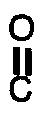
zum Erhalt von Verbindungen der Formel Ia mit RI = COOR¹² oder mit Alkylhalogeniden der Formel
R¹³-Y (VI)
zum Erhalt von Verbindungen der Formel Ia mit RI = R¹³
wobei
R¹¹, R¹² und R¹³ die oben angegebene Bedeutung haben und
Y für Chlor, Brom oder Iod, vorzugsweise für Brom oder Iod steht,
gegebenenfalls in Gegenwart eines Säureakzeptors wie z.B. Triethylamin oder Kaliumcarbonat oder einer Base wie Natriumhydrid, gegebenenfalls unter Verwendung eines organischen Verdünnungsmittels, wie z.B. Toluol, Tetrahydrofuran oder Acetonitril vorzugsweise bei Temperaturen zwischen 0 und 110° C umsetzt.The acylated α, ω-amino alcohol derivatives of the formula are obtained
R I stands for hydrogen, COR¹¹, COOR¹², R¹³, where R¹¹, R¹² and R¹³ are the same or different and represent optionally substituted alkyl or alkenyl radicals
and
R II represents C₂-C₆-alkyl or C₃-C₆-alkenyl,
if you have the α, ω-amino alcohol of the formula
R II -
where R II has the meaning given above,
optionally in the presence of an acid acceptor such as triethylamine or potassium carbonate and optionally using an organic diluent such as toluene, methylene chloride, tetrahydrofuran or acetonitrile at temperatures between -40 and 110 ° C, the compounds of the formula
R¹¹COCl (IV)
to obtain compounds of formula Ia with R I = COR¹¹ or with chlorocarbonic acid esters of the formula
Cl-
to obtain compounds of the formula Ia with R I = COOR¹² or with alkyl halides of the formula
R¹³-Y (VI)
to obtain compounds of formula Ia with R I = R¹³
in which
R¹¹, R¹² and R¹³ have the meaning given above and
Y represents chlorine, bromine or iodine, preferably bromine or iodine,
if appropriate in the presence of an acid acceptor such as triethylamine or potassium carbonate or a base such as sodium hydride, optionally using an organic diluent such as toluene, tetrahydrofuran or acetonitrile, preferably at temperatures between 0 and 110 ° C.
Die Aufarbeitung der erfindungsgemäßen Verbindungen der Formel (Ia) geschieht in analoger Weise, wie weiter vorne, bei der Herstellung der Verbindungen der Formel (I) beschrieben.The compounds of the formula (Ia) according to the invention are worked up in an analogous manner to that described above in the preparation of the compounds of the formula (I).
Die Wirkung der Repellentien der allgemeinen Formel (I) hält lange an.The action of the repellents of the general formula (I) lasts for a long time.
Sie können daher mit gutem Erfolg zur Abwehr von schädlichen oder lästigen, saugenden und beißenden Insekten und Milben verwendet werden.They can therefore be used successfully to ward off harmful or troublesome, sucking and biting insects and mites.
Zu den saugenden Insekten gehören im wesentlichen die Stechmücken (z.B. Aedes-, Culex- und Anopheles-Arten), Schmetterlingsmücken (Phlebotomen), Gnitzen (Culicoides-Arten), Kriebelmücken (Simulium-Arten), Stechfliegen (z.B. Stomoxys calcitrans), Tsetse-Fliegen (Glossina-Arten), Bremsen (Tabanus-, Haematopota- und Chrysops-Arten), Stubenfliegen (z.B. Musca domestica und Fannia canicularis), Fleischfliegen (z.B. Sarcophaga carnaria), Myiasis erzeugende Fliegen (z.B. Lucilia cuprina, Chrysomyia chloropyga, Hypoderma bovis, Hypoderma lineatum, Dermatobia hominis, Oestrus ovis, Gasterophilus intestinalis, Cochliomyia hominovorax), Wanzen (z.B. Cimex lectularius, Rhodnius prolixus, Triatoma infestans), Läuse (z.B. Pediculus humanus, Haematopinus suis, Damalina oris), Lausfliegen (z.B. Melaphagus orinus), Flöhe (z.B. Pulex irritans, Cthenocephalides canis, Xenopsylla cheopis) und Sandflöhe (z.B. Dermatophilus penetrans).The sucking insects essentially include the mosquitoes (e.g. Aedes, Culex and Anopheles species), butterfly mosquitoes (phlebotomes), Gnats (Culicoides species), black mosquitoes (Simulium species), biting flies (e.g. Stomoxys calcitrans), Tsetse- Flies (Glossina species), brakes (Tabanus, Haematopota and Chrysops species), houseflies (e.g. Musca domestica and Fannia canicularis), meat flies (e.g. Sarcophaga carnaria), myiasis-producing flies (e.g. Lucilia cuprina, Chrysomyia chloropyga, Hypoderma bovis , Hypoderma lineatum, Dermatobia hominis, Oestrus ovis, Gasterophilus intestinalis, Cochliomyia hominovorax), bugs (e.g. Cimex lectularius, Rhodnius prolixus, Triatoma infestans), lice (e.g. Pediculus humanus, Haematopinus suis, Damalina oris), flyflies (e.g. Melaphagusin) (e.g. Melaphagusin) irritans, Cthenocephalides canis, Xenopsylla cheopis) and sand fleas (e.g. Dermatophilus penetrans).
Zu den beißenden Insekten gehören im wesentlichen Schaben (z.B. Blatella germanica, Periplaneta americana, Blatta orientalis, Supella supellectilium), Käfer (z.B. Sitophilus granarius, Tenebrio molitor, Dermestes lardarius, Stegobium paniceum, Anobium puntactum, Hylotrupes bajulus), Termiten (z.B. Reticulitermes lucifugus) und Ameisen (z.B. Lasius niger).Biting insects essentially include cockroaches (e.g. Blatella germanica, Periplaneta americana, Blatta orientalis, Supella supellectilium), beetles (e.g. Sitophilus granarius, Tenebrio molitor, Dermestes lardarius, Stegobium paniceum, Anobium puntactum, Hylotrupes bajucicusululitulitulite), termites ) and ants (e.g. Lasius niger).
Zu den Milben gehören Zecken (z.B. Ornithodorus moubata, Ixodes ricinus, Boophilus microplus, Amblyomma hebreum) und Milben in engerem Sinne (z.B. Sarcoptes scabiei, Dermanyssus gallinae).The mites include ticks (e.g. Ornithodorus moubata, Ixodes ricinus, Boophilus microplus, Amblyomma hebreum) and mites in the narrower sense (e.g. Sarcoptes scabiei, Dermanyssus gallinae).
Die erfindungsgemäßen Wirkstoffe, die unverdünnt oder vorzugsweise verdünnt eingesetzt werden können, lassen sich in die für Repellents üblichen Formulierungen überführen. Sie lassen sich in allen in der Kosmetik üblichen Darreichungsformen einsetzen, beispielsweise in Form von Lösungen, Emulsionen, Gelen, Salben, Pasten, Cremes, Pulvern, Stiften, Sprays oder Aerosolen aus Sprühdosen.The active compounds according to the invention, which can be used undiluted or preferably diluted, can be converted into the formulations customary for repellents. They can be used in all dosage forms customary in cosmetics, for example in the form of solutions, emulsions, gels, ointments, pastes, creams, powders, pens, sprays or aerosols from spray cans.
Für die Anwendung im nichtkosmetischen Bereich lassen sich die Wirkstoffe z.B. in Granulate, Ölsprühmittel oder Slow-Release-Formulierungen einarbeiten.For use in the non-cosmetic area, the active ingredients can e.g. work into granules, oil spray or slow-release formulations.
Die Zubereitungen werden in bekannter Weise durch Vermischen oder Verdünnen der erfindungsgemäßen Wirkstoffe mit Lösungsmitteln (z.B. Xylol, Chlorbenzole, Paraffine, Methanol, Ethanol, Isopropanol, Wasser), Trägerstoffe (z.B. Kaoline, Tonerden, Talkum, Kreide, hochdisperse Kieselsäure, Silikate), Emulgiermitteln (z.B. Polyoxyethylen-Fettsäure-Ester, Polyoxyethylen-Fettalkohol-Ether, Alkylsulfonate, Arylsulfonate) und Dispergiermitteln (z.B. Lignin-Sulfitablaugen, Methylcellulose) hergestellt.The preparations are prepared in a known manner by mixing or diluting the active compounds according to the invention with solvents (for example xylene, chlorobenzenes, paraffins, methanol, ethanol, isopropanol, water), carriers (for example kaolins, clays, talc, chalk, highly disperse silica, silicates), emulsifiers (e.g. polyoxyethylene fatty acid esters, polyoxyethylene fatty alcohol ethers, alkyl sulfonates, aryl sulfonates) and dispersants (e.g. lignin sulfite liquor, methyl cellulose).
Die erfindungsgemäßen Wirkstoffe können in den Formulierungen miteinander gemischt oder auch in Mischungen mit anderen bekannten Wirkstoffen (z.B. Sonnenschutzmittel) eingesetzt werden. Die Zubereitungen enthalten im allgemeinen zwischen 0,1 und 95 Gew.-% Wirkstoff, vorzugsweise zwischen 0,5 und 90 %.The active compounds according to the invention can be mixed with one another in the formulations or can also be used in mixtures with other known active compounds (e.g. sunscreens). The preparations generally contain between 0.1 and 95% by weight of active compound, preferably between 0.5 and 90%.
Zum Schutz gegen blutsaugende Insekten oder Milben werden die erfindungsgemäßen Wirkstoffe entweder auf die menschliche oder tierische Haut aufgebracht oder Kleidungsstücke und andere Gegenstände damit behandelt.To protect against blood-sucking insects or mites, the active compounds according to the invention are either applied to human or animal skin or are used to treat articles of clothing and other objects.
Auch als Zusatz von Imprägniermitteln für beispielsweise Textilbahnen, Kleidungsstücke, Verpackungsmaterialien, sowie als Zusatz zu Polier-, Putz- und Fensterreinigungsmitteln sind die erfindungsgemäßen Wirkstoffe geeignet.Also as an additive for impregnating agents for e.g. textile webs, clothing, packaging materials, and as an additive to polishing, cleaning and window cleaning agents, the active compounds according to the invention are suitable.
Die folgenden Beispiele für die Zubereitungen und die Verwendung der erfindungsgemäßen Wirkstoffe dienen der weiteren Erläuterung der Erfindung.The following examples of the preparations and the use of the active compounds according to the invention serve to explain the invention further.
Ein Repellentmittel in Form einer Lotion zur Anwendung auf der Haut wird hergestellt durch Vermischen von 30 Teilen eines der erfindungsgemäßen Wirkstoffe, 1,5 Teilen Parfüm und 68,5 Teilen Isopropanol. Isopropanol kann durch Ethanol ersetzt werden.A repellent in the form of a lotion for use on the skin is produced by mixing 30 parts of one of the active ingredients according to the invention, 1.5 parts of perfume and 68.5 parts of isopropanol. Isopropanol can be replaced by ethanol.
Ein Repellentmittel in Form eines Aerosols zum Aufsprühen auf die Haut wird hergestellt, indem man 50 % Wirkstofflösung, bestehend aus 30 Teilen eines der erfindungsgemäßen Wirkstoffe, 1,5 Teilen Parfüm, 68,5 Teilen Isopropanol, mit 50 % Frigen 11/12 (= halogenierter Kohlenwasserstoff als Treibgas) als Sprühdosenpräparation formuliert.A repellant in the form of an aerosol for spraying on the skin is produced by adding 50% active ingredient solution, consisting of 30 parts of one of the active ingredients according to the invention, 1.5 parts of perfume, 68.5 parts of isopropanol, with 50% Frigen 11/12 halogenated hydrocarbon as a propellant gas) formulated as a spray can preparation.
Eine andere Sprühdose setzt sich aus 40% Wirkstofflösung, bestehend aus 20 Teilen eines der erfindungsgemäßen Wirkstoffe, 1 Teil Parfüm, 79 Teilen Isopropanol und 60 % Propan/Butan (Verhältnis 15:85) zusammen.Another spray can is composed of 40% active ingredient solution, consisting of 20 parts of one of the active ingredients according to the invention, 1 part perfume, 79 parts isopropanol and 60% propane / butane (ratio 15:85).
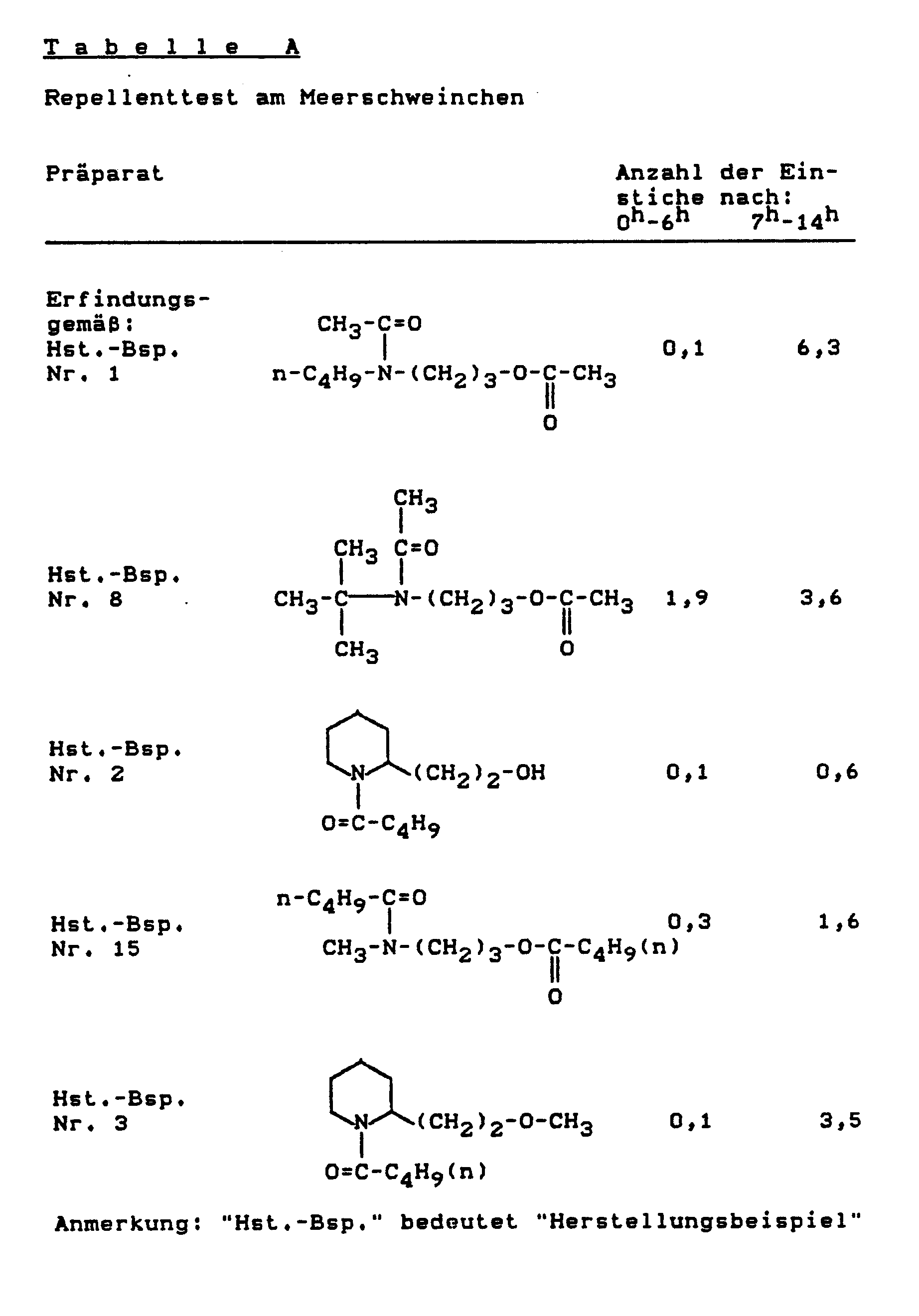
Es wurden individuelle Formulierungen entsprechend den Beispielen 1, 2 und 3 unter Einsatz folgender Wirkstoffe hergestellt: Verbindungen gemäß Herstellungsbeispielen Nr. 1, 2, 3, 8, 15.Individual formulations corresponding to Examples 1, 2 and 3 were prepared using the following active ingredients: compounds according to Preparation Examples Nos. 1, 2, 3, 8, 15.
Die folgenden Beispiele der biologischen Wirkung zeigen die Überlegenheit der erfindungsgemäßen Substanzen gegenüber dem Stand der Technik (Diethyltoluamid = DEET):
The following examples of the biological action show the superiority of the substances according to the invention over the prior art (diethyltoluamide = DEET):
Testtier: Aedes aegypti (Imagines)
Zahl der Testtiere: ca. 5000
Lösungsmittel: Ethanol (99,8 %)
3 Gewichtsteile Wirkstoff werden in 100 Volumenteilen Lösungsmittel aufgenommen.
Test animal: Aedes aegypti (imagines)
Number of test animals: approx. 5000
Solvent: ethanol (99.8%)
3 parts by weight of active ingredient are taken up in 100 parts by volume of solvent.
Ein Meerschweinchen, dessen Rücken in einem Bereich von 50 cm² rasiert worden ist, wird in einem engen Käfig (Box) so fixiert, daß nur die rasierte Fläche den Mücken zugänglich ist. Nach Behandeln der Fläche mit 0,4 ml Wirkstofflösung wird das Meerschweinchen nach Verdunsten des Lösungsmittels samt Box in einen 60x60x60 cm messenden Käfig gestellt, der nur mit Zuckerwasser gefütterte Testtiere beiderlei Geschlechts enthält.A guinea pig, whose back has been shaved in an area of 50 cm², is fixed in a narrow cage (box) so that only the shaved area is accessible to the mosquitoes. After treating the surface with 0.4 ml of active ingredient solution, the guinea pig, after the solvent has evaporated, is placed in a 60x60x60 cm cage containing the box, which contains only test animals of both sexes fed sugar water.
Es wird für 10 Minuten beobachtet, wieviele Mücken des Meerschweinchen stechen. Anschließend wird dieses herausgenommen und der Test nach einer Stunde wiederholt. Dr Versuch wird maximal 14 Stunden lang durchgeführt oder so lange, bis die Wirkung abbricht.It is observed for 10 minutes how many mosquitoes the guinea pig bites. It is then removed and the test repeated after one hour. The test is carried out for a maximum of 14 hours or until the effects cease.
Bei diesem Test zeigen z.B. die folgenden Verbindungen der Herstellungsbeispiele überlegene Wirkung gegenüber dem Stand der Technik (Diethyltoluamid = DEET): (1), (2), (3), (8), (15), (29).

Testtiere: Culex pipiens fatigans
Zahl der Testtiere: ca. 1000
Lösungsmittel: Ethanol (99,8 %)
3 Gewichtsteile Wirkstoff werden in 100 Volumenteilen Lösungsmittel aufgenommen.
Ein Meerschweinchen, dessen Rücken in einem Bereich von 50 cm² rasiert worden ist, wird in einem engen Käfig (Box) so fixiert, daß nur die rasierte Fläche den Mücken zugänglich ist. Nach Behandeln der Fläche mit 0,4 ml Wirkstofflösung wird das Meerschweinchen nach Verdunsten des Lösungsmittels samt Box in einem 60x60x60 cm messenden Käfig gestellt, der nur mit Zuckerwasser gefütterte Testtiere beiderlei Geschlechts enthält.
Test animals: Culex pipiens fatigans
Number of test animals: approx. 1000
Solvent: ethanol (99.8%)
3 parts by weight of active ingredient are taken up in 100 parts by volume of solvent.
A guinea pig, whose back has been shaved in an area of 50 cm², is fixed in a narrow cage (box) so that only the shaved area is accessible to the mosquitoes. After treating the surface with 0.4 ml of active ingredient solution, the guinea pig, after the solvent has evaporated, is placed in a 60x60x60 cm cage containing the test box, which contains only test animals of both sexes fed sugar water.
Es wird für 10 Minuten beobachtet, wieviele Mücken das Meerschweinchen stechen.It is observed for 10 minutes how many mosquitoes bite the guinea pig.
Anschließend wird dieses herausgenommen und der Test nach einer Stunde wiederholt. Der Versuch wird maximal 10 Stunden lang durchgeführt oder so lange, bis die Wirkung abbricht.It is then removed and the test repeated after one hour. The test is carried out for a maximum of 10 hours or until the effects cease.
Bei diesem Test zeigen z.B. die folgenden Verbindungen der Herstellungsbeispiele überlegene Wirkung gegenüber dem Stand der Technik (Diethyltoluamid = DEET): (3), (8), (15), (29).


40 g (0,3 Mol) N-Butyl-aminopropanol-1,3 und 100 ml Triethylamin (0,72 Mol) werden in 1 Liter Tetrahydrofuran gelöst und bei 20° C mit 50 ml Acetylchlorid (0,7 Mol) versetzt. Man erwärmt einen Tag unter Rückfluß und filtriert dann den Feststoff ab. Es wird Methylenchlorid zugegeben und die organische Phase mit Wasser gewaschen. Anschließend wird die organische Phase mit Magnesiumsulfat getrocknet, das Lösungsmittel am Rotationsverdampfer abdestilliert und im Kugelrohrofen (Kp0,6 135-140° C) destilliert. Zur weiteren Reinigung wird die Substanz über 1 kg Kieselgel (Laufmittel: Cyclohexan:Aceton = 7:3) chromatographiert.
Ausbeute: 52,1 g = 81 % der Theorie40 g (0.3 mol) of 1,3-N-butylaminopropanol and 100 ml of triethylamine (0.72 mol) are dissolved in 1 liter of tetrahydrofuran and 50 ml of acetyl chloride (0.7 mol) are added at 20 ° C. The mixture is heated under reflux for a day and then the solid is filtered off. Methylene chloride is added and the organic phase is washed with water. The organic phase is then dried with magnesium sulfate, the solvent is distilled off on a rotary evaporator and distilled in a bulb tube oven (bp 0.6 135-140 ° C.). For further purification, the substance is chromatographed over 1 kg of silica gel (mobile phase: cyclohexane: acetone = 7: 3).
Yield: 52.1 g = 81% of theory
65 g (0,5 Mol) 2-(2-Hydroxyethyl)-piperidin und 90 ml Triethylamin (0,64 Mol) werden in 1 Liter Tetrahydrofuran gelöst und bei -20° C mit 80 ml (0,67 Mol) Valeriansäurechlorid versetzt. Man erwärmt einen Tag auf 20° C und entfernt dann das Lösungsmittel weitgehend am Rotationsverdampfer; nimmt mit Methylenchlorid auf, wäscht mit 1N NaOH-Lösung, trocknet die organische Phase und entfernt das Lösungsmittel destallativ am Rotationsverdampfer. Um Verunreinigungen bis-acylierter Verbindung zu entfernen, wird in 200 ml Ethanol aufgenommen und eine Stunde bei 50° C mit 200 ml 1N Natronlauge erwärmt. Es wird erneut einrotiert, mit CH₂Cl₂/H₂O extrahiert, die organische Phase getrocknet, einrotiert und im Kugelrohrofen destilliert (Kp0,2 = 165° C).
Ausbeute: 65,4 = 61 % der Theorie.65 g (0.5 mol) of 2- (2-hydroxyethyl) piperidine and 90 ml of triethylamine (0.64 mol) are dissolved in 1 liter of tetrahydrofuran, and 80 ml (0.67 mol) of valeric acid chloride are added at -20 ° C. . The mixture is warmed to 20 ° C. for a day and then the solvent is largely removed on a rotary evaporator; takes up with methylene chloride, washed with 1N NaOH solution, dries the organic phase and removes the solvent by distillation Rotary evaporator. In order to remove impurities of bis-acylated compound, it is taken up in 200 ml of ethanol and heated for one hour at 50 ° C. with 200 ml of 1N sodium hydroxide solution. It is spun in again, extracted with CH₂Cl₂ / H₂O, the organic phase dried, spun in and distilled in a bulb tube furnace (bp 0.2 = 165 ° C).
Yield: 65.4 = 61% of theory.
32 g (0,15 Mol) 1-Pentanoyl-2-(2-hydroxyethyl)-piperidin werden in 300 ml Tetrahydrofuran gelöst und bei 20° C mit 5,9 g (0,197 Mol) Natriumhydrid (80 %ig in Paraffin) versetzt. Man erwärmt 4 Stunden unter Rückfluß und gibt dann 20 ml Methyliodid (0,32 Mol) zur Reaktionsmischung.32 g (0.15 mol) of 1-pentanoyl-2- (2-hydroxyethyl) piperidine are dissolved in 300 ml of tetrahydrofuran, and 5.9 g (0.197 mol) of sodium hydride (80% strength in paraffin) are added at 20 ° C. . The mixture is heated under reflux for 4 hours and then 20 ml of methyl iodide (0.32 mol) are added to the reaction mixture.
Anschließend wird 8 Stunden unter Rückfluß erwärmt, dann bei 20° C mit 100 ml Ammoniumchloridlösung versetzt, mit Methylenchlorid extrahiert, die organische Phase mit Magnesiumsulfat getrocknet und einrotiert. Nach chromatographischer Reinigung (Laufmittel CH₂Cl₂: i-C₃H₇OH = 1:1; Kieselgel) wird einrotiert und im Kugelrohrofen destilliert (Kp0,2: 160° C).
Ausbeute: 27,7 g = 81 % der Theorie.The mixture is then heated under reflux for 8 hours, then mixed with 100 ml of ammonium chloride solution at 20 ° C, extracted with methylene chloride, the organic phase dried with magnesium sulfate and evaporated. After chromatographic cleaning (eluent CH₂Cl₂: i-C₃H₇OH = 1: 1; silica gel), the mixture is rotated in and distilled in a bulb tube furnace (bp 0.2 : 160 ° C).
Yield: 27.7 g = 81% of theory.
In Analogie zu den vorgenannten Herstellungsbeispielen 1 bis 3 wurden die nachfolgend tabellarisch aufgeführten weiteren Herstellungsbeispiele synthetisiert.


Claims (8)

X für Wasserstoff, COR¹¹, COOR¹², R¹³ steht,
R¹ für gegebenenfalls substituierte Alkyl- oder Alkenylreste steht,
R²,R¹¹,R¹² und R¹³ gleich oder verschieden sind und für gegebenenfalls substituierte Alkyl- oder Alkenylreste stehen,
R³ bis R¹⁰ gleich oder verschieden sind und für Wasserstoff oder für gegebenenfalls substituierte Alkylreste stehen und wobei R² und R³ gemeinsam mit den Atomen, an welche sie gebunden sind auch einen gegebenenfalls substituierten monocyclischen Ring bilden können und
n und m gleich oder verschieden sind und 0 oder 1 bedeuten,
mit der Maßgabe, daß
X nicht für Wasserstoff oder R¹³ steht, wenn
n und m für 0 stehen.1. Insect and mite repellant, characterized by a content of at least one acylated α, ω-amino alcohol derivative of the formula (I)
X represents hydrogen, COR¹¹, COOR¹², R¹³,
R¹ represents optionally substituted alkyl or alkenyl radicals,
R², R¹¹, R¹² and R¹³ are the same or different and represent optionally substituted alkyl or alkenyl radicals,
R³ to R¹⁰ are the same or different and represent hydrogen or optionally substituted alkyl radicals and where R² and R³ together with the atoms to which they are bonded can also form an optionally substituted monocyclic ring and
n and m are the same or different and denote 0 or 1,
with the proviso that
X is not hydrogen or R¹³ if
n and m stand for 0.
dadurch gekennzeichnet, daß sie mindestens ein acyliertes α,ω-Aminoalkohol-Derivat der Formel (I) enthalten,
in welcher
X für Wasserstoff, COR¹¹ oder R¹³ steht,
R¹ für C₁-C₇-Alkyl oder C₃-C₇-Alkenyl steht,
R²,R¹¹,R¹³ gleich oder verschieden sind und für C₁-C₆-Alkyl stehen,
R³-R⁸ gleich oder verschieden sind und für Wasserstoff oder C₁-C₆-Alkyl stehen, wobei R² und R³ gemeinsam mit den Atomen, an welche sie gebunden sind, einen 5- oder 6-gliedrigen monocyclischen Ring bilden können und
n für 1 und
m für 0 steht.2. insect and mite repellent according to claim 1,
characterized in that they contain at least one acylated α, ω-amino alcohol derivative of the formula (I),
in which
X represents hydrogen, COR¹¹ or R¹³,
R¹ represents C₁-C₇-alkyl or C₃-C₇-alkenyl,
R², R¹¹, R¹³ are the same or different and are C₁-C₆-alkyl,
R³-R⁸ are the same or different and represent hydrogen or C₁-C₆-alkyl, where R² and R³ together with the atoms to which they are attached can form a 5- or 6-membered monocyclic ring and
n for 1 and
m stands for 0.

RI für Wasserstoff, COR¹¹, COOR¹², R¹³ steht, wobei R¹¹, R¹² und R¹³ gleich oder verschieden sind und für gegebenenfalls substituierte Alkyl- oder Alkenylreste stehen
und
RII für C₂-C₆-Alkyl oder für C₃-C₆-Alkenyl steht.6. Acylated α, ω-amino alcohol derivatives of the formula
R I stands for hydrogen, COR¹¹, COOR¹², R¹³, where R¹¹, R¹² and R¹³ are the same or different and represent optionally substituted alkyl or alkenyl radicals
and
R II is C₂-C₆-alkyl or C₃-C₆-alkenyl.
RI für Wasserstoff oder den Rest R¹³ steht, wobei R¹³ für gegebenenfalls substituiertes Alkyl orderAlkenyl steht und
RII C₂-C₆-Alkyl oder C₃-C₆-Alkenyl bedeutet.7. acylated α, ω-amino alcohol derivatives of the formula (Ia) according to claim 6, characterized in that
R I stands for hydrogen or the radical R¹³, where R¹³ stands for optionally substituted alkyl or alkenyl and
R II means C₂-C₆-alkyl or C₃-C₆-alkenyl.

RI für Wasserstoff, COR¹¹, COOR¹², R¹³ steht, wobei R¹¹, R¹² und R¹³ gleich oder verschieden sind und für gegebenenfalls substituierte Alkyl- oder Alkenylreste stehen
und
RII für C₂-C₆-Alkyl oder für C₃-C₆-Alkenyl steht,
dadurch gekennzeichnet, daß man den α,ω-Aminoalkohol der Formel

RII-

wobei RII die oben angegebene Bedeutung besitzt,
gegebenenfalls in Gegenwart eines Säureakzeptors und gegebenenfalls unter Verwendung eines organischen Verdünnungsmittels bei Temperaturen zwischen -40 und 110° C umsetzt, die Verbindungen der Formel

RI für COR¹¹ steht, mit einem Carbonsäurechlorid der Formel R¹¹ COCl (IV) worin R¹¹ die obengenannte Bedeutung hat, umsetzt
oder zum Erhalt von Verbindungen der Formel (Ia), in welcher RI für COOR¹² steht, weiter mit Chlorkohlensäureestern der Formel
Cl-

in welcher
R¹² die obengenannte Bedeutung hat, umsetzt
oder zum Erhalt von Verbindungen der Formel (Ia), in welcher
RI für R¹³ steht,
weiter mit Alkylhalogeniden der Formel
R¹³-Y (VI)
worin
R¹³ die oben angegebene Bedeutung besitzt und Y für Chlor, Brom oder Iod steht,
gegebenenfalls in Gegenwart eines Säureakzeptors oder einer Base und gegebenenfalls unter Verwendung eines organischen Lösungsmittels umsetzt.8. Process for the preparation of acylated α, ω-amino alcohol derivatives of the formula
R I stands for hydrogen, COR¹¹, COOR¹², R¹³, where R¹¹, R¹² and R¹³ are the same or different and represent optionally substituted alkyl or alkenyl radicals
and
R II represents C₂-C₆-alkyl or C₃-C₆-alkenyl,
characterized in that the α, ω-amino alcohol of the formula
R II -
where R II has the meaning given above,
optionally in the presence of an acid acceptor and optionally using an organic diluent at temperatures between -40 and 110 ° C, the compounds of the formula
R I stands for COR¹¹, with a carboxylic acid chloride of the formula R¹¹ COCl (IV) wherein R¹¹ has the meaning given above
or to obtain compounds of the formula (Ia) in which R I is COOR 12, further with chlorocarbonic acid esters of the formula
Cl-
in which
R¹² has the meaning given above
or to obtain compounds of the formula (Ia) in which
R I represents R¹³,
continue with alkyl halides of the formula
R¹³-Y (VI)
wherein
R¹³ has the meaning given above and Y represents chlorine, bromine or iodine,
if appropriate in the presence of an acid acceptor or a base and if appropriate using an organic solvent.
Priority Applications (1)
| Application Number | Priority Date | Filing Date | Title |
|---|---|---|---|
| AT88103119T ATE62788T1 (en) | 1987-03-12 | 1988-03-02 | INSECT AND MITE REPELLENT. |
Applications Claiming Priority (2)
| Application Number | Priority Date | Filing Date | Title |
|---|---|---|---|
| DE3708033 | 1987-03-12 | ||
| DE19873708033 DE3708033A1 (en) | 1987-03-12 | 1987-03-12 | AGENT FOR INSECT AND MITE REVENTION |
Publications (2)
| Publication Number | Publication Date |
|---|---|
| EP0281908A1 true EP0281908A1 (en) | 1988-09-14 |
| EP0281908B1 EP0281908B1 (en) | 1991-04-24 |
Family
ID=6322914
Family Applications (1)
| Application Number | Title | Priority Date | Filing Date |
|---|---|---|---|
| EP88103119A Expired - Lifetime EP0281908B1 (en) | 1987-03-12 | 1988-03-02 | Insect and mite repellents |
Country Status (25)
| Country | Link |
|---|---|
| US (2) | US4873252A (en) |
| EP (1) | EP0281908B1 (en) |
| JP (1) | JP2637758B2 (en) |
| KR (1) | KR950012166B1 (en) |
| AR (1) | AR248067A1 (en) |
| AT (1) | ATE62788T1 (en) |
| AU (1) | AU608578B2 (en) |
| BR (1) | BR8801110A (en) |
| CA (1) | CA1327041C (en) |
| DD (1) | DD267901A5 (en) |
| DE (2) | DE3708033A1 (en) |
| DK (1) | DK134888A (en) |
| EG (1) | EG18840A (en) |
| ES (1) | ES2021772B3 (en) |
| FI (1) | FI89323C (en) |
| GR (1) | GR3001856T3 (en) |
| HU (2) | HU203965B (en) |
| IL (1) | IL85686A (en) |
| MX (1) | MX168469B (en) |
| NO (1) | NO172093C (en) |
| NZ (1) | NZ223804A (en) |
| PH (1) | PH26328A (en) |
| PT (1) | PT86877B (en) |
| TR (1) | TR25479A (en) |
| ZA (1) | ZA881747B (en) |
Cited By (4)
| Publication number | Priority date | Publication date | Assignee | Title |
|---|---|---|---|---|
| WO1999065311A1 (en) * | 1998-06-18 | 1999-12-23 | Novartis Ag | Composition for keeping away vermin |
| WO1999065308A1 (en) * | 1998-06-18 | 1999-12-23 | Novartis Ag | Composition for keeping away vermin |
| US6569356B1 (en) | 1998-07-08 | 2003-05-27 | Rolic Ag | Chiral compounds and their use as doping agents in liquid crystals |
| WO2008062006A1 (en) * | 2006-11-24 | 2008-05-29 | Novartis Ag | Composition for repelling and deterring vermin |
Families Citing this family (10)
| Publication number | Priority date | Publication date | Assignee | Title |
|---|---|---|---|---|
| DE3801082A1 (en) * | 1987-04-28 | 1988-11-17 | Bayer Ag | AGENT FOR INSECT AND MITE REVENTION |
| IL90007A0 (en) * | 1988-04-22 | 1989-12-15 | Revlon | N-alkoxy-alkylamido derivatives,methods for the preparation thereof and cosmetic preparations containing the same |
| DE3913939A1 (en) * | 1989-04-27 | 1991-01-17 | Bayer Ag | NEW CARBONAMIDE GROUPS CONTAINING (METH) ACRYLIC ACID ESTERS, ADHESIVE COMPONENTS FOR TREATING COLLAGENOUS MATERIALS, CONTAINING THESE COMPOUNDS, AND PREPARING THEREOF AND USEING THESE ADHESIVE COMPONENTS |
| CA2047389C (en) * | 1990-07-24 | 2002-04-23 | James R. Mccarthy | Substituted piperidines and their use as inhibitors of cholesterol synthesis |
| MX9303636A (en) * | 1992-08-07 | 1994-07-29 | Us Agriculture | COMPOSITION AND METHOD TO REPELLENT ANTS. |
| DE19618089A1 (en) * | 1996-05-06 | 1997-11-13 | Bayer Ag | Arthropod repellents |
| DE10032879A1 (en) * | 2000-07-06 | 2002-01-17 | Bayer Ag | Anthelmintics to prevent parasitic infections in humans and animals II |
| DE20115729U1 (en) | 2001-09-25 | 2001-12-20 | Stubna, Eduard, 80634 München | Detergent with repetitive chemical substances |
| BRPI0809416A2 (en) * | 2007-03-28 | 2014-09-16 | Contech Entpr Inc | COMPOUND WITH DETENTOEA ACTIVITY AND ARTROPOD REPELLENT STEPASITE FEEDING OF BLOOD, COMPOSITION, AND METHOD FOR SYNTHESIZING A COMPOUND |
| DE102010023586A1 (en) * | 2010-06-12 | 2011-12-15 | Saltigo Gmbh | Synergistic mixtures of α, ω-Aminalkohol enantiomers, their preparation and their use in insect and mite repellent preparations |
Citations (5)
| Publication number | Priority date | Publication date | Assignee | Title |
|---|---|---|---|---|
| US3178439A (en) * | 1963-05-06 | 1965-04-13 | Reilly Tar & Chem Corp | N-alkanoyl and alkenoyl hydroxy alkyl piperidides |
| US4298612A (en) * | 1979-02-02 | 1981-11-03 | The United States Of America As Represented By The Secretary Of Agriculture | Insect repellents |
| GB1604855A (en) * | 1977-05-31 | 1981-12-16 | Stafford Miller Ltd | Use of alkanol amides as toxicants |
| DE3106877A1 (en) * | 1980-02-28 | 1982-02-25 | National Research Development Corp., London | BIOCID AGENTS IN THE FORM OF HETEROCYCLIC COMPOUNDS AND METHOD FOR THE PRODUCTION THEREOF |
| CH646581A5 (en) * | 1979-02-15 | 1984-12-14 | Block Drug Co | AGENT FOR INKNESSING INSECTS, THEIR LARVES AND EGGS, AND MITES. |
-
1987
- 1987-03-12 DE DE19873708033 patent/DE3708033A1/en not_active Withdrawn
-
1988
- 1988-03-02 DE DE8888103119T patent/DE3862490D1/en not_active Expired - Lifetime
- 1988-03-02 PT PT86877A patent/PT86877B/en not_active IP Right Cessation
- 1988-03-02 EP EP88103119A patent/EP0281908B1/en not_active Expired - Lifetime
- 1988-03-02 ES ES88103119T patent/ES2021772B3/en not_active Expired - Lifetime
- 1988-03-02 AT AT88103119T patent/ATE62788T1/en active
- 1988-03-03 MX MX010627A patent/MX168469B/en unknown
- 1988-03-07 JP JP63051802A patent/JP2637758B2/en not_active Expired - Fee Related
- 1988-03-08 EG EG12888A patent/EG18840A/en active
- 1988-03-09 US US07/165,684 patent/US4873252A/en not_active Expired - Lifetime
- 1988-03-09 TR TR88/0177A patent/TR25479A/en unknown
- 1988-03-09 NZ NZ223804A patent/NZ223804A/en unknown
- 1988-03-10 CA CA000561038A patent/CA1327041C/en not_active Expired - Fee Related
- 1988-03-10 DD DD88313565A patent/DD267901A5/en not_active IP Right Cessation
- 1988-03-10 FI FI881126A patent/FI89323C/en not_active IP Right Cessation
- 1988-03-10 IL IL85686A patent/IL85686A/en not_active IP Right Cessation
- 1988-03-11 NO NO881109A patent/NO172093C/en unknown
- 1988-03-11 AU AU13054/88A patent/AU608578B2/en not_active Ceased
- 1988-03-11 KR KR1019880002513A patent/KR950012166B1/en not_active Expired - Fee Related
- 1988-03-11 PH PH36624A patent/PH26328A/en unknown
- 1988-03-11 BR BR8801110A patent/BR8801110A/en not_active IP Right Cessation
- 1988-03-11 DK DK134888A patent/DK134888A/en not_active Application Discontinuation
- 1988-03-11 HU HU881186A patent/HU203965B/en unknown
- 1988-03-11 ZA ZA881747A patent/ZA881747B/en unknown
- 1988-03-11 HU HU911811A patent/HU206036B/en not_active IP Right Cessation
- 1988-03-11 AR AR88310289A patent/AR248067A1/en active
-
1989
- 1989-06-28 US US07/372,801 patent/US4946850A/en not_active Expired - Lifetime
-
1991
- 1991-04-25 GR GR91400459T patent/GR3001856T3/en unknown
Patent Citations (5)
| Publication number | Priority date | Publication date | Assignee | Title |
|---|---|---|---|---|
| US3178439A (en) * | 1963-05-06 | 1965-04-13 | Reilly Tar & Chem Corp | N-alkanoyl and alkenoyl hydroxy alkyl piperidides |
| GB1604855A (en) * | 1977-05-31 | 1981-12-16 | Stafford Miller Ltd | Use of alkanol amides as toxicants |
| US4298612A (en) * | 1979-02-02 | 1981-11-03 | The United States Of America As Represented By The Secretary Of Agriculture | Insect repellents |
| CH646581A5 (en) * | 1979-02-15 | 1984-12-14 | Block Drug Co | AGENT FOR INKNESSING INSECTS, THEIR LARVES AND EGGS, AND MITES. |
| DE3106877A1 (en) * | 1980-02-28 | 1982-02-25 | National Research Development Corp., London | BIOCID AGENTS IN THE FORM OF HETEROCYCLIC COMPOUNDS AND METHOD FOR THE PRODUCTION THEREOF |
Non-Patent Citations (1)
| Title |
|---|
| CHEMICAL ABSTRACTS, Band 83, Nr. 25, 22. Dezember 1975, Columbus, Ohio, USA K. MIZUNO "Polyhydroxy Amides" seite 350, spalte 2, Zusammenfassung-Nr. 205 791u & JP-A-50 106 920 * |
Cited By (9)
| Publication number | Priority date | Publication date | Assignee | Title |
|---|---|---|---|---|
| WO1999065311A1 (en) * | 1998-06-18 | 1999-12-23 | Novartis Ag | Composition for keeping away vermin |
| WO1999065308A1 (en) * | 1998-06-18 | 1999-12-23 | Novartis Ag | Composition for keeping away vermin |
| AU750802B2 (en) * | 1998-06-18 | 2002-07-25 | Novartis Ag | Composition for keeping away vermin |
| US6458826B2 (en) | 1998-06-18 | 2002-10-01 | Navartis Animal Health Us, Inc. | Composition for repelling and deterring pests |
| US6780876B2 (en) | 1998-06-18 | 2004-08-24 | Novartis Animal Health Us, Inc. | Composition for keeping away vermin |
| US6569356B1 (en) | 1998-07-08 | 2003-05-27 | Rolic Ag | Chiral compounds and their use as doping agents in liquid crystals |
| WO2008062006A1 (en) * | 2006-11-24 | 2008-05-29 | Novartis Ag | Composition for repelling and deterring vermin |
| US8338490B2 (en) | 2006-11-24 | 2012-12-25 | Novartis Ag | Composition for repelling and deterring vermin |
| US8940782B2 (en) | 2006-11-24 | 2015-01-27 | Novartis Ag | Composition for repelling and deterring vermin |
Also Published As
Similar Documents
| Publication | Publication Date | Title |
|---|---|---|
| EP0289842B1 (en) | Remedy against insects and mites | |
| EP0467045B1 (en) | Morpholino urea derivatives | |
| EP0281908B1 (en) | Insect and mite repellents | |
| EP0346709B1 (en) | Use of acylate -aminoacidester derivates as insect and mite repellent | |
| EP0912092B1 (en) | Arthropod repellant | |
| DE1542785A1 (en) | Insect and mite repellants | |
| EP2086327A1 (en) | Enantiomer-enriched alpha-,omega amino alcohol derivatives, their production and use as insect- and mite-repelling agents | |
| DE1518805A1 (en) | Insect and mite repellants | |
| FI90765B (en) | Acylated &alpha, &omega -aminoalcohol derivatives and process for the preparation thereof | |
| EP2394511B1 (en) | Synergistic mixtures of alpha, omega-amino alcohol enantiomers, their production and use of in preparations for combating insects and mites | |
| DE19917948A1 (en) | Arthropodicidal mixture of polyorganosiloxane, hydrogen peroxide and organic solvent, useful for controlling mites or ticks, e.g. house dust mites and ectoparasites | |
| DD281340A5 (en) | MEANS OF INSECT AND MILFEN DEFENSE | |
| DE1542784A1 (en) | Insect and mite repellants |
Legal Events
| Date | Code | Title | Description |
|---|---|---|---|
| PUAI | Public reference made under article 153(3) epc to a published international application that has entered the european phase |
Free format text: ORIGINAL CODE: 0009012 |
|
| 17P | Request for examination filed |
Effective date: 19880302 |
|
| AK | Designated contracting states |
Kind code of ref document: A1 Designated state(s): AT BE CH DE ES FR GB GR IT LI LU NL SE |
|
| 17Q | First examination report despatched |
Effective date: 19890824 |
|
| GRAA | (expected) grant |
Free format text: ORIGINAL CODE: 0009210 |
|
| AK | Designated contracting states |
Kind code of ref document: B1 Designated state(s): AT BE CH DE ES FR GB GR IT LI LU NL SE |
|
| REF | Corresponds to: |
Ref document number: 62788 Country of ref document: AT Date of ref document: 19910515 Kind code of ref document: T |
|
| ITF | It: translation for a ep patent filed | ||
| GBT | Gb: translation of ep patent filed (gb section 77(6)(a)/1977) | ||
| REF | Corresponds to: |
Ref document number: 3862490 Country of ref document: DE Date of ref document: 19910529 |
|
| ET | Fr: translation filed | ||
| PLBE | No opposition filed within time limit |
Free format text: ORIGINAL CODE: 0009261 |
|
| STAA | Information on the status of an ep patent application or granted ep patent |
Free format text: STATUS: NO OPPOSITION FILED WITHIN TIME LIMIT |
|
| 26N | No opposition filed | ||
| REG | Reference to a national code |
Ref country code: GR Ref legal event code: FG4A Free format text: 3001856 |
|
| EPTA | Lu: last paid annual fee | ||
| EAL | Se: european patent in force in sweden |
Ref document number: 88103119.9 |
|
| PGFP | Annual fee paid to national office [announced via postgrant information from national office to epo] |
Ref country code: LU Payment date: 19960401 Year of fee payment: 9 |
|
| PG25 | Lapsed in a contracting state [announced via postgrant information from national office to epo] |
Ref country code: LU Free format text: LAPSE BECAUSE OF NON-PAYMENT OF DUE FEES Effective date: 19970302 |
|
| PGFP | Annual fee paid to national office [announced via postgrant information from national office to epo] |
Ref country code: SE Payment date: 19990225 Year of fee payment: 12 |
|
| PGFP | Annual fee paid to national office [announced via postgrant information from national office to epo] |
Ref country code: AT Payment date: 19990309 Year of fee payment: 12 |
|
| PG25 | Lapsed in a contracting state [announced via postgrant information from national office to epo] |
Ref country code: AT Free format text: LAPSE BECAUSE OF NON-PAYMENT OF DUE FEES Effective date: 20000302 |
|
| PG25 | Lapsed in a contracting state [announced via postgrant information from national office to epo] |
Ref country code: SE Free format text: LAPSE BECAUSE OF NON-PAYMENT OF DUE FEES Effective date: 20000303 |
|
| EUG | Se: european patent has lapsed |
Ref document number: 88103119.9 |
|
| REG | Reference to a national code |
Ref country code: GB Ref legal event code: IF02 |
|
| REG | Reference to a national code |
Ref country code: GB Ref legal event code: 732E |
|
| PGFP | Annual fee paid to national office [announced via postgrant information from national office to epo] |
Ref country code: CH Payment date: 20060301 Year of fee payment: 19 Ref country code: GB Payment date: 20060301 Year of fee payment: 19 |
|
| PGFP | Annual fee paid to national office [announced via postgrant information from national office to epo] |
Ref country code: NL Payment date: 20060305 Year of fee payment: 19 |
|
| PGFP | Annual fee paid to national office [announced via postgrant information from national office to epo] |
Ref country code: FR Payment date: 20060308 Year of fee payment: 19 |
|
| PGFP | Annual fee paid to national office [announced via postgrant information from national office to epo] |
Ref country code: IT Payment date: 20060331 Year of fee payment: 19 |
|
| PGFP | Annual fee paid to national office [announced via postgrant information from national office to epo] |
Ref country code: ES Payment date: 20060425 Year of fee payment: 19 |
|
| PGFP | Annual fee paid to national office [announced via postgrant information from national office to epo] |
Ref country code: DE Payment date: 20070222 Year of fee payment: 20 |
|
| NLS | Nl: assignments of ep-patents |
Owner name: LANXESS DEUTSCHLAND GMBH Effective date: 20070305 |
|
| PGFP | Annual fee paid to national office [announced via postgrant information from national office to epo] |
Ref country code: BE Payment date: 20070514 Year of fee payment: 20 |
|
| REG | Reference to a national code |
Ref country code: CH Ref legal event code: PFA Owner name: BAYER AKTIENGESELLSCHAFT Free format text: BAYER AKTIENGESELLSCHAFT# #D-51368 LEVERKUSEN (DE) -TRANSFER TO- BAYER AKTIENGESELLSCHAFT# #D-51368 LEVERKUSEN (DE) |
|
| REG | Reference to a national code |
Ref country code: CH Ref legal event code: PUE Owner name: LANXESS DEUTSCHLAND GMBH Free format text: BAYER AKTIENGESELLSCHAFT# #D-51368 LEVERKUSEN (DE) -TRANSFER TO- LANXESS DEUTSCHLAND GMBH# #51369 LEVERKUSEN (DE) |
|
| REG | Reference to a national code |
Ref country code: CH Ref legal event code: PL |
|
| GBPC | Gb: european patent ceased through non-payment of renewal fee |
Effective date: 20070302 |
|
| NLV4 | Nl: lapsed or anulled due to non-payment of the annual fee |
Effective date: 20071001 |
|
| REG | Reference to a national code |
Ref country code: FR Ref legal event code: ST Effective date: 20071130 |
|
| PG25 | Lapsed in a contracting state [announced via postgrant information from national office to epo] |
Ref country code: NL Free format text: LAPSE BECAUSE OF NON-PAYMENT OF DUE FEES Effective date: 20071001 |
|
| PG25 | Lapsed in a contracting state [announced via postgrant information from national office to epo] |
Ref country code: CH Free format text: LAPSE BECAUSE OF NON-PAYMENT OF DUE FEES Effective date: 20070331 Ref country code: LI Free format text: LAPSE BECAUSE OF NON-PAYMENT OF DUE FEES Effective date: 20070331 |
|
| BE20 | Be: patent expired |
Owner name: *LANXESS DEUTSCHLAND G.M.B.H. Effective date: 20080302 |
|
| PGFP | Annual fee paid to national office [announced via postgrant information from national office to epo] |
Ref country code: GR Payment date: 20070214 Year of fee payment: 20 |
|
| PG25 | Lapsed in a contracting state [announced via postgrant information from national office to epo] |
Ref country code: GB Free format text: LAPSE BECAUSE OF NON-PAYMENT OF DUE FEES Effective date: 20070302 |
|
| REG | Reference to a national code |
Ref country code: ES Ref legal event code: FD2A Effective date: 20070303 |
|
| PG25 | Lapsed in a contracting state [announced via postgrant information from national office to epo] |
Ref country code: FR Free format text: LAPSE BECAUSE OF NON-PAYMENT OF DUE FEES Effective date: 20070402 Ref country code: ES Free format text: LAPSE BECAUSE OF NON-PAYMENT OF DUE FEES Effective date: 20070303 |
|
| REG | Reference to a national code |
Ref country code: FR Ref legal event code: TP |
|
| PG25 | Lapsed in a contracting state [announced via postgrant information from national office to epo] |
Ref country code: IT Free format text: LAPSE BECAUSE OF NON-PAYMENT OF DUE FEES Effective date: 20070302 |