EP0275558B1 - Derivat der Perfluoralkenyloxybenzoesäure, sein Herstellungsverfahren und Prepolymer dieses Derivates - Google Patents
Derivat der Perfluoralkenyloxybenzoesäure, sein Herstellungsverfahren und Prepolymer dieses Derivates Download PDFInfo
- Publication number
- EP0275558B1 EP0275558B1 EP87119333A EP87119333A EP0275558B1 EP 0275558 B1 EP0275558 B1 EP 0275558B1 EP 87119333 A EP87119333 A EP 87119333A EP 87119333 A EP87119333 A EP 87119333A EP 0275558 B1 EP0275558 B1 EP 0275558B1
- Authority
- EP
- European Patent Office
- Prior art keywords
- prepolymer
- compound
- diallyl
- formula
- acid derivative
- Prior art date
- Legal status (The legal status is an assumption and is not a legal conclusion. Google has not performed a legal analysis and makes no representation as to the accuracy of the status listed.)
- Expired
Links
- 239000002253 acid Substances 0.000 title claims description 19
- 238000004519 manufacturing process Methods 0.000 title claims description 6
- -1 allyl hydroxybenzoate Chemical compound 0.000 claims description 21
- XXROGKLTLUQVRX-UHFFFAOYSA-N allyl alcohol Chemical compound OCC=C XXROGKLTLUQVRX-UHFFFAOYSA-N 0.000 claims description 16
- 239000004641 Diallyl-phthalate Substances 0.000 claims description 15
- 125000004432 carbon atom Chemical group C* 0.000 claims description 15
- ZDNFTNPFYCKVTB-UHFFFAOYSA-N bis(prop-2-enyl) benzene-1,4-dicarboxylate Chemical compound C=CCOC(=O)C1=CC=C(C(=O)OCC=C)C=C1 ZDNFTNPFYCKVTB-UHFFFAOYSA-N 0.000 claims description 14
- QUDWYFHPNIMBFC-UHFFFAOYSA-N bis(prop-2-enyl) benzene-1,2-dicarboxylate Chemical compound C=CCOC(=O)C1=CC=CC=C1C(=O)OCC=C QUDWYFHPNIMBFC-UHFFFAOYSA-N 0.000 claims description 13
- 238000003776 cleavage reaction Methods 0.000 claims description 11
- 230000007017 scission Effects 0.000 claims description 11
- ROLAGNYPWIVYTG-UHFFFAOYSA-N 1,2-bis(4-methoxyphenyl)ethanamine;hydrochloride Chemical compound Cl.C1=CC(OC)=CC=C1CC(N)C1=CC=C(OC)C=C1 ROLAGNYPWIVYTG-UHFFFAOYSA-N 0.000 claims description 8
- YXFVVABEGXRONW-UHFFFAOYSA-N Toluene Chemical compound CC1=CC=CC=C1 YXFVVABEGXRONW-UHFFFAOYSA-N 0.000 description 42
- 150000001875 compounds Chemical class 0.000 description 36
- 239000000203 mixture Substances 0.000 description 23
- 238000006243 chemical reaction Methods 0.000 description 17
- XLYOFNOQVPJJNP-UHFFFAOYSA-N water Substances O XLYOFNOQVPJJNP-UHFFFAOYSA-N 0.000 description 17
- 239000000047 product Substances 0.000 description 15
- 229920000642 polymer Polymers 0.000 description 14
- 239000002904 solvent Substances 0.000 description 14
- 239000003999 initiator Substances 0.000 description 13
- ZCYVEMRRCGMTRW-UHFFFAOYSA-N 7553-56-2 Chemical compound [I] ZCYVEMRRCGMTRW-UHFFFAOYSA-N 0.000 description 12
- UHOVQNZJYSORNB-UHFFFAOYSA-N Benzene Chemical compound C1=CC=CC=C1 UHOVQNZJYSORNB-UHFFFAOYSA-N 0.000 description 12
- ZMANZCXQSJIPKH-UHFFFAOYSA-N Triethylamine Chemical compound CCN(CC)CC ZMANZCXQSJIPKH-UHFFFAOYSA-N 0.000 description 12
- 229910052740 iodine Inorganic materials 0.000 description 12
- 239000011630 iodine Substances 0.000 description 12
- 239000000843 powder Substances 0.000 description 12
- 238000006116 polymerization reaction Methods 0.000 description 10
- 125000003903 2-propenyl group Chemical group [H]C([*])([H])C([H])=C([H])[H] 0.000 description 9
- OKKJLVBELUTLKV-UHFFFAOYSA-N Methanol Chemical compound OC OKKJLVBELUTLKV-UHFFFAOYSA-N 0.000 description 9
- 239000004342 Benzoyl peroxide Substances 0.000 description 8
- OMPJBNCRMGITSC-UHFFFAOYSA-N Benzoylperoxide Chemical compound C=1C=CC=CC=1C(=O)OOC(=O)C1=CC=CC=C1 OMPJBNCRMGITSC-UHFFFAOYSA-N 0.000 description 8
- 235000019400 benzoyl peroxide Nutrition 0.000 description 8
- RTZKZFJDLAIYFH-UHFFFAOYSA-N ether Substances CCOCC RTZKZFJDLAIYFH-UHFFFAOYSA-N 0.000 description 8
- 229910052731 fluorine Inorganic materials 0.000 description 8
- FJKROLUGYXJWQN-UHFFFAOYSA-N 4-hydroxybenzoic acid Chemical compound OC(=O)C1=CC=C(O)C=C1 FJKROLUGYXJWQN-UHFFFAOYSA-N 0.000 description 7
- VEXZGXHMUGYJMC-UHFFFAOYSA-N Hydrochloric acid Chemical compound Cl VEXZGXHMUGYJMC-UHFFFAOYSA-N 0.000 description 7
- 239000007864 aqueous solution Substances 0.000 description 7
- 238000005266 casting Methods 0.000 description 7
- 239000000243 solution Substances 0.000 description 7
- YMWUJEATGCHHMB-UHFFFAOYSA-N Dichloromethane Chemical compound ClCCl YMWUJEATGCHHMB-UHFFFAOYSA-N 0.000 description 6
- ZMXDDKWLCZADIW-UHFFFAOYSA-N N,N-Dimethylformamide Chemical compound CN(C)C=O ZMXDDKWLCZADIW-UHFFFAOYSA-N 0.000 description 6
- FAPWRFPIFSIZLT-UHFFFAOYSA-M Sodium chloride Chemical compound [Na+].[Cl-] FAPWRFPIFSIZLT-UHFFFAOYSA-M 0.000 description 6
- QAOWNCQODCNURD-UHFFFAOYSA-N Sulfuric acid Chemical compound OS(O)(=O)=O QAOWNCQODCNURD-UHFFFAOYSA-N 0.000 description 6
- 238000000034 method Methods 0.000 description 6
- 239000000178 monomer Substances 0.000 description 6
- 229920005989 resin Polymers 0.000 description 6
- 239000011347 resin Substances 0.000 description 6
- CSCPPACGZOOCGX-UHFFFAOYSA-N Acetone Chemical compound CC(C)=O CSCPPACGZOOCGX-UHFFFAOYSA-N 0.000 description 5
- YCKRFDGAMUMZLT-UHFFFAOYSA-N Fluorine atom Chemical compound [F] YCKRFDGAMUMZLT-UHFFFAOYSA-N 0.000 description 5
- 239000011737 fluorine Substances 0.000 description 5
- 125000005010 perfluoroalkyl group Chemical group 0.000 description 5
- 239000002244 precipitate Substances 0.000 description 5
- NIXOWILDQLNWCW-UHFFFAOYSA-M Acrylate Chemical compound [O-]C(=O)C=C NIXOWILDQLNWCW-UHFFFAOYSA-M 0.000 description 4
- KAKZBPTYRLMSJV-UHFFFAOYSA-N Butadiene Chemical compound C=CC=C KAKZBPTYRLMSJV-UHFFFAOYSA-N 0.000 description 4
- HEDRZPFGACZZDS-UHFFFAOYSA-N Chloroform Chemical compound ClC(Cl)Cl HEDRZPFGACZZDS-UHFFFAOYSA-N 0.000 description 4
- 229940126062 Compound A Drugs 0.000 description 4
- NLDMNSXOCDLTTB-UHFFFAOYSA-N Heterophylliin A Natural products O1C2COC(=O)C3=CC(O)=C(O)C(O)=C3C3=C(O)C(O)=C(O)C=C3C(=O)OC2C(OC(=O)C=2C=C(O)C(O)=C(O)C=2)C(O)C1OC(=O)C1=CC(O)=C(O)C(O)=C1 NLDMNSXOCDLTTB-UHFFFAOYSA-N 0.000 description 4
- RRHGJUQNOFWUDK-UHFFFAOYSA-N Isoprene Chemical compound CC(=C)C=C RRHGJUQNOFWUDK-UHFFFAOYSA-N 0.000 description 4
- CDBYLPFSWZWCQE-UHFFFAOYSA-L Sodium Carbonate Chemical compound [Na+].[Na+].[O-]C([O-])=O CDBYLPFSWZWCQE-UHFFFAOYSA-L 0.000 description 4
- PPBRXRYQALVLMV-UHFFFAOYSA-N Styrene Chemical compound C=CC1=CC=CC=C1 PPBRXRYQALVLMV-UHFFFAOYSA-N 0.000 description 4
- PYGSKMBEVAICCR-UHFFFAOYSA-N hexa-1,5-diene Chemical group C=CCCC=C PYGSKMBEVAICCR-UHFFFAOYSA-N 0.000 description 4
- 238000010526 radical polymerization reaction Methods 0.000 description 4
- 239000011541 reaction mixture Substances 0.000 description 4
- 229920006395 saturated elastomer Polymers 0.000 description 4
- ZWEHNKRNPOVVGH-UHFFFAOYSA-N 2-Butanone Chemical compound CCC(C)=O ZWEHNKRNPOVVGH-UHFFFAOYSA-N 0.000 description 3
- 229940090248 4-hydroxybenzoic acid Drugs 0.000 description 3
- WEVYAHXRMPXWCK-UHFFFAOYSA-N Acetonitrile Chemical compound CC#N WEVYAHXRMPXWCK-UHFFFAOYSA-N 0.000 description 3
- 0 C*(c1ccc(*)cc1)=C Chemical compound C*(c1ccc(*)cc1)=C 0.000 description 3
- XEKOWRVHYACXOJ-UHFFFAOYSA-N Ethyl acetate Chemical compound CCOC(C)=O XEKOWRVHYACXOJ-UHFFFAOYSA-N 0.000 description 3
- UKLDJPRMSDWDSL-UHFFFAOYSA-L [dibutyl(dodecanoyloxy)stannyl] dodecanoate Chemical compound CCCCCCCCCCCC(=O)O[Sn](CCCC)(CCCC)OC(=O)CCCCCCCCCCC UKLDJPRMSDWDSL-UHFFFAOYSA-L 0.000 description 3
- 239000002585 base Substances 0.000 description 3
- 238000009835 boiling Methods 0.000 description 3
- 239000012975 dibutyltin dilaurate Substances 0.000 description 3
- 125000001153 fluoro group Chemical group F* 0.000 description 3
- 239000003607 modifier Substances 0.000 description 3
- NWVVVBRKAWDGAB-UHFFFAOYSA-N p-methoxyphenol Chemical compound COC1=CC=C(O)C=C1 NWVVVBRKAWDGAB-UHFFFAOYSA-N 0.000 description 3
- 239000011780 sodium chloride Substances 0.000 description 3
- WSLDOOZREJYCGB-UHFFFAOYSA-N 1,2-Dichloroethane Chemical compound ClCCCl WSLDOOZREJYCGB-UHFFFAOYSA-N 0.000 description 2
- OZAIFHULBGXAKX-UHFFFAOYSA-N 2-(2-cyanopropan-2-yldiazenyl)-2-methylpropanenitrile Chemical compound N#CC(C)(C)N=NC(C)(C)C#N OZAIFHULBGXAKX-UHFFFAOYSA-N 0.000 description 2
- SMZOUWXMTYCWNB-UHFFFAOYSA-N 2-(2-methoxy-5-methylphenyl)ethanamine Chemical compound COC1=CC=C(C)C=C1CCN SMZOUWXMTYCWNB-UHFFFAOYSA-N 0.000 description 2
- NIXOWILDQLNWCW-UHFFFAOYSA-N 2-Propenoic acid Natural products OC(=O)C=C NIXOWILDQLNWCW-UHFFFAOYSA-N 0.000 description 2
- JLBJTVDPSNHSKJ-UHFFFAOYSA-N 4-Methylstyrene Chemical compound CC1=CC=C(C=C)C=C1 JLBJTVDPSNHSKJ-UHFFFAOYSA-N 0.000 description 2
- HRPVXLWXLXDGHG-UHFFFAOYSA-N Acrylamide Chemical compound NC(=O)C=C HRPVXLWXLXDGHG-UHFFFAOYSA-N 0.000 description 2
- 229910015900 BF3 Inorganic materials 0.000 description 2
- LCGLNKUTAGEVQW-UHFFFAOYSA-N Dimethyl ether Chemical compound COC LCGLNKUTAGEVQW-UHFFFAOYSA-N 0.000 description 2
- IAZDPXIOMUYVGZ-UHFFFAOYSA-N Dimethylsulphoxide Chemical compound CS(C)=O IAZDPXIOMUYVGZ-UHFFFAOYSA-N 0.000 description 2
- VGGSQFUCUMXWEO-UHFFFAOYSA-N Ethene Chemical compound C=C VGGSQFUCUMXWEO-UHFFFAOYSA-N 0.000 description 2
- 239000005977 Ethylene Substances 0.000 description 2
- QIGBRXMKCJKVMJ-UHFFFAOYSA-N Hydroquinone Chemical compound OC1=CC=C(O)C=C1 QIGBRXMKCJKVMJ-UHFFFAOYSA-N 0.000 description 2
- CERQOIWHTDAKMF-UHFFFAOYSA-N Methacrylic acid Chemical compound CC(=C)C(O)=O CERQOIWHTDAKMF-UHFFFAOYSA-N 0.000 description 2
- CTQNGGLPUBDAKN-UHFFFAOYSA-N O-Xylene Chemical compound CC1=CC=CC=C1C CTQNGGLPUBDAKN-UHFFFAOYSA-N 0.000 description 2
- NBIIXXVUZAFLBC-UHFFFAOYSA-N Phosphoric acid Chemical compound OP(O)(O)=O NBIIXXVUZAFLBC-UHFFFAOYSA-N 0.000 description 2
- WYURNTSHIVDZCO-UHFFFAOYSA-N Tetrahydrofuran Chemical compound C1CCOC1 WYURNTSHIVDZCO-UHFFFAOYSA-N 0.000 description 2
- DTQVDTLACAAQTR-UHFFFAOYSA-N Trifluoroacetic acid Chemical compound OC(=O)C(F)(F)F DTQVDTLACAAQTR-UHFFFAOYSA-N 0.000 description 2
- XTXRWKRVRITETP-UHFFFAOYSA-N Vinyl acetate Chemical compound CC(=O)OC=C XTXRWKRVRITETP-UHFFFAOYSA-N 0.000 description 2
- BZHJMEDXRYGGRV-UHFFFAOYSA-N Vinyl chloride Chemical compound ClC=C BZHJMEDXRYGGRV-UHFFFAOYSA-N 0.000 description 2
- 125000005907 alkyl ester group Chemical group 0.000 description 2
- XYLMUPLGERFSHI-UHFFFAOYSA-N alpha-Methylstyrene Chemical compound CC(=C)C1=CC=CC=C1 XYLMUPLGERFSHI-UHFFFAOYSA-N 0.000 description 2
- VSCWAEJMTAWNJL-UHFFFAOYSA-K aluminium trichloride Chemical compound Cl[Al](Cl)Cl VSCWAEJMTAWNJL-UHFFFAOYSA-K 0.000 description 2
- 150000001555 benzenes Chemical group 0.000 description 2
- 125000001797 benzyl group Chemical group [H]C1=C([H])C([H])=C(C([H])=C1[H])C([H])([H])* 0.000 description 2
- WTEOIRVLGSZEPR-UHFFFAOYSA-N boron trifluoride Substances FB(F)F WTEOIRVLGSZEPR-UHFFFAOYSA-N 0.000 description 2
- 239000011203 carbon fibre reinforced carbon Substances 0.000 description 2
- 239000003054 catalyst Substances 0.000 description 2
- 238000010538 cationic polymerization reaction Methods 0.000 description 2
- 239000012986 chain transfer agent Substances 0.000 description 2
- YACLQRRMGMJLJV-UHFFFAOYSA-N chloroprene Chemical compound ClC(=C)C=C YACLQRRMGMJLJV-UHFFFAOYSA-N 0.000 description 2
- 125000000113 cyclohexyl group Chemical group [H]C1([H])C([H])([H])C([H])([H])C([H])(*)C([H])([H])C1([H])[H] 0.000 description 2
- 230000007547 defect Effects 0.000 description 2
- 239000000539 dimer Substances 0.000 description 2
- 238000004821 distillation Methods 0.000 description 2
- 125000005670 ethenylalkyl group Chemical group 0.000 description 2
- XUCNUKMRBVNAPB-UHFFFAOYSA-N fluoroethene Chemical compound FC=C XUCNUKMRBVNAPB-UHFFFAOYSA-N 0.000 description 2
- 238000010528 free radical solution polymerization reaction Methods 0.000 description 2
- 238000010438 heat treatment Methods 0.000 description 2
- HCDGVLDPFQMKDK-UHFFFAOYSA-N hexafluoropropylene Chemical compound FC(F)=C(F)C(F)(F)F HCDGVLDPFQMKDK-UHFFFAOYSA-N 0.000 description 2
- 239000003112 inhibitor Substances 0.000 description 2
- 239000010410 layer Substances 0.000 description 2
- 239000007788 liquid Substances 0.000 description 2
- FPYJFEHAWHCUMM-UHFFFAOYSA-N maleic anhydride Chemical compound O=C1OC(=O)C=C1 FPYJFEHAWHCUMM-UHFFFAOYSA-N 0.000 description 2
- FQPSGWSUVKBHSU-UHFFFAOYSA-N methacrylamide Chemical compound CC(=C)C(N)=O FQPSGWSUVKBHSU-UHFFFAOYSA-N 0.000 description 2
- 238000000465 moulding Methods 0.000 description 2
- VLKZOEOYAKHREP-UHFFFAOYSA-N n-Hexane Chemical compound CCCCCC VLKZOEOYAKHREP-UHFFFAOYSA-N 0.000 description 2
- 150000002894 organic compounds Chemical class 0.000 description 2
- 150000002978 peroxides Chemical class 0.000 description 2
- 239000003505 polymerization initiator Substances 0.000 description 2
- LVTJOONKWUXEFR-FZRMHRINSA-N protoneodioscin Natural products O(C[C@@H](CC[C@]1(O)[C@H](C)[C@@H]2[C@]3(C)[C@H]([C@H]4[C@@H]([C@]5(C)C(=CC4)C[C@@H](O[C@@H]4[C@H](O[C@H]6[C@@H](O)[C@@H](O)[C@@H](O)[C@H](C)O6)[C@@H](O)[C@H](O[C@H]6[C@@H](O)[C@@H](O)[C@@H](O)[C@H](C)O6)[C@H](CO)O4)CC5)CC3)C[C@@H]2O1)C)[C@H]1[C@H](O)[C@H](O)[C@H](O)[C@@H](CO)O1 LVTJOONKWUXEFR-FZRMHRINSA-N 0.000 description 2
- 238000000926 separation method Methods 0.000 description 2
- 229910000029 sodium carbonate Inorganic materials 0.000 description 2
- 238000003756 stirring Methods 0.000 description 2
- GJBRNHKUVLOCEB-UHFFFAOYSA-N tert-butyl benzenecarboperoxoate Chemical compound CC(C)(C)OOC(=O)C1=CC=CC=C1 GJBRNHKUVLOCEB-UHFFFAOYSA-N 0.000 description 2
- VZGDMQKNWNREIO-UHFFFAOYSA-N tetrachloromethane Chemical compound ClC(Cl)(Cl)Cl VZGDMQKNWNREIO-UHFFFAOYSA-N 0.000 description 2
- 238000012719 thermal polymerization Methods 0.000 description 2
- 229920001169 thermoplastic Polymers 0.000 description 2
- 239000013638 trimer Substances 0.000 description 2
- GETQZCLCWQTVFV-UHFFFAOYSA-N trimethylamine Chemical compound CN(C)C GETQZCLCWQTVFV-UHFFFAOYSA-N 0.000 description 2
- 239000008096 xylene Substances 0.000 description 2
- PBVZTJDHQVIHFR-UHFFFAOYSA-N 1,1,2,3,3,3-hexafluoroprop-1-ene Chemical compound FC(F)=C(F)C(F)(F)F.FC(F)=C(F)C(F)(F)F PBVZTJDHQVIHFR-UHFFFAOYSA-N 0.000 description 1
- VJRSWIKVCUMTFK-UHFFFAOYSA-N 1,1,2,3,3,3-hexafluoroprop-1-ene Chemical compound FC(F)=C(F)C(F)(F)F.FC(F)=C(F)C(F)(F)F.FC(F)=C(F)C(F)(F)F VJRSWIKVCUMTFK-UHFFFAOYSA-N 0.000 description 1
- RYHBNJHYFVUHQT-UHFFFAOYSA-N 1,4-Dioxane Chemical compound C1COCCO1 RYHBNJHYFVUHQT-UHFFFAOYSA-N 0.000 description 1
- UICXTANXZJJIBC-UHFFFAOYSA-N 1-(1-hydroperoxycyclohexyl)peroxycyclohexan-1-ol Chemical compound C1CCCCC1(O)OOC1(OO)CCCCC1 UICXTANXZJJIBC-UHFFFAOYSA-N 0.000 description 1
- PIZHFBODNLEQBL-UHFFFAOYSA-N 2,2-diethoxy-1-phenylethanone Chemical compound CCOC(OCC)C(=O)C1=CC=CC=C1 PIZHFBODNLEQBL-UHFFFAOYSA-N 0.000 description 1
- KWVGIHKZDCUPEU-UHFFFAOYSA-N 2,2-dimethoxy-2-phenylacetophenone Chemical compound C=1C=CC=CC=1C(OC)(OC)C(=O)C1=CC=CC=C1 KWVGIHKZDCUPEU-UHFFFAOYSA-N 0.000 description 1
- DNUYOWCKBJFOGS-UHFFFAOYSA-N 2-[[10-(2,2-dicarboxyethyl)anthracen-9-yl]methyl]propanedioic acid Chemical compound C1=CC=C2C(CC(C(=O)O)C(O)=O)=C(C=CC=C3)C3=C(CC(C(O)=O)C(O)=O)C2=C1 DNUYOWCKBJFOGS-UHFFFAOYSA-N 0.000 description 1
- ZCDADJXRUCOCJE-UHFFFAOYSA-N 2-chlorothioxanthen-9-one Chemical compound C1=CC=C2C(=O)C3=CC(Cl)=CC=C3SC2=C1 ZCDADJXRUCOCJE-UHFFFAOYSA-N 0.000 description 1
- WFUGQJXVXHBTEM-UHFFFAOYSA-N 2-hydroperoxy-2-(2-hydroperoxybutan-2-ylperoxy)butane Chemical compound CCC(C)(OO)OOC(C)(CC)OO WFUGQJXVXHBTEM-UHFFFAOYSA-N 0.000 description 1
- FRIBMENBGGCKPD-UHFFFAOYSA-N 3-(2,3-dimethoxyphenyl)prop-2-enal Chemical compound COC1=CC=CC(C=CC=O)=C1OC FRIBMENBGGCKPD-UHFFFAOYSA-N 0.000 description 1
- ATVJXMYDOSMEPO-UHFFFAOYSA-N 3-prop-2-enoxyprop-1-ene Chemical compound C=CCOCC=C ATVJXMYDOSMEPO-UHFFFAOYSA-N 0.000 description 1
- JIGUICYYOYEXFS-UHFFFAOYSA-N 3-tert-butylbenzene-1,2-diol Chemical compound CC(C)(C)C1=CC=CC(O)=C1O JIGUICYYOYEXFS-UHFFFAOYSA-N 0.000 description 1
- MKTOIPPVFPJEQO-UHFFFAOYSA-N 4-(3-carboxypropanoylperoxy)-4-oxobutanoic acid Chemical compound OC(=O)CCC(=O)OOC(=O)CCC(O)=O MKTOIPPVFPJEQO-UHFFFAOYSA-N 0.000 description 1
- OSDWBNJEKMUWAV-UHFFFAOYSA-N Allyl chloride Chemical compound ClCC=C OSDWBNJEKMUWAV-UHFFFAOYSA-N 0.000 description 1
- ZAFNJMIOTHYJRJ-UHFFFAOYSA-N Diisopropyl ether Chemical compound CC(C)OC(C)C ZAFNJMIOTHYJRJ-UHFFFAOYSA-N 0.000 description 1
- 239000004793 Polystyrene Substances 0.000 description 1
- PMZURENOXWZQFD-UHFFFAOYSA-L Sodium Sulfate Chemical compound [Na+].[Na+].[O-]S([O-])(=O)=O PMZURENOXWZQFD-UHFFFAOYSA-L 0.000 description 1
- XSTXAVWGXDQKEL-UHFFFAOYSA-N Trichloroethylene Chemical group ClC=C(Cl)Cl XSTXAVWGXDQKEL-UHFFFAOYSA-N 0.000 description 1
- 150000008062 acetophenones Chemical class 0.000 description 1
- PDAVOLCVHOKLEO-UHFFFAOYSA-N acetyl benzenecarboperoxoate Chemical compound CC(=O)OOC(=O)C1=CC=CC=C1 PDAVOLCVHOKLEO-UHFFFAOYSA-N 0.000 description 1
- 230000002378 acidificating effect Effects 0.000 description 1
- 229910001854 alkali hydroxide Inorganic materials 0.000 description 1
- 229910052783 alkali metal Inorganic materials 0.000 description 1
- 150000001340 alkali metals Chemical class 0.000 description 1
- 229920000180 alkyd Polymers 0.000 description 1
- 125000000217 alkyl group Chemical group 0.000 description 1
- 229910000147 aluminium phosphate Inorganic materials 0.000 description 1
- 150000001412 amines Chemical class 0.000 description 1
- ROOXNKNUYICQNP-UHFFFAOYSA-N ammonium peroxydisulfate Substances [NH4+].[NH4+].[O-]S(=O)(=O)OOS([O-])(=O)=O ROOXNKNUYICQNP-UHFFFAOYSA-N 0.000 description 1
- VAZSKTXWXKYQJF-UHFFFAOYSA-N ammonium persulfate Chemical compound [NH4+].[NH4+].[O-]S(=O)OOS([O-])=O VAZSKTXWXKYQJF-UHFFFAOYSA-N 0.000 description 1
- 229910001870 ammonium persulfate Inorganic materials 0.000 description 1
- 238000004458 analytical method Methods 0.000 description 1
- 150000004945 aromatic hydrocarbons Chemical class 0.000 description 1
- WPYMKLBDIGXBTP-UHFFFAOYSA-N benzoic acid Chemical class OC(=O)C1=CC=CC=C1 WPYMKLBDIGXBTP-UHFFFAOYSA-N 0.000 description 1
- RWCCWEUUXYIKHB-UHFFFAOYSA-N benzophenone Chemical compound C=1C=CC=CC=1C(=O)C1=CC=CC=C1 RWCCWEUUXYIKHB-UHFFFAOYSA-N 0.000 description 1
- 239000012965 benzophenone Substances 0.000 description 1
- 238000012662 bulk polymerization Methods 0.000 description 1
- CREMABGTGYGIQB-UHFFFAOYSA-N carbon carbon Chemical compound C.C CREMABGTGYGIQB-UHFFFAOYSA-N 0.000 description 1
- 239000012141 concentrate Substances 0.000 description 1
- 229920001577 copolymer Polymers 0.000 description 1
- 238000004132 cross linking Methods 0.000 description 1
- 238000000354 decomposition reaction Methods 0.000 description 1
- 238000006356 dehydrogenation reaction Methods 0.000 description 1
- 239000012933 diacyl peroxide Substances 0.000 description 1
- 238000007323 disproportionation reaction Methods 0.000 description 1
- 238000007720 emulsion polymerization reaction Methods 0.000 description 1
- 230000032050 esterification Effects 0.000 description 1
- 238000005886 esterification reaction Methods 0.000 description 1
- 125000000524 functional group Chemical group 0.000 description 1
- 230000005251 gamma ray Effects 0.000 description 1
- 238000004817 gas chromatography Methods 0.000 description 1
- 238000005227 gel permeation chromatography Methods 0.000 description 1
- 238000001879 gelation Methods 0.000 description 1
- 150000002432 hydroperoxides Chemical class 0.000 description 1
- 150000004679 hydroxides Chemical class 0.000 description 1
- 238000012690 ionic polymerization Methods 0.000 description 1
- 150000002576 ketones Chemical class 0.000 description 1
- IJFXRHURBJZNAO-UHFFFAOYSA-N meta--hydroxybenzoic acid Natural products OC(=O)C1=CC=CC(O)=C1 IJFXRHURBJZNAO-UHFFFAOYSA-N 0.000 description 1
- SYSQUGFVNFXIIT-UHFFFAOYSA-N n-[4-(1,3-benzoxazol-2-yl)phenyl]-4-nitrobenzenesulfonamide Chemical class C1=CC([N+](=O)[O-])=CC=C1S(=O)(=O)NC1=CC=C(C=2OC3=CC=CC=C3N=2)C=C1 SYSQUGFVNFXIIT-UHFFFAOYSA-N 0.000 description 1
- 239000012044 organic layer Substances 0.000 description 1
- 150000002976 peresters Chemical class 0.000 description 1
- 239000003208 petroleum Substances 0.000 description 1
- 239000002798 polar solvent Substances 0.000 description 1
- 229920002223 polystyrene Polymers 0.000 description 1
- BWJUFXUULUEGMA-UHFFFAOYSA-N propan-2-yl propan-2-yloxycarbonyloxy carbonate Chemical compound CC(C)OC(=O)OOC(=O)OC(C)C BWJUFXUULUEGMA-UHFFFAOYSA-N 0.000 description 1
- 239000007858 starting material Substances 0.000 description 1
- 125000001424 substituent group Chemical group 0.000 description 1
- 238000010557 suspension polymerization reaction Methods 0.000 description 1
- 125000000999 tert-butyl group Chemical group [H]C([H])([H])C(*)(C([H])([H])[H])C([H])([H])[H] 0.000 description 1
- 150000003512 tertiary amines Chemical class 0.000 description 1
- CIHOLLKRGTVIJN-UHFFFAOYSA-N tert‐butyl hydroperoxide Chemical compound CC(C)(C)OO CIHOLLKRGTVIJN-UHFFFAOYSA-N 0.000 description 1
- BFKJFAAPBSQJPD-UHFFFAOYSA-N tetrafluoroethene Chemical group FC(F)=C(F)F BFKJFAAPBSQJPD-UHFFFAOYSA-N 0.000 description 1
- YLQBMQCUIZJEEH-UHFFFAOYSA-N tetrahydrofuran Natural products C=1C=COC=1 YLQBMQCUIZJEEH-UHFFFAOYSA-N 0.000 description 1
- 229920005992 thermoplastic resin Polymers 0.000 description 1
- 229920001187 thermosetting polymer Polymers 0.000 description 1
- 239000004416 thermosoftening plastic Substances 0.000 description 1
- 238000006276 transfer reaction Methods 0.000 description 1
- UBOXGVDOUJQMTN-UHFFFAOYSA-N trichloroethylene Natural products ClCC(Cl)Cl UBOXGVDOUJQMTN-UHFFFAOYSA-N 0.000 description 1
- YFTHZRPMJXBUME-UHFFFAOYSA-N tripropylamine Chemical compound CCCN(CCC)CCC YFTHZRPMJXBUME-UHFFFAOYSA-N 0.000 description 1
Classifications
-
- C—CHEMISTRY; METALLURGY
- C07—ORGANIC CHEMISTRY
- C07C—ACYCLIC OR CARBOCYCLIC COMPOUNDS
- C07C69/00—Esters of carboxylic acids; Esters of carbonic or haloformic acids
- C07C69/76—Esters of carboxylic acids having a carboxyl group bound to a carbon atom of a six-membered aromatic ring
- C07C69/84—Esters of carboxylic acids having a carboxyl group bound to a carbon atom of a six-membered aromatic ring of monocyclic hydroxy carboxylic acids, the hydroxy groups and the carboxyl groups of which are bound to carbon atoms of a six-membered aromatic ring
- C07C69/92—Esters of carboxylic acids having a carboxyl group bound to a carbon atom of a six-membered aromatic ring of monocyclic hydroxy carboxylic acids, the hydroxy groups and the carboxyl groups of which are bound to carbon atoms of a six-membered aromatic ring with etherified hydroxyl groups
-
- C—CHEMISTRY; METALLURGY
- C08—ORGANIC MACROMOLECULAR COMPOUNDS; THEIR PREPARATION OR CHEMICAL WORKING-UP; COMPOSITIONS BASED THEREON
- C08F—MACROMOLECULAR COMPOUNDS OBTAINED BY REACTIONS ONLY INVOLVING CARBON-TO-CARBON UNSATURATED BONDS
- C08F218/00—Copolymers of compounds having one or more unsaturated aliphatic radicals, each having only one carbon-to-carbon double bond, and at least one being terminated by an acyloxy radical of a saturated carboxylic acid, of carbonic acid or of a haloformic acid
- C08F218/14—Esters of polycarboxylic acids
- C08F218/16—Esters of polycarboxylic acids with alcohols containing three or more carbon atoms
- C08F218/18—Diallyl phthalate
Definitions
- the present invention relates to a novel fluorine-containing aromatic carboxylic acid derivative, more particularly to perfluoroalkenyloxybenzoic acid derivative, process for preparing the same and a prepolymer of the derivative.
- the present perfluoroalkenyloxybenzoic acid derivative is useful as a starting material for a novel thermoplastic or thermosetting resin having resistances to water and heat, modifier for allyl resin or alkyd resin and the like.
- the compound is a benzene derivative substituted by a perfluoroalkenyloxy group and a group having an unsaturated bond. Also, the specififcation discloses a benzene derivative having similar substituents of the following formula.
- These compounds are used as a modifier for diallyl phthalate resin and like allyl resins and afford a modified cured product of allyl resin having superior water resistance.
- the cured product has a defect of being inferior in heat resistance.
- diallyl aromatic dicarboxylate such as diallyl phthalate is a monomer having two polymerizable functional groups which is finally fabricated into a thermosetted article.
- it is usually coducted to suspend the polymerization reaction to obtain so low-molecular-weight a polymer as to have solubility in a solvent or thermoplasticity.
- the polymer is molded in the form of a solution or a thermoplastic polymer and polymerized after molding or along with the molding to a cured polymer which is neither soluble in any solvent nor molten.
- such a polymer as to have solubility or thermoplasticity is called as a prepolymer.
- a cured article of a conventional prepolymer obtained from diallyl phthalate or the like is useful as a socket, connector and like electric parts, laminates, decorative sheets, etc., but has a defect of being poor in water-resistance.
- An object of the invention is to provide a novel perfluoroalkenyloxybenzoic acid derivative and process for preparing the same, the derivative being useful as a modifier for giving good resistances to water and heat to allyl resins, and able to polymerize by itself or together with other compounds having a double bond.
- Another object of the invention is to provide a novel prepolymer of perfluoroalkenyloxybenzoic acid derivative which affords a cured product having an excellent water-resistance.
- the present invention provides a perfluoroalkenyloxybenzoic acid derivative of the formula wherein X is perfluoroalkenyl group having 6 to 14 carbon atoms, and process for preparing the same.
- the present invention provides a prepolymer of a perfluoroalkenyloxybenzoic acid derivative comprising a repeating unit of the formula wherein X is perfluoroalkenyl group having 6 to 14 carbon atoms, and a repeating unit having one double bond and derived from the cleavage of double bond of a diene compound.
- perfluoroalkenyl groups X having 6 to 14 carbon atoms of the invention are the following groups of the formulae wherein R1, R2 and R3 are each perfluoroalkyl group having 1 to 6 carbon atoms, or one of them is fluorine atom and the others are each perfluoroalkyl group having 1 to 6 carbon atoms, R4 is perfluoroalkyl group having 1 to 5 carbon atoms.
- R1, R2 and R3 are each perfluoroalkyl group having 1 to 6 carbon atoms, or one of them is fluorine atom and the others are each perfluoroalkyl group having 1 to 6 carbon atoms
- R4 is perfluoroalkyl group having 1 to 5 carbon atoms.
- the repeating unit of the formula (2) is derived from a perfluoroalkenyloxybenzoic acid derivative represented by the formula where X is same as above.
- the above perfluoroalkenyloxybenzoic acid derivative (1) includes all of isomers in which OX group is bonded to ortho, meta or para position of the 2-propenyloxycarbonyl group.
- the perfluoroalkenyloxybenzoic acid derivative of the invention can be prepared, for example, by reacting an allyl alcohol with a perfluoroalkenyloxybenzoic acid of the formula wherein X is perfluoroalkenyl group having 6 to 14 carbon atoms.
- the compound (3) is a known compound.
- the reaction is conducted preferably in a solvent.
- a solvent is preferably used one which make an azeotrope with water and is substantially immiscible with water. Examples thereof are benzene, toluene, xylene, diallyl ether, etc. Allyl alcohol is used preferably in an amount of about 1 to 20moles per mole of the compound (3).
- the reaction temperature is suitably selected but is usually about 50 to 200°C, preferably about 70 to 160°C.
- the reaction is conducted preferably in the presence of a known esterification catalyst such as sulfuric acid, hydrochloric acid, phosphoric acid, trifluoroacetic acid or boron trifluoride ethyl etherate.
- the catalyst is used preferably in an amount of about 0.01 to 30wt% based on the compound (3).
- p-methoxyphenol, hydroquinone, tert-butylcatechol and like radical polymerization inhibitor may be added in a small amount. The amount is preferably about 0.01 to 5 wt% based on allyl alcohol.
- the present compound (1) can also be prepared by reacting allyl chloride with the compound (3) in the presence of triethylamine or like tertiary amine.
- the similar reaction conditions are used with respect to a solvent, reaction ratio, reaction temperature, polymerization inhibitor, etc.
- the desired compound (1) can be separated and recovered by known methods used in the separation of a mixture of organic compounds and liquid. For example, the desired compound (1) can be recovered by concentration, distillation or gas chromatography.
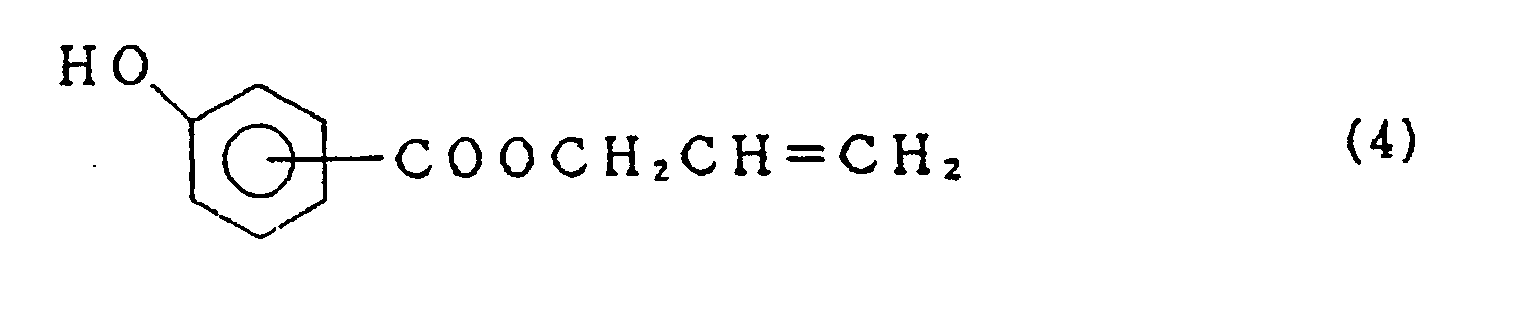
- the present compound (1) is further prepared by reacting a perfluoroalkene XF with allyl hydroxybenzoate of the formula
- X is perfluoroalkenyl group having 6 to 14 carbon atoms.
- the above compound (4) is obtained by reacting allyl alcohol with hydroxybenzoic acid.
- the reaction is conducted in the similar manner as in the reaction of allyl alcohol and the above compound (3).
- perfluoroalkenes X F are the following compouds of the formula wherein R1, R2 and R3 are each perfluoroalkyl group having 1 to 6 carbon atoms, or one of them is fluorine atom and the others are each perfluoroalkyl group having 1 to 6 carbon atoms.
- R1, R2 and R3 are each perfluoroalkyl group having 1 to 6 carbon atoms, or one of them is fluorine atom and the others are each perfluoroalkyl group having 1 to 6 carbon atoms.
- a dimer or trimer of hexafluoropropene, or tetramer, pentamer, hexamer or heptamer of tetrafluoeroethylene are shown below by the formulae.
- the reaction is conducted preferably in a solvent in the presence of a base.
- bases are triethylamine, trimethylamine, tripropylamine or like amines, alkali metal or hydroxides thereof, etc.
- a solvent is used preferably an aprotic polar solvent such as acetonitrile, dimethyl formamide, dimethyl sulfoxide, etc.
- the perfuluoroalkene is used preferably in an amount of about 1 to 10moles per mole of the compound (4).
- the reaction temperature is suitably selected but is usually about 0 to 40°C, preferably about 0 to 20°C.
- the base is used preferably in an amount of about 1 to 20moles per mole of the compound (4).
- the desired compound (1) can be separated and recovered by known methods used in the separation of a mixture of organic compounds and liquid. For example, the reaction mixture is added to a large amount of diluted hydrochloric acid and the resulting precipitates are collected and is distilled at a reduced pressure to obtain the desired compound.
- the compounds XF of the formula (5) include compounds represented by the formulae below.
- the present compound can be polymerized by heating in the presence of a peroxide such as benzoyl peroxide, thereby a polymer is prepared.
- the polymer is a thermoplastic resin and excellent in resistances to water and heat.
- the present compound can be copolymerized with other polymerizable compounds such as diallyl phthalate, diallyl isophthalate or diallyl terephthalate to form a prepolymer, the prepolymer being able to afford a cured product having water-resistance.
- the present compound can be mixed with a prepolymer of diallyl phthalate, diallyl isophthalate, diallyl terephthalate, etc. and the mixture is cured to obtain a product having water-resistance.
- the present invention also provides a prepolymer of a perfluoroalkenyloxybenzoic acid derivative comprising a repeating unit of the above formula (2) and a repeating unit having one double bond and derived from the cleavage of double bond of a diene compound.
- Example of repeating units having one double bond and derived from the cleavage of a double bond of a diene compound are those obtained by the cleavage of a double bond of various compounds such as butadiene, isoprene, chloroprene, diallyl phthalate, diallyl isophthalate or diallyl terephthalate.
- the present prepolymer includes a copolymer having other repeating unit in addition to the repeating unit of the formula (2) and the repeating unit derived from a diene compound.
- repeating units examples include those derived from cleavage of double bond of various compounds such as ethylene, vinyl acetate, vinyl fluoride, vinyl chloride, acrylamide, methacrylamide, styrene, ⁇ -methyl-styrene, p-methylstyrene, alkyl ester of acrylic acid or methacrylic acid, benzyl (meth)acrylate, vinyl alkyl ether, halogenated alkyl vinyl ether, vinyl alkyl ketone, cyclohexyl (meth)acrylate or maleic anhydride.
- various compounds such as ethylene, vinyl acetate, vinyl fluoride, vinyl chloride, acrylamide, methacrylamide, styrene, ⁇ -methyl-styrene, p-methylstyrene, alkyl ester of acrylic acid or methacrylic acid, benzyl (meth)acrylate, vinyl alkyl ether, halogenated alkyl vinyl ether, vinyl alky
- the prepolymer has a number average molecular weight preferably of about 1000 to 50000, more preferably about 3000 to 10000. With so great in molecular weight, the prepolymer is hardly processed. With too small in molecular weight, the cured product does not have practical strength.
- the prepolymer has an iodine value (gram of iodine which adducts to 100g of sample) preferably of about 10 to 95, more preferably about 25 to 80.
- the prepolymer having too small iodine value can not afford a cured product having practical strength. A cured product having superior impact-resistance is hardly obtained from the prepolymer having too large iodine value.
- the prepolymer contains the repeating unit (2) in an amount preferably of at least about one percent (weight percent, same as hereinafter), more preferably at least about 10%. With less than about one percent, water-resistance is not expected.
- the prepolymer contains the repeating unit having one double bond and derived from the cleavage of a double bond of a diene compound preferably in such an amount that the prepolymer has an iodine value of at least about 10, more preferably at least about 25. The prepolymer having too small iodine value hardly affords a cured product having practical strength.
- the present prepolymer can be obtained by copolymerizing the above compound (1).
- the diene compounds include butadiene, isoprene, chloroprene or like conjugated diene compound, diallyl phthalate, diallyl isophthalate, diallyl terephthalate or like non-conjugated diene compound, and other polymerizable compounds.
- an ethylenically unsaturated compound such as ethylene, vinyl acetate, vinyl fluoride, vinyl chloride, acrylamide, methacrylamide, styrene, ⁇ -methylstyrene, p-methylstyrene, alkyl ester of acrylic acid or methacrylic acid, benzyl (meth)acrylate, vinyl alkyl ether, halogenated alkyl vinyl ether, vinyl alkyl ketone, cyclohexyl (meth)acrylate or maleic anhydride.
- an ethylenically unsaturated compound such as ethylene, vinyl acetate, vinyl fluoride, vinyl chloride, acrylamide, methacrylamide, styrene, ⁇ -methylstyrene, p-methylstyrene, alkyl ester of acrylic acid or methacrylic acid, benzyl (meth)acrylate, vinyl alkyl ether, halogenated alkyl vinyl ether, vinyl al
- the repeating units having one double bond derived from cleavage of double bond of a diene compound include (a) when the double bonds are non-conjugated, a repeating unit obtained by cleavage of one double bond to form an addition bond and thereby the other double bond remains as not cleaved, (b) when the double bonds are conjugated, 1 a repeating unit obtained by cleavage of one double bond to form an addition bond and thereby the other double bond remains as not cleaved, and 2 a repeating unit obtained by cleavage of two double bonds and thereby two double bonds shift to the adjacent position to form one double bond, the position being between the intermediate two carbon atoms of four carbon atoms constituting two double bonds.
- the prepolymer has a terminal formed by hydrogen abstraction and shown by the structure (C) or a terminal formed by disproportionation between terminal radicals and shown by the structure (D), etc.
- radical polymerization methods and conditions thereof are suitably selected.
- radical polymerization are adopted bulk polymerization, solution polymerization, suspension polymerization, emulsion polymerization, etc.
- ionic polymerization are conducted cationic polymerization, etc.
- an initiator in radical polymerization is used a compound which produces free radicals.
- Preferred radical initiators are benzoyl peroxide, tert-butyl perbenzoate, acetyl benzoyl peroxide, succinyl peroxide, diisopropyl peroxydicarbonate, ammonium persulfate and like peroxides, azobisisobutyronitrile and like azonitriles, etc.
- chain transfer agent which is disclosed in Japanese Examined Patent Publication No. 16,035/1960 and has the formula wherein Z is C1, OH or group convertible to OH, R is lower alkyl ( 1 to 4 carbon atoms), m is 0 to 4, n is 0 to ( 4-m).
- the chain transfer agent is used in an amount of preferably about 10 to 25% by weight in order to adjust the molecular weight and to prevent the gelation.
- the radical initiator is used in an amount of 0.1 to 10% by weight based on the weight of monomers.
- the amount of initiator is not limited thereabove and is suitably selected depending on polymerization degree of the desired polymer, polymerization time, polymerization temperature, etc.
- the polymerization temperature is usually -80°C to +250°C as depending on the decomposition temperature of the initiator. Generally, the temperature is preferably in the range of -40°C to +150°C.
- Solvents useful for solution polymerization are benzene, toluene, xylene and like aromatic hydrocarbons, chloroform, methylene chloride, ethylene chloride and like low-basic solvents. These solvents are used singly or in mixture.
- the cationic polymerization is preferably conducted in a solvent such as toluene, benzene, etc. at -30°C to +250°C in the presence of boron trifluoride ethyl etherate, aluminum chloride or like initiator.
- the polymer is separated from the reaction mixture by a usual method, for example, by adding the mixture to a poor solvent which does not dissolve the polymer such as methanol, diisopropyl ether, dimethyl ether, petroleum ether or n-hexane.
- the polymer is obtained as precipitates.
- the precipitated polymer is purified by dissolving it in a solvent which is capable of dissolving the polymer such as acetone, methyl ethyl ketone, ethyl acetate, dioxane, tetrahydrofuran, ethylene dichloride, chloroform, carbon tetrachloride, trichloroethylene, benzene, toluene, etc. and thereafter re-precipitating the polymer by adding the solution in a poor solvent.
- the present prepolymer can be cured by itself or in the form of a mixture thereof with a prepolymer of diallyl phthalate, diallyl isophthalate, diallyl tetraphthalate, etc.
- the curing is conducted by heating or light in the presence of thermal polymerization initiator, photopolymerization initiator, etc. or with irradiation of electron rays, gamma-ray or like active energy rays in the absence of the initiator.
- a carrier for initiator is used diallyl phthalate, diallyl isophthalate, diallyl terephthalate or like monomer.
- the carrier is used preferably up to about 90% by weight of the mixture.
- thermal polymerization initiators are methyl ethyl ketone peroxide, cyclohexanone peroxide and like ketone peroxides, t-butyl perbenzoate, t-butyl peroxy-2-ethylhexoate and like peresters, t-butyl hydroperoxide, cumene hydroperoxide and like hydroperoxides, benzoyl peroxide and like diacyl peroxides.
- the photopolymerization initiators include 2,2-diethoxyacetophenone, 2,2-dimethoxy-2-phenylacetophenone and like acetophenones, benzophenone and like ketones, 2-chlorothioxanthone and like thioxanthones, etc.
- the initiator is used preferably in an amount of about 0.001 to 20% by weight, more preferably about 0.1 to 10% by weight based on the total amount of the prepolymer and carrier.
- the curing is conducted usually at a temperature from room temperature to 250°C, preferably from room temperature to 180°C, despite that any of heat, light or active energy rays is used.
- the prepolymer contains a carbon-carbon double bond in the main vhain or side chain, exhibits cross-linking ability and affords a cured product. Further, the prepolymer has a perfluoroalkenyloxy chain as the other side chain which gives an excellent water-resistance to the cured product.
- the cured product obtained from the present prepolymer has water-resistance which is much superior to that of a cured product prepared from the conventional diallyl phthalate. Even the prepolymer containing about 50% by weight of the repeating unit (1) provides a curing product which is about 1/10 in water absorbency than the conventional product.
- Ether was removed by distillation. To the residue were added 34.8g (0.6mole) of allyl alcohol, 500ml of toluene, 1.5g of sulfuric acid and 0.2g of p-methoxyphenol. The mixture was mildly heated and refluxed. A mixture of toluene and water was distilled off and cooled with a condenser, and toluene was separated from water and returned continuously to the reaction vessel. The mixture was heated for 20 hours and then allowed to cool to room temperature. To the reaction mixture was added 200ml of toluene and the solution was washed with a saturated aqueous solution of sodium carbonate and then washed with a saturated aqueous solution of sodium chloride. Toluene was removed at a reduced pressure and the residue was distilled to collect a fraction boiling at 115 ⁇ 118°C/8mmHg which gives 45g of allyl p-perfluorononenyloxybenzoate.
- the powder was 25 in iodine value, 7.6X10³ in number average molecular weight ( M n), 9.1X10⁴ in weight average molecular weight ( M w) in term of polystyrene with use of gel permeation chromatography and 28.0wt% in fluorine content.
- the above white powder was a prepolymer in which Compound A and diallyl terephthalate were contained in molar ratio of 1 : 2.2.
- benzoyl peroxide 2 parts
- the mixture was stirred homogeneously.
- the mixture was poured into a Petri dish having internal diameter of 50mm and heated at 95°C for 10 hours to obtain a casting plate which was 50 mm in diameter and 3 mm in thickness.
- White powder (288g) was obtained in the same manner as in Example 4 except that Compound A (500g) was used and 500g of diallyl phthalate was used in place of diallyl terephthalate.
- the powder was 59 in iodine value, 8.5X10³ in M n, 4.8X10⁴ in M w and 13.5wt% in fluorine content. Accordingly, the above white powder was a prepolymer in which Compound A and diallyl pthalate were contained in molar ratio of 1 : 7.3.
- a casting plate was obtained in the same manner as in Example 4 with use of the prepolymer.
- White powder (231g) was obtained in the same manner as in Example 4 with use of Compound B (600g), diallyl isophathalate (300g), benzoyl peroxide (13g), dibutyltin dilaurate (11g) and water (450ml).
- the powder was 55 in iodine value, 8.8X10³ in M n, 8.8X10⁴ in M w and 20.6wt% in fluorine content.
- the above white powder was a prepolymer in which Compound B and diallyl isophthalate were contained in molar ratio of 1 : 3.9.
- a casting plate was prepared in the same manner as in Example 4 with use of the prepolymer.
- White powder (162g) was obtained in the same manner as in Example 4 with use of Compound C (460g), diallyl terephathalate (250g), benzoyl peroxide (10g), dibutyltin dilaurate (8.5g) and water (350ml).
- the powder was 54 in iodine value, 1.1X10⁴ in M n, 1.3X10⁵ in M w and 19.5wt% in fluorine content.
- the above white powder was a prepolymer in which Compound C and diallyl terephthalate were contained in molar ratio of 1 : 2.5.
- a casting plate was prepared in the same manner as in Example 4 with use of the prepolymer.
- a casting plate was prepared in the same manner as in Example 4 with use of the mixture.
Landscapes
- Chemical & Material Sciences (AREA)
- Organic Chemistry (AREA)
- Health & Medical Sciences (AREA)
- Chemical Kinetics & Catalysis (AREA)
- Medicinal Chemistry (AREA)
- Polymers & Plastics (AREA)
- Organic Low-Molecular-Weight Compounds And Preparation Thereof (AREA)
- Addition Polymer Or Copolymer, Post-Treatments, Or Chemical Modifications (AREA)
Claims (6)
- Perfluoralkenyloxybenzoesäure-Derivat der Formel

- Verfahren zur Herstellung eines Perfluoralkenyloxybenzoesäure-Derivats nach Anspruch 1, welches die Umsetzung eines Allylalkohols mit einer Perfluoralkenyloxybenzoesäure der Formel

- Verfahren zur Herstellung eines Perfluoralkenyloxybenzoesäure-Derivats nach Anspruch 1, welches die Umsetzung eines Perfluoralkens XF mit einem Allylhydroxybenzoat der Formel
- Prepolymer eines Perfluoralkenyloxybenzoesäure-Derivats, umfassend eine Struktureinheit der Formel

- Prepolymer nach Anspruch 4, worin mindestens 1 Gew.-% der Struktureinheit mit der Formel (2) in dem Prepolymer enthalten ist.
- Prepolymer nach Anspruch 4, worin die Dienverbindung mindestens eine ist, die aus der Gruppe, bestehend aus Diallylphthalat, Diallylisophthalat und Diallylterephthalat, ausgewählt ist.
Applications Claiming Priority (4)
| Application Number | Priority Date | Filing Date | Title |
|---|---|---|---|
| JP31132686A JPS63166849A (ja) | 1986-12-29 | 1986-12-29 | パ−フルオロアルケニルオキシ安息香酸誘導体及びその製法 |
| JP311326/86 | 1986-12-29 | ||
| JP4354987A JPS63210112A (ja) | 1987-02-25 | 1987-02-25 | 芳香族カルボン酸アリルのプレポリマ− |
| JP43549/87 | 1987-02-25 |
Publications (2)
| Publication Number | Publication Date |
|---|---|
| EP0275558A1 EP0275558A1 (de) | 1988-07-27 |
| EP0275558B1 true EP0275558B1 (de) | 1991-07-17 |
Family
ID=26383336
Family Applications (1)
| Application Number | Title | Priority Date | Filing Date |
|---|---|---|---|
| EP87119333A Expired EP0275558B1 (de) | 1986-12-29 | 1987-12-29 | Derivat der Perfluoralkenyloxybenzoesäure, sein Herstellungsverfahren und Prepolymer dieses Derivates |
Country Status (3)
| Country | Link |
|---|---|
| US (1) | US4788321A (de) |
| EP (1) | EP0275558B1 (de) |
| DE (1) | DE3771477D1 (de) |
Families Citing this family (3)
| Publication number | Priority date | Publication date | Assignee | Title |
|---|---|---|---|---|
| CN102908937B (zh) * | 2012-09-12 | 2015-07-29 | 衢州学院 | 基于全氟壬烯和全氟己烯的阳离子型双子氟表面活性剂及其制备方法 |
| PL3018165T3 (pl) * | 2013-07-01 | 2019-11-29 | Lg Chemical Ltd | Związek poliorganosiloksanowy, sposób jego wytwarzania i zawierająca go żywica kopoliwęglanowa |
| JP6308775B2 (ja) * | 2013-12-25 | 2018-04-11 | 株式会社ネオス | 含フッ素共重合体 |
Family Cites Families (2)
| Publication number | Priority date | Publication date | Assignee | Title |
|---|---|---|---|---|
| DE3410543A1 (de) * | 1984-03-22 | 1985-10-03 | Basf Ag, 6700 Ludwigshafen | Neue ester, verfahren zu ihrer herstellung und ihre verwendung zur bekaempfung von schaedlingen |
| JP3522450B2 (ja) * | 1996-07-10 | 2004-04-26 | 三菱製紙株式会社 | 平版印刷版の製版方法 |
-
1987
- 1987-12-28 US US07/138,398 patent/US4788321A/en not_active Expired - Lifetime
- 1987-12-29 EP EP87119333A patent/EP0275558B1/de not_active Expired
- 1987-12-29 DE DE8787119333T patent/DE3771477D1/de not_active Expired - Lifetime
Also Published As
| Publication number | Publication date |
|---|---|
| DE3771477D1 (de) | 1991-08-22 |
| US4788321A (en) | 1988-11-29 |
| EP0275558A1 (de) | 1988-07-27 |
Similar Documents
| Publication | Publication Date | Title |
|---|---|---|
| US2732370A (en) | Polymers | |
| EP0106023B1 (de) | Endblockierte Polyarylenpolyäther, Gegenstände daraus und Verfahren zu ihrer Herstellung | |
| US2818399A (en) | Ethlenically unsaturated alkyd resin copolymerized with n-vinyl-2-oxazolidone and process for making same | |
| EP0275558B1 (de) | Derivat der Perfluoralkenyloxybenzoesäure, sein Herstellungsverfahren und Prepolymer dieses Derivates | |
| US3370050A (en) | Preparation of interpolymers of hydroxyl-containing monomers in an organic solvent using hydrogen plroxide as catalyst | |
| US2726232A (en) | P-xylylene bis (5 cyclopentadiene) and polymer | |
| US2328510A (en) | Dihalo-ethylene copolymerization product | |
| US2475273A (en) | Polyallyl levulinate | |
| US3320116A (en) | Benzophenone and acetophenone stabilized polymers | |
| US3743630A (en) | Styrene polymerization with ring substituted alkyl perbenzoates and new branched chain alkyl perbenzoates | |
| KR102126206B1 (ko) | 현탁중합 공중합체, 이의 제조방법 및 이를 포함하는 성형품 | |
| US2443005A (en) | Fluorine-containing vinyl esters | |
| US2906741A (en) | Polymerizable organic sulfides | |
| US4201702A (en) | Process to produce allyl halides copolymers | |
| JP2717265B2 (ja) | 熱硬化性樹脂組成物 | |
| US2958683A (en) | Copolymers of octafluorocyclohexa-1, 3-diene | |
| US2571883A (en) | 2-methylene-1, 3-propylene dichloride homopolymer | |
| US4929694A (en) | Copolymers of p-mercaptostyrene and its esters | |
| JPH0415245B2 (de) | ||
| US4302569A (en) | 2-Chloro-2-alkyl substituted peroxyesters | |
| US2451536A (en) | Diallyl diglycolate-styrene copolymer | |
| KR100387311B1 (ko) | 분지구조를갖는스티렌계열가소성수지및그제조방법 | |
| US2546798A (en) | Soluble copolymers of allylic maleates with allylic alcohols | |
| US2498474A (en) | Vinyldibenzofuran polymers | |
| US3644301A (en) | 1-methylcyclopropene copolymers |
Legal Events
| Date | Code | Title | Description |
|---|---|---|---|
| PUAI | Public reference made under article 153(3) epc to a published international application that has entered the european phase |
Free format text: ORIGINAL CODE: 0009012 |
|
| AK | Designated contracting states |
Kind code of ref document: A1 Designated state(s): DE FR GB IT |
|
| 17P | Request for examination filed |
Effective date: 19880916 |
|
| 17Q | First examination report despatched |
Effective date: 19900119 |
|
| GRAA | (expected) grant |
Free format text: ORIGINAL CODE: 0009210 |
|
| AK | Designated contracting states |
Kind code of ref document: B1 Designated state(s): DE FR GB IT |
|
| ET | Fr: translation filed | ||
| REF | Corresponds to: |
Ref document number: 3771477 Country of ref document: DE Date of ref document: 19910822 |
|
| ITF | It: translation for a ep patent filed | ||
| PLBE | No opposition filed within time limit |
Free format text: ORIGINAL CODE: 0009261 |
|
| STAA | Information on the status of an ep patent application or granted ep patent |
Free format text: STATUS: NO OPPOSITION FILED WITHIN TIME LIMIT |
|
| 26N | No opposition filed | ||
| PGFP | Annual fee paid to national office [announced via postgrant information from national office to epo] |
Ref country code: FR Payment date: 19961211 Year of fee payment: 10 |
|
| PGFP | Annual fee paid to national office [announced via postgrant information from national office to epo] |
Ref country code: GB Payment date: 19961220 Year of fee payment: 10 |
|
| PGFP | Annual fee paid to national office [announced via postgrant information from national office to epo] |
Ref country code: DE Payment date: 19970107 Year of fee payment: 10 |
|
| PG25 | Lapsed in a contracting state [announced via postgrant information from national office to epo] |
Ref country code: GB Free format text: LAPSE BECAUSE OF NON-PAYMENT OF DUE FEES Effective date: 19971229 |
|
| PG25 | Lapsed in a contracting state [announced via postgrant information from national office to epo] |
Ref country code: FR Free format text: THE PATENT HAS BEEN ANNULLED BY A DECISION OF A NATIONAL AUTHORITY Effective date: 19971231 |
|
| GBPC | Gb: european patent ceased through non-payment of renewal fee |
Effective date: 19971229 |
|
| PG25 | Lapsed in a contracting state [announced via postgrant information from national office to epo] |
Ref country code: DE Free format text: LAPSE BECAUSE OF NON-PAYMENT OF DUE FEES Effective date: 19980901 |
|
| REG | Reference to a national code |
Ref country code: FR Ref legal event code: ST |
|
| PG25 | Lapsed in a contracting state [announced via postgrant information from national office to epo] |
Ref country code: IT Free format text: LAPSE BECAUSE OF NON-PAYMENT OF DUE FEES;WARNING: LAPSES OF ITALIAN PATENTS WITH EFFECTIVE DATE BEFORE 2007 MAY HAVE OCCURRED AT ANY TIME BEFORE 2007. THE CORRECT EFFECTIVE DATE MAY BE DIFFERENT FROM THE ONE RECORDED. Effective date: 20051229 |