EP0275316B1 - Vibration damping metal sheet - Google Patents
Vibration damping metal sheet Download PDFInfo
- Publication number
- EP0275316B1 EP0275316B1 EP87904099A EP87904099A EP0275316B1 EP 0275316 B1 EP0275316 B1 EP 0275316B1 EP 87904099 A EP87904099 A EP 87904099A EP 87904099 A EP87904099 A EP 87904099A EP 0275316 B1 EP0275316 B1 EP 0275316B1
- Authority
- EP
- European Patent Office
- Prior art keywords
- vibration
- metal
- damping
- plates
- inclusions
- Prior art date
- Legal status (The legal status is an assumption and is not a legal conclusion. Google has not performed a legal analysis and makes no representation as to the accuracy of the status listed.)
- Expired - Lifetime
Links
- 229910052751 metal Inorganic materials 0.000 title claims abstract description 179
- 239000002184 metal Substances 0.000 title claims abstract description 179
- 238000013016 damping Methods 0.000 title claims abstract description 79
- 239000000463 material Substances 0.000 claims abstract description 51
- 239000000919 ceramic Substances 0.000 claims abstract description 11
- 239000000843 powder Substances 0.000 claims description 24
- 239000002245 particle Substances 0.000 claims description 7
- 239000011247 coating layer Substances 0.000 claims description 2
- 229910000831 Steel Inorganic materials 0.000 abstract description 34
- 239000010959 steel Substances 0.000 abstract description 34
- 150000002739 metals Chemical class 0.000 abstract description 14
- 238000009792 diffusion process Methods 0.000 abstract description 11
- 239000004033 plastic Substances 0.000 abstract description 11
- 229910045601 alloy Inorganic materials 0.000 abstract description 6
- 239000000956 alloy Substances 0.000 abstract description 6
- 229910000881 Cu alloy Inorganic materials 0.000 abstract 1
- 230000000052 comparative effect Effects 0.000 description 68
- 239000002131 composite material Substances 0.000 description 44
- 239000000203 mixture Substances 0.000 description 28
- 239000000126 substance Substances 0.000 description 28
- XEEYBQQBJWHFJM-UHFFFAOYSA-N iron Substances [Fe] XEEYBQQBJWHFJM-UHFFFAOYSA-N 0.000 description 20
- 229910001209 Low-carbon steel Inorganic materials 0.000 description 18
- 239000010960 cold rolled steel Substances 0.000 description 13
- 238000000137 annealing Methods 0.000 description 12
- 238000004519 manufacturing process Methods 0.000 description 12
- OKTJSMMVPCPJKN-UHFFFAOYSA-N Carbon Chemical compound [C] OKTJSMMVPCPJKN-UHFFFAOYSA-N 0.000 description 11
- 229910052799 carbon Inorganic materials 0.000 description 11
- 208000033897 Systemic primary carnitine deficiency Diseases 0.000 description 10
- 229910001315 Tool steel Inorganic materials 0.000 description 10
- 230000000694 effects Effects 0.000 description 10
- 229910052742 iron Inorganic materials 0.000 description 10
- 239000010935 stainless steel Substances 0.000 description 10
- 229910001220 stainless steel Inorganic materials 0.000 description 10
- 208000016505 systemic primary carnitine deficiency disease Diseases 0.000 description 10
- 229910000838 Al alloy Inorganic materials 0.000 description 8
- 239000010949 copper Substances 0.000 description 8
- 238000000034 method Methods 0.000 description 8
- 239000004411 aluminium Substances 0.000 description 7
- 229910052782 aluminium Inorganic materials 0.000 description 7
- XAGFODPZIPBFFR-UHFFFAOYSA-N aluminium Chemical compound [Al] XAGFODPZIPBFFR-UHFFFAOYSA-N 0.000 description 7
- 239000010410 layer Substances 0.000 description 6
- 238000010438 heat treatment Methods 0.000 description 5
- 238000005304 joining Methods 0.000 description 5
- 229910001018 Cast iron Inorganic materials 0.000 description 4
- 230000007423 decrease Effects 0.000 description 4
- 238000005096 rolling process Methods 0.000 description 4
- 229910000851 Alloy steel Inorganic materials 0.000 description 3
- PXHVJJICTQNCMI-UHFFFAOYSA-N Nickel Chemical compound [Ni] PXHVJJICTQNCMI-UHFFFAOYSA-N 0.000 description 3
- 239000011248 coating agent Substances 0.000 description 3
- 238000000576 coating method Methods 0.000 description 3
- 238000005097 cold rolling Methods 0.000 description 3
- CWYNVVGOOAEACU-UHFFFAOYSA-N Fe2+ Chemical compound [Fe+2] CWYNVVGOOAEACU-UHFFFAOYSA-N 0.000 description 2
- 229910001335 Galvanized steel Inorganic materials 0.000 description 2
- HCHKCACWOHOZIP-UHFFFAOYSA-N Zinc Chemical compound [Zn] HCHKCACWOHOZIP-UHFFFAOYSA-N 0.000 description 2
- -1 alloys or ceramics) Chemical class 0.000 description 2
- 238000010276 construction Methods 0.000 description 2
- 229910052802 copper Inorganic materials 0.000 description 2
- 229910003460 diamond Inorganic materials 0.000 description 2
- 239000010432 diamond Substances 0.000 description 2
- 239000000835 fiber Substances 0.000 description 2
- 239000008397 galvanized steel Substances 0.000 description 2
- 229910052759 nickel Inorganic materials 0.000 description 2
- 238000003825 pressing Methods 0.000 description 2
- 238000007670 refining Methods 0.000 description 2
- 230000035939 shock Effects 0.000 description 2
- 239000002344 surface layer Substances 0.000 description 2
- 238000005496 tempering Methods 0.000 description 2
- 229910052725 zinc Inorganic materials 0.000 description 2
- 239000011701 zinc Substances 0.000 description 2
- RYGMFSIKBFXOCR-UHFFFAOYSA-N Copper Chemical compound [Cu] RYGMFSIKBFXOCR-UHFFFAOYSA-N 0.000 description 1
- 244000000626 Daucus carota Species 0.000 description 1
- 235000002767 Daucus carota Nutrition 0.000 description 1
- 206010016275 Fear Diseases 0.000 description 1
- 229910000677 High-carbon steel Inorganic materials 0.000 description 1
- 206010039509 Scab Diseases 0.000 description 1
- RTAQQCXQSZGOHL-UHFFFAOYSA-N Titanium Chemical compound [Ti] RTAQQCXQSZGOHL-UHFFFAOYSA-N 0.000 description 1
- 238000005299 abrasion Methods 0.000 description 1
- 239000011203 carbon fibre reinforced carbon Substances 0.000 description 1
- 238000005255 carburizing Methods 0.000 description 1
- OGSYQYXYGXIQFH-UHFFFAOYSA-N chromium molybdenum nickel Chemical compound [Cr].[Ni].[Mo] OGSYQYXYGXIQFH-UHFFFAOYSA-N 0.000 description 1
- 238000005253 cladding Methods 0.000 description 1
- 238000005520 cutting process Methods 0.000 description 1
- 230000007547 defect Effects 0.000 description 1
- 238000009826 distribution Methods 0.000 description 1
- 238000004880 explosion Methods 0.000 description 1
- 230000002349 favourable effect Effects 0.000 description 1
- 238000002844 melting Methods 0.000 description 1
- 238000005121 nitriding Methods 0.000 description 1
- 230000003647 oxidation Effects 0.000 description 1
- 238000007254 oxidation reaction Methods 0.000 description 1
- 230000000704 physical effect Effects 0.000 description 1
- 238000007747 plating Methods 0.000 description 1
- 238000004663 powder metallurgy Methods 0.000 description 1
- XOFYZVNMUHMLCC-ZPOLXVRWSA-N prednisone Chemical compound O=C1C=C[C@]2(C)[C@H]3C(=O)C[C@](C)([C@@](CC4)(O)C(=O)CO)[C@@H]4[C@@H]3CCC2=C1 XOFYZVNMUHMLCC-ZPOLXVRWSA-N 0.000 description 1
- 238000010791 quenching Methods 0.000 description 1
- 230000001235 sensitizing effect Effects 0.000 description 1
- 238000005245 sintering Methods 0.000 description 1
- 238000009864 tensile test Methods 0.000 description 1
- 239000010936 titanium Substances 0.000 description 1
- 229910052719 titanium Inorganic materials 0.000 description 1
- 230000009466 transformation Effects 0.000 description 1
- 238000011282 treatment Methods 0.000 description 1
Images

Classifications
-
- B—PERFORMING OPERATIONS; TRANSPORTING
- B32—LAYERED PRODUCTS
- B32B—LAYERED PRODUCTS, i.e. PRODUCTS BUILT-UP OF STRATA OF FLAT OR NON-FLAT, e.g. CELLULAR OR HONEYCOMB, FORM
- B32B15/00—Layered products comprising a layer of metal
- B32B15/01—Layered products comprising a layer of metal all layers being exclusively metallic
-
- Y—GENERAL TAGGING OF NEW TECHNOLOGICAL DEVELOPMENTS; GENERAL TAGGING OF CROSS-SECTIONAL TECHNOLOGIES SPANNING OVER SEVERAL SECTIONS OF THE IPC; TECHNICAL SUBJECTS COVERED BY FORMER USPC CROSS-REFERENCE ART COLLECTIONS [XRACs] AND DIGESTS
- Y10—TECHNICAL SUBJECTS COVERED BY FORMER USPC
- Y10T—TECHNICAL SUBJECTS COVERED BY FORMER US CLASSIFICATION
- Y10T428/00—Stock material or miscellaneous articles
- Y10T428/12—All metal or with adjacent metals
- Y10T428/12347—Plural layers discontinuously bonded [e.g., spot-weld, mechanical fastener, etc.]
-
- Y—GENERAL TAGGING OF NEW TECHNOLOGICAL DEVELOPMENTS; GENERAL TAGGING OF CROSS-SECTIONAL TECHNOLOGIES SPANNING OVER SEVERAL SECTIONS OF THE IPC; TECHNICAL SUBJECTS COVERED BY FORMER USPC CROSS-REFERENCE ART COLLECTIONS [XRACs] AND DIGESTS
- Y10—TECHNICAL SUBJECTS COVERED BY FORMER USPC
- Y10T—TECHNICAL SUBJECTS COVERED BY FORMER US CLASSIFICATION
- Y10T428/00—Stock material or miscellaneous articles
- Y10T428/12—All metal or with adjacent metals
- Y10T428/12451—Macroscopically anomalous interface between layers
-
- Y—GENERAL TAGGING OF NEW TECHNOLOGICAL DEVELOPMENTS; GENERAL TAGGING OF CROSS-SECTIONAL TECHNOLOGIES SPANNING OVER SEVERAL SECTIONS OF THE IPC; TECHNICAL SUBJECTS COVERED BY FORMER USPC CROSS-REFERENCE ART COLLECTIONS [XRACs] AND DIGESTS
- Y10—TECHNICAL SUBJECTS COVERED BY FORMER USPC
- Y10T—TECHNICAL SUBJECTS COVERED BY FORMER US CLASSIFICATION
- Y10T428/00—Stock material or miscellaneous articles
- Y10T428/12—All metal or with adjacent metals
- Y10T428/12486—Laterally noncoextensive components [e.g., embedded, etc.]
Definitions
- the present invention relates to a vibration-damping metal sheet suitably designed to be used as members required to possess vibration-damping properties as well as heat resistance, weldability and toughness etc., said members being represented by, e.g. foundation metals for and gears in diamond cutters or chip saws used as a high speed rotator or structural materials etc. needed to have vibration-damping properties such as working structures in automobiles.
- vibration-damping materials Materials making use of magnetostriction such as those represented by 12Cr-3Al-Fe, Mn-Cu base alloys and cast iron have been known as the vibration-damping materials for a long time.
- sandwich steel sheets having a plastic material between steel plates have been put to practical use.
- the cast iron has the disadvantage that it cannot be used as the structural material having a limited sectional area, since it is not only poor in plastic workability and weldability but has low strength and is unstable.
- the sandwich steel sheet having a plastic material interposed between steel plates which is now the most noticeable vibration-damping material in view of its excellent vibration-damping properties and plastic workability, some problems have arisen in that it can only stand up to use at a temperature of as low as 100°C, and is thus not only poor in heat resistance, but is also lacking in weldability due to the absence of conductivity, since the plastic material is used as the material to attain vibration-damping properties.
- an extremely special vibration-damping material which is obtained by the procedures comprising the steps of subjecting the surface layer of a metal sheet to an intergranular oxidation, a sensitizing or a mechanical treatment to give flaws to the surface thereof, and subjecting the metal sheet having its surface layer thus processed to processing such as cold rolling to introduce intergranular fracture or converting the surface flaws to scab marks, thereby attaining vibration-damping properties.
- the vibration-damping material obtained by such procedures offers some problmes in that its plastic workability is poor due to the presence of surface fractures, and its fatigue strength drops markedly so that its reliability as a structural material becomes poor.
- a vibration-damping sheet having the desired properties can be obtained by joining together metal plates, while allowing minute inclusions such as iron powders to be present therebetween and bite thereinto, and predetermining the desired range of the joint area of the metal plates to be joined together through the minute inclusions biting thereinto.
- the present invention is concerned with a vibration-damping metal sheet in which metal plates are joined together through minute inclusions permitted to be substantially uniformly present therebetween and biting thereinto, the said plates coming into contact with each other, while they are not metallurgically joined to each other, at a portion where said minute inclusions are not found, and the projection area of a portion of said metal plates, having said minute inclusions biting thereinto, with respect to the same surface as said contact surface accounts for 0.5 to 50 % of the area of said metal plates.
- Figure 1 is a view illustrative of one exmaple of the method for preparing the vibration-damping metal sheet according to the present invention
- Figure 2 is a perspective view showing a device for measuring a sound-pressure level
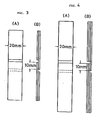
- Figures 3(A) and (B) and Figures 4(A) and (B) each are front and side views showing the shapes of test pieces for measuring shear load.
- a predetermined amount of minute inclusions 3 are first substantially uniformly scattered between metal plates 1 and 2. Then, the metal plates 1 and 2 are cold- or warm-pressed against each other between pressure rolls 4 and 4 to bite the minute inclusions 3 into the metal plates 1 and 2, whereby the metal plates 1 and 2 are joined together, while they are allowed to come into contact with each other, but are not metallurgically joined to each other, at their portion where the inclusions 3 are not present.
- the projection area of the joined portion with respect to the same surface as the aforesaid contact surface accounts for 0.5 to 50 % of the combined area of the metal plates 1 and 2 by the adjustment of the amount of the inclusions 3 to be scattered, etc. In this manner, a composite material serving as the vibration-damping metal sheet is obtained.
- the metal plates 1 and 2 are joined to each other, while the minute inclusions 3 nearly uniformly scattered therebetween bite thereinto, and the projection area of the portion of the metal plates 1 and 2 having the minute inclusions 3 bit thereinto, i.e. the joined portion (which may hereinafter be simply referred to as the joined area) amouts to 0.5 - 50 % or less of the combined area of the metal plates 1 and 2 (which correspond to the surface area of one side of one metal plate, and shall be hereinafter simply called the area of the metal plate).
- the joined area amouts to 0.5 - 50 % or less of the combined area of the metal plates 1 and 2 (which correspond to the surface area of one side of one metal plate, and shall be hereinafter simply called the area of the metal plate).
- the metal plates 1 and 2 are only allowed to contact each other, while not metallurgically joined to each other, at their portion where the inclusions 3 are not present, and which is to be subject to friction, thereby reducing vibrations and noises.
- the percentage of the joined area with respect to the area of the metal plate may simply be called the proportion of joined area).
- the joined area is calculated from distributions by sizes, obtained by forcedly separating the thus produced composite metal sheet into the original metal plates and measuring the sizes and quantities of the individual inclusions showing up on the separated surfaces of a given area.
- the vibration-damping properties increases with decreases in the joined area of the metal plates 1 and 2 having the minute inclusions 3 biting thereinto.
- too small a joined area gives rise to a reduction in the joint strength of the metal plates 1 and 2, which may in turn cause the metal sheet to deform at its end faces or to separate from each other between metal plates 1 and 2 during plastic working.
- the lower limit of the proportion of the joined area was set at 0.5 %.
- an increased joined area leads to an increase in the joint strength of the vibration-damping metal sheet, but rather results in a drop of the vibration-damping properties, so that the significance in making it in a composite structure is lost.
- the upper limit of the proportion of the joined area was set at 50 %.
- To join together the metal plates 1 and 2 by biting the minute inclusions 3 thereinto may be achieved by some techniques such as pressing or explosion pressing, in addition to pressure contact with the pressure rolls 4 and 4, as illustrated in Figure 1.
- some techniques such as pressing or explosion pressing, in addition to pressure contact with the pressure rolls 4 and 4, as illustrated in Figure 1.
- the most favorable technique is the pressure contact with the pressure rolls 4 and 4 in order to adjust the projection area of the joined portion to a desired value and permit the metal plates 1 and 2 to be not fixedly pressed against each other, i.e. come into pressure contact with each other, while not metallurgically joined together, at their portion where the minute inclusions 3 are not present.
- the diffusion annealing should preferably be carried out in a ferrite-phase region, when the metal plates 1 and 2 are formed of steel plates. However, it is preferable to carry out at a temperature equal to or higher than 650°C, since the rate of diffusion decreases at a lower temperature.
- the diffusion annealing should preferably be conducted at a temperature equal to or lower than 1,200°C. Within such a temperature range, the diffusion annealing should preferably be conducted for a sufficient time of 0.5 hours or longer.
- the metal plates 1 and 2 to be used may include various metal plates such as general-duty steel plates; special steel plates, e.g. carbon tool steel plates, stainless steel plates and nickel-chromium-molybdenum steel plates; non-ferrous metal plates, e.g. aluminium plates, copper plates, titanium plates and nickel plates; plated metal plates obtained by plating said general-duty steel plates, special steel plates and non-ferrous metal plates; and clad metal plates obtained by cladding of these metal plates.
- these metal plates may be subjected to desired hardening and heat treatments such as carburizing, nitriding, hardening and annealing to impart vibration-damping properties as well as abrasion resistance and toughness thereto.
- Both metal plates 1 and 2 joined to each other by the minute inclusions 3 need not be formed of the same material, and may optionally be formed of a combination of different materials, depending upon the purpose.
- minute inclusions 3 use may be made of any material which can bite into the metal plates 1 and 2 to join them together, such as metals, e.g. iron and ceramics in powder or finely wiry form and a network comprising such fine wires.
- the minute inclusions 3 may also consist only of a single-phase material (such as metals including alloys or ceramics), or may be coated on their surfaces with other metals. No particular limitation is placed on the type of the coating metals so far as the coating metals can bite into the metal plates 1 and 2 to join them together.
- the minute inclusions 3 are of metal or ceramic powders, then it is not especially required to adjust their particle size.
- their mean particle size is larger than that of metal powders for ordinary powder metallurgy.
- dents may show up on the surfaces of the metal plates 1 and 2 as if they come up from within, when they are joined together through such minute inclusions 3. Such dents may sometime impair the commercial value of the product.
- the particle size of the inclusions 3 is set at 1000 micrometers at most, and may be selected therefrom depending upon the purpose.
- the minimum particle size of the minute inclusions 3 should preferably be about 100 micrometers.
- the powders may be regarded as short wiry materials, and the diameter of the minute inclusions 3 is preferably in a range of 100 to 10000 micrometers in terms of the mean diameter in the vertical section with respect to their lengthwise direction.
- the vibration-damping properties were estimated in terms of the sound-pressure level measured by suspending a composite metal sheet X to be measured from a supporting frame 5 by means of threads 6 and allowing a hammer 7 rotatably mounted on an upper cross beam of said frame 5 by a bearing 8 to drop, while rotating, thereon from the horizontal state to receive at a microphone 9 a sound resulting from a blow struck upon the composite metal sheet X and determine the sound-pressure level by an amplifier 10, as illustrated in Figure 2.
- the mechanical properties were estimated in terms of the shear load obtained from the results of tensile tests conducted with test pieces, each being prepared by cutting off one side of a composite metal sheet of 20 mm in width and providing slits in the metal sheet to define a joined portion of 10 mm in length, as illustrated in Figures 3(A) and (B) or Figures 4(A) and (B).
- one-hour annealing was thereafter carried out at 850°C for low-carbon steel (SPCD) and 700°C for carbon tool steel (SK5) respectively.
- SPCD low-carbon steel
- SK5 carbon tool steel
- Host of the composite metal sheets in which SK5 were used were thermally refined in the following procedures, i.e. by one-hour annealing at 1,100°C, followed by hot-quenching at 800°C and tempering at 200°C.
- composite metal sheets having various proportions of joined area were made (Examples 1 to 11 & Comparison Examples 2,3 and 6 to 8).
- Table 3 shows the properties of the vibration-damping metal sheets, prepared according to the present invention the composite metal sheets in the Comparison Examples and the single sheet prepared as the comparative material.
- the vibration-damping metal sheets according to the present invention of the composite metal sheets made of low-carbon steel plates in Examples 1 to 7 and carbon tool steel plates in Examples 8 to 11 are lower in the sound-pressure level and, hence, higher in the vibration-damping properties than the single sheets in Comparison Examples 1, 4 and 5 and the composite sheets in Examples 3, 7 and 8 of which the proportion of joined area by biting of the minute inclusions of the iron powders exceeds 50 %. Since the difference between 20dB and 6dB in terms of sound-pressure level corresponds to that between 1/10 and 1/2 in terms of sound-pressure, how excellent are the vibration-damping metal sheets according to the present invention in the vibration-damping properties will be easily appreciated.
- Table 6 shows the properties of the sheets in Examples 12 to 14 and Comparative Examples 10 and 11 manufactured in this manner.
- the vibration-damping metal sheets accroding to the present invention in the Examples 12 to 14 are lower in the sound-pressure level and, hence, higher in the vibration-damping properties than the clad sheet in Comparative Example 9 in which no minute inclusion was used and the sheet in Comparative Example 11 which has a proportion of joined area by biting of the minute inclusions exceeding 50 %. From Comparative Example 10, it is found that when the proportion of joined area by biting of the minute inclusions is 0.4 %, the shear load of the sheet is so small that it is not suitable for any structural material.
- Table 9 shows the properties of the sheets manufactured in respective Examples and Comparative Examples.
- the vibration-damping metal sheets in Examples 23 to 26 according to the present invention are lower in the sound-pressure level and, hence, higher in the vibration-damping properties than Comparative Examples 15 and 16, and their vibration-damping properties are excellent.
- the vibration-damping metal sheets according to the present invention have excellent properties, as is the case with Examples 1 to 7 where the metal plates used were not plated.
- a clad sheet which was of the three-layer structure composed of aluminium plate - steel plate - aluminium plate, the steel plate being a low carbon plate having a chemical composition set forth in Table 11 and the aluminium plate having a chemical composition set forth in Table 12, each layer having thickness of 0.5mm-1.5mm-0.5mm and in the total thickness, 2.5 mm (Comparative Example 17 ).
- the vibration-damping metal sheets in Examples 35 to 40 according to the present invention are lower in the sound-pressure level and, hence, excellent in the vibration-damping properties than Comparative Example 21 and Comparative Example 23 in which the proportion of joined area exceeded 50 % by biting of the ceramic powders acting as the minute inclusions.
- the proportion of joined area by biting of the ceramic powders was 0.3 %, it spalled away easily with a small shock after rolling, and could not keep a state of joining. It is thus found that the effect of the present invention is had in the case wherein the ceramic powders as the minute inclusions is used as in the case wherein metal powders are used.
- the composite metal sheets were annealed at 700°C for two hours, and were then subjected to refining heat treatments involving hardening at 860°C and tempering at 200°C to manufacture composite metal sheets having various proportions of joined area (Examples 46 to 48 and Comparative Examples 26 to 27).
- the vibration-damping metal sheets in Examples 46 and 47 according to the present invention are lower in the sound-pressure level and, hence, excellent in the vibration-damping properties than the single sheet in Comparative Example 25 and Comparative Example 27 in which the proportion of joined area exceeded 50 %.
- Comparative Example 26 it is also found that in the case wherein the proportion of joined area is 0.4 %, difficulty is involved in using it as the structural material due to low shear load. From this, it is found that the effect of the present invention is had in the case wherein the wiry material is used as the minute inclusions as in the case wherein the powders are used.
- iron powders C specified in Table 25 were plated with Cu to form a 10 ⁇ m-thick layer on their surfaces, and varied amounts of such minute inclusions were uniformly scattered between the aforesaid two steel plates, which were cold-rolled to have a finished thickness of 1.6 mm for a finished plate of low carbon steel and 3.2 mm for a finished plate of carbon tool steel to obtain composite metal sheets.
- one-hour annealing at 800 °C and two-hour annealing at 900 °C were carried out for low carbon steel and carbon tool steel, respectively, to thereby manufacture composite metal sheets having various proportions of joined area (Examples 53 to 61 and Comparative Examples 31, 32, 34 and 35).
- the vibration-damping metal sheets in Examples 53 to 61 according to the present invention are excellent as compared with those Comparative Examples 30 to 35 where the metal plates of the same type of steel were used and can be used as structural materials, having both vibration-damping properties and joint strength. It is thus found that the effect of the present invention is had, or increased effect thereof is had in the case wherein the materials plated with Cu etc. are used as the minute inclusions as in the case wherein the inclusions not plated are used.
- the vibration-damping metal sheets of the present invention more than half of the area of the metal plates is occupied by the area of the metal plates at which they are not joined together, but simply come into contact with each other, and the friction occurring between the metal plates at this area assures excellent vibration-damping properties. Further, since the minute inclusions with which the joined portion is made of are formed of materials of heat-resistant metals or ceramics, rather than materials which are poor in heat resistance such as plastic materials, it is very unlikely that the structure and vibration-damping properties of the composite metal sheets may be destructed and deteriorated by heat treatments to be applied depending upon the purpose or by the use thereof in high-temperature environment, and high shear force is maintained between the metal plates.
- the composite metal sheets of the present invention possess sufficiently high conductivity as well as weldability, since the metal plates come into contact with each other at the portion at which the minute inclusions are not present.
- vibration-damping metal sheets according to the present invention possess such excellent physical properties, they are best-suited for use not only for foundation metals and gears of diamond cutters or chip saws used as a high speed rotator but also for structural materials needed to have vibration-damping properties as well as heat resistance, weldability and toughness such as working structures in automobiles etc.
Landscapes
- Laminated Bodies (AREA)
- Pressure Welding/Diffusion-Bonding (AREA)
Abstract
Description
- The present invention relates to a vibration-damping metal sheet suitably designed to be used as members required to possess vibration-damping properties as well as heat resistance, weldability and toughness etc., said members being represented by, e.g. foundation metals for and gears in diamond cutters or chip saws used as a high speed rotator or structural materials etc. needed to have vibration-damping properties such as working structures in automobiles.
- Materials making use of magnetostriction such as those represented by 12Cr-3Aℓ-Fe, Mn-Cu base alloys and cast iron have been known as the vibration-damping materials for a long time. In recent years, sandwich steel sheets having a plastic material between steel plates have been put to practical use.
- Of these conventional art vibration-damping materials, the materials making use of magnetostriction such as those represented by 12Cr-3Aℓ-Fe or the Mn-Cu base alloys have had the disadvantages that their vibration-damping properties do not only decrease markedly by plastic working, but drop with increases in temperature. Hence, the critical temperatures for use are 380°C for the former and 80°C for the latter. Another problem of such materials has been that their production cost is high. Although cast iron is also a material of which vibration-damping properties have been noted from of old, however, its vibration-damping properties are not so excellent. The cast iron only produces its vibration-damping properties on its own mass. Albeit inexpensive, the cast iron has the disadvantage that it cannot be used as the structural material having a limited sectional area, since it is not only poor in plastic workability and weldability but has low strength and is unstable. Referring further to the sandwich steel sheet having a plastic material interposed between steel plates, which is now the most noticeable vibration-damping material in view of its excellent vibration-damping properties and plastic workability, some problems have arisen in that it can only stand up to use at a temperature of as low as 100°C, and is thus not only poor in heat resistance, but is also lacking in weldability due to the absence of conductivity, since the plastic material is used as the material to attain vibration-damping properties.
- Still further, an extremely special vibration-damping material has been proposed, which is obtained by the procedures comprising the steps of subjecting the surface layer of a metal sheet to an intergranular oxidation, a sensitizing or a mechanical treatment to give flaws to the surface thereof, and subjecting the metal sheet having its surface layer thus processed to processing such as cold rolling to introduce intergranular fracture or converting the surface flaws to scab marks, thereby attaining vibration-damping properties. However, the vibration-damping material obtained by such procedures offers some problmes in that its plastic workability is poor due to the presence of surface fractures, and its fatigue strength drops markedly so that its reliability as a structural material becomes poor.
- In consequence of studies made to solve the aforesaid problems the conventional art offers, and to develop a vibration-damping sheet suitably used as the member which is required to be plastic workable, heat resistant, weldable and tough, and also to excel in vibration-damping properties, the present inventors have found that a vibration-damping sheet having the desired properties can be obtained by joining together metal plates, while allowing minute inclusions such as iron powders to be present therebetween and bite thereinto, and predetermining the desired range of the joint area of the metal plates to be joined together through the minute inclusions biting thereinto.
- More specifically, the present invention is concerned with a vibration-damping metal sheet in which metal plates are joined together through minute inclusions permitted to be substantially uniformly present therebetween and biting thereinto, the said plates coming into contact with each other, while they are not metallurgically joined to each other, at a portion where said minute inclusions are not found, and the projection area of a portion of said metal plates, having said minute inclusions biting thereinto, with respect to the same surface as said contact surface accounts for 0.5 to 50 % of the area of said metal plates.
- In what follows, the vibration-damping sheets according to the present invention will be explained in more detail with reference to the drawings.
- Figure 1 is a view illustrative of one exmaple of the method for preparing the vibration-damping metal sheet according to the present invention, Figure 2 is a perspective view showing a device for measuring a sound-pressure level, and Figures 3(A) and (B) and Figures 4(A) and (B) each are front and side views showing the shapes of test pieces for measuring shear load.
- As the description of the construction of the vibration-damping metal sheets according to the present invention will facilitate in describing its manufacturing method, the construction will now be explained with reference to the method for manufacturing the same.
- In order to make the vibration-damping metal sheets according to the present invention, a predetermined amount of
minute inclusions 3 are first substantially uniformly scattered betweenmetal plates metal plates pressure rolls minute inclusions 3 into themetal plates metal plates inclusions 3 are not present. Moreover, the projection area of the joined portion with respect to the same surface as the aforesaid contact surface (which may hereinafter be simply called the projection area) accounts for 0.5 to 50 % of the combined area of themetal plates inclusions 3 to be scattered, etc. In this manner, a composite material serving as the vibration-damping metal sheet is obtained. - In the vibration-damping metal sheet according to the present invention, the
metal plates minute inclusions 3 nearly uniformly scattered therebetween bite thereinto, and the projection area of the portion of themetal plates minute inclusions 3 bit thereinto, i.e. the joined portion (which may hereinafter be simply referred to as the joined area) amouts to 0.5 - 50 % or less of the combined area of themetal plates 1 and 2 (which correspond to the surface area of one side of one metal plate, and shall be hereinafter simply called the area of the metal plate). Besides, themetal plates inclusions 3 are not present, and which is to be subject to friction, thereby reducing vibrations and noises. (In what follows, the percentage of the joined area with respect to the area of the metal plate may simply be called the proportion of joined area). The joined area is calculated from distributions by sizes, obtained by forcedly separating the thus produced composite metal sheet into the original metal plates and measuring the sizes and quantities of the individual inclusions showing up on the separated surfaces of a given area. - In the structure as mentioned above, the vibration-damping properties increases with decreases in the joined area of the
metal plates minute inclusions 3 biting thereinto. However, too small a joined area gives rise to a reduction in the joint strength of themetal plates metal plates - To join together the
metal plates minute inclusions 3 thereinto may be achieved by some techniques such as pressing or explosion pressing, in addition to pressure contact with thepressure rolls pressure rolls metal plates minute inclusions 3 are not present. - The higher the temperature at which such pressure contact occurs, the easier the joint will be. However, pressure contact operations at higher temperatures have the disadvantages that they do not only encounter difficulty and cause an increased variation in the joined area, but also incur fears that the skin of the obtained sheet product may deteriorate because of scaling, etc., and the
metal plates minute inclusions 3, however, much increased joint strength is obtained, if annealing-accompanied-by-diffusion (hereinafter referred to as the diffusion annealing) is applied. Hence, satisfactory joint strength may be obtained even with a small joined area. The diffusion annealing should preferably be carried out in a ferrite-phase region, when themetal plates metal plates - The
metal plates metal plates minute inclusions 3 need not be formed of the same material, and may optionally be formed of a combination of different materials, depending upon the purpose. - As the
minute inclusions 3 to be employed, use may be made of any material which can bite into themetal plates minute inclusions 3 may also consist only of a single-phase material (such as metals including alloys or ceramics), or may be coated on their surfaces with other metals. No particular limitation is placed on the type of the coating metals so far as the coating metals can bite into themetal plates metal plates minute inclusions 3 coated on their surfaces with a metal easily diffusible into themetal plates inclusions 3 into the metal plates is combined with the diffusion of such a coating metal into themetal plates - Reference will now be made to the size of the
minute inclusions 3. If theminute inclusions 3 are of metal or ceramic powders, then it is not especially required to adjust their particle size. Preferably, their mean particle size is larger than that of metal powders for ordinary powder metallurgy. In the presence of theminute inclusions 3 having an excessively large particle size, however, dents may show up on the surfaces of themetal plates such minute inclusions 3. Such dents may sometime impair the commercial value of the product. Hence, the particle size of theinclusions 3 is set at 1000 micrometers at most, and may be selected therefrom depending upon the purpose. Sincesmaller minute inclusions 3 undergo slight sintering aroundlarger inclusions 3 biting into themetal plates minute inclusions 3 is small. When a large amount ofsmaller minute inclusions 3 is existed, the smaller inclusions bite into themetal plates metal plates minute inclusions 3 should preferably be about 100 micrometers. The same holds for the sectional diameter of wiry materials or network materials which may also be used as theminute inclusions 3. The powders may be regarded as short wiry materials, and the diameter of theminute inclusions 3 is preferably in a range of 100 to 10000 micrometers in terms of the mean diameter in the vertical section with respect to their lengthwise direction. - The vibration-damping metal sheets according to the present invention will now be explained specifically with reference to the examples and comparison examples.
- In the following respective examples, the vibration-damping properties were estimated in terms of the sound-pressure level measured by suspending a composite metal sheet X to be measured from a supporting
frame 5 by means ofthreads 6 and allowing ahammer 7 rotatably mounted on an upper cross beam of saidframe 5 by abearing 8 to drop, while rotating, thereon from the horizontal state to receive at a microphone 9 a sound resulting from a blow struck upon the composite metal sheet X and determine the sound-pressure level by anamplifier 10, as illustrated in Figure 2. - The mechanical properties were estimated in terms of the shear load obtained from the results of tensile tests conducted with test pieces, each being prepared by cutting off one side of a composite metal sheet of 20 mm in width and providing slits in the metal sheet to define a joined portion of 10 mm in length, as illustrated in Figures 3(A) and (B) or Figures 4(A) and (B).
- Use was made of respective two annealed, cold-rolled steel plates of low-carbon steel (SPCD) of 0.8 mm in thickness and carbon tool steel (SK5) of 1.6 mm in thickness, both having chemical compositions set forth in Table 1. (In this invention, it is noted that by the wordings "chemical composition of metal" are meant the chemical components of said metal except for the main-componential metal thereof.) Varied amounts of iron powders A or B, set forth in Table 2, were uniformly scattered between the said two low-carbon steel (SPCD) and carbon tool steel (SK5) plates, which were then respectively cold-rolled into composite metal sheets of 1.6 mm (SPCD) and 3.2 mm (SK5) in thickness.
- With regard to some of the thus obtained composite metal sheets, one-hour annealing was thereafter carried out at 850°C for low-carbon steel (SPCD) and 700°C for carbon tool steel (SK5) respectively. Host of the composite metal sheets in which SK5 were used were thermally refined in the following procedures, i.e. by one-hour annealing at 1,100°C, followed by hot-quenching at 800°C and tempering at 200°C. In this manner, composite metal sheets having various proportions of joined area were made (Examples 1 to 11 & Comparison Examples 2,3 and 6 to 8).
- As the comparative material for the aforesaid composite metal sheets, one sheet each of low-carbon steel (SPCD) of 1.6 mm in thickness and carbon tool steel (SK5) of 3.2 mm in thickness, each having the chemical composition set forth in Table 1, was cold-rolled and annealed (Comparison Examples 1, 4 and 5).


- Table 3 shows the properties of the vibration-damping metal sheets, prepared according to the present invention the composite metal sheets in the Comparison Examples and the single sheet prepared as the comparative material.

- As is clear from Table 3 that the vibration-damping metal sheets according to the present invention of the composite metal sheets made of low-carbon steel plates in Examples 1 to 7 and carbon tool steel plates in Examples 8 to 11 are lower in the sound-pressure level and, hence, higher in the vibration-damping properties than the single sheets in Comparison Examples 1, 4 and 5 and the composite sheets in Examples 3, 7 and 8 of which the proportion of joined area by biting of the minute inclusions of the iron powders exceeds 50 %. Since the difference between 20dB and 6dB in terms of sound-pressure level corresponds to that between 1/10 and 1/2 in terms of sound-pressure, how excellent are the vibration-damping metal sheets according to the present invention in the vibration-damping properties will be easily appreciated.
- It is understood that when the proportion of joined area is as low as 0.3 % as in Comparative Example 6, it is not possible to keep the state of joining, since it tends to spall away easily even though annealed, and when the proportion of joined area reaches 0.4 %, it is not possible to use the composite sheet as the structural material due to its extremely limited shear load, although that sheet may remain joined. Whilst when the proportion of joined area exceeds 50 % and reaches the order of about 55 to 60 % as in Comparative Examples 3, 7 and 8, their shear load is large, however the composite sheets hardly have difference in the vibration-damping properties as compared with the inclusion-free single sheets in Comparative Examples 1, 4 and 5, and carrot be used as the vibration-damping sheets. Still further, it is noted from the comparison of Example 3 with Example 4 that the shear load can be increased by the annealing-after-rolling.
- Use was made of two annealed, cold-rolled plates of stainless steel (SUS430) having a chemical composition set forth in Table 4 and a thickness of 0.6 mm and one annealed, cold-rolled plate of low carbon steel (SPCC) having a chemical composition set forth in Table 5 and a thickness of 1.0 mm. These three steel plates were put together in the order of stainless steel plate - low carbon steel plate -stainless steel plate, and various amounts of the iron powders A shown in Table 2, were uniformly scattered as the minute inclusions between the adjacent steel plates, then cold-rolled to a finished thickness of 2.0 mm, and was thereafter annealed at 850°C for one hour to manufacture composite metal sheets of Examples 12 to 14 and Comparative Examples 10 and 11 having varied proportions of joined area.
- Further, as the comparative material, use was made of two cold-rolled steel plates of annealed stainless steel (SUS430) having a chemical composition set forth in Table 4 and a thickness of 1.8 mm and one cold-rolled steel plate of annealed low carbon steel (SPCC) having a chemical composition set forth in Table 5 and a thickness of 3.0 mm, and these three steel plates were put together in the order of stainless steel plate- low carbon steel plate-stainless steel plate and were cold-rolled so that the finished plate has a thickness of 2.0 mm, and was thereafter annealed at 850°C for one hour to make a clad metal sheet (Comparative Example 9).


- Table 6 shows the properties of the sheets in Examples 12 to 14 and Comparative Examples 10 and 11 manufactured in this manner.

- As is clear in Table 6, the vibration-damping metal sheets accroding to the present invention in the Examples 12 to 14 are lower in the sound-pressure level and, hence, higher in the vibration-damping properties than the clad sheet in Comparative Example 9 in which no minute inclusion was used and the sheet in Comparative Example 11 which has a proportion of joined area by biting of the minute inclusions exceeding 50 %. From Comparative Example 10, it is found that when the proportion of joined area by biting of the minute inclusions is 0.4 %, the shear load of the sheet is so small that it is not suitable for any structural material.
- Use was made of two annealed, cold-rolled aluminium alloy plates made of an aluminium alloy (JIS H 5052) having a chemical composition set forth in Table 7 and a thickness of 1.1 mm, and varied amounts of minute inclusions consisting of powders of an agehardened aluminium alloy (JIS H 2017) set forth in Table 8, were uniformly scattered between respective aluminium alloy plates and were cold-rolled to a finished thickness of 2.0 mm to make composite aluminium alloy sheets. Afterwards, some of such alloy sheets were annealed at 400 °C for 2 hours to manufacture composite metal sheets having various proportions of joined area (Examples 15 to 22 and Comparative Examples 13 and 14).
- Further as the comparative material with the aforesaid composite metal sheets, two aluminium alloy (JIS H 5052), each having a thickness of 3.0 mm and a chemical composition set forth in Table 7 were put one upon the other without scattering of any metal powder therebetween, cold-rolled to a thickness of 2.0 mm, and were then annealed at 400 °C for 2 hours to make a clad sheet (Comparative Example 12).


- Table 9 shows the properties of the sheets manufactured in respective Examples and Comparative Examples.

- From Table 9, it is clear that the vibration-damping metal sheets in Examples 15 to 22 according to the present invention are lower in the sound-pressure level and, hence higher in the vibration-damping properties than the clad sheet in Comparative Example 12 in which no minute inclusion was used and Comparative Examples 13 and 14 of which the proportion of joined area by biting of the inclusions exceeded 50 %. From comparison of Examples (17 with 18), (19 with 20) and (21 with 22), it is also found that the composite sheets having the aluminium alloy powders diffused between the aluminium alloy plates are improved in respect of the joint strength by the annealing-after-rolling.
- Varied amounts of the iron powders A specified in said Table 2, were uniformly scattered as the minute inclusions between two hot-galvanized steel plates (zinc deposit: 220 g/m² on both sides), each having a thickness of 0.6 mm, and the sheets were then rolled to a finished thickness of 1.0 mm to manufacture composite metal sheets having various proportions of joined area (Examples 23 to 26 and Comparative Example 15).
- The properties of the vibration-damping metal sheets according to the present invention and the composite metal sheet in the Comparative Example manufactured in the aforesaid manner, are set forth in Table 10 along with those of a single hot-galvanized steel plate (zinc deposit: 220 g/m² on both sides) having a thickness of 1.0 mm, which was provided separately therefrom as the comparative material (Comparative Example 16).

- As is clear from Table 10, the vibration-damping metal sheets in Examples 23 to 26 according to the present invention are lower in the sound-pressure level and, hence, higher in the vibration-damping properties than Comparative Examples 15 and 16, and their vibration-damping properties are excellent. In the instant examples where the plated metal plates were used, it is also found that the vibration-damping metal sheets according to the present invention have excellent properties, as is the case with Examples 1 to 7 where the metal plates used were not plated.
- Use was made of two clad plates, each of the three-layer structure composed of aluminium plate - steel plate - aluminium plate, the steel plate being a low carbon steel plate having a chemical composition set forth in Table 11 and the aluminium plate having a chemical composition set forth in Table 12, and the thickness of each layer being 0.3mm-0.9mm-0.3mm, and the total thickness of the plate being 1.5 mm. Varied amounts of the iron powders B specified in said Table 2, were uniformly scattered as the minute inclusions between these two clad plates, and the sheets were then cold-rolled to a finished thickness of 2.5 mm to manufacture composite metal sheets having various proportions of joined area (Examples 27 to 34 and Comparative Examples 18 to 20).
- As the comparative material with said composite metal sheets, also made was a clad sheet which was of the three-layer structure composed of aluminium plate - steel plate - aluminium plate, the steel plate being a low carbon plate having a chemical composition set forth in Table 11 and the aluminium plate having a chemical composition set forth in Table 12, each layer having thickness of 0.5mm-1.5mm-0.5mm and in the total thickness, 2.5 mm (Comparative Example 17 ).


- The properties of the sheets in Examples 27 to 34 and Comparative Examples 17 to 20 are shown in Table 13.

- As is clear from Table 13, it is understood that the vibration-damping metal sheets in Examples 27 to 34 according to the present invention are lower in the sound-pressure level and, hence, excellent in the vibration-damping properties than the clad sheet in Comparative Example 17 where the minute inclusions were not used and Comparative Examples 19 and 20, in which the proportions of joined area exceeded 50 %. In Comparative Example 18 where the proportion of joined area was low, the sheet spalled away easily with a small shock after rolling, and could not keep a state of joining.
- Use was made of two annealed, cold-rolled steel plates of low carbon steel (SPCD) having a chemical composition specified in said Table 1 and a thickness of 0.8 mm, and varied amount of ceramic powders A or B, specified in Table 14, were uniformly scattered as the minute inclusions between the steel plates, and the sheets were then cold-rolled to a finished thickness of 1.6 mm to make composite metal sheets. Some of the composite metal sheets were annealed at 850°C for one hour and, composite metal sheets having various proportions of joined area were manufactured (Examples 35 to 40 and Comparative Examples 22 and 23). As the comparative example with the aforesaid composite-metal sheets, a single annealed, cold-rolled steel plate of low carbon steel (SPCD) having the same chemical composition as that mentioned above and a thickness of 1.6 mm was also prepared (Comparative Example 21).
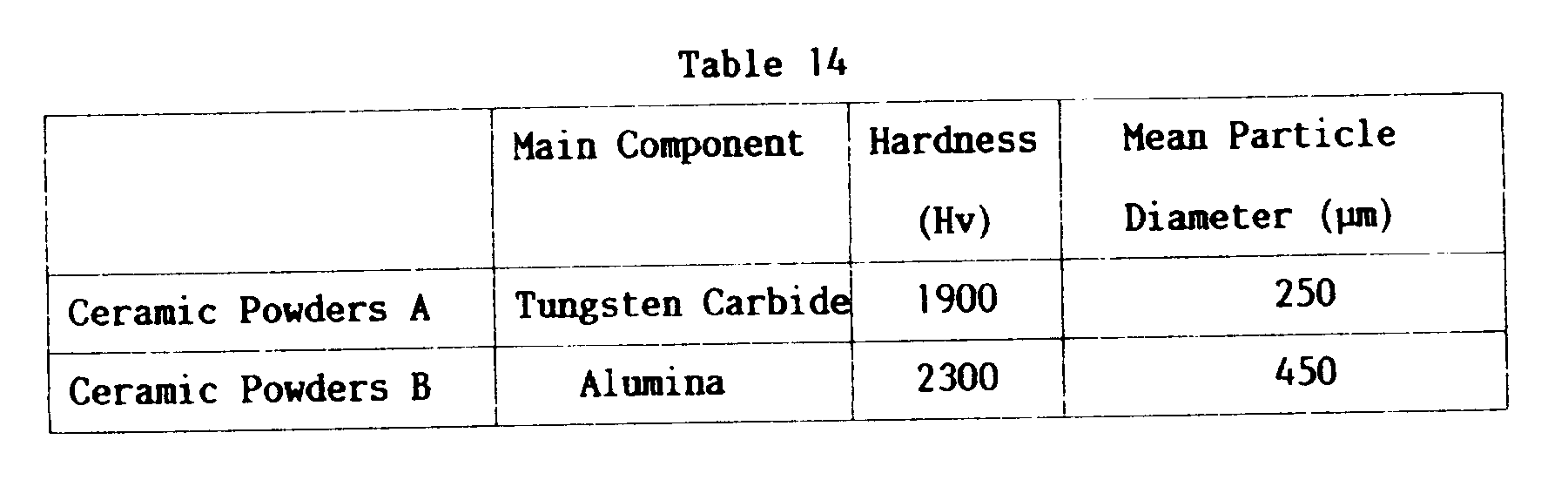
- The properties in each Example and Comparative Example are shown in Table 15.

- As is clear from Table 15, the vibration-damping metal sheets in Examples 35 to 40 according to the present invention are lower in the sound-pressure level and, hence, excellent in the vibration-damping properties than Comparative Example 21 and Comparative Example 23 in which the proportion of joined area exceeded 50 % by biting of the ceramic powders acting as the minute inclusions. In the case of the proportion of joined area by biting of the ceramic powders was 0.3 %, it spalled away easily with a small shock after rolling, and could not keep a state of joining. It is thus found that the effect of the present invention is had in the case wherein the ceramic powders as the minute inclusions is used as in the case wherein metal powders are used.
- Use was made of two annealed, cold-rolled steel plates of low carbon steel (SPCD) having the chemical composition specified in said Table 1 and a thickness of 0.8 mm, and varied amounts of short fibers of metals having a chemical composition specified in Table 16 were uniformly scattered between these steel plates, and the sheets were then cold-rolled to a finished thickness of 1.4 mm to make composite metal sheets. Afterwards, sone of the composite metal sheets were annealed at 850°C for one hour to manufacture composite metal sheets having various proportions of joined area (Examples 41 to 45).
- As the comparative material with the aforesaid metal sheets, a single annealed, cold-rolled steel plate of low carbon steel having the same chemical composition as that mentioned above and a thickness of 1.4 mm (Comparative Example 24) was also manufactured.

- The properties in respective Examples and Comparative Examples are shown in Table 17.

- As is clear from Table 17, it is found that the vibration-damping metal sheets in Examples 41 to 45 according to the present invention are lower in the sound-pressure level and, hence, the vibration-damping properties is excellent than the single sheet in Comparative Example 24, and the effect of the present invention is had in the case wherein relatively short fibers of metals are used as the minute inclusions as in the case wherein the powders are used.
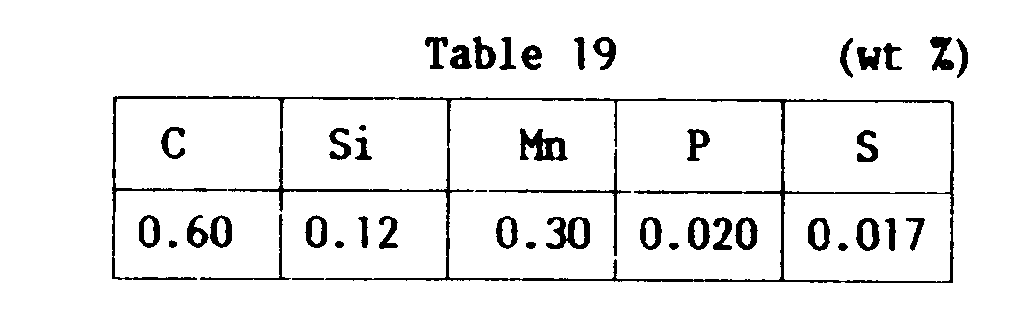
- Use was made of two annealed, cold-rolled steel plates of low-alloy steel (SNCM220) having a chemical composition specified in Table 18 and a thickness of 2.1 mm, and varied amount of hard steel wires having a chemical composition specified in Table 19, a hardness Hv of 783 and the diameter of 0.7 mm were supplied and put as the minute inclusions between the steel plates, and the sheets were then cold-rolled to a finished thickness of 4.0 mm to make composite metal sheets. In supplying the steel wires between the steel plates in cold-rolling, they were uniformly arranged at the predetermined intervals in the widthwise direction of the steel plates. Afterwards, the composite metal sheets were annealed at 700°C for two hours, and were then subjected to refining heat treatments involving hardening at 860°C and tempering at 200°C to manufacture composite metal sheets having various proportions of joined area (Examples 46 to 48 and Comparative Examples 26 to 27).
- As the comparative material with the aforesaid composite metal sheets, a single hot-rolled steel plate of 4.0 mm in thickness and made of low-alloy steel (SNCM220) having the same chemical composition as that mentioned above which was subjected to the same refining heat treatments as that mentioned above was also manufactured (Comparative Example 25).

- The properties in the respective Examples and Comparative Examples are shown in Table 20.

- As is clear from Table 20, the vibration-damping metal sheets in Examples 46 and 47 according to the present invention are lower in the sound-pressure level and, hence, excellent in the vibration-damping properties than the single sheet in Comparative Example 25 and Comparative Example 27 in which the proportion of joined area exceeded 50 %. From Comparative Example 26, it is also found that in the case wherein the proportion of joined area is 0.4 %, difficulty is involved in using it as the structural material due to low shear load. From this, it is found that the effect of the present invention is had in the case wherein the wiry material is used as the minute inclusions as in the case wherein the powders are used.
- Use was made of two annealed, cold-rolled steel plates of decarbonized steel (SPP) having a chemical composition specified in Table 21 and a thickness of 0.8 mm, and varied amounts of steel networks of varied meshes knit of stainless steel wires having a chemcial composition specified in Table 22, a hardness Hv of 386 and the diameter of 0.5 mm were put as the minute inclusions between the steel plates, and the sheets were then cold-rolled to a finished thickness of 1.6 mm to make composite metal sheets. Afterwards, the composite metal sheets were annealed at 900°C for one hour to manufacture composite metal sheets having various proportions of joined area (Examples 49 to 52 and Comparative Examples 29).
- As the comparative material with the aforesaid composite metal sheets, a single annealed, cold-rolled steel plate of decarbonized steel (SPP) having the same chemical composition as mentioned above and a thickness of 1.6 mm was also manufactured.


- The properties in the respective examples and Comparative Examples are shown in Table 23.
- From Table 23, it is found that the effect of the present invention is had in the case wherein the network composed of wiry material is used as in the case wherein the powders are used.

- Use was made of a set of two cold-rolled steel plates of low carbon steel (SPCD) having a thickness of 0.8 mm and another set of two annealed, cold-rolled steel plates of carbon tool steel (SK5) having a thickness of 1.6 mm. The chemical composition of each steel is shown in Table 24.

- For the minute inclusions to be used, iron powders C specified in Table 25 were plated with Cu to form a 10 µm-thick layer on their surfaces, and varied amounts of such minute inclusions were uniformly scattered between the aforesaid two steel plates, which were cold-rolled to have a finished thickness of 1.6 mm for a finished plate of low carbon steel and 3.2 mm for a finished plate of carbon tool steel to obtain composite metal sheets. Afterwards, one-hour annealing at 800 °C and two-hour annealing at 900 °C were carried out for low carbon steel and carbon tool steel, respectively, to thereby manufacture composite metal sheets having various proportions of joined area (Examples 53 to 61 and Comparative Examples 31, 32, 34 and 35).

- As the comparative material with the aforesaid composite steel sheets, single cold-rolled steel plates (Comparative Examples 30 and 33) were prepared from low carbon steel (SPCD) having a thickness of 1.6 mm and carbon tool steel (SK5) having a thickness of 3.2 mm, both having the chemical composition specified in Table 24, respectively.
- The results of the sound-pressure level and shear load of the sheets in respective Examples and Comparative Examples 30 to 35 measured are given in Table 26.

- As shown in Table 26 and in view of both sound-pressure level and the shear load, the vibration-damping metal sheets in Examples 53 to 61 according to the present invention are excellent as compared with those Comparative Examples 30 to 35 where the metal plates of the same type of steel were used and can be used as structural materials, having both vibration-damping properties and joint strength. It is thus found that the effect of the present invention is had, or increased effect thereof is had in the case wherein the materials plated with Cu etc. are used as the minute inclusions as in the case wherein the inclusions not plated are used.
- Use was made of a set of two aluminium-bronze plates having a thickness of 0.8 mm and another set of stainless steel plates having a thickness of 0.8 mm. The chemical compositions of these two sets of metal plates are indicated in Table 27.

- Various amounts of the iron powders C specified in said Table 25 and plated with Cu to form a 10 µm-thick layer thereon were uniformly scattered between two metal plates as the minute inclusions, and the sheets were then finished by cold-rolling to have a thickness of 1.6 mm to manufacture the vibration-damping metal sheets according to the present invention, which were further annealed at 750°C for one hour (Examples 62 and 63).
- As the comparative material with the aforesaid vibration-damping metal sheets, single sheets (Comparative Examples 36 and 37) were each prepared from an aluminium-bronze plate and a stainless steel plate, both having the chemical composition shown in Table 27 and a thickness of 1.6 mm, under the same annealing conditions as those mentioned above.
- The properties in the respective examples 62 and 63 and Comparative Examples 36 and 37 are indicated in Table 28.

- From Table 28, it is found that whether the type of metal forming the metal plates is of high-alloy steel or non-ferrous metals, the effect from the use of the materials plated with Cu etc. as the minute inclusions can be perceived as in the case of the said Examples 53 to 61.
- According to the vibration-damping metal sheets of the present invention, more than half of the area of the metal plates is occupied by the area of the metal plates at which they are not joined together, but simply come into contact with each other, and the friction occurring between the metal plates at this area assures excellent vibration-damping properties. Further, since the minute inclusions with which the joined portion is made of are formed of materials of heat-resistant metals or ceramics, rather than materials which are poor in heat resistance such as plastic materials, it is very unlikely that the structure and vibration-damping properties of the composite metal sheets may be destructed and deteriorated by heat treatments to be applied depending upon the purpose or by the use thereof in high-temperature environment, and high shear force is maintained between the metal plates. Still further, even if the minute inclusions are formed of non-conductive ceramics as well as of metals, the composite metal sheets of the present invention possess sufficiently high conductivity as well as weldability, since the metal plates come into contact with each other at the portion at which the minute inclusions are not present.
- Since the vibration-damping metal sheets according to the present invention possess such excellent physical properties, they are best-suited for use not only for foundation metals and gears of diamond cutters or chip saws used as a high speed rotator but also for structural materials needed to have vibration-damping properties as well as heat resistance, weldability and toughness such as working structures in automobiles etc.
Claims (10)
Applications Claiming Priority (4)
| Application Number | Priority Date | Filing Date | Title |
|---|---|---|---|
| JP14270986 | 1986-06-20 | ||
| JP142709/86 | 1986-06-20 | ||
| JP61180151A JPH0659707B2 (en) | 1986-06-20 | 1986-08-01 | Damping metal plate |
| JP180151/86 | 1986-08-01 |
Publications (3)
| Publication Number | Publication Date |
|---|---|
| EP0275316A1 EP0275316A1 (en) | 1988-07-27 |
| EP0275316A4 EP0275316A4 (en) | 1989-06-21 |
| EP0275316B1 true EP0275316B1 (en) | 1992-05-13 |
Family
ID=26474627
Family Applications (1)
| Application Number | Title | Priority Date | Filing Date |
|---|---|---|---|
| EP87904099A Expired - Lifetime EP0275316B1 (en) | 1986-06-20 | 1987-06-18 | Vibration damping metal sheet |
Country Status (4)
| Country | Link |
|---|---|
| US (1) | US4873149A (en) |
| EP (1) | EP0275316B1 (en) |
| GB (1) | GB2201624B (en) |
| WO (1) | WO1987007872A1 (en) |
Families Citing this family (20)
| Publication number | Priority date | Publication date | Assignee | Title |
|---|---|---|---|---|
| DE3834829A1 (en) * | 1988-10-13 | 1990-04-19 | Hoesch Stahl Ag | RESISTANT WELDABLE COMPOSITE |
| US5281470A (en) * | 1991-03-01 | 1994-01-25 | Cci Co., Ltd. | Vibration damper |
| AUPQ078899A0 (en) * | 1999-06-04 | 1999-06-24 | Ceramic Fuel Cells Limited | A fuel cell gas separator |
| KR100498462B1 (en) * | 2002-11-22 | 2005-07-01 | 삼성전자주식회사 | A damping apparatus |
| JP2006022930A (en) * | 2004-07-09 | 2006-01-26 | Matsushita Electric Ind Co Ltd | Hydrodynamic bearing device |
| US20060062977A1 (en) * | 2004-09-22 | 2006-03-23 | Sigler David R | Bonded lightweight structural sheet |
| US7510621B2 (en) * | 2004-09-22 | 2009-03-31 | General Motors Corporation | Conductive adhesive bonding |
| US20070295704A1 (en) * | 2004-12-20 | 2007-12-27 | Gm Global Technology Operations, Inc. | Additives for improved weldable composites |
| US7833630B2 (en) * | 2004-12-20 | 2010-11-16 | Gm Global Technology Operations, Inc. | Weldable metal composites and methods |
| US20060134450A1 (en) * | 2004-12-20 | 2006-06-22 | Sigler David R | Additives for improved weldable composites |
| KR101834288B1 (en) | 2008-08-18 | 2018-03-06 | 프로덕티브 리서치 엘엘씨 | Formable light weight composites |
| CA2822748C (en) | 2009-12-28 | 2021-06-01 | Shimon Mizrahi | Processes for welding composite materials and articles therefrom |
| CN102844178B (en) | 2010-02-15 | 2015-09-16 | 多产研究有限责任公司 | Formable lightweight composite systems and methods |
| US9005768B2 (en) | 2011-02-21 | 2015-04-14 | Productive Research | Composite materials including regions differing in properties and methods |
| JP2013147004A (en) * | 2012-01-23 | 2013-08-01 | Hitachi Cable Ltd | Composite material |
| JP2013184380A (en) * | 2012-03-08 | 2013-09-19 | Hitachi Cable Ltd | Vibration-damping composite material |
| US9233526B2 (en) | 2012-08-03 | 2016-01-12 | Productive Research Llc | Composites having improved interlayer adhesion and methods thereof |
| CN105109146B (en) * | 2015-08-24 | 2017-11-10 | 青岛理工大学 | Manufacturing process of metal sandwich plate embedded with damping film |
| US11338552B2 (en) | 2019-02-15 | 2022-05-24 | Productive Research Llc | Composite materials, vehicle applications and methods thereof |
| DE102023002027A1 (en) | 2023-05-19 | 2024-01-18 | Mercedes-Benz Group AG | Method for producing a metal-ceramic composite component and the metal-ceramic composite component |
Family Cites Families (18)
| Publication number | Priority date | Publication date | Assignee | Title |
|---|---|---|---|---|
| USRE22373E (en) | 1943-09-14 | Manufacture of abrasive articles | ||
| US22373A (en) * | 1858-12-21 | James montgomery | ||
| US2244771A (en) * | 1938-08-16 | 1941-06-10 | Int Standard Electric Corp | Composite conductor and contact between conductors |
| US2285583A (en) * | 1940-04-13 | 1942-06-09 | Westinghouse Electric & Mfg Co | Surface preparation of bearings for babbitting |
| US2292991A (en) * | 1941-03-06 | 1942-08-11 | Behr Manning Corp | Flexible abrasive product |
| US2490548A (en) * | 1945-07-07 | 1949-12-06 | Gen Motors Corp | Method of making composite articles |
| US2627649A (en) * | 1948-08-07 | 1953-02-10 | Burndy Engineering Co Inc | Method for making connectors with hard particle lining |
| US3406446A (en) * | 1963-10-29 | 1968-10-22 | Stephen A. Muldovan | Method of manufacturing laminated metal panel |
| US3620880A (en) * | 1969-04-07 | 1971-11-16 | Jerome H Lemelson | Apparatus and method for producing composite materials |
| JPS5025426B1 (en) * | 1969-05-23 | 1975-08-23 | ||
| FR2162317A1 (en) * | 1971-12-06 | 1973-07-20 | Bennes Marrel | Composite sheet with lightweight material - esp for vehicle bodies containers and material handling skips |
| US4005991A (en) * | 1971-12-29 | 1977-02-01 | Toyo Kogyo Co., Ltd. | Metal made of steel plate and aluminum material |
| US3860443A (en) * | 1973-03-22 | 1975-01-14 | Fiber Materials | Graphite composite |
| JPS52138017A (en) * | 1976-05-14 | 1977-11-17 | Taiho Kogyo Co Ltd | Compound material of aluminium group casting base and ferrous group annexation and its production method |
| JPS5724459Y2 (en) * | 1979-04-18 | 1982-05-27 | ||
| DE3000171C2 (en) * | 1980-01-04 | 1982-04-29 | Vereinigte Aluminium-Werke Ag, 5300 Bonn | Fiber-reinforced composite material and process for its manufacture |
| JPS58199138A (en) * | 1982-05-14 | 1983-11-19 | 株式会社丸三パツキング製作所 | Composite super-plastic material |
| US4565744A (en) * | 1983-11-30 | 1986-01-21 | Rockwell International Corporation | Wettable coating for reinforcement particles of metal matrix composite |
-
1987
- 1987-06-18 WO PCT/JP1987/000402 patent/WO1987007872A1/en not_active Ceased
- 1987-06-18 US US07/177,524 patent/US4873149A/en not_active Expired - Fee Related
- 1987-06-18 GB GB8803738A patent/GB2201624B/en not_active Expired - Lifetime
- 1987-06-18 EP EP87904099A patent/EP0275316B1/en not_active Expired - Lifetime
Also Published As
| Publication number | Publication date |
|---|---|
| GB2201624B (en) | 1990-10-17 |
| US4873149A (en) | 1989-10-10 |
| WO1987007872A1 (en) | 1987-12-30 |
| GB8803738D0 (en) | 1988-04-07 |
| GB2201624A (en) | 1988-09-07 |
| EP0275316A4 (en) | 1989-06-21 |
| EP0275316A1 (en) | 1988-07-27 |
Similar Documents
| Publication | Publication Date | Title |
|---|---|---|
| US4873149A (en) | Vibration-damper metal sheets | |
| EP0060083B1 (en) | Titanium clad steel plate | |
| US4340650A (en) | Multi-layer composite brazing alloy | |
| US7776454B2 (en) | Ti brazing strips or foils | |
| EP1257383B1 (en) | Method for making a joint between copper and stainless steel | |
| JP2001271129A (en) | Sintered materials and composite sintered sliding members | |
| GB2360294A (en) | A copper based sliding material | |
| GB1583638A (en) | Multi-layer metal bearings | |
| Shi et al. | Unlubricated rolling-sliding wear mechanisms of complex aluminium bronze against steel | |
| Nishi et al. | Diffusion bonding of alumina dispersion-strengthened copper to 316 stainless steel with interlayer metals | |
| US3732083A (en) | Composite article | |
| Sherby et al. | Superplastic bonding of ferrous laminates | |
| Sherby et al. | Multilayered composites based on ultrahigh carbon steel and brass | |
| JP2551981B2 (en) | Multi-layer iron copper lead alloy bearing material | |
| Vigraman | Liquid-solid phase reaction products formation in the diffusion welded joints made between Ti-6Al-4 V and AISI304L with brass interlayer | |
| JP2508862B2 (en) | Hot seamless pipe manufacturing plug | |
| JPH09103891A (en) | Aluminum alloy and stainless steel clad plate and method for producing the same | |
| Raybould | Wear-Resistant Al—Steel—Pb Admixed Alloys Produced by Dynamic Compaction | |
| EP4194191A1 (en) | Steel sheet | |
| Yılmaz | Effect of welding parameters on diffusion bonding of type 304 stainless steel–copper bimetal | |
| JPH11501105A (en) | Plain bearing with overlay | |
| JPS63242635A (en) | Vibration-damping metallic plate | |
| DE3327657A1 (en) | METHOD FOR PRODUCING ALUMINUM COMPOSITES | |
| JP2691456B2 (en) | Manufacturing method of composite type damping steel sheet | |
| JPH0659707B2 (en) | Damping metal plate |
Legal Events
| Date | Code | Title | Description |
|---|---|---|---|
| PUAI | Public reference made under article 153(3) epc to a published international application that has entered the european phase |
Free format text: ORIGINAL CODE: 0009012 |
|
| 17P | Request for examination filed |
Effective date: 19880217 |
|
| AK | Designated contracting states |
Kind code of ref document: A1 Designated state(s): DE FR |
|
| A4 | Supplementary search report drawn up and despatched |
Effective date: 19890621 |
|
| 17Q | First examination report despatched |
Effective date: 19910731 |
|
| GRAA | (expected) grant |
Free format text: ORIGINAL CODE: 0009210 |
|
| AK | Designated contracting states |
Kind code of ref document: B1 Designated state(s): DE FR |
|
| REF | Corresponds to: |
Ref document number: 3779093 Country of ref document: DE Date of ref document: 19920617 |
|
| ET | Fr: translation filed | ||
| PLBE | No opposition filed within time limit |
Free format text: ORIGINAL CODE: 0009261 |
|
| STAA | Information on the status of an ep patent application or granted ep patent |
Free format text: STATUS: NO OPPOSITION FILED WITHIN TIME LIMIT |
|
| 26N | No opposition filed | ||
| PGFP | Annual fee paid to national office [announced via postgrant information from national office to epo] |
Ref country code: FR Payment date: 19960611 Year of fee payment: 10 |
|
| PGFP | Annual fee paid to national office [announced via postgrant information from national office to epo] |
Ref country code: DE Payment date: 19960627 Year of fee payment: 10 |
|
| PG25 | Lapsed in a contracting state [announced via postgrant information from national office to epo] |
Ref country code: FR Free format text: LAPSE BECAUSE OF NON-PAYMENT OF DUE FEES Effective date: 19980227 |
|
| PG25 | Lapsed in a contracting state [announced via postgrant information from national office to epo] |
Ref country code: DE Free format text: LAPSE BECAUSE OF NON-PAYMENT OF DUE FEES Effective date: 19980303 |
|
| REG | Reference to a national code |
Ref country code: FR Ref legal event code: ST |
|
| REG | Reference to a national code |
Ref country code: FR Ref legal event code: ST |