EP0272425B1 - Resin blends exhibiting improved impact properties - Google Patents
Resin blends exhibiting improved impact properties Download PDFInfo
- Publication number
- EP0272425B1 EP0272425B1 EP19870116437 EP87116437A EP0272425B1 EP 0272425 B1 EP0272425 B1 EP 0272425B1 EP 19870116437 EP19870116437 EP 19870116437 EP 87116437 A EP87116437 A EP 87116437A EP 0272425 B1 EP0272425 B1 EP 0272425B1
- Authority
- EP
- European Patent Office
- Prior art keywords
- composition
- cross
- resin
- linked
- weight percent
- Prior art date
- Legal status (The legal status is an assumption and is not a legal conclusion. Google has not performed a legal analysis and makes no representation as to the accuracy of the status listed.)
- Expired - Lifetime
Links
- 239000000203 mixture Substances 0.000 title claims description 121
- 229920005989 resin Polymers 0.000 title claims description 57
- 239000011347 resin Substances 0.000 title claims description 57
- 230000001747 exhibiting effect Effects 0.000 title description 3
- -1 alkyl methacrylate Chemical compound 0.000 claims description 84
- LYCAIKOWRPUZTN-UHFFFAOYSA-N Ethylene glycol Chemical compound OCCO LYCAIKOWRPUZTN-UHFFFAOYSA-N 0.000 claims description 45
- 125000003118 aryl group Chemical group 0.000 claims description 38
- 238000000034 method Methods 0.000 claims description 36
- SCUZVMOVTVSBLE-UHFFFAOYSA-N prop-2-enenitrile;styrene Chemical compound C=CC#N.C=CC1=CC=CC=C1 SCUZVMOVTVSBLE-UHFFFAOYSA-N 0.000 claims description 35
- 229920000638 styrene acrylonitrile Polymers 0.000 claims description 35
- BVKZGUZCCUSVTD-UHFFFAOYSA-L Carbonate Chemical compound [O-]C([O-])=O BVKZGUZCCUSVTD-UHFFFAOYSA-L 0.000 claims description 31
- 239000000178 monomer Substances 0.000 claims description 28
- 229920001225 polyester resin Polymers 0.000 claims description 24
- 239000004645 polyester resin Substances 0.000 claims description 24
- 238000006116 polymerization reaction Methods 0.000 claims description 24
- NIXOWILDQLNWCW-UHFFFAOYSA-M Acrylate Chemical compound [O-]C(=O)C=C NIXOWILDQLNWCW-UHFFFAOYSA-M 0.000 claims description 23
- 229920000515 polycarbonate Polymers 0.000 claims description 23
- 239000004417 polycarbonate Substances 0.000 claims description 23
- 230000008569 process Effects 0.000 claims description 19
- 239000004431 polycarbonate resin Substances 0.000 claims description 17
- 229920005668 polycarbonate resin Polymers 0.000 claims description 17
- 239000011521 glass Substances 0.000 claims description 15
- 239000002253 acid Substances 0.000 claims description 13
- KKEYFWRCBNTPAC-UHFFFAOYSA-N Terephthalic acid Chemical compound OC(=O)C1=CC=C(C(O)=O)C=C1 KKEYFWRCBNTPAC-UHFFFAOYSA-N 0.000 claims description 12
- PPBRXRYQALVLMV-UHFFFAOYSA-N Styrene Chemical group C=CC1=CC=CC=C1 PPBRXRYQALVLMV-UHFFFAOYSA-N 0.000 claims description 11
- QQVIHTHCMHWDBS-UHFFFAOYSA-N isophthalic acid Chemical compound OC(=O)C1=CC=CC(C(O)=O)=C1 QQVIHTHCMHWDBS-UHFFFAOYSA-N 0.000 claims description 11
- 239000003365 glass fiber Substances 0.000 claims description 10
- YIMQCDZDWXUDCA-UHFFFAOYSA-N [4-(hydroxymethyl)cyclohexyl]methanol Chemical compound OCC1CCC(CO)CC1 YIMQCDZDWXUDCA-UHFFFAOYSA-N 0.000 claims description 9
- 125000005250 alkyl acrylate group Chemical group 0.000 claims description 9
- WGCNASOHLSPBMP-UHFFFAOYSA-N hydroxyacetaldehyde Natural products OCC=O WGCNASOHLSPBMP-UHFFFAOYSA-N 0.000 claims description 9
- 229920001707 polybutylene terephthalate Polymers 0.000 claims description 9
- 229920001283 Polyalkylene terephthalate Polymers 0.000 claims description 8
- 239000003431 cross linking reagent Substances 0.000 claims description 8
- 239000003063 flame retardant Substances 0.000 claims description 8
- 229920000058 polyacrylate Polymers 0.000 claims description 8
- 239000000945 filler Substances 0.000 claims description 7
- 229920000642 polymer Polymers 0.000 claims description 7
- NLHHRLWOUZZQLW-UHFFFAOYSA-N Acrylonitrile Chemical group C=CC#N NLHHRLWOUZZQLW-UHFFFAOYSA-N 0.000 claims description 6
- 239000007795 chemical reaction product Substances 0.000 claims description 6
- 229910000410 antimony oxide Inorganic materials 0.000 claims description 4
- CQEYYJKEWSMYFG-UHFFFAOYSA-N butyl acrylate Chemical group CCCCOC(=O)C=C CQEYYJKEWSMYFG-UHFFFAOYSA-N 0.000 claims description 4
- 239000000839 emulsion Substances 0.000 claims description 4
- VTRUBDSFZJNXHI-UHFFFAOYSA-N oxoantimony Chemical compound [Sb]=O VTRUBDSFZJNXHI-UHFFFAOYSA-N 0.000 claims description 4
- 229920000139 polyethylene terephthalate Polymers 0.000 claims description 4
- 230000000379 polymerizing effect Effects 0.000 claims description 4
- 239000005020 polyethylene terephthalate Substances 0.000 claims description 3
- 239000011145 styrene acrylonitrile resin Substances 0.000 claims 2
- 239000011342 resin composition Substances 0.000 claims 1
- 230000000979 retarding effect Effects 0.000 claims 1
- 239000012071 phase Substances 0.000 description 33
- 229920000728 polyester Polymers 0.000 description 28
- 239000004609 Impact Modifier Substances 0.000 description 19
- 125000004432 carbon atom Chemical group C* 0.000 description 13
- IISBACLAFKSPIT-UHFFFAOYSA-N bisphenol A Chemical compound C=1C=C(O)C=CC=1C(C)(C)C1=CC=C(O)C=C1 IISBACLAFKSPIT-UHFFFAOYSA-N 0.000 description 11
- 229920001634 Copolyester Polymers 0.000 description 10
- 239000004215 Carbon black (E152) Substances 0.000 description 9
- 229930195733 hydrocarbon Natural products 0.000 description 9
- YGYAWVDWMABLBF-UHFFFAOYSA-N Phosgene Chemical compound ClC(Cl)=O YGYAWVDWMABLBF-UHFFFAOYSA-N 0.000 description 8
- 239000000463 material Substances 0.000 description 8
- 150000003254 radicals Chemical class 0.000 description 8
- 239000003381 stabilizer Substances 0.000 description 8
- 238000012360 testing method Methods 0.000 description 8
- 239000003054 catalyst Substances 0.000 description 7
- 238000002360 preparation method Methods 0.000 description 7
- OKKJLVBELUTLKV-UHFFFAOYSA-N Methanol Chemical compound OC OKKJLVBELUTLKV-UHFFFAOYSA-N 0.000 description 6
- 238000006243 chemical reaction Methods 0.000 description 6
- 239000002609 medium Substances 0.000 description 6
- 239000002243 precursor Substances 0.000 description 6
- 239000011369 resultant mixture Substances 0.000 description 6
- 239000003017 thermal stabilizer Substances 0.000 description 6
- 238000012695 Interfacial polymerization Methods 0.000 description 5
- 229940106691 bisphenol a Drugs 0.000 description 5
- 150000002148 esters Chemical class 0.000 description 5
- 150000002989 phenols Chemical class 0.000 description 5
- SYJPAKDNFZLSMV-HYXAFXHYSA-N (Z)-2-methylpropanal oxime Chemical compound CC(C)\C=N/O SYJPAKDNFZLSMV-HYXAFXHYSA-N 0.000 description 4
- IJGRMHOSHXDMSA-UHFFFAOYSA-N Atomic nitrogen Chemical compound N#N IJGRMHOSHXDMSA-UHFFFAOYSA-N 0.000 description 4
- 229920004142 LEXAN™ Polymers 0.000 description 4
- ISWSIDIOOBJBQZ-UHFFFAOYSA-N Phenol Chemical compound OC1=CC=CC=C1 ISWSIDIOOBJBQZ-UHFFFAOYSA-N 0.000 description 4
- NIXOWILDQLNWCW-UHFFFAOYSA-N acrylic acid group Chemical group C(C=C)(=O)O NIXOWILDQLNWCW-UHFFFAOYSA-N 0.000 description 4
- 238000009833 condensation Methods 0.000 description 4
- 230000005494 condensation Effects 0.000 description 4
- 125000002993 cycloalkylene group Chemical group 0.000 description 4
- 239000000835 fiber Substances 0.000 description 4
- 229910052736 halogen Inorganic materials 0.000 description 4
- 239000002245 particle Substances 0.000 description 4
- 239000007790 solid phase Substances 0.000 description 4
- 239000002904 solvent Substances 0.000 description 4
- XLYOFNOQVPJJNP-UHFFFAOYSA-N water Chemical compound O XLYOFNOQVPJJNP-UHFFFAOYSA-N 0.000 description 4
- YMWUJEATGCHHMB-UHFFFAOYSA-N Dichloromethane Chemical compound ClCCl YMWUJEATGCHHMB-UHFFFAOYSA-N 0.000 description 3
- ZMANZCXQSJIPKH-UHFFFAOYSA-N Triethylamine Chemical compound CCN(CC)CC ZMANZCXQSJIPKH-UHFFFAOYSA-N 0.000 description 3
- 150000007513 acids Chemical class 0.000 description 3
- 238000013019 agitation Methods 0.000 description 3
- 150000004649 carbonic acid derivatives Chemical class 0.000 description 3
- 150000007942 carboxylates Chemical group 0.000 description 3
- 150000001875 compounds Chemical class 0.000 description 3
- 238000006482 condensation reaction Methods 0.000 description 3
- 239000008367 deionised water Substances 0.000 description 3
- 229910021641 deionized water Inorganic materials 0.000 description 3
- 150000002334 glycols Chemical class 0.000 description 3
- 239000004615 ingredient Substances 0.000 description 3
- 238000002156 mixing Methods 0.000 description 3
- 125000001997 phenyl group Chemical group [H]C1=C([H])C([H])=C(*)C([H])=C1[H] 0.000 description 3
- 125000001424 substituent group Chemical group 0.000 description 3
- 229920001169 thermoplastic Polymers 0.000 description 3
- 239000004416 thermosoftening plastic Substances 0.000 description 3
- QPFMBZIOSGYJDE-UHFFFAOYSA-N 1,1,2,2-tetrachloroethane Chemical compound ClC(Cl)C(Cl)Cl QPFMBZIOSGYJDE-UHFFFAOYSA-N 0.000 description 2
- RNFJDJUURJAICM-UHFFFAOYSA-N 2,2,4,4,6,6-hexaphenoxy-1,3,5-triaza-2$l^{5},4$l^{5},6$l^{5}-triphosphacyclohexa-1,3,5-triene Chemical compound N=1P(OC=2C=CC=CC=2)(OC=2C=CC=CC=2)=NP(OC=2C=CC=CC=2)(OC=2C=CC=CC=2)=NP=1(OC=1C=CC=CC=1)OC1=CC=CC=C1 RNFJDJUURJAICM-UHFFFAOYSA-N 0.000 description 2
- CIWBSHSKHKDKBQ-JLAZNSOCSA-N Ascorbic acid Chemical compound OC[C@H](O)[C@H]1OC(=O)C(O)=C1O CIWBSHSKHKDKBQ-JLAZNSOCSA-N 0.000 description 2
- WKBOTKDWSSQWDR-UHFFFAOYSA-N Bromine atom Chemical compound [Br] WKBOTKDWSSQWDR-UHFFFAOYSA-N 0.000 description 2
- QIGBRXMKCJKVMJ-UHFFFAOYSA-N Hydroquinone Chemical compound OC1=CC=C(O)C=C1 QIGBRXMKCJKVMJ-UHFFFAOYSA-N 0.000 description 2
- OFOBLEOULBTSOW-UHFFFAOYSA-N Malonic acid Chemical compound OC(=O)CC(O)=O OFOBLEOULBTSOW-UHFFFAOYSA-N 0.000 description 2
- JUJWROOIHBZHMG-UHFFFAOYSA-N Pyridine Chemical compound C1=CC=NC=C1 JUJWROOIHBZHMG-UHFFFAOYSA-N 0.000 description 2
- 150000001252 acrylic acid derivatives Chemical class 0.000 description 2
- 229920000800 acrylic rubber Polymers 0.000 description 2
- 125000001931 aliphatic group Chemical group 0.000 description 2
- 229910052784 alkaline earth metal Inorganic materials 0.000 description 2
- 125000005907 alkyl ester group Chemical group 0.000 description 2
- 125000002947 alkylene group Chemical group 0.000 description 2
- 125000001118 alkylidene group Chemical group 0.000 description 2
- ROOXNKNUYICQNP-UHFFFAOYSA-N ammonium persulfate Chemical compound [NH4+].[NH4+].[O-]S(=O)(=O)OOS([O-])(=O)=O ROOXNKNUYICQNP-UHFFFAOYSA-N 0.000 description 2
- 150000001491 aromatic compounds Chemical class 0.000 description 2
- 125000003710 aryl alkyl group Chemical group 0.000 description 2
- 239000012298 atmosphere Substances 0.000 description 2
- QMKYBPDZANOJGF-UHFFFAOYSA-N benzene-1,3,5-tricarboxylic acid Chemical compound OC(=O)C1=CC(C(O)=O)=CC(C(O)=O)=C1 QMKYBPDZANOJGF-UHFFFAOYSA-N 0.000 description 2
- FDQSRULYDNDXQB-UHFFFAOYSA-N benzene-1,3-dicarbonyl chloride Chemical compound ClC(=O)C1=CC=CC(C(Cl)=O)=C1 FDQSRULYDNDXQB-UHFFFAOYSA-N 0.000 description 2
- 239000011230 binding agent Substances 0.000 description 2
- PXKLMJQFEQBVLD-UHFFFAOYSA-N bisphenol F Chemical compound C1=CC(O)=CC=C1CC1=CC=C(O)C=C1 PXKLMJQFEQBVLD-UHFFFAOYSA-N 0.000 description 2
- 239000006085 branching agent Substances 0.000 description 2
- GDTBXPJZTBHREO-UHFFFAOYSA-N bromine Substances BrBr GDTBXPJZTBHREO-UHFFFAOYSA-N 0.000 description 2
- 229910052794 bromium Inorganic materials 0.000 description 2
- DQXBYHZEEUGOBF-UHFFFAOYSA-N but-3-enoic acid;ethene Chemical compound C=C.OC(=O)CC=C DQXBYHZEEUGOBF-UHFFFAOYSA-N 0.000 description 2
- 125000002837 carbocyclic group Chemical group 0.000 description 2
- 125000005587 carbonate group Chemical group 0.000 description 2
- 238000004132 cross linking Methods 0.000 description 2
- WOZVHXUHUFLZGK-UHFFFAOYSA-N dimethyl terephthalate Chemical compound COC(=O)C1=CC=C(C(=O)OC)C=C1 WOZVHXUHUFLZGK-UHFFFAOYSA-N 0.000 description 2
- ZUOUZKKEUPVFJK-UHFFFAOYSA-N diphenyl Chemical compound C1=CC=CC=C1C1=CC=CC=C1 ZUOUZKKEUPVFJK-UHFFFAOYSA-N 0.000 description 2
- 229920001971 elastomer Polymers 0.000 description 2
- 239000005038 ethylene vinyl acetate Substances 0.000 description 2
- 239000011152 fibreglass Substances 0.000 description 2
- 150000002367 halogens Chemical class 0.000 description 2
- 239000012535 impurity Substances 0.000 description 2
- YDSWCNNOKPMOTP-UHFFFAOYSA-N mellitic acid Chemical compound OC(=O)C1=C(C(O)=O)C(C(O)=O)=C(C(O)=O)C(C(O)=O)=C1C(O)=O YDSWCNNOKPMOTP-UHFFFAOYSA-N 0.000 description 2
- 239000003607 modifier Substances 0.000 description 2
- 229910052757 nitrogen Inorganic materials 0.000 description 2
- 230000000704 physical effect Effects 0.000 description 2
- 229920001200 poly(ethylene-vinyl acetate) Polymers 0.000 description 2
- CYIDZMCFTVVTJO-UHFFFAOYSA-N pyromellitic acid Chemical compound OC(=O)C1=CC(C(O)=O)=C(C(O)=O)C=C1C(O)=O CYIDZMCFTVVTJO-UHFFFAOYSA-N 0.000 description 2
- 239000000376 reactant Substances 0.000 description 2
- 230000035484 reaction time Effects 0.000 description 2
- 229920005992 thermoplastic resin Polymers 0.000 description 2
- 238000013022 venting Methods 0.000 description 2
- GJHVEONIFIJEIH-UHFFFAOYSA-N (2-chloronaphthalen-1-yl) (2-chlorophenyl) carbonate Chemical compound ClC1=CC=CC=C1OC(=O)OC1=C(Cl)C=CC2=CC=CC=C12 GJHVEONIFIJEIH-UHFFFAOYSA-N 0.000 description 1
- VLDPXPPHXDGHEW-UHFFFAOYSA-N 1-chloro-2-dichlorophosphoryloxybenzene Chemical compound ClC1=CC=CC=C1OP(Cl)(Cl)=O VLDPXPPHXDGHEW-UHFFFAOYSA-N 0.000 description 1
- SMZOUWXMTYCWNB-UHFFFAOYSA-N 2-(2-methoxy-5-methylphenyl)ethanamine Chemical compound COC1=CC=C(C)C=C1CCN SMZOUWXMTYCWNB-UHFFFAOYSA-N 0.000 description 1
- OEPOKWHJYJXUGD-UHFFFAOYSA-N 2-(3-phenylmethoxyphenyl)-1,3-thiazole-4-carbaldehyde Chemical compound O=CC1=CSC(C=2C=C(OCC=3C=CC=CC=3)C=CC=2)=N1 OEPOKWHJYJXUGD-UHFFFAOYSA-N 0.000 description 1
- GOXQRTZXKQZDDN-UHFFFAOYSA-N 2-Ethylhexyl acrylate Chemical compound CCCCC(CC)COC(=O)C=C GOXQRTZXKQZDDN-UHFFFAOYSA-N 0.000 description 1
- AKUCXWDJOMIBEH-UHFFFAOYSA-N 2-bromo-4-[2-(3-bromo-4-hydroxy-5-methylphenyl)propan-2-yl]-6-methylphenol Chemical compound BrC1=C(O)C(C)=CC(C(C)(C)C=2C=C(Br)C(O)=C(C)C=2)=C1 AKUCXWDJOMIBEH-UHFFFAOYSA-N 0.000 description 1
- VEORPZCZECFIRK-UHFFFAOYSA-N 3,3',5,5'-tetrabromobisphenol A Chemical compound C=1C(Br)=C(O)C(Br)=CC=1C(C)(C)C1=CC(Br)=C(O)C(Br)=C1 VEORPZCZECFIRK-UHFFFAOYSA-N 0.000 description 1
- KXYDGGNWZUHESZ-UHFFFAOYSA-N 4-(2,2,4-trimethyl-3h-chromen-4-yl)phenol Chemical compound C12=CC=CC=C2OC(C)(C)CC1(C)C1=CC=C(O)C=C1 KXYDGGNWZUHESZ-UHFFFAOYSA-N 0.000 description 1
- UITKHKNFVCYWNG-UHFFFAOYSA-N 4-(3,4-dicarboxybenzoyl)phthalic acid Chemical compound C1=C(C(O)=O)C(C(=O)O)=CC=C1C(=O)C1=CC=C(C(O)=O)C(C(O)=O)=C1 UITKHKNFVCYWNG-UHFFFAOYSA-N 0.000 description 1
- NZGQHKSLKRFZFL-UHFFFAOYSA-N 4-(4-hydroxyphenoxy)phenol Chemical compound C1=CC(O)=CC=C1OC1=CC=C(O)C=C1 NZGQHKSLKRFZFL-UHFFFAOYSA-N 0.000 description 1
- FLCXQXDIBIICJR-UHFFFAOYSA-N 4-[1-(4-hydroxy-3,5-dimethylphenyl)cyclododecyl]-2,6-dimethylphenol Chemical compound CC1=C(O)C(C)=CC(C2(CCCCCCCCCCC2)C=2C=C(C)C(O)=C(C)C=2)=C1 FLCXQXDIBIICJR-UHFFFAOYSA-N 0.000 description 1
- BHWMWBACMSEDTE-UHFFFAOYSA-N 4-[1-(4-hydroxyphenyl)cyclododecyl]phenol Chemical compound C1=CC(O)=CC=C1C1(C=2C=CC(O)=CC=2)CCCCCCCCCCC1 BHWMWBACMSEDTE-UHFFFAOYSA-N 0.000 description 1
- ICYDRUIZSPKQOH-UHFFFAOYSA-N 4-[1-(4-hydroxyphenyl)decyl]phenol Chemical compound C=1C=C(O)C=CC=1C(CCCCCCCCC)C1=CC=C(O)C=C1 ICYDRUIZSPKQOH-UHFFFAOYSA-N 0.000 description 1
- ODJUOZPKKHIEOZ-UHFFFAOYSA-N 4-[2-(4-hydroxy-3,5-dimethylphenyl)propan-2-yl]-2,6-dimethylphenol Chemical compound CC1=C(O)C(C)=CC(C(C)(C)C=2C=C(C)C(O)=C(C)C=2)=C1 ODJUOZPKKHIEOZ-UHFFFAOYSA-N 0.000 description 1
- KSYGTCNPCHQRKM-UHFFFAOYSA-N 4-[2-(4-hydroxyphenyl)propan-2-yl]phenol Chemical compound C=1C=C(O)C=CC=1C(C)(C)C1=CC=C(O)C=C1.C=1C=C(O)C=CC=1C(C)(C)C1=CC=C(O)C=C1 KSYGTCNPCHQRKM-UHFFFAOYSA-N 0.000 description 1
- RHSDKKXLNNCMIC-UHFFFAOYSA-N 4-[4-(4-hydroxyphenyl)butyl]phenol Chemical compound C1=CC(O)=CC=C1CCCCC1=CC=C(O)C=C1 RHSDKKXLNNCMIC-UHFFFAOYSA-N 0.000 description 1
- QHPQWRBYOIRBIT-UHFFFAOYSA-N 4-tert-butylphenol Chemical compound CC(C)(C)C1=CC=C(O)C=C1 QHPQWRBYOIRBIT-UHFFFAOYSA-N 0.000 description 1
- 229920000178 Acrylic resin Polymers 0.000 description 1
- 239000004925 Acrylic resin Substances 0.000 description 1
- SDDLEVPIDBLVHC-UHFFFAOYSA-N Bisphenol Z Chemical compound C1=CC(O)=CC=C1C1(C=2C=CC(O)=CC=2)CCCCC1 SDDLEVPIDBLVHC-UHFFFAOYSA-N 0.000 description 1
- UXVMQQNJUSDDNG-UHFFFAOYSA-L Calcium chloride Chemical compound [Cl-].[Cl-].[Ca+2] UXVMQQNJUSDDNG-UHFFFAOYSA-L 0.000 description 1
- ZAMOUSCENKQFHK-UHFFFAOYSA-N Chlorine atom Chemical compound [Cl] ZAMOUSCENKQFHK-UHFFFAOYSA-N 0.000 description 1
- JIGUQPWFLRLWPJ-UHFFFAOYSA-N Ethyl acrylate Chemical compound CCOC(=O)C=C JIGUQPWFLRLWPJ-UHFFFAOYSA-N 0.000 description 1
- CERQOIWHTDAKMF-UHFFFAOYSA-N Methacrylic acid Chemical compound CC(=C)C(O)=O CERQOIWHTDAKMF-UHFFFAOYSA-N 0.000 description 1
- VVQNEPGJFQJSBK-UHFFFAOYSA-N Methyl methacrylate Chemical compound COC(=O)C(C)=C VVQNEPGJFQJSBK-UHFFFAOYSA-N 0.000 description 1
- GYCMBHHDWRMZGG-UHFFFAOYSA-N Methylacrylonitrile Chemical compound CC(=C)C#N GYCMBHHDWRMZGG-UHFFFAOYSA-N 0.000 description 1
- 239000004698 Polyethylene Substances 0.000 description 1
- 239000002202 Polyethylene glycol Substances 0.000 description 1
- 229920006243 acrylic copolymer Polymers 0.000 description 1
- 239000000654 additive Substances 0.000 description 1
- 230000002411 adverse Effects 0.000 description 1
- 150000001298 alcohols Chemical class 0.000 description 1
- 229920003232 aliphatic polyester Polymers 0.000 description 1
- 239000003513 alkali Substances 0.000 description 1
- 125000004450 alkenylene group Chemical group 0.000 description 1
- 125000003545 alkoxy group Chemical group 0.000 description 1
- 125000000217 alkyl group Chemical group 0.000 description 1
- 125000003277 amino group Chemical group 0.000 description 1
- 229910001870 ammonium persulfate Inorganic materials 0.000 description 1
- 239000003963 antioxidant agent Substances 0.000 description 1
- 235000006708 antioxidants Nutrition 0.000 description 1
- 238000013459 approach Methods 0.000 description 1
- 239000012736 aqueous medium Substances 0.000 description 1
- 150000005840 aryl radicals Chemical class 0.000 description 1
- 235000010323 ascorbic acid Nutrition 0.000 description 1
- 229960005070 ascorbic acid Drugs 0.000 description 1
- 239000011668 ascorbic acid Substances 0.000 description 1
- CJPIDIRJSIUWRJ-UHFFFAOYSA-N benzene-1,2,4-tricarbonyl chloride Chemical compound ClC(=O)C1=CC=C(C(Cl)=O)C(C(Cl)=O)=C1 CJPIDIRJSIUWRJ-UHFFFAOYSA-N 0.000 description 1
- 235000010290 biphenyl Nutrition 0.000 description 1
- 239000004305 biphenyl Substances 0.000 description 1
- VCYAMSXIIWQHKV-UHFFFAOYSA-N bis(2,3,4-tribromophenyl) carbonate Chemical compound BrC1=C(Br)C(Br)=CC=C1OC(=O)OC1=CC=C(Br)C(Br)=C1Br VCYAMSXIIWQHKV-UHFFFAOYSA-N 0.000 description 1
- LUQQDEDMRRRWGN-UHFFFAOYSA-N bis(2-bromophenyl) carbonate Chemical compound BrC1=CC=CC=C1OC(=O)OC1=CC=CC=C1Br LUQQDEDMRRRWGN-UHFFFAOYSA-N 0.000 description 1
- MUCRFDZUHPMASM-UHFFFAOYSA-N bis(2-chlorophenyl) carbonate Chemical compound ClC1=CC=CC=C1OC(=O)OC1=CC=CC=C1Cl MUCRFDZUHPMASM-UHFFFAOYSA-N 0.000 description 1
- POZGCGJFBOZPCM-UHFFFAOYSA-N bis(2-methylphenyl) carbonate Chemical compound CC1=CC=CC=C1OC(=O)OC1=CC=CC=C1C POZGCGJFBOZPCM-UHFFFAOYSA-N 0.000 description 1
- BEVHTMLFDWFAQF-UHFFFAOYSA-N butyl(triphenyl)phosphanium Chemical compound C=1C=CC=CC=1[P+](C=1C=CC=CC=1)(CCCC)C1=CC=CC=C1 BEVHTMLFDWFAQF-UHFFFAOYSA-N 0.000 description 1
- 239000001110 calcium chloride Substances 0.000 description 1
- 229910001628 calcium chloride Inorganic materials 0.000 description 1
- 229910052799 carbon Inorganic materials 0.000 description 1
- MOIPGXQKZSZOQX-UHFFFAOYSA-N carbonyl bromide Chemical compound BrC(Br)=O MOIPGXQKZSZOQX-UHFFFAOYSA-N 0.000 description 1
- 125000003178 carboxy group Chemical group [H]OC(*)=O 0.000 description 1
- 150000001244 carboxylic acid anhydrides Chemical class 0.000 description 1
- 150000001732 carboxylic acid derivatives Chemical class 0.000 description 1
- 230000015556 catabolic process Effects 0.000 description 1
- 239000000460 chlorine Substances 0.000 description 1
- 229910052801 chlorine Inorganic materials 0.000 description 1
- 239000004927 clay Substances 0.000 description 1
- 229910052570 clay Inorganic materials 0.000 description 1
- 230000015271 coagulation Effects 0.000 description 1
- 238000005345 coagulation Methods 0.000 description 1
- 230000000052 comparative effect Effects 0.000 description 1
- 238000013329 compounding Methods 0.000 description 1
- 239000007859 condensation product Substances 0.000 description 1
- 238000001816 cooling Methods 0.000 description 1
- 229920001577 copolymer Polymers 0.000 description 1
- 125000000753 cycloalkyl group Chemical group 0.000 description 1
- 238000006731 degradation reaction Methods 0.000 description 1
- ZQUZPFYNEARCQO-UHFFFAOYSA-N dinaphthalen-1-yl carbonate Chemical compound C1=CC=C2C(OC(OC=3C4=CC=CC=C4C=CC=3)=O)=CC=CC2=C1 ZQUZPFYNEARCQO-UHFFFAOYSA-N 0.000 description 1
- 150000002009 diols Chemical class 0.000 description 1
- ROORDVPLFPIABK-UHFFFAOYSA-N diphenyl carbonate Chemical compound C=1C=CC=CC=1OC(=O)OC1=CC=CC=C1 ROORDVPLFPIABK-UHFFFAOYSA-N 0.000 description 1
- 239000000806 elastomer Substances 0.000 description 1
- 150000002118 epoxides Chemical class 0.000 description 1
- 230000008020 evaporation Effects 0.000 description 1
- 238000001704 evaporation Methods 0.000 description 1
- 239000004744 fabric Substances 0.000 description 1
- 125000000524 functional group Chemical group 0.000 description 1
- 230000009477 glass transition Effects 0.000 description 1
- 125000005067 haloformyl group Chemical group 0.000 description 1
- 125000005059 halophenyl group Chemical group 0.000 description 1
- 238000010438 heat treatment Methods 0.000 description 1
- 150000002430 hydrocarbons Chemical class 0.000 description 1
- 230000003301 hydrolyzing effect Effects 0.000 description 1
- 125000002887 hydroxy group Chemical group [H]O* 0.000 description 1
- 230000006872 improvement Effects 0.000 description 1
- 150000002531 isophthalic acids Chemical class 0.000 description 1
- 239000004816 latex Substances 0.000 description 1
- 229920000126 latex Polymers 0.000 description 1
- 238000011068 loading method Methods 0.000 description 1
- 238000004519 manufacturing process Methods 0.000 description 1
- 230000007246 mechanism Effects 0.000 description 1
- NNYHMCFMPHPHOQ-UHFFFAOYSA-N mellitic anhydride Chemical compound O=C1OC(=O)C2=C1C(C(OC1=O)=O)=C1C1=C2C(=O)OC1=O NNYHMCFMPHPHOQ-UHFFFAOYSA-N 0.000 description 1
- 239000000155 melt Substances 0.000 description 1
- 238000002844 melting Methods 0.000 description 1
- 230000008018 melting Effects 0.000 description 1
- 150000002734 metacrylic acid derivatives Chemical class 0.000 description 1
- 125000005395 methacrylic acid group Chemical group 0.000 description 1
- 239000010445 mica Substances 0.000 description 1
- 229910052618 mica group Inorganic materials 0.000 description 1
- 230000004048 modification Effects 0.000 description 1
- 238000012986 modification Methods 0.000 description 1
- 239000006082 mold release agent Substances 0.000 description 1
- 125000001624 naphthyl group Chemical group 0.000 description 1
- SLCVBVWXLSEKPL-UHFFFAOYSA-N neopentyl glycol Chemical compound OCC(C)(C)CO SLCVBVWXLSEKPL-UHFFFAOYSA-N 0.000 description 1
- 125000000449 nitro group Chemical group [O-][N+](*)=O 0.000 description 1
- 125000001741 organic sulfur group Chemical group 0.000 description 1
- PNJWIWWMYCMZRO-UHFFFAOYSA-N pent‐4‐en‐2‐one Natural products CC(=O)CC=C PNJWIWWMYCMZRO-UHFFFAOYSA-N 0.000 description 1
- 150000008301 phosphite esters Chemical class 0.000 description 1
- 229920002285 poly(styrene-co-acrylonitrile) Polymers 0.000 description 1
- 229920001281 polyalkylene Polymers 0.000 description 1
- 229920001223 polyethylene glycol Polymers 0.000 description 1
- 229920005644 polyethylene terephthalate glycol copolymer Polymers 0.000 description 1
- 239000000047 product Substances 0.000 description 1
- HJWLCRVIBGQPNF-UHFFFAOYSA-N prop-2-enylbenzene Chemical compound C=CCC1=CC=CC=C1 HJWLCRVIBGQPNF-UHFFFAOYSA-N 0.000 description 1
- 238000010926 purge Methods 0.000 description 1
- UMJSCPRVCHMLSP-UHFFFAOYSA-N pyridine Natural products COC1=CC=CN=C1 UMJSCPRVCHMLSP-UHFFFAOYSA-N 0.000 description 1
- 150000003856 quaternary ammonium compounds Chemical class 0.000 description 1
- 150000004023 quaternary phosphonium compounds Chemical class 0.000 description 1
- 230000005855 radiation Effects 0.000 description 1
- 239000007787 solid Substances 0.000 description 1
- 229910001220 stainless steel Inorganic materials 0.000 description 1
- 239000010935 stainless steel Substances 0.000 description 1
- 239000000126 substance Substances 0.000 description 1
- 150000003460 sulfonic acids Chemical class 0.000 description 1
- 239000000454 talc Substances 0.000 description 1
- 229910052623 talc Inorganic materials 0.000 description 1
- 150000003504 terephthalic acids Chemical class 0.000 description 1
- LXEJRKJRKIFVNY-UHFFFAOYSA-N terephthaloyl chloride Chemical compound ClC(=O)C1=CC=C(C(Cl)=O)C=C1 LXEJRKJRKIFVNY-UHFFFAOYSA-N 0.000 description 1
- 150000003512 tertiary amines Chemical class 0.000 description 1
- HWCKGOZZJDHMNC-UHFFFAOYSA-M tetraethylammonium bromide Chemical compound [Br-].CC[N+](CC)(CC)CC HWCKGOZZJDHMNC-UHFFFAOYSA-M 0.000 description 1
- 125000003944 tolyl group Chemical group 0.000 description 1
- 238000005809 transesterification reaction Methods 0.000 description 1
- SRPWOOOHEPICQU-UHFFFAOYSA-N trimellitic anhydride Chemical compound OC(=O)C1=CC=C2C(=O)OC(=O)C2=C1 SRPWOOOHEPICQU-UHFFFAOYSA-N 0.000 description 1
- NJMOHBDCGXJLNJ-UHFFFAOYSA-N trimellitic anhydride chloride Chemical compound ClC(=O)C1=CC=C2C(=O)OC(=O)C2=C1 NJMOHBDCGXJLNJ-UHFFFAOYSA-N 0.000 description 1
Classifications
-
- C—CHEMISTRY; METALLURGY
- C08—ORGANIC MACROMOLECULAR COMPOUNDS; THEIR PREPARATION OR CHEMICAL WORKING-UP; COMPOSITIONS BASED THEREON
- C08L—COMPOSITIONS OF MACROMOLECULAR COMPOUNDS
- C08L67/00—Compositions of polyesters obtained by reactions forming a carboxylic ester link in the main chain; Compositions of derivatives of such polymers
- C08L67/02—Polyesters derived from dicarboxylic acids and dihydroxy compounds
-
- C—CHEMISTRY; METALLURGY
- C08—ORGANIC MACROMOLECULAR COMPOUNDS; THEIR PREPARATION OR CHEMICAL WORKING-UP; COMPOSITIONS BASED THEREON
- C08L—COMPOSITIONS OF MACROMOLECULAR COMPOUNDS
- C08L69/00—Compositions of polycarbonates; Compositions of derivatives of polycarbonates
-
- C—CHEMISTRY; METALLURGY
- C08—ORGANIC MACROMOLECULAR COMPOUNDS; THEIR PREPARATION OR CHEMICAL WORKING-UP; COMPOSITIONS BASED THEREON
- C08L—COMPOSITIONS OF MACROMOLECULAR COMPOUNDS
- C08L69/00—Compositions of polycarbonates; Compositions of derivatives of polycarbonates
- C08L69/005—Polyester-carbonates
Definitions
- Blends of polycarbonate resins and polyester resins are known in the art.
- U.S. Patent 3,128,372 discloses blends of polycarbonates and polyalkylene terephthalates
- U.S. Patent 4,125, 572 discloses blends of polycarbonates, poly(1,4-butylene terephthalate) and a copolyester of an aliphatic or cycloaliphatic diol and a mixture of terephthalic acid and isophthalic acid.
- Polycarbonate/polyester blends exhibit excellent properties which render them useful in the manufacture of films, fibers, and molded articles. They exhibit, for example, better ductility than neat polyesters and better processability than neat polycarbonates. There exist certain situations where polycarbonate/polyester blends exhibiting better impact properties than those possessed by conventional presently available polycarbonate/polyester blends are required.
- Patent 4,342,846 discloses blends of a polyester resin, such as polyethylene or polybutylene terephthalate, and an impact resistant interpolymer comprising cross-linked acrylic or methacrylic rubber, cross-linked styrene-acrylonitrile, and uncross-linked styrene-acrylonitrile.
- a polyester resin such as polyethylene or polybutylene terephthalate
- an impact resistant interpolymer comprising cross-linked acrylic or methacrylic rubber, cross-linked styrene-acrylonitrile, and uncross-linked styrene-acrylonitrile.
- This type of impact modifier is described in U.S. Patent No. 3,944,631 to Yu et al.
- a two phase material i.e., a cross-linked acrylate/cross-linked styrene-acrylonitrile
- a two stage polymerization procedure can be utilized as an effective impact modifier for blends of thermoplastic aromatic carbonate resins/polyester resins.
- This two phase interpolymer comprised of a cross-linked elastomeric acrylate and a cross-linked styrene-acrylonitrile is thus a departure from known techniques described in the prior art.
- the two phase cross-linked acrylate/cross-linked styrene-acrylonitrile interpolymer can be used effectively in a blend of aromatic carbonate resins and polyester resins as an impact modifier is generally surprising and unexpected.
- a material In order for a material to function as an effective impact modifier for thermoplastic resins it must not only improve the impact porperties of these resins, but it must also be compatible with the resins. i.e., it must not deleteriously affect the advantageous properties of these resins. Furthermore, it must readily be combinable with the resin over the range of concentrations which are effective to improve the impact properties of these resins.
- Aromatic carbonate resin/polyester resin blends exhibiting improved impact properties are provided by adding to said blends an effective amount of an impact modifier which is a two phase interpolymer comprised of a first elastomeric phase of a cross-linked polyacrylate and a second phase comprised of a cross-linked styrene-acrylonitrile.
- an impact modifier which is a two phase interpolymer comprised of a first elastomeric phase of a cross-linked polyacrylate and a second phase comprised of a cross-linked styrene-acrylonitrile.
- compositions are comprised of (i) a blend of at least one aromatic carbonate resin and at least one polyester resin; and (ii) an amount effective to improve the impact properties of said blend of a two-phase interpolymer comprised of a cross-linked polyacrylate and a crosslinked styrene-acrylonitrile, the two phases being joined by an interpenetrating network between the two phases.
- the aromatic carbonate resins of the instant invention include the polycarbonate resins and the copolyester-carbonate resins.
- the polycarbonate resins are conventional and well known thermoplastic resins which are generally commercially available or may be readily prepared by known methods. These polycarbonates, as well as methods for their preparation, are described, inter alia, in U.S. Pat. Nos. 3,161,615; 3,220,973; 3,312,659; 3,312,660; 3,313, 777; 3,666,614 and 3,393,672.
- the polycarbonates may be prepared by a variety of known methods, including the interfacial polymerization process which involves the coreaction of at least one dihydric phenol and a carbonate precursor.
- the polycarbonate resins contain at least one recurring structural unit represented by the general formula wherein: R and R1 are independently selected from monovalent hydrocarbon radicals, monovalent hydrocarbonoxy radicals, and halogen radicals; W is selected from divalent hydrocarbon radicals, -S-, -S-S-, -O-, n and n1 are independently selected from integers having a value of from 0 to 4 inclusive; and b is either zero or one.
- the monovalent hydrocarbon radicals represented by R and R1 include the alkyl, cycloalkyl, aryl, aralkyl and alkaryl radicals.
- the preferred alkyl radicals are those containing from 1 to about 12 carbon atoms.
- the preferred cycloalkyl radicals are those containing from about 4 to about 8 ring carbon atoms.
- the preferred aryl radicals are those containing from 6 to 12 ring carbon atoms, i.e., phenyl, biphenyl, and naphthyl.
- the preferred aralkyl and alkaryl radicals are those containing from 7 to about 14 carbon atoms.
- the preferred halogen radicals represented by R and R1 are chlorine and bromine.
- the monovalent hydrocarbonoxy radicals represented by R and R1 may be represented by the formula -OR ⁇ wherein R ⁇ is a monovalent hydrocarbon radical of the type described hereinafore.
- Preferred hydrocarbonoxy radicals are the alkoxy and aryloxy radicals.
- the divalent hydrocarbon radicals represented by W include the alkylene, alkylidene, cycloalkylene, and cycloalkylidene radicals.
- the preferred alkylene radicals are those containing from 2 to about 20 carbon atoms.
- the preferred alkylidene radicals are those containing from 1 to about 20 carbon atoms.
- the preferred cycloalkylene and cycloalkylidene radicals are those containing from 6 to about 16 ring carbon atoms.
- the dihydric phenols utilized in the preparation of the polycarbonate resins may be represented by the general formula wherein R, R1, n, n1, W and b are as defined hereinafore.
- dihydric phenols falling within the scope of Formula II include: 2,2-bis(4-hydroxyphenyl) propane (bisphenol-A); 2,2-bis(3,5-dibromo-4-hydroxyphenyl) propane; 2,2-bis(3,5-dimethyl-4-hydroxyphenyl) propane; 2,2-bis(3-bromo-5-methyl-4-hydroxyphenyl) propane; 1,1-bis(4-hydroxyphenyl)cyclohexane; 1,1-bis(4-hydroxyphenyl) cyclododecane; 1,1-bis(3,5-dimethyl-4-hydroxyphenyl) cyclododecane; 1,1-bis(4-hydroxyphenyl) decane; 1,4-bis(4hydroxyphenyl) butane; bis(4-hydroxyphenyl) methane; 4,4 ⁇ -thiodiphenol; and bis(4-hydroxyphenyl) ether.
- bisphenol-A 2,2-bis(3,5-dibromo-4-hydroxyphenyl) propane
- the carbonate precursor may be a carbonyl halide, a carbonate ester, or a bishaloformate.
- the carbonyl halides may be carbonyl bromide, carbonyl chloride, or mixtures thereof.
- the carbonate esters may be diphenyl carbonate; di(halophenyl) carbonates such as di(bromophenyl) carbonate, di(chlorophenyl) carbonate, and di (tribromophenyl)carbonate: di(alkylphenyl)carbonates such as di(tolyl)carbonate; di(naphthyl) carbonate; chlorophenyl chloronaphthyl carbonate; and phenyl tolyl carbonate.
- the bishaloformates that can be used include the bishaloformates of dihydric phenols such as the bischloroformates of bisphenol-A and hydroquinone; and the bishaloformates of glycols such as the bischloroformates of ethylene glycol, neopentyl glycol, and polyethylene glycol.
- the preferred carbonate precursor is carbonyl chloride, also known as phosgene.
- the processes used for the preparation of the polycarbonates are the pyridine process, the interfacial polymerization process, transesterification, and melt polymerization.
- a convenient process for the preparation of the polycarbonate resins is the interfacial polymerization process. This process utilizes two different solvent media which are immiscible.
- One solvent medium is an aqueous basic medium.
- the other solvent medium is an organic medium such as methylene chloride which is immiscible with said aqueous medium.
- molecular weight regulators which control the chain length or molecular weight of the polycarbonate by a chain terminating mechanism, and catalysts.
- the molecular weight regulators are well known in the art and include phenyl itself, p-tertiarybutyl phenol, and chroman-I.
- the catalysts are also well known in the art and include tertiary amines such as triethylamine, quaternary ammonium compounds such as tetraethylammonium bromide, and quaternary phosphonium compounds such as n-butyltriphenyl phosphonium.
- polycarbonates are the randomly branched thermoplastic polycarbonates wherein a branching agent, which is generally a polyfunctional aromatic compound, is reacted with the dihydric phenol and the carbonate percursor.
- branching agent which is generally a polyfunctional aromatic compound
- These polyfunctional aromatic compounds are used in minor amounts, i.e., amount effective to provide branching, and contain at least three functional groups which may be carboxyl, hydroxyl, carboxylic anhydride, haloformyl, and mixtures thereof.
- copolyester-carbonate resins are well known in the art and are described along with methods for their preparation in U.S. Patent Nos. 3,169,121; 4,238,596; 4,156,069 and 4,238,597.
- thermoplastic aromatic copolyester-carbonates comprise recurring carbonate groups, carboxylate groups, and aromatic carbocyclic groups in the polymer chain in which at least some of the carbonate groups and at least some of the carboxylate groups are bonded directly to the ring carbon atoms of the aromatic carbocyclic groups.
- These copolyester-carbonates contain ester bonds and carbonate bonds in the chain, wherein the amount of the ester bonds is in the range of from about 25 to about 90 mole percent, preferably from about 35 to about 80 mole percent. For example, 5 moles of bisphenol-A reacting completely with 4 moles of isophthaloyl dichloride and one mole of phosgene would give a copolyester-carbonate of 80 mole percent ester bonds.
- copolyester-carbonates may be readily prepared by the interfacial polymerization process by the reaction of (i) at least one dihydric phenol, (ii) a carbonate percursor, and (iii) an ester precursor.
- the dihydric phenols and the carbonate precursors are of the type described hereinafore.
- the ester precursor may be a difunctional carboxylic acid or, preferably, its ester forming reactive derivative such as an acid dihalide, e.g., isophthaloyl dichloride, terephthaloyl dichloride, and mixtures thereof.
- the polyesters may be either aliphatic, aromatic, or aliphatic-aromatic in character.
- the polyesters are characterized in that they have recurring ester units in the polymer chain, i.e., carboxylate groups bonded to a carbon atom of a hydrocarbon or substituted hydrocarbon radical.
- the preferred polyesters for use in the instant invention generally contain at least one recurring structural unit represented by the general formula: wherein R2 and R3 are independently selected from divalent hydrocarbon radicals or substituted divalent hydrocarbon radicals.
- R2 and R3 are independently selected from divalent aliphatic hydrocarbon radicals or substituted divalent aliphatic hydrocarbon radicals.
- the divalent aliphatic hydrocarbon radicals include the alkylene, alkenylene, alkylidene, cycloalkylene, cycloalkylidene, and cycloalkenylene radicals.
- Preferred alkylene radicals are those containing from 2 to about 20 carbon atoms.
- the preferred alkylidene radicals are those containing from 1 to about 20 carbon atoms.
- the preferred alkenylene radicals are those containing from 2 to about 20 carbon atoms.
- the preferred cycloalkylene, cycloalkylidene, and cycloalkenylene radicals are those containing from about 4 to about 8 ring carbon atoms.
- the substituted divalent aliphatic hydrocarbon radicals are those divalent aliphatic hydrocarbon radicals described above which contain at least one substituent group, preferably from one to about three substituent groups.
- the preferred substituent groups are the halogens, nitro groups, and amino groups.
- the aromatic polyesters suitable for use in the instant invention generally contain at least one recurring structural unit of Formula III wherein R2 and R3 are independently selected from divalent aromatic radicals or substituted divalent aromatic radicals.
- the divalent aromatic radicals represented by R2 and R3 include the phenylene radical, the substituted phenylene radical, the biphenylene radical, the substituted biphenylene radical, the naphthylene radical, the substituted naphthylene radical, and radicals represented by the general formula wherein R, R1, W, n, n1 and b are as defined hereinafore.
- Particularly useful aromatic polyesters are those wherein R3 is a phenylene radical and R2 is a radical represented by Formula IIIa.
- the aliphatic aromatic polyesters are those wherein one of R2 or R3 is a divalent aromatic radical and one of R2 or R3 is a divalent aliphatic radical.
- Preferred aliphatic aromatic polyesters are those wherein R2 is a divalent aliphatic radical or substituted divalent aliphatic radical and R3 is a divalent aromatic radical or a substituted divalent aromatic radical.
- polyesters are the polyalkylene terephthalates or polyalkylene isophthalates. These types of polyesters contain at least one recurring structural unit represented by the general formula wherein m is an integer having a value of from 2 to about 4 inclusive.
- Especially preferred polyesters of Formula IIIb are polyethylene terephthalate and poly(1,4-butylene terephthalate).
- polyester copolymers or copolyesters which can, without limitation, comprise the reaction products of: (a) a glycol portion comprising a 1,4-cyclohexanedimethanol with an acid portion comprising terephthalic acid, isophthalic acid or mixtures thereof; or (b) a glycol portion comprising a 1,4-cyclohexanedimethanol and ethylene glycol wherein the molar ratio of the 1,4-cyclohexanedimethanol to the ethylene glycol in the glycol portion is from about 4:1 to about 1:4, with an acid portion comprising terephthalic acid, isophthalic acid, or mixtures thereof.
- copolyesters may be prepared by procedures well known in the art, such as by condensation reactions substantially as shown and described in U.S. Patent No. 2,901,466. More particularly, the acid or mixtures of acids or alkyl esters of the aromatic dicarboxylic acid or acids, for example, dimethylterephthalate, together with the dihydric alcohols are charged to a flask and heated to a temperature sufficient to cause condensation of the copolymer to begin, for example 175°-225° C. Thereafter the temperature is raised to about 250° to 300° C., and a vacuum is applied and the condensation reaction is allowed to proceed until substantially complete.
- the condensation reaction may be facilitated by the use of a catalyst, with the choice of catalyst being determined by the nature of the reactants.
- the various catalysts for use herein are very well known in the art and are too numerous to mention individually. Generally, however, when an alkyl ester of the dicarboxylic acid is employed, an ester interchange type of catalyst is preferred. If a free acid is being reacted with free glycols, a catalyst is generally not added until after the preliminary condensation has gotten under way.
- the reaction is generally begun in the presence of an excess of glycols and initially involves heating to a temperature sufficient to cause a preliminary condensation followed by the evaporation of excess glycol.
- the entire reaction is conducted with agitation under an inert atmosphere.
- the temperature can be advantageously increased with or without the immediate application of vacuum.
- the pressure can be advantageously greatly reduced and the condensation allowed to proceed until the desired degree of polymerization is achieved.
- the product can be considered finished at this stage or it can be subjected to further polymerization in the solid phase in accordance with well known techniques.
- the highly monomeric condensation product can be cooled, comminuted, and heated to a temperature below its melting point, thereby avoiding coagulation of the solid particles.
- the solid phase polymerization is conducted until the desired degree of polymerization is achieved.
- the solid phase polymerization results in a higher degree of polymerization without the accompanying degradation which frequently takes place when continuing the last stage of the melt polymerization at a temperature high enough to achieve the desired degree of polymerization.
- the solid phase process is advantageously conducted with agitation employing an inert atmosphere at either normal atmospheric pressure or under greatly reduced pressure.
- copolyesters will generally have an intrinsic viscosity of at least about 0.4 dl/gm as measured in 60/40 phenol/tetrachloroethane or other similar solvents at about 25°C. and will have a heat distortion temperature at 46.2 N/mm (264 p.s.i.) from about 60°C. to about 70°C.
- the relative amounts of the 1,4-cyclohexanedimethanol to ethylene glycol in the glycol portion of the copolyester (b) may vary so long as the molar ratio of 1,4-cyclohexanedimethanol to ethylene glycol is from about 1:4 to 4:1, in order to provide a polyester copolymer having a suitable heat distortion temperature within the recited range, and other suitable properties.
- copolyester is a copolyester of the type described hereinafore wherein the glycol portion has a predominance of ethylene glycol over 1,4-cyclohexanedimethanol, for example greater than about 50/50 and especially preferably is about 70 molar ethylene glycol to 30 molar 1,4-cyclohexanedimenathol, and the acid portion is terephthalic acid.
- a preferred copolyester of this type is commercially available under the tradename KODAR PETG 6763 from Eastman Chemical Co.
- a preferred copolyester is one derived from 1,4-cyclohexanedimethanol as the glycol portion and a mixture of isophthalic and terephthalic acids as the acid portion.
- This type of copolyester is available from Eastman Chemical Co. under the tradename KODAR A150.
- compositions which contain from about 2 to about 98 weight percent of the aromatic carbonate resin and from about 98 to about 2 weight percent polyester are preferred, while compositions which contain from about 5 to about 95 weight percent aromatic carbonate resin and from about 95 to about 5 weight percent polyester resin are more preferred.
- Quite useful compositions are those that contain from about 10 to about 90 weight percent aromatic carbonate resin and from about 90 to about 5 weight percent polyester resin.
- Weight percent aromatic carbonate resin is based on the total amounts of aromatic carbonate resin and polyester resin present in the compositions.
- weight percent polyester is based on the total amounts of the polyester resins and aromatic carbonate resin present in the instant compositions, i.e., polyester/aromatic carbonate blends.
- the impact modifier of the present invention is a two phase interpolymer containing a first elastomeric phase comprising a cross-linked polyacrylate and a second phase comprising a cross-linked styrene-acrylonitrile. The two phases are joined and held together by an interpenetrating network of the cross-linked acrylate and the cross-linked styrene-acrylonitrile.
- the integrity of the two phases is generally maintained by mechanical means such as interpenetration and entanglement of the two cross-linked components rather than by chemical means such as grafting or graftlinking of the two components.
- the interpolymer is substantiall free or contains little if any grafting or graft-linking.
- the instant two phase interpolymer is also free or substantially free of any added non-crosslinked or linear styrene-acrylonitrile. This is a sharp contrast to the interpolymer described in U.S. Patent No. 3,944,631 which contains a noncross-linked or linear styrene-acrylonitrile.
- These two phases interpolymer compositions may be formed by the following type of two-step sequential polymerization process:
- Such a two stage polymerization process is analogous to the three stage process described in U.S. Patent 3,944,631 to Yu, except for the fact that this two stage process does not include the critical third stage of Yu which involves adding a monomeric charge of styrene and acrylonitrile which does not contain a cross-linking agent to form a linear non-cross-linked styrene-acrylonitrile polymer.
- steps 1 and 2 are the same as described in U.S. Patent 3,944,631.
- the acrylic elastomers used in preparing the interpolymer of the instant invention comprise cross-linked acrylic polymers or copolymers having a Tg, i.e., a glass transition temperature, of below about 25°C which can be polymerized by means of free radical initiated emulsion techniques.
- the acrylic elastomers are cross-linked during the polymerization of the elastomer by the inclusion of a polyfunctional ethylenically unsaturated monomer cross-linking agent in the polymerization mixture.
- the preferred acrylate monomers are the C4-C8 alkyl acrylate monomers such as n-butyl acrylate, ethyl acrylate, and 2-ethylhexyl acrylate.
- the monomer charge may contain small amounts, i.e., 1-20% by weight of the amount of acrylate monomer, of optional monomers such as styrene, acrylonitrile, methacrylonitrile, methyl methacrylate, methacrylic acid, acrylic acid, vinylidene chloride, vinyl toluene and any other ethylenically unsaturated monomer copolymerizable with the acrylate monomer selected for use.
- acrylate and “acrylic” as used herein includes both the acrylates, i.e., alkyl acrylates, and methacrylates, i.e., alkyl methacrylates.
- the interpolymer of the present invention generally comprises from about 40 to about 90 percent by weight of at least one of the cross-linked acrylates, and from about 10 to about 60 percent by weight of said cross-linked styrene-acrylonitrile.
- the interpolymer will comprise from about 50 to about 90 weight percent of said cross-linked acrylate and from about 20 to about 50 weight percent of said cross-linked styrene-acrylonitrile. Weight percent is calculated based on the total amounts of said cross-linked acrylate and said cross-linked styrene-acrylonitrile present in the interpolymer.
- the instant two phase polymer does not contain any added non-cross-linked styrene-acrylonitrile copolymer which is obtained by the polymerization of styrene and acrylonitrile monomers in the absence of any cross-linking agent. While it is possible that some minor amounts of uncross-linked styrene-acrylonitrile may be present from the second polymerization and cross-linking step described hereinafore, this uncross-linked styrene-acrylonitrile is present only as a trace impurity and not as one of the components of the instant two phase interpolymer.
- this non-cross-linked or linear styrene-acrylonitrile is present due to any incomplete cross-linking reaction of step 2.
- the term "substantially free of linear or non-cross-linked styrene-acrylonitrile" means that the instant interpolymer does not contain any additional or added non-cross-linked styrene-acrylonitrile above and beyond that which may remain as an inherent impurity or unreacted reactant of step 2. That is to say, the instant interpolymer does not contain a third phase comprised of a linear or non-cross-linked styrene-acrylonitrile as does the three phase composition of the aforediscussed Yu patent.
- the amount of the instant two phase interpolymer present in the instant compositions is an amount which is at least effective to improve the impact properties, e.g., impact strength, of the aromatic carbonate resin/polyester resin blends. Generally, this amount is from about 1 to about 30 weight percent, preferably from about 3 to about 25 weight percent, and more preferably from about 4 to about 20 weight percent. Weight percent of impact modifier is based on the total of impact modifier and blend of aromatic carbonate resin/polyester resin present.
- the instant compositions contain more than about 30 weight percent of said impact modifiers than the advantageous properties of said blends will be substantially adversely affected, i.e., the compositions will begin to loose, to a substantial degree, the advantageous physical properties imparted thereto by the aromatic carbonate/polyester blends.
- the instant compositions contain an amount of said impact modifier effective to improve or positively upgrade the impact properties of the blends but insufficient to substantially deleteriously affect substantially most of the advantageous physical properties of said blends.
- compositions of the instant invention may be prepared by any of the known and conventional means.
- the instant compositions may be prepared by first compounding the aromatic carbonate/polyester blends and then mixing with said precompounded blends the appropriate amount of the impact modifier of the instant invention.
- the aromatic carbonate resin, the polyester resin, and the impact modifier can be mixed together without first precompounding the aromatic carbonate/polyester blends.
- compositions of the instant invention may also optionally contain other commonly known and used additives such as, for example, antioxidants; mold release agents; ultraviolet radiation stabilizers; hydrolytic stabilizers such as the epoxides disclosed in U.S. Patent Nos. 3,489,716; 4,138,379, and 3,839,247; color stabilizers such as the organophosphites disclosed in U.S. Patent Nos. 3,305,520 and 4,118,370; fillers such as talc, clay, mica and glass such as glass particles or chopped fiberglass; other commonly known and used impact modifiers such as those described in U.S. Patent No. 4,512,980 to Miller; and flame retardants.
- additives such as, for example, antioxidants; mold release agents; ultraviolet radiation stabilizers; hydrolytic stabilizers such as the epoxides disclosed in U.S. Patent Nos. 3,489,716; 4,138,379, and 3,839,247; color stabilizers such as the organophosphites disclosed in U.
- Some useful flame retardants include the alkali and alkaline earth metal salts of organic sulfonic acids. These types of flame retardants are disclosed, inter alia, in U.S. Patent Nos. 3,933,734; 3,948,851; 3,926,908; 3,919,167; 3,909,490; 3,953,396; 3,931,100; 3,978,024; 3,953,399; 3,917,559; 3,951,910 and 3,940, 366.
- halogenated flame retardants include the well known inorganic and organic sulfur and/or halogen containing compounds such as, for example, the halogenated, e.g., brominated, polycarbonate oligomers or polymers, used either alone or in combination with antimony oxide.
- compositions of the instant invention may optionally contain glass filler.
- the glass may be in the form of small glass particles or spheres or glass fibers.
- glass fibers it is to be understood that glass silk as well as all glass fiber materials derived therefrom including glass fiber fabrics, roving, staple fibers, and glass fiber mats are included
- the length of the glass filaments and whether or not they are bundled into fibers and the fibers bundled in turn to yarns, ropes, or rovings, or woven into mats and the like, are not critical. However, when using fibrous glass filaments, they may first be formed and gathered into a bundle known as a strand.
- a binder or binding agent may be applied to the glass filaments. This facilitates the handling of the strands.
- the strands can be chopped into various lengths, preferably from about 3,18 to about 25,4 mm (1/8" to about 1") long, more preferably less than 6,35 mm (1/4") long, and most preferably about 3,18 mm (1/8") long.
- the compositions generally contain up to about 50 weight % of glass filler, preferably up to about 30 weight % glass filler, based on the amounts of glass filler, resin, and modifier present.
- the following example illustrates the preparation of the two-phase cross-linked acrylate/crosslinked styrene acrylonitrile interpolymer of the instant invention.
- the reactor was purged of air by alternately pressurizing the reactor to 0.703 kg/cm2 with nitrogen and then venting to 0.141 kg/cm2. This purge cycle was repeated three times.
- the reactor was heated to 54.4°C. At this time 2.09 kg of ammonium persulfate in 6.1 liters of deionized water was added.
- the batch temperature was held close to 54.4°C by an automatic temperature control system supplying cooling to the reactor jacket. The batch was allowed to react for 2 hours.
- the reactor was then purged by alternately pressurizing to 0.703 kg/cm2 with nitrogen and venting to 0.141 kg/cm2 three times.
- the batch was allowed to react for an additional 3.25 hours with the temperature control system set at 54.4°C.
- This example illustrates a blend of a polycarbonate and a polyester resin.
- This example illustrates a flame retardant blend of a polycarbonate and a polyester resin.
- This example illustrates a glass filled polycarbonate/polyester blend.
- Example 2 To 15 parts by weight of the polycarbonate resin used in Example 2 are added 70 parts by weight of the poly(butylene terephthalate) used in Example 2, 15 parts by weight of the two phase interpolymer prepared substantially in accordance with the procedure of Example 1, 0.3 parts by weight of the color stabilizer of Example 2, and 0.15 parts by weight of the thermal stabilizer of Example 2. The resultant mixture is extruded and molded into test sample parts of about 3,18 mm (1/8")thickness. The notched Izod of these parts is determined in accordance with the procedure of Example 2 and the results are set forth in Table I.
- This example illustrates a flame retardant blend of polycarbonate/polyester containing the no phase interpolymer of the present invention.
- This example illustrates a glass filled blend of polycarbonate/polyester containing the two phase interpolymer of the present invention.
- Example 4 To 15 parts by weight of aromatic polycarbonate resin used in Example 4 are added 39.55 parts by weight of the poly(butylene terephthalate) resin used in Example 4, 0.15 parts by weight of the thermal stabilizer used in Example 4, 0.3 parts by weight of the color stabilizer used in Example 4, 30 parts by weight of the about 3,18 mm (1/8") long chopped fiberglass used in Example 4, and 15 parts by weight of the two phase interpolymer prepared substantially in accordance with the procedure of Example 1. The resultant mixture is extruded and molded into test sample parts measuring about 3,18 mm (1/8"/thick. The notched Izod of these test parts is determined in accordance with the procedure of Example 2 and the results are set forth in Table I. TABLE I Example No. Interpolymer (wt.
- compositions of the instant invention exhibit improved impact strengths over comparable compositions which do not contain any of the two phase interpolymer of the present invention (Examples 2-4).
- the composition of Example 2 should be compared with the composition of Example 5; the composition of Example 3 should be compared with the composition of Example 6; and the composition of Example 4 should be compared with the composition of Example 7
- compositions of the instant invention are useful for the preparation of molded and extruded articles.
Landscapes
- Chemical & Material Sciences (AREA)
- Health & Medical Sciences (AREA)
- Chemical Kinetics & Catalysis (AREA)
- Medicinal Chemistry (AREA)
- Polymers & Plastics (AREA)
- Organic Chemistry (AREA)
- Compositions Of Macromolecular Compounds (AREA)
Description
- Blends of polycarbonate resins and polyester resins are known in the art. For example U.S. Patent 3,128,372 discloses blends of polycarbonates and polyalkylene terephthalates; and U.S. Patent 4,125, 572 discloses blends of polycarbonates, poly(1,4-butylene terephthalate) and a copolyester of an aliphatic or cycloaliphatic diol and a mixture of terephthalic acid and isophthalic acid. Polycarbonate/polyester blends exhibit excellent properties which render them useful in the manufacture of films, fibers, and molded articles. They exhibit, for example, better ductility than neat polyesters and better processability than neat polycarbonates. There exist certain situations where polycarbonate/polyester blends exhibiting better impact properties than those possessed by conventional presently available polycarbonate/polyester blends are required.
- It is known that the impact properties of neat polycarbonates can be upgraded by combining the polycarbonate resins with impact modifiers. U.S. Patent 4,148,842 to Yu et al. discloses blends of a polycarbonate resin and an interpolymer modifier comprising crosslinked (meth)acrylate, cross-linked styrene-acrylonitrile, and uncrosslinked styrene-acrylonitrile. It is also known that the impact properties of neat polyester resins can be upgraded by combining said polyester resins with an impact modifier. U.S. Patent 4,342,846 discloses blends of a polyester resin, such as polyethylene or polybutylene terephthalate, and an impact resistant interpolymer comprising cross-linked acrylic or methacrylic rubber, cross-linked styrene-acrylonitrile, and uncross-linked styrene-acrylonitrile. This type of impact modifier is described in U.S. Patent No. 3,944,631 to Yu et al. as being a three stage interpolymer produced in a three stage polymerization process in which in the third stage a cross-linked acrylate/cross-linked styrene-acrylonitrile polymeric material is used as a reaction ingredient during the polymerization of styrene and acrylonitrile without a cross-linking agent.
- It has now been discovered that a two phase material, i.e., a cross-linked acrylate/cross-linked styrene-acrylonitrile, produced by a two stage polymerization procedure, can be utilized as an effective impact modifier for blends of thermoplastic aromatic carbonate resins/polyester resins. The use of this two phase interpolymer comprised of a cross-linked elastomeric acrylate and a cross-linked styrene-acrylonitrile is thus a departure from known techniques described in the prior art. For example, in the aforediscussed U.S. Patent Nos. 3,944,631, 4,148,842 and 4,342,846, three stage polymerizations yielding a three phase interpolymer comprised of a cross-linked acrylate/cross-linked styrene-acrylonitrile/uncross-linked or linear styrene-acrylonitrile, rather than a two stage polymerization yielding a two phase interpolymer followed by a blending step, are advocated.
- The fact that the two phase cross-linked acrylate/cross-linked styrene-acrylonitrile interpolymer can be used effectively in a blend of aromatic carbonate resins and polyester resins as an impact modifier is generally surprising and unexpected. In order for a material to function as an effective impact modifier for thermoplastic resins it must not only improve the impact porperties of these resins, but it must also be compatible with the resins. i.e., it must not deleteriously affect the advantageous properties of these resins. Furthermore, it must readily be combinable with the resin over the range of concentrations which are effective to improve the impact properties of these resins. While some materials are effective in positively upgrading the impact properties of certain resins they do so only at the cost of deleteriously affecting some of the other advantageous properties of said resins. While other materials function as impact modifiers for certain resins and do not significantly deleteriously affect substantially most of the advantageous properties of these resins they are not readily combinable with these resins. Still other materials need be present in relatively large concentrations in order to significantly positively upgrade the impact properties of these resins.
- This area of impact modification of various resins by blending them with various compounds which function as impact modifiers is thus still an art rather than an exact science wherein the empirical approach is still generally the rule rather than an exception. This is particularly true when dealing with blends of two different resins, wherein the aforediscussed problems are greatly magnified.
- Thus, the fact that the instant two phase interpolymers function as effective impact modifiers for blends of aromatic carbonate resins and polyester resins, are compatible with these blends, positively upgrade the impact properties of the blends at relatively low loadings, and are readily combinable with these blends, is one which could not be predicted and is unexpected.
- Aromatic carbonate resin/polyester resin blends exhibiting improved impact properties are provided by adding to said blends an effective amount of an impact modifier which is a two phase interpolymer comprised of a first elastomeric phase of a cross-linked polyacrylate and a second phase comprised of a cross-linked styrene-acrylonitrile.
- The instant compositions are comprised of (i) a blend of at least one aromatic carbonate resin and at least one polyester resin; and (ii) an amount effective to improve the impact properties of said blend of a two-phase interpolymer comprised of a cross-linked polyacrylate and a crosslinked styrene-acrylonitrile, the two phases being joined by an interpenetrating network between the two phases.
- The aromatic carbonate resins of the instant invention include the polycarbonate resins and the copolyester-carbonate resins. The polycarbonate resins are conventional and well known thermoplastic resins which are generally commercially available or may be readily prepared by known methods. These polycarbonates, as well as methods for their preparation, are described, inter alia, in U.S. Pat. Nos. 3,161,615; 3,220,973; 3,312,659; 3,312,660; 3,313, 777; 3,666,614 and 3,393,672. The polycarbonates may be prepared by a variety of known methods, including the interfacial polymerization process which involves the coreaction of at least one dihydric phenol and a carbonate precursor. The polycarbonate resins contain at least one recurring structural unit represented by the general formula

wherein:
R and R¹ are independently selected from monovalent hydrocarbon radicals, monovalent hydrocarbonoxy radicals, and halogen radicals;
W is selected from divalent hydrocarbon radicals, -S-, -S-S-, -O-,
n and n¹ are independently selected from integers having a value of from 0 to 4 inclusive; and b is either zero or one. - The monovalent hydrocarbon radicals represented by R and R¹ include the alkyl, cycloalkyl, aryl, aralkyl and alkaryl radicals. The preferred alkyl radicals are those containing from 1 to about 12 carbon atoms. The preferred cycloalkyl radicals are those containing from about 4 to about 8 ring carbon atoms. The preferred aryl radicals are those containing from 6 to 12 ring carbon atoms, i.e., phenyl, biphenyl, and naphthyl. The preferred aralkyl and alkaryl radicals are those containing from 7 to about 14 carbon atoms.
- The preferred halogen radicals represented by R and R¹ are chlorine and bromine.
- The monovalent hydrocarbonoxy radicals represented by R and R¹ may be represented by the formula -ORʹ wherein Rʹ is a monovalent hydrocarbon radical of the type described hereinafore. Preferred hydrocarbonoxy radicals are the alkoxy and aryloxy radicals.
- The divalent hydrocarbon radicals represented by W include the alkylene, alkylidene, cycloalkylene, and cycloalkylidene radicals. The preferred alkylene radicals are those containing from 2 to about 20 carbon atoms. The preferred alkylidene radicals are those containing from 1 to about 20 carbon atoms. The preferred cycloalkylene and cycloalkylidene radicals are those containing from 6 to about 16 ring carbon atoms.
- Typically, the dihydric phenols utilized in the preparation of the polycarbonate resins may be represented by the general formula

wherein R, R¹, n, n¹, W and b are as defined hereinafore. - Some illustrative examples of dihydric phenols falling within the scope of Formula II include:
2,2-bis(4-hydroxyphenyl) propane (bisphenol-A);
2,2-bis(3,5-dibromo-4-hydroxyphenyl) propane;
2,2-bis(3,5-dimethyl-4-hydroxyphenyl) propane;
2,2-bis(3-bromo-5-methyl-4-hydroxyphenyl) propane;
1,1-bis(4-hydroxyphenyl)cyclohexane;
1,1-bis(4-hydroxyphenyl) cyclododecane;
1,1-bis(3,5-dimethyl-4-hydroxyphenyl) cyclododecane;
1,1-bis(4-hydroxyphenyl) decane;
1,4-bis(4hydroxyphenyl) butane;
bis(4-hydroxyphenyl) methane;
4,4ʹ-thiodiphenol; and
bis(4-hydroxyphenyl) ether. - Other phenols which are useful are described in U.S. Patent Nos. 2,998,835; 3,028,365 and 3,334, 154.
- The carbonate precursor may be a carbonyl halide, a carbonate ester, or a bishaloformate. The carbonyl halides may be carbonyl bromide, carbonyl chloride, or mixtures thereof. The carbonate esters may be diphenyl carbonate; di(halophenyl) carbonates such as di(bromophenyl) carbonate, di(chlorophenyl) carbonate, and di (tribromophenyl)carbonate: di(alkylphenyl)carbonates such as di(tolyl)carbonate; di(naphthyl) carbonate; chlorophenyl chloronaphthyl carbonate; and phenyl tolyl carbonate. The bishaloformates that can be used include the bishaloformates of dihydric phenols such as the bischloroformates of bisphenol-A and hydroquinone; and the bishaloformates of glycols such as the bischloroformates of ethylene glycol, neopentyl glycol, and polyethylene glycol. The preferred carbonate precursor is carbonyl chloride, also known as phosgene.
- Among the processes used for the preparation of the polycarbonates are the pyridine process, the interfacial polymerization process, transesterification, and melt polymerization. A convenient process for the preparation of the polycarbonate resins is the interfacial polymerization process. This process utilizes two different solvent media which are immiscible. One solvent medium is an aqueous basic medium. The other solvent medium is an organic medium such as methylene chloride which is immiscible with said aqueous medium. Also employed in the interfacial polymerization process are molecular weight regulators which control the chain length or molecular weight of the polycarbonate by a chain terminating mechanism, and catalysts. The molecular weight regulators are well known in the art and include phenyl itself, p-tertiarybutyl phenol, and chroman-I. The catalysts are also well known in the art and include tertiary amines such as triethylamine, quaternary ammonium compounds such as tetraethylammonium bromide, and quaternary phosphonium compounds such as n-butyltriphenyl phosphonium.
- Also included within the scope of the term polycarbonates are the randomly branched thermoplastic polycarbonates wherein a branching agent, which is generally a polyfunctional aromatic compound, is reacted with the dihydric phenol and the carbonate percursor. These polyfunctional aromatic compounds are used in minor amounts, i.e., amount effective to provide branching, and contain at least three functional groups which may be carboxyl, hydroxyl, carboxylic anhydride, haloformyl, and mixtures thereof. Some illustrative examples of these aromatic polyfunctional compounds which may be employed as branching agents include trimellitic anhydride, trimelllitic acid, trimellityl trichloride, 4-chloroformyl phthalic anhydride, pyromellitic acid, pyromellitic dianhydride, mellitic acid, mellitic anhydride, trimesic acid, and benzophenonetetracarboxylic acid.
- The copolyester-carbonate resins are well known in the art and are described along with methods for their preparation in U.S. Patent Nos. 3,169,121; 4,238,596; 4,156,069 and 4,238,597.
- Briefly stated the high molecular weight thermoplastic aromatic copolyester-carbonates comprise recurring carbonate groups, carboxylate groups, and aromatic carbocyclic groups in the polymer chain in which at least some of the carbonate groups and at least some of the carboxylate groups are bonded directly to the ring carbon atoms of the aromatic carbocyclic groups. These copolyester-carbonates contain ester bonds and carbonate bonds in the chain, wherein the amount of the ester bonds is in the range of from about 25 to about 90 mole percent, preferably from about 35 to about 80 mole percent. For example, 5 moles of bisphenol-A reacting completely with 4 moles of isophthaloyl dichloride and one mole of phosgene would give a copolyester-carbonate of 80 mole percent ester bonds.
- These copolyester-carbonates may be readily prepared by the interfacial polymerization process by the reaction of (i) at least one dihydric phenol, (ii) a carbonate percursor, and (iii) an ester precursor. The dihydric phenols and the carbonate precursors are of the type described hereinafore. The ester precursor may be a difunctional carboxylic acid or, preferably, its ester forming reactive derivative such as an acid dihalide, e.g., isophthaloyl dichloride, terephthaloyl dichloride, and mixtures thereof. Some useful difunctional acids are set forth in U.S. Patent No. 3,169,121. The polyesters may be either aliphatic, aromatic, or aliphatic-aromatic in character. The polyesters are characterized in that they have recurring ester units in the polymer chain, i.e., carboxylate groups bonded to a carbon atom of a hydrocarbon or substituted hydrocarbon radical.
- The preferred polyesters for use in the instant invention generally contain at least one recurring structural unit represented by the general formula:

wherein R² and R³ are independently selected from divalent hydrocarbon radicals or substituted divalent hydrocarbon radicals. - In the case of aliphatic polyesters both R² and R³ are independently selected from divalent aliphatic hydrocarbon radicals or substituted divalent aliphatic hydrocarbon radicals. The divalent aliphatic hydrocarbon radicals include the alkylene, alkenylene, alkylidene, cycloalkylene, cycloalkylidene, and cycloalkenylene radicals. Preferred alkylene radicals are those containing from 2 to about 20 carbon atoms. The preferred alkylidene radicals are those containing from 1 to about 20 carbon atoms. The preferred alkenylene radicals are those containing from 2 to about 20 carbon atoms. The preferred cycloalkylene, cycloalkylidene, and cycloalkenylene radicals are those containing from about 4 to about 8 ring carbon atoms. The substituted divalent aliphatic hydrocarbon radicals are those divalent aliphatic hydrocarbon radicals described above which contain at least one substituent group, preferably from one to about three substituent groups. The preferred substituent groups are the halogens, nitro groups, and amino groups.
- The aromatic polyesters suitable for use in the instant invention generally contain at least one recurring structural unit of Formula III wherein R² and R³ are independently selected from divalent aromatic radicals or substituted divalent aromatic radicals. The divalent aromatic radicals represented by R² and R³ include the phenylene radical, the substituted phenylene radical, the biphenylene radical, the substituted biphenylene radical, the naphthylene radical, the substituted naphthylene radical, and radicals represented by the general formula

wherein R, R¹, W, n, n¹ and b are as defined hereinafore. - Particularly useful aromatic polyesters are those wherein R³ is a phenylene radical and R² is a radical represented by Formula IIIa.
- The aliphatic aromatic polyesters are those wherein one of R² or R³ is a divalent aromatic radical and one of R² or R³ is a divalent aliphatic radical. Preferred aliphatic aromatic polyesters are those wherein R² is a divalent aliphatic radical or substituted divalent aliphatic radical and R³ is a divalent aromatic radical or a substituted divalent aromatic radical.
- One class of particularly useful aliphatic aromatic polyesters are the polyalkylene terephthalates or polyalkylene isophthalates. These types of polyesters contain at least one recurring structural unit represented by the general formula

wherein m is an integer having a value of from 2 to about 4 inclusive. Especially preferred polyesters of Formula IIIb are polyethylene terephthalate and poly(1,4-butylene terephthalate). - Another class of particularly useful aliphatic aromatic polyesters are polyester copolymers or copolyesters which can, without limitation, comprise the reaction products of: (a) a glycol portion comprising a 1,4-cyclohexanedimethanol with an acid portion comprising terephthalic acid, isophthalic acid or mixtures thereof; or (b) a glycol portion comprising a 1,4-cyclohexanedimethanol and ethylene glycol wherein the molar ratio of the 1,4-cyclohexanedimethanol to the ethylene glycol in the glycol portion is from about 4:1 to about 1:4, with an acid portion comprising terephthalic acid, isophthalic acid, or mixtures thereof.
- These types of copolyesters may be prepared by procedures well known in the art, such as by condensation reactions substantially as shown and described in U.S. Patent No. 2,901,466. More particularly, the acid or mixtures of acids or alkyl esters of the aromatic dicarboxylic acid or acids, for example, dimethylterephthalate, together with the dihydric alcohols are charged to a flask and heated to a temperature sufficient to cause condensation of the copolymer to begin, for example 175°-225° C. Thereafter the temperature is raised to about 250° to 300° C., and a vacuum is applied and the condensation reaction is allowed to proceed until substantially complete.
- The condensation reaction may be facilitated by the use of a catalyst, with the choice of catalyst being determined by the nature of the reactants. The various catalysts for use herein are very well known in the art and are too numerous to mention individually. Generally, however, when an alkyl ester of the dicarboxylic acid is employed, an ester interchange type of catalyst is preferred. If a free acid is being reacted with free glycols, a catalyst is generally not added until after the preliminary condensation has gotten under way.
- The reaction is generally begun in the presence of an excess of glycols and initially involves heating to a temperature sufficient to cause a preliminary condensation followed by the evaporation of excess glycol. The entire reaction is conducted with agitation under an inert atmosphere. The temperature can be advantageously increased with or without the immediate application of vacuum. As the temperature is further increased, the pressure can be advantageously greatly reduced and the condensation allowed to proceed until the desired degree of polymerization is achieved. The product can be considered finished at this stage or it can be subjected to further polymerization in the solid phase in accordance with well known techniques. Thus, the highly monomeric condensation product can be cooled, comminuted, and heated to a temperature below its melting point, thereby avoiding coagulation of the solid particles. The solid phase polymerization is conducted until the desired degree of polymerization is achieved. The solid phase polymerization, among other things, results in a higher degree of polymerization without the accompanying degradation which frequently takes place when continuing the last stage of the melt polymerization at a temperature high enough to achieve the desired degree of polymerization. The solid phase process is advantageously conducted with agitation employing an inert atmosphere at either normal atmospheric pressure or under greatly reduced pressure.
- These copolyesters will generally have an intrinsic viscosity of at least about 0.4 dl/gm as measured in 60/40 phenol/tetrachloroethane or other similar solvents at about 25°C. and will have a heat distortion temperature at 46.2 N/mm (264 p.s.i.) from about 60°C. to about 70°C. The relative amounts of the 1,4-cyclohexanedimethanol to ethylene glycol in the glycol portion of the copolyester (b) may vary so long as the molar ratio of 1,4-cyclohexanedimethanol to ethylene glycol is from about 1:4 to 4:1, in order to provide a polyester copolymer having a suitable heat distortion temperature within the recited range, and other suitable properties.
- One Quite useful type of copolyester is a copolyester of the type described hereinafore wherein the glycol portion has a predominance of ethylene glycol over 1,4-cyclohexanedimethanol, for example greater than about 50/50 and especially preferably is about 70 molar ethylene glycol to 30 molar 1,4-cyclohexanedimenathol, and the acid portion is terephthalic acid. A preferred copolyester of this type is commercially available under the tradename KODAR PETG 6763 from Eastman Chemical Co. A preferred copolyester is one derived from 1,4-cyclohexanedimethanol as the glycol portion and a mixture of isophthalic and terephthalic acids as the acid portion. This type of copolyester is available from Eastman Chemical Co. under the tradename KODAR A150.
- The ratios of the polyesters to the polycarbonates in the instant compositions may vary widely. Generally, however, compositions which contain from about 2 to about 98 weight percent of the aromatic carbonate resin and from about 98 to about 2 weight percent polyester are preferred, while compositions which contain from about 5 to about 95 weight percent aromatic carbonate resin and from about 95 to about 5 weight percent polyester resin are more preferred. Quite useful compositions are those that contain from about 10 to about 90 weight percent aromatic carbonate resin and from about 90 to about 5 weight percent polyester resin. Weight percent aromatic carbonate resin is based on the total amounts of aromatic carbonate resin and polyester resin present in the compositions. Likewise, weight percent polyester is based on the total amounts of the polyester resins and aromatic carbonate resin present in the instant compositions, i.e., polyester/aromatic carbonate blends. The impact modifier of the present invention is a two phase interpolymer containing a first elastomeric phase comprising a cross-linked polyacrylate and a second phase comprising a cross-linked styrene-acrylonitrile. The two phases are joined and held together by an interpenetrating network of the cross-linked acrylate and the cross-linked styrene-acrylonitrile. The integrity of the two phases is generally maintained by mechanical means such as interpenetration and entanglement of the two cross-linked components rather than by chemical means such as grafting or graftlinking of the two components. Thus, the interpolymer is substantiall free or contains little if any grafting or graft-linking. The instant two phase interpolymer is also free or substantially free of any added non-crosslinked or linear styrene-acrylonitrile. This is a sharp contrast to the interpolymer described in U.S. Patent No. 3,944,631 which contains a noncross-linked or linear styrene-acrylonitrile.
- These two phases interpolymer compositions may be formed by the following type of two-step sequential polymerization process:
- 1. emusion polymerizing an acrylate monomer charge (herein designated "acrylate" for the purposes of the present invention) of at least one C₂-C₁₀ alkyl acrylate, C₈-C₂₂ alkyl methacrylate, or compatible mixtures thereof, in an aqueous polymerization medium in the presence of an effective amount, e.g., from about 0.05 to about 10 percent by weight, or a di- or polyfunctional ethylenically unsaturated cross-linking agent for such types of monomers to form an aqueous latex of cross-linked acrylic elastomeric particles;
- 2. emulsion polymerizing a charge of styrene and acrylonitrile monomers in an aqueous polymerization medium, also in the presence of an effective amount of a suitable di- or polyfunctional ethylenically unsaturated cross-linking agent, said polymerization being carried out in the presence of the produce of step 1, so that the cross-linked acrylic resin and the cross-linked styrene-acrylonitrile components form an interpolymer wherein the respective phases interpenetrate.
- Such a two stage polymerization process is analogous to the three stage process described in U.S. Patent 3,944,631 to Yu, except for the fact that this two stage process does not include the critical third stage of Yu which involves adding a monomeric charge of styrene and acrylonitrile which does not contain a cross-linking agent to form a linear non-cross-linked styrene-acrylonitrile polymer. In other respects steps 1 and 2 are the same as described in U.S. Patent 3,944,631.
- The acrylic elastomers used in preparing the interpolymer of the instant invention comprise cross-linked acrylic polymers or copolymers having a Tg, i.e., a glass transition temperature, of below about 25°C which can be polymerized by means of free radical initiated emulsion techniques. The acrylic elastomers are cross-linked during the polymerization of the elastomer by the inclusion of a polyfunctional ethylenically unsaturated monomer cross-linking agent in the polymerization mixture.
- The preferred acrylate monomers are the C₄-C₈ alkyl acrylate monomers such as n-butyl acrylate, ethyl acrylate, and 2-ethylhexyl acrylate. If desired, the monomer charge may contain small amounts, i.e., 1-20% by weight of the amount of acrylate monomer, of optional monomers such as styrene, acrylonitrile, methacrylonitrile, methyl methacrylate, methacrylic acid, acrylic acid, vinylidene chloride, vinyl toluene and any other ethylenically unsaturated monomer copolymerizable with the acrylate monomer selected for use.
- It is to be understood that the term "acrylate" and "acrylic" as used herein includes both the acrylates, i.e., alkyl acrylates, and methacrylates, i.e., alkyl methacrylates.
- The interpolymer of the present invention generally comprises from about 40 to about 90 percent by weight of at least one of the cross-linked acrylates, and from about 10 to about 60 percent by weight of said cross-linked styrene-acrylonitrile. Preferably the interpolymer will comprise from about 50 to about 90 weight percent of said cross-linked acrylate and from about 20 to about 50 weight percent of said cross-linked styrene-acrylonitrile. Weight percent is calculated based on the total amounts of said cross-linked acrylate and said cross-linked styrene-acrylonitrile present in the interpolymer.
- In contradistinction to the three phase interpolymer described in U.S. Patent 3,944,631, the instant two phase polymer does not contain any added non-cross-linked styrene-acrylonitrile copolymer which is obtained by the polymerization of styrene and acrylonitrile monomers in the absence of any cross-linking agent. While it is possible that some minor amounts of uncross-linked styrene-acrylonitrile may be present from the second polymerization and cross-linking step described hereinafore, this uncross-linked styrene-acrylonitrile is present only as a trace impurity and not as one of the components of the instant two phase interpolymer. That is to say, this non-cross-linked or linear styrene-acrylonitrile is present due to any incomplete cross-linking reaction of step 2. Thus the term "substantially free of linear or non-cross-linked styrene-acrylonitrile" means that the instant interpolymer does not contain any additional or added non-cross-linked styrene-acrylonitrile above and beyond that which may remain as an inherent impurity or unreacted reactant of step 2. That is to say, the instant interpolymer does not contain a third phase comprised of a linear or non-cross-linked styrene-acrylonitrile as does the three phase composition of the aforediscussed Yu patent.
- The amount of the instant two phase interpolymer present in the instant compositions is an amount which is at least effective to improve the impact properties, e.g., impact strength, of the aromatic carbonate resin/polyester resin blends. Generally, this amount is from about 1 to about 30 weight percent, preferably from about 3 to about 25 weight percent, and more preferably from about 4 to about 20 weight percent. Weight percent of impact modifier is based on the total of impact modifier and blend of aromatic carbonate resin/polyester resin present.
- Generally, if less than about 1 weight percent of impact modifier is present in the instant compositions there is no appreciable improvement in the impact properties of the aromatic carbonate/polyester blends. In general, if the instant compositions contain more than about 30 weight percent of said impact modifiers than the advantageous properties of said blends will be substantially adversely affected, i.e., the compositions will begin to loose, to a substantial degree, the advantageous physical properties imparted thereto by the aromatic carbonate/polyester blends. Thus, the instant compositions contain an amount of said impact modifier effective to improve or positively upgrade the impact properties of the blends but insufficient to substantially deleteriously affect substantially most of the advantageous physical properties of said blends.
- The compositions of the instant invention may be prepared by any of the known and conventional means. For example, the instant compositions may be prepared by first compounding the aromatic carbonate/polyester blends and then mixing with said precompounded blends the appropriate amount of the impact modifier of the instant invention. Alternatively, the aromatic carbonate resin, the polyester resin, and the impact modifier can be mixed together without first precompounding the aromatic carbonate/polyester blends.
- The compositions of the instant invention may also optionally contain other commonly known and used additives such as, for example, antioxidants; mold release agents; ultraviolet radiation stabilizers; hydrolytic stabilizers such as the epoxides disclosed in U.S. Patent Nos. 3,489,716; 4,138,379, and 3,839,247; color stabilizers such as the organophosphites disclosed in U.S. Patent Nos. 3,305,520 and 4,118,370; fillers such as talc, clay, mica and glass such as glass particles or chopped fiberglass; other commonly known and used impact modifiers such as those described in U.S. Patent No. 4,512,980 to Miller; and flame retardants.
- Some useful flame retardants include the alkali and alkaline earth metal salts of organic sulfonic acids. These types of flame retardants are disclosed, inter alia, in U.S. Patent Nos. 3,933,734; 3,948,851; 3,926,908; 3,919,167; 3,909,490; 3,953,396; 3,931,100; 3,978,024; 3,953,399; 3,917,559; 3,951,910 and 3,940, 366.
- Other useful flame retardants include the well known inorganic and organic sulfur and/or halogen containing compounds such as, for example, the halogenated, e.g., brominated, polycarbonate oligomers or polymers, used either alone or in combination with antimony oxide.
- As mentioned hereinafore the compositions of the instant invention may optionally contain glass filler. The glass may be in the form of small glass particles or spheres or glass fibers. By glass fibers it is to be understood that glass silk as well as all glass fiber materials derived therefrom including glass fiber fabrics, roving, staple fibers, and glass fiber mats are included The length of the glass filaments and whether or not they are bundled into fibers and the fibers bundled in turn to yarns, ropes, or rovings, or woven into mats and the like, are not critical. However, when using fibrous glass filaments, they may first be formed and gathered into a bundle known as a strand. In order to bind the filaments into a strand, a binder or binding agent may be applied to the glass filaments. This facilitates the handling of the strands. The strands can be chopped into various lengths, preferably from about 3,18 to about 25,4 mm (1/8" to about 1") long, more preferably less than 6,35 mm (1/4") long, and most preferably about 3,18 mm (1/8") long. The compositions generally contain up to about 50 weight % of glass filler, preferably up to about 30 weight % glass filler, based on the amounts of glass filler, resin, and modifier present.
- The following examples are presented to more fully and clearly illustrate the present invention. The examples are intended to be considered as illustrative of the invention. In the examples all parts and percentages are on a weight basis unless otherwise indicated.
- The following example illustrates the preparation of the two-phase cross-linked acrylate/crosslinked styrene acrylonitrile interpolymer of the instant invention.
- A 7,500 liter stainless steel reactor was charged with 5,488 liters of deionized water. With the agitator set at 55 rpm, the following ingredients were charged in order of their listing.

- The reactor was purged of air by alternately pressurizing the reactor to 0.703 kg/cm² with nitrogen and then venting to 0.141 kg/cm². This purge cycle was repeated three times. The reactor was heated to 54.4°C. At this time 2.09 kg of ammonium persulfate in 6.1 liters of deionized water was added. The batch temperature was held close to 54.4°C by an automatic temperature control system supplying cooling to the reactor jacket. The batch was allowed to react for 2 hours.
- At the end of the 2 hour reaction time the following ingredients were charged:


- The reactor was then purged by alternately pressurizing to 0.703 kg/cm² with nitrogen and venting to 0.141 kg/cm² three times. The batch was allowed to react for an additional 3.25 hours with the temperature control system set at 54.4°C.
- At the end of the 3.25 hour reaction time the following premixed solution was charged into the reactor with the agitator turned off:
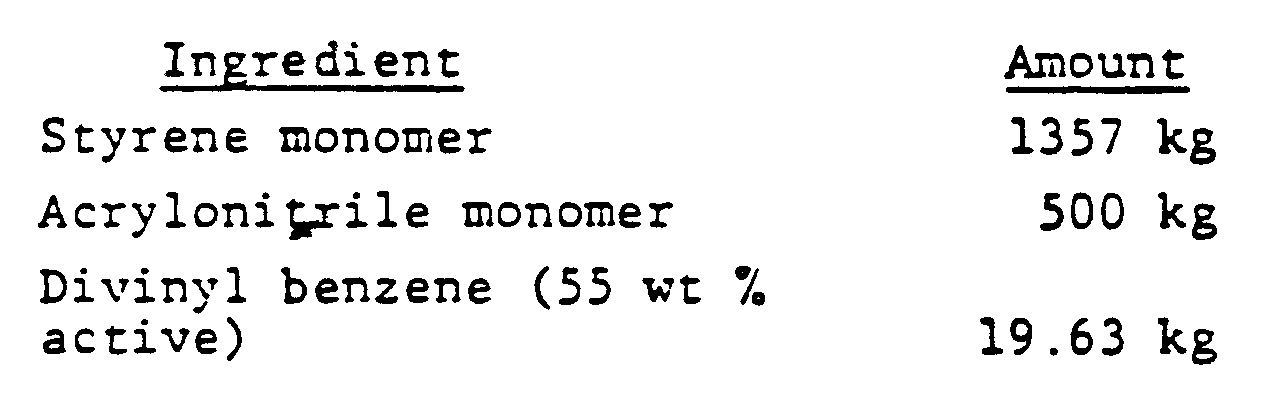
Immediately after charging the above solution agitation was resumed at 55 rpm. The batch was allowed to react for 3.5 hours at 54.4°C. - At the end of the 3.5 hour reaction period, 1.5 kg of ascorbic acid in 11.4 liters of deionized water was added. The batch was then cooled and transferred through a strainer to a hold tank. Less than 10 kg of undesired polymer coagulum was found in the strainer.
- To the strained material there was added methanol (equal parts by weight of methanol) and 0.5 wt. % of calcium chloride. The resultant coagulum was filtered, washed with water, and dried in a vacuum oven.
- The following examples illustrate compositions falling outside the scope of the instant invention they are presented for comparative purposes only.
- This example illustrates a blend of a polycarbonate and a polyester resin.
- To 15 parts by weight of an aromatic polycarbonate resin (derived from bisphenol-A and phosgene - LEXAN® resin, grade 131, sold by the General Electric Company) there are added 70 parts by weights of poly(butylene terephthalate) (VALOX® resin, grade 315, marketed by the General Electric Company), 0.3 parts by weight of a color stabilizer, and 0.15 parts by weight of a thermal stabilizer. The resultant mixture is extruded and molded into sample parts about 3,18 mm (1/8") thick. These test samples are subjected to the notched Izod impact strength test performed in accordance with ASTM D-256. The results are set forth in Table I.
- This example illustrates a flame retardant blend of a polycarbonate and a polyester resin.
- To 2 parts by weight of an aromatic polycarbonate resin (derived from bisphenol-A and phosgene - LEXAN® resin, grade 101, sold by the General ELectric Company) there are added 65.75 parts by weight of poly(butylene terephthalate) (VALOX® resin, grade 315, sold by the General Electric Company), 26 parts by weight of brominated polycarbonate resin (derived from brominated bisphenol-A and phosgene, and having a bromine content of 26 weight percent), 5.2 parts by weight of antimony oxide, 0.15 parts by weight of thermal stabilizer, and 1.9 parts by weight of ethylene vinyl acetate. The resultant mixture is extruded and molded into sample parts about 3,18 mm (1/8") thick. The notched Izod of these parts is determined in accordance with the procedure of Example 2 and the results are set forth in Table I.
- This example illustrates a glass filled polycarbonate/polyester blend.
- To 14 parts by weight of an aromatic polycarbonate resin (derived from bisphenol-A and phosgene - LEXAN® resin, grade 121, sold by the General Electric Company) there are added 55.55 parts by weight of poly(butylene terephthalate) resin (VALOX® resin, grade 295, sold by the General Electric Company), 30 parts by weight of glass fiber, 0.3 parts by weight of color stabilizer, and 0.15 parts by weight of thermal stabilizer. The resultant mixture is extruded and molded into test sample parts about 3,18 mm (1/8") thick. The notched Izod of these test samples is determined in accordance with the procedure of Example 2 and the results are set forth in Table I.
- The following examples illustrate the compositions of the present invention.
- To 15 parts by weight of the polycarbonate resin used in Example 2 are added 70 parts by weight of the poly(butylene terephthalate) used in Example 2, 15 parts by weight of the two phase interpolymer prepared substantially in accordance with the procedure of Example 1, 0.3 parts by weight of the color stabilizer of Example 2, and 0.15 parts by weight of the thermal stabilizer of Example 2. The resultant mixture is extruded and molded into test sample parts of about 3,18 mm (1/8")thickness. The notched Izod of these parts is determined in accordance with the procedure of Example 2 and the results are set forth in Table I.
- This example illustrates a flame retardant blend of polycarbonate/polyester containing the no phase interpolymer of the present invention.
- To 15 parts by weight of polycarbonate resin (LEXAN® resin, grade 131, sold by the General Electric Company), there are added 36.05 parts by weight of poly(butylene terephthalate) resin (VALOX® resin, grade 315, sold by the General Electric Company), 29 parts by weight of the brominated polycarbonate resin of Example 3, 0.1 parts by weight of the color stabilizer of Example 3, 0.15 parts by weight of the thermal stabilizer of Example 3, 1.3 parts by weight of ethylene vinyl acetate, 5.4 parts by weight of antimony oxide, and 13 parts by weight of the the two phase interpolymer prepared substantially in accordance with the procedure of Example 1. The resultant mixture is extruded and molded into test sample parts of about 3,18 mm (1/8") thickness. The notched Izod of these parts is determined in accordance with the procedure of Example 2 and the results are set forth in Table I.
- This example illustrates a glass filled blend of polycarbonate/polyester containing the two phase interpolymer of the present invention.
- To 15 parts by weight of aromatic polycarbonate resin used in Example 4 are added 39.55 parts by weight of the poly(butylene terephthalate) resin used in Example 4, 0.15 parts by weight of the thermal stabilizer used in Example 4, 0.3 parts by weight of the color stabilizer used in Example 4, 30 parts by weight of the about 3,18 mm (1/8") long chopped fiberglass used in Example 4, and 15 parts by weight of the two phase interpolymer prepared substantially in accordance with the procedure of Example 1. The resultant mixture is extruded and molded into test sample parts measuring about 3,18 mm (1/8"/thick. The notched Izod of these test parts is determined in accordance with the procedure of Example 2 and the results are set forth in Table I.
TABLE I Example No. Interpolymer (wt. %) Nm/cm Notched Izod (ft. lb./in) 2 0 0,54 (1) 3 0 0,38 (0.7) 4 0 0,86 (1.6) 5 15 6,48 (12) 6 13 6,48 (12) 7 15 1,84 (3.4) - As illustrated by the data in Table I the compositions of the instant invention (Examples 5-7) exhibit improved impact strengths over comparable compositions which do not contain any of the two phase interpolymer of the present invention (Examples 2-4). The composition of Example 2 should be compared with the composition of Example 5; the composition of Example 3 should be compared with the composition of Example 6; and the composition of Example 4 should be compared with the composition of Example 7
- The compositions of the instant invention are useful for the preparation of molded and extruded articles.
Claims (40)
- A resin composition comprising:(i) at least one aromatic carbonate resin;(ii) at least one polyester resin; and(iii) an impact improving effective amount of at least one two-phase interpolymer comprised of from 40 to 90 weight percent of a cross-linked acrylate and from 10 to 60 weight percent of a cross-linked styrene-acrylonitrile, said two phases are joined and held together by an interpenetrating network, and said interpolymer being substantially free of any graft-linking and of any non-crosslinked styrene-acrylonitrile.
- The composition of claim 1 wherein said cross-linked acrylate is comprised of the polymerized and cross-linked reaction products of at least one alkyl acrylate monomer, at least one alkyl methacrylate monomer, or mixtures thereof.
- The composition of claim 2 wherein said alkyl acrylate monomer is selected from C₂-C₁₀ alkyl acrylate monomers.
- The composition of claim 3 wherein said alkyl acrylate monomer is selected from C₄-C₈ alkyl acrylate monomers.
- The composition of claim 4 wherein said alkyl acrylate monomer is butyl acrylate.
- The composition of claim 2 wherein said alkyl methacrylate monomer is selected from C₈-C₂₂ alkyl methacrylate monomers.
- The composition of claim 1 wherein said interpolymer is comprised of from 50 to 80 weight percent of said cross-linked acrylate and from 20 to 50 weight percent of said cross-linked styrene acrylonitrile.
- The composition of claim 7 wherein said cross-linked acrylate is comprised of the polymerized and cross-linked reaction products of at least one C₄-C₈ alkyl acrylate monomer.
- The composition of claim 8 wherein said alkyl acrylate monomer is butyl acrylate.
- The composition of claim 1 wherein said aromatic carbonate resin is a polycarbonate resin.
- The composition of claim 10 wherein said polyester resin is a polyalkylene terephthalate resin.
- The composition of claim 11 wherein said polyalkylene terephthalate resin is polyethylene terephthalate.
- The composition of claim 11 wherein said polyalkylene terephthalate resin is poly(butylene terephthalate) resin.
- The composition of claim 10 wherein said polyester resin is comprised of the reaction products of a glycol portion comprised of 1,4-cyclohexanedimethanol, ethylene glycol, or mixtures thereof, and an acid portion comprised of isophthalic acid, terephthalic acid, or mixtures thereof.
- The composition of claim 1 wherein said aromatic carbonate resin is a copolyester-carbonate resin.
- The composition of claim 15 wherein said polyester resin is a polyalkylene terephthalate resin.
- The composition of claim 16 wherein said polyalkylene terephthalate resin is polyethylene terephthalate resin.
- The composition of claim 16 wherein said polyalkylene terephthalate resin is poly(butylene terephthalate) resin.
- The composition of claim 15 wherein said polyester resin is comprised of the reaction products of a glycol portion comprised of 1,4-cyclohexane dimethanol, ethylene glycol, or mixtures thereof, and an acid portion comprised of isophthalic acid, terephthalic acid, or mixtures thereof.
- The composition of claim 1 which contains from 1 to 30 weight percent of said interpolymer (iii), based on the total amounts of (i)-(iii) present.
- The composition of claim 20 which contains from 3 to 25 weight percent of said interpolymer (iii).
- The composition of claim 21 which contains from 4 to 20 weight percent of said interpolymer (iii).
- The composition of claim 1 wherein said two-phase interpolymer (iii) is substantially free of a non-crosslinked styrene-acrylonitrile resin.
- The composition of claim 23 wherein the first cross-linked acrylate phase is joined to said second cross-linked styrene-acrylonitrile phase by an interpenetrating network of said cross-linked acrylate and said cross-linked styrene-acrylonitrile.
- The composition of claim 1 wherein said two-phase interpolymer (iii) is formed by a two stage polymerization process comprising first emulsion polymerizing at least one alkyl acrylate, alkyl methacrylate, or mixtures thereof in the presence of a cross-linking agent and then emulsion polymerizing, in the presence of said cross-linked acrylate and a cross-linking agent, a styrene monomer and an acrylonitrile monomer.
- The composition of claim 1 which additionally contains a flame retarding amount of at least one flame retardant compound.
- The composition of claim 26 wherein said flame retardant compound is a halogenated aromatic polycarbonate.
- The composition of claim 27 wherein said halogenated polycarbonate is a brominated polycarbonate.
- The composition of claim 28 which additionally contains antimony oxide.
- The composition of claim 1 which contains glass filler.
- The composition of claim 30 wherein said glass filler is fibrous glass.
- The composition of claim 31 which contains up to 50 weight percent of said fibrous glass.
- The composition of claim 32 which contains up to 30 weight percent of said fibrous glass.
- A process for improving the impact properties of a blend of at least One aromatic carbonate resin and at least one polyester resin comprising admixing said blend with an amount effective to improve the impact properties of said blend of a two-phase interpolymer substantially free of non-crosslinked or linear styrene-acrylonitrile polymer comprised of from 40 to 90 weight percent of a cross-linked polyacrylate first phase comprised of the polymerized and cross-linked reaction products of at least one C₂-C₁₀ alkyl acrylate monomer, at least one C₈-C₂₂ alkyl methacrylate monomer, or mixtures thereof, and from 10 to 60 weight percent of a cross-linked styrene-acrylonitrile resin second phase.
- The process of claim 34 wherein said alkyl acrylate monomer is a C₄-C₆ alkyl acrylate monomer.
- The process of claim 35 wherein said alkyl acrylate monomer is butyl acrylate.
- The process of claim 35 wherein said interpolymer is comprised of from 50 to 80 weight percent of said cross-linked polyacrylate first phase and from 20 to 50 weight percent of said cross-linked styrene-acrylonitrile second phase.
- The process of claim 34 which comprises admixing from 1 to 30 weight percent of said interpolymer with said blend.
- The process of claim 38 which comprises admixing from 3 to 25 weight percent of said interpolymer with said blend.
- The process of claim 39 which comprises admixing from 4 to 20 weight percent of said interpolymer with said blend.
Applications Claiming Priority (2)
| Application Number | Priority Date | Filing Date | Title |
|---|---|---|---|
| US94545986A | 1986-12-23 | 1986-12-23 | |
| US945459 | 1986-12-23 |
Publications (3)
| Publication Number | Publication Date |
|---|---|
| EP0272425A2 EP0272425A2 (en) | 1988-06-29 |
| EP0272425A3 EP0272425A3 (en) | 1989-11-08 |
| EP0272425B1 true EP0272425B1 (en) | 1993-01-27 |
Family
ID=25483116
Family Applications (1)
| Application Number | Title | Priority Date | Filing Date |
|---|---|---|---|
| EP19870116437 Expired - Lifetime EP0272425B1 (en) | 1986-12-23 | 1987-11-06 | Resin blends exhibiting improved impact properties |
Country Status (3)
| Country | Link |
|---|---|
| EP (1) | EP0272425B1 (en) |
| JP (1) | JP2562159B2 (en) |
| DE (1) | DE3783890T2 (en) |
Cited By (3)
| Publication number | Priority date | Publication date | Assignee | Title |
|---|---|---|---|---|
| US7223804B2 (en) | 2003-12-30 | 2007-05-29 | General Electric Company | Polycarbonate composition |
| US7432327B2 (en) | 2004-12-30 | 2008-10-07 | Sabic Innovative Plastics Ip B.V. | Transparent polymeric compositions comprising polysiloxane-polycarbonate copolymer, articles made therefrom and methods of making same |
| US7799855B2 (en) | 2001-11-12 | 2010-09-21 | Sabic Innovative Plastics Ip B.V. | Flame retardant thermoplastic polycarbonate compositions, use and method thereof |
Families Citing this family (10)
| Publication number | Priority date | Publication date | Assignee | Title |
|---|---|---|---|---|
| EP0372296A3 (en) * | 1988-12-02 | 1991-08-07 | General Electric Company | Copolyetherester elastomeric compositions |
| US4987187A (en) * | 1989-12-20 | 1991-01-22 | Monsanto Company | Polyblends of thermoplastic copolyesters and styrene acrylonitrile copolymers |
| US5106907A (en) * | 1990-07-10 | 1992-04-21 | General Electric Company | Engineering thermoplastic with improved processability and performance |
| DE4030553A1 (en) * | 1990-09-27 | 1992-04-02 | Roehm Gmbh | Ternary polymer alloy(s) for injection moulding - contg. polyester, polycarbonate and (meth)acrylate] (co)polymer contg. opt.-substd. phenyl or phenoxy:alkyl (meth)acrylate units |
| EP0551687A1 (en) * | 1992-01-08 | 1993-07-21 | General Electric Company | Blends of poly(cyclohexane dimethylene terephthalate) |
| GB9215169D0 (en) * | 1992-07-16 | 1992-08-26 | Rohm & Haas | Mouldable crystalline polyester composition |
| US6545089B1 (en) * | 1997-09-04 | 2003-04-08 | General Electric Company | Impact modified carbonnate polymer composition having improved resistance to degradation and improved thermal stability |
| US5925507A (en) * | 1998-01-14 | 1999-07-20 | Eastman Kodak Company | Photographic film base and photographic elements |
| DE19825485A1 (en) * | 1998-06-08 | 1999-12-09 | Basf Ag | Polymer mixtures based on polyesters or polycarbonates and rubber-modified molding compounds |
| EP3564314A4 (en) * | 2016-12-30 | 2020-07-29 | Lotte Advanced Materials Co., Ltd. | Thermoplastic resin composition and molded article using same |
Family Cites Families (7)
| Publication number | Priority date | Publication date | Assignee | Title |
|---|---|---|---|---|
| FR2328004A1 (en) * | 1975-10-14 | 1977-05-13 | Ivanchev Sergei | High impact strength acrylate-styrene-acrylonitrile rubbers prodn - by polymerisation of acrylate with an acryloyl tert butylperoxyethane, then grafting on other monomers |
| US4148842A (en) * | 1978-06-15 | 1979-04-10 | Stauffer Chemical Company | Blends of a polycarbonate resin and interpolymer modifier |
| CA1213387A (en) * | 1982-11-12 | 1986-10-28 | James Y.J. Chung | Thermoplastic resinous blend having an improved impact performance |
| US4778853A (en) * | 1983-10-03 | 1988-10-18 | General Electric Company | Polycarbonate resin mixtures |
| JPS6126646A (en) * | 1984-07-13 | 1986-02-05 | Mitsubishi Rayon Co Ltd | thermoplastic resin composition |
| US4628074A (en) * | 1985-11-14 | 1986-12-09 | General Electric Company | Polycarbonate compositions |
| EP0269861B1 (en) * | 1986-12-03 | 1994-08-03 | General Electric Company | Impact modified aromatic carbonate compositions |
-
1987
- 1987-11-06 DE DE19873783890 patent/DE3783890T2/en not_active Expired - Fee Related
- 1987-11-06 EP EP19870116437 patent/EP0272425B1/en not_active Expired - Lifetime
- 1987-12-23 JP JP62324237A patent/JP2562159B2/en not_active Expired - Lifetime
Cited By (3)
| Publication number | Priority date | Publication date | Assignee | Title |
|---|---|---|---|---|
| US7799855B2 (en) | 2001-11-12 | 2010-09-21 | Sabic Innovative Plastics Ip B.V. | Flame retardant thermoplastic polycarbonate compositions, use and method thereof |
| US7223804B2 (en) | 2003-12-30 | 2007-05-29 | General Electric Company | Polycarbonate composition |
| US7432327B2 (en) | 2004-12-30 | 2008-10-07 | Sabic Innovative Plastics Ip B.V. | Transparent polymeric compositions comprising polysiloxane-polycarbonate copolymer, articles made therefrom and methods of making same |
Also Published As
| Publication number | Publication date |
|---|---|
| EP0272425A3 (en) | 1989-11-08 |
| JP2562159B2 (en) | 1996-12-11 |
| EP0272425A2 (en) | 1988-06-29 |
| DE3783890T2 (en) | 1993-08-19 |
| JPS63215765A (en) | 1988-09-08 |
| DE3783890D1 (en) | 1993-03-11 |
Similar Documents
| Publication | Publication Date | Title |
|---|---|---|
| US4885335A (en) | Low gloss thermoplastic blends | |
| US5034458A (en) | Polycarbonates of substituted cyclohexylindenebisphenols | |
| CA1237842A (en) | Impact modified polyetherimide-polycarbonate blends | |
| JPS63213554A (en) | Blend of polycarbonate resin and polyester resin showing improved color characteristics | |
| EP0153470B1 (en) | Polycarbonate composition | |
| US4778855A (en) | Thermoplastic molding compositions exhibiting improved melt flow properties | |
| EP0111810A2 (en) | High strength, reduced heat distortion temperature thermoplastic composition | |
| JP2562159B2 (en) | Resin blend with improved impact resistance | |
| US4628074A (en) | Polycarbonate compositions | |
| US4778853A (en) | Polycarbonate resin mixtures | |
| JPH02242851A (en) | Aromatic carbonate polymer blend of low gloss | |
| US5084527A (en) | Thermoplastic resin composition | |
| EP0230604B1 (en) | Resinous composition | |
| CA2039794A1 (en) | Glass fiber reinforced polycarbonate/polyester blends | |
| US4902737A (en) | Resin blends exhibiting improved impact properties | |
| US5037889A (en) | Resin blends exhibiting improved impact properties | |
| JPH04226563A (en) | Thermoplastic resin composition for engineering with improved processability and performance | |
| GB2061305A (en) | Block carbonate-carboxylate copolyesters and method for their preparation | |
| EP0269861B1 (en) | Impact modified aromatic carbonate compositions | |
| EP0108996B1 (en) | Thermoplastic resinous blend having an improved impact performance | |
| US5082890A (en) | Filled thermoplastic molding compositions | |
| JPH0739536B2 (en) | Polyarylate composition | |
| JPH073126A (en) | Low gloss thermoplastic resin composition containing polyester, copolyether polyester or blends thereof | |
| KR100543896B1 (en) | Polyester thermoplastic resin composition | |
| JPH03500468A (en) | Devices formed from polycarbonates, polyarylates and poly(alkylene terephthalates) |
Legal Events
| Date | Code | Title | Description |
|---|---|---|---|
| PUAI | Public reference made under article 153(3) epc to a published international application that has entered the european phase |
Free format text: ORIGINAL CODE: 0009012 |
|
| AK | Designated contracting states |
Kind code of ref document: A2 Designated state(s): DE FR GB IT NL |
|
| PUAL | Search report despatched |
Free format text: ORIGINAL CODE: 0009013 |
|
| AK | Designated contracting states |
Kind code of ref document: A3 Designated state(s): DE FR GB IT NL |
|
| 17P | Request for examination filed |
Effective date: 19900425 |
|
| 17Q | First examination report despatched |
Effective date: 19910724 |
|
| GRAA | (expected) grant |
Free format text: ORIGINAL CODE: 0009210 |
|
| AK | Designated contracting states |
Kind code of ref document: B1 Designated state(s): DE FR GB IT NL |
|
| ITF | It: translation for a ep patent filed | ||
| REF | Corresponds to: |
Ref document number: 3783890 Country of ref document: DE Date of ref document: 19930311 |
|
| ET | Fr: translation filed | ||
| PLBE | No opposition filed within time limit |
Free format text: ORIGINAL CODE: 0009261 |
|
| STAA | Information on the status of an ep patent application or granted ep patent |
Free format text: STATUS: NO OPPOSITION FILED WITHIN TIME LIMIT |
|
| 26N | No opposition filed | ||
| PGFP | Annual fee paid to national office [announced via postgrant information from national office to epo] |
Ref country code: FR Payment date: 20001018 Year of fee payment: 14 |
|
| PGFP | Annual fee paid to national office [announced via postgrant information from national office to epo] |
Ref country code: DE Payment date: 20001019 Year of fee payment: 14 |
|
| PGFP | Annual fee paid to national office [announced via postgrant information from national office to epo] |
Ref country code: GB Payment date: 20001020 Year of fee payment: 14 |
|
| PGFP | Annual fee paid to national office [announced via postgrant information from national office to epo] |
Ref country code: NL Payment date: 20001026 Year of fee payment: 14 |
|
| PG25 | Lapsed in a contracting state [announced via postgrant information from national office to epo] |
Ref country code: GB Free format text: LAPSE BECAUSE OF NON-PAYMENT OF DUE FEES Effective date: 20011106 |
|
| REG | Reference to a national code |
Ref country code: GB Ref legal event code: IF02 |
|
| PG25 | Lapsed in a contracting state [announced via postgrant information from national office to epo] |
Ref country code: NL Free format text: LAPSE BECAUSE OF NON-PAYMENT OF DUE FEES Effective date: 20020601 |
|
| GBPC | Gb: european patent ceased through non-payment of renewal fee |
Effective date: 20011106 |
|
| PG25 | Lapsed in a contracting state [announced via postgrant information from national office to epo] |
Ref country code: DE Free format text: LAPSE BECAUSE OF NON-PAYMENT OF DUE FEES Effective date: 20020702 |
|
| PG25 | Lapsed in a contracting state [announced via postgrant information from national office to epo] |
Ref country code: FR Free format text: LAPSE BECAUSE OF NON-PAYMENT OF DUE FEES Effective date: 20020730 |
|
| NLV4 | Nl: lapsed or anulled due to non-payment of the annual fee |
Effective date: 20020601 |
|
| REG | Reference to a national code |
Ref country code: FR Ref legal event code: ST |
|
| REG | Reference to a national code |
Ref country code: FR Ref legal event code: ST |
|
| PG25 | Lapsed in a contracting state [announced via postgrant information from national office to epo] |
Ref country code: IT Free format text: LAPSE BECAUSE OF NON-PAYMENT OF DUE FEES;WARNING: LAPSES OF ITALIAN PATENTS WITH EFFECTIVE DATE BEFORE 2007 MAY HAVE OCCURRED AT ANY TIME BEFORE 2007. THE CORRECT EFFECTIVE DATE MAY BE DIFFERENT FROM THE ONE RECORDED. Effective date: 20051106 |