EP0269738A1 - Method and apparatus for preventing collison of tools - Google Patents
Method and apparatus for preventing collison of tools Download PDFInfo
- Publication number
- EP0269738A1 EP0269738A1 EP87901659A EP87901659A EP0269738A1 EP 0269738 A1 EP0269738 A1 EP 0269738A1 EP 87901659 A EP87901659 A EP 87901659A EP 87901659 A EP87901659 A EP 87901659A EP 0269738 A1 EP0269738 A1 EP 0269738A1
- Authority
- EP
- European Patent Office
- Prior art keywords
- programs
- tool
- dwelling
- machining
- code
- Prior art date
- Legal status (The legal status is an assumption and is not a legal conclusion. Google has not performed a legal analysis and makes no representation as to the accuracy of the status listed.)
- Granted
Links
Images




Classifications
-
- B—PERFORMING OPERATIONS; TRANSPORTING
- B23—MACHINE TOOLS; METAL-WORKING NOT OTHERWISE PROVIDED FOR
- B23Q—DETAILS, COMPONENTS, OR ACCESSORIES FOR MACHINE TOOLS, e.g. ARRANGEMENTS FOR COPYING OR CONTROLLING; MACHINE TOOLS IN GENERAL CHARACTERISED BY THE CONSTRUCTION OF PARTICULAR DETAILS OR COMPONENTS; COMBINATIONS OR ASSOCIATIONS OF METAL-WORKING MACHINES, NOT DIRECTED TO A PARTICULAR RESULT
- B23Q15/00—Automatic control or regulation of feed movement, cutting velocity or position of tool or work
-
- G—PHYSICS
- G05—CONTROLLING; REGULATING
- G05B—CONTROL OR REGULATING SYSTEMS IN GENERAL; FUNCTIONAL ELEMENTS OF SUCH SYSTEMS; MONITORING OR TESTING ARRANGEMENTS FOR SUCH SYSTEMS OR ELEMENTS
- G05B19/00—Program-control systems
- G05B19/02—Program-control systems electric
- G05B19/18—Numerical control [NC], i.e. automatically operating machines, in particular machine tools, e.g. in a manufacturing environment, so as to execute positioning, movement or co-ordinated operations by means of program data in numerical form
- G05B19/4093—Numerical control [NC], i.e. automatically operating machines, in particular machine tools, e.g. in a manufacturing environment, so as to execute positioning, movement or co-ordinated operations by means of program data in numerical form characterised by part programming, e.g. entry of geometrical information as taken from a technical drawing, combining this with machining and material information to obtain control information, named part program, for the NC machine
- G05B19/40937—Numerical control [NC], i.e. automatically operating machines, in particular machine tools, e.g. in a manufacturing environment, so as to execute positioning, movement or co-ordinated operations by means of program data in numerical form characterised by part programming, e.g. entry of geometrical information as taken from a technical drawing, combining this with machining and material information to obtain control information, named part program, for the NC machine concerning programming of machining or material parameters, pocket machining
-
- G—PHYSICS
- G05—CONTROLLING; REGULATING
- G05B—CONTROL OR REGULATING SYSTEMS IN GENERAL; FUNCTIONAL ELEMENTS OF SUCH SYSTEMS; MONITORING OR TESTING ARRANGEMENTS FOR SUCH SYSTEMS OR ELEMENTS
- G05B19/00—Program-control systems
- G05B19/02—Program-control systems electric
- G05B19/18—Numerical control [NC], i.e. automatically operating machines, in particular machine tools, e.g. in a manufacturing environment, so as to execute positioning, movement or co-ordinated operations by means of program data in numerical form
- G05B19/406—Numerical control [NC], i.e. automatically operating machines, in particular machine tools, e.g. in a manufacturing environment, so as to execute positioning, movement or co-ordinated operations by means of program data in numerical form characterised by monitoring or safety
- G05B19/4061—Avoiding collision or forbidden zones
-
- G—PHYSICS
- G05—CONTROLLING; REGULATING
- G05B—CONTROL OR REGULATING SYSTEMS IN GENERAL; FUNCTIONAL ELEMENTS OF SUCH SYSTEMS; MONITORING OR TESTING ARRANGEMENTS FOR SUCH SYSTEMS OR ELEMENTS
- G05B19/00—Program-control systems
- G05B19/02—Program-control systems electric
- G05B19/18—Numerical control [NC], i.e. automatically operating machines, in particular machine tools, e.g. in a manufacturing environment, so as to execute positioning, movement or co-ordinated operations by means of program data in numerical form
- G05B19/406—Numerical control [NC], i.e. automatically operating machines, in particular machine tools, e.g. in a manufacturing environment, so as to execute positioning, movement or co-ordinated operations by means of program data in numerical form characterised by monitoring or safety
- G05B19/4069—Simulating machining process on screen
-
- G—PHYSICS
- G05—CONTROLLING; REGULATING
- G05B—CONTROL OR REGULATING SYSTEMS IN GENERAL; FUNCTIONAL ELEMENTS OF SUCH SYSTEMS; MONITORING OR TESTING ARRANGEMENTS FOR SUCH SYSTEMS OR ELEMENTS
- G05B2219/00—Program-control systems
- G05B2219/30—Nc systems
- G05B2219/35—Nc in input of data, input till input file format
- G05B2219/35313—Display, validate tool path for boundary, surface interference
-
- G—PHYSICS
- G05—CONTROLLING; REGULATING
- G05B—CONTROL OR REGULATING SYSTEMS IN GENERAL; FUNCTIONAL ELEMENTS OF SUCH SYSTEMS; MONITORING OR TESTING ARRANGEMENTS FOR SUCH SYSTEMS OR ELEMENTS
- G05B2219/00—Program-control systems
- G05B2219/30—Nc systems
- G05B2219/36—Nc in input of data, input key till input tape
- G05B2219/36084—Amend, modify program by inserting wait and wait dismiss command
-
- G—PHYSICS
- G05—CONTROLLING; REGULATING
- G05B—CONTROL OR REGULATING SYSTEMS IN GENERAL; FUNCTIONAL ELEMENTS OF SUCH SYSTEMS; MONITORING OR TESTING ARRANGEMENTS FOR SUCH SYSTEMS OR ELEMENTS
- G05B2219/00—Program-control systems
- G05B2219/30—Nc systems
- G05B2219/36—Nc in input of data, input key till input tape
- G05B2219/36341—Prepare program to control multiple slides at the same time
-
- G—PHYSICS
- G05—CONTROLLING; REGULATING
- G05B—CONTROL OR REGULATING SYSTEMS IN GENERAL; FUNCTIONAL ELEMENTS OF SUCH SYSTEMS; MONITORING OR TESTING ARRANGEMENTS FOR SUCH SYSTEMS OR ELEMENTS
- G05B2219/00—Program-control systems
- G05B2219/30—Nc systems
- G05B2219/45—Nc applications
- G05B2219/45125—Four axis, spindle lathe
-
- G—PHYSICS
- G05—CONTROLLING; REGULATING
- G05B—CONTROL OR REGULATING SYSTEMS IN GENERAL; FUNCTIONAL ELEMENTS OF SUCH SYSTEMS; MONITORING OR TESTING ARRANGEMENTS FOR SUCH SYSTEMS OR ELEMENTS
- G05B2219/00—Program-control systems
- G05B2219/30—Nc systems
- G05B2219/49—Nc machine tool, till multiple
- G05B2219/49397—Control of dwell time
-
- Y—GENERAL TAGGING OF NEW TECHNOLOGICAL DEVELOPMENTS; GENERAL TAGGING OF CROSS-SECTIONAL TECHNOLOGIES SPANNING OVER SEVERAL SECTIONS OF THE IPC; TECHNICAL SUBJECTS COVERED BY FORMER USPC CROSS-REFERENCE ART COLLECTIONS [XRACs] AND DIGESTS
- Y02—TECHNOLOGIES OR APPLICATIONS FOR MITIGATION OR ADAPTATION AGAINST CLIMATE CHANGE
- Y02P—CLIMATE CHANGE MITIGATION TECHNOLOGIES IN THE PRODUCTION OR PROCESSING OF GOODS
- Y02P90/00—Enabling technologies with a potential contribution to greenhouse gas [GHG] emissions mitigation
- Y02P90/02—Total factory control, e.g. smart factories, flexible manufacturing systems [FMS] or integrated manufacturing systems [IMS]
Definitions
- the present invention relates to a method of and an apparatus for preventing tool collision to avoid interference between movable members such as a plurality of tool posts by automatically altering a machining program when such interference occurs.
- Machine tools are numerically controlled for automatically machining workpieces.
- numerical control commands in a prescribed format i.e., a machining program must be input to a numerical control apparatus.
- a machining program for such a numerical control apparatus makes it possible to control a multiaxis lathe for moving two tool posts, i.e., tool rests independently to enable the two tool rests to cut the workpiece simultaneously.
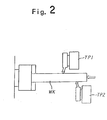
- a four-axis lathe shown in Fig. 4 has two tool rests TP1, TP2 and moves the tool rests TP1, TP2 independently along X- and Z- axes for machining a workpiece WK.
- the workpiece WK can be machined to a desired shape in a much shorter period of time than would be possible with an ordinary two-axis lathe.
- the machining programs for the respective tool rests should be of such a nature that they will prevent collision of the tool rests TP1, TP2.
- an actual machining process according to the machining programs to be checked is simulated on an animated screen.
- a tool interference checking process is effected by visually observing the simulation and determining that a collision or interference is caused when the paths of movement of the two tool rests intersect with each other.
- the machining program comprises a program for a tool rest 1 and a program for a tool rest 2 as shown in Fig. 3(a). Denoted in Fig.
- FIG. 3(a) at N100, N101, N102, N103, ... are date items for numerically controlling the movement of the tool rest 1, that is, blocks of a format of numerical control commands, and N200, N201, N202, N203, ... blocks of a format of numerical control commands for numerically controlling the movement of the tool rest 2.
- Fig. 3(b) illustrates the paths of movement of the tool rests 1, 2 displayed on the animated screen of a display unit during simulation of an actual machining effected by executing the tool rest programs. As shown in Fig. 3(b), the path of the tool rest 1 crosses the path of the tool rest 2 in the block N102 for the tool rest 1 and the block N202 for the tool rest 2. It can therefore be confirmed on the display screen that the tool rests 1, 2 will actually collide with each other at the intersection of the tool rest paths, as shown in Fig. 4.
- the conventional problems are solved by a method of preventing tool collision, including the steps of simulating and displaying the paths of movement of a plurality of movable members driven by respective independent programs in advance of an actual machining process, selecting the movable member to be moved at first and the movable member to be stopped when an interference occurs, and correcting the programs to avoid the interference between the movable members by inserting a dwelling code into the programs.
- machining programs are automatically altered in order to avoid such an interference. Therefore, labor and time required for the operator to alter the machining programs are reduced, and actual damage of tools which would otherwise result from the execution of the machining programs can be avoided.
- Fig. 1 is a block diagram of a system for carrying out a method of the present invention
- Fig. 2 is a schematic view of a four-axis lathe
- Fig. 3(a) is a diagram showing, by way of example, a machining program for a four-axis lathe
- Fig. 3(b) is a diagram showing an animated screen displaying paths of movement of two tool rests
- Fig. 4 is a view explaining an interference between tool rests in an actual machining process
- Fig. 5 is a diagram of system parameters required by an automatic collision prevention program
- Fig. 6 is a flowchart of an operation sequence of the automatic collision prevention program
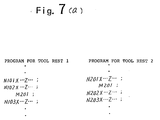
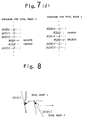
- Figs. 7(a), 7(b), 7(c), and 7(d) are diagrams showing, by way of example, modifications of machining programs by using dwelling M codes
- Fig. 8 is a view explaining an interference between tool rests in an actual machining process.
- Fig. 1 is a block diagram showing, by way of example, an NC system for controlling a four-axis lathe.
- a processor for effecting numerical control by executing programs
- 11 a programmable controller for programmed execution of operation of an electric power circuit which carries out sequence control of a four-axis lathe
- 12 a program memory storing various control programs to be executed by the processor 10, the memory 12 also storing an automatic -collision prevention program for automatically altering machining programs according to the present invention.
- a data memory 13 stores data required for executing the programs for the processor 10 such as machining programs composed of data formats of numerical control commands.
- a working memory 14 serves to temporarily store the results of arithmetic operations effected by the processor 10.
- a paper tape puncher 15 records data on a paper tape by punching the same.
- a paper tape reader 16 reads numerical control commands (NC commands) punched in an NC tape.
- a pulse distributor 17 effects an arithmetic operation to distribute pulses according to a motion command from the processor 10 and issues distributed pulses commensurate with the commanded amount.
- Denoted at 18x1, 18zl, 18x2, 18z2 are servo circuits for driving tool rests TP1, TP2 in the directions of X- and Z-axes by controlling Xl, Zl axes and X2, Z2 axes of a four-axie lathe 19.
- a parameter memory 20 stores system parameters required for executing the automatic collision prevention program.
- a display controller 21 has input keys for setting the system parameters and the like.
- a display unit 22 serves to display the paths of movement of the tool rests on an animated screen as shown in Fig. 3(b).
- An address data bus (hereinafter referred to as a "bus") 23 allows data to be transmitted between the processor 10 and the memories 12, 13, 14, 20, and an input/output device.
- the automatic collision prevention program stored in the program memory 12 will be described with reference to Figs. 4 through 6.
- the automatic collision prevention program automatically inserts dwelling M codes into prescribed positions in machining programs in order to move the tool rest of higher priority at first and temporarily stop the tool rest of lower priority.
- system parameters as shown in Fig. 5 it is necessary for system parameters as shown in Fig. 5 to be preset.
- the system parameters include a tool rest priority parameter, a dwelling M code parameter for stopping movement of a tool rest and determining the interval of stoppage of the tool rest, and a repetitive execution parameter for determining whether a machining program is to be repeatedly executed until no interference occurs.
- An initial value for the tool rest priority parameter is "0". If the tool rest priority parameter is "0", the operator can set it to "1” or "2" when an interference occurs between the tool rests during execution of the machining programs. When the priority parameter is "1", the tool rest 1 has higher priority, and when the priority parameter is "0", the tool 2 has higher priority.
- the stoppage interval of the M code parameter has an initial value of "200", and can be selected in the range of from "100" to "999".
- the repetitive execution parameter has an initial value of "0".
- the repetitive execution parameter is "0”
- dwelling M codes are automatically inserted into prescribed positions in the machining programs, and then the machining programs are rewound to restart the machining programs from their starting ends.
- the repetitive execution parameter is "I”
- a dwelling M code is automatically inserted into prescribed positions in the machining programs, and then the machining programs are rewound to stop program execution.
- Machining programs to be checked are prepared in the data memory 13 in a step (1) by entering the machining programs through the tape reader 16, for example. Thereafter, the four-axis lathe 19 is switched to a memory mode, i.e., a mode in which the programmable controller 11 and the pulse distributor 17 are disconnected from the bus 23 in Fig. 1 for data transfer only between the data memory 13 and the display controller 21, in a step (2). Then, an animated screen is displayed on the display unit 2, and the machining programs are started from their first addresses to begin simulation of an actual machining process in a step (4). The machining programs are successively executed block by block in a step (4). Whether an interference has occurred between the tool rests is checked during the execution of the machining program in a step (5).
- a memory mode i.e., a mode in which the programmable controller 11 and the pulse distributor 17 are disconnected from the bus 23 in Fig. 1 for data transfer only between the data memory 13 and the display controller 21, in a step (2).
- control returns to the step (4), and the machining programs are executed. If an interference is experienced, then control goes to a step (6) which ascertains whether the priority parameter is "0" or not. If the priority parameter is not “0", then it is "1” or "2". Therefore, a dwelling M code is inserted into prescribed positions in the machining programs, as described in detail later on, dependent on the value of the priority parameter, in a step (7). If the priority parameter is "0" in the step (6), then an inquiry as to a priority tool base is displayed on the display unit in a step (8). The operator then enters, through a key, a tool rest priority parameter "1" or “2” in a step (9). then, control goes to the step (7).
- the machining programs are rewound back to their first addresses in a step 10. Then, whether the repetitive execution parameter is "0" or "1” is ascertained in a step (11). If “0”, then the execution of the machining programs is completed in a step (12). If “1”, control goes back to the step (3) to execute the machining programs again.
- the automatic collision prevention program automatically inserts a dwelling M code M201 after the block N102 of the machining program for the tool rest 1 and before the block N202 of the machining program for the tool rest 2, as shown in Fig. 7(a).
- the tool rest 2 is stopped during a period specified by the dwelling M code M201 while the tool rest 1 is moving under a numerical control command of the block N102. Therefore, the tool rests are prevented from colliding with each other.
- the dwelling M code is inserted after the block N102 of the machining program for the tool rest 1 because synchronism should be kept between the block N103 of the machining program for the tool rest 1 and the block N202 of the machining program for the tool rest 2.
- a dwelling M code M201 is automatically inserted before the block N102 of the machining program for the tool rest 1 and after the block N202 of the machining program for the tool rest 2, as shown in Fig. 7(b).
- a dwelling M code M201 is inserted when the priority parameter is "1" as shown in Fig. 7(a), and if, after the machining programs are executed from their first addresses, there is an interference occurring in the block N103 of the machining program for the tool rest 1 and the block N202 of the machining program for the tool rest 2, then, as shown in Fig. 7(c), a dwelling M code having a different period than that of the dwelling M code 201, e.g., a dwelling M code 202 is inserted after the block N103 and before the block N202, and the dwelling M code 201 is deleted. With this modification, while the blocks N102, N103 are being executed, the tool rest 1 is stopped during the period specified by the different dwelling M code 202 for avoiding collision between the tool rests.
- a dwelling M code M201 is inserted when the priority parameter is "1" and the machining programs are executed again from their first addresses, if an interference occurs between the tool rest 2 stopped after the execution of the block N201 and the tool rest 1 moved by the execution of the block N102, as shown in Fig. 8, then the inserted dwelling M mode M201 is deleted, and a dwelling M mode having a different period than that of the dwelling M mode M201, e.g., a dwelling M mode M202 is inserted after the block N102 and before the block N201. While the tool rest 1 is moving according to the blocks N101, N102, the tool rest 2 is stopped in its initial position and hence prevented from interfering with the tool rest 1.
- the automatic collision prevention program can automatically prepare a machining program which is free from the danger of interferences during an actual machining process by automaticay inserting a dwelling M code into prescribed positions in machining programs, through the use of a tool interference checking process utilizing an animated screen.
- the present invention is also effective in preparing a machining program which prevents collision between movable members of a general NC machine tool in addition to a four-axis lathe as described above. Many changes and modifications may be made in the present invention without departing from the scope of thereof.
- the paths of movement of movable members such as a plurality of tool rests are displayed on an animated screen for simulating an actual machining process and checking the tool rests for their mutual interference. If an interference occurs on the screen, then the machining programs are automatically altered to avoid any interference in the actual machining process. Therefore, the machining programs can be rewritten with utmost ease, and tools can relaibly be prevented from damage.
Landscapes
- Engineering & Computer Science (AREA)
- Physics & Mathematics (AREA)
- Human Computer Interaction (AREA)
- Manufacturing & Machinery (AREA)
- General Physics & Mathematics (AREA)
- Automation & Control Theory (AREA)
- Geometry (AREA)
- Mechanical Engineering (AREA)
- Numerical Control (AREA)
- Auxiliary Devices For Machine Tools (AREA)
Abstract
Description
- The present invention relates to a method of and an apparatus for preventing tool collision to avoid interference between movable members such as a plurality of tool posts by automatically altering a machining program when such interference occurs.
- Machine tools are numerically controlled for automatically machining workpieces. To machine a workpiece to a design drawing with a numerically controlled machine tool, numerical control commands in a prescribed format, i.e., a machining program must be input to a numerical control apparatus.
- A machining program for such a numerical control apparatus makes it possible to control a multiaxis lathe for moving two tool posts, i.e., tool rests independently to enable the two tool rests to cut the workpiece simultaneously. For example, a four-axis lathe shown in Fig. 4 has two tool rests TP1, TP2 and moves the tool rests TP1, TP2 independently along X- and Z- axes for machining a workpiece WK. By controlling the positions and paths of these tool rests TP1,
TP 2 according to a machining program comprising independent programs for the respective tool rests, the workpiece WK can be machined to a desired shape in a much shorter period of time than would be possible with an ordinary two-axis lathe. - Since, however, the single workpiece WK is simultaneously machined by the two tool rests TP1, TP2, an accident may possibly occurs due to interference between the tool rests TP1, TP2. The machining programs for the respective tool rests should be of such a nature that they will prevent collision of the tool rests TP1, TP2. To check such an interference, an actual machining process according to the machining programs to be checked is simulated on an animated screen. A tool interference checking process is effected by visually observing the simulation and determining that a collision or interference is caused when the paths of movement of the two tool rests intersect with each other. The machining program comprises a program for a
tool rest 1 and a program for atool rest 2 as shown in Fig. 3(a). Denoted in Fig. 3(a) at N100, N101, N102, N103, ... are date items for numerically controlling the movement of thetool rest 1, that is, blocks of a format of numerical control commands, and N200, N201, N202, N203, ... blocks of a format of numerical control commands for numerically controlling the movement of thetool rest 2. Fig. 3(b) illustrates the paths of movement of thetool rests tool rest 1 crosses the path of thetool rest 2 in the block N102 for thetool rest 1 and the block N202 for thetool rest 2. It can therefore be confirmed on the display screen that the tool rests 1, 2 will actually collide with each other at the intersection of the tool rest paths, as shown in Fig. 4. - As described above, it has heretofore been known to effect a tool interference checking process by simulating an actual machining process according to a machining program on a display screen and checking the tool rests for their mutual interference. If an interference occurs in the tool interference checking process, then the program is altered or corrected manually by the operator. Therefore, the operator is required to think each time an interference happens, or always understand accurately, what part of the machining program is to be revised and how it is to be modified. Therefore, much laber and time have been needed in preparing a machining program.
- It is an object of the present invention to provide a method of and an apparatus for preventing tool collision to avoid a tool interference in advance by automatically altering a machining program when tool rests interfere with each other during machining simulation on animated display, through the utilization of a conventional tool interference checking process on animated display.
- According to the present invention, the conventional problems are solved by a method of preventing tool collision, including the steps of simulating and displaying the paths of movement of a plurality of movable members driven by respective independent programs in advance of an actual machining process, selecting the movable member to be moved at first and the movable member to be stopped when an interference occurs, and correcting the programs to avoid the interference between the movable members by inserting a dwelling code into the programs.
- With the method of the invention, in the event of an interference between tool rests during machining simulation on animated display, machining programs are automatically altered in order to avoid such an interference. Therefore, labor and time required for the operator to alter the machining programs are reduced, and actual damage of tools which would otherwise result from the execution of the machining programs can be avoided.
- Fig. 1 is a block diagram of a system for carrying out a method of the present invention; Fig. 2 is a schematic view of a four-axis lathe; Fig. 3(a) is a diagram showing, by way of example, a machining program for a four-axis lathe; Fig. 3(b) is a diagram showing an animated screen displaying paths of movement of two tool rests; Fig. 4 is a view explaining an interference between tool rests in an actual machining process; Fig. 5 is a diagram of system parameters required by an automatic collision prevention program; Fig. 6 is a flowchart of an operation sequence of the automatic collision prevention program; Figs. 7(a), 7(b), 7(c), and 7(d) are diagrams showing, by way of example, modifications of machining programs by using dwelling M codes; and Fig. 8 is a view explaining an interference between tool rests in an actual machining process.
- An embodiment of the present invention will hereinafter be described in specific detail with reference to the drawings.
- Fig. 1 is a block diagram showing, by way of example, an NC system for controlling a four-axis lathe.
- Denoted in Fig. 1 at 10 is a processor for effecting numerical control by executing programs, 11 a programmable controller for programmed execution of operation of an electric power circuit which carries out sequence control of a four-axis lathe, and 12 a program memory storing various control programs to be executed by the
processor 10, thememory 12 also storing an automatic -collision prevention program for automatically altering machining programs according to the present invention. Adata memory 13 stores data required for executing the programs for theprocessor 10 such as machining programs composed of data formats of numerical control commands. A workingmemory 14 serves to temporarily store the results of arithmetic operations effected by theprocessor 10. A paper tape puncher 15 records data on a paper tape by punching the same. Apaper tape reader 16 reads numerical control commands (NC commands) punched in an NC tape. Apulse distributor 17 effects an arithmetic operation to distribute pulses according to a motion command from theprocessor 10 and issues distributed pulses commensurate with the commanded amount. Denoted at 18x1, 18zl, 18x2, 18z2 are servo circuits for driving tool rests TP1, TP2 in the directions of X- and Z-axes by controlling Xl, Zl axes and X2, Z2 axes of a four-axie lathe 19. A parameter memory 20 stores system parameters required for executing the automatic collision prevention program. Adisplay controller 21 has input keys for setting the system parameters and the like. Adisplay unit 22 serves to display the paths of movement of the tool rests on an animated screen as shown in Fig. 3(b). An address data bus (hereinafter referred to as a "bus") 23 allows data to be transmitted between theprocessor 10 and thememories - The automatic collision prevention program stored in the
program memory 12 will be described with reference to Figs. 4 through 6. - During simulation of an actual machining process according to machining programs, and if an interference occurs between the tool rests 1, 2 in a block N102 for the
tool rest 1 and a block N202 for thetool rest 2, as shown in Fig. 4, the automatic collision prevention program automatically inserts dwelling M codes into prescribed positions in machining programs in order to move the tool rest of higher priority at first and temporarily stop the tool rest of lower priority. In order to start executing the automatic collision prevention program, it is necessary for system parameters as shown in Fig. 5 to be preset. - The system parameters include a tool rest priority parameter, a dwelling M code parameter for stopping movement of a tool rest and determining the interval of stoppage of the tool rest, and a repetitive execution parameter for determining whether a machining program is to be repeatedly executed until no interference occurs. An initial value for the tool rest priority parameter is "0". If the tool rest priority parameter is "0", the operator can set it to "1" or "2" when an interference occurs between the tool rests during execution of the machining programs. When the priority parameter is "1", the
tool rest 1 has higher priority, and when the priority parameter is "0", thetool 2 has higher priority. The stoppage interval of the M code parameter has an initial value of "200", and can be selected in the range of from "100" to "999". The repetitive execution parameter has an initial value of "0". When the repetitive execution parameter is "0", dwelling M codes are automatically inserted into prescribed positions in the machining programs, and then the machining programs are rewound to restart the machining programs from their starting ends. When the repetitive execution parameter is "I", a dwelling M code is automatically inserted into prescribed positions in the machining programs, and then the machining programs are rewound to stop program execution. - If the above system parameters are properly established, the automatic collision prevention program will be executed according to the flowchart shown in Fig. 6.
- Machining programs to be checked are prepared in the
data memory 13 in a step (1) by entering the machining programs through thetape reader 16, for example. Thereafter, the four-axis lathe 19 is switched to a memory mode, i.e., a mode in which theprogrammable controller 11 and thepulse distributor 17 are disconnected from thebus 23 in Fig. 1 for data transfer only between thedata memory 13 and thedisplay controller 21, in a step (2). Then, an animated screen is displayed on thedisplay unit 2, and the machining programs are started from their first addresses to begin simulation of an actual machining process in a step (4). The machining programs are successively executed block by block in a step (4). Whether an interference has occurred between the tool rests is checked during the execution of the machining program in a step (5). If no interference is caused, then control returns to the step (4), and the machining programs are executed. If an interference is experienced, then control goes to a step (6) which ascertains whether the priority parameter is "0" or not. If the priority parameter is not "0", then it is "1" or "2". Therefore, a dwelling M code is inserted into prescribed positions in the machining programs, as described in detail later on, dependent on the value of the priority parameter, in a step (7). If the priority parameter is "0" in the step (6), then an inquiry as to a priority tool base is displayed on the display unit in a step (8). The operator then enters, through a key, a tool rest priority parameter "1" or "2" in a step (9). then, control goes to the step (7). After the dwelling M code has been inserted in the step (7), the machining programs are rewound back to their first addresses in astep 10. Then, whether the repetitive execution parameter is "0" or "1" is ascertained in a step (11). If "0", then the execution of the machining programs is completed in a step (12). If "1", control goes back to the step (3) to execute the machining programs again. - The step (7) will be described in detail with reference to Figs. 7(a) through 7(d).
- In the event of an interference shown in Fig. 4 with the
tool rest 1 having higher priority than the tool rest 2 (i.e., if the priority parameter is "1"), the automatic collision prevention program automatically inserts a dwelling M code M201 after the block N102 of the machining program for thetool rest 1 and before the block N202 of the machining program for thetool rest 2, as shown in Fig. 7(a). When the machining programs thus corrected are executed again, thetool rest 2 is stopped during a period specified by the dwelling M code M201 while thetool rest 1 is moving under a numerical control command of the block N102. Therefore, the tool rests are prevented from colliding with each other. The dwelling M code is inserted after the block N102 of the machining program for thetool rest 1 because synchronism should be kept between the block N103 of the machining program for thetool rest 1 and the block N202 of the machining program for thetool rest 2. - Conversely, when the
tool rest 2 has higher priority than thetool rest 1, (i.e., when the priority parameter is "2"), a dwelling M code M201 is automatically inserted before the block N102 of the machining program for thetool rest 1 and after the block N202 of the machining program for thetool rest 2, as shown in Fig. 7(b). - If a dwelling M code M201 is inserted when the priority parameter is "1" as shown in Fig. 7(a), and if, after the machining programs are executed from their first addresses, there is an interference occurring in the block N103 of the machining program for the
tool rest 1 and the block N202 of the machining program for thetool rest 2, then, as shown in Fig. 7(c), a dwelling M code having a different period than that of the dwelling M code 201, e.g., a dwelling M code 202 is inserted after the block N103 and before the block N202, and the dwelling M code 201 is deleted. With this modification, while the blocks N102, N103 are being executed, thetool rest 1 is stopped during the period specified by the different dwelling M code 202 for avoiding collision between the tool rests. - Where a dwelling M code M201 is inserted when the priority parameter is "1" and the machining programs are executed again from their first addresses, if an interference occurs between the
tool rest 2 stopped after the execution of the block N201 and thetool rest 1 moved by the execution of the block N102, as shown in Fig. 8, then the inserted dwelling M mode M201 is deleted, and a dwelling M mode having a different period than that of the dwelling M mode M201, e.g., a dwelling M mode M202 is inserted after the block N102 and before the block N201. While thetool rest 1 is moving according to the blocks N101, N102, thetool rest 2 is stopped in its initial position and hence prevented from interfering with thetool rest 1. - Therefore, the automatic collision prevention program can automatically prepare a machining program which is free from the danger of interferences during an actual machining process by automaticay inserting a dwelling M code into prescribed positions in machining programs, through the use of a tool interference checking process utilizing an animated screen.
- The present invention is also effective in preparing a machining program which prevents collision between movable members of a general NC machine tool in addition to a four-axis lathe as described above. Many changes and modifications may be made in the present invention without departing from the scope of thereof.
- According to the present invention, as described above, the paths of movement of movable members such as a plurality of tool rests are displayed on an animated screen for simulating an actual machining process and checking the tool rests for their mutual interference. If an interference occurs on the screen, then the machining programs are automatically altered to avoid any interference in the actual machining process. Therefore, the machining programs can be rewritten with utmost ease, and tools can relaibly be prevented from damage.
Claims (6)
Applications Claiming Priority (2)
| Application Number | Priority Date | Filing Date | Title |
|---|---|---|---|
| JP42296/86 | 1986-02-27 | ||
| JP61042296A JPS62199338A (en) | 1986-02-27 | 1986-02-27 | Automatic prevention device for tool collision |
Publications (3)
| Publication Number | Publication Date |
|---|---|
| EP0269738A1 true EP0269738A1 (en) | 1988-06-08 |
| EP0269738A4 EP0269738A4 (en) | 1989-12-04 |
| EP0269738B1 EP0269738B1 (en) | 1993-07-28 |
Family
ID=12632073
Family Applications (1)
| Application Number | Title | Priority Date | Filing Date |
|---|---|---|---|
| EP87901659A Expired - Lifetime EP0269738B1 (en) | 1986-02-27 | 1987-02-27 | Method and apparatus for preventing collison of tools |
Country Status (6)
| Country | Link |
|---|---|
| US (1) | US5079713A (en) |
| EP (1) | EP0269738B1 (en) |
| JP (1) | JPS62199338A (en) |
| KR (1) | KR930001910B1 (en) |
| DE (1) | DE3786753T2 (en) |
| WO (1) | WO1987005246A1 (en) |
Cited By (8)
| Publication number | Priority date | Publication date | Assignee | Title |
|---|---|---|---|---|
| EP0250597B1 (en) * | 1985-12-10 | 1993-07-21 | Fanuc Ltd. | Method of correcting nc program for four-spindle lathe |
| EP0642067A1 (en) * | 1993-09-07 | 1995-03-08 | Traub AG | Dialog-oriented programming system for a CNC machine-tool |
| EP0735445A3 (en) * | 1995-03-31 | 1997-02-26 | Siemens Ag | Method of operating a machine tool or a robot |
| FR2766285A1 (en) * | 1997-07-19 | 1999-01-22 | Bosch Gmbh Robert | CONTROL APPARATUS FOR SYSTEM AND METHOD FOR IMPLEMENTING THE CONTROL APPARATUS |
| WO1999013386A1 (en) * | 1997-09-09 | 1999-03-18 | Schäublin S.A. | Method for generating a part-programme for digital control of a machine tool |
| FR2813032A1 (en) * | 2000-08-16 | 2002-02-22 | Homag Maschinenbau Ag | MACHINING CENTER AND APPROPRIATE MACHINING CONTROL METHOD |
| EP3370126B1 (en) * | 2011-10-13 | 2020-08-19 | I.M.A. Industria Macchine Automatiche S.p.A. | Method and system to prevent interferences and to control collisions of mechanical members |
| EP2538295B1 (en) * | 2011-06-22 | 2021-05-26 | Tornos SA | Execution of a program controlled by the operator |
Families Citing this family (22)
| Publication number | Priority date | Publication date | Assignee | Title |
|---|---|---|---|---|
| JPH0774972B2 (en) * | 1988-09-19 | 1995-08-09 | トヨタ自動車株式会社 | Robot teaching data creation method |
| US5304906A (en) * | 1989-12-26 | 1994-04-19 | Fanuc Ltd. | Collision detecting method using an observer |
| JPH03196310A (en) * | 1989-12-26 | 1991-08-27 | Fanuc Ltd | Display system for numerical controller |
| JP2642211B2 (en) * | 1990-01-31 | 1997-08-20 | オ−クマ株式会社 | Numerical control device with superposition control function |
| JP2608161B2 (en) * | 1990-03-29 | 1997-05-07 | ファナック株式会社 | Industrial robot stop control method |
| JP3072920B2 (en) * | 1991-06-14 | 2000-08-07 | オークマ株式会社 | Processing simulation device |
| JP2974183B2 (en) * | 1991-11-07 | 1999-11-08 | オークマ株式会社 | Interference check device for numerically controlled machine tools |
| JPH06114679A (en) * | 1992-10-06 | 1994-04-26 | Fanuc Ltd | Machining program check method for numerical controller |
| EP0606649B1 (en) * | 1992-12-28 | 1998-03-18 | Mitsubishi Denki Kabushiki Kaisha | Numerically controlled machine tool and method to re-execute a machining program after it has been stopped |
| US5453933A (en) * | 1993-09-08 | 1995-09-26 | Hurco Companies, Inc. | CNC control system |
| US6208357B1 (en) * | 1998-04-14 | 2001-03-27 | Avid Technology, Inc. | Method and apparatus for creating and animating characters having associated behavior |
| KR100582993B1 (en) * | 1998-12-31 | 2006-08-23 | 두산인프라코어 주식회사 | Anti-collision method of machine tool |
| US7318767B2 (en) * | 2004-10-05 | 2008-01-15 | Ruger, Barthelt & Abel | Device and method for machine control |
| EP2058717B1 (en) * | 2007-11-12 | 2011-07-20 | Siemens Aktiengesellschaft | Method and device for operating a machine tool |
| JP4986840B2 (en) * | 2007-12-28 | 2012-07-25 | 一般財団法人機械振興協会 | Tool collision prevention device, tool collision prevention method, and NC program |
| JP5129064B2 (en) * | 2008-08-26 | 2013-01-23 | 新日本工機株式会社 | Numerical control device for machine tools |
| US9002500B2 (en) | 2010-04-27 | 2015-04-07 | Mitsubishi Electric Corporation | Numerical control device |
| TWI500474B (en) | 2012-11-09 | 2015-09-21 | Ind Tech Res Inst | Offset-measuring system of machine tool and offset-measuring method thereof |
| JP6105548B2 (en) * | 2014-12-12 | 2017-03-29 | ファナック株式会社 | Numerical control device with interference avoidance positioning function |
| JP6627892B2 (en) * | 2016-02-10 | 2020-01-08 | 富士通株式会社 | Dental technician manufacturing apparatus, method and program |
| JP6444969B2 (en) * | 2016-12-21 | 2018-12-26 | ファナック株式会社 | Numerical controller |
| JP6568152B2 (en) * | 2017-06-30 | 2019-08-28 | ファナック株式会社 | Numerical controller |
Family Cites Families (5)
| Publication number | Priority date | Publication date | Assignee | Title |
|---|---|---|---|---|
| JPS58155150A (en) * | 1982-03-11 | 1983-09-14 | Yamazaki Mazak Corp | Decision control of simultaneous machining for four-axis numerical controlled lathe |
| JPS58163001A (en) * | 1982-03-23 | 1983-09-27 | Toyoda Mach Works Ltd | Numerical controller equipped with interference checking function |
| JPS58168105A (en) * | 1982-03-30 | 1983-10-04 | Yamazaki Mazak Corp | Numerical controller |
| JPS59152042A (en) * | 1983-02-16 | 1984-08-30 | Mitsubishi Electric Corp | Numerically controlled processing system |
| JPS59229615A (en) * | 1983-05-23 | 1984-12-24 | Mitsubishi Electric Corp | Numerical control device |
-
1986
- 1986-02-27 JP JP61042296A patent/JPS62199338A/en active Granted
-
1987
- 1987-02-27 WO PCT/JP1987/000127 patent/WO1987005246A1/en not_active Ceased
- 1987-02-27 DE DE87901659T patent/DE3786753T2/en not_active Expired - Fee Related
- 1987-02-27 EP EP87901659A patent/EP0269738B1/en not_active Expired - Lifetime
- 1987-02-27 KR KR1019870700981A patent/KR930001910B1/en not_active Expired - Fee Related
-
1991
- 1991-01-10 US US07/634,801 patent/US5079713A/en not_active Expired - Lifetime
Non-Patent Citations (2)
| Title |
|---|
| No relevant documents have been revealed. * |
| See also references of WO8705246A1 * |
Cited By (11)
| Publication number | Priority date | Publication date | Assignee | Title |
|---|---|---|---|---|
| EP0250597B1 (en) * | 1985-12-10 | 1993-07-21 | Fanuc Ltd. | Method of correcting nc program for four-spindle lathe |
| EP0642067A1 (en) * | 1993-09-07 | 1995-03-08 | Traub AG | Dialog-oriented programming system for a CNC machine-tool |
| EP0735445A3 (en) * | 1995-03-31 | 1997-02-26 | Siemens Ag | Method of operating a machine tool or a robot |
| FR2766285A1 (en) * | 1997-07-19 | 1999-01-22 | Bosch Gmbh Robert | CONTROL APPARATUS FOR SYSTEM AND METHOD FOR IMPLEMENTING THE CONTROL APPARATUS |
| US7257813B1 (en) | 1997-07-19 | 2007-08-14 | Robert Bosch Gmbh | System and method for a control unit with a scheduler preventing simultaneous activation of modules from interference |
| WO1999013386A1 (en) * | 1997-09-09 | 1999-03-18 | Schäublin S.A. | Method for generating a part-programme for digital control of a machine tool |
| FR2813032A1 (en) * | 2000-08-16 | 2002-02-22 | Homag Maschinenbau Ag | MACHINING CENTER AND APPROPRIATE MACHINING CONTROL METHOD |
| EP2538295B1 (en) * | 2011-06-22 | 2021-05-26 | Tornos SA | Execution of a program controlled by the operator |
| EP3370126B1 (en) * | 2011-10-13 | 2020-08-19 | I.M.A. Industria Macchine Automatiche S.p.A. | Method and system to prevent interferences and to control collisions of mechanical members |
| EP3757699A1 (en) * | 2011-10-13 | 2020-12-30 | I.M.A. Industria Macchine Automatiche S.p.A. | Method to control interference and/or collision of mechanical members and connected system |
| EP3757699B1 (en) | 2011-10-13 | 2025-08-13 | I.M.A. Industria Macchine Automatiche S.p.A. | Method and system to prevent interference and detect collision of mechanical members |
Also Published As
| Publication number | Publication date |
|---|---|
| EP0269738B1 (en) | 1993-07-28 |
| JPS62199338A (en) | 1987-09-03 |
| DE3786753D1 (en) | 1993-09-02 |
| DE3786753T2 (en) | 1993-10-28 |
| KR930001910B1 (en) | 1993-03-20 |
| KR880700712A (en) | 1988-04-11 |
| JPH0350659B2 (en) | 1991-08-02 |
| WO1987005246A1 (en) | 1987-09-11 |
| EP0269738A4 (en) | 1989-12-04 |
| US5079713A (en) | 1992-01-07 |
Similar Documents
| Publication | Publication Date | Title |
|---|---|---|
| EP0269738B1 (en) | Method and apparatus for preventing collison of tools | |
| EP1798618B1 (en) | Device and method for automatically setting interlock between robots | |
| EP0068797B1 (en) | Numerical control systems | |
| US5465215A (en) | Numerical control method and apparatus | |
| EP0213531B1 (en) | Automatic programming system for numerical control program used in cutting machine tool | |
| US4606001A (en) | Customized canned cycles for computer numerical control system | |
| US5610842A (en) | Method of animation plotting of NC machining program | |
| EP1640830B1 (en) | Simulation apparatus and method for NC machining | |
| JPH0420736B2 (en) | ||
| EP0371143A1 (en) | Method of numerical control | |
| EP0166000B1 (en) | Area machining method | |
| KR950015163B1 (en) | Operation resume method and numerical control device of punch press machine | |
| EP0548372B1 (en) | Animation drawing method for multiple-lathe numeric controller | |
| EP0509102A1 (en) | Method of working simulation | |
| JP4070744B2 (en) | Synchronous control device | |
| EP0328665B1 (en) | Numerical controller | |
| KR19980020028A (en) | Virtual computer numerical control machine system and method | |
| EP0604661A1 (en) | Conversational numeric control apparatus | |
| JP3092744B2 (en) | Processing system | |
| JPH06222820A (en) | Method of checking movable allowable area in numerical control device | |
| JPH0242510A (en) | Display system for working information | |
| EP0536412B1 (en) | Method of changing tools in punch press machine | |
| JP2942812B2 (en) | Device for creating a variant and variable production program | |
| JPS63313206A (en) | Nc servo-simulator | |
| JPS6349803A (en) | Nc program production system for nc device |
Legal Events
| Date | Code | Title | Description |
|---|---|---|---|
| PUAI | Public reference made under article 153(3) epc to a published international application that has entered the european phase |
Free format text: ORIGINAL CODE: 0009012 |
|
| 17P | Request for examination filed |
Effective date: 19871117 |
|
| AK | Designated contracting states |
Kind code of ref document: A1 Designated state(s): DE FR GB |
|
| A4 | Supplementary search report drawn up and despatched |
Effective date: 19891204 |
|
| 17Q | First examination report despatched |
Effective date: 19911030 |
|
| RBV | Designated contracting states (corrected) |
Designated state(s): DE |
|
| GRAA | (expected) grant |
Free format text: ORIGINAL CODE: 0009210 |
|
| AK | Designated contracting states |
Kind code of ref document: B1 Designated state(s): DE |
|
| REF | Corresponds to: |
Ref document number: 3786753 Country of ref document: DE Date of ref document: 19930902 |
|
| PLBE | No opposition filed within time limit |
Free format text: ORIGINAL CODE: 0009261 |
|
| STAA | Information on the status of an ep patent application or granted ep patent |
Free format text: STATUS: NO OPPOSITION FILED WITHIN TIME LIMIT |
|
| 26N | No opposition filed | ||
| PGFP | Annual fee paid to national office [announced via postgrant information from national office to epo] |
Ref country code: DE Payment date: 20040311 Year of fee payment: 18 |
|
| PG25 | Lapsed in a contracting state [announced via postgrant information from national office to epo] |
Ref country code: DE Free format text: LAPSE BECAUSE OF NON-PAYMENT OF DUE FEES Effective date: 20050901 |