EP0266504A2 - Verwendung von N6-[(1,2-Dihydro-1-acenaphthylenyl)methyl]adenosin zur Herstellung von Arzneimitteln zur Behandlung von kongestiver Herzinsuffizienz - Google Patents
Verwendung von N6-[(1,2-Dihydro-1-acenaphthylenyl)methyl]adenosin zur Herstellung von Arzneimitteln zur Behandlung von kongestiver Herzinsuffizienz Download PDFInfo
- Publication number
- EP0266504A2 EP0266504A2 EP87112508A EP87112508A EP0266504A2 EP 0266504 A2 EP0266504 A2 EP 0266504A2 EP 87112508 A EP87112508 A EP 87112508A EP 87112508 A EP87112508 A EP 87112508A EP 0266504 A2 EP0266504 A2 EP 0266504A2
- Authority
- EP
- European Patent Office
- Prior art keywords
- compound
- adenosine
- methyl
- dihydro
- heart failure
- Prior art date
- Legal status (The legal status is an assumption and is not a legal conclusion. Google has not performed a legal analysis and makes no representation as to the accuracy of the status listed.)
- Withdrawn
Links
Images
Classifications
-
- A—HUMAN NECESSITIES
- A61—MEDICAL OR VETERINARY SCIENCE; HYGIENE
- A61K—PREPARATIONS FOR MEDICAL, DENTAL OR TOILETRY PURPOSES
- A61K31/00—Medicinal preparations containing organic active ingredients
- A61K31/70—Carbohydrates; Sugars; Derivatives thereof
-
- A—HUMAN NECESSITIES
- A61—MEDICAL OR VETERINARY SCIENCE; HYGIENE
- A61P—SPECIFIC THERAPEUTIC ACTIVITY OF CHEMICAL COMPOUNDS OR MEDICINAL PREPARATIONS
- A61P9/00—Drugs for disorders of the cardiovascular system
- A61P9/08—Vasodilators for multiple indications
-
- A—HUMAN NECESSITIES
- A61—MEDICAL OR VETERINARY SCIENCE; HYGIENE
- A61P—SPECIFIC THERAPEUTIC ACTIVITY OF CHEMICAL COMPOUNDS OR MEDICINAL PREPARATIONS
- A61P9/00—Drugs for disorders of the cardiovascular system
- A61P9/10—Drugs for disorders of the cardiovascular system for treating ischaemic or atherosclerotic diseases, e.g. antianginal drugs, coronary vasodilators, drugs for myocardial infarction, retinopathy, cerebrovascula insufficiency, renal arteriosclerosis
-
- C—CHEMISTRY; METALLURGY
- C07—ORGANIC CHEMISTRY
- C07H—SUGARS; DERIVATIVES THEREOF; NUCLEOSIDES; NUCLEOTIDES; NUCLEIC ACIDS
- C07H19/00—Compounds containing a hetero ring sharing one ring hetero atom with a saccharide radical; Nucleosides; Mononucleotides; Anhydro-derivatives thereof
- C07H19/02—Compounds containing a hetero ring sharing one ring hetero atom with a saccharide radical; Nucleosides; Mononucleotides; Anhydro-derivatives thereof sharing nitrogen
- C07H19/04—Heterocyclic radicals containing only nitrogen atoms as ring hetero atom
- C07H19/16—Purine radicals
Definitions
- the present invention is related to a method of using N6-[(1,2-dihydro-1-acenaphthylenyl)methyl]-adenosine and certain pharmaceutically acceptable salts thereof as agents in treating congestive heart failure.
- the compound, a process for preparing it, and pharmaceutical compositions of the same are disclosed in EP-A-179 631 which is herein incorporated by reference.
- the utility of the compound in EP-A-179 631 is for treating hypertension or coronary flow insufficiency.
- the present invention relates to the use of N6-[(1,2-dihydro-1-acenaphthen-1-yl)methyl]-adenosine having the structural formula or a pharmaceutically acceptable salt thereof for the manufacture of pharmaceuticals for treating congestive heart failure.
- salts within the scope of the invention are those derived from mineral acids such as hydrochloric and sulfamic, and organic acids such as ethanesulfonic-, benzenesulfonic- or p-toluenesulfonic acid and the like, giving the hydrochloride, sulfamate, ethanesulfonate, benzenesulfonate, p-toluenesulfonate, and the like, respectively.
- the acid addition salts of the basic compounds are prepared either by dissolving the free base in aqueous or aqueous alcohol solution or other suitable solvents containing the appropriate acid and isolating the salt by evaporating the solution, or by reacting the free base and acid in an organic solvent, in which case the salt separates directly or can be obtained by concentration of the solution.
- the compound used in the invention may contain asymmetric carbon atoms.
- the invention includes the use of its individual enantiomers or diastereomers which may be prepared or isolated by methods known in the art.
- Male rats (400-600 gms) are pretreated with 2000 units Na heparin (Parke-Davis) and anesthetized with Na pentobarbital (50 mg/kg, Butler Co.) administered intraperitoneally.
- the rat heart is rapidly excised, the ascending aorta fitted to the aorta perfusion cannula, and secured with a ligature.
- the coronary arteries are perfused initially at a rate of about 15 ml/min for two to three minutes, after which they are perfused at constant pressure of 70 mm Hg and a temperature of 37°C.
- the electrocardiogram is recorded using two platinum electrodes positioned at the base and apex of the left ventricle (LV).
- the LV is instrumented via the mitral valve with a 4F Millar catheter tip pressure transducer.
- the catheter is advanced to the apex then withdrawn slightly. Once properly positioned, the catheter is anchored to the perfusion cannulae with an alligator clip.
- a second heart is excised, cannulated, and perfused by the same method outlined above. Both hearts are tested in parallel.
- the standard physiological salt solution is a modified Krebs Henseleit bicarbonate buffer of the following composition in mM concentration: NaCl, 127; NaHCO3, 25; dextrose, 5.5; Na Pyruvate, 2.0; KCl, 4.7; MgSO4, 1:1; KH 2PO4, 1.2; CaCl2 ⁇ 2H2O, 2.5; CaNa2 EDTA, 0.05.
- a 30-minute stabilization period is observed before starting the test protocol.
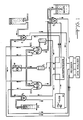
- Figure 1 depicts the microprocessor control system. This is a servo mechanism which permits coronary perfusion pressure (CPP) and drug concentration to be maintained constant independent of changes in coronary flow. The level at which CPP and drug concentration are maintained can be changed by commands communicated through the microprocessor keyboard. Dose-response curves are carried out by perfusing concentrated drug solution (DC) at rates proportional to total coronary flow (CF T ). Drug concentrations are increased by proportionate increases in the rate of DC infusion over CF T via the microprocessor keyboard.
- DC concentrated drug solution
- CF T total coronary flow
- the proportional flow rates for DC:CF T is about 0.00005:1 at the low end and .0015:1 at the high end of the dose-response curve
- Dose-response curves encompassing at least two log doses are carried out in one-half log increments starting at a subthreshold dose and ending at a dose which produces near maximal response.
- Measurements for Cardiovascular Isolated Heart are maximum positive first derivative of LVP (LV +dP/dt max ), heart rate (HR), and coronary flow (CF). Units are: LV +dP/dt max , millimeters of mercury/second (mm Hg/sec); HR, beats/ minutes (bpm) and CF, milliliters/minute (ml/min).
- LV +dP/dt max is derived from the LVP signal by a differential amplifier and recorded.
- HR is calculated from the ECG strip chart recording and CF is calculated by recording analog outputs from pumps 1 and 2.
- Compounds are solubilized in DMSO and diluted with water when possible.
- Data is digitized and averaged with an in-lab microcomputer (Buxco) data analyzer.
- the report format is screening data sheets. Percent change in HR, CF, and LV +dP/dt max are illustrated graphically and tabulated.
- the present invention was evaluated in the anesthetized dog.
- dP/dt Left intraventricular pressure and its first derivative (dP/dt) were recorded continuously using a Millar Instruments catheter pressure transducer advanced into the left intraventricular chamber from the left carotid artery. dP/dt was used as an index of left ventricular contractility.
- a left lateral thoracotomy was performed at the fourth intercostal space, the pericardium incised, and the heart exposed.
- the circumflex coronary artery was dissected free of connective tissue and an electromagnetic flow probe positioned around the vessel proximal to the left common coronary artery. Circumflex coronary artery blood flow was measured continuously.
- a Gould thermodilution catheter was advanced to the pulmonary artery via the right jugular vein for the measurement of cardiac output.
- the left femoral vein was cannulated for drug infusion.
- the reference compound was (N6-[2,3-dihydrophenalin-2-yl) methyl]adenosine), an adenosine agonist of structural similarity, Compound 3.
- Table 2 illustrate that Compound 1 of the present invention is unique in that, in addition to its potent coronary flow effects, it produces moderate inotropic and cardiac output increases.
- the unexpected in vitro and in vivo effects of the compound of the present invention on left ventricular contractility and cardiac output which properties are lacking in compound of similar structure, provides for the utility of the compound in the treatment of congestive heart failure.
- the usual mammalian dosage range for a 70 kg human subject is from 5 to 500 mg per day or 0.07 mg to 7.1 mg per kg of weight per day; optionally in divided portions. Determination of the proper dosage for a particular situation is within the skill of the art.
- compositions of the compound of the present invention or its salts are produced by formulating the active compound in dosage unit form with a pharmaceutical carrier.
- dosage unit forms are tablets, capsules, pills, powders, aqueous and nonaqueous oral solutions and suspensions, and parenteral solutions packaged in containers containing either one or some larger number of dosage units and capable of being subdivided into individual doses.
- suitable pharmaceutical carriers are gelatin capsules; sugars such as lactose and sucrose; starches such as corn starch and potato starch; cellulose derivatives such as sodium carboxymethyl cellulose, ethyl cellulose, methyl cellulose, and cellulose acetate phthalate; gelatin; talc; stearic acid; magnesium stearate; vegetable oils such as peanut oil, cottonseed oil; sesame oil, olive oil, corn oil, and oil of theobroma; propylene glycol, glycerine; sorbitol; polyethylene glycol; water; agar; alginic acid; isotonic saline, and phosphate buffer solutions; as well as other compatible substances normally used in pharmaceutical formulations.
- the compositions of the invention can also contain other components such as coloring agents, flavoring agents, and/or preservatives. These materials, if present, are usually used in relatively small amounts.
- the compositions can, if desired, also contain other therapeutic agents.
- the percentage of the active ingredient in the foregoing compositions can be varied within wide limits but for practical purposes it is preferably present in a concentration of at least 10% in a solid composition and at least 2% in a primarily liquid composition.
- the most satisfactory compositions are those in which a much higher proportion of the active ingredient is present.
- a useful intravenous dose is between 0.001 and 1 mg/kg.
- a preferred intravenous dose is 0.01 to 1.0 mg/kg.
- a still further preferred dose is 0.03 mg/kg.
- a useful oral dose is 0.01 to 31 mg/kg.
- a preferred oral dose is 0.1 to 10 mg/kg.
- a still further preferred dose is 1.0 mg/kg.
- formulations of the subject compound or its salts are:
- the hydrochloride salt of Compound I is dissolved in water and passed through a 0.2 - micron filter. Aliquots of the filtered solution are added to ampoules or vials, sealed, and sterilized.
- Compound 1 is dissolved in the water and to this solution the syrup is added with mild stirring.
Landscapes
- Health & Medical Sciences (AREA)
- Chemical & Material Sciences (AREA)
- Life Sciences & Earth Sciences (AREA)
- Organic Chemistry (AREA)
- General Health & Medical Sciences (AREA)
- Engineering & Computer Science (AREA)
- Veterinary Medicine (AREA)
- Public Health (AREA)
- Molecular Biology (AREA)
- Animal Behavior & Ethology (AREA)
- Medicinal Chemistry (AREA)
- Pharmacology & Pharmacy (AREA)
- Bioinformatics & Cheminformatics (AREA)
- Epidemiology (AREA)
- Genetics & Genomics (AREA)
- Biotechnology (AREA)
- Biochemistry (AREA)
- Cardiology (AREA)
- Heart & Thoracic Surgery (AREA)
- Chemical Kinetics & Catalysis (AREA)
- General Chemical & Material Sciences (AREA)
- Nuclear Medicine, Radiotherapy & Molecular Imaging (AREA)
- Urology & Nephrology (AREA)
- Vascular Medicine (AREA)
- Pharmaceuticals Containing Other Organic And Inorganic Compounds (AREA)
- Saccharide Compounds (AREA)
Applications Claiming Priority (2)
| Application Number | Priority Date | Filing Date | Title |
|---|---|---|---|
| US901107 | 1986-08-28 | ||
| US06/901,107 US4767747A (en) | 1986-08-28 | 1986-08-28 | Method for treating congestive heart failure with N6 -acenaphthyl adenosine |
Publications (2)
| Publication Number | Publication Date |
|---|---|
| EP0266504A2 true EP0266504A2 (de) | 1988-05-11 |
| EP0266504A3 EP0266504A3 (de) | 1990-02-07 |
Family
ID=25413606
Family Applications (1)
| Application Number | Title | Priority Date | Filing Date |
|---|---|---|---|
| EP87112508A Withdrawn EP0266504A3 (de) | 1986-08-28 | 1987-08-27 | Verwendung von N6-[(1,2-Dihydro-1-acenaphthylenyl)methyl]adenosin zur Herstellung von Arzneimitteln zur Behandlung von kongestiver Herzinsuffizienz |
Country Status (5)
| Country | Link |
|---|---|
| US (1) | US4767747A (de) |
| EP (1) | EP0266504A3 (de) |
| JP (1) | JPS6360930A (de) |
| DK (1) | DK425287A (de) |
| PH (1) | PH22718A (de) |
Cited By (1)
| Publication number | Priority date | Publication date | Assignee | Title |
|---|---|---|---|---|
| EP1045636A4 (de) * | 1997-09-19 | 2003-09-10 | Arthur M Feldman | Pharmazeutische zusammensetzung und behandlungsmethode für beschädigtes myokardgewebe |
Families Citing this family (7)
| Publication number | Priority date | Publication date | Assignee | Title |
|---|---|---|---|---|
| US5055569A (en) * | 1989-10-19 | 1991-10-08 | G. D. Searle & Co. | N-(6)-substituted adenosine compounds |
| TW528755B (en) | 1996-12-24 | 2003-04-21 | Glaxo Group Ltd | 2-(purin-9-yl)-tetrahydrofuran-3,4-diol derivatives |
| YU44900A (sh) | 1998-01-31 | 2003-01-31 | Glaxo Group Limited | Derivati 2-(purin-9-il)tetrahidrofuran-3,4-diola |
| YU81100A (sh) | 1998-06-23 | 2003-10-31 | Glaxo Group Limited | Derivati 2-(purin-9-il)tetrahidrofuran-3,4 diola |
| PE20060272A1 (es) * | 2004-05-24 | 2006-05-22 | Glaxo Group Ltd | (2r,3r,4s,5r,2'r,3'r,4's,5's)-2,2'-{trans-1,4-ciclohexanodiilbis-[imino(2-{[2-(1-metil-1h-imidazol-4-il)etil]amino}-9h-purin-6,9-diil)]}bis[5-(2-etil-2h-tetrazol-5-il)tetrahidro-3,4-furanodiol] como agonista a2a |
| GB0514809D0 (en) | 2005-07-19 | 2005-08-24 | Glaxo Group Ltd | Compounds |
| US20160290524A1 (en) * | 2015-04-02 | 2016-10-06 | Pentair Flow Services Ag | System for Controlling Valve Positioner |
Family Cites Families (2)
| Publication number | Priority date | Publication date | Assignee | Title |
|---|---|---|---|---|
| US4614732A (en) * | 1984-10-26 | 1986-09-30 | Warner-Lambert Company | N6 -acenaphthyl adenosines and analogs thereof |
| US4673670A (en) * | 1985-09-05 | 1987-06-16 | Warner-Lambert Company | N6 -acenaphthyl adenosines and analogs thereof |
-
1986
- 1986-08-28 US US06/901,107 patent/US4767747A/en not_active Expired - Fee Related
-
1987
- 1987-08-14 DK DK425287A patent/DK425287A/da not_active Application Discontinuation
- 1987-08-27 JP JP62211500A patent/JPS6360930A/ja active Pending
- 1987-08-27 PH PH35744A patent/PH22718A/en unknown
- 1987-08-27 EP EP87112508A patent/EP0266504A3/de not_active Withdrawn
Cited By (1)
| Publication number | Priority date | Publication date | Assignee | Title |
|---|---|---|---|---|
| EP1045636A4 (de) * | 1997-09-19 | 2003-09-10 | Arthur M Feldman | Pharmazeutische zusammensetzung und behandlungsmethode für beschädigtes myokardgewebe |
Also Published As
| Publication number | Publication date |
|---|---|
| US4767747A (en) | 1988-08-30 |
| EP0266504A3 (de) | 1990-02-07 |
| JPS6360930A (ja) | 1988-03-17 |
| DK425287D0 (da) | 1987-08-14 |
| PH22718A (en) | 1988-11-28 |
| DK425287A (da) | 1988-02-29 |
Similar Documents
| Publication | Publication Date | Title |
|---|---|---|
| US8017786B2 (en) | Substituted β-phenyl-α-hydroxy-propanoic acid, synthesis method and use thereof | |
| WENDT | Systemic and coronary vascular effects of the 2-and the 5-mononitrate esters of isosorbide | |
| EP0011609B1 (de) | Xanthinderivate und pharmazeutische Zusammensetzung zur Verwendung für die Behandlung chronischer Verstopfungen der Atemwege und von Herzkrankheiten | |
| US4501735A (en) | N6-(1- and 2-benzocycloalkyl) adenosines | |
| SU1212325A3 (ru) | Способ получени производных бензопирана | |
| EP0266504A2 (de) | Verwendung von N6-[(1,2-Dihydro-1-acenaphthylenyl)methyl]adenosin zur Herstellung von Arzneimitteln zur Behandlung von kongestiver Herzinsuffizienz | |
| JPS63166866A (ja) | キノリン化合物 | |
| PT99690B (pt) | Metodo para o tratamento de doencas utilizando derivados de 2'-o-alquil-adenosina e para a preparacao de composicoes que os contem e de um hidrato de 6-ciclo- -hexil-2'-ometil-adenosina | |
| US4416893A (en) | Substituted 1,2,5-oxadiazole-2-oxides in human cardiovascular system disease | |
| JPH0651625B2 (ja) | 高脂質血症治療剤 | |
| US6936596B2 (en) | Adenosine derivatives and use thereof | |
| JP3253302B2 (ja) | 3−ジアルキルアミノエトキシベンゾイル−ベンゾフランを含有する非経口溶液 | |
| KR100266834B1 (ko) | 프로스타글란딘 유도체 | |
| EP0485219B1 (de) | Arzneimittel für die Verhütung und Behandlung von Krankheiten der Kreislauforgane enthaltend Spiro-3-heteroazolidin-Verbindungen | |
| SU1598870A3 (ru) | Способ получени производных 1,4-дигидропиридина | |
| EP0448029A2 (de) | Neue pharmazeutische Verwendungen von Forskolin-Derivaten | |
| US4693996A (en) | Method of treating heart failure and medicaments therefor | |
| US4131678A (en) | Urapidil/furosemide compounds, compositions and use | |
| JPWO1991003471A1 (ja) | アスコルビン酸誘導体 | |
| US4555522A (en) | Antithrombotic and/or antihypertensive compositions | |
| KR20010034114A (ko) | 칼륨 채널 활성화제 | |
| US4980351A (en) | 3-aminopropoxyaryl derivatives having cardiotonic and antihypertensive use and compositions thereof | |
| US4061756A (en) | Methods for treating cardiovascular disorders | |
| US5747495A (en) | Method for treating hypertension using pyrazolopyrimidine derivatives | |
| US5354764A (en) | Method for inhibiting myocardial cell necrosis and preserving heart function during myocardial ischemia and/or reperfusion |
Legal Events
| Date | Code | Title | Description |
|---|---|---|---|
| PUAI | Public reference made under article 153(3) epc to a published international application that has entered the european phase |
Free format text: ORIGINAL CODE: 0009012 |
|
| 17P | Request for examination filed |
Effective date: 19870827 |
|
| AK | Designated contracting states |
Kind code of ref document: A2 Designated state(s): AT BE CH DE FR GB IT LI LU NL SE |
|
| PUAL | Search report despatched |
Free format text: ORIGINAL CODE: 0009013 |
|
| AK | Designated contracting states |
Kind code of ref document: A3 Designated state(s): AT BE CH DE FR GB IT LI LU NL SE |
|
| 17Q | First examination report despatched |
Effective date: 19901112 |
|
| STAA | Information on the status of an ep patent application or granted ep patent |
Free format text: STATUS: THE APPLICATION HAS BEEN WITHDRAWN |
|
| 18W | Application withdrawn |
Withdrawal date: 19910424 |
|
| R18W | Application withdrawn (corrected) |
Effective date: 19910424 |
|
| RIN1 | Information on inventor provided before grant (corrected) |
Inventor name: HAMILTON, HARRIET WALL Inventor name: STEFFEN, ROBERT PAUL |
|
| RTI1 | Title (correction) |
Free format text: USE OF N6-??(1,2-DIHYDRO-1-ACENAPHTHYLENYL) METHYL -ADENOSINE IN THE PREPARATION OF PHARMACEUTICAL COMPOUNDS FOR TREATING CONGESTIVE HEART FAILURE |