EP0265584A2 - Verfahren und Materialien zum Ätzen von Siliziumdioxid unter Verwendung eines Ätzstops aus Siliziumnitrid oder siliziumreichem Siliziumdioxid - Google Patents
Verfahren und Materialien zum Ätzen von Siliziumdioxid unter Verwendung eines Ätzstops aus Siliziumnitrid oder siliziumreichem Siliziumdioxid Download PDFInfo
- Publication number
- EP0265584A2 EP0265584A2 EP87106471A EP87106471A EP0265584A2 EP 0265584 A2 EP0265584 A2 EP 0265584A2 EP 87106471 A EP87106471 A EP 87106471A EP 87106471 A EP87106471 A EP 87106471A EP 0265584 A2 EP0265584 A2 EP 0265584A2
- Authority
- EP
- European Patent Office
- Prior art keywords
- silicon
- silicon dioxide
- layer
- etching
- nitride
- Prior art date
- Legal status (The legal status is an assumption and is not a legal conclusion. Google has not performed a legal analysis and makes no representation as to the accuracy of the status listed.)
- Withdrawn
Links
Images

Classifications
-
- H—ELECTRICITY
- H10—SEMICONDUCTOR DEVICES; ELECTRIC SOLID-STATE DEVICES NOT OTHERWISE PROVIDED FOR
- H10P—GENERIC PROCESSES OR APPARATUS FOR THE MANUFACTURE OR TREATMENT OF DEVICES COVERED BY CLASS H10
- H10P50/00—Etching of wafers, substrates or parts of devices
- H10P50/20—Dry etching; Plasma etching; Reactive-ion etching
- H10P50/28—Dry etching; Plasma etching; Reactive-ion etching of insulating materials
- H10P50/282—Dry etching; Plasma etching; Reactive-ion etching of insulating materials of inorganic materials
- H10P50/283—Dry etching; Plasma etching; Reactive-ion etching of insulating materials of inorganic materials by chemical means
Definitions
- the present invention relates to etching processes and materials and more particularly to an etching process and and etch stop structure for directionally etching silicon dioxide with high selectivity to an etch stop consisting of silicon nitride or silicon rich silicon dioxide.
- U.S. Patent 4,427,516 issued January 24, 1984 to Levinstein et al, entitled APPARATUS AND METHOD FOR PLASMA-ASSISTED ETCHING OF WAFERS teaches a plasma-assisted etching apparatus and method designed to pattern silicon dioxide in a plasma derived from a mixture of trifluoromethane and ammonia wherein surfaces in the reaction chamber are coated with a layer of silicon. Contamination of wafers during the etching process is thereby substantially reduced.
- U.S. Patent 4,376,672 issued March 15, 1983 to Wang et al describes a method for etching a layer of inorganic insulating material formed on a semiconductor wafer and containing silicon as the principal metallic element.
- the method involves disposing a wafer on one of a pair of electrode structures in a closed chamber.
- a reactive gas mixture comprising principally a fluorocarbon gas doped with a preselected quantity of carbon dioxide is supplied to the chamber.
- Radio frequency electrical energy is suppled to one of the electrode structures to create a plasma of the reactive gas mixture for chemically attacking the insulating material.
- U.S. Patent 4,431,477 issued February 14, 1984 to Zajao entitled PLASMA ETCHING WITH NITROUS OXIDE AND FLUORO COMPOUND GAS MIXTURE discloses a process for use in the manufacture of multilayer thin film integrated circuits for selective removal of specific layers, and a composition of matter useful in the process for selective etching of polysilicon and silicon nitrides during the manufacture of thin film integrated circuits.
- a multilayer thin film integrated circuit is exposed to a plasma formed from a gaseous mixture of nitrous oxide and a fluoro compound.
- the nitrous oxide preferably comprises between 2.5% and 9.0% of the mixture and the fluoro compound preferably comprises between 91.0% and 97.5% of the mixture.
- U.S. Patent 4,490,205 issued December 25, 1984 to Hartman entitled PLASMA ETCHING USING HYDROGEN BROMIDE ADDITION relates to a plasma etch chemistry which allows a near perfectly anisotropic etch of silicon.
- a Cl-containing compound such as HC1 has HBr added thereto, readily allowing the anisotropic etching of silicon. This is due to the low vola- tilit y of SiBr 4 .
- the silicon surface facing the discharge is subjected to ion bombardment, allowing the volatization (etching) of silicon as a Si-Cl-Br compound.
- the Br which absorbs on the sidewalls of the etched silicon passivates them from the etching.
- U.S. Patent 4,431,477 discusses the use of Freon 13 with nitrous oxide to etch nitride at a faster rate than oxide. This is in contrast to the present inven- 'tion wherein nitride is caused to etch significantly slower than oxide.
- U.S. Patent 4,376,672 and 4,283,249 discuss selective etching of oxide and nitride to silicon. In both cases, only silicon can be used as an etching barrier.
- U.S. Patent 4,490,209 claims selective etching of silicon to nitride. Although nitride is used as an etching barrier, the applications of patterning silicon are generally quite different trom that of defining an oxide layer. The features of the present invention are unique in that selectivity is obtained between two dielectric materials, silicon dioxide and nitride wherein oxide etches considerably faster than nitride in this process.
- CCIF 3 + H 2 will etch SiO 2 directionally with high selectivity to Si 3 N 4 and silicon rich Si0 2 . It has also been shown in the prior art that the use of a dielectric material as an etch stop prevents the transfer ot topography into underlaying layers of wafer material such as an SiO 2 film used as isolation.
- An object of the present invention is to provide a process for etching SiO 2 using either silicon rich SiO 2 or Si 3 N 4 as an etching barrier over a substrate.
- Another object of the present invention is to provide an etching process wherein selectivity is obtained between two dielectric materials, silicon dioxide and nitride or silicon dioxide and silicon rich silicon dioxide wherein the oxide etches considerably faster than nitride or silicon rich silicon dioxide because of the selectivity of oxide to nitride.
- a further object of the present invention is to provide an etching process wherein silicon dioxide on a substrate is directionally etched in a fluorocarbon gas to form silicon dioxide spacers on a substrate, and wherein the substrate surface is protected by an etch stop composed of silicon nitride or silicon rich silicon dioxide.
- the process of the present invention includes etching, for example, reactive ion etching.
- etching for example, reactive ion etching.
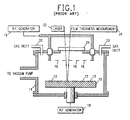
- means for carrying out the reactive ion etching is available in the art, and does not form a separate portion of the present invention, a typical reactive ion etching structure will be described to provide a complete disclosure.
- FIG. 1 A typical reactive ion etching systemis shown in FIG. 1 including a support means 10 for mounting recessed work specimens within an enclosed vacuum chamber 14.
- the work specimens are disposed between a pair of electrodes 12,16 which are energized with radio frequency power from R.F. generator 18 to produce an electric field for ionizing a gas which is introduced through inlets 20.
- Control of the etching process is maintained by directing a laser beam from laser 22 through window 24 and which is reflected from the specimen surface to a thickness measurement means 26.
- the etching of the silicon dioxide material is carried out by an etch gas consisting ot CClF 3 + H 2 , and more particularly thirty percent 20 millitorr CClF 3 plus seventy percent H2with a power density of 0.35 watts/cm 2 in a 7, 82 mm wafer reactive ion etch system.
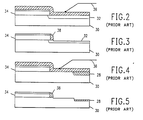
- FIG. 2 an illustration is provided showing a prior art example of an etch process for forming a silicon dioxide spacer sidewall.
- a substrate 30, such as silicon or gallium arsenide contains a shallow doped junction region 32 and a polysilicon layer 34.
- a layer of silicon dioxide 36 is tormed on the polysilicon 34 and junction 32, for example, by chemical vapor deposition.
- the structure is reactive ion etched in a system as shown in FIG. 1. The etching is directional normal to the structure surface such that a silicon dioxide sidewall 38 remains, as shown in FIG. 3.
- FIG. 4 another embodiment of a structure is shown including a semi-recessed oxide region 28 rather than a shallow junction. The remainder of the structure of FIG. 4 is the same as shown in FIG. 2.
- FIG. 4 is directionally reactively ion etched in the system of FIG. 1 to remove the silicon dioxide layer 36 and provide sidewall spacer 38 as shown in FIG. 5. However, a significant portion ot the semi-recessed oxide region 28 is also removed during the etching process, to the detriment of the resultant device structure.
- FIG. 6 an illustration of curves showing the etch rates of silicon dioxide, silicon nitride and silicon in CClF 3 + H 2 is depicted.
- the etch rate of silicon dioxide is shown to be higher than silicon nitride and silicon, with the differences between the etch rates becoming larger as the percentage of H 2 in the gas mixture increases to seventy percent (+7 percent):
- the application of this etch rate difference is used in the etch barrier structure of the prqcess of the present invention.
- the silicon nitride and the silicon rich silicon dioxide (that is, having a very high silicon content, for example, forty percent silicon in the silicon dioxide compound) etch more slowly than normal silicon dioxide may be a result of the CC1F 3 +H 2 etching gas being highly selective to silicon, in the order of 70 to 80 to 1.
- the silicon nitride which is composed of about 43% Si as opposed to silicon dioxide which is composed of about 33% Si, etches more slowly than the silicon dioxide.
- silicon rich Si0 2 which has a much higher silicon content than regular Si0 2 .
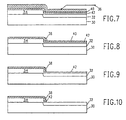
- FIGS. 7, 8 and 9 the process of the present invention is shown for fabricating a silicon dioxide sidewall spacer and a structure containing a shallow doped junction similar to the structure of FIGS. 2 and 3.
- the substrate 30 contains a shallow doped junction 32 and a polysilicon layer 34.
- An etch barrier 40 is deposited on the surface of the structure. If the substrate 30 is single crystal silicon, and if the etch barrier 40 is composed of silicon nitride, normal practice requires a thin passivating layer 42 of silicon dioxide to be placed between the nitride and the silicon to prevent defect formation. If the etch barrier is silicon rich silicon dioxide, such passivating layer 42 is not needed. Likewise, the passivating layer 42 may be unnecessary if the substrate 30 is composed of gallium arsenide.
- a layer of silicon dioxide 36 insulating material is then deposited on the surface of the structure as described for FIG. 2.
- the structure is then directionally etched in the system of FIG. 1 to provide the sidewall spacer 38 in FIG. 8.
- the silicon nitride etches slower than the silicon dioxide, when the sidewall is completed, there is still a thickness of silicon nitride etch barrier protecting the surtace of the shallow junction.
- the structure is reactively ion etched using CF 4 as the etching gas to remove the nitride layer 40. If a passivating layer 42 is used, it is removed by using a wet etching with a buftered HF solution which has infinite selectivity to silicon and, therefore, no junction material is removed as shown in FIG. 10.
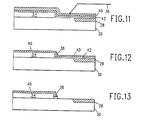
- FIGS. 11, 12 and 13 illustrate the use ot a barrier layer according to the present invention in a process for forming a sidewall on a structure including semi-recessed oxide.
- a substrate 30 is provided having a semi-recessed oxide region 28 therein, and a layer of polysilicon 34 similar to the structure of FIG. 4.
- a silicon nitride etch barrier layer is tormed and, if necessary, a thin silicon dioxide passivating layer 42 is first deposited on the structure surface.
- FIG. 12 illustrates the first process step, which is the same as described for FIG. 8, wherein a directional reactive ion etch is performed to remove the silicon dioxide layer 36 with the exception of the remaining sidewall 38.
- the nitride layer 40 is removed by reactive ion etching in CF 4 similar to the step of FIG. 9 and, if present, the passivating silicon dioxide layer 42 is also removed by reactive ion etching in CF 4 .
Landscapes
- Drying Of Semiconductors (AREA)
Applications Claiming Priority (2)
| Application Number | Priority Date | Filing Date | Title |
|---|---|---|---|
| US92471186A | 1986-10-30 | 1986-10-30 | |
| US924711 | 1986-10-30 |
Publications (2)
| Publication Number | Publication Date |
|---|---|
| EP0265584A2 true EP0265584A2 (de) | 1988-05-04 |
| EP0265584A3 EP0265584A3 (de) | 1989-12-06 |
Family
ID=25450595
Family Applications (1)
| Application Number | Title | Priority Date | Filing Date |
|---|---|---|---|
| EP87106471A Withdrawn EP0265584A3 (de) | 1986-10-30 | 1987-05-05 | Verfahren und Materialien zum Ätzen von Siliziumdioxid unter Verwendung eines Ätzstops aus Siliziumnitrid oder siliziumreichem Siliziumdioxid |
Country Status (2)
| Country | Link |
|---|---|
| EP (1) | EP0265584A3 (de) |
| JP (1) | JPS63117423A (de) |
Cited By (11)
| Publication number | Priority date | Publication date | Assignee | Title |
|---|---|---|---|---|
| WO1993026043A1 (en) * | 1992-06-05 | 1993-12-23 | Vlsi Technology, Inc. | Planarization method |
| US5312518A (en) * | 1991-05-31 | 1994-05-17 | Sony Corporation | Dry etching method |
| US5423945A (en) * | 1992-09-08 | 1995-06-13 | Applied Materials, Inc. | Selectivity for etching an oxide over a nitride |
| US5578524A (en) * | 1994-03-30 | 1996-11-26 | Nec Corporation | Fabrication process of a semiconductor device with a wiring structure |
| US5622596A (en) * | 1995-05-08 | 1997-04-22 | International Business Machines Corporation | High density selective SiO2 :Si3 N4 etching using a stoichiometrically altered nitride etch stop |
| US6444586B2 (en) | 1998-07-23 | 2002-09-03 | Micron Technology, Inc. | Method of etching doped silicon dioxide with selectivity to undoped silicon dioxide with a high density plasma etcher |
| US6479864B1 (en) | 1997-04-30 | 2002-11-12 | Micron Technology Inc. | Semiconductor structure having a plurality of gate stacks |
| US6989108B2 (en) | 2001-08-30 | 2006-01-24 | Micron Technology, Inc. | Etchant gas composition |
| US7049244B2 (en) | 1992-06-15 | 2006-05-23 | Micron Technology, Inc. | Method for enhancing silicon dioxide to silicon nitride selectivity |
| US20100279441A1 (en) * | 2007-10-17 | 2010-11-04 | Seiji Yokoyama | Method for fabricating a semiconductor device by considering the extinction coefficient during etching of an interlayer insulating film |
| CN102443395A (zh) * | 2010-09-30 | 2012-05-09 | 韩国泰科诺赛美材料株式会社 | 用于湿法蚀刻二氧化硅的组合物 |
Families Citing this family (1)
| Publication number | Priority date | Publication date | Assignee | Title |
|---|---|---|---|---|
| JP2739853B2 (ja) * | 1995-11-28 | 1998-04-15 | 日本電気株式会社 | 半導体装置の製造方法及びエッチング方法 |
Family Cites Families (3)
| Publication number | Priority date | Publication date | Assignee | Title |
|---|---|---|---|---|
| US4333794A (en) * | 1981-04-07 | 1982-06-08 | International Business Machines Corporation | Omission of thick Si3 N4 layers in ISA schemes |
| EP0218408A3 (de) * | 1985-09-25 | 1988-05-25 | Hewlett-Packard Company | Verfahren zum Herstellen einer schwach dotierten Drainstruktur (LLD) in integrierten Schaltungen |
| GB8528967D0 (en) * | 1985-11-25 | 1986-01-02 | Plessey Co Plc | Semiconductor device manufacture |
-
1987
- 1987-05-05 EP EP87106471A patent/EP0265584A3/de not_active Withdrawn
- 1987-05-29 JP JP62132003A patent/JPS63117423A/ja active Pending
Cited By (20)
| Publication number | Priority date | Publication date | Assignee | Title |
|---|---|---|---|---|
| US5312518A (en) * | 1991-05-31 | 1994-05-17 | Sony Corporation | Dry etching method |
| WO1993026043A1 (en) * | 1992-06-05 | 1993-12-23 | Vlsi Technology, Inc. | Planarization method |
| US5378318A (en) * | 1992-06-05 | 1995-01-03 | Vlsi Technology, Inc. | Planarization |
| US7049244B2 (en) | 1992-06-15 | 2006-05-23 | Micron Technology, Inc. | Method for enhancing silicon dioxide to silicon nitride selectivity |
| US5423945A (en) * | 1992-09-08 | 1995-06-13 | Applied Materials, Inc. | Selectivity for etching an oxide over a nitride |
| US5578524A (en) * | 1994-03-30 | 1996-11-26 | Nec Corporation | Fabrication process of a semiconductor device with a wiring structure |
| US5622596A (en) * | 1995-05-08 | 1997-04-22 | International Business Machines Corporation | High density selective SiO2 :Si3 N4 etching using a stoichiometrically altered nitride etch stop |
| EP0742584A3 (de) * | 1995-05-08 | 1997-10-08 | Ibm | Selektive Ätzung mit hoher Dichte von SiO2:Si3N4 mittels einer Ätz-Stopschicht aus stöchiometrisch geändertem Nitrid |
| US6849557B1 (en) | 1997-04-30 | 2005-02-01 | Micron Technology, Inc. | Undoped silicon dioxide as etch stop for selective etch of doped silicon dioxide |
| US6551940B1 (en) | 1997-04-30 | 2003-04-22 | Micron Technology, Inc. | Undoped silicon dioxide as etch mask for patterning of doped silicon dioxide |
| US6479864B1 (en) | 1997-04-30 | 2002-11-12 | Micron Technology Inc. | Semiconductor structure having a plurality of gate stacks |
| US6967408B1 (en) * | 1997-04-30 | 2005-11-22 | Micron Technology, Inc. | Gate stack structure |
| US6444586B2 (en) | 1998-07-23 | 2002-09-03 | Micron Technology, Inc. | Method of etching doped silicon dioxide with selectivity to undoped silicon dioxide with a high density plasma etcher |
| US6989108B2 (en) | 2001-08-30 | 2006-01-24 | Micron Technology, Inc. | Etchant gas composition |
| US7273566B2 (en) | 2001-08-30 | 2007-09-25 | Micron Technology, Inc. | Gas compositions |
| US7470628B2 (en) | 2001-08-30 | 2008-12-30 | Micron Technology, Inc. | Etching methods |
| US20100279441A1 (en) * | 2007-10-17 | 2010-11-04 | Seiji Yokoyama | Method for fabricating a semiconductor device by considering the extinction coefficient during etching of an interlayer insulating film |
| US8440557B2 (en) * | 2007-10-17 | 2013-05-14 | Spansion Llc | Method for fabricating a semiconductor device by considering the extinction coefficient during etching of an interlayer insulating film |
| CN102443395A (zh) * | 2010-09-30 | 2012-05-09 | 韩国泰科诺赛美材料株式会社 | 用于湿法蚀刻二氧化硅的组合物 |
| CN102443395B (zh) * | 2010-09-30 | 2016-01-20 | 韩国泰科诺赛美材料株式会社 | 用于湿法蚀刻二氧化硅的组合物 |
Also Published As
| Publication number | Publication date |
|---|---|
| EP0265584A3 (de) | 1989-12-06 |
| JPS63117423A (ja) | 1988-05-21 |
Similar Documents
| Publication | Publication Date | Title |
|---|---|---|
| US7049244B2 (en) | Method for enhancing silicon dioxide to silicon nitride selectivity | |
| US6391788B1 (en) | Two etchant etch method | |
| US5007982A (en) | Reactive ion etching of silicon with hydrogen bromide | |
| US4784720A (en) | Trench etch process for a single-wafer RIE dry etch reactor | |
| EP0814500B1 (de) | Verfahren zum Ätzen von Polyzidstrukturen | |
| EP0482519B1 (de) | Ätzverfahren für Materialien aus Oxid | |
| US6461974B1 (en) | High temperature tungsten etching process | |
| KR100229241B1 (ko) | 드라이 에칭방법 | |
| EP0819786A2 (de) | Verfahren zum Ätzen eines Siliziumkristalles | |
| KR100718072B1 (ko) | 기판의 실리콘층에 직통으로 접촉홀을 형성하기 위한 방법 | |
| US20060016781A1 (en) | Dry etching method | |
| WO1999016110A2 (en) | Plasma process for selectively etching oxide using fluoropropane or fluoropropylene | |
| US5880033A (en) | Method for etching metal silicide with high selectivity to polysilicon | |
| WO2003094217A1 (en) | Method of etching silicon nitride spacers with high selectivity relative to oxide in a high density plasma chamber | |
| KR20010042983A (ko) | 고 종횡비 개구를 형성하는 방법 | |
| US20060011579A1 (en) | Gas compositions | |
| EP0473344B1 (de) | Ätzverfahren für eine leitende Doppelschicht-Struktur | |
| KR100595090B1 (ko) | 포토레지스트 마스크를 사용한 개선된 엣칭방법 | |
| WO1999021218A1 (en) | Self-aligned contact etch using difluoromethane and trifluoromethane | |
| US5387312A (en) | High selective nitride etch | |
| US6117788A (en) | Semiconductor etching methods | |
| JPH0648680B2 (ja) | 窒化物絶縁層を選択的にドライ・エッチングする気体混合物及び方法 | |
| US6069087A (en) | Highly selective dry etching process | |
| JPS63117423A (ja) | 二酸化シリコンのエツチング方法 | |
| US5756216A (en) | Highly selective nitride spacer etch |
Legal Events
| Date | Code | Title | Description |
|---|---|---|---|
| PUAI | Public reference made under article 153(3) epc to a published international application that has entered the european phase |
Free format text: ORIGINAL CODE: 0009012 |
|
| AK | Designated contracting states |
Kind code of ref document: A2 Designated state(s): DE FR GB |
|
| 17P | Request for examination filed |
Effective date: 19880823 |
|
| PUAL | Search report despatched |
Free format text: ORIGINAL CODE: 0009013 |
|
| AK | Designated contracting states |
Kind code of ref document: A3 Designated state(s): DE FR GB |
|
| 17Q | First examination report despatched |
Effective date: 19920429 |
|
| STAA | Information on the status of an ep patent application or granted ep patent |
Free format text: STATUS: THE APPLICATION HAS BEEN WITHDRAWN |
|
| 18W | Application withdrawn |
Withdrawal date: 19921021 |
|
| RIN1 | Information on inventor provided before grant (corrected) |
Inventor name: CHAO, HU HERBERT Inventor name: BENNETT, REID STUART Inventor name: SACKLES, PAUL EDWARD |