EP0265306B1 - Système de commande à fonctions multiples d'un véhicule automobile - Google Patents
Système de commande à fonctions multiples d'un véhicule automobile Download PDFInfo
- Publication number
- EP0265306B1 EP0265306B1 EP87402089A EP87402089A EP0265306B1 EP 0265306 B1 EP0265306 B1 EP 0265306B1 EP 87402089 A EP87402089 A EP 87402089A EP 87402089 A EP87402089 A EP 87402089A EP 0265306 B1 EP0265306 B1 EP 0265306B1
- Authority
- EP
- European Patent Office
- Prior art keywords
- remote control
- electronic
- assembly
- motor vehicle
- vehicle
- Prior art date
- Legal status (The legal status is an assumption and is not a legal conclusion. Google has not performed a legal analysis and makes no representation as to the accuracy of the status listed.)
- Expired - Lifetime
Links
Images

Classifications
-
- B—PERFORMING OPERATIONS; TRANSPORTING
- B60—VEHICLES IN GENERAL
- B60R—VEHICLES, VEHICLE FITTINGS, OR VEHICLE PARTS, NOT OTHERWISE PROVIDED FOR
- B60R16/00—Electric or fluid circuits specially adapted for vehicles and not otherwise provided for; Arrangement of elements of electric or fluid circuits specially adapted for vehicles and not otherwise provided for
- B60R16/02—Electric or fluid circuits specially adapted for vehicles and not otherwise provided for; Arrangement of elements of electric or fluid circuits specially adapted for vehicles and not otherwise provided for electric constitutive elements
- B60R16/023—Electric or fluid circuits specially adapted for vehicles and not otherwise provided for; Arrangement of elements of electric or fluid circuits specially adapted for vehicles and not otherwise provided for electric constitutive elements for transmission of signals between vehicle parts or subsystems
-
- B—PERFORMING OPERATIONS; TRANSPORTING
- B60—VEHICLES IN GENERAL
- B60R—VEHICLES, VEHICLE FITTINGS, OR VEHICLE PARTS, NOT OTHERWISE PROVIDED FOR
- B60R25/00—Fittings or systems for preventing or indicating unauthorised use or theft of vehicles
- B60R25/01—Fittings or systems for preventing or indicating unauthorised use or theft of vehicles operating on vehicle systems or fittings, e.g. on doors, seats or windscreens
- B60R25/04—Fittings or systems for preventing or indicating unauthorised use or theft of vehicles operating on vehicle systems or fittings, e.g. on doors, seats or windscreens operating on the propulsion system, e.g. engine or drive motor
Definitions
- the present invention relates to a control system comprising, on the dashboard, an information display station forming part of an electronic control unit and a portable remote control unit capable of transmitting a message in infrared on a infrared remote control receiver mounted in the passenger compartment of the vehicle.
- French patent 2,420,008 discloses a door closing and opening device comprising a portable box emitting infrared waves cooperating with a receiver mounted on the vehicle for the remote control of the doors of a motor vehicle.
- French patent 2,570,037 discloses an audio-touch control station for a motor vehicle in which a voice assembly is combined with a display station with a touch screen.
- the present invention aims to provide a vehicle control system in which the infrared emitting unit is used to control the start-up of the electronic assembly and cooperates with this system to provide an anti-theft function.
- This system is particularly suitable for a voice command system.
- the system according to the invention is characterized in that the remote control receiver is coupled to the electronic control unit so as to control the powering up of the electronic control unit at the time of the command to open the doors. and by the fact that the viewing station includes a reader for receiving the remote control unit connected to the electronic assembly and that the remote control unit contains a memory which connects to the electronic control assembly.
- a quick start button connected to the central unit.
- the system includes a viewing station 1 which is placed on the central part of the dashboard to the right of the steering wheel. It consists of a monitor 11 used to display information and a touch screen 12.
- the touch screen 12 is connected to a central unit 2 which groups electronic cards and memories. The central unit sends control signals to the monitor 11.
- the system includes a portable remote control unit 3 which combines a memory function and an infrared remote control function. It is capable of emitting an infrared coded signal and, for this purpose, it comprises a transmitting diode receiving a signal from a coded signal generator circuit via an amplifier, the coded signal generator circuit being supplied by a battery.
- the housing includes a push button which when activated by the driver of the vehicle triggers the emission of the coded infrared signal.
- an infrared remote control receiver 4 which receives the coded signal coming from the portable remote control unit 3.
- This receiver comprises a photodiode and it is connected at 41 to the central unit 2. It controls, at 42 by l 'intermediary of a set known per se, the opening and closing of the doors.
- the system includes a speech recognition and synthesis device.
- the synthesis device comprises a loudspeaker 5 mounted in the passenger compartment of the vehicle.
- the recognition device comprises an acoustic sensor 6 (micro) also mounted in the passenger compartment at a location allowing reception of orders given by the occupant of the vehicle.
- the loudspeaker 5 is connected at 51 to the central unit 2.
- the acoustic sensor is connected at 61 to the central unit 2.
- the system comprises on the dashboard or near it a reader 7 of the transmitter box. It allows the plug-in of the portable control unit 3. For this purpose, it is fitted with a female (or male) multi-pin connector which is connected with a male (or female) multi-pin connector on the transmitter box 3. This is connected at 71 to the unit central 2.
- the box 3 performs a memory function.
- the memory contains a secret code only known by the system which will have to read it as well as the acoustic references of the owner of the vehicle.
- a quick start button 8 which is connected at 81 to the central unit 2.
- the latter is also connected to a safety button 10.
- the central unit 2 is connected to a clutch sensor 13 and to a neutral sensor 14. It is connected to a general contact 15 and to the ignition system 16 of the engine.
- the driver has instead of the traditional set of keys, a portable box 3.
- the driver presses the button on the box 3, he activates the infrared remote control which unlocks the doors (phase 1) and turns on the power the system installed in the passenger compartment for a specified period of time.
- the system compares the secret code contained in the portable box with a code which is stored in the central unit. If the two codes are identical, the system switches on the general contact 15.
- the driver To start the engine, the driver must say his keyword (e.g. first name, last name) or type a secret code on the station keypad.
- his keyword e.g. first name, last name
- the system After verifying the identity of the spoken command and the recorded command residing in the memory of box 3 or the validity of the keypad code, the system checks that the car is not in gear and starts the engine by pressing the starter and unlocking the ignition 16.
- the removal of the remote control unit 3 causes the engine to stop by cutting off the general contact.
- the quick start button 8 makes it possible to restart the engine directly during stalling and is validated by the central unit 2 when a first engine start has taken place, when the remote control unit has not been removed since and when the engine is stopped.
Landscapes
- Engineering & Computer Science (AREA)
- Mechanical Engineering (AREA)
- Lock And Its Accessories (AREA)
- Selective Calling Equipment (AREA)
Description
- La présente invention se rapporte à un système de commande comportant, sur le tableau de bord, un poste de visualisation d'informations faisant partie d'un ensemble électronique de commande et un boîtier portatif de télécommande capable d'émettre un message en infrarouges sur un récepteur de télécommande à infrarouges monté dans l'habitacle du véhicule.
- On connait par le brevet français 2 420 008, un dispositif de fermeture et d'ouverture de portes comportant un boîtier portatif émetteur d'ondes infrarouges coopérant avec un récepteur monté sur le véhicule pour la commande à distance des portes d'un véhicule automobile.
- On connait par le brevet français 2 570 037, un poste de commande audio-tactile pour véhicule automobile dans lequel un ensemble vocal est combiné à un poste de visualisation à écran tactile.
- La présente invention a pour but de fournir un système de commande de véhicule dans lequel le boîtier émetteur d'infrarouges sert à commander la mise en marche de l'ensemble électronique et coopère avec ce système pour assurer une fonction antivol. Ce système est particulièrement adapté à un système à commande vocale.
- Le système selon l'invention est caractérisé par le fait que le récepteur de télécommande est couplé à l'ensemble électronique de commande de manière à commander la mise sous tension de l'unité électronique de commande au moment de la commande d'ouverture des portes et par le fait que le poste de visualisation comporte un lecteur de réception du boîtier de télécommande connecté à l'ensemble électronique et que le boîtier de télécommande contient une mémoire qui se connecte à l'ensemble électronique de commande.
- Selon un mode particulier de réalisation de cette invention il comporte un bouton de démarrage rapide connecté à l'unité centrale.
- L'invention va maintenant être décrite en se référant à un mode de réalisation donné à titre d'exemple et représenté par les dessins annexés, sur lesquels :
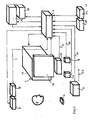
- la figure 1 est un schéma du système selon l'invention,
- la figure 2 est un diagramme des phases illustrant le fonctionnement du système.
- En se référant à la figure 1, le système comprend un poste de visualisation 1 qui se place sur la partie centrale du tableau de bord à droite du volant. Il se compose d'un moniteur 11 servant à l'affichage d'informations et d'un écran tactile 12. L'écran tactile 12 est connecté à une unité centrale 2 qui regroupe des cartes électroniques et des mémoires. L'unité centrale envoie des signaux de commande au moniteur 11.
- Le système comprend un boîtier portatif 3 de télécommande qui rassemble une fonction mémoire et une fonction de télécommande infrarouge. Il est capable d'émettre un signal codé infrarouge et, à cet effet, il comporte une diode émettrice recevant un signal d'un circuit générateur de signal codé par l'intermédiaire d'un amplificateur, le circuit générateur de signal codé étant alimenté par une pile. Le boîtier comporte un bouton poussoir qui lorsqu'il est actionné par le conducteur du véhicule déclenche l'émission du signal infrarouge codé.
- Dans le véhicule est monté un récepteur de télécommande à infrarouges 4 qui reçoit le signal codé provenant du boîtier de télécommande portatif 3. Ce récepteur comprend une photodiode et il est relié en 41 à l'unité centrale 2. Il commande, en 42 par l'intermédiaire d'un ensemble connu en soi, l'ouverture et la fermeture des portes.
- Le système comporte un dispositif de reconnaissance et de synthèse de la parole. Le dispositif de synthèse comporte un haut-parleur 5 monté dans l'habitacle du véhicule. Le dispositif de reconnaissance comporte un capteur acoustique 6 (micro) monté également dans l'habitacle à un endroit permettant réception des ordres donnés par l'occupant du véhicle.
- Le haut-parleur 5 est relié en 51 à l'unité centrale 2. Le capteur acoustique est relié en 61 à l'unité centrale 2.
- Le système comporte sur le tableau de bord ou à proximité de celui-ci un lecteur 7 de boîtier émetteur. Il permet l'enfichage du boîtier portable 3 de commande. Il est doté, à cet effet, d'un connecteur multi-broches femelle (ou mâle) qui se connecte avec un connecteur multi-broches mâle (ou femelle) du boîtier émetteur 3. Celui-ci est connecté en 71 à l'unité centrale 2.
- Le boîtier 3 assure une fonction de mémoire. La mémoire contient un code secret seulement connu par le système qui devra le lire ainsi que les références acoustiques du propriétaire du véhicule.
- Dans l'habitacle est disposé un bouton 8 de démarrage rapide qui est connecté en 81 à l'unité centrale 2. Celle-ci est également connectée à un bouton de sécurité 10.
- L'unité centrale 2 est connectée à un capteur d'embrayage 13 et à un capteur de point mort 14. Elle est reliée à un contact général 15 et au système d'allumage 16 du moteur.
- Le fonctionnement du système va maintenant être expliqué.
- Pour l'utilisation, le conducteur dispose à la place du jeu de clés traditionnel, un boîtier portatif 3. Lorsque le conducteur appuie sur le bouton du boîtier 3, il actionne la télécommande infrarouge qui déverrouille les portes (phase 1) et met sous tension le système monté dans l'habitacle pendant un laps de temps déterminé.
- Lorsque le conducteur est entré dans le véhicule, il enfiche le boîtier de commande 3 dans le lecteur 7 logé dans l'habitacle.
- Le système compare le code secret contenu dans le boîtier portatif avec un code qui est mémorisé dans l'unité centrale. Si les deux codes sont identiques, le système met sous tension le contact général 15.
- En cas de discordance, le système s'arrête.
- Pour faire démarrer le moteur, le conducteur doit prononcer son mot-clé (ex. : prénom, nom) ou taper un code secret sur le clavier du poste.
- Après vérification de l'identité de la commande parlée et de la commande enregistrée résidant dans la mémoire du boîtier 3 ou de la validité du code clavier, le système vérifie que la voiture n'est pas en prise et en lance le démarrage en actionnant le démarreur et en déverrouillant l'allumage 16.
- Le retrait du boîtier de télécommande 3 provoque l'arrêt du moteur par coupure du contact général.
- Le bouton de démarrage rapide 8 permet de relancer directement le moteur lors d'un calage et est validé par l'unité centrale 2 lorsqu'un premier démarrage du moteur a eu lieu, lors que le boîtier de télécommande n'a pas été retiré depuis et lors que le moteur est arrêté.
- Il est bien entendu que l'on peut sans sortir du cadre de l'invention imaginer des variantes et des perfectionnements de détails et de même envisager l'emploi de moyens équivalents.
Claims (2)
- Système de commande à fonctions multiples d'un véhicule automobile comportant sur le tableau de bord un poste de visualisation d'informations faisant partie d'un ensemble électronique de commande (2) et un boîtier portatif de télécommande (3) capable d'émettre un message en infrarouges sur un récepteur (4) de télécommande à infrarouges monté dans l'habitacle du véhicule, caractérisé par le fait que le récepteur de télécommande est couplé à l'ensemble électronique de commande (2) de manière à commander la mise sous tension de l'unité électronique (2) de commande au moment de la commande d'ouverture des portes et par le fait que le poste de visualisation comporte un lecteur de réception (7) du boîtier de télécommande connecté à l'ensemble électronique et que le boîtier de télécommande (3) contient une mémoire qui se connecte à l'ensemble électronique de commande.
- Système selon la revendication 1, caractérisé par le fait qu'il comporte un bouton de démarrage rapide connecté à l'unité centrale.
Applications Claiming Priority (2)
| Application Number | Priority Date | Filing Date | Title |
|---|---|---|---|
| FR8613320A FR2604128B1 (fr) | 1986-09-23 | 1986-09-23 | Systeme de commande a fonctions multiples d'un vehicule automobile |
| FR8613320 | 1986-09-23 |
Publications (2)
| Publication Number | Publication Date |
|---|---|
| EP0265306A1 EP0265306A1 (fr) | 1988-04-27 |
| EP0265306B1 true EP0265306B1 (fr) | 1991-07-24 |
Family
ID=9339224
Family Applications (1)
| Application Number | Title | Priority Date | Filing Date |
|---|---|---|---|
| EP87402089A Expired - Lifetime EP0265306B1 (fr) | 1986-09-23 | 1987-09-18 | Système de commande à fonctions multiples d'un véhicule automobile |
Country Status (4)
| Country | Link |
|---|---|
| EP (1) | EP0265306B1 (fr) |
| DE (1) | DE3771643D1 (fr) |
| ES (1) | ES2023664B3 (fr) |
| FR (1) | FR2604128B1 (fr) |
Families Citing this family (7)
| Publication number | Priority date | Publication date | Assignee | Title |
|---|---|---|---|---|
| FR2663894A1 (fr) * | 1990-06-27 | 1992-01-03 | Gcs Motos | Dispositif antivol pour vehicule a moteur. |
| EP0525979B1 (fr) * | 1991-07-31 | 1997-05-21 | Control Logic (Proprietary) Limited | Immobilisateur de véhicule avec commande prioritaire |
| IT1250890B (it) * | 1991-12-23 | 1995-04-21 | Fiat Auto Spa | Autoveicolo con dispositivo di telecomando per sistemi ed apparati elettrici od elettronici di bordo. |
| DE4403655C2 (de) * | 1994-02-05 | 1998-06-04 | Telefunken Microelectron | Elektronisches System für ein motorangetriebenes Fahrzeug |
| DE4424735C2 (de) * | 1994-07-13 | 1996-05-30 | Siemens Ag | Diebstahlschutzsystem |
| FR2786226B1 (fr) * | 1998-11-20 | 2000-12-29 | Renault | Circuit de commande de demarrage d'un moteur d'un vehicule automobile |
| DE10103608A1 (de) * | 2001-01-28 | 2002-08-14 | Audioton Kabelwerk Gmbh | Freisprecheinrichtung für den Betrieb von Mobiltelefonen in Kraftfahrzeugen |
Family Cites Families (7)
| Publication number | Priority date | Publication date | Assignee | Title |
|---|---|---|---|---|
| US3634880A (en) * | 1970-05-20 | 1972-01-11 | Popular Science Publishing Co | Automobile antitheft apparatus |
| IT1052933B (it) * | 1976-01-13 | 1981-08-31 | Voxson Spa | Apparecchiatura di telesegnalazione particolarmente adatta per protezione antifurto ed antieffrazione |
| GB1531951A (en) * | 1977-02-04 | 1978-11-15 | Eastern Co | Keyhole-less electronic lock |
| GB2023897A (en) * | 1977-09-22 | 1980-01-03 | Licentia Gmbh | Security systems |
| GB2051442B (en) * | 1979-03-30 | 1984-02-01 | Howard J A | Security system |
| GB2081483A (en) * | 1980-07-28 | 1982-02-17 | Agahi Arjang | Vehicle alarm and immobilising device |
| JPS58139840A (ja) * | 1982-02-15 | 1983-08-19 | Nissan Motor Co Ltd | 車両用キ−レス負荷作動装置 |
-
1986
- 1986-09-23 FR FR8613320A patent/FR2604128B1/fr not_active Expired - Lifetime
-
1987
- 1987-09-18 EP EP87402089A patent/EP0265306B1/fr not_active Expired - Lifetime
- 1987-09-18 ES ES87402089T patent/ES2023664B3/es not_active Expired - Lifetime
- 1987-09-18 DE DE8787402089T patent/DE3771643D1/de not_active Expired - Lifetime
Also Published As
| Publication number | Publication date |
|---|---|
| DE3771643D1 (de) | 1991-08-29 |
| FR2604128B1 (fr) | 1991-03-01 |
| EP0265306A1 (fr) | 1988-04-27 |
| ES2023664B3 (es) | 1992-02-01 |
| FR2604128A1 (fr) | 1988-03-25 |
Similar Documents
| Publication | Publication Date | Title |
|---|---|---|
| US6727800B1 (en) | Keyless system for entry and operation of a vehicle | |
| US7106171B1 (en) | Keyless command system for vehicles and other applications | |
| EP0275789B1 (fr) | Dispositif à code modifiable de protection contre le vol pour véhicules automobiles | |
| US5079435A (en) | Vehicle anti-theft system using second key means | |
| JP4705317B2 (ja) | スイッチ装置、セキュリティシステム | |
| US6362771B1 (en) | Garage door opener system for vehicles using manufacturer-supplied equipment | |
| US5541571A (en) | Hand-held transmitter for the remote control of various vehicle systems | |
| US20040168663A1 (en) | Remote start-up control apparatus, and start-up control apparatus | |
| JPH09119253A (ja) | 遠隔操作装置用多機能キーを備えた自動車用の制御手段 | |
| JPS62503179A (ja) | 電子施錠装置 | |
| JPH04213676A (ja) | 自動車等のドアの遠隔制御装置 | |
| US6426706B1 (en) | Safety warning transceiver | |
| FR2722461A1 (fr) | Systeme de protection contre le vol pour un vehicule automobile | |
| US20020180274A1 (en) | In-vehicle security system | |
| WO1998026393A1 (fr) | Dispositif d'entree a distance etablissant son propre diagnostic | |
| EP0595402B1 (fr) | Récepteur de radio pour véhicule automobile, muni d'une partie amovible comportant des fonctions essentielles du récepteur | |
| US6614920B2 (en) | GOD fingerprint operated ignition switch and entry system | |
| US4740775A (en) | Automobile burglar alarm | |
| US4222034A (en) | Vehicular protective system | |
| EP0265306A1 (fr) | Système de commande à fonctions multiples d'un véhicule automobile | |
| US20050184855A1 (en) | Fingerprint vehicle access system | |
| FR2765610A1 (fr) | Vehicule automobile avec un systeme de fermeture a ouvrir ou a verrouiller au moyen d'une telecommande | |
| FR2738588A1 (fr) | Procede de reinitialisation d'une installation de verrouillage centralise d'un vehicule automobile avec un dispositif de commande a distance | |
| FR2731190A1 (fr) | Dispositif antivol pour vehicule automobile | |
| WO2005096110A1 (fr) | Systeme sans cle permettant l'ouverture et la conduite d'un vehicule |
Legal Events
| Date | Code | Title | Description |
|---|---|---|---|
| PUAI | Public reference made under article 153(3) epc to a published international application that has entered the european phase |
Free format text: ORIGINAL CODE: 0009012 |
|
| 17P | Request for examination filed |
Effective date: 19870923 |
|
| AK | Designated contracting states |
Kind code of ref document: A1 Designated state(s): DE ES GB IT |
|
| 17Q | First examination report despatched |
Effective date: 19910102 |
|
| GRAA | (expected) grant |
Free format text: ORIGINAL CODE: 0009210 |
|
| AK | Designated contracting states |
Kind code of ref document: B1 Designated state(s): DE ES GB IT |
|
| GBT | Gb: translation of ep patent filed (gb section 77(6)(a)/1977) | ||
| REF | Corresponds to: |
Ref document number: 3771643 Country of ref document: DE Date of ref document: 19910829 |
|
| ITF | It: translation for a ep patent filed | ||
| REG | Reference to a national code |
Ref country code: ES Ref legal event code: FG2A Ref document number: 2023664 Country of ref document: ES Kind code of ref document: B3 |
|
| PLBE | No opposition filed within time limit |
Free format text: ORIGINAL CODE: 0009261 |
|
| STAA | Information on the status of an ep patent application or granted ep patent |
Free format text: STATUS: NO OPPOSITION FILED WITHIN TIME LIMIT |
|
| 26N | No opposition filed | ||
| PGFP | Annual fee paid to national office [announced via postgrant information from national office to epo] |
Ref country code: GB Payment date: 19920817 Year of fee payment: 6 |
|
| PGFP | Annual fee paid to national office [announced via postgrant information from national office to epo] |
Ref country code: ES Payment date: 19920917 Year of fee payment: 6 |
|
| PG25 | Lapsed in a contracting state [announced via postgrant information from national office to epo] |
Ref country code: GB Effective date: 19930918 |
|
| PG25 | Lapsed in a contracting state [announced via postgrant information from national office to epo] |
Ref country code: ES Free format text: LAPSE BECAUSE OF EXPIRATION OF PROTECTION Effective date: 19930920 |
|
| GBPC | Gb: european patent ceased through non-payment of renewal fee |
Effective date: 19930918 |
|
| PGFP | Annual fee paid to national office [announced via postgrant information from national office to epo] |
Ref country code: DE Payment date: 19950825 Year of fee payment: 9 |
|
| PG25 | Lapsed in a contracting state [announced via postgrant information from national office to epo] |
Ref country code: DE Effective date: 19970603 |
|
| REG | Reference to a national code |
Ref country code: ES Ref legal event code: FD2A Effective date: 19990601 |
|
| PG25 | Lapsed in a contracting state [announced via postgrant information from national office to epo] |
Ref country code: IT Free format text: LAPSE BECAUSE OF NON-PAYMENT OF DUE FEES;WARNING: LAPSES OF ITALIAN PATENTS WITH EFFECTIVE DATE BEFORE 2007 MAY HAVE OCCURRED AT ANY TIME BEFORE 2007. THE CORRECT EFFECTIVE DATE MAY BE DIFFERENT FROM THE ONE RECORDED. Effective date: 20050918 |