EP0264889B1 - Glycolipid containing N-glycolylneuraminic acid and method of procuding the same - Google Patents
Glycolipid containing N-glycolylneuraminic acid and method of procuding the same Download PDFInfo
- Publication number
- EP0264889B1 EP0264889B1 EP87115283A EP87115283A EP0264889B1 EP 0264889 B1 EP0264889 B1 EP 0264889B1 EP 87115283 A EP87115283 A EP 87115283A EP 87115283 A EP87115283 A EP 87115283A EP 0264889 B1 EP0264889 B1 EP 0264889B1
- Authority
- EP
- European Patent Office
- Prior art keywords
- compound
- reaction
- added
- compounds
- agitated
- Prior art date
- Legal status (The legal status is an assumption and is not a legal conclusion. Google has not performed a legal analysis and makes no representation as to the accuracy of the status listed.)
- Expired - Lifetime
Links
- 238000000034 method Methods 0.000 title claims description 11
- 229930186217 Glycolipid Natural products 0.000 title description 6
- SUHQNCLNRUAGOO-UHFFFAOYSA-N N-glycoloyl-neuraminic acid Natural products OCC(O)C(O)C(O)C(NC(=O)CO)C(O)CC(=O)C(O)=O SUHQNCLNRUAGOO-UHFFFAOYSA-N 0.000 title description 5
- FDJKUWYYUZCUJX-UHFFFAOYSA-N N-glycolyl-beta-neuraminic acid Natural products OCC(O)C(O)C1OC(O)(C(O)=O)CC(O)C1NC(=O)CO FDJKUWYYUZCUJX-UHFFFAOYSA-N 0.000 title description 5
- FDJKUWYYUZCUJX-KVNVFURPSA-N N-glycolylneuraminic acid Chemical compound OC[C@H](O)[C@H](O)[C@@H]1O[C@](O)(C(O)=O)C[C@H](O)[C@H]1NC(=O)CO FDJKUWYYUZCUJX-KVNVFURPSA-N 0.000 title description 5
- HVCOBJNICQPDBP-UHFFFAOYSA-N 3-[3-[3,5-dihydroxy-6-methyl-4-(3,4,5-trihydroxy-6-methyloxan-2-yl)oxyoxan-2-yl]oxydecanoyloxy]decanoic acid;hydrate Chemical compound O.OC1C(OC(CC(=O)OC(CCCCCCC)CC(O)=O)CCCCCCC)OC(C)C(O)C1OC1C(O)C(O)C(O)C(C)O1 HVCOBJNICQPDBP-UHFFFAOYSA-N 0.000 title description 3
- 150000001875 compounds Chemical class 0.000 claims description 186
- 150000002270 gangliosides Chemical class 0.000 claims description 16
- -1 dimethylphenylmethyl group Chemical group 0.000 claims description 7
- 125000002496 methyl group Chemical group [H]C([H])([H])* 0.000 claims description 6
- 230000000397 acetylating effect Effects 0.000 claims description 4
- 229910052783 alkali metal Inorganic materials 0.000 claims description 3
- 150000001340 alkali metals Chemical group 0.000 claims description 3
- 125000000484 butyl group Chemical group [H]C([*])([H])C([H])([H])C([H])([H])C([H])([H])[H] 0.000 claims description 3
- 125000004435 hydrogen atom Chemical group [H]* 0.000 claims description 2
- 125000001997 phenyl group Chemical group [H]C1=C([H])C([H])=C(*)C([H])=C1[H] 0.000 claims description 2
- OKKJLVBELUTLKV-UHFFFAOYSA-N methanol Substances OC OKKJLVBELUTLKV-UHFFFAOYSA-N 0.000 description 107
- XEKOWRVHYACXOJ-UHFFFAOYSA-N Ethyl acetate Chemical compound CCOC(C)=O XEKOWRVHYACXOJ-UHFFFAOYSA-N 0.000 description 104
- 238000006243 chemical reaction Methods 0.000 description 94
- HEDRZPFGACZZDS-UHFFFAOYSA-N Chloroform Chemical compound ClC(Cl)Cl HEDRZPFGACZZDS-UHFFFAOYSA-N 0.000 description 78
- YXFVVABEGXRONW-UHFFFAOYSA-N Toluene Chemical compound CC1=CC=CC=C1 YXFVVABEGXRONW-UHFFFAOYSA-N 0.000 description 69
- 239000000203 mixture Substances 0.000 description 50
- 238000004519 manufacturing process Methods 0.000 description 43
- XLYOFNOQVPJJNP-UHFFFAOYSA-N water Chemical compound O XLYOFNOQVPJJNP-UHFFFAOYSA-N 0.000 description 40
- QTBSBXVTEAMEQO-UHFFFAOYSA-N Acetic acid Chemical compound CC(O)=O QTBSBXVTEAMEQO-UHFFFAOYSA-N 0.000 description 38
- YMWUJEATGCHHMB-UHFFFAOYSA-N Dichloromethane Chemical compound ClCCl YMWUJEATGCHHMB-UHFFFAOYSA-N 0.000 description 38
- WYURNTSHIVDZCO-UHFFFAOYSA-N Tetrahydrofuran Chemical compound C1CCOC1 WYURNTSHIVDZCO-UHFFFAOYSA-N 0.000 description 36
- 235000019439 ethyl acetate Nutrition 0.000 description 36
- VLKZOEOYAKHREP-UHFFFAOYSA-N n-Hexane Chemical compound CCCCCC VLKZOEOYAKHREP-UHFFFAOYSA-N 0.000 description 36
- HEDRZPFGACZZDS-MICDWDOJSA-N Trichloro(2H)methane Chemical compound [2H]C(Cl)(Cl)Cl HEDRZPFGACZZDS-MICDWDOJSA-N 0.000 description 34
- ZMXDDKWLCZADIW-UHFFFAOYSA-N N,N-Dimethylformamide Chemical compound CN(C)C=O ZMXDDKWLCZADIW-UHFFFAOYSA-N 0.000 description 33
- RTZKZFJDLAIYFH-UHFFFAOYSA-N Diethyl ether Chemical compound CCOCC RTZKZFJDLAIYFH-UHFFFAOYSA-N 0.000 description 32
- JUJWROOIHBZHMG-UHFFFAOYSA-N Pyridine Chemical compound C1=CC=NC=C1 JUJWROOIHBZHMG-UHFFFAOYSA-N 0.000 description 30
- UHOVQNZJYSORNB-UHFFFAOYSA-N Benzene Chemical compound C1=CC=CC=C1 UHOVQNZJYSORNB-UHFFFAOYSA-N 0.000 description 27
- CSNNHWWHGAXBCP-UHFFFAOYSA-L Magnesium sulfate Chemical compound [Mg+2].[O-][S+2]([O-])([O-])[O-] CSNNHWWHGAXBCP-UHFFFAOYSA-L 0.000 description 26
- 238000004440 column chromatography Methods 0.000 description 25
- 238000004821 distillation Methods 0.000 description 25
- CSCPPACGZOOCGX-UHFFFAOYSA-N Acetone Chemical compound CC(C)=O CSCPPACGZOOCGX-UHFFFAOYSA-N 0.000 description 24
- 239000002904 solvent Substances 0.000 description 23
- WFDIJRYMOXRFFG-UHFFFAOYSA-N Acetic anhydride Chemical compound CC(=O)OC(C)=O WFDIJRYMOXRFFG-UHFFFAOYSA-N 0.000 description 18
- 238000004458 analytical method Methods 0.000 description 17
- YLQBMQCUIZJEEH-UHFFFAOYSA-N tetrahydrofuran Natural products C=1C=COC=1 YLQBMQCUIZJEEH-UHFFFAOYSA-N 0.000 description 17
- VZGDMQKNWNREIO-UHFFFAOYSA-N tetrachloromethane Chemical compound ClC(Cl)(Cl)Cl VZGDMQKNWNREIO-UHFFFAOYSA-N 0.000 description 16
- UMJSCPRVCHMLSP-UHFFFAOYSA-N pyridine Natural products COC1=CC=CN=C1 UMJSCPRVCHMLSP-UHFFFAOYSA-N 0.000 description 15
- UIIMBOGNXHQVGW-UHFFFAOYSA-M Sodium bicarbonate Chemical compound [Na+].OC([O-])=O UIIMBOGNXHQVGW-UHFFFAOYSA-M 0.000 description 13
- 229910052943 magnesium sulfate Inorganic materials 0.000 description 13
- 235000019341 magnesium sulphate Nutrition 0.000 description 13
- 150000003839 salts Chemical class 0.000 description 13
- 229920006395 saturated elastomer Polymers 0.000 description 13
- VYPSYNLAJGMNEJ-UHFFFAOYSA-N Silicium dioxide Chemical compound O=[Si]=O VYPSYNLAJGMNEJ-UHFFFAOYSA-N 0.000 description 12
- ZMANZCXQSJIPKH-UHFFFAOYSA-N Triethylamine Chemical compound CCN(CC)CC ZMANZCXQSJIPKH-UHFFFAOYSA-N 0.000 description 12
- RAXXELZNTBOGNW-UHFFFAOYSA-N imidazole Natural products C1=CNC=N1 RAXXELZNTBOGNW-UHFFFAOYSA-N 0.000 description 12
- 230000000704 physical effect Effects 0.000 description 12
- LFQSCWFLJHTTHZ-UHFFFAOYSA-N Ethanol Chemical compound CCO LFQSCWFLJHTTHZ-UHFFFAOYSA-N 0.000 description 11
- CRJGESKKUOMBCT-VQTJNVASSA-N N-acetylsphinganine Chemical compound CCCCCCCCCCCCCCC[C@@H](O)[C@H](CO)NC(C)=O CRJGESKKUOMBCT-VQTJNVASSA-N 0.000 description 11
- 238000005481 NMR spectroscopy Methods 0.000 description 11
- 239000000427 antigen Substances 0.000 description 11
- 102000036639 antigens Human genes 0.000 description 11
- 108091007433 antigens Proteins 0.000 description 11
- 230000035484 reaction time Effects 0.000 description 11
- 239000003054 catalyst Substances 0.000 description 10
- 229940106189 ceramide Drugs 0.000 description 10
- 239000007795 chemical reaction product Substances 0.000 description 10
- 125000000956 methoxy group Chemical group [H]C([H])([H])O* 0.000 description 10
- SCYULBFZEHDVBN-UHFFFAOYSA-N 1,1-Dichloroethane Chemical compound CC(Cl)Cl SCYULBFZEHDVBN-UHFFFAOYSA-N 0.000 description 9
- YDNKGFDKKRUKPY-JHOUSYSJSA-N C16 ceramide Natural products CCCCCCCCCCCCCCCC(=O)N[C@@H](CO)[C@H](O)C=CCCCCCCCCCCCCC YDNKGFDKKRUKPY-JHOUSYSJSA-N 0.000 description 9
- ZVEQCJWYRWKARO-UHFFFAOYSA-N ceramide Natural products CCCCCCCCCCCCCCC(O)C(=O)NC(CO)C(O)C=CCCC=C(C)CCCCCCCCC ZVEQCJWYRWKARO-UHFFFAOYSA-N 0.000 description 9
- 238000007796 conventional method Methods 0.000 description 9
- VVGIYYKRAMHVLU-UHFFFAOYSA-N newbouldiamide Natural products CCCCCCCCCCCCCCCCCCCC(O)C(O)C(O)C(CO)NC(=O)CCCCCCCCCCCCCCCCC VVGIYYKRAMHVLU-UHFFFAOYSA-N 0.000 description 9
- 239000010410 layer Substances 0.000 description 8
- 238000013019 agitation Methods 0.000 description 7
- 238000001816 cooling Methods 0.000 description 7
- 239000000126 substance Substances 0.000 description 7
- 206010028980 Neoplasm Diseases 0.000 description 6
- HEMHJVSKTPXQMS-UHFFFAOYSA-M Sodium hydroxide Chemical compound [OH-].[Na+] HEMHJVSKTPXQMS-UHFFFAOYSA-M 0.000 description 6
- 125000001495 ethyl group Chemical group [H]C([H])([H])C([H])([H])* 0.000 description 6
- 230000013595 glycosylation Effects 0.000 description 6
- 238000006206 glycosylation reaction Methods 0.000 description 6
- 125000001160 methoxycarbonyl group Chemical group [H]C([H])([H])OC(*)=O 0.000 description 6
- 239000012044 organic layer Substances 0.000 description 6
- 229910000030 sodium bicarbonate Inorganic materials 0.000 description 6
- 235000017557 sodium bicarbonate Nutrition 0.000 description 6
- JOXIMZWYDAKGHI-UHFFFAOYSA-N toluene-4-sulfonic acid Chemical compound CC1=CC=C(S(O)(=O)=O)C=C1 JOXIMZWYDAKGHI-UHFFFAOYSA-N 0.000 description 6
- WETWJCDKMRHUPV-UHFFFAOYSA-N acetyl chloride Chemical compound CC(Cl)=O WETWJCDKMRHUPV-UHFFFAOYSA-N 0.000 description 5
- 239000012346 acetyl chloride Substances 0.000 description 5
- 201000011510 cancer Diseases 0.000 description 5
- 239000003153 chemical reaction reagent Substances 0.000 description 5
- 238000000605 extraction Methods 0.000 description 5
- PSHKMPUSSFXUIA-UHFFFAOYSA-N n,n-dimethylpyridin-2-amine Chemical compound CN(C)C1=CC=CC=N1 PSHKMPUSSFXUIA-UHFFFAOYSA-N 0.000 description 5
- 239000000741 silica gel Substances 0.000 description 5
- 229910002027 silica gel Inorganic materials 0.000 description 5
- URGAHOPLAPQHLN-UHFFFAOYSA-N sodium aluminosilicate Chemical class [Na+].[Al+3].[O-][Si]([O-])=O.[O-][Si]([O-])=O URGAHOPLAPQHLN-UHFFFAOYSA-N 0.000 description 5
- FPGGTKZVZWFYPV-UHFFFAOYSA-M tetrabutylammonium fluoride Chemical compound [F-].CCCC[N+](CCCC)(CCCC)CCCC FPGGTKZVZWFYPV-UHFFFAOYSA-M 0.000 description 5
- 238000001644 13C nuclear magnetic resonance spectroscopy Methods 0.000 description 4
- KZMGYPLQYOPHEL-UHFFFAOYSA-N Boron trifluoride etherate Chemical compound FB(F)F.CCOCC KZMGYPLQYOPHEL-UHFFFAOYSA-N 0.000 description 4
- LRHPLDYGYMQRHN-UHFFFAOYSA-N N-Butanol Chemical compound CCCCO LRHPLDYGYMQRHN-UHFFFAOYSA-N 0.000 description 4
- WQDUMFSSJAZKTM-UHFFFAOYSA-N Sodium methoxide Chemical compound [Na+].[O-]C WQDUMFSSJAZKTM-UHFFFAOYSA-N 0.000 description 4
- SQVRNKJHWKZAKO-UHFFFAOYSA-N beta-N-Acetyl-D-neuraminic acid Natural products CC(=O)NC1C(O)CC(O)(C(O)=O)OC1C(O)C(O)CO SQVRNKJHWKZAKO-UHFFFAOYSA-N 0.000 description 4
- 239000013078 crystal Substances 0.000 description 4
- 239000000706 filtrate Substances 0.000 description 4
- NGYIMTKLQULBOO-UHFFFAOYSA-L mercury dibromide Chemical compound Br[Hg]Br NGYIMTKLQULBOO-UHFFFAOYSA-L 0.000 description 4
- FQGYCXFLEQVDJQ-UHFFFAOYSA-N mercury dicyanide Chemical compound N#C[Hg]C#N FQGYCXFLEQVDJQ-UHFFFAOYSA-N 0.000 description 4
- LYGJENNIWJXYER-UHFFFAOYSA-N nitromethane Chemical compound C[N+]([O-])=O LYGJENNIWJXYER-UHFFFAOYSA-N 0.000 description 4
- SQVRNKJHWKZAKO-OQPLDHBCSA-N sialic acid Chemical compound CC(=O)N[C@@H]1[C@@H](O)C[C@@](O)(C(O)=O)OC1[C@H](O)[C@H](O)CO SQVRNKJHWKZAKO-OQPLDHBCSA-N 0.000 description 4
- 238000005160 1H NMR spectroscopy Methods 0.000 description 3
- MEKOFIRRDATTAG-UHFFFAOYSA-N 2,2,5,8-tetramethyl-3,4-dihydrochromen-6-ol Chemical compound C1CC(C)(C)OC2=C1C(C)=C(O)C=C2C MEKOFIRRDATTAG-UHFFFAOYSA-N 0.000 description 3
- WEVYAHXRMPXWCK-UHFFFAOYSA-N Acetonitrile Chemical compound CC#N WEVYAHXRMPXWCK-UHFFFAOYSA-N 0.000 description 3
- 241000283086 Equidae Species 0.000 description 3
- BDAGIHXWWSANSR-UHFFFAOYSA-N Formic acid Chemical compound OC=O BDAGIHXWWSANSR-UHFFFAOYSA-N 0.000 description 3
- VEXZGXHMUGYJMC-UHFFFAOYSA-N Hydrochloric acid Chemical compound Cl VEXZGXHMUGYJMC-UHFFFAOYSA-N 0.000 description 3
- KDLHZDBZIXYQEI-UHFFFAOYSA-N Palladium on carbon Substances [Pd] KDLHZDBZIXYQEI-UHFFFAOYSA-N 0.000 description 3
- KWYUFKZDYYNOTN-UHFFFAOYSA-M Potassium hydroxide Chemical compound [OH-].[K+] KWYUFKZDYYNOTN-UHFFFAOYSA-M 0.000 description 3
- DRUIESSIVFYOMK-UHFFFAOYSA-N Trichloroacetonitrile Chemical compound ClC(Cl)(Cl)C#N DRUIESSIVFYOMK-UHFFFAOYSA-N 0.000 description 3
- 150000001408 amides Chemical class 0.000 description 3
- 238000010533 azeotropic distillation Methods 0.000 description 3
- 125000001797 benzyl group Chemical group [H]C1=C([H])C([H])=C(C([H])=C1[H])C([H])([H])* 0.000 description 3
- 230000003197 catalytic effect Effects 0.000 description 3
- 230000000694 effects Effects 0.000 description 3
- 210000003743 erythrocyte Anatomy 0.000 description 3
- IXCSERBJSXMMFS-UHFFFAOYSA-N hydrogen chloride Substances Cl.Cl IXCSERBJSXMMFS-UHFFFAOYSA-N 0.000 description 3
- 229910000041 hydrogen chloride Inorganic materials 0.000 description 3
- 238000002844 melting Methods 0.000 description 3
- 230000008018 melting Effects 0.000 description 3
- GRWIABMEEKERFV-UHFFFAOYSA-N methanol;oxolane Chemical compound OC.C1CCOC1 GRWIABMEEKERFV-UHFFFAOYSA-N 0.000 description 3
- QRUBYZBWAOOHSV-UHFFFAOYSA-M silver trifluoromethanesulfonate Chemical compound [Ag+].[O-]S(=O)(=O)C(F)(F)F QRUBYZBWAOOHSV-UHFFFAOYSA-M 0.000 description 3
- DPEYHNFHDIXMNV-UHFFFAOYSA-N (9-amino-3-bicyclo[3.3.1]nonanyl)-(4-benzyl-5-methyl-1,4-diazepan-1-yl)methanone dihydrochloride Chemical compound Cl.Cl.CC1CCN(CCN1Cc1ccccc1)C(=O)C1CC2CCCC(C1)C2N DPEYHNFHDIXMNV-UHFFFAOYSA-N 0.000 description 2
- RYHBNJHYFVUHQT-UHFFFAOYSA-N 1,4-Dioxane Chemical compound C1COCCO1 RYHBNJHYFVUHQT-UHFFFAOYSA-N 0.000 description 2
- IAZDPXIOMUYVGZ-WFGJKAKNSA-N Dimethyl sulfoxide Chemical compound [2H]C([2H])([2H])S(=O)C([2H])([2H])[2H] IAZDPXIOMUYVGZ-WFGJKAKNSA-N 0.000 description 2
- OAKJQQAXSVQMHS-UHFFFAOYSA-N Hydrazine Chemical compound NN OAKJQQAXSVQMHS-UHFFFAOYSA-N 0.000 description 2
- WMFOQBRAJBCJND-UHFFFAOYSA-M Lithium hydroxide Chemical compound [Li+].[OH-] WMFOQBRAJBCJND-UHFFFAOYSA-M 0.000 description 2
- VSCWAEJMTAWNJL-UHFFFAOYSA-K aluminium trichloride Chemical compound Cl[Al](Cl)Cl VSCWAEJMTAWNJL-UHFFFAOYSA-K 0.000 description 2
- 125000003118 aryl group Chemical group 0.000 description 2
- 125000003236 benzoyl group Chemical group [H]C1=C([H])C([H])=C(C([H])=C1[H])C(*)=O 0.000 description 2
- 238000010531 catalytic reduction reaction Methods 0.000 description 2
- 210000004027 cell Anatomy 0.000 description 2
- 230000000850 deacetylating effect Effects 0.000 description 2
- 238000010908 decantation Methods 0.000 description 2
- 238000001514 detection method Methods 0.000 description 2
- WGLUMOCWFMKWIL-UHFFFAOYSA-N dichloromethane;methanol Chemical compound OC.ClCCl WGLUMOCWFMKWIL-UHFFFAOYSA-N 0.000 description 2
- 238000001914 filtration Methods 0.000 description 2
- 235000019253 formic acid Nutrition 0.000 description 2
- 239000007789 gas Substances 0.000 description 2
- 238000009169 immunotherapy Methods 0.000 description 2
- 239000000543 intermediate Substances 0.000 description 2
- VNWKTOKETHGBQD-UHFFFAOYSA-N methane Natural products C VNWKTOKETHGBQD-UHFFFAOYSA-N 0.000 description 2
- XELZGAJCZANUQH-UHFFFAOYSA-N methyl 1-acetylthieno[3,2-c]pyrazole-5-carboxylate Chemical compound CC(=O)N1N=CC2=C1C=C(C(=O)OC)S2 XELZGAJCZANUQH-UHFFFAOYSA-N 0.000 description 2
- 239000012046 mixed solvent Substances 0.000 description 2
- 150000002482 oligosaccharides Polymers 0.000 description 2
- 229920001467 poly(styrenesulfonates) Polymers 0.000 description 2
- 239000000047 product Substances 0.000 description 2
- 210000002966 serum Anatomy 0.000 description 2
- 235000000346 sugar Nutrition 0.000 description 2
- 230000002194 synthesizing effect Effects 0.000 description 2
- JBWKIWSBJXDJDT-UHFFFAOYSA-N triphenylmethyl chloride Chemical compound C=1C=CC=CC=1C(C=1C=CC=CC=1)(Cl)C1=CC=CC=C1 JBWKIWSBJXDJDT-UHFFFAOYSA-N 0.000 description 2
- SVYOXGBINYWSDQ-UHFFFAOYSA-N 1,4-dioxane;ethanol Chemical compound CCO.C1COCCO1 SVYOXGBINYWSDQ-UHFFFAOYSA-N 0.000 description 1
- VLXSIHLNPYRFFN-UHFFFAOYSA-N 1,4-dioxane;methanol Chemical compound OC.C1COCCO1 VLXSIHLNPYRFFN-UHFFFAOYSA-N 0.000 description 1
- OSAAMGOENLXTHS-UHFFFAOYSA-N 1,4-dioxane;propan-1-ol Chemical compound CCCO.C1COCCO1 OSAAMGOENLXTHS-UHFFFAOYSA-N 0.000 description 1
- LBLYYCQCTBFVLH-UHFFFAOYSA-N 2-Methylbenzenesulfonic acid Chemical compound CC1=CC=CC=C1S(O)(=O)=O LBLYYCQCTBFVLH-UHFFFAOYSA-N 0.000 description 1
- FOYWCEUVVIHJKD-UHFFFAOYSA-N 2-methyl-5-(1h-pyrazol-5-yl)pyridine Chemical compound C1=NC(C)=CC=C1C1=CC=NN1 FOYWCEUVVIHJKD-UHFFFAOYSA-N 0.000 description 1
- OSWFIVFLDKOXQC-UHFFFAOYSA-N 4-(3-methoxyphenyl)aniline Chemical compound COC1=CC=CC(C=2C=CC(N)=CC=2)=C1 OSWFIVFLDKOXQC-UHFFFAOYSA-N 0.000 description 1
- 241000700198 Cavia Species 0.000 description 1
- ZAMOUSCENKQFHK-UHFFFAOYSA-N Chlorine atom Chemical compound [Cl] ZAMOUSCENKQFHK-UHFFFAOYSA-N 0.000 description 1
- SHZGCJCMOBCMKK-UHFFFAOYSA-N D-mannomethylose Natural products CC1OC(O)C(O)C(O)C1O SHZGCJCMOBCMKK-UHFFFAOYSA-N 0.000 description 1
- PNNNRSAQSRJVSB-SLPGGIOYSA-N Fucose Natural products C[C@H](O)[C@@H](O)[C@H](O)[C@H](O)C=O PNNNRSAQSRJVSB-SLPGGIOYSA-N 0.000 description 1
- WQZGKKKJIJFFOK-GASJEMHNSA-N Glucose Natural products OC[C@H]1OC(O)[C@H](O)[C@@H](O)[C@@H]1O WQZGKKKJIJFFOK-GASJEMHNSA-N 0.000 description 1
- UFHFLCQGNIYNRP-UHFFFAOYSA-N Hydrogen Chemical compound [H][H] UFHFLCQGNIYNRP-UHFFFAOYSA-N 0.000 description 1
- SHZGCJCMOBCMKK-DHVFOXMCSA-N L-fucopyranose Chemical compound C[C@@H]1OC(O)[C@@H](O)[C@H](O)[C@@H]1O SHZGCJCMOBCMKK-DHVFOXMCSA-N 0.000 description 1
- 241001465754 Metazoa Species 0.000 description 1
- OVRNDRQMDRJTHS-CBQIKETKSA-N N-Acetyl-D-Galactosamine Chemical compound CC(=O)N[C@H]1[C@@H](O)O[C@H](CO)[C@H](O)[C@@H]1O OVRNDRQMDRJTHS-CBQIKETKSA-N 0.000 description 1
- OVRNDRQMDRJTHS-UHFFFAOYSA-N N-acelyl-D-glucosamine Natural products CC(=O)NC1C(O)OC(CO)C(O)C1O OVRNDRQMDRJTHS-UHFFFAOYSA-N 0.000 description 1
- MBLBDJOUHNCFQT-UHFFFAOYSA-N N-acetyl-D-galactosamine Natural products CC(=O)NC(C=O)C(O)C(O)C(O)CO MBLBDJOUHNCFQT-UHFFFAOYSA-N 0.000 description 1
- OVRNDRQMDRJTHS-FMDGEEDCSA-N N-acetyl-beta-D-glucosamine Chemical compound CC(=O)N[C@H]1[C@H](O)O[C@H](CO)[C@@H](O)[C@@H]1O OVRNDRQMDRJTHS-FMDGEEDCSA-N 0.000 description 1
- MBLBDJOUHNCFQT-LXGUWJNJSA-N N-acetylglucosamine Natural products CC(=O)N[C@@H](C=O)[C@@H](O)[C@H](O)[C@H](O)CO MBLBDJOUHNCFQT-LXGUWJNJSA-N 0.000 description 1
- BPQQTUXANYXVAA-UHFFFAOYSA-N Orthosilicate Chemical compound [O-][Si]([O-])([O-])[O-] BPQQTUXANYXVAA-UHFFFAOYSA-N 0.000 description 1
- 241000283973 Oryctolagus cuniculus Species 0.000 description 1
- 241001494479 Pecora Species 0.000 description 1
- 229910019020 PtO2 Inorganic materials 0.000 description 1
- BQCADISMDOOEFD-UHFFFAOYSA-N Silver Chemical compound [Ag] BQCADISMDOOEFD-UHFFFAOYSA-N 0.000 description 1
- 241000282887 Suidae Species 0.000 description 1
- 229910003074 TiCl4 Inorganic materials 0.000 description 1
- 229910021627 Tin(IV) chloride Inorganic materials 0.000 description 1
- DTQVDTLACAAQTR-UHFFFAOYSA-N Trifluoroacetic acid Chemical compound OC(=O)C(F)(F)F DTQVDTLACAAQTR-UHFFFAOYSA-N 0.000 description 1
- ZCHPKWUIAASXPV-UHFFFAOYSA-N acetic acid;methanol Chemical compound OC.CC(O)=O ZCHPKWUIAASXPV-UHFFFAOYSA-N 0.000 description 1
- 230000021736 acetylation Effects 0.000 description 1
- 238000006640 acetylation reaction Methods 0.000 description 1
- 239000002253 acid Substances 0.000 description 1
- YKIOKAURTKXMSB-UHFFFAOYSA-N adams's catalyst Chemical compound O=[Pt]=O YKIOKAURTKXMSB-UHFFFAOYSA-N 0.000 description 1
- 125000001931 aliphatic group Chemical group 0.000 description 1
- WQZGKKKJIJFFOK-PHYPRBDBSA-N alpha-D-galactose Chemical compound OC[C@H]1O[C@H](O)[C@H](O)[C@@H](O)[C@H]1O WQZGKKKJIJFFOK-PHYPRBDBSA-N 0.000 description 1
- 150000001414 amino alcohols Chemical class 0.000 description 1
- HOPRXXXSABQWAV-UHFFFAOYSA-N anhydrous collidine Natural products CC1=CC=NC(C)=C1C HOPRXXXSABQWAV-UHFFFAOYSA-N 0.000 description 1
- PASDCCFISLVPSO-UHFFFAOYSA-N benzoyl chloride Chemical compound ClC(=O)C1=CC=CC=C1 PASDCCFISLVPSO-UHFFFAOYSA-N 0.000 description 1
- 238000006480 benzoylation reaction Methods 0.000 description 1
- WQZGKKKJIJFFOK-VFUOTHLCSA-N beta-D-glucose Chemical compound OC[C@H]1O[C@@H](O)[C@H](O)[C@@H](O)[C@@H]1O WQZGKKKJIJFFOK-VFUOTHLCSA-N 0.000 description 1
- 125000006297 carbonyl amino group Chemical group [H]N([*:2])C([*:1])=O 0.000 description 1
- 150000001768 cations Chemical class 0.000 description 1
- 210000000170 cell membrane Anatomy 0.000 description 1
- 150000001783 ceramides Chemical class 0.000 description 1
- 239000003638 chemical reducing agent Substances 0.000 description 1
- 239000000460 chlorine Substances 0.000 description 1
- 229910052801 chlorine Inorganic materials 0.000 description 1
- CZKMPDNXOGQMFW-UHFFFAOYSA-N chloro(triethyl)germane Chemical compound CC[Ge](Cl)(CC)CC CZKMPDNXOGQMFW-UHFFFAOYSA-N 0.000 description 1
- WORJEOGGNQDSOE-UHFFFAOYSA-N chloroform;methanol Chemical compound OC.ClC(Cl)Cl WORJEOGGNQDSOE-UHFFFAOYSA-N 0.000 description 1
- UTBIMNXEDGNJFE-UHFFFAOYSA-N collidine Natural products CC1=CC=C(C)C(C)=N1 UTBIMNXEDGNJFE-UHFFFAOYSA-N 0.000 description 1
- 238000011161 development Methods 0.000 description 1
- 235000014113 dietary fatty acids Nutrition 0.000 description 1
- 230000004069 differentiation Effects 0.000 description 1
- 201000010099 disease Diseases 0.000 description 1
- 208000037265 diseases, disorders, signs and symptoms Diseases 0.000 description 1
- 230000001747 exhibiting effect Effects 0.000 description 1
- 239000000194 fatty acid Substances 0.000 description 1
- 229930195729 fatty acid Natural products 0.000 description 1
- 150000004665 fatty acids Chemical class 0.000 description 1
- 229930182830 galactose Natural products 0.000 description 1
- 239000008103 glucose Substances 0.000 description 1
- 229910052739 hydrogen Inorganic materials 0.000 description 1
- 239000001257 hydrogen Substances 0.000 description 1
- 230000007062 hydrolysis Effects 0.000 description 1
- 238000006460 hydrolysis reaction Methods 0.000 description 1
- 230000003301 hydrolyzing effect Effects 0.000 description 1
- 238000011835 investigation Methods 0.000 description 1
- 150000002632 lipids Chemical group 0.000 description 1
- 210000004698 lymphocyte Anatomy 0.000 description 1
- 230000003211 malignant effect Effects 0.000 description 1
- 210000004962 mammalian cell Anatomy 0.000 description 1
- 239000002052 molecular layer Substances 0.000 description 1
- 229950006780 n-acetylglucosamine Drugs 0.000 description 1
- 125000001181 organosilyl group Chemical group [SiH3]* 0.000 description 1
- 229910052763 palladium Inorganic materials 0.000 description 1
- BWHMMNNQKKPAPP-UHFFFAOYSA-L potassium carbonate Substances [K+].[K+].[O-]C([O-])=O BWHMMNNQKKPAPP-UHFFFAOYSA-L 0.000 description 1
- 229910000027 potassium carbonate Inorganic materials 0.000 description 1
- CASUWPDYGGAUQV-UHFFFAOYSA-M potassium;methanol;hydroxide Chemical compound [OH-].[K+].OC CASUWPDYGGAUQV-UHFFFAOYSA-M 0.000 description 1
- 230000002265 prevention Effects 0.000 description 1
- 230000035755 proliferation Effects 0.000 description 1
- BDERNNFJNOPAEC-UHFFFAOYSA-N propan-1-ol Chemical compound CCCO BDERNNFJNOPAEC-UHFFFAOYSA-N 0.000 description 1
- 238000000746 purification Methods 0.000 description 1
- 239000002994 raw material Substances 0.000 description 1
- 238000011160 research Methods 0.000 description 1
- 229920005989 resin Polymers 0.000 description 1
- 239000011347 resin Substances 0.000 description 1
- 239000011369 resultant mixture Substances 0.000 description 1
- 125000005629 sialic acid group Chemical group 0.000 description 1
- 229910052709 silver Inorganic materials 0.000 description 1
- 239000004332 silver Substances 0.000 description 1
- 150000003410 sphingosines Chemical class 0.000 description 1
- 230000000707 stereoselective effect Effects 0.000 description 1
- 150000008163 sugars Chemical class 0.000 description 1
- GFYHSKONPJXCDE-UHFFFAOYSA-N sym-collidine Natural products CC1=CN=C(C)C(C)=C1 GFYHSKONPJXCDE-UHFFFAOYSA-N 0.000 description 1
- 239000013076 target substance Substances 0.000 description 1
- HPGGPRDJHPYFRM-UHFFFAOYSA-J tin(iv) chloride Chemical compound Cl[Sn](Cl)(Cl)Cl HPGGPRDJHPYFRM-UHFFFAOYSA-J 0.000 description 1
- XJDNKRIXUMDJCW-UHFFFAOYSA-J titanium tetrachloride Chemical compound Cl[Ti](Cl)(Cl)Cl XJDNKRIXUMDJCW-UHFFFAOYSA-J 0.000 description 1
- ITMCEJHCFYSIIV-UHFFFAOYSA-M triflate Chemical compound [O-]S(=O)(=O)C(F)(F)F ITMCEJHCFYSIIV-UHFFFAOYSA-M 0.000 description 1
- 125000002221 trityl group Chemical group [H]C1=C([H])C([H])=C([H])C([H])=C1C([*])(C1=C(C(=C(C(=C1[H])[H])[H])[H])[H])C1=C([H])C([H])=C([H])C([H])=C1[H] 0.000 description 1
- 238000005406 washing Methods 0.000 description 1
Classifications
-
- C—CHEMISTRY; METALLURGY
- C07—ORGANIC CHEMISTRY
- C07H—SUGARS; DERIVATIVES THEREOF; NUCLEOSIDES; NUCLEOTIDES; NUCLEIC ACIDS
- C07H13/00—Compounds containing saccharide radicals esterified by carbonic acid or derivatives thereof, or by organic acids, e.g. phosphonic acids
- C07H13/02—Compounds containing saccharide radicals esterified by carbonic acid or derivatives thereof, or by organic acids, e.g. phosphonic acids by carboxylic acids
- C07H13/04—Compounds containing saccharide radicals esterified by carbonic acid or derivatives thereof, or by organic acids, e.g. phosphonic acids by carboxylic acids having the esterifying carboxyl radicals attached to acyclic carbon atoms
- C07H13/06—Fatty acids
-
- C—CHEMISTRY; METALLURGY
- C07—ORGANIC CHEMISTRY
- C07H—SUGARS; DERIVATIVES THEREOF; NUCLEOSIDES; NUCLEOTIDES; NUCLEIC ACIDS
- C07H15/00—Compounds containing hydrocarbon or substituted hydrocarbon radicals directly attached to hetero atoms of saccharide radicals
- C07H15/02—Acyclic radicals, not substituted by cyclic structures
- C07H15/04—Acyclic radicals, not substituted by cyclic structures attached to an oxygen atom of the saccharide radical
- C07H15/10—Acyclic radicals, not substituted by cyclic structures attached to an oxygen atom of the saccharide radical containing unsaturated carbon-to-carbon bonds
Definitions
- the present invention relates to ganglioside-related compounds which exhibit Hanganatziu-Deicher antigen activity (referred to as "H-D antigen” hereinafter) and a method of producing the same.
- H-D antigen Hanganatziu-Deicher antigen
- glycolipids of mammalian cells are the glycosidic linkages between lipid structures called ceramides in which fatty acids are amido-bonded to long-chain amino alcohols called sphingosines and sugars, such as glucose, galactose, N-acetylglucosamine, N-acetylgalactosamine, fucose, and sialic acid, in various combinations, and belong to the category of so-called sphingoglycolipids.
- sphingosines long-chain amino alcohols
- sugars such as glucose, galactose, N-acetylglucosamine, N-acetylgalactosamine, fucose, and sialic acid, in various combinations, and belong to the category of so-called sphingoglycolipids.
- substances containing sialic acid are specifically called gangliosides.
- H-D antigens are antigens which were discovered separately by Hanganatziu and Deicher in patients which had been injected with horse antiserums, for the purpose of curing their diseases, during the 1920s, and are known as antigens which react with the infected serums injected, as well as the red blood corpuscles of various animals such as sheep, horses, pigs, rabbits, and guinea pigs.
- H-D antigens have also recently been extracted as gangliosides from the red blood corpuscles of horses and have been purified to form simple molecules.
- gangliosides exhibiting H-D antigen activity are principal glycolipid components of the red blood corpuscles of horses which have been called "hematosides".
- H-D antigens Gd Neu( 2-3) Gal( 1-4) Glc-Cer.
- H-D antigens have often been detected in the serums of diseased patients, regardless of whether heterologous antiserums have been administered. It has also been recognized that these antigens appear on the surfaces of cancerous lymphocyte cells of humans or domestic fowl.
- H-D antigens could be used as markers, not only in the early detection of cancer, but also in immunotherapy for cancer, it is expected that they will be applied to the field of the prevention and treatment of cancer.
- ganglioside-related compounds generally reside in the outer molecular layer of the two molecular layers of a cell membrane, and it is considered from the results of recent research that they play important roles in the discrimination and the acceptance and response of information in cells, in a receptor function, in differentiation, and in the proliferation, malignant change, and behavior of cells.
- the inventors have previously developed a method of synthesizing such a ceramide portion of a glycolipid in a stereoselective manner with a good yield (Japanese Patent Laid-Open No. 190745/1985).
- the above-described ceramide (I) When subjected to glycosylation with a sugar chain portion, the above-described ceramide (I) has conventionally been changed into a benzoylated compound (IV) by the method described below:
- the compound (I) is treated with trityl chloride in pyridine to produce a tritylated compound (II) which is then treated with benzoyl chloride and dimethylaminopyridine to obtain a trityl-benzoylated compound (III).
- This compound is treated with para-toluenesulfonic acid to separate a trityl group and produce the benzoylated compound (IV) of the ceramide.
- the benzoylation can be performed without isolating the compounds (II) and (III) ((I) - (IV)).
- the benzoylated compound (IV) exhibits poor solubility in solvents, such as methylene chloride, benzene, or nitromethane, which are generally used for glycosylation, and thus the glycosylation can be performed only at a low concentration, and the yield of the product obtained from the glycosylation is insufficient (about 30 to 35%).
- the inventors have conducted intensive investigations with a view to solving the above-described problems. As a result, they unexpectedly discovered that the replacement of the benzoyl group in the above-described compound (IV) by various types of silyl produces remarkable effects such as an increase in the solubility of the compound (IV) in solvents, even under the conditions of the above-described glycosylation, and thus they have determined that the reaction could, for example, be performed at a high concentration (of more than about 50%), as well as provide a large increase in the yield of the product. These findings led to the achievement of the present invention. It is an object of the present invention to provide novel intermediate ganglioside-related compounds which concern the above-described various medical fields, and a method of producing the same.
- the present invention relates to ganglioside-related compounds expressed by the following formula: wherein R1 denotes a hydrogen atom or SiR3R4R5 wherein R3 and R4 each denote a methyl or phenyl group, and R5 denotes a tertiary butyl or dimethylphenylmethyl group , and R2 denotes wherein M denotes an alkali metal atom .
- the present invention further relates to a method of producing galglioside-related compounds characterized by acetylating compounds expressed by the following formula: wherein Si t BuPh2 denotes a diphenyl-t-butylsilyl group to obtain compounds expressed by the following formula: which are then hydrolyzed to obtain compounds expressed by the following formula:
- Subject matter of the present invention are the above mentioned ganglioside related compounds and method, respectively.
- Various other method steps and compounds useful in the field of the present invention are described for illustrative purposes.
- Compound (1) is produced in accordance with the following method:
- the known compound (A) is prepared by the method described in Monatsh Chem. 97 , 654 (1966) (refer to Reference Examples 1 and 2).
- the above-described compound (1) is first added to a solvent such as acetyl chloride, and hydrogen chloride gas is added to the solvent while it is cooled with ice. After being agitated for 24 hours, the thus-obtained solution is concentrated under reduced pressure, and a solvent such as toluene is added to the residue. The obtained solution is subjected to azeotropic distillation to produce compound (2).
- a solvent such as acetyl chloride
- catalysts examples include HgBr2, Hg(CN)2, AgClO4, AgCO3, AgOTf (silver trifluoromethane sulfonate), and silver silicate.
- AgOTf or a mixture of HgBr2 and Hg(CN)2 in a ratio of between 1:3 and 1:1 is preferably used as the catalyst.
- CH2Cl2, benzene, toluene, chloroform, CH3CN, CH3NO2, or tetrahydrofuran can be used as a solvent. It is preferable to use CH2Cl2 or tetrahydrofuran as the solvent.
- the reaction can be performed at a temperature of within the range of about -25°C to about 90°C under ice cooling, but preferably at room temperature.
- the reaction is performed under agitation for about 30 minutes to about 24 hours. It is preferable to have an agitated reaction of about 24 hours.
- the thus-obtained reaction product is purified by a conventional method such as column chromatography.
- CH3COCl or Ac2O can be used as a reagent of this reaction, but Ac2O is preferable.
- Pyridine, TEA, dichloromethane, dichloroethane, or THF can be used as a solvent, and a catalytic amount of dimethylaminopyridine dissolved in pyridine is preferably added to the reaction solution.
- the reaction temperature is within the range of about 0°C to about 100°C, but is preferably about 60°C.
- the reaction can be performed under agitation for about 30 minutes to 24 hours, preferably under agitation for 24 hours.
- Pd-C, Pd(OH)2, or PtO2 can be used as a catalyst for the reaction in an atmosphere of hydrogen.
- a reductant such as HCOOH-MeOH can be also used as a catalyst, but 10% Pd-C is preferable.
- Methanol a mixed solvent of methanol and water, a mixed solvent of methanol and AcOH, or AcOH can be used as a solvent, but methanol is preferable.
- the reaction temperature is within the range of ice-cooling temperature to about 60°C, but is preferably room temperature.
- the reaction time is within the range of about 1 hour to about 24 hours, but is preferably about 24 hours.
- the reaction is preferably performed under agitation.
- the thus-obtained reaction product is purified by filtration.
- Ac2O or CH3COCl can be used as a reagent for the reaction, but Ac2O is preferable.
- Pyridine, TEA, dichloromethane, dichloroethane, DMF, or THF can be used as a solvent, but a catalytic amount of dimethylaminopyridine dissolved in pyridine is preferably added to the reaction solution.
- the reaction temperature is within the range of about 0°C to about 80°C, but is preferably about 60°C.
- the reaction time is within the range of about 30 minutes to about 24 hours, but is preferably about 24 hours. It is preferable to agitate the reaction solution.
- the thus-obtained reaction product is purified by a conventional method such as column chromatography.
- Compounds (11) and (12) are obtained by deacetylating the above-described compounds (9) and (10), respectively, under the reaction conditions given below.
- NH2 NH2AcOH can be used as a reagent for the reaction.
- DMF can be used as a solvent.
- the reaction temperature is within the range of room temperature to about 80°C, but is preferably about 60°C.
- the reaction time is within the range of about 5 minutes to about 1 hour, preferably about 20 minutes. It is preferable to agitate the reaction solution.
- the thus-obtained reaction product is purified by a conventional method such as column chromatography.
- CCl3CN-DBU, CCl3CN-NaH, CCl3CN-K2CO3, or CCl3CN-BuLi can be used as a catalyst for the reaction, but CCl3CN-DBU is preferable.
- Dichloroethane, benzene, toluene, dichloromethane, or chloroform can be used as a solvent, but dichloromethane is preferable.
- the reaction temperature is within the range of about -25°C to about 50°C, but is preferably about 0°C.
- the reaction time is within the range of about 30 minutes to about 12 hours, but is preferably about 4 hours. It is preferable to agitate the reaction solution.
- the thus-obtained reaction product is purified by a conventional method such as column chromatography.
- BF3 Et2O TMS trifluoromethane sulfonate
- TiCl4, AlCl3, or SnCl4 can be used as a catalyst for the reaction, but BF3 Et2O is preferable.
- CH2Cl2, C2H4Cl2, THF, benzene, toluene, CH3CN, CH2NO2, or ether can be used as a solvent, but CH2Cl2 is preferable.
- the reaction temperature is within the range of about -25°C to about 60°C, but is preferably a temperature under cooling with ice and methanol.
- the reaction time is within the range of about 1 hour to about 24 hours, but is preferably about 24 hours. It is preferable to agitate the reaction solution.
- Bu4NF or HF can be used as a catalyst for the reaction, but Bu4NF is preferably used.
- THF THF
- CH3CN CH3NO2, EtOAc, CH2Cl2, CHCl3, DMF, ether, benzene, or toluene
- EtOAc CH2Cl2, CHCl3, DMF
- ether benzene, or toluene
- THF is preferable.
- the reaction temperature is within the range of about 0°C to about 50°C, but is preferably room temperature.
- reaction time is within the range of about 30 minutes to about 48 hours, and reaction is preferably performed under agitation for about 48 hours.
- the thus-obtained reaction product is purified by a conventional method such as column chromatography.
- Ac2O or CH3COCl can be used as a reagent for the reaction, but Ac2O is preferable.
- Pyridine, TEA, or dimethylaminopyridine can be used as a solvent, but a catalytic amount of dimethylaminopyridine dissolved in pyridine is preferably added to the reaction solution.
- the reaction temperature is within the range of about 0°C to about 80°C, but is preferably about 60°C.
- the reaction time is within the range of about 30 minutes to about 24 hours, but the reaction is preferably performed under agitation for about 6 hours.
- the thus-obtained reaction product is purified by a conventional method such as column chromatography.
- NaH-MeOH, K2CO3-MeOH, TEA-MeOH, KOH-MeOH, or MaOH-MeOH can be used as a catalyst for the reaction, but NaOCH3 is preferable and 0.1N NaOCH3 is more preferable.
- Methanol, ethanol, propanol, THF, or dioxane can be used as a solvent, but methanol is preferable.
- the reaction temperature is within the range of about -10°C to about 50°C, but is preferably room temperature.
- the reaction time is within the range of about 30 minutes to about 24 hours, but the reaction is preferably performed under agitation for about 6 hours.
- the thus-obtained reaction product is purified by a conventional method such as column chromatography after being neutralized.
- NaOH, KOH, or LiOH can be used as a catalyst for the reaction, but NaOH is preferable.
- MeOH-THF MeOH-dioxaneethanol-THF, ethanol-dioxane, propanol-dioxane, or propanol-THF can be used as a solvent, and MeOH-THF is preferable.
- the reaction temperature is within the range of about 0°C to about 50°C, but is preferably room temperature.
- the reaction time is within the range of about 30 minutes to about 24 hours, but is preferably about 24 hours. It is preferable to agitate the reaction solution.
- the starting raw material for the ceramide-related compounds which are intermediates of the ganglioside-related compounds of the present invention is the above-described compound (22).
- the ceramide-related compounds can be obtained in accordance with the steps described below.
- Ph2 t BuSiCl, Ph2(CMe2Ph)SiCl, or Me2(CMePh)SiCl can be used as a reagent used for each reaction. It is preferable that each reaction is performed in the presence of a chlorine such as imidazole.
- DMF Dimethylformamide
- THF tetrahydrofuran
- chloroform pyridine
- collidine can be used as a solvent, but DMF is preferable.
- the reaction temperature is within the range of about 0°C to about 100°C, but is preferably within the range of room temperature to 40°C.
- the reaction time is within the range of about 1 hour to 2 nights, and but is preferably 1 to 2 nights. It is preferable to agitate the reaction solution.
- the thus-obtained reaction product is purified by a conventional method such as column chromatography.
- TsOH Toluenesulfonic acid
- CF3COOH CH3COOH
- HCOOH HCOOH
- HCl HCOOH
- MeOH-CH2Cl2, MeOH-C2H4Cl2, CHCl3-MeOH, AcOH-MeOH, THF-MeOH, dioxane-MeOH, an aqueous AcOH solution, an aqueous THF solution, or an aqueous dioxane solution can be used as a solvent, but MeOH-CH2Cl2 is preferable.
- the reaction temperature is within the range of about 0°C to about 80°C, but is preferably room temperature.
- the reaction time is within the range of about 30 minutes to one night, but is preferably 1 to 6 hours. It is preferable to agitate the reaction solution.
- the thus-obtained reaction product is purified by a conventional method such as column chromatography.
- the ganglioside-related compounds are useful as markers for the early detection of cancer and in the immunotherapy for cancer.
- the ceramide-related compounds are advantageously used for synthesizing ceramide portions when glycolipids and the above-described ganglioside-related compounds, which are useful as tumor markers, are synthesized.
- the crystals were recrystallized by methanol.
Landscapes
- Chemical & Material Sciences (AREA)
- Organic Chemistry (AREA)
- Biotechnology (AREA)
- Life Sciences & Earth Sciences (AREA)
- Engineering & Computer Science (AREA)
- Biochemistry (AREA)
- Health & Medical Sciences (AREA)
- General Health & Medical Sciences (AREA)
- Genetics & Genomics (AREA)
- Molecular Biology (AREA)
- Crystallography & Structural Chemistry (AREA)
- Pharmaceuticals Containing Other Organic And Inorganic Compounds (AREA)
- Saccharide Compounds (AREA)
- Organic Low-Molecular-Weight Compounds And Preparation Thereof (AREA)
- Steroid Compounds (AREA)
Description
- The present invention relates to ganglioside-related compounds which exhibit Hanganatziu-Deicher antigen activity (referred to as "H-D antigen" hereinafter) and a method of producing the same.
- The glycolipids of mammalian cells are the glycosidic linkages between lipid structures called ceramides in which fatty acids are amido-bonded to long-chain amino alcohols called sphingosines and sugars, such as glucose, galactose, N-acetylglucosamine, N-acetylgalactosamine, fucose, and sialic acid, in various combinations, and belong to the category of so-called sphingoglycolipids. Of these glycolipids, substances containing sialic acid are specifically called gangliosides.
- H-D antigens are antigens which were discovered separately by Hanganatziu and Deicher in patients which had been injected with horse antiserums, for the purpose of curing their diseases, during the 1920s, and are known as antigens which react with the infected serums injected, as well as the red blood corpuscles of various animals such as sheep, horses, pigs, rabbits, and guinea pigs. H-D antigens have also recently been extracted as gangliosides from the red blood corpuscles of horses and have been purified to form simple molecules. In addition, it has been proved that gangliosides exhibiting H-D antigen activity are principal glycolipid components of the red blood corpuscles of horses which have been called "hematosides".
- It is assumed that the chemical structure of H-D antigens is Gd Neu( 2-3) Gal( 1-4) Glc-Cer.
- Furthermore, at present, H-D antigens have often been detected in the serums of diseased patients, regardless of whether heterologous antiserums have been administered. It has also been recognized that these antigens appear on the surfaces of cancerous lymphocyte cells of humans or domestic fowl.
- Since it seems likely that H-D antigens could be used as markers, not only in the early detection of cancer, but also in immunotherapy for cancer, it is expected that they will be applied to the field of the prevention and treatment of cancer.
- Most of such ganglioside-related compounds generally reside in the outer molecular layer of the two molecular layers of a cell membrane, and it is considered from the results of recent research that they play important roles in the discrimination and the acceptance and response of information in cells, in a receptor function, in differentiation, and in the proliferation, malignant change, and behavior of cells.
- From EP-A-0 166 442 N-acetyl-substituted gangliosides are known. Sialic Acids Edit. R. Schauer, Springer Verlag vol. 10 (1982), p. 29 and Y. Fujii et al. Mol. Immunol. 19, 87 (1982) disclose natural gangliosides which are mixtures of various gangliosides containing various aliphatic acid residues at the ceramide site.
- However, it is very difficult to isolate and purify oligosaccharide chains containing sialic acid from living bodies. It has therefore become necessary and indispensable, in order to elucidate the correlation between the accurate biological information on these oligosaccharide chains containing sialic acid and the molecular structures thereof, that these chains should be accurately synthesized.
- The inventors have previously developed a method of synthesizing such a ceramide portion of a glycolipid in a stereoselective manner with a good yield (Japanese Patent Laid-Open No. 190745/1985).
- When subjected to glycosylation with a sugar chain portion, the above-described ceramide (I) has conventionally been changed into a benzoylated compound (IV) by the method described below:
The compound (I) is treated with trityl chloride in pyridine to produce a tritylated compound (II) which is then treated with benzoyl chloride and dimethylaminopyridine to obtain a trityl-benzoylated compound (III). This compound is treated with para-toluenesulfonic acid to separate a trityl group and produce the benzoylated compound (IV) of the ceramide. In this series of reactions, the benzoylation can be performed without isolating the compounds (II) and (III) ((I) - (IV)). - However, the glycosylation using the above-described benzoylated compound (IV) has the disadvantages described below:
The benzoylated compound (IV) exhibits poor solubility in solvents, such as methylene chloride, benzene, or nitromethane, which are generally used for glycosylation, and thus the glycosylation can be performed only at a low concentration, and the yield of the product obtained from the glycosylation is insufficient (about 30 to 35%). - The inventors have conducted intensive investigations with a view to solving the above-described problems. As a result, they unexpectedly discovered that the replacement of the benzoyl group in the above-described compound (IV) by various types of silyl produces remarkable effects such as an increase in the solubility of the compound (IV) in solvents, even under the conditions of the above-described glycosylation, and thus they have determined that the reaction could, for example, be performed at a high concentration (of more than about 50%), as well as provide a large increase in the yield of the product. These findings led to the achievement of the present invention.

It is an object of the present invention to provide novel intermediate ganglioside-related compounds which concern the above-described various medical fields, and a method of producing the same. - The present invention relates to ganglioside-related compounds expressed by the following formula:

wherein R₁ denotes a hydrogen atom or SiR₃R₄R₅ wherein R₃ and R₄ each denote a methyl or phenyl group, and R₅ denotes a tertiary butyl or dimethylphenylmethyl group , and R₂ denotes
wherein M denotes an alkali metal atom . - The present invention further relates to a method of producing galglioside-related compounds characterized by acetylating compounds expressed by the following formula:

wherein SitBuPh₂ denotes a diphenyl-t-butylsilyl group to obtain compounds expressed by the following formula:
which are then hydrolyzed to obtain compounds expressed by the following formula:
Subject matter of the present invention are the above mentioned ganglioside related compounds and method, respectively. Various other method steps and compounds useful in the field of the present invention are described for illustrative purposes.


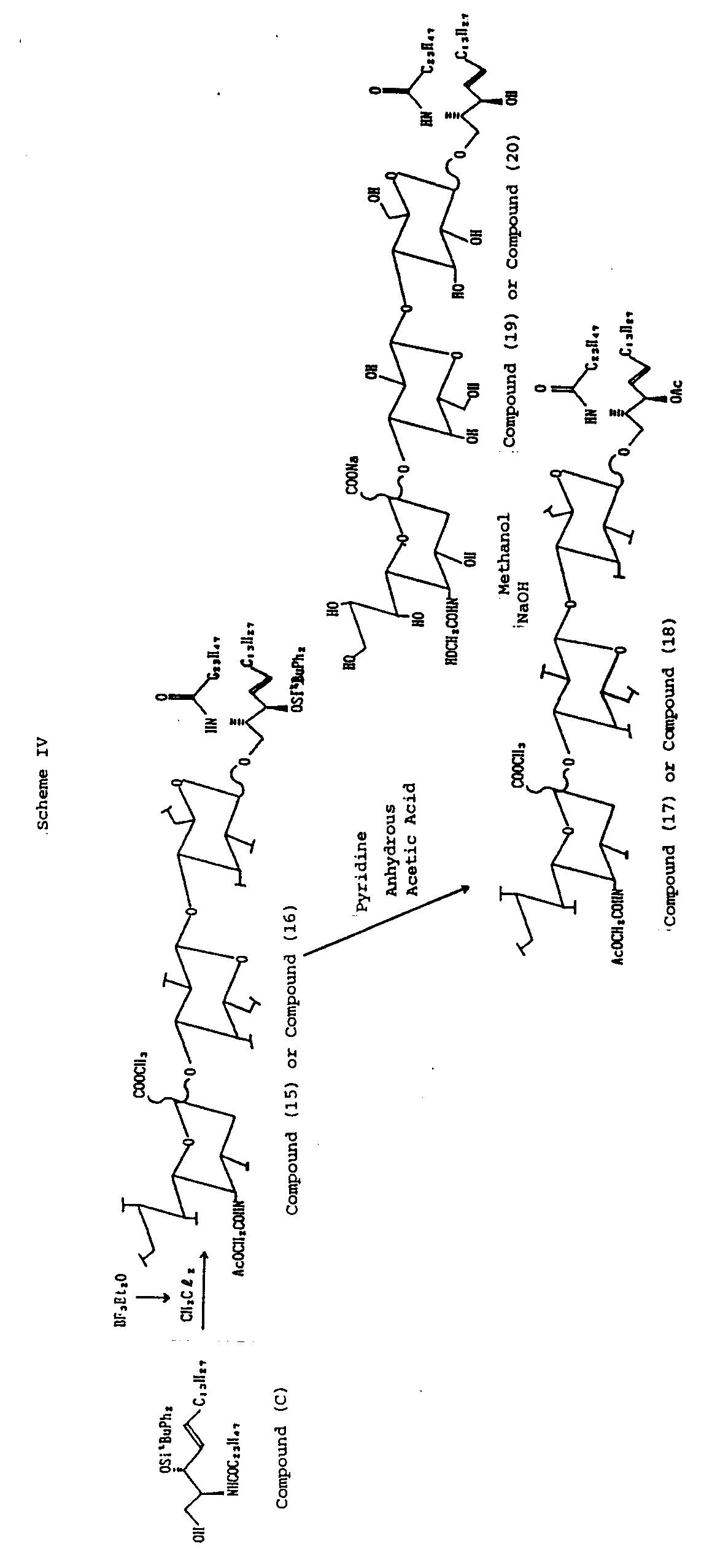

- The present invention is described in detail below with reference to Production Schemes I to V, wherein, in the chemical formulae, OAc denotes OCOCH₃ and BZ denotes OCH₂C₆H₅.
- Compound (1) is produced in accordance with the following method:

The known compound (A) is prepared by the method described in Monatsh Chem. 97, 654 (1966) (refer to Reference Examples 1 and 2). - The above-described compound (1) is first added to a solvent such as acetyl chloride, and hydrogen chloride gas is added to the solvent while it is cooled with ice. After being agitated for 24 hours, the thus-obtained solution is concentrated under reduced pressure, and a solvent such as toluene is added to the residue. The obtained solution is subjected to azeotropic distillation to produce compound (2).
- Compounds (3) and (4) are produced by reacting the above-described compound (2) with a compound (B) und the reaction conditions described below.
- Examples of catalysts, include HgBr₂, Hg(CN)₂, AgClO₄, AgCO₃, AgOTf (silver trifluoromethane sulfonate), and silver silicate. AgOTf or a mixture of HgBr₂ and Hg(CN)₂ in a ratio of between 1:3 and 1:1 is preferably used as the catalyst. In addition, CH₂Cl₂, benzene, toluene, chloroform, CH₃CN, CH₃NO₂, or tetrahydrofuran can be used as a solvent. It is preferable to use CH₂Cl₂ or tetrahydrofuran as the solvent.
- The reaction can be performed at a temperature of within the range of about -25°C to about 90°C under ice cooling, but preferably at room temperature.
- The reaction is performed under agitation for about 30 minutes to about 24 hours. It is preferable to have an agitated reaction of about 24 hours.
- The thus-obtained reaction product is purified by a conventional method such as column chromatography.
- Compounds (5) and (6) are obtained by acetylating the above-described compounds (3) and (4), respectively, under the reaction conditions given below.
- CH₃COCl or Ac₂O can be used as a reagent of this reaction, but Ac₂O is preferable.
- Pyridine, TEA, dichloromethane, dichloroethane, or THF can be used as a solvent, and a catalytic amount of dimethylaminopyridine dissolved in pyridine is preferably added to the reaction solution.
- The reaction temperature is within the range of about 0°C to about 100°C, but is preferably about 60°C.
- The reaction can be performed under agitation for about 30 minutes to 24 hours, preferably under agitation for 24 hours.
- Compounds (7) and (8) are obtained by reacting the above-described compounds (5) and (6), respectively, under the reaction conditions given below.
- Pd-C, Pd(OH)₂, or PtO₂ can be used as a catalyst for the reaction in an atmosphere of hydrogen. A reductant such as HCOOH-MeOH can be also used as a catalyst, but 10% Pd-C is preferable.
- Methanol, a mixed solvent of methanol and water, a mixed solvent of methanol and AcOH, or AcOH can be used as a solvent, but methanol is preferable.
- The reaction temperature is within the range of ice-cooling temperature to about 60°C, but is preferably room temperature.
- The reaction time is within the range of about 1 hour to about 24 hours, but is preferably about 24 hours. The reaction is preferably performed under agitation.
- The thus-obtained reaction product is purified by filtration.
- Compounds (9) and (10) are obtained by acetylating the above-described compounds (7) and (8), respectively, under the reaction conditions given below.
- Ac₂O or CH₃COCl can be used as a reagent for the reaction, but Ac₂O is preferable.
- Pyridine, TEA, dichloromethane, dichloroethane, DMF, or THF can be used as a solvent, but a catalytic amount of dimethylaminopyridine dissolved in pyridine is preferably added to the reaction solution.
- The reaction temperature is within the range of about 0°C to about 80°C, but is preferably about 60°C.
- The reaction time is within the range of about 30 minutes to about 24 hours, but is preferably about 24 hours. It is preferable to agitate the reaction solution.
- The thus-obtained reaction product is purified by a conventional method such as column chromatography.
- Compounds (11) and (12) are obtained by deacetylating the above-described compounds (9) and (10), respectively, under the reaction conditions given below.
- NH₂ NH₂AcOH can be used as a reagent for the reaction.
- DMF can be used as a solvent.
- The reaction temperature is within the range of room temperature to about 80°C, but is preferably about 60°C.
- The reaction time is within the range of about 5 minutes to about 1 hour, preferably about 20 minutes. It is preferable to agitate the reaction solution.
- The thus-obtained reaction product is purified by a conventional method such as column chromatography.
- Compounds (13) and (14) are obtained by reacting the above-described compounds (11) and (12), respectively, with Cl₃CCN under the reaction conditions given below.
- CCl₃CN-DBU, CCl₃CN-NaH, CCl₃CN-K₂CO₃, or CCl₃CN-BuLi can be used as a catalyst for the reaction, but CCl₃CN-DBU is preferable.
- Dichloroethane, benzene, toluene, dichloromethane, or chloroform can be used as a solvent, but dichloromethane is preferable.
- The reaction temperature is within the range of about -25°C to about 50°C, but is preferably about 0°C.
- The reaction time is within the range of about 30 minutes to about 12 hours, but is preferably about 4 hours. It is preferable to agitate the reaction solution.
- The thus-obtained reaction product is purified by a conventional method such as column chromatography.
- Compounds (15) and (16) are obtained by reacting the above-described compounds (13) and (14), respectively, with a compound (C) under the reaction conditions given below.
- BF₃ Et₂O, TMS trifluoromethane sulfonate, TiCl₄, AlCl₃, or SnCl₄ can be used as a catalyst for the reaction, but BF₃ Et₂O is preferable.
- CH₂Cl₂, C₂H₄Cl₂, THF, benzene, toluene, CH₃CN, CH₂NO₂, or ether can be used as a solvent, but CH₂Cl₂ is preferable.
- The reaction temperature is within the range of about -25°C to about 60°C, but is preferably a temperature under cooling with ice and methanol.
- The reaction time is within the range of about 1 hour to about 24 hours, but is preferably about 24 hours. It is preferable to agitate the reaction solution.
- Compounds (17) and (18) are obtained by reacting the above-described compounds (15) and (16), respectively, under the reaction conditions given below.
- Bu₄NF or HF can be used as a catalyst for the reaction, but Bu₄NF is preferably used.
- THF, CH₃CN, CH₃NO₂, EtOAc, CH₂Cl₂, CHCl₃, DMF, ether, benzene, or toluene can be used as a solvent, but THF is preferable.
- The reaction temperature is within the range of about 0°C to about 50°C, but is preferably room temperature.
- The reaction time is within the range of about 30 minutes to about 48 hours, and reaction is preferably performed under agitation for about 48 hours.
- The thus-obtained reaction product is purified by a conventional method such as column chromatography.
- Compounds (17) and (18) are obtained by reacting the above-described compounds (15) and (16), respectively, under the reaction conditions given below.
- Ac₂O or CH₃COCl can be used as a reagent for the reaction, but Ac₂O is preferable.
- Pyridine, TEA, or dimethylaminopyridine can be used as a solvent, but a catalytic amount of dimethylaminopyridine dissolved in pyridine is preferably added to the reaction solution.
- The reaction temperature is within the range of about 0°C to about 80°C, but is preferably about 60°C.
- The reaction time is within the range of about 30 minutes to about 24 hours, but the reaction is preferably performed under agitation for about 6 hours.
- The thus-obtained reaction product is purified by a conventional method such as column chromatography.
- Compounds (19) and (20) are obtained by deacetylating the above-described compounds (17) and (18), respectively, under the reaction conditions given below.
- NaH-MeOH, K₂CO₃-MeOH, TEA-MeOH, KOH-MeOH, or MaOH-MeOH can be used as a catalyst for the reaction, but NaOCH₃ is preferable and 0.1N NaOCH₃ is more preferable.
- Methanol, ethanol, propanol, THF, or dioxane can be used as a solvent, but methanol is preferable.
- The reaction temperature is within the range of about -10°C to about 50°C, but is preferably room temperature.
- The reaction time is within the range of about 30 minutes to about 24 hours, but the reaction is preferably performed under agitation for about 6 hours.
- The thus-obtained reaction product is purified by a conventional method such as column chromatography after being neutralized.
- Compounds (19) and (20) are obtained by hydrolyzing the above-described compounds (17) and (18), respectively, under the reaction conditions given below.
- NaOH, KOH, or LiOH can be used as a catalyst for the reaction, but NaOH is preferable.
- MeOH-THF, MeOH-dioxaneethanol-THF, ethanol-dioxane, propanol-dioxane, or propanol-THF can be used as a solvent, and MeOH-THF is preferable.
- The reaction temperature is within the range of about 0°C to about 50°C, but is preferably room temperature.
- The reaction time is within the range of about 30 minutes to about 24 hours, but is preferably about 24 hours. It is preferable to agitate the reaction solution.
- The starting raw material for the ceramide-related compounds which are intermediates of the ganglioside-related compounds of the present invention is the above-described compound (22). The ceramide-related compounds can be obtained in accordance with the steps described below.
-

(wherein R₃, R₄ and R₅ each denotes the same as that described above)
Compounds (23), (25), and (27) are obtained from compound (22) under the reaction conditions given below. - Ph₂tBuSiCl, Ph₂(CMe₂Ph)SiCl, or Me₂(CMePh)SiCl can be used as a reagent used for each reaction. It is preferable that each reaction is performed in the presence of a chlorine such as imidazole.
- Dimethylformamide (DMF), tetrahydrofuran (THF), chloroform, pyridine, or collidine can be used as a solvent, but DMF is preferable.
- The reaction temperature is within the range of about 0°C to about 100°C, but is preferably within the range of room temperature to 40°C.
- The reaction time is within the range of about 1 hour to 2 nights, and but is preferably 1 to 2 nights. It is preferable to agitate the reaction solution.
- The thus-obtained reaction product is purified by a conventional method such as column chromatography.
-

(wherein R₁, R₂, and R₃ each denotes the same as that described above)
Toluenesulfonic acid (abbreviated to TsOH hereinafter), CF₃COOH, CH₃COOH (abbreviated to AcOH hereinafter), HCOOH, HCl can be used as a catalyst used in each reaction, but TsOH is preferable. - MeOH-CH₂Cl₂, MeOH-C₂H₄Cl₂, CHCl₃-MeOH, AcOH-MeOH, THF-MeOH, dioxane-MeOH, an aqueous AcOH solution, an aqueous THF solution, or an aqueous dioxane solution can be used as a solvent, but MeOH-CH₂Cl₂ is preferable.
- The reaction temperature is within the range of about 0°C to about 80°C, but is preferably room temperature.
- The reaction time is within the range of about 30 minutes to one night, but is preferably 1 to 6 hours. It is preferable to agitate the reaction solution.
- The thus-obtained reaction product is purified by a conventional method such as column chromatography.
- The ganglioside-related compounds are useful as markers for the early detection of cancer and in the immunotherapy for cancer.
- In addition, the ceramide-related compounds are advantageously used for synthesizing ceramide portions when glycolipids and the above-described ganglioside-related compounds, which are useful as tumor markers, are synthesized.
- The present invention is described in detail below with reference to Reference Examples and Examples.
- 75 ml of anhydrous methanol and 1.12 g of Dowex 50W-X8 (H⁺) were added to 1.12 g (3.4431 mmol) of N-glycolylneuraminic acid (NGNA), and the obtained mixture was agitated at room temperature for 20 hours. Since NGNA remained and the reaction was not completed, 150 ml of anhydrous methanol and 2 g of Dowex 50W-X8 (H⁺) were further added to the reaction solution and, when the mixture was agitated at room temperature for 4 hours, the NGNA was substantially dissolved. The reaction solution was filtered, and the resin was washed with methanol. The filtrate and the washing solution were mixed together and the obtained mixture was subjected to distillation under reduced pressure to obtain 1.08 g of colorless, amorphous crystals (yield, 92%).
- The crystals were recrystallized by methanol.
- Melting point: 170 - 173°C

3400 (-OH, -NH),
1745 (-COOCH₃),
1645 (-CONH-),
1550 (-CONH-, amide II)
(DMSO-d₆ + D₂O, TMS)
1.721 (1H, t, J3ax 3eq=12.7 Hz, J3ax 4=11.7 Hz, H3ax)
2.050 (1H, dd, J3ax 3eq=12.7 Hz, J3eq 4=4.9 Hz, H3eq)
3.217 (1H, dd, J₇ ₈ = 9.3 Hz, J₆ ₇=1.0 Hz, H-7)
3.312 (1H, dd, J₉ ₉'=11.2 Hz, J₈ ₉'=6.8 Hz, -H-9')
3.502 (1H, ddd, J₇ ₈=9.3 Hz, J₈ ₉'=6.4 Hz, J₈ ₉ = 2.5 Hz, H-8)
3.518-3.671 (2H, m, H-9, H-5)
3.714 (3H, s, -COOCH₃)
3.845-3.932 (3H, m,
H-6)
3.865 (1H, d, J=16.1 Hz,
3.911 (1H, d, J=16.1 Hz, HOCH-CO-)
4.034 (1H, ddd, J3ax ₄=11.7 Hz, J₄ ₅=10.7 Hz, J3eq ₄=4.9 Hz, H-4)
7.813 (1H, d, J=8.8 Hz, -CONH-)
Elementary analysis C₁₂H₂₁NO₁₀ 7/10H₂O)
MW = 351.92 (339.31)Calculated value: C:40.96 H:6.42 N:3.98 Measured value: C:40.89 H:6.27 N:3.88 - 1.05 g (3.0945 mmol) of methyl 5-N-glycolyl-3,5-dideoxy-β-D-glycero-D-galacto-2-nonulopyranosonate was dissolved in 15 ml of anhydrous pyridine, 10 ml of anhydrous acetic acid was then added to the obtained solution, and the obtained mixture was agitated at room temperature for 42 hours. The reaction solution was subjected to distillation under reduced pressure, and toluene was then added to the residue. The obtained mixture was subjected to azeotropic distillation (5 times) until no odor of anhydrous acetic acid was generated to obtain 1.846 g of amorphous crystal. 185 g of silica gel which had previously been suspended in chloroform was filled in a column, and the 1.846 g of the amorphous crystals was dissolved in chloroform and then added to the column. Development was performed by using a mixture of chloroform and methanol (50:1) as a developing solvent so that fractions were collected. An eluate was collected every about 15 ml, and each of the fraction solutions was analyzed by TLC so that only the fraction solutions containing the target substance were collected. The solvent was distilled off and the residue was dissolved in water and was lyophilized and then dried under vacuum (P₂O₅) to obtain 445 mg of a α -substance, 518 mg of β -substance, and 688 mg of a α β-mixture in a total amount of 1.651 g (theoretical yield, 1.83 g; yield, 90.2%).
- Melting point: 74 - 78°C
Elementary analysis C₂₄H₃₃NO₁₆ 2/5H₂O
MW=598.74 (591.54)Calculated value: C:48.14 H:5.69 N:2.34 Measured value: C:48.12 H:5.57 N:2.38

3420 (-NH),
1750 (-COOCH₃),
1690 (-CONH-),
1540 (-CONH-, amide II)
(CDCl₃, TMS)
2.024 (3H, s, -OCOCH₃)
2.039 (3H, s, -OCOCH₃)
2.109 (3H, s, -OCOCH₃)
2.111 (3H, s, -OCOCH₃)
2.130 (3H, s, -OCOCH₃)
2.182 (3H, s, -OCOCH₃)
2.078 (H3ax)
2.571 (1H, dd, J=13.0 Hz, J=4.8 Hz, α-H3eq)
3.768 (3H, s, -COOCH₃)
4.163 (1H, dd, J=12.3 Hz, J=6.0 Hz, H-9ʹ)
4.175 (1H, ddd, J=10.6 Hz, J=10.4 Hz, J=10.0 Hz, H-5)
4.320 (1H, d, J=15.2 Hz,
4.370 (1H, dd, J=12.3 Hz, J=2.5 Hz, H-9)
4.588 (1H, d, J=15.2 Hz,
4.787 (1H, dd, J=10.6 Hz, J=2.3 Hz, H-6)
5.076 (1H, ddd, J=11.8 Hz, J=10.4 Hz, J=4.8 Hz, H-4)
5.204 (1H, ddd, J=6.4 Hz, J=6.0 Hz, J=2.5 Hz, H-8)
5.334 (1H, dd, J=6.4 Hz, J=2.3 Hz, H-7)
6.197 (1H, d, J=10.0 Hz, -CONH-) - Melting point: 80 - 86°C
Elementary analysis C₂₄H₃₃NO₁₆ 7/10H₂O
MW=604.15 (591.54)Calculated value: C:47.71 H:5.74 N:2.32 Measured value: C:46.66 H:5.43 N:2.35

3400 (-NH),
1750 (-COOCH₃),
1700 (-CONH-),
1530 (-CONH-, amide II)
(CDCl₃, TMS)
2.023 (3H, s, -OCOCH₃)
2.043 (3H, s, -OCOCH₃)
2.072 (3H, s, -OCOCH₃)
2.145 (3H, s, -OCOCH₃)
2.168 (3H, s, -OCOCH₃)
2.201 (3H, s, -OCOCH₃)
2.102 (1H, dd, J=13.4 Hz, J=11.4 Hz, β-H3ax)
2.558 (1H, dd, J=13.4 Hz, J=4.7 Hz, β-H3eq)
3.799 (3H, s, -COOCH₃)
4.103 (1H, ddd, J=10.8 Hz, J=10.2 Hz, J=9.5 Hz, H-5)
4.125 (1H, dd, J=12.3 Hz, J=6.7 Hz, H-9ʹ)
4.188 (1H, dd, J=10.8 Hz, J=2.2 Hz, H-6)
4.302 (1H, d, J=15.3 Hz,
4.490 (1H, dd, J=12.3 Hz, J=2.5 Hz, H-9)
4.614 (1H, d, J=15.3 Hz,
5.080 (1H, ddd, J=5.1 Hz, J=6.7 Hz, J=2.5 Hz, H-8)
5.316 (1H, dd, J=5.1 Hz, J=2.2 Hz, H-7)
5.332 (1H, ddd, J=11.4 Hz, J=10.2 Hz, J=4.7 Hz, H-4)
5.981 (1H, d, J=9.5 Hz, -CONH-) - 50 ml of acetyl chloride was added to 340 mg (0.54 mmol) of compound (1) and HCl gas was added to the mixture which was then agitated for one night. Toluene was then added to the reaction solution which was then subjected to distillation (azeotropic distillation).
- [α]

300 mg (97%)
Rf=0.46 (toluene : ethyl acetate = 1 : 2)
NMR: 400 MHz, CDCl₃, δ (ppm), TMS
δ 2.039, 2.062, 2.095, 2.123, 2.210 (s, OCOCH₃ x5)
2.295 (1H, dd, J=11.2, 13.9 Hz, H-3ax)
2.796 (1H, dd, J=4.6, 13.9 Hz, H-3eq)
3.888 (3H, s, -OCH₃)
4.074 (1H, dd, J=5.9, 12.5 Hz, H-9)
4.213 (td, J=10.2, 10.5 Hz, H-5)
4.312 (d, J=15.3, -CH₂OCO)
4.414 (1H, t, J=2.9, H-6)
4.443 (1H, dd, J=2.7, 5.4 Hz, H-9)
4.629 (1H, d, J=15.3 Hz, -CH₂OCO-)
5.182 (td, J=2.4, 10.0 Hz, H-8)
5.431 (1H, dd, J=2.2, 6.8 Hz, H-7)
5.469 (1H, m, H-4)
6.068 (d, J=10.0 Hz, NH) -
- A) 1.4 g (1.6 mmol) of compound (B), 1.125 g (4.5 mmol) of Hg(CN)₂, 540 mg (1.5 mmol) of HgBr₂, and 2 ml of dichloroethane were added to 1.5 g of activated Molecular Sieves 4Å, and the obtained mixture was agitated for 1 hour. 500 mg (0.8 mmol) of compound (2) which had been dissolved in 4 ml of dichloroethane under ice-MeOH cooling was then added to the mixture, which was then agitated for one night. After being agitated at 70°C for one day, the reaction solution was filtered by using Celite, and ethyl acetate was added to the filtrate. An organic layer was washed with an aqueous NaHCO₃ solution, water, and saturated salt water, dried with anhydrous MgSO₄, and then subjected to distillation. The residue was purified by column chromatography (C-300, 80 g; toluene : ethyl acetate = 2 : 1 and then 1 : 2) to obtain 195.8 mg of compound (3) (yield, 17.3%) and 81 mg of compound (4) (yield, 7.2%).
- B) 3 g (3.4 mmol) of compound (B), 750 mg (3 mmol) of Hg(CN)₂, 1.08 g (3 mmol) of HgBr₂, and 5 ml of dichloroethane were added to 3 g of activated Molecular Sieves 4Å, and the mixture was agitated for 1 hour. 1 g (1.6 mmol) of compound (2) which had been dissolved in 7 ml of dichloroethane under ice-MeOH cooling was then added to the mixture, which was then agitated for one night. After being agitated at 70°C for one day, the reaction solution was filtered by using Celite, and ethyl acetate was added to the filtrate. An organic layer was washed with an aqueous NaHCO₃ solution, water, and saturated salt water, dried with anhydrous MgSO₄, and then subjected to distillation. The residue was purified by column chromatography (C-300, 200 g; toluene : ethyl acetate = 2 : 1, then 1 : 2) to obtain 408 mg of compound (3) (yield, 18.1%) and 165 mg of compound (4) (yield, 7.3%).
- C) 755 mg (1 mmol) of compound (B) which had been dissolved in 2.5 ml of THF and 144 mg (0.55 mmol) of AgOTf were added to 1 g of activated Molecular Sieves 4A, and the mixture was agitated at -10°C for 30 minutes. 300 mg (527 µ mol) of compound (2) which had been dissolved in 2.5 ml of THF was then added to the mixture, which was then agitated at room temperature for one night. After being agitated at 70°C for one day, the reaction solution was subjected to Celite filtration, and ethyl acetate was then added to the filtrate. An organic layer was washed with an aqueous NaHCO₃ solution, water, and saturated salt water, dried with anhydrous MgSO₄, then subjected to distillation. The residue was purified by column chromatography (C-300, 50 g; toluene : ethyl acetate = 2 : 1, then 1 : 2) to obtain 23.8 mg of compound (3) (yield, 3.5%) and 26.7 mg of compound (4) (yield, 3.9%).
- Rf = 0.574 (toluene : ethyl acetate = 1 : 2)
[α]
Elementary analysisTheoretical value: C:64.53 H:6.20 N:0.99 Measured value: C:64.48 H:6.13 N:0.72
NMR: 400 MHz ppm (TMS)
1.913, 1.966, 2.044, 2.103, 2.183 (s, OCOCH₃ x 5)
2.555 (1H, dd, J=4.6, 13.4 Hz, H-3c)
3.618 (s, OCH₃)
5.259 (1H, td, J=2.4, 8.7 Hz, H-8c)
5.297 (1H, t, J=2.4 Hz)
5.333 (1H, ddd, J=4.6, 10.9, 10.9 Hz, H-4c)
5.585 (1H, d, J=10.2, NH)
7.21-7.37 (3OH, m, benzyl group x 6)
¹³C NMR CDCl₃ ppm
99.69 (C-2c), 102.29 (C-1a), 102.40 (C-1b) - Rf = 0.479 (toluene : ethyl acetate = 1 : 2)
[α]
Elementary analysisTheoretical value: C:64.53 H:6.20 N:0.99 Measured value: C:64.15 H:6.26 N:1.02
NMR: 400 MHz ppm (TMS)
1.883, 1.984, 2.001, 2.100, 2.189 (s, OCOCH₃ x 5)
2.521 (1H, dd, J=4.6, 13.1 Hz, H-3ceq)
3.774 (1H, m, -OCH₃)
4.20 (1H, m, H-4c)
5.261 (1H, dd, J=1.7, 8.0 Hz, H-7)
5.416 (1H, m, H-8)
5.808 (1H, d, J=9.7, NH)
7.20-7.40 (3OH, m, benzyl group x 6)
¹³C NMR 22.5 MHz CDCl₃ ppm
99.69 (C-2c), 103.75 (C-1a), 103.91 (C-1b) - 5 ml of pyridine and 5 ml of anhydrous acetic acid were added to 144 mg (101.8 µ mol) of compound (3), and the mixture was agitated at 60°C for one night. The reaction solution was dried up as it was.
148 mg (99.8%)
Rf = 0.397 (toluene : ethyl acetate = 1 : 1)
[α]
Elementary analysisTheoretical value: C:64.32 H:6.16 N:0.96 Measured value: C:64.66 H:6.17 N:1.09
¹H NMR 400 HMz ppm CDCl₃ (TMS)
1.819, 1.962, 2.034, 2.106, 2.143, 2.169 (s, OCOCH₃ x 6)
2.571 (1H, dd, J=4.6, 13.1 Hz, H-3ceq)
3.444 (3H, s, OCH₃)
4.095 (1H, td, J=10.5, 10.5 Hz)
5.101 (1H, m, H-4c)
5.378 (1H, d, J=3.2 Hz, H-4b)
7.23-7.38 (3OH, m, benzoyl group x 6)
¹³C NMR ppm CDCl₃
99.25 (C-2c), 101.86 (C-1a), 102.34 (C-1b) - 390 mg (267.7 µmol) of compound (5) was dissolved 50 ml of methanol, 200 mg of 10% Pd-C200 was added to the methanol solution, and the obtained mixture was subjected to catalytic reduction at room temperature for one night. The reaction solution was filtered by Celite and then dried up.
232 mg (94.7%)
Rf = 0.632 (BuOH : EtOH : H₂O = 2 : 1 : 1)
[α]
Elementary analysisTheoretical value: C:47.22 H:5.83 N:1.53 Measured value: C:47.25 H:5.77 N:1.78 - 8 ml of pyridine and 8 ml of anhydrous acetic acid were added to 220 mg (240.2 µmol) of compound (7), and the obtained mixture was agitated at room temperature for three days. The reaction solution was subjected to distillation and the residue was purified by column chromatography (C-300, 20 g; toluene : ethyl acetate = 1 : 5).
247 mg (88%)
Rf = 0.833 (CHCHl₃ : MeOH = 10 : 0.5)
[α]
Elementary analysisTheoretical value: C:49.63 H:5.61 N:1.20 Measured value: C:49.94 H:5.61 N:1.20 - 220 mg (188 µ mol) of compound (9) was dissolved in 2 ml of DMF, 24 mg (240 µmol) of H₂NNH₂ AcOH was added to the obtained solution, and the obtained mixture was agitated at 60°C for 20 minutes. Ethyl acetate was added to the reaction solution, and an organic layer was washed with water and saturated salt water, dried with anhydrous MgSO₄, and subjected to distillation. The residue was purified by column chromatography (C-300, 20 g; acetone : CCl₄ = 1 : 2).
144 mg (68%)
Rf = 0.58 (acetone : CCl₄ = 1 : 1)
[α]
Elementary analysisTheoretical value: C:49.07 H:5.64 N:1.24 Measured value: C:48.88 H:5.67 N:1.44 - 140 mg (124 µmol) of compound (11) was dissolved in 1 ml of dichloromethane, 358 µl (3.57 mmol) of Cl₃CCN and 18 l (0.126 mmol) of DBU were added to the obtained solution at 0°C, and the obtained mixture was agitated for 4 hours as it was. The reaction solution was purified by column chromatography (C-300, 18 g; acetone : CCl₄ = 1 : 2).
120 mg (76%)
Rf = 0.367 (acetone : CCl₄ = 1 : 2)
[α]
Elementary analysisTheoretical value : C:45.35 H:5.07 N.2.20 Measured value: C:45.61 H:5.04 N:2.30
¹H MNR CDCl₃ ppm TMS
1.982, 2.017, 2.043, 2.061, 2.062, 2.069, 2.083,
2.117, 2.152, 2.185, 2.304 (s, OCOCH₃ x 11)
1.777 (1H, t, J=12.2 Hz, H-3cax)
2.436 (1H, dd, J=4.6, 13.4 Hz, H-3ceq)
3.840 (s, OCH₃)
4.349 (1H, d, J=15.6 Hz, AcOCH₂-CO-)
4.601 (1H, d, J=15.3 Hz, AcOCH₂-CO-)
5.043 (1H, m, H-4c)
5.297 (1H, d, J=2.9 Hz, H-4b)
5.533 (1H, t, J=9.7 Hz, H-3a)
6.313 (1H, d, J=10.2 Hz, NH)
6.474 (1H, d, J=3.6 Hz, H-1a)
¹³C NMR CDCl₃ ppm
93.19 (C-1a), 99.63 (C-2c), 101.15 (C-1b) - 100 mg (78.6 µmol) of compound (13) and 70 mg (78.8 µmol) of compound (C) which had been dissolved in 3 ml of dichloromethane were added to 1.5 g of activated Molecular Sieves AW-300, 15 µ1 (124 µmol) of BF₃ Et₂O was added to the obtained mixture under ice-MeOH cooling, and the obtained mixture was agitated for one night at it was. The reaction solution was filtered by Celite, subjected to distillation, and then purified by column chromatography (C-300, 25 g; toluene : ethyl acetate = 1 : 1).
90.6 mg (58%)
Rf = 0.229 (toluene : ethyl acetate = 1 : 1)
[α]
¹H NMR CDCl₃ ppm TMS
0.881 (6H, t, J=7.0 Hz, -CH₂CH₃)
0.997 (9H, s, -CH₃ x 3)
1.251 (s, -CH₂-)
1.960, 1.981, 2.032, 2.042, 2.052,.2.060, 2.070,
2.088, 2.150, 2.181, 2.302 (s, OCOCH₃ x 11)
2.434 (1H, dd, J=4.6, 13.4 Hz, H-4ceq)
3.841 (3H, s, OCH₃)
4.350 (1H, d, J=15.3 Hz)
4.598 (1H, d, J=15.3 Hz, -OCH₂CONH)
5.041 (1H, m, H-4c)
5.291 (1H, d, J=2.5 Hz)
7.31-7.40 (6H, m, aromatic proton)
7.61-7.76 (4H, m, aromatic proton) - 20 mg (10 µmol) of compound (15) was dissolved in 1 ml of THF, 11.2 µl (11 µmol) of Bu₄NF was added to the obtained solution, and the obtained mixture was agitated at room temperature for 1 hour. 39.7 µg (39 umol) of Bu₄NF was added to the obtained mixture which was then agitated for two days. The reaction solution was subjected to distillation, 1 ml of pyridine and 1 ml of anhydrous acetic acid were added to the residue, and the obtained mixture was agitated at 60°C for 6 hours. The reaction solution was subjected to distillation and purified by column chromatography (C-300, 3 g; CHCl₃ : MeOH = 10 : 0.2).
17 mg (94%)
Rf = 0.70 (CHCl₃ : MeOH = 10 : 0.25)
[α]
Elementary analysisTheoretical value(1H₂O) C:59.45 H:8.21 N:1.54 Measured value: C:59.05 H:7.95 N:1.72
¹H NMR CDCl₃ ppm TMS 400 MHz
0.880 (6H, t, J=6.5 Hz, -CH₂CH₃ x 2)
1.252 (s, -CH₂ x 32)
1.771 (1H, t, J=12.2 Hz. H-3cex)
1.981, 2.004, 2.040, 2.042, 2.053, 2.060, 2.066,
2.086, 2.150, 2.159, 2.222, 2.295 (s, OCOCH₃ x - 12)
2.438 (1H, dd, J=4.6, 12.1 Hz, H-3ceq)
3.840 (3H, s, OCH₃)
4.349 (1H, d, J=15.6 Hz, -OCH₂ CONH) - 16 mg (8.3 µmol) of compound (17) was dissolved in 1.5 ml of methanol, 1 ml of 0.1N NaOCH₃ was added to the obtained solution, and the obtained mixture was agitated at room temperature for 6 hours. The reaction solution was dried up, 1 ml of MeOH, 1 ml of THF, and 0.5 ml of H₂O were added to the residue, and the obtained mixture was agitated at room temperature for one night. The reaction solution was neutralized by cation exchanger Amberlite IRC-50, filtered, and then purified by Sephadex LH-20 (eluted with CHCl₃ : MeOH : H₂O = 5 : 3 : 0.46).
10.8 mg (94%)
Rf = 0.25 (BuOH : EtOH : H₂O = 2 : 1 : 1)
[α]
NMR 400 MHz d 6DMSO-D₂O (98:2) TMS ppm
0.854 (6H, t, J=6.5 Hz, -CH₂CH x 2)
1.240 (64H, s, -CH₂- x 32)
2.041 (2H, t, J=7.0 Hz, H-2cer)
1.934 (2H, m, H-6cer)
3.057 (1H, t, J=8.0 Hz, H-2a)
4.176 (1H, d, J=7.57 Hz, H-1a)
4.193 (1H, d, J=6.1 Hz, H-1b)
5.372 (1H, dd, J=6.8, 15.3 Hz, H-4cer)
5.557 (1H, t, J=15.3, 6.6 Hz, H-5cer) - 5 ml of pyridine and 5 ml of anhydrous acetic acid were added to 81 mg (57.2 µmol) of compound (4), and the obtained mixture was agitated at 60°C for one night. The reaction solution was dried up as it was.
84 mg (100%)
Rf = 0.269 (toluene : ethyl acetate = 1 : 1)
[α]
Elementary analysisTheoretical value C:64.32 H:6.16 N:0.96 Measured value: C:64.02 H:6.00 N:1.08
NMR 400 MHz ppm CDCl₃ TMS
1.749, 1.971, 1.997, 2.000, 2.123, 2.185 (s, OCOCH₃ x 6)
1.851 (1H, t, J=12.4 Hz, H-3cax)
2.616 (1H, dd, J=4.6, 12.7 Hz, H-3ceq)
4.103 (1H, q, J=10.5 Hz, H-5c)
5.049 (1H, d, J=2.9 Hz, H-4b)
5.598 (1H, m, H-8c)
5.779 (1H, d, J=10.2 Hz, NH)
7.17-7.39 (30H, m, benzyl group x 6) - 232 mg (159.2 µmol) of compound (6) was dissolved in 50 ml of methanol, 150 mg of 10% Pd-C was added to the obtained solution, and the obtained mixture was subjected to catalytic reduction at room temperature for one night. The reaction solution was filtered by Celite and then dried up.
141 mg (97.2%)
Rf = 0.632 (BuOH : EtOH : H₂O = 2 : 1 : 1)
[α]
Elementary analysisTheoretical value (containing 1H₂O) C:46.30 H:5.94 N:1.50 Measured value C:46.53 H:5.82 N:1.86 - 8 ml of pyridine and 8 ml of anhydrous acetic acid were added to 130 mg (141.9 µmol) of compound (8), and the obtained mixture was agitated at room temperature for three days. The reaction solution was subjected to distillation and then purified by column chromatography (C-300, 20 g; toluene : ethyl acetate = 1 : 5).
151 mg (95%)
Rf = 0.743 (CHCl₃ : MeOH = 10 : 0.5)
[a]
Elementary analysisTheoretical value C:49.36 H:5.61 N:1.20 Measured value C:49.21 H:5.63 N:1.54 - 140 mg (120 µmol) of compound (10) was dissolved in 2 ml of DMF, 15 mg (160 umol) of H₂NNH₂ AcOH was added to the obtained solution, and the obtained mixture was agitated at 60°C for 25 minutes. Ethyl acetate was added to the reaction solution, and an organic layer was washed with water and saturated salt water, dried with anhydrous MgSO₄, and then subjected to distillation. The residue was purified by column chromatography (C-300, 20 g; acetone : CCl₄ = 1 : 2).
133 mg (98%)
Rf = 0.549 (acetone : CCl₄ = 1 : 1)
[α]
Elementary analysisTheoretical value C:49.07 H:5.64 N:1.24 Measured value C:48.79 H:5.70 N:1.70 - 116 mg (103 µmol) of compound (12) was dissolved in 1 ml of dichloromethane, 358 µ1 (3.53 mmol) of Cl₃CCN and 15 µl (0.11 mmol) of DBU were added to the obtained solution, and the obtained mixture was agitated for 4 hours as it was. The reaction solution was purified by column chromatography (C-300, 20 g; acetone : CCl₄ = 1 : 2).
121 mg (92%)
Rf = 0.278 (acetone : CCl₄ = 1 : 2)
[α]
Elementary analysisTheoretical value (containing 1.5H₂O) C:44.40 H:5.20 N:1.16 Measured value C:44.14 H:4.80 N:2.52
NMR 400 MHz CDCl₃ ppm TMS
1.992, 2.012, 2.054, 2.073, 2.075. 2.084, 2.100,
2.180, 2.186 (s, OCOCH₃ x 11)
1.683 (1H, t, J=12.4 Hz, H-3cax)
2.604 (1H, dd, J=4.6, 12.7 Hz, H-3ceq)
3.869 (3H, s, OCH₃)
4.274 (1H, d, J=15.1 Hz, -OCOCH₂O-)
4.571 (1H, d, J=15.3 Hz, -OCOCH₂O-)
4.513 (1H, dd, J=3.4, 10.0 Hz, H-2a)
4.664 (1H, d, J=8.0 Hz, H-1b)
4.899 (1H, d, J=2.6 Hz, H-4b)
4.975 (1H, m, H-4c)
4.962 (1H, dd, J=7.8, 10.0 Hz, H-2b)
5.081 (1H, dd, J=3.9, 10.2 Hz, H-3b)
5.373 (1H, dd, J=2.6, 9.2 Hz, H-7c)
5.500 (1H, m, H-8c)
5.553 (1H, t, J=9.7 Hz, H-3m)
5.779 (1H, d, J=10.0 Hz, -CONH-)
6.492 (1H, d, J=3.6 Hz, H-1a)
8.649 (1H, s, =NH) - 80 mg (62.9 µmol) of compound (14) and 70 mg (78.8 mol) of compound (C) which had been dissolved in 3 ml of dichloroethane were added to 1.5 g of activated Molecular Sieves AW-300, 15 u l (124 µmol) of BF₃ Et₂O was added to the obtained mixture under ice-MeOH cooling after 30 minutes, and the obtained mixture was agitated for one night as it was. The reaction solution was filtered by Celite and then subjected to distillation. The residue was purified by column chromatography (C-300, 25 g; toluene : ethyl acetate = 1 : 1).
65.4 mg (52%)
Rf = 0.131 (toluene : ethyl acetate : 1 : 1)
[α]
Elementary analysisTheoretical value C:62.54 H:8.23 N:1.40 Measured value C:62.49 H:8.15 N:1.59
NMR 400 MHz CDCl₃ ppm TMS
0.878 (3H, t, J=5.8 Hz, -CH₂CH₂)
0.881 (3H, t, J=5.6 Hz, -CH₂CH₂)
0.993 (9H, s, +Butyl group)
1.251 (64H, s, -CH₂- x 32)
1.961, 1.992, 2.013, 2.043, 2.073, 2.075, 2.083,
2.095, 2.175, 2.183, 2.245 (s, OCOCH₃ x 11)
2.601 (1H, dd, J=4.6, 12.9 Hz, H-3eq)
3.867 (3H, s, OCH₃)
4.275 (1H, d, J=15.3 Hz, -OCH₂COCH₃)
4.570 (1H, d, J=15.3 Hz, -OCH₂COCH₃)
4.428 (1H, d, J=8.0 Hz, H-1a)
4.640 (1H, d, J=8.0 Hz, H-1b)
4.950 (1H, m, H-4c)
5.500 (1H, m, H-8c)
5.773 (1H, d, J=10.0 Hz, NH)
7.30-7.42 (6H, m, benzene ring)
7.60-7.70 (4H, m, benzene ring) - 24 mg (12 µmol) of compound (16) was dissolved in 2 ml of THF, 60 µl (59 µmol) of Bu₄NF was added to the obtained solution, and the obtained mixture was agitated at room temperature for one night. The reaction solution was dried up, 1 ml of pyridine and 1 ml of anhydrous acetic acid were added to the residue, and the obtained mixture was agitated at 40°C for one night. The reaction solution was subjected to distillation and purified by column chromatography (C-300, 10 g; CHCl₃ : MeOH = 10 : 0.2).
14 mg (64%)
Rf = 0.48 (CHCl₃ : MeOH = 10 : 0.25)
[α]
NMR 400 MHz CDCl₃ ppm TMS
0.880 (6H, t, J=7.0 Hz, -CH₂CH₃ x 2)
1.252 (64H, s, -CH₂-)
1.682 (1H, t, J=12.4 Hz, H-3cax)
1.991, 2.006, 2.037, 2.041, 2.076, 2.081, 2.090,
2.108, 2.179, 2.184, 2.239 (s, OCOCH₃ x 12)
2.599 (1H, dd, J=4.6, 12.6 Hz)
3.866 (3H, s, OCH₃)
4.274 (1H, d, J=15.3 Hz, -OCH₂CO-)
4.425 (1H, d, J=8.0 Hz, H-1a)
4.570 (1H, d, J=15.3 Hz, -OCH₂CO-)
4.660 (1H, d, J=8.0 Hz, H-1b)
5.520 (1H, m, H-8c) - 12 mg (6.6 µ mol) of compound (18) was dissolved in 2 ml of MeOH, 1 ml of O.1N NaOCH₃ was added to the obtained solution, and the obtained mixture was agitated at room temperature for one night. The reaction solution was subjected to distillation, 1 ml of MeOH, 1 ml of THF, and 0.5 ml of H₂O were added to the residue, and the obtained mixture was agitated at room temperature for one night. The reaction solution was neutralized by Amberlite IRC-50, filtered, and then purified by Sephadex LH-20 (eluted with CHCl₃ : MeOH : H₂O = 5 : 3 : 0.46).
8.5 mg (97%)
Rf = 0.25 (BuOH : EtOH : H₂O = 2 : 1 : 1)
[α]
NMR 400 MHz d-6 DMSO-D₂O(98:2) TMS ppm
0.852 (6H, t, J=6.3 Hz, -CH₂CH₃ x 2)
1.232 (64H, s, -CH₂-)
1.930 (2H, m, H-6cer)
2.026 (2H, t, J=7.3 Hz, H-2cer)
2.757 (1H, dd, J=5.1, 11.9 Hz, H-3ceq)
3.041 (1H, t, J=8.5 Hz, H-2a)
4.159 (1H, d, J=7.8 Hz, H-1a)
4.200 (1H, d, J=7.8 Hz, H-1b)
5.343 (1H, dd, J=7.3 Hz, H-4cer)
5.534 (1H, td, J=14.9, 6.8 Hz, H-5cer) - 1.360 g (2.09 mmol) of ceramide (21) was dissolved in 30 ml of pyridine, 722.8 mg (2.77 mmol) of TrCl was added to the obtained solution, and the obtained mixture was agitated at 50°C for one night. The reaction solution was subjected to distillation, chloroform was added to the residue so as to dissolve it, and a chloroform layer was washed with water and saturated salt water, dried with anhydrous MgSO₄, and subjected to distillation. The residue was purified by column chromatography (Wakogel C-300, 85 g; toluene : ethyl acetate = 5 : 1; containing Et₃N) to obtain 909 mg of compound (22) (45%).
- Rf = 0.435 (toluene : ethyl acetate = 5 : 1)
[α]
- 15 ml of DMF, 370 mg (1.36 mmol) of Ph₂tBuSiCl, and 183 mg (2.688 mmol) of imidazole were added to 800 mg (896.4 µmol) of compound (22), and the obtained mixture was agitated at room temperature for one night. Ether was added to the reaction solution, and an ether layer was washed with water and saturated salt water, dried with anhydrous MgSO₄, and subjected to distillation. The residue was purified by column chromatography (Wakogel C-300, 80 g; hexane : ethyl acetate = 10 : 1, containing Et₃N) to obtain 1.006 g of compound (23) (99%).
- Rf = 0.57 (hexane : ethyl acetate = 5 : 1)
[α]
NMR 400 MHz CDCl₃ ppm TMS
0.880 (6H, t, J=5.8 HZ, -CH₂CH₃ x 2)
0.949 (9H, s, tBu group)
1.253 (62H, s, -CH₂-)
1.472 (2H, m, H-3l)
1.749 (2H, td, J=4.7, 6.3 Hz, H-6)
1.884 (2H, t, J=7.2 Hz, H-2l)
3.146 (1H, dd, J=5.3, 9.2 Hz, H-1)
3.298 (1H, dd, J=5.8, 9.2 Hz, H-1)
4.270 (1H, m, H-2)
4.386 (1H, t, J=4.8, H-3)
5.278 (1H, d, J=13.6 Hz, -NH)
7.192-7.605 (25H, m, benzene ring) - 1.0 g (883.4 µmol) of compound (23) was dissolved in a mixture of 20 ml of dichloroethane and 1 ml of methanol, 67 mg (352.2 µmol) of TsOH was added to the resultant solution, and the obtained mixture was agitated at room temperature for 1 hour. The reaction solution was neutralized by adding a saturated NaHCO₃ solution thereto, and chloroform was added to the reaction solution. A chloroform layer was washed with water and saturated salt water, dried with anhydrous MgSO₄, and then subjected to distillation. The residue was purified by column chromatography (Wakogel C-300, 25 g; hexane : ethyl acetate = 5 : 1) to obtain 650 mg of compound (24) (83%).
- Rf = 0.113 (hexane : ethyl acetate = 5 : 1)
[α]
NMR 400 MHz CDCl₃ ppm TMS
0.879 (6H, t, J=6.5 HZ, -CH₂CH₃ x 2)
1.066 (9H, s, tButyl group)
1.252 (62H, s, -CH₂-)
1.574 (2H, m, H-3l)
1.869 (2H, m, H-6)
1.962 (2H, m, H-2)
3.621 (1H, ddd, J=2.9, 7.2, 11.0 Hz, H-1)
3.831 (1H, m, H-2)
3.887 (1H, ddd, J=2.6, 4.4, 11.1 Hz, H-1)
4.335 (1H, t, J=3.6, H-3)
5.370 (1H, dd, J=15.2, 5.5 Hz, H-4)
5.406 (1H, dt, J=15.2, 5.6, H-5)
7.34-7.66 (1OH, m, benzene ring) - 10 ml of DMF was added to 280 mg (313.7 µmol) of compound (22), 82.4 mg (387 µmol) of Me₂(CMe₂Ph)SiCl and 54 mg of imidazole were added to the resultant mixture, and the obtained mixture was agitated at room temperature for one night. Ether and water were added to the reaction solution so that ether extraction is performed, and an ether layer was washed with water and saturated salt water, dried with anhydrous MgSO₄, then subjected to distillation to obtain 480 mg of compound (25).
- Rf = 0.532 (hexane : ethyl acetate = 5 : 1)
- 480 mg of compound (26) was dissolved in a mixture of 10 ml of CH₂Cl₂ and 1 ml of CH₃OH, 60 mg of TsOH was added to the resulting solution, and the obtained mixture was agitated at room temperature for 6 hours. Sodium bicarbonate was added to the reaction solution, which was then subjected to extraction with CHCl₃. A CHCl₃ layer was washed with water and saturated salt water, dried with anhydrous MgSO₄, then subjected to distillation. The residue was subjected to decantation with ether, and an ether solvent was distilled off. The residue was purified by a silica gel column (C-300, 35 g; hexane : EtOAc = 5 : 1) to obtain 61 mg of Compound (26) (20.5%).
- Rf = 0.08 (hexane : ethyl acetate = 5 : 1)
[α]
- 280 mg (313.7 µmol) of compound (22) was dissolved in 10 ml of DMF, 130 mg (387 µmol) of Ph₂(CMe₂Ph)SiCl and 54 mg of imidazole were added to the resultant solution, and the obtained mixture was agitated at room temperature for one night, then at 40°C for one night. The reaction solution was subjected to ether extraction, and an ether layer was washed with water and saturated salt water, dried with anhydrous MgSO₄, then subjected to distillation. The residue was purified by using a silica gel column (C-300, 20 g; hexane : ethyl aceate = 5 : 1) to obtain 410 mg of Compound (27).
- Rf = 0.534 (hexane : ethyl acetate = 5 : 1)
- (I) 410 mg of compound (27) was dissolved in a mixture of 10 ml of CH₂Cl₂ and 1 ml of CH₃OH, 30 mg of TsOH was added to the resultant solution, and the obtained mixture was agitated at room temperature for 1 hour. Sodium bicarbonate was added to the reaction solution, which was then subjected to extraction with CHCl₃. An organic layer was washed with water and saturated salt water, dried with anhydrous MgSO₄, then subjected to distillation. The residue was subjected to decantation with ether, and the ether solvent was distilled off. The residue was purified by using a silica gel column (C-300, 20 g; hexane : ethyl acetate = 5 : 1) to obtain 130 mg of compound (28) (43.6% from compound (22)).
- Rf = 0.128 (hexane : ethyl acetate = 5 : 1)
[α]
(II) 4 ml of ether and 6 ml of formic acid were added to 60 mg of compound (27), and the obtained mixture was agitated at room temperature for 1 hour. An aqueous sodium bicarbonate and ether were added to the reaction solution so that extraction was performed. An ether layer was washed with water and saturated salt water, dried with anhydrous MgSO₄, then subjected to distillation. The residue was purified by a silica gel column (C-300, 20 g; hexane : ethyl acetate = 5 : 2) to obtain 10 mg of compound (28) (20%).
Claims (2)
- Ganglioside-related compounds expressed by the following formula:
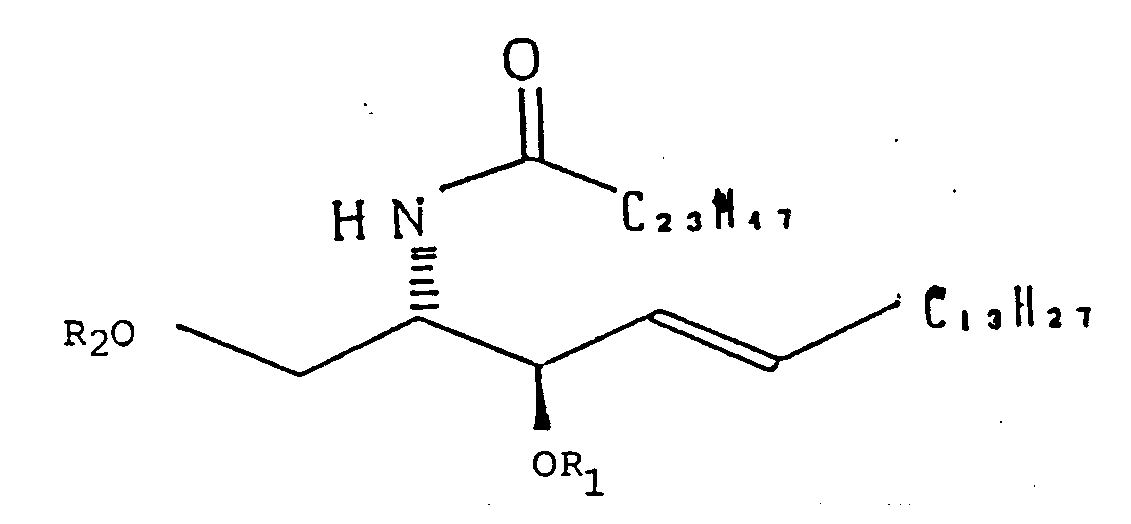

- A method of producing ganglioside-related compounds characterized by acetylating compounds expressed by the following formula:


Priority Applications (1)
| Application Number | Priority Date | Filing Date | Title |
|---|---|---|---|
| AT87115283T ATE101396T1 (en) | 1986-10-20 | 1987-10-19 | GLYCOLIPID CONTAINING N-GLYCONEURAMINIC ACID AND PROCESS FOR PRODUCTION THEREOF. |
Applications Claiming Priority (4)
| Application Number | Priority Date | Filing Date | Title |
|---|---|---|---|
| JP61248981A JPS63104986A (en) | 1986-10-20 | 1986-10-20 | Ceramide related compounds |
| JP248981/86 | 1986-10-20 | ||
| JP61254992A JPH0762026B2 (en) | 1986-10-27 | 1986-10-27 | Glycolipid containing N-glycolylneuraminic acid and method for producing the same |
| JP254992/86 | 1986-10-27 |
Publications (3)
| Publication Number | Publication Date |
|---|---|
| EP0264889A2 EP0264889A2 (en) | 1988-04-27 |
| EP0264889A3 EP0264889A3 (en) | 1989-11-29 |
| EP0264889B1 true EP0264889B1 (en) | 1994-02-09 |
Family
ID=26539042
Family Applications (1)
| Application Number | Title | Priority Date | Filing Date |
|---|---|---|---|
| EP87115283A Expired - Lifetime EP0264889B1 (en) | 1986-10-20 | 1987-10-19 | Glycolipid containing N-glycolylneuraminic acid and method of procuding the same |
Country Status (13)
| Country | Link |
|---|---|
| US (1) | US4950750A (en) |
| EP (1) | EP0264889B1 (en) |
| KR (1) | KR900006213B1 (en) |
| CN (1) | CN1015805B (en) |
| AU (1) | AU598596B2 (en) |
| CA (1) | CA1298579C (en) |
| DE (1) | DE3789043T2 (en) |
| DK (1) | DK549087A (en) |
| ES (1) | ES2061466T3 (en) |
| FI (1) | FI87573C (en) |
| IL (1) | IL84199A (en) |
| NO (1) | NO169343C (en) |
| NZ (1) | NZ222192A (en) |
Families Citing this family (11)
| Publication number | Priority date | Publication date | Assignee | Title |
|---|---|---|---|---|
| US4990603A (en) * | 1986-07-04 | 1991-02-05 | Mect Corporation | Sialic acid derivatives and process therefor |
| IT1235161B (en) * | 1988-12-02 | 1992-06-22 | Fidia Farmaceutici | DERIVATIVES OF LYSOGANGLIOSIDES |
| US5010062A (en) * | 1989-09-25 | 1991-04-23 | Vanderbilt University | Therapeutic agent and method of inhibiting vascularization of tumors |
| JPH03242553A (en) * | 1990-02-19 | 1991-10-29 | Mect Corp | Formulation containing episialo conjugated glucide |
| US5264567A (en) * | 1990-10-22 | 1993-11-23 | Mect Corporation | GM3 analogous compound |
| CU22420A1 (en) * | 1993-12-29 | 1996-01-31 | Centro Inmunologia Molecular | VACCINE COMPOSITION FOR THE DEVELOPMENT OF A RESPONSE AGAINST N GLYCOLYLATED GANGLIOSIDES AND ITS USE FOR THE TREATMENT OF CANCER |
| US6149921A (en) * | 1993-12-29 | 2000-11-21 | Centro De Inmunologia Molecular | Vaccine compositions for eliciting an immune response against N-acetylated gangliosides and their use for cancer treatment |
| JPH08176185A (en) * | 1994-12-19 | 1996-07-09 | Toa Boshoku Kk | Intermediate for synthesizing glycolipid |
| WO2006053972A2 (en) * | 2004-11-16 | 2006-05-26 | Commissariat A L'energie Atomique | Silanizing agents comprising a saccharide end group and uses thereof, such as for the functionalization of solid supports |
| US7537774B2 (en) * | 2005-12-23 | 2009-05-26 | Orion Therapeautics, Llc | Therapeutic formulation |
| JP7143819B2 (en) * | 2019-06-05 | 2022-09-29 | 信越化学工業株式会社 | Organosilane compound having bulky substituents and method for producing the same |
Family Cites Families (7)
| Publication number | Priority date | Publication date | Assignee | Title |
|---|---|---|---|---|
| JPS60190745A (en) * | 1984-03-09 | 1985-09-28 | Rikagaku Kenkyusho | Method for synthesizing ceramide |
| IT1199116B (en) * | 1984-07-03 | 1988-12-30 | Fidia Farmaceutici | GANGLIOSIDE DERIVATIVES |
| AU582758B2 (en) * | 1984-06-28 | 1989-04-13 | Mect Corporation | Sialic acid derivatives, galactose derivatives and method for producing the same |
| CA1262130A (en) * | 1985-10-11 | 1989-10-03 | Shoji Yoshimura | Process for preparing n-glycolylneuraminic acid derivatives |
| JPH07116209B2 (en) * | 1986-04-11 | 1995-12-13 | メクト株式会社 | Sialosyl ceramides and method for producing the same |
| JPS6335588A (en) * | 1986-07-30 | 1988-02-16 | Rikagaku Kenkyusho | Globoside neutral glycolipid and production thereof |
| JPS63297351A (en) * | 1987-05-28 | 1988-12-05 | Mect Corp | Non-natural type ceramide-relating compound and production thereof |
-
1987
- 1987-10-16 NZ NZ222192A patent/NZ222192A/en unknown
- 1987-10-19 ES ES87115283T patent/ES2061466T3/en not_active Expired - Lifetime
- 1987-10-19 DE DE3789043T patent/DE3789043T2/en not_active Expired - Fee Related
- 1987-10-19 US US07/110,133 patent/US4950750A/en not_active Expired - Fee Related
- 1987-10-19 IL IL84199A patent/IL84199A/en not_active IP Right Cessation
- 1987-10-19 EP EP87115283A patent/EP0264889B1/en not_active Expired - Lifetime
- 1987-10-19 AU AU79915/87A patent/AU598596B2/en not_active Ceased
- 1987-10-19 FI FI874588A patent/FI87573C/en not_active IP Right Cessation
- 1987-10-19 CN CN87107993A patent/CN1015805B/en not_active Expired
- 1987-10-19 NO NO874355A patent/NO169343C/en unknown
- 1987-10-20 KR KR1019870011643A patent/KR900006213B1/en not_active Expired
- 1987-10-20 CA CA000549724A patent/CA1298579C/en not_active Expired - Fee Related
- 1987-10-20 DK DK549087A patent/DK549087A/en not_active Application Discontinuation
Non-Patent Citations (2)
| Title |
|---|
| D.E.ONG J. Lipid Res. 13, 819 (1972) * |
| E. AUER et al. Monatsh. Chem. 98, 802 (1967) * |
Also Published As
| Publication number | Publication date |
|---|---|
| IL84199A0 (en) | 1988-03-31 |
| DE3789043D1 (en) | 1994-03-24 |
| ES2061466T3 (en) | 1994-12-16 |
| FI87573B (en) | 1992-10-15 |
| NZ222192A (en) | 1991-03-26 |
| AU598596B2 (en) | 1990-06-28 |
| NO169343B (en) | 1992-03-02 |
| EP0264889A3 (en) | 1989-11-29 |
| NO874355L (en) | 1988-04-21 |
| CN1015805B (en) | 1992-03-11 |
| IL84199A (en) | 1992-03-29 |
| CN87107993A (en) | 1988-06-15 |
| KR880005145A (en) | 1988-06-28 |
| AU7991587A (en) | 1988-04-21 |
| DK549087D0 (en) | 1987-10-20 |
| US4950750A (en) | 1990-08-21 |
| FI874588A7 (en) | 1988-06-08 |
| DE3789043T2 (en) | 1994-05-26 |
| EP0264889A2 (en) | 1988-04-27 |
| FI874588A0 (en) | 1987-10-19 |
| NO874355D0 (en) | 1987-10-19 |
| KR900006213B1 (en) | 1990-08-25 |
| CA1298579C (en) | 1992-04-07 |
| NO169343C (en) | 1992-06-10 |
| FI87573C (en) | 1993-01-25 |
| DK549087A (en) | 1988-04-21 |
Similar Documents
| Publication | Publication Date | Title |
|---|---|---|
| Murakata et al. | Stereoselective total synthesis of the glycosyl phosphatidylinositol (GPI) anchor of Trypanosoma brucei | |
| EP0251304A2 (en) | Glycosyl derivatives and use thereof | |
| JPS6399091A (en) | O-alpha-glycoside and its production | |
| US4950750A (en) | Glycolipid containing N-glycolylneuraminic acid and method of producing the same | |
| EP0242736B1 (en) | Sialosylceramides and production method thereof | |
| HU196818B (en) | Process for producing syalinic acid derivatives | |
| EP0728763B1 (en) | Ganglioside gm3 analog having sialic acid residue fluorinated at the 9-position and intermediate therefor | |
| US4751290A (en) | Sialosylcerebrosides | |
| EP0479769A2 (en) | Sialic acid derivatives and process therefor | |
| US5101026A (en) | Ganglioside related compounds and method of producing the same | |
| Lubineau et al. | First synthesis of the 3′-sulfated Lewisa pentasaccharide, the most potent human E-selectin ligand so far | |
| EP0219070B1 (en) | A process for preparing n-glycolylneuraminic acid derivatives | |
| EP0146090B1 (en) | Sialyloligosaccharides and method for producing the same | |
| US4774327A (en) | N-glycolylneuraminic acid derivative | |
| EP0578112A2 (en) | Disaccharide derivatives and processes for the preparation thereof | |
| EP0281067B1 (en) | N-acetyl-3-fluoro-neuraminic acid derivatives and preparation thereof | |
| US5977329A (en) | Methods of synthesizing GM3 | |
| Thomas et al. | Synthesis of O-(2-acetamido-2-deoxy-β-D-glucopyranosyl)-(1→ 3)-O-β-D-galactopyranosyl-(1→ 4)-2-acetamido-2-deoxy-D-glucopyranose and two related trisaccharides containing the “lacto-N-biose II” unit | |
| JP2002525375A (en) | Method for synthesizing urosonic acid C-glycoside | |
| JPS63221104A (en) | Ganglioside-related compounds and their production method | |
| JPS63104986A (en) | Ceramide related compounds | |
| JPH0552319B2 (en) | ||
| JPS6328072B2 (en) | ||
| JPH07107074B2 (en) | NeuAcα2 → 9 NeuAc sugar donor | |
| GB2195338A (en) | 4-O-phosphono-glycosides |
Legal Events
| Date | Code | Title | Description |
|---|---|---|---|
| PUAI | Public reference made under article 153(3) epc to a published international application that has entered the european phase |
Free format text: ORIGINAL CODE: 0009012 |
|
| 17P | Request for examination filed |
Effective date: 19871019 |
|
| AK | Designated contracting states |
Kind code of ref document: A2 Designated state(s): AT BE CH DE ES FR GB GR IT LI LU NL SE |
|
| PUAL | Search report despatched |
Free format text: ORIGINAL CODE: 0009013 |
|
| AK | Designated contracting states |
Kind code of ref document: A3 Designated state(s): AT BE CH DE ES FR GB GR IT LI LU NL SE |
|
| 17Q | First examination report despatched |
Effective date: 19920115 |
|
| GRAA | (expected) grant |
Free format text: ORIGINAL CODE: 0009210 |
|
| ITF | It: translation for a ep patent filed | ||
| AK | Designated contracting states |
Kind code of ref document: B1 Designated state(s): AT BE CH DE ES FR GB GR IT LI LU NL SE |
|
| PG25 | Lapsed in a contracting state [announced via postgrant information from national office to epo] |
Ref country code: GR Free format text: LAPSE BECAUSE OF FAILURE TO SUBMIT A TRANSLATION OF THE DESCRIPTION OR TO PAY THE FEE WITHIN THE PRESCRIBED TIME-LIMIT Effective date: 19940209 |
|
| REF | Corresponds to: |
Ref document number: 101396 Country of ref document: AT Date of ref document: 19940215 Kind code of ref document: T |
|
| REF | Corresponds to: |
Ref document number: 3789043 Country of ref document: DE Date of ref document: 19940324 |
|
| ET | Fr: translation filed | ||
| PG25 | Lapsed in a contracting state [announced via postgrant information from national office to epo] |
Ref country code: LU Free format text: LAPSE BECAUSE OF NON-PAYMENT OF DUE FEES Effective date: 19941031 |
|
| PLBE | No opposition filed within time limit |
Free format text: ORIGINAL CODE: 0009261 |
|
| STAA | Information on the status of an ep patent application or granted ep patent |
Free format text: STATUS: NO OPPOSITION FILED WITHIN TIME LIMIT |
|
| REG | Reference to a national code |
Ref country code: ES Ref legal event code: FG2A Ref document number: 2061466 Country of ref document: ES Kind code of ref document: T3 |
|
| EAL | Se: european patent in force in sweden |
Ref document number: 87115283.1 |
|
| 26N | No opposition filed | ||
| PGFP | Annual fee paid to national office [announced via postgrant information from national office to epo] |
Ref country code: SE Payment date: 19950918 Year of fee payment: 9 |
|
| PGFP | Annual fee paid to national office [announced via postgrant information from national office to epo] |
Ref country code: FR Payment date: 19950920 Year of fee payment: 9 Ref country code: CH Payment date: 19950920 Year of fee payment: 9 |
|
| PGFP | Annual fee paid to national office [announced via postgrant information from national office to epo] |
Ref country code: BE Payment date: 19951002 Year of fee payment: 9 |
|
| PGFP | Annual fee paid to national office [announced via postgrant information from national office to epo] |
Ref country code: ES Payment date: 19951003 Year of fee payment: 9 |
|
| PGFP | Annual fee paid to national office [announced via postgrant information from national office to epo] |
Ref country code: AT Payment date: 19951006 Year of fee payment: 9 |
|
| PGFP | Annual fee paid to national office [announced via postgrant information from national office to epo] |
Ref country code: GB Payment date: 19951013 Year of fee payment: 9 |
|
| PGFP | Annual fee paid to national office [announced via postgrant information from national office to epo] |
Ref country code: NL Payment date: 19951031 Year of fee payment: 9 |
|
| PGFP | Annual fee paid to national office [announced via postgrant information from national office to epo] |
Ref country code: DE Payment date: 19951208 Year of fee payment: 9 |
|
| PG25 | Lapsed in a contracting state [announced via postgrant information from national office to epo] |
Ref country code: GB Effective date: 19961019 Ref country code: AT Effective date: 19961019 |
|
| PG25 | Lapsed in a contracting state [announced via postgrant information from national office to epo] |
Ref country code: SE Effective date: 19961020 |
|
| PG25 | Lapsed in a contracting state [announced via postgrant information from national office to epo] |
Ref country code: ES Free format text: LAPSE BECAUSE OF EXPIRATION OF PROTECTION Effective date: 19961021 |
|
| PG25 | Lapsed in a contracting state [announced via postgrant information from national office to epo] |
Ref country code: LI Effective date: 19961031 Ref country code: CH Effective date: 19961031 Ref country code: BE Effective date: 19961031 |
|
| BERE | Be: lapsed |
Owner name: MECT CORP. Effective date: 19961031 |
|
| PG25 | Lapsed in a contracting state [announced via postgrant information from national office to epo] |
Ref country code: NL Effective date: 19970501 |
|
| GBPC | Gb: european patent ceased through non-payment of renewal fee |
Effective date: 19961019 |
|
| REG | Reference to a national code |
Ref country code: CH Ref legal event code: PL |
|
| PG25 | Lapsed in a contracting state [announced via postgrant information from national office to epo] |
Ref country code: FR Effective date: 19970630 |
|
| NLV4 | Nl: lapsed or anulled due to non-payment of the annual fee |
Effective date: 19970501 |
|
| PG25 | Lapsed in a contracting state [announced via postgrant information from national office to epo] |
Ref country code: DE Effective date: 19970701 |
|
| EUG | Se: european patent has lapsed |
Ref document number: 87115283.1 |
|
| REG | Reference to a national code |
Ref country code: FR Ref legal event code: ST |
|
| REG | Reference to a national code |
Ref country code: ES Ref legal event code: FD2A Effective date: 19990601 |
|
| PG25 | Lapsed in a contracting state [announced via postgrant information from national office to epo] |
Ref country code: IT Free format text: LAPSE BECAUSE OF NON-PAYMENT OF DUE FEES;WARNING: LAPSES OF ITALIAN PATENTS WITH EFFECTIVE DATE BEFORE 2007 MAY HAVE OCCURRED AT ANY TIME BEFORE 2007. THE CORRECT EFFECTIVE DATE MAY BE DIFFERENT FROM THE ONE RECORDED. Effective date: 20051019 |