EP0242736B1 - Sialosylceramides and production method thereof - Google Patents
Sialosylceramides and production method thereof Download PDFInfo
- Publication number
- EP0242736B1 EP0242736B1 EP87105321A EP87105321A EP0242736B1 EP 0242736 B1 EP0242736 B1 EP 0242736B1 EP 87105321 A EP87105321 A EP 87105321A EP 87105321 A EP87105321 A EP 87105321A EP 0242736 B1 EP0242736 B1 EP 0242736B1
- Authority
- EP
- European Patent Office
- Prior art keywords
- denotes
- compound
- hydrogen atom
- sialosylceramides
- producing
- Prior art date
- Legal status (The legal status is an assumption and is not a legal conclusion. Google has not performed a legal analysis and makes no representation as to the accuracy of the status listed.)
- Expired - Lifetime
Links
- 238000004519 manufacturing process Methods 0.000 title claims description 12
- 150000001875 compounds Chemical class 0.000 claims abstract description 84
- 125000004435 hydrogen atom Chemical group [H]* 0.000 claims abstract description 13
- 125000002496 methyl group Chemical group [H]C([H])([H])* 0.000 claims abstract description 8
- 125000004674 methylcarbonyl group Chemical group CC(=O)* 0.000 claims abstract description 7
- HEDRZPFGACZZDS-UHFFFAOYSA-N Chloroform Chemical compound ClC(Cl)Cl HEDRZPFGACZZDS-UHFFFAOYSA-N 0.000 claims description 48
- OKKJLVBELUTLKV-UHFFFAOYSA-N Methanol Chemical compound OC OKKJLVBELUTLKV-UHFFFAOYSA-N 0.000 claims description 41
- WYURNTSHIVDZCO-UHFFFAOYSA-N Tetrahydrofuran Chemical compound C1CCOC1 WYURNTSHIVDZCO-UHFFFAOYSA-N 0.000 claims description 30
- 238000006243 chemical reaction Methods 0.000 claims description 15
- YLQBMQCUIZJEEH-UHFFFAOYSA-N tetrahydrofuran Natural products C=1C=COC=1 YLQBMQCUIZJEEH-UHFFFAOYSA-N 0.000 claims description 12
- WQDUMFSSJAZKTM-UHFFFAOYSA-N Sodium methoxide Chemical compound [Na+].[O-]C WQDUMFSSJAZKTM-UHFFFAOYSA-N 0.000 claims description 8
- URGAHOPLAPQHLN-UHFFFAOYSA-N sodium aluminosilicate Chemical compound [Na+].[Al+3].[O-][Si]([O-])=O.[O-][Si]([O-])=O URGAHOPLAPQHLN-UHFFFAOYSA-N 0.000 claims description 7
- SCYULBFZEHDVBN-UHFFFAOYSA-N 1,1-Dichloroethane Chemical group CC(Cl)Cl SCYULBFZEHDVBN-UHFFFAOYSA-N 0.000 claims description 6
- CZKMPDNXOGQMFW-UHFFFAOYSA-N chloro(triethyl)germane Chemical group CC[Ge](Cl)(CC)CC CZKMPDNXOGQMFW-UHFFFAOYSA-N 0.000 claims description 6
- 239000011259 mixed solution Substances 0.000 claims description 6
- 239000011734 sodium Substances 0.000 claims description 6
- 239000002808 molecular sieve Substances 0.000 claims description 5
- LYGJENNIWJXYER-UHFFFAOYSA-N nitromethane Chemical compound C[N+]([O-])=O LYGJENNIWJXYER-UHFFFAOYSA-N 0.000 claims description 5
- 239000002904 solvent Substances 0.000 claims description 4
- 239000003054 catalyst Substances 0.000 claims description 3
- 238000005858 glycosidation reaction Methods 0.000 claims description 3
- 125000001160 methoxycarbonyl group Chemical group [H]C([H])([H])OC(*)=O 0.000 claims 4
- 125000002777 acetyl group Chemical group [H]C([H])([H])C(*)=O 0.000 claims 3
- 229910052801 chlorine Inorganic materials 0.000 claims 1
- 125000001309 chloro group Chemical group Cl* 0.000 claims 1
- 230000000850 deacetylating effect Effects 0.000 claims 1
- 230000006196 deacetylation Effects 0.000 claims 1
- 238000003381 deacetylation reaction Methods 0.000 claims 1
- 238000007360 debenzoylation reaction Methods 0.000 claims 1
- 238000005828 desilylation reaction Methods 0.000 claims 1
- 238000000034 method Methods 0.000 abstract description 5
- 230000015572 biosynthetic process Effects 0.000 abstract description 4
- 238000003786 synthesis reaction Methods 0.000 abstract description 4
- 206010028980 Neoplasm Diseases 0.000 abstract description 2
- 230000006698 induction Effects 0.000 abstract description 2
- 239000003147 molecular marker Substances 0.000 abstract description 2
- 238000002360 preparation method Methods 0.000 abstract 1
- XEKOWRVHYACXOJ-UHFFFAOYSA-N Ethyl acetate Chemical compound CCOC(C)=O XEKOWRVHYACXOJ-UHFFFAOYSA-N 0.000 description 40
- 239000000243 solution Substances 0.000 description 31
- YXFVVABEGXRONW-UHFFFAOYSA-N Toluene Chemical compound CC1=CC=CC=C1 YXFVVABEGXRONW-UHFFFAOYSA-N 0.000 description 30
- 235000019439 ethyl acetate Nutrition 0.000 description 15
- 230000000704 physical effect Effects 0.000 description 13
- UIIMBOGNXHQVGW-UHFFFAOYSA-M Sodium bicarbonate Chemical class [Na+].OC([O-])=O UIIMBOGNXHQVGW-UHFFFAOYSA-M 0.000 description 12
- FAPWRFPIFSIZLT-UHFFFAOYSA-M Sodium chloride Chemical class [Na+].[Cl-] FAPWRFPIFSIZLT-UHFFFAOYSA-M 0.000 description 12
- 229920006395 saturated elastomer Polymers 0.000 description 12
- 239000007864 aqueous solution Substances 0.000 description 11
- VYPSYNLAJGMNEJ-UHFFFAOYSA-N Silicium dioxide Chemical compound O=[Si]=O VYPSYNLAJGMNEJ-UHFFFAOYSA-N 0.000 description 10
- XLYOFNOQVPJJNP-UHFFFAOYSA-N water Substances O XLYOFNOQVPJJNP-UHFFFAOYSA-N 0.000 description 10
- VLKZOEOYAKHREP-UHFFFAOYSA-N n-Hexane Chemical compound CCCCCC VLKZOEOYAKHREP-UHFFFAOYSA-N 0.000 description 9
- 239000000741 silica gel Substances 0.000 description 9
- 229910002027 silica gel Inorganic materials 0.000 description 9
- 238000005292 vacuum distillation Methods 0.000 description 9
- 0 *C1C([C@@](C(CO)O*)O)O*(*)CC1O* Chemical compound *C1C([C@@](C(CO)O*)O)O*(*)CC1O* 0.000 description 8
- CSNNHWWHGAXBCP-UHFFFAOYSA-L Magnesium sulfate Chemical compound [Mg+2].[O-][S+2]([O-])([O-])[O-] CSNNHWWHGAXBCP-UHFFFAOYSA-L 0.000 description 8
- 239000000499 gel Substances 0.000 description 7
- 229910000030 sodium bicarbonate Inorganic materials 0.000 description 7
- IAZDPXIOMUYVGZ-UHFFFAOYSA-N Dimethylsulphoxide Chemical compound CS(C)=O IAZDPXIOMUYVGZ-UHFFFAOYSA-N 0.000 description 6
- LFQSCWFLJHTTHZ-UHFFFAOYSA-N Ethanol Chemical compound CCO LFQSCWFLJHTTHZ-UHFFFAOYSA-N 0.000 description 6
- JUJWROOIHBZHMG-UHFFFAOYSA-N Pyridine Chemical compound C1=CC=NC=C1 JUJWROOIHBZHMG-UHFFFAOYSA-N 0.000 description 6
- HEDRZPFGACZZDS-MICDWDOJSA-N Trichloro(2H)methane Chemical compound [2H]C(Cl)(Cl)Cl HEDRZPFGACZZDS-MICDWDOJSA-N 0.000 description 6
- 239000000706 filtrate Substances 0.000 description 6
- 235000017557 sodium bicarbonate Nutrition 0.000 description 6
- YDNKGFDKKRUKPY-JHOUSYSJSA-N C16 ceramide Natural products CCCCCCCCCCCCCCCC(=O)N[C@@H](CO)[C@H](O)C=CCCCCCCCCCCCCC YDNKGFDKKRUKPY-JHOUSYSJSA-N 0.000 description 5
- 229940106189 ceramide Drugs 0.000 description 5
- ZVEQCJWYRWKARO-UHFFFAOYSA-N ceramide Natural products CCCCCCCCCCCCCCC(O)C(=O)NC(CO)C(O)C=CCCC=C(C)CCCCCCCCC ZVEQCJWYRWKARO-UHFFFAOYSA-N 0.000 description 5
- 238000001816 cooling Methods 0.000 description 5
- 125000001495 ethyl group Chemical group [H]C([H])([H])C([H])([H])* 0.000 description 5
- 150000002270 gangliosides Chemical class 0.000 description 5
- VVGIYYKRAMHVLU-UHFFFAOYSA-N newbouldiamide Natural products CCCCCCCCCCCCCCCCCCCC(O)C(O)C(O)C(CO)NC(=O)CCCCCCCCCCCCCCCCC VVGIYYKRAMHVLU-UHFFFAOYSA-N 0.000 description 5
- 238000005160 1H NMR spectroscopy Methods 0.000 description 4
- HVCOBJNICQPDBP-UHFFFAOYSA-N 3-[3-[3,5-dihydroxy-6-methyl-4-(3,4,5-trihydroxy-6-methyloxan-2-yl)oxyoxan-2-yl]oxydecanoyloxy]decanoic acid;hydrate Chemical compound O.OC1C(OC(CC(=O)OC(CCCCCCC)CC(O)=O)CCCCCCC)OC(C)C(O)C1OC1C(O)C(O)C(O)C(C)O1 HVCOBJNICQPDBP-UHFFFAOYSA-N 0.000 description 4
- RTZKZFJDLAIYFH-UHFFFAOYSA-N Diethyl ether Chemical compound CCOCC RTZKZFJDLAIYFH-UHFFFAOYSA-N 0.000 description 4
- 229930186217 Glycolipid Natural products 0.000 description 4
- LRHPLDYGYMQRHN-UHFFFAOYSA-N N-Butanol Chemical compound CCCCO LRHPLDYGYMQRHN-UHFFFAOYSA-N 0.000 description 4
- ZMANZCXQSJIPKH-UHFFFAOYSA-N Triethylamine Chemical compound CCN(CC)CC ZMANZCXQSJIPKH-UHFFFAOYSA-N 0.000 description 4
- 238000004458 analytical method Methods 0.000 description 4
- 239000012300 argon atmosphere Substances 0.000 description 4
- 125000000956 methoxy group Chemical group [H]C([H])([H])O* 0.000 description 4
- 239000011541 reaction mixture Substances 0.000 description 4
- 239000011780 sodium chloride Substances 0.000 description 4
- 238000003756 stirring Methods 0.000 description 4
- CRJGESKKUOMBCT-VQTJNVASSA-N N-acetylsphinganine Chemical compound CCCCCCCCCCCCCCC[C@@H](O)[C@H](CO)NC(C)=O CRJGESKKUOMBCT-VQTJNVASSA-N 0.000 description 3
- 238000005481 NMR spectroscopy Methods 0.000 description 3
- 210000004027 cell Anatomy 0.000 description 3
- 210000000170 cell membrane Anatomy 0.000 description 3
- -1 ceramide compound Chemical class 0.000 description 3
- RAXXELZNTBOGNW-UHFFFAOYSA-N imidazole Natural products C1=CNC=N1 RAXXELZNTBOGNW-UHFFFAOYSA-N 0.000 description 3
- UMJSCPRVCHMLSP-UHFFFAOYSA-N pyridine Natural products COC1=CC=CN=C1 UMJSCPRVCHMLSP-UHFFFAOYSA-N 0.000 description 3
- 125000000999 tert-butyl group Chemical group [H]C([H])([H])C(*)(C([H])([H])[H])C([H])([H])[H] 0.000 description 3
- DPEYHNFHDIXMNV-UHFFFAOYSA-N (9-amino-3-bicyclo[3.3.1]nonanyl)-(4-benzyl-5-methyl-1,4-diazepan-1-yl)methanone dihydrochloride Chemical compound Cl.Cl.CC1CCN(CCN1Cc1ccccc1)C(=O)C1CC2CCCC(C1)C2N DPEYHNFHDIXMNV-UHFFFAOYSA-N 0.000 description 2
- SQVRNKJHWKZAKO-UHFFFAOYSA-N beta-N-Acetyl-D-neuraminic acid Natural products CC(=O)NC1C(O)CC(O)(C(O)=O)OC1C(O)C(O)CO SQVRNKJHWKZAKO-UHFFFAOYSA-N 0.000 description 2
- 150000001768 cations Chemical class 0.000 description 2
- 238000000354 decomposition reaction Methods 0.000 description 2
- 239000012153 distilled water Substances 0.000 description 2
- XELZGAJCZANUQH-UHFFFAOYSA-N methyl 1-acetylthieno[3,2-c]pyrazole-5-carboxylate Chemical compound CC(=O)N1N=CC2=C1C=C(C(=O)OC)S2 XELZGAJCZANUQH-UHFFFAOYSA-N 0.000 description 2
- 239000000203 mixture Substances 0.000 description 2
- KJIFKLIQANRMOU-UHFFFAOYSA-N oxidanium;4-methylbenzenesulfonate Chemical compound O.CC1=CC=C(S(O)(=O)=O)C=C1 KJIFKLIQANRMOU-UHFFFAOYSA-N 0.000 description 2
- SQVRNKJHWKZAKO-OQPLDHBCSA-N sialic acid Chemical compound CC(=O)N[C@@H]1[C@@H](O)C[C@@](O)(C(O)=O)OC1[C@H](O)[C@H](O)CO SQVRNKJHWKZAKO-OQPLDHBCSA-N 0.000 description 2
- SHZGCJCMOBCMKK-UHFFFAOYSA-N D-mannomethylose Natural products CC1OC(O)C(O)C(O)C1O SHZGCJCMOBCMKK-UHFFFAOYSA-N 0.000 description 1
- PNNNRSAQSRJVSB-SLPGGIOYSA-N Fucose Natural products C[C@H](O)[C@@H](O)[C@H](O)[C@H](O)C=O PNNNRSAQSRJVSB-SLPGGIOYSA-N 0.000 description 1
- WQZGKKKJIJFFOK-GASJEMHNSA-N Glucose Natural products OC[C@H]1OC(O)[C@H](O)[C@@H](O)[C@@H]1O WQZGKKKJIJFFOK-GASJEMHNSA-N 0.000 description 1
- SHZGCJCMOBCMKK-DHVFOXMCSA-N L-fucopyranose Chemical compound C[C@@H]1OC(O)[C@@H](O)[C@H](O)[C@@H]1O SHZGCJCMOBCMKK-DHVFOXMCSA-N 0.000 description 1
- OVRNDRQMDRJTHS-CBQIKETKSA-N N-Acetyl-D-Galactosamine Chemical compound CC(=O)N[C@H]1[C@@H](O)O[C@H](CO)[C@H](O)[C@@H]1O OVRNDRQMDRJTHS-CBQIKETKSA-N 0.000 description 1
- OVRNDRQMDRJTHS-UHFFFAOYSA-N N-acelyl-D-glucosamine Natural products CC(=O)NC1C(O)OC(CO)C(O)C1O OVRNDRQMDRJTHS-UHFFFAOYSA-N 0.000 description 1
- MBLBDJOUHNCFQT-UHFFFAOYSA-N N-acetyl-D-galactosamine Natural products CC(=O)NC(C=O)C(O)C(O)C(O)CO MBLBDJOUHNCFQT-UHFFFAOYSA-N 0.000 description 1
- OVRNDRQMDRJTHS-FMDGEEDCSA-N N-acetyl-beta-D-glucosamine Chemical compound CC(=O)N[C@H]1[C@H](O)O[C@H](CO)[C@@H](O)[C@@H]1O OVRNDRQMDRJTHS-FMDGEEDCSA-N 0.000 description 1
- MBLBDJOUHNCFQT-LXGUWJNJSA-N N-acetylglucosamine Natural products CC(=O)N[C@@H](C=O)[C@@H](O)[C@H](O)[C@H](O)CO MBLBDJOUHNCFQT-LXGUWJNJSA-N 0.000 description 1
- 239000002253 acid Substances 0.000 description 1
- 238000013019 agitation Methods 0.000 description 1
- WQZGKKKJIJFFOK-PHYPRBDBSA-N alpha-D-galactose Chemical compound OC[C@H]1O[C@H](O)[C@H](O)[C@@H](O)[C@H]1O WQZGKKKJIJFFOK-PHYPRBDBSA-N 0.000 description 1
- 150000001414 amino alcohols Chemical class 0.000 description 1
- 125000003118 aryl group Chemical group 0.000 description 1
- WQZGKKKJIJFFOK-VFUOTHLCSA-N beta-D-glucose Chemical compound OC[C@H]1O[C@@H](O)[C@H](O)[C@@H](O)[C@@H]1O WQZGKKKJIJFFOK-VFUOTHLCSA-N 0.000 description 1
- 235000014113 dietary fatty acids Nutrition 0.000 description 1
- 230000004069 differentiation Effects 0.000 description 1
- 229930195729 fatty acid Natural products 0.000 description 1
- 239000000194 fatty acid Substances 0.000 description 1
- 150000004665 fatty acids Chemical class 0.000 description 1
- 229930182830 galactose Natural products 0.000 description 1
- 239000008103 glucose Substances 0.000 description 1
- 150000002339 glycosphingolipids Chemical class 0.000 description 1
- 229910052739 hydrogen Inorganic materials 0.000 description 1
- 238000011835 investigation Methods 0.000 description 1
- 150000002632 lipids Chemical group 0.000 description 1
- 229910052943 magnesium sulfate Inorganic materials 0.000 description 1
- 230000003211 malignant effect Effects 0.000 description 1
- 150000004702 methyl esters Chemical class 0.000 description 1
- 239000002052 molecular layer Substances 0.000 description 1
- 229950006780 n-acetylglucosamine Drugs 0.000 description 1
- 230000035755 proliferation Effects 0.000 description 1
- 150000003839 salts Chemical class 0.000 description 1
- QRUBYZBWAOOHSV-UHFFFAOYSA-M silver trifluoromethanesulfonate Chemical compound [Ag+].[O-]S(=O)(=O)C(F)(F)F QRUBYZBWAOOHSV-UHFFFAOYSA-M 0.000 description 1
- 235000000346 sugar Nutrition 0.000 description 1
- 150000008163 sugars Chemical class 0.000 description 1
- JBWKIWSBJXDJDT-UHFFFAOYSA-N triphenylmethyl chloride Chemical compound C=1C=CC=CC=1C(C=1C=CC=CC=1)(Cl)C1=CC=CC=C1 JBWKIWSBJXDJDT-UHFFFAOYSA-N 0.000 description 1
Classifications
-
- C—CHEMISTRY; METALLURGY
- C07—ORGANIC CHEMISTRY
- C07H—SUGARS; DERIVATIVES THEREOF; NUCLEOSIDES; NUCLEOTIDES; NUCLEIC ACIDS
- C07H15/00—Compounds containing hydrocarbon or substituted hydrocarbon radicals directly attached to hetero atoms of saccharide radicals
- C07H15/02—Acyclic radicals, not substituted by cyclic structures
- C07H15/04—Acyclic radicals, not substituted by cyclic structures attached to an oxygen atom of the saccharide radical
- C07H15/10—Acyclic radicals, not substituted by cyclic structures attached to an oxygen atom of the saccharide radical containing unsaturated carbon-to-carbon bonds
-
- C—CHEMISTRY; METALLURGY
- C07—ORGANIC CHEMISTRY
- C07D—HETEROCYCLIC COMPOUNDS
- C07D309/00—Heterocyclic compounds containing six-membered rings having one oxygen atom as the only ring hetero atom, not condensed with other rings
Definitions
- the present invention relates to novel sialosylceramides and a production method thereof.
- the glycolipid of mammalion cells comprises a lipid structure expressed as a ceramide in which a fatty acid is amido-bonded to sphinogosine of a long chain amino alcohol and to which sugars such as glucose, galactose, N-acetylglucosamine, N-acetylgalactosamine, fucose, and sialic acid are bonded through glycosidic linkage in various combinations, and belongs to the category of so-called glycosphingolipids.
- the glycolipid having sialic acid is called ganglioside.
- ganglioside-based glycolipid as a component of cell membrane has not been sufficiently elucidated and it is difficult to isolate ganglioside from an organism and purify it.
- GM 3 ganglioside monosialo
- GM 4 ganglioside monosialo
- GM 3 unnatural compound of the present invention which has a similar structure to that of the above compounds is necessary and indispensable to the elucidation of the function of the ganglioside-based glycolipid as a component of cell membrane.
- An object of the present invention is to provide novel sialosylceramides and a production method thereof.
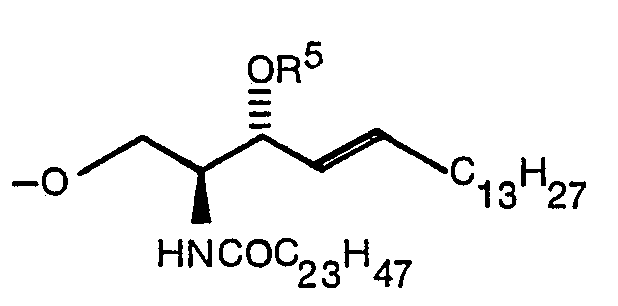
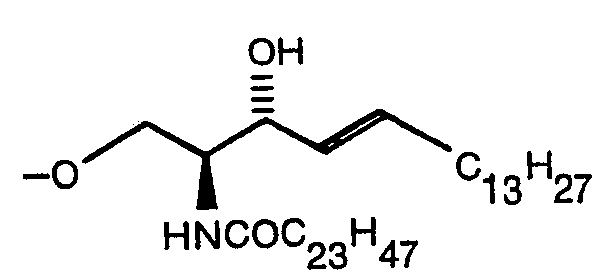
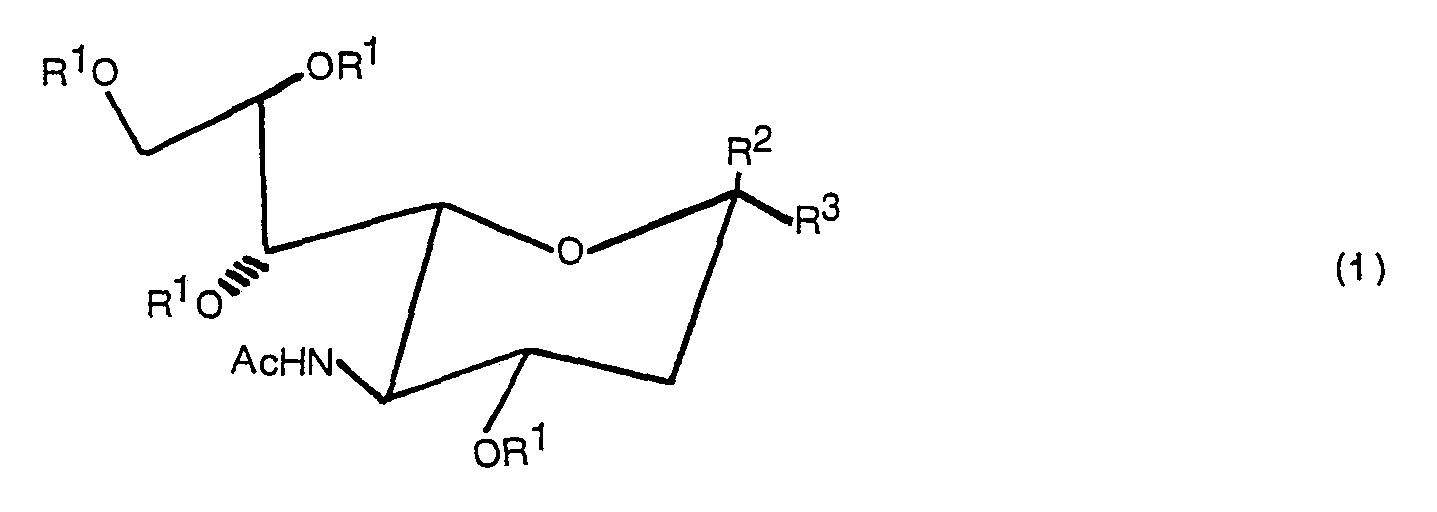
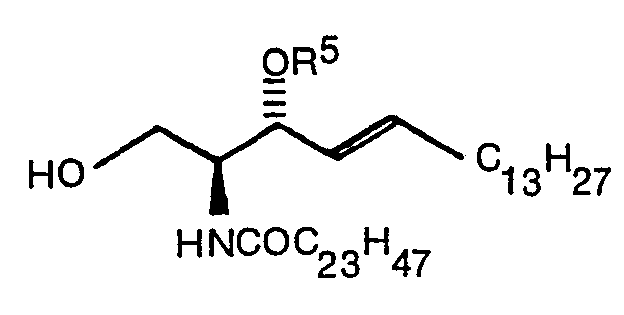
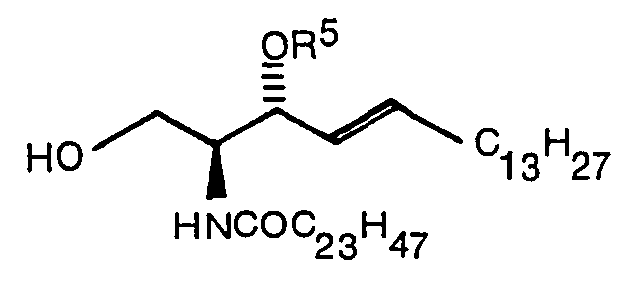
- the present invention relates to a compound expressed by the following formula (1): wherein R 1 denotes a hydrogen atom or a CH 3 CO group, R 2 denotes -COOR 4 (R 4 denotes Na or a methyl group) or (R S denotes a hydrogen atom, ⁇ COC 6 H 5 or ⁇ Si(C 6 H 5 ) 2 C(CH 3 ) 3 ), and R 3 denotes (R S denotes a hydrogen atom, ⁇ COC 6 H 5 or ⁇ Si(C 6 H 5 ) 2 C(CH 3 ) 3 ) when R 2 is -COOR 4 or denotes -COOR 4 when R is (R 4 denotes Na or a methyl group) and a production method thereof.
- R 1 denotes a hydrogen atom or a CH 3 CO group
- R 2 denotes -COOR 4
- R 4 denotes Na or a methyl group
- R S denotes a hydrogen atom, ⁇ COC 6
- the compound (V) is prepared from N-acethylneuraminic acid methyl ester peracetate by the method of Kuhn and others (refer to Chem. Ber., 99, 611-617 (1966)).
- the compound (VI) which is a ceramide portion is produced by the method disclosed in Japanese Patent Application No. 44913/1984 [Japanese Patent Disclosure No. 190745/1985].
- the compound (IX) which is also a ceramide portion is produced by the method disclosed in Japanese Patent Disclosure No. 190745/1985 or Japanese Patent Application No. 248981/1986 (See scheme III).
- the compound (VI) or (IX), a glycosidation catalyst such as silver trifluoromethane sulfonate, a solvent such a dichloroethane, a mixed solution of tetrahydrofuran and chloroform, nitromethane, tetrahydrofuran or chloroform are added to M.S. (molecular sieves) 4A or AW300, and the mixture is agitated at room temperature for about 1 to 6 hours.
- M.S. molecular sieves
- a solution containing the compound (V), and a solvent such as dichloroethane, a mixed solution of tetrahydrofuran and chloroform, nitromethane, tetrahydrofuran or chloroform is added to the resulting mixture under cooling, for example, with ice-methanol, and agitated at room temperature for about 10 to 20 hours after being allowed to stand for about 0.5 to 2 hours.
- the reaction solution is filtered and chloroform is added to the filtrate which is then washed with a saturated aqueous solution of sodium hydrogen carbonate and saturated salt water, dried with anhydrous magnesium sulfate, and subjected to vacuum distillation.
- the residue is purified by a known means such as a silica gel column to obtain the compounds (I) and (11) or compounds (VII) and (VIII).
- the compound (I) is dissolved in methanol and sodium methoxide is added to the methanol solution and agitated at room temperature for about 3 to 12 hours. After the reaction has been completed, the reaction solution is subjected to vacuum distillation and methanol, tetrahydrofuran, and distilled water are added to the residue and agitated at room temperature for about 10 to 20 hours.
- the reaction solution is neutralized with a cation exchanger "Amberlite IRC-50", filtered, and then subjected to vacuum distillation.
- the residue is purified by a known means such as a Sephadex LH-20 column to obtain the compound (III).
- the compound (III) can be obtained by treating the compound (VII) in the same manner as the above.
- the compound (IV) can be obtained by treating the compound (II) or (VIII) in the same manner as the above.
- novel compounds of the present invention are useful as a tumor maker, a molecular marker for cells having the ability of differential induction, or an intermediate of the synthesis thereof.
- reaction solution was filtered and chloroform was added to the filtrate which was then washed with a saturated aqueous solution of sodium hydrogencarbonate and saturated sodium chloride solution, dried over anhydrous magnesium sulfate, and concentrated under vacuum.
- reaction solution was filtered, the filtrate was diluted with chloroform and then washed with a saturated aqueous solution of sodium hydrogencarbonate and saturated sodium chloride solution, dried over anhydrous magnesium sulfate, and concentrated under vacuum.
- reaction solution was filtered and chloroform was added to the filtrate which was then washed with a saturated aqueous solution of sodium hydrogencarbonate and saturated sodium chloride solution, dried over anhydrous magnesium sulfate, and subjected to vacuum distillation.
- the compound (IX) was prepared from the ceramide compound (1a).
- the ceramide compound (1a) 1.360 g (2.09 m mol) was dissolved in pyridine 30 ml, and Trityl chloride, (C 6 H 5 ) 3 CCl, 722.8 mg (2.77 m mol) was added to the pyridine solution followed by stirring at 50°C for 12 hours. Pyridine was removed from the reaction mixture and the residue was dissolved in chloroform. The chloroform solution was washed with water and saturated aqueous solution of sodium chloride, dried with anhydrous magnesium sulfate, and subjected to vacuum distillation.
- the compound (IX) 100 mg (0.113 m mol) was dissolved in THF 2 ml and AgOTf 505 mg (1.96 m mol) dissolved in THF 1 ml were added to activated molecular sieves 4A 1 g followed by stirring for 10 minutes.
- the compound (V) 202 mg (0.34 m mol) dissolved in THF 1 ml was added slowly to the obtained reaction mixture at -20°C followed by agitation at room temperature for 18 hours.
- reaction mixture was filtered by using celite, the filtrate was diluted with EtOAc, washed with a saturated aqueous solution of sodium hydrogencarbonate, water and a saturated aqueous solution of sodium chloride, dried with anhydrous MgS0 4 , and subjected to vacuum distillation.
Landscapes
- Chemical & Material Sciences (AREA)
- Organic Chemistry (AREA)
- Crystallography & Structural Chemistry (AREA)
- Health & Medical Sciences (AREA)
- Life Sciences & Earth Sciences (AREA)
- Engineering & Computer Science (AREA)
- Biochemistry (AREA)
- Biotechnology (AREA)
- General Health & Medical Sciences (AREA)
- Genetics & Genomics (AREA)
- Molecular Biology (AREA)
- Pharmaceuticals Containing Other Organic And Inorganic Compounds (AREA)
- Saccharide Compounds (AREA)
- Heterocyclic Carbon Compounds Containing A Hetero Ring Having Oxygen Or Sulfur (AREA)
Abstract
Description
- The present invention relates to novel sialosylceramides and a production method thereof.
- The glycolipid of mammalion cells comprises a lipid structure expressed as a ceramide in which a fatty acid is amido-bonded to sphinogosine of a long chain amino alcohol and to which sugars such as glucose, galactose, N-acetylglucosamine, N-acetylgalactosamine, fucose, and sialic acid are bonded through glycosidic linkage in various combinations, and belongs to the category of so-called glycosphingolipids. In particular, the glycolipid having sialic acid is called ganglioside.
- Most of these compounds are generally located in the outer molecular layer of the two molecular layers of cell membrane and it has been thought from recent investigations that the compounds play an important role in the function as a reception and response receptor of recognition and information, differentiation, proliferation, malignant change, or behavior in cells.
- However, the function of ganglioside-based glycolipid as a component of cell membrane has not been sufficiently elucidated and it is difficult to isolate ganglioside from an organism and purify it.
- Although precision synthesis of GM3 (GM: ganglioside monosialo) and GM4 has been successfully achieved, the synthesis of an unnatural compound (GM3) of the present invention which has a similar structure to that of the above compounds is necessary and indispensable to the elucidation of the function of the ganglioside-based glycolipid as a component of cell membrane.
- An object of the present invention is to provide novel sialosylceramides and a production method thereof.
- The present invention relates to a compound expressed by the following formula (1):


- Typical examples of the compound expressed by the formula (1) of the present invention are indicated below.


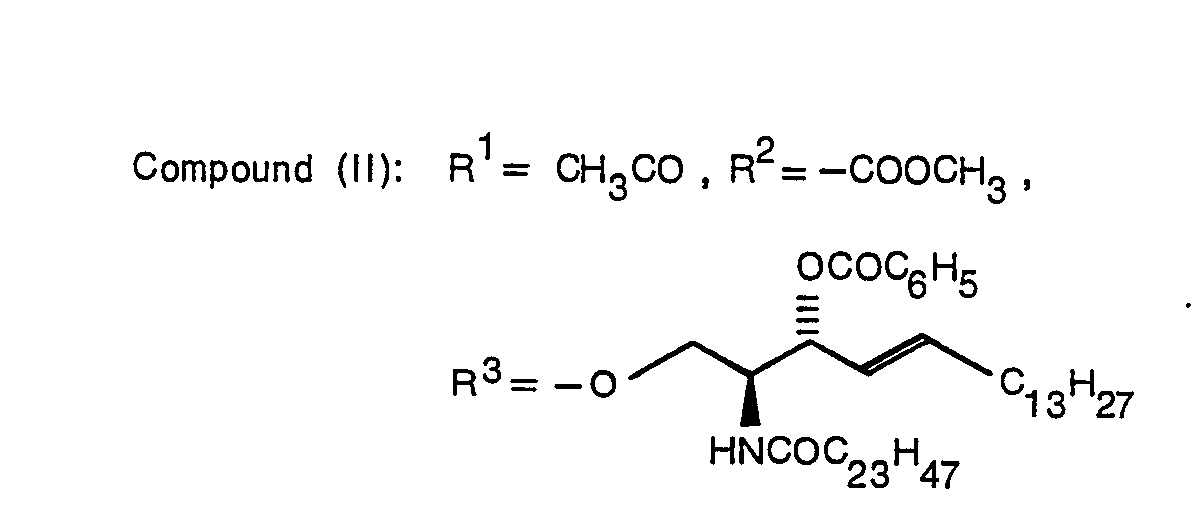


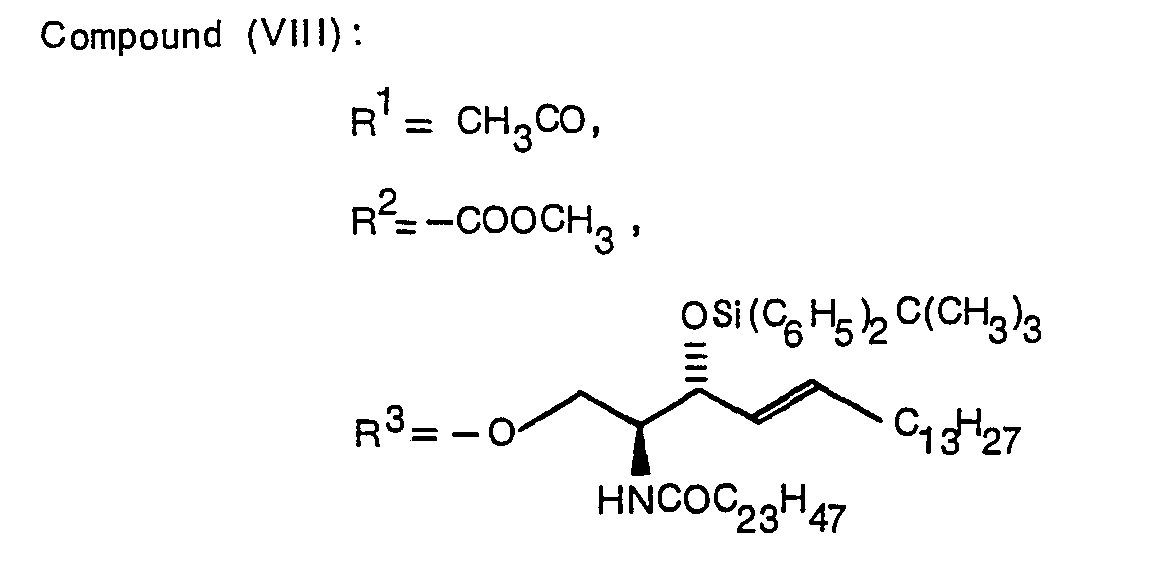
- A production method of the present invention will be described in detail below with reference to schemes I to III.
- The compound (V) is prepared from N-acethylneuraminic acid methyl ester peracetate by the method of Kuhn and others (refer to Chem. Ber., 99, 611-617 (1966)).
- The compound (VI) which is a ceramide portion is produced by the method disclosed in Japanese Patent Application No. 44913/1984 [Japanese Patent Disclosure No. 190745/1985].
- The compound (IX) which is also a ceramide portion is produced by the method disclosed in Japanese Patent Disclosure No. 190745/1985 or Japanese Patent Application No. 248981/1986 (See scheme III).
- The compound (VI) or (IX), a glycosidation catalyst such as silver trifluoromethane sulfonate, a solvent such a dichloroethane, a mixed solution of tetrahydrofuran and chloroform, nitromethane, tetrahydrofuran or chloroform are added to M.S. (molecular sieves) 4A or AW300, and the mixture is agitated at room temperature for about 1 to 6 hours. Then, a solution containing the compound (V), and a solvent such as dichloroethane, a mixed solution of tetrahydrofuran and chloroform, nitromethane, tetrahydrofuran or chloroform is added to the resulting mixture under cooling, for example, with ice-methanol, and agitated at room temperature for about 10 to 20 hours after being allowed to stand for about 0.5 to 2 hours. The reaction solution is filtered and chloroform is added to the filtrate which is then washed with a saturated aqueous solution of sodium hydrogen carbonate and saturated salt water, dried with anhydrous magnesium sulfate, and subjected to vacuum distillation. The residue is purified by a known means such as a silica gel column to obtain the compounds (I) and (11) or compounds (VII) and (VIII).
- The compound (I) is dissolved in methanol and sodium methoxide is added to the methanol solution and agitated at room temperature for about 3 to 12 hours. After the reaction has been completed, the reaction solution is subjected to vacuum distillation and methanol, tetrahydrofuran, and distilled water are added to the residue and agitated at room temperature for about 10 to 20 hours. The reaction solution is neutralized with a cation exchanger "Amberlite IRC-50", filtered, and then subjected to vacuum distillation. The residue is purified by a known means such as a Sephadex LH-20 column to obtain the compound (III).
- The compound (III) can be obtained by treating the compound (VII) in the same manner as the above.
- The compound (IV) can be obtained by treating the compound (II) or (VIII) in the same manner as the above.


- All the compounds (I), (II), (III), (IV), (VII) and (VIII) which are synthesized by the above-mentioned scheme are novel compounds.
- The above novel compounds of the present invention are useful as a tumor maker, a molecular marker for cells having the ability of differential induction, or an intermediate of the synthesis thereof.
- The present invention is described in detail below with reference to examples.
- 100 mg (0.13 millimol) of the compound (VI), 400 mg (1.5 millimol) of silver trifluoromethane sulfonate, 3 ml of dichloroethane were added to 1 g of activated molecular sieves 4A and stirred at room temperature for 3 hours under argon atmosphere. Then, 1 ml of dichloroethane solution containing 50 mg (0.1 millimol) of the compound (V) was added to the resulting solution under cooling with ice-methanol bath and stirred at room temperature for 15 hours after being allowed to stand for 1 hour. The resulting reaction solution was filtered and chloroform was added to the filtrate which was then washed with a saturated aqueous solution of sodium hydrogencarbonate and saturated sodium chloride solution, dried over anhydrous magnesium sulfate, and concentrated under vacuum. The residue was purified by a silica gel column (Wako gel C-300, 25 g,toluene:ethyl acetate =1:2, chloroform: methanol = 10:1) to give 17 mg (14%) of the compound (I) and 7 mg (6%) of the compound (II).
-
- Rf = 0.30 (toluene:ethyl acetate = 1:2)
-

- Elementary analysis:

- 1H―NMR(CDCl3): 6H 3.772 (s, 3H, OMe), 2.107, 2.024, 1.961, 1.881, 1.885 (Ac x 5), 0.879 (t, 6H, CH2CH3 x 2)
-
- Rf = 0.29 (toluene:ethyl acetate = 1:2)
-

- Elementary analysis:

- 1H―NMR(CDCl3): δH 3.559 (s, 3H, OMe), 2.068, 2.033, 2.027, 2.023, 1.880 (Ac x 5), 0.879 (t, 6H, CH2CH3 x 2)
- 100 mg (0.13 millimol) of the compound (VI), 400 mg (1.5 millimol) of silver trifluoromethane sulfonate, 3 ml of a mixed solution of tetrahydrofuran and chloroform (1:1) were added to 1 g of molecular sieves 4A and stirred at room temperature for 3 hours under argon atmosphere. Then, 1 ml of a mixed solution of tetrahydrofuran and chloroform (1:1) containing 100 mg (0.2 millimol) of the compound (V) was added to the resulting solution under cooling with ice-methanol bath and agitated at room temperature for 15 hours after being allowed to stand for 1 hour. The obtained reaction solution was filtered and chloroform was added to the filtrate which was then washed with a saturated aqueous solution of sodium hydrogencarbonate and saturated sodium chloride solution, dried over anhydrous magnesium sulfate, and concentrated under vacuum. The residue was purified by a silica gel column (Wako gel C-300, 25 g, toluene:ethyl acetate = 1:2, chloroform:methanol = 10:1) to give 0 mg (29%) of the compound (I) and 10 mg (42%) of the compound (II).
- Same as those of Example 1.
- Same as those of Example 1.
- 100 mg (0.13 millimol) of the compound (VI), 400 mg (1.5 millimol) of silver trifluoromethane sulfonate, 3 ml of nitromethane were added to 1 g of molecular sieves AW300 and stirred at room temperature for 3 hours under argon atmosphere. Then, 1 ml of a nitromethane solution containing 100 mg (0.2 millimol) of the compound (V) was added to the resulting solution under cooling with ice-methanol bath and stirred at room temperature for 15 hours after being allowed to stand for 1 hour. The obtained reaction solution was filtered, the filtrate was diluted with chloroform and then washed with a saturated aqueous solution of sodium hydrogencarbonate and saturated sodium chloride solution, dried over anhydrous magnesium sulfate, and concentrated under vacuum. The residue was purified by a silica gel column (Wako gel C-300, 25 g, toluene:ethyl acetate = 1:2, chloroform:methanol = 10:1) to give 55 mg (23%) of the compound (I) and 60 mg (25%) of the compound (II).
- Same as those of Example 1.
- Same as those of Example 1.
- 100 mg (0.13 millimol) of the compound (VI), 400 mg (1.5 millimol) of silver trifluoromethane sulfonate, 3 ml of tetrahydrofuran were added to 1 g of molecular sieves AW300 and stirred at room temperature for 3 hours under argon atmosphere. Then, 1 ml of a tetrahydrofuran solution containing 100 mg (0.2 millimol) of the compound (V) was added to the resulting solution under cooling with ice-methanol bath and stirred at room temperature for 15 hours after being allowed to stand for 1 hour. The obtained reaction solution was filtered and chloroform was added to the filtrate which was then washed with a saturated aqueous solution of sodium hydrogencarbonate and saturated sodium chloride solution, dried over anhydrous magnesium sulfate, and subjected to vacuum distillation. The residue was purified by a silica gel column (C-300, 25 g, toluene:ethyl acetate = 1:2, chloroform:methanol = 10:1) to give 70 mg (29%) of the compound (I) and 72 mg (30%) of the compound (II).
- Same as those of Example 1.
- Same as those of Example 1.
- 14 mg (0.012 millimol) of the compound (I) was dissolved in 8 ml of methanol and 50 µl of sodium methoxide was added to the obtained solution and stirred at room temperature for 6 hours. The reaction solution was subjected to vacuum distillation and 1 ml of methanol, 1 ml of tetrahydrofuran, and 0.5 ml of distilled water were added to the residue and stirred at room temperature for 15 hours. The reaction solution was neutralized with an cation exchanger "Amberlite IRC-50", filtered, and then subjected to vacuum distillation. The residue was purified by a Sephadex LH-20 column (chloroform:methanol:water = 60:30:4.6) to give 4.7 mg (43%) of the compound (III).
-
- Rf = 0.63 (butanol:ethanol:water = 2:1:1)
- 1H―NMR 6H (de DMSO:D20 = 49:1, 30°)
- 1.858 (S, 3H, NHCOCH3)
- 0.853 (t, 6H, -CH2CH3)
- Decomposition point: 217-222°C
- 2.0 mg (50%) of the compound (IV) was obtained in the similar manner to that of Example 5 except that 30 pl of sodium methoxide was added to 5 mg (0.004 millimol) of the compound (II).
-
- Rf = 0.63 (butanol:ethanol:water = 2:1:1)
- 1H―NMR 6H (d6 DMSO:D20 =49:1, 30°)
- 1.884 (S, 3H, NHCOCH3)
- 0.855 (t, 6H, -CH2CH3)
- Decomposition point: 74-78°C
- According to the method described in Japanese Patent Application No. 248981/1986, the compound (IX) was prepared from the ceramide compound (1a).
- The ceramide compound (1a) 1.360 g (2.09 m mol) was dissolved in pyridine 30 ml, and Trityl chloride, (C6H5)3CCl, 722.8 mg (2.77 m mol) was added to the pyridine solution followed by stirring at 50°C for 12 hours. Pyridine was removed from the reaction mixture and the residue was dissolved in chloroform. The chloroform solution was washed with water and saturated aqueous solution of sodium chloride, dried with anhydrous magnesium sulfate, and subjected to vacuum distillation. The residue was purified by a silica gel column (Wako gel C-300,85 g, toluene:ethyl acetate = 5:1 containing 2% Et3N) to give 909 mg (45%) of the compound (1 b).
- DMF 15 ml, CISi(C6H5)2C(CH3)3 370 mg (1.36 m mol) and imidazole 183 mg (2.69 m mol) were added to the compound (1 b) 800 mg (0.90 m mol) followed by stirring at room temperature for 12 hours. Ether was added to the obtained reaction solution. The obtained ether solution was washed with water and a saturated aqueous solution of sodium chloride, dried over anhydrous magnesium sulfate, and concentrated under vacuum. The residue was purified by a silica gel column (Wako gel, C-300, 80 g, hexane:ethyl acetate = 10:1, containing 2% Et3N) to give 1.006 g (99%) of the compound (1c).
- The compound (1c) 1.0 g (0.88 m mol) was dissolved in a mixed solution of dichloroethane 20 ml and methanol 1 ml, and TsOH (p-toluensulfonic acid monohydrate) 67 mg (0.35 m mol) was added to the reaction mixture followed by stirring at room temperature for 1 hour. A saturated aqueous solution of NaHC03 was added to the obtained reaction solution to neutralize the solution. After adding chloroform to the solution, the obtained chloroform solution was washed with water and a saturated aqueous solution of sodium chloride, dried over anhydrous magnesium sulfate, and subjected to vacuum distillation. The residue was purified by a silica gel column (Wako gel, C-300, 25 g, hexane:ethyl acetate = 5:1) to give the compound (IX) 650 mg (83%).
-
- Rf = 0.113 (hexane:ethyl acetate = 5:1)
-

- 400 MHz NMR CDCI3, TMS, ppm
- 0.879, 6H, t, J = 6.5, -CH2CH3 x 2, 1.066, 9H, s, t-butyl, 1.252, 62H, s, -CH2-, 1.574, 2H, m, H-3', 1.869, 2H, m, H―6,1.962, 2H, m, H-2', 3.621, 1H, d,d,d, J = 2.9,7.2,11.0, H-1, 3.831, 1H, m, H-2, 3.887, 1 H, d,d,d, J = 2.6, 4.4, 11.1, H-1, 4.335, 1H, t, J = 3.6, H―3, 5.370, 1 H, dd, J = 15.2,5.5, H―4, 5.406, 1 H, dt, J = 15.2, 5.6, H-5, 7.34 - 7.66, 10H, m, aromatic protons
- The compound (IX) 100 mg (0.113 m mol) was dissolved in THF 2 ml and AgOTf 505 mg (1.96 m mol) dissolved in THF 1 ml were added to activated molecular sieves 4A 1 g followed by stirring for 10 minutes. The compound (V) 202 mg (0.34 m mol) dissolved in THF 1 ml was added slowly to the obtained reaction mixture at -20°C followed by agitation at room temperature for 18 hours. The reaction mixture was filtered by using celite, the filtrate was diluted with EtOAc, washed with a saturated aqueous solution of sodium hydrogencarbonate, water and a saturated aqueous solution of sodium chloride, dried with anhydrous MgS04, and subjected to vacuum distillation. The residue was purified by a silica gel column (Wako gel, C-300, 25 g, toluene:EtOAc = 1:1) to give the compounds (VII) (28.5 mg, 18.6%) and (VIII) (36.4 mg, 23.8%).
- Rf = 0.46 (toluene:EtOAc = 1:1)
- Elementary analysis:
- Calculated: C 68.79, H 9.47, N 2.06
- Found: C 68.20, H 9.34, N 2.05
- NMR 400 MHz ppm CDCl3 TMS,
- 0.879 (6H, s, CH3 x 2, J = 7.0), 1.045 (9H, 2, t-Bu), 1.919, 2.003, 2.031, 2.094, 2.138 (s, Ac x 5), 2.404 (1 H, 3-Heq, dd, J = 12.70, 7.82), 3.75 (3H, s, OCH3), 5.05 (m, 1H, H―4), 7.3 - 7.7 (m, 10H, Ph)
- Rf = 0.42 (toluene:EtOAc = 1:1)
- Elementary analysis:
- Calculated: C 67.01, H 9.52, N 2.00 (+2H20)
- Found: C 66.95, H 9.14, N 2.18
- NMR 400 MHz ppm CDCI3 TMS,
- 0.874 (6H, t, CH3 x 2, J = 7.0), 1.031 (9H, s, t-Bu), 1.884, 2.028, 2.041, 2.093, 2.128 (s, OAc x 5), 2.532 (1H, dd, J = 12.82, 4.76, H―3eq), 3.728 (3H, s, OCH3), 4.858 (1H, m, H―4), 7.3 - 7.7 (10H, m, Ph)
Claims (14)









Priority Applications (1)
| Application Number | Priority Date | Filing Date | Title |
|---|---|---|---|
| AT87105321T ATE60060T1 (en) | 1986-04-11 | 1987-04-10 | SIALOSYLCERAMIDES AND PROCESSES FOR THEIR PRODUCTION. |
Applications Claiming Priority (2)
| Application Number | Priority Date | Filing Date | Title |
|---|---|---|---|
| JP8339686 | 1986-04-11 | ||
| JP83396/86 | 1986-04-11 |
Publications (2)
| Publication Number | Publication Date |
|---|---|
| EP0242736A1 EP0242736A1 (en) | 1987-10-28 |
| EP0242736B1 true EP0242736B1 (en) | 1991-01-16 |
Family
ID=13801268
Family Applications (1)
| Application Number | Title | Priority Date | Filing Date |
|---|---|---|---|
| EP87105321A Expired - Lifetime EP0242736B1 (en) | 1986-04-11 | 1987-04-10 | Sialosylceramides and production method thereof |
Country Status (8)
| Country | Link |
|---|---|
| US (1) | US4730058A (en) |
| EP (1) | EP0242736B1 (en) |
| JP (1) | JPH07116209B2 (en) |
| KR (1) | KR950003613B1 (en) |
| CN (1) | CN1019301B (en) |
| AT (1) | ATE60060T1 (en) |
| CA (1) | CA1293720C (en) |
| DE (1) | DE3767351D1 (en) |
Families Citing this family (16)
| Publication number | Priority date | Publication date | Assignee | Title |
|---|---|---|---|---|
| NZ222192A (en) * | 1986-10-20 | 1991-03-26 | Kanto Ishi Pharma Co Ltd | Glycolipid containing n-glycolylneuraminic acid, and preparation thereof |
| US5079353A (en) * | 1987-12-02 | 1992-01-07 | Chembiomed, Ltd. | Sialic acid glycosides, antigens, immunoadsorbents, and methods for their preparation |
| US5344870A (en) * | 1987-12-02 | 1994-09-06 | Alberta Research Council | Sialic acid glycosides, antigens, immunoadsorbents, and methods for their preparation |
| US5239091A (en) * | 1988-08-30 | 1993-08-24 | G. D. Searle & Co. | 2-deoxy derivatives of N-acetyl neuraminic acid and their preparation |
| US5554771A (en) * | 1988-08-30 | 1996-09-10 | G. D. Searle & Co. | 2-deoxy derivatives of N-acetyl neuraminic acid and their preparation |
| JPH03242553A (en) * | 1990-02-19 | 1991-10-29 | Mect Corp | Formulation containing episialo conjugated glucide |
| WO1992017189A1 (en) * | 1991-03-29 | 1992-10-15 | The Regents Of The University Of California | Gangliosides with immunosuppressive activity |
| WO1993002686A1 (en) * | 1991-07-31 | 1993-02-18 | The Regents Of The University Of California | Gangliosides with immunosuppressive ceramide moieties |
| US5936076A (en) * | 1991-08-29 | 1999-08-10 | Kirin Beer Kabushiki Kaisha | αgalactosylceramide derivatives |
| DE4204907A1 (en) * | 1992-02-14 | 1993-08-19 | Reutter Werner | INNOVATIVE GLYCOCONJUGATES WITH N-SUBSTITUTED NEURAMINE ACIDS AS A MEANS FOR STIMULATING THE IMMUNE SYSTEM |
| TW261533B (en) * | 1992-07-16 | 1995-11-01 | Kirin Brewery | |
| AU683026B2 (en) * | 1992-10-22 | 1997-10-30 | Kirin Pharma Kabushiki Kaisha | Novel shingoglycolipid and use thereof |
| CA2160566C (en) * | 1993-04-15 | 2004-07-13 | Tatsuo Higa | Novel sphingoglycolipids and uses thereof |
| US5783564A (en) * | 1993-12-24 | 1998-07-21 | Mitsubishi Chemical Corporation | Sialic acid derivatives |
| TW479061B (en) * | 1993-12-24 | 2002-03-11 | Mitsubishi Chem Corp | Sialic acid derivatives |
| US6074366A (en) * | 1998-01-16 | 2000-06-13 | Tandem Medical Inc. | Medication delivery apparatus |
Family Cites Families (4)
| Publication number | Priority date | Publication date | Assignee | Title |
|---|---|---|---|---|
| JPS5615232B2 (en) * | 1973-10-24 | 1981-04-09 | ||
| US4120824A (en) * | 1977-04-18 | 1978-10-17 | Ici Americas Inc. | Tetravalent manganese-carbon oxidation catalysts and methods of their preparation |
| JPS59164798A (en) * | 1983-03-09 | 1984-09-17 | Rikagaku Kenkyusho | Cyanuric acid-containing glycolipid derivative |
| EP0146810A3 (en) * | 1983-12-05 | 1987-05-13 | Solco Basel AG | Process for the preparation of sphingosin derivatives |
-
1987
- 1987-04-07 JP JP62085354A patent/JPH07116209B2/en not_active Expired - Lifetime
- 1987-04-09 US US07/036,445 patent/US4730058A/en not_active Expired - Fee Related
- 1987-04-10 CN CN87103413A patent/CN1019301B/en not_active Expired
- 1987-04-10 KR KR1019870003451A patent/KR950003613B1/en not_active Expired - Fee Related
- 1987-04-10 DE DE8787105321T patent/DE3767351D1/en not_active Expired - Fee Related
- 1987-04-10 AT AT87105321T patent/ATE60060T1/en not_active IP Right Cessation
- 1987-04-10 EP EP87105321A patent/EP0242736B1/en not_active Expired - Lifetime
- 1987-04-13 CA CA000534560A patent/CA1293720C/en not_active Expired - Fee Related
Also Published As
| Publication number | Publication date |
|---|---|
| CN87103413A (en) | 1987-12-02 |
| CN1019301B (en) | 1992-12-02 |
| US4730058A (en) | 1988-03-08 |
| EP0242736A1 (en) | 1987-10-28 |
| JPH07116209B2 (en) | 1995-12-13 |
| DE3767351D1 (en) | 1991-02-21 |
| ATE60060T1 (en) | 1991-02-15 |
| CA1293720C (en) | 1991-12-31 |
| JPS6345293A (en) | 1988-02-26 |
| KR950003613B1 (en) | 1995-04-17 |
| KR870010072A (en) | 1987-11-30 |
Similar Documents
| Publication | Publication Date | Title |
|---|---|---|
| EP0242736B1 (en) | Sialosylceramides and production method thereof | |
| Chow et al. | Stereospecific Vorbrueggen-like reactions of 1, 2-anhydro sugars. An alternative route to the synthesis of nucleosides | |
| US4968786A (en) | Sialic acid derivatives, galactose derivatives and method for producing the same | |
| EP0204344B1 (en) | Sialosylcerebrosides and a preparation method thereof | |
| JP3231765B2 (en) | Method for producing demethyl epipodophyllotoxin | |
| US4950750A (en) | Glycolipid containing N-glycolylneuraminic acid and method of producing the same | |
| PL149578B1 (en) | Novel method of obtaining sphingozine derivatives | |
| CA1309713C (en) | Sialic acid derivatives and process therefor | |
| US5792842A (en) | Ganglioside GM3 derivative having fluorine atom at 9-position of sialic acid and intermediates therefor | |
| CA1311751C (en) | Ganglioside related compounds and method of producing the same | |
| US5264567A (en) | GM3 analogous compound | |
| US5220003A (en) | Process for the synthesis of 2',3'-dideoxynucleosides | |
| US4774327A (en) | N-glycolylneuraminic acid derivative | |
| CA1251199A (en) | Method for producing asialoganglioside related compounds | |
| CA1320720C (en) | Sialosyl glyceride and process for producing the same | |
| Koike et al. | Stereoselective total synthesis of wheat flour ceramide dihexoside | |
| JP2696524B2 (en) | New synthesis method of ganglioside GM (3) | |
| US4284763A (en) | Sugar acetals, their preparation and use | |
| KR920000620B1 (en) | New anthracycline glycosides derivatives | |
| JP2625620B2 (en) | Fucosyl-glucosamine derivatives | |
| JPH07107074B2 (en) | NeuAcα2 → 9 NeuAc sugar donor | |
| JPH0570473A (en) | Production of beta-glucoside | |
| EP0482584A2 (en) | GM3 analogous compound and preparation method thereof | |
| JPH03112997A (en) | Ganglioside gm3, intermediate and production thereof | |
| EP0582153A1 (en) | Method of preparing 4-deoxy-D-mannose |
Legal Events
| Date | Code | Title | Description |
|---|---|---|---|
| PUAI | Public reference made under article 153(3) epc to a published international application that has entered the european phase |
Free format text: ORIGINAL CODE: 0009012 |
|
| AK | Designated contracting states |
Kind code of ref document: A1 Designated state(s): AT BE CH DE FR GB IT LI LU NL SE |
|
| 17P | Request for examination filed |
Effective date: 19880412 |
|
| 17Q | First examination report despatched |
Effective date: 19900130 |
|
| GRAA | (expected) grant |
Free format text: ORIGINAL CODE: 0009210 |
|
| ITF | It: translation for a ep patent filed | ||
| AK | Designated contracting states |
Kind code of ref document: B1 Designated state(s): AT BE CH DE FR GB IT LI LU NL SE |
|
| REF | Corresponds to: |
Ref document number: 60060 Country of ref document: AT Date of ref document: 19910215 Kind code of ref document: T |
|
| ET | Fr: translation filed | ||
| REF | Corresponds to: |
Ref document number: 3767351 Country of ref document: DE Date of ref document: 19910221 |
|
| PLBE | No opposition filed within time limit |
Free format text: ORIGINAL CODE: 0009261 |
|
| STAA | Information on the status of an ep patent application or granted ep patent |
Free format text: STATUS: NO OPPOSITION FILED WITHIN TIME LIMIT |
|
| 26N | No opposition filed | ||
| PGFP | Annual fee paid to national office [announced via postgrant information from national office to epo] |
Ref country code: LU Payment date: 19930325 Year of fee payment: 7 |
|
| EPTA | Lu: last paid annual fee | ||
| PG25 | Lapsed in a contracting state [announced via postgrant information from national office to epo] |
Ref country code: LU Free format text: LAPSE BECAUSE OF NON-PAYMENT OF DUE FEES Effective date: 19940410 |
|
| EAL | Se: european patent in force in sweden |
Ref document number: 87105321.1 |
|
| PGFP | Annual fee paid to national office [announced via postgrant information from national office to epo] |
Ref country code: FR Payment date: 19960313 Year of fee payment: 10 |
|
| PGFP | Annual fee paid to national office [announced via postgrant information from national office to epo] |
Ref country code: AT Payment date: 19960314 Year of fee payment: 10 |
|
| PGFP | Annual fee paid to national office [announced via postgrant information from national office to epo] |
Ref country code: GB Payment date: 19960315 Year of fee payment: 10 |
|
| PGFP | Annual fee paid to national office [announced via postgrant information from national office to epo] |
Ref country code: SE Payment date: 19960327 Year of fee payment: 10 |
|
| PGFP | Annual fee paid to national office [announced via postgrant information from national office to epo] |
Ref country code: BE Payment date: 19960409 Year of fee payment: 10 |
|
| PGFP | Annual fee paid to national office [announced via postgrant information from national office to epo] |
Ref country code: CH Payment date: 19960424 Year of fee payment: 10 |
|
| PGFP | Annual fee paid to national office [announced via postgrant information from national office to epo] |
Ref country code: NL Payment date: 19960430 Year of fee payment: 10 |
|
| PGFP | Annual fee paid to national office [announced via postgrant information from national office to epo] |
Ref country code: DE Payment date: 19960627 Year of fee payment: 10 |
|
| PG25 | Lapsed in a contracting state [announced via postgrant information from national office to epo] |
Ref country code: GB Effective date: 19970410 Ref country code: AT Effective date: 19970410 |
|
| PG25 | Lapsed in a contracting state [announced via postgrant information from national office to epo] |
Ref country code: SE Effective date: 19970411 |
|
| PG25 | Lapsed in a contracting state [announced via postgrant information from national office to epo] |
Ref country code: LI Free format text: LAPSE BECAUSE OF NON-PAYMENT OF DUE FEES Effective date: 19970430 Ref country code: CH Free format text: LAPSE BECAUSE OF NON-PAYMENT OF DUE FEES Effective date: 19970430 Ref country code: BE Effective date: 19970430 |
|
| BERE | Be: lapsed |
Owner name: MECT CORP. Effective date: 19970430 |
|
| PG25 | Lapsed in a contracting state [announced via postgrant information from national office to epo] |
Ref country code: NL Effective date: 19971101 |
|
| GBPC | Gb: european patent ceased through non-payment of renewal fee |
Effective date: 19970410 |
|
| REG | Reference to a national code |
Ref country code: CH Ref legal event code: PL |
|
| PG25 | Lapsed in a contracting state [announced via postgrant information from national office to epo] |
Ref country code: FR Free format text: LAPSE BECAUSE OF NON-PAYMENT OF DUE FEES Effective date: 19971231 |
|
| PG25 | Lapsed in a contracting state [announced via postgrant information from national office to epo] |
Ref country code: DE Free format text: LAPSE BECAUSE OF NON-PAYMENT OF DUE FEES Effective date: 19980101 |
|
| NLV4 | Nl: lapsed or anulled due to non-payment of the annual fee |
Effective date: 19971101 |
|
| EUG | Se: european patent has lapsed |
Ref document number: 87105321.1 |
|
| REG | Reference to a national code |
Ref country code: FR Ref legal event code: ST |
|
| PG25 | Lapsed in a contracting state [announced via postgrant information from national office to epo] |
Ref country code: IT Free format text: LAPSE BECAUSE OF NON-PAYMENT OF DUE FEES;WARNING: LAPSES OF ITALIAN PATENTS WITH EFFECTIVE DATE BEFORE 2007 MAY HAVE OCCURRED AT ANY TIME BEFORE 2007. THE CORRECT EFFECTIVE DATE MAY BE DIFFERENT FROM THE ONE RECORDED. Effective date: 20050410 |