EP0264299B2 - Dressing - Google Patents
Dressing Download PDFInfo
- Publication number
- EP0264299B2 EP0264299B2 EP87309180A EP87309180A EP0264299B2 EP 0264299 B2 EP0264299 B2 EP 0264299B2 EP 87309180 A EP87309180 A EP 87309180A EP 87309180 A EP87309180 A EP 87309180A EP 0264299 B2 EP0264299 B2 EP 0264299B2
- Authority
- EP
- European Patent Office
- Prior art keywords
- pad
- sealing pad
- water
- aperture
- dressing
- Prior art date
- Legal status (The legal status is an assumption and is not a legal conclusion. Google has not performed a legal analysis and makes no representation as to the accuracy of the status listed.)
- Expired - Lifetime
Links
- 238000007789 sealing Methods 0.000 claims description 58
- 239000000463 material Substances 0.000 claims description 15
- 239000000416 hydrocolloid Substances 0.000 claims description 9
- 230000001681 protective effect Effects 0.000 claims description 9
- 239000011230 binding agent Substances 0.000 claims description 7
- XLYOFNOQVPJJNP-UHFFFAOYSA-N water Substances O XLYOFNOQVPJJNP-UHFFFAOYSA-N 0.000 claims description 6
- 239000002250 absorbent Substances 0.000 claims description 5
- 230000002745 absorbent Effects 0.000 claims description 4
- 239000002671 adjuvant Substances 0.000 claims description 4
- 229920005989 resin Polymers 0.000 claims description 4
- 239000011347 resin Substances 0.000 claims description 4
- 210000004400 mucous membrane Anatomy 0.000 claims description 3
- 239000000853 adhesive Substances 0.000 description 9
- 230000001070 adhesive effect Effects 0.000 description 8
- 239000007788 liquid Substances 0.000 description 4
- 239000004820 Pressure-sensitive adhesive Substances 0.000 description 3
- 206010052428 Wound Diseases 0.000 description 3
- 208000027418 Wounds and injury Diseases 0.000 description 3
- 238000005266 casting Methods 0.000 description 3
- 239000000203 mixture Substances 0.000 description 3
- 230000000474 nursing effect Effects 0.000 description 3
- GRWFGVWFFZKLTI-IUCAKERBSA-N (-)-α-pinene Chemical compound CC1=CC[C@@H]2C(C)(C)[C@H]1C2 GRWFGVWFFZKLTI-IUCAKERBSA-N 0.000 description 2
- 239000004698 Polyethylene Substances 0.000 description 2
- 206010048629 Wound secretion Diseases 0.000 description 2
- 239000001768 carboxy methyl cellulose Substances 0.000 description 2
- ZSWFCLXCOIISFI-UHFFFAOYSA-N cyclopentadiene Chemical compound C1C=CC=C1 ZSWFCLXCOIISFI-UHFFFAOYSA-N 0.000 description 2
- 230000000694 effects Effects 0.000 description 2
- 229920001971 elastomer Polymers 0.000 description 2
- -1 polyethylene Polymers 0.000 description 2
- 229920000573 polyethylene Polymers 0.000 description 2
- 230000028327 secretion Effects 0.000 description 2
- 239000000126 substance Substances 0.000 description 2
- WTARULDDTDQWMU-RKDXNWHRSA-N (+)-β-pinene Chemical compound C1[C@H]2C(C)(C)[C@@H]1CCC2=C WTARULDDTDQWMU-RKDXNWHRSA-N 0.000 description 1
- WTARULDDTDQWMU-IUCAKERBSA-N (-)-Nopinene Natural products C1[C@@H]2C(C)(C)[C@H]1CCC2=C WTARULDDTDQWMU-IUCAKERBSA-N 0.000 description 1
- HECLRDQVFMWTQS-RGOKHQFPSA-N 1755-01-7 Chemical compound C1[C@H]2[C@@H]3CC=C[C@@H]3[C@@H]1C=C2 HECLRDQVFMWTQS-RGOKHQFPSA-N 0.000 description 1
- QTBSBXVTEAMEQO-UHFFFAOYSA-M Acetate Chemical compound CC([O-])=O QTBSBXVTEAMEQO-UHFFFAOYSA-M 0.000 description 1
- NIXOWILDQLNWCW-UHFFFAOYSA-N Acrylic acid Chemical group OC(=O)C=C NIXOWILDQLNWCW-UHFFFAOYSA-N 0.000 description 1
- NLHHRLWOUZZQLW-UHFFFAOYSA-N Acrylonitrile Chemical compound C=CC#N NLHHRLWOUZZQLW-UHFFFAOYSA-N 0.000 description 1
- 239000004215 Carbon black (E152) Substances 0.000 description 1
- 229920002134 Carboxymethyl cellulose Polymers 0.000 description 1
- 102000004190 Enzymes Human genes 0.000 description 1
- 108090000790 Enzymes Proteins 0.000 description 1
- 108010010803 Gelatin Proteins 0.000 description 1
- 229920002907 Guar gum Polymers 0.000 description 1
- 244000043261 Hevea brasiliensis Species 0.000 description 1
- 206010021639 Incontinence Diseases 0.000 description 1
- RRHGJUQNOFWUDK-UHFFFAOYSA-N Isoprene Chemical compound CC(=C)C=C RRHGJUQNOFWUDK-UHFFFAOYSA-N 0.000 description 1
- 239000004952 Polyamide Substances 0.000 description 1
- 229920002367 Polyisobutene Polymers 0.000 description 1
- 239000004372 Polyvinyl alcohol Substances 0.000 description 1
- 229920001328 Polyvinylidene chloride Polymers 0.000 description 1
- WTARULDDTDQWMU-UHFFFAOYSA-N Pseudopinene Natural products C1C2C(C)(C)C1CCC2=C WTARULDDTDQWMU-UHFFFAOYSA-N 0.000 description 1
- CZMRCDWAGMRECN-UGDNZRGBSA-N Sucrose Chemical compound O[C@H]1[C@H](O)[C@@H](CO)O[C@@]1(CO)O[C@@H]1[C@H](O)[C@@H](O)[C@H](O)[C@@H](CO)O1 CZMRCDWAGMRECN-UGDNZRGBSA-N 0.000 description 1
- 229930006000 Sucrose Natural products 0.000 description 1
- 208000002847 Surgical Wound Diseases 0.000 description 1
- 208000025865 Ulcer Diseases 0.000 description 1
- 238000010521 absorption reaction Methods 0.000 description 1
- DPXJVFZANSGRMM-UHFFFAOYSA-N acetic acid;2,3,4,5,6-pentahydroxyhexanal;sodium Chemical compound [Na].CC(O)=O.OCC(O)C(O)C(O)C(O)C=O DPXJVFZANSGRMM-UHFFFAOYSA-N 0.000 description 1
- 239000004840 adhesive resin Substances 0.000 description 1
- 229920006223 adhesive resin Polymers 0.000 description 1
- XCPQUQHBVVXMRQ-UHFFFAOYSA-N alpha-Fenchene Natural products C1CC2C(=C)CC1C2(C)C XCPQUQHBVVXMRQ-UHFFFAOYSA-N 0.000 description 1
- MVNCAPSFBDBCGF-UHFFFAOYSA-N alpha-pinene Natural products CC1=CCC23C1CC2C3(C)C MVNCAPSFBDBCGF-UHFFFAOYSA-N 0.000 description 1
- 230000003466 anti-cipated effect Effects 0.000 description 1
- 210000000436 anus Anatomy 0.000 description 1
- 238000001266 bandaging Methods 0.000 description 1
- 229930006722 beta-pinene Natural products 0.000 description 1
- 229920001400 block copolymer Polymers 0.000 description 1
- 230000036760 body temperature Effects 0.000 description 1
- 235000010948 carboxy methyl cellulose Nutrition 0.000 description 1
- 239000008112 carboxymethyl-cellulose Substances 0.000 description 1
- 229940096529 carboxypolymethylene Drugs 0.000 description 1
- 238000010276 construction Methods 0.000 description 1
- 229920001577 copolymer Polymers 0.000 description 1
- 238000005520 cutting process Methods 0.000 description 1
- 239000000806 elastomer Substances 0.000 description 1
- 239000006261 foam material Substances 0.000 description 1
- LCWMKIHBLJLORW-UHFFFAOYSA-N gamma-carene Natural products C1CC(=C)CC2C(C)(C)C21 LCWMKIHBLJLORW-UHFFFAOYSA-N 0.000 description 1
- 229920000159 gelatin Polymers 0.000 description 1
- 239000008273 gelatin Substances 0.000 description 1
- 235000019322 gelatine Nutrition 0.000 description 1
- 235000011852 gelatine desserts Nutrition 0.000 description 1
- 239000000665 guar gum Substances 0.000 description 1
- 229960002154 guar gum Drugs 0.000 description 1
- 235000010417 guar gum Nutrition 0.000 description 1
- 230000035876 healing Effects 0.000 description 1
- 239000011796 hollow space material Substances 0.000 description 1
- 229930195733 hydrocarbon Natural products 0.000 description 1
- 150000002430 hydrocarbons Chemical class 0.000 description 1
- 238000002347 injection Methods 0.000 description 1
- 239000007924 injection Substances 0.000 description 1
- 210000002011 intestinal secretion Anatomy 0.000 description 1
- 238000004519 manufacturing process Methods 0.000 description 1
- 238000000034 method Methods 0.000 description 1
- 239000002480 mineral oil Substances 0.000 description 1
- 235000010446 mineral oil Nutrition 0.000 description 1
- 229920003052 natural elastomer Polymers 0.000 description 1
- 229920001194 natural rubber Polymers 0.000 description 1
- 239000001814 pectin Substances 0.000 description 1
- 229920001277 pectin Polymers 0.000 description 1
- 235000010987 pectin Nutrition 0.000 description 1
- 239000004033 plastic Substances 0.000 description 1
- 229920003023 plastic Polymers 0.000 description 1
- 229920002647 polyamide Polymers 0.000 description 1
- 229920006149 polyester-amide block copolymer Polymers 0.000 description 1
- 229920001223 polyethylene glycol Polymers 0.000 description 1
- 229920001195 polyisoprene Polymers 0.000 description 1
- 229920000642 polymer Polymers 0.000 description 1
- 229920002635 polyurethane Polymers 0.000 description 1
- 239000004814 polyurethane Substances 0.000 description 1
- 229920003225 polyurethane elastomer Polymers 0.000 description 1
- 229920002451 polyvinyl alcohol Polymers 0.000 description 1
- 235000019422 polyvinyl alcohol Nutrition 0.000 description 1
- 239000005033 polyvinylidene chloride Substances 0.000 description 1
- 238000003825 pressing Methods 0.000 description 1
- GRWFGVWFFZKLTI-UHFFFAOYSA-N rac-alpha-Pinene Natural products CC1=CCC2C(C)(C)C1C2 GRWFGVWFFZKLTI-UHFFFAOYSA-N 0.000 description 1
- 239000000565 sealant Substances 0.000 description 1
- 229920002379 silicone rubber Polymers 0.000 description 1
- 239000004945 silicone rubber Substances 0.000 description 1
- 235000019812 sodium carboxymethyl cellulose Nutrition 0.000 description 1
- 229920001027 sodium carboxymethylcellulose Polymers 0.000 description 1
- 238000005728 strengthening Methods 0.000 description 1
- 239000005720 sucrose Substances 0.000 description 1
- 210000004243 sweat Anatomy 0.000 description 1
- 230000007704 transition Effects 0.000 description 1
- 231100000397 ulcer Toxicity 0.000 description 1
Images
Classifications
-
- A—HUMAN NECESSITIES
- A61—MEDICAL OR VETERINARY SCIENCE; HYGIENE
- A61F—FILTERS IMPLANTABLE INTO BLOOD VESSELS; PROSTHESES; DEVICES PROVIDING PATENCY TO, OR PREVENTING COLLAPSING OF, TUBULAR STRUCTURES OF THE BODY, e.g. STENTS; ORTHOPAEDIC, NURSING OR CONTRACEPTIVE DEVICES; FOMENTATION; TREATMENT OR PROTECTION OF EYES OR EARS; BANDAGES, DRESSINGS OR ABSORBENT PADS; FIRST-AID KITS
- A61F5/00—Orthopaedic methods or devices for non-surgical treatment of bones or joints; Nursing devices ; Anti-rape devices
- A61F5/44—Devices worn by the patient for reception of urine, faeces, catamenial or other discharge; Colostomy devices
- A61F5/443—Devices worn by the patient for reception of urine, faeces, catamenial or other discharge; Colostomy devices having adhesive seals for securing to the body, e.g. of hydrocolloid type seals, e.g. gels, starches, karaya gums
-
- A—HUMAN NECESSITIES
- A61—MEDICAL OR VETERINARY SCIENCE; HYGIENE
- A61F—FILTERS IMPLANTABLE INTO BLOOD VESSELS; PROSTHESES; DEVICES PROVIDING PATENCY TO, OR PREVENTING COLLAPSING OF, TUBULAR STRUCTURES OF THE BODY, e.g. STENTS; ORTHOPAEDIC, NURSING OR CONTRACEPTIVE DEVICES; FOMENTATION; TREATMENT OR PROTECTION OF EYES OR EARS; BANDAGES, DRESSINGS OR ABSORBENT PADS; FIRST-AID KITS
- A61F13/00—Bandages or dressings; Absorbent pads
- A61F13/02—Adhesive bandages or dressings
- A61F13/0203—Adhesive bandages or dressings with fluid retention members
- A61F13/0213—Adhesive bandages or dressings with fluid retention members the fluid retention member being a layer of hydrocolloid, gel forming material
-
- A—HUMAN NECESSITIES
- A61—MEDICAL OR VETERINARY SCIENCE; HYGIENE
- A61F—FILTERS IMPLANTABLE INTO BLOOD VESSELS; PROSTHESES; DEVICES PROVIDING PATENCY TO, OR PREVENTING COLLAPSING OF, TUBULAR STRUCTURES OF THE BODY, e.g. STENTS; ORTHOPAEDIC, NURSING OR CONTRACEPTIVE DEVICES; FOMENTATION; TREATMENT OR PROTECTION OF EYES OR EARS; BANDAGES, DRESSINGS OR ABSORBENT PADS; FIRST-AID KITS
- A61F13/00—Bandages or dressings; Absorbent pads
- A61F2013/00089—Wound bandages
- A61F2013/00157—Wound bandages for burns or skin transplants
-
- A—HUMAN NECESSITIES
- A61—MEDICAL OR VETERINARY SCIENCE; HYGIENE
- A61F—FILTERS IMPLANTABLE INTO BLOOD VESSELS; PROSTHESES; DEVICES PROVIDING PATENCY TO, OR PREVENTING COLLAPSING OF, TUBULAR STRUCTURES OF THE BODY, e.g. STENTS; ORTHOPAEDIC, NURSING OR CONTRACEPTIVE DEVICES; FOMENTATION; TREATMENT OR PROTECTION OF EYES OR EARS; BANDAGES, DRESSINGS OR ABSORBENT PADS; FIRST-AID KITS
- A61F13/00—Bandages or dressings; Absorbent pads
- A61F2013/00089—Wound bandages
- A61F2013/00217—Wound bandages not adhering to the wound
- A61F2013/00221—Wound bandages not adhering to the wound biodegradable, non-irritating
-
- A—HUMAN NECESSITIES
- A61—MEDICAL OR VETERINARY SCIENCE; HYGIENE
- A61F—FILTERS IMPLANTABLE INTO BLOOD VESSELS; PROSTHESES; DEVICES PROVIDING PATENCY TO, OR PREVENTING COLLAPSING OF, TUBULAR STRUCTURES OF THE BODY, e.g. STENTS; ORTHOPAEDIC, NURSING OR CONTRACEPTIVE DEVICES; FOMENTATION; TREATMENT OR PROTECTION OF EYES OR EARS; BANDAGES, DRESSINGS OR ABSORBENT PADS; FIRST-AID KITS
- A61F13/00—Bandages or dressings; Absorbent pads
- A61F2013/00361—Plasters
- A61F2013/00365—Plasters use
- A61F2013/00412—Plasters use for use with needles, tubes or catheters
-
- A—HUMAN NECESSITIES
- A61—MEDICAL OR VETERINARY SCIENCE; HYGIENE
- A61F—FILTERS IMPLANTABLE INTO BLOOD VESSELS; PROSTHESES; DEVICES PROVIDING PATENCY TO, OR PREVENTING COLLAPSING OF, TUBULAR STRUCTURES OF THE BODY, e.g. STENTS; ORTHOPAEDIC, NURSING OR CONTRACEPTIVE DEVICES; FOMENTATION; TREATMENT OR PROTECTION OF EYES OR EARS; BANDAGES, DRESSINGS OR ABSORBENT PADS; FIRST-AID KITS
- A61F13/00—Bandages or dressings; Absorbent pads
- A61F2013/00361—Plasters
- A61F2013/00727—Plasters means for wound humidity control
- A61F2013/00748—Plasters means for wound humidity control with hydrocolloids or superabsorbers
-
- A—HUMAN NECESSITIES
- A61—MEDICAL OR VETERINARY SCIENCE; HYGIENE
- A61F—FILTERS IMPLANTABLE INTO BLOOD VESSELS; PROSTHESES; DEVICES PROVIDING PATENCY TO, OR PREVENTING COLLAPSING OF, TUBULAR STRUCTURES OF THE BODY, e.g. STENTS; ORTHOPAEDIC, NURSING OR CONTRACEPTIVE DEVICES; FOMENTATION; TREATMENT OR PROTECTION OF EYES OR EARS; BANDAGES, DRESSINGS OR ABSORBENT PADS; FIRST-AID KITS
- A61F13/00—Bandages or dressings; Absorbent pads
- A61F2013/00361—Plasters
- A61F2013/00727—Plasters means for wound humidity control
- A61F2013/00757—Plasters means for wound humidity control with absorbent adhesives
-
- A—HUMAN NECESSITIES
- A61—MEDICAL OR VETERINARY SCIENCE; HYGIENE
- A61F—FILTERS IMPLANTABLE INTO BLOOD VESSELS; PROSTHESES; DEVICES PROVIDING PATENCY TO, OR PREVENTING COLLAPSING OF, TUBULAR STRUCTURES OF THE BODY, e.g. STENTS; ORTHOPAEDIC, NURSING OR CONTRACEPTIVE DEVICES; FOMENTATION; TREATMENT OR PROTECTION OF EYES OR EARS; BANDAGES, DRESSINGS OR ABSORBENT PADS; FIRST-AID KITS
- A61F13/00—Bandages or dressings; Absorbent pads
- A61F2013/00361—Plasters
- A61F2013/00855—Plasters pervious to air or vapours
- A61F2013/00885—Plasters pervious to air or vapours impervious, i.e. occlusive bandage
- A61F2013/00893—Plasters pervious to air or vapours impervious, i.e. occlusive bandage viscoelastic oil-elastomer gel
-
- A—HUMAN NECESSITIES
- A61—MEDICAL OR VETERINARY SCIENCE; HYGIENE
- A61F—FILTERS IMPLANTABLE INTO BLOOD VESSELS; PROSTHESES; DEVICES PROVIDING PATENCY TO, OR PREVENTING COLLAPSING OF, TUBULAR STRUCTURES OF THE BODY, e.g. STENTS; ORTHOPAEDIC, NURSING OR CONTRACEPTIVE DEVICES; FOMENTATION; TREATMENT OR PROTECTION OF EYES OR EARS; BANDAGES, DRESSINGS OR ABSORBENT PADS; FIRST-AID KITS
- A61F13/00—Bandages or dressings; Absorbent pads
- A61F13/15—Absorbent pads, e.g. sanitary towels, swabs or tampons for external or internal application to the body; Supporting or fastening means therefor; Tampon applicators
- A61F2013/15008—Absorbent pads, e.g. sanitary towels, swabs or tampons for external or internal application to the body; Supporting or fastening means therefor; Tampon applicators characterized by the use
- A61F2013/15048—Absorbent pads, e.g. sanitary towels, swabs or tampons for external or internal application to the body; Supporting or fastening means therefor; Tampon applicators characterized by the use for protection against contamination, or protection in using body disinfecting wipes
-
- A—HUMAN NECESSITIES
- A61—MEDICAL OR VETERINARY SCIENCE; HYGIENE
- A61F—FILTERS IMPLANTABLE INTO BLOOD VESSELS; PROSTHESES; DEVICES PROVIDING PATENCY TO, OR PREVENTING COLLAPSING OF, TUBULAR STRUCTURES OF THE BODY, e.g. STENTS; ORTHOPAEDIC, NURSING OR CONTRACEPTIVE DEVICES; FOMENTATION; TREATMENT OR PROTECTION OF EYES OR EARS; BANDAGES, DRESSINGS OR ABSORBENT PADS; FIRST-AID KITS
- A61F13/00—Bandages or dressings; Absorbent pads
- A61F13/15—Absorbent pads, e.g. sanitary towels, swabs or tampons for external or internal application to the body; Supporting or fastening means therefor; Tampon applicators
- A61F13/51—Absorbent pads, e.g. sanitary towels, swabs or tampons for external or internal application to the body; Supporting or fastening means therefor; Tampon applicators characterised by the outer layers of the pads
- A61F13/514—Backsheet, i.e. the impermeable cover or layer furthest from the skin
- A61F13/51401—Backsheet, i.e. the impermeable cover or layer furthest from the skin characterised by the material
- A61F2013/51409—Backsheet, i.e. the impermeable cover or layer furthest from the skin characterised by the material being a film
-
- A—HUMAN NECESSITIES
- A61—MEDICAL OR VETERINARY SCIENCE; HYGIENE
- A61F—FILTERS IMPLANTABLE INTO BLOOD VESSELS; PROSTHESES; DEVICES PROVIDING PATENCY TO, OR PREVENTING COLLAPSING OF, TUBULAR STRUCTURES OF THE BODY, e.g. STENTS; ORTHOPAEDIC, NURSING OR CONTRACEPTIVE DEVICES; FOMENTATION; TREATMENT OR PROTECTION OF EYES OR EARS; BANDAGES, DRESSINGS OR ABSORBENT PADS; FIRST-AID KITS
- A61F13/00—Bandages or dressings; Absorbent pads
- A61F13/15—Absorbent pads, e.g. sanitary towels, swabs or tampons for external or internal application to the body; Supporting or fastening means therefor; Tampon applicators
- A61F13/53—Absorbent pads, e.g. sanitary towels, swabs or tampons for external or internal application to the body; Supporting or fastening means therefor; Tampon applicators characterised by the absorbing medium
- A61F2013/530481—Absorbent pads, e.g. sanitary towels, swabs or tampons for external or internal application to the body; Supporting or fastening means therefor; Tampon applicators characterised by the absorbing medium having superabsorbent materials, i.e. highly absorbent polymer gel materials
Definitions
- the present invention relates to a dressing of the kind comprising a skin-friendly, water absorbent sealing pad adhering to skin and mucous membranes and having a predetermined shape and size, said dressing consisting of a water-soluble or water-swellable hydrocolloid dispersed in or admixed with a water-insoluble, viscous, elastomeric binder and/or a tackifier resin and/or other adjuvants, said sealing pad on one surface being firmly connected to a non-adhesive, water-tight cover layer and on the other surface being provided with a detachable protective cover, the sealing pad extending to the outer edge of the cover layer.
- dressings An important use of such dressings is for the absorption of wound secretions for instance by coverage of ulcers and burns. A further important use is as prophylacting dressings for avoidance of blisters and wounds from shear and friction. Other important fields of use are as sealing pads for securing ostomy equipment such as ostomy bags, drains and/or collecting bags for drainage from surgical wounds and incontinence equipment. The dressings are also used with healing substances for wound care incorporated therein.
- the material constituting the sealing pad has a tendency to flow along the edges thereof, partly influenced by the absorbed aqueous secretions, but especially under the influence of pressure since the material of the sealing pad even at body temperature (approx. 37°C) is so plastic that even weak pressures for instance from folds of the skin will cause the substance to flow.
- a pressure sensitive tape for instance a microporous tape
- a suitable length for instance 1-2 cm from the edge at all sides.
- This is a price-raising measure and will also increase the time consumption of the nursing staff for bandaging.
- ostomy equipment it is well-known, for instance from US Patent Specification No. 4,213,458, corresponding to Danish Patent Specification No. 146,466, and from various commercial ostomy bags to provide ostomy sealing rings with a porous sheet material such as a microporous tape over and around the outer edge in order to prevent the material of the sealing pad from flowing out and to further strengthen the adhesion. This contributes to make the ostomy equipment in question more expensive and cannot be used on the inner part of the sealing pad adjacent the ostomy aperture.
- a dressing of the kind comprising a skin-friendly, water absorbent sealing pad adapted to be secured to skin, mucous membranes or the like, said pad consisting of one or more water-soluble or water-swellable hydrocolloids dispersed in or admixed with a water-insoluble, viscous, elastomeric binder and, optionally, a tackifier resin and/or other adjuvants,one surface of the pad being firmly connected to a water-tight cover layer and the other surface being provided with a detachable protective cover sheet the sealing pad extending to the outer edge of the cover layer, characterised in that the sealing pad at least around its outer periphery is preformed to be bevelled such that its thickness adjacent its edge does not exceed about one quarter of its maximum thickness,wherein the bevel extends only across part of the pad.
- the sealing pad according to the invention may also be bevelled and have reduced thickness around the edge of said aperture.
- the inner edge of such rings will absorb liquid that might leak from the stoma instead of entering an ostomy bag, and this causes the inner edge of the ring to swell to a higher degree than the remaining parts of the pad and thereby tend to lose faster the adhesion to the skin than the other parts, which will entail a highly undesired contact between the liquid and the skin.
- the degree of uptake of liquid into the pad from the inner edge of the annular structure is, however, proportional to the thickness of the edge and when due to the bevel this is smaller than normally, and the sealing effect will last longer, the said risk hence be reduced and the lifetime of the sealing ring thereby be increased.
- the sealing pad or dressing can absorb water over the entire area thereof.
- the bevelled thin edge portions of the dressing or sealing pad are more flexible than is the remainder thereof and thereby offer an especially good adhesion which is on a par with that obtained by strengthening with tape comprising a self-adhesive sealant.
- the thickness dimension is not necessarily in correct proportion to the dimension of width.
- a dressing 3 shown in Fig. 1 has a main component comprising a sealing pad 4 made from a skin-friendly, water absorbent adhesive material consisting of a water-soluble or water-swellable hydrocolloid blended with or dispersed in a water-insoluble, viscous, elastomeric binder and possibly also an adhesive resin and/or other adjuvants.
- a sealing pad 4 made from a skin-friendly, water absorbent adhesive material consisting of a water-soluble or water-swellable hydrocolloid blended with or dispersed in a water-insoluble, viscous, elastomeric binder and possibly also an adhesive resin and/or other adjuvants.
- the sealing pad On the upper surface the sealing pad is firmly connected, e.g. by virtue of its pressure-sensitive properties, to a cover layer 5 and on the under side with a detachable protective cover 6, e.g. of siliconized paper.
- the skin flange may be of any known kind.
- the cover layer is preferably a film of water-tight (and hence water-insoluble) material, e.g. a polyurethane, polyethylene, polyester or polyamide film, or a thin foam material of for instance one of the same materials.
- the cover layer may also be laminated, e.g. when it has to have a high mechanical strength when used for connecting the skin flange to other objects.
- the protective cover may for instance be siliconized paper. It does not need to have the same contour as the sealing pad and the cover layer, e.g. a number of skin flanges may be attached to a larger sheet of protective cover; this sheet is not present on the dressing according to the invention when in use and therefore is not an essential part of the invention.
- the sealing pad may be of any known type of the hydrocolloid-containing, liquid-absorbing kind.
- the dressing known from US Patent Specification No. 3,339,546 in which the adhesive binder composition is a mixture of a water-soluble or swellable hydrocolloid admixed with a water-soluble, viscous, rubberlike elastic binder.
- hydrocolloid examples include polyvinyl alcohol, pectin, gelatin, carboxymethyl cellulose, carbowax and carboxypolymethylene; and as examples of the viscous binder natural rubber (caoutchouc), silicone rubber, acrylonitrile rubber, polyurethane rubber, sucrose acetate isoburytate and polyisobutylene, amongst which the latter is preferred.
- a continous phase containing a physically cross-linked elastomer consisting of one or more styrene-olefinestyrene block copolymers, a hydrocarbon tackifier resin consisting of a polymer or copolymer of cyclopentadiene, dicyclopentadiene, ⁇ -pinene and/or ⁇ -pinene, an antioxydant and optionally a mineral oil, and (II) a disperse phase consisting of one or more water-swellable hydrocolloids, preferably guar gum and/or sodium carboxymethylcellulose.
- a continous phase containing a physically cross-linked elastomer consisting of one or more styrene-olefinestyrene block copolymers, a hydrocarbon tackifier resin consisting of a polymer or copolymer of cyclopentadiene, dicyclopentadiene, ⁇ -pinene and/or ⁇ -pin
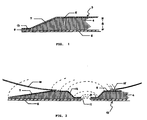
- the characteristic feature of the present dressing including the skin flange 3 is that along all edges thereof it has a bevel 7, which provides the advantages described hereinbefore. It will be understood that this bevel necessitates that the dressing has a predetermined shape and size which, incidentally, may be arbitrarily chosen with a view to the intended purpose, and cannot be produced by simply being punched out from a sheet of dressing material. Adjacent the edge 9 of the sealing pad its thickness does not exceed 1/4 of its maximum thickness 8. Between the edge 9 and the bevelled portion 7 the dressing 3 in the embodiment shown has an area 13 of a constant thickness as the lesser thickness of the bevel, i.e. not exceeding 1/4 of the normal thickness 8.
- a fastening and sealing ring for ostomy or drainage equipment as shown in Fig. 2 is annular with a (not essentially) central opening 11 for engaging a stoma or a drain (not shown).
- a sealing pad 4 surrounded by a permanent cover layer 5 and a detachable protective cover 6 which may all be constructed as described above.
- This fastening and sealing ring 10 like the skin flange 3 has a bevel 7 along the outer edge, and also a similar bevel 12 along its inner edge, around the aperture 11.
- the bevelled areas do not extend either to the outer or to the inner edges but gradually become a narrow edge area 14 in which the sealing pad has a considerably reduced thickness not exceeding 1/4 of its greatest thickness.
- the sealing pad of the ring 10 may, if desired, also end from the bevelled area in a small/narrow edge area having plane-parallel areas connected to the cover layer 5 and the protecting cover 6.
- a collecting bag 16 may be fastened to the cover layer 5 of the ring by means of a weld 15.
- dressings according to the invention may be similar to those of other corresponding dressings.
- Dressings as shown in Fig. 1 may for instance be rectangular and have a length and width from 1 or some few centimeters to 10-20 centimeters.
- Ostomy sealing pads may for instance be annular and have an outer diameter of 5-10 centimeters and an inner diameter of, e.g., 1 cm.
- the thickness of the sealing pad or dressing - the word "pad” does not aim at any definite shape, e.g. annular or elliptic - will normally be 0.25-2.5 mm.
- the width of the bevel of the embodiment shown in Fig. 1 i.e. the distance from the outer edge where it is narrowest to the portion of constant thickness, may for instance be 3-10 mm and the thickness of the thinnest area be 100-250 ⁇ m.
- the thickness thereof may be as stated above, viz. 100-250 ⁇ m when the maximum thickness of the sealing pad is approximately 1.1 mm.
- Fastening and sealing rings for ostomy equipment are often manufactured with a smaller diameter of the central aperture than the normal outer diameter of stomas; here stomas are referred to that have a diameter within the variation of the diameter falling within the normal range (which includes approximately 98% of all cases).
- stomas are referred to that have a diameter within the variation of the diameter falling within the normal range (which includes approximately 98% of all cases).
- the purpose is that the patient or the nursing staff cut the aperture before attachment so as to exactly fit the stoma it is intended for.
- the area of reduced thickness adjacent the aperture and between the aperture and the start of the bevel has a radial width corresponding to the area around the aperture expected to be removed when used for a stoma having a maximum width within the normal range.
- the diameter of the aperture when delivered from the producer will be approximately 1 cm, and within the normal range a maximum stoma diameter of approximately 4 cm is anticipated which means that the area of the sealing pad of reduced, constant thickness adjacent the stoma aperture should have a radial width of approximately 1.5 cm. It may be appropriate that the bevel from this minimum thickness to the maximum thickness of the sealing pad is somewhat steeper along the inner edge than is the bevel along the outer edge in order for the ring to be provided with a reasonably large area - of a difference of radius not smaller than 1 cm - having full thickness. This is due to the fact that the adhesion effect and especially the duration thereof is greater in thicker than in thinner sealing pads even though, as mentioned above, an improved adhesion of the thin areas may be obtained due to the increased flexibility thereof.
- Dressings in accordance with the invention may be manufactured in various ways.
- a simple process is to press an object.
- the mould may be adapted to form only one dressing at a time, or to press a number of dressings from a larger sheet of blanks in one operation.
- the blank or the sheet of blanks is provided with both adhesive and cover layer and is passed between the bottom plate and the mould, which is then operated to make the bevel at a pressure of e.g. 10-40 metric tonnes and a temperature of 90-110°C for 1-3 seconds; the exact conditions depend on the exact composition of the product.
- the edges are cut clean by diecutting in a well-known manner.
- the protective cover must be present.
- the casting mould has a hollow space between the two siliconized sheets, corresponding to the intended shape of the dressing (skin flange or ring) and the bevel thereof and is provided with an inlet for adhesive.
- the mass is thereby cast at a suitable temperature after which the two sheets are removed together in one step from the casting mould, and the dressing with cover layer and protective cover thus formed is detached and cut clean by die-cutting as mentioned above.
- cover layer for rings to be used for ostomy equipment and drainage equipment with bags must be capable of being welded to the film from which the collecting bag has been produced.
- films made from polyvinylidenechloride or laminates containing same are especially suitable for this purpose.
Landscapes
- Health & Medical Sciences (AREA)
- Animal Behavior & Ethology (AREA)
- Public Health (AREA)
- Engineering & Computer Science (AREA)
- Biomedical Technology (AREA)
- Heart & Thoracic Surgery (AREA)
- Vascular Medicine (AREA)
- Dispersion Chemistry (AREA)
- Life Sciences & Earth Sciences (AREA)
- General Health & Medical Sciences (AREA)
- Chemical & Material Sciences (AREA)
- Veterinary Medicine (AREA)
- Epidemiology (AREA)
- Nursing (AREA)
- Orthopedic Medicine & Surgery (AREA)
- Orthopedics, Nursing, And Contraception (AREA)
- Materials For Medical Uses (AREA)
Description
- The present invention relates to a dressing of the kind comprising a skin-friendly, water absorbent sealing pad adhering to skin and mucous membranes and having a predetermined shape and size, said dressing consisting of a water-soluble or water-swellable hydrocolloid dispersed in or admixed with a water-insoluble, viscous, elastomeric binder and/or a tackifier resin and/or other adjuvants, said sealing pad on one surface being firmly connected to a non-adhesive, water-tight cover layer and on the other surface being provided with a detachable protective cover, the sealing pad extending to the outer edge of the cover layer.
- An important use of such dressings is for the absorption of wound secretions for instance by coverage of ulcers and burns. A further important use is as prophylacting dressings for avoidance of blisters and wounds from shear and friction. Other important fields of use are as sealing pads for securing ostomy equipment such as ostomy bags, drains and/or collecting bags for drainage from surgical wounds and incontinence equipment. The dressings are also used with healing substances for wound care incorporated therein.
- In the former case a rather heavy uptake of liquids takes place in the sealing pad because of the hydrocolloid therein, and sooner or later this will cause the sealing pad to lose its ability of sealing to the body of the patient. When used for fastening ostomy or drainage equipment the same will occur, firstly due to the uptake of sweat from the skin around the aperture of the sealing pad through which the stoma or drain protrudes into a collecting bag or similar device, and secondly because intestinal secretion or wound secretion may penetrate into the edges of the sealing pad around the aperture in question; it is hereby remarked that an important part of the function of such dressings when used as sealing pads for ostomy equipment is to tighten against the stoma in order to prevent aggressive (enzyme-containing) secretions from the artificial anus from entering into contact with the skin of the patient.
- It is a well-known drawback in such dressings that the material constituting the sealing pad has a tendency to flow along the edges thereof, partly influenced by the absorbed aqueous secretions, but especially under the influence of pressure since the material of the sealing pad even at body temperature (approx. 37°C) is so plastic that even weak pressures for instance from folds of the skin will cause the substance to flow.
- When the sealing pad material flows from under the cover layer, it will stick to garments or bed linen, which is inhygienic and is also inconvenient for the nursing staff.
- In using such dressings in the wound care it has therefore been usual to place a pressure sensitive tape, for instance a microporous tape, on the outer edges of the dressing and extending a suitable length, for instance 1-2 cm from the edge at all sides. This, however, is a price-raising measure and will also increase the time consumption of the nursing staff for bandaging. Also in ostomy equipment it is well-known, for instance from US Patent Specification No. 4,213,458, corresponding to Danish Patent Specification No. 146,466, and from various commercial ostomy bags to provide ostomy sealing rings with a porous sheet material such as a microporous tape over and around the outer edge in order to prevent the material of the sealing pad from flowing out and to further strengthen the adhesion. This contributes to make the ostomy equipment in question more expensive and cannot be used on the inner part of the sealing pad adjacent the ostomy aperture.
- It has been attempted to solve this problem by means of a skin flange "DuoDERM"® with the description "with adhesive border" sold by the company ConvaTec, USA, thereby that the sealing pad only extends to a distance of about 1 cm from the edge of the water-tight cover layer and which on the part thereof where the sealing pad is not present is provided with a thin layer of a pressure sensitive adhesive. A disadvantage of this construction is firstly that there is a sharp transition of thickness from the sealing pad to the pressure-sensitive adhesive, secondly that the latter is not water-absorbent which, i.a., involves the same inconvenience in the removal thereof as does the removal of ordinary plasters and thirdly that it is much more expensive to manufacture.
- As the closest surroundings of skin flanges and ostomy equipment attached to the skin may often be very sensitive, the use of pressure sensitive adhesives that are not water absorbing should be avoided.
- In accordance with the invention, there is provided a dressing of the kind comprising a skin-friendly, water absorbent sealing pad adapted to be secured to skin, mucous membranes or the like, said pad consisting of one or more water-soluble or water-swellable hydrocolloids dispersed in or admixed with a water-insoluble, viscous, elastomeric binder and, optionally, a tackifier resin and/or other adjuvants,one surface of the pad being firmly connected to a water-tight cover layer and the other surface being provided with a detachable protective cover sheet the sealing pad extending to the outer edge of the cover layer, characterised in that the sealing pad at least around its outer periphery is preformed to be bevelled such that its thickness adjacent its edge does not exceed about one quarter of its maximum thickness,wherein the bevel extends only across part of the pad. If the dressing is ring-shaped and especially intended for securing ostomy or drainage equipment and is provided with an aperture for engaging a stoma or a drain, the sealing pad according to the invention may also be bevelled and have reduced thickness around the edge of said aperture.
- A series of advantages are obtained by this bevelling of the edges of e.g. skin flanges and ostomy sealing pads. By plastification of the material of the sealing pad by the influences of skin temperature and weak pressures, the plasticized material will flow to the portion of smaller thickness of material in the bevel, and this will normally be sufficient to prevent the adhesive material from flowing outside the cover layer and thereby smudging garments or bed linen. Thus the cost of tapes and the time consumption involved in the mounting thereof are saved. This applies to the outer edges of dressings as well as ostomy sealing rings, and to a certain degree also to the inner edge - the edge of the aperture for the stoma or the drain in ring-shaped pads for ostomy and drainage equipment. Here, however, a further advantage is obtained, especially in ostomy sealing pads.
- The inner edge of such rings will absorb liquid that might leak from the stoma instead of entering an ostomy bag, and this causes the inner edge of the ring to swell to a higher degree than the remaining parts of the pad and thereby tend to lose faster the adhesion to the skin than the other parts, which will entail a highly undesired contact between the liquid and the skin. The degree of uptake of liquid into the pad from the inner edge of the annular structure is, however, proportional to the thickness of the edge and when due to the bevel this is smaller than normally, and the sealing effect will last longer, the said risk hence be reduced and the lifetime of the sealing ring thereby be increased.
- When the tendency of the sealing disc to flow out from the cover layer along the outer edge of the dressing is reduced, the use of tape on and around the outer edge to fasten the dressing or fasten the sealing ring becomes unnecessary.
- As compared to the known product "DuoDERM"® with the description "with adhesive border" it is achieved that the sealing pad or dressing can absorb water over the entire area thereof.
- The bevelled thin edge portions of the dressing or sealing pad are more flexible than is the remainder thereof and thereby offer an especially good adhesion which is on a par with that obtained by strengthening with tape comprising a self-adhesive sealant.
- Certain embodiments of the invention will now be described, by way of example only, with reference to the drawings, in which:
- Fig. 1 shows a partial cross-section of such a dressing in the form of a skin flange, and
- Fig.2 shows a cross-section of an embodiment of the invention in the form of an ostomy or drainage sealing ring.
- In both of the figures the thickness dimension is not necessarily in correct proportion to the dimension of width.
- A dressing 3 shown in Fig. 1 has a main component comprising a
sealing pad 4 made from a skin-friendly, water absorbent adhesive material consisting of a water-soluble or water-swellable hydrocolloid blended with or dispersed in a water-insoluble, viscous, elastomeric binder and possibly also an adhesive resin and/or other adjuvants. - On the upper surface the sealing pad is firmly connected, e.g. by virtue of its pressure-sensitive properties, to a cover layer 5 and on the under side with a detachable
protective cover 6, e.g. of siliconized paper. - The skin flange may be of any known kind. The cover layer is preferably a film of water-tight (and hence water-insoluble) material, e.g. a polyurethane, polyethylene, polyester or polyamide film, or a thin foam material of for instance one of the same materials. The cover layer may also be laminated, e.g. when it has to have a high mechanical strength when used for connecting the skin flange to other objects.
- The protective cover may for instance be siliconized paper. It does not need to have the same contour as the sealing pad and the cover layer, e.g. a number of skin flanges may be attached to a larger sheet of protective cover; this sheet is not present on the dressing according to the invention when in use and therefore is not an essential part of the invention.
- The sealing pad may be of any known type of the hydrocolloid-containing, liquid-absorbing kind. As an example may be mentioned the dressing known from US Patent Specification No. 3,339,546 in which the adhesive binder composition is a mixture of a water-soluble or swellable hydrocolloid admixed with a water-soluble, viscous, rubberlike elastic binder. As examples of the hydrocolloid the specification mentions polyvinyl alcohol, pectin, gelatin, carboxymethyl cellulose, carbowax and carboxypolymethylene; and as examples of the viscous binder natural rubber (caoutchouc), silicone rubber, acrylonitrile rubber, polyurethane rubber, sucrose acetate isoburytate and polyisobutylene, amongst which the latter is preferred.
- In connection with the illustrated arrangements it is, however, preferred to use a sealing pad as the one described in the Danish Patent Specifications Nos. 147,034 and 147,035, corresponding to the US Patent Specifications Nos 4,231,369 and 4,367,732. It consists of (I) a continous phase containing a physically cross-linked elastomer consisting of one or more styrene-olefinestyrene block copolymers, a hydrocarbon tackifier resin consisting of a polymer or copolymer of cyclopentadiene, dicyclopentadiene, α-pinene and/or β-pinene, an antioxydant and optionally a mineral oil, and (II) a disperse phase consisting of one or more water-swellable hydrocolloids, preferably guar gum and/or sodium carboxymethylcellulose.
- The characteristic feature of the present dressing including the skin flange 3 is that along all edges thereof it has a
bevel 7, which provides the advantages described hereinbefore. It will be understood that this bevel necessitates that the dressing has a predetermined shape and size which, incidentally, may be arbitrarily chosen with a view to the intended purpose, and cannot be produced by simply being punched out from a sheet of dressing material. Adjacent the edge 9 of the sealing pad its thickness does not exceed 1/4 of its maximum thickness 8. Between the edge 9 and thebevelled portion 7 the dressing 3 in the embodiment shown has anarea 13 of a constant thickness as the lesser thickness of the bevel, i.e. not exceeding 1/4 of the normal thickness 8. - A fastening and sealing ring for ostomy or drainage equipment as shown in Fig. 2 is annular with a (not essentially)
central opening 11 for engaging a stoma or a drain (not shown). Like the dressing shown in Fig. 1 it comprises asealing pad 4 surrounded by a permanent cover layer 5 and a detachableprotective cover 6 which may all be constructed as described above. - This fastening and sealing
ring 10 like the skin flange 3 has abevel 7 along the outer edge, and also a similar bevel 12 along its inner edge, around theaperture 11. Here, however, the bevelled areas do not extend either to the outer or to the inner edges but gradually become a narrow edge area 14 in which the sealing pad has a considerably reduced thickness not exceeding 1/4 of its greatest thickness. The sealing pad of thering 10 may, if desired, also end from the bevelled area in a small/narrow edge area having plane-parallel areas connected to the cover layer 5 and the protectingcover 6. - In fig. 2 it is illustrated a collecting bag 16 may be fastened to the cover layer 5 of the ring by means of a
weld 15. - The dimensions of dressings according to the invention may be similar to those of other corresponding dressings. Dressings as shown in Fig. 1 may for instance be rectangular and have a length and width from 1 or some few centimeters to 10-20 centimeters. Ostomy sealing pads may for instance be annular and have an outer diameter of 5-10 centimeters and an inner diameter of, e.g., 1 cm.
- The thickness of the sealing pad or dressing - the word "pad" does not aim at any definite shape, e.g. annular or elliptic - will normally be 0.25-2.5 mm. In a frequently employed thickness of 1.1 mm the width of the bevel of the embodiment shown in Fig. 1, i.e. the distance from the outer edge where it is narrowest to the portion of constant thickness, may for instance be 3-10 mm and the thickness of the thinnest area be 100-250 µm.
- Where the
bevel 7 and possibly the bevel 12 gradually become a thin edge area having plane-parallel or approximately plane-parallel surfaces, the thickness thereof may be as stated above, viz. 100-250 µm when the maximum thickness of the sealing pad is approximately 1.1 mm. - Fastening and sealing rings for ostomy equipment are often manufactured with a smaller diameter of the central aperture than the normal outer diameter of stomas; here stomas are referred to that have a diameter within the variation of the diameter falling within the normal range (which includes approximately 98% of all cases). The purpose is that the patient or the nursing staff cut the aperture before attachment so as to exactly fit the stoma it is intended for. In such cases it is expedient in the preferred embodiment that the area of reduced thickness adjacent the aperture and between the aperture and the start of the bevel has a radial width corresponding to the area around the aperture expected to be removed when used for a stoma having a maximum width within the normal range. Typically, the diameter of the aperture when delivered from the producer will be approximately 1 cm, and within the normal range a maximum stoma diameter of approximately 4 cm is anticipated which means that the area of the sealing pad of reduced, constant thickness adjacent the stoma aperture should have a radial width of approximately 1.5 cm. It may be appropriate that the bevel from this minimum thickness to the maximum thickness of the sealing pad is somewhat steeper along the inner edge than is the bevel along the outer edge in order for the ring to be provided with a reasonably large area - of a difference of radius not smaller than 1 cm - having full thickness. This is due to the fact that the adhesion effect and especially the duration thereof is greater in thicker than in thinner sealing pads even though, as mentioned above, an improved adhesion of the thin areas may be obtained due to the increased flexibility thereof.
- Dressings in accordance with the invention may be manufactured in various ways. A simple process is to press an object. For this one uses a plane bottom plate and a mould that has been profiled for the intended size and shape and for the intended bevel, whether a skin flange as shown in Fig. 1 or a ring as shown in Fig. 2 is to be produced. The mould may be adapted to form only one dressing at a time, or to press a number of dressings from a larger sheet of blanks in one operation. The blank or the sheet of blanks is provided with both adhesive and cover layer and is passed between the bottom plate and the mould, which is then operated to make the bevel at a pressure of e.g. 10-40 metric tonnes and a temperature of 90-110°C for 1-3 seconds; the exact conditions depend on the exact composition of the product. Then the edges are cut clean by diecutting in a well-known manner. During the pressing the protective cover must be present.
- It is also possible to die-cast dressings in accordance with the invention. Thereby a web of material for the cover layer and a web of, e.g., siliconized paper or slip-film of polyethylene which may for instance be deformed without significant reduction of the slip-properties, are led across an injection casting mould.
- The casting mould has a hollow space between the two siliconized sheets, corresponding to the intended shape of the dressing (skin flange or ring) and the bevel thereof and is provided with an inlet for adhesive. The mass is thereby cast at a suitable temperature after which the two sheets are removed together in one step from the casting mould, and the dressing with cover layer and protective cover thus formed is detached and cut clean by die-cutting as mentioned above.
- It goes without saying that the cover layer for rings to be used for ostomy equipment and drainage equipment with bags must be capable of being welded to the film from which the collecting bag has been produced. Especially suitable for this purpose are films made from polyvinylidenechloride or laminates containing same.
Claims (4)
- A dressing of the kind comprising a skin-friendly, water absorbent sealing pad (4) adapted to be secured to skin, mucous membranes or the like, said pad consisting of one or more water-soluble or water-swellable hydrocolloids dispersed in or admixed with a water-insoluble, viscous, elastomeric binder and, optionally, a tackifier resin and/or other adjuvants, one surface of the pad being firmly connected to a water-tight cover layer (5) and the other surface being provided with a detachable protective cover sheet (6), the sealing pad (4) extending to the outer edge of the cover layer, characterised in that the sealing pad (4) at least around its outer periphery is preformed to be bevelled (7) such that its thickness adjacent its edge does not exceed about one quarter of its maximum thickness, wherein the bevel extends only across part of the pad.
- A dressing according to Claim 1, wherein an area (13) of constant thickness not exceeding one quarter of the maximum thickness of the sealing pad is defined between the outer extent of the bevel and the outer edge of the dressing.
- A dressing according to claim 1 or 2 which is generally annular and is particularly suitable for securing ostomy or drainage means, the pad having an aperture intended for engaging a stoma, or the like wherein the sealing pad is also bevelled (12) inwardly around the aperture and, optionally, defines a further area (14) of constant thickness not exceeding one quarter of the maximum thickness of the pad.
- A dressing according to claim 3 wherein the aperture has a diameter which is smaller than the normal diameter of stomas or the like and is adapted to be enlarged to fit a given stoma by removal of material from the sealing pad and the cover layer, wherein an area (14) of reduced thickness adjacent the aperture has a radial width corresponding generally to the maximum area around the aperture expected to be removed in the case of a stoma having a maximum diameter within a normal expected range.
Applications Claiming Priority (2)
| Application Number | Priority Date | Filing Date | Title |
|---|---|---|---|
| DK497686A DK154747C (en) | 1986-10-17 | 1986-10-17 | BANDAGE WITH A SKIN-FRIENDLY, WATER-ABSORBING CLOTH DISC WHICH IS ON THE SURFACE IS STRONGLY ASSOCIATED WITH A NON-CLASSIC COVERAGE AND ON THE OTHER WITH A REMOVABLE PROTECTIVE COVER |
| DK4976/86 | 1986-10-17 |
Publications (4)
| Publication Number | Publication Date |
|---|---|
| EP0264299A2 EP0264299A2 (en) | 1988-04-20 |
| EP0264299A3 EP0264299A3 (en) | 1989-08-02 |
| EP0264299B1 EP0264299B1 (en) | 1993-01-07 |
| EP0264299B2 true EP0264299B2 (en) | 1995-09-13 |
Family
ID=8138337
Family Applications (1)
| Application Number | Title | Priority Date | Filing Date |
|---|---|---|---|
| EP87309180A Expired - Lifetime EP0264299B2 (en) | 1986-10-17 | 1987-10-16 | Dressing |
Country Status (5)
| Country | Link |
|---|---|
| US (1) | US4867748A (en) |
| EP (1) | EP0264299B2 (en) |
| DE (1) | DE3783427T2 (en) |
| DK (1) | DK154747C (en) |
| ES (1) | ES2037726T5 (en) |
Cited By (2)
| Publication number | Priority date | Publication date | Assignee | Title |
|---|---|---|---|---|
| EP1413267A1 (en) | 1996-02-29 | 2004-04-28 | Bristol-Myers Squibb Company | Low profile ostomy system with respositionable pouch |
| US7612248B2 (en) | 2002-12-19 | 2009-11-03 | 3M Innovative Properties Company | Absorbent medical articles |
Families Citing this family (166)
| Publication number | Priority date | Publication date | Assignee | Title |
|---|---|---|---|---|
| US5074944A (en) * | 1988-05-27 | 1991-12-24 | Smith & Nephew United, Inc. | Method for manufacturing a layered article having a beveled edge |
| US5074852A (en) * | 1989-08-16 | 1991-12-24 | E. R. Squibb & Sons, Inc. | Occlusive attaching device for ostomy appliance |
| EP0503029B1 (en) * | 1990-10-01 | 1997-02-12 | Hollister Incorporated | Wound dressing having a countoured adhesive layer |
| US5591447A (en) * | 1990-10-01 | 1997-01-07 | Hollister Incorporated | Wound dressing having a contoured adhesive layer |
| DE69107470T2 (en) * | 1990-11-09 | 1995-09-14 | Rochester Medical Corp., Stewartville, Minn. | EXTERNAL URINE CATHETER WITH ADHESIVES. |
| US5176666A (en) * | 1990-11-09 | 1993-01-05 | Rochester Medical Corporation | External urinary catheter having integral adhesive means |
| US5334175A (en) * | 1990-11-09 | 1994-08-02 | Rochester Medical Corporation | Male urinary incontinence device |
| US5133821A (en) * | 1990-11-19 | 1992-07-28 | Jensen Ole R | Method for contouring hydrocolloid wound dressings |
| DK122791D0 (en) | 1991-06-24 | 1991-06-24 | Coloplast As | wound dressing |
| DK5492A (en) * | 1992-01-17 | 1993-07-18 | Coloplast As | A dressing |
| FR2686505A1 (en) * | 1992-01-29 | 1993-07-30 | Lhd Lab Hygiene Dietetique | PROCESS FOR THE MANUFACTURE OF A DRESSING WITH THINNED EDGES. |
| DK169711B1 (en) * | 1993-01-15 | 1995-01-23 | Coloplast As | A dressing |
| DK44193D0 (en) * | 1993-04-20 | 1993-04-20 | Euromed I S | SPECIAL CONNECTION AND ADMINISTRATIVE TO A SPECIAL CONNECTION OR SIMILAR |
| US5383896A (en) * | 1993-05-25 | 1995-01-24 | Gershony; Gary | Vascular sealing device |
| US5868778A (en) * | 1995-10-27 | 1999-02-09 | Vascular Solutions, Inc. | Vascular sealing apparatus and method |
| US6017359A (en) | 1993-05-25 | 2000-01-25 | Vascular Solutions, Inc. | Vascular sealing apparatus |
| US5998694A (en) * | 1994-03-02 | 1999-12-07 | Jensen; Ole R. | Occlusive dressing with release sheet having extended tabs |
| US5496296A (en) | 1994-06-06 | 1996-03-05 | Dansac A/S | Ostomy appliance with extrudable gasket |
| US5569207A (en) * | 1994-10-13 | 1996-10-29 | Quinton Instrument Company | Hydrocolloid dressing |
| US5554106A (en) * | 1994-10-13 | 1996-09-10 | Quinton Instrument Company | Hydrocolloid exit site dressing |
| DK0805663T3 (en) * | 1995-01-27 | 2000-12-18 | Coloplast As | Bandage |
| US5609585A (en) * | 1995-08-01 | 1997-03-11 | Hollister Incorporated | Wafer having adhesive skin barrier layer |
| US5704905A (en) * | 1995-10-10 | 1998-01-06 | Jensen; Ole R. | Wound dressing having film-backed hydrocolloid-containing adhesive layer with linear depressions |
| US5827213A (en) * | 1995-10-19 | 1998-10-27 | Ole R. Jensen | Heel and elbow dressing |
| GB9522313D0 (en) * | 1995-11-01 | 1996-01-03 | Bristol Myers Squibb Co | Use of an adhesive composition in the manufacture of a wound dressing |
| US5618276A (en) | 1996-02-14 | 1997-04-08 | Hollister Incorporated | Ostomy appliance with convex pressure ring |
| US6251493B1 (en) | 1996-04-08 | 2001-06-26 | 3M Innovative Properties Company | Vibration and shock attenuating articles and method of attenuating vibrations and shocks therewith |
| US5730736A (en) † | 1996-04-30 | 1998-03-24 | Dansac A/S | Ostomy appliance and contoured adhesive wafer therefor |
| US5968001A (en) * | 1996-05-14 | 1999-10-19 | Bristol-Myers Squibb Company | Wound dressings with leak prevention seal |
| US5935363A (en) * | 1996-07-11 | 1999-08-10 | Hollister Incorporated | Process for making contoured hydrocolloid-containing adhesive dressings |
| DK48997A (en) | 1997-04-30 | 1999-01-05 | Coloplast As | Adhesive and use of this agent |
| WO1998053771A1 (en) | 1997-05-26 | 1998-12-03 | Coloplast A/S | An ostomy appliance |
| DK1007597T3 (en) | 1997-08-29 | 2003-08-18 | Avery Dennison Corp | Absorbent pressure sensitive adhesives for biological fluids |
| GB9719711D0 (en) | 1997-09-16 | 1997-11-19 | Avery Dennison Corp | Hydrocolloid pressure sensitive adhesive |
| GB9725169D0 (en) | 1997-11-27 | 1998-01-28 | The Technology Partnership Plc | Wound dressing |
| US6482491B1 (en) | 1998-01-30 | 2002-11-19 | Coloplast A/S | Article having a surface showing adhesive properties |
| US7087041B2 (en) * | 1998-02-25 | 2006-08-08 | Zassi Medical Evolutions, Inc. | Pad for use with continent ostomy port |
| WO1999054422A1 (en) | 1998-04-21 | 1999-10-28 | Coloplast A/S | A pressure sensitive adhesive composition |
| US6093276A (en) * | 1998-06-11 | 2000-07-25 | Hollister Incorporated | In-line method of manufacture of ostomy appliance faceplate |
| EP1117516B1 (en) | 1998-09-25 | 2003-12-03 | Coloplast A/S | A method for producing a layered product |
| US6309500B1 (en) | 1998-11-02 | 2001-10-30 | Robert Jensen | Method for manufacturing contoured and laminated materials |
| AU6465499A (en) | 1998-11-04 | 2000-05-22 | Coloplast A/S | Cutting guide for ostomy appliances |
| US6143798A (en) * | 1999-01-11 | 2000-11-07 | Jentec, Inc. | Wound dressing |
| US6878385B2 (en) * | 1999-01-12 | 2005-04-12 | Jentec, Inc. | Wrinkle-resistant dressing and gently adhesive composition thereof |
| US6918765B1 (en) | 1999-01-25 | 2005-07-19 | Dentsply Research & Development Corp. | Hydrogel dental adhesive composition, product, system, method and dispenser |
| DK174650B1 (en) † | 1999-02-25 | 2003-08-04 | Coloplast As | An ostomy appliance |
| EP1178766B1 (en) | 1999-03-09 | 2005-02-09 | Welland Medical Limited | Adhesive pads for ostomy bags |
| GB9905313D0 (en) * | 1999-03-09 | 1999-04-28 | Welland Medical Ltd | Ostomy bags |
| ATE478932T1 (en) | 2000-07-07 | 2010-09-15 | Av Topchiev Inst Petrochemical | PRODUCTION OF HYDROPHILIC PRESSURE-SENSITIVE ADHESIVES WITH OPTIMAL ADHESIVE PROPERTIES |
| USRE44145E1 (en) | 2000-07-07 | 2013-04-09 | A.V. Topchiev Institute Of Petrochemical Synthesis | Preparation of hydrophilic pressure sensitive adhesives having optimized adhesive properties |
| ES2295182T3 (en) * | 2000-07-18 | 2008-04-16 | Coloplast A/S | ONE APOSITO. |
| US20020138896A1 (en) * | 2000-07-24 | 2002-10-03 | Holden Perriann M. | Protective attachment |
| DE10047884A1 (en) * | 2000-09-22 | 2002-04-11 | Beiersdorf Ag | Self-adhesive wound dressings with an adhesive wound care area |
| DE10047673A1 (en) * | 2000-09-22 | 2002-04-11 | Beiersdorf Ag | Association |
| DE60203783T2 (en) | 2001-02-08 | 2006-01-19 | Coloplast A/S | MEDICAL BAND WITH AN ANTIMICROBIAL SILVER COMPOUND |
| EP1390084B1 (en) * | 2001-05-01 | 2011-03-23 | A.V. Topchiev Institute of Petrochemical Synthesis | Two-phase, water-absorbent bioadhesive composition |
| US8840918B2 (en) | 2001-05-01 | 2014-09-23 | A. V. Topchiev Institute of Petrochemical Synthesis, Russian Academy of Sciences | Hydrogel compositions for tooth whitening |
| US8206738B2 (en) | 2001-05-01 | 2012-06-26 | Corium International, Inc. | Hydrogel compositions with an erodible backing member |
| US20050215727A1 (en) | 2001-05-01 | 2005-09-29 | Corium | Water-absorbent adhesive compositions and associated methods of manufacture and use |
| CA2445086C (en) | 2001-05-01 | 2008-04-08 | A.V. Topchiev Institute Of Petrochemical Synthesis | Hydrogel compositions |
| US20050113510A1 (en) | 2001-05-01 | 2005-05-26 | Feldstein Mikhail M. | Method of preparing polymeric adhesive compositions utilizing the mechanism of interaction between the polymer components |
| US8541021B2 (en) | 2001-05-01 | 2013-09-24 | A.V. Topchiev Institute Of Petrochemical Synthesis | Hydrogel compositions demonstrating phase separation on contact with aqueous media |
| US6919492B2 (en) * | 2001-06-13 | 2005-07-19 | Hollister Incorporated | Skin barrier strip having triangular cross section |
| EP1450740B1 (en) | 2001-11-23 | 2006-03-22 | Coloplast A/S | A wound dressing |
| WO2003057103A1 (en) * | 2002-01-02 | 2003-07-17 | Scapa North America | Hydrocolloid bandage |
| US6787680B2 (en) * | 2002-02-15 | 2004-09-07 | Jeremy D. McGowan | Wound dressing impervious to chemical and biological agents |
| US20030171737A1 (en) * | 2002-03-11 | 2003-09-11 | Leise, Walter F. | Soft convex adhesive wafer |
| DE10212866A1 (en) * | 2002-03-22 | 2003-10-09 | Beiersdorf Ag | Scar-reducing plaster |
| US7217853B2 (en) | 2002-05-24 | 2007-05-15 | Corium International, Inc. | Composition for cushions, wound dressings and other skin-contacting products |
| DE20215669U1 (en) | 2002-10-11 | 2002-12-19 | Lohmann & Rauscher GmbH & Co. KG, 56567 Neuwied | wound dressing |
| DK200201659A (en) * | 2002-10-31 | 2004-05-01 | Coloplast As | An ostomy device comprising a collection bag and a base plate as well as an ostomy collection bag |
| WO2004047695A1 (en) * | 2002-11-26 | 2004-06-10 | Coloplast A/S | A dressing |
| US7230154B2 (en) * | 2002-12-31 | 2007-06-12 | Ossur Hf | Wound dressing |
| DK176790B1 (en) * | 2003-03-31 | 2009-09-07 | Coloplast As | Sticky patch |
| WO2004103416A2 (en) * | 2003-05-20 | 2004-12-02 | Avery Dennison Corporation | Fluid absorbing adhesive paste |
| WO2004103415A2 (en) * | 2003-05-20 | 2004-12-02 | Avery Dennison Corporation | Multi-dressing system for managing skin wounds |
| WO2004103432A2 (en) * | 2003-05-20 | 2004-12-02 | Avery Dennison Corporation | Facial masks for managing skin wounds |
| US20040243044A1 (en) * | 2003-06-02 | 2004-12-02 | Penegor Stephen A. | Hemostatic wound dressing |
| US9278155B2 (en) * | 2003-06-05 | 2016-03-08 | 3M Innovative Properties Company | Adhesive compositions, articles incorporating same and methods of manufacture |
| US20040247654A1 (en) * | 2003-06-05 | 2004-12-09 | 3M Innovative Properties Company | Hydrophilic adhesives for delivery of herbal medicines |
| US7531711B2 (en) * | 2003-09-17 | 2009-05-12 | Ossur Hf | Wound dressing and method for manufacturing the same |
| US7396975B2 (en) * | 2003-09-17 | 2008-07-08 | Ossur Hf | Wound dressing and method for manufacturing the same |
| EP1720508A1 (en) | 2003-11-28 | 2006-11-15 | Coloplast A/S | An adhesive patch |
| KR20070007299A (en) | 2004-01-30 | 2007-01-15 | 코리움 인터네셔널, 인크. | Quick Melt Films for Delivery of Active Agents |
| US20050277860A1 (en) * | 2004-06-14 | 2005-12-15 | Jentec, Inc. | Extended stay-on wound dressing |
| WO2006002208A2 (en) * | 2004-06-22 | 2006-01-05 | Willat Ergonomic Technologies, Llc | Conformable pod for a manual implement |
| EP1761220B1 (en) * | 2004-06-30 | 2009-10-28 | Coloplast A/S | Skin plate adhesive product and method for its manufacture |
| AU2005271259B2 (en) | 2004-08-05 | 2012-01-19 | A.V. Topchiev Institute Of Petrochemical Synthesis | Adhesive composition |
| SE0500061L (en) | 2005-01-11 | 2006-07-12 | Moelnlycke Health Care Ab | Sealing film dressing |
| CA2596529C (en) * | 2005-01-27 | 2014-08-19 | Corium International, Inc. | Hydrophilic biocompatible adhesive formulations and uses |
| CA2600427C (en) * | 2005-03-09 | 2013-09-10 | Coloplast A/S | A three-dimensional adhesive device having a microelectronic system embedded therein |
| US8864730B2 (en) | 2005-04-12 | 2014-10-21 | Rochester Medical Corporation | Silicone rubber male external catheter with absorbent and adhesive |
| WO2006130461A1 (en) * | 2005-05-27 | 2006-12-07 | Johnson & Johnson Consumer Companies, Inc. | Discrete patch for viral lesions |
| US7875761B2 (en) † | 2005-09-26 | 2011-01-25 | Coloplast A/S | Bevelled foam |
| EP1966340B1 (en) * | 2005-12-23 | 2012-12-05 | Coloplast A/S | Hydractive recipe |
| CN101370530A (en) * | 2006-01-18 | 2009-02-18 | 科洛普拉斯特公司 | Layered adhesive construction with adhesive layers containing different hydrocolloid components |
| CA2637173C (en) * | 2006-01-31 | 2015-12-01 | Tyco Healthcare Group Lp | Super soft foams |
| WO2007093186A1 (en) * | 2006-02-17 | 2007-08-23 | Coloplast A/S | Foamed pressure sensitive adhesive body comprising hydrocolloids |
| ATE489116T1 (en) * | 2006-03-16 | 2010-12-15 | Hollister Inc | HYDROCOLLOID ADHESIVE COATING WITH A NETWORK OF FIBRILLATED POLYMER FIBERS |
| RU2008151158A (en) * | 2006-05-24 | 2010-06-27 | Колопласт А/С (Dk) | MULTI-LAYERED ADHESIVE CONSTRUCTION APPLICABLE FOR ATTACHING A RECEIVING BAG OR PRE-ASSEMBLY DEVICE IN A PERIANAL AREA |
| WO2008058535A1 (en) * | 2006-11-13 | 2008-05-22 | Coloplast A/S | The film dressing |
| RU2009127797A (en) | 2006-12-20 | 2011-01-27 | Колопласт А/С (Dk) | COMPOSITION OF SALT SENSITIVE FOR PRESSURE GLUE CONTAINING SALT |
| EP3513820B1 (en) | 2007-03-14 | 2025-06-18 | The Board of Trustees of the Leland Stanford Junior University | Devices for application of reduced pressure therapy |
| AU2008237157A1 (en) * | 2007-04-09 | 2008-10-16 | Convatec Technologies Inc. | Adhesive body fitment for ostomy appliance |
| CN101686950B (en) * | 2007-05-17 | 2014-01-01 | 尼普洛外用药品株式会社 | Catalyst and method for producing poultice |
| FR2916356B1 (en) | 2007-05-25 | 2009-08-28 | Urgo Soc Par Actions Simplifie | NOVEL AGENT FOR RELOCATING ACTIVE INGREDIENTS IN DRESSINGS CONTAINING AT LEAST ONE FATTY BODY |
| HUE029509T2 (en) | 2007-07-06 | 2017-02-28 | Coloplast As | Permeable pressure sensitive adhesive |
| EP2187846B1 (en) * | 2007-08-10 | 2015-05-06 | Coloplast A/S | A faecal management device |
| WO2009031948A1 (en) * | 2007-09-06 | 2009-03-12 | Mölnlycke Health Care Ab | Component for affixing an article of medical-technical nature to skin |
| AU2008310622B2 (en) | 2007-10-11 | 2014-01-09 | Solventum Intellectual Properties Company | Closed incision negative pressure wound therapy device and methods of use |
| BRPI0905692A2 (en) * | 2008-01-18 | 2015-07-07 | 3M Innovative Properties Co | "island bandage" |
| EP2252342B1 (en) * | 2008-02-14 | 2014-10-08 | Spiracur Inc. | Devices and methods for treatment of damaged tissue |
| JP2008178710A (en) * | 2008-03-14 | 2008-08-07 | Nitto Denko Corp | Skin patch and method for producing the same |
| EP2365831B2 (en) * | 2008-09-24 | 2017-01-04 | 3M Innovative Properties Company | Hydrogels with release element |
| EP3159034B1 (en) * | 2008-11-25 | 2020-01-08 | KCI Licensing, Inc. | Device for delivery of reduced pressure to body surfaces |
| US8624078B2 (en) | 2008-12-18 | 2014-01-07 | Coloplast A/S | Permeable pressure sensitive adhesive |
| US8361043B2 (en) | 2009-01-07 | 2013-01-29 | Spiracur Inc. | Reduced pressure therapy of the sacral region |
| CA2751884C (en) | 2009-01-14 | 2018-09-25 | Corium International, Inc. | Transdermal administration of tamsulosin |
| WO2010102146A1 (en) * | 2009-03-04 | 2010-09-10 | Spiracur Inc. | Devices and methods to apply alternating level of reduced pressure to tissue |
| US8444614B2 (en) | 2009-04-10 | 2013-05-21 | Spiracur, Inc. | Methods and devices for applying closed incision negative pressure wound therapy |
| EP2416816B1 (en) | 2009-04-10 | 2014-10-15 | Spiracur Inc. | Methods and devices for applying closed incision negative pressure wound therapy |
| US8211073B2 (en) * | 2009-06-17 | 2012-07-03 | Hollister Incorporated | Ostomy faceplate having moldable adhesive wafer with diminishing surface undulations |
| BR112012003749A2 (en) | 2009-08-21 | 2020-11-03 | Adolfo M. Llinas | kits, product and stress distributor layer, stress distributor composite and water resistant strain distributor layer |
| WO2011022023A1 (en) * | 2009-08-21 | 2011-02-24 | 3M Innovative Properties Company | Methods and products for reducing tissue trauma using water-absorbing stress-distributing materials |
| FR2955033B1 (en) | 2010-01-14 | 2012-03-02 | Urgo Lab | NEW DRESSING COMPRISING A MICROFIBRE OR NANOFIBRE SAIL CAPABLE OF GELIFIER OR SOLUBILIZE |
| FR2955032B1 (en) | 2010-01-14 | 2012-03-02 | Urgo Lab | NEW DRESSING COMPRISING PARTICULATE AGGLOMERATES CAPABLE OF GELIFIER OR RAPIDLY SOLUBULIZE |
| JP5776079B2 (en) * | 2010-02-26 | 2015-09-09 | 日東電工株式会社 | Patch preparation containing bisoprolol |
| WO2011129738A1 (en) * | 2010-04-12 | 2011-10-20 | Mölnlycke Health Care Ab | Body attachment wafer for an ostomy device |
| FR2959418B1 (en) | 2010-04-28 | 2012-08-31 | Urgo Lab | BANDOVER COMPRISING AN ADHESIVE HYDROCOLLOID MASS |
| FR2959417B1 (en) | 2010-04-28 | 2012-07-13 | Urgo Lab | BANDWASHING COMPRISING AT LEAST TWO TACKIFIING RESINS |
| BR112012031626B1 (en) | 2010-06-18 | 2018-12-11 | Coloplast A/S | pressure sensitive adhesive composition for skin application, layered adhesive construction, and medical device |
| US8753322B2 (en) | 2010-08-10 | 2014-06-17 | Spiracur Inc. | Controlled negative pressure apparatus and alarm mechanism |
| US8795246B2 (en) | 2010-08-10 | 2014-08-05 | Spiracur Inc. | Alarm system |
| US9327098B2 (en) | 2010-09-10 | 2016-05-03 | Mölnlycke Health Care Ab | Fixation device |
| RU2013133863A (en) | 2010-12-20 | 2015-01-27 | Евромед Инк. | DEVICE FOR STOMA |
| US9707375B2 (en) | 2011-03-14 | 2017-07-18 | Rochester Medical Corporation, a subsidiary of C. R. Bard, Inc. | Catheter grip and method |
| EP2694004B1 (en) | 2011-04-04 | 2015-06-10 | Coloplast A/S | An adhesive patch |
| CA2835250A1 (en) * | 2011-06-30 | 2013-01-03 | Charlotte Klein | An ostomy appliance |
| BR112013032472A2 (en) * | 2011-07-08 | 2017-02-21 | Moelnlycke Health Care Ab | self-adhesive wound care product |
| US8349357B1 (en) | 2011-09-01 | 2013-01-08 | Nitto Denko Corporation | Adhesive patch and adhesive preparation |
| EP2564789B1 (en) * | 2011-09-01 | 2014-07-02 | Nitto Denko Corporation | Adhesive patch and adhesive preparation |
| CN102973359B (en) * | 2011-09-02 | 2015-12-16 | 日东电工株式会社 | Gluing paster and gluing preparation |
| GB201115182D0 (en) | 2011-09-02 | 2011-10-19 | Trio Healthcare Ltd | Skin contact material |
| WO2013044924A1 (en) | 2011-09-30 | 2013-04-04 | Coloplast A/S | Adhesive wound dressing |
| US8272507B1 (en) | 2011-12-02 | 2012-09-25 | Visionary Products, Inc. | Kit of a plurality of detachable pockets, a detachable pocket, and associated methods |
| US9827146B2 (en) | 2011-12-20 | 2017-11-28 | Sarasota Medical Products, Inc. | Manufacturing method for wound dressings |
| WO2013130566A2 (en) | 2012-02-29 | 2013-09-06 | Hollister Incorporated | Buffered adhesive compositions for skin-adhering medical products |
| US10092728B2 (en) | 2012-11-20 | 2018-10-09 | Rochester Medical Corporation, a subsidiary of C.R. Bard, Inc. | Sheath for securing urinary catheter |
| US9872969B2 (en) | 2012-11-20 | 2018-01-23 | Rochester Medical Corporation, a subsidiary of C.R. Bard, Inc. | Catheter in bag without additional packaging |
| FR3003463B1 (en) | 2013-03-20 | 2015-04-10 | Urgo Lab | DRESSING HAVING AN ADHESIVE PERIPHERAL EDGE WITH AN INUTED ROUND |
| EP2981235B1 (en) | 2013-04-03 | 2017-03-15 | Coloplast A/S | A medical dressing |
| WO2016018338A1 (en) | 2014-07-31 | 2016-02-04 | Mcneil-Ppc, Inc. | Article and method for maintaining menstrual fluid within the vagina |
| KR102462510B1 (en) | 2014-08-26 | 2022-11-01 | 씨. 알. 바드, 인크. | Urinary catheter |
| EP3191041B1 (en) | 2014-09-10 | 2022-06-08 | C. R. Bard, Inc. | Protective dressing for skin-placed medical device |
| EP3250163B1 (en) | 2015-01-27 | 2023-07-12 | Medivance Incorporated | Medical pad for thermotherapy |
| EP3056225A1 (en) | 2015-02-16 | 2016-08-17 | Nitto Denko Corporation | Debondable adhesive system |
| ES2753542T3 (en) | 2015-05-29 | 2020-04-13 | Coloplast As | Callus dressing |
| GB201610184D0 (en) | 2016-06-10 | 2016-07-27 | Eumar Tech Ltd | Product |
| USD852368S1 (en) | 2017-03-27 | 2019-06-25 | Avery Dennison Corporation | Catheter dressing |
| JP7350722B2 (en) | 2017-09-19 | 2023-09-26 | シー・アール・バード・インコーポレーテッド | Urinary catheter bridge device, system and method thereof |
| CN111629700B (en) | 2017-11-15 | 2023-03-24 | 霍利斯特公司 | Buffered adhesive compositions for skin-adhesive medical products |
| US20220168131A1 (en) * | 2019-04-01 | 2022-06-02 | Coloplast A/S | A barrier ring |
| US12496215B2 (en) | 2021-01-25 | 2025-12-16 | C. R. Bard, Inc. | Transparent pad |
| US12433785B2 (en) | 2021-02-23 | 2025-10-07 | C. R. Bard, Inc. | Gel pad assembly using free rotatable fluid joints |
| US12241570B2 (en) | 2021-07-07 | 2025-03-04 | C. R. Bard, Inc. | Negative pressure connector seal |
| FR3135267B1 (en) | 2022-05-06 | 2025-07-18 | Centre Nat Rech Scient | New healing active ingredient and its use |
Family Cites Families (8)
| Publication number | Priority date | Publication date | Assignee | Title |
|---|---|---|---|---|
| US2649088A (en) * | 1951-01-20 | 1953-08-18 | Medical Fabrics Co Inc | Means for the treatment of phlebitis |
| US3339546A (en) * | 1963-12-13 | 1967-09-05 | Squibb & Sons Inc | Bandage for adhering to moist surfaces |
| GB1553450A (en) * | 1977-04-18 | 1979-09-26 | Squibb & Sons Inc | Ostomy bag |
| GB1576522A (en) * | 1977-05-24 | 1980-10-08 | Colorplast International A S | Sealing material for ostomy devices |
| US4213458A (en) * | 1978-05-17 | 1980-07-22 | Hollister Incorporated | Sealing and attachment assembly for medical drainage pouch |
| GB2082916B (en) * | 1980-08-07 | 1984-04-26 | Smith & Nephew Ass | Ostomy bag attachment |
| DK147035C (en) * | 1980-12-05 | 1984-09-03 | Coloplast As | Skin Barrier |
| US4700699A (en) * | 1986-04-09 | 1987-10-20 | Tollerud Bruce A | Nursing pad |
-
1986
- 1986-10-17 DK DK497686A patent/DK154747C/en not_active IP Right Cessation
-
1987
- 1987-10-13 US US07/107,157 patent/US4867748A/en not_active Expired - Lifetime
- 1987-10-16 EP EP87309180A patent/EP0264299B2/en not_active Expired - Lifetime
- 1987-10-16 DE DE3783427T patent/DE3783427T2/en not_active Expired - Lifetime
- 1987-10-16 ES ES87309180T patent/ES2037726T5/en not_active Expired - Lifetime
Cited By (3)
| Publication number | Priority date | Publication date | Assignee | Title |
|---|---|---|---|---|
| EP1413267A1 (en) | 1996-02-29 | 2004-04-28 | Bristol-Myers Squibb Company | Low profile ostomy system with respositionable pouch |
| US7612248B2 (en) | 2002-12-19 | 2009-11-03 | 3M Innovative Properties Company | Absorbent medical articles |
| US8410332B2 (en) | 2002-12-19 | 2013-04-02 | 3M Innovative Properties Company | Absorbent medical articles |
Also Published As
| Publication number | Publication date |
|---|---|
| ES2037726T3 (en) | 1993-07-01 |
| DK497686D0 (en) | 1986-10-17 |
| DK154747C (en) | 1989-05-08 |
| EP0264299B1 (en) | 1993-01-07 |
| DK497686A (en) | 1988-04-18 |
| DE3783427D1 (en) | 1993-02-18 |
| DE3783427T2 (en) | 1996-05-30 |
| US4867748A (en) | 1989-09-19 |
| EP0264299A2 (en) | 1988-04-20 |
| EP0264299A3 (en) | 1989-08-02 |
| ES2037726T5 (en) | 1996-02-16 |
| DK154747B (en) | 1988-12-19 |
Similar Documents
| Publication | Publication Date | Title |
|---|---|---|
| EP0264299B2 (en) | Dressing | |
| US5074852A (en) | Occlusive attaching device for ostomy appliance | |
| US5492943A (en) | Adhesive skin barrier composition for ostomy appliance | |
| EP0276898B1 (en) | Ostomy appliance | |
| US9980849B2 (en) | Ostomy appliance wafer having an absorbent layer located between a first adhesive and a second adhesive | |
| AU620117B2 (en) | Wound dressing system | |
| US5593397A (en) | Fecal collector with elastic attachment patch | |
| CA1098033A (en) | Ostomy adhesive | |
| EP0231508B1 (en) | Ostomy appliance | |
| AU2004212604B2 (en) | Adhesive structures for attachment to skin | |
| US3906951A (en) | Stomal device including means to prolong attachment of flange | |
| IE44152B1 (en) | Surgical bandage | |
| JP4780636B2 (en) | Multi-layer adhesive medical device | |
| IL134798A (en) | Biological fluid absorbing pressure sensitive adhesives | |
| JP2010184144A (en) | Reformable convex adapter for ostomy appliance | |
| GB2423267A (en) | Adhesive pad for a medical device | |
| EP0510802B1 (en) | Two-piece ostomy appliance | |
| GB2094809A (en) | Stoma seal adhesive | |
| US20030139697A1 (en) | Wound closure dressing with controlled stretchability | |
| JPH10314203A (en) | Skin protective material | |
| CA1146829A (en) | Stomal faceplate and skin barrier | |
| WO2002005735A1 (en) | An ostomy coupling | |
| GB2437059A (en) | Insert for the aperture of an adhesive flange for an ostomy device |
Legal Events
| Date | Code | Title | Description |
|---|---|---|---|
| PUAI | Public reference made under article 153(3) epc to a published international application that has entered the european phase |
Free format text: ORIGINAL CODE: 0009012 |
|
| AK | Designated contracting states |
Kind code of ref document: A2 Designated state(s): DE ES FR GB NL SE |
|
| PUAL | Search report despatched |
Free format text: ORIGINAL CODE: 0009013 |
|
| AK | Designated contracting states |
Kind code of ref document: A3 Designated state(s): DE ES FR GB NL SE |
|
| RHK1 | Main classification (correction) |
Ipc: A61F 13/02 |
|
| 17P | Request for examination filed |
Effective date: 19890817 |
|
| 17Q | First examination report despatched |
Effective date: 19910124 |
|
| GRAA | (expected) grant |
Free format text: ORIGINAL CODE: 0009210 |
|
| AK | Designated contracting states |
Kind code of ref document: B1 Designated state(s): DE ES FR GB NL SE |
|
| REF | Corresponds to: |
Ref document number: 3783427 Country of ref document: DE Date of ref document: 19930218 |
|
| ET | Fr: translation filed | ||
| PLBI | Opposition filed |
Free format text: ORIGINAL CODE: 0009260 |
|
| 26 | Opposition filed |
Opponent name: BEIERSDORF AKTIENGESELLSCHAFT Effective date: 19931006 |
|
| NLR1 | Nl: opposition has been filed with the epo |
Opponent name: BEIERSDORF AKTIENGESELLSCHAFT |
|
| EAL | Se: european patent in force in sweden |
Ref document number: 87309180.5 |
|
| PUAH | Patent maintained in amended form |
Free format text: ORIGINAL CODE: 0009272 |
|
| STAA | Information on the status of an ep patent application or granted ep patent |
Free format text: STATUS: PATENT MAINTAINED AS AMENDED |
|
| 27A | Patent maintained in amended form |
Effective date: 19950913 |
|
| AK | Designated contracting states |
Kind code of ref document: B2 Designated state(s): DE ES FR GB NL SE |
|
| NLR2 | Nl: decision of opposition | ||
| ET3 | Fr: translation filed ** decision concerning opposition | ||
| NLR3 | Nl: receipt of modified translations in the netherlands language after an opposition procedure | ||
| REG | Reference to a national code |
Ref country code: ES Ref legal event code: DC2A Kind code of ref document: T5 Effective date: 19960216 |
|
| REG | Reference to a national code |
Ref country code: GB Ref legal event code: IF02 |
|
| PGFP | Annual fee paid to national office [announced via postgrant information from national office to epo] |
Ref country code: NL Payment date: 20061003 Year of fee payment: 20 |
|
| PGFP | Annual fee paid to national office [announced via postgrant information from national office to epo] |
Ref country code: SE Payment date: 20061004 Year of fee payment: 20 |
|
| PGFP | Annual fee paid to national office [announced via postgrant information from national office to epo] |
Ref country code: GB Payment date: 20061011 Year of fee payment: 20 |
|
| PGFP | Annual fee paid to national office [announced via postgrant information from national office to epo] |
Ref country code: DE Payment date: 20061012 Year of fee payment: 20 |
|
| PGFP | Annual fee paid to national office [announced via postgrant information from national office to epo] |
Ref country code: ES Payment date: 20061124 Year of fee payment: 20 |
|
| REG | Reference to a national code |
Ref country code: GB Ref legal event code: PE20 |
|
| NLV7 | Nl: ceased due to reaching the maximum lifetime of a patent |
Effective date: 20071016 |
|
| REG | Reference to a national code |
Ref country code: ES Ref legal event code: FD2A Effective date: 20071017 |
|
| PG25 | Lapsed in a contracting state [announced via postgrant information from national office to epo] |
Ref country code: NL Free format text: LAPSE BECAUSE OF EXPIRATION OF PROTECTION Effective date: 20071016 |
|
| PG25 | Lapsed in a contracting state [announced via postgrant information from national office to epo] |
Ref country code: ES Free format text: LAPSE BECAUSE OF EXPIRATION OF PROTECTION Effective date: 20071017 Ref country code: GB Free format text: LAPSE BECAUSE OF EXPIRATION OF PROTECTION Effective date: 20071015 |
|
| PGFP | Annual fee paid to national office [announced via postgrant information from national office to epo] |
Ref country code: FR Payment date: 20061010 Year of fee payment: 20 |