EP0263950B1 - Method for facsimile transmission and compression - Google Patents
Method for facsimile transmission and compression Download PDFInfo
- Publication number
- EP0263950B1 EP0263950B1 EP87112542A EP87112542A EP0263950B1 EP 0263950 B1 EP0263950 B1 EP 0263950B1 EP 87112542 A EP87112542 A EP 87112542A EP 87112542 A EP87112542 A EP 87112542A EP 0263950 B1 EP0263950 B1 EP 0263950B1
- Authority
- EP
- European Patent Office
- Prior art keywords
- symbol
- scanned
- document
- prototype
- symbols
- Prior art date
- Legal status (The legal status is an assumption and is not a legal conclusion. Google has not performed a legal analysis and makes no representation as to the accuracy of the status listed.)
- Expired - Lifetime
Links
- 238000000034 method Methods 0.000 title claims description 18
- 230000005540 biological transmission Effects 0.000 title description 8
- 238000007906 compression Methods 0.000 title description 3
- 230000006835 compression Effects 0.000 title description 3
- 238000003491 array Methods 0.000 claims description 5
- 238000012935 Averaging Methods 0.000 claims description 4
- 239000011159 matrix material Substances 0.000 description 18
- 238000012015 optical character recognition Methods 0.000 description 4
- 230000006870 function Effects 0.000 description 3
- 230000003252 repetitive effect Effects 0.000 description 2
- 238000013144 data compression Methods 0.000 description 1
- 238000010586 diagram Methods 0.000 description 1
Images


Classifications
-
- H—ELECTRICITY
- H04—ELECTRIC COMMUNICATION TECHNIQUE
- H04N—PICTORIAL COMMUNICATION, e.g. TELEVISION
- H04N1/00—Scanning, transmission or reproduction of documents or the like, e.g. facsimile transmission; Details thereof
- H04N1/41—Bandwidth or redundancy reduction
- H04N1/411—Bandwidth or redundancy reduction for the transmission or storage or reproduction of two-tone pictures, e.g. black and white pictures
- H04N1/4115—Bandwidth or redundancy reduction for the transmission or storage or reproduction of two-tone pictures, e.g. black and white pictures involving the recognition of specific patterns, e.g. by symbol matching
Definitions
- This invention relates to facsimile transmission and compression. More particularly, it relates to a method for improving the appearance of a transmitted facsimile and for reducing the amount of data transmitted for the creation of the facsimile.
- Pratt et al in "Combined System Matching Facsimile Data Compression System," Proceedings of the IEEE, Vol. 68, No. 7, July 1980, also take advantage of symbol repetitions in document to achieve facsimile compression and transmission reduction.
- the system compares each input symbol with entries of a prototype library. If a match is indicated, a corresponding library ID and the horizontal location with respect to the previous symbol are coded. Otherwise, the binary pattern of the symbol is transmitted, in addition to being placed in the library as a new prototype element.
- each prototype is sent immediately upon first recognition. Noise due to poorly printed documents could result in poorly chosen prototypes and thereby cause poor image quality in the received document. Moreover, because inter-character spaces are not determined in these prior systems, each identification code must therefore be accompanied by an address that indicates the symbol's relative position in the document. A significant reduction in data transmission will result if the need to transmit this one address for each and every symbol is eliminated.
- the present invention relates to a method for facilitating the transmission as well as improving the appearance of a facsimile.
- Transmission reduction is accomplished by determining the amount of white space at opposite sides of each prototype.
- the amount of white space is sent to the receiving system together with the prototype as one of its parameters.
- the identification code is sent.
- the prototype is retrieved as a pseudo font character having the white space imbedded therein. As inter-character spaces have already been determined for the pseudo fonts, only the address of a first symbol in a page of the document needs to be sent. Subsequent symbols may be positioned next to each other without the need for more addresses.
- Appearance of the transmitted facsimile is improved by taking advantage of the redundancy which exists in the repetitions of symbols in the document to be transmitted.
- the transmitting system takes the average of all input symbols which match the same pattern and transmits the average as the prototype for those symbols. As a result, the quality of a transmitted facsimile is enhanced.
- Fig. 1 illustrates a text line of a document which is optically scanned for digital facsimile transmission.
- a matrix representation of the line is obtained and the locations of individual character patterns are determined.
- Symbol i (the character "v") is followed by symbol j (the character "a") which in turn is followed by symbol k (the character “r”).
- the space parameters of a symbol are characterized by its width W, its front white space f and its back white space b.
- Symbols i and j are separated by a white space s ij which is equal to b i + f j dot columns.
- Symbols j and k are separated by s jk which has b j + f k dot columns.
- W j , s ij and s jk of symbol j can be directly measured on the digital image.
- the front white space f j and the back white space b j of the symbol are, however, not directly measurable and can only be derived from s ij and s jk .
- class i is defined as the ensemble of symbol patterns that match the ith prototype.
- Parameter W i can be estimated as the mean value of the widths observed for members of class i.
- the inter-character spaces are first measured for the entire document.
- Let s ij be the average white space between patterns of class i and class j.
- Estimates of b i and f j can be obtained by minimizing the squared sum of differences SD of equation where The minimization is performed by differentiating equation (1) with respect to b i and f j and equating the result to zero.
- Equations 4, 5 and 6 can be used to obtain new estimates of b i , f i . Iterating on this procedure, at the kth loop, can be computed. The process is iterated until convergence.
- Fig. 2 illustrates a configuration having a transmitting system 1 and a receiving system 2.
- the transmitting system 1 consists of a commercially available scanner 3 such as the IBM model 8815. Scanner 3 scans the document to be transmitted and produces data output which is saved in buffer 4.
- Buffer 4 which is an IBM PC in this implementation, also functions as a terminal to the Central Processing Unit (CPU) 5.
- CPU 5 can be an IBM System/370 CPU running under an APL interpreter defined by the APL Language Processor, Release No. 3 published in the IBM Manual No. G6 26-3847, 5th Edition, in 1978.
- System/370 architecture is described in Amdahl et al, U.S. Patent No. 3,226,689, and in the publication "IBM Systems/370 Principles of Operation," form A22-7000-4.
- APL source code running under an IBM System/370 computer, other programming languages and computing apparatus can also be implemented to perform equivalent functions without undue experimentation.
- the receiving system 2 consists of a receiving CPU 6 which can also be an IBM System/370 computer.
- Receiving CPU 6 is connected to a printer flexible page printer (often called laser printer) 7 such as the IBM page printer model 3812 which allows fonts to be downloaded from its host computer.
- printer flexible page printer often called laser printer
- the document to be transmitted is scanned by the OCR scanner 3.
- Each scanned symbol received by the transmitting CPU 5 is registered as a pxq bit array in which a "1" bit represents a black PEL while a "0" denotes a white PEL.
- the transmitting CPU matches each bit array to a pattern and assigns thereto an identification code (ID) depending on the matched pattern.
- ID identification code
- the transmitting CPU retrieves the stored bit arrays and their respective ID's. It then averages the bit arrays in a manner similar to that described by the pseudo code of Table 1.
- Fig. 3a shows ten symbols which match the same pattern.
- Fig. 3b shows the average of these ten symbols.
- A(i,j) The result of the averaging, A(i,j), of all bit arrays belonging to a pattern is then used as a prototype for that pattern. It is sent to the receiving system where it is used to build a font. During the recreation of the document, the font is used when a corresponding symbol is to be printed.
- the center-to-center distances c ij between symbols of class i and class j are measured.
- the average of c ij is then calculated in a procedure similar to the procedure listed in Table 1.
- the width w i of the enhanced prototype i and the width w j of the enhanced prototype j are determined after the averaging of section (a) has been performed. Subtracting half of w i and half of w j from the average of c ij gives the average edge-to-edge distance s ij between symbols of classes i and j.
- Fig. 4 shows a listing of the APL source code for determining the average edge-to-edge distances s ij between symbols of classes i and j.
- edge-to-edge distances are used in this implementation, the method of this invention for calculating white spaces can be practiced without undue experimentation using other distances between prespecified points of symbols.
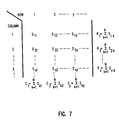
- Each row x of the matrix in Fig. 4 contains the average distances s xk , 1 ⁇ k ⁇ N, of all class sequences (x,k) having symbols of class x as immediately preceding symbols.
- Each column y of the matrix contains the average distances s ky , 1 ⁇ k ⁇ N, of all class sequences (k,y) having symbols of class y as immediately succeeding symbols.
- Equations (4) and (5) can only be used when all class sequences are present; therefore the missing s ij entries must be determined.
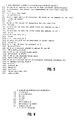
- Fig. 5 shows a listing of a segment of the APL source code for finding estimates of the missing s ij .
- the sum of all existing entries of each row is calculated (as R in the APL source code).
- R i is the average white space between two symbols having class i as a succeeding symbol.
- C in the APL source code is calculated (as C in the APL source code).
- C i is the average white space between two symbols having class i as the preceding symbols.
- the constant is calculated in lines 19-21 (represented in the code as Q).
- a row matrix F is obtained.
- Each ith element of F is the average value of the distances s ki , 1 ⁇ k ⁇ N, of sequences (k,i) having symbols of class i as immediately succeeding symbols.
- MINF of line 23 contains the smallest element of matrix F.
- FF is a row matrix formed by subtracting each element of F by MINF.
- Each i th element of the matrix FF is an estimated value of a corresponding f i .
- a column matrix B is obtained .
- Each ith element of B is the average value of the distances S ik , 1 ⁇ k ⁇ N, of sequence (i,k) having symbols of class i as immediately preceding symbols.
- BB is a column matrix obtained by subtracting each element of B by the value (Q-MINF).
- Each i th element of the matrix BB is an estimated value of a corresponding b i .
- a NxN matrix is formed by combining BB and FF using the outer product function of APL.
- a corresponding term in this new matrix is applied to each missing entry of the original matrix, thereby forming a new complete matrix SS of average distance of all s ij 's.
- Fig. 6 shows a listing of APL source code used in conjunction with lines 32 to 39 of the APL code of Table 3.
- the code in Table 4 iteratively revises the matrix SS, BB and FF, thereby obtaining better values of b i and f i
Landscapes
- Engineering & Computer Science (AREA)
- Multimedia (AREA)
- Signal Processing (AREA)
- Image Processing (AREA)
- Character Input (AREA)
- Character Discrimination (AREA)
- Editing Of Facsimile Originals (AREA)
- Facsimiles In General (AREA)
- Facsimile Transmission Control (AREA)
Applications Claiming Priority (2)
| Application Number | Priority Date | Filing Date | Title |
|---|---|---|---|
| US920489 | 1986-10-17 | ||
| US06/920,489 US4769716A (en) | 1986-10-17 | 1986-10-17 | Facsimile transmission using enhanced symbol prototypes with precalculated front and back white spaces |
Publications (3)
| Publication Number | Publication Date |
|---|---|
| EP0263950A2 EP0263950A2 (en) | 1988-04-20 |
| EP0263950A3 EP0263950A3 (en) | 1991-03-20 |
| EP0263950B1 true EP0263950B1 (en) | 1993-10-20 |
Family
ID=25443835
Family Applications (1)
| Application Number | Title | Priority Date | Filing Date |
|---|---|---|---|
| EP87112542A Expired - Lifetime EP0263950B1 (en) | 1986-10-17 | 1987-08-28 | Method for facsimile transmission and compression |
Country Status (4)
| Country | Link |
|---|---|
| US (1) | US4769716A (cg-RX-API-DMAC7.html) |
| EP (1) | EP0263950B1 (cg-RX-API-DMAC7.html) |
| JP (1) | JPS63108869A (cg-RX-API-DMAC7.html) |
| DE (1) | DE3787865T2 (cg-RX-API-DMAC7.html) |
Families Citing this family (14)
| Publication number | Priority date | Publication date | Assignee | Title |
|---|---|---|---|---|
| US5640607A (en) * | 1992-04-21 | 1997-06-17 | Microsoft Corporation | Method for sending bit mapped image by appending special code to text string and transmitting the text string separately from compressed residual image |
| US5706364A (en) * | 1995-04-28 | 1998-01-06 | Xerox Corporation | Method of producing character templates using unsegmented samples |
| US5956419A (en) * | 1995-04-28 | 1999-09-21 | Xerox Corporation | Unsupervised training of character templates using unsegmented samples |
| US5689620A (en) * | 1995-04-28 | 1997-11-18 | Xerox Corporation | Automatic training of character templates using a transcription and a two-dimensional image source model |
| US5883986A (en) * | 1995-06-02 | 1999-03-16 | Xerox Corporation | Method and system for automatic transcription correction |
| JP3061765B2 (ja) | 1996-05-23 | 2000-07-10 | ゼロックス コーポレイション | コンピュータベースの文書処理方法 |
| US5884014A (en) * | 1996-05-23 | 1999-03-16 | Xerox Corporation | Fontless structured document image representations for efficient rendering |
| US5835638A (en) * | 1996-05-30 | 1998-11-10 | Xerox Corporation | Method and apparatus for comparing symbols extracted from binary images of text using topology preserved dilated representations of the symbols |
| US7519221B1 (en) | 2005-02-28 | 2009-04-14 | Adobe Systems Incorporated | Reconstructing high-fidelity electronic documents from images via generation of synthetic fonts |
| US7702182B2 (en) * | 2006-02-16 | 2010-04-20 | Adobe Systems, Incorporated | Method and apparatus for creating a high-fidelity glyph prototype from low-resolution glyph images |
| US7697758B2 (en) * | 2006-09-11 | 2010-04-13 | Google Inc. | Shape clustering and cluster-level manual identification in post optical character recognition processing |
| US7646921B2 (en) * | 2006-09-11 | 2010-01-12 | Google Inc. | High resolution replication of document based on shape clustering |
| US8175394B2 (en) * | 2006-09-08 | 2012-05-08 | Google Inc. | Shape clustering in post optical character recognition processing |
| US7650035B2 (en) * | 2006-09-11 | 2010-01-19 | Google Inc. | Optical character recognition based on shape clustering and multiple optical character recognition processes |
Family Cites Families (7)
| Publication number | Priority date | Publication date | Assignee | Title |
|---|---|---|---|---|
| JPS54116121A (en) * | 1978-03-01 | 1979-09-10 | Fujitsu Ltd | Production system of character train |
| JPS56100565A (en) * | 1980-01-16 | 1981-08-12 | Toshiba Corp | Facsimile device |
| US4463386A (en) * | 1982-05-03 | 1984-07-31 | International Business Machines Corporation | Facsimile data reduction |
| US4499596A (en) * | 1982-06-28 | 1985-02-12 | International Business Machines Corporation | Adaptive facsimile compression using a dynamic extendable decision network |
| US4494150A (en) * | 1982-07-13 | 1985-01-15 | International Business Machines Corporation | Word autocorrelation redundancy match facsimile compression for text processing systems |
| US4499499A (en) * | 1982-12-29 | 1985-02-12 | International Business Machines Corporation | Method for identification and compression of facsimile symbols in text processing systems |
| JPS60254871A (ja) * | 1984-05-31 | 1985-12-16 | Kokusai Denshin Denwa Co Ltd <Kdd> | フアクシミリ画像の符号化方法 |
-
1986
- 1986-10-17 US US06/920,489 patent/US4769716A/en not_active Expired - Lifetime
-
1987
- 1987-05-29 JP JP62132010A patent/JPS63108869A/ja active Granted
- 1987-08-28 DE DE87112542T patent/DE3787865T2/de not_active Expired - Fee Related
- 1987-08-28 EP EP87112542A patent/EP0263950B1/en not_active Expired - Lifetime
Also Published As
| Publication number | Publication date |
|---|---|
| EP0263950A3 (en) | 1991-03-20 |
| EP0263950A2 (en) | 1988-04-20 |
| JPS63108869A (ja) | 1988-05-13 |
| US4769716A (en) | 1988-09-06 |
| DE3787865D1 (de) | 1993-11-25 |
| JPH0453476B2 (cg-RX-API-DMAC7.html) | 1992-08-26 |
| DE3787865T2 (de) | 1994-05-05 |
Similar Documents
| Publication | Publication Date | Title |
|---|---|---|
| EP0263950B1 (en) | Method for facsimile transmission and compression | |
| JP2940496B2 (ja) | パタンマッチング符号化装置及び方法 | |
| US4499499A (en) | Method for identification and compression of facsimile symbols in text processing systems | |
| EP0621542B1 (en) | Method and apparatus for automatic language determination of a script-type document | |
| US6950533B2 (en) | Sorting images for improved data entry productivity | |
| EP0098958B1 (en) | Method of encoding and transmitting documents for text processing systems | |
| US6453079B1 (en) | Method and apparatus for displaying regions in a document image having a low recognition confidence | |
| EP0592238B1 (en) | Certifiable optical character recognition | |
| US5428694A (en) | Data processing system and method for forms definition, recognition and verification of scanned images of document forms | |
| US5875261A (en) | Method of and apparatus for optical character recognition based on geometric and color attribute hypothesis testing | |
| US6069978A (en) | Method and apparatus for improving a text image by using character regeneration | |
| EP0687991B1 (en) | Information processing method and apparatus and computer readable memory medium | |
| US5033098A (en) | Method of processing character blocks with optical character reader | |
| Brickman et al. | Word autocorrelation redundancy match (WARM) technology | |
| Bodson et al. | Measurement of data compression in advanced group 4 facsimile systems | |
| US20050018918A1 (en) | Image enhancement employing partial template matching | |
| US5640607A (en) | Method for sending bit mapped image by appending special code to text string and transmitting the text string separately from compressed residual image | |
| US4623936A (en) | Error processing technique for modified read code | |
| EP0434005B1 (en) | Image data compression method using a run prediction technique | |
| US5745658A (en) | Method of aligning one dimensional or two dimensional codes to printer pixels | |
| US4408343A (en) | Image enhancement for optical character readers | |
| US4703362A (en) | Mixed-mode symbol removal method for facsimile data compression | |
| JPH0333990A (ja) | マスク処理を用いる光学式文字認識装置及び方法 | |
| US5715069A (en) | Data encoding system for rasterized fonts | |
| US5847841A (en) | Mixed-mode symbol removal for facsimile data compression |
Legal Events
| Date | Code | Title | Description |
|---|---|---|---|
| PUAI | Public reference made under article 153(3) epc to a published international application that has entered the european phase |
Free format text: ORIGINAL CODE: 0009012 |
|
| AK | Designated contracting states |
Kind code of ref document: A2 Designated state(s): DE FR GB IT |
|
| 17P | Request for examination filed |
Effective date: 19880823 |
|
| PUAL | Search report despatched |
Free format text: ORIGINAL CODE: 0009013 |
|
| AK | Designated contracting states |
Kind code of ref document: A3 Designated state(s): DE FR GB IT |
|
| 17Q | First examination report despatched |
Effective date: 19920612 |
|
| GRAA | (expected) grant |
Free format text: ORIGINAL CODE: 0009210 |
|
| AK | Designated contracting states |
Kind code of ref document: B1 Designated state(s): DE FR GB IT |
|
| PG25 | Lapsed in a contracting state [announced via postgrant information from national office to epo] |
Ref country code: IT Free format text: LAPSE BECAUSE OF FAILURE TO SUBMIT A TRANSLATION OF THE DESCRIPTION OR TO PAY THE FEE WITHIN THE PRE;WARNING: LAPSES OF ITALIAN PATENTS WITH EFFECTIVE DATE BEFORE 2007 MAY HAVE OCCURRED AT ANY TIME BEFORE 2007. THE CORRECT EFFECTIVE DATE MAY BE DIFFERENT FROM THE ONE RECORDED.SCRIBED TIME-LIMIT Effective date: 19931020 |
|
| REF | Corresponds to: |
Ref document number: 3787865 Country of ref document: DE Date of ref document: 19931125 |
|
| ET | Fr: translation filed | ||
| PLBE | No opposition filed within time limit |
Free format text: ORIGINAL CODE: 0009261 |
|
| STAA | Information on the status of an ep patent application or granted ep patent |
Free format text: STATUS: NO OPPOSITION FILED WITHIN TIME LIMIT |
|
| PG25 | Lapsed in a contracting state [announced via postgrant information from national office to epo] |
Ref country code: GB Effective date: 19940828 |
|
| 26N | No opposition filed | ||
| GBPC | Gb: european patent ceased through non-payment of renewal fee |
Effective date: 19940828 |
|
| PG25 | Lapsed in a contracting state [announced via postgrant information from national office to epo] |
Ref country code: FR Effective date: 19950428 |
|
| PG25 | Lapsed in a contracting state [announced via postgrant information from national office to epo] |
Ref country code: DE Effective date: 19950503 |
|
| REG | Reference to a national code |
Ref country code: FR Ref legal event code: ST |