EP0257963B1 - High strength zirconia ceramic - Google Patents
High strength zirconia ceramic Download PDFInfo
- Publication number
- EP0257963B1 EP0257963B1 EP87307289A EP87307289A EP0257963B1 EP 0257963 B1 EP0257963 B1 EP 0257963B1 EP 87307289 A EP87307289 A EP 87307289A EP 87307289 A EP87307289 A EP 87307289A EP 0257963 B1 EP0257963 B1 EP 0257963B1
- Authority
- EP
- European Patent Office
- Prior art keywords
- al2o3
- mgo
- mol
- zro2
- ceo2
- Prior art date
- Legal status (The legal status is an assumption and is not a legal conclusion. Google has not performed a legal analysis and makes no representation as to the accuracy of the status listed.)
- Expired - Lifetime
Links
- MCMNRKCIXSYSNV-UHFFFAOYSA-N Zirconium dioxide Chemical compound O=[Zr]=O MCMNRKCIXSYSNV-UHFFFAOYSA-N 0.000 title claims description 131
- 239000000919 ceramic Substances 0.000 title claims description 52
- CPLXHLVBOLITMK-UHFFFAOYSA-N Magnesium oxide Chemical compound [Mg]=O CPLXHLVBOLITMK-UHFFFAOYSA-N 0.000 claims description 102
- 239000000203 mixture Substances 0.000 claims description 59
- 239000000395 magnesium oxide Substances 0.000 claims description 58
- PNEYBMLMFCGWSK-UHFFFAOYSA-N aluminium oxide Inorganic materials [O-2].[O-2].[O-2].[Al+3].[Al+3] PNEYBMLMFCGWSK-UHFFFAOYSA-N 0.000 claims description 55
- 229910052593 corundum Inorganic materials 0.000 claims description 54
- 229910001845 yogo sapphire Inorganic materials 0.000 claims description 54
- 229910000422 cerium(IV) oxide Inorganic materials 0.000 claims description 33
- CETPSERCERDGAM-UHFFFAOYSA-N ceric oxide Chemical compound O=[Ce]=O CETPSERCERDGAM-UHFFFAOYSA-N 0.000 claims description 27
- XAGFODPZIPBFFR-UHFFFAOYSA-N aluminium Chemical compound [Al] XAGFODPZIPBFFR-UHFFFAOYSA-N 0.000 claims description 21
- 229910052782 aluminium Inorganic materials 0.000 claims description 21
- FYYHWMGAXLPEAU-UHFFFAOYSA-N Magnesium Chemical compound [Mg] FYYHWMGAXLPEAU-UHFFFAOYSA-N 0.000 claims description 17
- 239000011777 magnesium Substances 0.000 claims description 17
- 229910052749 magnesium Inorganic materials 0.000 claims description 17
- 238000000034 method Methods 0.000 claims description 17
- RUDFQVOCFDJEEF-UHFFFAOYSA-N yttrium(III) oxide Inorganic materials [O-2].[O-2].[O-2].[Y+3].[Y+3] RUDFQVOCFDJEEF-UHFFFAOYSA-N 0.000 claims description 13
- 239000003381 stabilizer Substances 0.000 claims description 11
- 238000002360 preparation method Methods 0.000 claims description 8
- 239000004411 aluminium Substances 0.000 claims description 5
- 238000001272 pressureless sintering Methods 0.000 claims description 5
- TWRXJAOTZQYOKJ-UHFFFAOYSA-L Magnesium chloride Chemical compound [Mg+2].[Cl-].[Cl-] TWRXJAOTZQYOKJ-UHFFFAOYSA-L 0.000 claims description 4
- 229910021502 aluminium hydroxide Inorganic materials 0.000 claims description 4
- WNROFYMDJYEPJX-UHFFFAOYSA-K aluminium hydroxide Chemical compound [OH-].[OH-].[OH-].[Al+3] WNROFYMDJYEPJX-UHFFFAOYSA-K 0.000 claims description 4
- JLDSOYXADOWAKB-UHFFFAOYSA-N aluminium nitrate Chemical compound [Al+3].[O-][N+]([O-])=O.[O-][N+]([O-])=O.[O-][N+]([O-])=O JLDSOYXADOWAKB-UHFFFAOYSA-N 0.000 claims description 4
- VSCWAEJMTAWNJL-UHFFFAOYSA-K aluminium trichloride Chemical compound Cl[Al](Cl)Cl VSCWAEJMTAWNJL-UHFFFAOYSA-K 0.000 claims description 4
- 229910001679 gibbsite Inorganic materials 0.000 claims description 4
- 150000002681 magnesium compounds Chemical class 0.000 claims description 4
- 229940077746 antacid containing aluminium compound Drugs 0.000 claims description 3
- VTHJTEIRLNZDEV-UHFFFAOYSA-L magnesium dihydroxide Chemical compound [OH-].[OH-].[Mg+2] VTHJTEIRLNZDEV-UHFFFAOYSA-L 0.000 claims description 3
- 239000000347 magnesium hydroxide Substances 0.000 claims description 3
- 229910001862 magnesium hydroxide Inorganic materials 0.000 claims description 3
- 235000012254 magnesium hydroxide Nutrition 0.000 claims description 3
- QSDQMOYYLXMEPS-UHFFFAOYSA-N dialuminium Chemical compound [Al]#[Al] QSDQMOYYLXMEPS-UHFFFAOYSA-N 0.000 claims description 2
- 239000001095 magnesium carbonate Substances 0.000 claims description 2
- ZLNQQNXFFQJAID-UHFFFAOYSA-L magnesium carbonate Chemical compound [Mg+2].[O-]C([O-])=O ZLNQQNXFFQJAID-UHFFFAOYSA-L 0.000 claims description 2
- 235000014380 magnesium carbonate Nutrition 0.000 claims description 2
- 229910000021 magnesium carbonate Inorganic materials 0.000 claims description 2
- 229910001629 magnesium chloride Inorganic materials 0.000 claims description 2
- YIXJRHPUWRPCBB-UHFFFAOYSA-N magnesium nitrate Inorganic materials [Mg+2].[O-][N+]([O-])=O.[O-][N+]([O-])=O YIXJRHPUWRPCBB-UHFFFAOYSA-N 0.000 claims description 2
- 150000001399 aluminium compounds Chemical class 0.000 claims 1
- 238000005452 bending Methods 0.000 description 26
- 239000000843 powder Substances 0.000 description 17
- 150000001875 compounds Chemical class 0.000 description 14
- 239000002994 raw material Substances 0.000 description 14
- RKTYLMNFRDHKIL-UHFFFAOYSA-N copper;5,10,15,20-tetraphenylporphyrin-22,24-diide Chemical group [Cu+2].C1=CC(C(=C2C=CC([N-]2)=C(C=2C=CC=CC=2)C=2C=CC(N=2)=C(C=2C=CC=CC=2)C2=CC=C3[N-]2)C=2C=CC=CC=2)=NC1=C3C1=CC=CC=C1 RKTYLMNFRDHKIL-UHFFFAOYSA-N 0.000 description 10
- 239000002253 acid Substances 0.000 description 8
- 229910002077 partially stabilized zirconia Inorganic materials 0.000 description 8
- 239000000243 solution Substances 0.000 description 8
- 239000013078 crystal Substances 0.000 description 6
- 230000009466 transformation Effects 0.000 description 6
- 230000003247 decreasing effect Effects 0.000 description 5
- 239000011812 mixed powder Substances 0.000 description 5
- 238000002441 X-ray diffraction Methods 0.000 description 4
- 239000012266 salt solution Substances 0.000 description 4
- 230000007062 hydrolysis Effects 0.000 description 3
- 238000006460 hydrolysis reaction Methods 0.000 description 3
- 239000004615 ingredient Substances 0.000 description 3
- 238000002156 mixing Methods 0.000 description 3
- 239000002245 particle Substances 0.000 description 3
- 239000007921 spray Substances 0.000 description 3
- OBOSXEWFRARQPU-UHFFFAOYSA-N 2-n,2-n-dimethylpyridine-2,5-diamine Chemical compound CN(C)C1=CC=C(N)C=N1 OBOSXEWFRARQPU-UHFFFAOYSA-N 0.000 description 2
- -1 MgC2O4 Inorganic materials 0.000 description 2
- VYPSYNLAJGMNEJ-UHFFFAOYSA-N Silicium dioxide Chemical compound O=[Si]=O VYPSYNLAJGMNEJ-UHFFFAOYSA-N 0.000 description 2
- GWEVSGVZZGPLCZ-UHFFFAOYSA-N Titan oxide Chemical compound O=[Ti]=O GWEVSGVZZGPLCZ-UHFFFAOYSA-N 0.000 description 2
- QCWXUUIWCKQGHC-UHFFFAOYSA-N Zirconium Chemical compound [Zr] QCWXUUIWCKQGHC-UHFFFAOYSA-N 0.000 description 2
- 238000009694 cold isostatic pressing Methods 0.000 description 2
- 230000006866 deterioration Effects 0.000 description 2
- 238000010438 heat treatment Methods 0.000 description 2
- 239000000463 material Substances 0.000 description 2
- 238000005259 measurement Methods 0.000 description 2
- 238000013001 point bending Methods 0.000 description 2
- 229910052727 yttrium Inorganic materials 0.000 description 2
- VWQVUPCCIRVNHF-UHFFFAOYSA-N yttrium atom Chemical compound [Y] VWQVUPCCIRVNHF-UHFFFAOYSA-N 0.000 description 2
- 229910052726 zirconium Inorganic materials 0.000 description 2
- 229910052684 Cerium Inorganic materials 0.000 description 1
- KKCBUQHMOMHUOY-UHFFFAOYSA-N Na2O Inorganic materials [O-2].[Na+].[Na+] KKCBUQHMOMHUOY-UHFFFAOYSA-N 0.000 description 1
- 239000007864 aqueous solution Substances 0.000 description 1
- 238000001354 calcination Methods 0.000 description 1
- 230000015556 catabolic process Effects 0.000 description 1
- VYLVYHXQOHJDJL-UHFFFAOYSA-K cerium trichloride Chemical compound Cl[Ce](Cl)Cl VYLVYHXQOHJDJL-UHFFFAOYSA-K 0.000 description 1
- 229910052681 coesite Inorganic materials 0.000 description 1
- 238000001816 cooling Methods 0.000 description 1
- 229910052906 cristobalite Inorganic materials 0.000 description 1
- 238000006731 degradation reaction Methods 0.000 description 1
- UAMZXLIURMNTHD-UHFFFAOYSA-N dialuminum;magnesium;oxygen(2-) Chemical compound [O-2].[O-2].[O-2].[O-2].[Mg+2].[Al+3].[Al+3] UAMZXLIURMNTHD-UHFFFAOYSA-N 0.000 description 1
- 239000010432 diamond Substances 0.000 description 1
- 229910003460 diamond Inorganic materials 0.000 description 1
- 230000000694 effects Effects 0.000 description 1
- 238000010304 firing Methods 0.000 description 1
- CJNBYAVZURUTKZ-UHFFFAOYSA-N hafnium(IV) oxide Inorganic materials O=[Hf]=O CJNBYAVZURUTKZ-UHFFFAOYSA-N 0.000 description 1
- 238000001513 hot isostatic pressing Methods 0.000 description 1
- 239000012535 impurity Substances 0.000 description 1
- 230000010354 integration Effects 0.000 description 1
- 150000002500 ions Chemical class 0.000 description 1
- CMOAHYOGLLEOGO-UHFFFAOYSA-N oxozirconium;dihydrochloride Chemical compound Cl.Cl.[Zr]=O CMOAHYOGLLEOGO-UHFFFAOYSA-N 0.000 description 1
- 230000000452 restraining effect Effects 0.000 description 1
- 230000000717 retained effect Effects 0.000 description 1
- 239000000377 silicon dioxide Substances 0.000 description 1
- 235000012239 silicon dioxide Nutrition 0.000 description 1
- 239000006104 solid solution Substances 0.000 description 1
- 229910052596 spinel Inorganic materials 0.000 description 1
- 239000011029 spinel Substances 0.000 description 1
- 229910052682 stishovite Inorganic materials 0.000 description 1
- 229910052905 tridymite Inorganic materials 0.000 description 1
- 238000003826 uniaxial pressing Methods 0.000 description 1
- XLYOFNOQVPJJNP-UHFFFAOYSA-N water Substances O XLYOFNOQVPJJNP-UHFFFAOYSA-N 0.000 description 1
Images


Classifications
-
- C—CHEMISTRY; METALLURGY
- C04—CEMENTS; CONCRETE; ARTIFICIAL STONE; CERAMICS; REFRACTORIES
- C04B—LIME, MAGNESIA; SLAG; CEMENTS; COMPOSITIONS THEREOF, e.g. MORTARS, CONCRETE OR LIKE BUILDING MATERIALS; ARTIFICIAL STONE; CERAMICS; REFRACTORIES; TREATMENT OF NATURAL STONE
- C04B35/00—Shaped ceramic products characterised by their composition; Ceramics compositions; Processing powders of inorganic compounds preparatory to the manufacturing of ceramic products
- C04B35/622—Forming processes; Processing powders of inorganic compounds preparatory to the manufacturing of ceramic products
- C04B35/624—Sol-gel processing
-
- C—CHEMISTRY; METALLURGY
- C04—CEMENTS; CONCRETE; ARTIFICIAL STONE; CERAMICS; REFRACTORIES
- C04B—LIME, MAGNESIA; SLAG; CEMENTS; COMPOSITIONS THEREOF, e.g. MORTARS, CONCRETE OR LIKE BUILDING MATERIALS; ARTIFICIAL STONE; CERAMICS; REFRACTORIES; TREATMENT OF NATURAL STONE
- C04B35/00—Shaped ceramic products characterised by their composition; Ceramics compositions; Processing powders of inorganic compounds preparatory to the manufacturing of ceramic products
- C04B35/01—Shaped ceramic products characterised by their composition; Ceramics compositions; Processing powders of inorganic compounds preparatory to the manufacturing of ceramic products based on oxide ceramics
- C04B35/48—Shaped ceramic products characterised by their composition; Ceramics compositions; Processing powders of inorganic compounds preparatory to the manufacturing of ceramic products based on oxide ceramics based on zirconium or hafnium oxides, zirconates, zircon or hafnates
- C04B35/486—Fine ceramics
-
- C—CHEMISTRY; METALLURGY
- C04—CEMENTS; CONCRETE; ARTIFICIAL STONE; CERAMICS; REFRACTORIES
- C04B—LIME, MAGNESIA; SLAG; CEMENTS; COMPOSITIONS THEREOF, e.g. MORTARS, CONCRETE OR LIKE BUILDING MATERIALS; ARTIFICIAL STONE; CERAMICS; REFRACTORIES; TREATMENT OF NATURAL STONE
- C04B35/00—Shaped ceramic products characterised by their composition; Ceramics compositions; Processing powders of inorganic compounds preparatory to the manufacturing of ceramic products
- C04B35/01—Shaped ceramic products characterised by their composition; Ceramics compositions; Processing powders of inorganic compounds preparatory to the manufacturing of ceramic products based on oxide ceramics
- C04B35/48—Shaped ceramic products characterised by their composition; Ceramics compositions; Processing powders of inorganic compounds preparatory to the manufacturing of ceramic products based on oxide ceramics based on zirconium or hafnium oxides, zirconates, zircon or hafnates
- C04B35/486—Fine ceramics
- C04B35/488—Composites
- C04B35/4885—Composites with aluminium oxide
Definitions
- the present invention relates to zirconia ceramics and is more particularly concerned with zirconia ceramic compositions superior in bending strength, acid resistance and thermal stability.
- Zirconia ceramics containing 1.5 -5.0 mol% yttria as a stablizer are each known in the art as a partially stabilized zirconia ceramic (PSZ) which has been developed as a high strength zirconia ceramic useful for mechanical structure materials.
- PSZ partially stabilized zirconia ceramic
- the partially stabilized zirconia ceramic is, however, still insufficient in bending strength.
- Japanese Kokai Publication No. 60-226457 (a counterpart to EP-A-0 140 638), there has been proposed a method of producing a high strength zirconia ceramic the bending strength of which is higher than that of the partially stabilized zirconia ceramic.
- raw material fine powder with a specific primary mean particle diameter was mixed at a predetermined ratio and made by Hot Isostatic Pressing or sintered by uniaxial pressing to produce a ceramic composition consisting essentially of Zr02 containing 1.5 - 5.0 mol% Y2O3 and Al2O3-MgO as a stabilizer.
- the zirconia ceramic in the cubic structure form transforms into the tetragonal structure then to the monoclinic structure form with consequent volume changes.
- the zirconia ceramic is degradated due to a volume expansion thereof.
- a stabilizer such as CaO, MgO, Y2O3 and the like.
- Y2O3 is used as the stabilizer to produce a partially stabilized zirconia ceramic of high strength and fracture toughness in the tetragonal structure form at room temperature.
- Such partially stabilized zirconia ceramics are, however, unstable in crystal phase and transform into the monoclinic structure when heated at a relatively low temperature within a range of 200° - 400°C, resulting in deterioration in strength, fracture toughness and thermal stability thereof.
- a zirconia ceramic composition consisting essentially of ZrO2 containing Y2O3 and Al2O3 has been proposed in Japanese Kokai Publication No. 58-32066, and a zirconia ceramic composition consisting essentially of ZrO2 containing Y2O3, CeO2 and Al2O3 has been further proposed in Japanese Kokai Publication No. 61-77665.
- a mixture of Al2O3 and MgO was suggested, but the mixture ratio of the oxides was not confirmed.
- the zirconia ceramic composition proposed in the former publication is not useful to enhance the thermal stability, whereas the zirconia ceramic composition proposed in the latter publication is not useful to enhance the strength.
- the present invention has now found that the strength of partially stabilized zirconia ceramics is greatly influenced by the mixture ratio of the oxides Al2O3 and MgO and that if the mixture ratio of the oxides is out of a predetermined extent, the bending strength of the partially stabilized zirconia ceramics may not be increased. It is, therefore, a primary object of the present invention to provide a partially stabilized ziroconia ceramic superior in bending strength, acid resistance and thermal stability on a basis of determination of an optimal mixture ratio between the oxides.
- a process for the preparation of a high strength zirconia ceramic composition which process comprises the pressureless sintering of a composition consisting essentially of a compound of ZrO2 containing from 0.5 to 5.0 mol% Y2O3 as a stabilizer when CeO2 is also present in the composition and from 1.5 to 5.0 mol% Y2O3 as a stabilizer when there is no CeO2 present, and aluminium and magnesium compounds in a combined amount of from 1 to 5 weight % expressed in terms of Al2O3 and MgO relative to the amount of ZrO2, the aluminium : magnesium molar ratio expressed in terms of Al2O3 and Mgo being from 35 to 45 : 65 to 55, from 60 to 75 : 40 to 25 or from 85 to 99 : 15 to 1.
- the ingredient amount of Y2O3 is 1.5 - 5.0 mol% relative to the compound of ZrO2.
- the ingredient amount of Y2O3 is 0.5 - 5.0 mol% relative to the compound of ZrO2
- the ingredient amount of CeO2 has been determined to be 0.5 - 12.0 mol% relative to the compound of ZrO2
- the total amount of Y2O3 and CeO2 has been determined to be 1.0 - 15 mol%.
- the zirconia ceramic composition contains 1.5 - 5.0 mol% Y2O3 (or 1.5 - 3.5 mol% Y2O3 and 2 - 5 mol% CeO2) as a stabilizer.
- the molar ratio (Al2O3/MgO) between the aluminum and magnesium contents is selected from the following ranges (a) - (c) in terms of Al2O3 and MgO.
- a compound of ZrO2-Y2O3 was precipitated by hydrolysis of aqueous salt solutions thereof.
- the precipitated compound was calcined at 900°C to obtain zirconia powder of particle diameter less than 1 ⁇ m.
- the zirconia powder was added with powder of Al2O3 and MgO, ground by a pot mill and dried by spray to obtain a raw material consisting essentially of ZrO2-Y2O3-Al2O3-MgO.
- the raw material was preformed under pressure of 19,6MPa (200 kg/cm2) and shaped by Cold Isostatic Pressing into a rectangular plate of 60 x 60 x 8 (mm) under pressure of 294,3MPa (3 ton/cm2).
- the rectangular plate was fired by pressureless sintering at about 1400°C for 5 hours and cut into a plurality of bar specimens each size of which is 3 x 4 x 40 (mm).
- the bar specimens were tested as follows.
- the test results of the bar specimens are shown in Tables 1 and 2 attached hereto and illustrated in Figs. 1 and 2.
- the test results of No. 1 - No. 27 shown in Tables 1 and 2 were obtained in the case that a molar ratio between Al2O3 and MgO or an added amount of Al2O3 and MgO was varied in a condition where the molar ratio of a stabilizer Y2O3 to the compound ZrO2 was determined in a constant value (3/97).
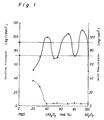
- the data of Fig. 1 was obtained by variation of the molar ratio between Al2O3 and MgO in a condition where the added amount of Al2O3 and MgO was determined in a constant value (2 wt%).
- the bending strength of the bar specimens was noticeably increased in the case that the molar ratio between Al2O3 and MgO was determined to be 35 - 45/65 - 55, 60 - 75/40 - 25, 85 - 99/15 - 1, respectively.
- the bending strength was increased in the case that the added amount of Al2O3 and MgO was determined to be less than 20 wt%, preferably less than 10 wt%.
- the test results of No. 28 - No. 43 shown in Table 2 were obtained in the case that the molar ratio between Al2O3 and MgO was varied in a condition where the molar ratio of a stabilizer Y2O3 to the compound ZrO2 was determined in a constant value (1.5/98.5, 2/98, 5/95) and where the added amount of Al2O3 and MgO was determined in a constant value (2 wt%, 5 wt%).
- the test results of No. 28 - No. 43 indicate that the bending strength and acid resistance of the bar specimens were enhanced in contrast with the bar specimen prepared without Al2O3 and MgO.
- the zirconia ceramic composition of the present invention is superior in bending strength and acid resistance and useful as mechanical structure materials.
- Al2O3 and MgO were adapted to contain aluminum and magnesium contents into the compound of ZrO2-Y2O3.
- the amount of the aluminum and magnesium contents is consistent with an amount of aluminum and magnesium contents in a ceramic composition ground in 44 ⁇ m after firing and measured by fluorescent X-ray analysis.
- the amount of aluminum and magnesium contents in terms of Al2O3 and MgO is substantially consistent with the added amount of Al2O3 and MgO.
- a compound of ZrO2-Y2O3-CeO2 was precipitated by hydrolysis of aqueous slat solutions thereof.
- the precipitated compound was calcined at 900°C to obtain zirconia powder of particle diameter less than 1 ⁇ m.
- the zirconia powder was added with powder of Al2O3 and MgO, ground by a pot mill and dried by spray to obtain a raw material consisting essentially of ZrO2-Y2O3-CeO2-Al2O3-MgO.
- the raw material was preformed under pressure of 19,6MPa (200 kg/cm2) and shaped by Cold Isostatic Pressing into a rectangular plate of 60 x 60 x 8 (mm) under pressure of 294,3MPa (3 ton/cm2).
- the rectangular plate was fired by pressureless sintering at about 1400°C for 5 hours and cut into a plurality of bar specimens each size of which is 3 x 4 x 40 (mm).
- the bar specimens were tested as follows.
- the bar specimens after heat treatment were further applied to X-ray diffraction to calculate an amount of tetragonal and cubic contents (V1) in the same manner as described above.
- the rate of transformation (%) (V0 - V1)/V0 x 100 was calculated on a basis of the calculated amounts of tetragonal and cubic contents V0 and V1.
- the specimens in groups A - D were prepared to contain less than 82-85 mol% ZrO2 and more than 15 mol% Y2O3 and CeO2, the specimens in groups E and F to contain 85 mol% ZrO2 and 15 mol% Y2O3 and CeO2, the specimens in group G to contain 5 mol% Y2O3, and the specimens in group H to contain 7 mol% Y2O3.
- Fig. 4 there is illustrated a relationship between a mixed amount of CeO2 (mol%) in a zirconia ceramic composition containing 3 mol% Y2O3 and 2 wt% Al2O3 and MgO and bending strength of the same ceramic composition.
- Fig. 5 there is illustrated a relationship between a mixed amount (wt%) of Al2O3 and MgO in a zirconia ceramic composition containing 3 mol% Y2O3 and 2 mol% CeO2 and bending strength of the same ceramic composition.
- the mixed amount (wt%) of aluminum and magnesium contents was determined in terms of Al2O3 and MgO.
- the bending strengths are decreased in accordance with an increase of the mixed amount of Al2O3 and MgO and noticeably decreased by mixture of Al2O3 and MgO more than 30 wt%.
- a relationship between a molar ratio Al2O3/MgO in a zirconia ceramic composition containing 3 mol% Y2O3, 2 mol% CeO2 and 2 wt% Al2O3 and MgO and bending strength of the same ceramic composition In this illustration, it was found that each peak of the bending strengths is obtained by determiation of the molar ratio Al2O3/MgO in 40/60, 70/30 or 90/10.
- the molar ratio Al2O3/MgO should be determined in a extent of 35 - 45/65 - 55, 60 - 75/40 - 25 or 85 - 99/15 - 1. From the test results, it was confirmed that a high strength zirconia ceramic composition can be obtained by a compound of ZrO2 containing less than 30 wt% Al2O3 and MgO at the molar ratio listed below.
- Powders of ZrO2-Y2O3 and ZrO2-Y2O3-CeO2 were prepared in the same manner as described in Example 1 added with aluminum and magnesium contents in the form of Al(OH)3, AlCl3, Al(NO3)3, Al2(C2O4)3 or the like and Mg(OH)2, MgCl2, Mg(NO3)2, MgC2O4, MgCO3 or the like, ground by a pot mill and dried by spray to obtain a raw material consisting essentially of ZrO2-Y2O3 and the aluminum and magnesium contents and a raw material consisting essentially of ZrO2-Y2O3-CeO2 and the aluminum and magnesium contents.
Landscapes
- Chemical & Material Sciences (AREA)
- Engineering & Computer Science (AREA)
- Ceramic Engineering (AREA)
- Manufacturing & Machinery (AREA)
- Composite Materials (AREA)
- Materials Engineering (AREA)
- Structural Engineering (AREA)
- Organic Chemistry (AREA)
- Dispersion Chemistry (AREA)
- Inorganic Chemistry (AREA)
- Compositions Of Oxide Ceramics (AREA)
- Catalysts (AREA)
Description
- The present invention relates to zirconia ceramics and is more particularly concerned with zirconia ceramic compositions superior in bending strength, acid resistance and thermal stability.
- Zirconia ceramics containing 1.5 -5.0 mol% yttria as a stablizer are each known in the art as a partially stabilized zirconia ceramic (PSZ) which has been developed as a high strength zirconia ceramic useful for mechanical structure materials. The partially stabilized zirconia ceramic is, however, still insufficient in bending strength. In Japanese Kokai Publication No. 60-226457 (a counterpart to EP-A-0 140 638), there has been proposed a method of producing a high strength zirconia ceramic the bending strength of which is higher than that of the partially stabilized zirconia ceramic. In this method, raw material fine powder with a specific primary mean particle diameter was mixed at a predetermined ratio and made by Hot Isostatic Pressing or sintered by uniaxial pressing to produce a ceramic composition consisting essentially of Zr0₂ containing 1.5 - 5.0 mol% Y₂O₃ and Al₂O₃-MgO as a stabilizer.
- During change of the ambient temperature from a high temperature to room temperature, the zirconia ceramic in the cubic structure form transforms into the tetragonal structure then to the monoclinic structure form with consequent volume changes. When the crystal structure changes on cooling from tetragonal to monoclinic, the zirconia ceramic is degradated due to a volume expansion thereof. For the purpose of preventing such degradation, there has been proposed a method of restraining the transformation of crystal stucture in ZrO₂ by solid solution of a stabilizer such as CaO, MgO, Y₂O₃ and the like. At present, Y₂O₃ is used as the stabilizer to produce a partially stabilized zirconia ceramic of high strength and fracture toughness in the tetragonal structure form at room temperature. Such partially stabilized zirconia ceramics are, however, unstable in crystal phase and transform into the monoclinic structure when heated at a relatively low temperature within a range of 200° - 400°C, resulting in deterioration in strength, fracture toughness and thermal stability thereof.
- To enhance the strength and thermal stability, a zirconia ceramic composition consisting essentially of ZrO₂ containing Y₂O₃ and Al₂O₃ has been proposed in Japanese Kokai Publication No. 58-32066, and a zirconia ceramic composition consisting essentially of ZrO₂ containing Y₂O₃, CeO₂ and Al₂O₃ has been further proposed in Japanese Kokai Publication No. 61-77665. In the former publication, a mixture of Al₂O₃ and MgO was suggested, but the mixture ratio of the oxides was not confirmed. In addition, it has been found that the zirconia ceramic composition proposed in the former publication is not useful to enhance the thermal stability, whereas the zirconia ceramic composition proposed in the latter publication is not useful to enhance the strength.
- The present invention has now found that the strength of partially stabilized zirconia ceramics is greatly influenced by the mixture ratio of the oxides Al₂O₃ and MgO and that if the mixture ratio of the oxides is out of a predetermined extent, the bending strength of the partially stabilized zirconia ceramics may not be increased. It is, therefore, a primary object of the present invention to provide a partially stabilized ziroconia ceramic superior in bending strength, acid resistance and thermal stability on a basis of determination of an optimal mixture ratio between the oxides.
- According to the present invention, there is provided a process for the preparation of a high strength zirconia ceramic composition, which process comprises the pressureless sintering of a composition consisting essentially of a compound of ZrO₂ containing from 0.5 to 5.0 mol% Y₂O₃ as a stabilizer when CeO₂ is also present in the composition and from 1.5 to 5.0 mol% Y₂O₃ as a stabilizer when there is no CeO₂ present, and aluminium and magnesium compounds in a combined amount of from 1 to 5 weight % expressed in terms of Al₂O₃ and MgO relative to the amount of ZrO₂, the aluminium : magnesium molar ratio expressed in terms of Al₂O₃ and Mgo being from 35 to 45 : 65 to 55, from 60 to 75 : 40 to 25 or from 85 to 99 : 15 to 1.
- In cases where the zirconia ceramic composition is produced without CeO₂, the ingredient amount of Y₂O₃ is 1.5 - 5.0 mol% relative to the compound of ZrO₂. In cases where the zirconia ceramic composition is produced with CeO₂, the ingredient amount of Y₂O₃ is 0.5 - 5.0 mol% relative to the compound of ZrO₂, and the ingredient amount of CeO₂ has been determined to be 0.5 - 12.0 mol% relative to the compound of ZrO₂, provided that the total amount of Y₂O₃ and CeO₂ has been determined to be 1.0 - 15 mol%. It is preferable that the zirconia ceramic composition contains 1.5 - 5.0 mol% Y₂O₃ (or 1.5 - 3.5 mol% Y₂O₃ and 2 - 5 mol% CeO₂) as a stabilizer.
- With respect to the aluminum and magnesium contents in the composition, the molar ratio (Al₂O₃/MgO) between the aluminum and magnesium contents is selected from the following ranges (a) - (c) in terms of Al₂O₃ and MgO.
- (a) 35 - 45/65 - 55
- (b) 60 - 75/40 - 25
- (c) 85 - 99/15 - 1
- For a better understanding of the present invention, and to show how the same may be carried into effect, reference will now be made, by way of example, the accompanying drawings, in which:-
- Fig. 1 is a graph illustrating bending strength and acid resistance of the zirconia ceramic composition in relation to molar ratios of Al₂O₃ and MgO in the case that the mixture ratio of aluminum and magnesium contents to the whole contents of the zirconia ceramic composition in terms of Al₂O₃ and MgO was determined in a constant value;
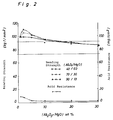
- Fig. 2 is a graph illustrating bending strength and acid resistance of the zirconia ceramic composition in relation to weight ratios of Al₂O₃ and MgO to the whole contents of the zirconia ceramic composition in the case that the molar ratio between aluminum and magnesium contents was determined in a constant value;
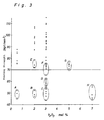
- Fig. 3 is a graph illustrating bending strength of the zirconia ceramic composition in relation to a mixed amount (mol%) of Y₂O₃ in the composition;
- Fig. 4 is a graph illustrating bending strength of the zirconia ceramic composition in relation to a mixed amount (mol%) of CeO₂ in the composition;
- Fig. 5 is a graph illustrating bending strength of the zirconia ceramic composition in relation to a mixed amount (wt%) of aluminum and magnesium contents in terms of Al₂O₃ and MgO in the composition;
- Fig. 6 is a graph illustrating bending strength of the zirconia ceramic composition in relation to a molar ratio of Al₂O₃ and MgO in the composition; and
- Fig. 7 is a graph illustrating the rate of transformation from cubi structure into tetragonal structure and to monoclinic structure in relation to a mixed amount (mol%) of CeO₂ and Y₂O₃ in the zirconia ceramic composition.
- Hereinafter, the preferred embodiments of the present invention will be described in detail with reference to the drawings.
- A compound of ZrO₂-Y₂O₃ was precipitated by hydrolysis of aqueous salt solutions thereof. The precipitated compound was calcined at 900°C to obtain zirconia powder of particle diameter less than 1 µm. The zirconia powder was added with powder of Al₂O₃ and MgO, ground by a pot mill and dried by spray to obtain a raw material consisting essentially of ZrO₂-Y₂O₃-Al₂O₃-MgO.
- The raw material was preformed under pressure of 19,6MPa (200 kg/cm²) and shaped by Cold Isostatic Pressing into a rectangular plate of 60 x 60 x 8 (mm) under pressure of 294,3MPa (3 ton/cm²). The rectangular plate was fired by pressureless sintering at about 1400°C for 5 hours and cut into a plurality of bar specimens each size of which is 3 x 4 x 40 (mm). Thus, the bar specimens were tested as follows.
- (1) The bending strengths were measured by 4-point bending test with 10mm upper span and 30mm lower span at a cross-head speed 0.5mm/min using the bar specimens.
- (2) For measurement of the acid resistances, the bar specimens were put into solution of 36 wt% HCl in a sealed container and retained in the solution at 150°C for 200 hours. Thereafter, the weight of bar specimens was measured to calculate reduction of the weight per a unit area (mg/cm²).
- The test results of the bar specimens are shown in Tables 1 and 2 attached hereto and illustrated in Figs. 1 and 2. The test results of No. 1 - No. 27 shown in Tables 1 and 2 were obtained in the case that a molar ratio between Al₂O₃ and MgO or an added amount of Al₂O₃ and MgO was varied in a condition where the molar ratio of a stabilizer Y₂O₃ to the compound ZrO₂ was determined in a constant value (3/97). The data of Fig. 1 was obtained by variation of the molar ratio between Al₂O₃ and MgO in a condition where the added amount of Al₂O₃ and MgO was determined in a constant value (2 wt%). The data of Fig. 2 was obtained by variation of the added amount of Al₂O₃ and MgO in a condition where the molar ratio between Al₂O₃ and MgO was determined in a constant value (40/60, 70/30, 90/10). As is illustrated in Figs. 1 and 2, the acid resistance of the bar specimens added with Al₂O₃ and MgO was noticeably enhanced in the case that the molar ratio between Al₂O₃ and MgO was determined more than 30/60, and the bending strength of the bar specimens was increased up to a peak value in the case that the molar ratio between Al₂O₃ and MgO was determined to be 40/60, 70/30 and 90/10, respectively. Particularly, the bending strength of the bar specimens was noticeably increased in the case that the molar ratio between Al₂O₃ and MgO was determined to be 35 - 45/65 - 55, 60 - 75/40 - 25, 85 - 99/15 - 1, respectively. In addition, the bending strength was increased in the case that the added amount of Al₂O₃ and MgO was determined to be less than 20 wt%, preferably less than 10 wt%.
- The test results of No. 28 - No. 43 shown in Table 2 were obtained in the case that the molar ratio between Al₂O₃ and MgO was varied in a condition where the molar ratio of a stabilizer Y₂O₃ to the compound ZrO₂ was determined in a constant value (1.5/98.5, 2/98, 5/95) and where the added amount of Al₂O₃ and MgO was determined in a constant value (2 wt%, 5 wt%). The test results of No. 28 - No. 43 indicate that the bending strength and acid resistance of the bar specimens were enhanced in contrast with the bar specimen prepared without Al₂O₃ and MgO.
- From the test results described above, it will be understood that the zirconia ceramic composition of the present invention is superior in bending strength and acid resistance and useful as mechanical structure materials. In Example 1, Al₂O₃ and MgO were adapted to contain aluminum and magnesium contents into the compound of ZrO₂-Y₂O₃. The amount of the aluminum and magnesium contents is consistent with an amount of aluminum and magnesium contents in a ceramic composition ground in 44 µm after firing and measured by fluorescent X-ray analysis. For this reason, the amount of aluminum and magnesium contents in terms of Al₂O₃ and MgO is substantially consistent with the added amount of Al₂O₃ and MgO. In addition, it was found by fluorescent X-ray analysis that the following impurity is contained in the bar specimens.
- --less than 2.0 wt% SiO₂, less than 2.0 wt% TiO₂, less than 0.5 wt% CaO, less than 0.5 wt% K₂O, less than 0.5 wt% Na₂O and less than 3.0 wt% HfO₂--
- A compound of ZrO₂-Y₂O₃-CeO₂ was precipitated by hydrolysis of aqueous slat solutions thereof. The precipitated compound was calcined at 900°C to obtain zirconia powder of particle diameter less than 1 µm. The zirconia powder was added with powder of Al₂O₃ and MgO, ground by a pot mill and dried by spray to obtain a raw material consisting essentially of ZrO₂-Y₂O₃-CeO₂-Al₂O₃-MgO.
- The raw material was preformed under pressure of 19,6MPa (200 kg/cm²) and shaped by Cold Isostatic Pressing into a rectangular plate of 60 x 60 x 8 (mm) under pressure of 294,3MPa (3 ton/cm²). The rectangular plate was fired by pressureless sintering at about 1400°C for 5 hours and cut into a plurality of bar specimens each size of which is 3 x 4 x 40 (mm). Thus, the bar specimens were tested as follows.
- (1) The bending strengths were measured by 4-point bending test with 10mm upper span and 30mm lower span at a cross-head speed 0.5mm/min using the bar specimens.
- (2) For measurement of the thermal deterioration, the bar specimens were put into hot water at 250°C under vapor pressure of 3,8MPa (39 kg/cm²) in an autoclave and treated by heat for 50 hours. Thereafter, the rate of transformation from cubic structure into tetragonal structure and to monoclinic structure in the bar specimens were calculated as follows.
- The bar specimens were mirror surface finished with diamond paste and applied to X-ray diffraction to measure integration intensity IM, IT, IC of diffraction peaks on the monoclinic crystal surface (ll
l ), the tetragonal crystal surface (lll) and the cubic crystal surface thereby to calculate an amount of tetragonal and cubic contents

- The test results of the bar specimens are shown in Tables 3-11 attached hereto and illustrated in Figs. 3-7. In the test results, the value of 6.86 x 10⁵kPa (70 Kgf/mm²) was defined as a standard value for determination of the bending strength, and the value of 25% was defined as a standard value for determination of the thermal stability. In Fig. 3, the specimens in eight groups A - H are plotted near or below the standard value 6.86 x 10⁵kPa (70 kgf/mm²). The specimens in groups A - D were prepared to contain less than 82-85 mol% ZrO₂ and more than 15 mol% Y₂O₃ and CeO₂, the specimens in groups E and F to contain 85 mol% ZrO₂ and 15 mol% Y₂O₃ and CeO₂, the specimens in group G to contain 5 mol% Y₂O₃, and the specimens in group H to contain 7 mol% Y₂O₃. In Fig. 4 there is illustrated a relationship between a mixed amount of CeO₂ (mol%) in a zirconia ceramic composition containing 3 mol% Y₂O₃ and 2 wt% Al₂O₃ and MgO and bending strength of the same ceramic composition. In this illustration, it was found that the bending strengths are decreased in accordance with an increase of the mixed amount of CeO₂ and noticeably decreased by mixture of CeO₂ more than 12 mol%. From the test results described above, it was confirmed that a high strength zirconia cermaic composition can be obtained by a compound of ZrO₂ containing 0.5 - 5 mol% Y₂O₃, 0.5 - 12 mol% CeO₂, Al₂O₃ and MgO, provided that the total amount of Y₂O₃ and CeO₂ should be determined to be 1.0 - 15 mol%.
- In Fig. 5 there is illustrated a relationship between a mixed amount (wt%) of Al₂O₃ and MgO in a zirconia ceramic composition containing 3 mol% Y₂O₃ and 2 mol% CeO₂ and bending strength of the same ceramic composition. In this case, the mixed amount (wt%) of aluminum and magnesium contents was determined in terms of Al₂O₃ and MgO. In this illustration, it was found that the bending strengths are decreased in accordance with an increase of the mixed amount of Al₂O₃ and MgO and noticeably decreased by mixture of Al₂O₃ and MgO more than 30 wt%. In Fig. 6 there is illustrated a relationship between a molar ratio Al₂O₃/MgO in a zirconia ceramic composition containing 3 mol% Y₂O₃, 2 mol% CeO₂ and 2 wt% Al₂O₃ and MgO and bending strength of the same ceramic composition. In this illustration, it was found that each peak of the bending strengths is obtained by determiation of the molar ratio Al₂O₃/MgO in 40/60, 70/30 or 90/10. Preferably, the molar ratio Al₂O₃/MgO should be determined in a extent of 35 - 45/65 - 55, 60 - 75/40 - 25 or 85 - 99/15 - 1. From the test results, it was confirmed that a high strength zirconia ceramic composition can be obtained by a compound of ZrO₂ containing less than 30 wt% Al₂O₃ and MgO at the molar ratio listed below.
- (a) 35 - 45/65 - 55
- (b) 60 - 75/40 - 25
- (c) 85 - 99/15 - 1
- Powders of ZrO₂-Y₂O₃ and ZrO₂-Y₂O₃-CeO₂ were prepared in the same manner as described in Example 1 added with aluminum and magnesium contents in the form of Al(OH)₃, AlCl₃, Al(NO₃)₃, Al₂(C₂O₄)₃ or the like and Mg(OH)₂, MgCl₂, Mg(NO₃)₂, MgC₂O₄, MgCO₃ or the like, ground by a pot mill and dried by spray to obtain a raw material consisting essentially of ZrO₂-Y₂O₃ and the aluminum and magnesium contents and a raw material consisting essentially of ZrO₂-Y₂O₃-CeO₂ and the aluminum and magnesium contents.
- Using the raw materials, various bar specimens were prepared in the same manner as described in Example 1 and tested in the same manner as described in Example 1. The test results of the bar specimens are shown in Tables 12-15 attached hereto. From the data of Tables 12-15, it was confirmed that the use of aluminum and magnesium contents in the form of the above-described compounds is effective to obtain the same results as those in use of Al₂O₃-MgO.
-
- (1) Sol-solution was prepared by hydrolysis of aqeous solution containing zirconium oxychloride added with yttrium chloride or yttrium chloride and cerium chloride. The sol-solution was added with Al(OH)₃ and Mg(OH)₂, treated by heat, ground and dried in the same manner as described in Example 1 to obtain a raw material.
- (2) The sol-solution was added with Al(OH)₃ in such a manner that a molar ratio to MgO is determined to be 90/10 in terms of Al₂O₃. Powder obtained by heat treatment of the sol-solution was added with powder of MgO, ground and dried in the same manner as described in Example 1 to obtain a raw material.
- Using the raw materials, various bar specimens were prepared in the same manner as described in Example 1 and tested in the same manner as described in Example 1. The test results of the bar specimens are shown in Table 16 attached hereto. From the data of Table 16, it was confirmed that the use of zirconium, yttrium and cerium ions in the form of aqueous salt solution is effective to obtain the same results as those in use of precipitated ZrO₂-Y₂O₃ or ZrO₂-Y₂O₃-CeO₂.


Claims (5)
- A process for the preparation of a sintered zirconia ceramic composition, which process comprises the pressureless sintering of a composition consisting essentially of ZrO₂ containing from 0.5 to 5.0 mol% Y₂O₃ as a stabilizer when CeO₂ is also present in the composition and from 1.5 to 5 mol% Y₂O₃ as a stabilizer when there is no CeO₂ present, and aluminium and magnesium compounds in a combined amount of from 1 to 5 weight % expressed in terms of Al₂O₃ and MgO relative to the amount of ZrO₂, the aluminium : magnesium molar ratio expressed in terms of Al₂O₃ and MgO being from 35 to 45 : 65 to 55, from 60 to 75 : 40 to 25 or from 85 to 99 : 15 to 1.
- A process according to claim 1, wherein the composition comprises from 1.5 to 5 mol% Y₂O₃.
- A process for the preparation of a sintered zirconia ceramic composition, which process comprises the pressureless sintering of a composition consisting essentially of ZrO₂ containing, as a stabilizer, 0.5 to 5 mol% Y₂O₃ and 0.5 to 12 mol% CeO₂, such that the total amount of Y₂O₃ and CeO₂ is from 1.0 to 15 mol%, and further containing aluminium and magnesium compounds in a combined amount of from 1 to 5 weight% expressed in terms of Al₂O₃ and MgO relative to the amount of ZrO₂, the aluminum : magnesium molar ratio expressed in terms of Al₂O₃ and MgO, being from 35 to 45 : 65 to 55, from 60 to 75 : 40 to 25 or from 85 to 99 : 15 to 1.
- A process according to any one of claims 1 to 3 wherein the aluminium compound in the composition is Al₂O₃, Al(OH)₃, AlCl₃, Al(NO₃)₃ or Al₂(C₂O₄)₃.
- A process according to any one of claims 1 to 4 wherein the magnesium compound in the composition is MgO, Mg(OH)₂, MgCl₂, Mg(NO₃)₂, MgC₂O₄ or MgCO₃.
Applications Claiming Priority (6)
| Application Number | Priority Date | Filing Date | Title |
|---|---|---|---|
| JP19318086 | 1986-08-18 | ||
| JP193180/86 | 1986-08-18 | ||
| JP70072/87 | 1987-03-24 | ||
| JP7007287 | 1987-03-24 | ||
| JP62-201315A JPH013071A (en) | 1986-08-18 | 1987-08-12 | High strength zirconia ceramics |
| JP201315/87 | 1987-08-12 |
Publications (3)
| Publication Number | Publication Date |
|---|---|
| EP0257963A2 EP0257963A2 (en) | 1988-03-02 |
| EP0257963A3 EP0257963A3 (en) | 1989-08-16 |
| EP0257963B1 true EP0257963B1 (en) | 1994-04-13 |
Family
ID=27300237
Family Applications (1)
| Application Number | Title | Priority Date | Filing Date |
|---|---|---|---|
| EP87307289A Expired - Lifetime EP0257963B1 (en) | 1986-08-18 | 1987-08-18 | High strength zirconia ceramic |
Country Status (3)
| Country | Link |
|---|---|
| US (1) | US4820667A (en) |
| EP (1) | EP0257963B1 (en) |
| DE (1) | DE3789583T2 (en) |
Families Citing this family (29)
| Publication number | Priority date | Publication date | Assignee | Title |
|---|---|---|---|---|
| GB8912838D0 (en) * | 1989-06-03 | 1989-07-19 | Tioxide Group Plc | Stabilized metal oxide powder compositions |
| JPH04357165A (en) * | 1991-05-29 | 1992-12-10 | Ngk Insulators Ltd | Zirconia porcelain and electrochemical element using the same |
| US5322820C1 (en) * | 1992-12-08 | 2001-04-24 | Kigre Inc | Athermal laser glass compositions with high thermal loading capacity |
| FR2701472B1 (en) * | 1993-02-10 | 1995-05-24 | Rhone Poulenc Chimie | Process for the preparation of compositions based on mixed oxides of zirconium and cerium. |
| FR2701471B1 (en) * | 1993-02-10 | 1995-05-24 | Rhone Poulenc Chimie | Process for the synthesis of compositions based on mixed oxides of zirconium and cerium, compositions thus obtained and uses of the latter. |
| DE69413619T2 (en) * | 1993-07-27 | 1999-04-01 | Ngk Insulators, Ltd., Nagoya, Aichi | Membrane structure made of zirconium oxide, process for its production and a piezoelectric / electrostrictive layer arrangement with the membrane structure made of zirconium oxide |
| US6004644A (en) * | 1994-07-26 | 1999-12-21 | Ngk Insulators, Ltd. | Zirconia diaphragm structure and piezoelectric/electrostrictive film element having the zirconia diaphragm structure |
| US6069103A (en) * | 1996-07-11 | 2000-05-30 | Saint-Gobain/Norton Industrial Ceramics Corporation | LTD resistant, high strength zirconia ceramic |
| JP2945935B2 (en) * | 1996-10-01 | 1999-09-06 | 松下電工株式会社 | Zirconia-based composite ceramic sintered body and method for producing the same |
| US5688731A (en) * | 1996-11-13 | 1997-11-18 | Eastman Kodak Company | Ceramic articles containing doped zirconia having high electrical conductivity |
| US5696040A (en) * | 1996-12-20 | 1997-12-09 | Eastiman Kodak Company | Ceramic article containing a core comprising zirconia and a shell comprising zirconium boride |
| US5702766A (en) * | 1996-12-20 | 1997-12-30 | Eastman Kodak Company | Process of forming a ceramic article containing a core comprising zirconia and a shell comprising zirconium boride |
| US5726110A (en) * | 1997-03-06 | 1998-03-10 | Eastman Kodak Company | Zirconia-alumina ceramic article |
| DE10107451B4 (en) * | 2001-02-14 | 2004-04-15 | 3M Espe Ag | Process for the production of dental prostheses, dental prosthetic item which can be produced by the process and pre-sintered blank |
| AU2004203889B2 (en) * | 2003-08-22 | 2006-02-23 | Panasonic Healthcare Holdings Co., Ltd. | ZrO2-Al2O3 composite ceramic material |
| FR2882749B1 (en) * | 2005-03-01 | 2007-04-27 | Saint Gobain Ct Recherches | ZIRCONY AND CERIUM OXIDE SINTERED BALL |
| DE102005018949A1 (en) * | 2005-04-18 | 2006-10-19 | Ami-Agrolinz Melamine International Gmbh | Urea particles, process for its preparation and its use |
| EP2086909B1 (en) * | 2006-10-05 | 2013-04-17 | Vita Zahnfabrik H. Rauter GmbH & Co. KG | Sintered material comprising stabilized zirconia, alumina and rare earth aluminate platelets, manufacturing method and uses |
| US8074472B2 (en) * | 2007-07-31 | 2011-12-13 | Zircoa Inc. | Grinding beads and method of producing the same |
| US20100035747A1 (en) * | 2008-07-30 | 2010-02-11 | Saint-Gobain Ceramics & Plastics, Inc. | Partially stabilized zirconia materials |
| WO2011083022A1 (en) * | 2009-12-16 | 2011-07-14 | Ceramtec Gmbh | Ceramic composite material consisting of aluminium oxide and zirconium oxide as main constituents |
| EP2377506B1 (en) * | 2010-04-16 | 2014-08-13 | Ivoclar Vivadent AG | Composite ceramic material comprising zirconia |
| KR20140018185A (en) * | 2010-10-06 | 2014-02-12 | 세람테크 게엠베하 | Ceramic cutting template |
| EP2838466B1 (en) | 2012-04-16 | 2024-07-10 | Vita Zahnfabrik H. Rauter GmbH & Co. KG | Process for producing a non-dense sintered ceramic molded body having at least two layers |
| US8679995B1 (en) | 2012-07-25 | 2014-03-25 | Superior Technical Ceramics Corporation | Addition of magnesium oxide to zirconia toughened alumina |
| CN107129296A (en) * | 2017-04-01 | 2017-09-05 | 景德镇晶隆陶瓷科技有限公司 | A kind of doping vario-property yellow zirconium oxide ceramic and its production method of wire-drawing wheel for wire-drawing wheel |
| FR3108904B1 (en) * | 2020-04-03 | 2023-04-07 | Saint Gobain Ct Recherches | ZIRCONIA SINTERED BEADS |
| FR3127492A1 (en) * | 2021-09-28 | 2023-03-31 | Saint-Gobain Centre De Recherches Et D'etudes Europeen | ZIRCONIA SINTERED BEADS |
| CN118771882A (en) * | 2024-06-28 | 2024-10-15 | 深圳市莫提尔科技有限公司 | Zirconia ceramic material and preparation method and application thereof |
Family Cites Families (8)
| Publication number | Priority date | Publication date | Assignee | Title |
|---|---|---|---|---|
| US4186072A (en) * | 1976-06-28 | 1980-01-29 | Blumenthal Robert N | Hot gas measuring device |
| DE2810134A1 (en) * | 1978-03-09 | 1979-09-20 | Bosch Gmbh Robert | ZIRCONIUM OXIDE CERAMICS WITH A FINE-GRAY AND THERMALLY STABLE STRUCTURE AND HIGH THERMAL SHOCK RESISTANCE, MOLDED BODIES MANUFACTURED FROM THEM, METHOD FOR MANUFACTURING THE MOLDED BODIES AND THEIR USE |
| DE2965652D1 (en) * | 1978-06-12 | 1983-07-21 | Corning Glass Works | Hot gas measuring device |
| JPS5832066A (en) * | 1981-08-13 | 1983-02-24 | 日本特殊陶業株式会社 | Tenacious zirconia sintered body |
| DE3345659A1 (en) * | 1983-06-16 | 1984-12-20 | Max-Planck-Gesellschaft zur Förderung der Wissenschaften e.V., 3400 Göttingen | ZIRCONIUM DIOXIDE CERAMIC BODY (ZRO (DOWN ARROW) 2 (DOWN ARROW)) AND METHOD FOR PRODUCING THE SAME |
| JPS60226457A (en) * | 1984-04-25 | 1985-11-11 | 東ソー株式会社 | Manufacture of high strength zirconia sintered body |
| EP0140638B1 (en) * | 1983-10-17 | 1988-06-29 | Tosoh Corporation | High-strength zirconia type sintered body and process for preparation thereof |
| US4525464A (en) * | 1984-06-12 | 1985-06-25 | Max-Planck-Gesellschaft Zur Forderung Der Wissenschaften | Ceramic body of zirconium dioxide (ZrO2) and method for its preparation |
-
1987
- 1987-08-17 US US07/086,388 patent/US4820667A/en not_active Expired - Fee Related
- 1987-08-18 EP EP87307289A patent/EP0257963B1/en not_active Expired - Lifetime
- 1987-08-18 DE DE3789583T patent/DE3789583T2/en not_active Expired - Fee Related
Non-Patent Citations (1)
| Title |
|---|
| CHEMICAL ABSTRACTS, vol. 105, no. 8, August 1986, page 279, no. 10816w, Columbus, Ohio, US & JP-A-6126562 * |
Also Published As
| Publication number | Publication date |
|---|---|
| EP0257963A2 (en) | 1988-03-02 |
| EP0257963A3 (en) | 1989-08-16 |
| DE3789583D1 (en) | 1994-05-19 |
| DE3789583T2 (en) | 1994-07-28 |
| US4820667A (en) | 1989-04-11 |
Similar Documents
| Publication | Publication Date | Title |
|---|---|---|
| US4820667A (en) | High strength zirconia ceramic | |
| KR920007020B1 (en) | High-strength zirconia type sintered body | |
| CA1154793A (en) | Zirconia ceramics and a method of producing the same | |
| EP0279102B1 (en) | Transformation toughened zirconia-titania-yttria ceramic alloys | |
| CA1259080A (en) | High density alumina zirconia ceramics and a process for production thereof | |
| US5081082A (en) | Production of alumina ceramics reinforced with β'"-alumina | |
| CA1257298A (en) | Silicon nitride sintered bodies and process for manufacturing the same | |
| EP0269108A2 (en) | Zirconia ceramics | |
| US4886768A (en) | Toughened ceramics | |
| Pena et al. | Multicomponent toughened ceramic materials obtained by reaction sintering: Part 1 ZrO2-Al2O3-SiO2-CaO system | |
| JPS6140621B2 (en) | ||
| US4690911A (en) | Zirconia ceramics and process for producing the same | |
| EP0218343A1 (en) | Silicon nitride sintered body and manufacturing method thereof | |
| EP0260893B1 (en) | Heat resisting low expansion zirconyl phosphate-zircon composite bodies and process for producing the same | |
| EP0506475A2 (en) | Aluminium titanate structure and process for producing the same | |
| YUAN et al. | Processing and Microstructure of Mullite‐Zirconia Composites Prepared from Sol‐Gel Powders | |
| EP0365553B1 (en) | Method for producing ceramic composite materials containing silicon oxynitride and zirconium oxide | |
| JPH0535103B2 (en) | ||
| EP0321955A2 (en) | High-strength alumina sintered body and process for preparation thereof | |
| JP2517253B2 (en) | Manufacturing method of high strength zirconia sintered body | |
| AU601999B2 (en) | High strength zirconia ceramic | |
| JP2517249B2 (en) | High-strength zirconia-based HIP sintered body | |
| JPH07215758A (en) | Zirconia sintered compact | |
| KR940007224B1 (en) | Oxide composites | |
| JPH0811707B2 (en) | Alumina-zirconia sintered body and method for producing the same |
Legal Events
| Date | Code | Title | Description |
|---|---|---|---|
| PUAI | Public reference made under article 153(3) epc to a published international application that has entered the european phase |
Free format text: ORIGINAL CODE: 0009012 |
|
| AK | Designated contracting states |
Kind code of ref document: A2 Designated state(s): DE FR GB |
|
| PUAL | Search report despatched |
Free format text: ORIGINAL CODE: 0009013 |
|
| AK | Designated contracting states |
Kind code of ref document: A3 Designated state(s): DE FR GB |
|
| 17P | Request for examination filed |
Effective date: 19900213 |
|
| 17Q | First examination report despatched |
Effective date: 19910403 |
|
| GRAA | (expected) grant |
Free format text: ORIGINAL CODE: 0009210 |
|
| AK | Designated contracting states |
Kind code of ref document: B1 Designated state(s): DE FR GB |
|
| REF | Corresponds to: |
Ref document number: 3789583 Country of ref document: DE Date of ref document: 19940519 |
|
| ET | Fr: translation filed | ||
| PLBE | No opposition filed within time limit |
Free format text: ORIGINAL CODE: 0009261 |
|
| STAA | Information on the status of an ep patent application or granted ep patent |
Free format text: STATUS: NO OPPOSITION FILED WITHIN TIME LIMIT |
|
| 26N | No opposition filed | ||
| PGFP | Annual fee paid to national office [announced via postgrant information from national office to epo] |
Ref country code: GB Payment date: 19950807 Year of fee payment: 9 |
|
| PGFP | Annual fee paid to national office [announced via postgrant information from national office to epo] |
Ref country code: FR Payment date: 19950809 Year of fee payment: 9 |
|
| PGFP | Annual fee paid to national office [announced via postgrant information from national office to epo] |
Ref country code: DE Payment date: 19950828 Year of fee payment: 9 |
|
| PG25 | Lapsed in a contracting state [announced via postgrant information from national office to epo] |
Ref country code: GB Effective date: 19960818 |
|
| GBPC | Gb: european patent ceased through non-payment of renewal fee |
Effective date: 19960818 |
|
| PG25 | Lapsed in a contracting state [announced via postgrant information from national office to epo] |
Ref country code: FR Effective date: 19970430 |
|
| PG25 | Lapsed in a contracting state [announced via postgrant information from national office to epo] |
Ref country code: DE Effective date: 19970501 |
|
| REG | Reference to a national code |
Ref country code: FR Ref legal event code: ST |