EP0255641A2 - Thermoplastische Formmassen aus Polycarbonat und Terpolymerisaten - Google Patents
Thermoplastische Formmassen aus Polycarbonat und Terpolymerisaten Download PDFInfo
- Publication number
- EP0255641A2 EP0255641A2 EP87110464A EP87110464A EP0255641A2 EP 0255641 A2 EP0255641 A2 EP 0255641A2 EP 87110464 A EP87110464 A EP 87110464A EP 87110464 A EP87110464 A EP 87110464A EP 0255641 A2 EP0255641 A2 EP 0255641A2
- Authority
- EP
- European Patent Office
- Prior art keywords
- weight
- parts
- thermoplastic
- polycarbonate
- diphenols
- Prior art date
- Legal status (The legal status is an assumption and is not a legal conclusion. Google has not performed a legal analysis and makes no representation as to the accuracy of the status listed.)
- Granted
Links
Classifications
-
- C—CHEMISTRY; METALLURGY
- C08—ORGANIC MACROMOLECULAR COMPOUNDS; THEIR PREPARATION OR CHEMICAL WORKING-UP; COMPOSITIONS BASED THEREON
- C08L—COMPOSITIONS OF MACROMOLECULAR COMPOUNDS
- C08L69/00—Compositions of polycarbonates; Compositions of derivatives of polycarbonates
Definitions
- the molding compositions of (A) and (B) according to the invention have only a single thermoplastic loss modulus maximum or show only a single glass transition temperature, which corresponds to an improved miscibility compared to the prior art with regard to polycarbonate / copolymer mixtures.
- the invention is based on the knowledge that a special copolymer of ⁇ -methylstyrene, acrylonitrile and methyl methacrylate, the amounts of the components being able to be varied only very slightly, has improved miscibility with polycarbonate and thus gives “compatible” polycarbonate / vinyl polymer mixtures.
- DE-AS 2 259 565 discloses polycarbonate / graft polymer / copolymer mixtures, the graft polymers of which are obtained by polymerizing styrene, methyl methacrylate in combination with acrylonitrile and / or methyl methacrylate from a rubber and their copolymers from 95-50% styrene, ⁇ -methylstyrene, Methacrylate or mixtures thereof and 5-50% acrylonitrile, methyl methacrylate or mixtures thereof have been produced. These compositions have improved flow line strength.
- DE-OS 1 810 993 describes polycarbonate / graft polymer / copolymer mixtures of the same type, the vinylaromatic compound used being predominantly ⁇ -methylstyrene. Mixtures of this type have high heat resistance, but have a lower impact strength than analogue mixtures based on styrene.
- Polycarbonates (A) suitable according to the invention are homopolycarbonates of diphenols of the formula (I) and copolycarbonates of diphenols of the formula (I) and diphenols of the formula (Ia) in a weight amount of 1 to 20% by weight, preferably 1.5 to 15% by weight .-% and in particular 2 to 10 wt .-%, based on the total weight of the diphenols used.
- Mixtures of a copolycarbonate based on diphenols (Ia) and (I) and another siloxane-free thermoplastic polycarbonate are also suitable, the amount of condensed diphenols (Ia) in the polycarbonate mixture being 1 to 20% by weight.
- the diphenols of the formula (I) are known or can be prepared by known processes; Polydiroganosiloxanes with hydroxy-aryloxy end groups according to formula (Ia) are also known (cf. US Pat. No. 3,419,634) or can be prepared by known processes.
- polycarbonates (A) which are suitable according to the invention is known.
- the diphenols can be reacted, for example, with phosgene by the interfacial process or in a homogeneous phase (the so-called pyridine process), the molecular weight being adjusted by an appropriate amount of chain terminators (cf. DE-OS 3 334 782).
- Suitable chain terminators are, for example, phenol, p-chlorophenol, p-tert-butylphenol and 2,4,6-tribromophenol, and long-chain alkylphenols such as 4- (1,3-tetramethyl-butyl) phenol (according to DE-OS 2 842 005 ), Monoalkylphenols and dialkylphenols with a total of 8 to 20 carbon atoms in the alkyl substituents (according to German patent application P-350647.2), such as p-nonylphenol, 3,5-di-tert.-butylphenol, p-tert.-octylphenol, p- Dodecylphenol, 2- (3,5-dimethylheptyl) phenol and 4- (3,5-dimethylheptyl) phenol.
- long-chain alkylphenols such as 4- (1,3-tetramethyl-butyl) phenol (according to DE-OS 2 842 005 ), Mono
- the polycarbonates (A) suitable according to the invention have average weight-average molecular weights ( w, measured by ultracentrifugation or scattered light measurement) from 10,000 to 200,000, preferably from 20,000 to 80,000.
- Suitable diphenols of the formula (I) are, for example, hydroquinone, resorcinol, 4,4'-dihydroxydiphenyl, 2,2-bis (4-hydroxyphenyl) propane, 2,4-bis (4-hydroxyphenyl) -2-methylbutane, 1 , 1-bis (4-hydroxyphenyl) cyclohexane, 2,2-bis (3-chloro-4-hydroxyphenyl) propane, 2,2-bis (3,5-dichloro-4-hydroxyphenyl) propane and 2,2-bis (3,5-dibromo-4-hydroxyphenyl) propane.
- Preferred diphenols of the formula (I) are 2,2-bis (4-hydroxyphenyl) propane, 2,2-bis (3,5-dichloro-4-hydroxyphenyl) propane, 2,2-bis (3 , 5-dibromo-4-hydroxyphenyl) propane and 1,1-bis (4-hydroxyphenyl) cyclohexane.
- Particularly suitable diphenols of the formula (Ia) are those in which R is methyl, ethyl, propyl, n-butyl, tert-butyl and phenyl.
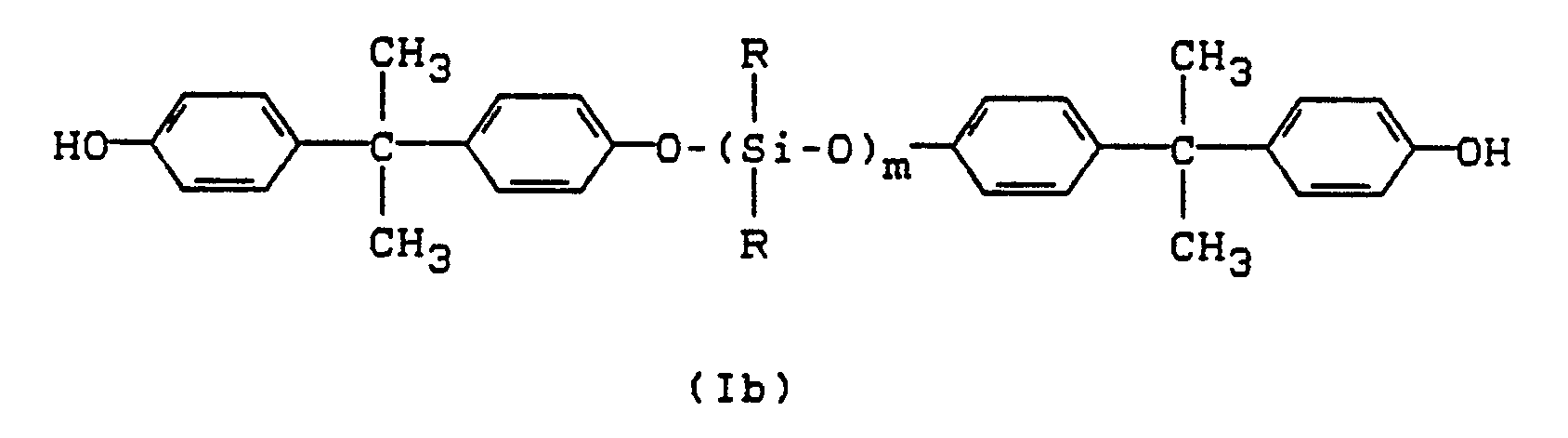
- Preferred diphenols of the formula (Ia) correspond to the formula (Ib) wherein the two radicals R are the same and have the meaning given above, preferably represent methyl etc. and phenyl and m is an integer from 5 to 100, preferably from 20 to 80.
- the diphenols of the formula (Ia) can be obtained, for example, from the corresponding bis-chlorine compounds of the formula (II) wherein R and m have the meaning already given, and the diphenols of the formula (I) according to US Pat. No. 3,419,634, column 3, can be prepared in combination with US Pat. No. 3,182,662.
- the polycarbonates (A) suitable according to the invention can be branched, preferably by incorporating 0.05 to 2.0 mol%, based on the sum of the diphenols used, of three or more than three-functional compounds, for example those with three or more more than three phenolic OH groups.
- preferred polycarbonates are the copolycarbonates of bisphenol A with up to 30% by weight, based on the total weight of diphenols, of 2,2-bis (3,5-dibromo-4-hydroxyphenyl) propane or the copolycarbonates of the diphenols of the formula (I) with 1 to 20% by weight of diphenols of the formula (Ia), preferably of the formula (Ib), based on the total weight of the diphenols (I) and (Ia) or ( I) and (Ib).
- the copolymers (B) are thermoplastic, resinous polymers. They are known and can be identified by ra produce radical polymerization, in particular by emulsion, suspension, solution or bulk polymerization. Your molecular weight w (weight average, determined by light scattering or sedimentation) is 15,000 to 200,000, in particular less than 100,000.
- Particularly preferred copolymers (B) are those composed of 34.5 parts by weight of ⁇ -methylstyrene, 55.5 parts by weight of methyl methacrylate and 10 parts by weight of acrylonitrile.
- the molding compositions according to the invention can contain further additives known for polycarbonate / graft polymer / copolymer molding compositions, such as stabilizers, pigments, flow agents, flame retardants, mold release agents and / or antistatic agents, in the customary amounts.
- the present invention also relates to a process for the preparation of thermoplastic molding compositions from components A, B and any known additives such as stabilizers, pigments, flow agents, flame retardants, mold release agents and antistatic agents, which is characterized in that components A, B and optionally Additives mixed and then at temperatures of 200 ° C to 330 ° C in conventional devices, for example Internal kneading, extruders, twin-screw extruders, melt compounded or melt extruded.
- any known additives such as stabilizers, pigments, flow agents, flame retardants, mold release agents and antistatic agents
- the components can be mixed successively or simultaneously, at about 20 ° C (room temperature) or at a higher temperature.
- the molding compositions of the present invention can be used to produce moldings of any type, in particular by injection molding. Examples of moldings that can be produced are:
- Machine housings e.g. for household appliances, such as juicers, coffee machines, mixers
- cover plates for buildings, automotive parts and components for electrical appliances (because of their good electrical properties).
- Shaped bodies can also be produced from sheets and foils by deep drawing.
- the siloxane content in the polydiorganosiloxane-polycarbonate block copolymer ie the proportion of the dimethylsiloxy units in% by weight, based on the total weight of the block copolymer, can be determined gravimetrically and by nuclear magnetic resonance spectrometry.
- the degree of polymerization determined by determining the end group on the siloxane prepolymer (formula Ia) is the average siloxane block length specified.
- the L value is defined as the specific viscosity of a polymer solution in dimethylformamide (measured at 20 ° C) at a concentration of 5 g / l, divided by this concentration.
- the glass transition temperature was determined on cast films. These were prepared by dissolving the components in the desired mixing ratio in methylene chloride, pouring the solution, evaporating the solvent at room temperature and drying at 50-70 ° C. under a slight vacuum.
- the material used in the injection molding was compounded on a 1.3 l internal kneader at a temperature of 200-220 ° C.
- a Rheometric Dynamie spectrometer (measuring frequency 1 Hz), RDS 7700 from Rheometrie, was used to determine the glass point by means of shear modulus measurement. was measured on the injection molded parts in the initial state.
- Table 1 shows that the mixture of the two components, polycarbonates and the copolymer according to the invention have only a single glass point.
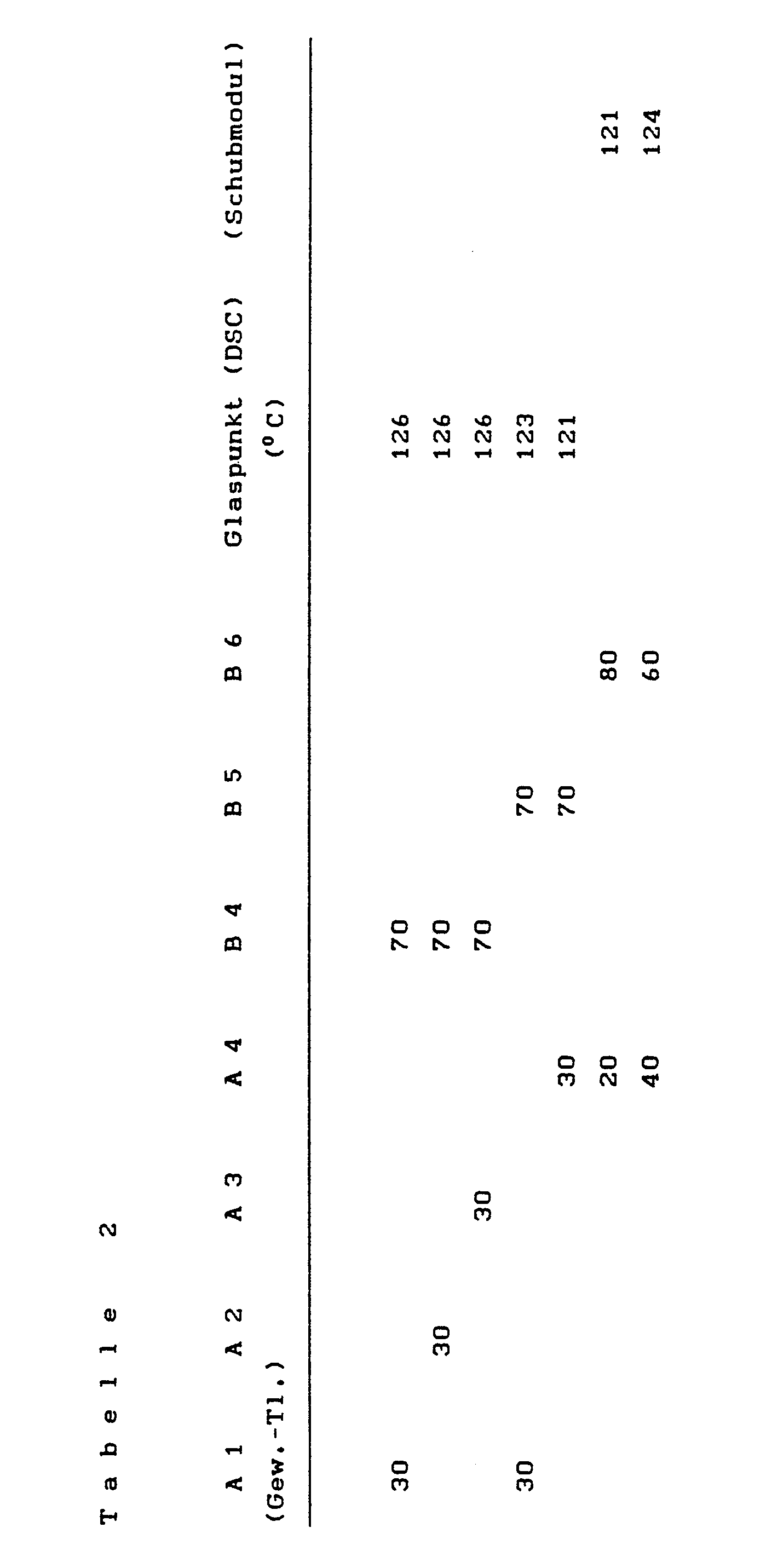
- Table 2 shows that the better miscibility is independent of the type of polycarbonate used and the type of mixture preparation.
- Table 3 lists glass points for mixtures which contain, as a resin component, a copolymer with a composition which differs from the resin according to the invention. The result is two glass points.
Landscapes
- Chemical & Material Sciences (AREA)
- Health & Medical Sciences (AREA)
- Chemical Kinetics & Catalysis (AREA)
- Medicinal Chemistry (AREA)
- Polymers & Plastics (AREA)
- Organic Chemistry (AREA)
- Compositions Of Macromolecular Compounds (AREA)
Abstract
- A.
1 - 99 Gew.-Teile eines aromatischen thermoplastischen Polycarbonates oder mehrerer aromatischer thermoplastischer Polycarbonate und - B.
1 - 99 Gew.-Teile eines thermoplastischen Copolymerisates aus 30 - 40 Gew.-Teile α-Methylstyrol, 50 - 60 Gew.-Teile Methylmethacrylat und 5 - 15 Gew.-Teile Acrylnitril.
Description
- Gegenstand der vorliegenden Erfindung sind thermoplastische Formmassen, enthaltend:
- A.
1 - 99 Gew.-Teile, vorzugsweise
5 - 95 Gew.-Teile eines aromatischen thermoplatischen Polycarbonates oder mehrerer aromatischer thermoplasticher Polycarbonate und - B.
1 - 99 Gew.-Teile, vorzugsweise
5 - 95 Gew.-Teile eines thermoplastischen Copolymerisats aus 30 bis 40 Gew.-Teile, vorzugsweise 34,5 Gew.-Teile, α-Methylstyrol, 50 bis 60 Gew.-Teile, vorzugsweise 55,5 Gew.-Teile, Methylmethacrylat und 5 bis 15 Gew.-Teile, vorzugsweise 10 Gew.-Teile, Acrylnitril. - Die erfindungsgemäßen Formmassen aus (A) und (B) haben nur ein einziges Thermoplast-Verlustmodulmaximum bzw. zeigen nur eine einzige Glasübergangstemperatur, was einer gegenüber dem Stand der Technik, bezüglich Polycarbonat/Copolymerisat-Mischungen, verbesserten Mischbarkeit entspricht.
- Bei der Herstellung von Polymerblends ist Unverträglichkeit, bedingt durch ungenügende Mischbarkeit der Komponenten, weit verbreitet.
- Der Erfindung liegt die Erkenntnis zugrunde, daß ein spezielles Copolymerisat aus α-Methylstyrol, Acrylnitril und Methylmethacrylat, wobei die Mengen der Komponenten nur sehr gering variiert werden können, verbesserte Mischbarkeit mit Polycarbonat besitzt und somit "verträgliche" Polycarbonate/Vinylpolymerisat-Mischungen ergibt.
- Aus DE-AS 2 259 565 sind Polycarbonat/Pfropfpolymerisat/Copolymerisat-Mischungen bekannt, deren Pfropfpolymerisate durch Polymerisation von Styrol, Methylmethacrylat in Kombination mit Acrylnitril und/oder Methylmethacrylat aus einen Kautschuk und deren Copolymerisate aus 95 - 50 % Styrol, α-Methylstyrol, Methacrylat oder Mischungen daraus und 5 - 50 % Acrylnitril, Methylmethacrylat oder Mischungen daraus hergestellt worden sind. Diese Zusammensetzungen besitzen eine verbesserte Fließnahtfestigkeit.
- DE-OS 1 810 993 beschreibt Polycarbonat/Pfropfpolymerisat/Copolymerisat-Mischungen der gleichen Art, wobei die eingesetzte vinylaromatische Verbindung vorwiegend α-Methylstyrol ist. Solche Mischungen besitzen hohe Wärmeformbeständigkeit, jedoch eine schlechtere Kerbschlagzähigkeit als analoge Mischungen auf Styrolbasis.
- Mischungen von Polycarbonat mit Pfropfpolymerisaten aus Mischungen von Styrol, Vinyltoluol, Methylmethacrylat, Acrylnitril, Methylacrylat, Hydroxyethylacrylat oder Ethylmethacrylat auf einen Dienkautschuk sind z.B. in der japanischen Patentanmeldung 56/131-657 beschrieben.
- Erfindungsgemäß geeignete, thermoplastiche, aromatische Polycarbonate (A) sind solche auf Basis der Diphenole der Formel (I)
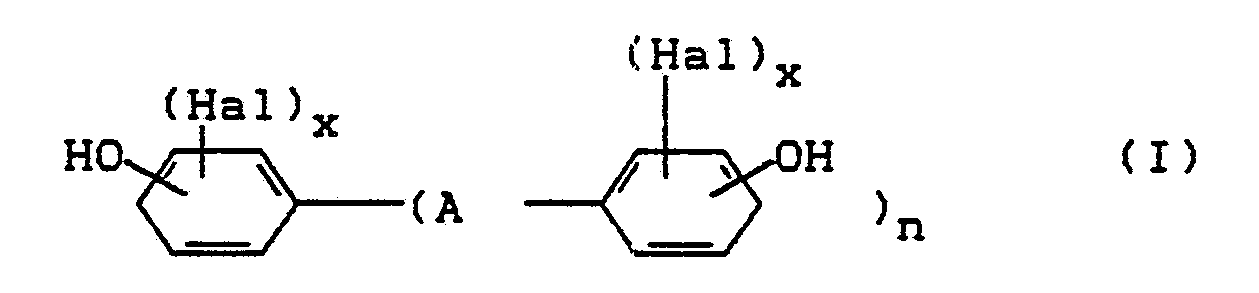

- Erfindungsgemäß geeignete Polycarbonate (A) sind Homopolycarbonate von Diphenolen der Formel (I) und Copolycarbonate von Diphenolen der Formel (I) und Diphenolen der Formel (Ia) in einer Gewichtsmenge von 1 bis 20 Gew.-%, vorzugsweise 1,5 bis 15 gew.-% und insbesondere 2 bis 10 Gew.-%, bezogen auf das Gesamtgewicht der eingesetzten Diphenole. Geeignet sind auch Mischungen aus einem Copolycarbonat auf Basis von Diphenolen (Ia) und (I) und einem anderen siloxanfreien thermoplastischen Polycarbonat, wobei die Menge an einkondensierten Diphenolen (Ia) in der Polycarbonatmischung 1 bis 20 Gew.-% ist.
- Die Diphenole der Formel (I) sind bekannt oder nach bekannten Verfahren herstellbar; Polydiroganosiloxane mit Hydroxy-aryloxy-Endgruppen gemäß Formel (Ia) sind ebenfalls bekannt (vgl. US-PS 3 419 634) oder nach bekannten Verfahren herstellbar.
- Die Herstellung erfindungsgemäß geeigneter Polycarbonate (A) ist bekannt. Man kann die Diphenole beispielsweise mit Phosgen nach dem Phasengrenzflächenverfahren oder in homogener Phase (dem sogenannten Pyridinverfahren) umsetzen, wobei das Molekulargewicht durch eine entsprechende Menge an Kettenabbrechern eingestellt wird (vgl. DE-OS 3 334 782).
- Geeignete Kettenabbrecher sind beispielsweise Phenol, p-Chlorphenol, p-tert.-Butylphenol und 2,4,6-Tribromphenol, sowie langkettige Alkylphenole wie 4-(1,3-Tetramethyl-butyl)-phenol (gemäß DE-OS 2 842 005), Monoalkylphenole und Dialkylphenole mit insgesamt 8 bis 20 C-Atomen in den Alkylsubstituenten (gemäß deutscher Patentanmeldung P-350647.2), wie p-Nonylphenol, 3,5-di-tert.-Butylphenol, p-tert.-Octylphenol, p-Dodecylphenol, 2-(3,5-Dimethyl-heptyl)-phenol und 4-(3,5-Dimethylheptyl)-phenol.
- Die erfindungsgemäß geeigneten Polycarbonate (A) haben mittlere Gewichtsmittelmolekulargewichte (w, gemessen durch Ultrazentrifugation oder Streulichtmessung) von 10 000 bis 200 000, vorzugsweise von 20 000 bis 80 000.

- Geeignete Diphenole der Formel (I) sind beispielsweise Hydrochinon, Resorcin, 4,4ʹ-Dihydroxydiphenyl, 2,2-Bis-(4-hydroxyphenyl)-propan, 2,4-Bis-(4-hydroxyphenyl)-2-methylbutan, 1,1-Bis-(4-hydroxyphenyl)-cyclohexan, 2,2-Bis-(3-chlor-4-hydroxyphenyl)-propan, 2,2-Bis-(3,5-dichlor-4-hydroxyphenyl)-propan und 2,2-Bis-(3,5-dibrom-4- hydroxyphenyl)-propan.
- Bevorzugte Diphenole der Formel (I) sind 2,2-Bis-(4-hydroxyphenyl)-propan, 2,2-Bis-(3,5-dichlor-4-hydroxyphenyl)-propan, 2,2-Bis-(3,5-dibrom-4-hydroxyphenyl)-propan und 1,1-Bis-(4-hydroxyphenyl)-cyclohexan.
- Besonders geeignete Diphenole der Formel (Ia) sind solche, in denen R Methyl, Ethyl, Propyl, n-Butyl, tert.-Butyl und Phenyl ist.
- Bevorzugte Diphenole der Formel (Ia) entsprechen der Formel (Ib)
- Die Diphenole der Formel (Ia) können beispielsweise aus den entsprechenden Bis-chlorverbindungen der Formel (II)

- Die erfindungsgemäß geeigneten Polycarbonate (A) können verzweigt sein, und zwar vorzugsweise durch den Einbau von 0,05 bis 2,0 Mol-%, bezogen auf die Summe der eingesetzten Diphenole, an drei oder mehr als dreifunktionellen Verbindungen, beispielsweise solchen mit drei oder mehr als drei phenolischen OH-Gruppen.
- Bevorzugte Polycarbonate sind neben dem Bisphenol A-Homopolycarbonat die Copolycarbonate von Bisphenol A mit bis zu 30 Gew.-%, bezogen auf die Gewichtssumme an Diphenolen, an 2,2,-Bis-(3,5-dibrom-4-hydroxyphenyl)-propan oder die Copolycarbonate der Diphenole der Formel (I) mit 1 bis 20 Gew.-% an Diphenolen der Formel (Ia), vorzugsweise der Formel (Ib), bezogen auf die Gewichtssumme der Diphenole (I) und (Ia) bzw. (I) und (Ib).
- Die Copolymerisate (B) sind thermoplastische, harzartige Polymerisate. Sie sind bekannt und lassen sich durch ra dikalische Polymerisation, insbesondere durch Emulsions-, Suspensions-, Lösungs- oder Massepolymerisation herstellen. Ihr Molekulargewichtw (Gewichtsmittel, ermittelt durch Lichtstreuung oder Sedimentation) ist 15 000 bis 200 000, insbesondere kleiner 100 000.

- Besonders bevorzugte Copolymerisate (B) sind solche aus 34,5 Gew.-Teile α-Methylstyrol, 55,5 Gew.-Teile Methylmethacrylat und 10 Gew.-Teile Acrylnitril.
- Die erfindungsgemäßen Formmassen können weitere für Polycarbonat/Pfropfpolymerisat/Copolymerisat-Formmassen bekannte Zusätze, wie Stabilisatoren, Pigmente, Fließmittel, Flammschutzmittel, Entformungsmittel und/oder Antistatika, in den üblichen Mengen enthalten.
- Gegenstand der vorliegenden Erfindung ist auch ein Verfahren zur Herstellung von thermoplatischen Formmassen aus den Komponenten A, B und gegebenenfalls bekannten Zusätzen wie Stabilisatoren, Pigmente, Fließmittel, Flammschutzmittel, Entformungsmittel und Antistatika, das dadurch gekennzeichnet ist, daß man die Komponenten A, B und gegebenenfalls Zusätze vermischt und dann bei Temperaturen von 200°C bis 330°C in dafür üblichen Vorrichtungen, z.B. Innenknetern, Extrudern, Doppelwellenschnecken, schemlzcompoundiert oder schmelzextrudiert.
- Die Komponenten können sukzessive oder simultan gemischt werden, bei etwa 20°C (Raumtemperatur) oder auch bei höherer Temperatur.
- Die Formmassen der vorliegenden Erfindung können zur Herstellung von Formkörpern jeder Art, insbesondere durch Spritzguß, verwendet werden. Beispiele für herstellbare Formkörper sind:
- Machinengehäuse (z.B. für Haushaltsgeräte, wie Saftpressen, Kaffeemaschinen, Mixer), Abdeckplatten für Bauten, Kraftfahrzeug-Teile und Bauteile für Elektrogeräte (wegen ihrer guten elektrischen Eigenschaften).
- Formkörper können auch durch Tiefziehen aus Platten und Folien hergestellt werden.
- Der Siloxangehalt im Polydiorganosiloxan-Polycarbonat-Blockcopolymeren, d.h. der Anteil der Dimethylsiloxy-Einheiten in Gew.-%, bezogen auf das Gesamtgewicht des Blockcopolymeren, kann gravimetrisch und durch Kernresonanzspektrometrie ermittelt werden. Als mittlere Siloxanblocklänge wird der durch Bestimmung der Endgruppe am Siloxan-Prepolymer (Formel Ia) ermittelte Polymerisationsgraddangegeben.

-
- A 1)
Polycarbonat aus 2,2-Bis-(4-hydroxyphenyl)-propan (Bisphenol A) mit einer relativen Lösungsviskosität von 1,26 - 1,28, gemessen in Methylenchlorid bei 25°C und einer Konzentration vin 0,5 Gew.-%. - A 2)
Polycarbonat aus 2,2-Bis-(4-hydroxyphenyl)-propan (Bisphenol A) mit einer relativen Lösungsviskosität von 1,30 - 1,32, gemessen in Methylenchlorid bei 25°C und einer Konzentration von 0,5 %. - A 3)
Copolycarbonat auf Basis von Bisphenol A mit 10 Gew.-% Tetrabrombisphenol A und einer relativen Lösungsviskosität von 1,284, gemessen in CH₂Cl₂ bei 25°C und einer Konzentration von 0,5 g/l; Gehalt an Brom: ca. 5 Gew.-%. - A 4)
Copolycarbonat aus Basis von Bisphenol A und 5 Gew.-% Polydimethylsiloxan der Blocklänge () 40, mit einer relativen Lösungsviskosität von 1,31, gemessen in CH₂Cl₂ bei 25°C und einer Konzentration von 0,5 g/100 ml.
- B 1)
Ein thermoplastisches Copolymerisat aus 34,5 Gew.-% α-Methylstyrol, 55,5 Gew.-% Methylmethacrylat und 10 Gew.-% Acrylnitril, mit einem L-Wert = 58, hergestellt durch Emulsionspolymerisation. - B 2)
Copolymerisat gemäß B 1 mit einem L-Wert = 40. - B 3)
Copolymerisat gemäß B 1 mit einem L-Wert = 42. - B 4)
Copolymerisat gemäß B 1 mit einem L-Wert = 41. - B 5)
Copolymerisat gemäß B 1 mit einem L-Wert = 48. - B 6)
Copolymerisat gemäß B 1 mit einem L-Wert = 49 - B 7)
Styrol/Acrylnitril-Copolymerisat mit einem Styrol/Acrylnitril-Verhältnis von 72:28 und einem L-Wert = 60, hergestellt durch Massepolymerisation. - B 8)
Methylmethacrylat/Acrylnitril-Copolymerisat mit einem Methylmethacrylat/Acrylnitril-Verhältnis von 70:30 und einem L-Wert = 77, hergestellt durch Emulsionspolymerisation. - B 9)
Ein Copolymerisat aus 50 Gew.-% α-Methylstyrol, 35,5 Gew.-% Methylmethacrylat, 14,5 Gew.-% Acrylnitril und einem L-Wert = 43, hergestellt durch Emulsionspolymerisation. - B 10)
Ein Copolymerisat aus 24,5 Gew.-% α-Methylstyrol, 64 Gew.-% Methylmethacrylat, 11,5 Gew.-% Acrylnitril und einem L-Wert = 36, hergestellt durch Emulsionspolymerisation. - B 11)
Ein Copolymerisat aus 14,5 Gew.-% α-Methylstyrol, 72,5 Gew.-% Methylmethacrylat, 13 Gew.-% Acrylnitril und einem L-Wert = 36, hergestellt durch Emulsionspolymerisation. - Der L-Wert ist definiert als spezifische Viskosität einer Polymerlösung in Dimethylformamid (gemessen bei 20°C) bei der Konzentration 5 g/l, dividiert durch diese Konzentration.
- Die Glastemperatur wurde an Gießfolien bestimmt. Diese wurden durch Lösen der Komponenten in dem gewünschten Mischungsverhältnis in Methylenchlorid, Vergießen der Lösung, Abdampfen des Lösungsmittels bei Raumtemperatur und Nachtrocknen bei 50 - 70°C bei leichtem Vakuum hergestellt.
- Zur Bestimmung der Schubmodulkurve wurden Spritzgußteile, hergestellt bei 260°C, eingesetzt (ASTM-Stab 1/8").
- Das beim Spritzguß eingesetzte Material wurde auf einem 1,3-l-Innenkneter bei einer Temperatur von 200 - 220°C compoundiert.
- Die Glastemperatur wurde mittels eines Differentialkalorimeters, DSC-2 (Perkin-Elmer) bestimmt. Jede Probe wurde hierbei unter Stickstoff als Schutzgas zweimal von +10°C bis 200°C mit einer Heizrate von 20 K/min aufgeheizt. Nach der ersten Aufheizung wurde die Probe im Kalorimeter mit 320 K/min auf 10°C abgekühlt. Gemessen wurde bei der zweiten Aufheizung.
- Zur Bestimmung des Glaspunktes mittels Schubmodulmessung wurde ein Rheometric Dynamie Spektrometer (Meßfrequenz 1 Hz), RDS 7700 der Firma Rheometrie verwendet. Gemessen wurde an den Spritzgußteilen im Ausgangszustand.
- In den folgenden Tabellen sind die untersuchten Polycarbonat/Copolymerisat-Mischungen sowie die zugehörigen Meßergebnisse aufgeführt:


- Tabelle 1 zeigt, daß die Mischung der beiden Komponenten, Polycarbonate und das erfindungsgemäße Copolymerisat nur einen einzigen Glaspunkt besitzen.
- Aus Tabelle 2 geht hervor, daß die bessere Mischbarkeit unabhängig vom eingesetzten Polycarbonattyp sowie der Art der Mischungsherstellung ist.
- In Tabelle 3 sind Glaspunkte für Mischungen aufgelistet, die als Harzkomponente ein Copolymerisat, mit von dem erfindungsgemäßen Harz abweichender Zusammensetzung, beinhalten. Es resultieren jeweils zwei Glaspunkte.
Claims (5)
1 - 99 Gew.-Teile eines aromatischen thermoplastischen Polycarbonates oder mehrerer aromatischer thermoplastischer Polycarbonate und
1 - 99 Gew.-Teile eines thermoplastischen Copolymerisates aus 30 - 40 Gew.-Teile α-Methylstyrol, 50 - 60 Gew.-Teile Methylmethacrylat und 5 bis 15 Gew.-Teile Acrylnitril.

Applications Claiming Priority (2)
| Application Number | Priority Date | Filing Date | Title |
|---|---|---|---|
| DE19863626258 DE3626258A1 (de) | 1986-08-02 | 1986-08-02 | Thermoplastische formmassen aus polycarbonat und terpolymerisaten |
| DE3626258 | 1986-08-02 |
Publications (3)
| Publication Number | Publication Date |
|---|---|
| EP0255641A2 true EP0255641A2 (de) | 1988-02-10 |
| EP0255641A3 EP0255641A3 (en) | 1988-07-06 |
| EP0255641B1 EP0255641B1 (de) | 1991-10-23 |
Family
ID=6306592
Family Applications (1)
| Application Number | Title | Priority Date | Filing Date |
|---|---|---|---|
| EP87110464A Expired - Lifetime EP0255641B1 (de) | 1986-08-02 | 1987-07-20 | Thermoplastische Formmassen aus Polycarbonat und Terpolymerisaten |
Country Status (4)
| Country | Link |
|---|---|
| US (1) | US4774289A (de) |
| EP (1) | EP0255641B1 (de) |
| JP (1) | JPS6341563A (de) |
| DE (2) | DE3626258A1 (de) |
Families Citing this family (3)
| Publication number | Priority date | Publication date | Assignee | Title |
|---|---|---|---|---|
| US5352500A (en) * | 1988-02-08 | 1994-10-04 | Rohm And Haas Company | Thermoplastic polymer compositions containing melt-rheology modifiers |
| DE3811054A1 (de) * | 1988-03-31 | 1989-10-12 | Basf Ag | Waermeformbestaendige thermoplastische formmasse, enthaltend ein terpolymerisat |
| US5241005A (en) * | 1990-12-28 | 1993-08-31 | Nippon Steel Chemical Co., Ltd. | Heat-resistant resin compositions with a pearly luster |
Family Cites Families (2)
| Publication number | Priority date | Publication date | Assignee | Title |
|---|---|---|---|---|
| US4579909A (en) * | 1984-12-18 | 1986-04-01 | General Electric Company | Ternary combination of acrylate-styrene-acrylonitrile terpolymer, poly methyl methacrylate and polycarbonate |
| DE3514185A1 (de) * | 1985-04-19 | 1986-10-23 | Bayer Ag, 5090 Leverkusen | Thermoplastische formmassen aus polycarbonaten, pfropfpolymerisaten und copolymerisaten |
-
1986
- 1986-08-02 DE DE19863626258 patent/DE3626258A1/de not_active Withdrawn
-
1987
- 1987-07-20 US US07/075,535 patent/US4774289A/en not_active Expired - Fee Related
- 1987-07-20 EP EP87110464A patent/EP0255641B1/de not_active Expired - Lifetime
- 1987-07-20 DE DE8787110464T patent/DE3774026D1/de not_active Expired - Lifetime
- 1987-07-29 JP JP62187851A patent/JPS6341563A/ja active Pending
Also Published As
| Publication number | Publication date |
|---|---|
| EP0255641A3 (en) | 1988-07-06 |
| EP0255641B1 (de) | 1991-10-23 |
| DE3774026D1 (en) | 1991-11-28 |
| DE3626258A1 (de) | 1988-02-11 |
| US4774289A (en) | 1988-09-27 |
| JPS6341563A (ja) | 1988-02-22 |
Similar Documents
| Publication | Publication Date | Title |
|---|---|---|
| EP0260558B1 (de) | Alterungsbeständige thermoplastische Formmassen mit guter Zähigkeit | |
| EP0260559A2 (de) | Thermoplastische Formmassen mit hoher Alterungsbeständigkeit und guter Tieftemperaturzähigkeit | |
| EP0158931B1 (de) | Thermoplastische Formmassen auf Basis von Polycarbonat-Pfropfpolymerisat-Gemischen | |
| DE3519690A1 (de) | Thermoplastische formmassen auf basis von polysiloxan-polycarbonat-blockcopolymeren | |
| EP0522314A1 (de) | Thermoplastische Formmassen auf der Basis von Polycarbonaten, Styrol/Acrylnitril-Polymerisaten und Polyolefinen | |
| DE102015122922B4 (de) | Thermoplastische Harzzusammensetzung für Automobilinnenbauteile und Formteil für Automobilinnenbauteile unter Verwendung derselben | |
| EP0199193B1 (de) | Thermoplastische Formmassen aus Polycarbonaten, Pfropfpolymerisaten und Copolymerisaten | |
| EP0312929A2 (de) | Thermoplastische Formmasse, Verfahren zu ihrer Herstellung und deren Verwendung | |
| DE4016417A1 (de) | Flammwidrige polycarbonate | |
| DE4000173A1 (de) | Waermeformbestaendige, gut verarbeitbare und thermostabile polycarbonat-formmassen | |
| EP0432581B1 (de) | Thermoplastische Polycarbonatformmassen mit flammwidrigen Eigenschaften | |
| EP0224805B1 (de) | Thermoplastische Polycarbonatformmassen | |
| EP0281837A2 (de) | Thermoplastische Formmassen | |
| EP0206006A1 (de) | Thermoplastische Formmassen mit verbesserter Fliessnahtfestigkeit | |
| EP0258689B1 (de) | Mischungen aus Polydiorganosiloxan-Polycarbonat-Blockcokondensaten und Polyisobutylenen | |
| EP0225518B1 (de) | Thermoplastische Polycarbonatformmassen | |
| DE60118394T2 (de) | Transparente Zusammensetzung enthaltend ein Polycarbonat und ein Methylmethacrylat-Copolymer | |
| EP0255641B1 (de) | Thermoplastische Formmassen aus Polycarbonat und Terpolymerisaten | |
| EP0337105B1 (de) | Thermoplastische Formmassen enthaltend aliphatische Polycarbonate | |
| EP0224111A2 (de) | Thermoplastische Formmassen auf Basis Polyphenylenoxid-Polycarbonat-Blockkondensaten | |
| EP0207327B1 (de) | Thermoplastische Formmassen | |
| EP0285984B1 (de) | Thermoplastische Formmasse mit verbessertem Spannungsrissverhalten | |
| EP0176811B1 (de) | Neue Stabilisatoren für ABS-Kunststoffe und ABS-Legierungen | |
| DE69028015T2 (de) | Mischungen von styrencopolymeren mit verbesserter schlagfestigkeit bei niedrigen temperaturen | |
| DE102018133635A1 (de) | Thermoplastische Harzzusammensetzung und Formartikel, für den diese verwendet wird |
Legal Events
| Date | Code | Title | Description |
|---|---|---|---|
| PUAI | Public reference made under article 153(3) epc to a published international application that has entered the european phase |
Free format text: ORIGINAL CODE: 0009012 |
|
| 17P | Request for examination filed |
Effective date: 19870720 |
|
| AK | Designated contracting states |
Kind code of ref document: A2 Designated state(s): DE FR GB IT NL |
|
| PUAL | Search report despatched |
Free format text: ORIGINAL CODE: 0009013 |
|
| AK | Designated contracting states |
Kind code of ref document: A3 Designated state(s): DE FR GB IT NL |
|
| 17Q | First examination report despatched |
Effective date: 19900309 |
|
| GRAA | (expected) grant |
Free format text: ORIGINAL CODE: 0009210 |
|
| AK | Designated contracting states |
Kind code of ref document: B1 Designated state(s): DE FR GB IT NL |
|
| REF | Corresponds to: |
Ref document number: 3774026 Country of ref document: DE Date of ref document: 19911128 |
|
| ITF | It: translation for a ep patent filed | ||
| ET | Fr: translation filed | ||
| GBT | Gb: translation of ep patent filed (gb section 77(6)(a)/1977) | ||
| PGFP | Annual fee paid to national office [announced via postgrant information from national office to epo] |
Ref country code: GB Payment date: 19920713 Year of fee payment: 6 |
|
| PGFP | Annual fee paid to national office [announced via postgrant information from national office to epo] |
Ref country code: FR Payment date: 19920724 Year of fee payment: 6 |
|
| PGFP | Annual fee paid to national office [announced via postgrant information from national office to epo] |
Ref country code: NL Payment date: 19920731 Year of fee payment: 6 |
|
| PLBE | No opposition filed within time limit |
Free format text: ORIGINAL CODE: 0009261 |
|
| STAA | Information on the status of an ep patent application or granted ep patent |
Free format text: STATUS: NO OPPOSITION FILED WITHIN TIME LIMIT |
|
| 26N | No opposition filed | ||
| PG25 | Lapsed in a contracting state [announced via postgrant information from national office to epo] |
Ref country code: GB Effective date: 19930720 |
|
| PG25 | Lapsed in a contracting state [announced via postgrant information from national office to epo] |
Ref country code: NL Effective date: 19940201 |
|
| GBPC | Gb: european patent ceased through non-payment of renewal fee |
Effective date: 19930720 |
|
| NLV4 | Nl: lapsed or anulled due to non-payment of the annual fee | ||
| PG25 | Lapsed in a contracting state [announced via postgrant information from national office to epo] |
Ref country code: FR Effective date: 19940331 |
|
| REG | Reference to a national code |
Ref country code: FR Ref legal event code: ST |
|
| PGFP | Annual fee paid to national office [announced via postgrant information from national office to epo] |
Ref country code: DE Payment date: 19940615 Year of fee payment: 8 |
|
| PG25 | Lapsed in a contracting state [announced via postgrant information from national office to epo] |
Ref country code: DE Effective date: 19960402 |
|
| PG25 | Lapsed in a contracting state [announced via postgrant information from national office to epo] |
Ref country code: IT Free format text: LAPSE BECAUSE OF NON-PAYMENT OF DUE FEES;WARNING: LAPSES OF ITALIAN PATENTS WITH EFFECTIVE DATE BEFORE 2007 MAY HAVE OCCURRED AT ANY TIME BEFORE 2007. THE CORRECT EFFECTIVE DATE MAY BE DIFFERENT FROM THE ONE RECORDED. Effective date: 20050720 |