EP0254735B1 - Thermally stable and ph stable subtilisin analogs and method for production thereof - Google Patents
Thermally stable and ph stable subtilisin analogs and method for production thereof Download PDFInfo
- Publication number
- EP0254735B1 EP0254735B1 EP87900930A EP87900930A EP0254735B1 EP 0254735 B1 EP0254735 B1 EP 0254735B1 EP 87900930 A EP87900930 A EP 87900930A EP 87900930 A EP87900930 A EP 87900930A EP 0254735 B1 EP0254735 B1 EP 0254735B1
- Authority
- EP
- European Patent Office
- Prior art keywords
- amino acid
- residue
- subtilisin
- asn
- analog
- Prior art date
- Legal status (The legal status is an assumption and is not a legal conclusion. Google has not performed a legal analysis and makes no representation as to the accuracy of the status listed.)
- Expired
Links
- 108090000787 Subtilisin Proteins 0.000 title claims abstract description 92
- 238000004519 manufacturing process Methods 0.000 title claims description 14
- 150000001413 amino acids Chemical class 0.000 claims abstract description 46
- 241000193830 Bacillus <bacterium> Species 0.000 claims abstract description 42
- 235000001014 amino acid Nutrition 0.000 claims abstract description 38
- 229940024606 amino acid Drugs 0.000 claims abstract description 34
- KLKHFFMNGWULBN-VKHMYHEASA-N Asn-Gly Chemical group NC(=O)C[C@H](N)C(=O)NCC(O)=O KLKHFFMNGWULBN-VKHMYHEASA-N 0.000 claims abstract description 31
- 238000000034 method Methods 0.000 claims abstract description 29
- 102000035195 Peptidases Human genes 0.000 claims abstract description 26
- 108091005804 Peptidases Proteins 0.000 claims abstract description 26
- 239000004365 Protease Substances 0.000 claims abstract description 24
- MTCFGRXMJLQNBG-UHFFFAOYSA-N Serine Natural products OCC(N)C(O)=O MTCFGRXMJLQNBG-UHFFFAOYSA-N 0.000 claims abstract description 18
- 239000000203 mixture Substances 0.000 claims abstract description 16
- MTCFGRXMJLQNBG-REOHCLBHSA-N (2S)-2-Amino-3-hydroxypropansäure Chemical compound OC[C@H](N)C(O)=O MTCFGRXMJLQNBG-REOHCLBHSA-N 0.000 claims description 51
- 108010056079 Subtilisins Proteins 0.000 claims description 48
- 102000005158 Subtilisins Human genes 0.000 claims description 48
- 101150117169 aprA gene Proteins 0.000 claims description 46
- 239000003599 detergent Substances 0.000 claims description 29
- 108020004705 Codon Proteins 0.000 claims description 13
- 125000000613 asparagine group Chemical group N[C@@H](CC(N)=O)C(=O)* 0.000 claims description 13
- 238000009472 formulation Methods 0.000 claims description 12
- 108020004707 nucleic acids Proteins 0.000 claims description 12
- 102000039446 nucleic acids Human genes 0.000 claims description 12
- 150000007523 nucleic acids Chemical class 0.000 claims description 12
- KZSNJWFQEVHDMF-UHFFFAOYSA-N Valine Natural products CC(C)C(N)C(O)=O KZSNJWFQEVHDMF-UHFFFAOYSA-N 0.000 claims description 9
- XUJNEKJLAYXESH-REOHCLBHSA-N L-Cysteine Chemical compound SC[C@H](N)C(O)=O XUJNEKJLAYXESH-REOHCLBHSA-N 0.000 claims description 8
- KZSNJWFQEVHDMF-BYPYZUCNSA-N L-valine Chemical compound CC(C)[C@H](N)C(O)=O KZSNJWFQEVHDMF-BYPYZUCNSA-N 0.000 claims description 8
- 125000000539 amino acid group Chemical group 0.000 claims description 8
- 108090000765 processed proteins & peptides Proteins 0.000 claims description 8
- 239000004474 valine Substances 0.000 claims description 8
- 235000018417 cysteine Nutrition 0.000 claims description 7
- XUJNEKJLAYXESH-UHFFFAOYSA-N cysteine Natural products SCC(N)C(O)=O XUJNEKJLAYXESH-UHFFFAOYSA-N 0.000 claims description 7
- ZDXPYRJPNDTMRX-VKHMYHEASA-N L-glutamine Chemical compound OC(=O)[C@@H](N)CCC(N)=O ZDXPYRJPNDTMRX-VKHMYHEASA-N 0.000 claims description 6
- AGPKZVBTJJNPAG-WHFBIAKZSA-N L-isoleucine Chemical compound CC[C@H](C)[C@H](N)C(O)=O AGPKZVBTJJNPAG-WHFBIAKZSA-N 0.000 claims description 6
- AYFVYJQAPQTCCC-GBXIJSLDSA-N L-threonine Chemical compound C[C@@H](O)[C@H](N)C(O)=O AYFVYJQAPQTCCC-GBXIJSLDSA-N 0.000 claims description 6
- AYFVYJQAPQTCCC-UHFFFAOYSA-N Threonine Natural products CC(O)C(N)C(O)=O AYFVYJQAPQTCCC-UHFFFAOYSA-N 0.000 claims description 6
- 239000004473 Threonine Substances 0.000 claims description 6
- ZDXPYRJPNDTMRX-UHFFFAOYSA-N glutamine Natural products OC(=O)C(N)CCC(N)=O ZDXPYRJPNDTMRX-UHFFFAOYSA-N 0.000 claims description 6
- 229960000310 isoleucine Drugs 0.000 claims description 6
- AGPKZVBTJJNPAG-UHFFFAOYSA-N isoleucine Natural products CCC(C)C(N)C(O)=O AGPKZVBTJJNPAG-UHFFFAOYSA-N 0.000 claims description 6
- 102000004196 processed proteins & peptides Human genes 0.000 claims description 6
- 229920001184 polypeptide Polymers 0.000 claims description 5
- 230000002950 deficient Effects 0.000 claims description 3
- 230000002759 chromosomal effect Effects 0.000 claims description 2
- 125000003607 serino group Chemical group [H]N([H])[C@]([H])(C(=O)[*])C(O[H])([H])[H] 0.000 claims 3
- 235000014469 Bacillus subtilis Nutrition 0.000 abstract description 57
- 108090000623 proteins and genes Proteins 0.000 abstract description 33
- DCXYFEDJOCDNAF-REOHCLBHSA-N L-asparagine Chemical compound OC(=O)[C@@H](N)CC(N)=O DCXYFEDJOCDNAF-REOHCLBHSA-N 0.000 abstract description 21
- 102000004169 proteins and genes Human genes 0.000 abstract description 11
- 102000012479 Serine Proteases Human genes 0.000 abstract description 10
- 108010022999 Serine Proteases Proteins 0.000 abstract description 10
- 235000018102 proteins Nutrition 0.000 abstract description 10
- DCXYFEDJOCDNAF-UHFFFAOYSA-N Asparagine Natural products OC(=O)C(N)CC(N)=O DCXYFEDJOCDNAF-UHFFFAOYSA-N 0.000 abstract description 9
- 235000009582 asparagine Nutrition 0.000 abstract description 9
- 229960001230 asparagine Drugs 0.000 abstract description 9
- 230000015572 biosynthetic process Effects 0.000 abstract description 9
- 108091005658 Basic proteases Proteins 0.000 abstract description 8
- 238000003786 synthesis reaction Methods 0.000 abstract description 7
- 244000063299 Bacillus subtilis Species 0.000 abstract description 4
- 238000005406 washing Methods 0.000 abstract description 3
- 230000001747 exhibiting effect Effects 0.000 abstract 1
- 102000004190 Enzymes Human genes 0.000 description 54
- 108090000790 Enzymes Proteins 0.000 description 54
- 229940088598 enzyme Drugs 0.000 description 54
- 239000013612 plasmid Substances 0.000 description 50
- 239000012634 fragment Substances 0.000 description 39
- 239000000047 product Substances 0.000 description 38
- 210000004027 cell Anatomy 0.000 description 34
- 108020004414 DNA Proteins 0.000 description 31
- 125000003275 alpha amino acid group Chemical group 0.000 description 18
- 229960005091 chloramphenicol Drugs 0.000 description 17
- WIIZWVCIJKGZOK-RKDXNWHRSA-N chloramphenicol Chemical compound ClC(Cl)C(=O)N[C@H](CO)[C@H](O)C1=CC=C([N+]([O-])=O)C=C1 WIIZWVCIJKGZOK-RKDXNWHRSA-N 0.000 description 17
- 230000000694 effects Effects 0.000 description 17
- 239000000243 solution Substances 0.000 description 17
- 241000588724 Escherichia coli Species 0.000 description 15
- 229940059720 apra Drugs 0.000 description 14
- 230000035772 mutation Effects 0.000 description 14
- DHMQDGOQFOQNFH-UHFFFAOYSA-N Glycine Chemical compound NCC(O)=O DHMQDGOQFOQNFH-UHFFFAOYSA-N 0.000 description 13
- 210000000349 chromosome Anatomy 0.000 description 12
- 230000002779 inactivation Effects 0.000 description 11
- 230000002068 genetic effect Effects 0.000 description 10
- 108091005507 Neutral proteases Proteins 0.000 description 9
- 230000009466 transformation Effects 0.000 description 9
- RZVAJINKPMORJF-UHFFFAOYSA-N Acetaminophen Chemical compound CC(=O)NC1=CC=C(O)C=C1 RZVAJINKPMORJF-UHFFFAOYSA-N 0.000 description 8
- 102000035092 Neutral proteases Human genes 0.000 description 8
- -1 aromatic amino acid Chemical class 0.000 description 8
- 230000008859 change Effects 0.000 description 8
- 125000001475 halogen functional group Chemical group 0.000 description 8
- 238000012986 modification Methods 0.000 description 8
- 230000004048 modification Effects 0.000 description 8
- 108090000145 Bacillolysin Proteins 0.000 description 7
- CKLJMWTZIZZHCS-REOHCLBHSA-N L-aspartic acid Chemical compound OC(=O)[C@@H](N)CC(O)=O CKLJMWTZIZZHCS-REOHCLBHSA-N 0.000 description 7
- 101100163944 Necator americanus apr-2 gene Proteins 0.000 description 7
- 238000006467 substitution reaction Methods 0.000 description 7
- 101150074257 xylE gene Proteins 0.000 description 7
- CSCPPACGZOOCGX-UHFFFAOYSA-N Acetone Chemical compound CC(C)=O CSCPPACGZOOCGX-UHFFFAOYSA-N 0.000 description 6
- 101100204301 Bacillus subtilis (strain 168) aprE gene Proteins 0.000 description 6
- 108091028043 Nucleic acid sequence Proteins 0.000 description 6
- XSQUKJJJFZCRTK-UHFFFAOYSA-N Urea Chemical compound NC(N)=O XSQUKJJJFZCRTK-UHFFFAOYSA-N 0.000 description 6
- 238000002955 isolation Methods 0.000 description 6
- 230000001105 regulatory effect Effects 0.000 description 6
- 238000002741 site-directed mutagenesis Methods 0.000 description 6
- 239000000758 substrate Substances 0.000 description 6
- 229920001817 Agar Polymers 0.000 description 5
- 239000008272 agar Substances 0.000 description 5
- 239000005018 casein Substances 0.000 description 5
- BECPQYXYKAMYBN-UHFFFAOYSA-N casein, tech. Chemical compound NCCCCC(C(O)=O)N=C(O)C(CC(O)=O)N=C(O)C(CCC(O)=N)N=C(O)C(CC(C)C)N=C(O)C(CCC(O)=O)N=C(O)C(CC(O)=O)N=C(O)C(CCC(O)=O)N=C(O)C(C(C)O)N=C(O)C(CCC(O)=N)N=C(O)C(CCC(O)=N)N=C(O)C(CCC(O)=N)N=C(O)C(CCC(O)=O)N=C(O)C(CCC(O)=O)N=C(O)C(COP(O)(O)=O)N=C(O)C(CCC(O)=N)N=C(O)C(N)CC1=CC=CC=C1 BECPQYXYKAMYBN-UHFFFAOYSA-N 0.000 description 5
- 235000021240 caseins Nutrition 0.000 description 5
- 238000012217 deletion Methods 0.000 description 5
- 230000037430 deletion Effects 0.000 description 5
- 230000014509 gene expression Effects 0.000 description 5
- 238000009396 hybridization Methods 0.000 description 5
- 230000002427 irreversible effect Effects 0.000 description 5
- 239000002609 medium Substances 0.000 description 5
- 235000020183 skimmed milk Nutrition 0.000 description 5
- XLYOFNOQVPJJNP-UHFFFAOYSA-N water Chemical compound O XLYOFNOQVPJJNP-UHFFFAOYSA-N 0.000 description 5
- 238000001712 DNA sequencing Methods 0.000 description 4
- 238000002835 absorbance Methods 0.000 description 4
- 239000011543 agarose gel Substances 0.000 description 4
- 229960000723 ampicillin Drugs 0.000 description 4
- AVKUERGKIZMTKX-NJBDSQKTSA-N ampicillin Chemical compound C1([C@@H](N)C(=O)N[C@H]2[C@H]3SC([C@@H](N3C2=O)C(O)=O)(C)C)=CC=CC=C1 AVKUERGKIZMTKX-NJBDSQKTSA-N 0.000 description 4
- 238000013459 approach Methods 0.000 description 4
- 238000003776 cleavage reaction Methods 0.000 description 4
- 238000010276 construction Methods 0.000 description 4
- 238000001962 electrophoresis Methods 0.000 description 4
- 238000000605 extraction Methods 0.000 description 4
- 239000001963 growth medium Substances 0.000 description 4
- 230000006872 improvement Effects 0.000 description 4
- 230000010354 integration Effects 0.000 description 4
- 229930027917 kanamycin Natural products 0.000 description 4
- 229960000318 kanamycin Drugs 0.000 description 4
- SBUJHOSQTJFQJX-NOAMYHISSA-N kanamycin Chemical compound O[C@@H]1[C@@H](O)[C@H](O)[C@@H](CN)O[C@@H]1O[C@H]1[C@H](O)[C@@H](O[C@@H]2[C@@H]([C@@H](N)[C@H](O)[C@@H](CO)O2)O)[C@H](N)C[C@@H]1N SBUJHOSQTJFQJX-NOAMYHISSA-N 0.000 description 4
- 229930182823 kanamycin A Natural products 0.000 description 4
- 210000001938 protoplast Anatomy 0.000 description 4
- 238000011160 research Methods 0.000 description 4
- 108091008146 restriction endonucleases Proteins 0.000 description 4
- 230000007017 scission Effects 0.000 description 4
- 230000028327 secretion Effects 0.000 description 4
- 238000012163 sequencing technique Methods 0.000 description 4
- 239000012064 sodium phosphate buffer Substances 0.000 description 4
- 239000000126 substance Substances 0.000 description 4
- 238000012360 testing method Methods 0.000 description 4
- 238000011426 transformation method Methods 0.000 description 4
- 239000013598 vector Substances 0.000 description 4
- 241000304886 Bacilli Species 0.000 description 3
- 241000193744 Bacillus amyloliquefaciens Species 0.000 description 3
- 101100498939 Bacillus subtilis (strain 168) degS gene Proteins 0.000 description 3
- 101710089384 Extracellular protease Proteins 0.000 description 3
- 108091034117 Oligonucleotide Proteins 0.000 description 3
- 238000004458 analytical method Methods 0.000 description 3
- 239000000872 buffer Substances 0.000 description 3
- 239000004202 carbamide Substances 0.000 description 3
- 238000005119 centrifugation Methods 0.000 description 3
- 238000006243 chemical reaction Methods 0.000 description 3
- 239000012228 culture supernatant Substances 0.000 description 3
- 230000029087 digestion Effects 0.000 description 3
- 230000007062 hydrolysis Effects 0.000 description 3
- 238000006460 hydrolysis reaction Methods 0.000 description 3
- 238000011534 incubation Methods 0.000 description 3
- 238000003780 insertion Methods 0.000 description 3
- 230000037431 insertion Effects 0.000 description 3
- 239000007788 liquid Substances 0.000 description 3
- 230000007246 mechanism Effects 0.000 description 3
- 238000002844 melting Methods 0.000 description 3
- 125000001360 methionine group Chemical group N[C@@H](CCSC)C(=O)* 0.000 description 3
- 231100000219 mutagenic Toxicity 0.000 description 3
- 230000003505 mutagenic effect Effects 0.000 description 3
- 230000007935 neutral effect Effects 0.000 description 3
- 239000002244 precipitate Substances 0.000 description 3
- 235000019419 proteases Nutrition 0.000 description 3
- 230000010076 replication Effects 0.000 description 3
- 230000000717 retained effect Effects 0.000 description 3
- 238000007363 ring formation reaction Methods 0.000 description 3
- 239000000523 sample Substances 0.000 description 3
- 244000153158 Ammi visnaga Species 0.000 description 2
- 235000010585 Ammi visnaga Nutrition 0.000 description 2
- 244000241257 Cucumis melo Species 0.000 description 2
- 102000053602 DNA Human genes 0.000 description 2
- 108010067770 Endopeptidase K Proteins 0.000 description 2
- 239000004471 Glycine Substances 0.000 description 2
- ZRALSGWEFCBTJO-UHFFFAOYSA-N Guanidine Chemical compound NC(N)=N ZRALSGWEFCBTJO-UHFFFAOYSA-N 0.000 description 2
- 238000002105 Southern blotting Methods 0.000 description 2
- 239000007983 Tris buffer Substances 0.000 description 2
- 235000021120 animal protein Nutrition 0.000 description 2
- 238000010945 base-catalyzed hydrolysis reactiony Methods 0.000 description 2
- 230000003115 biocidal effect Effects 0.000 description 2
- 101150055766 cat gene Proteins 0.000 description 2
- 230000003197 catalytic effect Effects 0.000 description 2
- YCIMNLLNPGFGHC-UHFFFAOYSA-N catechol Chemical compound OC1=CC=CC=C1O YCIMNLLNPGFGHC-UHFFFAOYSA-N 0.000 description 2
- 238000001311 chemical methods and process Methods 0.000 description 2
- 239000003795 chemical substances by application Substances 0.000 description 2
- 238000010367 cloning Methods 0.000 description 2
- 239000012141 concentrate Substances 0.000 description 2
- 108090000200 cucumisin Proteins 0.000 description 2
- HAAZLUGHYHWQIW-KVQBGUIXSA-N dGTP Chemical compound C1=NC=2C(=O)NC(N)=NC=2N1[C@H]1C[C@H](O)[C@@H](COP(O)(=O)OP(O)(=O)OP(O)(O)=O)O1 HAAZLUGHYHWQIW-KVQBGUIXSA-N 0.000 description 2
- 230000009849 deactivation Effects 0.000 description 2
- 239000012153 distilled water Substances 0.000 description 2
- 230000002255 enzymatic effect Effects 0.000 description 2
- 238000002474 experimental method Methods 0.000 description 2
- 239000013604 expression vector Substances 0.000 description 2
- 125000003630 glycyl group Chemical group [H]N([H])C([H])([H])C(*)=O 0.000 description 2
- 108010020132 microbial serine proteinases Proteins 0.000 description 2
- 239000002773 nucleotide Substances 0.000 description 2
- 125000003729 nucleotide group Chemical group 0.000 description 2
- 230000003647 oxidation Effects 0.000 description 2
- 238000007254 oxidation reaction Methods 0.000 description 2
- OJMIONKXNSYLSR-UHFFFAOYSA-N phosphorous acid Chemical compound OP(O)O OJMIONKXNSYLSR-UHFFFAOYSA-N 0.000 description 2
- 238000002360 preparation method Methods 0.000 description 2
- 230000008569 process Effects 0.000 description 2
- 230000002797 proteolythic effect Effects 0.000 description 2
- 229940024999 proteolytic enzymes for treatment of wounds and ulcers Drugs 0.000 description 2
- 230000003362 replicative effect Effects 0.000 description 2
- 235000014347 soups Nutrition 0.000 description 2
- 230000006641 stabilisation Effects 0.000 description 2
- 238000011105 stabilization Methods 0.000 description 2
- 230000005030 transcription termination Effects 0.000 description 2
- LENZDBCJOHFCAS-UHFFFAOYSA-N tris Chemical compound OCC(N)(CO)CO LENZDBCJOHFCAS-UHFFFAOYSA-N 0.000 description 2
- 241001515965 unidentified phage Species 0.000 description 2
- 235000013311 vegetables Nutrition 0.000 description 2
- XBKONSCREBSMCS-REOHCLBHSA-N 3-disulfanyl-L-alanine Chemical compound OC(=O)[C@@H](N)CSS XBKONSCREBSMCS-REOHCLBHSA-N 0.000 description 1
- TYMLOMAKGOJONV-UHFFFAOYSA-N 4-nitroaniline Chemical compound NC1=CC=C([N+]([O-])=O)C=C1 TYMLOMAKGOJONV-UHFFFAOYSA-N 0.000 description 1
- 102000002260 Alkaline Phosphatase Human genes 0.000 description 1
- 108020004774 Alkaline Phosphatase Proteins 0.000 description 1
- 101710184263 Alkaline serine protease Proteins 0.000 description 1
- 239000004382 Amylase Substances 0.000 description 1
- 241000194108 Bacillus licheniformis Species 0.000 description 1
- 229920002134 Carboxymethyl cellulose Polymers 0.000 description 1
- 108010080972 Catechol 2,3-dioxygenase Proteins 0.000 description 1
- 108010035563 Chloramphenicol O-acetyltransferase Proteins 0.000 description 1
- 108090000317 Chymotrypsin Proteins 0.000 description 1
- 108020004638 Circular DNA Proteins 0.000 description 1
- 108091026890 Coding region Proteins 0.000 description 1
- 235000015510 Cucumis melo subsp melo Nutrition 0.000 description 1
- 102000012410 DNA Ligases Human genes 0.000 description 1
- 108010061982 DNA Ligases Proteins 0.000 description 1
- 230000004544 DNA amplification Effects 0.000 description 1
- 238000007399 DNA isolation Methods 0.000 description 1
- 102000016928 DNA-directed DNA polymerase Human genes 0.000 description 1
- 108010014303 DNA-directed DNA polymerase Proteins 0.000 description 1
- UQBOJOOOTLPNST-UHFFFAOYSA-N Dehydroalanine Chemical compound NC(=C)C(O)=O UQBOJOOOTLPNST-UHFFFAOYSA-N 0.000 description 1
- 241001131785 Escherichia coli HB101 Species 0.000 description 1
- 241000701959 Escherichia virus Lambda Species 0.000 description 1
- 241000282326 Felis catus Species 0.000 description 1
- AVXURJPOCDRRFD-UHFFFAOYSA-N Hydroxylamine Chemical compound ON AVXURJPOCDRRFD-UHFFFAOYSA-N 0.000 description 1
- QNAYBMKLOCPYGJ-REOHCLBHSA-N L-alanine Chemical compound C[C@H](N)C(O)=O QNAYBMKLOCPYGJ-REOHCLBHSA-N 0.000 description 1
- ODKSFYDXXFIFQN-BYPYZUCNSA-N L-arginine Chemical compound OC(=O)[C@@H](N)CCCN=C(N)N ODKSFYDXXFIFQN-BYPYZUCNSA-N 0.000 description 1
- KDXKERNSBIXSRK-YFKPBYRVSA-N L-lysine Chemical compound NCCCC[C@H](N)C(O)=O KDXKERNSBIXSRK-YFKPBYRVSA-N 0.000 description 1
- 108010036940 Levansucrase Proteins 0.000 description 1
- CHJJGSNFBQVOTG-UHFFFAOYSA-N N-methyl-guanidine Natural products CNC(N)=N CHJJGSNFBQVOTG-UHFFFAOYSA-N 0.000 description 1
- 239000000020 Nitrocellulose Substances 0.000 description 1
- 108091092724 Noncoding DNA Proteins 0.000 description 1
- 229910019142 PO4 Inorganic materials 0.000 description 1
- 241001523956 Parengyodontium album Species 0.000 description 1
- 241000364057 Peoria Species 0.000 description 1
- 241001135910 Phage M13mp18 Species 0.000 description 1
- ONIBWKKTOPOVIA-UHFFFAOYSA-N Proline Natural products OC(=O)C1CCCN1 ONIBWKKTOPOVIA-UHFFFAOYSA-N 0.000 description 1
- 101000702488 Rattus norvegicus High affinity cationic amino acid transporter 1 Proteins 0.000 description 1
- 108020004682 Single-Stranded DNA Proteins 0.000 description 1
- 101710174704 Subtilisin-like serine protease Proteins 0.000 description 1
- 239000004098 Tetracycline Substances 0.000 description 1
- 108090000631 Trypsin Proteins 0.000 description 1
- 102000004142 Trypsin Human genes 0.000 description 1
- FJJCIZWZNKZHII-UHFFFAOYSA-N [4,6-bis(cyanoamino)-1,3,5-triazin-2-yl]cyanamide Chemical compound N#CNC1=NC(NC#N)=NC(NC#N)=N1 FJJCIZWZNKZHII-UHFFFAOYSA-N 0.000 description 1
- 239000002253 acid Substances 0.000 description 1
- 235000004279 alanine Nutrition 0.000 description 1
- 230000004075 alteration Effects 0.000 description 1
- BFNBIHQBYMNNAN-UHFFFAOYSA-N ammonium sulfate Chemical compound N.N.OS(O)(=O)=O BFNBIHQBYMNNAN-UHFFFAOYSA-N 0.000 description 1
- 229910052921 ammonium sulfate Inorganic materials 0.000 description 1
- 125000000129 anionic group Chemical group 0.000 description 1
- 239000007864 aqueous solution Substances 0.000 description 1
- 235000003704 aspartic acid Nutrition 0.000 description 1
- 238000003556 assay Methods 0.000 description 1
- QVGXLLKOCUKJST-UHFFFAOYSA-N atomic oxygen Chemical compound [O] QVGXLLKOCUKJST-UHFFFAOYSA-N 0.000 description 1
- 230000008901 benefit Effects 0.000 description 1
- 125000003164 beta-aspartyl group Chemical group 0.000 description 1
- OQFSQFPPLPISGP-UHFFFAOYSA-N beta-carboxyaspartic acid Natural products OC(=O)C(N)C(C(O)=O)C(O)=O OQFSQFPPLPISGP-UHFFFAOYSA-N 0.000 description 1
- 230000004071 biological effect Effects 0.000 description 1
- 210000004556 brain Anatomy 0.000 description 1
- VSGNNIFQASZAOI-UHFFFAOYSA-L calcium acetate Chemical compound [Ca+2].CC([O-])=O.CC([O-])=O VSGNNIFQASZAOI-UHFFFAOYSA-L 0.000 description 1
- 239000001639 calcium acetate Substances 0.000 description 1
- 229960005147 calcium acetate Drugs 0.000 description 1
- 235000011092 calcium acetate Nutrition 0.000 description 1
- 244000309466 calf Species 0.000 description 1
- 239000001768 carboxy methyl cellulose Substances 0.000 description 1
- 235000010948 carboxy methyl cellulose Nutrition 0.000 description 1
- 239000008112 carboxymethyl-cellulose Substances 0.000 description 1
- 238000006555 catalytic reaction Methods 0.000 description 1
- 125000002091 cationic group Chemical group 0.000 description 1
- 239000013611 chromosomal DNA Substances 0.000 description 1
- 229960002376 chymotrypsin Drugs 0.000 description 1
- 239000013599 cloning vector Substances 0.000 description 1
- 150000001875 compounds Chemical class 0.000 description 1
- 108091036078 conserved sequence Proteins 0.000 description 1
- SUYVUBYJARFZHO-RRKCRQDMSA-N dATP Chemical compound C1=NC=2C(N)=NC=NC=2N1[C@H]1C[C@H](O)[C@@H](COP(O)(=O)OP(O)(=O)OP(O)(O)=O)O1 SUYVUBYJARFZHO-RRKCRQDMSA-N 0.000 description 1
- SUYVUBYJARFZHO-UHFFFAOYSA-N dATP Natural products C1=NC=2C(N)=NC=NC=2N1C1CC(O)C(COP(O)(=O)OP(O)(=O)OP(O)(O)=O)O1 SUYVUBYJARFZHO-UHFFFAOYSA-N 0.000 description 1
- RGWHQCVHVJXOKC-SHYZEUOFSA-J dCTP(4-) Chemical compound O=C1N=C(N)C=CN1[C@@H]1O[C@H](COP([O-])(=O)OP([O-])(=O)OP([O-])([O-])=O)[C@@H](O)C1 RGWHQCVHVJXOKC-SHYZEUOFSA-J 0.000 description 1
- 230000006240 deamidation Effects 0.000 description 1
- 230000007423 decrease Effects 0.000 description 1
- 238000004925 denaturation Methods 0.000 description 1
- 230000036425 denaturation Effects 0.000 description 1
- 230000001419 dependent effect Effects 0.000 description 1
- 238000011161 development Methods 0.000 description 1
- 229940079919 digestives enzyme preparation Drugs 0.000 description 1
- 239000012470 diluted sample Substances 0.000 description 1
- 238000007865 diluting Methods 0.000 description 1
- SWSQBOPZIKWTGO-UHFFFAOYSA-N dimethylaminoamidine Natural products CN(C)C(N)=N SWSQBOPZIKWTGO-UHFFFAOYSA-N 0.000 description 1
- 235000013399 edible fruits Nutrition 0.000 description 1
- 230000008030 elimination Effects 0.000 description 1
- 238000003379 elimination reaction Methods 0.000 description 1
- 230000007613 environmental effect Effects 0.000 description 1
- ZMMJGEGLRURXTF-UHFFFAOYSA-N ethidium bromide Chemical compound [Br-].C12=CC(N)=CC=C2C2=CC=C(N)C=C2[N+](CC)=C1C1=CC=CC=C1 ZMMJGEGLRURXTF-UHFFFAOYSA-N 0.000 description 1
- 229960005542 ethidium bromide Drugs 0.000 description 1
- 230000007717 exclusion Effects 0.000 description 1
- 238000000855 fermentation Methods 0.000 description 1
- 230000004151 fermentation Effects 0.000 description 1
- 238000010353 genetic engineering Methods 0.000 description 1
- 125000000404 glutamine group Chemical group N[C@@H](CCC(N)=O)C(=O)* 0.000 description 1
- 235000013905 glycine and its sodium salt Nutrition 0.000 description 1
- 239000004247 glycine and its sodium salt Substances 0.000 description 1
- 125000000487 histidyl group Chemical group [H]N([H])C(C(=O)O*)C([H])([H])C1=C([H])N([H])C([H])=N1 0.000 description 1
- 238000002744 homologous recombination Methods 0.000 description 1
- 230000006801 homologous recombination Effects 0.000 description 1
- 239000000413 hydrolysate Substances 0.000 description 1
- 230000003301 hydrolyzing effect Effects 0.000 description 1
- 230000002209 hydrophobic effect Effects 0.000 description 1
- 230000000415 inactivating effect Effects 0.000 description 1
- 238000010348 incorporation Methods 0.000 description 1
- 238000001802 infusion Methods 0.000 description 1
- 230000000977 initiatory effect Effects 0.000 description 1
- 210000000936 intestine Anatomy 0.000 description 1
- 101150025049 leuB gene Proteins 0.000 description 1
- WQVJUBFKFCDYDQ-BBWFWOEESA-N leubethanol Natural products C1=C(C)C=C2[C@H]([C@H](CCC=C(C)C)C)CC[C@@H](C)C2=C1O WQVJUBFKFCDYDQ-BBWFWOEESA-N 0.000 description 1
- 238000009630 liquid culture Methods 0.000 description 1
- 239000012913 medium supplement Substances 0.000 description 1
- 230000008018 melting Effects 0.000 description 1
- 239000012528 membrane Substances 0.000 description 1
- 229910052751 metal Inorganic materials 0.000 description 1
- 239000002184 metal Substances 0.000 description 1
- 244000005700 microbiome Species 0.000 description 1
- 229930014626 natural product Natural products 0.000 description 1
- 229920001220 nitrocellulos Polymers 0.000 description 1
- 239000003960 organic solvent Substances 0.000 description 1
- 229910052760 oxygen Inorganic materials 0.000 description 1
- 239000001301 oxygen Substances 0.000 description 1
- 235000021317 phosphate Nutrition 0.000 description 1
- 150000003013 phosphoric acid derivatives Chemical class 0.000 description 1
- 230000004983 pleiotropic effect Effects 0.000 description 1
- 238000006116 polymerization reaction Methods 0.000 description 1
- 230000037452 priming Effects 0.000 description 1
- 238000012545 processing Methods 0.000 description 1
- 125000001500 prolyl group Chemical group [H]N1C([H])(C(=O)[*])C([H])([H])C([H])([H])C1([H])[H] 0.000 description 1
- 230000000644 propagated effect Effects 0.000 description 1
- 230000007065 protein hydrolysis Effects 0.000 description 1
- 230000005588 protonation Effects 0.000 description 1
- 238000000746 purification Methods 0.000 description 1
- 239000011541 reaction mixture Substances 0.000 description 1
- 230000008707 rearrangement Effects 0.000 description 1
- 238000009877 rendering Methods 0.000 description 1
- 229940029258 sodium glycinate Drugs 0.000 description 1
- 239000001488 sodium phosphate Substances 0.000 description 1
- 229910000162 sodium phosphate Inorganic materials 0.000 description 1
- WUWHFEHKUQVYLF-UHFFFAOYSA-M sodium;2-aminoacetate Chemical compound [Na+].NCC([O-])=O WUWHFEHKUQVYLF-UHFFFAOYSA-M 0.000 description 1
- 241000894007 species Species 0.000 description 1
- 230000002269 spontaneous effect Effects 0.000 description 1
- 238000010561 standard procedure Methods 0.000 description 1
- 238000003860 storage Methods 0.000 description 1
- 239000006228 supernatant Substances 0.000 description 1
- 229960002180 tetracycline Drugs 0.000 description 1
- 229930101283 tetracycline Natural products 0.000 description 1
- 235000019364 tetracycline Nutrition 0.000 description 1
- 150000003522 tetracyclines Chemical class 0.000 description 1
- 238000013518 transcription Methods 0.000 description 1
- 230000035897 transcription Effects 0.000 description 1
- 238000001890 transfection Methods 0.000 description 1
- YNJBWRMUSHSURL-UHFFFAOYSA-N trichloroacetic acid Chemical compound OC(=O)C(Cl)(Cl)Cl YNJBWRMUSHSURL-UHFFFAOYSA-N 0.000 description 1
- RYFMWSXOAZQYPI-UHFFFAOYSA-K trisodium phosphate Chemical compound [Na+].[Na+].[Na+].[O-]P([O-])([O-])=O RYFMWSXOAZQYPI-UHFFFAOYSA-K 0.000 description 1
- 238000001665 trituration Methods 0.000 description 1
- 101150079396 trpC2 gene Proteins 0.000 description 1
- 239000012588 trypsin Substances 0.000 description 1
- 238000011144 upstream manufacturing Methods 0.000 description 1
- 238000010792 warming Methods 0.000 description 1
Images

Classifications
-
- C—CHEMISTRY; METALLURGY
- C12—BIOCHEMISTRY; BEER; SPIRITS; WINE; VINEGAR; MICROBIOLOGY; ENZYMOLOGY; MUTATION OR GENETIC ENGINEERING
- C12N—MICROORGANISMS OR ENZYMES; COMPOSITIONS THEREOF; PROPAGATING, PRESERVING, OR MAINTAINING MICROORGANISMS; MUTATION OR GENETIC ENGINEERING; CULTURE MEDIA
- C12N9/00—Enzymes; Proenzymes; Compositions thereof; Processes for preparing, activating, inhibiting, separating or purifying enzymes
- C12N9/14—Hydrolases (3)
- C12N9/48—Hydrolases (3) acting on peptide bonds (3.4)
- C12N9/50—Proteinases, e.g. Endopeptidases (3.4.21-3.4.25)
- C12N9/52—Proteinases, e.g. Endopeptidases (3.4.21-3.4.25) derived from bacteria or Archaea
- C12N9/54—Proteinases, e.g. Endopeptidases (3.4.21-3.4.25) derived from bacteria or Archaea bacteria being Bacillus
-
- C—CHEMISTRY; METALLURGY
- C12—BIOCHEMISTRY; BEER; SPIRITS; WINE; VINEGAR; MICROBIOLOGY; ENZYMOLOGY; MUTATION OR GENETIC ENGINEERING
- C12N—MICROORGANISMS OR ENZYMES; COMPOSITIONS THEREOF; PROPAGATING, PRESERVING, OR MAINTAINING MICROORGANISMS; MUTATION OR GENETIC ENGINEERING; CULTURE MEDIA
- C12N15/00—Mutation or genetic engineering; DNA or RNA concerning genetic engineering, vectors, e.g. plasmids, or their isolation, preparation or purification; Use of hosts therefor
- C12N15/09—Recombinant DNA-technology
- C12N15/87—Introduction of foreign genetic material using processes not otherwise provided for, e.g. co-transformation
- C12N15/90—Stable introduction of foreign DNA into chromosome
Definitions
- the present invention relates in general to thermally stable and pH stable analogs of the enzyme subtilisin and to a method for generating such analogs.
- the present invention relates to analogs of Bacillus subtilisin having a substitution for Asn 218 and to a method for generating such analogs.
- subtilisin BPN' The X-ray structure of subtilisin BPN' [Wright, et al., Nature, 221, 235 (1969)] revealed that the geometry of the catalytic site of subtilisin, involving Asp 32 , His64 and Ser 221 , is almost identical to that of the active site of mammalian serine proteases (e.g., chymotrypsin) involving the residues Asp 102 , His 57 , and Ser 195 . However, the overall dissimilarities between Bacillus serine proteases and mammalian serine proteases indicate that these are two unrelated families of proteolytic enzymes.
- mammalian serine proteases e.g., chymotrypsin
- subtilisin is used to refer to the mature, secreted form of the enzyme which lacks leader sequences cleaved from the mature enzyme prior to or at secretion.
- Presently preferred analogs of a Bacillus subtilisin according to the present invention have an amino acid sequence wherein positions comprising an Asn-Gly sequence in the Bacillus subtilisin do not comprise an Asn-Gly sequence in the analog, and in particular wherein there are fewer Asn-Gly sequences than in the Bacillus subtilisin.
- a position corresponding to position 218 in the amino acid sequence as set forth in Table 1 does not comprise an asparaginyl residue, but rather comprises a residue of a different amino acid, preferably an amino acid selected from among serine, valine, threonine, cysteine, glutamine and isoleucine.
- substitution with such amino acids would ordinarily be less preferred.
- replacement of asparagine with other amino acids may introduce a charged group (e.g., aspartic acid) into the proximity of the active site, such substitution would be less preferred.
- Illustrative of a presently preferred embodiment of an analog according to the present invention is a [Ser 218 ]-analog of the aprA gene product.
- Alternative embodiments of analogs within the contemplation of the invention are those wherein Asn 109 of subtilisin BPN' or of aprA gene product is replaced, preferably by a serine, and wherein glycine residues at positions 110 and/or 219 are replaced by different amino acid residues.
- substitution for Asn at residue 62 or Gly at residue 63 of subtilisins Carlsberg or DY are also comprehended by the present invention.
- a nucleic acid according to the present invention has codons encoding a polypeptide analog as described above.
- a system for the production of subtilisin according to the present invention comprises a host cell in turn comprising nucleic acid encoding an analog of subtilisin as described above.
- the nucleic acid encoding the subtilisin analog may be chromosomal or extrachromosomal.
- the host cell is preferably selected from a strain deficient in secreted proteases, allowing for facile isolation of analog compounds.
- a detergent formulation according to the present invention includes an analog of a Bacillus subtilisin having an amino acid sequence comprising an Asn-Gly sequence wherein one or both residues of the Asn-Gly sequence are deleted or are replaced.
- a method for improving the thermal and pH stability of subtilisins according to the present invention comprises the step of substituting an amino acid other than asparagine for an asparagine in an Asn-Gly sequence and in particular for the asparagine residue at the position in the amino acid sequence of the subtilisin which corresponds to position 218 in the amino acid sequence as disclosed in Table 1.
- Asn-Gly A conserved sequence, Asn-Gly, at positions 109-110 and especially at positions 218-219 of Bacillus subtilisins is identified herein as a major factor responsible forthe pH instability of these substances.
- the sequence Asn-Gly in proteins and peptides readily undergoes cyclization under various conditions, to form the cyclic imide anhydroaspartylglycine [Bomstein, et al., Methods in Enzymol., 47, 132-145 (1977)], as illustrated in Fig. 1.
- This cyclic imide is susceptible to base-catalyzed hydrolysis which preferentially produces a non-native, ⁇ -aspartyl peptide bond.
- the cyclic imide derived from Asn-Gly may serve as a target for specific cleavage of subtilisin.
- the specific cleavage of proteins at Asn-Gly bonds with alkaline hydroxylamine has become a common practice in the preparation of protein-fragments forthe purpose of amino acid sequencing. [Bornstein, et al., supra].
- Formation of a cyclic imide and/or ⁇ -aspartyl-glycyl peptide at Asn 218- Gly 219 of subtilisin is predicted to cause irreversible inactivation of the enzyme. This prediction is based on the close proximity of the unstable Asn-Gly element to a reactive serine located at position 221.
- a computer analysis of protein structures led to the belief that rearrangement of Asn 218 -Gly- 219 to either anhydroaspartyl glycyl or to ⁇ -aspartyl-glycyl results in a shift of the side-chain of Ser 221 away from the position it must occupy for the enzyme to be active.
- Asn 218 -Gly 219 from the subtilisin molecule one can either replace Asn 218 with any amino acid other than asparagine and/or change Gly 219 to any amino acid other than glycine.
- modification of the unstable Asn-Gly element at positions 109-110 is expected to provide benefits in the stability of analogs of the invention.
- asparagine at position 218 was replaced by serine in the presently preferred embodiment of the present invention described in the following illustrative examples.
- This selection was based in part on the observation that the amino acid sequence around the reactive serine of cucumisin, a subtilisin-like enzyme from melon fruit, has the sequence Ser-Gly-Thr-Ser-Met (Kaneda, et aI., supra). Proteinase K has the same sequence around the active site. Jany et al., supra.
- DNA fragments were resolved on a low-melting point agarose gel by electrophoresis and fragments in the 4.4 to 8.0 kilobase (kb) range were isolated by a standard DNA isolation procedure as recommended by the supplier (Bethesda Research Laboratories, Inc., Gaithersburg, Maryland). These fragments were ligated to pCFM936 deposited as No. 53,413 with the American Type Culture Collection, 12301 Parklawn Drive, Rockville, Maryland, on January 13, 1986, an Escherichia coli (E. coli) "walkaway" plasmid which displays higher copy numbers at elevated temperatures and which confers kanamycin resistance.
- E. coli Escherichia coli
- the vector was digested with EcoRi and dephosphorylated with calf intestine alkaline phosphatase prior to ligation.
- E. coli C600 available as A.T.C.C. 23724 from the American Type Culture Collection, 12301 Parklawn Drive, Rockville, Maryland
- kanamycin-resistant host cells were selected after overnight incubation on L-agar supplemented with 10 ⁇ g/ml kanamycin.
- Plasmid DNA was amplified by incubating host cells at 42°C for 4 hours. Colonies were then transferred to. nitrocellulose filters and processed by a published procedure referred to as colony hybridization [Grunstein, et al., Proc. Natl. Acad. Sci. (USA), 72, 3961 (1975)].
- Plasmid pCFM936 apr2 was digested with EcoRl alone with Hindlll alone and with EcoRl and Hindlll in combination. Sizes of EcoRl fragments of the subtilisin gene conformed to those described in Stahl, et al., supra, but several otherwise undescribed Hindlll sites were discovered. As described in Example 3, two of the Hindlll sites were employed for genetic manipulations of the subtilisin gene.
- Plasmid pAMB11 A cloning vector for Bacillus host systems, plasmid pAMB11, was constructed as follows.
- the plasmid pTG402 (Northern Regional Research Laboratories, United States Department of Agriculture, Peoria, Illinois, strain number NRRL B-15264) was partially digested with the Rsal restriction endonuclease. Fragments were ligated to M13 mp18 (available from Bethesda Research Laboratories, Gaithersburg, Maryland as catalog number 8227SA) which had been previously digested with Hincll.
- Ligation products were introduced into E. coli JM103 (available from Pharmacia, Inc., Piscataway, New Jersey as catalog number 27-1545-01) by transformation [Mandel, et al., J. Mol.
- Bacteriophage plaques were sprayed with 0.5M catechol (prepared in distilled water) to detect the functional expression of the xylE gene derived from pTG402.
- the xylE gene encodes catechol 2,3-dioxygenase and is useful for detecting promoters in a variety of organisms. Zukowski, et al., Proc. Natl. Acad. Sci. (USA), 80, 1101-1105 (1983).
- E. coli cells harboring pAMB21 are resistant to tetracycline (15 ⁇ g/ml) and chloramphenicol (20 ug/ml) while B. subtilis cells harboring pAMB21 are resistant only to chloramphenicol (5 ⁇ g/ml).
- the toop transcription termination sequence of bacteriophage lambda was then transferred from plasmid pCFM936 (on a 400 base pair Pstl to Bglll fragment) to the unique Pstl site of pAMB21.
- a synthetic nucleotide with the sequence 5' GATCTGCA 3' was constructed to join the Bglll extremity of the toop fragment to the Pstl site of the vector pAMB21.
- the resulting plasmid was designated pAMB22 and had properties indentical to pAMB21 except for the inclusion of a transcription terminator.
- the pAMB22 plasmid is useful for detecting strong promoters that are functional in B. subtilis.
- the purified EcoRl to Kpnl fragment containing aprA was cloned onto pAMB11 to form pAMB111.
- Ligation products were introduced into B. subtilis MI112 (arg-15 leuB thr5 recE4) (available from Bacillus Genetic Stock Center as No. 1A423) by the protoplast transformation method [Chang, et al., Mol. Gen. Genet., 168, 111-115 (1979)].
- B. subtilis MI112 without plasmid DNA is protease-proficient (Prt + phenotype), but secreted levels ofsubtilisin are rather low.
- Chloramphenicol-resistant (Cmr) transformants were transferred onto L-agar plates supplemented with 1.5% (w/v) skim milk and 5 ⁇ g/ml chloramphenicol, then incubated at 37°C.
- the 1.1 kb fragment flanked by Hindlll sites was cloned to the single Hindlll site of bacteriophage M13 mp18 for the purposes of DNA sequencing and site-directed mutagenesis.
- One of the recombinants, designated M13 mp18 apr2 provided single stranded template DNA required for site-directed mutagenesis of the aprA gene.
- the coding region of the aprA gene was sequenced and the results of the sequence are set out in Table 1 below. It should be noted that the specific identity of the initial 5 codons of the leader region is attributable to the report of Stahl, et al., supra, and Wong, et al., supra, of sequence information for the aprA gene, and that there exist codon sequence differences from Stahl, et al., supra, at amino acid positions 84 and 85 which may be the result of sequencing error on the part of the authors of the Stahl, et al. reference or which may be the result of a difference in the nucleotide sequences of the strains employed.
- Stahl, et al., supra reports a codon GTT (coding for valine) at amino acid position 84 while the codon GTA (also coding for valine) appears in Table 1.
- Stahl, et al., supra also reports a codon AGC (coding for serine) at amino acid position 85 as opposed to the codon GCG (coding for alanine) in Table 1.
- Site-directed mutagenesis was performed by a standard method. Norrander, et al., Gene, 26, 101-106 (1983). Single-stranded DNA from M13 mp18 apr2 was annealed to the mutagenic primer which was synthesized by the phosphite chemistry method (Beaucage, et al., supra). The synthetic primer was homologous to codons for amino acids 216 through 220 of subtilisin with the exception of a single base change in the codon for amino acid 218 (AGC instead of AAC). Such a change allowed the mutagenic reaction to substitute a serine codon at position 218 in place of the original asparagine codon at this position.
- B. subtilis strain BGSC1A274 (Bacillus Genetic Stock Center) carries a mutation at the npr locus and is incapable of producing extracellular neutral protease.
- the plasmid pAMB301 was integrated into the genome of B. subtilis BGSC1A274 by transformation of competent cells [Spizizen, Proc. Natl. Acad. Sci. (USA), 44, 1072-1078 (1958)]. Selection was for chloramphenicol-resistant (5 ⁇ g/ml) host cells which were then transferred by sterile toothpicks to L-agar supplemented with 1.5% (w/v) powdered skim milk and (5 ⁇ /ml) cloramphenicol.
- BZ25 A chloramphenicol-sensitive derivative of BZ24 was designated BZ25.
- B. subtilis BZ25 has the Npr- Apr- phenotype, thus it produces no detectable extracellular neutral protease nor extracellular alkaline protease. Southern blotting was used to confirm the deletion in the aprA gene on the chromosome of B. subtilis BZ25.
- B. subtilis BZ25 produces no detectable extracellular neutral protease nor subtilisin, it is a useful host strain for introduction of plasmid DNA, such as pAMB113, for the production of mutated subtilisins which may be secreted into the surrounding growth medium free of other proteases.
- B. subtilis BZ25 produces no detectable extra-cellular proteases when culture supernatants are assayed as described below.
- B. subtilis BZ25/pAMB113 which is BZ25 that harbors plasmid pAMB113 (introduced by the protoplast transformation method of Chang, et al., supra) produces appreciable quantities of [Ser 218 ]-subtilisin when culture supernatants are assayed as described.
- Peak fractions were pooled and protein from the fractions containing the enzyme, as identified by a color change in a sample of the fraction mixed with succinyl-L-alanyl-L-alanyl-L-prolyl-L-phenylalanyl-p-nitroanilide (Vega Biochemicals), were precipitated by addition of 2.5 volumes of acetone. The precipitate was collected by centrifugation and then dissolved in 0.005 M calcium acetate (about 1 ml per 10 mg). The resulting solution was dialyzed at 4°C against water and then lyophilized.
- the enzyme preparation includes several enzymatic forms which inactivate at different rates and/or when the inactivation process occur through a number of mechanisms, the kinetics of inactivation are complicated. However, for most enzyme preparations at a suitable range of pH and temperature, the thermal inactivation follow first-order kinetics, i.e., the residual enzyme activity decreases as a function of time along an exponential decay curve. Under these conditions the half-life (T 112 ) of the enzyme is independent of the initial enzyme concentration and may be calculated according to : in which A 1 and A 2 are the enzyme activities at times t 1 and t 2 respectively.
- thermostability of subtilisins in the presence of detergents the liquid laundry detergent ERA Plus@ (Procter & Gamble) was used after diluting it with water (1 : 9) and completely inactivating the original protease activity by warming it to 65°C for 30 minutes.
- the pH of the resultant detergent solution was 7.50.
- the stabilities of [Ser 218 ]aprA gene product, wild-type aprA gene product and subtilisin BPN' (Sigma) were tested in the detergent at 45°C.
- Table 3 shows that enzyme activities are expressed as percentages of original enzyme activities. Again, the half-life of the subtilisin analog was on the order of three-fold greater than the natural products under the test conditions.
Landscapes
- Health & Medical Sciences (AREA)
- Life Sciences & Earth Sciences (AREA)
- Genetics & Genomics (AREA)
- Engineering & Computer Science (AREA)
- Chemical & Material Sciences (AREA)
- Zoology (AREA)
- Bioinformatics & Cheminformatics (AREA)
- Wood Science & Technology (AREA)
- Organic Chemistry (AREA)
- General Engineering & Computer Science (AREA)
- Biomedical Technology (AREA)
- Biotechnology (AREA)
- Molecular Biology (AREA)
- Microbiology (AREA)
- Biochemistry (AREA)
- General Health & Medical Sciences (AREA)
- Medicinal Chemistry (AREA)
- Mycology (AREA)
- Physics & Mathematics (AREA)
- Biophysics (AREA)
- Plant Pathology (AREA)
- Enzymes And Modification Thereof (AREA)
- Micro-Organisms Or Cultivation Processes Thereof (AREA)
- Detergent Compositions (AREA)
- Preparation Of Compounds By Using Micro-Organisms (AREA)
Abstract
Description
- The present invention relates in general to thermally stable and pH stable analogs of the enzyme subtilisin and to a method for generating such analogs. In particular, the present invention relates to analogs of Bacillus subtilisin having a substitution for Asn218 and to a method for generating such analogs.
- The term subtilisin designates a group of extracellular alkaline serine proteases produced by various species of Bacilli. These enzymes are also called Bacillus serine proteases, Bacillus subtilisins or bacterial alkaline proteases.
- The Bacillus subtilisin molecules are composed of a single polypeptide chain of either 274 residues (for subtilisin type Carlsberg produced by Bacillus licheniformis and for the subtilisin produced by Bacillus subtilis strain DY) or 275 residues (for subtilisin type BPN', produced by Bacillus amyloliquefaciens, and the aprA gene product of Bacillus subtilis). When comparing amino acid sequences of subtilisin from different strains of Bacillus the sequence of subtilisin BPN' is used as a standard. For example, based on an alignment of sequences that gives the highest degree of homology between subtilisin Carlsberg and subtilisin BPN', the serine at the active site of the former is referred to as serine 221, even though it is located at position 220 of the amino acid sequence. On the same basis, position 220 of the amino acid sequence of subtilisin Carlsberg may said to "correspond" to position 221 of subtilisin BPN'. See e.g., Nedkov et al., Hoppe-Seyler's Z. Physiol. Chem., 364, 1537-1540 (1983).
- The X-ray structure of subtilisin BPN' [Wright, et al., Nature, 221, 235 (1969)] revealed that the geometry of the catalytic site of subtilisin, involving Asp32, His64 and Ser221, is almost identical to that of the active site of mammalian serine proteases (e.g., chymotrypsin) involving the residues Asp102, His57, and Ser195. However, the overall dissimilarities between Bacillus serine proteases and mammalian serine proteases indicate that these are two unrelated families of proteolytic enzymes.
- In the family of Bacillus subtilisins complete amino acid sequences are available for four subtilisins : Carlsberg, [Smith, et al., J. Biol. Chem., 243, 2184-2191 (1968)] ; BPN' [Markland, et al., J. Biol. Chem., 242, 5198-5211 (1967)] ; the aprA gene product [Stahl, et al., J. Bacteriol., 158,411-418 (1984)] ; and DY [Nedkov, et al., supra]. Subtilisin Carlsberg and subtilisin BPN' (sometimes referred to as subtilisin Novo) differ by 84 amino acids and one additional residue in BPN' (subtilisin Carlsberg lacks an amino acid residue corresponding to residue 56 of subtilisin BPN'). Smith, et al., supra. Subtilisin DY is 274 amino acids in length and differs from subtilisin Carlsberg in 32 amino acid positions and from subtilisin BPN' by 82 amino acid replacements and one deletion (subtilisin DY lacks an amino acid residue corresponding to residue 56 of subtilisin BPN'). Nedkov, et al., supra. The amino acid sequence of the aprA gene product is 85% homologous to the amino acid sequence of subtilisin BPN'. Stahl, et al., supra. Thus, it seems that there is an extensive homology between amino acid sequences of serine proteases from different strains of Bacillus. This homology is complete in certain regions of the molecule and especially in those that play a role in the catalytic mechanism and in substrate binding. Examples of such sequence invariances are the primary and secondary substrate binding sites, Ser125-Leu126-Gly127-Gly128 and Tyr104 respectively and the sequence around the reactive serine (221) Asn218-Gly219-Thr220-Ser221-Met222-Ala223.
- Subtilisin molecules exhibit some unique stability properties. They are not completely stable at any pH value although they are relatively resistant to denaturation by urea and guanidine solutions and enzymatic activity is retained for some time even in a solution of 8 M urea. In solutions at a pH below 4, subtilisin rapidly and irreversibly loses its proteolytic activity. Gounaris, et al., Compt. Rend. Trav. Lab. Carlsberg, 35, 37 (1965) demonstrated that the acid deactivation of subtilisin is not due to a general charge effect and speculated that it is due to other changes in the molecule, such as protonation of histidine residues in the interior, hydrophobic parts of the molecule. In solution at pH above 5, Bacillus serine proteases gradually undergo irreversible inactivation at a rate that increases with temperature and pH. The mechanisms of this inactivation are not fully known but there is evidence indicating that autodigestion is responsible at least in part for enzyme instability at this pH range.
- The use of proteases in industrial processes which require hydrolysis of proteins has been limited due to enzyme instability under operational conditions. Thus, for example, the incorporation of trypsin into laundry detergents (e.g., Bio-38, Schnyder; Switzerland) to facilitate removal of proteinaceous stains had a very limited success which was undoubtedly a result of enzyme instability under the washing conditions. It was only about 1960, afterthe introduction of the use of bacterial alkaline proteases which are more compatible with detergents that proteases came to be widely used in the detergent industry.
- For practical reasons many industrial processes are conducted at temperatures that are above the stability range of most enzymes. Therefore, it is reasonable to assume that highly thermostable proteases not only will be advantageous to certain industries such as detergent and hide dehairing, that already require stable proteases, but may be useful in industries that use chemical means to hydrolyze proteins e.g. hydrolysis of vegetable and animal proteins for the production of soup concentrates.
- It should be pointed out, however, that although thermal inactivation may be the most important mode of enzyme inactivation, factors other than heat such as extremes of pH, oxygen and denaturing agents may have a determinantal effect on limiting the use of proteases in industrial processes. It is therefore, desirable to obtain proteases that are characterized by improved stability under the operational conditions used in various industries. Such a goal may be accomplished either through searching for new more stable wild-type enzymes or through stabilization of already known existing proteases.
- Even though the Bacillus-derived alkaline proteases are more compatible with detergent formulations than were the pancreatic proteases, they are still not ideal in all respects.
- Over the past several years there have been major changes in detergent formulations, particularly in the replacement of phosphates with alternate builders and in the development of liquid laundry detergents to meet environmental and consumer demands. These changes create a need for changes in traditional detergent enzymes. More particularly, it has become desirable to employ proteolytic enzymes which possess greater storage stability in liquid laundry formulations as well as stability and activity at broader ranges of pH and temperature.
- In one approach to producing modified subtilisins for use in detergent formulations, as disclosed in European Patent Application No. 130,756, mutations in the subtilisin of Bacillus amyloliquefaciens (B. amyloliquefaciens) at Tyr-1, Asp32, Asn155, Tyr104, Met222, Gly166, His64, Gly169, Phe'89, Ser33, Ser221, Tyr217, Glu156, and/or Ala152 are identified as providing changed stability, altered conformation or as having changes in the "processing" of the enzyme. In this context, mutation of Met222 to Ala, Cys (which mutant also exhibits a sharper pH optimum than wild type) or Ser assertedly results in improved oxidation stability. Substitution for Gly168 with Ala, Asp, Glu, Phe, Hys, Lys, Asn, Arg or Val appears to alter the kinetic parameters of the enzyme. However, none of the mutations are disclosed to provide analogs having greater stability at high temperatures or stability over a broader pH range than the wild type enzyme.
- In another approach, it appears that the pH dependence of subtilisin may be altered, as disclosed in Thomas, et al, Nature, 318, 375-376 (1985), by changing an Asp to Ser in Asp99-Gly100 of subtilisin BPN'. This change represents an alteration of a surface charge 14-15 Angstroms from the active site. However, the approach of Thomas, et al. does not provide an indication of improvement where no change in surface charge is made, as is the case where one uncharged residue is substituted for another.
- The present invention provides analogs of Bacillus serine protease products characterized by improved pH and heat stabilities, rendering them especially useful in detergent formulations as well as other processes requiring protease usage. The present invention also provides an industrially feasible recombinant process for preparing the products free of other proteases. Stable analogs according to the present invention are generally characterized by deletion and/or modification and/or replacement of either residue of Asn-Gly sequences present in the protease.
- It should be noted that, as employed herein, the term "subtilisin" is used to refer to the mature, secreted form of the enzyme which lacks leader sequences cleaved from the mature enzyme prior to or at secretion.
- Presently preferred analogs of a Bacillus subtilisin according to the present invention have an amino acid sequence wherein positions comprising an Asn-Gly sequence in the Bacillus subtilisin do not comprise an Asn-Gly sequence in the analog, and in particular wherein there are fewer Asn-Gly sequences than in the Bacillus subtilisin. Most preferably, a position corresponding to
position 218 in the amino acid sequence as set forth in Table 1, does not comprise an asparaginyl residue, but rather comprises a residue of a different amino acid, preferably an amino acid selected from among serine, valine, threonine, cysteine, glutamine and isoleucine. To the extent that replacement of asparagine with certain amino acids may give rise to interference with active site conformation, (e.g., due to steric hindrance which may be introduced by the presence of an aromatic amino acid or changes in tertiary structure such as may be introduced by the presence of a proline) substitution with such amino acids would ordinarily be less preferred. Likewise, to the extent that replacement of asparagine with other amino acids may introduce a charged group (e.g., aspartic acid) into the proximity of the active site, such substitution would be less preferred. Illustrative of a presently preferred embodiment of an analog according to the present invention is a [Ser218]-analog of the aprA gene product. Alternative embodiments of analogs within the contemplation of the invention are those wherein Asn109 of subtilisin BPN' or of aprA gene product is replaced, preferably by a serine, and wherein glycine residues atpositions 110 and/or 219 are replaced by different amino acid residues. In other subtilisins, substitution for Asn at residue 62 or Gly at residue 63 of subtilisins Carlsberg or DY are also comprehended by the present invention. - A nucleic acid according to the present invention has codons encoding a polypeptide analog as described above.
- A system for the production of subtilisin according to the present invention comprises a host cell in turn comprising nucleic acid encoding an analog of subtilisin as described above. In such a cell, the nucleic acid encoding the subtilisin analog may be chromosomal or extrachromosomal. The host cell is preferably selected from a strain deficient in secreted proteases, allowing for facile isolation of analog compounds.
- A detergent formulation according to the present invention includes an analog of a Bacillus subtilisin having an amino acid sequence comprising an Asn-Gly sequence wherein one or both residues of the Asn-Gly sequence are deleted or are replaced.
- A method for improving the thermal and pH stability of subtilisins according to the present invention comprises the step of substituting an amino acid other than asparagine for an asparagine in an Asn-Gly sequence and in particular for the asparagine residue at the position in the amino acid sequence of the subtilisin which corresponds to position 218 in the amino acid sequence as disclosed in Table 1.
-
- Fig. 1 schematically depicts the cyclization of Asn-Gly residues, such as those found at
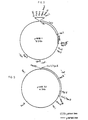
positions 218 and 219 of subtilisin as set forth in Table 1, to form anhydroaspartylglycine and also depicts base-catalyzed hydrolysis thereof ; - Fig. 2 is a partial restriction map of an aprA gene-containing an EcoRl-Kpnl gene fragment of Bacillus subtilis (B. subtilis) strain QB127 and includes a partial restriction map of the aprA gene and flanking sequences ;
- Fig. 3 is a partial restriction map of a plasmid pAMB11 ;
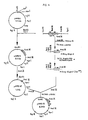
- Fig. 4 is a flowchart depicting stages in construction of pAMB113, a plasmid which directs synthesis of [Ser]218-subtilisin from B. subtilis host cells ; and
- Fig. 5 is a partial restriction map of pAMB30 plasmid.
- Bacillus serine proteases undergo irreversible inactivation in aqueous solutions at a rate that is largely dependent upon temperature and pH. At pH values below 4 or above 11 the rate of inactivation is very rapid while at pH's of between 4.5 and 10.5 the rate, although much slower, increases as the solution becomes more alkaline. In general, at any pH value, the higher the temperature the faster the rate of subtilisin deactivation.
- A conserved sequence, Asn-Gly, at positions 109-110 and especially at positions 218-219 of Bacillus subtilisins is identified herein as a major factor responsible forthe pH instability of these substances. The sequence Asn-Gly in proteins and peptides readily undergoes cyclization under various conditions, to form the cyclic imide anhydroaspartylglycine [Bomstein, et al., Methods in Enzymol., 47, 132-145 (1977)], as illustrated in Fig. 1. This cyclic imide is susceptible to base-catalyzed hydrolysis which preferentially produces a non-native, β-aspartyl peptide bond. Furthermore, the cyclic imide derived from Asn-Gly may serve as a target for specific cleavage of subtilisin. In fact, the specific cleavage of proteins at Asn-Gly bonds with alkaline hydroxylamine has become a common practice in the preparation of protein-fragments forthe purpose of amino acid sequencing. [Bornstein, et al., supra].
- Formation of a cyclic imide and/or β-aspartyl-glycyl peptide at Asn218-Gly219 of subtilisin is predicted to cause irreversible inactivation of the enzyme. This prediction is based on the close proximity of the unstable Asn-Gly element to a reactive serine located at position 221. A computer analysis of protein structures led to the belief that rearrangement of Asn218-Gly-219 to either anhydroaspartyl glycyl or to β-aspartyl-glycyl results in a shift of the side-chain of Ser221 away from the position it must occupy for the enzyme to be active.
- In order to eliminate the unstable element, Asn218-Gly219, from the subtilisin molecule one can either replace Asn218 with any amino acid other than asparagine and/or change Gly219 to any amino acid other than glycine. In a like manner, modification of the unstable Asn-Gly element at positions 109-110 is expected to provide benefits in the stability of analogs of the invention.
- The observed invariance of Gly219 in subtilisins and in subtilisin-like enzymes [e.g. Cucumisin from the melon Cucumis Melo L. Var Prince, Kaneda, et al., J. Biochem., 95, 825-829 (1984) ; and proteinase K, a subtilisin-like serine protease from the fungus Tritirachium album, Jany et al., Biol. Chem. Hoppe-Seyler, 366,485-492 (1985)] and the assumption that if Gly219 were any residue other than glycine, its side chain might interfere with binding of a substrate to the enzyme, make highly preferred the change of Asn218 rather than Gly219 for the removal of the unstable Asn218-Gly219 sequence.
- Based on theoretical considerations and on the compilation and analysis of sequencing data, asparagine at
position 218 was replaced by serine in the presently preferred embodiment of the present invention described in the following illustrative examples. This selection was based in part on the observation that the amino acid sequence around the reactive serine of cucumisin, a subtilisin-like enzyme from melon fruit, has the sequence Ser-Gly-Thr-Ser-Met (Kaneda, et aI., supra). Proteinase K has the same sequence around the active site. Jany et al., supra. It should be emphasized, however, that the selection of serine as a substitute for Asn218 does not preclude achieving the same goal, i.e., elimination of the unstable element Asn218-Gly219, through replacing asparagine atposition 218 with a different amino acid. It is preferred that an uncharged aliphatic amino acid, such as valine, threonine, cysteine, glutamine or isoleucine be substituted for Asn218. - Due to their capacity to secrete substantial quantities of proteins and because they are currently used to produce detergent proteases, Bacillus micro-organisms represent a preferred host for recombinant production of the [Ser218]-subtilisin according to the present invention. Because most Bacilli secrete alkaline and neutral proteases, it is preferable that mutations be introduced into the endogenous alkaline and neutral protease genes of B. subtilis so that the mutated subtilisin may be produced and secreted by B. subtilis in a medium free of other proteases. Thus the present invention also provides mutant strains of B. subtilis which are blocked with respect to the synthesis of endogenous proteases but which retain the ability to synthesize and secrete subtilisin analogs such as [Ser218]-subtilisin.
- As described in greater detail below, it was found that the pH and thermal stability and the stability in detergent formulations of [Ser218]-aprA gene product subtilisin is much greater than that of the wild type aprA gene product subtilisin.
- The production of a stable subtilisin analog according to the invention included the following procedures :
- 1. Isolation of the representative subtilisin gene apr A from B. subtilis ;
- 2. Cloning of the apr A gene on a vector which permits utilization of oligonucleotide site-directed mutagenesis to create desired modifications ;
- 3. Site-directed mutagenesis and sequencing of the resulting DNA to confirm the presence of the desired mutation ;
- 4. Construction of an expression vector to direct the synthesis of the mutated enzyme in B. subtilis ;
- 5. Construction of mutated B. subtilis strains which do not synthesize subtilisin and neutral protease ;
- 6. Isolation of the enzyme in the extra-cellular growth medium and its purification ;
- 7. Assessment of stability and activity characteristics of the isolated product ; and
- 8. Practice of procedures for insertion of the gene coding for the improved enzyme into the chromosome
- of a B. subtilis strain previously mutated to block synthesis of endogenous proteases.
- In Example 1, the AprA gene encoding subtilisin is isolated from the B. subtilis genome. In Example 2, the aprA gene is subjected to site-directed mutagenesis. In Example 3, an expression vector containing the mutated aprA gene is constructed. In Example 4, two mutant strains of B. subtilis which produce no detectable extracellular proteases are constructed. Example 5 describes procedures for integration of a mutated aprA gene into the chromosome of B. subtilis. In Example 6, wild-type and mutant aprA subtilisins are isolated and purified. Examples 7 through 10 compare the thermostability of [Ser218] subtilisin to that of wild-type aprA gene product and to that of a commercial BPN' product.
- B. subtilis strain QB127 (trpC2 leuAB sacUh200) [Lepesant, et al., Molec. Gen. Genet. 118,135-160 (1982)] was obtained from the Bacillus Genetic Stock Center at the Ohio State University, Columbus, Ohio. This strain overproduces extracellular serine and metal proteases, a-amylase and levansucrase relative to isogenic sacU+ strains due to the pleiotropic effect of the sacUh200 mutation [Lepesant, et al., in Schlessinger, D., ed., Microbiology, 1976, American Society for Microbiology, Washington, D.C., p. 65 (1976)] Strain QB127 was thus perceived to be a suitable source of DNA for isolating the aprA gene which codes for subtilisin.
- Genomic DNA was isolated from cells of B. subtilis strain QB127 by a published procedure [Saito, et al., Biochim. Biophys. Acta. 72, 619-629 (1963)]. Purified chromosomal DNA was digested to completion with the EcoRI restriction endonuclease.
- DNA fragments were resolved on a low-melting point agarose gel by electrophoresis and fragments in the 4.4 to 8.0 kilobase (kb) range were isolated by a standard DNA isolation procedure as recommended by the supplier (Bethesda Research Laboratories, Inc., Gaithersburg, Maryland). These fragments were ligated to pCFM936 deposited as No. 53,413 with the American Type Culture Collection, 12301 Parklawn Drive, Rockville, Maryland, on January 13, 1986, an Escherichia coli (E. coli) "walkaway" plasmid which displays higher copy numbers at elevated temperatures and which confers kanamycin resistance.
- The vector was digested with EcoRi and dephosphorylated with calf intestine alkaline phosphatase prior to ligation.
- Ligation products were introduced into E. coli C600 (available as A.T.C.C. 23724 from the American Type Culture Collection, 12301 Parklawn Drive, Rockville, Maryland) and kanamycin-resistant host cells were selected after overnight incubation on L-agar supplemented with 10 µg/ml kanamycin. Plasmid DNA was amplified by incubating host cells at 42°C for 4 hours. Colonies were then transferred to. nitrocellulose filters and processed by a published procedure referred to as colony hybridization [Grunstein, et al., Proc. Natl. Acad. Sci. (USA), 72, 3961 (1975)].
- A probe was used to screen for colonies which harbored the subtilisin gene on pCFM936. The probe [synthesized by the phosphite chemistry method of Beaucage, et al., Tetrahedron Letters, 22, 1859-1862 (1981)] had the nucleotide sequencewhich corresponds to the amino-terminus of the aprA gene product (Wong, et al., Proc. Natl. Acad. Sci. (USA), 81,1184-1188 (1984) ; Stahl, et al., J. Bacteriol. 158,411-418 (1984). A hybridization temperature of 55°C was used and 5 positive colonies were identified out of a total of 400. The plasmid DNA from one of the positive colonies was designated pCFM936 apr2.

- Plasmid pCFM936 apr2 was digested with EcoRl alone with Hindlll alone and with EcoRl and Hindlll in combination. Sizes of EcoRl fragments of the subtilisin gene conformed to those described in Stahl, et al., supra, but several otherwise undescribed Hindlll sites were discovered. As described in Example 3, two of the Hindlll sites were employed for genetic manipulations of the subtilisin gene.
- It was determined that a large 6.5 kb EcoRl fragment of B. subtilis QB127 genomic DNA carried the aprA gene, its regulatory sequences and unrelated flanking sequences by verifying that restriction enzyme digests conformed to the results reported by Stahl, et al., supra. This was confirmed by DNA sequencing using the dideoxy chain termination method [Sanger, et al., J. Mol. Biol., 143, 161-178 (1980)]. A 3.0 kb EcoRl to Kpnl subfragment of the 6.5 kb EcoRl fragment, as illustrated in Fig. 2, was also found to contain the aprA gene, its regulatory sequences, and unrelated flanking sequences. Although the Kpnl-EcoRl fragment is reported to be 2.5 kb in length in the text of Stahl, et al., and in the legend to Fig. 1 therein, comparison of the scale of Fig. 1 and the scaled depiction of the fragment therein reveal that, even in Stahl, et al., the Kpnl-EcoRl fragment is substantially larger than 2.5 kb.
- A cloning vector for Bacillus host systems, plasmid pAMB11, was constructed as follows. The plasmid pTG402 (Northern Regional Research Laboratories, United States Department of Agriculture, Peoria, Illinois, strain number NRRL B-15264) was partially digested with the Rsal restriction endonuclease. Fragments were ligated to M13 mp18 (available from Bethesda Research Laboratories, Gaithersburg, Maryland as catalog number 8227SA) which had been previously digested with Hincll. Ligation products were introduced into E. coli JM103 (available from Pharmacia, Inc., Piscataway, New Jersey as catalog number 27-1545-01) by transformation [Mandel, et al., J. Mol. Biol., 53, 154, (1970)]. Bacteriophage plaques were sprayed with 0.5M catechol (prepared in distilled water) to detect the functional expression of the xylE gene derived from pTG402. The xylE gene encodes
catechol 2,3-dioxygenase and is useful for detecting promoters in a variety of organisms. Zukowski, et al., Proc. Natl. Acad. Sci. (USA), 80, 1101-1105 (1983). - The xylE gene was then transferred as a 1.0 kb EcoRl to Pstl fragment to the E. coli/B subtilis plasmid pHV33 (available from the American Type Culture Collection as A.T.C.C. 39217) [Primrose, et al. Plasmid, 6, 193-201 (1981)] obtained from R. Dedonder (Institut Pasteur, Paris, France). The pHV33 plasmid had been previously digested with EcoRl and Pstl so that the xylE-containing fragment, when ligated in this region, would inactivate a gene for ampicillin resistance. The resulting plasmid, pAMB21, contains a functional xylE gene in E. coli host cells, but requires the addition of a promoter for xylE to be expressed in B. subtilis host cells. E. coli cells harboring pAMB21 are resistant to tetracycline (15 µg/ml) and chloramphenicol (20 ug/ml) while B. subtilis cells harboring pAMB21 are resistant only to chloramphenicol (5 µg/ml).
- The toop transcription termination sequence of bacteriophage lambda was then transferred from plasmid pCFM936 (on a 400 base pair Pstl to Bglll fragment) to the unique Pstl site of pAMB21. A synthetic nucleotide with the
sequence 5' GATCTGCA 3' was constructed to join the Bglll extremity of the toop fragment to the Pstl site of the vector pAMB21. The resulting plasmid was designated pAMB22 and had properties indentical to pAMB21 except for the inclusion of a transcription terminator. The pAMB22 plasmid is useful for detecting strong promoters that are functional in B. subtilis. - The 1.4 kb EcoRl to Bglll fragment of DNA from pAMB22 that contains xylE and toop was isolated from a low-melting point agarose gel after electrophoresis of restricted fragments. The 1.4 kb piece of DNA was ligated to plasmid pBD64 (available from Bacillus Genetic Stock Center, number 1E22) which had been previously digested with EcoRl and BamHl. The resulting 5.3 kb plasmid, pAMB11, contains the polylinker sequence of M13mp18 (EcoRl, Sstl, Xmal, Sma, BamHl and Xbal) upstream of the xylE gene which is followed by toop, as shown in Figure 3. The pAMB11 plasmid is capable of replicating in B. subtilis and confers upon host cells resistance to chloramphenicol (5 µg/ml) and/or kanamycin (5 µg/ml).
- As illustrated in Fig. 4, the purified EcoRl to Kpnl fragment containing aprA was cloned onto pAMB11 to form pAMB111. Ligation products were introduced into B. subtilis MI112 (arg-15 leuB thr5 recE4) (available from Bacillus Genetic Stock Center as No. 1A423) by the protoplast transformation method [Chang, et al., Mol. Gen. Genet., 168, 111-115 (1979)]. B. subtilis MI112 without plasmid DNA is protease-proficient (Prt+ phenotype), but secreted levels ofsubtilisin are rather low. Chloramphenicol-resistant (Cmr) transformants were transferred onto L-agar plates supplemented with 1.5% (w/v) skim milk and 5 µg/ml chloramphenicol, then incubated at 37°C.
- Afterovemight (approx. 16 hrs.) incubation at 37°C, colonies of MI112 harboring the new recombinant plasmid (designated pAMB111) produced a clear halo surrounding each colony. Halos were formed by the proteolytic action of subtilisin on the casein component of the skim milk medium supplement. M1112 harboring the pAMB11 vector alone had no visible halo after 16 hrs., although a slight halo eventually developed after 40 hrs. at 37°C. Cells carrying pAMB111 were clearly distinguished from cells carrying pAMB11 by a difference in halo size. The cloning of the aprA gene in a fully functional form was thus demonstrated to have led to the high level production and secretion of subtilisin by B. subtilis.
- As further illustrated in Fig. 4, the 3.0 kb EcoRl to Kpnl genomic fragment, the isolation of which is described in Example 1, was digested with Hindlll to produce three fragments : (1) a 1.1 kb EcoRl to Hindlll fragment carrying genetic regulatory sequences for aprA gene expression, the "pre-pro" region of the gene required to extracellular export of subtilisin, and the DNA sequence coding for the first 49 amino acids of mature subtilisin; (2) a 1.1 kb Hindlll to Hindlll fragment carrying DNA sequences coding for amino acids 50 through 275 (carboxyl-terminus) of subtilisin along with a transcription termination sequence and 3' non-coding sequences ; and (3) a 0.8 kb Hindlll to Kpnl fragment containing 3' non-coding sequences.
- The 1.1 kb fragment flanked by Hindlll sites was cloned to the single Hindlll site of bacteriophage M13 mp18 for the purposes of DNA sequencing and site-directed mutagenesis. One of the recombinants, designated M13 mp18 apr2, provided single stranded template DNA required for site-directed mutagenesis of the aprA gene.
- The coding region of the aprA gene was sequenced and the results of the sequence are set out in Table 1 below. It should be noted that the specific identity of the initial 5 codons of the leader region is attributable to the report of Stahl, et al., supra, and Wong, et al., supra, of sequence information for the aprA gene, and that there exist codon sequence differences from Stahl, et al., supra, at amino acid positions 84 and 85 which may be the result of sequencing error on the part of the authors of the Stahl, et al. reference or which may be the result of a difference in the nucleotide sequences of the strains employed. Specifically, Stahl, et al., supra, reports a codon GTT (coding for valine) at amino acid position 84 while the codon GTA (also coding for valine) appears in Table 1. Stahl, et al., supra, also reports a codon AGC (coding for serine) at amino acid position 85 as opposed to the codon GCG (coding for alanine) in Table 1.


- Site-directed mutagenesis was performed by a standard method. Norrander, et al., Gene, 26, 101-106 (1983). Single-stranded DNA from M13 mp18 apr2 was annealed to the mutagenic primerwhich was synthesized by the phosphite chemistry method (Beaucage, et al., supra). The synthetic primer was homologous to codons for amino acids 216 through 220 of subtilisin with the exception of a single base change in the codon for amino acid 218 (AGC instead of AAC). Such a change allowed the mutagenic reaction to substitute a serine codon at

position 218 in place of the original asparagine codon at this position. - The synthetic primer was annealed to M13 mp18 apr2 DNA at 65°C before being slowly cooled to room temperature (approx. 22°C). Polymerization followed for 2 hr. at 15°C in a reaction mixture which consisted of 12.5 µl of annealed DNA solution, 2.5 µl of 10 mM each dATP, dGTP, dCTP and dGTP, 2.0 µl of 12 mM ATP, 0.1 µl Klenow DNA polymerase, 0.1 pl T4 DNA ligase and 13 µl sterile distilled water. The resulting double-stranded, covalently closed circular DNA was introduced into E. coli JM103 by transfection.
- Bacteriophage plaques were then transferred to Gene Screen™ (New England Nuclear, Beverley, Massachusetts) hybridization membranes. Plaques which contained DNA with the desired base change were identified by hybridization to radioactively labeled (y-32p) synthetic oligonucleotide (2) used for the mutagenic priming reaction described above. Hybridization was performed at a restrictive temperature (52°C) so that only DNA carrying the Ser218 mutation would hybridize to the synthetic oligonucleotide. The presence of the Ser218 mutation in the aprA gene on DNAfrom a single purified plaque, designated M13 mp18 apr2 [Ser]218, was confirmed by DNA sequencing by the method of Sanger, et al., supra.
- In order to express [Ser218]-subtilisin in B. subtilis, a suitable plasmid vehicle was constructed by digesting pAMB111 with Hindlll. The 1.1 kb segment carrying most of the aprA gene was deleted by religating Hindlll digestion products of paMB111 at a concentration of approximately 1 µg/ml. This resulted in the formation of pAMB110 as illustrated in Fig. 4. The pAMB110 plasmid carries genetic regulatory sequences for expression of the subtilisin gene, the "pre-pro" region required for secretion of subtilisin. and the DNA sequence coding for the 3' non-coding region of mature subtilisin and the first 49 amino acids of mature subtilisin. Because it is lacking DNA coding for amino acids 50 through 275, pAMB110 does not synthesize subtilisin when introduced into B. subtilis host cells. Subtilisin is synthesized only after insertion of the remainder of a subtilisin gene, either the native DNA sequence or an analog-encoding sequence, such as a sequence encoding [Ser218]-subtilisin.
- Double-stranded DNA from M13 mp18 apr2 [Ser]218 was digested with Hindlll. A 1.1 kb fragment carrying the aprA gene segment with the Ser218 mutation was then ligated to pAMB110 which had been previously digested with Hindlll. Ligation products were introduced into B. subtilis by transformation as in Example 1 above. Ligation of the 1.1 kb Hindlll fragment in the correct orientation (as confirmed by DNAsequencing by the method of Sanger, et al. supra) for expression of the mutated gene resulted in the construction of pAMB113, a plasmid which directed synthesis and secretion of [Ser218]-subtilisin from B. subtilis host cells.
- Because most Bacilli secrete alkaline and/or neutral proteases into the surrounding growth medium, it is preferable that mutations be introduced into endogenous alkaline and neutral protease genes of B. subtilis to block their synthesis so that mutated subtilisin genes, when introduced into the mutant cell, may produce mutated subtilisins which will then be secreted in a medium free of other proteases likely to interfere with isolation of intact subtilisin analogs. Two mutant B. subtilis strains BZ24 and BZ25, which produce no detectable extracellular proteases, were constructed in the following manner.
- First, a plasmid vehicle capable of replicating in E. coli, but not in B. subtilis unless integrated into the B. subtilis chromosome by homologous recombination, was constructed as follows. Plasmid pBD64 (Bacillus Genetic Stock Center,
Number 1 E22) was digested to completion with Hpall to produce three fragments of 2.95 kb, 1.0 kb and 0.75 kb in size. These fragments were then ligated as a mixture to plasmid pBR322 (A.T.C.C. 37017) which previously had been digested with Clal. Ligation products were introduced into E. coli C600 (available from the American Type Culture Collection as A.T.C.C. 23724) by transformation [Mandel, et al., J. Mol. Biol., 53, 154 (1970)]. Selection was for cells resistant to chloramphenicol (20 gg/ml) and ampicillin (50 µg/ml). Plasmid DNAfrom 12 transformants was prepared by an alkaline extraction procedure [Bimboim, et al., Nucleic Acids Res., 7, 1513-1523 (1979), then digested with Hindlll and EcoRl in combination to verify the presence of inserted fragment(s). One such plasmid, designated pAMB30, was found to carry the 1.0 and 0.75 kb Hpall fragments of pBD64 in the Clal site of pBR322. These fragments contain the chloramphenicol acetyltransferase (cat) gene which is functional in E. coli and B. subtilis. Digestions with Bglll and, separately, with Sau3A confirmed the identity and orientation of the cat gene on pAMB30, as illustrated in Fig. 5. - Because pAMB30 lacks an origin of replication sequence which is functional in B. subtilis, it cannot replicate as an autonomous replicon in B. subtilis host cells. On the other hand, pAMB30 contains the pBR322-derived origin of replication which is functional in E. coli, thus the plasmid can be propagated in E. coli host cells. Plasmid pAMB30 is useful in at least 2 ways. First, a fragment of DNA which contains a functional origin of replication in B. subtilis may be detected when cloned onto pAMB30 such that the plasmid will autonomously replicate in the extrachromosomal state. Second, plasmid pAMB30 can integrate into the genome of B. subtilis at a site of homology between the chromosome and B. subtilis DNA cloned onto pAMB30. Such an event has been repeatedly demonstrated in the past [Haldenwang, etal., J. Bacteriol.,142, 90-98 (1980) ; Young, J. Gen. Microbiol., 129, 1497-1512 (1983)] by using plasmid vehicles similar to, but not identical with, pAMB30.
- Plasmid pAMB21 (described in Example 1) was digested with EcoR) and Pstt to isolate the xylE gene on a 1.0 kb fragment. The fragment was ligated to pAMB30 which had been previously digested with EcoRI and Pstl. Ligation products were introduced into E. coli C600 by transformation. Selection was for chloramphenicol resistant (20 µg/ml) host cells which were sensitive to ampicillin (50 µg/ml) due to the insertion of the xylE fragment of pAMB21 into the structural gene for ampicillin resistance of pAMB30. The resulting plasmid, pAMB30/21, has properties identical to pAMB30 but has, in addition, a functional xylE gene.
- Plasmid pAMB110, which carries the AprA gene deleted of a region coding for the latter 226 amino acids of mature subtilisin, was digested with EcoRl and Kpnl. The 1.9 kb fragment of B. subtilis DNA containing genetic regulatory sequences for aprA gene expression, "the pre-pro" region, the DNA sequence coding for the first 49 amino acids of mature subtilisin and 3' non-coding sequences was ligated to pAMB30/21 that had been previously digested with EcoRl and Kpnl. Ligation products were introduced into E. coli C600 by transformation. Plasmid DNA from several transformants was isolated by the alkaline extraction procedure of Birnboim, et al., supra, and the presence of the inserted 1.9 kb fragment was verified by multiple restriction endonuclease digestions. One such plasmid, designated pAMB301, was retained for further use.
- B. subtilis strain BGSC1A274 (Bacillus Genetic Stock Center) carries a mutation at the npr locus and is incapable of producing extracellular neutral protease. The plasmid pAMB301 was integrated into the genome of B. subtilis BGSC1A274 by transformation of competent cells [Spizizen, Proc. Natl. Acad. Sci. (USA), 44, 1072-1078 (1958)]. Selection was for chloramphenicol-resistant (5 µg/ml) host cells which were then transferred by sterile toothpicks to L-agar supplemented with 1.5% (w/v) powdered skim milk and (5 µ/ml) cloramphenicol. Those cells which failed to produce a clear halo surrounding the colony were deficient in the ability to produce extracellular neutral and serine proteases due to the combination of the npr mutation along with the newly introduced aprA mutation. The aprA mutation was a deletion of the latter 226 amino acids of mature subtilisin due to the replacement of the wild-type aprA gene with the deleted version carried on pAMB301. One such strain, designated BZ24, has the Npr Apr Cmr phenotype, thus it produces no detectable extracellular neutral protease nor extracellular alkaline protease and is resistant to chloramphenicol at 5 µg/ml. Southern blotting [Southern, J. Mol. Biol., 98, 503-517 (1975)] was used to confirm the deletion in the aprA gene on the chromosome of B. subtilis BZ24. Cultivation of B. subtilis BZ24 in Antibiotic Medium No. 3 (Penassay Broth, Difco, Detroit, Michigan) in the absence of antibiotic selection for approximately 32 generations led to the isolation of a derivative strain of BZ24 in which the cat gene confering chloramphenicol resistance upon host cells was lost due to its instability in the BZ24 chromosome. Such a phenomenon has been previously observed in similar experiments [Stahl, et al., J. Bacteriol., 158,411-418 (1984)]. A chloramphenicol-sensitive derivative of BZ24 was designated BZ25. B. subtilis BZ25 has the Npr- Apr- phenotype, thus it produces no detectable extracellular neutral protease nor extracellular alkaline protease. Southern blotting was used to confirm the deletion in the aprA gene on the chromosome of B. subtilis BZ25.
- Because B. subtilis BZ25 produces no detectable extracellular neutral protease nor subtilisin, it is a useful host strain for introduction of plasmid DNA, such as pAMB113, for the production of mutated subtilisins which may be secreted into the surrounding growth medium free of other proteases.
- B. subtilis BZ25 produces no detectable extra-cellular proteases when culture supernatants are assayed as described below. B. subtilis BZ25/pAMB113, which is BZ25 that harbors plasmid pAMB113 (introduced by the protoplast transformation method of Chang, et al., supra) produces appreciable quantities of [Ser218]-subtilisin when culture supernatants are assayed as described.
- Integration of the [Ser218]-subtilisin gene into the chromosome of B. subtilis was believed to provide an efficient way of increasing genetic stability of this mutant gene. Such an approach also alleviates the requirement for chloramphenicol in the fermentation medium which is otherwise needed for application of selective pressure to maintain plasmid DNA in the extra-chromosomal state. Therefore, the [Ser218]-subtilisin gene, along with its genetic regulatory sequences and flanking DNA homologous to the B. subtilis chromosome, was isolated from a low melting point agarose gel after electrophoresis of pAMB113 which had been digested with EcoRl and Psti in combination. The 4.0 kb EcoRl to Psti fragment (illustrated in Fig. 4) was then ligated to pAMB30 (illustrated in Fig. 5) which had been digested with EcoRI and Pstl in combination. Ligation products were introduced into E. coli HB101 (A.T.C.C. 33694) by transformation. Selection was for cells resistant to chloramphenicol (20 µg/ml). Plasmid DNA from four transformants which met the criteria above were isolated by the alkaline extraction procedure of Birnboim, et al., supra, then digested with EcoRl and Pstl in combination. All four plasmids contained the 4.0 kb insert and the 5.6 kb remaining portion of pAMB30. One such plasmid, designated pAMB302, was purified and retained for further use.
- Repeated attempts to integrate plasmid pAMB302 into the chromosome of B. subtilis BZ25 by the competence method [Spizizen, supra] were unsuccessful. This may have been due to the failure of BZ25 cells to become competent by the method employed. Therefore, pAMB302 was introduced into B. subtilis BZ25 cells by the protoplast transformation method of Chang, et al., supra. This is believed to be the first demonstration that the protoplast transformation method is successful for obtaining integration of heterologous DNA in Bacillus. This result is particularly significant in that research strains in which integration has been obtained were selected on the basis of transformation by the competence method. Strains which may be unable to become competent, and in particular industrial strains which were not selected on the basis of transformation by the competence method, may be more likely to be unable to become competent.
- Selection was for chloramphenicol-resistant cells (5 µg/ml) cells, which were then transferred with sterile toothpicks to L-agar supplemented with 1.5% (w/v) skim milk and 5 µg/ml chloramphenicol. Cells were incubated overnight at 37°C. Clear halos of different diameters were observed around the Cmr colonies. This indicates that subtilisin was produced and secreted by these cells. An attempt was made to isolate plasmid DNA from eight of these colonies by the alkaline extraction method. No plasmid DNA was detected on agarose gels which were stained with ethidium bromide (1 µg/ml) to visualize DNA after electrophoresis. The absence of extrachromosomal plasmid DNA in the Cmr cells which produced subtilisin was a strong indication that pAMB302 had been integrated into the chromosome of B. subtilis.
- Several colonies resulting from this experiment were isolated and designated BZ28, BZ29, BZ30, BZ31, BZ32 and BZ33. Each strain was grown overnight at 37°C with vigorous shaking in brain heart infusion medium (BHI, Difco) supplemented with 5 µglml chloramphenicol. Culture supernatants were assayed for subtilisin activity. B. subtilis strains BZ28, BZ29, BZ30, BZ31, BZ32 and BZ33 all produced subtilisin and secreted it into the surrounding growth medium, some strains producing more than others. The amount of subtilisin observed in the liquid culture broth was directly proportional to the size of the halo observed on skim milk L-agar plates. Because of the amounts of subtilisin secreted by these cells differed, it was postulated that either multiple copies of pAMB302 were integrated into the chromosome or that gene amplification [Young, J. Gen. Microbiol., 129, 1497-1512 (1983) ; Albertini, et al., J. Bacteriol., 162, 1203-1211 (1985)] had taken place.
- Wild-type subtilisin, from BZ25/pAMB111, and [Ser218]-subtilisin, from BZ25/pAMB113, were isolated and purified as follows. Each culture broth was centrifuged at 15,000 g for 30 minutes and protein in the clear supernatant was precipitated with (NH4)2SO4 (350 g per liter). The precipitate was collected by centrifugation and after trituration with 75% acetone, it was filtered and dried under a vacuum.
- In order to further purify the enzyme, the dried precipitate was dissolved in water and the solution was filtered and then dialyzed against 0.02 M sodium phosphate buffer at pH 6.3. The dialyzed solution was passed through a column (2.5 x .15 cm) of carboxymethyl cellulose at a rate of 2 ml per minute. After washing the column with 0.02 M sodium phosphate (pH 6.3), the enzyme was eluted with the same buffer containing 0.15 M NaCI. Peak fractions were pooled and protein from the fractions containing the enzyme, as identified by a color change in a sample of the fraction mixed with succinyl-L-alanyl-L-alanyl-L-prolyl-L-phenylalanyl-p-nitroanilide (Vega Biochemicals), were precipitated by addition of 2.5 volumes of acetone. The precipitate was collected by centrifugation and then dissolved in 0.005 M calcium acetate (about 1 ml per 10 mg). The resulting solution was dialyzed at 4°C against water and then lyophilized.
- Because the present invention relates to the stabilization of Bacillus subtilisin, an analysis of enzyme stability and quantitation thereof was undertaken.
- Most enzymes express their biological activity, i.e., catalysis of chemical reactions, only within a narrow range of pH and temperature. Moreover, even under optimal conditions, the enzyme will retain its activity only if its polypeptide chain is folded in a manner that forms the so-called native conformation. The native form of an enzyme is thermodynamically more stable than the denatured or unfolded form by an average of 10-15 kilocalories per mole. Unfolding of the native structure often occurs when the enzyme is exposed to extremes of pH or temperature, or to certain concentrations of chemicals such as detergents, urea and organic solvents. Removal of these denaturing agents often result in spontaneous refolding of the peptide chain to the native form, and in restoration of the original enzyme activity.
- Irreversible loss of enzyme activity may occur due to cleavage of the polypeptide chain or due to modification of certain amino acid side chains, especially if these modifications alter the native architecture of the enzymes' active site. Examples of such modifications include the deamidation of asparaginyl and glutaminyl residues, the oxidation of methionyl residues and the hydrolytic cleavage of cysteine to form one residue of thiocysteine and one of dehydroalanine. The present invention provides an additional example in the form of the irreversible inactivation through cyclization of Asn-Gly sequences.
- When the enzyme preparation includes several enzymatic forms which inactivate at different rates and/or when the inactivation process occur through a number of mechanisms, the kinetics of inactivation are complicated. However, for most enzyme preparations at a suitable range of pH and temperature, the thermal inactivation follow first-order kinetics, i.e., the residual enzyme activity decreases as a function of time along an exponential decay curve. Under these conditions the half-life (T112) of the enzyme is independent of the initial enzyme concentration and may be calculated according to :

- In general, everything else being equal, the half-life of an enzyme in solution is shorter at higher temperatures.
- In order to compare the thermostability of the [Ser218]-aprA gene product subtilisin to that of wild-type aprA gene product subtilisin and subtilisin BPN' (Sigma), solutions of these enzymes (1 mg/ml) were prepared in 0.1 M sodium glycinate buffer at pH 10.0. The solutions were incubated at 52°C and after various times aliquots (20 µl) were drawn and mixed with 900 pi of 0.2% casein solution in 0.1 M Tris buffer at pH 8.30. As a control, the substrate (casein) solution was incubated with 20 µl of enzyme buffer. The hydrolysis of casein at room temperature was terminated after 15 minutes with the addition of 200 pl of 10% trichloroacetic acid. The hydrolysate was separated from the precipitated protein by centrifugation and its ultraviolet (UV) absorbance at 280 nm, as compared to the control, was measured by an 8451A Diode Array Spectrophotometer available from Hewlett Packard. Substrate concentration was such that enyzme activities were directly proportional to the UV absorbances at 280 nm reported in Table 2. In this table the values in parentheses represent percentages of initial enzyme activities. The last column in Table 2 shows the calculated half-life of the three enzymes, and it can be seen that the half-life of the mutated [Ser218]aprA gene product is more than three-fold longer than the natural aprA gene product and subtilisin BPN' under the tested conditions.

- For determination of thermostability of subtilisins in the presence of detergents, the liquid laundry detergent ERA Plus@ (Procter & Gamble) was used after diluting it with water (1 : 9) and completely inactivating the original protease activity by warming it to 65°C for 30 minutes. The pH of the resultant detergent solution was 7.50. Using the casein assay and the procedure described in Example 7, the stabilities of [Ser218]aprA gene product, wild-type aprA gene product and subtilisin BPN' (Sigma) were tested in the detergent at 45°C. The results are shown in Table 3 in which enzyme activities are expressed as percentages of original enzyme activities. Again, the half-life of the subtilisin analog was on the order of three-fold greater than the natural products under the test conditions.

- The above-tabulated results demonstrate that the [Ser218]-analog of the aprA gene product exhibits greater stability than the wild type aprA gene product or subtilisin BPN' in ERA Plus® which, with a pH of 7.5, may be described as a cationic to neutral detergent and which most likely has been formulated to be compatible with inclusion of detergent enzymes. These results do not assure, however, that the [Ser218]-aprA gene product will be compatible with all current commercial detergent formulations, e.g., those which have been formulated to the exclusion of detergent enzymes. For example, in preliminary tests with a 2% (w/v) solution of Tide@, which may be described as an anionic to neutral detergent having a pH of greater than 8.5 and which excludes detergent enzymes in its formulation, the subtilisin BPN' exhibited greater stability than the wild-type and [Ser218]-aprA gene products. The [Ser218]-aprA gene product in that same test, however, showed greater stability than the wild-type aprA gene product. Although the different relative performance of the [Ser218]-aprA gene product and subtilisin BPN' in ERA Plus® and Tide® is as yet unexplained, the experimental results suggest that proper formulation of detergent compositions is a prerequisite for optimal performance of enzymes included in such compositions. What has been dearly demonstrated is that the [Ser218]aprA gene product consistently possesses properties superior to those of the wild type aprA gene product, and it is believed that analogs of subtilisins Carlsberg and BPN' according to the present invention will also possess greater stability than the corresponding wild type enzyme.
- Using succinyl-L-alanyl-L-alanyl-L-prolyl-L-phenylalanyl-p-nitroanilide (Vega Biochemicals) as substrate and the rate of increase in absorbance at405 nm due to release of p-nitroaniline [Del Mar, et al., Anal. Biochem., 99, 316-320, (1979)] to measure enzyme activity, the thermostabilities of [Ser218]aprA, wildtype aprA and subtilisin BPN' (Sigma) in 0.1 M sodium phosphate buffer at pH 7.5 were determined as follows.
- Enzyme solutions of about 0.5 Anson units per liter were incubated at 40°C and 50°C, and at various times aliquots (20 µl) were drawn and diluted into 180 µl of ice-cold 0.1 M sodium phosphate buffer at pH 7.5. 10 µl of the thus diluted sample was mixed with 890 µl of 1 mM succinyl-L-alanyl-L-alanyl-L-prolyl-L-phenylalanyl-p-nitroanilide in 0.1 M Tris HCI pH 8.2 and the absorbances at 405 nm were measured every 15 seconds for 5 minutes on a Hewlett Packard, 8451A Diode Array Spectrophotometer. Residual enzyme activities aftervari- ous incubation times are expressed in Table 4 and Table 5 as percentages of the corresponding initial activities. The procedure was then repeated in 0.1 M sodium phosphate buffer at pH 9.0 and the results are set out in Tables 6 and 7.

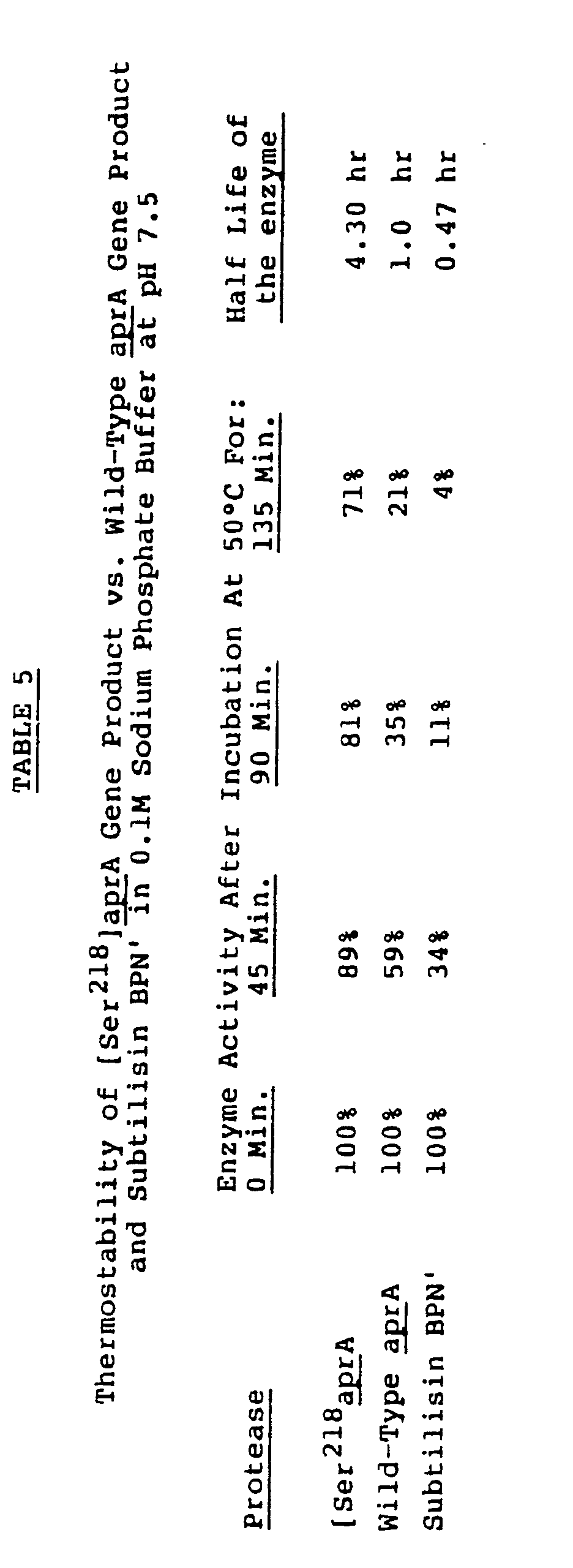
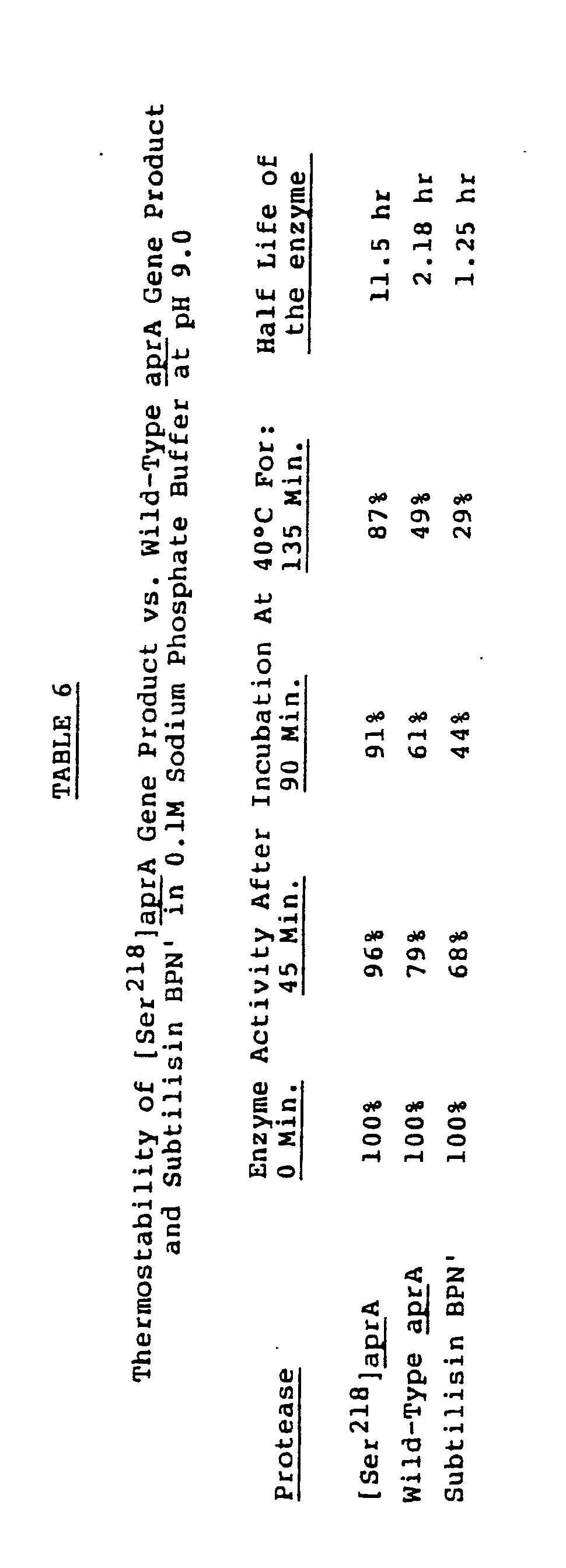

- In order to test pH stability of the [Ser218] analog, the procedure of Example 7 was carried out at pH 4.8 and room temperature and the results are set out in Table 8.

- While the present invention has been described in terms of preferred embodiments it is understood that modifications and improvements will occur to those skilled in the art. For example, the sequence Asn-Gly appears at other points in subtilisins, such as at
residues 109 and 110 of the aprA gene product and subtilisin BPN' and at residues 62 and 63 of subtilisin Carlsberg and of subtilisin DY. Thus, it is expected that substitution of residues other than Asn and Gly at these respective locations may improve stability as well. Similar improvements in stability are expected for such substitutions made in other enzymes which have the Asn-Gly sequence and in other proteins comprising this sequence. Furthermore, it is expected that a subtilisin analog according to the present invention possesses superior properties to wild type subtilisins in detergent formulations such as those disclosed in, for example, U.S. Patent No. 3,732,170 ; U.S. Patent No. 3,749,671 and U.S. Patent No. 3,790,482, all of which are incorporated by reference herein. - Moreover, for practical reasons many industrial processes are conducted at temperatures that are above the stability range of most enzymes. Therefore, although detergent applications have been emphasized herein, it is believed that thermostable proteases according to the present invention are not only advantageous to certain industries such as detergent and hide dehairing, which already require stable proteases, but also may be useful in industries that use chemical means to hydrolyze proteins, e.g. hydrolysis of vegetable and animal proteins for the production of soup concentrates.
- Therefore, it is intended that the present invention be include all such modifications and improvements as come within the scope of the present invention as claimed.

Claims (26)


Priority Applications (1)
| Application Number | Priority Date | Filing Date | Title |
|---|---|---|---|
| AT87900930T ATE64617T1 (en) | 1986-01-15 | 1987-01-07 | PH AND HEAT STABLE SUBTILISIN ANALOGUES AND THEIR PRODUCTION. |
Applications Claiming Priority (3)
| Application Number | Priority Date | Filing Date | Title |
|---|---|---|---|
| US81924186A | 1986-01-15 | 1986-01-15 | |
| US819241 | 1986-01-15 | ||
| PCT/US1987/000027 WO1987004461A1 (en) | 1986-01-15 | 1987-01-07 | THERMALLY STABLE AND pH STABLE SUBTILISIN ANALOGS AND METHOD FOR PRODUCTION THEREOF |
Publications (4)
| Publication Number | Publication Date |
|---|---|
| EP0254735A4 EP0254735A4 (en) | 1988-01-07 |
| EP0254735A1 EP0254735A1 (en) | 1988-02-03 |
| EP0254735B1 true EP0254735B1 (en) | 1991-06-19 |
| EP0254735B2 EP0254735B2 (en) | 1998-06-17 |
Family
ID=25227587
Family Applications (1)
| Application Number | Title | Priority Date | Filing Date |
|---|---|---|---|
| EP87900930A Expired - Lifetime EP0254735B2 (en) | 1986-01-15 | 1987-01-07 | METHOD FOR PRODUCTION OF THERMALLY STABLE AND pH STABLE SUBTILISIN ANALOGS |
Country Status (7)
| Country | Link |
|---|---|
| US (1) | US5399283A (en) |
| EP (1) | EP0254735B2 (en) |
| JP (1) | JP2599946B2 (en) |
| CA (2) | CA1341086C (en) |
| DK (1) | DK175409B1 (en) |
| FI (1) | FI102969B (en) |
| WO (1) | WO1987004461A1 (en) |
Families Citing this family (87)
| Publication number | Priority date | Publication date | Assignee | Title |
|---|---|---|---|---|
| US5972682A (en) * | 1984-05-29 | 1999-10-26 | Genencor International, Inc. | Enzymatically active modified subtilisins |
| US4990452A (en) * | 1986-02-12 | 1991-02-05 | Genex Corporation | Combining mutations for stabilization of subtilisin |
| WO1987005050A1 (en) * | 1986-02-12 | 1987-08-27 | Genex Corporation | Mutagenesis and screening method and product |
| US5013657A (en) * | 1988-04-12 | 1991-05-07 | Bryan Philip N | Subtilisin mutations |
| DE3750916T2 (en) * | 1986-04-30 | 1995-06-01 | Genencor Int | Mutant of a non-human carbonyl hydrolase, DNA sequences and vectors coding therefor and hosts transformed by these vectors. |
| ES2135386T3 (en) * | 1987-02-27 | 1999-11-01 | Genencor Int | TRANSFORMATION OF STRAINS OF ALCALOFILAS BACILLUS. |
| HUT50877A (en) * | 1987-02-27 | 1990-03-28 | Gist Brocades Nv | Process for producing stable gene amplification in chromosomal dna of procaryote microorganisms |
| KR0127560B1 (en) * | 1987-02-27 | 1997-12-29 | 마가렛트 에이.호른 | Molecular cloning and expression of genes encoding proteolytic enzymes |
| JPH01137972A (en) * | 1987-08-03 | 1989-05-30 | Ajinomoto Co Inc | Novel subtilisin |
| US4865983A (en) * | 1987-12-04 | 1989-09-12 | W. R. Grace & Co.-Conn. | Cleaning compositions containing protease produced by vibrio and method of use |
| DK6488D0 (en) | 1988-01-07 | 1988-01-07 | Novo Industri As | ENZYMES |
| CN1056187C (en) * | 1988-02-11 | 2000-09-06 | 金克克国际有限公司 | Proteolytic enzymes and their use in detergents |
| US6287841B1 (en) | 1988-02-11 | 2001-09-11 | Genencor International, Inc. | High alkaline serine protease |
| US5324653A (en) * | 1988-02-11 | 1994-06-28 | Gist-Brocades N.V. | Recombinant genetic means for the production of serine protease muteins |
| CA1333777C (en) * | 1988-07-01 | 1995-01-03 | Randy M. Berka | Aspartic proteinase deficient filamentous fungi |
| US5122449A (en) * | 1988-10-07 | 1992-06-16 | Eastman Kodak Company | Use of a protease in the extraction of chlamydial, gonococcal and herpes antigens |
| KR100188532B1 (en) * | 1989-05-17 | 1999-06-01 | 스티븐 엠. 오드리 | Multiply mutated subtilisins |
| US5665587A (en) | 1989-06-26 | 1997-09-09 | Novo Nordisk A/S | Modified subtilisins and detergent compositions containing same |
| US5658871A (en) * | 1989-07-07 | 1997-08-19 | Lever Brothers Company, Division Of Conopco, Inc. | Microbial lipase muteins and detergent compositions comprising same |
| US6271012B1 (en) * | 1989-10-11 | 2001-08-07 | Genencor International, Inc. | Protease muteins and their use in detergents |
| GB9027836D0 (en) * | 1990-12-21 | 1991-02-13 | Unilever Plc | Enzymes and enzymatic detergent compositions |
| US5482849A (en) * | 1990-12-21 | 1996-01-09 | Novo Nordisk A/S | Subtilisin mutants |
| US5340735A (en) | 1991-05-29 | 1994-08-23 | Cognis, Inc. | Bacillus lentus alkaline protease variants with increased stability |
| US6440717B1 (en) | 1993-09-15 | 2002-08-27 | The Procter & Gamble Company | BPN′ variants having decreased adsorption and increased hydrolysis |
| US6436690B1 (en) | 1993-09-15 | 2002-08-20 | The Procter & Gamble Company | BPN′ variants having decreased adsorption and increased hydrolysis wherein one or more loop regions are substituted |
| US6599730B1 (en) | 1994-05-02 | 2003-07-29 | Procter & Gamble Company | Subtilisin 309 variants having decreased adsorption and increased hydrolysis |
| US6455295B1 (en) | 1995-03-08 | 2002-09-24 | The Procter & Gamble Company | Subtilisin Carlsberg variants having decreased adsorption and increased hydrolysis |
| IL117350A0 (en) | 1995-03-09 | 1996-07-23 | Procter & Gamble | Proteinase k variants having decreased adsorption and increased hydrolysis |
| US6475765B1 (en) | 1995-03-09 | 2002-11-05 | Procter & Gamble Company | Subtilisin DY variants having decreased adsorption and increased hydrolysis |
| CN1530443A (en) | 1996-11-04 | 2004-09-22 | ŵ����÷������˾ | subtilase variants and compositions |
| AU4772697A (en) | 1996-11-04 | 1998-05-29 | Novo Nordisk A/S | Subtilase variants and compositions |
| WO1999011768A1 (en) | 1997-08-29 | 1999-03-11 | Novo Nordisk A/S | Protease variants and compositions |
| BR9811412A (en) | 1997-08-29 | 2000-08-22 | Novo Nordisk As | Subtilase enzyme variant having improved detergent washing performance, isolated DNA sequence, expression vector, microbial host cell, processes for producing a variant and for identifying a protease variant, composition, and, use of a subtilase variant |
| US6780629B2 (en) | 1997-11-21 | 2004-08-24 | Novozymes A/S | Subtilase enzymes |
| US6773907B2 (en) | 1997-11-21 | 2004-08-10 | Peter Kamp Hansen | Subtilase enzymes |
| ATE298791T1 (en) | 1997-11-21 | 2005-07-15 | Novozymes As | PROTEASE VARIANTS AND COMPOSITIONS |
| BR9909130A (en) | 1998-03-26 | 2000-12-19 | Procter & Gamble | Serine protease variants having amino acid substitutions |
| US6908757B1 (en) | 1998-03-26 | 2005-06-21 | The Procter & Gamble Company | Serine protease variants having amino acid deletions and substitutions |
| US6495136B1 (en) | 1998-03-26 | 2002-12-17 | The Procter & Gamble Company | Proteases having modified amino acid sequences conjugated to addition moieties |
| ATE504651T1 (en) | 1998-12-18 | 2011-04-15 | Novozymes As | SUBTILASE ENZYMES OF THE I-S1 AND I-S2 SUBGROUPS WITH AN ADDITIONAL AMINO ACID RESIDUE IN AN ACTIVE LOOP REGION |
| AU4392700A (en) | 1999-05-20 | 2000-12-12 | Novozymes A/S | Subtilase enzymes of the i-s1 and i-s2 sub-groups having at least one additionalamino acid residue between positions 129 and 130 |
| WO2000071691A1 (en) | 1999-05-20 | 2000-11-30 | Novozymes A/S | Subtilase enzymes of the i-s1 and i-s2 sub-groups having at least one additional amino acid residue between positions 125 and 126 |
| EP1183341B2 (en) | 1999-05-20 | 2012-05-02 | Novozymes A/S | Subtilase enzymes of the i-s1 and i-s2 sub-groups having at least one additional amino acid residue between positions 127 and 128 |
| WO2000071690A1 (en) | 1999-05-20 | 2000-11-30 | Novozymes A/S | Subtilase enzymes of the i-s1 and i-s2 sub-groups having at least one additional amino acid residue between positions 128 and 129 |
| AU4392800A (en) | 1999-05-20 | 2000-12-12 | Novozymes A/S | Subtilase enzymes of the i-s1 and i-s2 sub-groups having at least one additionalamino acid residue between positions 126 and 127 |
| EP1183337B1 (en) | 1999-05-20 | 2008-09-17 | Novozymes A/S | Subtilase enzymes of the i-s1 and i-s2 sub-groups having at least one additional amino acid residue between positions 132 and 133 |
| BR0012694A (en) | 1999-07-22 | 2002-04-09 | Procter & Gamble | Protease conjugate, cleaning composition and personal treatment composition |
| KR20020021397A (en) * | 1999-07-22 | 2002-03-20 | 데이비드 엠 모이어 | Subtilisin protease variants having amino acid deletions and substitutions in defined epitope regions |
| CA2376045A1 (en) | 1999-07-22 | 2001-02-01 | The Procter & Gamble Company | Subtilisin protease variants having amino acid substitutions in defined epitope regions |
| US6946128B1 (en) | 1999-07-22 | 2005-09-20 | The Procter & Gamble Company | Protease conjugates having sterically protected epitope regions |
| US6727085B2 (en) | 1999-12-15 | 2004-04-27 | Fanoe Tina Sejersgaard | Subtilase variants having an improved wash performance on egg stains |
| US6777218B1 (en) | 2000-03-14 | 2004-08-17 | Novozymes A/S | Subtilase enzymes having an improved wash performance on egg stains |
| US7087415B2 (en) * | 2000-07-31 | 2006-08-08 | Athena Biotechnologies, Inc. | Methods and compositions for directed gene assembly |
| EP1375656B1 (en) * | 2001-03-02 | 2006-11-29 | Seiren Kabushiki Kaisha | Novel protein and dna encoding the same |
| WO2003062380A2 (en) * | 2002-01-16 | 2003-07-31 | Genencor International, Inc. | Multiply-substituted protease variants |
| EP1495128B1 (en) * | 2002-03-29 | 2014-05-07 | Genencor International, Inc. | Ehanced protein expression in bacillus |
| WO2004033482A2 (en) | 2002-10-08 | 2004-04-22 | Genencor International, Inc. | Phenolic binding peptides |
| CN102766545B (en) | 2003-05-07 | 2014-08-06 | 诺维信公司 | Variant subtilisin enzymes (subtilases) |
| WO2005040372A1 (en) | 2003-10-23 | 2005-05-06 | Novozymes A/S | Protease with improved stability in detergents |
| WO2006033668A2 (en) * | 2004-04-09 | 2006-03-30 | Genencor International, Inc. | Pcka modifications and enhanced protein expression in bacillus |
| KR100750659B1 (en) * | 2005-02-18 | 2007-08-20 | 인하대학교 산학협력단 | Basophils, alkalophilic proteases that are very stable to surfactants and oxidants and genes encoding them |
| US20100029538A1 (en) | 2006-04-14 | 2010-02-04 | Anna-Liisa Auterinen | One-Step Treatment of Textiles |
| JP2009534022A (en) | 2006-04-20 | 2009-09-24 | ノボザイムス アクティーゼルスカブ | A sabinase variant with improved detergency against egg stains |
| US20080090745A1 (en) * | 2006-10-13 | 2008-04-17 | Fox Bryan P | Expression of Streptomyces subtilism inhibitor (SSI) proteins in Bacillus and Streptomyces sp. |
| WO2008112258A2 (en) * | 2007-03-12 | 2008-09-18 | Danisco Us Inc. | Modified proteases |
| KR101522042B1 (en) | 2007-04-30 | 2015-05-20 | 다니스코 유에스 인크. | Use of protein hydrolysates to stabilize metalloprotease detergent formulations |
| US8343735B2 (en) * | 2007-05-10 | 2013-01-01 | Danisco Us Inc. | Modified secretion system to increase expression of polypeptides in bacteria |
| SG148934A1 (en) | 2007-06-11 | 2009-01-29 | Novozymes As | A process for combined biopolishing and bleach clean-up |
| JP5629584B2 (en) | 2007-12-21 | 2014-11-19 | ダニスコ・ユーエス・インク | Accelerated protein production in Bacillus |
| MX2010010310A (en) * | 2008-03-28 | 2010-10-08 | Danisco Us Inc | Method for amplifying locus in bacterial cell. |
| AR076941A1 (en) | 2009-06-11 | 2011-07-20 | Danisco Us Inc | BACILLUS CEPA FOR A GREATER PROTEIN PRODUCTION |
| WO2012022777A1 (en) | 2010-08-19 | 2012-02-23 | Novozymes A/S | Induced sporulation screening method |
| WO2015102814A1 (en) | 2013-12-31 | 2015-07-09 | Danisco Us Inc. | Enhanced protein expression |
| US10683528B2 (en) | 2014-12-16 | 2020-06-16 | Danisco Us Inc | Enhanced protein expression |
| US20170369537A1 (en) | 2014-12-19 | 2017-12-28 | Danisco Us Inc. | Enhanced protein expression |
| EP3585910B1 (en) | 2017-02-24 | 2024-03-20 | Danisco US Inc. | Compositions and methods for increased protein production in bacillus licheniformis |
| US11879127B2 (en) | 2017-08-23 | 2024-01-23 | Danisco Us Inc. | Methods and compositions for efficient genetic modifications of Bacillus licheniformis strains |
| US20210032639A1 (en) | 2017-09-13 | 2021-02-04 | Danisco Us Inc. | Modified 5'-untranslated region (utr) sequences for increased protein production in bacillus |
| EP3703661A1 (en) | 2017-11-02 | 2020-09-09 | Danisco US Inc. | Freezing point depressed solid matrix compositions for melt granulation of enzymes |
| CN111670244B (en) | 2018-01-03 | 2023-08-01 | 丹尼斯科美国公司 | Mutant and genetically modified bacillus cells and methods for increasing protein production |
| WO2020099491A1 (en) | 2018-11-14 | 2020-05-22 | Novozymes A/S | Oral care composition comprising a polypeptide having dnase activity |
| CN110734903B (en) * | 2019-11-18 | 2021-06-04 | 山东隆科特酶制剂有限公司 | Method for producing high-temperature-resistant neutral protease |
| JP7787077B2 (en) | 2020-01-15 | 2025-12-16 | ダニスコ・ユーエス・インク | Compositions and methods for enhanced protein production in Bacillus licheniformis |
| US20230332124A1 (en) | 2020-08-24 | 2023-10-19 | Novozymes A/S | Oral care composition comprising a fructanase |
| WO2023023644A1 (en) | 2021-08-20 | 2023-02-23 | Danisco Us Inc. | Polynucleotides encoding novel nucleases, compositions thereof and methods thereof for eliminating dna from protein preparations |
| CN116286565B (en) * | 2022-07-12 | 2024-06-11 | 湖北佶凯星生物科技有限公司 | Bacillus subtilis strain for high yield of alkaline protease and application thereof |
| CN119286828B (en) * | 2024-12-11 | 2025-02-25 | 四川大学 | Neutral protease mutant and application thereof |
Family Cites Families (13)
| Publication number | Priority date | Publication date | Assignee | Title |
|---|---|---|---|---|
| GB1240058A (en) * | 1968-04-12 | 1971-07-21 | Procter & Gamble | Enzyme-containing detergent compositions |
| US3576719A (en) * | 1968-04-23 | 1971-04-27 | Squibb & Sons Inc | Alkaline proteinase |
| DE2026092C3 (en) * | 1969-05-31 | 1979-04-12 | Rikagaku Kenkyusho, Saitama (Japan) | Process for the production of an alkaline protease |
| US3770587A (en) * | 1971-02-09 | 1973-11-06 | Pfizer | Chemically modified proteolytic enzymes |
| BE785666A (en) * | 1971-07-01 | 1973-01-02 | Procter & Gamble | PROCESS FOR THE PRODUCTION OF ENZYMATIC COMPOSITIONS IN GRANULES |
| BE792982A (en) * | 1971-12-20 | 1973-06-19 | Procter & Gamble Europ | Proteolytic enzymes detergent - contg cationic and anionic surfactants |
| US3732170A (en) * | 1972-06-26 | 1973-05-08 | Colgate Palmolive Co | Bio-soaking performances |
| US6936694B1 (en) * | 1982-05-06 | 2005-08-30 | Intermune, Inc. | Manufacture and expression of large structural genes |
| US4760025A (en) * | 1984-05-29 | 1988-07-26 | Genencor, Inc. | Modified enzymes and methods for making same |
| NZ208612A (en) * | 1983-06-24 | 1991-09-25 | Genentech Inc | Method of producing "procaryotic carbonyl hydrolases" containing predetermined, site specific mutations |
| WO1985000817A1 (en) * | 1983-08-10 | 1985-02-28 | Amgen | Microbial expression of interleukin ii |
| US4771003A (en) * | 1985-10-22 | 1988-09-13 | Genex Corporation | Heat stable alkaline proteases produced by a bacillus |
| US4914031A (en) * | 1987-04-10 | 1990-04-03 | Amgen, Inc. | Subtilisin analogs |
-
1987
- 1987-01-07 WO PCT/US1987/000027 patent/WO1987004461A1/en not_active Ceased
- 1987-01-07 EP EP87900930A patent/EP0254735B2/en not_active Expired - Lifetime
- 1987-01-07 JP JP62500857A patent/JP2599946B2/en not_active Expired - Lifetime
- 1987-01-14 CA CA000616980A patent/CA1341086C/en not_active Expired - Fee Related
- 1987-01-14 CA CA000527350A patent/CA1340643C/en not_active Expired - Fee Related
- 1987-09-11 DK DK198704765A patent/DK175409B1/en not_active IP Right Cessation
- 1987-09-14 FI FI873980A patent/FI102969B/en not_active IP Right Cessation
-
1991
- 1991-01-09 US US07/637,972 patent/US5399283A/en not_active Expired - Lifetime
Also Published As
| Publication number | Publication date |
|---|---|
| DK476587D0 (en) | 1987-09-11 |
| EP0254735A1 (en) | 1988-02-03 |
| DK476587A (en) | 1987-09-11 |
| FI102969B1 (en) | 1999-03-31 |
| FI873980A7 (en) | 1987-09-14 |
| WO1987004461A1 (en) | 1987-07-30 |
| AU604476B2 (en) | 1990-12-20 |
| DK175409B1 (en) | 2004-09-27 |
| FI873980A0 (en) | 1987-09-14 |
| US5399283A (en) | 1995-03-21 |
| AU6939887A (en) | 1987-08-14 |
| CA1341086C (en) | 2000-08-15 |
| JP2599946B2 (en) | 1997-04-16 |
| EP0254735B2 (en) | 1998-06-17 |
| JPS63502396A (en) | 1988-09-14 |
| EP0254735A4 (en) | 1988-01-07 |
| CA1340643C (en) | 1999-07-13 |
| FI102969B (en) | 1999-03-31 |
Similar Documents
| Publication | Publication Date | Title |
|---|---|---|
| EP0254735B2 (en) | METHOD FOR PRODUCTION OF THERMALLY STABLE AND pH STABLE SUBTILISIN ANALOGS | |
| EP0309565B1 (en) | Subtilisin analogs | |
| EP0398539B1 (en) | Multiply mutated subtilisins | |
| EP0369817B1 (en) | Bacillus strains | |
| KR100530598B1 (en) | System for expressing hyperthermostable protease | |
| US9115351B2 (en) | Proteases with modified pro regions | |
| AU604476C (en) | Thermally stable and pH stable subtilisin analogs and method for production thereof | |
| HK1007168B (en) | Subtilisins analogs | |
| NO176844B (en) | Enzymatically active analogues of a Bacillus subtilisin, nucleic acid, host cell, method of improving the heat and pH stability of such a subtilisin, and detergent composition comprising such analog | |
| HK1006857B (en) | Multiply mutated subtilisins |
Legal Events
| Date | Code | Title | Description |
|---|---|---|---|
| PUAI | Public reference made under article 153(3) epc to a published international application that has entered the european phase |
Free format text: ORIGINAL CODE: 0009012 |
|
| AK | Designated contracting states |
Kind code of ref document: A1 Designated state(s): AT BE CH DE FR GB IT LI LU NL SE |
|
| A4 | Supplementary search report drawn up and despatched |
Effective date: 19880107 |
|
| 17P | Request for examination filed |
Effective date: 19880128 |
|
| 17Q | First examination report despatched |
Effective date: 19900830 |
|
| RAP1 | Party data changed (applicant data changed or rights of an application transferred) |
Owner name: AMGEN INC. |
|
| GRAA | (expected) grant |
Free format text: ORIGINAL CODE: 0009210 |
|
| AK | Designated contracting states |
Kind code of ref document: B1 Designated state(s): AT BE CH DE FR GB IT LI LU NL SE |
|
| REF | Corresponds to: |
Ref document number: 64617 Country of ref document: AT Date of ref document: 19910715 Kind code of ref document: T |
|
| REF | Corresponds to: |
Ref document number: 3770888 Country of ref document: DE Date of ref document: 19910725 |
|
| ITF | It: translation for a ep patent filed | ||
| ET | Fr: translation filed | ||
| PLBI | Opposition filed |
Free format text: ORIGINAL CODE: 0009260 |
|
| PLBI | Opposition filed |
Free format text: ORIGINAL CODE: 0009260 |
|
| 26 | Opposition filed |
Opponent name: NOVO INDUSTRI A/S Effective date: 19920312 |
|
| 26 | Opposition filed |
Opponent name: GIST-BROCADES N.V. Effective date: 19920319 Opponent name: NOVO INDUSTRI A/S Effective date: 19920312 Opponent name: UNILEVER N.V. Effective date: 19920317 |
|
| NLR1 | Nl: opposition has been filed with the epo |
Opponent name: GIST BROCADES N.V. Opponent name: NOVO INDUSTRI A/S Opponent name: UNILEVER N.V. |
|
| EPTA | Lu: last paid annual fee | ||
| EAL | Se: european patent in force in sweden |
Ref document number: 87900930.6 |
|
| APAC | Appeal dossier modified |
Free format text: ORIGINAL CODE: EPIDOS NOAPO |
|
| APAC | Appeal dossier modified |
Free format text: ORIGINAL CODE: EPIDOS NOAPO |
|
| APAC | Appeal dossier modified |
Free format text: ORIGINAL CODE: EPIDOS NOAPO |
|
| PLAW | Interlocutory decision in opposition |
Free format text: ORIGINAL CODE: EPIDOS IDOP |
|
| PUAH | Patent maintained in amended form |
Free format text: ORIGINAL CODE: 0009272 |
|
| STAA | Information on the status of an ep patent application or granted ep patent |
Free format text: STATUS: PATENT MAINTAINED AS AMENDED |
|
| 27A | Patent maintained in amended form |
Effective date: 19980617 |
|
| AK | Designated contracting states |
Kind code of ref document: B2 Designated state(s): AT BE CH DE FR GB IT LI LU NL SE |
|
| REG | Reference to a national code |
Ref country code: CH Ref legal event code: AEN Free format text: AUFRECHTERHALTUNG DES PATENTES IN GEAENDERTER FORM |
|
| NLR2 | Nl: decision of opposition | ||
| NLR3 | Nl: receipt of modified translations in the netherlands language after an opposition procedure | ||
| ITF | It: translation for a ep patent filed | ||
| ET3 | Fr: translation filed ** decision concerning opposition | ||
| REG | Reference to a national code |
Ref country code: GB Ref legal event code: IF02 |
|
| PG25 | Lapsed in a contracting state [announced via postgrant information from national office to epo] |
Ref country code: IT Free format text: LAPSE BECAUSE OF NON-PAYMENT OF DUE FEES;WARNING: LAPSES OF ITALIAN PATENTS WITH EFFECTIVE DATE BEFORE 2007 MAY HAVE OCCURRED AT ANY TIME BEFORE 2007. THE CORRECT EFFECTIVE DATE MAY BE DIFFERENT FROM THE ONE RECORDED. Effective date: 20050107 |
|
| APAH | Appeal reference modified |
Free format text: ORIGINAL CODE: EPIDOSCREFNO |
|
| PGFP | Annual fee paid to national office [announced via postgrant information from national office to epo] |
Ref country code: NL Payment date: 20060103 Year of fee payment: 20 |
|
| PGFP | Annual fee paid to national office [announced via postgrant information from national office to epo] |
Ref country code: GB Payment date: 20060104 Year of fee payment: 20 |
|
| PGFP | Annual fee paid to national office [announced via postgrant information from national office to epo] |
Ref country code: DE Payment date: 20060105 Year of fee payment: 20 Ref country code: SE Payment date: 20060105 Year of fee payment: 20 |
|
| PGFP | Annual fee paid to national office [announced via postgrant information from national office to epo] |
Ref country code: FR Payment date: 20060110 Year of fee payment: 20 |
|
| PGFP | Annual fee paid to national office [announced via postgrant information from national office to epo] |
Ref country code: AT Payment date: 20060111 Year of fee payment: 20 |
|
| PGFP | Annual fee paid to national office [announced via postgrant information from national office to epo] |
Ref country code: CH Payment date: 20060113 Year of fee payment: 20 |
|
| PGFP | Annual fee paid to national office [announced via postgrant information from national office to epo] |
Ref country code: LU Payment date: 20060127 Year of fee payment: 20 |
|
| PGFP | Annual fee paid to national office [announced via postgrant information from national office to epo] |
Ref country code: BE Payment date: 20060307 Year of fee payment: 20 |
|
| PG25 | Lapsed in a contracting state [announced via postgrant information from national office to epo] |
Ref country code: GB Free format text: LAPSE BECAUSE OF EXPIRATION OF PROTECTION Effective date: 20070106 |
|
| PG25 | Lapsed in a contracting state [announced via postgrant information from national office to epo] |
Ref country code: NL Free format text: LAPSE BECAUSE OF EXPIRATION OF PROTECTION Effective date: 20070107 |
|
| REG | Reference to a national code |
Ref country code: GB Ref legal event code: PE20 |
|
| NLV7 | Nl: ceased due to reaching the maximum lifetime of a patent |
Effective date: 20070107 |
|
| EUG | Se: european patent has lapsed | ||
| BE20 | Be: patent expired |
Owner name: *AMGEN INC. Effective date: 20070107 |
|
| PGFP | Annual fee paid to national office [announced via postgrant information from national office to epo] |
Ref country code: IT Payment date: 20060131 Year of fee payment: 20 |
|
| PGRI | Patent reinstated in contracting state [announced from national office to epo] |
Ref country code: IT Effective date: 20080301 |