EP0251484A2 - Steuerung des Leistungspegels für optische Übertragungssysteme - Google Patents
Steuerung des Leistungspegels für optische Übertragungssysteme Download PDFInfo
- Publication number
- EP0251484A2 EP0251484A2 EP87304635A EP87304635A EP0251484A2 EP 0251484 A2 EP0251484 A2 EP 0251484A2 EP 87304635 A EP87304635 A EP 87304635A EP 87304635 A EP87304635 A EP 87304635A EP 0251484 A2 EP0251484 A2 EP 0251484A2
- Authority
- EP
- European Patent Office
- Prior art keywords
- time period
- source
- light source
- responsive
- communication system
- Prior art date
- Legal status (The legal status is an assumption and is not a legal conclusion. Google has not performed a legal analysis and makes no representation as to the accuracy of the status listed.)
- Withdrawn
Links
Images
Classifications
-
- H—ELECTRICITY
- H04—ELECTRIC COMMUNICATION TECHNIQUE
- H04J—MULTIPLEX COMMUNICATION
- H04J14/00—Optical multiplex systems
- H04J14/08—Time-division multiplex systems
-
- H—ELECTRICITY
- H04—ELECTRIC COMMUNICATION TECHNIQUE
- H04B—TRANSMISSION
- H04B10/00—Transmission systems employing electromagnetic waves other than radio-waves, e.g. infrared, visible or ultraviolet light, or employing corpuscular radiation, e.g. quantum communication
- H04B10/50—Transmitters
- H04B10/564—Power control
Definitions
- This invention relates to optical communication systems and is applicable especially to systems in which an optical receiver receives signals from several transmitters in common using time division multiplexing, particularly using word or message rather than bit-partitioning.
- the invention is particularly applicable to systems in which a plurality of transmitters are connected to a receiver by way of a common communication channel or bus. Each transmitter is coupled to the bus by a three-port power combining device.
- the power level at the receiver will change when a different transmitter takes over the bus. This necessitates an appropriate alteration in the decision threshold level of the receiver.
- guard time a short time interval between data bursts to allow time for detection of power levels and changing of the receiver's decision threshold level.
- a disadvantage of this approach is that the guard time intervals reduce the utilization efficiency of the communication channel or bus.
- An object of one aspect of the present invention is to mitigate these disadvantages and ameliorate the problem.
- an optical communication system comprises a plurality of transmitters and at least one receiver connected to the transmitters by a communication channel.
- the transmitters are arranged for operating in time division multiplex mode, each transmitting data bursts in its assigned duty cycle or frame period.
- Each transmitter comprises a light source and drive means, e.g. a current source, responsive to a data signal to apply a corresponding current to said light source during a particular time or frame period.
- the current source maintains the output power of the light source, at the beginning and end of said time or frame period, at a level corresponding to the average of the maximum value and minimum value of said output power during said time period.
- the current is switched instantaneously between three levels - an average level in the absence of a data signal and a maximum level and a minimum level corresponding to the maximum and minimum levels, respectively, of the data signal.
- This permits substantially instantaneous changeover from one transmitter to the other since the receiver's comparator/threshold is set to the aforesaid average value.
- the output power of each transmitter has an increasing ramp waveform as a precursor to its own assigned time period and a decreasing ramp waveform posterior to its time period or frame of data.
- Each ramp waveform may extend in amplitude from a substantially zero light level to the average light level, equal to one half the sum of the maximum and minimum light levels.
- the data signal may then vary the light level about this average light level.
- the ramp is long relative to a bit period of the data and may conveniently be equal to said time period or duration of the data frame.
- the shape of the "turn-on" or precursor ramp waveform should be that of a first half of a sine wave i.e. between its minimum and maximum values and the shape of the "turn-off" or posterior ramp waveform should be that of the "falling", second half of the sine wave i.e. from its maximum to its minimum value.
- the drive means may comprise two source means, one for driving the light source in response to the data signal, and responding virtually instantaneously to signal changes.
- the other source means may generate the average power level and, where applicable, the ramps, and exhibit a slower response.
- the data to be transmitted employs a balanced line code so that the spectral component of the data is low at low frequencies.
- a balanced binary code is used, the mean level during the data burst is equal to the mean of the "1" and "0" levels.
- Balanced ternary or pseudoternary codes may also be employed.
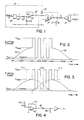
- the transmitter shown in Figure 1 comprises a laser diode 10 driven, in common, by drive means in the form of two current sources comprising amplifiers 12 and 14, respectively.
- the data to be transmitted is applied to one input of amplifier 12 and an enabling signal, designated ENABLE 1, is applied to the other.
- ENABLE 1 When signal ENABLE 1 is high the current I2, supplied by current source amplifier 12, swings about a mean value and between a maximum value +I M and a minimum value -I M .
- the output power of the laser diode 10 correspondingly varies about a mean or average value P mean and between maximum value P max and minimum value P min as shown in Figures 2 and 3.
- Current source 14 is driven by a ramp signal generator 16 comprising a step function generator 18, and a filter formed by a series resistor 20, series inductor 22 and shunt capacitor 24.
- the resistor 20 and the inductor 22 are connected, in series, between the output of step function generator 18 and the non-inverting input of a buffer amplifier 26.
- the capacitor 24 is connected between such non-inverting input and ground.
- the output of the buffer amplifier 26 is connected by a series resistance 28 to the inverting input of current source amplifier 14 and to the anode of a photodiode 30.
- the cathode of the photodiode 30 is connected to a bias rail.
- the photodiode 30 is positioned so as to receive light from the laser 10. In practice, the photodiode 30 will usually be mounted facing the back facet of the laser 10.
- An enabling signal designated ENABLE 2, (synchronized to enabling signal ENABLE 1) is applied to the input of step-function generator 18.
- ENABLE 2 (synchronized to enabling signal ENABLE 1) is applied to the input of step-function generator 18.
- the stepped waveform from the output of step-function generator 18 is modified by the RLC filter.
- the value of the resistance 20 is such that the LC combination is substantially critically-damped.
- the output of the filter is its critically-damped step response which approximates to the rising half of a sine wave - i.e. between minimum and maximum values as indicated at 32 in Figure 2.
- This sine-wave signal applied by way of buffer amplifier 26 to the current source 14, produces a corresponding current I1 to be applied to laser diode 10.
- Optical feedback between the laser diode 10 and photodiode 30 stabilizes the laser output over a long time period.
- the timing of the two enabling signals, ENABLE 1 and ENABLE 2 is so arranged that, when the sine-wave "ramp" reaches its maximum, which is actually the mean level for the data signal, the data signal is applied to the current source 12.
- the respective gains are such that the output of the current source 12 alternately doubles the current in the laser diode 10 to +I M and reduces it to -I M , which is substantially zero - actually just above the threshold value for the laser.
- the output power level falls virtually instantaneously to the mean. If a slower fall were permitted, the receiver's threshold evel would not have the correct relationship to the mean of the input signal during the first few bits of the next frame.
- the output of the step-function generator 18 is then effectively grounded, causing the current from current source 14, and hence the output power, to decay, as shown at 34 in Figure 2, with a waveform that is approximately the second half, i.e. from maximum to minimum, of a sine wave.
- the data comprises a balanced line code. Consequently, the DC component of the signal is independent of the data content.
- the line code is of the balanced "binary" type so the mean level during the data burst is equal to the mean of the "1" and "0" levels, i.e. the number of 1's is equal to the number of 0's.
- the mean current from transmitters that are inactive is much less than it would be if the transmitters were on continuously at their mean power level. Consequently steady state light from inactive transmitters, aggregating at the receiver, is less. This reduces quantum or shot noise, improving receiver sensitivity.
- a suitable high pass filter at the receiver (see Figure 4) will filter out the ramps.
- the amplitude of the remaining signal will still vary from transmitter to transmitter but the decision threshold will remain at the same, substantially zero level at all times, (where the transmitters are a.c. coupled).
- the light incident upon the receiver during any one data burst will be the aggregate of light from three transmitters, Tx1, Tx2 and Tx3. These comprise the data burst of Tx2, the decaying ramp following the immediately preceding data burst of Tx1, and the rising ramp of the immediately trailing data burst of Tx3.
- the low frequency component constituting the rising and falling ramps is at a lower frequency than the data burst and so is removed by a high pass filter at the input to the receiver.
- the first current source responds fast enough to follow the data burst.
- the second source means is too slow to follow the data burst.
- FIG. 4 shows the receiver and associated high pass filter.
- the light signal is received by a photodiode 40 which has its anode connected to inverting input of an amplifier 42 which has its non-inverting input grounded.
- the amplifier 42 has a feedback resistance 44 between its output and its inverting input, thus constituting a transimpedance amplifier.
- the output of amplifier 42 is also connected by way of a series capacitor 46 in common to a second resistance 48 and the input of a second amplifier 50, which serves as a buffer.
- ramps may be used to provide the "predetermined waveform", provided that the spectral content of the ramps is below the spectral content of the data, so that the two can be separated by means of a suitable filter.
- the ramp may be infinite, i.e. the mean power level maintained constantly from one time or frame period throughout the next.
- the disclosed ramps are preferred for the additional benefit of reduced quantum or shot noise.
- average is used herein in its broad sense to cover, inter alia, mean, median and mode.
Landscapes
- Engineering & Computer Science (AREA)
- Computer Networks & Wireless Communication (AREA)
- Signal Processing (AREA)
- Physics & Mathematics (AREA)
- Electromagnetism (AREA)
- Optical Communication System (AREA)
Applications Claiming Priority (2)
| Application Number | Priority Date | Filing Date | Title |
|---|---|---|---|
| CA000510504A CA1249029A (en) | 1986-05-30 | 1986-05-30 | Optical communication system |
| CA510504 | 1986-05-30 |
Publications (2)
| Publication Number | Publication Date |
|---|---|
| EP0251484A2 true EP0251484A2 (de) | 1988-01-07 |
| EP0251484A3 EP0251484A3 (de) | 1990-03-07 |
Family
ID=4133259
Family Applications (1)
| Application Number | Title | Priority Date | Filing Date |
|---|---|---|---|
| EP87304635A Withdrawn EP0251484A3 (de) | 1986-05-30 | 1987-05-26 | Steuerung des Leistungspegels für optische Übertragungssysteme |
Country Status (3)
| Country | Link |
|---|---|
| EP (1) | EP0251484A3 (de) |
| JP (1) | JPS62291225A (de) |
| CA (1) | CA1249029A (de) |
Cited By (1)
| Publication number | Priority date | Publication date | Assignee | Title |
|---|---|---|---|---|
| EP0367460A1 (de) * | 1988-10-31 | 1990-05-09 | AT&T Corp. | Steuereinrichtung für Lichtwellenleiterbus |
Family Cites Families (2)
| Publication number | Priority date | Publication date | Assignee | Title |
|---|---|---|---|---|
| FR2361022A1 (fr) * | 1976-08-06 | 1978-03-03 | Aerospatiale | Procede et dispositif de transmission de signaux par fibres optiques |
| US4397042A (en) * | 1981-07-22 | 1983-08-02 | Sumitomo Electric Industries, Ltd. | Optical modulation/demodulation system |
-
1986
- 1986-05-30 CA CA000510504A patent/CA1249029A/en not_active Expired
-
1987
- 1987-05-26 EP EP87304635A patent/EP0251484A3/de not_active Withdrawn
- 1987-05-30 JP JP62133545A patent/JPS62291225A/ja active Pending
Cited By (2)
| Publication number | Priority date | Publication date | Assignee | Title |
|---|---|---|---|---|
| EP0367460A1 (de) * | 1988-10-31 | 1990-05-09 | AT&T Corp. | Steuereinrichtung für Lichtwellenleiterbus |
| US5034944A (en) * | 1988-10-31 | 1991-07-23 | At&T Bell Laboratories | Optical fiber bus controller |
Also Published As
| Publication number | Publication date |
|---|---|
| CA1249029A (en) | 1989-01-17 |
| JPS62291225A (ja) | 1987-12-18 |
| EP0251484A3 (de) | 1990-03-07 |
Similar Documents
| Publication | Publication Date | Title |
|---|---|---|
| US5510919A (en) | Optical system for transmitting a multilevel signal | |
| US4709416A (en) | Laser bias current stabilization for burst mode fiber optic communication system | |
| US4620321A (en) | Optical fibre receiver | |
| US7657192B2 (en) | Burst mode optical receiver and system and method therefor | |
| CA1215121A (en) | Optical star repeater | |
| PL309766A1 (en) | Telecommunication system with transmitted signal implification for multiplexed signal with wavelength sharing and reception power correction | |
| JP2530282B2 (ja) | 光パルスのソ―ス及び該ソ―スを含むソリトンによる光伝送システム | |
| US6246499B1 (en) | Optical signal communication apparatus and optical signal communication method | |
| EP0845882A2 (de) | Sender-Empfänger-Schaltung eines passiven optischen Netzwerks | |
| US6137605A (en) | Output power control system for optical amplification repeater | |
| US4868809A (en) | Optical communication system | |
| US4504975A (en) | System for transmitting digital signals over an optical fiber | |
| EP0251484A2 (de) | Steuerung des Leistungspegels für optische Übertragungssysteme | |
| US6535308B1 (en) | Method and apparatus for converting electrical signals and optical signals for bidirectional communication over a single optical fiber | |
| US4499609A (en) | Symmetrically clamped fiber optic receiver | |
| JPH11145913A (ja) | プリアンプ | |
| JP4408623B2 (ja) | 光伝送システム | |
| SU1368904A1 (ru) | Оптоэлектронное устройство дл приема и передачи информации | |
| JPH03254232A (ja) | 光通信方法および装置 | |
| JPS57208738A (en) | Optical transmitter | |
| SU1674208A1 (ru) | Оптоэлектронное устройство дл приема и передачи информации | |
| CA1217818A (en) | Optical modulation/demodulation system | |
| JPS63175556A (ja) | 光受信回路 | |
| JPH0990441A (ja) | バースト光増幅装置 | |
| JPS60169248A (ja) | 光フアイバ通信方式 |
Legal Events
| Date | Code | Title | Description |
|---|---|---|---|
| PUAI | Public reference made under article 153(3) epc to a published international application that has entered the european phase |
Free format text: ORIGINAL CODE: 0009012 |
|
| AK | Designated contracting states |
Kind code of ref document: A2 Designated state(s): DE FR GB NL SE |
|
| PUAL | Search report despatched |
Free format text: ORIGINAL CODE: 0009013 |
|
| AK | Designated contracting states |
Kind code of ref document: A3 Designated state(s): DE FR GB NL SE |
|
| STAA | Information on the status of an ep patent application or granted ep patent |
Free format text: STATUS: THE APPLICATION IS DEEMED TO BE WITHDRAWN |
|
| 18D | Application deemed to be withdrawn |
Effective date: 19900910 |
|
| RIN1 | Information on inventor provided before grant (corrected) |
Inventor name: KAHN, DAVID ALEXANDER |