EP0248601A2 - Retortable packages - Google Patents
Retortable packages Download PDFInfo
- Publication number
- EP0248601A2 EP0248601A2 EP87304752A EP87304752A EP0248601A2 EP 0248601 A2 EP0248601 A2 EP 0248601A2 EP 87304752 A EP87304752 A EP 87304752A EP 87304752 A EP87304752 A EP 87304752A EP 0248601 A2 EP0248601 A2 EP 0248601A2
- Authority
- EP
- European Patent Office
- Prior art keywords
- diaphragm
- container
- heat
- package
- product
- Prior art date
- Legal status (The legal status is an assumption and is not a legal conclusion. Google has not performed a legal analysis and makes no representation as to the accuracy of the status listed.)
- Granted
Links
Images
Classifications
-
- B—PERFORMING OPERATIONS; TRANSPORTING
- B65—CONVEYING; PACKING; STORING; HANDLING THIN OR FILAMENTARY MATERIAL
- B65D—CONTAINERS FOR STORAGE OR TRANSPORT OF ARTICLES OR MATERIALS, e.g. BAGS, BARRELS, BOTTLES, BOXES, CANS, CARTONS, CRATES, DRUMS, JARS, TANKS, HOPPERS, FORWARDING CONTAINERS; ACCESSORIES, CLOSURES, OR FITTINGS THEREFOR; PACKAGING ELEMENTS; PACKAGES
- B65D77/00—Packages formed by enclosing articles or materials in preformed containers, e.g. boxes, cartons, sacks or bags
- B65D77/10—Container closures formed after filling
- B65D77/20—Container closures formed after filling by applying separate lids or covers, i.e. flexible membrane or foil-like covers
- B65D77/2024—Container closures formed after filling by applying separate lids or covers, i.e. flexible membrane or foil-like covers the cover being welded or adhered to the container
Definitions
- This invention relates to the production of retortable packages charged with a product (particularly a liquid or semi-liquid food product).
- a product particularly a liquid or semi-liquid food product.
- the enclosure of the package comprises a container of a thermoplastics material, and a diaphragm which is sealed to a rim formed at the charging or mouth end of the container.
- the diaphragm is made from metal foil, and is heat sealed to the container rim by means of a thin layer of a thermoplastics material which is carried by the metal foil.
- the package is thermally processed in, for example, a steam, steam/air or underwater retort to achieve pasteurisation or sterilisation.
- the enclosure With retortable packages it is commercially important that after retorting the enclosure should not only be intact but also should exhibit no significant visible signs of deformation, so as to have a consumer-acceptable appearance. A further requirement is that the enclosure can be stood stably upright, without rocking, on a display shelf or the like.
- Applicants have disclosed a sealing process by which retortable packages of a liquid or semi-liquid food product are made hydraulically solid.
- a headspace which is initially present in a thermoplastics container above the - contained product is eliminated by evacuation of the headspace gas before sealing with an aluminium diaphragm; after sealing, an external pressure is applied to the diaphragm so as to stretch it non-elastically and redistribute the product lying adjacent the diaphragm.
- the diaphragm therefore has a dished, outwardly concave configuration, and lies wholly in contact with the product.
- a retortable package having a product contained within an enclosure, the enclosure comprising a container having a base and an upstanding side wall extending to a rim, at least the side wall being moulded from a thermoplastics material and being subject to shrinkage during a retorting process, the enclosure further comprising a diaphragm which is heat-sealed to the container rim and dished on to the product in the container so as to render the package substantially hydraulically solid, said diaphragm being of thermoplastics material and being heat-shrinkable so as during a subsequent retorting process to shrink and by reducing the concavity of the diaphragm substantially to compensate for volume shrinkage of the container caused by the retorting process.
- the enclosure may thus exhibit no readily visible effects of retorting.
- the dished diaphragm becomes generally planar.
- a method of making a retortable package of a product comprising the steps of:-
- the tests now to be described were all performed upon packages formed using upwardly tapered containers of circular cross-section, of the style generally known as 71mm dairy pots.
- the containers had a rim diameter to pot height ratio of approximately 1:1, and were produced by thermoforming co-extruded multilayer thermoplastics laminate or sheet.
- the laminate was formed of two relatively thick polypropylene (PP) skin layers having sandwiched therebetween a thin oxygen barrier layer of polyvinylidene chloride (PVdC) and thin adhesive layers on either side of the barrier layer.
- PP polypropylene
- PVdC polyvinylidene chloride
- the liquid or semi-liquid food product which the packages would contain commercially was simulated by a starch solution.
- the containers were closed after they had been filled with product so as to leave a headspace, and the headspace had subsequently been evacuated.
- a plane flexible web of material was then heat-sealed to the container rim so as to form a diaphragm enclosing the product and headspace within the container, after which the diaphragm was subjected to an external fluid pressure over the headspace so as to be stretched inwards into full contact with the product.
- the movement of the diaphragm into the container removed the headspace and caused some redistribution of the product, the resulting sealed package thereby being substantially hydraulically solid and void-free, with little or no permanent gas.
- the stretching of the sheet was non-elastic, so that when the fluid pressure was removed the enclosure was substantially stress-free.
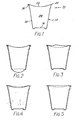
- Fig. 1 shows a vertical, diametral cross-section of a typical one of the test packages produced.
- the sealed enclosure 10 of the package contains a product 24 and comprises a unitary container 12 having a side wall 14, a base 16 and an outturned, annular rim 18, and a closure diaphrgam 20 having its peripheral margin 22 heat-sealed to the container rim 18.
- the containers were closed by diaphragms formed of 40 micron aluminium. foil coated with a 50 micron layer of high density polyethylene to enable the diaphragm to be heat-sealed to the container rim.
- the containers were formed from two thickness of laminate, namely 1.8 mm and 2.5 mm; moreover, the containers formed from the 1.8 mm laminate were made using two different sets of thermoforming conditions, which gave them either relatively thin or relatively thick bases.
- a four-cavity thermoforming mould was used for each laminate, and for the 2.5 mm laminate the particular mould cavity employed was noted for each container.
- test packages were subjected to three different but conventional retorting processes, but it was found after completion of those processes that all of the packages had suffered some substantial and readily visible deformation such that the containers were considered to be commercially unacceptable. Table 1 below gives the results obtained.
- the closed packages were retorted in an underwater retort for 60 minutes at.a temperature of 240°F and a pressure of 30 p.s.i. Before retorting all the packages had the appearance shown in Fig.l. After retorting the packages with a metal diaphragm again had an appearance such as.is depicted in Fig.2 or Fig.3, and were considered to be commercially unacceptable; however, the containers with a plastics diaphragm had an appearance usually as shown in Fig.4 but occasionally as shown in Fig.5.
- FIG. 4 depicts a typical container after retorting, and shows that the diaphragm had still retained its original smoothly curved concave appearance. The concavity of the diaphragm had been reduced, but this change was not apparent to a potential consumer of the packaged product; moreover, there was no wrinkling, folding, blistering or balooning of the diaphragm such as might throw doubt on the condition of the packaged product, or otherwise generate consumer resistance.
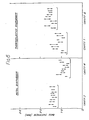
- Fig.6 shows the containers used in Test Series 2 in relation to the mould cavities in which they were formed and as plotted against base thickness. For each container the respective line represents the range of thicknesses which were measured at a number of points on the container base. The greater and more uniform base thicknesses given by cavities 2 and 3 can readily be seen. The results are shown in tabular form in Table 2 as follows:-
- thermoplastics diaphragms towards a substantially planar (undished) shape during retorting had rendered the plastics-lidded containers of Test Series 2 commercially acceptable after retorting.
- the minimum base thickness of the 30 containers of the Series 3 Tests was 0,65 mm, and applicants believe that this is about the minimum figure for containers base thickness which would have ensured that a high proportion (e.g. 99.9% or more) of the particular containers under test would have been commercially acceptable after retorting.
- the minimum base thickness of the successful, plastics-lidded containers of vest Series 2 was 0.74 mm.
- the closure material will be of a laminated construction, although this is not essential.
- the closure material is a five layer structure comprising outer skin layers of polypropylene and an intermediate barrier layer of polyvinylidene chloride ( PV dC) which is bonded by thin adhesive layers to the polypropylene layers on either side.
- thermoretractibility of the diaphragm closures of the packages in accordance with the invention may be imparted entirely by an operation to stretch the diaphragm material into contact with the product-as particularly described above in relation to the tests conducted by Applicants.
- the diaphragm material will have a degree of retractibility imparted to it during its original manufacture, and this inherent retractibility is additive to any retractibility created by the stretching operation.
- thermoforming operation on a relatively thick and usually self-supporting thermoplastics diaphragm material; in such circumstances thermoretractibility may again be conferred on the diaphragm on formation to its dished configuration, and possibly also during the original formation of the material.
- the diaphragm will usually be made wholly of thermoplastics material and the enclosure may therefore be fully microwaveable.
- the diaphragm may nevertheless be partially metallic, but any metal content which the diaphragm material does possess should not be such as to destroy the thermoretractile nature of the diaphragm material; it will therefore typically be in the form of a thin, vapour-deposited coating or discrete particles added for gas barrier or cosmetic reasons.
- the containers used in the tests described above had volume shrinkages lying within the range 3% - 8%, Applicants believe that the invention may be valuable for use with containers having volume shrinkages of from 1% upwards.
- the containers may be formed by a thermoforming operation on thermoplastics sheet, or by another plastics moulding operation; moreover, the base of the container need not be integral with the side wall.
- the invention is used to relieve internal pressure and prevent side wall distortion during retorting of a container having a generally cylindrical side wall cut from a stretch-blow moulded PET (polyethylene terephthalate) tube.
- One end of the container destined to form what may be considered as the container base, is closed by a rigid metal end closure double-seamed to an end of the side wall, the other "top" end of the container being a dished, relatively flexible and thermoretractile, plastics diaphragm which is heat-sealed to a flange formed on the other end of the side wall and which makes full contact with the enclosed product so that the package is hydraulically solid.
- the PET side wall may be subject to some volume shrinkage during retorting, but any resultant reduction in the enclosed volume of the container during that time is counteracted by reversion of the diaphragm towards a plane condition, as has previously been discussed in relation to the all-plastics container. It is to be noted that with this particular container construction the container may be supplied to the food packer with the diaphragm closure attached but plane (i.e. not dished).
- the packer fills the container with product through the opposite end under vacuum so as to leave an evacuated headspace, double-seams a metal end closure to that end so as to close the container, and subsequent dishes the diaphragm closure inwardly to remove the headspace, render the package hydraulically solid and render the diaphragm thermoretractile.
Landscapes
- Mechanical Engineering (AREA)
- Engineering & Computer Science (AREA)
- Packages (AREA)
- Food Preservation Except Freezing, Refrigeration, And Drying (AREA)
- Laminated Bodies (AREA)
- Supplying Of Containers To The Packaging Station (AREA)
- Polyoxymethylene Polymers And Polymers With Carbon-To-Carbon Bonds (AREA)
- Transition And Organic Metals Composition Catalysts For Addition Polymerization (AREA)
- Wrappers (AREA)
- Purification Treatments By Anaerobic Or Anaerobic And Aerobic Bacteria Or Animals (AREA)
- Road Repair (AREA)
- Vehicle Body Suspensions (AREA)
- Cookers (AREA)
Abstract
Description
- This invention relates to the production of retortable packages charged with a product (particularly a liquid or semi-liquid food product). In Applicants' British Patent Specification GB.2,067,157B the enclosure of the package comprises a container of a thermoplastics material, and a diaphragm which is sealed to a rim formed at the charging or mouth end of the container. The diaphragm is made from metal foil, and is heat sealed to the container rim by means of a thin layer of a thermoplastics material which is carried by the metal foil. After closure the package is thermally processed in, for example, a steam, steam/air or underwater retort to achieve pasteurisation or sterilisation.
- With retortable packages it is commercially important that after retorting the enclosure should not only be intact but also should exhibit no significant visible signs of deformation, so as to have a consumer-acceptable appearance. A further requirement is that the enclosure can be stood stably upright, without rocking, on a display shelf or the like.
- In our said British Patent Specification GB 2067157B (to which the reader's attention is hereby directed), Applicants have disclosed a sealing process by which retortable packages of a liquid or semi-liquid food product are made hydraulically solid. A headspace which is initially present in a thermoplastics container above the - contained product is eliminated by evacuation of the headspace gas before sealing with an aluminium diaphragm; after sealing, an external pressure is applied to the diaphragm so as to stretch it non-elastically and redistribute the product lying adjacent the diaphragm. The diaphragm therefore has a dished, outwardly concave configuration, and lies wholly in contact with the product.
- Using the process of patent specification 2067157 Applicants have been able to produce enclosures which have a high and commercially satisfactory degree of dimensional stability providing that the containers have been subject to only a small degree of volume shrinkage (e.g. 3% or less) during retorting. However, in seeking to use the process with containers subject to larger degrees of volume shrinkage (e.g. greater than 3%), Applicants have met difficulty with substantial distortion of the enclosure caused by the retorting process. This distortion is manifest in two ways, namely:-(a) an outward bulging and/or buckling of the base of the container, and (b) an outward bulging and/or unsightly wrinkling of the metal diaphragm at the top of the enclosure. Usually (a) or (b) alone is present, but on some occasions both (a) and (b) are present, and/or.the side wall of the container deforms instead of, or in addition to, the container base.
- With containers having a large plan area in relation to their height, in particular shallow trays, the degree of distortion involved may be visually and mechanically insignificant and therefore may be considered to be commercially acceptable. For containers such as pots, tubs and bowls having a relatively small plan area in relation to their height, however, the distortion will be more evident to the potential consumer and, in the case of container base deformation, may result in the inability of the package to stand stably upright. Particularly, therefore, for such containers which are subject to a substantial degree of volume shrinkage during retorting, there exists a requirement to control distortion of the enclosure caused by the volume shrinkage of the container in such a way that commercially acceptable packages may result.
- According to one aspect of the present invention, there is provided a retortable package having a product contained within an enclosure, the enclosure comprising a container having a base and an upstanding side wall extending to a rim, at least the side wall being moulded from a thermoplastics material and being subject to shrinkage during a retorting process, the enclosure further comprising a diaphragm which is heat-sealed to the container rim and dished on to the product in the container so as to render the package substantially hydraulically solid, said diaphragm being of thermoplastics material and being heat-shrinkable so as during a subsequent retorting process to shrink and by reducing the concavity of the diaphragm substantially to compensate for volume shrinkage of the container caused by the retorting process.
- The enclosure may thus exhibit no readily visible effects of retorting. In the ultimate case, the dished diaphragm becomes generally planar.
- Satisfactory results have been obtained by Applicants using containers made of polypropylene and laminates incorporating that material, but Applicants believe that the invention is applicable to containers formed from other plastics materials and of either single-layer or multi-layer (laminated) construction. Furthermore, although being of particular application to thermoplastics containers which are thermoformed from sheet materials, the invention may be used with containers made by other forming methods, for example, by stretch-blow moulding .a tube parison or tubular preform, and may include containers in which the base is not integral with but instead is attached to the side wall.
- According to a second aspect of the present invention, there is provided a method of making a retortable package of a product comprising the steps of:-
- (a) forming a container to have a base and an upstanding side wall extending to a rim, at least the side wall being moulded from thermoplastics material and being subject to shrinkage during a retorting process;
- (b) charging the container with the product to leave a headspace below the rim;
- (c) heat-sealing a thermoplastics diaphragm peripherally to the rim;
- (d) rendering the diaphragm material dished so as to cause the diaphragm, after heat-sealing, to occupy the headspace and make full contact with the product, the package thereby being rendered hydraulically solid; and
- (e) rendering the diaphragm heat-shrinkable so as during a retorting process on the hydraulically solid package to shrink and, by reducing the concavity of the diaphragm, substantially to compensate for volume shrinkage of the container caused by the retorting process.
- Other aspects and features of the present invention will appear from the description that follows hereafter and from the claims appended at the end of the description.
- The practice of the present invention will now be described and discussed with reference to the accompanying drawings in which:-
- Fig.l shows diagrammatically, in a vertical, diametral cross section, a package after filling and closing and before being subjected to a retorting process, the package.comprising a thermoplastics container made by thermoforming from a plastics laminate, and a diaphragm closure heat-sealed to the container rim and enclosing a liquid or semi-liquid food product within the container;
- .Figs.2 and 3 show two packages of the kind in Fig.l, as they appeared when closed by a metal diaphragm and after having been subjected to a retorting process;
- Figs.4 and 5 similarly show two plastics-lidded packages according to the present invention, as they appeared after having been subjected to a retorting process; and
- Fig. 6 graphically shows the range of base thicknesses, measured on the forty individual containers used in a comparison of the retort performances of packages having metal diaphragms with plastics-lidded packages in accordance with the invention.
- For the purpose of comparison the packages before retorting are represented by the broken lines in Figs.2 to 5.
- The tests now to be described were all performed upon packages formed using upwardly tapered containers of circular cross-section, of the style generally known as 71mm dairy pots. The containers had a rim diameter to pot height ratio of approximately 1:1, and were produced by thermoforming co-extruded multilayer thermoplastics laminate or sheet. The laminate was formed of two relatively thick polypropylene (PP) skin layers having sandwiched therebetween a thin oxygen barrier layer of polyvinylidene chloride (PVdC) and thin adhesive layers on either side of the barrier layer.
- For the purposes of the tests the liquid or semi-liquid food product which the packages would contain commercially was simulated by a starch solution. The containers were closed after they had been filled with product so as to leave a headspace, and the headspace had subsequently been evacuated. A plane flexible web of material was then heat-sealed to the container rim so as to form a diaphragm enclosing the product and headspace within the container, after which the diaphragm was subjected to an external fluid pressure over the headspace so as to be stretched inwards into full contact with the product.
- The movement of the diaphragm into the container removed the headspace and caused some redistribution of the product, the resulting sealed package thereby being substantially hydraulically solid and void-free, with little or no permanent gas. The stretching of the sheet was non-elastic, so that when the fluid pressure was removed the enclosure was substantially stress-free.
- - Such heat-sealing process has been described fully in the British Patent Specification GB 2067157B, to which the reader's attention is directed for further information concerning that process. In the resultant package, the heat-sealed diaphragm had a smoothly curved, shallow, outwardly concave appearance, and lay wholly in contact with the product in the container as mentioned above. Fig. 1 shows a vertical, diametral cross-section of a typical one of the test packages produced. In that Figure, the sealed
enclosure 10 of the package contains aproduct 24 and comprises aunitary container 12 having aside wall 14, abase 16 and an outturned,annular rim 18, and aclosure diaphrgam 20 having itsperipheral margin 22 heat-sealed to thecontainer rim 18. - For this first series of tests the containers were closed by diaphragms formed of 40 micron aluminium. foil coated with a 50 micron layer of high density polyethylene to enable the diaphragm to be heat-sealed to the container rim.
- In order to provide the packages with a wide range of base thicknesses the containers were formed from two thickness of laminate, namely 1.8 mm and 2.5 mm; moreover, the containers formed from the 1.8 mm laminate were made using two different sets of thermoforming conditions, which gave them either relatively thin or relatively thick bases. A four-cavity thermoforming mould was used for each laminate, and for the 2.5 mm laminate the particular mould cavity employed was noted for each container.
- The test packages were subjected to three different but conventional retorting processes, but it was found after completion of those processes that all of the packages had suffered some substantial and readily visible deformation such that the containers were considered to be commercially unacceptable. Table 1 below gives the results obtained.

- Measurements showed that the containers had suffered a degree of volume shrinkage lying within the
range 3% - 8%, and it was evident that this shrinkage had correspondingly reduced the volume available for the product, which accordingly had caused gross and commercially unacceptable deformation of the enclosure. Usually the deformation occured either at thebase 16 of thecontainer 12, or at theclosure diaphragm 20; in a few cases, however, the container deformed at itsside wall 14. Container base deformation and diaphragm deformation are illustrated in Figs. 2 and 3 respectvely. - From a comparison Fig.2 with Fig.l, it will be observed that whereas in Fig.2 the inwardly dished shape of the
closure diaphragm 20 is seemingly unaltered by the retorting process, thebase 16 of thecontainer 12 has been forced outwardly by the enclosed product whilst in a heat-softened condition, so as to be downwardly bulging in a manner that renders the enclosure mechanically unstable when placed base-down on to a horizontal surface, and, moreover, gives the container a "blown" appearance. Thus, the retorting process has rendered this package unsuitable for sale to a customer. This mode of deformation was typical of the packages having their containers formed from the thinner(1.8 mm) laminate, although some containers formed from the thicker(2.5 mm) laminate were similarly affected. - On the other hand, it will be seen that whereas the
container base 16 in Fig.3 is seemingly unaltered compared with that of Fig.l, theclosure diaphragm 20 has been pushed upwardly by the enclosed product so as to exhibit a wrinkled, uneven and bulging appearance, which was again considered to be unacceptable to a potential customer. This mode of deformation was typical of the packages having their containers formed from the thicker(2.5 mm) laminate, but it also occurred in the few containers formed from 1.8 mm laminate which were not subject to container deformation. Thus, all of the retorted packages having the metal diaphragms were considered to have been rendered unacceptable to potential customers by the retorting process. - 'From Table 1 above it will be seen that'the containers produced in the
cavities cavities
This disparity can be explained by the fact that the containers from thecavities cavities Test Series 2, a report of which now follows, the cavities were combined together asgroups 1/2 and 3/4 so that the containers from the two groups would have similar ranges of base thickness. - For this series of tests forty containers were moulded from the same 2.5 mm laminate as was used in
Test Series 1, using the same four-cavity thermoforming mould as was used before for that laminate. The cavity appropriate to each container was noted. The twenty containers moulded incavities cavities - The closed packages were retorted in an underwater retort for 60 minutes at.a temperature of 240°F and a pressure of 30 p.s.i. Before retorting all the packages had the appearance shown in Fig.l. After retorting the packages with a metal diaphragm again had an appearance such as.is depicted in Fig.2 or Fig.3, and were considered to be commercially unacceptable; however, the containers with a plastics diaphragm had an appearance usually as shown in Fig.4 but occasionally as shown in Fig.5.
- It will be seen from Figs.4 and 5 that the
bases 16 of all the plastics-lidded containers 12 of this second series of tests had resisted the internal forces produced during retorting; in fact, the containers showed no visible signs of deformation anywhere. Fig. 4 depicts a typical container after retorting, and shows that the diaphragm had still retained its original smoothly curved concave appearance. The concavity of the diaphragm had been reduced, but this change was not apparent to a potential consumer of the packaged product; moreover, there was no wrinkling, folding, blistering or balooning of the diaphragm such as might throw doubt on the condition of the packaged product, or otherwise generate consumer resistance. - Fig.6 shows the containers used in
Test Series 2 in relation to the mould cavities in which they were formed and as plotted against base thickness. For each container the respective line represents the range of thicknesses which were measured at a number of points on the container base. The greater and more uniform base thicknesses given bycavities 
- The reduction.in the concavity (or degree of dishing) of the plastics diaphragms in this
Test Series 2 was dependent upon the volume shrinkage of the containers in relation to the volume of the headspace closed by the diaphragms. It was found that the reduction could be adjusted within wide limits as desired, by varying the fill level of the product and therefore the headspace volume, the maximum reduction resulting in the generally plane diaphragm shown in Fig.5. In this respect it is to be noted that a convex, outwardly bulging diaphragm was considered to be commercially unacceptable from the viewpoints of stackability, ease of transport, and customer acceptance. - Applicants believe that the lack of any unacceptable deformation of the plastics-lidded packages caused by the retorting operation can be attributed to the following reasons:-
- (1) During retorting, the shrinkage of the diaphragm operates in the sense to increase the volume of the enclosure and so counteracts volume loss of the enclosure caused by the volume shrinkage of the container, thereby tending to reduce the pressure within the enclosure;
- (2) Because of the smaller material thickness and thermal capacity of the diaphragm material in relation to the container material, the thermal response of the diaphragm to the retorting temperatures is faster than that of the container, and during retorting the internal -pressure within the.enclosure is not merely substantially smaller than it would have been with a non-thermoretractile (e.g. metal) diaphragm material; but for at least a substantial part of the retorting operation it may in fact be negative in relation to the ambient pressure of the retort; .
- (3) Despite the limpness of the container and diaphragm materials induced by the retorting operation, the enclosure is able to sustain substantial negative pressures without deformation, and the package therefore survives the retorting operation with no deformation of the container and with the diaphragm concavity reduced so as to compensate for the volume shrinkage of the container;
- (4) After retorting, when the package has cooled to normal room temperatures, the plastics materials of the container and diaphragm regain their rigidity and the package is left in a substantially stress-free condition even though the diaphragm material may not have reverted fully to the plane condition in which it was originally formed.
- It was thus believed that reversion of their dished thermoplastics diaphragms towards a substantially planar (undished) shape during retorting had rendered the plastics-lidded containers of
Test Series 2 commercially acceptable after retorting. - 30 containers thermoformed in the same four-cavity mould from the 2.5 mm laminate used in the
Series Series 2 Tests. After retorting, the 11 containers which were plastics-lidded were all found to be commercially acceptable and in particular showed no visible container deformation; the 19 foil-lidded containers, however, all showed container or diaphragm deformation and were considered to be commercially unsatisfactory. - The minimum base thickness of the 30 containers of the
Series 3 Tests was 0,65 mm, and applicants believe that this is about the minimum figure for containers base thickness which would have ensured that a high proportion (e.g. 99.9% or more) of the particular containers under test would have been commercially acceptable after retorting. In this respect it is to be noted that the minimum base thickness of the successful, plastics-lidded containers ofvest Series 2 was 0.74 mm. - 66 containers thermoformed from 1.8 mm sheet were closed, some by metal diaphragms and the remainder by plastics diaphragms using the closing process of the other Test Series. After retorting using the retort process employed for
Series Test Series 3 above. The results ofTest Series 4 are therefore believed to lend support to 0.65mm being approximately the minimum value of the container wall thickness which was likely to have been commercially acceptable for the containers tested. - Various plastics materials may be used for the thermoretractile diaphragm closures of packages in accordance with the invention, Usually, the closure material will be of a laminated construction, although this is not essential. In one proposal the closure material is a five layer structure comprising outer skin layers of polypropylene and an intermediate barrier layer of polyvinylidene chloride (PVdC) which is bonded by thin adhesive layers to the polypropylene layers on either side.
- The thermoretractibility of the diaphragm closures of the packages in accordance with the invention may be imparted entirely by an operation to stretch the diaphragm material into contact with the product-as particularly described above in relation to the tests conducted by Applicants. Usually, the diaphragm material will have a degree of retractibility imparted to it during its original manufacture, and this inherent retractibility is additive to any retractibility created by the stretching operation. Within the scope of the invention, however, are packages and methods for making them wherein the diaphragm is wholly or partially dished prior to its application and heat sealing to the container, for example by a thermoforming operation on a relatively thick and usually self-supporting thermoplastics diaphragm material; in such circumstances thermoretractibility may again be conferred on the diaphragm on formation to its dished configuration, and possibly also during the original formation of the material.
- To give it its required property of thermoretractibility the diaphragm will usually be made wholly of thermoplastics material and the enclosure may therefore be fully microwaveable. The diaphragm may nevertheless be partially metallic, but any metal content which the diaphragm material does possess should not be such as to destroy the thermoretractile nature of the diaphragm material; it will therefore typically be in the form of a thin, vapour-deposited coating or discrete particles added for gas barrier or cosmetic reasons.
- Although the containers used in the tests described above had volume shrinkages lying within the
range 3% - 8%, Applicants believe that the invention may be valuable for use with containers having volume shrinkages of from 1% upwards. As previously mentioned, the containers may be formed by a thermoforming operation on thermoplastics sheet, or by another plastics moulding operation; moreover, the base of the container need not be integral with the side wall. - In one application the invention is used to relieve internal pressure and prevent side wall distortion during retorting of a container having a generally cylindrical side wall cut from a stretch-blow moulded PET (polyethylene terephthalate) tube. One end of the container, destined to form what may be considered as the container base, is closed by a rigid metal end closure double-seamed to an end of the side wall, the other "top" end of the container being a dished, relatively flexible and thermoretractile, plastics diaphragm which is heat-sealed to a flange formed on the other end of the side wall and which makes full contact with the enclosed product so that the package is hydraulically solid. Although it may have been subject to a heat-setting operation the PET side wall may be subject to some volume shrinkage during retorting, but any resultant reduction in the enclosed volume of the container during that time is counteracted by reversion of the diaphragm towards a plane condition, as has previously been discussed in relation to the all-plastics container. It is to be noted that with this particular container construction the container may be supplied to the food packer with the diaphragm closure attached but plane (i.e. not dished). The packer fills the container with product through the opposite end under vacuum so as to leave an evacuated headspace, double-seams a metal end closure to that end so as to close the container, and subsequent dishes the diaphragm closure inwardly to remove the headspace, render the package hydraulically solid and render the diaphragm thermoretractile.
Claims (10)
Priority Applications (1)
| Application Number | Priority Date | Filing Date | Title |
|---|---|---|---|
| AT87304752T ATE52988T1 (en) | 1986-05-29 | 1987-05-28 | STERILIZABLE PACKAGING. |
Applications Claiming Priority (2)
| Application Number | Priority Date | Filing Date | Title |
|---|---|---|---|
| GB8613029 | 1986-05-29 | ||
| GB8613029A GB2190892B (en) | 1986-05-29 | 1986-05-29 | Retortable packages |
Publications (3)
| Publication Number | Publication Date |
|---|---|
| EP0248601A2 true EP0248601A2 (en) | 1987-12-09 |
| EP0248601A3 EP0248601A3 (en) | 1988-10-05 |
| EP0248601B1 EP0248601B1 (en) | 1990-05-23 |
Family
ID=10598611
Family Applications (1)
| Application Number | Title | Priority Date | Filing Date |
|---|---|---|---|
| EP87304752A Expired - Lifetime EP0248601B1 (en) | 1986-05-29 | 1987-05-28 | Retortable packages |
Country Status (15)
| Country | Link |
|---|---|
| US (1) | US4735339A (en) |
| EP (1) | EP0248601B1 (en) |
| JP (1) | JPS6381A (en) |
| AT (1) | ATE52988T1 (en) |
| AU (1) | AU595314B2 (en) |
| CA (1) | CA1291075C (en) |
| DE (1) | DE3762839D1 (en) |
| DK (1) | DK269687A (en) |
| ES (1) | ES2015058B3 (en) |
| FI (1) | FI872352L (en) |
| GB (1) | GB2190892B (en) |
| GR (1) | GR3000510T3 (en) |
| NO (1) | NO872187L (en) |
| NZ (1) | NZ220268A (en) |
| ZA (1) | ZA873809B (en) |
Cited By (5)
| Publication number | Priority date | Publication date | Assignee | Title |
|---|---|---|---|---|
| EP0419764A1 (en) * | 1989-09-26 | 1991-04-03 | SOC.A.M.A. S.p.A. | Container for pre-cooked and/or ready-to-eat food |
| FR2668126A1 (en) * | 1990-10-19 | 1992-04-24 | Madrange Sa | Package for the vacuum packing of a product, in particular a food product having any type of surface, and method for preparing such a package |
| EP0721899A1 (en) * | 1995-01-11 | 1996-07-17 | W.R. Grace & Co.-Conn. | Package with shrink film lid |
| US5744181A (en) * | 1995-03-01 | 1998-04-28 | W. R. Grace & Co.-Conn. | Packaging method using thermoplastic materials and package obtained thereby |
| US6408598B1 (en) | 1998-12-23 | 2002-06-25 | Cryovac, Inc. | Modified atmosphere package for high profile products from upwardly formed heat shrinkable film |
Families Citing this family (16)
| Publication number | Priority date | Publication date | Assignee | Title |
|---|---|---|---|---|
| US5234126A (en) * | 1991-01-04 | 1993-08-10 | Abbott Laboratories | Plastic container |
| US5217737A (en) * | 1991-05-20 | 1993-06-08 | Abbott Laboratories | Plastic containers capable of surviving sterilization |
| US5283033A (en) * | 1991-11-29 | 1994-02-01 | Advanced Retort Systems, Inc. | Process for sterilizing the contents of a sealed deformable package |
| EP0642454A1 (en) * | 1992-06-02 | 1995-03-15 | Aci Operations Pty. Ltd. | Container |
| US5752614A (en) * | 1996-11-19 | 1998-05-19 | Sonoco Products Company | Easy-opening closure for hermetic sealing a retortable container |
| BR9917484A (en) * | 1999-09-10 | 2002-05-14 | Nestle Sa | Method for producing a sealed container for baked goods or similar |
| US6439413B1 (en) | 2000-02-29 | 2002-08-27 | Graham Packaging Company, L.P. | Hot-fillable and retortable flat paneled jar |
| US20030190272A1 (en) * | 2002-04-08 | 2003-10-09 | Dennis Raine | Sterilization containers and methods for radiation sterilization of liquid products |
| US20050145630A1 (en) * | 2004-01-05 | 2005-07-07 | Sonoco Development, Inc. | Easily openable closure for a retortable container having a metal end to which a membrane is sealed |
| KR20120058706A (en) * | 2010-11-30 | 2012-06-08 | 이정민 | Dissimilar Material Discharge Device |
| US8939695B2 (en) | 2011-06-16 | 2015-01-27 | Sonoco Development, Inc. | Method for applying a metal end to a container body |
| US8998027B2 (en) * | 2011-09-02 | 2015-04-07 | Sonoco Development, Inc. | Retort container with thermally fused double-seamed or crimp-seamed metal end |
| US10131455B2 (en) | 2011-10-28 | 2018-11-20 | Sonoco Development, Inc. | Apparatus and method for induction sealing of conveyed workpieces |
| US10399139B2 (en) | 2012-04-12 | 2019-09-03 | Sonoco Development, Inc. | Method of making a retort container |
| CA2871915A1 (en) | 2012-05-01 | 2013-11-07 | Berry Plastics Corporation | Retortable package |
| US9145251B2 (en) | 2012-10-26 | 2015-09-29 | Berry Plastics Corporation | Package |
Family Cites Families (9)
| Publication number | Priority date | Publication date | Assignee | Title |
|---|---|---|---|---|
| US3498018A (en) * | 1965-04-05 | 1970-03-03 | Mayer & Co Inc O | Method of forming a package |
| DE1586488A1 (en) * | 1967-05-06 | 1972-01-27 | Bellaplast Gmbh | Thin-walled plastic container with airtight seal |
| BE758450A (en) * | 1969-11-04 | 1971-04-16 | Ursina Franck A G | PROCESS FOR ESTABLISHING A PRESSURE IN A CONTAINER CONTAINING A FOOD AND HERMETICALLY CLOSED, AND CONTAINER FOR CARRYING OUT THIS PROCESS |
| NZ195962A (en) * | 1980-01-16 | 1984-11-09 | Metal Box Co Ltd | Vacuum packing a product in a rigid container so as to leave no headspace |
| US4350263A (en) * | 1980-09-19 | 1982-09-21 | H. P. Hood, Inc. | Package having sealed closing means |
| GB2104049B (en) * | 1981-02-27 | 1985-06-19 | Nestle Sa | Sealing process for filled containers |
| AU554618B2 (en) * | 1981-06-19 | 1986-08-28 | American National Can Corp. | Hot hilled container and method |
| US4542029A (en) * | 1981-06-19 | 1985-09-17 | American Can Company | Hot filled container |
| US4605142A (en) * | 1984-07-17 | 1986-08-12 | Toyo Seikan Kaisha, Ltd. | Synthetic resin vessel and heat sealed lid |
-
1986
- 1986-05-29 GB GB8613029A patent/GB2190892B/en not_active Expired - Lifetime
-
1987
- 1987-05-11 NZ NZ220268A patent/NZ220268A/en unknown
- 1987-05-14 AU AU72944/87A patent/AU595314B2/en not_active Ceased
- 1987-05-25 CA CA000537813A patent/CA1291075C/en not_active Expired - Lifetime
- 1987-05-26 NO NO872187A patent/NO872187L/en unknown
- 1987-05-26 US US07/054,263 patent/US4735339A/en not_active Expired - Fee Related
- 1987-05-26 DK DK269687A patent/DK269687A/en not_active Application Discontinuation
- 1987-05-27 FI FI872352A patent/FI872352L/en not_active Application Discontinuation
- 1987-05-28 DE DE8787304752T patent/DE3762839D1/en not_active Expired - Lifetime
- 1987-05-28 EP EP87304752A patent/EP0248601B1/en not_active Expired - Lifetime
- 1987-05-28 ES ES87304752T patent/ES2015058B3/en not_active Expired - Lifetime
- 1987-05-28 AT AT87304752T patent/ATE52988T1/en not_active IP Right Cessation
- 1987-05-29 JP JP62132022A patent/JPS6381A/en active Pending
- 1987-11-30 ZA ZA873809A patent/ZA873809B/en unknown
-
1990
- 1990-05-24 GR GR90400289T patent/GR3000510T3/en unknown
Cited By (6)
| Publication number | Priority date | Publication date | Assignee | Title |
|---|---|---|---|---|
| EP0419764A1 (en) * | 1989-09-26 | 1991-04-03 | SOC.A.M.A. S.p.A. | Container for pre-cooked and/or ready-to-eat food |
| FR2668126A1 (en) * | 1990-10-19 | 1992-04-24 | Madrange Sa | Package for the vacuum packing of a product, in particular a food product having any type of surface, and method for preparing such a package |
| EP0721899A1 (en) * | 1995-01-11 | 1996-07-17 | W.R. Grace & Co.-Conn. | Package with shrink film lid |
| US6739113B1 (en) | 1995-01-11 | 2004-05-25 | Cryovac, Inc. | Package with shrink film lidstock |
| US5744181A (en) * | 1995-03-01 | 1998-04-28 | W. R. Grace & Co.-Conn. | Packaging method using thermoplastic materials and package obtained thereby |
| US6408598B1 (en) | 1998-12-23 | 2002-06-25 | Cryovac, Inc. | Modified atmosphere package for high profile products from upwardly formed heat shrinkable film |
Also Published As
| Publication number | Publication date |
|---|---|
| JPS6381A (en) | 1988-01-05 |
| FI872352A0 (en) | 1987-05-27 |
| AU595314B2 (en) | 1990-03-29 |
| ATE52988T1 (en) | 1990-06-15 |
| DK269687A (en) | 1987-11-30 |
| ES2015058B3 (en) | 1990-08-01 |
| AU7294487A (en) | 1987-12-03 |
| GR3000510T3 (en) | 1991-07-31 |
| GB2190892A (en) | 1987-12-02 |
| EP0248601A3 (en) | 1988-10-05 |
| CA1291075C (en) | 1991-10-22 |
| NO872187L (en) | 1987-11-30 |
| DK269687D0 (en) | 1987-05-26 |
| GB2190892B (en) | 1990-02-14 |
| DE3762839D1 (en) | 1990-06-28 |
| GB8613029D0 (en) | 1986-07-02 |
| FI872352A7 (en) | 1987-11-30 |
| NZ220268A (en) | 1989-07-27 |
| ZA873809B (en) | 1987-11-30 |
| EP0248601B1 (en) | 1990-05-23 |
| NO872187D0 (en) | 1987-05-26 |
| FI872352L (en) | 1987-11-30 |
| US4735339A (en) | 1988-04-05 |
Similar Documents
| Publication | Publication Date | Title |
|---|---|---|
| EP0248601B1 (en) | Retortable packages | |
| CA1298772C (en) | Process for making a vacuum skin package and product formed thereby | |
| EP0232931B1 (en) | Shaped thermoformed flexible film container for granular products and method and apparatus for making the same | |
| US3977153A (en) | Container for food products and method for making same | |
| JP2013173568A (en) | Expandable container having lid for controlling headspace in food can | |
| EP2998239B1 (en) | Tray, hermetically sealed container and method of producing thereof | |
| JP2749907B2 (en) | High profile shrink wrap | |
| JP4220044B2 (en) | Injection mold container for microwave oven | |
| JPH0431273A (en) | Food package | |
| EP0132468B1 (en) | Container body | |
| EP1544129A1 (en) | Thermoformed plastic container and method for its manufacture | |
| JPH04242560A (en) | Sealable laminate, pack made of said laminate and manufacture of said laminate | |
| JP4059964B2 (en) | Method for producing laminated film | |
| JP6371088B2 (en) | Deep-drawing packaging container and manufacturing method thereof | |
| JP2556395B2 (en) | Container manufacturing method | |
| JP2544630B2 (en) | Manufacturing method for plastic containers | |
| JPS6026998Y2 (en) | Composite film for deep drawing | |
| JPH0339237Y2 (en) | ||
| EP1524202A1 (en) | Thermoformed plastic container and methods for its manufacture | |
| JP3324977B2 (en) | Sealed container | |
| CA1219820A (en) | Container body | |
| JPS58203012A (en) | Manufacture of cup-shaped thin-wall container | |
| JP3064034B2 (en) | Manufacturing method of kagami mochi container | |
| JPH01226502A (en) | Method for producing sealed container | |
| JPS5962434A (en) | Double-bottom vessel for hot-filling |
Legal Events
| Date | Code | Title | Description |
|---|---|---|---|
| PUAI | Public reference made under article 153(3) epc to a published international application that has entered the european phase |
Free format text: ORIGINAL CODE: 0009012 |
|
| 17P | Request for examination filed |
Effective date: 19870609 |
|
| AK | Designated contracting states |
Kind code of ref document: A2 Designated state(s): AT BE CH DE ES FR GB GR IT LI NL SE |
|
| PUAL | Search report despatched |
Free format text: ORIGINAL CODE: 0009013 |
|
| AK | Designated contracting states |
Kind code of ref document: A3 Designated state(s): AT BE CH DE ES FR GB GR IT LI NL SE |
|
| RAP1 | Party data changed (applicant data changed or rights of an application transferred) |
Owner name: MB GROUP PLC |
|
| 17Q | First examination report despatched |
Effective date: 19890608 |
|
| RAP1 | Party data changed (applicant data changed or rights of an application transferred) |
Owner name: CMB PACKAGING (UK) LIMITED |
|
| GRAA | (expected) grant |
Free format text: ORIGINAL CODE: 0009210 |
|
| AK | Designated contracting states |
Kind code of ref document: B1 Designated state(s): AT BE CH DE ES FR GB GR IT LI NL SE |
|
| REF | Corresponds to: |
Ref document number: 52988 Country of ref document: AT Date of ref document: 19900615 Kind code of ref document: T |
|
| ITF | It: translation for a ep patent filed | ||
| REF | Corresponds to: |
Ref document number: 3762839 Country of ref document: DE Date of ref document: 19900628 |
|
| RBV | Designated contracting states (corrected) |
Designated state(s): AT BE CH DE ES FR GR IT LI NL SE |
|
| ET | Fr: translation filed | ||
| REG | Reference to a national code |
Ref country code: GR Ref legal event code: FG4A Free format text: 3000510 |
|
| NLT1 | Nl: modifications of names registered in virtue of documents presented to the patent office pursuant to art. 16 a, paragraph 1 |
Owner name: CMB FOODCAN PLC TE WORCESTER, GROOT-BRITTANNIE. |
|
| PLBE | No opposition filed within time limit |
Free format text: ORIGINAL CODE: 0009261 |
|
| STAA | Information on the status of an ep patent application or granted ep patent |
Free format text: STATUS: NO OPPOSITION FILED WITHIN TIME LIMIT |
|
| 26N | No opposition filed | ||
| PGFP | Annual fee paid to national office [announced via postgrant information from national office to epo] |
Ref country code: FR Payment date: 19920408 Year of fee payment: 6 |
|
| PGFP | Annual fee paid to national office [announced via postgrant information from national office to epo] |
Ref country code: AT Payment date: 19920409 Year of fee payment: 6 |
|
| PGFP | Annual fee paid to national office [announced via postgrant information from national office to epo] |
Ref country code: SE Payment date: 19920413 Year of fee payment: 6 |
|
| PGFP | Annual fee paid to national office [announced via postgrant information from national office to epo] |
Ref country code: DE Payment date: 19920415 Year of fee payment: 6 Ref country code: BE Payment date: 19920415 Year of fee payment: 6 |
|
| PGFP | Annual fee paid to national office [announced via postgrant information from national office to epo] |
Ref country code: CH Payment date: 19920416 Year of fee payment: 6 |
|
| PGFP | Annual fee paid to national office [announced via postgrant information from national office to epo] |
Ref country code: GR Payment date: 19920430 Year of fee payment: 6 |
|
| PGFP | Annual fee paid to national office [announced via postgrant information from national office to epo] |
Ref country code: ES Payment date: 19920518 Year of fee payment: 6 |
|
| ITTA | It: last paid annual fee | ||
| PGFP | Annual fee paid to national office [announced via postgrant information from national office to epo] |
Ref country code: NL Payment date: 19920531 Year of fee payment: 6 |
|
| PG25 | Lapsed in a contracting state [announced via postgrant information from national office to epo] |
Ref country code: AT Effective date: 19930528 |
|
| PG25 | Lapsed in a contracting state [announced via postgrant information from national office to epo] |
Ref country code: SE Effective date: 19930529 Ref country code: ES Free format text: LAPSE BECAUSE OF NON-PAYMENT OF DUE FEES Effective date: 19930529 |
|
| PG25 | Lapsed in a contracting state [announced via postgrant information from national office to epo] |
Ref country code: LI Effective date: 19930531 Ref country code: CH Effective date: 19930531 Ref country code: BE Effective date: 19930531 |
|
| BERE | Be: lapsed |
Owner name: CMB PACKAGING (UK) LTD Effective date: 19930531 |
|
| PG25 | Lapsed in a contracting state [announced via postgrant information from national office to epo] |
Ref country code: GR Free format text: THE PATENT HAS BEEN ANNULLED BY A DECISION OF A NATIONAL AUTHORITY Effective date: 19931130 |
|
| PG25 | Lapsed in a contracting state [announced via postgrant information from national office to epo] |
Ref country code: NL Effective date: 19931201 |
|
| NLV4 | Nl: lapsed or anulled due to non-payment of the annual fee | ||
| PG25 | Lapsed in a contracting state [announced via postgrant information from national office to epo] |
Ref country code: FR Effective date: 19940131 |
|
| REG | Reference to a national code |
Ref country code: CH Ref legal event code: PL |
|
| PG25 | Lapsed in a contracting state [announced via postgrant information from national office to epo] |
Ref country code: DE Effective date: 19940201 |
|
| REG | Reference to a national code |
Ref country code: FR Ref legal event code: ST |
|
| REG | Reference to a national code |
Ref country code: GR Ref legal event code: MM2A Free format text: 3000510 |
|
| EUG | Se: european patent has lapsed |
Ref document number: 87304752.6 Effective date: 19931210 |
|
| REG | Reference to a national code |
Ref country code: ES Ref legal event code: FD2A Effective date: 19990301 |
|
| PG25 | Lapsed in a contracting state [announced via postgrant information from national office to epo] |
Ref country code: IT Free format text: LAPSE BECAUSE OF NON-PAYMENT OF DUE FEES;WARNING: LAPSES OF ITALIAN PATENTS WITH EFFECTIVE DATE BEFORE 2007 MAY HAVE OCCURRED AT ANY TIME BEFORE 2007. THE CORRECT EFFECTIVE DATE MAY BE DIFFERENT FROM THE ONE RECORDED. Effective date: 20050528 |