EP0247959A2 - Warning and/or alarm system for detecting the recuperation of vital constants in individuals diagnosed as clinically dead - Google Patents
Warning and/or alarm system for detecting the recuperation of vital constants in individuals diagnosed as clinically dead Download PDFInfo
- Publication number
- EP0247959A2 EP0247959A2 EP87500029A EP87500029A EP0247959A2 EP 0247959 A2 EP0247959 A2 EP 0247959A2 EP 87500029 A EP87500029 A EP 87500029A EP 87500029 A EP87500029 A EP 87500029A EP 0247959 A2 EP0247959 A2 EP 0247959A2
- Authority
- EP
- European Patent Office
- Prior art keywords
- warning
- energy
- reception
- signals
- providing
- Prior art date
- Legal status (The legal status is an assumption and is not a legal conclusion. Google has not performed a legal analysis and makes no representation as to the accuracy of the status listed.)
- Withdrawn
Links
- 230000000007 visual effect Effects 0.000 claims abstract description 8
- 230000005540 biological transmission Effects 0.000 claims abstract description 7
- 230000000903 blocking effect Effects 0.000 claims abstract description 5
- 230000002463 transducing effect Effects 0.000 claims abstract description 5
- 230000003321 amplification Effects 0.000 claims abstract description 4
- 238000003199 nucleic acid amplification method Methods 0.000 claims abstract description 4
- 206010067476 Apparent death Diseases 0.000 description 2
- 230000000712 assembly Effects 0.000 description 2
- 238000000429 assembly Methods 0.000 description 2
- 238000009933 burial Methods 0.000 description 1
- 238000001514 detection method Methods 0.000 description 1
- 239000000523 sample Substances 0.000 description 1
- 239000011800 void material Substances 0.000 description 1
Images

Classifications
-
- A—HUMAN NECESSITIES
- A62—LIFE-SAVING; FIRE-FIGHTING
- A62B—DEVICES, APPARATUS OR METHODS FOR LIFE-SAVING
- A62B33/00—Devices for allowing seemingly-dead persons to escape or draw attention; Breathing apparatus for accidentally buried persons
-
- A—HUMAN NECESSITIES
- A61—MEDICAL OR VETERINARY SCIENCE; HYGIENE
- A61B—DIAGNOSIS; SURGERY; IDENTIFICATION
- A61B5/00—Measuring for diagnostic purposes; Identification of persons
- A61B5/02—Detecting, measuring or recording for evaluating the cardiovascular system, e.g. pulse, heart rate, blood pressure or blood flow
Definitions
- This invention concerns a warning and/or alarm system for the detection of any sign of recuperation in the vital functions of persons considered to be clinically dead.
- This invention comes therefore to fill a considerable void that is observable among the security arrangements established worldwide.
- the subject system of this invention is characterised because, to the supposed cadaver, is applied a detector-warning assembly formed by means for transducing determined vital functions inside and outside the body; a first means for amplifying the signals received from the transducers; a first means for providing visual and/or audible warning, capable of being activated by the signals coming from the first amplifying means; and a first means of supplying energy to the assembly.
- a further characteristic of the invention is the provision of means to transmit the signals received from the transducers over a distance; a second means for visual and/or audible warning capable of being activated by signals coming from the said means of reception; and, possibly, a second means for supplying energy to the said means of reception and said means of warning.
- the said first and/or second means of supplying energy are preferentially provided with a blocking device which must necessarily be removed or disactivated to permit the start of supplying energy.
- the duration of the supply system shall be predetermined.
- the warning and/or alarm system described comprises a detector-warning assembly 16, prepared for application to the suposed cadaver and formed by means 1 for the transducing of determined vital functions, first means of amplification 2 for the signals received from the transducers 1, first means of audible warning devices 3 and first means of visual warning devices 4, capable of being activated by the first means of amplification 2, and first means of supplying energy 5, for the assembly.
- the said means of transducing 1 may preferentially be constituted by electrodes similar to those for making electroencephalograms and electrocardiograms, as well as also being able to be constituted by probes of any type.
- the first detector-warning assembly 16 is conceived to be preferentially applied to the body of the supposed cadaver, in a clearly visible spot, in such a way that it consitutes a type of alarm or warning able to be observed within a zone relatively close to the supposed cadaver. Clearly this means it can only be used by itself in those cases where there is always some one near to the supposedly deceased and, of course, only before the burial of the cadaver.
- a second warning device 19 in conjunction with means 6 of transmitting the signals received from the transducers 1 over a distance.
- the said device 19 comprises means of reception 7 to receive the signals emitted by the means 6, second means of audible warning 8, second means of visual warning 9 and and, possibly, second means of suypplying energy 10 to the said means of reception 7 and the second means of warning 8 and 9.
- the said first and/or second means of supplying energy 5 and 10 are equipped preferentially with a blocking device that has necessarily to be removed and deactivated to allow the supply of energy to commence.
- a blocking device that has necessarily to be removed and deactivated to allow the supply of energy to commence.
- the said blocking device of the first means of supplying energy 5 incorporates a seal 11 that has to be withdrawn in order to activate the switch 12 which permits the means of supplying energy to be made active.
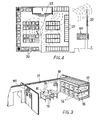
- Figure 5 shows mortuary consisting of a number of refrigerated deposits 14 and a group of tables 15 where the supposed deceased are kept. To each of the deceased is applied a detector-warning assembly 16, which, by means of cables or by wireless transmission, activates the control panel 18 and the warning device 191.
- Figure 4 shows, in outline, how the subject system can be applied in the case of a cemetery.
- the supposed cadavers contained in tombs 20 and in niches 21, each equipped with a detector-warning assembly 16, are monitored from a data receiving post 181 at which arrive the signals sent from each of the assemblies 16 via cables 171 or else via a wireless path through the repeater 22, for long distances, and the antenna 23 of means of reception 7 contained in panel 181.
- each of the signals from assemblies 16 must be individually identificable in order to rapidly locate the site occupied by the supposed cadaver to which pertains the assembly 16 which has emitted some signal.
Landscapes
- Health & Medical Sciences (AREA)
- Life Sciences & Earth Sciences (AREA)
- General Health & Medical Sciences (AREA)
- Pathology (AREA)
- Biomedical Technology (AREA)
- Cardiology (AREA)
- Physiology (AREA)
- Physics & Mathematics (AREA)
- Business, Economics & Management (AREA)
- Biophysics (AREA)
- Pulmonology (AREA)
- Engineering & Computer Science (AREA)
- Emergency Management (AREA)
- Heart & Thoracic Surgery (AREA)
- Medical Informatics (AREA)
- Molecular Biology (AREA)
- Surgery (AREA)
- Animal Behavior & Ethology (AREA)
- Public Health (AREA)
- Veterinary Medicine (AREA)
- Measuring And Recording Apparatus For Diagnosis (AREA)
- Measuring Pulse, Heart Rate, Blood Pressure Or Blood Flow (AREA)
- Emergency Alarm Devices (AREA)
Abstract
Warning and/or alarm system for detecting the recuperation of vital constants in individuals diagnosed as clinically dead, characterised because it is applied to the supposed cadaver a detector-warning assembly (16) consisting of means (1) for transducing determined vital functions, inside or outside of the body; first means (2) of amplifying the signals received from the transducers (1); first means (3,4) of providing audible and/or visual warnings, capable of being activated by the signals coming from the first means of amplification; and first means (5) of providing a supply of energy to the assembly. The system comprises means (6) of distance transmission of the signals received from the transducers; means (7) of reception to receive these remotely produced signals; second means (8,9) of providing audible and/or visual warnings, which are capable of being activated by signals coming from the said means of reception; and, possibly, second means (10) of providing a supply of energy to the said means (7) of reception and second means (8,9) of warning. Said first and/or second means of supplying energy are equipped with, preferentially, a blocking device (11), which must necessarily be removed or deactivated to permit the supply of energy to commence.
Description
- This invention concerns a warning and/or alarm system for the detection of any sign of recuperation in the vital functions of persons considered to be clinically dead.
- Once a person is considered to be clinically dead and this circumstance is assumed by the relatives and/or professional persons in the charge of whom is the supposedly deceased,it is most natural that it be considered to be useless to continue supervising his state.
- Despite the present systems available for verifying clinical death, the applicant, after statistical research and consulting extensive national and international information, has reached the conclusion that two persons in five hundred considered clinically dead, are in a state of apparent death. It is further known that such cases have in fact come to be buried.
- Nevertheless, in spite this relatively high proportion of cases of apparent death, there exists no known means by which it has been attempted to alleviate this situation.
- This invention comes therefore to fill a considerable void that is observable among the security arrangements established worldwide.
- Essentially, the subject system of this invention is characterised because, to the supposed cadaver, is applied a detector-warning assembly formed by means for transducing determined vital functions inside and outside the body; a first means for amplifying the signals received from the transducers; a first means for providing visual and/or audible warning, capable of being activated by the signals coming from the first amplifying means; and a first means of supplying energy to the assembly.
- A further characteristic of the invention is the provision of means to transmit the signals received from the transducers over a distance; a second means for visual and/or audible warning capable of being activated by signals coming from the said means of reception; and, possibly, a second means for supplying energy to the said means of reception and said means of warning.
- In accordance with another characteristic of the invention, the said first and/or second means of supplying energy are preferentially provided with a blocking device which must necessarily be removed or disactivated to permit the start of supplying energy.
- The duration of the supply system shall be predetermined.
- Other characteristics and advantages of the system for warning and/or alarm subject of this invention, shall become evident from the description given below in conjunction with the drawings attached, which illustrate, by way of a non-limiting example, one way of establishing the said system.
- Figures 1 and 2 provide two examples of estabhishing the detector-warning assembly and a second warning element;
- Figure 3 shows, in perspective, a schematic view of a mortuary with the warning and/alarm system incorporated; and
- Figure 4 is a highly schematic plan view of how the system could be applied to a cementery.
- In these drawings it can be appreciated that the warning and/or alarm system described comprises a detector-
warning assembly 16, prepared for application to the suposed cadaver and formed bymeans 1 for the transducing of determined vital functions, first means ofamplification 2 for the signals received from thetransducers 1, first means ofaudible warning devices 3 and first means ofvisual warning devices 4, capable of being activated by the first means ofamplification 2, and first means of supplyingenergy 5, for the assembly. - The said means of transducing 1 may preferentially be constituted by electrodes similar to those for making electroencephalograms and electrocardiograms, as well as also being able to be constituted by probes of any type.
- The first detector-
warning assembly 16 is conceived to be preferentially applied to the body of the supposed cadaver, in a clearly visible spot, in such a way that it consitutes a type of alarm or warning able to be observed within a zone relatively close to the supposed cadaver. Clearly this means it can only be used by itself in those cases where there is always some one near to the supposedly deceased and, of course, only before the burial of the cadaver. - In the cases where the supposedly deceased may have to remain alone for some time or at some distance from the supervision of some one, it is not sufficient to use only the detector-
warning assembly 16. In such a case, use is made of asecond warning device 19, in conjunction withmeans 6 of transmitting the signals received from thetransducers 1 over a distance. The saiddevice 19 comprises means ofreception 7 to receive the signals emitted by themeans 6, second means ofaudible warning 8, second means ofvisual warning 9 and and, possibly, second means of suypplyingenergy 10 to the said means ofreception 7 and the second means ofwarning - The said first and/or second means of supplying
energy energy 5 incorporates aseal 11 that has to be withdrawn in order to activate theswitch 12 which permits the means of supplying energy to be made active. - In Figure 1, the said means of transmitting to a distance admit the use of
signal transmitting cables 13, while Figure 2 contemplates themeans 16 for transmitting the said signals wirelessly to thereceiver 7. - Figure 5 shows mortuary consisting of a number of refrigerated
deposits 14 and a group of tables 15 where the supposed deceased are kept. To each of the deceased is applied a detector-warning assembly 16, which, by means of cables or by wireless transmission, activates thecontrol panel 18 and thewarning device 191. - Figure 4 shows, in outline, how the subject system can be applied in the case of a cemetery. The supposed cadavers contained in
tombs 20 and inniches 21, each equipped with a detector-warning assembly 16, are monitored from adata receiving post 181 at which arrive the signals sent from each of theassemblies 16 via cables 171 or else via a wireless path through therepeater 22, for long distances, and the antenna 23 of means ofreception 7 contained inpanel 181. Clearly each of the signals fromassemblies 16 must be individually identificable in order to rapidly locate the site occupied by the supposed cadaver to which pertains theassembly 16 which has emitted some signal. - Having described sufficiently the nature of the device, as well as the manner of making use of it, it is hereby placed on record that all which does not alter, change or modify its basic principle, may be subject to variations in detail.
Claims (5)
1- Warning and/or alarm system for detecting the recuperation of vital constants in individuals diagnosed as clinically dead, characterised because it is applied to the supposed cadaver a detector-warning assembly consisting of means for transducing determined vital functions, inside or outside of the body; first means of amplifying the signals received from the transducers; first means of providing audible and/or visual warnings, capable of being activated by the signals coming from the first means of amplification; and first means of providing a supply of energy to the assembly.
2.- Warning and/or system according to claim 1, characterised because it has means of distance transmission of the signals received from the transducers; means of reception to receive these remotely produced signals; second means of providing audible and/or visual warnings, which are capable of being activated by signals coming from the said means of reception; and, possibly, second means of providing a supply of energy to the said means of reception and second means of warning.
3.- Warning and/or alarm system according to claims 1 and 2, characterised because the said first and/or second means of supplying energy are equipped with, preferentially, a blocking device, which must necessarily be removed or deactivated to permit the supply of energy to commence.
4.- Warning and/or alarm system according to claims 1 and 2, characterised because the mentioned means of distance transmission are wireless transmission means.
5.- Warning and/or alarm according to claims 1 and 2, characterised because the mentioned means of distance transmission are wire transmission means.
Applications Claiming Priority (2)
| Application Number | Priority Date | Filing Date | Title |
|---|---|---|---|
| ES555887A ES8708075A1 (en) | 1986-05-27 | 1986-05-27 | Warning and/or alarm system for detecting the recuperation of vital constants in individuals diagnosed as clinically dead. |
| ES555887 | 1986-05-27 |
Publications (2)
| Publication Number | Publication Date |
|---|---|
| EP0247959A2 true EP0247959A2 (en) | 1987-12-02 |
| EP0247959A3 EP0247959A3 (en) | 1989-03-15 |
Family
ID=8491443
Family Applications (1)
| Application Number | Title | Priority Date | Filing Date |
|---|---|---|---|
| EP87500029A Withdrawn EP0247959A3 (en) | 1986-05-27 | 1987-05-27 | Warning and/or alarm system for detecting the recuperation of vital constants in individuals diagnosed as clinically dead |
Country Status (2)
| Country | Link |
|---|---|
| EP (1) | EP0247959A3 (en) |
| ES (1) | ES8708075A1 (en) |
Cited By (4)
| Publication number | Priority date | Publication date | Assignee | Title |
|---|---|---|---|---|
| FR2636847A1 (en) * | 1988-09-02 | 1990-03-30 | Eldasouqi Muhammad | Automatic system for postmortem monitoring of clinical signs of life and where necessary ordering rescue |
| DE9400950U1 (en) * | 1994-01-20 | 1995-08-24 | Selectronic Gesellschaft für Sicherheitstechnik und Sonderelektronik mbH, 14542 Werder | Device for detecting living bodies and their use |
| FR2868292A1 (en) * | 2004-03-30 | 2005-10-07 | Michel Momon | Electronic device for monitoring human body, has transmitter that dials telephone number and forwards information related to minimal movement of parts of human body, and microphone allowing to listen noises of voice |
| WO2006090023A1 (en) * | 2005-02-24 | 2006-08-31 | Patrick Silvestre | Device for detecting resumption of human body activity after death |
Family Cites Families (4)
| Publication number | Priority date | Publication date | Assignee | Title |
|---|---|---|---|---|
| FR1150656A (en) * | 1955-08-29 | 1958-01-16 | Apparatus intended to detect whether the state of death is apparent or real | |
| DE1578661A1 (en) * | 1967-02-24 | 1971-08-12 | Schlitz Otto Hartmann | Rescue device for living beings at risk of avalanches, especially people |
| GB2113439A (en) * | 1981-11-26 | 1983-08-03 | Lambert Jean Claude | A security alarm system for a person possibly in a cataleptic state |
| DE8432107U1 (en) * | 1984-11-02 | 1986-11-06 | Robers, Dieter, 4432 Gronau | Device for a warming device for the detection of a pseudo-dead |
-
1986
- 1986-05-27 ES ES555887A patent/ES8708075A1/en not_active Expired
-
1987
- 1987-05-27 EP EP87500029A patent/EP0247959A3/en not_active Withdrawn
Cited By (4)
| Publication number | Priority date | Publication date | Assignee | Title |
|---|---|---|---|---|
| FR2636847A1 (en) * | 1988-09-02 | 1990-03-30 | Eldasouqi Muhammad | Automatic system for postmortem monitoring of clinical signs of life and where necessary ordering rescue |
| DE9400950U1 (en) * | 1994-01-20 | 1995-08-24 | Selectronic Gesellschaft für Sicherheitstechnik und Sonderelektronik mbH, 14542 Werder | Device for detecting living bodies and their use |
| FR2868292A1 (en) * | 2004-03-30 | 2005-10-07 | Michel Momon | Electronic device for monitoring human body, has transmitter that dials telephone number and forwards information related to minimal movement of parts of human body, and microphone allowing to listen noises of voice |
| WO2006090023A1 (en) * | 2005-02-24 | 2006-08-31 | Patrick Silvestre | Device for detecting resumption of human body activity after death |
Also Published As
| Publication number | Publication date |
|---|---|
| ES555887A0 (en) | 1987-09-01 |
| EP0247959A3 (en) | 1989-03-15 |
| ES8708075A1 (en) | 1987-09-01 |
Similar Documents
| Publication | Publication Date | Title |
|---|---|---|
| US6292687B1 (en) | Medical emergency response and locating system | |
| ES2253349T3 (en) | SYSTEM OF INDENTIFICATION OF ASSOCIATED ARTICLES. | |
| US6334073B1 (en) | Internal monitoring and behavior control system | |
| US5204670A (en) | Adaptable electric monitoring and identification system | |
| US6272379B1 (en) | Implantable electronic system with acute myocardial infarction detection and patient warning capabilities | |
| US5874897A (en) | Emergency-reporting system for rescue operations | |
| US4611198A (en) | Security and communication system | |
| GB8726933D0 (en) | Telemetry system | |
| US20020060630A1 (en) | System for monitoring patients with alzheimer's disease or related dementia | |
| US20050073419A1 (en) | Electronic identification tag with electronic banding | |
| CA2471511A1 (en) | Emergency call and patient locating system for implanted automatic defibrillators | |
| US20050068172A1 (en) | Parental alert and child tracking device | |
| US5517201A (en) | Game alert system | |
| CN201058025Y (en) | Wristlet type heart monitor | |
| EP0247959A2 (en) | Warning and/or alarm system for detecting the recuperation of vital constants in individuals diagnosed as clinically dead | |
| DE19510382A1 (en) | Portable device for detecting ECG data | |
| WO2002060244A1 (en) | Method and assembly for monitoring the state of health of animals in a population | |
| RU2676443C1 (en) | Radio-channel complex of cardiac monitoring and rescue in life-threatening situations | |
| JP2006215727A (en) | Misidentification device for urns and remains | |
| JPH10248816A (en) | Patient position detection system | |
| CH715477A2 (en) | Monitoring and emergency aid system for fake deaths. | |
| Griffin-Shelley | Sexual harassment: One organization's response. | |
| RU2018264C1 (en) | Biotelemetric device | |
| RU2673108C1 (en) | Territorial cardiac emergency system | |
| CN113040945A (en) | Medical electronic fence device adopting ultrahigh-frequency radio frequency identification technology |
Legal Events
| Date | Code | Title | Description |
|---|---|---|---|
| PUAI | Public reference made under article 153(3) epc to a published international application that has entered the european phase |
Free format text: ORIGINAL CODE: 0009012 |
|
| AK | Designated contracting states |
Kind code of ref document: A2 Designated state(s): AT BE CH DE FR GB GR IT LI LU NL SE |
|
| PUAL | Search report despatched |
Free format text: ORIGINAL CODE: 0009013 |
|
| AK | Designated contracting states |
Kind code of ref document: A3 Designated state(s): AT BE CH DE FR GB GR IT LI LU NL SE |
|
| STAA | Information on the status of an ep patent application or granted ep patent |
Free format text: STATUS: THE APPLICATION IS DEEMED TO BE WITHDRAWN |
|
| 18D | Application deemed to be withdrawn |
Effective date: 19891201 |