EP0246739B1 - Macrolide compounds, their preparation and their use - Google Patents
Macrolide compounds, their preparation and their use Download PDFInfo
- Publication number
- EP0246739B1 EP0246739B1 EP87302494A EP87302494A EP0246739B1 EP 0246739 B1 EP0246739 B1 EP 0246739B1 EP 87302494 A EP87302494 A EP 87302494A EP 87302494 A EP87302494 A EP 87302494A EP 0246739 B1 EP0246739 B1 EP 0246739B1
- Authority
- EP
- European Patent Office
- Prior art keywords
- group
- carbon atoms
- formula
- compound
- keto
- Prior art date
- Legal status (The legal status is an assumption and is not a legal conclusion. Google has not performed a legal analysis and makes no representation as to the accuracy of the status listed.)
- Expired - Lifetime
Links
Classifications
-
- C—CHEMISTRY; METALLURGY
- C07—ORGANIC CHEMISTRY
- C07D—HETEROCYCLIC COMPOUNDS
- C07D493/00—Heterocyclic compounds containing oxygen atoms as the only ring hetero atoms in the condensed system
- C07D493/22—Heterocyclic compounds containing oxygen atoms as the only ring hetero atoms in the condensed system in which the condensed system contains four or more hetero rings
-
- A—HUMAN NECESSITIES
- A01—AGRICULTURE; FORESTRY; ANIMAL HUSBANDRY; HUNTING; TRAPPING; FISHING
- A01N—PRESERVATION OF BODIES OF HUMANS OR ANIMALS OR PLANTS OR PARTS THEREOF; BIOCIDES, e.g. AS DISINFECTANTS, AS PESTICIDES OR AS HERBICIDES; PEST REPELLANTS OR ATTRACTANTS; PLANT GROWTH REGULATORS
- A01N43/00—Biocides, pest repellants or attractants, or plant growth regulators containing heterocyclic compounds
- A01N43/90—Biocides, pest repellants or attractants, or plant growth regulators containing heterocyclic compounds having two or more relevant hetero rings, condensed among themselves or with a common carbocyclic ring system
-
- A—HUMAN NECESSITIES
- A01—AGRICULTURE; FORESTRY; ANIMAL HUSBANDRY; HUNTING; TRAPPING; FISHING
- A01N—PRESERVATION OF BODIES OF HUMANS OR ANIMALS OR PLANTS OR PARTS THEREOF; BIOCIDES, e.g. AS DISINFECTANTS, AS PESTICIDES OR AS HERBICIDES; PEST REPELLANTS OR ATTRACTANTS; PLANT GROWTH REGULATORS
- A01N47/00—Biocides, pest repellants or attractants, or plant growth regulators containing organic compounds containing a carbon atom not being member of a ring and having no bond to a carbon or hydrogen atom, e.g. derivatives of carbonic acid
- A01N47/02—Biocides, pest repellants or attractants, or plant growth regulators containing organic compounds containing a carbon atom not being member of a ring and having no bond to a carbon or hydrogen atom, e.g. derivatives of carbonic acid the carbon atom having no bond to a nitrogen atom
- A01N47/06—Biocides, pest repellants or attractants, or plant growth regulators containing organic compounds containing a carbon atom not being member of a ring and having no bond to a carbon or hydrogen atom, e.g. derivatives of carbonic acid the carbon atom having no bond to a nitrogen atom containing —O—CO—O— groups; Thio analogues thereof
-
- C—CHEMISTRY; METALLURGY
- C07—ORGANIC CHEMISTRY
- C07H—SUGARS; DERIVATIVES THEREOF; NUCLEOSIDES; NUCLEOTIDES; NUCLEIC ACIDS
- C07H19/00—Compounds containing a hetero ring sharing one ring hetero atom with a saccharide radical; Nucleosides; Mononucleotides; Anhydro-derivatives thereof
- C07H19/01—Compounds containing a hetero ring sharing one ring hetero atom with a saccharide radical; Nucleosides; Mononucleotides; Anhydro-derivatives thereof sharing oxygen
Definitions
- the present invention is concerned with a series of new macrolide compounds which are chemically related to certain known classes of macrolides including the milbemycins and avermectins. These compounds have valuable acaricidal, insecticidal and anthelmintic activities.
- the invention also provides methods of preparing these compounds and compositions and methods for using them.
- formula (A) also shows the numbering of positions of the macrolide ring system applied to those positions most relevant to the compounds of the present invention.
- milbemycins are a series of macrolide compounds known to have anthelmintic, acaricidal and insecticidal activities.
- Milbemycin D was disclosed in U.S. Patent No. 4,346,171, where it was referred to as "Compound B-41 D", and milbemycins A3 and A4 were disclosed in U.S. Patent No. 3,950,360.
- These compounds may be represented by the above formula (A) in which position 25 is substituted with a methyl group, an ethyl group or an isopropyl group, these compounds being designated as milbemycin A3, milbemycin A4 and milbemycin D, respectively.
- the milbemycin analogue substituted at position 25 with a sec-butyl was disclosed in U.S. Patent No. 4,173,571.
- Milbemycin derivatives esterified at position 13 are of particular relevance to the present invention and have been disclosed in U.S. Patent No. 4,093,629 and European Patent Publication No. 186043, as well as in published British Patent Application No. 2,168,345 which discloses milbemycin derivatives having a carboxy or esterified carboxy substituent at position 13 in combination with a hydroxy or esterified hydroxy substituent at position 5.
- the avermectins are based upon the same 16-membered ring macrolide compound.
- the avermectins are disclosed, for example in J. Antimicrob. Agents Chemother., 15(3J, 361-367 (1979). These compounds may be represented by the above formula (A) but with a carbon-carbon double bond at positions 22 and 23, and having position 13 substituted with a 4'-(a-L-oleandrosyl)-a-L-oleandrosyloxy group. Position 25 may be substituted with an isopropyl group or a sec-butyl group, these compounds being designated as avermectin B, b and avermectin B la , respectively.
- 22,23-Dihydroavermectins B, a and B lb may be obtained by reduction of the double bond between the 22 and 23 positions and are disclosed in U.S. patent No. 4,199,569.
- the aglyclone derivatives of the avermectins, which are milbemycin analogues, have sometimes been referred to in the literature as C-076 compounds, and various derivatives of these are known.
- U.S. Patent No. 4,201,861 discloses such derivatives substituted with a lower alkanoyl group at position 13.
- a yet further group of related macrolide derivatives is disclosed in Japanese Patent Application Kokai No. 62-29590. These have a structure corresponding to the above formula (A), with a hydroxy or methoxy group at position 5. Position 13 of the ring can be substituted with a 4'-(a-L-oleandrosyl)-a-Loleandrosyloxy group, as in the avermectins, and there may be a carbon-carbon double bond between positions 22 and 23, or alternatively position 23 may be substituted with hydroxy.
- the substituent at position 25 is of a type not found in the naturally produced avermectins and milbemycins, and includes various a-branched alkyl, alkenyl, alkynyl, alkoxyalkyl, alkylthioalkyl and cycloalkylalkyl groups, or cycloalkyl, cycloalkenyl or heterocyclic groups.
- This 25-substituent is introduced by adding the corresponding carboxylic acid or derivative thereof to the fermentation broth of an avermectin-producing microorganism.
- milbemycin-related macrolide compounds described above are all disclosed as having one or more types of activity as antibiotic, anthelmintic, ectoparasiticidal, acaricidal or other pesticidal agents. However, there is still a continuing need to provide such agents with improved activity against one or more classes of pests.
- the invention provides compounds having the formula in which
- the invention still further provides an anthelmintic, acaricidal and insecticidal composition
- an anthelmintic, acaricidal and insecticidal composition comprising an anthelmintic, acaricidal and insecticidal compound in admixture with a pharmaceutically, agriculturally, veterinarily or horticulturally acceptable carrier or diluent, wherein said compound is selected from the group consisting of compounds of formula (I).
- the invention still further provides the use for the manufacture of a medicament for treating an animal, which may be human or non-human, parasitized by a parasite selected from helminths, acarids and insects of at least one compound of formula (I).
- the invention still further provides a method of protecting animals or plants from damage by parasites other than animal endoparasites, selected from acarids, helminths and insects, which comprises applying an active compound to said animals, to said plants or to seeds of said plants or to a locus including said animals, plants or seeds, wherein the active compound is at least one compound of formula (I).
- R' represents an alkyl group having from 1 to 8 carbon atoms
- this may be straight or branched chain alkyl group and examples of such groups include the methyl, ethyl, propyl, isopropyl, butyl, isobutyl, sec-butyl, t-butyl, pentyl, isopentyl, heptyl and octyl groups.
- this alkyl group may be methyl, ethyl, isopropyl or sec-butyl.
- the a-branched alkyl groups having from 3 to 8 carbon atoms are preferred.
- R' represents an alkenyl group
- this may be a straight or branched chain group containing from 2 to 8 carbon atoms a-id having at least one double bond, for example vinyl, 1-propenyl, 2-propenyl, isopropenyl, 1-methyl-1-propenyl, 1-methyl-1-butenyl and 1,3-dimethyl-1-butenyl.
- the a-branched alkenyl groups are particularly preferred.
- R' represents an alkynyl group having from 2 to 8 carbon atoms, this may be a straight or branched chain group, for example ethynyl, 1-propynyl or 2-propynyl.
- R' represents an alkoxyalkyl group or alkylthioalkyl group
- this may have a total of from 2 to 8 carbon atoms and may be straight or branched, for example methoxymethyl, ethoxymethyl, 1-methoxyethyl, 2-methoxyethyl, 2-ethoxyethyl, isopropoxymethyl, and the thio analogues of each of these groups.
- the methoxymethyl, 1-methoxyethyl, methylthiomethyl and 1-(methylthio)ethyl groups, respectively, are preferred.
- R' represents a cycloalkyl or cycloalkenyl group
- this may have a monocyclic or fused polycyclic (preferably bicyclic) ring system containing from 3 to 8 ring carbon atoms.
- Examples include the cyclopropyl, cyclobutyl, cyclopentyl, cyclohexy, cycloheptyl, cyclooctyl, bicyclo[2.2.1]heptyl and norbornarnyl groups, and the analogues thereof containing one or more double bonds.
- this definition also includes partly aromatic fused polycyclic ring systems, for example the tetrahydronaphthyl and trimethylenephenyl groups.
- R' represents a cycloalkyl-substituted alkyl group
- the cycloalkyl moiety thereof may be any of the above-mentioned cycloalkyl groups which have from 3 to 6 ring carbon atoms
- the alkyl moiety may be any of the above-mentioned straight or branched chain alkyl groups which have from 1 to 5 carbon atoms.
- R' represents a heterocyclic group
- this may have from 3 to 6 ring atoms, of which at least one is an oxygen or sulfur hetero-atom.
- the ring system may be unsaturated, or partly or wholly saturated.
- heterocyclic groups include the oxiranyl, oxetanyl, thiranyl, thietanyl, (2,2-dimethyl)-1,3-dioxoranyl, furyl, thienyl, thiazolyl, isothiazolyl, oxazolyl, isoxazolyl and pyranyl groups.
- R' represents a cycloalkyl, cycloalkenyl or heterocyclic group
- this may optionally be substituted with at least one halogen atom (e.g. fluorine, chlorine, bromine or iodine) and/or at least one alkyl group having from 1 to 4 carbon atoms (e.g. any of those straight or branched chain alkyl groups mentioned above which have up to 4 carbon atoms).
- halogen atom e.g. fluorine, chlorine, bromine or iodine
- alkyl group having from 1 to 4 carbon atoms e.g. any of those straight or branched chain alkyl groups mentioned above which have up to 4 carbon atoms.
- R' The most preferred groups for R' are methyl, ethyl, isopropyl, sec-butyl, 1-methyl-1-propenyl, 1-methyl-1-butenyl and 1,3-dimethyl-1-butenyl.
- R 3 represents an alkyl group having from 1 to 6 carbon atoms
- this may have a straight or branched chain and may be for example any of those alkyl groups mentioned above for R' and having up to 6 carbon atoms.
- the alkyl group R 3 may also optionally be substituted with one or more carboxy groups.
- R 3 represents a cycloalkyl group having from 3 to 10 ring carbon atoms, this may have a monocyclic or fused polycyclic (preferably bicyclic) ring system and examples include those cycloalkyl groups mentioned above for R' as well as the cyclononyl, cyclodecyl and adamantyl groups.
- R 3 represents an aralkyl group, it may have from 6 to 10 ring carbon atoms in the aryl moiety and from 1 to 6 carbon atoms in the alkyl moiety.
- the alkyl moiety may have a straight or branched chain and may be, for example, any of those alkyl groups having up to 6 carbon atoms mentioned above for R'.
- the aralkyl group preferably has from 7 to 12 carbon atoms in total, and examples include benzyl, a-methylbenzyl, a,a-dimethylbenzyl, phenethyl, phenylpropyl, naphthylmethyl and naphthylethyl.
- the compounds of formula (I) where R 3 is a hydrogen atom are oximes and can therefore form ester derivatives.
- the biological activity of the compounds of the invention arises from the structure shown in formula (I) and is not essentially dependent on the nature of any ester group, so there is no particular restriction on the acids which may be chosen to form such esters, provided that the activity of the resulting compound remains acceptable. Examples include carboxylic acid esters, carbamic acid esters, carbonic acid esters, sulfonic acid esters and phosphoric acid esters.
- Such oxime esters are preferably compounds having the following formula (X):. wherein R', R 5 , X and n have the meanings previously defined, and R' 3 represents the residue of an organic acid capable of forming an ester group, and preferably represents one of the following groups (a)-(e):
- R 14 or R 17 represents an aralkyl group substituted on its aryl ring
- the substituent or substituents may suitably be selected from C 1-6 alkyl, halogen atoms, and the nitro group.
- Preferred aralkyl groups include alkyl-substituted benzyl groups having from 1 to 6 carbon atoms in the alkyl moiety, such as 3- or 4-methylbenzyl; halogenated benzyl groups, such as 4-chlorobenzyl, 4-bromobenzyl and 4-fluorobenzyl; and the 4-nitrobenzyl group.
- R 14 to R' 8 represents an aryl group substituted on its ring
- the substituent or subtituents may be selected from alkyl groups having from 1 to 6 carbon atoms, halogen atoms, nitro, carboxyl, and alkoxycarbonyl groups having from 2 to 7 carbon atoms.
- Preferred aryl groups include alkyl-substituted phenyl groups having from 1 to 6 carbon atoms in the alkyl moiety, such as 2-tolyl, 3-tolyl, 4-tolyl or 2,4,6-trimethylphenyl; halogenated phenyl groups, such as 2-chlorophenyl, 3-chlorophenyl, 4-chlorophenyl, 2-bromophenyl, 3-bromophenyl or 4-bromophenyl; nitrophenyl groups, such as 4-nitrophenyl; carboxyphenyl groups, such as 2-carboxyphenyl, 3-carboxyphenyl or 4-carboxyphenyl; and alkoxycarbonylphenyl groups such as 2-methoxycarbonylphenyl, 3-methoxycarbonylphenyl, 4-methoxycarbonylphenyl, 2-ethoxycarbonylphenyl, 3-ethoxycarbonylphenyl or 4-ethoxycarbonylphenyl.
- R 15 or R' 6 represents an alkenyl or alkynyl group, this is preferably vinyl, alyl, 1-propynyl, 2-propynyl or isopropenyl.
- R 17 is a carboxy-protecting group capable of being hydrolyzed in vivo, this may be for example an aliphatic acyloxymethyl group, such as acetoxymethyl, propionyloxymethyl, butyryloxymethyl or pivaloyloxymethyl; a 1-(alkoxycarbonyloxy)ethyl group with a C l - 6 alkoxy moiety, such as 1-methoxycarbonyloxyethyl, 1-ethoxycarbonyloxyethyl, 1-propoxycarbonyloxyethyl, 1-isopropoxycarbonyloxyethyl, 1-butoxycarbonyloxyethyl or 1-isobutoxycarbonyloxyethyl; a phthalidyl group; a (2-oxo-5-methyl-1,3-dioxolanyl-4-yl)methyl group; a (2,2-dimethyl-1,3-dioxolan-4-yl)methyl group or a (3,4-d
- a preferred group of compounds of formula (I) are those wherein R 3 represents hydrogen, C i - 6 alkanoyl, C l - 6 haloalkanoyl or di(C,- 6 alkyl)carbamoyl. Of these compounds, the more preferred ones are those in which R 3 is hydrogen and the C 1-6 alkanoyl esters; and the most highly preferred are those in which R 3 is hydrogen, and the propionyl and pivaloyl esters.
- R 5 represents an alkyl group, this may have a straight or branched chain with from 1 to 22 carbon atoms.
- examples include methyl, ethyl, propyl, isopropyl, butyl, sec-butyl, isobutyl, t-butyl, pentyl, hexyl, heptyl, octyl, nonyl, decyl, 3-methylnonyl, 8-methylnonyl, 3-ethyloctyl, 3,7-dimethyloctyl, undecyl, dodecyl, tridecyl, tetradecyl, pentadecyl, hexadecyl, 1-methylpentadecyl, 14-methylpentadecyl, 13,13-dimethyltetradecyl, heptadecyl, 15-methylhexadecyl, octadecyl, 1-methylh
- R 5 represents a cycloalkyl group
- this may have a monocyclic or fused polycyclic (preferably bicyclic) ring system containing from 3 to 10 ring carbon atoms, and examples include those mentioned above for R 3 .
- R 5 represents an alkenyl or alkynyl group
- this may have a straight or branched chain with from 2 to 6 carbon atoms and with one or more double or triple bonds, respectively. Examples include those already mentioned above for R' and having up to 6 carbon atoms.
- R 5 represents an aryl group containing from 6 to 10 carbon atoms
- examples of such groups include the phenyl, 1-naphthyl and 2-naphthyl groups.
- the phenyl group is preferred.
- R 5 represents an aralkyl group, it may have from 6 to 10 ring carbon atoms in the aryl moiety and from 1 to 6 carbon atoms in the alkyl moiety, and it preferably has a total of from 7 to 12 carbon atoms. Examples include those already mentioned above for the aralkyl group of R 3 .
- R 5 represents a heterocyclic group, it contains from 4 to 14 ring atoms, of which at least one, and preferably from 1 to 3, are hetero-atoms selected from nitrogen, oxygen and sulfur.
- the ring system may be monocyclic or fused polycyclic (preferably bicyclic), and may be unsaturated, or partly or completely saturated.
- Examples of such groups include oxiranyl, oxetanyl, aziridinyl, azetidinyl, thiranyl, thietanyl, (2,2-dimethyl)-1,3-dioxoranyl, furyl, thienyl, pyrrolyl, pyridyl, thiazolyl, isothiazolyl, oxazolyl, isoxazolyl, imidazolyl, pyrazolyl, pyranyl, pyrazinyl, pyridazinyl, pyrimidinyl, benzofuranyl, benzothiophenyl, indolyl, quinolyl, isoquinolyl, quinazolyl, quinoxalinyl, naphthyridinyl, xanthenyl, tetrahydrofuranyl, tetrahydrothienyl, pyrrolidinyl, thiazolidinyl, imid
- Preferred groups include oxiranyl, oxetanyl, aziridinyl, azetidinyl, furyl, thienyl, pyrrolyl, pyridyl, thiazolyl, oxazolyl, tetrahydrofuranyl, tetrahydrothienyl, pyrrolidinyl, morpholinyl, benzofuranyl, (2,2-dimethyl)-1,3-dioxoranyl and quinolyl.
- the group R 5 may optionally carry one or more substituents, as set out in the definitions for formula (1).
- an alkyl group is present as a substituent, this may be any of the alkyl groups having from 1 to 6 carbon atoms mentioned above.
- an alkoxy substituent having from 1 to 6 carbon atoms this may correspond to any of the said alkyl groups, for example methoxy or ethoxy.
- an alkoxycarbonyl substituent having from 2 to 7 carbon atoms the alkoxy moiety of this may correspond to any of the said alkoxy groups, for example methoxycarbonyl, ethoxycarbonyl, propoxycarbonyl or t-butoxycarbonyl.
- substituent is a halogen atom, it may be fluorine, chlorine, bromine or iodine.
- substituent is an aryloxy or arylthio group, which may optionally itself be halogen-substituted, examples include phenoxy, phenylthio, chlorophenoxy, bromophenoxy, iodophenoxy, fluorophenoxy, dichlorophenoxy, chlorophenylthio and bromophenylthio groups.
- the hydroxy-protecting group may be any of those conventionally employed for this purpose.
- the protecting group may be a tri-(lower)alkylsilyl group such as trimethylsilyl, triethylsilyl, isopropyldimethylsilyl, t-butyldimethylsilyl, methyldiisopropylsilyl, methyldi-t-butylsilyl, or triisopropylsilyl; a lower aliphatic acyl group such as formyl, acetyl, chloroacetyl, dichloroacetyl, trichloroacetyl, trifluoroacetyl, methoxyacetyl, propionyl, n-butyryl, (E)-2-methyl-2-butenoyl, isobutyryl, pentanoyl or pivaloyl; or an aromatic acyl group such as
- the or each alkyl moiety may be any of the alkyl groups having from 1 to 6 carbon atoms already mentioned above, and examples include methylamino, ethylamino, propylamino, isobutylamino, dimethylamino, diethylamino, methylethylamino and methylbutylamino groups.
- the acyl moiety may be aliphatic with from 1 to 6 carbon atoms, such as formyl, acetyl, propionyl, butyryl or hexanoyl, or it may be aromatic, such as benzoyl or naphthoyl; and the group is preferably an aliphatic acylamino group having from 2 to 4 carbon atoms, such as acetylamino, propionylamino or butyrylamino.
- the or each alkyl moiety may be any of the alkyl groups having from 1 to 6 carbon atoms already mentioned above, and examples include methylcarbamoyl, dimethylcarbamoyl and diethylcarbamoyl.
- R 5 which is an alkylthio, alkylsulfinyl or alkylsulfonyl group having from 1 to 6 carbon atoms
- the alkyl moiety thereof may be any of the alkyl groups already mentioned above having from 1 to 6 carbon atoms, and examples of these include, respectively, methylthio, ethylthio, propylthio, butylthio and sec-butylthio; methylsulfinyl and ethylsulfinyl; and methanesulfonyl and ethanesulfonyl.
- R 5 has an alkoxyalkyl substituent
- the alkoxy and alkyl moieties each having from 1 to 6 carbon atoms may be any of those already mentioned above, and each moiety preferably has from 1 to 4 carbon atoms, for example methoxymethyl, ethoxymethyl, propoxymethyl, 2-methoxyethyl, 2-ethoxyethyl, 2-butoxyethyl or 3-propoxypropyl.
- R 5 has as a substituent a haloalkyl group with from 1 to 6 carbon atoms or a haloalkenyl group with from 2 to 6 carbon atoms, this may correspond to any of the alkyl or alkenyl groups already mentioned above and preferably substituted with from 1 to 4 halogen atoms (selected from the halogen substituents already mentioned above), for example chloromethyl, bromomethyl, iodomethy1, fluoromethyl, dichloromethyl, trifluoromethyl, trichloromethyl, 2-chloroethyl, 2,3-dibromopropyl, 2,2,2-trichloroethyl, 1,2,2,2-tetrabromoethyl, 2,2-dibromovinyl or 2,2-dichlorovinyl.
- halogen atoms selected from the halogen substituents already mentioned above
- R 5 examples include the following: a hydrogen atom; an alkyl group having from 1 to 22 carbon atoms such as methyl, ethyl, isopropyl, t-butyl, pentyl, heptyl or pentadecyl; an optionally condensed cycloalkyl group having from 3 to 12 carbon atoms such as cyclopropyl, cyclobutyl, cyclohexyl, 1-methylcyclopropyl, 1-methylcyclohexyl or adamantyl; a halogenated alkyl group having from 1 to 6 carbon atoms such as trifluoromethyl, iodomethyl, chloromethyl, bromomethyl, trichloromethyl, tribromomethyl, 2-chloroethyl, fluoromethyl, 2-fluoroethyl, 2-bromoethyl, 1,1-dichloroethyl, 1,1-dimethyl-2-chloro
- R 5 is more preferably an a-branched alkyl or haloalkyl group having from 4 to 7 carbon atoms; or a phenyl or benzyl group which may be substituted with one or two substituents selected from trifluoromethyl, halogen (particularly fluorine or chlorine), methyl and amino. Most preferably, R 5 is a 2,6-difluorophenyl, o-(trifluoromethyl)phenyl, a-methylbenzyl, a,a-dimethylbenzyl, t-butyl or fluoro-t-butyl group.
- the compounds of formula (I) include some in which a carboxyl group may be present in the substituent R 2 or Y.
- esters and salts of such compounds may be formed by conventional techniques, and such esters and salts are also included within the scope of the invention.
- such salts include those with alkali metals such as lithium, sodium or potassium, alkaline earth metals such as calcium or barium, other metals such as magnesium or aluminium, and organic amines, particularly tertiary amines such as triethylamine and triethanolamine.
- alkali metal salts are preferred, and particularly the sodium and potassium salts.
- the compounds of the invention are capable of existing in the form of various isomers.
- the substituent at position 13 of the macrolide ring may be in either the alpha or beta configuration.
- the compounds which have beta-configuration at position 13 are preferred, but the invention includes both sets of stereoisomers, as well as mixtures thereof.
- the compounds of the invention, through having an oxime group at position 5, can also exist in the form of syn-and anti-isomers; and the individual syn- and anti-isomers are included within the scope of the invention, as well as mixtures thereof.
- the most highly preferred compounds are those with numbers 1, 2, 3, 26, 45, 55, 61, 90, 102, 108, 122, 123, 171 and 191 in Table 1(A).
- the compounds of formula (I) can be prepared from the corresponding 13-substituted 5- ketomilbemycins of formula (III), by the processes shown in Reaction Scheme No. 1, in which R 1 , R 3 , R 5 , X, n and the broken line have the meanings already defined.
- Step A is for preparing a compound of the formula (la) by allowing a compound of the formula (III) to react with hydroxylamine or with one of its salts (for example, the salt with a mineral acid such as hydrochloric acid, nitric acid or sulfuric acid) to introduce the oxime group at the 5 position.
- the reaction is usually carried out in an inert solvent, for example an alcohol such as methanol or ethanol, an ether such as tetrahydrofuran or dioxane, an aliphatic acid such as acetic acid, water, or a mixture of such solvents.
- the reaction temperature is preferably from 10 to 80°C and the reaction usually requires from 1 hour to 24 hours to be complete.
- Step B is for preparing a compound of the formula (lb) by allowing the compound (III) to react with an oxime compound having the general formula NH 2 OR 3 (wherein R 3 has the same meaning as before) or with one of its salts (e.g. the same salts as in Step A), to introduce the oxime group at the 5 position.
- the conditions required for this reaction are similar to those for Step A.
- Step C is for preparing a compound of formula (lb) by esterification of the oxime group of the compound (la).
- This reaction can be used to prepare the preferred compounds of formula (X) above, in which the group corresponding to R 3 is R' 3 and represents an ester residue of a carboxylic acid, an N,N-disubstituted carbamic acid, a carbonic acid, a sulfonic acid or a phosphonic acid, by allowing a compound (la) in which R 3 is a hydrogen atom to react with a corresponding acid halide, usually in an inert solvent, preferably in the presence of a base.
- This method is a preferred embodiment of the invention.
- the base employed is not particularly limited provided that it has an acid binding ability and an organic amine such as triethylamine or N,N-dimethylaniline, pyridine, 4-dimethylaminopyridine, 1,4-diazabicyclo[2.2.2]octane, 5-diazabicyclo[4.3.0]nonene-5 or 1,8-diazabicyclo[5.4.0]undecene-7 is preferred.
- an organic amine such as triethylamine or N,N-dimethylaniline
- pyridine 4-dimethylaminopyridine
- 1,4-diazabicyclo[2.2.2]octane 1,4-diazabicyclo[2.2.2]octane
- 5-diazabicyclo[4.3.0]nonene-5 or 1,8-diazabicyclo[5.4.0]undecene-7 is preferred.
- the inert solvent employed is not particularly limited provided that it does not interfere with the reaction, and a hydrocarbon such as hexane, benzene, toluene or xylene.
- a hydrocarbon such as hexane, benzene, toluene or xylene.
- an ether such as diethyl ether, tetrahydrofuran or dioxane, or a halogenated hydrocarbon such as methylene chloride, chloroform or carbon tetrachloride is preferred.
- the compound of the formula (X) in which R' 3 is a residue of an N-substituted carbamic acid can be prepared by allowing a compound of the formula (I) in which R 3 is a hydrogen atom to react with a corresponding isocyanate in an inert solvent, in the presence of a base.
- the base and the inert solvent employed can be the same as in the steps mentioned before.
- the reaction is usually carried out at near room temperature and the reaction usually requires from 1 to 20 hours to be complete.
- the compound in which R' 3 is an N-trihaloacetylcarbamoyl group, obtained by the above reaction, can be converted into a compound in which R' 3 is a carbamoyl group by reaction with zinc-acetic acid or zinc- methanol.
- the target compound of the reaction can be obtained easily from the reaction mixture by conventional means.
- the reaction mixture is poured into water and, if necessary, after filtering off the insoluble matter followed by neutralization with an acid or an alkali, extracted with a water-immiscible organic solvent.
- the organic layer is dried and the solvent distilled off to give the desired product.
- purification by conventional means such as recrystallization, column chromatography, etc., may be applied.
- the starting material of formula (III) can be prepared from a 13-hydroxy-5-ketomilbemycin compound having the general formula (IV) by the reaction shown in Reaction Scheme No. 3, in which R 1 , R 5 , X, n and the broken line have the meanings already defined.
- Step D is for preparing a compound of the formula (III) by allowing a 13-hydroxy-5-ketomilbemycin compound indicated by the formula (IV) to react with a carboxylic acid or its reactive derivative indicated by the formula (V).
- Compounds of formula (IV) are known from U.S. Patent No. 4,423,209.
- the reaction of Step D is an esterification of the hydroxyl group at position 13 of the compound (IV) with a carboxylic acid (V), and can be carried out according to any of the conventional procedures known for esterification reactions.
- the reactive derivative of a carboxylic acid employed may be for example an acid halide (an acid chloride, acid bromide or the like), an acid anhydride, a mixed acid anhydride, an active ester such as a p-nitrobenzyl ester, an active amide or the like, which can be conventionally used in esterifications.
- a dehydrating agent such as dicyclohexylcarbodiimide (DCC), p-toluenesulfonic acid or sulfuric acid.
- DCC dicyclohexylcarbodiimide
- p-toluenesulfonic acid sulfuric acid.
- DCC is preferably used, and when DCC is used, preferably a catalytic amount of pyridine or 4-pyrrolidinopyridine may be jointly used.
- DCC dehydrating agent
- its amount is usually from 1 to 5 equivalents, preferably from 1.5 to 4 equivalents.
- the reaction is usually carried out in a solvent.
- the solvent employed is not particularly limited provided that it does not interfere with the reaction, and a hydrocarbon such as hexane, petroleum ether, benzene, toluene, xylene, chloroform, methylene chloride or o-chlorobenzene, an ether such as diethyl ether, tetrahydrofuran, dioxane or ethyleneglycol dimethyl ether, or an ester such as methyl acetate or ethyl acetate or the like may be employed.
- a hydrocarbon such as hexane, petroleum ether, benzene, toluene, xylene, chloroform, methylene chloride or o-chlorobenzene
- an ether such as diethyl ether, tetrahydrofuran, dioxane or ethyleneglycol dimethyl ether, or an ester such as methyl acetate or eth
- the reaction is usually carried out at from 0°C to 50°C, preferably from 0°C to 20°C.
- the reaction usually requires from 30 minutes to 3 hours to be complete.
- the reaction is preferably carried out in the presence of a base, preferably an organic base such as triethylamine, N,N-dimethylaniline, pyridine, 4-dimethylaminopyridine, 1,5-diazabicyclo[4.3.0]nonene-5 (DBN) or 1,8-diazabicyclo[5.4.0]undecene-7 (DBU).
- a base preferably an organic base such as triethylamine, N,N-dimethylaniline, pyridine, 4-dimethylaminopyridine, 1,5-diazabicyclo[4.3.0]nonene-5 (DBN) or 1,8-diazabicyclo[5.4.0]undecene-7 (DBU).
- the amount of this acid halide is usually from 1 to 10 equivalents, and from 2 to 5 equivalents of the base is usually used.
- the solvent, reaction temperature and reaction time employed for this reaction are similar to those when a carboxylic acid is used.
- the target compound having the formula (III) can be isolated from the reaction mixture by conventional means and, if desired, further purified by conventional means such as column chromatography.
- the starting material of formula (IV) can be derived from one of the milbemycins or milbemycin analogues of natural origin, by per se known methods, such as those described in the various prior art references mentioned earlier in this specification. Natural milbemycins are produced as mixtures of various compounds, the different compounds being produced at different rates. Each fraction may be subjected to reaction after isolation thereof, or in the form of mixtures of the individual products. Therefore, the compound having the formula (IV) may be either a single compound or a mixture thereof, which may result in forming the compound (I) either as a single compound or as a mixture.
- the compounds of the invention having a 23-keto group can be obtained from the corresponding natural product, for example, by the following sequence of steps
- the natural product having a 5 hydroxy group is oxidized to the corresponding 5-oxo compound, e.g. with manganese dioxide.
- the 5-oxo derivative is treated with a lower alkanoic acid (e.g. formic acid) and selenium dioxide, and then with aqueous hydrochloric acid, giving the corresponding 13-hydroxy-5-oxo derivative.
- the 13-hydroxy group can then be acylated with the appropriate carboxylic acid or reactive derivative thereof, in the manner already described, to give the corresponding 13-esterified-5-oxo compound, such as a compound of formula (la) above.
- the 5-oxo group can then be converted to the 5-oxime, using the methods already described; or it can be converted to a 5-hydroxy group by reducing it e.g. with sodium borohydride.
- the compounds of the invention have a strong acaricidal activity against, for example, adults, imagos and eggs of Tetranychus, Panonychus (e.g. Panonychus ulmi and Panonychus citri), Aculopa pelekassi and rust mites, which are parasitic to fruit trees, vegetables and flowers. They are also active against Ixodidae Dermanyssidae and Sarcoptidae, which are parasitic to animals.
- Tetranychus e.g. Panonychus ulmi and Panonychus citri
- Aculopa pelekassi and rust mites which are parasitic to fruit trees, vegetables and flowers. They are also active against Ixodidae Dermanyssidae and Sarcoptidae, which are parasitic to animals.
- exoparasites such as Oestrus, Lucilia, Hypoderma, Gautrophilus, lice and fleas, which are parasitic to animals and birds, particularly livestock and poultry
- domestic insects such as cockroaches and houseflies
- various harmful insects in agricultural and horticultural areas such as aphids and larval Lepidoptera. They are also effective against Meloidogyne in the soil, Bursaphelenchus and Rhizoglyphus.
- insects are also effective against insects of the orders Coleoptera, Homoptera, Heteroptera, Diptera, Thysanoptera, Orthoptera, Anoplura, Siphonaptera, Mallophage, Thysanura, Isoptera, Psocoptera and Hymenoptera.
- the compounds of the invention equally can be used to control other plant-damaging insects, particularly insects that damage plants by eating them.
- the compounds can be used to protect both ornamental plants and productive plants, particularly cotton (e.g. against Spodoptera littoralis and Heliothis virescens), as well as vegetable crops (e.g. against Leptinotarsa decemlineata and Myzus persicae) and rice crops (e.g. against Chilo suppressalis and Laodelphax).
- the activity of the compounds of the invention is pronounced, both systemically and by contact. Accordingly, the compounds are very effective against sucking insects, especially sucking insects of the order Homoptera and most particularly the family Aphididae (such as Aphis fabae, Aphis craccivora and Myzus persicae), which are difficult to control with known compositions.
- sucking insects of the order Homoptera and most particularly the family Aphididae such as Aphis fabae, Aphis craccivora and Myzus persicae
- the compounds of the invention can be used to treat all manner of plants (as well as the seeds from which such plants are grown and the environment, whether for growth or storage, containing such plants) to protect them from insects such as those exemplified above.
- Such plants include cereals (e.g. maize or rice), vegetables (e.g. potatoes or soybeans), fruits and other plants (e.g. cotton).
- the compounds of the invention can similarly be used to protect animals from a variety of ectoparasites, by applying the compounds to the animals or to the animals' environment, e.g. livestock housing, animal boxes, abattoirs, pasture land and other grasslands, as well as to any other places liable to be infested.
- the compounds may also be applied to external parts of the animals, preferably before they are infested.
- the compounds of the invention are effective against various parasitical helminths. These parasites can attack livestock, poultry and pet animals (such as pigs, sheep, goats, cows. horses, dogs, cats and fowl) and can cause grave economic damage. Among the helminths, the nematodes in particular often cause serious infection. Typical genera of nematodes which are parasitic on these animals and against which the compounds of the invention are effective include:
- Parasites belonging to the families Filariidae and Setariidae are found in internal tissues and organs, for example, the heart, the blood vessels, the subcutaneous tissues and the lymphatic vessels. The compounds of the invention are active against all these parasites.
- the compounds of the invention are also effective against parasites which infect humans.
- Typical of the parasites which may most commonly be found in the digestive tracts of human beings are parasites of the genera Ancylostoma, Necator, Ascaris, Strongyloides, Trichinella, Capillaria, Trichuris and Enterobius.
- the compounds are also active against parasites of the genera Wuchereria, Brugia, Onchocerca and Loa of the family Filariidae (which are found in blood, tissues and organs other than the digestive tract and are medically important), parasites of the genus Dracunculus of the family Dracunculidae and parasites of the genera Strongyloides and Trichinella, which in a particular state may parasitize outside the intestinal tract, although they are essentially intestinal parasites.
- Filariidae which are found in blood, tissues and organs other than the digestive tract and are medically important
- parasites of the genus Dracunculus of the family Dracunculidae and parasites of the genera Strongyloides and Trichinella, which in a particular state may parasitize outside the intestinal tract, although they are essentially intestinal parasites.
- compositions of the invention and the nature of the carriers or diluents employed in them will vary depending upon the intended use of the composition.
- the compounds of the invention are to be employed as anthelmintics, they are preferably administered orally, parenterally or topically and the form of compositions chosen will be appropriate to the intended route of administration.
- the composition of the invention is preferably in the form of a liquid drink comprising a non-toxic solution, suspension or dispersion of the active compound in admixture with a suspending agent (such as bentonite), a wetting agent or other diluents, preferably in water or another non-toxic solvent.
- a suspending agent such as bentonite
- the drink in general, also contains an anti-foaming agent.
- the active compound would normally be present in the drink in an amount of from 0.01 to 0.5% by weight, more preferably from 0.01 to 0.1% by weight.
- compositions for oral administration may also be in the form of dry solids, preferably in unit dosage form, such as capsules, pills or tablets containing the desired amount of the active compound.
- These compositions may be prepared by mixing the active compound uniformly with suitable diluents, fillers, disintegrators and/or binding agents, for example starch, lactose, talc, magnesium stearate and vegetable gum.
- suitable diluents, fillers, disintegrators and/or binding agents for example starch, lactose, talc, magnesium stearate and vegetable gum.
- the weight and contents of the preparation will vary widely, depending upon the nature of the animal to be treated, the degree of infection, the nature of the parasite and the body weight of the animal to be treated.
- the compounds may also be administered as an additive to animal feedstuffs, in which case they may be dispersed uniformly in the feedstuffs, used as a top dressing or used in the form of pellets.
- the content of active compound in the feedstuff is preferably from 0.0001 to 0.02%, in order to achieve the desired anthelmintic activity.
- the compound of the invention is preferably dissolved or suspended in a liquid vehicle, preferably a vegetable oil, such as peanut oil or cottonseed oil.
- a liquid vehicle preferably a vegetable oil, such as peanut oil or cottonseed oil.
- the liquid vehicle may be water or another aqueous medium.
- the injection may be subcutaneous or into the proventriculus, a muscle or the trachea.
- Such preparations would normally contain the active compound at a concentration of from 0.05 to 50% by weight.
- the compounds of the invention may also be administered topically in admixture with a suitable carrier, such as dimethyl sulphoxide or a hydrocarbon solvent.
- a suitable carrier such as dimethyl sulphoxide or a hydrocarbon solvent.
- Such preparations would be applied directly to the outside of the animal by spraying (e.g. by a hand spray or in spray races), by dipping (e.g. in a plunge dip), by a pour-on solution or by manual methods (e.g. hand-dressing).
- the dose of active compound may be varied, depending upon the nature of the animal to be treated, and the nature and degree of parasitic infection. However, best results for oral administration are achieved when the dose is from 0.01 to 100 mg, more preferably from 0.5 to 50 mg, per 1 kg body weight.
- the compound may be administered in a single dose or in divided doses for a relatively short period, such as from 1 to 5 days.
- composition of the invention is intended for agricultural or horticultural use, a variety of forms and formulations is possible.
- the composition may be formulated as dusts, coarse dusts, soluble powders, microgranules, fine microgranules, wettable powders, dilute emulsions, emulsifiable concentrates, aqueous or oily suspensions, dispersions or solutions (which may be directly sprayable or for dilution), aerosols or capsules in, for example, polymeric substances.
- the carrier employed may be natural or synthetic and organic or inorganic; it is generally employed to assist the active compound to reach the substrate to be treated, and to make it easier to store, transport or handle the active compound. Solid, liquid and gaseous carriers may be employed, chosen from carriers well known in the art for use with compositions of this type.
- Such formulations may be prepared by conventional means, e.g. by intimate mixing and/or grinding of the active ingredient(s) with the carrier or diluent, e.g. solvent, solid carrier or, optionally, surface-active agent.
- carrier or diluent e.g. solvent, solid carrier or, optionally, surface-active agent.
- Suitable solvents include: aromatic hydrocarbons, preferably the C 8 to C 12 fractions from petroleum distillation, such as xylene mixtures or substituted naphthalenes; esters of phthalic acid, such as dibutyl or dioctyl phthalate; aliphatic hydrocarbons, such as cyclohexane or the paraffins; alcohols and glycols or esters thereof, such as ethanol, ethylene glycol, ethylene glycol monomethyl ether or ethylene glycol monoethyl ether; ketones, such as cyclohexanone; strongly polar solvents, such as N-methyl-2-pyrrolidone, dimethyl sulfoxide or N,N-dimethylformamide; optionally epoxidized vegetable oils, such as epoxidized coconut oil or soybean oil; and water.
- aromatic hydrocarbons preferably the C 8 to C 12 fractions from petroleum distillation, such as xylene mixtures or substituted naphthalenes
- Solid carriers which may be used, for example, in dusts and dispersible powders, include natural mineral fillers, such as calcite, talc, kaolin, montmorillonite or attapulgite.
- natural mineral fillers such as calcite, talc, kaolin, montmorillonite or attapulgite.
- highly dispersed silicic acid or highly dispersed absorbent polymers may be added.
- Suitable granulated adsorptive carriers may be porous (such as pumice, ground brick, sepiolite or bentonite) or non-porous (such as calcite or sand).
- a wide variety of pregranulated materials, organic or inorganic, may also be used; examples include dolomite and ground plant residues.
- Surface-active agents which may be used are well known in the art and may be non-ionic, cationic or anionic agents having good emulsifying, dispersing and wetting properties. Mixtures of such agents may also be used.
- Compositions may also contain stabilizers, anti-foaming agents, viscosity regulators, binders or adhesives or any combination thereof, as well as fertilizers or other active substances to achieve special effects.
- Pesticidal compositions will generally contain: from 0.01 to 99%, more preferably from 0.1 to 95%, by weight of the active compound; from 1 to 99.99% of a solid or liquid additive; and from 0 to 25%, more preferably from 0.1 to 25%, of a surface-active agent. Whereas commercial products are generally sold as concentrated compositions, they are generally diluted by the end-user to a concentration of from 0.001 to 0.0001 % by weight (from 10 to 1 ppm).
- Examples 1 to 128 illustrate the preparation of compounds of the invention.
- Preparations 1 to 4 illustrate the synthesis of starting materials for use in preparing the compounds of the invention.
- Examples 129 to 132 illustrate the activity of the compounds of the invention against various pests.
- the group X at position 23 always represents a hydrogen atom, throughout all of the Examples.
- Examples 1 to 94 illustrate the preparation of compounds of formula (la) from starting materials of formula (III), by the reaction of Step A in the above Reaction Scheme No. 1.
- Examples 95 to 97 illustrate the preparation of compounds of formula (lb) from starting materials of formula (III), by the reaction of Step B in the above reaction scheme.
- Examples 98 to 128 illustrate the preparation of compounds of formula (lb) from starting materials of formula (la), by the reaction of Step C in Reaction Scheme No. 1.
- Preparations 1 to 4 illustrate the synthesis of starting materials for use in preparing the compounds of the invention by the reactions described above.
- the primary leaves of cowpea plants of the species Vigna sinensis Savi were infected with organic phosphate-sensitive mites (Tetranychus urticae).
- organic phosphate-sensitive mites Tetranychus urticae
- the infested plants were sprayed, using a Mizuho rotary sprayer, with 7 ml of a test solution containing the compound under test at a concentration of 3 ppm, at a rate of 3.5 mg of the test solution per 1 cm 2 of leaf.
- the plants were assessed after 3 days by examining adult mites, under a binocular microscope, to determine living and dead individuals. Two plants were used for each concentration and each test compound. The plants were kept during the test in greenhouse compartments at 25°C. The results are reported in the following Table.
- the Control Compounds were as follows:
- the compounds of the present invention have a far stronger acaricidal activity than that of Control Compound No. 1 (i.e. the naturally produced milbemycin A 4 ), and also of the other milbemycin derivatives unsubstituted at the 13-position used as Control Compounds 2, 3 and 4.
- Test compounds were administered to each group at varying dosages ranging from 0.0005 ⁇ g to 5 pg, dissolved in 2 or 1 ⁇ 1 of solvent, in order to determine their IRg o value - i.e. the concentration of the test compound which would result in 90% inhibition of reproduction by division, 3 days after treatment.
- Test tubes containing 2-3 ml of a solution of the test compound at a concentration of 100 ppm were stoppered with cotton wool and shaken for 10 minutes, then the solution was sucked out through the cotton wool and the tubes with the treated mites allowed to stand for 3 days at room temperature.
- test tubes consisting of 30-50 eggs from the species Lucilia sericata, collected immediately after oviposition, were added to test tubes each containing 1 ml of a liquid culture medium and 1 ml of the test compound in solution at a concentration of 100 ppm.
- the test tubes were stoppered with cotton wool and allowed to stand for 4 days at 30°C. The percentage mortality in each test group was assessed at the end of the 4 days.
Landscapes
- Chemical & Material Sciences (AREA)
- Life Sciences & Earth Sciences (AREA)
- Organic Chemistry (AREA)
- General Health & Medical Sciences (AREA)
- Health & Medical Sciences (AREA)
- Engineering & Computer Science (AREA)
- Zoology (AREA)
- Dentistry (AREA)
- Environmental Sciences (AREA)
- Wood Science & Technology (AREA)
- Agronomy & Crop Science (AREA)
- Pest Control & Pesticides (AREA)
- Plant Pathology (AREA)
- Biotechnology (AREA)
- Molecular Biology (AREA)
- Biochemistry (AREA)
- Genetics & Genomics (AREA)
- Pharmaceuticals Containing Other Organic And Inorganic Compounds (AREA)
- Heterocyclic Carbon Compounds Containing A Hetero Ring Having Oxygen Or Sulfur (AREA)
- Agricultural Chemicals And Associated Chemicals (AREA)
- Nitrogen And Oxygen Or Sulfur-Condensed Heterocyclic Ring Systems (AREA)
Description
- The present invention is concerned with a series of new macrolide compounds which are chemically related to certain known classes of macrolides including the milbemycins and avermectins. These compounds have valuable acaricidal, insecticidal and anthelmintic activities. The invention also provides methods of preparing these compounds and compositions and methods for using them.
- There are several classes of known compounds with a structure based on a 16-membered macrolide ring, which are obtained by fermentation of various microorganisms or semi-synthetically by chemical derivatization of such natural fermentation products, and which exhibit acaricidal, insecticidal, anthelmintic and antiparasitic activities. The milbemycins and avermectins are examples of two such classes of known compounds, but various others also exist and are identified by different names or code numbers. The names for these various macrolide compounds have generally been taken from the names or code numbers of the microorganisms which produce the naturally occurring members of each class, and these names have then been extended to cover the chemical derivatives of the same class, with the result that there has been no standardized systematic nomenclature for such compounds generally.
- In order to avoid confusion, a standardized system of nomenclature will be used herein, which follows the normal rules for naming derivatives of organic compounds and which is based on the hypothetical parent compound hereby defined as "milbemycin" represented by formula (A):

- For the avoidance of doubt, formula (A) also shows the numbering of positions of the macrolide ring system applied to those positions most relevant to the compounds of the present invention.
- The naturally produced milbemycins are a series of macrolide compounds known to have anthelmintic, acaricidal and insecticidal activities. Milbemycin D was disclosed in U.S. Patent No. 4,346,171, where it was referred to as "Compound B-41 D", and milbemycins A3 and A4 were disclosed in U.S. Patent No. 3,950,360. These compounds may be represented by the above formula (A) in which position 25 is substituted with a methyl group, an ethyl group or an isopropyl group, these compounds being designated as milbemycin A3, milbemycin A4 and milbemycin D, respectively. The milbemycin analogue substituted at position 25 with a sec-butyl was disclosed in U.S. Patent No. 4,173,571.
- Subsequently, various derivatives of the original milbemycins have been prepared and their activities investigated. For example, epoxy milbemycins have been disclosed in Japanese Patent Applications Kokai (i.e. laid open to public inspection) No. 57-139079, 57-139080, 59-33288 and 59-36681 and in U.S. Patent No. 4,530,921. 5-Esterified milbemycins have been disclosed in U.S. Patents No. 4,201,861, No. 4,206,205, No. 4,173,571, No. 4,171,314, No. 4,203,976, No. 4,289,760, No. 4,457,920, No. 4,579,864 and No. 4,547,491, in European Patent Publications No. 8184, No. 102,721, No. 115,930, No. 180,539 and No. 184,989 and in Japanese Patent Applications Kokai No. 57-120589 and 59-16894.
- 13-Hydroxy-5-ketomilbemycin derivatives have been disclosed in U.S. Patent No. 4,423,209. Milbemycin 5-oxime derivatives were disclosed in U.S. Patent No. 4,547,520 and European Patent Publication No. 203 832.
- Milbemycin derivatives esterified at position 13 are of particular relevance to the present invention and have been disclosed in U.S. Patent No. 4,093,629 and European Patent Publication No. 186043, as well as in published British Patent Application No. 2,168,345 which discloses milbemycin derivatives having a carboxy or esterified carboxy substituent at position 13 in combination with a hydroxy or esterified hydroxy substituent at position 5.
- Like the milbemycins, the avermectins are based upon the same 16-membered ring macrolide compound. The avermectins are disclosed, for example in J. Antimicrob. Agents Chemother., 15(3J, 361-367 (1979). These compounds may be represented by the above formula (A) but with a carbon-carbon double bond at positions 22 and 23, and having position 13 substituted with a 4'-(a-L-oleandrosyl)-a-L-oleandrosyloxy group. Position 25 may be substituted with an isopropyl group or a sec-butyl group, these compounds being designated as avermectin B,b and avermectin Bla, respectively. 22,23-Dihydroavermectins B,a and Blb may be obtained by reduction of the double bond between the 22 and 23 positions and are disclosed in U.S. patent No. 4,199,569. The aglyclone derivatives of the avermectins, which are milbemycin analogues, have sometimes been referred to in the literature as C-076 compounds, and various derivatives of these are known. For example, U.S. Patent No. 4,201,861 discloses such derivatives substituted with a lower alkanoyl group at position 13.
- Published European Patent Application No. 170006 discloses a family of bioactive compounds produced by fermentation, identified collectively by the code number LL-F28249. Some of these have a 16-membered macrolide structure corresponding to the above formula (A), substituted with hydroxy at position 23 and with 1-methyl-1-propenyl, 1-methyl-1-butenyl or 1,3-dimethyl-1-butenyl at position 25. In these compounds, the hydroxy at position 5 may also be replaced by methoxy.
- Published British Patent Application No. 2,176,182 discloses another group of macrolide antibiotics corresponding to the above formula (A) with a hydroxy or substituted hydroxy group at position 5. A hydroxy, substituted hydroxy or keto group at position 23, and an a-branched alkenyl group at position 25.
- A yet further group of related macrolide derivatives is disclosed in Japanese Patent Application Kokai No. 62-29590. These have a structure corresponding to the above formula (A), with a hydroxy or methoxy group at position 5. Position 13 of the ring can be substituted with a 4'-(a-L-oleandrosyl)-a-Loleandrosyloxy group, as in the avermectins, and there may be a carbon-carbon double bond between positions 22 and 23, or alternatively position 23 may be substituted with hydroxy. The substituent at position 25 is of a type not found in the naturally produced avermectins and milbemycins, and includes various a-branched alkyl, alkenyl, alkynyl, alkoxyalkyl, alkylthioalkyl and cycloalkylalkyl groups, or cycloalkyl, cycloalkenyl or heterocyclic groups. This 25-substituent is introduced by adding the corresponding carboxylic acid or derivative thereof to the fermentation broth of an avermectin-producing microorganism.
- The various classes of milbemycin-related macrolide compounds described above are all disclosed as having one or more types of activity as antibiotic, anthelmintic, ectoparasiticidal, acaricidal or other pesticidal agents. However, there is still a continuing need to provide such agents with improved activity against one or more classes of pests.
- It has now been discovered that the activity of such milbemycin-related derivatives can be improved by appropriately selecting the combination of substituents on the macrolide ring system, especially the substituents at positions 5 and 13. In particular, it has now been found that the activity of the 13-esterified derivatives in the above-mentioned prior art can be improved upon by appropriate selection of certain ester groups at this position, as specified below.
- Accordingly, it is an object of the present invention to provide such macrolide compounds having improved activity. It is another object of the invention to provide methods for preparing such compounds. It is a still further object of the invention to provide pesticidal compositions and methods containing the said compounds.
- In accordance with these objects, the invention provides compounds having the formula

- the broken line represents a carbon-carbon single or double bond between the atoms at the 22 and 23 positions;
- X represents a hydrogen atom or a hydroxyl group, or together with the carbon atom to which it is attached represents the group C=0; provided that X represents a hydrogen atom when the broken line represents a double bond between the carbon atoms at the 22 and 23 positions;
- Y represents the group =N-OR3, wherein R3 represents a hydrogen atom, an alkyl group having from 1 to 6 carbon atoms and which may optionally be substituted with at least one carboxy group, a cycloalkyl group having from 3 to 10 ring carbon atoms, or an aralkyl group having from 6 to 10 ring carbon atoms in the aryl moiety and from 1 to 6 carbon atoms in the alkyl moiety;
- R' represents an alkyl, alkenyl, alkynyl, alkoxyalkyl or alkylthioalkyl group, each having up to 8 carbon atoms; a cycloalkyl-substituted alkyl group wherein the cycloalkyl moiety has from 3 to 6 ring carbon atoms and the alkyl moiety has from 1 to 5 carbon atoms; a cycloalkyl or cycloalkenyl group having from 3 to 8 ring carbon atoms and optionally substituted with at least one substituent selected from halogen atoms and alkyl groups having from 1 to 4 carbon atoms; a heterocyclic group having from 3 to 6 ring atoms of which at least one is an oxygen or sulfur atom and which may optionally be substituted with at least one substituent selected from halogen atoms and alkyl groups having from 1 to 4 carbon atoms;
- R2 represents the group R5_(0)n-' wherein n = 0 or 1; and R5 represents a hydrogen atom, an alkyl group having from 1 to 22 carbon atoms, an alkenyl or alkynyl group having from 2 to 6 carbon atoms, a cycloalkyl group having from 3 to 10 carbon atoms, an aryl group having from 6 to 10 ring carbon atoms, an aralkyl group having from 6 to 10 ring carbon atoms in the aryl moiety and from 1 to 6 carbon atoms in the alkyl moiety, or a heterocyclic group having from 4 to 14 ring atoms of which at least one is an oxygen, sulfur or nitrogen atom; wherein said alkyl group of R5 may optionally be substituted with at least one substituent selected from:
- (a) cycloalkyl groups having from 3 to 10 carbon atoms; alkoxy groups having from 1 to 6 carbon atoms; alkoxycarbonyl groups having from 2 to 7 carbon atoms; halogen atoms; aryloxy and arylthio groups having from 6 to 10 ring carbon atoms, which may themselves optionally be substituted with at least one halogen atom; protected or unprotected hydroxy; carboxy; amino; monoalkylamino and dialkylamino groups having from 1 to 6 carbon atoms in the or each alkyl moiety; aliphatic acylamino groups having from 1 to 6 carbon atoms; aromatic acylamino groups; cyano; carbamoyl; monoalkylcarbamoyl and dialkylcarbamoyl groups having from 1 to 6 carbon atoms in the or each alkyl moiety; mercapto; alkylthio, alkylsulfinyl and alkylsulfonyl groups, in each case having from 1 to 6 carbon atoms; nitro; and heterocyclic groups having from 4 to 14 ring atoms of which at least one is an oxygen, sulfur or nitrogen atom;
and wherein said alkenyl and alkynyl groups of R5 may optionally be substituted with at least one substituent selected from the group consisting of: - (b) the said substituents (a); and aryl groups, having from 6 to 10 ring carbon atoms;
and wherein the said cycloalkyl, aryl, aralkyl and heterocyclic groups of R5 may optionally be substituted with at least one substituent selected from: - (c) the said substituents (a); alkyl groups having from 1 to 6 carbon atoms each in the alkoxy and alkyl moieties; haloalkyl groups having from 1 to 6 carbon atoms; and haloalkenyl groups having from 2 to 6 carbon atoms;
and salts and esters of said compounds of formula (I).
- (a) cycloalkyl groups having from 3 to 10 carbon atoms; alkoxy groups having from 1 to 6 carbon atoms; alkoxycarbonyl groups having from 2 to 7 carbon atoms; halogen atoms; aryloxy and arylthio groups having from 6 to 10 ring carbon atoms, which may themselves optionally be substituted with at least one halogen atom; protected or unprotected hydroxy; carboxy; amino; monoalkylamino and dialkylamino groups having from 1 to 6 carbon atoms in the or each alkyl moiety; aliphatic acylamino groups having from 1 to 6 carbon atoms; aromatic acylamino groups; cyano; carbamoyl; monoalkylcarbamoyl and dialkylcarbamoyl groups having from 1 to 6 carbon atoms in the or each alkyl moiety; mercapto; alkylthio, alkylsulfinyl and alkylsulfonyl groups, in each case having from 1 to 6 carbon atoms; nitro; and heterocyclic groups having from 4 to 14 ring atoms of which at least one is an oxygen, sulfur or nitrogen atom;
- The invention still further provides an anthelmintic, acaricidal and insecticidal composition comprising an anthelmintic, acaricidal and insecticidal compound in admixture with a pharmaceutically, agriculturally, veterinarily or horticulturally acceptable carrier or diluent, wherein said compound is selected from the group consisting of compounds of formula (I).
- The invention still further provides the use for the manufacture of a medicament for treating an animal, which may be human or non-human, parasitized by a parasite selected from helminths, acarids and insects of at least one compound of formula (I).
- The invention still further provides a method of protecting animals or plants from damage by parasites other than animal endoparasites, selected from acarids, helminths and insects, which comprises applying an active compound to said animals, to said plants or to seeds of said plants or to a locus including said animals, plants or seeds, wherein the active compound is at least one compound of formula (I).
- In the compounds of formula (1), where R' represents an alkyl group having from 1 to 8 carbon atoms, this may be straight or branched chain alkyl group and examples of such groups include the methyl, ethyl, propyl, isopropyl, butyl, isobutyl, sec-butyl, t-butyl, pentyl, isopentyl, heptyl and octyl groups. According to one preferred embodiment of the invention, this alkyl group may be methyl, ethyl, isopropyl or sec-butyl. In accordance with another embodiment of the invention, the a-branched alkyl groups having from 3 to 8 carbon atoms are preferred.
- Where R' represents an alkenyl group, this may be a straight or branched chain group containing from 2 to 8 carbon atoms a-id having at least one double bond, for example vinyl, 1-propenyl, 2-propenyl, isopropenyl, 1-methyl-1-propenyl, 1-methyl-1-butenyl and 1,3-dimethyl-1-butenyl. The a-branched alkenyl groups are particularly preferred.
- Where R' represents an alkynyl group having from 2 to 8 carbon atoms, this may be a straight or branched chain group, for example ethynyl, 1-propynyl or 2-propynyl.
- Where R' represents an alkoxyalkyl group or alkylthioalkyl group, this may have a total of from 2 to 8 carbon atoms and may be straight or branched, for example methoxymethyl, ethoxymethyl, 1-methoxyethyl, 2-methoxyethyl, 2-ethoxyethyl, isopropoxymethyl, and the thio analogues of each of these groups. The methoxymethyl, 1-methoxyethyl, methylthiomethyl and 1-(methylthio)ethyl groups, respectively, are preferred.
- Where R' represents a cycloalkyl or cycloalkenyl group, this may have a monocyclic or fused polycyclic (preferably bicyclic) ring system containing from 3 to 8 ring carbon atoms. Examples include the cyclopropyl, cyclobutyl, cyclopentyl, cyclohexy, cycloheptyl, cyclooctyl, bicyclo[2.2.1]heptyl and norbornarnyl groups, and the analogues thereof containing one or more double bonds. It should be understood that this definition also includes partly aromatic fused polycyclic ring systems, for example the tetrahydronaphthyl and trimethylenephenyl groups.
- Where R' represents a cycloalkyl-substituted alkyl group, the cycloalkyl moiety thereof may be any of the above-mentioned cycloalkyl groups which have from 3 to 6 ring carbon atoms, and the alkyl moiety may be any of the above-mentioned straight or branched chain alkyl groups which have from 1 to 5 carbon atoms.
- Where R' represents a heterocyclic group, this may have from 3 to 6 ring atoms, of which at least one is an oxygen or sulfur hetero-atom. The ring system may be unsaturated, or partly or wholly saturated. Examples of such heterocyclic groups include the oxiranyl, oxetanyl, thiranyl, thietanyl, (2,2-dimethyl)-1,3-dioxoranyl, furyl, thienyl, thiazolyl, isothiazolyl, oxazolyl, isoxazolyl and pyranyl groups.
- Where R' represents a cycloalkyl, cycloalkenyl or heterocyclic group, this may optionally be substituted with at least one halogen atom (e.g. fluorine, chlorine, bromine or iodine) and/or at least one alkyl group having from 1 to 4 carbon atoms (e.g. any of those straight or branched chain alkyl groups mentioned above which have up to 4 carbon atoms).
- The most preferred groups for R' are methyl, ethyl, isopropyl, sec-butyl, 1-methyl-1-propenyl, 1-methyl-1-butenyl and 1,3-dimethyl-1-butenyl.
- In the above formula (I), where R3 represents an alkyl group having from 1 to 6 carbon atoms, this may have a straight or branched chain and may be for example any of those alkyl groups mentioned above for R' and having up to 6 carbon atoms. The alkyl group R3 may also optionally be substituted with one or more carboxy groups.
- Where R3 represents a cycloalkyl group having from 3 to 10 ring carbon atoms, this may have a monocyclic or fused polycyclic (preferably bicyclic) ring system and examples include those cycloalkyl groups mentioned above for R' as well as the cyclononyl, cyclodecyl and adamantyl groups.
- Where R3 represents an aralkyl group, it may have from 6 to 10 ring carbon atoms in the aryl moiety and from 1 to 6 carbon atoms in the alkyl moiety. The alkyl moiety may have a straight or branched chain and may be, for example, any of those alkyl groups having up to 6 carbon atoms mentioned above for R'. The aralkyl group preferably has from 7 to 12 carbon atoms in total, and examples include benzyl, a-methylbenzyl, a,a-dimethylbenzyl, phenethyl, phenylpropyl, naphthylmethyl and naphthylethyl.
- The compounds of formula (I) where R3 is a hydrogen atom are oximes and can therefore form ester derivatives. The biological activity of the compounds of the invention arises from the structure shown in formula (I) and is not essentially dependent on the nature of any ester group, so there is no particular restriction on the acids which may be chosen to form such esters, provided that the activity of the resulting compound remains acceptable. Examples include carboxylic acid esters, carbamic acid esters, carbonic acid esters, sulfonic acid esters and phosphoric acid esters.
- Such oxime esters are preferably compounds having the following formula (X):.

- (a) the group -COR'4, wherein R'4 represents an alkyl group which may optionally be substituted, a cycloalkyl group, an aralkyl group which may optionally be substituted on its aryl ring, or an aryl group which may optionally be substituted on its ring;
- (b) the group ―CQ―NR15R16, wherein Q represents an oxygen atom or a sulfur atom; and R15 and R16 may be the same or different and each represents a hydrogen atom, an alkyl, alkenyl or alkynyl group in each case having up to 6 carbon atoms, or an aryl group which may optionally be substituted on its ring;
- (c) the group ―CQ―QR17, wherein Q is as previously defined; and R17 represents an alkyl group having from 1 to 6 carbon atoms, an aralkyl group which may optionally be substituted on its ring, an aryl group which may optionally be substituted on its ring, or a carboxy-protecting group capable of being hydrolyzed in vivo;
- (d) the group ―SO2R18, wherein R18 represents an alkyl group having from 1 to 6 carbon atoms, or an aryl group which may optionally be substituted on its ring; or
- (e) the group ―PQ―(OR19)(OR20), wherein Q is as previously defined; and R19 and R20 may be the same or different and each represents an alkyl group having from 1 to 6 carbon atoms.
- Where R14 or R17 represents an aralkyl group substituted on its aryl ring, the substituent or substituents may suitably be selected from C1-6 alkyl, halogen atoms, and the nitro group. Preferred aralkyl groups include alkyl-substituted benzyl groups having from 1 to 6 carbon atoms in the alkyl moiety, such as 3- or 4-methylbenzyl; halogenated benzyl groups, such as 4-chlorobenzyl, 4-bromobenzyl and 4-fluorobenzyl; and the 4-nitrobenzyl group.
- Where any of R14 to R'8 represents an aryl group substituted on its ring, the substituent or subtituents may be selected from alkyl groups having from 1 to 6 carbon atoms, halogen atoms, nitro, carboxyl, and alkoxycarbonyl groups having from 2 to 7 carbon atoms. Preferred aryl groups include alkyl-substituted phenyl groups having from 1 to 6 carbon atoms in the alkyl moiety, such as 2-tolyl, 3-tolyl, 4-tolyl or 2,4,6-trimethylphenyl; halogenated phenyl groups, such as 2-chlorophenyl, 3-chlorophenyl, 4-chlorophenyl, 2-bromophenyl, 3-bromophenyl or 4-bromophenyl; nitrophenyl groups, such as 4-nitrophenyl; carboxyphenyl groups, such as 2-carboxyphenyl, 3-carboxyphenyl or 4-carboxyphenyl; and alkoxycarbonylphenyl groups such as 2-methoxycarbonylphenyl, 3-methoxycarbonylphenyl, 4-methoxycarbonylphenyl, 2-ethoxycarbonylphenyl, 3-ethoxycarbonylphenyl or 4-ethoxycarbonylphenyl.
- Where R15 or R'6 represents an alkenyl or alkynyl group, this is preferably vinyl, alyl, 1-propynyl, 2-propynyl or isopropenyl.
- Where R17 is a carboxy-protecting group capable of being hydrolyzed in vivo, this may be for example an aliphatic acyloxymethyl group, such as acetoxymethyl, propionyloxymethyl, butyryloxymethyl or pivaloyloxymethyl; a 1-(alkoxycarbonyloxy)ethyl group with a Cl-6 alkoxy moiety, such as 1-methoxycarbonyloxyethyl, 1-ethoxycarbonyloxyethyl, 1-propoxycarbonyloxyethyl, 1-isopropoxycarbonyloxyethyl, 1-butoxycarbonyloxyethyl or 1-isobutoxycarbonyloxyethyl; a phthalidyl group; a (2-oxo-5-methyl-1,3-dioxolanyl-4-yl)methyl group; a (2,2-dimethyl-1,3-dioxolan-4-yl)methyl group or a (3,4-dihydropyran-2-carbonyloxy)methyl group. The (2,2-dimethyl-1,3-dioxolan-4-yl)methyl and (3,4-dihydropyran-2-carbonyloxy)methyl groups are preferred.
- A preferred group of compounds of formula (I) are those wherein R3 represents hydrogen, Ci-6 alkanoyl, Cl-6 haloalkanoyl or di(C,-6 alkyl)carbamoyl. Of these compounds, the more preferred ones are those in which R3 is hydrogen and the C1-6 alkanoyl esters; and the most highly preferred are those in which R3 is hydrogen, and the propionyl and pivaloyl esters.
- Where R5 represents an alkyl group, this may have a straight or branched chain with from 1 to 22 carbon atoms. Examples include methyl, ethyl, propyl, isopropyl, butyl, sec-butyl, isobutyl, t-butyl, pentyl, hexyl, heptyl, octyl, nonyl, decyl, 3-methylnonyl, 8-methylnonyl, 3-ethyloctyl, 3,7-dimethyloctyl, undecyl, dodecyl, tridecyl, tetradecyl, pentadecyl, hexadecyl, 1-methylpentadecyl, 14-methylpentadecyl, 13,13-dimethyltetradecyl, heptadecyl, 15-methylhexadecyl, octadecyl, 1-methylheptadecyl, nonadecyl, icosyl, henicosyl and docosyl. Alkyl groups having from 1 to 18 carbon atoms are preferred.
- Where R5 represents a cycloalkyl group, this may have a monocyclic or fused polycyclic (preferably bicyclic) ring system containing from 3 to 10 ring carbon atoms, and examples include those mentioned above for R 3.
- Where R5 represents an alkenyl or alkynyl group, this may have a straight or branched chain with from 2 to 6 carbon atoms and with one or more double or triple bonds, respectively. Examples include those already mentioned above for R' and having up to 6 carbon atoms.
- Where R5 represents an aryl group containing from 6 to 10 carbon atoms, examples of such groups include the phenyl, 1-naphthyl and 2-naphthyl groups. The phenyl group is preferred.
- Where R5 represents an aralkyl group, it may have from 6 to 10 ring carbon atoms in the aryl moiety and from 1 to 6 carbon atoms in the alkyl moiety, and it preferably has a total of from 7 to 12 carbon atoms. Examples include those already mentioned above for the aralkyl group of R3.
- Where R5 represents a heterocyclic group, it contains from 4 to 14 ring atoms, of which at least one, and preferably from 1 to 3, are hetero-atoms selected from nitrogen, oxygen and sulfur. The ring system may be monocyclic or fused polycyclic (preferably bicyclic), and may be unsaturated, or partly or completely saturated. Examples of such groups include oxiranyl, oxetanyl, aziridinyl, azetidinyl, thiranyl, thietanyl, (2,2-dimethyl)-1,3-dioxoranyl, furyl, thienyl, pyrrolyl, pyridyl, thiazolyl, isothiazolyl, oxazolyl, isoxazolyl, imidazolyl, pyrazolyl, pyranyl, pyrazinyl, pyridazinyl, pyrimidinyl, benzofuranyl, benzothiophenyl, indolyl, quinolyl, isoquinolyl, quinazolyl, quinoxalinyl, naphthyridinyl, xanthenyl, tetrahydrofuranyl, tetrahydrothienyl, pyrrolidinyl, thiazolidinyl, imidazolidinyl, imidazolinyl, oxazolinyl, oxazolidinyl, pyrazolidinyl, piperazyl, tetrahydropyrimidinyl, dihydropyridazinyl, morpholinyl, indolinyl and tetrahydroquinolyl. Preferred groups include oxiranyl, oxetanyl, aziridinyl, azetidinyl, furyl, thienyl, pyrrolyl, pyridyl, thiazolyl, oxazolyl, tetrahydrofuranyl, tetrahydrothienyl, pyrrolidinyl, morpholinyl, benzofuranyl, (2,2-dimethyl)-1,3-dioxoranyl and quinolyl.
- The group R5 may optionally carry one or more substituents, as set out in the definitions for formula (1). Where an alkyl group is present as a substituent, this may be any of the alkyl groups having from 1 to 6 carbon atoms mentioned above. Where there is an alkoxy substituent having from 1 to 6 carbon atoms, this may correspond to any of the said alkyl groups, for example methoxy or ethoxy. Where there is an alkoxycarbonyl substituent having from 2 to 7 carbon atoms, the alkoxy moiety of this may correspond to any of the said alkoxy groups, for example methoxycarbonyl, ethoxycarbonyl, propoxycarbonyl or t-butoxycarbonyl. Where the substituent is a halogen atom, it may be fluorine, chlorine, bromine or iodine. Where the substituent is an aryloxy or arylthio group, which may optionally itself be halogen-substituted, examples include phenoxy, phenylthio, chlorophenoxy, bromophenoxy, iodophenoxy, fluorophenoxy, dichlorophenoxy, chlorophenylthio and bromophenylthio groups.
- Where R5 is substituted with a protected hydroxy group, the hydroxy-protecting group may be any of those conventionally employed for this purpose. For example, the protecting group may be a tri-(lower)alkylsilyl group such as trimethylsilyl, triethylsilyl, isopropyldimethylsilyl, t-butyldimethylsilyl, methyldiisopropylsilyl, methyldi-t-butylsilyl, or triisopropylsilyl; a lower aliphatic acyl group such as formyl, acetyl, chloroacetyl, dichloroacetyl, trichloroacetyl, trifluoroacetyl, methoxyacetyl, propionyl, n-butyryl, (E)-2-methyl-2-butenoyl, isobutyryl, pentanoyl or pivaloyl; or an aromatic acyl group such as benzoyl, o-(dibromoethyl)benzoyl, o-(methoxycarbonyl)benzoyl, p-phenylbenzoyl, 2,4,6-trimethylbenzoyl, p-toluoyl, p-anisoyl, p-chlorobenzoyl, p-nitrobenzoyl, o-nitrobenzoyl or a-naphthoyl. When the group protects two or more hydroxy groups simultaneously, it may be an alkylidene group such as isopropylidene.
- Where the substituent on R5 is a monoalkylamino or dialkylamino group, the or each alkyl moiety may be any of the alkyl groups having from 1 to 6 carbon atoms already mentioned above, and examples include methylamino, ethylamino, propylamino, isobutylamino, dimethylamino, diethylamino, methylethylamino and methylbutylamino groups. Where the substituent is an acylamino group, the acyl moiety may be aliphatic with from 1 to 6 carbon atoms, such as formyl, acetyl, propionyl, butyryl or hexanoyl, or it may be aromatic, such as benzoyl or naphthoyl; and the group is preferably an aliphatic acylamino group having from 2 to 4 carbon atoms, such as acetylamino, propionylamino or butyrylamino. Where the substituent is a monoalkylcarbamoyl or dialkylcarbamoyl group, the or each alkyl moiety may be any of the alkyl groups having from 1 to 6 carbon atoms already mentioned above, and examples include methylcarbamoyl, dimethylcarbamoyl and diethylcarbamoyl. Where there is a substituent on R5 which is an alkylthio, alkylsulfinyl or alkylsulfonyl group having from 1 to 6 carbon atoms, the alkyl moiety thereof may be any of the alkyl groups already mentioned above having from 1 to 6 carbon atoms, and examples of these include, respectively, methylthio, ethylthio, propylthio, butylthio and sec-butylthio; methylsulfinyl and ethylsulfinyl; and methanesulfonyl and ethanesulfonyl.
- Where R5 has an alkoxyalkyl substituent, the alkoxy and alkyl moieties each having from 1 to 6 carbon atoms may be any of those already mentioned above, and each moiety preferably has from 1 to 4 carbon atoms, for example methoxymethyl, ethoxymethyl, propoxymethyl, 2-methoxyethyl, 2-ethoxyethyl, 2-butoxyethyl or 3-propoxypropyl. Where R5 has as a substituent a haloalkyl group with from 1 to 6 carbon atoms or a haloalkenyl group with from 2 to 6 carbon atoms, this may correspond to any of the alkyl or alkenyl groups already mentioned above and preferably substituted with from 1 to 4 halogen atoms (selected from the halogen substituents already mentioned above), for example chloromethyl, bromomethyl, iodomethy1, fluoromethyl, dichloromethyl, trifluoromethyl, trichloromethyl, 2-chloroethyl, 2,3-dibromopropyl, 2,2,2-trichloroethyl, 1,2,2,2-tetrabromoethyl, 2,2-dibromovinyl or 2,2-dichlorovinyl.
- Examples of preferred values for R5 include the following: a hydrogen atom; an alkyl group having from 1 to 22 carbon atoms such as methyl, ethyl, isopropyl, t-butyl, pentyl, heptyl or pentadecyl; an optionally condensed cycloalkyl group having from 3 to 12 carbon atoms such as cyclopropyl, cyclobutyl, cyclohexyl, 1-methylcyclopropyl, 1-methylcyclohexyl or adamantyl; a halogenated alkyl group having from 1 to 6 carbon atoms such as trifluoromethyl, iodomethyl, chloromethyl, bromomethyl, trichloromethyl, tribromomethyl, 2-chloroethyl, fluoromethyl, 2-fluoroethyl, 2-bromoethyl, 1,1-dichloroethyl, 1,1-dimethyl-2-chloroethyl, 2,2,2-trichloroethyl, 2,2,2-tribromoethyl or 2,2,2-trifluoroethyl; an alkoxyalkyl group having from 1 to 4 carbon atoms each in the alkyl and alkoxy moieties such as methoxymethyl, ethoxymethyl, methoxyethyl or 2-methoxyethyl; an aryloxyalkyl group having from 1 to 6 carbon atoms in the alkyl moiety wherein the ring may optionally be halogenated such as phenoxymethyl or 4-fluorophenoxymethyl; an optionally protected hydroxyalkyl group having from 1 to 6 carbon atoms such as 2-hydroxyethyl, hydroxymethyl, 2,3-dihydroxypropyl, acetoxymethyl or pivaroyloxymethyl; a mercaptoalkyl group having from 1 to 6 carbon atoms such as 2-mercaptoethyl; an alkylthioalkyl group having from 1 to 4 carbon atoms in each of the alkyl moieties such as methylthiomethyl; a dialkylaminoalkyl group having from 1 to 4 carbon atoms in each of the alkyl moieties such as dimethylaminomethyl; an alkenyl-substituted cycloalkyl group such as 2-isobutenyl-3,3-dimethylcyclopropyl; a haloalkyl-substituted cycloalkyl group having from 1 to 4 carbon atoms in the haloalkyl moiety such as 2-(1,2,2,2-tetrabromoethyl)-3,3-dimethylcyclopropyl; a haloalkenyl-substituted cycloalkyl group such as 2-(2,2-dichlorovinyl)-3,3-dimethylcyclopropyl; a heterocyclylalkyl group having from 1 to 6 carbon atoms in the alkyl moiety such as 2-furfuryl, imidazolylmethyl, 4-pyridylmethyl, 2-thienylmethyl or 2,2-dimethyl-1,3-dioxoran-4-ylmethyl; a halogenated alkenyl group such as 2,2-dichlorovinyl; an alkenyl group having from 2 to 4 carbon atoms such as vinyl, 1-propenyl or 1-isobutenyl; an alkynyl group having from 2 to 4 carbon atoms such as 1-propynyl or ethynyl; an aralkyl group having from 7 to 9 carbon atoms such as benzyl, phenethyl, a-methylbenzyl or a,a-dimethylbenzyl; an aryl group such as phenyl; a halogenated aryl group, in particular a halophenyl group such as 2-, 3- or 4-bromophenyl, 2-, 3- or 4-fluorophenyl, 2,4-dichlorophenyl, 2,5-dichloro-6-methoxyphenyl, 2,3,4,5,6-pentafluorophenyl or 2,6-difluorophenyl; an alkoxyaryl group, in particular an alkoxyphenyl group having from 1 to 4 carbon atoms in the alkoxy moiety, such as methoxyphenyl; a nitroaryl group, in particular a nitrophenyl group such as 4-nitrophenyl; an alkylaryl group, in particular an alkylphenyl group having from 1 to 4 carbon atoms in the alkyl moiety such as 2-, 3- or 4-tolyl or 4-t-butylphenyl; a haloalkyl-substituted aryl group, in particular a haloalkyl-substituted phenyl group having from 1 to 4 carbon atoms in the haloalkyl moiety, such as 2-, 3- or 4-trifluoromethylphenyl or 2,5-di(trifluoromethyl)phenyl; a hydroxy-substituted aryl group, in particular a hydroxy-substituted phenyl group which may optionally be protected, such as 1-acetoxyphenyl; and a 5- or 6-membered heterocyclic group containing one or two hetero atoms in its ring such as 2-oxetanyl, 2-azetidinyl, 2- or 3-furyl, 2- or 3-thienyl, 1-isoquinolyl or 2- or 4-pyridyl.
- R5 is more preferably an a-branched alkyl or haloalkyl group having from 4 to 7 carbon atoms; or a phenyl or benzyl group which may be substituted with one or two substituents selected from trifluoromethyl, halogen (particularly fluorine or chlorine), methyl and amino. Most preferably, R5 is a 2,6-difluorophenyl, o-(trifluoromethyl)phenyl, a-methylbenzyl, a,a-dimethylbenzyl, t-butyl or fluoro-t-butyl group.
- The compounds of formula (I) include some in which a carboxyl group may be present in the substituent R2 or Y. As will be readily understood, esters and salts of such compounds may be formed by conventional techniques, and such esters and salts are also included within the scope of the invention.
- In particular, such salts include those with alkali metals such as lithium, sodium or potassium, alkaline earth metals such as calcium or barium, other metals such as magnesium or aluminium, and organic amines, particularly tertiary amines such as triethylamine and triethanolamine. The alkali metal salts are preferred, and particularly the sodium and potassium salts.
- It will also be appreciated from formula (I) that the compounds of the invention are capable of existing in the form of various isomers. Thus, the substituent at position 13 of the macrolide ring may be in either the alpha or beta configuration. The compounds which have beta-configuration at position 13 are preferred, but the invention includes both sets of stereoisomers, as well as mixtures thereof. The compounds of the invention, through having an oxime group at position 5, can also exist in the form of syn-and anti-isomers; and the individual syn- and anti-isomers are included within the scope of the invention, as well as mixtures thereof.
- The following Tables give examples of individual compounds in accordance with the present invention, the compounds being identified by means of the substituent groups shown in formula (I) above. In all the compounds of Tables 1(A)-(H), Y in formula (I) represents the group =N-OR3.
- In all of the following compounds 1-194, there is a single carbon-carbon double bond between the atoms at positions 22 and 23, X represents a hydrogen atom, R' represents an ethyl group, and R2 and R3 have the meanings shown.


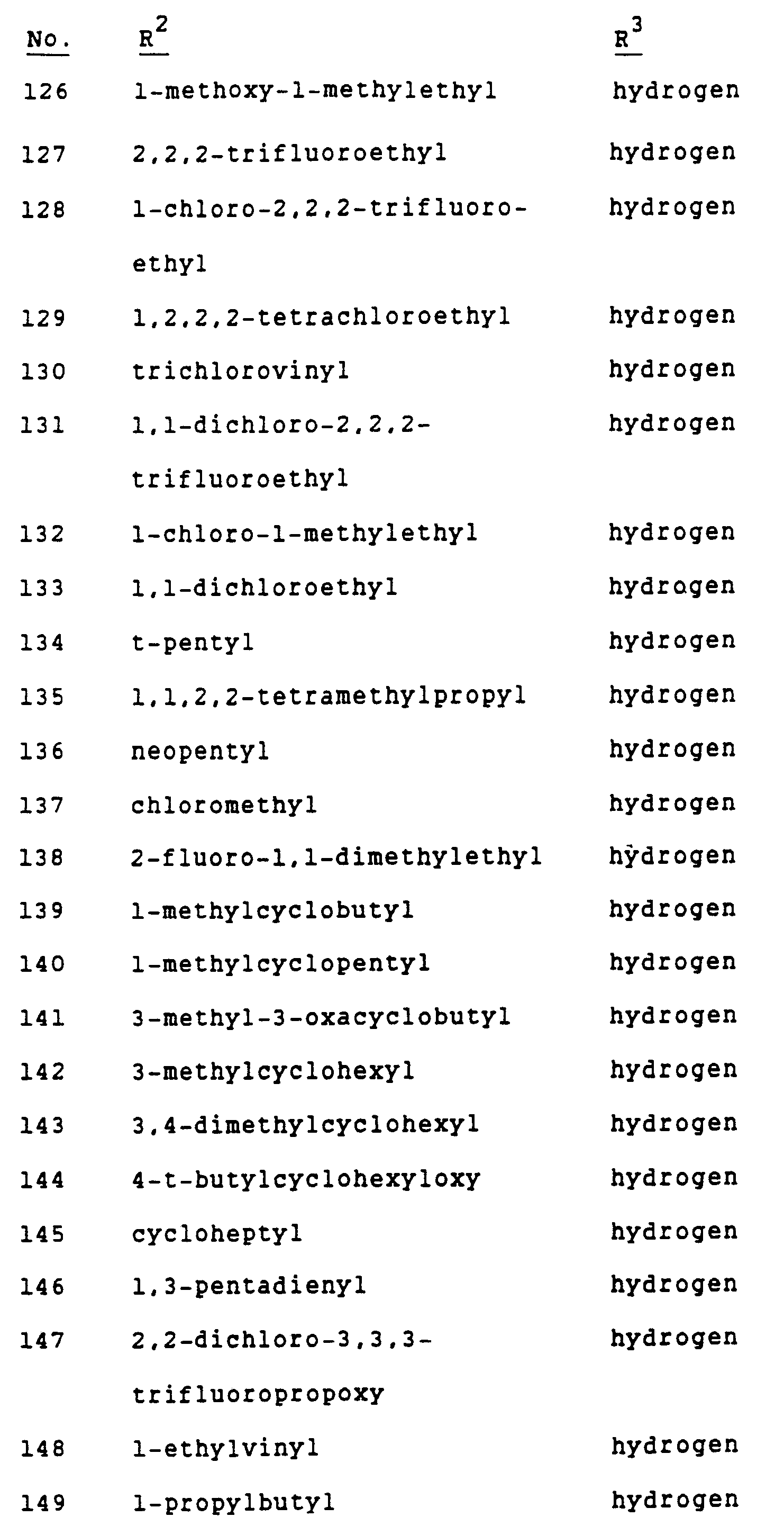


- In all of the compounds 195―388, there is a carbon-carbon single bond between the atoms at positions 22 and 23, X represents a hydrogen atom, R1 represents a methyl group, and R2 and R3 have the corresponding meanings as in compounds 1-194 above.
- In all of the compounds 389-582, there is a carbon-carbon single bond between the atoms at positions 22 and 23, X represents a hydrogen atom, R1 represents an isopropyl group, and R2 and R3 have the corresponding meanings as in compounds 1-194 above.
- In all of the compounds 583-776, there is a carbon-carbon single bond between the atoms at positions 22 and 23, X represents a hydrogen atom, R1 represents a sec-butyl group, and R2 and R3 have the corresponding meanings as in compounds 1-194 above.
- In compounds 777-782, there is a carbon-carbon single bond between the atoms at positions 22 and 23, X represents a hydrogen atom, and the groups R1, R2 and R3 have the meanings shown below.

- In compounds 783-786, there is a carbon-carbon single bond between the atoms at positions 22 and 23, X represents a hydroxy group, and R1, R2 and R3 have the meanings shown below.


- The most highly preferred compounds are those with numbers 1, 2, 3, 26, 45, 55, 61, 90, 102, 108, 122, 123, 171 and 191 in Table 1(A).
- The compounds of formula (I) can be prepared from the corresponding 13-substituted 5- ketomilbemycins of formula (III), by the processes shown in Reaction Scheme No. 1, in which R1, R3, R5, X, n and the broken line have the meanings already defined.

- In Reaction Scheme No. 1, Step A is for preparing a compound of the formula (la) by allowing a compound of the formula (III) to react with hydroxylamine or with one of its salts (for example, the salt with a mineral acid such as hydrochloric acid, nitric acid or sulfuric acid) to introduce the oxime group at the 5 position. The reaction is usually carried out in an inert solvent, for example an alcohol such as methanol or ethanol, an ether such as tetrahydrofuran or dioxane, an aliphatic acid such as acetic acid, water, or a mixture of such solvents. The reaction temperature is preferably from 10 to 80°C and the reaction usually requires from 1 hour to 24 hours to be complete.
- Step B is for preparing a compound of the formula (lb) by allowing the compound (III) to react with an oxime compound having the general formula NH2OR3 (wherein R3 has the same meaning as before) or with one of its salts (e.g. the same salts as in Step A), to introduce the oxime group at the 5 position. The conditions required for this reaction are similar to those for Step A.
- Step C is for preparing a compound of formula (lb) by esterification of the oxime group of the compound (la). This reaction can be used to prepare the preferred compounds of formula (X) above, in which the group corresponding to R3 is R'3 and represents an ester residue of a carboxylic acid, an N,N-disubstituted carbamic acid, a carbonic acid, a sulfonic acid or a phosphonic acid, by allowing a compound (la) in which R3 is a hydrogen atom to react with a corresponding acid halide, usually in an inert solvent, preferably in the presence of a base. This method is a preferred embodiment of the invention.
- The base employed is not particularly limited provided that it has an acid binding ability and an organic amine such as triethylamine or N,N-dimethylaniline, pyridine, 4-dimethylaminopyridine, 1,4-diazabicyclo[2.2.2]octane, 5-diazabicyclo[4.3.0]nonene-5 or 1,8-diazabicyclo[5.4.0]undecene-7 is preferred.
- The inert solvent employed is not particularly limited provided that it does not interfere with the reaction, and a hydrocarbon such as hexane, benzene, toluene or xylene. an ether such as diethyl ether, tetrahydrofuran or dioxane, or a halogenated hydrocarbon such as methylene chloride, chloroform or carbon tetrachloride is preferred.
- The compound of the formula (X) in which R'3 is a residue of an N-substituted carbamic acid can be prepared by allowing a compound of the formula (I) in which R3 is a hydrogen atom to react with a corresponding isocyanate in an inert solvent, in the presence of a base. The base and the inert solvent employed can be the same as in the steps mentioned before. The reaction is usually carried out at near room temperature and the reaction usually requires from 1 to 20 hours to be complete.
- The compound in which R'3 is an N-trihaloacetylcarbamoyl group, obtained by the above reaction, can be converted into a compound in which R'3 is a carbamoyl group by reaction with zinc-acetic acid or zinc- methanol.
- After completion of each of these reactions, the target compound of the reaction can be obtained easily from the reaction mixture by conventional means. For example, the reaction mixture is poured into water and, if necessary, after filtering off the insoluble matter followed by neutralization with an acid or an alkali, extracted with a water-immiscible organic solvent. The organic layer is dried and the solvent distilled off to give the desired product. If desired, purification by conventional means such as recrystallization, column chromatography, etc., may be applied.
- The starting material of formula (III) can be prepared from a 13-hydroxy-5-ketomilbemycin compound having the general formula (IV) by the reaction shown in Reaction Scheme No. 3, in which R1, R5, X, n and the broken line have the meanings already defined.

- Step D is for preparing a compound of the formula (III) by allowing a 13-hydroxy-5-ketomilbemycin compound indicated by the formula (IV) to react with a carboxylic acid or its reactive derivative indicated by the formula (V). Compounds of formula (IV) are known from U.S. Patent No. 4,423,209.
- The reaction of Step D is an esterification of the hydroxyl group at position 13 of the compound (IV) with a carboxylic acid (V), and can be carried out according to any of the conventional procedures known for esterification reactions. The reactive derivative of a carboxylic acid employed may be for example an acid halide (an acid chloride, acid bromide or the like), an acid anhydride, a mixed acid anhydride, an active ester such as a p-nitrobenzyl ester, an active amide or the like, which can be conventionally used in esterifications.
- When a carboxylic acid of the formula (V) is employed as such, it is preferred to use a dehydrating agent such as dicyclohexylcarbodiimide (DCC), p-toluenesulfonic acid or sulfuric acid. In particular, DCC is preferably used, and when DCC is used, preferably a catalytic amount of pyridine or 4-pyrrolidinopyridine may be jointly used.
- When DCC is used as the dehydrating agent, its amount is usually from 1 to 5 equivalents, preferably from 1.5 to 4 equivalents.
- The reaction is usually carried out in a solvent. The solvent employed is not particularly limited provided that it does not interfere with the reaction, and a hydrocarbon such as hexane, petroleum ether, benzene, toluene, xylene, chloroform, methylene chloride or o-chlorobenzene, an ether such as diethyl ether, tetrahydrofuran, dioxane or ethyleneglycol dimethyl ether, or an ester such as methyl acetate or ethyl acetate or the like may be employed.
- The reaction is usually carried out at from 0°C to 50°C, preferably from 0°C to 20°C. The reaction usually requires from 30 minutes to 3 hours to be complete.
- When an acid halide derived from a carboxylic acid of the formula (V) is employed, the reaction is preferably carried out in the presence of a base, preferably an organic base such as triethylamine, N,N-dimethylaniline, pyridine, 4-dimethylaminopyridine, 1,5-diazabicyclo[4.3.0]nonene-5 (DBN) or 1,8-diazabicyclo[5.4.0]undecene-7 (DBU).
- The amount of this acid halide is usually from 1 to 10 equivalents, and from 2 to 5 equivalents of the base is usually used.
- The solvent, reaction temperature and reaction time employed for this reaction are similar to those when a carboxylic acid is used.
- After completion of the reaction, the target compound having the formula (III) can be isolated from the reaction mixture by conventional means and, if desired, further purified by conventional means such as column chromatography.
- The starting material of formula (IV) can be derived from one of the milbemycins or milbemycin analogues of natural origin, by per se known methods, such as those described in the various prior art references mentioned earlier in this specification. Natural milbemycins are produced as mixtures of various compounds, the different compounds being produced at different rates. Each fraction may be subjected to reaction after isolation thereof, or in the form of mixtures of the individual products. Therefore, the compound having the formula (IV) may be either a single compound or a mixture thereof, which may result in forming the compound (I) either as a single compound or as a mixture.
- The compounds of the invention having a 23-keto group can be obtained from the corresponding natural product, for example, by the following sequence of steps The natural product having a 5 hydroxy group is oxidized to the corresponding 5-oxo compound, e.g. with manganese dioxide. The 5-oxo derivative is treated with a lower alkanoic acid (e.g. formic acid) and selenium dioxide, and then with aqueous hydrochloric acid, giving the corresponding 13-hydroxy-5-oxo derivative. The 13-hydroxy group can then be acylated with the appropriate carboxylic acid or reactive derivative thereof, in the manner already described, to give the corresponding 13-esterified-5-oxo compound, such as a compound of formula (la) above. The 5-oxo group can then be converted to the 5-oxime, using the methods already described; or it can be converted to a 5-hydroxy group by reducing it e.g. with sodium borohydride.
- The compounds of the invention have a strong acaricidal activity against, for example, adults, imagos and eggs of Tetranychus, Panonychus (e.g. Panonychus ulmi and Panonychus citri), Aculopa pelekassi and rust mites, which are parasitic to fruit trees, vegetables and flowers. They are also active against Ixodidae Dermanyssidae and Sarcoptidae, which are parasitic to animals. Further, they are active against: exoparasites, such as Oestrus, Lucilia, Hypoderma, Gautrophilus, lice and fleas, which are parasitic to animals and birds, particularly livestock and poultry; domestic insects, such as cockroaches and houseflies; and various harmful insects in agricultural and horticultural areas, such as aphids and larval Lepidoptera. They are also effective against Meloidogyne in the soil, Bursaphelenchus and Rhizoglyphus. They are also effective against insects of the orders Coleoptera, Homoptera, Heteroptera, Diptera, Thysanoptera, Orthoptera, Anoplura, Siphonaptera, Mallophage, Thysanura, Isoptera, Psocoptera and Hymenoptera.
- The compounds of the invention equally can be used to control other plant-damaging insects, particularly insects that damage plants by eating them. The compounds can be used to protect both ornamental plants and productive plants, particularly cotton (e.g. against Spodoptera littoralis and Heliothis virescens), as well as vegetable crops (e.g. against Leptinotarsa decemlineata and Myzus persicae) and rice crops (e.g. against Chilo suppressalis and Laodelphax).
- The activity of the compounds of the invention is pronounced, both systemically and by contact. Accordingly, the compounds are very effective against sucking insects, especially sucking insects of the order Homoptera and most particularly the family Aphididae (such as Aphis fabae, Aphis craccivora and Myzus persicae), which are difficult to control with known compositions.
- Accordingly, the compounds of the invention can be used to treat all manner of plants (as well as the seeds from which such plants are grown and the environment, whether for growth or storage, containing such plants) to protect them from insects such as those exemplified above. Such plants include cereals (e.g. maize or rice), vegetables (e.g. potatoes or soybeans), fruits and other plants (e.g. cotton).
- The compounds of the invention can similarly be used to protect animals from a variety of ectoparasites, by applying the compounds to the animals or to the animals' environment, e.g. livestock housing, animal boxes, abattoirs, pasture land and other grasslands, as well as to any other places liable to be infested. The compounds may also be applied to external parts of the animals, preferably before they are infested.
- Moreover, the compounds of the invention are effective against various parasitical helminths. These parasites can attack livestock, poultry and pet animals (such as pigs, sheep, goats, cows. horses, dogs, cats and fowl) and can cause grave economic damage. Among the helminths, the nematodes in particular often cause serious infection. Typical genera of nematodes which are parasitic on these animals and against which the compounds of the invention are effective include:
- Haemonchus,
- Trichostrongylus,
- Ostertagia,
- Nematodirus,
- Cooperia,
- Ascaris,
- Bunostomum,
- Oesophagostomum,
- Chabertia,
- Trichuris,
- Strongylus,
- Trichonema,
- Dictyocaulus,
- Capillaria,
- Heterakis,
- Toxocara,
- Ascaridia,
- Oxyuris,
- Ancylostoma,
- Uncinaria,
- Toxascaris and
- Parascaris.
- Certain parasitical species of the genera Nematodirus, Cooperia and Oesophagostomum attack the intestines, while certain species of the genera Haemonchus and Ostertagia parasitize the stomach, and parasites belonging to the genus Dictyocaulus are found, in the lungs. Parasites belonging to the families Filariidae and Setariidae are found in internal tissues and organs, for example, the heart, the blood vessels, the subcutaneous tissues and the lymphatic vessels. The compounds of the invention are active against all these parasites.
- The compounds of the invention are also effective against parasites which infect humans. Typical of the parasites which may most commonly be found in the digestive tracts of human beings are parasites of the genera Ancylostoma, Necator, Ascaris, Strongyloides, Trichinella, Capillaria, Trichuris and Enterobius. The compounds are also active against parasites of the genera Wuchereria, Brugia, Onchocerca and Loa of the family Filariidae (which are found in blood, tissues and organs other than the digestive tract and are medically important), parasites of the genus Dracunculus of the family Dracunculidae and parasites of the genera Strongyloides and Trichinella, which in a particular state may parasitize outside the intestinal tract, although they are essentially intestinal parasites.
- The form of the compositions of the invention and the nature of the carriers or diluents employed in them will vary depending upon the intended use of the composition. For example, where the compounds of the invention are to be employed as anthelmintics, they are preferably administered orally, parenterally or topically and the form of compositions chosen will be appropriate to the intended route of administration.
- For oral administration, the composition of the invention is preferably in the form of a liquid drink comprising a non-toxic solution, suspension or dispersion of the active compound in admixture with a suspending agent (such as bentonite), a wetting agent or other diluents, preferably in water or another non-toxic solvent. The drink, in general, also contains an anti-foaming agent. The active compound would normally be present in the drink in an amount of from 0.01 to 0.5% by weight, more preferably from 0.01 to 0.1% by weight.
- Compositions for oral administration may also be in the form of dry solids, preferably in unit dosage form, such as capsules, pills or tablets containing the desired amount of the active compound. These compositions may be prepared by mixing the active compound uniformly with suitable diluents, fillers, disintegrators and/or binding agents, for example starch, lactose, talc, magnesium stearate and vegetable gum. The weight and contents of the preparation will vary widely, depending upon the nature of the animal to be treated, the degree of infection, the nature of the parasite and the body weight of the animal to be treated.
- The compounds may also be administered as an additive to animal feedstuffs, in which case they may be dispersed uniformly in the feedstuffs, used as a top dressing or used in the form of pellets. The content of active compound in the feedstuff is preferably from 0.0001 to 0.02%, in order to achieve the desired anthelmintic activity.
- For parenteral administration, the compound of the invention is preferably dissolved or suspended in a liquid vehicle, preferably a vegetable oil, such as peanut oil or cottonseed oil. Where the compound is a salt of the 13-hydroxy 5-keto compound of formula (II), the liquid vehicle may be water or another aqueous medium. Depending upon the animal to be treated, the injection may be subcutaneous or into the proventriculus, a muscle or the trachea. Such preparations would normally contain the active compound at a concentration of from 0.05 to 50% by weight.
- The compounds of the invention may also be administered topically in admixture with a suitable carrier, such as dimethyl sulphoxide or a hydrocarbon solvent. Such preparations would be applied directly to the outside of the animal by spraying (e.g. by a hand spray or in spray races), by dipping (e.g. in a plunge dip), by a pour-on solution or by manual methods (e.g. hand-dressing).
- The dose of active compound may be varied, depending upon the nature of the animal to be treated, and the nature and degree of parasitic infection. However, best results for oral administration are achieved when the dose is from 0.01 to 100 mg, more preferably from 0.5 to 50 mg, per 1 kg body weight. The compound may be administered in a single dose or in divided doses for a relatively short period, such as from 1 to 5 days.
- Where the composition of the invention is intended for agricultural or horticultural use, a variety of forms and formulations is possible. For example, the composition may be formulated as dusts, coarse dusts, soluble powders, microgranules, fine microgranules, wettable powders, dilute emulsions, emulsifiable concentrates, aqueous or oily suspensions, dispersions or solutions (which may be directly sprayable or for dilution), aerosols or capsules in, for example, polymeric substances. The carrier employed may be natural or synthetic and organic or inorganic; it is generally employed to assist the active compound to reach the substrate to be treated, and to make it easier to store, transport or handle the active compound. Solid, liquid and gaseous carriers may be employed, chosen from carriers well known in the art for use with compositions of this type.
- Such formulations may be prepared by conventional means, e.g. by intimate mixing and/or grinding of the active ingredient(s) with the carrier or diluent, e.g. solvent, solid carrier or, optionally, surface-active agent.
- Suitable solvents include: aromatic hydrocarbons, preferably the C8 to C12 fractions from petroleum distillation, such as xylene mixtures or substituted naphthalenes; esters of phthalic acid, such as dibutyl or dioctyl phthalate; aliphatic hydrocarbons, such as cyclohexane or the paraffins; alcohols and glycols or esters thereof, such as ethanol, ethylene glycol, ethylene glycol monomethyl ether or ethylene glycol monoethyl ether; ketones, such as cyclohexanone; strongly polar solvents, such as N-methyl-2-pyrrolidone, dimethyl sulfoxide or N,N-dimethylformamide; optionally epoxidized vegetable oils, such as epoxidized coconut oil or soybean oil; and water.
- Solid carriers, which may be used, for example, in dusts and dispersible powders, include natural mineral fillers, such as calcite, talc, kaolin, montmorillonite or attapulgite. In order to improve the physical properties of the composition, it is also possible to add highly dispersed silicic acid or highly dispersed absorbent polymers. Suitable granulated adsorptive carriers may be porous (such as pumice, ground brick, sepiolite or bentonite) or non-porous (such as calcite or sand). A wide variety of pregranulated materials, organic or inorganic, may also be used; examples include dolomite and ground plant residues.
- Surface-active agents which may be used are well known in the art and may be non-ionic, cationic or anionic agents having good emulsifying, dispersing and wetting properties. Mixtures of such agents may also be used.
- Compositions may also contain stabilizers, anti-foaming agents, viscosity regulators, binders or adhesives or any combination thereof, as well as fertilizers or other active substances to achieve special effects.
- Pesticidal compositions will generally contain: from 0.01 to 99%, more preferably from 0.1 to 95%, by weight of the active compound; from 1 to 99.99% of a solid or liquid additive; and from 0 to 25%, more preferably from 0.1 to 25%, of a surface-active agent. Whereas commercial products are generally sold as concentrated compositions, they are generally diluted by the end-user to a concentration of from 0.001 to 0.0001 % by weight (from 10 to 1 ppm).
- The invention is further illustrated by the following non-limiting Examples and Preparations.
- Examples 1 to 128 illustrate the preparation of compounds of the invention.
- Preparations 1 to 4 illustrate the synthesis of starting materials for use in preparing the compounds of the invention.
- Examples 129 to 132 illustrate the activity of the compounds of the invention against various pests.
- Unless otherwise specified, the group X at position 23 always represents a hydrogen atom, throughout all of the Examples.
- Examples 1 to 94 illustrate the preparation of compounds of formula (la) from starting materials of formula (III), by the reaction of Step A in the above Reaction Scheme No. 1.
- (Compound of formula (la) wherein:
- R1 = ethyl, R5 = p-fluorophenoxymethyl, n = 0).
- A solution of 121 mg of 13-p-fluorophenoxyacetoxy-5-keto-25-ethylmilbemycin in a mixture of 4 ml of methanol and 4 ml of dioxane was added dropwise to 3 ml of an aqueous solution containing 59 mg of hydroxylamine hydrochloride, and the resulting mixture was stirred at room temperature for 8 hours. After completion of the reaction, the mixture was poured into water and extracted with ethyl acetate. The ethyl acetate extracts were washed with saturated aqueous sodium chloride solution, dried over anhydrous sodium sulfate, and then concentrated. The residue was subjected to column chromatography over silica gel, giving 76 mg of the target product (yield: 61.8 %).
- Mass Spectrum (m/z): 709(M+), 675.
- Nuclear Magnetic Resonance Spectrum (270 MHz, CDCI3) δ ppm:
- 3.97 (1H, singlet, OH at the 7 position);
- 4.67 (1 H, singlet, H at the 6 position);
- 5.06 (1 H, doublet, H at the 13 position, J = 10.6 Hz).
- By following the procedure of Example 1 the, compounds of the following Examples 2 to 94 were obtained, having the characteristics shown.
- (Compound of formula (la) wherein:
- R1 = isopropyl, R5 = ethyl, n = 1).
- Mass Spectrum (m/z). 657(M+) 639.
- Nuclear Magnetic Resonance Spectrum (270 MHz, CDCI3) δ ppm:
- 3.94 (1H, singlet, OH at the 7 position).
- 4.46 (1H, singlet, H at the 6 position);
- 4.49 (1H, doublet, H at the 13 position, J = 11.7 Hz).
- (Compound of formula (la) wherein:
- R1 = isopropyl, R5 = methyl, n = 0).
- Mass Spectrum (m/z): 618(M+).
- Nuclear Magnetic Resonance Spectrum (270 MHz, CDCl3) δ ppm:
- 3.92 (1H, singlet, OH at the 7 position);
- 4.66 (1H, singlet, H at the 6 position);
- 4.95 (1 H, doublet, H at the 13 position, J = 10.8 Hz).
- (Compound of formula (la) wherein:
- R1 = ethyl, R5 = p-chlorophenyl, n = 0).
- Mass Spectrum (m/z): 709(M+), 675.
- Nuclear Magnetic Resonance Spectrum (270 MHz, CDCI3) δ ppm:
- 3.97 (1 H, singlet, OH at the 7 position);
- 4.70 (1H, singlet, H at the 6 position);
- 5.20 (1 H, doublet. H at the 13 position, J = 10.6 Hz).
- (Compound of formula (la) wherein:
- R1 = ethyl, R5 = p-t-butylphenyl, n = 0).
- Mass Spectrum (m/z): 731(M+), 713, 553.
- Nuclear Magnetic Resonance Spectrum (270 MHz, CDCI3) δ ppm:
- 3.98 (1H, singlet, OH at the 7 position);
- 4.69 (1H, singlet, H at the 6 position);
- 5.19 (1 H, doublet, H at the 13 position, J = 10.6 Hz).
- (Compound of formula (la) wherein:
- R1 = ethyl, R5 = o-trifluoromethylphenyl, n = 0).
- Mass Spectrum (m/z): 743(M+), 725, 709.
- Nuclear Magnetic Resonance Spectrum (270 MHz, CDCI3) δ ppm:
- 3.98 (1 H, singlet, OH at the 7 position);
- 4.68 (1 H, singlet, H at the 6 position);
- 5.23 (1H, doublet, H at the 13 position, J = 10.3 Hz).
- (Compound of formula (la) wherein:
- R = ethyl, R5 = 2-furyl, n = 0).
- Mass Spectrum (m/z): 665(M+), 647, 631.
- Nuclear Magnetic Resonance Spectrum (270 MHz, CDCI3) δ ppm:
- 3.96 (1H, singlet, OH at the 7 position);
- 4.68 (1H, singlet, H at the 6 position);
- 5.17 (1 H, doublet, H at the 13 position, J = 10.6 Hz).
- Compound of formula (la) wherein:
- R1 = ethyl, R5 = benzyl, n = 1).
- Mass Spectrum (m/z): 705(M+), 553.
- Nuclear Magnetic Resonance Spectrum (270 MHz, CDCI3) δ ppm:
- 3.96 (1H, singlet, OH at the 7 position);
- 4.67 (1H, singlet, H at the 6 position);
- 4.76 (1H, doublet, H at the 13 position, J = 10.3 Hz).
- (Compound of formula (la) wherein:
- R1 = ethyl or methyl, R5 = methyl, n = 1).
- Mass Spectrum (m/z): 629(M+).
- Nuclear Magnetic Resonance Spectrum (270 MHz, CDCI3) δ ppm:
- 3.97 (1H, singlet, OH at the 7 position);
- 4.67 (1H, singlet, H at the 6 position);
- 4.7-4.85 (3H, multiplet, CH2 at the 27 position, H at the 13 position).
- (Compound of formula (la) wherein:
- R1 = ethyl, R5 = 2,2,2-trichloroethyl, n = 1).
- Mass Spectrum (m/z) 745(M) 727.
- Nuclear Magnetic Resonance Spectrum (270 MHz, CDCI3) δ ppm:
- 3.97 (1 H, singlet, OH at the 7 position);
- 4.67 (1H, singlet, H at the 6 position);
- 4.80 (1H, doublet, H at the 13 position, J = 10.3 Hz).
- (Compound of formula (la) wherein:
- R1 = ethyl or methyl, R5 = propenyl, n = 0).
- Mass Spectrum (m/z): 639(M+).
- Nuclear Magnetic Resonance Spectrum (270 MHz, CDCI3) δ ppm:
- 3.95 (1 H, singlet, OH at the 7 position);
- 4.67 (1H, singlet, H at the 6 position);
- 5.01 (1H, doublet, H at the 13 position, J = 10.6 Hz).
- (Compound of formula (la) wherein:
- R1 = ethyl or methyl, R5 = 2-(2,2-dichlorovinyl)-3,3-dimethylcyclopropyl, n = 0).
- Mass Spectrum (m/z): 761(M+).
- Nuclear Magnetic Resonance Spectrum (270 MHz, CDCI3) δ ppm:
- 3.97 (1H, singlet, OH at the 7 position);
- 4.67 (1H, singlet, H at the 6 position);
- 5.40 (1 H, doublet, H at the 13 position, J = 11 Hz).
- (Compound of formula (la) wherein:
- R1 = ethyl or methyl, R5 = benzyl, n = 0).
- Mass Spectrum (m/z): 689(M+), 655.
- Nuclear Magnetic Resonance Spectrum (270 MHz, CDCl3) δ ppm:
- 3.95 (1H, singlet, OH at the 7 position);
- 4.66 (1H, singlet, H at the 6 position);
- 4.93 (1H, doublet, H at the 13 position, J = 10.6 Hz).
- (Compound of formula (la) wherein:
- R1 = ethyl or methyl, R5 = 2-hydroxy-3-(t-butyldimethylsiloxy)propyl, n = 1).
- Mass Spectrum (m/z): 803(M+).
- Nuclear Magnetic Resonance Spectrum (270 MHz, CDCI3) δ ppm:
- 3.97 (1 H, singlet, OH at the 7 position);
- 4.67 (1H, singlet, H at the 6 position);
- 4.74 (1H, doublet, H at the 13 position, J = 9.7 Hz).
- (Compound of formula (Ia) wherein:
- R1 = ethyl or methyl, R5 = 2,2-dimethyl-1,3-dioxolanylmethyl, n = 1).
- Mass Spectrum (m/z). 729 and 715(M+).
- Nuclear Magnetic Resonance Spectrum (270 MHz, CDCl3) δ ppm:
- 3.97 (1 H, singlet, OH at the 7 position);
- 4.69 (1H, singlet, H at the 6 position);
- 4.65―4.85 (3H, multiplet, CH2 at the 27 position, H at the 13 position).
- (Compound of formula (la) wherein:
- R1 = ethyl or methyl, R5 = 2,3-dihydroxypropyl, n = 1).
- Mass Spectrum (m/z): 689 and 675(M+).
- Nuclear Magnetic Resonance Spectrum (270 MHz, CDCl3) δ ppm:
- 3.96 (1H, singlet, OH at the 7 position);
- 4.67 (1H, singlet, H at the 6 position);
- 4.74 (1H, doublet, H at the 13 position, J = 10.3 Hz).
- (Compound of formula (la) wherein:
- R1 = ethyl or methyl, R5 = 2-chloroethyl, n = 0).
- Mass Spectrum (m/z): 662(M+).
- Nuclear Magnetic Resonance Spectrum (270 MHz, CDCl3) δ ppm:
- 3.96 (1H, singlet, OH at the 7 position);
- 4.67 (1H, singlet, H at the 6 position);
- 5.00 (1H, doublet, H at the 13 position, J = 10.6 Hz).
- (Compound of formula (la) wherein:
- R1 = ethyl, R5 = 2-methoxyethyl, n = 1).
- Mass Spectrum (m/z): 673(M+), 655, 640.
- Nuclear Magnetic Resonance Spectrum (270 MHz, CDCl3) δ ppm:
- 3.95 (1H, singlet, OH at the 7 position);
- 4.67 (1 H, singlet, H at the 6 position);
- 4.75 (1H, doublet, H at the 13 position, J = 10.6 Hz).
- (Compound of formula (la) wherein:
- R1 = ethyl, R5 = t-butyl, n = 0).
- Mass Spectrum (m/z): 655(M+), 637, 621.
- Nuclear Magnetic Resonance Spectrum (270 MHz, CDCI3) δ ppm:
- 3.97 (1H, singlet, OH at the 7 position);
- 4.66 (1 H, singlet, H at the 6 position);
- 4.91 (1H, doublet, H at the 13 position, J = 10.2 Hz).
- (Compound of formula (la) wherein:
- R1 = ethyl, R5 = trichloromethyl, n = 0).
- Mass Spectrum (m/z): 715(M+), 697.
- Nuclear Magnetic Resonance Spectrum (270 MHz CDCI3), δ ppm:
- 3.96 (1 H, singlet, OH at the 7 position);
- 4.68 (1 H, singlet, H at the 6 position);
- 4.99 (1 H, doublet, H at the 13 position, J = 10.6 Hz).
- (Compound of formula (la) wherein:
- R1 = ethyl, R5 = iodomethyl, n = 0).
- Mass Spectrum (m/z): 739(M+), 721.
- Nuclear Magnetic Resonance Spectrum (270 MHz, CDCl3) δ ppm:
- 3.97 (1H, singlet, OH at the 7 position);
- 4.66 (1H, singlet, H at the 6 position);
- 4.94 (1H, doublet, H at the 13 position, J = 10.8 Hz).
- (Compound of formula (la) wherein:
- R1 = ethyl, R5 = hydrogen, n = 0).
- Mass Spectrum (m/z): 599(M+), 585, 581.
- Nuclear Magnetic Resonance Spectrum (270 MHz, CDCI3) δ ppm:
- 3.97 (1H, singlet, OH at the 7 position);
- 4.68 (1 H, singlet, H at the 6 position);
- 5.05 (1H, doublet, H at the 13 position, J = 10.6 Hz).
- (Compound of formula (Ia) wherein:
- R1 = ethyl, R5 = p-bromophenyl, n = 0).
- Mass Spectrum (m/z): 753(M+, with Br79), 735, 719.
- Nuclear Magnetic Resonance Spectrum (270 MHz CDCI3), δ ppm:
- 3.98 (1H, singlet, OH at the 7 position);
- 4.69 (1 H, singlet, H at the 6 position);
- 5.19 (1H, doublet, H at the 13 position, J = 10.4 Hz).
- (Compound of formula (la) wherein:
- R1 = ethyl, R5 = cyclobutyl, n = 0).
- Mass Spectrum (m/z): 653(M+).
- Nuclear Magnetic Resonance Spectrum (270 MHz, CDCl3) δ ppm:
- 3.95 (1H, singlet, OH at the 7 position);
- 4.67 (1 H, singlet, H at the 6 position);
- 4.94 (1 H, doublet, H at the 13 position, J = 10.6 Hz).
- (Compound of formula (la) wherein:
- R1 = ethyl or methyl, R5 = o-chlorophenyl, n = 0).
- Mass Spectrum (m/z): 709(M+).
- Nuclear Magnetic Resonance Spectrum (270 MHz, CDCI3) 5 ppm:
- 3.97 (1H, singlet, OH at the 7 position);
- 4.67 (1H, singlet, H at the 6 position);
- 5.23 (1 H, doublet, H at the 13 position, J = 10.6 Hz).
- (Compound of formula (la) wherein:
- R1 = ethyl or methyl, R5 = 2,4-dichlorophenyl, n = 0).
- Mass Spectrum (m/z): 743(M+).
- Nuclear Magnetic Resonance Spectrum (270 MHz, CDCl3) δ ppm:
- 3.98 (1H, singlet, OH at the 7 position);
- 4.66 (1 H, singlet, H at the 6 position);
- 5.23 (1 H, doublet, H at the 13 position, J = 10.6 Hz).
- (Compound of formula (la) wherein:
- R1 = ethyl or methyl, R5 = m-fluorophenyl, n = 0).
- Mass Spectrum (m/z): 693(M+).
- Nuclear Magnetic Resonance Spectrum (270 MHz, CDCl3) δ ppm:
- 3.71 (1H, singlet, OH at the 7 position);
- 4.69 (1H, singlet, H at the 6 position);
- 5.21 (1 H, doublet, H at the 13 position, J = 10.6 Hz).
- (Compound of formula (la) wherein:
- R1 = ethyl or methyl, R5 = m-trifluoromethylphenyl, n = 0).
- Mass Spectrum (m/z): 743(M+).
- Nuclear Magnetic Resonance Spectrum (270 MHz, CDCl3) δ ppm:
- 4.0 (1H, singlet, OH at the 7 position);
- 4.69 (1 H, singlet, H at the 6 position);
- 5.24 (1H, doublet, H at the 13 position, J = 10.3 Hz).
- (Compound of formula (Ia) wherein:
- R1 = ethyl or methyl, R5 = 2,5-dichloro-6-methoxyphenyl, n = 0).
- Mass Spectrum (m/z): 773(M+).
- Nuclear Magnetic Resonance Spectrum (270 MHz, CDCl3) δ ppm:
- 3.90 (1 H, singlet, OH at the 7 position);
- 4.69 (1H, singlet, H at the 6 position);
- 5.20 (1 H, doublet, H at the 13 position, J = 10.6 Hz).
- (Compound of formula (la) wherein:
- R1 = ethyl or methyl, R5 = cyclohexyl, n = 0).
- Mass Spectrum (m/z): 681(M+).
- Nuclear Magnetic Resonance Spectrum (270 MHz, CDCl3) δ ppm:
- 3.90 (1 H, singlet, OH at the 7 position);
- 4.68 (1H, singlet, H at the 6 position);
- 4.93 (1 H, doublet, H at the 13 position, J = 10.6 Hz).
- (Compound of formula (la) wherein:
- R1 = ethyl or methyl, R5 = a-methylbenzyl, n = 0).
- Mass Spectrum (m/z): 703(M+).
- Nuclear Magnetic Resonance Spectrum (270 MHz, CDCI3) δ ppm:
- 3.98 (1 H, singlet, OH at the 7 position);
- 4.66 (1H, singlet, H at the 6 position);
- 4.89 (1 H, doublet, H at the 13 position, J = 10.6 Hz).
- (Compound of formula (la) wherein:
- R1 = ethyl, R5 = o-bromophenyl, n = 0).
- Mass Spectrum (m/z): 753(M+, with Br79).
- Nuclear Magnetic Resonance Spectrum (270 MHz, CDCI3) δ ppm:
- 3.71 (1H, singlet, OH at the 7 position);
- 4.68 (1H, singlet, H at the 6 position);
- 4.94 (1H, doublet, H at the 13 position, J = 10.6 Hz).
- (Compound of formula (la) wherein:
- R1 = ethyl or methyl, R5 = 1,1-dichloroethyl, n = 0).
- Mass Spectrum (m/z): 695(M+).
- Nuclear Magnetic Resonance Spectrum (270 MHz, CDCl3) δ ppm:
- 3.95 (1H, singlet, OH at the 7 position);
- 4.68 (1H, singlet, H at the 6 position);
- 4.95 (1H, doublet, H at the 13 position, J = 10.3 Hz).
- (Compound of formula (la) wherein:
- R1 = ethyl, R5 = cyclopropyl, n = 0).
- Mass Spectrum (m/z): 639(M+).
- Nuclear Magnetic Resonance Spectrum (270 MHz, CDCl3) δ ppm:
- 3.90 (1H, singlet, OH at the 7 position);
- 4.57 (1H, singlet, H at the 6 position);
- 4.98 (1H, doublet, H at the 13 position, J = 10.6 Hz).
- (Compound of formula (la) wherein:
- R1 = ethyl or methyl, R5 = 1-methylcyclohexyl, n = 0).
- Mass Spectrum (m/z): 695(M+).
- Nuclear Magnetic Resonance Spectrum (270 MHz CDCl3), δ ppm:
- 3.97 (1H, singlet, OH at the 7 position);
- 4.67 (1 H, singlet, H at the 6 position);
- 4.94 (1H, doublet, H at the 13 position, J = 10.6 Hz).
- (Compound of formula (la) wherein:
- R1 = ethyl or methyl, R5 = heptyl, n = 0).
- Mass Spectrum (m/z): 697(M+).
- Nuclear Magnetic Resonance Spectrum (270 MHz, CDCl3) δ ppm:
- 3.96 (1 H, singlet, OH at the 7 position);
- 4.68 (1H, singlet, H at the 6 position);
- 4.95 (1H, doublet, H at the 13 position, J = 10.2 Hz).
- (Compound of formula (Ia) wherein:
- R1 = ethyl or methyl, R5 = pentadecyl, n = 0).
- Mass Spectrum (m/z): 809(M+).
- Nuclear Magnetic Resonance Spectrum (270 MHz, CDCl3) δ ppm:
- 3.95 (1 H, singlet, OH at the 7 position);
- 4.68 (1H, singlet, H at the 6 position);
- 4.96 (1H, doublet, H at the 13 position, J = 10.3 Hz).
- (Compound of formula (la) wherein:
- R1 = ethyl, R5 = 4-pyridyl, n = 0).
- Mass Spectrum (m/z): 676(M+).
- Nuclear Magnetic Resonance Spectrum (270 MHz, CDCl3) δ ppm:
- 4.01 (1H, singlet, OH at the 7 position);
- 4.70 (1H, singlet, H at the 6 position);
- 5.22 (1 H, doublet, H at the 13 position, J = 10.6 Hz).
- (Compound of formula (la) wherein:
- R1 = ethyl or methyl, R5 = m-tolyl, n = 0).
- Mass Spectrum (m/z): 689(M+).
- Nuclear Magnetic Resonance Spectrum (270 MHz, CDCl3) δ ppm:
- 3.99 (1H, singlet, OH at the 7 position);
- 4.69 (1 H, singlet H at the 6 position);
- 5.21 (1H, doublet, H at the 13 position, J = 10.3 Hz).
- (Compound of formula (la) wherein:
- R1 = ethyl or methyl, R5 = pentafluorophenyl, n = 0).
- Mass Spectrum (m/z): 765(M+).
- Nuclear Magnetic Resonance Spectrum (270 MHz, CDCl3) δ ppm:
- 3.97 (1 H, singlet, OH at the 7 position);
- 4.68 (1H, singlet, H at the 6 position);
- 5.21 (1 H, doublet, H at the 13 position, J = 10.6 Hz).
- (Compound of formula (Ia) wherein:
- R1 = ethyl, R5 = 3-adamantyl, n = 0).
- Mass Spectrum (m/z): 733(M+).
- Nuclear Magnetic Resonance Spectrum (270 MHz, CDCl3) δ ppm:
- 3.95 (1 H, singlet, OH at the 7 position);
- 4.67 (1 H, singlet, H at the 6 position);
- 4.92 (1 H, doublet, H at the 13 position, J = 10.6 Hz).
- (Compound of formula (Ia) wherein:
- R1 = ethyl, R5 = 3,5-bis(trifluoromethyl)phenyl, n = 0).
- Mass Spectrum (m/z): 811(M+).
- Nuclear Magnetic Resonance Spectrum (270 MHz, CDCl3) δ ppm:
- 3.97 (1H, singlet, OH at the 7 position);
- 4.69 (1H, singlet, H at the 6 position);
- 5.26 (1H, doublet, H at the 13 position, J = 10.6 Hz).
- (Compound of formula (la) wherein:
- R1 = ethyl or methyl, R5 = 2-thienyl, n = 0).
- Mass Spectrum (m/z): 681(M+).
- Nuclear Magnetic Resonance Spectrum (270 MHz, CDCl3) δ ppm:
- 3.97 (1H, singlet, OH at the 7 position);
- 4.68 (1H, singlet, H at the 6 position);
- 5.14 (1H, doublet, H at the 13 position, J = 10.6 Hz).
- (Compound of formula (la) wherein:
- R' = ethyl or methyl, R5 = 2,6-difluorophenyl, n = 0).
- Mass Spectrum (m/z): 711(M+).
- Nuclear Magnetic Resonance Spectrum (270 MHz, CDCl3) δ ppm:
- 3.98 (1H, singlet, OH at the 7 position);
- 4.68 (1H, singlet, H at the 6 position);
- 5.21 (1H, doublet, H at the 13 position, J = 10.6 Hz).
- (Compound of formula (la) wherein:
- R1 = ethyl or methyl, R5 = 1,1-dimethyl-2-chloroethyl, n = 0).
- Mass Spectrum (m/z): 689(M+).
- Nuclear Magnetic Resonance Spectrum (270 MHz, CDCl3) δ ppm:
- 3.96 (1 H, singlet, OH at the 7 position);
- 4.67 (1 H, singlet, H at the 6 position);
- 4.95 (1 H, doublet, H at the 13 position, J = 10.6 Hz).
- (Compound of formula (la) wherein:
- R1 = ethyl, R5 = 1-methylcyclopropyl, n = 0).
- Mass Spectrum (m/z): 653(M+).
- Nuclear Magnetic Resonance Spectrum (270 MHz, CDCl3) δ ppm:
- 3.96 (1H, singlet, OH at the 7 position);
- 4.67 (1H, singlet, H at the 6 position);
- 4.95 (1H, doublet, H at the 13 position, J = 10.6 Hz).
- (Compound of formula (la) wherein:
- R1 = ethyl, R5 = a,a-dimethylbenzyl, n = 0).
- Mass Spectrum (m/z): 717(M+).
- Nuclear Magnetic Resonance Spectrum (270 MHz, CDCl3) δ ppm:
- 3.96 (1 H, singlet, OH at the 7 position);
- 4.65 (1 H, singlet, H at the 6 position);
- 4.87 (1 H, doublet, H at the 13 position, J = 10.3 Hz).
- (Compound of formula (la) wherein:
- R1 = ethyl, R5 = o-acetoxyphenyl, n = 0).
- Mass Spectrum (m/z): 699(M+-34).
- Nuclear Magnetic Resonance Spectrum (270 MHz, CDCl3) δ ppm:
- 3.8 (1H, broad singlet, OH at the 7 position);
- 4.68 (1H, singlet, H at the 6 position);
- 5.18 (1H, doublet, H at the 13 position, J = 10.6 Hz).
- (Compound of formula (la) wherein:
- R1 = ethyl, R5 = methoxycarbonylmethyl, n = 0).
- Mass Spectrum (m/z): 671(M+), 653, 629.
- Nuclear Magnetic Resonance Spectrum (270 MHz, CDCl3) δ ppm:
- 3.96 (1H, singlet, OH at the 7 position);
- 5.02 (1H, doublet, H at the 13 position, J = 10.7 Hz).
- (Compound of formula (la) wherein:
- R1 = ethyl, R5 = t-butoxycarbonylmethyl, n = 0).
- Mass Spectrum (m/z): 713(M+), 695, 679.
- Nuclear Magnetic Resonance Spectrum (270 MHz, CDCl3) δ ppm:
- 3.96 (1H, singlet, OH at the 7 position);
- 5.00 (1H, doublet, H at the 13 position, J = 10.6 Hz).
- (Compound of formula (la) wherein:
- R1 = ethyl, R5 = 2-fluoro-1,1-dimethylethyl, n = 0).
- Mass Spectrum (m/z): 658, 640, 538, 520.
- Nuclear Magnetic Resonance Spectrum (270 MHz, CDCl3) δ ppm:
- 4.67 (1H, singlet, H at the 6 position);
- 4.95 (1 H, doublet, H at the 13 position, J = 10.3 Hz).
- (Compound of formula (la) wherein:
- R1 = ethyl, R5 = p-(trifluoromethyl)phenyl, n = 0).
- Mass Spectrum (m/z): 743(M+), 725, 709, 553.
- Nuclear Magnetic Resonance Spectrum (270 MHz, CDCl3) δ ppm:
- 4.69 (1H, singlet, H at the 6 position);
- 5.23 (1 H, doublet, H at the 13 position, J = 10.6 Hz).
- (Compound of formula (la) wherein:
- R1 = ethyl, R5 = 2,2,2-trifluoroethyl, n = 0).
- Mass Spectrum (m/z): 681(M+), 663, 647.
- Nuclear Magnetic Resonance Spectrum (270 MHz, CDCl3) δ ppm:
- 4.67 (1H, singlet, H at the 6 position);
- 5.02 (1 H, doublet, H at the 13 position, J = 10.6 Hz).
- (Compound of formula (la) wherein:
- R1 = ethyl, R5 = p-nitrophenyl, n = 0).
- Mass Spectrum (m/z): 720(M+), 702, 589, 553, 519.
- Nuclear Magnetic Resonance Spectrum (270 MHz, CDCl3) δ ppm:
- 4.69 (1H, singlet, H at the 6 position);
- 5.23 (1 H, doublet, H at the 13 position, J = 10.9 Hz).
- (Compound of formula (la) wherein:
- R1 = ethyl, R5 = o-phenoxyphenyl, n = 0).
- Mass Spectrum (m/z): 767(M+), 733, 707, 553, 519.
- Nuclear Magnetic Resonance Spectrum (270 MHz, CDCl3) δ ppm:
- 4.68 (1H, singlet, H at the 6 position).
- 5.14 (1 H, doublet, H at the 13 position, J = 10.3 Hz).
- (Compound of formula (la) wherein:
- R1 = ethyl, R5 = 2,6-xylyl, n = 0).
- Mass Spectrum (m/z), 703(M+) 685, 669, 645, 553, 536.
- Nuclear Magnetic Resonance Spectrum (270 MHz, CDCl3) δ ppm:
- 4.68 (1H, singlet, H at the 6 position);
- 5.26 (1 H, doublet, H at the 13 position, J = 10.3 Hz).
- (Compound of formula (la) wherein:
- R1 = ethyl, R5 = mesityl, n = 0).
- Mass Spectrum (m/z): 717(M+), 699, 683, 519.
- Nuclear Magnetic Resonance Spectrum (270 MHz, CDCl3) δ ppm:
- 4.68 (1H, singlet, H at the 6 position);
- 5.25 (1 H, doublet, H at the 13 position, J = 10.7 Hz).
- (Compound of formula (la) wherein:
- R1 = ethyl, R5 = m-phenoxyphenyl, n = 0).
- Mass Spectrum (m/z): 767(M+), 749, 733, 553, 535, 519.
- Nuclear Magnetic Resonance Spectrum (270 MHz, CDCl3) δ ppm:
- 4.68 (1 H, singlet, H at the 6 position);
- 5.18 (1H, doublet, H at the 13 position, J = 10.6 Hz).
- (Compound of formula (la) wherein:
- R1 = ethyl, R5 = 2,5,7,8-tetramethyl-6-methoxy-2-chromanyl, n = 0).
- Mass Spectrum (m/z): 817(M+), 799, 783, 589, 571.
- Nuclear Magnetic Resonance Spectrum (270 MHz, CDCl3) δ ppm:
- 4.65―4.85 (5H, multiplet).
- (Compound of formula (la) wherein:
- R1 = ethyl, R5 = 9-fluorenyl, n = 0).
- Mass Spectrum (m/z): 763(M+), 745.
- Nuclear Magnetic Resonance Spectrum (270 MHz, CDCl3) δ ppm:
- 4.67 (1H, singlet, H at the 6 position);
- 4.80 (1 H, doublet, H at the 13 position, J = 10.4 Hz).
- (Compound of formula (la) wherein:
- R1 = ethyl, R5 = 2,3-dihydro-3-oxopyrido-[2,1-c]-1,2,4-triazol-2-yl, n = 0).
- Mass Spectrum (m/z): 688(M+-44), 676, 571, 553, 537, 519.
- Nuclear Magnetic Resonance Spectrum (270 MHz, CDCl3) δ ppm:
- 4.70 (1H, singlet, H at the 6 position);
- 5.16 (1H, doublet, H at the 13 position, J = 10,6 Hz).
- (Compound of formula (la) wherein:
- R1 = ethyl, R5 = 9-xanthenyl, n = 0).
- Mass Spectrum (m/z): 779(M+), 761, 745, 701, 553, 535, 519.
- Nuclear Magnetic Resonance Spectrum (270 MHz, CDCI3) 5 ppm:
- 4.64 (1H, singlet, H at the 6 position);
- 4.76 (1H, doublet, H at the 13 position, J = 10.3 Hz).
- (Compound of formula (la) wherein:
- R1 = ethyl, R5 = 3-chloro-2-benzothienyl, n = 0).
- Mass Spectrum (m/z): 765(M+), 749, 731, 553, 535, 519.
- Nuclear Magnetic Resonance Spectrum (270 MHz, CDCl3) δ ppm:
- 4.69 (1H, singlet, H at the 6 position);
- 5.22 (1H, doublet, H at the 13 position, J = 10.6 Hz).
- (Compound of formula (la) wherein:
- R1 = ethyl, R5 = 2,6-dichloro-4-pyridyl, n = 0).
- Mass Spectrum (m/z): 744(M+), 726, 710, 553, 535, 519.
- Nuclear Magnetic Resonance Spectrum (270 MHz, CDCl3) δ ppm:
- 4.69 (1H, singlet, H at the 6 position);
- 5.21 (1 H, doublet, H at the 13 position, J = 10.6 Hz).
- (Compound of formula (la) wherein:
- R1 = ethyl, R5 = 3-methyl-1-oxa-3-cyclobutyl, n = 0).
- Mass Spectrum (m/z): 669(M+), 651, 635.
- Nuclear Magnetic Resonance Spectrum (270 MHz, CDCl3) δ ppm:
- 4.67 (1H, singlet, H at the 6 position);
- 5.00 (1 H, doublet, H at the 13 position, J = 10.6 Hz).
- (Compound of formula (la) wherein:
- R1 = ethyl, R5 = 2-ethylthio-3-pyridyl, n = 0).
- Mass Spectrum (m/z): 736(M+), 720, 702, 553, 535, 519.
- Nuclear Magnetic Resonance Spectrum (270 MHz, CDCl3) δ ppm:
- 4.69 (1H, singlet, H at the 6 position);
- 5.22 (1 H, doublet, H at the 13 position, J = 10.6 Hz).
- (Compound of formula (la) wherein:
- R1 = ethyl, R5 = phenethyl, n = 0).
- Mass Spectrum (m/z): 703(M+), 685, 645, 553, 536, 519.
- Nuclear Magnetic Resonance Spectrum (270 MHz, CDCl3) δ ppm:
- 4.68 (1 H, singlet, H at the 6 position);
- 4.96 (1H, doublet, H at the 13 position, J = 10.4 Hz).
- (Compound of formula (la) wherein:
- R1 = ethyl, R5 = cyclohexylmethyl, n = 0).
- Mass Spectrum (m/z): 695(M+), 677, 662, 519.
- Nuclear Magnetic Resonance Spectrum (270 MHz, CDCI3) 5 ppm:
- 4.67 (1H, singlet, H at the 6 position);
- 4.95 (1 H, doublet, H at the 13 position, J = 10.6 Hz).
- (Compound of formula (la) wherein:
- R1 = ethyl, R5 = 1-[(p-phenoxy)phenoxy]ethyl, n = 0).
- Mass Spectrum (m/z): 811(M+), 793, 777, 603, 552, 519.
- Nuclear Magnetic Resonance Spectrum (270 MHz, CDCl3) δ ppm:
- 4.67 (1H, singlet, H at the 6 position);
- 4.96 (1 H, doublet, H at the 13 position, J = 10.6 Hz).
- (Compound of formula (la) wherein:
- R1 = ethyl, R5 = 1-[p-(5-trifluoromethyl-2-pyridyloxy)phenoxy]ethyl, n = 0).
- Mass Spectrum (m/z): 880(M+), 537, 368, 327.
- Nuclear Magnetic Resonance Spectrum (270 MHz, CDCl3) δ ppm:
- 4.67 (1 H, singlet, H at the 6 position);
- 4.98 (1H, doublet, H at the 13 position, J = 10.6 Hz).
- (Compound of formula (la) wherein:
- R1 = ethyl, R5 = a-methyl-p-nitrobenzyl, n = 0).
- Mass Spectrum (m/z): 748(M+), 730, 714, 553, 519.
- Nuclear Magnetic Resonance Spectrum (270 MHz, CDCl3) δ ppm:
- 4.66 (1H, singlet, H at the 6 position);
- 4.92 (0.5H, doublet, H at the 13 position, J = 10.6 Hz);
- 4.93 (0.5H, doublet, H at the 13 position, J = 10.6 Hz).
- (Compound of formula (la) wherein:
- R1 = ethyl, R5 = a-methyl-o-fluorobenzyl, n = 0).
- Mass Spectrum (m/z): 721(M+), 703, 687.
- Nuclear Magnetic Resonance Spectrum (270 MHz, CDCl3) δ ppm:
- 4.67 (1H, singlet, H at the 6 position);
- 4.95 (1 H, doublet, H at the 13 position, J = 10.7 Hz).
- (Compound of formula (la) wherein:
- R1 = ethyl, R5 = a-cyclohexylbenzyl, n = 0).
- Mass Spectrum (m/z): 771(M+), 755, 737, 553, 535, 519.
- Nuclear Magnetic Resonance Spectrum (270 MHz, CDCl3) δ ppm:
- 4.66 (1H, singlet, H at the 6 position);
- 4.90 (1 H, doublet, H at the 13 position, J = 10.6 Hz).
- (Compound of formula (la) wherein:
- R1 = ethyl, R5 = 1-phenylcyclopentyl, n = 0).
- Mass Spectrum (m/z): 743(M+), 725, 709, 553, 519.
- Nuclear Magnetic Resonance Spectrum (270 MHz, CDCl3) δ ppm:
- 4.65 (1H, singlet, H at the 6 position);
- 4.80 (1 H, doublet, H at the 13 position, J = 10.3 Hz).
- (Compound of formula (la) wherein:
- R1 = ethyl, R5 = 1-(phenylthio)ethyl, n = 0).
- Mass Spectrum (m/z): 735(M+), 717, 701, 553, 519.
- Nuclear Magnetic Resonance Spectrum (270 MHz, CDCl3) δ ppm:
- 4.67 (1 H, singlet, H at the 6 position);
- 4.94 (1H, doublet, H at the 13 position, J = 10.5 Hz).
- (Compound of formula (la) wherein:
- R1 = ethyl, R5 = a-sec-butylbenzyl, n = 0).
- Mass Spectrum (m/z): 745(M+), 727, 711, 530, 515.
- Nuclear Magnetic Resonance Spectrum (270 MHz, CDCl3) δ ppm:
- 4.66 (1H, singlet, H at the 6 position);
- 4.87 (0.5H, doublet, H at the 13 position, J = 10.6 Hz);
- 4.90 (0.5H, doublet, H at the 13 position, J = 10.6 Hz).
- (Compound of formula (la) wherein:
- R1 = ethyl, R5 = 1-phenylcyclopropyl, n = 0).
- Mass Spectrum (m/z): 715(M+), 697, 681, 553, 535, 519.
- Nuclear Magnetic Resonance Spectrum (270 MHz, CDCl3) δ ppm:
- 4.65 (1H, singlet, H at the 6 position);
- 4.87 (1H, doublet, H at the 13 position, J = 10.6 Hz).
- (Compound of formula (la) wherein:
- R1 = ethyl, R5 = a-methyl-o-methylbenzyl, n = 0).
- Mass Spectrum (m/z): 702(M+), 684, 670, 538, 520.
- Nuclear Magnetic Resonance Spectrum (270 MHz, CDCl3) δ ppm:
- 4.65 (1H, singlet, H at the 6 position);
- 4.90 (1H, doublet, H at the 13 position, J = 10.6 Hz).
- (Compound of formula (la) wherein:
- R1 = ethyl, R5 = (S)-a-methylbenzyl, n = 0).
- Mass Spectrum (m/z): 703(M+), 685, 670, 519.
- Nuclear Magnetic Resonance Spectrum (270 MHz, CDCl3) δ ppm:
- 4.65 (1 H, singlet, H at the 6 position);
- 4.89 (1 H, doublet, H at the 13 position, J = 10.6 Hz).
- (Compound of formula (la) wherein:
- R1 = ethyl, R5 = (R)-a-methylbenzyl, n = 0).
- Mass Spectrum (m/z): 703(M+), 685, 669, 519.
- Nuclear Magnetic Resonance Spectrum (270 MHz, CDCl3) δ ppm:
- 4.66 (1H, singlet, H at the 6 position);
- 4.90 (1H, doublet, H at the 13 position, J = 10.3 Hz).
- (Compound of formula (la) wherein:
- R1 = ethyl, R5 = a,a-dimethyl-p-chlorobenzyl, n = 0).
- Mass Spectrum (m/z): 751 (M+), 717, 553, 535, 519.
- Nuclear Magnetic Resonance Spectrum (270 MHz, CDCl3) δ ppm:
- 4.66 (1H, singlet, H at the 6 position);
- 4.88 (1 H, doublet, H at the 13 position, J = 10-7 Hz).
- (Compound of formula (Ia) wherein:
- R1 = ethyl, R5 = a-methyl-p-chlorobenzyl, n = 0).
- Mass Spectrum (m/z): 737(M+) 719, 703, 553, 535, 519.
- Nuclear Magnetic Resonance Spectrum (270 MHz, CDCI3) δ ppm:
- 4.66 (1H, singlet, H at the 6 position);
- 4.90 (1H, doublet, H at the 13 position, J = 10-6 Hz).
- (Compound of formula (la) wherein:
- R1 = ethyl, R5 = a-methyl-o-trifluoromethylbenzyl, n = 0).
- Mass Spectrum (m/z): 771(M+) 753, 737.
- Nuclear Magnetic Resonance Spectrum (270 MHz, CDCI3) δ ppm:
- 4.65 (1H, singlet, H at the 6 position);
- 4.88 (1 H, doublet, H at the 13 position, J = 10.6 Hz).
- (Compound of formula (la) wherein:
- R1 = ethyl, R5 = a-methyl-o-chlorobenzyl, n = 0).
- Mass Spectrum (m/z): 737, 719,703, 553.
- Nuclear Magnetic Resonance Spectrum (270 MHz, CDCI3) δ ppm:
- 4.66 (1H, singlet, H at the 6 position);
- 4.92 (1 H, doublet, H at the 13 position, J = 10.6 Hz).
- (Compound of formula (la) wherein:
- R1 = ethyl, R5 = a-methoxybenzyl, n = 0).
- Mass Spectrum (m/z): 719(M+), 701, 685, 553.
- Nuclear Magnetic Resonance Spectrum (270 MHz, CDCI3) δ ppm:
- 4.65 (1H, singlet, H at the 6 position);
- 4.94 (0.6H, doublet, H at the 13 position, J = 10.3 Hz);
- 4.96 (0.4H, doublet, H at the 13 position, J = 10.3 Hz).
- (Compound of formula (la) wherein:
- R1 = ethyl, R5 = a-methylbenzhydryl, n = 0).
- Mass Spectrum (m/z): 779(M+), 761, 745.
- Nuclear Magnetic Resonance Spectrum (270 MHz, CDCI3) δ ppm:
- 4.65 (1 H, singlet, H at the 6 position);
- 4.98 (1 H, doublet, H at the 13 position, J = 10.6 Hz).
- (Compound of formula (la) wherein:
- R1 = ethyl, R5 = a-ethyl-a-methylbenzyl, n = 0).
- Mass Spectrum (m/z): 731(M+), 713, 589, 553, 535, 519.
- Nuclear Magnetic Resonance Spectrum (270 MHz, CDCI3) δ ppm:
- 4.65 (1 H, singlet, H at the 6 position);
- 4.88 (0.5H, doublet, H at the 13 position, J = 10.6 Hz);
- 4.90 (0.5H, doublet, H at the 13 position, J = 10.6 Hz).
- (Compound of formula (la) wherein:
- R1 = ethyl, R5 = a,a-dimethyl-p-fluorobenzyl, n = 0).
- Mass Spectrum (m/z): 735(M+), 717, 701, 553, 519.
- Nuclear Magnetic Resonance Spectrum (270 MHz, CDCI3) δ ppm:
- 4.65 (1H, singlet, H at the 6 position);
- 4.87 (1H, doublet, H at the 13 position, J = 10.6 Hz).
- (Compound of formula (la) wherein:
- R1 = ethyl, R5 = 1-methyl-1-(p-chlorophenoxy)-ethyl, n = 0).
- Mass Spectrum (m/z): 767(M+), 733, 519.
- Nuclear Magnetic Resonance Spectrum (270 MHz, CDCI3) δ ppm:
- 4.66 (1 H, singlet, H at the 6 position);
- 5.01 (1 H, doublet, H at the 13 position, J = 10.6 Hz).
- (Compound of formula (la) wherein:
- R1 = ethyl, R5 = benzhydryl, n = 0).
- Mass Spectrum (m/z): 765(M+), 747, 731.
- Nuclear Magnetic Resonance Spectrum (270 MHz CDCI3) δ ppm:
- 4.66 (1H, singlet, H at the 6 position);
- 4.99 (1H, doublet, H at the 13 position, J = 10.6 Hz).
- (Compound of formula (la) wherein:
- R1 = ethyl, R5 = a-ethylbenzyl, n = 0).
- Mass Spectrum (m/z): 717(M+), 699, 683, 553, 536, 519.
- Nuclear Magnetic Resonance Spectrum (270 MHz CDCI3) δ ppm:
- 4.66 (1H, singlet, H at the 6 position);
- 4.90 (0.2H, doublet, H at the 13 position, J = 10.6 Hz);
- 4.91 (0.8H, doublet, H at the 13 position, J = 10.6 Hz).
- (Compound of formula (la) wherein:
- R' = ethyl, R5 = 1-(2-pyridon-1-yl)ethyl, n = 0).
- Mass Spectrum (m/z): 720(M+), 702, 553, 520.
- Nuclear Magnetic Resonance Spectrum (270 MHz, CDCI3) δ ppm:
- 4.67 (1H, singlet, H at the 6 position);
- 4.95 (0.5H, doublet, H at the 13 position, J = 10.5 Hz);
- 4.97 (0.5H, doublet, H at the 13 position, J = 10.5 Hz).
- (Compound of formula (la) wherein:
- R1 = 1,3-dimethyl-1-butenyl, R5 = 2,6-difluorophenyl, X = -OH, n = 0).
- Mass Spectrum (m/z): 780(M+-1), 762, 746, 744.
- Nuclear Magnetic Resonance Spectrum (270 MHz, CDCI3) δ ppm:
- 4.67 (1H, singlet, H at the 6 position);
- 5.21 (1H, doublet, H at the 13 position, J = 10.5 Hz).
- (Compound of formula (la) wherein:
- R1 = 1,3-dimethyl-1-butenyl, R5 = a-methylbenzyl, X = -OH, n = 0).
- Mass Spectrum (m/z): 773(M+), 755, 739, 331.
- Nuclear Magnetic Resonance Spectrum (270 MHz, CDCI3) 5 ppm:
- 4.65 (1H, singlet, H at the 6 position);
- 4.89 (1 H, doublet, H at the 13 position, J = 10.5 Hz).
- Examples 95 to 97 illustrate the preparation of compounds of formula (lb) from starting materials of formula (III), by the reaction of Step B in the above reaction scheme.
- (Compound of formula (lb) wherein:
- R1 = ethyl or methyl, R5 = benzyl, R3 = carboxymethyl, n = 1).
- By following the procedure of Example 1 and reacting 180 mg of a mixture of 13-benzyloxycarbonyloxy-5-keto-25-ethylmilbemycin and -25-methylmilbemycin (in the ratio of 2.3:1) with 340 mg of O-carboxymethylhydroxylamine hydrochloride, 198 mg of the target product were obtained (yield: 99%).
- Mass Spectrum (m/z): 671(M+-92), 627.
- Nuclear Magnetic Resonance Spectrum (270 MHz, CDCI3) δ ppm:
- 3.70 (1 H, singlet, OH at the 7 position);
- 4.70 (1H, singlet, H at the 6 position);
- 4.72 (1 H, doublet, H at the 13 position, J = 10.6 Hz).
- The compounds of Examples 96 and 97 were prepared from the corresponding hydroxylamine hydrochlorides, using the procedure of Example 95.
- (Compound of formula (lb) wherein:
- R1 = ethyl or methyl, R5 = p-trifluoromethylphenyl, R3 = benzyl, n = 0).
- Mass Spectrum (m/z): 833(M+).
- Nuclear Magnetic Resonance Spectrum (270 MHz, CDCI3) δ ppm:
- 3.89 (1 H, singlet, OH at the 7 position);
- 4.61 (1H, singlet, H at the 6 position);
- 5.22 (1 H, doublet, H at the 13 position, J = 10.6 Hz).
- (Compound of formula (lb) wherein:
- R1 = ethyl or methyl, R5 = p-trifluoromethylphenyl, R3 = methyl, n = 0).
- Mass Spectrum (m/z): 758(M+) 743.
- Nuclear Magnetic Resonance Spectrum (270 MHz, CDCI3) δ ppm:
- 3.94 (1H, singlet, OH at the 7 position);
- 4.57 (1H, singlet, H at the 6 position);
- 5.22 (1 H, doublet, H at the 13 position, J = 10.6 Hz).
- Examples 98 to 128 illustrate the preparation of compounds of formula (lb) from starting materials of formula (la), by the reaction of Step C in Reaction Scheme No. 1.
- (Compound of formula (lb) wherein:
- R1 = ethyl, R5 = ethyl, R3 = pivaloyl, n = 1).
- To a solution of 129 mg of 13-ethoxycarbonyloxy-5-keto-25-ethylmilbemycin 5-oxime in 5 ml of benzene were added 22 µl of pivaloyl chloride and 31 µl of triethylamine, under ice-cooling, and the resulting mixture was stirred at room temperature for 4 hours. After completion of the reaction, the mixture was poured into water and extracted with ethyl acetate. The extracts were washed with a saturated solution of sodium chloride, dried over anhydrous sodium sulfate and concentrated. The residue was subjected to column chromatography over silica gel, giving 113 mg of the target product (yield: 77.4%).
- Mass Spectrum (m/z): 727(M+).
- Nuclear Magnetic Resonance Spectrum (270 MHz, CDC13) δ ppm:
- 3.98 (1 H, singlet, OH at the 7 position);
- 4.57 (1H, singlet, H at the 6 position);
- 4.75 (1H, doublet, H at the 13 position, J = 10.6 Hz).
- The compounds of Examples 99 to 127 were prepared from the corresponding acid halides by the procedure of Example 98.
- (Compound of formula (lb) wherein:
- R1 = ethyl, R5 = p-fluorophenoxymethyl, R3 = pivaloyl, n = 0).
- Mass Spectrum (m/z): 745(M+-62), 689.
- Nuclear Magnetic Resonance Spectrum (270 MHz, CDCI3) δ ppm:
- 3.99 (1 H, singlet, OH at the 7 position);
- 4.57 (1 H, singlet, H at the 6 position);
- 5.05 (1 H, doublet, H at the 13 position, J = 10.3 Hz).
- (Compound of formula (lb) wherein:
- R1 = ethyl, R5 = p-t-butylphenyl, R3 = N,N-dimethylcarbamoyl, n = 0).
- Mass Spectrum (m/z): 697(M+-106).
- Nuclear Magnetic Resonance Spectrum (270 MHz, CDCI3) δ ppm:
- 3.99 (1H, singlet, OH at the 7 position);
- 4.58 (1 H, singlet, H at the 6 position);
- 5.20 (1 H, doublet, H at the 13 position, J = 10.6 Hz).
- (Compound of formula (lb) wherein:
- R1 = ethyl, R5 = o-trifluoromethylphenyl, R3 = N,N-dimethylcarbamoyl, n = 0).
- Mass Spectrum (m/z): 753(M+-61 709.
- Nuclear Magnetic Resonance Spectrum (270 MHz, CDCl3) δ ppm:
- 3.99 (1 H, singlet, OH at the 7 position);
- 4.58 (1 H, singlet, H at the 6 position);
- 5.24 (1 H, doublet, H at the 13 position, J = 10.6 Hz).
- (Compound of formula (lb) wherein:
- R1 = ethyl, R5 = 2-furyl, R3 = N,N-dimethylcarbamoyl, n = 0).
- Mass Spectrum (m/z): 675(M+-61 649, 631.
- Nuclear Magnetic Resonance Spectrum (270 MHz, CDCI3) 5 ppm:
- 3.96 (1H, singlet, OH at the 7 position);
- 4.58 (1H, singlet, H at the 6 position);
- 5.17 (1H, doublet, H at the 13 position, J = 10.6 Hz).
- (Compound of formula (lb) wherein:
- R1 = ethyl, R5 = benzyl, R3 = N,N-dimethylcarbamoyl, n = 1).
- Mass Spectrum (m/z): 688(M+-88)..
- Nuclear Magnetic Resonance Spectrum (270 MHz, CDCI3) δ ppm:
- 3.96 (1H, singlet, OH at the 7 position);
- 4.56 (1H, singlet, H at the 6 position);
- 4.76 (1H, doublet, H at the 13 position, J = 10.6 Hz).
- (Compound of formula (lb) wherein:
- R1 = ethyl, R5 = methyl, R3 = N,N-dimethylcarbamoyl, n = 1).
- Mass Spectrum (m/z): 700(M+).
- Nuclear Magnetic Resonance Spectrum (270 MHz, CDCl3) δ ppm:
- 3.95 (1H, singlet, OH at the 7 position);
- 4.57 (1H, singlet, H at the 6 position);
- 4.72 (1H, doublet, H at the 13 position, J = 11 Hz).
- (Compound of formula (lb) wherein:
- R1 = ethyl, R5 = 2,2,2-trichloroethyl, R3 = N,N-dimethylcarbamoyl, n = 1).
- Mass Spectrum (m/z): 815 (M+).
- Nuclear Magnetic Resonance Spectrum (270 MHz, CDCI3) δ ppm:
- 3.97 (1H, singlet, OH at the 7 position);
- 4.59 (1H, singlet, H at the 6 position);
- 4.81 (1 H, doublet, H at the 13 position, J = 10,3 Hz).
- (Compound of formula (lb) wherein:
- R1 = ethyl or methyl, R5 = 2,2-dimethyl-1,3-dioxolanylmethyl, R3 = N,N-dimethylcarbamoyl, n = 1).
- Mass Spectrum (m/z): 734(M+-66).
- Nuclear Magnetic Resonance Spectrum (270 MHz, CDCI3) δ ppm:
- 3.96 (1H, singlet, OH at the 7 position);
- 4.57 (1 H, singlet, H at the 6 position);
- 4.74 (1 H, doublet, H at the 13 position, J = 12.8 Hz).
- (Compound of formula (lb) wherein:
- R1 = ethyl, R5 = 2-chloroethyl, R3 = tosyl, n = 0).
- Mass Spectrum (m/z): 644(M+-155).
- Nuclear Magnetic Resonance Spectrum (270 MHz, CDCI3) δ ppm.
- 3.84 (1H, singlet, OH at the 7 position);
- 4.51 (1H, singlet, H at the 6 position);
- 5.00 (1H, doublet, H at the 13 position, J = 10.6 Hz).
- (Compound of formula (lb) wherein:
- R1 = methyl, R5 = 2-chloroethyl, R3 = tosyl, n = 0).
- Mass Spectrum (m/z): 630(M+-155).
- Nuclear Magnetic Resonance Spectrum (270 MHz, CDCI3) δ ppm:
- 3.84 (1H, singlet, OH at the 7 position);
- 4.51 (1H, singlet, H at the 6 position);
- 5.00 (1H, doublet, H at the 13 position, J = 10.6 Hz).
- (Compound of formula (lb) wherein:
- R1 = ethyl, R5 = 2-methoxyethyl, R3 = N,N-dimethylcarbamoyl, n = 1).
- Mass Spectrum (m/z): 744(M+), 640.
- Nuclear Magnetic Resonance Spectrum (270 MHz, CDCI3) 5 ppm:
- 3.96 (1H, singlet, OH at the 7 position);
- 4.57 (1H, singlet, H at the 6 position);
- 4.75 (1 H, doublet, H at the 13 position, J = 10.6 Hz).
- (Compound of formula (lb) wherein:
- R1 = ethyl or methyl, R5 = 2-(2,2-dichlorovinyl)-3,3-dimethylcyclopropyl, R3 = propionyl, n = 0).
- Mass Spectrum (m/z): 745(M+-72).
- Nuclear Magnetic Resonance Spectrum (270 MHz, CDCl3) δ ppm:
- 3.96 (1 H, singlet, OH at the 7 position);
- 4.60 (1 H, singlet, H at the 6 position);
- 5.43 (1H, doublet, H at the 13 position, J = 10.6 Hz).
- (Compound of formula (lb) wherein:
- R1 = ethyl, R5 = trichloromethyl, R3 = propionyl, n = 0).
- Mass Spectrum (m/z): 771 (M+).
- Nuclear Magnetic Resonance Spectrum (270 MHz, CDCI3) δ ppm:
- 3.96 (1 H, singlet, OH at the 7 position);
- 4.61 (1 H, singlet, H at the 6 position);
- 4.99 (1 H, doublet, H at the 13 position, J = 10.6 Hz).
- (Compound of formula (lb) wherein:
- R1 = ethyl or methyl, R5 = ethyl, R3 = acetyl, n = 1).
- Mass Spectrum (m/z). 685(M+).
- Nuclear Magnetic Resonance Spectrum (270 MHz, CDCI3) δ ppm:
- 3.96 (1H, singlet, OH at the 7 position);
- 4.60 (1H, singlet, H at the 6 position);
- 4.75 (1H, doublet, H at the 13 position, J = 11 Hz).
- (Compound of formula (lb) wherein:
- R1 = ethyl or methyl, R5 = ethyl, R3 = palmitoyl, n = 1).
- Mass Spectrum (m/z): 610(M+-271).
- Nuclear Magnetic Resonance Spectrum (270 MHz, CDCI3) δ ppm:
- 3.95 (1 H, singlet, OH at the 7 position);
- 4.59 (1 H, singlet, H at the 6 position);
- 4.70 (1H, doublet, H at the 13 position, J = 10.6 Hz).
- (Compound of formula (lb) wherein:
- R1 = ethyl, R5 = 2,2,2-trichloroethyl, R3 = propionyl, n = 1).
- Mass Spectrum (m/z). 801(M+).
- Nuclear Magnetic Resonance Spectrum (270 MHz, CDCI3) δ ppm:
- 3.96 (1H, singlet, OH at the 7 position);
- 4.60 (1H, singlet, H at the 6 position);
- 4.81 (1H, doublet, H at the 13 position, J = 10.3 Hz).
- (Compound of formula (lb) wherein:
- R1 = ethyl, R5 = 2,2,2-trichloroethyl, R3 = N,N-dimethylcarbamoyl, n = 1).
- Mass Spectrum (m/z): 815(M+).
- Nuclear Magnetic Resonance Spectrum (270 MHz, CDCI3) δ ppm:
- 3.97 (1H, singlet, OH at the 7 position);
- 4.59 (1H, singlet, H at the 6 position);
- 4.81 (1H, doublet, H at the 13 position, J =10.8 Hz).
- (Compound of formula (lb) wherein:
- R1 = ethyl, R5 = 2,2,2-trichloroethyl, R3 = acetyl, n = 1).
- Mass Spectrum (m/z): 787(M+).
- Nuclear Magnetic Resonance Spectrum (270 MHz, CDCI3) 5 ppm:
- 3.96 (1H, singlet, OH at the 7 position);
- 4.60 (1H, singlet, H at the 6 position);
- 4.82 (1 H, doublet, H at the 13 position, J = 10.7 Hz).
- (Compound of formula (lb) wherein:
- R1 = ethyl, R5 = p-bromophenyl, R3 = octanoyl, n = 0).
- Mass Spectrum (m/z): 719(M+-161, with Br79).
- Nuclear Magnetic Resonance Spectrum (270 MHz, CDCI3) δ ppm:
- 3.6 (1H, broad singlet, OH at the 7 position);
- 4.61 (1H, singlet, H at the 6 position);
- 5.19 (1 H, doublet, H at the 13 position, J = 10.4 Hz).
- (Compound of formula (lb) wherein:
- R1 = ethyl, R5 = t-butyl, R3 = diethoxythiophosphoryl, n = 0).
- Mass Spectrum (m/z): 649(M+-158), 621.
- Nuclear Magnetic Resonance Spectrum (270 MHz, CDCl3) δ ppm:
- 3.85 (1 H, singlet, OH at the 7 position);
- 4.70 (1H, singlet, H at the 6 position);
- 4.91 (1 H, doublet, H at the 13 position, J = 10.6 Hz).
- (Compound of formula (lb) wherein:
- R1 = ethyl, R5 = o-trifluoromethylphenyl, R3 = pentaacetylgluconyl, n = 0).
- Mass Spectrum (m/z). 727(M+-404).
- Nuclear Magnetic Resonance Spectrum (270 MHz, CDCI3) δ ppm:
- 3.93 (1H, singlet, OH at the 7 position).
- 4.54 (1H, singlet, H at the 6 position);
- 5.42 (1 H, doublet, H at the 13 position, J = 10.6 Hz).
- (Compound of formula (Ib) wherein:
- R1 = ethyl or methyl, R5 = 2-(2,2-dichlorovinyl)-3,3-dimethylcyclopropyl, R3 = N,N-dimethylcarbamoyl, n=0).
- Nuclear Magnetic Resonance Spectrum (270 MHz, CDCI3) δ ppm:
- 2.99 (6H, singlet, N(CH3)2);
- 3.98 (1H, singlet, OH at the 7 position);
- 4.57 (1H, singlet, H at the 6 position);
- 4.72 (2H, singlet, CH2 at the 27 position);
- 4.96 (0.5H, doublet, H at the 13 position, J = 10.3 Hz);
- 5.00 (0.5H, doublet, H at the 13 position, J = 10.3 Hz).
- (Compound of formula (lb) wherein:
- R1 = ethyl or methyl, R5 = iodomethyl, R3 = propionyl, n = 0).
- Mass Spectrum (m/z): 795(M+), 781, 703.
- Nuclear Magnetic Resonance Spectrum (270 MHz, CDCI3) δ ppm:
- 3.68 (1H, singlet, OH at the 7 position);
- 4.60 (1H, singlet, H at the 6 position);
- 4.93 (0.5H, doublet, H at the 13 position, J = 10.5 Hz);
- 5.01 (0.5H, doublet, H at the 13 position, J = 10.5 Hz).
- (Compound of formula (lb) wherein:
- R1 = ethyl or methyl, R5 = acetoxymethyl, R3 = propionyl, n = 0).
- Mass Spectrum (m/z): 727(M+), 637.
- Nuclear Magnetic Resonance Spectrum (270 MHz, CDCI3) δ ppm:
- 3.94 (1H, singlet, OH at the 7 position);
- 5.03 (1H, doublet, H at the 13 position, J = 10.3 Hz).
- (Compound of formula (lb) wherein:
- R1 = ethyl or methyl, R5 = propionyloxymethyl, R3 = propionyl, n = 0).
- Mass Spectrum (m/z): 741(M+), 703.
- Nuclear Magnetic Resonance Spectrum (270 MHz, CDCI3) δ ppm:
- 3.95 (1H, singlet, OH at the 7 position);
- 5.02 (1H, doublet, H at the 13 position, J = 10.6 Hz).
- (Compound of formula (lb) wherein:
- R1 = ethyl, R5 = t-butyl, R3 = pentaacetylgluconyl, n = 0).
- Mass Spectrum (m/z): 1044(M++1), 943, 941, 655, 639 637.
- Nuclear Magnetic Resonance Spectrum (270 MHz, CDCI3) δ ppm:
- 4.53 (1H, singlet, H at the 6 position);
- 4.83 (1 H, doublet, H at the 13 position, J = 10.6 Hz).
- (Compound of formula (lb) wherein:
- R1 = ethyl, R5 = a-methylbenzyl, R3 = pivaloly, n = 0).
- Mass Spectrum (m/z): 801(M+), 536, 279.
- Nuclear Magnetic Resonance Spectrum (270 MHz, CDCI3) 5 ppm:
- 4.55 (1H, singlet, H at the 6 position);
- 4.88 (1H, doublet, H at the 13 position, J = 10.5 Hz).
- (Compound of formula (lb) wherein.
- R1 = ethyl, R5 = 2,6-difluorophenyl, R3 = pivaloyl, n = 0).
- Mass Spectrum (m/z): 795(M+), 694, 676, 535.
- Nuclear Magnetic Resonance Spectrum (270 MHz, CDCI3) 5 ppm:
- 4.58 (1H, singlet, H at the 6 position);
- 5.22 (1H, doublet, H at the 13 position, J = 10.5 Hz).
- (Compound of formula (lb) wherein:
- R1 = ethyl, R5 = 2-furyl, R3 = pentaacetylgluconyl, n = 0).
- Mass Spectrum (m/z): 648(M+-405), 646, 631, 535, 519.
- Nuclear Magnetic Resonance Spectrum (270 MHz, CDCl3) δ ppm:
- 4.54 (1H, singlet, H at the 6 position);
- 5.18 (1 H, doublet, H at the 13 position, J = 10.6 Hz).
- (Compound of formula (lb) wherein:
- R' = ethyl, R5 = t-butyl, R3 = N-methylcarbamoyl, n = 0).
- To a solution of 131 mg of 13-pivaloyloxy-5-keto-25-ethylmilbemycin 5-oxime in 5 ml of tetrahydrofuran was added 1 ml of methylisocyanate and the mixture was allowed to stand for 8 hours. After completion of the reaction, the solvent was distilled off and the residue subjected to column chromatography over silica gel, giving 118 mg of the target product (yield: 83.1%).
- Mass Spectrum (m/z): 655(M+-57), 637, 553.
- Nuclear Magnetic Resonance Spectrum (270 MHz, CDCl3) δ ppm:
- 3.90 (1 H, singlet, OH at the 7 position);
- 4.67 (1 H, singlet, H at the 6 position);
- 4.91 (1H, doublet, H at the 13 position, J = 10.6 Hz).
- Preparations 1 to 4 illustrate the synthesis of starting materials for use in preparing the compounds of the invention by the reactions described above.
- (Compound of formula (III) wherein:
- R' = ethyl, R2 = p-fluorophenoxymethyl, n = 0).
- 23 mg of 1,3-dicyclohexylcarbodiimide, 62 mg of 13-hydroxy-5-keto-25-ethylmilbemycin and a trace of 4-pyrrolidinopyridine were added successively to a solution of 17 mg of p-fluorophenoxyacetic acid in 15 ml of methylene chloride, and the resulting mixture was then stirred for 30 minutes at room temperature. After completion of the reaction, the mixture was filtered and the filtrate was poured into water, followed by extraction with ethyl acetate. The ethyl acetate extracts were washed with saturated aqueous sodium chloride solution and dried over magnesium sulfate. The solvent was distilled off from the extract, and the residue was subjected to column chromatography over silica gel, giving 44 mg of the desired compound.
- Mass Spectrum (m/z): 708(M+).
- Nuclear Magnetic Resonance Spectrum (270 MHz, CDCl3). δ ppm:
- 3.86 (1 H, singlet, OH at the 7 position);
- 4.01 (1 H, singlet, H at the 6 position);
- 5.06 (1 H, doublet, H at the 13 position, J = 10.3 Hz).
- 0.64 g of activated manganese dioxide was added to a solution of 61.2 mg of 23-hydroxy-25-(1,3-dimethyl-1-butenyl)milbemycin in 5 ml of acetone, and the resulting mixture was stirred vigorously for 30 minutes. The mixture was then filtered over "Celite" filter aid, and the filtrate was concentrated, giving 59.3 mg of the crude desired compound.
- Mass Spectrum (m/z): 610, 592, 574.
- Nuclear Magnetic Resonance Spectrum (CDCI3) δ ppm:
- 3.78 (1 H, singlet, OH at the 7 position);
- 3.84 (1 H, singlet, H at the 6 position).
- The crude 5-keto-23-hydroxy-25-(1,3-dimethyl-1-butenyl)milbemycin, obtained in Preparation 2 above, was dissolved in 3 ml of formic acid, then 13 mg of selenium dioxide were added to the solution, and the resulting mixture was stirred for 1.5 hours at room temperature. The mixture was then filtered over "Celite" filter aid, and the filtrate was poured into water and then extracted with ethyl acetate. The extract was dried over magnesium sulfate and concentrated. The residue was dissolved in a mixture of 2 ml of methanol, 3 ml of dioxane and 1 ml of 2N hydrochloric acid. The solution was kept stirred overnight at room temperature, then poured into water and extracted with ethyl acetate. The extract was dried over magnesium sulfate and concentrated. The residue was purified by preparative thin layer chromatography (Merck, Art 5715, 20 x 20 cm, 2 mm thick), developed with a 1:1 by volume mixture of hexane and ethyl acetate, to give 13.2 mg of the desired compound (yield: 21.7%).
- Mass Spectrum (m/z): 626(M+-36), 608, 590, 349, 331, 259, 242, 179.
- Nuclear Magnetic Resonance Spectrum (CDCI3 + D20) δ ppm:
- 3.73 (1H, doublet, H at the 13 position, J = 9.7 Hz);
- 3.75 (1H, doublet, H at the 25 position, J = 10.5 Hz);
- 3.84 (1H, singlet, H at the 6 position).
- 1.6 g of 2-methyl-2-phenylpropionyl chloride and 0.73 ml of pyridine were added, in turn, to a solution of 557 mg of 13-hydroxy-5-keto-25-ethylmilbemycin in 20 ml of chloroform, and then the mixture was stirred at 60°C for 3 hours. At the end of this period, the reaction mixture was poured into water and extracted with ethyl acetate. The extract was washed, in turn, with an aqueous solution of sodium bicarbonate, water and a saturated aqueous solution of sodium chloride, dried over magnesium sulfate and concentrated by evaporation. The residue was purified by column chromatography through silica gel to give 353 mg (yield: 50%) of the title compound.
- Mass Spectrum (m/z): 702(M+), 684, 538, 520.
- Nuclear Magnetic Resonance Spectrum (CDCI3) 6 ppm:
- 3.84 (1H, singlet, H at the 6 position);
- 4.01 (1H, singlet, OH at the 7 position);
- 4.80 (2H, multiplet, H at the 27 position);
- 4.87 (1H, doublet, H at the 13 position, J = 10.3 Hz);
- 5.3-5.5 (3H, multiplet, H at the 11, 15 and 19 position);
- 5.7-5.9 (2H, multiplet, H at the 9 and 10 position);
- 6.53 (1 H, multiplet, H at the 3 position);
- 7.3 (5H, multiplet).
- The primary leaves of cowpea plants of the species Vigna sinensis Savi were infected with organic phosphate-sensitive mites (Tetranychus urticae). One day after infection, the infested plants were sprayed, using a Mizuho rotary sprayer, with 7 ml of a test solution containing the compound under test at a concentration of 3 ppm, at a rate of 3.5 mg of the test solution per 1 cm2 of leaf. The plants were assessed after 3 days by examining adult mites, under a binocular microscope, to determine living and dead individuals. Two plants were used for each concentration and each test compound. The plants were kept during the test in greenhouse compartments at 25°C. The results are reported in the following Table.


- 1. 25-Ethylmilbemycin (milbemycin A4).
- 2. 5-Keto-25-ethylmilbemycin 5-oxime.
- 3. 5-Keto-25-ethylmilbemycin 5-O-dimethylcarbamoyloxime.
- 4. 5-Keto-25-ethylmilbemycin 5-0-pivaloyloxime.
- As can be seen clearly from the above results, the compounds of the present invention have a far stronger acaricidal activity than that of Control Compound No. 1 (i.e. the naturally produced milbemycin A4), and also of the other milbemycin derivatives unsubstituted at the 13-position used as Control Compounds 2, 3 and 4.
- Groups of 10 engorged female ticks of the species Boophilus microplus were immobilized on polyvinyl chloride panels by means of double sided adhesive tape. The test compounds were administered to each group at varying dosages ranging from 0.0005 µg to 5 pg, dissolved in 2 or 1 µ1 of solvent, in order to determine their IRgo value - i.e. the concentration of the test compound which would result in 90% inhibition of reproduction by division, 3 days after treatment.
- The compounds of Examples 2, 3, 6, 7, 9,10,11,18 and 19 were found to exhibit an IRgo value of 0.5 µg/ group.
- Compounds of the invention were tested for activity against mites of the species Dermanyssus gallinae. Groups consisting of 100-200 mites, at various stages of growth, were transferred into test tubes containing 2-3 ml of a solution of the test compound at a concentration of 100 ppm. The test tubes were stoppered with cotton wool and shaken for 10 minutes, then the solution was sucked out through the cotton wool and the tubes with the treated mites allowed to stand for 3 days at room temperature.
- The compounds of Examples 6―13,15, 17-20, 22―25, 27, 31-36, 38, 39, 43―47, 51-53, 56, 57, 64, 65,67,68,74,75,77―79,81,82,84,87―89, 91,98,102―106,109―119,124 and 127 were tested in this way and each produced 100% mortality in the test groups.
- Groups consisting of 30-50 eggs from the species Lucilia sericata, collected immediately after oviposition, were added to test tubes each containing 1 ml of a liquid culture medium and 1 ml of the test compound in solution at a concentration of 100 ppm. The test tubes were stoppered with cotton wool and allowed to stand for 4 days at 30°C. The percentage mortality in each test group was assessed at the end of the 4 days.
- The compounds of Examples 6, 7, 9, 13, 17, 19, 20, 23-29, 31-36, 38, 41, 43―45, 47, 51-53, 56-58, 62,65,66, 68―70,73,74,76―79,81―84,87-91,96,101,105,108,111―114,116,124 and 127 were tested in this way and each produced 100% mortality in the test groups.
Claims (12)

and wherein said alkenyl and alkynyl groups of R5 may optionally be substituted with at least one substituent selected from the group consisting of:
or a salt or ester of a compound of said formula (I), which process comprises the steps of: reacting a compound of formula
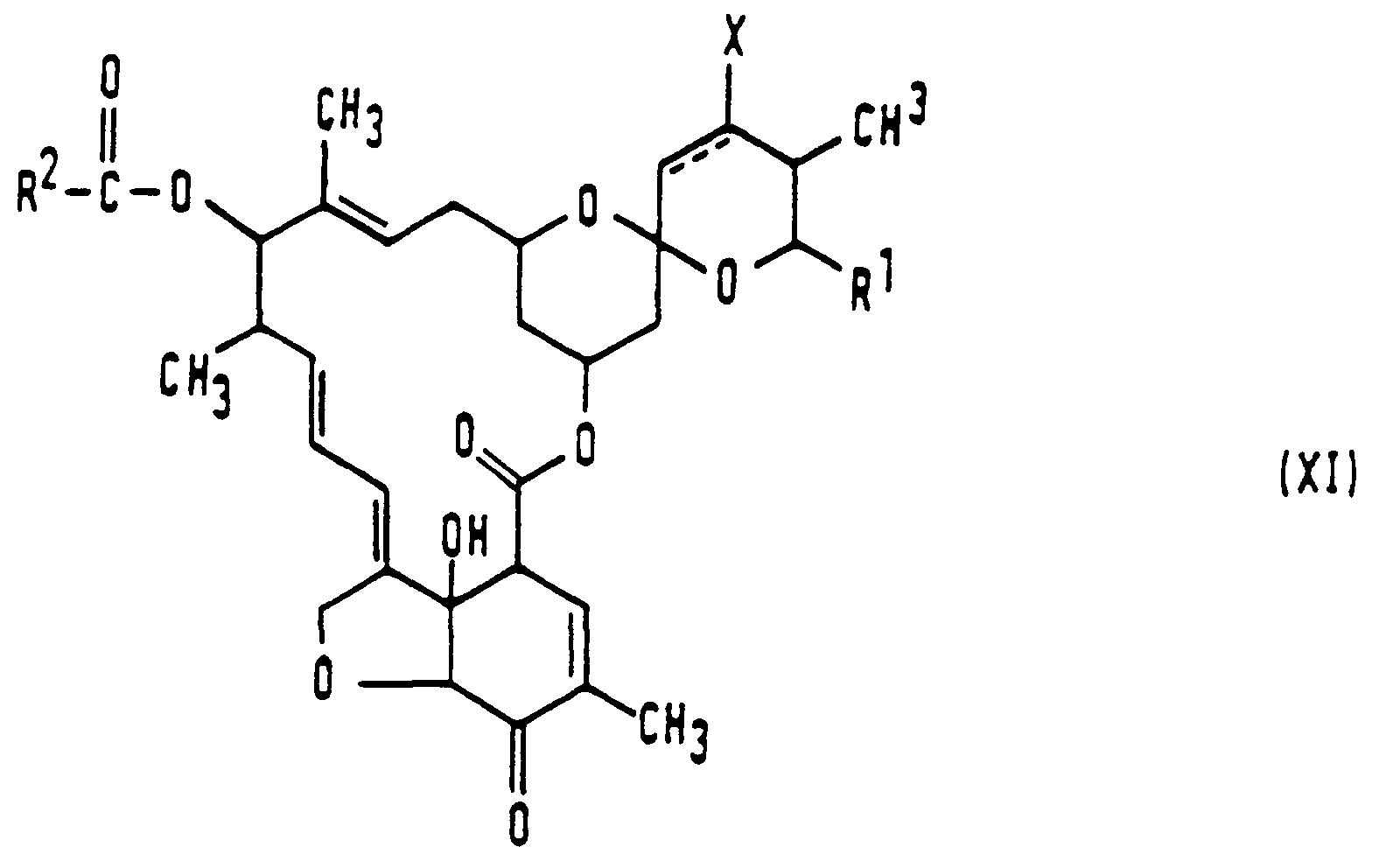


Priority Applications (1)
| Application Number | Priority Date | Filing Date | Title |
|---|---|---|---|
| AT87302494T ATE60336T1 (en) | 1986-03-25 | 1987-03-23 | MACROLID COMPOUNDS, THEIR PRODUCTION AND USE. |
Applications Claiming Priority (4)
| Application Number | Priority Date | Filing Date | Title |
|---|---|---|---|
| JP66315/86 | 1986-03-25 | ||
| JP6631586 | 1986-03-25 | ||
| JP137568/86 | 1986-06-13 | ||
| JP13756886 | 1986-06-13 |
Related Child Applications (1)
| Application Number | Title | Priority Date | Filing Date |
|---|---|---|---|
| EP89112109.7 Division-Into | 1989-07-03 |
Publications (3)
| Publication Number | Publication Date |
|---|---|
| EP0246739A2 EP0246739A2 (en) | 1987-11-25 |
| EP0246739A3 EP0246739A3 (en) | 1988-03-16 |
| EP0246739B1 true EP0246739B1 (en) | 1991-01-23 |
Family
ID=26407512
Family Applications (2)
| Application Number | Title | Priority Date | Filing Date |
|---|---|---|---|
| EP87302494A Expired - Lifetime EP0246739B1 (en) | 1986-03-25 | 1987-03-23 | Macrolide compounds, their preparation and their use |
| EP89112109A Expired - Lifetime EP0342710B1 (en) | 1986-03-25 | 1987-03-23 | Macrolide compounds, their preparation and their use |
Family Applications After (1)
| Application Number | Title | Priority Date | Filing Date |
|---|---|---|---|
| EP89112109A Expired - Lifetime EP0342710B1 (en) | 1986-03-25 | 1987-03-23 | Macrolide compounds, their preparation and their use |
Country Status (20)
| Country | Link |
|---|---|
| US (2) | US4963582A (en) |
| EP (2) | EP0246739B1 (en) |
| KR (1) | KR940009790B1 (en) |
| CN (2) | CN1022834C (en) |
| AR (1) | AR243191A1 (en) |
| AT (1) | ATE89560T1 (en) |
| AU (1) | AU592858B2 (en) |
| BR (1) | BR8701302A (en) |
| CA (1) | CA1317935C (en) |
| DE (2) | DE3767560D1 (en) |
| DK (1) | DK170046B1 (en) |
| ES (2) | ES2057027T3 (en) |
| FI (1) | FI95707C (en) |
| GR (1) | GR3001548T3 (en) |
| HU (1) | HU198496B (en) |
| IE (1) | IE61347B1 (en) |
| IL (1) | IL81997A (en) |
| NZ (1) | NZ219759A (en) |
| PT (1) | PT84549B (en) |
| RU (2) | RU2024527C1 (en) |
Families Citing this family (83)
| Publication number | Priority date | Publication date | Assignee | Title |
|---|---|---|---|---|
| EP0246739B1 (en) * | 1986-03-25 | 1991-01-23 | Sankyo Company Limited | Macrolide compounds, their preparation and their use |
| NZ221077A (en) * | 1986-07-18 | 1990-06-26 | Ciba Geigy Ag | 13b-alkyl milbemycins and use as parasiticides |
| GB8721371D0 (en) * | 1987-09-11 | 1987-10-21 | Glaxo Group Ltd | Chemical compounds |
| AU613521B2 (en) * | 1988-09-02 | 1991-08-01 | Sankyo Company Limited | 13-substituted milbemycin derivatives, their preparation and use |
| US5015630A (en) * | 1989-01-19 | 1991-05-14 | Merck & Co., Inc. | 5-oxime avermectin derivatives |
| NZ233680A (en) * | 1989-05-17 | 1995-02-24 | Beecham Group Plc | Avermectins and milbemycins and compositions thereof |
| JPH085894B2 (en) * | 1990-03-01 | 1996-01-24 | 三共株式会社 | Milbemycin ether derivative |
| DE4032147A1 (en) * | 1990-10-10 | 1992-04-16 | Bayer Ag | USE OF SUBSTITUTED 2-MERCAPTONICOTINSAEUREDERIVATES FOR THE CAPACITY OF ENDOPARASITES, NEW SUBSTITUTED 2-MERCAPTONICOTINSAEUREDERIVATES AND METHOD FOR THE PRODUCTION THEREOF |
| US5290804A (en) * | 1991-05-01 | 1994-03-01 | Merck & Co., Inc. | Anthelmintic milbemycin analogs of novel microorganisms |
| KR0171426B1 (en) * | 1991-12-18 | 1999-02-01 | 가와무라 요시부미 | 13- (substituted thio) acetoxymilbemycin derivatives, preparation method thereof and agrochemical use |
| US5345114A (en) * | 1992-10-15 | 1994-09-06 | Qiyuan Ma | Superconductor logic and switching circuits |
| US5614470A (en) * | 1994-04-01 | 1997-03-25 | Sankyo Company, Limited | 13-substituted milbemycin derivatives, their preparation and their use |
| DK0750907T3 (en) * | 1995-06-30 | 2002-07-08 | American Cyanamid Co | Stable vaccine preparations for parenteral administration, a method for their use and a method for their preparation |
| CZ288178B6 (en) * | 1995-09-29 | 2001-05-16 | Sankyo Co | Milbemycin-5-oxime derivatives substituted in position 13-, and their use |
| WO1999027906A1 (en) * | 1997-12-03 | 1999-06-10 | Merck & Co., Inc. | Long acting injectable formulations containing hydrogenated castor oil |
| AT501406A1 (en) * | 1997-12-23 | 2006-08-15 | Syngenta Participations Ag | METHOD FOR COMBATING MOLLUSKEN |
| PL342742A1 (en) * | 1998-03-06 | 2001-07-02 | Novartis Ag | Emulsion-type pre-concentrates containing cyclosporin or macrolyde |
| US6733767B2 (en) * | 1998-03-19 | 2004-05-11 | Merck & Co., Inc. | Liquid polymeric compositions for controlled release of bioactive substances |
| US6787342B2 (en) | 2000-02-16 | 2004-09-07 | Merial Limited | Paste formulations |
| CA2407611A1 (en) * | 2000-04-27 | 2001-11-08 | Sankyo Company, Limited | 13-substituted milbemycin derivatives, their preparation and their use against insects and other pests |
| CA2464403A1 (en) * | 2001-10-25 | 2003-05-01 | Sankyo Lifetech Company, Limited | Anthelmintic composition |
| US7001889B2 (en) * | 2002-06-21 | 2006-02-21 | Merial Limited | Anthelmintic oral homogeneous veterinary pastes |
| US20060205681A1 (en) * | 2002-06-21 | 2006-09-14 | Maryam Moaddeb | Homogenous paste formulations |
| US20040077703A1 (en) * | 2002-10-02 | 2004-04-22 | Soll Mark D. | Nodulisporic acid derivative spot-on formulations for combating parasites |
| US7531186B2 (en) * | 2003-12-17 | 2009-05-12 | Merial Limited | Topical formulations comprising 1-N-arylpyrazole derivatives and amitraz |
| US8362086B2 (en) | 2005-08-19 | 2013-01-29 | Merial Limited | Long acting injectable formulations |
| US20080027011A1 (en) * | 2005-12-20 | 2008-01-31 | Hassan Nached | Homogeneous paste and gel formulations |
| EP1849363A1 (en) * | 2006-03-09 | 2007-10-31 | Cheminova A/S | Synergistic combination of glutamate- and GABA-gated chloride agonist pesticide and at least one of Vitamin E or Niacin |
| AU2007269584B2 (en) | 2006-07-05 | 2012-05-03 | Boehringer Ingelheim Animal Health USA Inc. | 1-aryl-5-alkyl pyrazole derivative compounds, processes of making and methods of using thereof |
| KR100794258B1 (en) * | 2006-12-26 | 2008-01-11 | 삼성중공업 주식회사 | Transom Stern Structure of Ship to Reduce Harmonic Resistance |
| KR101472649B1 (en) | 2007-05-15 | 2014-12-16 | 메리얼 리미티드 | Aryloazol-2-yl cyanoethylamino compounds, method of making and method of using thereof |
| DK2222168T3 (en) | 2007-11-26 | 2018-12-03 | Merial Inc | SOLUTION SYSTEMS FOR POUR-ON FORMULAS TO FIGHT PARASITES |
| EP2237774B1 (en) | 2007-12-21 | 2016-06-22 | Merial Limited | THE USE OF 6-HALOGENO-(1,2,4)-TRIAZOLO-(1,5-a)-PYRIMIDINE COMPOUNDS FOR COMBATING PESTS IN AND ON ANIMALS |
| AU2009271299B2 (en) * | 2008-06-24 | 2014-09-11 | Boehringer Ingelheim Animal Health USA Inc. | Anthelminthic formulations |
| RS58508B1 (en) | 2008-11-14 | 2019-04-30 | Merial Inc | Enantiomerially enriched aryloazol-2-yl cyanoethylamino paraciticidal compounds |
| CN102271672B (en) | 2008-11-19 | 2015-02-04 | 梅里亚有限公司 | Compositions comprising 1-arylpyrazoles, alone or in combination with formamidines, for the treatment of parasitic infections |
| US9173728B2 (en) | 2008-11-19 | 2015-11-03 | Merial Inc. | Multi-cavity container having offset indentures for dispensing fluids |
| TWI457347B (en) | 2008-12-04 | 2014-10-21 | Merial Ltd | Dimeric avermectin and milbemycin derivatives |
| AU2010278948B2 (en) | 2009-07-30 | 2015-04-23 | Boehringer Ingelheim Animal Health USA Inc. | Insecticidal 4-Amino-thieno(2,3-d)-pyrimidine compounds and methods of their use |
| ES2546100T3 (en) | 2009-12-04 | 2015-09-18 | Merial, Inc. | Bis-organosulfurized pesticide compounds |
| WO2011075592A1 (en) | 2009-12-17 | 2011-06-23 | Merial Limited | Compositions comprising macrocyclic lactone compounds and spirodioxepinoindoles |
| UA108219C2 (en) | 2009-12-17 | 2015-04-10 | ANTI-PARASITER DIGIDROAZOLE COMPOUNDS AND COMPOSITION CONTAINING THEM (OPTIONS) | |
| UA108641C2 (en) | 2010-04-02 | 2015-05-25 | PARASITICID COMPOSITION CONTAINING FOUR ACTIVE AGENTS AND METHOD OF APPLICATION | |
| DK2568980T3 (en) | 2010-05-12 | 2015-11-30 | Merial Inc | INJECTABLE PARASITICIDE FORMULATIONS OF LEVAMISOL AND MACROCYCLIC LACTONS |
| NZ610547A (en) | 2010-11-16 | 2015-07-31 | Merial Ltd | Novel monensin derivatives for the treatment and prevention of protozoal infections |
| WO2012078605A1 (en) | 2010-12-07 | 2012-06-14 | Merial Limited | Topical combination formulations of macrocyclic lactones with synthetic pyrethroids |
| WO2013003168A1 (en) | 2011-06-27 | 2013-01-03 | Merial Limited | Novel insect-repellent coumarin derivatives, syntheses, and methods of use |
| CN103717573B (en) | 2011-06-27 | 2016-02-24 | 梅里亚股份有限公司 | Amido-pyridyl ether compounds and compositions and their use against parasites |
| DK3172964T3 (en) | 2011-09-12 | 2020-11-30 | Boehringer Ingelheim Animal Health Usa Inc | PARASITIC COMPOSITIONS CONTAINING AN ISOXAZOLINE ACTIVE SUBSTANCE, PROCEDURE AND USES |
| WO2013044118A2 (en) | 2011-09-23 | 2013-03-28 | Merial Limited | Indirect modeling of new repellent molecules active against insects, acarids, and other arthropods |
| KR102066757B1 (en) | 2011-11-17 | 2020-01-15 | 뵈링거 잉겔하임 애니멀 헬스 유에스에이 인코포레이티드 | Compositions comprising an aryl pyrazole and a substituted imidazole, methods and uses thereof |
| WO2013082373A1 (en) | 2011-12-02 | 2013-06-06 | Merial Limited | Long-acting injectable moxidectin formulations and novel moxidectin crystal forms |
| RU2763496C2 (en) | 2012-02-06 | 2021-12-29 | БЁРИНГЕР ИНГЕЛЬХАЙМ ЭНИМАЛ ХЕЛТ ЮЭсЭй ИНК. | Parasiticidal oral veterinary compositions including systematically acting active agents, methods and application of these compositions and methods |
| JO3626B1 (en) | 2012-02-23 | 2020-08-27 | Merial Inc | Topical formulations containing fipronil and permethrin and how to use them |
| MX345971B (en) | 2012-04-20 | 2017-02-28 | Merial Ltd | Parasiticidal compositions comprising benzimidazole derivatives, methods and uses thereof. |
| AU2013348175B2 (en) | 2012-11-20 | 2016-11-17 | Boehringer Ingelheim Animal Health USA Inc. | Anthelmintic compounds and compositions and method of using thereof |
| HUE039467T2 (en) | 2013-01-31 | 2019-01-28 | Merial Inc | Method for treating and curing leishmaniosis using fexinindazole |
| AU2014342241B2 (en) | 2013-11-01 | 2017-09-14 | Boehringer Ingelheim Animal Health USA Inc. | Antiparasitic and pesticidal isoxazoline compounds |
| CN106455560B (en) | 2014-04-17 | 2020-12-22 | 勃林格殷格翰动物保健美国公司 | Use of malononitrile compounds for protecting animals from parasites |
| CA2949511A1 (en) | 2014-05-19 | 2015-11-26 | Merial, Inc. | Anthelmintic compounds |
| ES2723969T3 (en) | 2014-06-19 | 2019-09-04 | Merial Inc | Parasiticidal compositions comprising indole derivatives, procedures and uses thereof |
| EP3211998B1 (en) | 2014-10-31 | 2021-04-07 | Boehringer Ingelheim Animal Health USA Inc. | Parasiticidal composition comprising fipronil |
| UY36570A (en) | 2015-02-26 | 2016-10-31 | Merial Inc | INJECTABLE FORMULATIONS OF PROLONGED ACTION THAT INCLUDE AN ISOXAZOLINE ACTIVE AGENT, METHODS AND USES OF THE SAME |
| WO2016164487A1 (en) | 2015-04-08 | 2016-10-13 | Merial, Inc. | Extended release injectable formulations comprising an isoxazoline active agent, methods and uses thereof |
| HUE055535T2 (en) | 2015-05-20 | 2021-12-28 | Boehringer Ingelheim Animal Health Usa Inc | Anthelmintic depsipeptide compounds |
| AU2016267047A1 (en) | 2015-05-27 | 2017-12-21 | Merial, Inc. | Compositions containing antimicrobial IgY antibodies, for treatment and prevention of disorders and diseases caused by oral health compromising (OHC) microorganisms |
| UY37137A (en) | 2016-02-24 | 2017-09-29 | Merial Inc | ANTIPARASITARY COMPOUNDS OF ISOXAZOLINE, INJECTABLE FORMULATIONS OF PROLONGED ACTION THAT INCLUDE THEM, METHODS AND USES OF THE SAME |
| WO2018039508A1 (en) | 2016-08-25 | 2018-03-01 | Merial, Inc. | Method for reducing unwanted effects in parasiticidal treatments |
| CN110381738B (en) | 2016-10-14 | 2021-07-16 | 勃林格殷格翰动物保健美国公司 | Pesticidal and parasiticidal vinylisoxazoline compounds |
| JP2020504710A (en) | 2016-11-16 | 2020-02-13 | ベーリンガー インゲルハイム アニマル ヘルス ユーエスエイ インコーポレイテッド | Anthelmintic depsipeptide compounds |
| CN107082784B (en) * | 2017-04-10 | 2019-08-09 | 中国农业大学 | A polyclonal antibody for detecting moxidectin and its preparation method and application |
| WO2019005700A1 (en) | 2017-06-26 | 2019-01-03 | Merial, Inc. | Dual active parasiticidal granule compositions, methods and uses thereof |
| JP2020530850A (en) | 2017-08-14 | 2020-10-29 | ベーリンガー インゲルハイム アニマル ヘルス ユーエスエイ インコーポレイテッド | Pesticides and parasites Pyrazole-isoxazoline compounds |
| WO2019157241A1 (en) | 2018-02-08 | 2019-08-15 | Boehringer Ingelheim Animal Health USA Inc. | Parasiticidal compositions comprising eprinomectin and praziquantel, methods and uses thereof |
| IL279977B2 (en) | 2018-07-09 | 2024-06-01 | Boehringer Ingelheim Animal Health Usa Inc | Anthelminthic heterocyclic compounds |
| EP3883648A1 (en) | 2018-11-20 | 2021-09-29 | Boehringer Ingelheim Animal Health USA Inc. | Indazolylcyanoethylamino compound, compositions of same, method of making, and methods of using thereof |
| CN109851648A (en) * | 2019-01-11 | 2019-06-07 | 南开大学 | A kind of synthesis and application of derivative of macrolides |
| WO2020150032A1 (en) | 2019-01-16 | 2020-07-23 | Boehringer Ingelheim Animal Health USA Inc. | Topical compositions comprising a neonicotinoid and a macrocyclic lactone, methods and uses thereof |
| WO2020180635A1 (en) | 2019-03-01 | 2020-09-10 | Boehringer Ingelheim Animal Health USA Inc. | Injectable clorsulon compositions, methods and uses thereof |
| WO2020191091A1 (en) | 2019-03-19 | 2020-09-24 | Boehringer Ingelheim Animal Health USA Inc. | Anthelmintic aza-benzothiophene and aza-benzofuran compounds |
| AU2020316642B2 (en) | 2019-07-22 | 2025-10-23 | Intervet International B.V. | Soft chewable veterinary dosage form |
| US11964977B2 (en) | 2020-05-29 | 2024-04-23 | Boehringer Ingelheim Animal Health USA Inc. | Anthelmintic heterocyclic compounds |
| US12161089B2 (en) | 2020-12-21 | 2024-12-10 | Boehringer Ingelheim Animal Health USA Inc. | Parasiticidal collar comprising isoxazoline compounds |
Family Cites Families (13)
| Publication number | Priority date | Publication date | Assignee | Title |
|---|---|---|---|---|
| US4093629A (en) * | 1977-04-11 | 1978-06-06 | Merck & Co., Inc. | Derivatives of antibiotic substance milbemycin and processes therefor |
| NZ188459A (en) * | 1977-10-03 | 1982-09-07 | Merck & Co Inc | Derivatives of c-076 compounds and pesticidal compositions |
| US4201861A (en) * | 1977-10-03 | 1980-05-06 | Merck & Co., Inc. | Acyl derivatives of C-076 compounds |
| PH15982A (en) * | 1977-10-03 | 1983-05-18 | Merck & Co Inc | Selective hydrogenation producta of c-076 compounds and derivatives thereof |
| US4200581A (en) * | 1978-08-04 | 1980-04-29 | Merck & Co., Inc. | Alkyl derivatives of C-076 compounds |
| US4423209A (en) * | 1982-02-26 | 1983-12-27 | Merck & Co., Inc. | Processes for the interconversion of avermectin compounds |
| JPS59108785A (en) * | 1982-11-25 | 1984-06-23 | Sankyo Co Ltd | 5-oxime derivatives of milbemycins |
| US4579864A (en) * | 1984-06-11 | 1986-04-01 | Merck & Co., Inc. | Avermectin and milbemycin 13-keto, 13-imino and 13-amino derivatives |
| AU574852B2 (en) * | 1984-10-26 | 1988-07-14 | Sankyo Company Limited | 13 - acyloxy - 5 - ketomilbemycin derivatives and preparation of 13 - hydroxy - 5 - ketomilbemycin derivatives |
| GB2168345B (en) * | 1984-12-14 | 1988-05-25 | Ciba Geigy Ag | Pesticidal 13b-substituted milbemycin derivatives |
| JPS6289685A (en) * | 1985-05-31 | 1987-04-24 | Sankyo Co Ltd | 13-halogenomilbemycin derivative |
| EP0246739B1 (en) * | 1986-03-25 | 1991-01-23 | Sankyo Company Limited | Macrolide compounds, their preparation and their use |
| KR0171426B1 (en) * | 1991-12-18 | 1999-02-01 | 가와무라 요시부미 | 13- (substituted thio) acetoxymilbemycin derivatives, preparation method thereof and agrochemical use |
-
1987
- 1987-03-23 EP EP87302494A patent/EP0246739B1/en not_active Expired - Lifetime
- 1987-03-23 AR AR87307084A patent/AR243191A1/en active
- 1987-03-23 DE DE8787302494T patent/DE3767560D1/en not_active Expired - Fee Related
- 1987-03-23 RU SU874202364A patent/RU2024527C1/en not_active IP Right Cessation
- 1987-03-23 ES ES89112109T patent/ES2057027T3/en not_active Expired - Lifetime
- 1987-03-23 ES ES87302494T patent/ES2019932B3/en not_active Expired - Lifetime
- 1987-03-23 DE DE8989112109T patent/DE3785936T2/en not_active Expired - Fee Related
- 1987-03-23 BR BR8701302A patent/BR8701302A/en not_active IP Right Cessation
- 1987-03-23 EP EP89112109A patent/EP0342710B1/en not_active Expired - Lifetime
- 1987-03-23 AT AT89112109T patent/ATE89560T1/en not_active IP Right Cessation
- 1987-03-24 IL IL8199787A patent/IL81997A/en not_active IP Right Cessation
- 1987-03-24 AU AU70607/87A patent/AU592858B2/en not_active Ceased
- 1987-03-24 PT PT84549A patent/PT84549B/en not_active IP Right Cessation
- 1987-03-24 KR KR1019870002706A patent/KR940009790B1/en not_active Expired - Fee Related
- 1987-03-24 FI FI871294A patent/FI95707C/en not_active IP Right Cessation
- 1987-03-24 HU HU871291A patent/HU198496B/en not_active IP Right Cessation
- 1987-03-24 IE IE76087A patent/IE61347B1/en not_active IP Right Cessation
- 1987-03-24 DK DK149987A patent/DK170046B1/en not_active IP Right Cessation
- 1987-03-24 NZ NZ219759A patent/NZ219759A/en unknown
- 1987-03-24 CN CN87103559A patent/CN1022834C/en not_active Expired - Fee Related
- 1987-03-24 CA CA000532820A patent/CA1317935C/en not_active Expired - Fee Related
- 1987-03-24 US US07/030,217 patent/US4963582A/en not_active Expired - Lifetime
-
1991
- 1991-03-05 GR GR91400269T patent/GR3001548T3/en unknown
-
1992
- 1992-11-13 CN CN92113159A patent/CN1028864C/en not_active Expired - Fee Related
-
1993
- 1993-04-27 RU RU9393004773A patent/RU2049785C1/en not_active IP Right Cessation
- 1993-10-08 US US08/133,776 patent/US5405867A/en not_active Expired - Fee Related
Also Published As
Similar Documents
| Publication | Publication Date | Title |
|---|---|---|
| EP0246739B1 (en) | Macrolide compounds, their preparation and their use | |
| US4547520A (en) | 5-Oxime derivatives of milbemycins and veterinary and agricultural use thereof | |
| CA2037411C (en) | Milbemycin ether derivatives | |
| US4945105A (en) | 13-Halomilbemycin derivatives, their preparation and compositions containing them | |
| US4760054A (en) | Milbemycin 5-carbonate derivatives and compositions containing them | |
| US4912090A (en) | Antiparasitic milbemycin and avermectin derivatives | |
| EP0552817B1 (en) | Milbemycin ether derivatives, their preparation and their therapeutic and agrochemical uses | |
| HK1010456B (en) | Milbemycin ether derivatives, their preparation and their therapeutic and agrochemical uses | |
| HK1005725B (en) | Milbemycin ether derivatives, their preparation and their therapeutic and agrochemical uses | |
| IE930731L (en) | Macrolide compounds, their preparation and their use | |
| PH26231A (en) | Macrolide compounds their preparation and their use | |
| HK1006310B (en) | Milbemycin ether derivatives, their preparation and their anthelmintic uses |
Legal Events
| Date | Code | Title | Description |
|---|---|---|---|
| PUAI | Public reference made under article 153(3) epc to a published international application that has entered the european phase |
Free format text: ORIGINAL CODE: 0009012 |
|
| AK | Designated contracting states |
Kind code of ref document: A2 Designated state(s): AT BE CH DE ES FR GB GR IT LI LU NL SE |
|
| PUAL | Search report despatched |
Free format text: ORIGINAL CODE: 0009013 |
|
| AK | Designated contracting states |
Kind code of ref document: A3 Designated state(s): AT BE CH DE ES FR GB GR IT LI LU NL SE |
|
| 17P | Request for examination filed |
Effective date: 19880720 |
|
| 17Q | First examination report despatched |
Effective date: 19890322 |
|
| GRAA | (expected) grant |
Free format text: ORIGINAL CODE: 0009210 |
|
| AK | Designated contracting states |
Kind code of ref document: B1 Designated state(s): AT BE CH DE ES FR GB GR IT LI LU NL SE |
|
| REF | Corresponds to: |
Ref document number: 60336 Country of ref document: AT Date of ref document: 19910215 Kind code of ref document: T |
|
| XX | Miscellaneous (additional remarks) |
Free format text: TEILANMELDUNG 89112109.7 EINGEREICHT AM 23/03/87. |
|
| REF | Corresponds to: |
Ref document number: 3767560 Country of ref document: DE Date of ref document: 19910228 |
|
| ET | Fr: translation filed | ||
| ITF | It: translation for a ep patent filed | ||
| PLBE | No opposition filed within time limit |
Free format text: ORIGINAL CODE: 0009261 |
|
| STAA | Information on the status of an ep patent application or granted ep patent |
Free format text: STATUS: NO OPPOSITION FILED WITHIN TIME LIMIT |
|
| 26N | No opposition filed | ||
| REG | Reference to a national code |
Ref country code: GR Ref legal event code: FG4A Free format text: 3001548 |
|
| EPTA | Lu: last paid annual fee | ||
| EAL | Se: european patent in force in sweden |
Ref document number: 87302494.7 |
|
| REG | Reference to a national code |
Ref country code: GB Ref legal event code: IF02 |
|
| PGFP | Annual fee paid to national office [announced via postgrant information from national office to epo] |
Ref country code: SE Payment date: 20020306 Year of fee payment: 16 |
|
| PGFP | Annual fee paid to national office [announced via postgrant information from national office to epo] |
Ref country code: AT Payment date: 20020313 Year of fee payment: 16 |
|
| PGFP | Annual fee paid to national office [announced via postgrant information from national office to epo] |
Ref country code: LU Payment date: 20020404 Year of fee payment: 16 |
|
| PGFP | Annual fee paid to national office [announced via postgrant information from national office to epo] |
Ref country code: FR Payment date: 20030310 Year of fee payment: 17 |
|
| PGFP | Annual fee paid to national office [announced via postgrant information from national office to epo] |
Ref country code: GB Payment date: 20030319 Year of fee payment: 17 |
|
| PG25 | Lapsed in a contracting state [announced via postgrant information from national office to epo] |
Ref country code: LU Free format text: LAPSE BECAUSE OF NON-PAYMENT OF DUE FEES Effective date: 20030323 Ref country code: AT Free format text: LAPSE BECAUSE OF NON-PAYMENT OF DUE FEES Effective date: 20030323 |
|
| PG25 | Lapsed in a contracting state [announced via postgrant information from national office to epo] |
Ref country code: SE Free format text: LAPSE BECAUSE OF NON-PAYMENT OF DUE FEES Effective date: 20030324 |
|
| PGFP | Annual fee paid to national office [announced via postgrant information from national office to epo] |
Ref country code: NL Payment date: 20030327 Year of fee payment: 17 Ref country code: GR Payment date: 20030327 Year of fee payment: 17 |
|
| PGFP | Annual fee paid to national office [announced via postgrant information from national office to epo] |
Ref country code: ES Payment date: 20030328 Year of fee payment: 17 |
|
| PGFP | Annual fee paid to national office [announced via postgrant information from national office to epo] |
Ref country code: CH Payment date: 20030331 Year of fee payment: 17 |
|
| PGFP | Annual fee paid to national office [announced via postgrant information from national office to epo] |
Ref country code: DE Payment date: 20030403 Year of fee payment: 17 |
|
| PGFP | Annual fee paid to national office [announced via postgrant information from national office to epo] |
Ref country code: BE Payment date: 20030514 Year of fee payment: 17 |
|
| EUG | Se: european patent has lapsed | ||
| PG25 | Lapsed in a contracting state [announced via postgrant information from national office to epo] |
Ref country code: GB Free format text: LAPSE BECAUSE OF NON-PAYMENT OF DUE FEES Effective date: 20040323 |
|
| PG25 | Lapsed in a contracting state [announced via postgrant information from national office to epo] |
Ref country code: ES Free format text: LAPSE BECAUSE OF NON-PAYMENT OF DUE FEES Effective date: 20040324 |
|
| PG25 | Lapsed in a contracting state [announced via postgrant information from national office to epo] |
Ref country code: LI Free format text: LAPSE BECAUSE OF NON-PAYMENT OF DUE FEES Effective date: 20040331 Ref country code: CH Free format text: LAPSE BECAUSE OF NON-PAYMENT OF DUE FEES Effective date: 20040331 Ref country code: BE Free format text: LAPSE BECAUSE OF NON-PAYMENT OF DUE FEES Effective date: 20040331 |
|
| BERE | Be: lapsed |
Owner name: *SANKYO CY LTD Effective date: 20040331 |
|
| PG25 | Lapsed in a contracting state [announced via postgrant information from national office to epo] |
Ref country code: NL Free format text: LAPSE BECAUSE OF NON-PAYMENT OF DUE FEES Effective date: 20041001 Ref country code: DE Free format text: LAPSE BECAUSE OF NON-PAYMENT OF DUE FEES Effective date: 20041001 |
|
| PG25 | Lapsed in a contracting state [announced via postgrant information from national office to epo] |
Ref country code: GR Free format text: LAPSE BECAUSE OF NON-PAYMENT OF DUE FEES Effective date: 20041006 |
|
| GBPC | Gb: european patent ceased through non-payment of renewal fee |
Effective date: 20040323 |
|
| REG | Reference to a national code |
Ref country code: CH Ref legal event code: PL |
|
| PG25 | Lapsed in a contracting state [announced via postgrant information from national office to epo] |
Ref country code: FR Free format text: LAPSE BECAUSE OF NON-PAYMENT OF DUE FEES Effective date: 20041130 |
|
| NLV4 | Nl: lapsed or anulled due to non-payment of the annual fee |
Effective date: 20041001 |
|
| REG | Reference to a national code |
Ref country code: FR Ref legal event code: ST |
|
| PG25 | Lapsed in a contracting state [announced via postgrant information from national office to epo] |
Ref country code: IT Free format text: LAPSE BECAUSE OF NON-PAYMENT OF DUE FEES;WARNING: LAPSES OF ITALIAN PATENTS WITH EFFECTIVE DATE BEFORE 2007 MAY HAVE OCCURRED AT ANY TIME BEFORE 2007. THE CORRECT EFFECTIVE DATE MAY BE DIFFERENT FROM THE ONE RECORDED. Effective date: 20050323 |
|
| REG | Reference to a national code |
Ref country code: ES Ref legal event code: FD2A Effective date: 20040324 |