EP0246087A2 - Chirurgische Klammer - Google Patents
Chirurgische Klammer Download PDFInfo
- Publication number
- EP0246087A2 EP0246087A2 EP19870304255 EP87304255A EP0246087A2 EP 0246087 A2 EP0246087 A2 EP 0246087A2 EP 19870304255 EP19870304255 EP 19870304255 EP 87304255 A EP87304255 A EP 87304255A EP 0246087 A2 EP0246087 A2 EP 0246087A2
- Authority
- EP
- European Patent Office
- Prior art keywords
- jaws
- jaw
- clip according
- clip
- teeth
- Prior art date
- Legal status (The legal status is an assumption and is not a legal conclusion. Google has not performed a legal analysis and makes no representation as to the accuracy of the status listed.)
- Withdrawn
Links
Images

Classifications
-
- A—HUMAN NECESSITIES
- A61—MEDICAL OR VETERINARY SCIENCE; HYGIENE
- A61F—FILTERS IMPLANTABLE INTO BLOOD VESSELS; PROSTHESES; DEVICES PROVIDING PATENCY TO, OR PREVENTING COLLAPSING OF, TUBULAR STRUCTURES OF THE BODY, e.g. STENTS; ORTHOPAEDIC, NURSING OR CONTRACEPTIVE DEVICES; FOMENTATION; TREATMENT OR PROTECTION OF EYES OR EARS; BANDAGES, DRESSINGS OR ABSORBENT PADS; FIRST-AID KITS
- A61F6/00—Contraceptive devices; Pessaries; Applicators therefor
- A61F6/20—Vas deferens occluders; Fallopian occluders
- A61F6/206—Clamps
Definitions
- the present invention relates to surgical clips for occluding bodily ducts, and, in particular to clips for performing sexual sterilization comprising two rigid jaws hinged together to form a mouth for receiving a bodily duct to be occluded by closing the jaws
- a design of clip must satisfy various medical requirements if it is to be successful. The following are among the most important of these requirements.
- the clip must overcome the tendency of the Fallopian tube to escape from the clip during the application process.
- a second requirement is that application of the clip be atraumatic, that is rupture of blood vessels in the mesosalpinx is avoided.
- the mesosalpinx is a sheet of tissue containing blood vessels for supplying the Fallopian tube, which runs along one edge of the sheet. Rupturing of the mesosalpinx blood vessels, causing bleeding, could occur either as a result of a flaw in the design of the clip, or as a result of insufficiently careful application.
- the clip must meet the normal medical requirements of non-toxicity and should also be effective against recanalization (re-opening) of the Fallopian tube after the clip has been applied.
- a principle cause of recanalization is necrosis of the muscular tissue surrounding the lumen of the Fallopian tube. As necrosis occurs, the thickness of this tissue may decrease, so allowing the lumen to expand and reopen, and allowing gametes to pass once more along the lumen. Recanalization caused by the clip falling off after application must also be prevented.
- the invention provides a surgical clip characterized in that it comprises one or more teeth at the free end of the jaws, the teeth and the jaws being so arranged and dimensioned that the teeth on the respective jaws mesh with one another to prevent the duct moving out from between the jaws longitudinally thereof when the jaws are fully closed.
- the invention provides a surgical clip characterized in that it comprises a trapping member resiliently biassed away from one jaw and towards the other jaw, to restrict the opening of the mouth, whereby the trapping member and the other jaw trap a duct within the mouth in the moment before the jaws are fully closed.
- the catch mechanism is located in the vicinity of the hinge.
- the location of the catch mechanism in the vicinity of the hinge ensures that there is no danger of the elements of the catch mechanism engaging the mesosalpinx and causing trauma.
- the regions of the jaws remote from the catch mechanism which do engage tissue can be designed primarily with a view to avoiding bleeding.
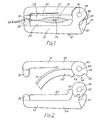
- Fig. 1 shows a surgical clip 10 for performing sexual sterilization.
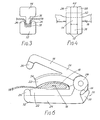
- the clip comprises two jaws 12,14 connected by a hinge 16 and movable between an open position (Fig. 5) in which a Fallopian tube 18 may be introduced between the jaws, and a closed position (Fig. 1) in which a tube so introduced is occluded by the jaws.
- Each jaw has moulded on it a resilient lining 22.
- the clip 10 further comprises a catch mechanism 20 located in the vicinity of the hinge 16 and which engages, upon the jaws 12,14 reaching their closed position, to lock the jaws in that position.
- the jaws are shown separated in Fig. 2.
- the bottom jaw 12 comprises a rigid shank 24.
- Two teeth 26 are formed at one end of the shank 24 and integrally therewith.
- the teeth 26 project in a direction generally perpendicular to the shank 24, towards the top jaw 14 in the assembled clip.
- the teeth 26 have smooth surfaces and rounded edges, to reduce the risk of damage to tissue.
- the top jaw 14 also comprises a rigid shank 34.
- a single tooth 36 is integrally formed at one end of the shank 34, projecting in a direction generally perpendicular to the shank 34.
- the tooth 36 has a smooth surface and rounded edges. In the assembled clip, the tooth 36 projects towards the first jaw 12. In the closed position of the clip, Fig. 3, the tooth 36 lies between, or is "interdigitated” with the teeth 26.
- the dimensions of the teeth 26,36 are chosen so that a channel of finite width 38 exists between the interdigitated teeth.
- the channel 38 allows the mesosalpinx to be located between the teeth 26,36, in the channel 38, with a low risk of its being punctured or ruptured.
- a single, generally disc-like extension 42 is provided, integral with the shank 34.
- the disc is provided with a hole 44 for receiving the pivot pin 52 of the hinge 16.
- the edge, or circumferential surface 46 of the disc 42 forms part of the catch mechanism 20.
- the surface 46 has a discontinuity 48 in the form of a step with a lip 50.
- the step surface 48 runs generally radially with respect to the axis of the hole 44, from the lip 50.
- the radius of the surface 46 from the hole 44 gradually decreases away from the lip 50 in an anti-clockwise direction as seen in Fig. 2.
- the disc 42 lies between the discs 28 (Fig. 4).
- a pivot pin 52 is located in the holes 32, 44 and allows the disc 42 to rotate relative to the discs 28 about the axis of the holes 32,44, but prevents other relative movement.
- a rounded stop 64 is formed on the jaw 12 between discs 28 (See Figure 2). The stop 64 engages the lip 50 on the jaw 14 to restrict the movement of the jaws 14 and thus to determine the maximum degree of opening of jaw 14 with respect to jaw 12.
- the finger 30 rides over the surface 46 in a relationship determined by the angle between the jaws 12,14.
- the jaw 14 has a resilient springy tongue 54.
- the tongue 54 is a relatively long, thin strip of resilient material which is integral at one end with the shank 34, and also has a free portion. The free portion is pre-formed to curve away from the shank 34, so that when the clip is open (Fig. 5), the end of the tongue 54 nearest the mouth 40 is spaced significantly from the jaw 14 in a direction towards the jaw 12. Accordingly, the resilient lining carried by the tongue 54 partially restricts the opening 40 even when the clip is open.
- the Fallopian tube 18, including the lumen 56 and mesosalpinx 58 are placed in the mouth 40 formed between the jaws 12, 14.
- the tube 18 then occupies a plane generally perpendicular to the plane of the jaws 12,14.
- the tube 18 is free to move in and out of the mouth 40, although the tongue 54 and teeth 26,36 partially restrict the mouth 40.
- the finger 30 is outside but is spaced from the surface 46.
- a second and final check on the movement is provided by the teeth 26,36 as the jaws 12 and 14 move further towards one another, that is, towards the position shown in Figures 1 and 3.
- the jaws 12,14, the teeth 26,36, and the hinge provide a loop which surrounds the Fallopian tube and retains it in the mouth.
- the mesosalpinx will begin to deform in the region of the teeth 26,36 so as to occupy the channel 38 which forms between the teeth as they interdigitate.
- the width of the channel 38 and the rounded smoothness of the teeth ensures that there is little risk of the teeth rupturing the blood vessels of the mesosalpinx as the jaws close.
- the surface 46 has rotated relative to the finger 30.
- the changing radius of the surface 46 provides a cam profile which causes the finger 30 to be deformed as the rotation progresses. This causes a bias to exist between the surfaces, by virtue of the resilience of the finger. The maximum deformation and bias occurs just before the jaws reach their final position, when the finger 30 is at its outermost position, forced out by the lip 50.
- a region 60 of the lining extends to form two projecting studs 62, near the hinge, is compressed by the jaws as they close, and biasses them to their open position.
- any further closing movement causes the finger to move past the lip 50.
- Contact between the surface 46 and the finger 30 then ceases and the finger 30 relaxes to its natural shape, simultaneously dropping down the step discontinuity 48.
- This causes some further closing movement to the fully closed position shown in Fig. 1.
- the lumen 56 is fully occluded.
- the lining 22 is under compression, to compensate for subsequent muscular necrosis.
- the resilient tongue 54 folds back almost completely against the rigid shank 34 and its trapping function is then taken over largely by the interdigitating teeth 26,36.
- the mesosalpinx is folded to occupy the channel 38 (see Figure 3).
- the catch mechanism 20 is engaged to lock the jaws in the fully closed position.
- the locking arises because the finger 30 cannot rise up to the lip 50, to run on the surface 46, unless the finger is deformed against its resilience. No means exist to provide this deformation unless the catch is deliberately interfered with. Accordingly, if the jaws 12,14 remain closed when the closing force on them is released, the surgeon can be confident that the clip has been fully closed.
- the interdigitated teeth prevent the tube escaping from the mouth.
- the catch mechanism 20 serves to retain the jaws in the fully closed position against the outward biassing provided by the resilient linings 22 which is under compression.
- the jaws of the clip once it is in place, do not exert any compressive force on the duct (other than the relatively gentle force exerted by the resilient linings 22).
- This arrangement permits the teeth 26 and 36 to interdigitate loosely transversely of the pivot pin 16 so that the mesosalpinx can pass easily between them without trauma.
- the clip described is intended to be manufactured from mouldable materials which lend themselves to mass production methods.
- the jaws and tongue may be made from a polycarbonate plastics material. Jaws made from plastics materials can relatively easily be moulded to have smooth surfaces and rounded edges, and so be substantially atraumatic in use.
- the lining 22 may be moulded onto each of the jaws after they have themselves been formed by moulding. Alternatively, the lining may be moulded separately and subsequently attached to the jaws.
- the lining may be silicone rubber, in which case it may be moulded under the influences of heat and pressure.
- the pivot pin 52 may be 'commercially pure' titanium, for instance. Titanium has the additional advantage that it is of low toxicity. Alternatively, the pin 52 may be of "Lexan” which is also of low toxicity.
- the clip may be used in male or female sterilization.
- jaws about 15 mm long, about 3 mm wide and about 7 mm high, when closed, could be used.
- substantially smaller clips could be used to occlude the vas deferens.
- the clip described can be applied by means of a simple applicator which enables a closing force to be applied remotely to a clip mounted in the applicator. Only a small closing force is required. It is envisaged that the clip would be mounted in the applicator so that the jaw 12 rests on a fixed surface, and the closing force is applied by a movable member to the jaw 14. If the closing force is removed before the clip is fully closed, the jaws will reopen, because of the dual biassing described above. Furthermore, the biassing can be used to retain the clip in the applicator until it has been closed. With a simple applicator the Fallopian tube (or vas deferens) can normally be drawn out of an incision and the clip applied externally. If a laparoscope is used a more complex applicator will be needed.
- the clip described has two mechanisms for retaining a bodily duct within the mouth of the clip. In practice it is conceivable that the use of only one would be satisfactory.
Landscapes
- Health & Medical Sciences (AREA)
- Reproductive Health (AREA)
- Engineering & Computer Science (AREA)
- Biomedical Technology (AREA)
- Heart & Thoracic Surgery (AREA)
- Vascular Medicine (AREA)
- Life Sciences & Earth Sciences (AREA)
- Animal Behavior & Ethology (AREA)
- General Health & Medical Sciences (AREA)
- Public Health (AREA)
- Veterinary Medicine (AREA)
- Surgical Instruments (AREA)
- Orthopedics, Nursing, And Contraception (AREA)
- Prostheses (AREA)
Applications Claiming Priority (2)
| Application Number | Priority Date | Filing Date | Title |
|---|---|---|---|
| GB868611865A GB8611865D0 (en) | 1986-05-15 | 1986-05-15 | Surgical clip |
| GB8611865 | 1986-05-15 |
Publications (2)
| Publication Number | Publication Date |
|---|---|
| EP0246087A2 true EP0246087A2 (de) | 1987-11-19 |
| EP0246087A3 EP0246087A3 (de) | 1988-07-20 |
Family
ID=10597914
Family Applications (1)
| Application Number | Title | Priority Date | Filing Date |
|---|---|---|---|
| EP87304255A Withdrawn EP0246087A3 (de) | 1986-05-15 | 1987-05-13 | Chirurgische Klammer |
Country Status (6)
| Country | Link |
|---|---|
| EP (1) | EP0246087A3 (de) |
| JP (1) | JPS62281937A (de) |
| CN (1) | CN1011194B (de) |
| CA (1) | CA1267342A (de) |
| GB (1) | GB8611865D0 (de) |
| IN (1) | IN169327B (de) |
Cited By (12)
| Publication number | Priority date | Publication date | Assignee | Title |
|---|---|---|---|---|
| GB2226958A (en) * | 1986-05-10 | 1990-07-18 | Femcare Ltd | Sexual sterilisation device |
| GB2243789A (en) * | 1990-05-12 | 1991-11-13 | Femcare Ltd | Sterilisation clips |
| FR2661820A1 (fr) * | 1990-05-12 | 1991-11-15 | Femcare Ltd | Clip de sterilisation. |
| GB2244757A (en) * | 1987-11-10 | 1991-12-11 | Casey Medical Prod | Surgical clip |
| GB2251794A (en) * | 1991-01-16 | 1992-07-22 | Donn Casey | Surgical clip |
| RU2196530C1 (ru) * | 2001-11-20 | 2003-01-20 | Феденко Вадим Викторович | Зажим для имплантации |
| WO2004080314A1 (en) * | 2003-03-14 | 2004-09-23 | Andrew Michael Wild | Surgical clip |
| US9955977B2 (en) | 2009-12-22 | 2018-05-01 | Cook Medical Technologies Llc | Medical devices with detachable pivotable jaws |
| US9987018B2 (en) | 2009-12-22 | 2018-06-05 | Cook Medical Technologies Llc | Medical devices with detachable pivotable jaws |
| US10010336B2 (en) | 2009-12-22 | 2018-07-03 | Cook Medical Technologies, Inc. | Medical devices with detachable pivotable jaws |
| US10548612B2 (en) | 2009-12-22 | 2020-02-04 | Cook Medical Technologies Llc | Medical devices with detachable pivotable jaws |
| US12070224B2 (en) | 2009-12-22 | 2024-08-27 | Cook Medical Technologies Llc | Medical devices with detachable pivotable jaws |
Families Citing this family (2)
| Publication number | Priority date | Publication date | Assignee | Title |
|---|---|---|---|---|
| JPS63272339A (ja) * | 1987-04-30 | 1988-11-09 | Toray Ind Inc | 腸鉗子 |
| US20110224700A1 (en) * | 2010-03-09 | 2011-09-15 | Teleflex Medical Incorporated | Narrow Profile Surgical Ligation Clip |
Family Cites Families (4)
| Publication number | Priority date | Publication date | Assignee | Title |
|---|---|---|---|---|
| DE2220117C3 (de) * | 1972-04-25 | 1975-01-09 | Bleier, Waldemar, Dr.Med., 6630 Saarlouis | Clip zum langdauernden reversiblen oder ständigen Unterbrechen von Eileltern und Samenleitern innerhalb des menschlichen oder tierischen Organismus sowie Instrumente zum Setzen des Clips |
| FR2237610A1 (en) * | 1973-07-18 | 1975-02-14 | Leveen Harry | One-piece plastic clip with flexibly jointed sections - has lever with locking device acting on jaw cam |
| US4487205A (en) * | 1982-04-26 | 1984-12-11 | Ethicon, Inc. | Non-metallic, bio-compatible hemostatic clips |
| GB2177748B (en) * | 1985-07-10 | 1988-11-16 | Femcare Ltd | Sexual sterilisation device |
-
1986
- 1986-05-15 GB GB868611865A patent/GB8611865D0/en active Pending
-
1987
- 1987-05-01 IN IN316/MAS/87A patent/IN169327B/en unknown
- 1987-05-13 JP JP62116683A patent/JPS62281937A/ja active Pending
- 1987-05-13 CA CA000537037A patent/CA1267342A/en not_active Expired
- 1987-05-13 EP EP87304255A patent/EP0246087A3/de not_active Withdrawn
- 1987-05-14 CN CN87103496.4A patent/CN1011194B/zh not_active Expired
Cited By (22)
| Publication number | Priority date | Publication date | Assignee | Title |
|---|---|---|---|---|
| GB2226958A (en) * | 1986-05-10 | 1990-07-18 | Femcare Ltd | Sexual sterilisation device |
| GB2190297B (en) * | 1986-05-10 | 1991-02-20 | Femcare Ltd | Sexual sterilisation device |
| GB2226958B (en) * | 1986-05-10 | 1991-03-13 | Femcare Ltd | Sexual sterilisation device |
| GB2244757A (en) * | 1987-11-10 | 1991-12-11 | Casey Medical Prod | Surgical clip |
| GB2243789A (en) * | 1990-05-12 | 1991-11-13 | Femcare Ltd | Sterilisation clips |
| FR2661820A1 (fr) * | 1990-05-12 | 1991-11-15 | Femcare Ltd | Clip de sterilisation. |
| GB2243789B (en) * | 1990-05-12 | 1993-11-03 | Femcare Ltd | Sterilisation devices |
| GB2251794A (en) * | 1991-01-16 | 1992-07-22 | Donn Casey | Surgical clip |
| WO1992012675A1 (en) * | 1991-01-16 | 1992-08-06 | Casey Medical Products Limited | Surgical clip |
| RU2196530C1 (ru) * | 2001-11-20 | 2003-01-20 | Феденко Вадим Викторович | Зажим для имплантации |
| WO2004080314A1 (en) * | 2003-03-14 | 2004-09-23 | Andrew Michael Wild | Surgical clip |
| US8795302B2 (en) | 2003-03-14 | 2014-08-05 | Teresa Kathleen Wild | Surgical clip |
| US9955977B2 (en) | 2009-12-22 | 2018-05-01 | Cook Medical Technologies Llc | Medical devices with detachable pivotable jaws |
| US9987018B2 (en) | 2009-12-22 | 2018-06-05 | Cook Medical Technologies Llc | Medical devices with detachable pivotable jaws |
| US10010336B2 (en) | 2009-12-22 | 2018-07-03 | Cook Medical Technologies, Inc. | Medical devices with detachable pivotable jaws |
| US10548612B2 (en) | 2009-12-22 | 2020-02-04 | Cook Medical Technologies Llc | Medical devices with detachable pivotable jaws |
| US10792046B2 (en) | 2009-12-22 | 2020-10-06 | Cook Medical Technologies Llc | Medical devices with detachable pivotable jaws |
| US10813650B2 (en) | 2009-12-22 | 2020-10-27 | Cook Medical Technologies Llc | Medical devices with detachable pivotable jaws |
| US11129624B2 (en) | 2009-12-22 | 2021-09-28 | Cook Medical Technologies Llc | Medical devices with detachable pivotable jaws |
| US11576682B2 (en) | 2009-12-22 | 2023-02-14 | Cook Medical Technologies Llc | Medical devices with detachable pivotable jaws |
| US12070224B2 (en) | 2009-12-22 | 2024-08-27 | Cook Medical Technologies Llc | Medical devices with detachable pivotable jaws |
| US12426892B2 (en) | 2009-12-22 | 2025-09-30 | Cook Medical Technologies Llc | Medical devices with detachable pivotable jaws |
Also Published As
| Publication number | Publication date |
|---|---|
| CN87103496A (zh) | 1987-12-02 |
| JPS62281937A (ja) | 1987-12-07 |
| CN1011194B (zh) | 1991-01-16 |
| GB8611865D0 (en) | 1986-06-25 |
| EP0246087A3 (de) | 1988-07-20 |
| CA1267342A (en) | 1990-04-03 |
| IN169327B (de) | 1991-09-28 |
Similar Documents
| Publication | Publication Date | Title |
|---|---|---|
| US4822348A (en) | Surgical clips | |
| US5002552A (en) | Surgical clip | |
| US4449531A (en) | Non-metallic, bio-compatible hemostatic clips with interlocking latch means | |
| CA1267342A (en) | Sexual sterilization clip | |
| CA1201349A (en) | Non-metallic, bio-compatible hemostatic clips (ring lock clips) | |
| US4498476A (en) | Non-metallic, bio-compatible hemostatic clips with interlocking latch means | |
| US4550729A (en) | Non-metallic, bio-compatible hemostatic clips with interlocking latch means | |
| US4476865A (en) | Non-metallic, bio-compatible hemostatic clips | |
| US4487205A (en) | Non-metallic, bio-compatible hemostatic clips | |
| US5843101A (en) | Disposable clip for temporary vessel occulsion | |
| US4545377A (en) | Non-metallic, bio-compatible hemostatic clips (two piece configured to lock tighter the larger the vessel being closed) | |
| US4638804A (en) | Double-latched non-metallic, bio-compatible hemostatic clip | |
| US6241748B1 (en) | Gastrointestinal compression clips | |
| US4527562A (en) | Non-metallic, bio-compatible hemostatic clips | |
| US5026390A (en) | Surgical staple | |
| US5741283A (en) | Vessel and duct salvage device and method | |
| US4671281A (en) | Non-metallic, bio-compatible hemostatic clips (one piece wedge clip) | |
| US4523590A (en) | Method and device for reversible sterilization in mammals | |
| WO2001005309A1 (en) | Surgical clip | |
| CA1212881A (en) | Non-metallic, bio-compatible hemostatic clip (two identical piece clip) | |
| CN210330654U (zh) | 结扎夹 | |
| CA1207623A (en) | Non-metallic, bio-compatible hemostatic clips | |
| GB2251794A (en) | Surgical clip | |
| CA1209433A (en) | Non-metallic, bio-compatible hemostatic clips (two piece clip configured to lock tighter the larger the vessel being closed) | |
| GB2244757A (en) | Surgical clip |
Legal Events
| Date | Code | Title | Description |
|---|---|---|---|
| PUAI | Public reference made under article 153(3) epc to a published international application that has entered the european phase |
Free format text: ORIGINAL CODE: 0009012 |
|
| AK | Designated contracting states |
Kind code of ref document: A2 Designated state(s): DE FR GB |
|
| PUAL | Search report despatched |
Free format text: ORIGINAL CODE: 0009013 |
|
| AK | Designated contracting states |
Kind code of ref document: A3 Designated state(s): DE FR GB |
|
| 17P | Request for examination filed |
Effective date: 19880812 |
|
| REG | Reference to a national code |
Ref country code: GB Ref legal event code: 712C |
|
| 19A | Proceedings stayed before grant |
Effective date: 19900613 |
|
| 19F | Resumption of proceedings before grant (after stay of proceedings) |
Effective date: 19920128 |
|
| REG | Reference to a national code |
Ref country code: GB Ref legal event code: 712E |
|
| RIN1 | Information on inventor provided before grant (corrected) |
Inventor name: CASEY, DONN |
|
| RAP1 | Party data changed (applicant data changed or rights of an application transferred) |
Owner name: CASEY MEDICAL PRODUCTS LIMITED |
|
| 17Q | First examination report despatched |
Effective date: 19920323 |
|
| STAA | Information on the status of an ep patent application or granted ep patent |
Free format text: STATUS: THE APPLICATION IS DEEMED TO BE WITHDRAWN |
|
| 18D | Application deemed to be withdrawn |
Effective date: 19930507 |