EP0246002B1 - Alkenamid-Derivate - Google Patents
Alkenamid-Derivate Download PDFInfo
- Publication number
- EP0246002B1 EP0246002B1 EP87303832A EP87303832A EP0246002B1 EP 0246002 B1 EP0246002 B1 EP 0246002B1 EP 87303832 A EP87303832 A EP 87303832A EP 87303832 A EP87303832 A EP 87303832A EP 0246002 B1 EP0246002 B1 EP 0246002B1
- Authority
- EP
- European Patent Office
- Prior art keywords
- formula
- compound
- trifluoromethyl
- cis
- alkyl
- Prior art date
- Legal status (The legal status is an assumption and is not a legal conclusion. Google has not performed a legal analysis and makes no representation as to the accuracy of the status listed.)
- Expired - Lifetime
Links
Classifications
-
- C—CHEMISTRY; METALLURGY
- C07—ORGANIC CHEMISTRY
- C07D—HETEROCYCLIC COMPOUNDS
- C07D319/00—Heterocyclic compounds containing six-membered rings having two oxygen atoms as the only ring hetero atoms
- C07D319/04—1,3-Dioxanes; Hydrogenated 1,3-dioxanes
- C07D319/06—1,3-Dioxanes; Hydrogenated 1,3-dioxanes not condensed with other rings
-
- A—HUMAN NECESSITIES
- A61—MEDICAL OR VETERINARY SCIENCE; HYGIENE
- A61P—SPECIFIC THERAPEUTIC ACTIVITY OF CHEMICAL COMPOUNDS OR MEDICINAL PREPARATIONS
- A61P11/00—Drugs for disorders of the respiratory system
- A61P11/08—Bronchodilators
-
- A—HUMAN NECESSITIES
- A61—MEDICAL OR VETERINARY SCIENCE; HYGIENE
- A61P—SPECIFIC THERAPEUTIC ACTIVITY OF CHEMICAL COMPOUNDS OR MEDICINAL PREPARATIONS
- A61P9/00—Drugs for disorders of the cardiovascular system
-
- A—HUMAN NECESSITIES
- A61—MEDICAL OR VETERINARY SCIENCE; HYGIENE
- A61P—SPECIFIC THERAPEUTIC ACTIVITY OF CHEMICAL COMPOUNDS OR MEDICINAL PREPARATIONS
- A61P9/00—Drugs for disorders of the cardiovascular system
- A61P9/12—Antihypertensives
Definitions
- This invention concerns novel alkenamide derivatives and, more particularly novel N-[4(Z)-6-(4-o-hydroxyphenyl-1,3-dioxan-cis-5-yl)hexenoyl]-sulphonamide derivatives which antagonise one or more of the actions ofthromboxane A 2 (hereafter referred to as '7XA2”) and which are of value as therapeutic agents.
- the invention also concerns novel pharmaceutical compositions containing one of the novel derivatives and processes and intermediates for use in the manufacture of the novel amide derivatives.
- TXA 2 is a potent aggregator of blood platelets and a powerful vasoconstrictor.
- TXA 2 is also a potent constrictor of bronchial and tracheal smooth muscle.
- TXA 2 may therefore be involved in a wide variety of disease conditions, for example ischaemic heart disease such as myocardial infarction, angina, cerebrovascular disease such as transient cerebral ischaemia, migraine and stroke, peripheral vascular disease such as atherosclerosis, microangiopathy, hypertension and blood clotting defects due to lipid imbalance, and pulmonary disease such as pulmonary embolism, bronchial asthma, bronchitis, pneumonia, dyspnoea and emphysema.
- ischaemic heart disease such as myocardial infarction, angina, cerebrovascular disease such as transient cerebral ischaemia, migraine and stroke
- peripheral vascular disease such as atherosclerosis, microangiopathy, hypertension and blood clotting defects due to lipid imbalance
- compounds which antagonise the actions of TXA 2 may be expected to have therapeutic value in the prevention or treatment of any one or more of the above mentioned diseases or any other disease conditions in which it is desirable to antagonise the actions of TXA 2 .
- TXA 2 antagonism is also shown by a novel group of amide derivatives of formula Z in which benzene ring B is o-hydroxyphenyl, n is 1, A is cis-vinylene, Y is ethylene and Rc is sulphonamido, as defined below.
- publication number 142323 there is described the preparation of N-methanesulphonyl-5-(Z)->-(2,2-dimethyl-4-phenyl-1,3-dioxan-cis-5-yl)heptenamide
- publication number 177121 there is described 5(Z)->-([2,4;5-cis-4-o-hydroxyphenyl-2-trif luoromethyl-1,3-dioxan-5-yl)heptenoic acid.
- the compounds of formula I possess asymmetric carbon atoms and may exist and be isolated in racemic and optically active forms.
- the invention includes both the racemic forms and any optically active form (or mixtures thereof) which is capable of antagonising one or more of the actions of TXA 2 , it being well known in the art how to prepare individual optical isomers (for example by synthesis from optically active starting materials or resolution of a racemic form) and how to determine the TXA 2 antagonist properties using one or more of the standard tests referred to hereafter.
- R I when it is (3-5C) branched alkyl is, for example, isopropyl, isobutyl, sec-butyl or t-butyl.
- a particular value for an optional substituent which may be present on R 1 or R 2 when it is phenyl or on R 2 when it is benzyl, as defined above, is, for example: fluoro, chloro or bromo, for halogeno; methyl or ethyl, for (1-4C)alkyl; and methoxy or ethoxy, for (1-4C)alkoxy.
- Particular pharmaceutically acceptable salts of the sulphonamide derivatives of formula I are, for example: alkali metal and alkaline earth metal salts, such as lithium, sodium, potassium, magnesium and calcium salts; aluminium and ammonium salts; and salts with organic amines and quaternary bases forming physiologically acceptable cations, such as salts with methylamine, dimethylamine, trimethylamine, ethylenediamine, piperidine, morpholine, pyrrolidine, piperazine, ethanolamine, triethanolamine, N-methylglucamine, tetramethylammonium hydroxide and benzyltrimethylammonium hydroxide.
- alkali metal and alkaline earth metal salts such as lithium, sodium, potassium, magnesium and calcium salts
- aluminium and ammonium salts such as salts with organic amines and quaternary bases forming physiologically acceptable cations, such as salts with methylamine, dimethylamine, trimethylamine, ethylenediamine, piperidine, morpho
- R 1 which are of special interest include for example, isopropyl, t-butyl, trifluoromethyl and phenyl optionally bearing a fluoro, chloro, bromo, cyano, nitro, trifluoromethyl or methoxy substituent.
- R 1 is isopropyl, !-butyl, trifluoromethyl, 2-chlorophenyl, 2-cyanophenyl, 3-(trifluoromethyl)phenyl, 4-chlorophenyl, 4-cyanophenyl or 4-nitrophenyl.
- R 2 is when it is (1-6C)alkyl, for example, methyl or ethyl.
- the compounds of formula I may be manufactured by conventional procedures of organic chemistry well known in the art for the manufacture of structurally analogous compounds. Such procedures are provided as a further aspect of the invention and are illustrated by the following processes in which R 1 and R 2 have any of the meanings hereinabove:-
- the aldehyde (or its hydrate, or its acetal or hemiacetal with a (1-4C)alkanol (such as methanol or ethanol)] is generally used in excess.
- the reaction is generally performed in the presence of an acid catalyst, such as hydrogen chloride, hydrogen bromide, sulphuric acid, phosphoric acid, methanesulphonic acid, p- toluenesulphonic acid, or an acidic resin, conveniently in the presence of a suitable solvent or diluent, such as toluene, xylene or an ether, for example tetrahydrofuran, dibutyl ether, methyl t-butyl ether or 1,2-dimethoxyethane, and at temperature in the range, for example 0 to 80°C.
- an acid catalyst such as hydrogen chloride, hydrogen bromide, sulphuric acid, phosphoric acid, methanesulphonic acid, p- toluenesulphonic acid, or an acidic resin
- a suitable solvent or diluent such as toluene, xylene or an ether, for example tetrahydrofuran, dibutyl ether, methyl
- Those starting materials of formula IV wherein Q 1 and Q 2 are both hydrogen may be obtained, for example, by mild acid catalysed hydrolysis or alcoholysis of the dioxane ring of a compound of formula V wherein Ra and Rb are both alkyl, such as methyl or ethyl.
- the hydrolysis or alcoholysis will normally be carried out a temperature in the range 10 to 80°C using an aqueous mineral acid such as hydrochloric acid, in an alkanol (such as ethanol or 2-propanol) or an ether (such as tetrahydrofuran), as solvent
- the invention also provides as procedure (d) a modification of process (c) which comprises reacting a compound of formula V wherein one of Ra and Rb is hydrogen, methyl or ethyl and the other is methyl or ethyl, with an excess of an aldehyde of the formula R 1 .CO.H or an acetal, hemiacetal or hydrate thereof, in the presence of an acid-catalyst(such as one of those given above), conveniently at a temperature in the range, for example, 10 to 80°C and optionally in the presence of a suitable solvent or diluent (such as one of those given above).
- a modification of process (c) which comprises reacting a compound of formula V wherein one of Ra and Rb is hydrogen, methyl or ethyl and the other is methyl or ethyl, with an excess of an aldehyde of the formula R 1 .CO.H or an acetal, hemiacetal or hydrate thereof, in the presence of an acid-
- the starting materials for use in the above processes may be made by general procedures of organic chemistry, known for the preparation of structurally related compounds, for example by analogy with those procedures disclosed in European patent application, publication No. 94239.
- the protected phenol derivatives of formula III may be made, for example, by using an analogous procedure to process (a) above, using an aldehyde analogous to formula II but wherein the phenol group has been protected with the group R".
- the starting materials of formula V may be obtained, for example, using analogous procedures to those described in European patent application, publication number 94239.
- the necessary Wittig reagents may be obtained, for example, by conventional procedures, for example by treating the corresponding phosphonium halides with a strong base, such as sodium hydride, lithium diisopropylamide, potassium t-butoxide or butyllithium. They are generally formed in situ just prior to carrying out the condensation process (a) above.
- a strong base such as sodium hydride, lithium diisopropylamide, potassium t-butoxide or butyllithium.
- the necessary starting materials of formula III may conveniently be, for example, obtained by reacting the corresponding protected acid of formula VI with a sulphonamide of the formula H 2 N.S0 2 R 2 and a suitable dehydrating agent, for example N,N'-dicyclohexylcarbodiimide, optionally together with an organic base, for example 4-(dimethylamino)pyridine, in the presence of a suitable solvent or diluent, for example methylene chloride at a temperature in the range, 10-50°C, but preferably at or near room temperature.
- a suitable dehydrating agent for example N,N'-dicyclohexylcarbodiimide
- an organic base for example 4-(dimethylamino)pyridine
- a reactive derivative of the acid of formula VI for example an acid halide (such as the acid chloride), may be reacted with an alkali metal salt (such as the sodium salt) of the appropriate sulphonamide, conveniently at or near room temperature and in a suitable solvent or diluent, for example an ether, N,N-dimethylformamide or methylene chloride.
- an acid halide such as the acid chloride
- an alkali metal salt such as the sodium salt
- an optically active form of a compound of formula I when required, one of the aforesaid processes is carried out using an optically active starting material.
- the racemicform of a compound of formula I may be reacted with an optically active form of a suitable organic base, for example ephedrine, N,N,N-trimethyl(1-phenylethyl)ammonium hydroxide or 1-phenylethylamine, followed by conventional separation of the diastereoisomeric mixture of salts thus obtained, for example by fractional crystallisation from a suitable solvent, for example a (1-4C)alkanol, whereafter the optically active form of said compound of formula may be liberated by treatment with acid using a conventional procedure for example using an aqueous mineral acid such as dilute hydrochloric acid.
- a suitable organic base for example ephedrine, N,N,N-trimethyl(1-phenylethyl)ammonium hydroxide or 1-phenylethylamine
- the compounds of formula I are antagonists of one or more of the actions of TXA 2 , for example certain of its actions on blood platelets, the vasculature and/orthe lung.
- the antagonism may be demonstrated in one or other of the following standard tests:-
- the antagonism of the effects of TXA 2 in vivo may be demonstrated, for example, by assessing the effects of a test compound on the aggregation of blood platelets obtained after administration of test compound to a test animal, such as a rabbit, rat, guinea pig or dog, using standard procedures similar to that described in (a) above.
- a test animal such as a rabbit, rat, guinea pig or dog
- threshold concentration of the platelet aggregation agent adenosine diphosphate about 0.4-1.2 x 10 -6 M
- Example 3 the compound described in Example 3 hereafter possesses a K B of 1.05 x 10 -8 M in procedure (b) above.
- the compounds of formula I may be used in the therapy or prevention of diseases or adverse conditions in warm-blooded animals in which it is desirable to antagonise one or more of the actions of TXA 2 .
- a compound of formula I will be administered for this purpose by an oral, rectal, intravenous, subcutaneous, intramuscular or inhalation route, so that a dose in the range, for example 0.01-5 mglkg body weight, will be given up to four times per day, varying with the route of administration, the severity of the condition and the size and age of the patient under treatment.
- the compounds offormula I will generally be used in the form of a pharmaceutical composition
- a pharmaceutical composition comprising a compound of formula I, or a pharmaceutically acceptable salt thereof, as defined hereinabove, together with a pharmaceutically acceptable diluent or carrier.
- Such a composition is provided as a further feature of the invention and may be in a variety of dosage forms.
- it may be in the form of tablets, capsules, solutions or suspensions for oral administration; in the form of a suppository for rectal administration; in the form of a sterile solution or suspension for administration by intravenous or intramuscular injection; in the form of an aerosol or a nebuliser solution or suspension, for administration by inhalation; and in the form of a powder, together with pharmaceutically acceptable inert solid diluents such as lactose, for administration by insufflation.
- inert solid diluents such as lactose
- compositions may be obtain by conventional procedures using pharmaceutically acceptable diluents and carriers well known in the art.
- Tablets and capsules for oral administration may conveniently be formed with an enteric coating, for example comprising cellulose acetate phthalate, to minimise contact of the active ingredient of formula I with stomach acids.
- compositions of the invention may also contain one or more agents known to be of value in diseases or conditions intended to be treated; for example a known platelet aggregation inhibitor, hypolipidemic agent, anti-hypertensive agent, beta- adrenergic blocker or a vasodilator may usefully also be present in a pharmaceutical composition of the invention for use in treating a heart or vascular disease or condition.
- an anti-histamine, steroid such as beclomethasone dipropionate
- sodium cromooglycate sodium cromooglycate, phosphodiesterase inhibitor or a beta-adrenergic stimulant
- a composition according to the invention may also advantageously contain an inhibitor of thromboxane A2 synthetase, for example dazoxiben or furegrelate (U63557).
- the compounds of formula are also useful as pharmacological tools in the development and standardisation of test systems for the evaluation of the effects of TXA 2 in laboratory animals such as cats, dogs, rabbits, moneys, rats an mice, as part of the search for new therapeutic agents.
- the compounds of formula I may also be used because of their TXA 2 antagonist properties in helping to maitain the viability of blood and blood vessels in warm-blooded animals (or parts thereof) under-going artificial extracorporeal circulation, for example during limb or organ transplants.
- a compound of the formula I, or a physiologically acceptable salt thereof will generally be administered so that a steady state concentration in the range, for example, 0.1 to 10 mg. per litre is achieved in the blood.
- the aqueous phase was acidified to pH4 with acetic acid and extracted with ether (4 x 50 ml). The extracts were washed with saturated brine (2 x 30 ml), dried (MgS0 4 ) and evaporated.
- the oil obtained was purified by flash chromatography on silica, using 97.5:2.5 v/v dichloromethane/ethanol as eluant, to give N-ethanesulphonyl-4(Z)-6-([2,4,5-cis]-2-p-cyanophenyl-4-o-hydroxyphenyl-1,3-dioxan-5-yl)hexenamide, as a colourless solid (215 mg, 63%), m.p.
- Ethanethiol (0.67 ml) was added over 15 minutes to a stirred suspension of sodium hydride (432 mg, 50% w/w dispersion in oil) in DMPU (15 ml) at 4°C, maintained under an argon atmosphere. After 30 minutes, the temperature was raised to 85°C and N-methanesulphonyl-4(Z)-6([2,4,5-cis-2-t-butyl-4-o-methoxyphenyl-1,3-dioxan-5-yl)hexenamide (659 mg) was added. The mixture was stirred for 3 hours, then cooled to 10°C and poured into an ice-water mixture (60 ml).
- the aqueous mixture was washed with dichloromethane (2 x 30 ml).
- the aqueous phase was acidified with acetic acid and extracted with ether (3 x 30 ml). These extracts were washed with water (2 x 20 ml) and saturated brine (2 x 20 ml), then dried (MgS0 4 ) and evaporated.
- the oil obtained was purified by flash chromatography, using 70:30:1 (by volume) hexane/ethyl acetate/acetic acid as eluant, to give an oil which crystallised on standing, to give N-methanesulphonyl-4-(Z)-6([2,4,5-cis]-2-t-butyl-4-o-hydroxyphenyl-1,3-dioxan-5-yl)hexenamide (318 mg), m.p.
- the starting material was obtained as follows:-
- composition of the invention is provided by the following capsule formulation:-
- Compound X * is a compound of formula I or a salt thereof as defined hereinbefore, for example the compound of Example 1, 2 or 3 or a pharmaceutically acceptable salt thereof.
Landscapes
- Organic Chemistry (AREA)
- Chemical & Material Sciences (AREA)
- Health & Medical Sciences (AREA)
- Pharmacology & Pharmacy (AREA)
- Nuclear Medicine, Radiotherapy & Molecular Imaging (AREA)
- Veterinary Medicine (AREA)
- Chemical Kinetics & Catalysis (AREA)
- General Chemical & Material Sciences (AREA)
- Medicinal Chemistry (AREA)
- Life Sciences & Earth Sciences (AREA)
- Engineering & Computer Science (AREA)
- Bioinformatics & Cheminformatics (AREA)
- Public Health (AREA)
- Animal Behavior & Ethology (AREA)
- General Health & Medical Sciences (AREA)
- Heart & Thoracic Surgery (AREA)
- Cardiology (AREA)
- Pulmonology (AREA)
- Acyclic And Carbocyclic Compounds In Medicinal Compositions (AREA)
- Organic Low-Molecular-Weight Compounds And Preparation Thereof (AREA)
- Heterocyclic Compounds That Contain Two Or More Ring Oxygen Atoms (AREA)
- Pharmaceuticals Containing Other Organic And Inorganic Compounds (AREA)
Claims (11)

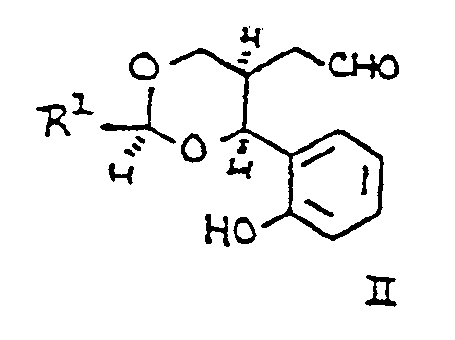
mit einemWittig-Reagenz der Formel
R'3P = CH.(CH2)2.CO.N-.SO2R2M+ worin R' für (1-6C)Alkyl oder Aryl und M+ für ein geeignetes Kation steht, umsetzt,

worin R" für eine geeignete Schutzgruppe steht, die Schutzgruppe abspaltet,


wobei, wenn eine optisch aktive Form einer Verbindung der Formel gewünscht wird, entweder eines der Verfahren (a) bis (d) unter Einsatz einer optisch aktiven Form des entsprechenden Ausgangsmaterials ausgeführt oder die racemische Form unter Verwendung einer geeigneten optisch aktiven Base getrennt wird; uni, wenn ein pharmazeutisch zulässiges Salz gewünscht wird, die freie Säureform der Verbindung der Formel mit einer geeigneten Base, die ein physiologisch zulässiges Kation liefert, umgesetzt wird; wobei R1 und R2 die in einem der Ansprüche 1 bis 5 angegebenen Bedeutungen besitzen.

Applications Claiming Priority (2)
| Application Number | Priority Date | Filing Date | Title |
|---|---|---|---|
| GB8611174 | 1986-05-08 | ||
| GB868611174A GB8611174D0 (en) | 1986-05-08 | 1986-05-08 | Amide derivatives |
Publications (3)
| Publication Number | Publication Date |
|---|---|
| EP0246002A2 EP0246002A2 (de) | 1987-11-19 |
| EP0246002A3 EP0246002A3 (en) | 1988-10-05 |
| EP0246002B1 true EP0246002B1 (de) | 1991-11-27 |
Family
ID=10597483
Family Applications (1)
| Application Number | Title | Priority Date | Filing Date |
|---|---|---|---|
| EP87303832A Expired - Lifetime EP0246002B1 (de) | 1986-05-08 | 1987-04-29 | Alkenamid-Derivate |
Country Status (14)
| Country | Link |
|---|---|
| US (1) | US4845120A (de) |
| EP (1) | EP0246002B1 (de) |
| JP (1) | JPS62273973A (de) |
| AU (1) | AU603570B2 (de) |
| CA (1) | CA1284332C (de) |
| DE (1) | DE3774759D1 (de) |
| DK (1) | DK229887A (de) |
| FI (1) | FI872040A7 (de) |
| GB (1) | GB8611174D0 (de) |
| IL (1) | IL82328A0 (de) |
| NO (1) | NO871907L (de) |
| NZ (1) | NZ220231A (de) |
| PT (1) | PT84832B (de) |
| ZA (1) | ZA872853B (de) |
Families Citing this family (5)
| Publication number | Priority date | Publication date | Assignee | Title |
|---|---|---|---|---|
| ES2017633B3 (es) * | 1985-11-12 | 1991-03-01 | Ici Plc | Amido derivados. |
| US5248780A (en) * | 1988-02-16 | 1993-09-28 | Imperial Chemical Industries, Plc | Pyridyl substituted alkenoic acid derivatives |
| GB8901201D0 (en) * | 1988-02-16 | 1989-03-15 | Ici Plc | Pyridine derivatives |
| GB9021571D0 (en) * | 1990-10-04 | 1990-11-21 | Ici Plc | Heterocyclic acids |
| GB2448116B (en) | 2007-04-05 | 2009-05-27 | Rolls Royce Plc | Means for cooling a bearing assembly |
Citations (1)
| Publication number | Priority date | Publication date | Assignee | Title |
|---|---|---|---|---|
| EP0177121A2 (de) * | 1984-07-06 | 1986-04-09 | Imperial Chemical Industries Plc | Dioxanyl Arzneimittel |
Family Cites Families (4)
| Publication number | Priority date | Publication date | Assignee | Title |
|---|---|---|---|---|
| GB8310407D0 (en) * | 1982-05-12 | 1983-05-25 | Ici Plc | 1 3 - dioxan -5- ylalkenoic acids |
| GB8330097D0 (en) * | 1983-11-11 | 1983-12-21 | Ici Plc | Cyclic ethers |
| GB8330120D0 (en) * | 1983-11-11 | 1983-12-21 | Ici Plc | Chemical process |
| ES2017633B3 (es) * | 1985-11-12 | 1991-03-01 | Ici Plc | Amido derivados. |
-
1986
- 1986-05-08 GB GB868611174A patent/GB8611174D0/en active Pending
-
1987
- 1987-04-20 US US07/040,153 patent/US4845120A/en not_active Expired - Fee Related
- 1987-04-22 ZA ZA872853A patent/ZA872853B/xx unknown
- 1987-04-23 CA CA000535387A patent/CA1284332C/en not_active Expired - Lifetime
- 1987-04-26 IL IL82328A patent/IL82328A0/xx unknown
- 1987-04-29 EP EP87303832A patent/EP0246002B1/de not_active Expired - Lifetime
- 1987-04-29 DE DE8787303832T patent/DE3774759D1/de not_active Expired - Lifetime
- 1987-04-30 AU AU72264/87A patent/AU603570B2/en not_active Ceased
- 1987-05-05 DK DK229887A patent/DK229887A/da not_active Application Discontinuation
- 1987-05-07 NZ NZ220231A patent/NZ220231A/en unknown
- 1987-05-07 PT PT84832A patent/PT84832B/pt not_active IP Right Cessation
- 1987-05-07 NO NO871907A patent/NO871907L/no unknown
- 1987-05-08 FI FI872040A patent/FI872040A7/fi not_active Application Discontinuation
- 1987-05-08 JP JP62110887A patent/JPS62273973A/ja active Pending
Patent Citations (1)
| Publication number | Priority date | Publication date | Assignee | Title |
|---|---|---|---|---|
| EP0177121A2 (de) * | 1984-07-06 | 1986-04-09 | Imperial Chemical Industries Plc | Dioxanyl Arzneimittel |
Also Published As
| Publication number | Publication date |
|---|---|
| EP0246002A2 (de) | 1987-11-19 |
| GB8611174D0 (en) | 1986-06-18 |
| NO871907L (no) | 1987-11-09 |
| NO871907D0 (no) | 1987-05-07 |
| ZA872853B (en) | 1987-12-30 |
| AU603570B2 (en) | 1990-11-22 |
| PT84832B (pt) | 1990-02-08 |
| DE3774759D1 (de) | 1992-01-09 |
| JPS62273973A (ja) | 1987-11-28 |
| EP0246002A3 (en) | 1988-10-05 |
| NZ220231A (en) | 1990-04-26 |
| IL82328A0 (en) | 1987-10-30 |
| PT84832A (en) | 1987-06-01 |
| AU7226487A (en) | 1987-11-12 |
| CA1284332C (en) | 1991-05-21 |
| US4845120A (en) | 1989-07-04 |
| DK229887D0 (da) | 1987-05-05 |
| DK229887A (da) | 1987-11-09 |
| FI872040A7 (fi) | 1987-11-09 |
| FI872040A0 (fi) | 1987-05-08 |
Similar Documents
| Publication | Publication Date | Title |
|---|---|---|
| EP0094239B1 (de) | 1,3-Dioxan-5-ylalkensäuren | |
| US4895962A (en) | 2,4-diphenyl-1,3-dioxanes | |
| US5047412A (en) | Alkene derivatives | |
| EP0223518B1 (de) | Amidderivate | |
| US4803220A (en) | Pharmaceutical agents | |
| US4845120A (en) | N-[4-o-hydroxyphenyl-1,3-dioxan-5-ylhexenoyl]sulphonamides | |
| US4772625A (en) | 1,3-dioxan-5-yl-hexenoic acids | |
| US4831046A (en) | Tetrazole derivatives of 1,3-dioxane and thromboxane A2 antigonizing use thereof | |
| US4735963A (en) | Anti-platelet aggregating 1,3-oxathiane derivatives, compositions, and method of use therefor | |
| EP0266980B1 (de) | Pharmazeutische Zusammensetzungen, enthaltend ein 2,4-diphenyl-1,3-dioxane derivat und einen Inhibitor des Thromboxan A2 Synthese | |
| US4921979A (en) | 1,3-dioxane ethers | |
| US4902712A (en) | Fluoroalkane derivatives | |
| EP0228887B1 (de) | Dioxan-Hexensäuren | |
| US5126368A (en) | Octenoic acid derivatives useful as thromboxane A2 inhibitors |
Legal Events
| Date | Code | Title | Description |
|---|---|---|---|
| PUAI | Public reference made under article 153(3) epc to a published international application that has entered the european phase |
Free format text: ORIGINAL CODE: 0009012 |
|
| AK | Designated contracting states |
Kind code of ref document: A2 Designated state(s): AT BE CH DE ES FR GB GR IT LI LU NL SE |
|
| PUAL | Search report despatched |
Free format text: ORIGINAL CODE: 0009013 |
|
| AK | Designated contracting states |
Kind code of ref document: A3 Designated state(s): AT BE CH DE ES FR GB GR IT LI LU NL SE |
|
| 17P | Request for examination filed |
Effective date: 19881108 |
|
| 17Q | First examination report despatched |
Effective date: 19890816 |
|
| RBV | Designated contracting states (corrected) |
Designated state(s): BE DE FR GB IT |
|
| GRAA | (expected) grant |
Free format text: ORIGINAL CODE: 0009210 |
|
| AK | Designated contracting states |
Kind code of ref document: B1 Designated state(s): BE DE FR GB IT |
|
| ITF | It: translation for a ep patent filed | ||
| REF | Corresponds to: |
Ref document number: 3774759 Country of ref document: DE Date of ref document: 19920109 |
|
| ET | Fr: translation filed | ||
| PLBE | No opposition filed within time limit |
Free format text: ORIGINAL CODE: 0009261 |
|
| STAA | Information on the status of an ep patent application or granted ep patent |
Free format text: STATUS: NO OPPOSITION FILED WITHIN TIME LIMIT |
|
| 26N | No opposition filed | ||
| PGFP | Annual fee paid to national office [announced via postgrant information from national office to epo] |
Ref country code: FR Payment date: 19930310 Year of fee payment: 7 |
|
| PGFP | Annual fee paid to national office [announced via postgrant information from national office to epo] |
Ref country code: DE Payment date: 19930322 Year of fee payment: 7 |
|
| PGFP | Annual fee paid to national office [announced via postgrant information from national office to epo] |
Ref country code: GB Payment date: 19930324 Year of fee payment: 7 |
|
| PGFP | Annual fee paid to national office [announced via postgrant information from national office to epo] |
Ref country code: BE Payment date: 19930329 Year of fee payment: 7 |
|
| REG | Reference to a national code |
Ref country code: GB Ref legal event code: 732E |
|
| PG25 | Lapsed in a contracting state [announced via postgrant information from national office to epo] |
Ref country code: GB Effective date: 19940429 |
|
| PG25 | Lapsed in a contracting state [announced via postgrant information from national office to epo] |
Ref country code: BE Effective date: 19940430 |
|
| BERE | Be: lapsed |
Owner name: IMPERIAL CHEMICAL INDUSTRIES P.L.C. Effective date: 19940430 |
|
| PG25 | Lapsed in a contracting state [announced via postgrant information from national office to epo] |
Ref country code: FR Effective date: 19941229 |
|
| PG25 | Lapsed in a contracting state [announced via postgrant information from national office to epo] |
Ref country code: DE Effective date: 19950103 |
|
| GBPC | Gb: european patent ceased through non-payment of renewal fee |
Effective date: 19940429 |
|
| REG | Reference to a national code |
Ref country code: FR Ref legal event code: ST |
|
| PG25 | Lapsed in a contracting state [announced via postgrant information from national office to epo] |
Ref country code: IT Free format text: LAPSE BECAUSE OF NON-PAYMENT OF DUE FEES;WARNING: LAPSES OF ITALIAN PATENTS WITH EFFECTIVE DATE BEFORE 2007 MAY HAVE OCCURRED AT ANY TIME BEFORE 2007. THE CORRECT EFFECTIVE DATE MAY BE DIFFERENT FROM THE ONE RECORDED. Effective date: 20050429 |