EP0245960A2 - Process for preparing N-acyltetrahydroisoquinoline - Google Patents
Process for preparing N-acyltetrahydroisoquinoline Download PDFInfo
- Publication number
- EP0245960A2 EP0245960A2 EP87303217A EP87303217A EP0245960A2 EP 0245960 A2 EP0245960 A2 EP 0245960A2 EP 87303217 A EP87303217 A EP 87303217A EP 87303217 A EP87303217 A EP 87303217A EP 0245960 A2 EP0245960 A2 EP 0245960A2
- Authority
- EP
- European Patent Office
- Prior art keywords
- binap
- group
- bis
- binaphthyl
- formula
- Prior art date
- Legal status (The legal status is an assumption and is not a legal conclusion. Google has not performed a legal analysis and makes no representation as to the accuracy of the status listed.)
- Granted
Links
Classifications
-
- C—CHEMISTRY; METALLURGY
- C07—ORGANIC CHEMISTRY
- C07D—HETEROCYCLIC COMPOUNDS
- C07D217/00—Heterocyclic compounds containing isoquinoline or hydrogenated isoquinoline ring systems
- C07D217/02—Heterocyclic compounds containing isoquinoline or hydrogenated isoquinoline ring systems with only hydrogen atoms or radicals containing only carbon and hydrogen atoms, directly attached to carbon atoms of the nitrogen-containing ring; Alkylene-bis-isoquinolines
- C07D217/06—Heterocyclic compounds containing isoquinoline or hydrogenated isoquinoline ring systems with only hydrogen atoms or radicals containing only carbon and hydrogen atoms, directly attached to carbon atoms of the nitrogen-containing ring; Alkylene-bis-isoquinolines with the ring nitrogen atom acylated by carboxylic or carbonic acids, or with sulfur or nitrogen analogues thereof, e.g. carbamates
-
- C—CHEMISTRY; METALLURGY
- C07—ORGANIC CHEMISTRY
- C07D—HETEROCYCLIC COMPOUNDS
- C07D217/00—Heterocyclic compounds containing isoquinoline or hydrogenated isoquinoline ring systems
- C07D217/12—Heterocyclic compounds containing isoquinoline or hydrogenated isoquinoline ring systems with radicals, substituted by hetero atoms, attached to carbon atoms of the nitrogen-containing ring
- C07D217/18—Aralkyl radicals
- C07D217/20—Aralkyl radicals with oxygen atoms directly attached to the aromatic ring of said aralkyl radical, e.g. papaverine
Definitions
- This invention relates to a process for efficiently and exclusively preparing interesting optical isomers of various tetrahydroisoquinolines that are useful as intermediates for synthesizing isoquinoline type alkaloids as pharamaceuticals.
- Physiologically active organic compounds have greatly varying physiological activities depending on their optical isomers. In some cases, they exhibit activities entirely opposite to expectation. Therefore, it is an important aim to efficiently and exclusively synthesize only useful optical isomers.
- Isoquinoline type alkaloids are a series of physiologically active substances obtained from naturally-occurring materials and are widely employed as pharmaceuticals.
- benzylisoquinoline type compounds are not only important per se but also useful as intermediates for introducing into various other physiologically active substances such as morphine.
- Several processes are known for obtaining the benzylisoquinoline type compounds as optically active isomers. For example, tetrahydropapaverine is synthesized by forming its racemate, for example, by reduction of papaverine as described in, e.g., W. Awe et al., Ber.
- benzylisoquinolines having an optical purity of approximately 100% can be obtained by asymmetrically hydrogenating a double bond of a methylene type isoquinoline or benzylidene type isoquinoline in the presence of a ruthenium-phosphine complex as a catalyst.
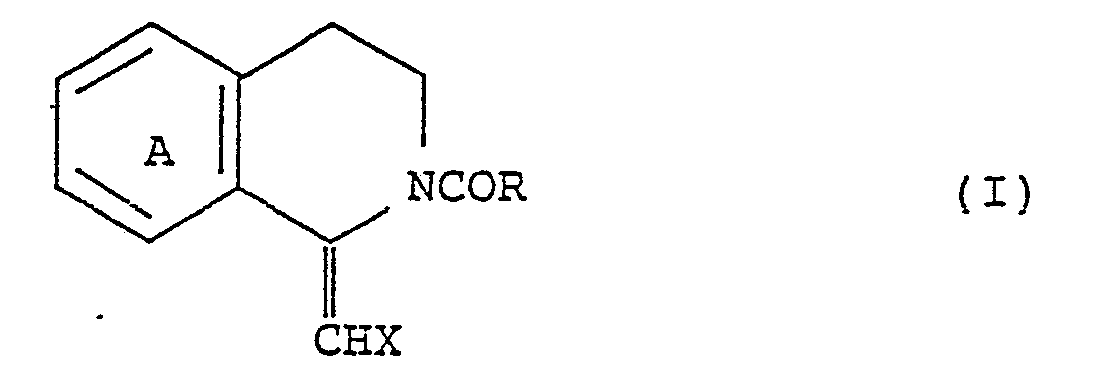
- the present invention relates to a process for preparing an N-acyltetrahydroisoquinoline represented by formula (II): wherein A represents a phenylene ring substituted with a hydroxyl groups, a lower alkoxy group having from 1 to 4 carbon atoms, an acetoxy group or a benzyloxy group; R represents a hydrogen atom, a lower alkyl group having from 1 to 4 carbon atoms, or a phenyl group; and X represents a hydrogen atom, a phenyl group, or a phenyl group substituted with a hydroxyl group, a lower alkoxy group having from 1 to 4 carbon atoms, or an acetoxy group, which comprises asymmetrically hydrogenating an N-actyl-1-methylenetetrahydroisoquinoline or N-acyl-l-benzylidenetetrahydroisoquinoline represented by formula (I) wherein A, R, and X are as defined above
- the starting material represented by the formula (I) is dissolved in a solvent such as methylene chloride, and an additional solvent such as methanol or ethanol is then added thereto to prepare an initial solution.
- a solution of a ruthenium-phosphine complex as hereinafter described is prepared in the same manner as described above. Both the solutions are mixed, and the mixture is transferred to an autoclave. Hydrogen is then introduced into the mixture, and the reaction is carried out under a hydrogen pressure of from 1 to 10 kg/cm2 i.e. to 9.8 bars, at a temperature of from 10 to 40°C for a period of from 10 to 160 hours.
- These reaction conditions can be decided appropriately depending on the kinds of the substrate and catalyst used.
- Typical examples of the compounds of formula (I) include:
- the optically active ruthenium-phosphine complex which can be used as a catalyst in the process of this invention includes those in which 2,2 ⁇ -bis(diphenylphosphino)-1,1 ⁇ -binaphthyl (hereinafter referred to as BINAP) etc. is coordinated to metallic ruthenium as disclosed in T. Ikariya et al., J. Chem. Soc., Chem. Commun. , pp. 922 (1985) and our Japanese Patent Application (OPI) No. 63690/86 (corresponding to European Specification No. 174,057A) (the term "OPI" as used herein means "unexamined published application").
- Typical examples of these complexes include:
- ruthenium-phosphine complexes in which carboxyl groups are bonded to metallic ruthenium as represented by formula (III) shown below can also be used as a catalyst in the present invention.
- Formula (III) is represented by wherein Y represents a hydrogen atom, an amino group, an acetylamino group, or a sulfo group; R3 represents a hydrogen atom or a lower alkyl group having from 1 to 4 carbon atomes); R1 and R2 each represents an alkyl group (e.g., those having from 1 to 9 carbon atoms), a halogenated lower alkyl group having from 1 to 4 carbon atoms (examples of the halogen include fluorine, chlorine, and bromine), a phenyl group, a phenyl goup substituted with a lower alkyl group having from 1 to 4 carbon atoms), an ⁇ -aminoalkyl group having from 1 to 4 carbon atoms, or an ⁇ -aminophenylalkyl group having from 7 to 10 carbon atoms, or R1 and R2 together form an alkylene group having from 1 to 4 carbon atoms; and n represents 1 or 2.
- Typical examples of the complex of formula (III) include:
- ruthenium-phosphine complexes having carboxyl groups bonded to metallic ruthenium can be prepared from complexes obtainable by the process disclosed in Japanese Patent Application (OPI) No. 63690/86.
- the complex of formula (III) can be prepared by reacting Ru2Cl4(BINAP)2N(C2H5)3 with a caboxylic acid salt in an alcohol solvent such as t-butanol by heat-refluxing for about 12 hours, removing the solvent by distillation, and extracting the residue with a solvent such as diethyl ether or ethanol, followed by evaporation to dryness.
- Any desired carboxyl group can be introduced to the ruthenium atom by selecting the starting carboxylic acid to be used.
- Ru(BINAP) O2CCH32 of formula (III).
- the complex of formula (III) where trifluoroacetyl groups are bonded to ruthenium can be obtained by reacting the above prepared diacetate complex with trifluoroacetic acid in methylene chloride as a solvent at about 25°C for about 12 hours.
- the complex of formula (III) where a 2-equivalent ligand is coordinated to ruthenium can be prepared by reacting a complex of such a type, e.g., RuHCl(BINAP)2, obtained by the process of Japanese Patent Application (OPI) No. 63690/86 with a carboxylic acid salt in a solvent such as methylene chloride.
- Example 2 The same procedure of Example 2 was repeated except for using 67 mg (0.27 mmol) of N-acetyl-6,7-dimethoxy-1-methylene-1,2,3,4-tetrahydroisoquinoline to obtain 66 mg (0.265 mmol) of N-acetylsalsolidine in a yield of 97.7%.
- the resulting N-acetylsalsolidine was mixed with 500 mg (7.58 mmol) of 85% potassium hydroxide, 0.2 ml (3.30 mmol) of 80% hydrazine hydrate, and 10 ml of ethylene glycol, and the mixture was allowed to react at 180°C for 14 hours in an argon stream. After completion of the reaction, 30 ml of 1N hydrochloric acid was added to the reaction mixture, and the mixture was washed three times with 10 ml portions of methylene chloride. The aqueous layer was made alkaline by the addition of 30 ml of a 2N sodium hydroxide aqueous solution. The aqueous solution was extracted three times with 15 ml portions of methylene chloride.
- the extract was dried over anhydrous sodium sulfate, followed by distillation under reduced pressure to remove the methylene chloride to obtain 55 mg (0.265 mmol) of oily brown Salsolidine in a yield of 100%.
- the resulting Salsolidine was then reacted with 2,3,4,6-tetra-O-acetyl- ⁇ -D-glucopyranosyl isothiocyanate (herein strictlyafter abbreviated as GITC) in acetonitrile to obtain a diastereomer.
- GITC 2,3,4,6-tetra-O-acetyl- ⁇ -D-glucopyranosyl isothiocyanate
- Example 2 The same procedure of Example 1 was repeated except for using Ru((R)-(+)-BINAP) (O2CCH3)2 as a catalyst to obtain (R)-N-acetyltetrahydropapaverine in a yield of 100% and an optical yield of 99.5%.
- Example 2 The same procedure of Example 1 was repeated except for using Ru2Cl4((R)-(+)-p-Tol BINAP)2N(C2H5)3 as a catalyst to obtain (R)-N-acetyltetrahydropapaverine in a yield of 90% and an optical yield of 98%.
- Example 2 The same procedure of Example 1 was repeated except for using Ru2Cl4((R)-(+)-p-t-butyl BINAP)2N(C2H5)3 as a catalyst to obtain (R)-N-acetyltetrahydropapaverine in a yield of 80% and an optical yield of 95%.
- Example 2 The same procedure of Example 1 was repeated except for using Ru((R)-(+)-p-Tol BINAP) (O2CCF3)2 as a catalyst to obtain (R)-N-acetyltetrahydropapaverine in a yield of 95% and an optical yield of 97%.
- Example 10 The same procedure of Example 10 was repeated except for using 204.9 mg (0.555 mmol) of (Z)-N-formyl-6,7-dimethoxy-1-(3,4-dimethoxyphenylmethylene)-1,2,3,4-tetrahydroquinoline as a substrate and 5.1 mg (6.06 x 10 ⁇ 3 mmol) of Ru((S)-(-)-BINAP) (O2CCH3)2 as a catalyst. As a result, 219.0 mg (0.555 mmol) (yield: 100%) of (S)-(+)-N-formyltetrahydropapaverine was obtained as white needle-like crystals.
- N-acyltetrahydroisoquinolines useful as intermediates for isoquinoline type alkaloids can be synthesized efficiently in the form of a pure optical isomer useful for the purpose without involving optical resolution of a racemate. Therefore, the process of this invention provides great industrial advantages.
Landscapes
- Chemical & Material Sciences (AREA)
- Organic Chemistry (AREA)
- Low-Molecular Organic Synthesis Reactions Using Catalysts (AREA)
- Catalysts (AREA)
- Organic Low-Molecular-Weight Compounds And Preparation Thereof (AREA)
- Other In-Based Heterocyclic Compounds (AREA)
Abstract

which comprises asymmetrically hydrogenating a solution of an N-acyl-1-methylenetetrahydroisoquinoline or N-acyl-1-benzylidenetetrahydroisoquinoline represented by formula (I)

Description
- This invention relates to a process for efficiently and exclusively preparing interesting optical isomers of various tetrahydroisoquinolines that are useful as intermediates for synthesizing isoquinoline type alkaloids as pharamaceuticals.
- Physiologically active organic compounds have greatly varying physiological activities depending on their optical isomers. In some cases, they exhibit activities entirely opposite to expectation. Therefore, it is an important aim to efficiently and exclusively synthesize only useful optical isomers.
- Isoquinoline type alkaloids are a series of physiologically active substances obtained from naturally-occurring materials and are widely employed as pharmaceuticals. In particular, benzylisoquinoline type compounds are not only important per se but also useful as intermediates for introducing into various other physiologically active substances such as morphine. Several processes are known for obtaining the benzylisoquinoline type compounds as optically active isomers. For example, tetrahydropapaverine is synthesized by forming its racemate, for example, by reduction of papaverine as described in, e.g., W. Awe et al., Ber., 70, 472 (1937) or addition of a benzyl group to tetrahydroisoquinoline as described, e.g., in T. Shono et al., Tetrahedron Letters, Vol. 22, No. 25, 2385 (1981) and then optically resolving the racemate. Such a process involving optical resolution of a racemate is uneconomical because an enantiomer having a configuration which is a mirror image of the desired optical isomer is discarded as unnecessary.
- In recent years, much research has been directed to asymmetric syntheses. Proposals for asymmetric synthesis include, for example, asymmetric reduction of 3,4-dihydropapaverine as reported in H.B. Kagan et al., J. Organomet. Chem., Vol. 90, 353 (1975), asymmetric alkylation to tetrahydroisoquinoline as reported in A.I. Meyer et al., J. Am. Chem. Soc., Vol. 105, 117 (1983), and biosynthesis starting with an amino acid as reported in S. Yamada et al., Tetrahedron Letters, No. 22, 2215 (1972). However, each of these processes involve complicated steps and are not satisfactory for production on an industrial scale.
- Accordingly, it has been much desired to establish a process which does not require complicated operations and directly provides an optical isomer of interest with high efficiency.
- The inventors have conducted extensive investigations on processes for efficiently obtaining optically active benzylisoquinolines which are key compound for syntheses of various isoquinoline type alkaloids. As a result, it has now been found that benzylisoquinolines having an optical purity of approximately 100% can be obtained by asymmetrically hydrogenating a double bond of a methylene type isoquinoline or benzylidene type isoquinoline in the presence of a ruthenium-phosphine complex as a catalyst.
- The present invention relates to a process for preparing an N-acyltetrahydroisoquinoline represented by formula (II):

which comprises asymmetrically hydrogenating an N-actyl-1-methylenetetrahydroisoquinoline or N-acyl-l-benzylidenetetrahydroisoquinoline represented by formula (I)
in the presence of an optically active ruthenium-phosphine complex as a catalyst. - In carrying out the process according to the present invention, the starting material represented by the formula (I) is dissolved in a solvent such as methylene chloride, and an additional solvent such as methanol or ethanol is then added thereto to prepare an initial solution. Separately, a solution of a ruthenium-phosphine complex as hereinafter described is prepared in the same manner as described above. Both the solutions are mixed, and the mixture is transferred to an autoclave. Hydrogen is then introduced into the mixture, and the reaction is carried out under a hydrogen pressure of from 1 to 10 kg/cm² i.e. to 9.8 bars, at a temperature of from 10 to 40°C for a period of from 10 to 160 hours. These reaction conditions can be decided appropriately depending on the kinds of the substrate and catalyst used. After completion of the reaction, the solvent is removed by distillation, and the residue is purified in a known manner usch as silica gel column chromatography to thereby obtain an N-acyltetrahydroisoquinoline of formula (II) in a yield of from 80 to 100%. When a diastereomer which is obtained by deacylating the resulting product and then reacting the product with 2,3,4,6-tetra-O-acetyl-β-D-glycopyranosyl isothiocyanate is analyzed by high performance liquid chromatography, it is proved that the above obtained hydrogenation product has an optical purity ranging from 95 to 99.5%ee.
- Typical examples of the compounds of formula (I) include:
- (1) (Z)-N-Acetyl-6,7-dimethoxy-1-(3,4-dimethoxyphenylmethylene)-1,2,3,4-tetrahydroisoquinoline (This compound gives tetrahydropapaverine through asymmetric hydrogenation according to the process of the invention, followed by deacetylation.)
- (2) (Z)-N-Benzoyl-6,7-dimethoxy-1-(3,4-dimethoxyphenylmethylene)-1,2,3,4-tetrahydroisoquinoline (This compound gives tetrahydropapaverine through the same steps as above.)
- (3) (Z)-N-Formyl-6,7-dimethoxy-1-(3,4-dimethoxyphenylmethylene)-1,2,3,4-tetrahydroisoquinoline (This compound gives tetrahydropapaverine through the same steps as above.)
- (4) (Z)-N-Acetyl-6,7-dimethoxy-1-methylene-1,2,3,4-tetrahydroisoquinoline (This compound gives Salsolidine through the same steps as above.)
- (5) (Z)-N-Acetyl-7-acetoxy-1-(3-acetoxy-4-methoxyphenylmethylene)-6-methoxy-1,2,3,4-tetrahydroisoquinoline (This compound gives Norreticurine through the same step as above.)
- (6) (Z)-N-Acetyl-6,7-dibenzyloxy-1-(3,4,5-trimethoxyphenylmethylene)-1,2,3,4-tetrahydroisoquinoline (This compound gives Tretoquinol through asymmetic hydrogenation according to the process of the invention, followed by deacetylation and debenzoylation.)
- The optically active ruthenium-phosphine complex which can be used as a catalyst in the process of this invention includes those in which 2,2ʹ-bis(diphenylphosphino)-1,1ʹ-binaphthyl (hereinafter referred to as BINAP) etc. is coordinated to metallic ruthenium as disclosed in T. Ikariya et al., J. Chem. Soc., Chem. Commun., pp. 922 (1985) and our Japanese Patent Application (OPI) No. 63690/86 (corresponding to European Specification No. 174,057A) (the term "OPI" as used herein means "unexamined published application"). Typical examples of these complexes include:
- (1) Ru₂Cl₄(BINAP)₂N(C₂H₅)₃
- (2) Ru₂Cl₄(p-Tol BINAP)₂N(C₂H₅)₃ (wherein p-Tol BINAP represents 2,2ʹ-bis(di-p-tolylphosphino)-1,1ʹ-binaphthyl)
- (3) RuHCl(BINAP)₂
- (4) Ru₂Cl₄(p-t-Bu BINAP)₂N(C₂H₅)₃ (wherein p-t-Bu BINAP represents 2,2ʹ-bis(di-p-t-butylphenylphosphino)-1,1ʹ-binaphthyl)
- (5) Ru₂Cl₄(5-acetylamino BINAP)₂N(C₂H₅)₃ (wherein 5-acetylamino BINAP represents 2,2ʹ-bis-(diphenylphosphino)-5,5ʹ-diacetylamino-1,1ʹ-binaphthyl)
- In addition, ruthenium-phosphine complexes in which carboxyl groups are bonded to metallic ruthenium as represented by formula (III) shown below can also be used as a catalyst in the present invention.
- Formula (III) is represented by

- Typical examples of the complex of formula (III) include:
- (1) Ru(BINAP) (O₂CCH₃)₂
- (2) Ru(p-Tol BINAP)₂(O₂CCH₃)₂
- (3) Ru(BINAP) (O₂Ct-Bu)₂ (wherein t-Bu represents a t-butyl group)

- (5) Ru(p-Tol BINAP) (O₂CCH₃)₂
- (6) Ru(p-Tol BINAP) (O₂CCF₃)₂
- (7) Ru(p-t-Bu BINAP) (O₂CCH₃)₂
- (8) Ru(5-acetylamino BINAP) (O₂CCH₃)₂
- (9)
Ru(BINAP) [O(CH₂)₃ O]
O]
- (10) Ru (BINAP) (O₂-i-Pr)₂

(wherein i-Pr represents an isopropyl group) - These ruthenium-phosphine complexes having carboxyl groups bonded to metallic ruthenium can be prepared from complexes obtainable by the process disclosed in Japanese Patent Application (OPI) No. 63690/86. For example, the complex of formula (III) can be prepared by reacting Ru₂Cl₄(BINAP)₂N(C₂H₅)₃ with a caboxylic acid salt in an alcohol solvent such as t-butanol by heat-refluxing for about 12 hours, removing the solvent by distillation, and extracting the residue with a solvent such as diethyl ether or ethanol, followed by evaporation to dryness. Any desired carboxyl group can be introduced to the ruthenium atom by selecting the starting carboxylic acid to be used. For example, from the above-described starting complex and sodium acetate is obtained Ru(BINAP) (O₂CCH₃)₂ of formula (III). The complex of formula (III) where trifluoroacetyl groups are bonded to ruthenium can be obtained by reacting the above prepared diacetate complex with trifluoroacetic acid in methylene chloride as a solvent at about 25°C for about 12 hours. Further, the complex of formula (III) where a 2-equivalent ligand is coordinated to ruthenium can be prepared by reacting a complex of such a type, e.g., RuHCl(BINAP)₂, obtained by the process of Japanese Patent Application (OPI) No. 63690/86 with a carboxylic acid salt in a solvent such as methylene chloride.
- The present invention will now be illustrated in greater detail with reference to the following examples, wherein percentages are by weight unless otherwise indicated.
-

- In a dried Schlenk-tube having its atmosphere displaced with argon, 205.9 mg (0.538 mmol) of (Z)-N-acetyl-6,7-dimethoxy-1-(3,4-dimethoxyphenylmethylene)-1,2,3,4-tetrahydroisoquinoline was charged and dissolved in 1.5 ml of methylene chloride. To the solution was further added 7.5 ml of ethanol. The resulting solution was frozen with liquid nitrogen three times for degasification in vacuo. Separately, in a dried Schlenk-tube having its atmosphere displaced with argon, 13.0 mg (7.8 x 10⁻³ mmol) of Ru₂Cl₄((R)-(+)-BINAP)₂N(C₂H₅)₃ was charged and dissolved in 1.5 ml of methylene chloride which had been previously degassed by freezing three times. To the solution was further added 7.5 ml of ethanol. Both the solutions were mixed, and the mixture was transferred to an autoclave and stirred at 23°C for 49 hours under a hydrogen pressure of 4 kg/cm² (3.9 bars). After completion of the reaction, the solvent was removed by distillation under reduced pressure, and the residue was purified by silica gel column chromatography (silica gel: 20 g, eluent: ethyl acetate/hexane=3:1 by volume) to obtain 202.5 mg (0.526 mmol) of white needle-like crystals (yield: 98%). The optical rotation [α]D²⁴ was -91.2° (c=1.09, CHCl₃). The optical purity was found to be 99.5% as determined by the method hereinafter described (see Example 3).
¹H NMR (400 MHz, CDCl₂₃) δ ppm:
1.64 (1.2H, s)
2.14 (1.8H, s) (COCH₃)
2.6-3.2 (5.5H, m)
3.4-3.5 (0.5H m) (-CH₂-)
3.63, 3.77, 3.84, 3.85, 3.86, 3.87 (six singlets, -OCH₃)
4.7-4.8 (0.7H, m)
5.6-5.7 (0.3H, m) (-CH=),
6.21 (0.5H, s)
6.5-6.8 (5H, m) (aromatic hydrogen) -

- In a dried Schlenk-tube having its atmosphere displaced with argon, 188.2 mg (0.423 mmol) of (Z)-N-benzoyl-6,7-dimethoxy-1-(3,4-dimethoxyphenylmethylene)-1,2,3,4-tetrahydroisoquinoline was charged and dissolved in 4.5 ml of methylene chloride. To the solution was futher added 7.5 ml of ethanol, followed by degasification by freezing three times. Separately, 5.0 mg (2.9 x 10⁻³ mmol) of Ru₂Cl₄((R)-(+)-BINAP)₂N(C₂H₅)₃ as a catalyst was charged in a dried Schlenk-tube having its atmosphere displaced with argon and dissolved in 1.5 ml of methylene chloride. To the solution was further added 7. 5ml of ethanol. Both the solutions were mixed and subjected to hydrogenation in an autoclave at 23°C for 160 hours under a hydrogen pressure of 4 kg/cm² while stirring. After completion of the reaction, the solvent was removed by distillation under reduced pressure, and the residue was purified by silica gel column chromatography (silica gel: 20 g, eluent: ethyl acetate/hexane=2:1 by volume) to obtain 189 mg (0.423 mmol) of pale yellow rod-like crystals in a yield of 100%.
[α]D²⁴-83.3° (c=1.13, CHCl₃) - The ¹H NMR spectrum of this compound was consistent with that of benzoylated tetrahydropapaverine.
- The optical purity of this compound was found to by 96.2%ee as determined by the method described in Example 3.
-

- The same procedure of Example 2 was repeated except for using 67 mg (0.27 mmol) of N-acetyl-6,7-dimethoxy-1-methylene-1,2,3,4-tetrahydroisoquinoline to obtain 66 mg (0.265 mmol) of N-acetylsalsolidine in a yield of 97.7%.
- The resulting N-acetylsalsolidine was mixed with 500 mg (7.58 mmol) of 85% potassium hydroxide, 0.2 ml (3.30 mmol) of 80% hydrazine hydrate, and 10 ml of ethylene glycol, and the mixture was allowed to react at 180°C for 14 hours in an argon stream. After completion of the reaction, 30 ml of 1N hydrochloric acid was added to the reaction mixture, and the mixture was washed three times with 10 ml portions of methylene chloride. The aqueous layer was made alkaline by the addition of 30 ml of a 2N sodium hydroxide aqueous solution. The aqueous solution was extracted three times with 15 ml portions of methylene chloride. The extract was dried over anhydrous sodium sulfate, followed by distillation under reduced pressure to remove the methylene chloride to obtain 55 mg (0.265 mmol) of oily brown Salsolidine in a yield of 100%. The resulting Salsolidine was then reacted with 2,3,4,6-tetra-O-acetyl-β-D-glucopyranosyl isothiocyanate (hereinafter abbreviated as GITC) in acetonitrile to obtain a diastereomer. The diastereomer was anaylzed by high performance liquid chromatography (column: Develosil ODS-5, mandufactured by Nomura Kagaku K.K., eluent: acetonitrile/water=3:4 by volume, buffer: ammonium phosphate) to find that Salsolidine obtained had an optical purity of 95%. Therefore, the optical purity of the N-acetylsalsolidine obtained by asymmetric hydrogenation was also 95%ee.
-

- In a dried Schlenk-tube having its atmosphere displaced with argon, 118.6 mg (0.270 mmol) of (Z)-N-acetyl-7-acetoxyl-1-(3-acetoxy-4-methoxyphenylmethylene)-6-methoxy-1,2,3,4-tetrahydroisoquinoline was charged and dissolved in 1.5 ml of methylene chloride. To the solution was further added 7.5 ml of ethanol, followed by degasification by freezing three times. Separately, in a dried Schlenk-tube having its atmosphere displaced with argon, 1.1 mg (6.5 x 10⁻⁴ mmol) of Ru₂Cl₄((R)- (+)-BINAP)₂N(C₂H₅)₃ was charged and dissolved in 1.5 ml of methylene chloride which had been previously degassed by freezing three times. To the solution was further added 7.5 ml of ethanol. Both the solutions were transferred to a pressure bottle and subjected to hydrogenation under a hydrogen pressure of 4 atms. at 23°C for 62 hours while stirring. After completion of the reaction, the solvent was removed by distillation under reduced pressure, and the residue was purified by silica gel column chromatography (silica gel: 15 g, eluent: ethyl acetate/hexane=3:1 by volume) to give 104.7 mg (0.237 mmol) of (R)-N-acetyl-7-acetoxy-1-(3-acetoxy-4-methoxyphenylmethyl)-6-methoxy-1,2,3,4-tetrahydroisoquinoline (hereinafter referred to as acetylated N-acetylnorreticurine) in a yield of 88%.
- The resulting acetylated N-acetylnorleticurine was deacylated in the same manner as in Example 3 to obtain Norleticurine which was then reacted with GITC in acetonitrile to form a diastereomer. High performance liquid chromatography of the diastereomer revealed that the N-acetyl-7-acetoxy-1-(3-acetoxy-4-methoxyphenoxymethyl)-6-methoxy-1,2,3,4-tetrahydroisoquinoline obtained by the asymmetric hydrogenation had an optical purity of 96%ee.
-

- In 1.5 ml of methylene chloride was dissolved 100.8 mg (0.178 mmol) of (Z)-N-acetyl-6,7-dibenzyloxy-1-(3,4,5-trimethoxyphenylmethylene)-1,2,3,4-tetrahydroisoquinoline, and 7.5 ml of ethanol was further added thereto. A separately prepared solution of 2,9 mg (1.7 x 10⁻³ mmol) of Ru₂Cl₄((S)-(-)-BINAP₂N(C₂H₅)₃ in 1.5 ml of methylene chloride was added to the above prepared solution, and the mixture was transferred to an autoclave. The mixture was subjected to hydrogenation at 23°C for 62 hours at a hydrogen pressure of 4 kg/cm² while stirring. After completion of the reaction, the solvent was removed by distillation, and the residue was purified by silica gel column chromatogarphy (silica gel: 15 g, eluent: ethyl acetate/hexane=3:1 by volume) to give 92.8 mg (0.164 mmol) of (S)-N-acetyl-6,7-dibenzyloxy-1-(3,4,5-trimethoxyphenylmethyl)-1,2,3,4-tetrahydroisoquinoline in a yield of 92%. The optical rotation [α]D²⁴ of this product was +62.8° (c=0.92, CHCl₃).
- A mixture consisting of 21.5 mg (0.038 mmol) of the thus obtained hydrogenation product, 100 mg (1.52 mmol) of 85% potassium hydroxide, 0.05 ml (0.8 mmol) of 80% hydrazine hydrate, and 2 ml of ethylene glycol was allowed to react at 180°C for 14 hours under an argon stream. To this reaction mixture was added 15 ml of 1N hydrochloric acid, and the mixture was washed three times with 10 ml portions of methylene chloride. To the aqueous layer was added 10 ml of a 2N sodium hydroxide aqueous solution to make it alkaline, and the solution was extracted three times with 10 ml portions of methylene chloride. The extract was dried over anhydrous sodium sulfate, and the methylene chloride was removed therefrom by distillation to obtain (S)-(-)-6,7-dibenzyloxy-1- (3,4,5-trimethoxyphenylmethyl)-1,2,3,4-tetrahydroisoquinoline as a brown oil. The resulting isoquinoline was reacted with GITC to form a diastereomer which was then analyzed by high performance liquid chromatography to find that the (S)-N-acetyl-6,7-dibenzyloxy-1-(3,4,5-trimethoxyphenylmethyl)-1,2,3,4-tetrahydroisoquinoline resulted from the asymmetric hydrogenation had an optical purity of 99.5%ee.
- The same procedure of Example 1 was repeated except for using Ru((R)-(+)-BINAP) (O₂CCH₃)₂ as a catalyst to obtain (R)-N-acetyltetrahydropapaverine in a yield of 100% and an optical yield of 99.5%.
- The same procedure of Example 1 was repeated except for using Ru₂Cl₄((R)-(+)-p-Tol BINAP)₂N(C₂H₅)₃ as a catalyst to obtain (R)-N-acetyltetrahydropapaverine in a yield of 90% and an optical yield of 98%.
- The same procedure of Example 1 was repeated except for using Ru₂Cl₄((R)-(+)-p-t-butyl BINAP)₂N(C₂H₅)₃ as a catalyst to obtain (R)-N-acetyltetrahydropapaverine in a yield of 80% and an optical yield of 95%.
- The same procedure of Example 1 was repeated except for using Ru((R)-(+)-p-Tol BINAP) (O₂CCF₃)₂ as a catalyst to obtain (R)-N-acetyltetrahydropapaverine in a yield of 95% and an optical yield of 97%.
- In a dried Schlenk-tube having its atmosphere displaced with argon, 194.6 mg (0.527 mmol) of (Z)-N-formyl-6,7-dimethoxy-1-(3,4-dimethoxyphenylmethylene)-1,2,3,4-tetrahydroisoquinoline was charged and dissolved in 3 ml of methylene chloride. To the solution was further added 10 ml of ethanol, followed by degasification by freezing three times. Separately, in a dried Schlenk-tube having its atmosphere displaced with argon, 4.0 mg (4.75 x 10⁻³ mmol) of Ru((R)-(+)-BINAP) (C₂CCH₃)₂ was charged and dissolved in 5 ml of ethanol which had been previously degassed by freezing three times. Both the solutions were transferred to an autoclave and stirred at 24°C for 24 hours and then at 25 to 30°C for 48 hours at a hydrogen pressure of 4 kg/cm² to effect hydrogenation. After completion of the reaction, the solvent was removed by distillation, and the residue was purified by silica gel column chromatography (silica gel: 20 g, eluent: ethyl acetate/hexane=3:1 by volume) to obtain 176.9 mg (0.477 mmol) of (R)-(-)-N-formyltetrahydropapaverine as white needle-like crystals in a yield of 91%.
- To 42.1 mg (0.113 mmol) of the resulting (R)-(-)-N-formyltetrahydropapaverine were added 6 ml of ethanol and 4 ml of a 2N sodium hydroxide aqueous solution in an argon stream, followed by stirring at 80°C for 12 hours. After completion of the reaction, 10 ml of water was added to the reaction mixture, and the aqueous solution was saturated with sodium chloride and then extracted three times with 10 ml portions of methylene chloride. The extract was dried over anhydrous sodium sulfate, and the solvent was removed from the residue by distillation under reduced pressure to obtain 38.3 mg (0.112 mmol) of (R)-(+)-tetrahydropapaverine as a brown oil in a yield of 99%. One milligram of this product was reacted wiht GITC in 0.2 ml of acetonitrile, and the resulting diastereomer was anaylzed by high performance liquid chromatography to find that the optical yield was 97.6%.
- The same procedure of Example 10 was repeated except for using 204.9 mg (0.555 mmol) of (Z)-N-formyl-6,7-dimethoxy-1-(3,4-dimethoxyphenylmethylene)-1,2,3,4-tetrahydroquinoline as a substrate and 5.1 mg (6.06 x 10⁻³ mmol) of Ru((S)-(-)-BINAP) (O₂CCH₃)₂ as a catalyst. As a result, 219.0 mg (0.555 mmol) (yield: 100%) of (S)-(+)-N-formyltetrahydropapaverine was obtained as white needle-like crystals.
- The resulting hydrogenation product weighing 25.4 mg (0.0685 mmol) was subjected to deformylation with a 2N sodium hydroxide aqueous solution in the same manner as in Example 10 to obtain 33.1 mg (0.0685 mmol) (yield: 100%) of (S)-(-)-tetrahydropapaverine as a brown oil. Analysis of a diastereomer formed by the reaction with GITC proved that the optical yield was 100%.
- According to the process of the present invention, N-acyltetrahydroisoquinolines useful as intermediates for isoquinoline type alkaloids can be synthesized efficiently in the form of a pure optical isomer useful for the purpose without involving optical resolution of a racemate. Therefore, the process of this invention provides great industrial advantages.
Claims (4)

which comprises asymmetrically hydrogenating an N-acyl-1-methylenetetrahydroisoquinoline or N-acyl-1-benzylidenetetrahydroisoquinoline represented by formula (I)


Ru(BINAP) [O


wherein BINAP represents 2,2ʹ-bis-(diphenylphosphino)-1,1ʹ-binaphthyl; p-Tol BINAP repreents 2,2ʹ-bis(di-p-tolylphosphino)-1,1,ʹ-binaphthyl; p-t-Bu BINAP represents 2,2ʹ-bis(di-p-t-butylphenylphosphino-1,1ʹ-binaphthyl; 5-acetylamino BINAP represents 2,2ʹ-bis(di-phenylphosphinop)-5,5ʹ-diacetylamino-1,1ʹ-binapthyl; and i-Pr represents an isopropyl group.
Applications Claiming Priority (2)
| Application Number | Priority Date | Filing Date | Title |
|---|---|---|---|
| JP108889/86 | 1986-05-13 | ||
| JP61108889A JPS62265266A (en) | 1986-05-13 | 1986-05-13 | Production of n-acyl-tetrahydroisoquinoline compound |
Publications (3)
| Publication Number | Publication Date |
|---|---|
| EP0245960A2 true EP0245960A2 (en) | 1987-11-19 |
| EP0245960A3 EP0245960A3 (en) | 1988-12-21 |
| EP0245960B1 EP0245960B1 (en) | 1992-07-29 |
Family
ID=14496171
Family Applications (1)
| Application Number | Title | Priority Date | Filing Date |
|---|---|---|---|
| EP87303217A Expired EP0245960B1 (en) | 1986-05-13 | 1987-04-13 | Process for preparing n-acyltetrahydroisoquinoline |
Country Status (4)
| Country | Link |
|---|---|
| US (1) | US4851537A (en) |
| EP (1) | EP0245960B1 (en) |
| JP (1) | JPS62265266A (en) |
| DE (1) | DE3780704T2 (en) |
Cited By (4)
| Publication number | Priority date | Publication date | Assignee | Title |
|---|---|---|---|---|
| US4857648A (en) * | 1987-11-11 | 1989-08-15 | Hoffmann-La Roche Inc. | Isoquinoline derivatives |
| US5132464A (en) * | 1987-06-16 | 1992-07-21 | Hoffmann-La Roche, Inc. | Hydrogenation process |
| EP0514851A1 (en) * | 1991-05-20 | 1992-11-25 | Schering Corporation | N-acyl-tetrahydroisoquinolines as inhibitors of acyl-coenzyme a:cholesterol acyl transferase |
| US5238935A (en) * | 1991-05-20 | 1993-08-24 | Schering Corporation | N-acyl-tetrahydroisoquinolines as inhibitors of acyl-coenzyme A: cholesterol acyl transferase |
Families Citing this family (13)
| Publication number | Priority date | Publication date | Assignee | Title |
|---|---|---|---|---|
| JPH02276A (en) * | 1987-11-25 | 1990-01-05 | Sankyo Co Ltd | Production of beta-lactam compound |
| DK0397042T3 (en) * | 1989-05-10 | 1995-10-02 | Hoffmann La Roche | Preparation of isoquinoline derivatives |
| US5362736A (en) * | 1991-02-27 | 1994-11-08 | Banyu Pharmaceutical Co., Ltd. | Isoquinoline derivatives |
| DE60223904T2 (en) | 2001-01-26 | 2008-11-27 | Btg International Ltd. | BENZYLAMINANALOGEN |
| CA2670843C (en) * | 2006-12-12 | 2015-05-19 | Mallinckrodt Inc. | Preparation of tetrahydroisoquinolines from dihydroisoquinolines |
| AU2008222298A1 (en) * | 2007-03-08 | 2008-09-12 | Chemagis Ltd. | (1R,1'R)-atracurium salts separation process |
| EP2125743A1 (en) * | 2007-03-26 | 2009-12-02 | Chemagis Ltd. | (1r,1'r)-atracurium salts separation process |
| US8293912B2 (en) * | 2007-05-01 | 2012-10-23 | Chemagis Ltd. | Process for producing cisatracurium compounds and associated intermediates |
| CA2685488A1 (en) * | 2007-05-01 | 2008-11-06 | Chemagis Ltd. | Novel isoquinolinium compounds useful in the preparation of cisatracurium and associated intermediates |
| CA2687157A1 (en) * | 2007-06-18 | 2008-12-24 | Chemagis Ltd. | (1r,1'r)-atracurium salts separation process |
| BRPI0812625A2 (en) * | 2007-07-09 | 2019-02-19 | Chemagis Ltd | process for preparing a cis-atracurium salt |
| CA2702535A1 (en) * | 2007-10-29 | 2009-05-07 | Chemagis Ltd. | Novel r,r'-atracurium salts |
| CA2722651A1 (en) * | 2008-05-01 | 2009-11-05 | Chemagis Ltd. | Cisatracurium derivatives, preparation and uses thereof |
Family Cites Families (2)
| Publication number | Priority date | Publication date | Assignee | Title |
|---|---|---|---|---|
| DE1250828B (en) * | 1962-10-10 | 1967-09-28 | Chinoin Gyogyszer es Vegyeszeti Termekek Gyära R.T., Budapest | Process for the preparation of the spasmolytically active 6,7,3 ', 4' - tetraethoxy-1-benzylidene-1,2,3,4 tetrahydroisoquinoline and its salts |
| JPS6163690A (en) * | 1984-09-04 | 1986-04-01 | Takasago Corp | Ruthenium-phosphine complex |
-
1986
- 1986-05-13 JP JP61108889A patent/JPS62265266A/en active Granted
-
1987
- 1987-04-13 DE DE8787303217T patent/DE3780704T2/en not_active Expired - Fee Related
- 1987-04-13 EP EP87303217A patent/EP0245960B1/en not_active Expired
- 1987-04-15 US US07/038,571 patent/US4851537A/en not_active Expired - Fee Related
Cited By (4)
| Publication number | Priority date | Publication date | Assignee | Title |
|---|---|---|---|---|
| US5132464A (en) * | 1987-06-16 | 1992-07-21 | Hoffmann-La Roche, Inc. | Hydrogenation process |
| US4857648A (en) * | 1987-11-11 | 1989-08-15 | Hoffmann-La Roche Inc. | Isoquinoline derivatives |
| EP0514851A1 (en) * | 1991-05-20 | 1992-11-25 | Schering Corporation | N-acyl-tetrahydroisoquinolines as inhibitors of acyl-coenzyme a:cholesterol acyl transferase |
| US5238935A (en) * | 1991-05-20 | 1993-08-24 | Schering Corporation | N-acyl-tetrahydroisoquinolines as inhibitors of acyl-coenzyme A: cholesterol acyl transferase |
Also Published As
| Publication number | Publication date |
|---|---|
| DE3780704T2 (en) | 1993-01-28 |
| JPS62265266A (en) | 1987-11-18 |
| US4851537A (en) | 1989-07-25 |
| JPH0368022B2 (en) | 1991-10-25 |
| DE3780704D1 (en) | 1992-09-03 |
| EP0245960A3 (en) | 1988-12-21 |
| EP0245960B1 (en) | 1992-07-29 |
Similar Documents
| Publication | Publication Date | Title |
|---|---|---|
| EP0245960B1 (en) | Process for preparing n-acyltetrahydroisoquinoline | |
| US4962230A (en) | Process for producing optically active carboxylic acid | |
| EP0128684B1 (en) | Process for producing 3-(3,4-dihydroxyphenyl) serine | |
| EP0441160B1 (en) | Process for preparing levo and dextro fenfluramine | |
| Bakó et al. | Synthesis of novel chiral crown ethers derived from D-glucose and their application to an enantioselective Michael reaction | |
| CN117843525B (en) | Preparation method of (2S, 3R, 4R) -4, 5-dihydroxyisoleucine derivative and intermediate | |
| WO2008077560A1 (en) | Process for the preparation of optically active 2-amino-1-phenylethanols | |
| JP2579677B2 (en) | Isoquinoline derivatives | |
| EP0406112B1 (en) | 1-Benzhydrylazetidines, their preparation and their use as intermediates for the preparation of compounds with antimicrobial activity | |
| EP0452143A2 (en) | Process for preparing optically active 3-hydroxypyrrolidine derivatives | |
| US6031127A (en) | Process for preparing L-p-boronophenylalanine and intermediate for preparing the same | |
| US4613460A (en) | Process for preparing α-L-aspartyl-L-phenylalanine methyl ester | |
| CA1142947A (en) | Optically active 1,2-bis-(diphenyl-phosphino) compounds and metal complexes containing them as chiral ligands as well as their use | |
| EP0079134B1 (en) | Stereospecific synthesis of 5-phenyl-2s-pentanol | |
| FR2638744A1 (en) | 1,2,3,4-TETRAHYDROISOQUINOLEIN-3-CARBOXYLIC ACID, ITS PRECURSORS AND THEIR PREPARATION | |
| EP0471303A1 (en) | Process for the preparation of 1-alkylisoquinoline derivatives | |
| O'reilly et al. | Optically pure (S)-6, 7-dimethoxy-1, 2, 3, 4-tetrahydro-3-isoquinolinecarboxylic acid and asymmetric hydrogenation studies related to its preparation | |
| CN115716799A (en) | Method for preparing cis-chiral-3-fluoro-4-hydroxypiperidine and its derivatives by reduction of organic borohydride metal reagents | |
| US5380849A (en) | Process for optically pure decahydroisoqiunolines | |
| US4168381A (en) | Enhancement of enantioselectivity by iodide salts of Rh(I) complexes in the reduction of prochiral imidazolinones | |
| US4533745A (en) | Amino ketones and their preparation | |
| JP4057088B2 (en) | Method for producing pyrrolidine derivative | |
| JPH0649005A (en) | Simple method for producing vinylglycine (2-amino-3- butenoic acid) and simple method for dividing derivative | |
| CN100488969C (en) | Optically active substituted oxyphosphonate salt acetate and its use | |
| CA2507669A1 (en) | Method for preparing 4-hydroxyisoleucine diastereoisomers and enantiomers and derivatives thereof |
Legal Events
| Date | Code | Title | Description |
|---|---|---|---|
| PUAI | Public reference made under article 153(3) epc to a published international application that has entered the european phase |
Free format text: ORIGINAL CODE: 0009012 |
|
| AK | Designated contracting states |
Kind code of ref document: A2 Designated state(s): CH DE FR GB LI NL |
|
| PUAL | Search report despatched |
Free format text: ORIGINAL CODE: 0009013 |
|
| AK | Designated contracting states |
Kind code of ref document: A3 Designated state(s): CH DE FR GB LI NL |
|
| 17P | Request for examination filed |
Effective date: 19890525 |
|
| 17Q | First examination report despatched |
Effective date: 19910314 |
|
| GRAA | (expected) grant |
Free format text: ORIGINAL CODE: 0009210 |
|
| AK | Designated contracting states |
Kind code of ref document: B1 Designated state(s): CH DE FR GB LI NL |
|
| REF | Corresponds to: |
Ref document number: 3780704 Country of ref document: DE Date of ref document: 19920903 |
|
| ET | Fr: translation filed | ||
| K2C2 | Correction of patent specification (partial reprint) published |
Effective date: 19920729 |
|
| PLBE | No opposition filed within time limit |
Free format text: ORIGINAL CODE: 0009261 |
|
| STAA | Information on the status of an ep patent application or granted ep patent |
Free format text: STATUS: NO OPPOSITION FILED WITHIN TIME LIMIT |
|
| 26N | No opposition filed | ||
| PGFP | Annual fee paid to national office [announced via postgrant information from national office to epo] |
Ref country code: GB Payment date: 19980330 Year of fee payment: 12 |
|
| PGFP | Annual fee paid to national office [announced via postgrant information from national office to epo] |
Ref country code: CH Payment date: 19980409 Year of fee payment: 12 |
|
| PGFP | Annual fee paid to national office [announced via postgrant information from national office to epo] |
Ref country code: NL Payment date: 19980430 Year of fee payment: 12 Ref country code: FR Payment date: 19980430 Year of fee payment: 12 |
|
| PGFP | Annual fee paid to national office [announced via postgrant information from national office to epo] |
Ref country code: DE Payment date: 19980528 Year of fee payment: 12 |
|
| PG25 | Lapsed in a contracting state [announced via postgrant information from national office to epo] |
Ref country code: GB Free format text: LAPSE BECAUSE OF NON-PAYMENT OF DUE FEES Effective date: 19990413 |
|
| PG25 | Lapsed in a contracting state [announced via postgrant information from national office to epo] |
Ref country code: LI Free format text: LAPSE BECAUSE OF NON-PAYMENT OF DUE FEES Effective date: 19990430 Ref country code: CH Free format text: LAPSE BECAUSE OF NON-PAYMENT OF DUE FEES Effective date: 19990430 |
|
| PG25 | Lapsed in a contracting state [announced via postgrant information from national office to epo] |
Ref country code: NL Free format text: LAPSE BECAUSE OF NON-PAYMENT OF DUE FEES Effective date: 19991101 |
|
| GBPC | Gb: european patent ceased through non-payment of renewal fee |
Effective date: 19990413 |
|
| REG | Reference to a national code |
Ref country code: CH Ref legal event code: PL |
|
| PG25 | Lapsed in a contracting state [announced via postgrant information from national office to epo] |
Ref country code: FR Free format text: LAPSE BECAUSE OF NON-PAYMENT OF DUE FEES Effective date: 19991231 |
|
| NLV4 | Nl: lapsed or anulled due to non-payment of the annual fee |
Effective date: 19991101 |
|
| REG | Reference to a national code |
Ref country code: FR Ref legal event code: ST |
|
| PG25 | Lapsed in a contracting state [announced via postgrant information from national office to epo] |
Ref country code: DE Free format text: LAPSE BECAUSE OF NON-PAYMENT OF DUE FEES Effective date: 20000201 |