EP0245834A2 - Auslöseglied für Schalter mit formgepresstem Gehäuse - Google Patents
Auslöseglied für Schalter mit formgepresstem Gehäuse Download PDFInfo
- Publication number
- EP0245834A2 EP0245834A2 EP87106853A EP87106853A EP0245834A2 EP 0245834 A2 EP0245834 A2 EP 0245834A2 EP 87106853 A EP87106853 A EP 87106853A EP 87106853 A EP87106853 A EP 87106853A EP 0245834 A2 EP0245834 A2 EP 0245834A2
- Authority
- EP
- European Patent Office
- Prior art keywords
- actuator
- leg
- circuit breaker
- trip
- latch
- Prior art date
- Legal status (The legal status is an assumption and is not a legal conclusion. Google has not performed a legal analysis and makes no representation as to the accuracy of the status listed.)
- Withdrawn
Links
Images



Classifications
-
- H—ELECTRICITY
- H01—ELECTRIC ELEMENTS
- H01H—ELECTRIC SWITCHES; RELAYS; SELECTORS; EMERGENCY PROTECTIVE DEVICES
- H01H71/00—Details of the protective switches or relays covered by groups H01H73/00 - H01H83/00
- H01H71/10—Operating or release mechanisms
- H01H71/12—Automatic release mechanisms with or without manual release
- H01H71/24—Electromagnetic mechanisms
- H01H71/32—Electromagnetic mechanisms having permanently magnetised part
- H01H71/321—Electromagnetic mechanisms having permanently magnetised part characterised by the magnetic circuit or active magnetic elements
- H01H71/323—Electromagnetic mechanisms having permanently magnetised part characterised by the magnetic circuit or active magnetic elements with rotatable armature
-
- H—ELECTRICITY
- H01—ELECTRIC ELEMENTS
- H01H—ELECTRIC SWITCHES; RELAYS; SELECTORS; EMERGENCY PROTECTIVE DEVICES
- H01H71/00—Details of the protective switches or relays covered by groups H01H73/00 - H01H83/00
- H01H71/10—Operating or release mechanisms
- H01H71/50—Manual reset mechanisms which may be also used for manual release
-
- H—ELECTRICITY
- H01—ELECTRIC ELEMENTS
- H01H—ELECTRIC SWITCHES; RELAYS; SELECTORS; EMERGENCY PROTECTIVE DEVICES
- H01H71/00—Details of the protective switches or relays covered by groups H01H73/00 - H01H83/00
- H01H71/10—Operating or release mechanisms
- H01H71/12—Automatic release mechanisms with or without manual release
- H01H71/24—Electromagnetic mechanisms
- H01H71/32—Electromagnetic mechanisms having permanently magnetised part
- H01H2071/328—Electromagnetic mechanisms having permanently magnetised part using a spring for having minimal force on armature while maximal force on trip pin
-
- H—ELECTRICITY
- H01—ELECTRIC ELEMENTS
- H01H—ELECTRIC SWITCHES; RELAYS; SELECTORS; EMERGENCY PROTECTIVE DEVICES
- H01H71/00—Details of the protective switches or relays covered by groups H01H73/00 - H01H83/00
- H01H71/10—Operating or release mechanisms
- H01H71/1009—Interconnected mechanisms
-
- H—ELECTRICITY
- H01—ELECTRIC ELEMENTS
- H01H—ELECTRIC SWITCHES; RELAYS; SELECTORS; EMERGENCY PROTECTIVE DEVICES
- H01H71/00—Details of the protective switches or relays covered by groups H01H73/00 - H01H83/00
- H01H71/10—Operating or release mechanisms
- H01H71/12—Automatic release mechanisms with or without manual release
- H01H71/123—Automatic release mechanisms with or without manual release using a solid-state trip unit
Definitions
- electronic trip units further provide accessory functions.
- Such functions include shunt trip and undervoltage as well as zone-select interlock facility, which heretofore was provided to themal-magnetic industrial molded case circuit breakers of lower ampere rating by separate individual accessory units.
- a trip force must be provided to overcome the mechanical latching forces that exist between the circuit breaker cradle and the primary latch as well as between the primary and secondary latches themselves.
- the latching force requirements ensure resistance against so-called "nuisance tripping" due to external environmental effects, such as shock and vibration.
- a powerful trip force is usually supplied by an electro-magnetic armature held against the forward bias of a relatively heavy compression spring by the attraction of a permanent magnet. An electric current pulse to the electromagnet opposes the magnetic force of attraction and allows the armature to be driven forward under the bias of the compression spring to articulate the operating mechanism and open the breaker contacts.
- the present invention provides sufficient trip force to overcome the circuit breaker latching forces by the cooperative arrangement of a compact magnetic latch and a mechanical actuator.
- the mechanical actuator design converts a low latching force from the magnetic latch to a high tripping force at the circuit breaker trip mechanism.
- the low force requirements result in the use of a compact electronic trip unit, sensing transformers and accessories within a compact molded case.
- An electronically driven trip actuator comprised of a magnetic latch and a molded plastic mechanical actuator allows the use of an electronic trip unit within lower ampere rated industrial molded case circuit breakers.
- the magnetic latch assembly comprises a hook-shaped latch-piece, stator and rotor pivotally arranged relative to a miniature permanent magnet.
- the mechanical actuator comprises a single molded plastic structure which includes a first lever in contact with the circuit breaker latch and a second lever in contact with a torsion spring. A crosspiece integrally formed within the mechanical actuator is held against the emergence of the torsion spring bias by engagement with the latch-piece of the magnetic latch assembly.
- An industrial rated molded case circuit breaker 10 having an ampere rating of 15 to 1,200 amperes is depicted at 10 in Figure 1, wherein a molded plastic case 11 is arranged in a two-pole configuration with a first compartment 12 and a second compartment 13 integrally formed with the case and separated from each other by means of a dividing wall 14.
- An operating mechanism 15 of the type described in U.S. Patent Application serial number 817,213, filed January 8, 1986, entitled "Interchangeable Mechanism For Molded Case Circuit Breaker”, is mounted in the first compartment over a contact arm carrier 17 which supports a movable contact arm 16.
- the completely assembled circuit breaker includes a fixed contact arm and means for electrical interconnection with an external circuit and, although not shown, is completely described within the referenced U.S.
- the movable contact arm 16 extends within an arc chamber 18, which contains means for extinguishing an arc that occurs when the circuit breaker contacts are separated to interrupt the current through a protected circuit.
- the arc chute arrangement is also found within the aforementioned U.S. Patent Application.
- a similar contact arm and contact arm carrier are arranged within the second compartment 13 and are interconnected with the first movable contact arm 16 and contact arm carrier 17 by means of a crossbar 86, which extends between both compartments 12, 13 through a crossbar slot 41.
- both contact arms move in unison under the operation of a cir cuit breaker handle 39 mounted to the operating mechanism 15 by means of a handle yoke assembly 38.
- the operating mechanism is assembled between a pair of side frames 19A, 19B, which carries an operating cradle 20 for latching the breaker contacts in a closed condition by the engagement of a cradle hook 25 with a primary latch 24 and also by means of a secondary latch 23 mounted to the operating mechanism by means of a secondary latch pivot 69.
- the entire latch assembly consisting of the primary and secondary latches as described within the referenced U.S.
- further includes a trip bar 26 pivotally arranged for moving the secondary latch 23 away from the primary latch 24 to thereby allow the cradle to be released by the primary latch and move the movable contacts into an open position.
- the handle 39 protrudes through a slot 37 arranged through the molded cover 36, which is securely attached to the molded case 11 by means of screws or rivets (not shown).
- a trip actuator In order to operate on the secondary latch 23 directly, a trip actuator, generally indicated at 27, is arranged within the second compartment 13 such that a mechanical actuator 29, including a first pivotally mounted lever 30 and a second lever 31, is arranged within the first compartment 12 while a magnetic module 28, a torsion spring 33 and a magnetic latchpiece 32 are arranged within the second compartment 13.
- An end 30A of the first lever 30 is arranged for interaction with a tab 71 on the secondary latch 23, while the second lever 31 engages the torsion spring 33 by means of a protrusion 35 integrally formed on the second lever 31 for biasing the spring 33 against a stop 34 integrally formed on the exterior of the magnetic module 28, as seen by referring to Figure 5.
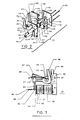
- the entire trip actuator 27 is shown disassembled in Figure 2 to illustrate the magnetic module 28 with its L-shaped stator 53 arranged with a vertical leg 54, as defined in the plane of Figure 2, carrying an integrally formed horizontal leg 55 around which are arranged a shunt trip coil 57 and a flux shift coil 58.
- the shunt trip coil 57 responds to an electronic trip signal to cause the circuit breaker operating mechanism to respond and open the contacts for remote switching purposes.
- the flux shift coil 58 is connected with an electronic trip unit 72 which comprises an integrated circuit trip unit 72 depicted in Figure 5. Upon the occurrence of an overcurrent condition through the protected circuit, an appropriate signal is sent to the flux shift coil to articulate the operating mechanism and trip the breaker.
- a rotor 59 consisting of an integrally upright arm having a downwardly extending leg member 63 and a radially formed protrusion 87, is pivotally mounted by means of a through-hole 61 extending through the rotor 59 for rotation about a pivot provided by headed bolt 50 used for assembling side frames 48, 49.
- a miniature permanent magnet 56 is imbedded within the vertical leg 54 for magnetic interaction with a rounded end 64 of the horizontal leg 55 by flux transfer through the upright arm 66 and thence the leg 63 of the rotor 59.
- the side frames 48, 49 of the magnetic module are attached together by means of the headed bolts 50 extending through clearance holes 51 formed on side frame 49, through clearance holes 60 formed within the L-shaped stator 53 and terminating within threaded holes 52 formed within the side frame 48.
- the torsion spring 33 is arranged on side frame 48 by means of a stud 9 located between stop 34 on the side frame and a protrusion 35 extending from the second lever 31.
- the magnetic latch accordingly comprises a hook-shaped latch-piece 65, pivotally attached to the upright arm 66 by means of the through-hole 61 for rotatably engaging a crosspiece 47 supported by integrally formed posts 45, 46 extending from a bar 44 integrally formed within the mechanical actuator 29.
- the mechanical actuator 29 accordingly comprises the first lever 30 and second lever 31 integrally formed from a single molded plastic operation and separated from each other by means of a connecting piece 81, which forms a part of the bar 44.
- the mechanical actuator 29 is supported on the magnetic module 28 by inserting the bar 44 integrally formed therein within the slot 94 formed in the bottom of the side frame 48.
- a similar slot 94 is arranged through the bottom of the other side frame 49 for supporting the opposite end of bar 44.
- the magnetic flux is carried through the rotor 59 from the point of contact on the upright arm down through the leg 63 to the rounded end 64 of the horizontal leg 55 formed on the L-shaped stator 53 to complete the magnetic path back to the miniature permanent magnet 56.
- the rounded end 64 ensures a single point of contact in a manner similar to the radial surface 67.
- a small trip spring 88 is secured to one end of leg 63 by means of a hole 89 and is attached to the outer cover (not shown) of the magnetic module 28 by means of a hooked end 90.
- the magnetic flux from the miniature permanent magnet 56 holds the rotor 59 from rotating in a clockwise direction against the bias of the trip spring 88.
- the torsion spring 33 is fixedly held against the stop 34 on the trip actuator 27 at one leg, as described earlier with reference to Figure 1, while the opposite leg abuts against the protrusion 35 on the second lever 31.
- the torsion spring 33 exhibits a force F1 in the indicated direction on the second lever 31, resulting in a first torque (F1)(X1) on the second lever rotating the lever about its pivot P measured at a distance X1 from the pivot P.
- the torsion spring 33 When the magnetic latch releases, thereby allowing the first and second levers 30, 31 to rotate in the counterclockwise direction about the pivot P, the torsion spring 33 exhibits a force F2 in the indicated direction which slightly decreases in magnitude as the torsion spring 33 proceeds to move from the magnetically latched to the magnetically unlatched position indicated in solid lines.
- F2 is applied at a second distance X2 from the pivot P to produce a torque (F2)(X2), which is substantially greater than the first torque.
- the increase in torque results primarily from the increase in the length of the distance X2 over the distance X1.
- the resultant force delivered to the extension 71 of the secondary latch 23 correspondingly increases in magnitude, moving from the magnetically latched to the magnetically unlatched position.
- the arrangement of the first and second levers 30, 31 at predetermined distances X1, X2 is an important feature of the instant invention. This arrangement provides a small "latching" force of a few ounces in magnitude against the second lever that is much lower than the available magnetic force generated by the miniature permanent magnet 56 ( Figure 3), while providing a resulting tripping force on the secondary latch extension in the order of several pounds. The larger tripping force is required to overcome the circuit breaker latching forces which are applied to the secondary latch extension 71 within the circuit breaker operating mechanism 15 shown in Figure 1.
- the two-pole breaker 10 is shown in Figure 5 with the cover removed and with the electronic components assembled for providing the necessary trip logic to the magnetic module 28.
- the current applied to the load side of the breaker overload straps 79, 81 is sensed through both poles by means of current transformers 73, 74, which include cores 76, 76 and secondary windings 77 and 78 respectively.
- the sensed current from the secondary windings is directed from terminal pins 84 and wires 85 to corresponding terminals 68 on the integrated circuit trip unit 72 for processing.
- the wires 85 interconnect between the two poles through an access slot 91 formed within the center wall 14 of the breaker case 11.
- an output signal from the trip unit is fed to the magnetic module 28, which is interconnected with the trip unit by means of terminals 68.
- the mechanical actuator assembly 29 is arranged within the circuit breaker case 11 such that the end 82 of the integrally formed bar 44 is rotatably supported within an opening 83 formed in the magnetic module enclosure 92 at one end, while being rotatably supported at an opposite end by the connecting piece 81 which nests in a corresponding opening 93 formed in the opposite end of the enclosure.
- the magnetic module 28 Upon receiving a trip signal from the trip unit, the magnetic module 28 releases the hook-shaped latch-piece 65 from crosspiece 47 on the mechanical actuator 29, thereby allowing the torsion spring 33 abutting against the protrusion 35 on the second lever 31 to drive the lever counterclockwise as viewed in Figure 4, thereby rotating the first lever 30 and driving the contact end 30A against a trip tab 71, which is an extension of the circuit breaker secondary latch 23.
- the secondary latch 23 then becomes displaced thereby allowing a boss 70 on the secondary latch 23 to move out of the path of the primary latch 24, sequentially allowing the cradle hook 25 to become released from the primary latch 24.
- the cradle 20 rapidly rotates in the manner described within the referenced U.S.
- Patent Application to allow the operating circuit breaker operating springs shown therein to separate the contacts and interrupt the circuit current. Still referring to Figure 5, the breaker is reset by engaging the cradle hook 25 with the primary latch 24, bringing the secondary latch 23 and the trip tab 71 on the secondary latch 23 against the contact end 30A of the primary lever 30 and rotating the primary lever from the position indicated in solid lines in Figure 4 to the latched position indicated in phantom.
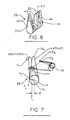
- FIG. 6 An alternate mechanical actuator 29 formed from a single molded plastic composition is depicted in Figure 6, wherein the second lever 31 is located in the same plane as the primary lever 30 but is offset a slight distance d ( Figure 7) from a center line through the center of the primary lever to enable the torsion spring 33 to rotate the actuator about its pivot P.
- the magnetic latch 32 is similar to that described earlier and comprises a pair of posts 45, 46 extending from a bar 44 and connected by means of a crosspiece 47.
- the torsion spring 33 contacts the second lever 31 by means of a hooked-end 37A and is anchored to the enclosure (not shown) at its opposite end 31B.
- the torsion spring exhibits a first force F1 in the indicated direction on the second lever and generates a torque at a first distance X1 measured from the pivot P.
- This first force F1 comprises the latching force described earlier.
- the torsion spring exerts a force F2 in the indicated direction, which provides a torque on the second lever 31 at a distance X2 from the pivot P.
- a trip actuator comprised of a unitary mechanical actuator and a magnetic module efficiently transfers the electronic trip logic from an electronic trip unit to mechanical motion for articulating a circuit breaker operating mechanism when arranged within a molded case circuit breaker enclosure.
- the arrangement of the trip actuator in an outside pole compartment of a multi-pole breaker prevents dielectric failure between the poles.
- the particular arrangement of a torsion spring and mechanical actuator results in a high spring force with a low torque on the mechanical actuator in a magnetically latched position and a low spring force with a high torque applied to the mechanical actuator when the magnetic module is magnetically unlatched.
- the arrangement of the torsion spring and mechanical actuator advantageously allows the mechanical actuator to be reset against a decreasing reset force.
Landscapes
- Physics & Mathematics (AREA)
- Electromagnetism (AREA)
- Breakers (AREA)
Applications Claiming Priority (2)
| Application Number | Priority Date | Filing Date | Title |
|---|---|---|---|
| US06/862,929 US4679019A (en) | 1986-05-14 | 1986-05-14 | Trip actuator for molded case circuit breakers |
| US862929 | 1986-05-14 |
Publications (2)
| Publication Number | Publication Date |
|---|---|
| EP0245834A2 true EP0245834A2 (de) | 1987-11-19 |
| EP0245834A3 EP0245834A3 (de) | 1989-10-18 |
Family
ID=25339763
Family Applications (1)
| Application Number | Title | Priority Date | Filing Date |
|---|---|---|---|
| EP87106853A Withdrawn EP0245834A3 (de) | 1986-05-14 | 1987-05-12 | Auslöseglied für Schalter mit formgepresstem Gehäuse |
Country Status (3)
| Country | Link |
|---|---|
| US (1) | US4679019A (de) |
| EP (1) | EP0245834A3 (de) |
| JP (1) | JPS62272420A (de) |
Cited By (2)
| Publication number | Priority date | Publication date | Assignee | Title |
|---|---|---|---|---|
| FR2633772A1 (fr) * | 1988-04-11 | 1990-01-05 | Gen Electric | Poignee de manoeuvre de disjoncteur en boitier moule pour assemblage automatise |
| FR2640423A1 (fr) * | 1988-12-14 | 1990-06-15 | Merlin Gerin | Mecanisme de commande d'un interrupteur differentiel multipolaire a barreau rotatif de commutation |
Families Citing this family (59)
| Publication number | Priority date | Publication date | Assignee | Title |
|---|---|---|---|---|
| US4835842A (en) * | 1987-04-23 | 1989-06-06 | General Electric Company | Method of assembling a molded case circuit breaker operating mechanism |
| US4801906A (en) * | 1987-10-19 | 1989-01-31 | General Electric Company | Molded case circuit breaker trip indicator unit |
| US4831221A (en) * | 1987-12-16 | 1989-05-16 | General Electric Company | Molded case circuit breaker auxiliary switch unit |
| US4786885A (en) * | 1987-12-16 | 1988-11-22 | General Electric Company | Molded case circuit breaker shunt trip unit |
| US4794356A (en) * | 1987-12-16 | 1988-12-27 | General Electric Company | Molded case circuit breaker auxiliary switch unit |
| US4788621A (en) * | 1987-12-16 | 1988-11-29 | General Electric Company | Molded case circuit breaker multiple accessory unit |
| US4806893A (en) * | 1988-03-03 | 1989-02-21 | General Electric Company | Molded case circuit breaker actuator-accessory unit |
| US4833563A (en) * | 1988-04-01 | 1989-05-23 | General Electric Company | Molded case circuit breaker actuator-accessory module |
| US4860157A (en) * | 1988-04-25 | 1989-08-22 | General Electric Company | Molded case circuit breaker actuator-accessory module |
| US4858056A (en) * | 1988-06-06 | 1989-08-15 | General Electric Company | Molded case circuit breaker actuator-accessory module |
| US4890081A (en) * | 1988-08-01 | 1989-12-26 | Westinghouse Electric Corp. | CT quick change assembly |
| US4894631A (en) * | 1988-09-06 | 1990-01-16 | General Electric Company | Molded case circuit breaker actuator-accessory unit |
| US4913503A (en) * | 1988-10-07 | 1990-04-03 | General Electric Company | Molded case circuit breaker actuator-accessory unit reset mechanism |
| US4890184A (en) * | 1988-12-30 | 1989-12-26 | Gen Electric | Molded case circuit breaker actuator-accessory unit |
| US4912439A (en) * | 1989-01-27 | 1990-03-27 | General Electric Company | Molded case circuit breaker auxiliary switch unit |
| US4884164A (en) * | 1989-02-01 | 1989-11-28 | General Electric Company | Molded case electronic circuit interrupter |
| US4939490A (en) * | 1989-02-17 | 1990-07-03 | General Electric Company | Molded case circuit breaker bell alarm unit |
| US4929920A (en) * | 1989-06-23 | 1990-05-29 | General Electric Company | Compact circuit breaker with an electronic trip unit |
| US5252937A (en) * | 1990-08-09 | 1993-10-12 | General Electric Company | Molded case circuit breaker modular bell alarm unit |
| US5059933A (en) * | 1990-09-14 | 1991-10-22 | General Electric Company | Molded case circuit breaker operating cradle configuration |
| US5027093A (en) * | 1990-10-29 | 1991-06-25 | General Electric Company | Molded case circuit breaker actuator-accessory unit having component tolerance compensation |
| US5295037A (en) * | 1992-01-27 | 1994-03-15 | General Electric Company | Molded case circuit breaker-process loop unit |
| US5321378A (en) * | 1993-04-08 | 1994-06-14 | General Electric Company | Molded case circuit breaker current transformer adapter unit |
| US5710399A (en) * | 1996-05-01 | 1998-01-20 | General Electric Company | Electronic trip unit conversion kit for high ampere-rated circuit breakers |
| US6087914A (en) * | 1996-12-19 | 2000-07-11 | Siemens Energy & Automation, Inc. | Circuit breaker combination thermal and magnetic trip actuator |
| US5866996A (en) * | 1996-12-19 | 1999-02-02 | Siemens Energy & Automation, Inc. | Contact arm with internal in-line spring |
| US5894260A (en) * | 1996-12-19 | 1999-04-13 | Siemens Energy & Automation, Inc. | Thermal sensing bi-metal trip actuator for a circuit breaker |
| US5844188A (en) * | 1996-12-19 | 1998-12-01 | Siemens Energy & Automation, Inc. | Circuit breaker with improved trip mechanism |
| US5875885A (en) * | 1997-05-28 | 1999-03-02 | Eaton Corporation | Combined wire lead and interphase barrier for power switches |
| US6060674A (en) * | 1997-05-28 | 2000-05-09 | Eaton Corporation | Circuit interrupter with plasma arc acceleration chamber and contact arm housing |
| DE20109898U1 (de) * | 2001-06-13 | 2001-09-06 | Siemens AG, 80333 München | Niederspannungs-Leistungsschalter mit einem elektronischen Überstromauslöser und Auslösemagneten |
| US7106155B2 (en) * | 2004-12-21 | 2006-09-12 | Eaton Corporation | Double-lever mechanism, trip actuator assembly and electrical switching apparatus employing the same |
| JP4650023B2 (ja) * | 2005-02-25 | 2011-03-16 | 富士電機機器制御株式会社 | 回路遮断器 |
| TWI327794B (en) * | 2005-12-12 | 2010-07-21 | Hon Hai Prec Ind Co Ltd | Electrical connector |
| US7369022B2 (en) * | 2006-01-23 | 2008-05-06 | Eaton Corporation | Auxiliary switch sub-assembly and electrical switching apparatus employing the same |
| US7319373B2 (en) * | 2006-01-23 | 2008-01-15 | Eaton Corporation | Electrical switching apparatus and terminal housing therefor |
| US7843291B2 (en) | 2006-02-23 | 2010-11-30 | Siemens Industry, Inc. | Integrated maglatch accessory |
| JP2009543296A (ja) * | 2006-06-30 | 2009-12-03 | モレックス インコーポレイテド | 低背型ラッチコネクタ及びラッチを外すためのプルタブ |
| US7697250B2 (en) * | 2006-07-14 | 2010-04-13 | William Davison | Switch-to-trip point translation |
| US7788055B2 (en) | 2006-07-14 | 2010-08-31 | Square D Company | Method and system of calibrating sensing components in a circuit breaker system |
| US7683586B2 (en) * | 2006-07-14 | 2010-03-23 | Davison William C | Method and system of fault powered supply voltage regulation |
| US7869169B2 (en) * | 2006-07-14 | 2011-01-11 | William Davison | Method and system of current transformer output magnitude compensation in a circuit breaker system |
| US7550939B2 (en) * | 2006-07-14 | 2009-06-23 | William Davison | Redundant instantaneous trip detection |
| US7869170B2 (en) * | 2006-07-14 | 2011-01-11 | Susan Jean Walker Colsch | Method and system for time synchronized trip algorithms for breaker self protection |
| US7791849B2 (en) * | 2006-07-14 | 2010-09-07 | William Davison | Redundant trip activation |
| US7592888B2 (en) * | 2006-07-14 | 2009-09-22 | Jason Robert Colsch | Low cost user adjustment, resistance to straying between positions, increased resistance to ESD, and consistent feel |
| US8154373B2 (en) * | 2006-07-14 | 2012-04-10 | Schneider Electric USA, Inc. | Circuit breaker-like apparatus with combination current transformer |
| US7859802B2 (en) * | 2006-07-14 | 2010-12-28 | William Davison | Burden resistor temperature compensation algorithm |
| US7570139B2 (en) * | 2007-04-05 | 2009-08-04 | Eaton Corporation | Electrical switching apparatus, and trip actuator assembly and reset assembly therefor |
| US7518476B2 (en) * | 2007-04-05 | 2009-04-14 | Eaton Corporation | Electrical switching apparatus and trip actuator reset assembly therefor |
| FR2926392B1 (fr) * | 2008-01-10 | 2009-12-18 | Schneider Electric Ind Sas | Boitier de declencheur electronique pour disjoncteur, dispositif de declenchement electronique et procede d'assemblage |
| GB0915379D0 (en) * | 2009-09-03 | 2009-10-07 | Deepstream Technologies Ltd | Miniature circuit breaker |
| CN101964285B (zh) * | 2010-10-29 | 2013-04-17 | 天津市百利电气有限公司 | 带有可机械复位磁通变换器的断路器 |
| US9484163B2 (en) | 2014-02-06 | 2016-11-01 | Eaton Corporation | Disconnect operating handles suitable for circuit breakers and related bucket assemblies |
| US9496101B2 (en) | 2014-02-06 | 2016-11-15 | Eaton Corporation | Disconnect operating handles suitable for circuit breakers and related bucket assemblies and handle interlocks |
| CN106158529B (zh) * | 2015-04-28 | 2018-10-23 | 上海电科电器科技有限公司 | 断路器的操作机构 |
| US9406465B1 (en) * | 2015-07-30 | 2016-08-02 | Carling Technologies, Inc. | Polarity insensitive arc quench |
| US11417489B2 (en) * | 2020-06-03 | 2022-08-16 | Rockwell Automation Technologies, Inc. | Trip unit fixation in a circuit breaker |
| CN112401510B (zh) * | 2020-10-26 | 2025-03-07 | 上海古鳌电子科技股份有限公司 | 一种档案柜 |
Family Cites Families (7)
| Publication number | Priority date | Publication date | Assignee | Title |
|---|---|---|---|---|
| CH456769A (de) * | 1966-09-22 | 1968-07-31 | Landis & Gyr Ag | Elektromagnetisches Auslöserelais |
| US3758887A (en) * | 1968-02-06 | 1973-09-11 | Westinghouse Electric Corp | Multi-pole circuit breaker with single trip adjustment for all poles |
| US3808567A (en) * | 1973-01-30 | 1974-04-30 | A Maier | Circuit breaker with improved resettable latch and trip means |
| US4104601A (en) * | 1976-04-12 | 1978-08-01 | I-T-E Imperial Corp. | Direct fault tripping of circuit breaker having solid state trip means |
| JPS56122246U (de) * | 1980-02-19 | 1981-09-17 | ||
| US4589942A (en) * | 1984-07-11 | 1986-05-20 | Transilwrap Company | Method for laminating a composite assembly |
| US4591942A (en) * | 1984-12-07 | 1986-05-27 | General Electric Company | Current sensing transformer assembly |
-
1986
- 1986-05-14 US US06/862,929 patent/US4679019A/en not_active Expired - Lifetime
-
1987
- 1987-03-16 JP JP62059125A patent/JPS62272420A/ja active Pending
- 1987-05-12 EP EP87106853A patent/EP0245834A3/de not_active Withdrawn
Cited By (4)
| Publication number | Priority date | Publication date | Assignee | Title |
|---|---|---|---|---|
| FR2633772A1 (fr) * | 1988-04-11 | 1990-01-05 | Gen Electric | Poignee de manoeuvre de disjoncteur en boitier moule pour assemblage automatise |
| FR2640423A1 (fr) * | 1988-12-14 | 1990-06-15 | Merlin Gerin | Mecanisme de commande d'un interrupteur differentiel multipolaire a barreau rotatif de commutation |
| EP0377385A1 (de) * | 1988-12-14 | 1990-07-11 | Merlin Gerin | Betätigungsmechanismus für einen mehrpoligen Fehlerstromschutzschalter mit drehbarer Schaltwelle |
| EP0602024A3 (en) * | 1988-12-14 | 1994-09-14 | Merlin Gerin | Operating mechanism for a multipolar fault-current protective switch with a rotary crossbar. |
Also Published As
| Publication number | Publication date |
|---|---|
| JPS62272420A (ja) | 1987-11-26 |
| EP0245834A3 (de) | 1989-10-18 |
| US4679019A (en) | 1987-07-07 |
Similar Documents
| Publication | Publication Date | Title |
|---|---|---|
| US4679019A (en) | Trip actuator for molded case circuit breakers | |
| US4700161A (en) | Combined trip unit and accessory module for electronic trip circuit breakers | |
| US4281359A (en) | Static trip unit for molded case circuit breakers | |
| US5231365A (en) | Circuit breaker | |
| CA2105917C (en) | Attachment actuator arrangement for 1 and 2-pole ground fault | |
| US7598830B2 (en) | Electromagnetic coil apparatus employing a magnetic flux enhancer, and accessory and electrical switching apparatus employing the same | |
| US8159318B2 (en) | Electromagnet assembly directly driving latch of an electronic circuit breaker | |
| US4757294A (en) | Combined trip unit and accessory module for electronic trip circuit breakers | |
| US6853279B1 (en) | Circuit breaker trip unit including a plunger resetting a trip actuator mechanism and a trip bar | |
| US5907461A (en) | Molded case circuit breaker with ground fault protection and signaling switches | |
| EP1981054B1 (de) | Elektrisches Schaltzubehörbaugruppe mit reversiblem Spulenrahmen und Zubehör und elektrisches Schaltgerät damit | |
| CA2292470C (en) | Multiple microswitch actuation mechanism | |
| US6175288B1 (en) | Supplemental trip unit for rotary circuit interrupters | |
| US3855502A (en) | Ground fault interrupter device | |
| US4300110A (en) | Trip interlock for static trip circuit breakers | |
| US4683451A (en) | Circuit breaker with trip delay magnetic circuit | |
| US3369202A (en) | Circuit breaker stack including auxiliary features | |
| US4037184A (en) | Lockout and cover interlock for circuit breaker | |
| US5015983A (en) | Compact circuit interrupter having multiple ampere ratings | |
| US6469600B1 (en) | Remote control circuit breaker with a by-pass lead | |
| US4267539A (en) | Circuit breaker having a cam for external adjustment of its trip point | |
| US20050024172A1 (en) | Circuit breaker trip unit employing a reset overtravel compensating rotary trip lever | |
| US3264428A (en) | Relay in combination with a circuit breaker for auxiliary tripping of the latter | |
| CA2049223C (en) | Molded case circuit breaker actuator-accessory unit having component tolerance compensation | |
| GB2071915A (en) | Static trip unit and interlock for circuit breaker |
Legal Events
| Date | Code | Title | Description |
|---|---|---|---|
| PUAI | Public reference made under article 153(3) epc to a published international application that has entered the european phase |
Free format text: ORIGINAL CODE: 0009012 |
|
| AK | Designated contracting states |
Kind code of ref document: A2 Designated state(s): DE FR GB IT |
|
| PUAL | Search report despatched |
Free format text: ORIGINAL CODE: 0009013 |
|
| AK | Designated contracting states |
Kind code of ref document: A3 Designated state(s): DE FR GB IT |
|
| 17P | Request for examination filed |
Effective date: 19900322 |
|
| 17Q | First examination report despatched |
Effective date: 19920221 |
|
| STAA | Information on the status of an ep patent application or granted ep patent |
Free format text: STATUS: THE APPLICATION IS DEEMED TO BE WITHDRAWN |
|
| 18D | Application deemed to be withdrawn |
Effective date: 19930414 |
|
| RIN1 | Information on inventor provided before grant (corrected) |
Inventor name: TODARO, FRANK ANDREW Inventor name: CASTONGUAY, ROGER NEIL Inventor name: KRAJEWSKI, ALEXANDER ANTHONY Inventor name: MORRIS, ROBERT ALLAN |