EP0245786B1 - Cathodically depositable aqueous electrocoating composition and its use - Google Patents
Cathodically depositable aqueous electrocoating composition and its use Download PDFInfo
- Publication number
- EP0245786B1 EP0245786B1 EP87106657A EP87106657A EP0245786B1 EP 0245786 B1 EP0245786 B1 EP 0245786B1 EP 87106657 A EP87106657 A EP 87106657A EP 87106657 A EP87106657 A EP 87106657A EP 0245786 B1 EP0245786 B1 EP 0245786B1
- Authority
- EP
- European Patent Office
- Prior art keywords
- groups
- component
- terminal
- per molecule
- transesterification
- Prior art date
- Legal status (The legal status is an assumption and is not a legal conclusion. Google has not performed a legal analysis and makes no representation as to the accuracy of the status listed.)
- Expired - Lifetime
Links
- 239000000203 mixture Substances 0.000 title claims abstract description 17
- 238000004070 electrodeposition Methods 0.000 title claims abstract description 12
- 229920005989 resin Polymers 0.000 claims abstract description 43
- 239000011347 resin Substances 0.000 claims abstract description 43
- 125000002887 hydroxy group Chemical group [H]O* 0.000 claims abstract description 36
- 150000001412 amines Chemical class 0.000 claims abstract description 18
- 125000004185 ester group Chemical group 0.000 claims abstract description 10
- 125000001302 tertiary amino group Chemical group 0.000 claims abstract description 9
- 238000006068 polycondensation reaction Methods 0.000 claims abstract description 7
- ZCYVEMRRCGMTRW-UHFFFAOYSA-N 7553-56-2 Chemical compound [I] ZCYVEMRRCGMTRW-UHFFFAOYSA-N 0.000 claims abstract description 5
- 229910052740 iodine Inorganic materials 0.000 claims abstract description 5
- 239000011630 iodine Substances 0.000 claims abstract description 5
- 238000005984 hydrogenation reaction Methods 0.000 claims abstract description 4
- 238000004132 cross linking Methods 0.000 claims description 20
- 239000003054 catalyst Substances 0.000 claims description 17
- 238000005809 transesterification reaction Methods 0.000 claims description 14
- 239000000049 pigment Substances 0.000 claims description 8
- 230000032050 esterification Effects 0.000 claims description 6
- 238000005886 esterification reaction Methods 0.000 claims description 6
- UFHFLCQGNIYNRP-UHFFFAOYSA-N Hydrogen Chemical compound [H][H] UFHFLCQGNIYNRP-UHFFFAOYSA-N 0.000 claims description 5
- 239000003795 chemical substances by application Substances 0.000 claims description 5
- 239000003960 organic solvent Substances 0.000 claims description 5
- 230000007797 corrosion Effects 0.000 claims description 4
- 238000005260 corrosion Methods 0.000 claims description 4
- 229910052739 hydrogen Inorganic materials 0.000 claims description 4
- 239000001257 hydrogen Substances 0.000 claims description 4
- 239000004922 lacquer Substances 0.000 claims description 4
- 239000003112 inhibitor Substances 0.000 claims description 3
- 125000002496 methyl group Chemical group [H]C([H])([H])* 0.000 claims 1
- 239000000126 substance Substances 0.000 claims 1
- 239000011230 binding agent Substances 0.000 abstract description 43
- 229920003002 synthetic resin Polymers 0.000 abstract description 11
- 239000000057 synthetic resin Substances 0.000 abstract description 11
- 238000000151 deposition Methods 0.000 abstract description 5
- 230000008021 deposition Effects 0.000 abstract description 5
- 208000009808 cranioectodermal dysplasia Diseases 0.000 description 29
- 239000003431 cross linking reagent Substances 0.000 description 25
- 239000007787 solid Substances 0.000 description 25
- 238000006243 chemical reaction Methods 0.000 description 20
- 150000001875 compounds Chemical class 0.000 description 20
- 238000000576 coating method Methods 0.000 description 13
- 239000010408 film Substances 0.000 description 13
- 239000002253 acid Substances 0.000 description 12
- 239000000047 product Substances 0.000 description 12
- 239000007795 chemical reaction product Substances 0.000 description 11
- 125000003277 amino group Chemical group 0.000 description 10
- 125000003700 epoxy group Chemical group 0.000 description 10
- 239000003973 paint Substances 0.000 description 10
- -1 glycidyl ester Chemical class 0.000 description 9
- OKKJLVBELUTLKV-UHFFFAOYSA-N Methanol Chemical group OC OKKJLVBELUTLKV-UHFFFAOYSA-N 0.000 description 8
- 239000011248 coating agent Substances 0.000 description 8
- 125000003055 glycidyl group Chemical group C(C1CO1)* 0.000 description 8
- 238000004519 manufacturing process Methods 0.000 description 8
- XLYOFNOQVPJJNP-UHFFFAOYSA-N water Substances O XLYOFNOQVPJJNP-UHFFFAOYSA-N 0.000 description 8
- 229910000831 Steel Inorganic materials 0.000 description 7
- 230000015572 biosynthetic process Effects 0.000 description 7
- 125000000467 secondary amino group Chemical group [H]N([*:1])[*:2] 0.000 description 7
- 239000010959 steel Substances 0.000 description 7
- QTBSBXVTEAMEQO-UHFFFAOYSA-N Acetic acid Chemical compound CC(O)=O QTBSBXVTEAMEQO-UHFFFAOYSA-N 0.000 description 6
- NIXOWILDQLNWCW-UHFFFAOYSA-M Acrylate Chemical compound [O-]C(=O)C=C NIXOWILDQLNWCW-UHFFFAOYSA-M 0.000 description 6
- 239000004593 Epoxy Substances 0.000 description 6
- XEKOWRVHYACXOJ-UHFFFAOYSA-N Ethyl acetate Chemical compound CCOC(C)=O XEKOWRVHYACXOJ-UHFFFAOYSA-N 0.000 description 6
- QIGBRXMKCJKVMJ-UHFFFAOYSA-N Hydroquinone Chemical compound OC1=CC=C(O)C=C1 QIGBRXMKCJKVMJ-UHFFFAOYSA-N 0.000 description 6
- 238000006845 Michael addition reaction Methods 0.000 description 6
- GWEVSGVZZGPLCZ-UHFFFAOYSA-N Titan oxide Chemical compound O=[Ti]=O GWEVSGVZZGPLCZ-UHFFFAOYSA-N 0.000 description 6
- IISBACLAFKSPIT-UHFFFAOYSA-N bisphenol A Chemical compound C=1C=C(O)C=CC=1C(C)(C)C1=CC=C(O)C=C1 IISBACLAFKSPIT-UHFFFAOYSA-N 0.000 description 6
- 239000000178 monomer Substances 0.000 description 6
- 229920000728 polyester Polymers 0.000 description 6
- JLBXCKSMESLGTJ-UHFFFAOYSA-N 1-ethoxypropan-1-ol Chemical compound CCOC(O)CC JLBXCKSMESLGTJ-UHFFFAOYSA-N 0.000 description 5
- BRLQWZUYTZBJKN-UHFFFAOYSA-N Epichlorohydrin Chemical compound ClCC1CO1 BRLQWZUYTZBJKN-UHFFFAOYSA-N 0.000 description 5
- WSFSSNUMVMOOMR-UHFFFAOYSA-N Formaldehyde Chemical class O=C WSFSSNUMVMOOMR-UHFFFAOYSA-N 0.000 description 5
- BPQQTUXANYXVAA-UHFFFAOYSA-N Orthosilicate Chemical compound [O-][Si]([O-])([O-])[O-] BPQQTUXANYXVAA-UHFFFAOYSA-N 0.000 description 5
- ISWSIDIOOBJBQZ-UHFFFAOYSA-N Phenol Chemical compound OC1=CC=CC=C1 ISWSIDIOOBJBQZ-UHFFFAOYSA-N 0.000 description 5
- NIXOWILDQLNWCW-UHFFFAOYSA-N acrylic acid group Chemical group C(C=C)(=O)O NIXOWILDQLNWCW-UHFFFAOYSA-N 0.000 description 5
- 125000001931 aliphatic group Chemical group 0.000 description 5
- 125000003118 aryl group Chemical group 0.000 description 5
- 150000002009 diols Chemical class 0.000 description 5
- DSSXKBBEJCDMBT-UHFFFAOYSA-M lead(2+);octanoate Chemical compound [Pb+2].CCCCCCCC([O-])=O DSSXKBBEJCDMBT-UHFFFAOYSA-M 0.000 description 5
- 229910052751 metal Inorganic materials 0.000 description 5
- 239000002184 metal Substances 0.000 description 5
- 238000000034 method Methods 0.000 description 5
- 229920000647 polyepoxide Polymers 0.000 description 5
- 229920001228 polyisocyanate Polymers 0.000 description 5
- 239000005056 polyisocyanate Substances 0.000 description 5
- 125000002924 primary amino group Chemical group [H]N([H])* 0.000 description 5
- 239000000243 solution Substances 0.000 description 5
- 239000002904 solvent Substances 0.000 description 5
- 238000012360 testing method Methods 0.000 description 5
- DVKJHBMWWAPEIU-UHFFFAOYSA-N toluene 2,4-diisocyanate Chemical compound CC1=CC=C(N=C=O)C=C1N=C=O DVKJHBMWWAPEIU-UHFFFAOYSA-N 0.000 description 5
- VZCYOOQTPOCHFL-OWOJBTEDSA-N Fumaric acid Chemical compound OC(=O)\C=C\C(O)=O VZCYOOQTPOCHFL-OWOJBTEDSA-N 0.000 description 4
- PPBRXRYQALVLMV-UHFFFAOYSA-N Styrene Chemical compound C=CC1=CC=CC=C1 PPBRXRYQALVLMV-UHFFFAOYSA-N 0.000 description 4
- 150000001252 acrylic acid derivatives Chemical class 0.000 description 4
- PXKLMJQFEQBVLD-UHFFFAOYSA-N bisphenol F Chemical compound C1=CC(O)=CC=C1CC1=CC=C(O)C=C1 PXKLMJQFEQBVLD-UHFFFAOYSA-N 0.000 description 4
- 239000008199 coating composition Substances 0.000 description 4
- ZBCBWPMODOFKDW-UHFFFAOYSA-N diethanolamine Chemical compound OCCNCCO ZBCBWPMODOFKDW-UHFFFAOYSA-N 0.000 description 4
- 125000002768 hydroxyalkyl group Chemical group 0.000 description 4
- BDAGIHXWWSANSR-UHFFFAOYSA-N methanoic acid Natural products OC=O BDAGIHXWWSANSR-UHFFFAOYSA-N 0.000 description 4
- 150000002763 monocarboxylic acids Chemical class 0.000 description 4
- 229920003986 novolac Polymers 0.000 description 4
- 229920000768 polyamine Polymers 0.000 description 4
- 238000002360 preparation method Methods 0.000 description 4
- 150000003141 primary amines Chemical class 0.000 description 4
- OAAZUWWNSYWWHG-UHFFFAOYSA-N 1-phenoxypropan-1-ol Chemical compound CCC(O)OC1=CC=CC=C1 OAAZUWWNSYWWHG-UHFFFAOYSA-N 0.000 description 3
- LFQSCWFLJHTTHZ-UHFFFAOYSA-N Ethanol Chemical compound CCO LFQSCWFLJHTTHZ-UHFFFAOYSA-N 0.000 description 3
- LYCAIKOWRPUZTN-UHFFFAOYSA-N Ethylene glycol Chemical compound OCCO LYCAIKOWRPUZTN-UHFFFAOYSA-N 0.000 description 3
- CERQOIWHTDAKMF-UHFFFAOYSA-N Methacrylic acid Chemical class CC(=C)C(O)=O CERQOIWHTDAKMF-UHFFFAOYSA-N 0.000 description 3
- 229960000583 acetic acid Drugs 0.000 description 3
- 150000007513 acids Chemical class 0.000 description 3
- 239000006229 carbon black Substances 0.000 description 3
- 238000003776 cleavage reaction Methods 0.000 description 3
- 150000004985 diamines Chemical group 0.000 description 3
- GYZLOYUZLJXAJU-UHFFFAOYSA-N diglycidyl ether Chemical class C1OC1COCC1CO1 GYZLOYUZLJXAJU-UHFFFAOYSA-N 0.000 description 3
- 239000006185 dispersion Substances 0.000 description 3
- 230000000694 effects Effects 0.000 description 3
- 239000003822 epoxy resin Substances 0.000 description 3
- 150000002148 esters Chemical class 0.000 description 3
- 150000002170 ethers Chemical class 0.000 description 3
- 230000004992 fission Effects 0.000 description 3
- 239000012362 glacial acetic acid Substances 0.000 description 3
- VOZRXNHHFUQHIL-UHFFFAOYSA-N glycidyl methacrylate Chemical compound CC(=C)C(=O)OCC1CO1 VOZRXNHHFUQHIL-UHFFFAOYSA-N 0.000 description 3
- 238000010348 incorporation Methods 0.000 description 3
- 229910052745 lead Inorganic materials 0.000 description 3
- 239000000463 material Substances 0.000 description 3
- 229910044991 metal oxide Inorganic materials 0.000 description 3
- 150000004706 metal oxides Chemical class 0.000 description 3
- 229920001568 phenolic resin Polymers 0.000 description 3
- 239000005011 phenolic resin Substances 0.000 description 3
- 150000002989 phenols Chemical class 0.000 description 3
- 238000006116 polymerization reaction Methods 0.000 description 3
- 230000005588 protonation Effects 0.000 description 3
- 239000011541 reaction mixture Substances 0.000 description 3
- 230000007017 scission Effects 0.000 description 3
- 150000003335 secondary amines Chemical class 0.000 description 3
- 238000003756 stirring Methods 0.000 description 3
- 239000004408 titanium dioxide Substances 0.000 description 3
- VZCYOOQTPOCHFL-UHFFFAOYSA-N trans-butenedioic acid Natural products OC(=O)C=CC(O)=O VZCYOOQTPOCHFL-UHFFFAOYSA-N 0.000 description 3
- 229920002818 (Hydroxyethyl)methacrylate Polymers 0.000 description 2
- KPAPHODVWOVUJL-UHFFFAOYSA-N 1-benzofuran;1h-indene Chemical compound C1=CC=C2CC=CC2=C1.C1=CC=C2OC=CC2=C1 KPAPHODVWOVUJL-UHFFFAOYSA-N 0.000 description 2
- YBYIRNPNPLQARY-UHFFFAOYSA-N 1H-indene Chemical compound C1=CC=C2CC=CC2=C1 YBYIRNPNPLQARY-UHFFFAOYSA-N 0.000 description 2
- STMDPCBYJCIZOD-UHFFFAOYSA-N 2-(2,4-dinitroanilino)-4-methylpentanoic acid Chemical compound CC(C)CC(C(O)=O)NC1=CC=C([N+]([O-])=O)C=C1[N+]([O-])=O STMDPCBYJCIZOD-UHFFFAOYSA-N 0.000 description 2
- LEJBBGNFPAFPKQ-UHFFFAOYSA-N 2-(2-prop-2-enoyloxyethoxy)ethyl prop-2-enoate Chemical compound C=CC(=O)OCCOCCOC(=O)C=C LEJBBGNFPAFPKQ-UHFFFAOYSA-N 0.000 description 2
- INQDDHNZXOAFFD-UHFFFAOYSA-N 2-[2-(2-prop-2-enoyloxyethoxy)ethoxy]ethyl prop-2-enoate Chemical compound C=CC(=O)OCCOCCOCCOC(=O)C=C INQDDHNZXOAFFD-UHFFFAOYSA-N 0.000 description 2
- ZNQVEEAIQZEUHB-UHFFFAOYSA-N 2-ethoxyethanol Chemical compound CCOCCO ZNQVEEAIQZEUHB-UHFFFAOYSA-N 0.000 description 2
- OMIGHNLMNHATMP-UHFFFAOYSA-N 2-hydroxyethyl prop-2-enoate Chemical compound OCCOC(=O)C=C OMIGHNLMNHATMP-UHFFFAOYSA-N 0.000 description 2
- QZPSOSOOLFHYRR-UHFFFAOYSA-N 3-hydroxypropyl prop-2-enoate Chemical compound OCCCOC(=O)C=C QZPSOSOOLFHYRR-UHFFFAOYSA-N 0.000 description 2
- OSWFIVFLDKOXQC-UHFFFAOYSA-N 4-(3-methoxyphenyl)aniline Chemical compound COC1=CC=CC(C=2C=CC(N)=CC=2)=C1 OSWFIVFLDKOXQC-UHFFFAOYSA-N 0.000 description 2
- OAOABCKPVCUNKO-UHFFFAOYSA-N 8-methyl Nonanoic acid Chemical compound CC(C)CCCCCCC(O)=O OAOABCKPVCUNKO-UHFFFAOYSA-N 0.000 description 2
- VVJKKWFAADXIJK-UHFFFAOYSA-N Allylamine Chemical compound NCC=C VVJKKWFAADXIJK-UHFFFAOYSA-N 0.000 description 2
- 229930185605 Bisphenol Natural products 0.000 description 2
- 239000004970 Chain extender Substances 0.000 description 2
- 239000004606 Fillers/Extenders Substances 0.000 description 2
- CTKINSOISVBQLD-UHFFFAOYSA-N Glycidol Chemical compound OCC1CO1 CTKINSOISVBQLD-UHFFFAOYSA-N 0.000 description 2
- WOBHKFSMXKNTIM-UHFFFAOYSA-N Hydroxyethyl methacrylate Chemical compound CC(=C)C(=O)OCCO WOBHKFSMXKNTIM-UHFFFAOYSA-N 0.000 description 2
- 229920000877 Melamine resin Polymers 0.000 description 2
- BAPJBEWLBFYGME-UHFFFAOYSA-N Methyl acrylate Chemical compound COC(=O)C=C BAPJBEWLBFYGME-UHFFFAOYSA-N 0.000 description 2
- NTIZESTWPVYFNL-UHFFFAOYSA-N Methyl isobutyl ketone Chemical compound CC(C)CC(C)=O NTIZESTWPVYFNL-UHFFFAOYSA-N 0.000 description 2
- UIHCLUNTQKBZGK-UHFFFAOYSA-N Methyl isobutyl ketone Natural products CCC(C)C(C)=O UIHCLUNTQKBZGK-UHFFFAOYSA-N 0.000 description 2
- LRHPLDYGYMQRHN-UHFFFAOYSA-N N-Butanol Chemical compound CCCCO LRHPLDYGYMQRHN-UHFFFAOYSA-N 0.000 description 2
- CTQNGGLPUBDAKN-UHFFFAOYSA-N O-Xylene Chemical compound CC1=CC=CC=C1C CTQNGGLPUBDAKN-UHFFFAOYSA-N 0.000 description 2
- ZJCCRDAZUWHFQH-UHFFFAOYSA-N Trimethylolpropane Chemical compound CCC(CO)(CO)CO ZJCCRDAZUWHFQH-UHFFFAOYSA-N 0.000 description 2
- DAKWPKUUDNSNPN-UHFFFAOYSA-N Trimethylolpropane triacrylate Chemical compound C=CC(=O)OCC(CC)(COC(=O)C=C)COC(=O)C=C DAKWPKUUDNSNPN-UHFFFAOYSA-N 0.000 description 2
- HCHKCACWOHOZIP-UHFFFAOYSA-N Zinc Chemical compound [Zn] HCHKCACWOHOZIP-UHFFFAOYSA-N 0.000 description 2
- XLOMVQKBTHCTTD-UHFFFAOYSA-N Zinc monoxide Chemical compound [Zn]=O XLOMVQKBTHCTTD-UHFFFAOYSA-N 0.000 description 2
- 150000003926 acrylamides Chemical class 0.000 description 2
- WNLRTRBMVRJNCN-UHFFFAOYSA-N adipic acid Chemical compound OC(=O)CCCCC(O)=O WNLRTRBMVRJNCN-UHFFFAOYSA-N 0.000 description 2
- 150000001298 alcohols Chemical class 0.000 description 2
- XXROGKLTLUQVRX-UHFFFAOYSA-N allyl alcohol Chemical compound OCC=C XXROGKLTLUQVRX-UHFFFAOYSA-N 0.000 description 2
- 150000001408 amides Chemical class 0.000 description 2
- 229920003180 amino resin Polymers 0.000 description 2
- ADCOVFLJGNWWNZ-UHFFFAOYSA-N antimony trioxide Chemical compound O=[Sb]O[Sb]=O ADCOVFLJGNWWNZ-UHFFFAOYSA-N 0.000 description 2
- 239000004841 bisphenol A epoxy resin Substances 0.000 description 2
- 125000003178 carboxy group Chemical group [H]OC(*)=O 0.000 description 2
- 229920001577 copolymer Polymers 0.000 description 2
- 230000007547 defect Effects 0.000 description 2
- SWXVUIWOUIDPGS-UHFFFAOYSA-N diacetone alcohol Chemical compound CC(=O)CC(C)(C)O SWXVUIWOUIDPGS-UHFFFAOYSA-N 0.000 description 2
- DOIRQSBPFJWKBE-UHFFFAOYSA-N dibutyl phthalate Chemical compound CCCCOC(=O)C1=CC=CC=C1C(=O)OCCCC DOIRQSBPFJWKBE-UHFFFAOYSA-N 0.000 description 2
- 150000001990 dicarboxylic acid derivatives Chemical class 0.000 description 2
- 235000014113 dietary fatty acids Nutrition 0.000 description 2
- WOZVHXUHUFLZGK-UHFFFAOYSA-N dimethyl terephthalate Chemical compound COC(=O)C1=CC=C(C(=O)OC)C=C1 WOZVHXUHUFLZGK-UHFFFAOYSA-N 0.000 description 2
- IUNMPGNGSSIWFP-UHFFFAOYSA-N dimethylaminopropylamine Chemical compound CN(C)CCCN IUNMPGNGSSIWFP-UHFFFAOYSA-N 0.000 description 2
- 238000002474 experimental method Methods 0.000 description 2
- 229930195729 fatty acid Natural products 0.000 description 2
- 239000000194 fatty acid Substances 0.000 description 2
- 150000004665 fatty acids Chemical class 0.000 description 2
- 239000000945 filler Substances 0.000 description 2
- 235000019253 formic acid Nutrition 0.000 description 2
- 239000001530 fumaric acid Substances 0.000 description 2
- 229910052736 halogen Inorganic materials 0.000 description 2
- 150000002367 halogens Chemical class 0.000 description 2
- 238000010438 heat treatment Methods 0.000 description 2
- NAQMVNRVTILPCV-UHFFFAOYSA-N hexane-1,6-diamine Chemical compound NCCCCCCN NAQMVNRVTILPCV-UHFFFAOYSA-N 0.000 description 2
- 239000011261 inert gas Substances 0.000 description 2
- 150000002736 metal compounds Chemical class 0.000 description 2
- 125000005395 methacrylic acid group Chemical group 0.000 description 2
- WSFSSNUMVMOOMR-NJFSPNSNSA-N methanone Chemical compound O=[14CH2] WSFSSNUMVMOOMR-NJFSPNSNSA-N 0.000 description 2
- 230000003472 neutralizing effect Effects 0.000 description 2
- 239000003921 oil Substances 0.000 description 2
- 239000002245 particle Substances 0.000 description 2
- 239000004014 plasticizer Substances 0.000 description 2
- 229920001610 polycaprolactone Polymers 0.000 description 2
- 239000004632 polycaprolactone Substances 0.000 description 2
- 229920005862 polyol Polymers 0.000 description 2
- 150000003077 polyols Chemical class 0.000 description 2
- 239000002243 precursor Substances 0.000 description 2
- 230000008569 process Effects 0.000 description 2
- 150000003839 salts Chemical class 0.000 description 2
- 239000004575 stone Substances 0.000 description 2
- 150000004670 unsaturated fatty acids Chemical class 0.000 description 2
- 235000021122 unsaturated fatty acids Nutrition 0.000 description 2
- 239000008096 xylene Substances 0.000 description 2
- 229910052725 zinc Inorganic materials 0.000 description 2
- 239000011701 zinc Substances 0.000 description 2
- DAFHKNAQFPVRKR-UHFFFAOYSA-N (3-hydroxy-2,2,4-trimethylpentyl) 2-methylpropanoate Chemical compound CC(C)C(O)C(C)(C)COC(=O)C(C)C DAFHKNAQFPVRKR-UHFFFAOYSA-N 0.000 description 1
- ALSTYHKOOCGGFT-KTKRTIGZSA-N (9Z)-octadecen-1-ol Chemical compound CCCCCCCC\C=C/CCCCCCCCO ALSTYHKOOCGGFT-KTKRTIGZSA-N 0.000 description 1
- OYHQOLUKZRVURQ-NTGFUMLPSA-N (9Z,12Z)-9,10,12,13-tetratritiooctadeca-9,12-dienoic acid Chemical compound C(CCCCCCC\C(=C(/C\C(=C(/CCCCC)\[3H])\[3H])\[3H])\[3H])(=O)O OYHQOLUKZRVURQ-NTGFUMLPSA-N 0.000 description 1
- WRIDQFICGBMAFQ-UHFFFAOYSA-N (E)-8-Octadecenoic acid Natural products CCCCCCCCCC=CCCCCCCC(O)=O WRIDQFICGBMAFQ-UHFFFAOYSA-N 0.000 description 1
- POILWHVDKZOXJZ-ARJAWSKDSA-M (z)-4-oxopent-2-en-2-olate Chemical compound C\C([O-])=C\C(C)=O POILWHVDKZOXJZ-ARJAWSKDSA-M 0.000 description 1
- MYWOJODOMFBVCB-UHFFFAOYSA-N 1,2,6-trimethylphenanthrene Chemical compound CC1=CC=C2C3=CC(C)=CC=C3C=CC2=C1C MYWOJODOMFBVCB-UHFFFAOYSA-N 0.000 description 1
- OUPZKGBUJRBPGC-UHFFFAOYSA-N 1,3,5-tris(oxiran-2-ylmethyl)-1,3,5-triazinane-2,4,6-trione Chemical compound O=C1N(CC2OC2)C(=O)N(CC2OC2)C(=O)N1CC1CO1 OUPZKGBUJRBPGC-UHFFFAOYSA-N 0.000 description 1
- DURPTKYDGMDSBL-UHFFFAOYSA-N 1-butoxybutane Chemical compound CCCCOCCCC DURPTKYDGMDSBL-UHFFFAOYSA-N 0.000 description 1
- OSSNTDFYBPYIEC-UHFFFAOYSA-N 1-ethenylimidazole Chemical compound C=CN1C=CN=C1 OSSNTDFYBPYIEC-UHFFFAOYSA-N 0.000 description 1
- JOLQKTGDSGKSKJ-UHFFFAOYSA-N 1-ethoxypropan-2-ol Chemical compound CCOCC(C)O JOLQKTGDSGKSKJ-UHFFFAOYSA-N 0.000 description 1
- HECLRDQVFMWTQS-RGOKHQFPSA-N 1755-01-7 Chemical compound C1[C@H]2[C@@H]3CC=C[C@@H]3[C@@H]1C=C2 HECLRDQVFMWTQS-RGOKHQFPSA-N 0.000 description 1
- OZAIFHULBGXAKX-UHFFFAOYSA-N 2-(2-cyanopropan-2-yldiazenyl)-2-methylpropanenitrile Chemical compound N#CC(C)(C)N=NC(C)(C)C#N OZAIFHULBGXAKX-UHFFFAOYSA-N 0.000 description 1
- SMZOUWXMTYCWNB-UHFFFAOYSA-N 2-(2-methoxy-5-methylphenyl)ethanamine Chemical compound COC1=CC=C(C)C=C1CCN SMZOUWXMTYCWNB-UHFFFAOYSA-N 0.000 description 1
- CBKJLMZJKHOGEQ-UHFFFAOYSA-N 2-(oxiran-2-yl)ethyl prop-2-enoate Chemical compound C=CC(=O)OCCC1CO1 CBKJLMZJKHOGEQ-UHFFFAOYSA-N 0.000 description 1
- LSWYGACWGAICNM-UHFFFAOYSA-N 2-(prop-2-enoxymethyl)oxirane Chemical compound C=CCOCC1CO1 LSWYGACWGAICNM-UHFFFAOYSA-N 0.000 description 1
- IHEDBVUTTQXGSJ-UHFFFAOYSA-M 2-[bis(2-oxidoethyl)amino]ethanolate;titanium(4+);hydroxide Chemical compound [OH-].[Ti+4].[O-]CCN(CC[O-])CC[O-] IHEDBVUTTQXGSJ-UHFFFAOYSA-M 0.000 description 1
- SVONRAPFKPVNKG-UHFFFAOYSA-N 2-ethoxyethyl acetate Chemical compound CCOCCOC(C)=O SVONRAPFKPVNKG-UHFFFAOYSA-N 0.000 description 1
- LQJBNNIYVWPHFW-UHFFFAOYSA-N 20:1omega9c fatty acid Natural products CCCCCCCCCCC=CCCCCCCCC(O)=O LQJBNNIYVWPHFW-UHFFFAOYSA-N 0.000 description 1
- RNLHGQLZWXBQNY-UHFFFAOYSA-N 3-(aminomethyl)-3,5,5-trimethylcyclohexan-1-amine Chemical compound CC1(C)CC(N)CC(C)(CN)C1 RNLHGQLZWXBQNY-UHFFFAOYSA-N 0.000 description 1
- KFIRODWJCYBBHY-UHFFFAOYSA-N 3-nitrophthalic acid Chemical compound OC(=O)C1=CC=CC([N+]([O-])=O)=C1C(O)=O KFIRODWJCYBBHY-UHFFFAOYSA-N 0.000 description 1
- FQMIAEWUVYWVNB-UHFFFAOYSA-N 3-prop-2-enoyloxybutyl prop-2-enoate Chemical compound C=CC(=O)OC(C)CCOC(=O)C=C FQMIAEWUVYWVNB-UHFFFAOYSA-N 0.000 description 1
- GZVHEAJQGPRDLQ-UHFFFAOYSA-N 6-phenyl-1,3,5-triazine-2,4-diamine Chemical compound NC1=NC(N)=NC(C=2C=CC=CC=2)=N1 GZVHEAJQGPRDLQ-UHFFFAOYSA-N 0.000 description 1
- FIHBHSQYSYVZQE-UHFFFAOYSA-N 6-prop-2-enoyloxyhexyl prop-2-enoate Chemical compound C=CC(=O)OCCCCCCOC(=O)C=C FIHBHSQYSYVZQE-UHFFFAOYSA-N 0.000 description 1
- 239000005725 8-Hydroxyquinoline Substances 0.000 description 1
- QSBYPNXLFMSGKH-UHFFFAOYSA-N 9-Heptadecensaeure Natural products CCCCCCCC=CCCCCCCCC(O)=O QSBYPNXLFMSGKH-UHFFFAOYSA-N 0.000 description 1
- HRPVXLWXLXDGHG-UHFFFAOYSA-N Acrylamide Chemical compound NC(=O)C=C HRPVXLWXLXDGHG-UHFFFAOYSA-N 0.000 description 1
- 0 C*C1C(*C)=C(C(*)(*)C(C(N)=C(*C)C2C)=C(*C)C2N)C(*C)=C(*C)[C@@]1C Chemical compound C*C1C(*C)=C(C(*)(*)C(C(N)=C(*C)C2C)=C(*C)C2N)C(*C)=C(*C)[C@@]1C 0.000 description 1
- GAWIXWVDTYZWAW-UHFFFAOYSA-N C[CH]O Chemical group C[CH]O GAWIXWVDTYZWAW-UHFFFAOYSA-N 0.000 description 1
- RPNUMPOLZDHAAY-UHFFFAOYSA-N Diethylenetriamine Chemical compound NCCNCCN RPNUMPOLZDHAAY-UHFFFAOYSA-N 0.000 description 1
- JIGUQPWFLRLWPJ-UHFFFAOYSA-N Ethyl acrylate Chemical compound CCOC(=O)C=C JIGUQPWFLRLWPJ-UHFFFAOYSA-N 0.000 description 1
- PIICEJLVQHRZGT-UHFFFAOYSA-N Ethylenediamine Chemical compound NCCN PIICEJLVQHRZGT-UHFFFAOYSA-N 0.000 description 1
- 239000013032 Hydrocarbon resin Substances 0.000 description 1
- CNCOEDDPFOAUMB-UHFFFAOYSA-N N-Methylolacrylamide Chemical compound OCNC(=O)C=C CNCOEDDPFOAUMB-UHFFFAOYSA-N 0.000 description 1
- UEEJHVSXFDXPFK-UHFFFAOYSA-N N-dimethylaminoethanol Chemical compound CN(C)CCO UEEJHVSXFDXPFK-UHFFFAOYSA-N 0.000 description 1
- OPKOKAMJFNKNAS-UHFFFAOYSA-N N-methylethanolamine Chemical compound CNCCO OPKOKAMJFNKNAS-UHFFFAOYSA-N 0.000 description 1
- 229920002292 Nylon 6 Polymers 0.000 description 1
- GFUFLQXOGFLXML-UHFFFAOYSA-N OCCOC(C(=C)C)=O.C1(C2C(C(=O)O1)CCC=C2)=O Chemical compound OCCOC(C(=C)C)=O.C1(C2C(C(=O)O1)CCC=C2)=O GFUFLQXOGFLXML-UHFFFAOYSA-N 0.000 description 1
- 239000005642 Oleic acid Substances 0.000 description 1
- ZQPPMHVWECSIRJ-UHFFFAOYSA-N Oleic acid Natural products CCCCCCCCC=CCCCCCCCC(O)=O ZQPPMHVWECSIRJ-UHFFFAOYSA-N 0.000 description 1
- 229930040373 Paraformaldehyde Natural products 0.000 description 1
- 239000002202 Polyethylene glycol Substances 0.000 description 1
- OFOBLEOULBTSOW-UHFFFAOYSA-N Propanedioic acid Natural products OC(=O)CC(O)=O OFOBLEOULBTSOW-UHFFFAOYSA-N 0.000 description 1
- ATJFFYVFTNAWJD-UHFFFAOYSA-N Tin Chemical compound [Sn] ATJFFYVFTNAWJD-UHFFFAOYSA-N 0.000 description 1
- 229920001807 Urea-formaldehyde Polymers 0.000 description 1
- CQHKDHVZYZUZMJ-UHFFFAOYSA-N [2,2-bis(hydroxymethyl)-3-prop-2-enoyloxypropyl] prop-2-enoate Chemical compound C=CC(=O)OCC(CO)(CO)COC(=O)C=C CQHKDHVZYZUZMJ-UHFFFAOYSA-N 0.000 description 1
- TUOBEAZXHLTYLF-UHFFFAOYSA-N [2-(hydroxymethyl)-2-(prop-2-enoyloxymethyl)butyl] prop-2-enoate Chemical compound C=CC(=O)OCC(CO)(CC)COC(=O)C=C TUOBEAZXHLTYLF-UHFFFAOYSA-N 0.000 description 1
- FHLPGTXWCFQMIU-UHFFFAOYSA-N [4-[2-(4-prop-2-enoyloxyphenyl)propan-2-yl]phenyl] prop-2-enoate Chemical compound C=1C=C(OC(=O)C=C)C=CC=1C(C)(C)C1=CC=C(OC(=O)C=C)C=C1 FHLPGTXWCFQMIU-UHFFFAOYSA-N 0.000 description 1
- YKTSYUJCYHOUJP-UHFFFAOYSA-N [O--].[Al+3].[Al+3].[O-][Si]([O-])([O-])[O-] Chemical compound [O--].[Al+3].[Al+3].[O-][Si]([O-])([O-])[O-] YKTSYUJCYHOUJP-UHFFFAOYSA-N 0.000 description 1
- UKLDJPRMSDWDSL-UHFFFAOYSA-L [dibutyl(dodecanoyloxy)stannyl] dodecanoate Chemical compound CCCCCCCCCCCC(=O)O[Sn](CCCC)(CCCC)OC(=O)CCCCCCCCCCC UKLDJPRMSDWDSL-UHFFFAOYSA-L 0.000 description 1
- 230000002378 acidificating effect Effects 0.000 description 1
- 125000005396 acrylic acid ester group Chemical group 0.000 description 1
- 229920006243 acrylic copolymer Polymers 0.000 description 1
- 239000000654 additive Substances 0.000 description 1
- 239000001361 adipic acid Substances 0.000 description 1
- 235000011037 adipic acid Nutrition 0.000 description 1
- 150000001338 aliphatic hydrocarbons Chemical class 0.000 description 1
- 125000000217 alkyl group Chemical group 0.000 description 1
- DTOSIQBPPRVQHS-PDBXOOCHSA-N alpha-linolenic acid Chemical compound CC\C=C/C\C=C/C\C=C/CCCCCCCC(O)=O DTOSIQBPPRVQHS-PDBXOOCHSA-N 0.000 description 1
- 235000020661 alpha-linolenic acid Nutrition 0.000 description 1
- 229910052782 aluminium Inorganic materials 0.000 description 1
- XAGFODPZIPBFFR-UHFFFAOYSA-N aluminium Chemical compound [Al] XAGFODPZIPBFFR-UHFFFAOYSA-N 0.000 description 1
- 150000001414 amino alcohols Chemical class 0.000 description 1
- QDHUQRBYCVAWEN-UHFFFAOYSA-N amino prop-2-enoate Chemical class NOC(=O)C=C QDHUQRBYCVAWEN-UHFFFAOYSA-N 0.000 description 1
- LHIJANUOQQMGNT-UHFFFAOYSA-N aminoethylethanolamine Chemical compound NCCNCCO LHIJANUOQQMGNT-UHFFFAOYSA-N 0.000 description 1
- 239000002518 antifoaming agent Substances 0.000 description 1
- 150000004945 aromatic hydrocarbons Chemical class 0.000 description 1
- 239000011324 bead Substances 0.000 description 1
- 230000008901 benefit Effects 0.000 description 1
- WTEOIRVLGSZEPR-UHFFFAOYSA-N boron trifluoride Chemical class FB(F)F WTEOIRVLGSZEPR-UHFFFAOYSA-N 0.000 description 1
- CQEYYJKEWSMYFG-UHFFFAOYSA-N butyl acrylate Chemical compound CCCCOC(=O)C=C CQEYYJKEWSMYFG-UHFFFAOYSA-N 0.000 description 1
- 229910052793 cadmium Inorganic materials 0.000 description 1
- BDOSMKKIYDKNTQ-UHFFFAOYSA-N cadmium atom Chemical compound [Cd] BDOSMKKIYDKNTQ-UHFFFAOYSA-N 0.000 description 1
- 150000003857 carboxamides Chemical class 0.000 description 1
- 229940072282 cardura Drugs 0.000 description 1
- 125000002091 cationic group Chemical group 0.000 description 1
- 230000015271 coagulation Effects 0.000 description 1
- 238000005345 coagulation Methods 0.000 description 1
- 238000009833 condensation Methods 0.000 description 1
- 230000005494 condensation Effects 0.000 description 1
- 238000007334 copolymerization reaction Methods 0.000 description 1
- 229960002887 deanol Drugs 0.000 description 1
- 239000008367 deionised water Substances 0.000 description 1
- 229910021641 deionized water Inorganic materials 0.000 description 1
- 238000005137 deposition process Methods 0.000 description 1
- 230000006866 deterioration Effects 0.000 description 1
- 238000011161 development Methods 0.000 description 1
- 125000004386 diacrylate group Chemical group 0.000 description 1
- 125000004985 dialkyl amino alkyl group Chemical group 0.000 description 1
- 125000005265 dialkylamine group Chemical group 0.000 description 1
- 239000012975 dibutyltin dilaurate Substances 0.000 description 1
- 150000001991 dicarboxylic acids Chemical class 0.000 description 1
- HPNMFZURTQLUMO-UHFFFAOYSA-N diethylamine Chemical compound CCNCC HPNMFZURTQLUMO-UHFFFAOYSA-N 0.000 description 1
- SBZXBUIDTXKZTM-UHFFFAOYSA-N diglyme Chemical compound COCCOCCOC SBZXBUIDTXKZTM-UHFFFAOYSA-N 0.000 description 1
- 125000005442 diisocyanate group Chemical group 0.000 description 1
- 239000003085 diluting agent Substances 0.000 description 1
- 238000010790 dilution Methods 0.000 description 1
- 239000012895 dilution Substances 0.000 description 1
- 239000012972 dimethylethanolamine Substances 0.000 description 1
- WNAHIZMDSQCWRP-UHFFFAOYSA-N dodecane-1-thiol Chemical compound CCCCCCCCCCCCS WNAHIZMDSQCWRP-UHFFFAOYSA-N 0.000 description 1
- RUZYUOTYCVRMRZ-UHFFFAOYSA-N doxazosin Chemical compound C1OC2=CC=CC=C2OC1C(=O)N(CC1)CCN1C1=NC(N)=C(C=C(C(OC)=C2)OC)C2=N1 RUZYUOTYCVRMRZ-UHFFFAOYSA-N 0.000 description 1
- 230000005684 electric field Effects 0.000 description 1
- 230000005611 electricity Effects 0.000 description 1
- 150000002118 epoxides Chemical class 0.000 description 1
- 238000006266 etherification reaction Methods 0.000 description 1
- 230000000763 evoking effect Effects 0.000 description 1
- 125000002485 formyl group Chemical class [H]C(*)=O 0.000 description 1
- 125000000524 functional group Chemical group 0.000 description 1
- 239000007789 gas Substances 0.000 description 1
- 238000010559 graft polymerization reaction Methods 0.000 description 1
- 238000000227 grinding Methods 0.000 description 1
- LNEPOXFFQSENCJ-UHFFFAOYSA-N haloperidol Chemical compound C1CC(O)(C=2C=CC(Cl)=CC=2)CCN1CCCC(=O)C1=CC=C(F)C=C1 LNEPOXFFQSENCJ-UHFFFAOYSA-N 0.000 description 1
- 125000000623 heterocyclic group Chemical group 0.000 description 1
- XXMIOPMDWAUFGU-UHFFFAOYSA-N hexane-1,6-diol Chemical compound OCCCCCCO XXMIOPMDWAUFGU-UHFFFAOYSA-N 0.000 description 1
- 229920006270 hydrocarbon resin Polymers 0.000 description 1
- 150000002430 hydrocarbons Chemical group 0.000 description 1
- 150000002431 hydrogen Chemical class 0.000 description 1
- 125000004356 hydroxy functional group Chemical group O* 0.000 description 1
- 238000011065 in-situ storage Methods 0.000 description 1
- IQPQWNKOIGAROB-UHFFFAOYSA-N isocyanate group Chemical group [N-]=C=O IQPQWNKOIGAROB-UHFFFAOYSA-N 0.000 description 1
- ZFSLODLOARCGLH-UHFFFAOYSA-N isocyanuric acid Chemical compound OC1=NC(O)=NC(O)=N1 ZFSLODLOARCGLH-UHFFFAOYSA-N 0.000 description 1
- QXJSBBXBKPUZAA-UHFFFAOYSA-N isooleic acid Natural products CCCCCCCC=CCCCCCCCCC(O)=O QXJSBBXBKPUZAA-UHFFFAOYSA-N 0.000 description 1
- JQJCSZOEVBFDKO-UHFFFAOYSA-N lead zinc Chemical class [Zn].[Pb] JQJCSZOEVBFDKO-UHFFFAOYSA-N 0.000 description 1
- GIWKOZXJDKMGQC-UHFFFAOYSA-L lead(2+);naphthalene-2-carboxylate Chemical compound [Pb+2].C1=CC=CC2=CC(C(=O)[O-])=CC=C21.C1=CC=CC2=CC(C(=O)[O-])=CC=C21 GIWKOZXJDKMGQC-UHFFFAOYSA-L 0.000 description 1
- 229960004488 linolenic acid Drugs 0.000 description 1
- KQQKGWQCNNTQJW-UHFFFAOYSA-N linolenic acid Natural products CC=CCCC=CCC=CCCCCCCCC(O)=O KQQKGWQCNNTQJW-UHFFFAOYSA-N 0.000 description 1
- VZCYOOQTPOCHFL-UPHRSURJSA-N maleic acid Chemical compound OC(=O)\C=C/C(O)=O VZCYOOQTPOCHFL-UPHRSURJSA-N 0.000 description 1
- 239000011976 maleic acid Substances 0.000 description 1
- 230000007246 mechanism Effects 0.000 description 1
- JDSHMPZPIAZGSV-UHFFFAOYSA-N melamine Chemical compound NC1=NC(N)=NC(N)=N1 JDSHMPZPIAZGSV-UHFFFAOYSA-N 0.000 description 1
- 150000002739 metals Chemical class 0.000 description 1
- FQPSGWSUVKBHSU-UHFFFAOYSA-N methacrylamide Chemical compound CC(=C)C(N)=O FQPSGWSUVKBHSU-UHFFFAOYSA-N 0.000 description 1
- 125000005397 methacrylic acid ester group Chemical group 0.000 description 1
- 230000005012 migration Effects 0.000 description 1
- 238000013508 migration Methods 0.000 description 1
- 230000004048 modification Effects 0.000 description 1
- 238000012986 modification Methods 0.000 description 1
- 150000002762 monocarboxylic acid derivatives Chemical class 0.000 description 1
- FUSJFDKVZJCPOQ-UHFFFAOYSA-N n'-(aminomethyl)propane-1,3-diamine Chemical compound NCCCNCN FUSJFDKVZJCPOQ-UHFFFAOYSA-N 0.000 description 1
- ZETYUTMSJWMKNQ-UHFFFAOYSA-N n,n',n'-trimethylhexane-1,6-diamine Chemical compound CNCCCCCCN(C)C ZETYUTMSJWMKNQ-UHFFFAOYSA-N 0.000 description 1
- GEMHFKXPOCTAIP-UHFFFAOYSA-N n,n-dimethyl-n'-phenylcarbamimidoyl chloride Chemical compound CN(C)C(Cl)=NC1=CC=CC=C1 GEMHFKXPOCTAIP-UHFFFAOYSA-N 0.000 description 1
- YPHQUSNPXDGUHL-UHFFFAOYSA-N n-methylprop-2-enamide Chemical compound CNC(=O)C=C YPHQUSNPXDGUHL-UHFFFAOYSA-N 0.000 description 1
- DYUWTXWIYMHBQS-UHFFFAOYSA-N n-prop-2-enylprop-2-en-1-amine Chemical compound C=CCNCC=C DYUWTXWIYMHBQS-UHFFFAOYSA-N 0.000 description 1
- 125000005609 naphthenate group Chemical group 0.000 description 1
- SLCVBVWXLSEKPL-UHFFFAOYSA-N neopentyl glycol Chemical compound OCC(C)(C)CO SLCVBVWXLSEKPL-UHFFFAOYSA-N 0.000 description 1
- 238000006386 neutralization reaction Methods 0.000 description 1
- XNGIFLGASWRNHJ-UHFFFAOYSA-N o-dicarboxybenzene Natural products OC(=O)C1=CC=CC=C1C(O)=O XNGIFLGASWRNHJ-UHFFFAOYSA-N 0.000 description 1
- 125000005474 octanoate group Chemical group 0.000 description 1
- ZQPPMHVWECSIRJ-KTKRTIGZSA-N oleic acid Chemical compound CCCCCCCC\C=C/CCCCCCCC(O)=O ZQPPMHVWECSIRJ-KTKRTIGZSA-N 0.000 description 1
- 235000021313 oleic acid Nutrition 0.000 description 1
- 229940055577 oleyl alcohol Drugs 0.000 description 1
- XMLQWXUVTXCDDL-UHFFFAOYSA-N oleyl alcohol Natural products CCCCCCC=CCCCCCCCCCCO XMLQWXUVTXCDDL-UHFFFAOYSA-N 0.000 description 1
- 150000002894 organic compounds Chemical class 0.000 description 1
- RPQRDASANLAFCM-UHFFFAOYSA-N oxiran-2-ylmethyl prop-2-enoate Chemical compound C=CC(=O)OCC1CO1 RPQRDASANLAFCM-UHFFFAOYSA-N 0.000 description 1
- 229960003540 oxyquinoline Drugs 0.000 description 1
- 238000010422 painting Methods 0.000 description 1
- 229920002866 paraformaldehyde Polymers 0.000 description 1
- PNJWIWWMYCMZRO-UHFFFAOYSA-N pent‐4‐en‐2‐one Natural products CC(=O)CC=C PNJWIWWMYCMZRO-UHFFFAOYSA-N 0.000 description 1
- 150000008379 phenol ethers Chemical class 0.000 description 1
- 239000004033 plastic Substances 0.000 description 1
- 229920003023 plastic Polymers 0.000 description 1
- 229920001223 polyethylene glycol Polymers 0.000 description 1
- 239000004848 polyfunctional curative Substances 0.000 description 1
- 230000000379 polymerizing effect Effects 0.000 description 1
- 229920000909 polytetrahydrofuran Polymers 0.000 description 1
- 239000000843 powder Substances 0.000 description 1
- 230000002028 premature Effects 0.000 description 1
- QCTJRYGLPAFRMS-UHFFFAOYSA-N prop-2-enoic acid;1,3,5-triazine-2,4,6-triamine Chemical compound OC(=O)C=C.NC1=NC(N)=NC(N)=N1 QCTJRYGLPAFRMS-UHFFFAOYSA-N 0.000 description 1
- POSICDHOUBKJKP-UHFFFAOYSA-N prop-2-enoxybenzene Chemical compound C=CCOC1=CC=CC=C1 POSICDHOUBKJKP-UHFFFAOYSA-N 0.000 description 1
- HJWLCRVIBGQPNF-UHFFFAOYSA-N prop-2-enylbenzene Chemical compound C=CCC1=CC=CC=C1 HJWLCRVIBGQPNF-UHFFFAOYSA-N 0.000 description 1
- BDERNNFJNOPAEC-UHFFFAOYSA-N propan-1-ol Chemical compound CCCO BDERNNFJNOPAEC-UHFFFAOYSA-N 0.000 description 1
- MCJGNVYPOGVAJF-UHFFFAOYSA-N quinolin-8-ol Chemical compound C1=CN=C2C(O)=CC=CC2=C1 MCJGNVYPOGVAJF-UHFFFAOYSA-N 0.000 description 1
- 230000009257 reactivity Effects 0.000 description 1
- 230000009467 reduction Effects 0.000 description 1
- 238000010992 reflux Methods 0.000 description 1
- 238000007127 saponification reaction Methods 0.000 description 1
- 239000007858 starting material Substances 0.000 description 1
- 238000001256 steam distillation Methods 0.000 description 1
- 150000005846 sugar alcohols Polymers 0.000 description 1
- 150000003512 tertiary amines Chemical class 0.000 description 1
- 229910052716 thallium Inorganic materials 0.000 description 1
- BKVIYDNLLOSFOA-UHFFFAOYSA-N thallium Chemical compound [Tl] BKVIYDNLLOSFOA-UHFFFAOYSA-N 0.000 description 1
- 238000009210 therapy by ultrasound Methods 0.000 description 1
- 238000012719 thermal polymerization Methods 0.000 description 1
- 239000010409 thin film Substances 0.000 description 1
- 238000007056 transamidation reaction Methods 0.000 description 1
- 238000005690 transetherification reaction Methods 0.000 description 1
- 230000001960 triggered effect Effects 0.000 description 1
- 150000004072 triols Chemical class 0.000 description 1
- 229930195735 unsaturated hydrocarbon Natural products 0.000 description 1
- XSQUKJJJFZCRTK-UHFFFAOYSA-N urea group Chemical group NC(=O)N XSQUKJJJFZCRTK-UHFFFAOYSA-N 0.000 description 1
- JOYRKODLDBILNP-UHFFFAOYSA-N urethane group Chemical group NC(=O)OCC JOYRKODLDBILNP-UHFFFAOYSA-N 0.000 description 1
- 150000003673 urethanes Chemical class 0.000 description 1
- 239000002966 varnish Substances 0.000 description 1
- 238000009736 wetting Methods 0.000 description 1
- 150000003752 zinc compounds Chemical class 0.000 description 1
- 239000011787 zinc oxide Substances 0.000 description 1
Classifications
-
- C—CHEMISTRY; METALLURGY
- C09—DYES; PAINTS; POLISHES; NATURAL RESINS; ADHESIVES; COMPOSITIONS NOT OTHERWISE PROVIDED FOR; APPLICATIONS OF MATERIALS NOT OTHERWISE PROVIDED FOR
- C09D—COATING COMPOSITIONS, e.g. PAINTS, VARNISHES OR LACQUERS; FILLING PASTES; CHEMICAL PAINT OR INK REMOVERS; INKS; CORRECTING FLUIDS; WOODSTAINS; PASTES OR SOLIDS FOR COLOURING OR PRINTING; USE OF MATERIALS THEREFOR
- C09D5/00—Coating compositions, e.g. paints, varnishes or lacquers, characterised by their physical nature or the effects produced; Filling pastes
- C09D5/44—Coating compositions, e.g. paints, varnishes or lacquers, characterised by their physical nature or the effects produced; Filling pastes for electrophoretic applications
- C09D5/4473—Mixture of polymers
-
- Y—GENERAL TAGGING OF NEW TECHNOLOGICAL DEVELOPMENTS; GENERAL TAGGING OF CROSS-SECTIONAL TECHNOLOGIES SPANNING OVER SEVERAL SECTIONS OF THE IPC; TECHNICAL SUBJECTS COVERED BY FORMER USPC CROSS-REFERENCE ART COLLECTIONS [XRACs] AND DIGESTS
- Y10—TECHNICAL SUBJECTS COVERED BY FORMER USPC
- Y10S—TECHNICAL SUBJECTS COVERED BY FORMER USPC CROSS-REFERENCE ART COLLECTIONS [XRACs] AND DIGESTS
- Y10S524/00—Synthetic resins or natural rubbers -- part of the class 520 series
- Y10S524/901—Electrodepositable compositions
Definitions
- the invention relates to a cathodically depositable aqueous electrodeposition coating composition
- a cathodically depositable aqueous electrodeposition coating composition which contains (A) one or more synthetic resin binders with amino groups which can be rendered water-soluble or water-dispersible by protonation with acids, crosslinking agents (B) and (C) reacting therewith when stoved Soluble and / or insoluble transesterification and / or esterification catalysts for thermal crosslinking at temperatures above 100 ° C., which may contain pigments, corrosion inhibitors, anti-cratering agents, coating aids, catalysts and organic solvents.
- the invention further relates to the use of such a coating agent for cathodic deposition from a paint bath on electrically conductive surfaces.
- such reaction products can be used together with urethane compounds as binders for cathodic deposits.
- binders for cathodic deposits.
- the disadvantages of these binders are the production-related, relatively high content of organic solvents and the development of surface defects insufficient elasticity of the coatings and adhesion problems with additional coatings applied.
- a disadvantage of this system is the formation of fission products during the baking process.
- CED Combinations of CED binders which carry primary and / or secondary amino groups with compounds containing double bonds are known from US Pat. Nos. 3,925,181 and 3,975,251.
- CED is an internationally used abbreviation for Cathodic Electro Deposition.
- the crosslinking reaction is a Michael addition of reactive amines to double bonds.
- the disadvantage is the poor stability of the CED baths, since the Michael addition can take place at room temperature.
- the instability can be reduced by completely neutralizing the primary and secondary amines.
- To get a good crosslink density one is a sufficiently large amount of reactive amino groups and thus a correspondingly large amount of neutralizing acid is necessary.
- the object of the present invention was to largely avoid the known disadvantages and to decisively improve the weathering and stone chip resistance, particularly at baking temperatures between 140 and 160.degree.
- the CED material of the invention is very stable against saponification.
- the professional manufacture of components (A) and (B) enables the crosslinking reaction to take place during the baking process without the emission of environmentally harmful fission products.
- Components (A), (B) and / or (C) can be used both as mixtures and as precondensates or prepolymers, i.e. by heating the mixtures, optionally under inert gas, to 40 to 200 ° C or higher.
- This pre-codate or prepolymer formation corresponds to the prior art and is intended to bring about a better code position of the various components during the electrical coating process.
- the heating of the components can of course also bring about other advantageous effects, such as purer ultrafiltrate, better dispersion, smoother film surface and better adhesion properties.
- crosslinking would be significantly increased by the presence of higher molecular weight polyols with primary hydroxyl groups, especially when using relatively low baking temperatures.
- crosslinking agent (B) the useful use of transesterification and esterification catalysts for the thermal crosslinking of synthetic resin binders which carry primary or secondary hydroxyl groups with crosslinking agent (B) was not known, especially since the crosslinking reaction can neither be a transesterification nor an esterification .
- the importance of the primary hydroxyl groups for crosslinking with the crosslinking component (B) was determined by experiments with tert. Amino acrylates which contain primary, secondary or no hydroxyl groups have been proven. In the presence of the resin with primary hydroxyl groups, the strongest crosslinking occurred, especially at low baking temperatures. The secondary hydroxyl groups led to somewhat less crosslinking at lower stoving temperatures, while practically no crosslinking was found with hydroxyl group-free resin even at stoving conditions of 60 minutes at 180 ° C.
- the binders of component (A) are known and can e.g. according to examples of EP-B-12 463, EP-A-40 867, EP-B-66 859 (examples A1, A3 and A6).
- EP-A-137 459 and DE-A-34 36 346 (examples A1 and A2) can be produced.
- An advantage for intercoat adhesion is the incorporation of substituted urea groups in component (A) and / or (B), e.g. can be introduced into the binder molecule by reaction of polyisocyanate or blocked polyisocyanate with mono- and polyamine.
- the binder of component (A) has a number average molecular weight ( Mn ) from 700 to 10,000, preferably 1500 to 5000. It contains at least one tertiary amino group per molecule.
- the lower limit of the amine number should preferably be 50, particularly preferably 70, the upper limit, however, should preferably be 120, particularly preferably 100. If the amine number is too low, for example, the solubility is too low or the pH values in the deposition baths are too acid due to a high degree of neutralization. If the amine number is too high, poor film formation during deposition or a blistered surface results.
- the binders of component (A) can be those which have essentially no carboxyl groups.
- Such resins are reaction products of epichlorohydrin with dioxi-diphenylmethane (bisphenol F) or dioxi-diphenylpropane (bisphenol A).
- Polyepoxides with a suitable molecular weight are either by selecting the reaction conditions in the reaction of the bisphenol with epichlorohydrin or by reacting the monomeric diglycidyl compound with further bisphenol or with long-chain polyalcohols such as 1,6-hexanediol, polytetrahydrofuran diol, polycaprolactone diol, polycaprolactam diol or polybutadienediol in the presence of suitable acidic catalysts such as boron fluoride complexes.
- suitable acidic catalysts such as boron fluoride complexes.
- Corresponding heterocyclic polyepoxy compounds can also be used, such as 1,3-diglycidyl-5,5-dimethylhydantioin, triglycidyl isocyanurate or diepoxides from bisimides.
- the epoxy group-containing resins are glycidyl (meth) acrylate copolymers which have been obtained by copolymerizing glycidyl methacrylate with unsaturated monomers.
- Unsaturated monomers are styrene, vinyl toluene, (meth) acrylic acid esters of various chain lengths, the methacrylic acid esters preferably containing linear or branched C1 to C4 alcohols and the acrylic acid esters preferably linear or branched C2 to C8 alcohols.
- the amino groups can be introduced either by copolymerization with unsaturated amines such as dialkylaminoalkyl (meth) acrylates, corresponding acrylamides or N-vinylimidazole, or by reaction of preferably secondary amines or amino alcohols with the epoxy groups.
- unsaturated amines such as dialkylaminoalkyl (meth) acrylates, corresponding acrylamides or N-vinylimidazole, or by reaction of preferably secondary amines or amino alcohols with the epoxy groups.
- the amino groups are introduced into component (A) either by adding NH-reactive compounds to the epoxy group or by reacting the hydroxyl groups of the base resin with basic monoisocyanates, which result from the reaction of aromatic and / or aliphatic and / or cycloaliphatic di- or polyisocyanates arise with a dialkylaminoalkanol (see. DE-A-2 707 405).
- Primary monoalkylamines such as dialkylaminoalkylamine and / or preferably secondary monoamines such as dialkylamines, monoalkylhydroxyalkylamines or dihydroxyalkylamines are used as NH-reactive compounds.
- Examples of compounds which can be used are diethylamine, dimethylaminopropylamine, N-methylaminoethanol or diethanolamine.
- Chain extension occurs when using primary amines or secondary diamines, e.g. when using addition products of 1,6-hexanediamine with 2 mol of glycidyl ester of versatic acid.
- Secondary diamines preferably long-chain diamines, can also be alkyldiaminoalkanes or reaction products of saturated glycidyl ethers with primary diaminoalkanes.
- the suitable number of hydroyl groups arises automatically from the epoxy group on addition of the secondary amino groups, and on the other hand it can be controlled by using hydroxylalkylamines.
- the molar ratios between compounds containing epoxide and amino groups are to be chosen so that the complete incorporation of the amine is ensured because breakthrough surface defects can occur during electrophoretic coating, ie a slight excess of epoxy groups is advantageous.
- the reaction of the amines begins at room temperature and is generally exothermic. In order to achieve complete implementation, it is usually necessary to temporarily raise the temperature to around 50 to 120 ° C.
- the 1,2-epoid group-containing resin is dissolved in organic solvents such as xylene, methyl isobutyl ketone, which later have to be distilled off before dilution, or in solvents such as ethylene glycol monoethyl ether, propylene glycol monoethyl ether, diethylene glycol dimethyl ether or diacetone alcohol, which can remain in solution.
- organic solvents such as xylene, methyl isobutyl ketone, which later have to be distilled off before dilution, or in solvents such as ethylene glycol monoethyl ether, propylene glycol monoethyl ether, diethylene glycol dimethyl ether or diacetone alcohol, which can remain in solution.
- a thin-film evaporator or steam distillation is suitable for removing amine residues.
- Primary mono- and polyamines are converted to tertiary amines in the presence of a sufficient number of epoxy groups. If the epoxy groups are insufficient, primary and secondary amino groups can remain in component (A).
- a small proportion of primary and secondary amino groups corresponding to an amine number below 20, preferably below 10, does not generally have a disruptive effect. Higher proportions of reactive amino groups can lead to premature gelatinization or at least to a reduction in stability.
- the double bonds can optionally be introduced into component (A) either directly by addition to the epoxy groups or indirectly by reacting the hydroxyl group of the base resin with unsaturated monoisocyanates which are reacted with aromatic and / or aliphatic and / or cycloaliphatic di- or polyisocyanates ⁇ , ⁇ -Unsaturated monocarboxylic acids or corresponding carboxamides, such as hydroxyalkyl (meth) acrylates or dicarboxylic acid esters of hydroxyalkyl (meth) acrylates, as are described in DE-A-2 707 482.
- Compounds are selected which, due to their structure in the molecular structure, result in largely thermally stable urethane groups.
- the direct addition to the epoxy group can be carried out, for example, with diallylamine, unsaturated fatty amines or unsaturated fatty acids.
- Unsaturated dicarboxylic acids such as fumaric acid or dimerized fatty acid or also adducts of unsaturated monoepoxy compounds with di- or polyamines with at least two primary amino groups or at least one primary and one secondary amino group, such as hexanediamine-1,6, 3-aminomethylaminopropylamine, diethylenetriamine, can be used as chain extenders.
- Trimethylhexamethylene diamine and isophorone diamine, according to the formula R ⁇ unsaturated hydrocarbon residue of fatty acids
- the amino groups of the polyamines are reacted approximately stoichiometrically with so much unsaturated monoepoxide compounds at temperatures of about 50 to 105 ° C. that a molecule with two reactive secondary amino groups is formed, which reacts as a chain extender with further polyepoxide.
- Examples are the reaction products of one mole of glycidyl allyl ether with aminoethylethanolamine or of two moles of linoleic glycidyl ester with ethylenediamine. If three reactive points are used, branches are installed.
- a chain extension can also be carried out by incorporating unsaturated primary amines such as primary allylamine.
- Another method of preparation is the transetherification with an etherified methylolated (methyl) acrylamide, for example methylolacrylamide monobutyl ether, as described in DE-A-2 934 467.
- the introduction of unsaturated double bonds can also be achieved in the same way by reaction with unsaturated formaldehyde condensation resins such as phenol plastics or aminoplasts.
- unsaturated formaldehyde condensation resins such as phenol plastics or aminoplasts.
- Suitable phenolic resins are, for example, reaction products of mononuclear and / or polynuclear, optionally alkyl-substituted phenols with formaldehyde or compounds providing formaldehyde, such as paraformaldehyde.
- the methylol groups can be partially or fully etherified with methanol, ethanol, propanol, butanol and / or unsaturated monoalcohols such as allyl alcohol, hydroxyalkyl (meth) acrylates or oleyl alcohol.
- Etherified phenolic resins can also be prepared by reaction with unsaturated monoepoxides such as glycidyl allyl ethers or glycidyl methyl acrylate.
- a further modification enables the reaction with unsaturated monocarboxylic acids such as (meth) acrylic acid, maleic acid or fumaric acid monoesters or unsaturated fatty acids such as oleic acid, linoleic acid, linolenic acid or their natural mixtures.
- unsaturated monocarboxylic acids such as (meth) acrylic acid, maleic acid or fumaric acid monoesters or unsaturated fatty acids such as oleic acid, linoleic acid, linolenic acid or their natural mixtures.
- Low molecular weight unsaturated phenol ethers such as the polymethylol compounds of phenol allyl ether (Methylonharz® 75 108 from General Electric) are particularly suitable.
- Unsaturated aminoplasts can be obtained by reacting the methylolated melamine, benzoguanamine or urea resins with unsaturated monoalcohols or monocarboxylic acids.
- Particularly preferred starting materials for binders of component (A) are reaction products of bisphenol A, bisphenol F and / or novolaks with epichlorohydrin.
- Novolaks are to be understood as meaning reaction products from phenols with aldehyde, as described in "Lackkunstharze” by H. Wagner and H.F. Sarx, Carl Hanser Verlag, Kunststoff 1959, on pages 42, 45 and 46, where, instead of phenol, suitable homologs and derivatives of phenol can also be used for the production of novolaks.
- Component (A) contains primary hydroxyl groups, corresponding to a hydroxyl number of 15 to 300, preferably 20 to 180.
- the reaction of secondary and primary amines with 1,2-epoxy groups essentially gives rise to secondary hydroxyl groups.
- Primary hydroxyl groups can, for example, be introduced into component (A) by using alkanolamines containing primary hydroxyl groups, such as diethanolamine.
- CED binders with primary hydroxyl groups Another possibility for the production of CED binders with primary hydroxyl groups is the, optionally partial, reaction of epoxy groups of an epoxy resin with polyols, such as diols, triols etc., e.g. with polycaprolactone diol, and introduction of tertiary amino groups in a known manner.
- polyols such as diols, triols etc., e.g. with polycaprolactone diol
- (Meth) acrylate resins with primary hydroxyl groups can be obtained by using monomers with primary hydroxyl groups, e.g. of hydroxy (meth) acrylate. By simultaneously polymerizing in unsaturated glycidyl monomers, 1,2-epoxy groups are suitable, which are reacted with amines in a known manner.
- the graft polymerization of (meth) acrylate monomers on aminoepoxy resins which contain terminal or pendant double bonds can be carried out with the use of e.g. Hydroxyethyl (meth) acrylate also lead to CED binders for component (A).
- Polycondensation resins with primary hydroxyl groups can be prepared from reactive polyamino amide resins, as described in the "Textbook of Lacquers and Coatings" by H. Kittel, W.A. Colomb in Heenemann GmbH Stuttgart-Berlin, Volume I, Part 1, 1971, pages 509 to 511, by reaction with primary hydroxyl-containing 1,2-epoxy compounds, such as glycidol (2,3-epoxy-1-propanol) .
- Component (B), which is used for crosslinking with component (A), has a number-average molar mass ( Mn ) from 170 to 10,000, preferably 250 to 6000. You must carry an average of at least two terminal or pendant reactive double bonds per molecule. The reaction starting from the double bonds should proceed so quickly that there is sufficient crosslinking at baking temperatures of 140 to 160 ° C. or lower. Double bonds of acrylic and methacrylic groups are particularly suitable for this.
- suitable acrylic acid compounds may be used, such as ethylene glycol, 1,3-butylene glycol diacrylate, bisphenol A diacrylate, diethylene glycol diacrylate, triethylene glycol diacrylate, Teraethylenglykoldiacrylat, 1,6-hexanediol diacrylate, polyethylene glycol diacrylate, trimethylolpropane diacrylate, trimethylolpropane triacrylate, pentaerythritol diacrylate, Pentraerythrittriacrylat, Pentaerythritol tetraacrylate and melamine acrylate as well as the corresponding methacrylic acid compounds.
- suitable acrylic acid compounds such as ethylene glycol, 1,3-butylene glycol diacrylate, bisphenol A diacrylate, diethylene glycol diacrylate, triethylene glycol diacrylate, Teraethylenglykoldiacrylat, 1,6-hexanediol diacrylate, polyethylene glycol diacrylate, trimethyl
- component (B) Another possibility is the use of methacrylamide or acrylamide compounds, which e.g. after reaction of the amides with formaldehyde, and optionally after etherification of the resulting methylol groups, on compounds and resins with corresponding functional groups, e.g. Hydroxyl groups are condensed by known methods.
- component (B) Another possibility for the production of component (B) consists in the reaction of glycidyl acrylate or glycidyl methacrylate with compounds or resins carrying carboxyl groups. Since ⁇ -hydroxyester groups are formed in this way, it must be ensured that no cleavage products result from transesterification during the stoving. If the unsaturated glycidyl compounds are reacted with compounds or resins which carry primary or secondary amino groups, the risk of cleavage product formation is considerably lower.
- Component (B) can also be obtained by transesterification of esters and polyesters or by reaction of diisocyanates, prepolymers carrying isocyanate groups, precondensates and synthetic resins with hydroxyalkyl (meth) acrylate, e.g. by reaction of the reaction product from 1 mol of trimethylolpropane and 3 mol of tolylene diisocyanate with 3 mol of 2-hydroxyethyl acrylate.
- Component (B) can optionally carry tertiary amino groups, so that better dispersion in water is achieved. In such cases, the amount of tertiary amino groups must be so large or so small that the code position with component (A) is ensured.
- component (B) it is of course also possible to use groups containing double bonds, e.g. the acrylic group to be inserted directly into the synthetic resin molecule of component (A), which to a certain extent creates self-curing CED binders.
- component (B) it is advantageous to add component (B) to the system as a reactive diluent component, which gives CED coatings with a higher layer thickness (30 to 50 ⁇ m) and excellent throwing power.
- component (B) per molecule for crosslinking without the formation of cleavage products, it is expedient for component (B) per molecule to contain on average less than one terminal ester group capable of being transesterified upon baking, preferably less than 0.5, particularly preferably essentially no terminal ester groups capable of being transesterified upon baking.
- the term "essentially” is understood to mean that practically all such groups are not present, although it is always possible with high molecular weight products of the present type that there is a very low content of such groups.
- crosslinking agents of component (B) In addition to the crosslinking agents of component (B), other crosslinking agents which are useful for cathodically depositable systems, such as blocked polyisocyanates, ⁇ -hydroxy esters, melamine resins, phenolic resins, phenol allyl ether-formaldehyde resins, can be used. This makes it possible to improve certain properties, for example pigment wetting and the appearance of the film surface, without a significant deterioration in the reactivity.
- binders of component (A) with more or less reactive hydroxyl groups and crosslinking agents with acrylic or methacrylic groups, it is possible to set optimal flow properties and to achieve excellent bath stability.
- the mass ratio of component (A) to component (B) is 95 to 5% component (A) to 5 to 95% component (B), preferably 95 to 40% component (A) to 5 to 60% component (B).
- Transesterification and esterification catalysts are suitable as crosslinking catalysts, component (C).
- the optimum amount must be determined specifically for each catalyst or for each catalyst mixture with the binder or binder mixture used.
- 0.1 to 10%, preferably 1 to 6% metal, based on the total proportion of component (A) and component (B), are used in the form of the metal oxides, metal salts and / or metal complex compounds, e.g. Chelates, used by mono- or polyvalent metals.
- Suitable catalysts are lead octoate, lead silicate, lead naphthenate, zinc compounds according to DE-C-28 07 698, e.g. Alcophor ® 827 from Henkel, and DE-A-33 06 064, zinc and zinc lead compounds of nitrophthalic acid (Sicorin® from BASF), complex compounds of zinc oxide and 8-hydroxyquinoline (also "in situ” applicable), antimony trioxide, cobalt naphthenate , Cadmium acetyl acetonate, thallium dicyclopentadiene, triethanolamine titanate or organic compounds of tin, for example Dibutyltin dilaurate and Swedcat 5 ® from Swedstab AB, Sweden.
- Water-soluble metal compounds are also suitable if the metal is deposited as a compound or complex in finely divided form with the lacquer.
- the metal oxides, metal salts or metal complex compounds can only be mixed in cold or heated with the binders to 40 to 250 ° C., optionally under an inert gas.
- octoates and naphthenates it may be advantageous to evaporate off the solvents contained in the commercial products, for example aliphatic and aromatic hydrocarbons, and to add the metal compounds in predominantly water-dilutable solvents which are well compatible with the binder or binder mixture.
- An advantageous incorporation of the catalyst into the CED material is the addition of special metal oxides, for example lead-II-oxide, during the grinding of the pigments and fillers (extenders), especially since the acid component to stabilize the overall system is significantly reduced by this measure.
- Catalysts which accelerate the Michael addition can also be used for this electrodeposition coating composition according to the invention if they fit into the system without disadvantages.
- the cationic binder is made water-dispersible in a manner known per se by protonation with the known acids.
- pigments that can be used for CED can be used for the electrodeposition coating composition according to the invention.
- the term “pigments” also includes the fillers (extenders), aluminum bronzes and the like. The usability of a pigment does not depend on its direction of migration in the electric field, since the deposition process in electrocoating is triggered by the coagulation of the ED binder, as in the specialist articles "On the Mechanism of Electrophoretic Painting” by Dr. Fritz Beck, Paint and Varnish, 72nd Year, No. 3, 1966, pages 218 to 224 and "Considerations and Experiments on Electrocoating" by Dr. F. Beck, Dr. H. Pohlemann and Dr. H. Spoor, Park und Lack, 73rd year, No.
- Nonionic binders such as Plasticizers (dibutyl phthalate and other phthalic acid esters), plasticizer resins, coumarone-indene resins, indene resins, hydrocarbon resins and the corresponding oils (eg coumarone-indene oil) can be used as far as they can be emulsified into the CED bath via primary and refill material , can be added to improve special properties.
- Additives such as leveling agents, anti-cratering agents, anti-foaming agents, solvents, etc. can be selected and added in a known manner.
- the metallically conductive workpieces are cathodically coated in a known manner with the electrodeposition coating agent according to the invention and preferably baked at temperatures of 130 to 170 ° C. over a period of 15 to 60 minutes.
- temperatures eg 170 to 210 ° C also leads to good results.
- Solids content 60% Hydroxyl number: 276 mg KOH / g solid resin Hydroxyl number, based on primary hydroxyl groups: 55mg KOH / G solid resin Hydrogen iodine number: practically 0 Amine number, based on tertiary amino groups: 78 mg KOH / g solid resin
- binder solution are, according to DE-B-27 32 902, column 9, example A2, from 706 g of bisphenol A epoxy resin (epoxy equivalent weight 260), 631 g EGA (ethyl glycol acetate, monoethylene glycol monoethyl ether), 0.25 g hydroquinone, 765 g half ester from tetrahydrophthalic anhydride Hydroxyethyl methacrylate, and 1017 g of a 70% solution of a monoisocyanate from tolylene diisocyanate and dimethylethanolamine in EGA and mixed with 1930 g of CED binder A1.
- bisphenol A epoxy resin epoxy equivalent weight 260
- EGA ethyl glycol acetate, monoethylene glycol monoethyl ether
- hydroquinone 765 g half ester from tetrahydrophthalic anhydride Hydroxyethyl methacrylate
- Solids content 66.2% Hydroxyl number: 158 mg KOH / g solid resin Hydroxyl number, based on primary hydroxyl groups: 22 mg KOH / g solid resin Solid resin hydrogenation iodine number: 18 Amine number, based on tertiary amino groups: 74 mg KOH / g solid resin
- the mixture is then diluted to a solids content of 70% with methyl isobutyl ketone.
- Solids content 70% Average molecular weight ( Mn ): 1004
- the crosslinking agent has an average of 3 terminal double bonds per molecule and no terminal or pendant ⁇ -hydroxyester groups.
- a synthetic resin is produced from 950 g bisphenol A epoxy resin (epoxy equivalent weight 450 to 500), 500 g EGA, 210 g diethanolamine, 1129 g monoisocyanate precursor from 452 g tolylene diisocyanate, 338 g hydroxyethyl methacrylate and 339 g EGA.
- the reaction product is diluted to 60% solids content with ethoxypropanol. Solids content: 60% Average molecular weight ( Mn ): 1950
- the crosslinking agent contains an average of 2.6 terminal or pendant double bonds per molecule and no terminal or pendant ⁇ -hydroxyester groups.
- CED binder A2 505 g of CED binder A2 are mixed as homogeneously as possible with 50 g of ethoxypropanol, 6 g of lead smoothness (lead II oxide), 20 g of lead silicate, 2.4 g of carbon black and 235 g of titanium dioxide and ground on a bead mill.
- the batch is completed with 273 g of CED binder A2, 161 g of crosslinking agent B1, 50 g of phenoxypropanol and 31 g of formic acid, 50% in water.
- a CED bath is then prepared with 4067 g of fully demineralized water.
- paint films are cathodically deposited on steel sheet and baked at 160 ° C. for 40 minutes.
- the dry film layer thickness is 19 to 21 ⁇ m.
- the test result of the MEK resistance is given in Table 1.
- a CED bath is produced from 380 g of CED binder A1, 2 g of 2,2,4-trimethylpentane-1,3-diolmonoisobutyrate, 9 g of lead octoate (31% Pb), 13.4 g of lead silicate, 1.6 g Carbon black, 169 g titanium dioxide, 28 g aluminum silicate, 25 g ethoxypropanol, 103 g CED binder A1, 103 g trimethylolpropane triacrylate (component B), 17 g formic acid, 50% in water, and 2450 g fully deionized water.
- a CED bath is produced from 283 g of CED binder A1, 182 g of CED binder A2, 50 g of phenoxypropanol, 16.3 g of lead silicate, 152 g of titanium dioxide, 1.7 g of carbon black, 212 g of crosslinking agent B2, 15 g of glacial acetic acid (98 to 100%) and 2391 g of fully demineralized water.
- the coatings deposited cathodically on zinc-phosphated steel sheets are smooth and tough-elastic after baking at 155 ° C. for 30 minutes with a layer thickness of 21 to 23 ⁇ m.
- the test results are summarized in Table 1.
- the solvents of a commercially available lead octoate are distilled off using a rotary evaporator until a product with 95% solids remains. 8.8 g of the 95% lead octoate (41% Pb) are added to 350 g of CED binder A1 and 30 g of phenoxypropanol and mixed well. After adding 138 g of crosslinking agent B4, 8.3 g of glacial acetic acid (98 to 100%) and 2473 g of fully demineralized water, a CED bath with a solids content of 10% is formed.
- the paint films deposited cathodically on sheet steel are smooth and tough-elastic after 60 minutes of baking at 60 ° C. The layer thickness is 17 ⁇ m.
Landscapes
- Life Sciences & Earth Sciences (AREA)
- Chemical & Material Sciences (AREA)
- Health & Medical Sciences (AREA)
- Molecular Biology (AREA)
- Engineering & Computer Science (AREA)
- Materials Engineering (AREA)
- Wood Science & Technology (AREA)
- Organic Chemistry (AREA)
- Paints Or Removers (AREA)
- Prevention Of Electric Corrosion (AREA)
- Polyoxymethylene Polymers And Polymers With Carbon-To-Carbon Bonds (AREA)
Abstract
Description
Die Erfindung betrifft ein kathodisch abscheidbares wäßriges Elektrotauchlack-Überzugsmittel, das (A) ein oder mehrere Kunstharz-Bindemittel mit Aminogruppen enthält, welche durch Protonisieren mit Säuren wasserlöslich bzw. wasserdispergierbar gemacht werden können, beim Einbrennen damit reagierende Vernetzungsmittel (B) sowie (C) lösliche und/oder unlösliche Umesterungs-und/oder Veresterungskatalysatoren für die thermische Vernetzung bei Temperaturen über 100°C, und das gegebenenfalls Pigmente, Korrosionsinhibitoren, Antikratermittel, Lackhilfsmittel, Katalysatoren und organische Lösungsmittel enthält.The invention relates to a cathodically depositable aqueous electrodeposition coating composition which contains (A) one or more synthetic resin binders with amino groups which can be rendered water-soluble or water-dispersible by protonation with acids, crosslinking agents (B) and (C) reacting therewith when stoved Soluble and / or insoluble transesterification and / or esterification catalysts for thermal crosslinking at temperatures above 100 ° C., which may contain pigments, corrosion inhibitors, anti-cratering agents, coating aids, catalysts and organic solvents.
Die Erfindung betrifft weiterhin die Verwendung eines solchen Überzugsmittels zur kathodischen Abscheidung aus einem Lackbad auf elektrisch leitende Oberflächen.The invention further relates to the use of such a coating agent for cathodic deposition from a paint bath on electrically conductive surfaces.
Aus der DE-A-27 07 405 und der DE-A-27 07 482 sind selbstvernetzende Bindemittel für kathodisch abscheidbare Elektrotauchlacke bekannt, die Aminogruppen enthaltende Reaktionsprodukte und/oder Polyadditionsprodukte sind, welche end- oder seitenständige Doppelbindungen tragen.From DE-A-27 07 405 and DE-A-27 07 482 self-crosslinking binders for cathodically depositable electrodeposition paints are known which are reaction products containing amino groups and / or polyaddition products which carry terminal or pendant double bonds.
Gemäß DE-B-27 32 902 können derartige Reaktionsprodukte zusammen mit Urethanverbindungen als Bindemittel für kathodische Abscheidungen eingesetzt werden. Als Nachteile dieser Bindemittel sind der herstellungsbedingte, relativ hohe Gehalt an organischen Lösungsmitteln, die Entstehung von Oberflächenstörungen, die ungenügende Elastizität der Beschichtungen und Haftungsprobleme mit darauf aufgebrachten weiteren Beschichtungen zu nennen.According to DE-B-27 32 902, such reaction products can be used together with urethane compounds as binders for cathodic deposits. The disadvantages of these binders are the production-related, relatively high content of organic solvents and the development of surface defects insufficient elasticity of the coatings and adhesion problems with additional coatings applied.
Aus der EP-B-66 859 sind Bindemittelsysteme bekannt, die bestehen aus
- A) Gemischen oder Prekondensaten von Kunstharzen mit end- oder seitenständigen Doppelbindungen, primären und/oder sekundären Hydroxylgruppen und Aminogruppen,
- B) Polyester mit ß-Hydroxyestergruppen als Umesterungs- und/oder Umamidierungshärter und
- C) Umesterungskatalysatoren.
- A) mixtures or precondensates of synthetic resins with terminal or pendant double bonds, primary and / or secondary hydroxyl groups and amino groups,
- B) polyester with ß-hydroxyester groups as transesterification and / or transamidation hardener and
- C) Transesterification catalysts.
Ein Nachteil dieses Systems ist die Bildung von Spaltprodukten während des Einbrennvorgangs.A disadvantage of this system is the formation of fission products during the baking process.
In der deutschen Patentanmeldung P 35 30 179.1-43 werden an Stelle der Polyester mit β-Hydroxyestergruppen spezielle Vernetzungsmittel genannt, die Michael-Additionsprodukte von zur Michael-Addition befähigten Mono- oder Dicarbonsäureester an Verbindungen sind, welche mindestens eine zur Michael-Addition befähigte Doppelbindung enthalten, und die pro Molekül im Mittel entweder zwei reaktionsfähige Estergruppen oder eine reaktionsfähige Estergruppe und eine ethylenische Doppelbindung enthalten. Während der Vernetzung werden ebenfalls Spaltprodukte gebildet.In German patent application P 35 30 179.1-43, instead of the polyesters with β-hydroxyester groups, special crosslinking agents are mentioned which are Michael addition products of mono- or dicarboxylic acid esters capable of Michael addition to compounds which have at least one double bond capable of Michael addition contained, and which contain on average either two reactive ester groups or one reactive ester group and one ethylenic double bond per molecule. Fission products are also formed during the crosslinking.
Aus US-A-3,925,181 undUS-A-3,975,251 sind Kombinationen aus CED-Bindemitteln, welche primäre und/oder sekundäre Aminogruppen tragen, mit doppelbindunghaltigen Verbindungen bekannt. (CED ist eine international gebräuchliche Abkürzung für Cathodic Electro Deposition.) Die Vernetzungsreaktion ist hierbei eine Michael-Addition von reaktiven Aminen an Doppelbindungen. Der Nachteil liegt in der mangelnden Stabilität der CED-Bäder, da die Michael-Addition schon bei Raumtemperatur erfolgen kann. Durch vollständige Neutralisation der primären und sekundären Amine kann die Instabilität vermindert werden. Um eine gute Vernetzungsdichte zu erhalten, ist eine genügend große Menge an reaktiven Aminogruppen und damit eine entsprechend große Menge an neutralisierender Säure notwendig. Dadurch wird die zur Abscheidung notwendige Elektrizitätsmenge und die Gefahr der Filmbildungsstörung durch Gasblasen an der Kathode größer, während der erzielbare Umgriff (throwing power) sich verringert. Außerdem führt die Basizität der Beschichtung zu schlechteren Korrosionsschutzergebnissen, besonders nach mechanischer Beanspruchung wie durch Steinschlag. Die Haftung der nachfolgenden Beschichtungen, z.B. in der Automobilproduktion, wird durch die basische Grundierung stark beeinträchtigt.Combinations of CED binders which carry primary and / or secondary amino groups with compounds containing double bonds are known from US Pat. Nos. 3,925,181 and 3,975,251. (CED is an internationally used abbreviation for Cathodic Electro Deposition.) The crosslinking reaction is a Michael addition of reactive amines to double bonds. The disadvantage is the poor stability of the CED baths, since the Michael addition can take place at room temperature. The instability can be reduced by completely neutralizing the primary and secondary amines. To get a good crosslink density, one is a sufficiently large amount of reactive amino groups and thus a correspondingly large amount of neutralizing acid is necessary. This increases the amount of electricity required for deposition and the risk of film formation disruption due to gas bubbles at the cathode, while the throwing power that can be achieved is reduced. In addition, the basicity of the coating leads to poorer corrosion protection results, especially after mechanical stress such as stone chips. The adhesion of the subsequent coatings, eg in automobile production, is severely affected by the basic primer.
Der vorliegenden Erfindung lag die Aufgabe zugrunde, die bekannten Nachteile weitgehend zu vermeiden und die Freibewitterungs- und Steinschlagresistenz besonders bei Einbrenntemperaturen zwischen 140 und 160°C entscheidend zu verbessern.The object of the present invention was to largely avoid the known disadvantages and to decisively improve the weathering and stone chip resistance, particularly at baking temperatures between 140 and 160.degree.
Es wurde gefunden, daß dies möglich ist, wenn Überzugsmittel verwendet werden, die nachfolgend definierte Bindemittel und Katalysatoren enthalten.It has been found that this is possible if coating agents are used which contain binders and catalysts defined below.
Gegenstand der Erfindung ist ein kathodisch abscheidbares wäßriges Elektrotauchlack-Überzugsmittel, das
(A) ein oder mehrere Kunstharz-Bindemittel mit Aminogruppen enthält, welche durch Protonisieren mit Säuren wasserlöslich bzw. wasserdispergierbar gemacht werden können, beim Einbrennen damit reagierende Vernetzungsmittel (B) sowie (C) lösliche und/oder unlösliche Umesterungs- und/oder Veresterungskatalysatoren für die thermische Vernetzung bei Temperaturen über 100°C, und das gegebenenfalls Pigmente, Korrosionsinhibitoren, Antikratermittel, Lackhilfsmittel, Katalysatoren und organische Lösungsmittel enthält, gekennzeichnet dadurch, daß es als Komponente (A) und (B) enthält
- (A) 95 bis 5 % Massenanteil, bezogen auf den Gesamtanteil des Kunstharz-Bindemittels, von einem oder mehreren Polykondensations-, Polymerisations- und/oder Polyadditionsharzen, wobei das Harz oder im Falle des Vorliegens mehrerer Harze deren Gemisch
- a) eine zahlenmittlere Molmasse (
Mn ) von 700 bis 10 000 hat, - b) 0 bis 21.7 · 10²³ seiten- oder endständige Doppelbindungen pro 1 000 g enthält, entsprechend einer Hydrierjodzahl von 0 bis 90,
- c) primäre Hydroxylgruppen enthält, entsprechend einer Hydroxylzahl 15 bis 300, und
- d) tertiäre Aminogruppen entsprechend einer Aminzahl von 30 bis 150 aufweist,
- a) eine zahlenmittlere Molmasse (
- (B) 5 bis 95 % Massenanteil, bezogen auf den Gesamtanteil des Kunstharz-Bindemittels, Polymerisations-, Polykondensations- und/oder Polyadditionsharze mit einer zahlenmittlere Molmasse (
Mn ) von 170 bis 10 000 mit im Mittel mindestens 2 end- oder seitenständigen ethylenischen Doppelbindungen pro Molekül und weniger als einer endständigen, beim Einbrennen umesterungsfähigen Estergruppe pro Molekül.
(A) contains one or more synthetic resin binders with amino groups, which can be rendered water-soluble or water-dispersible by protonation with acids, crosslinking agents (B) reacting with them when stoving, and (C) soluble and / or insoluble transesterification and / or esterification catalysts for the thermal crosslinking at temperatures above 100 ° C, and which may contain pigments, corrosion inhibitors, anti-cratering agents, paint auxiliaries, catalysts and organic solvents, characterized in that it contains as components (A) and (B)
- (A) 95 to 5% by mass, based on the total proportion of the synthetic resin binder, of one or more polycondensation, polymerization and / or polyaddition resins, the resin or in the case the presence of several resins, their mixture
- a) a number average molecular weight (
Mn ) from 700 to 10,000, - b) contains 0 to 21.7 · 10²³ side or terminal double bonds per 1,000 g, corresponding to a hydrogenation iodine number of 0 to 90,
- c) contains primary hydroxyl groups, corresponding to a hydroxyl number 15 to 300, and
- d) has tertiary amino groups corresponding to an amine number of 30 to 150,
- a) a number average molecular weight (
- (B) 5 to 95% by mass, based on the total proportion of the synthetic resin binder, polymerization, polycondensation and / or polyaddition resins with a number-average molar mass (
Mn ) from 170 to 10,000 with an average of at least 2 terminal or pendant ethylenic double bonds per molecule and less than one terminal ester group per molecule which is capable of transesterification when stoved.
Wegen des Fehlens oder zumindest des geringen Anteils von hydrolytisch spaltbaren Estergruppen ist das CED-Material der Erfindung sehr verseifungsstabil.
Durch fachmännische Herstellung der Komponenten (A) und (B) ist man in der Lage, die Vernetzungsreaktion während des Einbrennens ohne Emission von umweltschädlichen Spaltprodukten ablaufen zu lassen.Because of the absence or at least the small proportion of hydrolytically cleavable ester groups, the CED material of the invention is very stable against saponification.
The professional manufacture of components (A) and (B) enables the crosslinking reaction to take place during the baking process without the emission of environmentally harmful fission products.
Die Komponenten (A), (B) und/oder (C) können sowohl als Gemische als auch als Prekondensate oder Prepolymere, d.h. durch Erwärmen der Mischungen, gegebenenfalls unter Inertgas, auf 40 bis 200°C oder höher angewendet werden. Diese Prekodensat- oder Prepolymerbildung entspricht dem Stand der Technik und soll eine bessere Codeposition der verschiedenen Komponenten während des elektrischen Beschichtungsvorgangs herbeiführen. Das Erwärmen der Komponenten kann natürlich auch andere vorteilhafte Effekte bewirken, wie reineres Ultrafiltrat, bessere Dispergierung, glattere Filmoberfläche und bessere Haftungseigenschaften.Components (A), (B) and / or (C) can be used both as mixtures and as precondensates or prepolymers, i.e. by heating the mixtures, optionally under inert gas, to 40 to 200 ° C or higher. This pre-codate or prepolymer formation corresponds to the prior art and is intended to bring about a better code position of the various components during the electrical coating process. The heating of the components can of course also bring about other advantageous effects, such as purer ultrafiltrate, better dispersion, smoother film surface and better adhesion properties.
Bisher wurde vermutet, daß die Vernetzung der Elektrotauchlack-Bindemittel mit end- oder seitenständigen Doppelbindungen in Abwesenheit von herkömmlichen Vernetzungsmitteln allein "durch thermische Polymerisation der α,β-ungesättigten Doppelbindungen" zustande kommt, wie in der DE-A- 27 07 405 geschrieben wird.So far it has been assumed that the crosslinking of the electrocoat binders with terminal or pendant double bonds in the absence of conventional crosslinking agents is achieved solely "by thermal polymerization of the α, β-unsaturated double bonds", as is written in DE-A-27 07 405 .
Es war daher nicht vorauszusehen, daß die Vernetzung durch die Gegenwart von höhermolekularen Polyolen mit primären Hydroxylgruppen speziell bei Anwendung von relativ niedrigen Einbrenntemperaturen (low bake) entscheidend erhöht wird. Außerdem war die nutzvolle Verwendung von Umesterungs-und Veresterungskatalysatoren für die thermische Vernetzung von Kunstharz-Bindemitteln, welche primäre oder sekundäre Hydroxylgruppen tragen, mit Vernetzungsmittel (B) nicht bekannt, zumal es sich bei der Vernetzungsreaktion weder um eine Umesterung noch um eine Veresterung handeln kann.It was therefore not foreseeable that the crosslinking would be significantly increased by the presence of higher molecular weight polyols with primary hydroxyl groups, especially when using relatively low baking temperatures. In addition, the useful use of transesterification and esterification catalysts for the thermal crosslinking of synthetic resin binders which carry primary or secondary hydroxyl groups with crosslinking agent (B) was not known, especially since the crosslinking reaction can neither be a transesterification nor an esterification .
Die Bedeutung der primären Hydroxylgruppen für die Vernetzung mit der Vernetzungskomponente (B) wurde durch Versuche mit tert. Aminoacrylaten, welche primäre, sekundäre oder keine Hydroxylgruppen enthielten, bewiesen. In Anwesenheit des Harzes mit primären Hydroxylgruppen trat besonders bei niedrigen Einbrenntemperaturen die stärkste Vernetzung ein. Die sekundären Hydroxylgruppen führten bei niedrigeren Einbrenntemperaturen zu etwas geringerer Vernetzung, während mit hydroxylgruppenfreiem Harz selbst bei Einbrennbedingungen von 60 Minuten bei 180°C praktisch keine Vernetzung festgestellt wurde.The importance of the primary hydroxyl groups for crosslinking with the crosslinking component (B) was determined by experiments with tert. Amino acrylates which contain primary, secondary or no hydroxyl groups have been proven. In the presence of the resin with primary hydroxyl groups, the strongest crosslinking occurred, especially at low baking temperatures. The secondary hydroxyl groups led to somewhat less crosslinking at lower stoving temperatures, while practically no crosslinking was found with hydroxyl group-free resin even at stoving conditions of 60 minutes at 180 ° C.
Die Bindemittel der Komponente (A) sind bekannt und können z.B. nach Beispielen der EP-B-12 463, EP-A-40 867, EP-B-66 859 (Beispiele A1, A3 und A6). EP-A-137 459 und DE-A-34 36 346 (Beispiel A1 und A2) hergestellt werden. Vorteilhaft für die Zwischenhaftung (intercoat adhesion) ist ein Einbau von substituierten Harnstoffgruppen in Komponente (A) und/oder (B), wie sie z.B. durch Reaktion von Polyisocyanat oder verkapptem Polyisocyanat mit Mono- und Polyamin in das Bindemittelmolekül eingeführt werden können.The binders of component (A) are known and can e.g. according to examples of EP-B-12 463, EP-A-40 867, EP-B-66 859 (examples A1, A3 and A6). EP-A-137 459 and DE-A-34 36 346 (examples A1 and A2) can be produced. An advantage for intercoat adhesion is the incorporation of substituted urea groups in component (A) and / or (B), e.g. can be introduced into the binder molecule by reaction of polyisocyanate or blocked polyisocyanate with mono- and polyamine.
Das Bindemittel der Komponente (A) hat eine zahlenmittlere Molmasse (
Die untere Grenze der Aminzahl sollte bevorzugt 50, besonders bevorzugt 70, die obere Grenze dagegen sollte bevorzugt bei 120, besonders bevorzugt bei 100 liegen. Ist die Aminzahl zu niedrig, so ist die Löslichkeit zu gering oder es entstehen durch einen zu hohen Neutralisationsgrad zu saure pH-Werte in den Abscheidungsbädern. Ist die Aminzahl zu hoch, so entsteht eine schlecht haftende Filmbildung bei der Abscheidung oder eine blasige Oberfläche. Die Bindemittel der Komponente (A) können solche sein, die im wesentlichen keine Carboxylgruppen aufweisen.The lower limit of the amine number should preferably be 50, particularly preferably 70, the upper limit, however, should preferably be 120, particularly preferably 100. If the amine number is too low, for example, the solubility is too low or the pH values in the deposition baths are too acid due to a high degree of neutralization. If the amine number is too high, poor film formation during deposition or a blistered surface results. The binders of component (A) can be those which have essentially no carboxyl groups.
Hydroxylgruppenhaltige Amin-epoxyharze werden zweckmäßig aus Polyglycidylethern mit mindestens zwei 1,2-Epoxidgruppen pro Molekül erhalten. Sie können hergestellt werden durch
- a) Einführen von Glycidylgruppen in alkalischem Medium über z.B. Epichlorhydrin,
- aa) in aliphatische, cycloaliphatische oder aromatische OH-funktionelle Harze, z.B. Epoxynovolake, unter Bildung von Polyglycidylethern,
- ab) in aliphatische, cycloaliphatische oder aromatische COOH-funktionelle Harze unter Bildung von Polyglycidylestern, oder
- ac) in aliphatische, cycloaliphatische oder aromatische HN₂-funktionelle Harze unter Bildung von Polyglycidylaminen,
- b) Einpolymerisieren von ungesättigten Glycidylmonomeren wie Glycidyl(meth)acrylat, N-Glycidyl(meth)acrylamid oder Allylglycidylether in Acrylcopolymerisate.
- a) introduction of glycidyl groups in an alkaline medium via, for example, epichlorohydrin,
- aa) in aliphatic, cycloaliphatic or aromatic OH-functional resins, for example epoxy novolaks, with the formation of polyglycidyl ethers,
- ab) in aliphatic, cycloaliphatic or aromatic COOH-functional resins to form polyglycidyl esters, or
- ac) in aliphatic, cycloaliphatic or aromatic HN₂-functional resins to form polyglycidylamines,
- b) Polymerization of unsaturated glycidyl monomers such as glycidyl (meth) acrylate, N-glycidyl (meth) acrylamide or allyl glycidyl ether in acrylic copolymers.
Besonders bevorzugt gemäß a) ist, daß die 1,2-epoxidgruppenhaltigen Harze Polyglycidylether der allgemeinen Formel sind

- Rʹ
- = Wasserstoff oder -CnH2n+1
- Rʹʹ
- = -(CRʹ₂)n-
- Rʹʹʹ
- = Rʹ oder Halogen, bevorzugt Wasserstoff
- m
- = 0 bis 6
- n
- = 1 bis 3
- Rʹ
- = Hydrogen or -C n H 2n + 1
- Rʹʹ
- = - (CRʹ₂) n -
- Rʹʹʹ
- = Rʹ or halogen, preferably hydrogen
- m
- = 0 to 6
- n
- = 1 to 3
Sie haben ein mittleres (
Bevorzugt gemäß b) ist, daß die epoxygruppenhaltigen Harze Glycidyl(meth)acrylat-Copolymere sind, die durch Copolymerisation von Glycidylmethacrylat mit ungesättigten Monomeren erhalten wurden. Ungesättigte Monomere sind Styrol, Vinyltoluol, (Meth)acrylsäureester verschiedener Kettenlänge, wobei die Methacrylsäureester bevorzugt lineare oder verzweigte C₁- bis C₄-Alkohole und die Acrylsäureester bevorzugt lineare oder verzweigte C₂- bis C₈-Alkohole enthalten. Die Einführung der Aminogruppen kann entweder durch Copolymerisation mit ungesättigten Aminen wie Dialkyl-aminoalkyl(meth)acrylaten, entsprechenden Acrylamiden oder N-Vinylimidazol, oder durch Reaktion von vorzugsweise sekundären Aminen oder Aminoalkoholen mit den Epoxygruppen erfolgen.It is preferred according to b) that the epoxy group-containing resins are glycidyl (meth) acrylate copolymers which have been obtained by copolymerizing glycidyl methacrylate with unsaturated monomers. Unsaturated monomers are styrene, vinyl toluene, (meth) acrylic acid esters of various chain lengths, the methacrylic acid esters preferably containing linear or branched C₁ to C₄ alcohols and the acrylic acid esters preferably linear or branched C₂ to C₈ alcohols. The amino groups can be introduced either by copolymerization with unsaturated amines such as dialkylaminoalkyl (meth) acrylates, corresponding acrylamides or N-vinylimidazole, or by reaction of preferably secondary amines or amino alcohols with the epoxy groups.
Das Einführen der Aminogruppen in die Komponente (A) erfolgt entweder durch Addition von NH-reaktiven Verbindungen an die Epoxygruppe oder durch Umsetzung der Hydroxylgruppen des Grundharzes mit basischen Monoisocyanaten, die durch Reaktion von aromatischen und/oder aliphatischen und/oder cycloaliphatischen Di- oder Polyisocyanaten mit einem Dialkylaminoalkanol (vgl. DE-A-2 707 405) entstehen.The amino groups are introduced into component (A) either by adding NH-reactive compounds to the epoxy group or by reacting the hydroxyl groups of the base resin with basic monoisocyanates, which result from the reaction of aromatic and / or aliphatic and / or cycloaliphatic di- or polyisocyanates arise with a dialkylaminoalkanol (see. DE-A-2 707 405).
Als NH-reaktive Verbindungen werden verwendet primäre Monoalkylamine wie Dialkylaminoalkylamin und/oder bevorzugt sekundäre Monoamine wie Dialkylamine, Monoalkylhydroxyalkylamine oder Dihydroxyalkylamine. Beispiele für einsetzbare Verbindungen sind Diethylamin, Dimethylaminopropylamin, N-Methylaminoethanol oder Diethanolamin. Bei Verwendung von primären Aminen oder sekundären Diaminen tritt eine Kettenverlängerung ein, z.B. bei Einsatz von Additionsprodukten von Hexandiamin-1,6 mit 2 Mol Glycidylester der Versaticsäure. Als sekundäre Diamine, bevorzugt langkettige Diamine, können auch Alkyldiamino-alkane oder Umsetzungsprodukte von gesättigten Glycidylethern mit primären Diamino-alkanen verwendet werden. Die geeignete Hydroylgruppenzahl entsteht dabei einmal automatisch aus der Epoxygruppe bei der Addition der sekundären Aminogruppen, zum anderen kann sie durch Einsatz von Hydroxylalkylaminen gesteuert werden.Primary monoalkylamines such as dialkylaminoalkylamine and / or preferably secondary monoamines such as dialkylamines, monoalkylhydroxyalkylamines or dihydroxyalkylamines are used as NH-reactive compounds. Examples of compounds which can be used are diethylamine, dimethylaminopropylamine, N-methylaminoethanol or diethanolamine. Chain extension occurs when using primary amines or secondary diamines, e.g. when using addition products of 1,6-hexanediamine with 2 mol of glycidyl ester of versatic acid. Secondary diamines, preferably long-chain diamines, can also be alkyldiaminoalkanes or reaction products of saturated glycidyl ethers with primary diaminoalkanes. The suitable number of hydroyl groups arises automatically from the epoxy group on addition of the secondary amino groups, and on the other hand it can be controlled by using hydroxylalkylamines.
Die Molverhältnisse zwischen epoxid- und aminogruppenhaltigen Verbindungen sind so zu wählen, daß der vollständige Einbau des Amins gewährleistet ist, weil durchbruchartige Oberflächenstörungen beim elektrophoretischen Beschichten auftreten können, d.h. ein geringfügiger Überschuß an Epoxygruppen ist vorteilhaft. Die Reaktion der Amine beginnt schon bei Raumtemperatur und ist im allgemeinen exotherm. Um eine vollständige Umsetzung zu erreichen, ist es in der Regel notwendig, die Temperatur zeitweise auf etwa 50 bis 120°C zu erhöhen. Das 1,2-epoidgruppenhaltige Harz wird vor Zugabe des Amins in organischen Lösemitteln wie Xylol, Methylisobutylketon, die später vor dem Verdünnen abdestilliert werden müssen, oder in Lösemitteln wie Ethylenglykolmonoethylether, Propylenglykolmonoethylether, Diethylenglykoldimethylether oder Diacetonalkohol, die in Lösung bleiben können, gelöst. Zum Entfernen von Aminresten ist gegebenenfalls ein Dünnschichtverdampfer oder eine Wasserdampfdestillation geeignet.The molar ratios between compounds containing epoxide and amino groups are to be chosen so that the complete incorporation of the amine is ensured because breakthrough surface defects can occur during electrophoretic coating, ie a slight excess of epoxy groups is advantageous. The reaction of the amines begins at room temperature and is generally exothermic. In order to achieve complete implementation, it is usually necessary to temporarily raise the temperature to around 50 to 120 ° C. Before the amine is added, the 1,2-epoid group-containing resin is dissolved in organic solvents such as xylene, methyl isobutyl ketone, which later have to be distilled off before dilution, or in solvents such as ethylene glycol monoethyl ether, propylene glycol monoethyl ether, diethylene glycol dimethyl ether or diacetone alcohol, which can remain in solution. A thin-film evaporator or steam distillation is suitable for removing amine residues.
Primäre Mono- und Polyamine werden in Gegenwart ausreichender Anzahl von Epoxidgruppen zu tertiären Aminen umgewandelt. Reichen die Epoxidgruppen nicht aus, können primäre und sekundäre Aminogruppen in der Komponente (A) verbleiben. Ein geringer Anteil von primären und sekundären Aminogruppen entsprechend einer Aminzahl unter 20, bevorzugt unter 10, wirkt in der Regel nicht störend. Höhere Anteile an reaktiven Aminogruppen können zu vorzeitiger Gelatinierung oder zumindest zu einer Verminderung der Stabilität führen.Primary mono- and polyamines are converted to tertiary amines in the presence of a sufficient number of epoxy groups. If the epoxy groups are insufficient, primary and secondary amino groups can remain in component (A). A small proportion of primary and secondary amino groups corresponding to an amine number below 20, preferably below 10, does not generally have a disruptive effect. Higher proportions of reactive amino groups can lead to premature gelatinization or at least to a reduction in stability.
Das Einführen von Doppelbindungen in die Komponente (A) kann gegebenenfalls erfolgen entweder direkt durch Addition an die Epoxygruppen oder indirekt durch Umsetzung der Hydroxylgruppe des Grundharzes mit ungesättigten Monoisocyanaten, die durch Reaktion von aromatischen und/oder aliphatischen und/oder cycloaliphatischen Di-oder Polyisocyanaten mit α,β-ungesättigten Monocarbonsäuren oder entsprechenden Carbonsäureamiden, wie Hydroxyalkyl-(meth)-acrylaten oder Dicarbonsäureestern von Hydroxyalkyl(meth)-acrylaten erhalten werden, wie sie in der DE-A-2 707 482 beschrieben werden. Es werden dabei Verbindungen ausgewählt, die aufgrund ihrer Struktur im Molekülverband weitgehend thermisch stabile Urethangruppen ergeben. Die direkte Addition an die Epoxygruppe kann beispielsweise mit Diallylamin, ungesättigten Fettaminen oder auch ungesättigten Fettsäuren erfolgen.The double bonds can optionally be introduced into component (A) either directly by addition to the epoxy groups or indirectly by reacting the hydroxyl group of the base resin with unsaturated monoisocyanates which are reacted with aromatic and / or aliphatic and / or cycloaliphatic di- or polyisocyanates α, β-Unsaturated monocarboxylic acids or corresponding carboxamides, such as hydroxyalkyl (meth) acrylates or dicarboxylic acid esters of hydroxyalkyl (meth) acrylates, as are described in DE-A-2 707 482. Compounds are selected which, due to their structure in the molecular structure, result in largely thermally stable urethane groups. The direct addition to the epoxy group can be carried out, for example, with diallylamine, unsaturated fatty amines or unsaturated fatty acids.
Als Kettenverlängerungsmittel können ungesättigte Dicarbonsäuren wie Fumarsäure oder dimerisierte Fettsäure oder auch Addukte von ungesättigten Monoepoxyverbindungen an Di- oder Polyaminen mit mindestens zwei primären Aminogruppen oder mindestens einer primären und einer sekundären Aminogruppe verwendet werden, wie Hexandiamin-1,6, 3-Aminomethylaminopropylamin, Diethylentriamin, Trimethylhexamethylendiamin und Isophorondiamin, entsprechend der Formel

Rʹ = ungesättigter Kohlenwasserstoffrest von FettsäurenUnsaturated dicarboxylic acids such as fumaric acid or dimerized fatty acid or also adducts of unsaturated monoepoxy compounds with di- or polyamines with at least two primary amino groups or at least one primary and one secondary amino group, such as hexanediamine-1,6, 3-aminomethylaminopropylamine, diethylenetriamine, can be used as chain extenders. Trimethylhexamethylene diamine and isophorone diamine, according to the formula
Rʹ = unsaturated hydrocarbon residue of fatty acids
Als ungesättigte Monoepoxyverbindungen können dabei verwendet werden:
- a) Glycidylester von linearen oder verzweigten, isoliert oder konjugiert ungesättigten C₃- bis C₁₈- Monocarbonsäuren,
- b) Glycidylether von linearen oder verzweigten, isoliert oder konjugiert ungesättigten C₃- bis C₁₈-Monoalkoholen.
- a) glycidyl esters of linear or branched, isolated or conjugated unsaturated C₃ to C₁₈ monocarboxylic acids,
- b) Glycidyl ether of linear or branched, isolated or conjugated unsaturated C₃ to C₁₈ monoalcohols.
Die Aminogruppen der Polyamine werden dabei etwa stöchiometrisch mit so viel ungesättigten Monoepoxid-Verbindungen bei Temperaturen von etwa 50 bis 105°C umgesetzt, daß ein Molekül mit zwei reaktiven sekundären Aminogruppen entsteht, das als Kettenverlängerungsmittel mit weiterem Polyepoxid reagiert. Beispiele sind die Umsetzungsprodukte von einem Mol Glycidylallylether mit Aminoethylethanolamin oder von zwei Mol Linolglycidylester mit Ethylendiamin. Bei Verwendung von drei reaktiven Stellen werden Verzweigungen eingebaut. Eine Kettenverlängerung kann auch durch Einbau von ungesättigt substituierten primären Aminen wie primäres Allylamin erfolgen.The amino groups of the polyamines are reacted approximately stoichiometrically with so much unsaturated monoepoxide compounds at temperatures of about 50 to 105 ° C. that a molecule with two reactive secondary amino groups is formed, which reacts as a chain extender with further polyepoxide. Examples are the reaction products of one mole of glycidyl allyl ether with aminoethylethanolamine or of two moles of linoleic glycidyl ester with ethylenediamine. If three reactive points are used, branches are installed. A chain extension can also be carried out by incorporating unsaturated primary amines such as primary allylamine.
Eine andere Herstellungsweise ist die Umetherung mit einem veretherten methylolierten (Methyl)acrylamid, z.B. Methylolacrylamidmonobutylether, wie sie in der DE-A-2 934 467 beschrieben ist. Die Einführung ungesättigter Doppelbindungen kann auch auf gleiche Weise durch Umsetzung mit ungesättigten Formaldehyd-Kondensationsharzen wie Phenolplasten oder Aminoplasten erreicht werden. Geeignete Phenolharze sind z.B. Reaktionsprodukte von ein und/oder mehrkernigen, gegebenenfalls alkylsubstituierten Phenolen mit Formaldehyd oder Formaldehyd liefernden Verbindungen wie Paraformaldehyd. Die Methylolgruppen können teilweise oder voll verethert sein mit Methanol, Ethanol, Propanol, Butanol und/oder ungesättigten Monoalkoholen wie Allylalkohol, Hydroxyalkyl(meth)acrylaten oder Oleylalkohol. Veretherte Phenolharze können auch durch Reaktion mit ungesättigten Monoepoxiden wie Glycidylallylethern oder Glycidylmethylacrylat hergestellt werden. Eine weitere Modifizierung ermöglicht die Umsetzung mit ungesättigten Monocarbonsäuren wie (Meth)acrylsäure, Maleinsäure- oder Fumarsäuremonoestern oder ungesättigte Fettsäuren wie Oleinsäure, Linolsäure, Linolensäure oder ihren natürlichen Mischungen. Besonders geeignet sind niedrigmolekulare ungesättigte Phenolether wie die Polymethylolverbindungen von Phenolallylether (Methylonharz® 75 108 der General Electric). Ungesättigte Aminoplaste können durch Reaktion der methylolierten Melamin-, Benzoguanamin- oder Harnstoffharze mit ungesättigten Monoalkoholen oder Monocarbonsäuren erhalten werden.Another method of preparation is the transetherification with an etherified methylolated (methyl) acrylamide, for example methylolacrylamide monobutyl ether, as described in DE-A-2 934 467. The introduction of unsaturated double bonds can also be achieved in the same way by reaction with unsaturated formaldehyde condensation resins such as phenol plastics or aminoplasts. Suitable phenolic resins are, for example, reaction products of mononuclear and / or polynuclear, optionally alkyl-substituted phenols with formaldehyde or compounds providing formaldehyde, such as paraformaldehyde. The methylol groups can be partially or fully etherified with methanol, ethanol, propanol, butanol and / or unsaturated monoalcohols such as allyl alcohol, hydroxyalkyl (meth) acrylates or oleyl alcohol. Etherified phenolic resins can also be prepared by reaction with unsaturated monoepoxides such as glycidyl allyl ethers or glycidyl methyl acrylate. A further modification enables the reaction with unsaturated monocarboxylic acids such as (meth) acrylic acid, maleic acid or fumaric acid monoesters or unsaturated fatty acids such as oleic acid, linoleic acid, linolenic acid or their natural mixtures. Low molecular weight unsaturated phenol ethers such as the polymethylol compounds of phenol allyl ether (Methylonharz® 75 108 from General Electric) are particularly suitable. Unsaturated aminoplasts can be obtained by reacting the methylolated melamine, benzoguanamine or urea resins with unsaturated monoalcohols or monocarboxylic acids.
Besonders bevorzugte Ausgangsstoffe für Bindemittel der Komponente (A) sind Reaktionsprodukte aus Bisphenol A, Bisphenol F und/oder Novolaken mit Epichlorhydrin. Unter Novolake sind Reaktionsprodukte aus Phenolen mit Aldehyd zu verstehen, wie sie in "Lackkunstharze" von H. Wagner und H.F. Sarx, Carl Hanser Verlag, München 1959, auf den Seiten 42, 45 und 46 beschrieben werden, wobei statt Phenol auch geeignete Homologe und Derivate des Phenols zur Herstellung von Novolaken verwendbar sind.Particularly preferred starting materials for binders of component (A) are reaction products of bisphenol A, bisphenol F and / or novolaks with epichlorohydrin. Novolaks are to be understood as meaning reaction products from phenols with aldehyde, as described in "Lackkunstharze" by H. Wagner and H.F. Sarx, Carl Hanser Verlag, Munich 1959, on pages 42, 45 and 46, where, instead of phenol, suitable homologs and derivatives of phenol can also be used for the production of novolaks.
Die Komponente (A) enthält primäre Hydroxylgruppen, entsprechend einer Hydroxylzahlvon 15 bis 300, bevorzugt 20 bis 180. Bei der Reaktion von sekundären und primären Aminen mit 1,2-Epoxidgruppen entstehen im wesentlichen sekundäre Hydroxylgruppen. Primäre Hydroxylgruppen können z.B. in die Komponente (A) durch Verwendung von primäre Hydroxylgruppen enthaltenden Alkanolaminen, wie Diethanolamin, eingeführt werden.Component (A) contains primary hydroxyl groups, corresponding to a hydroxyl number of 15 to 300, preferably 20 to 180. The reaction of secondary and primary amines with 1,2-epoxy groups essentially gives rise to secondary hydroxyl groups. Primary hydroxyl groups can, for example, be introduced into component (A) by using alkanolamines containing primary hydroxyl groups, such as diethanolamine.
Eine weitere Möglichkeit zur Herstellung von CED-Bindemitteln mit primären Hydroxylgruppen ist die, gegebenenfalls partielle, Umsetzung von Epoxidgruppen eines Epoxidharzes mit Polyolen, wie Diolen, Triolen usw., z.B. mit Polycaprolactondiol, und Einführung von tertiären Aminogruppen in bekannter Weise.Another possibility for the production of CED binders with primary hydroxyl groups is the, optionally partial, reaction of epoxy groups of an epoxy resin with polyols, such as diols, triols etc., e.g. with polycaprolactone diol, and introduction of tertiary amino groups in a known manner.
(Meth)acrylatharze mit primären Hydroxylgruppen können durch Mitverwendung von Monomeren mit primären Hydroxylgruppen, z.B. von Hydroxy(meth)acrylat, hergestellt werden. Durch gleichzeitiges Einpolymerisieren von ungesättigten Glycidylmonomeren werden 1,2-Epoxidgruppen eigneführt, die mit Aminen in bekannter Weise umgesetzt werden. Die Pfropfpolymerisation von (Meth)acrylatmonomeren an Aminoepoxidharze, welche end- oder seitenständige Doppelbindungen enthalten, kann bei Mitverwendung von z.B. Hydroxyethyl(meth)acrylat ebenfalls zu CED-Bindemitteln für die Komponente (A) führen.(Meth) acrylate resins with primary hydroxyl groups can be obtained by using monomers with primary hydroxyl groups, e.g. of hydroxy (meth) acrylate. By simultaneously polymerizing in unsaturated glycidyl monomers, 1,2-epoxy groups are suitable, which are reacted with amines in a known manner. The graft polymerization of (meth) acrylate monomers on aminoepoxy resins which contain terminal or pendant double bonds can be carried out with the use of e.g. Hydroxyethyl (meth) acrylate also lead to CED binders for component (A).
Polykondensationsharze mit primären Hydroxylgruppen sind herstellbar aus reaktiven Polyaminoamidharzen, wie sie im "Lehrbuch der Lacke und Beschichtungen" von H. Kittel, Verlag W.A. Colomb in der Heenemann GmbH Stuttgart-Berlin, Band I, Teil 1, 1971, Seite 509 bis 511, beschrieben werden, durch Umsetzung mit primäre Hydroxylgruppen enthaltenden 1,2-Epoxidverbindungen, wie Glycidol (2,3-Epoxy-1-propanol).Polycondensation resins with primary hydroxyl groups can be prepared from reactive polyamino amide resins, as described in the "Textbook of Lacquers and Coatings" by H. Kittel, W.A. Colomb in Heenemann GmbH Stuttgart-Berlin, Volume I, Part 1, 1971, pages 509 to 511, by reaction with primary hydroxyl-containing 1,2-epoxy compounds, such as glycidol (2,3-epoxy-1-propanol) .
Die Komponente (B), welche zur Vernetzung mit Komponente (A) verwendet wird, hat eine zahlenmittlere Molmasse (
Als Komponente (B) können geeignete Acrylsäureverbindungen verwendet werden, wie Ethylenglykoldiacrylat, 1,3-Butylenglykoldiacrylat, Bisphenol-A-diacrylat, Diethylenglykol-diacrylat,Triethylenglykoldiacrylat, Teraethylenglykoldiacrylat, 1,6-Hexandioldiacrylat, Polyethylenglykoldiacrylat, Trimethylolpropandiacrylat, Trimethylolpropantriacrylat, Pentaerythritdiacrylat, Pentraerythrittriacrylat, Pentaerythrittetraacrylat und Melaminacrylat sowie die entsprechenden Methacrylsäureverbindungen.As the component (B) suitable acrylic acid compounds may be used, such as ethylene glycol, 1,3-butylene glycol diacrylate, bisphenol A diacrylate, diethylene glycol diacrylate, triethylene glycol diacrylate, Teraethylenglykoldiacrylat, 1,6-hexanediol diacrylate, polyethylene glycol diacrylate, trimethylolpropane diacrylate, trimethylolpropane triacrylate, pentaerythritol diacrylate, Pentraerythrittriacrylat, Pentaerythritol tetraacrylate and melamine acrylate as well as the corresponding methacrylic acid compounds.
Eine andere Möglichkeit liegt in der Verwendung von Methacrylamid- oder von Acrylamidverbindungen, welche z.B. nach Reaktion der Amide mit Formaldehyd, und gegebenenfalls nach Veretherung der entstandenen Methylolgruppen, an Verbindungen und Harze mit entsprechenden funktionellen Gruppen, z.B. Hydroxylgruppen, nach bekannten Methoden ankondensiert werden. Eine weitere Möglichkeit zur Herstellung der Komponente (B) besteht in der Reaktion von Glycidylacrylat oder Glycidylmethacrylat mit Carboxylgruppen tragenden Verbindungen oder Harzen. Da auf diese Weise β-Hydroxyestergruppen entstehen, muß sichergestellt werden, daß während des Einbrennens keine Spaltprodukte durch Umesterung entstehen. Werden die ungesättigten Glycidylverbindungen mit Verbindungen oder Harzen, welche primäre oder sekundäre Aminogruppen tragen, umgesetzt, ist das Risiko einer Spaltproduktbildung wesentlich geringer.Another possibility is the use of methacrylamide or acrylamide compounds, which e.g. after reaction of the amides with formaldehyde, and optionally after etherification of the resulting methylol groups, on compounds and resins with corresponding functional groups, e.g. Hydroxyl groups are condensed by known methods. Another possibility for the production of component (B) consists in the reaction of glycidyl acrylate or glycidyl methacrylate with compounds or resins carrying carboxyl groups. Since β-hydroxyester groups are formed in this way, it must be ensured that no cleavage products result from transesterification during the stoving. If the unsaturated glycidyl compounds are reacted with compounds or resins which carry primary or secondary amino groups, the risk of cleavage product formation is considerably lower.
Die Komponente (B) kann auch durch Umesterung von Estern und Polyestern oder durch Reaktion von Diisocyanaten, Isocyanatgruppen tragenden Prepolymeren, Prekondensaten und Kunstharzen mit Hydroxyalkyl(meth-)acrylat, z.B. durch Reaktion des Reaktionsproduktes aus 1 mol Trimethylolpropan und 3 mol Toluylendiisocyanat mit 3 mol 2-Hydroxyethylacrylat, hergestellt werden.Component (B) can also be obtained by transesterification of esters and polyesters or by reaction of diisocyanates, prepolymers carrying isocyanate groups, precondensates and synthetic resins with hydroxyalkyl (meth) acrylate, e.g. by reaction of the reaction product from 1 mol of trimethylolpropane and 3 mol of tolylene diisocyanate with 3 mol of 2-hydroxyethyl acrylate.
Die Komponente (B) kann gegebenenfalls tertiäre Aminogruppen tragen, damit eine bessere Dispergierung in Wasser erreicht wird. Die Menge an tertiären Aminogruppen muß in solchen Fällen so groß oder so klein sein, daß die Codeposition mit Komponente (A) gewährleistet ist.Component (B) can optionally carry tertiary amino groups, so that better dispersion in water is achieved. In such cases, the amount of tertiary amino groups must be so large or so small that the code position with component (A) is ensured.
Es ist natürlich auch möglich, Doppelbindungen enthaltende Gruppen, z.B. die Acrylgruppe, direkt in das Kunstharzmolekül der Komponente (A) einzuführen, wodurch in gewissem Umfang selbsthärtende CED-Bindemittel entstehen. Vorteilhaft ist es jedoch, die Komponente (B) als reaktive Verdünnerkomponente dem System zuzumischen, wodurch CED-Beschichtungen mit höherer Schichtdicke (30 bis 50 µm) und hervorragendem Umgriff (throwing power) erhalten werden.It is of course also possible to use groups containing double bonds, e.g. the acrylic group to be inserted directly into the synthetic resin molecule of component (A), which to a certain extent creates self-curing CED binders. However, it is advantageous to add component (B) to the system as a reactive diluent component, which gives CED coatings with a higher layer thickness (30 to 50 μm) and excellent throwing power.
Für eine Vernetzung ohne Entstehung von Spaltprodukten ist es zweckmäßig, daß die Komponente (B) pro Molekül im Mittel weniger als eine endständige, beim Einbrennen umesterungsfähige Estergruppe, bevorzugt weniger als 0.5, besonders bevorzugt im wesentlichen keine endständigen, beim Einbrennen umesterungsfähigen Estergruppen enthält. Unter dem Begriff "im wesentlichen" wird verstanden, daß praktisch alle derartigen Gruppen nicht vorliegen, wobei jedoch bei hochmolekularen Produkten der vorliegenden Art es immer möglich ist, daß ein sehr geringer Gehalt an solchen Gruppen vorliegt.
Zusätzlich zu den Vernetzungsmitteln der Komponente (B) können noch andere Vernetzungsmittel, die für kathodisch abscheidbare Systeme brauchbar sind, wie blockierte Polyisocyanate, β-Hydroxyester, Melaminharze, Phenolharze, Phenolallylether-Formaldehyd-Harze, verwendet werden. Dadurch ist es möglich, ohne wesentliche Verschlechterung der Reaktivität gewisse Eigenschaften zu verbessern, z.B. Pigmentbenetzung und Aussehen der Filmoberfläche.For crosslinking without the formation of cleavage products, it is expedient for component (B) per molecule to contain on average less than one terminal ester group capable of being transesterified upon baking, preferably less than 0.5, particularly preferably essentially no terminal ester groups capable of being transesterified upon baking. The term "essentially" is understood to mean that practically all such groups are not present, although it is always possible with high molecular weight products of the present type that there is a very low content of such groups.
In addition to the crosslinking agents of component (B), other crosslinking agents which are useful for cathodically depositable systems, such as blocked polyisocyanates, β-hydroxy esters, melamine resins, phenolic resins, phenol allyl ether-formaldehyde resins, can be used. This makes it possible to improve certain properties, for example pigment wetting and the appearance of the film surface, without a significant deterioration in the reactivity.
Durch geeignete Wahl von Bindemitteln der Komponente (A) mit mehr oder weniger reaktiven Hydroxylgruppen und Vernetzungsmitteln mit Acryl-oder Methacrylgruppen ist es möglich, optimale Verlaufseigenschaften einzustellen und eine hervorragende Badstabilität zu erreichen.By suitable choice of binders of component (A) with more or less reactive hydroxyl groups and crosslinking agents with acrylic or methacrylic groups, it is possible to set optimal flow properties and to achieve excellent bath stability.
Das Massenverhältnis der Komponente (A) zu Komponente (B) beträgt 95 bis 5 % Komponente (A) zu 5 bis 95 % Komponente (B), bevorzugt 95 bis 40 % Komponente (A) zu 5 bis 60 % Komponente (B).The mass ratio of component (A) to component (B) is 95 to 5% component (A) to 5 to 95% component (B), preferably 95 to 40% component (A) to 5 to 60% component (B).
Als Vernetzungskatalysatoren, Komponente (C), eignen sich Umesterungs-und Veresterungskatalysatoren. Die optimale Menge muß für jeden Katalysator oder für jedes Katalysatorgemisch mit dem zur Anwendung kommenden Bindemittel oder Bindemittelgemisch speziell ermittelt werden. Im allgemeinen werden 0.1 bis 10 %, bevorzugt 1 bis 6 % Metall, bezogen auf Gesamtanteil Komponente (A) und Komponente (B), in Form der Metalloxide, Metallsalze und/oder Metallkomplexverbindungen, z.B. Chelate, von ein- oder mehrwertigen Metallen verwendet.Transesterification and esterification catalysts are suitable as crosslinking catalysts, component (C). The optimum amount must be determined specifically for each catalyst or for each catalyst mixture with the binder or binder mixture used. In general 0.1 to 10%, preferably 1 to 6% metal, based on the total proportion of component (A) and component (B), are used in the form of the metal oxides, metal salts and / or metal complex compounds, e.g. Chelates, used by mono- or polyvalent metals.
Beispiele für geeignete Katalysatoren sind Bleioctoat, Bleisilikat, Bleinaphthenat, Zinkverbindungen nach DE-C-28 07 698, z.B. Alcophor ® 827 von Henkel, und DE-A- -33 06 064, Zink- und Zink-Bleiverbindungen der Nitrophthalsäure (Sicorin® der BASF), Komplexverbindungen aus Zinkoxid und 8-Hydroxychinolin (auch "in situ" anwendbar), Antimontrioxid, Kobaltnaphthenat, Cadmium-acetyl-acetonat, Thallium-dicyclopentadien, Triethanolamin-titanat oder organische Verbindungen des Zinns, z.B. Dibutylzinndilaurat und Swedcat 5 ® von Swedstab AB, Schweden.Examples of suitable catalysts are lead octoate, lead silicate, lead naphthenate, zinc compounds according to DE-C-28 07 698, e.g. Alcophor ® 827 from Henkel, and DE-A-33 06 064, zinc and zinc lead compounds of nitrophthalic acid (Sicorin® from BASF), complex compounds of zinc oxide and 8-hydroxyquinoline (also "in situ" applicable), antimony trioxide, cobalt naphthenate , Cadmium acetyl acetonate, thallium dicyclopentadiene, triethanolamine titanate or organic compounds of tin, for example Dibutyltin dilaurate and Swedcat 5 ® from Swedstab AB, Sweden.
Wasserlösliche Metallverbindungen sind ebenfalls geeignet, wenn das Metall als Verbindung oder Komplex in fein verteilter Form mit dem Lack abgeschieden wird.Water-soluble metal compounds are also suitable if the metal is deposited as a compound or complex in finely divided form with the lacquer.
Die Metalloxide, Metallsalze oder Metallkomplexverbindungen können lediglich kalt zugemischt oder mit den Bindemitteln auf 40 bis 250°C, gegebenenfalls unter Inertgas, erwärmt werden.The metal oxides, metal salts or metal complex compounds can only be mixed in cold or heated with the binders to 40 to 250 ° C., optionally under an inert gas.
Für die Wirkung von Octoaten und Naphthenaten kann es vorteilhaft sein, die in den Handelsprodukten enthaltenen Lösungsmittel, z.B. aliphatische und aromatische Kohlenwasserstoffe, abzudampfen und die Metallverbindungen in vorwiegend wasserverdünnbaren Lösungsmitteln, die gut mit dem Bindemittel oder Bindemittelgemisch verträglich sind, zuzugeben.
Eine vorteilhafte Einarbeitung des Katalysators in das CED-Material ist die Zugabe von speziellen Metalloxiden, z.B. Blei-II-oxid, bei der Vermahlung der Pigmente und Füllstoffe (extender), zumal der Säureanteil zur Stabilisierung des Gesamtsystems durch diese Maßnahme deutlich verringert wird.For the effect of octoates and naphthenates, it may be advantageous to evaporate off the solvents contained in the commercial products, for example aliphatic and aromatic hydrocarbons, and to add the metal compounds in predominantly water-dilutable solvents which are well compatible with the binder or binder mixture.
An advantageous incorporation of the catalyst into the CED material is the addition of special metal oxides, for example lead-II-oxide, during the grinding of the pigments and fillers (extenders), especially since the acid component to stabilize the overall system is significantly reduced by this measure.
Katalysatoren, welche die Michael-Addition beschleunigen, sind auch für dieses erfindungsgemäße Elektrotauchlack-Überzugsmittel verwendbar, wenn sie sich ohne Nachteile in das System einfügen.Catalysts which accelerate the Michael addition can also be used for this electrodeposition coating composition according to the invention if they fit into the system without disadvantages.
Durch Protonisieren mit den bekannten Säuren wird das kationische Bindemittel in an sich bekannter Weise wasserdispergierbar gemacht.The cationic binder is made water-dispersible in a manner known per se by protonation with the known acids.
Für das erfindungsgemäße Elektrotauchlack-Überzugsmittel können alle für CED verwendbaren Pigmente benutzt werden. Unter den Begriff "Pigmente" fallen hierzu auch die Füllstoffe (extender), Aluminiumbronzen und dergleichen. Die Verwendbarkeit eines Pigmentes hängt nicht von seiner Wanderungsrichtung im elektrischen Feld ab, da der Abscheidungsvorgang bei der Elektrotauchlackierung durch die Koagulation des ED-Bindemittels ausgelöst wird, wie in den Fachaufsätzen "Zum Mechanismus der elektrophoretischen Lackierung" von Dr. Fritz Beck, Farbe und Lack, 72. Jahrgang, Nr. 3, 1966, Seite 218 bis 224 und "Betrachtungen und Versuche zur Elektrotauchlackierung" von Dr. F. Beck, Dr. H. Pohlemann und Dr. H. Spoor, Farbe und Lack, 73. Jahrgang, Nr. 4/1967, Seite 298 bis 310 zu lesen ist. Nichtionische Bindemittel wie z.B. Weichmacher (Dibutylphthalat und andere Phthalsäureester), Weichmacherharze, Cumaron-Inden- Harze, Inden-Harze, Kohlenwasserstoffharze und die entsprechenden Öle (z.B. Cumaron-Inden-Öl) können, soweit sie sich über Erst- und Nachfüllmaterial in das CED-Bad einemulgieren lassen, zur Verbesserung spezieller Eigenschaften zugesetzt werden.All pigments that can be used for CED can be used for the electrodeposition coating composition according to the invention. The term “pigments” also includes the fillers (extenders), aluminum bronzes and the like. The usability of a pigment does not depend on its direction of migration in the electric field, since the deposition process in electrocoating is triggered by the coagulation of the ED binder, as in the specialist articles "On the Mechanism of Electrophoretic Painting" by Dr. Fritz Beck, Paint and Varnish, 72nd Year, No. 3, 1966, pages 218 to 224 and "Considerations and Experiments on Electrocoating" by Dr. F. Beck, Dr. H. Pohlemann and Dr. H. Spoor, Farbe und Lack, 73rd year, No. 4/1967, pages 298 to 310 can be read. Nonionic binders such as Plasticizers (dibutyl phthalate and other phthalic acid esters), plasticizer resins, coumarone-indene resins, indene resins, hydrocarbon resins and the corresponding oils (eg coumarone-indene oil) can be used as far as they can be emulsified into the CED bath via primary and refill material , can be added to improve special properties.
Zusatzstoffe wie Verlaufmittel, Antikratermittel, Antischaummittel, Lösungsmittel usw. können in bekannter Art und Weise ausgewählt und zugesetzt werden.
Die metallisch leitenden Werkstücke werden in bekannter Weise mit dem erfindungsgemäßen Elektrotauchlack-Überzugsmittel kathodisch beschichtet und bevorzugt bei Temperaturen von 130 bis 170°C über einen Zeitraum von 15 bis 60 Minuten eingebrannt. Selbstverständlich führt die Anwendung höherer Temperaturen, z.B. 170 bis 210°C auch zu guten Ergebnissen.Additives such as leveling agents, anti-cratering agents, anti-foaming agents, solvents, etc. can be selected and added in a known manner.
The metallically conductive workpieces are cathodically coated in a known manner with the electrodeposition coating agent according to the invention and preferably baked at temperatures of 130 to 170 ° C. over a period of 15 to 60 minutes. Of course, the use of higher temperatures, eg 170 to 210 ° C also leads to good results.
In Fällen, in welchen im Bad während der Herstellung oder später gröbere Teilchen entstehen, kann es vorteilhaft sein, wenn eine Ultraschallbehandlung nach DE-C-31 13 881 durchgeführt wird. Es gelingt mit diesem Verfahren, welches für Electro-Powder-Coating anwendet wird, oft sogar sehr schwer dispergierbare Teilchen, welche als Sieb- und Filterrückstände anfallen würden, im ED-Bad zu dispergieren. Um den zur Stabilisierung des CED-Bades notendigen Säureanteils wünschenswert gering zu halten, wird eine minimale Säuremenge zugegeben und das Bad anschließend zur Verbesserung des Dispergierzustandes ultrabeschallt.In cases in which coarser particles are formed in the bath during manufacture or later, it can be advantageous if an ultrasound treatment according to DE-C-31 13 881 is carried out. With this method, which is used for electro powder coating, it is often possible to disperse even very difficult to disperse particles, which would result as sieve and filter residues, in the ED bath. In order to keep the amount of acid necessary to stabilize the CED bath desirably low, a minimal amount of acid is added and the bath is then sonicated to improve the state of dispersion.
Alle Angaben in Prozent (%) bedeuten Massenanteile, soweit nichts anderes gesagt.Unless otherwise stated, all percentages are percentages by mass.
Gemäß EP-B-12 463 werden 301 g Diethanolamin, 189 g 3-(N,N-dimethylamino)propylamin und 1147 g eines Adduktes aus 2 mol Hexandiamin-1,6 und 4 mol Glycidylester der Versaticsäure (Cardura® E 10 von Shell) zu 5273 g Bishpenol A- Epoxidharz (Epoxidäquivalentgewicht 475) in 3000 g Ethoxypropanol gegeben.
Das Reaktionsgemisch wird 4 Stunden unter Rühren bei 85 bis 90°C und dann eine Stunde bei 120°C gehalten.
Anschließend wird mit Ethoxypropanol auf 60 % Festkörper verdünnt.
Kennzahlen:
Festkörpergehalt: 60 %
Hydroxylzahl: 276 mg KOH/g Festharz
Hydroxylzahl,
bezogen auf primäre Hydroxylgruppen: 55mg KOH/G Festharz
Hydrierjodzahl: praktisch 0
Aminzahl,
bezogen auf tertiäre Aminogruppen: 78 mg KOH/g FestharzAccording to EP-B-12 463, 301 g of diethanolamine, 189 g of 3- (N, N-dimethylamino) propylamine and 1147 g of an adduct of 2 mol of 1,6-hexanediamine and 4 mol of glycidyl ester of versatic acid (Cardura® E 10 from Shell ) to 5273 g of Bishpenol A epoxy resin (epoxy equivalent weight 475) in 3000 g of ethoxypropanol.
The reaction mixture is kept at 85 to 90 ° C. for 4 hours with stirring and then at 120 ° C. for one hour.
The mixture is then diluted to 60% solids with ethoxypropanol.
Key figures:
Solids content: 60%
Hydroxyl number: 276 mg KOH / g solid resin
Hydroxyl number,
based on primary hydroxyl groups: 55mg KOH / G solid resin
Hydrogen iodine number: practically 0
Amine number,
based on tertiary amino groups: 78 mg KOH / g solid resin
3120 g Bindemittellösung werden gemäß DE-B-27 32 902, Spalte 9, Beispiel A2, aus 706 g Bisphenol A-Epoxidharz (Epoxidäquivalentgewicht 260), 631 g EGA (Ethylglykolacetat, Monoethylenglykolmonoethylether), 0.25 g Hydrochinon, 765 g Halbester aus Tetrahydrophthalsäureanhydrid und Hydroxyethylmethacrylat, und 1017 g einer 70 %-igen Lösung eines Monoisocyanats aus Toluylendiisocyanat und Dimethylethanolamin in EGA hergestellt und mit 1930 g CED-Bindemittel A1 gemischt.
Kennzahlen des Gemisches:
Festkörpergehalt: 66.2 %
Hydroxylzahl: 158 mg KOH/g Festharz
Hydroxylzahl,
bezogen auf primäre Hydroxylgruppen: 22 mg KOH/ g Festharz
Hydrierjodzahl des Festharzes: 18
Aminzahl,
bezogen auf tertiäre Aminogruppen: 74 mg KOH/ g Festharz3120 g of binder solution are, according to DE-B-27 32 902, column 9, example A2, from 706 g of bisphenol A epoxy resin (epoxy equivalent weight 260), 631 g EGA (ethyl glycol acetate, monoethylene glycol monoethyl ether), 0.25 g hydroquinone, 765 g half ester from tetrahydrophthalic anhydride Hydroxyethyl methacrylate, and 1017 g of a 70% solution of a monoisocyanate from tolylene diisocyanate and dimethylethanolamine in EGA and mixed with 1930 g of CED binder A1.
Key figures of the mixture:
Solids content: 66.2%
Hydroxyl number: 158 mg KOH / g solid resin
Hydroxyl number,
based on primary hydroxyl groups: 22 mg KOH / g solid resin
Solid resin hydrogenation iodine number: 18
Amine number,
based on tertiary amino groups: 74 mg KOH / g solid resin
875 g der Lösung eines Adduktes aus 2,4-Toluylendiisocyanat und Trimethylolpropan (Molverhältnis 3:1), 75 %-ig in Ethylacetat (Desmodur® L/75), wird mit Xylol auf 50 % Festkörpergehalt verdünnt und mit 0,25 g Hydrochinon versetzt.
Nach Zugabe von 348 g Hydroxyethylacrylat wird das Reaktionsgemisch unter Rückflußkühlung etwa 3 Stunden erhitzt, bis der NCO-Wert praktisch auf Null gesunken ist. Danach wird Ethylacetat fraktioniert abdestilliert, wobei die Temperatur des Reaktionsgutes, gegebenenfalls durch Anlegen eines Vakuums, nicht über 100°C steigen darf, bis ein Festkörpergehalt von 75 % erreicht wird.
Anschließend wird mit Methylisobutylketon auf 70 % Festkörpergehalt verdünnt.
Festkörpergehalt: 70 %
Mittlere Molmasse (
Das Vernetzungsmittel hat im Mittel pro Molekül 3 endständige Doppelbindungen und keine endständigen oder seitenständigen β-Hydroxyestergruppen.875 g of the solution of an adduct of 2,4-tolylene diisocyanate and trimethylolpropane (3: 1 molar ratio), 75% in ethyl acetate (Desmodur® L / 75), is diluted to 50% solids content with xylene and with 0.25 g of hydroquinone transferred.
After adding 348 g of hydroxyethyl acrylate, the reaction mixture is heated under reflux for about 3 hours until the NCO value has practically dropped to zero. Then ethyl acetate is fractionally distilled off, the temperature of the reaction mixture, if appropriate by applying a vacuum, not to rise above 100 ° C. until a solids content of 75% is reached.
The mixture is then diluted to a solids content of 70% with methyl isobutyl ketone.
Solids content: 70%
Average molecular weight (
The crosslinking agent has an average of 3 terminal double bonds per molecule and no terminal or pendant β-hydroxyester groups.
Gemäß DE-C-27 07 482 wird, wie unter "Beispiele 1 bis 12" beschrieben, ein Kunstharz hergestellt aus 950 g Bisphenol A-Epoxidharz (Epoxidäquivalentgewicht 450 bis 500), 500 g EGA, 210 g Diethanolamin, 1129 g Monoisocyanatvorprodukt aus 452 g Toluylendiisocyanat, 338 g Hydroxyethylmethacrylat und 339 g EGA.
Das Reaktionsprodukt wird mit Ethoxypropanol auf 60 % Festkörpergehalt verdünnt.
Festkörpergehalt: 60 %
Mittlere Molmasse (
Das Vernetzungsmittel enthält pro Molekül im Mittel 2.6 end- oder seitenständige Doppelbindungen und keine endständigen oder seitenständigen β-Hydroxyestergruppen.According to DE-C-27 07 482, as described under "Examples 1 to 12", a synthetic resin is produced from 950 g bisphenol A epoxy resin (epoxy equivalent weight 450 to 500), 500 g EGA, 210 g diethanolamine, 1129 g monoisocyanate precursor from 452 g tolylene diisocyanate, 338 g hydroxyethyl methacrylate and 339 g EGA.
The reaction product is diluted to 60% solids content with ethoxypropanol.
Solids content: 60%
Average molecular weight (
The crosslinking agent contains an average of 2.6 terminal or pendant double bonds per molecule and no terminal or pendant β-hydroxyester groups.
Herstellung wie Vernetzungsmittel B2 mit Hydroxypropylacrylat statt Hydroxyethylmethacrylat, Kenndaten wie B2.Production like crosslinking agent B2 with hydroxypropyl acrylate instead of hydroxyethyl methacrylate, characteristic data like B2.
Aus 120 g Ethylacrylat, 250 g Methylacrylat, 250 g n-Butylacrylat, 250 g Styrol und 180 g Acrylsäure wird in 695 g EGA unter Verwendung von 20 g Azodiisobuttersäurenitril und 20 g tert. Dodecylmercaptan ein Copolymerisat in bekannter Weise hergestellt, welches bei 110°C nach Zugabe von 0,2 g Hydrochinon und 355 g Glycidylmethacrylat bis zu einer Säurezahl unter 5 mg KOH/g Festharz umgesetzt wird.
Festkörpergehalt: 65 %.
Mittlere Molmasse (
Das Vernetzungsmittel hat im Mittel pro Molekül mehr als 2 end-oder seidenständige Doppelbindungen und keine end- oder seitenständigen β-Hydroxyestergruppen.From 120 g of ethyl acrylate, 250 g of methyl acrylate, 250 g of n-butyl acrylate, 250 g of styrene and 180 g of acrylic acid is tert in 695 g of EGA using 20 g of azodiisobutyronitrile and 20 g. Dodecyl mercaptan a copolymer prepared in a known manner, which is reacted at 110 ° C after adding 0.2 g of hydroquinone and 355 g of glycidyl methacrylate to an acid number below 5 mg KOH / g of solid resin.
Solids content: 65%.
Average molecular weight (
The crosslinking agent has on average more than 2 terminal or silk double bonds per molecule and no terminal or pendant β-hydroxyester groups.
485 g Dimethylterephthalat und 555 g Neopentylglykol werden auf 200°C erwärmt und bei dieser Temperatur gehalten, bis die theoretische Methanolmenge abdestilliert ist. Nach Zugabe von 645 g Adipinsäure wird bei 190°C bis zu einer Säurezahl von 131 mg KOH/g verestert. Das Reaktionsprodukt wird anschließend mit 401 g Trishydroymethylaminomethan bis zu einer Säurezahl von weniger als 1 mg KOH/g umgesetzt. Der Polyester wird mit EGA auf 70 % Festkörper verdünnt.485 g of dimethyl terephthalate and 555 g of neopentyl glycol are heated to 200 ° C. and kept at this temperature until the theoretical amount of methanol has been distilled off. After adding 645 g of adipic acid, the mixture is esterified at 190 ° C. to an acid number of 131 mg KOH / g. The reaction product is then reacted with 401 g of trishydroymethylaminomethane to an acid number of less than 1 mg KOH / g. The polyester is diluted to 70% solids with EGA.
1430 g der 70 %-igen Lösung des Hydroxylgruppen tragenden Polyesters werden mit 1300 g Monoisocyanatvorprodukt aus 522 g Toluylendiisocyanat, 390 g Hydroxypropylacrylat und 388 g EGA bei 65°C bis zu einem NCO-Wert von praktisch 0 umgesetzt.
Festkörpergehalt: 70 %
Mittlere Molmässe (
Das Vernetzungsmittel hat im Mittel pro Molekül mehr als 2 end- oder seitenständige Doppelbindungen und keine end- oder seitenständige β-Hydroxylgruppen.1430 g of the 70% solution of the hydroxyl-containing polyester are reacted with 1300 g of monoisocyanate precursor from 522 g of tolylene diisocyanate, 390 g of hydroxypropyl acrylate and 388 g of EGA at 65 ° C. to an NCO value of practically 0.
Solids content: 70%
Average molar dimensions (
The crosslinking agent has on average more than 2 terminal or pendant double bonds per molecule and no terminal or pendant β-hydroxyl groups.
Zu 743 g CED-Bindemittel A1 werden unter gutem Rühren 116 g Vernetzungsmittel B1 , 3,5 g Bleioctoat (31 % Pb), 30 g Eisessig (98 bis 100 %) und 4507 g voll entsalztes Wasser zugegeben. Aus dem CED-Bad, das einen Festkörpergehalt von 10 % aufweist, werden Lackfilme kathodisch auf Stahlblech abgeschieden und 30 Minuten bei 160°C eingebrannt. Die eingebrannten Lackfilme mit einer Schichtdicke von 16 bis 18 µm sind zähelastisch und glatt.
Das Ergebnis der MEK-Beständigkeitsprüfung ist in Tabelle 1 angegeben.116 g of crosslinking agent B1, 3.5 g of lead octoate (31% Pb), 30 g of glacial acetic acid (98 to 100%) and 4507 g of fully demineralized water are added to 743 g of CED binder A1 with thorough stirring. Paint films are cathodically deposited on sheet steel from the CED bath, which has a solids content of 10%, and baked at 160 ° C. for 30 minutes. The baked paint films with a layer thickness of 16 to 18 µm are tough-elastic and smooth.
The result of the MEK resistance test is given in Table 1.
505 g CED-Bindemittel A2 werden unter gutem Rühren mit 50 g Ethoxypropanol, 6 g Bleigätte (Blei-II-oxid), 20 g Bleisilikat, 2.4 g Ruß und 235 g Titandioxid möglichst homogen vermischt und auf einer Perlmühle vermahlen.505 g of CED binder A2 are mixed as homogeneously as possible with 50 g of ethoxypropanol, 6 g of lead smoothness (lead II oxide), 20 g of lead silicate, 2.4 g of carbon black and 235 g of titanium dioxide and ground on a bead mill.
Mit 273 g CED-Bindemittel A2, 161 g Vernetzungsmittel B1, 50 g Phenoxypropanol und 31 g Ameisensäure, 50 %-ig in Wasser, wird der Ansatz komplettiert.
Anschließend wird mit 4067 g voll entsalztem Wasser ein CED-Bad hergestellt. Nach zwei bis drei Tage offenem Rühren werden Lackfilme auf Stahlblech kathodisch abgeschieden und 40 Minuten bei 160°C eingebrannt. Die Trockenfilmschichtdicke beträgt 19 bis 21 µm. Das Prüfungsergebnis der MEK-Beständigkeit ist in Tabelle 1 angegeben.The batch is completed with 273 g of CED binder A2, 161 g of crosslinking agent B1, 50 g of phenoxypropanol and 31 g of formic acid, 50% in water.
A CED bath is then prepared with 4067 g of fully demineralized water. After two to three days of open stirring, paint films are cathodically deposited on steel sheet and baked at 160 ° C. for 40 minutes. The dry film layer thickness is 19 to 21 µm. The test result of the MEK resistance is given in Table 1.
Ähnlich wie in Beispiel 2 wird ein CED-Bad hergestellt aus 380 g CED-Bindemittel A1, 2 g 2,2,4-Trimethylpentan-1,3-diolmonoisobutyrat, 9 g Bleioctoat (31 % Pb), 13.4 g Bleisilikat, 1.6 g Ruß, 169 g Titandioxid, 28 g Aluminiumsilikat, 25 g Ethoxypropanol, 103 g CED-Bindemittel A1, 103 g Trimethylolpropantriacrylat (Komponente B), 17 g Ameisensäure, 50 %-ig in Wasser, und 2450 g voll entsalztem Wasser.
Festkörpergehalt: 18 % pH-Wert: 5.8
MEQ-Wert = 37 mmol Säure/ 100 g Festkörper Leitfähigkeit: 1570 µS.cm⁻¹ Bei 30°C Badtemperatur und 250 bis 300 V Beschichtungspannung werden zinkphospatierte und nicht vorbehandelte Stahlbleche kathodisch beschichtet. Die Testergebnisse der 30 Minuten bei 160°C eingebrannten Beschichtungen mit 39 bis 41 µm Trockenfilmschichtdicke sind in Tabelle 1 zusammengefaßt.Similar to Example 2, a CED bath is produced from 380 g of CED binder A1, 2 g of 2,2,4-trimethylpentane-1,3-diolmonoisobutyrate, 9 g of lead octoate (31% Pb), 13.4 g of lead silicate, 1.6 g Carbon black, 169 g titanium dioxide, 28 g aluminum silicate, 25 g ethoxypropanol, 103 g CED binder A1, 103 g trimethylolpropane triacrylate (component B), 17 g formic acid, 50% in water, and 2450 g fully deionized water.
Solids content: 18% pH: 5.8
MEQ value = 37 mmol acid / 100 g solid conductivity: 1570 µS.cm⁻¹ at 30 ° C bath temperature and 250 to 300 V coating voltage, zinc-phosphated and not pretreated steel sheets are coated cathodically. The test results of the coatings baked for 30 minutes at 160 ° C. with a dry film thickness of 39 to 41 μm are summarized in Table 1.
Wie im Beispiel 2 beschrieben, wird ein CED-Bad hergestellt aus 283 g CED- Bindemittel A1, 182 g CED-Bindemittel A2, 50 g Phenoxypropanol, 16.3 g Bleisilikat, 152 g Titandioxid, 1.7 g Ruß, 212 g Vernetzungsmittel B2, 15 g Eisessig (98 bis 100 %-ig) und 2391 g voll entsalztem Wasser.As described in Example 2, a CED bath is produced from 283 g of CED binder A1, 182 g of CED binder A2, 50 g of phenoxypropanol, 16.3 g of lead silicate, 152 g of titanium dioxide, 1.7 g of carbon black, 212 g of crosslinking agent B2, 15 g of glacial acetic acid (98 to 100%) and 2391 g of fully demineralized water.
Die kathodisch auf zinkphosphatierten Stahlblechen abgeschiedenen Beschichtungen sind nach 30 Minuten 155°C Einbrennen bei einer Schichtdicke von 21 bis 23 µm glatt und zäheleastisch. Die Testergebnisse sind in Tabelle 1 zusammengestellt.The coatings deposited cathodically on zinc-phosphated steel sheets are smooth and tough-elastic after baking at 155 ° C. for 30 minutes with a layer thickness of 21 to 23 μm. The test results are summarized in Table 1.
Herstellung des CED-Bades wie in Beispiel 4, aber mit Vernetzungsmittel B3 statt B2.
Die kathodisch abgeschiedenen Lackfilme auf zinkphosphatierten Stahlblechen sind nach 30 Minuten Einbrennen bei 150°C mit Schichtdicke 25 µm glatt und zäheleastisch.
Die Prüfergebnisse sind in Tabelle 1 zusammengefaßt.Preparation of the CED bath as in Example 4, but with crosslinking agent B3 instead of B2.
The cathodically deposited paint films on zinc-phosphated steel sheets are smooth and tough-elastic after 30 minutes of baking at 150 ° C with a layer thickness of 25 µm.
The test results are summarized in Table 1.
Herstellung des CED-Bades wie in Beispiel 5, aber mit 30 g Zinkcyanurat statt 16.3 g Bleisilikat.
Die auf Stahlblech kathodisch abgeschiedenen Lackfilme sind nach 60 Minuten Einbrennen bei 160°C mit einer Schichtdicke von 20 µm glatt und zähelastisch.Preparation of the CED bath as in Example 5, but with 30 g zinc cyanurate instead of 16.3 g lead silicate.
The paint films deposited cathodically on sheet steel are smooth and tough-elastic after baking for 60 minutes at 160 ° C. with a layer thickness of 20 μm.
Die Lösungsmittel eines handelsüblichen Bleioctoats werden mit Hilfe eines Rotationsverdampfers abdestilliert, bis ein Produkt mit 95 % Festkörper zurückbleibt.
8.8 g des 95 %-igen Bleioctoates (41 % Pb) werden zu 350 g CED-Bindemittel A1 und 30 g Phenoxypropanol gegeben und gut vermischt. Nach weiterer Zugabe von 138 g Vernetzungsmittel B4, 8.3 g Eisessig (98 bis 100 %) und 2473 g voll entsalztem Wasser entsteht ein CED-Bad mit 10 % Festkörpergehalt.
Die kathodisch auf Stahlblech abgeschiedenen Lackfilme sind nach 60 Minuten Einbrennen bei 60°C glatt und zäheleastisch.
Die Schichtdicke beträgt 17 µm.The solvents of a commercially available lead octoate are distilled off using a rotary evaporator until a product with 95% solids remains.
8.8 g of the 95% lead octoate (41% Pb) are added to 350 g of CED binder A1 and 30 g of phenoxypropanol and mixed well. After adding 138 g of crosslinking agent B4, 8.3 g of glacial acetic acid (98 to 100%) and 2473 g of fully demineralized water, a CED bath with a solids content of 10% is formed.
The paint films deposited cathodically on sheet steel are smooth and tough-elastic after 60 minutes of baking at 60 ° C.
The layer thickness is 17 µm.
Herstellung wie im Beispiel 7, aber mit 128 g Vernetzungsmittel B5 statt 138 g Vernetzungsmittel B4.
Die auf gleiche Weise beschichteten Lackfilme werden den gleichen Bedingungen wie in Beispiel 7 unterworfen und führen zu ähnlichen Ergebnissen.
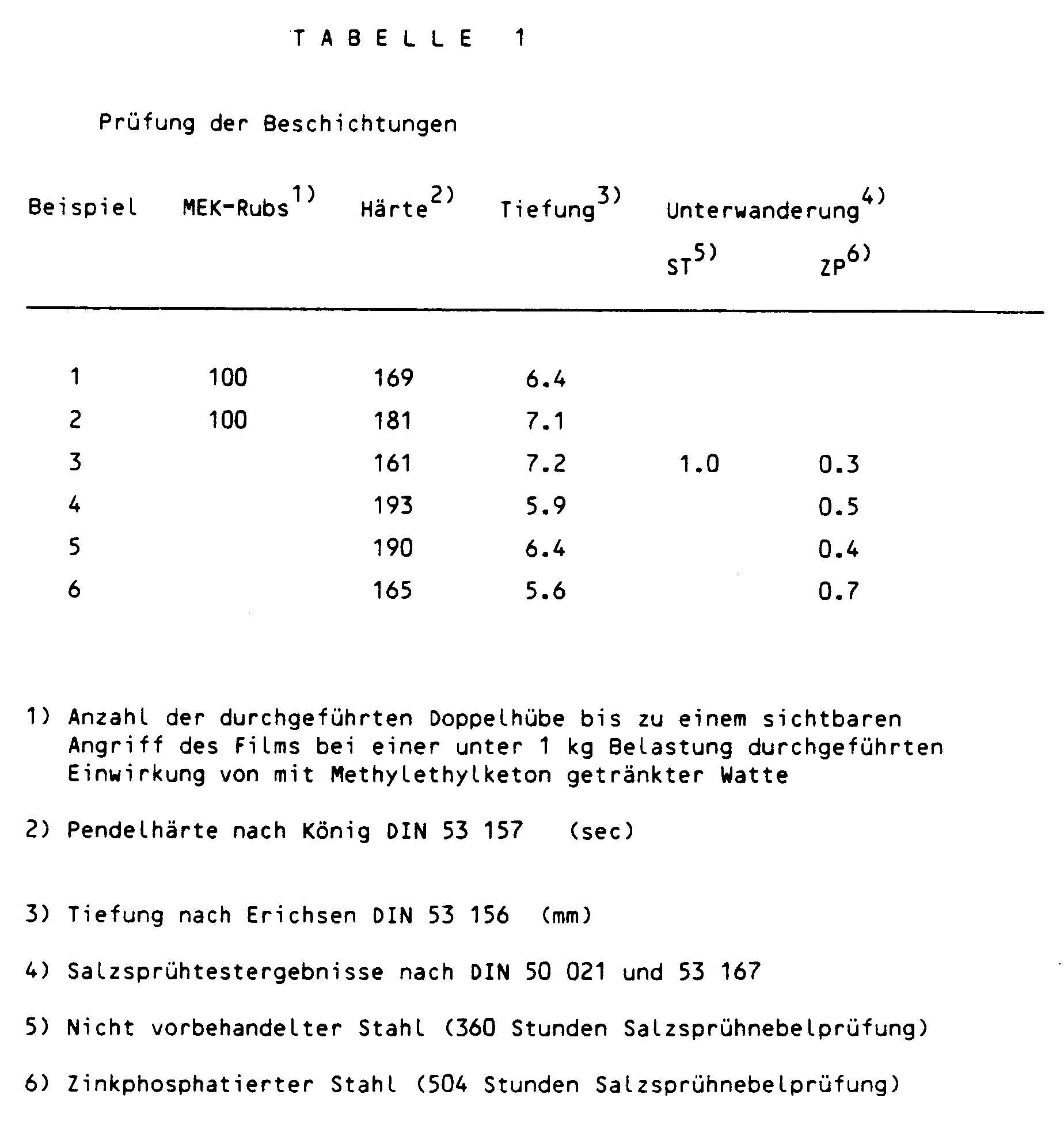
The lacquer films coated in the same way are subjected to the same conditions as in Example 7 and lead to similar results.
Claims (3)
- Use of soluble and/or insoluble transesterification and/or esterification catalysts for thermal crosslinking at temperatures over 100°C of cathodically depositable aqueous electrocoating compositions which contain(A) one or more polycondensation, polymerisation and/or polyaddition resins, wherein the resin, or in the presence of more than one resin, the mixture thereofa) has a number average molar weight (Mn) of 700 to 10 000,b) contains 0 to 21.7 . 10²³ lateral or terminal double bonds per 1 000 g, corresponding to a hydrogenation iodine value of 0 to 90,c) contains primary hydroxyl groups, corresponding to a hydroxyl value of 15 to 300, andd) has tertiary amino groups corresponding to an amine value of 30 to 150, and(B) polymerisation, polycondensation and/or polyaddition resins with a number average molar mass (Mn) of 170 to 10 000 with on average at least 2 groups of the general formulaand optionally pigments, corrosion inhibitors, anti-cratering agents, lacquer auxiliary substances, catalysts and organic solvents, wherein the mass ratio of component (A) to component (B) is 95 - 5% to 5 - 95%.

- Use according to claim 1, characterised in that component (B) on average contains less than 0.5 terminal ester groups capable of transesterification on baking per molecule.
- Use according to claim 2, characterised in that component (B) contains substantially no terminal ester groups capable of transesterification on baking.
Priority Applications (1)
| Application Number | Priority Date | Filing Date | Title |
|---|---|---|---|
| AT87106657T ATE93255T1 (en) | 1986-05-10 | 1987-05-07 | CATHODICALLY DEPOSITABLE AQUEOUS ELECTROCOAT COATING AGENT AND ITS USE. |
Applications Claiming Priority (2)
| Application Number | Priority Date | Filing Date | Title |
|---|---|---|---|
| DE19863615810 DE3615810A1 (en) | 1986-05-10 | 1986-05-10 | CATHODICALLY DEPOSITABLE AQUEOUS ELECTRODE COATING COAT AND ITS USE |
| DE3615810 | 1986-05-10 |
Publications (3)
| Publication Number | Publication Date |
|---|---|
| EP0245786A2 EP0245786A2 (en) | 1987-11-19 |
| EP0245786A3 EP0245786A3 (en) | 1988-08-17 |
| EP0245786B1 true EP0245786B1 (en) | 1993-08-18 |
Family
ID=6300575
Family Applications (1)
| Application Number | Title | Priority Date | Filing Date |
|---|---|---|---|
| EP87106657A Expired - Lifetime EP0245786B1 (en) | 1986-05-10 | 1987-05-07 | Cathodically depositable aqueous electrocoating composition and its use |
Country Status (11)
| Country | Link |
|---|---|
| US (1) | US5109040A (en) |
| EP (1) | EP0245786B1 (en) |
| JP (1) | JPS62267378A (en) |
| AT (1) | ATE93255T1 (en) |
| AU (1) | AU594460B2 (en) |
| CA (1) | CA1281148C (en) |
| CS (1) | CS417491A3 (en) |
| DE (2) | DE3615810A1 (en) |
| DK (1) | DK236587A (en) |
| ES (1) | ES2044863T3 (en) |
| ZA (1) | ZA873314B (en) |
Families Citing this family (20)
| Publication number | Priority date | Publication date | Assignee | Title |
|---|---|---|---|---|
| DE3823731A1 (en) * | 1988-07-13 | 1990-02-08 | Herberts Gmbh | HEAT-CURABLE COATING AGENTS AND THEIR USE |
| DE3920214A1 (en) * | 1989-06-21 | 1991-01-03 | Herberts Gmbh | AQUEOUS SOLUTION OR DISPERSION OF A BINDING AGENT FOR AQUEOUS COATING AGENT TO BE CATHODED AND THEIR USE FOR CATHODIC DEPOSITION |
| DE3932744A1 (en) * | 1989-09-30 | 1991-04-11 | Herberts Gmbh | Aq. coating soln. for electrophoretic dip lacquer coating - contains at least one zirconium aluminate to improve edge corrosion - and stone impact - resistance |
| DE3942921C1 (en) * | 1989-12-23 | 1991-01-31 | Herberts Gmbh, 5600 Wuppertal, De | |
| DE4115588A1 (en) * | 1991-05-13 | 1992-11-19 | Herberts Gmbh | METHOD FOR PRIMING PLASTIC SUBSTRATES, COATING AGENTS THEREOF AND USE THEREOF |
| DE19512017C1 (en) * | 1995-03-31 | 1996-07-18 | Herberts Gmbh | Multi-layer lacquering for use in car industry |
| US5789468A (en) * | 1997-03-27 | 1998-08-04 | E. I. Du Pont De Nemours And Company | Internal anticratering agent for cathodic electrocoating compositions |
| DE19930060A1 (en) | 1999-06-30 | 2001-01-11 | Basf Coatings Ag | Electrocoating bath with water-soluble polyvinyl alcohol (co) polymers |
| DE19944483A1 (en) | 1999-09-16 | 2001-03-29 | Basf Coatings Ag | Integrated painting process for bodies or cabins of cars and commercial vehicles containing plastic parts as well as their spare parts and attachments |
| DE10009913B4 (en) * | 2000-03-01 | 2004-12-23 | Basf Coatings Ag | Process for the production of multi-layer coatings on electrically conductive substrates and their use |
| DE10022750A1 (en) * | 2000-05-10 | 2001-11-22 | Wolfgang Schuhmann | Preparing surface with immobilized recognition elements, useful e.g. in biosensors, by electrodeposition of resin from emulsion containing active substances |
| US6706821B1 (en) | 2000-07-18 | 2004-03-16 | Fmc Corporation | Michael addition products of amine terminated polyolefins and polyfunctional acrylates |
| DE10236350A1 (en) | 2002-08-08 | 2004-02-19 | Basf Coatings Ag | Bismuth compound-containing electrophoretic coating composition comprises a crosslinking binding agent having (potential) cationic or anionic groups and bismuth sub-salicylate |
| DE102007038824A1 (en) | 2007-08-16 | 2009-02-19 | Basf Coatings Ag | Use of bismuth subnitrate in electrodeposition paints |
| DE102008016220A1 (en) | 2008-03-27 | 2009-10-01 | Basf Coatings Ag | Electrocoating paints containing polymethyleneurea |
| US9938417B2 (en) | 2013-12-20 | 2018-04-10 | Basf Coatings Gmbh | Formulations containing pigment and filler |
| AR100953A1 (en) | 2014-02-19 | 2016-11-16 | Tenaris Connections Bv | THREADED PIPE FOR AN OIL WELL PIPING |
| US12043764B2 (en) | 2017-08-23 | 2024-07-23 | Kansai Paint Co., Ltd. | Cationic electrodeposition coating composition and method for electrodeposition coating |
| JP7503573B2 (en) * | 2019-12-12 | 2024-06-20 | 株式会社ブリヂストン | Resin composition, resin-metal composite member, and tire |
| EP3854831A1 (en) | 2020-01-24 | 2021-07-28 | BASF Coatings GmbH | Compound comprising fully blocked isocyanate and silane groups and its use as crosslinker in electrocoating materials |
Family Cites Families (13)
| Publication number | Priority date | Publication date | Assignee | Title |
|---|---|---|---|---|
| US3947339A (en) * | 1971-12-01 | 1976-03-30 | Ppg Industries, Inc. | Method of electrodepositing primary amine group-containing cationic resins |
| US4009133A (en) * | 1975-08-01 | 1977-02-22 | Ppg Industries, Inc. | Electrodepositable epoxy resins having quaternary groups carrying blocked NCO, and aqueous dispersions |
| DE2707405C3 (en) * | 1976-07-19 | 1987-12-03 | Vianova Kunstharz Ag, Werndorf | Process for the preparation of binders for electrocoating |
| DE2707482C2 (en) * | 1976-07-19 | 1982-07-29 | Vianova Kunstharz AG, 8402 Werndorf | Process for the production of binders for electrodeposition paints |
| AT346987B (en) * | 1977-02-07 | 1978-12-11 | Vianova Kunstharz Ag | PROCESS FOR THE PRODUCTION OF SELF-NETWORKING CATIONIC EMULSIONS FOR ELECTRO-DIP PAINTING |
| ATE1293T1 (en) * | 1978-12-11 | 1982-07-15 | Shell Internationale Research Maatschappij B.V. | COMPOSITIONS BASED ON HEAT-CURING RESIN BINDERS, THEIR PRODUCTION AND THEIR USE AS COATINGS. |
| BR8008248A (en) * | 1979-12-21 | 1981-07-21 | Du Pont | PROCESS FOR THE PRODUCTION OF A NEW MATERIAL COMPOSITION AND A WATER COATING COMPOSITION, AND PERFECTING IN A PROCESS FOR ELECTRORREVESTMENT |
| US4335031A (en) * | 1979-12-21 | 1982-06-15 | E. I. Du Pont De Nemours And Company | Electrocoating composition with polyhydroxyamine and polybutadiene |
| DE3122641A1 (en) * | 1981-06-06 | 1982-12-23 | Herberts Gmbh, 5600 Wuppertal | CATHODICALLY DEPOSITABLE AQUEOUS ELECTRODESCENT COATING AGENT |
| US4407763A (en) * | 1981-10-05 | 1983-10-04 | Monsanto Company | Thiosulfenamide derivatives of N-phosphonomethylglycinonitriles |
| AT374487B (en) * | 1982-06-30 | 1984-04-25 | Vianova Kunstharz Ag | METHOD FOR PRODUCING CATHODICALLY DEPOSIBLE EMULSIONS |
| DE3324211A1 (en) * | 1983-07-05 | 1985-01-17 | Basf Farben + Fasern Ag, 2000 Hamburg | HEAT-CURABLE BINDING MIXTURE |
| DE3336749A1 (en) * | 1983-10-08 | 1985-04-18 | Herberts Gmbh, 5600 Wuppertal | CATHODICALLY DEPOSITABLE AQUEOUS ELECTRODE COATING COAT AND USE THEREOF |
-
1986
- 1986-05-10 DE DE19863615810 patent/DE3615810A1/en not_active Withdrawn
-
1987
- 1987-05-07 AT AT87106657T patent/ATE93255T1/en not_active IP Right Cessation
- 1987-05-07 DE DE8787106657T patent/DE3787043D1/en not_active Expired - Fee Related
- 1987-05-07 ES ES87106657T patent/ES2044863T3/en not_active Expired - Lifetime
- 1987-05-07 AU AU72669/87A patent/AU594460B2/en not_active Ceased
- 1987-05-07 EP EP87106657A patent/EP0245786B1/en not_active Expired - Lifetime
- 1987-05-07 JP JP62112226A patent/JPS62267378A/en active Pending
- 1987-05-08 CA CA000536711A patent/CA1281148C/en not_active Expired - Lifetime
- 1987-05-08 ZA ZA873314A patent/ZA873314B/en unknown
- 1987-05-08 DK DK236587A patent/DK236587A/en not_active Application Discontinuation
-
1990
- 1990-03-21 US US07/500,096 patent/US5109040A/en not_active Expired - Lifetime
-
1991
- 1991-12-30 CS CS914174A patent/CS417491A3/en unknown
Also Published As
| Publication number | Publication date |
|---|---|
| AU594460B2 (en) | 1990-03-08 |
| AU7266987A (en) | 1987-11-12 |
| DE3615810A1 (en) | 1987-11-12 |
| CS417491A3 (en) | 1992-06-17 |
| ATE93255T1 (en) | 1993-09-15 |
| EP0245786A3 (en) | 1988-08-17 |
| JPS62267378A (en) | 1987-11-20 |
| ES2044863T3 (en) | 1994-01-16 |
| DK236587A (en) | 1987-11-11 |
| CA1281148C (en) | 1991-03-05 |
| ZA873314B (en) | 1987-11-02 |
| EP0245786A2 (en) | 1987-11-19 |
| DE3787043D1 (en) | 1993-09-23 |
| US5109040A (en) | 1992-04-28 |
| DK236587D0 (en) | 1987-05-08 |
Similar Documents
| Publication | Publication Date | Title |
|---|---|---|
| EP0245786B1 (en) | Cathodically depositable aqueous electrocoating composition and its use | |
| EP0261385B1 (en) | Vehicle combination curable by curing agents, for use in aqueous dilutable coatings, cathodically depositable electrophoretic coating compositions, and their use | |
| EP0310971B1 (en) | Cathodically depositable aqueous electrodeposition composition and its use | |
| EP0178531B1 (en) | Aqueous electrodip-lacquering coating composition and its use in coating objects | |
| EP0180051B1 (en) | Process for the production of an externally cross-linkable epoxy-free amino-poly(meth)acrylate resin, the resin obtainable thereby, its use, cathodic electrodeposition bath containing it and its use in the coating of objects | |
| WO1998033835A1 (en) | Aqueous binding agent dispersion for cationic electro-dipcoat paint | |
| DE3311517A1 (en) | IN THE HEAT SELF-CROSSLINKING VARNISH BINDERS, THEIR PRODUCTION AND USE | |
| EP0066859B1 (en) | Cathodically depositable aqueous dipping varnish composition | |
| EP0057389B1 (en) | Heat-hardenable mixture of binders | |
| EP0137459B2 (en) | Cathodically depositable aqueous electrodip lacquer coating agent and its use | |
| EP0138922B1 (en) | Thermosetting binder mixture | |
| EP0093241B1 (en) | Self-cross-linking thermosetting binder | |
| EP0131126B1 (en) | Self-cross-linking thermosetting grinding resin | |
| EP0025554B1 (en) | Precondensed heat-curable aqueous varnish-coating composition and application thereof to the cathodic electrodeposition on electro-conductive substrates | |
| EP0179184B1 (en) | Method of making cathodically depositable electrophoretic binders | |
| EP0131125A1 (en) | Heat-curable binder composition | |
| EP0136411A1 (en) | Heat-curable binder composition | |
| EP0167029B1 (en) | Binders for cathodic electrodeposition comprising non-tertiary basic amino groups besides phenolic mannich bases | |
| DE3014290A1 (en) | WATER-DISCOVERABLE BINDERS, THEIR PRODUCTION AND USE | |
| EP0102496B1 (en) | Self-cross-linkable, heat-curable binder | |
| EP0123879A1 (en) | Process for the preparation of urea condensation products, and their use | |
| EP0212633A2 (en) | Cathodically disposable aqueous electrodeposition paint | |
| EP0179273B1 (en) | Process for preparing urea condensation products, and their application | |
| EP0231803B1 (en) | Electrodepositable preparations with a low organic solvents content, and method of making them |
Legal Events
| Date | Code | Title | Description |
|---|---|---|---|
| PUAI | Public reference made under article 153(3) epc to a published international application that has entered the european phase |
Free format text: ORIGINAL CODE: 0009012 |
|
| AK | Designated contracting states |
Kind code of ref document: A2 Designated state(s): AT BE CH DE ES FR GB IT LI NL SE |
|
| PUAL | Search report despatched |
Free format text: ORIGINAL CODE: 0009013 |
|
| AK | Designated contracting states |
Kind code of ref document: A3 Designated state(s): AT BE CH DE ES FR GB IT LI NL SE |
|
| 17P | Request for examination filed |
Effective date: 19890209 |
|
| 17Q | First examination report despatched |
Effective date: 19900522 |
|
| GRAA | (expected) grant |
Free format text: ORIGINAL CODE: 0009210 |
|
| AK | Designated contracting states |
Kind code of ref document: B1 Designated state(s): AT BE CH DE ES FR GB IT LI NL SE |
|
| REF | Corresponds to: |
Ref document number: 93255 Country of ref document: AT Date of ref document: 19930915 Kind code of ref document: T |
|
| REF | Corresponds to: |
Ref document number: 3787043 Country of ref document: DE Date of ref document: 19930923 |
|
| GBT | Gb: translation of ep patent filed (gb section 77(6)(a)/1977) |
Effective date: 19930916 |
|
| ET | Fr: translation filed | ||
| ITF | It: translation for a ep patent filed | ||
| REG | Reference to a national code |
Ref country code: ES Ref legal event code: FG2A Ref document number: 2044863 Country of ref document: ES Kind code of ref document: T3 |
|
| PG25 | Lapsed in a contracting state [announced via postgrant information from national office to epo] |
Ref country code: LI Effective date: 19940531 Ref country code: CH Effective date: 19940531 |
|
| PLBE | No opposition filed within time limit |
Free format text: ORIGINAL CODE: 0009261 |
|
| STAA | Information on the status of an ep patent application or granted ep patent |
Free format text: STATUS: NO OPPOSITION FILED WITHIN TIME LIMIT |
|
| 26N | No opposition filed | ||
| EAL | Se: european patent in force in sweden |
Ref document number: 87106657.7 |
|
| REG | Reference to a national code |
Ref country code: CH Ref legal event code: PL |
|
| PGFP | Annual fee paid to national office [announced via postgrant information from national office to epo] |
Ref country code: AT Payment date: 19960517 Year of fee payment: 10 |
|
| PGFP | Annual fee paid to national office [announced via postgrant information from national office to epo] |
Ref country code: SE Payment date: 19960528 Year of fee payment: 10 |
|
| PGFP | Annual fee paid to national office [announced via postgrant information from national office to epo] |
Ref country code: NL Payment date: 19960531 Year of fee payment: 10 |
|
| PG25 | Lapsed in a contracting state [announced via postgrant information from national office to epo] |
Ref country code: AT Effective date: 19970507 |
|
| PG25 | Lapsed in a contracting state [announced via postgrant information from national office to epo] |
Ref country code: SE Effective date: 19970508 |
|
| PG25 | Lapsed in a contracting state [announced via postgrant information from national office to epo] |
Ref country code: NL Effective date: 19971201 |
|
| EUG | Se: european patent has lapsed |
Ref document number: 87106657.7 |
|
| NLV4 | Nl: lapsed or anulled due to non-payment of the annual fee |
Effective date: 19971201 |
|
| REG | Reference to a national code |
Ref country code: GB Ref legal event code: IF02 |
|
| PGFP | Annual fee paid to national office [announced via postgrant information from national office to epo] |
Ref country code: BE Payment date: 20030314 Year of fee payment: 17 |
|
| PGFP | Annual fee paid to national office [announced via postgrant information from national office to epo] |
Ref country code: GB Payment date: 20030422 Year of fee payment: 17 |
|
| PG25 | Lapsed in a contracting state [announced via postgrant information from national office to epo] |
Ref country code: GB Free format text: LAPSE BECAUSE OF NON-PAYMENT OF DUE FEES Effective date: 20040507 |
|
| PG25 | Lapsed in a contracting state [announced via postgrant information from national office to epo] |
Ref country code: BE Free format text: LAPSE BECAUSE OF NON-PAYMENT OF DUE FEES Effective date: 20040531 |
|
| BERE | Be: lapsed |
Owner name: *HERBERTS G.M.B.H. Effective date: 20040531 |
|
| GBPC | Gb: european patent ceased through non-payment of renewal fee |
Effective date: 20040507 |
|
| PG25 | Lapsed in a contracting state [announced via postgrant information from national office to epo] |
Ref country code: IT Free format text: LAPSE BECAUSE OF NON-PAYMENT OF DUE FEES;WARNING: LAPSES OF ITALIAN PATENTS WITH EFFECTIVE DATE BEFORE 2007 MAY HAVE OCCURRED AT ANY TIME BEFORE 2007. THE CORRECT EFFECTIVE DATE MAY BE DIFFERENT FROM THE ONE RECORDED. Effective date: 20050507 |
|
| PGFP | Annual fee paid to national office [announced via postgrant information from national office to epo] |
Ref country code: ES Payment date: 20050516 Year of fee payment: 19 |
|
| PGFP | Annual fee paid to national office [announced via postgrant information from national office to epo] |
Ref country code: FR Payment date: 20050517 Year of fee payment: 19 |
|
| PGFP | Annual fee paid to national office [announced via postgrant information from national office to epo] |
Ref country code: DE Payment date: 20050723 Year of fee payment: 19 |
|
| PG25 | Lapsed in a contracting state [announced via postgrant information from national office to epo] |
Ref country code: ES Free format text: LAPSE BECAUSE OF NON-PAYMENT OF DUE FEES Effective date: 20060508 |
|
| PG25 | Lapsed in a contracting state [announced via postgrant information from national office to epo] |
Ref country code: DE Free format text: LAPSE BECAUSE OF NON-PAYMENT OF DUE FEES Effective date: 20061201 |
|
| REG | Reference to a national code |
Ref country code: FR Ref legal event code: ST Effective date: 20070131 |
|
| REG | Reference to a national code |
Ref country code: ES Ref legal event code: FD2A Effective date: 20060508 |
|
| PG25 | Lapsed in a contracting state [announced via postgrant information from national office to epo] |
Ref country code: FR Free format text: LAPSE BECAUSE OF NON-PAYMENT OF DUE FEES Effective date: 20060531 |