EP0244967A2 - Querverbundene Polymere - Google Patents
Querverbundene Polymere Download PDFInfo
- Publication number
- EP0244967A2 EP0244967A2 EP87303257A EP87303257A EP0244967A2 EP 0244967 A2 EP0244967 A2 EP 0244967A2 EP 87303257 A EP87303257 A EP 87303257A EP 87303257 A EP87303257 A EP 87303257A EP 0244967 A2 EP0244967 A2 EP 0244967A2
- Authority
- EP
- European Patent Office
- Prior art keywords
- cross
- groups
- polyamine
- functionality
- linked polyamide
- Prior art date
- Legal status (The legal status is an assumption and is not a legal conclusion. Google has not performed a legal analysis and makes no representation as to the accuracy of the status listed.)
- Withdrawn
Links
Images



Classifications
-
- C—CHEMISTRY; METALLURGY
- C08—ORGANIC MACROMOLECULAR COMPOUNDS; THEIR PREPARATION OR CHEMICAL WORKING-UP; COMPOSITIONS BASED THEREON
- C08G—MACROMOLECULAR COMPOUNDS OBTAINED OTHERWISE THAN BY REACTIONS ONLY INVOLVING UNSATURATED CARBON-TO-CARBON BONDS
- C08G69/00—Macromolecular compounds obtained by reactions forming a carboxylic amide link in the main chain of the macromolecule
Definitions
- This invention relates to cross-linked polymers which are able to withstand continuous working conditions at high temperature, e.g. at least about 200°C, and particularly to such polymers which may be used as matrices in fibre-reinforced composites.
- high performance we mean retention of strength at high temperature, stability to harsh environments and a good combination of mechanical properties, e.g. toughness.
- cross-link density thereof has been increased by using an epoxide component which bears greater than two epoxide groups in each monomer.
- epoxide component which bears greater than two epoxide groups in each monomer.
- the preparation of the aforesaid certain cross-linked polyamides may be effected by reacting an organic compound bearing at least two imide groups (which compound is hereinafter referred to for convenience as a "polyimide”) with an organic compound bearing at least two amino groups, which may be primary or secondary amino groups, (which compound is hereinafter referred to for convenience as a "polyamine”) wherein at least one of the compounds has a functionality of more than two.
- an organic compound bearing at least two imide groups which compound is hereinafter referred to for convenience as a "polyimide”
- amino groups which may be primary or secondary amino groups
- a second aspect of the present invention provides a process for the preparation of cross-linked polyamides characterised in that a polyimide and a first poly(primary or secondary)amine are reacted under suitable conditions wherein the functionality of one of the reagents is at least two and the functionality of the other reagent is more than two.
- the cross-linked polyamide according to the first aspect of the present invention comprises a plurality of repeat units of the general formula wherein R1 and R3, which may be the same or different, are divalent organic groups; R2, R4, R5, R6 and R7, which may be the same or different, are hydrogen or lower alkyl groups having up to five carbon atoms; with the proviso that (i) where R2, R4 and R5 are lower alkyl groups,R6 and R7 are hydrogen and (ii) where R6 and R7 are lower alkyl groups, R2, R4 and R5 are hydrogen; X3, X4, X5 and X6, each of which may be the same or different, are hydrogen or substituents which do not unduly adversely affect (i) the properties of the cross-linked polyamides according to the first aspect of the present invention or, (ii) the preparation thereof by the process according to the second aspect of the present invention.
- divalent organic group inter alia divalent hydrocarbyl groups, which may be linear or branched,e.g. alkyl, aryl, alkaryl, or aralkyl; and divalent hydrocarbyl groups which are substituted with one or more in-chain or pendant hetero-atoms.
- suitable in-chain hetero-atoms include inter alia O and S and combinations thereof.
- suitable pendant hetero-atoms include inter alia halogen, e.g. chlorine.
- divalent hydrocarbyl groups may be mentioned inter alia -(CH2) n -, where n is an integer, e.g. 2, or 6; phenylene; xylylene; and di-phenylene-methane.
- R1 and R3 are preferably aromatic groups. More preferably, R1 and R3 are chains of aromatic groups containing in-chain carbon atoms, e.g. -CH2-, or hetero-atoms, e.g. -O- or -SO2-; the aforesaid chains confer additional desirable properties, e.g. the ability to control (a) the solubility of oligomers, where present, and (b) the softening point and cross-linked density of the polyamide; R2 and R4 are preferably hydrogen.
- X6 is hydrogen, particularly preferably X3 and X6 are separately hydrogen and more particularly preferably X3, X4, X5 and X6 are separately hydrogen.
- substituents examples thereof include inter alia lower alkyl groups, e.g. methyl, or halo groups, e.g. chloro; we do not exclude the possibility that where two of the aforesaid X3, X4, X5 and X6 are substituents such substituents may join to form a further ring which may be aromatic or alicyclic.
- X6 is not hydrogen it may be chosen such that it facilitates or hinders rotation about the phenylene-phenylene bond of the biphenyl residue.
- X6 may be chosen such that it facilitates ring closure in formation of the imide groups in the polyimide; alternatively, it may facilitate ring opening of the imide in preparation of the polyamide according to the present invention or hinder ring opening and hence facilitate control of a fast reaction, e.g. where a labile imide or reactive amine is used in preparation of a polyamide; or it may increase the glass transition temperature of the cross-linked polyamide.
- the relative proportions of the reagent of functionality at least 2.0 and the reagent of functionality greater than 2.0 used in the process according to the second aspect of the present invention will depend inter alia upon the required properties of the cross-linked polyamide prepared therefrom and the polymerisation conditions to be employed. Typically, the ratio of imide groups to amine groups is about l:l.
- the reagent which has a functionality of more than two may be an individual compound or may be a mixture of compounds having an average functionality specified herein.
- a bis-imide of the general formula is reacted with a first polyamine of the general formula or (ii) a tris-imide of the general formula is reacted with with a first diamine of the general formula NHR2 ⁇ R3 ⁇ NHR4 V wherein R1, R2, R3, R4, R5, X3, X4, X5 and X6 have the meanings hereinbefore ascribed to them.
- R3 in the first polyamine of the general formulae III or V represents an alkylene chain, which may be substituted, e.g.
- the ⁇ , ⁇ groups of the alkylene chain are methylene groups.
- R1 is aromatic since this increases the reactivity of the imide group in the polyimides of the general formulae II or IV as well as contributing to the thermal stability of the polyamide prepared therefrom. Further, it has been found that the rate of polymerisation in the process according to the second aspect of the present invention tends to be proportional to the pK b of the first polyamine which is reacted with the polyimide; thus, for example, an aliphatic diamine, e.g. NH2(CH2)6NH2, reacts faster than an aromatic diamine, e.g.
- NH2ArCH2ArNH2 which in turn reacts faster than an aromatic diamine which bears a substituent which lowers the pK b of the amino group, e.g. para-NH2ArSO2ArNH2 (where Ar is an aromatic group, e.g. phenylene).
- Ar is an aromatic group, e.g. phenylene.
- the process according to the second aspect of the present invention is preferably carried out by reacting neat reactants.
- any of X3, X4, X5 or X6 in general Formula I are substituent groups we do not exclude the possibility that such substituents may be introduced into the polyamide of the first aspect of the present invention after it has been prepared.
- a third aspect of the present invention provides compositions comprising a polyimide of functionality more than two prepared by reacting a dicarboxylic anhydride with a second polyamine which bears more than two primary amino groups; preferably the composition comprises a tris-imide of the general formula IV.
- the polyimide used in the process according to the second aspect of the present invention is preferably derivable by the reaction of a second polyamine with sufficient of one or more dicarboxylic acid anhydrides such that each amino group in the second polyamine is converted into a imide group.
- the polyimide may be prepared by reacting a compound bearing a plurality of dicarboxylic acid anhydride residues with sufficient mono-amine to convert each of the anhydride residues into an imide group; however, this is not preferred.
- the dicarboxylic acid anhydride from which polyimides used in the process according to the second aspect of the present invention may be prepared may be aliphatic, e.g. succinic anhydride or adipic anhydride, or preferably aromatic, e.g. phthalic anhydride or l,8-napthalic anhydride or more preferably 2,2 ⁇ -diphenyldicarboxylic acid anhydride (which is hereinafter referred to for convenience as "diphenic anhydride").
- Polyimides for use in the process according to the second aspect of the present invention may be prepared by reacting diphenic anhydride with a suitable polyamine, e.g. a diamine of the general formula: NH2 - R1 - NH2 VI or a triamine of the general formula respectively, wherein R1 has the meaning hereinbefore ascribed to it.
- a suitable polyamine e.g. a diamine of the general formula: NH2 - R1 - NH2 VI or a triamine of the general formula respectively, wherein R1 has the meaning hereinbefore ascribed to it.
- the proportion of dicarboxylic acid anhydride and second polyamine are chosen such that substantially all the amino groups of the second polyamine and substantially all the dicarboxylic acid anhydride groups are converted into imide groups.
- the diamine of the general formula VI is reacted with a solution, preferably a non-aqueous solution, and more preferably a solution in a polar aprotic solvent,of a suitable dicarboxylic acid anhydride, e.g. diphenic anhydride.
- the reaction may be carried out at a temperature in the range of 0°C to l50°C.
- the anhydride preferably neat, is added to a solution of the diamine in a suitable solvent.
- the reaction is a two step reaction.
- the first step the anhydride rings are opened to generate an amic-acid.
- cyclisation occurs with elimination of water.
- the second step is preferably carried out in the presence of a suitable dehydrating agent, for example an anhydride, e.g. acetic anhydride, and a weak base, e.g. sodium acetate.
- the first step is preferably carried out at between 0°C and 20°C and the second step is preferably carried out between 50°C and l00°C. We do not exclude the possibility that the second step may be carried out as a melt.
- the cross-linked polyamides of the present invention may be used as the matrices for fibre-reinforced composites.
- suitable fibre reinforcing materials include, for example, glass, e.g. in the form of mat, tapes, continuous fibre or chopped rovings; inorganic mineral fibres; or preferably fibres of suitable high temperature resistant organic fibres, e.g. a poly aromatic amide, e.g. Kevlar (RTM); or more preferably carbon fibre.
- a cross-linked polyamide according to the present invention is used as a matrix for a fibre-reinforced composite
- such a composite may be produced, for example,by placing fibres, for example carbon fibres, in a mould of a desired shape and impregnating the fibres with a composition which comprises a polyimide and a first polyamine wherein the functionality of one of the reagents is at least two and the functionality of the other reagent is more than two, e.g. (i) a mixture of a bis-imide of the general formula II with a triamine of the general formula III; or (ii) a mixture of a tris-imide of the general formula IV with a diamine of the general formula V.
- a mixture of polyimide and the first polyamine are partially reacted to form a prepolymer or so-called "B-stage" intermediate which is substantially linear.
- the fibres are then impregnated with this prepolymer to form a so-called "prepreg".
- the fibres and the aforesaid prepreg are heated to an appropriate temperature, e.g. 200°C-300°C, often at a pressure of about 200 psi, for typically up to about a few hours, to effect cross-linking of the prepolymer and to form a fibre-reinforced composite.
- the aforesaid mixture may comprise an epoxy resin which is cured by reaction with a portion of the first polyamine.
- the aforesaid prepolymer is a solid or is very viscous, and is thus not sufficiently fluid for satisfactory impregnation of the fibres, it may be diluted with, e.g. dissolved in, a polar aprotic solvent, e.g. N,N-dimethylacetamide, in order to provide a mixture of the desired fluidity for impregnating the fibres.
- a polar aprotic solvent e.g. N,N-dimethylacetamide
- the solvent may be caused or allowed to evaporate before the reaction of the aforesaid reagents is initiated.
- cross-linked polyamides may be prepared by the polymerisation of an appropriate poly-imido-amine wherein there is (i) an average of more than one of the groups, preferably the amino group, per molecule and (ii) an average of at least one of the other groups per molecule Wherein n, or m, or both is greater than l.
- the cross-linked polyamides of the present invention may include inter alia heat and light stabilisers, antioxidants, colouring pigments and particulate filler materials, e.g. chalk, calcium carbonate, talc, mica, carbon black and glass.
- This Example illustrates the preparation of a bis(biphenyl-2,2 ⁇ -dicarboxylimide) for use in the process according to the first aspect of the present invention.
- Diphenic anhydride (9.3 g, 0.042 moles) was added as a solid, to a cooled (0°-l5°C), stirred solution of 4,4 ⁇ - diaminodiphenyl methane (4.l g, 0.02l moles) in dry N,N-dimethyl-acetamide (30 ml), over a period of l.5 hours.
- the mixture was warmed to room temperature and stirred for l hour, acetic anhydride (4.7 g, 0.046 moles) and triethylamine (0.4 g, 0.004 moles) were added and the mixture was stirred for a further 4 hours.
- This example illustrates the preparation of a cross-linked polyamide according to the present invention.
- a portion (6.l grams) of the diimide prepared in Example l and a mixture (2.l grams) of aromatic primary amines (comprising 55% w/w 4,4 ⁇ -diamino-diphenyl methane and 45% w/w of oligomeric polyamines of the general formula were heated in a nitrogen-purged tube until molten.
- the molten reaction mixture was agitated for 30 seconds to ensure efficient mixing and vacuum was applied thereto to remove residual volatiles.
- the reaction mixture was then cooled and a brittle, transparent, glassy pre-polymer was obtained.
- a first portion (2.5 grams) of the prepolymer was heated in an open metal cup for 2 hours at 290°C and a transparent, strong polymer was obtained.
- Samples of the polymer were analysed by TMA and DSC, both techniques revealed that it had a glass-transition temperature of 250°C.
- a second portion (l.4 grams) of the prepolymer was disposed in a circular metal mould (of diameter 2.5 cms and height 0.2 cms) and compression moulded at 285°C and a pressure of l000 Newtons for 2 hours.
- the resulting moulding was strong, transparent and insoluble in warm dimethylacetamide.
- a third portion (0.6 grams) of the prepolymer was compression moulded under the conditions hereinbefore described to give a moulding measuring 2.5 cm ⁇ l.0 cm ⁇ 0.l cm.
- Dynamic mechanical analysis of the moulding revealed that it had a Tg (defined by the peak of the tan ⁇ loss) of 265°C.
- a further portion of the prepolymer was compression moulded at 300° for 30 mins to give a square plaque measuring 5 cm ⁇ 5 cm ⁇ 0.l cm.
- the flexural properties of samples machined from the plaque were found to be (at 20°C); flexural strength: l2l.8 MPa; flexural modulus: 2.48 GPa.
- This example illustrates the preparation of a polyimide according to the third aspect of the present invention.
- Diphenic anhydride (9.3 grams) was added over 50 minutes to a stirred solution of a mixture (4.0 grams) as defined in Example 2 of aromatic primary amines in dry N,N-dimethylacetamide (22 grams) at l0°C. The temperature was then raised to 25°C and after l5 minutes, tri-ethylamine (0.5 grams) and acetic anhydride (ll grams) were added. The temperature of the reaction mixture was then raised to 70°C for 30 minutes and it was then allowed to stand at 20°C for l8 hours.
- the powder had no well-defined melting point; it had a stick temperature of about 200°C on the Kofler bar; and formed a clear stable melt at about 240°C.
- This example illustrates the preparation of a cross-linked polyamide according to the present invention.
- Example 3 A portion (l.40 grams) of the poly-imide prepared in Example 3 and a mixture (0.48 grams) as defined in Example 2 of aromatic primary amines were melted, mixed and degassed as described in Example 2. After cooling, the brittle transparent glass was compression moulded at 300°C for l hour and a strong transparent moulding was obtained which had a glass transition temperature (by DSC) of 248°C.
- This example illustrates the preparation of a diimide for use in the process of the present invention.
- Diphenic anhydride (8.96 grams) was added portionwise, as a solid, over l.5 hours to a solution, cooled to 4°C, of 4,4 ⁇ -diaminodiphenylsulphone (4.96 grams; dried at 60°C under vacuum for l hour) in N,N-dimethylacetamide (80 mls; dried over 5A molecular sieve); during the addition,the temperature of the solution was allowed to rise slowly to 20°C. The temperature of the reaction mixture was then raised to 65°C, a clear solution formed, and the temperature was held at 50°C for l hour. The reaction mixture was allowed to stand overnight at room temperature.
- This example illustrates the preparation of a cross-linked polyamide according to the present invention.
- Example 5 A portion (l.74 grams) of the diimide prepared in Example 5 and a mixture (0.55 grams) as defined in Example 2 of the aromatic primary amines were melted, mixed and degassed as described in Example 2. A portion (0.5 grams) of the resultant glassy pre-polymer was compression moulded at 300°C for 30 minutes; a strong, transparent moulding of dimensions 2.5 ⁇ l.0 ⁇ 0.l cms was obtained. Dynamic mechanical analysis of the moulding revealed that it had a T g as defined in Example 2 of 286°C and little change in modulus between 20°C and 230°C.
- This Example illustrates the preparation of a cross-linked polyamide according to the present invention.
- a pre-polymer was obtained in the form of a pale yellow glass which had a stick temperature on the Kofler block of l90-200°C.
- a portion (0.5 grams) of the pre-polymer was compression moulded at 290°C for 30 mins, a strong moulding which was insoluble in N,N-dimethylacetamide was obtained, and had a glass transition temperature of about 200°C.
- This example illustrates the preparation of a cross-linked polyamide according to the present invention.
- Example 7 A portion (0.6l grams) of the polyamine described in Example 7 was reacted with a portion (0.66 grams) of the diimide prepared in Example 5. The product was compression moulded at 300°C for 50 minutes; a dark, transparent, strong moulding which was insoluble in N,N-dimethylacetamide was obtained.
- Diphenic anhydride (9.3 grams; 0.042 moles) was added as a solid to a cooled (0-l5°C) stirred solution an appropriate diprimary amine (0.02l mole) in dry N,N-dimethyl-acetamide (30 mls) over l.5 hours. The mixtures were warmed to room temperature and stirred for l hour. Acetic anhydride (l4.3 mls) and triethylamine (0.4 grams; 0.004 moles) were added and the mixture was stirred for a further l hour at 80°C. It was then cooled to room temperature, allowed to stand overnight and added to a stirred water/ice mixture. A solid precipitate was filtered, washed with water and dried under vacuum.
- Example 2 The procedure of Example 2 was repeated except that (i) the polyimides and polyamines described in Table l were used instead of the polyimide and polyamine described in Example 2 and (ii) curing of the prepolymer was effected under pressure at 300°C for l hour.
- the glass transition temperature of the cross-linked polyamides are shown in Table 2.
- This example illustrates the variation in properties which can be obtained.
- Example 2 was repeated except that the mixture of amines was used in l5% w/w excess (2.4l grams instead of 2.l grams).
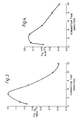
- the molten reaction mixture was heated and six portions thereof were removed at pre-determined periods of time between 0.5 minutes and l0 minutes (hereinafter referred to for convenience "prepolymer formation time"). On cooling, each portion gave a brittle, transparent, glassy prepolymer.
- Figures l-4 illustrate the variation in properties with prepolymer formation time. From the Figures it can be seen that optimum mechanical properties are obtained for mixing times of between l and 3 minutes.
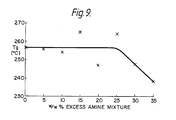
- This Example illustrates the affect of polyimide:polyamine ratio on the properties of the cross-linked polyamides.
- Example 2 was repeated using portions (6.lg) of the polyimide prepared in Example l and various amounts (from 2.lg (0% w/w excess amine mixture) to 2.83g (35% w/w excess amine mixture)) of the aromatic primary amine mixture described in Example 2.
- the polyimide/polyamine mixtures were heated until molten and stirred for 3 minutes at 300-320°C under vacuum. They were then cooled and brittle, transparent, glassy prepolymers were obtained.
- This Example illustrates the use of cross-linked polyamides according to the present invention as the matrix in carbon fibre composites.
- Example 2 A portion of a mixture of polyamine and polyimide as described in Example 2 was used, except that (i) a prepolymer formation time of 3 minutes (the optimum time as indiscated in Example l4) and (ii) an amine content of 20% w/w excess (the optimum as indicated in Example l5) were used.
- Plain-weave carbon-fibre fabric was solution impregnated with 30-40% w/v solutions of prepolymers in N-methyl-2-pyrrolidone (NMP), or N,N-dimethylacetamide (DMAc), or methylene chloride/NMP (70/30% v/v) or methylene chloride/DMAc (70/30% v/v). After leaving the solvent to dry at room temperature overnight, drying of the prepolymer or so-called B-stage mixture was completed under vacuum at l20°C.
- NMP N-methyl-2-pyrrolidone
- DMAc N,N-dimethylacetamide
- methylene chloride/NMP 70/30% v/v
- methylene chloride/DMAc 70/30% v/v
- Lay-up was carried out by hand and, for example, a l2-ply 6 ⁇ ⁇ 6 ⁇ laminate was fabricated in a press at 300°C for 2 hour under 2 ton pressure to yield a well consolidated, void-free carbon-fibre composite.
Landscapes
- Chemical & Material Sciences (AREA)
- Health & Medical Sciences (AREA)
- Chemical Kinetics & Catalysis (AREA)
- Medicinal Chemistry (AREA)
- Polymers & Plastics (AREA)
- Organic Chemistry (AREA)
- Macromolecular Compounds Obtained By Forming Nitrogen-Containing Linkages In General (AREA)
- Other Resins Obtained By Reactions Not Involving Carbon-To-Carbon Unsaturated Bonds (AREA)
- Polyamides (AREA)
Applications Claiming Priority (2)
| Application Number | Priority Date | Filing Date | Title |
|---|---|---|---|
| GB8610469 | 1986-04-29 | ||
| GB868610469A GB8610469D0 (en) | 1986-04-29 | 1986-04-29 | Cross-linked polymers |
Publications (2)
| Publication Number | Publication Date |
|---|---|
| EP0244967A2 true EP0244967A2 (de) | 1987-11-11 |
| EP0244967A3 EP0244967A3 (de) | 1990-03-21 |
Family
ID=10597044
Family Applications (1)
| Application Number | Title | Priority Date | Filing Date |
|---|---|---|---|
| EP87303257A Withdrawn EP0244967A3 (de) | 1986-04-29 | 1987-04-14 | Querverbundene Polymere |
Country Status (4)
| Country | Link |
|---|---|
| US (1) | US4808695A (de) |
| EP (1) | EP0244967A3 (de) |
| JP (1) | JPS6346219A (de) |
| GB (1) | GB8610469D0 (de) |
Cited By (2)
| Publication number | Priority date | Publication date | Assignee | Title |
|---|---|---|---|---|
| US4981497A (en) * | 1989-06-01 | 1991-01-01 | E. I. Du Pont De Nemours And Company | Amine-modified polyimide membranes |
| EP2481475A1 (de) | 2007-05-14 | 2012-08-01 | Evonik Fibres GmbH | Vernetzte Polyimidmembranen |
Families Citing this family (3)
| Publication number | Priority date | Publication date | Assignee | Title |
|---|---|---|---|---|
| US7528205B2 (en) * | 2003-09-26 | 2009-05-05 | Dai Nippon Printing Co., Ltd. | Photo radical generator, photo sensitive resin composition and article |
| CN109161015B (zh) * | 2018-07-26 | 2021-10-01 | 东华大学 | 一种高耐热交替共聚酰胺树脂及其制备方法 |
| CN120535792A (zh) * | 2025-06-13 | 2025-08-26 | 哈尔滨工业大学 | 一种基于动态网络重构制备热固性聚酰亚胺复合材料的方法 |
Family Cites Families (6)
| Publication number | Priority date | Publication date | Assignee | Title |
|---|---|---|---|---|
| DE1954878B2 (de) * | 1968-11-05 | 1972-03-02 | Toray Industries, Ine , Tokio | Verfahren zur herstellung von formkoerpern auf der basis von imidgruppen enthaltenden polykondensaten |
| FR2142741B1 (de) * | 1971-06-24 | 1973-06-29 | Rhone Poulenc Sa | |
| US4266047A (en) * | 1971-12-16 | 1981-05-05 | General Electric Company | Novel polymers of olefin terminated prepolymers and amine terminated prepolymers |
| FR2405964A1 (fr) * | 1977-10-14 | 1979-05-11 | Rhone Poulenc Ind | Polymeres a groupements imide |
| JPS5534233A (en) * | 1978-08-31 | 1980-03-10 | Hitachi Chem Co Ltd | Preparation of thermosetting maleimide prepolymer |
| US4731436A (en) * | 1986-10-07 | 1988-03-15 | Btl Specialty Resins Corporation | Thermosetting crosslinked imide resin from bis-imide and polyamine |
-
1986
- 1986-04-29 GB GB868610469A patent/GB8610469D0/en active Pending
-
1987
- 1987-04-14 EP EP87303257A patent/EP0244967A3/de not_active Withdrawn
- 1987-04-17 US US07/039,459 patent/US4808695A/en not_active Expired - Fee Related
- 1987-04-28 JP JP62103477A patent/JPS6346219A/ja active Pending
Non-Patent Citations (1)
| Title |
|---|
| No relevant documents have been disclosed. * |
Cited By (2)
| Publication number | Priority date | Publication date | Assignee | Title |
|---|---|---|---|---|
| US4981497A (en) * | 1989-06-01 | 1991-01-01 | E. I. Du Pont De Nemours And Company | Amine-modified polyimide membranes |
| EP2481475A1 (de) | 2007-05-14 | 2012-08-01 | Evonik Fibres GmbH | Vernetzte Polyimidmembranen |
Also Published As
| Publication number | Publication date |
|---|---|
| GB8610469D0 (en) | 1986-09-17 |
| US4808695A (en) | 1989-02-28 |
| JPS6346219A (ja) | 1988-02-27 |
| EP0244967A3 (de) | 1990-03-21 |
Similar Documents
| Publication | Publication Date | Title |
|---|---|---|
| EP0618935B1 (de) | Bei hohen temperaturen verwendbare polyimidharze | |
| US4239883A (en) | Polyimide preparation from imido acyl halide | |
| US4935523A (en) | Crosslinking imidophenylamines | |
| US3654227A (en) | Manufacture of aromatic polyimides and process for preparation of reinforced polymer article from said polyimides | |
| PT1516119E (pt) | Processo para a montagem/desmontagem de componentes de uma central de energia eólica | |
| GB2139628A (en) | Bis-maleimide-epoxy compositions and pre-pregs | |
| US4670536A (en) | Addition-curable quinoxaline resin oligomer and intermediate material for fiber-reinforced composite | |
| EP0672044A1 (de) | Bisnadimide | |
| US4600769A (en) | Amine terminated bisaspartimide polymer | |
| JPH06501257A (ja) | ジアミノビスイミド化合物に基づくエポキシ樹脂 | |
| US5087701A (en) | Phthalimide acid halides | |
| Hergenrother | Polyphenylquinoxalines—high performance thermoplastics | |
| US4985568A (en) | Method of making crosslinking imidophenylamines | |
| US5587105A (en) | Methods for making liquid molding compounds using diamines and dicyanates | |
| US4973662A (en) | Endcapping agent for polyimide, polyimide varnish, and intermediate material for fiber-reinforced composite material comprising same | |
| EP0244967A2 (de) | Querverbundene Polymere | |
| US5149746A (en) | Semi-interpenetrating polymer network for tougher and more microcracking resistant high temperature polymers | |
| US4579782A (en) | Laminate comprising fibers embedded in cured amine terminated bis-imide | |
| CA2004943A1 (en) | Polyimide precursors and method for preparing crosslinked polyimides using said precursors | |
| EP0203770B1 (de) | Polyamide | |
| CA1338543C (en) | Thermosettable powder compositions of polymaleimide and allyl-functional prepolymer | |
| Cano et al. | Polyimide Composites from Salt-Like Solution Precursors | |
| US5082920A (en) | Thermosetting bis(isoimide) resin compositions | |
| KR900004221B1 (ko) | 변성비스말레이미드 수지의 제조방법 | |
| Kumar et al. | Amine terminated bisaspartimide polymer |
Legal Events
| Date | Code | Title | Description |
|---|---|---|---|
| PUAI | Public reference made under article 153(3) epc to a published international application that has entered the european phase |
Free format text: ORIGINAL CODE: 0009012 |
|
| AK | Designated contracting states |
Kind code of ref document: A2 Designated state(s): AT BE CH DE ES FR GB GR IT LI LU NL SE |
|
| PUAL | Search report despatched |
Free format text: ORIGINAL CODE: 0009013 |
|
| AK | Designated contracting states |
Kind code of ref document: A3 Designated state(s): AT BE CH DE ES FR GB GR IT LI LU NL SE |
|
| 17P | Request for examination filed |
Effective date: 19900823 |
|
| 17Q | First examination report despatched |
Effective date: 19920304 |
|
| STAA | Information on the status of an ep patent application or granted ep patent |
Free format text: STATUS: THE APPLICATION IS DEEMED TO BE WITHDRAWN |
|
| 18D | Application deemed to be withdrawn |
Effective date: 19920715 |
|
| RIN1 | Information on inventor provided before grant (corrected) |
Inventor name: JONES, MICHAEL EDWARD BENET |