EP0244627A2 - Expression vectors for the production of polypeptides - Google Patents
Expression vectors for the production of polypeptides Download PDFInfo
- Publication number
- EP0244627A2 EP0244627A2 EP87104653A EP87104653A EP0244627A2 EP 0244627 A2 EP0244627 A2 EP 0244627A2 EP 87104653 A EP87104653 A EP 87104653A EP 87104653 A EP87104653 A EP 87104653A EP 0244627 A2 EP0244627 A2 EP 0244627A2
- Authority
- EP
- European Patent Office
- Prior art keywords
- aprotinin
- met
- dna
- piwi
- gene
- Prior art date
- Legal status (The legal status is an assumption and is not a legal conclusion. Google has not performed a legal analysis and makes no representation as to the accuracy of the status listed.)
- Withdrawn
Links
- 238000004519 manufacturing process Methods 0.000 title claims abstract description 15
- 108090000765 processed proteins & peptides Proteins 0.000 title abstract description 48
- 229920001184 polypeptide Polymers 0.000 title abstract description 46
- 102000004196 processed proteins & peptides Human genes 0.000 title abstract description 46
- 239000013604 expression vector Substances 0.000 title abstract description 12
- 229960004405 aprotinin Drugs 0.000 claims abstract description 113
- 108020004414 DNA Proteins 0.000 claims abstract description 58
- 108091028043 Nucleic acid sequence Proteins 0.000 claims abstract description 25
- 239000000825 pharmaceutical preparation Substances 0.000 claims abstract description 13
- 241000588724 Escherichia coli Species 0.000 claims description 36
- 239000013612 plasmid Substances 0.000 claims description 31
- 150000001413 amino acids Chemical class 0.000 claims description 20
- 244000005700 microbiome Species 0.000 claims description 11
- 239000003814 drug Substances 0.000 claims description 5
- 108090000623 proteins and genes Proteins 0.000 abstract description 81
- 238000010276 construction Methods 0.000 abstract description 25
- 102000004169 proteins and genes Human genes 0.000 abstract description 25
- 238000000034 method Methods 0.000 abstract description 21
- 230000014509 gene expression Effects 0.000 abstract description 20
- 239000013598 vector Substances 0.000 abstract description 13
- 108020004511 Recombinant DNA Proteins 0.000 abstract description 7
- 238000005516 engineering process Methods 0.000 abstract description 7
- 230000008569 process Effects 0.000 abstract description 4
- 108010039627 Aprotinin Proteins 0.000 description 60
- 101100408379 Drosophila melanogaster piwi gene Proteins 0.000 description 52
- ZPNFWUPYTFPOJU-LPYSRVMUSA-N iniprol Chemical compound C([C@H]1C(=O)NCC(=O)NCC(=O)N[C@H]2CSSC[C@H]3C(=O)N[C@@H](CCCCN)C(=O)N[C@@H](C)C(=O)N[C@@H](CCCNC(N)=N)C(=O)N[C@H](C(N[C@H](C(=O)N[C@@H](CCCNC(N)=N)C(=O)N[C@@H](CC=4C=CC(O)=CC=4)C(=O)N[C@@H](CC=4C=CC=CC=4)C(=O)N[C@@H](CC=4C=CC(O)=CC=4)C(=O)N[C@@H](CC(N)=O)C(=O)N[C@@H](C)C(=O)N[C@@H](CCCCN)C(=O)N[C@@H](C)C(=O)NCC(=O)N[C@@H](CC(C)C)C(=O)N[C@@H](CSSC[C@H](NC(=O)[C@H](CC(O)=O)NC(=O)[C@H](CCC(O)=O)NC(=O)[C@H](C)NC(=O)[C@H](CO)NC(=O)[C@H](CCCCN)NC(=O)[C@H](CC=4C=CC=CC=4)NC(=O)[C@H](CC(N)=O)NC(=O)[C@H](CC(N)=O)NC(=O)[C@H](CCCNC(N)=N)NC(=O)[C@H](CCCCN)NC(=O)[C@H](C)NC(=O)[C@H](CCCNC(N)=N)NC2=O)C(=O)N[C@@H](CCSC)C(=O)N[C@@H](CCCNC(N)=N)C(=O)N[C@@H]([C@@H](C)O)C(=O)N[C@@H](CSSC[C@H](NC(=O)[C@H](CC=2C=CC=CC=2)NC(=O)[C@H](CC(O)=O)NC(=O)[C@H]2N(CCC2)C(=O)[C@@H](N)CCCNC(N)=N)C(=O)N[C@@H](CC(C)C)C(=O)N[C@@H](CCC(O)=O)C(=O)N2[C@@H](CCC2)C(=O)N2[C@@H](CCC2)C(=O)N[C@@H](CC=2C=CC(O)=CC=2)C(=O)N[C@@H]([C@@H](C)O)C(=O)NCC(=O)N2[C@@H](CCC2)C(=O)N3)C(=O)NCC(=O)NCC(=O)N[C@@H](C)C(O)=O)C(=O)N[C@@H](CCC(N)=O)C(=O)N[C@H](C(=O)N[C@@H](CC=2C=CC=CC=2)C(=O)N[C@H](C(=O)N1)C(C)C)[C@@H](C)O)[C@@H](C)CC)=O)[C@@H](C)CC)C1=CC=C(O)C=C1 ZPNFWUPYTFPOJU-LPYSRVMUSA-N 0.000 description 49
- 239000012634 fragment Substances 0.000 description 37
- 150000001875 compounds Chemical class 0.000 description 33
- 108020004705 Codon Proteins 0.000 description 21
- 239000000872 buffer Substances 0.000 description 21
- 210000004027 cell Anatomy 0.000 description 19
- 239000000499 gel Substances 0.000 description 18
- 239000000203 mixture Substances 0.000 description 14
- 108700005078 Synthetic Genes Proteins 0.000 description 13
- 239000003112 inhibitor Substances 0.000 description 12
- 239000000126 substance Substances 0.000 description 12
- 239000000243 solution Substances 0.000 description 11
- 239000000546 pharmaceutical excipient Substances 0.000 description 10
- 108010005774 beta-Galactosidase Proteins 0.000 description 8
- 239000000047 product Substances 0.000 description 8
- 239000003826 tablet Substances 0.000 description 8
- 229920002684 Sepharose Polymers 0.000 description 7
- 108091081024 Start codon Proteins 0.000 description 7
- 238000004587 chromatography analysis Methods 0.000 description 7
- 241000283690 Bos taurus Species 0.000 description 6
- DNIAPMSPPWPWGF-UHFFFAOYSA-N Propylene glycol Chemical compound CC(O)CO DNIAPMSPPWPWGF-UHFFFAOYSA-N 0.000 description 6
- VYPSYNLAJGMNEJ-UHFFFAOYSA-N Silicium dioxide Chemical compound O=[Si]=O VYPSYNLAJGMNEJ-UHFFFAOYSA-N 0.000 description 6
- XSQUKJJJFZCRTK-UHFFFAOYSA-N Urea Chemical compound NC(N)=O XSQUKJJJFZCRTK-UHFFFAOYSA-N 0.000 description 6
- 230000001580 bacterial effect Effects 0.000 description 6
- 238000006243 chemical reaction Methods 0.000 description 6
- 238000010367 cloning Methods 0.000 description 6
- 239000013613 expression plasmid Substances 0.000 description 6
- 108020004999 messenger RNA Proteins 0.000 description 6
- 229920002401 polyacrylamide Polymers 0.000 description 6
- 210000003705 ribosome Anatomy 0.000 description 6
- RWQNBRDOKXIBIV-UHFFFAOYSA-N thymine Chemical compound CC1=CNC(=O)NC1=O RWQNBRDOKXIBIV-UHFFFAOYSA-N 0.000 description 6
- 238000001262 western blot Methods 0.000 description 6
- ZKHQWZAMYRWXGA-KQYNXXCUSA-J ATP(4-) Chemical compound C1=NC=2C(N)=NC=NC=2N1[C@@H]1O[C@H](COP([O-])(=O)OP([O-])(=O)OP([O-])([O-])=O)[C@@H](O)[C@H]1O ZKHQWZAMYRWXGA-KQYNXXCUSA-J 0.000 description 5
- ZKHQWZAMYRWXGA-UHFFFAOYSA-N Adenosine triphosphate Natural products C1=NC=2C(N)=NC=NC=2N1C1OC(COP(O)(=O)OP(O)(=O)OP(O)(O)=O)C(O)C1O ZKHQWZAMYRWXGA-UHFFFAOYSA-N 0.000 description 5
- 108010067372 Pancreatic elastase Proteins 0.000 description 5
- 102000016387 Pancreatic elastase Human genes 0.000 description 5
- FAPWRFPIFSIZLT-UHFFFAOYSA-M Sodium chloride Chemical compound [Na+].[Cl-] FAPWRFPIFSIZLT-UHFFFAOYSA-M 0.000 description 5
- 238000001962 electrophoresis Methods 0.000 description 5
- 238000002474 experimental method Methods 0.000 description 5
- 229930182817 methionine Natural products 0.000 description 5
- 230000004048 modification Effects 0.000 description 5
- 238000012986 modification Methods 0.000 description 5
- 239000008188 pellet Substances 0.000 description 5
- 238000002360 preparation method Methods 0.000 description 5
- XLYOFNOQVPJJNP-UHFFFAOYSA-N water Substances O XLYOFNOQVPJJNP-UHFFFAOYSA-N 0.000 description 5
- 108091026890 Coding region Proteins 0.000 description 4
- KCXVZYZYPLLWCC-UHFFFAOYSA-N EDTA Chemical compound OC(=O)CN(CC(O)=O)CCN(CC(O)=O)CC(O)=O KCXVZYZYPLLWCC-UHFFFAOYSA-N 0.000 description 4
- LFQSCWFLJHTTHZ-UHFFFAOYSA-N Ethanol Chemical compound CCO LFQSCWFLJHTTHZ-UHFFFAOYSA-N 0.000 description 4
- PEDCQBHIVMGVHV-UHFFFAOYSA-N Glycerine Chemical compound OCC(O)CO PEDCQBHIVMGVHV-UHFFFAOYSA-N 0.000 description 4
- FFEARJCKVFRZRR-BYPYZUCNSA-N L-methionine Chemical compound CSCC[C@H](N)C(O)=O FFEARJCKVFRZRR-BYPYZUCNSA-N 0.000 description 4
- GUBGYTABKSRVRQ-QKKXKWKRSA-N Lactose Natural products OC[C@H]1O[C@@H](O[C@H]2[C@H](O)[C@@H](O)C(O)O[C@@H]2CO)[C@H](O)[C@@H](O)[C@H]1O GUBGYTABKSRVRQ-QKKXKWKRSA-N 0.000 description 4
- 108091034117 Oligonucleotide Proteins 0.000 description 4
- 239000004098 Tetracycline Substances 0.000 description 4
- 239000007983 Tris buffer Substances 0.000 description 4
- 108090000631 Trypsin Proteins 0.000 description 4
- 102000004142 Trypsin Human genes 0.000 description 4
- JLCPHMBAVCMARE-UHFFFAOYSA-N [3-[[3-[[3-[[3-[[3-[[3-[[3-[[3-[[3-[[3-[[3-[[5-(2-amino-6-oxo-1H-purin-9-yl)-3-[[3-[[3-[[3-[[3-[[3-[[5-(2-amino-6-oxo-1H-purin-9-yl)-3-[[5-(2-amino-6-oxo-1H-purin-9-yl)-3-hydroxyoxolan-2-yl]methoxy-hydroxyphosphoryl]oxyoxolan-2-yl]methoxy-hydroxyphosphoryl]oxy-5-(5-methyl-2,4-dioxopyrimidin-1-yl)oxolan-2-yl]methoxy-hydroxyphosphoryl]oxy-5-(6-aminopurin-9-yl)oxolan-2-yl]methoxy-hydroxyphosphoryl]oxy-5-(6-aminopurin-9-yl)oxolan-2-yl]methoxy-hydroxyphosphoryl]oxy-5-(6-aminopurin-9-yl)oxolan-2-yl]methoxy-hydroxyphosphoryl]oxy-5-(6-aminopurin-9-yl)oxolan-2-yl]methoxy-hydroxyphosphoryl]oxyoxolan-2-yl]methoxy-hydroxyphosphoryl]oxy-5-(5-methyl-2,4-dioxopyrimidin-1-yl)oxolan-2-yl]methoxy-hydroxyphosphoryl]oxy-5-(4-amino-2-oxopyrimidin-1-yl)oxolan-2-yl]methoxy-hydroxyphosphoryl]oxy-5-(5-methyl-2,4-dioxopyrimidin-1-yl)oxolan-2-yl]methoxy-hydroxyphosphoryl]oxy-5-(5-methyl-2,4-dioxopyrimidin-1-yl)oxolan-2-yl]methoxy-hydroxyphosphoryl]oxy-5-(6-aminopurin-9-yl)oxolan-2-yl]methoxy-hydroxyphosphoryl]oxy-5-(6-aminopurin-9-yl)oxolan-2-yl]methoxy-hydroxyphosphoryl]oxy-5-(4-amino-2-oxopyrimidin-1-yl)oxolan-2-yl]methoxy-hydroxyphosphoryl]oxy-5-(4-amino-2-oxopyrimidin-1-yl)oxolan-2-yl]methoxy-hydroxyphosphoryl]oxy-5-(4-amino-2-oxopyrimidin-1-yl)oxolan-2-yl]methoxy-hydroxyphosphoryl]oxy-5-(6-aminopurin-9-yl)oxolan-2-yl]methoxy-hydroxyphosphoryl]oxy-5-(4-amino-2-oxopyrimidin-1-yl)oxolan-2-yl]methyl [5-(6-aminopurin-9-yl)-2-(hydroxymethyl)oxolan-3-yl] hydrogen phosphate Polymers Cc1cn(C2CC(OP(O)(=O)OCC3OC(CC3OP(O)(=O)OCC3OC(CC3O)n3cnc4c3nc(N)[nH]c4=O)n3cnc4c3nc(N)[nH]c4=O)C(COP(O)(=O)OC3CC(OC3COP(O)(=O)OC3CC(OC3COP(O)(=O)OC3CC(OC3COP(O)(=O)OC3CC(OC3COP(O)(=O)OC3CC(OC3COP(O)(=O)OC3CC(OC3COP(O)(=O)OC3CC(OC3COP(O)(=O)OC3CC(OC3COP(O)(=O)OC3CC(OC3COP(O)(=O)OC3CC(OC3COP(O)(=O)OC3CC(OC3COP(O)(=O)OC3CC(OC3COP(O)(=O)OC3CC(OC3COP(O)(=O)OC3CC(OC3COP(O)(=O)OC3CC(OC3COP(O)(=O)OC3CC(OC3COP(O)(=O)OC3CC(OC3CO)n3cnc4c(N)ncnc34)n3ccc(N)nc3=O)n3cnc4c(N)ncnc34)n3ccc(N)nc3=O)n3ccc(N)nc3=O)n3ccc(N)nc3=O)n3cnc4c(N)ncnc34)n3cnc4c(N)ncnc34)n3cc(C)c(=O)[nH]c3=O)n3cc(C)c(=O)[nH]c3=O)n3ccc(N)nc3=O)n3cc(C)c(=O)[nH]c3=O)n3cnc4c3nc(N)[nH]c4=O)n3cnc4c(N)ncnc34)n3cnc4c(N)ncnc34)n3cnc4c(N)ncnc34)n3cnc4c(N)ncnc34)O2)c(=O)[nH]c1=O JLCPHMBAVCMARE-UHFFFAOYSA-N 0.000 description 4
- 238000003556 assay Methods 0.000 description 4
- 230000015572 biosynthetic process Effects 0.000 description 4
- 239000002775 capsule Substances 0.000 description 4
- 201000010099 disease Diseases 0.000 description 4
- 208000037265 diseases, disorders, signs and symptoms Diseases 0.000 description 4
- 230000000694 effects Effects 0.000 description 4
- 238000001502 gel electrophoresis Methods 0.000 description 4
- 230000002401 inhibitory effect Effects 0.000 description 4
- NOESYZHRGYRDHS-UHFFFAOYSA-N insulin Chemical compound N1C(=O)C(NC(=O)C(CCC(N)=O)NC(=O)C(CCC(O)=O)NC(=O)C(C(C)C)NC(=O)C(NC(=O)CN)C(C)CC)CSSCC(C(NC(CO)C(=O)NC(CC(C)C)C(=O)NC(CC=2C=CC(O)=CC=2)C(=O)NC(CCC(N)=O)C(=O)NC(CC(C)C)C(=O)NC(CCC(O)=O)C(=O)NC(CC(N)=O)C(=O)NC(CC=2C=CC(O)=CC=2)C(=O)NC(CSSCC(NC(=O)C(C(C)C)NC(=O)C(CC(C)C)NC(=O)C(CC=2C=CC(O)=CC=2)NC(=O)C(CC(C)C)NC(=O)C(C)NC(=O)C(CCC(O)=O)NC(=O)C(C(C)C)NC(=O)C(CC(C)C)NC(=O)C(CC=2NC=NC=2)NC(=O)C(CO)NC(=O)CNC2=O)C(=O)NCC(=O)NC(CCC(O)=O)C(=O)NC(CCCNC(N)=N)C(=O)NCC(=O)NC(CC=3C=CC=CC=3)C(=O)NC(CC=3C=CC=CC=3)C(=O)NC(CC=3C=CC(O)=CC=3)C(=O)NC(C(C)O)C(=O)N3C(CCC3)C(=O)NC(CCCCN)C(=O)NC(C)C(O)=O)C(=O)NC(CC(N)=O)C(O)=O)=O)NC(=O)C(C(C)CC)NC(=O)C(CO)NC(=O)C(C(C)O)NC(=O)C1CSSCC2NC(=O)C(CC(C)C)NC(=O)C(NC(=O)C(CCC(N)=O)NC(=O)C(CC(N)=O)NC(=O)C(NC(=O)C(N)CC=1C=CC=CC=1)C(C)C)CC1=CN=CN1 NOESYZHRGYRDHS-UHFFFAOYSA-N 0.000 description 4
- 239000008101 lactose Substances 0.000 description 4
- 108020004707 nucleic acids Proteins 0.000 description 4
- 102000039446 nucleic acids Human genes 0.000 description 4
- 150000007523 nucleic acids Chemical class 0.000 description 4
- -1 paraffins Substances 0.000 description 4
- 239000006187 pill Substances 0.000 description 4
- 238000000746 purification Methods 0.000 description 4
- 238000004153 renaturation Methods 0.000 description 4
- 238000012163 sequencing technique Methods 0.000 description 4
- 229960002180 tetracycline Drugs 0.000 description 4
- 229930101283 tetracycline Natural products 0.000 description 4
- 235000019364 tetracycline Nutrition 0.000 description 4
- 150000003522 tetracyclines Chemical class 0.000 description 4
- HWCKGOZZJDHMNC-UHFFFAOYSA-M tetraethylammonium bromide Chemical compound [Br-].CC[N+](CC)(CC)CC HWCKGOZZJDHMNC-UHFFFAOYSA-M 0.000 description 4
- LENZDBCJOHFCAS-UHFFFAOYSA-N tris Chemical compound OCC(N)(CO)CO LENZDBCJOHFCAS-UHFFFAOYSA-N 0.000 description 4
- 239000012588 trypsin Substances 0.000 description 4
- DGVVWUTYPXICAM-UHFFFAOYSA-N β‐Mercaptoethanol Chemical compound OCCS DGVVWUTYPXICAM-UHFFFAOYSA-N 0.000 description 4
- QTBSBXVTEAMEQO-UHFFFAOYSA-N Acetic acid Chemical compound CC(O)=O QTBSBXVTEAMEQO-UHFFFAOYSA-N 0.000 description 3
- HRPVXLWXLXDGHG-UHFFFAOYSA-N Acrylamide Chemical compound NC(=O)C=C HRPVXLWXLXDGHG-UHFFFAOYSA-N 0.000 description 3
- 229920001817 Agar Polymers 0.000 description 3
- 241000894006 Bacteria Species 0.000 description 3
- 108010054576 Deoxyribonuclease EcoRI Proteins 0.000 description 3
- XEKOWRVHYACXOJ-UHFFFAOYSA-N Ethyl acetate Chemical compound CCOC(C)=O XEKOWRVHYACXOJ-UHFFFAOYSA-N 0.000 description 3
- WQZGKKKJIJFFOK-GASJEMHNSA-N Glucose Natural products OC[C@H]1OC(O)[C@H](O)[C@@H](O)[C@@H]1O WQZGKKKJIJFFOK-GASJEMHNSA-N 0.000 description 3
- KFZMGEQAYNKOFK-UHFFFAOYSA-N Isopropanol Chemical compound CC(C)O KFZMGEQAYNKOFK-UHFFFAOYSA-N 0.000 description 3
- 108010028275 Leukocyte Elastase Proteins 0.000 description 3
- 102000016799 Leukocyte elastase Human genes 0.000 description 3
- ZMXDDKWLCZADIW-UHFFFAOYSA-N N,N-Dimethylformamide Chemical compound CN(C)C=O ZMXDDKWLCZADIW-UHFFFAOYSA-N 0.000 description 3
- 108010076181 Proinsulin Proteins 0.000 description 3
- 108020005038 Terminator Codon Proteins 0.000 description 3
- 239000002253 acid Substances 0.000 description 3
- 150000007513 acids Chemical class 0.000 description 3
- 125000000539 amino acid group Chemical group 0.000 description 3
- 230000003321 amplification Effects 0.000 description 3
- 238000004458 analytical method Methods 0.000 description 3
- 235000012216 bentonite Nutrition 0.000 description 3
- 230000037396 body weight Effects 0.000 description 3
- 239000004202 carbamide Substances 0.000 description 3
- 239000001913 cellulose Substances 0.000 description 3
- 235000010980 cellulose Nutrition 0.000 description 3
- 229920002678 cellulose Polymers 0.000 description 3
- 238000010828 elution Methods 0.000 description 3
- 239000000839 emulsion Substances 0.000 description 3
- 235000019441 ethanol Nutrition 0.000 description 3
- 150000002191 fatty alcohols Chemical class 0.000 description 3
- 230000002068 genetic effect Effects 0.000 description 3
- 239000008103 glucose Substances 0.000 description 3
- 239000008187 granular material Substances 0.000 description 3
- 239000007788 liquid Substances 0.000 description 3
- 239000000463 material Substances 0.000 description 3
- 238000003199 nucleic acid amplification method Methods 0.000 description 3
- 229920001223 polyethylene glycol Polymers 0.000 description 3
- 239000000843 powder Substances 0.000 description 3
- 230000010076 replication Effects 0.000 description 3
- 239000000377 silicon dioxide Substances 0.000 description 3
- 235000012239 silicon dioxide Nutrition 0.000 description 3
- 239000007787 solid Substances 0.000 description 3
- 239000002904 solvent Substances 0.000 description 3
- 239000007921 spray Substances 0.000 description 3
- KZNICNPSHKQLFF-UHFFFAOYSA-N succinimide Chemical compound O=C1CCC(=O)N1 KZNICNPSHKQLFF-UHFFFAOYSA-N 0.000 description 3
- 239000000829 suppository Substances 0.000 description 3
- 239000000725 suspension Substances 0.000 description 3
- 238000003786 synthesis reaction Methods 0.000 description 3
- 239000000454 talc Substances 0.000 description 3
- 235000012222 talc Nutrition 0.000 description 3
- 229910052623 talc Inorganic materials 0.000 description 3
- 101150072314 thyA gene Proteins 0.000 description 3
- 229940113082 thymine Drugs 0.000 description 3
- 230000005030 transcription termination Effects 0.000 description 3
- 238000013519 translation Methods 0.000 description 3
- 239000002753 trypsin inhibitor Substances 0.000 description 3
- PUPZLCDOIYMWBV-UHFFFAOYSA-N (+/-)-1,3-Butanediol Chemical compound CC(O)CCO PUPZLCDOIYMWBV-UHFFFAOYSA-N 0.000 description 2
- JNYAEWCLZODPBN-JGWLITMVSA-N (2r,3r,4s)-2-[(1r)-1,2-dihydroxyethyl]oxolane-3,4-diol Chemical compound OC[C@@H](O)[C@H]1OC[C@H](O)[C@H]1O JNYAEWCLZODPBN-JGWLITMVSA-N 0.000 description 2
- VBICKXHEKHSIBG-UHFFFAOYSA-N 1-monostearoylglycerol Chemical compound CCCCCCCCCCCCCCCCCC(=O)OCC(O)CO VBICKXHEKHSIBG-UHFFFAOYSA-N 0.000 description 2
- KYNFOMQIXZUKRK-UHFFFAOYSA-N 2,2'-dithiodiethanol Chemical compound OCCSSCCO KYNFOMQIXZUKRK-UHFFFAOYSA-N 0.000 description 2
- OSBLTNPMIGYQGY-UHFFFAOYSA-N 2-amino-2-(hydroxymethyl)propane-1,3-diol;2-[2-[bis(carboxymethyl)amino]ethyl-(carboxymethyl)amino]acetic acid;boric acid Chemical compound OB(O)O.OCC(N)(CO)CO.OC(=O)CN(CC(O)=O)CCN(CC(O)=O)CC(O)=O OSBLTNPMIGYQGY-UHFFFAOYSA-N 0.000 description 2
- QKNYBSVHEMOAJP-UHFFFAOYSA-N 2-amino-2-(hydroxymethyl)propane-1,3-diol;hydron;chloride Chemical compound Cl.OCC(N)(CO)CO QKNYBSVHEMOAJP-UHFFFAOYSA-N 0.000 description 2
- 241000024188 Andala Species 0.000 description 2
- 241000416162 Astragalus gummifer Species 0.000 description 2
- VTYYLEPIZMXCLO-UHFFFAOYSA-L Calcium carbonate Chemical compound [Ca+2].[O-]C([O-])=O VTYYLEPIZMXCLO-UHFFFAOYSA-L 0.000 description 2
- 102000004190 Enzymes Human genes 0.000 description 2
- 108090000790 Enzymes Proteins 0.000 description 2
- ZHNUHDYFZUAESO-UHFFFAOYSA-N Formamide Chemical compound NC=O ZHNUHDYFZUAESO-UHFFFAOYSA-N 0.000 description 2
- 102000018997 Growth Hormone Human genes 0.000 description 2
- 108010051696 Growth Hormone Proteins 0.000 description 2
- 102000004877 Insulin Human genes 0.000 description 2
- 108090001061 Insulin Proteins 0.000 description 2
- QIVBCDIJIAJPQS-VIFPVBQESA-N L-tryptophane Chemical compound C1=CC=C2C(C[C@H](N)C(O)=O)=CNC2=C1 QIVBCDIJIAJPQS-VIFPVBQESA-N 0.000 description 2
- 102400000050 Oxytocin Human genes 0.000 description 2
- 101800000989 Oxytocin Proteins 0.000 description 2
- XNOPRXBHLZRZKH-UHFFFAOYSA-N Oxytocin Natural products N1C(=O)C(N)CSSCC(C(=O)N2C(CCC2)C(=O)NC(CC(C)C)C(=O)NCC(N)=O)NC(=O)C(CC(N)=O)NC(=O)C(CCC(N)=O)NC(=O)C(C(C)CC)NC(=O)C1CC1=CC=C(O)C=C1 XNOPRXBHLZRZKH-UHFFFAOYSA-N 0.000 description 2
- 102000006382 Ribonucleases Human genes 0.000 description 2
- 108010083644 Ribonucleases Proteins 0.000 description 2
- CDBYLPFSWZWCQE-UHFFFAOYSA-L Sodium Carbonate Chemical compound [Na+].[Na+].[O-]C([O-])=O CDBYLPFSWZWCQE-UHFFFAOYSA-L 0.000 description 2
- 229920002472 Starch Polymers 0.000 description 2
- WYURNTSHIVDZCO-UHFFFAOYSA-N Tetrahydrofuran Chemical compound C1CCOC1 WYURNTSHIVDZCO-UHFFFAOYSA-N 0.000 description 2
- 229920001615 Tragacanth Polymers 0.000 description 2
- QIVBCDIJIAJPQS-UHFFFAOYSA-N Tryptophan Natural products C1=CC=C2C(CC(N)C(O)=O)=CNC2=C1 QIVBCDIJIAJPQS-UHFFFAOYSA-N 0.000 description 2
- GXBMIBRIOWHPDT-UHFFFAOYSA-N Vasopressin Natural products N1C(=O)C(CC=2C=C(O)C=CC=2)NC(=O)C(N)CSSCC(C(=O)N2C(CCC2)C(=O)NC(CCCN=C(N)N)C(=O)NCC(N)=O)NC(=O)C(CC(N)=O)NC(=O)C(CCC(N)=O)NC(=O)C1CC1=CC=CC=C1 GXBMIBRIOWHPDT-UHFFFAOYSA-N 0.000 description 2
- 108010004977 Vasopressins Proteins 0.000 description 2
- 102000002852 Vasopressins Human genes 0.000 description 2
- XLOMVQKBTHCTTD-UHFFFAOYSA-N Zinc monoxide Chemical compound [Zn]=O XLOMVQKBTHCTTD-UHFFFAOYSA-N 0.000 description 2
- MZVQCMJNVPIDEA-UHFFFAOYSA-N [CH2]CN(CC)CC Chemical group [CH2]CN(CC)CC MZVQCMJNVPIDEA-UHFFFAOYSA-N 0.000 description 2
- 235000010419 agar Nutrition 0.000 description 2
- 239000008272 agar Substances 0.000 description 2
- KBZOIRJILGZLEJ-LGYYRGKSSA-N argipressin Chemical compound C([C@H]1C(=O)N[C@@H](CCC(N)=O)C(=O)N[C@@H](CC(N)=O)C(=O)N[C@@H](CSSC[C@@H](C(N[C@@H](CC=2C=CC(O)=CC=2)C(=O)N1)=O)N)C(=O)N1[C@@H](CCC1)C(=O)N[C@@H](CCCN=C(N)N)C(=O)NCC(N)=O)C1=CC=CC=C1 KBZOIRJILGZLEJ-LGYYRGKSSA-N 0.000 description 2
- 239000000440 bentonite Substances 0.000 description 2
- 229910000278 bentonite Inorganic materials 0.000 description 2
- SVPXDRXYRYOSEX-UHFFFAOYSA-N bentoquatam Chemical compound O.O=[Si]=O.O=[Al]O[Al]=O SVPXDRXYRYOSEX-UHFFFAOYSA-N 0.000 description 2
- SESFRYSPDFLNCH-UHFFFAOYSA-N benzyl benzoate Chemical compound C=1C=CC=CC=1C(=O)OCC1=CC=CC=C1 SESFRYSPDFLNCH-UHFFFAOYSA-N 0.000 description 2
- 239000013592 cell lysate Substances 0.000 description 2
- 239000003795 chemical substances by application Substances 0.000 description 2
- 238000000576 coating method Methods 0.000 description 2
- 239000006071 cream Substances 0.000 description 2
- ATDGTVJJHBUTRL-UHFFFAOYSA-N cyanogen bromide Chemical compound BrC#N ATDGTVJJHBUTRL-UHFFFAOYSA-N 0.000 description 2
- 230000006378 damage Effects 0.000 description 2
- 239000003085 diluting agent Substances 0.000 description 2
- 239000012153 distilled water Substances 0.000 description 2
- 229940088598 enzyme Drugs 0.000 description 2
- 239000003925 fat Substances 0.000 description 2
- 235000019197 fats Nutrition 0.000 description 2
- 238000000855 fermentation Methods 0.000 description 2
- 230000004151 fermentation Effects 0.000 description 2
- 239000000945 filler Substances 0.000 description 2
- 238000009472 formulation Methods 0.000 description 2
- 230000004927 fusion Effects 0.000 description 2
- 235000011187 glycerol Nutrition 0.000 description 2
- 239000000122 growth hormone Substances 0.000 description 2
- 210000003000 inclusion body Anatomy 0.000 description 2
- 230000005764 inhibitory process Effects 0.000 description 2
- 229940125396 insulin Drugs 0.000 description 2
- HQKMJHAJHXVSDF-UHFFFAOYSA-L magnesium stearate Chemical compound [Mg+2].CCCCCCCCCCCCCCCCCC([O-])=O.CCCCCCCCCCCCCCCCCC([O-])=O HQKMJHAJHXVSDF-UHFFFAOYSA-L 0.000 description 2
- 235000019988 mead Nutrition 0.000 description 2
- MBABOKRGFJTBAE-UHFFFAOYSA-N methyl methanesulfonate Chemical compound COS(C)(=O)=O MBABOKRGFJTBAE-UHFFFAOYSA-N 0.000 description 2
- 231100000252 nontoxic Toxicity 0.000 description 2
- 230000003000 nontoxic effect Effects 0.000 description 2
- 239000002773 nucleotide Substances 0.000 description 2
- 239000002674 ointment Substances 0.000 description 2
- 238000006384 oligomerization reaction Methods 0.000 description 2
- 210000000056 organ Anatomy 0.000 description 2
- XNOPRXBHLZRZKH-DSZYJQQASA-N oxytocin Chemical compound C([C@H]1C(=O)N[C@H](C(N[C@@H](CCC(N)=O)C(=O)N[C@@H](CC(N)=O)C(=O)N[C@@H](CSSC[C@H](N)C(=O)N1)C(=O)N1[C@@H](CCC1)C(=O)N[C@@H](CC(C)C)C(=O)NCC(N)=O)=O)[C@@H](C)CC)C1=CC=C(O)C=C1 XNOPRXBHLZRZKH-DSZYJQQASA-N 0.000 description 2
- 229960001723 oxytocin Drugs 0.000 description 2
- 239000006072 paste Substances 0.000 description 2
- 239000000137 peptide hydrolase inhibitor Substances 0.000 description 2
- 101150079601 recA gene Proteins 0.000 description 2
- 230000001105 regulatory effect Effects 0.000 description 2
- 238000011160 research Methods 0.000 description 2
- 239000011780 sodium chloride Substances 0.000 description 2
- 239000007790 solid phase Substances 0.000 description 2
- 235000019698 starch Nutrition 0.000 description 2
- 239000012622 synthetic inhibitor Substances 0.000 description 2
- 238000012360 testing method Methods 0.000 description 2
- 235000010487 tragacanth Nutrition 0.000 description 2
- 239000000196 tragacanth Substances 0.000 description 2
- 229940116362 tragacanth Drugs 0.000 description 2
- 230000009466 transformation Effects 0.000 description 2
- IEDVJHCEMCRBQM-UHFFFAOYSA-N trimethoprim Chemical compound COC1=C(OC)C(OC)=CC(CC=2C(=NC(N)=NC=2)N)=C1 IEDVJHCEMCRBQM-UHFFFAOYSA-N 0.000 description 2
- 229960001082 trimethoprim Drugs 0.000 description 2
- 229960003726 vasopressin Drugs 0.000 description 2
- 239000001993 wax Substances 0.000 description 2
- 108091032973 (ribonucleotides)n+m Proteins 0.000 description 1
- 229940058015 1,3-butylene glycol Drugs 0.000 description 1
- OPIFSICVWOWJMJ-AEOCFKNESA-N 5-bromo-4-chloro-3-indolyl beta-D-galactoside Chemical compound O[C@@H]1[C@@H](O)[C@@H](O)[C@@H](CO)O[C@H]1OC1=CNC2=CC=C(Br)C(Cl)=C12 OPIFSICVWOWJMJ-AEOCFKNESA-N 0.000 description 1
- 229920000936 Agarose Polymers 0.000 description 1
- 108700028369 Alleles Proteins 0.000 description 1
- GUBGYTABKSRVRQ-XLOQQCSPSA-N Alpha-Lactose Chemical compound O[C@@H]1[C@@H](O)[C@@H](O)[C@@H](CO)O[C@H]1O[C@@H]1[C@@H](CO)O[C@H](O)[C@H](O)[C@H]1O GUBGYTABKSRVRQ-XLOQQCSPSA-N 0.000 description 1
- 239000005995 Aluminium silicate Substances 0.000 description 1
- VHUUQVKOLVNVRT-UHFFFAOYSA-N Ammonium hydroxide Chemical compound [NH4+].[OH-] VHUUQVKOLVNVRT-UHFFFAOYSA-N 0.000 description 1
- 206010003210 Arteriosclerosis Diseases 0.000 description 1
- 101100427060 Bacillus spizizenii (strain ATCC 23059 / NRRL B-14472 / W23) thyA1 gene Proteins 0.000 description 1
- BTBUEUYNUDRHOZ-UHFFFAOYSA-N Borate Chemical compound [O-]B([O-])[O-] BTBUEUYNUDRHOZ-UHFFFAOYSA-N 0.000 description 1
- 101000984722 Bos taurus Pancreatic trypsin inhibitor Proteins 0.000 description 1
- OYPRJOBELJOOCE-UHFFFAOYSA-N Calcium Chemical compound [Ca] OYPRJOBELJOOCE-UHFFFAOYSA-N 0.000 description 1
- OKTJSMMVPCPJKN-UHFFFAOYSA-N Carbon Chemical compound [C] OKTJSMMVPCPJKN-UHFFFAOYSA-N 0.000 description 1
- 108090000317 Chymotrypsin Proteins 0.000 description 1
- FBPFZTCFMRRESA-FSIIMWSLSA-N D-Glucitol Natural products OC[C@H](O)[C@H](O)[C@@H](O)[C@H](O)CO FBPFZTCFMRRESA-FSIIMWSLSA-N 0.000 description 1
- FBPFZTCFMRRESA-KVTDHHQDSA-N D-Mannitol Chemical compound OC[C@@H](O)[C@@H](O)[C@H](O)[C@H](O)CO FBPFZTCFMRRESA-KVTDHHQDSA-N 0.000 description 1
- FBPFZTCFMRRESA-JGWLITMVSA-N D-glucitol Chemical compound OC[C@H](O)[C@@H](O)[C@H](O)[C@H](O)CO FBPFZTCFMRRESA-JGWLITMVSA-N 0.000 description 1
- 102000012410 DNA Ligases Human genes 0.000 description 1
- 108010061982 DNA Ligases Proteins 0.000 description 1
- 239000003109 Disodium ethylene diamine tetraacetate Substances 0.000 description 1
- 238000002965 ELISA Methods 0.000 description 1
- 229940122858 Elastase inhibitor Drugs 0.000 description 1
- 241000702224 Enterobacteria phage M13 Species 0.000 description 1
- 241000702374 Enterobacteria phage fd Species 0.000 description 1
- 241001522878 Escherichia coli B Species 0.000 description 1
- 101100153154 Escherichia phage T5 thy gene Proteins 0.000 description 1
- 108010088842 Fibrinolysin Proteins 0.000 description 1
- 239000004606 Fillers/Extenders Substances 0.000 description 1
- 241000233866 Fungi Species 0.000 description 1
- 108010010803 Gelatin Proteins 0.000 description 1
- 241000206672 Gelidium Species 0.000 description 1
- 208000032843 Hemorrhage Diseases 0.000 description 1
- 208000032456 Hemorrhagic Shock Diseases 0.000 description 1
- 101150017040 I gene Proteins 0.000 description 1
- 206010061218 Inflammation Diseases 0.000 description 1
- 108060005987 Kallikrein Proteins 0.000 description 1
- 102000001399 Kallikrein Human genes 0.000 description 1
- 108010054278 Lac Repressors Proteins 0.000 description 1
- 102000003960 Ligases Human genes 0.000 description 1
- 108090000364 Ligases Proteins 0.000 description 1
- KDXKERNSBIXSRK-UHFFFAOYSA-N Lysine Natural products NCCCCC(N)C(O)=O KDXKERNSBIXSRK-UHFFFAOYSA-N 0.000 description 1
- 239000004472 Lysine Substances 0.000 description 1
- 229930195725 Mannitol Natural products 0.000 description 1
- UASDAHIAHBRZQV-YUMQZZPRSA-N Met-Arg Chemical compound CSCC[C@H](N)C(=O)N[C@H](C(O)=O)CCCNC(N)=N UASDAHIAHBRZQV-YUMQZZPRSA-N 0.000 description 1
- 241001465754 Metazoa Species 0.000 description 1
- 108700005443 Microbial Genes Proteins 0.000 description 1
- 229920000168 Microcrystalline cellulose Polymers 0.000 description 1
- 102000016943 Muramidase Human genes 0.000 description 1
- 108010014251 Muramidase Proteins 0.000 description 1
- 108010062010 N-Acetylmuramoyl-L-alanine Amidase Proteins 0.000 description 1
- XUYPXLNMDZIRQH-LURJTMIESA-N N-acetyl-L-methionine Chemical compound CSCC[C@@H](C(O)=O)NC(C)=O XUYPXLNMDZIRQH-LURJTMIESA-N 0.000 description 1
- 206010033645 Pancreatitis Diseases 0.000 description 1
- 235000019483 Peanut oil Nutrition 0.000 description 1
- 229920003171 Poly (ethylene oxide) Polymers 0.000 description 1
- 239000004952 Polyamide Substances 0.000 description 1
- 108010021757 Polynucleotide 5'-Hydroxyl-Kinase Proteins 0.000 description 1
- 102000008422 Polynucleotide 5'-hydroxyl-kinase Human genes 0.000 description 1
- 101100313751 Rickettsia conorii (strain ATCC VR-613 / Malish 7) thyX gene Proteins 0.000 description 1
- 240000004808 Saccharomyces cerevisiae Species 0.000 description 1
- 206010049771 Shock haemorrhagic Diseases 0.000 description 1
- SSZBUIDZHHWXNJ-UHFFFAOYSA-N Stearinsaeure-hexadecylester Natural products CCCCCCCCCCCCCCCCCC(=O)OCCCCCCCCCCCCCCCC SSZBUIDZHHWXNJ-UHFFFAOYSA-N 0.000 description 1
- CZMRCDWAGMRECN-UGDNZRGBSA-N Sucrose Chemical compound O[C@H]1[C@H](O)[C@@H](CO)O[C@@]1(CO)O[C@@H]1[C@H](O)[C@@H](O)[C@H](O)[C@@H](CO)O1 CZMRCDWAGMRECN-UGDNZRGBSA-N 0.000 description 1
- 229930006000 Sucrose Natural products 0.000 description 1
- 244000299461 Theobroma cacao Species 0.000 description 1
- 235000009470 Theobroma cacao Nutrition 0.000 description 1
- 229940122618 Trypsin inhibitor Drugs 0.000 description 1
- 101710162629 Trypsin inhibitor Proteins 0.000 description 1
- 230000002159 abnormal effect Effects 0.000 description 1
- 238000002835 absorbance Methods 0.000 description 1
- 238000009825 accumulation Methods 0.000 description 1
- 239000008351 acetate buffer Substances 0.000 description 1
- VJHCJDRQFCCTHL-UHFFFAOYSA-N acetic acid 2,3,4,5,6-pentahydroxyhexanal Chemical compound CC(O)=O.OCC(O)C(O)C(O)C(O)C=O VJHCJDRQFCCTHL-UHFFFAOYSA-N 0.000 description 1
- 208000038016 acute inflammation Diseases 0.000 description 1
- 230000006022 acute inflammation Effects 0.000 description 1
- 239000000654 additive Substances 0.000 description 1
- 239000003463 adsorbent Substances 0.000 description 1
- 235000010443 alginic acid Nutrition 0.000 description 1
- 229920000615 alginic acid Polymers 0.000 description 1
- XAGFODPZIPBFFR-UHFFFAOYSA-N aluminium Chemical compound [Al] XAGFODPZIPBFFR-UHFFFAOYSA-N 0.000 description 1
- 229910052782 aluminium Inorganic materials 0.000 description 1
- WNROFYMDJYEPJX-UHFFFAOYSA-K aluminium hydroxide Chemical compound [OH-].[OH-].[OH-].[Al+3] WNROFYMDJYEPJX-UHFFFAOYSA-K 0.000 description 1
- 235000012211 aluminium silicate Nutrition 0.000 description 1
- 239000000908 ammonium hydroxide Substances 0.000 description 1
- 239000003708 ampul Substances 0.000 description 1
- 229940019748 antifibrinolytic proteinase inhibitors Drugs 0.000 description 1
- 239000007864 aqueous solution Substances 0.000 description 1
- 208000011775 arteriosclerosis disease Diseases 0.000 description 1
- 230000037429 base substitution Effects 0.000 description 1
- 229960002903 benzyl benzoate Drugs 0.000 description 1
- WQZGKKKJIJFFOK-VFUOTHLCSA-N beta-D-glucose Chemical compound OC[C@H]1O[C@@H](O)[C@H](O)[C@@H](O)[C@@H]1O WQZGKKKJIJFFOK-VFUOTHLCSA-N 0.000 description 1
- 102000005936 beta-Galactosidase Human genes 0.000 description 1
- 239000011230 binding agent Substances 0.000 description 1
- 230000004071 biological effect Effects 0.000 description 1
- 230000000903 blocking effect Effects 0.000 description 1
- 210000004369 blood Anatomy 0.000 description 1
- 239000008280 blood Substances 0.000 description 1
- UDSAIICHUKSCKT-UHFFFAOYSA-N bromophenol blue Chemical compound C1=C(Br)C(O)=C(Br)C=C1C1(C=2C=C(Br)C(O)=C(Br)C=2)C2=CC=CC=C2S(=O)(=O)O1 UDSAIICHUKSCKT-UHFFFAOYSA-N 0.000 description 1
- 239000007853 buffer solution Substances 0.000 description 1
- 235000019437 butane-1,3-diol Nutrition 0.000 description 1
- 229910052791 calcium Inorganic materials 0.000 description 1
- 229910000019 calcium carbonate Inorganic materials 0.000 description 1
- 239000000378 calcium silicate Substances 0.000 description 1
- 229910052918 calcium silicate Inorganic materials 0.000 description 1
- 235000013539 calcium stearate Nutrition 0.000 description 1
- 239000008116 calcium stearate Substances 0.000 description 1
- OYACROKNLOSFPA-UHFFFAOYSA-N calcium;dioxido(oxo)silane Chemical compound [Ca+2].[O-][Si]([O-])=O OYACROKNLOSFPA-UHFFFAOYSA-N 0.000 description 1
- 229910052799 carbon Inorganic materials 0.000 description 1
- 239000004359 castor oil Substances 0.000 description 1
- 235000019438 castor oil Nutrition 0.000 description 1
- 230000015556 catabolic process Effects 0.000 description 1
- 229960000541 cetyl alcohol Drugs 0.000 description 1
- 230000008859 change Effects 0.000 description 1
- 239000007795 chemical reaction product Substances 0.000 description 1
- 239000003153 chemical reaction reagent Substances 0.000 description 1
- 210000000349 chromosome Anatomy 0.000 description 1
- 208000037976 chronic inflammation Diseases 0.000 description 1
- 230000006020 chronic inflammation Effects 0.000 description 1
- 229960002376 chymotrypsin Drugs 0.000 description 1
- 230000000295 complement effect Effects 0.000 description 1
- 239000002299 complementary DNA Substances 0.000 description 1
- 210000002808 connective tissue Anatomy 0.000 description 1
- 239000005289 controlled pore glass Substances 0.000 description 1
- 235000005687 corn oil Nutrition 0.000 description 1
- 239000002285 corn oil Substances 0.000 description 1
- 235000012343 cottonseed oil Nutrition 0.000 description 1
- 239000002385 cottonseed oil Substances 0.000 description 1
- 230000002950 deficient Effects 0.000 description 1
- 230000007850 degeneration Effects 0.000 description 1
- 238000006731 degradation reaction Methods 0.000 description 1
- 230000003111 delayed effect Effects 0.000 description 1
- 238000004925 denaturation Methods 0.000 description 1
- 230000036425 denaturation Effects 0.000 description 1
- 238000001212 derivatisation Methods 0.000 description 1
- 238000000502 dialysis Methods 0.000 description 1
- 239000007884 disintegrant Substances 0.000 description 1
- 235000019301 disodium ethylene diamine tetraacetate Nutrition 0.000 description 1
- 229940079593 drug Drugs 0.000 description 1
- 239000000975 dye Substances 0.000 description 1
- 239000003602 elastase inhibitor Substances 0.000 description 1
- 239000003995 emulsifying agent Substances 0.000 description 1
- 239000003623 enhancer Substances 0.000 description 1
- 101150015862 epi gene Proteins 0.000 description 1
- 150000002148 esters Chemical class 0.000 description 1
- 229940093499 ethyl acetate Drugs 0.000 description 1
- 239000010642 eucalyptus oil Substances 0.000 description 1
- 229940044949 eucalyptus oil Drugs 0.000 description 1
- 239000011888 foil Substances 0.000 description 1
- 235000003599 food sweetener Nutrition 0.000 description 1
- SZMNOLSLNRNAJC-UHFFFAOYSA-N formaldehyde;propane-1,2,3-triol Chemical compound O=C.OCC(O)CO SZMNOLSLNRNAJC-UHFFFAOYSA-N 0.000 description 1
- 238000004108 freeze drying Methods 0.000 description 1
- 239000007789 gas Substances 0.000 description 1
- 210000001035 gastrointestinal tract Anatomy 0.000 description 1
- 239000008273 gelatin Substances 0.000 description 1
- 229920000159 gelatin Polymers 0.000 description 1
- 235000019322 gelatine Nutrition 0.000 description 1
- 235000011852 gelatine desserts Nutrition 0.000 description 1
- 238000002523 gelfiltration Methods 0.000 description 1
- 235000001727 glucose Nutrition 0.000 description 1
- YQEMORVAKMFKLG-UHFFFAOYSA-N glycerine monostearate Natural products CCCCCCCCCCCCCCCCCC(=O)OC(CO)CO YQEMORVAKMFKLG-UHFFFAOYSA-N 0.000 description 1
- SVUQHVRAGMNPLW-UHFFFAOYSA-N glycerol monostearate Natural products CCCCCCCCCCCCCCCCC(=O)OCC(O)CO SVUQHVRAGMNPLW-UHFFFAOYSA-N 0.000 description 1
- ZEMPKEQAKRGZGQ-XOQCFJPHSA-N glycerol triricinoleate Natural products CCCCCC[C@@H](O)CC=CCCCCCCCC(=O)OC[C@@H](COC(=O)CCCCCCCC=CC[C@@H](O)CCCCCC)OC(=O)CCCCCCCC=CC[C@H](O)CCCCCC ZEMPKEQAKRGZGQ-XOQCFJPHSA-N 0.000 description 1
- PJJJBBJSCAKJQF-UHFFFAOYSA-N guanidinium chloride Chemical compound [Cl-].NC(N)=[NH2+] PJJJBBJSCAKJQF-UHFFFAOYSA-N 0.000 description 1
- 238000010438 heat treatment Methods 0.000 description 1
- BXWNKGSJHAJOGX-UHFFFAOYSA-N hexadecan-1-ol Chemical compound CCCCCCCCCCCCCCCCO BXWNKGSJHAJOGX-UHFFFAOYSA-N 0.000 description 1
- IPCSVZSSVZVIGE-UHFFFAOYSA-N hexadecanoic acid Chemical compound CCCCCCCCCCCCCCCC(O)=O IPCSVZSSVZVIGE-UHFFFAOYSA-N 0.000 description 1
- 230000000988 hyperfibrinolytic effect Effects 0.000 description 1
- 238000003384 imaging method Methods 0.000 description 1
- 230000037189 immune system physiology Effects 0.000 description 1
- 238000011534 incubation Methods 0.000 description 1
- 230000004054 inflammatory process Effects 0.000 description 1
- NLYAJNPCOHFWQQ-UHFFFAOYSA-N kaolin Chemical compound O.O.O=[Al]O[Si](=O)O[Si](=O)O[Al]=O NLYAJNPCOHFWQQ-UHFFFAOYSA-N 0.000 description 1
- 239000012160 loading buffer Substances 0.000 description 1
- 239000006210 lotion Substances 0.000 description 1
- 239000000314 lubricant Substances 0.000 description 1
- 210000004072 lung Anatomy 0.000 description 1
- 230000002132 lysosomal effect Effects 0.000 description 1
- 239000004325 lysozyme Substances 0.000 description 1
- 229960000274 lysozyme Drugs 0.000 description 1
- 235000010335 lysozyme Nutrition 0.000 description 1
- 235000019359 magnesium stearate Nutrition 0.000 description 1
- 239000000594 mannitol Substances 0.000 description 1
- 235000010355 mannitol Nutrition 0.000 description 1
- 230000013011 mating Effects 0.000 description 1
- 230000007246 mechanism Effects 0.000 description 1
- 238000002844 melting Methods 0.000 description 1
- 230000008018 melting Effects 0.000 description 1
- 239000001525 mentha piperita l. herb oil Substances 0.000 description 1
- MYWUZJCMWCOHBA-VIFPVBQESA-N methamphetamine Chemical compound CN[C@@H](C)CC1=CC=CC=C1 MYWUZJCMWCOHBA-VIFPVBQESA-N 0.000 description 1
- 230000000813 microbial effect Effects 0.000 description 1
- 235000019813 microcrystalline cellulose Nutrition 0.000 description 1
- 239000008108 microcrystalline cellulose Substances 0.000 description 1
- 229940016286 microcrystalline cellulose Drugs 0.000 description 1
- 238000002156 mixing Methods 0.000 description 1
- 230000003020 moisturizing effect Effects 0.000 description 1
- 238000010369 molecular cloning Methods 0.000 description 1
- CQDGTJPVBWZJAZ-UHFFFAOYSA-N monoethyl carbonate Chemical compound CCOC(O)=O CQDGTJPVBWZJAZ-UHFFFAOYSA-N 0.000 description 1
- 230000035772 mutation Effects 0.000 description 1
- 230000002107 myocardial effect Effects 0.000 description 1
- NCGWKCHAJOUDHQ-UHFFFAOYSA-N n,n-diethylethanamine;formic acid Chemical compound OC=O.OC=O.CCN(CC)CC NCGWKCHAJOUDHQ-UHFFFAOYSA-N 0.000 description 1
- 230000001338 necrotic effect Effects 0.000 description 1
- 239000012299 nitrogen atmosphere Substances 0.000 description 1
- 125000003729 nucleotide group Chemical group 0.000 description 1
- 229940054441 o-phthalaldehyde Drugs 0.000 description 1
- 239000003921 oil Substances 0.000 description 1
- 235000019198 oils Nutrition 0.000 description 1
- 230000003606 oligomerizing effect Effects 0.000 description 1
- 239000004006 olive oil Substances 0.000 description 1
- 235000008390 olive oil Nutrition 0.000 description 1
- 238000011022 operating instruction Methods 0.000 description 1
- 238000007500 overflow downdraw method Methods 0.000 description 1
- MTHMVLLKCNMJQL-UHFFFAOYSA-N oxalonitrile hydrobromide Chemical compound Br.N#CC#N MTHMVLLKCNMJQL-UHFFFAOYSA-N 0.000 description 1
- 238000007911 parenteral administration Methods 0.000 description 1
- 239000000312 peanut oil Substances 0.000 description 1
- 235000019477 peppermint oil Nutrition 0.000 description 1
- 239000012071 phase Substances 0.000 description 1
- WVDDGKGOMKODPV-ZQBYOMGUSA-N phenyl(114C)methanol Chemical compound O[14CH2]C1=CC=CC=C1 WVDDGKGOMKODPV-ZQBYOMGUSA-N 0.000 description 1
- 239000008363 phosphate buffer Substances 0.000 description 1
- ZWLUXSQADUDCSB-UHFFFAOYSA-N phthalaldehyde Chemical compound O=CC1=CC=CC=C1C=O ZWLUXSQADUDCSB-UHFFFAOYSA-N 0.000 description 1
- 229940012957 plasmin Drugs 0.000 description 1
- 239000002985 plastic film Substances 0.000 description 1
- 229920006255 plastic film Polymers 0.000 description 1
- 229920002647 polyamide Polymers 0.000 description 1
- 229920001296 polysiloxane Polymers 0.000 description 1
- 239000001267 polyvinylpyrrolidone Substances 0.000 description 1
- 229920000036 polyvinylpyrrolidone Polymers 0.000 description 1
- 235000013855 polyvinylpyrrolidone Nutrition 0.000 description 1
- 238000011176 pooling Methods 0.000 description 1
- 239000003755 preservative agent Substances 0.000 description 1
- 125000002924 primary amino group Chemical group [H]N([H])* 0.000 description 1
- 239000003380 propellant Substances 0.000 description 1
- 229960004063 propylene glycol Drugs 0.000 description 1
- 150000003856 quaternary ammonium compounds Chemical class 0.000 description 1
- 230000001172 regenerating effect Effects 0.000 description 1
- 239000011347 resin Substances 0.000 description 1
- 229920005989 resin Polymers 0.000 description 1
- 230000004044 response Effects 0.000 description 1
- 108091008146 restriction endonucleases Proteins 0.000 description 1
- 206010039073 rheumatoid arthritis Diseases 0.000 description 1
- 239000012146 running buffer Substances 0.000 description 1
- CVHZOJJKTDOEJC-UHFFFAOYSA-N saccharin Chemical compound C1=CC=C2C(=O)NS(=O)(=O)C2=C1 CVHZOJJKTDOEJC-UHFFFAOYSA-N 0.000 description 1
- 229940081974 saccharin Drugs 0.000 description 1
- 235000019204 saccharin Nutrition 0.000 description 1
- 239000000901 saccharin and its Na,K and Ca salt Substances 0.000 description 1
- 229920006395 saturated elastomer Polymers 0.000 description 1
- 210000002966 serum Anatomy 0.000 description 1
- 239000008159 sesame oil Substances 0.000 description 1
- 235000011803 sesame oil Nutrition 0.000 description 1
- 230000035939 shock Effects 0.000 description 1
- 239000011734 sodium Substances 0.000 description 1
- 229910000029 sodium carbonate Inorganic materials 0.000 description 1
- 238000002415 sodium dodecyl sulfate polyacrylamide gel electrophoresis Methods 0.000 description 1
- 238000010532 solid phase synthesis reaction Methods 0.000 description 1
- 239000000600 sorbitol Substances 0.000 description 1
- 241000894007 species Species 0.000 description 1
- 238000001228 spectrum Methods 0.000 description 1
- 210000000952 spleen Anatomy 0.000 description 1
- 230000006641 stabilisation Effects 0.000 description 1
- 238000011105 stabilization Methods 0.000 description 1
- 239000008107 starch Substances 0.000 description 1
- 238000006467 substitution reaction Methods 0.000 description 1
- 229960002317 succinimide Drugs 0.000 description 1
- 239000005720 sucrose Substances 0.000 description 1
- 239000006228 supernatant Substances 0.000 description 1
- 239000000375 suspending agent Substances 0.000 description 1
- 239000003765 sweetening agent Substances 0.000 description 1
- 208000011580 syndromic disease Diseases 0.000 description 1
- HLZKNKRTKFSKGZ-UHFFFAOYSA-N tetradecan-1-ol Chemical compound CCCCCCCCCCCCCCO HLZKNKRTKFSKGZ-UHFFFAOYSA-N 0.000 description 1
- YLQBMQCUIZJEEH-UHFFFAOYSA-N tetrahydrofuran Natural products C=1C=COC=1 YLQBMQCUIZJEEH-UHFFFAOYSA-N 0.000 description 1
- 238000004809 thin layer chromatography Methods 0.000 description 1
- 210000001519 tissue Anatomy 0.000 description 1
- 231100000331 toxic Toxicity 0.000 description 1
- 230000002588 toxic effect Effects 0.000 description 1
- 230000035897 transcription Effects 0.000 description 1
- 238000013518 transcription Methods 0.000 description 1
- 230000001131 transforming effect Effects 0.000 description 1
- 229940108519 trasylol Drugs 0.000 description 1
- 230000000472 traumatic effect Effects 0.000 description 1
- 229960001322 trypsin Drugs 0.000 description 1
- 230000002792 vascular Effects 0.000 description 1
- 235000019871 vegetable fat Nutrition 0.000 description 1
- 108700026220 vif Genes Proteins 0.000 description 1
- 239000011800 void material Substances 0.000 description 1
- 238000005303 weighing Methods 0.000 description 1
- 239000000080 wetting agent Substances 0.000 description 1
- NLIVDORGVGAOOJ-MAHBNPEESA-M xylene cyanol Chemical compound [Na+].C1=C(C)C(NCC)=CC=C1C(\C=1C(=CC(OS([O-])=O)=CC=1)OS([O-])=O)=C\1C=C(C)\C(=[NH+]/CC)\C=C/1 NLIVDORGVGAOOJ-MAHBNPEESA-M 0.000 description 1
- 239000011787 zinc oxide Substances 0.000 description 1
- 235000014692 zinc oxide Nutrition 0.000 description 1
Images





Classifications
-
- C—CHEMISTRY; METALLURGY
- C12—BIOCHEMISTRY; BEER; SPIRITS; WINE; VINEGAR; MICROBIOLOGY; ENZYMOLOGY; MUTATION OR GENETIC ENGINEERING
- C12N—MICROORGANISMS OR ENZYMES; COMPOSITIONS THEREOF; PROPAGATING, PRESERVING, OR MAINTAINING MICROORGANISMS; MUTATION OR GENETIC ENGINEERING; CULTURE MEDIA
- C12N15/00—Mutation or genetic engineering; DNA or RNA concerning genetic engineering, vectors, e.g. plasmids, or their isolation, preparation or purification; Use of hosts therefor
- C12N15/09—Recombinant DNA-technology
- C12N15/63—Introduction of foreign genetic material using vectors; Vectors; Use of hosts therefor; Regulation of expression
- C12N15/70—Vectors or expression systems specially adapted for E. coli
-
- A—HUMAN NECESSITIES
- A61—MEDICAL OR VETERINARY SCIENCE; HYGIENE
- A61P—SPECIFIC THERAPEUTIC ACTIVITY OF CHEMICAL COMPOUNDS OR MEDICINAL PREPARATIONS
- A61P29/00—Non-central analgesic, antipyretic or antiinflammatory agents, e.g. antirheumatic agents; Non-steroidal antiinflammatory drugs [NSAID]
-
- A—HUMAN NECESSITIES
- A61—MEDICAL OR VETERINARY SCIENCE; HYGIENE
- A61P—SPECIFIC THERAPEUTIC ACTIVITY OF CHEMICAL COMPOUNDS OR MEDICINAL PREPARATIONS
- A61P9/00—Drugs for disorders of the cardiovascular system
-
- C—CHEMISTRY; METALLURGY
- C07—ORGANIC CHEMISTRY
- C07K—PEPTIDES
- C07K14/00—Peptides having more than 20 amino acids; Gastrins; Somatostatins; Melanotropins; Derivatives thereof
- C07K14/81—Protease inhibitors
- C07K14/8107—Endopeptidase (E.C. 3.4.21-99) inhibitors
- C07K14/811—Serine protease (E.C. 3.4.21) inhibitors
- C07K14/8114—Kunitz type inhibitors
- C07K14/8117—Bovine/basic pancreatic trypsin inhibitor (BPTI, aprotinin)
-
- C—CHEMISTRY; METALLURGY
- C12—BIOCHEMISTRY; BEER; SPIRITS; WINE; VINEGAR; MICROBIOLOGY; ENZYMOLOGY; MUTATION OR GENETIC ENGINEERING
- C12N—MICROORGANISMS OR ENZYMES; COMPOSITIONS THEREOF; PROPAGATING, PRESERVING, OR MAINTAINING MICROORGANISMS; MUTATION OR GENETIC ENGINEERING; CULTURE MEDIA
- C12N15/00—Mutation or genetic engineering; DNA or RNA concerning genetic engineering, vectors, e.g. plasmids, or their isolation, preparation or purification; Use of hosts therefor
- C12N15/09—Recombinant DNA-technology
- C12N15/63—Introduction of foreign genetic material using vectors; Vectors; Use of hosts therefor; Regulation of expression
- C12N15/66—General methods for inserting a gene into a vector to form a recombinant vector using cleavage and ligation; Use of non-functional linkers or adaptors, e.g. linkers containing the sequence for a restriction endonuclease
-
- C—CHEMISTRY; METALLURGY
- C12—BIOCHEMISTRY; BEER; SPIRITS; WINE; VINEGAR; MICROBIOLOGY; ENZYMOLOGY; MUTATION OR GENETIC ENGINEERING
- C12N—MICROORGANISMS OR ENZYMES; COMPOSITIONS THEREOF; PROPAGATING, PRESERVING, OR MAINTAINING MICROORGANISMS; MUTATION OR GENETIC ENGINEERING; CULTURE MEDIA
- C12N15/00—Mutation or genetic engineering; DNA or RNA concerning genetic engineering, vectors, e.g. plasmids, or their isolation, preparation or purification; Use of hosts therefor
- C12N15/09—Recombinant DNA-technology
- C12N15/63—Introduction of foreign genetic material using vectors; Vectors; Use of hosts therefor; Regulation of expression
- C12N15/67—General methods for enhancing the expression
-
- A—HUMAN NECESSITIES
- A61—MEDICAL OR VETERINARY SCIENCE; HYGIENE
- A61K—PREPARATIONS FOR MEDICAL, DENTAL OR TOILETRY PURPOSES
- A61K38/00—Medicinal preparations containing peptides
Definitions
- heterologous polypeptides Although a large number of heterologous polypeptides with more than approx. 100 amino acid residues have been expressed in E. coli, relatively few small heterologous polypeptides have been expressed in E. coli despite the numerous attempts.
- This DNA codes for a short peptide and functions as an expression enhancer.
- Powders and sprays can contain conventional excipients in addition to the active compound or compounds, e.g. B. lactose, talc, silicon dioxide, aluminum hydroxide, calcium silicate and polyamide powder, or mixtures of these substances.
- Sprays can also contain conventional propellants, e.g. B. chlorofluorocarbons.
- the cell lysate was centrifuged at 20,000 rpm for 20 min. The supernatant was discarded. The pellet was washed twice with 20 ml buffer.
Landscapes
- Health & Medical Sciences (AREA)
- Genetics & Genomics (AREA)
- Life Sciences & Earth Sciences (AREA)
- Chemical & Material Sciences (AREA)
- Organic Chemistry (AREA)
- Engineering & Computer Science (AREA)
- Bioinformatics & Cheminformatics (AREA)
- Zoology (AREA)
- General Engineering & Computer Science (AREA)
- Biotechnology (AREA)
- Wood Science & Technology (AREA)
- Biomedical Technology (AREA)
- General Health & Medical Sciences (AREA)
- Molecular Biology (AREA)
- Biophysics (AREA)
- Biochemistry (AREA)
- Physics & Mathematics (AREA)
- Medicinal Chemistry (AREA)
- Plant Pathology (AREA)
- Microbiology (AREA)
- Veterinary Medicine (AREA)
- Public Health (AREA)
- Animal Behavior & Ethology (AREA)
- Pharmacology & Pharmacy (AREA)
- Nuclear Medicine, Radiotherapy & Molecular Imaging (AREA)
- General Chemical & Material Sciences (AREA)
- Chemical Kinetics & Catalysis (AREA)
- Heart & Thoracic Surgery (AREA)
- Cardiology (AREA)
- Gastroenterology & Hepatology (AREA)
- Proteomics, Peptides & Aminoacids (AREA)
- Pain & Pain Management (AREA)
- Rheumatology (AREA)
- Preparation Of Compounds By Using Micro-Organisms (AREA)
- Peptides Or Proteins (AREA)
- Micro-Organisms Or Cultivation Processes Thereof (AREA)
- Medicines That Contain Protein Lipid Enzymes And Other Medicines (AREA)
Abstract
Die Erfindung betrifft Proteine und Polypeptide, pharmazeutische Zubereitungen, Promotoren, Operatoren, Gene, Vektoren, Wirtsorganismen und Verfahren zu deren Herstellung.The invention relates to proteins and polypeptides, pharmaceutical preparations, promoters, operators, genes, vectors, host organisms and methods for their production.
Die Erfindung betrifft Proteine und Polypeptide, insbesondere Met-Aprotinin und Met-Aprotinin-Homologe, deren Gewinnung über die rekombinante DNA-Technologie, erfolgt, Expressionsgene eines neuen Organismus, neue Expressionsvektoren einschließlich Promotoren, Operatoren, amplifizierte Gene und ein Verfahren zur Konstruktion von oligomeren Genen.The invention relates to proteins and polypeptides, in particular met-aprotinin and met-aprotinin homologs, which are obtained via recombinant DNA technology, expression genes of a new organism, new expression vectors including promoters, operators, amplified genes and a process for the construction of oligomers Genes.
Die chemisch synthetisierten DNA-Moleküle, wie sie hier offenbart werden, sind durch ihre DNA-Sequenz charakterisiert. The chemically synthesized DNA molecules as disclosed here are characterized by their DNA sequence.
Description
Die Erfindung betrifft Proteine und Polypeptide, pharmazeutische Zubereitungen, Promotoren, Operatoren, Gene, Vektoren, Wirtsorganismen und Verfahren zu deren Herstellung.The invention relates to proteins and polypeptides, pharmaceutical preparations, promoters, operators, genes, vectors, host organisms and methods for their production.
Die Erfindung betrifft Proteine und Polypeptide, insbesondere Met-Aprotinin und Met-Aprotinin-Homologe, deren Gewinnung über die rekombinante DNA-Technologie, erfolgt, Expressionsgene eines neuen Organismus, neue Expressionsvektoren einschließlich Promotoren, Operatoren, amplifizierte Gene und ein Verfahren zur Konstruktion von oligomeren Genen.The invention relates to proteins and polypeptides, in particular met-aprotinin and met-aprotinin homologs, which are obtained via recombinant DNA technology, expression genes of a new organism, new expression vectors including promoters, operators, amplified genes and a process for the construction of oligomers Genes.
Die chemisch synthetisierten DNA-Moleküle, wie sie hier offenbart werden, sind durch ihre DNA-Sequenz charakterisiert.The chemically synthesized DNA molecules as disclosed here are characterized by their DNA sequence.
Im Falle von Genen für Met-Aprotinin und Met-Aprotinin-Homologen kodiert die DNA-Sequenz für neue Polypeptide oder Polypeptide, die im wesentlichen in ihrer Aminosäuresequenz und Zusammensetzung mit der von Aprotinin oder Aprotinin-Homologen übereinstimmen und die biologische Aktivität von Aprotinin oder Aprotinin-Homologen besitzen.In the case of genes for met-aprotinin and met-aprotinin homologs, the DNA sequence codes for new polypeptides or polypeptides which essentially correspond in their amino acid sequence and composition to that of aprotinin or aprotinin homologues and the biological activity of aprotinin or aprotinin -Homeologists own.
Aprotinin ist ein allgemein bekanntes Peptid mit 58 Aminosäuren, das eine Inhibierung von Trypsin, Chymotrypsin, Plasmin und Kallikrein bewirkt. Es ist ein basischer Proteinasen-Inhibitor aus Organen des Rinds; Aprotinin, bezeichnet als Trasylol®, stellt ein wertvolles Arzneimittel zur Behandlung verschiedener Erkrankungen, wie z. B. hyperfibrinolytische Hämorrhagie und traumatischer-hämorrhagischer-Schock dar (s. H. Fritz und G. Wunderer, 1983, Drug Res. 33, 479 - 494).Aprotinin is a well-known 58 amino acid peptide that inhibits trypsin, chymotrypsin, plasmin and kallikrein. It is a basic proteinase inhibitor from bovine organs; Aprotinin, referred to as Trasylol®, is a valuable medicine for the treatment of various diseases, such as B. hyperfibrinolytic hemorrhage and traumatic hemorrhagic shock (see H. Fritz and G. Wunderer, 1983, Drug Res. 33, 479-494).
Es konnte kürzlich gezeigt werden, daß Homologe von Aprotinin mit anderen Aminosäuren in der Position 15. anstelle von Lysin, wertvolle Proteinasen-Inhibitoren mit modifizierten Wirkungen und Wirksamkeiten im Vergleich zu Aprotinin sind (DE-OS 33 39 693; H. R. Wenzel et al 1985 in Chemistry of Peptides and Proteins, Band 3). Diese Aprotinin-Homologen weisen eine stark inhibierende Wirkung auf Elastasen aus Pankreas und Leukozyten auf.It has recently been shown that homologues of aprotinin with other amino acids in
Solche Aprotinin-Homologen können therapeutisch bei Erkrankungen in Verbindung mit einer übermäßigen Freisetzung von Pankreas-Elastase (Pankreatitis), Serum-Elastase (Arteriosklerose), Leukozyten-Elastase bei akuten und chronischen Entzündungen mit Schädigungen des Bindegewebes, bei Schäden an Gefäßwänden, nekrotischen Erkrankungen und der Degenerierung des Lungengewebes verwendet werden. Ebenso wichtig ist die Rolle, die lysosomale Enzyme, insbesondere Leukozyten Elastase, bei Entzündungsreaktionen aufgrund immunologischer Prozesse, z. B. rheumatoider Arthritis, spielen; außerdem können die genannten Homologen als Myocardunterdrückende Faktoren und bei Schocksyndromen verwendet werden.Such aprotinin homologues can be used therapeutically for diseases in connection with an excessive release of pancreatic elastase (pancreatitis), serum elastase (arteriosclerosis), leukocyte elastase for acute and chronic inflammation with damage to the connective tissue, damage to vascular walls, necrotic diseases and the degeneration of the lung tissue. The role that lysosomal enzymes, especially leukocyte elastase, play in inflammatory reactions due to immunological processes, e.g. B. rheumatoid arthritis, play; in addition, the homologs mentioned can be used as myocardial suppressing factors and in shock syndromes.
Obwohl Aprotinin und Aprotinin-Homologe aus Rinderorganen und durch halbsynthetische Umwandlung von Rinder-Trypsininhibitor erhalten werden können (Tschesche, H., Wenzel, H., Schmuck R., Schnabel E. DE-OS 33 39 693 vom 15.5.1985),sind die Ausbeuten relativ gering.Although aprotinin and aprotinin homologs can be obtained from bovine organs and by semisynthetic conversion of bovine trypsin inhibitor (Tschesche, H., Wenzel, H., Schmuck R., Schnabel E. DE-OS 33 39 693 from May 15, 1985), the yields are relatively low.
Es wurde erkannt, daß die Anwendung rekombinanter DNA und assoziierter Technologien der erfolgreichste Weg wäre, um die erforderlichen großen Mengen an qualitativ hochstehenden Aprotinin-Homologen zur Verfügung zu stellen. Das Ziel war, Met-Aprotinin und Met-Aprotinin-Homologe, die biologisch aktiv sind, als nicht-fusionierte Produkte mit Hilfe der rekombinaten DNA-Technologie in einem Wirtsorganismus zu produzieren.It was recognized that the use of recombinant DNA and associated technologies would be the most successful way to provide the large amounts of high quality aprotinin homologs required. The aim was to produce met-aprotinin and met-aprotinin homologues, which are biologically active, as unfused products using recombinant DNA technology in a host organism.
DNA, die für Polypeptide bekannter Aminosäuresequenz kodiert, kann hergestellt werden unter Verwendung der genomischen DNA-Sequenz, der cDNA-Sequenz, die komplementär zur mRNA ist, oder durch die Wahl von Codons gemäß dem genetischen Code und der Herstellung eines synthetischen Gens, die die entsprechenden Codons enthältDNA encoding polypeptides of known amino acid sequence can be produced using the genomic DNA sequence, the cDNA sequence which is complementary to the mRNA, or by choosing codons according to the genetic code and producing a synthetic gene which contains corresponding codons
Eine DNA-Teilsequenz eines Rindergenom-Klons von Rinderpankreas-Trypsininhibitor-Gen wurde von S. Anderson und I.B. Kingston, 1983, Proc. Natl. Acad. Sci. USA, 80, 6838 - 6842 geklont, um einen genomischen Klon für Aprotinin zu charakterisieren. Kürzlich wurden ca. 4 kBP Segmente des Rindergenoms, der einen Kodierungsabschnitt für Rinderpankreas-Trypsininhibitor-Gen (BPTI e Aprotinin) und für Rindermilz-Inhibitor II enthält, von Kingston, I.B. und Anderson, S. 1986, Biochem. J. 233, 443-450, veröffentlicht.A partial DNA sequence of a bovine genome clone of bovine pancreatic trypsin inhibitor gene was published by S. Anderson and I.B. Kingston, 1983, Proc. Natl. Acad. Sci. USA, 80, 6838-6842, to characterize a genomic clone for aprotinin. Recently, approximately 4 kbp segments of the bovine genome, which contains a coding section for bovine pancreatic trypsin inhibitor gene (BPTI e aprotinin) and for bovine spleen inhibitor II, were developed by Kingston, I.B. and Anderson, p. 1986, Biochem. J. 233, 443-450.
Es konnte kürzlich gezeigt werden, daß Aprotinin-Homologe durch rekombinante DNA-Technologie unter Verwendung eines Konstrukts, bei welchem das Gen an ß-Galactase gebunden war, hergestellt werden können.It has recently been shown that aprotinin homologs can be produced by recombinant DNA technology using a construct in which the gene was linked to β-galactase.
Es ist normalerweise viel leichter, die Expression eines Säugerproteins in einem bakteriellen Wirt mittels der Methode der Gen-Fusion durchzuführen, wobei man die Information für ein endogenes (homologes) Polypeptid, das natürlicherweise in einem bestimmten Genus oder einer Spezies der Wirtszellen existiert, mit der Information eines heterologen Polypeptids kombiniert, als daß man in einer Bakterien-Wirts-Zelle ein nicht-fusioniertes heterologes Polypeptid exprimiert. Das geht auf eine Reihe komplexer Phänomene zurück, die nicht vollständig bekannt sind. Einige der Faktoren, von denen man annimmt, daß sie die Expression oder Akkumulierung eines heterologen Polypeptids in einer Wirtszelle behindern, sind folgende:
- 1. Das heterologe Polypeptid kann durch die Wirtszelle abgebaut werden.
- 2. Das heterologe Polypeptid kann auf die Zelle einen toxischen Effekt ausüben.
- 1. The heterologous polypeptide can be degraded by the host cell.
- 2. The heterologous polypeptide can have a toxic effect on the cell.
Es wird angenommen, daß das Problem des Abbaus bei kleinen heterologen Polypeptiden schwerwiegender ist als bei großen heterologen Polypeptiden.The degradation problem is believed to be more severe with small heterologous polypeptides than with large heterologous polypeptides.
Obwohl eine Vielzahl heterologer Polypeptide mit mehr als ca. 100 Aminosäureresten in E. coli exprimiert worden ist, hat man - trotz der zahlreichen Versuche - relativ wenige kleine heterologe Polypeptide in E. coli exprimiert.Although a large number of heterologous polypeptides with more than approx. 100 amino acid residues have been expressed in E. coli, relatively few small heterologous polypeptides have been expressed in E. coli despite the numerous attempts.
Bei zahlreichen Versuchen, die Probleme der Exprimierung heterologer Polypeptide in Bakterienzellen zu überwinden, hat man sich der Fusionspolypeptide bedient.Fusion polypeptides have been used in numerous attempts to overcome the problems of expressing heterologous polypeptides in bacterial cells.
Die Nachteile dieser Verfahrensweisen sind folgende:
- 1. Die insertierte Struktursequenz muß in bezug zum AUG-Startcodon des E. coli Gens im richtigen Leserahmen vorliegen.
- 2. Das heterologe Polypeptid muß aus dem Fusionspolypeptid mit Chemikalien herausgespalten werden, welche bestimmte Aminosäurereste modifizieren und/oder zerstören (z. B. Methionin durch Cyanogenbromid; Tryptophan durch Succinimid); deshalb ist es erforderlich, daß das heterologe Polypeptid frei von solchen Aminosäureresten ist.
- 1. The inserted structural sequence must be in the correct reading frame with respect to the AUG start codon of the E. coli gene.
- 2. The heterologous polypeptide must be cleaved out of the fusion polypeptide with chemicals which modify and / or destroy certain amino acid residues (eg methionine by cyanogen bromide; tryptophan by succinimide); therefore, the heterologous polypeptide is required to be free of such amino acid residues.
Die Kopienzahl des zu exprimierenden Gens beträgt normalerweise 1 für jeden Expressionsvektor. Theoretisch ist es möglich, die Expression mehrerer Gene mit einem Genexpressionskontrollsystem zu regulieren (N. Lee et al 1984, Nucl. Acids Res. 12, 6797-6812).The copy number of the gene to be expressed is normally 1 for each expression vector. Theoretically, it is possible to regulate the expression of several genes with a gene expression control system (N. Lee et al 1984, Nucl. Acids Res. 12, 6797-6812).
Eine Erhöhung des Expressionsniveaus heterologer Polypeptide oder eine Stabilisierung eines exprimierten Polypeptids kann mit Hilfe von Amplifikationen von Domänen erzielt werden, wie dies von S-H Shen. 1984, Proc. Nat. Acad. Sci. USA 81, 4627-4631 gezeigt wurde. Er demonstrierte, daß mehrfache Kopien der für Proinsulin kodierenden Sequenz die Stabilität exprimierter Produkte, mit fusionierten und nicht-fusionierten Expressionssystemen, erhöhen konnte. Sein Produkt stellte ein vervielfachtes Polypeptid dar, das mit Cyanogenbromid gespalten werden muß. Das beste Expressionsniveau wurde mil drei Kopien erzielt.An increase in the level of expression of heterologous polypeptides or a stabilization of an expressed polypeptide can be achieved with the aid of domain amplifications, as described by SH Shen. 1984, Proc. Nat. Acad. Sci. USA 81, 4627-4631. He demonstrated that multiple copies of the proinsulin coding sequence could increase the stability of expressed products, with fused and unfused expression systems. His product was a multiplied polypeptide that had to be cleaved with cyanogen bromide. The best level of expression was achieved with three copies.
Die Mechanismen, nach denen abnormale Proteine, einschließlich heterologen Polypeptiden, in E. coli abgebaut werden, sind nicht völlig bekannt. Durch Auswahl gewisser Wirtstämme können Polypeptide stabil produziert werden, die sonst instabil sind (Gottesmann, S. und Zipser, D., 1970 J. Bacteriol. 133, 844-851). Diese Mutanten stabilisieren jedoch nicht jedes heterologe in E. coli exprimierte Polypeptid.The mechanisms by which abnormal proteins, including heterologous polypeptides, are broken down in E. coli are not fully known. By selecting certain host strains, polypeptides can be stably produced that are otherwise unstable (Gottesmann, S. and Zipser, D., 1970 J. Bacteriol. 133, 844-851). However, these mutants do not stabilize every heterologous polypeptide expressed in E. coli.
Ein Gegenstand der Erfindung besteht in der zur Verfügungstellung von Met-Aprotinin, Met-Aprotinin-Homologen, Nukleinsäuren, die für diese kodieren, Vektoren, in welche die Nukleinsäuren inkorporiert sind, neue modifizierte Zellen, die damit transformiert sind und Verfahren zum Erhalt von Met-Aprotinin und Met-Aprotinin-Homologen. Die Bezeichnung Met-Aprotinin bezieht sich auf ein Aprotinin, in welchem die Aminosäure in Null(0)-Stellung ein Methionin darstellt.An object of the invention is to provide Met-aprotinin, Met-aprotinin homologues, nucleic acids encoding them, vectors in which the nucleic acids are incorporated, new modified cells which are transformed therewith and methods for obtaining Met -Aprotinin and Met-Aprotinin homologues. The term met-aprotinin refers to an aprotinin in which the amino acid in the zero (0) position represents a methionine.
Für die Genkonstruktion zur Herstellung synthetischer Gene war es besonders vorteilhaft, einen geeigneten Bauplan mit solchen Codons auszuwählen, die eine breite Anwendung ermöglichten.
Dies ist besonders bei der Konstruktion eines synthetischen Mastergens der Fall, welches DNA-Blöcke oder Kassetten umfaßt, die von einmal vorkommenden Erkennungsstellen der Restriktionsenzyme terminiert werden. Eine solche Bauweise des Gens erlaubt eine leichte Modifizierung oder Mutation sämtlicher DNA-Sequenzen innerhalb solcher DNA-Blöcke, und wird von der vorliegenden Erfindung mitumfaßt.For the gene construction for the production of synthetic genes, it was particularly advantageous to select a suitable blueprint with those codons which made possible a wide application.
This is particularly the case in the construction of a synthetic master gene which comprises DNA blocks or cassettes which are terminated by unique recognition enzyme recognition sites. Such a construction of the gene allows easy modification or mutation of all DNA sequences within such DNA blocks, and is included in the present invention.
Homologe von Aprotinin, die am Aminoende mit einem zusätzlichen Methionin versehen sind, wurden mit Hilfe der rekombinanten DNA-Technologie hergestellt. Es wurde festgestellt, daß solche Aprotinin-Homologe, wie z. B. Val-15-, Ile-15-, Leu-15-, Phe-15-, Ala-15-, Arg-15-, Gly-15-, Ser-15-, Thr-15-, Trp-15-, Met-15- und Tyr-15-Aprotinin dem bekannten Aprotinin und dessen Homologen äquivalent sind.Homologs of aprotinin, which are provided with an additional methionine at the amino end, were identified with Made using recombinant DNA technology. It has been found that such aprotinin homologs, e.g. B. Val-15, Ile-15, Leu-15, Phe-15, Ala-15, Arg-15, Gly-15, Ser-15, Thr-15, Trp-15 -, Met-15 and Tyr-15 aprotinin are equivalent to the known aprotinin and its homologues.
Es wird eine pharmazeutische Zubereitung in Einheits-Dosis oder flüssiger Form beschrieben.A pharmaceutical preparation in unit dose or liquid form is described.
Die vorliegende Erfindung umfaßt außerdem einen neuen Expressionsvektor, der Regulationssequenzen, wie Promotoren, Operatoren, Ribosomenbindungsstellen, Sequenzen für das Ribosomen-Pooling, Transkriptionsterminatoren, sowie typische Plasmidfunktionen und Gene oder Oligomere von Genen, welche die bakterielle Wirtszelle veranlassen, nicht-fusionierte heterologe Polypeptide zu exprimieren, umfaßt.The present invention also encompasses a new expression vector that can regulate non-fused heterologous polypeptides, regulatory sequences such as promoters, operators, ribosome binding sites, sequences for ribosome pooling, transcription terminators, as well as typical plasmid functions and genes or oligomers of genes that induce the bacterial host cell express, includes.
In einer weiteren Ausführungsform stellt die Erfindung ein Verfahren zur Herstellung von Genprodukten zur Verfügung, welche Oligomere des Gens umfassen, die mit den DNA-Sequenzen der Ribosomenbindungsstelle verbunden sind und für einzelne (nicht-fusionierte) Polypeptide kodieren, indem sie einen bakteriellen Wirt dazu veranlassen, die oligomerisierten Gene zu exprimieren.In a further embodiment, the invention provides a method for producing gene products which comprise oligomers of the gene which are linked to the DNA sequences of the ribosome binding site and which code for individual (unfused) polypeptides by causing a bacterial host to do so to express the oligomerized genes.
Entsprechend dieser Ausführungsform wird ein Verfahren zur Oligomerisierung einzelner Gene mit einem speziellen Konstruktionsvektor offenbart, und es wird ein bakterieller Wirt beschrieben, der genetisch modifiziert wurde.According to this embodiment, a method for oligomerizing individual genes with a particular construction vector is disclosed, and a bacterial host that has been genetically modified is described.
Die vorliegende Erfindung betrifft mikrobiell hergestelltes Met-Aprotinin und Met-Aprotinin-Homologe.The present invention relates to microbially produced met-aprotinin and met-aprotinin homologs.
Das mikrobiell hergestellte Met-Aprotinin kann in Position 15 durch eine beliebige, natürlich vorkommende Aminosäure substituiert sein, insbesondere mit Arg, Val, Thr, Ile, Leu, Phe, Gly, Ser, Met, Trp, Tyr und Ala.The microbially produced Met-aprotinin can be substituted in
Das mikrobiell hergestellte Met-Aprotinin kann auch zusätzlich oder allein in Position 52 durch Glu, Leu, Val, Thr oder Ser substituiert sein. Auf diese Weise kann man mikrobiell hergestelltes Glu-52-Met-Aprotinin oder Val-15-Glu-52-Met-Aprotinin oder Ile-15-Glu-52-Met-Aprotinin oder Leu-15-Glu-52-Met-Aprotinin erhalten.The microbially produced met-aprotinin can also be substituted additionally or alone in position 52 by Glu, Leu, Val, Thr or Ser. In this way, microbially produced Glu-52-Met-Aprotinin or Val-15-Glu-52-Met-Aprotinin or Ile-15-Glu-52-Met-Aprotinin or Leu-15-Glu-52-Met-Aprotinin receive.
Die DNA, die für Met-Aprotinin kodiert, kann am Codon 15 und/oder am Codon 52 durch ein Codon substituiert sein, das für eine beliebige, natürlich vorkommende Aminosäure kodiert. Die DNA kann am Codon 15 durch ein Codon substituiert sein, das für eine Aminosäure kodiert, ausgewählt aus der Gruppe Arg, Val, Thr, Ile, Leu, Phe, Gly, Ser, Trp, Tyr, Met und Ala. Am Codon 15 kann die DNA durch ein Codon substituiert sein, das für eine Aminosäure kodiert, die ausgewählt ist aus der Gruppe Glu, Leu, Val, Thr und Ser.The DNA encoding Met-aprotinin can be substituted on
Die Erfindung betrifft im weiteren eine DNA, die für ein Protein oder ein Polypeptid kodiert, und welche in 5′Richtung die DNA der folgenden Sequenz


Die Erfindung betrifft insbesondere eine DNA, die für ein Protein oder Polypeptid kodiert, welche in 5′Richtung die DNA der folgenden Sequenz

Der kodierende Teil der DNA kann z. B. für folgende Polypeptide kodieren: Insulin, Proinsulin, Vasopressin, Oxytocin, Ribonuklease, Wachstumshormon, Met-Aprotinin und Homologe von Met-Aprotinin.The coding part of the DNA can e.g. B. encode for the following polypeptides: insulin, proinsulin, vasopressin, oxytocin, ribonuclease, growth hormone, met-aprotinin and homologues of met-aprotinin.
Im weiteren betrifft die vorliegende Erfindung ein Expressionssystem für ein Protein oder für ein Polypeptid, welches eine Kopie oder mehrere Kopien einer DNA umfaßt, die für ein Protein oder ein Polypeptid kodiert, wobei jede Kopie der kodierenden DNA in 5′Richtung eine DNA der folgenden Sequenz


Eine DNA der Sequenz

Außerdem wird eine DNA der Sequenz

Im weiteren umfaßt die Erfindung eine DNA mit der folgenden Sequenz:

Diese DNA kodiert für ein kurzes Peptid und hat eine Funktion als Expressionsverstärker.This DNA codes for a short peptide and functions as an expression enhancer.
Es wird eine DNA beschrieben mit einer Funktion als Operator mit folgender Sequenz


Dem Fachmann auf dem entsprechenden Gebiet ist es bekannt, daß die Substitution einer oder mehrerer Basen in der beschriebenen Sequenz nicht notwendigerweise zu einem Verlust oder einer Änderung der Funktion führt. Deshalb umfaßt die Erfindung auch funktionelle Äquivalente der genannten Sequenzen.It is known to those skilled in the relevant art that the substitution of one or more bases in the sequence described does not necessarily result in a loss or a change in the function. The invention therefore also includes functional equivalents of the sequences mentioned.
Beide DNA-Sequenzen können zu einer DNA kombiniert werden, die eine Funktion als Promotor und Operator hat und die folgende Sequenz aufweist

Das vorstehend beschriebene Expressionssystem kann in 5′Richtung mit den DNA-Sequenzen versehen sein, die sich aus der DNA mit einer Funktion als Promotor und Operator zusammensetzt und dann in ein Plasmid inkorporiert werden.The expression system described above can be provided in the 5′-direction with the DNA sequences, which are composed of the DNA with a function as a promoter and operator and then incorporated into a plasmid.
Die Bezeichnung "Expressionssystem" bezieht sich auf eine DNA-Sequenz, welche eine Struktursequenz, die für ein Protein oder Polypeptid kodiert, und regulatorische Sequenzen, wie Promotor- und Operator, umfaßt.The term "expression system" refers to a DNA sequence which comprises a structural sequence which codes for a protein or polypeptide and regulatory sequences such as promoter and operator.
Dieses Plasmid eignet sich zum Transformieren eines Mikroorganismus, insbesondere eines E. coli Mikroorganismus.This plasmid is suitable for transforming a microorganism, in particular an E. coli microorganism.
Am meisten bevorzugt ist ein E. coli BR17 MIkroorganismus, der mit dem Plasmid transformiert wird und die DSM-Bezeichnung DSM 3685 und DSM 3686 trägt.Most preferred is an E. coli BR17 microorganism which is transformed with the plasmid and has the DSM designation DSM 3685 and DSM 3686.
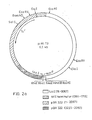
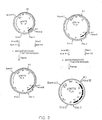
Die Erfindung betrifft Plasmide, die die Restriktions-Karte von PiWiT 10 wL1 und PiWiT 11 aufweisen sowie auch die Plasmide piWiT10 wi7 und piWi T11.The invention relates to plasmids which Show restriction map of
Die Plasmide piWiT 10 wL1 und piWiT 11 eignen sich in einem Verfahren zur Herstellung von Proteinen und Polypeptiden, insbesondere einem Verfahren zur Herstellung eines Polypeptids ausgewählt aus der Gruppe Insulin, Proinsulin, Vasopressin, Oxytocin, Ribonuklease, Wachstumshormon, Met-Aprotinin und Homologe von Met-Aprotinin.The plasmids piWiT 10 wL1 and
Die gemäß der Erfindung verwendeten Mikroorganismen wurden bei der deutschen Sammlung von Mikroorganismen, Griesbachstrasse 8, D-3400 Göttingen, hinterlegt. Die DSM-Hinterlegungsnummer des Wirt-Mikroorganismus E. coli BR 17 ist DSM 3684.The microorganisms used in accordance with the invention have been deposited with the German Collection of Microorganisms,
Die DSM-Hinterlegungsnummer des Wirt-Mikroorganismus E. Coli BR 17, der mit den Plasmiden piWiT10 wi11 und piWiT10 wi7 transformiert ist, ist DSM 3685 und DSM 3686.The DSM deposit number of the host microorganism E. Coli BR 17, which is transformed with the plasmids piWiT10 wi11 and piWiT10 wi7, is DSM 3685 and DSM 3686.
Kurze Beschreibung der Zeichnungen
- Fig. 1a. Aufbau des synthetischen Gens
- Fig. 1b. DNA-Sequenz von DNA-Fragmenten
- Fig. 2a. Konstruktionsvektor piWi T9
- Fig. 2b. DNA-Teilsequenzen von piWi T9
- Fig. 3. Amplifikationsschema zur Oligomerisation des synthetischen Gens
- Fig. 4a.
Expressionsvektor piWi T 11 - Fig. 4b. DNA-Teilsequenz von piWi T11
- Fig. 5a. Plasmid PiWi T10 wL1
- Fig. 5b. DNA-Teilsequenzen von piWi T10 wL1
- Fig. 6. SDS-Protein-Gelelektrophorese
- Fig. 7. SDS-Protein-Gelelektrophorese
- Fig. 8. Renaturierung von Met-Aprotinin
- Fig. 9. Western-Blot
- Fig. 10. Chromatographie von Met-Aprotinin
- Fig. 1a. Structure of the synthetic gene
- Fig. 1b. DNA sequence of DNA fragments
- Fig. 2a. Construction vector piWi T9
- Fig. 2b. Partial DNA sequences of piWi T9
- Fig. 3. Amplification scheme for oligomerization of the synthetic gene
- Fig. 4a. Expression
vector piWi T 11 - Fig. 4b. Partial DNA sequence of piWi T11
- Fig. 5a. Plasmid PiWi T10 wL1
- Fig. 5b. Partial DNA sequences of piWi T10 wL1
- Figure 6. SDS protein gel electrophoresis
- Figure 7. SDS protein gel electrophoresis
- Fig. 8. Renaturation of Met aprotinin
- Fig. 9. Western blot
- Fig. 10. Chromatography of Met aprotinin
Im folgenden werden die Strategie für die Konstruktion und Selektion, die Herstellung von DNA-Fragmenten, die für Met-Aprotinin, Met-Aprotinin-Homologe kodieren, Konstruktionsvektoren, Expressionsvektoren, Expressionsplasmide, Mikroorganismen, die mit denselben transformiert sind, und die mikrobielle Herstellung von Met-Aprotinin und Met-Aprotinin-Homologen, sowie pharmazeutische Zubereitungen offenbart.The following are the strategy for the construction and selection, the production of DNA fragments which code for met-aprotinin, met-aprotinin homologs, construction vectors, expression vectors, expression plasmids, microorganisms which are transformed with them, and the microbial production of Met-aprotinin and met-aprotinin homologues, as well as pharmaceutical preparations are disclosed.
Es wurden Standardmethoden der rekombinanten DNA-Technik angewendet, wie sie von Maniatis et al, 1982, Molecular Cloning, Cold Spring Harbor Laboratory, Cold Spring Harbor, USA beschrieben sind, wobei manchmal Modifikationen angewendet werden, wie sie im folgenden beschrieben werden.Standard recombinant DNA technology methods have been used, as described by Maniatis et al, 1982, Molecular Cloning, Cold Spring Harbor Laboratory, Cold Spring Harbor, USA, sometimes using modifications as described below.
Die bekannte Proteinsequenz und der genetische Code von Aprotinin und Aprotinin-Homologen dienten zur Bestimmung einer DNA-Sequenz, die für solche Polypeptide kodiert.The known protein sequence and the genetic code of aprotinin and aprotinin homologues were used to determine a DNA sequence which codes for such polypeptides.
Die Degenerierung des genetischen Codes erlaubt eine bestimmte Freiheit in der Wahl der Codons für eine gegebene Aminosäuresequenz.The degeneracy of the genetic code allows a certain freedom in the choice of codons for a given amino acid sequence.
Alle möglichen Basensubstitutionen unter den Codons, die die Aminosäuresequenz dieses Proteins festlegen, wurden bestimmt. Dementsprechend wurden alle potentiellen Restriktionsstellen, die innerhalb der möglichen DNA-Sequenzen lokalisiert sind, bestimmt.All possible base substitutions among the codons that determine the amino acid sequence of this protein have been determined. Accordingly, all potential restriction sites located within the possible DNA sequences were determined.
Die Codonwahl für Mastergene war von folgenden Überlegungen begleitet:
- 1. Es wurden Codons und Fragmente ausgewählt und die Fragmentzusammensetzung geplant, und zwar so, daß eine nicht gewünschte Komplementarität der Fragmente vermieden wurde.
- 2. Der ßereich oberhalb des Initiationscodons enthält eine ribosomale Bindungsstelle; als Codons um den Bereich des Initiationscodons wurden solche ausgewählt, die die Ribosomenbindung verstärken (Lit G.F.E. Scherer et al, 1980, Nucl. Acids Res. 8, 3895-3907).
- 3. Es wurden Restriktionsstellen ausgewählt, die erforderlich sind zur Erleichterung der Bestimmung von Transformanden oder zum Austausch Von Basen mittels Ersatz geeigneter Fragmente durch andere Fragmente, so daß man leicht Modifikationen von Aprotinin herstellen kann, sowie zur Schaffung eines breiten Spektrums an Möglichkeiten zur Klonierung und Expression.
- 4. Die Mehrheit der gewählten Codons sind solche, die bei der Expression mikrobieller Gene bevorzugt vorkommen (siehe H. Grosjean and W. Fiers, Gene, 18 (1982) 192-209; M. Gouy und C. Gautier, Nucleic Acids Research, 10 (1982) 7055 - 7074).
- 1. Codons and fragments were selected and the fragment composition was planned in such a way that undesired complementarity of the fragments was avoided.
- 2. The area above the initiation codon contains a ribosomal binding site; as codons around the region of the initiation codon, those were chosen which enhance ribosome binding (Lit GFE Scherer et al, 1980, Nucl. Acids Res. 8, 3895-3907).
- 3. Restriction sites were selected which are necessary to facilitate the determination of transformants or to replace bases by replacing suitable fragments with other fragments, so that modifications of aprotinin can be easily produced, and to create a broad spectrum of possibilities for cloning and Expression.
- 4. The majority of the codons chosen are those which are preferred in the expression of microbial genes (see H. Grosjean and W. Fiers, Gene, 18 (1982) 192-209; M. Gouy and C. Gautier, Nucleic Acids Research, 10 (1982) 7055-7074).
Der prinzipielle Bauplan für synthetische Aprotiningene und deren Homologe ist in Fig. 1a. wiedergegeben.The basic blueprint for synthetic aprotinin genes and their homologues is shown in Fig. 1a. reproduced.
Die synthetischen Gene für Met-Aprotinin-Homologe wurden über ein Mastergen durch Zusammensetzung von 14 gereinigten Oligonukleotiden konstruiert. Diese Konstruktion erfolgte wie in Fig. 1a. gezeigt. Die DNA-Sequenzen der Fragmente für den synthetischen Inhibitor gehen aus Fig. 1b. hervor.The synthetic genes for Met aprotinin homologs were constructed from a master gene by assembling 14 purified oligonucleotides. This construction was carried out as in Fig. 1a. shown. The DNA sequences of the fragments for the synthetic inhibitor are shown in Fig. 1b. forth.
Das Mastergen umfaßt eine Ribosomenbindungsstelle, das Initiationscodon ATG, das Terminationscodon, TAG, die 5′-terminale Restriktionsstelle für Xba I, die 3′-terminale Restriktionsstelle für Hind III, zusätzlich die internen Restriktionsstellen für Xho I, Apa I, Stu I, Acc I, Pst I, Sst II und Sph I. Diese Restriktionsstellen, insbesondere die internen, erleichtern das Klonieren der kodierenden Sequenz, die Modifikation des Mastergens durch Austausch von DNA-Fragmenten, die für andere Aminosäuren kodieren oder die einen anderen Codongebrauch haben. Das gesamte Spektrum des Proteinengineerings ist mit einem solchen Konstrukt möglich.The master gene comprises a ribosome binding site, the initiation codon ATG, the termination codon, TAG, the 5'-terminal restriction site for Xba I, the 3'-terminal restriction site for Hind III, additionally the internal restriction sites for Xho I, Apa I, Stu I, Acc I, Pst I, Sst II and Sph I. These restriction sites, especially the internal ones, facilitate the cloning of the coding sequence, the modification of the master gene by exchanging DNA fragments which code for other amino acids or which have a different codon use. The entire spectrum of protein engineering is possible with such a construct.
Um Gene für Met-Aprotinin-Homologe zu konstruieren, ist lediglich der Austausch eines Restriktionsfragmentes mit einer geeigneten DNA-Sequenz erforderlich. Sequenzen für solche Fragmente, die für Aminosäureänderungen in Position 15 kodieren, z. B. Apa I - Stu I-Fragmente, werden in Fig. 1b. wiedergegeben.To construct genes for Met aprotinin homologues, all that is required is to exchange a restriction fragment with a suitable DNA sequence. Sequences for such fragments encoding amino acid changes in
Das für experimentelle Met-Aprotinin-Klonierung gewählte Plasmid war piWi T9 (siehe auch Fig. 2a.).The plasmid chosen for experimental Met-aprotinin cloning was piWi T9 (see also FIG. 2a.).
Der Konstruktionsvektor setzt sich zusammen aus zwei Fragmenten von pBR 322, welche jeweils den Ursprung der Replikation ("origin of replication") und das Tetracycinresistenzgen tragen, einem Fragment der Bakteriophagen-fd 11-DNA, welches ein Transkriptions-Terminationssignal trägt, und einem Fragment aus dem lac-Operon von E. coli, welches sich erstreckt vom C-Terminus des lac-I-Gens bis genau hinter das lac-Z-gen, wobei die gesamte lac-Promotor-Operator-Region und die ersten fünf Codons des lac-Z-Gens deletiert und durch ein kurzes Stück einer synthetischen DNA ersetzt wurden. Die synthetische DNA besitzt konstitutive Promotoraktivität, welche auf das lac-Z-Gen gerichtet ist und sie enthält die Klonierungsstellen Xba I, Xma I und Hind III zwischen dem Promotor und dem lac-Z-Gen. Jede DNA, die in eine beliebige dieser drei Stellen kloniert ist, wird von dem synthetischen Promotor transkribiert; ob sie auch translatiert wird hängt von der Sequenz ab. Das lac-Z-Gen von piWi T9 wird nicht translatiert, es wird nur dann aktive ß- Galactosidase hergestellt, wenn zusätzliche DNA in eine beiliebige der Klonierungsstellen eingefügt wird, die ein Initiationscodon im Leseraster für das lac-Z-Gen mitbringt.
Die DNA-Sequenzen wichtiger Bereiche des Konstruktionsvektors piWi T9 sind in Fig. 2b aufgeführt.The construction vector is composed of two fragments of
The DNA sequences of important regions of the construction vector piWi T9 are shown in Fig. 2b.
Zur Oligomerisation von Genen wurde das synthetische Gen (siehe Fig. 1a) zwischen die Restriktionsstellen Xba I und Hind III des Konstruktionsvektors piWi T9 kloniert. Für eine Tandemverdoppelung des synthetischen Gens wurde ein Bam HI - Hind III-Fragment, welches eine Kopie des oberhalb der Hind III-Stelle lokalisierten Gens enthält, in Gegenwart eines Hind III-Xba I-Adaptors an ein Xba I - Bam HI-Fragment, welches eine Kopie des unterha1b der Xba I-Stelle lokalisierten Gens enthält (s. Fig. 3) ligiert. Der Hind III - Xba I-Adaptor paßt in die überstehenden Enden, wie sie von Hind III und Xba I gebildet werden, regeneriert jedoch diese Stellen nicht. Das erhaltene Plasmid piWi T9 TL2 hat eine einzige Xba I-Stelle oberhalb des ersten Gens und eine einzige Hind III-Stelle unterhalb des zweiten Gens. Somit kann die Verdopplung mit Hilfe der gleichen Reihe von Reaktionen wiederholt werden, wobei man weitere Plasmide erhält, die 4, 8, 16 und 32 in Tandemanordnung wiederholte Gene enthalten, wobei jedem seine eigene ribosomale Bindungsstelle vorausgeht. Da das lac-Z-Gen nicht mehr gebraucht wird, wird das 3kb Eco RI-Fragment aus dem Plasmid deletiert.For the oligomerization of genes, the synthetic gene (see FIG. 1a) was placed between the restriction sites Xba I and Hind III of the construction vector piWi T9 cloned. For a tandem duplication of the synthetic gene, a Bam HI - Hind III fragment, which contains a copy of the gene located above the Hind III site, was attached to an Xba I - Bam HI fragment in the presence of a Hind III-Xba I adapter, which contains a copy of the gene located below the Xba I site (see FIG. 3). The Hind III - Xba I adapter fits into the protruding ends as formed by Hind III and Xba I, but does not regenerate these sites. The plasmid piWi T9 TL2 obtained has a single Xba I site above the first gene and a single Hind III site below the second gene. Thus, the duplication can be repeated using the same series of reactions to obtain additional plasmids containing 4, 8, 16 and 32 genes repeated in tandem, each preceded by its own ribosomal binding site. Since the lac Z gene is no longer needed, the 3 kb Eco RI fragment is deleted from the plasmid.
Zur Expression von Met-Aprotinin und Met-Aprotinin-Homologen wurde ein Plasmid konstruiert, in welchem die geeigneten Gene unter Kontrolle eines starken Promotors-Operators exprimiert werden konnten, und welches im weiteren DNA-Sequenzen umfaßt, die zur Expression heterologer Proteine und Polypeptide sehr geeignet sind. Die physikalische Karte des Expressionsvektors piWi T11 ist in Fig. 4a wiedergegeben.For the expression of Met-aprotinin and Met-aprotinin homologues, a plasmid was constructed in which the suitable genes could be expressed under the control of a strong promoter operator, and which further comprises DNA sequences which are very suitable for the expression of heterologous proteins and polypeptides are suitable. The physical map of the expression vector piWi T11 is shown in Fig. 4a.
Der Expressionsvektor piWi T11 ist dem Konstruktionsvektor piWi T9 sehr ähnlich; sie besitzen ein gemeinsames 3,3 Kb-langes Xho I - Eco RI-Fragment, welches 36 bp lac I-DNA, 883 bp pBR 322 DNA (Ursprung der Replikation), 2067 (+ 8) bp pBR 322 DNA (Tetracyclinresistenzgen), 9 bp Polylinker, 332 bp fd 11 DNA-Transkriptions-Terminationssignal, 8 bp Bam HI-Octalinker und 68 bp lac-Z-DNA umfaßt. Um die Expression zu verstärken, wurde ein synthetisches DNA-Fragment konstruiert und zwischen die Eco RI - Xho I-Stellen ligiert. Die Sequenz dieses synthetischen Fragments ist in Fig. 4b wiedergegeben. Das Fragment umfaßt Sequenzen für einen starken Promotor, einen RNA-Start, eine lac-Repressor-Bindungsstelle (Operator), eine ribosomale Bindungsstelle, ein Protein-Startcodon, einen kurzen kodierenden Abschnitt, der fünf einmal vorkommende Restriktionsstellen zur Klonierung enthält (Hind III, Xba I, Pst I, Bgl II and Xma I).The expression vector piWi T11 is very similar to the construction vector piWi T9; they have a common 3.3 Kb long Xho I - Eco RI fragment which contains 36 bp lac I DNA, 883
Für Expressionszwecke wurde das kleine Xho I - Xba I-Fragment eines Konstruktionsvektors mit Oligomeren des synthetischen Gens, wie oben beschrieben, durch ein kleines Xho I - Xba I-Fragment von piWi T11 ausgetauscht, wobei letzteres einen Promotor, Operator, eine Ribosomenbindungsstelle und eine Kodierungssequenz für ein Hexapeptid enthielt. Ein erhaltenes rekombinantes Plasmid ist z. B. das Expressionsplasmid piWi T10 wL1 mit Oligomeren des Met-Aprotiningens.For expression purposes, the small Xho I - Xba I fragment of a construction vector with synthetic gene oligomers as described above was replaced with a small Xho I - Xba I fragment from piWi T11, the latter having a promoter, operator, a ribosome binding site and one Contained coding sequence for a hexapeptide. A recombinant plasmid obtained is e.g. B. the expression plasmid piWi T10 wL1 with oligomers of Met-Aprotinens.
DNA-Sequenzen wichtiger Abschnitte des Expressionsplasmids sind in Fig. 5b wiedergegeben.DNA sequences of important sections of the expression plasmid are shown in FIG. 5b.
Im Stand der Technik kennt man eine große Zahl an Mikroorganismen, die sich zur Transformation eignen. Das sind solche einzelligen Organismen, die zur Züchtung in Kulturen oder für Fermentationen geeignet sind. Bevorzugte Organismen zur Transformation umfassen Bakterien, Hefen und Pilze.A large number of microorganisms which are suitable for transformation are known in the prior art. These are unicellular organisms that are suitable for cultivation in cultures or for fermentations. Preferred organisms for transformation include bacteria, yeast and fungi.
Der für die vorliegende Arbeit gewählte Organismus war E. coli.The organism chosen for the present work was E. coli.
Ein besonders geeigneter Stamm ist E. coli B lamda R⁻, mal⁻, der mit Hilfe der von J.H. Miller, 1972, Experiments in Molecular Genetics, Cold Spring Harbor Laboratory, beschriebenen Methode zu recA notiert wurde.A particularly suitable strain is E. coli B lamda R⁻, mal⁻, which with the help of J.H. Miller, 1972, Experiments in Molecular Genetics, Cold Spring Harbor Laboratory, method described to recA.
Viele Proteine, die in großen Mengen in Bakterien synthetisiert werden, akkumulieren sich in unlöslicher Form (D. C. Williams, R.M. van Frank, J.B. Burnett, W.L. Muth, 1982, Science 215, 687).Many proteins that are synthesized in large quantities in bacteria accumulate in insoluble form (D.C. Williams, R.M. van Frank, J.B. Burnett, W.L. Muth, 1982, Science 215, 687).
Diese unlöslichen Proteine bezeichnet man als Inklusionskörper. Sie können gewöhnlich nur mit polaren Stoffen, wie z. B. Harnstoff oder Guanidiniumhydrochlorid gelöst werden.These insoluble proteins are called inclusion bodies. You can usually only with polar substances such. B. urea or guanidinium hydrochloride.
Der E. coli Stamm BR17 wurde mit dem Plasmid piWi T10 wL1 transformiert, welches für das Aprotiningen vierzehnmal unterhalb eines E. coli Promotors, Operators und einer Ribosomen-Bindungsstelle kodiert. Eine Übernacht-Kultur von E. coli Stamm BR17 piWi T10 wL1 wurde zentrifugiert, das Pellet wurde in Puffer zum Aufbrechen resuspendiert, und die Zellen wurden mittels einer "french press". lysiert.The E. coli strain BR17 was transformed with the plasmid piWi T10 wL1, which for the aprotinin gene fourteen times below an E. coli promoter, operator and one Ribosome binding site encoded. An overnight culture of E. coli strain BR17 piWi T10 wL1 was centrifuged, the pellet was resuspended in buffer for disruption, and the cells were analyzed using a "french press". lysed.
Das Zell-Lysat wurde zur Gewinnung der Inklusionskörper zentrifugiert. Das Pellet wurde zweimal mit Puffer (breaking puffer) gewaschen.The cell lysate was centrifuged to obtain the inclusion bodies. The pellet was washed twice with buffer (breaking buffer).
Die Reinigungsschritte wurden mittels der SDS-Polyacrylamid-Gelelektrophorese nach Laemmli (U.K. Laemmli 1970, Nature 277, 680-685) überprüft; Fig. 7.The purification steps were checked using SDS-polyacrylamide gel electrophoresis according to Laemmli (U.K. Laemmli 1970, Nature 277, 680-685); Fig. 7.
Der inaktive Inhibitor wurde nach einem Verfahren von Creighton (T.E. Creighton, Proceedings of Genex-UCLA Symposium 1985 Kingstones) renaturiert; Fig 8. Der aktive Inhibitor konnte durch Trypsinbestimmung und Western-Blot-Analyse nachgewiesen werden; Fig. 9.The inactive inhibitor was renatured using a Creighton method (T.E. Creighton, Proceedings of Genex-UCLA Symposium 1985 Kingstones); Fig. 8. The active inhibitor could be detected by trypsin determination and Western blot analysis; Fig. 9.
Der aktive Inhibitor wurde im weiteren durch Chromatographie auf einer Trypsin-Sepharose-Säule nach Fritz (H. Fritz, M. Gebhardt, R. Meister, K. Illchmann, K. Hochstraßer, 1970, Hoppe-Seyler's Z. Physiol. Chem. 351, 571-574) gereinigt; Fig. 10.The active inhibitor was furthermore determined by chromatography on a trypsin-Sepharose column according to Fritz (H. Fritz, M. Gebhardt, R. Meister, K. Illchmann, K. Hochstraßer, 1970, Hoppe-Seyler's Z. Physiol. Chem. 351 , 571-574) cleaned; Fig. 10.
Der Inhibitor wurde dann durch Mikrosequenzierung gemäß Hewick (R.M. Hewick, M.W. Hunkapillar, L.E. Hood, W.I. Dreger 1981, J. Biol. Chem. 256, 7970-7997) charakterisiert.The inhibitor was then characterized by microsequencing according to Hewick (R.M. Hewick, M.W. Hunkapillar, L.E. Hood, W.I. Dreger 1981, J. Biol. Chem. 256, 7970-7997).
Die ersten 20 Reste am N-Terminus wurden bestimmt. Abgesehen von dem Methionin in der Position Null war die Aminosäuresequenz völlig mit der von Aprotinin identisch (Tabelle 1). Die Aminosäurezusammensetzung des Inhibitors zeigt die erwarteten Werte (Tabelle 2). Ein Vergleich von Aprotinin und Met-Aprotinin mittels der Trypsin-inhibierenden Wirkung zeigt vergleichbare Werte (Tabelle 3).The first 20 residues at the N-terminus were determined. Except for the methionine in the zero position, the amino acid sequence was completely the same as that of aprotinin identical (Table 1). The amino acid composition of the inhibitor shows the expected values (Table 2). A comparison of aprotinin and met-aprotinin by means of the trypsin-inhibiting effect shows comparable values (Table 3).
Alle diese Experimente zeigen, daß es möglich ist, Met-Aprotinin in E. coli herzustellen und es zum aktiven Inhibitor zu renaturieren.All of these experiments show that it is possible to produce met-aprotinin in E. coli and to renature it to the active inhibitor.
Met-Ile-15-Aprotinin kann in ähnlicher Weise in E. coli hergestellt werden, wie dies für Met-Aprotinin beschrieben ist (siehe auch Fig. 6).Met-Ile-15-aprotinin can be prepared in E. coli in a similar manner to that described for Met-aprotinin (see also Figure 6).
Die inhibierende Wirkung wurde mittels eines Elastase-Inhibierungsassays (K. Nakajima, M. Zimmermann, J.C. Powers, M.J. Castillo, B.M. Ashe 1979, J. Biol. Chem. 254, 4027) bestimmt.The inhibitory effect was determined by means of an elastase inhibition assay (K. Nakajima, M. Zimmermann, J.C. Powers, M.J. Castillo, B.M. Ashe 1979, J. Biol. Chem. 254, 4027).
Der Inhibitor wurde durch Aminosäureanalyse und N-terminale Sequenzierung charakterisiert (Tabelle 1, 2).The inhibitor was characterized by amino acid analysis and N-terminal sequencing (Table 1, 2).
Alle anderen Derivate von Aprotinin konnten in ähnlicher Weise hergestellt werden, wie dies für Met-Aprotinin und Met-Ile-15-Aprotinin beschrieben ist.All other derivatives of aprotinin could be prepared in a manner similar to that described for Met-Aprotinin and Met-Ile-15-Aprotinin.
Die vorliegende Erfindung umfaßt pharmazeutische Zubereitungen, die außer nicht-toxischen, inerten, pharmazeutisch geeigneten Exzipienten eine oder mehrere Verbindungen gemäß der Erfindung umfassen, oder die aus einer oder mehreren aktiven Verbindungen gemäß der Erfindung bestehen, sowie Verfahren zur Herstellung dieser Zubereitungen.The present invention encompasses pharmaceutical preparations which, in addition to non-toxic, inert, pharmaceutically suitable excipients comprise one or more compounds according to the invention, or which consist of one or more active compounds according to the invention, and methods for the preparation of these preparations.
Die vorliegende Erfindung umfaßt auch pharmazeutische Zubereitungen in Dosis-Einheiten. Dies bedeutet, daß die Zubereitungen in Form individueller Teile vorliegen, z. B. als Tabletten, beschichtete Tabletten, Kapseln, Pillen, Suppositorien und Ampullen, wobei der Gehalt an aktiver Verbindung einem Teil oder einem Vielfachen einer individuellen Dosis entspricht. Die Dosiseinheiten können z. B. eine, zwei, drei oder vier individuelle Dosen oder eine Hälfte, ein Drittel oder ein Viertel einer individuellen Dosis enthalten. Eine individuelle Dosis enthält bevorzugt die Menge an aktiver Verbindung, die bei einer Verabreichung gegeben wird, und die üblicherweise dem Ganzen, einer Hälfte, einem Drittel oder einem Viertel einer Tagesdosis entspricht.The present invention also encompasses pharmaceutical preparations in unit doses. This means that the preparations are in the form of individual parts, e.g. B. as tablets, coated tablets, capsules, pills, suppositories and ampoules, wherein the content of active compound corresponds to a part or a multiple of an individual dose. The dose units can e.g. B. contain one, two, three or four individual doses or a half, a third or a quarter of an individual dose. An individual dose preferably contains the amount of active compound given in one administration, which is usually the whole, one half, one third or one quarter of a daily dose.
Unter nicht-toxischen, inerten, pharmazeutisch geeigneten Exzipienten versteht man feste, halbfeste oder flüssige Verdünner, Füllmittel und Formulierungshilfsmittel aller Art.Non-toxic, inert, pharmaceutically suitable excipients are understood to mean solid, semi-solid or liquid diluents, fillers and formulation auxiliaries of all kinds.
Als bevorzugte pharmazeutische Zubereitungen sind Tabletten, beschichtete Tabletten, Kapseln, Pillen, Granalien, Suppositorien, Lösungen, Suspensionen und Emulsionen, Pasten, Salben, Gele, Cremen, Lotionen, Pulver und Sprays zu nennen.Preferred pharmaceutical preparations include tablets, coated tablets, capsules, pills, granules, suppositories, solutions, suspensions and emulsions, pastes, ointments, gels, creams, lotions, powders and sprays.
Tabletten, beschichtete Tabletten, Kapseln, Pillen und Granalien können die aktive Verbindung oder die aktiven Verbindungen zusammen mit üblichen Exzipienten enthalten, wie z. B. (a) Füllmittel und Streckmittel, z. B. Stärken, Lactose, Sucrose, Glukose, Mannit und Siliziumdioxid, (b) Bindemittel, z. B. Carboxymethylcellulose, Alginate, Gelatine und Polyvinylpyrrolidon, (c) anfeuchtende Mittel, z. B. Glycerin, (d) Disintegrationsmittel, z. B. Agar-Agar, Kalziumcarbonat und Natriumcarbonat, (e) Lösungsverzögerer, z. B. quaternäre Ammoniumverbindungen, (g) Benetzungsmittel, z. B. Cetylalkohol und Glycerinmonostearat, (h) Adsorbentien, z. B. Kaolin und Bentonit, und (i) Schmiermittel, z. B. Talk, Kalzium- und Magnesiumstearat und feste Polyethylenglykole, oder Gemische der unter (a) bis (i) aufgeführten Substanzen.Tablets, coated tablets, capsules, pills and granules can contain the active compound or compounds together with conventional excipients, such as e.g. B. (a) fillers and extenders, e.g. B. starches, lactose, sucrose, glucose, mannitol and silicon dioxide, (b) binders, e.g. B. carboxymethyl cellulose, alginates, gelatin and polyvinylpyrrolidone, (c) moisturizing agents, e.g. B. glycerin, (d) disintegrant, e.g. B. agar-agar, calcium carbonate and sodium carbonate, (e) solution retarders, e.g. B. quaternary ammonium compounds, (g) wetting agents, e.g. B. cetyl alcohol and glycerol monostearate, (h) adsorbents, e.g. B. kaolin and bentonite, and (i) lubricants, e.g. B. talc, calcium and magnesium stearate and solid polyethylene glycols, or mixtures of the substances listed under (a) to (i).
Die Tabletten, beschichtete Tabletten, Kapseln, Pillen und Granalien können mit üblichen Beschichtungen und Umhüllungen versehen werden, und enthalten gegebenenfalls Opazifizierungsmittel; sie können auch eine Zubereitung darstellen, welche die aktive Verbindung oder die aktiven Verbindungen nur oder vorzugsweise in einem bestimmten Teil des Intestinaltraktes, gegebenenfalls in verzögerter Weise, freisetzen. Beispiele von geeigneten Einbettungsmaterialien sind polymere Substanzen und Wachse.The tablets, coated tablets, capsules, pills and granules can be provided with customary coatings and coatings, and optionally contain opacifying agents; they can also be a preparation which releases the active compound or compounds only or preferably in a certain part of the intestinal tract, optionally in a delayed manner. Examples of suitable embedding materials are polymeric substances and waxes.
Die aktive Verbindung oder Verbindungen, gegebenenfalls zusammen mit einem oder mehreren der vorstehend genannten Exzipienten, kann auch in einer mikroverkapselten Form vorliegen.The active compound or compounds, optionally together with one or more of the above-mentioned excipients, can also be in a microencapsulated form.
Suppositorien können außer der aktiven Verbindung oder den aktiven Verbindungen die üblichen wasserlöslichen oder wasserunlöslichen Exzipienten aufweisen, z. B. Polyethylenglykole,Fette, z. B. Kakaofett und höhere Ester (z. B. C₁₄-Alkohol mit C₁₆-Fettsäure) oder Gemische dieser Substanzen.Suppositories can have the usual water-soluble or water-insoluble excipients in addition to the active compound or compounds, e.g. B. polyethylene glycols, fats, e.g. B. cocoa fat and higher esters (z. B. C₁₄ alcohol with C₁₆ fatty acid) or mixtures of these substances.
Salben, Pasten, Cremen und Gele können übliche Exzipienten zusätzlich zu der aktiven Verbindung oder den aktiven Verbindungen enthalten, z. B. tierische und pflanzliche Fette, Wachse, Paraffine, Stärke, Tragacanth, Cellulosederivate, Polyethylenglykole, Silikone, Bentonite, Siliziumdioxid, Talk und Zinkoxid, oder Gemische dieser Substanzen.Ointments, pastes, creams and gels can contain conventional excipients in addition to the active compound or compounds, e.g. B. animal and vegetable fats, waxes, paraffins, starch, tragacanth, cellulose derivatives, polyethylene glycols, silicones, bentonites, silicon dioxide, talc and zinc oxide, or mixtures of these substances.
Pulver und Sprays können übliche Exzipienten neben der aktiven Verbindung oder den aktiven Verbindungen enthalten, z. B. Lactose, Talk, Siliziumdioxid, Aluminiumhydroxid, Kalziumsilikat und Polyamidpulver, oder Gemische dieser Substanzen. Sprays können außerdem übliche Treibmittel enthalten, z. B. Chlorfluorkohlenwasserstoffe.Powders and sprays can contain conventional excipients in addition to the active compound or compounds, e.g. B. lactose, talc, silicon dioxide, aluminum hydroxide, calcium silicate and polyamide powder, or mixtures of these substances. Sprays can also contain conventional propellants, e.g. B. chlorofluorocarbons.
Lösungen und Emulsionen können übliche Exzipienten neben der aktiven Verbindung oder den aktiven Verbindungen enthalten, wie Lösungsmittel, Solubilisierungsmittel und Emulgiermittel, z. B. Wasser, Ethylalkohol, Isopropylalkohol, Ethylcarbonat, Ethylacetat, Benzylalkohol, Benzylbenzoat, Propylenglykol, 1,3-Butylenglykol, Dimethylformamid, Öle, insbesondere Baumwollsamenöl, Erdnußöl, Maiskeimöl, Olivenöl, Rizinusöl und Sesamöl, Glycerin, Glycerinformal, Tetrahydrofurfurylalkohol, Polyethylenglykole und Fettsäureester von Sorbitan, oder Gemische dieser Substanzen.Solutions and emulsions can contain conventional excipients in addition to the active compound or compounds, such as solvents, solubilizers and emulsifiers, e.g. As water, ethyl alcohol, isopropyl alcohol, ethyl carbonate, ethyl acetate, benzyl alcohol, benzyl benzoate, propylene glycol, 1,3-butylene glycol, dimethylformamide, oils, especially cottonseed oil, peanut oil, corn oil, olive oil, castor oil and sesame oil, glycerin, glycerol formaldehyde, tetrahydrofuran, fatty alcohol, fatty alcohol, fatty alcohol of sorbitan, or mixtures of these substances.
Zur parenteralen Verabreichung können die Lösungen und Emulsionen auch in einer sterilen Form, die isoton mit Blut ist, vorliegen.For parenteral administration, the solutions and emulsions can also be in a sterile form that is isotonic with blood.
Die Suspensionen können übliche Exzipienten neben der aktiven Verbindung oder den aktiven Verbindungen enthalten, wie flüssige Verdünnungsmittel, z. B. Wasser, Ethylalkohol oder Propylenglykol, Suspensionsmittel, z. B. ethoxylierte Isostearylalkohole, Polyoxyethylensorbit und Sorbitanester, mikrokristalline Cellulose, Aluminium-metahydroxid, Bentonit, Agar-Agar und Tragacanth, oder Gemische dieser Substanzen.The suspensions can contain conventional excipients in addition to the active compound or compounds, such as liquid diluents, e.g. B. water, ethyl alcohol or propylene glycol, suspending agent, for. B. ethoxylated isostearyl alcohols, polyoxyethylene sorbitol and sorbitan esters, microcrystalline cellulose, aluminum metahydroxide, bentonite, agar and tragacanth, or mixtures of these substances.
Die genannten Formulierungsformen können auch Farbstoffe, Konservierungsmittel und Additive enthalten, die den Geruch und Geschmack verbessern, z. B. Pfefferminzöl und Eukalyptusöl, und Süßungsmittel, z. B. Saccharin.The formulation forms mentioned can also contain dyes, preservatives and additives which improve the smell and taste, e.g. Peppermint oil and eucalyptus oil, and sweeteners, e.g. B. saccharin.
Die therapeutisch wirksamen Verbindungen sollten in den vorstehend genannten pharmazeutischen Zubereitungen bevorzugt in einer Konzentration von ca. 0,1 bis 99,5, vorzugsweise von 0,5 bis 95 Gew.-%, bezogen auf das Gesamtgemisch, vorliegen.The therapeutically active compounds should be present in the above-mentioned pharmaceutical preparations preferably in a concentration of approximately 0.1 to 99.5, preferably 0.5 to 95% by weight, based on the mixture as a whole.
Die vorstehend genannten pharmazeutischen Zubereitungen können auch andere pharmazeutisch aktive Verbindungen zusätzlich zu den Verbindungen gemäß der Erfindung enthalten.The aforementioned pharmaceutical preparations can also contain other pharmaceutically active compounds in addition to the compounds according to the invention.
Die vorstehend genannten pharmazeutischen Zubereitungen werden in üblicher Weise nach bekannten Verfahren hergestellt, z. B. durch Vermischen der aktiven Verbindung oder der aktiven Verbindungen mit dem oder den Exzipienten.The above-mentioned pharmaceutical preparations are prepared in a conventional manner by known methods, e.g. B. by mixing the active compound or compounds with the one or more excipients.
Die aktiven Verbindungen oder die pharmazeutischen Zubereitungen können lokal, oral, parenteral, intraperitoneal und/oder rektal verabreicht werden, bevorzugt oral oder parenteral, wie intravenös oder intramuskular.The active compounds or the pharmaceutical preparations can be administered locally, orally, parenterally, intraperitoneally and / or rectally, preferably orally or parenterally, such as intravenously or intramuscularly.
Im allgemeinen hat es sich sowohl in der Human- als auch in der Veterinärmedizin als vorteilhaft erwiesen, die aktive Verbindung oder die aktiven Verbindungen gemäß der Erfindung in Gesamtmengen von ca. 0,5 bis ca. 500, vorzugsweise 5 bis 100 mg/kg Körpergewicht alle 24 h, gegebenenfalls in Form mehrerer individueller Verabreichungen, zu geben, um die gewünschten Ergebnisse zu erzielen. Eine individuelle Verabreichung enthält die aktive Verbindung oder die aktiven Verbindungen gemäß der Erfindung vorzugsweise in Mengen von ca. 1 bis ca. 250, insbesondere von 3 bis 60 mg/kg Körpergewicht. Es kann jedoch erforderlich sein, von dieser genannten Dosis abzuweichen, insbesondere in Abhängigkeit von der Natur und dem Körpergewicht des zu behandelnden Patienten, der Art und Schwere der Erkrankung, der Art der Zubereitung und der Verabreichung der Medizin, und der Zeit oder dem Intervall, über den die Verabreichung stattfindet.In general, it has proven advantageous in both human and veterinary medicine to use the active compound or compounds according to the invention in total amounts of from about 0.5 to about 500, preferably from 5 to 100 mg / kg of body weight every 24 h, if necessary in the form of several individual administrations, to achieve the desired results. An individual administration contains the active compound or the active compounds according to the invention preferably in amounts of approx. 1 to approx. 250, in particular 3 to 60 mg / kg body weight. However, it may be necessary to deviate from this dose, in particular depending on the nature and body weight of the patient to be treated, the type and severity of the disease, the type of preparation and administration of the medicine, and the time or interval, through which the administration takes place.
Somit kann es in einigen Fällen genügen, mit weniger als der vorstehend genannten Menge an aktiver Verbindung auszukommen, während in anderen Fällen die vorstehend genannte Menge an aktiver Verbindung überschritten werden muß. Die insbesondere erforderliche optimale Dosis und die Art der Verabreichung der aktiven Verbindung kann ohne weiteres vom Fachmann auf der Grundlage seines Fachwissens bestimmt werden.Thus, in some cases it may be sufficient to make do with less than the above-mentioned amount of active compound, while in other cases the above-mentioned amount of active compound has to be exceeded. The particular optimal dose required and the mode of administration of the active compound can readily be determined by the person skilled in the art on the basis of his specialist knowledge.
Die Oligonukleotide, die das Gen umfassen, wurden unter Anwendung von Festphasen-Synthesemethoden hergestellt. Das Syntheseschema für die Oligomeren entsprach dem angegeben und bediente sich Protonen-aktivierter, geschützter 2′-Desoxyribonukleotid-phosphoramidite. Sämtliche Sequenzschritte wurden in automatisierter Weise auf einem Applied Biosystems Modell 380 DNA-Synthesator unter Verwendung geschützter Nukleotide, Lösungsmittel, Chemikalien und Reagentien, die vom Hersteller bezogen wurden, ausgeführt. Der Festphasen-Träger, der vom gleichen Hersteller ist, war c"controlled pore glass" an welchem das Ausgangs-3′-nukleotid bereits aufgebracht war. Bestimmte Modifikationen wurden in den automatisierten Reaktionszyklus in Übereinstimmung mit den "Manufacturers Operating Instructions" and "Users Bulletins" eingeführt. Nach Beendigung der Synthese wurden die Oligomeren entblockt und vom Festphasen-Träger innerhalb des DNA-Synthesators, wie vom Hersteller angegeben, abgespalten.The oligonucleotides comprising the gene were made using solid phase synthesis methods. The synthesis scheme for the oligomers corresponded to that stated and used proton-activated, protected 2'-deoxyribonucleotide-phosphoramidites. All sequence steps were carried out in an automated manner on an Applied Biosystems Model 380 DNA synthesizer using protected nucleotides, solvents, chemicals and reagents, which were obtained from the manufacturer. The solid phase support, which is from the same manufacturer, was c "controlled pore glass" to which the starting 3'-nucleotide was already applied. Certain modifications have been introduced in the automated response cycle in accordance with the "Manufacturers Operating Instructions" and "Users Bulletins". After completion of the synthesis, the oligomers were unblocked and cleaved from the solid phase support within the DNA synthesizer as specified by the manufacturer.
Die Entfernung der Blockierungsgruppen wurde durch Erwärmen der wäßrigen Lösung, die das Oligomer enthält, mit konzentriertem Ammoniumhydroxid für 4 bis 24 h auf 55°C in einer versiegelten Ampulle vervollständigt. Die erhaltene Lösung wurde eingedampft, der Rückstand in 0,01 M Triethylammonium-bicarbonat-Puffer, pH 7,0 (TEAB-Puffer) aufgelöst. Diese Lösung wurde über Sephadex-G 50 ® - Gelfiltrationsharz chromatographiert.Removal of the blocking groups was completed by heating the aqueous solution containing the oligomer with concentrated ammonium hydroxide for 4 to 24 hours at 55 ° C in a sealed ampoule. The resulting solution was evaporated, the residue dissolved in 0.01 M triethylammonium bicarbonate buffer, pH 7.0 (TEAB buffer). This solution was chromatographed on Sephadex-
Die Säule wurde in dem gleichen TEAB-Puffer hergestellt und mit diesem wurde eluiert. Das Material, das mit dem Leervolumen eluierte, wurde vereinigt und die Lösung eingedampft.The column was prepared in the same TEAB buffer and eluted with it. The material that eluted with the void volume was combined and the solution evaporated.
Ein Teil des Rückstandes (10 bis 40 % der Extinktionseinheiten bei 260 nm), aufgelöst in Beladungspuffer (Zusammensetzung: 0,1 % Bromphenol-Blau, 0,1 % Xylolcyanol, 10 mM Dinatrium-EDTA, in Formamid) wurde durch Elektrophorese in Polyacrylamidgelen weiter gereinigt. Die Gelabmessung betrug 10 × 32 cm mit einer Dicke von 1,5 mm. Die Geltasche für jedes auf diese Weise gereinigte Oligomer war 2 bis 5 cm breit; bis zu fünf Oligomere wurden unter Verwendung eines Gels gereinigt. Die Acrylamid-Konzentration des jeweiligen Gels variierte von 14 bis 20 %, je nach der Kettenlänge zu reinigenden Produkte. Für längere Oligomere wurde das 14 %ige Acrylamidgel bevorzugt, während kürzere Oligomere auf bis zu 20 %igen Acrylamidgelen gereinigt wurden. Die Gele enthielten auch 7 M Harnstoff und Tris-borat-EDTA-Puffer (0,1 M Tris, 0,1 M Borat, 2 mM EDTA, pH 8,3). Der Laufpuffer bestand ebenfalls aus dem Tris-borat-EDTA-Gemisch. Die Elektrophorese wurde bei 20 bis 60 Watt, konstantem Strom, 6 bis 18 h lang durchgeführt. Derartige standardisierte Methoden sind verschiedenen "User Information Bulletins" von Applied Biosystems zu entnehmen.A portion of the residue (10 to 40% of the absorbance units at 260 nm), dissolved in loading buffer (composition: 0.1% bromophenol blue, 0.1% xylene cyanol, 10 mM disodium EDTA, in formamide) was electrophoresed in polyacrylamide gels further cleaned. The gel dimension was 10 × 32 cm with a thickness of 1.5 mm. The gel pocket for each oligomer purified in this way was 2 to 5 cm wide; up to five oligomers were purified using a gel. The acrylamide concentration of the respective gel varied from 14 to 20%, depending on the chain length of the products to be cleaned. The 14% acrylamide gel was preferred for longer oligomers, while shorter oligomers were purified on up to 20% acrylamide gels. The gels also contained 7 M urea and tris-borate-EDTA buffer (0.1 M Tris, 0.1 M borate, 2 mM EDTA, pH 8.3). The running buffer also consisted of the tris-borate-EDTA mixture. Electrophoresis was carried out at 20 to 60 watts, constant current, for 6 to 18 hours. Such standardized methods can be found in various "User Information Bulletins" from Applied Biosystems.
Nach Beendigung der Elektrophorese wurde das Gel auf eine Plastikfolie gelegt und die Oligomeren durch "UV-shadowing" sichtbar gemacht. Diese Abbildung erreicht man, indem man das Gel mit Folie auf eine Fluoreszenz-Dünnschicht-Chromatographieplatte legt und das Gel unter einer kurzwelligen UV-Lichtquelle beobachtet.
Das gewünschte Produkt erscheint als oas am langsamsten wandernde, blaue DNA-Haupt-Fragment mittels dieser Abbildungs-Methode. Die gewünschte 8ande wird aus dem Gel herausgeschnitten. Das DNA-Oligomer wird aus der Gelscheibe, auf pulverförmiger Diethylaminoethyl(DEAE)-cellulose unter Verwendung einer EpiGene D-Gel®-Elektrophoreseapparatur eluiert. Das Oligomer wird aus der Cellulose durch Eluieren mit 1 M TEAB-Puffer gewonnen. Die Pufferlösung, die das Oligomer enthält, wird eingedampft, der Rückstand in 0,01 M TEAB-Puffer aufgelöst und dann durch Chromatographie über eine Sephadex-G 50®-Säule, wie vorstehend beschrieben, entsalzt. Das im Leervolumen eluierende Material wird vereinigt und unter Erhalt des Endproduktes lyophilisert.After the electrophoresis had ended, the gel was placed on a plastic film and the oligomers were made visible by "UV shadowing". This is achieved by placing the gel with foil on a fluorescence thin-layer chromatography plate and observing the gel under a short-wave UV light source.
The desired product appears as oas on slowest migrating blue DNA main fragment using this imaging method. The desired 8ande is cut out of the gel. The DNA oligomer is eluted from the gel slice on powdered diethylaminoethyl (DEAE) cellulose using an EpiGene D-Gel® electrophoresis apparatus. The oligomer is obtained from the cellulose by elution with 1 M TEAB buffer. The buffer solution containing the oligomer is evaporated, the residue dissolved in 0.01 M TEAB buffer and then desalted by chromatography on a Sephadex-
Unter Anwendung der vorstehend beschriebenen Verfahren wurden ca. 0,5 bis 5,0 A₂₆₀-Einheiten eines jeden der gereinigten Oligomere erhalten.Using the methods described above, about 0.5 to 5.0 A₂₆₀ units of each of the purified oligomers were obtained.
Die synthetischen Oligonukleotide, die wie in Beispiel 1 gereinigt worden waren, wurden mit Polynukleotidkinase und Adenosintriphosphat (ATP) unter Standardbedingungen behandelt (Maniatis et al.(1982)). Ein Zehntel einer jeden Probe wurde mit δ[32P] ATP anstelle von ATP inkubiert. ßeide Proben wurden anschließend vermischt und, wie in Beispiel 1 beschrieben, einer Elektrophorese unterworfen. Die markierten Banden wurden aus dem Gel eluiert und wie zuvor beschrieben gereinigt.The synthetic oligonucleotides, which had been purified as in Example 1, were treated with polynucleotide kinase and adenosine triphosphate (ATP) under standard conditions (Maniatis et al. (1982)). One-tenth of each sample was incubated with δ [32P] ATP instead of ATP. Large samples were then mixed and, as described in Example 1, subjected to electrophoresis. The labeled bands were eluted from the gel and purified as previously described.
Die 14 Oligonukleotide (Fig. 1a, b) wurden dann mit 30 µl doppelt-konzentriertem Ligase-Puffer (Maniatis et al. (1982 vermischt und 20 min bei 40°C und 30 min bei Raumtemperatur einer Ligierungsreaktion unterworfen. Dann wurden 2 µl 100 mM ATP, pH 7,5, 6 µl T4DNA-Ligase und 22 µl Wasser zugegeben und die Ligierung über Nacht bei ca. 10°C fortgesetzt.The 14 oligonucleotides (FIGS. 1a, b) were then mixed with 30 μl of double-concentrated ligase buffer (Maniatis et al. (1982 and mixed for 20 min at 40 ° C. and 30 min at room temperature subjected to a ligation reaction. Then 2
Die Produkte der Ligierungsreaktion wurden dann mit Xba I und HindIII unter Erhalt einzelner synthetischer Gensegmente mit einer Gesamtlänge von 204 bp geschnitten, diese umfaßten eine offene XbaI-Stelle, eine ribosomale Bindungsstelle, einen Initiationscodon ATG, die Aprotinin-Kodierungssequenz, einen Terminationscodon TAG und eine offene HindIII-Stelle.The products of the ligation reaction were then cut with Xba I and HindIII to obtain individual synthetic gene segments with a total length of 204 bp, which included an open XbaI site, a ribosomal binding site, an initiation codon ATG, the aprotinin coding sequence, a termination codon TAG and one open HindIII position.
Die Konstruktionsvektor-DNA (Fig. 2a, b) wurde mit XbaI und HindIII (Maniatis) gespalten, mit synthetischen Gensegmenten, die wie in Beispiel 2 beschreiben, hergestellt worden waren, vermischt und über Nacht ligiert. Die Probe wurde dann zum Transformieren von E. coli Su3 [lac-pro]Δmet⁻ argam supF thi⁻) nach der Methode von Hahnahan (D. Hahnahan, J. Mol. Biol., 1983, 166, 557-580) verwandt. Die Zellen wurden auf vollmedium-Platten ausplattiert, die 10 µg Tetracyclin/ml und 0,005 % x-gal (5-Brom-4-Chlor-3indolyl-β-D-galactosid; J. Miler, Experiments in Molecular Genetics, 1972, Cold Spring Harbor Laboratory, Cold Spring Harbor, NY), enthielten und wurden über Nacht bei 37 °C inkubiert. Aus blauen Kolonien wurde die Plasmid-DNA extrahiert und auf die Anwesenheit von Restriktionsenzym-Erkennungsstellen, die im synthetischen Gensegment liegen, untersucht. Zum Schluß wurde die DNA-Sequenz nach der Methode von Maxam und Gilbert bestimmt (A. Maxam & W. Gilbert, in Meth. Enzymol., 1983, 65, 499-560).The construction vector DNA (Fig. 2a, b) was digested with XbaI and HindIII (Maniatis), mixed with synthetic gene segments, which had been prepared as described in Example 2, mixed and ligated overnight. The sample was then used to transform E. coli Su3 [lac-pro] Δ met⁻ arg on supF thi⁻) according to the method of Hahnahan (D. Hahnahan, J. Mol. Biol., 1983, 166, 557-580) related. The cells were plated on full medium plates containing 10 µg tetracycline / ml and 0.005% x-gal (5-bromo-4-chloro-3indolyl-β-D-galactoside; J. Miler, Experiments in Molecular Genetics, 1972, Cold Spring Harbor Laboratory, Cold Spring Harbor, NY) contained and were incubated overnight at 37 ° C. The plasmid DNA was extracted from blue colonies and examined for the presence of restriction enzyme recognition sites located in the synthetic gene segment. Finally, the DNA sequence was determined by the Maxam and Gilbert method (A. Maxam & W. Gilbert, in Meth. Enzymol., 1983, 65, 499-560).
piWiT9L1-DNA, die wie im vorhergehenden Beispiel 3 beschrieben,hergestellt worden war, wurde zur Herstellung von Multimeren des Aprotiningens verwendet. Die Plasmid-DNA wurde mit HindIII und BamHI gespalten, und das kleinere Fragment, das das 3′-Ende des Tetracyclinresistenzgens, den "origin of replication", den Promotor und das Met-Aprotiningen enthält, wurde gereinigt (Maniatis et al. (1982)). Eine zweite Probe der Plasmid-DNA wurde mit SbaI und BamHI gespalten und das größere Fragment, welches wiederum das Met-Aprotiningen, das lac-Z-Gen, das Transkriptions-Terminationssignal und das 5′-Ende des Tetracyclinresistenzgens enthält, wurde wie vorstehend gereinigt. Beide Fragmente werden ligiert,(s. Beispiel 2) in Gegenwart der gereinigten Adaptermoleküle,

Vor einer dritten Duplizierung der nun vier Aprotiningene wurde das 3Kb EcoRI-Fragment aus dem Plasmid deletiert, um dessen Gesamtgröße zu verringern (Fig. 3). Nach der dritten Verdopplung erhielten wir zufällig ein Plasmid mit sieben Aprotiningenen anstelle von acht. Plasmide mit ungeraden Nummern von Genen findet man gewöhnlich unter den Produkten einer derartigen Ligierungsreaktion mit geringer Häufigkeit. Wir nehmen an, daß ihre Bildung auf eine teilweise Denaturierung der DNA-Fragmente während des SchmeLzens der "Seaplaque® -Agarose (Maniatis et al.(I982)) im Verlauf des Reinigungsverfahrens zurückzufÜhren ist. Wir konnten keine Abweichung von einer gegebenen Genanzahl nach dem weiteren Wachstum dieser Plasmide in E. coli BR17 feststellen.Before a third duplication of the now four aprotinin genes, the 3Kb EcoRI fragment was deleted from the plasmid in order to reduce its overall size (FIG. 3). After the third doubling, we randomly received a plasmid with seven aprotinin genes instead of eight. Plasmids with odd number of genes are usually found among the products of such a low frequency ligation reaction. We believe that their formation is due to partial denaturation of the DNA fragments during the melting of the "Seaplaque® agarose (Maniatis et al. (I982)) in the course of the purification process. We could not deviate from a given number of genes after the determine further growth of these plasmids in E. coli BR17.
Somit ergab die vierte Verdopplung, die wie vorstehend beschrieben durchgeführt wurde, ein Plasmid mit vierzehn Aprotiningenen, die in einem künstlichen Operon zusammengesetzt waren, das in eine polycistronische mRNA transkribiert werden konnte, die dann in 14 getrennte identische Aprotininpeptide übersetzt wurde.Thus, the fourth duplication, performed as described above, resulted in a plasmid with fourteen aprotinin genes assembled in an artificial operon that could be transcribed into a polycistronic mRNA, which was then translated into 14 separate identical aprotinin peptides.
Die Bedeutung des 5′-nicht-translatierten Abschnittes der mRNA, der sogenannten Leader-Sequenz der mRNA, auf die Translationsrate des Gens oder der Gene, die auf dieser mRNA kodieren, ist noch nicht vollständig erklärbar. Wir untersuchten mehrere dieser Leader-Sequenzen auf ihre Translationswirksamkeit und erhielten mit verschiedenen Genen verschiedene Ergebnisse. Eine Leader-Sequenz, mit der mit unserem synthetischen Aprotiningen,die besten Ergebnisse erhalten wurden, ist die Sequenz, die im Expressionsvektor piWiT11 vorliegt (Fig. 4a, b).The importance of the 5'-untranslated section of the mRNA, the so-called leader sequence of the mRNA, on the translation rate of the gene or of the genes which code on this mRNA cannot yet be fully explained. We examined several of these leader sequences for their translation efficiency and got different results with different genes. A leader sequence with which the best results were obtained with our synthetic aprotinin gene is the sequence which is present in the expression vector piWiT11 (FIG. 4a, b).
Ein Fragment, welches 14 identische Aprotiningene umfaßt, wobei jedes seine eigene ribosome Bindungsstelle enthält, wurde aus dem Konstruktionsplasmid mit XbaI und EcoRI herausgeschnitten und zwischen die XbaI- und EcoRI-Stellen des Polylinkers des Expressionsvektors piWiT11 insertiert. Fig. 5b zeigt, daß ein Hexapeptid codiert von der mRNA, zusätzlich zu den 14 Aprotininpeptiden,translatiert wird. Es wurde berichtet, daß solche kleinen Peptide die Translation des folgenden Gens bzw. der folgenden Gene verstärken (B.E. Schoner et al, Proc. Natl. Acad. Sci. USA, 1984, 81, 5403-5407).A fragment comprising 14 identical aprotinin genes, each containing its own ribosome binding site, was excised from the construction plasmid with XbaI and EcoRI and inserted between the XbaI and EcoRI sites of the polylinker of the expression vector piWiT11. Figure 5b shows that a hexapeptide encoded by the mRNA is translated in addition to the 14 aprotinin peptides. Such small peptides have been reported to enhance translation of the following gene (s) (B.E. Schoner et al, Proc. Natl. Acad. Sci. USA, 1984, 81, 5403-5407).
E. coli B1.8 wurde in Berkeley isoliert. Sein Phänotyp, angegeben mit mal⁻ und λR wurde bestätigt. Dieser Stamm wurde den folgenden Verfahren unterworfen:
1 ml gesättigte Kultur wurde 1 min in einer Eppendorf-Zentrifuge zentrifugiert, die pelettierten Zellen wurden in 1 ml 0,9 % NaCl-Lösung resuspendiert. 0,2 ml dieser Suspension wurden auf einer Minimal-Glukose-Platte, die Thymin bis zu einer Endkonzentration von 0,05 % und Trimethoprim bis zu eienr Endkonzentration von 0,001 %, enthielt, ausplattiert, um die thyA-Mutanten zu selektieren. Eine dieser Kolonien, die auf dieser Platte nach 30 h Inkubation bei 37°C gewachsen war, wurde auf einer weiteren Minimal-Glukose-Agar-Platte mit Thymin und Trimethoprim angezogen und als B13 bezeichnet. Aus dieser Platte wurde eine einzige Kolonie ausgewählt und mit E. coli RZ423, einem recA-defizienten Hfr-Stamm, der ebenfalls lac⁻gepaart. Diese sexuell sich vereinigenden E. colis wurde auf Minimal-Lactose-Platten ausgestrichen. Die weiblichen B13-Stämme konnte auf diesen Platten aufgrund ihrer Thymin-Auxotrophie nicht wachsen. Die männlichen RZ423-Stämme konnten Lactose nicht als Kohlenstoffquelle verwerten. Somit konnten nur solche B13-Zellen wachsen, die - nach der Paarung mit RZ423 - stabil den Teil des RZ423-Chromosoms inkorporiert hatten, der für ein funktionelles thyA-Gen kodiert. 24 solche Kolonien wurden gereinigt und einzeln auf die Charakteristika mal⁻ (auf EMBmal-Platten) und recA⁻ (durch Vergleich des Wachstums in Gegenwart von Methylmethansulfonat) untersucht. Sämtliche der getesteten Kolonien waren mal⁻ ; auf diese Weise wurde sichergestellt, daß sie nicht zufälligerweise lac⁺-Revertanden von RZ423 darstellten; drei davon zeigten ein reduziertes Wachstum in Gegenwart von Methylmethansulfonat, was darauf hinwies, daß diese Bakterien das recA⁻-Allel aus RZ423 gleichzeitig mit dem damit eng verbundenen Wildtyp-thyA-Gen inkorporiert hatten. Sie verfügten nicht über den Hfr-Genotyp, da mit ihnen nicht der männlich-spezifische Bakteriophage M13 auszuplattieren war.E. coli B1.8 was isolated in Berkeley. His phenotype, given mal⁻ and λ R , was confirmed. This strain was subjected to the following procedures:
1 ml of saturated culture was centrifuged for 1 min in an Eppendorf centrifuge, the peletted cells were resuspended in 1 ml of 0.9% NaCl solution. 0.2 ml of this suspension was plated on a minimal glucose plate containing thymine to a final concentration of 0.05% and trimethoprim to a final concentration of 0.001% to select the thyA mutants. One of these colonies, which had grown on this plate after incubation at 37 ° C. for 30 h, was grown on a further minimal glucose agar plate with thymine and trimethoprim and designated B13. A single colony was selected from this plate and paired with E. coli RZ423, a recA-deficient Hfr strain, which is also lac-paired. These sexually merging E. colis were streaked on minimal lactose plates. The female B13 strains could not grow on these plates due to their thymine auxotrophy. The male RZ423 strains could not use lactose as a carbon source. Thus, only those B13 cells could grow that - after mating with RZ423 - had stably incorporated the part of the RZ423 chromosome that codes for a functional thyA gene. 24 such colonies were cleaned and individually examined for the characteristics mal⁻ (on EMBmal plates) and recA⁻ (by comparing the growth in the presence of methyl methanesulfonate). All of the colonies tested were mal⁻; in this way it was ensured that they did not happen to be lac⁺ revertands of RZ423; three of them showed reduced growth in the presence of methyl methanesulfonate, indicating that these bacteria had incorporated the recA⁻ allele from RZ423 at the same time as the closely related wild-type thyA gene. They did not have the Hfr genotype because they did not have to be used to plate out the male-specific bacteriophage M13.
Einer der drei Klone wurde als Wirtstamm für die Expressionsplasmide, die die Inhibitorgene aufweisen, verwendet. Er wurde als E. coli BR17 bezeichnet und bei der Deutschen Sammlung für Mikroorganismen, Göttigen, unter der Nummer DMS 3684 hinterlegt.One of the three clones was used as a host strain for the expression plasmids that have the inhibitor genes. It was designated E. coli BR17 and deposited with the German Collection for Microorganisms, Göttigen, under number DMS 3684.
Puffer A, pH 8,2
50 mMol Tris-HCl
1 mMol EDTA
eingestellt auf pH 8,2
Puffer B, pH 8,2
8 M Harnstoff
1 mMol Bis-(2-hydroxyethyl)-disulfid
1 mMol 2-Mercaptoethanol
in Puffer A;
Puffer C, pH 8,2
1 mMol Bis-(2-Hydroxyethyl-disulfid)
1 mMol 2-Mercaptoethanol
in Puffer A;
Puffer D, pH 8,2
0,6 Mol Natriumchlorid in Puffer A.
Buffer A, pH 8.2
50 mmol Tris-HCl
1 mmol EDTA
adjusted to pH 8.2
Buffer B, pH 8.2
8 M urea
1 mmole of bis (2-hydroxyethyl) disulfide
1 mmole of 2-mercaptoethanol
in buffer A;
Buffer C, pH 8.2
1 mmole of bis (2-hydroxyethyl disulfide)
1 mmole of 2-mercaptoethanol
in buffer A;
Buffer D, pH 8.2
0.6 mol sodium chloride in buffer A.
Für Herstellungszwecke wurden 5 l einer E. coli Übernachtkultur des Stammes BR17 piWi T10 wL1,15 min mit 8000 Upm zentrifugiert. Das Zellpellet mit ca. 10 g Gewicht wurde in 25 ml 0,1 M Tris.HCl, 0,001 M EDTA und 0,1 mg Lysozym/ml resuspendiert. Die Zellen wurden mit einer "french press" lysiert.For production purposes, 5 l of an E. coli overnight culture of the strain BR17 piWi T10 wL1.15 min were centrifuged at 8000 rpm. The cell pellet weighing approx. 10 g was resuspended in 25 ml 0.1 M Tris.HCl, 0.001 M EDTA and 0.1 mg lysozyme / ml. The cells were lysed with a "french press".
Das Zellysat wurde 20 min bei 20,000 Upm zentrifugiert. Der Überstand wurde verworfen. Das Pellet wurde zweimal mit 20 ml Puffer gewaschen.The cell lysate was centrifuged at 20,000 rpm for 20 min. The supernatant was discarded. The pellet was washed twice with 20 ml buffer.
Das Pellet wurde in 10 ml Puffer B gelöst. Die Lösung wurde 1 h bei 50°C unter einer Stickstoffatmosphäre reduziert. Die Lösung wurde dann auf eine Econo-Säule (25 × 100 mm), die mit ca. 10 ml CM-Sepharose Fast Flow R gefüllt war, aufgebracht. Die Säule war mit Puffer B equilibriert worden. Die Säule wurde mit Puffer B gewaschen, bis die Grundlinie stabil war. In einer ersten linearen Gradientenelution wurde die Säule mit 100 ml Puffer B und 100 ml Puffer C eluiert. Vor Aufbringen des zweiten linearen Elutionsgradienten wurde die Säule mit Puffer A gewaschen, bis die Grundlinie stabil war.The pellet was dissolved in 10 ml of buffer B. The solution was reduced at 50 ° C for 1 h under a nitrogen atmosphere. The solution was then applied to an Econo column (25 × 100 mm) which was filled with approx. 10 ml CM-Sepharose Fast Flow R. The column had been equilibrated with Buffer B. The column was washed with Buffer B until the baseline was stable. In a first linear gradient elution, the column was eluted with 100 ml buffer B and 100 ml buffer C. Before applying the second linear elution gradient, the column was washed with buffer A until the baseline was stable.
Der zweite Gradient wurde aus 100 ml Puffer A und 100 ml Puffer D gebildet. Die Peakfraktionen wurden auf ihre Trypsin-inhibierende Aktivität getestet; außerdem wurde ein ELISA und ein Western-Blot durchgeführt.The second gradient was formed from 100 ml of buffer A and 100 ml of buffer D. The peak fractions were tested for their trypsin inhibitory activity; an ELISA and a Western blot were also carried out.
In einer Reihe von Experimenten betrug die mit verschiedenen Testen ermittelte Ausbeute 5 bis 20 mg.In a series of experiments, the yield determined with various tests was 5 to 20 mg.
5 mg renaturiertes Met-Aprotinin wurden in 1 ml 0,1 M Tris-Puffer, pH 6,5, gelöst und auf eine Econo-Säule. die mit 30 ml Trypsin-Sepharose gefüllt war, aufgebracht.5 mg of renatured met-aprotinin were dissolved in 1 ml of 0.1 M Tris buffer, pH 6.5, and on an Econo column. which was filled with 30 ml of trypsin-Sepharose.
Die Säule war zuvor mit 0,1 M Tris-Puffer, pH 6,5, equilibriert worden. Die Säule wurde dann mit 0,1 M Tris-Puffer, pH 6,5, bis zum Erhalt einer stabilen Grundlinie gewaschen.The column had previously been equilibrated with 0.1 M Tris buffer, pH 6.5. The column was then washed with 0.1 M Tris buffer, pH 6.5, until a stable baseline was obtained.
Die Säule wurde mit fünf Volumen 0,2 M Na-Acetat-Puffer, pH 4, und dann mit fünf Volumen 0,2 M Essigsäure/HCl, pH 1,8, gewaschen.The column was washed with five volumes of 0.2 M Na acetate buffer,
Die verschiedenen Fraktionen wurden neutralisiert und ihre Aktivitäten mit Hilfe eines Trypsin-Inhibierungsassays bestimmt.The various fractions were neutralized and their activities determined using a trypsin inhibition assay.
Die aktiven Fraktionen wurden vereinigt und dann durch Dialyse gegen destilliertes Wasser entsalzt. Der erhaltene Inhibitor wurde durch N-terminale Sequenzierung und Aminosäureanalyse charakterisiert.The active fractions were pooled and then desalted by dialysis against distilled water. The inhibitor obtained was characterized by N-terminal sequencing and amino acid analysis.
Die Fermentation von mit Plasmid piWi T10 Wi7 transformierten E. coli und die Renaturierung von Met-Ile-15-Aprotinin erfolgte nach dem gleichen Verfahren, wie dies in Beispiel 7 beschrieben ist, mit der Ausnahme, daß die Aktivität mit Hilfe eines Elastase-Inhibierungsassays anstelle von einem Trypsin-Inhibierungsassay getestet wurde. In einer Reihe von Experimenten betrug die durch verschiedene Tests bestimmte Ausbeute 5 - 10 mg.The fermentation of E. coli transformed with plasmid piWi T10 Wi7 and the renaturation of Met-Ile-15-aprotinin were carried out according to the same procedure as described in Example 7, with the exception that that the activity was tested using an elastase inhibition assay instead of a trypsin inhibition assay. In a series of experiments, the yield determined by various tests was 5-10 mg.
Das renaturierte Met-Ile-15-Aprotinin wurde durch Chromatographie auf einer mit polyklonalem Anti-Aprotinin-Antikörper gefüllten Säule weiter gereinigt.The renatured Met-Ile-15 aprotinin was further purified by chromatography on a column filled with polyclonal anti-aprotinin antibody.
1 mg Met-Ile-15-Aprotinin wurde in 2 ml 0,05 M Phosphatpuffer, 1 M NaCl, pH 7,0, aufgelöst und auf eine Econo-Säule (41 × 100 mm), die mit 40 ml polyklonalem Anti-Aprotininantikörper-Sepharose gefüllt war, aufgebracht.1 mg of Met-Ile-15-aprotinin was dissolved in 2 ml of 0.05 M phosphate buffer, 1 M NaCl, pH 7.0 and on an Econo column (41 × 100 mm) containing 40 ml of polyclonal anti-aprotinin antibody -Sepharose was filled, applied.
Die Säule wurde mit drei Volumen Ausgangspuffer gewaschen. Der Elastaseinhibitor Met-Ile-15-Aprotinin wurde mit Hilfe von 0,2 M KCl/HCl pH 2,2,desorbiert. Die aktiven Fraktionen wurden vereinigt und gegen destilliertes Wasser dialysiert. Der Inhibitor wurde durch Lyophilisierung erhalten (ca. 600 µg Gewicht). 1 nMol des Inhibitors wurde auf den Gasphasen-Sequenator aufgetragen und durch N-terminale Sequenzierung charakterisiert; außerdem wurde 1 nMol zur Aminosäureanalyse verwendet.The column was washed with three volumes of starting buffer. The elastase inhibitor Met-Ile-15-aprotinin was desorbed using 0.2 M KCl / HCl pH 2.2. The active fractions were pooled and dialyzed against distilled water. The inhibitor was obtained by lyophilization (approx. 600 µg weight). 1 nmol of the inhibitor was applied to the gas phase sequencer and characterized by N-terminal sequencing; 1 nmol was also used for amino acid analysis.
-
1. Met-Aprotinin; ca. 1 nMol der Substanz wurde über 20 Zyklen sequenziert.

-
2. Met-Ile-15-Aprotinin; ca. 1 nMol der Substanz wurde über 20 Zyklen sequenziert.


Die Aminosäuren wurden nach durch "post column"-Derivatisierung mit o-Phthalaldehyd bestimmt. Cys und Pro wurden nicht bestimmt.

Legenden zu
- Fig. 6: SDS-Gelelektrophorese (15 % Polyacrylamid) von E. coli-Proteinen aus E. coli BR 17 [piWi T10 wL1], E. coli BR 17 [piWi T10 wi7] und E. coli BR 17 [piWi T10w]
- 1. piWi T10 wi7,10⁹-Zellen;
- 2. piWi T10 wL1, 10⁹-Zellen;
- 3. lösliche Proteine piWi T10 wi7;
- 4. lösliche Proteine piWi T10 wL1;
- 5. lösliche Proteine piWi T10w;
- 6. piWi T10w, 2 × 10⁸-Zellen;
- 7. piWi T10 wi7, 2 × 10⁸ -Zellen;
- 8. piWi T10 wL1, 2 x 10⁸-Zellen.
- Fig. 7: SDS-Gelelektrophorese (10 - 20 % Polyacrylamid) der Proteine aus E. coli-Stamm BR 17 piWi T10 wL1.
- Fig. 9: Durch Renaturierung und Trypsin-Sepharose-Chromatographie erhaltenes rekombinantes Aprotinin wurde einer Elektrophorese auf einem Na-DodS0₄ Gradienten (10 - 20 %) Polyacrylamidgel unterworfen und dann ein Western-Blot nach Towbin durchgeführt.
- Bahn 1: Aprotinin;
- Bahn 2: rekombinantes Aprotinin nach Renaturierung;
- Bahn 3: rekombinantes Aprotinin nach Trypsin-Sepharose-Chromatographie .
- 6: SDS gel electrophoresis (15% polyacrylamide) of E. coli proteins from E. coli BR 17 [piWi T10 wL1], E. coli BR 17 [piWi T10 wi7] and E. coli BR 17 [piWi T10w]
- 1. piWi T10 wi7,10⁹ cells;
- 2. piWi T10 wL1, 10⁹ cells;
- 3. soluble proteins piWi T10 wi7;
- 4. soluble proteins piWi T10 wL1;
- 5. soluble proteins piWi T10w;
- 6. piWi T10w, 2 x 10⁸ cells;
- 7. piWi T10 wi7, 2 × 10⁸ cells;
- 8. piWi T10 wL1, 2 x 10⁸ cells.
- Fig. 7: SDS gel electrophoresis (10-20% polyacrylamide) of the proteins from E. coli strain BR 17 piWi T10 wL1.
- Fig. 9: Recombinant aprotinin obtained by renaturation and trypsin-Sepharose chromatography was subjected to electrophoresis on a Na-DodS0₄ gradient (10-20%) polyacrylamide gel and then a Western blot according to Towbin was carried out.
- Lane 1: aprotinin;
- Lane 2: recombinant aprotinin after renaturation;
- Lane 3: recombinant aprotinin after trypsin-Sepharose chromatography.
Claims (10)


Applications Claiming Priority (2)
| Application Number | Priority Date | Filing Date | Title |
|---|---|---|---|
| GB8608706 | 1986-04-10 | ||
| GB08608706A GB2188933A (en) | 1986-04-10 | 1986-04-10 | Expression vectors for production of polypeptides, method for enhanced expression of polypeptides, hosts containing the expression vectors, products manufactured thereby |
Publications (2)
| Publication Number | Publication Date |
|---|---|
| EP0244627A2 true EP0244627A2 (en) | 1987-11-11 |
| EP0244627A3 EP0244627A3 (en) | 1989-03-22 |
Family
ID=10595962
Family Applications (1)
| Application Number | Title | Priority Date | Filing Date |
|---|---|---|---|
| EP87104653A Withdrawn EP0244627A3 (en) | 1986-04-10 | 1987-03-30 | Expression vectors for the production of polypeptides |
Country Status (3)
| Country | Link |
|---|---|
| EP (1) | EP0244627A3 (en) |
| JP (1) | JPS6312299A (en) |
| GB (1) | GB2188933A (en) |
Cited By (3)
| Publication number | Priority date | Publication date | Assignee | Title |
|---|---|---|---|---|
| WO1989010374A1 (en) * | 1988-04-26 | 1989-11-02 | Novo Nordisk A/S | Aprotinin analogues and a process for the production thereof |
| EP0297362A3 (en) * | 1987-06-27 | 1990-05-30 | Bayer Ag | Human aprotinine whose lys residue in position 15 is substituted by another protogene redisue of amino-acid |
| EP0238993B1 (en) * | 1986-03-26 | 1995-05-31 | Bayer Ag | Aprotinin homologues produced by genetic engineering |
Families Citing this family (6)
| Publication number | Priority date | Publication date | Assignee | Title |
|---|---|---|---|---|
| US5591603A (en) * | 1987-08-28 | 1997-01-07 | Novo Nordisk A/S | Process for preparing aprotinin and aprotinin analogs in yeast cells |
| US5223409A (en) | 1988-09-02 | 1993-06-29 | Protein Engineering Corp. | Directed evolution of novel binding proteins |
| WO1990010066A1 (en) * | 1989-02-22 | 1990-09-07 | Mitsui Toatsu Chemicals, Inc. | New protease inhibitor and production thereof |
| US7413537B2 (en) | 1989-09-01 | 2008-08-19 | Dyax Corp. | Directed evolution of disulfide-bonded micro-proteins |
| DE69233769D1 (en) | 1991-03-01 | 2009-09-24 | Dyax Corp | Chimeric protein with microprotein having two or more disulfide bonds and embodiments thereof |
| EP0578746B1 (en) * | 1991-04-01 | 2002-07-03 | Merck & Co., Inc. | GENES WHICH INFLUENCE $i(PICHIA) PROTEOLYTIC ACTIVITY, AND USES THEREFOR |
Family Cites Families (6)
| Publication number | Priority date | Publication date | Assignee | Title |
|---|---|---|---|---|
| WO1983004030A1 (en) * | 1982-05-06 | 1983-11-24 | Applied Molecular Genetics, Inc. | The manufacture and expression of genes for urogastrone and polypeptide analogs thereof |
| AU560584B2 (en) * | 1983-07-28 | 1987-04-09 | Bayer Aktiengesellschaft | Homologues of aprotinin |
| DE3410437A1 (en) * | 1984-03-22 | 1985-09-26 | Bayer Ag, 5090 Leverkusen | PROCESS FOR PRODUCING PROTEINS |
| DE3429430A1 (en) * | 1984-08-10 | 1986-02-20 | Hoechst Ag, 6230 Frankfurt | GENE TECHNOLOGICAL METHOD FOR PRODUCING HIRUDINE AND MEANS FOR IMPLEMENTING THIS METHOD |
| DE3523701A1 (en) * | 1985-07-03 | 1987-01-08 | Bayer Ag | PROCESS FOR PRODUCING PROTEINS AND POLYPEPTIDES |
| GB2188322A (en) * | 1986-03-26 | 1987-09-30 | Bayer Ag | Aprotinin and analogues thereof produced by a recombinant host |
-
1986
- 1986-04-10 GB GB08608706A patent/GB2188933A/en not_active Withdrawn
-
1987
- 1987-03-30 EP EP87104653A patent/EP0244627A3/en not_active Withdrawn
- 1987-04-09 JP JP62085918A patent/JPS6312299A/en active Pending
Cited By (4)
| Publication number | Priority date | Publication date | Assignee | Title |
|---|---|---|---|---|
| EP0238993B1 (en) * | 1986-03-26 | 1995-05-31 | Bayer Ag | Aprotinin homologues produced by genetic engineering |
| EP0297362A3 (en) * | 1987-06-27 | 1990-05-30 | Bayer Ag | Human aprotinine whose lys residue in position 15 is substituted by another protogene redisue of amino-acid |
| WO1989010374A1 (en) * | 1988-04-26 | 1989-11-02 | Novo Nordisk A/S | Aprotinin analogues and a process for the production thereof |
| EP0339942A3 (en) * | 1988-04-26 | 1990-05-30 | Novo-Nordisk A/S | Aprotinin analogues and process for the production thereof |
Also Published As
| Publication number | Publication date |
|---|---|
| GB8608706D0 (en) | 1986-05-14 |
| GB2188933A (en) | 1987-10-14 |
| EP0244627A3 (en) | 1989-03-22 |
| JPS6312299A (en) | 1988-01-19 |
Similar Documents
| Publication | Publication Date | Title |
|---|---|---|
| EP0238993B1 (en) | Aprotinin homologues produced by genetic engineering | |
| EP0307592B1 (en) | Analogues of the pancreatic bovine trypsin inhibitor, their production and use | |
| DE69018920T2 (en) | USE OF DNA FRAGMENTS ENCODING A SIGNAL PEPTIDE FOR SECRETION OF MATURE PROTEINS IN RECOMBINANT YEARS, EXPRESSION CASSETTES, TRANSFORMED YEARS AND METHOD FOR PRODUCING THESE PROTEINS. | |
| DE3786767T3 (en) | New polypeptide. | |
| DE69031997T2 (en) | TNF (Tumor Necrosis Factor) inhibitor and manufacturing method | |
| DE3852255T2 (en) | Tumor necrosis factor inhibitor protein and its purification. | |
| DE3789859T2 (en) | Forms of colony stimulation factor 1. | |
| DE68929387T2 (en) | Interleukin-1 inhibitors | |
| EP0099084B1 (en) | Process for the preparation of interferon and expression vehicles therefor | |
| DE3785864T2 (en) | Process for the preparation of human epidermal growth factor and its analogs. | |
| DE69434083T2 (en) | EXPRESSION OF A FUSION POLYPEPTIDE TRANSPORTED FROM THE CYTOPLASMA WITHOUT A LEADER SEQUENCE | |
| DE3586333T2 (en) | EXPRESSION VECTORS FOR HIRUDIN, TRANSFORMED CELLS AND METHOD FOR THE PRODUCTION OF HIRUDIN. | |
| DE3650306T2 (en) | Expression and elimination vectors for hirudin using transformed yeast. | |
| EP0401508B1 (en) | Proteinaseinhibitors, method for their preparation and pharmaceutical compositions containing them | |
| DE3750056T2 (en) | Human TNF polypeptide mutants and DNA coding for these mutants. | |
| DE3587875T2 (en) | RECOMBINANT METHOD FOR THE PRODUCTION OF SERINE PROTEASE INHIBITORS, AND DNA SEQUENCES THEREFOR. | |
| DE69024104T2 (en) | Polypeptides and polypeptide analogs with inhibitory activity towards human elastase | |
| DE69121192T2 (en) | HIRUDINE MUTANTE, THEIR PRODUCTION, ANTICOAGULANS, SECRETORIC VECTOR, MICROORGANISM TRANSFORMED BY SAYING VECTOR AND PRODUCTION OF A PRODUCT BY SAYING THAT MICROORGANISM | |
| EP0291804A2 (en) | Proteins with a TNF effect | |
| DE3689977T2 (en) | DNA SEQUENCES, RECOMBINANT DNA MOLECULES AND METHOD FOR PRODUCING HUMAN LIPOCORTIN-LIKE POLYPEPTIDES. | |
| EP0244627A2 (en) | Expression vectors for the production of polypeptides | |
| EP0163249A2 (en) | Gene-technological process for the preparation of human interleukin-2, and device for carrying out this process | |
| DE3855078T2 (en) | METHOD FOR PRODUCING CYSTATIN-C OR MODIFICATIONS THEREOF AND DNA SEQUENCE FOR CARRYING OUT THIS METHOD | |
| CH676990A5 (en) | ||
| EP0297362A2 (en) | Human aprotinine whose Lys residue in position 15 is substituted by another protogene redisue of amino-acid |
Legal Events
| Date | Code | Title | Description |
|---|---|---|---|
| PUAI | Public reference made under article 153(3) epc to a published international application that has entered the european phase |
Free format text: ORIGINAL CODE: 0009012 |
|
| 17P | Request for examination filed |
Effective date: 19870331 |
|
| AK | Designated contracting states |
Kind code of ref document: A2 Designated state(s): AT BE CH DE ES FR GB IT LI NL SE |
|
| PUAL | Search report despatched |
Free format text: ORIGINAL CODE: 0009013 |
|
| AK | Designated contracting states |
Kind code of ref document: A3 Designated state(s): AT BE CH DE ES FR GB IT LI NL SE |
|
| 17Q | First examination report despatched |
Effective date: 19900817 |
|
| STAA | Information on the status of an ep patent application or granted ep patent |
Free format text: STATUS: THE APPLICATION HAS BEEN WITHDRAWN |
|
| 18W | Application withdrawn |
Withdrawal date: 19901006 |
|
| R18W | Application withdrawn (corrected) |
Effective date: 19901006 |
|
| RIN1 | Information on inventor provided before grant (corrected) |
Inventor name: AUERSWALD, ERNST-AUGUST, DR. Inventor name: MUELLER-HILL, BENNO, PROF. DR. Inventor name: WILCKEN-BERGMANN, BRIGITTE, DR. V. |