EP0244486B1 - Water absorbing material and method for its manufacture - Google Patents
Water absorbing material and method for its manufacture Download PDFInfo
- Publication number
- EP0244486B1 EP0244486B1 EP86903556A EP86903556A EP0244486B1 EP 0244486 B1 EP0244486 B1 EP 0244486B1 EP 86903556 A EP86903556 A EP 86903556A EP 86903556 A EP86903556 A EP 86903556A EP 0244486 B1 EP0244486 B1 EP 0244486B1
- Authority
- EP
- European Patent Office
- Prior art keywords
- fibres
- melting point
- water
- absorbing material
- composite
- Prior art date
- Legal status (The legal status is an assumption and is not a legal conclusion. Google has not performed a legal analysis and makes no representation as to the accuracy of the status listed.)
- Expired - Lifetime
Links
- 238000000034 method Methods 0.000 title claims abstract description 25
- 239000011358 absorbing material Substances 0.000 title claims abstract description 22
- 238000004519 manufacturing process Methods 0.000 title claims abstract description 6
- XLYOFNOQVPJJNP-UHFFFAOYSA-N water Substances O XLYOFNOQVPJJNP-UHFFFAOYSA-N 0.000 title description 5
- 238000002844 melting Methods 0.000 claims abstract description 45
- 230000008018 melting Effects 0.000 claims abstract description 45
- 229920005992 thermoplastic resin Polymers 0.000 claims abstract description 19
- 239000002131 composite material Substances 0.000 claims description 47
- 229920005989 resin Polymers 0.000 claims description 23
- 239000011347 resin Substances 0.000 claims description 23
- 239000000203 mixture Substances 0.000 claims description 15
- 230000002745 absorbent Effects 0.000 claims description 8
- 239000002250 absorbent Substances 0.000 claims description 8
- 230000004927 fusion Effects 0.000 claims description 6
- 238000010438 heat treatment Methods 0.000 claims description 4
- 238000002156 mixing Methods 0.000 claims description 2
- 239000000835 fiber Substances 0.000 abstract description 46
- 238000010276 construction Methods 0.000 abstract description 9
- 238000002074 melt spinning Methods 0.000 abstract 1
- 239000010410 layer Substances 0.000 description 46
- 239000000463 material Substances 0.000 description 15
- 229920000642 polymer Polymers 0.000 description 13
- -1 polypropylene Polymers 0.000 description 13
- 238000009987 spinning Methods 0.000 description 10
- 239000004698 Polyethylene Substances 0.000 description 6
- 239000004743 Polypropylene Substances 0.000 description 6
- 238000001125 extrusion Methods 0.000 description 6
- 229920000573 polyethylene Polymers 0.000 description 6
- 229920001155 polypropylene Polymers 0.000 description 6
- 238000000465 moulding Methods 0.000 description 5
- 239000004745 nonwoven fabric Substances 0.000 description 5
- 238000009960 carding Methods 0.000 description 4
- 238000003490 calendering Methods 0.000 description 3
- 238000005266 casting Methods 0.000 description 3
- 229920001577 copolymer Polymers 0.000 description 3
- 239000004952 Polyamide Substances 0.000 description 2
- OFOBLEOULBTSOW-UHFFFAOYSA-N Propanedioic acid Natural products OC(=O)CC(O)=O OFOBLEOULBTSOW-UHFFFAOYSA-N 0.000 description 2
- 239000004840 adhesive resin Substances 0.000 description 2
- 229920006223 adhesive resin Polymers 0.000 description 2
- 239000011230 binding agent Substances 0.000 description 2
- 229920001903 high density polyethylene Polymers 0.000 description 2
- 239000004700 high-density polyethylene Substances 0.000 description 2
- 229920000092 linear low density polyethylene Polymers 0.000 description 2
- 239000004707 linear low-density polyethylene Substances 0.000 description 2
- VZCYOOQTPOCHFL-UPHRSURJSA-N maleic acid Chemical compound OC(=O)\C=C/C(O)=O VZCYOOQTPOCHFL-UPHRSURJSA-N 0.000 description 2
- 239000011976 maleic acid Substances 0.000 description 2
- 229920002647 polyamide Polymers 0.000 description 2
- 229920000098 polyolefin Polymers 0.000 description 2
- VZCYOOQTPOCHFL-UHFFFAOYSA-N trans-butenedioic acid Natural products OC(=O)C=CC(O)=O VZCYOOQTPOCHFL-UHFFFAOYSA-N 0.000 description 2
- SMZOUWXMTYCWNB-UHFFFAOYSA-N 2-(2-methoxy-5-methylphenyl)ethanamine Chemical compound COC1=CC=C(C)C=C1CCN SMZOUWXMTYCWNB-UHFFFAOYSA-N 0.000 description 1
- NIXOWILDQLNWCW-UHFFFAOYSA-N 2-Propenoic acid Natural products OC(=O)C=C NIXOWILDQLNWCW-UHFFFAOYSA-N 0.000 description 1
- 229920002292 Nylon 6 Polymers 0.000 description 1
- 235000014676 Phragmites communis Nutrition 0.000 description 1
- XTXRWKRVRITETP-UHFFFAOYSA-N Vinyl acetate Chemical compound CC(=O)OC=C XTXRWKRVRITETP-UHFFFAOYSA-N 0.000 description 1
- 239000006096 absorbing agent Substances 0.000 description 1
- 238000010521 absorption reaction Methods 0.000 description 1
- 239000002253 acid Substances 0.000 description 1
- 150000008065 acid anhydrides Chemical class 0.000 description 1
- 150000007513 acids Chemical class 0.000 description 1
- 239000000853 adhesive Substances 0.000 description 1
- 230000001070 adhesive effect Effects 0.000 description 1
- 239000012790 adhesive layer Substances 0.000 description 1
- 239000003963 antioxidant agent Substances 0.000 description 1
- 230000003078 antioxidant effect Effects 0.000 description 1
- 235000006708 antioxidants Nutrition 0.000 description 1
- 235000019504 cigarettes Nutrition 0.000 description 1
- 239000003086 colorant Substances 0.000 description 1
- 238000004040 coloring Methods 0.000 description 1
- 230000008602 contraction Effects 0.000 description 1
- 238000005520 cutting process Methods 0.000 description 1
- 230000000694 effects Effects 0.000 description 1
- 239000000839 emulsion Substances 0.000 description 1
- 239000002657 fibrous material Substances 0.000 description 1
- 239000012467 final product Substances 0.000 description 1
- 239000003063 flame retardant Substances 0.000 description 1
- 238000010030 laminating Methods 0.000 description 1
- 238000003475 lamination Methods 0.000 description 1
- 239000000314 lubricant Substances 0.000 description 1
- 239000000178 monomer Substances 0.000 description 1
- 229920000620 organic polymer Polymers 0.000 description 1
- 238000005192 partition Methods 0.000 description 1
- 239000000049 pigment Substances 0.000 description 1
- 229920000728 polyester Polymers 0.000 description 1
- 239000002861 polymer material Substances 0.000 description 1
- 239000002994 raw material Substances 0.000 description 1
- 239000011342 resin composition Substances 0.000 description 1
- 239000003381 stabilizer Substances 0.000 description 1
- 229920003051 synthetic elastomer Polymers 0.000 description 1
- 239000005061 synthetic rubber Substances 0.000 description 1
- 239000004753 textile Substances 0.000 description 1
- 229920001169 thermoplastic Polymers 0.000 description 1
- 239000004416 thermosoftening plastic Substances 0.000 description 1
- 239000004711 α-olefin Substances 0.000 description 1
Images

Classifications
-
- D—TEXTILES; PAPER
- D04—BRAIDING; LACE-MAKING; KNITTING; TRIMMINGS; NON-WOVEN FABRICS
- D04H—MAKING TEXTILE FABRICS, e.g. FROM FIBRES OR FILAMENTARY MATERIAL; FABRICS MADE BY SUCH PROCESSES OR APPARATUS, e.g. FELTS, NON-WOVEN FABRICS; COTTON-WOOL; WADDING ; NON-WOVEN FABRICS FROM STAPLE FIBRES, FILAMENTS OR YARNS, BONDED WITH AT LEAST ONE WEB-LIKE MATERIAL DURING THEIR CONSOLIDATION
- D04H1/00—Non-woven fabrics formed wholly or mainly of staple fibres or like relatively short fibres
- D04H1/40—Non-woven fabrics formed wholly or mainly of staple fibres or like relatively short fibres from fleeces or layers composed of fibres without existing or potential cohesive properties
- D04H1/54—Non-woven fabrics formed wholly or mainly of staple fibres or like relatively short fibres from fleeces or layers composed of fibres without existing or potential cohesive properties by welding together the fibres, e.g. by partially melting or dissolving
-
- A—HUMAN NECESSITIES
- A61—MEDICAL OR VETERINARY SCIENCE; HYGIENE
- A61L—METHODS OR APPARATUS FOR STERILISING MATERIALS OR OBJECTS IN GENERAL; DISINFECTION, STERILISATION OR DEODORISATION OF AIR; CHEMICAL ASPECTS OF BANDAGES, DRESSINGS, ABSORBENT PADS OR SURGICAL ARTICLES; MATERIALS FOR BANDAGES, DRESSINGS, ABSORBENT PADS OR SURGICAL ARTICLES
- A61L15/00—Chemical aspects of, or use of materials for, bandages, dressings or absorbent pads
- A61L15/16—Bandages, dressings or absorbent pads for physiological fluids such as urine or blood, e.g. sanitary towels, tampons
- A61L15/42—Use of materials characterised by their function or physical properties
-
- D—TEXTILES; PAPER
- D01—NATURAL OR MAN-MADE THREADS OR FIBRES; SPINNING
- D01D—MECHANICAL METHODS OR APPARATUS IN THE MANUFACTURE OF ARTIFICIAL FILAMENTS, THREADS, FIBRES, BRISTLES OR RIBBONS
- D01D5/00—Formation of filaments, threads, or the like
- D01D5/42—Formation of filaments, threads, or the like by cutting films into narrow ribbons or filaments or by fibrillation of films or filaments
-
- D—TEXTILES; PAPER
- D01—NATURAL OR MAN-MADE THREADS OR FIBRES; SPINNING
- D01F—CHEMICAL FEATURES IN THE MANUFACTURE OF ARTIFICIAL FILAMENTS, THREADS, FIBRES, BRISTLES OR RIBBONS; APPARATUS SPECIALLY ADAPTED FOR THE MANUFACTURE OF CARBON FILAMENTS
- D01F8/00—Conjugated, i.e. bi- or multicomponent, artificial filaments or the like; Manufacture thereof
- D01F8/04—Conjugated, i.e. bi- or multicomponent, artificial filaments or the like; Manufacture thereof from synthetic polymers
-
- Y—GENERAL TAGGING OF NEW TECHNOLOGICAL DEVELOPMENTS; GENERAL TAGGING OF CROSS-SECTIONAL TECHNOLOGIES SPANNING OVER SEVERAL SECTIONS OF THE IPC; TECHNICAL SUBJECTS COVERED BY FORMER USPC CROSS-REFERENCE ART COLLECTIONS [XRACs] AND DIGESTS
- Y10—TECHNICAL SUBJECTS COVERED BY FORMER USPC
- Y10S—TECHNICAL SUBJECTS COVERED BY FORMER USPC CROSS-REFERENCE ART COLLECTIONS [XRACs] AND DIGESTS
- Y10S57/00—Textiles: spinning, twisting, and twining
- Y10S57/907—Foamed and/or fibrillated
-
- Y—GENERAL TAGGING OF NEW TECHNOLOGICAL DEVELOPMENTS; GENERAL TAGGING OF CROSS-SECTIONAL TECHNOLOGIES SPANNING OVER SEVERAL SECTIONS OF THE IPC; TECHNICAL SUBJECTS COVERED BY FORMER USPC CROSS-REFERENCE ART COLLECTIONS [XRACs] AND DIGESTS
- Y10—TECHNICAL SUBJECTS COVERED BY FORMER USPC
- Y10T—TECHNICAL SUBJECTS COVERED BY FORMER US CLASSIFICATION
- Y10T428/00—Stock material or miscellaneous articles
- Y10T428/249921—Web or sheet containing structurally defined element or component
-
- Y—GENERAL TAGGING OF NEW TECHNOLOGICAL DEVELOPMENTS; GENERAL TAGGING OF CROSS-SECTIONAL TECHNOLOGIES SPANNING OVER SEVERAL SECTIONS OF THE IPC; TECHNICAL SUBJECTS COVERED BY FORMER USPC CROSS-REFERENCE ART COLLECTIONS [XRACs] AND DIGESTS
- Y10—TECHNICAL SUBJECTS COVERED BY FORMER USPC
- Y10T—TECHNICAL SUBJECTS COVERED BY FORMER US CLASSIFICATION
- Y10T428/00—Stock material or miscellaneous articles
- Y10T428/29—Coated or structually defined flake, particle, cell, strand, strand portion, rod, filament, macroscopic fiber or mass thereof
-
- Y—GENERAL TAGGING OF NEW TECHNOLOGICAL DEVELOPMENTS; GENERAL TAGGING OF CROSS-SECTIONAL TECHNOLOGIES SPANNING OVER SEVERAL SECTIONS OF THE IPC; TECHNICAL SUBJECTS COVERED BY FORMER USPC CROSS-REFERENCE ART COLLECTIONS [XRACs] AND DIGESTS
- Y10—TECHNICAL SUBJECTS COVERED BY FORMER USPC
- Y10T—TECHNICAL SUBJECTS COVERED BY FORMER US CLASSIFICATION
- Y10T428/00—Stock material or miscellaneous articles
- Y10T428/29—Coated or structually defined flake, particle, cell, strand, strand portion, rod, filament, macroscopic fiber or mass thereof
- Y10T428/2904—Staple length fiber
-
- Y—GENERAL TAGGING OF NEW TECHNOLOGICAL DEVELOPMENTS; GENERAL TAGGING OF CROSS-SECTIONAL TECHNOLOGIES SPANNING OVER SEVERAL SECTIONS OF THE IPC; TECHNICAL SUBJECTS COVERED BY FORMER USPC CROSS-REFERENCE ART COLLECTIONS [XRACs] AND DIGESTS
- Y10—TECHNICAL SUBJECTS COVERED BY FORMER USPC
- Y10T—TECHNICAL SUBJECTS COVERED BY FORMER US CLASSIFICATION
- Y10T428/00—Stock material or miscellaneous articles
- Y10T428/29—Coated or structually defined flake, particle, cell, strand, strand portion, rod, filament, macroscopic fiber or mass thereof
- Y10T428/2904—Staple length fiber
- Y10T428/2909—Nonlinear [e.g., crimped, coiled, etc.]
-
- Y—GENERAL TAGGING OF NEW TECHNOLOGICAL DEVELOPMENTS; GENERAL TAGGING OF CROSS-SECTIONAL TECHNOLOGIES SPANNING OVER SEVERAL SECTIONS OF THE IPC; TECHNICAL SUBJECTS COVERED BY FORMER USPC CROSS-REFERENCE ART COLLECTIONS [XRACs] AND DIGESTS
- Y10—TECHNICAL SUBJECTS COVERED BY FORMER USPC
- Y10T—TECHNICAL SUBJECTS COVERED BY FORMER US CLASSIFICATION
- Y10T428/00—Stock material or miscellaneous articles
- Y10T428/29—Coated or structually defined flake, particle, cell, strand, strand portion, rod, filament, macroscopic fiber or mass thereof
- Y10T428/2913—Rod, strand, filament or fiber
-
- Y—GENERAL TAGGING OF NEW TECHNOLOGICAL DEVELOPMENTS; GENERAL TAGGING OF CROSS-SECTIONAL TECHNOLOGIES SPANNING OVER SEVERAL SECTIONS OF THE IPC; TECHNICAL SUBJECTS COVERED BY FORMER USPC CROSS-REFERENCE ART COLLECTIONS [XRACs] AND DIGESTS
- Y10—TECHNICAL SUBJECTS COVERED BY FORMER USPC
- Y10T—TECHNICAL SUBJECTS COVERED BY FORMER US CLASSIFICATION
- Y10T428/00—Stock material or miscellaneous articles
- Y10T428/29—Coated or structually defined flake, particle, cell, strand, strand portion, rod, filament, macroscopic fiber or mass thereof
- Y10T428/2913—Rod, strand, filament or fiber
- Y10T428/2922—Nonlinear [e.g., crimped, coiled, etc.]
-
- Y—GENERAL TAGGING OF NEW TECHNOLOGICAL DEVELOPMENTS; GENERAL TAGGING OF CROSS-SECTIONAL TECHNOLOGIES SPANNING OVER SEVERAL SECTIONS OF THE IPC; TECHNICAL SUBJECTS COVERED BY FORMER USPC CROSS-REFERENCE ART COLLECTIONS [XRACs] AND DIGESTS
- Y10—TECHNICAL SUBJECTS COVERED BY FORMER USPC
- Y10T—TECHNICAL SUBJECTS COVERED BY FORMER US CLASSIFICATION
- Y10T428/00—Stock material or miscellaneous articles
- Y10T428/29—Coated or structually defined flake, particle, cell, strand, strand portion, rod, filament, macroscopic fiber or mass thereof
- Y10T428/2913—Rod, strand, filament or fiber
- Y10T428/2922—Nonlinear [e.g., crimped, coiled, etc.]
- Y10T428/2924—Composite
-
- Y—GENERAL TAGGING OF NEW TECHNOLOGICAL DEVELOPMENTS; GENERAL TAGGING OF CROSS-SECTIONAL TECHNOLOGIES SPANNING OVER SEVERAL SECTIONS OF THE IPC; TECHNICAL SUBJECTS COVERED BY FORMER USPC CROSS-REFERENCE ART COLLECTIONS [XRACs] AND DIGESTS
- Y10—TECHNICAL SUBJECTS COVERED BY FORMER USPC
- Y10T—TECHNICAL SUBJECTS COVERED BY FORMER US CLASSIFICATION
- Y10T428/00—Stock material or miscellaneous articles
- Y10T428/29—Coated or structually defined flake, particle, cell, strand, strand portion, rod, filament, macroscopic fiber or mass thereof
- Y10T428/2913—Rod, strand, filament or fiber
- Y10T428/2929—Bicomponent, conjugate, composite or collateral fibers or filaments [i.e., coextruded sheath-core or side-by-side type]
-
- Y—GENERAL TAGGING OF NEW TECHNOLOGICAL DEVELOPMENTS; GENERAL TAGGING OF CROSS-SECTIONAL TECHNOLOGIES SPANNING OVER SEVERAL SECTIONS OF THE IPC; TECHNICAL SUBJECTS COVERED BY FORMER USPC CROSS-REFERENCE ART COLLECTIONS [XRACs] AND DIGESTS
- Y10—TECHNICAL SUBJECTS COVERED BY FORMER USPC
- Y10T—TECHNICAL SUBJECTS COVERED BY FORMER US CLASSIFICATION
- Y10T428/00—Stock material or miscellaneous articles
- Y10T428/29—Coated or structually defined flake, particle, cell, strand, strand portion, rod, filament, macroscopic fiber or mass thereof
- Y10T428/2913—Rod, strand, filament or fiber
- Y10T428/2929—Bicomponent, conjugate, composite or collateral fibers or filaments [i.e., coextruded sheath-core or side-by-side type]
- Y10T428/2931—Fibers or filaments nonconcentric [e.g., side-by-side or eccentric, etc.]
-
- Y—GENERAL TAGGING OF NEW TECHNOLOGICAL DEVELOPMENTS; GENERAL TAGGING OF CROSS-SECTIONAL TECHNOLOGIES SPANNING OVER SEVERAL SECTIONS OF THE IPC; TECHNICAL SUBJECTS COVERED BY FORMER USPC CROSS-REFERENCE ART COLLECTIONS [XRACs] AND DIGESTS
- Y10—TECHNICAL SUBJECTS COVERED BY FORMER USPC
- Y10T—TECHNICAL SUBJECTS COVERED BY FORMER US CLASSIFICATION
- Y10T442/00—Fabric [woven, knitted, or nonwoven textile or cloth, etc.]
- Y10T442/60—Nonwoven fabric [i.e., nonwoven strand or fiber material]
- Y10T442/637—Including strand or fiber material which is a monofilament composed of two or more polymeric materials in physically distinct relationship [e.g., sheath-core, side-by-side, islands-in-sea, fibrils-in-matrix, etc.] or composed of physical blend of chemically different polymeric materials or a physical blend of a polymeric material and a filler material
Definitions
- the present invention relates to a water absorbing material comprising a blend of a pulp having a water-absorbing property and multi-layer composite branched fibres, a method for the manufacture of said material and its use as an absorbent for paper diapers or toilet articles.
- Composite fibres are known as conjugate fibres formed by simultaneously extruding two kinds of spinning solutions from a single spinning nozzle having a partition provided therein to provide conjugate spinning, or by laminating together two kinds of fibres to form a single fibre.
- melt composite spinning comprising using two kinds of thermoplastic resins different in melting point from each other, for example, crystalline polypropylene (m.p. 165°C) as a high melting point polymer and polyethylene (m.p. 125°C) as a low melting point polymer and simultaneously extruding both resins in their melted state from a single spinning nozzle to form a single fibre.
- thermoplastic resins different in melting point from each other, for example, crystalline polypropylene (m.p. 165°C) as a high melting point polymer and polyethylene (m.p. 125°C) as a low melting point polymer and simultaneously extruding both resins in their melted state from a single spinning nozzle to form a single fibre.
- two kinds of polymers are made into a composite form in the state of a concentric circle or an eccentric circle, and in the case where they are made into a composite form with a low melting point polymer positioned externally and a high melting point polymer, the low melting point polymer is melted so that fibres may be thermally bonded with each other.
- the low melting point polymer is melted but when the high melting point polymer is subjected to heat treatment at a temperature at which it is not melted, contact parts of the fibres become fused, resulting in non-woven fabrics or the like.
- This non-woven fabric eliminates the necessity of a binder such as a synthetic rubber emulsion, and therefore has an advantage that various disadvantages caused by the use of the binder may be avoided.
- thermoplastic resins used therefor are limited to polymers which can be thermally welded with each other.
- US-A-4 134 951 discloses multi-layer composite split fibres which may comprise two or more stretched layers formed from thermoplastic resins differing in melting point from another.
- DE-A-2 319 735 discloses a filter material useful as a cigarette filter on the basis of a fibrilated material comprising longitudinal main fibres connected by connecting fibres and comprising a number of free ends obtained by splitting of the main fibres and/or the connecting fibres.
- GB-A- 1 522 952 describes a fibrous material made from films of a molecularly-orientable synthetic thermoplastic semi-crystalline organic polymer material, which, after drawing to a high degree of uniaxial orientation has the natural tendency to fibrillate to thereby obtain a helical crimp.
- DE-A-2 212 326 covers textile sheet materials comprising fibrillated fibres made of flat or blown films of polymers, copolymers or bi-component films.
- Laminates having a plurality of different thermoplastic resins laminated for example such as multi-layer films, tapes, sheets, etc. are well known.
- Such laminates (hereinafter referred to as multi-layer films) have merits that they can be molded in two layers and in three layers or more by use of various molding means, such as by a calendering method, extrusion method, casting method and the like, and the materials can be colored.
- molding means such as by a calendering method, extrusion method, casting method and the like, and the materials can be colored.
- lamination since lamination may be easily achieved through an adhesive layer, polymers which are hard to be fused together may be integrated.
- the object of the present invention is to provide a water-absorbing material having improved properties, specifically improved water-absorbing properties.
- the subject matter of the present invention therefore is a a water-absorbing material comprising a blend of a pulp having water-absorbing property and multi-layer composite branched fibres comprising at least two stretched layers formed from thermoplastic resins differing in melting point from one another, bonded by thermal fusion of said fibres.
- the water-absorbing material comprises a pulp having a water-absorbing property which comprises a blend of a pulp and a high molecular absorbent.
- the branched fibres are short fibres having a length of 50 to 100 mm.
- the subject matter of the present invention is a method for the manufacture of the water-absorbing material according to claims 1 to 3, comprising blending short multi-layer composite branched fibres comprising at least two stretched layers formed from thermoplastic resins differing in melting point from one another with a pulp and a high molecular absorbent, heating said blend to a temperature in the vicinity of the melting point of the low melting point resin of said fibres and partially fusing the short fibres.
- a further object of the present invention is the use of this water-absorbing material as an absorbent for paper diapers or toilet articles.
- the multi-layer composite branched fibres comprise at least two stretched layers formed from thermoplastic resins differing in melting point from one another, bonded by thermal fusion. Said fibres are formed by splitting a base material comprising at least two multi-layer films formed of said thermoplastic resins having different melting points after said base material has been stretched, so that the fibres have the same section as that of the base material.
- the multi-layer films serving as the base material for said multi-layer composite branched fibres may be manufactured by various molding methods, such as a calendering method, an extrusion method and a casting method, wherein the extrusion method comprising an inflation step and a T-die method are preferred.
- the multi-layer films serving as the base material for said multi-layer composite branched fibres may be manufactured by various molding methods, such as by calendaring, extrusion or casting, wherein the extrusion method comprising an inflation step and the T-die method are preferred.
- thermoplastic resin is preferably the resin from which a film may be molded, and the thickness thereof is not particularly limited but is preferably in the range of 30 to 100 ⁇ m.
- thermoplastic resin examples include alpha-olefin polymers such as polyethylene, polypropylene, etc., polyamide, polyester, etc.
- Such resins can be copolymers with a monomer of a different kind, and can contain therein, as needed, an anti-oxidant, a lubricant, a ultraviolet absorbent, a delusterant, a stabilizer, a fire retardant, etc.
- a color film is obtained by adding a colorant, and the composite fibre used accordingly to the present invention may be colored as will be described hereinafter, and a composite fibre rich in variety of color may be obtained.
- a plurality of resins used in the composite fibres used according to the present invention are different in melting point from one another because a heat fusion property must be imparted thereto. In case of three layers, it is necessary so that a resin having a low melting point is positioned externally.
- the difference in melting point between a thermoplastic resin having a low melting point and a thermoplastic resin having a high melting point is preferably that if the melting point of the former resin is Mp °C, then that of the latter resin is Mp + 10°C or over in consideration of the heat treating conditions, extrusion conditions of a multilayer film, stretching conditions in a post-process and the like, which will be described later.
- polyethylene m.p. 125°C
- crystalline polypropylene m.p. 165 °C
- an adhesive resin may be interposed between these resins for composition.
- this adhesive resin used comprises a resin composition in which polyethylene or polypropylene is denatured by acid anhydride such as anhydrous maleic acid and acids.
- acid anhydride such as anhydrous maleic acid and acids.
- anhydrous maleic acid denatured linear low-density polyethylene is preferred.
- the composite fiber used accordingly to the present invention can be not only two and three-layer constructions but also four-layer or more, in which case, a multi-layer film is constituted in consideration of the heat treating conditions at a temperature at which the low melting point polymer is melted but the high melting point polymer is not melted.
- a die lip construction may be formed into a flat type but when a ribbed die is used, a film surface is formed into an uneven surface, which remains on the surface of each fibre even after being formed into a fibre, to bring forth a drape or volume in the composite fibre.
- the multi-layer film is stretched before being formed into a fibre. This stretching increases the strength of the composite fibre.
- Streching of the multi-layer film is carried out by any of stretching means such as a hot plate, a hot roll, an oven, etc.
- a stretching temperature and a stretching magnification are not particularly restricted but may be set to optimum conditions according to the composition and shape of the multi-layer film.
- the strength, drape and volume feeling of webs or non-woven fabrics obtained through posterior processes largely depend upon properties of the composite fibres.
- the stretching temperature and stretching magnification are given:
- the stretching temperature is preferably in the range of 100°C to 130°C and the stretching magnification preferably in the range of 4 to 10 times.
- a multi-layer film is formed into a fibre by splitting the film in a longitudinal direction. This split comprises discontinuously splitting surface of a film to form a fibre assuming a state or form (split fibre) which repeats a partial connection to provide a branch-like continuation.
- the coarseness and length of each fibre are determined according to the reed or pitch of a needle of a split roll, and their dimensions are made uneven to make the coarseness and length of the fibre uneven as the case may be.
- the composite fibre resulting from a fibrous form of a multi-layer film is used in the state of a continuous fibre or as a short fibre.
- the length of the short fibre is preferably in the range of 50 to 100 mm.
- This short fibre may be formed into a web via preliminary splitting or via direct carding process to form a non-woven fabric as well as gauze, diaper covers and carpets.
- the short fibre is blended with a pulp having a water-absorbing property, and when the blend is heated, a part of the short fibre is melted and as a result, a fusion partly occurs in the blend, whereby the pulp is solidified. Also, contraction of pulp caused by absorption of moisture may lso be controlled, and therefore, they can be used as an absorbing material for paper diapers and an absorbing material for toilet articles.
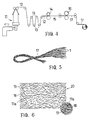
- the drawings show a composite fibre, a water-absorbing material using the composite fibre as a base material, and a method for producing them, according to the present invention.
- FIGS. 1 to 3 are sectional views, respectively, of a composite fibre.
- FIG. 4 is a flow chart for producing the composite fibre.
- FIG. 5 is a view showing a part of split yarns in an enlarged scale.
- FIG. 6 is a plan view showing a water-absorbing material partly enlarged.
- a composite fibre 1 consists of a resin layer having a high melting point 2 and resin layers having a low melting point 3, 4 forming external layers.
- a composite fibre 1 shown in FIG. 2 has an arrangement wherein surfaces of resin layers having a low melting point 4, are formed into uneven surfaces by use of a ribbed die.
- FIG. 3 shows a composite fibre 1 branched by partial connections.
- the aforesaid composite fibres 1 may be produced according to the process shown in FIG. 4.
- a multi-layer film 12 of a three-layer construction having approximately 3 ⁇ m of thickness is molded by an inflation film molding machine 11 provided with a cross head die for molding a three-layer. Subsequently, the multilayer film 12 is passed over heated stretching rolls 13, and thereafter are slit by means of a slitter 14 into a plurality of tapes 15 having the desired width.
- a split yarn 17 comprised of a composite fibre having a three-layer construction is produced thereon.
- a single fibre as shown in FIG. 1 is produced.
- a net-like fibre formed by being discontinuously split at regular intervals untied by carding process a branched fibre as shown in FIG. 3 is produced.
- the multilayer film 12 is stretched, it is to be noted that the tape 15 may be stretched.
- Conditions of extruding machines are as follows: A. Diameter of screw: 40mm ⁇ (for the low melting point resin layer 3) Temperature of cylinder: C : 170°C C : 230°C C : 220°C B. Diameter of screw: 40 mm ⁇ (for the high melting point resin layer 2) Temperature of cylinder C : 180°C C : 220°C C : 230°C C.
- Diameter of screw 32 mm ⁇ (for the low melting point resin layer 4) Temperature of cylinder: Same as A above Die lip : 1 m/m Take-off speed: 10.7 m/min. Temperature of stretching roll: 120°C Stretching magnification: 5 times Split: 10 d
- the composite fibre 1 produced under the above-described conditions takes the form of a split yarn 17 as shown in FIG. 5.
- This split yarn 17 is cut into short fibres in the range of 70 to 90 mm.
- a branched fibre results. Webs which are well thermally fused are obtained from these short fibres.
- a colored thermally fused web may be obtained, the web being rich in drape and volume feeling.
- the short fibres are untied into fibres by carding process, a suitable amount of fibres 17a and fibres 18 of pulverized pulp are blended while adding thereto high-molecular water absorbing agents 19 (for example, a copolymer of acrylic acid and vinyl acetate) and applying an air blow thereto, and the resulting blend is heated to a level in the vicinity of a melting point of the low melting point resins 3 and 4. It is noted that during such heating, the blend may be pressed into a flat form. Thereby, parts of the low melting point resins 3 and 4 are fused together to provide an absorbing material 20 in which the aforesaid two fibres 17a and 18 are mixed.
- high-molecular water absorbing agents 19 for example, a copolymer of acrylic acid and vinyl acetate
- the rates of the composite fibre, pulverized pulp and high-molecular water absorbing material are preferably 30%, 50% and 20%, respectively, and the amount of the composite fibre may be increased as the case may be.
- the composite fibre used according to the present invention comprises a multi-layer film as a base material, the multi-layer film being split into fibres. Therefore, coloring and composition of three component systems or more which are difficult in melt composite spinning may be easily carried out, and in addition, various composite fibres different in sectional construction may be obtained by changing a shape of die and besides uses of thermally fusion composite fibres are also widely ranged.
- the composite fibres used according to the present invention are greatly efficacious as a base material for a water-absorbing material, particularly as a base material for a water absorbing material for toilet articles, paper diapers and the like, and therefore are extremely effective in industrial fields and widely used.
Landscapes
- Engineering & Computer Science (AREA)
- Textile Engineering (AREA)
- Health & Medical Sciences (AREA)
- Chemical & Material Sciences (AREA)
- Life Sciences & Earth Sciences (AREA)
- Public Health (AREA)
- Materials Engineering (AREA)
- Epidemiology (AREA)
- Mechanical Engineering (AREA)
- Animal Behavior & Ethology (AREA)
- General Health & Medical Sciences (AREA)
- Hematology (AREA)
- Veterinary Medicine (AREA)
- Chemical Kinetics & Catalysis (AREA)
- General Chemical & Material Sciences (AREA)
- Nonwoven Fabrics (AREA)
- Multicomponent Fibers (AREA)
- Laminated Bodies (AREA)
- Absorbent Articles And Supports Therefor (AREA)
Abstract
Description
- The present invention relates to a water absorbing material comprising a blend of a pulp having a water-absorbing property and multi-layer composite branched fibres, a method for the manufacture of said material and its use as an absorbent for paper diapers or toilet articles.
- Composite fibres are known as conjugate fibres formed by simultaneously extruding two kinds of spinning solutions from a single spinning nozzle having a partition provided therein to provide conjugate spinning, or by laminating together two kinds of fibres to form a single fibre.
- Known furtheron is melt composite spinning comprising using two kinds of thermoplastic resins different in melting point from each other, for example, crystalline polypropylene (m.p. 165°C) as a high melting point polymer and polyethylene (m.p. 125°C) as a low melting point polymer and simultaneously extruding both resins in their melted state from a single spinning nozzle to form a single fibre.
- In these conventional composite fibres, a spinning nozzle is used to effect spinning, and therefore, composite fibres obtained therefrom are limited to those of two component systems, and it has been extremely difficult to obtain composite fibres above three component systems.
- Moreover, in the aforementioned melt composite spinning, two kinds of polymers are made into a composite form in the state of a concentric circle or an eccentric circle, and in the case where they are made into a composite form with a low melting point polymer positioned externally and a high melting point polymer, the low melting point polymer is melted so that fibres may be thermally bonded with each other. For example, after a web has been formed, the low melting point polymer is melted but when the high melting point polymer is subjected to heat treatment at a temperature at which it is not melted, contact parts of the fibres become fused, resulting in non-woven fabrics or the like. This non-woven fabric eliminates the necessity of a binder such as a synthetic rubber emulsion, and therefore has an advantage that various disadvantages caused by the use of the binder may be avoided.
- However, in the above-described melt composite spinning, dies, nozzles and the like are complicated in construction, and for this reason, the composite fibres above three component systems may not only be obtained but thermoplastic resins used therefor are limited to polymers which can be thermally welded with each other.
- Furthermore, even in the composite fibres comprising two component systems, since it is difficult to change color of raw material, a colored non-woven fabric as a final product is hard to obtain. Despite the possession of characteristic of thermal adhesion, the range of utilization thereof has been greatly limited.
- US-A-4 134 951 discloses multi-layer composite split fibres which may comprise two or more stretched layers formed from thermoplastic resins differing in melting point from another.
- DE-A-2 319 735 discloses a filter material useful as a cigarette filter on the basis of a fibrilated material comprising longitudinal main fibres connected by connecting fibres and comprising a number of free ends obtained by splitting of the main fibres and/or the connecting fibres.
- GB-A- 1 522 952 describes a fibrous material made from films of a molecularly-orientable synthetic thermoplastic semi-crystalline organic polymer material, which, after drawing to a high degree of uniaxial orientation has the natural tendency to fibrillate to thereby obtain a helical crimp.
- DE-A-2 212 326 covers textile sheet materials comprising fibrillated fibres made of flat or blown films of polymers, copolymers or bi-component films.
- Laminates having a plurality of different thermoplastic resins laminated, for example such as multi-layer films, tapes, sheets, etc. are well known. Such laminates (hereinafter referred to as multi-layer films) have merits that they can be molded in two layers and in three layers or more by use of various molding means, such as by a calendering method, extrusion method, casting method and the like, and the materials can be colored. Furthermore, since lamination may be easily achieved through an adhesive layer, polymers which are hard to be fused together may be integrated.
- The object of the present invention is to provide a water-absorbing material having improved properties, specifically improved water-absorbing properties.
- The subject matter of the present invention therefore is a a water-absorbing material comprising a blend of a pulp having water-absorbing property and multi-layer composite branched fibres comprising at least two stretched layers formed from thermoplastic resins differing in melting point from one another, bonded by thermal fusion of said fibres.
- According to a preferred embodiment, the water-absorbing material comprises a pulp having a water-absorbing property which comprises a blend of a pulp and a high molecular absorbent.
- According to a further preferred embodiment, the branched fibres are short fibres having a length of 50 to 100 mm.
- The subject matter of the present invention furtheron is a method for the manufacture of the water-absorbing material according to
claims 1 to 3, comprising blending short multi-layer composite branched fibres comprising at least two stretched layers formed from thermoplastic resins differing in melting point from one another with a pulp and a high molecular absorbent, heating said blend to a temperature in the vicinity of the melting point of the low melting point resin of said fibres and partially fusing the short fibres. - A further object of the present invention is the use of this water-absorbing material as an absorbent for paper diapers or toilet articles.
- The multi-layer composite branched fibres comprise at least two stretched layers formed from thermoplastic resins differing in melting point from one another, bonded by thermal fusion. Said fibres are formed by splitting a base material comprising at least two multi-layer films formed of said thermoplastic resins having different melting points after said base material has been stretched, so that the fibres have the same section as that of the base material.
- The multi-layer films serving as the base material for said multi-layer composite branched fibres may be manufactured by various molding methods, such as a calendering method, an extrusion method and a casting method, wherein the extrusion method comprising an inflation step and a T-die method are preferred.
- The multi-layer films serving as the base material for said multi-layer composite branched fibres may be manufactured by various molding methods, such as by calendaring, extrusion or casting, wherein the extrusion method comprising an inflation step and the T-die method are preferred.
- The thermoplastic resin is preferably the resin from which a film may be molded, and the thickness thereof is not particularly limited but is preferably in the range of 30 to 100 µm.
- Specific examples of the thermoplastic resin are alpha-olefin polymers such as polyethylene, polypropylene, etc., polyamide, polyester, etc.
- Such resins can be copolymers with a monomer of a different kind, and can contain therein, as needed, an anti-oxidant, a lubricant, a ultraviolet absorbent, a delusterant, a stabilizer, a fire retardant, etc.
- Particularly, a color film is obtained by adding a colorant, and the composite fibre used accordingly to the present invention may be colored as will be described hereinafter, and a composite fibre rich in variety of color may be obtained.
- A plurality of resins used in the composite fibres used according to the present invention are different in melting point from one another because a heat fusion property must be imparted thereto. In case of three layers, it is necessary so that a resin having a low melting point is positioned externally.
- The difference in melting point between a thermoplastic resin having a low melting point and a thermoplastic resin having a high melting point is preferably that if the melting point of the former resin is Mp °C, then that of the latter resin is Mp + 10°C or over in consideration of the heat treating conditions, extrusion conditions of a multilayer film, stretching conditions in a post-process and the like, which will be described later.
- As for one example, polyethylene (m.p. 125°C) as a thermoplastic resin having a low melting point and crystalline polypropylene (m.p. 165 °C) as a thermoplastic resin having a high melting point are used.
- In the case where, as in the use of linear low-density polyethylene for a thermoplastic resin having a low melting point and the use of polyamide for a thermoplastic resin having a high melting point, both resins cannot be fused, an adhesive resin may be interposed between these resins for composition.
- As an example, this adhesive resin used comprises a resin composition in which polyethylene or polypropylene is denatured by acid anhydride such as anhydrous maleic acid and acids. Specically, anhydrous maleic acid denatured linear low-density polyethylene is preferred.
- It is of course that the composite fiber used accordingly to the present invention can be not only two and three-layer constructions but also four-layer or more, in which case, a multi-layer film is constituted in consideration of the heat treating conditions at a temperature at which the low melting point polymer is melted but the high melting point polymer is not melted.
- In forming a multi-layer film by way of a T-die method or the like, a die lip construction may be formed into a flat type but when a ribbed die is used, a film surface is formed into an uneven surface, which remains on the surface of each fibre even after being formed into a fibre, to bring forth a drape or volume in the composite fibre.
- The multi-layer film is stretched before being formed into a fibre. This stretching increases the strength of the composite fibre.
- Streching of the multi-layer film is carried out by any of stretching means such as a hot plate, a hot roll, an oven, etc. A stretching temperature and a stretching magnification are not particularly restricted but may be set to optimum conditions according to the composition and shape of the multi-layer film. However, the strength, drape and volume feeling of webs or non-woven fabrics obtained through posterior processes largely depend upon properties of the composite fibres.
- Preferable examples of the stretching temperature and stretching magnification are given: For example, in the case where a multi-layer film comprised of polyethylene and crystalline polypropylene is stretched by hot rolls after competion of slit process for longitudinally cutting it, the stretching temperature is preferably in the range of 100°C to 130°C and the stretching magnification preferably in the range of 4 to 10 times.
- A multi-layer film is formed into a fibre by splitting the film in a longitudinal direction. This split comprises discontinuously splitting surface of a film to form a fibre assuming a state or form (split fibre) which repeats a partial connection to provide a branch-like continuation.
- The coarseness and length of each fibre are determined according to the reed or pitch of a needle of a split roll, and their dimensions are made uneven to make the coarseness and length of the fibre uneven as the case may be.
- The composite fibre resulting from a fibrous form of a multi-layer film is used in the state of a continuous fibre or as a short fibre. The length of the short fibre is preferably in the range of 50 to 100 mm.
- This short fibre may be formed into a web via preliminary splitting or via direct carding process to form a non-woven fabric as well as gauze, diaper covers and carpets.
- The short fibre is blended with a pulp having a water-absorbing property, and when the blend is heated, a part of the short fibre is melted and as a result, a fusion partly occurs in the blend, whereby the pulp is solidified. Also, contraction of pulp caused by absorption of moisture may lso be controlled, and therefore, they can be used as an absorbing material for paper diapers and an absorbing material for toilet articles.
- The drawings show a composite fibre, a water-absorbing material using the composite fibre as a base material, and a method for producing them, according to the present invention.
- FIGS. 1 to 3 are sectional views, respectively, of a composite fibre.
- FIG. 4 is a flow chart for producing the composite fibre.
- FIG. 5 is a view showing a part of split yarns in an enlarged scale.
- FIG. 6 is a plan view showing a water-absorbing material partly enlarged.
- As shown in the section of FIG. 1, a
composite fibre 1 consists of a resin layer having ahigh melting point 2 and resin layers having alow melting point - A
composite fibre 1 shown in FIG. 2 has an arrangement wherein surfaces of resin layers having alow melting point 4, are formed into uneven surfaces by use of a ribbed die. FIG. 3 shows acomposite fibre 1 branched by partial connections. - The
aforesaid composite fibres 1 may be produced according to the process shown in FIG. 4. - First, a
multi-layer film 12 of a three-layer construction having approximately 3 µm of thickness is molded by an inflationfilm molding machine 11 provided with a cross head die for molding a three-layer. Subsequently, themultilayer film 12 is passed over heatedstretching rolls 13, and thereafter are slit by means of aslitter 14 into a plurality oftapes 15 having the desired width. - When this
tape 15 is passed over asplit roll 16 for splitting, asplit yarn 17 comprised of a composite fibre having a three-layer construction is produced thereon. In this case, when eachtape 15 is completely split, a single fibre as shown in FIG. 1 is produced. When a net-like fibre formed by being discontinuously split at regular intervals untied by carding process, a branched fibre as shown in FIG. 3 is produced. - While in the aforementioned process, the
multilayer film 12 is stretched, it is to be noted that thetape 15 may be stretched. - Conditions of various parts in the aforementioned process will be given below:
Composition of composite fibre Example 1 Example 2 Low melting point resin layer 3high density polyethylene (MI=1.0) linear polyethylene (MI=1.8) High melting point resin layer 2polypropylene (MI=1.5) adhesive polyolefin Low melting point resin layer 4high density polyethylene (MI=1.0) nylon 6
Conditions of extruding machines are as follows:A. Diameter of screw: 40mm ⌀ (for the low melting point resin layer 3) Temperature of cylinder: C : 170°C C : 230°C C : 220°C B. Diameter of screw: 40 mm ⌀ (for the high melting point resin layer 2) Temperature of cylinder C : 180°C C : 220°C C : 230°C C. Diameter of screw: 32 mm ⌀ (for the low melting point resin layer 4) Temperature of cylinder: Same as A above Die lip : 1 m/m Take-off speed: 10.7 m/min. Temperature of stretching roll: 120°C Stretching magnification: 5 times Split: 10 d - The
composite fibre 1 produced under the above-described conditions takes the form of asplit yarn 17 as shown in FIG. 5. This splityarn 17 is cut into short fibres in the range of 70 to 90 mm. In case of the net-like fibre, when it is subjected to carding process, a branched fibre results. Webs which are well thermally fused are obtained from these short fibres. If approximately 2% of pigment is added to the high meltingpoint resin layer 2, a colored thermally fused web may be obtained, the web being rich in drape and volume feeling. - To use the aforesaid
composite fibre 1 as a base material for an water-absorbing material for diapers or the like, the short fibres are untied into fibres by carding process, a suitable amount offibres 17a andfibres 18 of pulverized pulp are blended while adding thereto high-molecular water absorbing agents 19 (for example, a copolymer of acrylic acid and vinyl acetate) and applying an air blow thereto, and the resulting blend is heated to a level in the vicinity of a melting point of the lowmelting point resins melting point resins material 20 in which the aforesaid twofibres - The rates of the composite fibre, pulverized pulp and high-molecular water absorbing material are preferably 30%, 50% and 20%, respectively, and the amount of the composite fibre may be increased as the case may be.
- As described above, the composite fibre used according to the present invention comprises a multi-layer film as a base material, the multi-layer film being split into fibres. Therefore, coloring and composition of three component systems or more which are difficult in melt composite spinning may be easily carried out, and in addition, various composite fibres different in sectional construction may be obtained by changing a shape of die and besides uses of thermally fusion composite fibres are also widely ranged.
- Moreover, the composite fibres used according to the present invention are greatly efficacious as a base material for a water-absorbing material, particularly as a base material for a water absorbing material for toilet articles, paper diapers and the like, and therefore are extremely effective in industrial fields and widely used.
Claims (5)
- A water-absorbing material comprising a blend of a pulp having a water-absorbing property and multi-layer composite branched fibres comprising at least two stretched layers formed from thermoplastic resins differing in melting point from one another, bonded by thermal fusion of said fibres.
- The water-absorbing material according to claim 1 characterized in that said pulp having a water-absorbing property comprises a blend of a pulp and a high molecular absorbent.
- The water-absorbing material according to claim 1 or 2, characterized in that said branched fibres are short fibres having a length of 50 to 100mm.
- A method for the manufacture of the water-absorbing material according to claims 1 to 3, comprising blending short multi-layer composite branched fibres comprising at least two stretched layers formed from thermoplastic resins differing in melting point from one another with a pulp and a high molecular absorbent, heating said blend to a temperature in the vicinity of the melting point of the low melting point resin of said fibres and partially fusing the short fibres.
- The use of the water-absorbing material according to claims 1 to 3 as an absorbent for paper diapers or toilet articles.
Applications Claiming Priority (4)
| Application Number | Priority Date | Filing Date | Title |
|---|---|---|---|
| JP243863/85 | 1985-11-01 | ||
| JP60243863A JPH0636808B2 (en) | 1985-11-01 | 1985-11-01 | Disposable diaper absorber |
| JP2829/86 | 1985-12-18 | ||
| JP28298685A JPS62149905A (en) | 1985-12-18 | 1985-12-18 | Conjugated fiber |
Publications (3)
| Publication Number | Publication Date |
|---|---|
| EP0244486A1 EP0244486A1 (en) | 1987-11-11 |
| EP0244486A4 EP0244486A4 (en) | 1988-10-20 |
| EP0244486B1 true EP0244486B1 (en) | 1993-07-28 |
Family
ID=26536469
Family Applications (1)
| Application Number | Title | Priority Date | Filing Date |
|---|---|---|---|
| EP86903556A Expired - Lifetime EP0244486B1 (en) | 1985-11-01 | 1986-05-16 | Water absorbing material and method for its manufacture |
Country Status (4)
| Country | Link |
|---|---|
| US (2) | US5071705A (en) |
| EP (1) | EP0244486B1 (en) |
| DE (1) | DE3688791T2 (en) |
| WO (1) | WO1987002719A1 (en) |
Families Citing this family (22)
| Publication number | Priority date | Publication date | Assignee | Title |
|---|---|---|---|---|
| NL8602312A (en) * | 1986-09-12 | 1988-04-05 | Nijverdal Ten Cate Textiel | METHOD FOR MANUFACTURING AN ARTIFICIAL GRASSMAT AND ARTIFICIAL GRASSMAT OBTAINED THEREFROM |
| US5231122A (en) * | 1988-04-11 | 1993-07-27 | Faricerca S.P.A. | Fibrous composition for absorbent pads, a method for the manufacture of an absorbent material from such a composition, and an absorbent material produced by the method |
| IT1219196B (en) * | 1988-04-11 | 1990-05-03 | Faricerca Spa | FIBROUS COMPOSITION FOR ABSORBENT MATTRESSES METHOD OF MANUFACTURE OF AN ABSORBENT MATERIAL STARTING FROM SUCH COMPOSITION AND ABSORBENT MATERIAL PRODUCED BY SUCH METHOD |
| US5188895A (en) * | 1989-08-31 | 1993-02-23 | Mitsui Petrochemical Industries, Ltd. | Split fibers, integrated split fiber articles and method for preparing the same |
| GB9002374D0 (en) * | 1990-02-02 | 1990-04-04 | Don & Low Holdings Ltd | Improvements in or relating to composite sheet material |
| US5534339A (en) * | 1994-02-25 | 1996-07-09 | Kimberly-Clark Corporation | Polyolefin-polyamide conjugate fiber web |
| US5424115A (en) * | 1994-02-25 | 1995-06-13 | Kimberly-Clark Corporation | Point bonded nonwoven fabrics |
| US5605739A (en) * | 1994-02-25 | 1997-02-25 | Kimberly-Clark Corporation | Nonwoven laminates with improved peel strength |
| US5702657A (en) * | 1994-12-27 | 1997-12-30 | Nippon Oil Co., Ltd. | Method for the continuous production of a polyethylene material having high strength and high modulus of elasticity |
| DE19506037A1 (en) * | 1995-02-22 | 1996-08-29 | Hoechst Trevira Gmbh & Co Kg | Deformable, heat-stabilizable textile pile goods |
| US5759926A (en) * | 1995-06-07 | 1998-06-02 | Kimberly-Clark Worldwide, Inc. | Fine denier fibers and fabrics made therefrom |
| US6203905B1 (en) | 1995-08-30 | 2001-03-20 | Kimberly-Clark Worldwide, Inc. | Crimped conjugate fibers containing a nucleating agent |
| EP1314808B1 (en) | 1995-11-30 | 2006-01-04 | Kimberly-Clark Worldwide, Inc. | Superfine microfiber nonwoven web |
| US6100208A (en) * | 1996-10-31 | 2000-08-08 | Kimberly-Clark Worldwide, Inc. | Outdoor fabric |
| US6143368A (en) * | 1998-02-10 | 2000-11-07 | Gunn; Robert T. | Low coefficient of friction fibers |
| FR2814245B1 (en) * | 2000-09-21 | 2002-12-06 | Cit Alcatel | IMPROVED OPTICAL FIBER CABLE AND MANUFACTURING METHOD THEREOF |
| DE10307174B4 (en) * | 2003-02-20 | 2017-05-24 | Reifenhäuser GmbH & Co. KG Maschinenfabrik | Multilayer monofilament |
| US20070199654A1 (en) * | 2006-02-27 | 2007-08-30 | Conwed Plastics Llc | Layered plastic netting |
| CN104936990B (en) * | 2013-01-14 | 2017-05-17 | 科腾聚合物美国有限责任公司 | Anion exchange block copolymers, their manufacture and use |
| US9694558B2 (en) * | 2013-09-06 | 2017-07-04 | Mitsui Chemicals, Inc. | Multilayer nonwoven fabric for foam molding, method of producing multilayer nonwoven fabric for foam molding, urethane-foam molded complex using multilayer nonwoven fabric, vehicle seat, and chair |
| WO2020174419A1 (en) * | 2019-02-28 | 2020-09-03 | 3M Innovative Properties Company | Novel nano-ribbons from multilayer coextruded film |
| CN114108114A (en) * | 2021-10-18 | 2022-03-01 | 浙江古纤道股份有限公司 | Preparation method of split type superfine flat yarn |
Citations (3)
| Publication number | Priority date | Publication date | Assignee | Title |
|---|---|---|---|---|
| DE2212326A1 (en) * | 1972-03-15 | 1973-10-11 | Karl Bous | Matted fibre webs - mfd from laminated differentially fibrillated plastics webs having different m pts |
| DE2319735A1 (en) * | 1972-04-20 | 1973-10-25 | British Ropes Ltd | FILTER MATERIAL |
| GB1522952A (en) * | 1975-09-10 | 1978-08-31 | Lamberg Ind Res Ass | Fibrous material |
Family Cites Families (16)
| Publication number | Priority date | Publication date | Assignee | Title |
|---|---|---|---|---|
| DE133448C (en) * | ||||
| GB522952A (en) | 1938-12-20 | 1940-07-02 | Frederick Hermes Nicoll | Improvements in or relating to electrode arrangements for cathode ray tubes |
| US2772994A (en) * | 1954-10-18 | 1956-12-04 | Dobeckmun Co | Laminated thread |
| NL6610696A (en) * | 1966-07-29 | 1968-01-30 | ||
| CA937720A (en) * | 1966-08-31 | 1973-12-04 | Shell Internationale Research Maatschappij, N.V. | Method for the production of crimped fibres from thermoplastic macromolecular materials |
| US3594459A (en) * | 1967-04-03 | 1971-07-20 | Celanese Corp | Process for the production of conjugate foam fibrillated structures |
| US3639573A (en) * | 1967-09-12 | 1972-02-01 | Avisun Corp | Method for making a multicolored split polyolefin yarn |
| US3460337A (en) * | 1967-12-18 | 1969-08-12 | Hercules Inc | Synthetic yarn and method of making the same |
| US3503106A (en) * | 1968-06-27 | 1970-03-31 | Avisun Corp | Continuous techniques for making flat woven synthetic fabrics |
| US3608298A (en) * | 1969-03-25 | 1971-09-28 | Lurex Nv | Pearlescent yarn |
| GB1362952A (en) * | 1970-07-21 | 1974-08-07 | Rasmussen O B | Conjugate fibre and method of manufacturing same |
| US4134951A (en) * | 1971-08-31 | 1979-01-16 | Smith & Nephew Polyfabrik Limited | Production of filaments |
| US3914365A (en) * | 1973-01-16 | 1975-10-21 | Hercules Inc | Methods of making network structures |
| JPS5349902A (en) * | 1976-10-18 | 1978-05-06 | Fujitsu Ltd | Technical report copying system using telephone circuit |
| US4600643A (en) * | 1982-03-29 | 1986-07-15 | Multi-Tex Products Corp. | Composite yarn product and method of preparation |
| JP3009078B2 (en) * | 1992-01-06 | 2000-02-14 | オムロン株式会社 | Character recognition device |
-
1986
- 1986-05-16 DE DE86903556T patent/DE3688791T2/en not_active Expired - Lifetime
- 1986-05-16 WO PCT/JP1986/000253 patent/WO1987002719A1/en not_active Ceased
- 1986-05-16 EP EP86903556A patent/EP0244486B1/en not_active Expired - Lifetime
-
1987
- 1987-06-29 US US07/068,039 patent/US5071705A/en not_active Expired - Lifetime
-
1991
- 1991-05-31 US US07/708,692 patent/US5143786A/en not_active Expired - Lifetime
Patent Citations (3)
| Publication number | Priority date | Publication date | Assignee | Title |
|---|---|---|---|---|
| DE2212326A1 (en) * | 1972-03-15 | 1973-10-11 | Karl Bous | Matted fibre webs - mfd from laminated differentially fibrillated plastics webs having different m pts |
| DE2319735A1 (en) * | 1972-04-20 | 1973-10-25 | British Ropes Ltd | FILTER MATERIAL |
| GB1522952A (en) * | 1975-09-10 | 1978-08-31 | Lamberg Ind Res Ass | Fibrous material |
Also Published As
| Publication number | Publication date |
|---|---|
| US5143786A (en) | 1992-09-01 |
| EP0244486A1 (en) | 1987-11-11 |
| DE3688791T2 (en) | 1994-02-24 |
| EP0244486A4 (en) | 1988-10-20 |
| DE3688791D1 (en) | 1993-09-02 |
| WO1987002719A1 (en) | 1987-05-07 |
| US5071705A (en) | 1991-12-10 |
Similar Documents
| Publication | Publication Date | Title |
|---|---|---|
| EP0244486B1 (en) | Water absorbing material and method for its manufacture | |
| CA1057015A (en) | Network structures and methods of making same | |
| US4438167A (en) | Novel porous fabric | |
| CA2106460C (en) | Composite fabrics comprising continuous filaments locked in place by intermingled melt blown fibers and methods and apparatus for making | |
| EP1694897B1 (en) | Full-surface bonded multiple component melt-spun nonwoven web | |
| US3906073A (en) | Methods of making network structures | |
| CA1055672A (en) | Network structures and methods of making same | |
| US6063492A (en) | Adhesive tape and its base fabric | |
| US20030059587A1 (en) | Composite nonwoven fabric having great crosswise tensile strength, method for its production and use | |
| RU95118172A (en) | EXTRUSION LAMINATED MATERIAL FROM A NONWOVEN FIBERGOINT FABRIC RECEIVED BY A HOOD AND A THERMOPLASTIC FILM AND METHOD FOR ITS MANUFACTURE | |
| CA2129496A1 (en) | Strength improved single polymer conjugate fiber webs | |
| US4186781A (en) | Network structures and methods of making same | |
| US4101358A (en) | Method of making network structures | |
| US4348445A (en) | Reinforced film of a combination of thermoplastic netting and oriented film | |
| KR880005306A (en) | Multilayer Nonwoven | |
| KR102431854B1 (en) | Spunbonded nonwoven and tile carpet using the same | |
| US4207375A (en) | Network structures and methods of making same | |
| US4144368A (en) | Network structures having different cross-sections | |
| US20050041312A1 (en) | Nonwoven web and method of making same | |
| JPH11286862A (en) | Spunbonded nonwoven fabric for clothing and method for producing the same | |
| JPS6244058B2 (en) | ||
| JPH0636808B2 (en) | Disposable diaper absorber | |
| JPS61113810A (en) | Composite fiber | |
| DE19956926A1 (en) | Textile surfaces based on tear fiber | |
| US20040188888A1 (en) | Film materials with pronounced imaging and method for making the same |
Legal Events
| Date | Code | Title | Description |
|---|---|---|---|
| PUAI | Public reference made under article 153(3) epc to a published international application that has entered the european phase |
Free format text: ORIGINAL CODE: 0009012 |
|
| AK | Designated contracting states |
Kind code of ref document: A1 Designated state(s): DE FR GB |
|
| 17P | Request for examination filed |
Effective date: 19871029 |
|
| A4 | Supplementary search report drawn up and despatched |
Effective date: 19881020 |
|
| 17Q | First examination report despatched |
Effective date: 19900824 |
|
| GRAA | (expected) grant |
Free format text: ORIGINAL CODE: 0009210 |
|
| AK | Designated contracting states |
Kind code of ref document: B1 Designated state(s): DE FR GB |
|
| REF | Corresponds to: |
Ref document number: 3688791 Country of ref document: DE Date of ref document: 19930902 |
|
| ET | Fr: translation filed | ||
| PLBE | No opposition filed within time limit |
Free format text: ORIGINAL CODE: 0009261 |
|
| STAA | Information on the status of an ep patent application or granted ep patent |
Free format text: STATUS: NO OPPOSITION FILED WITHIN TIME LIMIT |
|
| 26N | No opposition filed | ||
| REG | Reference to a national code |
Ref country code: GB Ref legal event code: IF02 |
|
| PGFP | Annual fee paid to national office [announced via postgrant information from national office to epo] |
Ref country code: GB Payment date: 20050511 Year of fee payment: 20 Ref country code: FR Payment date: 20050511 Year of fee payment: 20 |
|
| PGFP | Annual fee paid to national office [announced via postgrant information from national office to epo] |
Ref country code: DE Payment date: 20050512 Year of fee payment: 20 |
|
| REG | Reference to a national code |
Ref country code: GB Ref legal event code: PE20 |
|
| PG25 | Lapsed in a contracting state [announced via postgrant information from national office to epo] |
Ref country code: GB Free format text: LAPSE BECAUSE OF EXPIRATION OF PROTECTION Effective date: 20060515 |