EP0241612B1 - Teppichfliese mit antistatischen Eigenschaften und deren Vorbereitungsverfahren - Google Patents
Teppichfliese mit antistatischen Eigenschaften und deren Vorbereitungsverfahren Download PDFInfo
- Publication number
- EP0241612B1 EP0241612B1 EP86303305A EP86303305A EP0241612B1 EP 0241612 B1 EP0241612 B1 EP 0241612B1 EP 86303305 A EP86303305 A EP 86303305A EP 86303305 A EP86303305 A EP 86303305A EP 0241612 B1 EP0241612 B1 EP 0241612B1
- Authority
- EP
- European Patent Office
- Prior art keywords
- electrically conductive
- back surface
- layer
- backing layer
- columns
- Prior art date
- Legal status (The legal status is an assumption and is not a legal conclusion. Google has not performed a legal analysis and makes no representation as to the accuracy of the status listed.)
- Expired - Lifetime
Links
- 238000004519 manufacturing process Methods 0.000 title claims description 6
- 239000004020 conductor Substances 0.000 claims abstract description 23
- 238000000034 method Methods 0.000 claims abstract description 21
- 239000000463 material Substances 0.000 claims description 69
- 239000010426 asphalt Substances 0.000 claims description 18
- 239000000835 fiber Substances 0.000 claims description 16
- 239000011248 coating agent Substances 0.000 claims description 13
- 238000000576 coating method Methods 0.000 claims description 13
- 230000003068 static effect Effects 0.000 claims description 12
- 239000002245 particle Substances 0.000 claims description 10
- 230000037361 pathway Effects 0.000 claims description 9
- 235000019241 carbon black Nutrition 0.000 claims description 7
- 239000006229 carbon black Substances 0.000 claims description 7
- -1 polypropylene, ethylene vinyl-acetate Polymers 0.000 claims description 7
- 239000007788 liquid Substances 0.000 claims description 6
- 230000000149 penetrating effect Effects 0.000 claims description 6
- 229920005989 resin Polymers 0.000 claims description 5
- 239000011347 resin Substances 0.000 claims description 5
- 230000035515 penetration Effects 0.000 claims description 4
- BZHJMEDXRYGGRV-UHFFFAOYSA-N Vinyl chloride Chemical compound ClC=C BZHJMEDXRYGGRV-UHFFFAOYSA-N 0.000 claims description 2
- 239000006261 foam material Substances 0.000 claims description 2
- VNWKTOKETHGBQD-UHFFFAOYSA-N methane Chemical compound C VNWKTOKETHGBQD-UHFFFAOYSA-N 0.000 claims description 2
- 239000002923 metal particle Substances 0.000 claims 1
- 229920002635 polyurethane Polymers 0.000 claims 1
- 239000004814 polyurethane Substances 0.000 claims 1
- 239000002904 solvent Substances 0.000 claims 1
- 239000010410 layer Substances 0.000 description 60
- OKTJSMMVPCPJKN-UHFFFAOYSA-N Carbon Chemical compound [C] OKTJSMMVPCPJKN-UHFFFAOYSA-N 0.000 description 7
- 229910052799 carbon Inorganic materials 0.000 description 7
- 229920000728 polyester Polymers 0.000 description 7
- 235000019738 Limestone Nutrition 0.000 description 6
- 239000006028 limestone Substances 0.000 description 6
- 230000033001 locomotion Effects 0.000 description 6
- 239000004816 latex Substances 0.000 description 5
- 229920000126 latex Polymers 0.000 description 5
- 239000007787 solid Substances 0.000 description 5
- 239000004743 Polypropylene Substances 0.000 description 4
- 239000002174 Styrene-butadiene Substances 0.000 description 4
- 239000000654 additive Substances 0.000 description 4
- 239000000853 adhesive Substances 0.000 description 4
- 230000001070 adhesive effect Effects 0.000 description 4
- 229920001155 polypropylene Polymers 0.000 description 4
- 229920003048 styrene butadiene rubber Polymers 0.000 description 4
- 239000003795 chemical substances by application Substances 0.000 description 3
- 239000012799 electrically-conductive coating Substances 0.000 description 3
- 239000000945 filler Substances 0.000 description 3
- 239000006260 foam Substances 0.000 description 3
- 239000004677 Nylon Substances 0.000 description 2
- 230000005540 biological transmission Effects 0.000 description 2
- 230000015572 biosynthetic process Effects 0.000 description 2
- MTAZNLWOLGHBHU-UHFFFAOYSA-N butadiene-styrene rubber Chemical compound C=CC=C.C=CC1=CC=CC=C1 MTAZNLWOLGHBHU-UHFFFAOYSA-N 0.000 description 2
- 239000006258 conductive agent Substances 0.000 description 2
- 239000003365 glass fiber Substances 0.000 description 2
- 238000009434 installation Methods 0.000 description 2
- 239000002184 metal Substances 0.000 description 2
- 239000013528 metallic particle Substances 0.000 description 2
- 229920001778 nylon Polymers 0.000 description 2
- 238000002360 preparation method Methods 0.000 description 2
- 229910001220 stainless steel Inorganic materials 0.000 description 2
- 239000010935 stainless steel Substances 0.000 description 2
- 239000011115 styrene butadiene Substances 0.000 description 2
- 239000000126 substance Substances 0.000 description 2
- 229920002994 synthetic fiber Polymers 0.000 description 2
- 239000012209 synthetic fiber Substances 0.000 description 2
- 240000000491 Corchorus aestuans Species 0.000 description 1
- 235000011777 Corchorus aestuans Nutrition 0.000 description 1
- 235000010862 Corchorus capsularis Nutrition 0.000 description 1
- 239000005909 Kieselgur Substances 0.000 description 1
- VYPSYNLAJGMNEJ-UHFFFAOYSA-N Silicium dioxide Chemical compound O=[Si]=O VYPSYNLAJGMNEJ-UHFFFAOYSA-N 0.000 description 1
- 238000009825 accumulation Methods 0.000 description 1
- 230000000996 additive effect Effects 0.000 description 1
- 239000012790 adhesive layer Substances 0.000 description 1
- 238000004873 anchoring Methods 0.000 description 1
- 238000010420 art technique Methods 0.000 description 1
- DQXBYHZEEUGOBF-UHFFFAOYSA-N but-3-enoic acid;ethene Chemical compound C=C.OC(=O)CC=C DQXBYHZEEUGOBF-UHFFFAOYSA-N 0.000 description 1
- CJZGTCYPCWQAJB-UHFFFAOYSA-L calcium stearate Chemical class [Ca+2].CCCCCCCCCCCCCCCCCC([O-])=O.CCCCCCCCCCCCCCCCCC([O-])=O CJZGTCYPCWQAJB-UHFFFAOYSA-L 0.000 description 1
- 230000000711 cancerogenic effect Effects 0.000 description 1
- 231100000315 carcinogenic Toxicity 0.000 description 1
- 239000011280 coal tar Substances 0.000 description 1
- 239000011247 coating layer Substances 0.000 description 1
- 238000000151 deposition Methods 0.000 description 1
- 235000014113 dietary fatty acids Nutrition 0.000 description 1
- 238000002845 discoloration Methods 0.000 description 1
- 238000001035 drying Methods 0.000 description 1
- 230000000694 effects Effects 0.000 description 1
- 239000005038 ethylene vinyl acetate Substances 0.000 description 1
- 239000000194 fatty acid Substances 0.000 description 1
- 229930195729 fatty acid Natural products 0.000 description 1
- 150000004665 fatty acids Chemical class 0.000 description 1
- 239000010419 fine particle Substances 0.000 description 1
- 239000003063 flame retardant Substances 0.000 description 1
- 239000011521 glass Substances 0.000 description 1
- 150000002334 glycols Chemical class 0.000 description 1
- 239000012943 hotmelt Substances 0.000 description 1
- 230000003993 interaction Effects 0.000 description 1
- 230000007257 malfunction Effects 0.000 description 1
- 239000000615 nonconductor Substances 0.000 description 1
- 239000003960 organic solvent Substances 0.000 description 1
- 239000003208 petroleum Substances 0.000 description 1
- 239000004014 plasticizer Substances 0.000 description 1
- 229920001200 poly(ethylene-vinyl acetate) Polymers 0.000 description 1
- 229920000642 polymer Polymers 0.000 description 1
- 229920000915 polyvinyl chloride Polymers 0.000 description 1
- 239000004800 polyvinyl chloride Substances 0.000 description 1
- 229920006395 saturated elastomer Polymers 0.000 description 1
- 239000000344 soap Substances 0.000 description 1
- 229920001059 synthetic polymer Polymers 0.000 description 1
- 239000000454 talc Substances 0.000 description 1
- 229910052623 talc Inorganic materials 0.000 description 1
- 239000003860 topical agent Substances 0.000 description 1
- 238000011282 treatment Methods 0.000 description 1
- 150000003673 urethanes Chemical class 0.000 description 1
- XLYOFNOQVPJJNP-UHFFFAOYSA-N water Substances O XLYOFNOQVPJJNP-UHFFFAOYSA-N 0.000 description 1
Images

Classifications
-
- B—PERFORMING OPERATIONS; TRANSPORTING
- B32—LAYERED PRODUCTS
- B32B—LAYERED PRODUCTS, i.e. PRODUCTS BUILT-UP OF STRATA OF FLAT OR NON-FLAT, e.g. CELLULAR OR HONEYCOMB, FORM
- B32B11/00—Layered products comprising a layer of bituminous or tarry substances
- B32B11/10—Layered products comprising a layer of bituminous or tarry substances next to a fibrous or filamentary layer
-
- B—PERFORMING OPERATIONS; TRANSPORTING
- B32—LAYERED PRODUCTS
- B32B—LAYERED PRODUCTS, i.e. PRODUCTS BUILT-UP OF STRATA OF FLAT OR NON-FLAT, e.g. CELLULAR OR HONEYCOMB, FORM
- B32B27/00—Layered products comprising a layer of synthetic resin
- B32B27/12—Layered products comprising a layer of synthetic resin next to a fibrous or filamentary layer
-
- H—ELECTRICITY
- H05—ELECTRIC TECHNIQUES NOT OTHERWISE PROVIDED FOR
- H05F—STATIC ELECTRICITY; NATURALLY-OCCURRING ELECTRICITY
- H05F3/00—Carrying-off electrostatic charges
- H05F3/02—Carrying-off electrostatic charges by means of earthing connections
- H05F3/025—Floors or floor coverings specially adapted for discharging static charges
-
- B—PERFORMING OPERATIONS; TRANSPORTING
- B32—LAYERED PRODUCTS
- B32B—LAYERED PRODUCTS, i.e. PRODUCTS BUILT-UP OF STRATA OF FLAT OR NON-FLAT, e.g. CELLULAR OR HONEYCOMB, FORM
- B32B2307/00—Properties of the layers or laminate
- B32B2307/20—Properties of the layers or laminate having particular electrical or magnetic properties, e.g. piezoelectric
- B32B2307/21—Anti-static
-
- B—PERFORMING OPERATIONS; TRANSPORTING
- B32—LAYERED PRODUCTS
- B32B—LAYERED PRODUCTS, i.e. PRODUCTS BUILT-UP OF STRATA OF FLAT OR NON-FLAT, e.g. CELLULAR OR HONEYCOMB, FORM
- B32B2471/00—Floor coverings
- B32B2471/02—Carpets
-
- Y—GENERAL TAGGING OF NEW TECHNOLOGICAL DEVELOPMENTS; GENERAL TAGGING OF CROSS-SECTIONAL TECHNOLOGIES SPANNING OVER SEVERAL SECTIONS OF THE IPC; TECHNICAL SUBJECTS COVERED BY FORMER USPC CROSS-REFERENCE ART COLLECTIONS [XRACs] AND DIGESTS
- Y10—TECHNICAL SUBJECTS COVERED BY FORMER USPC
- Y10S—TECHNICAL SUBJECTS COVERED BY FORMER USPC CROSS-REFERENCE ART COLLECTIONS [XRACs] AND DIGESTS
- Y10S428/00—Stock material or miscellaneous articles
- Y10S428/922—Static electricity metal bleed-off metallic stock
-
- Y—GENERAL TAGGING OF NEW TECHNOLOGICAL DEVELOPMENTS; GENERAL TAGGING OF CROSS-SECTIONAL TECHNOLOGIES SPANNING OVER SEVERAL SECTIONS OF THE IPC; TECHNICAL SUBJECTS COVERED BY FORMER USPC CROSS-REFERENCE ART COLLECTIONS [XRACs] AND DIGESTS
- Y10—TECHNICAL SUBJECTS COVERED BY FORMER USPC
- Y10T—TECHNICAL SUBJECTS COVERED BY FORMER US CLASSIFICATION
- Y10T428/00—Stock material or miscellaneous articles
- Y10T428/23907—Pile or nap type surface or component
- Y10T428/23979—Particular backing structure or composition
Definitions
- Floor-covering materials such as carpet tile
- Carpet materials particularly carpet tile, have been developed to prevent the formation of static charges or the accumulation of static charges and which permit the rapid dissipation of such charges without danger to personnel or equipment; however, to date such floor-covering materials have not been wholly satisfactory.
- Antistatic floor-surface materials may be produced by applying an antistatic topical agent to the face of the floor covering; however, such antistatic treatments typically are not permanent and can contribute to soiling characteristics of the floor covering, and further usually are not very effective in low humidity and relative humidity conditions.
- Permanent electrical conductivity or electrical static conductivity in a fibrous floor covering may be produced by incorporating conductive fiber or yarn elements into the face of the floor covering, such as the carpet tile.
- Such conductive fibrous elements may comprise, for example, fine, thin, metal wires or metallic-coated wires as yarn elements, or be composed of carbon-containing, such as carbon-filled, core yarns or fibers incorporated into the nonconductive face fibers or yarns.
- Such permanent protection often provides both low static generation from the interaction between the face of the carpet and people and objects, and also electrical conductivity across the face of the carpet.
- electrically conductive fiber faces by themselves, do not ensure efficient electrical conductivity through the face of the carpet; that is, acceptable transmission or bulk resistivity (also called volume resistivity).
- an antistatic mat comprises a non conductive layer is provided with holes and a conducting layer is applied on the underside of the backing layer and extends through the holes.
- the mat is not however provided with any fibrous face.
- Carpet tile has been produced wherein static charges generated are dissipated very rapidly through the employment of electrically conductive fiber or yarn elements incorporated in the fibrous face of the carpet and anchoring the fibrous face of the carpet and these elements to a primary backing, through the employment of an electrically conductive precoat or backing layer.
- electrically conductive precoat comprises a polymeric material, such as a styrene-butadiene latex incorporating therein electrically conductive agents, such as metallic particles or more particularly dispersed finely- divided carbon-black particles, in order to provide for increased electrical conductivity.
- Such carpet tile and other carpet material also require a relatively thick backing layer, to ensure dimensional stability of the carpet tile and the laying flat of the carpet tile in use.
- polymeric materials may be used; however, atactic polypropylene, bitumen and polyvinyl chloride resin are presently the most popular materials used in the backing of commercial carpet tile. Such materials are essentially nonelectrically conductive and, therefore, do not permit an easy pathway for electrical charges to the ground or to the back of the carpet tile.
- antistatic or electrically conductive agents into the relatively thick backing layer such as the employment of particulate particles, such as carbon-black particles, with a polymeric backing material
- particulate particles such as carbon-black particles
- antistatic additives such as, for example, metal fatty-acid soaps, glycols and the like, where incorporated into the backing material, often modifies and changes the chemical and mechanical properties of the backing, resulting in unsatisfactory specifications or properties.
- the invention relates to an antistatic or improved electrically conductive, fibrous-face, surface-coating material and to a method of preparing and employing such material.
- the invention concerns an antistatic carpet tile and a method of manufacturing and employing such carpet tile, particularly for use in those industrial and office environments, such as the computer and electronic industry, to prevent damage to sensitive computer and electronic equipment.
- the present invention is a fibrous floor surface-covering material of improved electrical conductivity, which floor surface-covering material comprises a fibrous-face material, a primary backing sheet, the fibrous-face material secured to the primary backing sheet, a relatively thick backing layer composed of a backing material and having a back surface, and being characterised by a plurality of thin columns of an electrically conductive material extending generally from the back surface of the backing layer toward and in the general area of the primary backing sheet, to form an electrically conductive pathway from the back surface of the fibrous face of the floor surface-covering material to the back surface of the backing layer.
- One embodiment of the invention is an antistatic carpet tile, wherein the carpet tile has a fibrous face which is secured to a primary backing sheet, typically a nonwoven polypropylene, a polyester, jute or glass-fiber or other sheet material used as a primary backing, and a precoating layer, which secured or aids in securing the fibrous face to the back surface of the primary backing sheet.
- the carpet includes a relatively thick solid or foam, or combination, backing layer which may be formed of one or several layers, and which also may contain therein a glass-fiber sheet or other dimensionally stable sheet material.
- a secondary backing layer is secured to the back surface of the backing layer, such as a polyester or other sheet material.
- the carpet tile contains a plurality of spaced-apart columns of electrically conductive material formed in the backing layer and extending from the back surface of the carpet tile toward and generally into the precoat layer and back of the primary backing sheet, to provide an electrical path from the back face of the surface to the back surface of the carpet, so as to enhance the electrical conductivity and to provide an improved transmission or bulk resistivity of less than 1 x 1 010 ohms per square, and typically 1 xlo l or lower ohms per square.
- the antistatic carpet tile also may contain on the back surface one or more layers of an electrically conductive material, such as a thin coating layer or strips, connecting the electrically conductive columns on the back surface of the carpet tile, and generally extending across the entire back surface of the carpet tile, to form an electrically conductive strip connecting the spaced-apart ends of the columns across the back surface of the carpet tile.
- the electrically conductive layer or strip also may be composed of an electrically conductive adhesive layer which secures the carpet to the floor.
- the antistatic carpet comprises a carpet tile, wherein the fibrous face surface contains electrically conductive fibers or yarns, wherein the precoat is an electrically conductive precoat; that is, contains carbon particles or metallic particles or other antistatic additives, and wherein one end of the electrically conductive columns extends into the precoat and the other end extends generally perpendicular to the back surface of the carpet to the electrically condutive strip or back surface of the carpet.
- electrically conductive or antistatic additives may, in fact, be applied topically to the face of the carpet or incorporated into the backing layer or to any of the sheet materials employed in the carpet, typically the backing layer is electrically nonconductive or unsatisfactorily conductive, so that the plurality of islands of electrically conductive materials, such as generally uniformly spaced across one dimension of the carpet tile, provides an effective electrical pathway to ground.
- An antistatic and effective electrically conductive carpet suitable for use in the computer and electronic industry, and having a bulk resistivity of less than about 1x10 8 ohms per square, is provided through the employment of a carpet tile having a fibrous face of synthetic fibers, such as polyester, nylon or the like, which contains a needle-punched, fusion-bonded or other tufted fiber, and which fibrous face has or contains some fine stainless-steel yarns of carbon-core synthetic yarns, to impart electrical conductivity to the face of the carpet.
- Such fine stainless-steel yarns may be coated for enhanced electrical conductivity, and also may compose carbon-filled polymeric fibers; for example, in the amount of about one electrically conductive yarn to 6 to 12 electrically conductive fibers to the nonelectrically conductive fibers.
- Such a carpet tile also would include a primary backing sheet, such as of nonwoven polypropylene, and wherein an electrically conductive precoat is employed to aid in securing the fibers to the primary backing sheet, such as, for example, a styrene-butadiene latex layer.
- the latex precoat may contain carbon particles in an amount to impart electrical conductivity to the thin precoat layer; for example, 169.5 to 1356 grammes per square metre (5 to 40 ounces per square yard), and to provide an electrical conductivity of generally less than 1 x10⁸ ohms per square.
- the carpet tile also includes a relatively thick layer of a solid polymeric backing layer, such as of bitumen, or a bitumen-filler admixture, such as the use of fine-particle limestone with the bitumen; for example, in an amount of 339 to 5085 grammes per square metre (10 to 150 ounces per square yard), and more particularly 1017 to 4068 grammes per square metre (30 to 120 ounces per square yard), is used.
- the backing layer may contain therein a tissue or scrim of glass or a synthetic fiber, such as polyester, to provide dimensional stability to the carpet tile.
- the bitumen or limestone-filled bitumen and other polymeric backings are essentially nonelectrically conductive.
- the carpet tile also generally contains on its back surface a secondary backing, such as a woven polyester layer, so that the carpet tile may be secured easily to the ground or be laid on the surface on installation.
- Embodiments of carpet tiles of the invention include a series of solid columns of electrically conductive material, typically of an electrically conductive ink-type polymeric material, such as a water-based or volatile organic solvent-based ink containing fine carbon particles therein.
- the carpet contains the columns of electrically conductive ink extending from the precoat layer, which is usually electrically conductive, or from the back of the primary layer to the back surface or, optionally, to the back surface of the secondary backing sheet.
- the columns are spaced apart and aligned, although they may vary, and may be uniformly spaced, for example, 2.5 to 15 cm (1 to 6 inches), but more typically 1.25 to 5 cm (1/2 to 2 inches), apart across one substantial length of the carpet tile; that is, from one edge to another.
- the straight spaced-apart ends of the columns of electrically conductive material, extending across the back surface of the secondary backing sheet may be connected by a thin strip of electrically conductive material, such as a thin coating strip of a material containing carbon-black particles, such as an SBR latex or an electrically conductive ink.
- This electrically conductive coating layer or strip generally should extend across the entire surface of the carpet tile and connect the ends of these columns which form islands on the back surface of the carpet tile and run to the edge of the carpet tile.
- the electrical path to ground may comprise the use of electrically conductive adhesives used to secure the back surface of the carpet to the base floor.
- the carpet tiles of the invention when employed in a computer room or a room with electronic equipment, provides for enhanced electrical bulk resistivity of 1x10 8 or less ohms per square, and typically 1 x10⁶ or less ohms per square, and promote the rapid dissipation of static charges from the electrically conductive fibrous face, through the electrically conductive precoat layer, through the electrically conductive columns in the nonelectrically conductive thick backing layer and through the electrically conductive strip or coating on the back surface of the columns and then to ground.
- the carpet tile may contain the columns generally spread in a straight line, a zig-zag line or essentially nonuniformly or uniformly distributed across the entire back surface of the carpet. There may be one or more or even a grid work of electrically conductive strips connecting such columns, where a high antistatic-type carpettile is desired.
- the polymeric material used in the backing layer comprises a wide variety of hot-melt or thermoplastic-type polymeric materials, to include, but not be limited to: bitumen, vinylchloride resins, atactic polypropylene, urethanes and ethylene vinyl-acetate resins. These polymers may contain various additive agents, such as plasticizers, flame retardants, curing agents, viscosity index agents, etc., as well as filler materials, such as talc, limestone, diatomaceous earth, etc.
- the bitumen employed comprises a petroleum bitumen or asphalt material which is not derived from or does not contain carcinogenic coal tar derivatives and which is suitable for use as a hot-melt-type carpet backing material.
- the invention also comprises a method of manufacturing an antistatic or electrically conductive surface-covering material, which surface-covering material comprises a fibrous-face layer secured to a primary backing sheet, and which surface-covering material includes a backing layer having a back surface, the method being characterised by forming a plurality of spaced-apart thin columns of electrically conductive material extending generally from the back surface of the backing layer toward and generally to about the primary sheet, to provide an electrically conductive pathway of static charges from the fibrous face of the surface-covering material to the back surface of the backing layer, and a surface-covering material of improved low electrical resistivity.
- the thin columns of electrically conductive material are typically easily formed by penetrating the backing layer with one or more spike or needle-like elements containing the electrically conductive material to be deposited and to form said thin columns in the backing layer.
- the thin columns may be formed by coating the surface of one or more spike-like elements mounted on a rotatable wheel or on a reciprocating member with an electrically conductive drying liquid, such as an electrically conductive carbon-containing ink, and then penetrating the back surface of the backing layer of the carpet with the spike-like or needle-like elements of defined length, so as to extend into the precoat layer or to the back surface of the primary sheet of the carpet tile.
- the electrically conductive columns are formed, when the need-like or spike-like element is withdrawn, and the electrically conductive material is deposited as a column in the penetration hole.
- the elements are recoated with electrically conductive material and are again employed in penetrating the back surface of the backing layer.
- the columns are formed in a discontinuous, but defined, straight path generally across substantially the entire back surface of the carpet tile.
- the method also comprises coating the back surface of the carpet tile with an electrically conductive coating layer, strip or adhesive, to connect the ends of the thin columns to the back surface.
- the coating may only comprise a strip which connects the ends of the columns to the back surface of a carpet tile, but may, of course, if desired, be an electrically conductive coating layer which covers the entire or a part of the surface of the back of the carpet, either prior to or after the installation of the secondary backing layer.
- the carpet tile is carried with the fibrous face down or up, and a rotating wheel, containing needle-like elements of defined length to reach into the precoat, is then rotated by the lateral movement of the carpet tile on the support layer, so that the needle-like elements penetrate the back surface of the backing layer in a defined pattern, and, after such penetrating, withdrawing and depositing of the electrically conductive ink, the surface of the needle-like elements are again recoated and the pattern repeated. Since the electrically conductive ink is generally of a dark colour, due to the carbon-black particles, the needles should not penetrate to the face of the carpet, to avoid face-fiber discoloration.
- the antistatic electrically conductive surface coating, particularly a carpet tile, of the invention and the method of preparation avoid many of the difficulties associated with prior-art techniques, and provide for a superior surface coating and more particularly a carpet tile, having a solid electrically nonconductive backing layer, of improved electrical resistivity.
- the drawings show a carpet tile 10 with a tufted fibrous face, such as of nylon or other synthetic polymer, interwoven with electrically conductive yarns 14, with the fibrous face on a support belt 12.
- the fibers 14 are secured to a polyester primary backing sheet and are secured in place through the employment of an electrically conductive precoat SBR latex layer 18 containing electrically conductive carbon black particles.
- a bitumen limestone backing 20 is secured to the precoat layer 18, while a secondary backing sheet 22, for example, of polyester fibres, is secured to the back surface of the bitumen backing layer 20.
- a rotating wheel 24 is placed above the carpet tile 10 on the moving support sheet 12, which wheel 24 contains, on its periphery, a plurality of uniformly spaced-apart spike-like or needle-like elements 26.
- a foam roll coater 28 composed of an open-cell foam material, is disposed for rotating through a pan containing a conductive liquid ink material 32.
- the forward movement of the carpet 10 on the belt 12 permits the free movement of the rotatable wheel 24 about its axis with the spikes 26.
- the spikes pass into the open-cell foam layer 28, saturated with the conductive liquid 32 from the pan 30, so that the outer surfaces of the spikes 26 are coated.
- the conductive liquid end-coated spikes 26 penetrate the secondary backing 22, the bitumen 20 and extend into the electrically conductive precoat layer 18 and deposit the electrically conductive ink in the penetration hole 36 on withdrawal, to form an electrically conductive column 32, which provides an electrical pathway from the electrically conductive precoat layer 18 to the back surface of the secondary backing layer 22.
- Rotation of the wheel provides for a plurality of columns of electrically conductive material 32 in a predefined, spaced-apart, straight-line arrangement across the entire back surface of the carpet tile 10 to a defined depth to the precoat layer; for example, reaching, depending on the thickness of the back coating and the precoat, from about 30 to 150 mils, and more particularly 60 to 120 mils.
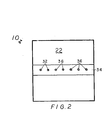
- an electrically conductive layer for example, of an electrically conductive ink, is coated onto the back surface of the carpet 10, to form a dried electrically conductive strip 34 across the entire back surface of the carpet, and connecting the ends of the columns 32 on the secondary backing layer 22.
- the carpet as prepared in Figures 1 and 2 is then employed by placing the carpet on the ground and, if desired, may be electrically connected by wires in the ground to ground or by electrically conductive adhesives, but more typically is merely laid on the ground surface, so that, in operation, any static charges accumulating on the face surface of the carpet 10 pass through the electrically conductive fibers in the face surface 14 through the electrically conductive precoat layer and the various columns 32 and to the strip 34 and to ground.
- the fibrous face of the carpet be electrically conductive, or that the precoat be electrically conductive, since the formation of the thin columns of electrically conductive material throughout the backing layer, extending toward and into the precoat or primary sheet, is often desirable, merely to permit an electrical pathway across the face thickness of the carpet tile, and is particularly useful where the thick backing is composed of a nonelectrically conductive material and, in fact, acts as an electrical insulator for the surface-coating material, such as the bitumen or limestone-filled bitumen of the example.
Landscapes
- Carpets (AREA)
- Floor Finish (AREA)
- Laminated Bodies (AREA)
- Chemical Or Physical Treatment Of Fibers (AREA)
- Synthetic Leather, Interior Materials Or Flexible Sheet Materials (AREA)
- Elimination Of Static Electricity (AREA)
- Treatments For Attaching Organic Compounds To Fibrous Goods (AREA)
Claims (17)
Priority Applications (1)
| Application Number | Priority Date | Filing Date | Title |
|---|---|---|---|
| AT86303305T ATE55161T1 (de) | 1986-04-07 | 1986-05-01 | Teppichfliese mit antistatischen eigenschaften und deren vorbereitungsverfahren. |
Applications Claiming Priority (2)
| Application Number | Priority Date | Filing Date | Title |
|---|---|---|---|
| US848775 | 1986-04-07 | ||
| US06/848,775 US4678694A (en) | 1986-04-07 | 1986-04-07 | Antistatic carpet tile and method of manufacturing such carpet tile |
Publications (2)
| Publication Number | Publication Date |
|---|---|
| EP0241612A1 EP0241612A1 (de) | 1987-10-21 |
| EP0241612B1 true EP0241612B1 (de) | 1990-08-01 |
Family
ID=25304233
Family Applications (1)
| Application Number | Title | Priority Date | Filing Date |
|---|---|---|---|
| EP86303305A Expired - Lifetime EP0241612B1 (de) | 1986-04-07 | 1986-05-01 | Teppichfliese mit antistatischen Eigenschaften und deren Vorbereitungsverfahren |
Country Status (7)
| Country | Link |
|---|---|
| US (1) | US4678694A (de) |
| EP (1) | EP0241612B1 (de) |
| CN (1) | CN1012748B (de) |
| AT (1) | ATE55161T1 (de) |
| AU (1) | AU585338B2 (de) |
| DE (1) | DE3673158D1 (de) |
| NO (1) | NO174899C (de) |
Families Citing this family (18)
| Publication number | Priority date | Publication date | Assignee | Title |
|---|---|---|---|---|
| US5560972A (en) * | 1988-07-25 | 1996-10-01 | Interface, Inc. | Latex fusion bonded pile carpets and carpet tile |
| US5030497A (en) * | 1989-09-28 | 1991-07-09 | Heuga Holding Bv | Carpet tile and method of preparing same |
| US5198277A (en) * | 1991-10-07 | 1993-03-30 | Interface, Inc. | Pattern-tufted, fusion-bonded carpet and carpet tile and method of preparation |
| US5348784A (en) * | 1991-11-04 | 1994-09-20 | United Technical Products, Inc. | Antistatic and conductive carpet tile system |
| US5545276A (en) | 1994-03-03 | 1996-08-13 | Milliken Research Corporation | Process for forming cushion backed carpet |
| DE19941838C2 (de) * | 1999-09-02 | 2003-01-30 | Anker Teppichboden Gebr Schoel | Bodenbelag mit einer elektrisch leitfähigen Oberschicht |
| US7029544B2 (en) * | 2000-09-15 | 2006-04-18 | Bridgestone Firestone North American Tire, Llc | Conductive pathways in tire treads for reduced static charge buildup |
| DE20100843U1 (de) * | 2001-01-16 | 2002-01-24 | Witex AG, 32832 Augustdorf | Anti-Statik-Bodenbelag |
| US20030084982A1 (en) * | 2001-09-04 | 2003-05-08 | Campbell William G | Method for making an anti-static tire tread |
| US20040137191A1 (en) * | 2003-01-15 | 2004-07-15 | Beren James R. | Recyclable extrusion-coated carpet having improved fiber lock |
| ES2329317B1 (es) * | 2006-05-16 | 2011-10-18 | Bosnor, Sl | Metodo de fabricacion de placas conductivas, aplicables al recubrimiento de suelos o paredes, placa conductiva y maquina inyectora. |
| KR101276523B1 (ko) * | 2010-11-09 | 2013-06-18 | (주)엘지하우시스 | 치수안정성이 우수한 슬림형 카펫 타일 및 그 제조 방법 |
| EP2755451A1 (de) * | 2013-01-09 | 2014-07-16 | Sika Technology AG | Beschichtungssystem mit Schutz vor elektrostatischer Entladung |
| CN103643786A (zh) * | 2013-11-28 | 2014-03-19 | 无锡合众信息科技有限公司 | 一种防静电的复合地坪材料 |
| CN104533054B (zh) * | 2014-12-29 | 2016-08-24 | 苏州奥莱鑫建材有限公司 | 一种防静电地坪 |
| CN105231778B (zh) * | 2015-07-10 | 2017-05-24 | 北京中电弘远静电设备有限公司 | 防静电地毯以及防静电地毯的制备方法 |
| CN105089250A (zh) * | 2015-08-21 | 2015-11-25 | 安徽优胜美塑胶有限公司 | 一种高性能pvc塑料地板 |
| CN106602292B (zh) * | 2016-11-28 | 2019-07-05 | 云南科威液态金属谷研发有限公司 | 一种抑制电力设备表面电荷积聚的方法 |
Family Cites Families (2)
| Publication number | Priority date | Publication date | Assignee | Title |
|---|---|---|---|---|
| FR15867E (fr) * | 1912-04-26 | 1912-10-10 | Jules Rousseau | Nouveau procédé de coloration des tissus, et appareil permettant sa mise en oeuvre |
| DE2230578A1 (de) * | 1972-06-22 | 1974-01-17 | Dynamit Nobel Ag | Antistatischer und/oder elektrisch leitfaehiger bodenbelag sowie verfahren zu seiner herstellung |
-
1986
- 1986-04-07 US US06/848,775 patent/US4678694A/en not_active Expired - Lifetime
- 1986-04-17 AU AU56309/86A patent/AU585338B2/en not_active Expired
- 1986-05-01 EP EP86303305A patent/EP0241612B1/de not_active Expired - Lifetime
- 1986-05-01 DE DE8686303305T patent/DE3673158D1/de not_active Expired - Lifetime
- 1986-05-01 AT AT86303305T patent/ATE55161T1/de not_active IP Right Cessation
- 1986-09-04 NO NO863540A patent/NO174899C/no not_active IP Right Cessation
-
1987
- 1987-01-09 CN CN87100115A patent/CN1012748B/zh not_active Expired
Also Published As
| Publication number | Publication date |
|---|---|
| EP0241612A1 (de) | 1987-10-21 |
| NO863540L (no) | 1987-10-08 |
| ATE55161T1 (de) | 1990-08-15 |
| NO174899B (no) | 1994-04-18 |
| CN87100115A (zh) | 1988-07-20 |
| NO863540D0 (no) | 1986-09-04 |
| CN1012748B (zh) | 1991-06-05 |
| AU585338B2 (en) | 1989-06-15 |
| NO174899C (no) | 1994-07-27 |
| US4678694A (en) | 1987-07-07 |
| AU5630986A (en) | 1987-10-22 |
| DE3673158D1 (de) | 1990-09-06 |
Similar Documents
| Publication | Publication Date | Title |
|---|---|---|
| EP0241612B1 (de) | Teppichfliese mit antistatischen Eigenschaften und deren Vorbereitungsverfahren | |
| CA1338761C (en) | Static dissipative mat and method of preparation | |
| CA2123411C (en) | Resilient foam-backed carpet and method of preparation | |
| CA1158486A (en) | Electrically conductive foam and method of preparation and use | |
| US4981544A (en) | Static dissipative tape | |
| CA1256009A (en) | Antistatic laminates containing long carbon fibers | |
| KR100189344B1 (ko) | 대전(帶電)방지매트 | |
| US5122404A (en) | Carpet composites having improved static electricity characteristics | |
| EP0369644B1 (de) | Teppichzusammensetzung mit verbesserten statischen Eigenschaften | |
| US4926570A (en) | Shoe inner sole, particularly insole or welt | |
| WO2004096538A1 (en) | Surface covering | |
| WO2002066241A1 (en) | Adhesive-free carpet tiles and methods of installing adhesive-free carpet tiles | |
| US4269881A (en) | Anti-static mats and carpets | |
| US4084031A (en) | Static discharging floor covering | |
| CA1115768A (en) | Electrically conductive web | |
| EP1091038A2 (de) | Modulares plattenförmiges Element für Bodenbeläge | |
| CA1279973C (en) | Antistatic carpet tile and method of manufacturing such carpet tile | |
| JPS62257474A (ja) | 静電防止カ−ペツトタイル及びこの種のカ−ペツトタイルの製造方法 | |
| JPS6044468B2 (ja) | 制電性床ユニツト | |
| KR100427554B1 (ko) | 카본 블랙을 사용한 염화비닐수지 카펫타일 및 그 제조방법 | |
| JPH0546715Y2 (de) | ||
| JPH1061158A (ja) | タイルカーペット | |
| EP4707460A2 (de) | Bodenbelagsprodukt | |
| JPH032525B2 (de) | ||
| JPS5854914A (ja) | 敷物の施工法 |
Legal Events
| Date | Code | Title | Description |
|---|---|---|---|
| PUAI | Public reference made under article 153(3) epc to a published international application that has entered the european phase |
Free format text: ORIGINAL CODE: 0009012 |
|
| AK | Designated contracting states |
Kind code of ref document: A1 Designated state(s): AT BE CH DE FR GB IT LI LU NL SE |
|
| 17P | Request for examination filed |
Effective date: 19871215 |
|
| 17Q | First examination report despatched |
Effective date: 19890306 |
|
| GRAA | (expected) grant |
Free format text: ORIGINAL CODE: 0009210 |
|
| ITF | It: translation for a ep patent filed | ||
| AK | Designated contracting states |
Kind code of ref document: B1 Designated state(s): AT BE CH DE FR GB IT LI LU NL SE |
|
| REF | Corresponds to: |
Ref document number: 55161 Country of ref document: AT Date of ref document: 19900815 Kind code of ref document: T |
|
| ET | Fr: translation filed | ||
| REF | Corresponds to: |
Ref document number: 3673158 Country of ref document: DE Date of ref document: 19900906 |
|
| ITTA | It: last paid annual fee | ||
| PLBE | No opposition filed within time limit |
Free format text: ORIGINAL CODE: 0009261 |
|
| STAA | Information on the status of an ep patent application or granted ep patent |
Free format text: STATUS: NO OPPOSITION FILED WITHIN TIME LIMIT |
|
| 26N | No opposition filed | ||
| EPTA | Lu: last paid annual fee | ||
| EAL | Se: european patent in force in sweden |
Ref document number: 86303305.6 |
|
| PGFP | Annual fee paid to national office [announced via postgrant information from national office to epo] |
Ref country code: CH Payment date: 19990526 Year of fee payment: 14 |
|
| PGFP | Annual fee paid to national office [announced via postgrant information from national office to epo] |
Ref country code: SE Payment date: 19990528 Year of fee payment: 14 Ref country code: LU Payment date: 19990528 Year of fee payment: 14 |
|
| PG25 | Lapsed in a contracting state [announced via postgrant information from national office to epo] |
Ref country code: LU Free format text: LAPSE BECAUSE OF NON-PAYMENT OF DUE FEES Effective date: 20000501 |
|
| PG25 | Lapsed in a contracting state [announced via postgrant information from national office to epo] |
Ref country code: SE Free format text: LAPSE BECAUSE OF NON-PAYMENT OF DUE FEES Effective date: 20000502 |
|
| PG25 | Lapsed in a contracting state [announced via postgrant information from national office to epo] |
Ref country code: LI Free format text: LAPSE BECAUSE OF NON-PAYMENT OF DUE FEES Effective date: 20000531 Ref country code: CH Free format text: LAPSE BECAUSE OF NON-PAYMENT OF DUE FEES Effective date: 20000531 |
|
| REG | Reference to a national code |
Ref country code: CH Ref legal event code: PL |
|
| EUG | Se: european patent has lapsed |
Ref document number: 86303305.6 |
|
| REG | Reference to a national code |
Ref country code: GB Ref legal event code: IF02 |
|
| PGFP | Annual fee paid to national office [announced via postgrant information from national office to epo] |
Ref country code: AT Payment date: 20020502 Year of fee payment: 17 |
|
| PG25 | Lapsed in a contracting state [announced via postgrant information from national office to epo] |
Ref country code: AT Free format text: LAPSE BECAUSE OF NON-PAYMENT OF DUE FEES Effective date: 20030501 |
|
| PGFP | Annual fee paid to national office [announced via postgrant information from national office to epo] |
Ref country code: NL Payment date: 20050416 Year of fee payment: 20 |
|
| PGFP | Annual fee paid to national office [announced via postgrant information from national office to epo] |
Ref country code: GB Payment date: 20050427 Year of fee payment: 20 |
|
| PGFP | Annual fee paid to national office [announced via postgrant information from national office to epo] |
Ref country code: FR Payment date: 20050517 Year of fee payment: 20 |
|
| PGFP | Annual fee paid to national office [announced via postgrant information from national office to epo] |
Ref country code: BE Payment date: 20050624 Year of fee payment: 20 |
|
| PGFP | Annual fee paid to national office [announced via postgrant information from national office to epo] |
Ref country code: DE Payment date: 20050630 Year of fee payment: 20 |
|
| PGFP | Annual fee paid to national office [announced via postgrant information from national office to epo] |
Ref country code: IT Payment date: 20051025 Year of fee payment: 20 |
|
| PG25 | Lapsed in a contracting state [announced via postgrant information from national office to epo] |
Ref country code: GB Free format text: LAPSE BECAUSE OF EXPIRATION OF PROTECTION Effective date: 20060430 |
|
| PG25 | Lapsed in a contracting state [announced via postgrant information from national office to epo] |
Ref country code: NL Free format text: LAPSE BECAUSE OF EXPIRATION OF PROTECTION Effective date: 20060501 |
|
| REG | Reference to a national code |
Ref country code: GB Ref legal event code: PE20 |
|
| NLV7 | Nl: ceased due to reaching the maximum lifetime of a patent |
Effective date: 20060501 |
|
| BE20 | Be: patent expired |
Owner name: *HEUGA HOLDING B.V. Effective date: 20060501 |