EP0237963A2 - 2-Azolylmethyl-2-aryl-1,3-dioxolane und deren Salze, Verfahren zu ihrer Herstellung, sie enthaltende Mittel und ihre Verwendung - Google Patents
2-Azolylmethyl-2-aryl-1,3-dioxolane und deren Salze, Verfahren zu ihrer Herstellung, sie enthaltende Mittel und ihre Verwendung Download PDFInfo
- Publication number
- EP0237963A2 EP0237963A2 EP87103589A EP87103589A EP0237963A2 EP 0237963 A2 EP0237963 A2 EP 0237963A2 EP 87103589 A EP87103589 A EP 87103589A EP 87103589 A EP87103589 A EP 87103589A EP 0237963 A2 EP0237963 A2 EP 0237963A2
- Authority
- EP
- European Patent Office
- Prior art keywords
- alkyl
- formula
- phenyl
- compound
- unsubstituted
- Prior art date
- Legal status (The legal status is an assumption and is not a legal conclusion. Google has not performed a legal analysis and makes no representation as to the accuracy of the status listed.)
- Withdrawn
Links
- 238000000034 method Methods 0.000 title claims abstract description 39
- 150000003839 salts Chemical class 0.000 title claims abstract description 27
- 238000002360 preparation method Methods 0.000 title claims abstract description 22
- 239000000203 mixture Substances 0.000 title description 45
- 150000001875 compounds Chemical class 0.000 claims abstract description 178
- 229910052801 chlorine Inorganic materials 0.000 claims abstract description 106
- 229910052731 fluorine Inorganic materials 0.000 claims abstract description 91
- 125000001997 phenyl group Chemical group [H]C1=C([H])C([H])=C(*)C([H])=C1[H] 0.000 claims abstract description 89
- 125000000217 alkyl group Chemical group 0.000 claims abstract description 35
- 239000002253 acid Substances 0.000 claims abstract description 18
- 229940121375 antifungal agent Drugs 0.000 claims abstract description 12
- 238000004519 manufacturing process Methods 0.000 claims abstract description 12
- 125000000623 heterocyclic group Chemical group 0.000 claims abstract description 7
- 125000001624 naphthyl group Chemical group 0.000 claims abstract description 5
- 125000001544 thienyl group Chemical group 0.000 claims abstract description 5
- -1 methoxy, ethoxy Chemical group 0.000 claims description 101
- 125000001424 substituent group Chemical group 0.000 claims description 86
- 229910052739 hydrogen Inorganic materials 0.000 claims description 71
- 125000002023 trifluoromethyl group Chemical group FC(F)(F)* 0.000 claims description 46
- 229910052799 carbon Inorganic materials 0.000 claims description 44
- 125000002496 methyl group Chemical group [H]C([H])([H])* 0.000 claims description 43
- CYRMSUTZVYGINF-UHFFFAOYSA-N trichlorofluoromethane Chemical compound FC(Cl)(Cl)Cl CYRMSUTZVYGINF-UHFFFAOYSA-N 0.000 claims description 42
- 229910052736 halogen Inorganic materials 0.000 claims description 41
- 125000001797 benzyl group Chemical group [H]C1=C([H])C([H])=C(C([H])=C1[H])C([H])([H])* 0.000 claims description 40
- 150000002367 halogens Chemical class 0.000 claims description 39
- 229910052794 bromium Inorganic materials 0.000 claims description 38
- 125000000956 methoxy group Chemical group [H]C([H])([H])O* 0.000 claims description 26
- 125000001495 ethyl group Chemical group [H]C([H])([H])C([H])([H])* 0.000 claims description 25
- CIUQDSCDWFSTQR-UHFFFAOYSA-N [C]1=CC=CC=C1 Chemical compound [C]1=CC=CC=C1 CIUQDSCDWFSTQR-UHFFFAOYSA-N 0.000 claims description 24
- 125000004201 2,4-dichlorophenyl group Chemical group [H]C1=C([H])C(*)=C(Cl)C([H])=C1Cl 0.000 claims description 19
- XEEYBQQBJWHFJM-UHFFFAOYSA-N Iron Chemical compound [Fe] XEEYBQQBJWHFJM-UHFFFAOYSA-N 0.000 claims description 17
- 229910052784 alkaline earth metal Inorganic materials 0.000 claims description 13
- 230000000843 anti-fungal effect Effects 0.000 claims description 12
- 125000005279 aryl sulfonyloxy group Chemical group 0.000 claims description 12
- 125000004423 acyloxy group Chemical group 0.000 claims description 11
- 125000005278 alkyl sulfonyloxy group Chemical group 0.000 claims description 11
- 239000003814 drug Substances 0.000 claims description 10
- 125000001309 chloro group Chemical group Cl* 0.000 claims description 9
- 239000003513 alkali Substances 0.000 claims description 8
- SMWDFEZZVXVKRB-UHFFFAOYSA-N anhydrous quinoline Natural products N1=CC=CC2=CC=CC=C21 SMWDFEZZVXVKRB-UHFFFAOYSA-N 0.000 claims description 8
- 150000007522 mineralic acids Chemical class 0.000 claims description 8
- 125000000449 nitro group Chemical group [O-][N+](*)=O 0.000 claims description 8
- 208000031888 Mycoses Diseases 0.000 claims description 7
- 229910052786 argon Inorganic materials 0.000 claims description 7
- 125000001301 ethoxy group Chemical group [H]C([H])([H])C([H])([H])O* 0.000 claims description 7
- 125000001153 fluoro group Chemical group F* 0.000 claims description 7
- 150000007524 organic acids Chemical class 0.000 claims description 7
- 235000005985 organic acids Nutrition 0.000 claims description 7
- 150000001342 alkaline earth metals Chemical class 0.000 claims description 6
- 125000002943 quinolinyl group Chemical group N1=C(C=CC2=CC=CC=C12)* 0.000 claims description 6
- 125000000951 phenoxy group Chemical group [H]C1=C([H])C([H])=C(O*)C([H])=C1[H] 0.000 claims description 5
- 150000000180 1,2-diols Chemical class 0.000 claims description 4
- 125000003545 alkoxy group Chemical group 0.000 claims description 4
- 125000004803 chlorobenzyl group Chemical group 0.000 claims description 4
- 125000005843 halogen group Chemical group 0.000 claims description 3
- LMBFAGIMSUYTBN-MPZNNTNKSA-N teixobactin Chemical compound C([C@H](C(=O)N[C@@H]([C@@H](C)CC)C(=O)N[C@@H](CO)C(=O)N[C@H](CCC(N)=O)C(=O)N[C@H]([C@@H](C)CC)C(=O)N[C@@H]([C@@H](C)CC)C(=O)N[C@@H](CO)C(=O)N[C@H]1C(N[C@@H](C)C(=O)N[C@@H](C[C@@H]2NC(=N)NC2)C(=O)N[C@H](C(=O)O[C@H]1C)[C@@H](C)CC)=O)NC)C1=CC=CC=C1 LMBFAGIMSUYTBN-MPZNNTNKSA-N 0.000 claims description 3
- WNXJIVFYUVYPPR-UHFFFAOYSA-N 1,3-dioxolane Chemical group C1COCO1 WNXJIVFYUVYPPR-UHFFFAOYSA-N 0.000 claims description 2
- 239000000969 carrier Substances 0.000 claims description 2
- 239000000543 intermediate Substances 0.000 abstract description 6
- 239000000460 chlorine Substances 0.000 description 133
- ZMXDDKWLCZADIW-UHFFFAOYSA-N N,N-Dimethylformamide Chemical compound CN(C)C=O ZMXDDKWLCZADIW-UHFFFAOYSA-N 0.000 description 46
- RTZKZFJDLAIYFH-UHFFFAOYSA-N Diethyl ether Chemical compound CCOCC RTZKZFJDLAIYFH-UHFFFAOYSA-N 0.000 description 40
- OKKJLVBELUTLKV-UHFFFAOYSA-N Methanol Chemical compound OC OKKJLVBELUTLKV-UHFFFAOYSA-N 0.000 description 33
- YXFVVABEGXRONW-UHFFFAOYSA-N Toluene Chemical compound CC1=CC=CC=C1 YXFVVABEGXRONW-UHFFFAOYSA-N 0.000 description 27
- IAZDPXIOMUYVGZ-UHFFFAOYSA-N Dimethylsulphoxide Chemical compound CS(C)=O IAZDPXIOMUYVGZ-UHFFFAOYSA-N 0.000 description 26
- 239000000243 solution Substances 0.000 description 25
- HEMHJVSKTPXQMS-UHFFFAOYSA-M Sodium hydroxide Chemical compound [OH-].[Na+] HEMHJVSKTPXQMS-UHFFFAOYSA-M 0.000 description 23
- UHOVQNZJYSORNB-UHFFFAOYSA-N monobenzene Natural products C1=CC=CC=C1 UHOVQNZJYSORNB-UHFFFAOYSA-N 0.000 description 22
- 125000004178 (C1-C4) alkyl group Chemical group 0.000 description 21
- 239000012071 phase Substances 0.000 description 21
- XLYOFNOQVPJJNP-UHFFFAOYSA-N water Substances O XLYOFNOQVPJJNP-UHFFFAOYSA-N 0.000 description 21
- 238000004458 analytical method Methods 0.000 description 20
- VYPSYNLAJGMNEJ-UHFFFAOYSA-N Silicium dioxide Chemical compound O=[Si]=O VYPSYNLAJGMNEJ-UHFFFAOYSA-N 0.000 description 19
- 239000000741 silica gel Substances 0.000 description 18
- 229910002027 silica gel Inorganic materials 0.000 description 18
- WEVYAHXRMPXWCK-UHFFFAOYSA-N Acetonitrile Chemical compound CC#N WEVYAHXRMPXWCK-UHFFFAOYSA-N 0.000 description 15
- 239000002585 base Substances 0.000 description 15
- 239000003921 oil Substances 0.000 description 15
- 239000000284 extract Substances 0.000 description 14
- 238000003756 stirring Methods 0.000 description 14
- 238000006243 chemical reaction Methods 0.000 description 13
- YMWUJEATGCHHMB-UHFFFAOYSA-N Dichloromethane Chemical compound ClCCl YMWUJEATGCHHMB-UHFFFAOYSA-N 0.000 description 12
- 239000000126 substance Substances 0.000 description 11
- WYURNTSHIVDZCO-UHFFFAOYSA-N Tetrahydrofuran Chemical compound C1CCOC1 WYURNTSHIVDZCO-UHFFFAOYSA-N 0.000 description 10
- 239000007864 aqueous solution Substances 0.000 description 10
- MVPPADPHJFYWMZ-UHFFFAOYSA-N chlorobenzene Chemical compound ClC1=CC=CC=C1 MVPPADPHJFYWMZ-UHFFFAOYSA-N 0.000 description 10
- 238000002156 mixing Methods 0.000 description 10
- XTHFKEDIFFGKHM-UHFFFAOYSA-N Dimethoxyethane Chemical compound COCCOC XTHFKEDIFFGKHM-UHFFFAOYSA-N 0.000 description 9
- XEKOWRVHYACXOJ-UHFFFAOYSA-N Ethyl acetate Chemical compound CCOC(C)=O XEKOWRVHYACXOJ-UHFFFAOYSA-N 0.000 description 9
- QUPDWYMUPZLYJZ-UHFFFAOYSA-N ethyl Chemical compound C[CH2] QUPDWYMUPZLYJZ-UHFFFAOYSA-N 0.000 description 9
- 239000002904 solvent Substances 0.000 description 9
- CSCPPACGZOOCGX-UHFFFAOYSA-N Acetone Chemical compound CC(C)=O CSCPPACGZOOCGX-UHFFFAOYSA-N 0.000 description 8
- 0 C*C1=***(cccc2)c2C1=O Chemical compound C*C1=***(cccc2)c2C1=O 0.000 description 8
- 241000282414 Homo sapiens Species 0.000 description 7
- 238000004440 column chromatography Methods 0.000 description 7
- 238000010828 elution Methods 0.000 description 7
- LQNUZADURLCDLV-UHFFFAOYSA-N nitrobenzene Chemical compound [O-][N+](=O)C1=CC=CC=C1 LQNUZADURLCDLV-UHFFFAOYSA-N 0.000 description 7
- 239000000825 pharmaceutical preparation Substances 0.000 description 7
- 239000000047 product Substances 0.000 description 7
- 229910000104 sodium hydride Inorganic materials 0.000 description 7
- 125000006273 (C1-C3) alkyl group Chemical group 0.000 description 6
- 125000000229 (C1-C4)alkoxy group Chemical group 0.000 description 6
- 125000004209 (C1-C8) alkyl group Chemical group 0.000 description 6
- 241000233866 Fungi Species 0.000 description 6
- RDOXTESZEPMUJZ-UHFFFAOYSA-N anisole Chemical compound COC1=CC=CC=C1 RDOXTESZEPMUJZ-UHFFFAOYSA-N 0.000 description 6
- 238000001816 cooling Methods 0.000 description 6
- IRGIAGAHMWSRKP-UHFFFAOYSA-N hydron;4-piperazin-1-ylphenol;dibromide Chemical compound Br.Br.C1=CC(O)=CC=C1N1CCNCC1 IRGIAGAHMWSRKP-UHFFFAOYSA-N 0.000 description 6
- RAXXELZNTBOGNW-UHFFFAOYSA-N imidazole Natural products C1=CNC=N1 RAXXELZNTBOGNW-UHFFFAOYSA-N 0.000 description 6
- 239000012442 inert solvent Substances 0.000 description 6
- 239000003208 petroleum Substances 0.000 description 6
- NLKNQRATVPKPDG-UHFFFAOYSA-M potassium iodide Chemical compound [K+].[I-] NLKNQRATVPKPDG-UHFFFAOYSA-M 0.000 description 6
- YLQBMQCUIZJEEH-UHFFFAOYSA-N tetrahydrofuran Natural products C=1C=COC=1 YLQBMQCUIZJEEH-UHFFFAOYSA-N 0.000 description 6
- KEAYESYHFKHZAL-UHFFFAOYSA-N Sodium Chemical compound [Na] KEAYESYHFKHZAL-UHFFFAOYSA-N 0.000 description 5
- DKGAVHZHDRPRBM-UHFFFAOYSA-N Tert-Butanol Chemical compound CC(C)(C)O DKGAVHZHDRPRBM-UHFFFAOYSA-N 0.000 description 5
- 239000004480 active ingredient Substances 0.000 description 5
- 239000000706 filtrate Substances 0.000 description 5
- 239000004533 oil dispersion Substances 0.000 description 5
- 239000002994 raw material Substances 0.000 description 5
- 238000000926 separation method Methods 0.000 description 5
- 239000012312 sodium hydride Substances 0.000 description 5
- RYHBNJHYFVUHQT-UHFFFAOYSA-N 1,4-Dioxane Chemical compound C1COCCO1 RYHBNJHYFVUHQT-UHFFFAOYSA-N 0.000 description 4
- DLFVBJFMPXGRIB-UHFFFAOYSA-N Acetamide Chemical compound CC(N)=O DLFVBJFMPXGRIB-UHFFFAOYSA-N 0.000 description 4
- HEDRZPFGACZZDS-UHFFFAOYSA-N Chloroform Chemical compound ClC(Cl)Cl HEDRZPFGACZZDS-UHFFFAOYSA-N 0.000 description 4
- LFQSCWFLJHTTHZ-UHFFFAOYSA-N Ethanol Chemical compound CCO LFQSCWFLJHTTHZ-UHFFFAOYSA-N 0.000 description 4
- LRHPLDYGYMQRHN-UHFFFAOYSA-N N-Butanol Chemical compound CCCCO LRHPLDYGYMQRHN-UHFFFAOYSA-N 0.000 description 4
- 241001045770 Trichophyton mentagrophytes Species 0.000 description 4
- 239000013543 active substance Substances 0.000 description 4
- 238000001704 evaporation Methods 0.000 description 4
- 230000000855 fungicidal effect Effects 0.000 description 4
- 229930195733 hydrocarbon Natural products 0.000 description 4
- 125000005948 methanesulfonyloxy group Chemical group 0.000 description 4
- 239000012299 nitrogen atmosphere Substances 0.000 description 4
- BWHMMNNQKKPAPP-UHFFFAOYSA-L potassium carbonate Chemical compound [K+].[K+].[O-]C([O-])=O BWHMMNNQKKPAPP-UHFFFAOYSA-L 0.000 description 4
- 238000001953 recrystallisation Methods 0.000 description 4
- 239000007787 solid Substances 0.000 description 4
- XMAYWYJOQHXEEK-OZXSUGGESA-N (2R,4S)-ketoconazole Chemical compound C1CN(C(=O)C)CCN1C(C=C1)=CC=C1OC[C@@H]1O[C@@](CN2C=NC=C2)(C=2C(=CC(Cl)=CC=2)Cl)OC1 XMAYWYJOQHXEEK-OZXSUGGESA-N 0.000 description 3
- JFZJMSDDOOAOIV-UHFFFAOYSA-N 2-chloro-5-(trifluoromethyl)pyridine Chemical compound FC(F)(F)C1=CC=C(Cl)N=C1 JFZJMSDDOOAOIV-UHFFFAOYSA-N 0.000 description 3
- HCUSWVRCTUYZSD-UHFFFAOYSA-N 4-[4-[5-(trifluoromethyl)pyridin-2-yl]piperazin-1-yl]phenol Chemical compound C1=CC(O)=CC=C1N1CCN(C=2N=CC(=CC=2)C(F)(F)F)CC1 HCUSWVRCTUYZSD-UHFFFAOYSA-N 0.000 description 3
- WKBOTKDWSSQWDR-UHFFFAOYSA-N Bromine atom Chemical compound [Br] WKBOTKDWSSQWDR-UHFFFAOYSA-N 0.000 description 3
- 241000196324 Embryophyta Species 0.000 description 3
- 241001480036 Epidermophyton floccosum Species 0.000 description 3
- 241000282412 Homo Species 0.000 description 3
- KFZMGEQAYNKOFK-UHFFFAOYSA-N Isopropanol Chemical compound CC(C)O KFZMGEQAYNKOFK-UHFFFAOYSA-N 0.000 description 3
- NTIZESTWPVYFNL-UHFFFAOYSA-N Methyl isobutyl ketone Chemical compound CC(C)CC(C)=O NTIZESTWPVYFNL-UHFFFAOYSA-N 0.000 description 3
- UIHCLUNTQKBZGK-UHFFFAOYSA-N Methyl isobutyl ketone Natural products CCC(C)C(C)=O UIHCLUNTQKBZGK-UHFFFAOYSA-N 0.000 description 3
- CTQNGGLPUBDAKN-UHFFFAOYSA-N O-Xylene Chemical compound CC1=CC=CC=C1C CTQNGGLPUBDAKN-UHFFFAOYSA-N 0.000 description 3
- KWYUFKZDYYNOTN-UHFFFAOYSA-M Potassium hydroxide Chemical compound [OH-].[K+] KWYUFKZDYYNOTN-UHFFFAOYSA-M 0.000 description 3
- ZMANZCXQSJIPKH-UHFFFAOYSA-N Triethylamine Chemical compound CCN(CC)CC ZMANZCXQSJIPKH-UHFFFAOYSA-N 0.000 description 3
- 125000003668 acetyloxy group Chemical group [H]C([H])([H])C(=O)O[*] 0.000 description 3
- 229910052783 alkali metal Inorganic materials 0.000 description 3
- 150000001340 alkali metals Chemical class 0.000 description 3
- 239000008346 aqueous phase Substances 0.000 description 3
- 125000001231 benzoyloxy group Chemical group C(C1=CC=CC=C1)(=O)O* 0.000 description 3
- 230000015572 biosynthetic process Effects 0.000 description 3
- 238000009835 boiling Methods 0.000 description 3
- GDTBXPJZTBHREO-UHFFFAOYSA-N bromine Substances BrBr GDTBXPJZTBHREO-UHFFFAOYSA-N 0.000 description 3
- 201000010099 disease Diseases 0.000 description 3
- 208000037265 diseases, disorders, signs and symptoms Diseases 0.000 description 3
- 238000001035 drying Methods 0.000 description 3
- 230000000694 effects Effects 0.000 description 3
- 150000002391 heterocyclic compounds Chemical class 0.000 description 3
- XMBWDFGMSWQBCA-UHFFFAOYSA-N hydrogen iodide Chemical compound I XMBWDFGMSWQBCA-UHFFFAOYSA-N 0.000 description 3
- 238000005907 ketalization reaction Methods 0.000 description 3
- 229960004125 ketoconazole Drugs 0.000 description 3
- 229910052744 lithium Inorganic materials 0.000 description 3
- UZKWTJUDCOPSNM-UHFFFAOYSA-N methoxybenzene Substances CCCCOC=C UZKWTJUDCOPSNM-UHFFFAOYSA-N 0.000 description 3
- VLKZOEOYAKHREP-UHFFFAOYSA-N n-Hexane Chemical compound CCCCCC VLKZOEOYAKHREP-UHFFFAOYSA-N 0.000 description 3
- 239000003960 organic solvent Substances 0.000 description 3
- LPNYRYFBWFDTMA-UHFFFAOYSA-N potassium tert-butoxide Chemical compound [K+].CC(C)(C)[O-] LPNYRYFBWFDTMA-UHFFFAOYSA-N 0.000 description 3
- 239000002244 precipitate Substances 0.000 description 3
- 239000003755 preservative agent Substances 0.000 description 3
- 150000003254 radicals Chemical class 0.000 description 3
- 239000000376 reactant Substances 0.000 description 3
- 229910052708 sodium Inorganic materials 0.000 description 3
- 239000011734 sodium Substances 0.000 description 3
- 239000011877 solvent mixture Substances 0.000 description 3
- JRMUNVKIHCOMHV-UHFFFAOYSA-M tetrabutylammonium bromide Chemical compound [Br-].CCCC[N+](CCCC)(CCCC)CCCC JRMUNVKIHCOMHV-UHFFFAOYSA-M 0.000 description 3
- 239000008096 xylene Substances 0.000 description 3
- BLSQLHNBWJLIBQ-OZXSUGGESA-N (2R,4S)-terconazole Chemical compound C1CN(C(C)C)CCN1C(C=C1)=CC=C1OC[C@@H]1O[C@@](CN2N=CN=C2)(C=2C(=CC(Cl)=CC=2)Cl)OC1 BLSQLHNBWJLIBQ-OZXSUGGESA-N 0.000 description 2
- XQQCMSDHQIQVQM-UHFFFAOYSA-N 2,6-dimethyl-4-piperazin-1-ylphenol;dihydrobromide Chemical compound Br.Br.CC1=C(O)C(C)=CC(N2CCNCC2)=C1 XQQCMSDHQIQVQM-UHFFFAOYSA-N 0.000 description 2
- XNWFRZJHXBZDAG-UHFFFAOYSA-N 2-METHOXYETHANOL Chemical compound COCCO XNWFRZJHXBZDAG-UHFFFAOYSA-N 0.000 description 2
- PJQSNWMRMSTTNS-UHFFFAOYSA-N 4-(4-hydroxyphenyl)piperazine-1-carbaldehyde Chemical compound C1=CC(O)=CC=C1N1CCN(C=O)CC1 PJQSNWMRMSTTNS-UHFFFAOYSA-N 0.000 description 2
- ZGLWQUSWAJVJKR-UHFFFAOYSA-N 4-[4-(5,6-dimethyl-2-phenylpyrimidin-4-yl)piperazin-1-yl]phenol Chemical compound CC=1C(C)=NC(C=2C=CC=CC=2)=NC=1N(CC1)CCN1C1=CC=C(O)C=C1 ZGLWQUSWAJVJKR-UHFFFAOYSA-N 0.000 description 2
- QZYNVGZXXXRNIG-UHFFFAOYSA-N 4-chloro-5,6-dimethyl-2-phenylpyrimidine Chemical compound ClC1=C(C)C(C)=NC(C=2C=CC=CC=2)=N1 QZYNVGZXXXRNIG-UHFFFAOYSA-N 0.000 description 2
- AWISILIOGCZORR-UHFFFAOYSA-N 5-methyl-7-oxabicyclo[4.1.0]hepta-1,3,5-triene Chemical compound CC1=CC=CC2=C1O2 AWISILIOGCZORR-UHFFFAOYSA-N 0.000 description 2
- 241000894006 Bacteria Species 0.000 description 2
- 241000222122 Candida albicans Species 0.000 description 2
- OKTJSMMVPCPJKN-UHFFFAOYSA-N Carbon Chemical compound [C] OKTJSMMVPCPJKN-UHFFFAOYSA-N 0.000 description 2
- 239000004215 Carbon black (E152) Substances 0.000 description 2
- ZAMOUSCENKQFHK-UHFFFAOYSA-N Chlorine atom Chemical compound [Cl] ZAMOUSCENKQFHK-UHFFFAOYSA-N 0.000 description 2
- XDTMQSROBMDMFD-UHFFFAOYSA-N Cyclohexane Chemical compound C1CCCCC1 XDTMQSROBMDMFD-UHFFFAOYSA-N 0.000 description 2
- 208000007163 Dermatomycoses Diseases 0.000 description 2
- LYCAIKOWRPUZTN-UHFFFAOYSA-N Ethylene glycol Chemical compound OCCO LYCAIKOWRPUZTN-UHFFFAOYSA-N 0.000 description 2
- VZCYOOQTPOCHFL-OWOJBTEDSA-N Fumaric acid Chemical compound OC(=O)\C=C\C(O)=O VZCYOOQTPOCHFL-OWOJBTEDSA-N 0.000 description 2
- VEXZGXHMUGYJMC-UHFFFAOYSA-N Hydrochloric acid Chemical compound Cl VEXZGXHMUGYJMC-UHFFFAOYSA-N 0.000 description 2
- UFHFLCQGNIYNRP-UHFFFAOYSA-N Hydrogen Chemical compound [H][H] UFHFLCQGNIYNRP-UHFFFAOYSA-N 0.000 description 2
- DGAQECJNVWCQMB-PUAWFVPOSA-M Ilexoside XXIX Chemical compound C[C@@H]1CC[C@@]2(CC[C@@]3(C(=CC[C@H]4[C@]3(CC[C@@H]5[C@@]4(CC[C@@H](C5(C)C)OS(=O)(=O)[O-])C)C)[C@@H]2[C@]1(C)O)C)C(=O)O[C@H]6[C@@H]([C@H]([C@@H]([C@H](O6)CO)O)O)O.[Na+] DGAQECJNVWCQMB-PUAWFVPOSA-M 0.000 description 2
- 241001465754 Metazoa Species 0.000 description 2
- AMQJEAYHLZJPGS-UHFFFAOYSA-N N-Pentanol Chemical compound CCCCCO AMQJEAYHLZJPGS-UHFFFAOYSA-N 0.000 description 2
- PCLIMKBDDGJMGD-UHFFFAOYSA-N N-bromosuccinimide Chemical compound BrN1C(=O)CCC1=O PCLIMKBDDGJMGD-UHFFFAOYSA-N 0.000 description 2
- CYTYCFOTNPOANT-UHFFFAOYSA-N Perchloroethylene Chemical group ClC(Cl)=C(Cl)Cl CYTYCFOTNPOANT-UHFFFAOYSA-N 0.000 description 2
- JUJWROOIHBZHMG-UHFFFAOYSA-N Pyridine Chemical compound C1=CC=NC=C1 JUJWROOIHBZHMG-UHFFFAOYSA-N 0.000 description 2
- CDBYLPFSWZWCQE-UHFFFAOYSA-L Sodium Carbonate Chemical compound [Na+].[Na+].[O-]C([O-])=O CDBYLPFSWZWCQE-UHFFFAOYSA-L 0.000 description 2
- UIIMBOGNXHQVGW-UHFFFAOYSA-M Sodium bicarbonate Chemical compound [Na+].OC([O-])=O UIIMBOGNXHQVGW-UHFFFAOYSA-M 0.000 description 2
- 241000224527 Trichomonas vaginalis Species 0.000 description 2
- XXFGHJUOZYQSHT-UHFFFAOYSA-N [2-(bromomethyl)-2-(2,4-dichlorophenyl)-1,3-dioxolan-4-yl]methyl methanesulfonate Chemical compound O1C(COS(=O)(=O)C)COC1(CBr)C1=CC=C(Cl)C=C1Cl XXFGHJUOZYQSHT-UHFFFAOYSA-N 0.000 description 2
- ZVQOOHYFBIDMTQ-UHFFFAOYSA-N [methyl(oxido){1-[6-(trifluoromethyl)pyridin-3-yl]ethyl}-lambda(6)-sulfanylidene]cyanamide Chemical compound N#CN=S(C)(=O)C(C)C1=CC=C(C(F)(F)F)N=C1 ZVQOOHYFBIDMTQ-UHFFFAOYSA-N 0.000 description 2
- 150000001408 amides Chemical class 0.000 description 2
- 150000004945 aromatic hydrocarbons Chemical class 0.000 description 2
- ISAOCJYIOMOJEB-UHFFFAOYSA-N benzoin Chemical compound C=1C=CC=CC=1C(O)C(=O)C1=CC=CC=C1 ISAOCJYIOMOJEB-UHFFFAOYSA-N 0.000 description 2
- TXFLGZOGNOOEFZ-UHFFFAOYSA-N bis(2-chloroethyl)amine Chemical compound ClCCNCCCl TXFLGZOGNOOEFZ-UHFFFAOYSA-N 0.000 description 2
- 230000037396 body weight Effects 0.000 description 2
- QARVLSVVCXYDNA-UHFFFAOYSA-N bromobenzene Chemical compound BrC1=CC=CC=C1 QARVLSVVCXYDNA-UHFFFAOYSA-N 0.000 description 2
- KVNRLNFWIYMESJ-UHFFFAOYSA-N butyronitrile Chemical compound CCCC#N KVNRLNFWIYMESJ-UHFFFAOYSA-N 0.000 description 2
- 239000006227 byproduct Substances 0.000 description 2
- 229940095731 candida albicans Drugs 0.000 description 2
- 239000002775 capsule Substances 0.000 description 2
- 125000004432 carbon atom Chemical group C* 0.000 description 2
- 238000004587 chromatography analysis Methods 0.000 description 2
- 239000013078 crystal Substances 0.000 description 2
- 150000004862 dioxolanes Chemical group 0.000 description 2
- 229940079593 drug Drugs 0.000 description 2
- 239000000839 emulsion Substances 0.000 description 2
- 150000002170 ethers Chemical class 0.000 description 2
- 238000001914 filtration Methods 0.000 description 2
- 150000002430 hydrocarbons Chemical class 0.000 description 2
- 239000001257 hydrogen Substances 0.000 description 2
- 150000004679 hydroxides Chemical class 0.000 description 2
- 208000015181 infectious disease Diseases 0.000 description 2
- 229910052740 iodine Inorganic materials 0.000 description 2
- HRDXJKGNWSUIBT-UHFFFAOYSA-N methoxybenzene Chemical group [CH2]OC1=CC=CC=C1 HRDXJKGNWSUIBT-UHFFFAOYSA-N 0.000 description 2
- 231100000252 nontoxic Toxicity 0.000 description 2
- 230000003000 nontoxic effect Effects 0.000 description 2
- 244000052769 pathogen Species 0.000 description 2
- 239000003444 phase transfer catalyst Substances 0.000 description 2
- 230000003032 phytopathogenic effect Effects 0.000 description 2
- 229910052700 potassium Inorganic materials 0.000 description 2
- 229910000027 potassium carbonate Inorganic materials 0.000 description 2
- FGIUAXJPYTZDNR-UHFFFAOYSA-N potassium nitrate Chemical compound [K+].[O-][N+]([O-])=O FGIUAXJPYTZDNR-UHFFFAOYSA-N 0.000 description 2
- 239000000843 powder Substances 0.000 description 2
- 230000035484 reaction time Effects 0.000 description 2
- FVAUCKIRQBBSSJ-UHFFFAOYSA-M sodium iodide Inorganic materials [Na+].[I-] FVAUCKIRQBBSSJ-UHFFFAOYSA-M 0.000 description 2
- 239000000725 suspension Substances 0.000 description 2
- 238000003786 synthesis reaction Methods 0.000 description 2
- 239000003826 tablet Substances 0.000 description 2
- 229960000580 terconazole Drugs 0.000 description 2
- 229950011008 tetrachloroethylene Drugs 0.000 description 2
- 238000006276 transfer reaction Methods 0.000 description 2
- QSLPNSWXUQHVLP-UHFFFAOYSA-N $l^{1}-sulfanylmethane Chemical compound [S]C QSLPNSWXUQHVLP-UHFFFAOYSA-N 0.000 description 1
- LYDIOQLYFDREJG-UHFFFAOYSA-N (2-methylsulfonyloxyphenyl) 2,2,2-trifluoroacetate Chemical compound CS(=O)(=O)OC1=CC=CC=C1OC(=O)C(F)(F)F LYDIOQLYFDREJG-UHFFFAOYSA-N 0.000 description 1
- QBYIENPQHBMVBV-HFEGYEGKSA-N (2R)-2-hydroxy-2-phenylacetic acid Chemical compound O[C@@H](C(O)=O)c1ccccc1.O[C@@H](C(O)=O)c1ccccc1 QBYIENPQHBMVBV-HFEGYEGKSA-N 0.000 description 1
- 125000006091 1,3-dioxolane group Chemical group 0.000 description 1
- SBSCJEDEQMLKJY-UHFFFAOYSA-N 1-chloro-4-(4-methylphenyl)phthalazine Chemical compound C1=CC(C)=CC=C1C1=NN=C(Cl)C2=CC=CC=C12 SBSCJEDEQMLKJY-UHFFFAOYSA-N 0.000 description 1
- QXQAPNSHUJORMC-UHFFFAOYSA-N 1-chloro-4-propylbenzene Chemical compound CCCC1=CC=C(Cl)C=C1 QXQAPNSHUJORMC-UHFFFAOYSA-N 0.000 description 1
- UCOVESIAFFGEOR-UHFFFAOYSA-N 1-chlorophthalazine Chemical compound C1=CC=C2C(Cl)=NN=CC2=C1 UCOVESIAFFGEOR-UHFFFAOYSA-N 0.000 description 1
- VBICKXHEKHSIBG-UHFFFAOYSA-N 1-monostearoylglycerol Chemical compound CCCCCCCCCCCCCCCCCC(=O)OCC(O)CO VBICKXHEKHSIBG-UHFFFAOYSA-N 0.000 description 1
- XQQZRZQVBFHBHL-UHFFFAOYSA-N 12-crown-4 Chemical compound C1COCCOCCOCCO1 XQQZRZQVBFHBHL-UHFFFAOYSA-N 0.000 description 1
- VFTFKUDGYRBSAL-UHFFFAOYSA-N 15-crown-5 Chemical compound C1COCCOCCOCCOCCO1 VFTFKUDGYRBSAL-UHFFFAOYSA-N 0.000 description 1
- XEZNGIUYQVAUSS-UHFFFAOYSA-N 18-crown-6 Chemical compound C1COCCOCCOCCOCCOCCO1 XEZNGIUYQVAUSS-UHFFFAOYSA-N 0.000 description 1
- KAESVJOAVNADME-UHFFFAOYSA-N 1H-pyrrole Natural products C=1C=CNC=1 KAESVJOAVNADME-UHFFFAOYSA-N 0.000 description 1
- HSBCEAUPNUSRJP-UHFFFAOYSA-N 2,6-dimethyl-4-[4-[5-(trifluoromethyl)pyridin-2-yl]piperazin-1-yl]phenol Chemical compound CC1=C(O)C(C)=CC(N2CCN(CC2)C=2N=CC(=CC=2)C(F)(F)F)=C1 HSBCEAUPNUSRJP-UHFFFAOYSA-N 0.000 description 1
- QGGMCLHBBMMHBK-UHFFFAOYSA-N 2-[4-(4-hydroxyphenyl)piperazin-1-yl]-4-methyl-6-phenylpyridine-3-carbonitrile Chemical compound N#CC=1C(C)=CC(C=2C=CC=CC=2)=NC=1N(CC1)CCN1C1=CC=C(O)C=C1 QGGMCLHBBMMHBK-UHFFFAOYSA-N 0.000 description 1
- OZDAOHVKBFBBMZ-UHFFFAOYSA-N 2-aminopentanedioic acid;hydrate Chemical compound O.OC(=O)C(N)CCC(O)=O OZDAOHVKBFBBMZ-UHFFFAOYSA-N 0.000 description 1
- ZVHUQSOEUQZWBF-UHFFFAOYSA-N 2-chloro-4-methyl-6-phenylpyridine-3-carbonitrile Chemical compound ClC1=C(C#N)C(C)=CC(C=2C=CC=CC=2)=N1 ZVHUQSOEUQZWBF-UHFFFAOYSA-N 0.000 description 1
- GNHZWBVSGWJMLC-UHFFFAOYSA-N 2-chloro-6-cyclohexyl-4-methylpyridine Chemical compound CC1=CC(Cl)=NC(C2CCCCC2)=C1 GNHZWBVSGWJMLC-UHFFFAOYSA-N 0.000 description 1
- YTAGJMFBUAHVDP-UHFFFAOYSA-N 2-chloro-6-phenylpyridine Chemical compound ClC1=CC=CC(C=2C=CC=CC=2)=N1 YTAGJMFBUAHVDP-UHFFFAOYSA-N 0.000 description 1
- SMNDYUVBFMFKNZ-UHFFFAOYSA-N 2-furoic acid Chemical compound OC(=O)C1=CC=CO1 SMNDYUVBFMFKNZ-UHFFFAOYSA-N 0.000 description 1
- LQOQZWZDLZDOPU-UHFFFAOYSA-N 2-methyl-4-(4-methylphenyl)pyrimidine Chemical compound C1=CC(C)=CC=C1C1=CC=NC(C)=N1 LQOQZWZDLZDOPU-UHFFFAOYSA-N 0.000 description 1
- KWPQTFXULUUCGD-UHFFFAOYSA-N 3,4,5,7,8,9,10,10a-octahydropyrido[1,2-a][1,4]diazepine Chemical compound C1CCN=CC2CCCCN21 KWPQTFXULUUCGD-UHFFFAOYSA-N 0.000 description 1
- BMYNFMYTOJXKLE-UHFFFAOYSA-N 3-azaniumyl-2-hydroxypropanoate Chemical compound NCC(O)C(O)=O BMYNFMYTOJXKLE-UHFFFAOYSA-N 0.000 description 1
- SIBFQOUHOCRXDL-UHFFFAOYSA-N 3-bromopropane-1,2-diol Chemical compound OCC(O)CBr SIBFQOUHOCRXDL-UHFFFAOYSA-N 0.000 description 1
- QBGWUKDMIGJTDU-UHFFFAOYSA-N 4-(4-methylphenyl)-2h-phthalazin-1-one Chemical compound C1=CC(C)=CC=C1C1=NNC(=O)C2=CC=CC=C12 QBGWUKDMIGJTDU-UHFFFAOYSA-N 0.000 description 1
- IZEKUSAOBOEYHA-UHFFFAOYSA-N 4-(4-phthalazin-1-ylpiperazin-1-yl)phenol Chemical compound C1=CC(O)=CC=C1N1CCN(C=2C3=CC=CC=C3C=NN=2)CC1 IZEKUSAOBOEYHA-UHFFFAOYSA-N 0.000 description 1
- XRDIQCNPYNYEQQ-UHFFFAOYSA-N 4-[4-(2-phenyl-5,6,7,8-tetrahydroquinazolin-4-yl)piperazin-1-yl]phenol Chemical compound C1=CC(O)=CC=C1N1CCN(C=2C=3CCCCC=3N=C(N=2)C=2C=CC=CC=2)CC1 XRDIQCNPYNYEQQ-UHFFFAOYSA-N 0.000 description 1
- OKCDSBNUUSSWMQ-UHFFFAOYSA-N 4-[4-(5,6-dimethyl-2-phenylpyrimidin-4-yl)piperazin-1-yl]-2,6-dimethylphenol Chemical compound CC1=C(O)C(C)=CC(N2CCN(CC2)C=2C(=C(C)N=C(N=2)C=2C=CC=CC=2)C)=C1 OKCDSBNUUSSWMQ-UHFFFAOYSA-N 0.000 description 1
- NOGCHIBORIGICK-UHFFFAOYSA-N 4-[4-(6-phenylpyridin-2-yl)piperazin-1-yl]phenol Chemical compound C1=CC(O)=CC=C1N1CCN(C=2N=C(C=CC=2)C=2C=CC=CC=2)CC1 NOGCHIBORIGICK-UHFFFAOYSA-N 0.000 description 1
- MQOGPWAFULTEOY-UHFFFAOYSA-N 4-[4-[2-methyl-6-(4-methylphenyl)pyrimidin-4-yl]piperazin-1-yl]phenol Chemical compound C1=CC(C)=CC=C1C1=CC(N2CCN(CC2)C=2C=CC(O)=CC=2)=NC(C)=N1 MQOGPWAFULTEOY-UHFFFAOYSA-N 0.000 description 1
- NGQTVVCUTXXPCH-UHFFFAOYSA-N 4-[4-[4-(4-methylphenyl)phthalazin-1-yl]piperazin-1-yl]phenol Chemical compound C1=CC(C)=CC=C1C(C1=CC=CC=C11)=NN=C1N1CCN(C=2C=CC(O)=CC=2)CC1 NGQTVVCUTXXPCH-UHFFFAOYSA-N 0.000 description 1
- UITFFYRTWLZKPR-UHFFFAOYSA-N 4-[4-[4-[[2-(2,4-dichlorophenyl)-2-(imidazol-1-ylmethyl)-1,3-dioxolan-4-yl]methoxy]phenyl]piperazin-1-yl]-2-methyl-6-(4-methylphenyl)pyrimidine Chemical compound C1=CC(C)=CC=C1C1=CC(N2CCN(CC2)C=2C=CC(OCC3OC(CN4C=NC=C4)(OC3)C=3C(=CC(Cl)=CC=3)Cl)=CC=2)=NC(C)=N1 UITFFYRTWLZKPR-UHFFFAOYSA-N 0.000 description 1
- OIHFJPBXHINWTG-UHFFFAOYSA-N 4-[4-[4-[[2-(bromomethyl)-2-(2,4-dichlorophenyl)-1,3-dioxolan-4-yl]methoxy]phenyl]piperazin-1-yl]-2-methyl-6-(4-methylphenyl)pyrimidine Chemical compound C1=CC(C)=CC=C1C1=CC(N2CCN(CC2)C=2C=CC(OCC3OC(CBr)(OC3)C=3C(=CC(Cl)=CC=3)Cl)=CC=2)=NC(C)=N1 OIHFJPBXHINWTG-UHFFFAOYSA-N 0.000 description 1
- SNKMIURFAPBDLY-UHFFFAOYSA-N 4-[4-[6-(2-cyclopentylethyl)-2-ethylpyrimidin-4-yl]piperazin-1-yl]-2,6-dimethylphenol Chemical compound C=1C(N2CCN(CC2)C=2C=C(C)C(O)=C(C)C=2)=NC(CC)=NC=1CCC1CCCC1 SNKMIURFAPBDLY-UHFFFAOYSA-N 0.000 description 1
- OBHKONRNYCDRKM-UHFFFAOYSA-N 4-chloro-2-phenylquinazoline Chemical compound N=1C2=CC=CC=C2C(Cl)=NC=1C1=CC=CC=C1 OBHKONRNYCDRKM-UHFFFAOYSA-N 0.000 description 1
- DBPKMSBWOKAKLA-UHFFFAOYSA-N 4-chloropyrimidine Chemical compound ClC1=CC=NC=N1 DBPKMSBWOKAKLA-UHFFFAOYSA-N 0.000 description 1
- 150000005717 4-chloropyrimidines Chemical class 0.000 description 1
- 150000005653 4-chloroquinolines Chemical class 0.000 description 1
- HVCNXQOWACZAFN-UHFFFAOYSA-N 4-ethylmorpholine Chemical compound CCN1CCOCC1 HVCNXQOWACZAFN-UHFFFAOYSA-N 0.000 description 1
- 125000004203 4-hydroxyphenyl group Chemical group [H]OC1=C([H])C([H])=C(*)C([H])=C1[H] 0.000 description 1
- GPEOAEVZTOQXLG-UHFFFAOYSA-N 4-piperazin-1-ium-1-ylphenolate Chemical compound C1=CC(O)=CC=C1N1CCNCC1 GPEOAEVZTOQXLG-UHFFFAOYSA-N 0.000 description 1
- NSPMIYGKQJPBQR-UHFFFAOYSA-N 4H-1,2,4-triazole Chemical compound C=1N=CNN=1 NSPMIYGKQJPBQR-UHFFFAOYSA-N 0.000 description 1
- HBAQYPYDRFILMT-UHFFFAOYSA-N 8-[3-(1-cyclopropylpyrazol-4-yl)-1H-pyrazolo[4,3-d]pyrimidin-5-yl]-3-methyl-3,8-diazabicyclo[3.2.1]octan-2-one Chemical class C1(CC1)N1N=CC(=C1)C1=NNC2=C1N=C(N=C2)N1C2C(N(CC1CC2)C)=O HBAQYPYDRFILMT-UHFFFAOYSA-N 0.000 description 1
- RZVAJINKPMORJF-UHFFFAOYSA-N Acetaminophen Chemical compound CC(=O)NC1=CC=C(O)C=C1 RZVAJINKPMORJF-UHFFFAOYSA-N 0.000 description 1
- 241001136792 Alle Species 0.000 description 1
- 241000228245 Aspergillus niger Species 0.000 description 1
- BVKZGUZCCUSVTD-UHFFFAOYSA-M Bicarbonate Chemical class OC([O-])=O BVKZGUZCCUSVTD-UHFFFAOYSA-M 0.000 description 1
- 229910014265 BrCl Inorganic materials 0.000 description 1
- GPIYDHFZCWMPCT-UHFFFAOYSA-N CCc(ccc([ClH]C)c1)c1[ClH]C Chemical compound CCc(ccc([ClH]C)c1)c1[ClH]C GPIYDHFZCWMPCT-UHFFFAOYSA-N 0.000 description 1
- 206010007134 Candida infections Diseases 0.000 description 1
- 241000222178 Candida tropicalis Species 0.000 description 1
- 241000700198 Cavia Species 0.000 description 1
- 241000530549 Cercospora beticola Species 0.000 description 1
- 241000223233 Cutaneotrichosporon cutaneum Species 0.000 description 1
- 101100520660 Drosophila melanogaster Poc1 gene Proteins 0.000 description 1
- 241000224432 Entamoeba histolytica Species 0.000 description 1
- 241000221785 Erysiphales Species 0.000 description 1
- PMVSDNDAUGGCCE-TYYBGVCCSA-L Ferrous fumarate Chemical compound [Fe+2].[O-]C(=O)\C=C\C([O-])=O PMVSDNDAUGGCCE-TYYBGVCCSA-L 0.000 description 1
- 206010017533 Fungal infection Diseases 0.000 description 1
- 241000250507 Gigaspora candida Species 0.000 description 1
- PVNIQBQSYATKKL-UHFFFAOYSA-N Glycerol trihexadecanoate Natural products CCCCCCCCCCCCCCCC(=O)OCC(OC(=O)CCCCCCCCCCCCCCC)COC(=O)CCCCCCCCCCCCCCC PVNIQBQSYATKKL-UHFFFAOYSA-N 0.000 description 1
- DCXXMTOCNZCJGO-UHFFFAOYSA-N Glycerol trioctadecanoate Natural products CCCCCCCCCCCCCCCCCC(=O)OCC(OC(=O)CCCCCCCCCCCCCCCCC)COC(=O)CCCCCCCCCCCCCCCCC DCXXMTOCNZCJGO-UHFFFAOYSA-N 0.000 description 1
- 239000005909 Kieselgur Substances 0.000 description 1
- 241000222727 Leishmania donovani Species 0.000 description 1
- 241000124008 Mammalia Species 0.000 description 1
- 241000893980 Microsporum canis Species 0.000 description 1
- FXHOOIRPVKKKFG-UHFFFAOYSA-N N,N-Dimethylacetamide Chemical compound CN(C)C(C)=O FXHOOIRPVKKKFG-UHFFFAOYSA-N 0.000 description 1
- SECXISVLQFMRJM-UHFFFAOYSA-N N-Methylpyrrolidone Chemical compound CN1CCCC1=O SECXISVLQFMRJM-UHFFFAOYSA-N 0.000 description 1
- OAICVXFJPJFONN-UHFFFAOYSA-N Phosphorus Chemical compound [P] OAICVXFJPJFONN-UHFFFAOYSA-N 0.000 description 1
- 241001281803 Plasmopara viticola Species 0.000 description 1
- IWYDHOAUDWTVEP-UHFFFAOYSA-N R-2-phenyl-2-hydroxyacetic acid Natural products OC(=O)C(O)C1=CC=CC=C1 IWYDHOAUDWTVEP-UHFFFAOYSA-N 0.000 description 1
- 240000004808 Saccharomyces cerevisiae Species 0.000 description 1
- 101100520662 Saccharomyces cerevisiae (strain ATCC 204508 / S288c) PBA1 gene Proteins 0.000 description 1
- YGSDEFSMJLZEOE-UHFFFAOYSA-N Salicylic acid Natural products OC(=O)C1=CC=CC=C1O YGSDEFSMJLZEOE-UHFFFAOYSA-N 0.000 description 1
- 229910007161 Si(CH3)3 Inorganic materials 0.000 description 1
- WQDUMFSSJAZKTM-UHFFFAOYSA-N Sodium methoxide Chemical compound [Na+].[O-]C WQDUMFSSJAZKTM-UHFFFAOYSA-N 0.000 description 1
- 244000028419 Styrax benzoin Species 0.000 description 1
- 235000000126 Styrax benzoin Nutrition 0.000 description 1
- NINIDFKCEFEMDL-UHFFFAOYSA-N Sulfur Chemical compound [S] NINIDFKCEFEMDL-UHFFFAOYSA-N 0.000 description 1
- QAOWNCQODCNURD-UHFFFAOYSA-N Sulfuric acid Chemical class OS(O)(=O)=O QAOWNCQODCNURD-UHFFFAOYSA-N 0.000 description 1
- 235000008411 Sumatra benzointree Nutrition 0.000 description 1
- 241000223238 Trichophyton Species 0.000 description 1
- 241000223109 Trypanosoma cruzi Species 0.000 description 1
- 241000228452 Venturia inaequalis Species 0.000 description 1
- YUDRVAHLXDBKSR-UHFFFAOYSA-N [CH]1CCCCC1 Chemical compound [CH]1CCCCC1 YUDRVAHLXDBKSR-UHFFFAOYSA-N 0.000 description 1
- 241000222126 [Candida] glabrata Species 0.000 description 1
- 230000002378 acidificating effect Effects 0.000 description 1
- 150000007513 acids Chemical class 0.000 description 1
- 125000001931 aliphatic group Chemical group 0.000 description 1
- 229910001854 alkali hydroxide Inorganic materials 0.000 description 1
- 150000008044 alkali metal hydroxides Chemical class 0.000 description 1
- 230000000845 anti-microbial effect Effects 0.000 description 1
- 239000007900 aqueous suspension Substances 0.000 description 1
- 125000004429 atom Chemical group 0.000 description 1
- 229960002130 benzoin Drugs 0.000 description 1
- 239000003139 biocide Substances 0.000 description 1
- 230000002051 biphasic effect Effects 0.000 description 1
- 230000036772 blood pressure Effects 0.000 description 1
- 230000031709 bromination Effects 0.000 description 1
- 238000005893 bromination reaction Methods 0.000 description 1
- CODNYICXDISAEA-UHFFFAOYSA-N bromine monochloride Chemical compound BrCl CODNYICXDISAEA-UHFFFAOYSA-N 0.000 description 1
- 125000005997 bromomethyl group Chemical group 0.000 description 1
- 125000000484 butyl group Chemical group [H]C([*])([H])C([H])([H])C([H])([H])C([H])([H])[H] 0.000 description 1
- 201000003984 candidiasis Diseases 0.000 description 1
- 210000000748 cardiovascular system Anatomy 0.000 description 1
- 235000013339 cereals Nutrition 0.000 description 1
- 239000003795 chemical substances by application Substances 0.000 description 1
- 239000005068 cooling lubricant Substances 0.000 description 1
- 239000006071 cream Substances 0.000 description 1
- 150000003983 crown ethers Chemical class 0.000 description 1
- 239000010730 cutting oil Substances 0.000 description 1
- 125000000113 cyclohexyl group Chemical group [H]C1([H])C([H])([H])C([H])([H])C([H])(*)C([H])([H])C1([H])[H] 0.000 description 1
- 125000001511 cyclopentyl group Chemical group [H]C1([H])C([H])([H])C([H])([H])C([H])(*)C1([H])[H] 0.000 description 1
- 125000001559 cyclopropyl group Chemical group [H]C1([H])C([H])([H])C1([H])* 0.000 description 1
- 238000005661 deetherification reaction Methods 0.000 description 1
- YSSSPARMOAYJTE-UHFFFAOYSA-N dibenzo-18-crown-6 Chemical compound O1CCOCCOC2=CC=CC=C2OCCOCCOC2=CC=CC=C21 YSSSPARMOAYJTE-UHFFFAOYSA-N 0.000 description 1
- 239000003085 diluting agent Substances 0.000 description 1
- 150000002009 diols Chemical class 0.000 description 1
- 239000006185 dispersion Substances 0.000 description 1
- 239000002552 dosage form Substances 0.000 description 1
- 239000008298 dragée Substances 0.000 description 1
- 238000005553 drilling Methods 0.000 description 1
- 235000013399 edible fruits Nutrition 0.000 description 1
- 239000004495 emulsifiable concentrate Substances 0.000 description 1
- 229940007078 entamoeba histolytica Drugs 0.000 description 1
- 125000004185 ester group Chemical group 0.000 description 1
- 239000012259 ether extract Substances 0.000 description 1
- LRMHFDNWKCSEQU-UHFFFAOYSA-N ethoxyethane;phenol Chemical compound CCOCC.OC1=CC=CC=C1 LRMHFDNWKCSEQU-UHFFFAOYSA-N 0.000 description 1
- 238000000605 extraction Methods 0.000 description 1
- 230000002349 favourable effect Effects 0.000 description 1
- 210000003754 fetus Anatomy 0.000 description 1
- 239000000945 filler Substances 0.000 description 1
- 238000009472 formulation Methods 0.000 description 1
- 238000001640 fractional crystallisation Methods 0.000 description 1
- 239000001530 fumaric acid Substances 0.000 description 1
- 230000002538 fungal effect Effects 0.000 description 1
- 244000053095 fungal pathogen Species 0.000 description 1
- 239000000417 fungicide Substances 0.000 description 1
- 150000002314 glycerols Chemical class 0.000 description 1
- 239000008187 granular material Substances 0.000 description 1
- 235000019382 gum benzoic Nutrition 0.000 description 1
- 150000004678 hydrides Chemical class 0.000 description 1
- 229910000043 hydrogen iodide Inorganic materials 0.000 description 1
- WGCNASOHLSPBMP-UHFFFAOYSA-N hydroxyacetaldehyde Natural products OCC=O WGCNASOHLSPBMP-UHFFFAOYSA-N 0.000 description 1
- 125000004029 hydroxymethyl group Chemical group [H]OC([H])([H])* 0.000 description 1
- 238000000338 in vitro Methods 0.000 description 1
- 238000001727 in vivo Methods 0.000 description 1
- JEIPFZHSYJVQDO-UHFFFAOYSA-N iron(III) oxide Inorganic materials O=[Fe]O[Fe]=O JEIPFZHSYJVQDO-UHFFFAOYSA-N 0.000 description 1
- 150000002576 ketones Chemical class 0.000 description 1
- 210000003734 kidney Anatomy 0.000 description 1
- 239000007788 liquid Substances 0.000 description 1
- 239000006210 lotion Substances 0.000 description 1
- 229960002510 mandelic acid Drugs 0.000 description 1
- 239000000463 material Substances 0.000 description 1
- 238000005555 metalworking Methods 0.000 description 1
- LLCOIQRNSJBFSN-UHFFFAOYSA-N methane;sulfurochloridic acid Chemical compound C.OS(Cl)(=O)=O LLCOIQRNSJBFSN-UHFFFAOYSA-N 0.000 description 1
- 239000008267 milk Substances 0.000 description 1
- 210000004080 milk Anatomy 0.000 description 1
- 235000013336 milk Nutrition 0.000 description 1
- 239000012452 mother liquor Substances 0.000 description 1
- PSHKMPUSSFXUIA-UHFFFAOYSA-N n,n-dimethylpyridin-2-amine Chemical compound CN(C)C1=CC=CC=N1 PSHKMPUSSFXUIA-UHFFFAOYSA-N 0.000 description 1
- 229910052757 nitrogen Inorganic materials 0.000 description 1
- 239000002674 ointment Substances 0.000 description 1
- 238000005580 one pot reaction Methods 0.000 description 1
- 230000003287 optical effect Effects 0.000 description 1
- 150000007530 organic bases Chemical class 0.000 description 1
- BHAAPTBBJKJZER-UHFFFAOYSA-N p-anisidine Chemical class COC1=CC=C(N)C=C1 BHAAPTBBJKJZER-UHFFFAOYSA-N 0.000 description 1
- 125000001037 p-tolyl group Chemical group [H]C1=C([H])C(=C([H])C([H])=C1*)C([H])([H])[H] 0.000 description 1
- 239000003973 paint Substances 0.000 description 1
- FJKROLUGYXJWQN-UHFFFAOYSA-N papa-hydroxy-benzoic acid Natural products OC(=O)C1=CC=C(O)C=C1 FJKROLUGYXJWQN-UHFFFAOYSA-N 0.000 description 1
- 239000006072 paste Substances 0.000 description 1
- 125000001147 pentyl group Chemical group C(CCCC)* 0.000 description 1
- 239000000546 pharmaceutical excipient Substances 0.000 description 1
- 230000000144 pharmacologic effect Effects 0.000 description 1
- 229910052698 phosphorus Inorganic materials 0.000 description 1
- 239000011574 phosphorus Substances 0.000 description 1
- 239000006187 pill Substances 0.000 description 1
- 125000004194 piperazin-1-yl group Chemical group [H]N1C([H])([H])C([H])([H])N(*)C([H])([H])C1([H])[H] 0.000 description 1
- 150000004885 piperazines Chemical class 0.000 description 1
- 125000004193 piperazinyl group Chemical group 0.000 description 1
- 239000004323 potassium nitrate Substances 0.000 description 1
- 235000010333 potassium nitrate Nutrition 0.000 description 1
- 230000002265 prevention Effects 0.000 description 1
- BDERNNFJNOPAEC-UHFFFAOYSA-N propan-1-ol Chemical compound CCCO BDERNNFJNOPAEC-UHFFFAOYSA-N 0.000 description 1
- 239000005297 pyrex Substances 0.000 description 1
- UMJSCPRVCHMLSP-UHFFFAOYSA-N pyridine Natural products COC1=CC=CN=C1 UMJSCPRVCHMLSP-UHFFFAOYSA-N 0.000 description 1
- 239000011541 reaction mixture Substances 0.000 description 1
- 238000010992 reflux Methods 0.000 description 1
- 229960004889 salicylic acid Drugs 0.000 description 1
- AAFNAJWYTUYBNY-UHFFFAOYSA-M sodium 4-[4-(6-cyclohexyl-4-methylpyridin-2-yl)piperazin-1-yl]phenol iodide Chemical compound [Na+].[I-].C=1C(C)=CC(C2CCCCC2)=NC=1N(CC1)CCN1C1=CC=C(O)C=C1 AAFNAJWYTUYBNY-UHFFFAOYSA-M 0.000 description 1
- ODZPKZBBUMBTMG-UHFFFAOYSA-N sodium amide Chemical compound [NH2-].[Na+] ODZPKZBBUMBTMG-UHFFFAOYSA-N 0.000 description 1
- 229910000030 sodium bicarbonate Inorganic materials 0.000 description 1
- 235000017557 sodium bicarbonate Nutrition 0.000 description 1
- 229910000029 sodium carbonate Inorganic materials 0.000 description 1
- 235000009518 sodium iodide Nutrition 0.000 description 1
- 241000894007 species Species 0.000 description 1
- 238000001228 spectrum Methods 0.000 description 1
- 239000007921 spray Substances 0.000 description 1
- 239000007858 starting material Substances 0.000 description 1
- 238000006467 substitution reaction Methods 0.000 description 1
- FDDDEECHVMSUSB-UHFFFAOYSA-N sulfanilamide Chemical compound NC1=CC=C(S(N)(=O)=O)C=C1 FDDDEECHVMSUSB-UHFFFAOYSA-N 0.000 description 1
- 229940124530 sulfonamide Drugs 0.000 description 1
- 229910052717 sulfur Inorganic materials 0.000 description 1
- 239000011593 sulfur Substances 0.000 description 1
- 230000009885 systemic effect Effects 0.000 description 1
- 150000003512 tertiary amines Chemical class 0.000 description 1
- 125000005425 toluyl group Chemical group 0.000 description 1
- VZCYOOQTPOCHFL-UHFFFAOYSA-N trans-butenedioic acid Natural products OC(=O)C=CC(O)=O VZCYOOQTPOCHFL-UHFFFAOYSA-N 0.000 description 1
- 230000017105 transposition Effects 0.000 description 1
- IMFACGCPASFAPR-UHFFFAOYSA-N tributylamine Chemical compound CCCCN(CCCC)CCCC IMFACGCPASFAPR-UHFFFAOYSA-N 0.000 description 1
- 235000013311 vegetables Nutrition 0.000 description 1
- 239000000052 vinegar Substances 0.000 description 1
- 235000021419 vinegar Nutrition 0.000 description 1
- 239000002023 wood Substances 0.000 description 1
- 238000010626 work up procedure Methods 0.000 description 1
Classifications
-
- C—CHEMISTRY; METALLURGY
- C07—ORGANIC CHEMISTRY
- C07D—HETEROCYCLIC COMPOUNDS
- C07D239/00—Heterocyclic compounds containing 1,3-diazine or hydrogenated 1,3-diazine rings
- C07D239/02—Heterocyclic compounds containing 1,3-diazine or hydrogenated 1,3-diazine rings not condensed with other rings
- C07D239/24—Heterocyclic compounds containing 1,3-diazine or hydrogenated 1,3-diazine rings not condensed with other rings having three or more double bonds between ring members or between ring members and non-ring members
- C07D239/28—Heterocyclic compounds containing 1,3-diazine or hydrogenated 1,3-diazine rings not condensed with other rings having three or more double bonds between ring members or between ring members and non-ring members with hetero atoms or with carbon atoms having three bonds to hetero atoms with at the most one bond to halogen, directly attached to ring carbon atoms
- C07D239/32—One oxygen, sulfur or nitrogen atom
- C07D239/42—One nitrogen atom
-
- A—HUMAN NECESSITIES
- A01—AGRICULTURE; FORESTRY; ANIMAL HUSBANDRY; HUNTING; TRAPPING; FISHING
- A01N—PRESERVATION OF BODIES OF HUMANS OR ANIMALS OR PLANTS OR PARTS THEREOF; BIOCIDES, e.g. AS DISINFECTANTS, AS PESTICIDES OR AS HERBICIDES; PEST REPELLANTS OR ATTRACTANTS; PLANT GROWTH REGULATORS
- A01N43/00—Biocides, pest repellants or attractants, or plant growth regulators containing heterocyclic compounds
- A01N43/48—Biocides, pest repellants or attractants, or plant growth regulators containing heterocyclic compounds having rings with two nitrogen atoms as the only ring hetero atoms
- A01N43/60—1,4-Diazines; Hydrogenated 1,4-diazines
-
- A—HUMAN NECESSITIES
- A01—AGRICULTURE; FORESTRY; ANIMAL HUSBANDRY; HUNTING; TRAPPING; FISHING
- A01N—PRESERVATION OF BODIES OF HUMANS OR ANIMALS OR PLANTS OR PARTS THEREOF; BIOCIDES, e.g. AS DISINFECTANTS, AS PESTICIDES OR AS HERBICIDES; PEST REPELLANTS OR ATTRACTANTS; PLANT GROWTH REGULATORS
- A01N43/00—Biocides, pest repellants or attractants, or plant growth regulators containing heterocyclic compounds
- A01N43/64—Biocides, pest repellants or attractants, or plant growth regulators containing heterocyclic compounds having rings with three nitrogen atoms as the only ring hetero atoms
- A01N43/647—Triazoles; Hydrogenated triazoles
- A01N43/653—1,2,4-Triazoles; Hydrogenated 1,2,4-triazoles
-
- A—HUMAN NECESSITIES
- A61—MEDICAL OR VETERINARY SCIENCE; HYGIENE
- A61P—SPECIFIC THERAPEUTIC ACTIVITY OF CHEMICAL COMPOUNDS OR MEDICINAL PREPARATIONS
- A61P25/00—Drugs for disorders of the nervous system
- A61P25/08—Antiepileptics; Anticonvulsants
-
- C—CHEMISTRY; METALLURGY
- C07—ORGANIC CHEMISTRY
- C07D—HETEROCYCLIC COMPOUNDS
- C07D213/00—Heterocyclic compounds containing six-membered rings, not condensed with other rings, with one nitrogen atom as the only ring hetero atom and three or more double bonds between ring members or between ring members and non-ring members
- C07D213/02—Heterocyclic compounds containing six-membered rings, not condensed with other rings, with one nitrogen atom as the only ring hetero atom and three or more double bonds between ring members or between ring members and non-ring members having three double bonds between ring members or between ring members and non-ring members
- C07D213/04—Heterocyclic compounds containing six-membered rings, not condensed with other rings, with one nitrogen atom as the only ring hetero atom and three or more double bonds between ring members or between ring members and non-ring members having three double bonds between ring members or between ring members and non-ring members having no bond between the ring nitrogen atom and a non-ring member or having only hydrogen or carbon atoms directly attached to the ring nitrogen atom
- C07D213/60—Heterocyclic compounds containing six-membered rings, not condensed with other rings, with one nitrogen atom as the only ring hetero atom and three or more double bonds between ring members or between ring members and non-ring members having three double bonds between ring members or between ring members and non-ring members having no bond between the ring nitrogen atom and a non-ring member or having only hydrogen or carbon atoms directly attached to the ring nitrogen atom with hetero atoms or with carbon atoms having three bonds to hetero atoms with at the most one bond to halogen, e.g. ester or nitrile radicals, directly attached to ring carbon atoms
- C07D213/72—Nitrogen atoms
-
- C—CHEMISTRY; METALLURGY
- C07—ORGANIC CHEMISTRY
- C07D—HETEROCYCLIC COMPOUNDS
- C07D213/00—Heterocyclic compounds containing six-membered rings, not condensed with other rings, with one nitrogen atom as the only ring hetero atom and three or more double bonds between ring members or between ring members and non-ring members
- C07D213/02—Heterocyclic compounds containing six-membered rings, not condensed with other rings, with one nitrogen atom as the only ring hetero atom and three or more double bonds between ring members or between ring members and non-ring members having three double bonds between ring members or between ring members and non-ring members
- C07D213/04—Heterocyclic compounds containing six-membered rings, not condensed with other rings, with one nitrogen atom as the only ring hetero atom and three or more double bonds between ring members or between ring members and non-ring members having three double bonds between ring members or between ring members and non-ring members having no bond between the ring nitrogen atom and a non-ring member or having only hydrogen or carbon atoms directly attached to the ring nitrogen atom
- C07D213/60—Heterocyclic compounds containing six-membered rings, not condensed with other rings, with one nitrogen atom as the only ring hetero atom and three or more double bonds between ring members or between ring members and non-ring members having three double bonds between ring members or between ring members and non-ring members having no bond between the ring nitrogen atom and a non-ring member or having only hydrogen or carbon atoms directly attached to the ring nitrogen atom with hetero atoms or with carbon atoms having three bonds to hetero atoms with at the most one bond to halogen, e.g. ester or nitrile radicals, directly attached to ring carbon atoms
- C07D213/78—Carbon atoms having three bonds to hetero atoms, with at the most one bond to halogen, e.g. ester or nitrile radicals
- C07D213/84—Nitriles
- C07D213/85—Nitriles in position 3
-
- C—CHEMISTRY; METALLURGY
- C07—ORGANIC CHEMISTRY
- C07D—HETEROCYCLIC COMPOUNDS
- C07D215/00—Heterocyclic compounds containing quinoline or hydrogenated quinoline ring systems
- C07D215/02—Heterocyclic compounds containing quinoline or hydrogenated quinoline ring systems having no bond between the ring nitrogen atom and a non-ring member or having only hydrogen atoms or carbon atoms directly attached to the ring nitrogen atom
- C07D215/16—Heterocyclic compounds containing quinoline or hydrogenated quinoline ring systems having no bond between the ring nitrogen atom and a non-ring member or having only hydrogen atoms or carbon atoms directly attached to the ring nitrogen atom with hetero atoms or with carbon atoms having three bonds to hetero atoms with at the most one bond to halogen, e.g. ester or nitrile radicals, directly attached to ring carbon atoms
- C07D215/48—Carbon atoms having three bonds to hetero atoms with at the most one bond to halogen
- C07D215/54—Carbon atoms having three bonds to hetero atoms with at the most one bond to halogen attached in position 3
-
- C—CHEMISTRY; METALLURGY
- C07—ORGANIC CHEMISTRY
- C07D—HETEROCYCLIC COMPOUNDS
- C07D231/00—Heterocyclic compounds containing 1,2-diazole or hydrogenated 1,2-diazole rings
- C07D231/02—Heterocyclic compounds containing 1,2-diazole or hydrogenated 1,2-diazole rings not condensed with other rings
- C07D231/10—Heterocyclic compounds containing 1,2-diazole or hydrogenated 1,2-diazole rings not condensed with other rings having two or three double bonds between ring members or between ring members and non-ring members
- C07D231/12—Heterocyclic compounds containing 1,2-diazole or hydrogenated 1,2-diazole rings not condensed with other rings having two or three double bonds between ring members or between ring members and non-ring members with only hydrogen atoms, hydrocarbon or substituted hydrocarbon radicals, directly attached to ring carbon atoms
-
- C—CHEMISTRY; METALLURGY
- C07—ORGANIC CHEMISTRY
- C07D—HETEROCYCLIC COMPOUNDS
- C07D233/00—Heterocyclic compounds containing 1,3-diazole or hydrogenated 1,3-diazole rings, not condensed with other rings
- C07D233/54—Heterocyclic compounds containing 1,3-diazole or hydrogenated 1,3-diazole rings, not condensed with other rings having two double bonds between ring members or between ring members and non-ring members
- C07D233/56—Heterocyclic compounds containing 1,3-diazole or hydrogenated 1,3-diazole rings, not condensed with other rings having two double bonds between ring members or between ring members and non-ring members with only hydrogen atoms or radicals containing only hydrogen and carbon atoms, attached to ring carbon atoms
-
- C—CHEMISTRY; METALLURGY
- C07—ORGANIC CHEMISTRY
- C07D—HETEROCYCLIC COMPOUNDS
- C07D237/00—Heterocyclic compounds containing 1,2-diazine or hydrogenated 1,2-diazine rings
- C07D237/26—Heterocyclic compounds containing 1,2-diazine or hydrogenated 1,2-diazine rings condensed with carbocyclic rings or ring systems
- C07D237/30—Phthalazines
- C07D237/34—Phthalazines with nitrogen atoms directly attached to carbon atoms of the nitrogen-containing ring, e.g. hydrazine radicals
-
- C—CHEMISTRY; METALLURGY
- C07—ORGANIC CHEMISTRY
- C07D—HETEROCYCLIC COMPOUNDS
- C07D239/00—Heterocyclic compounds containing 1,3-diazine or hydrogenated 1,3-diazine rings
- C07D239/02—Heterocyclic compounds containing 1,3-diazine or hydrogenated 1,3-diazine rings not condensed with other rings
- C07D239/06—Heterocyclic compounds containing 1,3-diazine or hydrogenated 1,3-diazine rings not condensed with other rings having one double bond between ring members or between a ring member and a non-ring member
- C07D239/08—Heterocyclic compounds containing 1,3-diazine or hydrogenated 1,3-diazine rings not condensed with other rings having one double bond between ring members or between a ring member and a non-ring member with hetero atoms directly attached in position 2
- C07D239/12—Nitrogen atoms not forming part of a nitro radical
- C07D239/14—Nitrogen atoms not forming part of a nitro radical with only hydrogen atoms, hydrocarbon or substituted hydrocarbon radicals, attached to said nitrogen atoms
-
- C—CHEMISTRY; METALLURGY
- C07—ORGANIC CHEMISTRY
- C07D—HETEROCYCLIC COMPOUNDS
- C07D249/00—Heterocyclic compounds containing five-membered rings having three nitrogen atoms as the only ring hetero atoms
- C07D249/02—Heterocyclic compounds containing five-membered rings having three nitrogen atoms as the only ring hetero atoms not condensed with other rings
- C07D249/08—1,2,4-Triazoles; Hydrogenated 1,2,4-triazoles
Definitions
- the invention relates to heterocyclic substituted 2-azolylmethyl-2-aryl-4 - [(4-piperazino-phenoxy) -methyl] -1,3-dioxolanes including their salts, processes for their preparation, medicaments containing these compounds and their use in particular as antifungals.
- Antifungal or fungicidally active 2-azolylmethyl-2-aryl-4 - [(4-piperazino-phenoxy) -methyl] -1,3-dioxolanes are already known and are u.a. in DE-OS 2 804 096, and EP-OS 7696.
- halothienyl means a thienyl radical linked in the 2- or 3-position, which can be substituted in any position by a halogen atom, preferably bromine or chlorine, under the terms "C 1 -C 3 -, C 1 -C 4 - and C 1 -C 8 alkyl "is an unbranched or branched hydrocarbon radical having 1-3, 1-4 or 1-8 C atoms, under the expression” C 3 -C 6 - or C 5 - C 6 -cycloalkyl "a cyclopropyl, butyl, pentyl or cyclohexyl or cyclopentyl or cyclohexyl radical, under the expression” C 1 -C 4 alkoxy "an alkoxy group, the hydrocarbon radical of which is under the expression” C 1 -C 4 alkyl "has the meaning given and the term” halogen "means an F, Cl, Br or J atom.
- the invention further relates to the possible stereoisomers of the formula I, both as diastereomer racemates and as pure enantiomers, and their pharmaceutically acceptable salts.
- the cis isomers are among the preferred compounds according to the invention.
- Suitable salts of the compounds of the formula I according to the invention are those with physiologically acceptable inorganic and organic acids, such as, for example, chlorine, bromine or hydrogen iodide, sulfur, phosphorus, saltpetre, benzene sulfone, toluenesulfone, sulfamine, methyl sulfur, Vinegar, Propion, Oil, Palmitin, Stearin, Malon, Malein, Amber, Glutar, Apple, Wine, Lemon, Fumar, Milk, Glycol, Pyrex, Benzoin, Toluyl, glutamic, furancarboxylic, salicylic or mandelic acid into consideration. Salts with physiologically compatible inorganic acids, strongly to moderately acidic derivatives of such acids or with fumaric acid are preferred.
- the compounds according to the invention differ significantly from the known azolylmethyl-2-aryl-4 - [(4-piperazino-phenoxy) -methyl] -1,3-dioxolanes, which are active against fungi and bacteria, by the nature of the substituents on the Piperazinophenoxymethyl unit in the 4-position of the dioxolane ring as well as through the optional additional substitution of the phenyl ring of the 4-position phenoxy group.
- the compounds according to the invention differ from the partially similar compounds mentioned in EP-A 7 696 either by the type and position of the substituents on the heterocycles or by the different structure of the heterocyclic radicals bonded to the piperazine ring.
- the 2-azolyl-2-aryl-4 - [(4-piperazino-phenoxy) -methyll-1,3-dioxolanes according to the invention show a broader and better antifungal activity than the known 2-azolylmethyl-2-aryl-1,3 -dioxolane derivatives and as the well-known 2-S, (R) - (2,4-dichlorophenyl) -2- (imidazol-l-ylmethyl) -4-R, (S) - [4- (4-acetylpiperazine- l-yl) phenoxymethyl] -1,3-dioxolane (ketoconazole).
- a linear or branched C 1 -C 4 alkanoyloxy radical or an unsubstituted or in the phenyl ring with up to 2 identical or different substituents the expression "A cyloxy” means substituted benzoyloxy radical, the substituents being CH 3 , OCH 3 , F, Cl, or Br, and the term "arylsulfonyloxy” means an unsubstituted or a phenylsulfonyloxy substituted by a Cl, Br, CH 3 , C 2 H 5 , OCH 3 , OC 2 H 5 or NO 2 - or to understand a naphthylsulfonyloxy radical.
- Particularly preferred for the reaction with a compound of the formula IX are those compounds of the formulas Xa 1 , Xb, Xc and Xd in which E is "Cl".
- Process variant A where in the compounds of the formula II E preferably denotes Cl, Br, acetoxy, trifluoroacetoxy, methanesulfonyloxy or (subst.) Phenylsulfonyloxy, is used at a temperature between 20 ° C.
- a base and suitably in an inert organic solvent such as N, N-dimethylformamide, N, N-dimethylacetamide, dimethyl sulfoxide, N-methylpyrrolidone-2, 1,2-dimethoxyethane, dioxane, tetrahydrofuran, 4-methyl-2-pentanone, methanol, ethanol, isopropyl alcohol, propanol, butanol, pentanol, tert-butyl alcohol, methyl glycol, methylene chloride, acetonitrile or an aromatic hydrocarbon such as benzene, chlorobenzene, toluene or xylene. Mixtures of the solvents mentioned by way of example can also be used.
- an inert organic solvent such as N, N-dimethylformamide, N, N-dimethylacetamide, dimethyl sulfoxide, N-methylpyrrolidone-2, 1,2-dimethoxyethane, dioxane,
- Suitable bases are, for example, alkali metal or alkaline earth metal carbonates, bicarbonates, hydroxides, amides, alcoholates or hydrides such as e.g. Sodium carbonate, sodium hydrogen carbonate, potassium carbonate, sodium hydroxide, amide or methylate, potassium t-butoxide or sodium hydride, or organic bases, e.g. tertiary amines such as triethylamine, tributylamine, ethylmorpholine or pyridine, dimethylaminopyridine, quinoline or 1,5-diazabicyclo- [5,4,0] undec-5-ene (DBU).
- alkali metal or alkaline earth metal carbonates bicarbonates, hydroxides, amides, alcoholates or hydrides
- e.g. Sodium carbonate, sodium hydrogen carbonate, potassium carbonate, sodium hydroxide, amide or methylate, potassium t-butoxide or sodium hydride or organic bases, e.g.
- the reaction can also be carried out under the conditions of a phase transfer reaction by reacting the reactants in a suitable solvent, e.g. Ether, dioxane, tetrahydrofuran, methylene chloride, N, N-dimethylform- or -acetamide, N-methylpyrrolidone- (2), butanol, tert-butanol, an aliphatic, cycloaliphatic or aromatic hydrocarbon such as hexane, cyclohexane, benzene, toluene or xylene , Methylglycol, anisole or chlorobenzene with vigorous stirring in the presence of a phase transfer catalyst and either a powdered alkali hydroxide, such as. B. sodium or potassium hydroxide or a concentrated aqueous solution thereof, preferably in a temperature range from 20 ° C to 120 ° C interact.
- a suitable solvent e.g. Ether, dioxane, tetra
- Suitable phase transfer catalysts are e.g. Trialkylbenzylammonium or tetraalkylammonium halides, hydroxides, hydrogen sulfates with preferably 1 to 12 C atoms in the alkyl radical or crown ether, such as e.g. 12-Crown-4, 15-Crown-5, 18-Crown-6 or Dibenzo-18-crown-6.
- Process variant B a compound of the formula IV in which E preferably denotes Br, J or trifluoroacetyloxy, methanesulfonyloxy, benzene-, nitrobenzene-, bromobenzene- or toluenesulfonyloxy and E 'preferably denotes Cl or Br, with a compound of the formula III, in which M, R1, g and Y have the meanings given, is reacted to form a compound of the formula V, is carried out under the same reaction conditions as given for variant A for the preparation of compounds of the formula I.
- the preparation of compounds of the formula I by reacting compounds of the formula V with compounds of the formula VI is advantageously carried out in an inert solvent in the presence of a base, as indicated above for the first preparation process, preferably in a temperature range from 100 to 190.degree.
- the reaction is conveniently carried out in the presence of an alkali iodide such as e.g. Sodium or potassium iodide, optionally in an autoclave under pressure.
- the reactions described above can advantageously be carried out as a one-pot reaction by first reacting a compound of the formula VI with a compound of the formula III in the presence of a base in an inert solvent at 40 to 100 ° C. Subsequently, without isolating the compound of the formula V, a compound of the formula VI and, if appropriate, a further molar equivalent of a base and an alkali iodide (e.g. potassium iodide) are added and the mixture is heated to 100 to 190 ° C.
- an alkali iodide e.g. potassium iodide
- the compounds of the formula IV in which E 'is preferably Cl or Br and E is methanesulfonyloxy are prepared by using a compound of the formula XI in which Ar has the meanings given for formula I and E' is Cl or Br, with methanesulfochloride at -10 ° C to + 50 ° C appropriately in an inert solvent, in the presence of a base.
- brominating agents such as, for example, PBr 3 or POBr 3, in an inert solvent at 0 ° C. to 100 ° C. produced.
- Such compounds can also be prepared by using a compound of formula XII,
- Process variant C in which a compound of the formula VII is reacted with a compound of the formula VIII to form a compound of the formula I, is generally carried out under the same conditions as the preparation of compounds of formula IV (variant B).
- the ketalization of ketones of the formula VII with glycerol derivatives of the formula VIII is advantageously carried out in a solvent mixture consisting of an inert solvent which forms an azeotropic mixture with water, such as, for example, benzene, toluene, xylene, chlorobenzene or cyclohexane, and an alcohol, in the presence of a strong acid in a temperature range of 75 to 180 ° C.
- ketalization are at least 2.5 equivalents of a strong acid (based on the azole compound of the formula VII) and as alcohols aliphatic alcohols with a bp between 75 ° and 150 ° C and / or monoethers of lower diols between 100 ° and boil at 150 ° C.
- a strong acid based on the azole compound of the formula VII
- alcohols aliphatic alcohols with a bp between 75 ° and 150 ° C and / or monoethers of lower diols between 100 ° and boil at 150 ° C are at least 2.5 equivalents of a strong acid (based on the azole compound of the formula VII) and as alcohols aliphatic alcohols with a bp between 75 ° and 150 ° C and / or monoethers of lower diols between 100 ° and boil at 150 ° C.
- a compound of the formula IX is mixed with a heterocyclic compound of the formula X, preferably with a heterocyclic compound either of the formula xa 1 or Xa 2 or of the formula Xb, Xc or Xd, in which E "in each case the specified Has meanings, expediently in an inert organic solvent in a temperature range from 20 ° to 180 ° C., preferably from 50 ° to 120 ° C.
- This reaction is advantageously carried out in the presence of a base, which is preferably used in an equimolar amount.
- the synthesis of compounds of the formula I from the compounds of the formulas IX and X can also be carried out without addition of base.
- the reactants of formulas IX and X can be used in different molar ratios, i.e. either the compounds of the formula IX or those of the formula X can be used in excess, equimolar amounts are advantageously used.
- suitable solvents are hydrocarbons, generally ethers such as diethyl ether, 1,2-dimethoxyethane, tetrahydrofuran or dioxane, or acetonitrile, butyronitrile, dimethylformamide or acetamide, acetone, 4-methyl-2-pentanone, methylene chloride, chloroform, dimethylsulfoxide, Anisole, chlorobenzene, tetrachlorethylene or mixtures of these solvents.
- ethers such as diethyl ether, 1,2-dimethoxyethane, tetrahydrofuran or dioxane, or acetonitrile, butyronitrile, dimethylformamide or acetamide, acetone, 4-methyl-2-pentanone, methylene chloride, chloroform, dimethylsulfoxide, Anisole, chlorobenzene, tetrachlorethylene or mixtures of these solvents.
- Suitable bases are those exemplified in process variant A).
- the reaction can also be carried out under the conditions of a phase transfer reaction, as explained in the description of process variant A).
- reaction times range from a few minutes to a few hours.
- the process products can be purified by recrystallization from a suitable solvent or solvent mixture or by column chromatography on silica gel.
- the diastereomeric racemates (cis or trans form) of the compounds of formula I can be used in a conventional manner, e.g. separated by selective, fractional crystallization or column chromatography.
- the separation into the cis and trans form can take place at this stage or even earlier, for example at the stage of the intermediates of the general formula IV, or in the intermediates of the formula IX done.
- the cis and trans diastereomeric racemates can in turn be separated in a conventional manner into their optical antipodes cis (+), cis (-) or trans (+) and trans (-).
- Process variants A, B and D are preferably used to prepare compounds I.
- the compounds of formula IIIa in which R 1 , g and Y have the meanings given, are new and represent are valuable intermediates for the preparation of the strongly antifungal and fungicidal compounds of the formula I. Some of the compounds of the formula IIIa also have an antifungal and fungicidal effect. In addition, some of the compounds of the formula IIIa show pharmacological effects, for example effects on the cardiovascular system, inter alia through a favorable influence on blood pressure.
- the invention also relates to a process for the preparation of compounds of the formula IIIa, which is characterized in that a compound of the formula XIII, in which R 1 and g have the meanings given for formula I, or a salt of this compound, with a compound of the formula X, in which E "denotes C 1 -C 4 alkoxy, Cl, Br, J, acyloxy, such as acetoxy or benzoyloxy, or alkylsulfonyloxy, such as methanesulfonyloxy, or arylsulfonyloxy, such as benzene, nitrobenzene or toluenesulfonyloxy, and Y represents the formula I. has the meanings indicated, and, if appropriate, the compounds of the formula IIIa obtained are converted into their acid addition salts using inorganic or organic acids.
- the process according to the invention for the preparation of compounds of the formula IIIa is advantageously carried out in an inert organic solvent in a temperature range from 20 ° to 180 ° C., preferably from 50 ° to 120 ° C., advantageously in the presence of a base, which is preferably used in an equivalent amount , carried out. If salts of the compounds of the formula XIII are used for the process, the stoichiometric amount of base corresponding to the salt content is added. A further proportion of base can then optionally be used.
- the synthesis of compounds of the formula IIIa from the compounds of the formulas XIII and X can, if the compounds XIII are not used as a salt, also be carried out without addition of base.
- the reactants of formulas XIII and X can be used in different molar ratios, i.e. either the compounds of the formula XIII or those of the formula X can be used in excess, advantageously equimolar amounts are used.
- solvents are hydrocarbons, generally ethers, such as diethyl ether, 1,2-dimethoxyethane, tetrahydrofuran or dioxane, or acetonitrile, butyronitrile, dimethylformamide or acetamide, acetone, 4-methyl-2-pentanone, methylene chloride, chloroform, dimethylsulfoxide, anisole , Chlorobenzene, tetrachlorethylene or mixtures of these solvents in question.
- ethers such as diethyl ether, 1,2-dimethoxyethane, tetrahydrofuran or dioxane, or acetonitrile, butyronitrile, dimethylformamide or acetamide, acetone, 4-methyl-2-pentanone, methylene chloride, chloroform, dimethylsulfoxide, anisole , Chlorobenzene, tetrachlorethylene or mixtures of these solvents in question.
- Suitable bases are those exemplified in process variant A).
- reaction times range from a few minutes to a few hours.
- the process products can be purified by recrystallization from a suitable solvent or solvent mixture or by column chromatography on silica gel.
- the compounds of formula I and their acid addition salts are valuable drugs. They have an antimicrobial effect and are particularly suitable for the prevention and treatment of fungal infections in humans and in various types of mammals.
- the new compounds are very effective in vitro against skin fungi, e.g. Trichophyton mentagrophytes, Microsporum canis, Epidermophyton floccosum; against mold, e.g. Aspergillus niger or against yeasts, e.g. Candida albicans, C. tropicalis, Torulopsis glabrata and Trichosporon cutaneum or against protozoa like Trichomonas vaginalis or T. fetus, or against gram-positive and gram-negative bacteria.
- skin fungi e.g. Trichophyton mentagrophytes, Microsporum canis, Epidermophyton floccosum
- mold e.g. Aspergillus niger
- yeasts e.g. Candida albicans, C. tropicalis, Torulopsis glabrata and Trichosporon cutaneum or against protozoa like Trichomonas vaginalis or T. fetus, or against gram
- the compounds have a very good systemic effect after oral or parenteral use. eg against Candida albicans. There is also a very good effect against various pathogens of skin mycoses (eg Trichophyton mentagrophytes) on guinea pigs after oral, parenteral or local use.
- skin mycoses eg Trichophyton mentagrophytes
- the present invention includes pharmaceutical preparations which, in addition to non-toxic, inert pharmaceutically suitable excipients, contain one or more active compounds according to the invention or which consist of one or more active compounds according to the invention, and processes for producing these preparations.
- Non-toxic, inert pharmaceutically suitable carriers are to be understood as solid, semi-solid or liquid diluents, fillers and formulation auxiliaries of all kinds.
- Dosage forms include, for example, tablets, dragees, capsules, pills, aqueous solutions, suspensions and emulsions, optionally sterile injectable solutions, non-aqueous emulsions, suspensions and solutions, ointments, creams, pastes, lotions, sprays, etc.
- the therapeutically active compounds should advantageously be present in the pharmaceutical preparations listed above in a concentration of about 0.01 to 99.0, preferably of about 0.05 to 50,% by weight of the total mixture.
- the pharmaceutical preparations listed above can also contain further pharmaceutical active substances.
- the pharmaceutical preparations listed above are prepared in a conventional manner by known methods, e.g. by mixing the active substance or substances with the carrier substance or substances.
- the present invention also includes the use of the active compounds according to the invention and of pharmaceutical preparations which contain one or more active compounds according to the invention in human and veterinary medicine for preventing, ameliorating and / or curing the diseases mentioned above.
- the active ingredients or the pharmaceutical preparations can be applied locally, orally, parenterally, intraperitoneally and / or rectally.
- the active ingredient (s) according to the invention in total amounts of from about 0.05 to about 200, preferably 0.1 to 100, in particular 0.5 to 30 mg / kg body weight per 24 hours, if necessary in the form of several single doses to achieve the desired results.
- the total amount is administered in 1 to 8, preferably in 1 to 3, single doses.
- the new compounds of formula I are also suitable for the treatment of protozoan diseases in humans and animals such as z. B. caused by infection with Trichomonas vaginalis and Entamoeba histolytica as well as by Trypanosoma cruzi and leishmania donovani.
- the new compounds can be used orally or locally. Oral use takes place in customary pharmaceutical preparations, e.g. B. in the form of tablets or capsules.
- the compounds of formula I are also effective as biocides. They are particularly characterized by their fungicidal activity in phytopathogenic fungi. Even fungal pathogens that have already penetrated the plant tissue can be successfully combated. This is particularly important and advantageous in the case of those fungal diseases which can no longer be effectively combated with the usual fungicides after infection has occurred.
- the spectrum of activity of the new compounds covers a variety of different phytopathogenic fungi, e.g. Piricularia oryzae, Plasmopara viticola, various types of rust, but above all Venturia inaequalis, Cercospora beticola and powdery mildew in fruit, vegetable, cereal and ornamental plants.
- the new compounds of the formula I are also suitable for use in technical fields, for example as wood preservatives, as preservatives in paints, in cooling lubricants for metalworking or as preservatives in drilling and cutting oils.
- the new compounds can be used as wettable powders, emulsifiable concentrates, sprayable solutions, dusts, mordants, dispersions, granules or microgranules in the customary preparations.
- the DMF was then distilled off in vacuo (3-10 mbar) on a rotary evaporator, the residue was mixed with 50 ml of water and 50 ml of CH 2 Cl 2 , shaken, the phases were separated and the aqueous phase was extracted three times with CH 2 Cl 2 .
- the combined CH 2 C1 2 extracts were dried with MgS0 4 , filtered and evaporated in vacuo.
- the remaining residue (3.9 g) was on a silica gel S / CH 2 Cl 2 column ( ⁇ 2.0, height 30 cm) eluting with CH 2 C1 2 and CH 2 Cl 2 / C 2 H 5 OH- Mixtures, chromatographed with increasing C 2 H 5 OH content (up to max. 2 vol.%).
- the aqueous phase was extracted twice more with CH 2 C1 2 .
- the combined CH 2 C1 2 extracts were dried, filtered and evaporated in vacuo.
- the remaining residue (3.4 g) was on a silica gel / CH 2 C1 2 column ( ⁇ 2.1 cm, H 30 cm) by elution with CH 2 C1 2 and CH 2 Cl 2 / C 2 H 5 OH- Mixtures (C 2 H 5 0H content: 0.1-2.0 vol%) chromatographed.
- the DMF was then distilled off in vacuo, the residue was taken up in CH 2 CL 2 / water, the phases were separated after thorough mixing and the aqueous was extracted three more times with CH 2 C1 2 .
- the combined CH 2 C1 2 extracts were dried, filtered and evaporated in vacuo.
- the crystalline residue (5.2 g) was boiled with 15 ml of methanol and, after cooling in an ice bath, the crystals were suctioned off.
- the DMF was then distilled off in vacuo, the residue was taken up in CH2C12 / water, the phases were separated after thorough mixing and the aqueous solution was extracted three times with CH 2 C1 2 .
- the combined CH 2 C1 2 extracts were dried, filtered and evaporated in vacuo.
- the remaining residue (4.75 g) was on a silica gel S / CH 2 C1 2 column ( ⁇ 2.6 cm, H 43 cm) by elution with CH 2 Cl 2 -C 2 H 5 OH mixtures with increasing C 2 H 5 0H content (1-10 vol.%) Chromatographed.
- Example 23 The same procedure as described in Example 23 was used on a 25 mmol scale starting from 1- (4-hydroxyphenyl) piperazine dihydrobromide, K 2 CO 3 and 2-chloro-6-cyclohexyl-4-methyl-pyridine (refluxing for 34 hours with stirring) in abs. DMF with the addition of 5 mmol sodium iodide 1- (4-hydroxyphenyl) -4- (6-cyclohexyl-4-methyl-pyrid-2-yl) -piperazine, mp. 82-83 ° C, in 15% yield; Analysis: C 22 H 29 N 3 0 (MG 351.50) calc. C 75.18, H 8.32, N 11.96; Found C 73.5, H 8.5, N 11.6%. Under these reaction conditions, the main product is 1- (4-hydroxyphenyl) -4-formyl-piperazine, which is obtained as an undesired product in 74% yield.
Landscapes
- Organic Chemistry (AREA)
- Chemical & Material Sciences (AREA)
- Life Sciences & Earth Sciences (AREA)
- Health & Medical Sciences (AREA)
- General Health & Medical Sciences (AREA)
- Engineering & Computer Science (AREA)
- Dentistry (AREA)
- Plant Pathology (AREA)
- Wood Science & Technology (AREA)
- Zoology (AREA)
- Environmental Sciences (AREA)
- Pest Control & Pesticides (AREA)
- Agronomy & Crop Science (AREA)
- Bioinformatics & Cheminformatics (AREA)
- Medicinal Chemistry (AREA)
- Biomedical Technology (AREA)
- Neurology (AREA)
- Neurosurgery (AREA)
- Chemical Kinetics & Catalysis (AREA)
- General Chemical & Material Sciences (AREA)
- Pain & Pain Management (AREA)
- Nuclear Medicine, Radiotherapy & Molecular Imaging (AREA)
- Pharmacology & Pharmacy (AREA)
- Animal Behavior & Ethology (AREA)
- Public Health (AREA)
- Veterinary Medicine (AREA)
- Pharmaceuticals Containing Other Organic And Inorganic Compounds (AREA)
- Plural Heterocyclic Compounds (AREA)
Abstract

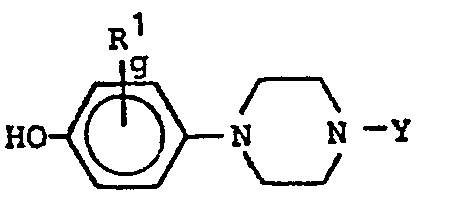
Description
- Die Erfindung betrifft mit Heterocyclen substituierte 2-Azolylmethyl-2-aryl-4-[(4-piperazino-phenoxy)-methyl]-1,3-dioxolane einschließlich ihrer Salze, Verfahren zu ihrer Herstellung, diese Verbindungen enthaltende Arzneimittel und ihre Verwendung insbesondere als Antimykotika.
- Antimykotisch bzw. fungizid wirksame 2-Azolylmethyl-2- aryl-4-[(4-piperazino-phenoxy)-methyl]-1,3-dioxolane sind bereits bekannt und werden u.a. in der DE-OS 2 804 096, und der EP-OS 7696 beschrieben. Die bekanntesten Vertreter aus der großen Zahl der beschriebenen Verbindungen sind 2-S,(R)-(2,4-Dichlorphenyl)-2-(imidazol-l-ylmethyl)-4-R,(S)-(4-(4-acetyl-piperazin-1-yl)-phenoxymethyl]-1,3-dioxolan (Ketoconazol) und 2-S,(R)-(2,4-Dichlorphenyl)-2-(1,2,4-triazol-1-ylmethyl)-4-R,(S)-(4-(4-isopropyl-piperazin-1-yl)-phenoxymethyll-1,3-dioxolan (Terconazol), die als Antimykotika im Handel sind (vgl. DOS 2 804 096, Beispiel 20 und Beispiel 53), wobei Ketoconazol vorwiegend als systemisch wirksames und Terconazol als topisch wirksames Antimykotikum verwendet wird. Die antimykotische Wirkung sowie insbesondere die Verträglichkeit der bekannten Verbindungen sind jedoch nicht immer ganz befriedigend.
- Es wurde nun gefunden, daß 2-Azolylmethyl-2-aryl-4-[(4-piperazino-phenoxy)-methyl]-1,3-dioxolane der Formel

- Ar Naphthyl, Thienyl, Halothienyl oder eine unsubstituierte oder eine bis zu 3 Substituenten tragende Phenylgruppe bedeutet, wobei die Substituenten gleich oder verschieden sein können und Halogen, Trifluormethyl, Ci-C2-Alkyl, CI-C2-Alkoxy oder Phenoxy bedeuten,
- R1 C1-C3-Alkyl, F oder Cl,
- g 0, 1 oder 2,
- Y die folgenden heterocyclischen Reste


- R 5 H oder CN
- R6 H, C1-C4-Alkyl oder eine unsubstituierte oder durch OCH3, F, Cl, CH3 oder C2H5 substituierte Phenylgruppe
- R7 H, Benzyl, CF3 oder CH3,
- R C5-C6-Cycloalkyl oder eine unsubstituierte oder durch OCH3, F, Cl, CH3 oder C2H5 substituierte Phenylgruppe bedeutet und, falls R 5 CN und/oder R7 CF3 bedeutet, R8 auch H bedeuten kann, oder R7 und R8 zusammen -(CH2)4- bedeuten, oder

- R9 H, Methyl oder Ethyl,
- R10 H, CN oder COOR12, wobei R12 Methyl oder Ethyl bedeutet,
- R 11 C1-C4-Alkyl, C1-C4-Alkoxy, Halogen oder Trifluormethyl und
- n 0, 1 oder 2 bedeutet, wobei, falls R11 CF bedeutet, n=l ist, und, falls n≠0, die Reste R11 in 5, 6, 7 oder 8-Stellung des Chinolinsystems stehen können, oder

- R13 H, C1-C4-Alkyl oder eine unsubstituierte oder 1 oder 2 Substituenten tragende Phenylgruppe, wobei die Substituenten gleich oder verschieden sein können und Halogen, Methoxy, Ethoxy, Methyl oder Ethyl bedeuten, bedeutet,
- sowie deren physiologisch verträgliche Säureadditionssalze wertvolle antimykotische bzw. fungizide Eigenschaften besitzen. Sie sind daher zur Bekämpfung von Mykosen bei Mensch und Tier sowie zur Bekämpfung von Pilzbefall bei Pflanzen und auf Werkstoffen geeignet.
- In diesem Zusammenhang ist unter dem Ausdruck "Halothienyl" ein in 2- oder 3-Stellung verknüpfter Thienylrest, der in beliebiger Position mit einem Halogenatom, vorzugsweise Brom oder Chlor, substituiert sein kann, unter den Ausdrücken "C1-C3-, C1-C4- und C1-C8-Alkyl" ein unverzweigter oder verzweigter Kohlenwasserstoffrest mit 1-3, 1-4 oder 1-8 C-Atomen, unter dem Ausdruck "C3-C6- bzw. C5-C6-Cycloalkyl" einen Cyclopropyl-, -butyl-, -pentyl- oder Cyclohexyl- bzw. Cyclopentyl- oder Cyclohexyl-Rest, unter dem Ausdruck "C1-C4-Alkoxy" eine Alkoxygruppe, deren Kohlenwasserstoffrest die unter dem Ausdruck "C1-C4-Alkyl" angegebene Bedeutung hat und unter dem Ausdruck "Halogen" ein F-, Cl-, Br- oder J-Atom zu verstehen.
- Bevorzugt sind diejenigen Verbindungen der Formel I, in denen mindestens einer der Substituenten bzw. Indices die folgende Bedeutung hat:
- A CH oder N,
- Ar eine durch 1 oder 2 F- oder Cl-Atome substituierte Phenylgruppe,
- R1 1 CH3 oder C 2 H 5
- g 0 oder 2 Y
- zu dem heterocyclischen Rest a) R2 C1-C4-Alkyl, eine unsubstituierte oder 1 oder 2 gleiche oder verschiedene Substituenten tragende Phenylgruppe, wobei die Substituenten F, Cl, OCH3, OC2H5, CH3 oder C2H5 bedeuten, oder eine Benzyl- oder eine durch ein F- oder Cl-Atom im Phenylrest substituierte Benzylgruppe,
- R3 C1-C8-Alkyl, C5-C6-Cycloalkyl-C1-C2-alkyl, eine Phenyl- oder Phenyl-C1-C2-alkylgruppe, im Phenylrest jeweils unsubstituiert oder durch 1 oder 2 F, Cl, OCH3 oder CH3 substituiert, oder CF3,
- R4 C1-C4-Alkyl, Benzyl oder
- R3 und R4 zusammen -(CH2)3-, -(CH2)4- oder -CH=CH-CH=CH-, q 0 oder 1
- zu dem heterocyclischen Rest b)
- R 5 H oder CN,
- R 6 H, CH3 oder Phenyl
- R 7 H oder CF 3
- R 8 Phenyl oder durch F, Cl, CH3 oder OCH3 substituiertes Phenyl oder, falls R5 CN und/oder R7 CF3 bedeutet, zusätzlich H und
- R 7 und R8 zusammen -(CH 2)4-
- zu dem heterocyclischen Rest c)
- R 9 H
- R 10 CN, COOCH3 oder COOC 2 H 5,
- R11 C1-C4-Alkyl, C1-C4-Alkoxy, F, Cl, Br oder CF 3
- n 0, 1 oder 2, wobei falls R11 CF3 bedeutet n=1 ist und, falls n ungleich 0 ist, R11 in 5, 6, 7 oder 8-Stellung stehen kann,
- zu dem heterocyclischen Rest d)
- R13 H, C1-C4-Alkyl oder eine unsubstituierte oder durch 1 oder 2 F, Cl, OCH3 oder CH3 substituierte Phenylgruppe.
- Besonders bevorzugt sind Verbindungen der Formel I, in denen mindestens einer der Substituenten bzw. Indizes die folgende Bedeutung hat:
- A CH oder N
- Ar 2,4-Dichlorphenyl
- R1 CH 3
- g 0 oder 2
- Y
- zu den heterocyclischen Resten a)
- R2 eine unsubstituierte oder 1 oder 2 gleiche oder verschiedene Substituenten tragende Phenylgruppe, wobei die Substituenten Cl, OCH3, OC2H5 oder CH3 bedeuten, eine Benzyl- oder eine Chlorbenzylgruppe,
- R3 C1-C8-Alkyl, C5-C6-Cycloalkyl-C1-C2-alkyl, eine Phenyl- oder Phenyl-C1-C2-alkylgruppe, im Phenylrest jeweils unsubstituiert oder durch 1 oder 2 F, Cl, OCH3 oder CH3 substituiert,
- R C1-C4-Alkyl, Benzyl oder
- R3 und R4 zusammen -(CH2)3-, -(CH2)4- oder -CH=CH-CH=GH-,
- q 0 oder 1,
- zu dem heterocyclischen Rest b)
- R 5 H oder CN,
- R6 H oder CH 3,
- R 7 H oder CF3,
- R8 Phenyl oder durch Cl oder OCH3 substituiertes Phenyl oder, falls R5 CN und/oder R CF3 bedeutet, zusätzlich H,
- zu dem heterocyclischen Rest c)
- R 9 H,
- R10 CN, COOCH3 oder COOC2H5,
- R11 CH3, C2H5, OCH3, OC2H5, F, Cl, Br oder CF 3,
- n 0, 1 oder 2, wobei, falls R11 GF3 bedeutet, n=1 ist und, falls n ungleich 0 ist, R11 in 5-, 6-, 7- oder 8-Stellung stehen kann,
- zu dem heterocyclischen Rest d)
- R13 eine unsubstituierte oder durch 1 oder 2 F, Cl, OCH3 oder CH3 substituierte Phenylgruppe.
- Die Erfindung betrifft weiterhin die möglichen Stereoisomeren der Formel I, sowohl als Diastereomeren-Racemate wie auch als reine Enantiomere, sowie ihre pharmazeutisch akzeptablen Salze. Insbesondere betrifft das die wegen der 2,4-Disubstitution des 1,3-Dioxolan-Rings möglichen Stereoisomeren; die 2-Azolylmethyl-Gruppe kann zum 4-ständigen Substituenten, der substituierten Phenoxymethyl-Gruppe, cis- oder trans-ständig angeordnet sein. Die cis-Isomeren zählen zu den bevorzugten erfindungsgemäßen Verbindungen.
- Als Salze der erfindungsgemäßen Verbindungen der Formel I kommen solche mit physiologisch unbedenklichen anorganischen und organischen Säuren, wie beispielsweise Chlor-, Brom- oder Jodwasserstoff-, Schwefel-, Phosphor-, Salpeter-, Benzolsulfon-, Toluolsulfon-, Sulfamin-, Methylschwefel-, Essig-, Propion-, Oel-, Palmitin-, Stearin, Malon-, Malein-, Bernstein-, Glutar-, Aepfel-, Wein-, Zitronen-, Fumar-, Milch-, Glykol-, Brenztrauben-, Benzoe-, Toluyl-, Glutamin-, Furancarbon-, Salicyl- oder Mandelsäure in Betracht. Bevorzugt werden Salze mit physiologisch verträglichen anorganischen Säuren, stark bis mittelstark sauren Derivaten solcher Säuren oder mit Fumarsäure.
- Von den bekannten, gegen Pilze und Bakterien wirksamen, oben erwähnten Azolylmethyl-2-aryl-4-[(4-piperazino-phenoxy)-methyl]-1,3-dioxolanen unterscheiden sich die erfindungsgemäßen Verbindungen wesentlich durch die Art der Substituenten an der Piperazinophenoxymethyl-Einheit in der 4-Stellung des Dioxolanrings sowie durch die wahlweise vorhandene zusätzliche Substitution des Phenylrings der 4-ständigen Phenoxygruppe. Von den teilweise ähnlichen, in der EP-A 7 696 erwähnten Verbindungen unterscheiden sich die erfindungsgemäßen Verbindungen entweder durch die Art und Stellung der Substituenten an den Heterocyclen oder durch die andersartige Struktur der an dem Piperazinring gebundenen heterocyclischen Reste.
- Überraschenderweise zeigen die erfindungsgemäßen 2-Azolyl-2-aryl-4-[(4-piperazino-phenoxy)-methyll-1,3-dioxolane eine breitere und bessere antimykotische Wirkung als die bekannten 2-Azolylmethyl-2-aryl-1,3-dioxolan-Derivate und als das bekannte 2-S,(R)-(2,4-Dichlorphenyl)-2-(imidazol- l-ylmethyl)-4-R,(S)-[4-(4-acetylpiperazin-l-yl)-phenoxymethyl]-1,3-dioxolan (Ketoconazol).
- Die Erfindung betrifft weiterhin ein Verfahren zur Herstellung der Verbindungen der Formel I und ihrer Salze, das dadurch gekennzeichnet ist, daß man
- A) eine Verbindung der Formel II,


- B) eine Verbindung der Formel IV,


- C) eine Verbindung der Formel VII,


- D) eine Verbindung der Formel IX,


- In diesem Zusammenhang ist unter dem Ausdruck "Acyloxy" ein geradkettiger oder verzweigter C1-C4-Alkanoyloxy-Rest oder ein im Phenylkern unsubstituierter oder mit bis zu 2 gleichen oder verschiedenen Substituenten substituierter Benzoyloxy-Rest zu verstehen, wobei die Substituenten CH3, OCH3, F, Cl, oder Br bedeuten können, und unter dem Ausdruck "Arylsulfonyloxy" ein unsubstituierter oder ein mit einem Cl, Br, CH3,C2H5, OCH3, OC2H5 oder N02 substituierter Phenylsulfonyloxy- oder ein Naphthylsulfonyloxy-Rest zu verstehen.
- Zur Umsetzung mit einer Verbindung der Formel IX werden bevorzugt verwendet entweder
- a) eine Verbindung der Formel Xa1 oder der Formel Xa2

- b) eine Verbindung der Formel Xb,


- c) eine Verbindung der Formel Xc,

- d) eine Verbindung der Formel Xd,

- Besonders bevorzugt für die Umsetzung mit einer Verbindung der Formel IX sind diejenigen Verbindungen der Formeln Xal, Xb, Xc, und Xd, bei denen E" Cl bedeutet.
- Die Verfahrens-Variante A), wobei bei den Verbindungen der Formel II E bevorzugt Cl, Br, Acetoxy, Trifluoracetoxy, Methansulfonyloxy oder (subst.) Phenylsulfonyloxy bedeutet, wird bei einer Temperatur zwischen 20°C und 180°C, vorteilhaft zwischen 40°C und 120°C, in Anwesenheit einer Base und zweckmäßig in einem inerten organischen Lösungsmittel, wie beispielsweise N,N-Dimethylformamid, N,N-Dimethylacetamid, Dimethylsulfoxid, N-Methylpyrrolidon-2, 1,2-Dimethoxyethan, Dioxan, Tetrahydrofuran, 4-Methyl-2-pentanon, Methanol, Ethanol, Isopropylalkohol, Propanol, Butanol, Pentanol, Tert.-Butylalkohol, Methylglykol, Methylenchlorid, Acetonitril oder einem aromatischen Kohlenwasserstoff wie Benzol, Chlorbenzol, Toluol oder Xylol durchgeführt. Es können auch Gemische der beispielhaft genannten Lösungsmittel verwendet werden.
- Geeignete Basen sind beispielsweise Alkalimetall- oder Erdalkalimetall-carbonate, -hydrogencarbonate, -hydroxide, -amide, -alkoholate oder -hydride wie z.B. Natriumcarbonat, Natriumhydrogencarbonat, Kaliumcarbonat, Natriumhydroxid, -amid oder -methylat, Kalium-t-butylat oder Natriumhydrid, oder organische Basen, z.B. tertiäre Amine wie Triethylamin, Tributylamin, Ethylmorpholin oder Pyridin, Dimethylaminopyridin, Chinolin oder 1,5-Diazabicyclo-[5,4,0]undec-5-en (DBU).
- Die Umsetzung kann ebenso unter den Bedingungen einer Phasentransferreaktion ausgeführt werden, indem man die Reaktionspartner in einem geeigneten Lösungsmittel, wie z.B. Ether, Dioxan, Tetrahydrofuran, Methylenchlorid, N,N-Dimethylform- oder -acetamid, N-Methylpyrrolidon-(2), Butanol, tert.-Butanol, einem aliphatischen, cycloaliphatischen oder aromatischen Kohlenwasserstoff wie Hexan, Cyclohexan, Benzol, Toluol oder Xylol, Methylglykol, Anisol oder Chlorbenzol unter kräftigem Rühren in Gegenwart eines Phasentransferkatalysators und entweder einem gepulverten Alkalihydroxid, wie z. B. Natrium- oder Kaliumhydroxid oder einer konzentrierten wäßrigen Lösung derselben, vorzugsweise in einem Temperaturbereich von 20°C bis 120°C aufeinander einwirken läßt.
- Geeignete Phasentransferkatalysatoren sind z.B. Trialkylbenzylammonium- oder Tetraalkylammonium-halogenide, -hydroxide, -hydrogensulfate mit vorzugsweise 1 bis 12 C-Atomen im Alkylrest oder Kronenether, wie z.B. 12-Crown-4, 15-Crown-5, 18-Crown-6 oder Dibenzo-18-crown-6.
- Herstellung der Ausgangsstoffe:
- Die Ausgangsverbindungen der Formel II, in der Ar und A die zu Formel I angegebenen Bedeutungen haben, sind teilweise bekannt; die nicht bekannten können in Analogie zu den bekannten hergestellt werden.
- Die Verfahrens-Variante B), wobei eine Verbindung der Formel IV, in der E bevorzugt Br, J oder Trifluoracetyloxy, Methansulfonyloxy, Benzol-, Nitrobenzol-, Brombenzol- oder Toluolsulfonyloxy und E' bevorzugt Cl oder Br bedeuten, mit einer Verbindung der Formel III, in der M, R1, g und Y die angegebenen Bedeutungen haben, unter Bildung einer Verbindung der Formel V umgesetzt wird, wird unter den gleichen Reaktionsbedingungen wie bei Variante A zur Herstellung von Verbindungen der Formel I angegeben durchgeführt.
- Die Herstellung von Verbindungen der Formel I durch Umsetzung von Verbindungen der Formel V mit Verbindungen der Formel VI erfolgt zweckmäßig in einem inerten Lösungsmittel in Gegenwart einer Base, wie zum ersten Herstellverfahren vorstehend angegeben, vorzugsweise in einem Temperaturbereich von 100 bis 190°C. Die Umsetzung erfolgt zweckmäßigerweise in Anwesenheit eines Alkalijodides wie z.B. Natrium- oder Kaliumjodid, gegebenenfalls in einem Autoklaven unter Druck.
- Die vorstehend beschriebenen Umsetzungen können zweckmäßig als Eintopfreaktion durchgeführt werden, indem man zunächst bei 40 bis 100°C eine Verbindung der Formel VI mit einer Verbindung der Formel III in Gegenwart einer Base in einem inerten Lösungsmittel umsetzt. Anschliessend wird ohne Isolierung der Verbindung der Formel V eine Verbindung der Formel VI und gegebenenfalls ein weiteres Moläquivalent einer Base und ein Alkalijodid (z.B. Kaliumjodid) zugegeben und auf 100 bis 190°C erhitzt.
- Herstellung der Ausgangsstoffe:
- Verbindungen der Formel IV, in der E und E' die zur Formel II für E angegebenen Bedeutungen haben, sind bekannt. Sie werden hergestellt, indem man die Hydroxymethylgruppe in einer Verbindung der Formel

- XI in üblicher Weise in eine reaktionsfähige Estergruppe überführt. So werden z.B. die Verbindungen der Formel IV, in der E' bevorzugt Cl oder Br und E Methansulfonyloxy bedeuten, hergestellt, indem man eine Verbindung der Formel XI, in der Ar die zu Formel I angegebenen Bedeutungen hat und E' Cl oder Br bedeuten, mit Methansulfochlorid bei -10°C bis +50°C zweckmäßig in einem inerten Lösungsmittel, in Gegenwart einer Base umsetzt. Verbindungen der Formel IV, in der E beispielsweise Brom bedeutet, werden durch Umsetzung von Verbindungen der Formel XI (E' = Cl oder Br) mit Bromierungsmitteln, wie z.B. PBr3 oder POBr3 in einem inerten Lösungsmittel bei 0°C bis 100°C hergestellt. Derartige Verbindungen können auch hergestellt werden, indem man eine Verbindung der Formel XII,

- in der E' Cl oder Br bedeutet und Ar die angegebenen Bedeutungen hat, mit 1-Brom-2,3-propandiol in einem inerten Lösungsmittel in Gegenwart einer starken Säure unter Bildung eines 1,3-Dioxolans nach für derartige Ketalisierungen bekannten Methoden umsetzt.
- Die Verbindungen der Formel XI sind bekannt.
- Die Verfahrens-Variante C), wobei man eine Verbindung der Formel VII mit einer Verbindung der Formel VIII unter Bildung einer Verbindung der Formel I umsetzt, wird im allgemeinen unter den gleichen Bedingungen durchgeführt, wie die Herstellung von Verbindungen der Formel IV (Variante B). Die Ketalisierung von Ketonen der Formel VII mit Glycerin-Derivaten der Formel VIII erfolgt vorteilhaft in einem Lösungsmittelgemisch, bestehend aus einem inerten Lösungsmittel, das mit Wasser ein azeotropes Gemisch bildet, wie z.B. Benzol, Toluol, Xylol, Chlorbenzol oder Cyclohexan, und einem Alkohol, in Anwesenheit einer starken Säure in einem Temperaturbereich von 75 bis 180°C. Vorteilhaft werden bei dieser Ketalisierung mindestens 2,5 Äquivalente einer starken Säure (bez. auf die Azolverbindung der Formel VII) und als Alkohole aliphatische Alkohole mit einem Kp zwischen 75° und 150°C und/oder Monoether von niederen Diolen, die zwischen 100° und 150°C sieden, verwendet.
- Herstellung der Ausgangsstoffe:
- Die Verbindungen der Formel VII sind bekannt und können nach bekannten Methoden hergestellt werden.
- Verbindungen der Formel VIII, in der R , g und Y die zu Formel I angegebenen Bedeutungen haben, werden durch Umsetzung von Verbindungen der Formel III mit 1-Halogen-2,3-propandiol hergestellt, in analoger Weise wie in Org. Synth. Collect. Vol. I, S. 296 beschrieben.
- Bei der Verfahrens-Variante D) wird eine Verbindung der Formel IX mit einer heterocyclischen Verbindung der Formel X, bevorzugt mit einer heterocyclischen Verbindung entweder der Formel xa1 oder Xa2 oder der Formel Xb, Xc oder Xd, in denen E" jeweils die angegebenen Bedeutungen hat, zweckmäßig in einem inerten organischen Lösungsmittel in einem Temperaturbereich von 20° bis 180°C, vorzugsweise von 50° bis 120°C, umgesetzt. Diese Umsetzung wird vorteilhaft in Gegenwart einer Base, die vorzugsweise in äquimolarer Menge angewandt wird, durchgeführt.
- Die Synthese von Verbindungen der Formel I aus den Verbindungen der Formeln IX und X kann auch ohne Basenzusatz ausgeführt werden. Die Reaktanten der Formeln IX und X können in unterschiedlichen Molverhältnissen angewendet werden, d.h. es können entweder jeweils die Verbindungen der Formel IX oder diejenigen der Formel X im Überschuß angewandt werden, vorteilthaft werden äquimolare Mengen angewendet.
- Als Lösungsmittel kommen beispielsweise Kohlenwasserstoffe, allgemein Ether wie Diethylether, 1,2-Dimethoxyethan, Tetrahydrofuran oder Dioxan, oder Acetonitril, Butyronitril, Dimethylform- oder -acetamid, Aceton, 4-Methyl-2-pen- tanon, Methylenchlorid, Chloroform, Dimethylsulfoxid, Anisol, Chlorbenzol, Tetrachlorethen oder Gemische dieser Lösungsmittel in Frage.
- Geeignete Basen sind die beispielhaft bei der Verfahrens- Variante A) erläuterten.
- Die Umsetzung kann ebenso unter den Bedingungen einer Phasentransferreaktion, wie sie bei der Beschreibung der Verfahrens-Variante A) erläutert sind, ausgeführt werden.
- Herstellung der Ausgangsstoffe:
- Die Verbindungen der Formel IX sind z.T. bekannt (vgl. DOS 2 804 096, z.B. Beispiel 21); solche, die von den bekannten abweichende Bedeutungen für Ar haben und/oder bei denen g 1 oder 2 bedeutet, können in Analogie zu den bekannten (vgl. DOS 2 804 096) hergestellt werden.
- Die Verbindungen der Formel X, in der E" und Y die angegebenen Bedeutungen haben, sind teilweise bekannt. Das trifft vor allem für Verbindungen der Formel X mit E" = Cl zu.
- Sofern die Substituenten an den heterocyclischen Verbindungen Xal, Xb, Xc und Xd von bekannten Verbindungen abweichen und es sich bei den Substituenten um weitgehend inerte, also unempfindliche handelt, können diese Verbindungen der Formeln Xa1-Xd, in denen die Substituenten R2- R13 und n die angegebenen Bedeutungen haben, in Analogie zu den bekannten Verbindungen dieser Strukturen hergestellt werden.
- Die Verbindungen Xa2 mit q=0 oder 1 und R2 wie zu Formel I angegeben, werden aus Verbindungen der Formel XI,

- Verbindungen der Formel Xc, in der R10 COOR12 und E" z.B. Cl bedeuten, werden ebenfalls gemäß den zur Herstellung von Verbindungen der Formel Xc üblichen Methoden, nämlich durch Umsetzung von Verbindungen der Formel XII,

- Verbindungen der Formeln Xa1 und Xd, in denen E" OCH3 bedeutet, werden aus entsprechenden Verbindungen der Formeln Xa1 und Xd, in denen E" z. B. Cl bedeutet, durch Umsetzung mit Methanol oder mit Methanol plus bis zu einem Äquivalent Alkalimethanolat hergestellt. Als Alkalimetalle werden Li, Na oder K verwendet.
- Die Reaktionszeiten betragen je nach Verfahrensvariante und je nach Temperaturbereich wenige Minuten bis einige Stunden.
- Falls erforderlich, kann eine Reinigung der Verfahrenserzeugnisse durch Umkristallisation aus einem geeigneten Lösungsmittel oder Lösungsmittelgemisch oder durch Säulenchromatographie an Kieselgel erfolgen.
- Die diastereomeren Racemate (cis- oder trans-Form) der Verbindungen der Formel I können in üblicher Weise, z.B. durch selektive, fraktionierte Kristallisation oder Säulenchromatographie getrennt werden.
- Da die stereochemische Konfiguration bereits in den Zwischenprodukten der Formel II vorgegeben ist, kann die Trennung in die cis- und trans-Form bereits auf dieser Stufe oder noch früher, beispielsweise auf der Stufe der Zwischenprodukte der allgemeinen Formel IV, oder bei den Zwischenprodukten der Formel IX erfolgen.
- Die cis- und trans-diastereomeren Racemate können ihrerseits in üblicher Weise in ihre optischen Antipoden cis(+), cis(-) bzw. trans(+) und trans(-) getrennt werden.
- Bevorzugt werden zur Herstellung von Verbindungen I die Verfahrens-Varianten A, B und D angewendet.
- Die Erfindung betrifft weiterhin Verbindungen der Formel IIIa,

- R1 C1-C3-Alkyl, F oder Cl,
- g 0, 1 oder 2 und
- Y die folgenden heterocyclischen Reste

- R2 C1-C4-Alkyl, eine unsubstituierte oder 1 oder 2 Substituenten tragende Phenylgruppe, wobei die Substituenten gleich oder verschieden sein können und Halogen, Trifluormethyl, Methoxy, Ethoxy, Nitro oder C1-C4-Alkyl bedeuten, oder eine unsubstituierte oder eine im Phenylrest 1 oder 2 Substituenten tragende Phenyl-Cl-C2-alkylgruppe, wobei die Substituenten gleich oder verschieden sein können und F, Cl, Methoxy-, Ethoxy- oder C1-C3-Alkyl bedeuten,
- R3 H, C1-C8-Alkyl, C3-C6-Cycloalkyl-C1-C3-alkyl, eine unsubstituierte oder 1 oder 2 Substituenten tragende Phenylgruppe, wobei die Substituenten gleich oder verschieden sein können und Halogen, Methoxy-, Ethoxy oder C1-C3-Alkyl bedeuten, eine unsubstituierte oder im Phenylrest durch Methoxy, 1,2-Methylendioxy, F, Cl oder Cl-C3-Alkyl substituierte Phenyl-C1-C2-alkylgruppe, oder Trifluormethyl,
- R4 H, C1-C4-Alkyl oder Benzyl, oder R und R zusammen -(CH2)r-, wobei r=3 oder 4 ist, oder -CH=CH-CH=CH-, q 0 oder 1 bedeutet, oder

- R 5 H oder CN
- R6 H, C1-C4-Alkyl oder eine unsubstituierte oder durch OCH3, F, Cl, CH3 oder C2H5 substituierte Phenylgruppe,
- R7 H, Benzyl oder CF3,
- R C5-C6-Cycloalkyl oder eine unsubstituierte oder durch OCH3, F, Cl, CH3 oder C2H5 substituierte Phenylgruppe bedeuten und, falls R5 CN und/oder 7 R7 CF3 bedeutet, R8 auch H bedeuten kann, oder R und R zusammen -(CH2)4- bedeuten, oder

- R10 H, CN oder COOR12, wobei R12 Methyl oder Ethyl bedeutet,
- R11 C1-C4-Alkyl, C1-C4-Alkoxy, Halogen oder Trifluormethyl und
- n 0, 1 oder 2 bedeuten, wobei, falls R11 CF3 bedeutet, n=1 ist, und, falls n ungleich 0, die Reste R 11 in 5-, 6-, 7- oder 8-Stellung des Chinolinsystems stehen können, oder

- R13 H, C1-C4-Alkyl oder eine unsubstituierte oder 1 oder 2 Substituenten tragende Phenylgruppe, wobei die Substituenten gleich oder verschieden sein können und Halogen, Methoxy, Ethoxy, Methyl oder Ethyl bedeuten, sowie deren Säureadditionssalze.
- Bevorzugt werden Verbindungen der Formel IIIa, bei denen mindestens einer der Substituenten oder Indices R1, g, Y, R2-R13, q und n die folgenden Bedeutungen hat:
- R1 CH3 oder C 2 H 5
- g 0 oder 2
- Y
- zu dem heterocyclischen Rest a)
- R C1-C4-Alkyl, eine unsubstituierte oder 1 oder 2 gleiche oder verschiedene Substituenten tragende Phenylgruppe, wobei die Substituenten F, Cl, OCH3, OC2H5, CH3 oder C2H5 bedeuten, oder eine Benzyl- oder eine durch ein F- oder Cl-Atom im Phenylrest substituierte Benzylgruppe,
- R3 C1-C8-Alkyl, C5-C6-Cycloalkyl-C1-C2-alkyl, eine Phenyl- oder Phenyl-C1-C2-alkylgruppe, im Phenylrest jeweils unsubstituiert oder durch 1 oder 2 F, Cl, OCH3 oder CH3 substituiert, oder CF3,
- R4 C1-C4-Alkyl, Benzyl oder
- Rund R4 zusammen -(CH2)3-, -(CH2)4- oder -CH=CH-CH=CH-, q 0 oder 1
- zu dem heterocyclischen Rest b)
- R 5 H oder CN,
- R 6 H, CH3 oder Phenyl
- R7 H, CH3 oder CF 3
- R 8 H, CH3, C5-C6-Cycloalkyl, Phenyl oder durch F, Cl oder OCH3 substituiertes Phenyl und/oder falls R5 CN und/oder R7 CF3 bedeutet, R8 auch H oder
- R 7 und R8 zusammen -(CH 2)4-
- zu dem heterocyclischen Rest c)
- R9 H
- R 10 CN, COOCH3 oder COOC2H5,
- R11 C1-C4-Alkyl, C1-C4-Alkoxy, F, Cl, Br oder CF 3
- n 0, 1 oder 2, wobei falls R11 CF3 bedeutet, n=1 ist und, falls n ungleich 0 ist, R11 in 5-, 6-, 7- oder 8-Stellung stehen kann,
- zu dem heterocyclischen Rest d)
- R13 H, C1-C4-Alkyl oder eine unsubstituierte oder durch 1 oder 2 F, Cl, OCH3 oder CH3 substituierte Phenylgruppe
- Besonders bevorzugte Verbindungen der Formel IIIa sind solche, bei denen mindestens einer der Substituenten oder Indices bedeutet:
- R1 CH 3
- g 0 oder 2
- Y
- zu den heterocyclischen Resten a)
- R 2 eine unsubstituierte oder 1 oder 2 gleiche oder verschiedene Substituenten tragende Phenylgruppe, wobei die Substituenten Cl, OCH3, OC2H5 oder CH3 bedeuten, eine Benzyl- oder eine Chlorbenzylgruppe,
- R3 C1-C8-Alkyl, C5-C6-Cycloalkyl-C1-C2-alkyl, eine Phenyl- oder Phenyl-C1-C2-alkylgruppe, im Phenylrest jeweils unsubstituiert oder durch 1 oder 2 F, Cl, OCH3 oder CH3 substituiert,
- R4 C1-C4-Alkyl, Benzyl oder
- R3 und R4 zusammen -(CH2)3-, -(CH2)4- oder -CH=CH-CH=CH-,
- q 0 oder 1,
- zu dem heterocyclischen Rest b)
- R 5 H oder CN,
- R 6 H, CH3 oder C2H5,
- R 7 H oder CF3,
- R 8 C5-C6-Cycloalkyl, Phenyl oder durch Cl oder OCH3 substituiertes Phenyl oder, falls R5 CN und/oder R7 CF3 bedeutet, zusätzlich H,
- zu dem heterocyclischen Rest c)
- R 9 H,
- R10 CN, COOCH3 oder COOC2H5,
- R11 CH3, C2H5, OCH3, OC2H5, F, Cl, Br oder CF3,
- n 0, 1 oder 2, wobei, falls R11 CF3 bedeutet, n=1 ist und, falls n ungleich 0 ist, R11 in 5-, 6-, 7- oder 8-Stellung stehen kann,
- zu dem heterocyclischen Rest d)
- R13 eine unsubstituierte oder durch 1 oder 2 F, Cl, OCH3 oder CH3 substituierte Phenylgruppe.
- Die Verbindungen der Formel IIIa, in denen R1, g und Y die angegebenen Bedeutungen haben, sind neu und stellen wertvolle Zwischenprodukte zur Herstellung der stark antimykotisch sowie fungizid wirkenden Verbindungen der Formel I dar. Ein Teil der Verbindungen der Formel IIIa wirkt ebenfalls antimykotisch sowie fungizid. Ein Teil der Verbindungen der Formel IIIa zeigt darüberhinaus pharmakologische Wirkungen, so z.B. Wirkungen auf das Herz-Kreislaufsystem u.a. durch günstige Beeinflussung des Blutdrucks.
- Die Erfindung betrifft außerdem ein Verfahren zur Herstellung von Verbindungen der Formel IIIa, das dadurch gekennzeichnet ist, daß man eine Verbindung der Formel XIII,


- Bevorzugt verwendet werden für die erfindungsgemäße Umsetzung mit Verbindungen der Formel XIII entweder
- a) eine Verbindung der Formel Xa1 oder der Formel Xa2,

- b) eine Verbindung der Formel Xb,


- c) eine Verbindung der Formel Xc,

- d) eine Verbindung der Formel Xd,

- Das erfindungsgemäße Verfahren zur Herstellung von Verbindungen der Formel IIIa wird zweckmäßig in einem inerten organischen Lösungsmittel in einem Temperaturbereich von 20° bis 180°C, vorzugsweise von 50° bis 120°C, vorteilhaft in Gegenwart einer Base, die vorzugsweise in äquivalenter Menge angewandt wird, durchgeführt. Werden für das Verfahren Salze der Verbindungen der Formel XIII verwandt, dann wird die dem Salzanteil entsprechende stöchiometrische Menge an Base zugesetzt. Wahlweise kann darüber hinaus dann ein weiterer Anteil an Base angewandt werden. Die Synthese von Verbindungen der Formel IIIa aus den Verbindungen-der Formeln XIII und X kann, sofern die Verbindungen XIII nicht als Salz angewandt werden, auch ohne Basenzusatz ausgeführt werden. Die Reaktanten der Formeln XIII und X können in unterschiedlichen Molverhältnissen angewandt werden, d.h. es können entweder jeweils die Verbindungen der Formel XIII oder diejenigen der Formel X im Überschuß angewandt werden, vorteilhaft werden äquimolare Mengen angewandt.
- Als Lösungsmittel kommen beispielsweise Kohlenwasserstoffe, allgemein Ether, wie Diethylether, 1,2-Dimethoxyethan, Tetrahydrofuran oder Dioxan, oder Acetonitril, Butyronitril, Dimethylform- oder -acetamid, Aceton, 4-Methyl-2-pentanon, Methylenchlorid, Chloroform, Dimethylsulfoxid, Anisol, Chlorbenzol, Tetrachlorethen oder Gemische dieser Lösungsmittel in Frage.
- Geeignete Basen sind die beispielhaft bei der Verfahrens- Variante A) erläuterten.
- Die Reaktionszeiten betragen je nach Temperaturbereich wenige Minuten bis einige Stunden.
- Falls erforderlich, kann eine Reinigung der Verfahrenserzeugnisse durch Umkristallisation aus einem geeigneten Lösungsmittel oder Lösungsmittelgemisch oder durch Säulenchromatographie an Kieselgel erfolgen.
- Herstellung der Ausgangsstoffe:
- Die Verbindung der Formel XIII mit g=0 ist bekannt. Verbindungen der Formel XIII, bei denen g 1 oder 2 bedeutet und R die zu Formel I angegebenen Bedeutungen hat, werden in Analogie zu den bekannten Verbindungen durch Umsetzung von entsprechenden 4-Methoxy-Anilinen mit Bis-(2-Chlorethyl)-amin und anschließender Phenolether-Spaltung mit konz. wäßriger Bromwasserstoffsäure hergestellt. Die Herstellung der Verbindungen der Formel X, in der E" und Y die angegebenen Bedeutungen haben, sofern sie nicht bekannt sind, ist bereits bei Verfahrensvariante D) beschrieben.
- Die Verbindungen der Formel I und ihre Säureadditionssalze sind wertvolle Arzneimittel. Sie wirken antimikrobiell und eignen sich insbesondere zur Vorbeugung und Behandlung von Pilzinfektionen beim Menschen und bei verschiedenen Säugetierarten.
- Die neuen Verbindungen sind in vitro sehr gut wirksam gegen Hautpilze, wie z.B. Trichophyton mentagrophytes, Microsporum canis, Epidermophyton floccosum; gegen Schimmelpilze, wie z.B. Aspergillus niger oder gegen Hefen, wie z.B. Candida albicans, C. tropicalis, Torulopsis glabrata und Trichosporon cutaneum oder gegen Protozoen wie Trichomonas vaginalis oder T. fetus, oder auch gegen grampositive und gramnegative Bakterien.
- Auch in vivo, z.B. bei der experimentellen Nierencandidose der Maus, besitzen die Verbindungen nach oraler oder parenteraler Anwendung einen sehr guten systemischen Effekt, z.B. gegen Candida albicans. Ebenso besteht ein sehr guter Effekt gegen verschiedene Erreger der Hautmykosen (z.B. Trichophyton mentagrophytes) am Meerschweinchen nach oraler, parenteraler oder lokaler Anwendung.
- Als Indikationsgebiete in der Humanmedizin können beispielsweise genannt werden:
- Dermatomykosen und Systemmykosen durch Trichophyton mentagrophytes und andere Trichophytonarten, Mikrosporonarten, Epidermophyton floccosum, Sproßpilze und biphasische Pilze sowie Schimmelpilze hervorgerufen.
- Als Indikationsgebiete in der Tiermedizin können beispielsweise aufgeführt werden:
- Alle Dermatomykosen und Systemmykosen, insbesondere solche, die durch die oben genannten Erreger hervorgerufen werden.
- Zur vorliegenden Erfindung gehören pharmazeutische Zubereitungen, die neben nicht toxischen, inerten pharmazeutisch geeigneten Trägerstoffen einen oder mehrere erfindungsgemäße Wirkstoffe enthalten oder die aus einem oder mehreren erfindungsgemäßen Wirkstoffen bestehen sowie Verfahren zur Herstellung dieser Zubereitungen.
- Unter nicht toxischen, inerten pharmazeutisch geeigneten Trägerstoffen sind feste, halbfeste oder flüssige Verdünnungsmittel, Füllstoffe und Formulierungshilfsmittel jeder Art zu verstehen.
- Als Darreichungsformen kommen beispielsweise Tabletten, Dragees, Kapseln, Pillen, wäßrige Lösungen, Suspensionen und Emulsionen, gegebenenfalls sterile injizierbare Lösungen, nichtwäßrige Emulsionen, Suspensionen und Lösungen, Salben, Cremes, Pasten, Lotions, Sprays etc. in Betracht. Die therapeutisch wirksamen Verbindungen sollen in den oben aufgeführten pharmazeutischen Zubereitungen zweckmäßig in einer Konzentration von etwa 0,01 bis 99,0, vorzugsweise von etwa 0,05 bis 50 Gew.-% der Gesamtmischung vorhanden sein.
- Die oben aufgeführten pharmazeutischen Zubereitungen können außer den erfindungsgemäßen Wirkstoffen auch weitere pharmazeutische Wirkstoffe enthalten.
- Die Herstellung der oben aufgeführten pharmazeutischen Zubereitungen erfolgt in üblicher Weise nach bekannten Methoden, z.B. durch Mischen des oder der Wirkstoffe mit dem oder den Trägerstoffen.
- Zur vorliegenden Erfindung gehört auch die Verwendung der erfindungsgemäßen Wirkstoffe sowie von pharmazeutischen Zubereitungen, die einen oder mehrere erfindungsgemäße Wirkstoffe enthalten, in der Human- und Veterinärmedizin zur Verhütung, Besserung und/oder Heilung der oben angeführten Erkrankungen.
- Die Wirkstoffe oder die pharmazeutischen Zubereitungen können lokal, oral, parenteral, intraperitoneal und/oder rectal appliziert werden.
- Im allgemeinen hat es sich sowohl in der Human- als auch in der Veterinärmedizin als vorteilhaft erwiesen, den oder die erfindungsgemäßen Wirkstoffe in Gesamtmengen von etwa 0,05 bis etwa 200, vorzugsweise 0,1 bis 100, insbesondere 0,5 bis 30 mg/kg Körpergewicht je 24 Stunden, gegebenenfalls in Form mehrerer Einzelgaben zur Erzielung der gewünschten Ergebnisse zu verabreichen. Die Gesamtmenge wird in 1 bis 8, vorzugsweise in 1 bis 3 Einzeldosen verabreicht.
- Es kann jedoch erforderlich sein, von den genannten Dosierungen abzuweichen und zwar in Abhängigkeit von der Art und dem Körpergewicht des zu behandelnden Objekts, der Art und der Schwere der Erkrankung, der Art der Zubereitung und der Applikation des Arzneimittels sowie dem Zeitraum bzw. Intervall, innerhalb welchem die Verabreichung erfolgt. So kann es in einigen Fällen ausreichend sein, mit weniger als der oben genannten Menge Wirkstoff auszukommen, während in anderen Fällen die oben angeführte Wirkstoffmenge überschritten werden muß. Die Festlegung der jeweils erforderlichen optimalen Dosierung und Applikationsart der Wirkstoffe kann durch jeden Fachmann aufgrund seines Fachwissens leicht erfolgen.
- Die neuen Verbindungen der Formel I eignen sich auch zur Behandlung von Protozoenerkrankungen beim Menschen und Tier wie sie z. B. durch Infektion mit Trichomonas vaginalis und Entamoeba histolytica sowie durch Trypanosoma cruzi und leishmania donovani hervorgerufen werden.
- Die neuen Verbindungen können oral oder lokal angewendet werden. Die orale Anwendung erfolgt in pharmazeutisch üblichen Zubereitungen, z. B. in Form von Tabletten oder Kapseln.
- Die Verbindungen der Formel I sind auch als Biozide wirksam. Sie zeichnen sich insbesondere durch ihre fungizide Wirksamkeit bei phytopathogenen Pilzen aus. Selbst bereits in das pflanzliche Gewebe eingedrungene pilzliche Krankheitserreger lassen sich erfolgreich bekämpfen. Dies ist besonders wichtig und vorteilhaft bei solchen Pilzkrankheiten, die nach eingetretener Infektion mit den sonst üblichen Fungiziden nicht mehr wirksam bekämpft werden können. Das Wirkungsspektrum der neuen Verbindungen erfaßt eine Vielzahl verschiedener phytopathogener Pilze, wie z.B. Piricularia oryzae, Plasmopara viticola, verschiedene Rostarten, vor allem aber Venturia inaequalis, Cercospora beticola und echte Mehltaupilze im Obst-, Gemüse-, Getreide- und Zierpflanzenbau.
- Die neuen Verbindungen der Formel I eignen sich ferner für den Einsatz in technischen Bereichen, beispielsweise als Holzschutzmittel, als Konservierungsmittel in Anstrichfarben, in Kühlschmiermitteln für die Metallbearbeitung oder als Konservierungsmittel in Bohr- und Schneidölen.
- Die neuen Verbindungen können als Spritzpulver, emulgierbare Konzentrate, versprühbare Lösungen, Stäubemittel, Beizmittel, Dispersionen, Granulate oder Mikrogranulate in den üblichen Zubereitungen angewendet werden.
- Die nachfolgenden Beispiele dienen zur näheren Erläuterung der Erfindung, ohne dieselbe einzuschränken.
- Beispiele für das Herstellungsverfahren Variante A):
- Eine Mischung aus 1,51 g (3,7 mMol) 1-(4-Hydroxy-3,5-dimethylphenyl)-4-(6-(2-cyclopentyl-ethyl)-2-ethyl- pyrimidin-4-yl)-piperazin, 1,51 g (3,7 mMol) 2-S,(R)-(2,4-Dichlorphenyl)-2-(imidazol-1-ylmethyl)-4-R,(S)-methansulfonyloxymethyl-1,3-dioxolan (cis-Form), 0,28 g Tetrabutylammoniumbromid, 33 ml Toluol und 5,5 ml 50 %ige Natronlauge wurde 3,5 Stunden bei 100°C intensiv gerührt. Danach trennte man bei Raumtemperatur die Phasen, schüttelte die konzentrierte NaOH zweimal mit Ether aus, vereinigte Toluol- und Etherphasen und schüttelte diese dreimal mit Wasser aus. Die Toluol-Ether-Lösung wurde getrocknet, filtriert und im Vakuum am Rotationsverdampfer eingedampft. Der Rückstand (3,20 g) wurde an einer KieselgelS/CH2Cl2-Säule (φ= 2,0 cm, Höhe 33 cm) unter Elution mit CH2C12 und CH2C12/C2H5OH-Mischungenmit steigendem C2H50H-Gehalt (bis max. 4 Vol.%) chromatographiert. Nach Elution von Vorzonen (Gehalt 0,25 g) wurden DC-einheitliche Fraktionen vereinigt und im Vakuum eingedampft. Man erhielt 2,15 g DC-reines (= 81 % Ausbeute) 2-S,(R)-(2,4-Dichlorphenyl)-2-(imidazol-1-ylmethyl)-4-R,(S)-[(4-(4-(6-(2-cyclopentyl-ethyl)-2-ethyl-pyrimidin-4-yl)-piperazin-1-yl)-2,6-dimethylphenoxy)-methylJ-1,3-dioxolan (cis-Form) als hochviskoses Öl; Analyse: C39H48Cl2N6O3 (MG 719,78) Ber. C 65.08, H 6.72, N 11.68; Gef. C 65,0; H 7.1, N 11.5 %.
- Zu einer Lösung von 1,803 g (5 mMol) 1-(4-Hydroxyphenyl)-4-(5,6-dimethyl-2-phenyl-pyrimidin-4-yl)-piperazin in 20 ml abs. N,N-Dimethylformamid (DMF) wurden bei Raumtemperatur 154 mg (5.13 mMol) 80 %ige Natriumhydrid-Öl-Dispersion zugesetzt. Nach Abklingen der Wasserstoffentwicklung wurde eine Lösung von 2.10 g (5.14 mMol) 2-S,(R)-(2,4-Dichlorphenyl)-2-(1,2,4-triazol-1-ylmethyl)-4-R,(S)-methansulfonyloxymethyl-1,3-dioxolan (cis-Form) in 15 ml abs. DMF zugegeben und die Mischung 3 Stunden bei 95 - 97°C gerührt. Anschließend destillierte man das DMF unter Vakuum (3-10 mbar) an einem Rotationsverdampfer ab, versetzte den Rückstand mit 50 ml Wasser und 50 ml CH2Cl2, schüttelte durch, trennte die Phasen und extrahierte die wäßrige Phase dreimal mit CH2Cl2. Die vereinigten CH2C12-Extrakte wurden mit MgS04 getrocknet, filtriert und im Vakuum eingedampft. Der verbliebene Rückstand (3,9 g) wurde an einer Kieselgel S/CH2Cl2-Säule (φ 2,0, Höhe 30 cm) unter Elution mit CH2C12 und CH2Cl2/C2H5OH-Mischungen, mit steigendem C2H5OH-Gehalt (bis max. 2 Vol.%) chromatographiert. Nach Elution von Vorzonen (Gehalt 0,95 g) wurden DC-einheitliche Fraktionen vereinigt und im Vakuum eingedampft. Man erhielt 2,31 g (= 69 % Ausbeute ) 2-S,(R)-(2,4-Dichlorphenyl)-2-(1,2,4-triazol-1-ylmethyl)-4-R,(S)-[4-(4-(5,6-dimethyl-2-phenyl-pyrimidin-4-yl)-piperazin-1-yl)-phenoxymethyl]-1,3-dioxolan (cis-Form) als hochviskoses Öl; Analyse: C35H35Cl2N7O3 (MG 672.64) Ber. C 62.50, H 5.25, Cl 10.54, N 14.58; Gef. C 61.8 , H 5.3 , Cl 11.0 , N 14.3 %.
- Nach der gleichen Arbeitsweise wie im Beispiel 1 beschrieben wurden ausgehend von IIb bzw. IIc (vgl. Tabelle 1) und jeweils der entsprechenden Verbindung IIIa (Y vgl. Tabelle 1) die in der Tabelle 1 aufgeführten Verbindungen der Formel I (g= 0 oder 2, R1 H oder CH3 in 2,6-Stellung) hergestellt.
-


- Nach der gleichen Arbeitsweise wie im Beispiel 2 beschrieben wurden ausgehend von IIb bzw. IIc (vgl. Tabelle 1) und jeweils der entsprechenden Verbindung IIIa (Y vgl. Tab. 2) die in der Tabelle 2 aufgeführten Verbindungen der Formel I (g=0 oder 2, R1= H oder CH3 in 2,6-Stellung; cis-Form) hergestellt.
- Sofern nach dem Abdestillieren des DMF und Aufnehmen des Rückstands in Wasser ein kristallines Produkt anfiel oder der CH2Cl2-Extraktrückstand kristallisierte, wurden diese Verbindungen durch Umkristallisation aus Methanol oder Acetonitril gereinigt. In dieser Weise isolierte Verbindungen sind mit (*) gekennzeichnet. In allen anderen Fällen wurden die in der Tabelle 2 aufgeführten Verbindungen durch Säulenchromatographie wie im Beispiel 2 beschrieben gewonnen.


- Zu einer Lösung von 1.62 g (5 mMol) 1-(4-Hydroxyphenyl)-4-(5-trifluormethyl-pyrid-2-yl)-piperazin in 20 ml abs. DMF gab man bei Raumtemperatur 0.58 g (5.15 mMol) Kalium- tert.-butylat, rührte 10 Min., gab dann eine Lösung von 2,04 g (5 mMol) IIb (vgl. Beispiel 3, Tab. 1) in 15 ml abs. 1,2-Dimethoxyethan (DME) zu und rührte die Mischung 5,5 Stunden bei 92-93°C. Anschließend wurden die Lösungsmittel im Vakuum abgezogen, der Rückstand in Wasser/CH2Cl2 aufgenommen und nach Durchschütteln die Phasen getrennt. Die wäßrige Phase wurde noch zweimal mit CH2C12 extrahiert. Die-vereinigten CH2C12-Auszüge wurden getrocknet, filtriert und im Vakuum eingedampft. Der verbleibende Rückstand (3,4 g) wurde an einer Kieselgel/CH2C12-Säule (φ 2,1 cm, H 30 cm) durch Elution mit CH2C12 und CH2Cl2/C2H5OH-Mischungen (C2H50H-Gehalt: 0,1-2,0 Vol%) chromatographiert. Nach Vereinigung und Eindampfen DC-einheitlicher Fraktionen wurden 2,0 g (= 63 % Ausbeute) Cis-2-(2,4-Dichlorphenyl)-2-(imidazol-1-ylmethyl)-4-[4-(4-(5-trifluormethyl-pyrid-2-yl)-piperazin-1-yl)-phenoxymethylj-1,3-dioxolan als hochviskoses Öl erhalten.
- Nach der gleichen Arbeitsweise wie im Beispiel 5 beschrieben, gleichfalls im 5 mMol-Maßstab, wurde bei Verwendung des gleichen Piperazin-Derivats als Zwischenprodukt und bei Anwendung von IIb (vgl. Beispiel 3, Tab. 1) und bei Anwendung von 0,207 g (5.3 mMol) Natriumamid, anstelle von Kalium-tert.-butylat als Base, unter sonst gleichen Reaktionsbedingungen und bei gleicher Aufarbeitung wie im Beispiel 5 beschrieben, Cis-2-(2,4-Dichlorphenyl)-2-(imidazol-1-ylmethyl)-4-[4-(4-(5-trifluormethyl-pyrid-2-yl)-piperazin-1-yl)-phenoxymethyl]-1,3-dioxolan, 2.11 g (= 66.6 % Ausbeute), erhalten.
- Eine Lösung von 1.11 g (1,75 mMol) 2-S,(R)-(2,4-Dichlorphenyl)-2-(imidazol-1-ylmethyl)-4-R,(S)-[4-(4-(5-trifluormethyl-pyrid-2-yl)-piperazin-1-yl)-phenoxymethylj-1,3-dioxolan (cis-Form) (vgl. Beispiel 5 und 6) in 15 ml Ethylacetat wurde mit 0,585 ml einer 6m Lösung von HCl in Ether versetzt, woraufhin kristalliner Niederschlag ausfiel.
- Die Mischung wurde im Vakuum eingedampft, der verbleibende kristalline Rückstand mit 25 ml Aceton 8 Minuten aufgekocht und nach Abkühlung auf <9°C abgesaugt und getrocknet. Man erhielt 1,22 g (= 98,5 % Ausbeute an Dihydrochlorid) Cis-2-(2,4-Dichlorphenyl)-2-(imidazol-1-ylmethyl)-4-[4-(4-(5-trifluormethyl-pyrid-2-yl)-piperazin-1-yl)-phenoxymethyl]-1,3-dioxolan-dihydrochlorid; Fp. 205-06°C; Analyse: C30H30Cl4F3N5O3 (MG 707,44),
- Ber. C 50.93, H 4.27, Cl⊖ 10.02, N 9.90; Gef. C 51.7 H 4.3 Cl⊖ 7.9 N 9.9 %.
- Beispiele für das Herstellungsverfahren Variante B):
-
- a) Zu einer Lösung von 4.64 g (12 mMol) 1-(4-Hydroxyphenyl)-4-(5,6,7,8-tetrahydro-2-phenyl-chinazolin-4-yl)-piperazin in 48 ml abs. DMF gab man bei Raumtemperatur (unter Kühlung) 0,367 g (12,24 mMol) 80 %ige Natriumhydrid-Öl-Dispersion. Nach Ende der Wasserstoffentwicklung wurde bei Raumtemperatur eine Lösung von 4,43 g (12 mMol) Cis-2-Brommethyl-2-(4-fluorphenyl)-4-methansulfonyloxymethyl-1,3-dioxolan (cis und trans bezieht sich auf die Brommethyl- und die Methansulfonyloxymethyl-Gruppe in der 2- bzw. der 4-Stellung des Dioxolanringes) in 35 ml abs. DMF zugetropft und die Mischung 4 Stunden bei 100°C gerührt. Anschließend verdampfte man das DMF im Vakuum, nahm den Rückstand in Ether/Wasser auf, trennte nach intensiver Durchmischung die Phasen und schüttelte die wäßrige Phase noch dreimal mit Ether aus. Die Etherextrakte wurden vereinigt, getrocknet und im Vakuum eingedampft. Der verbleibende Rückstand (8,0 g) wurde an einer Kieselgel S-CH2C12/Petrolether 1:1-Säule (φ 3,0 cm, H 41 cm) unter Elution mit CH2C12/Petrolether-Mischungen mit steigendem CH 2C12-Gehalt (bis max. 75 Vol.% CH2C12) chromatographiert. Nach Elution von Vorzonen (Gehalt ca. 1 g) wurden DCnahezu einheitliche Fraktionen vereinigt, eingedampft und aus Ether kristallisiert. Man erhielt auf diese Weise 6,0 g (= 76% Ausbeute) reines Cis-2-Brommethyl-2-(4- fluorphenyl)-4-[4-(4-(5,6,7,8-tetrahydro-2-phenyl-chinazo- lin-4-yl)-piperazin-1-yl)-phenoxymethyl]-1,3-dioxolan, Fp . 170-71°; Analyse: C 35 H 36 BrFN 4 0 3 (MG 659,62) Ber. C 63.73, H 5.50, Br 12.12, N 8.49; Gef. C 63,4 , H 5.5 , Br 12.6 , N 8.4 %.
- b) Zu einer Lösung von 1.23 g (18.1 mMol) Imidazol in 25 ml abs. Dimethylsulfoxid gab man bei Raumtemperatur 0.54 g (18 mMol) 80 %ige Natriumhydrid-Öl-Dispersion und rührte 30 Min. bei Raumtemperatur. Anschließend setzte man 5.94 g (9.2 mMol) Cis-2-Brommethyl-2-(4-fluorphenyl)-4-[4-(4-(5,6,7,8-tetrahydro-2-phenyl-chinazolin-4-yl)-piperazin-1-yl)-phenoxymethyl]-1,3-dioxolan (unter a) hergestellt) zu und rührte 30 Stunden unter Stickstoffatmosphäre bei 130°C. Das Dimethylsulfoxid (DMSO) wurde im Ölpumpenvakuum am Rotationsverdampfer abdestilliert. Der verbleibende Rückstand wurde in CH2C12/Waser aufgenommen. Nach Durchmischung und Trennung der Phasen wurde die wäßrige Lösung dreimal mit CH2Cl2 extrahiert. Die vereinigten CH2C12-Extrakte wurden im Vakuum eingedampft. Der verbleibende Rückstand (6,5 g) wurde an einer Kiesel- gel S-CH2C12/Petrolether 1:1-Säule (φ 2,6 cm, Höhe 40 cm) unter Elution mit CH2C12/Petrolether 1:1; 2:1-4:1; CH2C12 und CH2Cl2/C2H5OH-Mischungen mit steigendem C2H50H-Gehalt (bis max. 1.6 Vol.% C2H50H) chromatographiert. Nach Vereinigen und Eindampfen der DC-einheitlichen Fraktionen wurden 1.67 g (= 28.7 % Ausbeute) reines Cis-2-(4-Fluorphenyl)-2-(imidazol-1-ylmethyl)-4-[4-(4-(5,6,7,8-tetra- hydro-2-phenyl-chinazolin-4-yl)-piperazin-1-yl)phenoxymethyl]-1,3-dioxolan, Fp. 161-62°C, erhalten; Analyse: C38H39FN6O3 (MG 646.78) Ber. C 70.57, H 6.08, F 2.94, N 12.99; Gef. C 69.9 , H 6.0 , F 2.7 , N 12.8 %.
-
- a) Eine Mischung von 3,605 g (10 mMol) 1-(4-Hydroxyphenyl)-4-(2-methyl-4-(4-tolyl)-pyrimidin-6-yl)-piperazin, 80 ml Toluol, 4.20 g (10 mMol) 2-Brommethyl-2-(2,4-dichlorphenyl)-4-methansulfonyloxymethyl-1,3-dioxolan (cis/trans-Mischung), 0.65 g Tetrabutylammoniumbromid und 13,5 ml 50 %ige Natronlauge wurde 4 Stunden bei 55°C intensiv gerührt. Anschließend trennte man bei Raumtemperatur die Phasen, schüttelte die Natronlauge dreimal mit Ether aus und vereinigte Toluol- und Etherphasen. Diese wurden dreimal mit Wasser ausgewaschen, getrocknet, filtriert und im Vakuum eingedampft. Der verbleibende Rückstand (7,4 g) wurde an einer Kieselgel S/CH2C12-Säule (φ 2,6 cm, H 11 cm) unter Elution mit CH2C12 chromatographiert. Nach Elution wurden die DC-einheitlichen Fraktionen vereinigt und im Vakuum eingedampft. Man erhielt 6,27 g (= 91,6 % Ausbeute) 2-Brommethyl-2-(2,4-dichlorphenyl)-4-[4-(4-(2-methyl-4-(4-tolyl)-pyrimidin-6-yl)-piperazin-1-yl)-phenoxymethylJ-1,3-dioxolan (Cis/trans-Mischung) als hochviskoses Öl; Analyse: C33H33BrC12N403 (MG 684.49) Ber. C 57.91, H 4.86, Br 11.68, Cl 10.36, N 8.19; Gef. C 57.8 H 4.8 Br 11.8 Cl 10.5 N 8.0 %
- b) Wie im Beispiel 8b beschrieben wurden 6,21 g (9.1 mMol) 2-Brommethyl-2-(2,4-dichlorphenyl)-4-(4-(4-(2-methyl-4-(4-tolyl)-pyrimidin-6-yl)-piperazin-1-yl)-phenoxymethyl]-1,3-dioxolan (cis/trans-Diastereomerenmischung) mit 1,244g (18.3 mMol) Imidazol und 0,55 g (18,2 mMol) 80 %iger Natriumhydrid-Öl-Dispersion in 26 ml abs. Dimethylsulfoxid umgesetzt. Nach 26 Stunden Rühren bei 130°C wurde das Dimethylsulfoxid (DMSO) im Ölpumpenvakuum abdestilliert. Der verbleibende Rückstand wurde in CH2C12/Wasser aufgenommen. Nach Durchmischung und anschließender Trennung der Phasen wurde die wäßrige Lösung dreimal mit CH2C12 extrahiert. Die vereinigten CH2C12-Extrakte wurden im Vakuum eingedampft. Der verbleibende Rückstand (4.30 g wurde an einer Kieselgel S/CH2C12-Säule (φ 2,0 cm, H 20cm) unter Elution mit CH2Cl2 und CH2Cl2/C2H5OH-Mischungen (0,5-3,0 Vol% C2H5OH) chromatographiert. Die die Diastereomeren-Racemate enthaltenden Fraktionen (Überprüfung mittels DC) wurden vereinigt und im Vakuum eingedampft. Auf diese Weise erhielt man 3.12 g (= 51 % Ausbeute) 2-(2,4-Dichlorphenyl)-2-(imidazol-1-ylmethyl)-4-[4-(4-(2-methyl-4-(4-tolyl)-pyrimidin-6-yl)-piperazin-1-yl)-phenoxymethyl]-1,3-dioxolan (cis/trans-Diastereomeren-Mischung) als zähflüssiges Öl; Analyse: C36H36Cl2N6O3 (MG 671.65) Ber. C 64.38, H 5.40, N 12.51; Gef. C 62.8 , H 5.6 , N 11.8 %.
- Nach der gleichen Arbeitsweise wie im Beispiel 8a beschrieben wurden, ausgehend von 20 mMol 1-(4-Hydroxyphenyl)-4-(5-trifluormethyl-pyrid-2-yl)-piperazin, der entsprechenden Menge NaH und 20 mMol 2-Brommethyl-2-(2,4-dichlorphenyl)-4-methansulfonyloxymethyl-1,3-dioxolan (cis/trans-Mischung), 8.92 g (= 69 % d.Th.) 2-Brommethyl-2-(2,4-dichlorphenyl)-4-[4-(4-(5-trifluormethyl-pyrid-2-yl)-piperazin-1-yl)phenoxy- methylj-1,3-dioxolan (cis/trans-Mischung) als hochviskoses Öl erhalten; Analyse: C27H25BrCl2F3O3 (MG 647.35) Ber. C 50.10, H 3.89, F 8.81, N 6.49 ; Gef. C 49.2 , H 3.7 , F 8.2 , N 6.6
- Zu einer Suspension von 0.49 g (16,3 mMol) 80 %iger NaH Öl-Dispersion in 15 ml abs. Dimethylsulfoxid (DMSO) tropfte man bei Raumtemperatur eine Lösung von 1-.03 g (14,9 mMol) 1,2,4-Triazol in 7 ml abs. DMSO, rührte 30 Minuten bei Raumtemperatur nach und gab anschließend eine Lösung von 6.475 g (10 mMol) gemäß Beispiel 10 hergestelltes 2-Brommethyl-2-(2,4-dichlorphenyl)-4-[4-(4-(5-trifluormethyl- pyrid-2-yl)-piperazin-1-yl)-phenoxymethyl]-1,3-dioxolan (cis/trans-Mischung) in 7 ml abs. DMSO zu und rührte 28 Stunden bei 130°C unter Stickstoffatmosphäre. Nach Abkühlung wurde die Reaktionsmischung in 140 ml Wasser eingerührt und die entstandene Mischung mehrmals mit CH2C12 extrahiert. Die vereinigten CH2C12-Extrakte wurden getrocknet, filtriert und im Vakuum eingedampft. Der Rückstand (7.0 g) wurde wie im Beispiel 9b beschrieben an einer Kieselgel S-CH2C12-Säule (φ 2,6 cm, H 40.0 cm) durch Chromatographie gereinigt. Aus den laut DC gleichen Fraktionen wurden 1,72g (= 27,0 % Ausbeute) nahezu reines 2-(2,4-Dichlorphenyl)-2-(1,2,4-triazol-1-ylmethyl)-4-(4-(4-(5-trifluormethyl-pyrid-2-yl)-piperazin-1-yl)-phen- oxymethylj-1,3-dioxolan (cis/trans-Diastereomeren-Mischung) als hochviskoses Öl erhalten; Analyse: C 29 H 27 C1 2 F 3 N 6 0 3 (MG 635,50)
- Ber. C 54.81, H 4.28, F 8.97, N 13.23; Gef. C 54.1 , H 4.4 , F 8.2 , N 12.8 %.
- Eine Lösung von 3,67 g (7,5 mMol) 2-S,(R)-(2,4-Dichlorphenyl)-2-(imidazol-1-ylmethyl)-4-R,(S)-(4-piperazinophenoxymethyl)-1,3-dioxolan(cis-Form) und 1,40 g (7,7 mMol) 2-Chlor-5-trifluormethyl-pyridin in 30 ml abs. DMF wurde auf 80°C unter Stickstoffatmosphäre erwärmt und unter Rühren nach 10 Minuten mit 173 mg pulverisiertem Kaliumkarbonat versetzt. Nach weiteren 25 Minuten gab man weitere 173 mg pulverisiertes K2C03 und nach weiteren 60 Minuten eine 3. Portion von 173 mg pulverisiertem K2C03 zu (insgesamt 519 mg(3,75 mMol) K2C03). Anschließend rührte man 9 Stunden bei 80°C nach, destillierte das DMF im Ölpumpenvakuum am Rotationsverdampfer ab und nahm den Rückstand in Wasser/CH2C12 auf. Nach Durchmischung und Trennung der Phasen wurde die wäßrige Lösung dreimal mit CH2C12 extrahiert. Die vereinigten CH2C12-Extrakte wurden getrocknet, filtriert und im Vakuum eingedampft. Der Rückstand wurde durch Säulenchromatographie an Kieselgel S/CH2Cl2 (φ 2,6 cm, H 29 cm) unter Elution mit CH2Cl2 und CH2C12/ C2H50H-Mischungen mit steigendem C2H50H-Gehalt (bis max. 4 Vol.% C2H5OH) gereinigt. Man erhielt 2,47 g (= 52 % Ausbeute) reines Cis-2-(2,4-Dichlorphenyl)-2-(imidazol-1-ylmethyl)-4-[4-(4-(5-trifluormethyl-pyrid-2-yl)-piperazin-1-yl)-phenoxymethylJ-1,3-dioxolan als zähes Öl; Analyse: C30 H 28 C1 2 F 3 N 5 0 3 Ber. C 56.79, H 4.45, N 11.04; Gef. C 56.4 , H 4.3 , N 11.0 %.
- Nach der gleichen Arbeitsweise wie im Beispiel 12 beschrieben, ausgehend von IXa oder IXb (vgl. Tabelle 3) und jeweils der entsprechenden Verbindung der Formel Xa, wurden die in der Tabelle 3 aufgeführten Verbindungen der Formel I nach Verfahrensvariante D) hergestellt. Bei Verwendung von 4-Chlorpyrimidinen erfolgte die Zugabe von K2C03 und das Nachrühren (5-7 Stunden) bei 90°C und bei Verwendung von 4-Chlor-chinolinen erfolgten diese Maßnahmen bei 80°C (Nachrührzeit 4-5 Stunden).


- Eine Mischung von 3,42 g ( 7 mMol) Cis-2-(2,4-Dichlorphenyl)-2-(imidazol-1-ylmethyl)-4-(4-piperazino-phenoxymethyl)-1,3-dioxolan, 1,69 g ( 7 mMol) 4-Chlor-2-phenyl- chinazolin, 0,45 g Tetrabutylammoniumbromid, 55 ml Toluol und 9 ml 50 %ige Natronlauge wurde 5 Stunden bei 70°C intensiv gerührt. Danach trennte man bei Raumtemperatur die Phasen, schüttelte die konzentrierte NaOH zweimal mit Ether aus, vereinigte Toluol- und Etherphasen und schüttelte diese dreimal mit Wasser aus. Die Toluol-Ether-Lösung wurde getrocknet, filtriert und im Vakuum eingedampft. Der verbleibende Rückstand (4,95 g) wurde an einer Kieselgel S/ CH2C12-Säule (φ 2,6 cm, H 30 cm) wie im Beispiel 1 beschrieben chromatographiert. Man erhielt nach Vereinigen und Eindampfen DC-einheitlicher Fraktionen 2,49 g (= 52 % Ausbeute) Cis-2-(2,4-Dichlorphenyl)-2-(imidazol-1-ylmethyl)-4-[4-(4-(2-phenyl-chinazolin-4-yl)-piperazin-1-yl)-phenoxymethyl]-1,3-dioxolan als hochviskoses öl;
- Analyse: C38H34Cl2N6O3 (MG 693.65) Ber. C 65.80, H 4.94, Cl 10.22, N 12.12; Gef. C 64.8 H 4.8 Cl 10.6 N 11.8 %.
- Eine Lösung von 1.89 g (10.6 mMol) 1-(4-Hydroxyphenyl)-piperazin und 2.19 g (10 mMol) 4-Chlor-5,6-dimethyl-2-phenyl-pyrimidin in 30 ml abs. N,N-Dimethylformamid (DMF) wurde auf 80°C erwärmt und unter Rühren bei 80°C nach 10 Minuten, nach weiteren 25 Minuten und nach weiteren 60 Minuten mit jeweils 234 mg pulverisiertem K2C03 unter Stickstoffatmosphäre versetzt (insgesamt Zusatz von 702 mg (5.08 mMol) K2G03). Man rührte 6 Stunden bei 90°C nach, destillierte im Ölpumpenvakuum am Rotationsverdampfer das DMF weitgehend ab und nahm den verbleibenden Rückstand in CH2C12/Wasser auf und stellte mit verdünnter Salzsäure den pH auf 7-8. Nach Durchmischung und Trennung der Phasen wurde die wäßrige noch zweimal mit CH2Cl2 extrahiert. Die vereinigten CH2C12-Extrakte wurden getrocknet, filtriert und im Vakuum eingedampft. Der kristalline Rückstand (3,6g) wurde an einer Kieselgel S/CH2C12-Säule (φ 2,0 cm, H 38 cm) durch Elution mit CH2C12 und CH2Cl2/C2H5OH-Mischungen mit steigendem C2H50H-Gehalt (bis max. 10 Vol.% C2H50H) chromatographiert. Aufgezogen wurde die Substanz auf die Säule mit 60 ml einer CH2C12/Tetrahydrofuran 2:1-Mischung. Die eluierte, nicht ganz reine, kristalline Substanz wurde durch Auskochen mit wenig CH2C12 und Absaugen gereinigt. Man erhielt so 2,22 g reines 1-(4-Hydroxyphenyl)-4-(5,6-dimethyl-2-phenyl-pyrimidin-4-yl)-piperazin, Fp. 202-03°C, (= 61,5 % Ausbeute) Analyse: C22H24N4O (MG 360.47),
- Ber. C 73.31, H 6.71, N 15.54, Gef. C 73.2 , H 6.6 , N 15.6 %.
- Eine Mischung von 4,42 g (12 mMol) 1-(4-Hydroxy-3,5-dimethylphenyl)-piperazin-dihydrobromid, 2.84 g (13 mMol) 4-Chlor-5,6-dimethyl-2-phenyl-pyrimidin, 1,66 g (12 mMol) pulverisiertem K2C03 und 38 ml abs. DMF wurde auf 90°C erwärmt und unter Rühren bei 90°C nach 10 Minuten, nach weiteren 25 Minuten und nach weiteren 60 Minuten mit jeweils 277 mg pulverisiertem K2C03 (insgesamt 6 mMol K2C03) versetzt und 6 Stunden bei 95°C nachgerührt. Anschließend destillierte man das DMF im Vakuum ab, nahm den Rückstand in CH2CL2/Wasser auf, trennte nach Durchmischung die Phasen und extrahierte die wäßrige noch dreimal mit CH2C12. Die vereinigten CH2C12-Extrakte wurden getrocknet, filtriert und im Vakuum eingedampft. Den kristallinen Rückstand (5,2 g) kochte man mit 15 ml Methanol auf und saugte nach Abkühlung im Eisbad das Kristallisat ab. Man erhielt auf diese Weise 3,54 g (= 76 % Ausbeute) reines 1-(4-Hydroxy-3,5-dimethyl-phenyl)-4-(5,6-dimethyl-2-phenylpyrimidin-4-yl)-piperazin, Fp. 188-89°C, Analyse C24H28N40 (MG 388.52) Ber. C 74.20, H 7.26, N 14.4; Gef. C 74.0 , H 7.3 , N 14.3 %.
- Gemäß der in den Beispielen 15 und 16 beschriebenen Arbeitsmethode wurden ausgehend von einer Verbindung der Formel XIIIa und jeweils des entsprechenden 4-Chlorpyrimidins der Formel Xa (vgl. Tab. 4) die in der Tabelle 4 aufgeführten Verbindungen der Formel IIIa hergestellt. Sofern der nach Abdestillieren des DMF verbliebene Rückstand kristallin war bzw. beim Aufnehmen in Wasser kristallisierte und durch Umkristallisieren (bevorzugt aus Methanol oder Acetonitril) zu reinigen war, wurde die betreffende Verbindung der Formel IIIa auf diese Weise rein hergestellt. Andernfalls wurden die Verbindungen IIIa durch Säulenchromatographie gemäß der im Beispiel 15 beschriebenen Arbeitsweise in reiner Form gewonnen. Diese Fälle sind in der Tabelle 4 mit (*) gekennzeichnet.


- Eine Mischung von 5.11 g (15 mMol) 1-(4-Hydroxyphenyl)-piperazin-dihydrobromid, 2,48 g (15 mMol) 1-Chlorphthalazin, 2,08 g (15 mMol) pulverisiertem K2CO3 und 55 ml abs. DMF wurde auf 85°C erwärmt und unter Rühren bei 85°C nach 10 Minuten, nach weiteren 25 Minuten und nach weiteren 60 Minuten mit jeweils 346 mg pulverisiertem K2CO3 (insgesamt 1,038 g, 7,51 mMol K2C03) versetzt und 2 Stunden bei 90°C und 3 Stunden bei 105°C nachgerührt. Danach destillierte man das DMF im Vakuum ab, nahm den Rückstand in CH2C12/Wasser auf, trennte nach Durchmischung die Phasen und extrahierte die wäßrige Lösung dreimal mit CH2C12. Die vereinigten CH2C12-Extrakte wurden getrocknet, filtriert und im Vakuum eingedampft. Der verbleibende Rückstand (4,75 g) wurde an einer Kieselgel S/CH2C12-Säule (φ 2,6 cm, H 43 cm) durch Elution mit CH2Cl2-C2H5OH-Mischungen mit steigendem C2H50H-Gehalt (1-10 Vol.%) chromatographiert. Die Fraktionen, in denen laut DC die gesuchte Verbindung angereichert war, wurden zusammgengefaßt und eingedampft. Der anfallende kristalline Rückstand (2.04 g) wurde mit 15 ml CH2C12 kurz aufgekocht, im Eisbad abgekühlt und abgesaugt. Man erhielt so 0,73 g reines 1-(4-Hydroxyphenyl)-4-(1-phthalazinyl)-piperazin, Fp. 244-45°C. Die Mutterlauge wurde nochmals an einer Kieselgel/CH2C12-Säule (φ 2,0 cm, H 22 cm) analog der ersten Säulenchromatographie chromatographisch gereinigt. Das dabei anfallende angereicherte Produkt wurde ebenso wie der erste Teil mit 7 ml CH2C12 kurz aufgekocht und im gekühlten Zustand abgesaugt. Hierbei erhält man weitere 0,28 g reine Verbindung, Fp.244-45°C. Die Ausbeute betrug insgesamt 1.01 g = 22 % d.Th.; Analyse: C18H18N4O (MG 306.37) Ber. C 70.57, H 5.92, N 18.29; Gef. C 69.8 , H 5.9 , N 18.2
- Nach der gleichen Arbeitsweise wie im Beispiel 18 beschrieben wurden 35 mMol 1-(4-Hydroxyphenyl)-piperazin-dihydro- bromid, 35 mMol 1-Chlor-4-(4-tolyl)-phthalazin und 52,5 mMol K2CO3 in 110 ml abs. N,N-Dimethylformamid (DMF) umgesetzt. Die Nachrührzeit betrug 2 Stunden bei 90°C und 7 Stunden bei 105°C. Danach wurde das DMF im Vakuum abdestilliert. Der verbleibende Rückstand wurde in CH2Cl2/Wasser aufgenommen. Nach Durchmischung trennte man die Phasen, extrahierte die wäßrige Lösung noch dreimal mit CH2Cl2, vereinigte die CH2C12-Extrakte und dampfte diese nach dem Trocknen mit MgS04 im Vakuum ein. Den Rückstand vermischte man mit 70 ml CH2C12 und saugte die dabei kristallin anfallende Substanz ab. Bei diesem Feststoff (1,7 g) handelt es sich um 1,2-Dihydro-4-(4-tolyl)-phthalazin-1-on, ein Nebenprodukt. Das Filtrat wurde auf 40-50 ml Volumen eingeengt, woraufhin weitere Substanz auskristallisierte, die abgesaugt wurde. Dieser Anteil (4,65 g) wurde mit 15 ml Methanol kurz aufgekocht und nach Abkühlung ( <10°C) abgesaugt und getrocknet. Man erhielt an dieser Stelle 2,72 g reines 1-(4-Hydroxyphenyl)-4-l4-(4-tolyl)-phthal- azin-1-yl]-piperazin, Fp. 265-66°C, Analyse: C25H24N4O (MG 396,50)
- Ber. C 75.73, H 6.10, N 14.13; Gef. C 76.0 , H 6.2 , N 14.2 %. Die Mutterlaugen (Filtrate) wurden zusammengefaßt, im Vakuum eingedampft und an einer Kieselgel/CH2C12-Säule (φ 4,2 cm, H 38 cm) unter Elution mit CH2C12 und CH2C12/ C 2 H 50H-Mischungen (0,5-10,0 Vol.% C2H50H) chromatographiert. Man erhielt hierbei weitere 2,9 g angereicherte Substanz, die nach Aufkochen mit 8 ml Methanol, Absaugen im gekühlten Zustand und Trocknen 2,0 g weitere reine Substanz ergaben. Die Ausbeute betrug 4,72 g (= 34 % d.Th.) 1-(4-Hydroxyphenyl)-4-[4-(4-tolyl)-phthalazin-1-yl]-piperazin.
- Eine Mischung von 6,82 g (20 mMol) 1-(4-Hydroxyphenyl)-piperazindihydrobromid, 3,36 g (18,5 mMol) 2-Chlor-5-trifluormethyl-pyridin, 2,91 g (21 mMol) pulverisiertem K2C03 und 76 ml abs. DMF wurde auf 80°C erwärmt und unter Rühren bei 80°C nach 10 Minuten,nach weiteren 25 Minuten und nach weiteren 60 Minuten mit jeweils 460 mg pulverisiertem K2CO3 (insgesamt 1,38 g) 10 mMol) K2CO3) versetzt und 9 Stunden bei 80°C nachgerührt. Nach Abdestillieren des DMF im Vakuum wurde der Rückstand in CH2C12/Wasser aufgenommen, nach Durchmischung die Phasen getrennt und die wäßrige Lösung dreimal mit CH2C12 extrahiert. Die vereinigten CH2C12-Extrakte wurden getrocknet, filtriert und im Vakuum eingedampft. Der Rückstand (6 g) löste man kochend in Methanol. Die gebildete trübe Lösung wurde über Kieselgur abgesaugt, auf die Hälfte eingeengt und im Eisbad gekühlt. Das ausfallende Kristallisat wurde abgesaugt und getrocknet. Das Filtrat schied nach weiterem Einengen und Kühlen weitere kristalline Substanz ab, die abgesaugt und aus wenig Methanol umkristallisiert wurde. Man erhielt auf diese Weise 3,43 g (= 57,4 % Ausbeute) 1-(4-Hydroxyphenyl)-4-(5-trifluormethyl-pyrid-2-yl)-piperazin, Fp. 178-79°C,
- Analyse: C16H16F3N30 (MG 323,33) Ber. C 59.44, H 4.99, N 13.0; Gef. C 59.0 , H 5.2 , N 13.1 %.
- Nach der gleichen Arbeitsweise wie im Beispiel 20 beschrieben, wurden 2,21 g (6 mMol) 1-(4-Hydroxy-3,5-dimethylphenyl)-piperazin-dihydrobromid, 1,14 g (6.25 mMol) 2-Chlor-5-trifluormethyl-pyridin und 1,245 g (9 mMol) K2C03 in 27 ml abs. DMF umgesetzt, Die Nachrührzeit betrug 3,5 Stunden bei 90°C. Nach Verdampfen des DMF wurde der Rückstand mit Wasser vermischt und die dabei entstandene ver- ölte kristalline Masse abgesaugt, in Methanol gelöst und mit Aktivkohle geklärt. Nach der Filtration wurde zum Filtrat etwas Wasser zugesetzt, wobei kristalliner Niederschlag ausfiel. Dieser wurde abgesaugt (Anfall 1,63 g) und an einer Kieselgel/CH2C12-Säule (φ 2,0 cm, H 22 cm) wie im Beispiel 15 beschrieben chromatographiert. Man erhielt auf diese Weise 1,24 g (= 59 % Ausbeute) 1-(4-Hydroxy-3,5-dimethyl-phenyl)-4-(5-trifluormethyl-pyrid-2-yl)-piperazin, Fp. 143-44°C, Analyse: C18H20F3N3O (MG 351.38) Ber. C 61.53, H 5.74, N 11.96; Gef. C 61.3 , H 5.6 , H 12.1 %.
- Gemäß der im Beispiel 20 beschriebenen Arbeitsweise wurden 12,26 g (36 mMol) 1-(4-Hydroxyphenyl)-piperazin-dihydro- bromid, 8,24 g (36,1 mMol) 2-Chlor-3-cyano-4-methyl-6-phenyl-pyridin und 7,46 g (54 mMol) pulverisiertes K2C03 in 135 ml abs. DMF bei 90°C umgesetzt. Die Nachrührzeit betrug 10 Stunden bei 110°C. Nach Abdestillieren des DMF wurde der Rückstand in CH2C12/Wasser aufgenommen. Nach Durchmischung, Trennung der Phasen und Extraktion der wäßrigen Lösung wurden die CH2C12-Extrakte vereinigt, getrocknet und eingedampft. Der kristalline Rückstand (14,6 g) wurde dreimal wie folgt umkristallisiert. Man löste die Substanz siedend in einer CH2Cl2/CH3OH-1:1-Mischung und destillierte dann das CH2C12 großteils ab. Aus der erhaltenen CH3OH-Lösung kristallisierte Produkt aus, das abgesaugt und erneut auf diese Weise umkristallisiert wurde. Aus den Mutterlaugen wurde weitere nicht reine Substanz durch Einengen etc. isoliert, die abschließend, ebenso wie vorstehend beschrieben, nochmals umkristallisiert wurde. Auf diese Weise wurden 6,82 g (= 51 % Ausbeute) 1-(4-Hydroxyphenyl)-4-(3-cyano-4-methyl-6-phenyl-pyrid-2-yl)-piperazin, Fp. 207-08°C, erhalten; Analyse: C23H22N40 (MG 370,46) Ber. C 74.57, H 5.99, N 15.12; Gef. C 73.7 , H 5.9 , N 14.9 %.
- Eine Mischung aus 12.77 g (37,5 mMol) 1-(4-Hydroxyphenyl)-piperazin-dihydrobromid, 7,13 g (37,6 mMol) 2-Chlor-6-phenyl-pyridin, 8 g (58 mMol) K2C03 und 145 ml abs. DMF wurdeunter Rühren 24 Stunden am Rückfluß gekocht. Danach wurde das DMF im Vakuum abdestilliert. Den Rückstand versetzte man mit CH2Cl2/Wasser, schüttelte durch, trennte die Phasen und extrahierte die wäßrige Lösung mehrmals mit CH2C12. Die vereinigten CH2C12-Extrakte dampfte man nach dem Trocknen und Filtrieren ein. Den Rückstand nahm man in Ethylacetat auf, woraufhin kristalliner Niederschlag ausfiel, der abgesaugt wurde. Bei diesem Feststoff (4,89 g) handelt es sich um ein Nebenprodukt, und zwar 1-(4-Hydroxyphenyl)-4-formyl-piperazin. Die Ethylacetat-Lösung (Filtrat) wurde eingedampft und der verbleibende Rückstand (12 g) an einer Kieselgel-CH2C12/Petrolether 1:2 Säule (φ 2,2 cm, H 44 cm) chromatographiert. Man eluierte mit CH2C12/Petrolether 1:2; 1:1 und 2:1 Mischungen, mit CH2C12 und mit CH2Cl2/C2H5OH-Mischungen (0,5-2,0 Vol.% C2H5OH). Nach Vorzonen wurden 2,82 g (= 22,7 % Ausbeute)l-(4-Hydroxyphenyl)-4-(6-phenyl-pyrid-2-yl)-piperazin als hochviskoses Öl erhalten; Analyse: C21H21N30 (MG 331.42)
- Ber. C 76.11, H 6.39, N 12.68; Gef. C 75.7 , H 6.2 , N 12.3
- Nach der gleichen Arbeitsweise wie im Beispiel 23 beschrieben wurde im 25 mMol Maßstab ausgehend von 1-(4-Hydroxyphenyl)-piperazin-dihydrobromid, K2C03 und 2-Chlor-6-cyclohexyl-4-methyl-pyridin (34 Stunden Rückflußkochen unter Rühren) in abs. DMF unter Zusatz von 5 mMol Natriumjodid 1-(4-Hydroxyphenyl)-4-(6-cyclohexyl-4-methyl-pyrid-2-yl)-piperazin, Fp. 82-83°C, in 15 %iger Ausbeute hergestellt; Analyse: C22H29N30 (MG 351.50) Ber. C 75.18, H 8.32, N 11.96; Gef. C 73.5 , H 8.5 , N 11.6 %. Hauptprodukt ist unter diesen Reaktionsbedingungen 1-(4-Hydroxyphenyl)-4-formyl-piperazin, das in 74 %iger Ausbeute als unerwünschtes Produkt anfällt.
Claims (16)


sowie deren Säureadditionssalze.


Y die zur Formel I angegebenen Bedeutungen hat,
umsetzt und gegebenenfalls die erhaltenen Verbindungen der Formel IIIa mit anorganischen oder organischen Säuren in ihre Säureadditionssalze überführt.


oder eine unsubstituierte oder eine im Phenylrest 1 oder 2 Substituenten tragende Phenyl-C1-C2-alkylgruppe, wobei die Substituenten gleich oder verschieden sein können und F, Cl, Methoxy-, Ethoxy- oder C1-C3-Alkyl bedeuten,
oder R 3 und R4 zusammen
-(CH2)r-, wobei r=3 oder 4 ist, oder -CH=CH-CH=CH-,


sowie von deren physiologisch verträglichen Säureadditionssalzen, dadurch gekennzeichnet, daß man

E Halogen oder Acyloxy, Alkyl-sulfonyloxy oder Arylsulfonyloxy bedeutet,
mit einer Verbindung der Formel III

M H, ein Alkali- oder Erdalkalimetall bedeutet und
R1, g und Y die zu Formel I angegebenen Bedeutungen haben, umsetzt, oder daß man

zunächst mit einer Verbindung der Formel III umsetzt und hierbei eine Verbindung der Formel V herstellt, in der

und anschließend eine Verbindung der Formel V mit einer Verbindung der Formel VI umsetzt,

M' H, ein Alkali- oder Erdalkalimetall oder Si(CH3)3 bedeutet,
oder daß man


oder daß man


Y


Applications Claiming Priority (2)
| Application Number | Priority Date | Filing Date | Title |
|---|---|---|---|
| DE19863609596 DE3609596A1 (de) | 1986-03-21 | 1986-03-21 | 2-azolylmethyl-2-aryl-1,3-dioxolane und deren salze, verfahren zu ihrer herstellung, sie enthaltende mittel und ihre verwendung |
| DE3609596 | 1986-03-21 |
Publications (2)
| Publication Number | Publication Date |
|---|---|
| EP0237963A2 true EP0237963A2 (de) | 1987-09-23 |
| EP0237963A3 EP0237963A3 (de) | 1989-03-22 |
Family
ID=6296968
Family Applications (1)
| Application Number | Title | Priority Date | Filing Date |
|---|---|---|---|
| EP87103589A Withdrawn EP0237963A3 (de) | 1986-03-21 | 1987-03-12 | 2-Azolylmethyl-2-aryl-1,3-dioxolane und deren Salze, Verfahren zu ihrer Herstellung, sie enthaltende Mittel und ihre Verwendung |
Country Status (11)
| Country | Link |
|---|---|
| US (1) | US4824846A (de) |
| EP (1) | EP0237963A3 (de) |
| JP (1) | JPS62240680A (de) |
| AU (1) | AU590691B2 (de) |
| CA (1) | CA1290333C (de) |
| DE (1) | DE3609596A1 (de) |
| DK (1) | DK143987A (de) |
| HU (1) | HUT47102A (de) |
| IL (1) | IL81934A (de) |
| NO (1) | NO871167L (de) |
| ZA (1) | ZA872055B (de) |
Cited By (7)
| Publication number | Priority date | Publication date | Assignee | Title |
|---|---|---|---|---|
| EP0352946A1 (de) * | 1988-07-20 | 1990-01-31 | Pfizer Limited | Triazol-Antifongusmittel |
| US5023258A (en) * | 1989-06-20 | 1991-06-11 | Pfizer Inc. | Triazole antifungal agents |
| EP0515265A1 (de) * | 1991-05-23 | 1992-11-25 | Roussel Uclaf | Pyrimidinderivate, ihre Verfahren zur Herstellung, die erlangten Zwischenprodukte, ihre Anwendung als Heilmittel und diese enthaltende pharmazeutische Zusammensetzungen |
| WO2005040156A1 (en) * | 2003-10-17 | 2005-05-06 | Italfarmaco S.P.A. | Azole derivative useful as antifungal agents with reduced interaction with metabolic cytochromes |
| US8785638B2 (en) | 2009-05-15 | 2014-07-22 | Katholieke Universiteit Leuven | Thieno [2, 3-B] pyridine derivatives as viral replication inhibitors |
| US8906906B2 (en) | 2009-08-05 | 2014-12-09 | Katholieke Universiteit Leuven | Viral replication inhibitors |
| US9132129B2 (en) | 2010-11-15 | 2015-09-15 | Katholieke Universiteit Leuven | Antiviral compounds |
Families Citing this family (19)
| Publication number | Priority date | Publication date | Assignee | Title |
|---|---|---|---|---|
| DE3609598A1 (de) * | 1986-03-21 | 1987-10-01 | Hoechst Ag | 2-azolylmethyl-2-aryl-1,3-dioxolane und deren salze, verfahren zu ihrer herstellung, sie enthaltende mittel und ihre verwendung |
| DE3609597A1 (de) * | 1986-03-21 | 1987-10-01 | Hoechst Ag | 2-azolylmethyl-2-aryl-1,3-dioxolane und deren salze, verfahren zu ihrer herstellung, sie enthaltende mittel und ihre verwendung |
| US5041443A (en) * | 1989-02-21 | 1991-08-20 | Dainippon Pharmaceutical Co., Ltd. | Medicament for treating cerebral insufficiency diseases, novel 2-(1-piperazinyl)-4-phenylcycloalkanopyrimidine derivatives, and process for the production thereof |
| DE4425143A1 (de) * | 1994-07-15 | 1996-01-18 | Basf Ag | Substituierte Pyrimidinverbindungen und deren Verwendung |
| KR100331609B1 (ko) * | 1995-04-21 | 2002-11-18 | 성 렬 류 | 신규한시스-튜불라졸유도체및그의제조방법 |
| US20030236259A1 (en) * | 2002-02-05 | 2003-12-25 | Rolf Hohlweg | Novel aryl- and heteroarylpiperazines |
| WO2005007648A2 (en) * | 2003-07-16 | 2005-01-27 | Neurogen Corporation | Biaryl piperazinyl-pyridine analogues |
| NZ545717A (en) * | 2003-08-05 | 2009-12-24 | Vertex Pharma | Hydrogenated quinazoline derivatives as inhibitors of voltage-gated ion channels |
| JP2005232081A (ja) * | 2004-02-19 | 2005-09-02 | Bayer Cropscience Ag | ベンジルピリミジン誘導体の農園芸用殺菌剤としての利用 |
| CA2568165A1 (en) * | 2004-05-28 | 2005-12-15 | Speedel Experimenta Ag | Heterocyclic compounds and their use as aldosterone synthase inhibitors |
| MY145822A (en) * | 2004-08-13 | 2012-04-30 | Neurogen Corp | Substituted biaryl piperazinyl-pyridine analogues |
| EP2386554A1 (de) | 2005-07-04 | 2011-11-16 | High Point Pharmaceuticals, LLC | Histamine H3 Rezeptor aktive Verbindungen |
| EP2079732B9 (de) * | 2006-05-29 | 2012-03-21 | High Point Pharmaceuticals, LLC | 3-(1,3-benyodioxol-5-yl)-6- (4-cyclopropylpiperazin-1-yl)-pyridazin, dessen salze und solvate und dessen verwendung als histamin-h3-rezeptorantagonist |
| EP2014656A3 (de) * | 2007-06-11 | 2011-08-24 | High Point Pharmaceuticals, LLC | Neue heterocyclische H3-Antagonisten |
| CN102811620B (zh) * | 2010-01-25 | 2015-03-25 | Chdi基金会股份有限公司 | 一些犬尿氨酸-3-单加氧酶抑制剂、药物组合物及其使用方法 |
| BR112014004741B1 (pt) | 2011-08-30 | 2021-10-13 | Chdi Foundation, Inc | Entidade química, seu uso e composição farmacêutica compreendendo a mesma |
| AU2012300246A1 (en) | 2011-08-30 | 2014-03-06 | Chdi Foundation, Inc. | Kynurenine-3-monooxygenase inhibitors, pharmaceutical compositions, and methods of use thereof |
| AU2015289492B2 (en) | 2014-07-17 | 2020-02-20 | Chdi Foundation, Inc. | Methods and compositions for treating HIV-related disorders |
| CN116554127B (zh) * | 2022-01-28 | 2025-03-21 | 成都麻沸散医药科技有限公司 | 哌嗪取代苯酚类衍生物及其用途 |
Family Cites Families (8)
| Publication number | Priority date | Publication date | Assignee | Title |
|---|---|---|---|---|
| US4144346A (en) * | 1977-01-31 | 1979-03-13 | Janssen Pharmaceutica N.V. | Novel 1-(1,3-dioxolan-2-ylmethyl)-1H-imidazoles |
| US4287195A (en) * | 1978-07-14 | 1981-09-01 | Janssen Pharmaceutica, N.V. | Heterocyclic derivatives of [4-(piperazin-1-yl-phenyloxymethyl)-1,3-dioxolan-2-ylmethyl]-1H-imidazoles and 1H-1,2,4-triazoles |
| FI834141A7 (fi) * | 1982-11-16 | 1984-05-17 | Ciba Geigy Ag | Foerfarande foer framstaellning av nya arylfenyleterderivat. |
| US4619931A (en) * | 1983-02-28 | 1986-10-28 | Janssen Pharmaceutica, N.V. | [[4-[4-(4-phenyl-1-piperazinyl)phenoxymethyl]-1,3-dioxolan-2-yl]methyl]-1H-imidazoles and 1H-1,2,4-triazoles |
| DE3404819A1 (de) * | 1984-02-10 | 1985-08-14 | Ludwig Heumann & Co GmbH, 8500 Nürnberg | Neue 1,3-dioxolanylderivate, verfahren zu ihrer herstellung, ihre verwendung und diese verbindungen enthaltendes arzneimittel |
| DE3410070A1 (de) * | 1984-03-20 | 1985-10-03 | Hoechst Ag, 6230 Frankfurt | 1-(2-aryl-1,3-dioxolan-2-ylmethyl)-azole, ihre salze, verfahren zu ihrer herstellung, sie enthaltende zubereitungen und ihre verwendung |
| DE3609597A1 (de) * | 1986-03-21 | 1987-10-01 | Hoechst Ag | 2-azolylmethyl-2-aryl-1,3-dioxolane und deren salze, verfahren zu ihrer herstellung, sie enthaltende mittel und ihre verwendung |
| DE3609598A1 (de) * | 1986-03-21 | 1987-10-01 | Hoechst Ag | 2-azolylmethyl-2-aryl-1,3-dioxolane und deren salze, verfahren zu ihrer herstellung, sie enthaltende mittel und ihre verwendung |
-
1986
- 1986-03-21 DE DE19863609596 patent/DE3609596A1/de not_active Withdrawn
-
1987
- 1987-03-12 EP EP87103589A patent/EP0237963A3/de not_active Withdrawn
- 1987-03-18 IL IL81934A patent/IL81934A/xx unknown
- 1987-03-19 HU HU871219A patent/HUT47102A/hu unknown
- 1987-03-19 US US07/028,087 patent/US4824846A/en not_active Expired - Fee Related
- 1987-03-20 JP JP62064429A patent/JPS62240680A/ja active Pending
- 1987-03-20 AU AU70421/87A patent/AU590691B2/en not_active Ceased
- 1987-03-20 NO NO871167A patent/NO871167L/no unknown
- 1987-03-20 DK DK143987A patent/DK143987A/da not_active Application Discontinuation
- 1987-03-20 ZA ZA872055A patent/ZA872055B/xx unknown
- 1987-03-20 CA CA000532657A patent/CA1290333C/en not_active Expired - Fee Related
Cited By (10)
| Publication number | Priority date | Publication date | Assignee | Title |
|---|---|---|---|---|
| EP0352946A1 (de) * | 1988-07-20 | 1990-01-31 | Pfizer Limited | Triazol-Antifongusmittel |
| US5023258A (en) * | 1989-06-20 | 1991-06-11 | Pfizer Inc. | Triazole antifungal agents |
| EP0515265A1 (de) * | 1991-05-23 | 1992-11-25 | Roussel Uclaf | Pyrimidinderivate, ihre Verfahren zur Herstellung, die erlangten Zwischenprodukte, ihre Anwendung als Heilmittel und diese enthaltende pharmazeutische Zusammensetzungen |
| FR2676734A1 (fr) * | 1991-05-23 | 1992-11-27 | Roussel Uclaf | Nouveaux derives de la pyrimidine, leur procede de preparation, les nouveaux intermediaires obtenus, leur application a titre de medicaments et les compositions pharmaceutiques les renfermant. |
| WO2005040156A1 (en) * | 2003-10-17 | 2005-05-06 | Italfarmaco S.P.A. | Azole derivative useful as antifungal agents with reduced interaction with metabolic cytochromes |
| US7427620B2 (en) | 2003-10-17 | 2008-09-23 | Italfarmaco Spa | Azole derivative useful as antifungal agents with reduced interaction with metabolic cytochromes |
| US8785638B2 (en) | 2009-05-15 | 2014-07-22 | Katholieke Universiteit Leuven | Thieno [2, 3-B] pyridine derivatives as viral replication inhibitors |
| US9499563B2 (en) | 2009-05-15 | 2016-11-22 | Katholieke Universiteit Leuven | Thieno [2, 3-B] pyridine derivatives as viral replication inhibitors |
| US8906906B2 (en) | 2009-08-05 | 2014-12-09 | Katholieke Universiteit Leuven | Viral replication inhibitors |
| US9132129B2 (en) | 2010-11-15 | 2015-09-15 | Katholieke Universiteit Leuven | Antiviral compounds |
Also Published As
| Publication number | Publication date |
|---|---|
| US4824846A (en) | 1989-04-25 |
| NO871167D0 (no) | 1987-03-20 |
| DE3609596A1 (de) | 1987-10-01 |
| DK143987D0 (da) | 1987-03-20 |
| JPS62240680A (ja) | 1987-10-21 |
| NO871167L (no) | 1987-09-22 |
| IL81934A0 (en) | 1987-10-20 |
| DK143987A (da) | 1987-09-22 |
| AU590691B2 (en) | 1989-11-09 |
| ZA872055B (en) | 1987-09-14 |
| HUT47102A (en) | 1989-01-30 |
| AU7042187A (en) | 1987-09-24 |
| EP0237963A3 (de) | 1989-03-22 |
| CA1290333C (en) | 1991-10-08 |
| IL81934A (en) | 1990-12-23 |
Similar Documents
| Publication | Publication Date | Title |
|---|---|---|
| DE3609596A1 (de) | 2-azolylmethyl-2-aryl-1,3-dioxolane und deren salze, verfahren zu ihrer herstellung, sie enthaltende mittel und ihre verwendung | |
| EP0011769B1 (de) | Hydroxyethyl-azole, Verfahren zu ihrer Herstellung sowie ihre Verwendung als Arzneimittel | |
| EP0237962A2 (de) | 2-Azolylmethyl-2-aryl-1,3-dioxolane und deren Salze, Verfahren zu ihrer Herstellung, sie enthaltende Mittel und ihre Verwendung | |
| EP0120276B1 (de) | Substituierte Di-bzw. Triazolylalkyl-carbinole, Verfahren zu ihrer Herstellung und ihre Verwendung als antimykotische Mittel | |
| EP0011768A1 (de) | Hydroxypropyl-triazole, Verfahren zu ihrer Herstellung und diese Verbindungen enthaltende Arzneimittel | |
| EP0025949B1 (de) | Acylierte Triazolyl-gamma-fluorpinakolyl-Derivate, Verfahren zu ihrer Herstellung und ihre Verwendung als Fungizide | |
| EP0005250A2 (de) | Hydroxypropyl-imidazole, Verfahren zu ihrer Herstellung sowie diese enthaltende Arzneimittel | |
| EP0003796B1 (de) | Substituierte Diphenyl-imidazolyl-methane, Verfahren zu ihrer Herstellung sowie sie enthaltende Arzneimittel | |
| EP0180850A2 (de) | Antimykotische Azolylmethyl-cyclopropyl-carbinol Derivate | |
| EP0088874B1 (de) | Azolyl-phenoxy-tetrahydrofuran-2-yliden-methane, Verfahren zu ihrer Herstellung sowie antimikrobielle Mittel, die diese Stoffe enthalten | |
| DE3902031A1 (de) | Substituierte azolylmethylcycloalkan-derivate, ihre herstellung und verwendung sowie diese enthaltende arzneimittel | |
| EP0180835A2 (de) | Antimykotische Azolylcyclopropylcarbinolderivate | |
| EP0118070B1 (de) | Substituierte 1,3-Diazolyl-2-propanole, Verfahren zu ihrer Herstellung und ihre Verwendung als antimykotische Mittel | |
| EP0237964A2 (de) | 2-Azolylmethyl-2-aryl-1,3-dioxolane und deren Salze,Verfahren zu ihrer Herstellung, sie enthaltende Mittel und ihre Verwendung | |
| EP0104300B1 (de) | Diazolyl-alkanole, Verfahren zu ihrer Herstellung und ihre Verwendung als antimykotische Mittel | |
| EP0105166A1 (de) | Substituierte tert.-Butanol-Derivate, Verfahren zu ihrer Herstellung und diese enthaltende antimykotische Mittel | |
| EP0533056A2 (de) | Substituierte Aminopropane, Verfahren zu ihrer Herstellung und ihre Verwendung als Antimykutiku | |
| EP0011770B1 (de) | Fluorenyl-azolylmethyl-carbinole, Verfahren zu ihrer Herstellung, Arzneimittel, die diese Verbindungen enthalten und Verfahren zur Herstellung dieser Arzneimittel | |
| EP0370300A2 (de) | Cyclopropyl-Substituierte Azolylmethylcarbinole, Verfarhren zu ihrer Herstellung und ihre Verwendung als Arzneimittel | |
| EP0181529B1 (de) | Optisch aktives 2-(4-Chlorphenoxymethyl)-3,3-dimethyl-1-(1,2,4-triazol-1-yl)-2-butanol, ein Verfahren zu dessen Herstellung und dessen Verwendung als Antimykotikum | |
| EP0028689B1 (de) | Acylierte Triazolyl-gamma-fluorpinakolyl-Derivate enthaltende antimykotische Mittel und ihre Herstellung | |
| EP0057864A2 (de) | 2-Azolylmethyl-1,3-dioxolan- und -dioxan-Derivate, Verfahren zu ihrer Herstellung und ihre Verwendung als Fungizide | |
| EP0019134B1 (de) | Fluorierte 1-Imidazolyl-butan-Derivate, Verfahren zu ihrer Herstellung und ihre Verwendung als Fungizide | |
| EP0308781A2 (de) | Antimykotische Mittel | |
| DE3736747A1 (de) | Verwendung neuer triazolylalkanole zur behandlung von krankheiten |
Legal Events
| Date | Code | Title | Description |
|---|---|---|---|
| PUAI | Public reference made under article 153(3) epc to a published international application that has entered the european phase |
Free format text: ORIGINAL CODE: 0009012 |
|
| AK | Designated contracting states |
Kind code of ref document: A2 Designated state(s): AT BE CH DE ES FR GB GR IT LI LU NL SE |
|
| PUAL | Search report despatched |
Free format text: ORIGINAL CODE: 0009013 |
|
| AK | Designated contracting states |
Kind code of ref document: A3 Designated state(s): AT BE CH DE ES FR GB GR IT LI LU NL SE |
|
| 17P | Request for examination filed |
Effective date: 19890729 |
|
| 17Q | First examination report despatched |
Effective date: 19910508 |
|
| STAA | Information on the status of an ep patent application or granted ep patent |
Free format text: STATUS: THE APPLICATION IS DEEMED TO BE WITHDRAWN |
|
| 18D | Application deemed to be withdrawn |
Effective date: 19920121 |
|
| RIN1 | Information on inventor provided before grant (corrected) |
Inventor name: KAMPE, KLAUS-DIETER, DR. Inventor name: DITTMAR, WALTER, DR. Inventor name: RAETHER, WOLFGANG, DR. Inventor name: HAENEL, HEINZ, DR. |