EP0236940A2 - Alpha-heterocycle substituted tolunitriles - Google Patents
Alpha-heterocycle substituted tolunitriles Download PDFInfo
- Publication number
- EP0236940A2 EP0236940A2 EP87103099A EP87103099A EP0236940A2 EP 0236940 A2 EP0236940 A2 EP 0236940A2 EP 87103099 A EP87103099 A EP 87103099A EP 87103099 A EP87103099 A EP 87103099A EP 0236940 A2 EP0236940 A2 EP 0236940A2
- Authority
- EP
- European Patent Office
- Prior art keywords
- lower alkyl
- formula
- phenyl
- represents hydrogen
- pyridyl
- Prior art date
- Legal status (The legal status is an assumption and is not a legal conclusion. Google has not performed a legal analysis and makes no representation as to the accuracy of the status listed.)
- Granted
Links
- 150000001875 compounds Chemical class 0.000 claims abstract description 182
- 239000003886 aromatase inhibitor Substances 0.000 claims abstract description 6
- 229940046844 aromatase inhibitors Drugs 0.000 claims abstract description 3
- 125000000217 alkyl group Chemical group 0.000 claims description 154
- 239000001257 hydrogen Substances 0.000 claims description 117
- 229910052739 hydrogen Inorganic materials 0.000 claims description 117
- -1 1-imidazolyl Chemical group 0.000 claims description 105
- 125000001997 phenyl group Chemical group [H]C1=C([H])C([H])=C(*)C([H])=C1[H] 0.000 claims description 95
- 150000003839 salts Chemical class 0.000 claims description 74
- UFHFLCQGNIYNRP-UHFFFAOYSA-N Hydrogen Chemical compound [H][H] UFHFLCQGNIYNRP-UHFFFAOYSA-N 0.000 claims description 52
- JFDZBHWFFUWGJE-UHFFFAOYSA-N benzonitrile Substances N#CC1=CC=CC=C1 JFDZBHWFFUWGJE-UHFFFAOYSA-N 0.000 claims description 48
- 229910052736 halogen Inorganic materials 0.000 claims description 43
- 150000002367 halogens Chemical class 0.000 claims description 43
- 125000001797 benzyl group Chemical group [H]C1=C([H])C([H])=C(C([H])=C1[H])C([H])([H])* 0.000 claims description 42
- 125000003545 alkoxy group Chemical group 0.000 claims description 41
- 238000000034 method Methods 0.000 claims description 40
- 125000004093 cyano group Chemical group *C#N 0.000 claims description 39
- 150000002431 hydrogen Chemical class 0.000 claims description 38
- 125000003349 3-pyridyl group Chemical group N1=C([H])C([*])=C([H])C([H])=C1[H] 0.000 claims description 37
- 239000000203 mixture Substances 0.000 claims description 33
- 125000002023 trifluoromethyl group Chemical group FC(F)(F)* 0.000 claims description 32
- 125000002947 alkylene group Chemical group 0.000 claims description 31
- 125000002887 hydroxy group Chemical group [H]O* 0.000 claims description 30
- 125000003118 aryl group Chemical group 0.000 claims description 29
- 125000001118 alkylidene group Chemical group 0.000 claims description 28
- 125000004435 hydrogen atom Chemical group [H]* 0.000 claims description 27
- 125000004423 acyloxy group Chemical group 0.000 claims description 26
- 125000001589 carboacyl group Chemical group 0.000 claims description 24
- 125000005153 alkyl sulfamoyl group Chemical group 0.000 claims description 23
- 125000003435 aroyl group Chemical group 0.000 claims description 23
- 125000004076 pyridyl group Chemical group 0.000 claims description 22
- 125000005115 alkyl carbamoyl group Chemical group 0.000 claims description 21
- UFWIBTONFRDIAS-UHFFFAOYSA-N Naphthalene Chemical compound C1=CC=CC2=CC=CC=C21 UFWIBTONFRDIAS-UHFFFAOYSA-N 0.000 claims description 20
- 125000004390 alkyl sulfonyl group Chemical group 0.000 claims description 20
- 125000004397 aminosulfonyl group Chemical group NS(=O)(=O)* 0.000 claims description 20
- 125000003917 carbamoyl group Chemical group [H]N([H])C(*)=O 0.000 claims description 18
- 125000004432 carbon atom Chemical group C* 0.000 claims description 18
- 125000001544 thienyl group Chemical group 0.000 claims description 18
- 125000000449 nitro group Chemical group [O-][N+](*)=O 0.000 claims description 15
- 125000000339 4-pyridyl group Chemical group N1=C([H])C([H])=C([*])C([H])=C1[H] 0.000 claims description 12
- 125000004414 alkyl thio group Chemical group 0.000 claims description 12
- 125000003342 alkenyl group Chemical group 0.000 claims description 11
- 125000005333 aroyloxy group Chemical group 0.000 claims description 10
- CXWXQJXEFPUFDZ-UHFFFAOYSA-N tetralin Chemical group C1=CC=C2CCCCC2=C1 CXWXQJXEFPUFDZ-UHFFFAOYSA-N 0.000 claims description 9
- 229910052799 carbon Inorganic materials 0.000 claims description 8
- 125000002541 furyl group Chemical group 0.000 claims description 8
- 125000001041 indolyl group Chemical group 0.000 claims description 8
- 238000004519 manufacturing process Methods 0.000 claims description 8
- 125000006505 p-cyanobenzyl group Chemical group [H]C1=C([H])C(=C([H])C([H])=C1C#N)C([H])([H])* 0.000 claims description 8
- AEKVBBNGWBBYLL-UHFFFAOYSA-N 4-fluorobenzonitrile Chemical compound FC1=CC=C(C#N)C=C1 AEKVBBNGWBBYLL-UHFFFAOYSA-N 0.000 claims description 7
- 125000001309 chloro group Chemical group Cl* 0.000 claims description 7
- 150000002148 esters Chemical class 0.000 claims description 7
- 230000003287 optical effect Effects 0.000 claims description 7
- 150000001408 amides Chemical class 0.000 claims description 6
- 125000000649 benzylidene group Chemical group [H]C(=[*])C1=C([H])C([H])=C([H])C([H])=C1[H] 0.000 claims description 6
- 125000001424 substituent group Chemical group 0.000 claims description 6
- 125000005913 (C3-C6) cycloalkyl group Chemical group 0.000 claims description 5
- 241001465754 Metazoa Species 0.000 claims description 4
- 125000001624 naphthyl group Chemical group 0.000 claims description 4
- 125000003356 phenylsulfanyl group Chemical group [*]SC1=C([H])C([H])=C([H])C([H])=C1[H] 0.000 claims description 4
- 229940122815 Aromatase inhibitor Drugs 0.000 claims description 3
- 239000000825 pharmaceutical preparation Substances 0.000 claims description 3
- XGIZIRHEEDRCJL-UHFFFAOYSA-N 4-(2-imidazol-1-yl-1,3-dihydroinden-2-yl)benzonitrile Chemical compound C1=CC(C#N)=CC=C1C1(N2C=NC=C2)CC2=CC=CC=C2C1 XGIZIRHEEDRCJL-UHFFFAOYSA-N 0.000 claims description 2
- YSKDOVRYOHAINQ-UHFFFAOYSA-N 4-[1-(1H-imidazol-2-yl)-2-methylpropyl]benzonitrile Chemical compound C(C)(C)C(C=1NC=CN1)C1=CC=C(C#N)C=C1 YSKDOVRYOHAINQ-UHFFFAOYSA-N 0.000 claims description 2
- 230000001588 bifunctional effect Effects 0.000 claims description 2
- SYSQUGFVNFXIIT-UHFFFAOYSA-N n-[4-(1,3-benzoxazol-2-yl)phenyl]-4-nitrobenzenesulfonamide Chemical class C1=CC([N+](=O)[O-])=CC=C1S(=O)(=O)NC1=CC=C(C=2OC3=CC=CC=C3N=2)C=C1 SYSQUGFVNFXIIT-UHFFFAOYSA-N 0.000 claims description 2
- 125000003161 (C1-C6) alkylene group Chemical group 0.000 claims 1
- 125000004801 4-cyanophenyl group Chemical group [H]C1=C([H])C(C#N)=C([H])C([H])=C1* 0.000 claims 1
- 230000001225 therapeutic effect Effects 0.000 claims 1
- 230000000144 pharmacologic effect Effects 0.000 abstract description 3
- 239000000243 solution Substances 0.000 description 68
- XEKOWRVHYACXOJ-UHFFFAOYSA-N Ethyl acetate Chemical compound CCOC(C)=O XEKOWRVHYACXOJ-UHFFFAOYSA-N 0.000 description 66
- 238000006243 chemical reaction Methods 0.000 description 48
- RTZKZFJDLAIYFH-UHFFFAOYSA-N Diethyl ether Chemical compound CCOCC RTZKZFJDLAIYFH-UHFFFAOYSA-N 0.000 description 42
- YMWUJEATGCHHMB-UHFFFAOYSA-N Dichloromethane Chemical compound ClCCl YMWUJEATGCHHMB-UHFFFAOYSA-N 0.000 description 38
- XLYOFNOQVPJJNP-UHFFFAOYSA-N water Substances O XLYOFNOQVPJJNP-UHFFFAOYSA-N 0.000 description 32
- CSCPPACGZOOCGX-UHFFFAOYSA-N Acetone Chemical compound CC(C)=O CSCPPACGZOOCGX-UHFFFAOYSA-N 0.000 description 27
- HEMHJVSKTPXQMS-UHFFFAOYSA-M Sodium hydroxide Chemical compound [OH-].[Na+] HEMHJVSKTPXQMS-UHFFFAOYSA-M 0.000 description 27
- KFZMGEQAYNKOFK-UHFFFAOYSA-N Isopropanol Chemical compound CC(C)O KFZMGEQAYNKOFK-UHFFFAOYSA-N 0.000 description 26
- ZMXDDKWLCZADIW-UHFFFAOYSA-N N,N-Dimethylformamide Chemical compound CN(C)C=O ZMXDDKWLCZADIW-UHFFFAOYSA-N 0.000 description 23
- QCQCHGYLTSGIGX-GHXANHINSA-N 4-[[(3ar,5ar,5br,7ar,9s,11ar,11br,13as)-5a,5b,8,8,11a-pentamethyl-3a-[(5-methylpyridine-3-carbonyl)amino]-2-oxo-1-propan-2-yl-4,5,6,7,7a,9,10,11,11b,12,13,13a-dodecahydro-3h-cyclopenta[a]chrysen-9-yl]oxy]-2,2-dimethyl-4-oxobutanoic acid Chemical compound N([C@@]12CC[C@@]3(C)[C@]4(C)CC[C@H]5C(C)(C)[C@@H](OC(=O)CC(C)(C)C(O)=O)CC[C@]5(C)[C@H]4CC[C@@H]3C1=C(C(C2)=O)C(C)C)C(=O)C1=CN=CC(C)=C1 QCQCHGYLTSGIGX-GHXANHINSA-N 0.000 description 18
- RAXXELZNTBOGNW-UHFFFAOYSA-N imidazole Natural products C1=CNC=N1 RAXXELZNTBOGNW-UHFFFAOYSA-N 0.000 description 18
- 239000007858 starting material Substances 0.000 description 18
- CSNNHWWHGAXBCP-UHFFFAOYSA-L Magnesium sulfate Chemical compound [Mg+2].[O-][S+2]([O-])([O-])[O-] CSNNHWWHGAXBCP-UHFFFAOYSA-L 0.000 description 16
- 239000002904 solvent Substances 0.000 description 16
- LFQSCWFLJHTTHZ-UHFFFAOYSA-N Ethanol Chemical compound CCO LFQSCWFLJHTTHZ-UHFFFAOYSA-N 0.000 description 14
- VEXZGXHMUGYJMC-UHFFFAOYSA-N Hydrochloric acid Chemical compound Cl VEXZGXHMUGYJMC-UHFFFAOYSA-N 0.000 description 14
- 239000011541 reaction mixture Substances 0.000 description 14
- FYSNRJHAOHDILO-UHFFFAOYSA-N thionyl chloride Chemical compound ClS(Cl)=O FYSNRJHAOHDILO-UHFFFAOYSA-N 0.000 description 14
- OKKJLVBELUTLKV-UHFFFAOYSA-N Methanol Chemical compound OC OKKJLVBELUTLKV-UHFFFAOYSA-N 0.000 description 13
- 239000002585 base Substances 0.000 description 13
- 239000000284 extract Substances 0.000 description 13
- WEVYAHXRMPXWCK-UHFFFAOYSA-N Acetonitrile Chemical compound CC#N WEVYAHXRMPXWCK-UHFFFAOYSA-N 0.000 description 12
- ZMANZCXQSJIPKH-UHFFFAOYSA-N Triethylamine Chemical compound CCN(CC)CC ZMANZCXQSJIPKH-UHFFFAOYSA-N 0.000 description 12
- 229940011871 estrogen Drugs 0.000 description 12
- 239000000262 estrogen Substances 0.000 description 12
- 150000002825 nitriles Chemical group 0.000 description 12
- 239000002253 acid Substances 0.000 description 11
- 229910052943 magnesium sulfate Inorganic materials 0.000 description 11
- ICGOVDHTTBNXJI-UHFFFAOYSA-N 4-(1h-imidazol-2-ylmethyl)benzonitrile Chemical compound C1=CC(C#N)=CC=C1CC1=NC=CN1 ICGOVDHTTBNXJI-UHFFFAOYSA-N 0.000 description 10
- JUJWROOIHBZHMG-UHFFFAOYSA-N Pyridine Chemical compound C1=CC=NC=C1 JUJWROOIHBZHMG-UHFFFAOYSA-N 0.000 description 10
- 125000001434 methanylylidene group Chemical group [H]C#[*] 0.000 description 10
- 239000000047 product Substances 0.000 description 10
- QTBSBXVTEAMEQO-UHFFFAOYSA-N Acetic acid Chemical compound CC(O)=O QTBSBXVTEAMEQO-UHFFFAOYSA-N 0.000 description 9
- VYPSYNLAJGMNEJ-UHFFFAOYSA-N Silicium dioxide Chemical compound O=[Si]=O VYPSYNLAJGMNEJ-UHFFFAOYSA-N 0.000 description 9
- 239000012043 crude product Substances 0.000 description 9
- VLKZOEOYAKHREP-UHFFFAOYSA-N n-Hexane Chemical compound CCCCCC VLKZOEOYAKHREP-UHFFFAOYSA-N 0.000 description 9
- WYURNTSHIVDZCO-UHFFFAOYSA-N Tetrahydrofuran Chemical compound C1CCOC1 WYURNTSHIVDZCO-UHFFFAOYSA-N 0.000 description 8
- 230000005764 inhibitory process Effects 0.000 description 8
- 239000000543 intermediate Substances 0.000 description 8
- LPNYRYFBWFDTMA-UHFFFAOYSA-N potassium tert-butoxide Chemical compound [K+].CC(C)(C)[O-] LPNYRYFBWFDTMA-UHFFFAOYSA-N 0.000 description 8
- 102000014654 Aromatase Human genes 0.000 description 7
- 108010078554 Aromatase Proteins 0.000 description 7
- HEDRZPFGACZZDS-UHFFFAOYSA-N Chloroform Chemical compound ClC(Cl)Cl HEDRZPFGACZZDS-UHFFFAOYSA-N 0.000 description 7
- 241000124008 Mammalia Species 0.000 description 7
- 230000015572 biosynthetic process Effects 0.000 description 7
- 238000010828 elution Methods 0.000 description 7
- 125000002485 formyl group Chemical group [H]C(*)=O 0.000 description 7
- 125000006239 protecting group Chemical group 0.000 description 7
- 238000010992 reflux Methods 0.000 description 7
- IJGRMHOSHXDMSA-UHFFFAOYSA-N Atomic nitrogen Chemical compound N#N IJGRMHOSHXDMSA-UHFFFAOYSA-N 0.000 description 6
- DGAQECJNVWCQMB-PUAWFVPOSA-M Ilexoside XXIX Chemical compound C[C@@H]1CC[C@@]2(CC[C@@]3(C(=CC[C@H]4[C@]3(CC[C@@H]5[C@@]4(CC[C@@H](C5(C)C)OS(=O)(=O)[O-])C)C)[C@@H]2[C@]1(C)O)C)C(=O)O[C@H]6[C@@H]([C@H]([C@@H]([C@H](O6)CO)O)O)O.[Na+] DGAQECJNVWCQMB-PUAWFVPOSA-M 0.000 description 6
- MZRVEZGGRBJDDB-UHFFFAOYSA-N N-Butyllithium Chemical compound [Li]CCCC MZRVEZGGRBJDDB-UHFFFAOYSA-N 0.000 description 6
- 230000002378 acidificating effect Effects 0.000 description 6
- ILAHWRKJUDSMFH-UHFFFAOYSA-N boron tribromide Chemical compound BrB(Br)Br ILAHWRKJUDSMFH-UHFFFAOYSA-N 0.000 description 6
- 125000003178 carboxy group Chemical group [H]OC(*)=O 0.000 description 6
- 238000001816 cooling Methods 0.000 description 6
- 238000002360 preparation method Methods 0.000 description 6
- 230000002829 reductive effect Effects 0.000 description 6
- 239000000741 silica gel Substances 0.000 description 6
- 229910002027 silica gel Inorganic materials 0.000 description 6
- 239000011734 sodium Substances 0.000 description 6
- 229910052708 sodium Inorganic materials 0.000 description 6
- 235000015424 sodium Nutrition 0.000 description 6
- 239000007787 solid Substances 0.000 description 6
- 239000000725 suspension Substances 0.000 description 6
- 241000700159 Rattus Species 0.000 description 5
- 229920002472 Starch Polymers 0.000 description 5
- 239000004480 active ingredient Substances 0.000 description 5
- 229910052783 alkali metal Inorganic materials 0.000 description 5
- 125000001246 bromo group Chemical group Br* 0.000 description 5
- 239000003153 chemical reaction reagent Substances 0.000 description 5
- 238000009833 condensation Methods 0.000 description 5
- 230000005494 condensation Effects 0.000 description 5
- 230000001419 dependent effect Effects 0.000 description 5
- 238000001035 drying Methods 0.000 description 5
- 230000000694 effects Effects 0.000 description 5
- 125000005843 halogen group Chemical group 0.000 description 5
- 125000002346 iodo group Chemical group I* 0.000 description 5
- 239000011777 magnesium Substances 0.000 description 5
- 229910052749 magnesium Inorganic materials 0.000 description 5
- 239000000463 material Substances 0.000 description 5
- 125000002496 methyl group Chemical group [H]C([H])([H])* 0.000 description 5
- UMJSCPRVCHMLSP-UHFFFAOYSA-N pyridine Natural products COC1=CC=CN=C1 UMJSCPRVCHMLSP-UHFFFAOYSA-N 0.000 description 5
- 238000000935 solvent evaporation Methods 0.000 description 5
- 235000019698 starch Nutrition 0.000 description 5
- MYXHSVDJKHADST-UHFFFAOYSA-N 4-(1-imidazol-1-ylethyl)benzonitrile Chemical compound C1=CN=CN1C(C)C1=CC=C(C#N)C=C1 MYXHSVDJKHADST-UHFFFAOYSA-N 0.000 description 4
- GMPXGIUUGTZYAZ-UHFFFAOYSA-N 4-[chloro-(4-cyanophenyl)methyl]benzonitrile Chemical compound C=1C=C(C#N)C=CC=1C(Cl)C1=CC=C(C#N)C=C1 GMPXGIUUGTZYAZ-UHFFFAOYSA-N 0.000 description 4
- NLXLAEXVIDQMFP-UHFFFAOYSA-N Ammonia chloride Chemical compound [NH4+].[Cl-] NLXLAEXVIDQMFP-UHFFFAOYSA-N 0.000 description 4
- GUUVPOWQJOLRAS-UHFFFAOYSA-N Diphenyl disulfide Chemical compound C=1C=CC=CC=1SSC1=CC=CC=C1 GUUVPOWQJOLRAS-UHFFFAOYSA-N 0.000 description 4
- FYYHWMGAXLPEAU-UHFFFAOYSA-N Magnesium Chemical compound [Mg] FYYHWMGAXLPEAU-UHFFFAOYSA-N 0.000 description 4
- SMWDFEZZVXVKRB-UHFFFAOYSA-N Quinoline Chemical compound N1=CC=CC2=CC=CC=C21 SMWDFEZZVXVKRB-UHFFFAOYSA-N 0.000 description 4
- UIIMBOGNXHQVGW-UHFFFAOYSA-M Sodium bicarbonate Chemical compound [Na+].OC([O-])=O UIIMBOGNXHQVGW-UHFFFAOYSA-M 0.000 description 4
- QAOWNCQODCNURD-UHFFFAOYSA-N Sulfuric acid Chemical compound OS(O)(=O)=O QAOWNCQODCNURD-UHFFFAOYSA-N 0.000 description 4
- 125000004453 alkoxycarbonyl group Chemical group 0.000 description 4
- 150000001721 carbon Chemical group 0.000 description 4
- 239000012024 dehydrating agents Substances 0.000 description 4
- 238000001704 evaporation Methods 0.000 description 4
- 238000001914 filtration Methods 0.000 description 4
- 125000000524 functional group Chemical group 0.000 description 4
- 238000001727 in vivo Methods 0.000 description 4
- 230000002401 inhibitory effect Effects 0.000 description 4
- 150000002576 ketones Chemical class 0.000 description 4
- ZCSHNCUQKCANBX-UHFFFAOYSA-N lithium diisopropylamide Chemical compound [Li+].CC(C)[N-]C(C)C ZCSHNCUQKCANBX-UHFFFAOYSA-N 0.000 description 4
- 229910003002 lithium salt Inorganic materials 0.000 description 4
- 159000000002 lithium salts Chemical class 0.000 description 4
- HQKMJHAJHXVSDF-UHFFFAOYSA-L magnesium stearate Chemical compound [Mg+2].CCCCCCCCCCCCCCCCCC([O-])=O.CCCCCCCCCCCCCCCCCC([O-])=O HQKMJHAJHXVSDF-UHFFFAOYSA-L 0.000 description 4
- 239000012074 organic phase Substances 0.000 description 4
- 239000008107 starch Substances 0.000 description 4
- KDYFGRWQOYBRFD-UHFFFAOYSA-N succinic acid Chemical compound OC(=O)CCC(O)=O KDYFGRWQOYBRFD-UHFFFAOYSA-N 0.000 description 4
- 238000003786 synthesis reaction Methods 0.000 description 4
- QGZKDVFQNNGYKY-UHFFFAOYSA-N Ammonia Chemical compound N QGZKDVFQNNGYKY-UHFFFAOYSA-N 0.000 description 3
- 206010006187 Breast cancer Diseases 0.000 description 3
- XFXPMWWXUTWYJX-UHFFFAOYSA-N Cyanide Chemical compound N#[C-] XFXPMWWXUTWYJX-UHFFFAOYSA-N 0.000 description 3
- GUBGYTABKSRVRQ-QKKXKWKRSA-N Lactose Natural products OC[C@H]1O[C@@H](O[C@H]2[C@H](O)[C@@H](O)C(O)O[C@@H]2CO)[C@H](O)[C@@H](O)[C@H]1O GUBGYTABKSRVRQ-QKKXKWKRSA-N 0.000 description 3
- SJRJJKPEHAURKC-UHFFFAOYSA-N N-Methylmorpholine Chemical compound CN1CCOCC1 SJRJJKPEHAURKC-UHFFFAOYSA-N 0.000 description 3
- 206010028980 Neoplasm Diseases 0.000 description 3
- YXFVVABEGXRONW-UHFFFAOYSA-N Toluene Chemical compound CC1=CC=CC=C1 YXFVVABEGXRONW-UHFFFAOYSA-N 0.000 description 3
- 125000002777 acetyl group Chemical group [H]C([H])([H])C(*)=O 0.000 description 3
- 150000001299 aldehydes Chemical class 0.000 description 3
- 125000005278 alkyl sulfonyloxy group Chemical group 0.000 description 3
- 150000001412 amines Chemical class 0.000 description 3
- AEMFNILZOJDQLW-QAGGRKNESA-N androst-4-ene-3,17-dione Chemical compound O=C1CC[C@]2(C)[C@H]3CC[C@](C)(C(CC4)=O)[C@@H]4[C@@H]3CCC2=C1 AEMFNILZOJDQLW-QAGGRKNESA-N 0.000 description 3
- 229960005471 androstenedione Drugs 0.000 description 3
- AEMFNILZOJDQLW-UHFFFAOYSA-N androstenedione Natural products O=C1CCC2(C)C3CCC(C)(C(CC4)=O)C4C3CCC2=C1 AEMFNILZOJDQLW-UHFFFAOYSA-N 0.000 description 3
- 125000005279 aryl sulfonyloxy group Chemical group 0.000 description 3
- 239000012298 atmosphere Substances 0.000 description 3
- 238000009835 boiling Methods 0.000 description 3
- 239000012267 brine Substances 0.000 description 3
- 239000002775 capsule Substances 0.000 description 3
- 239000000969 carrier Substances 0.000 description 3
- 239000003054 catalyst Substances 0.000 description 3
- UAOMVDZJSHZZME-UHFFFAOYSA-N diisopropylamine Chemical compound CC(C)NC(C)C UAOMVDZJSHZZME-UHFFFAOYSA-N 0.000 description 3
- 230000008020 evaporation Effects 0.000 description 3
- JMANVNJQNLATNU-UHFFFAOYSA-N glycolonitrile Natural products N#CC#N JMANVNJQNLATNU-UHFFFAOYSA-N 0.000 description 3
- IXCSERBJSXMMFS-UHFFFAOYSA-N hydrogen chloride Substances Cl.Cl IXCSERBJSXMMFS-UHFFFAOYSA-N 0.000 description 3
- 229910000041 hydrogen chloride Inorganic materials 0.000 description 3
- 239000008101 lactose Substances 0.000 description 3
- 229910052744 lithium Inorganic materials 0.000 description 3
- 125000005905 mesyloxy group Chemical group 0.000 description 3
- 229910052757 nitrogen Inorganic materials 0.000 description 3
- 239000012299 nitrogen atmosphere Substances 0.000 description 3
- 239000008194 pharmaceutical composition Substances 0.000 description 3
- NNFCIKHAZHQZJG-UHFFFAOYSA-N potassium cyanide Chemical compound [K+].N#[C-] NNFCIKHAZHQZJG-UHFFFAOYSA-N 0.000 description 3
- NLKNQRATVPKPDG-UHFFFAOYSA-M potassium iodide Chemical compound [K+].[I-] NLKNQRATVPKPDG-UHFFFAOYSA-M 0.000 description 3
- 239000000843 powder Substances 0.000 description 3
- 238000000746 purification Methods 0.000 description 3
- FVAUCKIRQBBSSJ-UHFFFAOYSA-M sodium iodide Chemical compound [Na+].[I-] FVAUCKIRQBBSSJ-UHFFFAOYSA-M 0.000 description 3
- HPALAKNZSZLMCH-UHFFFAOYSA-M sodium;chloride;hydrate Chemical compound O.[Na+].[Cl-] HPALAKNZSZLMCH-UHFFFAOYSA-M 0.000 description 3
- 238000003756 stirring Methods 0.000 description 3
- 238000012360 testing method Methods 0.000 description 3
- YLQBMQCUIZJEEH-UHFFFAOYSA-N tetrahydrofuran Natural products C=1C=COC=1 YLQBMQCUIZJEEH-UHFFFAOYSA-N 0.000 description 3
- KWGRBVOPPLSCSI-WPRPVWTQSA-N (-)-ephedrine Chemical compound CN[C@@H](C)[C@H](O)C1=CC=CC=C1 KWGRBVOPPLSCSI-WPRPVWTQSA-N 0.000 description 2
- 125000000175 2-thienyl group Chemical group S1C([*])=C([H])C([H])=C1[H] 0.000 description 2
- 125000003682 3-furyl group Chemical group O1C([H])=C([*])C([H])=C1[H] 0.000 description 2
- KEEIWFHXOMZEJL-UHFFFAOYSA-N 4-(1h-1,2,4-triazol-5-ylmethyl)benzonitrile Chemical compound C1=CC(C#N)=CC=C1CC1=NC=NN1 KEEIWFHXOMZEJL-UHFFFAOYSA-N 0.000 description 2
- WCLDVIQCUPHSRR-UHFFFAOYSA-N 4-(4-chloro-1-imidazol-1-ylbutyl)benzonitrile Chemical compound C1=CN=CN1C(CCCCl)C1=CC=C(C#N)C=C1 WCLDVIQCUPHSRR-UHFFFAOYSA-N 0.000 description 2
- UMLFTCYAQPPZER-UHFFFAOYSA-N 4-(bromomethyl)benzonitrile Chemical compound BrCC1=CC=C(C#N)C=C1 UMLFTCYAQPPZER-UHFFFAOYSA-N 0.000 description 2
- BSYVIJZXPRACHS-UHFFFAOYSA-N 4-(pyridin-3-ylmethyl)benzonitrile Chemical compound C1=CC(C#N)=CC=C1CC1=CC=CN=C1 BSYVIJZXPRACHS-UHFFFAOYSA-N 0.000 description 2
- QGDXCRJMSYCFLO-UHFFFAOYSA-N 4-[1-imidazol-1-yl-2,2-bis(4-methoxyphenyl)ethenyl]benzonitrile Chemical group C1=CC(OC)=CC=C1C(C=1C=CC(OC)=CC=1)=C(N1C=NC=C1)C1=CC=C(C#N)C=C1 QGDXCRJMSYCFLO-UHFFFAOYSA-N 0.000 description 2
- VDTAOVIPSATTNS-UHFFFAOYSA-N 4-[2-hydroxy-1-imidazol-1-yl-2,2-bis(4-methoxyphenyl)ethyl]benzonitrile Chemical compound C1=CC(OC)=CC=C1C(O)(C=1C=CC(OC)=CC=1)C(N1C=NC=C1)C1=CC=C(C#N)C=C1 VDTAOVIPSATTNS-UHFFFAOYSA-N 0.000 description 2
- FZMGMDLGMVXWCF-UHFFFAOYSA-N 4-bromo-n-tert-butylbenzamide Chemical compound CC(C)(C)NC(=O)C1=CC=C(Br)C=C1 FZMGMDLGMVXWCF-UHFFFAOYSA-N 0.000 description 2
- XLSZMDLNRCVEIJ-UHFFFAOYSA-N 4-methylimidazole Chemical compound CC1=CNC=N1 XLSZMDLNRCVEIJ-UHFFFAOYSA-N 0.000 description 2
- ARSRBNBHOADGJU-UHFFFAOYSA-N 7,12-dimethyltetraphene Chemical compound C1=CC2=CC=CC=C2C2=C1C(C)=C(C=CC=C1)C1=C2C ARSRBNBHOADGJU-UHFFFAOYSA-N 0.000 description 2
- WFDIJRYMOXRFFG-UHFFFAOYSA-N Acetic anhydride Chemical compound CC(=O)OC(C)=O WFDIJRYMOXRFFG-UHFFFAOYSA-N 0.000 description 2
- GUBGYTABKSRVRQ-XLOQQCSPSA-N Alpha-Lactose Chemical compound O[C@@H]1[C@@H](O)[C@@H](O)[C@@H](CO)O[C@H]1O[C@@H]1[C@@H](CO)O[C@H](O)[C@H](O)[C@H]1O GUBGYTABKSRVRQ-XLOQQCSPSA-N 0.000 description 2
- VHUUQVKOLVNVRT-UHFFFAOYSA-N Ammonium hydroxide Chemical compound [NH4+].[OH-] VHUUQVKOLVNVRT-UHFFFAOYSA-N 0.000 description 2
- 0 CCN(C(C)(C)*)N=C Chemical compound CCN(C(C)(C)*)N=C 0.000 description 2
- FOSCDBCOYQJHPN-UHFFFAOYSA-M Cl[Mg] Chemical compound Cl[Mg] FOSCDBCOYQJHPN-UHFFFAOYSA-M 0.000 description 2
- RYGMFSIKBFXOCR-UHFFFAOYSA-N Copper Chemical compound [Cu] RYGMFSIKBFXOCR-UHFFFAOYSA-N 0.000 description 2
- ZHNUHDYFZUAESO-UHFFFAOYSA-N Formamide Chemical compound NC=O ZHNUHDYFZUAESO-UHFFFAOYSA-N 0.000 description 2
- VZCYOOQTPOCHFL-OWOJBTEDSA-N Fumaric acid Chemical compound OC(=O)\C=C\C(O)=O VZCYOOQTPOCHFL-OWOJBTEDSA-N 0.000 description 2
- WHXSMMKQMYFTQS-UHFFFAOYSA-N Lithium Chemical compound [Li] WHXSMMKQMYFTQS-UHFFFAOYSA-N 0.000 description 2
- JLTDJTHDQAWBAV-UHFFFAOYSA-N N,N-dimethylaniline Chemical compound CN(C)C1=CC=CC=C1 JLTDJTHDQAWBAV-UHFFFAOYSA-N 0.000 description 2
- SECXISVLQFMRJM-UHFFFAOYSA-N N-Methylpyrrolidone Chemical compound CN1CCCC1=O SECXISVLQFMRJM-UHFFFAOYSA-N 0.000 description 2
- NBIIXXVUZAFLBC-UHFFFAOYSA-N Phosphoric acid Chemical compound OP(O)(O)=O NBIIXXVUZAFLBC-UHFFFAOYSA-N 0.000 description 2
- 239000002202 Polyethylene glycol Substances 0.000 description 2
- ZLMJMSJWJFRBEC-UHFFFAOYSA-N Potassium Chemical compound [K] ZLMJMSJWJFRBEC-UHFFFAOYSA-N 0.000 description 2
- XBDQKXXYIPTUBI-UHFFFAOYSA-M Propionate Chemical compound CCC([O-])=O XBDQKXXYIPTUBI-UHFFFAOYSA-M 0.000 description 2
- LOUPRKONTZGTKE-WZBLMQSHSA-N Quinine Chemical compound C([C@H]([C@H](C1)C=C)C2)C[N@@]1[C@@H]2[C@H](O)C1=CC=NC2=CC=C(OC)C=C21 LOUPRKONTZGTKE-WZBLMQSHSA-N 0.000 description 2
- HCHKCACWOHOZIP-UHFFFAOYSA-N Zinc Chemical compound [Zn] HCHKCACWOHOZIP-UHFFFAOYSA-N 0.000 description 2
- 150000007513 acids Chemical class 0.000 description 2
- 239000008186 active pharmaceutical agent Substances 0.000 description 2
- VSCWAEJMTAWNJL-UHFFFAOYSA-K aluminium trichloride Chemical compound Cl[Al](Cl)Cl VSCWAEJMTAWNJL-UHFFFAOYSA-K 0.000 description 2
- 235000019270 ammonium chloride Nutrition 0.000 description 2
- 239000000908 ammonium hydroxide Substances 0.000 description 2
- 150000003863 ammonium salts Chemical class 0.000 description 2
- 150000008064 anhydrides Chemical class 0.000 description 2
- 238000005899 aromatization reaction Methods 0.000 description 2
- 125000003236 benzoyl group Chemical group [H]C1=C([H])C([H])=C(C([H])=C1[H])C(*)=O 0.000 description 2
- 125000001231 benzoyloxy group Chemical group C(C1=CC=CC=C1)(=O)O* 0.000 description 2
- 159000000007 calcium salts Chemical class 0.000 description 2
- 125000002837 carbocyclic group Chemical group 0.000 description 2
- 150000001732 carboxylic acid derivatives Chemical class 0.000 description 2
- 239000003795 chemical substances by application Substances 0.000 description 2
- HVYWMOMLDIMFJA-DPAQBDIFSA-N cholesterol Chemical group C1C=C2C[C@@H](O)CC[C@]2(C)[C@@H]2[C@@H]1[C@@H]1CC[C@H]([C@H](C)CCCC(C)C)[C@@]1(C)CC2 HVYWMOMLDIMFJA-DPAQBDIFSA-N 0.000 description 2
- KMPWYEUPVWOPIM-KODHJQJWSA-N cinchonidine Chemical compound C1=CC=C2C([C@H]([C@H]3[N@]4CC[C@H]([C@H](C4)C=C)C3)O)=CC=NC2=C1 KMPWYEUPVWOPIM-KODHJQJWSA-N 0.000 description 2
- KMPWYEUPVWOPIM-UHFFFAOYSA-N cinchonidine Natural products C1=CC=C2C(C(C3N4CCC(C(C4)C=C)C3)O)=CC=NC2=C1 KMPWYEUPVWOPIM-UHFFFAOYSA-N 0.000 description 2
- LOUPRKONTZGTKE-UHFFFAOYSA-N cinchonine Natural products C1C(C(C2)C=C)CCN2C1C(O)C1=CC=NC2=CC=C(OC)C=C21 LOUPRKONTZGTKE-UHFFFAOYSA-N 0.000 description 2
- 230000008025 crystallization Effects 0.000 description 2
- 125000004802 cyanophenyl group Chemical group 0.000 description 2
- 239000012954 diazonium Substances 0.000 description 2
- 150000001989 diazonium salts Chemical class 0.000 description 2
- WQOXQRCZOLPYPM-UHFFFAOYSA-N dimethyl disulfide Chemical compound CSSC WQOXQRCZOLPYPM-UHFFFAOYSA-N 0.000 description 2
- 208000037265 diseases, disorders, signs and symptoms Diseases 0.000 description 2
- 229940088679 drug related substance Drugs 0.000 description 2
- 239000000706 filtrate Substances 0.000 description 2
- WBJINCZRORDGAQ-UHFFFAOYSA-N formic acid ethyl ester Natural products CCOC=O WBJINCZRORDGAQ-UHFFFAOYSA-N 0.000 description 2
- 238000001640 fractional crystallisation Methods 0.000 description 2
- 239000012458 free base Substances 0.000 description 2
- 239000007903 gelatin capsule Substances 0.000 description 2
- 201000000079 gynecomastia Diseases 0.000 description 2
- 238000011065 in-situ storage Methods 0.000 description 2
- 239000003112 inhibitor Substances 0.000 description 2
- 229910052500 inorganic mineral Inorganic materials 0.000 description 2
- 229910052740 iodine Inorganic materials 0.000 description 2
- 235000019359 magnesium stearate Nutrition 0.000 description 2
- 235000019341 magnesium sulphate Nutrition 0.000 description 2
- 238000002844 melting Methods 0.000 description 2
- 230000008018 melting Effects 0.000 description 2
- 229910052751 metal Inorganic materials 0.000 description 2
- 239000002184 metal Substances 0.000 description 2
- 230000003228 microsomal effect Effects 0.000 description 2
- 235000010755 mineral Nutrition 0.000 description 2
- 239000011707 mineral Substances 0.000 description 2
- SJPPMWFYBQYDCV-UHFFFAOYSA-N n,n,4-trimethylimidazole-1-carboxamide Chemical compound CN(C)C(=O)N1C=NC(C)=C1 SJPPMWFYBQYDCV-UHFFFAOYSA-N 0.000 description 2
- 150000007524 organic acids Chemical class 0.000 description 2
- CTSLXHKWHWQRSH-UHFFFAOYSA-N oxalyl chloride Chemical compound ClC(=O)C(Cl)=O CTSLXHKWHWQRSH-UHFFFAOYSA-N 0.000 description 2
- 239000006072 paste Substances 0.000 description 2
- XHXFXVLFKHQFAL-UHFFFAOYSA-N phosphoryl trichloride Chemical compound ClP(Cl)(Cl)=O XHXFXVLFKHQFAL-UHFFFAOYSA-N 0.000 description 2
- 229920001223 polyethylene glycol Polymers 0.000 description 2
- 229910052700 potassium Inorganic materials 0.000 description 2
- 239000011591 potassium Substances 0.000 description 2
- BWHMMNNQKKPAPP-UHFFFAOYSA-L potassium carbonate Chemical compound [K+].[K+].[O-]C([O-])=O BWHMMNNQKKPAPP-UHFFFAOYSA-L 0.000 description 2
- 238000001953 recrystallisation Methods 0.000 description 2
- 229920006395 saturated elastomer Polymers 0.000 description 2
- 238000000926 separation method Methods 0.000 description 2
- 235000017557 sodium bicarbonate Nutrition 0.000 description 2
- 229910000030 sodium bicarbonate Inorganic materials 0.000 description 2
- QMGVPVSNSZLJIA-FVWCLLPLSA-N strychnine Chemical compound O([C@H]1CC(N([C@H]2[C@H]1[C@H]1C3)C=4C5=CC=CC=4)=O)CC=C1CN1[C@@H]3[C@]25CC1 QMGVPVSNSZLJIA-FVWCLLPLSA-N 0.000 description 2
- 239000001384 succinic acid Substances 0.000 description 2
- 125000000999 tert-butyl group Chemical group [H]C([H])([H])C(*)(C([H])([H])[H])C([H])([H])[H] 0.000 description 2
- 150000003512 tertiary amines Chemical class 0.000 description 2
- GETQZCLCWQTVFV-UHFFFAOYSA-N trimethylamine Chemical compound CN(C)C GETQZCLCWQTVFV-UHFFFAOYSA-N 0.000 description 2
- 238000005406 washing Methods 0.000 description 2
- 238000010626 work up procedure Methods 0.000 description 2
- DNXHEGUUPJUMQT-UHFFFAOYSA-N (+)-estrone Natural products OC1=CC=C2C3CCC(C)(C(CC4)=O)C4C3CCC2=C1 DNXHEGUUPJUMQT-UHFFFAOYSA-N 0.000 description 1
- NWZSZGALRFJKBT-KNIFDHDWSA-N (2s)-2,6-diaminohexanoic acid;(2s)-2-hydroxybutanedioic acid Chemical compound OC(=O)[C@@H](O)CC(O)=O.NCCCC[C@H](N)C(O)=O NWZSZGALRFJKBT-KNIFDHDWSA-N 0.000 description 1
- FMGGHNGKHRCJLL-UHFFFAOYSA-N 1,2-bis(chloromethyl)benzene Chemical group ClCC1=CC=CC=C1CCl FMGGHNGKHRCJLL-UHFFFAOYSA-N 0.000 description 1
- SGUVLZREKBPKCE-UHFFFAOYSA-N 1,5-diazabicyclo[4.3.0]-non-5-ene Chemical compound C1CCN=C2CCCN21 SGUVLZREKBPKCE-UHFFFAOYSA-N 0.000 description 1
- JXOSPTBRSOYXGC-UHFFFAOYSA-N 1-Chloro-4-iodobutane Chemical compound ClCCCCI JXOSPTBRSOYXGC-UHFFFAOYSA-N 0.000 description 1
- 125000001637 1-naphthyl group Chemical group [H]C1=C([H])C([H])=C2C(*)=C([H])C([H])=C([H])C2=C1[H] 0.000 description 1
- YQTCQNIPQMJNTI-UHFFFAOYSA-N 2,2-dimethylpropan-1-one Chemical group CC(C)(C)[C]=O YQTCQNIPQMJNTI-UHFFFAOYSA-N 0.000 description 1
- OCQAXYHNMWVLRH-UHFFFAOYSA-N 2,3-dibenzoyl-2,3-dihydroxybutanedioic acid Chemical compound C=1C=CC=CC=1C(=O)C(O)(C(O)=O)C(O)(C(=O)O)C(=O)C1=CC=CC=C1 OCQAXYHNMWVLRH-UHFFFAOYSA-N 0.000 description 1
- UEWNJJOFTQUCKC-UHFFFAOYSA-N 2-(1h-imidazol-2-ylmethyl)benzonitrile;hydrochloride Chemical compound Cl.N#CC1=CC=CC=C1CC1=NC=CN1 UEWNJJOFTQUCKC-UHFFFAOYSA-N 0.000 description 1
- LBLYYCQCTBFVLH-UHFFFAOYSA-N 2-Methylbenzenesulfonic acid Chemical compound CC1=CC=CC=C1S(O)(=O)=O LBLYYCQCTBFVLH-UHFFFAOYSA-N 0.000 description 1
- 125000002941 2-furyl group Chemical group O1C([*])=C([H])C([H])=C1[H] 0.000 description 1
- 125000001622 2-naphthyl group Chemical group [H]C1=C([H])C([H])=C2C([H])=C(*)C([H])=C([H])C2=C1[H] 0.000 description 1
- 125000003903 2-propenyl group Chemical group [H]C([*])([H])C([H])=C([H])[H] 0.000 description 1
- 125000004105 2-pyridyl group Chemical group N1=C([*])C([H])=C([H])C([H])=C1[H] 0.000 description 1
- 125000001541 3-thienyl group Chemical group S1C([H])=C([*])C([H])=C1[H] 0.000 description 1
- ASTKCJOLFBZJKC-UHFFFAOYSA-N 4-(1-imidazol-1-ylcyclopentyl)benzonitrile Chemical compound C1=CC(C#N)=CC=C1C1(N2C=NC=C2)CCCC1 ASTKCJOLFBZJKC-UHFFFAOYSA-N 0.000 description 1
- BMVLBPIQWTTWJR-UHFFFAOYSA-N 4-(1h-imidazol-2-ylmethyl)naphthalene-1-carbonitrile;hydrochloride Chemical compound Cl.C12=CC=CC=C2C(C#N)=CC=C1CC1=NC=CN1 BMVLBPIQWTTWJR-UHFFFAOYSA-N 0.000 description 1
- FDPQVDGUGCEAAU-UHFFFAOYSA-N 4-(2-imidazol-1-ylpropan-2-yl)benzonitrile;hydrochloride Chemical compound Cl.C1=CN=CN1C(C)(C)C1=CC=C(C#N)C=C1 FDPQVDGUGCEAAU-UHFFFAOYSA-N 0.000 description 1
- LOQLDQJTSMKBJU-UHFFFAOYSA-N 4-(chloromethyl)benzonitrile Chemical compound ClCC1=CC=C(C#N)C=C1 LOQLDQJTSMKBJU-UHFFFAOYSA-N 0.000 description 1
- SQZGFAHWBDBDNJ-UHFFFAOYSA-N 4-[(5-methyl-1h-imidazol-2-yl)methyl]benzonitrile Chemical compound N1C(C)=CN=C1CC1=CC=C(C#N)C=C1 SQZGFAHWBDBDNJ-UHFFFAOYSA-N 0.000 description 1
- UGXZLJADRIDFRR-UHFFFAOYSA-N 4-[1-(1h-imidazol-2-yl)pentyl]benzonitrile;oxalic acid Chemical compound OC(=O)C(O)=O.C=1C=C(C#N)C=CC=1C(CCCC)C1=NC=CN1 UGXZLJADRIDFRR-UHFFFAOYSA-N 0.000 description 1
- YWGUVADLXOVRMX-UHFFFAOYSA-N 4-[2,2-bis(4-hydroxyphenyl)-1-imidazol-1-ylethenyl]benzonitrile;hydrobromide Chemical compound Br.C1=CC(O)=CC=C1C(C=1C=CC(O)=CC=1)=C(N1C=NC=C1)C1=CC=C(C#N)C=C1 YWGUVADLXOVRMX-UHFFFAOYSA-N 0.000 description 1
- HVBSAKJJOYLTQU-UHFFFAOYSA-N 4-aminobenzenesulfonic acid Chemical compound NC1=CC=C(S(O)(=O)=O)C=C1 HVBSAKJJOYLTQU-UHFFFAOYSA-N 0.000 description 1
- AVPYQKSLYISFPO-UHFFFAOYSA-N 4-chlorobenzaldehyde Chemical compound ClC1=CC=C(C=O)C=C1 AVPYQKSLYISFPO-UHFFFAOYSA-N 0.000 description 1
- 125000005274 4-hydroxybenzoic acid group Chemical group 0.000 description 1
- NSPMIYGKQJPBQR-UHFFFAOYSA-N 4H-1,2,4-triazole Chemical compound C=1N=CNN=1 NSPMIYGKQJPBQR-UHFFFAOYSA-N 0.000 description 1
- XVMSFILGAMDHEY-UHFFFAOYSA-N 6-(4-aminophenyl)sulfonylpyridin-3-amine Chemical compound C1=CC(N)=CC=C1S(=O)(=O)C1=CC=C(N)C=N1 XVMSFILGAMDHEY-UHFFFAOYSA-N 0.000 description 1
- ZCYVEMRRCGMTRW-UHFFFAOYSA-N 7553-56-2 Chemical compound [I] ZCYVEMRRCGMTRW-UHFFFAOYSA-N 0.000 description 1
- HBAQYPYDRFILMT-UHFFFAOYSA-N 8-[3-(1-cyclopropylpyrazol-4-yl)-1H-pyrazolo[4,3-d]pyrimidin-5-yl]-3-methyl-3,8-diazabicyclo[3.2.1]octan-2-one Chemical class C1(CC1)N1N=CC(=C1)C1=NNC2=C1N=C(N=C2)N1C2C(N(CC1CC2)C)=O HBAQYPYDRFILMT-UHFFFAOYSA-N 0.000 description 1
- 229920001817 Agar Polymers 0.000 description 1
- 229910000761 Aluminium amalgam Inorganic materials 0.000 description 1
- 239000005995 Aluminium silicate Substances 0.000 description 1
- 239000004475 Arginine Substances 0.000 description 1
- 241000416162 Astragalus gummifer Species 0.000 description 1
- 208000026310 Breast neoplasm Diseases 0.000 description 1
- CPELXLSAUQHCOX-UHFFFAOYSA-M Bromide Chemical compound [Br-] CPELXLSAUQHCOX-UHFFFAOYSA-M 0.000 description 1
- WKBOTKDWSSQWDR-UHFFFAOYSA-N Bromine atom Chemical compound [Br] WKBOTKDWSSQWDR-UHFFFAOYSA-N 0.000 description 1
- COVZYZSDYWQREU-UHFFFAOYSA-N Busulfan Chemical compound CS(=O)(=O)OCCCCOS(C)(=O)=O COVZYZSDYWQREU-UHFFFAOYSA-N 0.000 description 1
- 241000282472 Canis lupus familiaris Species 0.000 description 1
- OKTJSMMVPCPJKN-UHFFFAOYSA-N Carbon Chemical compound [C] OKTJSMMVPCPJKN-UHFFFAOYSA-N 0.000 description 1
- BVKZGUZCCUSVTD-UHFFFAOYSA-L Carbonate Chemical compound [O-]C([O-])=O BVKZGUZCCUSVTD-UHFFFAOYSA-L 0.000 description 1
- 241000700198 Cavia Species 0.000 description 1
- 241000282693 Cercopithecidae Species 0.000 description 1
- VEXZGXHMUGYJMC-UHFFFAOYSA-M Chloride anion Chemical compound [Cl-] VEXZGXHMUGYJMC-UHFFFAOYSA-M 0.000 description 1
- ZAMOUSCENKQFHK-UHFFFAOYSA-N Chlorine atom Chemical compound [Cl] ZAMOUSCENKQFHK-UHFFFAOYSA-N 0.000 description 1
- 235000001258 Cinchona calisaya Nutrition 0.000 description 1
- FBPFZTCFMRRESA-FSIIMWSLSA-N D-Glucitol Natural products OC[C@H](O)[C@H](O)[C@@H](O)[C@H](O)CO FBPFZTCFMRRESA-FSIIMWSLSA-N 0.000 description 1
- FBPFZTCFMRRESA-KVTDHHQDSA-N D-Mannitol Chemical compound OC[C@@H](O)[C@@H](O)[C@H](O)[C@H](O)CO FBPFZTCFMRRESA-KVTDHHQDSA-N 0.000 description 1
- FBPFZTCFMRRESA-JGWLITMVSA-N D-glucitol Chemical compound OC[C@H](O)[C@@H](O)[C@H](O)[C@H](O)CO FBPFZTCFMRRESA-JGWLITMVSA-N 0.000 description 1
- FEWJPZIEWOKRBE-JCYAYHJZSA-N Dextrotartaric acid Chemical compound OC(=O)[C@H](O)[C@@H](O)C(O)=O FEWJPZIEWOKRBE-JCYAYHJZSA-N 0.000 description 1
- YIIMEMSDCNDGTB-UHFFFAOYSA-N Dimethylcarbamoyl chloride Chemical compound CN(C)C(Cl)=O YIIMEMSDCNDGTB-UHFFFAOYSA-N 0.000 description 1
- 201000009273 Endometriosis Diseases 0.000 description 1
- DNXHEGUUPJUMQT-CBZIJGRNSA-N Estrone Chemical compound OC1=CC=C2[C@H]3CC[C@](C)(C(CC4)=O)[C@@H]4[C@@H]3CCC2=C1 DNXHEGUUPJUMQT-CBZIJGRNSA-N 0.000 description 1
- 241000282326 Felis catus Species 0.000 description 1
- PXGOKWXKJXAPGV-UHFFFAOYSA-N Fluorine Chemical compound FF PXGOKWXKJXAPGV-UHFFFAOYSA-N 0.000 description 1
- 108010010803 Gelatin Proteins 0.000 description 1
- WQZGKKKJIJFFOK-GASJEMHNSA-N Glucose Natural products OC[C@H]1OC(O)[C@H](O)[C@@H](O)[C@@H]1O WQZGKKKJIJFFOK-GASJEMHNSA-N 0.000 description 1
- DHMQDGOQFOQNFH-UHFFFAOYSA-N Glycine Chemical compound NCC(O)=O DHMQDGOQFOQNFH-UHFFFAOYSA-N 0.000 description 1
- AVXURJPOCDRRFD-UHFFFAOYSA-N Hydroxylamine Chemical compound ON AVXURJPOCDRRFD-UHFFFAOYSA-N 0.000 description 1
- 206010020880 Hypertrophy Diseases 0.000 description 1
- KDXKERNSBIXSRK-UHFFFAOYSA-N Lysine Natural products NCCCCC(N)C(O)=O KDXKERNSBIXSRK-UHFFFAOYSA-N 0.000 description 1
- 239000004472 Lysine Substances 0.000 description 1
- 229930195725 Mannitol Natural products 0.000 description 1
- 241000699670 Mus sp. Species 0.000 description 1
- JGFZNNIVVJXRND-UHFFFAOYSA-N N,N-Diisopropylethylamine (DIPEA) Chemical compound CCN(C(C)C)C(C)C JGFZNNIVVJXRND-UHFFFAOYSA-N 0.000 description 1
- 238000007126 N-alkylation reaction Methods 0.000 description 1
- 239000007832 Na2SO4 Substances 0.000 description 1
- QMGVPVSNSZLJIA-UHFFFAOYSA-N Nux Vomica Natural products C1C2C3C4N(C=5C6=CC=CC=5)C(=O)CC3OCC=C2CN2C1C46CC2 QMGVPVSNSZLJIA-UHFFFAOYSA-N 0.000 description 1
- MUBZPKHOEPUJKR-UHFFFAOYSA-N Oxalic acid Chemical compound OC(=O)C(O)=O MUBZPKHOEPUJKR-UHFFFAOYSA-N 0.000 description 1
- KDLHZDBZIXYQEI-UHFFFAOYSA-N Palladium on carbon Substances [Pd] KDLHZDBZIXYQEI-UHFFFAOYSA-N 0.000 description 1
- 229930040373 Paraformaldehyde Natural products 0.000 description 1
- YGYAWVDWMABLBF-UHFFFAOYSA-N Phosgene Chemical compound ClC(Cl)=O YGYAWVDWMABLBF-UHFFFAOYSA-N 0.000 description 1
- 208000006399 Premature Obstetric Labor Diseases 0.000 description 1
- 206010036600 Premature labour Diseases 0.000 description 1
- 238000000297 Sandmeyer reaction Methods 0.000 description 1
- PMZURENOXWZQFD-UHFFFAOYSA-L Sodium Sulfate Chemical compound [Na+].[Na+].[O-]S([O-])(=O)=O PMZURENOXWZQFD-UHFFFAOYSA-L 0.000 description 1
- DWAQJAXMDSEUJJ-UHFFFAOYSA-M Sodium bisulfite Chemical compound [Na+].OS([O-])=O DWAQJAXMDSEUJJ-UHFFFAOYSA-M 0.000 description 1
- 235000021355 Stearic acid Nutrition 0.000 description 1
- 241001279009 Strychnos toxifera Species 0.000 description 1
- CZMRCDWAGMRECN-UGDNZRGBSA-N Sucrose Chemical compound O[C@H]1[C@H](O)[C@@H](CO)O[C@@]1(CO)O[C@@H]1[C@H](O)[C@@H](O)[C@H](O)[C@@H](CO)O1 CZMRCDWAGMRECN-UGDNZRGBSA-N 0.000 description 1
- 229930006000 Sucrose Natural products 0.000 description 1
- QAOWNCQODCNURD-UHFFFAOYSA-L Sulfate Chemical compound [O-]S([O-])(=O)=O QAOWNCQODCNURD-UHFFFAOYSA-L 0.000 description 1
- 229920001615 Tragacanth Polymers 0.000 description 1
- DRUIESSIVFYOMK-UHFFFAOYSA-N Trichloroacetonitrile Chemical compound ClC(Cl)(Cl)C#N DRUIESSIVFYOMK-UHFFFAOYSA-N 0.000 description 1
- 206010046782 Uterine enlargement Diseases 0.000 description 1
- JVVXZOOGOGPDRZ-SLFFLAALSA-N [(1R,4aS,10aR)-1,4a-dimethyl-7-propan-2-yl-2,3,4,9,10,10a-hexahydrophenanthren-1-yl]methanamine Chemical compound NC[C@]1(C)CCC[C@]2(C)C3=CC=C(C(C)C)C=C3CC[C@H]21 JVVXZOOGOGPDRZ-SLFFLAALSA-N 0.000 description 1
- AZFNGPAYDKGCRB-XCPIVNJJSA-M [(1s,2s)-2-amino-1,2-diphenylethyl]-(4-methylphenyl)sulfonylazanide;chlororuthenium(1+);1-methyl-4-propan-2-ylbenzene Chemical compound [Ru+]Cl.CC(C)C1=CC=C(C)C=C1.C1=CC(C)=CC=C1S(=O)(=O)[N-][C@@H](C=1C=CC=CC=1)[C@@H](N)C1=CC=CC=C1 AZFNGPAYDKGCRB-XCPIVNJJSA-M 0.000 description 1
- CYSAMXITKBXZOP-UHFFFAOYSA-N [(2,2,2-trifluoroacetyl)amino] 2,2,2-trifluoroacetate Chemical compound FC(F)(F)C(=O)NOC(=O)C(F)(F)F CYSAMXITKBXZOP-UHFFFAOYSA-N 0.000 description 1
- HIQGQHGKISWQCZ-UHFFFAOYSA-N [N]C1=NC=CN1 Chemical compound [N]C1=NC=CN1 HIQGQHGKISWQCZ-UHFFFAOYSA-N 0.000 description 1
- YKTSYUJCYHOUJP-UHFFFAOYSA-N [O--].[Al+3].[Al+3].[O-][Si]([O-])([O-])[O-] Chemical compound [O--].[Al+3].[Al+3].[O-][Si]([O-])([O-])[O-] YKTSYUJCYHOUJP-UHFFFAOYSA-N 0.000 description 1
- 239000002250 absorbent Substances 0.000 description 1
- 230000002745 absorbent Effects 0.000 description 1
- DPXJVFZANSGRMM-UHFFFAOYSA-N acetic acid;2,3,4,5,6-pentahydroxyhexanal;sodium Chemical compound [Na].CC(O)=O.OCC(O)C(O)C(O)C(O)C=O DPXJVFZANSGRMM-UHFFFAOYSA-N 0.000 description 1
- 125000003668 acetyloxy group Chemical group [H]C([H])([H])C(=O)O[*] 0.000 description 1
- 125000002252 acyl group Chemical group 0.000 description 1
- 230000010933 acylation Effects 0.000 description 1
- 238000005917 acylation reaction Methods 0.000 description 1
- 239000002671 adjuvant Substances 0.000 description 1
- 230000001919 adrenal effect Effects 0.000 description 1
- 239000008272 agar Substances 0.000 description 1
- 235000010419 agar Nutrition 0.000 description 1
- 150000001298 alcohols Chemical class 0.000 description 1
- 235000010443 alginic acid Nutrition 0.000 description 1
- 239000000783 alginic acid Substances 0.000 description 1
- 229920000615 alginic acid Polymers 0.000 description 1
- 229960001126 alginic acid Drugs 0.000 description 1
- 150000004781 alginic acids Chemical class 0.000 description 1
- 125000001931 aliphatic group Chemical group 0.000 description 1
- 239000003513 alkali Substances 0.000 description 1
- 229910000102 alkali metal hydride Inorganic materials 0.000 description 1
- 150000008046 alkali metal hydrides Chemical class 0.000 description 1
- 150000008044 alkali metal hydroxides Chemical class 0.000 description 1
- 150000001340 alkali metals Chemical class 0.000 description 1
- 150000001447 alkali salts Chemical class 0.000 description 1
- 229910052784 alkaline earth metal Inorganic materials 0.000 description 1
- 150000003973 alkyl amines Chemical class 0.000 description 1
- 125000005103 alkyl silyl group Chemical group 0.000 description 1
- 230000029936 alkylation Effects 0.000 description 1
- 238000005804 alkylation reaction Methods 0.000 description 1
- 229910000147 aluminium phosphate Inorganic materials 0.000 description 1
- 235000012211 aluminium silicate Nutrition 0.000 description 1
- 229910000323 aluminium silicate Inorganic materials 0.000 description 1
- 150000001413 amino acids Chemical class 0.000 description 1
- 125000003277 amino group Chemical group 0.000 description 1
- 229910021529 ammonia Inorganic materials 0.000 description 1
- 238000004458 analytical method Methods 0.000 description 1
- 239000003098 androgen Substances 0.000 description 1
- 229940030486 androgens Drugs 0.000 description 1
- 238000005349 anion exchange Methods 0.000 description 1
- 230000000259 anti-tumor effect Effects 0.000 description 1
- 239000011260 aqueous acid Substances 0.000 description 1
- 239000008346 aqueous phase Substances 0.000 description 1
- ODKSFYDXXFIFQN-UHFFFAOYSA-N arginine Natural products OC(=O)C(N)CCCNC(N)=N ODKSFYDXXFIFQN-UHFFFAOYSA-N 0.000 description 1
- 125000005002 aryl methyl group Chemical group 0.000 description 1
- 238000003556 assay Methods 0.000 description 1
- 230000004888 barrier function Effects 0.000 description 1
- WPYMKLBDIGXBTP-UHFFFAOYSA-N benzoic acid group Chemical group C(C1=CC=CC=C1)(=O)O WPYMKLBDIGXBTP-UHFFFAOYSA-N 0.000 description 1
- 125000001584 benzyloxycarbonyl group Chemical group C(=O)(OCC1=CC=CC=C1)* 0.000 description 1
- WQZGKKKJIJFFOK-VFUOTHLCSA-N beta-D-glucose Chemical compound OC[C@H]1O[C@@H](O)[C@H](O)[C@@H](O)[C@@H]1O WQZGKKKJIJFFOK-VFUOTHLCSA-N 0.000 description 1
- 239000011230 binding agent Substances 0.000 description 1
- RFVHVYKVRGKLNK-UHFFFAOYSA-N bis(4-methoxyphenyl)methanone Chemical compound C1=CC(OC)=CC=C1C(=O)C1=CC=C(OC)C=C1 RFVHVYKVRGKLNK-UHFFFAOYSA-N 0.000 description 1
- 230000037396 body weight Effects 0.000 description 1
- 201000008275 breast carcinoma Diseases 0.000 description 1
- 230000008195 breast development Effects 0.000 description 1
- GDTBXPJZTBHREO-UHFFFAOYSA-N bromine Substances BrBr GDTBXPJZTBHREO-UHFFFAOYSA-N 0.000 description 1
- 229910052794 bromium Inorganic materials 0.000 description 1
- RRKTZKIUPZVBMF-IBTVXLQLSA-N brucine Chemical compound O([C@@H]1[C@H]([C@H]2C3)[C@@H]4N(C(C1)=O)C=1C=C(C(=CC=11)OC)OC)CC=C2CN2[C@@H]3[C@]41CC2 RRKTZKIUPZVBMF-IBTVXLQLSA-N 0.000 description 1
- RRKTZKIUPZVBMF-UHFFFAOYSA-N brucine Natural products C1=2C=C(OC)C(OC)=CC=2N(C(C2)=O)C3C(C4C5)C2OCC=C4CN2C5C31CC2 RRKTZKIUPZVBMF-UHFFFAOYSA-N 0.000 description 1
- 239000000872 buffer Substances 0.000 description 1
- 125000000484 butyl group Chemical group [H]C([*])([H])C([H])([H])C([H])([H])C([H])([H])[H] 0.000 description 1
- 125000004063 butyryl group Chemical group O=C([*])C([H])([H])C([H])([H])C([H])([H])[H] 0.000 description 1
- MIOPJNTWMNEORI-UHFFFAOYSA-N camphorsulfonic acid Chemical class C1CC2(CS(O)(=O)=O)C(=O)CC1C2(C)C MIOPJNTWMNEORI-UHFFFAOYSA-N 0.000 description 1
- 239000001768 carboxy methyl cellulose Substances 0.000 description 1
- 230000003197 catalytic effect Effects 0.000 description 1
- 238000005341 cation exchange Methods 0.000 description 1
- 239000001913 cellulose Substances 0.000 description 1
- 229920002678 cellulose Polymers 0.000 description 1
- 239000003610 charcoal Substances 0.000 description 1
- 239000000460 chlorine Substances 0.000 description 1
- 229910052801 chlorine Inorganic materials 0.000 description 1
- 150000001805 chlorine compounds Chemical class 0.000 description 1
- 229920005556 chlorobutyl Polymers 0.000 description 1
- WRJWRGBVPUUDLA-UHFFFAOYSA-N chlorosulfonyl isocyanate Chemical compound ClS(=O)(=O)N=C=O WRJWRGBVPUUDLA-UHFFFAOYSA-N 0.000 description 1
- 235000012000 cholesterol Nutrition 0.000 description 1
- 238000004587 chromatography analysis Methods 0.000 description 1
- 238000003776 cleavage reaction Methods 0.000 description 1
- 238000000576 coating method Methods 0.000 description 1
- 239000003086 colorant Substances 0.000 description 1
- 230000001276 controlling effect Effects 0.000 description 1
- 229910052802 copper Inorganic materials 0.000 description 1
- 239000010949 copper Substances 0.000 description 1
- DOBRDRYODQBAMW-UHFFFAOYSA-N copper(i) cyanide Chemical compound [Cu+].N#[C-] DOBRDRYODQBAMW-UHFFFAOYSA-N 0.000 description 1
- 239000013058 crude material Substances 0.000 description 1
- 239000013078 crystal Substances 0.000 description 1
- 238000002425 crystallisation Methods 0.000 description 1
- ATDGTVJJHBUTRL-UHFFFAOYSA-N cyanogen bromide Chemical compound BrC#N ATDGTVJJHBUTRL-UHFFFAOYSA-N 0.000 description 1
- QPJDMGCKMHUXFD-UHFFFAOYSA-N cyanogen chloride Chemical compound ClC#N QPJDMGCKMHUXFD-UHFFFAOYSA-N 0.000 description 1
- 150000004292 cyclic ethers Chemical class 0.000 description 1
- 125000000113 cyclohexyl group Chemical group [H]C1([H])C([H])([H])C([H])([H])C([H])(*)C([H])([H])C1([H])[H] 0.000 description 1
- HCAJEUSONLESMK-UHFFFAOYSA-N cyclohexylsulfamic acid Chemical compound OS(=O)(=O)NC1CCCCC1 HCAJEUSONLESMK-UHFFFAOYSA-N 0.000 description 1
- 125000001511 cyclopentyl group Chemical group [H]C1([H])C([H])([H])C([H])([H])C([H])(*)C1([H])[H] 0.000 description 1
- 229960001270 d- tartaric acid Drugs 0.000 description 1
- KWGRBVOPPLSCSI-UHFFFAOYSA-N d-ephedrine Natural products CNC(C)C(O)C1=CC=CC=C1 KWGRBVOPPLSCSI-UHFFFAOYSA-N 0.000 description 1
- 238000005695 dehalogenation reaction Methods 0.000 description 1
- 230000018044 dehydration Effects 0.000 description 1
- 238000006297 dehydration reaction Methods 0.000 description 1
- 239000008121 dextrose Substances 0.000 description 1
- 229940043279 diisopropylamine Drugs 0.000 description 1
- 239000003085 diluting agent Substances 0.000 description 1
- 238000010790 dilution Methods 0.000 description 1
- 239000012895 dilution Substances 0.000 description 1
- 201000010099 disease Diseases 0.000 description 1
- 239000007884 disintegrant Substances 0.000 description 1
- 208000035475 disorder Diseases 0.000 description 1
- 238000006073 displacement reaction Methods 0.000 description 1
- 238000004090 dissolution Methods 0.000 description 1
- 238000004821 distillation Methods 0.000 description 1
- 150000002019 disulfides Chemical class 0.000 description 1
- 239000003937 drug carrier Substances 0.000 description 1
- 239000003995 emulsifying agent Substances 0.000 description 1
- 239000000839 emulsion Substances 0.000 description 1
- 208000023965 endometrium neoplasm Diseases 0.000 description 1
- 229960002179 ephedrine Drugs 0.000 description 1
- 230000032050 esterification Effects 0.000 description 1
- 238000005886 esterification reaction Methods 0.000 description 1
- 229960003399 estrone Drugs 0.000 description 1
- 239000012259 ether extract Substances 0.000 description 1
- 125000001301 ethoxy group Chemical group [H]C([H])([H])C([H])([H])O* 0.000 description 1
- 125000001495 ethyl group Chemical group [H]C([H])([H])C([H])([H])* 0.000 description 1
- 125000000816 ethylene group Chemical group [H]C([H])([*:1])C([H])([H])[*:2] 0.000 description 1
- 125000000219 ethylidene group Chemical group [H]C(=[*])C([H])([H])[H] 0.000 description 1
- 201000007741 female breast cancer Diseases 0.000 description 1
- 201000002276 female breast carcinoma Diseases 0.000 description 1
- 238000011049 filling Methods 0.000 description 1
- 238000003818 flash chromatography Methods 0.000 description 1
- 239000000796 flavoring agent Substances 0.000 description 1
- 235000019634 flavors Nutrition 0.000 description 1
- 229910052731 fluorine Inorganic materials 0.000 description 1
- 239000011737 fluorine Substances 0.000 description 1
- 125000001153 fluoro group Chemical group F* 0.000 description 1
- 239000006260 foam Substances 0.000 description 1
- 235000003599 food sweetener Nutrition 0.000 description 1
- 238000009472 formulation Methods 0.000 description 1
- 238000004508 fractional distillation Methods 0.000 description 1
- 239000001530 fumaric acid Substances 0.000 description 1
- 239000000499 gel Substances 0.000 description 1
- 239000008273 gelatin Substances 0.000 description 1
- 229920000159 gelatin Polymers 0.000 description 1
- 235000019322 gelatine Nutrition 0.000 description 1
- 235000011852 gelatine desserts Nutrition 0.000 description 1
- 239000008187 granular material Substances 0.000 description 1
- 150000004820 halides Chemical class 0.000 description 1
- 150000008282 halocarbons Chemical class 0.000 description 1
- 125000005067 haloformyl group Chemical group 0.000 description 1
- 230000002140 halogenating effect Effects 0.000 description 1
- GNOIPBMMFNIUFM-UHFFFAOYSA-N hexamethylphosphoric triamide Chemical compound CN(C)P(=O)(N(C)C)N(C)C GNOIPBMMFNIUFM-UHFFFAOYSA-N 0.000 description 1
- 150000004677 hydrates Chemical class 0.000 description 1
- IKDUDTNKRLTJSI-UHFFFAOYSA-N hydrazine monohydrate Substances O.NN IKDUDTNKRLTJSI-UHFFFAOYSA-N 0.000 description 1
- XMBWDFGMSWQBCA-UHFFFAOYSA-N hydrogen iodide Chemical compound I XMBWDFGMSWQBCA-UHFFFAOYSA-N 0.000 description 1
- 230000007062 hydrolysis Effects 0.000 description 1
- 238000006460 hydrolysis reaction Methods 0.000 description 1
- UWYVPFMHMJIBHE-OWOJBTEDSA-N hydroxymaleic acid group Chemical group O/C(/C(=O)O)=C/C(=O)O UWYVPFMHMJIBHE-OWOJBTEDSA-N 0.000 description 1
- 125000002883 imidazolyl group Chemical group 0.000 description 1
- 238000000338 in vitro Methods 0.000 description 1
- 238000000099 in vitro assay Methods 0.000 description 1
- 239000011261 inert gas Substances 0.000 description 1
- 239000012442 inert solvent Substances 0.000 description 1
- 239000007972 injectable composition Substances 0.000 description 1
- 230000002452 interceptive effect Effects 0.000 description 1
- 239000013067 intermediate product Substances 0.000 description 1
- 238000011835 investigation Methods 0.000 description 1
- 239000011630 iodine Substances 0.000 description 1
- INQOMBQAUSQDDS-UHFFFAOYSA-N iodomethane Chemical compound IC INQOMBQAUSQDDS-UHFFFAOYSA-N 0.000 description 1
- 238000002955 isolation Methods 0.000 description 1
- 239000000644 isotonic solution Substances 0.000 description 1
- 239000007788 liquid Substances 0.000 description 1
- 239000000314 lubricant Substances 0.000 description 1
- IWYDHOAUDWTVEP-UHFFFAOYSA-M mandelate Chemical compound [O-]C(=O)C(O)C1=CC=CC=C1 IWYDHOAUDWTVEP-UHFFFAOYSA-M 0.000 description 1
- 239000000594 mannitol Substances 0.000 description 1
- 235000010355 mannitol Nutrition 0.000 description 1
- 230000002503 metabolic effect Effects 0.000 description 1
- 150000004692 metal hydroxides Chemical class 0.000 description 1
- 125000000956 methoxy group Chemical group [H]C([H])([H])O* 0.000 description 1
- 229920000609 methyl cellulose Polymers 0.000 description 1
- 239000001923 methylcellulose Substances 0.000 description 1
- 235000010981 methylcellulose Nutrition 0.000 description 1
- 125000000325 methylidene group Chemical group [H]C([H])=* 0.000 description 1
- 238000004452 microanalysis Methods 0.000 description 1
- 238000002156 mixing Methods 0.000 description 1
- 150000002780 morpholines Chemical class 0.000 description 1
- PSZYNBSKGUBXEH-UHFFFAOYSA-N naphthalene-1-sulfonic acid Chemical compound C1=CC=C2C(S(=O)(=O)O)=CC=CC2=C1 PSZYNBSKGUBXEH-UHFFFAOYSA-N 0.000 description 1
- 125000002560 nitrile group Chemical group 0.000 description 1
- 238000000655 nuclear magnetic resonance spectrum Methods 0.000 description 1
- QIQXTHQIDYTFRH-UHFFFAOYSA-N octadecanoic acid Chemical compound CCCCCCCCCCCCCCCCCC(O)=O QIQXTHQIDYTFRH-UHFFFAOYSA-N 0.000 description 1
- OQCDKBAXFALNLD-UHFFFAOYSA-N octadecanoic acid Natural products CCCCCCCC(C)CCCCCCCCC(O)=O OQCDKBAXFALNLD-UHFFFAOYSA-N 0.000 description 1
- 235000005985 organic acids Nutrition 0.000 description 1
- 230000003204 osmotic effect Effects 0.000 description 1
- 230000002611 ovarian Effects 0.000 description 1
- 229920002866 paraformaldehyde Polymers 0.000 description 1
- 238000007911 parenteral administration Methods 0.000 description 1
- 125000004817 pentamethylene group Chemical group [H]C([H])([*:2])C([H])([H])C([H])([H])C([H])([H])C([H])([H])[*:1] 0.000 description 1
- 229940021222 peritoneal dialysis isotonic solution Drugs 0.000 description 1
- 239000008177 pharmaceutical agent Substances 0.000 description 1
- 239000000546 pharmaceutical excipient Substances 0.000 description 1
- WLJVXDMOQOGPHL-UHFFFAOYSA-N phenylacetic acid Chemical compound OC(=O)CC1=CC=CC=C1 WLJVXDMOQOGPHL-UHFFFAOYSA-N 0.000 description 1
- UYWQUFXKFGHYNT-UHFFFAOYSA-N phenylmethyl ester of formic acid Natural products O=COCC1=CC=CC=C1 UYWQUFXKFGHYNT-UHFFFAOYSA-N 0.000 description 1
- UHZYTMXLRWXGPK-UHFFFAOYSA-N phosphorus pentachloride Chemical compound ClP(Cl)(Cl)(Cl)Cl UHZYTMXLRWXGPK-UHFFFAOYSA-N 0.000 description 1
- OXNIZHLAWKMVMX-UHFFFAOYSA-N picric acid Chemical class OC1=C([N+]([O-])=O)C=C([N+]([O-])=O)C=C1[N+]([O-])=O OXNIZHLAWKMVMX-UHFFFAOYSA-N 0.000 description 1
- 210000002826 placenta Anatomy 0.000 description 1
- 239000002798 polar solvent Substances 0.000 description 1
- 239000001267 polyvinylpyrrolidone Substances 0.000 description 1
- 235000013855 polyvinylpyrrolidone Nutrition 0.000 description 1
- 229920000036 polyvinylpyrrolidone Polymers 0.000 description 1
- 229910000027 potassium carbonate Inorganic materials 0.000 description 1
- 239000004304 potassium nitrite Substances 0.000 description 1
- 235000010289 potassium nitrite Nutrition 0.000 description 1
- 239000002244 precipitate Substances 0.000 description 1
- 239000002243 precursor Substances 0.000 description 1
- 208000026440 premature labor Diseases 0.000 description 1
- 239000003755 preservative agent Substances 0.000 description 1
- 125000002924 primary amino group Chemical group [H]N([H])* 0.000 description 1
- 230000002035 prolonged effect Effects 0.000 description 1
- 125000001501 propionyl group Chemical group O=C([*])C([H])([H])C([H])([H])[H] 0.000 description 1
- 125000001436 propyl group Chemical group [H]C([*])([H])C([H])([H])C([H])([H])[H] 0.000 description 1
- 229960000948 quinine Drugs 0.000 description 1
- 230000001105 regulatory effect Effects 0.000 description 1
- 230000007017 scission Effects 0.000 description 1
- 238000007086 side reaction Methods 0.000 description 1
- 239000000377 silicon dioxide Substances 0.000 description 1
- 235000019812 sodium carboxymethyl cellulose Nutrition 0.000 description 1
- 229920001027 sodium carboxymethylcellulose Polymers 0.000 description 1
- 235000010267 sodium hydrogen sulphite Nutrition 0.000 description 1
- 235000009518 sodium iodide Nutrition 0.000 description 1
- 159000000000 sodium salts Chemical class 0.000 description 1
- 229910052938 sodium sulfate Inorganic materials 0.000 description 1
- 239000011877 solvent mixture Substances 0.000 description 1
- 239000000600 sorbitol Substances 0.000 description 1
- 241000894007 species Species 0.000 description 1
- 238000013223 sprague-dawley female rat Methods 0.000 description 1
- 239000003381 stabilizer Substances 0.000 description 1
- 230000000087 stabilizing effect Effects 0.000 description 1
- 239000008117 stearic acid Substances 0.000 description 1
- 150000003431 steroids Chemical class 0.000 description 1
- 229960005453 strychnine Drugs 0.000 description 1
- 239000000126 substance Substances 0.000 description 1
- 239000005720 sucrose Substances 0.000 description 1
- 150000003460 sulfonic acids Chemical class 0.000 description 1
- 239000000829 suppository Substances 0.000 description 1
- 239000003765 sweetening agent Substances 0.000 description 1
- 239000000454 talc Substances 0.000 description 1
- 235000012222 talc Nutrition 0.000 description 1
- 229910052623 talc Inorganic materials 0.000 description 1
- 229960001367 tartaric acid Drugs 0.000 description 1
- 239000011975 tartaric acid Substances 0.000 description 1
- 229940095064 tartrate Drugs 0.000 description 1
- 150000003892 tartrate salts Chemical class 0.000 description 1
- 125000000383 tetramethylene group Chemical group [H]C([H])([*:1])C([H])([H])C([H])([H])C([H])([H])[*:2] 0.000 description 1
- DLYUQMMRRRQYAE-UHFFFAOYSA-N tetraphosphorus decaoxide Chemical compound O1P(O2)(=O)OP3(=O)OP1(=O)OP2(=O)O3 DLYUQMMRRRQYAE-UHFFFAOYSA-N 0.000 description 1
- 239000000196 tragacanth Substances 0.000 description 1
- 235000010487 tragacanth Nutrition 0.000 description 1
- 229940116362 tragacanth Drugs 0.000 description 1
- VZCYOOQTPOCHFL-UHFFFAOYSA-N trans-butenedioic acid Natural products OC(=O)C=CC(O)=O VZCYOOQTPOCHFL-UHFFFAOYSA-N 0.000 description 1
- 125000005039 triarylmethyl group Chemical group 0.000 description 1
- 150000003852 triazoles Chemical class 0.000 description 1
- DBGVGMSCBYYSLD-UHFFFAOYSA-N tributylstannane Chemical compound CCCC[SnH](CCCC)CCCC DBGVGMSCBYYSLD-UHFFFAOYSA-N 0.000 description 1
- 125000000026 trimethylsilyl group Chemical group [H]C([H])([H])[Si]([*])(C([H])([H])[H])C([H])([H])[H] 0.000 description 1
- 238000001665 trituration Methods 0.000 description 1
- 125000002221 trityl group Chemical group [H]C1=C([H])C([H])=C([H])C([H])=C1C([*])(C1=C(C(=C(C(=C1[H])[H])[H])[H])[H])C1=C([H])C([H])=C([H])C([H])=C1[H] 0.000 description 1
- 210000004291 uterus Anatomy 0.000 description 1
- 239000003039 volatile agent Substances 0.000 description 1
- 238000010792 warming Methods 0.000 description 1
- 238000009736 wetting Methods 0.000 description 1
- 239000000080 wetting agent Substances 0.000 description 1
- 239000011701 zinc Substances 0.000 description 1
- 229910052725 zinc Inorganic materials 0.000 description 1
Classifications
-
- C—CHEMISTRY; METALLURGY
- C07—ORGANIC CHEMISTRY
- C07D—HETEROCYCLIC COMPOUNDS
- C07D233/00—Heterocyclic compounds containing 1,3-diazole or hydrogenated 1,3-diazole rings, not condensed with other rings
- C07D233/54—Heterocyclic compounds containing 1,3-diazole or hydrogenated 1,3-diazole rings, not condensed with other rings having two double bonds between ring members or between ring members and non-ring members
-
- C—CHEMISTRY; METALLURGY
- C07—ORGANIC CHEMISTRY
- C07D—HETEROCYCLIC COMPOUNDS
- C07D231/00—Heterocyclic compounds containing 1,2-diazole or hydrogenated 1,2-diazole rings
- C07D231/02—Heterocyclic compounds containing 1,2-diazole or hydrogenated 1,2-diazole rings not condensed with other rings
- C07D231/10—Heterocyclic compounds containing 1,2-diazole or hydrogenated 1,2-diazole rings not condensed with other rings having two or three double bonds between ring members or between ring members and non-ring members
- C07D231/12—Heterocyclic compounds containing 1,2-diazole or hydrogenated 1,2-diazole rings not condensed with other rings having two or three double bonds between ring members or between ring members and non-ring members with only hydrogen atoms, hydrocarbon or substituted hydrocarbon radicals, directly attached to ring carbon atoms
-
- A—HUMAN NECESSITIES
- A61—MEDICAL OR VETERINARY SCIENCE; HYGIENE
- A61P—SPECIFIC THERAPEUTIC ACTIVITY OF CHEMICAL COMPOUNDS OR MEDICINAL PREPARATIONS
- A61P13/00—Drugs for disorders of the urinary system
- A61P13/02—Drugs for disorders of the urinary system of urine or of the urinary tract, e.g. urine acidifiers
-
- A—HUMAN NECESSITIES
- A61—MEDICAL OR VETERINARY SCIENCE; HYGIENE
- A61P—SPECIFIC THERAPEUTIC ACTIVITY OF CHEMICAL COMPOUNDS OR MEDICINAL PREPARATIONS
- A61P15/00—Drugs for genital or sexual disorders; Contraceptives
-
- A—HUMAN NECESSITIES
- A61—MEDICAL OR VETERINARY SCIENCE; HYGIENE
- A61P—SPECIFIC THERAPEUTIC ACTIVITY OF CHEMICAL COMPOUNDS OR MEDICINAL PREPARATIONS
- A61P35/00—Antineoplastic agents
-
- C—CHEMISTRY; METALLURGY
- C07—ORGANIC CHEMISTRY
- C07D—HETEROCYCLIC COMPOUNDS
- C07D213/00—Heterocyclic compounds containing six-membered rings, not condensed with other rings, with one nitrogen atom as the only ring hetero atom and three or more double bonds between ring members or between ring members and non-ring members
- C07D213/02—Heterocyclic compounds containing six-membered rings, not condensed with other rings, with one nitrogen atom as the only ring hetero atom and three or more double bonds between ring members or between ring members and non-ring members having three double bonds between ring members or between ring members and non-ring members
- C07D213/04—Heterocyclic compounds containing six-membered rings, not condensed with other rings, with one nitrogen atom as the only ring hetero atom and three or more double bonds between ring members or between ring members and non-ring members having three double bonds between ring members or between ring members and non-ring members having no bond between the ring nitrogen atom and a non-ring member or having only hydrogen or carbon atoms directly attached to the ring nitrogen atom
- C07D213/24—Heterocyclic compounds containing six-membered rings, not condensed with other rings, with one nitrogen atom as the only ring hetero atom and three or more double bonds between ring members or between ring members and non-ring members having three double bonds between ring members or between ring members and non-ring members having no bond between the ring nitrogen atom and a non-ring member or having only hydrogen or carbon atoms directly attached to the ring nitrogen atom with substituted hydrocarbon radicals attached to ring carbon atoms
- C07D213/54—Radicals substituted by carbon atoms having three bonds to hetero atoms with at the most one bond to halogen, e.g. ester or nitrile radicals
- C07D213/57—Nitriles
-
- C—CHEMISTRY; METALLURGY
- C07—ORGANIC CHEMISTRY
- C07D—HETEROCYCLIC COMPOUNDS
- C07D233/00—Heterocyclic compounds containing 1,3-diazole or hydrogenated 1,3-diazole rings, not condensed with other rings
- C07D233/54—Heterocyclic compounds containing 1,3-diazole or hydrogenated 1,3-diazole rings, not condensed with other rings having two double bonds between ring members or between ring members and non-ring members
- C07D233/56—Heterocyclic compounds containing 1,3-diazole or hydrogenated 1,3-diazole rings, not condensed with other rings having two double bonds between ring members or between ring members and non-ring members with only hydrogen atoms or radicals containing only hydrogen and carbon atoms, attached to ring carbon atoms
-
- C—CHEMISTRY; METALLURGY
- C07—ORGANIC CHEMISTRY
- C07D—HETEROCYCLIC COMPOUNDS
- C07D249/00—Heterocyclic compounds containing five-membered rings having three nitrogen atoms as the only ring hetero atoms
- C07D249/02—Heterocyclic compounds containing five-membered rings having three nitrogen atoms as the only ring hetero atoms not condensed with other rings
- C07D249/08—1,2,4-Triazoles; Hydrogenated 1,2,4-triazoles
Definitions
- the invention relates to certain heterocycle-substituted tolunitriles.
- R and R a independently represent hydrogen or lower alkyl; or R and R o located on adjacent carbon atoms and together when combined with the benzene ring to which they are attached form a naphthalene or tetrahydro-naphthalene ring;
- R, and R 2 independently represent hydrogen, lower alkyl, (lower alkyl, aryl or aryl-lower alkyl)-thio, lower alkenyl, aryl, aryl-lower alkyl, C 3 -C 6 -cycloalkyl, or C 3 -C 6 -cycloalkyl-lower alkyl; or R, and R z combined represent lower alkylidene, mono-or di-aryl-lower alkylidene; R, and R 2 combined also represent C 4 -C 6 -straight chain alkylene, lower alkyl-substituted straight chain alkylene or ortho-pheny
- the compounds of the invention which possess an asymmetric carbon atom exist as racemates and the R and S enantiomers thereof.
- the present invention is intended to include these forms, also diastereoisomers and mixtures thereof if two or more asymmetric centers are present, as well as geometric isomers, e.g. cis and trans isomers, if a double bond is present in the molecule.
- lower referred to above and hereinafter in connection with organic radicals or compounds respectively preferably defines such with up to and including 7, preferably up to and including 4 and advantageously one or two carbon atoms.
- a lower alkyl group preferably contains 1-4 carbon atoms and represents for example ethyl, propyl, butyl or advantageously methyl.
- a lower alkenyl group preferably contains 2-4 carbon atoms and represents for example allyl or crotyl.
- a lower alkoxy group preferably contains 1-4 carbon atoms and represents for example methoxy, propoxy, isopropoxy or advantageously ethoxy.
- Halogen preferably represents chlorine, but may also be bromine, fluorine or iodine.
- Acyl in acyloxy represents lower alkanoyl, aroyl, lower alkoxycarbonyl, or N,N-di-lower alkylcarbamoyl, preferably lower alkanoyl.
- Lower alkanoyl is preferably acetyl, propionyl, butyryl, or pivaloyl, especially acetyl.
- Aroyl is preferably benzoyl; and also e.g. benzoyl substituted by one or two of lower alkyl, lower alkoxy, halogen or trifluoromethyl; aroyl is also e.g. thienoyl, pyrroloyl, 2-, 3-or 4-pyridylcarbonyl, advantageously nicotinoyl.
- Lower alkanoyloxy is preferably acetoxy; and also e.g. pivaloyloxy or propionyloxy.
- Aroyloxy is preferably benzoyloxy; and also e.g. benzoyloxy substituted on the benzene ring by one or two of lower alkyl, lower alkoxy, halogen or trifluoromethyl.
- Heteroaroyloxy is preferably 2-, 3-or 4-pyridylcarbonyloxy, advantageously nicotinoyloxy.
- Aryl represents a carbocyclic or heterocyclic aromatic radical comprising e.g. optionally substituted phenyl, naphthyl, pyridyl, thienyl, indolyl or furyl, preferably phenyl, naphthyl, pyridyl, thienyl, indolyl or furyl, and especially phenyl.
- a carbocyclic aromatic radical represents preferably phenyl or phenyl substituted by one or two substituents selected from lower alkyl, lower alkoxy, hydroxy, acyloxy, nitro, amino, halogen, trifluoromethyl, cyano, carboxy, carboxy functionalized in form of a pharmceutically acceptable ester or amide, lower alkanoyl, aroyl, lower alkylsulfonyl, sulfamoyl, N-lower alkylsulfamoyl and N,N-di-lower alkylsulfamoyl; also 1-or 2-naphthyl, optionally substituted by lower alkyl, lower alkoxy, cyano or halogen.
- a heterocyclic aromatic radical represents particularly thienyl, indolyl, pyridyl, furyl; and also e.g. a said heterocyclic radical monosubstituted by lower alkyl, lower alkoxy, cyano or halogen.
- Thienyl represents 2-or 3-thienyl, preferably 2-thienyl.
- Pyridyl represents 2-, 3-or 4-pyridyl, preferably 3-or 4-pyridyl advantageously 3-pyridyl.
- Furyl represents 2-or 3-furyl, preferably 3-furyl.
- Indolyl represents preferabaly 3-indolyl.
- Carboxy functionalized in form of a pharmaceutically acceptable ester represents preferably lower alkoxycarbonyl; and also e.g. aryl-lower alkoxycarbonyl, e.g. benzyloxycarbonyl or pyridylmethoxycarbonyl; lower alkanoyloxy-substituted lower alkoxycarbonyl, e.g. pivaloyloxymethoxycarbonyl; or 3-phthalidoxycarbonyl.
- Carboxy functionalized in form of a pharmaceutically acceptable amide represents preferably carbamoyl, N-mono-lower alkylcarbamoyl or N,N-di-lower alkylcarbamoyl.
- Aryl-lower alkyl represents preferably arylmethyl or arylethyl in which aryl represents a carbocyclic or heterocyclic aromatic radical as defined above, advantageously optionally substituted phenyl as defined above.
- Lower alkylidene represents preferably straight chain lower alkylidene, advantageously methylidene or ethylidene.
- C 4 -C 6 -alkylene represents advantageously butylene or pentylene.
- Ortho-phenylene bridged-C 2 -C.-straight chain alkylene represents preferably ortho-phenylene bridged CH 2 CH 2 .
- C 3 -C 6 -cycloalkyl represents preferably cyclopentyl or cyclohexyl.
- salts represent acid addition salts with conventional acids, for example mineral acids, e.g. hydrochloric acid, sulfuric or phosphoric acid, or organic acids, for example aliphatic or aromatic carboxylic or sulfonic acids, e.g.
- salts for compounds of the invention having acidic groups, for example a free carboxy group
- pharmaceutically acceptable salts also represent metal or ammonium salts, such as alkali metal or alkaline earth metal salts, e.g. sodium, potassium, magnesium or calcium salts, as well as ammonium salts, which are formed with ammonia or suitable organic amines.
- the compounds of the instant invention have valuable pharmacological properties. For example, they are useful as inhibitors of aromatase activity and inhibitors or estrogen biosynthesis in mammals, and for treating conditions responsive thereto. These compounds inhibit the metabolic conversion of androgens to estrogens in mammals.
- the compounds of the invention are useful e.g. in the treatment of gynecomastia, i.e. male breast development, by inhibiting the aromatization of steroids in males susceptible to this condition.
- the compounds of the invention are useful e.g. in the treatment of estrogen dependent diseases in females, for example estrogen dependent female breast cancer, especially in postmenopausal females, by inhibiting estrogen biosynthesis.
- the applied dosage may range between about 0.001 and 30 mg/kg, preferably between about 0.001 to 5 mg/kg.
- a microsomal fraction is prepared from human placenta by the method essentially as described by Thompson and Siiteri, J. Biol. Chem. 249, 5364 (1974).
- the microsomal preparation so obtained is lyophilized and stored at -40°C.
- the assay is conducted substantially as described by Thompson and Siiteri.
- IC so values can be determined graphically as the concentration of test compound at which the aromatization of androstenedione to estrone is reduced to 50% of control value.
- the compounds of the invention are effective at concentrations of about 1 0-'M or above.
- the in vivo inhibition of aromatase activity of the compounds of the present invention can be demonstrated e.g. by measuring the inhibition of estrogen synthesis in rats.
- the inhibition of estrogen synthesis, indicative of aromatase inhibition is calculated from the ovarian estrogen content in treated as compared to control animals.
- the compounds of the invention inhibit estrogen synthesis at a dose of about 3 ug/kg p.o. or above in the female rat.
- the in vivo inhibition of aromatase activity can be also assessed e.g. as follows: Androstenedione (30 mg/kg subcutaneously) alone and together with the aromatase inhibitor under investigation (orally or subcutaneously) is administered to immature female rats once daily for 4 days. After the fourth application, the rats are sacrificed and their uteri removed and weighed. The inhibition of aromatase can be assessed by determining the extent to which the uterine hypertrophy elicited by androstenedione alone is suppressed by coadministration of the aromatase inhibitor.
- the antitumor activity can be demonstrated in vivo e.g. in dimethylbenzanthracene (DMBA)-induced mammary tumors in female Sprague-Dawley rats [see Proc. Soc. Exp. Biol. Med. 160, 296-301 (1979)].
- DMBA dimethylbenzanthracene
- Compounds of the invention cause regression of existing tumors and suppress the appearance of new tumors at daily doses of about 0.1 mg/kg p.o. or above.
- the compounds of the invention are essentially devoid of cholesterol side chain cleavage inhibitory activity and do not induce adrenal hypertrophy at effective aromatase inhibitory doses.
- the compounds of the invention are useful for the inhibition of estrogen biosynthesis in mammals and the treatment of estrogen dependent disorders responsive thereto, such as mammary tumors (breast carcinoma), endometriosis, premature labor and endometrial tumors in females, as well as gynecomastia in males.
- mammary tumors breast carcinoma
- endometriosis premature labor and endometrial tumors in females
- gynecomastia in males.
- R and R o represent independently hydrogen or lower alkyl; or R and R o located on adjacent carbon atoms and together when combined with the benzene ring to which they are attached form a naphthalene or tetrahydronaphthalene ring;
- R represents hydrogen, lower alkyl, aryl, aryl-lower alkyl or lower alkenyl;
- R 2 represents hydrogen, lower alkyl, aryl, aryl-lower alkyl, (lower alkyl, aryl or aryl-lower alkyl)-thio or lower alkenyl; or R, and R 2 combined represent lower alkylidene or C 4 -C 6 alkylene;
- W has meaning given above; and aryl within the above definitions represents phenyl or phenyl substituted by one or two substituents selected from lower alkyl, lower alkoxy, hydroxy, acyloxy, nitro, amino, halogen, trifluoride
- the invention relates to the compounds of the formula I wherein R and R o independently represent hydrogen or lower alkyl; or R and R o located on adjacent carbon atoms and together when combined with the benzene ring to which they are attached form a naphthalene or tetrahydro-naphthafene ring;
- R represents hydrogen;
- R 2 represents hydrogen, lower alkyl, lower alkenyl, aryl, aryl-lower alkyl, C 3 -C 6 -cycloalkyl, or C 3 -C 6 cycloalkyl-lower alkyl; or
- R, and R 2 combined represent lower alkylidene, or mono-or di-aryl-lower alkylidene;
- R, and R 2 combined also represent C 4 -C 6 -straight chain alkylene, lower alkyl-substituted straight chain alkylene or ortho-phenylene bridged-C 2 -C 4 -straight chain alkylene,
- R and R o represent hydrogen; or R and R o located on adjacent carbon atoms and together when combined with the benzene ring to which they are attached form a naphthalene ring;
- R represents hydrogen;
- R 2 represents hydrogen, lower alkyl, aryl or aryl-lower alkyl; or
- R, and R 2 combined represent lower alkylidene or di-aryl-lower alkylidene;
- R, and R 2 combined also represent C 4 -C 6 -straight chain alkylene or ortho-phenylene bridged-C z Ca-straight chain alkylene, to form with the carbon atom attached thereto a corresponding optionally benzo-fused 5-, 6-or 7- membered ring;
- W represents 1-imidazolyl, 1-(1,2,4 or 1,3,4)-triazolyl, 3-pyridyl, or 1-imidazolyl substituted by lower alkyl; and aryl within the above definitions represents phenyl
- R and R o independently represent hydrogen or lower alkyl; or R and R o located on adjacent carbon atoms and together when combined with the benzene ring to which they are attached form a naphthalene or tetrahydro-naphthalene ring;
- R represents hydrogen;
- R 2 represents hydrogen, lower alkyl, lower alkenyl, aryl, or aryl-lower alkyl; or
- R, and R 2 combined represent lower alkylidene or C 4 -C 6 -alkylene;
- W represents 1-imidazolyl or 1-imidazolyl substituted by lower alkyl; and aryl within the above definitions represents phenyl or phenyl substituted by one or two substituents selected from lower alkyl, lower alkoxy, hydroxy, acyloxy, nitro, amino, halogen, trifluoromethyl, cyano, carboxy, carboxy functionalized in form of a pharmaceutically acceptable ester or amide, lower
- R 1 represents hydrogen
- R 2 ' represents hydrogen, lower alkyl, phenyl, pyridyl, thienyl or benzyl
- R 2 ' represents phenyl or benzyl, each monosubstituted on the phenyl ring by cyano, lower alkyl, lower alkoxy, hydroxy, lower alkanoyloxy, aroyloxy, nitro, halogen, trifluoromethyl, lower alkanoyl, aroyl, lower alkylsulfonyl, carbamoyl, N-mono-or N,N-di-lower alkylcarbamoyl, sulfamoyl, N-mono-or N,N-di-lower alkylsulfamoyl; or R,' and R 2 ' combined represent together lower alkylidene, benzylidene or diphenylmethylidene; or R,' and
- R,' represents hydrogen
- R 2 ' represents hydrogen, lower alkyl, pyridyl, benzyl or phenyl; or R; represents benzyl or phenyl, each monosubstituted on phenyl by cyano, lower alkyl, lower alkoxy, hydroxy, lower alkanoyloxy, halogen, nitro, trifluoromethyl, lower alkanoyl, aroyl, lower alkylsulfonyl, carbamoyl, N-mono-or N,N-di-lower alkylcarbamoyl, sulfamoyl, N-mono-or N,N-di-lower alkylsulfamoyl; R 3 represents hydrogen or lower alkyl; and pharmaceutically acceptable salts thereof.
- R,' represents hydrogen
- R2 represents hydrogen, lower alkyl, benzyl, phenyl, or 3-or 4-pyridyl
- R represents phenyl or benzyl, each monosubstituted on phenyl by cyano, halogen, lower alkoxy, lower alkyl or trifluoromethyl
- R 3 represents hydrogen or lower alkyl at the 4-or 5-position
- pharmaceutically acceptable salts thereof
- R represents unsubstituted or monosubstituted phenyl or benzyl, or pyridyl, as defined hereinabove.
- R 2 ' represents 3-pyridyl, p-cyanobenzyl or p-cyanophenyl; and pharmaceutically acceptable salts thereof.
- a particular embodiment of the invention relates to the compounds of formula I wherein R and R o are located on adjacent carbon atoms and together when combined with the benzene ring to which they are attached form a naphthalene or tetrahydro-naphthalene ring.
- a preferred embodiment thereof relates to the naphthonitriles of formula IV wherein R,' represents hydrogen; R 2 ' represents hydrogen, lower alkyl, phenyl, lower alkylthio, phenyl-lower alkylthio, phenylthio, pyridyl, thienyl or benzyl; or R 2 ' represents phenyl, phenyl-lower alkylthio, phenylthio or benzyl, each monosubstituted on the phenyl ring by cyano, lower alkyl, lower alkoxy, hydroxy, lower alkanoyloxy, aroyloxy, nitro, halogen, trifluoromethyl, lower alkanoyl, aroyl, lower alkylsulfonyl, carbamoyl, N-mono-or N,N-di-lower alkylcarbamoyl, sulfamoyl, N-mono-or N
- R 1 ' represents hydrogen
- R 2 ' represents hydrogen, lower alkyl, pyridyl
- R represents benzyl or phenyl, each unsubstituted or monosubstituted on phenyl by cyano, lower alkyl, lower alkoxy, hydroxy, lower alkanoyloxy, halogen, nitro, trifluoromethyl, lower alkanoyl, aroyl, lower alkylsulfonyl, carbamoyl, N-mono-or N,N-di-lower alkylcarbamoyl, sulfamoyl, N-mono-or N,N-di-lower alkylsulfamoyl;
- R 3 represents hydrogen or lower alkyl; and pharmaceutically acceptable salts thereof.
- R 1 ' represents hydrogen
- R 2 ' represents hydrogen, lower alkyl, benzyl, phenyl, or 3-or 4-pyridyl
- R 2 ⁇ represents phenyl or benzyl, each monosubstituted on phenyl by cyano, halogen, lower alkoxy, lower alkyl or trifluoromethyl
- R 3 represents hyrogen or lower alkyl at the 4-or 5-position; and pharmaceutically acceptable salts thereof.
- R 1 ' and R represent hydrogen; R 2 ' represents 3-pyridyl, p-cyanobenzyl or p-cyanophenyl; and pharmaceutically acceptable salts thereof.
- Another specific preferred embodiment of the invention relates to compounds of formula I wherein W represents 1-(1,2,4)-triazolyl or 1-(1,2,4)-triazolyl substituted by lower alkyl.
- Preferred thereof are the compounds of formula V wherein R 1 ' represents hydrogen; R 2 ' represents hydrogen, lower alkyl, phenyl, pyridyl, thienyl or benzyl; or R 2 ' represents phenyl or benzyl, each monosubstituted on the phenyl ring by cyano, lower alkyl, lower alkoxy, hydroxy, lower alkanoyloxy, aroyloxy, nitro, halogen, trifluoromethyl, lower alkanoyl, aroyl, lower alkylsulfonyl, carbamoyl, N-mono-or N,N-di-lower alkylcarbamoyl, sulfamoyl, N-mono-or N,N-di-
- R,' represents hydrogen; R; represents hydrogen, lower alkyl or pyridyf; or R 2 ' represents benzyl or phenyl, each unsubstituted or monosubstituted on phenyl by cyano, lower alkyl, lower alkoxy, hydroxy, lower alkanoyloxy, halogen, nitro, trifluoromethyl, lower alkanoyl, aroyl, lower alkylsulfonyl, carbamoyl, N-mono-or N,N-di-lower alkylcarbamoyl, sulfamoyl, N-mono-or N,N-di-lower alkylsulfamoyl; R 3 ' represents hydrogen or lower alkyl; and pharmaceutically acceptable salts thereof.
- R,' represents hydrogen; R; represents hydrogen, lower alkyl, benzyl, phenyl, or 3-or 4-pyridyl; or R; represents phenyl or benzyl, each monosubstituted on phenyl by cyano, halogen, lower alkoxy, lower alkyl or trifluoromethyl; R 3 ' represents hydrogen or lower alkyl; and pharmaceutically accpetable salts thereof.
- R 1 ' and R 3 ' represent hydrogen; R 2 ' represents 3-pyridyl, p-cyanobenzyl or p-cyanophenyl; and pharmaceutically acceptable salts thereof.
- a further specific embodiment of the invention relates to compounds of the formula I wherein W represents a 3-pyridyl group, particularly the compounds of formula VI wherein R,' represents hydrogen; R 2 ' represents hydrogen, lower alkyl, phenyl, lower alkylthio, phenyl-lower alkylthio, phenylthio, pyridyl, thienyl, benzyl; or R 2 ⁇ represents phenyl, phenyl-lower alkylthio, phenylthio or benzyl, each monosubstituted on the phenyl ring by cyano, lower alkyl, loewr alkoxy, hydroxy, lower alkanoyloxy, aroyloxy, nitro, halogen, trifluoromethyl, lower alkanoyl, aroyl, lower alkylsulfonyl, carbamoyl, N-mono-or N,N-di-lower alkylcarbam
- R,' represents hydrogen
- R 2 ' represents hydrogen, lower alkyl, pyridyl
- R 2 ' represents benzyl or phenyl each unsubstituted or monosubstituted on phenyl by cyano, tower alkyl, lower alkoxy, hydroxy, lower alkanoyloxy, halogen, nitro, trifluoromethyl, lower alkanoyl, aroyl, lower alkylsulfonyl, carbamoyl, N-mono-or N,N-di-lower alkylcarbamoyl, sulfamoyl, N-mono-or N,N-di-lower alkylsulfamoyl; R, represents hydrogen or lower alkyl; and pharmaceutically acceptable salts thereof.
- R,' and R3 represent hydrogen;
- R 2 ' represents hydrogen, lower alkyl, benzyl, phenyl, or 3-or 4-pyridyl; or
- R 2 ' represents phenyl or benzyl each substituted on phenyl by cyano, halogen, lower alkoxy, lower alkyl or trifluoromethyl; and pharmaceutically acceptable salts thereof.
- R,' and R 3 represent hyrogen; R 2 ' represents 3-or 4-pyridyl, p-cyanobenzyl or p-cyanophenyl; and pharmaceutically acceptable salts thereof.
- a specific embodiment of the invention relates to the compounds of formula I wherein W represents 1-imidazolyl or 1-imidazolyl substituted by lower alkyl; another embodiment relates to the compounds of formula I wherein W represents 1-(1,2,4 or 1,3,4)-triazolyl or 1-(1,2,4 or 1,3,4)-triazolyl substituted by lower alkyl; a further embodiment relates to the compounds of formula I wherein W represents 3-pyridyl or 3-pyridyl substituted by lower alkyl.
- R and R o represent hydrogen or lower alkyl; also those wherein R and R o together with the benzene ring to which they are attached form a naphthalene or tetrahydro-naphthalene ring.
- the compounds of formula I or II-VI may be prepared e.g. as follows:
- protecting groups present, such as carboxy, amino (including ring NH) and hydroxy groups, are optionally protected by conventional protecting groups that are common in preparative organic chemistry.
- Protected carboxy, amino and hydroxy groups are those that can be converted under mild conditions into free carboxy, amino and hydroxy groups without the molecular framework being destroyed or other undesired side reactions taking place.
- the purpose of introducing protecting groups is to protect the functional groups from undesired reactions with reaction components and under the conditions used for carrying out a desired chemical transformation.
- protecting groups for a particular reaction is known to those skilled in the art and depends on the nature of the functional group to be protected (carboxy group, amino group, etc.), the structure and stability of the molecule of which the substituent is a part, and the reaction conditions.
- Well-known protecting groups that meet these conditions and their introduction and removal are described, for example, in J.F.W. McOmie, "Protective Groups in Organic Chemistry", Plenum Press, London, New York, 1973; T.W. Greene, "Protective Groups in Organic Synthesis", Wiley, New York, 1984.
- a reactive functional derivative of the radicals R, and R 2 represents said radicals substituted by a leaving group, preferably by lower alkyl-or aryl-sulfonyloxy, e.g. mesyloxy or toluenesulfonyloxy, or by halogen, e.g. fluoro, chloro, bromo or iodo.
- a reactive esterified derivative of an alcohol e.g. of. a compound of formula Vlll, represents said alcohol esterified in the form of a leaving group, e.g. lower alkyl-or aryl-sulfonyloxy, such as mesyloxy or toluenesulfonyloxy, or halogen, such as chloro, bromo or iodo.
- Protecting groups for the imidazolyl nitrogen are preferably tri-lower alkylsilyl, e.g. trimethylsilyl, lower alkanoyl, e.g. acetyl, di-lower alkylcarbamoyl such as dimethylcarbamoyl, or triarylmethyl, e.g. triphenylmethyl.
- condensation according to process (a) is carried out according to N-alkylation procedures well- known in the art, either as such or in the presence of a base such as triethylamine or pyridine in an inert solvent, e.g. dichloromethane, at room temperature or near the boiling point of the solvent used.
- a base such as triethylamine or pyridine
- an inert solvent e.g. dichloromethane
- a N-protected derivative of formula VII is particularly used, when a compound of formula I wherein W is 1-imidazolyl or lower-alkyl-substituted 1-imidazolyl is prepared.
- W is 1-imidazolyl or lower-alkyl-substituted 1-imidazolyl
- alkylation occurs on the second unprotected nitrogen to first form a quaternary compound which is advantageously simultaneously deprotected in situ prior to the isolation of the product.
- the imidazole and triazole starting materials of formula VII are either known or are prepared according to methods known in the art.
- nitrile substituted starting materials representing reactive esterified derivatives of the carbinols of formula VIII are also either known or are prepared e.g. as illustrated below and in the examples herein.
- the intermediate corresponding to formula XV can be advantageously prepared by reacting the lithium organometallic reagent of formula XIII with ethyl formate (instead of a compound of formula XIV) in the above sequence of reactions.
- CONH-tBu substituent may be replaced by cyano or any other grouping suitable for the condensation and known in the art to be convertible into cyano. Such groupings are included under process (d) (R s in formula XII).
- dehalogenation under process (b) for the preparation of the compounds of formula I wherein W represents pyridyl optionally substituted by lower alkyl can be achieved advantageously with zinc in acetic acid.
- suitable reagents include tributyl tin hydride or aluminium amalgam.
- the starting halides of formula IX can be prepared from an alcohol with a halogenating agent, e.g. thionyl chloride as described under process (a).
- the alcohol can in turn be prepared by condensation of a compound of formula XIII or the like with an appropriate aldehyde or ketone of the formula XVII W"- -R, (or -R 2 ) (XVII) in which R, and R2 correspond to relevant definitions for R, and R 2 in formula I and W" represents 3-pyridyl.
- the condensation according to process (c) is carried out according to procedures generally known in the art for displacement e.g. of a halo, lower alkyl-or aryl-sulfonyloxy leaving group, e.g. by first forming a carbanion in the presence of a strong base such as lithium diisopropylamide, an alkali metal hydride, an alkali metal alkoxide such as potassium t-butoxide, or a strongly basic tertiary amine such as 1,5-diazabicyclo[4.3.0]non-5-ene (DBN), preferably in an inert atomosphere, for example under a nitrogen atmosphere, and in a polar solvent such as dimethylformamide.
- a strong base such as lithium diisopropylamide, an alkali metal hydride, an alkali metal alkoxide such as potassium t-butoxide, or a strongly basic tertiary amine such as 1,5-diazabicyclo[4.3
- a suitable reactive derivative is p-fluorobenzonitrile.
- R, or R2 represents (lower alkyl, aryl or aryl-lower alkyl)-thio
- suitable reactive derivatives are the disulfides corresponding thereto, such as diphenyl disulfide or dimethyl disulfide.
- Process (d) is carried out according to known methods for the introduction of a nitrile group.
- a group or radical R s in a compound formula XII which can be converted into the CN group is, for example, hydrogen, esterified hydroxy, for example halo, especially chloro, bromo, or iodo, or a sulfonyloxy group, for example p-toluenesulfonyloxy, benzenesulfonyloxy or mesyloxy, sulfo, amino, carboxy, carboxy in the form of a functional derivative, for example carbamoyl, lower alkylcarbamoyl, for example t-butylcarbamoyl, or haloformyl, for example chloro-or bromoformyl, formyl, a formyl group in the form of a functional derivative, for example hydroxyiminomethyl, or a halomagnesium group, for example iodo-, bromo-or chloromagnesium.
- a diazonium salt is formed e.g. by reaction of the amino compound with an alkali metal nitrite preferably potassium nitrite.
- the diazonium salt can be reacted using the well-known Sandmeyer reaction in situ e.g. with cuprous cyanide or a cyanide complex preferably potassium cuproammonium cyanide, or with catalytic amounts of freshly precipitated copper powder in the presence of an alkali metal cyanide, for example sodium or potassium cyanide.
- the conversion of a compound of the formula XII wherein R s is a carboxy group in the form of a functional derivative, for example carbamoyl, lower alkylcarbamoyl, advantageously t-butylcarbamoyl, to a nitrile of the formula I can be carried out e.g. with a strong dehydrating agent, such as phosphorous pentoxide, phosphoryl chloride, thionyl chloride, phosgene or oxalyl chloride.
- the dehydration can be preferably carried out in the presence of a suitable base.
- a suitable base is, for example, an amine, for example a tertiary amine, for example tri-lower alkylamine, for example trimethylamine, triethylamine or ethyl diisopropylamine, or N,N-di-lower alkylaniline, for example N,N-dimethylaniline, or a cyclic tertiary amine, for example a N-lower alkylated morpholine, for example N-methylmorpholine, or is, for example, a base of the pyridine type, for example pyridine or quinoline.
- an amine for example a tertiary amine, for example tri-lower alkylamine, for example trimethylamine, triethylamine or ethyl diisopropylamine, or N,N-di-lower alkylaniline, for example N,N-dimethylaniline, or a cyclic tertiary amine, for example
- the conversion of a compound of formula XII wherein R s is formyl to a nitrile of formula I is carried out e.g. by converting the formyl group to a reactive functional derivative, for example a hydroxyiminomethyl group, and converting this group to cyano by a dehydrating agent.
- a suitable dehydrating agent is one of the inorganic dehydrating agents mentioned above, for example phosphorous pentachloride, or, preferably, the anhydride of an organic acid, for example the anhydride of a lower alkane carboxylic acid, for example acetic acid anhydride.
- the conversion of the formyl group to hydroxyiminomethyl is carried out by reaction a compound of formula XII wherein R s is formyl, e.g. with an acid addition salt of hydroxylamine, preferably the hydrochloride.
- a compound of the formula XII wherein R s is formyl can also be converted directly to a corresponding nitrile of the formula I e.g. by reaction with O,N-bis(trifluoroacetyl)-hydroxylamine in the presence of a base, for example pyridine, according to the method of D. T. Mowry, Chem. Rev. 42, 251 (1948).
- the conversion of a compound of the formula XII wherein R s is a halomagnesium group, for example, iodo-, brom-, or chloromagnesium, to a corresponding nitrile of the formula I is performed e.g. by reacting the magnesium halide with cyanogen halide or dicyanogen.
- the "Grignard" reagent, wherein R s is a halomagnesium group is prepared in a conventional manner, for example by reacting a compound of the formula XII wherein R s is halo, for example chloro, bromo or iodo, with magnesium, e.g. in dry ether.
- Compounds of formula I substituted by e.g. an acyloxy group, such as lower alkanoyloxy or aroyloxy, may be converted to compounds of formula I substituted by hydroxy, by hydrolysis with e.g. aqueous acid such as hydrochloric acid, or with aqueous alkali, such as lithium or sodium hdyroxide.
- aqueous acid such as hydrochloric acid
- aqueous alkali such as lithium or sodium hdyroxide
- the conversion of the compounds of formula I substituted by an etherified hydroxy group, e.g. lower alkoxy, to the compounds of formula I substituted by a hydroxy group is carried out by methods well-known in the art, e.g., with a mineral acid, such as hydriodic acid or, advantageously for compounds wherein lower alkoxy is methoxy, with e.g. boron tribromide in methylene chloride or with sodium or lithium diphenyl- phosphide in tetrahydrofuran.
- the compounds of formula I wherein R, and R 2 represent hydrogen, i.e. the compounds of formula XI, may be converted to the compounds of formula I wherein R, and R 2 combined represent lower alkylidene, mono-or diaryl-lower alkylidene by reacting said compounds of formula XI with an appropriate aldehyde or ketone in the presence of a strong base, e.g. lithium diisopropylamide, and, if required, treating the resulting alcohols with a dehydrating agent, such as thionyl chloride.
- a strong base e.g. lithium diisopropylamide
- the above reactions are preferably carried out in an inert, preferably anhydrous, solvent or solvent mixture, for example in a carboxylic acid amide, for example a formamide, for example dimethylformamide, a halogenated hydrocarbon, for example methylene chloride or chloroform, a ketone, for example acetone, a cyclic ether, for example tetrahydrofuran, an ester, for example ethyl acetate, or a nitrile, for example acetonitrile, or in mixtures thereof, optionally at reduced or elevated temperature, for example in a temperature range from approximately -50°C to approximately +150°C, preferably from room temperature to the boiling temperature of the reaction mixture and optionally under inert gas atmosphere, for example nitrogen atmosphere, and preferably at atmospheric pressure.
- a carboxylic acid amide for example a formamide, for example dimethylformamide, a halogenated hydrocarbon, for example methylene chloride or chloroform, a ketone
- the invention further includes any variant of the present processes, in which an intermediate product obtainable at any stage thereof is used as starting material and the remaining steps are carried out, or the process is discontinued at any stage thereof, or in which the starting materials are formed under the reaction conditions or in which the reaction components are used in the form of their salts or optically pure antipodes. Whenever desirable, the above processes are carried out after first suitably protecting any potentially interfering reactive functional groups, as illustrated above and in the examples herein.
- the invention also relates to novel starting materials and processes for their manufacture.
- the new compounds may be in the form of one of the possible isomers or mixtures thereof, for example, as pure geometric isomers (cis or trans), as pure optical isomers (as antipodes), or as mixtures of optical isomers such as racemates, or as mixtures of geometric isomers.
- racemic products or basic intermediates can be resolved into the optical antipodes, for example, by separation of diastereomeric salts thereof, e.g., by the fractional crystallization of d-or I-(tartrate, dibenzoyltartrate, mandelate or camphorsulfonate) salts.
- Any acidic intermediates or products can be resolved by separation of e.g. the d-and I-(alpha- methylbenzylamine, cinchonidine, cinchonine, quinine, ephedrine, dehydroabietylamine, brucine or strychnine)-salts of any compounds having an acidic salt-forming group.
- the more active of the antipodes of the compounds of this invention is isolated.
- the compounds of the invention are either obtained in the free form, or as a salt thereof.
- Any resulting base can be converted into a corresponding acid addition salt, preferably with the use of a pharmaceutically acceptable acid or anion exchange preparation, or resulting salt can be converted into the corresponding free bases, for example, with the use of a stronger base, such as a metal or ammonium hydroxide, or any basic salt, e.g., an alkali metal hydroxide or carbonate, or a cation exchange preparation.
- a stronger base such as a metal or ammonium hydroxide, or any basic salt, e.g., an alkali metal hydroxide or carbonate, or a cation exchange preparation.
- These or other salts for example, the picrates, can also be used for purification of the bases obtained; the bases are converted into salts.
- a corresponding salt is also intended, provided such is possible or appropriate under the circumstances.
- the compounds, including their salts, may also be obtained in the form of their hydrates, or include other solvents used for the crystallization.
- compositions according to the invention are those suitable for enteral, such as oral or rectal, transdermal and parenteral administration to mammals, including man, comprising an effective amount of a pharmacologically active compound of formula I, or 11, III, IV, V or VI or a pharmacologically acceptable salt thereof, alone or in combination with one or more pharmaceutically acceptable carriers.
- the pharmacologically active compounds of the invention are useful in the manufacture of pharmaceutical compositions comprising an effective amount thereof in conjunction or admixture with excipients or carriers suitable for either enteral or parenteral application.
- Preferred are tablets and gelatin capsules comprising the active ingredient together with a) diluents, e.g. lactose, dextrose, sucrose, mannitol, sorbitol, cellulose and/or glycine; b) lubricants, e.g. silica, talcum, stearic acid, its magnesium or calcium salts and/or polyethyleneglycol; for tablets also c) binders, e.g.
- Injectable compositions are preferably aqueous isotonic solutions or suspensions, and suppositories are advantageously prepared from fatty emulsions or suspensions.
- compositions may be sterilized and/or contain adjuvants, such as preserving, stabilizing, wetting or emulsifying agents, solution promoters, salts for regulating the osmotic pressure and/or buffers.
- adjuvants such as preserving, stabilizing, wetting or emulsifying agents, solution promoters, salts for regulating the osmotic pressure and/or buffers.
- the compositions may also contain other therapeutically valuable substances.
- Said compositions are prepared according to conventional mixing, granulating or coating methods, respectively, and contain preferably about 1 to 50% of the active ingredient.
- the dosage of active compound administered is dependent on the species of warm-blooded animal - (mammal), the body weight, age and individual condition, and on the form of administration.
- a unit dosage for a mammal of about 50 to 70 kg may contain between about 5 and 100 mg of the active ingredient.
- transdermal devices are in the form of a bandage comprising a backing member, a reservoir containing the compound, optionally with carriers, optionally a rate controlling barrier to deliver the compound to the skin of the host at a controlled and predetermined rate over a prolonged period of time, and means to secure the device to the skin.
- Example 1 a) A solution of aipha-bromo-4-totunitriie (86.6 g) in dichloromethane (1000 ml) is mixed with imidazole (68.0 g). The mixture is stirred at ambient temperature for 15 h and then diluted with water (1000 ml). Any undissolved solid is removed by filtration and the separated organic solution is then repeatedly washed with water (5 x 200 ml) to remove excess imidazole, and then dried (MgSO.). The crude product obtained upon evaporation of the solvent can be purified by trituration with cold diethyl ether (200 ml) to obtain 4-(1-imidazolylmethyl)-benzonitrile, m.p. 99-101 °; HCI salt, m.p. 142-144°.
- Example 2 a) A suspension of potassium tert-butoxide (61.6 g) in DMF (500 ml) is stirred and cooled to -10° (ice-salt bath), and a solution of 4-(1-imidazolylmethyl)-benzonitrile (45.6 g) in DMF (250 ml) is added so that the reaction temperature remains below 0°. The resulting solution is stirred at 0° for 0.5 h and then a solution of 4-fluorobenzonitrile (38.3 g) in DMF (100 ml) is added while keeping reaction temperature below 5°. After 0.75 h, the reaction mixture is neutralized to pH 7 by addition of sufficient 3N HCI and the bulk of the solvents are then removed under reduced pressure.
- the residue is diluted with water (500 ml) and the crude product is extracted into ethyl acetate (3 x 200 ml).
- the combined extracts are then extracted with 3N HCI (3 x 150 ml) and, after washing the latter acid extracts with ethyl acetate (100 ml), the solution is made basic (pH.8) with 6N ammonium hydroxide and the product is again extracted into ethyl acetate (3 x 150 ml).
- the combined extracts are dried (MgS04), decolorized by treatment with charcoal, and then evaporated to give crude 4-[alpha-(4-cyanophenyl)-1-imidazolylmethyl]-benzonitrile as an oil.
- Example 3 A solution of 4-(alpha-chloro-4'-cyanobenzyl)-benzonitrile (20.2 g) and imidazole (16.3 g) in DMF (130 ml) is stirred and heated at 160° for 2 h. The reaction is cooled, diluted with water (800 ml) and extracted into ethyl acetate (3 x 150 ml). The remainder of the work-up is carried out in the manner described in Example 2 to yield 4-[alpha-(4-cyanophenyl)-1-imidazolylmethyl]-benzonitrile hemisuccinate, m.p. 148-150°.
- Example 4 Imidazole (9.4 g) and 4-(alpha-chloro-4'-cyanobenzyl)-benzonitrile (11.6 g) are intimately mixed and heated together in an oil bath at 110-120° for 15 h. The reaction mixture is diluted with water - (200 ml) and extracted with ethyl acetate (3 x 75 ml). The remainder of the work-up is carried out as described in Example 2, yielding 4-[alpha-(4-cyanophenyl)-1-imidazolylmethyl)-benzonitrile.
- Example 5 The following compounds are prepared according to the methods described in previous examples 3 and 4 using the appropriate starting materials.
- the starting precursor for compound b is prepared as follows: A solution of n-butyl lithium (20 ml of 2.4 M reagent, 0.048 mole) in hexane is added dropwise under an atmosphere of N 2 to a solution of N-tert-butyl-4-bromobenzamide (6.1 g, 0.024 mole) in THF (100 ml) which is maintained at -60° and then a solution of 4-chlorobenzaldehyde (5.1 g, 0.036 mole) in THF (50 ml) is added dropwise. The reaction mixture is stirred for 2 h at -60° and then quenched by the addition of saturated aqueous ammonium chloride (30 ml) and ether (100 ml).
- Example 6 A solution of 4-[alpha-(4-cyanophenyl)-1-imidazolylmethyl]-benzonitrile (5.3 g) in DMF (20 ml) is added dropwise to a cooled (ice-bath) stirred suspension of potassium tert-butoxide (2.5 g) in DMF - (20 ml). This mixture is stirred for 30 min at 0-5° and then a solution of methyl iodide (3,5 g) in DMF (10 ml) is added during 10 min. After stirring at 0-5° for a further 15 min, the reaction mixture is diluted with water (200 ml) and extracted with ethyl acetate (3 x 60 ml).
- Example 7 a) A solution of boron tribromide (11.7 g) in dichloromethane (50 ml) is added dropwise during 30 min to a cooled (ice-bath) stirred solution of 4-[alpha-(4-methoxyphenyl-1-imidazolylmethyl]-benzonitrile (3.2 g) in dichloromethane (50 ml). The reaction is allowed to proceed at ambient temperature for 15 h and then the mixture is poured onto ice and water (100 ml). The pH is adjusted to 7 by the addition of solid sodium bicarbonate and the layers are separated. The organic solution is washed with water, dried (MgSO 4 ) and evaporated. The residual crude product is triturated with diethyl ether to give 4-[alpha-(4-hydroxyphenyl)-1-imidazolylmethyl]-benzonitrile, m.p. 196-198°.
- Example 8 A solution containing 2-[alpha-(4-bromophenyl)-1-imidazolylmethyl]-benzonitrile (2.1 g) and hydrazine hydrate (10 ml) in 95% ethanol (60 ml) is mixed with 10% Pd-C catalyst (0.5 g) and the mixture is stirred at reflux for 2.5 h. The catalyst is filtered off and the solvent evaporated to give an oil which is dissolved in 3N HCI (20 ml). The acid solution is extracted with ethyl acetate (10 ml), neutralized to pH 7 with aqueous sodium hydroxide and extracted with ethyl acetate (3 x 10 ml).
- Example 9 A solution containing alpha-bromo-4-tolunitrile (19.6 g) and 1,2,4-triazole (30.5 g) in a mixture of chlorform (250 ml) and acetonitrile (50 ml) is stirred at reflux for 15 h. The solution is cooled and washed with 3% aqueous sodium bicarbonate (200 ml) and the organic solution is then dried (MgSO.) and evaporated. The residue is chromatographed on silica gel (300 g). Elution with chloroform/isopropanol - (10:1) affords 4-[1-(1,2,4-triazolyl)methyl]-benzonitrile, which forms a hydrochloride salt, m.p. 200-205°, when its solution in ethyl acetate is treated with ethereal HCI.
- Example 10 A solution containing alpha-bromo-4-tolunitrile (11.0 g), 1-(dimethylcarbamoyl)-4-methylimidazole (8.6 g) and sodium iodide (8.4 g) in acetonitrile (75 ml) is heated and stirred at reflux for 15 h. The mixture is cooled to 0° (ice-bath) and ammonia gas is bubbled through the solution for 15 min. The volatiles are then evaporated and the residue is partitioned between water (150 ml) and ethyl acetate (150 ml). The organic solution is washed with water (2 x 50 ml) and is then extracted with 3N HCI.
- the combined acidic extracts are made basic (pH 9) with 6N sodium hydroxide and the product is extracted into ethyl acetate (3 x 60 ml). After drying (MgSO,), solvent evaporation affords crude 4-[1-(5-methylimidazolyl)-methyl]-benzonitrile which forms a hydrochloride salt, m.p. 203-205°, when its solution in acetone is treated with ethereal HCI.
- the starting material is prepared in the following manner: A solution containing 4-methylimidazole (16.4 g), N,N-dimethylcarbamoyl chloride (30 g) and triethylamine (30 g) in acetonitrile (125 ml) is stirred at reflux for 20 h. Upon cooling, the reaction is diluted with diethyl ether (1000 ml) and then filtered. The filtrate is concentrated and the residue is distilled under reduced pressure. 1-(Dimethylcarbamoyl)-4-methylimidazole is obtained as a colorless liquid, b.p. 104-106° at 0.47 mbar.
- Example 11 a) A solution of n-butyl lithium (25 ml of 2.1 M reagent in hexane, 0.0525 mole) is added dropwise in an N2 atmosphere to a solution of diisopropylamine (5.6 g) in THF (100 ml) which is maintained at -20°. This cold solution is then added dropwise to a solution of 4-(1-imidazolylmethyl)-benzonitrile (9.15 g) in THF (250 ml) which is maintained at -50° during addition and for 30 min subsequently. The reaction mixture is then cooled to -70° for 30 min and then without external cooling for 10 h.
- the reaction is quenched by addition of water (300 ml) and extracted with diethyl ether (3 x 100 ml).
- the combined ether extracts are extracted with 3N HCI (3 x 60 ml) and the acid extracts are made basic (pH 9) with 6N sodium hydroxide.
- the crude product is extracted into ether (3 x 60 ml), and after drying (MgS04) and solvent evaporation, 4-[1-(1-imidazolyl)ethyl]-benzonitrile is obtained.
- the crude material is dissolved in acetone and treated with ethereal HCI to afford the hydrochloride salt, m.p. 184-186°.
- Example 12 The lithium salt of 10.0 g of 4-(1-imidazolylmethyl)-benzonitrile is prepared in THF (250 ml) in the manner described in Example 11. This solution is cooled to -60° and solid paraformaldehyde - (10.0 g, previously dried for 15 h in vacuo at 60°) is added, all at once. The reaction mixture is stirred at - 60° for 1 h and then without cooling for a further 15 h.
- Example 13 a) Racemic 4-[1-(1-imidazolyl)ethyl]-benzonitrile (3.5 g) is dissolved in warm acetone (50 ml) and added to a solution of 1-tartaric acid (1.2 g) in warm acetone (300 ml). The mixture is allowed to stand at room temperature overnight and the tartrate salt is collected.
- Each enantiomer forms a hydrochloride salt, m.p. 190-191°. when a solution in acetone is treated with ethereal HCI.
- Example 14 A solution of potassium tert-butoxide (1.10 g) in THF (50 ml) is added dropwise to a solution of 4-[1-(1-imidazolyl)-4-chlorobutyl]-benzonitrile (2.50 g) in THF at 0° (ice-bath). The reaction is allowed to proceed at 0° for 30 min and is then allowed to warm to room temperature during 3 h. The reaction is then quenched with water (100 ml) and the mixture is subsequently extracted with ethyl acetate - (100 ml). The organic extract is extracted with 3N HCl (3 x 30 ml) and the combined acid extracts are made basic with 6N sodium hydroxide.
- Example 15 A solution of potassium tert-butoxide (4.5 g) in THF (125 ml) is added dropwise during 1 h to a solution of 4-[1-imidazolylmethyl]-benzonitrile (3.66 g) and ⁇ , ⁇ '-dichloro-o-xylene (3.50 g) in THF (100 ml) which is maintained at 0° (ice-bath). The reaction mixture is subsequently stirred for a further 1 h without external cooling and is then quenched with water (200 ml) and extracted with ethyl acetate (150 ml).
- Example 16 a) The lithium salt of 4-[1-imidazolylmethyl]-benzonitrile (3.7 g) is prepared at -50° in THF (100 ml) in the manner described in Example 11. This cold solution is then added dropwise to a solution of diphenyl disulfide (6.5 g) in THF (100 ml) at -50°. The reaction mixture is stirred for 2 h, then quenched by addition of water (150 ml) and worked up as described in Example 11 to afford 4-[alpha-phenylthio-1-imidazolylmethyl]-benzonitrile as an oil. The compound forms a hydrochloride salt, m.p. 159-162°, when its solution in ether is treated with ethereal HCI.
- Example 17 2,2-Bis-(4-methoxyphenyl)-2-hydroxy-1-(1-imidazolyl)-1-(4-cyanophenyl)-ethane (10.2 g) is dissolved in thionyl chloride (25 ml) and the solution is stirred at room temperature for 36 h. The solvent is evaporated and the residue is chromatographed on silic gel (250 g). Elution with ethyl acetate affords the crystalline 2,2-bis-(4-methoxyphenyl)-1-(1-imidazolyl)-1-(4-cyanophenyl)-ethylene. The compound has m.p. 174-176° after recrystallization from isopropanol.
- the starting material is prepared as follows:
- Example 18 Treatment of 2,2-bis-(4-methoxyphenyl)-1-(1-imidazolyl)-1-(4-cyanophenyl)-ethylene with boron tribromide using procedure analogous to that described in Example 7 yields 2,2-bis-(4-hydroxyphenyl)-1-(1-imidazolyl)-1-(4-cyanophenyl)-ethylene hydrobromide, m.p. 178° (dec.).
- Example 19 a) Zinc dust (23 g) is added in small portions over 15 min to a solution of 4-(alpha-chloro-3-pyridytmethyl)-benzonitrile hydrochloride (13.25 g) in a mixture of acetic acid (110 ml) and water (5 ml). The reaction mixture is stirred at room temperature for 3 h and is then filtered through a pad of Celite. The filtrate is concentrated and the residue is taken up in ether (250 ml) and washed with 3N sodium hydroxide (3 x 100 ml) and brine.
- the starting material is prepared from (3-pyridyl)-(4'-N-tert-butylcarbamoylphenyl)-methanol by treatment with thionyl chloride as described in Example 3.
- Examole 20 a) 4-[l-(1,2,4-Triazolyl)methyl]-benzonitrile is reacted with potassium tert-butoxide and 4-fluorobenzonitrile according to procedure in Example 2 to yield a 4-[alpha-(4-cyanophenyl)-1-(1,2,4-triazolyl)methyl]-benzonitrile, m.p. 181-183°.
- Examole 21 4-(3-Pyridylmethyl)-benzonitrile is reacted with potassium tert-butoxide and 4-fluorobenzonitrile according to the procedure in Example 2 to yield 4-[aipha-(4-cyanophenyl)-3-pyridylmethyl]-benzonitrile hydrochloride, m.p. 120-125° (dec.).
- Example 22 To 48.0 I of acetone under nitrogen is added 4.326 kg of potassium carbonate, 0.26 kg of potassium iodide, 3.2 kg of imidazole and 4.745 kg of alpha-chloro-4-tolunitrile. The mixture is stirred at 45° under nitrogen for 26 h. The reaction mixture is cooled, filtered and the solvent is evaporated at reduced pressure. The residue is redissolved in 40 I of methylene chloride, washed with 40 I of water and twice with 10 I of water. The organic phase is dried over magnesium sulfate and evaporated to yield the crude product which is stirred with 6.4 I of ether for 2 h. The solid is filtered, washed with 9 I of ether and dried at 40° and 26.7 mbar for 17 h to yield 4-(1-imidazolylmethyl)-benzonitrile, the compound of Example 1.
- Example 23 In portions of approximately 500 g, 4.44 kg of potassium tert-butoxide is added to 25 l of DMF, precooled to -10°, without allowing the solvent temperature to rise above -4°. The solution is recooled to -8° and a solution of 3.3 kg 4-(1-imidazolylmethyl)-benzonitrile in 12.5 I of DMF is added within 3.3 h. The rate of addition is adjusted to maintain the reaction temperature at -7 ⁇ 2°.
- the solution is stirred for 45 min while cooling to -11 and a solution of 2.18 kg of 4-fluorobenzonitrile in 5 I of DMF is added over 3.5 h.
- the reaction temperature is maintained at 3 ⁇ 4°.
- the pH of the reaction is brought to 7 with 3.0 I of concentrated HCI, stirred an additional 20 min and allowed to stand overnight.
- the solvent is removed by distillation at 10.7 mbar over 7 h.
- the resulting oil is partitioned between 25 I of methylene chloride and 35 I of water. The layers are separated.
- the aqueous phase is extracted with 7 I of methylene chloride and the combined organic phases are washed with 10 I of H 2 0 and twice with 1.1 I of 3N HCI.
- Example 24 Preparation of 10,000 tablets each containing 5 mg of the active ingredient:
- All the powders are passed through a screen with openings of 0.6 mm. Then the drug substance, lactose, magnesium stearate and half of the starch are mixed in a suitable mixer. The other half of the starch is suspended in 65 mI of water and the suspension is added to the boiling solution of the polyethylene glycol in 260 ml of water. The paste formed is added to the powders, which are granulated, if necessary, with an additional amount of water. The granulate is dried overnight at 35°, broken on a screen with 1.2 mm openings and compressed into tablets, using concave uppers bisected.
- Analogously tablets are prepared containing one of the other compounds disclosed and exemplified herein.
- Example 25 Preparation of 1,000 capsules each containing 10 mg of the active ingredient:
- Analogously capsules are prepared, containing one of the other compounds disclosed and exemplified herein.
- Example 26 10 mI of 2N sulfuric acid are added to a solution of 2.60 g (10 mmole) 4-[alpha-(3-pyridyl)-1-imidazolylmethyl]-benzonitrile, the compound of example 5e), in 100 ml of ethanol, while stirring and cooling the solution in an ice bath; immediately crystals precipitate. After filtration, washing with ethanol and drying under high vacuum, 4-[alpha-(3-pyridyl)-1-imidazolylmethyl]-benzonitrile sulfate, m.p. 238-240°, is obtained.
Landscapes
- Chemical & Material Sciences (AREA)
- Organic Chemistry (AREA)
- Health & Medical Sciences (AREA)
- Chemical Kinetics & Catalysis (AREA)
- General Chemical & Material Sciences (AREA)
- Medicinal Chemistry (AREA)
- Nuclear Medicine, Radiotherapy & Molecular Imaging (AREA)
- Pharmacology & Pharmacy (AREA)
- Life Sciences & Earth Sciences (AREA)
- Animal Behavior & Ethology (AREA)
- General Health & Medical Sciences (AREA)
- Public Health (AREA)
- Veterinary Medicine (AREA)
- Engineering & Computer Science (AREA)
- Bioinformatics & Cheminformatics (AREA)
- Reproductive Health (AREA)
- Urology & Nephrology (AREA)
- Endocrinology (AREA)
- Pharmaceuticals Containing Other Organic And Inorganic Compounds (AREA)
- Plural Heterocyclic Compounds (AREA)
- Pyridine Compounds (AREA)
- Fats And Perfumes (AREA)
- Polymers With Sulfur, Phosphorus Or Metals In The Main Chain (AREA)
- Organic Low-Molecular-Weight Compounds And Preparation Thereof (AREA)
- Low-Molecular Organic Synthesis Reactions Using Catalysts (AREA)
- Nitrogen And Oxygen Or Sulfur-Condensed Heterocyclic Ring Systems (AREA)
- Saccharide Compounds (AREA)
- Medicines Containing Material From Animals Or Micro-Organisms (AREA)
- Acyclic And Carbocyclic Compounds In Medicinal Compositions (AREA)
- Steroid Compounds (AREA)
- Hydrogenated Pyridines (AREA)
- Agricultural Chemicals And Associated Chemicals (AREA)
- Indole Compounds (AREA)
- Pyrrole Compounds (AREA)
Abstract

Description
- The invention relates to certain heterocycle-substituted tolunitriles.
- Particularly the invention relates to the use of compounds of the formula I

- The compounds of the invention which possess an asymmetric carbon atom exist as racemates and the R and S enantiomers thereof. The present invention is intended to include these forms, also diastereoisomers and mixtures thereof if two or more asymmetric centers are present, as well as geometric isomers, e.g. cis and trans isomers, if a double bond is present in the molecule.
- The general definitions used herein, unless denoted otherwise, have the following meanings within the scope of the present invention.
- The term "lower" referred to above and hereinafter in connection with organic radicals or compounds respectively preferably defines such with up to and including 7, preferably up to and including 4 and advantageously one or two carbon atoms.
- A lower alkyl group preferably contains 1-4 carbon atoms and represents for example ethyl, propyl, butyl or advantageously methyl.
- A lower alkenyl group preferably contains 2-4 carbon atoms and represents for example allyl or crotyl.
- A lower alkoxy group preferably contains 1-4 carbon atoms and represents for example methoxy, propoxy, isopropoxy or advantageously ethoxy.
- Halogen preferably represents chlorine, but may also be bromine, fluorine or iodine.
- Acyl in acyloxy represents lower alkanoyl, aroyl, lower alkoxycarbonyl, or N,N-di-lower alkylcarbamoyl, preferably lower alkanoyl.
- Lower alkanoyl is preferably acetyl, propionyl, butyryl, or pivaloyl, especially acetyl.
- Aroyl is preferably benzoyl; and also e.g. benzoyl substituted by one or two of lower alkyl, lower alkoxy, halogen or trifluoromethyl; aroyl is also e.g. thienoyl, pyrroloyl, 2-, 3-or 4-pyridylcarbonyl, advantageously nicotinoyl.
- Lower alkanoyloxy is preferably acetoxy; and also e.g. pivaloyloxy or propionyloxy.
- Aroyloxy is preferably benzoyloxy; and also e.g. benzoyloxy substituted on the benzene ring by one or two of lower alkyl, lower alkoxy, halogen or trifluoromethyl.
- Heteroaroyloxy is preferably 2-, 3-or 4-pyridylcarbonyloxy, advantageously nicotinoyloxy.
- Aryl represents a carbocyclic or heterocyclic aromatic radical comprising e.g. optionally substituted phenyl, naphthyl, pyridyl, thienyl, indolyl or furyl, preferably phenyl, naphthyl, pyridyl, thienyl, indolyl or furyl, and especially phenyl.
- A carbocyclic aromatic radical represents preferably phenyl or phenyl substituted by one or two substituents selected from lower alkyl, lower alkoxy, hydroxy, acyloxy, nitro, amino, halogen, trifluoromethyl, cyano, carboxy, carboxy functionalized in form of a pharmceutically acceptable ester or amide, lower alkanoyl, aroyl, lower alkylsulfonyl, sulfamoyl, N-lower alkylsulfamoyl and N,N-di-lower alkylsulfamoyl; also 1-or 2-naphthyl, optionally substituted by lower alkyl, lower alkoxy, cyano or halogen.
- A heterocyclic aromatic radical represents particularly thienyl, indolyl, pyridyl, furyl; and also e.g. a said heterocyclic radical monosubstituted by lower alkyl, lower alkoxy, cyano or halogen.
- Thienyl represents 2-or 3-thienyl, preferably 2-thienyl.
- Pyridyl represents 2-, 3-or 4-pyridyl, preferably 3-or 4-pyridyl advantageously 3-pyridyl.
- Furyl represents 2-or 3-furyl, preferably 3-furyl.
- Indolyl represents preferabaly 3-indolyl.
- Carboxy functionalized in form of a pharmaceutically acceptable ester represents preferably lower alkoxycarbonyl; and also e.g. aryl-lower alkoxycarbonyl, e.g. benzyloxycarbonyl or pyridylmethoxycarbonyl; lower alkanoyloxy-substituted lower alkoxycarbonyl, e.g. pivaloyloxymethoxycarbonyl; or 3-phthalidoxycarbonyl.
- Carboxy functionalized in form of a pharmaceutically acceptable amide represents preferably carbamoyl, N-mono-lower alkylcarbamoyl or N,N-di-lower alkylcarbamoyl.
- Aryl-lower alkyl represents preferably arylmethyl or arylethyl in which aryl represents a carbocyclic or heterocyclic aromatic radical as defined above, advantageously optionally substituted phenyl as defined above.
- Lower alkylidene represents preferably straight chain lower alkylidene, advantageously methylidene or ethylidene.
- C4-C6-alkylene represents advantageously butylene or pentylene.
- Ortho-phenylene bridged-C2-C.-straight chain alkylene represents preferably ortho-phenylene bridged CH2CH2.
- C3-C6-cycloalkyl represents preferably cyclopentyl or cyclohexyl.
- Pharmaceutically acceptable salts represent acid addition salts with conventional acids, for example mineral acids, e.g. hydrochloric acid, sulfuric or phosphoric acid, or organic acids, for example aliphatic or aromatic carboxylic or sulfonic acids, e.g. acetic, propionic, succinic, glycolic, lactic, malic, tartaric, citric, ascorbic, maleic, fumaric, hydroxymaleic, pyruvic, phenylacetic, benzoic, 4-aminobenzoic, anthranilic, 4-hydroxybenzoic, salicylic, 4-aminosalicylic, pamoic, gluconic, nicotinic, methanesulfonic, ethanesulfonic, halobenzenesulfonic, toluenesulfonic, naphthalenesulfonic, sulfanilic or cyclohexylsulfamic acid; also amino acids, such as arginine and lysine. For compounds of the invention having acidic groups, for example a free carboxy group, pharmaceutically acceptable salts also represent metal or ammonium salts, such as alkali metal or alkaline earth metal salts, e.g. sodium, potassium, magnesium or calcium salts, as well as ammonium salts, which are formed with ammonia or suitable organic amines.
- The compounds of the instant invention have valuable pharmacological properties. For example, they are useful as inhibitors of aromatase activity and inhibitors or estrogen biosynthesis in mammals, and for treating conditions responsive thereto. These compounds inhibit the metabolic conversion of androgens to estrogens in mammals. Thus, the compounds of the invention are useful e.g. in the treatment of gynecomastia, i.e. male breast development, by inhibiting the aromatization of steroids in males susceptible to this condition. Moreover, the compounds of the invention are useful e.g. in the treatment of estrogen dependent diseases in females, for example estrogen dependent female breast cancer, especially in postmenopausal females, by inhibiting estrogen biosynthesis.
- These effects are demonstrable in in vitro assay tests or in vivo animal tests using advantageously mammals, e.g. guinea pigs, mice, rats, cats, dogs, or monkeys. The applied dosage may range between about 0.001 and 30 mg/kg, preferably between about 0.001 to 5 mg/kg.
- The in vitro inhibition of aromatase activity of the compounds of the present invention can be demonstrated e.g. as follows: A microsomal fraction is prepared from human placenta by the method essentially as described by Thompson and Siiteri, J. Biol. Chem. 249, 5364 (1974). The microsomal preparation so obtained is lyophilized and stored at -40°C. The assay is conducted substantially as described by Thompson and Siiteri. ICso values can be determined graphically as the concentration of test compound at which the aromatization of androstenedione to estrone is reduced to 50% of control value. The compounds of the invention are effective at concentrations of about 1 0-'M or above.
- The in vivo inhibition of aromatase activity of the compounds of the present invention can be demonstrated e.g. by measuring the inhibition of estrogen synthesis in rats. The inhibition of estrogen synthesis, indicative of aromatase inhibition, is calculated from the ovarian estrogen content in treated as compared to control animals. The compounds of the invention inhibit estrogen synthesis at a dose of about 3 ug/kg p.o. or above in the female rat.
- The in vivo inhibition of aromatase activity can be also assessed e.g. as follows: Androstenedione (30 mg/kg subcutaneously) alone and together with the aromatase inhibitor under investigation (orally or subcutaneously) is administered to immature female rats once daily for 4 days. After the fourth application, the rats are sacrificed and their uteri removed and weighed. The inhibition of aromatase can be assessed by determining the extent to which the uterine hypertrophy elicited by androstenedione alone is suppressed by coadministration of the aromatase inhibitor.
- The antitumor activity, especially in estrogen-dependent tumors, can be demonstrated in vivo e.g. in dimethylbenzanthracene (DMBA)-induced mammary tumors in female Sprague-Dawley rats [see Proc. Soc. Exp. Biol. Med. 160, 296-301 (1979)]. Compounds of the invention cause regression of existing tumors and suppress the appearance of new tumors at daily doses of about 0.1 mg/kg p.o. or above.
- Furthermore, the compounds of the invention are essentially devoid of cholesterol side chain cleavage inhibitory activity and do not induce adrenal hypertrophy at effective aromatase inhibitory doses.
- Due to their pharmacological properties as selective aromatase inhibitors, the compounds of the invention are useful for the inhibition of estrogen biosynthesis in mammals and the treatment of estrogen dependent disorders responsive thereto, such as mammary tumors (breast carcinoma), endometriosis, premature labor and endometrial tumors in females, as well as gynecomastia in males.
- Preferred is the use of the compounds of formula I wherein R and Ro represent independently hydrogen or lower alkyl; or R and Ro located on adjacent carbon atoms and together when combined with the benzene ring to which they are attached form a naphthalene or tetrahydronaphthalene ring; R, represents hydrogen, lower alkyl, aryl, aryl-lower alkyl or lower alkenyl; R2 represents hydrogen, lower alkyl, aryl, aryl-lower alkyl, (lower alkyl, aryl or aryl-lower alkyl)-thio or lower alkenyl; or R, and R2 combined represent lower alkylidene or C4-C6 alkylene; W has meaning given above; and aryl within the above definitions represents phenyl or phenyl substituted by one or two substituents selected from lower alkyl, lower alkoxy, hydroxy, acyloxy, nitro, amino, halogen, trifluoromethyl, cyano, carboxy, carboxy functionalized in form of a pharmaceutically acceptable ester or amide, lower alkanoyl, aroyl, lower alkylsulfonyl, sulfamoyl, N-lower-alkylsulfamoyl or N,N-di-lower alkylsulfamoyl; or aryl within the above definitions also represents a heterocyclic aromatic radical selected from thienyl, indolyl, pyridyl and furyl, or a said heterocyclic radical monosubstituted by lower alkyl, lower alkoxy, cyano or halogen; and pharmaceutically acceptable salts thereof.
- Particularly preferred is the use of said compounds of formula I wherein R, represents hydrogen; and W, R, Ro, R2 as well as R, and R2 combined have meaning as defined above.
- Furthermore, the invention relates to the compounds of the formula I

- Especially preferred are the compounds of the formula 1, wherein R and Ro represent hydrogen; or R and Ro located on adjacent carbon atoms and together when combined with the benzene ring to which they are attached form a naphthalene ring; R, represents hydrogen; R2 represents hydrogen, lower alkyl, aryl or aryl-lower alkyl; or R, and R2 combined represent lower alkylidene or di-aryl-lower alkylidene; R, and R2 combined also represent C4-C6-straight chain alkylene or ortho-phenylene bridged-Cz Ca-straight chain alkylene, to form with the carbon atom attached thereto a corresponding optionally benzo-fused 5-, 6-or 7- membered ring; W represents 1-imidazolyl, 1-(1,2,4 or 1,3,4)-triazolyl, 3-pyridyl, or 1-imidazolyl substituted by lower alkyl; and aryl within the above definitions represents phenyl or phenyl substituted by lower alkyl, lower alkoxy, hydroxy, halogen, trifluoromethyl or cyano; thienyl or pyridyl; and pharmaceutically acceptable salts thereof.
- Also preferred are the compounds of formula I, wherein R and Ro independently represent hydrogen or lower alkyl; or R and Ro located on adjacent carbon atoms and together when combined with the benzene ring to which they are attached form a naphthalene or tetrahydro-naphthalene ring; R, represents hydrogen; R2 represents hydrogen, lower alkyl, lower alkenyl, aryl, or aryl-lower alkyl; or R, and R2 combined represent lower alkylidene or C4-C6-alkylene; W represents 1-imidazolyl or 1-imidazolyl substituted by lower alkyl; and aryl within the above definitions represents phenyl or phenyl substituted by one or two substituents selected from lower alkyl, lower alkoxy, hydroxy, acyloxy, nitro, amino, halogen, trifluoromethyl, cyano, carboxy, carboxy functionalized in form of a pharmaceutically acceptable ester or amide, lower alkanoyl, aroyl, lower alkylsulfonyl, sulfamoyl, N-lower alkylsulfamoyl or N,N-di-lower alkylsulfamoyl; or aryl within the above definitions also represents a heterocyclic aromatic radical selected from thienyl, indolyl, pyridyl and furyl, or a said heterocyclic radical monosubstituted by lower alkyl, lower alkoxy, cyano or halogen; and pharmaceutically acceptable salts thereof.
- Further preferred are the compounds of formula II

- Particularly preferred are the compounds of formula II wherein R,' represents hydrogen; R2' represents hydrogen, lower alkyl, pyridyl, benzyl or phenyl; or R; represents benzyl or phenyl, each monosubstituted on phenyl by cyano, lower alkyl, lower alkoxy, hydroxy, lower alkanoyloxy, halogen, nitro, trifluoromethyl, lower alkanoyl, aroyl, lower alkylsulfonyl, carbamoyl, N-mono-or N,N-di-lower alkylcarbamoyl, sulfamoyl, N-mono-or N,N-di-lower alkylsulfamoyl; R3 represents hydrogen or lower alkyl; and pharmaceutically acceptable salts thereof.
- Preferred in turn are the compounds of formula II wherein R,' represents hydrogen; R2 represents hydrogen, lower alkyl, benzyl, phenyl, or 3-or 4-pyridyl; or R; represents phenyl or benzyl, each monosubstituted on phenyl by cyano, halogen, lower alkoxy, lower alkyl or trifluoromethyl; R3 represents hydrogen or lower alkyl at the 4-or 5-position; and pharmaceutically acceptable salts thereof.
- Particularly preferred are the compounds of formula II wherein R; represents unsubstituted or monosubstituted phenyl or benzyl, or pyridyl, as defined hereinabove.
- Most preferred are the compounds of formula III

- A particular embodiment of the invention relates to the compounds of formula I wherein R and Ro are located on adjacent carbon atoms and together when combined with the benzene ring to which they are attached form a naphthalene or tetrahydro-naphthalene ring.
- A preferred embodiment thereof relates to the naphthonitriles of formula IV

- Particularly preferred are the compounds of formula IV wherein R1' represents hydrogen; R2' represents hydrogen, lower alkyl, pyridyl; or R; represents benzyl or phenyl, each unsubstituted or monosubstituted on phenyl by cyano, lower alkyl, lower alkoxy, hydroxy, lower alkanoyloxy, halogen, nitro, trifluoromethyl, lower alkanoyl, aroyl, lower alkylsulfonyl, carbamoyl, N-mono-or N,N-di-lower alkylcarbamoyl, sulfamoyl, N-mono-or N,N-di-lower alkylsulfamoyl; R3 represents hydrogen or lower alkyl; and pharmaceutically acceptable salts thereof.
- Preferred in turn are the compounds of formula IV wherein R1' represents hydrogen; R2' represents hydrogen, lower alkyl, benzyl, phenyl, or 3-or 4-pyridyl; or R2` represents phenyl or benzyl, each monosubstituted on phenyl by cyano, halogen, lower alkoxy, lower alkyl or trifluoromethyl; R3 represents hyrogen or lower alkyl at the 4-or 5-position; and pharmaceutically acceptable salts thereof.
- Most preferred are the compounds of formula IV wherein R1' and R, represent hydrogen; R2' represents 3-pyridyl, p-cyanobenzyl or p-cyanophenyl; and pharmaceutically acceptable salts thereof.
- Another specific preferred embodiment of the invention relates to compounds of formula I wherein W represents 1-(1,2,4)-triazolyl or 1-(1,2,4)-triazolyl substituted by lower alkyl. Preferred thereof are the compounds of formula V

- Particularly preferred are the compounds of formula V wherein R,' represents hydrogen; R; represents hydrogen, lower alkyl or pyridyf; or R2' represents benzyl or phenyl, each unsubstituted or monosubstituted on phenyl by cyano, lower alkyl, lower alkoxy, hydroxy, lower alkanoyloxy, halogen, nitro, trifluoromethyl, lower alkanoyl, aroyl, lower alkylsulfonyl, carbamoyl, N-mono-or N,N-di-lower alkylcarbamoyl, sulfamoyl, N-mono-or N,N-di-lower alkylsulfamoyl; R3' represents hydrogen or lower alkyl; and pharmaceutically acceptable salts thereof.
- Preferred in turn are the compounds of formula V wherein R,' represents hydrogen; R; represents hydrogen, lower alkyl, benzyl, phenyl, or 3-or 4-pyridyl; or R; represents phenyl or benzyl, each monosubstituted on phenyl by cyano, halogen, lower alkoxy, lower alkyl or trifluoromethyl; R3' represents hydrogen or lower alkyl; and pharmaceutically accpetable salts thereof.
- Most preferred are the compounds of formula V wherein R1' and R3' represent hydrogen; R2' represents 3-pyridyl, p-cyanobenzyl or p-cyanophenyl; and pharmaceutically acceptable salts thereof.
- A further specific embodiment of the invention relates to compounds of the formula I wherein W represents a 3-pyridyl group, particularly the compounds of formula VI

- Particularly preferred are the compounds of formula VI wherein R,' represents hydrogen; R2' represents hydrogen, lower alkyl, pyridyl; or R2' represents benzyl or phenyl each unsubstituted or monosubstituted on phenyl by cyano, tower alkyl, lower alkoxy, hydroxy, lower alkanoyloxy, halogen, nitro, trifluoromethyl, lower alkanoyl, aroyl, lower alkylsulfonyl, carbamoyl, N-mono-or N,N-di-lower alkylcarbamoyl, sulfamoyl, N-mono-or N,N-di-lower alkylsulfamoyl; R, represents hydrogen or lower alkyl; and pharmaceutically acceptable salts thereof.
- Preferred in turn are the compounds of formula VI wherein R,' and R3 represent hydrogen; R2' represents hydrogen, lower alkyl, benzyl, phenyl, or 3-or 4-pyridyl; or R2' represents phenyl or benzyl each substituted on phenyl by cyano, halogen, lower alkoxy, lower alkyl or trifluoromethyl; and pharmaceutically acceptable salts thereof.
- Most preferred are the compounds of formula VI wherein R,' and R3 represent hyrogen; R2' represents 3-or 4-pyridyl, p-cyanobenzyl or p-cyanophenyl; and pharmaceutically acceptable salts thereof.
- A specific embodiment of the invention relates to the compounds of formula I wherein W represents 1-imidazolyl or 1-imidazolyl substituted by lower alkyl; another embodiment relates to the compounds of formula I wherein W represents 1-(1,2,4 or 1,3,4)-triazolyl or 1-(1,2,4 or 1,3,4)-triazolyl substituted by lower alkyl; a further embodiment relates to the compounds of formula I wherein W represents 3-pyridyl or 3-pyridyl substituted by lower alkyl. Further particular embodiments relate to compounds of formula I wherein R and Ro represent hydrogen or lower alkyl; also those wherein R and Ro together with the benzene ring to which they are attached form a naphthalene or tetrahydro-naphthalene ring.
- Preferred are the compounds of formula I wherein the

- The compounds of formula I or II-VI may be prepared e.g. as follows:
- a) for compounds of formula I wherein W represents 1-imidazolyl or 1-triazolyl each optionally substituted by lower alkyl, condensing a compound of the formula VII W'-H (VII) wherein W' represents 1-imidazolyl or 1-triazolyl each optionally substituted by lower alkyl, or an N-protected derivative thereof, with a reactive esterified derivative of a compound of the formula VIII

- b) for compounds wherein W represents 3-pyridyl optionally substituted by lower alkyl, dehalogenating a compound of the formula IX
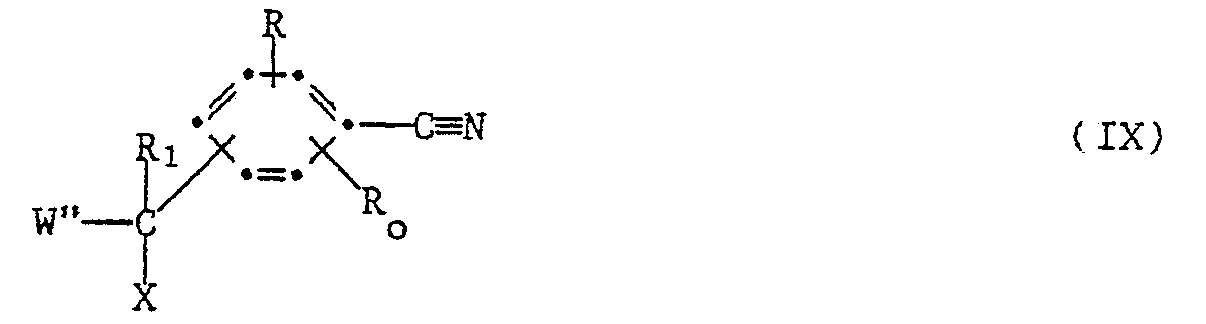

- c) condensing under basic conditions a compound of the formula XI

- d) converting Rs to cyano in a compound of the formula XII
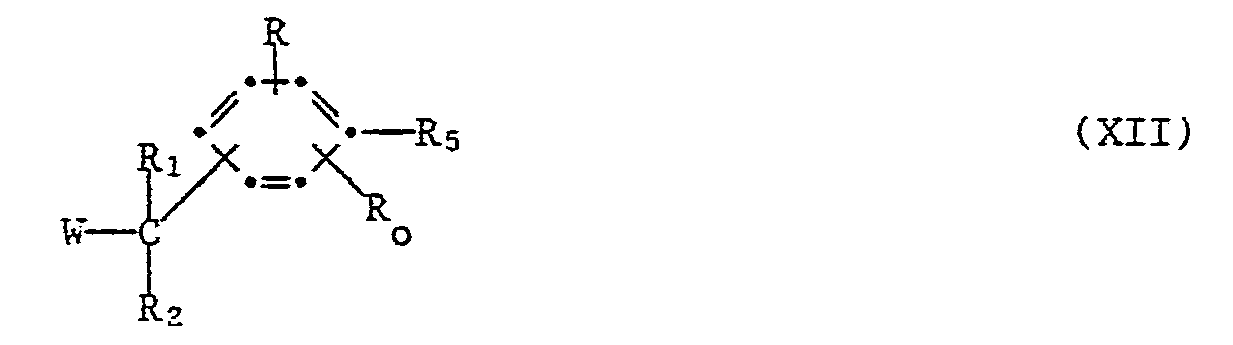
- In starting compounds and intermediates which are converted to the compounds of the invention in a manner described herein, functional groups present, such as carboxy, amino (including ring NH) and hydroxy groups, are optionally protected by conventional protecting groups that are common in preparative organic chemistry. Protected carboxy, amino and hydroxy groups are those that can be converted under mild conditions into free carboxy, amino and hydroxy groups without the molecular framework being destroyed or other undesired side reactions taking place. The purpose of introducing protecting groups is to protect the functional groups from undesired reactions with reaction components and under the conditions used for carrying out a desired chemical transformation. The need and choice of protecting groups for a particular reaction is known to those skilled in the art and depends on the nature of the functional group to be protected (carboxy group, amino group, etc.), the structure and stability of the molecule of which the substituent is a part, and the reaction conditions. Well-known protecting groups that meet these conditions and their introduction and removal are described, for example, in J.F.W. McOmie, "Protective Groups in Organic Chemistry", Plenum Press, London, New York, 1973; T.W. Greene, "Protective Groups in Organic Synthesis", Wiley, New York, 1984.
- Relating to the above processes, a reactive functional derivative of the radicals R, and R2 represents said radicals substituted by a leaving group, preferably by lower alkyl-or aryl-sulfonyloxy, e.g. mesyloxy or toluenesulfonyloxy, or by halogen, e.g. fluoro, chloro, bromo or iodo. Similarly, a reactive esterified derivative of an alcohol, e.g. of. a compound of formula Vlll, represents said alcohol esterified in the form of a leaving group, e.g. lower alkyl-or aryl-sulfonyloxy, such as mesyloxy or toluenesulfonyloxy, or halogen, such as chloro, bromo or iodo.
- Protecting groups for the imidazolyl nitrogen are preferably tri-lower alkylsilyl, e.g. trimethylsilyl, lower alkanoyl, e.g. acetyl, di-lower alkylcarbamoyl such as dimethylcarbamoyl, or triarylmethyl, e.g. triphenylmethyl.
- The condensation according to process (a) is carried out according to N-alkylation procedures well- known in the art, either as such or in the presence of a base such as triethylamine or pyridine in an inert solvent, e.g. dichloromethane, at room temperature or near the boiling point of the solvent used.
- A N-protected derivative of formula VII is particularly used, when a compound of formula I wherein W is 1-imidazolyl or lower-alkyl-substituted 1-imidazolyl is prepared. In the case of protected imidazolyl, alkylation occurs on the second unprotected nitrogen to first form a quaternary compound which is advantageously simultaneously deprotected in situ prior to the isolation of the product. The imidazole and triazole starting materials of formula VII are either known or are prepared according to methods known in the art.
- The nitrile substituted starting materials representing reactive esterified derivatives of the carbinols of formula VIII are also either known or are prepared e.g. as illustrated below and in the examples herein. For example, the halo substituted starting materials can be advantageously prepared using the following illustrative sequence of reactions (tBu = tert-butyl) using appropriate reaction conditions known in the art and illustrated in the examples.

- The starting materials of formula XIV represent appropriate aldehydes or ketones in which R, and R2 correspond to relevant definitions in formula I.
- For compounds of formula I wherein R, represents hydrogen and R2 represents cyanophenyl, the intermediate corresponding to formula XV can be advantageously prepared by reacting the lithium organometallic reagent of formula XIII with ethyl formate (instead of a compound of formula XIV) in the above sequence of reactions.
- It should also be noted that in the above intermediate XIII, the CONH-tBu substituent may be replaced by cyano or any other grouping suitable for the condensation and known in the art to be convertible into cyano. Such groupings are included under process (d) (Rs in formula XII).
- The dehalogenation under process (b) for the preparation of the compounds of formula I wherein W represents pyridyl optionally substituted by lower alkyl can be achieved advantageously with zinc in acetic acid. Other suitable reagents include tributyl tin hydride or aluminium amalgam.
- The starting halides of formula IX can be prepared from an alcohol with a halogenating agent, e.g. thionyl chloride as described under process (a). The alcohol can in turn be prepared by condensation of a compound of formula XIII or the like with an appropriate aldehyde or ketone of the formula XVII
W"--R, (or -R2) (XVII)
in which R, and R2 correspond to relevant definitions for R, and R2 in formula I and W" represents 3-pyridyl. - The condensation according to process (c) is carried out according to procedures generally known in the art for displacement e.g. of a halo, lower alkyl-or aryl-sulfonyloxy leaving group, e.g. by first forming a carbanion in the presence of a strong base such as lithium diisopropylamide, an alkali metal hydride, an alkali metal alkoxide such as potassium t-butoxide, or a strongly basic tertiary amine such as 1,5-diazabicyclo[4.3.0]non-5-ene (DBN), preferably in an inert atomosphere, for example under a nitrogen atmosphere, and in a polar solvent such as dimethylformamide.
- For compounds of formula I wherein R, and/or R2 represents p-cyanophenyl a suitable reactive derivative is p-fluorobenzonitrile. For compounds wherein R, or R2 represents (lower alkyl, aryl or aryl-lower alkyl)-thio, suitable reactive derivatives are the disulfides corresponding thereto, such as diphenyl disulfide or dimethyl disulfide.
- Process (d) is carried out according to known methods for the introduction of a nitrile group.
- A group or radical Rs in a compound formula XII which can be converted into the CN group, is, for example, hydrogen, esterified hydroxy, for example halo, especially chloro, bromo, or iodo, or a sulfonyloxy group, for example p-toluenesulfonyloxy, benzenesulfonyloxy or mesyloxy, sulfo, amino, carboxy, carboxy in the form of a functional derivative, for example carbamoyl, lower alkylcarbamoyl, for example t-butylcarbamoyl, or haloformyl, for example chloro-or bromoformyl, formyl, a formyl group in the form of a functional derivative, for example hydroxyiminomethyl, or a halomagnesium group, for example iodo-, bromo-or chloromagnesium.
- Compounds of the formula I (or II-VI) can be obtained, for example, by carrying out the following conversions:
- The conversion of a compound of the formula Xll wherein Rs is hydrogen, to the corresponding nitrile of the formula I is performed e.g. according to the known method of C. Friedel, F.M. Crafts and P. Karrer by reacting with cyanogen chloride (CICN) or cyanogen bromide or according to the method of J. Houben and W. Fisher, by reacting with e.g. trichloroacetonitrile. Advantageously, the standard catalyst aluminium chloride is used in these reactions and hydrogen chloride or hyrogen bromide is released which can be removed from the reaction mixture after addition of a base, preferably an amine, for example triethylamine or pyridine.
- The conversion of a compound of the formula XII wherein Rs is halo, for example, chloro, bromo or iodo, to a corresponding nitrile of the formula I is performed by using e.g. a cyanide salt, especially sodium or potassium cyanide or, preferably, copper(l) cyanide. Preferred solvents for this reaction are pyridine, quinoline, dimethylformamide, 1-methyl-2-pyrrolidinone and hexamethylphosphoric triamide. High temperatures, especially reflux temperatures of the reaction mixture are preferred.
- The conversion of a compound of the formula XII wherein Rs is a sulfonyloxy group, for example p-toluenesulfonyloxy, benzenesulfonyloxy or mesyloxy, to a nitrile of the formula I is performed e.g. by reaction with an alkali metal cyanide, preferably sodium or potassium cyanide. High temperatures, expecially the reflux temperature of the reaction mixture, are preferred.
- The conversion of a compound of the formula XII wherein Rs is amino, to a nitrile of the formula I proceeds over several steps. First, a diazonium salt is formed e.g. by reaction of the amino compound with an alkali metal nitrite preferably potassium nitrite. The diazonium salt can be reacted using the well-known Sandmeyer reaction in situ e.g. with cuprous cyanide or a cyanide complex preferably potassium cuproammonium cyanide, or with catalytic amounts of freshly precipitated copper powder in the presence of an alkali metal cyanide, for example sodium or potassium cyanide.
- The conversion of a compound of formula XII wherein Rs is carboxy to a nitrile of formula I can be carried out e.g. by reaction with chlorosulfonylisocyanate in e.g. dimethylformamide according to the method of R. Graf, Angew. Chem. 80 , 183 (1968).
- The conversion of a compound of the formula XII wherein Rs is a carboxy group in the form of a functional derivative, for example carbamoyl, lower alkylcarbamoyl, advantageously t-butylcarbamoyl, to a nitrile of the formula I can be carried out e.g. with a strong dehydrating agent, such as phosphorous pentoxide, phosphoryl chloride, thionyl chloride, phosgene or oxalyl chloride. The dehydration can be preferably carried out in the presence of a suitable base. A suitable base is, for example, an amine, for example a tertiary amine, for example tri-lower alkylamine, for example trimethylamine, triethylamine or ethyl diisopropylamine, or N,N-di-lower alkylaniline, for example N,N-dimethylaniline, or a cyclic tertiary amine, for example a N-lower alkylated morpholine, for example N-methylmorpholine, or is, for example, a base of the pyridine type, for example pyridine or quinoline.
- The conversion of a compound of formula XII wherein Rs is formyl to a nitrile of formula I is carried out e.g. by converting the formyl group to a reactive functional derivative, for example a hydroxyiminomethyl group, and converting this group to cyano by a dehydrating agent. A suitable dehydrating agent is one of the inorganic dehydrating agents mentioned above, for example phosphorous pentachloride, or, preferably, the anhydride of an organic acid, for example the anhydride of a lower alkane carboxylic acid, for example acetic acid anhydride. The conversion of the formyl group to hydroxyiminomethyl is carried out by reaction a compound of formula XII wherein Rs is formyl, e.g. with an acid addition salt of hydroxylamine, preferably the hydrochloride.
- A compound of the formula XII wherein Rs is formyl can also be converted directly to a corresponding nitrile of the formula I e.g. by reaction with O,N-bis(trifluoroacetyl)-hydroxylamine in the presence of a base, for example pyridine, according to the method of D. T. Mowry, Chem. Rev. 42, 251 (1948).
- The conversion of a compound of the formula XII wherein Rs is a halomagnesium group, for example, iodo-, brom-, or chloromagnesium, to a corresponding nitrile of the formula I is performed e.g. by reacting the magnesium halide with cyanogen halide or dicyanogen. The "Grignard" reagent, wherein Rs is a halomagnesium group, is prepared in a conventional manner, for example by reacting a compound of the formula XII wherein Rs is halo, for example chloro, bromo or iodo, with magnesium, e.g. in dry ether.
- The compounds of the invention obtained by the above-cited processes can be converted into other compounds of the invention of formula I according to methodology known in the art and as illustrated herein.
- Compounds of formula I, substituted by e.g. an acyloxy group, such as lower alkanoyloxy or aroyloxy, may be converted to compounds of formula I substituted by hydroxy, by hydrolysis with e.g. aqueous acid such as hydrochloric acid, or with aqueous alkali, such as lithium or sodium hdyroxide.
- Conversely, the conversion of compounds of formula I substituted by hydroxy to compounds of formula I substituted by acyloxy, such as alkanoyloxy or aroyloxy, may be carried out by condensation with a corresponding carboxylic acid, or a reactive functional derivative thereof, according to acylation - (esterification) procedures wellknown to the art.
- The conversion of the compounds of formula I substituted by an etherified hydroxy group, e.g. lower alkoxy, to the compounds of formula I substituted by a hydroxy group is carried out by methods well-known in the art, e.g., with a mineral acid, such as hydriodic acid or, advantageously for compounds wherein lower alkoxy is methoxy, with e.g. boron tribromide in methylene chloride or with sodium or lithium diphenyl- phosphide in tetrahydrofuran.
- The compounds of formula I wherein R, and R2 represent hydrogen, i.e. the compounds of formula XI, may be converted to the compounds of formula I wherein R, and R2 combined represent lower alkylidene, mono-or diaryl-lower alkylidene by reacting said compounds of formula XI with an appropriate aldehyde or ketone in the presence of a strong base, e.g. lithium diisopropylamide, and, if required, treating the resulting alcohols with a dehydrating agent, such as thionyl chloride.
- Furthermore, the compounds of formula I wherein at least one of R, and R2 represents hydrogen are converted to other compounds of formula I as described above under process c).
- Unless stated otherwise, the above reactions are preferably carried out in an inert, preferably anhydrous, solvent or solvent mixture, for example in a carboxylic acid amide, for example a formamide, for example dimethylformamide, a halogenated hydrocarbon, for example methylene chloride or chloroform, a ketone, for example acetone, a cyclic ether, for example tetrahydrofuran, an ester, for example ethyl acetate, or a nitrile, for example acetonitrile, or in mixtures thereof, optionally at reduced or elevated temperature, for example in a temperature range from approximately -50°C to approximately +150°C, preferably from room temperature to the boiling temperature of the reaction mixture and optionally under inert gas atmosphere, for example nitrogen atmosphere, and preferably at atmospheric pressure.
- The invention further includes any variant of the present processes, in which an intermediate product obtainable at any stage thereof is used as starting material and the remaining steps are carried out, or the process is discontinued at any stage thereof, or in which the starting materials are formed under the reaction conditions or in which the reaction components are used in the form of their salts or optically pure antipodes. Whenever desirable, the above processes are carried out after first suitably protecting any potentially interfering reactive functional groups, as illustrated above and in the examples herein.
- Advantageously, those starting materials should be used in said reactions, that lead to the formation of those compounds indicated above as being preferred.
- The invention also relates to novel starting materials and processes for their manufacture.
- Depending on the choice of starting materials and methods, the new compounds may be in the form of one of the possible isomers or mixtures thereof, for example, as pure geometric isomers (cis or trans), as pure optical isomers (as antipodes), or as mixtures of optical isomers such as racemates, or as mixtures of geometric isomers.
- In case geometric or diastereomeric mixtures of the above compounds of intermediates are obtained, these can be separated into the single racemic or optically active isomers by methods in themselves known, e.g. by fractional distillation, crystallization and/or chromatography.
- The racemic products or basic intermediates can be resolved into the optical antipodes, for example, by separation of diastereomeric salts thereof, e.g., by the fractional crystallization of d-or I-(tartrate, dibenzoyltartrate, mandelate or camphorsulfonate) salts.
- Any acidic intermediates or products can be resolved by separation of e.g. the d-and I-(alpha- methylbenzylamine, cinchonidine, cinchonine, quinine, ephedrine, dehydroabietylamine, brucine or strychnine)-salts of any compounds having an acidic salt-forming group.
- Advantageously, the more active of the antipodes of the compounds of this invention is isolated.
- Finally, the compounds of the invention are either obtained in the free form, or as a salt thereof. Any resulting base can be converted into a corresponding acid addition salt, preferably with the use of a pharmaceutically acceptable acid or anion exchange preparation, or resulting salt can be converted into the corresponding free bases, for example, with the use of a stronger base, such as a metal or ammonium hydroxide, or any basic salt, e.g., an alkali metal hydroxide or carbonate, or a cation exchange preparation. These or other salts, for example, the picrates, can also be used for purification of the bases obtained; the bases are converted into salts. In view of the close relationship between the free compounds and the compounds in the form of their salts, whenever a compound is referred to in this context, a corresponding salt is also intended, provided such is possible or appropriate under the circumstances.
- The compounds, including their salts, may also be obtained in the form of their hydrates, or include other solvents used for the crystallization.
- The pharmaceutical compositions according to the invention are those suitable for enteral, such as oral or rectal, transdermal and parenteral administration to mammals, including man, comprising an effective amount of a pharmacologically active compound of formula I, or 11, III, IV, V or VI or a pharmacologically acceptable salt thereof, alone or in combination with one or more pharmaceutically acceptable carriers.
- The pharmacologically active compounds of the invention are useful in the manufacture of pharmaceutical compositions comprising an effective amount thereof in conjunction or admixture with excipients or carriers suitable for either enteral or parenteral application. Preferred are tablets and gelatin capsules comprising the active ingredient together with a) diluents, e.g. lactose, dextrose, sucrose, mannitol, sorbitol, cellulose and/or glycine; b) lubricants, e.g. silica, talcum, stearic acid, its magnesium or calcium salts and/or polyethyleneglycol; for tablets also c) binders, e.g. magnesium aluminium silicate, starch paste, gelatin, tragacanth, methylcellulose, sodium carboxymethylcellulose and/or polyvinylpyrrolidone; if desired, d) disintegrants, e.g. starches, agar, alginic acid or its sodium salt, or effervescent mixtures; and/or e) e.g. absorbents, colorants, flavors and sweeteners. Injectable compositions are preferably aqueous isotonic solutions or suspensions, and suppositories are advantageously prepared from fatty emulsions or suspensions. Said compositions may be sterilized and/or contain adjuvants, such as preserving, stabilizing, wetting or emulsifying agents, solution promoters, salts for regulating the osmotic pressure and/or buffers. In addition, the compositions may also contain other therapeutically valuable substances. Said compositions are prepared according to conventional mixing, granulating or coating methods, respectively, and contain preferably about 1 to 50% of the active ingredient.
- The dosage of active compound administered is dependent on the species of warm-blooded animal - (mammal), the body weight, age and individual condition, and on the form of administration. A unit dosage for a mammal of about 50 to 70 kg may contain between about 5 and 100 mg of the active ingredient.
- Suitable formulations for transdermal application include an effective amount of a compound of formula I or II-VI with carrier. Advantageous carriers include absorbable pharmaceutically acceptable solvents to assist passage through the skin of the host. Characteristically, transdermal devices are in the form of a bandage comprising a backing member, a reservoir containing the compound, optionally with carriers, optionally a rate controlling barrier to deliver the compound to the skin of the host at a controlled and predetermined rate over a prolonged period of time, and means to secure the device to the skin.
- The following examples are intended to illustrate the invention and are not to be construed as being limitations thereon. Temperatures are given in degrees Centigrade. If not mentioned otherwise, all evaporations are performed under reduced pressure, preferably between about 20 and 130 mbar. The structure of final products, intermediates and starting materials is confirmed by analytical methods, e.g. microanalysis and spectroscopic characteristics (e.g. MS, IR, NMR). The following abbreviations are used: HCI = hydrochloric acid, THF = tetrahydrofuran, DMF = dimethylformamide.
- Example 1: a) A solution of aipha-bromo-4-totunitriie (86.6 g) in dichloromethane (1000 ml) is mixed with imidazole (68.0 g). The mixture is stirred at ambient temperature for 15 h and then diluted with water (1000 ml). Any undissolved solid is removed by filtration and the separated organic solution is then repeatedly washed with water (5 x 200 ml) to remove excess imidazole, and then dried (MgSO.). The crude product obtained upon evaporation of the solvent can be purified by trituration with cold diethyl ether (200 ml) to obtain 4-(1-imidazolylmethyl)-benzonitrile, m.p. 99-101 °; HCI salt, m.p. 142-144°.
- Similarly prepared are:
- b) 2-(1-imidazolylmethyl)-benzonitrile hydrochloride, m.p. 176-177°;
- c) 4-(1-imidazolylmethyl)-1-naphthonitrile hydrochloride, m.p. 210-212° (dec.).
- Example 2: a) A suspension of potassium tert-butoxide (61.6 g) in DMF (500 ml) is stirred and cooled to -10° (ice-salt bath), and a solution of 4-(1-imidazolylmethyl)-benzonitrile (45.6 g) in DMF (250 ml) is added so that the reaction temperature remains below 0°. The resulting solution is stirred at 0° for 0.5 h and then a solution of 4-fluorobenzonitrile (38.3 g) in DMF (100 ml) is added while keeping reaction temperature below 5°. After 0.75 h, the reaction mixture is neutralized to pH 7 by addition of sufficient 3N HCI and the bulk of the solvents are then removed under reduced pressure. The residue is diluted with water (500 ml) and the crude product is extracted into ethyl acetate (3 x 200 ml). The combined extracts are then extracted with 3N HCI (3 x 150 ml) and, after washing the latter acid extracts with ethyl acetate (100 ml), the solution is made basic (pH.8) with 6N ammonium hydroxide and the product is again extracted into ethyl acetate (3 x 150 ml). The combined extracts are dried (MgS04), decolorized by treatment with charcoal, and then evaporated to give crude 4-[alpha-(4-cyanophenyl)-1-imidazolylmethyl]-benzonitrile as an oil. This material is dissolved in isopropanol (250 ml) and the warm solution is stirred with succinic acid (14.4 g). Upon dilution with diethyl ether (100 ml) and stirring at ambient temperature, the hemisuccinate salt separates. The salt is filtered off, washed with a little cold isopropanol and then air-dried to afford 4-[alpha-(4-cyanophenyl)-l-imidazolylmethyl]-benzonitrile hemisuccinate, m.p. 149-1500. The hemifumarate salt has m.p. 157-158°.
- Similarly prepared are:
- b) 4-[alpha-(2-cyanophenyl)-l-imidazolylmethyl]-benzonitrile, IR(CN) 2240 cm-', M/e 384; HCI salt - (hygroscopic), m.p. 90° (dec.);
- c) 4-[alpha-(4-trifluoromethylphenyl)-1-imidazolyimethyl]-benzonitrile, IR(CN) 2232 cm-', M/e 327; HCI salt - (hygroscopic), m.p. 100° (dec.).
- Example 3: A solution of 4-(alpha-chloro-4'-cyanobenzyl)-benzonitrile (20.2 g) and imidazole (16.3 g) in DMF (130 ml) is stirred and heated at 160° for 2 h. The reaction is cooled, diluted with water (800 ml) and extracted into ethyl acetate (3 x 150 ml). The remainder of the work-up is carried out in the manner described in Example 2 to yield 4-[alpha-(4-cyanophenyl)-1-imidazolylmethyl]-benzonitrile hemisuccinate, m.p. 148-150°.
- The starting material, 4-(alpha-chloro-4'-cyanobenzyl)-benzonitrile is prepared as follows:
- A solution of N-tert-butyl-4-bromobenzamide (37.2 g) in anhydrous THF (1000 ml) is stirred under an atmosphere of N2 and cooled to -60°. A solution of n-butyl lithium (125 ml, 2.4 M in hexane, 0.300 mole) is then added during 40 min and the resulting suspension is stirred for a further 40 min at -60°. A solution of ethyl formate (5.3 g) in anhydrous THF (50 ml) is then added dropwise during 10 min and the reaction is allowed to proceed at -60° for 2 h. The reaction is then quenched by the addition of saturated aqueous ammonium chloride (200 ml) and after allowing the mixture to reach room temperature, diethyl ether (300 ml) is added and the layers are separated. The ethereal solution is washed with water (2 x 100 ml) and brine (100 ml) and dried (MgS04). The solvent is evaporated and the residue is triturated with diethyl ether - (150 ml) to afford the bis-(4-N-tert-butylcarbamoylphenyi)methanol, m.p. 200-202°.
- Bis-(4-N-tert-butylcarbamoylphenyl)-methanol (17.6 g) is suspended in thionyl chloride (140 ml) and the mixture is stirred at reflux for 6 h. The solvent is evaporated and the residue is taken up in toluene (100 ml) and the solvent is evaporated. The latter procedure is repeated once more to afford the 4-(alpha-chloro-4'-cyanobenzyl)-benzonitrile as an oil which is used directly; NMR(CH methine) 3.85 ppm.
- Example 4: Imidazole (9.4 g) and 4-(alpha-chloro-4'-cyanobenzyl)-benzonitrile (11.6 g) are intimately mixed and heated together in an oil bath at 110-120° for 15 h. The reaction mixture is diluted with water - (200 ml) and extracted with ethyl acetate (3 x 75 ml). The remainder of the work-up is carried out as described in Example 2, yielding 4-[alpha-(4-cyanophenyl)-1-imidazolylmethyl)-benzonitrile. The crude product is treated with an equivalent amount of fumaric acid in warm isopropanol to yield 4-[alpha-(4-cyanophenyl)-1-imidazolylmethyl]-benzonitrile hemifumarate, m.p. 156-1570.
- Example 5: The following compounds are prepared according to the methods described in previous examples 3 and 4 using the appropriate starting materials.
- a) 2-[alpha-(4-bromophenyl)-1-imidazolylmethyl)-benzonitrile, M/e 337;
- b) 4-[alpha-(4-chlorophenyl)-1-imidazolylmethyl]-benzonitrile; M/e 293; hydrochloride salt, m.p. 90° - (dec.);
- c) 4-[alpha-(4-methoxyphenyl)-1-imidazolylmethyl]-benzonitrile, IR(CN) 2235 cm-', M/e 289; hydrochloride salt (hygroscopic), m.p. 90° (dec.);
- d) 4-[alpha-(2-methoxyphenyl)-1-imidazolylmethyl]-benzonitrile, IR(CN) 2234 cm-', M/e 289; hydrochloride salt (hygroscopic), m.p. 95° (dec.);
- e) 4-[alpha-(3-pyridyl)-1-imidazolylmethyl]-benzonitrile, IR(CN) 2237 cm-', M/e 260; dihydrochloride salt (hygroscopic), m.p. 150°;
- f) 4-[alpha-(2-thienyl)-1-imidazolylmethyl]-benzonitrile, IR(CN) 2237 cm-'; M/e 265; hydrochloride salt, m.p.65° (dec.);
- g) 4-[alpha-(3-thienyl)-1-imidazoly(methyl]-benzonitrile, IR(CN) 2240 cm-1, M/e 265; hydrochloride salt, m.p. 70° (dec.);
- h) 4-(alpha-phenyl-1-imidazolylmethyl)-benzonitrile; M/e 259; hydrochloride salt (hygroscopic), m.p. 90 (dec.);
- i) 4-[alpha-(4-tolyl)-1-imidazolylmethyl]-benzonitrile; M/e 273; hydrochloride salt (hygroscopic), m.p. 90 (dec.);
- j) 3-(alpha-phenyl-1-imidazolylmethyl)-benzonitrile; M/e 259; hydrochloride salt (hygroscopic), m.p. 80 (dec.);
- The starting precursor for compound b is prepared as follows: A solution of n-butyl lithium (20 ml of 2.4 M reagent, 0.048 mole) in hexane is added dropwise under an atmosphere of N2 to a solution of N-tert-butyl-4-bromobenzamide (6.1 g, 0.024 mole) in THF (100 ml) which is maintained at -60° and then a solution of 4-chlorobenzaldehyde (5.1 g, 0.036 mole) in THF (50 ml) is added dropwise. The reaction mixture is stirred for 2 h at -60° and then quenched by the addition of saturated aqueous ammonium chloride (30 ml) and ether (100 ml). The ethereal layer is separated, washed repeatedly (3 x 30 ml) with aqueous sodium bisulfite and finally with brine and dried (MgSO4). Solvent evaporation affords (4-chlorophenyl)-(4'-N-tert-butylcarbamoylphenyl)-methanol as an oil, NMR(CH methine) 4.30 ppm, which can be used without further purification.
- The following carbinols are prepared in a similar manner using an appropriate starting material:
- phenyl-(4'-N-tert-butylcarbamoylphenyl)-methanol, NMR(CH methine) 4.27 ppm;
- (4-methoxyphenyl)-(4'-N-tert-butylcarbamoylphenyl)-methanol, NMR(CH methine) 4.23 ppm;
- (2-methoxyphenylr(4'-N-tert-butylcarbamoylphenyl)-methanol, NMR(CH methine) 4.00 ppm;
- (4-methylphenyl)-(4'-N-tert-butylcarbamoylphenyl)-methanol, NMR(CH methine) 4.23 ppm;
- (3-pyridyl)-(4'-N-tert-butylcarbamoylphenyl)-methanol, NMR(CH methine) 4.20 ppm;
- (2-thienyl)-(4'-N-tert-butylcarbamoylphenyl)-methanol, NMR(CH methine) 3.98 ppm;
- (3-thienyl)-(4'-N-tert-butylcarbamoylphenyl)-methanol, NMR(CH methine) 4.05 ppm;
- 3-(alpha-hydroxybenzyl)-benzonitrite, NMR(CH methine) 4.20 ppm.
- The appropriate starting cyanophenyl substituted chlorides corresponding to the above carbinols are prepared by treatment with thionyl chloride as previously described in Example 3.
- Example 6: A solution of 4-[alpha-(4-cyanophenyl)-1-imidazolylmethyl]-benzonitrile (5.3 g) in DMF (20 ml) is added dropwise to a cooled (ice-bath) stirred suspension of potassium tert-butoxide (2.5 g) in DMF - (20 ml). This mixture is stirred for 30 min at 0-5° and then a solution of methyl iodide (3,5 g) in DMF (10 ml) is added during 10 min. After stirring at 0-5° for a further 15 min, the reaction mixture is diluted with water (200 ml) and extracted with ethyl acetate (3 x 60 ml). The organic solution is washed with water (50 ml) and then extracted with 3N HCI (3 x 30 ml). The extracts are made basic (pH 8) with aqueous sodium hydroxide and the product is again extracted into ethyl acetate (2 x 50 ml). The extracts are dried (MgSO4) and evaporated to give a solid which is recrystallized from isopropanol to give 4-[alpha-(4-cyanophenyl)-alpha-methyl-1-imidazolylmethyl]-benzonitrile, m.p. 184-186°.
- Example 7: a) A solution of boron tribromide (11.7 g) in dichloromethane (50 ml) is added dropwise during 30 min to a cooled (ice-bath) stirred solution of 4-[alpha-(4-methoxyphenyl-1-imidazolylmethyl]-benzonitrile (3.2 g) in dichloromethane (50 ml). The reaction is allowed to proceed at ambient temperature for 15 h and then the mixture is poured onto ice and water (100 ml). The pH is adjusted to 7 by the addition of solid sodium bicarbonate and the layers are separated. The organic solution is washed with water, dried (MgSO4) and evaporated. The residual crude product is triturated with diethyl ether to give 4-[alpha-(4-hydroxyphenyl)-1-imidazolylmethyl]-benzonitrile, m.p. 196-198°.
- b) 4-[alpha-(2-hydroxyphenyl)-1-imidazolylmethyl]-benzonitrile, m.p. 230-235° (dec.), is similarly prepared.
- c) 4-[alpha-(4-hydroxybenzyl)-1-imidazolylmethyl]-benzonitrile, m.p. 238-240°, is also similarly prepared.
- Example 8: A solution containing 2-[alpha-(4-bromophenyl)-1-imidazolylmethyl]-benzonitrile (2.1 g) and hydrazine hydrate (10 ml) in 95% ethanol (60 ml) is mixed with 10% Pd-C catalyst (0.5 g) and the mixture is stirred at reflux for 2.5 h. The catalyst is filtered off and the solvent evaporated to give an oil which is dissolved in 3N HCI (20 ml). The acid solution is extracted with ethyl acetate (10 ml), neutralized to pH 7 with aqueous sodium hydroxide and extracted with ethyl acetate (3 x 10 ml). The extracts are dried - (MgSO4) and evaporated to give the crude product which is further purified by flash column chromatography on silica gel. Elution with ethyl acetate affords 2-[alpha-pheny(-1-imidazolylmethyl]-benzonitrile; IR(CN): 2240 cm-'; M/e 259; hydrochloride salt. melting with dec.
- Example 9: A solution containing alpha-bromo-4-tolunitrile (19.6 g) and 1,2,4-triazole (30.5 g) in a mixture of chlorform (250 ml) and acetonitrile (50 ml) is stirred at reflux for 15 h. The solution is cooled and washed with 3% aqueous sodium bicarbonate (200 ml) and the organic solution is then dried (MgSO.) and evaporated. The residue is chromatographed on silica gel (300 g). Elution with chloroform/isopropanol - (10:1) affords 4-[1-(1,2,4-triazolyl)methyl]-benzonitrile, which forms a hydrochloride salt, m.p. 200-205°, when its solution in ethyl acetate is treated with ethereal HCI.
- Further elution of the silica gel column with chloroform/isopropanol (3:2) affords 4-[i-(1,3,4-triazolyl)-methyl]-benzonitrile which forms a hydrochloride salt, m.p. 236-238°.
- Example 10: A solution containing alpha-bromo-4-tolunitrile (11.0 g), 1-(dimethylcarbamoyl)-4-methylimidazole (8.6 g) and sodium iodide (8.4 g) in acetonitrile (75 ml) is heated and stirred at reflux for 15 h. The mixture is cooled to 0° (ice-bath) and ammonia gas is bubbled through the solution for 15 min. The volatiles are then evaporated and the residue is partitioned between water (150 ml) and ethyl acetate (150 ml). The organic solution is washed with water (2 x 50 ml) and is then extracted with 3N HCI. The combined acidic extracts are made basic (pH 9) with 6N sodium hydroxide and the product is extracted into ethyl acetate (3 x 60 ml). After drying (MgSO,), solvent evaporation affords crude 4-[1-(5-methylimidazolyl)-methyl]-benzonitrile which forms a hydrochloride salt, m.p. 203-205°, when its solution in acetone is treated with ethereal HCI.
- The starting material is prepared in the following manner: A solution containing 4-methylimidazole (16.4 g), N,N-dimethylcarbamoyl chloride (30 g) and triethylamine (30 g) in acetonitrile (125 ml) is stirred at reflux for 20 h. Upon cooling, the reaction is diluted with diethyl ether (1000 ml) and then filtered. The filtrate is concentrated and the residue is distilled under reduced pressure. 1-(Dimethylcarbamoyl)-4-methylimidazole is obtained as a colorless liquid, b.p. 104-106° at 0.47 mbar.
- Example 11: a) A solution of n-butyl lithium (25 ml of 2.1 M reagent in hexane, 0.0525 mole) is added dropwise in an N2 atmosphere to a solution of diisopropylamine (5.6 g) in THF (100 ml) which is maintained at -20°. This cold solution is then added dropwise to a solution of 4-(1-imidazolylmethyl)-benzonitrile (9.15 g) in THF (250 ml) which is maintained at -50° during addition and for 30 min subsequently. The reaction mixture is then cooled to -70° for 30 min and then without external cooling for 10 h. The reaction is quenched by addition of water (300 ml) and extracted with diethyl ether (3 x 100 ml). The combined ether extracts are extracted with 3N HCI (3 x 60 ml) and the acid extracts are made basic (pH 9) with 6N sodium hydroxide. The crude product is extracted into ether (3 x 60 ml), and after drying (MgS04) and solvent evaporation, 4-[1-(1-imidazolyl)ethyl]-benzonitrile is obtained. The crude material is dissolved in acetone and treated with ethereal HCI to afford the hydrochloride salt, m.p. 184-186°.
- Similarly prepared are:
- b) 4-[2-(1-imidazolyl)-2-propyl]-benzonitrile hydrochloride, m.p. 219-2210;
- c) 4-(alpha-n-butyl-1-imidazolylmethyl)-benzonitrile oxalate, m.p. 73-75°;
- d) 4-(alpha-isopropyl-1-imidazolylmethyl)-benzonitrile, m.p. 94-95°;
- e) 4-(alpha-benzyl-1-imidazolylmethyl)-benzonitrile hydrochloride, m.p. 221-223°;
- f) 4-[alpha-(4-cyanobenzyl)-1-imidazolylmethyl]-benzonitrile. m.p. 199-201°;
- Example 12: The lithium salt of 10.0 g of 4-(1-imidazolylmethyl)-benzonitrile is prepared in THF (250 ml) in the manner described in Example 11. This solution is cooled to -60° and solid paraformaldehyde - (10.0 g, previously dried for 15 h in vacuo at 60°) is added, all at once. The reaction mixture is stirred at - 60° for 1 h and then without cooling for a further 15 h. The reaction is then quenched with water (200 ml) and worked up in the manner described in Example 11 to afford a mixture of 4-(alpha-hydroxymethyl-1-imidazolylmethyl)-benzonitrile and 4-(alpha-methylene-1-imidazolylmethyl)-benzonitrile which is chromatographed on silica gel (250 g). Elution with a mixture of methylene chloride and isopropanol (19:1 ) affords 4-(alpha-methylene-1-imidazolylmethyl)-benzonitrile. This compound forms a hydrochloride salt, m.p. 195-197°, when its solution in acetone is treated with ethereal HCI.
- Example 13: a) Racemic 4-[1-(1-imidazolyl)ethyl]-benzonitrile (3.5 g) is dissolved in warm acetone (50 ml) and added to a solution of 1-tartaric acid (1.2 g) in warm acetone (300 ml). The mixture is allowed to stand at room temperature overnight and the tartrate salt is collected. This material is recrystallized four times from minimal volumes of anhydrous ethanol and the resultant material is converted to the free base by dissolution in water, making basic (pH 9) with dilute sodium hydroxide and isolating (-)-4-[1-(1-imidazolyl)ethyl]-benzonitrile which has an optical rotation [α]D 25 = -4.94°.
- b) (+)-4-[1-(1-imidazolyl)ethyl]-benzonitrile is obtained in a similar manner using d-tartaric acid and has an optical rotation [α]D 25 = +4.89°.
- Each enantiomer forms a hydrochloride salt, m.p. 190-191°. when a solution in acetone is treated with ethereal HCI.
- Example 14: A solution of potassium tert-butoxide (1.10 g) in THF (50 ml) is added dropwise to a solution of 4-[1-(1-imidazolyl)-4-chlorobutyl]-benzonitrile (2.50 g) in THF at 0° (ice-bath). The reaction is allowed to proceed at 0° for 30 min and is then allowed to warm to room temperature during 3 h. The reaction is then quenched with water (100 ml) and the mixture is subsequently extracted with ethyl acetate - (100 ml). The organic extract is extracted with 3N HCl (3 x 30 ml) and the combined acid extracts are made basic with 6N sodium hydroxide. The crude product is extracted into ethyl acetate (3 x 30 ml) and the combined extracts are dried (MgSO4) and evaporated to afford 1-(4-cyanophenyl)-1-(1-imidazolyl)-cyclopentane as an oil. The compound is dissolved in acetone and treated with ethereal HCl to afford the hydrochloride salt, m.p. 217-219°.
- The starting material, 4-[1-(1-imidazolyl)-4-chlorobutyl]-benzonitrile, is prepared as follows:
- The lithium salt of 4-[1-imidazolylmethyl]-benzonitrile (3.7 g) is prepared at -50° in THF (100 ml) as described in Example 11, and the cold solution is then added dropwise to a solution of 1-chloro-4-iodobutane (8.7 g) in THF (60 ml) at -60°. The reaction is maintained at -60° for 2 h and is then quenched by addition of water (150 ml). The product is extracted as described in Example 11 and the chlorobutyl intermediate is obtained as an oil. The methine-CH (triplet) is observed at 4.77 ppm in the NMR spectrum. The material is used without further purification.
- Example 15: A solution of potassium tert-butoxide (4.5 g) in THF (125 ml) is added dropwise during 1 h to a solution of 4-[1-imidazolylmethyl]-benzonitrile (3.66 g) and α,α'-dichloro-o-xylene (3.50 g) in THF (100 ml) which is maintained at 0° (ice-bath). The reaction mixture is subsequently stirred for a further 1 h without external cooling and is then quenched with water (200 ml) and extracted with ethyl acetate (150 ml). The organic extracts are then extracted with 3N HCI (3 x 80 ml) and the acidic extracts are made basic with 6N sodium hydroxide and the crude product is extracted into ethyl acetate (3 x 50 ml). The material obtained after drying (MgSO.) and solvent evaporation is chromatographed on silica gel (100 g). Elution with ethyl acetate affords the crystalline 2-(4-cyanophenyl)-2-(1-imidazolyl)-indane which is recrystallized from isopropanol, m.p. 150-152°.
- Example 16: a) The lithium salt of 4-[1-imidazolylmethyl]-benzonitrile (3.7 g) is prepared at -50° in THF (100 ml) in the manner described in Example 11. This cold solution is then added dropwise to a solution of diphenyl disulfide (6.5 g) in THF (100 ml) at -50°. The reaction mixture is stirred for 2 h, then quenched by addition of water (150 ml) and worked up as described in Example 11 to afford 4-[alpha-phenylthio-1-imidazolylmethyl]-benzonitrile as an oil. The compound forms a hydrochloride salt, m.p. 159-162°, when its solution in ether is treated with ethereal HCI.
- Example 17: 2,2-Bis-(4-methoxyphenyl)-2-hydroxy-1-(1-imidazolyl)-1-(4-cyanophenyl)-ethane (10.2 g) is dissolved in thionyl chloride (25 ml) and the solution is stirred at room temperature for 36 h. The solvent is evaporated and the residue is chromatographed on silic gel (250 g). Elution with ethyl acetate affords the crystalline 2,2-bis-(4-methoxyphenyl)-1-(1-imidazolyl)-1-(4-cyanophenyl)-ethylene. The compound has m.p. 174-176° after recrystallization from isopropanol.
- The starting material is prepared as follows:
- The lithium salt of 4-(1-imidazolylmethyl)-benzonitrile (5.5 g) is prepared in THF (200 ml) in the manner described in Example 11. This cold solution is added dropwise to a solution of 4,4'-dimethoxybenzophenone (7.5 g) in THF (100 ml) at -60°. The reaction is allowed to proceed for 4 h at -60° and is then quenched by dropwise addition of acetic acid (0.5 ml) and then water (200 ml). After warming to room temperature, the mixture is diluted with ether (200 ml). The separated organic phase is washed with water (3 x 50 ml), dried over MgSO4 and, after evaporating the solvents, the residue is chromatographed on silica gel (200 g). Elution with ethyl acetate affords 2,2-bis-(4-methoxyphenyl)-2-hydroxy-1-(1-imidazolyl)-1-(4-cyanophenyl)-ethane as a foam [NMR (CH-methine) 4.15 ppm].
- Example 18: Treatment of 2,2-bis-(4-methoxyphenyl)-1-(1-imidazolyl)-1-(4-cyanophenyl)-ethylene with boron tribromide using procedure analogous to that described in Example 7 yields 2,2-bis-(4-hydroxyphenyl)-1-(1-imidazolyl)-1-(4-cyanophenyl)-ethylene hydrobromide, m.p. 178° (dec.).
- Example 19: a) Zinc dust (23 g) is added in small portions over 15 min to a solution of 4-(alpha-chloro-3-pyridytmethyl)-benzonitrile hydrochloride (13.25 g) in a mixture of acetic acid (110 ml) and water (5 ml). The reaction mixture is stirred at room temperature for 3 h and is then filtered through a pad of Celite. The filtrate is concentrated and the residue is taken up in ether (250 ml) and washed with 3N sodium hydroxide (3 x 100 ml) and brine. After drying the ethereal solution (anhydrous Na2SO4), solvent evaporation affords crude 4-(3-pyridylmethyl)-benzonitrile. The compound forms a hydrochloride salt, m.p. 155-157°, when its solution in ethyl acetate is treated with ethereal HCI.
- The starting material is prepared from (3-pyridyl)-(4'-N-tert-butylcarbamoylphenyl)-methanol by treatment with thionyl chloride as described in Example 3.
- Similarly prepared are:
- b) 4-[alpha-(3-pyridyl)-3'-pyridylmethyl]-benzonitrile, m.p. 125-127°;
- c) 4-[alpha-(4-pyridyl)-3'-pyridylmethyl]-benzonitrile oxalate, m.p. 172-174°.
- Examole 20: a) 4-[l-(1,2,4-Triazolyl)methyl]-benzonitrile is reacted with potassium tert-butoxide and 4-fluorobenzonitrile according to procedure in Example 2 to yield a 4-[alpha-(4-cyanophenyl)-1-(1,2,4-triazolyl)methyl]-benzonitrile, m.p. 181-183°.
- b) 4-[1-(1,3,4-Triazolyl)methyl]-benzonitrile is similarly reacted with 4-fluorobenzonitrile to yield 4-[alpha-(4-cyanophenyl)-1-(1,3,4-triazolyl)methyl]-benzonitrile, m.p. 239-243°.
- Examole 21: 4-(3-Pyridylmethyl)-benzonitrile is reacted with potassium tert-butoxide and 4-fluorobenzonitrile according to the procedure in Example 2 to yield 4-[aipha-(4-cyanophenyl)-3-pyridylmethyl]-benzonitrile hydrochloride, m.p. 120-125° (dec.).
- Example 22: To 48.0 I of acetone under nitrogen is added 4.326 kg of potassium carbonate, 0.26 kg of potassium iodide, 3.2 kg of imidazole and 4.745 kg of alpha-chloro-4-tolunitrile. The mixture is stirred at 45° under nitrogen for 26 h. The reaction mixture is cooled, filtered and the solvent is evaporated at reduced pressure. The residue is redissolved in 40 I of methylene chloride, washed with 40 I of water and twice with 10 I of water. The organic phase is dried over magnesium sulfate and evaporated to yield the crude product which is stirred with 6.4 I of ether for 2 h. The solid is filtered, washed with 9 I of ether and dried at 40° and 26.7 mbar for 17 h to yield 4-(1-imidazolylmethyl)-benzonitrile, the compound of Example 1.
- Example 23: In portions of approximately 500 g, 4.44 kg of potassium tert-butoxide is added to 25 l of DMF, precooled to -10°, without allowing the solvent temperature to rise above -4°. The solution is recooled to -8° and a solution of 3.3 kg 4-(1-imidazolylmethyl)-benzonitrile in 12.5 I of DMF is added within 3.3 h. The rate of addition is adjusted to maintain the reaction temperature at -7 ± 2°.
- The solution is stirred for 45 min while cooling to -11 and a solution of 2.18 kg of 4-fluorobenzonitrile in 5 I of DMF is added over 3.5 h. The reaction temperature is maintained at 3 ± 4°. After 1.25 h, the pH of the reaction is brought to 7 with 3.0 I of concentrated HCI, stirred an additional 20 min and allowed to stand overnight. The solvent is removed by distillation at 10.7 mbar over 7 h. The resulting oil is partitioned between 25 I of methylene chloride and 35 I of water. The layers are separated. The aqueous phase is extracted with 7 I of methylene chloride and the combined organic phases are washed with 10 I of H20 and twice with 1.1 I of 3N HCI. The combined acidic layers are washed with 7 I of methylene chloride and added to a mixture of 10 kg of ice and 20 I of methyllene chloride. The solution is stirred and brought to pH 11 with 2.8 I of concentrated sodium hydroxide solution. The aqueous layer is separated and extracted with 5 I of methylene chloride. The combined organic phases are washed with 10 I of water and dried over magnesium sulfate. Filtration and evaporation at 45° and 10.7 mbar yields 4-[alpha-(4-cyanophenyl)-1-imidazolylmethyl]-benzonitrile as an oil; IR (CH2Cl2) 2240 cm-'.
- A solution of 9.23 kg of the above free base in 19.1 I of isopropanol is treated with 0.45 kg of decolorizing carbon and after 15 min is filtered into a stirred solution of 1.84 kg of succinic acid in 31.4 I of isopropanol at 50°. The solution is stirred for 14 h at 50° and allowed to cool to room temperature. The resulting crystalline solid is collected by filtration, washed with 8 I of isopropanol and 5 I of diethyl ether and dried at 90° and 26.7 mbar for 28 h to yield 4-[alpha-(4-cyanophenyl)-1-imidazolylmethyl]-benzonitrile hemisuccinate, m.p. 149-1500. Recrystallization from isopropanol/ether gives product melting at 151-1520.
- Example 24: Preparation of 10,000 tablets each containing 5 mg of the active ingredient:
-

- Analogously tablets are prepared containing one of the other compounds disclosed and exemplified herein.
- Example 25: Preparation of 1,000 capsules each containing 10 mg of the active ingredient:
-

- All the powders are passed through a screen with openings of 0.6 mm. Then the drug substance is placed in a suitable mixer and mixed first with the magnesium stearate, then with the lactose and starch until homogeneous. No. 2 hard gelatin capsules are filled with 300 mg of said mixture each, using a capsule filling machine.
- Analogously capsules are prepared, containing one of the other compounds disclosed and exemplified herein.
- Example 26: 10 mI of 2N sulfuric acid are added to a solution of 2.60 g (10 mmole) 4-[alpha-(3-pyridyl)-1-imidazolylmethyl]-benzonitrile, the compound of example 5e), in 100 ml of ethanol, while stirring and cooling the solution in an ice bath; immediately crystals precipitate. After filtration, washing with ethanol and drying under high vacuum, 4-[alpha-(3-pyridyl)-1-imidazolylmethyl]-benzonitrile sulfate, m.p. 238-240°, is obtained.
Claims (32)


W'-H (VII)
wherein W' represents 1-imidazolyl or 1-triazolyl each optionally substituted by lower alkyl, or an N-protected derivative thereof, with a reactive esterified derivative of a compound of the formula VIII,


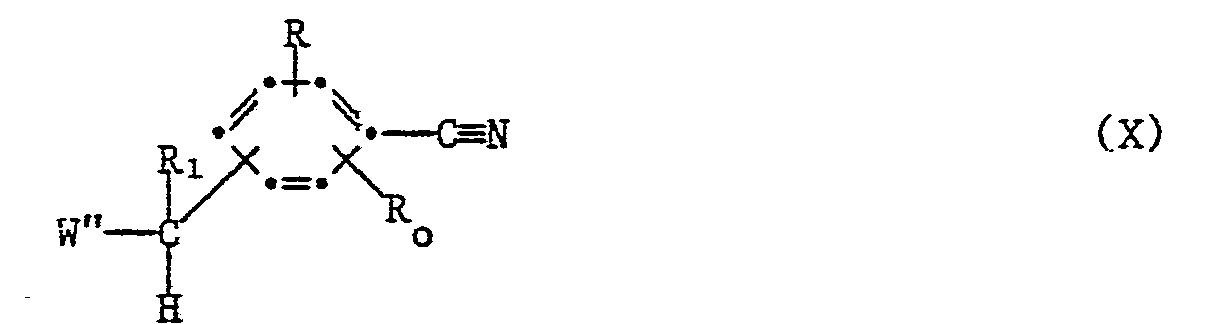


and/or converting a compound of formula I into another compound of formula I; and/or converting a free compound into a salt, and/or converting a salt into a free compound or into another salt; and/or separating a mixture of isomers or racemates into the single isomers or racemates and/or resolving a racemate into the optical isomers.
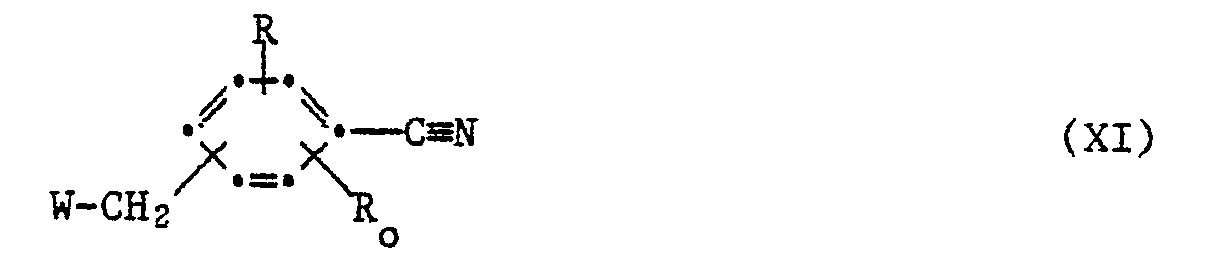
Priority Applications (2)
| Application Number | Priority Date | Filing Date | Title |
|---|---|---|---|
| AT87103099T ATE94873T1 (en) | 1986-03-07 | 1987-03-05 | ALPHA HETEROCYCLIC SUBSTITUTE TOLUNITRILES. |
| LV960274A LV5769B4 (en) | 1986-03-07 | 1996-07-18 | Toluitril with heterocyclic substituent alpha-state |
Applications Claiming Priority (2)
| Application Number | Priority Date | Filing Date | Title |
|---|---|---|---|
| US837489 | 1986-03-07 | ||
| US06/837,489 US4749713A (en) | 1986-03-07 | 1986-03-07 | Alpha-heterocycle substituted tolunitriles |
Publications (4)
| Publication Number | Publication Date |
|---|---|
| EP0236940A2 true EP0236940A2 (en) | 1987-09-16 |
| EP0236940A3 EP0236940A3 (en) | 1989-10-18 |
| EP0236940B1 EP0236940B1 (en) | 1993-09-22 |
| EP0236940B3 EP0236940B3 (en) | 2011-03-23 |
Family
ID=25274596
Family Applications (1)
| Application Number | Title | Priority Date | Filing Date |
|---|---|---|---|
| EP87103099A Expired - Lifetime EP0236940B3 (en) | 1986-03-07 | 1987-03-05 | Alpha-heterocycle substituted tolunitriles |
Country Status (36)
| Country | Link |
|---|---|
| US (1) | US4749713A (en) |
| EP (1) | EP0236940B3 (en) |
| JP (1) | JPH0755930B2 (en) |
| KR (1) | KR910000482B1 (en) |
| AT (1) | ATE94873T1 (en) |
| BG (4) | BG45701A3 (en) |
| CA (1) | CA1316928C (en) |
| CY (1) | CY1905A (en) |
| CZ (3) | CZ279027B6 (en) |
| DD (1) | DD264432A5 (en) |
| DE (2) | DE3787480T2 (en) |
| DK (1) | DK172190B1 (en) |
| DZ (1) | DZ1055A1 (en) |
| ES (1) | ES2059317T3 (en) |
| FI (1) | FI91857C (en) |
| HK (1) | HK50296A (en) |
| HU (1) | HU202843B (en) |
| IE (1) | IE61101B1 (en) |
| IL (1) | IL81746A (en) |
| LU (1) | LU90128I2 (en) |
| LV (1) | LV5769B4 (en) |
| MA (1) | MA20888A1 (en) |
| MC (1) | MC1805A1 (en) |
| MT (1) | MTP998B (en) |
| MX (1) | MX5496A (en) |
| MY (1) | MY102428A (en) |
| NL (1) | NL970011I2 (en) |
| NO (2) | NO170277C (en) |
| PH (1) | PH24159A (en) |
| PL (2) | PL152025B1 (en) |
| PT (1) | PT84410B (en) |
| RO (2) | RO101533B1 (en) |
| SK (3) | SK736787A3 (en) |
| SU (3) | SU1470184A3 (en) |
| TN (1) | TNSN87033A1 (en) |
| ZA (1) | ZA871637B (en) |
Cited By (30)
| Publication number | Priority date | Publication date | Assignee | Title |
|---|---|---|---|---|
| EP0296749A1 (en) * | 1987-06-16 | 1988-12-28 | Zeneca Limited | (Substituted aralkyl) heterocyclic compounds |
| EP0337929A1 (en) * | 1988-03-31 | 1989-10-18 | Schering Aktiengesellschaft | N-substituted imidazoles, process for their preparation and their pharmaceutical application |
| EP0411735A1 (en) * | 1989-08-04 | 1991-02-06 | Schering Aktiengesellschaft | Cycloalkylenazoles, process for their preparation, pharmaceutical preparations containing them and their use for the preparation of medicines |
| US5073574A (en) * | 1989-07-14 | 1991-12-17 | Ciba-Geigy Corporation | Tetrazolyl substituted benzonitriles and anti-tumor use thereof |
| WO1992010482A1 (en) * | 1990-12-07 | 1992-06-25 | Schering Aktiengesellschaft Berlin Und Bergkamen | Pharmaceutical compositions containing functionalized vinylazoles, use of these vinylazoles for producing medicaments, these vinylazoles themselves and process for producing the same |
| EP0490816A3 (en) * | 1990-12-12 | 1992-12-02 | Ciba-Geigy Ag | Fluoro-compounds |
| EP0518457A1 (en) * | 1991-06-14 | 1992-12-16 | Schering Aktiengesellschaft | Bicyclic substituted vinylimidazoles, -triazoles and -tetrazoles |
| WO1993005027A1 (en) | 1991-09-02 | 1993-03-18 | Yamanouchi Pharmaceutical Co., Ltd. | Triazolylated tertiary amine compound or salt thereof |
| WO1993010077A1 (en) * | 1991-11-21 | 1993-05-27 | G.D. Searle & Co. | N,n-di-alkyl(phenoxy)benzamide derivatives |
| WO1994013645A1 (en) * | 1992-12-16 | 1994-06-23 | Orion-Yhtymä Oy | Novel selective aromatase inhibiting compounds |
| WO1995017408A1 (en) * | 1993-12-22 | 1995-06-29 | Glaxo Wellcome Inc. | Synthesis of diaryl methanes |
| EP0877610A4 (en) * | 1996-01-30 | 1999-09-15 | Merck & Co Inc | INHIBITORS OF FARNESYL PROTEIN TRANSFERASE |
| EP0944387A4 (en) * | 1996-01-30 | 1999-09-29 | ||
| EP0891360A4 (en) * | 1996-04-03 | 2002-05-15 | Merck & Co Inc | FARNESYL PROTEIN TRANSFERASE INHIBITORS |
| WO2003050093A1 (en) * | 2001-12-11 | 2003-06-19 | Emory University | Bis(cyanophenyl)methyl-triazole for use in prevention of breast cancer |
| WO2005047269A1 (en) * | 2003-11-14 | 2005-05-26 | Natco Pharma Limited | A method for the separation of the letrozole precursor 4-‘1-(1,2,4-triazolyl) methyl!benzonitrile from its 1,3,4-triazolyl isomer |
| EP2253319A1 (en) | 2001-05-16 | 2010-11-24 | Novartis AG | Combination comprising N-{5-[4-(4-methyl-piperazino-methyl)-benzoylamido]-2-methylphenyl}-4-(3-pyridyl)-2pyrimidine-amine and a chemotherapeutic agent. |
| WO2011128434A2 (en) | 2010-04-16 | 2011-10-20 | Novartis Ag | Treatment of endocrine resistant breast cancer |
| US8314097B2 (en) | 2005-08-25 | 2012-11-20 | Novartis Ag | Organic compounds |
| WO2013036562A1 (en) | 2011-09-08 | 2013-03-14 | Novartis Ag | Use of an aromatase inhibitor for the treatment of hypogonadism and related diseases |
| WO2013182668A1 (en) | 2012-06-08 | 2013-12-12 | F. Hoffmann-La Roche Ag | Mutant selectivity and combinations of a phosphoinositide 3 kinase inhibitor compound and chemotherapeutic agents for the treatment of cancer |
| WO2015022609A1 (en) | 2013-08-14 | 2015-02-19 | Novartis Ag | Combination therapy for the treatment of cancer |
| WO2016151063A1 (en) | 2015-03-26 | 2016-09-29 | F. Hoffmann-La Roche Ag | Combinations of a phosphoinositide 3-kinase inhibitor compound and a cdk4/6 inhibitor compound for the treatment of cancer |
| WO2018033759A1 (en) | 2016-08-19 | 2018-02-22 | Mereo Biopharma 2 Limited | Dosage regimen for the treatment of endometriosis |
| WO2020023297A1 (en) | 2018-07-23 | 2020-01-30 | Genentech, Inc. | Methods of treating cancer with pi3k inhibitor, gdc-0077 |
| WO2020076432A1 (en) | 2018-10-08 | 2020-04-16 | Genentech, Inc. | Methods of treating cancer with pi3k alpha inhibitors and metformin |
| WO2021113219A1 (en) | 2019-12-03 | 2021-06-10 | Genentech, Inc. | Combination therapies for treatment of breast cancer |
| WO2022125483A1 (en) | 2020-12-11 | 2022-06-16 | Genentech, Inc. | Combination therapies for treatment of her2 cancer |
| WO2025122745A1 (en) | 2023-12-05 | 2025-06-12 | Genentech, Inc. | Combination therapies for treatment of her2 cancer |
| WO2026161536A1 (en) | 2025-01-24 | 2026-07-30 | Genentech, Inc. | Combination therapies for use in the treatment of breast cancer |
Families Citing this family (20)
| Publication number | Priority date | Publication date | Assignee | Title |
|---|---|---|---|---|
| US5112845A (en) * | 1986-03-07 | 1992-05-12 | Ciba-Geigy Corporation | Alpha-heterocycle substituted tolunitriles |
| US5352795A (en) * | 1986-03-07 | 1994-10-04 | Ciba-Geigy Corporation | Alpha-heterocycle substituted tolunitriles |
| JP2602456B2 (en) * | 1990-04-12 | 1997-04-23 | 雪印乳業株式会社 | Endometriosis treatment |
| EP0457716A1 (en) * | 1990-04-20 | 1991-11-21 | Ciba-Geigy Ag | Naphthalin derivatives |
| CH683151A5 (en) * | 1991-04-24 | 1994-01-31 | Ciba Geigy Ag | Contraception in female primates without affecting the menstrual cycle. |
| AU5285593A (en) * | 1992-10-21 | 1994-05-09 | Sankyo Company Limited | Azole compound |
| CA2249615A1 (en) * | 1996-04-03 | 1997-10-09 | Robert Gomez | Inhibitors of farnesyl-protein transferase |
| US6063930A (en) * | 1996-04-03 | 2000-05-16 | Merck & Co., Inc. | Substituted imidazole compounds useful as farnesyl-protein transferase inhibitors |
| US6080870A (en) * | 1996-04-03 | 2000-06-27 | Merck & Co., Inc. | Biaryl substituted imidazole compounds useful as farnesyl-protein transferase inhibitors |
| US6858598B1 (en) | 1998-12-23 | 2005-02-22 | G. D. Searle & Co. | Method of using a matrix metalloproteinase inhibitor and one or more antineoplastic agents as a combination therapy in the treatment of neoplasia |
| US6833373B1 (en) | 1998-12-23 | 2004-12-21 | G.D. Searle & Co. | Method of using an integrin antagonist and one or more antineoplastic agents as a combination therapy in the treatment of neoplasia |
| DE60309887T2 (en) * | 2002-07-30 | 2007-05-16 | Novartis Ag | COMBINATION OF AN AROMATASE WITH A BISPHOSPHONATE |
| GB0217636D0 (en) * | 2002-07-30 | 2002-09-11 | Novartis Ag | Organic compounds |
| JP2004196795A (en) * | 2002-12-16 | 2004-07-15 | Wyeth | N-phenyl-3-cyclopropylpyrazole-4-carbonitrile as external parasiticide |
| RU2365586C2 (en) * | 2003-12-15 | 2009-08-27 | Лаборатуар Терамекс | 1-n-phenylamino-1h-imidazol derivatives and pharmaceutical compositions containing them |
| KR100917698B1 (en) * | 2005-07-06 | 2009-09-21 | 시코르, 인크. | Improved Methods for the Preparation of Letrozole |
| US20090082413A1 (en) * | 2007-09-26 | 2009-03-26 | Protia, Llc | Deuterium-enriched letrozole |
| RU2425038C2 (en) * | 2009-11-27 | 2011-07-27 | Федеральное государственное унитарное предприятие "Государственный научный центр "Научно-исследовательский институт органических полупродуктов и красителей" (ФГУП "ГНЦ "НИОПИК") | Method of producing 1-[di (4-cyanophenyl)methyl]-1,2,4-triazole |
| EP2609087A2 (en) * | 2010-08-27 | 2013-07-03 | Generics [UK] Limited | Pure intermediate |
| CN116925001B (en) * | 2023-07-26 | 2025-09-30 | 陕西师范大学 | A synthetic method for anti-breast cancer drug letrozole analogues |
Family Cites Families (29)
| Publication number | Priority date | Publication date | Assignee | Title |
|---|---|---|---|---|
| US3290281A (en) * | 1963-07-18 | 1966-12-06 | Weinstein Julius | Photochromic nitrobenzylpyridines |
| US3397273A (en) * | 1966-02-18 | 1968-08-13 | Lilly Co Eli | Controlling phytopathogenic fungi on plants with 3-pyridyl methane derivatives |
| GB1170188A (en) * | 1967-09-15 | 1969-11-12 | Bayer Ag | N-trityl-imidazoles and salts and uses thereof |
| DE1670976B2 (en) * | 1968-01-29 | 1976-07-22 | N-TRITYL IMIDAZOLE | |
| DE1908991B2 (en) * | 1969-02-22 | 1977-05-26 | Bayer Ag, 5090 Leverkusen | ALPHA, ALPHA-DISUBSTITUTED N-BENZYLIMIDAZOLES AND THEIR SALTS |
| BR6915465D0 (en) * | 1969-03-07 | 1973-01-04 | Bayer Ag | PROCESS TO PREPARE SUBSTITUTED N-BENZIMIDAZOLES IN THE ALPHA POSITION BY PENTA-MEMBER HETEROCYCLES WITH ANTIMYCOTIC ACTIVITY |
| DE2007794A1 (en) * | 1970-02-20 | 1971-09-02 | Farbenfabriken Bayer Aktiengesell schaft, 5090 Leverkusen | Fungicides |
| DE2009020C3 (en) * | 1970-02-26 | 1979-09-13 | Bayer Ag, 5090 Leverkusen | Process for the preparation of N- (l, l, l-trisubstituted) -methylazoles |
| US3764690A (en) * | 1972-03-03 | 1973-10-09 | Bayer Ag | Substituted n-benzylimidazoles as antimycotic agents |
| US3927017A (en) * | 1974-06-27 | 1975-12-16 | Janssen Pharmaceutica Nv | 1-({62 -Aryl-{62 -R-ethyl)imidazoles |
| DE2628152C2 (en) * | 1976-06-23 | 1985-03-28 | Bayer Ag, 5090 Leverkusen | Fungicidal and nematicidal agents |
| DE2732531A1 (en) * | 1977-07-19 | 1979-02-01 | Hoechst Ag | IMIDAZOLE CARBONIC ACIDS AND THEIR DERIVATIVES |
| DE2735314A1 (en) * | 1977-08-05 | 1979-02-22 | Basf Ag | ALPHA-AZOLYL SULPHIDES AND THEIR DERIVATIVES |
| US4431815A (en) * | 1977-08-26 | 1984-02-14 | Burroughs Wellcome Co. | 1-[3-(2,4-Dichlorophenyl)propyl]imidazole and salts thereof |
| EP0003732B1 (en) * | 1978-02-01 | 1983-10-19 | The Wellcome Foundation Limited | Imidazole derivatives and salts thereof, their synthesis, and pharmaceutical formulations thereof |
| DE2808086A1 (en) * | 1978-02-24 | 1979-08-30 | Bayer Ag | SUBSTITUTED DIPHENYL-IMIDAZOLYL-METHANES, THE PROCESS FOR THEIR MANUFACTURING AND THEIR USE AS A MEDICINAL PRODUCT |
| DE2821829A1 (en) * | 1978-05-19 | 1979-11-22 | Basf Ag | MEANS OF REGULATING PLANT GROWTH |
| JPS55313A (en) * | 1978-06-13 | 1980-01-05 | Kissei Pharmaceut Co Ltd | Imidazole derivative |
| DE2847441A1 (en) * | 1978-11-02 | 1980-05-22 | Basf Ag | IMIDAZOLE COPPER COMPLEX CONNECTIONS |
| DK157860C (en) * | 1979-06-07 | 1990-07-30 | Shionogi & Co | METHOD OF ANALOGUE FOR THE PREPARATION OF BENZYLIMIDAZOLD DERIVATIVES AND PHARMACEUTICAL ACCEPTABLE ACID ADDITION SALTS THEREOF |
| US4281141A (en) * | 1980-05-30 | 1981-07-28 | Eli Lilly And Company | 3-(Imidazol-4-yl)-2-phenylpropanenitriles |
| US4617307A (en) * | 1984-06-20 | 1986-10-14 | Ciba-Geigy Corporation | Substituted imidazo[1,5-A]pyridine derivatives as aromatase inhibitors |
| US4562199A (en) * | 1983-08-11 | 1985-12-31 | Thorogood Peter B | Imidazole derivatives, compositions and use |
| EP0149976A3 (en) * | 1983-12-30 | 1986-12-10 | Ciba-Geigy Ag | Substituted imidazoles |
| US4801594A (en) * | 1984-06-18 | 1989-01-31 | Eli Lilly And Company | Aromatase inhibitors |
| US4605661A (en) * | 1984-06-18 | 1986-08-12 | Eli Lilly And Company | Aromastase inhibiting α,α-diarylimidazole-4(5)-propionitriles, α,α-diarylimidazole-4(5)-propionamides, and 4(5)-(2,2-diarylethyl)imidazoles |
| US4755526A (en) * | 1984-06-18 | 1988-07-05 | Eli Lilly And Company | Method of inhibiting aromatase |
| US4766140A (en) * | 1984-06-18 | 1988-08-23 | Eli Lilly And Company | Method of inhibiting aromatase |
| US4602025A (en) * | 1984-06-18 | 1986-07-22 | Eli Lilly And Company | Aromatase inhibitors |
-
1986
- 1986-03-07 US US06/837,489 patent/US4749713A/en not_active Expired - Lifetime
-
1987
- 1987-03-02 FI FI870903A patent/FI91857C/en not_active IP Right Cessation
- 1987-03-03 DD DD87300415A patent/DD264432A5/en not_active IP Right Cessation
- 1987-03-03 IL IL81746A patent/IL81746A/en not_active IP Right Cessation
- 1987-03-04 DZ DZ870031A patent/DZ1055A1/en active
- 1987-03-05 ES ES87103099T patent/ES2059317T3/en not_active Expired - Lifetime
- 1987-03-05 PT PT84410A patent/PT84410B/en unknown
- 1987-03-05 MC MC871874A patent/MC1805A1/en unknown
- 1987-03-05 HU HU87952A patent/HU202843B/en unknown
- 1987-03-05 BG BG081515A patent/BG45701A3/en unknown
- 1987-03-05 PL PL1987280247A patent/PL152025B1/en unknown
- 1987-03-05 AT AT87103099T patent/ATE94873T1/en active
- 1987-03-05 EP EP87103099A patent/EP0236940B3/en not_active Expired - Lifetime
- 1987-03-05 BG BG078756A patent/BG46598A3/en unknown
- 1987-03-05 CY CY190587A patent/CY1905A/en unknown
- 1987-03-05 DE DE87103099T patent/DE3787480T2/en not_active Expired - Lifetime
- 1987-03-05 RO RO1987134372A patent/RO101533B1/en unknown
- 1987-03-05 BG BG081514A patent/BG45700A3/en unknown
- 1987-03-05 MA MA21124A patent/MA20888A1/en unknown
- 1987-03-05 PL PL1987264460A patent/PL151490B1/en unknown
- 1987-03-05 DE DE1997175016 patent/DE19775016I2/en active Active
- 1987-03-05 CA CA000531185A patent/CA1316928C/en not_active Expired - Lifetime
- 1987-03-05 RO RO1987134373A patent/RO101532B1/en unknown
- 1987-03-06 IE IE57587A patent/IE61101B1/en not_active IP Right Cessation
- 1987-03-06 SU SU874202145A patent/SU1470184A3/en active
- 1987-03-06 MX MX549687A patent/MX5496A/en unknown
- 1987-03-06 CZ CS877367A patent/CZ279027B6/en not_active IP Right Cessation
- 1987-03-06 JP JP62050446A patent/JPH0755930B2/en not_active Expired - Lifetime
- 1987-03-06 NO NO870937A patent/NO170277C/en not_active IP Right Cessation
- 1987-03-06 SK SK7367-87A patent/SK736787A3/en unknown
- 1987-03-06 KR KR1019870002004A patent/KR910000482B1/en not_active Expired
- 1987-03-06 MY MYPI87000247A patent/MY102428A/en unknown
- 1987-03-06 SK SK1512-87A patent/SK279101B6/en unknown
- 1987-03-06 CZ CS877368A patent/CZ279028B6/en not_active IP Right Cessation
- 1987-03-06 MT MT998A patent/MTP998B/en unknown
- 1987-03-06 SK SK7368-87A patent/SK736887A3/en unknown
- 1987-03-06 ZA ZA871637A patent/ZA871637B/en unknown
- 1987-03-06 TN TNTNSN87033A patent/TNSN87033A1/en unknown
- 1987-03-06 DK DK117687A patent/DK172190B1/en not_active IP Right Cessation
- 1987-03-06 PH PH34986A patent/PH24159A/en unknown
- 1987-03-06 CZ CS871512A patent/CZ279026B6/en not_active IP Right Cessation
-
1988
- 1988-01-18 SU SU884203999A patent/SU1577695A3/en active
- 1988-01-18 SU SU884203990A patent/SU1549478A3/en active
-
1993
- 1993-11-11 BG BG098212A patent/BG61204B2/en unknown
-
1996
- 1996-03-21 HK HK50296A patent/HK50296A/en not_active IP Right Cessation
- 1996-07-18 LV LV960274A patent/LV5769B4/en unknown
-
1997
- 1997-03-03 NL NL970011C patent/NL970011I2/en unknown
- 1997-08-20 LU LU90128C patent/LU90128I2/en unknown
-
1998
- 1998-03-04 NO NO1998010C patent/NO1998010I1/en unknown
Non-Patent Citations (1)
| Title |
|---|
| None |
Cited By (48)
| Publication number | Priority date | Publication date | Assignee | Title |
|---|---|---|---|---|
| EP0296749A1 (en) * | 1987-06-16 | 1988-12-28 | Zeneca Limited | (Substituted aralkyl) heterocyclic compounds |
| EP0337929A1 (en) * | 1988-03-31 | 1989-10-18 | Schering Aktiengesellschaft | N-substituted imidazoles, process for their preparation and their pharmaceutical application |
| US5073574A (en) * | 1989-07-14 | 1991-12-17 | Ciba-Geigy Corporation | Tetrazolyl substituted benzonitriles and anti-tumor use thereof |
| US5411982A (en) * | 1989-08-03 | 1995-05-02 | Schering Aktiengesellschaft | Cycloalkylene azoles, and their use as aromatase inhibitors |
| US5280035A (en) * | 1989-08-04 | 1994-01-18 | Schering Aktiengesellschaft | Cycloalkylene azoles and their use as aromatase inhibitors |
| EP0411735A1 (en) * | 1989-08-04 | 1991-02-06 | Schering Aktiengesellschaft | Cycloalkylenazoles, process for their preparation, pharmaceutical preparations containing them and their use for the preparation of medicines |
| WO1991001975A1 (en) * | 1989-08-04 | 1991-02-21 | Schering Aktiengesellschaft Berlin Und Bergkamen | Cycloalkylenazoles, process for preparing them, pharmaceutical preparations containing them and their use to manufacture drugs |
| US5135937A (en) * | 1989-08-04 | 1992-08-04 | Schering Aktiengesellschaft | Cycloalkylene azoles and pharmaceutical preparations obtained therefrom |
| WO1992010482A1 (en) * | 1990-12-07 | 1992-06-25 | Schering Aktiengesellschaft Berlin Und Bergkamen | Pharmaceutical compositions containing functionalized vinylazoles, use of these vinylazoles for producing medicaments, these vinylazoles themselves and process for producing the same |
| US5344834A (en) * | 1990-12-07 | 1994-09-06 | Schering Aktiengesellschaft | Functionalized vinyl azoles and methods of use |
| US5227393A (en) * | 1990-12-12 | 1993-07-13 | Ciba-Geigy Corporation | α-fluoro-α-tetrazolyl-phenylmethyl derivatives useful as aromatase inhibitors |
| EP0490816A3 (en) * | 1990-12-12 | 1992-12-02 | Ciba-Geigy Ag | Fluoro-compounds |
| WO1992022536A1 (en) * | 1991-06-14 | 1992-12-23 | Schering Aktiengesellschaft, Berlin Und Bergkamen | Vinylimidazoles, vinyltriazoles and vinyltetrazoles with a bicyclic substituent group |
| EP0518457A1 (en) * | 1991-06-14 | 1992-12-16 | Schering Aktiengesellschaft | Bicyclic substituted vinylimidazoles, -triazoles and -tetrazoles |
| WO1993005027A1 (en) | 1991-09-02 | 1993-03-18 | Yamanouchi Pharmaceutical Co., Ltd. | Triazolylated tertiary amine compound or salt thereof |
| WO1993010077A1 (en) * | 1991-11-21 | 1993-05-27 | G.D. Searle & Co. | N,n-di-alkyl(phenoxy)benzamide derivatives |
| US5962495A (en) * | 1992-12-16 | 1999-10-05 | Risto Arvo Sakari Lammintausta | Selective aromatase inhibiting compounds |
| WO1994013645A1 (en) * | 1992-12-16 | 1994-06-23 | Orion-Yhtymä Oy | Novel selective aromatase inhibiting compounds |
| US5703109A (en) * | 1992-12-16 | 1997-12-30 | Orion-yhtyma Oy | Selective aromatase inhibiting compounds |
| CN1056835C (en) * | 1992-12-16 | 2000-09-27 | 瑞斯托莱明特斯塔 | Novel selective aromatase inhibiting compounds |
| WO1995017408A1 (en) * | 1993-12-22 | 1995-06-29 | Glaxo Wellcome Inc. | Synthesis of diaryl methanes |
| EP0944387A4 (en) * | 1996-01-30 | 1999-09-29 | ||
| EP0877610A4 (en) * | 1996-01-30 | 1999-09-15 | Merck & Co Inc | INHIBITORS OF FARNESYL PROTEIN TRANSFERASE |
| EP0891360A4 (en) * | 1996-04-03 | 2002-05-15 | Merck & Co Inc | FARNESYL PROTEIN TRANSFERASE INHIBITORS |
| EP2253319A1 (en) | 2001-05-16 | 2010-11-24 | Novartis AG | Combination comprising N-{5-[4-(4-methyl-piperazino-methyl)-benzoylamido]-2-methylphenyl}-4-(3-pyridyl)-2pyrimidine-amine and a chemotherapeutic agent. |
| WO2003050093A1 (en) * | 2001-12-11 | 2003-06-19 | Emory University | Bis(cyanophenyl)methyl-triazole for use in prevention of breast cancer |
| CN1325482C (en) * | 2001-12-11 | 2007-07-11 | 埃默里大学 | Biscyanophenylmethyl-triazole for use in prevention of breast cancer |
| WO2005047269A1 (en) * | 2003-11-14 | 2005-05-26 | Natco Pharma Limited | A method for the separation of the letrozole precursor 4-‘1-(1,2,4-triazolyl) methyl!benzonitrile from its 1,3,4-triazolyl isomer |
| US9278969B2 (en) | 2005-08-25 | 2016-03-08 | Novartis Ag | Organic compounds |
| US8314097B2 (en) | 2005-08-25 | 2012-11-20 | Novartis Ag | Organic compounds |
| US8835646B2 (en) | 2005-08-25 | 2014-09-16 | Novartis Ag | Organic compounds |
| WO2011128434A2 (en) | 2010-04-16 | 2011-10-20 | Novartis Ag | Treatment of endocrine resistant breast cancer |
| WO2013036562A1 (en) | 2011-09-08 | 2013-03-14 | Novartis Ag | Use of an aromatase inhibitor for the treatment of hypogonadism and related diseases |
| WO2013036563A1 (en) | 2011-09-08 | 2013-03-14 | Novartis Ag | Pharmaceutical compositions comprising an aromatase inhibitor |
| RU2617510C2 (en) * | 2011-09-08 | 2017-04-25 | Новартис Аг | Pharmaceutical compositions comprising aromatase inhibitor |
| WO2013182668A1 (en) | 2012-06-08 | 2013-12-12 | F. Hoffmann-La Roche Ag | Mutant selectivity and combinations of a phosphoinositide 3 kinase inhibitor compound and chemotherapeutic agents for the treatment of cancer |
| EP3545968A1 (en) | 2012-06-08 | 2019-10-02 | F. Hoffmann-La Roche AG | Mutant selectivity and combinations of a phosphoinositide 3 kinase inhibitor compound and chemotherapeutic agents for the treatment of cancer |
| WO2015022609A1 (en) | 2013-08-14 | 2015-02-19 | Novartis Ag | Combination therapy for the treatment of cancer |
| EP4005573A1 (en) | 2013-08-14 | 2022-06-01 | Novartis AG | Combination therapy for the treatment of cancer |
| EP4772247A2 (en) | 2013-08-14 | 2026-07-08 | Novartis AG | Combination therapy comprising ribociclib and fulvestrant for the treatment of cancer |
| WO2016151063A1 (en) | 2015-03-26 | 2016-09-29 | F. Hoffmann-La Roche Ag | Combinations of a phosphoinositide 3-kinase inhibitor compound and a cdk4/6 inhibitor compound for the treatment of cancer |
| WO2018033759A1 (en) | 2016-08-19 | 2018-02-22 | Mereo Biopharma 2 Limited | Dosage regimen for the treatment of endometriosis |
| WO2020023297A1 (en) | 2018-07-23 | 2020-01-30 | Genentech, Inc. | Methods of treating cancer with pi3k inhibitor, gdc-0077 |
| WO2020076432A1 (en) | 2018-10-08 | 2020-04-16 | Genentech, Inc. | Methods of treating cancer with pi3k alpha inhibitors and metformin |
| WO2021113219A1 (en) | 2019-12-03 | 2021-06-10 | Genentech, Inc. | Combination therapies for treatment of breast cancer |
| WO2022125483A1 (en) | 2020-12-11 | 2022-06-16 | Genentech, Inc. | Combination therapies for treatment of her2 cancer |
| WO2025122745A1 (en) | 2023-12-05 | 2025-06-12 | Genentech, Inc. | Combination therapies for treatment of her2 cancer |
| WO2026161536A1 (en) | 2025-01-24 | 2026-07-30 | Genentech, Inc. | Combination therapies for use in the treatment of breast cancer |
Also Published As
Similar Documents
| Publication | Publication Date | Title |
|---|---|---|
| EP0236940B3 (en) | Alpha-heterocycle substituted tolunitriles | |
| US4978672A (en) | Alpha-heterocyclc substituted tolunitriles | |
| US4937250A (en) | Alpha-heterocycle substituted tolunitriles | |
| US5473078A (en) | Alpha-heterocycle substituted tolunitriles | |
| NZ201690A (en) | Naphthalenes and benzofused heterocyclic compounds and pharmaceutical compositions | |
| JP2001524455A (en) | Imidazole derivatives and their use as farnesyl protein transferase inhibitors | |
| US5962495A (en) | Selective aromatase inhibiting compounds | |
| HUT67852A (en) | New benzocycloheptenes, and benzoxepines, pharmaceutical compositions containing them and process for producing them | |
| JPH0971586A (en) | Novel bicyclic fused imidazole derivative | |
| US5071861A (en) | Alpha-heterocycle substituted tolunitriles | |
| US4588732A (en) | Certain imidazo(1,5-a)pyridine derivatives and their use as thromboxane synthetase inhibitors | |
| CA1197249A (en) | N-substituted-2-pyridylindoles | |
| KR900002756B1 (en) | Omega-[(hetero) alkyl] benz [cd] indol-2-amines, salts thereof, compositions and preparations thereof | |
| US5112845A (en) | Alpha-heterocycle substituted tolunitriles | |
| US4663332A (en) | 5-substituted N-alkylated tetrazoles | |
| US6943183B2 (en) | 5-substituted tetralones as inhibitors of ras farnesyl transferase | |
| HUT72299A (en) | Novel selective aromatase inhibiting heterocyclic compounds, pharmaceutical compositions containing them and process for preparing them |
Legal Events
| Date | Code | Title | Description |
|---|---|---|---|
| PUAI | Public reference made under article 153(3) epc to a published international application that has entered the european phase |
Free format text: ORIGINAL CODE: 0009012 |
|
| 17P | Request for examination filed |
Effective date: 19870305 |
|
| AK | Designated contracting states |
Kind code of ref document: A2 Designated state(s): AT BE CH DE ES FR GB GR IT LI LU NL SE |
|
| PUAL | Search report despatched |
Free format text: ORIGINAL CODE: 0009013 |
|
| AK | Designated contracting states |
Kind code of ref document: A3 Designated state(s): AT BE CH DE ES FR GB GR IT LI LU NL SE |
|
| 17Q | First examination report despatched |
Effective date: 19900928 |
|
| GRAA | (expected) grant |
Free format text: ORIGINAL CODE: 0009210 |
|
| AK | Designated contracting states |
Kind code of ref document: B1 Designated state(s): AT BE CH DE ES FR GB GR IT LI LU NL SE |
|
| REF | Corresponds to: |
Ref document number: 94873 Country of ref document: AT Date of ref document: 19931015 Kind code of ref document: T |
|
| ITF | It: translation for a ep patent filed | ||
| REF | Corresponds to: |
Ref document number: 3787480 Country of ref document: DE Date of ref document: 19931028 |
|
| ET | Fr: translation filed | ||
| REG | Reference to a national code |
Ref country code: GR Ref legal event code: FG4A Free format text: 3009833 |
|
| ITTA | It: last paid annual fee | ||
| EPTA | Lu: last paid annual fee | ||
| REG | Reference to a national code |
Ref country code: AT Ref legal event code: UEP |
|
| PLBE | No opposition filed within time limit |
Free format text: ORIGINAL CODE: 0009261 |
|
| 26N | No opposition filed | ||
| REG | Reference to a national code |
Ref country code: ES Ref legal event code: FG2A Ref document number: 2059317 Country of ref document: ES Kind code of ref document: T3 |
|
| EAL | Se: european patent in force in sweden |
Ref document number: 87103099.5 |
|
| REG | Reference to a national code |
Ref country code: GB Ref legal event code: 727 |
|
| REG | Reference to a national code |
Ref country code: GB Ref legal event code: 727A |
|
| REG | Reference to a national code |
Ref country code: GB Ref legal event code: 727B |
|
| REG | Reference to a national code |
Ref country code: GB Ref legal event code: SP |
|
| REG | Reference to a national code |
Ref country code: FR Ref legal event code: CP Free format text: PRODUCT NAME: LETROZOLE; NAT. REGISTRATION NO/DATE: NL 21881 19960724; FIRST REGISTRATION: Spc suppl protection certif: 96C0045 Filing date: 19961128 |
|
| REG | Reference to a national code |
Ref country code: CH Ref legal event code: PFA Free format text: CIBA-GEIGY AG TRANSFER- NOVARTIS AG |
|
| REG | Reference to a national code |
Ref country code: CH Ref legal event code: SPCF Free format text: CHSPCFOICM 54018 19970314 |
|
| REG | Reference to a national code |
Ref country code: GB Ref legal event code: 732E |
|
| REG | Reference to a national code |
Ref country code: NL Ref legal event code: AC1 Free format text: NLAC1 970011, 970303 |
|
| REG | Reference to a national code |
Ref country code: SE Ref legal event code: SPCF Free format text: 9790014, 961210 |
|
| REG | Reference to a national code |
Ref country code: GB Ref legal event code: CTFF Free format text: GBCTFFSPC/GB97/013, 970506 |
|
| NLS | Nl: assignments of ep-patents |
Owner name: NOVARTIS AG |
|
| REG | Reference to a national code |
Ref country code: ES Ref legal event code: PC2A |
|
| REG | Reference to a national code |
Ref country code: FR Ref legal event code: CR Free format text: FRCR 96C0045, 19961128 |
|
| REG | Reference to a national code |
Ref country code: AT Ref legal event code: EEIH |
|
| REG | Reference to a national code |
Ref country code: NL Ref legal event code: KC1 Free format text: NLKC1 970011, 20070305, EXPIRES: 20110723 |
|
| REG | Reference to a national code |
Ref country code: AT Ref legal event code: ESZA Spc suppl protection certif: SZ 25/1997 |
|
| REG | Reference to a national code |
Ref country code: GB Ref legal event code: CTFG Free format text: GBCTFGSPC/GB97/013, 19970908, EXPIRES:20110723 |
|
| REG | Reference to a national code |
Ref country code: LU Ref legal event code: CCP Free format text: LUCCP 90128, EXPIRES:20110724 |
|
| REG | Reference to a national code |
Ref country code: FR Ref legal event code: TP |
|
| REG | Reference to a national code |
Ref country code: SE Ref legal event code: SPCG Free format text: 9790014, 961210, EXPIRES: 20110723 |
|
| REG | Reference to a national code |
Ref country code: FR Ref legal event code: CY Free format text: FRCY 96C0045, 961128 |
|
| CCPV | Be: grant of a complementary protection certificate |
Free format text: 097C0053, EXPIRES: 20110724 |
|
| REG | Reference to a national code |
Ref country code: FR Ref legal event code: CP |
|
| MEDD | It: supplementary protection certificate for pharmaceutical products: granted |
Free format text: CCP 595, 19970915; NOVARTIS AG |
|
| REG | Reference to a national code |
Ref country code: CH Ref legal event code: SPCG Free format text: OICM-NO 54018/19970226, 19970314, EXPIRES: 20120226 |
|
| REG | Reference to a national code |
Ref country code: GB Ref legal event code: IF02 |
|
| REG | Reference to a national code |
Ref country code: AT Ref legal event code: EEZF Free format text: PRODUCT NAME: LETROZOL ODER EIN PHARMAZEUTISCH VERWENDBARES SALZ DAVON Spc suppl protection certif: SZ 25/1997 Filing date: 19970702 Extension date: 20110724 |
|
| PGFP | Annual fee paid to national office [announced via postgrant information from national office to epo] |
Ref country code: FR Payment date: 20060203 Year of fee payment: 20 |
|
| PGFP | Annual fee paid to national office [announced via postgrant information from national office to epo] |
Ref country code: CH Payment date: 20060206 Year of fee payment: 20 Ref country code: BE Payment date: 20060206 Year of fee payment: 20 |
|
| PGFP | Annual fee paid to national office [announced via postgrant information from national office to epo] |
Ref country code: NL Payment date: 20060209 Year of fee payment: 20 |
|
| PGFP | Annual fee paid to national office [announced via postgrant information from national office to epo] |
Ref country code: AT Payment date: 20060210 Year of fee payment: 20 |
|
| PGFP | Annual fee paid to national office [announced via postgrant information from national office to epo] |
Ref country code: GB Payment date: 20060224 Year of fee payment: 20 Ref country code: GR Payment date: 20060224 Year of fee payment: 20 |
|
| PGFP | Annual fee paid to national office [announced via postgrant information from national office to epo] |
Ref country code: LU Payment date: 20060228 Year of fee payment: 20 |
|
| PGFP | Annual fee paid to national office [announced via postgrant information from national office to epo] |
Ref country code: ES Payment date: 20060303 Year of fee payment: 20 |
|
| PGFP | Annual fee paid to national office [announced via postgrant information from national office to epo] |
Ref country code: IT Payment date: 20060331 Year of fee payment: 20 |
|
| PGFP | Annual fee paid to national office [announced via postgrant information from national office to epo] |
Ref country code: DE Payment date: 20060403 Year of fee payment: 20 |
|
| PG25 | Lapsed in a contracting state [announced via postgrant information from national office to epo] |
Ref country code: GB Free format text: LAPSE BECAUSE OF EXPIRATION OF PROTECTION Effective date: 20070304 |
|
| PG25 | Lapsed in a contracting state [announced via postgrant information from national office to epo] |
Ref country code: NL Free format text: LAPSE BECAUSE OF EXPIRATION OF PROTECTION Effective date: 20070305 |
|
| PG25 | Lapsed in a contracting state [announced via postgrant information from national office to epo] |
Ref country code: ES Free format text: LAPSE BECAUSE OF EXPIRATION OF PROTECTION Effective date: 20070306 |
|
| REG | Reference to a national code |
Ref country code: GB Ref legal event code: CTFE Free format text: SPC/GB97/013: 20070305, EXPIRES: 20110723 Spc suppl protection certif: SPC/GB97/013 Filing date: 20070305 Expiry date: 20110723 Ref country code: GB Ref legal event code: PE20 |
|
| REG | Reference to a national code |
Ref country code: CH Ref legal event code: PL |
|
| NLV7 | Nl: ceased due to reaching the maximum lifetime of a patent |
Effective date: 20070305 |
|
| EUG | Se: european patent has lapsed | ||
| REG | Reference to a national code |
Ref country code: AT Ref legal event code: EELA |
|
| REG | Reference to a national code |
Ref country code: ES Ref legal event code: FD2A Effective date: 20070306 |
|
| BE20 | Be: patent expired |
Owner name: *NOVARTIS A.G. Effective date: 20070305 |
|
| PGFP | Annual fee paid to national office [announced via postgrant information from national office to epo] |
Ref country code: SE Payment date: 20060224 Year of fee payment: 20 |
|
| PLCP | Request for limitation filed |
Free format text: ORIGINAL CODE: EPIDOSNLIM1 |
|
| PLCQ | Request for limitation of patent found admissible |
Free format text: ORIGINAL CODE: 0009231 |
|
| LIM1 | Request for limitation found admissible |
Free format text: SEQUENCE NO: 1; FILED AFTER OPPOSITION PERIOD Filing date: 20090218 |
|
| PLCO | Limitation procedure: reply received to communication from examining division + time limit |
Free format text: ORIGINAL CODE: EPIDOSNLIR3 |
|
| REG | Reference to a national code |
Ref country code: FR Ref legal event code: CL Ref country code: FR Ref legal event code: CL Spc suppl protection certif: 96C0045 |
|
| REG | Reference to a national code |
Ref country code: FR Ref legal event code: ER Spc suppl protection certif: 96C0045 Ref country code: FR Ref legal event code: CL Spc suppl protection certif: 96C0045 |
|
| PLCR | Communication despatched that request for limitation of patent was allowed |
Free format text: ORIGINAL CODE: 0009245 |
|
| PLCN | Payment of fee for limitation of patent |
Free format text: ORIGINAL CODE: EPIDOSNRAL3 |
|
| PUAM | (expected) publication of b3 document |
Free format text: ORIGINAL CODE: 0009410 |
|
| STAA | Information on the status of an ep patent application or granted ep patent |
Free format text: STATUS: THE PATENT HAS BEEN LIMITED |
|
| REG | Reference to a national code |
Ref country code: CH Ref legal event code: AEN Free format text: REQUETE DE LIMITATION ACCORDEE |
|
| REG | Reference to a national code |
Ref country code: NL Ref legal event code: T3 |
|
| REG | Reference to a national code |
Ref country code: BE Ref legal event code: CCRE Owner name: *NOVARTIS A.G. Free format text: PRODUCT NAME: LETROZOLE; NAT. REGISTRATION NO/DATE: 206 IS 241 F 3 19970616; FIRST REGISTRATION: FR 341 474.2 1996072 Spc suppl protection certif: 97C0053 Filing date: 19970718 Expiry date: 20070305 Extension date: 20110724 Effective date: 20110724 |
|
| REG | Reference to a national code |
Ref country code: GB Ref legal event code: SPCE Free format text: PRODUCT NAME: LETROZOLE OPTIONALLY IN THE FORM OF A PHARMACEUTICALLY ACCEPTABLE SALT; REGISTERED: FR 341 474-2 19960724; FR 341 475-9 19960724; UK PL00001/0224 19961118 Spc suppl protection certif: SPC/GB97/013 Filing date: 19970506 Expiry date: 20070305 Extension date: 20110723 |
|
| REG | Reference to a national code |
Ref country code: NL Ref legal event code: SPCX Free format text: PRODUCT NAME: LETROZOLUM, DESGEWENST IN DE VORM VAN EEN FARMACEUTISCH AANVAAR DBAAR ZOUT; NAT. REGISTRATION: RVG 20755 19970106; FIRST REGISTRATION: FR NL 21 881 19960724 Spc suppl protection certif: C970011 Filing date: 19970303 Expiry date: 20070305 Extension date: 20110723 |
|
| REG | Reference to a national code |
Ref country code: CH Ref legal event code: SPCL Spc suppl protection certif: C00236940/01 |