EP0236136A2 - Product for dispensing treatment agents in a washing or dishwashing machine - Google Patents
Product for dispensing treatment agents in a washing or dishwashing machine Download PDFInfo
- Publication number
- EP0236136A2 EP0236136A2 EP19870301905 EP87301905A EP0236136A2 EP 0236136 A2 EP0236136 A2 EP 0236136A2 EP 19870301905 EP19870301905 EP 19870301905 EP 87301905 A EP87301905 A EP 87301905A EP 0236136 A2 EP0236136 A2 EP 0236136A2
- Authority
- EP
- European Patent Office
- Prior art keywords
- compartment
- sachet
- product
- water
- wash liquor
- Prior art date
- Legal status (The legal status is an assumption and is not a legal conclusion. Google has not performed a legal analysis and makes no representation as to the accuracy of the status listed.)
- Granted
Links
Images


Classifications
-
- D—TEXTILES; PAPER
- D06—TREATMENT OF TEXTILES OR THE LIKE; LAUNDERING; FLEXIBLE MATERIALS NOT OTHERWISE PROVIDED FOR
- D06F—LAUNDERING, DRYING, IRONING, PRESSING OR FOLDING TEXTILE ARTICLES
- D06F39/00—Details of washing machines not specific to a single type of machines covered by groups D06F9/00 - D06F27/00
-
- C—CHEMISTRY; METALLURGY
- C11—ANIMAL OR VEGETABLE OILS, FATS, FATTY SUBSTANCES OR WAXES; FATTY ACIDS THEREFROM; DETERGENTS; CANDLES
- C11D—DETERGENT COMPOSITIONS; USE OF SINGLE SUBSTANCES AS DETERGENTS; SOAP OR SOAP-MAKING; RESIN SOAPS; RECOVERY OF GLYCEROL
- C11D17/00—Detergent materials or soaps characterised by their shape or physical properties
- C11D17/04—Detergent materials or soaps characterised by their shape or physical properties combined with or containing other objects
- C11D17/041—Compositions releasably affixed on a substrate or incorporated into a dispensing means
- C11D17/046—Insoluble free body dispenser
-
- C—CHEMISTRY; METALLURGY
- C11—ANIMAL OR VEGETABLE OILS, FATS, FATTY SUBSTANCES OR WAXES; FATTY ACIDS THEREFROM; DETERGENTS; CANDLES
- C11D—DETERGENT COMPOSITIONS; USE OF SINGLE SUBSTANCES AS DETERGENTS; SOAP OR SOAP-MAKING; RESIN SOAPS; RECOVERY OF GLYCEROL
- C11D17/00—Detergent materials or soaps characterised by their shape or physical properties
- C11D17/04—Detergent materials or soaps characterised by their shape or physical properties combined with or containing other objects
Definitions
- the present invention relates to a product in the form of a multicompartment sachet for the delivery of treatment agents, for example, detergent, bleach, enzyme, rinse conditioner or rinse aid, into the wash liquor in an automatic washing machine or dishwasher.
- treatment agents for example, detergent, bleach, enzyme, rinse conditioner or rinse aid
- Multicompartment sachets for delivering ingredients in washing machines in a sequential manner have been disclosed in the prior art.
- GB 2 000 177B discloses a two-compartment sachet containing a phosphate free detergent composition based on sodium carbonate.
- a first compartment is bounded by a water-permeable wall and separated by a partition from a second compartment bounded by an impermeable wall; the partition wall is of material that disintegrates in the wash water. The contents of the second compartment are therefore not released until the contents of the first compartment have been leached out and the partition wall has disintegrated.
- US 4 410 441 discloses another two-compartment sachet which differs from that of GB 2 000 177B in that the partition wall is of water-insoluble water-permeable material. Release of the contents of the second compartment is by leaching out through the porous partition after the contents of the first compartment have been delivered.
- EP 143 476A discloses a sachet having two compartments, one being formed of water-permeable material or material that immediately disintegrates in water and the other being formed of water-impermeable non-disintegrating material and being sealed with a water-sensitive composition comprising an anionic and/or nonionic water-binding polymer, for example, polyvinyl pyrrolidone and a cationic polymeric adhesive, for example, polyethyleneimine.
- the first compartment releases its contents rapidly, while release from the second compartment is delayed by the slow opening of the water-sensitive seals.
- EP 66 463B discloses an article for releasing an active material in a controlled manner, comprising two layers of sheet material (laminates each consisting of an outer porous layer and an inner plastics film layer) bonded together in a grid pattern to form an array of cells or compartments.
- the sheet material is pinholed for release of active material. If desired different compartments can contain different active material and can be pinholed to differing extents to allow release of different active material at different rates.
- the present invention provides a product for the delivery of treatment agents into the wash liquor of an automatic washing or dishwashing machine, comprising a sachet having at least two compartments, including:
- the sachet of the invention contains at least two different compartments and is designed to deliver their contents in distinctly different ways: the contents of the first compartment are released very rapidly while the release of the contents of the second compartment is delayed and/or retarded.
- the sachet is designed to deliver its contents in at least two discrete stages, with an interval between the deliveries of at least 2 minutes, preferably at least 5 minutes and advantageously from 10 to 15 minutes, from at least two different compartments.
- the contents of the compartments may if desired be identical, but the sachet of the invention is especially useful for delivering different ingredients at different stages in the washing or dishwashing process.
- the contents of the second compartment are in pulverulent or granular form while the contents of the first compartment can be in any desired form compatible with the nature of the compartment's walls and seals.
- Any compositions that can be used to treat laundry or a dishwasher load may be delivered by means of the sachet of the invention provided that the second treatment agent is water-soluble or water-dispersible. Examples include detergents, bleaches, rinse conditioners, enzymes, deodorants and rinse aids. In fabric washing, for example, a detergent composition may be delivered from the first compartment and a bleach or rinse conditioner from the second; such a product may be a self-contained whole wash product.
- An additive product intended to boost the performance of a conventional detergent powder may, for example, deliver an enzyme from the first compartment and a bleach from the second.
- a product for dishwasher use may, for example, deliver a cleaning composition with enzyme from the first compartment and a chlorine bleach from the second.
- wash liquor should be understood to apply both to fabric washing machines and to dishwashing machines.
- start of the wash process will also be used, and this should be understood as the time at which the water fill is substantially complete and full agitation commences; any period of static heat-up and any short bursts of agitation before water fill is complete are regarded as occurring before the start of the wash process.
- the sachet of the invention may have any number of compartments greater than one, but for simplicity the preferred embodiment of a two-compartment sachet will now be discussed.
- the first compartment is so designed that its contents will be released at or very shortly after the beginning of the wash cycle in the washing or dishwashing machine. Substantially complete delivery of the contents of the first compartment occurs within at least 3 minutes of the start of the wash process, and preferably within 1 minute.
- the first compartment must therefore combine the ability to contain a composition securely in the dry state with the ability to release that composition quickly when exposed to water, or water and agitation, in the wash environment.
- the first compartment may be provided with one or more seals that open when the sachet is exposed to the wash environment, for example, seals sensitive to water, temperature or agitation.
- a water-sensitive adhesive as described in GB 1 583 082 (Unilever) may be used; or a mechanically weak heat-seal as described in EP 11 500B (Unilever).
- An example of a suitable water-sensitive adhesive is sodium carboxymethylcellulose.
- the contents of the first compartment are liquid, it may suitably be provided with one or more mechanically weak heat-seals, as described in EP 40 931B (Unilever), that will open as a result of agitation in the wash environment.
- EP 40 931B Unilever
- the first compartment is of the opening type and its contents are in powder form, it may be made of either water-permeable or water-impermeable material. Suitable materials include wet-strength paper; woven; knitted or nonwoven fabrics; and plastics films. A material that has been found to be highly suitable is tea bag paper manufactured by Crompton Ltd., UK. The impermeable materials mentioned are also suitable for containing liquids.
- the first compartment if its contents are in powder form, to be of a non-opening type, in which case its walls must be made of highly water-permeable material.
- the pore size of the wall material must be sufficiently large to allow very rapid leaching out of the contents of the compartment, but it may be necessary to prevent leakage of the contents in the dry state, for example, by ensuring that the composition contained in the compartment is free of particles smaller that the pore size of the wall material, or by coating the outside of the compartment walls with a pore-occluding coating or layer of material that will be disrupted (dissolved or dispersed) very rapidly by the wash liquor.
- the second compartment in contrast to the first, is so designed that its contents, which are in powder form, will be released only gradually and/or after a delay of at least 5 minutes. Preferably release, whether gradual or not, occurs only after a delay of at least 5 minutes, preferably at least 10 minutes: the delay required will depend on the intended use of the sachet of the invention and the machine cycle that it has to match, delays of from 5 to 90 minutes typically being useful.
- the second compartment is of the non-opening type, and therefore it has at least one wall of porous water-permeable material. Release from the second compartment is by leaching out of its contents by the wash liquor through its porous water-permeable wall(s), and this process is delayed and/or retarded by means of one or both of two measures.
- the first of these is the provision of a pore-occluding coating or layer of a material that is disrupted (dissolved or dispersed) by the wash liquor; unlike the coating mentioned above for the first compartment, this should be of a material that is not too soluble or dispersible, so that its disruption occurs over a sufficiently long period to provide some delay and/or retardation.
- the sachet product of the invention may comprise a first compartment, and an adjacent second compartment separated from the first by a non-opening seam or a non-water-permeable partition wall, the second compartment being provided with a pore-occluding coating or layer.
- the sachet can be enclosed within another sachet compartment of porous water-permeable material.
- This other sachet compartment may simply be the first compartment; the second compartment (inner sachet) is then located, together with the first treatment agent, in the first compartment (outer sachet).
- the first compartment (outer sachet) should be of the non-opening type to prevent escape of the inner sachet into the wash liquor, if the inner sachet does not have a pore-occluding coating or layer.
- the inner sachet may be wholly separate from the outer sachet, or it may be attached; an integral construction created by folding is also possible.
- the second compartment inner sachet
- the second compartment may be located in a separate additional (third) compartment separated from the first compartment by a non-opening seam or a partition wall which is preferably water-impermeable.
- the inner sachet may conveniently be made from a water-impermeable, thermoplastic sheet material, such as polyethylene film, provided with pin-holes. This form of construction is preferred as the inner sachet is readily heat-sealable. Additionally, by varying the number and size of the pin-holes the delay in release of the second treatment agent may be varied. Rapid release may be achieved by the provision of a large number of large diameter holes whereas slower release can be obtained from sachets having a small number of smaller diameter holes.
- Sachets for use in a conventional sized machine are preferably provided with a total of 2 to 8 pin-holes having a diameter of 0.5 to 1mm.
- Reproducibility of release profiles is generally increased by provision of a large number of small holes and also by the provision of pin-holes in both faces of the sachet. Reproducibility is also increased in general when the pin-holes are comparatively close to the sachet corners.
- first and second compartments have a porous wall in common
- the use of a pore-occluding coating or layer for the second compartment is then particularly beneficial.
- designs in which the two compartments are separated by a water-impermeable partition or by a non-opening seam are preferred.
- the second compartment is integral with the first it is most conveniently made of the same material, which will of course have the same porosity. This is, however, not essential. If the first compartment is of the opening type, the porosity of that material can be relatively low, and a coating to reduce the porosity of the second compartment may be unnecessary. If the first compartment is non-opening and of relatively high porosity, a coating will probably be needed for the second compartment and a different (more quickly disrupted) coating may also be needed for the first compartment.
- the second compartment is a separate inner sachet, it may of course be made of a different material from that of the first compartment and the porosity of both compartments can then be chosen at will.
- Suitable pore-occluding coating materials include fatty acids, for example, stearic acid, which disperse slowly; polyethylene glycols, which can disperse quickly or slowly depending on molecular weight; mixtures of fatty acids and polyethylene glycol, which can be tailored by suitable choice of proportions to give any chosen release rate; and long-chain nonionic surfactants, for example, tallow alcohol ethoxylates.
- a separate discrete layer of pore-occluding material for example, polyvinyl alcohol film, may instead be laminated onto the porous wall material.
- the pore-occluding material is preferably coated onto the sachet material at a level of 50 to 300g/m2, more preferably 150 to 250/m2.
- the release rate is conveniently tailored by using a mixture of materials. For example, a 80:20 mixture of tallow 18EO and stearic acid will give a much greater release rate than a 20:80 mixture of the same components.
- the rate of release is enchanced by the use of a high propertion of a material which is dispersed quickly in the wash liquor and depressed by the use of a material which is dispersed slowly. The skilled worker will be able to determine suitable proportions by simple experimentation.
- a two-compartment sachet 1 has a large first compartment 2 and a smaller second compartment 3.
- the sachet is made, for example, of Crompton (Trade Mark) tea bag paper, a cellulosic material which contains thermoplastic (polypropylene) fibres to render it heat-sealable.
- the second compartment 3 is bounded by strong heat-seals 4 that will not open in the wash liquor, while the remaining three edge seals 5 of the first compartment 2 are formed by a water-soluble adhesive, for example, sodium carboxymethylcellulose.
- the second compartment 3 is coated externally with a coating or layer 6 of pore-occluding material, for example, tallow alcohol 18 EO.
- the first compartment 2 contains a first powdered composition 7, for example, a detergent powder with enzyme, and the second compartment 3 contains a second powdered composition 8, for example, a bleach.
- the sachet is placed together with the load in a washing or dishwashing machine.
- the first compartment opens very rapidly along the edges 5 and releases its contents within 1 to 3 minutes.
- the coating 6 on the second compartment is gradually dissolved and after a delay of about 5-15 minutes the walls of the compartment 3 are sufficiently exposed for its contents 8 to be leached out by the wash liquor.
- FIG. 3 and 4 of the accompanying drawings show a sachet of slightly different construction.
- the second compartment 3 takes the form of an inner sachet within a third compartment 9.
- the inner sachet 3 may be of the same or a different material to that of the main sachet 1.
- This sachet 10 is produced from a single sheet of porous water-impermeable material, for example, the polypropylene nonwoven fabric Kimtex (Trade Mark) ex Kimberly-Clark.
- the sheet is folded so as to generate a small inner compartment 11 (the second compartment) within a principal compartment 12 (the first compartment), and closed by heat-sealing along the folded edge 13 and along the other three edges 14: the edge seals 14 may be opening or non-opening.
- the external surfaces of the walls of the inner compartment 11 could be coated or laminated with a pore-occluding material, but it is possible to obtain suitable delivery characteristics without using such a coating or layer if a sheet material of appropriate porosity is chosen.
- the first compartment may be made of material different from the second.
- the base weight of the sheet material is not critical, preferably it is in the range 15 to 150g/m2. If the material has a very high base weight some difficulty may be experienced in heat sealing the sachet as in some parts the construction is four layers thick, but the problem may be overcome by glueing.
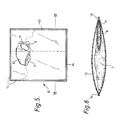
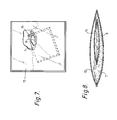
- FIG. 7 and 8 of the accompanying drawings Yet another sachet design is shown in Figures 7 and 8 of the accompanying drawings.
- An outer sachet 15 (the first compartment) of porous water-permeable sheet material contains the first powdered composition 7 for rapid delivery to the wash liquor and also contains an inner sachet 16 (the second compartment), also of water-permeable sheet material, containing the second powdered composition 8.
- the inner sachet 16 is loose within the outer sachet 15, but if desired its position could be fixed, for example, by means of an edge seal common to both sachets.
- the inner sachet 16 may be provided with a pore-occluding outer coating or layer, but as with the embodiment of Figures 5 and 6 this may not be necessary if the porosities of the materials of the sachets (which may of course be different) are suitably chosen.
- the sachet product of the invention may be of such a size than a single unit will deliver an appropriate quantity of ingredients for a single washload. Greater flexibility for the consumer is, however, achieved if smaller units are produced in groups, for example, of two to six units, readily separable by tearing along perforated marginal regions.
- the main sachet 1 was made of Crompton (Trade Mark) 784 tea bag paper ex Crompton, and had overall dimensions of 15 cm ⁇ 15 cm.
- the first compartment contained 110.6 g of non-bleaching detergent powder, including 3.6 g of sodium bromide, and was sealed with detergent-grade sodium carboxymethylcellulose.
- the inner sachet 3 had an outer coating of 200 g/m2 (2.6 g in total) of tallow alcohol 18 EO (Lutensol (Trade Mark) AP 18 ex BASF).
- the detergent powder was completely delivered from the first compartment within a period of 30 seconds to 1 minute from the start of the wash process. Delivery of substantially all of the bleaching agent from the second compartment took place in each run after a delay of 5 to 10 minutes, as can be seen from the Table below. This period can be lengthened or shortened by varying the type and level of coating on the inner sachet
- a sachet of the type described by reference to Figures 7 and 8 was prepared as follows.
- a rectangle of polyethylene film (6cm by 3cm) of 115 ⁇ m thickness was folded along the minor axis and heat-sealed along two edges.
- Calcium hypochlorite (1.25g) was placed in the sachet which was then sealed along the open edge to give a square sachet having 3cm sides.
- Three 1mm holes were made in each face of the sachet.
- a square sachet having 10cm sides was made from a sheet of Sontara (Trade Mark) 8000 non-woven polyester sheet by folding a sheet of 10 ⁇ 20cm material. Two sides were heat-sealed, and 25g of conventional washing powder and the 3 ⁇ 3cm sachet placed inside. The final seam was closed by heat-sealing.
- the complete sachet was placed in a Miele (Trade Mark) 429 washing machine along with a 2.5kg ballast load of terry towelling and cotton sheeting. The machine was set into action to run a 30°C cycle and the concentration of hypochlorite in the wash liquor measure at regular intervals. The following results were obtained:
- the detergent was released within 3 minutes but release of the bleach was delayed for almost 15 minutes.
- a sachet of the type described by reference to Figure 1 and 2 was prepared as follows: A strip of polyethylene laminated cellulosic non-woven fabric of base weight 30g/m2) (Storalene (Trade Mark)) of dimensions 30 ⁇ 5cm was folded along the minor axis so that the polyethylene coated sides were adjacent to each other. The long seams were then heat-sealed. 25g of conventional washing powder was introduced into the sachet which was then heat-sealed so that the powder was confined in a compartment of dimensions 15 ⁇ 5cm defined in part by the folded seam. Calcium hypochlorite (1.25g) was introduced into the open end of the sachet and the sachet sealed. Two pin-holes (1mm diameter) were made in each face of the hypochlorite containing compartment, which compartment was then coated at 200g/m2 with a polyethylene glycol having an average molecular mass of 35,000.
- a piece of Kimtex (Trade Mark) melt blown polypropylene non-woven fabric of 70g/m2 and dimensions 15 ⁇ 27cm was folded along the minor axis. Two further folds, equidistant (7.5cm) from the first and parallel with it were then made so that the fabric adpoted an 'M' shaped configuration. Three of the seams were then heat-sealed to give two open compartments, one of which was contained within the other. The inner compartment was filled with potassium monopersulphate (3g) and the outer compartment was filled with a conventional detergent (20g) and sodium bromide (0.6g). The remaining seam was heat sealed with the rate of release of bleach into wash liquor determined as described in Examples 2 and 3. The following results were obtained:
- the delay of release was less than in the previous examples; about half the bleach was released with 10 minutes and all within 15 minutes. The detergent was released immediately.
Landscapes
- Chemical & Material Sciences (AREA)
- Engineering & Computer Science (AREA)
- Life Sciences & Earth Sciences (AREA)
- Chemical Kinetics & Catalysis (AREA)
- Oil, Petroleum & Natural Gas (AREA)
- Wood Science & Technology (AREA)
- Organic Chemistry (AREA)
- Textile Engineering (AREA)
- Detergent Compositions (AREA)
- Packages (AREA)
Abstract
Description
- The present invention relates to a product in the form of a multicompartment sachet for the delivery of treatment agents, for example, detergent, bleach, enzyme, rinse conditioner or rinse aid, into the wash liquor in an automatic washing machine or dishwasher.
- Multicompartment sachets for delivering ingredients in washing machines in a sequential manner have been disclosed in the prior art.
-
GB 2 000 177B (Akzo) discloses a two-compartment sachet containing a phosphate free detergent composition based on sodium carbonate. A first compartment is bounded by a water-permeable wall and separated by a partition from a second compartment bounded by an impermeable wall; the partition wall is of material that disintegrates in the wash water. The contents of the second compartment are therefore not released until the contents of the first compartment have been leached out and the partition wall has disintegrated. -
US 4 410 441 (Davies et al/Lever Brothers Company) discloses another two-compartment sachet which differs from that ofGB 2 000 177B in that the partition wall is of water-insoluble water-permeable material. Release of the contents of the second compartment is by leaching out through the porous partition after the contents of the first compartment have been delivered. - EP 143 476A (Akzo) discloses a sachet having two compartments, one being formed of water-permeable material or material that immediately disintegrates in water and the other being formed of water-impermeable non-disintegrating material and being sealed with a water-sensitive composition comprising an anionic and/or nonionic water-binding polymer, for example, polyvinyl pyrrolidone and a cationic polymeric adhesive, for example, polyethyleneimine. The first compartment releases its contents rapidly, while release from the second compartment is delayed by the slow opening of the water-sensitive seals.
- EP 66 463B (Unilever) discloses an article for releasing an active material in a controlled manner, comprising two layers of sheet material (laminates each consisting of an outer porous layer and an inner plastics film layer) bonded together in a grid pattern to form an array of cells or compartments. The sheet material is pinholed for release of active material. If desired different compartments can contain different active material and can be pinholed to differing extents to allow release of different active material at different rates.
- The present invention provides a product for the delivery of treatment agents into the wash liquor of an automatic washing or dishwashing machine, comprising a sachet having at least two compartments, including:
- (i) a first compartment of water-insoluble material containing a first treatment agent, said first compartment having at least one opening seal and/or being formed of porous water-permeable material, and being capable of releasing said first treatment agent into the wash liquor of a washing or dishwashing machine within a period of 3 minutes from the start of the wash process; and
- (ii) a second, non-opening, compartment containing a second, water-soluble or water-dispersible, treatment agent in particulate form, said second compartment being formed at least partially of porous water-permeable material through which said second treatment agent can be leached out by the wash liquor, said second compartment being provided with means for delaying said leaching out for at least 5 minutes from the start of the wash process and/or for retarding said leaching out, said delaying and/or retarding means comprising
- (a) a substantially wholly pore-occluding external coating or layer that is capable of being disrupted by the wash liquor, and/or
- (b) the enclosure of the second compartment within another sachet compartment of porous water-permeable material.
-
- The sachet of the invention contains at least two different compartments and is designed to deliver their contents in distinctly different ways: the contents of the first compartment are released very rapidly while the release of the contents of the second compartment is delayed and/or retarded.
- In a preferred embodiment of the invention, the sachet is designed to deliver its contents in at least two discrete stages, with an interval between the deliveries of at least 2 minutes, preferably at least 5 minutes and advantageously from 10 to 15 minutes, from at least two different compartments. The contents of the compartments may if desired be identical, but the sachet of the invention is especially useful for delivering different ingredients at different stages in the washing or dishwashing process.
- The contents of the second compartment are in pulverulent or granular form while the contents of the first compartment can be in any desired form compatible with the nature of the compartment's walls and seals. Any compositions that can be used to treat laundry or a dishwasher load may be delivered by means of the sachet of the invention provided that the second treatment agent is water-soluble or water-dispersible. Examples include detergents, bleaches, rinse conditioners, enzymes, deodorants and rinse aids. In fabric washing, for example, a detergent composition may be delivered from the first compartment and a bleach or rinse conditioner from the second; such a product may be a self-contained whole wash product. An additive product intended to boost the performance of a conventional detergent powder may, for example, deliver an enzyme from the first compartment and a bleach from the second. A product for dishwasher use may, for example, deliver a cleaning composition with enzyme from the first compartment and a chlorine bleach from the second. These are only examples, and the skilled worker will readily be able to think of other combinations where segregation combined with delayed or retarded release of certain components is advantageous or even essential.
- In the present specification the terms "wash liquor", "wash process" and "wash environment" should be understood to apply both to fabric washing machines and to dishwashing machines. The expression "start of the wash process" will also be used, and this should be understood as the time at which the water fill is substantially complete and full agitation commences; any period of static heat-up and any short bursts of agitation before water fill is complete are regarded as occurring before the start of the wash process.
- In principle the sachet of the invention may have any number of compartments greater than one, but for simplicity the preferred embodiment of a two-compartment sachet will now be discussed.
- The first compartment is so designed that its contents will be released at or very shortly after the beginning of the wash cycle in the washing or dishwashing machine. Substantially complete delivery of the contents of the first compartment occurs within at least 3 minutes of the start of the wash process, and preferably within 1 minute. The first compartment must therefore combine the ability to contain a composition securely in the dry state with the ability to release that composition quickly when exposed to water, or water and agitation, in the wash environment.
- The first compartment may be provided with one or more seals that open when the sachet is exposed to the wash environment, for example, seals sensitive to water, temperature or agitation. A water-sensitive adhesive as described in
GB 1 583 082 (Unilever) may be used; or a mechanically weak heat-seal as described inEP 11 500B (Unilever). An example of a suitable water-sensitive adhesive is sodium carboxymethylcellulose. - When the contents of the first compartment are liquid, it may suitably be provided with one or more mechanically weak heat-seals, as described in EP 40 931B (Unilever), that will open as a result of agitation in the wash environment.
- If the first compartment is of the opening type and its contents are in powder form, it may be made of either water-permeable or water-impermeable material. Suitable materials include wet-strength paper; woven; knitted or nonwoven fabrics; and plastics films. A material that has been found to be highly suitable is tea bag paper manufactured by Crompton Ltd., UK. The impermeable materials mentioned are also suitable for containing liquids.
- It is also possible for the first compartment, if its contents are in powder form, to be of a non-opening type, in which case its walls must be made of highly water-permeable material. The pore size of the wall material must be sufficiently large to allow very rapid leaching out of the contents of the compartment, but it may be necessary to prevent leakage of the contents in the dry state, for example, by ensuring that the composition contained in the compartment is free of particles smaller that the pore size of the wall material, or by coating the outside of the compartment walls with a pore-occluding coating or layer of material that will be disrupted (dissolved or dispersed) very rapidly by the wash liquor.
- The second compartment, in contrast to the first, is so designed that its contents, which are in powder form, will be released only gradually and/or after a delay of at least 5 minutes. Preferably release, whether gradual or not, occurs only after a delay of at least 5 minutes, preferably at least 10 minutes: the delay required will depend on the intended use of the sachet of the invention and the machine cycle that it has to match, delays of from 5 to 90 minutes typically being useful. The second compartment is of the non-opening type, and therefore it has at least one wall of porous water-permeable material. Release from the second compartment is by leaching out of its contents by the wash liquor through its porous water-permeable wall(s), and this process is delayed and/or retarded by means of one or both of two measures. The first of these is the provision of a pore-occluding coating or layer of a material that is disrupted (dissolved or dispersed) by the wash liquor; unlike the coating mentioned above for the first compartment, this should be of a material that is not too soluble or dispersible, so that its disruption occurs over a sufficiently long period to provide some delay and/or retardation.
- Thus the sachet product of the invention may comprise a first compartment, and an adjacent second compartment separated from the first by a non-opening seam or a non-water-permeable partition wall, the second compartment being provided with a pore-occluding coating or layer.
- Alternatively or additionally, the sachet can be enclosed within another sachet compartment of porous water-permeable material. This other sachet compartment may simply be the first compartment; the second compartment (inner sachet) is then located, together with the first treatment agent, in the first compartment (outer sachet). In this case, the first compartment (outer sachet) should be of the non-opening type to prevent escape of the inner sachet into the wash liquor, if the inner sachet does not have a pore-occluding coating or layer.
- The inner sachet may be wholly separate from the outer sachet, or it may be attached; an integral construction created by folding is also possible. According to yet another possibility, the second compartment (inner sachet) may be located in a separate additional (third) compartment separated from the first compartment by a non-opening seam or a partition wall which is preferably water-impermeable.
- The inner sachet may conveniently be made from a water-impermeable, thermoplastic sheet material, such as polyethylene film, provided with pin-holes. This form of construction is preferred as the inner sachet is readily heat-sealable. Additionally, by varying the number and size of the pin-holes the delay in release of the second treatment agent may be varied. Rapid release may be achieved by the provision of a large number of large diameter holes whereas slower release can be obtained from sachets having a small number of smaller diameter holes. Sachets for use in a conventional sized machine are preferably provided with a total of 2 to 8 pin-holes having a diameter of 0.5 to 1mm. Reproducibility of release profiles is generally increased by provision of a large number of small holes and also by the provision of pin-holes in both faces of the sachet. Reproducibility is also increased in general when the pin-holes are comparatively close to the sachet corners.
- In embodiments where the first and second compartments have a porous wall in common, there is a danger of premature mixing in the dry state when the sachets are transported, stored and handled. The use of a pore-occluding coating or layer for the second compartment is then particularly beneficial. When no such coating or layer is to be used, designs in which the two compartments are separated by a water-impermeable partition or by a non-opening seam are preferred.
- If the second compartment is integral with the first it is most conveniently made of the same material, which will of course have the same porosity. This is, however, not essential. If the first compartment is of the opening type, the porosity of that material can be relatively low, and a coating to reduce the porosity of the second compartment may be unnecessary. If the first compartment is non-opening and of relatively high porosity, a coating will probably be needed for the second compartment and a different (more quickly disrupted) coating may also be needed for the first compartment.
- If the second compartment is a separate inner sachet, it may of course be made of a different material from that of the first compartment and the porosity of both compartments can then be chosen at will.
- Examples of suitable pore-occluding coating materials include fatty acids, for example, stearic acid, which disperse slowly; polyethylene glycols, which can disperse quickly or slowly depending on molecular weight; mixtures of fatty acids and polyethylene glycol, which can be tailored by suitable choice of proportions to give any chosen release rate; and long-chain nonionic surfactants, for example, tallow alcohol ethoxylates. A separate discrete layer of pore-occluding material, for example, polyvinyl alcohol film, may instead be laminated onto the porous wall material.
- The pore-occluding material is preferably coated onto the sachet material at a level of 50 to 300g/m², more preferably 150 to 250/m². The release rate is conveniently tailored by using a mixture of materials. For example, a 80:20 mixture of tallow 18EO and stearic acid will give a much greater release rate than a 20:80 mixture of the same components. In general, the rate of release is enchanced by the use of a high propertion of a material which is dispersed quickly in the wash liquor and depressed by the use of a material which is dispersed slowly. The skilled worker will be able to determine suitable proportions by simple experimentation.
- Embodiments of the invention will now be described, by way of example only, with reference to the accompanying drawings in which:
- Figure 1 is a plan view of a first sachet in accordance with the invention;
- Figure 2 is a section, on a larger scale, along the line II - II of Figure 1;
- Figure 3 is a plan view of a second sachet in accordance with the invention;
- Figure 4 is a section, on a larger scale, along the line IV - IV of Figure 3;
- Figure 5 is a plan view of a third sachet in accordance with the invention;
- Figure 6 is a section, on a larger scale, along the line VI - VI of Figure 5;
- Figure 7 is a plan view of a fourth sachet in accordance with the invention; and
- Figure 8 is a schematic sectional view, on a larger scale, of a sachet as shown in Figure 7.
- Referring now to Figure 1 of the accompanying drawings, a two-
compartment sachet 1 has a largefirst compartment 2 and a smallersecond compartment 3. The sachet is made, for example, of Crompton (Trade Mark) tea bag paper, a cellulosic material which contains thermoplastic (polypropylene) fibres to render it heat-sealable. Thesecond compartment 3 is bounded by strong heat-seals 4 that will not open in the wash liquor, while the remaining threeedge seals 5 of thefirst compartment 2 are formed by a water-soluble adhesive, for example, sodium carboxymethylcellulose. - Referring now to Figure 2, the
second compartment 3 is coated externally with a coating orlayer 6 of pore-occluding material, for example, tallow alcohol 18 EO. Thefirst compartment 2 contains a firstpowdered composition 7, for example, a detergent powder with enzyme, and thesecond compartment 3 contains a secondpowdered composition 8, for example, a bleach. In use, the sachet is placed together with the load in a washing or dishwashing machine. The first compartment opens very rapidly along theedges 5 and releases its contents within 1 to 3 minutes. Thecoating 6 on the second compartment is gradually dissolved and after a delay of about 5-15 minutes the walls of thecompartment 3 are sufficiently exposed for itscontents 8 to be leached out by the wash liquor. - Figure 3 and 4 of the accompanying drawings show a sachet of slightly different construction. The
second compartment 3 takes the form of an inner sachet within athird compartment 9. Theinner sachet 3 may be of the same or a different material to that of themain sachet 1. - A different sachet construction is shown in Figures 5 and 6 of the accompanying drawings. This
sachet 10 is produced from a single sheet of porous water-impermeable material, for example, the polypropylene nonwoven fabric Kimtex (Trade Mark) ex Kimberly-Clark. The sheet is folded so as to generate a small inner compartment 11 (the second compartment) within a principal compartment 12 (the first compartment), and closed by heat-sealing along the foldededge 13 and along the other three edges 14: the edge seals 14 may be opening or non-opening. If desired the external surfaces of the walls of theinner compartment 11 could be coated or laminated with a pore-occluding material, but it is possible to obtain suitable delivery characteristics without using such a coating or layer if a sheet material of appropriate porosity is chosen. Alternatively, by using a sheet made of a mixture of materials joined for example by glueing or welding, the first compartment may be made of material different from the second. - As in the other embodiments the base weight of the sheet material is not critical, preferably it is in the
range 15 to 150g/m². If the material has a very high base weight some difficulty may be experienced in heat sealing the sachet as in some parts the construction is four layers thick, but the problem may be overcome by glueing. - Yet another sachet design is shown in Figures 7 and 8 of the accompanying drawings. An outer sachet 15 (the first compartment) of porous water-permeable sheet material contains the first
powdered composition 7 for rapid delivery to the wash liquor and also contains an inner sachet 16 (the second compartment), also of water-permeable sheet material, containing the secondpowdered composition 8. As shown theinner sachet 16 is loose within theouter sachet 15, but if desired its position could be fixed, for example, by means of an edge seal common to both sachets. If desired, theinner sachet 16 may be provided with a pore-occluding outer coating or layer, but as with the embodiment of Figures 5 and 6 this may not be necessary if the porosities of the materials of the sachets (which may of course be different) are suitably chosen. - In any of the embodiments described above, the sachet product of the invention may be of such a size than a single unit will deliver an appropriate quantity of ingredients for a single washload. Greater flexibility for the consumer is, however, achieved if smaller units are produced in groups, for example, of two to six units, readily separable by tearing along perforated marginal regions.
- An experiment was carried out to determine the release times of the two compartments of the sachet described above with reference to Figures 3 and 4 of the accompanying drawings. The
main sachet 1 was made of Crompton (Trade Mark) 784 tea bag paper ex Crompton, and had overall dimensions of 15 cm × 15 cm. The first compartment contained 110.6 g of non-bleaching detergent powder, including 3.6 g of sodium bromide, and was sealed with detergent-grade sodium carboxymethylcellulose. Theinner sachet 3, of Kimtex (Trade Mark) polypropylene nonwoven fabric ex Kimberly-Clark, had dimensions of 13 cm × 5cm and contained 18 g of potassium peroxomonosulphate triple salt ex Interox. Theinner sachet 3 had an outer coating of 200 g/m² (2.6 g in total) of tallow alcohol 18 EO (Lutensol (Trade Mark) AP 18 ex BASF). - Nine washing machine experiments were carried out to determine the time taken for the
inner sachet 3 to release it contents. A Miele (Trade Mark) De Luxe Electronic 756 washing machine set to the 40°C economy programme was used, with a mixed load of 2.5 kg of clean cotton and synthetic fabrics. - In each run the detergent powder was completely delivered from the first compartment within a period of 30 seconds to 1 minute from the start of the wash process. Delivery of substantially all of the bleaching agent from the second compartment took place in each run after a delay of 5 to 10 minutes, as can be seen from the Table below. This period can be lengthened or shortened by varying the type and level of coating on the inner sachet

- A sachet of the type described by reference to Figures 7 and 8 was prepared as follows.
- A rectangle of polyethylene film (6cm by 3cm) of 115µm thickness was folded along the minor axis and heat-sealed along two edges. Calcium hypochlorite (1.25g) was placed in the sachet which was then sealed along the open edge to give a square sachet having 3cm sides. Three 1mm holes were made in each face of the sachet.
- A square sachet having 10cm sides was made from a sheet of Sontara (Trade Mark) 8000 non-woven polyester sheet by folding a sheet of 10 × 20cm material. Two sides were heat-sealed, and 25g of conventional washing powder and the 3 × 3cm sachet placed inside. The final seam was closed by heat-sealing. The complete sachet was placed in a Miele (Trade Mark) 429 washing machine along with a 2.5kg ballast load of terry towelling and cotton sheeting. The machine was set into action to run a 30°C cycle and the concentration of hypochlorite in the wash liquor measure at regular intervals. The following results were obtained:

- The detergent was released within 3 minutes but release of the bleach was delayed for almost 15 minutes.
- A sachet of the type described by reference to Figure 1 and 2 was prepared as follows: A strip of polyethylene laminated cellulosic non-woven fabric of base weight 30g/m²) (Storalene (Trade Mark)) of dimensions 30 × 5cm was folded along the minor axis so that the polyethylene coated sides were adjacent to each other. The long seams were then heat-sealed. 25g of conventional washing powder was introduced into the sachet which was then heat-sealed so that the powder was confined in a compartment of
dimensions 15 × 5cm defined in part by the folded seam. Calcium hypochlorite (1.25g) was introduced into the open end of the sachet and the sachet sealed. Two pin-holes (1mm diameter) were made in each face of the hypochlorite containing compartment, which compartment was then coated at 200g/m² with a polyethylene glycol having an average molecular mass of 35,000. - The rate of release of the hypochlorite was measured in a similar experiment to that described in Example 2. The following results were obtained:

- In this case no detectable amount of bleach was released for more than 15 minutes and the detergent composition was released within 3 minutes.
- A piece of Kimtex (Trade Mark) melt blown polypropylene non-woven fabric of 70g/m² and
dimensions 15 × 27cm was folded along the minor axis. Two further folds, equidistant (7.5cm) from the first and parallel with it were then made so that the fabric adpoted an 'M' shaped configuration. Three of the seams were then heat-sealed to give two open compartments, one of which was contained within the other. The inner compartment was filled with potassium monopersulphate (3g) and the outer compartment was filled with a conventional detergent (20g) and sodium bromide (0.6g). The remaining seam was heat sealed with the rate of release of bleach into wash liquor determined as described in Examples 2 and 3. The following results were obtained: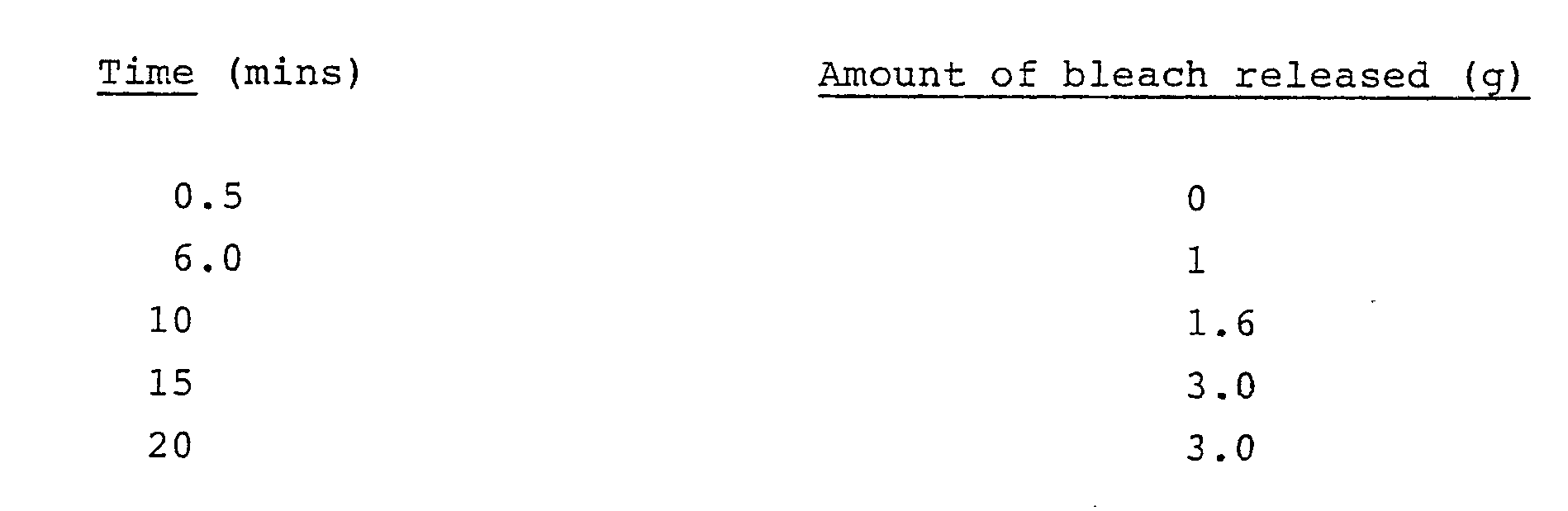
- The delay of release was less than in the previous examples; about half the bleach was released with 10 minutes and all within 15 minutes. The detergent was released immediately.
Claims (7)
Applications Claiming Priority (2)
| Application Number | Priority Date | Filing Date | Title |
|---|---|---|---|
| GB868605734A GB8605734D0 (en) | 1986-03-07 | 1986-03-07 | Dispensing treatment agents |
| GB8605734 | 1986-03-07 |
Publications (3)
| Publication Number | Publication Date |
|---|---|
| EP0236136A2 true EP0236136A2 (en) | 1987-09-09 |
| EP0236136A3 EP0236136A3 (en) | 1989-10-18 |
| EP0236136B1 EP0236136B1 (en) | 1993-05-26 |
Family
ID=10594249
Family Applications (1)
| Application Number | Title | Priority Date | Filing Date |
|---|---|---|---|
| EP87301905A Expired - Lifetime EP0236136B1 (en) | 1986-03-07 | 1987-03-05 | Product for dispensing treatment agents in a washing or dishwashing machine |
Country Status (13)
| Country | Link |
|---|---|
| US (1) | US4776455A (en) |
| EP (1) | EP0236136B1 (en) |
| JP (1) | JPS62235400A (en) |
| KR (1) | KR920000135B1 (en) |
| AT (1) | ATE89857T1 (en) |
| AU (1) | AU586075B2 (en) |
| BR (1) | BR8701050A (en) |
| CA (1) | CA1263628A (en) |
| DE (1) | DE3785947T2 (en) |
| GB (1) | GB8605734D0 (en) |
| MY (1) | MY101151A (en) |
| PH (1) | PH23596A (en) |
| ZA (1) | ZA871643B (en) |
Cited By (25)
| Publication number | Priority date | Publication date | Assignee | Title |
|---|---|---|---|---|
| WO1991014766A1 (en) * | 1990-03-24 | 1991-10-03 | Henkel Kommanditgesellschaft Auf Aktien | Detergent moulding |
| US5294361A (en) * | 1991-04-04 | 1994-03-15 | Unilever Patent Holdings B.V. | Detergent containing article |
| EP0593952A1 (en) * | 1992-10-17 | 1994-04-27 | DISPO-Kommerz AG | Product for releasing treatment agents into the wash liquid of an automatic washing or dishwashing machine |
| ES2080028A1 (en) * | 1994-01-05 | 1996-01-16 | Ideal | Packaging for powdered textile dye or pigment |
| EP0700989A1 (en) * | 1994-09-12 | 1996-03-13 | The Procter & Gamble Company | A unit packaged detergent |
| WO1997001625A1 (en) * | 1995-06-27 | 1997-01-16 | Johnson Company, Ltd. | A detergent for use in an automatic dishwasher |
| WO2003014458A1 (en) * | 2001-08-10 | 2003-02-20 | Henkel Kommanditgesellschaft Auf Aktien | Washing method |
| US6846784B2 (en) * | 2003-01-30 | 2005-01-25 | Access Business Group International Llc | Water soluble pouch package |
| US6955067B2 (en) | 2002-03-28 | 2005-10-18 | The Procter & Gamble Company | Smart dosing device |
| US6995126B2 (en) * | 2000-04-28 | 2006-02-07 | The Procter & Gamble Company | Pouched compositions |
| EP2163488A1 (en) * | 2008-09-11 | 2010-03-17 | August Töpfer & Co. (GmbH & Co.) KG | Bag with sealed sides containing washing agent |
| US7830263B2 (en) | 2006-04-28 | 2010-11-09 | Obrist Closures Switzerland Gmbh | Closure with RFID device |
| USD630093S1 (en) | 2010-06-11 | 2011-01-04 | Obrist Closures Switzerland Gmbh | Closure |
| ITBO20090523A1 (en) * | 2009-08-04 | 2011-02-05 | Packaging Imolese S P A | DISPENSER DEVICE FOR WASHING PRODUCTS |
| EP2567898A1 (en) | 2011-09-09 | 2013-03-13 | Dalli-Werke GmbH & Co. KG | Multi-compartment pouch and method for making it |
| US8413830B2 (en) | 2008-04-04 | 2013-04-09 | Obrist Closures Switzerland Gmbh | Closure |
| US8453856B2 (en) | 2007-07-13 | 2013-06-04 | Obrist Closures Switzerland Gmbh | Tamper-evident closure |
| US8490804B2 (en) | 2007-10-31 | 2013-07-23 | Obrist Closures Switzerland Gmbh | Closure with movable tamper-evident member |
| US8522991B2 (en) | 2003-10-31 | 2013-09-03 | Obrist Closures Switzerland Gmbh | Tamper evident closure |
| WO2015034976A1 (en) * | 2013-09-06 | 2015-03-12 | The Procter & Gamble Company | Pouches comprising apertured film wall materials and methods for making same |
| EP2857486A1 (en) | 2013-10-07 | 2015-04-08 | WeylChem Switzerland AG | Multi-compartment pouch comprising cleaning compositions, washing process and use for washing and cleaning of textiles and dishes |
| US9102448B2 (en) | 2007-07-13 | 2015-08-11 | Obrist Closures Switzerland Gmbh | Tamper-evident closure |
| CN102099185B (en) * | 2008-06-20 | 2015-11-25 | 爱德华兹创新有限公司 | Can the multiple compartmental device of fluid filling |
| WO2016115408A1 (en) | 2015-01-14 | 2016-07-21 | Gregory Van Buskirk | Improved fabric treatment method for stain release |
| DE102016115927A1 (en) * | 2016-08-26 | 2018-03-01 | Brauns-Heitmann GmbH & Co Kommanditgesellschaft | Dyeing system for textile materials |
Families Citing this family (100)
| Publication number | Priority date | Publication date | Assignee | Title |
|---|---|---|---|---|
| NZ223955A (en) * | 1987-03-24 | 1990-06-26 | Alcan Int Ltd | Aqueous heat transfer system containing delayed release inhibitor capsule |
| US4875575A (en) * | 1988-01-26 | 1989-10-24 | The Procter & Gamble Company | Pouched laundry wash active dispenser for improved solubility |
| US4835804A (en) * | 1988-03-25 | 1989-06-06 | The Procter & Gamble Company | Multiple compartment container laundering method |
| US4839076A (en) * | 1988-04-07 | 1989-06-13 | The Procter & Gamble Company | Pouched through the washer and dryer laundry additive product having at least one wall comprised of finely apertured polymeric film |
| SE8900406D0 (en) * | 1989-02-07 | 1989-02-07 | Electrolux Ab | DEVICE FOR A CLEANING MOP |
| US5190725A (en) * | 1990-04-19 | 1993-03-02 | Winfield Industries | Chemical treatment of an infectious waste |
| EP0644715A1 (en) * | 1992-05-29 | 1995-03-29 | Du Pont De Nemours And Company E.I. | Water-soluble polymer packaging for delivery of incompatible crop protection chemicals |
| US5462526A (en) * | 1993-09-15 | 1995-10-31 | Mcgaw, Inc. | Flexible, sterile container and method of making and using same |
| US5407278A (en) * | 1993-12-10 | 1995-04-18 | Fres-Co System Usa, Inc. | Dual compartment easily openable flexible package |
| US5551557A (en) * | 1994-10-25 | 1996-09-03 | Convey, Inc. | Efficient method and apparatus for establishing shelf-life of getters utilized within sealed enclosures |
| EP0813453B1 (en) * | 1995-03-10 | 2003-10-29 | Illinois Tool Works Inc. | Cleaning device and method |
| US6001187A (en) * | 1995-03-10 | 1999-12-14 | The Texwipe Company Llc | Cleaning method |
| US6040286A (en) * | 1995-12-26 | 2000-03-21 | Huff; Karen L. | Through-the-washer-dryer pouch-type detergent bag and method of use |
| DE19726141A1 (en) * | 1997-06-19 | 1999-01-28 | Daum Gmbh | Device for inserting medical instrument into neuronal part of head |
| US20030188988A1 (en) * | 1998-07-23 | 2003-10-09 | De Caluwe Robert Corneel Julia Maria | Package with child deterrent means |
| US6565802B1 (en) | 1999-06-03 | 2003-05-20 | Baxter International Inc. | Apparatus, systems and methods for processing and treating a biological fluid with light |
| US7445756B2 (en) * | 1999-06-03 | 2008-11-04 | Fenwal, Inc. | Fluid processing sets and organizers for the same |
| US7025877B1 (en) | 1999-06-03 | 2006-04-11 | Baxter International Inc. | Processing set for processing and treating a biological fluid |
| US7068361B2 (en) | 1999-06-03 | 2006-06-27 | Baxter International | Apparatus, systems and methods for processing and treating a biological fluid with light |
| US6364864B1 (en) | 1999-06-03 | 2002-04-02 | Baxter International Inc. | Plastic containers having inner pouches and methods for making such containers |
| ES2252027T3 (en) * | 1999-07-09 | 2006-05-16 | Henkel Kommanditgesellschaft Auf Aktien | PORTION OF DETERGENT OR CLEANING AGENT. |
| ES2222253T3 (en) * | 1999-11-17 | 2005-02-01 | Reckitt Benckiser (Uk) Limited | WATER SOLUBLE CONTAINERS MOLDED BY INJECTION. |
| EP1126070B1 (en) * | 2000-02-17 | 2004-11-10 | The Procter & Gamble Company | Laundry additive sachet |
| US6995125B2 (en) | 2000-02-17 | 2006-02-07 | The Procter & Gamble Company | Detergent product |
| WO2002008371A2 (en) * | 2000-02-17 | 2002-01-31 | The Procter & Gamble Company | Cleaning composition |
| US7351683B2 (en) * | 2000-02-17 | 2008-04-01 | The Procter & Gamble Company | Laundry additive sachet |
| US7615524B2 (en) * | 2000-02-17 | 2009-11-10 | The Procter & Gamble Co. | Laundry additive sachet |
| JP3886321B2 (en) * | 2000-04-17 | 2007-02-28 | 大和グラビヤ株式会社 | Packaging bag |
| KR100366556B1 (en) | 2000-04-26 | 2003-01-09 | 동양화학공업주식회사 | Granular coated sodium percarbonate and process for preparing them |
| US20020142931A1 (en) * | 2000-07-19 | 2002-10-03 | The Procter & Gamble Company | Gel form automatic dishwashing compositions, methods of preparation and use thereof |
| GB2365018A (en) | 2000-07-24 | 2002-02-13 | Procter & Gamble | Water soluble pouches |
| US6488146B1 (en) * | 2000-09-05 | 2002-12-03 | Michael Dotsikas | Multi-dose disposable medicant and fluid container |
| US7125828B2 (en) | 2000-11-27 | 2006-10-24 | The Procter & Gamble Company | Detergent products, methods and manufacture |
| ES2264784T3 (en) * | 2000-11-27 | 2007-01-16 | THE PROCTER & GAMBLE COMPANY | DETERGENT PRODUCTS, METHODS AND MANUFACTURE. |
| ES2273912T3 (en) * | 2000-11-27 | 2007-05-16 | THE PROCTER & GAMBLE COMPANY | METHOD FOR WASHING DISHES. |
| US8940676B2 (en) | 2000-11-27 | 2015-01-27 | The Procter & Gamble Company | Detergent products, methods and manufacture |
| PL362604A1 (en) * | 2000-11-27 | 2004-11-02 | The Procter & Gamble Company | Dishwashing method |
| US8283300B2 (en) * | 2000-11-27 | 2012-10-09 | The Procter & Gamble Company | Detergent products, methods and manufacture |
| US6624130B2 (en) * | 2000-12-28 | 2003-09-23 | Unilever Home & Personal Care Usa Division Of Conopco, Inc. | Laundry product |
| US6475977B1 (en) * | 2001-03-16 | 2002-11-05 | Unilever Home & Personal Care Usa, Division Of Conopco, Inc. | Water soluble sachet with a dishwasher composition |
| US6492312B1 (en) | 2001-03-16 | 2002-12-10 | Unilever Home & Personal Care Usa, Division Of Conopco, Inc. | Water soluble sachet with a dishwashing enhancing particle |
| GB2374830A (en) * | 2001-04-20 | 2002-10-30 | Reckitt Benckiser | Improvements in or relating to compositions/components including a thermoforming step |
| GB2375517A (en) * | 2001-05-17 | 2002-11-20 | Reckitt Benckiser | A water-soluble injection moulded container |
| US7850005B2 (en) | 2001-07-05 | 2010-12-14 | Interpharm Development | Separation container with interdisposed membrane |
| FR2826942A1 (en) * | 2001-07-05 | 2003-01-10 | Brevet Michel Sarl | WALL FOR CLOSING A CONTAINER AND METHODS FOR ASSEMBLING CONTAINERS USING SUCH A WALL |
| CA2463613C (en) * | 2001-11-14 | 2009-04-07 | The Procter & Gamble Company | Automatic dishwashing composition in unit dose form comprising an anti-scaling polymer |
| US6541439B1 (en) * | 2001-11-16 | 2003-04-01 | Colgate-Palmolive Company | Cleaning system including a powdered cleaning composition disposed in a water soluble container |
| US6521581B1 (en) | 2001-12-14 | 2003-02-18 | Unilever Home & Personal Care Usa, Division Of Conopco, Inc. | Water-soluble package with multiple distinctly colored layers of liquid laundry detergent |
| GB0200154D0 (en) * | 2002-01-04 | 2002-02-20 | Unilever Plc | Fabric conditioning kit |
| US20030146115A1 (en) * | 2002-02-01 | 2003-08-07 | Sharp David R. | Multiple compartment mixing unit dose |
| GB2385857B (en) * | 2002-02-27 | 2004-04-21 | Reckitt Benckiser Nv | Washing materials |
| ATE445005T1 (en) * | 2003-02-03 | 2009-10-15 | Reckitt Benckiser Nv | ISSUE BLISTER |
| PL1543763T3 (en) * | 2003-12-16 | 2012-08-31 | Unilever Nv | Ingredient dispenser for automatic dishwashers |
| US20060070351A1 (en) * | 2004-10-01 | 2006-04-06 | Solar Communications, Inc. | Wicketed bag fabrication and packaging process |
| DE102004055075A1 (en) * | 2004-10-22 | 2006-07-06 | Henkel Kgaa | Detergent or detergent dosing unit |
| DE102004051560A1 (en) * | 2004-10-22 | 2006-04-27 | Henkel Kgaa | Combination product, useful for dish washing machine, comprises compartments containing wash pack and main cleaning agent; and instructions for using wash pack and cleaning agent in the pre-washing and main washing cycle |
| USD564899S1 (en) | 2004-12-21 | 2008-03-25 | The Procter & Gamble Company | Pouch with cleaning compositions |
| US7458195B2 (en) * | 2005-01-14 | 2008-12-02 | Frito-Lay North America, Inc. | Method for making a multi-compartment microwavable package having a permeable wall between compartments |
| US7669736B2 (en) * | 2005-08-24 | 2010-03-02 | Harper William A | Resealable packets of liquid |
| GB0613069D0 (en) * | 2006-06-30 | 2006-08-09 | Unilever Plc | Laundry articles |
| US20080041751A1 (en) * | 2006-07-05 | 2008-02-21 | The Proctor & Gamble Company | Article comprising an indicator |
| US20100249013A1 (en) * | 2007-08-28 | 2010-09-30 | Molly I-Chin Busby | Encapsulated active ingredients for cleaning applications |
| DE102007042450B4 (en) * | 2007-09-06 | 2009-12-31 | Andreas Siggelkow | Water-soluble packaging with functional depot and method for its production and use of the packaging |
| US8066818B2 (en) * | 2008-02-08 | 2011-11-29 | The Procter & Gamble Company | Water-soluble pouch |
| US8008247B2 (en) * | 2008-06-18 | 2011-08-30 | The Clorox Company | Tumble dryer bleach and fabric treatment |
| USD596495S1 (en) * | 2008-09-17 | 2009-07-21 | Smithkline Beecham Corporation | Dissolving film packaging |
| WO2011049709A1 (en) | 2009-10-23 | 2011-04-28 | Fenwal, Inc. | Methods and systems for providing red blood cell products with reduced plasma |
| PL2609183T3 (en) | 2010-08-23 | 2019-05-31 | Henkel IP & Holding GmbH | Unit dose detergent compositions and methods of production and use thereof |
| IT1403162B1 (en) * | 2010-12-14 | 2013-10-04 | Lavazza Luigi Spa | "CARTRIDGE FOR THE PREPARATION OF A LIQUID PRODUCT" |
| GB201101547D0 (en) * | 2011-01-31 | 2011-03-16 | Reckitt Benckiser Nv | Container for use in a washing process |
| WO2013033376A1 (en) * | 2011-08-30 | 2013-03-07 | Reinhard Matye | Multi-chamber container for bulk materials, and method of filling a multi-chamber container |
| JP2014529693A (en) | 2011-09-06 | 2014-11-13 | ザ サン プロダクツ コーポレーション | Solid and liquid fiber treatment compositions |
| WO2013043841A1 (en) | 2011-09-20 | 2013-03-28 | The Sun Products Corporation | Cleaning formulations with improved surfactant solubility and methods of production and use thereof |
| USD683499S1 (en) | 2012-06-07 | 2013-05-28 | The Procter & Gamble Company | Dishwashing product |
| ES2710529T3 (en) | 2013-02-15 | 2019-04-25 | Biip Cvba | Device for packaging and dispensing edible items |
| DE102013004367B4 (en) * | 2013-03-12 | 2018-12-27 | Comtag Ag | Disposable container with additive for water for the treatment of objects |
| CN107574053A (en) | 2013-09-06 | 2018-01-12 | 宝洁公司 | Pouch including water-soluble fibre wall material and preparation method thereof |
| EP2899308A1 (en) | 2014-01-24 | 2015-07-29 | BiiP cvba | Device and process for dosing and dispensing a detergent composition |
| CN103923775A (en) * | 2014-04-08 | 2014-07-16 | 余姚市德派日用品有限公司 | Household clothes-washing and dish-washing bag |
| EP3134501A4 (en) | 2014-04-22 | 2018-01-17 | Henkel IP & Holding GmbH | Unit dose detergent compositions |
| US9873558B2 (en) | 2015-02-26 | 2018-01-23 | Monosol, Llc | Multi-dose cleaning product and method of manufacture |
| EP3408180A4 (en) | 2016-01-29 | 2019-10-09 | Henkel IP & Holding GmbH | MULTI-COMPARTMENT DETERGENT COMPOSITIONS AND METHODS OF MAKING AND USING SAME |
| GB2549531B (en) * | 2016-04-22 | 2018-12-05 | Reckitt Benckiser Finish Bv | A deformable container |
| USD829985S1 (en) | 2016-07-27 | 2018-10-02 | Envirocon Technologies, Inc. | Multi-chambered dish-washing pod |
| US10752868B2 (en) | 2016-11-09 | 2020-08-25 | Henkel IP & Holding GmbH | Unit dose detergent composition |
| US11697904B2 (en) | 2017-01-27 | 2023-07-11 | The Procter & Gamble Company | Active agent-containing articles that exhibit consumer acceptable article in-use properties |
| US11697905B2 (en) | 2017-01-27 | 2023-07-11 | The Procter & Gamble Company | Active agent-containing articles that exhibit consumer acceptable article in-use properties |
| WO2018140565A1 (en) | 2017-01-27 | 2018-08-02 | Henkel IP & Holding GmbH | Stable unit dose compositions with high water content |
| US11697906B2 (en) | 2017-01-27 | 2023-07-11 | The Procter & Gamble Company | Active agent-containing articles and product-shipping assemblies for containing the same |
| WO2018212858A1 (en) | 2017-05-17 | 2018-11-22 | Henkel IP & Holding GmbH | Stable unit dose compositions |
| EP3894528A1 (en) | 2018-12-14 | 2021-10-20 | The Procter & Gamble Company | Water disintegrable, foam producing article |
| US20200199493A1 (en) | 2018-12-21 | 2020-06-25 | Henkel IP & Holding GmbH | Unit dose detergent with zinc ricinoleate |
| US20200199496A1 (en) | 2018-12-21 | 2020-06-25 | Henkel IP & Holding GmbH | Use of ionic liquids to control rheology of unit dose detergent compositions |
| JP2022534474A (en) * | 2019-04-30 | 2022-08-01 | ロレアル | Soluble package of pre-measured powdered hair bleach |
| US11098271B2 (en) | 2019-06-12 | 2021-08-24 | Henkel IP & Holding GmbH | Salt-free structured unit dose systems |
| US11268053B2 (en) * | 2019-08-21 | 2022-03-08 | Henkel IP & Holding GmbH | Unit dose packs with non-water soluble covers |
| US11795416B2 (en) | 2021-02-17 | 2023-10-24 | Henkel Ag & Co. Kgaa | Synergistic effects of iminodisuccinic acid on an ethanol and PEG400 blend for rheology control |
| EP4230786A1 (en) * | 2022-02-21 | 2023-08-23 | Henkel AG & Co. KGaA | Container for at least two flowable preparations |
| EP4257336A1 (en) * | 2022-04-04 | 2023-10-11 | Henkel AG & Co. KGaA | Washing agent portion units |
| WO2026077945A1 (en) | 2024-10-09 | 2026-04-16 | Henkel Ag & Co. Kgaa | Bleach alternative complex for stain removal in liquid detergents |
Family Cites Families (22)
| Publication number | Priority date | Publication date | Assignee | Title |
|---|---|---|---|---|
| US1854235A (en) * | 1930-01-18 | 1932-04-19 | Conover Company | Detergent composition |
| US2377118A (en) * | 1940-11-30 | 1945-05-29 | Mabe Corp | Package |
| US3186869A (en) * | 1961-02-23 | 1965-06-01 | Friedman Jack | Coated film for laundry package |
| CH432341A (en) * | 1965-12-13 | 1967-03-15 | Sig Schweiz Industrieges | Device for the production of two-chamber packaging bags |
| US4000996A (en) * | 1975-11-07 | 1977-01-04 | Hospital Marketing Services Co., Inc. | Refrigerating package |
| US4259373A (en) * | 1976-07-12 | 1981-03-31 | The Procter & Gamble Company | Fabric treating articles and process |
| DE2635257A1 (en) * | 1976-08-05 | 1978-02-09 | Henkel Kgaa | AGENT FOR AFTER-TREATING WASHED LAUNDRY IN THE DRYER |
| US4113630A (en) * | 1977-03-25 | 1978-09-12 | The Procter & Gamble Company | Article for conditioning fabrics |
| GB1583082A (en) * | 1977-05-18 | 1981-01-21 | Unilever Ltd | Detergent products |
| GB2000177B (en) * | 1977-06-27 | 1982-01-20 | Akzo Nv | Detergent compositions |
| DE7818669U1 (en) * | 1978-06-22 | 1978-10-26 | Dr. Werner Freyberg Chemische Fabrik Delitia Nachf.,6941 Laudenbach | DEVICE SUITABLE FOR TAKING UP AND USE OF PEST CONTROL |
| MX151028A (en) * | 1978-11-17 | 1984-09-11 | Unilever Nv | IMPROVEMENTS IN INSOLUBLE BAG BUT PERMEABLE TO WATER THAT HAS A DISPERSIBLE PROTECTIVE LAYER OR SOLUBLE IN WATER, WHICH CONTAINS A PARTICULATE DETERGENT COMPOSITION |
| FR2454477A1 (en) * | 1979-04-20 | 1980-11-14 | Unilever Nv | BLEACHING PRODUCTS CONTAINING PERCOMPOSE AND THEIR USE FOR BLEACHING TISSUES |
| EP0039527A3 (en) * | 1980-05-01 | 1981-12-16 | Akzo N.V. | Feed unit for a detergent and packaging thereof |
| CA1211603A (en) * | 1981-06-01 | 1986-09-23 | Zia Haq | Article carrying active material |
| DE3211470A1 (en) * | 1982-03-29 | 1983-10-06 | Henkel Kgaa | AGENTS FOR CARE OF TEXTILES |
| US4410441A (en) * | 1982-04-26 | 1983-10-18 | Lever Brothers Company | Product for treating fabrics in a washing machine |
| DE3326249A1 (en) * | 1983-07-21 | 1985-01-31 | Henkel Kgaa | WASHING, DISHWASHER OR DETERGENT PACKAGING |
| ATE29523T1 (en) * | 1983-10-03 | 1987-09-15 | Akzo Nv | A DOSING UNIT CONTAINING DETERGENT AND/OR BLEACH. |
| US4588080A (en) * | 1985-01-07 | 1986-05-13 | Ginn Martin E | Staged detergent/fabric treating preparation for use in washing machines |
| GB8502700D0 (en) * | 1985-02-02 | 1985-03-06 | Procter & Gamble Ltd | Laundry products |
| GB2187748A (en) * | 1986-03-07 | 1987-09-16 | Unilever Plc | Bleaching fabrics |
-
1986
- 1986-03-07 GB GB868605734A patent/GB8605734D0/en active Pending
-
1987
- 1987-02-27 MY MYPI87000200A patent/MY101151A/en unknown
- 1987-03-02 CA CA000530879A patent/CA1263628A/en not_active Expired
- 1987-03-03 AU AU69636/87A patent/AU586075B2/en not_active Ceased
- 1987-03-04 PH PH34964A patent/PH23596A/en unknown
- 1987-03-05 AT AT87301905T patent/ATE89857T1/en not_active IP Right Cessation
- 1987-03-05 DE DE8787301905T patent/DE3785947T2/en not_active Expired - Fee Related
- 1987-03-05 EP EP87301905A patent/EP0236136B1/en not_active Expired - Lifetime
- 1987-03-06 KR KR1019870002011A patent/KR920000135B1/en not_active Expired
- 1987-03-06 BR BR8701050A patent/BR8701050A/en unknown
- 1987-03-06 JP JP62051847A patent/JPS62235400A/en active Pending
- 1987-03-06 US US07/022,703 patent/US4776455A/en not_active Expired - Fee Related
- 1987-03-06 ZA ZA871643A patent/ZA871643B/en unknown
Cited By (32)
| Publication number | Priority date | Publication date | Assignee | Title |
|---|---|---|---|---|
| WO1991014766A1 (en) * | 1990-03-24 | 1991-10-03 | Henkel Kommanditgesellschaft Auf Aktien | Detergent moulding |
| US5294361A (en) * | 1991-04-04 | 1994-03-15 | Unilever Patent Holdings B.V. | Detergent containing article |
| EP0593952A1 (en) * | 1992-10-17 | 1994-04-27 | DISPO-Kommerz AG | Product for releasing treatment agents into the wash liquid of an automatic washing or dishwashing machine |
| ES2080028A1 (en) * | 1994-01-05 | 1996-01-16 | Ideal | Packaging for powdered textile dye or pigment |
| EP0700989A1 (en) * | 1994-09-12 | 1996-03-13 | The Procter & Gamble Company | A unit packaged detergent |
| WO1997001625A1 (en) * | 1995-06-27 | 1997-01-16 | Johnson Company, Ltd. | A detergent for use in an automatic dishwasher |
| US6995126B2 (en) * | 2000-04-28 | 2006-02-07 | The Procter & Gamble Company | Pouched compositions |
| WO2003014458A1 (en) * | 2001-08-10 | 2003-02-20 | Henkel Kommanditgesellschaft Auf Aktien | Washing method |
| US6955067B2 (en) | 2002-03-28 | 2005-10-18 | The Procter & Gamble Company | Smart dosing device |
| US6846784B2 (en) * | 2003-01-30 | 2005-01-25 | Access Business Group International Llc | Water soluble pouch package |
| US9242768B2 (en) | 2003-10-31 | 2016-01-26 | Obrist Closures Switzerland Gmbh | Tamper evident closure |
| US8522991B2 (en) | 2003-10-31 | 2013-09-03 | Obrist Closures Switzerland Gmbh | Tamper evident closure |
| US7830263B2 (en) | 2006-04-28 | 2010-11-09 | Obrist Closures Switzerland Gmbh | Closure with RFID device |
| US8453856B2 (en) | 2007-07-13 | 2013-06-04 | Obrist Closures Switzerland Gmbh | Tamper-evident closure |
| US9102448B2 (en) | 2007-07-13 | 2015-08-11 | Obrist Closures Switzerland Gmbh | Tamper-evident closure |
| US8490804B2 (en) | 2007-10-31 | 2013-07-23 | Obrist Closures Switzerland Gmbh | Closure with movable tamper-evident member |
| US8413830B2 (en) | 2008-04-04 | 2013-04-09 | Obrist Closures Switzerland Gmbh | Closure |
| CN102099185B (en) * | 2008-06-20 | 2015-11-25 | 爱德华兹创新有限公司 | Can the multiple compartmental device of fluid filling |
| US10858620B2 (en) | 2008-06-20 | 2020-12-08 | Edwards Innovations Limited | Multi-chambered fluid-fillable apparatus |
| US10041025B2 (en) | 2008-06-20 | 2018-08-07 | Edwards Innovations Limited | Multi-chambered fluid-fillable apparatus |
| EP2163488A1 (en) * | 2008-09-11 | 2010-03-17 | August Töpfer & Co. (GmbH & Co.) KG | Bag with sealed sides containing washing agent |
| ITBO20090523A1 (en) * | 2009-08-04 | 2011-02-05 | Packaging Imolese S P A | DISPENSER DEVICE FOR WASHING PRODUCTS |
| USD630093S1 (en) | 2010-06-11 | 2011-01-04 | Obrist Closures Switzerland Gmbh | Closure |
| EP2567898A1 (en) | 2011-09-09 | 2013-03-13 | Dalli-Werke GmbH & Co. KG | Multi-compartment pouch and method for making it |
| GB2531974A (en) * | 2013-09-06 | 2016-05-04 | Procter & Gamble | Pouches comprising apertured film wall materials and methods for making same |
| CN105579567A (en) * | 2013-09-06 | 2016-05-11 | 宝洁公司 | Pouches comprising apertured film wall materials and methods for making same |
| WO2015034976A1 (en) * | 2013-09-06 | 2015-03-12 | The Procter & Gamble Company | Pouches comprising apertured film wall materials and methods for making same |
| GB2531974B (en) * | 2013-09-06 | 2021-05-26 | Procter & Gamble | Pouches comprising apertured film wall materials and methods for making same |
| EP2857486A1 (en) | 2013-10-07 | 2015-04-08 | WeylChem Switzerland AG | Multi-compartment pouch comprising cleaning compositions, washing process and use for washing and cleaning of textiles and dishes |
| WO2016115408A1 (en) | 2015-01-14 | 2016-07-21 | Gregory Van Buskirk | Improved fabric treatment method for stain release |
| DE102016115927A1 (en) * | 2016-08-26 | 2018-03-01 | Brauns-Heitmann GmbH & Co Kommanditgesellschaft | Dyeing system for textile materials |
| EP3346053A3 (en) * | 2016-08-26 | 2018-08-22 | Brauns-Heitmann GmbH & Co. KG | Dyeing system for textile materials |
Also Published As
| Publication number | Publication date |
|---|---|
| JPS62235400A (en) | 1987-10-15 |
| GB8605734D0 (en) | 1986-04-16 |
| DE3785947D1 (en) | 1993-07-01 |
| EP0236136B1 (en) | 1993-05-26 |
| CA1263628A (en) | 1989-12-05 |
| KR870009071A (en) | 1987-10-23 |
| ZA871643B (en) | 1988-11-30 |
| AU6963687A (en) | 1987-09-10 |
| ATE89857T1 (en) | 1993-06-15 |
| AU586075B2 (en) | 1989-06-29 |
| BR8701050A (en) | 1988-01-05 |
| MY101151A (en) | 1991-07-31 |
| PH23596A (en) | 1989-09-11 |
| KR920000135B1 (en) | 1992-01-09 |
| US4776455A (en) | 1988-10-11 |
| EP0236136A3 (en) | 1989-10-18 |
| DE3785947T2 (en) | 1993-09-09 |
Similar Documents
| Publication | Publication Date | Title |
|---|---|---|
| EP0236136B1 (en) | Product for dispensing treatment agents in a washing or dishwashing machine | |
| EP0011500B2 (en) | Particulate detergent composition contained within a closed bag of sheet material | |
| EP1346023B1 (en) | Laundry product | |
| US5015513A (en) | Sealable containers | |
| CA1122091A (en) | Detergent products | |
| EP0040931B1 (en) | Fabric treatment products | |
| US4410441A (en) | Product for treating fabrics in a washing machine | |
| EP0143476B1 (en) | Dosing unit comprising a detergent and/or bleaching agent | |
| KR950012210B1 (en) | Packaging film and pouch products | |
| US4795032A (en) | Wash-added, rinse-activated fabric conditioner and package | |
| GB2187748A (en) | Bleaching fabrics | |
| WO1980001077A1 (en) | Detergent products | |
| JPH03119174A (en) | Laundry treatment product | |
| WO1980001079A1 (en) | Detergent products | |
| EP0249439B1 (en) | Sachet product | |
| CA1182074A (en) | Product for treating fabrics in a washing machine |
Legal Events
| Date | Code | Title | Description |
|---|---|---|---|
| PUAI | Public reference made under article 153(3) epc to a published international application that has entered the european phase |
Free format text: ORIGINAL CODE: 0009012 |
|
| AK | Designated contracting states |
Kind code of ref document: A2 Designated state(s): AT BE CH DE ES FR GB GR IT LI NL SE |
|
| 17P | Request for examination filed |
Effective date: 19880905 |
|
| PUAL | Search report despatched |
Free format text: ORIGINAL CODE: 0009013 |
|
| AK | Designated contracting states |
Kind code of ref document: A3 Designated state(s): AT BE CH DE ES FR GB GR IT LI NL SE |
|
| 17Q | First examination report despatched |
Effective date: 19910516 |
|
| RAP3 | Party data changed (applicant data changed or rights of an application transferred) |
Owner name: UNILEVER N.V. Owner name: UNILEVER PLC |
|
| GRAA | (expected) grant |
Free format text: ORIGINAL CODE: 0009210 |
|
| AK | Designated contracting states |
Kind code of ref document: B1 Designated state(s): AT BE CH DE ES FR GB GR IT LI NL SE |
|
| PG25 | Lapsed in a contracting state [announced via postgrant information from national office to epo] |
Ref country code: FR Effective date: 19930526 Ref country code: NL Effective date: 19930526 Ref country code: GR Free format text: LAPSE BECAUSE OF FAILURE TO SUBMIT A TRANSLATION OF THE DESCRIPTION OR TO PAY THE FEE WITHIN THE PRESCRIBED TIME-LIMIT Effective date: 19930526 Ref country code: BE Effective date: 19930526 Ref country code: AT Effective date: 19930526 Ref country code: SE Effective date: 19930526 Ref country code: IT Free format text: LAPSE BECAUSE OF FAILURE TO SUBMIT A TRANSLATION OF THE DESCRIPTION OR TO PAY THE FEE WITHIN THE PRESCRIBED TIME-LIMIT;WARNING: LAPSES OF ITALIAN PATENTS WITH EFFECTIVE DATE BEFORE 2007 MAY HAVE OCCURRED AT ANY TIME BEFORE 2007. THE CORRECT EFFECTIVE DATE MAY BE DIFFERENT FROM THE ONE RECORDED. Effective date: 19930526 |
|
| REF | Corresponds to: |
Ref document number: 89857 Country of ref document: AT Date of ref document: 19930615 Kind code of ref document: T |
|
| REF | Corresponds to: |
Ref document number: 3785947 Country of ref document: DE Date of ref document: 19930701 |
|
| PG25 | Lapsed in a contracting state [announced via postgrant information from national office to epo] |
Ref country code: ES Free format text: LAPSE BECAUSE OF FAILURE TO SUBMIT A TRANSLATION OF THE DESCRIPTION OR TO PAY THE FEE WITHIN THE PRESCRIBED TIME-LIMIT Effective date: 19930906 |
|
| EN | Fr: translation not filed | ||
| NLV1 | Nl: lapsed or annulled due to failure to fulfill the requirements of art. 29p and 29m of the patents act | ||
| PG25 | Lapsed in a contracting state [announced via postgrant information from national office to epo] |
Ref country code: GB Effective date: 19940305 |
|
| PG25 | Lapsed in a contracting state [announced via postgrant information from national office to epo] |
Ref country code: LI Effective date: 19940331 Ref country code: CH Effective date: 19940331 |
|
| PLBE | No opposition filed within time limit |
Free format text: ORIGINAL CODE: 0009261 |
|
| STAA | Information on the status of an ep patent application or granted ep patent |
Free format text: STATUS: NO OPPOSITION FILED WITHIN TIME LIMIT |
|
| 26N | No opposition filed | ||
| GBPC | Gb: european patent ceased through non-payment of renewal fee |
Effective date: 19940305 |
|
| REG | Reference to a national code |
Ref country code: CH Ref legal event code: PL |
|
| PG25 | Lapsed in a contracting state [announced via postgrant information from national office to epo] |
Ref country code: DE Effective date: 19941201 |