EP0232222A2 - Verfahren zur Herstellung von bromierten Pyrrolo-[3,4-c]-pyrrolen - Google Patents
Verfahren zur Herstellung von bromierten Pyrrolo-[3,4-c]-pyrrolen Download PDFInfo
- Publication number
- EP0232222A2 EP0232222A2 EP87810050A EP87810050A EP0232222A2 EP 0232222 A2 EP0232222 A2 EP 0232222A2 EP 87810050 A EP87810050 A EP 87810050A EP 87810050 A EP87810050 A EP 87810050A EP 0232222 A2 EP0232222 A2 EP 0232222A2
- Authority
- EP
- European Patent Office
- Prior art keywords
- pyrrolo
- formula
- pyrrole
- bromine
- pyrroles
- Prior art date
- Legal status (The legal status is an assumption and is not a legal conclusion. Google has not performed a legal analysis and makes no representation as to the accuracy of the status listed.)
- Granted
Links
- 238000000034 method Methods 0.000 title claims abstract description 38
- YKPJEYXZEBLYCI-UHFFFAOYSA-N pyrrolo[3,4-c]pyrrole Chemical class C1=NC=C2C=NC=C21 YKPJEYXZEBLYCI-UHFFFAOYSA-N 0.000 title claims abstract description 31
- 238000002360 preparation method Methods 0.000 title claims abstract description 7
- 229910052794 bromium Inorganic materials 0.000 claims abstract description 57
- GDTBXPJZTBHREO-UHFFFAOYSA-N bromine Substances BrBr GDTBXPJZTBHREO-UHFFFAOYSA-N 0.000 claims abstract description 56
- WKBOTKDWSSQWDR-UHFFFAOYSA-N Bromine atom Chemical compound [Br] WKBOTKDWSSQWDR-UHFFFAOYSA-N 0.000 claims abstract description 54
- 239000000203 mixture Substances 0.000 claims abstract description 36
- 230000031709 bromination Effects 0.000 claims abstract description 21
- 238000005893 bromination reaction Methods 0.000 claims abstract description 21
- 239000002904 solvent Substances 0.000 claims abstract description 19
- 239000003795 chemical substances by application Substances 0.000 claims abstract description 11
- -1 nitro, amino, carbamoyl Chemical group 0.000 claims description 38
- 125000001997 phenyl group Chemical group [H]C1=C([H])C([H])=C(*)C([H])=C1[H] 0.000 claims description 13
- 229910052739 hydrogen Inorganic materials 0.000 claims description 8
- 239000001257 hydrogen Substances 0.000 claims description 8
- 125000004642 (C1-C12) alkoxy group Chemical group 0.000 claims description 6
- 229910052736 halogen Inorganic materials 0.000 claims description 6
- 150000002367 halogens Chemical class 0.000 claims description 6
- 125000002924 primary amino group Chemical group [H]N([H])* 0.000 claims description 6
- 125000001424 substituent group Chemical group 0.000 claims description 6
- HHBCEKAWSILOOP-UHFFFAOYSA-N 1,3-dibromo-1,3,5-triazinane-2,4,6-trione Chemical compound BrN1C(=O)NC(=O)N(Br)C1=O HHBCEKAWSILOOP-UHFFFAOYSA-N 0.000 claims description 5
- 125000000217 alkyl group Chemical group 0.000 claims description 5
- UFHFLCQGNIYNRP-UHFFFAOYSA-N Hydrogen Chemical compound [H][H] UFHFLCQGNIYNRP-UHFFFAOYSA-N 0.000 claims description 4
- 125000005236 alkanoylamino group Chemical group 0.000 claims description 4
- 125000004453 alkoxycarbonyl group Chemical group 0.000 claims description 4
- 125000005115 alkyl carbamoyl group Chemical group 0.000 claims description 4
- QVGXLLKOCUKJST-UHFFFAOYSA-N atomic oxygen Chemical compound [O] QVGXLLKOCUKJST-UHFFFAOYSA-N 0.000 claims description 4
- 125000004663 dialkyl amino group Chemical group 0.000 claims description 4
- 150000002431 hydrogen Chemical class 0.000 claims description 4
- 229910052760 oxygen Inorganic materials 0.000 claims description 4
- 239000001301 oxygen Substances 0.000 claims description 4
- 125000004093 cyano group Chemical group *C#N 0.000 claims description 3
- 125000000753 cycloalkyl group Chemical group 0.000 claims description 3
- 125000001624 naphthyl group Chemical group 0.000 claims description 3
- 125000002023 trifluoromethyl group Chemical group FC(F)(F)* 0.000 claims description 3
- NINIDFKCEFEMDL-UHFFFAOYSA-N Sulfur Chemical compound [S] NINIDFKCEFEMDL-UHFFFAOYSA-N 0.000 claims description 2
- 125000004414 alkyl thio group Chemical group 0.000 claims description 2
- 150000003233 pyrroles Chemical class 0.000 claims description 2
- 229910052717 sulfur Inorganic materials 0.000 claims description 2
- 239000011593 sulfur Substances 0.000 claims description 2
- OKKJLVBELUTLKV-UHFFFAOYSA-N Methanol Chemical compound OC OKKJLVBELUTLKV-UHFFFAOYSA-N 0.000 description 36
- VZGDMQKNWNREIO-UHFFFAOYSA-N tetrachloromethane Chemical compound ClC(Cl)(Cl)Cl VZGDMQKNWNREIO-UHFFFAOYSA-N 0.000 description 28
- 239000000049 pigment Substances 0.000 description 22
- 239000004800 polyvinyl chloride Substances 0.000 description 21
- 229920000915 polyvinyl chloride Polymers 0.000 description 21
- QKWILNTYPDJSME-UHFFFAOYSA-N pyrrolo[3,4-c]pyrrole-3,6-dione Chemical class C1=NC(=O)C2=C1C(=O)N=C2 QKWILNTYPDJSME-UHFFFAOYSA-N 0.000 description 15
- IGPFDBHTWKTPFD-UHFFFAOYSA-N 1,4-diphenylpyrrolo[3,4-c]pyrrole-3,6-dione Chemical compound C=1C=CC=CC=1C1=NC(=O)C2=C1C(=O)N=C2C1=CC=CC=C1 IGPFDBHTWKTPFD-UHFFFAOYSA-N 0.000 description 7
- 238000001291 vacuum drying Methods 0.000 description 7
- RFFLAFLAYFXFSW-UHFFFAOYSA-N 1,2-dichlorobenzene Chemical compound ClC1=CC=CC=C1Cl RFFLAFLAYFXFSW-UHFFFAOYSA-N 0.000 description 6
- RTZKZFJDLAIYFH-UHFFFAOYSA-N Diethyl ether Chemical compound CCOCC RTZKZFJDLAIYFH-UHFFFAOYSA-N 0.000 description 6
- QAOWNCQODCNURD-UHFFFAOYSA-N Sulfuric acid Chemical compound OS(O)(=O)=O QAOWNCQODCNURD-UHFFFAOYSA-N 0.000 description 6
- 150000001875 compounds Chemical class 0.000 description 6
- HGCIXCUEYOPUTN-UHFFFAOYSA-N cyclohexene Chemical compound C1CCC=CC1 HGCIXCUEYOPUTN-UHFFFAOYSA-N 0.000 description 6
- 150000002825 nitriles Chemical class 0.000 description 5
- 239000000047 product Substances 0.000 description 5
- QPFMBZIOSGYJDE-UHFFFAOYSA-N 1,1,2,2-tetrachloroethane Chemical compound ClC(Cl)C(Cl)Cl QPFMBZIOSGYJDE-UHFFFAOYSA-N 0.000 description 4
- 238000006243 chemical reaction Methods 0.000 description 4
- LQNUZADURLCDLV-UHFFFAOYSA-N nitrobenzene Chemical compound [O-][N+](=O)C1=CC=CC=C1 LQNUZADURLCDLV-UHFFFAOYSA-N 0.000 description 4
- 238000010992 reflux Methods 0.000 description 4
- YMWUJEATGCHHMB-UHFFFAOYSA-N Dichloromethane Chemical compound ClCCl YMWUJEATGCHHMB-UHFFFAOYSA-N 0.000 description 3
- HEMHJVSKTPXQMS-UHFFFAOYSA-M Sodium hydroxide Chemical compound [OH-].[Na+] HEMHJVSKTPXQMS-UHFFFAOYSA-M 0.000 description 3
- YXFVVABEGXRONW-UHFFFAOYSA-N Toluene Chemical compound CC1=CC=CC=C1 YXFVVABEGXRONW-UHFFFAOYSA-N 0.000 description 3
- 150000001338 aliphatic hydrocarbons Chemical class 0.000 description 3
- JFDZBHWFFUWGJE-UHFFFAOYSA-N benzonitrile Chemical compound N#CC1=CC=CC=C1 JFDZBHWFFUWGJE-UHFFFAOYSA-N 0.000 description 3
- 238000002425 crystallisation Methods 0.000 description 3
- 230000008025 crystallization Effects 0.000 description 3
- 150000002148 esters Chemical class 0.000 description 3
- 239000000155 melt Substances 0.000 description 3
- VLKZOEOYAKHREP-UHFFFAOYSA-N n-Hexane Chemical compound CCCCCC VLKZOEOYAKHREP-UHFFFAOYSA-N 0.000 description 3
- 239000011368 organic material Substances 0.000 description 3
- 239000003208 petroleum Substances 0.000 description 3
- 239000011541 reaction mixture Substances 0.000 description 3
- 239000007787 solid Substances 0.000 description 3
- ZYECOAILUNWEAL-NUDFZHEQSA-N (4z)-4-[[2-methoxy-5-(phenylcarbamoyl)phenyl]hydrazinylidene]-n-(3-nitrophenyl)-3-oxonaphthalene-2-carboxamide Chemical compound COC1=CC=C(C(=O)NC=2C=CC=CC=2)C=C1N\N=C(C1=CC=CC=C1C=1)/C(=O)C=1C(=O)NC1=CC=CC([N+]([O-])=O)=C1 ZYECOAILUNWEAL-NUDFZHEQSA-N 0.000 description 2
- WAWMAERLNJGODR-UHFFFAOYSA-N 1,4-bis(4-bromophenyl)pyrrolo[3,4-c]pyrrole-3,6-dione Chemical compound C1=CC(Br)=CC=C1C1=NC(=O)C2=C1C(=O)N=C2C1=CC=C(Br)C=C1 WAWMAERLNJGODR-UHFFFAOYSA-N 0.000 description 2
- 239000004808 2-ethylhexylester Substances 0.000 description 2
- IJGRMHOSHXDMSA-UHFFFAOYSA-N Atomic nitrogen Chemical compound N#N IJGRMHOSHXDMSA-UHFFFAOYSA-N 0.000 description 2
- PCLIMKBDDGJMGD-UHFFFAOYSA-N N-bromosuccinimide Chemical compound BrN1C(=O)CCC1=O PCLIMKBDDGJMGD-UHFFFAOYSA-N 0.000 description 2
- FAPWRFPIFSIZLT-UHFFFAOYSA-M Sodium chloride Chemical compound [Na+].[Cl-] FAPWRFPIFSIZLT-UHFFFAOYSA-M 0.000 description 2
- VSCWAEJMTAWNJL-UHFFFAOYSA-K aluminium trichloride Chemical compound Cl[Al](Cl)Cl VSCWAEJMTAWNJL-UHFFFAOYSA-K 0.000 description 2
- 239000002585 base Substances 0.000 description 2
- 125000001246 bromo group Chemical group Br* 0.000 description 2
- 239000012043 crude product Substances 0.000 description 2
- NNBZCPXTIHJBJL-UHFFFAOYSA-N decalin Chemical compound C1CCCC2CCCCC21 NNBZCPXTIHJBJL-UHFFFAOYSA-N 0.000 description 2
- 210000003298 dental enamel Anatomy 0.000 description 2
- 239000011521 glass Substances 0.000 description 2
- 239000004922 lacquer Substances 0.000 description 2
- 238000004519 manufacturing process Methods 0.000 description 2
- 229920003023 plastic Polymers 0.000 description 2
- 239000004033 plastic Substances 0.000 description 2
- 229920000642 polymer Polymers 0.000 description 2
- 229920005989 resin Polymers 0.000 description 2
- 239000011347 resin Substances 0.000 description 2
- 239000007858 starting material Substances 0.000 description 2
- 239000000725 suspension Substances 0.000 description 2
- 125000004400 (C1-C12) alkyl group Chemical group 0.000 description 1
- JWWQGBVMXNFPTI-UHFFFAOYSA-N 1,4-bis(4-phenylphenyl)pyrrolo[3,4-c]pyrrole-3,6-dione Chemical compound C=1C=C(C=2C=CC=CC=2)C=CC=1C1=NC(=O)C2=C1C(=O)N=C2C(C=C1)=CC=C1C1=CC=CC=C1 JWWQGBVMXNFPTI-UHFFFAOYSA-N 0.000 description 1
- PAWQVTBBRAZDMG-UHFFFAOYSA-N 2-(3-bromo-2-fluorophenyl)acetic acid Chemical compound OC(=O)CC1=CC=CC(Br)=C1F PAWQVTBBRAZDMG-UHFFFAOYSA-N 0.000 description 1
- MARXMDRWROUXMD-UHFFFAOYSA-N 2-bromoisoindole-1,3-dione Chemical compound C1=CC=C2C(=O)N(Br)C(=O)C2=C1 MARXMDRWROUXMD-UHFFFAOYSA-N 0.000 description 1
- HQSCPPCMBMFJJN-UHFFFAOYSA-N 4-bromobenzonitrile Chemical compound BrC1=CC=C(C#N)C=C1 HQSCPPCMBMFJJN-UHFFFAOYSA-N 0.000 description 1
- 229910052684 Cerium Inorganic materials 0.000 description 1
- RYGMFSIKBFXOCR-UHFFFAOYSA-N Copper Chemical compound [Cu] RYGMFSIKBFXOCR-UHFFFAOYSA-N 0.000 description 1
- SNRUBQQJIBEYMU-UHFFFAOYSA-N Dodecane Natural products CCCCCCCCCCCC SNRUBQQJIBEYMU-UHFFFAOYSA-N 0.000 description 1
- 239000001856 Ethyl cellulose Substances 0.000 description 1
- ZZSNKZQZMQGXPY-UHFFFAOYSA-N Ethyl cellulose Chemical compound CCOCC1OC(OC)C(OCC)C(OCC)C1OC1C(O)C(O)C(OC)C(CO)O1 ZZSNKZQZMQGXPY-UHFFFAOYSA-N 0.000 description 1
- VEXZGXHMUGYJMC-UHFFFAOYSA-N Hydrochloric acid Chemical compound Cl VEXZGXHMUGYJMC-UHFFFAOYSA-N 0.000 description 1
- 229920000877 Melamine resin Polymers 0.000 description 1
- 229910002651 NO3 Inorganic materials 0.000 description 1
- NHNBFGGVMKEFGY-UHFFFAOYSA-N Nitrate Chemical compound [O-][N+]([O-])=O NHNBFGGVMKEFGY-UHFFFAOYSA-N 0.000 description 1
- 239000000020 Nitrocellulose Substances 0.000 description 1
- CYTYCFOTNPOANT-UHFFFAOYSA-N Perchloroethylene Chemical group ClC(Cl)=C(Cl)Cl CYTYCFOTNPOANT-UHFFFAOYSA-N 0.000 description 1
- 239000004952 Polyamide Substances 0.000 description 1
- 239000004698 Polyethylene Substances 0.000 description 1
- 239000004743 Polypropylene Substances 0.000 description 1
- 239000004793 Polystyrene Substances 0.000 description 1
- 229920002125 Sokalan® Polymers 0.000 description 1
- ULUAUXLGCMPNKK-UHFFFAOYSA-N Sulfobutanedioic acid Chemical compound OC(=O)CC(C(O)=O)S(O)(=O)=O ULUAUXLGCMPNKK-UHFFFAOYSA-N 0.000 description 1
- UCKMPCXJQFINFW-UHFFFAOYSA-N Sulphide Chemical compound [S-2] UCKMPCXJQFINFW-UHFFFAOYSA-N 0.000 description 1
- XSTXAVWGXDQKEL-UHFFFAOYSA-N Trichloroethylene Chemical group ClC=C(Cl)Cl XSTXAVWGXDQKEL-UHFFFAOYSA-N 0.000 description 1
- XSQUKJJJFZCRTK-UHFFFAOYSA-N Urea Chemical compound NC(N)=O XSQUKJJJFZCRTK-UHFFFAOYSA-N 0.000 description 1
- 229920001807 Urea-formaldehyde Polymers 0.000 description 1
- HCHKCACWOHOZIP-UHFFFAOYSA-N Zinc Chemical compound [Zn] HCHKCACWOHOZIP-UHFFFAOYSA-N 0.000 description 1
- 239000002253 acid Substances 0.000 description 1
- 150000007513 acids Chemical class 0.000 description 1
- 229910052783 alkali metal Inorganic materials 0.000 description 1
- 150000001340 alkali metals Chemical class 0.000 description 1
- 150000001336 alkenes Chemical class 0.000 description 1
- 125000003545 alkoxy group Chemical group 0.000 description 1
- 229920000180 alkyd Polymers 0.000 description 1
- 229920003180 amino resin Polymers 0.000 description 1
- 150000004945 aromatic hydrocarbons Chemical class 0.000 description 1
- 125000000043 benzamido group Chemical group [H]N([*])C(=O)C1=C([H])C([H])=C([H])C([H])=C1[H] 0.000 description 1
- 239000004202 carbamide Substances 0.000 description 1
- 229910052799 carbon Inorganic materials 0.000 description 1
- 239000005018 casein Substances 0.000 description 1
- BECPQYXYKAMYBN-UHFFFAOYSA-N casein, tech. Chemical compound NCCCCC(C(O)=O)N=C(O)C(CC(O)=O)N=C(O)C(CCC(O)=N)N=C(O)C(CC(C)C)N=C(O)C(CCC(O)=O)N=C(O)C(CC(O)=O)N=C(O)C(CCC(O)=O)N=C(O)C(C(C)O)N=C(O)C(CCC(O)=N)N=C(O)C(CCC(O)=N)N=C(O)C(CCC(O)=N)N=C(O)C(CCC(O)=O)N=C(O)C(CCC(O)=O)N=C(O)C(COP(O)(O)=O)N=C(O)C(CCC(O)=N)N=C(O)C(N)CC1=CC=CC=C1 BECPQYXYKAMYBN-UHFFFAOYSA-N 0.000 description 1
- 235000021240 caseins Nutrition 0.000 description 1
- 229920002678 cellulose Polymers 0.000 description 1
- 229920006217 cellulose acetate butyrate Polymers 0.000 description 1
- 229920001727 cellulose butyrate Polymers 0.000 description 1
- 229920003086 cellulose ether Polymers 0.000 description 1
- GWXLDORMOJMVQZ-UHFFFAOYSA-N cerium Chemical compound [Ce] GWXLDORMOJMVQZ-UHFFFAOYSA-N 0.000 description 1
- 239000003153 chemical reaction reagent Substances 0.000 description 1
- 238000004040 coloring Methods 0.000 description 1
- 238000009833 condensation Methods 0.000 description 1
- 230000005494 condensation Effects 0.000 description 1
- 238000001816 cooling Methods 0.000 description 1
- 229910052802 copper Inorganic materials 0.000 description 1
- 239000010949 copper Substances 0.000 description 1
- 230000003247 decreasing effect Effects 0.000 description 1
- 125000002704 decyl group Chemical group [H]C([H])([H])C([H])([H])C([H])([H])C([H])([H])C([H])([H])C([H])([H])C([H])([H])C([H])([H])C([H])([H])C([H])([H])* 0.000 description 1
- 238000003795 desorption Methods 0.000 description 1
- 150000005690 diesters Chemical class 0.000 description 1
- 125000003438 dodecyl group Chemical group [H]C([H])([H])C([H])([H])C([H])([H])C([H])([H])C([H])([H])C([H])([H])C([H])([H])C([H])([H])C([H])([H])C([H])([H])C([H])([H])C([H])([H])* 0.000 description 1
- 239000000975 dye Substances 0.000 description 1
- 238000004043 dyeing Methods 0.000 description 1
- 229920001971 elastomer Polymers 0.000 description 1
- 229920001249 ethyl cellulose Polymers 0.000 description 1
- 235000019325 ethyl cellulose Nutrition 0.000 description 1
- 125000001495 ethyl group Chemical group [H]C([H])([H])C([H])([H])* 0.000 description 1
- 239000000835 fiber Substances 0.000 description 1
- 239000000976 ink Substances 0.000 description 1
- 229910052500 inorganic mineral Chemical class 0.000 description 1
- 125000001449 isopropyl group Chemical group [H]C([H])([H])C([H])(*)C([H])([H])[H] 0.000 description 1
- 239000007788 liquid Substances 0.000 description 1
- 239000000463 material Substances 0.000 description 1
- 125000002496 methyl group Chemical group [H]C([H])([H])* 0.000 description 1
- 230000005012 migration Effects 0.000 description 1
- 238000013508 migration Methods 0.000 description 1
- 239000011707 mineral Chemical class 0.000 description 1
- 125000002950 monocyclic group Chemical group 0.000 description 1
- OTVPURYEWXIAKH-UHFFFAOYSA-N n,n-dibromobenzenesulfonamide Chemical compound BrN(Br)S(=O)(=O)C1=CC=CC=C1 OTVPURYEWXIAKH-UHFFFAOYSA-N 0.000 description 1
- 125000004108 n-butyl group Chemical group [H]C([H])([H])C([H])([H])C([H])([H])C([H])([H])* 0.000 description 1
- 125000003136 n-heptyl group Chemical group [H]C([H])([H])C([H])([H])C([H])([H])C([H])([H])C([H])([H])C([H])([H])C([H])([H])* 0.000 description 1
- 125000001280 n-hexyl group Chemical group C(CCCCC)* 0.000 description 1
- 125000000740 n-pentyl group Chemical group [H]C([H])([H])C([H])([H])C([H])([H])C([H])([H])C([H])([H])* 0.000 description 1
- 125000004123 n-propyl group Chemical group [H]C([H])([H])C([H])([H])C([H])([H])* 0.000 description 1
- 239000000025 natural resin Substances 0.000 description 1
- 229920001220 nitrocellulos Polymers 0.000 description 1
- MCSAJNNLRCFZED-UHFFFAOYSA-N nitroethane Chemical compound CC[N+]([O-])=O MCSAJNNLRCFZED-UHFFFAOYSA-N 0.000 description 1
- 229910052757 nitrogen Inorganic materials 0.000 description 1
- 125000001400 nonyl group Chemical group [H]C([*])([H])C([H])([H])C([H])([H])C([H])([H])C([H])([H])C([H])([H])C([H])([H])C([H])([H])C([H])([H])[H] 0.000 description 1
- JRZJOMJEPLMPRA-UHFFFAOYSA-N olefin Natural products CCCCCCCC=C JRZJOMJEPLMPRA-UHFFFAOYSA-N 0.000 description 1
- 150000002894 organic compounds Chemical class 0.000 description 1
- 239000007800 oxidant agent Substances 0.000 description 1
- 230000003647 oxidation Effects 0.000 description 1
- 238000007254 oxidation reaction Methods 0.000 description 1
- 239000003973 paint Substances 0.000 description 1
- 229920001568 phenolic resin Polymers 0.000 description 1
- 239000003495 polar organic solvent Substances 0.000 description 1
- 239000004584 polyacrylic acid Substances 0.000 description 1
- 229920002239 polyacrylonitrile Polymers 0.000 description 1
- 229920002647 polyamide Polymers 0.000 description 1
- 229920000515 polycarbonate Polymers 0.000 description 1
- 239000004417 polycarbonate Substances 0.000 description 1
- 229920000728 polyester Polymers 0.000 description 1
- 229920000573 polyethylene Polymers 0.000 description 1
- 238000006116 polymerization reaction Methods 0.000 description 1
- 229920000098 polyolefin Polymers 0.000 description 1
- 229920000259 polyoxyethylene lauryl ether Polymers 0.000 description 1
- 229920013636 polyphenyl ether polymer Polymers 0.000 description 1
- 229920006389 polyphenyl polymer Polymers 0.000 description 1
- 229920001155 polypropylene Polymers 0.000 description 1
- 229920001296 polysiloxane Polymers 0.000 description 1
- 229920002223 polystyrene Polymers 0.000 description 1
- 229920002635 polyurethane Polymers 0.000 description 1
- 239000004814 polyurethane Substances 0.000 description 1
- 229910052573 porcelain Inorganic materials 0.000 description 1
- BBFCIBZLAVOLCF-UHFFFAOYSA-N pyridin-1-ium;bromide Chemical compound Br.C1=CC=NC=C1 BBFCIBZLAVOLCF-UHFFFAOYSA-N 0.000 description 1
- 150000003254 radicals Chemical class 0.000 description 1
- 125000002914 sec-butyl group Chemical group [H]C([H])([H])C([H])([H])C([H])(*)C([H])([H])[H] 0.000 description 1
- 238000007086 side reaction Methods 0.000 description 1
- 229920002050 silicone resin Polymers 0.000 description 1
- 239000011780 sodium chloride Substances 0.000 description 1
- RTVVXRKGQRRXFJ-UHFFFAOYSA-N sodium;2-sulfobutanedioic acid Chemical compound [Na].OC(=O)CC(C(O)=O)S(O)(=O)=O RTVVXRKGQRRXFJ-UHFFFAOYSA-N 0.000 description 1
- 239000000243 solution Substances 0.000 description 1
- 238000009987 spinning Methods 0.000 description 1
- 238000003756 stirring Methods 0.000 description 1
- 238000000859 sublimation Methods 0.000 description 1
- 230000008022 sublimation Effects 0.000 description 1
- 239000000126 substance Substances 0.000 description 1
- 238000000967 suction filtration Methods 0.000 description 1
- 238000006277 sulfonation reaction Methods 0.000 description 1
- 239000004094 surface-active agent Substances 0.000 description 1
- 229920003002 synthetic resin Polymers 0.000 description 1
- 239000000057 synthetic resin Substances 0.000 description 1
- 125000000999 tert-butyl group Chemical group [H]C([H])([H])C(*)(C([H])([H])[H])C([H])([H])[H] 0.000 description 1
- 229950011008 tetrachloroethylene Drugs 0.000 description 1
- HFRXJVQOXRXOPP-UHFFFAOYSA-N thionyl bromide Chemical compound BrS(Br)=O HFRXJVQOXRXOPP-UHFFFAOYSA-N 0.000 description 1
- 125000002948 undecyl group Chemical group [H]C([*])([H])C([H])([H])C([H])([H])C([H])([H])C([H])([H])C([H])([H])C([H])([H])C([H])([H])C([H])([H])C([H])([H])C([H])([H])[H] 0.000 description 1
- PXXNTAGJWPJAGM-UHFFFAOYSA-N vertaline Natural products C1C2C=3C=C(OC)C(OC)=CC=3OC(C=C3)=CC=C3CCC(=O)OC1CC1N2CCCC1 PXXNTAGJWPJAGM-UHFFFAOYSA-N 0.000 description 1
- XLYOFNOQVPJJNP-UHFFFAOYSA-N water Substances O XLYOFNOQVPJJNP-UHFFFAOYSA-N 0.000 description 1
- 239000011701 zinc Substances 0.000 description 1
- 229910052725 zinc Inorganic materials 0.000 description 1
Classifications
-
- C—CHEMISTRY; METALLURGY
- C07—ORGANIC CHEMISTRY
- C07D—HETEROCYCLIC COMPOUNDS
- C07D487/00—Heterocyclic compounds containing nitrogen atoms as the only ring hetero atoms in the condensed system, not provided for by groups C07D451/00 - C07D477/00
- C07D487/02—Heterocyclic compounds containing nitrogen atoms as the only ring hetero atoms in the condensed system, not provided for by groups C07D451/00 - C07D477/00 in which the condensed system contains two hetero rings
- C07D487/04—Ortho-condensed systems
Definitions
- the present invention relates to a process for the preparation of brominated pyrrolo- [3,4-c] pyrroles by direct bromination of the pyrrolo- [3,4-c] pyrroles.
- Brominated 1,4-diketo-pyrrolo- [3,4-c] pyrroles represent an important group of pigments of the new class of 1,4-diketo-pyrrolo- [3,4-c] -pyrroles. So far they have been based on the corresponding brominated nitriles by reaction with bromoacetic ester and zinc, according to the method described in EP-A 61426, or with a succinic diester in the presence of a strong base, according to the method described in EP-A 94911.
- the brominated nitriles required for the preparation of the 1,4-diketo-pyrrolo- [3,4-c] -pyrroles brominated on the aromatic substituents can hardly be obtained directly from the aromatic nitriles by bromination, but must be obtained from simple starting materials in multistage processes can be produced with low yields and relatively high costs.
- the benzonitrile cannot be converted easily and directly with bromine into the p-bromobenzonitrile.
- the latter is produced by bromination of toluene (Glinzer & Fittig, Ann. 136, 301 (1865)) and subsequent oxidation to the nitrile (Hübner & Wallach, Ann. 154, 293 (1870); DE-OS 1 189 976).
- Brominated nitriles as are required for the known production of brominated 1,4-diketo-pyrrolo- [3,4-c] -pyrroles, are therefore difficult and can only be obtained at high prices over several stages.
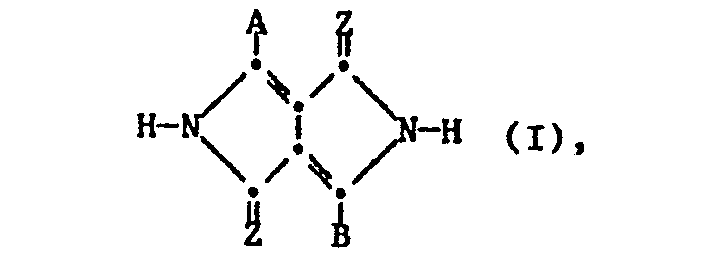
- the present invention accordingly relates to a process for the preparation of 3,6-diaryl-1,4-diketo-pyrrolo- [3,4-c] -pyrroles substituted by bromine by bromination of a pyrrolo- [3,4-c] -pyrrole or a mixture of different pyrrolo- [3,4-c] pyrroles of the formula 1 wherein A and B are the same or different isocyclic aromatic radicals and Z is oxygen or sulfur, with a brominating agent in an amount which provides 0.5 to 70 equivalents of bromine, with or without solvent, and then isolating the brominated pyrrolo- [3, 4-c] pyrrole by removal of the excess bromination agent and, if appropriate, the solvent by customary methods.
- Z is preferably oxygen.
- radicals A and B are preferably the same.
- a and B as isocyclic aromatic radicals are preferably monobis tetra-cyclic, in particular mono- or bicyclic radicals, for example phenyl, biphenylyl or naphthyl.
- the isocyclic aromatic radicals can have customary non-water-solubilizing substituents, such as: halogen, nitro, amino, carbamoyl, cyano, Trifluoromethyl, C 2 -C 13 alkylcarbamoyl, C 1 -C 12 alkyl, C 1 -C 12 alkoxy, C 1 -C 12 alkyl mercapto, C Z -C 13 alkoxycarbonyl, C 2 -C 13 alkanoylamino, C 1 -C 12 monoalkylamino, C 2 -C 24 dialkylamino, mono- (C 5 -C 7 cycloalkyl) amino, di- (C 5 -C 7 cycloalkyl) amino, unsubstituted or by
- C 2 -C 13 alkylcarbamoyl groups are N-methylcarbamoyl, N-ethylcarbamoyl, N, N-dimethylcarbamoyl, N-butylcarbamoyl, N, N-di-butylcarbamoyl, N, N-dihexylcarbamoyl.
- C 1 -C 12 alkyl groups are methyl, ethyl, n-propyl, isopropyl, n-butyl, sec-butyl, tert-butyl, tert-amyl, n-pentyl, n-hexyl, 1,1, 3,3-tetramethylbutyl, n-heptyl, n-octyl, nonyl, decyl, undecyl, dodecyl.
- C 1 -C 12 alkoxy groups are, for example: methoxy, ethoxy, propoxy, isopropoxy, n-butoxy, sec-butoxy, tert-butoxy, n-pentyloxy, tert-amyloxy, n-hexyloxy, n-heptyloxy, n- Octyloxy, decyloxy, dodecyloxy.
- C 1 -C 12 -Alkylmercapto means, for example, methylmercapto, ethylmercapto, propylmercapto, butylmercapto, n-pentylmercapto, tert.-amylmercapto, n-hexylmercapto, decylmercapto, dodecylmercapto.
- C 2 -C 13 alkoxycarbonyl groups represent, for example, methoxy, ethoxy, propoxy, isopropoxy, n-butoxy, tert-butoxy, n-hexyloxy, n-octyloxy, dodecyloxycarbonyl.
- C z -C 13 alkanoylamino is, for example, acetylamino, propionylamino, butyrylamino.
- C 1 -C 12 monoalkylamino means, for example, methylamino, ethylamino, isopropylamino, n-butylamino.
- Mono- (C5-C7-cycloalkyl) amino means, for example, cyclohexylamino.
- C 1 -C 12 dialkylamino means, for example, dimethylamino, diethylamino, dibutylamino, dihexylamino.
- Di- (Cs-C7-cycloalkyl) amino means e.g. Dicyclohexylamino.
- a and B are a group of the formula mean, wherein R 1 , R 2 , R 3 independently of one another hydrogen, halogen, nitro, amino, carbamoyl, cyano, trifluoromethyl, C 2 -C 13 alkylcarbamoyl, C 1 -C 12 alkyl, C 1 -C 12 alkoxy , CI-C12-alkylmercapto, C 2 -C 13 alkoxycarbonyl, C 2 -C 13 alkanoylamino, C 1 -C 12 monoalkylamino, C 2 -C 24 dialkylamino, unsubstituted or by halogen, C 1 -C 12 - Alkyl or C I -C 12 alkoxy substituted phenyl, phenoxy, phenylmercapto, phenoxycarbonyl or phenylcarbamo
- a and B are a group of the formula are wherein R 1 and R 2 are hydrogen, C 1 -C 4 alkyl, C 1 -C 4 alkoxy or phenyl.
- 1,4-diketopyrrolo [3,4-c] pyrroles to be brominated are e.g. known from EP-A 61426, EP-A 94911 and EP-A 133156 and can be prepared by the methods described in the same publications.
- the 1,4-diketopyrrolo- [3,4-c] pyrrole to be brominated can be either in a solvent or in a melt or in the absence of a solvent with the brominating agent in the desired amount, i.e. in an amount which provides 0.5 to 70, preferably 2 to 40 equivalents of bromine, at temperatures which can suitably vary between -20 and 200 ° C, preferably between 20 and 150 ° C, in an open or closed vessel until be brominated to the desired bromine content.
- Suitable brominating agents are, for example: bromine, N-bromosuccinimide, dibromocyanuric acid, thionyl bromide, alkali metal hypobromides, N, N-di-bromophenylsulfonamide, pyridine hydrobromide perbromide, N-bromophthalimide. Bromine and dibromocyanuric acid are preferred.
- Halogenated or nitrated aromatic hydrocarbons, unsubstituted or halogenated aliphatic hydrocarbons and mineral acids can be used as solvents.
- solvents include: o-dichlorobenzene, nitrobenzene, carbon tetrachloride, 1,1,2,2-tetrachloroethane, methylene chloride, Trichlorethylene, tetrachlorethylene, petroleum ether, nitroethane, hexane, decalin, O Shellsol TD (a mixture of Shell aliphatic hydrocarbons), sulfuric acid.
- the reaction is advantageously carried out in the presence of a weak base, such as KzC0 3 .
- a weak base such as KzC0 3 .
- Surface-active agents such as, for example, polyoxyethylene lauryl ether and bis-2-ethylhexyl ester sodium sulfosuccinic acid, and oxidizing agents, such as, for example, cerium IV ammonium nitrate and copper II nitrate, can also advantageously be added.
- the process according to the invention can be controlled so that uniform products or mixtures of unbrominated and uniformly or differently brominated or different brominated 1,4-diketopyrrolo [3,4-c] pyrroles are formed.
- the brominated 1,4-diketo-pyrrolo- [3,4-c] -pyrroles obtained according to the invention are used as pigments for coloring high molecular weight organic materials.
- the pigments can generally be used directly in the form in which they are obtained by the process according to the invention.
- the brominated 1,4-diketopyrrolo- [3,4-c] pyrroles of the formula I according to the invention can also be used as polymer-soluble dyes.
- the brominated 1,4-diketo-pyrrolo- [3,4-c] -pyrroles produced according to the present invention are notable in particular for good heat resistance.
- High molecular weight organic materials which can be colored or pigmented with the brominated 1,4-diketo-pyrrolo- [3,4-c] -pyrroles of the formula I obtained according to the invention are e.g. Cellulose ethers and esters such as ethyl cellulose, nitrocellulose, cellulose acetate or cellulose butyrate, natural resins or synthetic resins such as polymerization resins or condensation resins, e.g.
- Aminoplasts especially urea and melamine-formaldehyde resins, alkyd resins, phenoplasts, polycarbonates, polyolefins, such as polyethylene or polypropylene, polystyrene, polyvinyl chloride, polyphenyl ether, polyphenyl sulfide, polyacrylonitrile, polyacrylic acid esters, polyamides, polyurethanes or polyesters, rubber, casein, silicone and silicone resins, individually or in mixtures.
- polyolefins such as polyethylene or polypropylene
- polystyrene polyvinyl chloride
- polyphenyl ether polyphenyl sulfide
- polyacrylonitrile polyacrylic acid esters
- polyamides polyurethanes or polyesters
- silicone and silicone resins individually or in mixtures.
- the high-molecular organic compounds mentioned are in the form of plastic masses, melts or in the form of spinning solutions, lacquers, paints or printing inks. Depending on the intended use, it proves to be advantageous to use the pigments obtained according to the invention as toners or in the form of preparations.
- the compounds of formula 1 are used in an amount of preferably 0.1 to 10% by weight.
- the dyeings obtained are notable for high color strength, good dispersibility, good resistance to overpainting, migration, heat, light and weather, as well as good gloss and good IR reflectance behavior .
- the brominated compounds of formula (1) according to the invention can also be used as photoconductive substances, for example in electrophotographic recording materials.
- brominated compounds of formula (1) according to the invention can also be used as photoelectrophoretic toners.
- the brominated compounds of the formula (I) according to the invention which are partially or completely dissolved in the polymers used, are likewise distinguished by their pure color, high color strength, good general fastness properties, in particular fastness to light and sublimation, and also by high fluorescence. They are suitable for use in solar energy collectors and for the production of laser beams.
- the crystallization dish with the brominated product is then removed and left to stand at a constant weight [the product can be used to remove Excess bromine, even at 0-5 ° C, slowly add a solution of 1.5 to 3 equivalents (based on bromine) cyclohexene in 200 ml carbon tetrachloride and, after stirring for 30 minutes, be suction filtered].
- the crude product is heated for a few hours at reflux in methanol, suction filtered, washed with methanol and dried at 70 ° C. in a vacuum drying cabinet.
- Example 2 A mixture of 1.0 g of 3,6-diphenyl-l, 4-diketopyrrolo [3,4-c] pyrrole and 3.8 g of bromine in 10 ml of carbon tetrachloride is placed in a 50 ml round-bottomed flask with a reflux condenser stirred for 18 hours at room temperature.
- Example 3 55.2 g of aluminum chloride are placed in a 50 ml sulfonation flask, and 3.4 g of NaCl, 2.5 g of KCl and 0.9 g of NaF are added in portions at 100.degree. 2.0 g of 3,6-diphenyl-1,4-diketopyrrolo- [3,4-c] -pyrrole are added to the melt obtained, and 2.4 g of bromine are then added dropwise within one hour. The mixture is stirred for 4 hours at 100 ° C. and then poured onto 100 ml of 2N HCl / ice and filtered off.
- Example 4 3.0 g of 3,6-diphenyl-1,4-diketo-pyrrolo [3,4-c] pyrrole are added to 7.7 ml of concentrated sulfuric acid in a 100 ml round-bottomed flask. A solution of 8.7 g of dibromocyanuric acid in 70 ml of concentrated sulfuric acid is then slowly added, and the mixture obtained is stirred at room temperature for 15 minutes. The reaction mixture is then poured onto 100 ml of ice and suction filtered. The residue is slurried in 50 ml of dilute NaOH solution, suction filtered, washed with water and dried in a vacuum drying cabinet. The solid is then in methanol heated at reflux for 3 hours. This gives 2.1 g of a pigment mixture (consisting essentially of components A, B and C) with a bromine content of 43.8%, which, when incorporated into PVC, gives an orange color.
- a pigment mixture consisting essentially of components A, B and C
- Example 5 In a 1 liter enamel autoclave, 5.0 g of 3,6-diphenyl-1,4-diketo-pyrrolo [3,4-c] pyrrole are placed in a glass dish provided with three legs. 27.8 g of bromine are added to the bottom of the autoclave, the autoclave is closed and the mixture is heated to 100 ° C. for 18 hours.
- the autoclave is cooled to room temperature, vented, flushed with nitrogen, the glass dish is removed and its content is slowly removed from a solution of 1.5 to 3 equivalents (based on the amount of bromine to avoid excess bromine and to avoid side reactions at 0-5 ° C Bromine) of an olefin, for example cyclohexene, in 200 ml of carbon tetrachloride and stirred for 30 minutes, then suction filtered, refluxed for a few hours in methanol, suction filtered and dried at 70 ° C. in a vacuum drying cabinet.
- an olefin for example cyclohexene
- Example 7 30 g of 3,6-diphenyl-1,4-diketopyrrolo- [3,4-c] pyrrole and 116 g of bromine in 300 ml of carbon tetrachloride are stirred at 100 ° C. for 18 hours in a 1 liter enamel autoclave. After cooling to room temperature, the suspension is filtered off with suction. To remove excess bromine, it is advantageous to use it at 0-5 ° C slowly a solution of, for example, 1.5 to 3 equivalents (based on bromine) of cyclohexene in 200 ml of carbon tetrachloride to the cooled reaction mixture before suction filtration and stirred for about 30 minutes.
- EXAMPLE 8 If the procedure is as in Example 7, but instead of carbon tetrachloride, petroleum ether 40 ° -60 ° C. is used as the solvent, 32.0 g of a pigment mixture (consisting essentially of components A, B and C) with a bromine content are obtained of 19.7%, which, when incorporated into PVC, gives a red color.
- EXAMPLE 9 If the procedure is as in Example 7, but instead of carbon tetrachloride 'sshellsol TD (mixture of aliphatic hydrocarbons from Shell) is used as the solvent, 34.4 g of a pigment mixture (consisting essentially of components A, B and C) with a bromine content of 12.5%, which, when incorporated into PVC, gives a red color.
- carbon tetrachloride 'sshellsol TD mixture of aliphatic hydrocarbons from Shell
- EXAMPLE 12 If the procedure is as in Example 7, but 1,1,2,2-tetrachloroethane is used as the solvent instead of carbon tetrachloride, 36.5 g of a pigment mixture (consisting essentially of components A, B and C) are obtained a bromine content of 26.7%, which, when incorporated into PVC, gives a red color.
- Example 13 In a bomb tube (100 ml) in 30 ml carbon tetrachloride, 3.0 g of 3,6-diphenyl-1, 4-diketopyrrolo- [3,4-c] -pyrrole and 11.4 g of bromine for 18 hours stirred at room temperature.
- Working up analogously to Example 2 gives 2.8 g of a pigment mixture (consisting essentially of components A, B and C) with a bromine content of 11.1%, which, when incorporated into PVC, gives a red color.
- Example 14 If the procedure is as in Example 13, but 0.5 g of sulfosuccinic acid bis-2-ethylhexyl ester sodium salt are additionally added, 3.1 g of a pigment mixture (consisting essentially of components A, B and C) are obtained. with a bromine content of 15%, which, when incorporated into PVC, gives a red color.
- Example 15 If the procedure is as in Example 13, but 5.7 g of K 2 CO 3 are added, 2.9 g of a pigment mixture (consisting essentially of components A, B and C) with a bromine content of 16 are obtained %, which, when incorporated into PVC, gives a red color.
- Example 16 The procedure is as in Example 1, but 3.0 g of 3,6-di- (4-phenylphenyl) -1,4-diketopyrrolo- [3,4-c] pyrrole and are used as starting material 7.3 g of bromine gives 3.7 g of a pigment mixture with a bromine content of 35.7%, which, when incorporated into PVC, gives a red-violet color.
- Example 17 3.0 g of 3,6-diphenyl-1,4-diketo-pyrrolo [3,4-c] pyrrole are added to 30 ml of bromine and the mixture is stirred for one hour at room temperature. The reaction mixture is filtered off with suction, washed with petroleum ether, and the residue is refluxed in methanol for three hours, filtered off with suction, washed with methanol and in Vacuum cabinet dried at 70 ° C. 3.2 g of a pigment mixture (consisting essentially of components A, B and C) with a bromine content of 21.9% Br are obtained, which, when incorporated into PVC, gives a red color.
- Example 18 The procedure is as in Example 1, but instead of 50 g of 3,6-diphenyl-1,4-diketopyrrolo [3,4-c] pyrrole and 278 g of bromine, 0.5 g of 3,6-di is used - (3-methoxyphenyl) -1,4-diketopyrrolo- [3,4-c] pyrrole and 7.3 g bromine, 0.5 g of a pigment mixture with 48.8% bromine content is obtained, which, incorporated into PVC , gives a red-violet color.
- EXAMPLE 20 If the procedure is as in Example 7, but using o-dichlorobenzene and 232 g of bromine instead of carbon tetrachloride, 36.7 g of a pigment mixture (consisting essentially of components A, B and C) with a bromine content of 30 are obtained , 6%, which is incorporated into PVC gives a red color.
Landscapes
- Chemical & Material Sciences (AREA)
- Organic Chemistry (AREA)
- Nitrogen Condensed Heterocyclic Rings (AREA)
Abstract
Description
- Die vorliegende Erfindung betrifft ein Verfahren zur Herstellung von bromierten Pyrrolo-[3,4-c]-pyrrolen durch direkte Bromierung der Pyrrolo-[3,4-c]-pyrrole.
- Bromierte 1,4-Diketo-pyrrolo-[3,4-c]-pyrrole, wie sie z.B. in EP-A 61426 beschrieben sind, stellen eine wichtige Gruppe von Pigmenten der neuen Klasse der 1,4-Diketo-pyrrolo-[3,4-c]-pyrrole dar. Sie wurden bisher ausgehend von den entsprechenden bromierten Nitrilen durch Umsetzung mit Bromessigester und Zink, gemäss der in EP-A 61426 beschriebenen Methode, oder mit einem Bernsteinsäurediester in Gegenwart einer starken Base, gemäss der in EP-A 94911 beschriebenen Methode, hergestellt. Die für die Herstellung der an den aromatischen Substituenten bromierten 1,4-Diketo-pyrrolo-[3,4-c]-pyrrole benötigten bromierten Nitrile können schlecht direkt aus den aromatischen Nitrilen durch Bromierung erhalten werden, sondern müssen aus einfachen Ausgangsmaterialien in mehrstufigen Prozessen mit niedrigen Ausbeuten und relativ hohen Kosten hergestellt werden. So kann z.B. das Benzonitril nicht einfach und direkt mit Brom in das p-Brombenzonitril übergeführt werden. Letzteres wird durch Bromierung von Toluol (Glinzer & Fittig, Ann. 136, 301 (1865)) und anschliessende Oxidation zum Nitril (Hübner & Wallach, Ann. 154, 293 (1870); DE-OS 1 189 976) hergestellt.
- Bromierte Nitrile, wie sie zur bekannten Herstellung von bromierten 1,4-Diketo-pyrrolo-[3,4-c]-pyrrolen benötigt werden, sind daher schwer und nur über mehrere Stufen zu hohen Preisen zugänglich.
- Es ist nun gefunden worden, dass an den aromatischen Substituenten durch Brom substituierte 3,6-Diaryl-1,4-diketo-pyrrolo[3,4-c]-pyr- role überraschenderweise durch direkte Bromierung der entsprechenden 1,4-Diketo-pyrrolo-[3,4-c]-pyrrole, welche leicht aus meist billigen, leicht zugänglichen Nitrilen erhältlich sind, mit hoher Ausbeute hergestellt werden können.
- Die vorliegende Erfindung betrifft demnach ein Verfahren zur Herstellung von durch Brom substituierten 3,6-Diaryl-l,4-diketo- pyrrolo-[3,4-c]-pyrrolen durch Bromierung eines Pyrrolo-[3,4-c]-pyrrols oder eines Gemisches verschiedener Pyrrolo-[3,4-c]-pyrrole der Formel 1

- Bevorzugt geht man von einem einheitlichen Pyrrolo-[3,4-c]-pyrrol aus. Z ist bevorzugt Sauerstoff.
- Die Reste A und B sind vorzugsweise gleich.
- A und B sind als isocyclische aromatische Reste vorzugsweise monobis tetra-cyclische, insbesondere mono- oder bicyclische Reste, z.B. Phenyl, Biphenylyl oder Naphthyl. Die isocyclischen aromatischen Reste können übliche nichtwasserlöslichmachende Substituenten aufweisen, wie z.B.: Halogen, Nitro, Amino, Carbamoyl, Cyano, Trifluormethyl, C2-C13-Alkylcarbamoyl, C1-C12-Alkyl, C1-C12-Alkoxy, C1-C12-Alkylmercapto, CZ-C13-Alkoxycarbonyl, C2-C13-Alkanoylamino, C1-C12-Monoalkylamino, C2-C24-Dialkylamino, Mono-(C5-C7-cycloalkyl)-amino, Di-(C5-C7-cycloalkyl)-amino, unsubstituiertes oder durch Halogen, C1-C12-Alkyl oder C1-C12-Alkoxy substituiertes Phenyl, Phenoxy, Phenylmercapto, Phenoxycarbonyl, Phenylcarbamoyl oder Benzoylamino.
- Beispiele von C2-C13-Alkylcarbamoylgruppen sind N-Methylcarbamoyl, N-Ethylcarbamoyl, N,N-Dimethylcarbamoyl, N-Butylcarbamoyl, N,N-Di- butylcarbamoyl, N,N-Dihexylcarbamoyl.
- Beispiele von C1-C12-Alkylgruppen sind Methyl, Ethyl, n-Propyl, Isopropyl, n-Butyl, sec-Butyl, tert.-Butyl, tert.-Amyl, n-Pentyl, n-Hexyl, 1,1,3,3-Tetramethylbutyl, n-Heptyl, n-Octyl, Nonyl, Decyl, Undecyl, Dodecyl.
- C1-C12-Alkoxygruppen sind z.B.: Methoxy, Ethoxy, Propoxy, Isopropoxy, n-Butoxy, sec-Butoxy, tert.-Butoxy, n-Pentyloxy, tert.-Amyloxy, n-Hexyloxy, n-Heptyloxy, n-Octyloxy, Decyloxy, Dodecyloxy.
- C1-C12-Alkylmercapto bedeutet z.B. Methylmercapto, Ethylmercapto, Propylmercapto, Butylmercapto, n-Pentylmercapto, tert.-Amylmercapto, n-Hexylmercapto, Decylmercapto, Dodecylmercapto.
- C2-C13-Alkoxycarbonylgruppen stellen z.B. Methoxy-, Ethoxy-, Propoxy-, Isopropoxy-, n-Butoxy-, tert.-Butoxy-, n-Hexyloxy-, n-Octyloxy-, Dodecyloxy-carbonyl dar.
- Cz-C13-Alkanoylamino ist z.B. Acetylamino, Propionylamino, Butyrylamino.
- C1-C12-Monoalkylamino bedeutet z.B. Methylamino, Ethylamino, Isopropylamino, n-Butylamino.
- Mono-(C5-C7-cycloalkyl)-amino bedeutet z.B. Cyclohexylamino. C1-C12-Dialkylamino bedeutet z.B. Dimethylamino, Diethylamino, Dibutylamino, Dihexylamino.
- Di-(Cs-C7-cycloalkyl)-amino bedeutet z.B. Dicyclohexylamino.
- Von besonderem Interesse ist die Bromierung von Pyrrolo-[3,4-c]-pyr- rolen der Formel I, worin A und B unsubstituiertes oder durch übliche nichtwasserlöslichmachende Substituenten substituiertes Phenyl oder Naphthyl bedeuten.
- Von ganz besonderem Interesse ist die Bromierung von Pyrrolo-[3,4-c]-pyrrolen der Formel I, worin A und B eine Gruppe der Formel

- Bevorzugt ist die Bromierung von Pyrrolo-[3,4-c]-pyrrolen der Formel I, worin A und B eine Gruppe der Formel

- Besonders bevorzugt ist die Bromierung von Pyrrolo-[3,4-c]-pyrrolen der Formel I, worin A und B eine Gruppe der Formel

- Ganz besonders bevorzugt ist die Bromierung von 1,4-Diketopyrrolo-[3,4-c]-pyrrolen der Formel I, worin A und B unsubstituiertes Phenyl bedeuten.
- Die zu bromierenden 1,4-Diketopyrrolo-[3,4-c]-pyrrole sind z.B. aus EP-A 61426, EP-A 94911 und EP-A 133156 bekannt und können nach den in den gleichen Publikationen beschriebenen Methoden hergestellt werden.
- Das zu bromierende 1,4-Diketopyrrolo-[3,4-c]-pyrrol kann entweder in einem Lösungsmittel oder in einer Schmelze oder in Abwesenheit eines Lösungsmittels mit dem Bromierungsmittel in der gewünschten Menge, d.h. in einer Menge die 0,5 bis 70, bevorzugt 2 bis 40 Aequivalente Brom liefert, bei Temperaturen, die zweckmässig zwischen -20 und 200°C, bevorzugt zwischen 20 und 150°C, variieren können, in einem offenen oder geschlossenen Gefäss, bis zum gewünschten Bromgehalt bromiert werden.
- Geeignete Bromierungsmittel sind z.B.: Brom, N-Bromsuccinimid, Dibromcyanursäure, Thionylbromid, Alkalimetallhypobromide, N,N-Di- bromphenylsulfonamid, Pyridinhydrobromid-perbromid, N-Bromphthalimid. Bevorzugt werden Brom und Dibromcyanursäure.
- Als Lösungsmittel können z.B. halogenierte oder nitrierte aromatische Kohlenwasserstoffe, unsubstituierte oder halogenierte aliphatische Kohlenwasserstoffe sowie Mineralsäuren eingesetzt werden. Beispiele dafür sind: o-Dichlorbenzol, Nitrobenzol, Tetrachlorkohlenstoff, 1,1,2,2-Tetrachlorethan, Methylenchlorid, Trichlorethylen, Tetrachlorethylen, Petrolether, Nitroethan, Hexan, Decalin, OShellsol TD (ein Gemisch von aliphatischen Kohlenwasserstoffen von Shell), Schwefelsäure.
- Um die Bromierung zu beschleunigen, wird die Reaktion mit Vorteil in Gegenwart einer schwachen Base, wie z.B. KzC03, durchgeführt. Mit Vorteil können auch oberflächenaktive Mittel, wie z.B. Polyoxyethylen-laurylether und Sulfobernsteinsäure-bis-2-ethylhexyl-ester-Natriumsalz, sowie Oxidationsmittel, wie z.B. Cer-IV-ammoniumnitrat und Kupfer-II-nitrat, zugegeben werden.
- Bevorzugt wird die Bromierung von 1,4-Diketopyrrolo-[3,4-c]-pyrrolen der Formel I mit 2-40 Aequivalenten Brom in einem der obenerwähnten Lösungsmittel oder in einem Gemisch davon, oder in flüssigem oder gasförmigem Brom ohne Lösungsmittel, oder mit Dibromcyanursäure in Schwefelsäure, bei Temperaturen zwischen 20 und 150°C durchgeführt. Wenn nötig wird das überschüssige Brom durch Zugabe eines geeigneten Reagenz abgefangen und die Suspension abgenutscht. Der Rückstand wird zweckmässig mit einem polaren organischen Lösungsmittel gereinigt und im Vakuumtrockenschrank getrocknet.
- Durch die Wahl der Reaktionstemperatur und -dauer und/oder des verwendeten Lösungsmittels und/oder durch Erhöhung bzw. Verminderung der Menge des Bromierungsmittels, kann das erfindungsgemässe Verfahren so gesteuert werden, dass einheitliche Produkte oder Gemische von unbromierten und einheitlich oder unterschiedlich bromierten oder von unterschiedlich bromierten 1,4-Diketopyrro- lo-[3,4-c]-pyrrole entstehen.
- In der Regel verwendet man die erfindungsgemäss erhaltenen bromierten 1,4-Diketo-pyrrolo-[3,4-c]-pyrrole als Pigmente zum Einfärben von hochmolekularen organischen Materialien. Dabei lassen sich die Pigmente im allgemeinen direkt in der Form einsetzen, wie sie nach dem erfindungsgemässen Verfahren anfallen.
- Je nach Art ihrer Substituenten und der zu färbenden Polymeren können die erfindungsgemäss bromierten 1,4-Diketopyrrolo-[3,4-c]-pyrrole der Formel I auch als polymerlösliche Farbstoffe verwendet werden.
- Die gemäss der vorliegenden Erfindung hergestellten bromierten l,4-Diketo-pyrrolo-[3,4-c]-pyrrole zeichnen sich insbesondere durch gute Hitzebeständigkeit aus.
- Je nach Verwendungszweck kann es vorteilhaft sein, die erfindungsgemäss erhältlichen Gemische von bromierten und unbromierten oder von verschiedentlich bromierten 1,4-Diketo-pyrrolo-[3,4-c]-pyrrolen einzusetzen.
- Von besonderem Interesse sind die ausgehend von Verbindungen der Formel I, worin A und B Phenyl bedeuten, erhaltenen Gemische von bromierten 1,4-Diketo-[3,4-c]-pyrrolen, die einen Bromgehalt von mindestens 10, insbesondere 20 % aufweisen.
- Hochmolekulare organische Materialien, die mit den erfindungsgemäss erhaltenen bromierten 1,4-Diketo-pyrrolo-[3,4-c]-pyrrolen der Formel I gefärbt bzw. pigmentiert werden können, sind z.B. Celluloseether und -ester, wie Ethylcellulose, Nitrocellulose, Celluloseacetat oder Cellulosebutyrat, natürliche Harze oder Kunstharze, wie Polymerisationsharze oder Kondensationsharze, z.B. Aminoplaste, insbesondere Harnstoff- und Melamin-Formaldehydharze, Alkydharze, Phenoplaste, Polycarbonate, Polyolefine, wie Polyethylen oder Polypropylen, Polystyrol, Polyvinylchlorid, Polyphenylether, Polyphenylsulfid, Polyacrylnitril, Polyacrylsäureester, Polyamide, Polyurethane oder Polyester, Gummi, Casein, Silikon und Silikonharze, einzeln oder in Mischungen.
- Dabei spielt es keine Rolle, ob die erwähnten hochmolekularen organischen Verbindungen als plastische Massen, Schmelzen oder in Form von Spinnlösungen, Lacken, Anstrichstoffen oder Druckfarben vorliegen. Je nach Verwendungszweck erweist es sich als vorteilhaft, die erfindungsgemäss erhaltenen Pigmente als Toner oder in Form von Präparaten einzusetzen. Bezogen auf das zu pigmentierende hochmolekulare organische Material setzt man die Verbindungen der Formel 1 in einer Menge von vorzugsweise 0,1 bis 10 Gew.% ein.
- Die erhaltenen Färbungen, beispielsweise in Kunststoffen, Fasern, Lacken oder Drucken, zeichnen sich durch hohe Farbstärke, gute Dispergierbarkeit, gute Ueberlackier-, Migrations-, Hitze-, Licht-und Wetterbeständigkeit, sowie durch einen guten Glanz und ein gutes IR-Remissionsverhalten aus.
- Die erfindungsgemäss bromierten Verbindungen der Formel (1) können auch als photoleitfähige Substanzen, beispielsweise in elektrophotographischen Aufzeichnungsmaterialien Verwendung finden.
- Die erfindungsgemäss bromierten Verbindungen der Formel (1) können auch als photoelektrophoretische Toner verwendet werden.
- Die erfindungsgemäss bromierten Verbindungen der Formel (I), die in den angewandten Polymeren teilweise oder vollständig gelöst vorliegen, zeichnen sich ebenfalls durch reinen Farbton, hohe Farbstärke, gute allgemeine Echtheiten, insbesondere Licht- und Sublimierechtheit, und ausserdem durch hohe Fluoreszenz aus. Sie eignen sich für die Anwendung in Sonnenenergie-Kollektoren und zur Herstellung von Laser-Strahlen.
- Die folgenden Beispiele erläutern die Erfindung.
- Beispiel 1: Auf dem Boden eines Exsikkators (0 = 20 cm) werden eine Kristallisationsschale mit 278 g Brom und auf der Porzellan-Einlage eine mit 50 g 3,6-Diphenyl-1,4-diketopyrrolo-[3,E-c]-pyrrol gefüllte Kristallisationsschale gestellt. Der Deckel wird aufgelegt, der Entlüftungshahn wird leicht geöffnet, und das Ganze wird 8 Tage bei Zimmertemperatur stehen gelassen. Danach wird die Kristallisationsschale mit dem bromierten Produkt entnommen und bis zum konstanten Gewicht stehen gelassen [das Produkt kann zur Entfernung von überschüssigem Brom auch bei 0-5°C langsam einer Lösung von 1,5 bis 3 Aequivalenten (bezogen auf Brom) Cyclohexen, in 200 ml Tetrachlorkohlenstoff zugegeben und nach 30 Minuten Rühren abgenutscht werden]. Das Rohprodukt wird zur Reinigung in Methanol einige Stunden bei Rückfluss erhitzt, abgenutscht, mit Methanol gewaschen und im Vakuumtrockenschrank bei 70°C getrocknet. Man erhält 67,0 g (87 % der Theorie) eines roten schwerlöslichen Festkörpers, der in spektroskopischer und koloristischer Hinsicht identisch ist mit 3,6-Di(4-bromphenyl)-1,4-diketopyrrolo-[3,4-c]-pyrrol. Das Produkt ergibt, in PVC eingearbeitet, eine rote Färbung.


- Beispiel 3: In einem 50 ml-Sulfierkolben werden 55,2 g Aluminiumchlorid vorgelegt, und bei 100°C werden portionenweise 3,4 g NaCl, 2,5 g KC1 und 0,9 g NaF zugegeben. Zu der erhaltenen Schmelze werden 2,0 g 3,6-Diphenyl-1,4-diketopyrrolo-[3,4-c]-pyrrol zugegeben und dann innert einer Stunde 2,4 g Brom zugetropft. Das Gemisch wird 4 Stunden bei 100°C gerührt und anschliessend auf 100 ml 2N HCl/Eis gegossen und abfiltriert. Der Rückstand wird in Methanol während 16 Stunden bei Rückfluss erhitzt, abgekühlt, abgenutscht, mit Methanol gewaschen und im Vakuumtrockenschrank bei 70°C getrocknet. Man erhält 2,3 g einer Pigmentmischung (bestehend im wesentlichen aus den Komponenten A, B und C) mit einem Bromgehalt von 31,6 X, die, in PVC eingearbeitet, eine rote Färbung ergibt.
- Beispiel 4: In einem 100 ml-Rundkolben werden 3,0 g 3,6-Diphenyl-1,4-diketo-pyrrolo-[3,4-c]-pyrrol zu 7,7 ml konzentrierter Schwefelsäure gegeben. Danach wird eine Lösung von 8,7 g Dibromcyanursäure in 70 ml konzentrierter Schwefelsäure langsam zugegeben, und das erhaltene Gemisch wird 15 Minuten bei Zimmertemperatur gerührt. Anschliessend wird das Reaktionsgemisch auf 100 ml Eis gegossen und abgenutscht. Der Rückstand wird in 50 ml verdünnter NaOH-Lösung aufgeschlämmt, abgenutscht, mit Wasser gewaschen und im Vakuumtrockenschrank getrocknet. Der Festkörper wird danach in Methanol während 3 Stunden am Rückfluss erhitzt. Man erhält 2,1 g einer Pigmentmischung (bestehend im wesentlichen aus den Komponenten A, B und C) mit einem Bromgehalt von 43,8 %, die, in PVC eingearbeitet, eine orange Färbung ergibt.
- Beispiel 5: In einem 1 1-Emailautoklaven werden in eine mit drei Beinen versehenen Glasschale 5,0 g 3,6-Diphenyl-1,4-diketo-pyrro- lo-[3,4-c]-pyrrol gegeben. Auf dem Boden des Autoklaven gibt man 27,8 g Brom, schliesst den Autoklaven ab und heizt auf 100°C während 18 Stunden. Der Autoklav wird auf Zimmertemperatur abgekühlt, entlüftet, mit Stickstoff gespült, die Glasschale wird entnommen und deren Inhalt zur Entfernung von überschüssigem Brom und zur Vermeidung von Nebenreaktionen bei 0-5°C langsam einer Lösung von 1,5 bis 3 Aequivalenten (bezogen auf das Brom) eines Olefins, z.B. Cyclohexen, in 200 ml Tetrachlorkohlenstoff zugegeben und 30 Minuten gerührt, dann abgenutscht, zur Reinigung einige Stunden in Methanol am Rückfluss erhitzt, abgenutscht und bei 70°C im Vakuumtrockenschrank getrocknet. Man erhält 6,5 g eines Festkörpers, der, in PVC eingearbeitet, eine rote Färbung ergibt und in spektroskopischer und koloristischer Hinsicht identisch ist mit 3,6-Di(4-bromphenyl)-1,4-diketopyrrolo-[3,4-c]-pyrrol.

- Beispiel 6: Verfährt man wie im Beispiel 5, führt aber die Reaktion bei 23°C durch, so erhält man 5,9 g einer Pigmentmischung (bestehend im wesentlichen aus den Komponenten A, B und C) mit einem Bromgehalt von 21,8 %, die, in PVC eingearbeitet, eine rote Färbung ergibt.
- Beispiel 7: In einem 1 1-Emailautoklaven werden 30 g 3,6-Diphenyl-1,4-diketopyrrolo-[3,4-c]-pyrrol und 116 g Brom in 300 ml Tetrachlorkohlenstoff während 18 Stunden bei 100°C gerührt. Nach dem Abkühlen auf Zimmertemperatur wird die Suspension abgenutscht. Zur Entfernung von überschüssigem Brom gibt man mit Vorteil bei 0-5°C langsam eine Lösung von z.B. 1,5 bis 3 Aequivalenten (bezogen auf Brom) Cyclohexen in 200 ml Tetrachlorkohlenstoff zum abgekühlten Reaktionsgemisch vor dem Abnutschen und rührt ca. 30 Minuten. Das Rohprodukt wird zur Reinigung einige Stunden in Methanol am Rückfluss erhitzt, abgenutscht und im Vakuumtrockenschrank bei 70°C getrocknet. Man erhält 36,9 g einer Pigmentmischung (bestehend im wesentlichen aus den Komponenten A, B und C) mit einem Bromgehalt von 25,8 %, die, in PVC eingearbeitet, eine rote Färbung ergibt.
- Beispiel 8: Verfährt man wie in Beispiel 7, verwendet aber anstelle von Tetrachlorkohlenstoff Petrolether 40°-60°C als Lösungsmittel, so erhält man 32,0 g einer Pigmentmischung (bestehend im wesentlichen aus den Komponenten A, B und C) mit einem Bromgehalt von 19,7 %, die, in PVC eingearbeitet, eine rote Färbung ergibt.
- Beispiel 9: Verfährt man wie in Beispiel 7, vewendet aber anstelle von Tetrachlorkohlenstoff 'sshellsol TD (Gemisch von aliphatischen Kohlenwasserstoffen der Firma Shell) als Lösungsmittel, so erhält man 34,4 g einer Pigmentmischung (bestehend im wesentlichen aus den Komponenten A, B und C) mit einem Bromgehalt von 12,5 %, die, in PVC eingearbeitet, eine rote Färbung ergibt.
- Beispiel 10: Verfährt man wie in Beispiel 7, verwendet aber anstelle von Tetrachlorkohlenstoff o-Dichlorbenzol als Lösungsmittel, so erhält man 35,5 g einer Pigmentmischung (bestehend im wesentlichen aus den Komponenten A, B und C) mit einem Bromgehalt von 26,3 %, die, in PVC eingearbeitet, eine rote Färbung ergibt.
- Beispiel 11: Verfährt man wie in Beispiel 7, verwendet aber anstelle von Tetrachlorkohlenstoff Nitrobenzol als Lösungsmittel, so erhält man 26,5 g einer Pigmentmischung (bestehend im wesentlichen aus den Komponenten A, B und C) mit einem Bromgehalt von 31,2 %, die, in PVC eingearbeitet, eine rote Färbung ergibt.
- Beispiel 12: Verfährt man wie in Beispiel 7, verwendet aber anstelle von Tetrachlorkohlenstoff 1,1,2,2-Tetrachlorethan als Lösungsmittel, so erhält man 36,5 g einer Pigmentmischung (bestehend im wesentlichen aus den Komponenten A, B und C) mit einem Bromgehalt von 26,7 %, die, in PVC eingearbeitet, eine rote Färbung ergibt.
- Beispiel 13: In einem Bombenrohr (100 ml) werden in 30 ml Tetrachlorkohlenstoff, 3,0 g 3,6-Diphenyl-l,4-diketopyrrolo-[3,4-c]-pyrrol und 11,4 g Brom während 18 Stunden bei Zimmertemperatur gerührt. Die Aufarbeitung analog Beispiel 2 ergibt 2,8 g einer Pigmentmischung (bestehend im wesentlichen aus den Komponenten A, B und C) mit einem Bromgehalt von 11,1 %, die, in PVC eingearbeitet, eine rote Färbung ergibt.
- Beispiel 14: Verfährt man wie in Beispiel 13, gibt aber zusätzlich 0,5 g Sulfobernsteinsäure-bis-2-ethylhexylester-Natriumsalz zu, so erhält man 3,1 g einer Pigmentmischung (bestehend im wesentlichen aus den Komponenten A, B und C) mit einem Bromgehalt von 15 %, die, in PVC eingearbeitet, eine rote Färbung ergibt.
- Beispiel 15: Verfährt man wie in Beispiel 13, gibt aber noch 5,7 g K2C03 zu, so erhält man 2,9 g einer Pigmentmischung (bestehend im wesentlichen aus den Komponenten A, B und C) mit einem Bromgehalt von 16 %, die, in PVC eingearbeitet, eine rote Färbung ergibt.
- Beispiel 16: Verfährt man wie in Beispiel 1, verwendet aber als Ausgangsmaterial 3,0 g 3,6-Di-(4-phenyl-phenyl)-1,4-diketopyr- rolo-[3,4-c]-pyrrol und 7,3 g Brom, so erhält man 3,7 g einer Pigmentmischung mit einem Bromgehalt von 35,7 %, die, in PVC eingearbeitet, eine rotviolette Färbung ergibt.
- Beispiel 17: Zu 30 ml Brom werden 3,0 g 3,6-Diphenyl-1,4-diketo- pyrrolo-[3,4-c]-pyrrol gegeben und eine Stunde bei Zimmertemperatur gerührt. Das Reaktionsgemisch wird abgenutscht, mit Petrolether gewaschen, und der Rückstand wird während drei Stunden in Methanol bei Rückfluss erhitzt, abgenutscht, mit Methanol gewaschen und im Vakuumschrank bei 70°C getrocknet. Man erhält 3,2 g einer Pigment- mischung (bestehend im wesentlichen aus den Komponenten A, B und C) mit einem Bromgehalt von 21,9 % Br, die, in PVC eingearbeitet, eine rote Färbung ergibt.
- Beispiel 18: Verfährt man wie in Beispiel 1, verwendet aber anstelle von 50 g 3,6-Diphenyl-1,4-diketopyrrolo-[3,4-c]-pyrrol und 278 g Brom 0,5 g 3,6-Di-(3-methoxyphenyl)-1,4-diketopyrrolo-[3,4-c]-pyrrol und 7,3 g Brom, so erhält man 0,5 g einer Pigmentmischung mit 48,8 % Bromgehalt, die, in PVC eingearbeitet, eine rotviolette Färbung ergibt.
- Beispiel 19: Verfährt man wie in Beispiel 7, verwendet aber 232 g Brom, so erhält man 40,3 g einer Pigmentmischung (bestehend im wesentlichen aus den Komponenten A, B und C) mit einem Bromgehalt von 32,4 %, die, in PVC eingearbeitet eine rote Färbung ergibt.
- Beispiel 20: Verfährt man wie in Beispiel 7, verwendet aber anstelle von Tetrachlorkohlenstoff o-Dichlorbenzol und 232 g Brom, so erhält man 36,7 g einer Pigmentmischung (bestehend im wesentlichen aus den Komponenten A, B und C) mit einem Bromgehalt von 30,6 %, die in PVC eingearbeitet eine rote Färbung ergibt.
Claims (14)


Applications Claiming Priority (2)
| Application Number | Priority Date | Filing Date | Title |
|---|---|---|---|
| CH365/86 | 1986-01-31 | ||
| CH36586 | 1986-01-31 |
Publications (3)
| Publication Number | Publication Date |
|---|---|
| EP0232222A2 true EP0232222A2 (de) | 1987-08-12 |
| EP0232222A3 EP0232222A3 (en) | 1988-10-12 |
| EP0232222B1 EP0232222B1 (de) | 1992-09-09 |
Family
ID=4185368
Family Applications (1)
| Application Number | Title | Priority Date | Filing Date |
|---|---|---|---|
| EP87810050A Expired - Lifetime EP0232222B1 (de) | 1986-01-31 | 1987-01-26 | Verfahren zur Herstellung von bromierten Pyrrolo-[3,4-c]-pyrrolen |
Country Status (5)
| Country | Link |
|---|---|
| US (1) | US4810802A (de) |
| EP (1) | EP0232222B1 (de) |
| JP (1) | JPH0742289B2 (de) |
| CA (1) | CA1323369C (de) |
| DE (1) | DE3781564D1 (de) |
Cited By (4)
| Publication number | Priority date | Publication date | Assignee | Title |
|---|---|---|---|---|
| EP0337945A1 (de) * | 1988-04-12 | 1989-10-18 | Ciba-Geigy Ag | Monoketo-pyrrolopyrrole |
| EP0499011A1 (de) * | 1991-02-12 | 1992-08-19 | Japat Ltd | Organisches elektrolumineszentes Element |
| WO2009144115A1 (en) * | 2008-05-28 | 2009-12-03 | Basf Se | Improved, red colour filter composition |
| EP3922681A1 (de) | 2018-06-25 | 2021-12-15 | Basf Se | Rote pigmentzusammensetzung für farbfilter |
Families Citing this family (7)
| Publication number | Priority date | Publication date | Assignee | Title |
|---|---|---|---|---|
| US5989453A (en) * | 1990-05-11 | 1999-11-23 | Societe Nouvelle De Chimie Industrielle S.A. | Process for the manufacture of pigments, especially fluorescent pigments |
| EP0710705B1 (de) | 1994-11-04 | 1999-12-22 | Ciba SC Holding AG | Gelbe Diketopyrrolopyrrolpigmente |
| US5817832A (en) * | 1995-06-22 | 1998-10-06 | Ciba Specialty Chemicals Corporation | Blue diketopyrrolopyrrole pigments |
| WO2004083313A1 (en) * | 2003-03-20 | 2004-09-30 | Mca Technologies Gmbh | Process for the preparation of fluorescent and non-fluorescent pigments |
| DE102005061997A1 (de) * | 2005-12-23 | 2007-07-05 | Basf Ag | Naphthalintetracarbonsäurederivate und deren Verwendung |
| KR102105622B1 (ko) * | 2011-06-09 | 2020-04-29 | 스미또모 가가꾸 가부시키가이샤 | 착색 조성물 |
| JP7308842B2 (ja) * | 2018-08-27 | 2023-07-14 | 株式会社Dnpファインケミカル | 着色樹脂組成物、硬化物、カラーフィルタ、及び表示装置 |
Family Cites Families (6)
| Publication number | Priority date | Publication date | Assignee | Title |
|---|---|---|---|---|
| US3592947A (en) * | 1967-12-27 | 1971-07-13 | Gaf Corp | Halogenated vat dyestuff of the diphthaloyl phenanthridone series |
| DE3262270D1 (en) * | 1981-03-20 | 1985-03-28 | Ciba Geigy Ag | Process for colouring highly molecular organic material and polycyclic pigments |
| US4490562A (en) * | 1982-02-11 | 1984-12-25 | Ciba-Geigy Corporation | Process for the preparation of a very pure commercial form of 4,2',4'-trichloro-2-hydroxydiphenyl ether |
| DE3366011D1 (en) * | 1982-05-17 | 1986-10-16 | Ciba Geigy Ag | Preparation of pyrrolo-(3,4-c) pyrroles |
| US4585878A (en) * | 1983-06-29 | 1986-04-29 | Ciba-Geigy Corporation | N-substituted 1,4-diketopyrrolo-[3,4-c]-pyrroles |
| US4659775A (en) * | 1984-11-07 | 1987-04-21 | Ciba-Geigy Corporation | Process for the preparation of pyrrolo[3,4-c]pyrroles, and novel pyrrolo[3,4-c]pyrroles |
-
1987
- 1987-01-26 DE DE8787810050T patent/DE3781564D1/de not_active Expired - Lifetime
- 1987-01-26 EP EP87810050A patent/EP0232222B1/de not_active Expired - Lifetime
- 1987-01-27 US US07/007,836 patent/US4810802A/en not_active Expired - Lifetime
- 1987-01-29 CA CA000528450A patent/CA1323369C/en not_active Expired - Fee Related
- 1987-01-30 JP JP62018783A patent/JPH0742289B2/ja not_active Expired - Lifetime
Cited By (5)
| Publication number | Priority date | Publication date | Assignee | Title |
|---|---|---|---|---|
| EP0337945A1 (de) * | 1988-04-12 | 1989-10-18 | Ciba-Geigy Ag | Monoketo-pyrrolopyrrole |
| EP0499011A1 (de) * | 1991-02-12 | 1992-08-19 | Japat Ltd | Organisches elektrolumineszentes Element |
| WO2009144115A1 (en) * | 2008-05-28 | 2009-12-03 | Basf Se | Improved, red colour filter composition |
| US8273269B2 (en) | 2008-05-28 | 2012-09-25 | Basf Se | Red colour filter composition |
| EP3922681A1 (de) | 2018-06-25 | 2021-12-15 | Basf Se | Rote pigmentzusammensetzung für farbfilter |
Also Published As
| Publication number | Publication date |
|---|---|
| EP0232222B1 (de) | 1992-09-09 |
| DE3781564D1 (de) | 1992-10-15 |
| JPS62190186A (ja) | 1987-08-20 |
| CA1323369C (en) | 1993-10-19 |
| US4810802A (en) | 1989-03-07 |
| EP0232222A3 (en) | 1988-10-12 |
| JPH0742289B2 (ja) | 1995-05-10 |
Similar Documents
| Publication | Publication Date | Title |
|---|---|---|
| EP0648817B1 (de) | Neue Fluoreszenzfarbstoffe | |
| EP0224445B1 (de) | Pyrrolo-pyrrol Pigmentpräparate, Verfahren zu deren Herstellung sowie ihre Verwendung | |
| EP0133156B1 (de) | Neue 1,4-Diketopyrrolo-(3,4-c)-pyrrole | |
| EP0648770B1 (de) | Pyrrolo[3,4-c]pyrrole | |
| DE69800715T2 (de) | Lösliche chromophore enthaltend gruppen mit verbesserter löslichkeit | |
| DE60219037T2 (de) | Verfahren zur herstellung von diketopyrrolopyrrolen | |
| US5097027A (en) | Heterocyclic compounds | |
| EP0761772A1 (de) | Lösliche Chromophore mit leicht abspaltbaren löslichmachenden Gruppen | |
| EP0181290A2 (de) | Pigmentmischungen | |
| DE69701232T2 (de) | Ternäre feste Lösungen von 1,4-Diketopyrrolopyrrolen und Chinacridonen | |
| EP0232222A2 (de) | Verfahren zur Herstellung von bromierten Pyrrolo-[3,4-c]-pyrrolen | |
| EP0098808B1 (de) | Herstellung von 1,4-Diketopyrrolo-(3,4-c)-pyrrolen | |
| EP0763572B1 (de) | Feste Lösungen von 1,4-Diketopyrrolopyrrolen | |
| EP0769532A1 (de) | Naphthalinlactamimid-Fluoreszenzfarbstoffe | |
| EP0570750A1 (de) | Metallfreie, substituierte Phthalocyanine in der X-Modifikation, ein Verfahren zu ihrer Herstellung sowie ihre Verwendung als Pigmente | |
| EP0036834B1 (de) | Verfahren zur Herstellung von Metallkomplexen von Isoindolinazinen | |
| EP0190692B1 (de) | Bis-isoindolinpigmente und ihre Verwendung | |
| EP0673940B1 (de) | Cyaniminogruppen enthaltende Pyrrolo(3,4-c)pyrrole | |
| EP0359708B1 (de) | Monoazoverbindungen mit langkettigen Alkylresten | |
| EP0710705A1 (de) | Gelbe Diketopyrrolopyrrolpigmente | |
| EP0337945A1 (de) | Monoketo-pyrrolopyrrole | |
| EP0163609A2 (de) | Verfahren zum Färben von hochmolekularem organischem Material, neue polycyclische Verbindungen sowie deren Herstellung | |
| EP0036836A2 (de) | Metallkomplexe von Isoindolinazinen, Verfahren zu deren Herstellung und Verwendung | |
| DE2449148B1 (de) | Formierung von Perhalogen-Kupferphthalocyaninen | |
| EP0387595B1 (de) | Heterocyclische Verbindungen |
Legal Events
| Date | Code | Title | Description |
|---|---|---|---|
| PUAI | Public reference made under article 153(3) epc to a published international application that has entered the european phase |
Free format text: ORIGINAL CODE: 0009012 |
|
| 17P | Request for examination filed |
Effective date: 19870128 |
|
| AK | Designated contracting states |
Kind code of ref document: A2 Designated state(s): CH DE FR GB IT LI |
|
| PUAL | Search report despatched |
Free format text: ORIGINAL CODE: 0009013 |
|
| AK | Designated contracting states |
Kind code of ref document: A3 Designated state(s): CH DE FR GB IT LI |
|
| 17Q | First examination report despatched |
Effective date: 19890919 |
|
| GRAA | (expected) grant |
Free format text: ORIGINAL CODE: 0009210 |
|
| AK | Designated contracting states |
Kind code of ref document: B1 Designated state(s): CH DE FR GB IT LI |
|
| REF | Corresponds to: |
Ref document number: 3781564 Country of ref document: DE Date of ref document: 19921015 |
|
| ITF | It: translation for a ep patent filed | ||
| GBT | Gb: translation of ep patent filed (gb section 77(6)(a)/1977) | ||
| ET | Fr: translation filed | ||
| PLBE | No opposition filed within time limit |
Free format text: ORIGINAL CODE: 0009261 |
|
| STAA | Information on the status of an ep patent application or granted ep patent |
Free format text: STATUS: NO OPPOSITION FILED WITHIN TIME LIMIT |
|
| 26N | No opposition filed | ||
| REG | Reference to a national code |
Ref country code: CH Ref legal event code: PUE Owner name: CIBA-GEIGY AG TRANSFER- CIBA SC HOLDING AG |
|
| REG | Reference to a national code |
Ref country code: GB Ref legal event code: 732E |
|
| REG | Reference to a national code |
Ref country code: CH Ref legal event code: PFA Free format text: CIBA SC HOLDING AG TRANSFER- CIBA SPECIALTY CHEMICALS HOLDING INC. |
|
| REG | Reference to a national code |
Ref country code: FR Ref legal event code: TP |
|
| PGFP | Annual fee paid to national office [announced via postgrant information from national office to epo] |
Ref country code: FR Payment date: 20001129 Year of fee payment: 15 Ref country code: CH Payment date: 20001129 Year of fee payment: 15 |
|
| PGFP | Annual fee paid to national office [announced via postgrant information from national office to epo] |
Ref country code: DE Payment date: 20001208 Year of fee payment: 15 |
|
| PGFP | Annual fee paid to national office [announced via postgrant information from national office to epo] |
Ref country code: GB Payment date: 20010102 Year of fee payment: 15 |
|
| REG | Reference to a national code |
Ref country code: GB Ref legal event code: IF02 |
|
| PG25 | Lapsed in a contracting state [announced via postgrant information from national office to epo] |
Ref country code: GB Free format text: LAPSE BECAUSE OF NON-PAYMENT OF DUE FEES Effective date: 20020126 |
|
| PG25 | Lapsed in a contracting state [announced via postgrant information from national office to epo] |
Ref country code: LI Free format text: LAPSE BECAUSE OF NON-PAYMENT OF DUE FEES Effective date: 20020131 Ref country code: CH Free format text: LAPSE BECAUSE OF NON-PAYMENT OF DUE FEES Effective date: 20020131 |
|
| PG25 | Lapsed in a contracting state [announced via postgrant information from national office to epo] |
Ref country code: DE Free format text: LAPSE BECAUSE OF NON-PAYMENT OF DUE FEES Effective date: 20020801 |
|
| REG | Reference to a national code |
Ref country code: CH Ref legal event code: PL |
|
| GBPC | Gb: european patent ceased through non-payment of renewal fee |
Effective date: 20020126 |
|
| PG25 | Lapsed in a contracting state [announced via postgrant information from national office to epo] |
Ref country code: FR Free format text: LAPSE BECAUSE OF NON-PAYMENT OF DUE FEES Effective date: 20020930 |
|
| REG | Reference to a national code |
Ref country code: FR Ref legal event code: ST |
|
| PG25 | Lapsed in a contracting state [announced via postgrant information from national office to epo] |
Ref country code: IT Free format text: LAPSE BECAUSE OF NON-PAYMENT OF DUE FEES;WARNING: LAPSES OF ITALIAN PATENTS WITH EFFECTIVE DATE BEFORE 2007 MAY HAVE OCCURRED AT ANY TIME BEFORE 2007. THE CORRECT EFFECTIVE DATE MAY BE DIFFERENT FROM THE ONE RECORDED. Effective date: 20050126 |