EP0224776A2 - Automatic washing machine with rotating drum - Google Patents
Automatic washing machine with rotating drum Download PDFInfo
- Publication number
- EP0224776A2 EP0224776A2 EP86115826A EP86115826A EP0224776A2 EP 0224776 A2 EP0224776 A2 EP 0224776A2 EP 86115826 A EP86115826 A EP 86115826A EP 86115826 A EP86115826 A EP 86115826A EP 0224776 A2 EP0224776 A2 EP 0224776A2
- Authority
- EP
- European Patent Office
- Prior art keywords
- laundering
- pressure
- washing machine
- pressure switch
- spin
- Prior art date
- Legal status (The legal status is an assumption and is not a legal conclusion. Google has not performed a legal analysis and makes no representation as to the accuracy of the status listed.)
- Granted
Links
Images

Classifications
-
- D—TEXTILES; PAPER
- D06—TREATMENT OF TEXTILES OR THE LIKE; LAUNDERING; FLEXIBLE MATERIALS NOT OTHERWISE PROVIDED FOR
- D06F—LAUNDERING, DRYING, IRONING, PRESSING OR FOLDING TEXTILE ARTICLES
- D06F37/00—Details specific to washing machines covered by groups D06F21/00 - D06F25/00
- D06F37/30—Driving arrangements
- D06F37/304—Arrangements or adaptations of electric motors
-
- D—TEXTILES; PAPER
- D06—TREATMENT OF TEXTILES OR THE LIKE; LAUNDERING; FLEXIBLE MATERIALS NOT OTHERWISE PROVIDED FOR
- D06F—LAUNDERING, DRYING, IRONING, PRESSING OR FOLDING TEXTILE ARTICLES
- D06F34/00—Details of control systems for washing machines, washer-dryers or laundry dryers
- D06F34/08—Control circuits or arrangements thereof
-
- D—TEXTILES; PAPER
- D06—TREATMENT OF TEXTILES OR THE LIKE; LAUNDERING; FLEXIBLE MATERIALS NOT OTHERWISE PROVIDED FOR
- D06F—LAUNDERING, DRYING, IRONING, PRESSING OR FOLDING TEXTILE ARTICLES
- D06F2103/00—Parameters monitored or detected for the control of domestic laundry washing machines, washer-dryers or laundry dryers
- D06F2103/24—Spin speed; Drum movements
-
- D—TEXTILES; PAPER
- D06—TREATMENT OF TEXTILES OR THE LIKE; LAUNDERING; FLEXIBLE MATERIALS NOT OTHERWISE PROVIDED FOR
- D06F—LAUNDERING, DRYING, IRONING, PRESSING OR FOLDING TEXTILE ARTICLES
- D06F2105/00—Systems or parameters controlled or affected by the control systems of washing machines, washer-dryers or laundry dryers
- D06F2105/46—Drum speed; Actuation of motors, e.g. starting or interrupting
- D06F2105/48—Drum speed
Definitions
- the present invention relates to an automatic washing machine operable to carry out washing cycles and spin-drying cycles by means of a rotating drum for containing laundry.
- a laundry washing machine wherein a laundering liquid collected in a receptacle at the bottom of the laundering tub is recirculated to the interior of a rotating drum for soakening the laundry contained therein.
- the drum is periodically made to rotate at the spin-drying speed for extracting from the laundry a quantity of the laundering liquid sufficient for the operation of the recirculation pump.
- This laundry washing machine is particularly advantageous in that it permits considerable savings of water, detergents and electric energy to be obtained.
- the laundering tub contains not only water, but also detergents during the periodic spin-drying phases.
- these periodic spin-drying phases may give rise, particularly when their duration exceeds a certain value of for instance three seconds, to the formation of an excessive quantity of foam in the tub, which tends to escape from the machine, for instance through the detergent distributor.
- This troublesome phenomenon may occur with relative facility due to the tolerances of the components of the machine and to the variability of certain parameters such as the spin-drying speed, the temperature of the laundering liquid and the type of detergent employed.
- an automatic washing machine comprising a laundering tub and a drum mounted therein for rotation by means of an electric motor for carrying out at least one laundering cycle during which the laundry is soaked with a laundering liquid, and the motor operates at a reduced rotational speed, and at least one intervening phase during which the motor operates at the rotational speed for spin-drying the laundry.
- This washing machine is mainly characterized by comprising control means adapted to detect the pressure in the interior of the laundering tub and to terminate the spin-drying phase when said pressure exceeds a predetermined value.
- the washing machine comprises a program unit in the form for instance of a timer having a number of cams rotating at different speeds for the operation of associated electric contacts for the combined operation of various functional elements.
- the actuator solenoid 19 of a water supply solenoid valve is adapted to be connected between terminals 5 and 6 of an electric power supply via a circuit breaker 7 and a pressure switch 4 connected in series.
- the movable contact 9 of pressure switch 4 is adapted to connect terminal 5 to fixed contacts 41 or 42, respectively, when the pressure switch detects an "empty" or “full” state of a liquid collector receptacle provided in the machine.
- the washing machine also comprises an electric motor for rotating the drum of the machine; this motor includes a low-speed winding section 10 and a high-speed winding section 11.
- low-speed winding section 10 is adapted to be connected between terminals 5 and 6 through a series-connected circuit comprising pressure switch 4 (when detecting the "full" state), circuit breakers 12 and 13, and a per se known inverter 14 including a phase shift capacitor 15 having two fixed contacts selectively engageable by a movable contact 16 actuated by a fast cam.
- the high-speed winding section 11 of the motor on its part is adapted to be connected between terminals 5 and 6 by a series-connected circuit including pressure switch 4 (when detecting the "full" state), circuit breaker 12 and a pair of circuit breakers 17 and 18 actuated respectively by a slow cam and a fast cam of the program unit.
- high-speed winding section 11 is additionally connected to a further pressure switch 8 adapted to detect the pressure in the interior of the laundering tub of the machine.
- a movable contact 20 of pressure switch 8 is closed on a fixed contact 81 connected to high-speed winding section 11 as long as the pressure within the laundering tub is below a pre-determined value P2 (fig. 2) beyond which there occurs an excessive formation of foam.
- Pressure switch 8 is positioned and calibrated in such a manner that its movable contact 20 closes on a blind fixed contact 82 when the said pressure value P2 is detected.
- the circuit also includes a small electric motor 21 for advancing the timer, this motor being connected between terminals 5 and 6 by the series-connected circuit of pressure switch 4 and circuit breaker 12.
- circuit of fig. 1 is to be understood to include further functional components controlled by the program unit, such as a discharge pump, heater elements, a recirculation pump etc., these elements being not shown for the sake of simplification.
- the overall operation of the washing machine proceeds substantially as known.
- Solenoid valve 19 is actuated to admit water and detergent to the washing machine until pressure switch 4 detects a predetermined water level, causing its movable contact 9 to close on fixed contact 42 for energizing timer motor 21.
- the operation of the timer causes circuit breaker 13 to close for energizing low-speed winding section 10 of the drum motor, so that the drum is rotated at a low speed in alternating directions.
- the laundering liquid is concurrently heated and supplied to the interior of the drum so as to soak the laundry therein.
- the pressure within the laundering tub is stabilized at a value P1 as shown at t1 in fig. 2, this value remaining substantially constant.
- timer 21 at a predetermined instant operates to close circuit breaker 17, so that during an interval between the rotations of the drum in opposite directions as determined by inverter 14 circuit breaker 18 may be closed for energizing high-speed winding section 11 of the drum motor.
- the laundering drum is thus made to rotate at the speed for spin-drying the laundry, as described in the quoted patent application no.
- the laundering cycle then proceeds in the conventional manner, with circuit breakers 17 and 18 again opened and further reversals of the rotation of the drum at low speed, and with the possible intervention of further spin-drying phases similar to the one indicated at t2-t3.
- the washing machine may be of the combined function type capable of selectively operating with two different liquid levels as described in the quoted patent application no. 45715 A/85.
- the machine At the lower liquid level the machine would then operate with recirculation of the liquid and periodic spin-drying phases during the laundering cycle; at the higher liquid level the machine would operate in the conventional manner by agitating the laundry with or without liquid recirculation, but in any case without the intervention of spin-drying phases during the laundering cycle.
- control circuit is the advantageously designed as shown in fig. 3 by the provision of certain modifications of the circuit shown in fig. 1.
- pressure switch 8 is in this case connected between pressure switch 4 and circuit breaekr 12, its movable contact 20 being directly connected to fixed contact 42 of pressure switch 4, while its fixed contact 82 is connected to circuit breaker 12.
- fixed contact 81 of pressure switch 8 is connected respectively via further circuit breakers 22 and 23 to the junction between circuit breaker 7 and solenoid valve 9, and the junction between circuit breakers 12 and 17. Circuit breakers 22 and 23 are actuated by respective slow cams of the program unit.
- Solenoid valve 19 is energized via pressure switch 4 and circuit breaker 7 to admit water to the tub until the liquid attains the lower level, at which point movable contact 9 of pressostat 4 is caused to close on fixed contact 42. Solenoid valve 19 thus continues to be energized via pressure switch 4, pressure switch 8 and circuit breaker 22 until the liquid attains the high level, causing movable contact 20 of pressure switch 8 to close on fixed contact 82. The eventual closing of circuit breakers 13 and 16 during this phase results in low-speed winding section 10 to be energized, whereupon the laundering operation proceeds in the known manner which needs not be described. It is noted in this contect that pressure switch 8 in this case carries out the conventional function of controlling the maximum level of the liquid admitted to the washing machine.
- Solenoid valve 19 is actuated to admit water only until pressure switch 4 is actuated in response to detecting the "full" state; the laundering cycle then proceeds as already described with reference to fig. 1, that is, with recirculation of the laundering liquid to the interior of the drum and alternating rotation of the drum motor resulting from the simultaneous closing of circuit breakers 13 and 16.
- the combined closing of circuit breakers 17 and 18 at instant t2 results in the intervention of a spin-drying phase t2-t3.
- the laundering tub contains an amount of laundering liquid heated for instance to 60 °C, resulting in a pressure increase up to the value P2.
- movable contact 20 of pressure switch 8 is caused to close on fixed contact 82 to thereby interrupt the energization of high-speed winding section 11 and thus terminate the spin-drying phase.
- pressure switch 8 functions as a safety device effective to prevent the excessive formation of foam within the laundering tub to thus attain the stated object of the invention.
- the control circuit shown in fig. 3 thus requires only a single pressure switch 8 connected in series to pressure switch 4 for performing the double function of a conventional control element for the admission of water to the higher level and of a safety device for preventing the excessive formation of foam. This eliminates the necessity of providing an additional component specifically for performing the safety function to attain the object of the invention.
- washing machine may of course be variously modified within the purview of the invention.
- Motor 10, 11 may thus be of any other type suitable for this purpose.
- the program unit may similarly be of any other type to meet specific requirements.
- the spin-drying phase, or phases, t2-t3 may intervene at any suitable time other than the laundry washing cycle under suitable control by the program unit.
Landscapes
- Engineering & Computer Science (AREA)
- Textile Engineering (AREA)
- Control Of Washing Machine And Dryer (AREA)
Abstract
Description
- The present invention relates to an automatic washing machine operable to carry out washing cycles and spin-drying cycles by means of a rotating drum for containing laundry. Described in Italian Patent Application No.45715 A/85, filed on 5-24-1985 in the name of the present applicant, is a laundry washing machine wherein a laundering liquid collected in a receptacle at the bottom of the laundering tub is recirculated to the interior of a rotating drum for soakening the laundry contained therein. In the course of the laundering cycle the drum is periodically made to rotate at the spin-drying speed for extracting from the laundry a quantity of the laundering liquid sufficient for the operation of the recirculation pump.
- This laundry washing machine is particularly advantageous in that it permits considerable savings of water, detergents and electric energy to be obtained. In contrast to the conventional final spin-drying cycle, however, the laundering tub contains not only water, but also detergents during the periodic spin-drying phases.
- As a result, these periodic spin-drying phases may give rise, particularly when their duration exceeds a certain value of for instance three seconds, to the formation of an excessive quantity of foam in the tub, which tends to escape from the machine, for instance through the detergent distributor.
- This troublesome phenomenon may occur with relative facility due to the tolerances of the components of the machine and to the variability of certain parameters such as the spin-drying speed, the temperature of the laundering liquid and the type of detergent employed.
- It is therefore an object of the present invention to provide an automatic washing machine comprising a rotatable drum for carrying out spin-drying of the laundry at periodic intervals during the laundering cycle without giving rise to the excessive formation of foam.
- According to the invention, this object is attained in an automatic washing machine comprising a laundering tub and a drum mounted therein for rotation by means of an electric motor for carrying out at least one laundering cycle during which the laundry is soaked with a laundering liquid, and the motor operates at a reduced rotational speed, and at least one intervening phase during which the motor operates at the rotational speed for spin-drying the laundry.
- This washing machine is mainly characterized by comprising control means adapted to detect the pressure in the interior of the laundering tub and to terminate the spin-drying phase when said pressure exceeds a predetermined value.
- The rotation of the drum at the spin-drying speed during the respective period intervening in the laundering cycle is thus terminated in response to the stabilization within the laundering tub of a pressure limit value determined by a combination of the parameters contributing to the formation of foam.
- The characteristics and advantages of the invention will become more clearly evident from the following description, given by way of example with reference to the accompanying drawings, wherein:
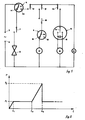
- fig. 1 shows a diagram of a preferred embodiment of a control circuit for the motor provided in the washing machine according to the invention for rotating the drum thereof,
- fig. 2 shows the development of the pressure within the tub of the washing machine according to the invention during a laundering cycle, and
- fig. 3 shows a modification of the control circuit of fig.1.
- The physical construction and the hydraulic system of the washing machine according to the invention are of a per se known type as described for instance in the patent application no. 45715 A/85 quoted above and need therefore not be described in detail. Amongst other components the washing machine comprises a program unit in the form for instance of a timer having a number of cams rotating at different speeds for the operation of associated electric contacts for the combined operation of various functional elements.
- With reference to fig. 1, there are only shown certain functional and control elements required for the understanding of the present invention.
- The
actuator solenoid 19 of a water supply solenoid valve is adapted to be connected betweenterminals 5 and 6 of an electric power supply via acircuit breaker 7 and a pressure switch 4 connected in series. In particular, themovable contact 9 of pressure switch 4 is adapted to connectterminal 5 to fixedcontacts - The washing machine also comprises an electric motor for rotating the drum of the machine; this motor includes a low-
speed winding section 10 and a high-speed winding section 11.In particular, low-speed winding section 10 is adapted to be connected betweenterminals 5 and 6 through a series-connected circuit comprising pressure switch 4 (when detecting the "full" state),circuit breakers inverter 14 including aphase shift capacitor 15 having two fixed contacts selectively engageable by amovable contact 16 actuated by a fast cam. - The high-
speed winding section 11 of the motor on its part is adapted to be connected betweenterminals 5 and 6 by a series-connected circuit including pressure switch 4 (when detecting the "full" state),circuit breaker 12 and a pair ofcircuit breakers speed winding section 11 is additionally connected to afurther pressure switch 8 adapted to detect the pressure in the interior of the laundering tub of the machine. In particular, amovable contact 20 ofpressure switch 8 is closed on a fixedcontact 81 connected to high-speed winding section 11 as long as the pressure within the laundering tub is below a pre-determined value P2 (fig. 2) beyond which there occurs an excessive formation of foam.Pressure switch 8 is positioned and calibrated in such a manner that itsmovable contact 20 closes on a blind fixedcontact 82 when the said pressure value P2 is detected. - The circuit also includes a small
electric motor 21 for advancing the timer, this motor being connected betweenterminals 5 and 6 by the series-connected circuit of pressure switch 4 andcircuit breaker 12. - As already noted, the circuit of fig. 1 is to be understood to include further functional components controlled by the program unit, such as a discharge pump, heater elements, a recirculation pump etc., these elements being not shown for the sake of simplification.
- The overall operation of the washing machine proceeds substantially as known.
- On initiation of a laundering
cycle pressure switches 4 and 8 are in their rest positions as shown in fig. 1,circuit breakers circuit breakers -
Solenoid valve 19 is actuated to admit water and detergent to the washing machine until pressure switch 4 detects a predetermined water level, causing itsmovable contact 9 to close on fixedcontact 42 for energizingtimer motor 21. - The operation of the timer causes
circuit breaker 13 to close for energizing low-speed winding section 10 of the drum motor, so that the drum is rotated at a low speed in alternating directions. - The sense of rotation of the motor is periodically reversed by the per se known actuation of
inverter 14. - Also in a known manner, the laundering liquid is concurrently heated and supplied to the interior of the drum so as to soak the laundry therein. As a result, the pressure within the laundering tub is stabilized at a value P1 as shown at t1 in fig. 2, this value remaining substantially constant. In accordance with the selected laundering program,
timer 21 at a predetermined instant operates to closecircuit breaker 17, so that during an interval between the rotations of the drum in opposite directions as determined by inverter 14circuit breaker 18 may be closed for energizing high-speed winding section 11 of the drum motor. The laundering drum is thus made to rotate at the speed for spin-drying the laundry, as described in the quoted patent application no. 45715 A/85, with a resultant increase of the pressure within the tub. When this pressure reaches the predetermined value P2,movable contact 20 ofpressure switch 8 closes on fixedcontact 82 to thereby deenergize high-speed winding section 11 and thus terminate the spin-drying phase t2-t3 before any excessive formation of foam takes place within the laundering tub. At the instant t3 the pressure within the tub thus drops again to the value P1. - The laundering cycle then proceeds in the conventional manner, with
circuit breakers - The washing machine may be of the combined function type capable of selectively operating with two different liquid levels as described in the quoted patent application no. 45715 A/85.
- At the lower liquid level the machine would then operate with recirculation of the liquid and periodic spin-drying phases during the laundering cycle; at the higher liquid level the machine would operate in the conventional manner by agitating the laundry with or without liquid recirculation, but in any case without the intervention of spin-drying phases during the laundering cycle.
- In this case the control circuit is the advantageously designed as shown in fig. 3 by the provision of certain modifications of the circuit shown in fig. 1.
- In particular,
pressure switch 8 is in this case connected between pressure switch 4 andcircuit breaekr 12, itsmovable contact 20 being directly connected to fixedcontact 42 of pressure switch 4, while its fixedcontact 82 is connected tocircuit breaker 12. On the other hand, fixedcontact 81 ofpressure switch 8 is connected respectively viafurther circuit breakers circuit breaker 7 andsolenoid valve 9, and the junction betweencircuit breakers Circuit breakers - The operation of the washing machine during a laundering cycle at the higher water level in the tub proceeds as follows:
At thebeginning pressure switches 4 and 8 are in their rest positions shown in fig. 3, while solelycircuit breakers -
Solenoid valve 19 is energized via pressure switch 4 andcircuit breaker 7 to admit water to the tub until the liquid attains the lower level, at which pointmovable contact 9 of pressostat 4 is caused to close on fixedcontact 42.Solenoid valve 19 thus continues to be energized via pressure switch 4,pressure switch 8 andcircuit breaker 22 until the liquid attains the high level, causingmovable contact 20 ofpressure switch 8 to close on fixedcontact 82. The eventual closing ofcircuit breakers speed winding section 10 to be energized, whereupon the laundering operation proceeds in the known manner which needs not be described. It is noted in this contect thatpressure switch 8 in this case carries out the conventional function of controlling the maximum level of the liquid admitted to the washing machine. - When the machine is to carry out a laundering operation at the lower liquid level,
pressure switches 4 and 8 are initially in their rest positions as shown in fig. 3, while solelycircuit breakers -
Solenoid valve 19 is actuated to admit water only until pressure switch 4 is actuated in response to detecting the "full" state; the laundering cycle then proceeds as already described with reference to fig. 1, that is, with recirculation of the laundering liquid to the interior of the drum and alternating rotation of the drum motor resulting from the simultaneous closing ofcircuit breakers - Also as already described, the combined closing of
circuit breakers movable contact 20 ofpressure switch 8 is caused to close on fixedcontact 82 to thereby interrupt the energization of high-speed winding section 11 and thus terminate the spin-drying phase. - It is noted that in this
case pressure switch 8 functions as a safety device effective to prevent the excessive formation of foam within the laundering tub to thus attain the stated object of the invention. - The control circuit shown in fig. 3 thus requires only a
single pressure switch 8 connected in series to pressure switch 4 for performing the double function of a conventional control element for the admission of water to the higher level and of a safety device for preventing the excessive formation of foam. This eliminates the necessity of providing an additional component specifically for performing the safety function to attain the object of the invention. - The described washing machine may of course be variously modified within the purview of the invention.
-
Motor
Claims (3)
Priority Applications (1)
| Application Number | Priority Date | Filing Date | Title |
|---|---|---|---|
| AT86115826T ATE64632T1 (en) | 1985-11-27 | 1986-11-14 | AUTOMATIC WASHING MACHINE WITH ROTATING DRUM. |
Applications Claiming Priority (2)
| Application Number | Priority Date | Filing Date | Title |
|---|---|---|---|
| IT4575185 | 1985-11-27 | ||
| IT45751/85A IT1187301B (en) | 1985-11-27 | 1985-11-27 | AUTOMATIC ROTARY DRUM WASHING MACHINE |
Publications (3)
| Publication Number | Publication Date |
|---|---|
| EP0224776A2 true EP0224776A2 (en) | 1987-06-10 |
| EP0224776A3 EP0224776A3 (en) | 1988-03-02 |
| EP0224776B1 EP0224776B1 (en) | 1991-06-19 |
Family
ID=11258053
Family Applications (1)
| Application Number | Title | Priority Date | Filing Date |
|---|---|---|---|
| EP86115826A Expired - Lifetime EP0224776B1 (en) | 1985-11-27 | 1986-11-14 | Automatic washing machine with rotating drum |
Country Status (4)
| Country | Link |
|---|---|
| EP (1) | EP0224776B1 (en) |
| AT (1) | ATE64632T1 (en) |
| DE (1) | DE3679889D1 (en) |
| IT (1) | IT1187301B (en) |
Cited By (1)
| Publication number | Priority date | Publication date | Assignee | Title |
|---|---|---|---|---|
| EP2246469A1 (en) * | 2010-02-16 | 2010-11-03 | V-Zug AG | Washing machine with circulation pump and rinse phase |
Family Cites Families (6)
| Publication number | Priority date | Publication date | Assignee | Title |
|---|---|---|---|---|
| FR1123515A (en) * | 1954-05-07 | 1956-09-24 | Electrical device for washing machines to prevent excessive foam formation in the event of an excessively high concentration of detergent | |
| DE1610030A1 (en) * | 1965-12-07 | 1970-07-16 | Siemens Elektrogeraete Gmbh | Device to prevent overcooking |
| DE2325586A1 (en) * | 1973-05-19 | 1974-12-05 | Miele & Cie | Foaming indicator for washing machine or dishwasher - is pressure-dependent switch which (partially) switches off the heating |
| IT1174953B (en) * | 1983-12-06 | 1987-07-01 | Zanussi A Spa Industrie | WASHING MACHINE |
| NZ207319A (en) * | 1984-02-29 | 1988-02-12 | Fisher & Paykel | Clothes washing machine, control of spin cycle and of washing during water entry |
| IT1187280B (en) * | 1985-05-24 | 1987-12-23 | Zanussi Elettrodomestici | PROGRAMMER DEVICE FOR WASHING MACHINE |
-
1985
- 1985-11-27 IT IT45751/85A patent/IT1187301B/en active
-
1986
- 1986-11-14 AT AT86115826T patent/ATE64632T1/en not_active IP Right Cessation
- 1986-11-14 DE DE8686115826T patent/DE3679889D1/en not_active Expired - Lifetime
- 1986-11-14 EP EP86115826A patent/EP0224776B1/en not_active Expired - Lifetime
Cited By (1)
| Publication number | Priority date | Publication date | Assignee | Title |
|---|---|---|---|---|
| EP2246469A1 (en) * | 2010-02-16 | 2010-11-03 | V-Zug AG | Washing machine with circulation pump and rinse phase |
Also Published As
| Publication number | Publication date |
|---|---|
| EP0224776A3 (en) | 1988-03-02 |
| IT8545751A0 (en) | 1985-11-27 |
| EP0224776B1 (en) | 1991-06-19 |
| IT1187301B (en) | 1987-12-23 |
| DE3679889D1 (en) | 1991-07-25 |
| ATE64632T1 (en) | 1991-07-15 |
Similar Documents
| Publication | Publication Date | Title |
|---|---|---|
| EP0182364B1 (en) | Laundry washing machine | |
| EP0146719B1 (en) | Laundry washing machine | |
| US4794661A (en) | Process for the treatment of laundry in a washing machine | |
| US4631771A (en) | Clothes washing machines | |
| US4711103A (en) | Controlling device for clothes washing machine | |
| US2579598A (en) | Control for automatic washing machines | |
| EP0629733B1 (en) | Machine for washing and rinsing fabrics | |
| EP0224776B1 (en) | Automatic washing machine with rotating drum | |
| US3129361A (en) | Control mechanism for laundering equipment | |
| US3939673A (en) | Device for preventing unbalance in washing machines during spindrying | |
| US3148523A (en) | Laundry apparatus | |
| EP0300295B1 (en) | A procedure for washing clothes, fabrics and similar materials and a machine to practice said procedure | |
| CA2035320C (en) | Automatic laundry washer of the rotating drum type | |
| CA1148375A (en) | Assured slow speed spin for fabric washing machine | |
| EP0278461B1 (en) | Program control device for a laundry washing machine | |
| US3005328A (en) | Automatic washing machines | |
| EP0452678B1 (en) | Control assembly for a combined laundry washing and drying machine | |
| EP0687761B1 (en) | Multiprogram washing machine with an electromechanical programmer and a digital microcontroller | |
| US2934926A (en) | Control arrangement for clothes washing machine | |
| EP0331149B1 (en) | Apparatus for controlling the supply of liquid detergents in a washing machine, particularly a laundry washing machine | |
| EP0553645B1 (en) | Control arrangement for the spin extraction phase in clothes washing machines | |
| FI83889C (en) | TVAETTMASKIN VARS STYRPROGRAM AER BEROENDE AV TVAETTBELASTNINGEN. | |
| EP0224145B1 (en) | Automatic washing machine with rotating drum | |
| US2865187A (en) | Laundry apparatus | |
| JPS6131756Y2 (en) |
Legal Events
| Date | Code | Title | Description |
|---|---|---|---|
| PUAI | Public reference made under article 153(3) epc to a published international application that has entered the european phase |
Free format text: ORIGINAL CODE: 0009012 |
|
| AK | Designated contracting states |
Kind code of ref document: A2 Designated state(s): AT BE CH DE FR GB IT LI LU NL SE |
|
| PUAL | Search report despatched |
Free format text: ORIGINAL CODE: 0009013 |
|
| RAP1 | Party data changed (applicant data changed or rights of an application transferred) |
Owner name: INDUSTRIE ZANUSSI S.P.A. |
|
| AK | Designated contracting states |
Kind code of ref document: A3 Designated state(s): AT BE CH DE FR GB IT LI LU NL SE |
|
| 17P | Request for examination filed |
Effective date: 19880726 |
|
| 17Q | First examination report despatched |
Effective date: 19900801 |
|
| ITF | It: translation for a ep patent filed | ||
| GRAA | (expected) grant |
Free format text: ORIGINAL CODE: 0009210 |
|
| AK | Designated contracting states |
Kind code of ref document: B1 Designated state(s): AT BE CH DE FR GB IT LI LU NL SE |
|
| REF | Corresponds to: |
Ref document number: 64632 Country of ref document: AT Date of ref document: 19910715 Kind code of ref document: T |
|
| ET | Fr: translation filed | ||
| REF | Corresponds to: |
Ref document number: 3679889 Country of ref document: DE Date of ref document: 19910725 |
|
| PG25 | Lapsed in a contracting state [announced via postgrant information from national office to epo] |
Ref country code: LU Free format text: LAPSE BECAUSE OF NON-PAYMENT OF DUE FEES Effective date: 19911130 Ref country code: CH Effective date: 19911130 Ref country code: BE Effective date: 19911130 Ref country code: LI Effective date: 19911130 |
|
| PLBE | No opposition filed within time limit |
Free format text: ORIGINAL CODE: 0009261 |
|
| STAA | Information on the status of an ep patent application or granted ep patent |
Free format text: STATUS: NO OPPOSITION FILED WITHIN TIME LIMIT |
|
| BERE | Be: lapsed |
Owner name: INDUSTRIE ZANUSSI S.P.A. Effective date: 19911130 |
|
| PG25 | Lapsed in a contracting state [announced via postgrant information from national office to epo] |
Ref country code: NL Effective date: 19920601 |
|
| 26N | No opposition filed | ||
| NLV4 | Nl: lapsed or anulled due to non-payment of the annual fee | ||
| REG | Reference to a national code |
Ref country code: CH Ref legal event code: PL |
|
| EAL | Se: european patent in force in sweden |
Ref document number: 86115826.9 |
|
| REG | Reference to a national code |
Ref country code: GB Ref legal event code: IF02 |
|
| PGFP | Annual fee paid to national office [announced via postgrant information from national office to epo] |
Ref country code: AT Payment date: 20051011 Year of fee payment: 20 |
|
| PGFP | Annual fee paid to national office [announced via postgrant information from national office to epo] |
Ref country code: FR Payment date: 20051013 Year of fee payment: 20 |
|
| PGFP | Annual fee paid to national office [announced via postgrant information from national office to epo] |
Ref country code: GB Payment date: 20051018 Year of fee payment: 20 |
|
| PGFP | Annual fee paid to national office [announced via postgrant information from national office to epo] |
Ref country code: SE Payment date: 20051024 Year of fee payment: 20 |
|
| PGFP | Annual fee paid to national office [announced via postgrant information from national office to epo] |
Ref country code: DE Payment date: 20051026 Year of fee payment: 20 |
|
| PGFP | Annual fee paid to national office [announced via postgrant information from national office to epo] |
Ref country code: IT Payment date: 20051118 Year of fee payment: 20 |
|
| PG25 | Lapsed in a contracting state [announced via postgrant information from national office to epo] |
Ref country code: GB Free format text: LAPSE BECAUSE OF EXPIRATION OF PROTECTION Effective date: 20061113 |
|
| REG | Reference to a national code |
Ref country code: GB Ref legal event code: PE20 |
|
| EUG | Se: european patent has lapsed |