EP0224339A2 - Pyrimidine derivative, process for preparing same and agricultural or horticultural fungicidal composition containing same - Google Patents
Pyrimidine derivative, process for preparing same and agricultural or horticultural fungicidal composition containing same Download PDFInfo
- Publication number
- EP0224339A2 EP0224339A2 EP86308422A EP86308422A EP0224339A2 EP 0224339 A2 EP0224339 A2 EP 0224339A2 EP 86308422 A EP86308422 A EP 86308422A EP 86308422 A EP86308422 A EP 86308422A EP 0224339 A2 EP0224339 A2 EP 0224339A2
- Authority
- EP
- European Patent Office
- Prior art keywords
- group
- formula
- halogen atom
- atom
- hydrogen atom
- Prior art date
- Legal status (The legal status is an assumption and is not a legal conclusion. Google has not performed a legal analysis and makes no representation as to the accuracy of the status listed.)
- Granted
Links
Classifications
-
- C—CHEMISTRY; METALLURGY
- C07—ORGANIC CHEMISTRY
- C07D—HETEROCYCLIC COMPOUNDS
- C07D239/00—Heterocyclic compounds containing 1,3-diazine or hydrogenated 1,3-diazine rings
- C07D239/02—Heterocyclic compounds containing 1,3-diazine or hydrogenated 1,3-diazine rings not condensed with other rings
- C07D239/24—Heterocyclic compounds containing 1,3-diazine or hydrogenated 1,3-diazine rings not condensed with other rings having three or more double bonds between ring members or between ring members and non-ring members
- C07D239/28—Heterocyclic compounds containing 1,3-diazine or hydrogenated 1,3-diazine rings not condensed with other rings having three or more double bonds between ring members or between ring members and non-ring members with hetero atoms or with carbon atoms having three bonds to hetero atoms with at the most one bond to halogen, directly attached to ring carbon atoms
- C07D239/32—One oxygen, sulfur or nitrogen atom
- C07D239/42—One nitrogen atom
-
- A—HUMAN NECESSITIES
- A01—AGRICULTURE; FORESTRY; ANIMAL HUSBANDRY; HUNTING; TRAPPING; FISHING
- A01N—PRESERVATION OF BODIES OF HUMANS OR ANIMALS OR PLANTS OR PARTS THEREOF; BIOCIDES, e.g. AS DISINFECTANTS, AS PESTICIDES OR AS HERBICIDES; PEST REPELLANTS OR ATTRACTANTS; PLANT GROWTH REGULATORS
- A01N43/00—Biocides, pest repellants or attractants, or plant growth regulators containing heterocyclic compounds
- A01N43/48—Biocides, pest repellants or attractants, or plant growth regulators containing heterocyclic compounds having rings with two nitrogen atoms as the only ring hetero atoms
- A01N43/54—1,3-Diazines; Hydrogenated 1,3-diazines
-
- C—CHEMISTRY; METALLURGY
- C07—ORGANIC CHEMISTRY
- C07D—HETEROCYCLIC COMPOUNDS
- C07D239/00—Heterocyclic compounds containing 1,3-diazine or hydrogenated 1,3-diazine rings
- C07D239/02—Heterocyclic compounds containing 1,3-diazine or hydrogenated 1,3-diazine rings not condensed with other rings
- C07D239/24—Heterocyclic compounds containing 1,3-diazine or hydrogenated 1,3-diazine rings not condensed with other rings having three or more double bonds between ring members or between ring members and non-ring members
- C07D239/28—Heterocyclic compounds containing 1,3-diazine or hydrogenated 1,3-diazine rings not condensed with other rings having three or more double bonds between ring members or between ring members and non-ring members with hetero atoms or with carbon atoms having three bonds to hetero atoms with at the most one bond to halogen, directly attached to ring carbon atoms
- C07D239/46—Two or more oxygen, sulphur or nitrogen atoms
- C07D239/47—One nitrogen atom and one oxygen or sulfur atom, e.g. cytosine
-
- C—CHEMISTRY; METALLURGY
- C07—ORGANIC CHEMISTRY
- C07D—HETEROCYCLIC COMPOUNDS
- C07D239/00—Heterocyclic compounds containing 1,3-diazine or hydrogenated 1,3-diazine rings
- C07D239/02—Heterocyclic compounds containing 1,3-diazine or hydrogenated 1,3-diazine rings not condensed with other rings
- C07D239/24—Heterocyclic compounds containing 1,3-diazine or hydrogenated 1,3-diazine rings not condensed with other rings having three or more double bonds between ring members or between ring members and non-ring members
- C07D239/28—Heterocyclic compounds containing 1,3-diazine or hydrogenated 1,3-diazine rings not condensed with other rings having three or more double bonds between ring members or between ring members and non-ring members with hetero atoms or with carbon atoms having three bonds to hetero atoms with at the most one bond to halogen, directly attached to ring carbon atoms
- C07D239/46—Two or more oxygen, sulphur or nitrogen atoms
- C07D239/48—Two nitrogen atoms
-
- C—CHEMISTRY; METALLURGY
- C07—ORGANIC CHEMISTRY
- C07D—HETEROCYCLIC COMPOUNDS
- C07D239/00—Heterocyclic compounds containing 1,3-diazine or hydrogenated 1,3-diazine rings
- C07D239/02—Heterocyclic compounds containing 1,3-diazine or hydrogenated 1,3-diazine rings not condensed with other rings
- C07D239/24—Heterocyclic compounds containing 1,3-diazine or hydrogenated 1,3-diazine rings not condensed with other rings having three or more double bonds between ring members or between ring members and non-ring members
- C07D239/28—Heterocyclic compounds containing 1,3-diazine or hydrogenated 1,3-diazine rings not condensed with other rings having three or more double bonds between ring members or between ring members and non-ring members with hetero atoms or with carbon atoms having three bonds to hetero atoms with at the most one bond to halogen, directly attached to ring carbon atoms
- C07D239/46—Two or more oxygen, sulphur or nitrogen atoms
- C07D239/52—Two oxygen atoms
Definitions
- This invention relates to pyrimidine derivatives and the salts thereof as well as an agricultural or horticultural fungicidal composition comprising the same as an active ingredient. This invention also relates to a process for preparing the pyrimidine derivatives.
- pyrimidine derivatives of this invention represented by the general formula (I) wherein Z1 represents an alkynyl group, an alkenyl group, an alkoxy group, an alkenyloxy group, or an alkynyloxy group which may be substituted with a halogen atom, and Z2 represents a hydrogen atom, a halogen atom, an alkyl group, an alkoxy group, or a group of formula.
- the pyrimidine derivatives of this invention and the salts thereof are represented by the general formula (I) wherein Z1 represents an alkynyl group having from 2 to 7 carbon atoms in which the position of the triple bond may be at any one of the 1- to 5-positions (e.g., an ethynyl group, a 1-propynyl group, a 2-propynyl group, a 1-butynyl group, a 3,3-dimethylbutynyl group, a 1-pentynyl group, a 2-pentynyl group, a 2-heptynyl group, etc.), an alkenyl group having from 2 to 5 carbon atoms in which the position of the double bond may be at any one of the 1- to 4-positions (e.g., a vinyl group, an allyl group, a 1-propenyl group, a 2-butenyl group, a 2-pentenyl group, a 3-butenyl group, etc.), an
- Z1 represents an alkoxy group, an alkynyl group or an alkynyloxy which may be substituted with a halogen atom
- Z2 prefereably represents a hadrogen atom, a halogen atom or an alkyl group.
- Z1 prepresents a methoxy group, a propynyl group,butynyl group, a propynloxy group or a butynyloxy group
- Z2 represents a hydrogen atom, a chlorine atom, a methyl group or an ethyl group are preferred.
- Z1 represents a 1-propynyl group or 2-propynyloxy group and Z2 represents a hydrogen atom, a chlorine atom, a methyl group or an ethyl group are more preferred, with those in which Z2 represents a methyl group or an ethyl group being particularly preferred.
- the compounds of this invention can be prepared in the following manner.
- Z3 represents an alkyl group, a benzyl group or a substituted benzyl group; Z1 and Z2 have the same meanings as defined above.
- a solvent e.g., aromatic hydrocarbons such as benzene, toluene, xylene, etc., inert polar solvents such as dimethylformamide, dimethylacetamide, dimethyl sulfoxide, etc., halogenated hydrocarbons such as dichloromethane, chloroform, carbon tetrachloride, etc., ethers such as diethyl ether, dioxane, tetrahydrofuran, etc., ketones such as acetone, methyl ethyl ketone, cyclohexanone, etc., nitriles such as acetonitrile, propionitrile, etc.) in the presence of a base (e.g., aromatic hydrocarbons such as benzene, toluene, xy
- This intermediate (IV), with or without isolation, is hydrolyzed in water or a mixed solvent comprising water and an organic solvent in the presence of an acid such as hydrochloric acid, hydrobromic acid, sulfuric acid, etc., an alkali metal hydroxide such as sodium hydroxide, potassium hydroxide, etc., and the like at a temperature of from 0°C to the boiling point of the solvent used to obtain the compound of this invention represented by formula (V).
- the compound of formula (V) can be reacted with an acid, e.g., hydrochloric acid, sulfuric acid and nitric acid to obtain salts thereof.
- Z1 represents an alkoxy group, an alkenyloxy group or an alkynyloxy gr oup which may be substituted with a halogen atom
- Z2 represents an alkoxy group or a group of formula -NRCH3 where R represents a hydrogen atom or a methyl group
- hal represents a halogen atom
- Z4 represents a hydrogen atom, a halogen atom, an alkyl group, an alkoxy group or an alkynyl group
- Z5 represents an alkyl group, an alkenyl group, an alkynyl group which may be substituted with a halogen atom
- A represents an oxygen atom or a group of formula -NR- where R has the same meaning as defined above.
- the compound of formula (VI) and the compound of formula (VII) are reacted preferably in a solvent (e.g., those described above for Preparation Process 1), or using an excessive amount of the alcohol as a solvent when A represents an oxygen atom, in the presence of a base (e.g., an alkali metal, an alkali metal hydroxide, carbonate and hydride, etc.) at a temperature of from -20°C to the boiling point of the solvent used, preferably from room temperature to 100°C to obtain the compound of this invention represented by formula (VIII).
- a solvent e.g., those described above for Preparation Process 1
- a base e.g., an alkali metal, an alkali metal hydroxide, carbonate and hydride, etc.
- the compounds of this invention can be prepared as described hereinbelow.
- hal represents a halogen atom
- Z6 represents an alkyl group or an alkenyl group
- Z2 has the same meaning as defined above.
- An 2-anilino-4 (or 6)-halogenopyrimidine (IX) and an alcohol (X) are reacted in the presence of a base (for instance, hydroxides, carbonates, hydrides, etc. of alkali metal, alkaline earth metals) preferably in a solvent (for instance, aromatic hydrocarbons such as benzene, toluene, xylene, etc.; inert polar solvents such as dimethylformamide, dimethylacetamide, dimethyl sulfoxide, etc.; halogenated hydrocarbons such as dichloromethane, chloroform, carbon tetrachloride, etc.; ethers such as diethyl ether, dioxane, tetrahydrofuran, etc.; ketones such as acetone, methyl ethyl ketone, cyclohexanone, etc.; nitriles such as acetonitrile, propionitrile, etc.), or alternatively the reaction is
- Compounds (XII) and formanilide (III) are reacted at a reaction temperature within the range of from -20°C to the boiling point of the solvent, preferably from room temperature to 100°C in the presence of a base (e.g., alkali metals, alkali metal hydrides, alkali metal hydroxides, etc.) in a solvent (such as described in Preparation Process 1, except for alcohols) to give an intermediate product (XIII), which is subsequently hydrolyzed in a routine manner with an acid such as hydrochloric acid, hydrobromic acid, sulfuric acid, etc. or an alkali metal hydroxide such as sodium hydroxide, potassium hydroxide, etc. to produce the compounds (X) of this invention.
- a base e.g., alkali metals, alkali metal hydrides, alkali metal hydroxides, etc.
- solvent such as described in Preparation Process 1, except for alcohols
- the compounds obtained as above may be reacted with acids (such as hydrochloric acid, sulfuric acid, nitric acid) to form salts.
- acids such as hydrochloric acid, sulfuric acid, nitric acid
- Z7 represents an alkyl group
- Z2 and Z3 have the same meanings as defined above
- the parenthesized formula (XVI) represents an intermediate product in synthesis, which can also be isolated.
- a reaction temperature within the range of from -20°C to the boiling point of the solvent, preferably from room temperature to 100°C in the presence of a base (e.g., alkali metals, alkali metal hydrides, alkali metal hydroxides, etc.) in a solvent (e.g., aromatic hydrocarbons such as benzene, toluene, xylene, etc.; inert polar solvents such as dimethylformamide, dimethylacetamide, dimethyl sulfoxide, etc.; halogenated hydrocarbons such as dichloromethane, chloroform, carbon tetrachloride, etc.; ethers such as diethyl ether, dioxane, tetrahydrofuran, etc.; ketones such as acetone, methyl ethyl ketone, cyclohexanone, etc.; nitriles such as acet
- a base e.g., alkali metals, alkal
- the compounds obtained as above may be reacted with acids (such as hydrochloric acid, sulfuric acid, nitric acid) to form the salts.
- acids such as hydrochloric acid, sulfuric acid, nitric acid
- the compound of formula (XV) which is a starting material for preparing the compound of formula (XVII) can be obtained by oxidizing the compound of the following formula wherein Z2, Z5 and Z6 have the same meanings as defined above prepared by the method described in Chemical and Pharmaceutical Bulletin , 22 , 3843 (1978) in a mixed solvent composed of an alcohol and water using an OXONE (registered trademark).
- Z8 represents an alkynyl group, an alkeny group or an alkynyloxy group which may be substituted with a halogen atom
- Z9 represents a hydrogen atom, a halogen atom, a lower alkyl group, a lower alkoxy group or a dimethylamino group
- Z3 represents an alkyl group, a benzyl group or a substituted benzyl group
- the parenthesized formula (XIX) represents an intermediate product in synthesis, which can also be isolated.
- the compound of formula (XVIII) and formanilide (III) are reacted in the presence of a base (e.g., alkali metals alkali metal hydrides, alkali metal hydroxides, etc.) in a solvent (e.g., aromatic hydrocarbons such as benzene, toluene, xylene, etc., inert polar solvents such as dimethylformamide, dimethylacetamide, dimethyl sulfoxide, etc., halogenated hydrocarbons such as dichloromethane, chloroform, carbon tetrachloride, etc., ethers such as diethyl ether, dioxane, tetrahydrofuran, etc., ketones such as acetone, methyl ethyl ketone, cyclohexanone, etc., nitriles such as acetonitrile, propionitrile, etc.) at a temperature of from -20°C to the boiling point of the solvent
- This intermediate (XIX), with or without isolation, is hydrolyzed in water or a mixed solvent comprising water and an organic solvent in the presence of an acid such as hydrochloric acid, hydrobromic acid, sulfuric acid, etc., an alkali metal hydroxide such as sodium hydroxide, potassium hydroxide, etc., and the like at a temperature of from 0°C to the boiling temperature of the solvent used to obtain the compound of this invention represented by formula (XX).
- the compound of formula (XX) can be reacted with an acid, e.g., hydrochloric acid, sulfuric acid and nitric acid to obtain salts thereof.
- Z10 represents a halogen atom or a lower alkyl group
- Z11 represents a hydrogen atom or a halogen atom
- Z12 represents an alkynyloxy gr oup which may be substituted with a halogen atom
- Z13 represents a lower alkoxy group or a dimethylamino group
- Hal represents a halogen atom.
- the above described reaction can be carried out in the presence of a base (e.g., alkali metal hydroxides, carbonates, hydrides, etc.) when the compound of formula (XXII) or (XXV) is an alcohol, or in the presence of sodium carbonate, sodium hydrogencarbonate, potassium hydrogencarbonate, or a tertiary amine such as triethylamine, or by the use of the amine derivative itself used in the reaction when the compound of formula (XXV) is dimethylamine.
- a base e.g., alkali metal hydroxides, carbonates, hydrides, etc.
- aromatic hydrocarbons such as benzene, toluene, xylene, etc.
- inert polar solvents such as dimethylformamide, dimethylacetamide, dimethyl sulfoxide, etc.
- halogenated hydrocarbons such as dichloromethane, chloroform, carbon tetrachloride, etc.
- ethers such as diethyl ether, dioxane, tetrahydrofuran, etc.
- ketones such as acetone, methyl ethyl ketone, cyclohexanone, etc.
- nitriles such as acetonitrile, propionitrile, etc.
- water water.
- the reaction temperature is within the range of from -20°C to the boiling point of the solvent, preferably from room temperature to 100°C.
- 2-Anilino-4-chloro-6-(1-propynyl)pyrimidine (1.7 g) prepared in Example 2, 1.9 g of 54% aqueous solution of dimethylamine and 0.7 g of KOH were added to 20 ml of THF and the mixture was stitrred at room temperature for 24 hours. The reaction liquid was poured in water and extracted with benzene. Then, the benzen layer was dried over Glauber's salt and concentrated, the residue was recrystallized from n-hexane-ethanol to afford 1.5 g of 2-anilino-4-dimethylamino-6-(1-propynyl)pyrimidine (yield: 85%). Melting point: 150-152°C.
- the agricultural or horticultural fungicide of this invention is a composition comprising a pyrimidine derivative or the salt thereof as the active ingredient.
- the compounds of this invention can be used as such, but are usually compounded with a carrier, a surface active agent, a dispersant, an adjuvant, etc. and then formulated into the form of dust, wettable powder, emulsifiable concentrate, fine grains, or granules.
- suitable carrier include, for instance, solid carriers such as talc, bentonite, clay, kaoline, diatomaceous earth, white carbon, vermiculite, slaked lime, silica sand, ammonium sulfate, urea, etc.
- liquid carriers such as methylnaphthalene, isopropyl alcohol, xylene, cyclohexanone, etc.
- surface active agent and dispersant include, for instance, dinaphthylmethanedisulfonate, alkyl sulfates, alkylarylsulfonates, alkylsulfonates, lignin sulfonate, polyoxyethylene glycol ethers, polyoxyethylene alkyl aryl ethers, polyoxyethylene sorbitan monoalkylates, etc.
- preparations are diluted to a suitable concentration and sprayed, dusted, or directly applied.
- the fungicide of this invention can be applied in an amount of from about 1 g to about 100 kg per hectare, preferably 10 g to 10 kg per hectare.
- it is usually diluted to a concentration of about 0.1 to 10,000 ppm, preferably 100 to 3,000 ppm.
- the agricultural or horticultural fungicidal composition of this invention possesses a broad anti-microbial spectrum showing an excellent activity as the controlling agents especially for rice blast ( Pyricularia oryzae ), cucumber downy mildew ( Pseudoperonospora cubensis ), cucumber gray mold ( Botrytis cinerea ), and Alternaria sooty spot of Chinese mustard ( Alternaria brassicicola ), and is also effective as the controlling agents for rice sheath blight ( Rhizoctonia solani ), cucumber anthracnose ( Colletotrichum lagenarium ), and apple Alternaria leaf spot ( Alternaria mali ).
- the agricultural or horticultural fungicidal compositions of this invention show high controlling activities for cucumber gray mold, cucumber downy mildew, Alternaria sooty spot of Chinese mustard, rice blast, etc. even as compared with the compounds described in the above desribed East German Patent 151404 and British Patent 1245085. Moreover, the agricultural or horticultural fungicidal compositions of this invention are also characterized by that they are no harmful chemicals and yet excellent in the residual activity and persistence to rainfall, and not only the toxicity to warm-blooded animals but also the fish-toxicity is weak.
- compositions of this invention preferred are those which contain 2-anilino-4-methoxy-6-methylpyrimidine, 2-anilino-4-(1-propynyl)pyrimidine, 2-anilino-4-methyl-6-(1-propynyl)pyrimidine, 2-anilino-4-ethyl-6-(1-propynyl)pyrimidine, 2-anilino-4-chloro-6-(1-propynyl)pyrimidine, 2-anilino-4-(1-butynyl)-6-methylpyrimidine, 2-anilino-4-methyl-6-(2-propynyloxy)pyrimidine, 2-anilino-4-chloro-6-methoxy-pyrimidine, etc.
- a wettable powder prepared as in Example 11 was diluted to 500 ppm with water, and sprayed with a spray gun in an amount of 10 ml per pot. After the air drying of the sprayed liquid, a suspension of spores of rice blast ( Pyricularica oryzae ) was inoculated by spraying and the pot was placed in a moistured chamber at 25°C. After five days from the inoculation the number of lesions was examined.
Landscapes
- Chemical & Material Sciences (AREA)
- Organic Chemistry (AREA)
- Life Sciences & Earth Sciences (AREA)
- Agronomy & Crop Science (AREA)
- Pest Control & Pesticides (AREA)
- Plant Pathology (AREA)
- Health & Medical Sciences (AREA)
- Engineering & Computer Science (AREA)
- Dentistry (AREA)
- General Health & Medical Sciences (AREA)
- Wood Science & Technology (AREA)
- Zoology (AREA)
- Environmental Sciences (AREA)
- Agricultural Chemicals And Associated Chemicals (AREA)
- Plural Heterocyclic Compounds (AREA)
Abstract
Description
- This invention relates to pyrimidine derivatives and the salts thereof as well as an agricultural or horticultural fungicidal composition comprising the same as an active ingredient. This invention also relates to a process for preparing the pyrimidine derivatives.
- Heretofore, with regard to 2-anilinopyrimidine derivatives there have been made many investigations, and chiefly in the field of fungicides there are known the active compounds. For instance, in East German Patent 151404 there is described the fungicidal action of 2-anilinopyrimidine derivatives represented by the general formula


- These compounds are, however, found to have defects such that their fungicidal activity is weak, and moreover their anti-microbial spectrum is narrow.
- In an attempt to develop a useful agricultural or horticultural fungicide, various pyrimidine derivatives have been synthesized and investigated their physiological activities and as the result it has been discovered that the pyrimidine derivatives of this invention, represented by the general formula (I)
 - CH₃ -(wherein Z³ represents a hydrogen atom or a methyl group), have an excellent fungicidal activity for various plant pathogenic fungi, especially gray mold ( Botrytis cinerea), and thus this invention has been accomplished.

- The pyrimidine derivatives of this invention and the salts thereof are represented by the general formula (I)
 - CH₃ (wherein Z³ represents a hydrogen atom or a methyl group).

- Preferably, Z¹ represents an alkoxy group, an alkynyl group or an alkynyloxy which may be substituted with a halogen atom, Z² prefereably represents a hadrogen atom, a halogen atom or an alkyl group. Those compounds in which Z¹ prepresents a methoxy group, a propynyl group,butynyl group, a propynloxy group or a butynyloxy group, and Z² represents a hydrogen atom, a chlorine atom, a methyl group or an ethyl group are preferred. Those compounds in which Z¹ represents a 1-propynyl group or 2-propynyloxy group and Z² represents a hydrogen atom, a chlorine atom, a methyl group or an ethyl group are more preferred, with those in which Z² represents a methyl group or an ethyl group being particularly preferred.
- Specific examples of the compounds of this invention represented by the above described general formula (i) are listed in Table 1. The numbers of the compounds are referred to in the subsequent description.


- Usually, the compounds of this invention can be prepared in the following manner.
-
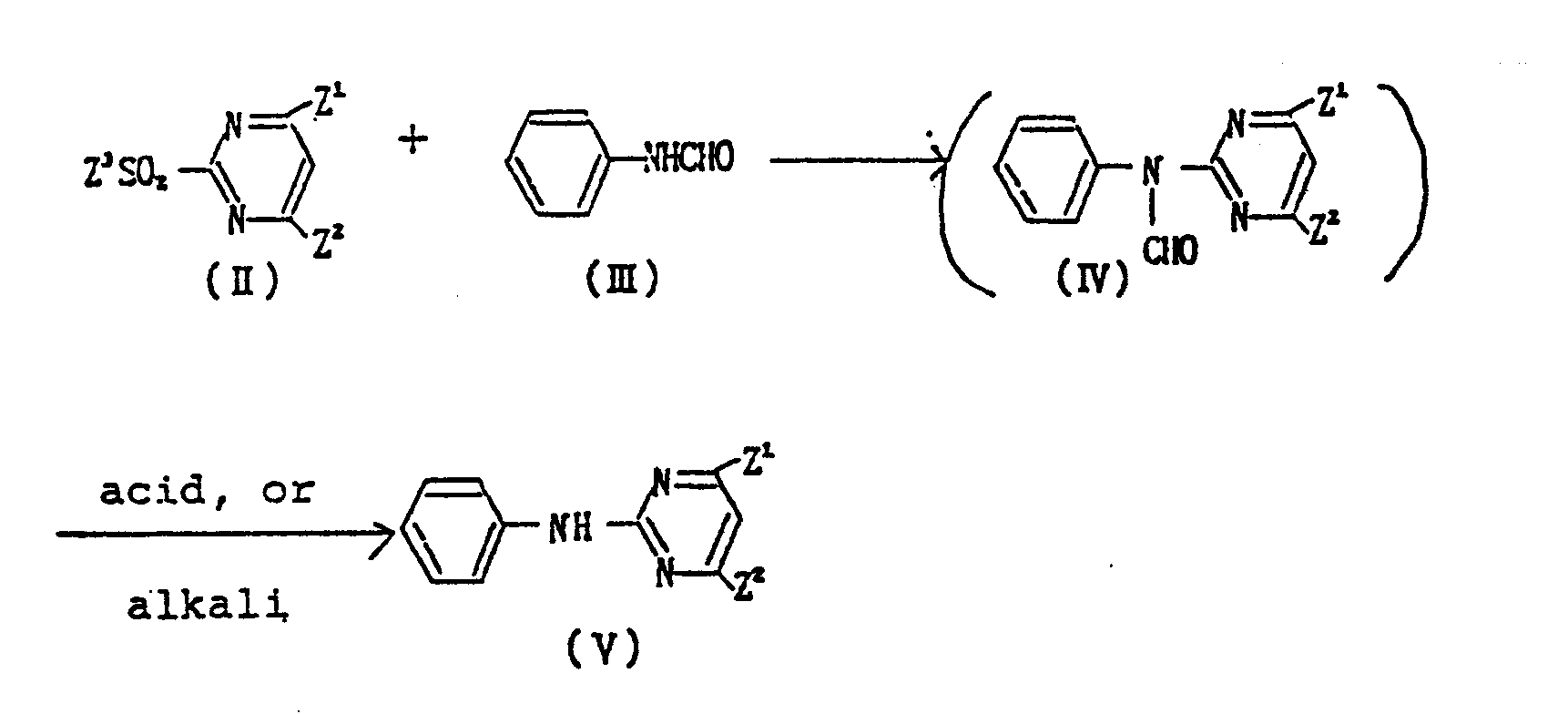
- In the above formulae, Z³ represents an alkyl group, a benzyl group or a substituted benzyl group; Z¹ and Z² have the same meanings as defined above. The compound of formula (II) and formanilide (III) are reacted in a solvent (e.g., aromatic hydrocarbons such as benzene, toluene, xylene, etc., inert polar solvents such as dimethylformamide, dimethylacetamide, dimethyl sulfoxide, etc., halogenated hydrocarbons such as dichloromethane, chloroform, carbon tetrachloride, etc., ethers such as diethyl ether, dioxane, tetrahydrofuran, etc., ketones such as acetone, methyl ethyl ketone, cyclohexanone, etc., nitriles such as acetonitrile, propionitrile, etc.) in the presence of a base (e.g., alkali metals, alkali metal hydrides, alkali metal hydroxides, etc.) at a temperature of from -20°C to the boiling point of the solvent used, preferably from room temperature to 100°C, to form an intermediate (IV). This intermediate (IV), with or without isolation, is hydrolyzed in water or a mixed solvent comprising water and an organic solvent in the presence of an acid such as hydrochloric acid, hydrobromic acid, sulfuric acid, etc., an alkali metal hydroxide such as sodium hydroxide, potassium hydroxide, etc., and the like at a temperature of from 0°C to the boiling point of the solvent used to obtain the compound of this invention represented by formula (V). The compound of formula (V) can be reacted with an acid, e.g., hydrochloric acid, sulfuric acid and nitric acid to obtain salts thereof.
- Of the compounds of this invention represented by formula (I), those in which Z¹ represents an alkoxy group, an alkenyloxy group or an alkynyloxy gr oup which may be substituted with a halogen atom, and Z² represents an alkoxy group or a group of formula -NRCH₃ where R represents a hydrogen atom or a methyl group can be prepared by the following process.
-

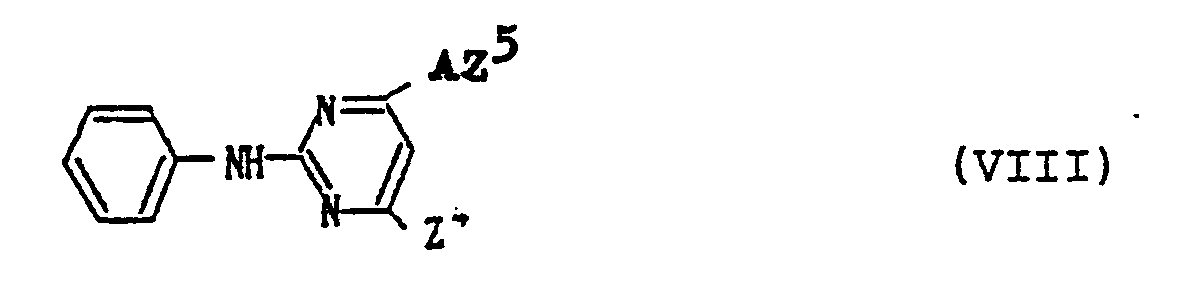
- In the above formulae, hal represents a halogen atom, Z⁴ represents a hydrogen atom, a halogen atom, an alkyl group, an alkoxy group or an alkynyl group, Z⁵ represents an alkyl group, an alkenyl group, an alkynyl group which may be substituted with a halogen atom, A represents an oxygen atom or a group of formula -NR- where R has the same meaning as defined above.
- The compound of formula (VI) and the compound of formula (VII) are reacted preferably in a solvent (e.g., those described above for Preparation Process 1), or using an excessive amount of the alcohol as a solvent when A represents an oxygen atom, in the presence of a base (e.g., an alkali metal, an alkali metal hydroxide, carbonate and hydride, etc.) at a temperature of from -20°C to the boiling point of the solvent used, preferably from room temperature to 100°C to obtain the compound of this invention represented by formula (VIII).
- More particularly, the compounds of this invention can be prepared as described hereinbelow.
- When the compounds of this invention in which Z¹ is an alkoxy group, an alkenyloxy group, or an alkynyloxy group which may be substituted with a halogen atom can be prepared by the following process.
-

- In the above formulae, hal represents a halogen atom, Z⁶ represents an alkyl group or an alkenyl group, and Z² has the same meaning as defined above.
- An 2-anilino-4 (or 6)-halogenopyrimidine (IX) and an alcohol (X) are reacted in the presence of a base (for instance, hydroxides, carbonates, hydrides, etc. of alkali metal, alkaline earth metals) preferably in a solvent (for instance, aromatic hydrocarbons such as benzene, toluene, xylene, etc.; inert polar solvents such as dimethylformamide, dimethylacetamide, dimethyl sulfoxide, etc.; halogenated hydrocarbons such as dichloromethane, chloroform, carbon tetrachloride, etc.; ethers such as diethyl ether, dioxane, tetrahydrofuran, etc.; ketones such as acetone, methyl ethyl ketone, cyclohexanone, etc.; nitriles such as acetonitrile, propionitrile, etc.), or alternatively the reaction is carried out using an alcohol (X) in excess as solvent without the use of other solvent. The compounds (XI) of this invention can be obtained by carrying out the reaction within the temperature range of from -20°C to the boiling point of the solvent, preferably from room temperature to 100°C.
-

- In the above formulae, Z², Z³ and Z⁶ have the same meanings as defined above, and the parenthesized formula (XIII) represents an intermediate product in synthesis, which can also be isolated.
- Compounds (XII) and formanilide (III) are reacted at a reaction temperature within the range of from -20°C to the boiling point of the solvent, preferably from room temperature to 100°C in the presence of a base (e.g., alkali metals, alkali metal hydrides, alkali metal hydroxides, etc.) in a solvent (such as described in Preparation Process 1, except for alcohols) to give an intermediate product (XIII), which is subsequently hydrolyzed in a routine manner with an acid such as hydrochloric acid, hydrobromic acid, sulfuric acid, etc. or an alkali metal hydroxide such as sodium hydroxide, potassium hydroxide, etc. to produce the compounds (X) of this invention.
- The compounds obtained as above may be reacted with acids (such as hydrochloric acid, sulfuric acid, nitric acid) to form salts.
-

- In the above formulae, Z⁷ represents an alkyl group, Z² and Z³ have the same meanings as defined above, and the parenthesized formula (XVI) represents an intermediate product in synthesis, which can also be isolated.
- Compounds (XV) and formanilide (III) are reacted at a reaction temperature within the range of from -20°C to the boiling point of the solvent, preferably from room temperature to 100°C in the presence of a base (e.g., alkali metals, alkali metal hydrides, alkali metal hydroxides, etc.) in a solvent (e.g., aromatic hydrocarbons such as benzene, toluene, xylene, etc.; inert polar solvents such as dimethylformamide, dimethylacetamide, dimethyl sulfoxide, etc.; halogenated hydrocarbons such as dichloromethane, chloroform, carbon tetrachloride, etc.; ethers such as diethyl ether, dioxane, tetrahydrofuran, etc.; ketones such as acetone, methyl ethyl ketone, cyclohexanone, etc.; nitriles such as acetonitrile, propionitrile, etc.) to give an intermediate product (XVI), which is subsequently hydrolyzed in a routine manner with an acid such as hydrochloric acid, hydrobromic acid, sulfuric acid, etc. or an alkali metal hydroxide such as sodium hydroxide, potassium hydroxide, etc. to produce the compounds (XVII) of this invention.
- The compounds obtained as above may be reacted with acids (such as hydrochloric acid, sulfuric acid, nitric acid) to form the salts.
- The compound of formula (XV) which is a starting material for preparing the compound of formula (XVII) can be obtained by oxidizing the compound of the following formula

-

- In the above formulae, Z⁸ represents an alkynyl group, an alkeny group or an alkynyloxy group which may be substituted with a halogen atom, Z⁹ represents a hydrogen atom, a halogen atom, a lower alkyl group, a lower alkoxy group or a dimethylamino group, and Z³ represents an alkyl group, a benzyl group or a substituted benzyl group, and the parenthesized formula (XIX) represents an intermediate product in synthesis, which can also be isolated.
- The compound of formula (XVIII) and formanilide (III) are reacted in the presence of a base (e.g., alkali metals alkali metal hydrides, alkali metal hydroxides, etc.) in a solvent (e.g., aromatic hydrocarbons such as benzene, toluene, xylene, etc., inert polar solvents such as dimethylformamide, dimethylacetamide, dimethyl sulfoxide, etc., halogenated hydrocarbons such as dichloromethane, chloroform, carbon tetrachloride, etc., ethers such as diethyl ether, dioxane, tetrahydrofuran, etc., ketones such as acetone, methyl ethyl ketone, cyclohexanone, etc., nitriles such as acetonitrile, propionitrile, etc.) at a temperature of from -20°C to the boiling point of the solvent used, preferably from room temperature to 100°C to form an intermediate (XIX). This intermediate (XIX), with or without isolation, is hydrolyzed in water or a mixed solvent comprising water and an organic solvent in the presence of an acid such as hydrochloric acid, hydrobromic acid, sulfuric acid, etc., an alkali metal hydroxide such as sodium hydroxide, potassium hydroxide, etc., and the like at a temperature of from 0°C to the boiling temperature of the solvent used to obtain the compound of this invention represented by formula (XX). The compound of formula (XX) can be reacted with an acid, e.g., hydrochloric acid, sulfuric acid and nitric acid to obtain salts thereof.
-

- In the above formulae, Z¹⁰ represents a halogen atom or a lower alkyl group, Z¹¹ represents a hydrogen atom or a halogen atom, Z¹² represents an alkynyloxy gr oup which may be substituted with a halogen atom, Z¹³ represents a lower alkoxy group or a dimethylamino group, and Hal represents a halogen atom.
- The above described reaction can be carried out in the presence of a base (e.g., alkali metal hydroxides, carbonates, hydrides, etc.) when the compound of formula (XXII) or (XXV) is an alcohol, or in the presence of sodium carbonate, sodium hydrogencarbonate, potassium hydrogencarbonate, or a tertiary amine such as triethylamine, or by the use of the amine derivative itself used in the reaction when the compound of formula (XXV) is dimethylamine.
- As the solvents, there can be used aromatic hydrocarbons such as benzene, toluene, xylene, etc.; inert polar solvents such as dimethylformamide, dimethylacetamide, dimethyl sulfoxide, etc.; halogenated hydrocarbons such as dichloromethane, chloroform, carbon tetrachloride, etc.; ethers such as diethyl ether, dioxane, tetrahydrofuran, etc.; ketones such as acetone, methyl ethyl ketone, cyclohexanone, etc.; nitriles such as acetonitrile, propionitrile, etc.; or water. When alcohols are used as a reactant, excess amount of the alcohol can be used as a solvent.
- The reaction temperature is within the range of from -20°C to the boiling point of the solvent, preferably from room temperature to 100°C.
- Now, with reference to concrete examples this invention will be explained in greater detail below.
- 2.9 g of 28% methanolic solution of sodium methylate was dissolved in 40 ml of methanol, and thereto was added 3.3 g of 2-anilino-4-chloro-6-methylpyrimidine. After 2 hours of reaction with stirring at room temperature the reaction liquid was poured in water. The solids deposited were filtered, dried, and recrystallized from n-hexane to afford 2.9 g of 2-anilino-4-methyl-6-methoxypyrimidine (yield 92 %). Melting point: 75 - 76°C.
- 1.8 g of formanilide was dissolved in 50 ml of tetrahydrofuran, and 0.4 g of sodium hydride from which the oily matter had been removed beforehand with n-hexane was slowly added to the resulting solution at 10 to 20°C while cooling with ice water. To the suspension thus obtained was added 3.3 g of 4-chloro-2-methanesulfonyl-6-methoxypyrimidine, and the mixture was stirred for 1 hour at room temperature. Then, 15 ml of 4N hydrochloric acid was added, and reaction was effected for 1 hour under reflux. The reaction liquid was poured in water, extracted with ether, and the ether layer was washed with water, dried over magnesium sulfate, and then the ether was stripped by concentration. The residual crystals were recrystallized from n-hexane, and 4.0 g of 2-anilino-4-chloro-6-methoxypyrimidine was obtained (yield 87%). Melting point: 101 - 103°C.
- 2.1 g of formanilide was dissolved in 50 ml of dry benzene, and 0.4 g of sodium hydride from which the oily matter had been removed beforehand with n-hexane was slowly added to the resulting solution at 10 to 20°C, cooling with ice water. After 1 hour of stirring at the room temperature, 3.2 g of 2-methanesulfonyl-4-methyl-6-(1-propynyl)pyrimidine was added to the suspension thus obtained, and the mixture was stirred for 10 hours at room temperature. To the reaction liquid was added 100 ml of benzene, and the benzene layer was washed over water, dried with Glauber's salt, and concentrated. Then the residue was dissolved in 100 ml of ethanol, and stirred for 10 hours at room temperature with the addition of 5 ml of 6N hydrochloric acid. The reaction liquid was poured in water, extracted with benzene, and the benzene layer was washed with water, dried with Glauber's salt, and concentrated. The residue was cooled to room temperature to solidify, thus giving rise to crystals having a melting point of 135 - 136°C (Compound a).
- Further, the crystals thus obtained were dissolved in benzene and the benzene layer was washed with an aqueous solution of sodium bicarbonate and with water, dried over Glauber's salt and concentrated, and recrystallized from ethanol-hexane to obtain crystals having a melting point of 125 to 127°C (Compound b). Both the compounds a and b were confirmed to be 2-anilino-4-methyl-6-(1-propynyl)pyrimidine by Infrared spectral analysis, NMR and elemental analysis.
- IR (cm⁻¹): NH 3270; C≡C 2230
NMR (CDCl₃): : 2.05 (3H, s), 2.39 (3H, s), 6.59 (1H, s), 6.80-7.70 (6H, m)
Elemental Analysis:
Calculated (%): C:75.31, H:5.87, N:18.82
Found (%): C:75.89, H:6.05, N:18.53 - IR (cm⁻¹): NH 3270, C ≡ C 2230
NMR(CDCl₃): : 2.05 (3H, s), 2.39 (3H, s), 6.60 (1H, s), 6.82-7.70 (6H, m)
Elemental Analysis:
Calculated (%): C:75.31, H:5.87, N:18.82
Found (%): C:74.95. H:5.88, N:18.55 - 0.42 g of NaH from which the oily matter had been removed beforehand with n-hexane was suspended in 70 ml of THF, and then stirred for 1 hour under reflux with the addition of 2.0 g of formanilide. After cooling 3.6 g of 2-methanesulfonyl-4-methyl-6-(1-propenyl)pyrimidine was added and stirred for 1 hour at room temperature. Then, 20 ml of 10 % aqueous solution of sodium hydroxide was added, and the mixture was stirred for 2 hours at room temperature. The reaction liquid was poured in water and neutralized with dilute hydrochloric acid. The organic layer was extracted with ethyl acetate, and dried over magnesium sulfate. The ethyl acetate was stripped under reduced pressure. The residue was purified by silica gel column chromatography, and 2.7 g of 2-anilino-4-methyl-6-(1-propenyl)pyrimidine was obtained (yield 72%). Refractive index: 1.6408 (20°C).
- After 3.0 g of formanilide was dissolved in 70 ml of dry benzene, 0.55 g of NaH from which the oily matter had been removed beforehand with n-hexane was slowly added at 10 to 20°C, and the mixture was stirred for 1 hour at room temperature. 2-Methanesulfonyl-4-chloro-6-(1-propynyl)pyrimidine (4.4 g) was added to the suspension thus obtained and the mixture was stirred for 10 hours at room temperature. The reaction liquid was washed with water, dried, concentrated, and then stirred for 10 hours at room temperature with the addition of 100 ml of ethanol and 5 ml of 6N hydrochloric acid. To the reaction mixture was added 150 ml of toluene and the toluene layer was washed with water, dried, concentrated, and the residue was purified by silica gel column chromatography whereby 3.6 g of 2-anilino-4-chloro-6-(1-propynyl)pyrimidine was obtained (yield 75%). Melting point: 121 -124°C.
- NaH (1.0 g) from which the oily matter had been removed beforehand with n-hexane was suspended in 30 ml of DMF and 2.4 g of 2-propynyl alcohol was added to the suspension, and the mixture was stirred for 30 minutes at room temperature. Then the solution was dropwise added to a solution obtained by dissolving 5.0 g of 2-anilino-4, 6-dichloropyrimidine in 50 ml of DMF. After 7 hours of stirring at room temperature the reaction liquid was poured in water, and rendered weakly acidic with dilute hydrochloric acid. The organic layer was extracted with toluene, and dried over magnesium sulfate. Toluene was stripped under reduced pressure, and the residue was purified by silica gel column chromatography, whereby 3.5 g of 2-anilino-4-chloro-6-(2-propynyloxy)pyrimidine was obtained (yield 65%). Melting point: 92-93°C.
- 2-Anilino-4-methyl-6-(1-propynyl)pyrimidine (2.2 g) was dissolved in 100 ml of ethanol, and 2 ml of concentrated sulfuric acid was added thereto and stirred for 1 hour at room temperature. The crystals deposited were filtered, and dried to afford 2.4 g of 2-anilino-4-methyl-6-(1-propynyl)pyrimidine sulfate (yield 75%). Melting point: 192-195°C.
- 2-Anilino-4-chloro-6-(1-propynyl)pyrimidine (1.7 g) prepared in Example 2, 1.9 g of 54% aqueous solution of dimethylamine and 0.7 g of KOH were added to 20 ml of THF and the mixture was stitrred at room temperature for 24 hours. The reaction liquid was poured in water and extracted with benzene. Then, the benzen layer was dried over Glauber's salt and concentrated, the residue was recrystallized from n-hexane-ethanol to afford 1.5 g of 2-anilino-4-dimethylamino-6-(1-propynyl)pyrimidine (yield: 85%). Melting point: 150-152°C.
- In the same manner as in Example 3, 3.1 g of 2-anilino-4-chloro-6-methylpyrimidine, 1.9 g of isopropyl alcohol and 0.7 g of NaH were added to 50 ml of THF and allowed to react at room temperature for 4 hours to obtain 2.2 g of 2-anilino-4-methyl-6-isopropoxypyrimidine (yield 65%). n⁰ 1.5931

- The agricultural or horticultural fungicide of this invention is a composition comprising a pyrimidine derivative or the salt thereof as the active ingredient. The compounds of this invention can be used as such, but are usually compounded with a carrier, a surface active agent, a dispersant, an adjuvant, etc. and then formulated into the form of dust, wettable powder, emulsifiable concentrate, fine grains, or granules. Examples of suitable carrier include, for instance, solid carriers such as talc, bentonite, clay, kaoline, diatomaceous earth, white carbon, vermiculite, slaked lime, silica sand, ammonium sulfate, urea, etc. and liquid carriers such as methylnaphthalene, isopropyl alcohol, xylene, cyclohexanone, etc. Examples of surface active agent and dispersant include, for instance, dinaphthylmethanedisulfonate, alkyl sulfates, alkylarylsulfonates, alkylsulfonates, lignin sulfonate, polyoxyethylene glycol ethers, polyoxyethylene alkyl aryl ethers, polyoxyethylene sorbitan monoalkylates, etc.
- These preparations are diluted to a suitable concentration and sprayed, dusted, or directly applied.
- Usually, the fungicide of this invention can be applied in an amount of from about 1 g to about 100 kg per hectare, preferably 10 g to 10 kg per hectare. When it is sprayed to leaved and stems of plants it is usually diluted to a concentration of about 0.1 to 10,000 ppm, preferably 100 to 3,000 ppm.
- 2% of compound 1, 5% of diatomaceous earth, and 93% of clay were homogeneously mixed and pulverized to prepare a dust.
- 50% of Compound 4, 45% of diatomaceous earth, 2% of sodium dinaphthylmethanedisulfonate, and 3% of sodium lignin sulfonate were homogeneously mixed and pulverized to prepare a wettable powder.
- 30% of Compound 5, 20% of cyclohexanone, 11% of polyoxyethylene alkyl aryl ether, 4% of calcium alkylbenzenesulfonate, and 35% of methylnapthalene were homogeneously dissolved to prepare an emulsifiable concentrate.
- 5% of Compound 22, 2% of sodium lauryl sulfate, 5% of sodium lignin sulfonate, 2% of carboxymethylcellulose, and 86% of clay were homogeneously mixed and pulverized. To the resulting mixture was added 20% of water, and the mixture was kneaded, processed into granular form of 14 to 32 mesh using an extruder type granulating machine and dried to prepare granules.
- 2% of Compound 23, 5% of diatomaceous earth, and 93% of clay were homogeneously mixed and pulverized to prepare a dust.
- 50% of Compound 24, 45% of diatomaceous earth, 2% of sodium dinaphthylmethane disulfonate, and 3% of sodium lignin sulfonate were homogeneously mixed and pulverized to prepare a wettable powder.
- 30% of Compound 25, 20% of cyclohexanone, 11% of polyoxyethylene alkyl aryl ether, 4% of calcium alkylbenzenesulfonate, and 35% of methylnaphthalene were homogeneously dissolved to prepare an emulsifiable concentration.
- 5% of Compound 26, 2% of sodium lauryl sulfate, 5% of sodium lignin sulfonate, 2% of carboxymethylcellulose, and 86% of clay were homogeneously mixed and pulverized. To 100 parts by weight of the resulting mixture was added 20 parts by weight of water and the mixture was kneaded, processed into granular form of 14 to 32 mesh using an extruder type granulating machine, and dried to prepare granules.
- The agricultural or horticultural fungicidal composition of this invention possesses a broad anti-microbial spectrum showing an excellent activity as the controlling agents especially for rice blast ( Pyricularia oryzae), cucumber downy mildew ( Pseudoperonospora cubensis), cucumber gray mold ( Botrytis cinerea), and Alternaria sooty spot of Chinese mustard ( Alternaria brassicicola), and is also effective as the controlling agents for rice sheath blight ( Rhizoctonia solani), cucumber anthracnose ( Colletotrichum lagenarium), and apple Alternaria leaf spot ( Alternaria mali).
- The agricultural or horticultural fungicidal compositions of this invention show high controlling activities for cucumber gray mold, cucumber downy mildew, Alternaria sooty spot of Chinese mustard, rice blast, etc. even as compared with the compounds described in the above desribed East German Patent 151404 and British Patent 1245085. Moreover, the agricultural or horticultural fungicidal compositions of this invention are also characterized by that they are no harmful chemicals and yet excellent in the residual activity and persistence to rainfall, and not only the toxicity to warm-blooded animals but also the fish-toxicity is weak.
- Among the agricultural or horticultural fungicidal composition of this invention, preferred are those which contain 2-anilino-4-methoxy-6-methylpyrimidine, 2-anilino-4-(1-propynyl)pyrimidine, 2-anilino-4-methyl-6-(1-propynyl)pyrimidine, 2-anilino-4-ethyl-6-(1-propynyl)pyrimidine, 2-anilino-4-chloro-6-(1-propynyl)pyrimidine, 2-anilino-4-(1-butynyl)-6-methylpyrimidine, 2-anilino-4-methyl-6-(2-propynyloxy)pyrimidine, 2-anilino-4-chloro-6-methoxy-pyrimidine, etc.
- With reference to some Test Examples the effect achieved by the agricultural or horticultural fungicidal composition of this invention will be explained more concretely below.
- When the cucumber (variety:"Sagami hanjiro") which was grown by seeding in a population of 12 seeds per pot (square pot of 9 cm side) attained to the cotyledonous stage, a wettable powder prepared as in Example 11 was diluted to a predetermined concentration with water, and sprayed with a spray gun in an amount of 5 ml per pot. After the air drying of the sprayed liquid, a homogenized solution of the liquid cultured fungi of cucumber gray mold ( Botrytis cinerea) was inoculated by spraying. After three days of incubation in a moistured chamber, the number of the infected leaves was examined according to the following standard. The results are shown in Tables 2, 3, 4 and 5.
-

- Incidence of Disease (%)

- Controlling Activity (%)

- In addition, the following fungicidal compounds were used for comparison.
-

-


- As is clear from the results shown in Table 4, there is no difference in the fungicidal activity between Compound 27 (a) and Compound 27 (b).

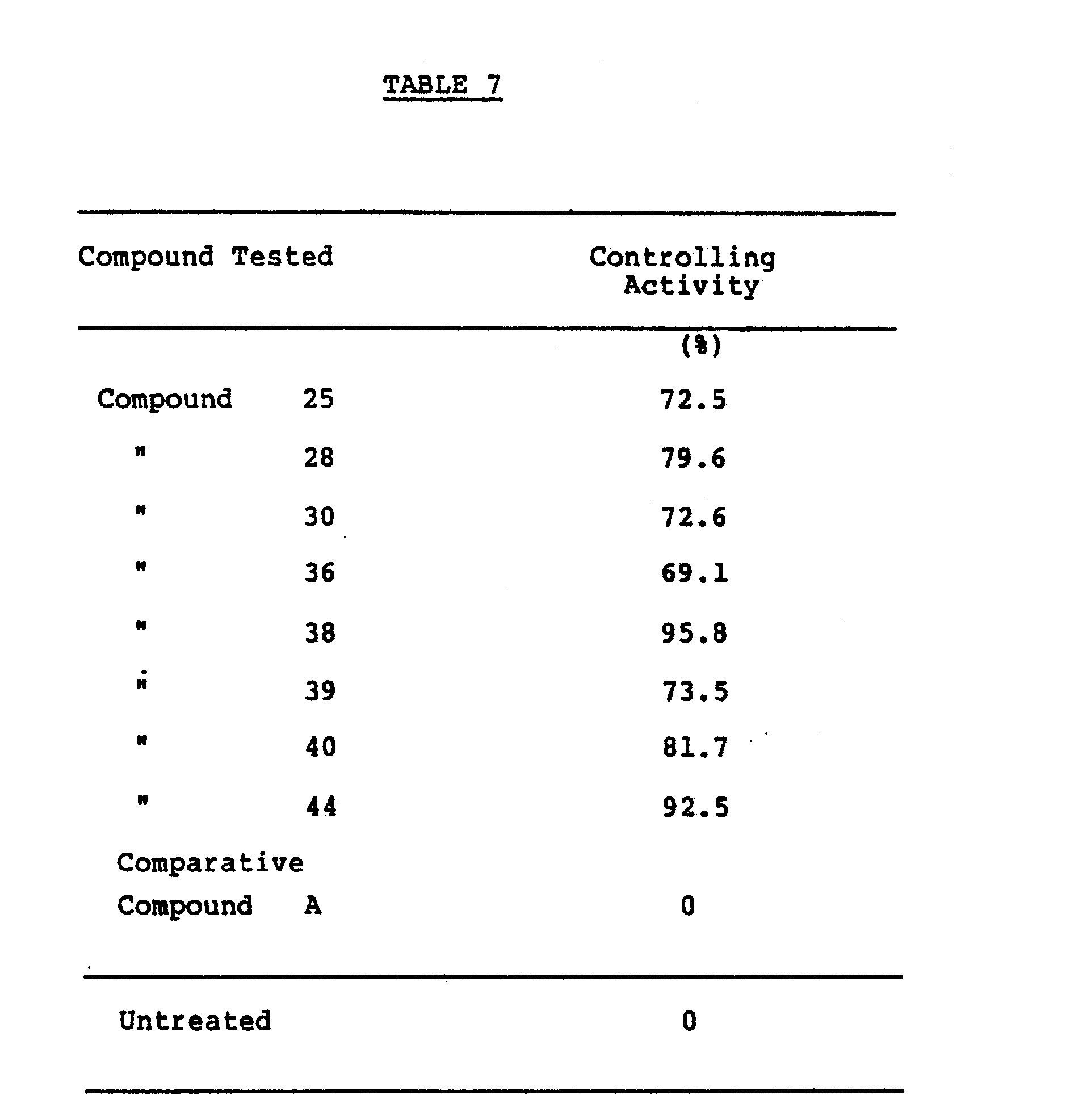
- When the Chinese mustard (variety: Okute Komatsuna) which was grown by seeding in a population of 15 seeds per pot (square pot of 9 cm side) attained to the cotyledonous stage, a wettable powder prepared as in Example 11 was diluted to 500 ppm with water, and sprayed in an amount of 5 ml per pot. After the air drying of the sprayed liquid, the fungi of Alternaria sooty spot ( Alternaria brassicicola), which were cultured for one week in a PSA medium and the spore concentration was adjusted to 60 to 80 spores per visual field of a microscope (150 magnifications), were inoculated by spraying. After the inoculation the plant was incubated for 3 days in a moistured chamber (30°C), and the number of the leaf spots was counted, and the control value was calculated from the average number of the spots per leaf according to the following equation.
- Controlling Activity (%)

- The results are shown in Tables 6 to 8.


- When the cucumber (variety: "Sagami hanjiro") which was grown by seeding in a population of 12 seeds per pot (square pot of 9 cm side) attained to the cotyledonous stage, a wettable powder prepared as in Example 11 was diluted to 500 ppm with water, and sprayed with a spray gun in an amount of 5 ml per pot. After the air drying of the sprayed liquid, the fungi of cucumber downy mildew ( Pseudoperonospora cubensis) whose spore concentration had been adjusted to 5 to 10 spores per visual field of a microscope (150 magnifications), were inoculated by spraying. Twenty four (24) hours after the inoculation, the plant was allowed to be infected by being placed on a bench in a greenhouse, and seven days after the inoculation it was examined according to the following standard.
- Healthy: No infection is discernible.
Slight: Infected area is less than 1/3
Moderate: Infected area is 1/3 to 2/3
Severe: Infected area is more than 2/3 - Incidence of Disease (%)

- Controlling Activity (%)

- The results are shown in Tables 9 and 10


- Twenty grains of rice seed (variety: Aichi asahi) were sowed in each white porcelain pot (diameter: 9 cm) and grown for 3 to 4 weeks in a greenhouse. When the seedling developed 4th leaf, a wettable powder prepared as in Example 11 was diluted to 500 ppm with water, and sprayed with a spray gun in an amount of 10 ml per pot. After the air drying of the sprayed liquid, a suspension of spores of rice blast ( Pyricularica oryzae) was inoculated by spraying and the pot was placed in a moistured chamber at 25°C. After five days from the inoculation the number of lesions was examined.
- Controlling Activity (%)

- The results obtained are shown in Tables 11 and 12.


- Fifteen (15) grains of paddy field rice plant (variety: (Kinmaze)) were sowed in an unglazed pot (diameter: 7 cm) and grown in a greenhouse for 4 to 5 weeks. When the seedling developed 5th leaf, a wettable powder prepared as in Example 11 was diluted to 500 ppm with water and sprayed in an amount of 10 ml per pot. After the air drying of the sprayed liquid the fungus of rice sheath blight (Rhizoctonia solani) cultured on a chaffs-bran medium for seven days was inoculated at the foot of the plant and the pot was placed in a moistured chamber at 28°C. After five days from the inoculation, the height of the lesions formed at the leaf sheath of the plant was measured, and control value was calculated according to the following equation.
- Controlling Activity (%)

- The results obtained are shown in Table 13.

- While the invention has been described in detail and with reference to specific embodiment thereof, it will be apparent to one skilled in the art that various changes and modifications can be made therein without departing from the spirit and scope thereof.
Claims (9)


where Z³ represents a hydrogen atom or a methyl group; or its salt, and a carrier.



Z⁵AH (VII)
wherein Z⁵ represents an alkyl group, an alkenyl group or an alkynyl group which may be substituted with a halogen atom, and A represents an oxygen atom or a group of formula -NR- where R represents a hydrogen atom or a methyl group, in the presence of a base in a solvent or using excess amount of compound of formula (VII) as a solvent when A represents an oxygen atom at a temperature of from -20°C to the boiling point of the solvent.


Applications Claiming Priority (4)
| Application Number | Priority Date | Filing Date | Title |
|---|---|---|---|
| JP24347685 | 1985-10-30 | ||
| JP243476/85 | 1985-10-30 | ||
| JP17835486 | 1986-07-29 | ||
| JP178354/86 | 1986-07-29 |
Publications (3)
| Publication Number | Publication Date |
|---|---|
| EP0224339A2 true EP0224339A2 (en) | 1987-06-03 |
| EP0224339A3 EP0224339A3 (en) | 1988-04-13 |
| EP0224339B1 EP0224339B1 (en) | 1991-01-02 |
Family
ID=26498550
Family Applications (1)
| Application Number | Title | Priority Date | Filing Date |
|---|---|---|---|
| EP86308422A Expired - Lifetime EP0224339B1 (en) | 1985-10-30 | 1986-10-29 | Pyrimidine derivative, process for preparing same and agricultural or horticultural fungicidal composition containing same |
Country Status (5)
| Country | Link |
|---|---|
| US (2) | US4814338A (en) |
| EP (1) | EP0224339B1 (en) |
| JP (1) | JPH0629263B2 (en) |
| KR (1) | KR930000149B1 (en) |
| DE (2) | DE3676460D1 (en) |
Cited By (44)
| Publication number | Priority date | Publication date | Assignee | Title |
|---|---|---|---|---|
| US4897396A (en) * | 1988-06-03 | 1990-01-30 | Ciba-Geigy Corporation | 2-phenylamino pyrimidine derivatives and their uses as microbicides |
| US4931560A (en) * | 1987-09-28 | 1990-06-05 | Ciba-Geigy Corporation | Pesticides |
| US4943675A (en) * | 1988-06-24 | 1990-07-24 | Ihara Chemical Industry Co., Ltd. | Anilinopyrimidine derivatives |
| WO1990014338A1 (en) * | 1989-05-20 | 1990-11-29 | Fisons Plc | Anti-inflammatory 4-aminophenol derivatives |
| EP0270111B1 (en) * | 1986-12-03 | 1991-05-15 | Kumiai Chemical Industry Co., Ltd. | Pyrimidine derivatives and agricultural or horticultural fungicidal composition contaning the same |
| EP0457727A1 (en) * | 1990-05-17 | 1991-11-21 | Ciba-Geigy Ag | Pesticides |
| US5075316A (en) * | 1989-03-22 | 1991-12-24 | Ciba-Geigy Corporation | Pest control compositions |
| US5153200A (en) * | 1987-09-28 | 1992-10-06 | Ciba-Geigy Corporation | Pesticides |
| EP0642735A1 (en) * | 1993-09-13 | 1995-03-15 | BASF Aktiengesellschaft | Fungicidal mixtures |
| MD206C2 (en) * | 1987-09-28 | 1995-07-31 | Novartis Ag | Method of the 2-anilin-pyrimidine derivatives preparation |
| US5439912A (en) * | 1990-05-17 | 1995-08-08 | Ciba-Geigy Corporation | 2-phenylamino-4-cyano-pyrimidines |
| EP0717038A1 (en) | 1994-12-16 | 1996-06-19 | Hoechst Schering AgrEvo GmbH | Process for the preparation of 2-anilino-pyramidine derivatives |
| WO2002096888A1 (en) * | 2001-05-29 | 2002-12-05 | Schering Aktiengesellschaft | Cdk inhibiting pyrimidines, production thereof and their use as medicaments |
| US6562833B1 (en) | 1998-06-10 | 2003-05-13 | Basf Aktiengesellschaft | Use of 2-(n-phenylamino)pyrimidines as fungicides, and novel 2-(n-phenylamino) pyrimidines |
| DE10212098A1 (en) * | 2002-03-11 | 2003-10-23 | Schering Ag | New 2-anilino-pyrimidine derivatives, are potent cyclin dependent kinase inhibitors, useful e.g. for treating cancer, autoimmune, cardiovascular or neurodegenerative diseases or viral infections |
| WO2005104847A1 (en) | 2004-04-30 | 2005-11-10 | Basf Aktiengesellschaft | Fungicidal mixtures |
| CN1305375C (en) * | 2002-07-08 | 2007-03-21 | 巴斯福股份公司 | Dithianon-based fungicidal mixtures |
| WO2009040397A1 (en) | 2007-09-26 | 2009-04-02 | Basf Se | Ternary fungicidal compositions comprising boscalid and chlorothalonil |
| WO2009098243A1 (en) | 2008-02-06 | 2009-08-13 | Janssen Pharmaceutica Nv | Combinations of anilinopyrimidines and pyrion compounds |
| EP2258177A2 (en) | 2006-12-15 | 2010-12-08 | Rohm and Haas Company | Mixtures comprising 1-methylcyclopropene |
| WO2011026796A1 (en) | 2009-09-01 | 2011-03-10 | Basf Se | Synergistic fungicidal mixtures comprising lactylates and method for combating phytopathogenic fungi |
| WO2010025863A3 (en) * | 2008-09-03 | 2011-03-17 | Bayer Cropscience Ag | 4-alkyl-substituted diaminopyrimidines |
| EP2392662A2 (en) | 2007-04-23 | 2011-12-07 | Basf Se | Plant produtivity enhancement by combining chemical agents with transgenic modifications |
| WO2012084670A1 (en) | 2010-12-20 | 2012-06-28 | Basf Se | Pesticidal active mixtures comprising pyrazole compounds |
| EP2481284A2 (en) | 2011-01-27 | 2012-08-01 | Basf Se | Pesticidal mixtures |
| EP2489266A2 (en) | 2006-09-18 | 2012-08-22 | Basf Se | Pesticidal mixtures comprising an anthranilamide insecticide and a fungicide |
| WO2012127009A1 (en) | 2011-03-23 | 2012-09-27 | Basf Se | Compositions containing polymeric, ionic compounds comprising imidazolium groups |
| WO2013030338A2 (en) | 2011-09-02 | 2013-03-07 | Basf Se | Agricultural mixtures comprising arylquinazolinone compounds |
| CN103141483A (en) * | 2013-02-04 | 2013-06-12 | 安徽省农业科学院植物保护与农产品质量安全研究所 | A kind of bactericidal composition containing azoxystrobin and Jinggangmycin |
| WO2013189801A1 (en) | 2012-06-20 | 2013-12-27 | Basf Se | Pyrazole compound and pesticidal mixtures comprising a pyrazole compound |
| EP2679094A1 (en) | 2007-02-06 | 2014-01-01 | Basf Se | Pesticidal mixtures |
| WO2014056780A1 (en) | 2012-10-12 | 2014-04-17 | Basf Se | A method for combating phytopathogenic harmful microbes on cultivated plants or plant propagation material |
| WO2014095994A1 (en) | 2012-12-20 | 2014-06-26 | Basf Se | Compositions comprising a triazole compound |
| EP2783569A1 (en) | 2013-03-28 | 2014-10-01 | Basf Se | Compositions comprising a triazole compound |
| EP2835052A1 (en) | 2013-08-07 | 2015-02-11 | Basf Se | Fungicidal mixtures comprising pyrimidine fungicides |
| WO2015036059A1 (en) | 2013-09-16 | 2015-03-19 | Basf Se | Fungicidal pyrimidine compounds |
| WO2015036058A1 (en) | 2013-09-16 | 2015-03-19 | Basf Se | Fungicidal pyrimidine compounds |
| US9237749B2 (en) | 2010-07-01 | 2016-01-19 | Janssen Pharmaceutica N.V. | Antimicrobial combinations of pyrion compounds with polyethyleneimines |
| EP2979549A1 (en) | 2014-07-31 | 2016-02-03 | Basf Se | Method for improving the health of a plant |
| CN105379722A (en) * | 2015-11-06 | 2016-03-09 | 南京华洲药业有限公司 | Sterilizing composition containing mepanioyrim and ethirimol and application thereof |
| CN105379724A (en) * | 2015-11-06 | 2016-03-09 | 南京华洲药业有限公司 | Sterilizing composition containing mepanioyrim and metalaxyl-M and application thereof |
| CN105394060A (en) * | 2015-11-06 | 2016-03-16 | 南京华洲药业有限公司 | Sterilization composition containing mepanipyrim and propamocarb and application thereof |
| CN106508933A (en) * | 2015-09-15 | 2017-03-22 | 南京华洲药业有限公司 | Sterilization composition containing benthiavalicarb-isopropyl and mepanipyrim |
| US10899932B2 (en) | 2014-10-24 | 2021-01-26 | Basf Se | Non-amphoteric, quaternisable and water-soluble polymers for modifying the surface charge of solid particles |
Families Citing this family (16)
| Publication number | Priority date | Publication date | Assignee | Title |
|---|---|---|---|---|
| US5574040A (en) * | 1995-01-06 | 1996-11-12 | Picower Institute For Medical Research | Pyrimidine compounds and methods of use to derivatize neighboring lysine residues in proteins under physiologic conditions |
| US5733932A (en) * | 1995-01-06 | 1998-03-31 | The Picower Institute For Medical Research | Compounds and methods of use to derivatize neighboring lysine residues in proteins under physiological conditions |
| EA001030B1 (en) * | 1996-04-26 | 2000-08-28 | Басф Акциенгезельшафт | Fungicide mixtures |
| GB0014022D0 (en) * | 2000-06-08 | 2000-08-02 | Novartis Ag | Organic compounds |
| WO2004048343A1 (en) * | 2002-11-28 | 2004-06-10 | Schering Aktiengesellschaft | Chk-, pdk- and akt-inhibitory pyrimidines, their production and use as pharmaceutical agents |
| RU2420395C2 (en) * | 2004-10-22 | 2011-06-10 | Янссен Фармацевтика Н.В. | Application of phenyl amine pyrimidine for protection of wood |
| US8592438B2 (en) * | 2008-03-21 | 2013-11-26 | Sumitomo Chemical Intellectual Property Service, Ltd | Plant disease control composition |
| AU2011263720B2 (en) | 2010-06-10 | 2013-11-07 | Janssen Pharmaceutica Nv | Combinations of pyrimethanil and monoterpenes |
| CN102067852A (en) * | 2011-01-20 | 2011-05-25 | 陕西美邦农药有限公司 | Fungicide combination containing polyoxin and pyrimidine compound |
| CN103314974A (en) * | 2012-03-23 | 2013-09-25 | 陕西韦尔奇作物保护有限公司 | Bactericidal composition containing mepanipyrim and thiocarbamates |
| CN103141495B (en) * | 2013-02-04 | 2015-08-12 | 安徽省农业科学院植物保护与农产品质量安全研究所 | A kind of bactericidal composition containing carbendazim and mepanipyrim |
| CN103651373A (en) * | 2013-12-10 | 2014-03-26 | 济南凯因生物科技有限公司 | Composition for preventing and treating grey mould of strawberry |
| CN105360136A (en) * | 2015-11-06 | 2016-03-02 | 南京华洲药业有限公司 | Sterilization composition containing mepanipyrim and diniconazole and application thereof |
| CN105379753B (en) * | 2015-11-06 | 2018-04-20 | 南京华洲药业有限公司 | A kind of bactericidal composition and its application containing mepanipyrim and different rice blast net |
| CN105360144A (en) * | 2015-11-06 | 2016-03-02 | 南京华洲药业有限公司 | Sterilization composition containing mepanipyrim and benthiavalicarb-isopropyl and application thereof |
| CN105994280B (en) * | 2016-05-20 | 2018-09-07 | 南京华洲药业有限公司 | A kind of bactericidal composition and its application containing volution bacterium amine and mepanipyrim |
Family Cites Families (6)
| Publication number | Priority date | Publication date | Assignee | Title |
|---|---|---|---|---|
| FR922448A (en) * | 1943-11-02 | 1947-06-09 | Ici Ltd | Preparation of new pyrimidine compounds |
| DE1670537A1 (en) * | 1966-11-09 | 1970-10-29 | Degussa | Process for the preparation of new substituted aminopyrimidines |
| GB1245085A (en) * | 1967-10-02 | 1971-09-02 | Ici Ltd | Fungicidal processes and compositions |
| NZ188244A (en) * | 1977-09-13 | 1981-04-24 | Ici Australia Ltd | 2-substituted pyrimidines compositions growth regulating processes |
| DD151404A1 (en) * | 1980-06-13 | 1981-10-21 | Friedrich Franke | FUNGICIDAL AGENTS |
| US4659363A (en) * | 1983-07-25 | 1987-04-21 | Ciba-Geigy Corporation | N-(2-nitrophenyl)-2-aminopyrimidine derivatives, the preparation and use thereof |
-
1986
- 1986-10-28 JP JP61256279A patent/JPH0629263B2/en not_active Expired - Lifetime
- 1986-10-29 DE DE8686308422T patent/DE3676460D1/en not_active Expired - Lifetime
- 1986-10-29 DE DE198686308422T patent/DE224339T1/en active Pending
- 1986-10-29 US US06/924,384 patent/US4814338A/en not_active Expired - Lifetime
- 1986-10-29 EP EP86308422A patent/EP0224339B1/en not_active Expired - Lifetime
- 1986-10-30 KR KR1019860009134A patent/KR930000149B1/en not_active Expired - Lifetime
-
1989
- 1989-03-20 US US07/325,808 patent/US4988704A/en not_active Expired - Lifetime
Cited By (64)
| Publication number | Priority date | Publication date | Assignee | Title |
|---|---|---|---|---|
| EP0270111B1 (en) * | 1986-12-03 | 1991-05-15 | Kumiai Chemical Industry Co., Ltd. | Pyrimidine derivatives and agricultural or horticultural fungicidal composition contaning the same |
| US4931560A (en) * | 1987-09-28 | 1990-06-05 | Ciba-Geigy Corporation | Pesticides |
| US5153200A (en) * | 1987-09-28 | 1992-10-06 | Ciba-Geigy Corporation | Pesticides |
| MD206C2 (en) * | 1987-09-28 | 1995-07-31 | Novartis Ag | Method of the 2-anilin-pyrimidine derivatives preparation |
| US4897396A (en) * | 1988-06-03 | 1990-01-30 | Ciba-Geigy Corporation | 2-phenylamino pyrimidine derivatives and their uses as microbicides |
| US4943675A (en) * | 1988-06-24 | 1990-07-24 | Ihara Chemical Industry Co., Ltd. | Anilinopyrimidine derivatives |
| EP0347866B1 (en) * | 1988-06-24 | 1993-04-07 | IHARA CHEMICAL INDUSTRY Co., Ltd. | Anilinopyrimidine derivatives |
| US5075316A (en) * | 1989-03-22 | 1991-12-24 | Ciba-Geigy Corporation | Pest control compositions |
| US5428044A (en) * | 1989-05-20 | 1995-06-27 | Fisons Plc | Anti-inflammatory 4-aminophenyl derivatives |
| WO1990014338A1 (en) * | 1989-05-20 | 1990-11-29 | Fisons Plc | Anti-inflammatory 4-aminophenol derivatives |
| EP0457727A1 (en) * | 1990-05-17 | 1991-11-21 | Ciba-Geigy Ag | Pesticides |
| US5439912A (en) * | 1990-05-17 | 1995-08-08 | Ciba-Geigy Corporation | 2-phenylamino-4-cyano-pyrimidines |
| EP0642735A1 (en) * | 1993-09-13 | 1995-03-15 | BASF Aktiengesellschaft | Fungicidal mixtures |
| US5508283A (en) * | 1993-09-13 | 1996-04-16 | Basf Aktiengesellschaft | Fungicidal mixtures |
| CN1071088C (en) * | 1993-09-13 | 2001-09-19 | Basf公司 | Fungicidal mixtures |
| EP0717038A1 (en) | 1994-12-16 | 1996-06-19 | Hoechst Schering AgrEvo GmbH | Process for the preparation of 2-anilino-pyramidine derivatives |
| US6562833B1 (en) | 1998-06-10 | 2003-05-13 | Basf Aktiengesellschaft | Use of 2-(n-phenylamino)pyrimidines as fungicides, and novel 2-(n-phenylamino) pyrimidines |
| WO2002096888A1 (en) * | 2001-05-29 | 2002-12-05 | Schering Aktiengesellschaft | Cdk inhibiting pyrimidines, production thereof and their use as medicaments |
| US7291624B2 (en) | 2001-05-29 | 2007-11-06 | Bayer Schering Pharma Ag | CDK-inhibitory pyrimidines, their production and use as pharmaceutical agents |
| CN100480242C (en) * | 2001-05-29 | 2009-04-22 | 舍林股份公司 | CDK-inhibiting pyrimidine compounds, method for the production thereof and use thereof as medicaments |
| AU2002312933B2 (en) * | 2001-05-29 | 2007-12-06 | Schering Ag | CDK inhibiting pyrimidines, production thereof and their use as medicaments |
| US7235561B2 (en) | 2001-05-29 | 2007-06-26 | Schering Ag | Compound and a composition including such a compound |
| DE10212098A1 (en) * | 2002-03-11 | 2003-10-23 | Schering Ag | New 2-anilino-pyrimidine derivatives, are potent cyclin dependent kinase inhibitors, useful e.g. for treating cancer, autoimmune, cardiovascular or neurodegenerative diseases or viral infections |
| CN1305375C (en) * | 2002-07-08 | 2007-03-21 | 巴斯福股份公司 | Dithianon-based fungicidal mixtures |
| WO2005104847A1 (en) | 2004-04-30 | 2005-11-10 | Basf Aktiengesellschaft | Fungicidal mixtures |
| EP2255627A2 (en) | 2004-04-30 | 2010-12-01 | Basf Se | Fungicidal mixtures |
| EP2255629A2 (en) | 2004-04-30 | 2010-12-01 | Basf Se | Fungicidal mixtures |
| EP2255628A2 (en) | 2004-04-30 | 2010-12-01 | Basf Se | Fungicidal mixtures |
| EP2489266A2 (en) | 2006-09-18 | 2012-08-22 | Basf Se | Pesticidal mixtures comprising an anthranilamide insecticide and a fungicide |
| EP2489265A2 (en) | 2006-09-18 | 2012-08-22 | Basf Se | Pesticidal mixtures comprising an anthranilamide insecticide and a fungicide |
| EP2489267A2 (en) | 2006-09-18 | 2012-08-22 | Basf Se | Pesticidal mixtures comprising an anthranilamide insecticide and a fungicide |
| EP2489268A2 (en) | 2006-09-18 | 2012-08-22 | Basf Se | Pesticidal mixtures comprising an anthranilamide insecticide and a fungicide |
| EP2258177A2 (en) | 2006-12-15 | 2010-12-08 | Rohm and Haas Company | Mixtures comprising 1-methylcyclopropene |
| EP2679095A1 (en) | 2007-02-06 | 2014-01-01 | Basf Se | Pesticidal mixtures |
| EP2679096A1 (en) | 2007-02-06 | 2014-01-01 | Basf Se | Pesticidal mixtures |
| EP2679094A1 (en) | 2007-02-06 | 2014-01-01 | Basf Se | Pesticidal mixtures |
| EP2392662A2 (en) | 2007-04-23 | 2011-12-07 | Basf Se | Plant produtivity enhancement by combining chemical agents with transgenic modifications |
| WO2009040397A1 (en) | 2007-09-26 | 2009-04-02 | Basf Se | Ternary fungicidal compositions comprising boscalid and chlorothalonil |
| WO2009098243A1 (en) | 2008-02-06 | 2009-08-13 | Janssen Pharmaceutica Nv | Combinations of anilinopyrimidines and pyrion compounds |
| WO2010025863A3 (en) * | 2008-09-03 | 2011-03-17 | Bayer Cropscience Ag | 4-alkyl-substituted diaminopyrimidines |
| WO2011026796A1 (en) | 2009-09-01 | 2011-03-10 | Basf Se | Synergistic fungicidal mixtures comprising lactylates and method for combating phytopathogenic fungi |
| US9237749B2 (en) | 2010-07-01 | 2016-01-19 | Janssen Pharmaceutica N.V. | Antimicrobial combinations of pyrion compounds with polyethyleneimines |
| WO2012084670A1 (en) | 2010-12-20 | 2012-06-28 | Basf Se | Pesticidal active mixtures comprising pyrazole compounds |
| EP2481284A2 (en) | 2011-01-27 | 2012-08-01 | Basf Se | Pesticidal mixtures |
| WO2012127009A1 (en) | 2011-03-23 | 2012-09-27 | Basf Se | Compositions containing polymeric, ionic compounds comprising imidazolium groups |
| EP3378313A1 (en) | 2011-03-23 | 2018-09-26 | Basf Se | Compositions containing polymeric, ionic compounds comprising imidazolium groups |
| WO2013030338A2 (en) | 2011-09-02 | 2013-03-07 | Basf Se | Agricultural mixtures comprising arylquinazolinone compounds |
| WO2013189801A1 (en) | 2012-06-20 | 2013-12-27 | Basf Se | Pyrazole compound and pesticidal mixtures comprising a pyrazole compound |
| EP3646731A1 (en) | 2012-06-20 | 2020-05-06 | Basf Se | Pesticidal mixtures comprising a pyrazole compound |
| EP3300602A1 (en) | 2012-06-20 | 2018-04-04 | Basf Se | Pesticidal mixtures comprising a pyrazole compound |
| WO2014056780A1 (en) | 2012-10-12 | 2014-04-17 | Basf Se | A method for combating phytopathogenic harmful microbes on cultivated plants or plant propagation material |
| WO2014095994A1 (en) | 2012-12-20 | 2014-06-26 | Basf Se | Compositions comprising a triazole compound |
| EP3498098A1 (en) | 2012-12-20 | 2019-06-19 | BASF Agro B.V. | Compositions comprising a triazole compound |
| CN103141483A (en) * | 2013-02-04 | 2013-06-12 | 安徽省农业科学院植物保护与农产品质量安全研究所 | A kind of bactericidal composition containing azoxystrobin and Jinggangmycin |
| EP2783569A1 (en) | 2013-03-28 | 2014-10-01 | Basf Se | Compositions comprising a triazole compound |
| EP2835052A1 (en) | 2013-08-07 | 2015-02-11 | Basf Se | Fungicidal mixtures comprising pyrimidine fungicides |
| WO2015036058A1 (en) | 2013-09-16 | 2015-03-19 | Basf Se | Fungicidal pyrimidine compounds |
| WO2015036059A1 (en) | 2013-09-16 | 2015-03-19 | Basf Se | Fungicidal pyrimidine compounds |
| EP2979549A1 (en) | 2014-07-31 | 2016-02-03 | Basf Se | Method for improving the health of a plant |
| US10899932B2 (en) | 2014-10-24 | 2021-01-26 | Basf Se | Non-amphoteric, quaternisable and water-soluble polymers for modifying the surface charge of solid particles |
| CN106508933A (en) * | 2015-09-15 | 2017-03-22 | 南京华洲药业有限公司 | Sterilization composition containing benthiavalicarb-isopropyl and mepanipyrim |
| CN105394060A (en) * | 2015-11-06 | 2016-03-16 | 南京华洲药业有限公司 | Sterilization composition containing mepanipyrim and propamocarb and application thereof |
| CN105379724A (en) * | 2015-11-06 | 2016-03-09 | 南京华洲药业有限公司 | Sterilizing composition containing mepanioyrim and metalaxyl-M and application thereof |
| CN105379722A (en) * | 2015-11-06 | 2016-03-09 | 南京华洲药业有限公司 | Sterilizing composition containing mepanioyrim and ethirimol and application thereof |
Also Published As
| Publication number | Publication date |
|---|---|
| DE224339T1 (en) | 1987-11-05 |
| EP0224339A3 (en) | 1988-04-13 |
| US4814338A (en) | 1989-03-21 |
| EP0224339B1 (en) | 1991-01-02 |
| KR870003997A (en) | 1987-05-06 |
| US4988704A (en) | 1991-01-29 |
| JPS63208581A (en) | 1988-08-30 |
| JPH0629263B2 (en) | 1994-04-20 |
| DE3676460D1 (en) | 1991-02-07 |
| KR930000149B1 (en) | 1993-01-09 |
Similar Documents
| Publication | Publication Date | Title |
|---|---|---|
| EP0224339B1 (en) | Pyrimidine derivative, process for preparing same and agricultural or horticultural fungicidal composition containing same | |
| EP0270111B1 (en) | Pyrimidine derivatives and agricultural or horticultural fungicidal composition contaning the same | |
| RU2019543C1 (en) | Method of pyrimidine derivative synthesis | |
| EP0629609B1 (en) | Process for the preparation of Alkoxyiminoacetamide derivatives and an intermediate therefor | |
| EP0532022B1 (en) | Acrylate compound, preparation process thereof and fungicide using the same | |
| US4705790A (en) | N-(2-nitrophenyl)-4-aminopyrimidine microbicides | |
| EP0239391B1 (en) | 1,2,6-triphenyl-4(1H)-pyridinone and pyridinethione derivatives, production and uses thereof | |
| EP0370704A2 (en) | Aralkylamine derivatives, preparation thereof and fungicides containing the same | |
| JPH02286666A (en) | Pest control composition | |
| EP0517215B1 (en) | Pyrimidine or triazine derivative, process for preparing the same and herbicide using the same | |
| EP0331529A2 (en) | Diphenyl ether derivatives, process for producing the same and insecticide and acaricide containing the same as active ingredient | |
| EP0407621A1 (en) | Benzothiazole derivatives as fungicide | |
| EP0617014A2 (en) | Oxime ether compound, processes for preparing the same and fungicide containing the same | |
| JPH0789940A (en) | Pyrimidinyl acrylic acid derivative | |
| CA1108140A (en) | 4-alkyl- and 4-allyl-mercapto-, -sulfinyl- and - sulfonyl-methyl-2-amino-6-n,n-dimethylcarbamoyloxy- pyrimidines, processes for producing them, compositions containing these pyrimidines, and the use thereof for controlling insect pests | |
| KR930000150B1 (en) | Manufacturing method of pyrimidine derivative | |
| JPH07112972A (en) | Pyrazolecarboxamide derivative, its manufacturing method and pest control agent for agricultural and horticultural use | |
| EP0427445A1 (en) | Benzylideneaminoxyalkanoic acid (thio) amide derivative, process for preparing the same and herbicide | |
| EP1074546B1 (en) | 5-iodo-4-phenethylaminopyrimidine derivatives, intermediates thereof, process for producing the same and agricultural/horticultural pesticides | |
| EP1357113B1 (en) | 6-(1-fluoroethyl)-5-iodo-4-aminopyrimidine compounds, process for preparation of the same, and pest controllers for agricultural and horticultural use | |
| JP4136110B2 (en) | Biarylalkylenecarbamic acid derivatives and agricultural and horticultural fungicides | |
| JPH11116555A (en) | 4-anilinopyrimidine derivatives and insecticides, acaricides, fungicides for agricultural and horticultural use containing the same as an active ingredient | |
| JP2000186089A (en) | 5-Azolylpyrimidine derivatives, their production and fungicides for agricultural and horticultural use | |
| JP4535350B2 (en) | Pyrimidinylbenzimidazole derivatives and agricultural and horticultural fungicides | |
| JPH07118242A (en) | Phenoxyalkylamine derivative, its manufacturing method and pest control agent for agriculture and horticulture |
Legal Events
| Date | Code | Title | Description |
|---|---|---|---|
| PUAI | Public reference made under article 153(3) epc to a published international application that has entered the european phase |
Free format text: ORIGINAL CODE: 0009012 |
|
| AK | Designated contracting states |
Kind code of ref document: A2 Designated state(s): CH DE FR GB IT LI NL |
|
| ITCL | It: translation for ep claims filed |
Representative=s name: SOCIETA' ITALIANA BREVETTI S.P.A. |
|
| TCNL | Nl: translation of patent claims filed | ||
| EL | Fr: translation of claims filed | ||
| DET | De: translation of patent claims | ||
| PUAL | Search report despatched |
Free format text: ORIGINAL CODE: 0009013 |
|
| AK | Designated contracting states |
Kind code of ref document: A3 Designated state(s): CH DE FR GB IT LI NL |
|
| EM | Fr: revised translation of claims filed | ||
| 17P | Request for examination filed |
Effective date: 19880505 |
|
| 17Q | First examination report despatched |
Effective date: 19890809 |
|
| GRAA | (expected) grant |
Free format text: ORIGINAL CODE: 0009210 |
|
| AK | Designated contracting states |
Kind code of ref document: B1 Designated state(s): CH DE FR GB IT LI NL |
|
| ET | Fr: translation filed | ||
| REF | Corresponds to: |
Ref document number: 3676460 Country of ref document: DE Date of ref document: 19910207 |
|
| ITF | It: translation for a ep patent filed | ||
| PLBE | No opposition filed within time limit |
Free format text: ORIGINAL CODE: 0009261 |
|
| STAA | Information on the status of an ep patent application or granted ep patent |
Free format text: STATUS: NO OPPOSITION FILED WITHIN TIME LIMIT |
|
| 26N | No opposition filed | ||
| REG | Reference to a national code |
Ref country code: GB Ref legal event code: IF02 |
|
| REG | Reference to a national code |
Ref country code: FR Ref legal event code: CP Free format text: PRODUCT NAME: MEPANIPYRIM; NAT. REGISTRATION NO/DATE: 99 000 81 20020608; FIRST REGISTRATION: BE - 9128/B 19991021 Spc suppl protection certif: 02C0049 Filing date: 20021122 |
|
| REG | Reference to a national code |
Ref country code: FR Ref legal event code: C1 Free format text: 02C0049, 20021122 Spc suppl protection certif: 02C0049 |
|
| REG | Reference to a national code |
Ref country code: FR Ref legal event code: CP |
|
| REG | Reference to a national code |
Ref country code: FR Ref legal event code: C2 Free format text: 02C0049, 20021122, EXPIRES: 20111028 Spc suppl protection certif: 02C0049 Filing date: 20021122 |
|
| PGFP | Annual fee paid to national office [announced via postgrant information from national office to epo] |
Ref country code: FR Payment date: 20051010 Year of fee payment: 20 |
|
| PGFP | Annual fee paid to national office [announced via postgrant information from national office to epo] |
Ref country code: NL Payment date: 20051016 Year of fee payment: 20 |
|
| PGFP | Annual fee paid to national office [announced via postgrant information from national office to epo] |
Ref country code: GB Payment date: 20051026 Year of fee payment: 20 |
|
| PGFP | Annual fee paid to national office [announced via postgrant information from national office to epo] |
Ref country code: DE Payment date: 20051027 Year of fee payment: 20 Ref country code: CH Payment date: 20051027 Year of fee payment: 20 |
|
| PGFP | Annual fee paid to national office [announced via postgrant information from national office to epo] |
Ref country code: IT Payment date: 20051028 Year of fee payment: 20 |
|
| REG | Reference to a national code |
Ref country code: GB Ref legal event code: PE20 |
|
| REG | Reference to a national code |
Ref country code: DE Ref legal event code: R065 Ref document number: P3676460 Country of ref document: DE Free format text: PRODUCT NAME: MEPANIPYRIM ODER DESSEN SALZ; AUTHORISATION NO/DATE: 5477-00 20060503; 9128/B 19991025 Spc suppl protection certif: 122006000048 |
|
| REG | Reference to a national code |
Ref country code: DE Ref legal event code: R067 Ref document number: P3676460 Country of ref document: DE Free format text: PRODUCT NAME: MEPANIPYRIM ODER DESSEN SALZ; AUTHORISATION NO/DATE: 5477-00 20060503; 9128/B 19991025 Spc suppl protection certif: 122006000048 |
|
| PG25 | Lapsed in a contracting state [announced via postgrant information from national office to epo] |
Ref country code: GB Free format text: LAPSE BECAUSE OF EXPIRATION OF PROTECTION Effective date: 20061028 |
|
| PG25 | Lapsed in a contracting state [announced via postgrant information from national office to epo] |
Ref country code: NL Free format text: LAPSE BECAUSE OF EXPIRATION OF PROTECTION Effective date: 20061029 |
|
| REG | Reference to a national code |
Ref country code: CH Ref legal event code: PL |
|
| NLV7 | Nl: ceased due to reaching the maximum lifetime of a patent |
Effective date: 20061029 |
|
| REG | Reference to a national code |
Ref country code: DE Ref legal event code: R069 Ref document number: P3676460 Country of ref document: DE Free format text: PRODUCT NAME: MEPANIPYRIM ODER DESSEN SALZ; AUTHORISATION NO/DATE: 5477-00 20060503; 9128/B 19991025 Spc suppl protection certif: 122006000048 |
|
| REG | Reference to a national code |
Ref country code: DE Ref legal event code: SP71 Ref document number: P3676460 Country of ref document: DE Free format text: PRODUCT NAME: MEPANIPYRIM ODER DESSEN SALZ; AUTHORISATION NO/DATE: 5477-00 20060503; 9128/B 19991025 Spc suppl protection certif: 122006000048 |