EP0222283A2 - Aminosäurederivate - Google Patents
Aminosäurederivate Download PDFInfo
- Publication number
- EP0222283A2 EP0222283A2 EP86115175A EP86115175A EP0222283A2 EP 0222283 A2 EP0222283 A2 EP 0222283A2 EP 86115175 A EP86115175 A EP 86115175A EP 86115175 A EP86115175 A EP 86115175A EP 0222283 A2 EP0222283 A2 EP 0222283A2
- Authority
- EP
- European Patent Office
- Prior art keywords
- ahcp
- benzimidazole
- amino
- phe
- boc
- Prior art date
- Legal status (The legal status is an assumption and is not a legal conclusion. Google has not performed a legal analysis and makes no representation as to the accuracy of the status listed.)
- Granted
Links
Classifications
-
- C—CHEMISTRY; METALLURGY
- C07—ORGANIC CHEMISTRY
- C07D—HETEROCYCLIC COMPOUNDS
- C07D403/00—Heterocyclic compounds containing two or more hetero rings, having nitrogen atoms as the only ring hetero atoms, not provided for by group C07D401/00
- C07D403/02—Heterocyclic compounds containing two or more hetero rings, having nitrogen atoms as the only ring hetero atoms, not provided for by group C07D401/00 containing two hetero rings
- C07D403/12—Heterocyclic compounds containing two or more hetero rings, having nitrogen atoms as the only ring hetero atoms, not provided for by group C07D401/00 containing two hetero rings linked by a chain containing hetero atoms as chain links
-
- A—HUMAN NECESSITIES
- A61—MEDICAL OR VETERINARY SCIENCE; HYGIENE
- A61P—SPECIFIC THERAPEUTIC ACTIVITY OF CHEMICAL COMPOUNDS OR MEDICINAL PREPARATIONS
- A61P43/00—Drugs for specific purposes, not provided for in groups A61P1/00-A61P41/00
-
- A—HUMAN NECESSITIES
- A61—MEDICAL OR VETERINARY SCIENCE; HYGIENE
- A61P—SPECIFIC THERAPEUTIC ACTIVITY OF CHEMICAL COMPOUNDS OR MEDICINAL PREPARATIONS
- A61P9/00—Drugs for disorders of the cardiovascular system
- A61P9/12—Antihypertensives
-
- C—CHEMISTRY; METALLURGY
- C07—ORGANIC CHEMISTRY
- C07D—HETEROCYCLIC COMPOUNDS
- C07D235/00—Heterocyclic compounds containing 1,3-diazole or hydrogenated 1,3-diazole rings, condensed with other rings
- C07D235/02—Heterocyclic compounds containing 1,3-diazole or hydrogenated 1,3-diazole rings, condensed with other rings condensed with carbocyclic rings or ring systems
- C07D235/04—Benzimidazoles; Hydrogenated benzimidazoles
- C07D235/06—Benzimidazoles; Hydrogenated benzimidazoles with only hydrogen atoms, hydrocarbon or substituted hydrocarbon radicals, directly attached in position 2
- C07D235/14—Radicals substituted by nitrogen atoms
-
- C—CHEMISTRY; METALLURGY
- C07—ORGANIC CHEMISTRY
- C07D—HETEROCYCLIC COMPOUNDS
- C07D471/00—Heterocyclic compounds containing nitrogen atoms as the only ring hetero atoms in the condensed system, at least one ring being a six-membered ring with one nitrogen atom, not provided for by groups C07D451/00 - C07D463/00
- C07D471/02—Heterocyclic compounds containing nitrogen atoms as the only ring hetero atoms in the condensed system, at least one ring being a six-membered ring with one nitrogen atom, not provided for by groups C07D451/00 - C07D463/00 in which the condensed system contains two hetero rings
- C07D471/04—Ortho-condensed systems
-
- C—CHEMISTRY; METALLURGY
- C07—ORGANIC CHEMISTRY
- C07K—PEPTIDES
- C07K5/00—Peptides containing up to four amino acids in a fully defined sequence; Derivatives thereof
- C07K5/02—Peptides containing up to four amino acids in a fully defined sequence; Derivatives thereof containing at least one abnormal peptide link
- C07K5/0205—Peptides containing up to four amino acids in a fully defined sequence; Derivatives thereof containing at least one abnormal peptide link containing the structure -NH-(X)3-C(=0)-, e.g. statine or derivatives thereof
-
- C—CHEMISTRY; METALLURGY
- C07—ORGANIC CHEMISTRY
- C07K—PEPTIDES
- C07K5/00—Peptides containing up to four amino acids in a fully defined sequence; Derivatives thereof
- C07K5/02—Peptides containing up to four amino acids in a fully defined sequence; Derivatives thereof containing at least one abnormal peptide link
- C07K5/0227—Peptides containing up to four amino acids in a fully defined sequence; Derivatives thereof containing at least one abnormal peptide link containing the (partial) peptide sequence -Phe-His-NH-(X)2-C(=0)-, e.g. Renin-inhibitors with n = 2 - 6; for n > 6 see C07K5/06 - C07K5/10
-
- Y—GENERAL TAGGING OF NEW TECHNOLOGICAL DEVELOPMENTS; GENERAL TAGGING OF CROSS-SECTIONAL TECHNOLOGIES SPANNING OVER SEVERAL SECTIONS OF THE IPC; TECHNICAL SUBJECTS COVERED BY FORMER USPC CROSS-REFERENCE ART COLLECTIONS [XRACs] AND DIGESTS
- Y10—TECHNICAL SUBJECTS COVERED BY FORMER USPC
- Y10S—TECHNICAL SUBJECTS COVERED BY FORMER USPC CROSS-REFERENCE ART COLLECTIONS [XRACs] AND DIGESTS
- Y10S530/00—Chemistry: natural resins or derivatives; peptides or proteins; lignins or reaction products thereof
- Y10S530/86—Renin inhibitors
Definitions
- the invention relates to new amino acid derivatives of the formula I.
- the object of the invention was to find new compounds with valuable properties, in particular those which can be used for the production of medicaments.
- the compounds can be used as active pharmaceutical ingredients in human and veterinary medicine, in particular for the prophylaxis and for the treatment of cardiovascular and vascular diseases, especially hypertension, heart failure and hyperaldosteronism.
- the compounds can also be used for diagnostic purposes to determine the possible contribution of renin activity to maintaining the pathological condition in patients with hypertension or hyperaldosteronism.
- amino acid residues listed above and below stand for the residues -NH-CHR-CO- (in which R has the specific meaning known for each amino acid) of the following amino acids: Abu 2-aminobutyric acid Ada Adamantylalanine Ala alanine Arg arginine Asn asparagine Bia benzimidazolylalanine Cal cyclohexylalanine Dab 2,4-diaminobutyric acid Gln glutamine Gly glycine His histidine N (im) -alkyl-His in the 1- or 3-position of the imidazole ring with A substituted histidine Ile isoleucine Leu leucine tert-leu tert-leucine Lys lysine With methionine ⁇ Nal ⁇ -naphthylalanine ⁇ Nal ⁇ -naphthylalanine Nbg (2-norbornyl) glycine Nle norleucine
- radicals or parameters X, Z, B, D, Y, R1 to R7, L, m, n, p, r, Ar, Hal, A, G1, G2, Z1, Z2 and W have the in the formulas I, II or III meanings, unless expressly stated otherwise.
- A has 1-8, preferably 1,2,3 or 4 carbon atoms.
- A is preferably methyl, furthermore ethyl, propyl, isopropyl, butyl, isobutyl, sec-butyl or tert-butyl, and also pentyl, 1-, 2- or 3-methylbutyl, 1,1-, 1,2- or 2,2-dimethylpropyl, 1-ethylpropyl, hexyl, 1-, 2 -, 3- or 4-methylpentyl, 1,1-, 1,2-, 1,3-, 2,2- 2,3- or 3,3-dimethylbutyl, 1- or 2-ethylbutyl, 1-ethyl- 1-methylpropyl, 1-ethyl-2-methylpropyl, 1,1,2- or 1,2,2-trimethylpropyl.
- Cycloalkyl preferably means cyclopropyl, cyclobutyl, cyclopentyl, cyclohexyl or cycloheptyl, but also z.
- B. 1-, 2- or 3-methylcyclopentyl, 1-, 2-, 3- or 4-methylcyclohexyl.
- cycloalkyl-alkyl preferably means cyclopropylmethyl, 2-cyclopropylethyl, cyclobutylmethyl, 2-cyclobutylethyl, cyclopentylmethyl, 2-cyclopentylethyl, cyclohexylmethyl, 2-cyclohexylethyl, but also, for. B. 1-, 2- or 3-methylcyclopentylmethyl, 1-, 2-, 3- or 4-methylcyclohexylmethyl.
- Bicycloalkyl is preferably 1- or 2-decalyl, 2-bicyclo [2,2,1] heptyl or 6,6-dimethyl-2-bicyclo [3,1,1] heptyl.
- Tricycloalkyl preferably means 2-adamantyl.
- Ar is preferably phenyl, further preferably o-, m- or p-tolyl, o-, m- or p-ethylphenyl, o-, m- or p-methoxyphenyl, o-, m- or p-fluorophenyl, o-, m- or p-chlorophenyl, o-, m- or p-bromophenyl, o-, m- or p-iodophenyl, o-, m- or p-trifluoromethylphenyl, 2,3-, 2,4-, 2,5 -, 2,6-, 3,4- or 3,5-dimethoxyphenyl, 3,4,5-trimethoxyphenyl, o-, m- or p-aminophenyl, 1- or 2-naphthyl.
- R1 is preferably A, in particular methyl, ethyl, propyl, isopropyl, butyl, isobutyl or tert-butyl, further preferably cyclopropyl, cyclopentyl, cyclohexyl, phenyl or benzyl.
- R2, R5 and R6 are preferably H or methyl, furthermore ethyl, propyl, isopropyl, butyl or isobutyl.
- R3 preferably denotes cyclohexylmethyl, further preferably A, in particular methyl, ethyl, propyl, isopropyl, butyl, isobutyl, sec-butyl, pentyl, isopentyl (3-methylbutyl) or 2-methylbutyl, phenyl, benzyl, p-chlorobenzyl, 2- Cyclohexylethyl, bicyclo [2,2,1] heptyl-2-methyl or 6,6-dimethylbicyclo [3,1,1] heptyl-2-methyl.
- R4 is preferably OH.
- R7 is preferably H, methyl, ethyl, isobutyl or sec-butyl, further preferably propyl, butyl, cyclohexylmethyl or benzyl.
- L is preferably CH.
- Y is preferably NH.
- n is preferably 1.
- X preferably denotes H, POA, alkoxycarbonyl such as BOC, CBZ, alkanoyl such as acetyl, propionyl, butyryl or isobutyryl, cycloalkylcarbonyl such as cyclopentylcarbonyl or cyclohexylcarbonyl, aroyl such as benzoyl, arylalkanoyl such as phenylacetyl, 2- or 3-phenylproylionyl, 4-phenylbutyryl Benzyl-3-phenylpropionyl, 2-benzyl-4-phenylbutyryl, 2- (2-phenylethyl) -4-phenylbutyryl, 2- (2-naphthylmethyl) - 4-phenylbutyryl, 2- or 3-o-, -m- or -p-fluorophenylpropionyl, 2- or 3-o-, -m- or -p-chlorophenylpropiony
- radicals X are H and BOC, furthermore POA, 4-phenylbutyryl, 2-benzyl-3-phenylpropionyl, 2-benzyl-4-phenylbutyryl, 2- (2-phenylethyl) -4-phenylbutyryl, 2- (2nd -Naphthylmethyl) -4-phenylbutyryl and CBZ.
- Z preferably denotes 2, but also 0 or 1, furthermore 3 or 4 amino acid residues linked to one another in peptides, in particular one of the groups His, Phe-His, Pro-Phe-His or His-Pro-Phe-His, further preferably the groups Abu, Ada , Asn, Bia, Cal, Gln, N- (im) -Methyl-His, Leu, ⁇ Nal, ⁇ Nal, Nle, Phe, Trp, Tyr, Abu-His, Ada-His, Ala-His, Ala-Phe, Arg -His, Asn-His, Bia-His, Cal-His, Dab-His, Gly-His, His-His, Ile-His, Leu-His, tert.-Leu-His, Lys-His, Met-His, ⁇ Nal-His, ⁇ Nal-His, Nbg-His, Nle-His, (
- B is preferably absent or preferably means Ile or Leu, further preferably Abu, Cal, Met or Nle.
- the group W is preferably -NH-CHR3-CHOH-CH2-CO-, in particular -NH-CH (cyclohexylmethyl) -CHOH-CH2-CO- ("AHCP", derived from 4-amino-3-hydroxy-5-cyclohexylpentanoic acid ), also -NH-CH (CH2CH2-cyclohexyl) -CHOH-CH2-CO- ("AHCH”; derived from 4-amino-3-hydroxy-6-cyclohexyl-hexanoic acid), -NH-CH (isobutyl) -CHOH -CH2-CO- ("Sta”; derived from statin) or -NH-CH (benzyl) -CHOH-CH2-CO ("AHPP”; derived from 4-amino-3-hydroxy-5-phenylpentanoic acid).
- AHCP derived from 4-amino-3-hydroxy-5-cyclohexylpentanoic acid
- AHCH derived from 4-a
- the group W also preferably denotes -NH-CHR3-CH (NH2) -CH2-CO-, in particular -NH-CH (cyclohexylmethyl) -CH (NH2) -CH2) -CO- ("DACP"; derived from 3.4 -Diamino-5-cyclohexylpentanoic acid), -NH-CH (CH2CH2-cyclohexyl) -CH (NH2) -CH2-CO - ("DACH”; derived from 3,4, -diamino-6-cyclohexylhexanoic acid), -NH-CH (Isobutyl) -CH (NH2) -CH2-CO- ("DAMH”; derived from 3,4-diamino-6-methylheptanoic acid) or -NH-CH (benzyl) -CH (NH2) -CH2-CO- (" DAPP "; derived from 3,4-diamino-5-phenylpentanoic acid).
- Group W has at least two chiral centers.
- the compounds of the formula I can therefore exist in various - optically inactive or optically active - forms.
- Formula I encompasses all of these forms. If W is -NH-CHR3-CHR4-CH2-CO-, the 3S-hydroxy-4S-amino enantiomers or 3S, 4S-diamino enantiomers are preferred.
- the abbreviations AHCP, AHCH, Sta, AHPP, DACP, DACH, DAMH and DAPP always refer to these 3S, 4S forms.
- the invention relates in particular to those compounds of the formula I in which at least one of the radicals mentioned has one of the preferred meanings indicated above.
- Some preferred groups of compounds can be expressed by the following sub-formulas Ia to Ic, which correspond to formula I, but in in Ia XH, BOC, POA, CBZ, 2-phenylbutyryl, 2-benzyl-3-phenylpropionyl, 2-benzyl-4-phenylbutyryl, 2- (2-phenylethyl-4-phenylbutyryl) or 2- (2-naphthylmethyl) - 4-phenylbutyryl, Z missing or His, Ada-His, Cal-His, ⁇ Nal-His, ⁇ Nal-His, Phe-Abu, Phe-Bia, Phe-DAB, Phe-His, Phe-N- (im) -methyl -His, Phe-Leu, Phe-Lys, Phe-Met, Phe-N
- the invention further relates to a process for the preparation of an amino acid derivative of the formula I and of its salts, characterized in that it is liberated from one of its functional derivatives by treatment with a solvolysing or hydrogenolysing agent or that a compound corresponding to formula I but containing one or more additional CC and / or CN and / or CO bonds instead of H atoms is reduced or that an aminoketo acid derivative which corresponds to the formula I but contains a CO group instead of a CH (NH2) group is reductively aminated or that a carboxylic acid of formula II X-G1-OH II wherein G1 (a) Z1, (b) Z, (c) ZW, (d) ZWB, (e) ZWB-NR6-CHR7-CO and W -NR2-CHR3-CHR4- (CHR5) n -CO- mean with an amino compound of formula III H-G2 III wherein G2 (a) Z2-WBD, (b) WBD, (
- the starting materials can also be formed in situ, so that they are not isolated from the reaction mixture, but instead are immediately reacted further to give the compounds of the formula I.
- the compounds of the formula I are preferably obtained by liberating them from their functional derivatives by solvolysis, in particular hydrolysis, or by hydrogenolysis.
- Preferred starting materials for solvolysis or hydrogenolysis are those which, instead of one or more free amino and / or hydroxyl groups, contain corresponding protected amino and / or hydroxyl groups, preferably those which instead of an H atom which is linked to an N- Atom is attached, carry an amino protecting group, e.g. B. those which correspond to the formula I, but instead of a His group contain an N (im) -R8-His group (in which R experiencing is an amino protecting group, for example BOM or DNP), or those of the formula XZ -NR2-CHR3-CH (NHR8) - (CHR5) n -CO-BD.
- starting materials are preferred which carry a hydroxy protecting group instead of the H atom of a hydroxy group, e.g. B. those of the formula XZ-NR2-CHR3-CHOR9- (CHR5) n -CO-BD, wherein R9 is a hydroxy protecting group.
- amino protecting group is generally known and refers to groups which are suitable for protecting (blocking) an amino group from chemical reactions, but which are easily removable after the desired chemical reaction has been carried out elsewhere in the molecule. Typical of such groups are in particular unsubstituted or substituted acyl, aryl (e.g. 2,4-dinitrophenyl), aralkoxymethyl (e.g. benzyloxymethyl) or aralkyl groups (e.g. benzyl, 4-nitrobenzyl, triphenylmethyl) . Since the amino protective groups are removed after the desired reaction (or sequence of reactions), their type and size is otherwise not critical; however, preference is given to those having 1-20, in particular 1-8, carbon atoms.
- acyl group is to be understood in the broadest sense in connection with the present process. It encompasses acyl groups derived from aliphatic, araliphatic, aromatic or heterocyclic carboxylic acids or sulfonic acids, and in particular alkoxycarbonyl, aryloxycarbonyl and especially aralkoxycarbonyl groups.
- acyl groups are alkanoyl such as acetyl, propionyl, butyryl; Aralkanoyl such as phenylacetyl; Aroyl such as benzoyl or toluyl; Aryloxyalkanoyl such as phenoxyacetyl; Alkoxycarbonyl such as methoxycarbonyl, ethoxycar bonyl, 2,2,2, -Trichlorethoxycarbonyl, BOC, 2-iodoethoxycarbonyl; Aralkyloxycarbonyl such as CBZ ("carbobenzoxy”), 4-methoxybenzyloxycarbonyl, FMOC.
- Preferred amino protecting groups are DNP, BOM, CBZ, FMOC, benzyl and acetyl.
- hydroxyl protecting group is also generally known and refers to groups which are suitable for protecting a hydroxyl group from chemical reactions, but which are easily removable after the desired chemical reaction has been carried out elsewhere in the molecule. Typical of such groups are the unsubstituted or substituted aryl, aralkyl or acyl groups mentioned above, and also alkyl groups.
- the nature and size of the hydroxyl protective groups is not critical, since they are removed again after the desired chemical reaction or reaction sequence; groups with 1-20, in particular 1-10, carbon atoms are preferred.
- Examples of hydroxy protecting groups include Benzyl, p-nitrobenzoyl, p-toluenesulfonyl and acetyl, with benzyl and acetyl being particularly preferred.
- the functional derivatives of the compounds of the formula I to be used as starting materials can be prepared by customary methods of amino acid and peptide synthesis, as described, for. B. are described in the standard works and patent applications mentioned.
- the freedom of the compounds of formula I from their functional derivatives is achieved - depending on the protective group used - e.g. with strong acids, expediently with trifluoroacetic acid or perchloric acid, but also with other strong inorganic acids such as hydrochloric acid or sulfuric acid, strong organic Carboxylic acids such as trichloroacetic acid or sulfonic acids such as benzene or p-toluenesulfonic acid.
- strong acids expediently with trifluoroacetic acid or perchloric acid, but also with other strong inorganic acids such as hydrochloric acid or sulfuric acid, strong organic Carboxylic acids such as trichloroacetic acid or sulfonic acids such as benzene or p-toluenesulfonic acid.
- strong acids expediently with trifluoroacetic acid or perchloric acid
- other strong inorganic acids such as hydrochloric acid or sulfuric acid
- Suitable inert solvents are preferably organic, for example carboxylic acids such as acetic acid, ethers such as tetrahydrofuran or dioxane, amides such as dimethylformamide (DMF), halogenated hydrocarbons such as dichloromethane, and also alcohols such as methanol, ethanol or isopropanol and water. Mixtures of the abovementioned solvents are also suitable. Trifluoroacetic acid is preferably used in excess without the addition of another solvent, perchloric acid in the form of a mixture of acetic acid and 70% perchloric acid in a ratio of 9: 1.
- the reaction temperatures for the cleavage are advantageously between about 0 and about 50 °, preferably between 15 and 30 ° (room temperature).
- the BOC group can e.g. B. preferably with 40% trifluoroacetic acid in methylene chloride or with about 3 to 5 N HCl in dioxane at 15-30%, the FMOC group with an about 5 to 20% solution of dimethylamine, diethylamine or piperidine in DMF at 15-30 °.
- a split off of the DNP group succeeds z. B. also with an approximately 3 to 10% solution of 2-mercaptoethanol in DMF / water at 15-30 °.
- Hydrogenolytically removable protective groups can e.g. B. by treatment with hydrogen in the presence of a catalyst (z. B. a noble metal catalyst such as palladium, advantageously on a support such as coal).
- a catalyst z. B. a noble metal catalyst such as palladium, advantageously on a support such as coal.
- Suitable solvents are the above, in particular z. B. alcohols such as methanol or ethanol or amides such as DMF.
- Hydrogenolysis is usually carried out at temperatures between about 0 and 100 ° and pressures between about 1 and 200 bar, preferably at 20-30 ° and 1-10 bar. Hydrogenolysis of the CBZ group succeeds e.g. B. good on 5- to 10% Pd-C in methanol at 20-30 °.
- the compounds of the formula I can also be obtained by reducing corresponding compounds which contain one or more additional C-C and / or C-N and / or C-O bonds instead of H atoms.
- the compounds of the formula I can also be prepared by reductive amination of corresponding aminoketoacid derivatives, in particular those of the formula IV.
- Compounds of the formula I can also be obtained by direct peptide synthesis from a carboxylic acid and an amine component.
- carboxylic acid components are, for. B. those of the sub-formulas X-Z-OH, X-Z-W-OH or X-Z-W-B-NR6-CHR7-COOH, as amine components those of the sub-formulas H-W-B-D, H-W-B or o-H2N-C6H4-YH.
- the reaction is preferably carried out in the presence of a dehydrating agent, e.g. B. a carbodiimide such as DCCI or dimethylaminopropylethyl-carbodiimide, also propanephosphonic anhydride (see Angew. Chem. 92 , 129 (1980)), diphenylphosphoryl azide or 2-ethoxy-N-ethoxycarbonyl-1,2-dihydroquinoline, in an inert solvent, e.g. . B.
- a dehydrating agent e.g. B.
- a carbodiimide such as DCCI or dimethylaminopropylethyl-carbodiimide, also propanephosphonic anhydride (see Angew. Chem. 92 , 129 (1980)), diphenylphosphoryl azide or 2-ethoxy-N-ethoxycarbonyl-1,2-dihydroquinoline, in an inert solvent, e.g. . B.
- a halogenated hydrocarbon such as dichloromethane, an ether such as tetrahydrofuran or dioxane, an amide such as DMF or dimethylacetamide, a nitrile such as acetonitrile, at temperatures between about -10 and 40, preferably between 0 and 30 °.
- suitable reactive derivatives of these substances can also be used in the reaction are used, e.g. B. those in which reactive groups are temporarily blocked by protective groups.
- the amino acid derivatives III can e.g. B. used in the form of their activated esters, which are conveniently formed in situ, for. B. by adding HOBt or N-hydroxysuccinimide.
- a functionally modified amino and / or hydroxyl group in a compound of the formula I can be liberated by solvolysis or hydrogenolysis by one of the methods described above.
- a base of the formula I can be converted into the associated acid addition salt using an acid.
- acids that provide physiologically acceptable salts are suitable for this implementation.
- So inorganic acids can be used, e.g. B. sulfuric acid, nitric acid, hydrohalic acids such as hydrochloric acid or hydrobromic acid, phosphoric acids such as orthophosphoric acid, sulfamic acid, and also organic acids, especially aliphatic, alicyclic, arali phatic, aromatic or heterocyclic mono- or polybasic carboxylic, sulfonic or sulfuric acids, e.g.
- Formic acid acetic acid, propionic acid, pivalic acid, diethylacetic acid, malonic acid, succinic acid, pimelic acid, fumaric acid, maleic acid, lactic acid, tartaric acid, malic acid, benzoic acid, salicylic acid, 2- or 3-phenylpropionic acid, citric acid, gluconic acid, ascorbic acid, nicotinic acid, isonicotinic acid, methane - Or ethanesulfonic acid, ethanedisulfonic acid, 2-hydroxyethanesulfonic acid, benzenesulfonic acid, p-toluenesulfonic acid, naphthalene mono- and disulfonic acids, lauryl sulfuric acid. Salts with physiologically unacceptable acids, e.g. B. picrates, can be used for the isolation and / or purification of the compounds of formula I.
- physiologically unacceptable acids e.g. B. picrates
- the new compounds of formula I and their physiologically acceptable salts can be used for the production of pharmaceutical preparations by bringing them into a suitable dosage form together with at least one carrier or auxiliary and, if desired, together with one or more further active ingredient (s) .
- the preparations thus obtained can be used as pharmaceuticals in human or veterinary medicine.
- Suitable carrier substances are organic or inorganic substances which are suitable for enteral (e.g.
- oral or rectal or parenteral application or for application in the form of an inhalation spray and do not react with the new compounds, for example water, vegetable Oils, benzyl alcohols, polyethylene glycols, glycerol triacetate and other fatty acid glycerides, gelatin, soy lecithin, carbohydrates such as lactose or starch, magnesium stearate, talc, cellulose.
- Tablets, coated tablets, capsules, syrups, juices or drops are used in particular for oral use; of particular interest are coated tablets and capsules with enteric coatings or capsule shells.
- Suppositories are used for rectal administration, solutions, preferably oily or aqueous solutions, and also suspensions, emulsions or implants for parenteral administration.
- sprays can be used that contain the active ingredient either dissolved or suspended in a propellant gas mixture (e.g. fluorochlorohydrocarbons).
- the active ingredient is expediently used in micronized form, it being possible for one or more additional physiologically compatible solvents to be present, e.g. Ethanol.
- Inhalation solutions can be administered using standard inhalers.
- the new compounds can also be lyophilized and the lyophilizates obtained, for. B. can be used for the preparation of injectables.
- the specified preparations can be sterilized and / or contain auxiliaries such as preservatives, stabilizers and / or wetting agents, emulsifiers, salts for influencing the osmotic pressure, buffer substances, colors and / or flavorings. If desired, they can also contain one or more other active ingredients, e.g. B. one or more vitamins.
- auxiliaries such as preservatives, stabilizers and / or wetting agents, emulsifiers, salts for influencing the osmotic pressure, buffer substances, colors and / or flavorings.
- auxiliaries such as preservatives, stabilizers and / or wetting agents, emulsifiers, salts for influencing the osmotic pressure, buffer substances, colors and / or flavorings. If desired, they can also contain one or more other active ingredients, e.g. B. one or more vitamins.
- the substances according to the invention are generally administered in analogy to other known, commercially available peptides, but in particular in analogy to the compounds described in EP-A-77028, preferably in doses between about 100 mg and 30 g, in particular between 500 mg and 5 g per dosage unit.
- the daily dosage is preferably between about 2 and 600 mg / kg body weight.
- the specific dose for each particular patient depends on a wide variety of factors, for example on the effectiveness of the particular compound used, on the age, body weight, general health, sex, on the diet, on the time and route of administration, on the rate of excretion, and drug combination and severity of the respective disease to which the therapy applies. Parenteral administration is preferred.
- Example 1 The compounds given in Example 1 are obtained analogously from the corresponding imi-BOM derivatives.
- BOC-Phe-OH and 2- (Nle-AHCP-aminomethyl) benzimidazole (obtainable by reaction of BOC-Gly-OH with o-phenylenediamine to give 2-BOC-aminomethylbenzimidazole, cleavage of the BOC group, Condensation with BOC-Nle-AHCP-OH to 2-BOC-Nle-AHCP-aminomethyl-benzimidazole and renewed splitting off of the BOC group) the 2- (BOC-Phe-Nle-AHCP-aminomethyl) -benzimidazole.
- the 2- (1S-BOC-phe-Nle-AHCP-Ile-amino-3) is obtained from BOC-Phe-Nle-AHCP-OH and 2- (1S-Ile-amino-3-methylbutyl) -benzimidazole -methylbutyl) -benzimidazole.
- the 2- (1S-BOC-Phe-NLe-AHCP-Ile-amino-3-methylbutyl) -benzimidazole is obtained from BOC-Phe-Nle-AHCP-Ile-Leu-OH and o-phenylenediamine.
- Example A Injection glasses
- a solution of 100 g of 2- (BOC-Phe-His-AHCP-aminomethyl) benzimidazole formate and 5 g of disodium hydrogenphosphate in 3 l of double-distilled water is adjusted to pH 6.5 with 2 N hydrochloric acid, sterile filtered, filled into injection glasses , lyophilized under sterile conditions and sealed sterile. Each injection jar contains 500 mg of active ingredient.
- a mixture of 500 g of 2- (1S-BOC-Phe-His-AHCP-Ile-amino-3-methylbutyl) benzimidazole is melted with 100 g of soy lecithin and 1400 g of cocoa butter, poured into molds and allowed to cool.
- Each suppository contains 500 mg of active ingredient.
Landscapes
- Chemical & Material Sciences (AREA)
- Organic Chemistry (AREA)
- Health & Medical Sciences (AREA)
- General Health & Medical Sciences (AREA)
- Medicinal Chemistry (AREA)
- Life Sciences & Earth Sciences (AREA)
- Proteomics, Peptides & Aminoacids (AREA)
- Molecular Biology (AREA)
- Genetics & Genomics (AREA)
- Biophysics (AREA)
- Biochemistry (AREA)
- Veterinary Medicine (AREA)
- Engineering & Computer Science (AREA)
- Public Health (AREA)
- Pharmacology & Pharmacy (AREA)
- Crystallography & Structural Chemistry (AREA)
- Nuclear Medicine, Radiotherapy & Molecular Imaging (AREA)
- General Chemical & Material Sciences (AREA)
- Chemical Kinetics & Catalysis (AREA)
- Bioinformatics & Cheminformatics (AREA)
- Animal Behavior & Ethology (AREA)
- Cardiology (AREA)
- Heart & Thoracic Surgery (AREA)
- Medicines That Contain Protein Lipid Enzymes And Other Medicines (AREA)
- Organic Low-Molecular-Weight Compounds And Preparation Thereof (AREA)
- Peptides Or Proteins (AREA)
- Acyclic And Carbocyclic Compounds In Medicinal Compositions (AREA)
- Pharmaceuticals Containing Other Organic And Inorganic Compounds (AREA)
Abstract
X-Z-NR²-CHR³-CHR⁴-(CHR⁵)n-CO-B-D I
worin
X, Z, R², R³, R⁴, R⁵, B, D und n die in Patentansprüch 1 angegebene Bedeutung haben,
sowie ihre Salze hemmen die Aktivität des menschlichen Plasmarenins.
Description
- Die Erfindung betrifft neue Aminosäurederivate der Formel I
X-Z-NR²-CHR³-CHR⁴-(CHR⁵)n-CO-B-D I
worin
X H, R¹-O-CmH2m-CO-, R¹-Cm-H2m-O-CO-, R¹-CmH2m-CO-, R¹-SO₂-, (R¹-CmH2m)-L(R¹-CpH2p)-CrH2r)-CO-,
H-(NHCH₂CH₂)m-NH-CH₂CO- oder 9-Fluorenyl-CmH2m-O-CO-,
Z 0 bis 4 peptidartig miteinander verbundene Aminosäurereste ausgewählt aus der Gruppe bestehend aus Abu, Ada, Ala, Arg, Asn, Bia, Cal, Dab, Gln, Gly, His, N(im)-Alkyl-His, Ile, Leu, tert.-Leu, Lys, Met, αNal, βNal, Nbg, Nle, Orn, Phe, Pro, Ser, Thr, Tic, Trp, Tyr und Val,
B fehlt oder Abu, Ala, Cal, Gly, Ile, Leu, Met, Nle oder Val, D
R¹ und R³ jeweils A, Ar, Ar-alkyl, unsubstituiertes oder ein- oder mehrfach durch A, AO und/oder Hal substituiertes Cycloalkyl mit 3-7 C-Atomen, Cycloalkyl-alkyl mit 4-11 C-Atomen, Bicycloalkyl oder Tricycloalkyl mit jeweils 7-14 C-Atomen, Bicycloalkylalkyl oder Tricycloalkylalkyl mit jeweils 8-18 C-Atomen,
R², R⁵ und R⁶ jeweils H oder A,
R⁴ OH oder NH₂,
R⁷ H, A, Cycloalkylalkyl oder Ar-alkyl,
L CH oder N,
m, p und r jeweils 0, 1, 2, 3, 4, oder 5,
n 1 oder 2,
Ar unsubstituiertes oder ein- oder mehrfach durch A, AO, Hal, CF₃, OH und/oder NH₂ substituiertes Phenyl oder unsubstituiertes Naphthyl,
Hal F, Cl, Br oder J und
A Alkyl mit 1-8 C-Atomen bedeuten,
worin ferner an Stelle einer oder mehrere -NH-CO-Gruppen auch eine oder mehrere -NA-CO-Gruppen stehen können, sowie deren Salze. - Ähnliche Verbindungen sind aus der EP-A-77028 bekannt.
- Der Erfindung lag die Aufgabe zugrunde, neue Verbindungen mit wertvollen Eigenschaften aufzufinden, insbesondere solche, die zur Herstellung von Arzneimitteln verwendet werden können.
- Es wurd gefunden, daß die Verbindungen der Formel I und ihre Salze sehr wertvolle Eigenschaften besitzen. Vor allem hemmen sie die Aktivität des menschlichen Plasmarenins. Diese Wirkung kann z. B. nach der Methode von F. Fyhrquist et. al., Clin.Chem. 22, 250-256 (1976), nachgewiesen werden. Bemerkenswert ist, daß diese Verbindungen sehr spezifische Hemmer des Renins sind; für die Hemmung anderer Aspartylproteinasen (z. B. Pepsin und Kathepsin D) sind in der Regel wesentlich höhere Konzentrationen dieser Verbindung notwendig.
- Die Verbindungen können als Arzneimittelwirkstoffe in der Human- und Veterinärmedizin eingesetzt werden, insbesondere zur Prophylaxe und zur Behandlung von Herz-, Kreislauf- und Gefäßkrankheiten, vor allem von Hypertonie, Herzinsuffizienz und Hyperaldosteronismus. Außerdem können die Verbindungen zu diagnostischen Zwecken verwendet werden, um bei Patienten mit Hypertonie oder Hyperaldosteronismus den möglichen Beitrag der Reninaktivität zur Aufrechterhaltung des pathologischen Zustands zu bestimmen.
- Die vor- und nachstehend aufgeführten Abkürzungen von Aminosäureresten stehen für die Reste -NH-CHR-CO- (worin R die für jede Aminosäure bekannte spezifische Bedeutung hat) folgender Aminosäuren:
Abu 2-Aminobuttersäure
Ada Adamantylalanin
Ala Alanin
Arg Arginin
Asn Asparagin
Bia Benzimidazolylalanin
Cal Cyclohexylalanin
Dab 2,4-Diaminobuttersäure
Gln Glutamin
Gly Glycin
His Histidin
N(im)-Alkyl-His in 1- oder 3-Stellung des Imidazolrings durch A substituiertes Histidin
Ile Isoleucin
Leu Leucin
tert.-Leu tert.-Leucin
Lys Lysin
Met Methionin
αNal α-Naphthylalanin
βNal β-Naphthylalanin Nbg (2-Norbornyl)-glycin
Nle Norleucin
N-Me-His N-Methyl-histidin
N-Me-Phe N-Methyl-phenylalanin
Orn Ornithin
Phe Phenylalanin
Pro Prolin
Ser Serin
Thr Threonin
Tic Tetrahydroisochinolin-1-carbonsäure
Trp Tryptophan
Tyr Tyrosin
Val Valin.
Ferner bedeutet nachstehend:
BOC tert.-Butoxycarbonyl
imi-BOM Benzyloxymethyl in 1-Stellung des Imidazolrings
CBZ Benzyloxycarbonyl
DNP 2,4-Dinitrophenyl
imi-DNP 2,4-Dinitrophenyl in 1-Stellung des Imidazolrings
FMOC 9-Fluorenylmethoxycarbonyl
OMe Methylester
OEt Ethylester
POA Phenoxyacetyl
DCCI Dicyclohexylcarbodiimid
HOBt 1-Hydroxybenzotriazol. - Sofern die vorstehend gennanten Aminosäuren in mehreren enantiomeren Formen auftreten können, so sind vor- und nachstehend, z. B. als Bestandteil der Verbindungen der Formel I, alle diese Formen und auch ihre Gemische (z. B. die DL-Formen) eingeschlossen. Die L-Formen sind bevorzugt. Sofern nachstehend einzelne Verbindungen aufgeführt sind, so beziehen sich die Abkürzungen dieser Aminosäuren jeweils auf die L-Form, sofern nicht ausdrücklich etwas anderes angegeben ist.
- Vor- und nachstehend haben die Reste bzw. Parameter X, Z, B, D, Y, R¹ bis R⁷, L, m, n, p, r, Ar, Hal, A, G¹, G², Z¹, Z² und W die bei den Formeln I, II oder III angegebenen Bedeutungen, falls nicht ausdrücklich etwas anderes angegeben ist.
- In den vorstehenden Formeln hat A 1 - 8, vorzugsweise 1,2,3 oder 4 C-Atome. A bedeutet vorzugsweise Methyl, weiterhin Ethyl, Propyl, Isopropyl, Butyl, Isobutyl, sek.-Butyl oder tert.-Butyl, ferner auch Pentyl, 1-, 2- oder 3-Methylbutyl, 1,1-, 1,2- oder 2,2-Dimethylpropyl, 1-Ethylpropyl, Hexyl, 1-, 2-, 3- oder 4-Methylpentyl, 1,1-, 1,2-, 1,3-, 2,2- 2,3- oder 3,3-Dimethylbutyl, 1- oder 2-Ethylbutyl, 1-Ethyl-1-methylpropyl, 1-Ethyl-2-methylpropyl, 1,1,2- oder 1,2,2-Trimethylpropyl.
- Cycloalkyl bedeutet vorzugsweise Cyclopropyl, Cyclobutyl, Cyclopentyl, Cyclohexyl oder Cycloheptyl, aber auch z. B. 1-, 2- oder 3-Methylcyclopentyl, 1-, 2-, 3- oder 4-Methylcyclohexyl.
- Dementsprechend bedeutet Cycloalkyl-alkyl vorzugsweise Cyclopropylmethyl, 2-Cyclopropylethyl, Cyclobutylmethyl, 2-Cyclobutylethyl, Cyclopentylmethyl, 2-Cyclopentylethyl, Cyclohexylmethyl, 2-Cyclohexylethyl, aber auch z. B. 1-, 2- oder 3-Methylcyclopentylmethyl, 1-, 2-, 3- oder 4-Methylcyclohexylmethyl.
- Bicycloalkyl bedeutet vorzugsweise 1- oder 2-Dekalyl, 2-Bicyclo[2,2,1]heptyl oder 6,6-Dimethyl-2-bicyclo [3,1,1]heptyl.
- Tricycloalkyl bedeutet vorzugsweise 2-Adamantyl.
- Ar bedeutet vorzugsweise Phenyl, ferner bevorzugt o-, m- oder p-Tolyl, o-, m- oder p-Ethylphenyl, o-, m- oder p-Methoxyphenyl, o-, m- oder p-Fluorphenyl, o-, m- oder p-Chlorphenyl, o-, m- oder p-Bromphenyl, o-, m- oder p-Jodphenyl, o-, m- oder p-Trifluormethylphenyl, 2,3-, 2,4-, 2,5-, 2,6-, 3,4- oder 3,5-Dimethoxyphenyl, 3,4,5-Trimethoxyphenyl, o-, m- oder p-Aminophenyl, 1- oder 2-Naphthyl.
- R¹ bedeutet vorzugsweise A, insbesondere Methyl, Ethyl, Propyl, Isopropyl, Butyl, Isobutyl oder tert.-Butyl, weiterhin vorzugsweise Cyclopropyl, Cyclopentyl, Cyclohexyl, Phenyl oder Benzyl.
- R², R⁵ und R⁶ bedeuten vorzugsweise H oder Methyl, ferner Ethyl, Propyl, Isopropyl, Butyl oder Isobutyl.
- R³ bedeutet vorzugsweise Cyclohexylmethyl, ferner bevorzugt A, insbesondere Methyl, Ethyl, Propyl, Isopropyl, Butyl, Isobutyl, sek.-Butyl, Pentyl, Isopentyl (3-Methylbutyl) oder 2-Methylbutyl, Phenyl, Benzyl, p-Chlorbenzyl, 2-Cyclohexylethyl, Bicyclo[2,2,1]heptyl-2-methyl oder 6,6-Dimethylbicyclo[3,1,1]heptyl-2-methyl.
- R⁴ ist vorzugsweise OH.
- R⁷ ist vorzugsweise H, Methyl, Ethyl, Isobutyl oder sek.-Butyl, ferner bevorzugt Propyl, Butyl, Cyclohexylmethyl oder Benzyl.
- L ist vorzugsweise CH.
- Y ist vorzugsweise NH.
- m, p und r sind vorzugsweise 0, 1 oder 2; n ist vorzugsweise 1.
- X bedeutet vorzugsweise H, POA, Alkoxycarbonyl wie BOC, CBZ, Alkanoyl wie Acetyl, Propionyl, Butyryl oder Isobutyryl, Cycloalkylcarbonyl wie Cyclopentylcarbonyl oder Cyclohexylcarbonyl, Aroyl wie Benzoyl, Arylalkanoyl wie Phenylacetyl, 2- oder 3-Phenylpropionyl, 4-Phenylbutyryl, 2-Benzyl-3-phenylpropionyl, 2-Benzyl-4-phenylbutyryl, 2-(2-Phenylethyl)-4-phenylbutyryl, 2-(2-Naphthylmethyl)- 4-phenylbutyryl, 2- oder 3-o-, -m- oder -p-Fluorphenylpropionyl, 2- oder 3-o-, -m- oder -p-Chlorphenylpropionyl, Cycloalkylalkanoyl wie Cyclohexylacetyl, 2-oder 3-Cyclohexylpropionyl. Besonders bevorzugte Reste X sind H und BOC, ferner POA, 4-Phenylbutyryl, 2-Benzyl-3-phenylpropionyl, 2-Benzyl-4-phenylbutyryl, 2-(2-Phenylethyl)-4-phenyl-butyryl, 2-(2-Naphthylmethyl)-4-phenylbutyryl und CBZ.
- Z bedeutet vorzugsweise 2, aber auch 0 oder1, weiterhin 3 oder 4 peptidartig miteinander verbundene Aminosäurereste, insbesondere eine der Gruppen His, Phe-His, Pro-Phe-His oder His-Pro-Phe-His, ferner bevorzugt die Gruppen Abu, Ada, Asn, Bia, Cal, Gln, N-(im)-Methyl-His, Leu, αNal, βNal, Nle, Phe, Trp, Tyr, Abu-His, Ada-His, Ala-His, Ala-Phe, Arg-His, Asn-His, Bia-His, Cal-His, Dab-His, Gly-His, His-His, Ile-His, Leu-His, tert.-Leu-His, Lys-His, Met-His, αNal-His, βNal-His, Nbg-His, Nle-His, (N-Me-His)-His, (N-Me-Phe)-His, Orn-His, Phe-Abu, Phe-Ada, Phe-Ala, Phe-Arg, Phe-Asn, Phe-Bia, Phe-Cal, Phe-Dab, Phe-Gln, Phe-Gly, Phe-(N-im-Methyl-His), Phe-Ile, Phe-Leu, Phe-tert.-Leu, Phe-Lys, Phe-Met, Phe-α-Nal, Phe-βNal, Phe-Nbg, Phe-Nle, Phe-(N-Me-His), Phe-(N-Me-Phe), Phe-Orn, Phe-Phe, Phe-Pro, Phe-Ser, Phe-Thr, Phe-Tic, Phe-Trp, Phe-Tyr, Phe-Val, Pro-His, Ser-His, Thr-His, Tic-His, Trp-His, Tyr-His, Val-His, ferner Ada-Phe-His, Pro-Ala-His, Pro-Ala-Phe, Pro-Phe-Ala, Pro-Phe-Phe, His-Pro-Ala-His, His-Pro-Ala-Phe, His-Pro-Phe-Ala, His-Pro-Phe-Phe, weiterhin Pro-Abu-His, Pro-Ada-His, Pro-Arg-His, Pro-Asn-His, Pro-Bia-His, Pro-Dab-His, Pro-Gly-His, Pro-His-His, Pro-Ile-His, Pro-Leu-His, Pro-tert.-Leu-His, Pro-Lys-His, Pro-Met-His, Pro-Nbg-His, Pro-Nle-His, Pro-(N-Me-His)-His, Pro-(N-Me-Phe)-His, Pro-Orn-His, Pro-Phe-Abu, Pro-Phe-Ada, Pro-Phe-Arg, Pro-Phe-Asn, Pro-Phe-Bia, Pro-Phe-Dab, Pro-Phe-Gln, Pro-Phe-Gly, Pro-Phe-(N-im-Methyl-His), Pro-Phe-Ile, Pro-Phe-Leu, Pro-Phe-tert.-Leu, Pro-Phe-Lys, Pro-Phe-Met, Pro-Phe-Nbg, Pro-Phe-Nle, Pro-Phe-(N-Me-His), Pro-Phe-(N-Me-Phe), Pro-Phe-Orn, Pro-Phe-Pro, Pro-Phe-Ser, Pro-Phe-Thr, Pro-Phe-Tic, Pro-Phe-Trp, Pro-Phe-Thr, Pro-Phe-Val, Pro-Pro-His, Pro-Ser-His, Pro-Thr-His, Pro-Tic-His, Pro-Trp-His, Pro-Tyr-His, Pro-Val-His, His-Pro-Abu-His, His-Pro-Ada-His, His-Pro-Arg-His, His-Pro-Asn-His, His-Pro-Bia-His, His-Pro-Dab-His, His-Pro-Gly-His, His-Pro-His-His, His-Pro-Ile-His, His-Pro-Leu-His, His-Pro-tert.-Leu-His, His-Pro-Lys-His, His-Pro-Met-His, His-Pro-Nbg-His, His-Pro-Nle-His, His-Pro-(N-Me-His)-His, His-Pro-(N-Me-Phe)-His, His-Pro-Orn-His, His-Pro-Phe-Abu, His-Pro-Phe-Ada, His-Pro-Phe-Arg, His-Pro-Phe-Asn, His-Pro-Phe-Bia, His-Pro-Phe-Dab, His-Pro-Phe-Gln, His-Pro-Phe-Gly, His-Pro-Phe(N-im-Methyl-His), His-Pro-Phe-Ile, His-Pro-Phe-Leu, His-Pro-Phe-tert.-Leu, His-Pro-Phe-Lys, His-Pro-Phe-Met, His-Pro-Phe-Nbg, His-Pro-Phe-Nle, His-Pro-Phe-(N-Me-His), His-Pro-Phe-(N-Me-Phe), His-Pro-Phe-Orn, His-Pro-Phe-Pro, His-Pro-Phe-Ser, His-Pro-Phe-Thr, His-Pro-Phe-Tic, His-Pro-Phe-Trp, His-Pro-Phe-Tyr, His-Pro-Phe-Val, His-Pro-Pro-His, His-Pro-Ser-His, His-Pro-Thr-His, His-Pro-Tic-His, His-Pro-Trp-His, His-Pro-Tyr-His, His-Pro-Val-His.
- B ist vorzugsweise abwesend oder bedeutet vorzugsweise Ile oder Leu, ferner bevorzugt Abu, Cal, Met oder Nle.
- Der heterocyclische Ring im Rest D ist vorzugsweise Benzimidazol-2-yl, ferner bevorzugt Imidazo[4,5-b]pyridin-2-yl (= 1,3,4-Triazainden-2-yl), Imidazo[4,5-c]pyridin-2-yl (= 1,3,5-Triazainden-2-yl) oder Imidazo[4,5-d]-pyrimidin-2-yl (= Purin-8-yl), weiterhin z. B. Benzoxazol-2-yl, Benzthiazol-2-yl, Imidazo[4,5-b]pyrazin-2-yl (= 1,3,4,7-Tetraazainden-2-yl) oder Imidazo[4,5-d]pyri dazin-2-yl (= 1,3,5,6-Tetraazainden-2-yl). Falls in dem Benzolring im Rest D CH-Gruppen durch N ersetzt sind, so sind vorzugsweise nur eine oder zwei dieser CH-Gruppen durch N ersetzt.
- Die Gruppe W bedeutet vorzugsweise -NH-CHR³-CHOH-CH₂-CO-, insbesondere -NH-CH(Cyclohexylmethyl)-CHOH-CH₂-CO- ("AHCP", abgeleitet von 4-Amino-3-hydroxy-5-cyclohexylpentansäure), ferner -NH-CH(CH₂CH₂-Cyclohexyl)-CHOH-CH₂-CO- ("AHCH"; abgeleitet von 4-Amino-3-hydroxy-6-cyclohexyl-hexansäure), -NH-CH(Isobutyl)-CHOH-CH₂-CO- ("Sta"; abgeleitet von Statin) oder -NH-CH(Benzyl)-CHOH-CH₂-CO ("AHPP"; abgeleitet von 4-Amino-3-hydroxy-5-phenylpentansäure). Die Gruppe W bedeutet ferner bevorzugt -NH-CHR³-CH(NH₂)-CH₂-CO-, insbesondere -NH-CH(Cyclohexylmethyl)-CH(NH₂)-CH₂)-CO- ("DACP"; abgeleitet von 3,4-Diamino-5-cyclohexylpentansäure), -NH-CH(CH₂CH₂-Cyclohexyl)-CH(NH₂)-CH₂-CO-("DACH"; abgeleitet von 3,4,-Diamino-6-cyclohexylhexansäure), -NH-CH(Isobutyl)-CH(NH₂)-CH₂-CO- ("DAMH"; abgeleitet von 3,4-Diamino-6-methylheptansäure) oder -NH-CH(Benzyl)-CH(NH₂)-CH₂-CO- ("DAPP"; abgeleitet von 3,4-Diamino-5-phenylpentansäure).
- Die Gruppe W besitzt mindestens zwei chirale Zentren. Die Verbindungen der Formel I können daher in verschiedenen - optisch-inaktiven oder optisch-aktiven - Formen vorkommen. Die Formel I umschließt alle diese Formen. Falls W -NH-CHR³-CHR⁴-CH₂-CO- bedeutet, sind die 3S-Hydroxy-4S-amino-Enantiomeren bzw. 3S,4S-Diamino-Enantiomeren bevorzugt. Wenn bei der Bezeichnung von Einzelsubstanzen nichts anderes angegeben ist, beziehen sich die Abkürzungen AHCP, AHCH, Sta, AHPP, DACP, DACH, DAMH und DAPP immer auf diese 3S, 4S-Formen.
- Dementsprechend sind Gegenstand der Erfindung insbesondere diejenigen Verbindungen der Formel I, in denen mindestens einer der genannten Reste eine der vorstehend angegebenen bevorzugten Bedeutungen hat. Einige bevorzugte Gruppen von Verbindungen können durch die folgenden Teilformeln Ia bis Ic ausgedrückt werden, die der Formel I entsprechen, worin jedoch
in Ia X H, BOC, POA, CBZ, 2-Phenylbutyryl, 2-Benzyl-3-phenylpropionyl, 2-Benzyl-4-phenylbutyryl, 2-(2-Phenylethyl-4-phenylbutyryl) oder 2-(2-Naphthylmethyl)-4-phenylbutyryl, Z fehlt oder His, Ada-His, Cal-His, αNal-His, βNal-His, Phe-Abu, Phe-Bia, Phe-DAB, Phe-His, Phe-N-(im)-Methyl-His, Phe-Leu, Phe-Lys, Phe-Met, Phe-Nle oder Phe-Orn,
R² und R⁵ H,
R³ Isobutyl, Cyclohexylmethyl, 2-Cyclohexylethyl oder Benzyl,
n 1,
B fehlt oder Ile oder Leu,
D -NH-CHR⁷-(Benzimidazol-2-yl) und
R⁷ H oder Alkyl mit 1-4 C-Atomen bedeuten;
In Ib X H, BOC, 2-Benzyl-3-phenylpropionyl, 2-Benzyl-4-phenylbutyryl oder 2-(2-Phenylethyl)-4-phenylbutyryl,
Z His, Ada-His, Cal-His, α-Nal-His, β-Nal-His, Phe-Abu, Phe-Bia, Phe-Dab, Phe-His, Phe-N(im)-Methyl-His, Phe-Leu, Phe-Lys, Phe-Met, Phe-Nle oder Phe-Orn,
R² und R⁵ H,
R³ Cyclohexylmethyl,
R⁴ OH,
n 1
B fehlt oder Ile,
D -NH-CHR⁷-(Benzimidazol-2-yl) und
R⁷ H oder Alkyl mit 1-4 C-Atomen bedeuten;
in Ic X BOC oder 2-Benzyl-4-phenylbutyryl,
Z His oder Phe-His,
R² und R⁵ jeweils H,
R³ Cyclohexylmethyl,
R⁴ OH,
n 1,
B fehlt oder Ile,
D -NH-CHR⁷-(Benzimidazol(2-yl) und
R⁷ H oder Isobutyl bedeuten. - Gegenstand der Erfindung ist ferner ein Verfahren zur Herstellung eines Aminosäurederivats der Formel I sowie von seinen Salzen, dadurch gekennzeichnet, daß man es aus einem seiner funktionellen Derivate durch Behandeln mit einem solvolysierenden oder hydrogenolysierenden Mittel in Freiheit setzt
oder daß man eine Verbindung, die der Formel I entspricht, aber an Stelle von H-Atomen eine oder mehrere zusätzliche C-C- und/oder C-N- und/oder C-O- Bindungen enthält, reduziert
oder daß man ein Aminoketosäurederivat, das der Formel I entspricht, jedoch an Stelle einer CH(NH₂)-Gruppe eine CO-Gruppe enthält, reduktiv aminiert
oder daß man eine Carbonsäure der Formel II
X-G¹-OH II
worin G¹ (a) Z¹,
(b) Z,
(c) Z-W,
(d) Z-W-B,
(e) Z-W-B-NR⁶-CHR⁷-CO und
W -NR²-CHR³-CHR⁴-(CHR⁵)n-CO- bedeuten
mit einer Aminoverbindung der Formel III
H-G² III
worin
G² (a) Z²-W-B-D,
(b) W-B-D,
(c) B-D,
(d) D,
(e) -HN-(o-C₆H₄)-YH
(worin im Benzolring auch eine oder mehrere CH-Gruppen durch N ersetzt sein können) und
Z¹ + Z² zusammen Z bedeuten
umsetzt,
und daß man gegebenenfalls in einer Verbindung der Formel I eine funktionell abgewandelte Amino- und/oder Hydroxygruppe durch Behandeln mit solvolysierenden oder hydrogenolysierenden Mitteln in Freiheit setzt und/oder eine Verbindung der Formel I durch Behandeln mit einer Säure in eines ihrer Salze überführt. - Die Verbindungen der Formel I und auch die Ausgangsstoffe zu ihrer Herstellung werden im übrigen nach an sich bekannten Methoden hergestellt, wie sie in der Literatur (z. B. in den Standardweken wie Houben-Weyl, Methoden der organischen Chemie, Georg-Thieme-Verlag, Stuttgart; ferner EP-A-45665, EP-A-77028, EP-A-77029, EP-A-81783) beschrieben sind, und zwar unter Reaktionsbedingungen, die für die genannten Umsetzungen bekannt und geeignet sind. Dabei kann man auch von an sich bekannten, hier nicht näher erwähnten Varianten Gebrauch machen.
- Die Ausgangsstoffe können, falls erwünscht, auch in situ gebildet werden, so daß man sie aus dem Reaktionsgemisch nicht isoliert, sondern sofort weiter zu den Verbindungen der Formel I umsetzt.
- Vorzugsweise werden die Verbindungen der Formel I erhalten, indem man sie aus ihren funktionellen Derivaten durch Solvolyse, insbesondere Hydrolyse, oder durch Hydrogenolyse in Freiheit setzt.
- Bevorzugte Ausgangsstoffe für die Solvolyse bzw. Hydrogenolyse sind solche, die an Stelle einer oder mehrere freier Amino- und/oder Hydroxygruppen entsprechende geschützte Amino- und/oder Hydroxygruppen enthalten, vorzugsweise solche, die an Stelle eines H-Atoms, das mit einem N-Atom verbunden ist, eine Aminoschutzgruppe tragen, z. B. solche, die der Formel I entsprechen, aber an Stelle einer His-Gruppe eine N(im)-R⁸-His-Gruppe (worin R⁸ eine Aminoschutzgruppe bedeutet, z. B. BOM oder DNP) enthalten, oder solche der Formel X-Z-NR²-CHR³-CH(NHR⁸)-(CHR⁵)n-CO-B-D.
- Ferner sind Ausgangsstoffe bevorzugt, die an Stelle des H-Atoms einer Hydroxygrupe eine Hydroxyschutzgruppe tragen, z. B. solche der Formel X-Z-NR²-CHR³-CHOR⁹-(CHR⁵)n-CO-B-D, worin R⁹ eine Hydroxyschutzgruppe bedeutet.
- Es können auch mehrere - gleiche oder verschiedene - geschützte Amino - und/oder Hydroxygruppen im Molekül des Ausgangsstoffes vorhanden sein. Falls die vorhandenen Schutzgruppen voneinander verschieden sind, können sie in vielen Fällen selektiv abgespalten werden.
- Der Ausdruck "Aminoschutzgruppe" ist allgemein bekannt und bezieht sich auf Gruppen, die geeignet sind, eine Aminogruppe vor chemischen Umsetzungen zu schützen (zu blockieren), die aber leicht entfernbar sind, nachdem die gewünschte chemische Reaktion an anderen Stellen des Moleküls duchgeführt worden ist. Typisch für solche Gruppen sind insbesondere unsubstituierte oder substituierte Acyl-, Aryl- (z. B. 2,4-Dinitrophenyl), Aralkoxymethyl- (z. B. Benzyloxymethyl) oder Aralkylgruppen (z. B. Benzyl, 4-Nitrobenzyl, Triphenylmethyl). Da die Aminoschutzgruppen nach der gewünschten Reaktion (oder Reaktionsfolge) entfernt werden, ist ihre Art und Größe im übrigen nicht kritisch; bevorzugt werden jedoch solche mit 1-20, insbesondere 1-8 C-Atomen. Der Ausdruck "Acylgruppe" ist im Zusammenhang mit dem vorliegenden Verfahren in weitestem Sinne aufzufassen. Er umschließt von aliphatischen, araliphatischen, aromatischen oder heterocyclischen Carbonsäuren oder Sulfonsäuren abgeleitete Acylgruppen sowie insbesondere Alkoxycarbonyl-, Aryloxycarbonyl- und vor allem Aralkoxycarbonylgruppen. Beispiele für derartige Acylgruppen sind Alkanoyl wie Acetyl, Propionyl, Butyryl; Aralkanoyl wie Phenylacetyl; Aroyl wie Benzoyl oder Toluyl; Aryloxyalkanoyl wie Phenoxyacetyl; Alkoxycarbonyl wie Methoxycarbonyl, Ethoxycar bonyl, 2,2,2,-Trichlorethoxycarbonyl, BOC, 2-Jodethoxycarbonyl; Aralkyloxycarbonyl wie CBZ ("Carbobenzoxy"), 4-Methoxybenzyloxycarbonyl, FMOC. Bevorzugte Aminoschutzgruppen sind DNP, BOM, CBZ, FMOC, Benzyl und Acetyl.
- Der Ausdruck "Hydroxyschutzgruppe" ist ebenfalls allgemein bekannt und bezieht sich auf Gruppen, die geeignet sind, eine Hydroxygruppe vor chemischen Umsetzungen zu schützen, die aber leicht entfernbar sind, nachdem die gewünschte chemische Reaktion an anderen Stellen des Moleküls durchgeführt worden ist. Typisch für solche Gruppen sind die oben genannten unsubstituierten oder substituierten Aryl-, Aralkyl- oder Acylgruppen, ferner auch Alkylgruppen. Die Natur und Größe der Hydroxyschutzgruppen ist nicht kritisch, da sie nach der gewünschten chemischen Reaktion oder Reaktionsfolge wieder entfernt werden; bevorzugt sind Gruppen mit 1-20, insbesondere 1-10 C-Atomen. Beispiele für Hydroxyschutzgruppen sind u.a. Benzyl, p-Nitrobenzoyl, p-Toluolsulfonyl und Acetyl, wobei Benzyl und Acetyl besonders bevorzugt sind.
- Die als Ausgangsstoffe zu verwendenden funktionellen Derivate der Verbindungen der Formel I können nach üblichen Methoden der Aminosäure- und Peptidsynthese hergestellt werden, wie sie z. B. in den genannten Standardwerken und Patentanmeldungen beschrieben sind.
- Das In-Freiheit-Setzen der Verbindungen der Formel I aus ihren funktionellen Derivaten gelingt - je nach der benutzten Schutzgruppe - z B. mit starken Säuren, zweckmaßig mit Trifluoressigsäure oder Perchlorsäure, aber auch mit anderen starken anorganischen Säuren wie Salzsäure oder Schwefelsäure, starken organischen Carbonsäuren wie Trichloressigsäure oder Sulfonsäuren wie Benzol- oder p-Toluolsulfonsäure. Die Anwesenheit eines zusätzlichen inerten Lösungsmittels ist möglich, aber nicht immer erforderlich. Als inerte Lösungsmittel eignen sich vorzugsweise organische, beispielsweise Carbonsäuren wie Essigsäure, Ether wie Tetrahydrofuran oder Dioxan, Amide wie Dimethylformamid (DMF), halogenierte Kohlenwasserstoffe wie Dichlormethan, ferner auch Alkohole wie Methanol, Ethanol oder Isopropanol sowie Wasser. Ferner kommen Gemische der vorgenannten Lösungsmittel in Frage. Trifluoressigsäure wird vorzugsweise im Überschuß ohne Zusatz eines weiteren Lösungsmittels verwendet, Perchlorsäure in Form eines Gemisches aus Essigsäure und 70 %iger Perchlorsäure im Verhältnis 9 : 1. Die Reaktionstemperaturen für die Spaltung liegen zweckmäßig zwischen etwa 0 und etwa 50°, vorzugsweise arbeitet man zwischen 15 und 30° (Raumtemperatur).
- Die BOC-Gruppe kann z. B. bevorzugt mit 40 %iger Trifluoressigsäure in Methylenchlorid oder mit etwa 3 bis 5 n HCl in Dioxan bei 15-30% abgespalten werden, die FMOC-Gruppe mit einer etwa 5- bis 20%igen Lösung von Dimethylamin, Diethylamin oder Piperidin in DMF bei 15-30°. Ein Abspaltung der DNP-Gruppe gelingt z. B. auch mit einer etwa 3- bis 10%igen Lösung von 2-Mercaptoethanol in DMF/Wasser bei 15-30°.
- Hydrogenolytisch entfernbare Schutzgruppen (z. B. BOM, CBZ oder Benzyl) können z. B. durch Behandeln mit Wasserstoff in Gegenwart eines Katalysators (z. B. eines Edelmetallkatalysators wie Palladium, zweckmäßig auf einem Träger wie Kohle) abgespalten werden. Als Lösungsmittel eignen sich dabei die oben angegebenen, insbesondere z. B. Alkohole wie Methanol oder Ethanol oder Amide wie DMF. Die Hydrogenolyse wird in der Regel bei Temperaturen zwischen etwa 0 und100° und Drucken zwischen etwa 1 und 200 bar, bevorzugt bei 20-30° und 1-10 bar durchgeführt. Eine Hydrogenolyse der CBZ-Gruppe gelingt z. B. gut an 5- bis 10%igem Pd-C in Methanol bei 20-30°.
- Die Verbindungen der Formel I sind auch erhältlich durch Reduktion entsprechender Verbindungen, die an Stelle von H-Atomen eine oder mehrere zusätzliche C-C- und/oder C-N-und/oder C-O-Bindungen enthalten.
- So können z. B. Ketoverbindungen der Formel IV
X-Z-NR²-CHR³-CO-(CHR⁵)n-CO-B-D IV
zu Verbindungen der Formel I (R⁴ = OH) reduziert werden, beispielsweise mit einem komplexen Metallhydrid wie NaBH₄, das nicht gleichzeitig die Peptid-Carbonylgruppen reduziert, in einem inerten Lösungsmittel, wie Methanol bei Temperaturen zwischen etwa -10 und +30°. Die Verbindungen der Formel IV (n = 1) sind z. B. erhältlich durch Reaktion einer Aminosäure der Formel X-Z-NR²-CHR³-COOH mit Carbonyldiimidazol zum entsprechenden Imidazolid und anschließende Umsetzung mit Malonsäurederivaten der Formel HOOC-CHR⁵-CO-B-D oder deren Estern oder Salzen sowie nachfolgende Decarboxylierung. - Die Verbindungen der Formel I (R⁴ = NH₂) können auch durch reduktive Aminierung von entsprechenden Aminoketosäurederivaten, insbesondere solchen der Formel IV, hergestellt werden. Man kann ein- oder mehrstufig reduktiv aminieren. So kann man z. B. die Verbindung IV mit Ammoniumsalzen, z. B. Ammoniumacetat, und NaCNBH₃ behandeln, vorzugsweise in einem inerten Lösungsmittel, z. B. einem Alkohol wie Methanol bei Temperaturen zwischen etwa 0 und 50°, insbesondere zwischen 15 und 30°, weiterhin ist es möglich, die Ketoverbindung IV zunächst mit Hydroxylamin in üblicher Weise in das Oxim zu überführen und dieses, z. B. durch katalytische Hydrierung an Raney-Nickel, zum Amin zu reduzieren.
- Verbindungen der Formel I können auch durch direkte Peptidsynthese aus einer Carbonsäure- und einer Aminkomponente erhalten werden. Als Carbonsäurekomponenten eignen sich z. B. solche der Teilformeln X-Z-OH, X-Z-W-OH oder X-Z-W-B-NR⁶-CHR⁷-COOH,als Aminkomponenten solche der Teilformeln H-W-B-D, H-W-B oder o-H₂N-C₆H₄-YH. Die Peptidbindung kann aber auch innerhalb der Gruppe Z geknüpft werden; dabei wird eine Carbonsäure der Formel X-Z¹-OH mit einem Aminopeptid der Formel H-Z²-W-B-D umgesetzt, wobei Z¹ + Z² = Z ist. Dabei arbeitet man zweckmäßig nach üblichen Methoden der Peptid-Synthese, wie sie z. B. in Houben-Weyl, 1.c., Band 15/II, Seiten 1 bis 806 (1974) beschrieben sind.
- Die Reaktion gelingt vorzugsweise in Gegenwart eines Dehydratisierungsmittels, z. B. eines Carbodiimids wie DCCI oder Dimethylaminopropylethyl-carbodiimid, ferner Propanphosphonsäureanhydrid (vgl. Angew.Chem. 92, 129 (1980)), Diphenylphosphorylazid oder 2-Ethoxy-N-ethoxycarbonyl-1,2-dihydrochinolin, in einem inerten Lösungsmittel, z. B. einem halogenierten Kohlenwasserstoff wie Dichlormethan, einem Ether wie Tetrahydrofuran oder Dioxan, einem Amid wie DMF oder Dimethylacetamid, einem Nitril wie Acetonitril, bei Temperaturen zwischen etwa -10 und 40, vorzugsweise zwischen 0 und 30°.
- An Stelle von II bzw. III können auch geeignete reaktionsfähige Derivate dieser Stoffe in die Reaktion eingesetzt werden, z. B. solche, in denen reaktive Gruppen intermediär durch Schutzgruppen blockiert sind. Die Aminosäurederivate III können z. B. in Form ihrer aktivierten Ester verwendet werden, die zweckmäßig in situ gebildet werden, z. B. durch Zusatz von HOBt oder N-Hydroxysuccinimid.
- Die Ausgangsstoffe der Formeln II und III sind großenteils bekannt. Sofern sie nicht bekannt sind, können sie nach bekannten Methoden, z. B. den oben angegebenen Methoden der Peptidsynthese und der Abspaltung von Schutzgruppen, hergestellt werden.
- Gewünschtenfalls kann in einer Verbindung der Formel I eine funktionell abgewandelte Amino- und/oder Hydroxygruppe durch Solvolyse oder Hydrogenolyse nach einer der oben beschriebenen Methoden in Freiheit gesetzt werden.
- So kann insbesondere eine Verbindung der Formel I, worin X von H verschieden ist, in eine Verbindung der Formel I (X = H) umgewandelt werden, zweckmäßig durch Hydrogenolyse, falls X = CBZ ist, sonst durch selektive Solvolyse. Falls X = BOC ist, kann man z. B. mit HCl in Dioxan bei Raumtemperatur die BOC-Gruppe abspalten.
- Eine Base der Formel I kann mit einer Säure in das zugehörige Säureadditionssalz übergeführt werden. Für diese Umsetzung kommen insbesondere Säuren in Frage, die physiologisch unbedenkliche Salze liefern. So können anorganische Säuren verwendet werden, z. B. Schwefelsäure, Salpetersäure, Halogenwasserstoffsäuren wie Chlorwasserstoffsäure oder Bromwasserstoffsäure, Phosphorsäuren wie Orthophosphorsäure, Sulfaminsäure, ferner organische Säuren, insbesondere aliphatische, alicyclische, arali phatische, aromatische oder heterocyclische ein- oder mehrbasige Carbon-, Sulfon- oder Schwefelsäuren, z. B. Ameisensäure, Essigsäure, Propionsäure, Pivalinsäure, Diethylessigsäure, Malonsäure, Bernsteinsäure, Pimelinsäure, Fumarsäure, Maleinsäure, Milchsäure, Weinsäure, Äpfelsäure, Benzoesäure, Salicylsäure, 2- oder 3-Phenylpropionsäure, Citronensäure, Gluconsäure, Ascorbinsäure, Nicotinsäure, Isonicotinsäure, Methan- oder Ethansulfonsäure, Ethandisulfonsäure, 2-Hydroxyethansulfonsäure, Benzolsulfonsäure, p-Toluolsulfonsäure, Naphthalin-mono- und -disulfonsäuren, Laurylschwefelsäure. Salze mit physiologisch nicht unbedenklichen Säuren, z. B. Pikrate, können zur Isolierung und/oder Aufreinigung der Verbindungen der Formel I verwendet werden.
- Die neuen Verbindungen der Formel I und ihre physiologisch unbedenklichen Salze können zur Herstellung pharmazeutischer Präparate verwendet werden, indem man sie zusammen mit mindestens einem Träger- oder Hilfsstoff und, falls erwünscht, zusammen mit einem oder mehreren weiteren Wirkstoff(en) in eine geeignete Dosierungsform bringt. Die so erhaltenen Zubereitungen können als Arzneimittel in der Human- oder Veterinärmedizin eingesetzt werden. Als Trägersubstanzen kommen organische oder anorganische Stoffe in Frage, die sich für die enterale (z. B. orale oder rektale) oder parenterale Applikation oder für eine Applikation in Form eines Inhalations-Sprays eignen und mit den neuen Verbindungen nicht reagieren, beispielsweise Wasser, pflanzliche Öle, Benzylalkohole, Polyethylenglykole, Glycerintriacetat und andere Fettsäureglyceride, Gelatine, Sojalecithin, Kohlehydrate wie Lactose oder Stärke, Magnesiumstearat, Talk, Cellulose. Zur oralen Anwendung dienen insbesondere Tabletten, Dragees, Kapseln, Sirupe, Säfte oder Tropfen; von Interesse sind speziell Lacktabletten und Kapseln mit magensaftresistenten Überzügen bzw. Kapselhüllen.
- Zur rektalen Anwendung dienen Suppositorien, zur parenteralen Applikation Lösungen, vorzugsweise ölige oder wässerige Lösungen, ferner Suspensionen, Emulsionen oder Implantate. Fur die Applikation als Inhalations-Spray können Sprays verwendet werden, die den Wirkstoff entweder gelöst oder suspendiert in einem Treibgasgemisch (z. B. Fluorchlor-kohlenwasserstoffen) enthalten. Zweckmäßig verwendet man den Wirkstoff dabei in mikronisierter Form, wobei ein oder mehrere zusätzliche physiologisch verträgliche Lösungsmittel zugegen sein können, z.B. Ethanol. Inhalationslösungen können mit Hilfe üblicher Inhalatoren verabfolgt werden. Die neuen Verbindungen können auch lyophilisiert und die erhaltenen Lyophilisate z. B. zur Herstellung von Injektionspräparaten verwendet werden. Die angegebenen Zubereitungen können sterilisiert sein und/oder Hilfsstoffe wie Konservierungs-, Stabilisierungs- und/oder Netzmittel, Emulgatoren, Salze zur Beeinflussung des osmotischen Druckes, Puffersubstanzen, Farb- und/oder Aromastoffe enthalten. Sie können, falls erwünscht, auch einen oder mehrere weitere Wirkstoffe enthalten, z. B. ein oder mehrere Vitamine.
- Die erfindungsgemäßen Substanzen werden in der Regel in Analogie zu anderen bekannten, im Handel befindlichen Peptiden, insbesondere aber in Analogie zu den in der EP-A-77028 beschriebenen Verbindungen verabreicht, vorzugsweise in Dosierungen zwischen etwa 100 mg und 30 g, insbesondere zwischen 500 mg und 5 g pro Dosierungseinheit. Die tägliche Dosierung liegt vorzugsweise zwischen etwa 2 und 600 mg/kg Körpergewicht. Die spezielle Dosis für jeden bestimmten Patienten hängt jedoch von den verschiedensten Faktoren ab, beispielsweise von der Wirksamkeit der eingesetzten speziellen Verbindung, vom Alter, Körpergewicht, allgemeinen Gesundheitszustand, Geschlecht, von der Kost, vom Verabfolgungszeitpunkt und -weg, von der Ausscheidungsgeschwindigkeit, Arzneistoff kombination und Schwere der jeweiligen Erkrankung, welcher die Therapie gilt. Die parenterale Applikation ist bevorzugt.
- Vor- und nachstehend sind alle Temperaturen in °C angegeben. In den nachfolgenden Beispielen bedeutet "übliche Aufarbeitung": Man gibt, falls erforderlich, Wasser hinzu, neutralisiert, extrahiert mit Ether oder Dichlormethan, trennt ab, trocknet die organische Phase über Natriumsulfat, filtriert, dampft ein und reinigt durch Chromatographie an Kieselgel und/oder Kristallisation.
- Ein Gemisch von 400 mg 2-[1S-(3S-Hydroxy-4S-(N-tert.-butoxycarbonyl-L-phenylalanyl-N(im)-(2,4-dinitrophenyl)-L-histidyl-amino)-5-cyclohexylpentanoylamino)-3-methylbutyl]-benzimidazol ["2-(1S-BOC-Phe-imi-DNP-His-AHCP-amino-3-methylbutyl)-benzimidazol"; F. 130° (Zers.); erhältlich durch Reaktion von BOC-Ile-Oh mit o-Phenylendiamin zu N-BOC-Ile-o-phenylendiamin, Cyclisierung mit Essigsäure (5 Std. bei 65°) zu 2-(1S-BOC-amino-3-methylbutyl)-benzimidazol (F. 211-213°), Abspaltung der BOC-Gruppe mit 4n HCl in Dioxan zu 2-(1S-Amino-3-methylbutyl)-benzimidazol (F. 240-242° (Zers.)), Reaktion mit BOC-AHCP-OH/DCCI/HOBt zu 2-(1S-BOC-AHCP-amino-3-methylbutyl)-benzimidazol (F. 180-182°), Abspaltung der BOC-Gruppe und Kondensation mit BOC-imi-DNP-His-OH zu 2-(1S-BOC-imi-DNP-His-AHCP-amino-3-methylbutyl)-benzimidazol (F. 140° Zers.), erneute Abspaltung der BOC-Gruppe und Reaktion mit BOC-Phe-OH], 860 mg 2- Mercaptoethanol, 10 ml DMF und 10 ml Wasser wird unter Rühren bei 20° mit wässeriger Na₂CO₃-Lösung auf pH 8 eingestellt und 2 Std. bei 20° gerührt. Nach üblicher Aufarbeitung erhält man 2-[1S-(3S-Hydroxy-4S-(N-tert.-butoxycarbonyl-L-phenylalanyl- L-histidyl-amino)-5-cyclohexylpentanoylamino)-3-methylbutyl]-benzimidazol ["2-(1S-BOC-Phe-His-AHCP-amino-3-methylbutyl)-benzimidazol"], F. 140° (Zers.).
- Analog erhält man durch Spaltung der entsprechenden imi-DNP-Derivate:
2-(BOC-His-AHCP-aminomethyl)-benzimidazol
2-(1S-BOC-His-AHCP-aminoethyl)-benzimidazol
2-(1S-BOC-His-AHCP-aminopropyl)-benzimidazol
2-(1S-BOC-His-AHCP-aminobutyl)-benzimidazol
2-(1S-BOC-His-AHCP-amino-2-methylbutyl)-benzimidazol
2-(1S-BOC-His-AHCP-amino-3-methylbutyl)-benzimidazol
2-(BOC-Phe-His-AHCH-aminomethyl)-benzimidazol
2-(BOC-Phe-His-Sta-aminomethyl)-benzimidazol
2-(BOC-Phe-His-AHPP-aminomethyl)-benzimidazol
2-(BOC-Phe-His-DACP-aminomethyl)-benzimidazol
2-(BOC-Phe-His-DACH-aminomethyl)-benzimidazol
2-(BOC-Phe-His-DAMH-aminoethyl)-benzimidazol
2-(BOC-Phe-His-DAPP-aminomethyl)-benzimidazol
2-(POA-His-AHCP-aminomethyl)-benzimidazol
2-(4-Phenylbutyryl-His-AHCP-aminomethyl)-benzimidazol
2-(2-Benzyl-3-phenylpropionyl-His-AHCP-aminomethyl)-benzimidazol
2-(2-Benzyl-4-phenylbutyryl-His-AHCP-aminomethyl)-benzimidazol
2-[2-(2-Phenylethyl)-4-phenylbutyryl-His-AHCP-aminomethyl]-benzimidazol
2-[2-(2-Naphthylmethyl)-4-phenylbutyryl-His-AHCP-aminomethyl]-benzimidazol
2-(1S-POA-His-AHCP-amino-3-methylbutyl)-benzimidazol
2-[1S-(4-Phenylbutyryl-His-AHCP-amino)-3-methylbutyl]-benzimidazol
2-[1S-(2-Benzyl-3-phenylpropionyl-His-AHCP-amino)-3-methylbutyl]-benzimidazol
2-[1S-(2-Benzyl-4-phenylbutyryl-His-AHCP-amino)-3-methylbutyl]-benzimidazol, F. 130°
2-[1S-(2-(2-phenylethyl)-4-phenylbutyryl-His-AHCP-amino)-3-methylbutyl]-benzimidazol
2-[1S-(2-(2-Naphthylmethyl)-4-phenylbutyryl-His-AHCP-amino)-3-methylbutyl]-benzimidazol
2-(POA-His-AHCP-Ile-aminomethyl)-benzimidazol
2-(4-Phenylbutyryl-His-AHCP-Ile-aminomethyl)-benzimidazol
2-(2-(Benzyl-3-phenylpropionyl-His-AHCP-Ile-aminomethyl)-benzimidazol
2-(2-Benzyl-4-phenylbutyryl-His-AHCP-Ile-aminomethyl)-benzimidazol
2-(2-Benzyl-4-phenylbutyryl-His-AHCP-Ile-aminomethyl)-1H-imidazo[4,5-b]pyridin
2-(2-Benzyl-4-phenylbutyryl-His-AHCP-Ile-aminomethyl)-1H-imidazo[4,5-c]pyridin
2-[2-(2-Phenylethyl)-4-phenylbutyryl-His-AHCP-Ile-aminomethyl]-benzimidazol
2-[2-(2-Naphthylmethyl)-4-phenylbutyryl-His-ACHP-Ile-aminomethyl]-benzimidazol
2-(1S-POA-His-AHCP-Ile-amino-3-methylbutyl)-benzimidazol
2-[1S-(4-Phenylbutyryl-His-AHCP-Ile-amino)-3-methylbutyl]-benzimidazol
2-[1S-(2-Benzyl-3-phenylpropionyl-His-AHCP-Ile-amino)-3-methylbutyl]-benzimidazol
2-[1S-(2-Benzyl-4-phenylbutyryl-His-AHCP-Ile-amino)-3-methylbutyl]-benzimidazol
2-[1S-(2-(2-Phenylethyl)-4-phenylbutyryl-His-AHCP-Ile-amino)-3-methylbutyl]-benzimidazol
2-[1S-(2-(2-Naphthylmethyl)-4-phenylbutyryl-His-AHCP-Ile-amino)-3-methylbutyl]-benzimidazol
2-(2-Benzyl-4-phenylbutyryl-His-AHCP-Leu-aminomethyl)-benzimidazol
2-(2-Benzyl-4-phenylbutyryl-His-AHCP-Leu-aminomethyl)-1H-imidazo[4,5-b]pyridin
2-(2-Benzyl-4-phenylbutyryl-His-AHCP-Leu-aminomethyl)-1H-imidazo[4,5,-c]pyridin
2-[1S-(2-Benzyl-4-phenylbutyryl-His-AHCP-Leu-amino)-3-methylbutyl]-benzimidazol
2-(BOC-Abu-His-AHCP-aminomethyl)-benzimidazol
2-(BOC-Ada-His-AHCP-aminomethyl)-benzimidazol
2-(BOC-Ala-His-AHCP-aminomethyl)-benzimidazol
2-(BOC-Arg-His-AHCP-aminomethyl)-benzimidazol
2-(BOC-Asn-His-AHCP-aminomethyl)-benzimidazol
2-(BOC-Bia-His-AHCP-aminomethyl)-benzimidazol
2-(BOC-Cal-His-AHCP-aminomethyl)-benzimidazol
2-(BOC-Dab-His-AHCP-aminomethyl)-benzimidazol
2-(BOC-Gln-His-AHCP-aminomethyl)-benzimidazol
2-(BOC-Gly-His-AHCP-aminomethyl)-benzimidazol
2-(BOC-His-His-AHCP-aminomethyl)-benzimidazol
2-(BOC-N(im)-methyl-His-His-AHCP-aminomethyl)-benzimidazol
2-(BOC-Ile-His-AHCP-aminomethyl)-benzimidazol
2-(BOC-Leu-His-AHCP-aminomethyl)-benzimidazol
2-(BOC-tert.-Leu-His-AHCP-aminomethyl)-benzimidazol
2-(BOC-Lys-His-AHCP-aminomethyl)-benzimidazol
2-(BOC-Met-His-AHCP-aminomethyl)-benzimidazol
2-(BOC-αNal-His-AHCP-aminomethyl)-benzimidazol
2-(BOC-βNal-His-AHCP-aminomethyl)-benzimidazol
2-(BOC-Nbg-His-AHCP-aminomethyl)-benzimidazol
2-(BOC-Nle-His-AHCP-aminomethyl)-benzimidazol
2-(BOC-Orn-His-AHCP-aminomethyl)-benzimidazol
2-(BOC-Pro-His-AHCP-aminomethyl)-benzimidazol
2-(BOC-Ser-His-AHCP-aminomethyl)-benzimidazol
2-(BOC-Thr-His-AHCP-aminomethyl)-benzimidazol
2-(BOC-Tic-His-AHCP-aminomethyl)-benzimidazol
2-(BOC-Trp-His-AHCP-aminomethyl)-benzimidazol
2-(BOC-Tyr-His-AHCP-aminomethyl)-benzimidazol
2-(BOC-Val-His-AHCP-aminomethyl)-benzimidazol
2-(1S-BOC-Abu-His-AHCP-amino-3-methylbutyl)-benzimidazol
2-(1S-BOC-Ada-His-AHCP-amino-3-methylbutyl)-benzimidazol
2-(1S-BOC-Ala-His-AHCP-amino-3-methylbutyl)-benzimidazol
2-(1S-BOC-Arg-His-AHCP-amino-3-methylbutyl)-benzimidazol
2-(1S-BOC-Asn-His-AHCP-amino-3-methylbutyl)-benzimidazol
2-(1S-BOC-Bia-His-AHCP-amino-3-methylbutyl)-benzimidazol
2-(1S-BOC-Cal-His-AHCP-amino-3-methylbutyl)-benzimidazol
2-(1S-BOC-Dab-His-AHCP-amino-3-methylbutyl)-benzimidazol
2-(1S-BOC-Gln-His-AHCP-amino-3-methylbutyl)-benzimidazol
2-(1S-BOC-Gly-His-AHCP-amino-3-methylbutyl)-benzimidazol
2-(1S-BOC-His-His-AHCP-amino-3-methylbutyl)-benzimidazol
2-(1S-BOC-N(im)-methyl-His-His-AHCP-amino-3-methylbutyl)-benzimidazol
2-(1S-BOC-Ile-His-AHCP-amino-3-methylbutyl)-benzimidazol
2-(1S-BOC-Leu-His-AHCP-amino-3-methylbutyl)-benzimidazol
2-(1S-BOC-tert.-Leu-His-AHCP-amino-3-methylbutyl)-benzimidazol
2-(1S-BOC-Lys-His-AHCP-amino-3-methylbutyl)-benzimidazol
2-(1S-BOC-Met-His-AHCP-amino-3-methylbutyl)-benzimidazol
2-(1S-BOC-αNal-His-AHCP-amino-3-methylbutyl)-benzimidazol
2-(1S-BOC-βNal-His-AHCP-amino-3-methylbutyl)-benzimidazol
2-(1S-BOC-Nbg-His-AHCP-amino-3-methylbutyl)-benzimidazol
2-(1S-BOC-Nle-His-AHCP-amino-3-methylbutyl)-benzimidazol
2-(1S-BOC-Orn-His-AHCP-amino-3-methylbutyl)-benzimidazol
2-(1S-BOC-Pro-His-AHCP-amino-3-methylbutyl)-benzimidazol
2-(1S-BOC-Ser-His-AHCP-amino-3-methylbutyl)-benzimidazol
2-(1S-BOC-Thr-His-AHCP-amino-3-methylbutyl)-benzimidazol
2-(1S-BOC-Tic-His-AHCP-amino-3-methylbutyl)-benzimidazol
2-(1S-BOC-Trp-His-AHCP-amino-3-methylbutyl)-benzimidazol
2-(1S-BOC-Tyr-His-AHCP-amino-3-methylbutyl)-benzimidazol
2-(1S-BOC-Val-His-AHCP-amino-3-methylbutyl)-benzimidazol
2-(BOC-Abu-His-AHCP-Ile-aminomethyl)-benzimidazol
2-(BOC-Ada-His-AHCP-Ile-aminomethyl)-benzimidazol
2-(BOC-Ala-His-AHCP-Ile-aminomethyl)-benzimidazol
2-(BOC-Arg-His-AHCP-Ile-aminomethyl)-benzimidazol
2-(BOC-Asn-His-AHCP-Ile-aminomethyl)-benzimidazol
2-(BOC-Bia-His-AHCP-Ile-aminomethyl)-benzimidazol
2-(BOC-Cal-His-AHCP-Ile-aminomethyl)-benzimidazol
2-(BOC-Dab-His-AHCP-Ile-aminomethyl)-benzimidazol
2-(BOC-Gln-His-AHCP-Ile-aminomethyl)-benzimidazol
2-(BOC-Gly-His-AHCP-Ile-aminomethyl)-benzimidazol
2-(BOC-His-His-AHCP-Ile-aminomethyl)-benzimidazol
2-(BOC-N(im)-methyl-His-His-AHCP-Ile-aminomethyl)-benzimidazol
2-(BOC-Ile-His-AHCP-Ile-aminomethyl)-benzimidazol
2-(BOC-Leu-His-AHCP-Ile-aminomethyl)-benzimidazol
2-(BOC-tert.-Leu-His-AHCP-Ile-aminomethyl)-benzimidazol
2-(BOC-Lys-His-AHCP-Ile-aminomethyl)-benzimidazol
2-(BOC-Met-His-AHCP-Ile-aminomethyl)-benzimidazol
2-(BOC-αNal-His-AHCP-Ile-aminomethyl)-benzimidazol
2-(BOC-βNal-His-AHCP-Ile-aminomethyl)-benzimidazol
2-(BOC-Nbg-His-AHCP-Ile-aminomethyl)-benzimidazol
2-(BOC-Nle-His-AHCP-Ile-aminomethyl)-benzimidazol
2-(BOC-Orn-His-AHCP-Ile-aminomethyl)-benzimidazol
2-(BOC-Pro-His-AHCP-Ile-aminomethyl)-benzimidazol
2-(BOC-Ser-His-AHCP-Ile-aminomethyl)-benzimidazol
2-(BOC-Thr-His-AHCP-Ile-aminomethyl)-benzimidazol
2-(BOC-Tic-His-AHCP-Ile-aminomethyl)-benzimidazol
2-(BOC-Trp-His-AHCP-Ile-aminomethyl)-benzimidazol
2-(BOC-Tyr-His-AHCP-Ile-aminomethyl)-benzimidazol
2-(BOC-Val-His-AHCP-Ile-aminomethyl)-benzimidazol
2-(1S-BOC-Abu-His-AHCP-Ile-amino-3-methylbutyl)-benzimidazol
2-(1S-BOC-Ada-His-AHCP-Ile-amino-3-methylbutyl)-benzimidazol
2-(1S-BOC-Ala-His-AHCP-Ile-amino-3-methylbutyl)-benzimidazol
2-(1S-BOC-Arg-His-AHCP-Ile-amino-3-methylbutyl)-benzimidazol
2-(1S-BOC-Asn-His-AHCP-Ile-amino-3-methylbutyl)-benzimidazol
2-(1S-BOC-Bia-His-AHCP-Ile-amino-3-methylbutyl)-benzimidazol
2-(1S-BOC-Cal-His-AHCP-Ile-amino-3-methylbutyl)-benzimidazol
2-(1S-BOC-Dab-His-AHCP-Ile-amino-3-methylbutyl)-benzimidazol
2-(1S-BOC-Gln-His-AHCP-Ile-amino-3-methylbutyl)-benzimidazol
2-(1S-BOC-Gly-His-AHCP-Ile-amino-3-methylbutyl)-benzimidazol
2-(1S-BOC-His-His-AHCP-Ile-amino-3-methylbutyl)-benzimidazol
2-(1S-BOC-N(im)-methyl-His-His-AHCP-Ile-amino-3-methylbutyl)-benzimidazol
2-(1S-BOC-Ile-His-AHCP-Ile-amino-3-methylbutyl)-benzimidazol
2-(1S-BOC-Leu-His-AHCP-Ile-amino-3-methylbutyl)-benzimidazol
2-(1S-BOC-tert.-Leu-His-AHCP-Ile-amino-3-methylbutyl)-benzimidazol
2-(1S-BOC-Lys-His-AHCP-Ile-amino-3-methylbutyl)-benzimidazol
2-(1S-BOC-Met-His-AHCP-Ile-amino-3-methylbutyl)-benzimidazol
2-(1S-BOC-αNal-His-AHCP-Ile-amino-3-methylbutyl)-benzimidazol
2-(1S-BOC-βNal-His-AHCP-Ile-amino-3-methylbutyl)-benzimidazol
2-(1S-BOC-Nbg-His-AHCP-Ile-amino-3-methylbutyl)-benzimidazol
2-(1S-BOC-Nle-His-AHCP-Ile-amino-3-methylbutyl)-benzimidazol
2-(1S-BOC-Orn-His-AHCP-Ile-amino-3-methylbutyl)-benzimidazol
2-(1S-BOC-Pro-His-AHCP-Ile-amino-3-methylbutyl)-benzimidazol
2-(1S-BOC-Ser-His-AHCP-Ile-amino-3-methylbutyl)-benzimidazol
2-(1S-BOC-Thr-His-AHCP-Ile-amino-3-methylbutyl)-benzimidazol
2-(1S-BOC-Tic-His-AHCP-Ile-amino-3-methylbutyl)-benzimidazol
2-(1S-BOC-Trp-His-AHCP-Ile-amino-3-methylbutyl)-benzimidazol
2-(1S-BOC-Tyr-His-AHCP-Ile-amino-3-methylbutyl)-benzimidazol
2-(1S-BOC-Val-His-AHCP-Ile-amino-3-methylbutyl)-benzimidazol
2-(BOC-Phe-His-AHCP-Abu-aminomethyl)-benzimidazol
2-(BOC-Phe-His-AHCP-Ala-aminomethyl)-benzimidazol
2-(BOC-Phe-His-AHCP-Cal-aminomethyl)-benzimidazol
2-(BOC-Phe-His-AHCP-Gly-aminomethyl)-benzimidazol
2-(BOC-Phe-His-AHCP-Leu-aminomethyl)-benzimidazol
2-(BOC-Phe-His-AHCP-Leu-aminomethyl)-1H-imidazo[4,5-b]-pyridin, Sinterpunkt 165 - 170°
2-(BOC-Phe-His-AHCP-Leu-aminomethyl)-1H-imidazo[4,5-c]-pyridin, Sinterpunkt 110 - 115°
2-(BOC-Phe-His-AHCP-Met-aminomethyl)-benzimidazol
2-(BOC-Phe-His-AHCP-Nle-aminomethyl)-benzimidazol
2-(BOC-Phe-His-AHCP-Val-aminomethyl)-benzimidazol
2-(1S-BOC-Phe-His-AHCP-Abu-amino-3-methylbutyl)-benzimidazol
2-(1S-BOC-Phe-His-AHCP-Ala-amino-3-methylbutyl)-benzimidazol
2-(1S-BOC-Phe-His-AHCP-Cal-amino-3-methylbutyl)-benzimidazol
2-(1S-BOC-Phe-His-AHCP-Gly-amino-3-methylbutyl)-benzimidazol
2-(1S-BOC-Phe-His-AHCP-Leu-amino-3-methylbutyl)-benzimidazol
2-(1S-BOC-Phe-His-AHCP-Leu-amino-3-methylbutyl)-1H-imidazo[4,5-b]pyridin
2-(1S-BOC-Phe-His-AHCP-Leu-amino-3-methylbutyl)-1H-imidazo[4,5-c]pyridin
2-(1S-BOC-Phe-His-AHCP-Met-amino-3-methylbutyl)-benzimidazol
2-(1S-BOC-Phe-His-AHCP-Nle-amino-3-methylbutyl)-benzimidazol
2-(1S-BOC-Phe-His-AHCP-Val-amino-3-methylbutyl)-benzimidazol
2-(BOC-Phe-His-AHCP-aminomethyl)-benzimidazol, Formiat, F 201° (Zers.)
2-(BOC-Phe-His-AHCP-aminomethyl)-1H-imidazo[4,5-b]pyridin, Sinterpunkt 185 - 195°
2-(BOC-Phe-His-AHCP-aminomethyl)-1H-imidazo[4,5-c]pyridin Sinterpunkt 165 - 170°
2-(1S-BOC-Phe-His-AHCP-aminoethyl)-benzimidazol
2-(1S-BOC-Phe-His-AHCP-aminopropyl)-benzimidazol
2-(1S-BOC-Phe-His-AHCP-aminobutyl)-benzimidazol
2-(1S-BOC-Phe-His-AHCP-amino-2-methylbutyl)-benzimidazol
2-(1S-BOC-Phe-His-AHCP-amino-3-methylbutyl)-1H-imidazo[4,5-b]pyridin, Sinterpunkt 130 - 135°
2-(1S-BOC-Phe-His-AHCP-amino-3-methylbutyl)-1H-imidazo[4,5-c]pyridin
2-(1S-BOC-Phe-His-AHCP-amino-3-methylbutyl)-benzoxazol
2-(1S-BOC-Phe-His-AHCP-amino-3-methylbutyl)-benzthiazol
2-(BOC-Phe-His-AHCP-Ile-aminomethyl)-benzimidazol, F. 213° (Zers.)
2-(BOC-Phe-His-AHCP-Ile-aminomethyl)-1H-imidazo[4,5-b]pyridin
2-(BOC-Phe-His-AHCP-Ile-aminomethyl)-1H-imidazo[4,5-c]pyridin
2-(1S-BOC-Phe-His-AHCP-Ile-aminoethyl)-benzimidazol
2-(1S-BOC-Phe-His-AHCP-Ile-aminopropyl)-benzimidazol
2-(1S-BOC-Phe-His-AHCP-Ile-aminobutyl)-benzimidazol
2-(1S-BOC-Phe-His-AHCP-Ile-amino-2-methylbutyl)-benzimidazol
2-(1S-BOC-Phe-His-AHCP-Ile-amino-3-methylbutyl)-benzimidazol, F. 166-168°
2-(1S-BOC-Phe-His-AHCP-Ile-amino-3-methylbutyl)-1H-imidazo[4,5-b]pyridin
2-(1S-BOC-Phe-His-AHCP-Ile-amino-3-methylbutyl)-1H-imidazo[4,5,-c]pyridin
2-(1S-BOC-Phe-His-AHCP-Ile-amino-3-methylbutyl)-benzoxazol
2-(1S-BOC-Phe-His-AHCP-Ile-amino-3-methylbutyl)-benzthiazol. - Man löst 1 g 2-(1S-BOC-Phe-imi-BOM-His-AHCP-amino-3-methylbutyl)-benzimidazol [erhältlich aus 2-(1S-AHCP-amino-3-methylbutyl)-benzimidazol durch Kondensation mit BOC-Phe-imi-BOM-His-OH] in 10 ml Methanol, hydriert an 0,5 g 10%ig. Pd-C bei 20° und 1 bar 3 Std. lang, filtriert, dampft ein und erhält 2-(1S-BOC-Phe-His-AHCP-amino-3-methylbutyl)-benzimidazol, F. 140° (Zers.).
- Analog erhält man aus den entsprechenden imi-BOM-Derivaten die in Beispiel 1 angegebenen Verbindungen.
- Ein Lösung von 782 mg 2-[1S-(3-Oxo-4S-BOC-Phe-His-amino-5-cyclohexylpentanoylamino)-3-methylbutyl]-benzimidazol und 1,43 g Na₂CO₃ . 10 H₂O in 5 ml Methanol und 5 ml Wasser wird mit 70 mg Hydroxylaminhydrochlorid versetzt und 14 Std. bei 20° gerührt. Das ausgefallene Oxim wird abfiltriert, getrocknet, in 10 ml Methanol gelöst und an 0,5 g Raney-Ni bei 20° und 5 bar hydriert. Man filtriert den Katalysator ab, dampft das Filtrat ein, trennt an Kieselgel (Dichlormethan/Methanol/Essigsäure/Wasser) und erhält 2-[1S-(3S-Amino-4S-BOC-Phe-His-amino-5-cyclohexylpentanoylamino)-3-methylbutyl]-benzimidazol ["2-(1S-BOC-Phe-His-DACP-amino-3-methylbutyl)-benzimidazol"]; daneben erhält man das 3R-Amino-Epimere.
- Eine Lösung von 4 g 2-(1S-AHCP-amino-3-methylbutyl)-benzimidazol in 60 ml Dichlormethan wird mit 1,01 g N-Methylmorpholin versetzt. Unter Rühren gibt man 3,78 g BOC-Phe-Nle-OH, 1,35 g HOBt und eine Lösung von 2,06 g DCCI in 50 ml Dichlormethan hinzu, rührt 14 Std. bei 4°, filtriert den ausgeschiedenen Dicyclohexylharnstoff ab und dampft das Filtrat ein. Man arbeitet wie üblich auf und erhält 2-(1S-BOC-Phe-Nle-AHCP-amino-3-methylbutyl)-benzimidazol.
- Analog erhält man aus den entsprechenden BOC-Dipeptiden und 2-(1S-H-AHCP-Ile-amino-3-methylbutyl)-benzimidazol:
2-(1S-BOC-Phe-Abu-AHCP-Ile-amino-3-methylbutyl)-benzimidazol
2-(1S-BOC-Phe-Ada-AHCP-Ile-amino-3-methylbutyl)-benzimidazol
2-(1S-BOC-Phe-Ala-AHCP-Ile-amino-3-methylbutyl)-benzimidazol
2-(1S-BOC-Phe-Bia-AHCP-Ile-amino-3-methylbutyl)-benzimidazol
2-(1S-BOC-Phe-Cal-AHCP-Ile-amino-3-methylbutyl)-benzimidazol
2-(1S-BOC-Phe-Gly-AHCP-Ile-amino-3-methylbutyl)-benzimidazol
2-(1S-BOC-Phe-N(im)-methyl-His-AHCP-Ile-amino-3-methylbutyl)-benzimidazol
2-(1S-BOC-Phe-Ile-AHCP-Ile-amino-3-methylbutyl)-benzimidazol
2-(1S-BOC-Phe-Leu-AHCP-Ile-amino-3-methylbutyl)-benzimidazol
2-(1S-BOC-Phe-tert.-Leu-AHCP-Ile-amino-3-methylbutyl)-benzimidazol
2-(1S-BOC-Phe-Met-AHCP-Ile-amino-3-methylbutyl)-benzimidazol
2-(1S-BOC-Phe-α-Nal-AHCP-Ile-amino-3-methylbutyl)-benzimidazol
2-(1S-BOC-Phe-β-Nal-AHCP-Ile-amino-3-methylbutyl)-benzimidazol
2-(1S-BOC-Phe-Nbg-AHCP-Ile-amino-3-methylbutyl)-benzimidazol
2-(1S-BOC-Phe-Nle-AHCP-Ile-amino-3-methylbutyl)-benzimidazol
2-(1S-BOC-Phe-Pro-AHCP-Ile-amino-3-methylbutyl)-benzimidazol
2-(1S-BOC-Phe-Ser-AHCP-Ile-amino-3-methylbutyl)-benzimidazol
2-(1S-BOC-Phe-Thr-AHCP-Ile-amino-3-methylbutyl)-benzimidazol
2-(1S-BOC-Phe-Tic-AHCP-Ile-amino-3-methylbutyl)-benzimidazol
2-(1S-BOC-Phe-Trp-AHCP-Ile-amino-3-methylbutyl)-benzimidazol
2-(1S-BOC-Phe-Val-AHCP-Ile-amino-3-methylbutyl)-benzimidazol. - Analog Beispiel 4 erhält man aus BOC-Phe-OH und 2-(Nle-AHCP-aminomethyl)-benzimidazol (erhältlich durch Reaktion von BOC-Gly-OH mit o-Phenylendiamin zu 2-BOC-aminomethylbenzimidazol, Abspaltung der BOC-Gruppe, Kondensation mit BOC-Nle-AHCP-OH zu 2-BOC-Nle-AHCP-aminomethyl-benzimidazol und erneute Abspaltung der BOC-Gruppe) das 2-(BOC-Phe-Nle-AHCP-aminomethyl)-benzimidazol.
- Analog Beispiel 4 erhält man aus BOC-Phe-Nle-AHCP-OH und 2-(1S-Ile-amino-3-methylbutyl)-benzimidazol das 2-(1S-BOC-phe-Nle-AHCP-Ile-amino-3-methylbutyl)-benzimidazol.
- Analog Beispiel 4 erhält man aus BOC-Phe-Nle-AHCP-Ile-OH und 2-(1S-Amino-3-methylbutyl)-benzimidazol das 2-(1S-BOC-Phe-Nle-AHCP-Ile-amino-3-methylbutyl)-benzimidazol.
- Analog Beispiel 4 erhält man aus BOC-Phe-Nle-AHCP-Ile-Leu-OH und o-Phenylendiamin das 2-(1S-BOC-Phe-NLe-AHCP-Ile-amino-3-methylbutyl)-benzimidazol.
- Eine Lösung von 1 g 2-(1S-BOC-Phe-His-AHCP-amino-3-methylbutyl)-benzimidazol in 20 ml 4 n HCl in Dioxan wird 30 Min. bei 20° gerührt und dann eingedampft. Man erhält 2-(1S-H-Phe-His-AHCP-amino-3-methylbutyl)-benzimidazol.
- Analog erhält man durch Spaltung der entsprechenden N-BOC-Derivate:
2-(H-His-AHCP-aminomethyl)-benzimidazol
2-(1S-H-His-AHCP-aminoethyl)-benzimidazol
2-(1S-H-His-AHCP-aminopropyl)-benzimidazol
2-(1S-H-His-AHCP-aminobutyl)-benzimidazol
2-(1S-H-His-AHCP-amino-2-methylbutyl)-benzimidazol
2-(1S-H-His-AHCP-amino-3-methylbutyl)-benzimidazol
2-(H-Phe-His-AHCH-aminomethyl)-benzimidazol
2-(H-Phe-His-Sta-aminomethyl)-benzimidazol
2-(H-Phe-His-AHPP-aminomethyl)-benzimidazol
2-(H-Phe-His-DACP-aminomethyl)-benzimidazol
2-(H-Phe-His-DACH-aminomethyl)-benzimidazol
2-(H-Phe-His-DAMH-aminomethyl)-benzimidazol
2-(H-Phe-His-DAPP-aminomethyl)-benzimidazol
2-(H-Abu-His-AHCP-aminomethyl)-benzimidazol
2-(H-Ada-His-AHCP-aminomethyl)-benzimidazol
2-(H-Ala-His-AHCP-aminomethyl)-benzimidazol
2-(H-Arg-His-AHCP-aminomethyl)-benzimidazol
2-(H-Asn-His-AHCP-aminomethyl)-benzimidazol
2-(H-Bia-His-AHCP-aminomethyl)-benzimidazol
2-(H-Cal-His-AHCP-aminomethyl)-benzimidazol
2-(H-Dab-His-AHCP-aminomethyl)-benzimidazol
2-(H-Gln-His-AHCP-aminomethyl)-benzimidazol
2-(H-Gly-His-AHCP-aminomethyl)-benzimidazol
2-(H-His-His-AHCP-aminomethyl)-benzimidazol
2-(H-N(im)-methyl-His-His-AHCP-aminomethyl)-benzimidazol
2-(H-Ile-His-AHCP-aminomethyl)-benzimidazol
2-(H-Leu-His-AHCP-aminomethyl)-benzimidazol
2-(H-tert.-Leu-His-AHCP-aminomethyl)-benzimidazol
2-(H-Lys-His-AHCP-aminomethyl)-benzimidazol
2-(H-Met-His-AHCP-aminomethyl)-benzimidazol
2-(H-αNal-His-AHCP-aminomethyl)-benzimidazol
2-(H-βNal-His-AHCP-aminomethyl)-benzimidazol
2-(H-Nbg-His-AHCP-aminomethyl)-benzimidazol
2-(H-Nle-His-AHCP-aminomethyl)-benzimidazol
2-(H-Orn-His-AHCP-aminomethyl)-benzimidazol
2-(H-Pro-His-AHCP-aminomethyl)-benzimidazol
2-(H-Ser-His-AHCP-aminomethyl)-benzimidazol
2-(H-Thr-His-AHCP-aminomethyl)-benzimidazol
2-(H-Tic-His-AHCP-aminomethyl)-benzimidazol
2-(H-Trp-His-AHCP-aminomethyl)-benzimidazol
2-(H-Tyr-His-AHCP-aminomethyl)-benzimidazol
2-(H-Val-His-AHCP-aminomethyl)-benzimidazol
2-(1S-H-Abu-His-AHCP-amino-3-methylbutyl)-benzimidazol
2-(1S-H-Ada-His-AHCP-amino-3-methylbutyl)-benzimidazol
2-(1S-H-Ala-His-AHCP-amino-3-methylbutyl)-benzimidazol
2-(1S-H-Arg-His-AHCP-amino-3-methylbutyl)-benzimidazol
2-(1S-H-Asn-His-AHCP-amino-3-methylbutyl)-benzimidazol
2-(1S-H-Bia-His-AHCP-amino-3-methylbutyl)-benzimidazol
2-(1S-H-Cal-His-AHCP-amino-3-methylbutyl)-benzimidazol
2-(1S-H-Dab-His-AHCP-amino-3-methylbutyl)-benzimidazol
2-(1S-H-Gln-His-AHCP-amino-3-methylbutyl)-benzimidazol
2-(1S-H-Gly-His-AHCP-amino-3-methylbutyl)-benzimidazol
2-(1S-H-His-His-AHCP-amino-3-methylbutyl)-benzimidazol
2-(1S-H-N(im)-methyl-His-His-AHCP-amino-3-methylbutyl)-benzimidazol
2-(1S-H-Ile-His-AHCP-amino-3-methylbutyl)-benzimidazol
2-(1S-H-Leu-His-AHCP-amino-3-methylbutyl)-benzimidazol
2-(1S-H-tert.-Leu-His-AHCP-amino-3-methylbutyl)-benzimidazol
2-(1S-H-Lys-His-AHCP-amino-3-methylbutyl)-benzimidazol
2-(1S-H-Met-His-AHCP-amino-3-methylbutyl)-benzimidazol
2-(1S-H-αNal-His-AHCP-amino-3-methylbutyl)-benzimidazol
2-(1S-H-βNal-His-AHCP-amino-3-methylbutyl)-benzimidazol
2-(1S-H-Nbg-His-AHCP-amino-3-methylbutyl)-benzimidazol
2-(1S-H-Nle-His-AHCP-amino-3-methylbutyl)-benzimidazol
2-(1S-H-Orn-His-AHCP-amino-3-methylbutyl)-benzimidazol
2-(1S-H-Pro-His-AHCP-amino-3-methylbutyl)-benzimidazol
2-(1S-H-Ser-His-AHCP-amino-3-methylbutyl)-benzimidazol
2-(1S-H-Thr-His-AHCP-amino-3-methylbutyl)-benzimidazol
2-(1S-H-Tic-His-AHCP-amino-3-methylbutyl)-benzimidazol
2-(1S-H-Trp-His-AHCP-amino-3-methylbutyl)-benzimidazol
2-(1S-H-Tyr-His-AHCP-amino-3-methylbutyl)-benzimidazol
2-(1S-H-Val-His-AHCP-amino-3-methylbutyl)-benzimidazol
2-(H-Abu-His-AHCP-Ile-aminomethyl)-benzimidazol
2-(H-Ada-His-AHCP-Ile-aminomethyl)-benzimidazol
2-(H-Ala-His-AHCP-Ile-aminomethyl)-benzimidazol
2-(H-Arg-His-AHCP-Ile-aminomethyl)-benzimidazol
2-(H-Asn-His-AHCP-Ile-aminomethyl)-benzimidazol
2-(H-Bia-His-AHCP-Ile-aminomethyl)-benzimidazol
2-(H-Cal-His-AHCP-Ile-aminomethyl)-benzimidazol
2-(H-Dab-His-AHCP-Ile-aminomethyl)-benzimidazol
2-(H-Gln-His-AHCP-Ile-aminomethyl)-benzimidazol
2-(H-Gly-His-AHCP-Ile-aminomethyl)-benzimidazol
2-(H-His-His-AHCP-Ile-aminomethyl)-benzimidazol
2-(H-N(im)-methyl-His-His-AHCP-Ile-aminomethyl)-benzimidazol
2-(H-Ile-His-AHCP-Ile-aminomethyl)-benzimidazol
2-(H-Leu-His-AHCP-Ile-aminomethyl)-benzimidazol
2-(H-tert.-Leu-His-AHCP-Ile-aminomethyl)-benzimidazol
2-(H-Lys-His-AHCP-Ile-aminomethyl)-benzimidazol
2-(H-Met-His-AHCP-Ile-aminomethyl)-benzimidazol
2-(H-αNal-His-AHCP-Ile-aminomethyl)-benzimidazol
2-(H-βNal-His-AHCP-Ile-aminomethyl)-benzimidazol
2-(H-Nbg-His-AHCP-Ile-aminomethyl)-benzimidazol
2-(H-Nle-His-AHCP-Ile-aminomethyl)-benzimidazol
2-(H-Orn-His-AHCP-Ile-aminomethyl)-benzimidazol
2-(H-Pro-His-AHCP-Ile-aminomethyl)-benzimidazol
2-(H-Ser-His-AHCP-Ile-aminomethyl)-benzimidazol
2-(H-Thr-His-AHCP-Ile-aminomethyl)-benzimidazol
2-(H-Tic-His-AHCP-Ile-aminomethyl)-benzimidazol
2-(H-Trp-His-AHCP-Ile-aminomethyl)-benzimidazol
2-(H-Tyr-His-AHCP-Ile-aminomethyl)-benzimidazol
2-(H-Val-His-AHCP-Ile-aminomethyl)-benzimidazol
2-(1S-H-Abu-His-AHCP-Ile-amino-3-methylbutyl)-benzimidazol
2-(1S-H-Ada-His-AHCP-Ile-amino-3-methylbutyl)-benzimidazol
2-(1S-H-Ala-His-AHCP-Ile-amino-3-methylbutyl)-benzimidazol
2-(1S-H-Arg-His-AHCP-Ile-amino-3-methylbutyl)-benzimidazol
2-(1S-H-Asn-His-AHCP-Ile-amino-3-methylbutyl)-benzimidazol
2-(1S-H-Bia-His-AHCP-Ile-amino-3-methylbutyl)-benzimidazol
2-(1S-H-Cal-His-AHCP-Ile-amino-3-methylbutyl)-benzimidazol
2-(1S-H-Dab-His-AHCP-Ile-amino-3-methylbutyl)-benzimidazol
2-(1S-H-Gln-His-AHCP-Ile-amino-3-methylbutyl)-benzimidazol
2-(1S-H-Gly-His-AHCP-Ile-amino-3-methylbutyl)-benzimidazol
2-(1S-H-His-His-AHCP-Ile-amino-3-methylbutyl)-benzimidazol
2-(1S-H-N(im)-methyl-His-His-AHCP-Ile-amino-3-methylbutyl)-benzimidazol
2-(1S-H-Ile-His-AHCP-Ile-amino-3-methylbutyl)-benzimidazol
2-(1S-H-Leu-His-AHCP-Ile-amino-3-methylbutyl)-benzimidazol
2-(1S-H-tert.Leu-His-AHCP-Ile-amino-3-methylbutyl)-benzimidazol
2-(1S-H-Lys-His-AHCP-Ile-amino-3-methylbutyl)-benzimidazol
2-(1S-H-Met-His-AHCP-Ile-amino-3-methylbutyl)-benzimidazol
2-(1S-H-αNal-His-AHCP-Ile-amino-3-methylbutyl)-benzimidazol
2-(1S-H-βNal-His-AHCP-Ile-amino-3-methylbutyl)-benzimidazol
2-(1S-H-Nbg-His-AHCP-Ile-amino-3-methylbutyl)-benzimidazol
2-(1S-H-Nle-His-AHCP-Ile-amino-3-methylbutyl)-benzimidazol
2-(1S-H-Orn-His-AHCP-Ile-amino-3-methylbutyl)-benzimidazol
2-(1S-H-Pro-His-AHCP-Ile-amino-3-methylbutyl)-benzimidazol
2-(1S-H-Ser-His-AHCP-Ile-amino-3-methylbutyl)-benzimidazol
2-(1S-H-Thr-His-AHCP-Ile-amino-3-methylbutyl)-benzimidazol
2-(1S-H-Tic-His-AHCP-Ile-amino-3-methylbutyl)-benzimidazol
2-(1S-H-Trp-His-AHCP-Ile-amino-3-methylbutyl)-benzimidazol
2-(1S-H-Tyr-His-AHCP-Ile-amino-3-methylbutyl)-benzimidazol
2-(1S-H-Val-His-AHCP-Ile-amino-3-methylbutyl)-benzimidazol
2(H-Phe-His-AHCP-Abu-aminomethyl)-benzimidazol
2(H-Phe-His-AHCP-Ala-aminomethyl)-benzimidazol
2(H-Phe-His-AHCP-Cal-aminomethyl)-benzimidazol
2(H-Phe-His-AHCP-Gly-aminomethyl)-benzimidazol
2(H-Phe-His-AHCP-Leu-aminomethyl)-benzimidazol
2(H-Phe-His-AHCP-Leu-aminomethyl)-1H-imidazo[4,5-b]pyridin
2(H-Phe-His-AHCP-Leu-aminomethyl)-1H-imidazo[4,5-c]pyridin
2(H-Phe-His-AHCP-Met-aminomethyl)-benzimidazol
2(H-Phe-His-AHCP-Nle-aminomethyl)-benzimidazol
2(H-Phe-His-AHCP-Val-aminomethyl)-benzimidazol
2-(1S-H-Phe-His-AHCP-Abu-amino-3-methylbutyl)-benzimidazol
2-(1S-H-Phe-His-AHCP-Ala-amino-3-methylbutyl)-benzimidazol
2-(1S-H-Phe-His-AHCP-Cal-amino-3-methylbutyl)-benzimidazol
2-(1S-H-Phe-His-AHCP-Gly-amino-3-methylbutyl)-benzimidazol
2-(1S-H-Phe-His-AHCP-Leu-amino-3-methylbutyl)-benzimidazol
2-(1S-H-Phe-His-AHCP-Leu-amino-3-methylbutyl)-1H-imidazo[4,5-b]pyridin
2-(1S-H-Phe-His-AHCP-Leu-amino-3-methylbutyl)-1H-imidazo[4,5-c]pyridin
2-(1S-H-Phe-His-AHCP-Met-amino-3-methylbutyl)-benzimidazol
2-(1S-H-Phe-His-AHCP-Nle-amino-3-methylbutyl)-benzimidazol
2-(1S-H-Phe-His-AHCP-Val-amino-3-methylbutyl)-benzimidazol
2-(H-Phe-His-AHCP-aminomethyl)-benzimidazol
2-(H-Phe-His-AHCP-aminomethyl)-1H-imidazo[4,5-b]pyridin
2-(H-Phe-His-AHCP-aminomethyl)-1H-imidazo[4,5-c]pyridin
2-(1S-H-Phe-His-AHCP-aminoethyl)-benzimidazol
2-(1S-H-Phe-His-AHCP-aminopropyl)-benzimidazol
2-(1S-H-Phe-His-AHCP-aminobutyl)-benzimidazol
2-(1S-H-Phe-His-AHCP-amino-2-methylbutyl)-benzimidazol
2-(1S-H-Phe-His-AHCP-amino-3-methylbutyl)-1H-imidazo [4,5-b]pyridin
2-(1S-H-Phe-His-AHCP-amino-3-methylbutyl)-1H-imidazo [4,5-c]pyridin
2-(1S-H-Phe-His-AHCP-amino-3-methylbutyl)-benzoxazol
2-(1S-H-Phe-His-AHCP-amino-3-methylbutyl)-benzthiazol
2-(H-Phe-His-AHCP-Ile-aminomethyl)-benzimidazol
2-(H-Phe-His-AHCP-Ile-aminomethyl)-1H-imidazo[4,5-b]pyridin
2-(H-Phe-His-AHCP-Ile-aminomethyl)-1H-imidzao[4,5-c]pyridin
2-(1S-H-Phe-His-AHCP-Ile-aminoethyl)-benzimidazol
2-(1S-H-Phe-His-AHCP-Ile-aminopropyl)-benzimidazol
2-(1S-H-Phe-His-AHCP-Ile-aminobutyl)-benzimidazol
2-(1S-H-Phe-His-AHCP-Ile-amino-2-methylbutyl)-benzimidazol
2-(1S-H-Phe-His-AHCP-Ile-amino-3-methylbutyl)-1H-imidazo[4,5-b]pyridin
2-(1S-H-Phe-His-AHCP-Ile-amino-3-methylbutyl)-1H-imidazo[4,5-c]pyridin
2-(1S-H-Phe-His-AHCP-Ile-amino-3-methylbutyl)-benzoxazol
2-(1S-H-Phe-His-AHCP-Ile-amino-3-methylbutyl)-benzthiazol. - Man löst 1 g 2-(1-CBZ-Phe-His-AHCP-aminomethyl)-benzimidazol in 10 ml Ethanol, hydriert an 0,5 g 10%ig. Pd-C bei 20° und 1 bar 3 Std. lang, filtriert, dampft ein und erhält nach chromatographischer Reinigung 2-(1-H-Phe-His-AHCP-aminomethyl)-benzimidazol.
- Analog erhält man:
aus 2-[1S-BOC-Phe-(4-CBZ-Dab)-AHCP-Ile-amino-3-methylbutyl]-benzimidazol das 2-(1S-BOC-Phe-Dab-AHCP-Ileamino-3-methylbutyl)-benzimidazol;
aus 2-[1S-BOC-Phe-(5-CBZ-Orn)-AHCP-Ile-amino-3-methylbutyl]-benzimidazol das 2-(1S-BOC-Phe-Orn-AHCP-Ile-amino-3-methylbutyl)-benzimidazol;
aus 2-[1S-BOC-Phe-(6-CBZ-Lys)-AHCP-Ile-amino-3-methylbutyl]-benzimidazol das 2-(1S-BOC-Phe-Lys-AHCP-Ile-amino-3-methylbutyl)-benzimidazol. - Die nachstehenden Beispiele betreffen pharmazeutische Zubereitungen.
- Eine Lösung von 100 g 2-(BOC-Phe-His-AHCP-aminomethyl)-benzimidazol-formiat und 5 g Dinatriumhydrogenphosphat in 3 l zweifach destilliertem Wasser wird mit 2 n Salzsäure auf pH 6,5 eingestellt, steril filtriert, in Injektionsgläser abgefüllt, unter sterilen Bedingungen lyophilisiert und steril verschlossen. Jedes Injektionsglas enthält 500 mg Wirkstoff.
- Man schmilzt ein Gemisch von 500 g 2-(1S-BOC-Phe-His-AHCP-Ile-amino-3-methylbutyl)-benzimidazol mit 100 g Sojalecithin und 1400 g Kakaobutter, gießt in Formen und läßt erkalten. Jedes Suppositorium enthält 500 mg Wirkstoff.
Claims (8)
X-Z-NR²-CHR³-CHR⁴-(CHR⁵)n-CO-B-D I
worin
X H, R¹-O-CmH2m-CO-, R¹-CmH2m-O-CO-, R¹-CmH2m-CO-, R¹-SO₂-, (R¹-CmH2m)-L(R¹-CpH2p)-CrH2r-CO-,
H-(NHCH₂CH₂)m-NH-CH₂CO- oder 9-Fluorenyl-CmH2m-O-CO-,
Z 0 bis 4 peptidartig miteinander verbundene Aminosäurereste ausgewählt aus der Gruppe bestehend aus Abu, Ada, Ala, Arg, Asn, Bia, Cal, Dab, Gln, Gly, His, N(im)-Alkyl-His, Ile, Leu, tert.-Leu, Lys, Met, αNal, βNal, Nbg, Nle, Orn, Phe, Pro, Ser, Thr, Tic, Trp, Tyr und Val,
B fehlt oder Abu, Ala, Cal, Gly, Ile, Leu, Met, Nle oder Val, D
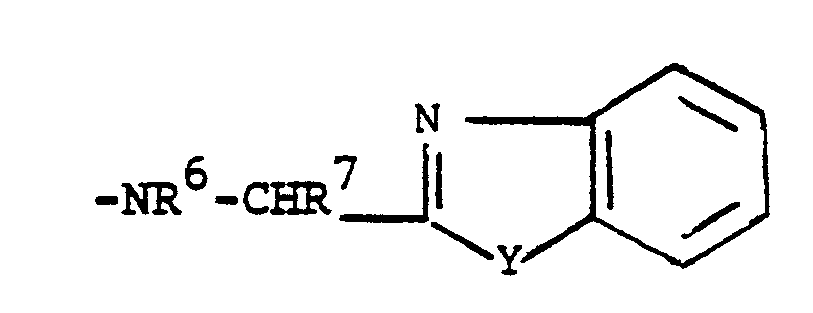
R¹ und R³ jeweils A, Ar, Ar-Alkyl, unsubstituiertes oder ein- oder mehrfach durch A, AO und/oder Hal substituiertes Cycloalkyl mit 3-7 C-Atomen, Cycloalkyl-alkyl mit 4-11 C-Atomen, Bicycloalkyl oder Tricycloalkyl mit jeweils 7-14 C-Atomen, Bicycloalkylalkyl oder Tricycloalkylalkyl mit jeweils 8-18 C-Atomen,
R², R⁵ und R⁶ jeweils H oder A,
R⁴ OH oder NH₂,
R⁷ H, A, Cycloalkylalkyl oder Ar-alkyl,
L CH oder N,
m, p und r jeweils 0, 1, 2, 3, 4, oder 5,
n 1 oder 2,
Ar unsubstituiertes oder ein- oder mehrfach durch A, AO, Hal, CF₃, OH und/oder NH₂ substituiertes Phenyl oder unsubstituiertes Naphthyl,
Hal F, Cl, Br oder J und
A Alkyl mit 1-8 C-Atomen bedeuten,
worin ferner an Stelle einer oder mehrerer -NH-CO-Gruppen auch eine oder mehrere -NA-CO-Gruppen stehen können,
sowie deren Salze.
b) 2-[1S-(2-Benzyl-4-phenylbutyryl-His-AHCP-amino)-3-methyl-butyl]-benzimidazol;
c) 2-(1S-BOC-Phe-His-AHCP-Ile-amino-3-methyl-butyl)-benzimidazol;
oder daß man eine Verbindung, die der Formel I entspricht, aber an Stelle von H-Atomen eine oder mehrere zusätzliche C-C- und/oder C-N- und/oder C-O- Bindungen enthält, reduziert
oder daß man ein Aminoketosäurederivat, das der Formel I entspricht, jedoch an Stelle einer CH(NH₂)-Gruppe eine CO-Gruppe enthält, reduktiv aminiert
oder daß man eine Carbonsäure der Formel II
X-G¹-OH II
worin G¹ (a) Z¹,
(b) Z,
(c) Z-W,
(d) Z-W-B,
(e) Z-W-B-NR⁶-CHR⁷-CO- und
W -NR²-CHR³-CHR⁴-(CHR⁵)n-CO- bedeuten mit einer Aminoverbindung der Formel III
H-G² III
worin
G² (a) Z²-W-B-D,
(b) W-B-D,
(c) B-D,
(d) D,
(e) -HN-(o-C₆H₄)-YH
(worin im Benzolring auch eine oder mehrere CH-Gruppen durch N ersetzt sein können) und Z¹ + Z² zusammen Z bedeuten
umsetzt,
und daß man gegebenenfalls in einer Verbindung der Formel I eine funktionell abgewandelte Amino- und/oder Hydroxygruppe durch Behandeln mit solvolysierenden oder hydrogenolysierenden Mitteln in Freiheit setzt und/oder eine Verbindung der Formel I durch Behandeln mit einer Säure in eines ihrer Salze überführt.
Priority Applications (1)
| Application Number | Priority Date | Filing Date | Title |
|---|---|---|---|
| AT86115175T ATE84043T1 (de) | 1985-11-15 | 1986-11-01 | Aminosaeurederivate. |
Applications Claiming Priority (2)
| Application Number | Priority Date | Filing Date | Title |
|---|---|---|---|
| DE19853540495 DE3540495A1 (de) | 1985-11-15 | 1985-11-15 | Aminosaeurederivate |
| DE3540495 | 1985-11-15 |
Publications (3)
| Publication Number | Publication Date |
|---|---|
| EP0222283A2 true EP0222283A2 (de) | 1987-05-20 |
| EP0222283A3 EP0222283A3 (en) | 1989-09-06 |
| EP0222283B1 EP0222283B1 (de) | 1992-12-30 |
Family
ID=6286038
Family Applications (1)
| Application Number | Title | Priority Date | Filing Date |
|---|---|---|---|
| EP86115175A Expired - Lifetime EP0222283B1 (de) | 1985-11-15 | 1986-11-01 | Aminosäurederivate |
Country Status (10)
| Country | Link |
|---|---|
| US (1) | US4721776A (de) |
| EP (1) | EP0222283B1 (de) |
| JP (1) | JPS62187488A (de) |
| AT (1) | ATE84043T1 (de) |
| AU (1) | AU588929B2 (de) |
| CA (1) | CA1298034C (de) |
| DE (2) | DE3540495A1 (de) |
| ES (1) | ES2053430T3 (de) |
| HU (1) | HU205139B (de) |
| ZA (1) | ZA868665B (de) |
Cited By (6)
| Publication number | Priority date | Publication date | Assignee | Title |
|---|---|---|---|---|
| WO1989003841A1 (en) * | 1987-10-26 | 1989-05-05 | Warner-Lambert Company | Renin inhibitors, processes for preparing them, methods for using them, and compositions containing them |
| EP0292800A3 (de) * | 1987-05-26 | 1990-11-22 | MERCK PATENT GmbH | Aminosäurederivate |
| WO1991001976A1 (en) * | 1989-08-04 | 1991-02-21 | Iaf Biochem International Inc. | Thioacylating reagents and intermediates, thiopeptides, and methods for preparing and using same |
| US5288851A (en) * | 1987-10-26 | 1994-02-22 | Warner-Lambert Company | Renin inhibitors, processes for preparing them, methods for using them, and compositions containing them |
| WO1994013695A1 (en) * | 1992-12-16 | 1994-06-23 | Basf Aktiengesellschaft | Dolostatin analog |
| US5457180A (en) * | 1989-08-04 | 1995-10-10 | Biochem Pharma Inc. | Methods for producing linear thiopeptides using an amino acid ortho amino thioanilide compound |
Families Citing this family (5)
| Publication number | Priority date | Publication date | Assignee | Title |
|---|---|---|---|---|
| US4826958A (en) * | 1984-12-14 | 1989-05-02 | Abbott Laboratories | Renin inhibiting compounds |
| DE3638425A1 (de) * | 1986-11-11 | 1988-05-19 | Merck Patent Gmbh | Aminosaeurederivate |
| DE3626130A1 (de) * | 1986-08-01 | 1988-02-11 | Merck Patent Gmbh | Aminosaeurederivate |
| US5182266A (en) * | 1990-01-31 | 1993-01-26 | Abbott Laboratories | Method for treating renal disease |
| IL96942A (en) * | 1990-01-31 | 1995-01-24 | Abbott Lab | A pharmaceutical mixture containing a history of amide prevents renin |
Family Cites Families (17)
| Publication number | Priority date | Publication date | Assignee | Title |
|---|---|---|---|---|
| US4609643A (en) * | 1980-08-06 | 1986-09-02 | Aktiebolaget Hassle | Renin inhibitors, treatments and dipeptide synthesis |
| NO812612L (no) * | 1980-08-06 | 1982-02-08 | Ferring Pharma Ltd | Enzym-inhibitorer. |
| CA1258748A (en) * | 1981-10-08 | 1989-08-22 | Daniel F. Veber | Renin inhibitory peptides |
| CA1245217A (en) * | 1981-12-10 | 1988-11-22 | Joshua S. Boger | Renin inhibitory peptides having phe su13 xx deletion |
| US4650661A (en) * | 1982-09-15 | 1987-03-17 | Aktiebolaget Hassle | Enzyme inhibitors |
| US4668770A (en) * | 1982-12-27 | 1987-05-26 | Merck & Co., Inc. | Renin inhibitory tripeptides |
| EP0118223A1 (de) * | 1983-02-07 | 1984-09-12 | Aktiebolaget Hässle | Enzymhemmende Stoffe |
| GB8305985D0 (en) * | 1983-03-04 | 1983-04-07 | Szelke M | Enzyme inhibition |
| CA1254699A (en) * | 1984-03-12 | 1989-05-23 | Jasjit S. Bindra | Renin inhibitors containing statine or derivatives thereof |
| US4636491A (en) * | 1984-03-27 | 1987-01-13 | Merck & Co., Inc. | Renin inhibitory peptides having improved solubility |
| US4661473A (en) * | 1984-03-27 | 1987-04-28 | Merck & Co., Inc. | Renin inhibitors containing peptide isosteres |
| US4663310A (en) * | 1984-04-04 | 1987-05-05 | Merck & Co., Inc. | Renin inhibitors containing 2-substituted statine |
| DE3418491A1 (de) * | 1984-05-18 | 1985-11-21 | Merck Patent Gmbh, 6100 Darmstadt | Diaminosaeurederivate |
| US4645759A (en) * | 1984-06-22 | 1987-02-24 | Abbott Laboratories | Renin inhibiting compounds |
| US4652551A (en) * | 1984-06-22 | 1987-03-24 | Abbott Laboratories | Renin inhibiting compounds |
| US4657931A (en) * | 1985-05-15 | 1987-04-14 | G. D. Searle & Co. | N-(acyldipeptidyl)-aminoglycols |
| US4665055A (en) * | 1985-06-17 | 1987-05-12 | Merck & Co., Inc. | Peptide renin inhibitors |
-
1985
- 1985-11-15 DE DE19853540495 patent/DE3540495A1/de not_active Withdrawn
-
1986
- 1986-10-31 AU AU64629/86A patent/AU588929B2/en not_active Ceased
- 1986-11-01 AT AT86115175T patent/ATE84043T1/de not_active IP Right Cessation
- 1986-11-01 EP EP86115175A patent/EP0222283B1/de not_active Expired - Lifetime
- 1986-11-01 DE DE8686115175T patent/DE3687405D1/de not_active Expired - Fee Related
- 1986-11-01 ES ES86115175T patent/ES2053430T3/es not_active Expired - Lifetime
- 1986-11-13 CA CA000522819A patent/CA1298034C/en not_active Expired - Fee Related
- 1986-11-14 JP JP61270016A patent/JPS62187488A/ja active Pending
- 1986-11-14 US US06/930,483 patent/US4721776A/en not_active Expired - Fee Related
- 1986-11-14 ZA ZA868665A patent/ZA868665B/xx unknown
- 1986-11-14 HU HU864701A patent/HU205139B/hu not_active IP Right Cessation
Cited By (8)
| Publication number | Priority date | Publication date | Assignee | Title |
|---|---|---|---|---|
| EP0292800A3 (de) * | 1987-05-26 | 1990-11-22 | MERCK PATENT GmbH | Aminosäurederivate |
| WO1989003841A1 (en) * | 1987-10-26 | 1989-05-05 | Warner-Lambert Company | Renin inhibitors, processes for preparing them, methods for using them, and compositions containing them |
| US5288851A (en) * | 1987-10-26 | 1994-02-22 | Warner-Lambert Company | Renin inhibitors, processes for preparing them, methods for using them, and compositions containing them |
| WO1991001976A1 (en) * | 1989-08-04 | 1991-02-21 | Iaf Biochem International Inc. | Thioacylating reagents and intermediates, thiopeptides, and methods for preparing and using same |
| US5138061A (en) * | 1989-08-04 | 1992-08-11 | Biochem Pharma Inc. | Thioacylating reagents |
| US5457180A (en) * | 1989-08-04 | 1995-10-10 | Biochem Pharma Inc. | Methods for producing linear thiopeptides using an amino acid ortho amino thioanilide compound |
| WO1994013695A1 (en) * | 1992-12-16 | 1994-06-23 | Basf Aktiengesellschaft | Dolostatin analog |
| AU679479B2 (en) * | 1992-12-16 | 1997-07-03 | Basf Aktiengesellschaft | Dolostatin analog |
Also Published As
| Publication number | Publication date |
|---|---|
| AU6462986A (en) | 1987-05-21 |
| EP0222283A3 (en) | 1989-09-06 |
| AU588929B2 (en) | 1989-09-28 |
| CA1298034C (en) | 1992-03-24 |
| JPS62187488A (ja) | 1987-08-15 |
| HU205139B (en) | 1992-03-30 |
| EP0222283B1 (de) | 1992-12-30 |
| DE3687405D1 (de) | 1993-02-11 |
| ZA868665B (en) | 1987-06-24 |
| DE3540495A1 (de) | 1987-05-21 |
| ES2053430T3 (es) | 1994-08-01 |
| US4721776A (en) | 1988-01-26 |
| HUT45081A (en) | 1988-05-30 |
| ATE84043T1 (de) | 1993-01-15 |
Similar Documents
| Publication | Publication Date | Title |
|---|---|---|
| EP0264795A2 (de) | Aminosäurederivate | |
| EP0161588B1 (de) | Diaminosäurederivate | |
| EP0286813A2 (de) | Renin inhibierende Aminosäurederivate | |
| EP0220665A2 (de) | Peptide | |
| EP0284942A2 (de) | Aminosäurederivate | |
| EP0222283A2 (de) | Aminosäurederivate | |
| EP0198271B1 (de) | Peptide | |
| DE4007869A1 (de) | Aminosaeurederivate | |
| EP0262318A2 (de) | Renin-inhibierende Aminosäurederivate | |
| EP0179352B1 (de) | Peptide | |
| EP0249096A2 (de) | Reninhemmende Aminosäurederivate | |
| DE3733296A1 (de) | Aminosaeurederivate | |
| DE3915361A1 (de) | Cyclopeptide | |
| DE3814325A1 (de) | Aminosaeurederivate | |
| DE4014421A1 (de) | Aminosaeurederivate | |
| EP0292800A2 (de) | Aminosäurederivate | |
| DE3840289A1 (de) | Aminosaeurederivate | |
| DE3619508A1 (de) | Aminosaeurederivate | |
| EP0272444A2 (de) | Renin inhibierende Peptide | |
| DE3809145A1 (de) | Aminosaeurederivate | |
| DE3805156A1 (de) | Aminosaeurederivate | |
| DE3819263A1 (de) | Aminosaeurederivate | |
| DE3807022A1 (de) | Aminosaeurederivate | |
| DE4021512A1 (de) | Aminosaeurederivate | |
| DE3803584A1 (de) | Aminosaeurederivate |
Legal Events
| Date | Code | Title | Description |
|---|---|---|---|
| PUAI | Public reference made under article 153(3) epc to a published international application that has entered the european phase |
Free format text: ORIGINAL CODE: 0009012 |
|
| AK | Designated contracting states |
Kind code of ref document: A2 Designated state(s): AT BE CH DE ES FR GB IT LI NL SE |
|
| PUAL | Search report despatched |
Free format text: ORIGINAL CODE: 0009013 |
|
| AK | Designated contracting states |
Kind code of ref document: A3 Designated state(s): AT BE CH DE ES FR GB IT LI NL SE |
|
| 17P | Request for examination filed |
Effective date: 19900116 |
|
| 17Q | First examination report despatched |
Effective date: 19910701 |
|
| ITF | It: translation for a ep patent filed | ||
| GRAA | (expected) grant |
Free format text: ORIGINAL CODE: 0009210 |
|
| AK | Designated contracting states |
Kind code of ref document: B1 Designated state(s): AT BE CH DE ES FR GB IT LI NL SE |
|
| REF | Corresponds to: |
Ref document number: 84043 Country of ref document: AT Date of ref document: 19930115 Kind code of ref document: T |
|
| GBT | Gb: translation of ep patent filed (gb section 77(6)(a)/1977) |
Effective date: 19921229 |
|
| REF | Corresponds to: |
Ref document number: 3687405 Country of ref document: DE Date of ref document: 19930211 |
|
| ET | Fr: translation filed | ||
| PG25 | Lapsed in a contracting state [announced via postgrant information from national office to epo] |
Ref country code: GB Effective date: 19931101 Ref country code: AT Effective date: 19931101 |
|
| PG25 | Lapsed in a contracting state [announced via postgrant information from national office to epo] |
Ref country code: SE Effective date: 19931102 Ref country code: ES Free format text: LAPSE BECAUSE OF THE APPLICANT RENOUNCES Effective date: 19931102 |
|
| PLBE | No opposition filed within time limit |
Free format text: ORIGINAL CODE: 0009261 |
|
| STAA | Information on the status of an ep patent application or granted ep patent |
Free format text: STATUS: NO OPPOSITION FILED WITHIN TIME LIMIT |
|
| PG25 | Lapsed in a contracting state [announced via postgrant information from national office to epo] |
Ref country code: LI Effective date: 19931130 Ref country code: CH Effective date: 19931130 Ref country code: BE Effective date: 19931130 |
|
| 26N | No opposition filed | ||
| BERE | Be: lapsed |
Owner name: MERCK PATENT G.M.B.H. Effective date: 19931130 |
|
| PG25 | Lapsed in a contracting state [announced via postgrant information from national office to epo] |
Ref country code: NL Effective date: 19940601 |
|
| GBPC | Gb: european patent ceased through non-payment of renewal fee |
Effective date: 19931101 |
|
| NLV4 | Nl: lapsed or anulled due to non-payment of the annual fee | ||
| PG25 | Lapsed in a contracting state [announced via postgrant information from national office to epo] |
Ref country code: FR Effective date: 19940729 |
|
| REG | Reference to a national code |
Ref country code: CH Ref legal event code: PL |
|
| REG | Reference to a national code |
Ref country code: ES Ref legal event code: FG2A Ref document number: 2053430 Country of ref document: ES Kind code of ref document: T3 |
|
| PG25 | Lapsed in a contracting state [announced via postgrant information from national office to epo] |
Ref country code: DE Effective date: 19940802 |
|
| REG | Reference to a national code |
Ref country code: FR Ref legal event code: ST |
|
| EUG | Se: european patent has lapsed |
Ref document number: 86115175.1 Effective date: 19940610 |
|
| REG | Reference to a national code |
Ref country code: ES Ref legal event code: FD2A Effective date: 20010402 |
|
| PG25 | Lapsed in a contracting state [announced via postgrant information from national office to epo] |
Ref country code: IT Free format text: LAPSE BECAUSE OF NON-PAYMENT OF DUE FEES;WARNING: LAPSES OF ITALIAN PATENTS WITH EFFECTIVE DATE BEFORE 2007 MAY HAVE OCCURRED AT ANY TIME BEFORE 2007. THE CORRECT EFFECTIVE DATE MAY BE DIFFERENT FROM THE ONE RECORDED. Effective date: 20051101 |