EP0221847A2 - Salze von Benzoylharnstoffen - Google Patents
Salze von Benzoylharnstoffen Download PDFInfo
- Publication number
- EP0221847A2 EP0221847A2 EP86810475A EP86810475A EP0221847A2 EP 0221847 A2 EP0221847 A2 EP 0221847A2 EP 86810475 A EP86810475 A EP 86810475A EP 86810475 A EP86810475 A EP 86810475A EP 0221847 A2 EP0221847 A2 EP 0221847A2
- Authority
- EP
- European Patent Office
- Prior art keywords
- formula
- hydrogen
- compound according
- chlorine
- fluorine
- Prior art date
- Legal status (The legal status is an assumption and is not a legal conclusion. Google has not performed a legal analysis and makes no representation as to the accuracy of the status listed.)
- Withdrawn
Links
- 0 C1C=C2[C@]3*2C2C3C12 Chemical compound C1C=C2[C@]3*2C2C3C12 0.000 description 2
Classifications
-
- C—CHEMISTRY; METALLURGY
- C07—ORGANIC CHEMISTRY
- C07D—HETEROCYCLIC COMPOUNDS
- C07D213/00—Heterocyclic compounds containing six-membered rings, not condensed with other rings, with one nitrogen atom as the only ring hetero atom and three or more double bonds between ring members or between ring members and non-ring members
- C07D213/02—Heterocyclic compounds containing six-membered rings, not condensed with other rings, with one nitrogen atom as the only ring hetero atom and three or more double bonds between ring members or between ring members and non-ring members having three double bonds between ring members or between ring members and non-ring members
- C07D213/04—Heterocyclic compounds containing six-membered rings, not condensed with other rings, with one nitrogen atom as the only ring hetero atom and three or more double bonds between ring members or between ring members and non-ring members having three double bonds between ring members or between ring members and non-ring members having no bond between the ring nitrogen atom and a non-ring member or having only hydrogen or carbon atoms directly attached to the ring nitrogen atom
- C07D213/60—Heterocyclic compounds containing six-membered rings, not condensed with other rings, with one nitrogen atom as the only ring hetero atom and three or more double bonds between ring members or between ring members and non-ring members having three double bonds between ring members or between ring members and non-ring members having no bond between the ring nitrogen atom and a non-ring member or having only hydrogen or carbon atoms directly attached to the ring nitrogen atom with hetero atoms or with carbon atoms having three bonds to hetero atoms with at the most one bond to halogen, e.g. ester or nitrile radicals, directly attached to ring carbon atoms
- C07D213/62—Oxygen or sulfur atoms
- C07D213/63—One oxygen atom
- C07D213/64—One oxygen atom attached in position 2 or 6
- C07D213/643—2-Phenoxypyridines; Derivatives thereof
-
- A—HUMAN NECESSITIES
- A01—AGRICULTURE; FORESTRY; ANIMAL HUSBANDRY; HUNTING; TRAPPING; FISHING
- A01N—PRESERVATION OF BODIES OF HUMANS OR ANIMALS OR PLANTS OR PARTS THEREOF; BIOCIDES, e.g. AS DISINFECTANTS, AS PESTICIDES OR AS HERBICIDES; PEST REPELLANTS OR ATTRACTANTS; PLANT GROWTH REGULATORS
- A01N47/00—Biocides, pest repellants or attractants, or plant growth regulators containing organic compounds containing a carbon atom not being member of a ring and having no bond to a carbon or hydrogen atom, e.g. derivatives of carbonic acid
- A01N47/08—Biocides, pest repellants or attractants, or plant growth regulators containing organic compounds containing a carbon atom not being member of a ring and having no bond to a carbon or hydrogen atom, e.g. derivatives of carbonic acid the carbon atom having one or more single bonds to nitrogen atoms
- A01N47/28—Ureas or thioureas containing the groups >N—CO—N< or >N—CS—N<
- A01N47/34—Ureas or thioureas containing the groups >N—CO—N< or >N—CS—N< containing the groups, e.g. biuret; Thio analogues thereof; Urea-aldehyde condensation products
-
- A—HUMAN NECESSITIES
- A01—AGRICULTURE; FORESTRY; ANIMAL HUSBANDRY; HUNTING; TRAPPING; FISHING
- A01N—PRESERVATION OF BODIES OF HUMANS OR ANIMALS OR PLANTS OR PARTS THEREOF; BIOCIDES, e.g. AS DISINFECTANTS, AS PESTICIDES OR AS HERBICIDES; PEST REPELLANTS OR ATTRACTANTS; PLANT GROWTH REGULATORS
- A01N47/00—Biocides, pest repellants or attractants, or plant growth regulators containing organic compounds containing a carbon atom not being member of a ring and having no bond to a carbon or hydrogen atom, e.g. derivatives of carbonic acid
- A01N47/08—Biocides, pest repellants or attractants, or plant growth regulators containing organic compounds containing a carbon atom not being member of a ring and having no bond to a carbon or hydrogen atom, e.g. derivatives of carbonic acid the carbon atom having one or more single bonds to nitrogen atoms
- A01N47/28—Ureas or thioureas containing the groups >N—CO—N< or >N—CS—N<
- A01N47/36—Ureas or thioureas containing the groups >N—CO—N< or >N—CS—N< containing the group >N—CO—N< directly attached to at least one heterocyclic ring; Thio analogues thereof
-
- C—CHEMISTRY; METALLURGY
- C07—ORGANIC CHEMISTRY
- C07C—ACYCLIC OR CARBOCYCLIC COMPOUNDS
- C07C273/00—Preparation of urea or its derivatives, i.e. compounds containing any of the groups, the nitrogen atoms not being part of nitro or nitroso groups
- C07C273/18—Preparation of urea or its derivatives, i.e. compounds containing any of the groups, the nitrogen atoms not being part of nitro or nitroso groups of substituted ureas
- C07C273/1854—Preparation of urea or its derivatives, i.e. compounds containing any of the groups, the nitrogen atoms not being part of nitro or nitroso groups of substituted ureas by reactions not involving the formation of the N-C(O)-N- moiety
- C07C273/1863—Preparation of urea or its derivatives, i.e. compounds containing any of the groups, the nitrogen atoms not being part of nitro or nitroso groups of substituted ureas by reactions not involving the formation of the N-C(O)-N- moiety from urea
-
- C—CHEMISTRY; METALLURGY
- C07—ORGANIC CHEMISTRY
- C07C—ACYCLIC OR CARBOCYCLIC COMPOUNDS
- C07C275/00—Derivatives of urea, i.e. compounds containing any of the groups, the nitrogen atoms not being part of nitro or nitroso groups
- C07C275/46—Derivatives of urea, i.e. compounds containing any of the groups, the nitrogen atoms not being part of nitro or nitroso groups containing any of the groups, X being a hetero atom, Y being any atom, e.g. acylureas
- C07C275/48—Y being a hydrogen or a carbon atom
- C07C275/54—Y being a carbon atom of a six-membered aromatic ring, e.g. benzoylureas
Definitions
- the present invention relates to novel salts of benzoylureas, processes for their preparation and their use in pest control.
- the salts of the benzoylureas have the formula I. wherein R 1 to R 5 independently of one another are hydrogen, halogen or C I -C 6 alkoxy, R 6 is hydrogen or C 1 -C 6 alkyl, R 7 optionally substituted phenyl, naphthyl, pyridyl, pyridazinyl, pyrimidinyl or pyrazinyl and X is an inorganic or organic cation.
- Halogen is to be understood as fluorine, chlorine, bromine or iodine.
- the alkyl and alkoxy groups at R I -R 6 can be straight-chain or branched and preferably have 1 to 4 carbon atoms in the chain. Examples of such groups include: methyl, ethyl, propyl, isopropyl, n-butyl, n-pentyl, n-hexyl and their isomers.
- the cations of the alkali and alkaline earth metals are suitable as inorganic cations.
- organic cations include: in which Ra-R i i are independently hydrogen, C 1 -C 20 alkyl, benzyl or phenyl and R 12 is hydrogen or C 1 -C 20 alkyl, such as the following cations: (CH 3 ) 4 N ⁇ , (C 2 H 5 ) 4 N ⁇ , (nC 3 H 7 ) 4 N ⁇ , (iC 3 H 7 ) 4 N ⁇ , (nC 4 H 9 ) 4 N ⁇ , where n is a number 8 to 15.
- R 7 The following substituents on the phenyl, naphthyl, pyridyl, pyridazinyl, pyrimidinyl or pyrazinyl groups are possible with R 7, inter alia: halogen atoms, in particular fluorine or chlorine; Alkyl, haloalkyl, alkoxy, haloalkoxy, alkylthio, haloalkylthio, alkenyl, haloalkenyl, alkynyl, haloalkynyl, alkylsulfinyl, alkylsulfonyl, haloalkylsulfinyl, haloalkylsulfonyl, alkylamino or dialkylamino groups; phenoxy or pyridyloxy groups substituted by halogen, haloalkyl, haloalkoxy or nitro; -O-CF 2 -CF 2 -0-, -O-CF 2
- Preferred compounds of the formula I are those in which R 1 fluorine, chlorine or methoxy, Rz to R 5 independently of one another are hydrogen, fluorine, chlorine or methoxy, R 6 is hydrogen or methyl, R 7 optionally substituted phenyl and X ⁇ a cation of the alkali metals, R 8 -R 11 independently of one another are hydrogen, C 1 -C 20 alkyl, benzyl or phenyl and R 12 is hydrogen or C 1 -C 20 alkyl or X ⁇ in particular a cation of the alkali metals, (CH 3 ) 4 N ⁇ , (C 2 H 5 ) 4 N ⁇ , (nC 3 H 7 ) 4 N ⁇ , (iC 3 H 7 ) 4 N ⁇ , (nC 4 H 9 ) 4 N ⁇ , or mean.
- Ri fluorine, chlorine or methoxy, R 2 to R 5 independently of one another are hydrogen, fluorine, chlorine or methoxy, R 6 is hydrogen, R 7 is a phenyl substituted by one or more halogen atoms, haloalkyl, haloalkoxy or dialkylamino groups or by a phenoxy or pyridyloxy radical substituted by one or more nitro, halogen, haloalkyl or haloalkoxy or by the groups 3,4-0-CF 2 -CF 2 -0- or 3,4-O-CF 2 -CFCl-O- and X ⁇ Na ⁇ , K ⁇ , or (CH 3 ) 4 N ⁇ , (C 2 H 5 ) 4 N ⁇ , CH 3 - (CH 2 ) 15 -N ⁇ (CH 3 ) 3 or (nC 4 H 9 ) 4 N ⁇ mean.
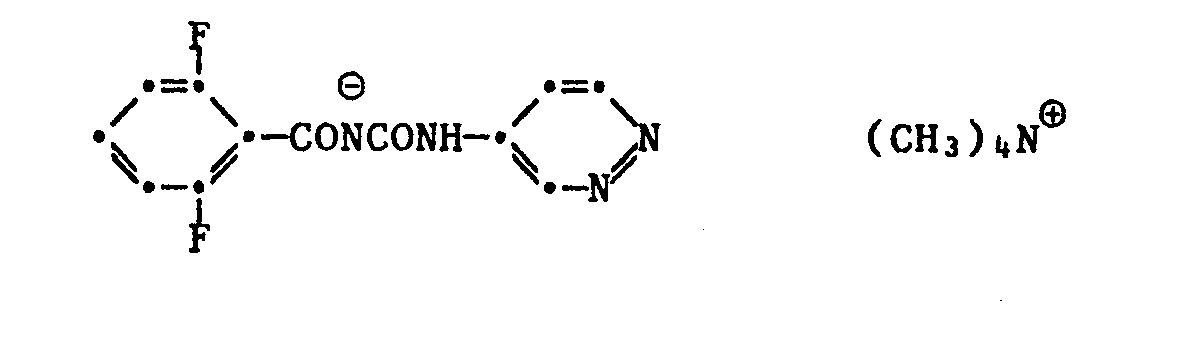
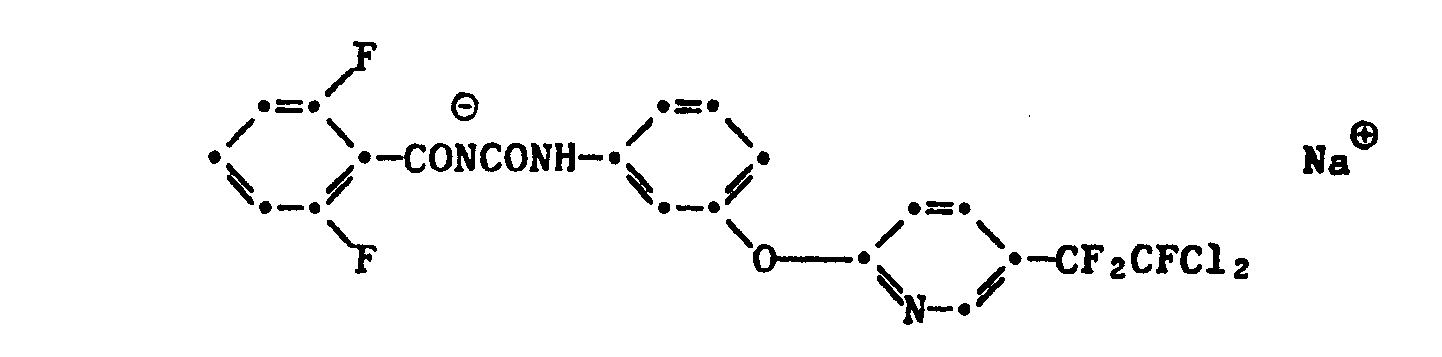
- benzoylurea salts of the formula I according to the invention include:
- the salts of the formula I according to the invention are prepared in a manner known per se, for example by reacting a compound of the formula II wherein R 1 -R 7 have the meaning given for the formula I, with a metal alkanolate, such as sodium ethylate or potassium methylate, or with corresponding ammonium hydroxides of the formula III where X e is an organic cation.
- a metal alkanolate such as sodium ethylate or potassium methylate
- Salt formation is preferably carried out at room temperature and in the presence of an alcohol, preferably methanol or ethanol.
- the ureas of the formula II are known or can be prepared by known methods.
- the present compounds of the formula I have excellent activity as a pesticide with good plant tolerance and low toxicity to warm-blooded animals. They are particularly suitable for combating insects and plants of the Akarina species that attack plants and animals.
- the compounds of formula I are suitable for controlling insects of the orders: Lepidoptera, Coleoptera, Homoptera, Heteroptera, Diptera, Thysanoptera, Orthoptera, Anoplura, Siphonaptera, Mallophaga, Thysanura, Isoptera, Psocoptera and Hymenoptera, and representatives of the order Akarina der Families: Ixodidae, Argasidae, Tetranychidae and Dermanyssidae.
- compounds of the formula I can also be used to control harmful insects in ornamental and useful plants, in particular in cotton crops (for example Spodoptera littoralis and Heliothis virescens), and in fruit and vegetable crops (for example Laspeyresia pomonella, Leptinotarsa decemlineata and Epilachna varivestis) can be used.
- the compounds of the formula I are distinguished by a pronounced larvicidal and ovo-larvicidal activity against insects, in particular larvae of feeding insect pests.
- Compounds of formula I also have a beneficial action against soil insects (e.g. Aulacophora femoralis, Chortophila brassicae, Diabrotica balteata, Pachnoda savignyi and Ontario ypsilon).
- soil insects e.g. Aulacophora femoralis, Chortophila brassicae, Diabrotica balteata, Pachnoda savignyi and Ontario ypsilon.
- the compounds of formula I can also be used to control ectoparasites such as ticks and Lucilia sericata on domestic and farm animals, e.g. through animal, stable and pasture treatment.
- the compounds of the formula I are also suitable for combating the following mite species afflicting fruit and vegetable crops: Tetranychus urticae, Tetranychus cinnabarinus, Panonychus ulmi, Bryobia rubrioculus, Panonychus citri, Eriophyes piri, Eriophyes ribis, Eriophyes vylliditis vyllid, varsidyllus, tarsonemusyllium, Tarsonemutula, Tarsonemutula, Tarsonemutula, Tarsonemuta oleivora.
- the compounds of the formula I can advantageously be used as dressings for the treatment of seeds and stocks (fruits, tubers, grains) and plant cuttings and for seed furrow application to protect against fungal infections and insects and against the phytopathogenic fungi and insects occurring in the soil.
- the good pesticidal activity of the compounds of the formula I according to the invention corresponds to a mortality rate of at least 50-60% of the pests mentioned.
- the action of the compounds according to the invention or of the compositions comprising them can be broadened considerably by adding other insecticides and / or acaricides and adapted to the given circumstances.
- Representatives of the following active ingredient come as additives Classes into consideration: organic phosphorus compounds, nitrophenols and derivatives, formamidines, ureas, carbamates, pyrethroids, chlorinated hydrocarbons and Bacillus thuringiensis preparations.
- the compounds of the formula I are used in unchanged form or preferably together with the auxiliaries customary in formulation technology and can therefore, for example to emulsion concentrates, directly sprayable or dilutable solutions, diluted emulsions, wettable powders, soluble powders, dusts, granules, also encapsulations in e.g. polymeric substances are processed in a known manner.
- the application methods such as spraying, atomizing, dusting, scattering or pouring, as well as the means, are chosen in accordance with the desired goals and the given conditions.
- the salts of formula 1 are not only characterized by high acaricidal and insecticidal activity, but also by good solubility in solvents and diluents and by improved formulability.
- the wording i.e. the agents, preparations or compositions containing the active ingredient of formula I, or combinations of these active ingredients with other insecticides or acaricides, and optionally a solid or liquid additive, are prepared in a known manner, e.g. by intimately mixing and / or grinding the active ingredients with extenders, e.g. with solvents, solid carriers, and optionally surface-active compounds (surfactants).
- extenders e.g. with solvents, solid carriers, and optionally surface-active compounds (surfactants).
- Possible solvents are: aromatic hydrocarbons, preferably the fractions C 8 to C 12 ', such as xylene mixtures or substituted naphthalenes, phthalic esters, such as dibutyl or dioctyl phthalate, aliphatic hydrocarbons such as cyclohexane, paraffins, alcohols and glycols and their ethers and esters , such as ethanol, ethylene glycol, ethylene glycol monomethyl or ethyl ether, ketones, such as cyclohexanone, strongly polar solvents, such as N-methyl-2-pyrrolidone, dimethyl sulfoxide or dimethylformamide, and optionally epoxidized vegetable oils, such as epoxidized coconut oil or soybean oil, or water.
- aromatic hydrocarbons preferably the fractions C 8 to C 12 ', such as xylene mixtures or substituted naphthalenes, phthalic esters, such as dibutyl or dioct
- solid carriers e.g. natural dust, such as calcite, talc, kaolin, montmorillonite or attapulgite
- natural dust such as calcite, talc, kaolin, montmorillonite or attapulgite
- highly disperse silicas or highly disperse absorbent polymers can also be added.
- Porous types such as e.g. Pumice stone, broken brick, sepiolite or bentonite, as non-sorptive carrier materials e.g. Calcite or sand in question.
- a large number of granulated materials of inorganic or organic nature such as, in particular, dolomite or comminuted plant residues, can be used.
- suitable surface-active compounds are nonionic, cationic and / or anionic surfactants with good emulsifying, dispersing and wetting properties.
- surfactants are also to be understood as mixtures of surfactants.
- Suitable anionic surfactants can be both so-called water-soluble soaps and water-soluble synthetic surface-active compounds.
- Suitable soaps are the alkali metal, alkaline earth metal or optionally substituted ammonium salts of higher fatty acids (C 10 -C 22 ), such as the Na or K salts of oleic or stearic acid, or of natural fatty acid mixtures which, for example, from coconut or tall oil can be extracted.
- surfactants are the fatty acid methyl taurine salts and modified and unmodified phospholipids.
- the fatty sulfonates or sulfates are usually present as alkali, alkaline earth or optionally substituted ammonium salts and generally have an alkyl radical with 8 to 22 carbon atoms, alkyl also including the alkyl part of acyl radicals, e.g. the Na or Ca salt of lignin sulfonic acid, dodecylsulfuric acid ester or a fatty alcohol sulfate mixture made from natural fatty acids.
- This subheading also includes the salts of sulfuric acid esters and sulfonic acids from fatty alcohol / ethylene oxide adducts.
- the sulfonated benzimidazole derivatives preferably contain 2 sulfonic acid groups and a fatty acid residue with about 8-22 carbon atoms.
- Alkylarylsulfonates are e.g. the sodium, calcium or triethanolamine salts of dodecylbenzenesulfonic acid, dibutylnaphthalenesulfonic acid or a naphthalenesulfonic acid-formaldehyde condensation product.
- Corresponding phosphates such as e.g. Salts of the phosphoric acid ester of a p-nonylphenol (4-14) ethylene oxide adduct, in question.
- Suitable nonionic surfactants are primarily polyglycol ether derivatives of aliphatic or cycloaliphatic alcohols, saturated or unsaturated fatty acids and alkylphenols, which can contain 3 to 30 glycol ether groups and 8 to 20 carbon atoms in the (aliphatic) hydrocarbon radical and 6 to 18 carbon atoms in the alkyl radical of the alkylphenols.
- nonionic surfactants are the water-soluble 20 to 250 ethylene glycol ether groups and 10 to 100 propylene glycol ether groups containing polyethylene oxide adducts with polypropylene glycol, ethylenediaminopolypropylene glycol and alkylpolypropylene glycol with 1 to 10 carbon atoms in the alkyl chain.
- the compounds mentioned usually contain 1 to 5 ethylene glycol units per propylene glycol unit.
- nonionic surfactants are nonylphenol polyethoxyethanols, castor oil polyglycol ethers, castor oil thioxilate, polypropylene-polyethylene oxide adducts, tributylphenoxypolyethoxyethanol, polyethylene glycol and octylphenoxypolyethoxyethanol.
- Fatty acid esters of polyoxyethylene sorbitan, such as polyoxyethylene sorbitan trioleate, are also suitable.
- the cationic surfactants are primarily quaternary ammonium salts which contain at least one alkyl radical having 8 to 22 carbon atoms as N substituents and have low, optionally halogenated alkyl, benzyl or low hydroxyalkyl radicals as further substituents.
- the salts are preferably in the form of halides, methyl sulfates or ethyl sulfates, e.g. the stearyl trimethyl ammonium chloride or the benzyl di (2-chloroethyl) ethyl ammonium bromide.
- the pesticidal preparations generally contain 0.1 to 99%, in particular 0.1 to 95%, active ingredient of the formula I or combinations of these active ingredients with other insecticides or acaricides, 1 to 99.9% of a solid or liquid additive and 0 to 25%, in particular 0.1 to 20%, of a surfactant. While concentrated products are preferred as a commercial product, the end user generally uses diluted preparations which have significantly lower active substance concentrations.
- the agents can also contain other additives such as stabilizers, defoamers, viscosity regulators, binders, adhesives and fertilizers or other active ingredients to achieve special effects.
- Emulsions of any desired concentration can be prepared from such concentrates by dilution with water.
- the solutions are suitable for use in the form of tiny drops.
- the active ingredient is dissolved in methylene chloride, sprayed onto the carrier and the solvent is then evaporated off in vacuo.
- Ready-to-use dusts are obtained by intimately mixing the carrier substances with the active ingredient.
- the active ingredient is mixed well with the additives and ground well in a suitable mill.
- Spray powder is obtained which can be diluted with water to form suspensions of any desired concentration.
- the active ingredient is mixed with the additives, ground and moistened with water. This mixture is extruded and then dried in an air stream.
- the finely ground active ingredient is applied evenly in a mixer to the kaolin moistened with polyethylene glycol. In this way, dust-free coating granules are obtained.
- the finely ground active ingredient is intimately mixed with the additives. This gives a suspension concentrate from which suspensions of any desired concentration can be prepared by dilution with water.
- Example 3 Biological examples for the compounds according to manufacturing example 1
- acetone solution 50 g freshly prepared nutrient substrate for maggots is weighed into beakers. A certain amount of a 1% by weight acetone solution of the active ingredient in question is pipetted onto the nutrient substrate in the beakers, so that an active ingredient concentration of 800 ppm results. After mixing the substrate, the acetone is allowed to evaporate for at least 20 hours.
- Approx. 25 cm high potted cotton plants are sprayed with aqueous active ingredient emulsions, each containing the active ingredient in increasing concentrations up to 100 ppm.
- the cotton plants are populated with Spodoptera littoralis or Heliothis virescens larvae in the third larval stage.
- the test is carried out at 24 ° C and 60% relative humidity. After 120 hours, the mortality of the test insects is determined in percent.
- Phaseolus vulgaris plants bush beans
- aqueous emulsion preparations containing the active ingredient to be tested in a concentration of 800 ppm.
- 5 larvae of Epilachna varivestis (Mexican bean beetle) are set in the 4th larval stage per plant.
- a plastic cylinder is placed over the infested plants, which is covered with a copper gauze cover. The test is carried out at 28 0 C and 60% relative humidity.
- the mortality is determined in percent.
- the test animals are observed for a further 3 days.
- Laid eggs of Laspeyresia pomonella which are not older than 24 hours, are immersed on filter paper for 1 minute in an acetone-aqueous solution containing 800 ppm of the active ingredient to be tested. After the solution has dried on, the eggs are placed in Petri dishes and kept at a temperature of 28 ° C. After 6 days, the percentage hatching from the treated eggs is assessed and the mortality is determined in percent.
- the egg laying of the beetles is checked over a period of about 4 weeks.
- the rating is based on the reduction in the number of eggs laid and the larvae hatched from them compared to untreated controls.
- Two potted cotton plants in the 6-leaf stage are each sprayed with an aqueous wettable emulsion preparation containing 400 ppm of the active ingredient to be tested. After the spray coating has dried on (after about 1.5 hours), each plant is populated with 10 adult beetles (Anthonomus grandis). Plastic cylinders, the upper openings of which are covered with gauze, are then placed over the treated plants populated with the test animals in order to prevent the beetles from migrating. The plants treated in this way are kept at 25 ° C. and about 60% relative atmospheric humidity. The evaluation takes place after 2, 3, 4 and 5 days based on the percentage mortality of the test animals used (% supine) and the antifeedant effect compared to untreated control batches.
- Potted Chinese cabbage plants (pot size 10 cm in diameter) in the 4-leaf stage are sprayed with aqueous active ingredient emulsions which contain the active ingredient in a concentration of 0.8 ppm and dry on the plants.
- the treated Chinese cabbage plants are each populated with 10 Plutella xylostella larvae in the second larval stage.
- the test is carried out at 24 ° C and 60% relative humidity in dim light. The assessment takes place after 2 and 5 days; the% mortality of the larvae is determined.
- Example 3.11 Action against ticks - wetting test / inhibition of oviposition
Landscapes
- Chemical & Material Sciences (AREA)
- Organic Chemistry (AREA)
- Life Sciences & Earth Sciences (AREA)
- Health & Medical Sciences (AREA)
- Plant Pathology (AREA)
- Engineering & Computer Science (AREA)
- Dentistry (AREA)
- General Health & Medical Sciences (AREA)
- Wood Science & Technology (AREA)
- Zoology (AREA)
- Environmental Sciences (AREA)
- Pest Control & Pesticides (AREA)
- Agronomy & Crop Science (AREA)
- Chemical Kinetics & Catalysis (AREA)
- Agricultural Chemicals And Associated Chemicals (AREA)
- Organic Low-Molecular-Weight Compounds And Preparation Thereof (AREA)
Abstract

- R, bis R6 unabhängig voneinander Wasserstoff, Halogen oder C1-C6-Alkoxy
- R6 Wasserstoff oder C1-C6-Alkyl
- R7 gegebenenfalls substituiertes Phenyl, Naphthyl, Pyridyl, Pyridazinyl, Pyrimidinyl oder Pyrazinyl und
- X+ ein anorganisches oder organisches Kation bedeuten.
Verfahren zur Herstellung dieser Salze und ihre Verwendung in der Schädlingsbekämpfung werden beschrieben.
Description
- Die vorliegende Erfindung betrifft neuartige Salze von Benzoylharnstoffen, Verfahren zu ihrer Herstellung und ihre Verwendung in der Schädlingsbekämpfung.
- Die Salze der Benzoylharnstoffe haben die Formel I

R1 bis R5 unabhängig voneinander Wasserstoff, Halogen oder CI-C6-Alkoxy,
R6 Wasserstoff oder C1-C6-Alkyl,
R7 gegebenenfalls substituiertes Phenyl, Naphthyl, Pyridyl, Pyridazinyl, Pyrimidinyl oder Pyrazinyl und
X ein anorganisches oder organisches Kation bedeuten. - Unter Halogen ist Fluor, Chlor, Brom oder Jod zu verstehen.
- Die Alkyl- und Alkoxygruppen bei RI-R6 können geradkettig oder verzweigt sein und haben in der Kette vorzugsweise 1 bis 4 Kohlenstoffatome. Beispiele solcher Gruppen sind u.a.: Methyl, Aethyl, Propyl, Isopropyl, n-Butyl, n-Pentyl, n-Hexyl und deren Isomere.
- Als anorganische Kationen kommen insbesondere die Kationen der Alkali- und Erdalkalimetalle, vorzugsweise das Natrium- und Kaliumkation, in Betracht.
- Beispiele von organischen Kationen sind u.a.:


- Folgende Substituenten an den Phenyl-, Naphthyl-, Pyridyl, Pyridazinyl-, Pyrimidinyl- oder Pyrazinylgruppen kommen bei R7 u.a. in Frage: Halogenatome, insbesondere Fluor oder Chlor; Alkyl-, Halogenalkyl-, Alkoxy-, Halogenalkoxy-, Alkylthio-, Halogenalkylthio-, Alkenyl-, Halogenalkenyl-, Alkinyl-, Halogenalkinyl, Alkylsulfinyl-, Alkylsulfonyl-, Halogenalkylsulfinyl-, Halogenalkylsulfonyl-, Alkylamino- oder Dialkylaminogruppen; durch Halogen, Halogenalkyl, Halogenalkoxy oder Nitro substituierte Phenoxy- oder Pyridyloxygruppen;

- Bevorzugt sind Verbindungen der Formel I , worin
R1 Fluor, Chlor oder Methoxy,
Rz bis R5 unabhängig voneinander Wasserstoff, Fluor, Chlor oder Methoxy,
R6 Wasserstoff oder Methyl,
R7 gegebenenfalls substituiertes Phenyl und
X⊕ ein Kation der Alkalimetalle,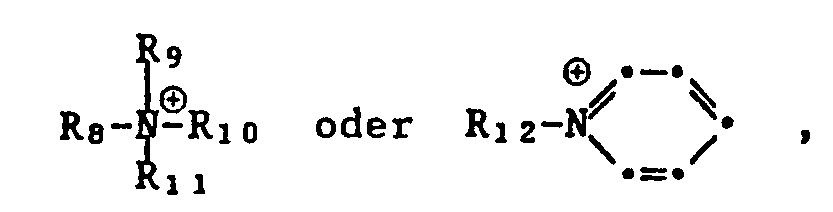
R8-R11 unabhängig voneinander Wasserstoff, C1-C20-Alkyl, Benzyl oder Phenyl und
R12 Wasserstoff oder C1-C20-Alkyl oder X⊕ insbesondere ein Kation der Alkalimetalle, (CH3)4N⊕, (C2H5)4N⊕, (n-C3H7)4N⊕, (i-C3H7)4N⊕, (n-C4H9)4N⊕,

- Wegen ihrer biologischen Wirkung insbesondere bevorzugt sind Verbindungen der Formel I, worin
Ri Fluor, Chlor oder Methoxy,
R2 bis R5 unabhängig voneinander Wasserstoff, Fluor, Chlor oder Methoxy,
R6 Wasserstoff,
R7 ein Phenyl substituiert durch ein oder mehrere Halogenatome, Halogenalkyl-, Halogenalkoxy- oder Dialkylaminogruppen oder durch einen durch ein oder mehrere Nitro, Halogen, Halogenalkyl oder Halogenalkoxy substituierten Phenoxy- oder Pyridyloxyrest oder durch die Gruppen
X⊕ Na⊕, K⊕, oder (CH3)4N⊕, (C2H5)4N⊕, CH3-(CH2)15-N⊕(CH3)3 oder (n-C4H9)4N⊕ bedeuten. - Beispiele von erfindungsgemässen Benzoylharnstoff-Salzen der Formel I sind u.a.:




- Die erfindungsgemässen Salze der Formel I werden in an sich bekannter Weise hergestellt, z.B. durch Umsetzen einer Verbindung der Formel II


- Die Salzbildung wird vorzugsweise bei Raumtemperatur und in Gegenwart eines Alkohols, vorzugsweise Methanol oder Aethanol, durchgeführt.
- Die Harnstoffe der Formel II sind bekannt oder können nach bekannten Methoden hergestellt werden.
- Ueberraschenderweise wurde gefunden, dass die vorliegenden Verbindungen der Formel I bei guter Pflanzenverträglichkeit und geringer Warmblütertoxizität ausgezeichnete Wirksamkeit als Schädlingsbekämpfungsmittel aufweisen. Sie eignen sich vor allem zur Bekämpfung von Pflanzen und Tiere befallenden Insekten und Vertretern der Ordnung Akarina.
- Insbesondere eignen sich die Verbindungen der Formel I zur Bekämpfung von Insekten der Ordnungen: Lepidoptera, Coleoptera, Homoptera, Heteroptera, Diptera, Thysanoptera, Orthoptera, Anoplura, Siphonaptera, Mallophaga, Thysanura, Isoptera, Psocoptera und Hymenoptera, sowie von Vertretern der Ordnung Akarina der Familien: Ixodidae, Argasidae, Tetranychidae und Dermanyssidae.
- Neben ihrer Wirkung gegenüber Fliegen, wie z.B. Musca domestica, und Mückenlarven können Verbindungen der Formel I auch zur Bekämpfung von pflanzenschädigenden Frassinsekten in Zier- und Nutzpflanzungen, insbesondere in Baumwollkulturen (z.B. Spodoptera littoralis und Heliothis virescens), sowie in Obst- und Gemüsekulturen (z.B. Laspeyresia pomonella, Leptinotarsa decemlineata und Epilachna varivestis) eingesetzt werden. Die Verbindungen der Formel I zeichnen sich durch eine ausgeprägte larvizide und ovo-larvizide Wirkung gegen Insekten, insbesondere Larven von fressenden Schadinsekten, aus. Werden Verbindungen der Formel I von adulten Insekten-Stadien mit dem Futter aufgenommen, so ist in vielen Fällen, insbesondere bei Coleopteren, wie z.B. Anthonomus grandis, eine verminderte Ei-Ablage und/oder reduzierte Schlupfrate festzustellen.
- Verbindungen der Formel I haben auch eine günstige Wirkung gegen Bodeninsekten (z.B. Aulacophora femoralis, Chortophila brassicae, Diabrotica balteata, Pachnoda savignyi und Scotia ypsilon).
- Die Verbindungen der Formel I können ferner zur Bekämpfung von Ektoparasiten, wie Zecken und Lucilia sericata, an Haus- und Nutztieren eingesetzt werden, z.B. durch Tier-, Stall- und Weidebehandlung.
- Die Verbindungen der Formel I eignen sich ferner zur Bekämpfung der folgenden Obst- und Gemüsekulturen befallenden Milbenspezies: Tetranychus urticae, Tetranychus cinnabarinus, Panonychus ulmi, Bryobia rubrioculus, Panonychus citri, Eriophyes piri, Eriophyes ribis, Eriophyes vitis, Tarsonemus pallidus, Phyllocoptes vitis und Phyllocoptruta oleivora.
- Die Verbindungen der Formel I können vorteilhaft als Beizmittel zur Behandlung von Saatgut und Vorrat (Früchte, Knollen, Körner) und Pflanzenstecklingen und zur Saatfurchenapplikation zum Schutz vor Pilzinfektionen und Insekten sowie gegen die im Erdboden auftretenden phytopathogenen Pilze und Insekten eingesetzt werden.
- Die gute pestizide Wirkung der erfindungsgemässen Verbindungen der Formel I entspricht einer Abtötungsrate (Mortalität) von mindestens 50-60 % der erwähnten Schädlinge.
- Die Wirkung der erfindungsgemässen Verbindungen bzw. der sie enthaltenden Mittel lässt sich durch Zusatz von anderen Insektiziden und/oder Akariziden wesentlich verbreitern und an gegebene Umstände anpassen. Als Zusätze kommen z.B. Vertreter der folgenden Wirkstoffklassen in Betracht: Organische Phosphorverbindungen, Nitrophenole und Derivate, Formamidine, Harnstoffe, Carbamate, Pyrethroide, chlorierte Kohlenwasserstoffe und Bacillus thuringiensis-Präparate.
- Die Verbindungen der Formel I werden in unveränderter Form oder vorzugsweise zusammen mit den in der Formulierungstechnik üblichen Hilfsmitteln eingesetzt und können daher z.B. zu Emulsionskonzentraten, direkt versprühbaren oder verdünnbaren Lösungen, verdünnten Emulsionen, Spritzpulvern, löslichen Pulvern, Stäubemitteln, Granulaten, auch Verkapselungen in z.B. polymeren Stoffen in bekannter Weise verarbeitet werden. Die Anwendungsverfahren, wie Versprühen, Vernebeln, Verstäuben, Verstreuen oder Giessen, werden ebenso wie die Mittel den angestrebten Zielen und den gegebenen Verhältnissen entsprechend gewählt.
- Die Salze der Formel 1 zeichnen sich nicht nur durch hohe akarizide und insektizide Wirkung, sondern auch durch gute Löslichkeit in Lösungs- und Verdünnungsmitteln sowie durch verbesserte Formulierbarkeit aus.
- Die Formulierung, d.h. die den Wirkstoff der Formel I, bzw. Kombinationen dieser Wirkstoffe mit anderen Insektiziden oder Akariziden, und gegebenenfalls einen festen oder flüssigen Zusatzstoff enthaltenden Mittel, Zubereitungen oder Zusammensetzungen, werden in bekannter Weise hergestellt, z.B. durch inniges Vermischen und/oder Vermahlen der Wirkstoffe mit Streckmitteln, wie z.B. mit Lösungsmitteln, festen Trägerstoffen, und gegebenenfalls oberflächenaktiven Verbindungen (Tensiden).
- Als Lösungsmittel können in Frage kommen: Aromatische Kohlenwasserstoffe, bevorzugt die Fraktionen C8 bis C12' wie z.B. Xylolgemische oder substituierte Naphthaline, Phthalsäureester, wie Dibutyl- oder Dioctylphthalat, aliphatische Kohlenwasserstoffe, wie Cyclohexan, Paraffine, Alkohole und Glykole sowie deren Aether und Ester, wie Aethanol, Aethylenglykol, Aethylenglykolmonomethyl- oder -äthyläther, Ketone, wie Cyclohexanon, stark polare Lösungsmittel, wie N-Methyl-2-pyrrolidon, Dimethylsulfoxid oder Dimethylformamid, sowie gegebenenfalls epoxidierte Pflanzenöle, wie epoxidiertes Kokosnussöl oder Sojaöl, oder Wasser.
- Als feste Trägerstoffe, z.B. für Stäubemittel und dispergierbare Pulver, werden in der Regel natürliche Gesteinsmehle verwendet, wie Calcit, Talkum, Kaolin, Montmorillonit oder Attapulgit. Zur Verbesserung der physikalischen Eigenschaften können auch hochdisperse Kieselsäuren oder hochdisperse saugfähige Polymerisate zugesetzt werden. Als gekörnte, adsorptive Granulatträger kommen poröse Typen, wie z.B. Bimsstein, Ziegelbruch, Sepiolit oder Bentonit, als nicht sorptive Trägermaterialien z.B. Calcit oder Sand in Frage. Darüberhinaus kann eine Vielzahl von granulierten Materialien anorganischer oder organischer Natur, wie insbesondere Dolomit oder zerkleinerte Pflanzenrückstände, verwendet werden.
- Als oberflächenaktive Verbindungen kommen je nach Art des zu formulierenden Wirkstoffes der Formel I oder der Kombinationen dieser Wirkstoffe mit andern Insektiziden oder Akariziden nichtionogene, kation- und/oder anionaktive Tenside mit guten Emulgier-, Dispergier- und Netzeigenschaften in Betracht. Unter Tensiden sind auch Tensidgemische zu verstehen.
- Geeignete anionische Tenside können sowohl sog. wasserlösliche Seifen als auch wasserlösliche synthetische oberflächenaktive Verbindungen sein.
- Als Seifen eignen sich die Alkali-, Erdalkali- oder gegebenenfalls substituierten Ammoniumsalze von höheren Fettsäuren (C10-C22), wie z.B. die Na- oder K-Salze der Oel- oder Stearinsäure, oder von natürlichen Fettsäuregemischen, die z.B. aus Kokosnuss- oder Tallöl gewonnen werden können. Ferner sind als Tenside auch die Fettsäure-methyl-taurin-salze sowie modifizierte und nicht modifizierte Phospholipide zu erwähnen.
- Häufiger werden jedoch sogenannte synthetische Tenside verwendet, insbesondere Fettsulfonate, Fettsulfate, sulfonierte Benzimidazolderivate oder Alkylarylsulfonate.
- Die Fettsulfonate oder -sulfate liegen in der Regel als Alkali-, Erdalkali- oder gegebenenfalls substituierte Ammoniumsalze vor und weisen im allgemeinen einen Alkylrest mit 8 bis 22 C-Atomen auf, wobei Alkyl auch den Alkylteil von Acylresten einschliesst, z.B. das Na- oder Ca-Salz der Ligninsulfonsäure, des Dodecylschwefelsäureesters oder eines aus natürlichen Fettsäuren hergestellten Fettalkoholsulfatgemisches. Hierher gehören auch die Salze der Schwefelsäureester und Sulfonsäuren von Fettalkohol-Aethylenoxid-Addukten. Die sulfonierten Benzimidazolderivate enthalten vorzugsweise 2 Sulfonsäuregruppen und einen Fettsäurerest mit etwa 8 - 22 C-Atomen. Alkylarylsulfonate sind z.B. die Na-, Ca- oder Triäthanolaminsalze der Dodecylbenzolsulfonsäure, der Dibutylnaphthalinsulfonsäure oder eines Naphthalinsulfonsäure-Formaldehydkondensationsproduktes. Ferner kommen auch entsprechende Phosphate, wie z.B. Salze des Phosphorsäureesters eines p-Nonylphenol-(4-14)-Aethylenoxid-Adduktes, in Frage.
- Als nichtionische Tenside kommen in erster Linie Polyglykolätherderivate von aliphatischen oder cycloaliphatischen Alkoholen, gesättigten oder ungesättigten Fettsäuren und Alkylphenolen in Frage, die 3 bis 30 Glykoläthergruppen und 8 bis 20 Kohlenstoffatome im (aliphatischen) Kohlenwasserstoffrest und 6 bis 18 Kohlenstoffatome im Alkylrest der Alkylphenole enthalten können. Weiterhin geeignete nichtionische Tenside sind die wasserlöslichen 20 bis 250 Aethylenglykoläthergruppen und 10 bis 100 Propylenglykoläthergruppen enthaltenden Polyäthylenoxid-Addukte an Polypropylenglykol, Aethylendiaminopolypropylenglykol und Alkylpolypropylenglykol mit 1 bis 10 Kohlenstoffatomen in der Alkylkette. Die genannten Verbindungen enthalten üblicherweise pro Propylenglykol-Einheit 1 bis 5 Aethylenglykoleinheiten. Als Beispiele nichtionischer Tenside seien Nonylphenolpolyäthoxy- äthanole, Ricinusölpolyglykoläther, Ricinusölthioxilat, Poly-propylen-Polyäthylenoxid-Addukte, Tributylphenoxypolyäthoxyäthanol, Polyäthylenglykol und Octylphenoxypolyäthoxyäthanol erwähnt. Ferner kommen auch Fettsäureester von Polyoxyäthylensorbitan, wie das Polyoxyäthylensorbitan-trioleat in Betracht.
- Bei den kationischen Tensiden handelt es sich vor allem um quaternäre Ammoniumsalze, welche als N-Substituenten mindestens einen Alkylrest mit 8 bis 22 C-Atomen enthalten und als weitere Substituenten niedrige, gegebenenfalls halogenierte Alkyl-, Benzyl- oder niedrige Hydroxyalkylreste aufweisen. Die Salze liegen vorzugsweise als Halogenide, Methylsulfate oder Aethylsulfate vor, z.B. das Stearyltrimethylammoniumchlorid oder das Benzyl-di-(2-chloräthyl)-äthylammoniumbromid.
- Die in der Formulierungstechnik gebräuchlichen Tenside sind u.a. in folgenden Publikationen beschrieben:
- "Mc Cutcheon's Detergents and Emulsifiers Annual" MC Publishing Corp., Ridgewood, New Jersey, 1979;
- Dr. Helmut Stache "Tensid Taschenbuch", Carl Hanser Verlag München/Wien 1981.
- Die pestiziden Zubereitungen enthalten in der Regel 0,1 bis 99 %, insbesondere 0,1 bis 95 %, Wirkstoff der Formel I oder Kombinationen dieser Wirkstoffe mit andern Insektiziden oder Akariziden, 1 bis 99,9 % eines festen oder flüssigen Zusatzstoffes und 0 bis 25 %, insbesondere 0,1 bis 20 %, eines Tensides. Während als Handelsware eher konzentrierte Mittel bevorzugt werden, verwendet der Endverbraucher in der Regel verdünnte Zubereitungen, die wesentlich geringere Wirkstoffkonzentrationen aufweisen.
- Die Mittel können auch weitere Zusätze wie Stabilisatoren, Entschäumer, Viskositätsregulatoren, Bindemittel, Haftmittel sowie Dünger oder andere Wirkstoffe zur Erzielung spezieller Effekte enthalten.
-
- a) Herstellung des Natriumsalzes vom N-(2,6-Difluorbenzoyl)-N'-[3,5-dichlor-4-(1',1',2',2'-tetrafluoräthoxy)-phenyl]-harnstoff.
9,2 g N-(2,6-Difluorbenzoyl)-N'-(3,5-dichlor-4-(1'-1',2',2'-tetra- fluoräthoxy)-phenyl]-harnstoff werden in 30 ml Methanol suspendiert. Unter Rühren wird zu dieser Suspension eine Lösung von 0,45 g Na in 20 ml Methanol zugetropft. Die Lösung wird noch 30 Minuten bei 20°C gerührt. Nach dem Abdestillieren des Methanols erhält man die Verbindung Nr. 1 der Formel
- b) Herstellung des Tetrabutylammoniumsalzes vom N-(2,6-Difluor- benzoyl)-N'[3,5-dichlor-4-(3'-chlor-5'-trifluormethylpyridyloxy-(2)-phenyl]-harnstoff.
5,4 g N-(2,6-Difluorbenzoyl)-N'-[3,5-dichlör-4-(3'-chlor-5'-trifluor-methylpyridyloxy-(2)-phenyl]-harnstoff werden in 60 ml Methanol suspendiert. In dieser Suspension wird unter Rühren bei 20°C eine Lösung von 2,6 g Tetrabutylammoniumhydroxid in Methanol (10,4 g einer 25%igen Lösung) getropft. Die entstandene klare Lösung wird 30 Minuten bei 20°C gerührt. Nach dem Abdestillieren des Methanols wird der Rückstand mit Hexan verrührt, das kristalline Produkt abgenutscht und im Vakuum bei 30°C getrocknet. Man erhält die Verbindung Nr. 2 der Formel
- Auf analoge Weise werden auch die folgenden Verbindungen der Formel I hergestellt:


- Beispiel 2: Formulierungsbeispiele für Wirkstoffe gemäss dem Herstellungsbeispiel 1 (% = Gewichtsprozent)

- Aus solchen Konzentraten können durch Verdünnen mit Wasser Emülsionen jeder gewünschten Konzentration hergestellt werden.

- Die Lösungen sind zur Anwendung in Form kleinster Tropfen geeignet.

- Der Wirkstoff wird in Methylenchlorid gelöst, auf den Träger aufgesprüht und das Lösungsmittel anschliessend im Vakuum abgedampft.

- Durch inniges Vermischen der Trägerstoffe mit dem Wirkstoff erhält man gebrauchsfertige Stäubemittel.

- Der Wirkstoff wird mit den Zusatzstoffen gut vermischt und in einer geeigneten Mühle gut vermahlen. Man erhält Spritzpulver, die sich mit Wasser zu Suspensionen jeder gewünschten Konzentration verdünnen lassen.
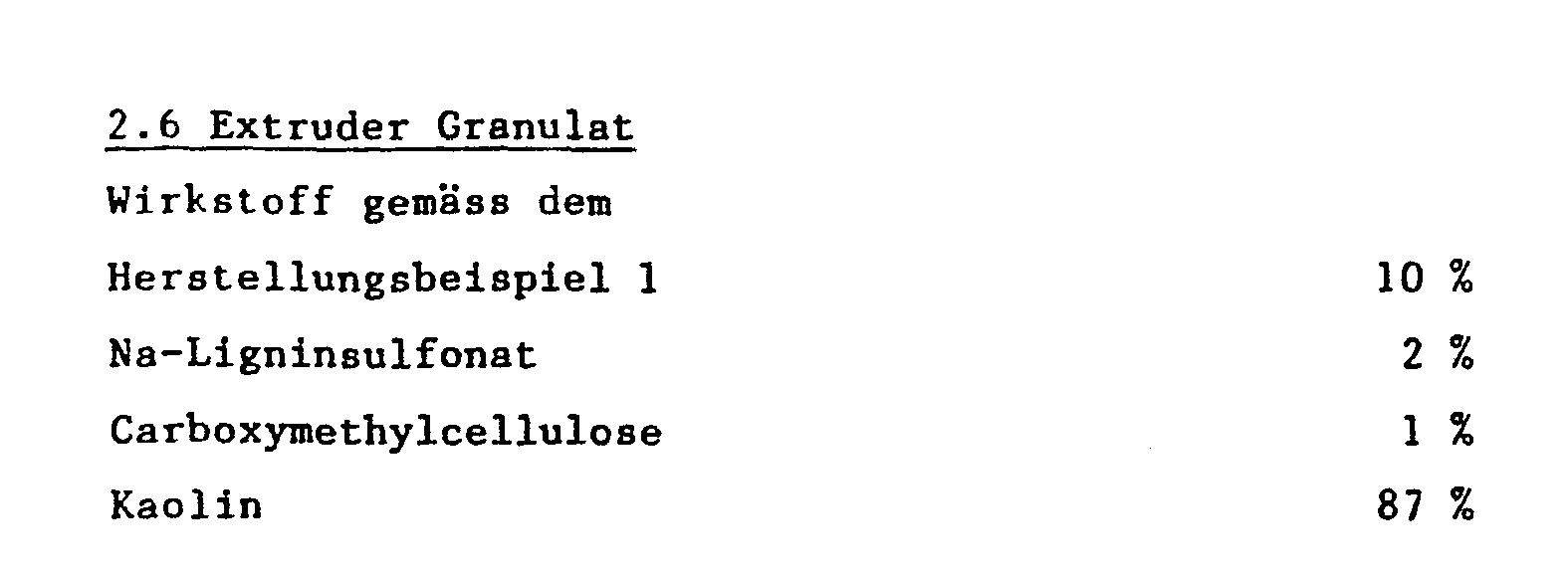
- Der Wirkstoff wird mit den Zusatzstoffen vermischt, vermahlen und mit Wasser angefeuchtet. Dieses Gemisch wird extrudiert und anschliessend im Luftstrom getrocknet.

- Der feingemahlene Wirkstoff wird in einem Mischer auf das mit Polyäthylenglykol angefeuchtete Kaolin gleichmässig aufgetragen. Auf diese Weise erhält man staubfreie Umhüllungs-Granulate.

- Der fein gemahlene Wirkstoff wird mit den Zusatzstoffen innig vermischt. Man erhält so ein Suspensions-Konzentrat, aus welchem durch Verdünnen mit Wasser Suspensionen jeder gewünschten Konzentration hergestellt werden können.
- Je 50 g frisch zubereitetes Nährsubstrat für Maden wird in Becher eingewogen. Von einer 1 gew.-%igen acetonischen Lösung des betreffenden Wirkstoffes wird eine bestimmte Menge auf das in den Bechern befindliche Nährsubstrat pipettiert, so dass sich eine Wirkstoffkonzentration von 800 ppm ergibt. Nach dem Durchmischen des Substrates lässt man das Aceton mindestens 20 Stunden lang verdampfen.
- Dann werden pro Wirkstoff je 25 eintägige Maden von Musca domestica in die das so behandelte Nährsubstrat enthaltenden Becher gegeben. Nachdem sich die Maden verpuppt haben, werden die gebildeten Puppen durch Ausschwemmen mit Wasser von dem Substrat abgetrennt und in mit Siebdeckeln verschlossenen Gefässen deponiert. Die pro Ansatz ausgeschwemmten Puppen werden gezählt (toxischer Einfluss des Wirkstoffes auf die Madenentwicklung). Dann wird nach 10 Tagen die Anzahl der aus den Puppen geschlüpften Fliegen bestimmt.
- Verbindungen der Formel I gemäss Beispiel 1 zeigen gute Wirkung in obigem Test.
- Zu 9 ml eines Zuchtmediums wird bei 50°C 1 ml einer 0,5 Gew.-% Aktivsubstanz enthaltenden wässrigen Zubereitung hinzugefügt. Nun werden ca. 30 frisch geschlüpfte Lucilia sericata-Larven zum Zuchtmedium gegeben, und nach 48 und 96 Stunden wird die insektizide Wirkung durch Ermittlung der Abtötungsrate festgestellt.
- Verbindungen der Formel 1 gemäss Beispiel 1 zeigen in diesem Test gute Wirkung gegen Lucilia sericata.
- Auf die Oberfläche von 150 ml Wasser, das sich in einem Behälter befindet, wird so viel einer 0,1 gew.-%igen acetonischen Lösung des Wirkstoffes pipettiert, dass eine Konzentration von 800 ppm erhalten wird. Nach Verdunsten des Acetons wird der Behälter mit 30 bis 40 2-tägigen Aëdes-Larven beschickt. Nach 1, 2 und 5 Tagen wird die Mortalität geprüft.
- Verbindungen der Formel I gemäss Beispiel 1 zeigen in diesem Test gute Wirkung gegen Aëdes aegypti.
- Ca. 25 cm hohe eingetopfte Baumwollpflanzen werden mit wässrigen Wirkstoffemulsionen besprüht, die den Wirkstoff jeweils in ansteigenden Konzentrationen bis zu 100 ppm enthalten.
- Nach dem Antrocknen des Sprühbelages werden die Baumwollpflanzen mit Spodoptera littoralis- bzw. Heliothis virescens-Larven im dritten larvalen Stadium besiedelt. Der Versuch wird bei 24°C und 60 % relativer Luftfeuchtigkeit durchgeführt. Nach 120 Stunden wird die Mortalität der Test-Insekten in Prozenten bestimmt.
- Eine Wirkung von 80 - 100 % (Mortalität) zeigen die Verbindungen Nr. 1, 2, 3, 22 und 23 bei 12,5 ppm gegen Spodoptera- und Heliothis-Larven.
- Etwa 15 - 20 cm hohe Phaseolus vulgaris-Pflanzen (Buschbohnen) werden mit wässrigen, den zu prüfenden Wirkstoff in einer Konzentration von 800 ppm enthaltenden Emulsions-Zubereitungen besprüht. Nach dem Antrocknen des Sprühbelages werden pro Pflanze 5 Larven von Epilachna varivestis (Mexikanischer Bohnenkäfer) im 4. larvalen Stadium angesetzt. Ueber die infestierten Pflanzen wird ein Plastikzylinder gestülpt, der mit einem Kupfer-Gazedeckel abgedeckt ist. Der Versuch wird bei 280C und 60 % relativer Luftfeuchtigkeit durchgeführt.
- Nach 2 und 3 Tagen wird die Mortalität in Prozenten bestimmt. Zur Auswertung hinsichtlich allfälligem Frass-Schaden (Antifeeding-Effekt), Entwicklungs- und Häutungsstörungen werden die Versuchstiere während weiterer 3 Tage beobachtet.
- Verbindungen der Formel I gemäss Beispiel 1 zeigen gute Wirkung in obigem Test.
- Entsprechende Mengenanteile einer benetzbaren pulverförmigen Formulierung, enthaltend 25 Gew.% des zu prüfenden Wirkstoffes, werden mit jeweils so viel Wasser vermischt, dass sich eine wässrige Emulsion mit einer Wirkstoffkonzentration von 800 ppm ergibt.
- In diese wirkstoffhaltigen Emulsionen werden eintägige Eigelege von Heliothis auf Cellophan während drei Minuten eingetaucht und dann auf Rundfilter abgenutscht. Die so behandelten Gelege werden in Petrischalen ausgelegt und in der Dunkelheit aufbewahrt. Nach 6 bis 8 Tagen wird die Schlupfrate im Vergleich zu unbehandelten Kontrollen festgestellt.
- Verbindungen der Formel 1 gemäss Beispiel 1 zeigen gute Wirkung in obigem Test.
- Abgelegte Eier von Laspeyresia pomonella, die nicht älter als 24 Stunden sind, werden auf Filterpapier für 1 Minute in eine acetonisch-wässrige Lösung, enthaltend 800 ppm des zu prüfenden Wirkstoffes, eingetaucht. Nach dem Antrocknen der Lösung werden die Eier in Petrischalen ausgelegt und bei einer Temperatur von 28°C belassen. Nach 6 Tagen wird der prozentuale Schlupf aus den behandelten Eiern bewertet und die Mortalität in Prozenten bestimmt.
- Verbindungen der Formel I gemäss Beispiel 1 zeigen gute Wirkung in obigem Test.
- Adulte Anthonomus grandis, die nach dem Schlupf nicht älter als 24 Stunden waren, werden in Gruppen zu jeweils 25 Käfern in Käfige mit Gitterwänden überführt. Die mit den Käfern besetzten Käfige werden sodann während 5 bis 10 Sekunden in eine acetonische Lösung, enthaltend 0,1 Gew.% des zu prüfenden Wirkstoffes, eingetaucht. Nachdem die Käfer wieder trocken sind, werden sie zur Kopulation und Eiablage in abgedeckte und Futter enthaltende Schalen eingesetzt. Abgelegte Eier werden zwei- bis dreimal wöchentlich mit fliessendem Wasser ausgeschwemmt, gezählt, durch zwei- bis dreistündiges Einlegen in ein wässriges Desinfektionsmittel desinfiziert und dann in Schalen, die eine geeignete Larvaldiät enthalten, deponiert. Nach 7 Tagen wird untersucht, ob sich aus den deponierten Eiern Larven entwickelt haben.
- Zur Ermittlung der Dauer des die Reproduktion beeinflussenden Effektes der zu prüfenden Wirkstoffe wird die Eiablage der Käfer während eines Zeitraums von etwa 4 Wochen überprüft. Die Bonitierung erfolgt anhand der Verminderung der Anzahl abgelegter Eier und der daraus geschlüpften Larven im Vergleich zu unbehandelten Kontrollen.
- Verbindungen der Formel I gemäss Beispiel 1 zeigen eine gute reproduktionsreduzierende Wirkung in obigem Test.
- Zwei eingetopfte Baumwollpflanzen im 6-Blattstadium werden jeweils mit einer wässrigen benetzungsfähigen Emulsions-Zubereitung enthaltend 400 ppm des zu prüfenden Wirkstoffes besprüht. Nach dem Antrocknen des Spritzbelages (nach etwa 1,5 Stunden) wird jede Pflanze mit 10 adulten Käfern (Anthonomus grandis) besiedelt. Plastikzylinder, deren obere Oeffnungen mit Gaze abgedeckt sind, werden dann über die behandelten, mit den Testtieren besiedelten Pflanzen gestülpt, um ein Abwandern der Käfer zu verhindern. Die so behandelten Pflanzen werden bei 25°C und etwa 60 % relativer Luftfeuchtigkeit gehalten. Die Auswertung erfolgt nach 2, 3, 4 und 5 Tagen unter Zugrundelegung der prozentualen Mortalität der eingesetzten Testtiere (% Rückenlage) sowie der Antifeedant-Wirkung gegenüber unbehandelten Kontrollansätzen.
- Verbindungen der Formel I gemäss Beispiel 1 zeigen gute Wirkung in obigem Test.
- Eingetopfte Chinakohlpflanzen (Topfgrösse 10 cm Durchmesser) im 4-Blatt-Stadium werden mit wässrigen Wirkstoffemulsionen besprüht, die den Wirkstoff in einer Konzentration von 0,8 ppm enthalten und auf den Pflanzen antrocknen.
- Nach zwei Tagen werden die behandelten Chinakohlpflanzen mit je 10 Plutella xylostella-Larven im zweiten larvalen Stadium besiedelt. Der Versuch wird bei 24°C und 60 % relativer Luftfeuchtigkeit im Dämmerlicht durchgeführt. Die Bonitur erfolgt nach 2 und 5 Tagen; es wird die %-Mortalität der Larven bestimmt.
- Verbindungen der Formel I gemäss Beispiel 1 zeigen gute Wirkung in obigem Test.
- Als Testtiere werden mit Blut vollgesogene adulte Weibchen der Rinderzecke Boophilus microplus verwendet. Es werden je 10 Zecken eines OP-resistenten Stammes (z.B. vom Biarra-Stamm) und eines normal empfindlichen Stammes (z.B. vom Yeerongpilly-Stamm) behandelt. Die Zecken werden auf mit Doppelklebeband bezogenen Platten fixiert und mit einer Baumwoll-Watteschicht bedeckt, auf die 5 ml einer wässrigen Emulsion bzw. Lösung enthaltend 800 ppm der zu untersuchenden Verbindung aufgetropft werden. Nach einer Einwirkungszeit von 1 Stunde wird die Watteschicht entfernt und die Zecken ca. 12 Stunden trocknen gelassen. Anschliessend werden die Zecken in einem klimatisierten Raum bei konstanten Bedingungen aufbewahrt (28°C und 90 % relative Luftfeuchtigkeit). Die Auswertung erfolgt nach drei Wochen. Es wird die %-Mortalität der Testtiere sowie die prozentuale Hemmung der Ablage von fertilen Eiern gegenüber unbehandelten Kontrollen ermittelt.
- Verbindungen der Formel I gemäss Beispiel 1 zeigen gute Wirkung in obigem Test.
Claims (17)

R1 bis R5 unabhängig voneinander Wasserstoff, Halogen oder C1-C6-Alkoxy,
R6 Wasserstoff oder CI-C6-Alkyl,
R7 gegebenenfalls substituiertes Phenyl, Naphthyl, Pyridyl, Pyridazyl, Pyrimidinyl oder Pyrazinyl und
X⊕ ein anorganisches oder organisches Kation bedeuten.
R1 Fluor, Chlor oder Methoxy,
R2 bis R5 unabhängig voneinander Wasserstoff, Fluor, Chlor oder Methoxy,
R6 Wasserstoff oder Methyl,
R7 gegebenenfalls substituiertes Phenyl und
X⊕ ein Kation der Alkalimetalle,

R8 bis R11 unabhängig voneinander Wasserstoff C1-C20-Alkyl, Benzyl oder Phenyl und
R12 Wasserstoff oder C1-C20-Alkyl bedeuten.
R1 Fluor, Chlor oder Methoxy,
R2 bis R5 unabhängig voneinander Wasserstoff, Fluor, Chlor oder Methoxy,
R6 Wasserstoff oder Methyl,
R7 gegebenenfalls substituiertes Phenyl und
X- ein Kation der Alkalimetalle oder (CH3)4N⊕, (C2H5)4N⊕, (n-C3H7)4N⊕, (i-C3H7)4N⊕, (n-C4H9)4N⊕,


R1 Fluor, Chlor oder Methoxy,
R2 bis R5 unabhängig voneinander Wasserstoff, Fluor, Chlor oder Methoxy,
R6 Wasserstoff,
R7 ein Phenyl substituiert durch ein oder mehrere Halogenatome, Halogenalkyl-, Halogenalkoxy- oder Dialkylaminogruppen, durch einen durch ein oder mehrere Nitro, Halogen, Halogenalkyl oder Halogenalkoxy substituierten Phenoxy- oder Pyridyloxyrest oder durch die Gruppen

und
X⊕ Na⊕, K⊕, oder (CH3)4N⊕, (C2H5)4N⊕, CH3-(CH2)15-N⊕(CH3)3 oder (n-C4H9)4N⊕ bedeuten.




Applications Claiming Priority (4)
| Application Number | Priority Date | Filing Date | Title |
|---|---|---|---|
| CH4640/85 | 1985-10-29 | ||
| CH464085 | 1985-10-29 | ||
| CH372286 | 1986-09-17 | ||
| CH3722/86 | 1986-09-17 |
Publications (2)
| Publication Number | Publication Date |
|---|---|
| EP0221847A2 true EP0221847A2 (de) | 1987-05-13 |
| EP0221847A3 EP0221847A3 (de) | 1988-03-23 |
Family
ID=25693704
Family Applications (1)
| Application Number | Title | Priority Date | Filing Date |
|---|---|---|---|
| EP86810475A Withdrawn EP0221847A3 (de) | 1985-10-29 | 1986-10-23 | Salze von Benzoylharnstoffen |
Country Status (7)
| Country | Link |
|---|---|
| EP (1) | EP0221847A3 (de) |
| KR (1) | KR870003976A (de) |
| AU (1) | AU6447186A (de) |
| BR (1) | BR8605258A (de) |
| DK (1) | DK515386A (de) |
| IL (1) | IL80460A0 (de) |
| ZW (1) | ZW21486A1 (de) |
Cited By (9)
| Publication number | Priority date | Publication date | Assignee | Title |
|---|---|---|---|---|
| EP0343110A1 (de) * | 1988-05-20 | 1989-11-23 | Ciba-Geigy Ag | Benzoylphenylharnstoffe |
| WO1995016354A1 (en) * | 1993-12-15 | 1995-06-22 | Ciba-Geigy Ag | Method of combating termites and other wood destructive insects |
| US5811461A (en) * | 1997-10-31 | 1998-09-22 | Dow Agrosciences Llc | Benzoylphenylurea insecticides and methods of using them to control cockroaches, ants, fleas, and termites |
| US5886221A (en) * | 1997-11-03 | 1999-03-23 | Dow Agrosciences Llc | Benzoylphenylurea insecticides and methods of using certain benzoylphenylureas to control cockroaches, ants, fleas, and termites |
| US5945453A (en) * | 1996-11-08 | 1999-08-31 | Dow Agrosciences Llc | Benzoylphenylurea insecticides to control cockroaches |
| US6040345A (en) * | 1996-11-08 | 2000-03-21 | Dow Agrosciences Llc | Benzoylphenylurea insecticides and methods of using them to control cockroaches |
| WO2000062617A1 (es) * | 1999-04-15 | 2000-10-26 | Consejo Superior De Investigaciones Cientificas | Metodo para controlar una plaga de tefritidos |
| WO2004007437A1 (de) * | 2002-07-11 | 2004-01-22 | Aventis Pharma Deutschland Gmbh | Harnstoff- und urethan-substituierte acylharnstoffe, verfahren zu deren herstellung und deren verwendung als arzneimittel |
| US7262220B2 (en) | 2002-07-11 | 2007-08-28 | Sanofi-Aventis Deutschland Gmbh | Urea- and urethane-substituted acylureas, process for their preparation and their use |
Family Cites Families (2)
| Publication number | Priority date | Publication date | Assignee | Title |
|---|---|---|---|---|
| EP0179022B1 (de) * | 1984-10-18 | 1990-11-07 | Ciba-Geigy Ag | Benzoylphenylharnstoffe |
| ATE63112T1 (de) * | 1985-10-14 | 1991-05-15 | Ciba Geigy Ag | Benzoylphenylharnstoffe. |
-
1986
- 1986-10-23 EP EP86810475A patent/EP0221847A3/de not_active Withdrawn
- 1986-10-27 ZW ZW214/86A patent/ZW21486A1/xx unknown
- 1986-10-28 BR BR8605258A patent/BR8605258A/pt unknown
- 1986-10-28 KR KR860009094A patent/KR870003976A/ko not_active Ceased
- 1986-10-28 DK DK515386A patent/DK515386A/da not_active Application Discontinuation
- 1986-10-28 AU AU64471/86A patent/AU6447186A/en not_active Abandoned
- 1986-10-30 IL IL80460A patent/IL80460A0/xx unknown
Cited By (12)
| Publication number | Priority date | Publication date | Assignee | Title |
|---|---|---|---|---|
| EP0343110A1 (de) * | 1988-05-20 | 1989-11-23 | Ciba-Geigy Ag | Benzoylphenylharnstoffe |
| WO1995016354A1 (en) * | 1993-12-15 | 1995-06-22 | Ciba-Geigy Ag | Method of combating termites and other wood destructive insects |
| US5945453A (en) * | 1996-11-08 | 1999-08-31 | Dow Agrosciences Llc | Benzoylphenylurea insecticides to control cockroaches |
| US6040345A (en) * | 1996-11-08 | 2000-03-21 | Dow Agrosciences Llc | Benzoylphenylurea insecticides and methods of using them to control cockroaches |
| US6221912B1 (en) | 1996-11-08 | 2001-04-24 | Dow Agrosciences Llc | Benzoylphenylurea insecticides and methods of using certain benzoylphenylureas to control cockroaches |
| US6245816B1 (en) | 1996-11-08 | 2001-06-12 | Ronald J. Spragia | Benzoylphenylurea insecticides and methods of using certain benzoylphenylureas to control ants |
| US5811461A (en) * | 1997-10-31 | 1998-09-22 | Dow Agrosciences Llc | Benzoylphenylurea insecticides and methods of using them to control cockroaches, ants, fleas, and termites |
| US5886221A (en) * | 1997-11-03 | 1999-03-23 | Dow Agrosciences Llc | Benzoylphenylurea insecticides and methods of using certain benzoylphenylureas to control cockroaches, ants, fleas, and termites |
| WO2000062617A1 (es) * | 1999-04-15 | 2000-10-26 | Consejo Superior De Investigaciones Cientificas | Metodo para controlar una plaga de tefritidos |
| WO2004007437A1 (de) * | 2002-07-11 | 2004-01-22 | Aventis Pharma Deutschland Gmbh | Harnstoff- und urethan-substituierte acylharnstoffe, verfahren zu deren herstellung und deren verwendung als arzneimittel |
| US7262220B2 (en) | 2002-07-11 | 2007-08-28 | Sanofi-Aventis Deutschland Gmbh | Urea- and urethane-substituted acylureas, process for their preparation and their use |
| US8247452B2 (en) | 2002-07-11 | 2012-08-21 | Sanofi-Aventis Deutschland Gmbh | Urea- and urethane-substituted acylureas, process for their preparation and their use |
Also Published As
| Publication number | Publication date |
|---|---|
| KR870003976A (ko) | 1987-05-06 |
| EP0221847A3 (de) | 1988-03-23 |
| ZW21486A1 (en) | 1987-09-23 |
| BR8605258A (pt) | 1987-07-28 |
| DK515386D0 (da) | 1986-10-28 |
| IL80460A0 (en) | 1987-01-30 |
| AU6447186A (en) | 1987-04-30 |
| DK515386A (da) | 1987-04-30 |
Similar Documents
| Publication | Publication Date | Title |
|---|---|---|
| EP0179022B1 (de) | Benzoylphenylharnstoffe | |
| EP0077759B1 (de) | Phenylharnstoffe | |
| EP0175649B1 (de) | Substituierte Carbodiimide | |
| EP0239535A2 (de) | N-Pyridyloxyphenyl-isothioharnstoffe, ihre Herstellung und Verwendung bei der Kontrolle von Schädlingen | |
| EP0179021A2 (de) | Benzoylphenylharnstoffe | |
| EP0300968B1 (de) | N-Benzoyl-N'-2,5-dihalogen-4-perfluoro-alkoxyphenylharnstoffe, ihre Herstellung und Verwendung bei der Kontrolle von Schädlingen | |
| EP0235089B1 (de) | N-Benzoyl-N'-phenylharnstoffe, ihre Herstellung und Verwendung bei der Kontrolle von Schädlingen | |
| EP0231152A2 (de) | Phenylbenzoylharnstoffe | |
| EP0219460B1 (de) | Benzoylphenylharnstoffe | |
| EP0055213B1 (de) | Phenylharnstoffe | |
| EP0098800B1 (de) | Carbaminsäureester | |
| EP0174274B1 (de) | Phenylbenzoylharnstoffe | |
| EP0138756A1 (de) | Neue Oxadiazine | |
| EP0138757B1 (de) | Oxalsäureanilide | |
| DE3827133A1 (de) | N-benzoyl-n'-2,3,5-trihalogen-4-halogenalkoxy-phenylharnstoffe, ihre herstellung und verwendung bei der kontrolle von schaedlingen | |
| EP0138772A1 (de) | Phenylcarboximidsäureester | |
| EP0290392B1 (de) | N-Benzoyl-N'-trihalogen-halogenalkoxy-phenylharnstoffe, ihre Herstellung und Verwendung bei der Kontrolle von Schädlingen | |
| EP0145662A2 (de) | Isothioharnstoffe | |
| DE3320534A1 (de) | Carbaminsaeureester | |
| EP0288432A1 (de) | Schädlingsbekämpfungsmittel | |
| EP0165903B1 (de) | Phenylbenzoylharnstoffe | |
| EP0065487B1 (de) | Phenylharnstoffderivat | |
| EP0398842A1 (de) | Hydrazid-derivate | |
| DE3241138A1 (de) | Phenylharnstoffe | |
| EP0101662A2 (de) | Benzoylparabansäuren |
Legal Events
| Date | Code | Title | Description |
|---|---|---|---|
| PUAI | Public reference made under article 153(3) epc to a published international application that has entered the european phase |
Free format text: ORIGINAL CODE: 0009012 |
|
| 17P | Request for examination filed |
Effective date: 19861025 |
|
| AK | Designated contracting states |
Kind code of ref document: A2 Designated state(s): AT BE CH DE ES FR GB IT LI NL |
|
| PUAL | Search report despatched |
Free format text: ORIGINAL CODE: 0009013 |
|
| AK | Designated contracting states |
Kind code of ref document: A3 Designated state(s): AT BE CH DE ES FR GB IT LI NL |
|
| 17Q | First examination report despatched |
Effective date: 19890724 |
|
| STAA | Information on the status of an ep patent application or granted ep patent |
Free format text: STATUS: THE APPLICATION HAS BEEN WITHDRAWN |
|
| 18W | Application withdrawn |
Withdrawal date: 19890819 |
|
| R18W | Application withdrawn (corrected) |
Effective date: 19890819 |
|
| RIN1 | Information on inventor provided before grant (corrected) |
Inventor name: DRABEK, JOZEF, DR. Inventor name: BOEGER, MANFRED |