EP0221211A1 - Use of secondary amide compounds for the manufacture of medicaments for the treatment of dermatological inflammation - Google Patents
Use of secondary amide compounds for the manufacture of medicaments for the treatment of dermatological inflammation Download PDFInfo
- Publication number
- EP0221211A1 EP0221211A1 EP85307531A EP85307531A EP0221211A1 EP 0221211 A1 EP0221211 A1 EP 0221211A1 EP 85307531 A EP85307531 A EP 85307531A EP 85307531 A EP85307531 A EP 85307531A EP 0221211 A1 EP0221211 A1 EP 0221211A1
- Authority
- EP
- European Patent Office
- Prior art keywords
- formula
- secondary amide
- hydroxy
- group
- substituents
- Prior art date
- Legal status (The legal status is an assumption and is not a legal conclusion. Google has not performed a legal analysis and makes no representation as to the accuracy of the status listed.)
- Granted
Links
- -1 secondary amide compounds Chemical class 0.000 title claims abstract description 66
- 206010061218 Inflammation Diseases 0.000 title claims abstract description 29
- 230000004054 inflammatory process Effects 0.000 title claims abstract description 29
- 238000011282 treatment Methods 0.000 title claims abstract description 11
- 239000003814 drug Substances 0.000 title claims abstract description 10
- 238000004519 manufacturing process Methods 0.000 title claims abstract description 6
- 125000004432 carbon atom Chemical group C* 0.000 claims abstract description 20
- 125000000217 alkyl group Chemical group 0.000 claims abstract description 14
- 125000001424 substituent group Chemical group 0.000 claims abstract description 14
- 125000001997 phenyl group Chemical group [H]C1=C([H])C([H])=C(*)C([H])=C1[H] 0.000 claims abstract description 13
- 150000003334 secondary amides Chemical class 0.000 claims abstract description 13
- 125000003118 aryl group Chemical group 0.000 claims abstract description 8
- 238000006243 chemical reaction Methods 0.000 claims abstract description 8
- 125000001072 heteroaryl group Chemical group 0.000 claims abstract description 8
- 125000003367 polycyclic group Chemical group 0.000 claims abstract description 8
- 125000005843 halogen group Chemical group 0.000 claims abstract description 6
- 125000004190 benzothiazol-2-yl group Chemical group [H]C1=C([H])C([H])=C2N=C(*)SC2=C1[H] 0.000 claims abstract description 5
- 125000003342 alkenyl group Chemical group 0.000 claims abstract description 4
- 125000000304 alkynyl group Chemical group 0.000 claims abstract description 4
- 125000000753 cycloalkyl group Chemical group 0.000 claims abstract description 4
- ISWSIDIOOBJBQZ-UHFFFAOYSA-N phenol group Chemical group C1(=CC=CC=C1)O ISWSIDIOOBJBQZ-UHFFFAOYSA-N 0.000 claims abstract description 4
- 125000000437 thiazol-2-yl group Chemical group [H]C1=C([H])N=C(*)S1 0.000 claims abstract description 4
- 150000008064 anhydrides Chemical class 0.000 claims abstract description 3
- 125000003178 carboxy group Chemical group [H]OC(*)=O 0.000 claims abstract description 3
- 125000004122 cyclic group Chemical group 0.000 claims abstract description 3
- 125000001160 methoxycarbonyl group Chemical group [H]C([H])([H])OC(*)=O 0.000 claims abstract description 3
- 125000002887 hydroxy group Chemical group [H]O* 0.000 claims abstract 10
- 125000004185 ester group Chemical group 0.000 claims abstract 2
- 125000002924 primary amino group Chemical group [H]N([H])* 0.000 claims abstract 2
- 239000000203 mixture Substances 0.000 claims description 34
- 125000002496 methyl group Chemical group [H]C([H])([H])* 0.000 claims description 3
- 125000000636 p-nitrophenyl group Chemical group [H]C1=C([H])C(=C([H])C([H])=C1*)[N+]([O-])=O 0.000 claims 3
- 125000001153 fluoro group Chemical group F* 0.000 claims 1
- 125000004108 n-butyl group Chemical group [H]C([H])([H])C([H])([H])C([H])([H])C([H])([H])* 0.000 claims 1
- 125000001280 n-hexyl group Chemical group C(CCCCC)* 0.000 claims 1
- 150000001875 compounds Chemical class 0.000 description 47
- CSCPPACGZOOCGX-UHFFFAOYSA-N Acetone Chemical compound CC(C)=O CSCPPACGZOOCGX-UHFFFAOYSA-N 0.000 description 37
- 239000000243 solution Substances 0.000 description 31
- 241001465754 Metazoa Species 0.000 description 25
- UOWIFEANNONTKY-UHFFFAOYSA-N 2-hydroxy-5-octanoyl-n-[3-(trifluoromethyl)phenyl]benzamide Chemical compound CCCCCCCC(=O)C1=CC=C(O)C(C(=O)NC=2C=C(C=CC=2)C(F)(F)F)=C1 UOWIFEANNONTKY-UHFFFAOYSA-N 0.000 description 15
- LFQSCWFLJHTTHZ-UHFFFAOYSA-N Ethanol Chemical compound CCO LFQSCWFLJHTTHZ-UHFFFAOYSA-N 0.000 description 15
- 210000005069 ears Anatomy 0.000 description 15
- 238000012360 testing method Methods 0.000 description 15
- 239000004615 ingredient Substances 0.000 description 14
- 238000000034 method Methods 0.000 description 14
- 210000003491 skin Anatomy 0.000 description 13
- 239000004166 Lanolin Substances 0.000 description 12
- 235000019388 lanolin Nutrition 0.000 description 12
- 229940039717 lanolin Drugs 0.000 description 12
- XLYOFNOQVPJJNP-UHFFFAOYSA-N water Substances O XLYOFNOQVPJJNP-UHFFFAOYSA-N 0.000 description 12
- 239000002674 ointment Substances 0.000 description 11
- 230000000699 topical effect Effects 0.000 description 10
- QGJOPFRUJISHPQ-UHFFFAOYSA-N Carbon disulfide Chemical group S=C=S QGJOPFRUJISHPQ-UHFFFAOYSA-N 0.000 description 9
- 241000699670 Mus sp. Species 0.000 description 9
- 239000006071 cream Substances 0.000 description 9
- 239000003995 emulsifying agent Substances 0.000 description 9
- 239000002904 solvent Substances 0.000 description 9
- HIYAVKIYRIFSCZ-CYEMHPAKSA-N 5-(methylamino)-2-[[(2S,3R,5R,6S,8R,9R)-3,5,9-trimethyl-2-[(2S)-1-oxo-1-(1H-pyrrol-2-yl)propan-2-yl]-1,7-dioxaspiro[5.5]undecan-8-yl]methyl]-1,3-benzoxazole-4-carboxylic acid Chemical compound O=C([C@@H](C)[C@H]1O[C@@]2([C@@H](C[C@H]1C)C)O[C@@H]([C@@H](CC2)C)CC=1OC2=CC=C(C(=C2N=1)C(O)=O)NC)C1=CC=CN1 HIYAVKIYRIFSCZ-CYEMHPAKSA-N 0.000 description 8
- 239000002253 acid Substances 0.000 description 8
- 239000002585 base Substances 0.000 description 8
- 239000000499 gel Substances 0.000 description 8
- 238000002156 mixing Methods 0.000 description 8
- 239000002453 shampoo Substances 0.000 description 8
- HIYAVKIYRIFSCZ-CVXKHCKVSA-N Calcimycin Chemical compound CC([C@H]1OC2([C@@H](C[C@H]1C)C)O[C@H]([C@H](CC2)C)CC=1OC2=CC=C(C(=C2N=1)C(O)=O)NC)C(=O)C1=CC=CN1 HIYAVKIYRIFSCZ-CVXKHCKVSA-N 0.000 description 7
- 201000004624 Dermatitis Diseases 0.000 description 7
- PEDCQBHIVMGVHV-UHFFFAOYSA-N Glycerine Chemical compound OCC(O)CO PEDCQBHIVMGVHV-UHFFFAOYSA-N 0.000 description 7
- 206010030113 Oedema Diseases 0.000 description 7
- 230000003110 anti-inflammatory effect Effects 0.000 description 7
- 239000000463 material Substances 0.000 description 7
- 239000000829 suppository Substances 0.000 description 7
- KBPLFHHGFOOTCA-UHFFFAOYSA-N 1-Octanol Chemical compound CCCCCCCCO KBPLFHHGFOOTCA-UHFFFAOYSA-N 0.000 description 6
- 238000009826 distribution Methods 0.000 description 6
- 229940099367 lanolin alcohols Drugs 0.000 description 6
- 239000002562 thickening agent Substances 0.000 description 6
- FBPFZTCFMRRESA-JGWLITMVSA-N D-glucitol Chemical compound OC[C@H](O)[C@@H](O)[C@H](O)[C@H](O)CO FBPFZTCFMRRESA-JGWLITMVSA-N 0.000 description 5
- JUJWROOIHBZHMG-UHFFFAOYSA-N Pyridine Chemical compound C1=CC=NC=C1 JUJWROOIHBZHMG-UHFFFAOYSA-N 0.000 description 5
- SKZKKFZAGNVIMN-UHFFFAOYSA-N Salicilamide Chemical class NC(=O)C1=CC=CC=C1O SKZKKFZAGNVIMN-UHFFFAOYSA-N 0.000 description 5
- 206010052428 Wound Diseases 0.000 description 5
- 208000027418 Wounds and injury Diseases 0.000 description 5
- 239000000443 aerosol Substances 0.000 description 5
- 125000003368 amide group Chemical group 0.000 description 5
- 230000015572 biosynthetic process Effects 0.000 description 5
- 239000003974 emollient agent Substances 0.000 description 5
- 150000004665 fatty acids Chemical group 0.000 description 5
- 239000006210 lotion Substances 0.000 description 5
- 230000009467 reduction Effects 0.000 description 5
- 239000007787 solid Substances 0.000 description 5
- 238000003786 synthesis reaction Methods 0.000 description 5
- 239000003981 vehicle Substances 0.000 description 5
- PAYRUJLWNCNPSJ-UHFFFAOYSA-N Aniline Chemical class NC1=CC=CC=C1 PAYRUJLWNCNPSJ-UHFFFAOYSA-N 0.000 description 4
- KFZMGEQAYNKOFK-UHFFFAOYSA-N Isopropanol Chemical compound CC(C)O KFZMGEQAYNKOFK-UHFFFAOYSA-N 0.000 description 4
- 239000007810 chemical reaction solvent Substances 0.000 description 4
- 230000032050 esterification Effects 0.000 description 4
- 238000005886 esterification reaction Methods 0.000 description 4
- 239000000194 fatty acid Substances 0.000 description 4
- 239000000865 liniment Substances 0.000 description 4
- 229910052751 metal Inorganic materials 0.000 description 4
- 239000002184 metal Substances 0.000 description 4
- 239000011505 plaster Substances 0.000 description 4
- 239000000344 soap Substances 0.000 description 4
- ZWVMLYRJXORSEP-UHFFFAOYSA-N 1,2,6-Hexanetriol Chemical compound OCCCCC(O)CO ZWVMLYRJXORSEP-UHFFFAOYSA-N 0.000 description 3
- HIXDQWDOVZUNNA-UHFFFAOYSA-N 2-(3,4-dimethoxyphenyl)-5-hydroxy-7-methoxychromen-4-one Chemical compound C=1C(OC)=CC(O)=C(C(C=2)=O)C=1OC=2C1=CC=C(OC)C(OC)=C1 HIXDQWDOVZUNNA-UHFFFAOYSA-N 0.000 description 3
- ALYNCZNDIQEVRV-UHFFFAOYSA-N 4-aminobenzoic acid Chemical compound NC1=CC=C(C(O)=O)C=C1 ALYNCZNDIQEVRV-UHFFFAOYSA-N 0.000 description 3
- 206010015150 Erythema Diseases 0.000 description 3
- LYCAIKOWRPUZTN-UHFFFAOYSA-N Ethylene glycol Chemical compound OCCO LYCAIKOWRPUZTN-UHFFFAOYSA-N 0.000 description 3
- IAYPIBMASNFSPL-UHFFFAOYSA-N Ethylene oxide Chemical compound C1CO1 IAYPIBMASNFSPL-UHFFFAOYSA-N 0.000 description 3
- 238000003547 Friedel-Crafts alkylation reaction Methods 0.000 description 3
- 239000004698 Polyethylene Substances 0.000 description 3
- DNIAPMSPPWPWGF-UHFFFAOYSA-N Propylene glycol Chemical compound CC(O)CO DNIAPMSPPWPWGF-UHFFFAOYSA-N 0.000 description 3
- HEMHJVSKTPXQMS-UHFFFAOYSA-M Sodium hydroxide Chemical compound [OH-].[Na+] HEMHJVSKTPXQMS-UHFFFAOYSA-M 0.000 description 3
- 239000000853 adhesive Substances 0.000 description 3
- 230000001070 adhesive effect Effects 0.000 description 3
- 150000001350 alkyl halides Chemical class 0.000 description 3
- 150000001412 amines Chemical class 0.000 description 3
- 125000000129 anionic group Chemical group 0.000 description 3
- 150000001555 benzenes Chemical group 0.000 description 3
- 229910052799 carbon Inorganic materials 0.000 description 3
- 235000014113 dietary fatty acids Nutrition 0.000 description 3
- MTHSVFCYNBDYFN-UHFFFAOYSA-N diethylene glycol Chemical compound OCCOCCO MTHSVFCYNBDYFN-UHFFFAOYSA-N 0.000 description 3
- 238000001035 drying Methods 0.000 description 3
- 239000003221 ear drop Substances 0.000 description 3
- 229940047652 ear drops Drugs 0.000 description 3
- 230000000694 effects Effects 0.000 description 3
- 231100000321 erythema Toxicity 0.000 description 3
- RTZKZFJDLAIYFH-UHFFFAOYSA-N ether Substances CCOCC RTZKZFJDLAIYFH-UHFFFAOYSA-N 0.000 description 3
- 239000003889 eye drop Substances 0.000 description 3
- 229940012356 eye drops Drugs 0.000 description 3
- 229930195729 fatty acid Natural products 0.000 description 3
- 239000011888 foil Substances 0.000 description 3
- 235000011187 glycerol Nutrition 0.000 description 3
- 238000010348 incorporation Methods 0.000 description 3
- 230000000236 ionophoric effect Effects 0.000 description 3
- 125000001570 methylene group Chemical group [H]C([H])([*:1])[*:2] 0.000 description 3
- 125000002950 monocyclic group Chemical group 0.000 description 3
- 210000004400 mucous membrane Anatomy 0.000 description 3
- 229940100662 nasal drops Drugs 0.000 description 3
- ZHCAAFJSYLFLPX-UHFFFAOYSA-N nitrocyclohexatriene Chemical group [O-][N+](=O)C1=CC=C=C[CH]1 ZHCAAFJSYLFLPX-UHFFFAOYSA-N 0.000 description 3
- 210000000056 organ Anatomy 0.000 description 3
- 239000003960 organic solvent Substances 0.000 description 3
- 229920000573 polyethylene Polymers 0.000 description 3
- 229960000581 salicylamide Drugs 0.000 description 3
- 239000006216 vaginal suppository Substances 0.000 description 3
- TYMLOMAKGOJONV-UHFFFAOYSA-N 4-nitroaniline Chemical compound NC1=CC=C([N+]([O-])=O)C=C1 TYMLOMAKGOJONV-UHFFFAOYSA-N 0.000 description 2
- QTBSBXVTEAMEQO-UHFFFAOYSA-M Acetate Chemical compound CC([O-])=O QTBSBXVTEAMEQO-UHFFFAOYSA-M 0.000 description 2
- 241000416162 Astragalus gummifer Species 0.000 description 2
- 229920000742 Cotton Polymers 0.000 description 2
- FBPFZTCFMRRESA-FSIIMWSLSA-N D-Glucitol Natural products OC[C@H](O)[C@H](O)[C@@H](O)[C@H](O)CO FBPFZTCFMRRESA-FSIIMWSLSA-N 0.000 description 2
- 208000002064 Dental Plaque Diseases 0.000 description 2
- 238000005863 Friedel-Crafts acylation reaction Methods 0.000 description 2
- 208000034693 Laceration Diseases 0.000 description 2
- 239000002841 Lewis acid Substances 0.000 description 2
- 206010028980 Neoplasm Diseases 0.000 description 2
- 241000700159 Rattus Species 0.000 description 2
- 230000010757 Reduction Activity Effects 0.000 description 2
- 229920001615 Tragacanth Polymers 0.000 description 2
- HFBMWMNUJJDEQZ-UHFFFAOYSA-N acryloyl chloride Chemical compound ClC(=O)C=C HFBMWMNUJJDEQZ-UHFFFAOYSA-N 0.000 description 2
- 208000038016 acute inflammation Diseases 0.000 description 2
- 230000006022 acute inflammation Effects 0.000 description 2
- VSCWAEJMTAWNJL-UHFFFAOYSA-K aluminium trichloride Chemical compound Cl[Al](Cl)Cl VSCWAEJMTAWNJL-UHFFFAOYSA-K 0.000 description 2
- 150000001448 anilines Chemical class 0.000 description 2
- 208000010668 atopic eczema Diseases 0.000 description 2
- 239000000440 bentonite Substances 0.000 description 2
- 229910000278 bentonite Inorganic materials 0.000 description 2
- SVPXDRXYRYOSEX-UHFFFAOYSA-N bentoquatam Chemical compound O.O=[Si]=O.O=[Al]O[Al]=O SVPXDRXYRYOSEX-UHFFFAOYSA-N 0.000 description 2
- 125000001246 bromo group Chemical group Br* 0.000 description 2
- CDQSJQSWAWPGKG-UHFFFAOYSA-N butane-1,1-diol Chemical compound CCCC(O)O CDQSJQSWAWPGKG-UHFFFAOYSA-N 0.000 description 2
- 239000003710 calcium ionophore Substances 0.000 description 2
- HIYAVKIYRIFSCZ-UHFFFAOYSA-N calcium ionophore A23187 Natural products N=1C2=C(C(O)=O)C(NC)=CC=C2OC=1CC(C(CC1)C)OC1(C(CC1C)C)OC1C(C)C(=O)C1=CC=CN1 HIYAVKIYRIFSCZ-UHFFFAOYSA-N 0.000 description 2
- 229940096529 carboxypolymethylene Drugs 0.000 description 2
- 125000002091 cationic group Chemical group 0.000 description 2
- MVPPADPHJFYWMZ-UHFFFAOYSA-N chlorobenzene Chemical compound ClC1=CC=CC=C1 MVPPADPHJFYWMZ-UHFFFAOYSA-N 0.000 description 2
- 229940110456 cocoa butter Drugs 0.000 description 2
- 235000019868 cocoa butter Nutrition 0.000 description 2
- 230000003247 decreasing effect Effects 0.000 description 2
- YSAVZVORKRDODB-WDSKDSINSA-N diethyl tartrate Chemical compound CCOC(=O)[C@@H](O)[C@H](O)C(=O)OCC YSAVZVORKRDODB-WDSKDSINSA-N 0.000 description 2
- 229940059082 douche Drugs 0.000 description 2
- 239000006196 drop Substances 0.000 description 2
- 150000002148 esters Chemical class 0.000 description 2
- CJAONIOAQZUHPN-KKLWWLSJSA-N ethyl 12-[[2-[(2r,3r)-3-[2-[(12-ethoxy-12-oxododecyl)-methylamino]-2-oxoethoxy]butan-2-yl]oxyacetyl]-methylamino]dodecanoate Chemical compound CCOC(=O)CCCCCCCCCCCN(C)C(=O)CO[C@H](C)[C@@H](C)OCC(=O)N(C)CCCCCCCCCCCC(=O)OCC CJAONIOAQZUHPN-KKLWWLSJSA-N 0.000 description 2
- 150000002191 fatty alcohols Chemical class 0.000 description 2
- 239000007789 gas Substances 0.000 description 2
- 229920000591 gum Polymers 0.000 description 2
- 125000000623 heterocyclic group Chemical group 0.000 description 2
- JYGXADMDTFJGBT-VWUMJDOOSA-N hydrocortisone Chemical compound O=C1CC[C@]2(C)[C@H]3[C@@H](O)C[C@](C)([C@@](CC4)(O)C(=O)CO)[C@@H]4[C@@H]3CCC2=C1 JYGXADMDTFJGBT-VWUMJDOOSA-N 0.000 description 2
- 238000001727 in vivo Methods 0.000 description 2
- CGIGDMFJXJATDK-UHFFFAOYSA-N indomethacin Chemical compound CC1=C(CC(O)=O)C2=CC(OC)=CC=C2N1C(=O)C1=CC=C(Cl)C=C1 CGIGDMFJXJATDK-UHFFFAOYSA-N 0.000 description 2
- 230000004968 inflammatory condition Effects 0.000 description 2
- 239000002555 ionophore Substances 0.000 description 2
- 150000007517 lewis acids Chemical class 0.000 description 2
- 239000003446 ligand Substances 0.000 description 2
- 229940040145 liniment Drugs 0.000 description 2
- 229940119073 medicated pad Drugs 0.000 description 2
- 239000000155 melt Substances 0.000 description 2
- 229920000609 methyl cellulose Polymers 0.000 description 2
- OSWPMRLSEDHDFF-UHFFFAOYSA-N methyl salicylate Chemical compound COC(=O)C1=CC=CC=C1O OSWPMRLSEDHDFF-UHFFFAOYSA-N 0.000 description 2
- 239000001923 methylcellulose Substances 0.000 description 2
- 235000010981 methylcellulose Nutrition 0.000 description 2
- 244000005700 microbiome Species 0.000 description 2
- 229910052757 nitrogen Inorganic materials 0.000 description 2
- 235000019271 petrolatum Nutrition 0.000 description 2
- 230000008569 process Effects 0.000 description 2
- UMJSCPRVCHMLSP-UHFFFAOYSA-N pyridine Natural products COC1=CC=CN=C1 UMJSCPRVCHMLSP-UHFFFAOYSA-N 0.000 description 2
- 239000000376 reactant Substances 0.000 description 2
- 230000035484 reaction time Effects 0.000 description 2
- WBHHMMIMDMUBKC-QJWNTBNXSA-M ricinoleate Chemical compound CCCCCC[C@@H](O)C\C=C/CCCCCCCC([O-])=O WBHHMMIMDMUBKC-QJWNTBNXSA-M 0.000 description 2
- 229940066675 ricinoleate Drugs 0.000 description 2
- 229960001860 salicylate Drugs 0.000 description 2
- 210000004761 scalp Anatomy 0.000 description 2
- 239000000600 sorbitol Substances 0.000 description 2
- 230000003637 steroidlike Effects 0.000 description 2
- 239000012085 test solution Substances 0.000 description 2
- 229940120293 vaginal suppository Drugs 0.000 description 2
- 229920001285 xanthan gum Polymers 0.000 description 2
- JNYAEWCLZODPBN-JGWLITMVSA-N (2r,3r,4s)-2-[(1r)-1,2-dihydroxyethyl]oxolane-3,4-diol Chemical compound OC[C@@H](O)[C@H]1OC[C@H](O)[C@H]1O JNYAEWCLZODPBN-JGWLITMVSA-N 0.000 description 1
- NGNBDVOYPDDBFK-UHFFFAOYSA-N 2-[2,4-di(pentan-2-yl)phenoxy]acetyl chloride Chemical compound CCCC(C)C1=CC=C(OCC(Cl)=O)C(C(C)CCC)=C1 NGNBDVOYPDDBFK-UHFFFAOYSA-N 0.000 description 1
- VHDBCRXSHLVFGR-UHFFFAOYSA-N 5-decanoyl-2-hydroxybenzoic acid Chemical compound CCCCCCCCCC(=O)C1=CC=C(O)C(C(O)=O)=C1 VHDBCRXSHLVFGR-UHFFFAOYSA-N 0.000 description 1
- NIXOWILDQLNWCW-UHFFFAOYSA-N Acrylic acid Chemical group OC(=O)C=C NIXOWILDQLNWCW-UHFFFAOYSA-N 0.000 description 1
- QGZKDVFQNNGYKY-UHFFFAOYSA-O Ammonium Chemical compound [NH4+] QGZKDVFQNNGYKY-UHFFFAOYSA-O 0.000 description 1
- 208000003014 Bites and Stings Diseases 0.000 description 1
- VEXZGXHMUGYJMC-UHFFFAOYSA-M Chloride anion Chemical compound [Cl-] VEXZGXHMUGYJMC-UHFFFAOYSA-M 0.000 description 1
- 206010012434 Dermatitis allergic Diseases 0.000 description 1
- 206010012442 Dermatitis contact Diseases 0.000 description 1
- 241000792859 Enema Species 0.000 description 1
- 238000005727 Friedel-Crafts reaction Methods 0.000 description 1
- 241001456088 Hesperocnide Species 0.000 description 1
- 241000238631 Hexapoda Species 0.000 description 1
- 206010020880 Hypertrophy Diseases 0.000 description 1
- OYHQOLUKZRVURQ-HZJYTTRNSA-N Linoleic acid Chemical compound CCCCC\C=C/C\C=C/CCCCCCCC(O)=O OYHQOLUKZRVURQ-HZJYTTRNSA-N 0.000 description 1
- 241000699666 Mus <mouse, genus> Species 0.000 description 1
- 229920003171 Poly (ethylene oxide) Polymers 0.000 description 1
- 229920001214 Polysorbate 60 Polymers 0.000 description 1
- GOOHAUXETOMSMM-UHFFFAOYSA-N Propylene oxide Chemical compound CC1CO1 GOOHAUXETOMSMM-UHFFFAOYSA-N 0.000 description 1
- NUQJULCGNZMBEF-UHFFFAOYSA-N Prostratin Natural products COC(=O)C12CC(C)C3(O)C(C=C(CO)CC4(O)C3C=C(C)C4=O)C1C2(C)C NUQJULCGNZMBEF-UHFFFAOYSA-N 0.000 description 1
- 201000004681 Psoriasis Diseases 0.000 description 1
- YGSDEFSMJLZEOE-UHFFFAOYSA-N Salicylic acid Natural products OC(=O)C1=CC=CC=C1O YGSDEFSMJLZEOE-UHFFFAOYSA-N 0.000 description 1
- 206010039793 Seborrhoeic dermatitis Diseases 0.000 description 1
- 206010040880 Skin irritation Diseases 0.000 description 1
- PMZURENOXWZQFD-UHFFFAOYSA-L Sodium Sulfate Chemical compound [Na+].[Na+].[O-]S([O-])(=O)=O PMZURENOXWZQFD-UHFFFAOYSA-L 0.000 description 1
- 206010042496 Sunburn Diseases 0.000 description 1
- 206010053615 Thermal burn Diseases 0.000 description 1
- FZWLAAWBMGSTSO-UHFFFAOYSA-N Thiazole Chemical compound C1=CSC=N1 FZWLAAWBMGSTSO-UHFFFAOYSA-N 0.000 description 1
- 241000159241 Toxicodendron Species 0.000 description 1
- 241000159243 Toxicodendron radicans Species 0.000 description 1
- GSEJCLTVZPLZKY-UHFFFAOYSA-N Triethanolamine Chemical compound OCCN(CCO)CCO GSEJCLTVZPLZKY-UHFFFAOYSA-N 0.000 description 1
- 235000009108 Urtica dioica Nutrition 0.000 description 1
- 208000032159 Vaginal inflammation Diseases 0.000 description 1
- 201000008100 Vaginitis Diseases 0.000 description 1
- 239000004164 Wax ester Substances 0.000 description 1
- ODUIXUGXPFKQLG-QWRGUYRKSA-N [2-(4-chloro-2-fluoroanilino)-5-methyl-1,3-thiazol-4-yl]-[(2s,3s)-2,3-dimethylpiperidin-1-yl]methanone Chemical group C[C@H]1[C@@H](C)CCCN1C(=O)C1=C(C)SC(NC=2C(=CC(Cl)=CC=2)F)=N1 ODUIXUGXPFKQLG-QWRGUYRKSA-N 0.000 description 1
- 239000002250 absorbent Substances 0.000 description 1
- 230000002745 absorbent Effects 0.000 description 1
- 238000010521 absorption reaction Methods 0.000 description 1
- 229940048299 acetylated lanolin alcohols Drugs 0.000 description 1
- 150000001252 acrylic acid derivatives Chemical class 0.000 description 1
- 230000009471 action Effects 0.000 description 1
- 239000004480 active ingredient Substances 0.000 description 1
- 150000001263 acyl chlorides Chemical class 0.000 description 1
- 150000001266 acyl halides Chemical class 0.000 description 1
- 239000000654 additive Substances 0.000 description 1
- 150000001298 alcohols Chemical class 0.000 description 1
- 229910052783 alkali metal Inorganic materials 0.000 description 1
- 150000008044 alkali metal hydroxides Chemical class 0.000 description 1
- 150000001340 alkali metals Chemical class 0.000 description 1
- 150000008055 alkyl aryl sulfonates Chemical class 0.000 description 1
- 230000029936 alkylation Effects 0.000 description 1
- 230000000844 anti-bacterial effect Effects 0.000 description 1
- 229940121363 anti-inflammatory agent Drugs 0.000 description 1
- 239000002260 anti-inflammatory agent Substances 0.000 description 1
- 210000000436 anus Anatomy 0.000 description 1
- 201000008937 atopic dermatitis Diseases 0.000 description 1
- 238000001266 bandaging Methods 0.000 description 1
- IOJUPLGTWVMSFF-UHFFFAOYSA-N benzothiazole Chemical group C1=CC=C2SC=NC2=C1 IOJUPLGTWVMSFF-UHFFFAOYSA-N 0.000 description 1
- 230000003115 biocidal effect Effects 0.000 description 1
- 230000036760 body temperature Effects 0.000 description 1
- 239000001273 butane Substances 0.000 description 1
- 201000011510 cancer Diseases 0.000 description 1
- 239000002775 capsule Substances 0.000 description 1
- 125000001589 carboacyl group Chemical group 0.000 description 1
- 239000000969 carrier Substances 0.000 description 1
- 150000001768 cations Chemical class 0.000 description 1
- 150000001841 cholesterols Chemical class 0.000 description 1
- 238000004040 coloring Methods 0.000 description 1
- 208000010247 contact dermatitis Diseases 0.000 description 1
- 238000007796 conventional method Methods 0.000 description 1
- 229920001577 copolymer Polymers 0.000 description 1
- 238000005520 cutting process Methods 0.000 description 1
- 231100000223 dermal penetration Toxicity 0.000 description 1
- 238000013461 design Methods 0.000 description 1
- XEYBRNLFEZDVAW-ARSRFYASSA-N dinoprostone Chemical compound CCCCC[C@H](O)\C=C\[C@H]1[C@H](O)CC(=O)[C@@H]1C\C=C/CCCC(O)=O XEYBRNLFEZDVAW-ARSRFYASSA-N 0.000 description 1
- 239000003937 drug carrier Substances 0.000 description 1
- 239000000975 dye Substances 0.000 description 1
- 230000002500 effect on skin Effects 0.000 description 1
- 230000005670 electromagnetic radiation Effects 0.000 description 1
- 230000001804 emulsifying effect Effects 0.000 description 1
- 239000007920 enema Substances 0.000 description 1
- 229940079360 enema for constipation Drugs 0.000 description 1
- 230000036566 epidermal hyperplasia Effects 0.000 description 1
- 210000002615 epidermis Anatomy 0.000 description 1
- 229960001617 ethyl hydroxybenzoate Drugs 0.000 description 1
- 235000010228 ethyl p-hydroxybenzoate Nutrition 0.000 description 1
- 239000004403 ethyl p-hydroxybenzoate Substances 0.000 description 1
- NUVBSKCKDOMJSU-UHFFFAOYSA-N ethylparaben Chemical compound CCOC(=O)C1=CC=C(O)C=C1 NUVBSKCKDOMJSU-UHFFFAOYSA-N 0.000 description 1
- 238000011156 evaluation Methods 0.000 description 1
- 210000001508 eye Anatomy 0.000 description 1
- 239000004744 fabric Substances 0.000 description 1
- 239000003205 fragrance Substances 0.000 description 1
- 150000004820 halides Chemical class 0.000 description 1
- 125000001188 haloalkyl group Chemical group 0.000 description 1
- 238000010438 heat treatment Methods 0.000 description 1
- 125000005842 heteroatom Chemical group 0.000 description 1
- 229960000890 hydrocortisone Drugs 0.000 description 1
- 238000007327 hydrogenolysis reaction Methods 0.000 description 1
- 239000005457 ice water Substances 0.000 description 1
- 238000000338 in vitro Methods 0.000 description 1
- 229960000905 indomethacin Drugs 0.000 description 1
- 230000008595 infiltration Effects 0.000 description 1
- 238000001764 infiltration Methods 0.000 description 1
- 230000002757 inflammatory effect Effects 0.000 description 1
- 239000003112 inhibitor Substances 0.000 description 1
- 230000005764 inhibitory process Effects 0.000 description 1
- 238000002347 injection Methods 0.000 description 1
- 239000007924 injection Substances 0.000 description 1
- 125000001449 isopropyl group Chemical group [H]C([H])([H])C([H])(*)C([H])([H])[H] 0.000 description 1
- 238000005304 joining Methods 0.000 description 1
- 210000000265 leukocyte Anatomy 0.000 description 1
- 125000005647 linker group Chemical group 0.000 description 1
- 229940049918 linoleate Drugs 0.000 description 1
- 239000007788 liquid Substances 0.000 description 1
- 230000001404 mediated effect Effects 0.000 description 1
- 229940103903 medicated shampoo Drugs 0.000 description 1
- 238000002844 melting Methods 0.000 description 1
- 230000008018 melting Effects 0.000 description 1
- 235000010270 methyl p-hydroxybenzoate Nutrition 0.000 description 1
- 239000004292 methyl p-hydroxybenzoate Substances 0.000 description 1
- 229960001047 methyl salicylate Drugs 0.000 description 1
- 229960002216 methylparaben Drugs 0.000 description 1
- 230000002297 mitogenic effect Effects 0.000 description 1
- YNAVUWVOSKDBBP-UHFFFAOYSA-O morpholinium Chemical compound [H+].C1COCCN1 YNAVUWVOSKDBBP-UHFFFAOYSA-O 0.000 description 1
- 238000000465 moulding Methods 0.000 description 1
- 210000000214 mouth Anatomy 0.000 description 1
- IJDNQMDRQITEOD-UHFFFAOYSA-N n-butane Chemical compound CCCC IJDNQMDRQITEOD-UHFFFAOYSA-N 0.000 description 1
- OFBQJSOFQDEBGM-UHFFFAOYSA-N n-pentane Natural products CCCCC OFBQJSOFQDEBGM-UHFFFAOYSA-N 0.000 description 1
- 239000007923 nasal drop Substances 0.000 description 1
- 239000006199 nebulizer Substances 0.000 description 1
- 210000001331 nose Anatomy 0.000 description 1
- HGASFNYMVGEKTF-UHFFFAOYSA-N octan-1-ol;hydrate Chemical compound O.CCCCCCCCO HGASFNYMVGEKTF-UHFFFAOYSA-N 0.000 description 1
- 239000011368 organic material Substances 0.000 description 1
- 229910052760 oxygen Inorganic materials 0.000 description 1
- FJKROLUGYXJWQN-UHFFFAOYSA-N papa-hydroxy-benzoic acid Natural products OC(=O)C1=CC=C(O)C=C1 FJKROLUGYXJWQN-UHFFFAOYSA-N 0.000 description 1
- 239000012188 paraffin wax Substances 0.000 description 1
- 235000019809 paraffin wax Nutrition 0.000 description 1
- 239000002304 perfume Substances 0.000 description 1
- 230000000737 periodic effect Effects 0.000 description 1
- 150000002989 phenols Chemical class 0.000 description 1
- FAIAAWCVCHQXDN-UHFFFAOYSA-N phosphorus trichloride Chemical compound ClP(Cl)Cl FAIAAWCVCHQXDN-UHFFFAOYSA-N 0.000 description 1
- 229920000642 polymer Polymers 0.000 description 1
- BITYAPCSNKJESK-UHFFFAOYSA-N potassiosodium Chemical compound [Na].[K] BITYAPCSNKJESK-UHFFFAOYSA-N 0.000 description 1
- 230000003389 potentiating effect Effects 0.000 description 1
- 239000002243 precursor Substances 0.000 description 1
- 238000002360 preparation method Methods 0.000 description 1
- 239000003755 preservative agent Substances 0.000 description 1
- 125000001453 quaternary ammonium group Chemical group 0.000 description 1
- 150000003254 radicals Chemical class 0.000 description 1
- 238000001953 recrystallisation Methods 0.000 description 1
- 229960004889 salicylic acid Drugs 0.000 description 1
- 208000008742 seborrheic dermatitis Diseases 0.000 description 1
- 238000007493 shaping process Methods 0.000 description 1
- 238000007086 side reaction Methods 0.000 description 1
- 208000017520 skin disease Diseases 0.000 description 1
- 231100000475 skin irritation Toxicity 0.000 description 1
- 230000036556 skin irritation Effects 0.000 description 1
- 238000003892 spreading Methods 0.000 description 1
- 230000007480 spreading Effects 0.000 description 1
- 230000000638 stimulation Effects 0.000 description 1
- 238000006467 substitution reaction Methods 0.000 description 1
- 229910052717 sulfur Inorganic materials 0.000 description 1
- 230000000475 sunscreen effect Effects 0.000 description 1
- 239000000516 sunscreening agent Substances 0.000 description 1
- 239000000725 suspension Substances 0.000 description 1
- 239000003826 tablet Substances 0.000 description 1
- 125000000999 tert-butyl group Chemical group [H]C([H])([H])C(*)(C([H])([H])[H])C([H])([H])[H] 0.000 description 1
- 230000001225 therapeutic effect Effects 0.000 description 1
- 230000036575 thermal burns Effects 0.000 description 1
- 230000000451 tissue damage Effects 0.000 description 1
- 231100000827 tissue damage Toxicity 0.000 description 1
- 231100000820 toxicity test Toxicity 0.000 description 1
- 238000011269 treatment regimen Methods 0.000 description 1
- KVSKGMLNBAPGKH-UHFFFAOYSA-N tribromosalicylanilide Chemical compound OC1=C(Br)C=C(Br)C=C1C(=O)NC1=CC=C(Br)C=C1 KVSKGMLNBAPGKH-UHFFFAOYSA-N 0.000 description 1
- 239000000717 tumor promoter Substances 0.000 description 1
- 210000001215 vagina Anatomy 0.000 description 1
- 239000001993 wax Substances 0.000 description 1
- 235000019386 wax ester Nutrition 0.000 description 1
Classifications
-
- A—HUMAN NECESSITIES
- A61—MEDICAL OR VETERINARY SCIENCE; HYGIENE
- A61L—METHODS OR APPARATUS FOR STERILISING MATERIALS OR OBJECTS IN GENERAL; DISINFECTION, STERILISATION OR DEODORISATION OF AIR; CHEMICAL ASPECTS OF BANDAGES, DRESSINGS, ABSORBENT PADS OR SURGICAL ARTICLES; MATERIALS FOR BANDAGES, DRESSINGS, ABSORBENT PADS OR SURGICAL ARTICLES
- A61L15/00—Chemical aspects of, or use of materials for, bandages, dressings or absorbent pads
- A61L15/16—Bandages, dressings or absorbent pads for physiological fluids such as urine or blood, e.g. sanitary towels, tampons
- A61L15/42—Use of materials characterised by their function or physical properties
- A61L15/44—Medicaments
-
- A—HUMAN NECESSITIES
- A61—MEDICAL OR VETERINARY SCIENCE; HYGIENE
- A61K—PREPARATIONS FOR MEDICAL, DENTAL OR TOILETRY PURPOSES
- A61K31/00—Medicinal preparations containing organic active ingredients
- A61K31/60—Salicylic acid; Derivatives thereof
-
- A—HUMAN NECESSITIES
- A61—MEDICAL OR VETERINARY SCIENCE; HYGIENE
- A61K—PREPARATIONS FOR MEDICAL, DENTAL OR TOILETRY PURPOSES
- A61K9/00—Medicinal preparations characterised by special physical form
- A61K9/0012—Galenical forms characterised by the site of application
- A61K9/0034—Urogenital system, e.g. vagina, uterus, cervix, penis, scrotum, urethra, bladder; Personal lubricants
- A61K9/0036—Devices retained in the vagina or cervix for a prolonged period, e.g. intravaginal rings, medicated tampons, medicated diaphragms
-
- A—HUMAN NECESSITIES
- A61—MEDICAL OR VETERINARY SCIENCE; HYGIENE
- A61L—METHODS OR APPARATUS FOR STERILISING MATERIALS OR OBJECTS IN GENERAL; DISINFECTION, STERILISATION OR DEODORISATION OF AIR; CHEMICAL ASPECTS OF BANDAGES, DRESSINGS, ABSORBENT PADS OR SURGICAL ARTICLES; MATERIALS FOR BANDAGES, DRESSINGS, ABSORBENT PADS OR SURGICAL ARTICLES
- A61L15/00—Chemical aspects of, or use of materials for, bandages, dressings or absorbent pads
- A61L15/16—Bandages, dressings or absorbent pads for physiological fluids such as urine or blood, e.g. sanitary towels, tampons
- A61L15/42—Use of materials characterised by their function or physical properties
- A61L15/46—Deodorants or malodour counteractants, e.g. to inhibit the formation of ammonia or bacteria
-
- A—HUMAN NECESSITIES
- A61—MEDICAL OR VETERINARY SCIENCE; HYGIENE
- A61L—METHODS OR APPARATUS FOR STERILISING MATERIALS OR OBJECTS IN GENERAL; DISINFECTION, STERILISATION OR DEODORISATION OF AIR; CHEMICAL ASPECTS OF BANDAGES, DRESSINGS, ABSORBENT PADS OR SURGICAL ARTICLES; MATERIALS FOR BANDAGES, DRESSINGS, ABSORBENT PADS OR SURGICAL ARTICLES
- A61L2300/00—Biologically active materials used in bandages, wound dressings, absorbent pads or medical devices
- A61L2300/40—Biologically active materials used in bandages, wound dressings, absorbent pads or medical devices characterised by a specific therapeutic activity or mode of action
- A61L2300/41—Anti-inflammatory agents, e.g. NSAIDs
Definitions
- This invention relates to the use of certain secondary amido compounds including certain salicylanilides for the manufacture of medicaments for the treatment of dermatological inflammation.
- EP-A-38191 describes compositions having antibacterial activity and which are particularly useful in controlling the growth of microorganisms associated with dental plaque comprising novel 5-acyl- salicylanilides including compounds used in this invention, of the formula:
- Z is a substituted phenyl ring of from 6 to 30 carbon atoms including substituents
- R is a substituted or unsubstituted alkyl or phenyl group of from 2 to 30 carbon atoms including substituents
- M is a radical selected from the group consisting of -C ⁇ N, -F, -NO 2 , -H, lower alkyl or lower haloalkyl.
- the secondary amido compounds used according to this invention for the manufacture of medicments for the treatment of dermatological inflammation are those of Formula I below: where the substituents -R, and -R 2 are -H, normal or branched chain or cyclic or fused ring polycyclic or non-fused ring polycyclic, alkyl, alkenyl, alkynyl, aryl or heteroaryl groups optionally containing further substituents thereon, said -R, and -R2 substituents comprising up to about 30 carbon atoms when taken together either attached directly to the phenyl ring or through a group with the proviso that at least one of -RI and -R2 is other than -H; and wherein -R 3 is selected from the group consisting of thiazol-2-yl, benzothiazol-2-yl and R 4 -substituted phenyl, ie.
- -R 4 is selected from the group consisting of -CH 2 R 5 , -OH, -COOH, the tautomeric pair and -CH 2 COOH, -COOCH 3 , -COOC 2 H 5 , -CH 2 COOCH 3 , -CH 2 COOC 2 H 5 , -N0 2 , -CX 1 X 2 X 3 wherein X,, X 2 and X 3 are halogen atoms, which can all be different halogen atoms or wherein two or more halogen atoms are alike, wherein -R s is -H, alkyl, cycloalkyl, or their unsaturated counterparts, aryl or heteroaryl comprising up to a total of about 24 carbon atoms, and Y is -OH or a phenolic group derived from the reaction of such - OH group with a carboxylic acid halide or anhydride.
- -R may simply be any aryl or heteroaryl group or -CH 2 -R 6 wherein -R, is -H or an attachment of up to 24 carbon atoms of the same description as - R, or -R 2 involving the same linking groups between itself and the methylene group directly attached to the amido nitrogen atom.
- alkyl can be straight or branched chain, eg. n-octyl, n-decyl or tert-butyl; cycloalkyl can be monocyclic, eg. fused polycyclic, eg. or non-fused polycyclic, eg.
- Each of the respective groups can bear one or more substituents such that -R, and -R 2 taken together contain collectively up to about 30 carbon atoms and -R3 contains up to about 25 carbon atoms.
- the medicaments for the treatment of dermatological inflammation may be manufactured by incorporating one or more compounds of Formula I into a pharmaceutically acceptable carrier vehicle which may be petroleum jelly, lanolin, paraffin wax, alkanols and mixtures thereof as well as other comparable vehicles noted in the Examples given below.
- a pharmaceutically acceptable carrier vehicle which may be petroleum jelly, lanolin, paraffin wax, alkanols and mixtures thereof as well as other comparable vehicles noted in the Examples given below.
- Alternative vehicles include, ointments, sticks, capsules and tablets, injection solutions or suspensions, other solutions, shampoos, soaps, creams, water, aerosol bases, medicated pads, medicated plasters, medicated bandages, medicated dressings, and medicated catamenial and non-catamential tampons.
- Incorporation of the compounds of Formula I in suitable carriers also results in ear drops, eye drops, nasal drops, anal and vaginal suppositories, enemas and douches as well as liniments, gels and lotions.
- the medicament is placed in intimate contact with the affected organ or is otherwise applied to the affected skin, mucous membrane or organ for a sufficient length of time to relieve inflammation with repeat applications as needed.
- inflammation in, for example, the ear, eye, nose, mouth, anus and vagina or any other affected organ or cavity is relieved.
- Topical application on the skin of the compounds of Formula I in the form eg. of ointments, sticks, shampoos, soaps, creams, water and other solutions, aerosol bases, medicated pads, medicated plasters, medicated bandages, medicated dressings, liniments, gels and lotions results in the relief of skin inflammation.
- Skin inflammation can be the result of various skin disorders such as eczema, psoriasis, seborrheic dermatitis, contact dermatitis, allergic dermatitis, reactions due to poison ivy, poison oak, stinging nettles, etc. Skin inflammation may also be caused by tissue damage resulting from ultraviolet or other electromagnetic radiation including sunburns, insect and kindred bites and stings as well as thermal burns.
- the preferred secondary amides of Formula I bear on the benzene ring at least one lipophilic substituent R, and/or R2 which imparts thereto a distribution coefficient in octanol/water greater than 4.5 and the substituted moieties -R.
- R lipophilic substituent
- R2 which imparts thereto a distribution coefficient in octanol/water greater than 4.5 and the substituted moieties -R.
- the term "distribution coefficient" of a composition as used herein is the Iog 10 P where P is the ratio of the concentration of the composition in octanol to the concentration of the composition in water in a two phase octanol-water system.
- a distribution coefficient of, for example, 5 therefore means that the ratio of the concentration of the compound in octanol to the concentration in water is 10 5 or 100,000 to 1.
- the distribution coefficient is a measure of the lipophilic character of the compound.
- the preferred compounds of Formula I are lipophilic as indicated by a distribution coefficient of greater than about 4.5. The distribution coefficient is however usually less than 10.
- n is an integer, preferably from 3 to 14, R, is as defined above and X is a covalent bond joining the alkyl group to the phenyl ring.
- R is an R 4 -substituted benzene ring
- R 4 -preferably is para -NO 2 , meta -COOC 2 H 5 or meta or para -CF,.
- Very small concentrations of a secondary amide of Formula I in an acceptable carrier vehicle are effective, with concentrations of about 0.1 micrograms per millilitre of carrier vehicle being sufficient in most cases.
- a very short contact time of eg. 10 seconds may be sufficient. If necessary, the contact time is extended to about 24 hours. Also, if necessary, such topical application is repeated, as needed.
- lower alkyl as used herein means alkyl of from 1 to 4 carbon atoms.
- R x is n-C 7 in the case of APCF3-8 and AMCF3-8. It is n-C, in the case of AN-10. It is n-C., n-C, and n-C 15 in the cases involving ACBXE-9, ABC-4 and RV-19 respectively.
- the Friedel-Crafts acylation step is replaced by a Friedel-Crafts alkylation process by substituting the acid chloride R x- CO-CI by a normal alkyl halide R x CI.
- R x is C 6 and C 4 respectively.
- R 3 is a substituted benzene ring or a thiazole or a benzothiazole ring.
- the substituents may be -NO 2 in a para position or -COOC 2 H 5 in a meta position or -CF, in either a para or a meta position.
- esterification of AN-10 with acryloyl chloride in pyridine or other base results in the esterified product, ie. acryloyl AN-10.
- the 5-acyl or 5-alkyl salicylic acid precursor is prepared in a medium or reaction solvent which is customarily considered suitable for conducting a Friedel-Crafts acylation or alkylation with optimal yield, minimal side reactions, non-onerous reaction conditions and minimal reaction time.
- a preferred reaction solvent is carbon disulfide.
- Anhydrous aluminium chloride or other Lewis acid is initially added to the carbon disulfide and the mixture is cooled, eg. with ice.
- a chloride (or an alkyl halide as applicable) in carbon disulfide or other reaction solvent is then slowly added and the temperature is maintained below about 10°C.
- the reaction mass is poured into ice water and the mixture is then extracted with a suitable solvent such as ether.
- the ether or other extract is washed with water and then dried over anhydrous sodium sulfate. Thereafter, the ether or other solvent is evaporated in vacuo.
- the resulting solid residue is dissolved in a suitable solvent such as ethanol and treated with a solution of an alkali metal hydroxide, eg. 2N NaOH solution. After heating to a temperature of between about 80 and 120°C., eg.
- the 5-acyl or 5-alkyl salicyclic acid is reacted with the appropriate substituted aniline or other amine, eg. p-nitroaniline in the case of AN-10, in a suitable reaction solvent such as chlorobenzene.
- a suitable reaction solvent such as chlorobenzene.
- the 5-acyl or 5-alkylsalicylic acid is pre-reacted with phosphorus trichloride in the solvent at a suitable temperature, eg. between about 55°C and about 80°C.
- the reaction time is usually between about one and about five hours.
- the solution is then cooled and the appropriate substituted aniline or heterocylic amine, eg. p-nitroaniline is then added and the solution is again heated to a suitable temperature, eg.
- Example 3 of EP-A-38191 describes toxicity tests for AN-10 performed upon sixteen female white rats of average weight 265 gms. Example 3 concludes with the finding that LD50 for AN-10 by the single dose oral route is greater than 2000 mg/kg in Osborne-Mendel white rats.
- Said compound has been found in in vivo tumor promotion studies involving topical application thereof of mice backs to have potent ability to cause skin irritation with white blood cell infiltration, erythema (skin reddening), edema, epidermal hypertrophy and subsequent epidermal hyperplasia.
- erythema skin reddening
- edema epidermal hypertrophy and subsequent epidermal hyperplasia.
- Marks, F, Furstenberger, G, and Kownatzki, E "Prostaglandin E-mediated Mitogenic Stimulation of Mouse Epidermis in vivo by divalent cation ionophore A-23187 and by tumor promoter t2-0-tetradecanoyl phorbol-13-acetate, Cancer Res., 41, 696, 1981.
- each animal only one ear is treated, the other untreated ear serving as a control.
- Acute inflammation develops on treated mice ears within 4 hours following topical application of A-23187, showing both time and dose dependencies.
- Topical application of steroidal (hydrocortisone) and non-steroidal (indomethacin) anti-inflammatory compositions 30 minutes after application of said ionophore causes reduction of inflammation.
- Example 1 the compounds AN-10, APCF3-8 and AMCF3-8, respectively, are topically applied to the treated ears of different groups of five male outbred hairless mice 30 minutes following the topical application thereto of the ionophore A-23187.
- 1.5 micromole of the amido compound in acetone solution (total volume 10 microlitres) is applied topically to treated male outbred hairless mice ears 30 min after topical application thereto of a calcium ionophore (A-23187, 4.0 nmole total volume to 10 microlitre) in acetone.
- A-23187 calcium ionophore
- each animal serves as its own control in that only one ear is subjected to said test regime while the other ear is left untouched. Erythema and edema are assessed 4 hours after application of the ionophore.
- TBS 3,4',5-tribromosalicylanilide
- TBS is structurally very similar to the compounds of Formula I wherein -R, and -R. are each -Br and -R, is a para-bromo substituted benzene ring.
- Acute inflammation is induced by the application of 4 nano mole of the antibiotic A-23187 to the ears of young, male, adult hairless outbred mice (Skh:hr-1 strain). Thereafter, one of the compounds AN-10, AMCF3-8, ACBXE-9, acryloyl AN-10, S-4-F and SAN-6 is applied to the affected ears and the degree of reduction in edema (inflammation) noted.
- test animals are assigned to different treatment groups in which each ear of an animal receives the same assigned treatment, ie. the test animals of the present Examples do not serve as their own controls as they do in the preceding four Examples.
- the objective parameter of ear weights is used as the sole data source (for the reduction of edema) as erythematous responses are not recorded.
- Ear weights are determined by sacrificing the animals four hours after initial application of the antibiotic A-23187 or other control material by the use of C02 gas. Thereafter, the ears are excised by cutting along the characteristic ridge readily discernible along the inner aspect of the ears. Wet and dry ear weights are used to determine the extent of the edema or inflammation present.
- test animals are randomised into four treatment groups of seven each and subjected to the following ear treatment regimen:
- Each animal is dosed with a treatment consisting of a 10 microlitre quantity of the assigned test material solution (or pure acetone in the case of the animals of Group D) applied to the outer aspect of both ears, ie. 20 microlitre of test material per ear.
- concentrations of the respective materials in acetone solution are such that a 10 microlitre dose of a solution of the antibiotic A-23187 contains 4 nano mole of such antibiotic.
- the corresponding quantity in the case of the AN-10 in acetone solution is 1.5 micromole.
- the animals of Groups A and B are initially treated with the acetone solution of A-23187.
- a second group of studies (Study B) is conducted on two consecutive days with two sets of mice - (totalling 80 animals) received from the same shipment.
- the first batch of 40 animals is divided into 8 groups of 5 each.
- the six salicylamides AN-10, AMCF3-8, ACBXE-9, acryloyl AN-10, S-4-F and SAN-6 are applied as test solutions to the untreated ears of each group of 5 animals to ascertain whether or not any of the compounds possesses inflammatory potential.
- the remaining two groups of 5 animals each serve as controls and their ears are dosed with A-23187 and acetone respectively.
- the respective quantities of the test and control materials and the method of administration is identical with that described for Study A. It is found that none of the six compounds being tested cause any noticeable inflammation.
- mice On Day 2, using the second set of 40 mice, sub-divided into 8 groups of 5 each, the six compounds in question are applied as acetone solutions in the manner described under Study A to mice ears inflamed with A-23187 again, as described in Study A above. As with the studies conducted on Day 1, the remaining two groups of 5 animal each serve as controls and their ears are dosed with A-23187 and acetone respectively.
- each salicylamide compound applied is kept constant, for Days 1 and 2, at 1.5 micromole per 10 microlitre of test solution. Sacrifice begins four hours after application of A-23187, on both days, and the results are recorded. Table 2 summarises the results of the regimen of testing involved with each one of the 30 animals in question on Day 2 with the remaining 10 animals serving as controls as already noted. Table 2 shows the reduction in edema observed with the use of each one of the six salicylamide compounds tested.
- An ointment is prepared incorporating the compound AN-10 as an active ingredient.
- the ointment comprises the respective ingredients in the percentages shown below:
- AN-10 is substituted by an equivalent quantity of any one of the compounds of Formula I, eg. APCF3-8, AMCF3-8, ACBXE-9, acryloyl AN-10, S-4-F and SAN-6 as well as mixtures thereof to form comparable ointments.
- the resulting ointment is applied on the skin to relieve an inflammatory condition thereof in sufficient amount to cause the spreading of 0.01 microgram to 500 microgram of the active compound per square centimetre of the dermal area affected.
- the resulting ointment is applied to the skin to relieve inflammation caused by a painful skin condition in the manner described in Example 12.
- the secondary amides may also be used according to the invention for the manufacture of medicaments in a solid form.
- Such forms have use as a stick-type composition intended for application to the lips or other parts of the body.
- Such compositions consist essentially of from 0.001% to 10%, preferably 0.01% to 5% of a compound of Formula 1, eg. acryloyl AN-10, and from 50% to 98%, preferably 60% to 90% of an emollient.
- This composition can further consist essentially of from 1% to 20%, preferably 5% to 15%, of a suitable thickening agent, and optionally emulsifiers and water.
- Thickening agents include without limitation: cross-linked carboxy polymethylene polymers, methylcellulose, gum tragacanth, gum kharaya, xanthan gums and bentonite.
- Suitable emulsifiers are of a nonionic, anionic or cationic variety.
- nonionic emulsifiers include fatty alcohols having 10 to 20 carbon atoms, fatty alcohols having 10 to 20 carbon atoms condensed with 2 to 20 moles of ethylene oxide or propylene oxide, alkyl phenols with 6 to 12 carbon atoms in the alkyl chain condensed with 2 to 20 moles of ethylene oxide, mono-and di-fatty acid esters of ethylene glycol wherein the fatty acid moiety contains from 10 to 20 carbon atoms, fatty acid monoglycerides wherein the fatty acid moiety contains from 10 to 20 carbon atoms, diethylene glycol, glycerol, sorbitol, sorbitan, polyoxyethylene sorbitol, polyoxyethylene sorbitan, and hydrophilic wax esters.
- Suitable anionic emulsifiers include the fatty acid soaps, eg. sodium potassium and triethanolamine soaps, wherein the fatty acid moiety contains from 10 to 20 carbon atoms.
- Other suitable anionic emulsifiers include the alkali metal, ammonium or substituted ammonium alkyl sulfates, alkyl arylsulfonates, and alkyl ethoxy ether sulfonates having 10 to 30 carbon atoms in the alkyl moiety.
- the alkyl ethoxy ether sulfonates contain from 1 to 50 ethylene oxide units.
- Satisfactory cationic emulsifiers are the quaternary ammonium, morpholinium and pyridinium compounds. Certain of the emollients noted below also have emulsifying properties.
- Suitable emollients include lanolin and its derivatives, namely: lanolin, lanolin oil, lanolin wax, lanolin alcohols, lanolin fatty acids, isopropyl lanolate, ethoxylated lanolin, ethoxylated lanolin alcohols, ethoxylated cholesterol, propoxylated lanolin alcohols, acetylated lanolin acetylated lanolin alcohols, lanolin alcohols linoleate, lanolin alcohols ricinoleate, acetate of lanolin alcohols ricinoleate, acetate of ethoxylated alcohols - esters, hydrogenolysis products of lanolin, ethoxylated hydrogenated lanolin, ethoxylated sorbitol lanolin, and liquid and semi-solid lanolin absorption bases.
- lanolin and its derivatives namely: lanolin, lanolin oil, lanolin wax, lanolin alcohol
- Additives commonly found in topical compositions such as preservatives, eg. methyl and ethyl paraben, dyes and perfume are advantageously included in any of the afore-mentioned compositions.
- An exemplary solid stick according to this invention containing one or more of the compounds of Formula I is prepared by shaping and molding the following ingredients:
- a medicament for the treatment of dermatological inflammation may also be formulated in a solution form.
- the solution form of the composition consists essentially of from 0.001% to 10%, preferably 0.01% to 5% of a compound of Formula I, eg. ACBXE-9. and the balance being a suitable organic solvent.
- Suitable organic materials useful as the solvent or a part of a solvent system are as follows: propylene glycol, glycerine, ethanol, sorbitol esters, 1,2,6-hexanetriol, isopropanol, diethyl tartrate, butanediol, and mixtures thereof.
- solvent systems can also contain water.
- the solution is applied to the affected skin in substantially the same manner as that described for the ointment of Example 12.
- Example 15 The solution of Example 15 is incorporated in a closed metal container fitted with an aerosol cap and pressurised using conventional methods up to 100 psi pressure with butane gas.
- the resulting aerosol is used as a convenient method of administering an anti-inflammatory composition comprising one or more compounds of Formula I, eg. ACBXE-9, for the relief of painful skin conditions.
- the composition of the aerosol is applied to the affected area of the skin at periodic intervals for the relief of inflammation , and preferably every four to twelve hours.
- a medicament may also be formulated in a cream form.
- the creams consist essentially of from 0.001% to 10%, preferably 0.01% to 5% of a compound or compounds of Formula I, eg. S-4-F, from 5% to 50%, preferably 10% to 25% of an emollient, and the balance water.
- the emollients described above with respect to the medicaments in a stick form are equally suitable herein.
- the cream form contains a suitable emulsifier.
- the emulsifiers described in Example 14 above are also equally suitable herein. When an emulsifier is included, it is in the composition at a level from about 2% to about 10%, preferably 5%.
- a cream is prepared by mixing together the following ingredients:
- the resulting cream is applied to the skin to relieve inflammation in the same manner as that described for the ointment of Example 12.
- a lotion is prepared incorporating one or more compounds of Formula I, eg. SAN-6 by mixing together the following ingredients in the stated percentages on a wt/wt basis:
- the above lotion contains 5% of a sun screen, eg. para- amino benzoic acid or PABA at the expense of the water ingredient.
- a sun screen eg. para- amino benzoic acid or PABA
- the resulting lotion is topically applied to relieve inflammation of the skin in the same manner as that described for the cream of Example 17.
- One or more compounds of Formula I are formulated into a gel form by simply admixing a suitable thickening agent with the above-described solution composition of Example 15.
- suitable thickening agents include: cross-linked carboxy polymethylene copolymers, methyl cellulose, gum tragacanth, gum kharaya, xanthan gums and bentonite.
- the gelled compositions consist essentially of from 0.001% to 10%, preferably 0.01% to 5% of a compound or compounds of Formula I, from 5% to 75% preferably 10% to 50% of an organic solvent, 0.5% to 20%, preferably 1% to 10% of the aforementioned thickening agent, the balance being water.
- Suitable organic solvents include without limitation glycerine, sorbitol esters, 1,2,6-hexanetriol, ethanol, isopropanol, diethyl tartrate, butanediol, and mixtures thereof.
- a gel is prepared by mixing together the following ingredients:
- the resulting gel is applied to the skin to relieve inflammation in the same manner as that described for the cream of Example 17 noted above.
- a liniment is prepared from a gel composition of Example- 19.
- the resulting liniment is applied to the skin to relieve inflammation in the same manner as that noted for the gel of Example 19.
- One or more compounds of Formula I, such as AMCF3-8 is incorporated in a suppository for intraanal use.
- a suppository is prepared by mixing together the following ingredients in the weight ratios shown:
- Said suppository is prepared by melting the cocoa butter base at a temperature of about 39°C and adding the remaining ingredients, including AMCF3-8 to the melt, with blending, to provide a homogeneous system.
- the cocoa butter based resulting melt is poured into moulds of appropriate dimensions and allowed to solidify.
- the resulting product is a lubricious suppository which melts at body temperature to release the AMCF3-8 or other salicylamide compound to provide improved anti-inflammatory benefits.
- Intraanal administration of the resulting suppository is effective in relieving inflammation. The application is repeated as necessary.
- vaginal suppository is made generally following the procedure described above in Example 21 for making an anal suppository.
- the vaginal suppository has the composition noted below:
- any one or more the compounds of Formula may be employed.
- Intravaginal administration of the resulting suppository is effective in relieving vaginal inflammation. The application is repeated as necessary.
- aqueous preparation containing one or more of the compounds of Formula I, such as acryloyl AN-10 is incorporated in an aqueous composition to form a douche for intravaginal administration.
- a composition is prepared which contains the following ingredients in the weight percentages shown below:
- composition advantageously further incorporates inert but pharmaceutically acceptable colouring matter and fragrances.
- composition as an intravaginal douche results in the alleviation of intravaginal inflammation.
- One or more compounds of Formula I such as S-4-F is incoporated in a shampoo for application to the scalp.
- a shampoo is prepared by dissolving one part by weight of S-4-F in 10 parts by weight of ethanol and incorporating the resulting solution in a shampoo base.
- the shampoo base contains the following ingredients:
- One part by weight of the S-4-F in ethanol solution is added to nine parts by weight of the above-described shampoo base to form a medicated shampoo.
- Medicated ear drops containing one or more of the compounds of Formula I such as AN-10 are prepared by the mixing together of the following ingredients in the parts by weight noted below:
- Nose drops containing one or more of the compounds of Formula I such as APCF3-8 are prepared by mixing such compound together with the other ingredients in the proportions noted below:
- composition described above may alternatively be incorporated into a compressed air nebulizer and administered in like manner with equal efficacy.
- Eye drops containing one or more of the compound of Formula I such as ACBXE-9 are prepared by mixing together the following ingredients in the proportions noted below:
- Medicated sanitary napkins, medicated pads and medicated dressings are prepared by the incorporation of one or more of the compounds of Formula I in a suitable cotton wool or other absorbent article.
- a sanitary napkin is prepared in accordance with the method described in Example 3 of US-A-4 226 237.
- the resulting sanitary napkin is sprayed with a 10% wt/wt acryloyl AN-10 in acetone solution to ensure a concentration spread of 0.01 gram AN-10 per square centimetre of the napkin. After drying in an aerated chamber at room temperature the napkin is hermetically sealed in a polyethylene or metal foil envelope.
- the resulting pad is effective in relieving inflammation when used as a medicated pad.
- a pad is prepared in a size other than that to which the teachings of US -A-4 226 237 are confined to thereby produce a medicated pad or a medicated dressing for use in the bandaging of wounds and lacerations.
- the resulting pads and dressing when made of selected differing dimensions are effective in relieving inflammation when used as medicated pads and as medicated dressings.
- One or more compounds of Formula I such as acryloyl AN-10 are incorporated in plasters and bandages.
- a plaster or a bandage is sprinkled with a 10% wt/wt acryloyl AN-10 in acetone solution to the extent of 0.01 gram acryloyl AN-10 per square centimetre of surface area.
- the resulting plasters and bandages are stored in hermetically sealed polyethylene or metal foil envelopes to prevent loss of the salicylamide compound from the medicated plaster or medicated bandage.
- plaster means a wound dressing which has an adhesive coated on one side thereof.
- the adhesive material is one which is not affected by the acryloyl AN-10 in acetone solution.
- bandage means a roll of cotton or other fabric of sterile nature without the incorporation therein of an adhesive which is used in the dressing of wounds.
- the acyloyl AN-10 impregnated plaster or bandage is used with enhanced, therapeutic value when utilised in the dressing of wounds by relieving inflammation associated with wounds or lacerations.
- One or more of the compounds of Formula I, such S-4-F are incorporated in a catamenial or non- catamenial tampon.
- a catamenial tampon is prepared in accordance with the method described in US-A-4 226 237, of the kind shown in the illustrative embodiments included in Figures 8 and thereof.
- the outer surface of said catamenial tampon is sprinkled with a 10% wt/wt acetone solution of S-4-F in an amount sufficient to provide a concentration of 0.01 gram of such compound per square centimetre of the outer surfaces of such tampon.
- the tampon is stored in a sealed polyethylene or metal foil pouch, in order to guard against the loss of any S-4-F compound prior to the use of such tampon.
- tampon When said tampon is prepared in appropriate (smaller) dimensions, such as to enable the same to fit snugly within other body cavities such as the ears and the nose without causing any discomfort to the wearer, similar relief from inflammation of skin as well as affected mucous membranes is noticed.
Landscapes
- Health & Medical Sciences (AREA)
- Life Sciences & Earth Sciences (AREA)
- Public Health (AREA)
- Veterinary Medicine (AREA)
- Chemical & Material Sciences (AREA)
- General Health & Medical Sciences (AREA)
- Animal Behavior & Ethology (AREA)
- Epidemiology (AREA)
- Pharmacology & Pharmacy (AREA)
- Reproductive Health (AREA)
- Medicinal Chemistry (AREA)
- Hematology (AREA)
- Engineering & Computer Science (AREA)
- Materials Engineering (AREA)
- Gynecology & Obstetrics (AREA)
- Urology & Nephrology (AREA)
- Pharmaceuticals Containing Other Organic And Inorganic Compounds (AREA)
- Acyclic And Carbocyclic Compounds In Medicinal Compositions (AREA)
- Heterocyclic Carbon Compounds Containing A Hetero Ring Having Nitrogen And Oxygen As The Only Ring Hetero Atoms (AREA)
Abstract
Description
- This invention relates to the use of certain secondary amido compounds including certain salicylanilides for the manufacture of medicaments for the treatment of dermatological inflammation.
- A number of different amido compounds having anti-inflammatory activity have been reported in "Nature", 222, 275:1969; "J. Med. Chem.", 14, 973 (1971); "J. Med. Chem.", 14, 1171 (1971); "J. Med. Chem.", 15, 551 (1972); "J. Med. Chem.", 15, 848 (1972) and in "J. Med. Chem." 16, 493 (1973).
- EP-A-38191 describes compositions having antibacterial activity and which are particularly useful in controlling the growth of microorganisms associated with dental plaque comprising novel 5-acyl- salicylanilides including compounds used in this invention, of the formula:

- In the above formula, Z is a substituted phenyl ring of from 6 to 30 carbon atoms including substituents, R is a substituted or unsubstituted alkyl or phenyl group of from 2 to 30 carbon atoms including substituents and M is a radical selected from the group consisting of -C≡N, -F, -NO2, -H, lower alkyl or lower haloalkyl.
- The secondary amido compounds used according to this invention for the manufacture of medicments for the treatment of dermatological inflammation are those of Formula I below:


- In the Formula I shown above, alkyl can be straight or branched chain, eg. n-octyl, n-decyl or tert-butyl; cycloalkyl can be monocyclic, eg.


- alkenyl can be, eg. CH2=CH2-(CH2)n-where n is an integer or CH3-(CH2)nCH=CH(CH2)m-where n and m are each either zero or an integer it being understood that one or more double bonds may be included in the formula;
- alkynyl can be, eg. HC-C-or CH3(CH2)n-C≡C-(CH2)m-where m and n are each zero or an integer it being understood that one or more triple bonds may be included in the formula; aryl can be mono or polycyclic, eg.

- and heteroaryl can be mono or polycyclic and can contain 1,2,3 or more heteroatoms, eg. N, O or S, eg.

- Each of the respective groups can bear one or more substituents such that -R, and -R2 taken together contain collectively up to about 30 carbon atoms and -R3 contains up to about 25 carbon atoms.
- The medicaments for the treatment of dermatological inflammation may be manufactured by incorporating one or more compounds of Formula I into a pharmaceutically acceptable carrier vehicle which may be petroleum jelly, lanolin, paraffin wax, alkanols and mixtures thereof as well as other comparable vehicles noted in the Examples given below. Alternative vehicles include, ointments, sticks, capsules and tablets, injection solutions or suspensions, other solutions, shampoos, soaps, creams, water, aerosol bases, medicated pads, medicated plasters, medicated bandages, medicated dressings, and medicated catamenial and non-catamential tampons. Incorporation of the compounds of Formula I in suitable carriers also results in ear drops, eye drops, nasal drops, anal and vaginal suppositories, enemas and douches as well as liniments, gels and lotions.
- The medicament is placed in intimate contact with the affected organ or is otherwise applied to the affected skin, mucous membrane or organ for a sufficient length of time to relieve inflammation with repeat applications as needed. By making such use of the compounds of Formula I, inflammation in, for example, the ear, eye, nose, mouth, anus and vagina or any other affected organ or cavity is relieved.
- Topical application on the skin of the compounds of Formula I in the form eg. of ointments, sticks, shampoos, soaps, creams, water and other solutions, aerosol bases, medicated pads, medicated plasters, medicated bandages, medicated dressings, liniments, gels and lotions results in the relief of skin inflammation. Skin inflammation can be the result of various skin disorders such as eczema, psoriasis, seborrheic dermatitis, contact dermatitis, allergic dermatitis, reactions due to poison ivy, poison oak, stinging nettles, etc. Skin inflammation may also be caused by tissue damage resulting from ultraviolet or other electromagnetic radiation including sunburns, insect and kindred bites and stings as well as thermal burns.
- The preferred secondary amides of Formula I bear on the benzene ring at least one lipophilic substituent R, and/or R2 which imparts thereto a distribution coefficient in octanol/water greater than 4.5 and the substituted moieties -R. in the phenyl ring of the secondary amido ligand (when the -R, ligand takes the form -PhR4, Ph being a phenyl ring) have a combined overall electron withdrawing effect on said phenyl ring.
- The term "distribution coefficient" of a composition as used herein is the Iog10P where P is the ratio of the concentration of the composition in octanol to the concentration of the composition in water in a two phase octanol-water system. A distribution coefficient of, for example, 5 therefore means that the ratio of the concentration of the compound in octanol to the concentration in water is 105 or 100,000 to 1. The distribution coefficient is a measure of the lipophilic character of the compound. The preferred compounds of Formula I are lipophilic as indicated by a distribution coefficient of greater than about 4.5. The distribution coefficient is however usually less than 10.
- The preferred compounds of Formula I are those of the structure shown below:

- Of the preferred compounds, especially preferred are those wherein:
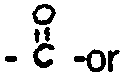
- (a) n is 8, X is

- (b) n is 6, X is

- (c) n is 6,X is

- (d) n is 5, X is a covalent bond and -R, is a para-nitrophenyl (hereinafter called SAN-6).
- (e) n is 3, X is a covalent bond and -R3 is a meta-trifluoromethylphenyl (hereinafter called S-4-F).
- (f) n is 7. X is

- (g) n is 8, X is

- (h) n is 14. X is

- (i) n is 8, X is

- Very small concentrations of a secondary amide of Formula I in an acceptable carrier vehicle are effective, with concentrations of about 0.1 micrograms per millilitre of carrier vehicle being sufficient in most cases.
- In topical applications of a secondary amide of Formula I, a very short contact time of eg. 10 seconds may be sufficient. If necessary, the contact time is extended to about 24 hours. Also, if necessary, such topical application is repeated, as needed.
- As stated above, the salicylamides of Formula I are known and described in existing literature. A representative, though not the only available or conceivable method of synthesis thereof is disclosed in EP-A-38191. The following description has been adopted from EP-A-38191. In general such compounds can be prepared by reacting a lower alkyl (Ra) salicylate ester with an acyl chloride (RxCOCl) in the presence of a Lewis acid to form an ester of a 5-acysalicylic acid. The 5-acylsalicylic acid ester is then hydrolysed and the resulting free acid is reacted with a substituted amine or aniline H2N-R3 to form the 5-acylsalicylamide. The term "lower alkyl" as used herein means alkyl of from 1 to 4 carbon atoms. Rx is n-C7 in the case of APCF3-8 and AMCF3-8. It is n-C, in the case of AN-10. It is n-C., n-C, and n-C15 in the cases involving ACBXE-9, ABC-4 and RV-19 respectively. In the cases of SAN-6 and S-4-F, the Friedel-Crafts acylation step is replaced by a Friedel-Crafts alkylation process by substituting the acid chloride Rx-CO-CI by a normal alkyl halide RxCI. In the case of SAN-6 and S-4-F which are prepared by way of the Friedel-Crafts alkylation initial step, Rxis C6 and C4 respectively. R3 is a substituted benzene ring or a thiazole or a benzothiazole ring. In the case of a substituted benzene ring, the substituents may be -NO2 in a para position or -COOC2H5 in a meta position or -CF, in either a para or a meta position. When R3 is one of the two heterocyclic attachments mentioned above, the linking thereof to the secondary amido nitrogen atom occurs through the No.2 carbon atom of the heterocyclic attachment. Acryloyl AN-10 is, as already noted above, an acrylic acid derivative of AN-10 wherein the 2-hydroxy group of AN-10 is replaced by the CH2 = CH-COO-group. Such replacement is accomplished by the esterification of AN-10 in the manner generally employed for the esterification of phenols. Thus, esterification of AN-10 with acryloyl chloride in pyridine or other base results in the esterified product, ie. acryloyl AN-10.
- As a usual procedure, the 5-acyl or 5-alkyl salicylic acid precursor is prepared in a medium or reaction solvent which is customarily considered suitable for conducting a Friedel-Crafts acylation or alkylation with optimal yield, minimal side reactions, non-onerous reaction conditions and minimal reaction time. A preferred reaction solvent is carbon disulfide. Anhydrous aluminium chloride or other Lewis acid is initially added to the carbon disulfide and the mixture is cooled, eg. with ice. A solution of the alkyl salicylate ester, eg. methyl salicylate, and an acyl halide, eg. a chloride (or an alkyl halide as applicable) in carbon disulfide or other reaction solvent is then slowly added and the temperature is maintained below about 10°C. After completion of reaction which may take as long as 24 hours, the reaction mass is poured into ice water and the mixture is then extracted with a suitable solvent such as ether. The ether or other extract is washed with water and then dried over anhydrous sodium sulfate. Thereafter, the ether or other solvent is evaporated in vacuo. The resulting solid residue is dissolved in a suitable solvent such as ethanol and treated with a solution of an alkali metal hydroxide, eg. 2N NaOH solution. After heating to a temperature of between about 80 and 120°C., eg. on a steam bath, the mass is cooled and acidified with a suitable acid such as HCI to a pH of about 1 to precipitate the product. Recrystallisation from ethanol gives purified 5-acylsalicylic acid or 5-alkylsalicylic acid, depending on whether an acid halide or an alkyl halide was the initial Friedel-Crafts reactant.
- The 5-acyl or 5-alkyl salicyclic acid is reacted with the appropriate substituted aniline or other amine, eg. p-nitroaniline in the case of AN-10, in a suitable reaction solvent such as chlorobenzene. Desirably the 5-acyl or 5-alkylsalicylic acid is pre-reacted with phosphorus trichloride in the solvent at a suitable temperature, eg. between about 55°C and about 80°C. The reaction time is usually between about one and about five hours. The solution is then cooled and the appropriate substituted aniline or heterocylic amine, eg. p-nitroaniline is then added and the solution is again heated to a suitable temperature, eg. between about 55°C and about 80°C as previously described for about one to about five hours and is then refluxed until the reaction is complete, eg. for about 24 hours. The solvent is then removed in vacuo and the residue is purified by recystallisation from a suitable solvent such as a mixture of ethanol and water. The resulting product is an amido compound for use according to the invention.
- Detailed descriptions of the methods of synthesis of 5-n-decanoylsalicylic acid and of AN-10 therefrom are given in Examples 1 and 2, respectively, of EP-A-38191.
- Example 3 of EP-A-38191 describes toxicity tests for AN-10 performed upon sixteen female white rats of average weight 265 gms. Example 3 concludes with the finding that LD50 for AN-10 by the single dose oral route is greater than 2000 mg/kg in Osborne-Mendel white rats.
- Methods of synthesis of the other preferred compounds of the invention, namely APCF3-8, AMCF3-8, SAN-6, S-4-F, ACBXE-9, ABC-4 and RV-19 follow naturally from the method of synthesis described for AN-10 with appropriate substitution of the respective reactants.See generally, Batista, A J, "Salicylanilides: Design, Synthesis, and In Vitro Evaluation as Inhibitors of Dental Plaque-Forming Microorganisms", PhD. Dissertation, State University of New York at Buffalo, 1980. Acryloyl AN-10 is prepared, as already noted above, from AN-10 by esterification of the phenolic -OH group of AN-10 with acryloyl chloride in pyridine.
- Other synthetic routes are described in EP-A-143628 and EP-A-144204.
- In the following Examples, percentage amounts are by weight.
- In a group of 5 male outbred hairless mice, inflammation is induced on their ears by the topical application thereto of 4.0 nmole in acetone solution (total volume 10 microlitre) of the known divalent calcium ionophore (antibiotic A-23187), which is derived from streptomvces chartreusis and is a member of a known class of compounds showing ionophoric activity. See, eg. Pressman, B C. "Biological Applications of lonophores", Ann Rev Biochem, 45, 501, 1976. Said compound has been found in in vivo tumor promotion studies involving topical application thereof of mice backs to have potent ability to cause skin irritation with white blood cell infiltration, erythema (skin reddening), edema, epidermal hypertrophy and subsequent epidermal hyperplasia. See Marks, F, Furstenberger, G, and Kownatzki, E, "Prostaglandin E-mediated Mitogenic Stimulation of Mouse Epidermis in vivo by divalent cation ionophore A-23187 and by tumor promoter t2-0-tetradecanoyl phorbol-13-acetate, Cancer Res., 41, 696, 1981.
- In each animal only one ear is treated, the other untreated ear serving as a control.
- Acute inflammation develops on treated mice ears within 4 hours following topical application of A-23187, showing both time and dose dependencies. Topical application of steroidal (hydrocortisone) and non-steroidal (indomethacin) anti-inflammatory compositions 30 minutes after application of said ionophore causes reduction of inflammation.
- In Examples 1, 2 and 3 the compounds AN-10, APCF3-8 and AMCF3-8, respectively, are topically applied to the treated ears of different groups of five male outbred hairless mice 30 minutes following the topical application thereto of the ionophore A-23187. Specifically, 1.5 micromole of the amido compound in acetone solution (total volume 10 microlitres) is applied topically to treated male outbred hairless mice ears 30 min after topical application thereto of a calcium ionophore (A-23187, 4.0 nmole total volume to 10 microlitre) in acetone. As already noted, in each case, each animal serves as its own control in that only one ear is subjected to said test regime while the other ear is left untouched. Erythema and edema are assessed 4 hours after application of the ionophore. In Control Example 4, 3,4',5-tribromosalicylanilide (TBS) is applied in the same manner.
- TBS is structurally very similar to the compounds of Formula I wherein -R, and -R. are each -Br and -R, is a para-bromo substituted benzene ring.
- The varying degrees of effectiveness of AN-10, APCF3-8, AMCF3-8 and TBS in the above-described tests are summarised in Table 1 below.

- From the data summarised in Table 1, of the four amido compounds tested for anti-inflammatory activity, only TBS is essentially inactive at the concentration used, whereas AN-10, APCF3-8 and AMCF3-8 are all effective anti-inflammatories. Of the two isomers APCF3-8 and AMCF3-8 (which differ from each other in the position of the -CF3 group), the meta isomer has a significantly higher level of activity, ie. the meta isomer shows about 30% more edema reduction activity and about 20% more erythema reduction activity than the para isomer.
- This fact is suggestive of a structure/function relationship in the inflammation reduction and/or inhibition process. Along the same lines it may be speculated as a theory underlying the mode of action of the salicylamides of Formula I, that the relative ineffectiveness of TBS is due to the decreased lipophilicity of such compound when alkyl, alkanoyl or similar -R, and -R2 attachments (as already defined above) are substituted by -Br thereby leading to decreased dermal penetration.
- Acute inflammation is induced by the application of 4 nano mole of the antibiotic A-23187 to the ears of young, male, adult hairless outbred mice (Skh:hr-1 strain). Thereafter, one of the compounds AN-10, AMCF3-8, ACBXE-9, acryloyl AN-10, S-4-F and SAN-6 is applied to the affected ears and the degree of reduction in edema (inflammation) noted.
- The method used in the present Examples differs from the method used in the preceding Examples in two respects. Firstly, in the present Examples test animals are assigned to different treatment groups in which each ear of an animal receives the same assigned treatment, ie. the test animals of the present Examples do not serve as their own controls as they do in the preceding four Examples.
- Secondly, in the expression of the data, the objective parameter of ear weights is used as the sole data source (for the reduction of edema) as erythematous responses are not recorded. Ear weights are determined by sacrificing the animals four hours after initial application of the antibiotic A-23187 or other control material by the use of C02 gas. Thereafter, the ears are excised by cutting along the characteristic ridge readily discernible along the inner aspect of the ears. Wet and dry ear weights are used to determine the extent of the edema or inflammation present.
- In Study A, 28 test animals are randomised into four treatment groups of seven each and subjected to the following ear treatment regimen:
- Group A -A-23187
- Group B -A-23187 + AN-10
- Group C -AN-10
- Group D -Acetone
- Each animal is dosed with a treatment consisting of a 10 microlitre quantity of the assigned test material solution (or pure acetone in the case of the animals of Group D) applied to the outer aspect of both ears, ie. 20 microlitre of test material per ear. The concentrations of the respective materials in acetone solution are such that a 10 microlitre dose of a solution of the antibiotic A-23187 contains 4 nano mole of such antibiotic. The corresponding quantity in the case of the AN-10 in acetone solution is 1.5 micromole. The animals of Groups A and B are initially treated with the acetone solution of A-23187. In the case of the animals in Group B alone, 10 microlitre of the acetone solution of AN-10 is applied to the affected ears t hour after the application of the above-mentioned quantity of a solution in acetone of the antibiotic A-23187. The animals of Group C receive a 10 microlitre dose per ear of the AN-10 in acetone solution alone. The animals of Group D receive a dose of 10 microlitre per ear of pure acetone. All the test subjects are sacrificed four hours after the application of A-23187 to the animals of Groups A and B or the other test materials in the case of the animals of Groups C and D. The results are summarised in Table 2 given below.
- A second group of studies (Study B) is conducted on two consecutive days with two sets of mice - (totalling 80 animals) received from the same shipment.
- The first batch of 40 animals is divided into 8 groups of 5 each. On Day 1, the six salicylamides AN-10, AMCF3-8, ACBXE-9, acryloyl AN-10, S-4-F and SAN-6 are applied as test solutions to the untreated ears of each group of 5 animals to ascertain whether or not any of the compounds possesses inflammatory potential. The remaining two groups of 5 animals each serve as controls and their ears are dosed with A-23187 and acetone respectively. The respective quantities of the test and control materials and the method of administration is identical with that described for Study A. It is found that none of the six compounds being tested cause any noticeable inflammation.
- On Day 2, using the second set of 40 mice, sub-divided into 8 groups of 5 each, the six compounds in question are applied as acetone solutions in the manner described under Study A to mice ears inflamed with A-23187 again, as described in Study A above. As with the studies conducted on Day 1, the remaining two groups of 5 animal each serve as controls and their ears are dosed with A-23187 and acetone respectively.
- The amount of each salicylamide compound applied is kept constant, for Days 1 and 2, at 1.5 micromole per 10 microlitre of test solution. Sacrifice begins four hours after application of A-23187, on both days, and the results are recorded. Table 2 summarises the results of the regimen of testing involved with each one of the 30 animals in question on Day 2 with the remaining 10 animals serving as controls as already noted. Table 2 shows the reduction in edema observed with the use of each one of the six salicylamide compounds tested.

- Examination of the above data indicates that all six of the salicylamide compounds tested, AN-10, acryloyl AN-10, AMCF3-8, ACBXE-9, S-4-F and SAN-6 exhibit significant anti-inflammatory activity under the test conditions.
- The variation noted in the activity levels for AN-10 are probably the results of individual differences between the 5 animals tested on Day 1 and the 5 animals tested on Day 2 as well as possible nonuniformity of testing conditions on the days in question. It is believed that such differences may be minimised and possibly eliminated by making use of a larger number of animals in each test group and by conducting such tests at the same time and under as uniform conditions as possible.
- An ointment is prepared incorporating the compound AN-10 as an active ingredient. The ointment comprises the respective ingredients in the percentages shown below:
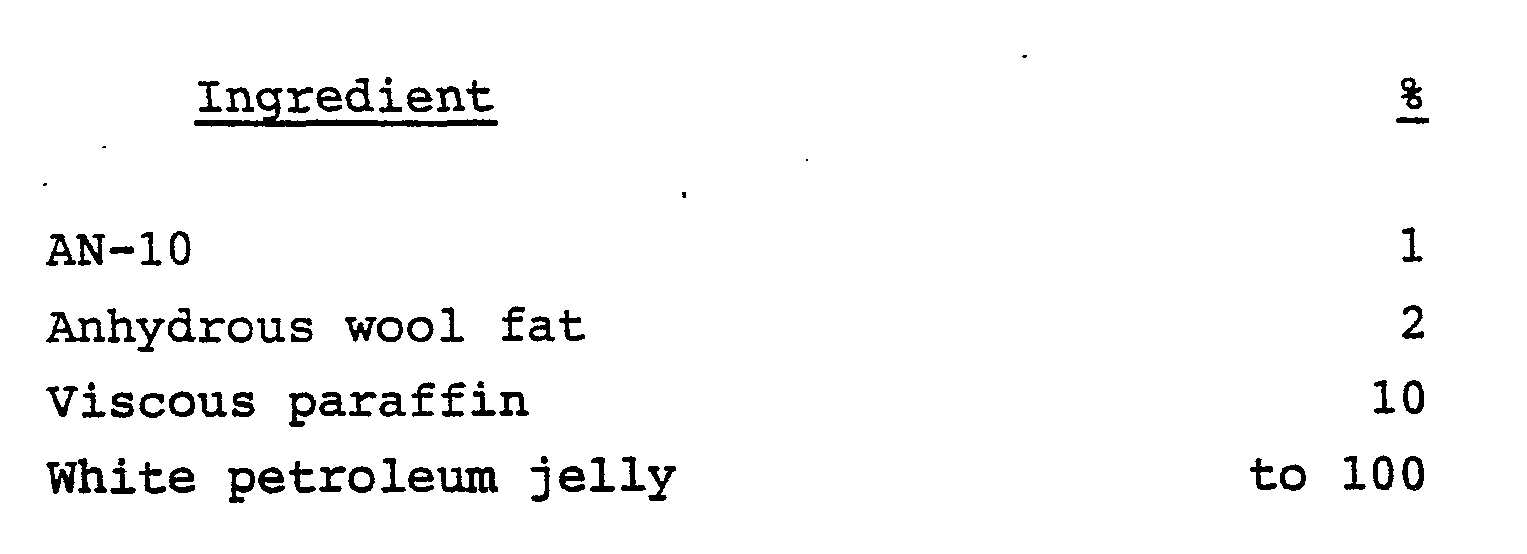
- AN-10 is substituted by an equivalent quantity of any one of the compounds of Formula I, eg. APCF3-8, AMCF3-8, ACBXE-9, acryloyl AN-10, S-4-F and SAN-6 as well as mixtures thereof to form comparable ointments.
- The resulting ointment is applied on the skin to relieve an inflammatory condition thereof in sufficient amount to cause the spreading of 0.01 microgram to 500 microgram of the active compound per square centimetre of the dermal area affected.
- An ointment of comparable efficacy to that described in Example 12 is made with the following ingredients:
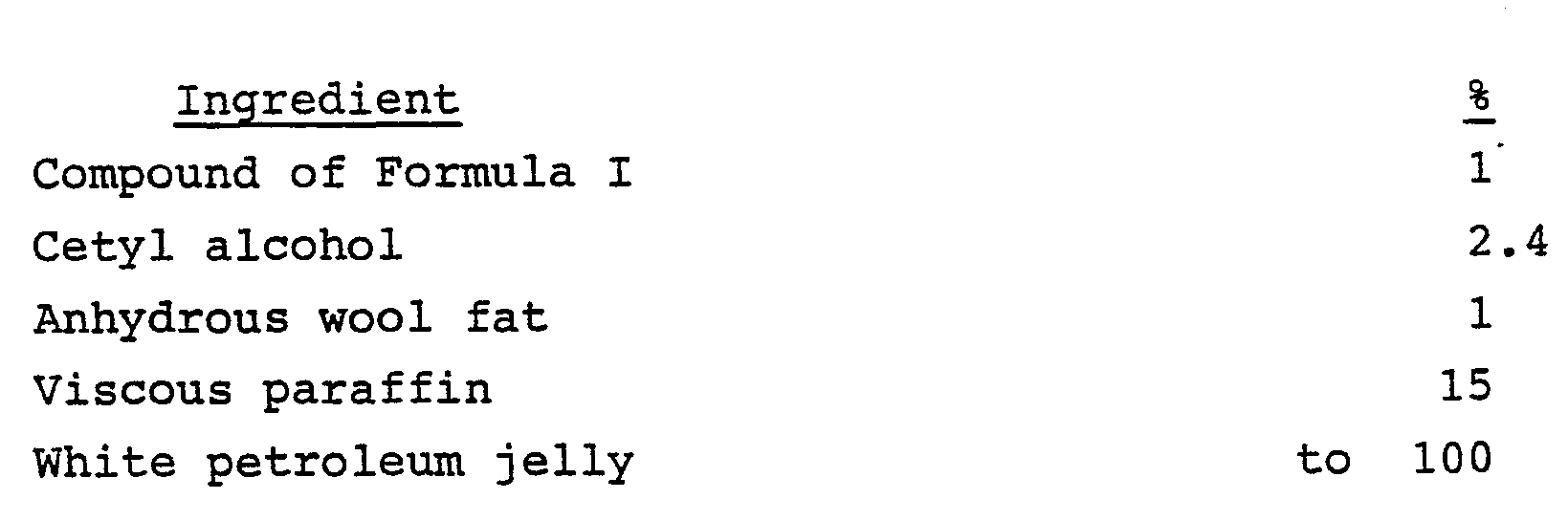
- The resulting ointment is applied to the skin to relieve inflammation caused by a painful skin condition in the manner described in Example 12.
- The secondary amides may also be used according to the invention for the manufacture of medicaments in a solid form. Such forms have use as a stick-type composition intended for application to the lips or other parts of the body. Such compositions consist essentially of from 0.001% to 10%, preferably 0.01% to 5% of a compound of Formula 1, eg. acryloyl AN-10, and from 50% to 98%, preferably 60% to 90% of an emollient. This composition can further consist essentially of from 1% to 20%, preferably 5% to 15%, of a suitable thickening agent, and optionally emulsifiers and water. Thickening agents include without limitation: cross-linked carboxy polymethylene polymers, methylcellulose, gum tragacanth, gum kharaya, xanthan gums and bentonite. Suitable emulsifiers are of a nonionic, anionic or cationic variety. Examples of suitable nonionic emulsifiers include fatty alcohols having 10 to 20 carbon atoms, fatty alcohols having 10 to 20 carbon atoms condensed with 2 to 20 moles of ethylene oxide or propylene oxide, alkyl phenols with 6 to 12 carbon atoms in the alkyl chain condensed with 2 to 20 moles of ethylene oxide, mono-and di-fatty acid esters of ethylene glycol wherein the fatty acid moiety contains from 10 to 20 carbon atoms, fatty acid monoglycerides wherein the fatty acid moiety contains from 10 to 20 carbon atoms, diethylene glycol, glycerol, sorbitol, sorbitan, polyoxyethylene sorbitol, polyoxyethylene sorbitan, and hydrophilic wax esters. Suitable anionic emulsifiers include the fatty acid soaps, eg. sodium potassium and triethanolamine soaps, wherein the fatty acid moiety contains from 10 to 20 carbon atoms. Other suitable anionic emulsifiers include the alkali metal, ammonium or substituted ammonium alkyl sulfates, alkyl arylsulfonates, and alkyl ethoxy ether sulfonates having 10 to 30 carbon atoms in the alkyl moiety. The alkyl ethoxy ether sulfonates contain from 1 to 50 ethylene oxide units. Satisfactory cationic emulsifiers are the quaternary ammonium, morpholinium and pyridinium compounds. Certain of the emollients noted below also have emulsifying properties.
- Suitable emollients include lanolin and its derivatives, namely: lanolin, lanolin oil, lanolin wax, lanolin alcohols, lanolin fatty acids, isopropyl lanolate, ethoxylated lanolin, ethoxylated lanolin alcohols, ethoxylated cholesterol, propoxylated lanolin alcohols, acetylated lanolin acetylated lanolin alcohols, lanolin alcohols linoleate, lanolin alcohols ricinoleate, acetate of lanolin alcohols ricinoleate, acetate of ethoxylated alcohols - esters, hydrogenolysis products of lanolin, ethoxylated hydrogenated lanolin, ethoxylated sorbitol lanolin, and liquid and semi-solid lanolin absorption bases.
- Additives commonly found in topical compositions such as preservatives, eg. methyl and ethyl paraben, dyes and perfume are advantageously included in any of the afore-mentioned compositions.
- An exemplary solid stick according to this invention containing one or more of the compounds of Formula I is prepared by shaping and molding the following ingredients:
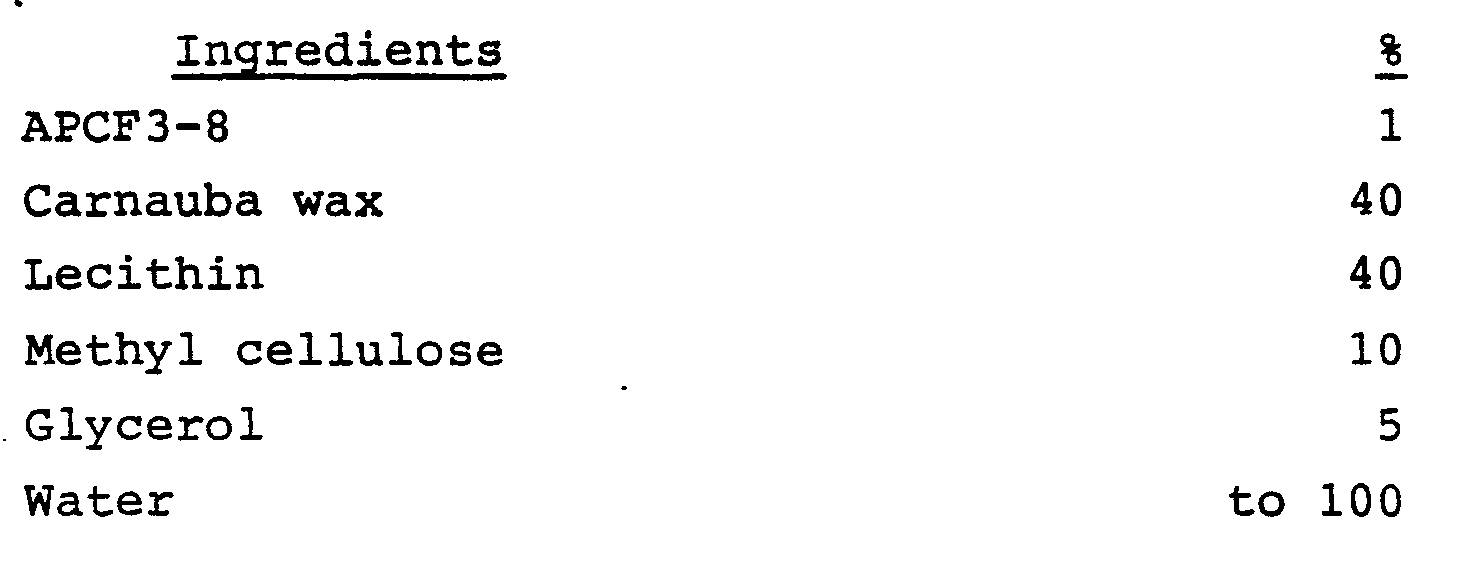
- The resulting solid stick of this Example is applied upon the skin to relieve inflammation in substantially the same manner as with the ointment described in Example 12.
- A medicament for the treatment of dermatological inflammation may also be formulated in a solution form. The solution form of the composition consists essentially of from 0.001% to 10%, preferably 0.01% to 5% of a compound of Formula I, eg. ACBXE-9. and the balance being a suitable organic solvent. Suitable organic materials useful as the solvent or a part of a solvent system are as follows: propylene glycol, glycerine, ethanol, sorbitol esters, 1,2,6-hexanetriol, isopropanol, diethyl tartrate, butanediol, and mixtures thereof. Such solvent systems can also contain water.
- Accordingly, a solution is prepared as follows:

- The solution is applied to the affected skin in substantially the same manner as that described for the ointment of Example 12.
- The solution of Example 15 is incorporated in a closed metal container fitted with an aerosol cap and pressurised using conventional methods up to 100 psi pressure with butane gas. The resulting aerosol is used as a convenient method of administering an anti-inflammatory composition comprising one or more compounds of Formula I, eg. ACBXE-9, for the relief of painful skin conditions. The composition of the aerosol is applied to the affected area of the skin at periodic intervals for the relief of inflammation , and preferably every four to twelve hours.
- A medicament may also be formulated in a cream form. The creams consist essentially of from 0.001% to 10%, preferably 0.01% to 5% of a compound or compounds of Formula I, eg. S-4-F, from 5% to 50%, preferably 10% to 25% of an emollient, and the balance water. The emollients described above with respect to the medicaments in a stick form (Example 14) are equally suitable herein. Optionally, the cream form contains a suitable emulsifier. The emulsifiers described in Example 14 above are also equally suitable herein. When an emulsifier is included, it is in the composition at a level from about 2% to about 10%, preferably 5%.
- A cream is prepared by mixing together the following ingredients:

- The resulting cream is applied to the skin to relieve inflammation in the same manner as that described for the ointment of Example 12.
- A lotion is prepared incorporating one or more compounds of Formula I, eg. SAN-6 by mixing together the following ingredients in the stated percentages on a wt/wt basis:

- In an advantagoues alternative embodiment, the above lotion contains 5% of a sun screen, eg. para- amino benzoic acid or PABA at the expense of the water ingredient.
- The resulting lotion is topically applied to relieve inflammation of the skin in the same manner as that described for the cream of Example 17.
- One or more compounds of Formula I, eg. AN-10, are formulated into a gel form by simply admixing a suitable thickening agent with the above-described solution composition of Example 15. Examples of suitable thickening agents include: cross-linked carboxy polymethylene copolymers, methyl cellulose, gum tragacanth, gum kharaya, xanthan gums and bentonite. The gelled compositions consist essentially of from 0.001% to 10%, preferably 0.01% to 5% of a compound or compounds of Formula I, from 5% to 75% preferably 10% to 50% of an organic solvent, 0.5% to 20%, preferably 1% to 10% of the aforementioned thickening agent, the balance being water. Suitable organic solvents include without limitation glycerine, sorbitol esters, 1,2,6-hexanetriol, ethanol, isopropanol, diethyl tartrate, butanediol, and mixtures thereof.
- A gel is prepared by mixing together the following ingredients:

- The resulting gel is applied to the skin to relieve inflammation in the same manner as that described for the cream of Example 17 noted above.
- A liniment is prepared from a gel composition of Example- 19.
- In the aforementioned gel composition, the presence of the betonite thickening agent is eliminated and the balance is made up with 1,2,6-hexanetriol.
- The resulting liniment is applied to the skin to relieve inflammation in the same manner as that noted for the gel of Example 19.
- One or more compounds of Formula I, such as AMCF3-8 is incorporated in a suppository for intraanal use.
- A suppository is prepared by mixing together the following ingredients in the weight ratios shown:

- Said suppository is prepared by melting the cocoa butter base at a temperature of about 39°C and adding the remaining ingredients, including AMCF3-8 to the melt, with blending, to provide a homogeneous system. The cocoa butter based resulting melt is poured into moulds of appropriate dimensions and allowed to solidify. The resulting product is a lubricious suppository which melts at body temperature to release the AMCF3-8 or other salicylamide compound to provide improved anti-inflammatory benefits.
- Intraanal administration of the resulting suppository is effective in relieving inflammation. The application is repeated as necessary.
- A vaginal suppository is made generally following the procedure described above in Example 21 for making an anal suppository. The vaginal suppository has the composition noted below:

- In place of AMCF3-8, any one or more the compounds of Formula may be employed.
- Intravaginal administration of the resulting suppository is effective in relieving vaginal inflammation.The application is repeated as necessary.
- An aqueous preparation containing one or more of the compounds of Formula I, such as acryloyl AN-10 is incorporated in an aqueous composition to form a douche for intravaginal administration. A composition is prepared which contains the following ingredients in the weight percentages shown below:

- Said composition advantageously further incorporates inert but pharmaceutically acceptable colouring matter and fragrances.
- The use of the resulting composition as an intravaginal douche results in the alleviation of intravaginal inflammation.
- One or more compounds of Formula I such as S-4-F is incoporated in a shampoo for application to the scalp.
- A shampoo is prepared by dissolving one part by weight of S-4-F in 10 parts by weight of ethanol and incorporating the resulting solution in a shampoo base. The shampoo base contains the following ingredients:

- One part by weight of the S-4-F in ethanol solution is added to nine parts by weight of the above-described shampoo base to form a medicated shampoo.
- Inflammation of the scalp is effectively alleviated by the use of such shampoo with repeat applications as needed.
- Medicated ear drops containing one or more of the compounds of Formula I such as AN-10 are prepared by the mixing together of the following ingredients in the parts by weight noted below:
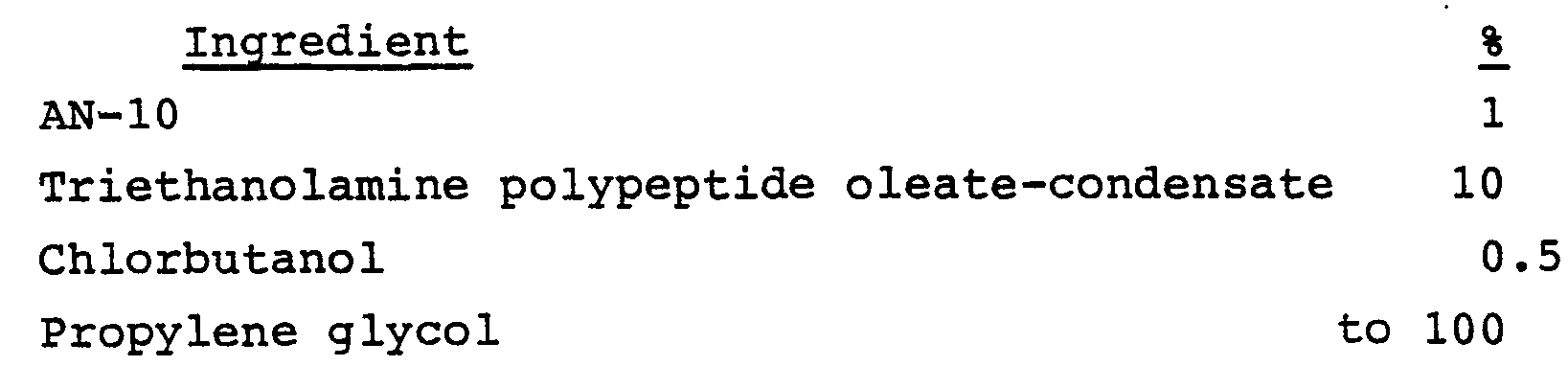
- The administration of the resulting ear drops into the ear cavity or auditory canal, with repeated applications as needed, results in the relief of inflammatory conditions of the ear.
- Nose drops containing one or more of the compounds of Formula I such as APCF3-8 are prepared by mixing such compound together with the other ingredients in the proportions noted below:

- Administraiton of three to four drops in each nostril of nose drops of the composition noted above three to four times daily results in the relief of inflammation of skin and the nasal mucous membranes.
- The composition described above may alternatively be incorporated into a compressed air nebulizer and administered in like manner with equal efficacy.
- Eye drops containing one or more of the compound of Formula I such as ACBXE-9 are prepared by mixing together the following ingredients in the proportions noted below:

- The application of one or two drops of eye drops of the above composition, repeated as required, is effective in reducing inflammation.
- Medicated sanitary napkins, medicated pads and medicated dressings are prepared by the incorporation of one or more of the compounds of Formula I in a suitable cotton wool or other absorbent article.
- A sanitary napkin is prepared in accordance with the method described in Example 3 of US-A-4 226 237.
- The resulting sanitary napkin is sprayed with a 10% wt/wt acryloyl AN-10 in acetone solution to ensure a concentration spread of 0.01 gram AN-10 per square centimetre of the napkin. After drying in an aerated chamber at room temperature the napkin is hermetically sealed in a polyethylene or metal foil envelope.
- The resulting pad is effective in relieving inflammation when used as a medicated pad.
- A pad is prepared in a size other than that to which the teachings of US -A-4 226 237 are confined to thereby produce a medicated pad or a medicated dressing for use in the bandaging of wounds and lacerations. The resulting pads and dressing when made of selected differing dimensions are effective in relieving inflammation when used as medicated pads and as medicated dressings.
- One or more compounds of Formula I, such as acryloyl AN-10 are incorporated in plasters and bandages.
- To this purpose, a plaster or a bandage is sprinkled with a 10% wt/wt acryloyl AN-10 in acetone solution to the extent of 0.01 gram acryloyl AN-10 per square centimetre of surface area. Following drying in an aerated chamber at room temperature, the resulting plasters and bandages are stored in hermetically sealed polyethylene or metal foil envelopes to prevent loss of the salicylamide compound from the medicated plaster or medicated bandage.
- The term plaster as used herein means a wound dressing which has an adhesive coated on one side thereof. Advantageously, the adhesive material is one which is not affected by the acryloyl AN-10 in acetone solution. The term bandage as used herein means a roll of cotton or other fabric of sterile nature without the incorporation therein of an adhesive which is used in the dressing of wounds.
- The acyloyl AN-10 impregnated plaster or bandage is used with enhanced, therapeutic value when utilised in the dressing of wounds by relieving inflammation associated with wounds or lacerations.
- One or more of the compounds of Formula I, such S-4-F are incorporated in a catamenial or non- catamenial tampon.
- A catamenial tampon is prepared in accordance with the method described in US-A-4 226 237, of the kind shown in the illustrative embodiments included in Figures 8 and thereof.
- The outer surface of said catamenial tampon is sprinkled with a 10% wt/wt acetone solution of S-4-F in an amount sufficient to provide a concentration of 0.01 gram of such compound per square centimetre of the outer surfaces of such tampon. Following drying in an aerated chamber at room temperature, the tampon is stored in a sealed polyethylene or metal foil pouch, in order to guard against the loss of any S-4-F compound prior to the use of such tampon.
- When the resulting catamenial tampon is intravaginally worn, relief of intravaginal inflammation is noticed.
- When said tampon is prepared in appropriate (smaller) dimensions, such as to enable the same to fit snugly within other body cavities such as the ears and the nose without causing any discomfort to the wearer, similar relief from inflammation of skin as well as affected mucous membranes is noticed.
Claims (7)


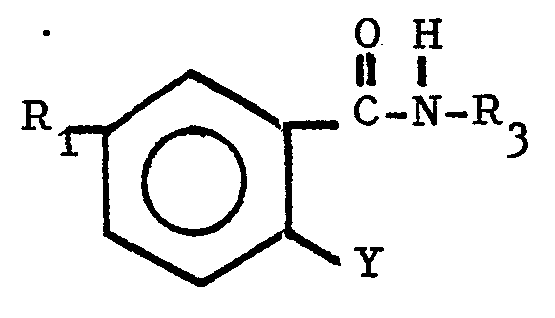
or is a mixture thereof.
Priority Applications (2)
| Application Number | Priority Date | Filing Date | Title |
|---|---|---|---|
| DE8585307531T DE3567375D1 (en) | 1985-10-18 | 1985-10-18 | Use of secondary amide compounds for the manufacture of medicaments for the treatment of dermatological inflammation |
| AT85307531T ATE39843T1 (en) | 1985-10-18 | 1985-10-18 | USE OF SECONDARY AMIDE COMPOUNDS FOR THE MANUFACTURE OF PHARMACEUTICALS FOR THE TREATMENT OF DERMATOLOGICAL INFLAMMATIONS. |
Applications Claiming Priority (1)
| Application Number | Priority Date | Filing Date | Title |
|---|---|---|---|
| US06/525,916 US4560549A (en) | 1983-08-24 | 1983-08-24 | Method of relieving pain and inflammatory conditions employing substituted salicylamides |
Publications (2)
| Publication Number | Publication Date |
|---|---|
| EP0221211A1 true EP0221211A1 (en) | 1987-05-13 |
| EP0221211B1 EP0221211B1 (en) | 1989-01-11 |
Family
ID=24095143
Family Applications (1)
| Application Number | Title | Priority Date | Filing Date |
|---|---|---|---|
| EP85307531A Expired EP0221211B1 (en) | 1983-08-24 | 1985-10-18 | Use of secondary amide compounds for the manufacture of medicaments for the treatment of dermatological inflammation |
Country Status (2)
| Country | Link |
|---|---|
| US (1) | US4560549A (en) |
| EP (1) | EP0221211B1 (en) |
Cited By (9)
| Publication number | Priority date | Publication date | Assignee | Title |
|---|---|---|---|---|
| EP0912549A4 (en) * | 1996-06-20 | 2002-01-02 | Univ Texas | COMPOUNDS AND METHODS FOR OBTAINING PHARMACOLOGICALLY ACTIVE PREPARATIONS AND THEIR USES |
| WO2002049632A1 (en) * | 2000-12-18 | 2002-06-27 | Institute Of Medicinal Molecular Design. Inc. | Inhibitors against the production and release of inflammatory cytokines |
| WO2003103665A1 (en) * | 2002-06-06 | 2003-12-18 | 株式会社医薬分子設計研究所 | Antiallergic |
| US7626042B2 (en) | 2002-06-06 | 2009-12-01 | Institute Of Medicinal Molecular Design, Inc. | O-substituted hydroxyaryl derivatives |
| US7671058B2 (en) | 2006-06-21 | 2010-03-02 | Institute Of Medicinal Molecular Design, Inc. | N-(3,4-disubstituted phenyl) salicylamide derivatives |
| CN101928227A (en) * | 2009-12-16 | 2010-12-29 | 天津工业大学 | Preparation method and application of interconnected prodrug of 6-methoxy-2-naphthaleneacetic acid and salicylanilide compounds |
| JP2014526536A (en) * | 2011-09-23 | 2014-10-06 | バイヤースドルフ・アクチエンゲゼルシヤフト | Aromatic amidothiazole, cosmetic or dermatological formulations containing it, and its use for treating and preventing unwanted skin pigmentation |
| US10463680B2 (en) | 2015-05-29 | 2019-11-05 | UNION therapeutics A/S | Halogenated salicylanilides for treating clostridium infections |
| US11285164B2 (en) | 2014-09-12 | 2022-03-29 | UNION therapeutics A/S | Antibacterial use of halogenated salicylanilides |
Families Citing this family (29)
| Publication number | Priority date | Publication date | Assignee | Title |
|---|---|---|---|---|
| US5223539A (en) * | 1991-11-22 | 1993-06-29 | G. D. Searle & Co. | N,n-di-alkyl(phenoxy)benzamide derivatives |
| US5663357A (en) * | 1995-11-22 | 1997-09-02 | Allergan | Substituted heteroarylamides having retinoid-like biological activity |
| US6572874B1 (en) | 1998-05-15 | 2003-06-03 | Umd, Inc. | Vaginal delivery of bisphosphonates |
| US6197327B1 (en) * | 1997-06-11 | 2001-03-06 | Umd, Inc. | Device and method for treatment of dysmenorrhea |
| US6416779B1 (en) | 1997-06-11 | 2002-07-09 | Umd, Inc. | Device and method for intravaginal or transvaginal treatment of fungal, bacterial, viral or parasitic infections |
| US7319112B2 (en) * | 2000-07-14 | 2008-01-15 | The Procter & Gamble Co. | Non-halogenated antibacterial agents and processes for making same |
| US6972010B2 (en) * | 2001-04-17 | 2005-12-06 | The Procter & Gamble Company | Absorbent article comprising an agent able to convey a perception to the wearer, without the need to create the external condition perceived |
| US20020193758A1 (en) * | 2001-06-18 | 2002-12-19 | Sca Hygiene Products Ab | Product |
| US7026354B2 (en) * | 2001-10-02 | 2006-04-11 | Kimberly-Clark Worldwide, Inc. | Aromatic compositions for the inhibition of exoprotein production from gram positive bacteria |
| KR100918887B1 (en) * | 2001-10-02 | 2009-09-23 | 킴벌리-클라크 월드와이드, 인크. | Inhibition of External Protein Production Using Aromatic Compositions |
| US7022333B2 (en) * | 2001-10-02 | 2006-04-04 | Kimberly-Clark Worldwide, Inc. | Inhibition of exoprotein production in non-absorbent articles uisng aromatic compositions |
| US20030135173A1 (en) * | 2001-10-02 | 2003-07-17 | Kimberly-Clark Worldwide, Inc. | Inhibition of exoprotein production in absorbent articles using aromatic compositions |
| DE10222895A1 (en) * | 2002-05-23 | 2003-12-11 | Bosch Gmbh Robert | High pressure accumulator for fuel injection systems with integrated pressure control valve |
| EA009523B1 (en) * | 2002-06-05 | 2008-02-28 | Инститьют Оф Медисинал Молекьюлар Дизайн. Инк. | INHIBITORS FOR THE ACTIVATION OF AP-1 AND NFAT |
| EA008622B1 (en) * | 2002-06-05 | 2007-06-29 | Инститьют Оф Медисинал Молекьюлар Дизайн. Инк. | Immunity-related protein kinase inhibitors |
| EA008769B1 (en) * | 2002-06-05 | 2007-08-31 | Инститьют Оф Медисинал Молекьюлар Дизайн. Инк. | Therapeutic drug for diabetes |
| US20060089395A1 (en) * | 2002-06-10 | 2006-04-27 | Susumu Muto | Nf-kb activation inhibitors |
| AU2003242108B2 (en) * | 2002-06-10 | 2008-09-11 | Institute Of Medicinal Molecular Design, Inc. | Medicament for treatment of cancer |
| CA2488979A1 (en) * | 2002-06-11 | 2003-12-18 | Institute Of Medicinal Molecular Design, Inc. | Medicament for treatment of neurodegenerative diseases |
| US7338956B2 (en) * | 2002-08-07 | 2008-03-04 | Sanofi-Aventis Deutschland Gmbh | Acylamino-substituted heteroaromatic compounds and their use as pharmaceuticals |
| CN100417847C (en) * | 2002-11-12 | 2008-09-10 | Nok株式会社 | Rubber-like Elastic Parts |
| JP2004285160A (en) * | 2003-03-20 | 2004-10-14 | Konica Minolta Holdings Inc | Photostimulable phosphor, its preparation method, and radiation-image conversion panel |
| US7744556B2 (en) | 2005-03-25 | 2010-06-29 | Kimberly-Clark Worldwide, Inc. | Delivery tube assembly for an applicator |
| US7919453B2 (en) | 2005-03-25 | 2011-04-05 | Kimberly-Clark Worldwide, Inc. | Dosage cap assembly for an applicator |
| US7993667B2 (en) | 2005-03-25 | 2011-08-09 | Kimberly-Clark Worldwide, Inc. | Methods of manufacturing a medicated tampon assembly |
| US7527614B2 (en) | 2005-03-25 | 2009-05-05 | Kimberly-Clark Worldwide, Inc. | Protective tube for a medicated tampon |
| US7708726B2 (en) | 2005-04-28 | 2010-05-04 | Kimberly-Clark Worldwide, Inc. | Dosage form cap for an applicator |
| US7320801B2 (en) * | 2005-09-26 | 2008-01-22 | Jack Perez Kelly | Patch for treating symptoms of a skin abscess |
| US11419834B2 (en) | 2019-02-25 | 2022-08-23 | Rhode Island Hospital | Methods for treating diseases or infections caused by or associated with H. pylori using a halogenated salicylanilide |
Citations (8)
| Publication number | Priority date | Publication date | Assignee | Title |
|---|---|---|---|---|
| DE1801299A1 (en) * | 1967-10-06 | 1969-05-08 | Merck & Co Inc | Chemical processes and products |
| FR2035771A1 (en) * | 1969-03-14 | 1970-12-24 | Aries Robert | Salicylaminophenols having analgesic antipy - etic and antiinflammatory activity |
| CH506292A (en) * | 1968-03-25 | 1971-04-30 | Muehlemann Hans R Dr Prof | Salicylanilide-contg anticaries prepara- - tions |
| US4032635A (en) * | 1975-06-12 | 1977-06-28 | Zaidan Hojin Biseibutsu Kagaku Kenkyu Kai | Pharmaceutical method for the therapy of immune diseases |
| DE2755224A1 (en) * | 1976-12-15 | 1978-07-13 | Procter & Gamble | PAIN AND INFLAMMATION SOUNDING AGENT FOR LOCAL USE |
| EP0038191A1 (en) * | 1980-04-14 | 1981-10-21 | The Research Foundation Of State University Of New York | 5-Acylsalicylanilides derivatives and method for inhibiting the growth of microorganisms |
| EP0038192A1 (en) * | 1980-04-14 | 1981-10-21 | The Research Foundation Of State University Of New York | 5-Alkylsalicylanilides derivatives and method for inhibiting the growth of microorganisms |
| EP0154907A2 (en) * | 1984-03-13 | 1985-09-18 | Bayer Ag | Medical wound dressing |
Family Cites Families (17)
| Publication number | Priority date | Publication date | Assignee | Title |
|---|---|---|---|---|
| BE524930A (en) * | 1952-12-09 | |||
| US2975097A (en) * | 1957-11-13 | 1961-03-14 | Modern Lab Inc | Topical analgesic composition |
| US3027301A (en) * | 1959-03-16 | 1962-03-27 | Us Vitamin Pharm Corp | Therapeutic wound healing composition of hydroxypropylamides of hydroxybenzoic acids |
| US3317583A (en) * | 1964-01-13 | 1967-05-02 | Upjohn Co | Alkylcarbamates of cyanosalicylanilides |
| FR6677M (en) * | 1967-06-21 | 1969-02-03 | ||
| FR8118M (en) * | 1968-12-23 | 1970-08-03 | ||
| JPS5115025B2 (en) * | 1972-04-15 | 1976-05-13 | ||
| US4091097A (en) * | 1973-04-20 | 1978-05-23 | Zaidan Hojin Biseibutsu Kagaku Kenkyu Kai | Treatment of elevated histamine and uric acid levels |
| GB1427112A (en) * | 1973-06-25 | 1976-03-10 | Yoshitomi Pharmaceutical | Antifouling compositions |
| DE2336526A1 (en) * | 1973-07-18 | 1975-02-06 | Hoechst Ag | Anthelmintic 2,6-diacyloxy-benzanilides - prepd. by acylation of 2,6-dihydroxy-3,5-dichloro-benzanilides |
| US3917617A (en) * | 1973-10-01 | 1975-11-04 | Sharps Ass | 1-{8 2,6-Dihydroxy-4-hydrocarbyl-benzoyl{9 polymethyleneimines and derivatives |
| JPS5720923B2 (en) * | 1974-04-02 | 1982-05-04 | ||
| DD112255A2 (en) * | 1974-05-09 | 1975-04-05 | ||
| US4199576A (en) * | 1976-12-15 | 1980-04-22 | The Procter & Gamble Company | Analgesic and anti-inflammatory compositions for topical application |
| US4275059A (en) * | 1977-03-28 | 1981-06-23 | The Procter & Gamble Company | Salicylate anti-inflammatory composition |
| BE884977A (en) * | 1980-08-29 | 1981-03-02 | Bago Sa Labor | NOVEL N-PHENYL-BENZAMIDES USEFUL IN THE TREATMENT OF MAMMALIAN INFLAMMATION AND PAIN |
| EP0058009A1 (en) * | 1981-01-28 | 1982-08-18 | Kyowa Hakko Kogyo Co., Ltd. | Novel benzanilide derivatives and pharmaceutical compositions containing them |
-
1983
- 1983-08-24 US US06/525,916 patent/US4560549A/en not_active Expired - Fee Related
-
1985
- 1985-10-18 EP EP85307531A patent/EP0221211B1/en not_active Expired
Patent Citations (8)
| Publication number | Priority date | Publication date | Assignee | Title |
|---|---|---|---|---|
| DE1801299A1 (en) * | 1967-10-06 | 1969-05-08 | Merck & Co Inc | Chemical processes and products |
| CH506292A (en) * | 1968-03-25 | 1971-04-30 | Muehlemann Hans R Dr Prof | Salicylanilide-contg anticaries prepara- - tions |
| FR2035771A1 (en) * | 1969-03-14 | 1970-12-24 | Aries Robert | Salicylaminophenols having analgesic antipy - etic and antiinflammatory activity |
| US4032635A (en) * | 1975-06-12 | 1977-06-28 | Zaidan Hojin Biseibutsu Kagaku Kenkyu Kai | Pharmaceutical method for the therapy of immune diseases |
| DE2755224A1 (en) * | 1976-12-15 | 1978-07-13 | Procter & Gamble | PAIN AND INFLAMMATION SOUNDING AGENT FOR LOCAL USE |
| EP0038191A1 (en) * | 1980-04-14 | 1981-10-21 | The Research Foundation Of State University Of New York | 5-Acylsalicylanilides derivatives and method for inhibiting the growth of microorganisms |
| EP0038192A1 (en) * | 1980-04-14 | 1981-10-21 | The Research Foundation Of State University Of New York | 5-Alkylsalicylanilides derivatives and method for inhibiting the growth of microorganisms |
| EP0154907A2 (en) * | 1984-03-13 | 1985-09-18 | Bayer Ag | Medical wound dressing |
Non-Patent Citations (1)
| Title |
|---|
| JOURNAL OF MEDICINAL CHEMISTRY, vol. 24, 1981, pages 1245-1249, American Chemical Society, US; R.A. COBURN et al.: "Potential salicylamide antiplaque agents: in vitro antibacterial activity against Actinomyces viscosus" * |
Cited By (26)
| Publication number | Priority date | Publication date | Assignee | Title |
|---|---|---|---|---|
| EP0912549A4 (en) * | 1996-06-20 | 2002-01-02 | Univ Texas | COMPOUNDS AND METHODS FOR OBTAINING PHARMACOLOGICALLY ACTIVE PREPARATIONS AND THEIR USES |
| US6720344B2 (en) | 1996-06-20 | 2004-04-13 | The Board Of Regents Of The University Of Texas System | Methods and compositions for stimulating osteoblast proliferation or treating malignant cell proliferation and methods for selecting osteoblast proliferation stimulants |
| WO2002049632A1 (en) * | 2000-12-18 | 2002-06-27 | Institute Of Medicinal Molecular Design. Inc. | Inhibitors against the production and release of inflammatory cytokines |
| AU2002222683B9 (en) * | 2000-12-18 | 2021-12-23 | Institute Of Medicinal Molecular Design, Inc | Inflammatory cytokine release inhibitor |
| AU2002222683B2 (en) * | 2000-12-18 | 2006-09-21 | Institute Of Medicinal Molecular Design, Inc | Inflammatory cytokine release inhibitor |
| CN100370975C (en) * | 2000-12-18 | 2008-02-27 | 株式会社医药分子设计研究所 | Inflammatory cytokine production dissociation inhibitor |
| US8263657B2 (en) | 2000-12-18 | 2012-09-11 | Institute Of Medicinal Molecular Design, Inc. | Inhibitors against the production and release of inflammatory cytokines |
| EA011719B1 (en) * | 2000-12-18 | 2009-04-28 | Институт Оф Медисинал Молекьюлар Дизайн, Инк. | Inhibitor against release of inflammatory cytokines |
| EP1844766A3 (en) * | 2000-12-18 | 2009-04-29 | Institute of Medicinal Molecular Design, Inc. | Inhibitors against the production and release of inflammatory cytokines |
| EP1847263A3 (en) * | 2000-12-18 | 2009-08-26 | Institute of Medicinal Molecular Design, Inc. | Inhibitors against the production and release of inflammatory cytokines |
| CN101849953B (en) * | 2000-12-18 | 2012-04-25 | 株式会社医药分子设计研究所 | Inflammatory cytokine release inhibitor |
| US8097759B2 (en) | 2000-12-18 | 2012-01-17 | Institute Of Medicinal Molecular Design, Inc. | Inflammatory cytokine release inhibitor |
| US7700655B2 (en) | 2002-06-06 | 2010-04-20 | Institute Of Medicinal Molecular Design, Inc. | Antiallergic agents |
| WO2003103665A1 (en) * | 2002-06-06 | 2003-12-18 | 株式会社医薬分子設計研究所 | Antiallergic |
| US7626042B2 (en) | 2002-06-06 | 2009-12-01 | Institute Of Medicinal Molecular Design, Inc. | O-substituted hydroxyaryl derivatives |
| EA009701B1 (en) * | 2002-06-06 | 2008-02-28 | Инститьют Оф Медисинал Молекьюлар Дизайн. Инк. | Antiallergic |
| US7671058B2 (en) | 2006-06-21 | 2010-03-02 | Institute Of Medicinal Molecular Design, Inc. | N-(3,4-disubstituted phenyl) salicylamide derivatives |
| CN101928227A (en) * | 2009-12-16 | 2010-12-29 | 天津工业大学 | Preparation method and application of interconnected prodrug of 6-methoxy-2-naphthaleneacetic acid and salicylanilide compounds |
| JP2014526536A (en) * | 2011-09-23 | 2014-10-06 | バイヤースドルフ・アクチエンゲゼルシヤフト | Aromatic amidothiazole, cosmetic or dermatological formulations containing it, and its use for treating and preventing unwanted skin pigmentation |
| JP2017141242A (en) * | 2011-09-23 | 2017-08-17 | バイエルスドルフ・アクチエンゲゼルシヤフトBeiersdorf AG | Aromatic amide thiazole, cosmetic or dermatological preparation containing the same and use thereof for treating and preventing undesired skin pigmentation |
| US11285164B2 (en) | 2014-09-12 | 2022-03-29 | UNION therapeutics A/S | Antibacterial use of halogenated salicylanilides |
| US11324761B2 (en) | 2014-09-12 | 2022-05-10 | UNION therapeutics A/S | Antibacterial use of halogenated salicylanilides |
| US11331327B2 (en) | 2014-09-12 | 2022-05-17 | UNION therapeutics A/S | Antibacterial use of halogenated salicylanilides |
| US10857164B2 (en) | 2015-05-29 | 2020-12-08 | UNION therapeutics A/S | Halogenated salicylanilides for treating Clostridium infections |
| US10463680B2 (en) | 2015-05-29 | 2019-11-05 | UNION therapeutics A/S | Halogenated salicylanilides for treating clostridium infections |
| US11529361B2 (en) | 2015-05-29 | 2022-12-20 | UNION therapeutics A/S | Halogenated salicylanilides for treating Clostridium infections |
Also Published As
| Publication number | Publication date |
|---|---|
| EP0221211B1 (en) | 1989-01-11 |
| US4560549A (en) | 1985-12-24 |
Similar Documents
| Publication | Publication Date | Title |
|---|---|---|
| EP0221211B1 (en) | Use of secondary amide compounds for the manufacture of medicaments for the treatment of dermatological inflammation | |
| US4742083A (en) | Method of relieving pain and inflammatory conditions employing substituted salicylamides | |
| US4725590A (en) | Method of relieving pain and inflammatory conditions employing substituted salicylamides | |
| JP2533471B2 (en) | Absorbent articles | |
| US5476664A (en) | Treatment of warts using anthralins and occlusion | |
| US20040082654A1 (en) | Cooling compositons | |
| SK13652000A3 (en) | Enzyme inhibitors | |
| KR100378063B1 (en) | Skin care composition | |
| EP1250914B1 (en) | Cooling compositions | |
| US4708873A (en) | Method of chemically debriding uncerated necrotic tissue | |
| JP2001523714A (en) | Skin rash prevention composition | |
| US4107330A (en) | Topical application of thioglycolic acid in the treatment of acne | |
| EP1045692B1 (en) | Skin protection composition | |
| KR101400638B1 (en) | Composition for preventing or treating diaper dermatitis comprising pegylated betulin derivatives | |
| JPS6299329A (en) | Antiinflammatory composition for skin | |
| US6855326B2 (en) | Skin protection composition | |
| US20040009964A1 (en) | Compositions and methods for the treatment of matrix metalloproteinase-related diseases | |
| JPS5877824A (en) | Compositions of containing interferon and use thereof for treatment of herpes infectious disease, premalignant skin disease, malignant skin disease and psoriasis | |
| CA2104515C (en) | Composition for accelerating healing of wound | |
| WO1996040104A1 (en) | Hydroxyl ions as unique therapeutic agents and compounds that modulate ions, compounds | |
| WO1997049662A1 (en) | Quinone bacterial inhibitors | |
| AU724699B2 (en) | Use of substituted (5,6)-dihydronaphthalenyl compounds having retinoid-like activity to prevent or reduce ischemic injury | |
| KR100242479B1 (en) | Composition for accelerating healing of wound | |
| JPS6149289B2 (en) | ||
| JPH09194379A (en) | Dermal ulcer treating agent |
Legal Events
| Date | Code | Title | Description |
|---|---|---|---|
| PUAI | Public reference made under article 153(3) epc to a published international application that has entered the european phase |
Free format text: ORIGINAL CODE: 0009012 |
|
| 17P | Request for examination filed |
Effective date: 19860724 |
|
| AK | Designated contracting states |
Kind code of ref document: A1 Designated state(s): AT BE CH DE FR GB IT LI NL SE |
|
| 17Q | First examination report despatched |
Effective date: 19880218 |
|
| GRAA | (expected) grant |
Free format text: ORIGINAL CODE: 0009210 |
|
| AK | Designated contracting states |
Kind code of ref document: B1 Designated state(s): AT BE CH DE FR GB IT LI NL SE |
|
| PG25 | Lapsed in a contracting state [announced via postgrant information from national office to epo] |
Ref country code: BE Effective date: 19890111 Ref country code: AT Effective date: 19890111 |
|
| REF | Corresponds to: |
Ref document number: 39843 Country of ref document: AT Date of ref document: 19890115 Kind code of ref document: T |
|
| REF | Corresponds to: |
Ref document number: 3567375 Country of ref document: DE Date of ref document: 19890216 |
|
| ITF | It: translation for a ep patent filed | ||
| ET | Fr: translation filed | ||
| PLBE | No opposition filed within time limit |
Free format text: ORIGINAL CODE: 0009261 |
|
| STAA | Information on the status of an ep patent application or granted ep patent |
Free format text: STATUS: NO OPPOSITION FILED WITHIN TIME LIMIT |
|
| 26N | No opposition filed | ||
| PGFP | Annual fee paid to national office [announced via postgrant information from national office to epo] |
Ref country code: GB Payment date: 19920929 Year of fee payment: 8 |
|
| PGFP | Annual fee paid to national office [announced via postgrant information from national office to epo] |
Ref country code: NL Payment date: 19921031 Year of fee payment: 8 |
|
| PGFP | Annual fee paid to national office [announced via postgrant information from national office to epo] |
Ref country code: FR Payment date: 19930914 Year of fee payment: 9 |
|
| PGFP | Annual fee paid to national office [announced via postgrant information from national office to epo] |
Ref country code: SE Payment date: 19930920 Year of fee payment: 9 Ref country code: DE Payment date: 19930920 Year of fee payment: 9 Ref country code: CH Payment date: 19930920 Year of fee payment: 9 |
|
| PG25 | Lapsed in a contracting state [announced via postgrant information from national office to epo] |
Ref country code: GB Effective date: 19931018 |
|
| ITTA | It: last paid annual fee | ||
| PG25 | Lapsed in a contracting state [announced via postgrant information from national office to epo] |
Ref country code: NL Effective date: 19940501 |
|
| GBPC | Gb: european patent ceased through non-payment of renewal fee |
Effective date: 19931018 |
|
| NLV4 | Nl: lapsed or anulled due to non-payment of the annual fee | ||
| PG25 | Lapsed in a contracting state [announced via postgrant information from national office to epo] |
Ref country code: SE Effective date: 19941019 |
|
| PG25 | Lapsed in a contracting state [announced via postgrant information from national office to epo] |
Ref country code: LI Effective date: 19941031 Ref country code: CH Effective date: 19941031 |
|
| EAL | Se: european patent in force in sweden |
Ref document number: 85307531.5 |
|
| PG25 | Lapsed in a contracting state [announced via postgrant information from national office to epo] |
Ref country code: FR Effective date: 19950630 |
|
| REG | Reference to a national code |
Ref country code: CH Ref legal event code: PL |
|
| PG25 | Lapsed in a contracting state [announced via postgrant information from national office to epo] |
Ref country code: DE Effective date: 19950701 |
|
| EUG | Se: european patent has lapsed |
Ref document number: 85307531.5 |
|
| REG | Reference to a national code |
Ref country code: FR Ref legal event code: ST |