EP0220273B2 - Synthetic antigens for the detection of aids-related disease - Google Patents
Synthetic antigens for the detection of aids-related disease Download PDFInfo
- Publication number
- EP0220273B2 EP0220273B2 EP86902998A EP86902998A EP0220273B2 EP 0220273 B2 EP0220273 B2 EP 0220273B2 EP 86902998 A EP86902998 A EP 86902998A EP 86902998 A EP86902998 A EP 86902998A EP 0220273 B2 EP0220273 B2 EP 0220273B2
- Authority
- EP
- European Patent Office
- Prior art keywords
- peptide
- protein
- peptides
- yes
- present
- Prior art date
- Legal status (The legal status is an assumption and is not a legal conclusion. Google has not performed a legal analysis and makes no representation as to the accuracy of the status listed.)
- Expired - Lifetime
Links
- 238000001514 detection method Methods 0.000 title description 11
- 208000012124 AIDS-related disease Diseases 0.000 title 1
- 108010008038 Synthetic Vaccines Proteins 0.000 title 1
- 108090000765 processed proteins & peptides Proteins 0.000 claims abstract description 178
- 108090000623 proteins and genes Proteins 0.000 claims description 49
- 102000004169 proteins and genes Human genes 0.000 claims description 47
- 150000001413 amino acids Chemical class 0.000 claims description 22
- 230000008878 coupling Effects 0.000 claims description 16
- 238000010168 coupling process Methods 0.000 claims description 16
- 238000005859 coupling reaction Methods 0.000 claims description 16
- 102000004196 processed proteins & peptides Human genes 0.000 abstract description 77
- 241000700605 Viruses Species 0.000 abstract description 25
- 229920001184 polypeptide Polymers 0.000 abstract description 18
- 239000003153 chemical reaction reagent Substances 0.000 abstract description 7
- 208000030507 AIDS Diseases 0.000 abstract description 6
- 239000012634 fragment Substances 0.000 abstract description 3
- 239000010836 blood and blood product Substances 0.000 abstract description 2
- 238000012216 screening Methods 0.000 abstract description 2
- 229940125691 blood product Drugs 0.000 abstract 1
- 230000000652 homosexual effect Effects 0.000 description 33
- 235000018102 proteins Nutrition 0.000 description 23
- 238000000034 method Methods 0.000 description 15
- 239000000523 sample Substances 0.000 description 14
- 238000003556 assay Methods 0.000 description 13
- 230000000423 heterosexual effect Effects 0.000 description 12
- FAPWRFPIFSIZLT-UHFFFAOYSA-M Sodium chloride Chemical compound [Na+].[Cl-] FAPWRFPIFSIZLT-UHFFFAOYSA-M 0.000 description 11
- 239000000243 solution Substances 0.000 description 10
- 108091003079 Bovine Serum Albumin Proteins 0.000 description 9
- 229940098773 bovine serum albumin Drugs 0.000 description 9
- 238000002965 ELISA Methods 0.000 description 8
- 102000004190 Enzymes Human genes 0.000 description 8
- 108090000790 Enzymes Proteins 0.000 description 8
- 229940024606 amino acid Drugs 0.000 description 8
- 210000002966 serum Anatomy 0.000 description 8
- 241001430294 unidentified retrovirus Species 0.000 description 8
- QTBSBXVTEAMEQO-UHFFFAOYSA-N acetic acid Substances CC(O)=O QTBSBXVTEAMEQO-UHFFFAOYSA-N 0.000 description 7
- 235000001014 amino acid Nutrition 0.000 description 7
- -1 gp65 Proteins 0.000 description 7
- MYRTYDVEIRVNKP-UHFFFAOYSA-N 1,2-Divinylbenzene Chemical compound C=CC1=CC=CC=C1C=C MYRTYDVEIRVNKP-UHFFFAOYSA-N 0.000 description 6
- 230000027455 binding Effects 0.000 description 6
- 235000006109 methionine Nutrition 0.000 description 6
- 239000011780 sodium chloride Substances 0.000 description 6
- LWIHDJKSTIGBAC-UHFFFAOYSA-K tripotassium phosphate Chemical compound [K+].[K+].[K+].[O-]P([O-])([O-])=O LWIHDJKSTIGBAC-UHFFFAOYSA-K 0.000 description 6
- ZRALSGWEFCBTJO-UHFFFAOYSA-N Guanidine Chemical compound NC(N)=N ZRALSGWEFCBTJO-UHFFFAOYSA-N 0.000 description 5
- 239000000427 antigen Substances 0.000 description 5
- 102000036639 antigens Human genes 0.000 description 5
- 108091007433 antigens Proteins 0.000 description 5
- 210000004369 blood Anatomy 0.000 description 5
- 239000008280 blood Substances 0.000 description 5
- 150000001875 compounds Chemical class 0.000 description 5
- 239000006166 lysate Substances 0.000 description 5
- 229930182817 methionine Natural products 0.000 description 5
- 239000011347 resin Substances 0.000 description 5
- 229920005989 resin Polymers 0.000 description 5
- 239000001488 sodium phosphate Substances 0.000 description 5
- 229910000162 sodium phosphate Inorganic materials 0.000 description 5
- RYFMWSXOAZQYPI-UHFFFAOYSA-K trisodium phosphate Chemical compound [Na+].[Na+].[Na+].[O-]P([O-])([O-])=O RYFMWSXOAZQYPI-UHFFFAOYSA-K 0.000 description 5
- KPYXMALABCDPGN-HYOZMBHHSA-N (4s)-5-[[(2s)-6-amino-1-[[(2s,3s)-1-[[(2s)-1-[[(2s)-1-[[(2s)-1-[[(2s)-1-[[(2r)-1-[[2-[[2-[[(1s)-3-amino-1-carboxy-3-oxopropyl]amino]-2-oxoethyl]amino]-2-oxoethyl]amino]-1-oxo-3-sulfanylpropan-2-yl]amino]-4-methyl-1-oxopentan-2-yl]amino]-1-oxopropan-2-yl]a Chemical compound NC(=O)C[C@@H](C(O)=O)NC(=O)CNC(=O)CNC(=O)[C@H](CS)NC(=O)[C@H](CC(C)C)NC(=O)[C@H](C)NC(=O)[C@H](C(C)C)NC(=O)[C@H](CC(C)C)NC(=O)[C@H]([C@@H](C)CC)NC(=O)[C@H](CCCCN)NC(=O)[C@H](CCC(O)=O)NC(=O)[C@@H](NC(=O)[C@H](CC(O)=O)NC(=O)CNC(=O)[C@@H](N)CCCCN)CC1=CC=C(O)C=C1 KPYXMALABCDPGN-HYOZMBHHSA-N 0.000 description 4
- 108020004414 DNA Proteins 0.000 description 4
- 108060003951 Immunoglobulin Proteins 0.000 description 4
- XUJNEKJLAYXESH-REOHCLBHSA-N L-Cysteine Chemical compound SC[C@H](N)C(O)=O XUJNEKJLAYXESH-REOHCLBHSA-N 0.000 description 4
- FFEARJCKVFRZRR-BYPYZUCNSA-N L-methionine Chemical compound CSCC[C@H](N)C(O)=O FFEARJCKVFRZRR-BYPYZUCNSA-N 0.000 description 4
- 239000000562 conjugate Substances 0.000 description 4
- 235000018417 cysteine Nutrition 0.000 description 4
- 208000037265 diseases, disorders, signs and symptoms Diseases 0.000 description 4
- 102000018358 immunoglobulin Human genes 0.000 description 4
- 239000002609 medium Substances 0.000 description 4
- 230000001177 retroviral effect Effects 0.000 description 4
- 206010001513 AIDS related complex Diseases 0.000 description 3
- ZMXDDKWLCZADIW-UHFFFAOYSA-N N,N-Dimethylformamide Chemical compound CN(C)C=O ZMXDDKWLCZADIW-UHFFFAOYSA-N 0.000 description 3
- 229920001213 Polysorbate 20 Polymers 0.000 description 3
- 239000004793 Polystyrene Substances 0.000 description 3
- 108010092799 RNA-directed DNA polymerase Proteins 0.000 description 3
- 210000004027 cell Anatomy 0.000 description 3
- 238000003745 diagnosis Methods 0.000 description 3
- 201000010099 disease Diseases 0.000 description 3
- VHJLVAABSRFDPM-QWWZWVQMSA-N dithiothreitol Chemical compound SC[C@@H](O)[C@H](O)CS VHJLVAABSRFDPM-QWWZWVQMSA-N 0.000 description 3
- 238000002875 fluorescence polarization Methods 0.000 description 3
- 229960004198 guanidine Drugs 0.000 description 3
- 229920002521 macromolecule Polymers 0.000 description 3
- 239000000203 mixture Substances 0.000 description 3
- 239000002773 nucleotide Substances 0.000 description 3
- 125000003729 nucleotide group Chemical group 0.000 description 3
- 239000000256 polyoxyethylene sorbitan monolaurate Substances 0.000 description 3
- 235000010486 polyoxyethylene sorbitan monolaurate Nutrition 0.000 description 3
- 229920002223 polystyrene Polymers 0.000 description 3
- 229910000160 potassium phosphate Inorganic materials 0.000 description 3
- 235000011009 potassium phosphates Nutrition 0.000 description 3
- 239000007787 solid Substances 0.000 description 3
- 230000009870 specific binding Effects 0.000 description 3
- 239000000758 substrate Substances 0.000 description 3
- JJAHTWIKCUJRDK-UHFFFAOYSA-N succinimidyl 4-(N-maleimidomethyl)cyclohexane-1-carboxylate Chemical compound C1CC(CN2C(C=CC2=O)=O)CCC1C(=O)ON1C(=O)CCC1=O JJAHTWIKCUJRDK-UHFFFAOYSA-N 0.000 description 3
- YBJHBAHKTGYVGT-ZKWXMUAHSA-N (+)-Biotin Chemical compound N1C(=O)N[C@@H]2[C@H](CCCCC(=O)O)SC[C@@H]21 YBJHBAHKTGYVGT-ZKWXMUAHSA-N 0.000 description 2
- QGZKDVFQNNGYKY-UHFFFAOYSA-N Ammonia Chemical compound N QGZKDVFQNNGYKY-UHFFFAOYSA-N 0.000 description 2
- ATRRKUHOCOJYRX-UHFFFAOYSA-N Ammonium bicarbonate Chemical compound [NH4+].OC([O-])=O ATRRKUHOCOJYRX-UHFFFAOYSA-N 0.000 description 2
- DCXYFEDJOCDNAF-UHFFFAOYSA-N Asparagine Natural products OC(=O)C(N)CC(N)=O DCXYFEDJOCDNAF-UHFFFAOYSA-N 0.000 description 2
- 241000283707 Capra Species 0.000 description 2
- 108091026890 Coding region Proteins 0.000 description 2
- QOSSAOTZNIDXMA-UHFFFAOYSA-N Dicylcohexylcarbodiimide Chemical compound C1CCCCC1N=C=NC1CCCCC1 QOSSAOTZNIDXMA-UHFFFAOYSA-N 0.000 description 2
- BWGNESOTFCXPMA-UHFFFAOYSA-N Dihydrogen disulfide Chemical compound SS BWGNESOTFCXPMA-UHFFFAOYSA-N 0.000 description 2
- 101000906736 Escherichia phage Mu DNA circularization protein N Proteins 0.000 description 2
- 102100034343 Integrase Human genes 0.000 description 2
- DCXYFEDJOCDNAF-REOHCLBHSA-N L-asparagine Chemical compound OC(=O)[C@@H](N)CC(N)=O DCXYFEDJOCDNAF-REOHCLBHSA-N 0.000 description 2
- OUYCCCASQSFEME-QMMMGPOBSA-N L-tyrosine Chemical compound OC(=O)[C@@H](N)CC1=CC=C(O)C=C1 OUYCCCASQSFEME-QMMMGPOBSA-N 0.000 description 2
- BAVYZALUXZFZLV-UHFFFAOYSA-N Methylamine Chemical compound NC BAVYZALUXZFZLV-UHFFFAOYSA-N 0.000 description 2
- CHJJGSNFBQVOTG-UHFFFAOYSA-N N-methyl-guanidine Natural products CNC(N)=N CHJJGSNFBQVOTG-UHFFFAOYSA-N 0.000 description 2
- 101000764570 Streptomyces phage phiC31 Probable tape measure protein Proteins 0.000 description 2
- 210000001744 T-lymphocyte Anatomy 0.000 description 2
- 101800001690 Transmembrane protein gp41 Proteins 0.000 description 2
- 108010067390 Viral Proteins Proteins 0.000 description 2
- RJURFGZVJUQBHK-UHFFFAOYSA-N actinomycin D Natural products CC1OC(=O)C(C(C)C)N(C)C(=O)CN(C)C(=O)C2CCCN2C(=O)C(C(C)C)NC(=O)C1NC(=O)C1=C(N)C(=O)C(C)=C2OC(C(C)=CC=C3C(=O)NC4C(=O)NC(C(N5CCCC5C(=O)N(C)CC(=O)N(C)C(C(C)C)C(=O)OC4C)=O)C(C)C)=C3N=C21 RJURFGZVJUQBHK-UHFFFAOYSA-N 0.000 description 2
- 230000009435 amidation Effects 0.000 description 2
- 238000007112 amidation reaction Methods 0.000 description 2
- 239000001099 ammonium carbonate Substances 0.000 description 2
- 235000012501 ammonium carbonate Nutrition 0.000 description 2
- 238000004458 analytical method Methods 0.000 description 2
- 239000002518 antifoaming agent Substances 0.000 description 2
- 235000009582 asparagine Nutrition 0.000 description 2
- 229960001230 asparagine Drugs 0.000 description 2
- 125000001797 benzyl group Chemical group [H]C1=C([H])C([H])=C(C([H])=C1[H])C([H])([H])* 0.000 description 2
- 238000006243 chemical reaction Methods 0.000 description 2
- 238000003776 cleavage reaction Methods 0.000 description 2
- 230000002860 competitive effect Effects 0.000 description 2
- 230000009918 complex formation Effects 0.000 description 2
- ATDGTVJJHBUTRL-UHFFFAOYSA-N cyanogen bromide Chemical compound BrC#N ATDGTVJJHBUTRL-UHFFFAOYSA-N 0.000 description 2
- XUJNEKJLAYXESH-UHFFFAOYSA-N cysteine Natural products SCC(N)C(O)=O XUJNEKJLAYXESH-UHFFFAOYSA-N 0.000 description 2
- 150000001945 cysteines Chemical class 0.000 description 2
- SWSQBOPZIKWTGO-UHFFFAOYSA-N dimethylaminoamidine Natural products CN(C)C(N)=N SWSQBOPZIKWTGO-UHFFFAOYSA-N 0.000 description 2
- MGHPNCMVUAKAIE-UHFFFAOYSA-N diphenylmethanamine Chemical compound C=1C=CC=CC=1C(N)C1=CC=CC=C1 MGHPNCMVUAKAIE-UHFFFAOYSA-N 0.000 description 2
- 239000013604 expression vector Substances 0.000 description 2
- 235000013861 fat-free Nutrition 0.000 description 2
- 238000001641 gel filtration chromatography Methods 0.000 description 2
- ZDXPYRJPNDTMRX-UHFFFAOYSA-N glutamine Natural products OC(=O)C(N)CCC(N)=O ZDXPYRJPNDTMRX-UHFFFAOYSA-N 0.000 description 2
- 229940072221 immunoglobulins Drugs 0.000 description 2
- 208000015181 infectious disease Diseases 0.000 description 2
- 230000002458 infectious effect Effects 0.000 description 2
- KDXKERNSBIXSRK-UHFFFAOYSA-N lysine Chemical compound NCCCCC(N)C(O)=O KDXKERNSBIXSRK-UHFFFAOYSA-N 0.000 description 2
- 235000013336 milk Nutrition 0.000 description 2
- 239000008267 milk Substances 0.000 description 2
- 210000004080 milk Anatomy 0.000 description 2
- 230000004048 modification Effects 0.000 description 2
- 238000012986 modification Methods 0.000 description 2
- 239000000863 peptide conjugate Substances 0.000 description 2
- 239000002953 phosphate buffered saline Substances 0.000 description 2
- 239000013641 positive control Substances 0.000 description 2
- 125000002924 primary amino group Chemical group [H]N([H])* 0.000 description 2
- 238000012545 processing Methods 0.000 description 2
- 239000000047 product Substances 0.000 description 2
- 230000007017 scission Effects 0.000 description 2
- 239000001509 sodium citrate Substances 0.000 description 2
- NLJMYIDDQXHKNR-UHFFFAOYSA-K sodium citrate Chemical compound O.O.[Na+].[Na+].[Na+].[O-]C(=O)CC(O)(CC([O-])=O)C([O-])=O NLJMYIDDQXHKNR-UHFFFAOYSA-K 0.000 description 2
- 239000000126 substance Substances 0.000 description 2
- 238000012360 testing method Methods 0.000 description 2
- RTKIYNMVFMVABJ-UHFFFAOYSA-L thimerosal Chemical compound [Na+].CC[Hg]SC1=CC=CC=C1C([O-])=O RTKIYNMVFMVABJ-UHFFFAOYSA-L 0.000 description 2
- 229940033663 thimerosal Drugs 0.000 description 2
- CWERGRDVMFNCDR-UHFFFAOYSA-N thioglycolic acid Chemical compound OC(=O)CS CWERGRDVMFNCDR-UHFFFAOYSA-N 0.000 description 2
- 125000003396 thiol group Chemical group [H]S* 0.000 description 2
- 239000013598 vector Substances 0.000 description 2
- 230000003612 virological effect Effects 0.000 description 2
- XLYOFNOQVPJJNP-UHFFFAOYSA-N water Chemical compound O XLYOFNOQVPJJNP-UHFFFAOYSA-N 0.000 description 2
- UHPQFNXOFFPHJW-UHFFFAOYSA-N (4-methylphenyl)-phenylmethanamine Chemical compound C1=CC(C)=CC=C1C(N)C1=CC=CC=C1 UHPQFNXOFFPHJW-UHFFFAOYSA-N 0.000 description 1
- 108091032973 (ribonucleotides)n+m Proteins 0.000 description 1
- UFBJCMHMOXMLKC-UHFFFAOYSA-N 2,4-dinitrophenol Chemical compound OC1=CC=C([N+]([O-])=O)C=C1[N+]([O-])=O UFBJCMHMOXMLKC-UHFFFAOYSA-N 0.000 description 1
- WFIYPADYPQQLNN-UHFFFAOYSA-N 2-[2-(4-bromopyrazol-1-yl)ethyl]isoindole-1,3-dione Chemical compound C1=C(Br)C=NN1CCN1C(=O)C2=CC=CC=C2C1=O WFIYPADYPQQLNN-UHFFFAOYSA-N 0.000 description 1
- OZDAOHVKBFBBMZ-UHFFFAOYSA-N 2-aminopentanedioic acid;hydrate Chemical compound O.OC(=O)C(N)CCC(O)=O OZDAOHVKBFBBMZ-UHFFFAOYSA-N 0.000 description 1
- JMTMSDXUXJISAY-UHFFFAOYSA-N 2H-benzotriazol-4-ol Chemical class OC1=CC=CC2=C1N=NN2 JMTMSDXUXJISAY-UHFFFAOYSA-N 0.000 description 1
- UAIUNKRWKOVEES-UHFFFAOYSA-N 3,3',5,5'-tetramethylbenzidine Chemical compound CC1=C(N)C(C)=CC(C=2C=C(C)C(N)=C(C)C=2)=C1 UAIUNKRWKOVEES-UHFFFAOYSA-N 0.000 description 1
- LKUOJDGRNKVVFF-UHFFFAOYSA-N 4-(2,5-dioxopyrrol-1-yl)benzoic acid Chemical compound C1=CC(C(=O)O)=CC=C1N1C(=O)C=CC1=O LKUOJDGRNKVVFF-UHFFFAOYSA-N 0.000 description 1
- NMHGKQRBLJOZEL-UHFFFAOYSA-N 4-methylbenzenecarbodithioic acid Chemical compound CC1=CC=C(C(S)=S)C=C1 NMHGKQRBLJOZEL-UHFFFAOYSA-N 0.000 description 1
- CJIJXIFQYOPWTF-UHFFFAOYSA-N 7-hydroxycoumarin Natural products O1C(=O)C=CC2=CC(O)=CC=C21 CJIJXIFQYOPWTF-UHFFFAOYSA-N 0.000 description 1
- 108010088751 Albumins Proteins 0.000 description 1
- 102000009027 Albumins Human genes 0.000 description 1
- 108090001008 Avidin Proteins 0.000 description 1
- 241000283690 Bos taurus Species 0.000 description 1
- 108020004705 Codon Proteins 0.000 description 1
- 108010092160 Dactinomycin Proteins 0.000 description 1
- 102000004860 Dipeptidases Human genes 0.000 description 1
- 108090001081 Dipeptidases Proteins 0.000 description 1
- 238000012286 ELISA Assay Methods 0.000 description 1
- 229940126656 GS-4224 Drugs 0.000 description 1
- 101710177291 Gag polyprotein Proteins 0.000 description 1
- 108700039691 Genetic Promoter Regions Proteins 0.000 description 1
- 108700007698 Genetic Terminator Regions Proteins 0.000 description 1
- WHUUTDBJXJRKMK-UHFFFAOYSA-N Glutamic acid Natural products OC(=O)C(N)CCC(O)=O WHUUTDBJXJRKMK-UHFFFAOYSA-N 0.000 description 1
- SXRSQZLOMIGNAQ-UHFFFAOYSA-N Glutaraldehyde Chemical compound O=CCCCC=O SXRSQZLOMIGNAQ-UHFFFAOYSA-N 0.000 description 1
- 108010001336 Horseradish Peroxidase Proteins 0.000 description 1
- 206010020460 Human T-cell lymphotropic virus type I infection Diseases 0.000 description 1
- 241000714260 Human T-lymphotropic virus 1 Species 0.000 description 1
- 241000714259 Human T-lymphotropic virus 2 Species 0.000 description 1
- CKLJMWTZIZZHCS-REOHCLBHSA-N L-aspartic acid Chemical compound OC(=O)[C@@H](N)CC(O)=O CKLJMWTZIZZHCS-REOHCLBHSA-N 0.000 description 1
- ZDXPYRJPNDTMRX-VKHMYHEASA-N L-glutamine Chemical compound OC(=O)[C@@H](N)CCC(N)=O ZDXPYRJPNDTMRX-VKHMYHEASA-N 0.000 description 1
- ROHFNLRQFUQHCH-YFKPBYRVSA-N L-leucine Chemical compound CC(C)C[C@H](N)C(O)=O ROHFNLRQFUQHCH-YFKPBYRVSA-N 0.000 description 1
- QIVBCDIJIAJPQS-VIFPVBQESA-N L-tryptophane Chemical compound C1=CC=C2C(C[C@H](N)C(O)=O)=CNC2=C1 QIVBCDIJIAJPQS-VIFPVBQESA-N 0.000 description 1
- ROHFNLRQFUQHCH-UHFFFAOYSA-N Leucine Natural products CC(C)CC(N)C(O)=O ROHFNLRQFUQHCH-UHFFFAOYSA-N 0.000 description 1
- 208000008771 Lymphadenopathy Diseases 0.000 description 1
- 239000004472 Lysine Substances 0.000 description 1
- 101710125418 Major capsid protein Proteins 0.000 description 1
- 241000124008 Mammalia Species 0.000 description 1
- LSDPWZHWYPCBBB-UHFFFAOYSA-N Methanethiol Chemical group SC LSDPWZHWYPCBBB-UHFFFAOYSA-N 0.000 description 1
- 108091028043 Nucleic acid sequence Proteins 0.000 description 1
- 229910019142 PO4 Inorganic materials 0.000 description 1
- 102000035195 Peptidases Human genes 0.000 description 1
- 108091005804 Peptidases Proteins 0.000 description 1
- 101800005164 Peptide V Proteins 0.000 description 1
- 108010039918 Polylysine Proteins 0.000 description 1
- 239000004365 Protease Substances 0.000 description 1
- 239000012083 RIPA buffer Substances 0.000 description 1
- 108020004511 Recombinant DNA Proteins 0.000 description 1
- 240000004808 Saccharomyces cerevisiae Species 0.000 description 1
- 229920005654 Sephadex Polymers 0.000 description 1
- 239000012507 Sephadex™ Substances 0.000 description 1
- VYPSYNLAJGMNEJ-UHFFFAOYSA-N Silicium dioxide Chemical compound O=[Si]=O VYPSYNLAJGMNEJ-UHFFFAOYSA-N 0.000 description 1
- 241000191967 Staphylococcus aureus Species 0.000 description 1
- 229930006000 Sucrose Natural products 0.000 description 1
- CZMRCDWAGMRECN-UGDNZRGBSA-N Sucrose Chemical compound O[C@H]1[C@H](O)[C@@H](CO)O[C@@]1(CO)O[C@@H]1[C@H](O)[C@@H](O)[C@H](O)[C@@H](CO)O1 CZMRCDWAGMRECN-UGDNZRGBSA-N 0.000 description 1
- QAOWNCQODCNURD-UHFFFAOYSA-N Sulfuric acid Chemical compound OS(O)(=O)=O QAOWNCQODCNURD-UHFFFAOYSA-N 0.000 description 1
- 108700005078 Synthetic Genes Proteins 0.000 description 1
- 208000000389 T-cell leukemia Diseases 0.000 description 1
- 208000028530 T-cell lymphoblastic leukemia/lymphoma Diseases 0.000 description 1
- 206010042971 T-cell lymphoma Diseases 0.000 description 1
- 208000027585 T-cell non-Hodgkin lymphoma Diseases 0.000 description 1
- 239000007983 Tris buffer Substances 0.000 description 1
- YZCKVEUIGOORGS-NJFSPNSNSA-N Tritium Chemical compound [3H] YZCKVEUIGOORGS-NJFSPNSNSA-N 0.000 description 1
- QIVBCDIJIAJPQS-UHFFFAOYSA-N Tryptophan Natural products C1=CC=C2C(CC(N)C(O)=O)=CNC2=C1 QIVBCDIJIAJPQS-UHFFFAOYSA-N 0.000 description 1
- DRTQHJPVMGBUCF-XVFCMESISA-N Uridine Chemical compound O[C@@H]1[C@H](O)[C@@H](CO)O[C@H]1N1C(=O)NC(=O)C=C1 DRTQHJPVMGBUCF-XVFCMESISA-N 0.000 description 1
- 238000002835 absorbance Methods 0.000 description 1
- 230000000397 acetylating effect Effects 0.000 description 1
- 230000021736 acetylation Effects 0.000 description 1
- 238000006640 acetylation reaction Methods 0.000 description 1
- 239000002253 acid Substances 0.000 description 1
- 150000007513 acids Chemical class 0.000 description 1
- RJURFGZVJUQBHK-IIXSONLDSA-N actinomycin D Chemical compound C[C@H]1OC(=O)[C@H](C(C)C)N(C)C(=O)CN(C)C(=O)[C@@H]2CCCN2C(=O)[C@@H](C(C)C)NC(=O)[C@H]1NC(=O)C1=C(N)C(=O)C(C)=C2OC(C(C)=CC=C3C(=O)N[C@@H]4C(=O)N[C@@H](C(N5CCC[C@H]5C(=O)N(C)CC(=O)N(C)[C@@H](C(C)C)C(=O)O[C@@H]4C)=O)C(C)C)=C3N=C21 RJURFGZVJUQBHK-IIXSONLDSA-N 0.000 description 1
- 230000010933 acylation Effects 0.000 description 1
- 238000005917 acylation reaction Methods 0.000 description 1
- 239000002671 adjuvant Substances 0.000 description 1
- 239000003463 adsorbent Substances 0.000 description 1
- 150000001336 alkenes Chemical class 0.000 description 1
- 229940024546 aluminum hydroxide gel Drugs 0.000 description 1
- SMYKVLBUSSNXMV-UHFFFAOYSA-K aluminum;trihydroxide;hydrate Chemical compound O.[OH-].[OH-].[OH-].[Al+3] SMYKVLBUSSNXMV-UHFFFAOYSA-K 0.000 description 1
- 125000003277 amino group Chemical group 0.000 description 1
- 229910021529 ammonia Inorganic materials 0.000 description 1
- 150000008064 anhydrides Chemical class 0.000 description 1
- 238000000137 annealing Methods 0.000 description 1
- 230000000890 antigenic effect Effects 0.000 description 1
- 235000003704 aspartic acid Nutrition 0.000 description 1
- 239000012911 assay medium Substances 0.000 description 1
- 230000001580 bacterial effect Effects 0.000 description 1
- 239000011324 bead Substances 0.000 description 1
- OQFSQFPPLPISGP-UHFFFAOYSA-N beta-carboxyaspartic acid Natural products OC(=O)C(N)C(C(O)=O)C(O)=O OQFSQFPPLPISGP-UHFFFAOYSA-N 0.000 description 1
- 102000023732 binding proteins Human genes 0.000 description 1
- 108091008324 binding proteins Proteins 0.000 description 1
- 229960002685 biotin Drugs 0.000 description 1
- 235000020958 biotin Nutrition 0.000 description 1
- 239000011616 biotin Substances 0.000 description 1
- 229960000182 blood factors Drugs 0.000 description 1
- 239000000872 buffer Substances 0.000 description 1
- 125000004432 carbon atom Chemical group C* 0.000 description 1
- 239000011545 carbonate/bicarbonate buffer Substances 0.000 description 1
- 150000003857 carboxamides Chemical class 0.000 description 1
- 125000003178 carboxy group Chemical group [H]OC(*)=O 0.000 description 1
- 239000000969 carrier Substances 0.000 description 1
- 230000001413 cellular effect Effects 0.000 description 1
- 239000001913 cellulose Substances 0.000 description 1
- 229920002678 cellulose Polymers 0.000 description 1
- 239000003795 chemical substances by application Substances 0.000 description 1
- 108091006116 chimeric peptides Proteins 0.000 description 1
- 230000000295 complement effect Effects 0.000 description 1
- 238000002809 confirmatory assay Methods 0.000 description 1
- 238000007796 conventional method Methods 0.000 description 1
- 230000000120 cytopathologic effect Effects 0.000 description 1
- 229960000640 dactinomycin Drugs 0.000 description 1
- 230000007812 deficiency Effects 0.000 description 1
- 230000001419 dependent effect Effects 0.000 description 1
- 239000003085 diluting agent Substances 0.000 description 1
- 238000010790 dilution Methods 0.000 description 1
- 239000012895 dilution Substances 0.000 description 1
- LOKCTEFSRHRXRJ-UHFFFAOYSA-I dipotassium trisodium dihydrogen phosphate hydrogen phosphate dichloride Chemical compound P(=O)(O)(O)[O-].[K+].P(=O)(O)([O-])[O-].[Na+].[Na+].[Cl-].[K+].[Cl-].[Na+] LOKCTEFSRHRXRJ-UHFFFAOYSA-I 0.000 description 1
- 150000002019 disulfides Chemical class 0.000 description 1
- 230000000694 effects Effects 0.000 description 1
- 238000005516 engineering process Methods 0.000 description 1
- 150000002148 esters Chemical class 0.000 description 1
- GNBHRKFJIUUOQI-UHFFFAOYSA-N fluorescein Chemical compound O1C(=O)C2=CC=CC=C2C21C1=CC=C(O)C=C1OC1=CC(O)=CC=C21 GNBHRKFJIUUOQI-UHFFFAOYSA-N 0.000 description 1
- 125000002485 formyl group Chemical group [H]C(*)=O 0.000 description 1
- 230000004927 fusion Effects 0.000 description 1
- 108010074605 gamma-Globulins Proteins 0.000 description 1
- 238000002523 gelfiltration Methods 0.000 description 1
- 239000011521 glass Substances 0.000 description 1
- 235000013922 glutamic acid Nutrition 0.000 description 1
- 210000002443 helper t lymphocyte Anatomy 0.000 description 1
- HNDVDQJCIGZPNO-UHFFFAOYSA-N histidine Natural products OC(=O)C(N)CC1=CN=CN1 HNDVDQJCIGZPNO-UHFFFAOYSA-N 0.000 description 1
- 238000009396 hybridization Methods 0.000 description 1
- NPZTUJOABDZTLV-UHFFFAOYSA-N hydroxybenzotriazole Substances O=C1C=CC=C2NNN=C12 NPZTUJOABDZTLV-UHFFFAOYSA-N 0.000 description 1
- 230000001900 immune effect Effects 0.000 description 1
- 238000003018 immunoassay Methods 0.000 description 1
- 239000003112 inhibitor Substances 0.000 description 1
- 238000002347 injection Methods 0.000 description 1
- 239000007924 injection Substances 0.000 description 1
- 108010045069 keyhole-limpet hemocyanin Proteins 0.000 description 1
- 239000003446 ligand Substances 0.000 description 1
- 125000005647 linker group Chemical group 0.000 description 1
- 208000018555 lymphatic system disease Diseases 0.000 description 1
- 235000018977 lysine Nutrition 0.000 description 1
- 239000006249 magnetic particle Substances 0.000 description 1
- FPYJFEHAWHCUMM-UHFFFAOYSA-N maleic anhydride Chemical compound O=C1OC(=O)C=C1 FPYJFEHAWHCUMM-UHFFFAOYSA-N 0.000 description 1
- 125000001360 methionine group Chemical group N[C@@H](CCSC)C(=O)* 0.000 description 1
- 150000002742 methionines Chemical class 0.000 description 1
- 230000003278 mimic effect Effects 0.000 description 1
- 238000010369 molecular cloning Methods 0.000 description 1
- 238000012544 monitoring process Methods 0.000 description 1
- FEMOMIGRRWSMCU-UHFFFAOYSA-N ninhydrin Chemical compound C1=CC=C2C(=O)C(O)(O)C(=O)C2=C1 FEMOMIGRRWSMCU-UHFFFAOYSA-N 0.000 description 1
- 230000036963 noncompetitive effect Effects 0.000 description 1
- 230000009871 nonspecific binding Effects 0.000 description 1
- JRZJOMJEPLMPRA-UHFFFAOYSA-N olefin Natural products CCCCCCCC=C JRZJOMJEPLMPRA-UHFFFAOYSA-N 0.000 description 1
- 230000003287 optical effect Effects 0.000 description 1
- 230000003647 oxidation Effects 0.000 description 1
- 238000007254 oxidation reaction Methods 0.000 description 1
- 239000000123 paper Substances 0.000 description 1
- 239000002245 particle Substances 0.000 description 1
- 238000010647 peptide synthesis reaction Methods 0.000 description 1
- NBIIXXVUZAFLBC-UHFFFAOYSA-K phosphate Chemical compound [O-]P([O-])([O-])=O NBIIXXVUZAFLBC-UHFFFAOYSA-K 0.000 description 1
- 239000010452 phosphate Substances 0.000 description 1
- 210000002381 plasma Anatomy 0.000 description 1
- 238000007747 plating Methods 0.000 description 1
- 229920000729 poly(L-lysine) polymer Polymers 0.000 description 1
- 229920001308 poly(aminoacid) Polymers 0.000 description 1
- 229920002401 polyacrylamide Polymers 0.000 description 1
- 108010011110 polyarginine Proteins 0.000 description 1
- 229920000656 polylysine Polymers 0.000 description 1
- 125000006239 protecting group Chemical group 0.000 description 1
- 238000000159 protein binding assay Methods 0.000 description 1
- 230000006337 proteolytic cleavage Effects 0.000 description 1
- 239000011541 reaction mixture Substances 0.000 description 1
- 230000010076 replication Effects 0.000 description 1
- 239000011369 resultant mixture Substances 0.000 description 1
- 238000004366 reverse phase liquid chromatography Methods 0.000 description 1
- 238000010839 reverse transcription Methods 0.000 description 1
- PYWVYCXTNDRMGF-UHFFFAOYSA-N rhodamine B Chemical compound [Cl-].C=12C=CC(=[N+](CC)CC)C=C2OC2=CC(N(CC)CC)=CC=C2C=1C1=CC=CC=C1C(O)=O PYWVYCXTNDRMGF-UHFFFAOYSA-N 0.000 description 1
- 210000003296 saliva Anatomy 0.000 description 1
- 238000002602 scintillography Methods 0.000 description 1
- 238000007423 screening assay Methods 0.000 description 1
- 230000035945 sensitivity Effects 0.000 description 1
- 239000000741 silica gel Substances 0.000 description 1
- 229910002027 silica gel Inorganic materials 0.000 description 1
- 238000002415 sodium dodecyl sulfate polyacrylamide gel electrophoresis Methods 0.000 description 1
- 239000007790 solid phase Substances 0.000 description 1
- 239000008223 sterile water Substances 0.000 description 1
- RINCXYDBBGOEEQ-UHFFFAOYSA-N succinic anhydride Chemical compound O=C1CCC(=O)O1 RINCXYDBBGOEEQ-UHFFFAOYSA-N 0.000 description 1
- 239000005720 sucrose Substances 0.000 description 1
- 150000003462 sulfoxides Chemical class 0.000 description 1
- 239000006228 supernatant Substances 0.000 description 1
- 125000004149 thio group Chemical group *S* 0.000 description 1
- 150000003568 thioethers Chemical class 0.000 description 1
- 230000001131 transforming effect Effects 0.000 description 1
- 229910052722 tritium Inorganic materials 0.000 description 1
- OUYCCCASQSFEME-UHFFFAOYSA-N tyrosine Natural products OC(=O)C(N)CC1=CC=C(O)C=C1 OUYCCCASQSFEME-UHFFFAOYSA-N 0.000 description 1
- 235000002374 tyrosine Nutrition 0.000 description 1
- ORHBXUUXSCNDEV-UHFFFAOYSA-N umbelliferone Chemical compound C1=CC(=O)OC2=CC(O)=CC=C21 ORHBXUUXSCNDEV-UHFFFAOYSA-N 0.000 description 1
- HFTAFOQKODTIJY-UHFFFAOYSA-N umbelliferone Natural products Cc1cc2C=CC(=O)Oc2cc1OCC=CC(C)(C)O HFTAFOQKODTIJY-UHFFFAOYSA-N 0.000 description 1
- 229960005486 vaccine Drugs 0.000 description 1
- 239000011534 wash buffer Substances 0.000 description 1
- 238000005406 washing Methods 0.000 description 1
- DGVVWUTYPXICAM-UHFFFAOYSA-N β‐Mercaptoethanol Chemical compound OCCS DGVVWUTYPXICAM-UHFFFAOYSA-N 0.000 description 1
Classifications
-
- C—CHEMISTRY; METALLURGY
- C12—BIOCHEMISTRY; BEER; SPIRITS; WINE; VINEGAR; MICROBIOLOGY; ENZYMOLOGY; MUTATION OR GENETIC ENGINEERING
- C12Q—MEASURING OR TESTING PROCESSES INVOLVING ENZYMES, NUCLEIC ACIDS OR MICROORGANISMS; COMPOSITIONS OR TEST PAPERS THEREFOR; PROCESSES OF PREPARING SUCH COMPOSITIONS; CONDITION-RESPONSIVE CONTROL IN MICROBIOLOGICAL OR ENZYMOLOGICAL PROCESSES
- C12Q1/00—Measuring or testing processes involving enzymes, nucleic acids or microorganisms; Compositions therefor; Processes of preparing such compositions
- C12Q1/70—Measuring or testing processes involving enzymes, nucleic acids or microorganisms; Compositions therefor; Processes of preparing such compositions involving virus or bacteriophage
-
- C—CHEMISTRY; METALLURGY
- C07—ORGANIC CHEMISTRY
- C07K—PEPTIDES
- C07K14/00—Peptides having more than 20 amino acids; Gastrins; Somatostatins; Melanotropins; Derivatives thereof
- C07K14/005—Peptides having more than 20 amino acids; Gastrins; Somatostatins; Melanotropins; Derivatives thereof from viruses
-
- C—CHEMISTRY; METALLURGY
- C12—BIOCHEMISTRY; BEER; SPIRITS; WINE; VINEGAR; MICROBIOLOGY; ENZYMOLOGY; MUTATION OR GENETIC ENGINEERING
- C12N—MICROORGANISMS OR ENZYMES; COMPOSITIONS THEREOF; PROPAGATING, PRESERVING, OR MAINTAINING MICROORGANISMS; MUTATION OR GENETIC ENGINEERING; CULTURE MEDIA
- C12N15/00—Mutation or genetic engineering; DNA or RNA concerning genetic engineering, vectors, e.g. plasmids, or their isolation, preparation or purification; Use of hosts therefor
- C12N15/09—Recombinant DNA-technology
- C12N15/63—Introduction of foreign genetic material using vectors; Vectors; Use of hosts therefor; Regulation of expression
- C12N15/66—General methods for inserting a gene into a vector to form a recombinant vector using cleavage and ligation; Use of non-functional linkers or adaptors, e.g. linkers containing the sequence for a restriction endonuclease
-
- A—HUMAN NECESSITIES
- A61—MEDICAL OR VETERINARY SCIENCE; HYGIENE
- A61K—PREPARATIONS FOR MEDICAL, DENTAL OR TOILETRY PURPOSES
- A61K38/00—Medicinal preparations containing peptides
-
- A—HUMAN NECESSITIES
- A61—MEDICAL OR VETERINARY SCIENCE; HYGIENE
- A61K—PREPARATIONS FOR MEDICAL, DENTAL OR TOILETRY PURPOSES
- A61K39/00—Medicinal preparations containing antigens or antibodies
-
- C—CHEMISTRY; METALLURGY
- C07—ORGANIC CHEMISTRY
- C07K—PEPTIDES
- C07K2319/00—Fusion polypeptide
-
- C—CHEMISTRY; METALLURGY
- C07—ORGANIC CHEMISTRY
- C07K—PEPTIDES
- C07K2319/00—Fusion polypeptide
- C07K2319/01—Fusion polypeptide containing a localisation/targetting motif
- C07K2319/02—Fusion polypeptide containing a localisation/targetting motif containing a signal sequence
-
- C—CHEMISTRY; METALLURGY
- C12—BIOCHEMISTRY; BEER; SPIRITS; WINE; VINEGAR; MICROBIOLOGY; ENZYMOLOGY; MUTATION OR GENETIC ENGINEERING
- C12N—MICROORGANISMS OR ENZYMES; COMPOSITIONS THEREOF; PROPAGATING, PRESERVING, OR MAINTAINING MICROORGANISMS; MUTATION OR GENETIC ENGINEERING; CULTURE MEDIA
- C12N2740/00—Reverse transcribing RNA viruses
- C12N2740/00011—Details
- C12N2740/10011—Retroviridae
- C12N2740/16011—Human Immunodeficiency Virus, HIV
- C12N2740/16111—Human Immunodeficiency Virus, HIV concerning HIV env
- C12N2740/16122—New viral proteins or individual genes, new structural or functional aspects of known viral proteins or genes
-
- C—CHEMISTRY; METALLURGY
- C12—BIOCHEMISTRY; BEER; SPIRITS; WINE; VINEGAR; MICROBIOLOGY; ENZYMOLOGY; MUTATION OR GENETIC ENGINEERING
- C12N—MICROORGANISMS OR ENZYMES; COMPOSITIONS THEREOF; PROPAGATING, PRESERVING, OR MAINTAINING MICROORGANISMS; MUTATION OR GENETIC ENGINEERING; CULTURE MEDIA
- C12N2740/00—Reverse transcribing RNA viruses
- C12N2740/00011—Details
- C12N2740/10011—Retroviridae
- C12N2740/16011—Human Immunodeficiency Virus, HIV
- C12N2740/16211—Human Immunodeficiency Virus, HIV concerning HIV gagpol
- C12N2740/16222—New viral proteins or individual genes, new structural or functional aspects of known viral proteins or genes
-
- Y—GENERAL TAGGING OF NEW TECHNOLOGICAL DEVELOPMENTS; GENERAL TAGGING OF CROSS-SECTIONAL TECHNOLOGIES SPANNING OVER SEVERAL SECTIONS OF THE IPC; TECHNICAL SUBJECTS COVERED BY FORMER USPC CROSS-REFERENCE ART COLLECTIONS [XRACs] AND DIGESTS
- Y10—TECHNICAL SUBJECTS COVERED BY FORMER USPC
- Y10S—TECHNICAL SUBJECTS COVERED BY FORMER USPC CROSS-REFERENCE ART COLLECTIONS [XRACs] AND DIGESTS
- Y10S435/00—Chemistry: molecular biology and microbiology
- Y10S435/974—Aids related test
Definitions
- lymphadenopathy syndrome and acquired immune deficiency disease are caused by an infectious retrovirus designated lymphadenopathy virus (LAV), human T-cell lymphotropic virus-III (HTLV-III), AIDS-related virus (ARV), or immune deficiency-associated virus (IDAV)
- LAV lymphadenopathy virus
- HTLV-III human T-cell lymphotropic virus-III
- ARV AIDS-related virus
- IDAV immune deficiency-associated virus
- Hopp and Woods Proc. Natl. Acad. Sci. USA (1981) 78 :3824, describe criteria for selecting peptides as potential epitopes of polypeptides based on their relative hydrophilicity. In one study employing these criteria, a 12-amino acid peptide was synthesized that bound 9% of antibodies elicited by the native protein (Hopp, Molec. Immunol. (1981) 18 :869). In general, Hopp/Woods criteria have been shown not to have a high predictive value. Furthermore, epitopes have been demonstrated which are not hydrophilic (Kazim et al., Biochem. J. (1982) 203 :201).
- All three viruses exhibit substantial nucleotide homology and are similar with respect to morphology, cytopathology, requirements for optimum reverse transcriptase activity, and at least some antigenic properties (Levy et al ., Science - (1984) 225 :840; Shupbach et al ., Science (1984) 224 :503), and hence should be considered isolates of the same virus. See also, Chang et al ., Science (1985) 228 :93.
- Peptide sequences capable of immunologically mimicking proteins encoded in the gag and/or env regions of the LAV/HTLV-III retrovirus are provided as reagents for use in the screening of blood and blood products for prior exposure to the retrovirus.
- the peptides I, III to XIII as defined hereinafter can be used in various specific binding assays for the detection of antibodies to LAV/HTLV-III virus, for the detection of LAV/HTLV-III antigens, or as immunogens.
- a virus is considered to be the same as or equivalent to LAV/HTLV-III if it substantially fulfills the following criteria:
- Novel peptides as defined hereinafter are provided which immunologically mimic proteins encoded by the LAV/HTLV-III retrovirus, particularly proteins encoded by the gag and/or env regions of the viral genome. These peptides can be used individually or together for detection of the virus or of antibodies to the virus in a physiological sample. Depending upon the nature of the test protocol, the peptides may be labeled or unlabeled, bound to a solid surface, conjugated to a carrier or other compounds, or the like.
- the peptides of interest will be derived from the peptides encoded by the gag region or the env region. These peptides will be primarily derived from P55 or fragments thereof, e.g., p25 and P18, or gp150 and fragments thereof, e.g., gp41. These peptides will be given Roman numerals, but will also be given numerical designations which are arbitrarily associated with the manner in which they were produced.
- the coding regions extending from about base pair (bp) 450 to bp 545 (97) and bp 696 to bp 731 (71); bp 972 to bp 1016 (92); or from bp 1164 to bp 1250 (90); bp 1278 to bp 1385 (88); and bp 1320 to bp 1385 (15), of the LAV/HTLV-III retrovirus. (Numbering according to Wain-Hobson et al., supra .)
- the regions of interest will be those polypeptides encoded within about bp 7246 through bp 7317 (36), bp 7516 through bp 7593 (39), particularly bp 7543 through bp 7593 (79), bp 7708 through bp 7779 (23), bp 7630 through bp 7689 (40), bp 7498 through bp 7554 (56).
- one or two amino acids may be added to the termini of a peptide of interest to provide for ease of linking of peptides one to another, for coupling to a support or larger peptide, for reasons to be discussed subsequently, for modifying the physical or chemical properties of the peptide of interest.
- Amino acids such as tyrosine, cysteine, lysine, glutamic or aspartic acid, or the like, may be introduced at the C- or N-terminus of the peptide of interest to provide for a useful functionality for linking.
- tyrosine cysteine, lysine, glutamic or aspartic acid, or the like
- cysteine may be linked through a disulfide linkage to a dithio- or thiofunctionalized support on a thioether linkage to an activated olefin support.
- sequences of the peptides of interest may differ from the natural sequence by the sequence being modified by terminal-NH 2 acylation, e.g., acetylation, or thioglycolic acid amidation, terminal-carboxy amidation, e.g., ammonia, methylamine, etc. In some instances, these modifications may provide sites for linking to a support or other molecule.
- the peptides of interest will now be considered.
- the first peptides of interest will be derived from the gag region, particularly the protein referred to as p25 and p18.
- the peptides for p25 are as follows:
- the peptide I (15) encoded in the region bp 1320 to bp 1385 will have the following amino acid sequence: (I) (15) Y-Asp-Cys-Lys-Thr-Ile-Leu-Lys-Ala-Leu-Gly-Pro-Ala-Ala-Thr-leu-Glu0Glu-Met-Met-Thr-Ala-Cys-X, where X is OH or NH 2 , wherein the amino terminal Y, e.g., Tyr or Cys, if present, is added to facilitate coupling of the peptide to a protein carrier.
- the next peptide of interest, III (92) will be encoded by the region extending from bp 972 to bp 1016 and will have the following sequence: (III) (92) Y-Asp-Arg-Val-His-Pro-Val-His-Ala-Gly-Pro-Ile-Ala-Pro-Gly-Gln-X, wherein X, Y and Z have been defined previously.
- the next peptide, IV (90) will be encoded by the region extending from bp 1164 to bp 1250 and will have the following sequence: (IV) (90) Y-Tyr-Ser-Pro-Thr-Ser-Ile-Leu-Asp-Ile-Arg-Gln-Gly-Pro-Lys-Glu-Pro-Phe-Arg-Asp-Tyr-Val-Asp-Arg-Phe-Tyr-Lys-Thr-Leu-Arg-Z-X, wherein X, Y and Z have been defined previously.
- V (88) The peptide, V (88), will be encoded by the region extending from bp 1278 to bp 1385 and will have the following sequence: (V) (88) Y-Asn-Trp-Nor-Thr-Glu-Thr-Leu-Leu-Val-Gln-Asn-Ala-Asn-Pro-Asp-Cys-Lys-Thr-Ile-Leu-Lys-Ala-Leu-Gfy-Pro-Ala-Ala-Thr-Leu-Glu-Glu-Nor-Nor-Thr-Ala-Cys-X, wherein X and Y have been defined previously.
- next peptides of interest will be derived from the gag protein region referred to as p18.
- VI The next peptide of interest, VI (97), will be encoded by the region extending from bp 450 through bp 545 and will have the following sequence: (VI) (97) Y-Arg-Glu-Leu-Glu-Arg-Phe-Ala-Val-Asn-Pro-Gly-Leu-Leu-Glu-Thr-Ser-Glu-Gly-Cys-Arg-Gln-Ile-Leu-Gly-Gln-Leu-Gln-Pro-Ser-Leu-Gln-Thr-X, wherein X and Y have been defined previously.
- the next peptide of interest VII (71) will be encoded by the region extending from bp 696 to bp 731.
- polypeptides of interest will be those derived from the env region, from gp110 (110kDal).
- the next peptide of interest, VIII will be encoded by the region extending from bp 7246 through bp 7317.
- the peptide of interest will have the following amino acid sequence: (VIII) (36) Val-Lys-Ile-Glu-Pro-Leu-Gly-Val-Ala-Pro-Thr-Lys-Ala-Lys-Arg-Arg-Val-Val-Gln-Arg-Glu-Lys-Arg-Ala-Z-X, where X is OH or NH 2 , wherein the carboxy terminal Z, e.g., Cys, if present, is an amino acid added to facilitate coupling of the peptide to a protein carrier.
- next peptides of interest will be derived from the env region known as gp41.
- IX The next peptide, IX (56), will be encoded by the region extending from bp 7498 to bp 7554: (IX) (56) Ile-Lys-Gln-Leu-Gln-Ala-Arg-Ile-Leu-Ala-Val-Glu-Arg-Tyr-Leu-Lys-Asp-Gln-Gln-2-X, wherein X, Y and Z have been defined previously.
- the next peptide of interest, X (39), will be encoded by the region from bp 7516 through bp 7593 and has the following amino acid sequence: (X) (39) Arg-Ile-Leu-Ala-Val-Glu-Arg-Tyr-Leu-Lys-Asp-Gln-Gln-Leu-Leu-Gly-Ile-Trp-Gly-Cys-Ser-Gly-Lys-Leu-Ile-Cys-X, where X is OH or NH 2 .
- the next peptide, XI (40), will be encoded by the region extending from bp 7630 to 7689: (XI) (40) Y-Lys-Ser-Leu-Glu-Gln-Ile-Trp-Asn-Asn-Met-Thr-Trp-Met-Glu-Trp-Asp-Arg-Glu-Ile-Asn-Z-X, wherein Y, X and Z have been defined previously.
- XII The next peptide of interest, XII (23), will be encoded by the region extending from bp 7708 through bp 7779: (XII) (23) Y-His-Ser-Leu-ile-Glu-Glu-Ser-Gln-Asn-Gln-Gln-Glu-Lys-Asn-Glu-Gln-Glu-Leu-Leu-Glu-Leu-Asp-Lys-Trp-Z-X, wherein X, Y and Z have been defined previously.
- XIII (79)
- Y-Lys-Asp-Gln-Gln-Leu-Leu-Gly-Ile-Trp-Gly-Cys-Ser-Gly-Lys-Leu-Ile-Cys-X wherein X and Y have been previously defined.
- the mercaptan group of cysteines or thioglycolic acids used for acylating terminal amino groups or the like for linking two of the peptides or combinations thereof by a disulfide linkage or a longer linkage.
- compounds may be employed having bis- haloacetyl groups, nitroarylhalides, or the like, where the reagents are specific for thio groups.
- the linking between the two mercapto groups of the different peptides may be a single bond or a linking group of at least two, usually at least four, and not more than about 16, usually not more than about 14 carbon atoms.
- a member of a sequence from the gag region is linked to a member from the env region.
- chimeric peptides which may include non-amino acid linkages, may be further modified as will be described for the peptides.
- the subject peptides may be employed linked to a soluble macromolecular (e.g., ⁇ 5kDal) carrier.
- the carrier may be a poly(amino acid), either naturally occurring or synthetic, to which antibodies are unlikely to be encountered in human serum.
- Illustrative polypeptides include poly-L-lysine, bovine serum albumin, keyhole limpet hemocyanin, bovine gamma globulin, etc. The choice is primarily one of convenience and availability.
- conjugates there will be at least one molecule of at least one subject peptide per macromolecule and not more than about 1 per 0.5kDal, usually not more than about 1 per 2kDal of the macromolecule.
- One or more different peptides may be linked to the same macromolecule.
- the manner of linking is conventional, employing such reagents as p -maleimidobenzoic acid, p- methyldithiobenzoic acid, maleic acid anhydride, succinic acid anhydride, glutaraldehyde, etc.
- the linkage may occur at the N-terminus, C-terminus or at a site intermediate the ends of the molecule.
- the subject peptide may be derivatized for linking, may be linked while bound to a support, or the like.
- the compounds may be employed as labeled or unlabeled compounds depending upon their use.
- label is intended a molecule which provides, directly or indirectly, a detectable signal.
- Various labels may be employed, such as radionuclides, enzymes, fluorescers, chemiluminescers, enzyme substrates, cofactors or inhibitors, particles, e.g., magnetic particles, combinations of ligands and receptors, e.g., biotin and avidin, or the like.
- the peptides may be modified in a variety of ways for binding to a surface, e.g., microtiter plate, glass beads, chromatographic surface, e.g., paper, cellulose, silica gel, or the like.
- the particular manner in which the polypeptides are joined to another compound or surface is conventional and finds ample illustration in the literature. See, for example, U.S. Patent Nos. 4,371,515; 4,487,715; and patents cited therein.
- Various assay protocols may be employed for detecting the presence of either antibodies to retroviral proteins or retroviral proteins themselves.
- the labeled reagent where the label allows for a detectable signal, or binding the peptide, either directly or indirectly to a surface, where antibody to the peptide in the sample will become bound to the peptide on the surface.
- the presence of human antibody bound to the peptide can then be detected by employing a xenogeneic antibody specific for human immunoglobulin, normally both human IgM and IgG, or a labeled protein specific for immune complexes, e.g., Rf factor or S . aureus protein A.
- Peptide may be bound to a surface or support ("support") and labeled antibody allowed to compete with antibody in the sample for the limited amount of bound peptide.
- the amount of label bound to the support would be related to the amount of competitive antibody in the sample.
- Antibody could be bound to the support and the sample combined with labeled peptide. After contact of the reaction mixture with the bound antibody, the amount of label bound to the support would relate to the amount of cognate antibody in the sample.
- Xenogeneic anti-human antibody e.g., antibodies to the F c of IgG and IgM (immunoglobulins)
- the sample would be contacted with the immunoglobulins and labeled peptide, whereby the amount of labeled peptide bound to the support would be indicative of the presence of the cognate antibodies.
- homogeneous assays can be employed where the peptide is bound to an enzyme, fluorescer, or other label, where the binding of antibody to the peptide results in being able to discriminate between the label involved with a specific binding pair complex and label which is not involved in the complex.
- assays involving such techniques see for example U.S. Patent Nos. 3,817,837; 3,850,752; 3,901,654; 3,935,074; 3,984,533; 3,996,345; 4,034,074; and 4,098,876, whose disclosures are incorporated herein by reference.
- the subject peptides may be conjugated to a fluorescent molecule, such as fluorescein, rhodamine or umbelliferone.
- a fluorescent molecule such as fluorescein, rhodamine or umbelliferone.
- Various techniques may be used for detecting complex formation with antibodies, e.g., fluorescence polarization. In this assay the fluorescence polarization is different between complexed and uncomplexed peptide conjugate.
- Apparatuses are available for measuring changes in fluorescence polarization, e.g., TDx supplied by Abbott Laboratories, Chicago, IL.
- sample containers e.g., microtiter plate wells
- the subject polypeptides or conjugates thereof are adhered to the container bottom and/or walls either covalently or non-covalently.
- the sample normally human blood or serum diluted in an appropriately buffered medium, is added to the container and a sufficient time allowed for complex formation between the polypeptide(s) and any cognate antibodies in the sample. The supernatant is removed and the container washed to remove non-specifically bound proteins.
- a labeled specific binding protein which specifically binds to the complex is employed for detection.
- To the container may be added xenogeneic antisera to human immunoglobulin, particularly anti-(human IgM and IgG) in an appropriately buffered medium.
- the xenogeneic antisera will normally be labeled with a detectable label, e.g., radionuclide or enzyme.
- proteins specific for the immune complex may be employed, e.g., S . aureus protein A.
- the label may then be detected.
- a developer solution is added.
- the developer solution will contain an enzyme substrate and possibly enzyme cofactors, chromogens, etc., which, upon reaction, provide a colored or fluorescent product which may be detected colorimetrically or fluorimetrically, respectively.
- the peptides can be prepared in a wide variety of ways.
- the peptides because of their relatively short size, may be synthesized in solution or on a solid support in accordance with conventional techniques.
- Various automatic synthesizers are commercially available today and can be used in accordance with known protocols. See, for example, Stewart and Young, Solid Phase Peptide Synthesis, 2nd ed., Pierce Chemical Co., 1984; and Tam et al. , J. Am. Chem. Soc. (1983) 105 :6442.
- hybrid DNA technology may be employed where a synthetic gene may be prepared by employing single strands which code for the polypeptide or substantially complementary strands thereof, where the single strands overlap and can be brought together in an annealing medium so as to hybridize. The hybridized strands may then be ligated to form the complete gene and by choice of appropriate termini, the gene may be inserted into expression vectors, which are readily available today. See, for example, Maniatis et al ., Molecular Cloning, A Laboratory Manual, CSH, Cold Spring Harbor Laboratory, 1982. Or, the region of the viral genome coding for the peptide may be cloned by conventional recombinant DNA techniques and expressed (see Maniatis, supra).
- DNA coding sequences which may be used for expressing peptides I and III - XIII are: I (15) III (92) IV (90) V (88) VI (97) VII (71) GACACAGGACACAGCAGCCAGGTCAGCCAAAATTAC VIII (36) IX (56) X (39) XI (40) XII (23) XIII (79)
- the coding sequence will be provided with start and stop codons, promoter and terminator regions and usually a replication system to provide an expression vector for expression in a cellular host, e.g., prokaryotic or eukaryotic, bacterial, yeast, mammal, etc.
- a cellular host e.g., prokaryotic or eukaryotic, bacterial, yeast, mammal, etc.
- sequences by themselves may be used as probes for detection of retroviral RNA or roviral DNA. Numerous techniques are described, such as the Grunstein-Hogness technique, Southern technique, Northern technique, dot-blot, improvements thereon, as well as other methodology. See, for example, WO 83/02277 and Berent et al ., Biotechniques (1985) 3:208.
- the polypeptides may be prepared as fused proteins, where the polypeptide may be the N- or C-terminus of the fused polypeptide.
- the resulting fused protein could be used directly by itself as the reagent or the subject polypeptide may be cleaved from all or a portion of the remaining sequence of the fused protein.
- the polypeptide may be cleaved employing cyanogen bromide.
- proteolytic cleavage site e.g., poly-lysine and/or -arginine or combinations thereof, or the internal methionine could be substituted with an amino acid such as leucine and an N-terminal methionine added for cyanogen bromide cleavage.
- a wide variety of proteases, including dipeptidases, are well known and the appropriate processing signal could be introduced at the proper site. The processing signal may have tandem repeats so as to insure cleavage, since the presence of one or more extraneous amino acids will not interfere with the utility of the subject polypeptides.
- the physiological sample e.g., saliva, blood, plasma, or serum
- an assay medium which will usually be an aqueous buffered medium employing one of a variety of buffers, such as phosphate, tris, or the like.
- a preferred diluent is blotto (5% w/v nonfat dry milk, .01 % thimerosal, .01 % Antifoam A in .01 M sodium phosphate, pH 7.2, and 15 M NaCl).
- the pH will be in the range of about 6 to 9.
- the sample will then be combined with the reagent in accordance with the appropriate protocol and sufficient time allowed for binding. Where a heterogeneous system is used, usually the stages will be followed by washes, to minimize non-specific binding. At the end of the procedure, the label will be detected in accordance with conventional ways.
- the subject peptides may also find use by themselves or in combination in vaccines.
- the peptides may be formulated in a convenient manner, generally at concentrations in the range of 1 ⁇ g to 20mg/kg of host.
- Physiologically acceptable media may be used as carriers, such as sterile water, saline, phosphate buffered saline, and the like.
- Adjuvants may be employed, such as aluminum hydroxide gel, or the like.
- Administration may be by injection, e.g., intramuscularly, peritoneally, subcutaneously, intravenously, etc. Administration may be one or a plurality of times, usually at one to four week intervals.
- Peptides 15, 71, 88, 90, 92 and 97 were assembled on a t -butyloxycarbonyl (BOC)-methylbenzyl-cysteine-phenyl-acetamidomethyl (PAM) polystyrene/divinylbenzene resin (Applied Biosystems, Inc., Foster City, CA).
- PAM t -butyloxycarbonyl
- PAM methylbenzyl-cysteine-phenyl-acetamidomethyl
- Benzyl based side chain protection and BOC alpha-amine protection were used. Tryptophan was protected by the formyl moiety, methionine was protected by its sulfoxide, and dinitrophenol was used for protecting histidine. Protecting groups were removed by conventional procedures.
- Peptide 36 was assembled on a benzhydrylamine polystyrene/divinylbenzene resin in a Beckman 990 peptide synthesizer (Beckman Instruments, La Brea, CA). Benzyl based side chain protection and BOC alpha-amine protection were used. All the residues were added by the direct dicyclohexylcarbodiimide method, except for glutamine which was coupled as the hydroxybenzotriazole ester.
- Peptide 39 was synthesized on a benzhydrylamine resin as described for peptide 36 with asparagine also being coupled as the ester.
- the peptides were deprotected and cleaved from the resin by the Tam "low-high" HF protocol (Tam et al. , supra ).
- Peptides 36, 39, 79, 88, 90, 92 and 97 were extracted from the resin in 5% acetic acid and subjected to gel filtration chromatography in 5% acetic acid.
- Peptides 15 and 71 were extracted in 0.5M ammonium carbonate/0.001M dithiothreitol (DTT) and chromatographed in 0.05M ammonium carbonate/0.005M ⁇ -mercaptoethanol. Fractions containing the peptide were pooled and lyophilized. The integrity of the synthetic products was assured by ninhydrin monitoring after each coupling and by analytical reverse phase chromatography and amino acid analysis.
- Peptides 90, 92 and 97 were polymerized by oxidation of their sulfhydryls to intermolecular disulfides. Briefly, the lyophilized reduced peptide was dissolved in minimal 6M guanidine HCl/0.1M sodium phosphate, pH 9.0, and allowed to oxidize overnight at room temperature.
- Peptides 15, 23, 36, 40, 49, 50 and 56 synthesized above were conjugated to bovine serum albumin (BSA) which had been derivatized with N-succinimidyl-4-(N-maleimidomethyl)-cyclohexane-1-carboxylate (SMCC), essentially as described by Ishikawa et al ., J. of Immunoassay (1983) 4 :209.
- BSA bovine serum albumin
- SMCC N-succinimidyl-4-(N-maleimidomethyl)-cyclohexane-1-carboxylate
- the peptides synthesized above were dissolved in 0.1 M sodium phosphate, pH 8.0 to a concentration of 5mg/ml (peptide 36), 8mg/ml (peptide 15) or 1.6mg/ml (peptide 39). To 1.5ml of each solution was added 2mg of solid DTT. The solutions were stirred for 30min at 30°C. after which they were subjected to gel filtration chromatography on Sephadex G-10, equilibrated in 0.1 M potassium phosphate, pH 6.0. The tritium-containing fractions, as determined by scintillography of aliquots, were pooled and mixed with 1ml (0.5ml for peptide V) of SMCC-derivatized BSA. The resultant mixtures were stirred at 30°C for 12hr and then dialyzed exhaustively against water.
- peptides were prepared in accordance with the procedures described above and conjugated to BSA in accordance with the above described procedures.
- the ratio of peptide to BSA was determined by employing radiotracers in accordance with conventional ways.
- mols peptide mol BSA I (15) 14 VIII (36) 9 IX (56) 17 X (39) 6 XI (40) 18 XI (23) 30* * may be erroneous and could be as high as 55.
- the lyophilized peptide or protein/peptide conjugate was dissolved in 6M guanidine HCI.
- the guanidine solutions were diluted in 0.05M carbonate/bicarbonate buffer (pH 9.6) to a final peptide concentration of 8 to 40 ⁇ g/ml just prior to plating in the 96-well plates.
- Fifty ⁇ l of peptide solution were aliquoted per microtiter well and incubated at 4°C overnight. Plates were then blocked with BLOTTO (5% [w/v] nonfat dry milk/0.01% thimerosal/0.01% antifoam A in 0.01M sodium phosphate, pH 7.2/0.15M sodium chloride) for one hour at 37°C.
- BLOTTO 5% [w/v] nonfat dry milk/0.01% thimerosal/0.01% antifoam A in 0.01M sodium phosphate, pH 7.2/0.15M sodium chloride
- Sera were diluted 1:100 with a 1:1 mixture of BLOTTO and PBS (0.01 M sodium phosphate, pH 7.3/0.15M NaCl), and 50 ⁇ l of diluted sera was added to each well and incubated for one hour at 37°C. The sera were removed and the plates were washed three times in wash buffer (0.15M NaCl/0.05% [w/v] Tween 20) before adding 100 ⁇ l of the goat anti-human IgG/horseradish peroxidase conjugate (50% stock diluted 1:10,000 in 50mM sodium citrate/0.05% Tween 20/1% heat-inactivated normal goat serum; obtained from Antibodies, Inc., Davis, CA) for one hour at 37°C.
- wash buffer (0.15M NaCl/0.05% [w/v] Tween 20
- the conjugate was removed and the plates washed three times with 0.15M NaCl/0.05% (w/v) Tween 20.
- the ELISA was developed by adding 100 ⁇ l per well of substrate solution (10mg 3,3',5,5'-tetramethylbenzidine in 50ml 0.05M sodium citrate, pH 7.0) for 30min at room temperature. Reactions were stopped with 100 ⁇ l per well of 3N H 2 SO 4 . and the optical density at 450nm determined by an automated ELISA reader.
- Table 1 gives ELISA results for all petpides that are immunoreactive.
- peptide 56 which partially overlaps peptide 39, is not reactive with all sera that are reactive with peptide 39. This suggests that there are at least two reactive epitopes within peptide 39 or that peptides 39 and 56 contain non overlapping reactive epitopes.
- Peptide 23 (both conjugated to BSA and unconjugated) was further tested against a larger panel of sera (23 positives, 8 negatives) and displays a sensitivity of 80-90%.
- Table 2 shows that two of the peptides derived from the gag region (#15) are reactive with LAV seropositive sera that are poorly reactive or unreactive with peptide 39. This supports the use of a combination of gag and env peptides to produce a more sensitive assay.
- Table 3 compares results obtained with peptides 15-BSA and 39 with results obtained with these peptides physically mixed (15-BSA + 39) or chemically combined (thiol-oxidized 15 + 39).
- Table 4 compares results obtained with peptides 71, 79, 88, 90, 92 and 97 in an ELISA assay. All of the peptides except one provide better than 70% correlation for positives and two peptides had 100% correlation.
- TABLE 1 COMPARISON OF PEPTIDES WITH A WHOLE VIRUS LYSATE IN AN ELISA ASSAY FOR THE DETECTION OF ANTIBODIES TO LAV Positive Sera Diagnosis ELISA Using Whole Virus Lysate 1 Confirmed as Serpositive 2 BSA-Pep15 BSA-Pep36 Pep39 BSA-Pep56 BSA-Pep40 BSA-Pep21 Pep 23 155 LAS and/or homosexual 1.069 yes 0.525 1.679 1.167 1.675 0.603 1.640 0.111 124 LAS and/or homosexual 1.189 yes 1.329 1.465 1.073 1.842 1.462 2.117 2.127 138 LAS and/or homosexual 1.302 yes 0.378 0.
- Diagnosis Whole Virus Lysate 1 Confirmed as Seropositive 2 15-BSA 19 15-B5A 39 Thiol-oxidized 15 + 19 133 LAS and/or homosexual 1.250 yes 0.13 1.02 >2 1.88 134 LAS and/or homosexual 1.050 yes 0.21 1.62 >2 2.27 135 LAS and/or homosexual 1.310 yes 0.25 0.32 1.93 1.48 138 LAS and/or homosexual 1.302 yes 0.13 0.51 1.65 0.91 153 LAS and/or homosexual 2.000 yes 0.16 1.32 n.d. 1.89 154 LAS and/or homosexual 1.41 yes 0.19 0.35 n.d. 1.35 155 LAS and/or homosexual 1.069 yes 0.29 1.17 n.d.
- peptides of the subject invention by employing one or a combination of peptides of the subject invention, a sensitive accurate test for the presence of antibodies to AIDS is provided.
- the subject peptides can be used by themselves or in combination with a screening assay or confirmatory assay, where the complete lysate or complete antigens may be employed as an independent procedure.
- a screening assay or confirmatory assay where the complete lysate or complete antigens may be employed as an independent procedure.
- DNA sequences coding for the peptides would also find similar specificity in a DNA hybridization assay.
- the subject invention allows for the detection of patients who have been exposed to the retroviral etiologic agent of lymphadenopathy syndrome and/or AIDS.
Landscapes
- Health & Medical Sciences (AREA)
- Life Sciences & Earth Sciences (AREA)
- Chemical & Material Sciences (AREA)
- Genetics & Genomics (AREA)
- Organic Chemistry (AREA)
- Engineering & Computer Science (AREA)
- Molecular Biology (AREA)
- Wood Science & Technology (AREA)
- Zoology (AREA)
- Biophysics (AREA)
- Biochemistry (AREA)
- Bioinformatics & Cheminformatics (AREA)
- General Health & Medical Sciences (AREA)
- General Engineering & Computer Science (AREA)
- Biotechnology (AREA)
- Proteomics, Peptides & Aminoacids (AREA)
- Biomedical Technology (AREA)
- Microbiology (AREA)
- Physics & Mathematics (AREA)
- Virology (AREA)
- Plant Pathology (AREA)
- Medicinal Chemistry (AREA)
- Gastroenterology & Hepatology (AREA)
- Immunology (AREA)
- Analytical Chemistry (AREA)
- Peptides Or Proteins (AREA)
- Measuring Or Testing Involving Enzymes Or Micro-Organisms (AREA)
- Medicines Containing Antibodies Or Antigens For Use As Internal Diagnostic Agents (AREA)
- Investigating Or Analysing Biological Materials (AREA)
Abstract
Description
- With the discovery that the diseases called lymphadenopathy syndrome and acquired immune deficiency disease (AIDS) are caused by an infectious retrovirus designated lymphadenopathy virus (LAV), human T-cell lymphotropic virus-III (HTLV-III), AIDS-related virus (ARV), or immune deficiency-associated virus (IDAV), there has become an immediate need to be able to detect potential vectors of the disease, such as blood from diseased individuals, which may be employed for transfusions or from which specific blood factors may be isolated.
- To detect potential vectors of the disease, it is necessary to have viral proteins and/or antibodies to such proteins. Because of the hazards associated with growing the LAV/HTLV-III retrovirus, there is significant interest in establishing means for obtaining the viral proteins or their immunologic equivalents, which means do not necessitate handling large volumes of live, potentially infectious virus. In choosing alternatives, one must be concerned with the fact that the viruses have been reported to be highly polymorphic, frequently changing as the retrovirus is passaged.
- The various antigens of the retrovirus are described by Saxinger et al., Science (1985) 227:1036-1038. See also Gallo et al., ibid. (1984) 224:500; Sarangadharn et al., ibid. 224:506; Barre-Sinoussi et al., ibid. (1983) 220:868; Montagnier et al., in Human T-Cell Leukemia/Lymphoma Virus, Gallo, Essex, Gross, eds. (Cold Spring Harbor Laboratory, Cold Spring Harbor, New York), 1984, p. 363. These may include, but are not limited to, p13, p18, p25, p36, gp43, p55, gp65, gp110, etc., where the numbers may differ depending upon the reporter.
- Hopp and Woods, Proc. Natl. Acad. Sci. USA (1981) 78:3824, describe criteria for selecting peptides as potential epitopes of polypeptides based on their relative hydrophilicity. In one study employing these criteria, a 12-amino acid peptide was synthesized that bound 9% of antibodies elicited by the native protein (Hopp, Molec. Immunol. (1981) 18:869). In general, Hopp/Woods criteria have been shown not to have a high predictive value. Furthermore, epitopes have been demonstrated which are not hydrophilic (Kazim et al., Biochem. J. (1982) 203:201). Other studies of polypeptide antigenicity include Green et al., Cell (1982) 28:477, where peptides were employed which elicited antibodies, which antibodies were capable of binding to the native protein, while conversely antibodies which were elicited by the native protein failed to bind to the peptides; and Trainer et al., Nature (1984) 312:127, whose results with myohaemerythrin paralleled those of Green et al.
- The complete nucleotide sequence of LAV is reported by Wain-Hobson et al., Cell (1985) 40:9. The complete sequence for HTLV-III is reported by Muesing et al., Nature (1985) 313:450, while the complete sequence for ARV is reported by Sanchez-Pescador et al., Science (1985) 227:484. All three viruses exhibit substantial nucleotide homology and are similar with respect to morphology, cytopathology, requirements for optimum reverse transcriptase activity, and at least some antigenic properties (Levy et al., Science - (1984) 225:840; Shupbach et al., Science (1984) 224:503), and hence should be considered isolates of the same virus. See also, Chang et al., Science (1985) 228:93.
- Peptide sequences capable of immunologically mimicking proteins encoded in the gag and/or env regions of the LAV/HTLV-III retrovirus are provided as reagents for use in the screening of blood and blood products for prior exposure to the retrovirus. The peptides I, III to XIII as defined hereinafter can be used in various specific binding assays for the detection of antibodies to LAV/HTLV-III virus, for the detection of LAV/HTLV-III antigens, or as immunogens.
- For the purpose or this disclosure, a virus is considered to be the same as or equivalent to LAV/HTLV-III if it substantially fulfills the following criteria:
- (a) The virus is tropic for T-lymphocytes, especially T-helper cells (CD4+, according to the international nomenclature defined in Bernard et al., eds. Leucocyte Typing, New York: Springer Verlag. 1984);
- (b) The virus is cytopathic for infected CD4+ cells (rather than transforming, as are HTLV-I and -II);
- (c) The virus encodes an RNA-dependent DNA polymerase (reverse transcriptase) which is Mg2+-dependent (optimum concentration 5mM), has a pH optimum of 7.8, is not inhibitable by actinomycin D, and can employ oligo(dT)12-18 as a primer for reverse transcription from its 3' LTR;
- (d) The virus bands in a sucrose gradient at a density of approximately 1.16;
- (e) The virus can be labeled with [3H]-uridine;
- (f) The virus is substantially cross-reactive immunologically with the proteins encoded by the gag and env regions of LAV/HTLV-III; and
- (g) The virus shares substantial nucleotide homology (approximately 75-100%) and amino acid sequence homology (approximately 75-100%) with LAV or HTLV-III.
- Novel peptides as defined hereinafter are provided which immunologically mimic proteins encoded by the LAV/HTLV-III retrovirus, particularly proteins encoded by the gag and/or env regions of the viral genome. These peptides can be used individually or together for detection of the virus or of antibodies to the virus in a physiological sample. Depending upon the nature of the test protocol, the peptides may be labeled or unlabeled, bound to a solid surface, conjugated to a carrier or other compounds, or the like.
- The peptides of interest will be derived from the peptides encoded by the gag region or the env region. These peptides will be primarily derived from P55 or fragments thereof, e.g., p25 and P18, or gp150 and fragments thereof, e.g., gp41. These peptides will be given Roman numerals, but will also be given numerical designations which are arbitrarily associated with the manner in which they were produced.
- For the gag region, of interest are the coding regions extending from about base pair (bp) 450 to bp 545 (97) and bp 696 to bp 731 (71); bp 972 to bp 1016 (92); or from bp 1164 to bp 1250 (90); bp 1278 to bp 1385 (88); and bp 1320 to bp 1385 (15), of the LAV/HTLV-III retrovirus. (Numbering according to Wain-Hobson et al., supra.)
- For the env region, the regions of interest will be those polypeptides encoded within about bp 7246 through bp 7317 (36), bp 7516 through bp 7593 (39), particularly bp 7543 through bp 7593 (79), bp 7708 through bp 7779 (23), bp 7630 through bp 7689 (40), bp 7498 through bp 7554 (56).
- In addition, one or two amino acids may be added to the termini of a peptide of interest to provide for ease of linking of peptides one to another, for coupling to a support or larger peptide, for reasons to be discussed subsequently, for modifying the physical or chemical properties of the peptide of interest.
- Amino acids such as tyrosine, cysteine, lysine, glutamic or aspartic acid, or the like, may be introduced at the C- or N-terminus of the peptide of interest to provide for a useful functionality for linking. Of particular interest is the presence of from 1 to 3 cysteines at the C- or N-terminus for linking to a support. The cysteine could be linked through a disulfide linkage to a dithio- or thiofunctionalized support on a thioether linkage to an activated olefin support.
- In addition, the sequences of the peptides of interest may differ from the natural sequence by the sequence being modified by terminal-NH2 acylation, e.g., acetylation, or thioglycolic acid amidation, terminal-carboxy amidation, e.g., ammonia, methylamine, etc. In some instances, these modifications may provide sites for linking to a support or other molecule.
- The peptides of interest will now be considered. The first peptides of interest will be derived from the gag region, particularly the protein referred to as p25 and p18.
- The peptides for p25 are as follows:
- The peptide I (15) encoded in the region bp 1320 to bp 1385 will have the following amino acid sequence:
(I) (15)
Y-Asp-Cys-Lys-Thr-Ile-Leu-Lys-Ala-Leu-Gly-Pro-Ala-Ala-Thr-leu-Glu0Glu-Met-Met-Thr-Ala-Cys-X, where X is OH or NH2,
wherein the amino terminal Y, e.g., Tyr or Cys, if present, is added to facilitate coupling of the peptide to a protein carrier. - The next peptide of interest, III (92), will be encoded by the region extending from bp 972 to bp 1016 and will have the following sequence:
(III) (92)
Y-Asp-Arg-Val-His-Pro-Val-His-Ala-Gly-Pro-Ile-Ala-Pro-Gly-Gln-X,
wherein X, Y and Z have been defined previously. - The next peptide, IV (90), will be encoded by the region extending from bp 1164 to bp 1250 and will have the following sequence:
(IV) (90)
Y-Tyr-Ser-Pro-Thr-Ser-Ile-Leu-Asp-Ile-Arg-Gln-Gly-Pro-Lys-Glu-Pro-Phe-Arg-Asp-Tyr-Val-Asp-Arg-Phe-Tyr-Lys-Thr-Leu-Arg-Z-X,
wherein X, Y and Z have been defined previously. - The peptide, V (88), will be encoded by the region extending from bp 1278 to bp 1385 and will have the following sequence:
(V) (88)
Y-Asn-Trp-Nor-Thr-Glu-Thr-Leu-Leu-Val-Gln-Asn-Ala-Asn-Pro-Asp-Cys-Lys-Thr-Ile-Leu-Lys-Ala-Leu-Gfy-Pro-Ala-Ala-Thr-Leu-Glu-Glu-Nor-Nor-Thr-Ala-Cys-X,
wherein X and Y have been defined previously. - The next peptides of interest will be derived from the gag protein region referred to as p18.
- The next peptide of interest, VI (97), will be encoded by the region extending from bp 450 through bp 545 and will have the following sequence:
(VI) (97)
Y-Arg-Glu-Leu-Glu-Arg-Phe-Ala-Val-Asn-Pro-Gly-Leu-Leu-Glu-Thr-Ser-Glu-Gly-Cys-Arg-Gln-Ile-Leu-Gly-Gln-Leu-Gln-Pro-Ser-Leu-Gln-Thr-X,
wherein X and Y have been defined previously. - The next peptide of interest VII (71) will be encoded by the region extending from bp 696 to bp 731.
(VII) (71)
Y-Asp-Thr-Gly-His-Ser-Ser-Gln-Val-Ser-Gln-Asn-Tyr,
wherein Y has been defined previously. - The next polypeptides of interest will be those derived from the env region, from gp110 (110kDal).
- The next peptide of interest, VIII, will be encoded by the region extending from bp 7246 through bp 7317.
- The peptide of interest will have the following amino acid sequence:
(VIII) (36)
Val-Lys-Ile-Glu-Pro-Leu-Gly-Val-Ala-Pro-Thr-Lys-Ala-Lys-Arg-Arg-Val-Val-Gln-Arg-Glu-Lys-Arg-Ala-Z-X,
where X is OH or NH2,
wherein the carboxy terminal Z, e.g., Cys, if present, is an amino acid added to facilitate coupling of the peptide to a protein carrier. - The next peptides of interest will be derived from the env region known as gp41.
- The next peptide, IX (56), will be encoded by the region extending from bp 7498 to bp 7554:
(IX) (56)
Ile-Lys-Gln-Leu-Gln-Ala-Arg-Ile-Leu-Ala-Val-Glu-Arg-Tyr-Leu-Lys-Asp-Gln-Gln-2-X,
wherein X, Y and Z have been defined previously. - The next peptide of interest, X (39), will be encoded by the region from bp 7516 through bp 7593 and has the following amino acid sequence:
(X) (39)
Arg-Ile-Leu-Ala-Val-Glu-Arg-Tyr-Leu-Lys-Asp-Gln-Gln-Leu-Leu-Gly-Ile-Trp-Gly-Cys-Ser-Gly-Lys-Leu-Ile-Cys-X, where X is OH or NH2. - The next peptide, XI (40), will be encoded by the region extending from bp 7630 to 7689:
(XI) (40)
Y-Lys-Ser-Leu-Glu-Gln-Ile-Trp-Asn-Asn-Met-Thr-Trp-Met-Glu-Trp-Asp-Arg-Glu-Ile-Asn-Z-X,
wherein Y, X and Z have been defined previously. - The next peptide of interest, XII (23), will be encoded by the region extending from bp 7708 through bp 7779:
(XII) (23)
Y-His-Ser-Leu-ile-Glu-Glu-Ser-Gln-Asn-Gln-Gln-Glu-Lys-Asn-Glu-Gln-Glu-Leu-Leu-Glu-Leu-Asp-Lys-Trp-Z-X,
wherein X, Y and Z have been defined previously. - The next peptide of interest, XIII (79), will be encoded by the region extending from bp 7543 through bp 7593.
(XIII) (79)
Y-Lys-Asp-Gln-Gln-Leu-Leu-Gly-Ile-Trp-Gly-Cys-Ser-Gly-Lys-Leu-Ile-Cys-X,
wherein X and Y have been previously defined. - Of particular interest is the use of the mercaptan group of cysteines or thioglycolic acids used for acylating terminal amino groups or the like for linking two of the peptides or combinations thereof by a disulfide linkage or a longer linkage. To achieve this, compounds may be employed having bis-haloacetyl groups, nitroarylhalides, or the like, where the reagents are specific for thio groups. Thus, the linking between the two mercapto groups of the different peptides may be a single bond or a linking group of at least two, usually at least four, and not more than about 16, usually not more than about 14 carbon atoms. Of particular interest, is where a member of a sequence from the gag region is linked to a member from the env region. These chimeric peptides which may include non-amino acid linkages, may be further modified as will be described for the peptides.
- The subject peptides may be employed linked to a soluble macromolecular (e.g., ≥5kDal) carrier. Conveniently, the carrier may be a poly(amino acid), either naturally occurring or synthetic, to which antibodies are unlikely to be encountered in human serum. Illustrative polypeptides include poly-L-lysine, bovine serum albumin, keyhole limpet hemocyanin, bovine gamma globulin, etc. The choice is primarily one of convenience and availability.
- With such conjugates, there will be at least one molecule of at least one subject peptide per macromolecule and not more than about 1 per 0.5kDal, usually not more than about 1 per 2kDal of the macromolecule. One or more different peptides may be linked to the same macromolecule.
- The manner of linking is conventional, employing such reagents as p-maleimidobenzoic acid, p-methyldithiobenzoic acid, maleic acid anhydride, succinic acid anhydride, glutaraldehyde, etc. The linkage may occur at the N-terminus, C-terminus or at a site intermediate the ends of the molecule. The subject peptide may be derivatized for linking, may be linked while bound to a support, or the like.
- The compounds may be employed as labeled or unlabeled compounds depending upon their use. (By label is intended a molecule which provides, directly or indirectly, a detectable signal.) Various labels may be employed, such as radionuclides, enzymes, fluorescers, chemiluminescers, enzyme substrates, cofactors or inhibitors, particles, e.g., magnetic particles, combinations of ligands and receptors, e.g., biotin and avidin, or the like. In addition, the peptides may be modified in a variety of ways for binding to a surface, e.g., microtiter plate, glass beads, chromatographic surface, e.g., paper, cellulose, silica gel, or the like. The particular manner in which the polypeptides are joined to another compound or surface is conventional and finds ample illustration in the literature. See, for example, U.S. Patent Nos. 4,371,515; 4,487,715; and patents cited therein.
- Various assay protocols may be employed for detecting the presence of either antibodies to retroviral proteins or retroviral proteins themselves. Of particular interest is using the peptide as the labeled reagent, where the label allows for a detectable signal, or binding the peptide, either directly or indirectly to a surface, where antibody to the peptide in the sample will become bound to the peptide on the surface. The presence of human antibody bound to the peptide can then be detected by employing a xenogeneic antibody specific for human immunoglobulin, normally both human IgM and IgG, or a labeled protein specific for immune complexes, e.g., Rf factor or S. aureus protein A.
- Various heterogeneous protocols may be employed, either competitive or non-competitive. Peptide may be bound to a surface or support ("support") and labeled antibody allowed to compete with antibody in the sample for the limited amount of bound peptide. The amount of label bound to the support would be related to the amount of competitive antibody in the sample.
- Antibody could be bound to the support and the sample combined with labeled peptide. After contact of the reaction mixture with the bound antibody, the amount of label bound to the support would relate to the amount of cognate antibody in the sample.
- Xenogeneic anti-human antibody, e.g., antibodies to the Fc of IgG and IgM (immunoglobulins), could be bound to a support. The sample would be contacted with the immunoglobulins and labeled peptide, whereby the amount of labeled peptide bound to the support would be indicative of the presence of the cognate antibodies.
- Alternatively, homogeneous assays can be employed where the peptide is bound to an enzyme, fluorescer, or other label, where the binding of antibody to the peptide results in being able to discriminate between the label involved with a specific binding pair complex and label which is not involved in the complex. For assays involving such techniques, see for example U.S. Patent Nos. 3,817,837; 3,850,752; 3,901,654; 3,935,074; 3,984,533; 3,996,345; 4,034,074; and 4,098,876, whose disclosures are incorporated herein by reference.
- As an illustration of the subject invention the subject peptides may be conjugated to a fluorescent molecule, such as fluorescein, rhodamine or umbelliferone. Various techniques may be used for detecting complex formation with antibodies, e.g., fluorescence polarization. In this assay the fluorescence polarization is different between complexed and uncomplexed peptide conjugate. Apparatuses are available for measuring changes in fluorescence polarization, e.g., TDx supplied by Abbott Laboratories, Chicago, IL.
- Illustrative of an assay technique is the use of sample containers, e.g., microtiter plate wells, where the subject polypeptides or conjugates thereof are adhered to the container bottom and/or walls either covalently or non-covalently. The sample, normally human blood or serum diluted in an appropriately buffered medium, is added to the container and a sufficient time allowed for complex formation between the polypeptide(s) and any cognate antibodies in the sample. The supernatant is removed and the container washed to remove non-specifically bound proteins.
- A labeled specific binding protein which specifically binds to the complex is employed for detection. To the container may be added xenogeneic antisera to human immunoglobulin, particularly anti-(human IgM and IgG) in an appropriately buffered medium. The xenogeneic antisera will normally be labeled with a detectable label, e.g., radionuclide or enzyme. Instead of antisera, proteins specific for the immune complex may be employed, e.g., S. aureus protein A. The label may then be detected. For example, with an enzyme, after removal of non-specifically bound enzyme label, a developer solution is added. The developer solution will contain an enzyme substrate and possibly enzyme cofactors, chromogens, etc., which, upon reaction, provide a colored or fluorescent product which may be detected colorimetrically or fluorimetrically, respectively.
- The peptides can be prepared in a wide variety of ways. The peptides, because of their relatively short size, may be synthesized in solution or on a solid support in accordance with conventional techniques. Various automatic synthesizers are commercially available today and can be used in accordance with known protocols. See, for example, Stewart and Young, Solid Phase Peptide Synthesis, 2nd ed., Pierce Chemical Co., 1984; and Tam et al., J. Am. Chem. Soc. (1983) 105:6442.
- Alternatively, hybrid DNA technology may be employed where a synthetic gene may be prepared by employing single strands which code for the polypeptide or substantially complementary strands thereof, where the single strands overlap and can be brought together in an annealing medium so as to hybridize. The hybridized strands may then be ligated to form the complete gene and by choice of appropriate termini, the gene may be inserted into expression vectors, which are readily available today. See, for example, Maniatis et al., Molecular Cloning, A Laboratory Manual, CSH, Cold Spring Harbor Laboratory, 1982. Or, the region of the viral genome coding for the peptide may be cloned by conventional recombinant DNA techniques and expressed (see Maniatis, supra).
DNA coding sequences which may be used for expressing peptides I and III - XIII are:I (15) 
III (92) 
IV (90) 
V (88) 
VI (97) 
VII (71) GACACAGGACACAGCAGCCAGGTCAGCCAAAATTAC VIII (36) 
IX (56) 
X (39) 
XI (40) 
XII (23) 
XIII (79) 
- For expression, the coding sequence will be provided with start and stop codons, promoter and terminator regions and usually a replication system to provide an expression vector for expression in a cellular host, e.g., prokaryotic or eukaryotic, bacterial, yeast, mammal, etc.
- The sequences by themselves may be used as probes for detection of retroviral RNA or roviral DNA. Numerous techniques are described, such as the Grunstein-Hogness technique, Southern technique, Northern technique, dot-blot, improvements thereon, as well as other methodology. See, for example, WO 83/02277 and Berent et al., Biotechniques (1985) 3:208.
- Conveniently, the polypeptides may be prepared as fused proteins, where the polypeptide may be the N- or C-terminus of the fused polypeptide. The resulting fused protein could be used directly by itself as the reagent or the subject polypeptide may be cleaved from all or a portion of the remaining sequence of the fused protein. With a polypeptide where there are no internal methionines, by introducing a methionine at the fusion site, the polypeptide may be cleaved employing cyanogen bromide. Where there is an internal methionine, it would be necessary to provide for a proteolytic cleavage site, e.g., poly-lysine and/or -arginine or combinations thereof, or the internal methionine could be substituted with an amino acid such as leucine and an N-terminal methionine added for cyanogen bromide cleavage. A wide variety of proteases, including dipeptidases, are well known and the appropriate processing signal could be introduced at the proper site. The processing signal may have tandem repeats so as to insure cleavage, since the presence of one or more extraneous amino acids will not interfere with the utility of the subject polypeptides.
- Depending upon the nature of the assay, the physiological sample, e.g., saliva, blood, plasma, or serum, may be pretreated by dilution into an assay medium, which will usually be an aqueous buffered medium employing one of a variety of buffers, such as phosphate, tris, or the like. A preferred diluent is blotto (5% w/v nonfat dry milk, .01 % thimerosal, .01 % Antifoam A in .01 M sodium phosphate, pH 7.2, and 15 M NaCl). Usually the pH will be in the range of about 6 to 9. The sample will then be combined with the reagent in accordance with the appropriate protocol and sufficient time allowed for binding. Where a heterogeneous system is used, usually the stages will be followed by washes, to minimize non-specific binding. At the end of the procedure, the label will be detected in accordance with conventional ways.
- Besides the use of the subject peptides and their analogs in assays, the subject peptides may also find use by themselves or in combination in vaccines. The peptides may be formulated in a convenient manner, generally at concentrations in the range of 1µg to 20mg/kg of host. Physiologically acceptable media may be used as carriers, such as sterile water, saline, phosphate buffered saline, and the like. Adjuvants may be employed, such as aluminum hydroxide gel, or the like. Administration may be by injection, e.g., intramuscularly, peritoneally, subcutaneously, intravenously, etc. Administration may be one or a plurality of times, usually at one to four week intervals.
- The following examples are offered by way of illustration and not by way of limitation.
- Peptides 15, 71, 88, 90, 92 and 97 were assembled on a t-butyloxycarbonyl (BOC)-methylbenzyl-cysteine-phenyl-acetamidomethyl (PAM) polystyrene/divinylbenzene resin (Applied Biosystems, Inc., Foster City, CA). For carboxamide peptide 79 p-methylbenzhydrylamine polystyrene/divinylbenzene was used. Symmetrical anhydride couplings were carried out in an Applied Biosystems 430A synthesizer, except that glutamine and asparagine were coupled as hydroxybenzotriazole esters. Benzyl based side chain protection and BOC alpha-amine protection were used. Tryptophan was protected by the formyl moiety, methionine was protected by its sulfoxide, and dinitrophenol was used for protecting histidine. Protecting groups were removed by conventional procedures.
- Peptide 36 was assembled on a benzhydrylamine polystyrene/divinylbenzene resin in a Beckman 990 peptide synthesizer (Beckman Instruments, La Brea, CA). Benzyl based side chain protection and BOC alpha-amine protection were used. All the residues were added by the direct dicyclohexylcarbodiimide method, except for glutamine which was coupled as the hydroxybenzotriazole ester.
- Peptide 39 was synthesized on a benzhydrylamine resin as described for peptide 36 with asparagine also being coupled as the ester.
- When the peptides were radiolabeled, it was by acetylating the amino terminus with 3H-acetic acid and an excess of dicyclohexylcarbodiimide.
- The peptides were deprotected and cleaved from the resin by the Tam "low-high" HF protocol (Tam et al., supra). Peptides 36, 39, 79, 88, 90, 92 and 97 were extracted from the resin in 5% acetic acid and subjected to gel filtration chromatography in 5% acetic acid. Peptides 15 and 71 were extracted in 0.5M ammonium carbonate/0.001M dithiothreitol (DTT) and chromatographed in 0.05M ammonium carbonate/0.005M β-mercaptoethanol. Fractions containing the peptide were pooled and lyophilized. The integrity of the synthetic products was assured by ninhydrin monitoring after each coupling and by analytical reverse phase chromatography and amino acid analysis.
- Peptides 90, 92 and 97 were polymerized by oxidation of their sulfhydryls to intermolecular disulfides. Briefly, the lyophilized reduced peptide was dissolved in minimal 6M guanidine HCl/0.1M sodium phosphate, pH 9.0, and allowed to oxidize overnight at room temperature.
- Peptides 15, 23, 36, 40, 49, 50 and 56 synthesized above were conjugated to bovine serum albumin (BSA) which had been derivatized with N-succinimidyl-4-(N-maleimidomethyl)-cyclohexane-1-carboxylate (SMCC), essentially as described by Ishikawa et al., J. of Immunoassay (1983) 4:209.
- To 2ml of a BSA solution (20mg/ml in 0.1M potassium phosphate, pH 7.0) at 30°C was added 1.5ml of an SMCC solution (8mg/ml in dimethylformamide). The mixture was stirred magnetically for 1 hr, after which it was centrifuged to remove any precipitated albumin. The clarified mixture was then subjected to gel filtration on Sephadex G-25 equilibrated in 0.1 M potassium phosphate, pH 6.0. The protein-containing fractions, as determined by their absorbance at 280nm, were pooled and stored frozen at -70°C until needed.
- The peptides synthesized above were dissolved in 0.1 M sodium phosphate, pH 8.0 to a concentration of 5mg/ml (peptide 36), 8mg/ml (peptide 15) or 1.6mg/ml (peptide 39). To 1.5ml of each solution was added 2mg of solid DTT. The solutions were stirred for 30min at 30°C. after which they were subjected to gel filtration chromatography on Sephadex G-10, equilibrated in 0.1 M potassium phosphate, pH 6.0. The tritium-containing fractions, as determined by scintillography of aliquots, were pooled and mixed with 1ml (0.5ml for peptide V) of SMCC-derivatized BSA. The resultant mixtures were stirred at 30°C for 12hr and then dialyzed exhaustively against water.
- The other peptides were prepared in accordance with the procedures described above and conjugated to BSA in accordance with the above described procedures. The ratio of peptide to BSA was determined by employing radiotracers in accordance with conventional ways.
mols peptide mol BSA I (15) 14 VIII (36) 9 IX (56) 17 X (39) 6 XI (40) 18 XI (23) 30* * may be erroneous and could be as high as 55. - The lyophilized peptide or protein/peptide conjugate was dissolved in 6M guanidine HCI. The guanidine solutions were diluted in 0.05M carbonate/bicarbonate buffer (pH 9.6) to a final peptide concentration of 8 to 40µg/ml just prior to plating in the 96-well plates. Fifty µl of peptide solution were aliquoted per microtiter well and incubated at 4°C overnight. Plates were then blocked with BLOTTO (5% [w/v] nonfat dry milk/0.01% thimerosal/0.01% antifoam A in 0.01M sodium phosphate, pH 7.2/0.15M sodium chloride) for one hour at 37°C. Sera were diluted 1:100 with a 1:1 mixture of BLOTTO and PBS (0.01 M sodium phosphate, pH 7.3/0.15M NaCl), and 50µl of diluted sera was added to each well and incubated for one hour at 37°C. The sera were removed and the plates were washed three times in wash buffer (0.15M NaCl/0.05% [w/v] Tween 20) before adding 100µl of the goat anti-human IgG/horseradish peroxidase conjugate (50% stock diluted 1:10,000 in 50mM sodium citrate/0.05% Tween 20/1% heat-inactivated normal goat serum; obtained from Antibodies, Inc., Davis, CA) for one hour at 37°C. The conjugate was removed and the plates washed three times with 0.15M NaCl/0.05% (w/v) Tween 20. The ELISA was developed by adding 100µl per well of substrate solution (10mg 3,3',5,5'-tetramethylbenzidine in 50ml 0.05M sodium citrate, pH 7.0) for 30min at room temperature. Reactions were stopped with 100µl per well of 3N H2SO4. and the optical density at 450nm determined by an automated ELISA reader.
- Table 1 gives ELISA results for all petpides that are immunoreactive.
- Peptide 56 partially overlaps peptide 39.
- Peptide 56-BSA reactive with 10/10 positive sera; not reactive wtih 2/2 negative sera.
- Peptide 40-BSA reactive with 10/10 positive sera; not reactive with 2/2 negative sera.
- Peptide 23-BSA reactive with 10/10 positive sera; not reactive with 2/2 negative sera.
- Peptide 15-BSA reactive with 10/10 positive sera; not reactive with 2/2 negative sera.
- Peptide 36-BSA reactive with 9/10 positive sera; not reactive with 2/2 negative sera.
- In a larger panel, peptide 56 which partially overlaps peptide 39, is not reactive with all sera that are reactive with peptide 39. This suggests that there are at least two reactive epitopes within peptide 39 or that peptides 39 and 56 contain non overlapping reactive epitopes.
- Peptide 23 (both conjugated to BSA and unconjugated) was further tested against a larger panel of sera (23 positives, 8 negatives) and displays a sensitivity of 80-90%.
- Table 2 shows that two of the peptides derived from the gag region (#15) are reactive with LAV seropositive sera that are poorly reactive or unreactive with peptide 39. This supports the use of a combination of gag and env peptides to produce a more sensitive assay.
- Table 3 compares results obtained with peptides 15-BSA and 39 with results obtained with these peptides physically mixed (15-BSA + 39) or chemically combined (thiol-oxidized 15 + 39).
- The result obtained when positive samples are assayed with either the physical or chemical combination of peptides 15 and 39 is generally higher than that obtained with either peptide alone. This is clearly demonstrated with samples 126, 131, 135, 138 and 1296.
- Table 4 compares results obtained with peptides 71, 79, 88, 90, 92 and 97 in an ELISA assay. All of the peptides except one provide better than 70% correlation for positives and two peptides had 100% correlation.
TABLE 1: COMPARISON OF PEPTIDES WITH A WHOLE VIRUS LYSATE IN AN ELISA ASSAY FOR THE DETECTION OF ANTIBODIES TO LAV Positive Sera Diagnosis ELISA Using Whole Virus Lysate1 Confirmed as Serpositive2 BSA-Pep15 BSA-Pep36 Pep39 BSA-Pep56 BSA-Pep40 BSA-Pep21 Pep 23 155 LAS and/or homosexual 1.069 yes 0.525 1.679 1.167 1.675 0.603 1.640 0.111 124 LAS and/or homosexual 1.189 yes 1.329 1.465 1.073 1.842 1.462 2.117 2.127 138 LAS and/or homosexual 1.302 yes 0.378 0.159 0.514 0.643 0.774 0.960 0.106 133 LAS and/or homosexual 1.250 yes 0.365 0.567 1.036 0.627 1.297 2.077 N.D. 131 LAS and/or homosexual 1.220 yes 0.411 0.272 0.448 1.679 1.209 1.621 0.949 134 LAS and/or homosexual 1.050 yes 0.559 0.712 1.619 2.170 0.567 1.705 1.552 153 LAS and/or homosexual 2.000 yes 0.467 0.548 1.314 1.324 0.734 0.970 0.524 157 LAS and/or homosexual 1.349 yes 0.366 0.321 1.326 2.179 1.153 2.017 1.158 Y=1/ CDC LAS and/or homosexual 2.000 yes 2.109 1.022 1.305 2.115 1.257 1.565 0.762 501 LAS and/or homosexual 1.109 yes 2.374 1.168 1.167 1.170 0.625 0.467 0.059 1892 Healthy heterosexual n.d. n.d.4 0.128 0.113 0.045 0.143 0.141 0.253 0.034 639 Healthy heterosexual 0.123 not seropositive 0.159 0.142 0.038 0.355 0.251 0.286 0.024 TABLE 2: COMPARISON OF GAG PEPTIDES WITH PEPTIDE 39 IN AN ELISA ASSAY FOR THE DETECTION OF ANTIBODIES TO LAV Serum No. Diagnosis Whole Virus Lysate1 Confirmed as Seropositive2 15-BSA 39 1296 Blood Donor 2.01 yes 0.65 0.11 501 Unknown 1.109 yes 2.04 2.15 129 LAS and/or homosexual 1.08 yes 0.49 0.42 154 LAS and/or homosexual 1.41 yes 0.26 0.35 7 LAS and/or homosexual 2.00 yes 1.02 0.22 641 Healthy heterosexual 0.20 n.d. 0.19 0.04 639 Healthy heterosexual 0.12 n.d. 0.16 0.05 TABLE 3: COMPARISON OF PEPTIDES 15 and 39 INDIVIDUALLY WITH PEPTIDES 15 AND 39 PHYSICALLY OR CHEMICALLY COMBINED IN AN ELISA ASSAY FOR THE DETECTION OF ANTIBODIES TO LAV Serum No. Diagnosis Whole Virus Lysate1 Confirmed as Seropositive2 15-BSA 19 15-B5A 39 Thiol-oxidized 15 + 19 133 LAS and/or homosexual 1.250 yes 0.13 1.02 >2 1.88 134 LAS and/or homosexual 1.050 yes 0.21 1.62 >2 2.27 135 LAS and/or homosexual 1.310 yes 0.25 0.32 1.93 1.48 138 LAS and/or homosexual 1.302 yes 0.13 0.51 1.65 0.91 153 LAS and/or homosexual 2.000 yes 0.16 1.32 n.d. 1.89 154 LAS and/or homosexual 1.41 yes 0.19 0.35 n.d. 1.35 155 LAS and/or homosexual 1.069 yes 0.29 1.17 n.d. 1.83 157 LAS and/or homosexual 1.349 yes 0.14 1.33 n.d. n.d. 666 Unknown 2.000 yes 1.60 1.39 >2 2.01 1296 Blood Donor 2,00 yes 0.65 0.11 0.99 0.16 633 Healthy heterosexual 0.222 not seropositive 0.09 0.05 n.d. n.d. 637 Healthy heterosexual 0.097 not seropositive 0.13 0.04 0.42 n.d. 639 Healthy heterosexual 0.123 not seropositive 0.12 0.04 0.22 0.11 641 Healthy heterosexual 0.199 not seropositive 0.18 0.03 0.49 0.13 501 Positive control 1.109 yes 1.39 1.17 >2.0 1.77 Y-1 CDC Positive control pool 2.000 yes 1.02 1.30 >2.0 2.02 120 LAS3 and/or homosexual 1,540 yes 0.19 1.37 n.d. n.d. 121 LAS and/or homosexual 1.483 yes 0.09 1.51 >2.0 1.96 122 LAS and/or homosexual 1.283 yes 0.14 1.88 >2.0 2.33 124 LAS and/or homosexual 1.189 yes 0.60 1.06 n.d. n.d. 125 LAS and/or homosexual 1.232 yes 0.18 1.53 n.d. n.d. 126 LAS and/or homosexual 1.233 yes 0.24 0.51 >2 1.5 127 LAS and/or homosexual 1.046 yes 0.25 1.52 n.d. n.d. 128 LAS and/or homosexual 1.284 yes 0.09 1.07 n.d. n.d. 129 LAS and/or homosexual 1.081 yes 0.33 0.42 n.d. n.d. 130 LAS and/or homosexual 0.912 yes 0.28 1.17 n.d. n.d. 131 LAS and/or homosexual 1.220 yes 0.14 0.45 >2 1.22 132 LAS and/or homosexual 1.237 yes 0.15 1.24 >2 1.91 667 Healthy heterosexual 0.095 n.d. 0.15 0.04 0.42 n.d. 1890 Healthy heterosexual n.d. n.d. 0.15 0.05 0.39 0.15 1891 Healthy heterosexual n.d. n.d. 0.17 0.05 0.31 0.12 1892 Healthy heterosexual n.d. n.d. 0.08 0.05 0.18 0.07 TABLE 4: COMPARISON OF PEPTIDES 92, 90, 88, 97, 71 and 79 IN AN ELISA ASSAY FOR THE DETECTION OF ANTIBODIES TO LAV Serum No. Confirmed as Seropositive 92 90 88 97 71 79 127 yes .201 1.256 1.610 2.558 .476 2.346 130 yes .220 .900 1.912 2.341 .350 1.808 124 yes .105 1.175 .372 2.302 .514 1.086 125 yes .126 1.386 1.798 .395 .416 2.266 128 yes .122 .882 .201 .377 .246 1.144 134 yes .131 1.159 .358 2.455 .535 1.316 135 yes .120 .644 .157 1.231 .292 .381 153 yes .138 1.150 .180 .780 .352 1.039 154 yes ND .623 .256 .365 .210 ND 155 yes .108 .845 .058 1.984 .185 1.584 157 yes .118 .936 .942 1.620 .536 1.162 120 yes .159 1.031 .740 .221 .362 1.546 121 yes .157 1.284 1.776 .396 .307 2.084 132 yes .100 .909 .422 .399 .398 1.386 138 yes .086 .495 ND 1.201 .285 .312 133 yes .100 .739 .143 .526 .312 .597 131 yes .112 .841 .197 .742 .188 1.150 501 yes .472 1.098 2.058 2.253 .341 1.768 129 yes .091 ND ND ND ND .562 Y1 yes ND ND 2.228 ND ND ND N3 no .074 .603 .106 .162 .101 .224 N12 no .075 .617 .131 .174 .088 .174 N4 no .058 .519 .128 .190 .090 .172 639 no .082 .474 .092 .115 .121 .153 641 no .081 .369 .090 .155 .169 .140 N13 no .079 .455 .111 .120 .100 .226 N14 no .054 .560 .098 .151 .085 .162 N16 no .077 .521 .083 .122 .070 .183 Cutoff 0.10 0.70 0.20 0.20 0.20 0.30 Fraction of Confirmed Seropositive Samples Detected as Positive 14/18 15/18 13/18 18/18 16/18 18/18 FOOTNOTES TO TABLES 1-3
1 Prepared as described in U.K. application Serial No. 83/24800, filed September 15, 1983.
2 Radiolabeled LAV antigens were disrupted in RIPA buffer (Gilead et al., Nature (1976) 264:263) and then were reacted with human serum. The resultant immune complexes were separated by binding to a Staphylococcus aureus adsorbent (Kessler, J. Immunology (1975) 115:1617) followed by multiple washings. Immuneprecipitated antigens were analyzed by SDS polyacrylamide gel electrophoresis (Laemmli, Nature (1970) 227:680) followed by fluorography. Presence of either a p25 or gp43 band was considered necessary and sufficient to confirm a sample as seropositive.
3 LAS = lymphadenopathy syndrome.
4 N.D. = not determined. - It is evident from the foregoing results that by employing one or a combination of peptides of the subject invention, a sensitive accurate test for the presence of antibodies to AIDS is provided. The subject peptides can be used by themselves or in combination with a screening assay or confirmatory assay, where the complete lysate or complete antigens may be employed as an independent procedure. Furthermore, because of the specificities of the peptides, one would anticipate that the DNA sequences coding for the peptides would also find similar specificity in a DNA hybridization assay. Thus, the subject invention allows for the detection of patients who have been exposed to the retroviral etiologic agent of lymphadenopathy syndrome and/or AIDS.
- Although the foregoing invention has been described in some detail by way of illustration and example for purposes of clarity of understanding, it will be obvious that certain changes and modifications may be practiced within the scope of the appended claims.
Claims (12)
- A peptide of the formula:where X is OH or NH2, and Y, if present, is an amino acid added to facilitate coupling, N-terminal acetylated I, or I linked to a peptide or protein of at least 5,000 molecular weight, which peptide or protein does not normally bind to antibodies present in a human host.

- A peptide of the formula:where X is OH or NH2, and Y, if present, is an amino acid added to facilitate coupling, N-terminal acetylated III, or III linked to a peptide or protein of at least 5,000 molecular weight, which peptide or protein does not normally bind to antibodies present in a human host.

- A peptide of the formula:where X is OH or NH2, and Y and Z, if present, are amino acids added to facilitate coupling, N-terminal acetylated IV, or IV linked to a peptide or protein of at least 5,000 molecular weight, which peptide or protein does not normally bind to antibodies present in a human host.

- A peptide of the formula:where X is OH or NH2, and Y, if present, is an amino acid added to facilitate coupling, N-terminal acetylated V, or V linked to a peptide or protein of at least 5,000 molecular weight, which peptide or protein does not normally bind to antibodies present in a human host.

- A peptide of the formula:where X is OH or NH2, and Y, if present, is an amino acid added to facilitate coupling, N-terminal acetylated VI, or VI linked to a peptide or protein of at least 5,000 molecular weight, which peptide or protein does not normally bind to antibodies present in a human host.
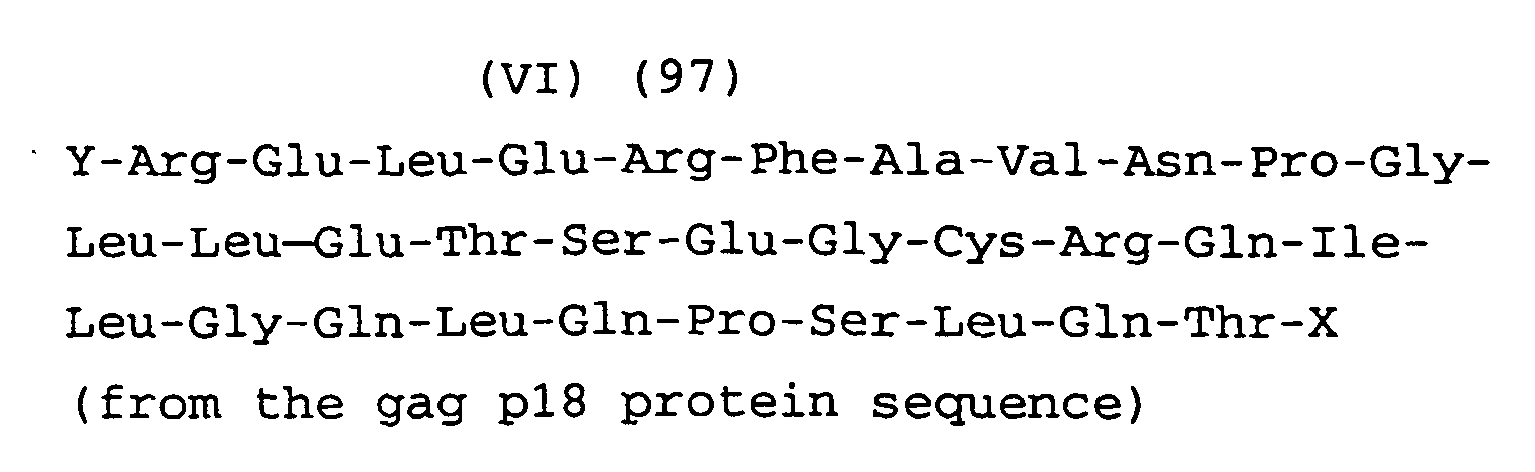
- A peptide of the formula:where Y, if present, is an amino acid added to facilitate coupling, N-terminal acetylated VII, or VII linked to a peptide or protein of at least 5,000 molecular weight, which peptide or protein does not normally bind to antibodies present in a human host.

- A peptide of the formula:where X is OH or NH2, and Z, if present, is an amino acid added to facilitate coupling, N-terminal acetylated VIII, or VIII linked to a peptide or protein of at least 5,000 molecular weight, which peptide or protein does not normally bind to antibodies present in a human host.

- A peptide of the formula:where X is OH or NH2, and Z, if present, is an amino acid added to facilitate coupling, N-terminal acetylated IX, or IX linked to a peptide or protein of at least 5,000 molecular weight, which peptide or protein does not normally bind to antibodies present in a human host.

- A peptide of the formula:where X is OH or NH2, N-terminal acetylated X, or X linked to a peptide or protein of at least 5,000 molecular weight, which peptide or protein does not normally bind to antibodies present in a human host.

- A peptide of the formula:where X is OH or NH2, and each of Y and Z, if present, is an amino acid added to facilitate coupling, N-terminal acetylated XI, and XI linked to a peptide or protein of at least 5,000 molecular weight, which peptide or protein does not normally bind to antibodies present in a human host.

- A peptide of the formula:where X is OH or NH2, and each of Y and Z, if present, is an amino acid added to facilitate coupling, N-terminal acetylated XII, or XII linked to a peptide or protein of at least 5,000 molecular weight, which peptide or protein does not normally bind to antibodies present in a human host.

- A peptide of the formula:where X is OH or NH2, and Y, if present, is an amino acid added to facilitate coupling, N-terminal acetylated XIII, or XIII linked to a peptide or protein of at least 5,000 molecular weight, which peptide or protein does not normally bind to antibodies present in a human host.

Applications Claiming Priority (7)
| Application Number | Priority Date | Filing Date | Title |
|---|---|---|---|
| US72805285A | 1985-04-29 | 1985-04-29 | |
| US06/767,303 US4629783A (en) | 1985-04-29 | 1985-08-19 | Synthetic antigen for the detection of AIDS-related disease |
| US767303 | 1985-08-19 | ||
| US728052 | 1985-11-07 | ||
| US84448586A | 1986-03-26 | 1986-03-26 | |
| US844485 | 1986-03-26 | ||
| PCT/US1986/000831 WO1986006414A1 (en) | 1985-04-29 | 1986-04-21 | Synthetic antigens for the detection of aids-related disease |
Publications (4)
| Publication Number | Publication Date |
|---|---|
| EP0220273A1 EP0220273A1 (en) | 1987-05-06 |
| EP0220273A4 EP0220273A4 (en) | 1989-10-04 |
| EP0220273B1 EP0220273B1 (en) | 1994-12-21 |
| EP0220273B2 true EP0220273B2 (en) | 2007-01-17 |
Family
ID=27419109
Family Applications (1)
| Application Number | Title | Priority Date | Filing Date |
|---|---|---|---|
| EP86902998A Expired - Lifetime EP0220273B2 (en) | 1985-04-29 | 1986-04-21 | Synthetic antigens for the detection of aids-related disease |
Country Status (8)
| Country | Link |
|---|---|
| US (2) | US6485900B1 (en) |
| EP (1) | EP0220273B2 (en) |
| KR (1) | KR910002374B1 (en) |
| AT (1) | ATE116006T1 (en) |
| DE (1) | DE3650175T3 (en) |
| DK (2) | DK171250B1 (en) |
| FI (1) | FI91073C (en) |
| WO (1) | WO1986006414A1 (en) |
Families Citing this family (60)
| Publication number | Priority date | Publication date | Assignee | Title |
|---|---|---|---|---|
| US7285271B1 (en) | 1984-10-31 | 2007-10-23 | Novartis Vaccines And Diagnostics, Inc. | Antigenic composition comprising an HIV gag or env polypeptide |
| CA1341423C (en) | 1984-10-31 | 2003-03-04 | Paul A. Luciw | Recombinant proteins of viruses associated with lymphadenopathy syndrome and/or acquired immune deficiency syndrome |
| US7273695B1 (en) | 1984-10-31 | 2007-09-25 | Novartis Vaccines And Diagnostics, Inc. | HIV immunoassays using synthetic envelope polypeptides |
| US7393949B1 (en) * | 1987-12-24 | 2008-07-01 | Novartis Vaccines And Diagnostics, Inc. | Human immunodeficiency virus (HIV) nucleotide sequences |
| US4629783A (en) * | 1985-04-29 | 1986-12-16 | Genetic Systems Corporation | Synthetic antigen for the detection of AIDS-related disease |
| JP2702911B2 (en) * | 1985-09-11 | 1998-01-26 | ユナイテツド・バイオメデイカル・インコ−ポレ−テツド | Synthetic peptide, and method for detecting AIDS and pre-AIDS using the same |
| GB8525615D0 (en) * | 1985-10-17 | 1985-11-20 | Hoffmann La Roche | Polypeptides |
| US6265149B1 (en) | 1986-01-22 | 2001-07-24 | Institut Pasteur | In vitro diagnostic methods and kits for the detection of HIV-2-specific antibodies |
| US4734362A (en) * | 1986-02-03 | 1988-03-29 | Cambridge Bioscience Corporation | Process for purifying recombinant proteins, and products thereof |
| FR2625100A2 (en) * | 1986-03-13 | 1989-06-30 | Lurhuma Zirimwabagabo | Use of antigens for the preparation of vaccines, protein rendered immunogenic and pharmaceutical composition containing it |
| US5075211A (en) * | 1986-03-26 | 1991-12-24 | Genetic Systems Corporation | Synthetic antigen for the detection of AIDS-related disease |
| US4879212A (en) * | 1986-04-02 | 1989-11-07 | United Biomedical Inc. | Peptide composition and method for the detection of antibodies to HTLV-III |
| US4925784A (en) * | 1986-04-04 | 1990-05-15 | Hoffmann-La Roche Inc. | Expression and purification of an HTLV-III gag/env gene protein |
| US5087557A (en) * | 1986-06-23 | 1992-02-11 | Genetic Systems Corporation | Human monoclonal antibody to lymphadenopathy-associated virus |
| DK169582B1 (en) * | 1986-06-23 | 1994-12-12 | Squibb Bristol Myers Co | Human monoclonal antibody capable of reacting with an epitope on the LAV / HTLV-III envelope glycoprotein gp41, cell lines producing such antibody, pharmaceutical preparation containing the antibody, and method for determining the presence of LAV / HTLV-III in a biological sample. and method for separating specific antigenic determinants of LAV / HTLV-III using ant |
| NZ221440A (en) * | 1986-08-20 | 1991-11-26 | Genetic Systems Corp | Composition containing monoclonal antibodies/peptides useful in treating and diagnosing hiv infections |
| JPH01501939A (en) * | 1987-01-28 | 1989-07-06 | オーソ・フアーマシユーチカル・コーポレーシヨン | Immunosuppressive peptides and usage |
| EP0284383B2 (en) * | 1987-03-25 | 2000-04-05 | Genetic Systems Corporation | Synthetic antigens for the detection of aids-related disease caused by LAV-2 |
| NO881151L (en) * | 1987-03-27 | 1988-09-28 | Syntello Ab | SYNTHETIC HIV-1 ANTIGEN. |
| SE8701628D0 (en) * | 1987-04-16 | 1987-04-16 | Erling Norrby | MEANS OF ANALYSIS MM |
| US4921787A (en) * | 1987-05-01 | 1990-05-01 | Cambridge Bioscience Corporation | Detection of antibodies to human immunodeficiency virus by agglutination of antigen coated latex |
| CA1339363C (en) * | 1987-05-01 | 1997-08-26 | Alan Ray Flesher | Monoclonal antibodies to specific antigenic regions of the human immunodeficiency virus and methods for use |
| FI872409A0 (en) * | 1987-05-29 | 1987-05-29 | Labsystems Oy | FOERFARANDE FOER DETEKTERING AV HIV-1 MOTKROPPAR. |
| US5128319A (en) * | 1987-08-28 | 1992-07-07 | Board Of Regents, The University Of Texas System | Prophylaxis and therapy of acquired immunodeficiency syndrome |
| IE63455B1 (en) * | 1987-09-04 | 1995-04-19 | Int Murex Tech Corp | Immunoassay and biological constructs for use therein |
| SE8704185L (en) * | 1987-10-28 | 1989-04-29 | Ferring Ab | NEW PEPTIDES, ARTIFICIAL ANTIGENS AND IMMUNO ANALYSIS TEST RATES |
| SE8705197D0 (en) * | 1987-12-30 | 1987-12-30 | Jonas Blomberg | NEW PEPTIDES, TWO DIAGNOSTIC METHODS USING THE PEPTIDES AND A MEDICATION BASED ON THE PEPTIDES |
| US6218102B1 (en) * | 1988-01-27 | 2001-04-17 | Biochem Immunosystems, Inc. | Synthetic peptides and mixtures thereof for detecting HIV antibodies |
| US6214537B1 (en) | 1988-01-27 | 2001-04-10 | Biochem Immunosystems, Inc. | Synthetic peptides and mixtures thereof for detecting HIV antibodies |
| US5241047A (en) * | 1988-12-08 | 1993-08-31 | Biochem Pharma Inc. | Synthetic peptides and mixtures thereof for detecting HIV antibodies |
| US6210874B1 (en) | 1988-01-27 | 2001-04-03 | Biochem Immunosystems, Inc. | Synthetic peptides and mixtures thereof for detecting HIV antibodies |
| GB2220939B (en) * | 1988-06-10 | 1992-02-26 | Medical Res Council | Peptide fragments of hiv and their use in vaccines and diagnosis |
| GB8828097D0 (en) * | 1988-12-01 | 1989-01-05 | Wellcome Found | Peptides |
| GB8828098D0 (en) * | 1988-12-01 | 1989-01-05 | Wellcome Found | Peptides |
| GB8910145D0 (en) * | 1989-05-03 | 1989-06-21 | Connaught Lab | Synthetic peptides for an hiv-1 vaccine |
| AU6887591A (en) * | 1989-11-27 | 1991-06-26 | Replico Medical Aktiebolag | New hiv-1 p17 peptides, diagnostic antigens and immunoassay method |
| US6248574B1 (en) | 1989-12-13 | 2001-06-19 | Avigdor Shaffermann | Polypeptides selectively reactive with antibodies against human immunodeficiency virus and vaccines comprising the polypeptides |
| US5480967A (en) * | 1990-01-05 | 1996-01-02 | United Biomedical, Inc. | HIV-1 core protein fragments |
| FR2657017B1 (en) * | 1990-01-16 | 1995-08-18 | Clonatec Sa | PEPTIDES DERIVED FROM THE GLYCOPROTEIN ENVELOPE OF THE HIV-1 VIRUS, THEIR APPLICATIONS FOR THE DETECTION OF AN INFECTION DUE TO THIS VIRUS AND FOR VACCINATION AGAINST AIDS. |
| EP0438332B1 (en) * | 1990-01-16 | 1998-04-08 | Orgenics Ltd. | Peptides issued from the glycoprotein envelope of HIV virus, their uses for the detection of an infection due to these viruses and for the vaccination against AIDS |
| SE468168B (en) * | 1990-02-20 | 1992-11-16 | Replico Medical Ab | HIV-1, P24 PEPTIDES, DIAGNOSTIC ANTIGENS AND PROCEDURES FOR DIFFERENTIAL DIAGNOSTICS OF PRELIMINARY HIV-1 POSITIVE SERUM TESTS |
| SE470074B (en) * | 1990-08-16 | 1993-11-01 | Replico Medical Ab | Method for diagnosis of picorene and / or flavivirus infection, peptides, diagnostic antigens and vaccine composition with these peptides |
| DE4039925A1 (en) * | 1990-12-14 | 1992-06-17 | Behringwerke Ag | SELECTED PEPTIDES OF THE GROUP-SPECIFIC ANTIGEN (GAG) OF HUMANEM IMMUNE DEFICIENCY VIRUS (HIV), THEIR PRODUCTION AND USE |
| AU4387193A (en) * | 1992-05-29 | 1993-12-30 | Abbott Laboratories | Ligase chain reaction starting with rna sequences |
| US6479055B1 (en) | 1993-06-07 | 2002-11-12 | Trimeris, Inc. | Methods for inhibition of membrane fusion-associated events, including respiratory syncytial virus transmission |
| FR2732346B1 (en) * | 1995-03-27 | 1997-05-30 | Centre Nat Rech Scient | MUTE PROTEINS, ENCODED BY LENTIVIRUS MUTE GENES, PEPTIDE FRAGMENTS INCLUDED IN SAID PROTEINS, EXPRESSION VECTORS EXPRESSING MUTE PROTEINS AND THEIR APPLICATIONS |
| FR2773156B1 (en) * | 1997-12-26 | 2000-03-31 | Biovacs Inc | NOVEL ANTI-RETROVIRAL IMMUNOGENS (TOXOIDS), NOVEL PREPARATION METHODS AND APPLICATION TO AIDS PREVENTION AND TREATMENT |
| FR2781158B1 (en) | 1998-07-15 | 2002-12-13 | Vacs Internat | NOVEL MODIFIED NON-IMMUNOSUPPRESSIVE IMMUNOGENIC PROTEINS, THEIR PREPARATION PROCESS AND THEIR APPLICATIONS |
| CA2290217C (en) * | 1998-11-30 | 2010-01-12 | Ortho-Clinical Diagnostics, Inc. | Peptides for the detection of hiv-1 group o |
| FR2802426B1 (en) | 1999-12-15 | 2004-04-02 | Neovacs | USE OF IMMUNOSUPPRESSIVE AND / OR ANGIOGENIC IMMUNOGENIC PROTEINS MADE INACTIVE FOR THE PRODUCTION OF SECRETORY IGAs |
| ES2366185T3 (en) * | 2003-04-11 | 2011-10-18 | Institut Pasteur | SYNTHETIC PEPTIDES VACCINES FOR HIV: THE EPDOPE OF CBD AS AN EFFECTIVE IMMUNOGEN TO PROVIDE WIDE NEUTRALIZING ANTIBODIES AGAINST HIV. |
| FR2882557A1 (en) * | 2005-02-25 | 2006-09-01 | Centre Nat Rech Scient | HIV EPITOPES AND PHARMACEUTICAL COMPOSITION CONTAINING SAME |
| JP6692834B2 (en) | 2015-02-09 | 2020-05-13 | スリングショット バイオサイエンシーズ, インコーポレイテッド | Hydrogel particles with tunable optical properties and methods of use thereof |
| TW202141019A (en) | 2020-01-24 | 2021-11-01 | 美商史林夏特生化公司 | Compositions and methods for cell-like calibration particles |
| CN115485556B (en) | 2020-05-04 | 2026-02-03 | 弹弓生物科学公司 | Compositions and methods for passive optical barcoding for multiplexed assays |
| EP4423250A1 (en) | 2021-10-29 | 2024-09-04 | Slingshot Biosciences, Inc. | Hydrogel particles as feeder cells and as synthetic antigen presenting cells |
| WO2023215886A1 (en) | 2022-05-05 | 2023-11-09 | Slingshot Biosciences, Inc. | Engineered particles as red blood cell mimics and compositions containing same for hematology |
| WO2023235885A1 (en) | 2022-06-02 | 2023-12-07 | Slingshot Biosciences, Inc. | Apoptotic cell mimic |
| CN120712108A (en) | 2022-10-26 | 2025-09-26 | 弹弓生物科学公司 | Size-tunable synthetic particles with tunable optical properties and methods for using the same for immune cell activation |
| CN121986254A (en) | 2023-08-29 | 2026-05-05 | 弹弓生物科学公司 | CD34 stem cell mimicry |
Family Cites Families (22)
| Publication number | Priority date | Publication date | Assignee | Title |
|---|---|---|---|---|
| GB8429099D0 (en) | 1984-11-16 | 1984-12-27 | Pasteur Institut | Closed dna sequences |
| GB8324800D0 (en) | 1983-09-15 | 1983-10-19 | Pasteur Institut | Antigens |
| FR2571968B1 (en) | 1984-10-18 | 1989-03-17 | Pasteur Institut | VIRUS PURIFIES LYMPHADENOPATHIES AND ACQUIRED IMMUNO-DEPRESSION SYNDROME AND ENVELOPE ANTIGENS OF THIS VIRUS, VIRUS AND ENVELOPE ANTIGENS OF THIS VIRUS, APPLICATIONS OF THIS VIRUS OR ANTIGENS THEREOF PREPARATION OF IMMUNOGENIC COMPOSITIONS OR FOR THE DIAGNOSIS OF THE ABOVE CONDITIONS. |
| US4520113A (en) * | 1984-04-23 | 1985-05-28 | The United States Of America As Represented By The Secretary Of The Department Of Health And Human Services | Serological detection of antibodies to HTLV-III in sera of patients with AIDS and pre-AIDS conditions |
| GB8501473D0 (en) | 1985-01-21 | 1985-02-20 | Pasteur Institut | Cloned dna sequences |
| WO1986002383A1 (en) | 1984-10-18 | 1986-04-24 | Institut Pasteur | Envelope antigens of lymphadenopathy associated virus and their applications |
| US4774175A (en) | 1985-03-01 | 1988-09-27 | Centocor, Inc. | Immunochemical methods for the detection of antibody against HTLV-III |
| US4784941A (en) | 1985-04-08 | 1988-11-15 | Genetic Systems Corporation | Expression and diagnostic use of pENV-3 encoded peptides which are immunologically reactive with antibodies to LAV |
| US4629783A (en) * | 1985-04-29 | 1986-12-16 | Genetic Systems Corporation | Synthetic antigen for the detection of AIDS-related disease |
| US4843011A (en) | 1985-08-01 | 1989-06-27 | Akzo N.V. | Monoclonal antibodies for binding HTLV-III proteins, and cell lines for their production |
| US4735896A (en) * | 1986-03-04 | 1988-04-05 | United Biomedical, Inc. | Synthetic peptide and process of using same for the detection and diagnosis of AIDS and pre-AIDS conditions |
| US4803156A (en) * | 1985-09-11 | 1989-02-07 | New York Blood Center | Peptide-beta-lactamase conjugates for enzyme-linked immunoassays |
| US4956273A (en) | 1985-10-24 | 1990-09-11 | Southwest Foundation For Biomedical Research | Synthetic peptides and method of use for diagnosis and vaccination for AIDS and ARC |
| US4839288A (en) | 1986-01-22 | 1989-06-13 | Institut Pasteur | Retrovirus capable of causing AIDS, antigens obtained from this retrovirus and corresponding antibodies and their application for diagnostic purposes |
| US4772547A (en) * | 1986-02-03 | 1988-09-20 | Hoffmann-La Roche Inc. | HTLV-III envelope peptides |
| US4753873A (en) | 1986-02-03 | 1988-06-28 | Cambridge Bioscience Corporation | Peptides for the diagnosis of HTLV-III antibodies, their preparation and use |
| US4808536A (en) | 1986-02-27 | 1989-02-28 | Centocor, Inc. | Immunochemical method for detection of antibody against HTLV-III core protein based upon recombinant HTLV-III gag gene encoded protein |
| US4879212A (en) | 1986-04-02 | 1989-11-07 | United Biomedical Inc. | Peptide composition and method for the detection of antibodies to HTLV-III |
| US4957737A (en) | 1986-05-27 | 1990-09-18 | Hoffmann-La Roche Inc. | HTLV-III (LAV) envelope peptides |
| US5017688A (en) | 1986-06-12 | 1991-05-21 | Biogen, Inc. | Peptides involved in the pathogenesis of HIV infection |
| US4861707A (en) | 1987-02-02 | 1989-08-29 | E. I. Du Pont De Nemours And Company | Human immunodeficiency virus antigen |
| US4943628A (en) | 1988-06-13 | 1990-07-24 | Ortho Pharmaceutical Corporation | HIV peptide-inducted T cell stimulation |
-
1986
- 1986-04-21 KR KR1019860700948A patent/KR910002374B1/en not_active Expired
- 1986-04-21 DE DE3650175T patent/DE3650175T3/en not_active Expired - Lifetime
- 1986-04-21 AT AT86902998T patent/ATE116006T1/en not_active IP Right Cessation
- 1986-04-21 EP EP86902998A patent/EP0220273B2/en not_active Expired - Lifetime
- 1986-04-21 WO PCT/US1986/000831 patent/WO1986006414A1/en not_active Ceased
- 1986-12-23 DK DK626486A patent/DK171250B1/en not_active IP Right Cessation
- 1986-12-29 FI FI865313A patent/FI91073C/en not_active IP Right Cessation
-
1990
- 1990-06-20 US US07/541,163 patent/US6485900B1/en not_active Expired - Lifetime
-
1994
- 1994-06-01 US US08/252,987 patent/US6214539B1/en not_active Expired - Lifetime
-
1995
- 1995-07-18 DK DK084195A patent/DK84195A/en not_active Application Discontinuation
Also Published As
| Publication number | Publication date |
|---|---|
| EP0220273A1 (en) | 1987-05-06 |
| FI865313A0 (en) | 1986-12-29 |
| KR910002374B1 (en) | 1991-04-20 |
| DK171250B1 (en) | 1996-08-12 |
| FI91073C (en) | 1994-05-10 |
| FI865313L (en) | 1986-12-29 |
| US6485900B1 (en) | 2002-11-26 |
| ATE116006T1 (en) | 1995-01-15 |
| KR880700080A (en) | 1988-02-15 |
| EP0220273A4 (en) | 1989-10-04 |
| AU5773386A (en) | 1986-11-18 |
| DE3650175T2 (en) | 1995-06-14 |
| US6214539B1 (en) | 2001-04-10 |
| EP0220273B1 (en) | 1994-12-21 |
| DE3650175T3 (en) | 2007-09-06 |
| AU597884B2 (en) | 1990-06-14 |
| DK626486D0 (en) | 1986-12-23 |
| FI91073B (en) | 1994-01-31 |
| DK626486A (en) | 1986-12-23 |
| DK84195A (en) | 1995-07-18 |
| WO1986006414A1 (en) | 1986-11-06 |
| DE3650175D1 (en) | 1995-02-02 |
Similar Documents
| Publication | Publication Date | Title |
|---|---|---|
| US6485900B1 (en) | Synthetic antigen for the detection of AIDS-related disease | |
| US4629783A (en) | Synthetic antigen for the detection of AIDS-related disease | |
| US5075211A (en) | Synthetic antigen for the detection of AIDS-related disease | |
| US4808536A (en) | Immunochemical method for detection of antibody against HTLV-III core protein based upon recombinant HTLV-III gag gene encoded protein | |
| EP0247557A2 (en) | HTLV-III(LAV) Envelope peptides | |
| US6322964B1 (en) | Synthetic HIV-2 gag and env oligopeptides reactive with HIV-2 specific antibodies | |
| EP0284383B2 (en) | Synthetic antigens for the detection of aids-related disease caused by LAV-2 | |
| EP1878805B1 (en) | Synthetic antigen for the detection of antibodies immunoreactive with HIV virus | |
| US6130314A (en) | Synthetic antigen for the detection of AIDS-related disease | |
| AU597884C (en) | Synthetic antigens for the detection of AIDS-related disease | |
| AU627738B2 (en) | Htlv-i / hiv-1 fusion proteins | |
| JP2705791B2 (en) | Synthetic antigens for detection of AIDS-related diseases | |
| NO173034B (en) | PROCEDURES AND PEPTIDES FOR DETECTION OF AIDS-RELATED DISEASE |
Legal Events
| Date | Code | Title | Description |
|---|---|---|---|
| PUAI | Public reference made under article 153(3) epc to a published international application that has entered the european phase |
Free format text: ORIGINAL CODE: 0009012 |
|
| 17P | Request for examination filed |
Effective date: 19870120 |
|
| AK | Designated contracting states |
Kind code of ref document: A1 Designated state(s): AT BE CH DE FR GB IT LI LU NL SE |
|
| A4 | Supplementary search report drawn up and despatched |
Effective date: 19891004 |
|
| 17Q | First examination report despatched |
Effective date: 19901129 |
|
| GRAA | (expected) grant |
Free format text: ORIGINAL CODE: 0009210 |
|
| AK | Designated contracting states |
Kind code of ref document: B1 Designated state(s): AT BE CH DE FR GB IT LI LU NL SE |
|
| REF | Corresponds to: |
Ref document number: 116006 Country of ref document: AT Date of ref document: 19950115 Kind code of ref document: T |
|
| REF | Corresponds to: |
Ref document number: 3650175 Country of ref document: DE Date of ref document: 19950202 |
|
| ITF | It: translation for a ep patent filed | ||
| ET | Fr: translation filed | ||
| PLBI | Opposition filed |
Free format text: ORIGINAL CODE: 0009260 |
|
| 26 | Opposition filed |
Opponent name: BEHRINGWERKE AG Effective date: 19950921 Opponent name: BOEHRINGER MANNHEIM GMBH Effective date: 19950918 |
|
| NLR1 | Nl: opposition has been filed with the epo |
Opponent name: BEHRINGWERKE AG Opponent name: BOEHRINGER MANNHEIM GMBH |
|
| PLBF | Reply of patent proprietor to notice(s) of opposition |
Free format text: ORIGINAL CODE: EPIDOS OBSO |
|
| PLBF | Reply of patent proprietor to notice(s) of opposition |
Free format text: ORIGINAL CODE: EPIDOS OBSO |
|
| PLAB | Opposition data, opponent's data or that of the opponent's representative modified |
Free format text: ORIGINAL CODE: 0009299OPPO |
|
| R26 | Opposition filed (corrected) |
Opponent name: BOEHRINGER MANNHEIM GMBH * 950921 BEHRING DIAGNOST Effective date: 19950918 |
|
| NLR1 | Nl: opposition has been filed with the epo |
Opponent name: BEHRING DIAGNOSTICS GMBH Opponent name: BOEHRINGER MANNHEIM GMBH |
|
| PLAB | Opposition data, opponent's data or that of the opponent's representative modified |
Free format text: ORIGINAL CODE: 0009299OPPO |
|
| R26 | Opposition filed (corrected) |
Opponent name: BOEHRINGER MANNHEIM GMBH * 950921 DADE BEHRING MAR Effective date: 19950918 |
|
| NLR1 | Nl: opposition has been filed with the epo |
Opponent name: DADE BEHRING MARBURG GMBH Opponent name: BOEHRINGER MANNHEIM GMBH |
|
| PLAW | Interlocutory decision in opposition |
Free format text: ORIGINAL CODE: EPIDOS IDOP |
|
| PLAB | Opposition data, opponent's data or that of the opponent's representative modified |
Free format text: ORIGINAL CODE: 0009299OPPO |
|
| APAC | Appeal dossier modified |
Free format text: ORIGINAL CODE: EPIDOS NOAPO |
|
| R26 | Opposition filed (corrected) |
Opponent name: ROCHE DIAGNOSTICS GMBH * 950921 DADE BEHRING MARBU Effective date: 19950918 |
|
| APAE | Appeal reference modified |
Free format text: ORIGINAL CODE: EPIDOS REFNO |
|
| NLR1 | Nl: opposition has been filed with the epo |
Opponent name: DADE BEHRING MARBURG GMBH Opponent name: ROCHE DIAGNOSTICS GMBH |
|
| REG | Reference to a national code |
Ref country code: GB Ref legal event code: IF02 |
|
| APBP | Date of receipt of notice of appeal recorded |
Free format text: ORIGINAL CODE: EPIDOSNNOA2O |
|
| APBQ | Date of receipt of statement of grounds of appeal recorded |
Free format text: ORIGINAL CODE: EPIDOSNNOA3O |
|
| APBU | Appeal procedure closed |
Free format text: ORIGINAL CODE: EPIDOSNNOA9O |
|
| RAP2 | Party data changed (patent owner data changed or rights of a patent transferred) |
Owner name: BIO-RAD LABORATORIES, INC. |
|
| PGFP | Annual fee paid to national office [announced via postgrant information from national office to epo] |
Ref country code: NL Payment date: 20050329 Year of fee payment: 20 |
|
| PGFP | Annual fee paid to national office [announced via postgrant information from national office to epo] |
Ref country code: AT Payment date: 20050401 Year of fee payment: 20 |
|
| PGFP | Annual fee paid to national office [announced via postgrant information from national office to epo] |
Ref country code: GB Payment date: 20050413 Year of fee payment: 20 |
|
| PGFP | Annual fee paid to national office [announced via postgrant information from national office to epo] |
Ref country code: FR Payment date: 20050418 Year of fee payment: 20 |
|
| PGFP | Annual fee paid to national office [announced via postgrant information from national office to epo] |
Ref country code: SE Payment date: 20050420 Year of fee payment: 20 |
|
| PGFP | Annual fee paid to national office [announced via postgrant information from national office to epo] |
Ref country code: CH Payment date: 20050421 Year of fee payment: 20 |
|
| PGFP | Annual fee paid to national office [announced via postgrant information from national office to epo] |
Ref country code: LU Payment date: 20050427 Year of fee payment: 20 |
|
| PGFP | Annual fee paid to national office [announced via postgrant information from national office to epo] |
Ref country code: IT Payment date: 20050428 Year of fee payment: 20 |
|
| NLT2 | Nl: modifications (of names), taken from the european patent patent bulletin |
Owner name: BIO-RAD LABORATORIES, INC. |
|
| PGFP | Annual fee paid to national office [announced via postgrant information from national office to epo] |
Ref country code: BE Payment date: 20050520 Year of fee payment: 20 |
|
| PGFP | Annual fee paid to national office [announced via postgrant information from national office to epo] |
Ref country code: DE Payment date: 20050531 Year of fee payment: 20 |
|
| APAH | Appeal reference modified |
Free format text: ORIGINAL CODE: EPIDOSCREFNO |
|
| PG25 | Lapsed in a contracting state [announced via postgrant information from national office to epo] |
Ref country code: GB Free format text: LAPSE BECAUSE OF EXPIRATION OF PROTECTION Effective date: 20060420 |
|
| PG25 | Lapsed in a contracting state [announced via postgrant information from national office to epo] |
Ref country code: NL Free format text: LAPSE BECAUSE OF EXPIRATION OF PROTECTION Effective date: 20060421 |
|
| REG | Reference to a national code |
Ref country code: GB Ref legal event code: PE20 |
|
| REG | Reference to a national code |
Ref country code: CH Ref legal event code: PL |
|
| RIC2 | Information provided on ipc code assigned after grant |
Ipc: A61K 39/21 20060101ALI20060502BHEP Ipc: A61K 39/00 20060101ALI20060502BHEP Ipc: C07K 14/16 20060101ALI20060502BHEP Ipc: C07K 7/08 20060101ALI20060502BHEP Ipc: C07K 7/06 20060101ALI20060502BHEP Ipc: G01N 33/50 20060101ALI20060502BHEP Ipc: C12Q 1/70 20060101AFI20060502BHEP |
|
| EUG | Se: european patent has lapsed | ||
| NLV7 | Nl: ceased due to reaching the maximum lifetime of a patent |
Effective date: 20060421 |
|
| PUAH | Patent maintained in amended form |
Free format text: ORIGINAL CODE: 0009272 |
|
| STAA | Information on the status of an ep patent application or granted ep patent |
Free format text: STATUS: PATENT MAINTAINED AS AMENDED |
|
| 27A | Patent maintained in amended form |
Effective date: 20070117 |
|
| AK | Designated contracting states |
Kind code of ref document: B2 Designated state(s): AT BE CH DE FR GB IT LI LU NL SE |
|
| NLR2 | Nl: decision of opposition |
Effective date: 20070117 |
|
| NLV7 | Nl: ceased due to reaching the maximum lifetime of a patent |
Effective date: 20060421 |
|
| REG | Reference to a national code |
Ref country code: CH Ref legal event code: PUE Owner name: BIO-RAD LABORATORIES, INC. Free format text: GENETIC SYSTEMS CORPORATION#3005 FIRST AVENUE#SEATTLE/WA (US) -TRANSFER TO- BIO-RAD LABORATORIES, INC.#1000 ALFRED NOBEL DRIVE#HERCULES, CA 94547 (US) Ref country code: CH Ref legal event code: NV Representative=s name: MICHELI & CIE SA |
|
| REG | Reference to a national code |
Ref country code: SE Ref legal event code: RPEO |
|
| NLR3 | Nl: receipt of modified translations in the netherlands language after an opposition procedure | ||
| NLV7 | Nl: ceased due to reaching the maximum lifetime of a patent |
Effective date: 20070418 |
|
| ET3 | Fr: translation filed ** decision concerning opposition | ||
| BE20 | Be: patent expired |
Owner name: *BIO-RAD LABORATORIES INC. Effective date: 20060421 |