EP0220249B1 - A safety device for switches - Google Patents
A safety device for switches Download PDFInfo
- Publication number
- EP0220249B1 EP0220249B1 EP86902803A EP86902803A EP0220249B1 EP 0220249 B1 EP0220249 B1 EP 0220249B1 EP 86902803 A EP86902803 A EP 86902803A EP 86902803 A EP86902803 A EP 86902803A EP 0220249 B1 EP0220249 B1 EP 0220249B1
- Authority
- EP
- European Patent Office
- Prior art keywords
- fuse
- barring
- pins
- box
- switch
- Prior art date
- Legal status (The legal status is an assumption and is not a legal conclusion. Google has not performed a legal analysis and makes no representation as to the accuracy of the status listed.)
- Expired
Links
- 230000007935 neutral effect Effects 0.000 claims abstract description 6
- 230000037431 insertion Effects 0.000 claims abstract description 5
- 238000003780 insertion Methods 0.000 claims abstract description 5
- 230000000694 effects Effects 0.000 claims 1
- 238000010276 construction Methods 0.000 description 5
- 238000005192 partition Methods 0.000 description 5
- 230000008878 coupling Effects 0.000 description 1
- 238000010168 coupling process Methods 0.000 description 1
- 238000005859 coupling reaction Methods 0.000 description 1
- 230000000284 resting effect Effects 0.000 description 1
- 210000003813 thumb Anatomy 0.000 description 1
Images
Classifications
-
- H—ELECTRICITY
- H01—ELECTRIC ELEMENTS
- H01H—ELECTRIC SWITCHES; RELAYS; SELECTORS; EMERGENCY PROTECTIVE DEVICES
- H01H9/00—Details of switching devices, not covered by groups H01H1/00 - H01H7/00
- H01H9/10—Adaptation for built-in fuses
- H01H9/104—Adaptation for built-in fuses with interlocking mechanism between switch and fuse
-
- H—ELECTRICITY
- H01—ELECTRIC ELEMENTS
- H01H—ELECTRIC SWITCHES; RELAYS; SELECTORS; EMERGENCY PROTECTIVE DEVICES
- H01H85/00—Protective devices in which the current flows through a part of fusible material and this current is interrupted by displacement of the fusible material when this current becomes excessive
- H01H85/02—Details
- H01H85/0208—Tools for inserting and removing fuses
Definitions
- the present invention relates to a safety device for use in connection with power switches of a type known per se and comprising a substantially box-shaped breaker box with a number of one-sidedly located contact pieces which are in pairs intended to secure a fuse formed as a fuse body and two opposite terminal legs extending there from.
- switches of the above type are often only shielded by means of mounted plastic partitions between the fuses and their holders (the contact pieces), which has resulted in a construction of switch boards, where each switch is mounted below separate doors or covers, which can only be opened when the switch in question is disconnected. This will obviously increase the price of switchboards, the daily operation of which is difficult and time-consuming.
- SE-A-219225 and DE-B-1069270 relate to a cover with a manually operated closing handle resiliently movable for cooperation with carrier pins engaging the fuse vanes.
- Switches with built-in safety devices are known preventing unauthorised access to live parts when the fuse has been mounted and the switch connected; however, no safety device is known, which, if desired, can be mounted as a separate unit on existing power switches of the above type and which can simultaneously offer the necessary safety.
- a safety device is hereby obtained which can easily be mounted as a separate unit on existing power switches and will consequently imply protection against the situation, where a impatient electrician is injured during an attempt of removing or inserting a fuse by means of an available unsuitable tool while the switch is connected.
- the safety device according to the invention prevents everybody from coming into contact at all with live parts in a connected switch via the terminal legs of the fuse by means of an inappropriate manipulation with the fuse, e.g. by an oblique insertion of the fuse into the fuse box. The space will prevent this.
- Fig. 1 of the drawing illustrates a position indicator 15 on the axle of the handle as well as markings for the in- and out-position, "I" and "O", respectively, of the switch.
- a respective box-shaped shielded fuse box in Figs. 1 and 2 designated 17, 19, and 21, is positioned around each pair of contact pieces, only indicated in Fig. 3 of the drawing at positions 16, there being a fuse box for each of the three phases normally available.
- a DIN-standardized knife fuse consisting of a fuse body 23 and a terminal leg 25 in each end is inserted into each box as indicated by dotted line.
- Each fuse box comprises in particular an outer box 27 open at the top and the bottom; said outer box carries in the inner of the central third part a chamber for the fuse body 23, said chamber being substantially U-shaped in section.
- the chamber is formed by two inner end walls 29 and a bottom wall 31. Each inner wall 29 is at the top connected to an outer end wall through a horizontal partition 33.
- the mutual distance between the inner end walls 29 is only somewhat greater than the length of the fuse body 23, so that only little clearance d is left between the end surfaces of the fuse body 23 and the inner end walls 29 of the fuse box.
- end walls 29 and the horizontal partitions 33 furthermore comprise a slot 35 each allowing insertion of the terminal legs of the fuse for engaging a contact piece 16 each.
- the fuse boxes 17, 19, and 21 may be fastened to the breaker box 11 by means of screws or suitable snap-action device; this is not illustrated in the drawing.
- Each fuse box comprises a barring pin 41, 43, and 45, respectively, situated in the same horizontal and vertical plane and resting in suitable recesses in the side walls of the fuse boxes at a level between a horizontal partition 33 and the upper end of a contact piece 16.
- the barring pins can be moved longitudinally between the two outermost positions by means of a suitable manoeuvring means, e.g. an appropriately formed cam disc 47 placed on the axle 13 of the handle.
- a suitable manoeuvring means e.g. an appropriately formed cam disc 47 placed on the axle 13 of the handle.
- the cam disc 47 has manoeuvred all barring pins to the barring position as illustrated in Fig. 2. This takes place under the surmounting of small spring forces from the springs 51, 53, and 55 ensuring the return of the pins to the neutral position when the switch is disconnected. It should be noted that as far as the two adjacent fuse boxes - which in the drawing are positioned to the right of the handle axis 13 - are concerned, the outer barring pin 45 is indirectly influenced through the inner barring pin 43.
- Each fuse box is furthermore covered by a specially formed cover according to the invention as illustrated in Figs. 3, 4, and 5.
- the cover provided with the general reference number 60, abuts the upper edge of the outer box walls 27 with an edge flange 61, cf. Fig. 3.
- a central section of the cover is opened in the side walls to form a handle portion 63 and is on the underside constructed with open cells separated by partitions 65.
- the cover is provided with carrier pins 67 for engaging eye-shaped fuse vanes 69, which by way of standard are provided at the ends of the fuse body 23 of each fuse.
- a closing handle 71 is provided in one end wall of the cover opposite a carrier pin 67 through suitable recesses in the end wall and on the top side; the closing handle may be bent outwards, away from the center of the handle or the cover, the cover being made of a material sufficiently elastic to make such a deflection possible.
- the closing handle 71 is furthermore provided with a downwardly projecting nose 73 for cooperation with a fuse vane 69 as illustrated in Figs. 4 and 5, which are a longitudinal sectional view of the cover 60 and a sectional view of the fuse.
- the construction of the cover further allows the removal of a hot fuse without it being touched, as the closing handle 71 after removal from the fuse box in question is easily bent outwards by a push with a thumb, whereafter the fuse is capable of sliding off freely, if the handle is tilted at a suitable angle.
Landscapes
- Switch Cases, Indication, And Locking (AREA)
- Fuses (AREA)
- Push-Button Switches (AREA)
- Automotive Seat Belt Assembly (AREA)
- Driving Mechanisms And Operating Circuits Of Arc-Extinguishing High-Tension Switches (AREA)
- Keying Circuit Devices (AREA)
Abstract
Description
- The present invention relates to a safety device for use in connection with power switches of a type known per se and comprising a substantially box-shaped breaker box with a number of one-sidedly located contact pieces which are in pairs intended to secure a fuse formed as a fuse body and two opposite terminal legs extending there from.
- Known switches of the above type are often only shielded by means of mounted plastic partitions between the fuses and their holders (the contact pieces), which has resulted in a construction of switch boards, where each switch is mounted below separate doors or covers, which can only be opened when the switch in question is disconnected. This will obviously increase the price of switchboards, the daily operation of which is difficult and time-consuming. (DE-B-1150434). SE-A-219225 and DE-B-1069270 relate to a cover with a manually operated closing handle resiliently movable for cooperation with carrier pins engaging the fuse vanes.
- Switches with built-in safety devices are known preventing unauthorised access to live parts when the fuse has been mounted and the switch connected; however, no safety device is known, which, if desired, can be mounted as a separate unit on existing power switches of the above type and which can simultaneously offer the necessary safety.
- This problem is solved with the features of the claims.
- A safety device is hereby obtained which can easily be mounted as a separate unit on existing power switches and will consequently imply protection against the situation, where a impatient electrician is injured during an attempt of removing or inserting a fuse by means of an available unsuitable tool while the switch is connected. The safety device according to the invention prevents everybody from coming into contact at all with live parts in a connected switch via the terminal legs of the fuse by means of an inappropriate manipulation with the fuse, e.g. by an oblique insertion of the fuse into the fuse box. The space will prevent this.
- As a result maximum contact safety is achieved, which involves that the costs of construction in connection with the establishment of switch boards can be reduced, as the previously enforced requirement of only one switch behind one door can be modified without any risk. The placing of several switches behind the same door increases the accessibility in connection with service on switch boards considerably.
- The invention will be described more detailed below with reference to the accompanying drawing, in which
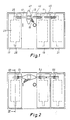
- Fig. 1 is a schematic top view of a safety device with the switch in out-position and the barring pins correspondingly in neutral position,
- Fig. 2 illustrates the safety device of Fig. 1 but with the switch in in-position and the barring pins correspondingly in their barring position,
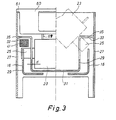
- Fig. 3 is a sectional view along the line III-III of Fig. 2, in which the left part of the figure in full line illustrates a correctly inserted fuse with the switch connected, and in which the right part in dotted line illustrates a fuse, the insertion of which has been attempted with the switch connected,
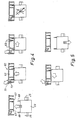
- Fig. 4 is a longitudinal sectional view of four stages of the connection between the cover of a fuse box and a fuse, and
- Fig. 5 is a longitudinal sectional view of two stages in the disengagement of the fuse from the cover.
- The types of switches normally referred to in the present context pass by the name of quick-break switches, circuit interruptors or the like and are so well-known to the experts that the sketchy figures of the drawing are quite sufficient for explaining the present invention. For the sake of clarity the switch itself has only been indicated by an
outer contour 11 and by an axle of the handle for the operating mechanism of the switch. A more detailed description of a switch of this well-known type is given in Danish Patent Application No. 5105/84 with the title: "Electric Switch" and No. 0161/85 with the title: "Breaker Box". - Furthermore, Fig. 1 of the drawing illustrates a
position indicator 15 on the axle of the handle as well as markings for the in- and out-position, "I" and "O", respectively, of the switch. - A respective box-shaped shielded fuse box, in Figs. 1 and 2 designated 17, 19, and 21, is positioned around each pair of contact pieces, only indicated in Fig. 3 of the drawing at
positions 16, there being a fuse box for each of the three phases normally available. A DIN-standardized knife fuse consisting of afuse body 23 and aterminal leg 25 in each end is inserted into each box as indicated by dotted line. - The more detailed construction of the fuse boxes is illustrated in Fig. 3. Each fuse box comprises in particular an
outer box 27 open at the top and the bottom; said outer box carries in the inner of the central third part a chamber for thefuse body 23, said chamber being substantially U-shaped in section. The chamber is formed by twoinner end walls 29 and abottom wall 31. Eachinner wall 29 is at the top connected to an outer end wall through ahorizontal partition 33. - The mutual distance between the
inner end walls 29 is only somewhat greater than the length of thefuse body 23, so that only little clearance d is left between the end surfaces of thefuse body 23 and theinner end walls 29 of the fuse box. - These
end walls 29 and thehorizontal partitions 33 furthermore comprise aslot 35 each allowing insertion of the terminal legs of the fuse for engaging acontact piece 16 each. - The
fuse boxes breaker box 11 by means of screws or suitable snap-action device; this is not illustrated in the drawing. - Each fuse box comprises a
barring pin horizontal partition 33 and the upper end of acontact piece 16. The barring pins can be moved longitudinally between the two outermost positions by means of a suitable manoeuvring means, e.g. an appropriately formedcam disc 47 placed on theaxle 13 of the handle. In the situation shown in Fig. 1 all barring pins are in neutral position, where they do not bar the access of a terminal leg to a contact piece, e.g. through the slot opening 35. In this situation the switch is disconnected and in its out-position, and the fuses can unimpededly be removed and inserted. If on the contrary the switch is connected, i.e. in its in-position, thecam disc 47 has manoeuvred all barring pins to the barring position as illustrated in Fig. 2. This takes place under the surmounting of small spring forces from thesprings outer barring pin 45 is indirectly influenced through theinner barring pin 43. - In the barring position the barring pins project in such a manner over the slot spaces for one of the terminal legs of the fuses that the pins can neither be inserted nor removed when the switch is connected. The combination of the narrowed passages of the fuses and the stop by means of the barring pins involves an increased personal security, as it is impossible when the switch is connected to come into contact with live parts. With the establishment of the fuse boxes according to the invention it will not be possible either to edge the fuses in or out; the space is too narrow for that, cf. the illustration in the left part of Fig. 3. It is of no importance in this connection whether the barring pins are on the input or output side.
- Each fuse box is furthermore covered by a specially formed cover according to the invention as illustrated in Figs. 3, 4, and 5. The cover, provided with the
general reference number 60, abuts the upper edge of theouter box walls 27 with anedge flange 61, cf. Fig. 3. - A central section of the cover is opened in the side walls to form a
handle portion 63 and is on the underside constructed with open cells separated bypartitions 65. In each end the cover is provided withcarrier pins 67 for engaging eye-shaped fuse vanes 69, which by way of standard are provided at the ends of thefuse body 23 of each fuse. Aclosing handle 71 is provided in one end wall of the cover opposite acarrier pin 67 through suitable recesses in the end wall and on the top side; the closing handle may be bent outwards, away from the center of the handle or the cover, the cover being made of a material sufficiently elastic to make such a deflection possible. Theclosing handle 71 is furthermore provided with a downwardly projectingnose 73 for cooperation with afuse vane 69 as illustrated in Figs. 4 and 5, which are a longitudinal sectional view of thecover 60 and a sectional view of the fuse. - The situation immediately before the coupling of the fuse and the cover/handle is illustrated far to the left in Fig. 4; in the next situation the
nose 73 is pressed in upward direction by thefuse vane 69, and theclosing handle 71 is bent outwards from its normal position or rest position. Thecarrier pins 67 are hereby allowed to engage thefuse vanes 69 by pushing the fuse to the right, cf. situation No. 3 in the Figure, and when the fuse vane is free of thenose 73, theclosing handle 71 slides back into its rest position and bars the fuse vanes in such a manner that the fuse cannot be displaced to the left on the carrier pins, cf. situation No. 4. The connected parts can now be inserted into the fuse box, and when the fuse with itsterminal legs 35 engages thecontact pieces 16 and the cover with itsedge flange 61 rests on the upper edges of the side wall, theclosing handle 71 is barred so that the cover cannot be removed without simultaneous removal of the fuse. When the switch is connected this will, however, be prevented by thebarring pins - As mentioned in the introduction this involves a reduction of the costs of construction in connection with the establishment of switch boards, it not longer being necessary to have a door for each switch. The location of several switches behind the same door can now be permitted. This implies in turn that the switch board is more easily serviced.
- The construction of the cover further allows the removal of a hot fuse without it being touched, as the
closing handle 71 after removal from the fuse box in question is easily bent outwards by a push with a thumb, whereafter the fuse is capable of sliding off freely, if the handle is tilted at a suitable angle. - The invention has been explained above with reference to DIN-standardized knife fuses, but there is nothing to prevent the principles of the present invention from being used in connection with other similar fuses.
Claims (3)
- A safety device for use in connection with power switches of a type known per se and comprising a substantially box-shaped breaker housing (11) with a plurality of projecting contact pieces (16) which are in pairs, each pair intended to secure a fuse formed with a fuse body (23) and two opposite terminal legs (25) extending therefrom, characterised in that the device comprises a plurality of fuse boxes (17, 19, 21) for individual fastening on the breaker box (11) and for shielding a pair of contact pieces (16) with an associated fuse (23, 25), a plurality of barring pins (41, 43, 45), one for each fuse box, longitudinally displaceably located in the breaker box (11) against the effect of a spring (51, 53, 55) between a neutral position and a barring position, as well as a manoeuvring unit (47) for collective operation of the barring pins either directly or indirectly, so that said barring pins in the in-position ("I") of the switch have been manoeuvred to said barring position and in the out-position ("O") of the switch, to said neutral position, and in which each fuse box on its inside is constructed with inner walls (29, 31, 33) in such a manner that the fuse (23, 25) concerned is given as little clearance (d) as possible, which makes an oblique mounting of the fuse impossible, and in which the barring pins (41, 43, 45) in the barring position make the removal of a fuse from, alternatively the insertion of a fuse into, its respective contact pieces (16) impossible.
- A safety device as claimed in claim 1, characterised in that it further comprises a cover (60) for each fuse box, said cover having a handle portion (63), a rigid and manually operated closing handle (71) which is resiliently movable from a rest position and which is provided in one end for cooperation with one of the fuse vanes (69) on the fuse body (23) and which has carrier pins (67) situated on the underside for engaging said fuse vanes for carrying said fuse, said closing handle (71) in a rest position barring the unintended sliding off of a fuse vane from a carrier pin.
- A safety device as claimed in claim 2, characterised in that the closing handle (71) is constructed for self-barring when the cover (60) has been mounted.
Priority Applications (1)
| Application Number | Priority Date | Filing Date | Title |
|---|---|---|---|
| AT86902803T ATE65147T1 (en) | 1985-04-17 | 1986-04-16 | SAFETY ARRANGEMENT FOR SWITCH. |
Applications Claiming Priority (2)
| Application Number | Priority Date | Filing Date | Title |
|---|---|---|---|
| DK174385A DK160115C (en) | 1985-04-17 | 1985-04-17 | SAFETY DEVICE FOR POWER SWITCHES |
| DK1743/85 | 1985-04-17 |
Publications (2)
| Publication Number | Publication Date |
|---|---|
| EP0220249A1 EP0220249A1 (en) | 1987-05-06 |
| EP0220249B1 true EP0220249B1 (en) | 1991-07-10 |
Family
ID=8107706
Family Applications (1)
| Application Number | Title | Priority Date | Filing Date |
|---|---|---|---|
| EP86902803A Expired EP0220249B1 (en) | 1985-04-17 | 1986-04-16 | A safety device for switches |
Country Status (5)
| Country | Link |
|---|---|
| EP (1) | EP0220249B1 (en) |
| AU (1) | AU588595B2 (en) |
| DK (1) | DK160115C (en) |
| FI (1) | FI86012C (en) |
| WO (1) | WO1986006221A1 (en) |
Cited By (1)
| Publication number | Priority date | Publication date | Assignee | Title |
|---|---|---|---|---|
| DE4204238C2 (en) * | 1992-02-13 | 2000-06-21 | Moeller Gmbh | Insert with a switchable NH fuse strip for insert distributors |
Families Citing this family (3)
| Publication number | Priority date | Publication date | Assignee | Title |
|---|---|---|---|---|
| DE9308495U1 (en) * | 1993-06-07 | 1994-10-20 | Weber AG, Emmenbrücke | Single or multi-pole NH fuse |
| US6833519B1 (en) | 1999-07-22 | 2004-12-21 | Klaus Bruchmann | Switching system with a combined switching and blocking device |
| DE19937017C1 (en) * | 1999-08-05 | 2001-03-01 | Klaus Bruchmann | Multipolar switch-fuse arrangement for current rails has combined switching and blocking device with switching lever, actuating arrangement and locking devices |
Family Cites Families (6)
| Publication number | Priority date | Publication date | Assignee | Title |
|---|---|---|---|---|
| DE361514C (en) * | 1922-10-16 | Voigt & Haeffner Akt Ges | Interlocking arrangement between more than two switch drives | |
| US2342852A (en) * | 1942-11-19 | 1944-02-29 | Bulldog Electric Prod Co | Switch |
| DE1069270B (en) * | 1956-08-11 | 1959-11-19 | Siemens Ag | FUSE HANDLE FOR INSERTING NH FUSES |
| GB859084A (en) * | 1956-09-07 | 1961-01-18 | English Electric Co Ltd | Improvements in and relating to electric fusegear |
| DE1150434B (en) * | 1958-02-10 | 1963-06-20 | Bassani Spa | Locking electric toggle switch |
| DE2618360C3 (en) * | 1976-04-27 | 1983-11-03 | Lindner Gmbh, Fabrik Elektrischer Lampen Und Apparate, 8600 Bamberg | Fuse base with built-in switch |
-
1985
- 1985-04-17 DK DK174385A patent/DK160115C/en not_active IP Right Cessation
-
1986
- 1986-04-16 AU AU58113/86A patent/AU588595B2/en not_active Ceased
- 1986-04-16 WO PCT/DK1986/000041 patent/WO1986006221A1/en not_active Ceased
- 1986-04-16 EP EP86902803A patent/EP0220249B1/en not_active Expired
- 1986-12-11 FI FI865055A patent/FI86012C/en not_active IP Right Cessation
Cited By (1)
| Publication number | Priority date | Publication date | Assignee | Title |
|---|---|---|---|---|
| DE4204238C2 (en) * | 1992-02-13 | 2000-06-21 | Moeller Gmbh | Insert with a switchable NH fuse strip for insert distributors |
Also Published As
| Publication number | Publication date |
|---|---|
| AU5811386A (en) | 1986-11-05 |
| EP0220249A1 (en) | 1987-05-06 |
| WO1986006221A1 (en) | 1986-10-23 |
| DK174385A (en) | 1986-10-18 |
| FI86012C (en) | 1992-06-25 |
| FI865055A0 (en) | 1986-12-11 |
| DK174385D0 (en) | 1985-04-17 |
| DK160115B (en) | 1991-01-28 |
| AU588595B2 (en) | 1989-09-21 |
| FI865055A7 (en) | 1986-12-11 |
| DK160115C (en) | 1991-07-01 |
| FI86012B (en) | 1992-03-13 |
Similar Documents
| Publication | Publication Date | Title |
|---|---|---|
| CN100474481C (en) | Fuse holder | |
| EP0204479A2 (en) | Operating handle locking device for circuit interrupters | |
| AP593A (en) | Enclosure for a circuit breaker. | |
| US4827089A (en) | Molded case circuit breaker interlock arrangement | |
| CZ2002390A3 (en) | Multi-pole safety switching device | |
| US4496916A (en) | Switch fuse unit | |
| EP0717425B1 (en) | A differential protection module with a multipole switch block with a safety coupling for coupling to the multipole switch block | |
| US5027091A (en) | Molded case circuit interrupter rating plug keying and interlock arrangement | |
| US5272297A (en) | Streamlined air conditioning disconnect switch | |
| US5936214A (en) | Apparatus for restricting operation of push buttons on electric switching apparatus | |
| KR880005640A (en) | Interchangeable electronic switchgear | |
| US5060107A (en) | Molded case circuit breaker operating handle guard | |
| US4034169A (en) | Electric switchgear device with interlocking handle means | |
| US6531948B1 (en) | Fuse handler | |
| AU588595B2 (en) | A safety device for switches | |
| US2263760A (en) | Enclosed circuit breaker | |
| US5486666A (en) | Protective cover for electrical terminals and method of using same | |
| DK157467B (en) | LITTLE CONTACTOR WITH A REMOVABLE SUBSTANCE OF AID SWITCHES | |
| US3076876A (en) | Means for locking circuit breaker operating handles | |
| US3295025A (en) | Movable barrier serving as shutter means and enclosure door in switchgear housing | |
| US3141934A (en) | Enclosed electric switch with rotary type operating handle and interlocking mechanism | |
| EP1112585B1 (en) | Low voltage switching device with bimetal trip | |
| US4547634A (en) | Electrical appliance interlock switch with improved buss | |
| GB1270188A (en) | Interlocking fuse and switch assembly | |
| US3171007A (en) | Circuit breaker actuator box |
Legal Events
| Date | Code | Title | Description |
|---|---|---|---|
| PUAI | Public reference made under article 153(3) epc to a published international application that has entered the european phase |
Free format text: ORIGINAL CODE: 0009012 |
|
| AK | Designated contracting states |
Kind code of ref document: A1 Designated state(s): AT BE CH DE FR GB IT LI LU NL SE |
|
| 17P | Request for examination filed |
Effective date: 19870403 |
|
| 17Q | First examination report despatched |
Effective date: 19890602 |
|
| GRAA | (expected) grant |
Free format text: ORIGINAL CODE: 0009210 |
|
| AK | Designated contracting states |
Kind code of ref document: B1 Designated state(s): AT BE CH DE FR GB IT LI LU NL SE |
|
| PG25 | Lapsed in a contracting state [announced via postgrant information from national office to epo] |
Ref country code: LI Effective date: 19910710 Ref country code: CH Effective date: 19910710 Ref country code: BE Effective date: 19910710 Ref country code: AT Effective date: 19910710 |
|
| REF | Corresponds to: |
Ref document number: 65147 Country of ref document: AT Date of ref document: 19910715 Kind code of ref document: T |
|
| REF | Corresponds to: |
Ref document number: 3680175 Country of ref document: DE Date of ref document: 19910814 |
|
| ITF | It: translation for a ep patent filed | ||
| REG | Reference to a national code |
Ref country code: CH Ref legal event code: PL |
|
| ET | Fr: translation filed | ||
| PG25 | Lapsed in a contracting state [announced via postgrant information from national office to epo] |
Ref country code: LU Free format text: LAPSE BECAUSE OF NON-PAYMENT OF DUE FEES Effective date: 19920430 |
|
| PLBE | No opposition filed within time limit |
Free format text: ORIGINAL CODE: 0009261 |
|
| STAA | Information on the status of an ep patent application or granted ep patent |
Free format text: STATUS: NO OPPOSITION FILED WITHIN TIME LIMIT |
|
| 26N | No opposition filed | ||
| REG | Reference to a national code |
Ref country code: GB Ref legal event code: 732 |
|
| ITPR | It: changes in ownership of a european patent |
Owner name: CESSIONE;HOLEC LK A/S |
|
| REG | Reference to a national code |
Ref country code: FR Ref legal event code: TP |
|
| NLS | Nl: assignments of ep-patents |
Owner name: HOLEC SYSTEMEN EN COMPONENTEN B.V. TE HENGELO (O.) |
|
| ITPR | It: changes in ownership of a european patent |
Owner name: CESSIONE;HOLEC SYSTEMEN & COMPONENTEN B.V. |
|
| EAL | Se: european patent in force in sweden |
Ref document number: 86902803.5 |
|
| NLS | Nl: assignments of ep-patents |
Owner name: HOLEC HOLLAND N.V. |
|
| REG | Reference to a national code |
Ref country code: GB Ref legal event code: 732E |
|
| REG | Reference to a national code |
Ref country code: FR Ref legal event code: TP |
|
| PG25 | Lapsed in a contracting state [announced via postgrant information from national office to epo] |
Ref country code: FR Free format text: LAPSE BECAUSE OF NON-PAYMENT OF DUE FEES Effective date: 20011231 |
|
| REG | Reference to a national code |
Ref country code: GB Ref legal event code: IF02 |
|
| REG | Reference to a national code |
Ref country code: FR Ref legal event code: ST |
|
| PGFP | Annual fee paid to national office [announced via postgrant information from national office to epo] |
Ref country code: SE Payment date: 20020327 Year of fee payment: 17 |
|
| PGFP | Annual fee paid to national office [announced via postgrant information from national office to epo] |
Ref country code: NL Payment date: 20020328 Year of fee payment: 17 |
|
| PGFP | Annual fee paid to national office [announced via postgrant information from national office to epo] |
Ref country code: GB Payment date: 20020402 Year of fee payment: 17 |
|
| REG | Reference to a national code |
Ref country code: FR Ref legal event code: D3 |
|
| PGFP | Annual fee paid to national office [announced via postgrant information from national office to epo] |
Ref country code: FR Payment date: 20020416 Year of fee payment: 17 |
|
| PGFP | Annual fee paid to national office [announced via postgrant information from national office to epo] |
Ref country code: DE Payment date: 20020418 Year of fee payment: 17 |
|
| PG25 | Lapsed in a contracting state [announced via postgrant information from national office to epo] |
Ref country code: GB Free format text: LAPSE BECAUSE OF NON-PAYMENT OF DUE FEES Effective date: 20030416 |
|
| PG25 | Lapsed in a contracting state [announced via postgrant information from national office to epo] |
Ref country code: SE Free format text: LAPSE BECAUSE OF NON-PAYMENT OF DUE FEES Effective date: 20030417 |
|
| PG25 | Lapsed in a contracting state [announced via postgrant information from national office to epo] |
Ref country code: NL Free format text: LAPSE BECAUSE OF NON-PAYMENT OF DUE FEES Effective date: 20031101 Ref country code: DE Free format text: LAPSE BECAUSE OF NON-PAYMENT OF DUE FEES Effective date: 20031101 |
|
| NLV4 | Nl: lapsed or anulled due to non-payment of the annual fee |
Effective date: 20031101 |
|
| EUG | Se: european patent has lapsed | ||
| GBPC | Gb: european patent ceased through non-payment of renewal fee |
Effective date: 20030416 |
|
| REG | Reference to a national code |
Ref country code: FR Ref legal event code: ST |
|
| PG25 | Lapsed in a contracting state [announced via postgrant information from national office to epo] |
Ref country code: IT Free format text: LAPSE BECAUSE OF NON-PAYMENT OF DUE FEES;WARNING: LAPSES OF ITALIAN PATENTS WITH EFFECTIVE DATE BEFORE 2007 MAY HAVE OCCURRED AT ANY TIME BEFORE 2007. THE CORRECT EFFECTIVE DATE MAY BE DIFFERENT FROM THE ONE RECORDED. Effective date: 20050416 |