EP0219054B1 - An allergen absorbent and blocking gel - Google Patents
An allergen absorbent and blocking gel Download PDFInfo
- Publication number
- EP0219054B1 EP0219054B1 EP86113910A EP86113910A EP0219054B1 EP 0219054 B1 EP0219054 B1 EP 0219054B1 EP 86113910 A EP86113910 A EP 86113910A EP 86113910 A EP86113910 A EP 86113910A EP 0219054 B1 EP0219054 B1 EP 0219054B1
- Authority
- EP
- European Patent Office
- Prior art keywords
- clay
- allergen
- anyone
- weight
- aerosol
- Prior art date
- Legal status (The legal status is an assumption and is not a legal conclusion. Google has not performed a legal analysis and makes no representation as to the accuracy of the status listed.)
- Expired
Links
- 239000013566 allergen Substances 0.000 title claims abstract description 25
- 230000000903 blocking effect Effects 0.000 title abstract description 7
- 230000002745 absorbent Effects 0.000 title abstract description 4
- 239000002250 absorbent Substances 0.000 title abstract description 4
- 239000004927 clay Substances 0.000 claims abstract description 60
- 229910021647 smectite Inorganic materials 0.000 claims abstract description 23
- 150000003856 quaternary ammonium compounds Chemical class 0.000 claims abstract description 19
- 125000000217 alkyl group Chemical group 0.000 claims abstract description 14
- 239000012190 activator Substances 0.000 claims abstract description 13
- 239000000443 aerosol Substances 0.000 claims abstract description 12
- 125000004432 carbon atom Chemical group C* 0.000 claims abstract description 11
- 150000002430 hydrocarbons Chemical class 0.000 claims abstract description 8
- 239000004215 Carbon black (E152) Substances 0.000 claims abstract description 6
- 229930195733 hydrocarbon Natural products 0.000 claims abstract description 6
- 150000002500 ions Chemical group 0.000 claims abstract description 6
- RUOJZAUFBMNUDX-UHFFFAOYSA-N propylene carbonate Chemical compound CC1COC(=O)O1 RUOJZAUFBMNUDX-UHFFFAOYSA-N 0.000 claims abstract description 6
- 230000000699 topical effect Effects 0.000 claims abstract description 6
- 238000002156 mixing Methods 0.000 claims abstract description 4
- 229920001296 polysiloxane Polymers 0.000 claims abstract description 3
- 239000000203 mixture Substances 0.000 claims description 38
- 230000004888 barrier function Effects 0.000 claims description 18
- 238000000034 method Methods 0.000 claims description 16
- 230000008569 process Effects 0.000 claims description 14
- -1 alkyl radicals Chemical class 0.000 claims description 12
- 125000002496 methyl group Chemical group [H]C([H])([H])* 0.000 claims description 8
- 239000003380 propellant Substances 0.000 claims description 7
- 229910000278 bentonite Inorganic materials 0.000 claims description 6
- 239000000440 bentonite Substances 0.000 claims description 6
- SVPXDRXYRYOSEX-UHFFFAOYSA-N bentoquatam Chemical group O.O=[Si]=O.O=[Al]O[Al]=O SVPXDRXYRYOSEX-UHFFFAOYSA-N 0.000 claims description 6
- 238000005341 cation exchange Methods 0.000 claims description 6
- KWLMIXQRALPRBC-UHFFFAOYSA-L hectorite Chemical compound [Li+].[OH-].[OH-].[Na+].[Mg+2].O1[Si]2([O-])O[Si]1([O-])O[Si]([O-])(O1)O[Si]1([O-])O2 KWLMIXQRALPRBC-UHFFFAOYSA-L 0.000 claims description 5
- 229910000271 hectorite Inorganic materials 0.000 claims description 5
- NNPPMTNAJDCUHE-UHFFFAOYSA-N isobutane Chemical compound CC(C)C NNPPMTNAJDCUHE-UHFFFAOYSA-N 0.000 claims description 4
- 239000003814 drug Substances 0.000 claims description 3
- 150000002576 ketones Chemical class 0.000 claims description 3
- 238000004519 manufacturing process Methods 0.000 claims description 3
- SLRMQYXOBQWXCR-UHFFFAOYSA-N 2154-56-5 Chemical compound [CH2]C1=CC=CC=C1 SLRMQYXOBQWXCR-UHFFFAOYSA-N 0.000 claims description 2
- LFQSCWFLJHTTHZ-UHFFFAOYSA-N Ethanol Chemical compound CCO LFQSCWFLJHTTHZ-UHFFFAOYSA-N 0.000 claims description 2
- 238000011109 contamination Methods 0.000 claims description 2
- 239000001282 iso-butane Substances 0.000 claims description 2
- 239000012530 fluid Substances 0.000 claims 1
- RMTXUPIIESNLPW-UHFFFAOYSA-N 1,2-dihydroxy-3-(pentadeca-8,11-dienyl)benzene Natural products CCCC=CCC=CCCCCCCCC1=CC=CC(O)=C1O RMTXUPIIESNLPW-UHFFFAOYSA-N 0.000 abstract description 41
- IYROWZYPEIMDDN-UHFFFAOYSA-N 3-n-pentadec-8,11,13-trienyl catechol Natural products CC=CC=CCC=CCCCCCCCC1=CC=CC(O)=C1O IYROWZYPEIMDDN-UHFFFAOYSA-N 0.000 abstract description 41
- DQTMTQZSOJMZSF-UHFFFAOYSA-N urushiol Natural products CCCCCCCCCCCCCCCC1=CC=CC(O)=C1O DQTMTQZSOJMZSF-UHFFFAOYSA-N 0.000 abstract description 41
- QARRXYBJLBIVAK-UEMSJJPVSA-N 3-[(8e,11e)-pentadeca-8,11-dienyl]benzene-1,2-diol;3-[(8e,11e)-pentadeca-8,11,14-trienyl]benzene-1,2-diol;3-[(8e,11e,13e)-pentadeca-8,11,13-trienyl]benzene-1,2-diol;3-[(e)-pentadec-8-enyl]benzene-1,2-diol;3-pentadecylbenzene-1,2-diol Chemical compound CCCCCCCCCCCCCCCC1=CC=CC(O)=C1O.CCCCCC\C=C\CCCCCCCC1=CC=CC(O)=C1O.CCC\C=C\C\C=C\CCCCCCCC1=CC=CC(O)=C1O.C\C=C\C=C\C\C=C\CCCCCCCC1=CC=CC(O)=C1O.OC1=CC=CC(CCCCCCC\C=C\C\C=C\CC=C)=C1O QARRXYBJLBIVAK-UEMSJJPVSA-N 0.000 abstract description 39
- 239000000463 material Substances 0.000 abstract description 20
- 239000003760 tallow Substances 0.000 abstract description 15
- 239000002674 ointment Substances 0.000 abstract description 7
- 239000003921 oil Substances 0.000 abstract description 5
- 238000010521 absorption reaction Methods 0.000 abstract description 3
- 239000007921 spray Substances 0.000 abstract description 2
- 125000003118 aryl group Chemical group 0.000 abstract 1
- 239000002270 dispersing agent Substances 0.000 abstract 1
- 230000014759 maintenance of location Effects 0.000 abstract 1
- 210000003491 skin Anatomy 0.000 description 28
- 238000006243 chemical reaction Methods 0.000 description 19
- 239000000499 gel Substances 0.000 description 13
- CSCPPACGZOOCGX-UHFFFAOYSA-N Acetone Chemical compound CC(C)=O CSCPPACGZOOCGX-UHFFFAOYSA-N 0.000 description 12
- 241000159243 Toxicodendron radicans Species 0.000 description 11
- QGZKDVFQNNGYKY-UHFFFAOYSA-N Ammonia Chemical compound N QGZKDVFQNNGYKY-UHFFFAOYSA-N 0.000 description 10
- 241000159241 Toxicodendron Species 0.000 description 10
- OKKJLVBELUTLKV-UHFFFAOYSA-N Methanol Chemical compound OC OKKJLVBELUTLKV-UHFFFAOYSA-N 0.000 description 9
- 239000000945 filler Substances 0.000 description 8
- 150000002894 organic compounds Chemical class 0.000 description 7
- 238000002360 preparation method Methods 0.000 description 7
- 229910052708 sodium Inorganic materials 0.000 description 7
- 239000011734 sodium Substances 0.000 description 7
- 229910003202 NH4 Inorganic materials 0.000 description 6
- 229910052744 lithium Inorganic materials 0.000 description 6
- 125000000962 organic group Chemical group 0.000 description 6
- 239000003981 vehicle Substances 0.000 description 6
- XLYOFNOQVPJJNP-UHFFFAOYSA-N water Substances O XLYOFNOQVPJJNP-UHFFFAOYSA-N 0.000 description 6
- 201000004624 Dermatitis Diseases 0.000 description 5
- 229940092782 bentonite Drugs 0.000 description 5
- 239000002002 slurry Substances 0.000 description 5
- 239000000126 substance Substances 0.000 description 5
- 241000196324 Embryophyta Species 0.000 description 4
- DGAQECJNVWCQMB-PUAWFVPOSA-M Ilexoside XXIX Chemical group C[C@@H]1CC[C@@]2(CC[C@@]3(C(=CC[C@H]4[C@]3(CC[C@@H]5[C@@]4(CC[C@@H](C5(C)C)OS(=O)(=O)[O-])C)C)[C@@H]2[C@]1(C)O)C)C(=O)O[C@H]6[C@@H]([C@H]([C@@H]([C@H](O6)CO)O)O)O.[Na+] DGAQECJNVWCQMB-PUAWFVPOSA-M 0.000 description 4
- 241000871311 Toxicodendron vernix Species 0.000 description 4
- AZDRQVAHHNSJOQ-UHFFFAOYSA-N alumane Chemical class [AlH3] AZDRQVAHHNSJOQ-UHFFFAOYSA-N 0.000 description 4
- 150000001768 cations Chemical class 0.000 description 4
- 230000000694 effects Effects 0.000 description 4
- 235000019198 oils Nutrition 0.000 description 4
- 230000008961 swelling Effects 0.000 description 4
- 206010015150 Erythema Diseases 0.000 description 3
- 206010020751 Hypersensitivity Diseases 0.000 description 3
- 206010030113 Oedema Diseases 0.000 description 3
- HEMHJVSKTPXQMS-UHFFFAOYSA-M Sodium hydroxide Chemical compound [OH-].[Na+] HEMHJVSKTPXQMS-UHFFFAOYSA-M 0.000 description 3
- 208000030961 allergic reaction Diseases 0.000 description 3
- 229910052782 aluminium Inorganic materials 0.000 description 3
- 239000000084 colloidal system Substances 0.000 description 3
- 210000004207 dermis Anatomy 0.000 description 3
- ONCZQWJXONKSMM-UHFFFAOYSA-N dialuminum;disodium;oxygen(2-);silicon(4+);hydrate Chemical compound O.[O-2].[O-2].[O-2].[O-2].[O-2].[O-2].[O-2].[O-2].[O-2].[O-2].[O-2].[O-2].[Na+].[Na+].[Al+3].[Al+3].[Si+4].[Si+4].[Si+4].[Si+4] ONCZQWJXONKSMM-UHFFFAOYSA-N 0.000 description 3
- 210000002615 epidermis Anatomy 0.000 description 3
- 231100000321 erythema Toxicity 0.000 description 3
- 239000007788 liquid Substances 0.000 description 3
- 230000007246 mechanism Effects 0.000 description 3
- 239000002245 particle Substances 0.000 description 3
- 125000001997 phenyl group Chemical group [H]C1=C([H])C([H])=C(*)C([H])=C1[H] 0.000 description 3
- 210000004927 skin cell Anatomy 0.000 description 3
- 229940080314 sodium bentonite Drugs 0.000 description 3
- 229910000280 sodium bentonite Inorganic materials 0.000 description 3
- NWUYHJFMYQTDRP-UHFFFAOYSA-N 1,2-bis(ethenyl)benzene;1-ethenyl-2-ethylbenzene;styrene Chemical compound C=CC1=CC=CC=C1.CCC1=CC=CC=C1C=C.C=CC1=CC=CC=C1C=C NWUYHJFMYQTDRP-UHFFFAOYSA-N 0.000 description 2
- FUFLCEKSBBHCMO-UHFFFAOYSA-N 11-dehydrocorticosterone Natural products O=C1CCC2(C)C3C(=O)CC(C)(C(CC4)C(=O)CO)C4C3CCC2=C1 FUFLCEKSBBHCMO-UHFFFAOYSA-N 0.000 description 2
- NLXLAEXVIDQMFP-UHFFFAOYSA-N Ammonia chloride Chemical compound [NH4+].[Cl-] NLXLAEXVIDQMFP-UHFFFAOYSA-N 0.000 description 2
- VEXZGXHMUGYJMC-UHFFFAOYSA-M Chloride anion Chemical compound [Cl-] VEXZGXHMUGYJMC-UHFFFAOYSA-M 0.000 description 2
- MFYSYFVPBJMHGN-ZPOLXVRWSA-N Cortisone Chemical compound O=C1CC[C@]2(C)[C@H]3C(=O)C[C@](C)([C@@](CC4)(O)C(=O)CO)[C@@H]4[C@@H]3CCC2=C1 MFYSYFVPBJMHGN-ZPOLXVRWSA-N 0.000 description 2
- MFYSYFVPBJMHGN-UHFFFAOYSA-N Cortisone Natural products O=C1CCC2(C)C3C(=O)CC(C)(C(CC4)(O)C(=O)CO)C4C3CCC2=C1 MFYSYFVPBJMHGN-UHFFFAOYSA-N 0.000 description 2
- 206010012442 Dermatitis contact Diseases 0.000 description 2
- 208000010201 Exanthema Diseases 0.000 description 2
- KFZMGEQAYNKOFK-UHFFFAOYSA-N Isopropanol Chemical compound CC(C)O KFZMGEQAYNKOFK-UHFFFAOYSA-N 0.000 description 2
- CDBYLPFSWZWCQE-UHFFFAOYSA-L Sodium Carbonate Chemical compound [Na+].[Na+].[O-]C([O-])=O CDBYLPFSWZWCQE-UHFFFAOYSA-L 0.000 description 2
- 230000004913 activation Effects 0.000 description 2
- 150000001298 alcohols Chemical class 0.000 description 2
- 208000002029 allergic contact dermatitis Diseases 0.000 description 2
- XAGFODPZIPBFFR-UHFFFAOYSA-N aluminium Chemical compound [Al] XAGFODPZIPBFFR-UHFFFAOYSA-N 0.000 description 2
- 210000003484 anatomy Anatomy 0.000 description 2
- 239000003957 anion exchange resin Substances 0.000 description 2
- 150000001450 anions Chemical class 0.000 description 2
- 238000009835 boiling Methods 0.000 description 2
- 239000003729 cation exchange resin Substances 0.000 description 2
- 229960004544 cortisone Drugs 0.000 description 2
- 239000002781 deodorant agent Substances 0.000 description 2
- 238000010790 dilution Methods 0.000 description 2
- 239000012895 dilution Substances 0.000 description 2
- 239000006185 dispersion Substances 0.000 description 2
- 230000035622 drinking Effects 0.000 description 2
- 238000001035 drying Methods 0.000 description 2
- 229940083342 drysol Drugs 0.000 description 2
- 201000005884 exanthem Diseases 0.000 description 2
- 238000002474 experimental method Methods 0.000 description 2
- 238000001914 filtration Methods 0.000 description 2
- 235000020251 goat milk Nutrition 0.000 description 2
- 238000000227 grinding Methods 0.000 description 2
- 238000001027 hydrothermal synthesis Methods 0.000 description 2
- 239000012535 impurity Substances 0.000 description 2
- 238000005342 ion exchange Methods 0.000 description 2
- 150000002632 lipids Chemical class 0.000 description 2
- BQJCRHHNABKAKU-KBQPJGBKSA-N morphine Chemical compound O([C@H]1[C@H](C=C[C@H]23)O)C4=C5[C@@]12CCN(C)[C@@H]3CC5=CC=C4O BQJCRHHNABKAKU-KBQPJGBKSA-N 0.000 description 2
- 239000012071 phase Substances 0.000 description 2
- 231100000614 poison Toxicity 0.000 description 2
- 230000002265 prevention Effects 0.000 description 2
- 150000003242 quaternary ammonium salts Chemical class 0.000 description 2
- 206010037844 rash Diseases 0.000 description 2
- 210000002345 respiratory system Anatomy 0.000 description 2
- 239000000523 sample Substances 0.000 description 2
- QMGVPVSNSZLJIA-FVWCLLPLSA-N strychnine Chemical compound O([C@H]1CC(N([C@H]2[C@H]1[C@H]1C3)C=4C5=CC=CC=4)=O)CC=C1CN1[C@@H]3[C@]25CC1 QMGVPVSNSZLJIA-FVWCLLPLSA-N 0.000 description 2
- 238000005406 washing Methods 0.000 description 2
- QTBSBXVTEAMEQO-UHFFFAOYSA-M Acetate Chemical compound CC([O-])=O QTBSBXVTEAMEQO-UHFFFAOYSA-M 0.000 description 1
- 244000208874 Althaea officinalis Species 0.000 description 1
- 235000006576 Althaea officinalis Nutrition 0.000 description 1
- 244000056139 Brassica cretica Species 0.000 description 1
- 235000003351 Brassica cretica Nutrition 0.000 description 1
- 235000003343 Brassica rupestris Nutrition 0.000 description 1
- CPELXLSAUQHCOX-UHFFFAOYSA-M Bromide Chemical compound [Br-] CPELXLSAUQHCOX-UHFFFAOYSA-M 0.000 description 1
- 241000282472 Canis lupus familiaris Species 0.000 description 1
- 241000283707 Capra Species 0.000 description 1
- OKTJSMMVPCPJKN-UHFFFAOYSA-N Carbon Chemical compound [C] OKTJSMMVPCPJKN-UHFFFAOYSA-N 0.000 description 1
- ZAMOUSCENKQFHK-UHFFFAOYSA-N Chlorine atom Chemical compound [Cl] ZAMOUSCENKQFHK-UHFFFAOYSA-N 0.000 description 1
- 241000282326 Felis catus Species 0.000 description 1
- KRHYYFGTRYWZRS-UHFFFAOYSA-M Fluoride anion Chemical compound [F-] KRHYYFGTRYWZRS-UHFFFAOYSA-M 0.000 description 1
- 240000008669 Hedera helix Species 0.000 description 1
- LTGPFZWZZNUIIK-LURJTMIESA-N Lysol Chemical compound NCCCC[C@H](N)CO LTGPFZWZZNUIIK-LURJTMIESA-N 0.000 description 1
- 241001465754 Metazoa Species 0.000 description 1
- VKEQBMCRQDSRET-UHFFFAOYSA-N Methylone Chemical compound CNC(C)C(=O)C1=CC=C2OCOC2=C1 VKEQBMCRQDSRET-UHFFFAOYSA-N 0.000 description 1
- IOVCWXUNBOPUCH-UHFFFAOYSA-M Nitrite anion Chemical compound [O-]N=O IOVCWXUNBOPUCH-UHFFFAOYSA-M 0.000 description 1
- QMGVPVSNSZLJIA-UHFFFAOYSA-N Nux Vomica Natural products C1C2C3C4N(C=5C6=CC=CC=5)C(=O)CC3OCC=C2CN2C1C46CC2 QMGVPVSNSZLJIA-UHFFFAOYSA-N 0.000 description 1
- 241000255969 Pieris brassicae Species 0.000 description 1
- 241000219492 Quercus Species 0.000 description 1
- 241000208225 Rhus Species 0.000 description 1
- 235000014220 Rhus chinensis Nutrition 0.000 description 1
- XUIMIQQOPSSXEZ-UHFFFAOYSA-N Silicon Chemical compound [Si] XUIMIQQOPSSXEZ-UHFFFAOYSA-N 0.000 description 1
- 241001279009 Strychnos toxifera Species 0.000 description 1
- 210000001744 T-lymphocyte Anatomy 0.000 description 1
- LNUFLCYMSVYYNW-ZPJMAFJPSA-N [(2r,3r,4s,5r,6r)-2-[(2r,3r,4s,5r,6r)-6-[(2r,3r,4s,5r,6r)-6-[(2r,3r,4s,5r,6r)-6-[[(3s,5s,8r,9s,10s,13r,14s,17r)-10,13-dimethyl-17-[(2r)-6-methylheptan-2-yl]-2,3,4,5,6,7,8,9,11,12,14,15,16,17-tetradecahydro-1h-cyclopenta[a]phenanthren-3-yl]oxy]-4,5-disulfo Chemical compound O([C@@H]1[C@@H](COS(O)(=O)=O)O[C@@H]([C@@H]([C@H]1OS(O)(=O)=O)OS(O)(=O)=O)O[C@@H]1[C@@H](COS(O)(=O)=O)O[C@@H]([C@@H]([C@H]1OS(O)(=O)=O)OS(O)(=O)=O)O[C@@H]1[C@@H](COS(O)(=O)=O)O[C@H]([C@@H]([C@H]1OS(O)(=O)=O)OS(O)(=O)=O)O[C@@H]1C[C@@H]2CC[C@H]3[C@@H]4CC[C@@H]([C@]4(CC[C@@H]3[C@@]2(C)CC1)C)[C@H](C)CCCC(C)C)[C@H]1O[C@H](COS(O)(=O)=O)[C@@H](OS(O)(=O)=O)[C@H](OS(O)(=O)=O)[C@H]1OS(O)(=O)=O LNUFLCYMSVYYNW-ZPJMAFJPSA-N 0.000 description 1
- 230000001476 alcoholic effect Effects 0.000 description 1
- 230000000172 allergic effect Effects 0.000 description 1
- JGDITNMASUZKPW-UHFFFAOYSA-K aluminium trichloride hexahydrate Chemical compound O.O.O.O.O.O.Cl[Al](Cl)Cl JGDITNMASUZKPW-UHFFFAOYSA-K 0.000 description 1
- 229940009861 aluminum chloride hexahydrate Drugs 0.000 description 1
- 150000001412 amines Chemical group 0.000 description 1
- 229910021529 ammonia Inorganic materials 0.000 description 1
- 235000019270 ammonium chloride Nutrition 0.000 description 1
- 150000003863 ammonium salts Chemical class 0.000 description 1
- 239000010775 animal oil Substances 0.000 description 1
- 239000008346 aqueous phase Substances 0.000 description 1
- 210000001367 artery Anatomy 0.000 description 1
- 208000010668 atopic eczema Diseases 0.000 description 1
- 238000003287 bathing Methods 0.000 description 1
- 125000001797 benzyl group Chemical group [H]C1=C([H])C([H])=C(C([H])=C1[H])C([H])([H])* 0.000 description 1
- 229910001423 beryllium ion Inorganic materials 0.000 description 1
- 230000015572 biosynthetic process Effects 0.000 description 1
- QKSKPIVNLNLAAV-UHFFFAOYSA-N bis(2-chloroethyl) sulfide Chemical compound ClCCSCCCl QKSKPIVNLNLAAV-UHFFFAOYSA-N 0.000 description 1
- 239000007844 bleaching agent Substances 0.000 description 1
- 208000002352 blister Diseases 0.000 description 1
- 230000001680 brushing effect Effects 0.000 description 1
- 235000015155 buttermilk Nutrition 0.000 description 1
- VNSBYDPZHCQWNB-UHFFFAOYSA-N calcium;aluminum;dioxido(oxo)silane;sodium;hydrate Chemical compound O.[Na].[Al].[Ca+2].[O-][Si]([O-])=O VNSBYDPZHCQWNB-UHFFFAOYSA-N 0.000 description 1
- 229910052799 carbon Inorganic materials 0.000 description 1
- 239000004359 castor oil Substances 0.000 description 1
- 235000019438 castor oil Nutrition 0.000 description 1
- 230000015556 catabolic process Effects 0.000 description 1
- 210000004027 cell Anatomy 0.000 description 1
- 239000003795 chemical substances by application Substances 0.000 description 1
- 239000000460 chlorine Substances 0.000 description 1
- 229910052801 chlorine Inorganic materials 0.000 description 1
- 239000002734 clay mineral Substances 0.000 description 1
- 238000004140 cleaning Methods 0.000 description 1
- 238000002485 combustion reaction Methods 0.000 description 1
- 230000000052 comparative effect Effects 0.000 description 1
- 150000001875 compounds Chemical class 0.000 description 1
- 239000012141 concentrate Substances 0.000 description 1
- 239000013068 control sample Substances 0.000 description 1
- 239000002285 corn oil Substances 0.000 description 1
- 235000005687 corn oil Nutrition 0.000 description 1
- 235000012343 cottonseed oil Nutrition 0.000 description 1
- 239000002385 cottonseed oil Substances 0.000 description 1
- 239000006071 cream Substances 0.000 description 1
- 230000001419 dependent effect Effects 0.000 description 1
- 238000010586 diagram Methods 0.000 description 1
- GUJOJGAPFQRJSV-UHFFFAOYSA-N dialuminum;dioxosilane;oxygen(2-);hydrate Chemical compound O.[O-2].[O-2].[O-2].[Al+3].[Al+3].O=[Si]=O.O=[Si]=O.O=[Si]=O.O=[Si]=O GUJOJGAPFQRJSV-UHFFFAOYSA-N 0.000 description 1
- IPGANOYOHAODGA-UHFFFAOYSA-N dilithium;dimagnesium;dioxido(oxo)silane Chemical compound [Li+].[Li+].[Mg+2].[Mg+2].[O-][Si]([O-])=O.[O-][Si]([O-])=O.[O-][Si]([O-])=O IPGANOYOHAODGA-UHFFFAOYSA-N 0.000 description 1
- 125000000118 dimethyl group Chemical group [H]C([H])([H])* 0.000 description 1
- 239000000839 emulsion Substances 0.000 description 1
- 210000003238 esophagus Anatomy 0.000 description 1
- 230000002349 favourable effect Effects 0.000 description 1
- 210000000245 forearm Anatomy 0.000 description 1
- 238000009472 formulation Methods 0.000 description 1
- 239000000295 fuel oil Substances 0.000 description 1
- 239000007789 gas Substances 0.000 description 1
- 210000004907 gland Anatomy 0.000 description 1
- ZEMPKEQAKRGZGQ-XOQCFJPHSA-N glycerol triricinoleate Natural products CCCCCC[C@@H](O)CC=CCCCCCCCC(=O)OC[C@@H](COC(=O)CCCCCCCC=CC[C@@H](O)CCCCCC)OC(=O)CCCCCCCC=CC[C@H](O)CCCCCC ZEMPKEQAKRGZGQ-XOQCFJPHSA-N 0.000 description 1
- 239000003721 gunpowder Substances 0.000 description 1
- 210000004209 hair Anatomy 0.000 description 1
- 210000003780 hair follicle Anatomy 0.000 description 1
- 210000004919 hair shaft Anatomy 0.000 description 1
- 239000008266 hair spray Substances 0.000 description 1
- 125000004435 hydrogen atom Chemical group [H]* 0.000 description 1
- XLYOFNOQVPJJNP-UHFFFAOYSA-M hydroxide Chemical compound [OH-] XLYOFNOQVPJJNP-UHFFFAOYSA-M 0.000 description 1
- 150000004679 hydroxides Chemical class 0.000 description 1
- 125000002887 hydroxy group Chemical group [H]O* 0.000 description 1
- 210000000987 immune system Anatomy 0.000 description 1
- 230000036039 immunity Effects 0.000 description 1
- 239000004615 ingredient Substances 0.000 description 1
- NLYAJNPCOHFWQQ-UHFFFAOYSA-N kaolin Chemical compound O.O.O=[Al]O[Si](=O)O[Si](=O)O[Al]=O NLYAJNPCOHFWQQ-UHFFFAOYSA-N 0.000 description 1
- 239000004922 lacquer Substances 0.000 description 1
- 210000000265 leukocyte Anatomy 0.000 description 1
- 230000005923 long-lasting effect Effects 0.000 description 1
- 210000002540 macrophage Anatomy 0.000 description 1
- 235000001035 marshmallow Nutrition 0.000 description 1
- 108010091431 meat tenderizer Proteins 0.000 description 1
- 229910052751 metal Inorganic materials 0.000 description 1
- 239000002184 metal Substances 0.000 description 1
- 150000002739 metals Chemical class 0.000 description 1
- WCYWZMWISLQXQU-UHFFFAOYSA-N methyl Chemical compound [CH3] WCYWZMWISLQXQU-UHFFFAOYSA-N 0.000 description 1
- 235000013336 milk Nutrition 0.000 description 1
- 239000008267 milk Substances 0.000 description 1
- 210000004080 milk Anatomy 0.000 description 1
- 229910052901 montmorillonite Inorganic materials 0.000 description 1
- 229960005181 morphine Drugs 0.000 description 1
- 235000010460 mustard Nutrition 0.000 description 1
- 210000005036 nerve Anatomy 0.000 description 1
- 235000014593 oils and fats Nutrition 0.000 description 1
- 150000002892 organic cations Chemical class 0.000 description 1
- 239000011368 organic material Substances 0.000 description 1
- 238000006053 organic reaction Methods 0.000 description 1
- 229940112041 peripherally acting muscle relaxants other quaternary ammonium compound in atc Drugs 0.000 description 1
- 239000002574 poison Substances 0.000 description 1
- 239000011148 porous material Substances 0.000 description 1
- 125000002924 primary amino group Chemical group [H]N([H])* 0.000 description 1
- 230000000069 prophylactic effect Effects 0.000 description 1
- 125000001453 quaternary ammonium group Chemical group 0.000 description 1
- 150000003254 radicals Chemical class 0.000 description 1
- 239000011541 reaction mixture Substances 0.000 description 1
- 229910000275 saponite Inorganic materials 0.000 description 1
- 210000001732 sebaceous gland Anatomy 0.000 description 1
- 238000010008 shearing Methods 0.000 description 1
- 229910052710 silicon Inorganic materials 0.000 description 1
- 239000010703 silicon Substances 0.000 description 1
- 208000017520 skin disease Diseases 0.000 description 1
- 239000000344 soap Substances 0.000 description 1
- 229910000029 sodium carbonate Inorganic materials 0.000 description 1
- 150000003388 sodium compounds Chemical class 0.000 description 1
- 239000000243 solution Substances 0.000 description 1
- 238000000638 solvent extraction Methods 0.000 description 1
- 239000004071 soot Substances 0.000 description 1
- 238000001179 sorption measurement Methods 0.000 description 1
- 239000003549 soybean oil Substances 0.000 description 1
- 235000012424 soybean oil Nutrition 0.000 description 1
- 210000000434 stratum corneum Anatomy 0.000 description 1
- 210000000498 stratum granulosum Anatomy 0.000 description 1
- 229960005453 strychnine Drugs 0.000 description 1
- 239000000375 suspending agent Substances 0.000 description 1
- 238000003786 synthesis reaction Methods 0.000 description 1
- 238000010998 test method Methods 0.000 description 1
- 230000008719 thickening Effects 0.000 description 1
- 229940034610 toothpaste Drugs 0.000 description 1
- 239000000606 toothpaste Substances 0.000 description 1
- 231100000331 toxic Toxicity 0.000 description 1
- 230000002588 toxic effect Effects 0.000 description 1
- 239000003053 toxin Substances 0.000 description 1
- 231100000765 toxin Toxicity 0.000 description 1
- 108700012359 toxins Proteins 0.000 description 1
- 210000002700 urine Anatomy 0.000 description 1
- 229960005486 vaccine Drugs 0.000 description 1
- 235000015112 vegetable and seed oil Nutrition 0.000 description 1
- 239000008158 vegetable oil Substances 0.000 description 1
- 239000004711 α-olefin Substances 0.000 description 1
Images

Classifications
-
- A—HUMAN NECESSITIES
- A61—MEDICAL OR VETERINARY SCIENCE; HYGIENE
- A61K—PREPARATIONS FOR MEDICAL, DENTAL OR TOILETRY PURPOSES
- A61K8/00—Cosmetics or similar toiletry preparations
- A61K8/18—Cosmetics or similar toiletry preparations characterised by the composition
- A61K8/30—Cosmetics or similar toiletry preparations characterised by the composition containing organic compounds
- A61K8/49—Cosmetics or similar toiletry preparations characterised by the composition containing organic compounds containing heterocyclic compounds
- A61K8/4973—Cosmetics or similar toiletry preparations characterised by the composition containing organic compounds containing heterocyclic compounds with oxygen as the only hetero atom
-
- A—HUMAN NECESSITIES
- A61—MEDICAL OR VETERINARY SCIENCE; HYGIENE
- A61K—PREPARATIONS FOR MEDICAL, DENTAL OR TOILETRY PURPOSES
- A61K8/00—Cosmetics or similar toiletry preparations
- A61K8/02—Cosmetics or similar toiletry preparations characterised by special physical form
- A61K8/04—Dispersions; Emulsions
- A61K8/042—Gels
-
- A—HUMAN NECESSITIES
- A61—MEDICAL OR VETERINARY SCIENCE; HYGIENE
- A61K—PREPARATIONS FOR MEDICAL, DENTAL OR TOILETRY PURPOSES
- A61K8/00—Cosmetics or similar toiletry preparations
- A61K8/18—Cosmetics or similar toiletry preparations characterised by the composition
- A61K8/19—Cosmetics or similar toiletry preparations characterised by the composition containing inorganic ingredients
- A61K8/26—Aluminium; Compounds thereof
-
- A—HUMAN NECESSITIES
- A61—MEDICAL OR VETERINARY SCIENCE; HYGIENE
- A61K—PREPARATIONS FOR MEDICAL, DENTAL OR TOILETRY PURPOSES
- A61K8/00—Cosmetics or similar toiletry preparations
- A61K8/18—Cosmetics or similar toiletry preparations characterised by the composition
- A61K8/30—Cosmetics or similar toiletry preparations characterised by the composition containing organic compounds
- A61K8/40—Cosmetics or similar toiletry preparations characterised by the composition containing organic compounds containing nitrogen
- A61K8/41—Amines
- A61K8/416—Quaternary ammonium compounds
-
- A—HUMAN NECESSITIES
- A61—MEDICAL OR VETERINARY SCIENCE; HYGIENE
- A61Q—SPECIFIC USE OF COSMETICS OR SIMILAR TOILETRY PREPARATIONS
- A61Q17/00—Barrier preparations; Preparations brought into direct contact with the skin for affording protection against external influences, e.g. sunlight, X-rays or other harmful rays, corrosive materials, bacteria or insect stings
Definitions
- This invention relates to an allergen barrier composition for topical application to the skin to prevent the allergic reaction of persons coming into contact with poison ivy, poison oak, poison sumak or other allergens.
- Poison ivy and poison oak are two of the major causes of allergic contact dermatitis in the United States today. According to Dr William Epstein, as reported in the Smithsonian, Volume 16, Number 5, dated August, 1985 by Noel Vietmeyer: "Poison ivy and poison oak are by far the major causes of allergic contact dermatitis in the United States. More people suffer from them than from all the other allergic skin diseases combined.... No one counts the number of cases, but there are probably at least ten million a year, nationwide. Poison oak and poison ivy are possibly the greatest cause to workmen's disability in the nation; each year may bring more than 140,000 cases in the workplace, causing perhaps more than 152,000 lost work days.
- the allergen common to poison oak, poison ivy and poison sumac is a heavy oil called urushiol. It is a clear, gummy, oily substance that is so incredibly reactive that only a pin-head amount can cause rashes in 500 sensitive people. Additionally, the effect of the allergen is so long lasting that botanists have received serious dermatitis from plant samples stored away for more than a century. In one reported incident, lacquer from a Chinese jar, which had been buried for almost a thousand years, resulted in dermatitis. Additionally. it does not effect animals and household pets.
- Cats and dogs can be exposed and actually play in the area, without being affected but can infect their owners by brushing up against their skin and transferring the urushiol on their coats to the unexposed areas of the human anatomy.
- the oily substance urushiol when in contact with the skin, penetrates the outer skin layers and begins to chemically bind to the skin cells.
- the body sees the combination of the urushiol in chemical combination with a skin cell as a foreign intruder.
- the immune system immediately rushes large white cells called macrophages and T-lymphocytes to destroy the affected skin cell.
- Dr. Epstein explains, ibid.: "It's the body's own over-reaction that causes the complications. In sensitized persons, the area fills up with the white blood cells and they release so much cell-destroying toxins that they tear apart even the skin itself. That's what produces the blisters and suppurating sores.”
- the sores can be treated by physicians with various cortisone salves. However, it is essential that the salve be used for the term of the allergic reaction. The rash immediately disappears upon application of the cortisone-containing salve, but will rebound or reappear if the treatment is stopped prior to the end of the reaction.
- FR-A-2 409 081 discloses compositions containing an organophilic clay and an organic vehicle. It also discloses the use of an intermediate pre-formed gel containing the organophilic clay in the preparation of useful aerosol compositions. The amount of organophilic clay in this pre-formed gel may range from 5 to 15 % by weight of the gel. However, in the finally prepared aerosol compositions, the amount of organophilic clay is much lower, typically 0.25 % by weight.
- US-A-2 684 321 discloses a skin treating ion exchange mixture which is said to overcome venenation as from poision ivy, poison oak, poison sumac and other plants which cause dermatitis.
- This mixture contains organic ion exchangers, a quaternary ammonium anion exchange resin in a basic form, a carboxylic cation exchange resin in its hydrogen form, and an amino anion exchange resin in its basic form.
- the aerosol allergen barrier composition for topical application comprising:
- This barrier composition when topically applied to the skin, effectively blocks the skin from contact with urushiol and other allergens and absorbs the allergen and holds it away from the skin until it is washed off with soap and water.
- the quaternary ammonium compound has at least one alkyl group containing from about 10 to 22 carbon atoms.
- organophilic clay and quaternary ammonium compound be highly activated and this is accomplished by high-shear mixing with a colloid mill or other known mechanisms and the use of a low molecular weight polar activator, such as methanol, or a self-activative material.
- the highly-activated gel consisting of platelets of the smectite clay, forms a barrier on the skin, possibly through contact of the active tallow tails of the organic material with the lipids of the skin and by absorption of the urushiol in the organic tallow tails.
- the invention also relates to the use of the aerosol allergen barrier composition as defined above, and of the barrier composition A as defined above, for the manufacture of a medicament for protecting the skin from contact with an allergen.
- the invention relates to a method of preventing contamination of clothes and utensils with an allergen comprising component A as defined above.
- the most efficient and accepted polar materials for use as activators have been found to be low molecular weight alcohols and ketones, particularly methanol and acetone.
- the activators however, have very low flash points and require the use of flame-proof apparatus.
- Clays used to prepare the allergen absorbent and blocking gels of this invention are the smectite-type clays, having a high cation exchange capacity.
- the cation exchange capacity of the smectite clay should equal or exceed 50 milliequivalents per 100 grams of clay.
- Particularly desirable types of clay are the naturally-occurring Wyoming variety of swelling bentonite and like clays as well as hectorite. a swelling magnesium-lithium silicate clay. Suitable bentonite clays are also found in Europe, particularly in the Moosburg section of Bavaria, near Kunststoff Smectite clays can also be prepared synthetically by either a pneumatolytic or preferably a hydrothermal synthesis process. Representative hydrothermal processes for preparing synthetic smectities are disclosed in U. S-A-3,252,757 3,586,478, 3,666,407, 3,671,190, 3,844,978, 3,844,979 3,852,405 and 3,855,147.
- the invention relates to the discovery that organo-treated clays of the smectite type, which are highly activated, produce allergen absorbents and blocking gels for topical application to the skin to prevent contact of the skin with the allergens produced by poison ivy, poison oak or poison sumac or with other allergens.
- the smectite-type clays which have been sufficient cation exchange capacity to be ion exchanged with organic compounds having a cation and one or more alkyl chains, having at least 10 carbon atoms naturally occur in Wyoming and in the Moosburg section of Bavaria, in the vicinity of Kunststoff, Germany.
- the clays are of the bentonite type and are usually of the sodium form.
- smectite clays can be converted by passing an aqueous clay slurry through a bed of cation exchange resin in the sodium form.
- the smectite clay can be mixed with water and a soluble sodium compound, such as sodium carbonate, sodium hydroxide and sheared at high shear in a pug mill or extruder.
- smectite-type clays can be prepared synthetically, either by a pneumatolytic, or preferably a hydrothermal, synthesis process. Representatives of such smectite clays are the following:
- smectite clays may be synthesized hydrothermally by forming an aqueous reaction mixture in the form of a slurry containing mixed hydrous oxides or hydroxides of the desired metals with or without, as the case may be, sodium (or alternate exchangeable cation or mixture thereof) fluoride in the proportions defined in the above formulas and preselected values of x, y and f for the particular synthetic smectite desired.
- the slurry is then placed in an autoclave and heated under autogenous pressure to a temperature within the range of approximately 100° to 325°C, preferably 275° to 300°C for a sufficient period of time to form the desired product.
- Formulation times of 3 to 48 hours are typical at 300°C, depending on the particular smectite being synthesized and the optimum time an be readily determined by pilot trials.
- the organic compounds useful in this invention are quaternary ammonium salts containing one methyl radical or one benzyl radical and a mixture of trialkyl radicals, having from 14 to 20 carbon atoms, preferably wherein 20 to 35% have 16 carbon atoms and 5% have 18 carbon atoms on a 100% basis.
- the anion salt is preferably selected from chloride and bromide and mixtures thereof and is preferably a chloride.
- ammonium salt may be represented as follows:
- the preferred quaternary amine for use in the practice of this invention is dimethyl dihydrogenated tallow ammonium chloride.
- R1 can be methyl or benzyl
- R2 can be methyl or C10 to C18
- R3 can be methyl or C10 to C18
- R4 can be C10 to C18.
- Commercially-prepared hydrogenated tallow typically analyzes 2.0% C14, 0.5% C15, 29.0% C16, 1.5% C17, 66.0% C18 and 1.0% C20 alkyl radicals.
- the alkyl radicals may be derived from other natural oils, including various vegetable oils, such as corn oil, soybean oil, cottonseed oil, or castor oil, as well as various animal oils and fats. Additionally, the alkyl radicals may be petrochemically derived, as from alpha olefins.
- organophilic clay compounds be highly activated.
- self-activating organophilic clays may be used which do not require activation with polar materials.
- Activation of the organophilic clays may be accomplished by use of organic polar materials of low molecular weight (which are known as activators).
- activators organic polar materials of low molecular weight
- the most efficient and accepted polar materials are low molecular weight alcohols and ketones, particularly methanol and acetone.
- these activators do have the disadvantage of a very low flash point and therefore the danger of combustion is present.
- Higher boiling flash point activators, such as propylene carbonate therefore, may be advantageously utilized.
- the organophilic clays are prepared by admixing the smectite clay, the quaternary ammonium compound and water together, preferably at temperatures within the range of 100° to 180°F (38° to 77°C) for a period of time sufficient for the organic compound to coat the smectite clay particle, followed by filtering, washing, drying and grinding.
- the drying and grinding steps can be eliminated.
- the smectite clay and quaternary ammonium compound and water are mixed together in such concentrations that a slurry is not formed, then the filtration and washing steps are eliminated.
- the smectite clay is dispersed in water at a concentration of from about 3 to 7% and the slurry is optionally centrifuged to remove nonclay impurities. These nonclay impurities may constitute between about 10 to 50% of the starting clay composition. Thereafter, the slurry is agitated and heated to a temperature in the range of 104° to 170°F (60° to 77°C), the quaternary amine salt added in the proper milliequivalent ratio, preferably as a liquid in isopropanol.
- the amount of the quaternary ammonium salt added to the smectite clay for purposes of this invention must be sufficient to impart to the organophilic clay the enhanced dispersion characteristics desired.
- Milliequivalent ratio is defined as the number of milliequivalents of the organic compound in the organo-clay per 100 g of clay, on a 100% active clay basis.
- the organophilic clays preferably have a milliequivalent ratio of from 100 to 120.
- polar organic activators are utilized, a much lower milliequivalent ratio can be utilized without affecting the resultant gel system disadvantageously.
- the smectite clay and quaternary ammonium compound are admixed with a hydrocarbon vehicle or a volatile silicone vehicle and the entire admixture is subjected to a high-shear mixing in a colloid mill.
- the concentration of the organo-treated clay is in the ratio of from 5 to 15% by weight. Therefore, the vehicle for the resulting gel makes up the balance of the mixture in the weight concentration of from about 95 to 85%.
- the gel is utilized in the form of an aerospray, the admixture of organo-treated clay forming the gel being in the ratio of 5 to 10% and the total gel making up about 30% of the contents of the can, with the rest of the material being a propellant.
- Typical aerosol propellants are hydrocarbon blends of isobutane. The trade designations are A46TM, A31TM and A70TM.
- the skin is made up of an epidermis 1 and a dermis 7.
- the epidermis consists of five layers, the stratum corneum 2, the stratum lucideum 3, the stratum granulosum 4, the stratum mucosum 5, which terminates in the stratum germinationium 6.
- the sudoriferous gland 8 is located in the dermis.
- the ducts 9 extend through the epidermis to the outer layer of the skin.
- the shaft of the hair 10 extends through duct 14 and terminates at the bulb 12.
- the hair follicle is surrounded by sebaceous glands 11, which discharge into the duct 14 to keep the hair shaft lubricated.
- the dermis contains some relatively deep-lying arteries 21 and nerves 22.
- the organo-treated clay 15, made up of platelets 16 and the depending tallow tails 17 form as a layer over the skin with the tallow tails reacting to some extent with the lipids of the skin's surface.
- the droplets, in order to reach the skin, must pass through the barriers or blockers formed by the platelets 16 without being absorbed by the reactive organic alkyl groups in the form of tallow tails 17.
- Urushiol 18 is diagrammatically illustrated in Fig. 2, according to its chemical formula.
- the urushiol compound consists of a phenyl group 20 with two hydroxyl groups and a long hydrocarbon chain of 15 to 17 carbons, designated as 19.
- the quaternary ammonium compounds are designated with the tallow tails 17, consisting of 16 to 18 carbons. Some of the quaternary ammonium compounds contain a benzyl compound and one alkyl chain and two methyl groups, while the other quaternary ammonium compounds consist of two alkyl hydrocarbon chains 17 and two methyl groups.
- the van-der Waal bonding of the hydrocarbon chain 19 of the urushiol compound 18 is diagrammatically shown with the long-chain alkyl group 17 of the organophilic clay 15. Additionally, it is felt that the phenyl group 20 of the urushiol compound may have some affinity for the active surface of the platelet 16 of the organophilic clay. This is shown diagrammatically in the right-hand portion of Fig. 2.
- a batch of organophilic clay is prepared by admixing finely-milled western sodium bentonite with a quaternary ammonium compound obtained from hydrogenated tallow.
- This quaternary ammonium compound contains two alkyl groups from 16 to 18 carbons in length and two methyl groups.
- the quaternary ammonium compound is admixed with water and the sodium bentonite at a temperature within the range of 100° to 180°F(38 to 82°C) for a period of time sufficient for the quaternary ammonium compound to coat the clay particles.
- the sodium bentonite then reacts with the reactive chlorine or other anion, so that the quaternary ammonium compound becomes ion exchanged with the bentonite clay particles.
- a polar organic activator as for example propylene carbonate, may he added to the admixture, which is then mixed with a long-chain hydrocarbon vehicle or a volatile silicon liquid and subjected to high shearing in a colloid
- the test procedure * involved the application of Sure® deodorant and the organophilic clay of Example 1, spray applied to the skin of the forearm at 1,4 and 24 hours before the application of dilutions of purified urushiol in acetone in a double-blind fashion.
- Three samples of urushiol in acetone were made up with five microliters of urushiol in acetone, ranging in amount from .25ug to .005ug.
- the samples of urushiol in acetone were then applied to the patch test sites.
- the patch test sites were there after read two to five days later and recorded from N to 4 as follows:
- the control showed a normal reaction for the patch test for the low concentrations, but a 2 reaction as to any concentration of urushiol above 0.05 ⁇ g.
- Sure® provided some protection at 0.05 ⁇ g and reduced in the size of the reaction as to the concentrations above 0.1.
- the material of Example 1 showed full protection 4 hours after application for all concentrations of the material. Essentially the same results were obtained after Day 4. Except with the control, the severity of the reactions increased. The severity of the reaction of the high concentration of urushiol increased with the Sure® application but the material of Example 1 gave full protection throughout the total range of concentration. 24 hours after application, essentially the same results were obtained on Day 2. On Day 4, the severity of the reaction was greater with the control and with the Sure® sample and there was a 1 range of reaction for the Example 1 material after 24 hours.
- Example 1 for a completely different individual, who was extremely sensitive, demonstrated a more severe reaction with both the control sample and the Sure® sample, after Day 2 and Day 4, as compared to Table II.
- the organophilic clay of Example 1 provided good protection, both for Day 2 and Day 4 throughout the entire range of urushiol concentrations.
- the severity of the reactions increased across the board after application and even the material of Example 2 showed a moderate grade 2 reaction for the higher concentrations after the second and fourth days.
- the superiority of the material of Example 1 over the control and over the Sure® is shown, however, throughout.
- Table IV demonstrates in like manner the protection afforded by the individual throughout a smaller range of urushiol concentrations. After the fourth day, from hours after application, the material of Example 1 showed a positive reaction, as indicated by -1. In like manner, the table demonstrates that even 24 hours after application, there is protection against the low concentrations of urushiol by the organophilic clay of Example 1 on the second and fourth days following application.
- the long C18 chain of the urushiol molecule is absorbed through van-der Waal forces with the long, C16 to C22 carbon tallow tails of the organophilic clays.
- the phenyl group of the urushiol may have some affinity for the active surface of the clay platelet itself.
- the material may be applied in aerosol form, as a salve, or as a stick, onto the skin, prior to encountering the urushiol-producing plants, such as poison ivy, oak, sumac.
- the comparative study has clearly shown that the organophilic clays of this invention are more effective than any material heretofore known in the prevention of experimentally-induced poison oak or ivy dermatitis.
Landscapes
- Health & Medical Sciences (AREA)
- Life Sciences & Earth Sciences (AREA)
- Public Health (AREA)
- Veterinary Medicine (AREA)
- Animal Behavior & Ethology (AREA)
- General Health & Medical Sciences (AREA)
- Epidemiology (AREA)
- Birds (AREA)
- Chemical & Material Sciences (AREA)
- Dermatology (AREA)
- Dispersion Chemistry (AREA)
- Inorganic Chemistry (AREA)
- Medicinal Preparation (AREA)
- Cosmetics (AREA)
- Medicines Containing Material From Animals Or Micro-Organisms (AREA)
Abstract
Description
- This invention relates to an allergen barrier composition for topical application to the skin to prevent the allergic reaction of persons coming into contact with poison ivy, poison oak, poison sumak or other allergens.
- Poison ivy and poison oak are two of the major causes of allergic contact dermatitis in the United States today. According to Dr William Epstein, as reported in the Smithsonian,
Volume 16,Number 5, dated August, 1985 by Noel Vietmeyer:
"Poison ivy and poison oak are by far the major causes of allergic contact dermatitis in the United States. More people suffer from them than from all the other allergic skin diseases combined.... No one counts the number of cases, but there are probably at least ten million a year, nationwide. Poison oak and poison ivy are possibly the greatest cause to workmen's disability in the nation; each year may bring more than 140,000 cases in the workplace, causing perhaps more than 152,000 lost work days. - The allergen common to poison oak, poison ivy and poison sumac is a heavy oil called urushiol. It is a clear, gummy, oily substance that is so incredibly reactive that only a pin-head amount can cause rashes in 500 sensitive people. Additionally, the effect of the allergen is so long lasting that botanists have received serious dermatitis from plant samples stored away for more than a century. In one reported incident, lacquer from a Chinese jar, which had been buried for almost a thousand years, resulted in dermatitis. Additionally. it does not effect animals and household pets. Cats and dogs can be exposed and actually play in the area, without being affected but can infect their owners by brushing up against their skin and transferring the urushiol on their coats to the unexposed areas of the human anatomy. According to Dr. Epstein, ibid.:
"Between 15 and 25% of us are essentially immune, 25% are mildly sensitive and don't normally develop severe reactions, 25 to 30% are moderately sensitive and break out significantly with the amount of urushiol found in one leaf and 10 to 20% are so exquisitely sensitive that less than one leaf produces intense dermatitis..."
The oily substance urushiol, when in contact with the skin, penetrates the outer skin layers and begins to chemically bind to the skin cells. The body sees the combination of the urushiol in chemical combination with a skin cell as a foreign intruder. The immune system immediately rushes large white cells called macrophages and T-lymphocytes to destroy the affected skin cell. Dr. Epstein explains, ibid.:
"It's the body's own over-reaction that causes the complications. In sensitized persons, the area fills up with the white blood cells and they release so much cell-destroying toxins that they tear apart even the skin itself. That's what produces the blisters and suppurating sores." - Many folk remedies have been proposed for use after the contact with the urushiol. These include bathing in horse urine or bleach, cleaning the skin with gasoline, morphine, gun powder, buttermilk, marshmallows or strychnine; drinking photographer's hypo; or rubbing on ammonia, mustard, Lysol®, hairspray, clear nail polish, meat tenderizer or toothpaste.
- Drinking milk from goats that have grazed on poison ivy or poison oak has long been claimed to give immunity. According to Dr. Byers of the University of California's Dermatology Department (San Francisco), ibid.:
"This is one folk remedy that probably works, although it has never been tested. There remains something magic about oral doses of urushiol oil, and goat's milk probably has traces of it. If you drink goat's milk, you're probably doing about the same thing we are in our vaccine work." - The sores can be treated by physicians with various cortisone salves. However, it is essential that the salve be used for the term of the allergic reaction. The rash immediately disappears upon application of the cortisone-containing salve, but will rebound or reappear if the treatment is stopped prior to the end of the reaction.
- A major problem as to the contact with urushiol from poison oak, poison sumac and poison ivy is encountered by the foresters of the U. S. Forestry Service. This is particularly severe in the case of forest fires, where the soot and gases from the burning flames contain urushiol, which can get onto the foresters fighting the fire and even into their respiratory system, causing severe complications by swelling and closing off of the esophagus and respiratory systems.
- Work is under way at the University of Oregon and at the University of California as to developing tests to determine susceptibility to poison ivy and the other toxic plants containing urushiol. Other work is concerned with developing topical ointments, salves and other prophylactic creams or gels for the prevention of the allergic reaction through blocking of the urushiol oil from contact with the skin. Hundreds of materials have been tested with varying results. FR-A-2 409 081 discloses compositions containing an organophilic clay and an organic vehicle. It also discloses the use of an intermediate pre-formed gel containing the organophilic clay in the preparation of useful aerosol compositions. The amount of organophilic clay in this pre-formed gel may range from 5 to 15 % by weight of the gel. However, in the finally prepared aerosol compositions, the amount of organophilic clay is much lower, typically 0.25 % by weight.
- US-A-2 684 321 discloses a skin treating ion exchange mixture which is said to overcome venenation as from poision ivy, poison oak, poison sumac and other plants which cause dermatitis. This mixture contains organic ion exchangers, a quaternary ammonium anion exchange resin in a basic form, a carboxylic cation exchange resin in its hydrogen form, and an amino anion exchange resin in its basic form.
- The aerosol allergen barrier composition for topical application according to the invention comprising:
- A. a barrier composition consisting essentially of
- 1) from 5 to 15 % by weight of a smectite clay having a cation exchange capacity of at least 50 milliequivalents per 100 g, said clay having been ion exchanged with at least 50 milliequivalents per 100 g of said clay of a quaternary ammonium compound having at least one alkyl group containing more than 10 carbon atoms and
- 2) from 95 to 85 % by weight of a vehicle; and
- B. an aerosol propellant.
- This barrier composition, when topically applied to the skin, effectively blocks the skin from contact with urushiol and other allergens and absorbs the allergen and holds it away from the skin until it is washed off with soap and water.
- Preferred embodiments of the aerosol allergen barrier composition according to the invention are recited in the dependent claims.
- The quaternary ammonium compound has at least one alkyl group containing from about 10 to 22 carbon atoms.
- It is essential that the organophilic clay and quaternary ammonium compound be highly activated and this is accomplished by high-shear mixing with a colloid mill or other known mechanisms and the use of a low molecular weight polar activator, such as methanol, or a self-activative material. The highly-activated gel, consisting of platelets of the smectite clay, forms a barrier on the skin, possibly through contact of the active tallow tails of the organic material with the lipids of the skin and by absorption of the urushiol in the organic tallow tails. It is felt, therefore, that there is a partitioning effect which effectively blocks and absorbs the oil phase urushiol from aqueous, phase perspiration, allowing the urushiol to be held away from the skin and held in chemical combination with the reactive tallow tails of the organo-treated clay gel, while allowing the aqueous phase materials to pass through the clay barrier.
- A similar mechanism will take place with other allergens.
- The invention also relates to the use of the aerosol allergen barrier composition as defined above, and of the barrier composition A as defined above, for the manufacture of a medicament for protecting the skin from contact with an allergen.
- Furthermore, the invention relates to a method of preventing contamination of clothes and utensils with an allergen comprising component A as defined above.
- The invention is illustrated by the attached drawings, wherein:
- Fig. 1 is a diagrammatic view of the skin's surface and the organophilic clay platelets acting as a barrier to the invading urushiol droplets.
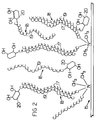
- Fig. 2 is a diagrammatic view of an individual clay platelet with the alkyl groups attached thereto.
- It his been known for a long time that organic compounds which contain a cation will react under favorable conditions by ion exchange with clays which contain a negative layer-lattice and exchangeable cations to form organophilic organic-clay products. If the organic cation contains at least one alkyl containing at least 10 carbon atoms, then such organo-clays have the property of swelling in certain organic liquids. See, for example, U. S-A-2,531,427 and U. S.-A-2,966,506. See also the book Clay Mineralogy, Second Edition, 1968, by Ralph E. Grim (McGraw-Hill Book Co., Inc.), particularly
Chapter 10, "Clay-Mineral-Organic Reactions," pp. 356-368 - "Ionic Reactions, Smectite;" and pp. 392-401 - "Organophilic Clay-Mineral Complexes." Since the commercial introduction of these organo-clays in the early '50's, it has become well-known to gain maximum gelling (thickening) by adding a low molecular weight polar organic compound to the composition. Such polar organic compounds have been variously called activators, dispersion aids and solvating agents. See, for example, U. S-A-2,677,661; 2,979,229; 2,833,720; 2,979,229; and 3,294,683. The most efficient and accepted polar materials for use as activators have been found to be low molecular weight alcohols and ketones, particularly methanol and acetone. The activators, however, have very low flash points and require the use of flame-proof apparatus. Higher-boiling activators, having higher flash points, such as propylene carbonate, may also be used. Clays used to prepare the allergen absorbent and blocking gels of this invention are the smectite-type clays, having a high cation exchange capacity. The cation exchange capacity of the smectite clay should equal or exceed 50 milliequivalents per 100 grams of clay. Particularly desirable types of clay are the naturally-occurring Wyoming variety of swelling bentonite and like clays as well as hectorite. a swelling magnesium-lithium silicate clay. Suitable bentonite clays are also found in Europe, particularly in the Moosburg section of Bavaria, near Munich Smectite clays can also be prepared synthetically by either a pneumatolytic or preferably a hydrothermal synthesis process. Representative hydrothermal processes for preparing synthetic smectities are disclosed in U. S-A-3,252,757 3,586,478, 3,666,407, 3,671,190, 3,844,978, 3,844,979 3,852,405 and 3,855,147. - As has been previously indicated, the invention relates to the discovery that organo-treated clays of the smectite type, which are highly activated, produce allergen absorbents and blocking gels for topical application to the skin to prevent contact of the skin with the allergens produced by poison ivy, poison oak or poison sumac or with other allergens. The smectite-type clays, which have been sufficient cation exchange capacity to be ion exchanged with organic compounds having a cation and one or more alkyl chains, having at least 10 carbon atoms naturally occur in Wyoming and in the Moosburg section of Bavaria, in the vicinity of Munich, Germany. The clays are of the bentonite type and are usually of the sodium form. However, if they are not already in the sodium form, they can be converted by passing an aqueous clay slurry through a bed of cation exchange resin in the sodium form. Alternately, the smectite clay can be mixed with water and a soluble sodium compound, such as sodium carbonate, sodium hydroxide and sheared at high shear in a pug mill or extruder. Additionally, smectite-type clays can be prepared synthetically, either by a pneumatolytic, or preferably a hydrothermal, synthesis process. Representatives of such smectite clays are the following:
- [(Al₄ - xMgx) Si₈O₂₀(OH)₄ - fFf]x R⁺ where 0.55 ≦ x ≦ 1.10, f ≦ 4 and R is selected from Na, Li, NH₄, and mixtures thereof;
- [(Al₄ - xMgx(Si₈ - yAly)O₂₀(OH₄ - fFf](x+y) R⁺ where 0 < x < 1.10, 0 < y < 1.10, 0.55 ≦ (x+y) ≦ 1.10, f ≦ 4 and R is selected from Na, Li, NH₄, and mixtures thereof;
- [(Al₄ ₋ y) (Si₈ ₋ yAlx+y)O₂₀(OH)₄ - fFf]x R⁺ where 0.55 ≦ x ≦ 1.10, 0 ≦ y ≦ 0.44, f ≦ 4 and R is selected from Na, Li, NH₄, and mixtures thereof;
- [(Mg₆ - xLix)Si₈O₂₀(OH)₄ - fFf]x R⁺ where 0.57 ≦ x ≦ 1.15, f ≦ 4 and is selected from Na, Li, NH₄, and mixtures thereof;
- [(Mg₆ - yAly) (Si₈ - x - ₆Alx+y)O₂₀(OH)₄ - fFf]x R⁺ where 0.58 ≦ x ≦ 1.18, 0 ≦ y ≦ 0.66, f ≦ 4 and R⁺ is selected from Na, Li, NH₄, and mixtures thereof;
- [(Mg₆ - xAly)Si₈O₂₀(OH)₄ - fFf]2 x R⁺ where 0.28 ≦ x ≦ 0.57, f ≦ 4 and R is selected from Na, Li, NH₄, and mixtures thereof.
- These smectite clays may be synthesized hydrothermally by forming an aqueous reaction mixture in the form of a slurry containing mixed hydrous oxides or hydroxides of the desired metals with or without, as the case may be, sodium (or alternate exchangeable cation or mixture thereof) fluoride in the proportions defined in the above formulas and preselected values of x, y and f for the particular synthetic smectite desired. The slurry is then placed in an autoclave and heated under autogenous pressure to a temperature within the range of approximately 100° to 325°C, preferably 275° to 300°C for a sufficient period of time to form the desired product. Formulation times of 3 to 48 hours are typical at 300°C, depending on the particular smectite being synthesized and the optimum time an be readily determined by pilot trials. The organic compounds useful in this invention are quaternary ammonium salts containing one methyl radical or one benzyl radical and a mixture of trialkyl radicals, having from 14 to 20 carbon atoms, preferably wherein 20 to 35% have 16 carbon atoms and 5% have 18 carbon atoms on a 100% basis. The anion salt is preferably selected from chloride and bromide and mixtures thereof and is preferably a chloride. However, other anions, such as acetate, hydroxide, nitrite, etc., may be present in the ammonium salt to neutralize the quaternary ammonium compound. The methyl or benzyl trialkyl ammonium salt may be represented as follows:
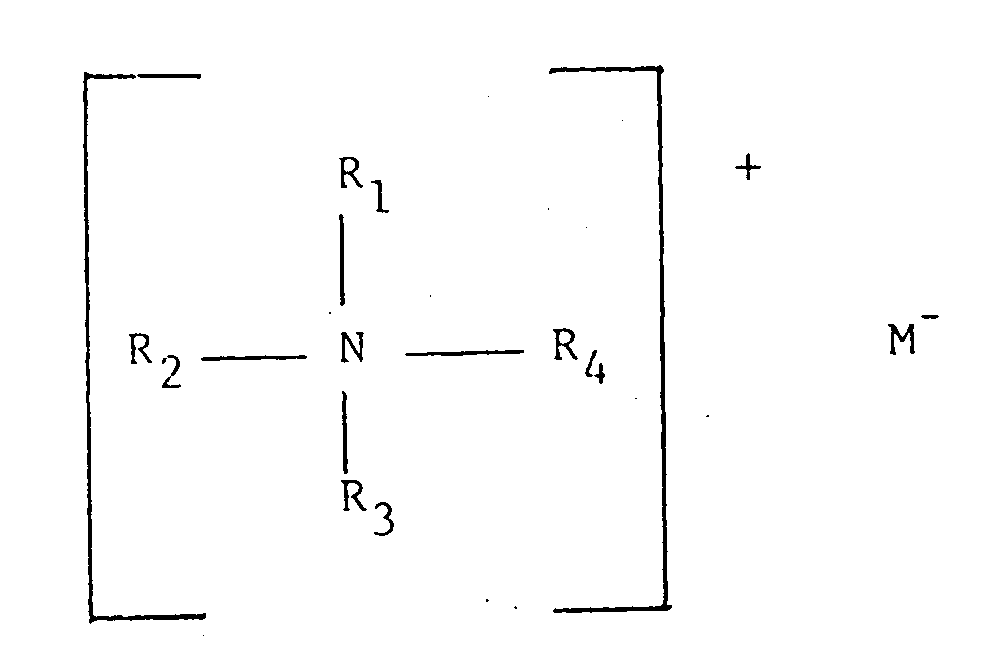
- The preferred quaternary amine for use in the practice of this invention is dimethyl dihydrogenated tallow ammonium chloride. R₁ can be methyl or benzyl, R₂ can be methyl or C₁₀ to C₁₈. R₃ can be methyl or C₁₀ to C₁₈. R₄ can be C₁₀ to C₁₈. Commercially-prepared hydrogenated tallow typically analyzes 2.0% C₁₄, 0.5% C₁₅, 29.0% C₁₆, 1.5% C₁₇, 66.0% C₁₈ and 1.0% C₂₀ alkyl radicals.
- Nevertheless, the alkyl radicals may be derived from other natural oils, including various vegetable oils, such as corn oil, soybean oil, cottonseed oil, or castor oil, as well as various animal oils and fats. Additionally, the alkyl radicals may be petrochemically derived, as from alpha olefins.
- We have found that it is essential that the organophilic clay compounds be highly activated. Alternately, self-activating organophilic clays may be used which do not require activation with polar materials. Activation of the organophilic clays may be accomplished by use of organic polar materials of low molecular weight (which are known as activators). The most efficient and accepted polar materials are low molecular weight alcohols and ketones, particularly methanol and acetone. However, these activators do have the disadvantage of a very low flash point and therefore the danger of combustion is present. Higher boiling flash point activators, such as propylene carbonate, therefore, may be advantageously utilized. The organophilic clays are prepared by admixing the smectite clay, the quaternary ammonium compound and water together, preferably at temperatures within the range of 100° to 180°F (38° to 77°C) for a period of time sufficient for the organic compound to coat the smectite clay particle, followed by filtering, washing, drying and grinding. In using the organophilic clays in emulsions, the drying and grinding steps can be eliminated. When the smectite clay and quaternary ammonium compound and water are mixed together in such concentrations that a slurry is not formed, then the filtration and washing steps are eliminated. Preferably, however, the smectite clay is dispersed in water at a concentration of from about 3 to 7% and the slurry is optionally centrifuged to remove nonclay impurities. These nonclay impurities may constitute between about 10 to 50% of the starting clay composition. Thereafter, the slurry is agitated and heated to a temperature in the range of 104° to 170°F (60° to 77°C), the quaternary amine salt added in the proper milliequivalent ratio, preferably as a liquid in isopropanol. The amount of the quaternary ammonium salt added to the smectite clay for purposes of this invention must be sufficient to impart to the organophilic clay the enhanced dispersion characteristics desired. Milliequivalent ratio is defined as the number of milliequivalents of the organic compound in the organo-clay per 100 g of clay, on a 100% active clay basis. The organophilic clays preferably have a milliequivalent ratio of from 100 to 120. However, if polar organic activators are utilized, a much lower milliequivalent ratio can be utilized without affecting the resultant gel system disadvantageously. The smectite clay and quaternary ammonium compound are admixed with a hydrocarbon vehicle or a volatile silicone vehicle and the entire admixture is subjected to a high-shear mixing in a colloid mill. Generally speaking, the concentration of the organo-treated clay is in the ratio of from 5 to 15% by weight. Therefore, the vehicle for the resulting gel makes up the balance of the mixture in the weight concentration of from about 95 to 85%.
- The gel is utilized in the form of an aerospray, the admixture of organo-treated clay forming the gel being in the ratio of 5 to 10% and the total gel making up about 30% of the contents of the can, with the rest of the material being a propellant. Typical aerosol propellants are hydrocarbon blends of isobutane. The trade designations are A46™, A31™ and A70™.
- Referring now to Fig. 1, there is illustrated a diagrammatic section of the skin after a diagram of Gray's Anatomy. As will be noted, the skin is made up of an epidermis 1 and a
dermis 7. The epidermis consists of five layers, the stratum corneum 2, the stratum lucideum 3, the stratum granulosum 4, thestratum mucosum 5, which terminates in the stratum germinationium 6. Thesudoriferous gland 8 is located in the dermis. However, theducts 9 extend through the epidermis to the outer layer of the skin. Additionally, the shaft of thehair 10 extends through duct 14 and terminates at thebulb 12. The hair follicle is surrounded by sebaceous glands 11, which discharge into the duct 14 to keep the hair shaft lubricated. Additionally, the dermis / contains some relatively deep-lyingarteries 21 andnerves 22. - According to the drawing, the organo-treated
clay 15, made up ofplatelets 16 and the dependingtallow tails 17 form as a layer over the skin with the tallow tails reacting to some extent with the lipids of the skin's surface. This allows the platelets to align themselves pretty much as a shield against the invadingurushiol droplets 18. The droplets, in order to reach the skin, must pass through the barriers or blockers formed by theplatelets 16 without being absorbed by the reactive organic alkyl groups in the form oftallow tails 17. It is believed that the tallow tails, through the van-der Waal forces, tend to absorb chemically the urushiol droplets and hold the urushiol droplets and thus prevent their contact with the skin (see Fig. 2). Any urushiol droplets which might escape the first row of tallow tails are blocked by theclay platelets 16 and then encounter succeeding alkyl groups where absorption takes place. -
Urushiol 18 is diagrammatically illustrated in Fig. 2, according to its chemical formula. As will be noted, the urushiol compound consists of aphenyl group 20 with two hydroxyl groups and a long hydrocarbon chain of 15 to 17 carbons, designated as 19. - Additionally, the quaternary ammonium compounds are designated with the
tallow tails 17, consisting of 16 to 18 carbons. Some of the quaternary ammonium compounds contain a benzyl compound and one alkyl chain and two methyl groups, while the other quaternary ammonium compounds consist of twoalkyl hydrocarbon chains 17 and two methyl groups. The van-der Waal bonding of thehydrocarbon chain 19 of theurushiol compound 18 is diagrammatically shown with the long-chain alkyl group 17 of theorganophilic clay 15. Additionally, it is felt that thephenyl group 20 of the urushiol compound may have some affinity for the active surface of theplatelet 16 of the organophilic clay. This is shown diagrammatically in the right-hand portion of Fig. 2. - It should be understood that this explanation is somewhat hypothetical. However, it is supported by data, as will hereinafter be shown. The fact of the matter is that adsorption apparently is not the major mechanism in this instance, since materials with higher surface areas do not provide the protection that is provided by the organo-treated clays. It is felt, therefore, that the organic surface area is of major importance while the inorganic surface area formed by the pores of the clay platelets perform only a secondary function relative to the absorptive function performed by the reactive tallow tails of the organophilic clays.
- The invention will be better understood by reference to the examples contained hereinafter.
- A batch of organophilic clay is prepared by admixing finely-milled western sodium bentonite with a quaternary ammonium compound obtained from hydrogenated tallow. This quaternary ammonium compound contains two alkyl groups from 16 to 18 carbons in length and two methyl groups. The quaternary ammonium compound is admixed with water and the sodium bentonite at a temperature within the range of 100° to 180°F(38 to 82°C) for a period of time sufficient for the quaternary ammonium compound to coat the clay particles. The sodium bentonite then reacts with the reactive chlorine or other anion, so that the quaternary ammonium compound becomes ion exchanged with the bentonite clay particles. A polar organic activator, as for example propylene carbonate, may he added to the admixture, which is then mixed with a long-chain hydrocarbon vehicle or a volatile silicon liquid and subjected to high shearing in a colloid mill.
- The test procedure* involved the application of Sure® deodorant and the organophilic clay of Example 1, spray applied to the skin of the forearm at 1,4 and 24 hours before the application of dilutions of purified urushiol in acetone in a double-blind fashion. Three samples of urushiol in acetone were made up with five microliters of urushiol in acetone, ranging in amount from .25ug to .005ug. The samples of urushiol in acetone were then applied to the patch test sites. The patch test sites were there after read two to five days later and recorded from N to 4 as follows:
- N =
- Normal
- 1 =
- Erythema and edema involving half the test site
- 2 =
- Erythema and edema plus small vesicles involving the entire site
- 3 =
- Full involvement of the test site with erythema and edema and large vesicles
- 4 =
- Bullae
- A second preliminary study was carried out, comparing the results of pretreatment with Sure® to pretreatment with Drysol® (a 20% w/v concentrate of aluminum chloride hexahydrate in alcohol). The pretreatment time was 4 hours. The patch tests were urushiol and the patch test readings were the same as described above.
- In the next series of experiments, the subjects were pretreated with breakdown products of Sure® that either were missing the aluminum chloralhydrate or the suspending agents (hectorite and propylene carbonate). The patch tests with urushiol and the patch test readings were the same as described above.
- The results of these tests are shown in Table I.

- Table I shows that pretreatment with the Sure® deodorant does reduce the patch test reaction to dilutions of urushiol. However, Sure® is not able to completely prevent the reactions, but simply reduce them. The material of Example 1, on the other hand, was more effective at reducing the reactions and this was particularly noticeable at 4 and 24 hours after applications. as compared to Sure®. This table averages overall responses.
- The preliminary study, comparing the high concentration of the aluminum salt (Drysol®) to Sure®, indicated that the alcoholic solution was less effective than Sure®.
- Another experiment compared the blocking effect of Sure® with its ingredients, i.e. without fillers and without aluminum chloralhydrate. In one instance, Sure® was compared to the aluminum compound containing preparation without the fillers, i.e. the organophilic hectorite, and the two were equal on two occasions. Sure® was more effective in one and definitely more effective in four instances. In no instance, was the aluminum salt more effective than Sure®. Sure®, containing only the fillers and no aluminum was compared to Sure® and the two preparations were equal on two occasions. Sure® was more effective than the filler preparations on two occasions and much more effective on one occasion. On the other hand, the filler was more effective than Sure® on two occasions. Finally, in direct comparison of the filler versus the aluminum preparation, the filler was more effective than the aluminum salt on two occasions and much more effective in four additional trials. In one instance, the aluminum salt was, more effective than the filler preparations.
- The tests, as previously described, were carried out with three particularly sensitive individuals. These are shown in Tables II, III and IV.
- As can be seen, after the second day, the control showed a normal reaction for the patch test for the low concentrations, but a 2 reaction as to any concentration


of urushiol above 0.05 µg. Sure®, on the other hand, provided some protection at 0.05 µg and reduced in the size of the reaction as to the concentrations above 0.1. The material of Example 1, however, showed full protection 4 hours after application for all concentrations of the material. Essentially the same results were obtained after Day 4. Except with the control, the severity of the reactions increased. The severity of the reaction of the high concentration of urushiol increased with the Sure® application but the material of Example 1 gave full protection throughout the total range of concentration. 24 hours after application, essentially the same results were obtained on Day 2. On Day 4, the severity of the reaction was greater with the control and with the Sure® sample and there was a 1 range of reaction for the Example 1 material after 24 hours. - Table III, for a completely different individual, who was extremely sensitive, demonstrated a more severe reaction with both the control sample and the Sure® sample, after Day 2 and Day 4, as compared to Table II. However, the organophilic clay of Example 1 provided good protection, both for Day 2 and Day 4 throughout the entire range of urushiol concentrations. The severity of the reactions increased across the board after application and even the material of Example 2 showed a moderate grade 2 reaction for the higher concentrations after the second and fourth days. The superiority of the material of Example 1 over the control and over the Sure® is shown, however, throughout.
- Table IV demonstrates in like manner the protection afforded by the individual throughout a smaller range of urushiol concentrations. After the fourth day, from hours after application, the material of Example 1 showed a positive reaction, as indicated by -1. In like manner, the table demonstrates that even 24 hours after application, there is protection against the low concentrations of urushiol by the organophilic clay of Example 1 on the second and fourth days following application.
- A series of other over-the-counter preparations, Technu®, Less Ivy®, and Off®, were completely ineffective in protecting the skin from the effects of urushiol.
- It is believed that the long C₁₈ chain of the urushiol molecule is absorbed through van-der Waal forces with the long, C₁₆ to C₂₂ carbon tallow tails of the organophilic clays. Additionally, it is felt that the phenyl group of the urushiol may have some affinity for the active surface of the clay platelet itself. The material may be applied in aerosol form, as a salve, or as a stick, onto the skin, prior to encountering the urushiol-producing plants, such as poison ivy, oak, sumac. The comparative study, however, has clearly shown that the organophilic clays of this invention are more effective than any material heretofore known in the prevention of experimentally-induced poison oak or ivy dermatitis.
A -1 score equals a definite positive reaction which invoves less than 1/2 of the test site and a ± equals a questionable rejection which either is subsequently read as, ± or -.
*These tests were conducted under a grant from the U.S. Forestry Service under the supervision of Dr. William Epstein of the University of California Medical School at San Francisco.
Claims (14)
- A process of preparing an aerosol allergen barrier composition for topical application comprising:A. a barrier composition consisting essentially of1) from 5 to 15 % by weight of a smectite clay having a cation exchange capacity of at least 50 milliequivalents per 100 g, said clay having been ion exchanged with at least 50 milliequivalents per 100 g of said clay of a quaternary ammonium compound having at least one alkyl group containing more than 10 carbon atoms and2) from 95 to 85 % by weight of a vehicle; andB. an aerosol propellantwhich process comprises mixing component A 1 with component A 2 and adding component B to said mixture.
- The process of Claim 1, wherein the aerosol composition comprises from 20 to 35 parts by weight of said barrier composition and 80 to 65 parts by weight of said aerosol propellant.
- The process of Claim 1, wherein the aerosol composition comprises 30 parts by weight of said barrier composition and 70 parts by weight of said aerosol propellant.
- The process of anyone of Claims 1 to 3, wherein said smectite clay is a highly activated clay.
- The process of anyone of Claims 1 to 4, wherein said vehicle is a long chain hydrocarbon.
- The process of anyone of Claims 1 to 4, wherein said vehicle is a silicone fluid.
- The process of anyone of Claims 1 to 6, wherein said quaternary ammonium compound contains one methyl or benzyl radical and three alkyl radicals having from 14 to 20 carbon atoms.
- The process of anyone of Claims 1 to 7, wherein said smectite clay is bentonite or hectorite.
- The process of anyone of Claims 1 to 8, wherein the composition additionally comprises a low molecular weight polar organic activator for said smectite clay.
- The process of Claim 9, wherein said activator is propylene carbonate or a low molecular weight alcohol or ketone.
- The process of anyone of Claims 1 to 10, wherein said propellant is a hydrocarbon blend containing isobutane.
- The use of the aerosol allergen barrier composition prepared according to anyone of Claims 1 to 11 for the manufacture of a medicament for protecting the skin from contact with an allergen.
- The use of the aerosol allergen barrier composition prepared according to part A of Claim 1 and anyone of Claims 4 to 10, for the manufacture of a medicament for protecting the skin from contact with an allergen.
- A method of preventing contamination of clothes and utensils with an allergen comprising applying to said clothes and utensils a barrier composition comprising1) from 5 to 15 % by weight of a smectite clay having a cation exchange capacity of at least 50 milliequivalents per 100 g, said clay having been ion exchanged with at least 50 milliequivalents per 100 g of said clay of a quaternary ammonium compound having at least one alkyl group containing more than 10 carbon atoms, and2) from 95 to 85 % by weight of a vehicle.
Priority Applications (1)
| Application Number | Priority Date | Filing Date | Title |
|---|---|---|---|
| AT86113910T ATE74520T1 (en) | 1985-10-07 | 1986-10-07 | ALLERGEN ABSORBING AND BLOCKING GEL. |
Applications Claiming Priority (2)
| Application Number | Priority Date | Filing Date | Title |
|---|---|---|---|
| US78516785A | 1985-10-07 | 1985-10-07 | |
| US785167 | 1985-10-07 |
Publications (3)
| Publication Number | Publication Date |
|---|---|
| EP0219054A2 EP0219054A2 (en) | 1987-04-22 |
| EP0219054A3 EP0219054A3 (en) | 1988-01-27 |
| EP0219054B1 true EP0219054B1 (en) | 1992-04-08 |
Family
ID=25134643
Family Applications (1)
| Application Number | Title | Priority Date | Filing Date |
|---|---|---|---|
| EP86113910A Expired EP0219054B1 (en) | 1985-10-07 | 1986-10-07 | An allergen absorbent and blocking gel |
Country Status (6)
| Country | Link |
|---|---|
| EP (1) | EP0219054B1 (en) |
| AT (1) | ATE74520T1 (en) |
| CA (1) | CA1289073C (en) |
| DE (1) | DE3684752D1 (en) |
| ES (1) | ES2033668T3 (en) |
| GR (1) | GR3005057T3 (en) |
Families Citing this family (2)
| Publication number | Priority date | Publication date | Assignee | Title |
|---|---|---|---|---|
| US5869033A (en) * | 1996-04-12 | 1999-02-09 | Enviroderm Pharmaceuticals,Inc. | Method of preventing skin irritation caused by fecal enzymes |
| WO2008018540A1 (en) * | 2006-08-09 | 2008-02-14 | Shiseido Company Ltd. | Sol composition containing organomodified clay mineral having flaky particle structure, oil-base gel compositions and w/o emulsion compositions containing the same |
Family Cites Families (4)
| Publication number | Priority date | Publication date | Assignee | Title |
|---|---|---|---|---|
| US2684321A (en) * | 1950-09-28 | 1954-07-20 | Rohm & Haas | Skin treating ion exchange mixture |
| US2857311A (en) * | 1954-07-06 | 1958-10-21 | Rohm & Haas | Dermatological mixture of ion-exchange resins |
| US3922342A (en) * | 1973-05-07 | 1975-11-25 | Univ Minnesota | Poison ivy and poison oak treatment utilizing hydrophilic anion exchange material |
| US4350605A (en) * | 1977-11-22 | 1982-09-21 | Peterson/Puritan, Inc. | Water-in-oil emulsions |
-
1986
- 1986-10-06 CA CA000519891A patent/CA1289073C/en not_active Expired - Lifetime
- 1986-10-07 ES ES86113910T patent/ES2033668T3/en not_active Expired - Lifetime
- 1986-10-07 EP EP86113910A patent/EP0219054B1/en not_active Expired
- 1986-10-07 DE DE8686113910T patent/DE3684752D1/en not_active Expired - Lifetime
- 1986-10-07 AT AT86113910T patent/ATE74520T1/en not_active IP Right Cessation
-
1992
- 1992-06-30 GR GR920401389T patent/GR3005057T3/el unknown
Also Published As
| Publication number | Publication date |
|---|---|
| ES2033668T3 (en) | 1996-07-16 |
| EP0219054A2 (en) | 1987-04-22 |
| CA1289073C (en) | 1991-09-17 |
| DE3684752D1 (en) | 1992-05-14 |
| EP0219054A3 (en) | 1988-01-27 |
| GR3005057T3 (en) | 1993-05-24 |
| ATE74520T1 (en) | 1992-04-15 |
Similar Documents
| Publication | Publication Date | Title |
|---|---|---|
| US4670185A (en) | Aqueous vesicle dispersion having surface charge | |
| US3751562A (en) | Medicated gelled oils | |
| AU717000B2 (en) | Skin toning formulation | |
| DE2850488A1 (en) | WATER-IN-OIL EMULSIONS | |
| EP2628477B1 (en) | Water-in-oil type emulsion cosmetic | |
| US4861584A (en) | Allergen absorbent and blocking aerosol composition | |
| JPH057062B2 (en) | ||
| JPH0825866B2 (en) | Bath agent composition | |
| US5017361A (en) | Allergen absorbent and blocking aerosol composition | |
| JP2007519731A (en) | Composition containing activated antioxidant inside | |
| EP0219054A2 (en) | An allergen absorbent and blocking gel | |
| CH638097A5 (en) | Process for the preparation of a compound active as an antiperspirant | |
| JP6281153B2 (en) | Hair care or nail care cosmetics | |
| WO2002100175A1 (en) | Removal of ectoparasites | |
| US7025972B2 (en) | Allergen absorbent, blocking, and deactivating compositions and method | |
| McBride et al. | Evaluation of triacontanol-containing compounds as anti-inflammatory agents using guinea pig models | |
| JP2003095907A (en) | Skin cosmetics | |
| US2874090A (en) | Sunburn preventive n-salicoyl-p-aminophenol compositions | |
| RU2164403C1 (en) | Protective-and-prophylactic cream | |
| US3152951A (en) | Germicidal composition of iodine and liquid lanolin | |
| EP1736207A1 (en) | Depilatory composition | |
| JPH0563218B2 (en) | ||
| DE2518742C2 (en) | Persistent water-in-oil emulsions in the gastrointestinal tract | |
| JPH0232015B2 (en) | ||
| EP0465663B1 (en) | Dermatologic preparation |
Legal Events
| Date | Code | Title | Description |
|---|---|---|---|
| PUAI | Public reference made under article 153(3) epc to a published international application that has entered the european phase |
Free format text: ORIGINAL CODE: 0009012 |
|
| AK | Designated contracting states |
Kind code of ref document: A2 Designated state(s): AT BE CH DE ES FR GB GR IT LI LU NL SE |
|
| PUAL | Search report despatched |
Free format text: ORIGINAL CODE: 0009013 |
|
| AK | Designated contracting states |
Kind code of ref document: A3 Designated state(s): AT BE CH DE ES FR GB GR IT LI LU NL SE |
|
| 17P | Request for examination filed |
Effective date: 19880714 |
|
| 17Q | First examination report despatched |
Effective date: 19891218 |
|
| ITTA | It: last paid annual fee | ||
| GRAA | (expected) grant |
Free format text: ORIGINAL CODE: 0009210 |
|
| AK | Designated contracting states |
Kind code of ref document: B1 Designated state(s): AT BE CH DE ES FR GB GR IT LI LU NL SE |
|
| REF | Corresponds to: |
Ref document number: 74520 Country of ref document: AT Date of ref document: 19920415 Kind code of ref document: T |
|
| ITF | It: translation for a ep patent filed | ||
| REF | Corresponds to: |
Ref document number: 3684752 Country of ref document: DE Date of ref document: 19920514 |
|
| ET | Fr: translation filed | ||
| PLBE | No opposition filed within time limit |
Free format text: ORIGINAL CODE: 0009261 |
|
| STAA | Information on the status of an ep patent application or granted ep patent |
Free format text: STATUS: NO OPPOSITION FILED WITHIN TIME LIMIT |
|
| REG | Reference to a national code |
Ref country code: GR Ref legal event code: FG4A Free format text: 3005057 |
|
| 26N | No opposition filed | ||
| REG | Reference to a national code |
Ref country code: ES Ref legal event code: FG2A Ref document number: 2033668 Country of ref document: ES Kind code of ref document: T3 |
|
| EPTA | Lu: last paid annual fee | ||
| EAL | Se: european patent in force in sweden |
Ref document number: 86113910.3 |
|
| REG | Reference to a national code |
Ref country code: ES Ref legal event code: FG2A Ref document number: 2033668 Country of ref document: ES Kind code of ref document: T3 |
|
| REG | Reference to a national code |
Ref country code: GB Ref legal event code: IF02 |
|
| PGFP | Annual fee paid to national office [announced via postgrant information from national office to epo] |
Ref country code: FR Payment date: 20021030 Year of fee payment: 17 Ref country code: DE Payment date: 20021030 Year of fee payment: 17 Ref country code: BE Payment date: 20021030 Year of fee payment: 17 Ref country code: AT Payment date: 20021030 Year of fee payment: 17 |
|
| PGFP | Annual fee paid to national office [announced via postgrant information from national office to epo] |
Ref country code: SE Payment date: 20021031 Year of fee payment: 17 Ref country code: NL Payment date: 20021031 Year of fee payment: 17 Ref country code: GR Payment date: 20021031 Year of fee payment: 17 Ref country code: ES Payment date: 20021031 Year of fee payment: 17 |
|
| PGFP | Annual fee paid to national office [announced via postgrant information from national office to epo] |
Ref country code: LU Payment date: 20021107 Year of fee payment: 17 Ref country code: GB Payment date: 20021107 Year of fee payment: 17 |
|
| PGFP | Annual fee paid to national office [announced via postgrant information from national office to epo] |
Ref country code: CH Payment date: 20021120 Year of fee payment: 17 |
|
| PG25 | Lapsed in a contracting state [announced via postgrant information from national office to epo] |
Ref country code: LU Free format text: LAPSE BECAUSE OF NON-PAYMENT OF DUE FEES Effective date: 20031007 Ref country code: GB Free format text: LAPSE BECAUSE OF NON-PAYMENT OF DUE FEES Effective date: 20031007 Ref country code: AT Free format text: LAPSE BECAUSE OF NON-PAYMENT OF DUE FEES Effective date: 20031007 |
|
| PG25 | Lapsed in a contracting state [announced via postgrant information from national office to epo] |
Ref country code: SE Free format text: LAPSE BECAUSE OF NON-PAYMENT OF DUE FEES Effective date: 20031008 Ref country code: ES Free format text: LAPSE BECAUSE OF NON-PAYMENT OF DUE FEES Effective date: 20031008 |
|
| PG25 | Lapsed in a contracting state [announced via postgrant information from national office to epo] |
Ref country code: LI Free format text: LAPSE BECAUSE OF NON-PAYMENT OF DUE FEES Effective date: 20031031 Ref country code: CH Free format text: LAPSE BECAUSE OF NON-PAYMENT OF DUE FEES Effective date: 20031031 Ref country code: BE Free format text: LAPSE BECAUSE OF NON-PAYMENT OF DUE FEES Effective date: 20031031 |
|
| BERE | Be: lapsed |
Owner name: *UNITED CATALYSTS INC. Effective date: 20031031 |
|
| PG25 | Lapsed in a contracting state [announced via postgrant information from national office to epo] |
Ref country code: NL Free format text: LAPSE BECAUSE OF NON-PAYMENT OF DUE FEES Effective date: 20040501 Ref country code: DE Free format text: LAPSE BECAUSE OF NON-PAYMENT OF DUE FEES Effective date: 20040501 |
|
| PG25 | Lapsed in a contracting state [announced via postgrant information from national office to epo] |
Ref country code: GR Free format text: LAPSE BECAUSE OF NON-PAYMENT OF DUE FEES Effective date: 20040504 |
|
| GBPC | Gb: european patent ceased through non-payment of renewal fee |
Effective date: 20031007 |
|
| EUG | Se: european patent has lapsed | ||
| REG | Reference to a national code |
Ref country code: CH Ref legal event code: PL |
|
| PG25 | Lapsed in a contracting state [announced via postgrant information from national office to epo] |
Ref country code: FR Free format text: LAPSE BECAUSE OF NON-PAYMENT OF DUE FEES Effective date: 20040630 |
|
| NLV4 | Nl: lapsed or anulled due to non-payment of the annual fee |
Effective date: 20040501 |
|
| REG | Reference to a national code |
Ref country code: FR Ref legal event code: ST |
|
| REG | Reference to a national code |
Ref country code: ES Ref legal event code: FD2A Effective date: 20031008 |
|
| PG25 | Lapsed in a contracting state [announced via postgrant information from national office to epo] |
Ref country code: IT Free format text: LAPSE BECAUSE OF NON-PAYMENT OF DUE FEES;WARNING: LAPSES OF ITALIAN PATENTS WITH EFFECTIVE DATE BEFORE 2007 MAY HAVE OCCURRED AT ANY TIME BEFORE 2007. THE CORRECT EFFECTIVE DATE MAY BE DIFFERENT FROM THE ONE RECORDED. Effective date: 20051007 |