EP0215401A2 - Method and composition for determining glycosylated hemoglobin as well as compounds suited therefor and methods for their preparation - Google Patents
Method and composition for determining glycosylated hemoglobin as well as compounds suited therefor and methods for their preparation Download PDFInfo
- Publication number
- EP0215401A2 EP0215401A2 EP86112347A EP86112347A EP0215401A2 EP 0215401 A2 EP0215401 A2 EP 0215401A2 EP 86112347 A EP86112347 A EP 86112347A EP 86112347 A EP86112347 A EP 86112347A EP 0215401 A2 EP0215401 A2 EP 0215401A2
- Authority
- EP
- European Patent Office
- Prior art keywords
- glycosylated
- hemoglobin
- radicals
- haptoglobin
- salts
- Prior art date
- Legal status (The legal status is an assumption and is not a legal conclusion. Google has not performed a legal analysis and makes no representation as to the accuracy of the status listed.)
- Withdrawn
Links
- 0 CCC1(C)CC=C(*C)C(C)C1 Chemical compound CCC1(C)CC=C(*C)C(C)C1 0.000 description 1
- SLYHWWMPRNVYMF-SECBINFHSA-N C[C@@]1(CO)C=CC(C)=CC1 Chemical compound C[C@@]1(CO)C=CC(C)=CC1 SLYHWWMPRNVYMF-SECBINFHSA-N 0.000 description 1
Images

Classifications
-
- G—PHYSICS
- G01—MEASURING; TESTING
- G01N—INVESTIGATING OR ANALYSING MATERIALS BY DETERMINING THEIR CHEMICAL OR PHYSICAL PROPERTIES
- G01N33/00—Investigating or analysing materials by specific methods not covered by groups G01N1/00 - G01N31/00
- G01N33/48—Biological material, e.g. blood, urine; Haemocytometers
- G01N33/50—Chemical analysis of biological material, e.g. blood, urine; Testing involving biospecific ligand binding methods; Immunological testing
- G01N33/72—Chemical analysis of biological material, e.g. blood, urine; Testing involving biospecific ligand binding methods; Immunological testing involving blood pigments, e.g. haemoglobin, bilirubin or other porphyrins; involving occult blood
- G01N33/721—Haemoglobin
- G01N33/723—Glycosylated haemoglobin
Definitions
- the present invention relates to a method for the determination of glycosylated hemoglobin in blood samples, a reagent for carrying it out as well as suitable compounds and methods for their production.
- Glycosylated hemoglobin is created by non-enzymatic glycosylation of hemoglobin. Normally, the concentration of glycosylated hemoglobin in the blood is about 5%, based on the total hemoglobin. In diabetics, this concentration is increased two to four times.
- glycosylated portion of total hemoglobin has gained importance in diabetes diagnostics in recent years (see L. Jovanovic and C. M. Peterson, Am. J. Med. 70, (1981), pages 331-338).
- the reaction between individual hemoglobin molecules and glucose results in a stable reaction product that remains intact for the entire lifespan of the erythrocytes, i.e. around 100-200 days.
- Short-term fluctuations in the blood sugar content do not have a decisive influence on the concentration of glycosylated hemoglobin.
- the concentration of glycosylated hemoglobin therefore reflects the average glucose concentration in the blood of a patient over a long period of time relatively accurately.
- a method for determining the glycosylated hemoglobin in blood samples is known from German Offenlegungsschrift 29 50 457, in which the change in the spectroscopic properties of a blood sample when an allosteric effector is added is used to determine the glycosylated hemoglobin. Only the non-glycosylated main part of the hemoglobin is affected. The measured extinction differences are very small in the relevant range. They also decrease as the glycosylated portion of total hemoglobin increases.
- glycosylated hemoglobin A method for the determination of glycosylated hemoglobin on the basis of its increased binding ability to haptoglobin is described in German Offenlegungsschrift 31 41 146.
- the difference in the binding behavior of glycosylated and non-glycosylated hemoglobin compared to haptoglobin is increased by adding 2,3-diphosphoglycerate, inositol hexaphosphate or mellitic acid.
- 2,3-diphosphoglycerate, inositol hexaphosphate or mellitic acid 2,3-diphosphoglycerate, inositol hexaphosphate or mellitic acid.
- the object of the invention was therefore to improve the sensitivity of the determination of glycosylated hemoglobin, which is dependent on the precision and specificity of the indicator reaction, and to create possibilities for a fully automated test implementation.
- the glycosylated and non-glycosylated hemoglobin portion is differentiated with the aid of haptoglobin in the presence of compounds which differ in the binding behavior of glycosylated ones and non-glycosylated hemoglobin compared to haptoglobin significantly increase compared to previously known substances and either the reaction between hemoglobin and H aptoglobin is kinetically monitored or the part of the hemoglobin bound to haptoglobin or that which is not bound by haptoglobin is measured.
- a saturated or unsaturated, straight-chain or branched aliphatic hydrocarbon radical in the definition of A preferably has two to 30, particularly preferably 2 to 10, carbon atoms.
- Heteroatoms that can disrupt aliphatic hydrocarbons are preferably oxygen and sulfur.
- Oxycycloalkoxy radicals consist of 5 to 8 carbon atoms. Residues such as. B. oxycyclopentoxy or oxycyclohexoxy. The oxycyclohexoxy radical is particularly preferred. The oxycycloalkoxy radicals on each ring carbon atom can be substituted by further radicals B-R.
- Aromatic residues in the definition of A and B can e.g. B. benzene or heteroaromatics such as pyridine, furan or pyrrole.
- Alkyl, alkoxy, hydroxyalkyl or hydroxyalkoxy in the definition of R are radicals of 1-10, preferably 1-6 carbon atoms. Residues of 2 to 5 carbon atoms are particularly preferred. Residues with three or four carbon atoms are mostly used.
- a reactive group X is understood to mean groups which can form a covalent bond with amino groups, without additional aids, such as, for. B. dicyclohexylcarbodiimide or elevated temperature (above 40 ° C).
- Preferred groups X are e.g. B. the aldehyde residue or its bisulfite adduct or the thiocyanate or isothiocyanate residue.
- the aldehyde radical is particularly preferred.
- Acid residues in the sense of the present invention are preferably -COOH, -S0 3 H, -OS0 3 H, -PO 3 H 2 ' -OPO 3 H 2 , -P 2 O 6 H 3 , -OP 2 O 6 H 3 .
- Preferred salts of these acid residues are the alkali, alkaline earth and ammonium salts.
- Alkali salts are to be understood primarily as lithium, sodium and potassium salts.
- Alkaline earth salts are primarily magnesium, calcium or barium salts.
- Ammonium salts can contain unsubstituted ammonium ions or those which are substituted by alkyl groups with 1-5 carbon atoms, preferably methyl or ethyl radicals, or also by aralkyl groups, such as benzyl radicals.
- the substituents can be the same or different.
- Substances of the general formula I can be added to the blood sample before, but also simultaneously with, the haptoglobin and have the surprising effect that the binding of non-glycosylated hemoglobin to haptoglobin is completely suppressed, so that the test becomes specific for glycosylated hemoglobin. It is possible, but no longer necessary in the presence of these substances, to convert the heme groups into a uniform form beforehand, so that a fully automated test sequence comprising only two incubation steps can also be carried out.
- the method for determining the glycosylated portion of the total hemoglobin is expediently carried out in such a way that the glycosylated and the non-glycosylated hemoglobin are first released from the erythrocytes by customary methods.
- One or more compounds of the general formula I can be added simultaneously with the hemolytic reagent.
- compounds of the general formula I can be added to the sample before or during this process.
- a solution containing haptoglobin is then added to the hemolyzed blood sample. Under these conditions, the glycosylated portion of hemoglobin binds to haptoglobin.
- the determination of the haptoglobin-hemoglobin complexes can then z. B. in a known manner by measuring the peroxidase activity after denaturing the free, non-glycosylated hemoglobin.
- the process according to the invention is expediently carried out in the presence of a suitable buffer system. Any suitable buffer system in the pH range from about 4.0 to about 8.5, preferably from about 6.0 to about 7.0, can be used as a suitable buffer system. Phosphate, morpholinoethanesulfonic acid (MES) and bis-tris buffers have proven particularly useful.
- MES morpholinoethanesulfonic acid
- bis-tris buffers have proven particularly useful.
- Preferred compounds of general formula II are e.g. B. or their alkali, alkaline earth or ammonium salts.
- R 'and n have the meaning given above, preferred for the process according to the invention.
- Particularly preferred compounds of general formula II a are e.g. B.
- Alkyl or hydroxyalkyl radicals in the definition of G 1 and G 2 mean radicals of 1-6 carbon atoms, preferably 1-4 carbon atoms. Residues of 3 or 4 carbon atoms are mostly used.
- R ' has the meaning given in formula II, preferred.
- the reaction is advantageously carried out without a solvent or in a solvent such as dichloromethane, chloroform, formamide, dimethylformamide, benzene, carbon tetrachloride, acetone, acetonitrile, pyridine, lutidine or collidine.
- a solvent such as dichloromethane, chloroform, formamide, dimethylformamide, benzene, carbon tetrachloride, acetone, acetonitrile, pyridine, lutidine or collidine.
- Phosphorylations take place with or without the addition of auxiliary reagents, such as silver salts, ammonia, and optionally substituted amines, such as triethylamine, cyclohexylamine, piperidines, piperazines or pyridine.
- auxiliary reagents such as silver salts, ammonia, and optionally substituted amines, such as triethylamine, cyclohexylamine, piperidines, piperazines or pyridine.
- the products are isolated by precipitation as a salt, preferably as a barium salt or by ion exchange chromatography.
- Suitable protective groups are in particular the acetyl, the benzoyl, the benzyl, the isopyropylidene, the cyclohexylidene or the benzylidene group. After phosphorylation has taken place, the protective groups are split off again in a known manner and the protected alcohol functions are released again.
- Phosphonic acid derivatives are produced by customary methods. Especially geminal diphosphonic acid compounds are preferred by subsequent reaction of corresponding carbonyl compounds with phosphorous acid and phosphorus trichloride in high-boiling solvents, such as. B. chlorobenzene and acidic hydrolysis of the resulting intermediates.
- reaction temperatures should advantageously be about 70-140 ° C. Temperatures around 100 ° C. are particularly preferred.
- reaction times are a few hours, in most cases 2-7 hours.
- the compounds are advantageously isolated by precipitation as a salt in organic, water-miscible solvents, such as. B. methanol or ethanol or by ion exchange chromatography.
- sulfonic acid groups into the aliphatic as well as into the aromatic part is carried out by conventional sulfonation reactions. Sulfonation with chlorosulfonic acid has proven to be particularly favorable.
- the aromatic substitution preferably leads to the goal in good yield at elevated temperature, preferably 40-80 ° C.
- Conversion of the aliphatic alcohol functions of the starting compounds into OS0 3 H groups succeeds with chlorosulfonic acid even at low temperatures, preferably at 0-20 ° C.
- carboxy groups in polyols can be prepared by known methods, e.g. B. by converting primary or secondary alcohol functions into good leaving groups, substitution of these leaving groups by cyanide and subsequent hydrolysis of the nitrile.
- Good leaving groups include in particular z. B. the acetyl, the benzoyl, toluenesulfonyl, p-bromobenzenesulfonyl, methanesulfonyl or trifluoromethanesulfonyl group. You can easily by reaction of the polyol, e.g. B. with the appropriate acid chloride or acid anhydride.
- Alkali, alkaline earth or ammonium cyanides can be used for the substitution reaction with cyanide.
- the reaction can be carried out under homogeneous or heterogeneous conditions, e.g. B. take place under phase transfer catalysis. Hydrolysis of the nitrile formed as an intermediate is possible both acidic and basic. Basic conditions are preferred.
- the products are isolated by precipitation as a salt, preferably as a barium salt or by ion exchange chromatography.
- Suitable protective groups are in particular the benzyl, the isopropylidene, the cyclohexylidene or the benzylidene group. After the hydroxyl groups to be substituted have been converted into good leaving groups, the protective groups can be split off again in a suitable manner.
- a preferred compound of general formula III is e.g. B. or their alkali, alkaline earth or ammonium salts.
- Particularly preferred representatives are e.g. B. or their alkali, alkaline earth or ammonium salts.
- the hydrocarbon chain in the definition of G 3 and G 4 consists of 1 to 7, preferably 2 to 5 carbon atoms.
- the starting materials are in each case polyols whose hydroxyl groups can be converted into acid groups analogously to the methods described for compounds of the general formulas II, II a, II b and II c.
- the introduction of reactive groups X and X 2 depends on the type of these groups.
- Aldehyde functions are usually formed by the oxidation of primary alcohol functions.
- Manganese dioxide or manganate salts such as. B. barium manganate is used.
- protection groups such as e.g. B. the acetyl, benzoyl, benzyl, isopropylidene, cyclohexylidene or benzylidene group.
- the protective groups are split off again in a known manner and the alcohol functions are released again. They can then be converted into acid groups.
- Bisulfite adducts of aldehydes can easily be prepared by reaction with sodium bisulfite, by aldehydes e.g. B. be dissolved in bisulfite liquor.
- the reaction mixture can either be used directly, without isolation of the end product, or only after purification and isolation of the adduct for the method according to the invention for the determination of glycosylated hemoglobin.
- Isothiocyanates are advantageously made from primary amines and carbon disulfide in the presence of a strong base. Strong bases are understood to mean above all alkali and alkaline earth hydroxides.
- the salt of N-alkyl-dithio-carbamic acid that forms then reacts z. B. with chloroformates to the desired isothiocyanates.
- the saturated or unsaturated hydrocarbon chain in the definition of M is understood to mean a radical of 1 to 8, preferably 1 to 4, carbon atoms.
- Particularly preferred representatives are e.g. B. or their alkali, alkaline earth or ammonium salts.
- the compounds of the general formula IV are prepared by methods known per se.
- Preferred acid residues in the definitions of R and R 6 are -OPO 3 H 2 , -OP 2 O 6 H 3 or -OS0 3 H.
- 1,2-bis (4-formyl-2-sulfonylphenyl) ethane and 1,2-bis (4-formylphenyl) ethanediol-1,2-diphosphate are also available call.
- Dibenzyl compounds of the general formula V are new. They can be produced by methods known per se.
- the 1,2-bis (4-formylphenyl) ethane backbone is obtained e.g. B. by Wittig reaction of a p-alkoxycarbonylbenzyltriphenylphosphonium bromide with a p-alkoxycarbonylbenzaldehyde.
- alkoxy radicals are understood to mean groups of 1-5 carbon atoms.
- the methoxy or ethoxy radical are particularly preferred.
- the stilbene formed is e.g. B. hydrogenated over palladium on carbon.
- the two carboxylic ester functions are then converted in a known manner, for. B. by reduction with lithium aluminum hydride to benzyl alcohol and subsequent manganese dioxide oxidation to aldehyde.
- Sulfonic acid groups are introduced by conventional sulfonation reactions. Sulphonation with chlorosulphonic acid has proven to be particularly favorable, which leads to the goal in good yield at elevated temperature, preferably 40-80 ° C.
- Carboxy and carboxymethyleneoxy groups can be introduced by choosing appropriate starting compounds known from the literature.
- Phosphate groups on the ethylene grouping are introduced by first epoxidizing the corresponding stilbene by conventional methods, e.g. B. opens with meta-chloroperbenzoic acid to the diol and then reacted with a literature phosphorylating agent such as phosphorus oxychloride.
- Bisulfite adducts of the bis (formylphenyl) ethane compounds are easily accessible by reaction with sodium bisulfite. They can either be prepared separately or generated in situ without special insulation in the test by dissolving the dialdehyde in bisulfite liquor.
- the compounds of general formula I suitable for the process according to the invention are used in at least an equivalent amount, based on the hemoglobin content. In general, however, it is advantageous to add these substances in excess, preferably in 2 to 200 times, particularly preferably 5 to 50 times, molar excess.
- an ion-binding stabilizing agent to the test solution before carrying out contact with haptoglobin when carrying out the method according to the invention.
- Such substances with a stabilizing effect on ionic bonds are, for example, ethylene glycols, polyethylene glycols or sucrose.
- Haptoglobin must also be used in at least an equivalent amount, based on the hemoglobin. However, an excess also has an advantageous effect here.
- Preferably the 1.2 to 50 times, particularly preferably 1.5 to S times the molar amount is used.
- Suitable supports are the supports customary for analytical detection reagents, such as paper, cellulose, non-woven fabrics, porous plastics and the like.
- Carriers loaded with haptoglobin are prepared by immersing them in or spraying them with a solution containing haptoglobin.
- the glycosylated hemoglobin can also be determined based on its ability to inhibit haptoglobin-induced agglutination of latex particles loaded with hemoglobin.
- Such latex agglutination tests are known to the person skilled in the art as a means for better detection of the formation of immune complexes and can surprisingly also be used for the quantitative measurement of the binding of glycosylated hemoglobin to haptoglobin.
- the principle of the measurement is based on the fact that latex particles loaded with hemoglobin aggregate in the presence of haptoglobin and cloud the solution. If glycosylated hemoglobin is present at the same time, haptoglobin reacts preferentially with it and there is a reduced agglutination.
- the content of glycosylated hemoglobin in a sample can be determined from the speed and extent of the agglutination or the measured turbidity using a calibration curve.
- the following procedure for determining the glycosylated fraction is also possible by measuring the agglutination of latex loaded with haptoglobin by glycosylated hemoglobin in the presence of an antibody against hemoglobin.
- Poly- or monoclonal antibodies against glycosylated or non-glycosylated hemoglobin or against any mixtures of the two forms can be used for this.
- a monoclonal antibody against the glycosylated amino terminus is added to the ⁇ -chain of the glycosylated hemoglobin, as described, for. Described in U.S. Patent 4,478,744.
- the use of antibodies in a concentration of 10 -4 to 10 -8 mol / 1 is preferred.
- the preferred size of the latex particles is between 10 and 300 nm.
- the person skilled in the art knows how to choose the particle concentration such that a sufficiently sensitive photometric measurement of the latex agglutination is possible in the preferred wave range between about 400 and about 1000 nm.
- a major advantage of measuring the complex formation of haptoglobin and glycosylated hemoglobin by latex agglutination is, compared to detection based on the peroxidase activity, the saving of an incubation step, so that a fully automated process consisting of two incubation steps can be implemented even without using the substances according to the invention.
- the combined use of the above-mentioned substances of general formula I, which prevent or at least significantly reduce measurement signals caused by non-glycosylated hemoglobin, and detection by latex agglutination offers particular advantages. This enables a simple method of high specificity, which in the most favorable case consists of only one incubation step.
- the invention further relates to a reagent for the automated determination of glycosylated hemoglobin in blood samples, containing a means for hemolysis of the erythrocytes in a suitable buffer system, free or carrier-bound haptoglobin, one or more compounds of the general formula I and, if appropriate, substances with a stabilizing effect on ionic bonds .
- an absorbent carrier preferably paper, cellulose, nonwoven fabric, porous plastic or the like
- solutions of the required reagents in suitable solvents This can be done in one impregnation step. However, it is often expedient to carry out the impregnation in several steps, solutions being used which each contain part of the constituents of the reagent.
- the finished test strips can be used as such or glued to handles in a manner known per se or preferably sealed between plastics and fine-meshed networks in accordance with DBP 21 18 455.
- Another object of the invention is a reagent for differentiating glycosylated and non-glycosylated hemoglobin, containing haptoglobin and hemoglobin-loaded latex particles and one or more compounds of the general formula I.
- the invention also relates to a reagent for the differentiation of glycosylated and non-glycosylated hemoglobin containing latex particles loaded with haptoglobin, poly- or monoclonal antibodies against glycosylated or non-glycosylated hemoglobin and one or more compounds of the general formula I.
- 20 / ul whole blood are hemolyzed in 5 ml of a solution containing 50 mmol / 1 bis-Tris buffer pH 6.7, 0.2 g / 1 saponin and variable amounts of one of the substances listed under a) to e).
- a 20 minute incubation at 25 ° C. an aliquot of 20 / ul is removed and 2 ml of a solution containing 7 mmol / 1 bis-Tris buffer pH 6.7, 2 mmol / 1 2,2'-azino- contains di- [3-ethylbenzthiazoline sulfonate (6)] (ABTS), 20 mg / 1 haptoglobin and 200 g / 1 sucrose.
- ABTS di- [3-ethylbenzthiazoline sulfonate (6)
- the kinetic determination of the peroxidase activity is started by adding 1 ml of a solution of 0.5 mol / 1 citrate buffer pH 3.8, 30 mmol / 1 sodium perborate and 3 g / 1 saponin. From the measured speed, the content of glycosylated hemoglobin of the human blood samples is determined by means of a calibration line, which is to be created by measuring different mixtures of pure glycosylated and non-glycosylated hemoglobin.
- the following table shows the glycosylated hemoglobin content of various samples determined according to the following variants in comparison to the values obtained using the common reference method (ion exchange chromatography).
- 5 ml of a 2% suspension of commercially available active epoxide-bearing latex particles of average size 16 0 were nm with 5 ml of a solution of 10 mg / ml of purified oxyhemoglobin A 1, 50 mmol / 1 sodium phosphate buffer pH 7.8 and 0, 5 mol / 1 NaCl incubated for 3 hours with gentle stirring at room temperature. After adding 10 ml of a 5% solution of bovine serum albumin, incubation was continued for a further 15 hours. The mixture was then centrifuged at 50,000 g and washed twice with 10 mmol / 1 bis-Tris buffer pH 6.7.
- This buffer was then diluted to such an extent that a suspension was obtained which had an absorbance of 0.4 at 700 nm.
- To 2 ml of such a suspension was added 100 / ul of a hemolysate of 20 / ul whole blood in 5 ml of a solution of 50 mmol / 1 bis-Tris buffer pH 6.7, 0.2 g / 1 saponin and 1 mmol / 1 of substance given. After thorough mixing, 20 / ul of a solution of 1 g / 1 haptoglobin was added. The absorbance at 700 nm was measured after 30 and 150 sec.
- the content of glycosylated hemoglobin is determined on the basis of a calibration curve (mixture series of glycosylated and non-glycosylated hemoglobin) and compared with the values determined by ion exchange chromatography.
- the suspension also contains 0.2 mmol / l of the substance 50 / ul of a hemolysate of 20 ul whole blood in 5 ml of a solution of 50 mmol / 1 bis-Tris buffer pH 6.7 and 0.2 g / 1 saponin are added to 2 ml of such a suspension, which is kept at 25 ° C. The increase in extinction within 120 seconds at 630 nm is measured. The content of glycosylated hemoglobin is determined using a calibration curve. The following table shows the comparison with the values determined by ion exchange chromatography for some human serum samples
- a solution of perseitol (0.5 g, 2.4 mmol) in polyphosphoric acid (8 g) is heated to 150 ° C. for 6 hours, cooled and introduced into 80 ml of water. After adding 20 ml of 10 N hydrochloric acid, this solution is heated to 100 ° C. for 30 minutes, cooled, made alkaline by adding ammonia and concentrated to about 20 ml. By adding concentrated aqueous ammonia solution (approx. 120 ml) and storing at 5 ° C, inorganic phosphate is precipitated. The filtrate is again concentrated to about 20 ml, adjusted to pH 8 with ammonia and mixed with saturated aqueous barium acetate solution. To completely precipitate the title compound as barium salt, ethanol is added, the precipitate is filtered off with suction and dried. You get
- a mixture of the polyol, 3,6-bis-0- (4-hydroxybutyl) -myo-inositol (0.5 g, 1.5 mmol), N-benzoylphosphoramidic acid (7.5 g, 37.3 mmol) and triethylamine (5.2 ml, 37.3 mmol) ) in 50 ml of dimethylformamide is heated to 140 ° C. for 24 hours. After cooling and adding 10 ml of water, the mixture is evaporated to dryness. The residue is taken up in 25 ml of water and extracted several times with ether to remove the benzamide. After adding 6 ml of 6 N hydrochloric acid to the aqueous solution, the mixture is heated to 100 ° C. for 30 minutes and, after cooling, mixed with aqueous ammonia solution. The further workup is carried out as described in Example 5. You get
- ethyl 4-methylbenzoate 50 g of ethyl 4-methylbenzoate are refluxed with 60 g of N-bromosuccinimide and 3 spatula tips of dibenzoyl peroxide in 100 ml of carbon tetrachloride for 3 hours. The mixture is stirred for a further 12 hours at room temperature, then suction filtered, the precipitate is washed with carbon tetrachloride and the filtrate is evaporated. The oily residue is distilled at 0.3 mbar.
- the fraction at 105 ° C is crystallized from 50 ml of n-hexane.
- the catalyst is filtered off, evaporated and crystallized from methanol.
Landscapes
- Health & Medical Sciences (AREA)
- Life Sciences & Earth Sciences (AREA)
- Hematology (AREA)
- Engineering & Computer Science (AREA)
- Molecular Biology (AREA)
- Biomedical Technology (AREA)
- Chemical & Material Sciences (AREA)
- Immunology (AREA)
- Urology & Nephrology (AREA)
- Biotechnology (AREA)
- Microbiology (AREA)
- Cell Biology (AREA)
- Food Science & Technology (AREA)
- Medicinal Chemistry (AREA)
- Physics & Mathematics (AREA)
- Analytical Chemistry (AREA)
- Biochemistry (AREA)
- General Health & Medical Sciences (AREA)
- General Physics & Mathematics (AREA)
- Pathology (AREA)
- Investigating Or Analysing Biological Materials (AREA)
Abstract
Beansprucht wird ein Verfahren zur Bestimmung von glykosiliertem Hämoglobin in Blutproben, wobei zunächst durch chemische oder physikalische Behandlung der Blutprobe glykosiliertes und nichtglykosiliertes Hämoglobin aus den Erythrozyten freigesetzt, gegebenenfalls das Hämoglobin in Methämoglobin überführt, danach eine Differenzierung von glykosiliertem und nichtglykosiliertem Hämoglobin mittels Haptoglobin durchgeführt und anschließend der glykosilierte Anteil des Hämoglobins bestimmt wird, dadurch gekennzeichnet, daß die Differenzierung von glykosiliertem und nichtglykosiliertem Hämoglobin mit Haptoglobin in Gegenwart eines geeigneten Puffersystems und/oder einer oder mehrere Substanzen der allgemeinen Formel 1

A ein gesättigter oder ungesättigter, geradkettiger oder verzweigter aliphatischer Kohlenwasserstoffrest, der ein- oder mehrfach durch Heteroatome, durch Oxycycloalkoxyreste oder durch aromatische Reste unterbrochen sein kann, oder ein aromatischer Rest,
R eine Hydroxy-, Hydroxyalkyl-, Hydroxyalkoxygruppe, eine Aminogruppe, eine reaktive Gruppe X, einen Säurerest bzw. dessen Salze oder einen ein- oder mehrfach durch Säurereste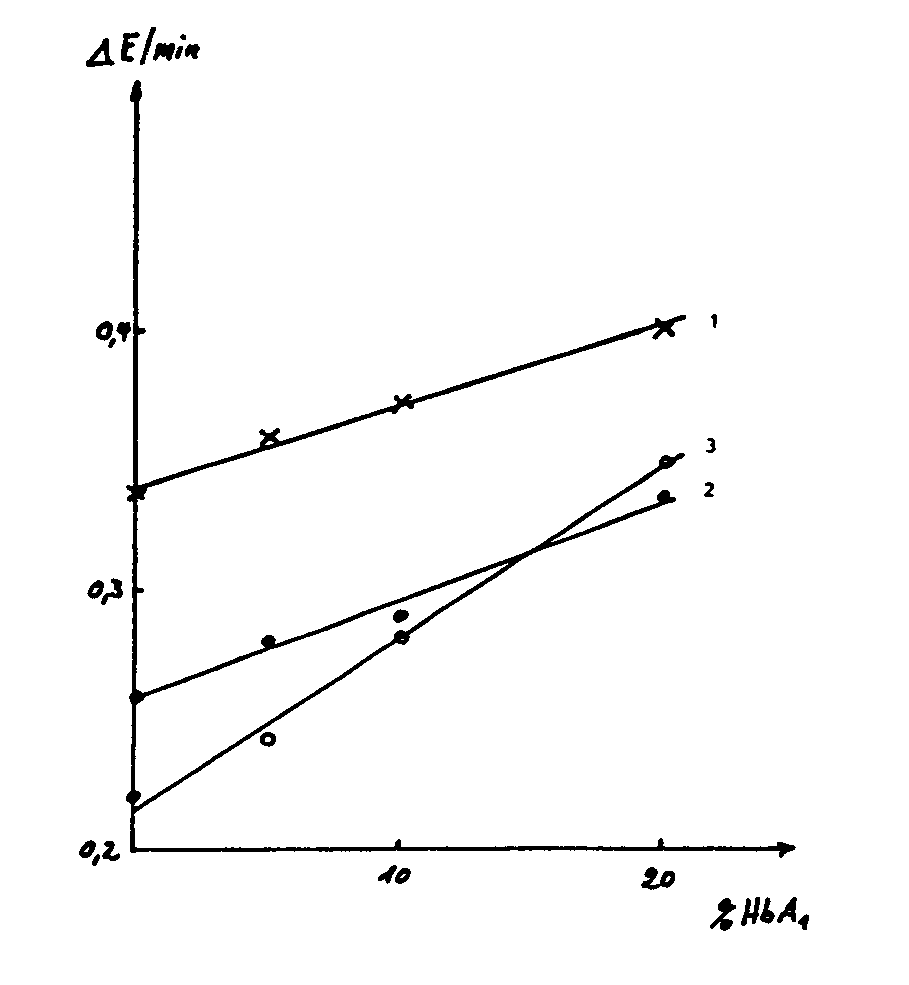
A is a saturated or unsaturated, straight-chain or branched aliphatic hydrocarbon radical which can be interrupted one or more times by heteroatoms, by oxycycloalkoxy radicals or by aromatic radicals, or an aromatic radical,
R is a hydroxy, hydroxyalkyl, hydroxyalkoxy group, an amino group, a reactive group X, an acid residue or its salts or one or more times by acid residues
bzw. deren Salze oder durch reaktive Gruppen X substituierten Alkyl-, Alkoxy-, Hydroxyalkyl- oder Hydroxyalkoxyrest, die durch Heteroatome unterbrochen sein können, B eine Einfachbindung oder einen unsubstituierten oder einen ein- oder mehrfach durch weitere Reste R substituierten aromatischen Rest, und
n eine ganze Zahl von 2 bis 20 bedeuten,or their salts or alkyl, alkoxy, hydroxyalkyl or hydroxyalkoxy radicals which are substituted by reactive groups X and which can be interrupted by heteroatoms, B a single bond or an unsubstituted or an aromatic radical which is substituted one or more times by further radicals R, and
n is an integer from 2 to 20,
wobei sowohl die verschiedenen Reste B als auch R innerhalb einer Substanz auch unterschiedlich sein können, erfolgt, sowie hierfür geeignete Reagentien.where both the different radicals B and R can also be different within a substance, and suitable reagents.
Description
Die vorliegende Erfindung betrifft ein Verfahren zur Bestimmung von glykosiliertem Hämoglobin in Blutproben, ein Reagenz zu seiner Durchführung sowie hierzu geeignete Verbindungen und Verfahren zu deren Herstellung.The present invention relates to a method for the determination of glycosylated hemoglobin in blood samples, a reagent for carrying it out as well as suitable compounds and methods for their production.
Glykosiliertes Hämoglobin entsteht durch nichtenzymatische Glykosilierung des Hämoglobins. Normalerweise beträgt die Konzentration an glykosiliertem Hämoglobin im Blut etwa 5 %, bezogen auf das Gesamthämoglobin. Bei Diabetikern ist diese Konzentration auf das Zwei- bis Vierfache erhöht.Glycosylated hemoglobin is created by non-enzymatic glycosylation of hemoglobin. Normally, the concentration of glycosylated hemoglobin in the blood is about 5%, based on the total hemoglobin. In diabetics, this concentration is increased two to four times.
Die Bestimmung des glykosilierten Anteils am Gesamthämoglobin hat in den letzten Jahren Bedeutung bei der Diabetesdiagnostik erlangt (vergleiche L. Jovanovic und C. M. Peterson, Am. J. Med. 70, (1981), Seite 331 - 338). Die Reaktion zwischen einzelnen Hämoglobinmolekülen und Glukose ergibt ein stabiles Reaktionsprodukt, das während der gesamten Lebenszeit der Erythrozyten, also ca. 100 - 200 Tage, erhalten bleibt. Kurzzeitige Schwankungen des Blutzuckergehaltes beeinflussen die Konzentration an glykosiliertem Hämoglobin nicht entscheidend. Die Konzentration an glykosiliertem Hämoglobin spiegelt daher relativ genau die durchschnittliche Glukosekonzentration im Blut eines Patienten über einen langen Zeitraum hinweg wieder.The determination of the glycosylated portion of total hemoglobin has gained importance in diabetes diagnostics in recent years (see L. Jovanovic and C. M. Peterson, Am. J. Med. 70, (1981), pages 331-338). The reaction between individual hemoglobin molecules and glucose results in a stable reaction product that remains intact for the entire lifespan of the erythrocytes, i.e. around 100-200 days. Short-term fluctuations in the blood sugar content do not have a decisive influence on the concentration of glycosylated hemoglobin. The concentration of glycosylated hemoglobin therefore reflects the average glucose concentration in the blood of a patient over a long period of time relatively accurately.
Es sind mehrere Verfahren zur Bestimmung des glykosilierten Anteils am Gesamthämoglobin bekannt. In klinischen Labors am weitesten verbreitet sind chromatographische Trennverfahren. Hierbei wird der glykosilierte Anteil des Hämoglobins vom nichtglykosilierten mit Hilfe einer Chromatographiesäule, einer Mikrosäule oder auch mit Hilfe der HPLC-Methode (HPLC = high pressure liquid chromatography) getrennt, wobei die Säulen mit einem Ionenaustauscher, beispielsweise mit Bio Rex 70 gefüllt sind. Alle diese Methoden sind jedoch sehr empfindlich gegen Änderungen des pH-Wertes, der Temperatur und der Ionenkonzentrationen. Die Trennverfahren müssen daher sehr vorsichtig durchgeführt werden, um optimale Resultate zu erhalten (vergleiche a.a.O. Seite 332).Several methods are known for determining the glycosylated portion of the total hemoglobin. Chromatographic separation processes are the most common in clinical laboratories. The glycosylated portion of the hemoglobin is separated from the non-glycosylated with the help of a chromatography column, a micro column or with the help of the HPLC method (HPLC = high pressure liquid chromatography) separated, the columns being filled with an ion exchanger, for example with Bio Rex 70. However, all of these methods are very sensitive to changes in pH, temperature and ion concentrations. The separation processes must therefore be carried out very carefully in order to obtain optimal results (see above page 332).
Aus der deutschen Offenlegungsschrift 29 50 457 ist ein Verfahren zur Bestimmung des glykosilierten Hämoglobins in Blutproben bekannt, bei dem die Veränderung der spektroskopischen Eigenschaften einer Blutprobe bei Zugabe eines allosterischen Effektors für die Bestimmung des glykosilierten Hämoglobins ausgenutzt wird. Beeinflußt wird hierbei lediglich der nichtglykosilierte Hauptanteil des Hämoglobins. Die gemessenen Extinktionsdifferenzen sind im relevanten Bereich sehr klein. Sie werden außerdem noch geringer, wenn der glykosilierte Anteil am Gesamthämoglobin zunimmt.A method for determining the glycosylated hemoglobin in blood samples is known from German Offenlegungsschrift 29 50 457, in which the change in the spectroscopic properties of a blood sample when an allosteric effector is added is used to determine the glycosylated hemoglobin. Only the non-glycosylated main part of the hemoglobin is affected. The measured extinction differences are very small in the relevant range. They also decrease as the glycosylated portion of total hemoglobin increases.
Ein Verfahren zur Bestimmung von glykosiliertem Hämoglobin aufgrund dessen verstärkter Bindungsfähigkeit an Haptoglobin wird in der deutschen Offenlegungsschrift 31 41 146 beschrieben. Der Unterschied im Bindungsverhalten von glykosiliertem und nichtglykosiliertem Hämoglobin gegenüber Haptoglobin wird durch Zusatz von 2,3-Diphosphoglycerat, Inosithexaphosphat oder Mellitsäure verstärkt. Er wird jedoch in keinem Fall so ausgeprägt, daß ausschließlich das glykosilierte Hämoglobin an Haptoglobin gebunden wird. Eine einfache photometrische Bestimmung des Haptoglobin-Hämoglobin-Komplexes ist entsprechend der deutschen Offenlegungsschrift 33 14 308 durch Messung der Pseudoperoxidaseaktivität dieses Komplexes möglich, wobei die Aktivität des freien, nichtglykosilierten Hämoglobins durch Detergenzzusatz und Wahl geeigneter chromogener Substrate unterdrückt wird.A method for the determination of glycosylated hemoglobin on the basis of its increased binding ability to haptoglobin is described in German Offenlegungsschrift 31 41 146. The difference in the binding behavior of glycosylated and non-glycosylated hemoglobin compared to haptoglobin is increased by adding 2,3-diphosphoglycerate, inositol hexaphosphate or mellitic acid. However, it is never so pronounced that only the glycosylated hemoglobin is bound to haptoglobin. A simple photometric determination of the haptoglobin-hemoglobin complex is possible according to German Offenlegungsschrift 33 14 308 by measuring the pseudoperoxidase activity of this complex, the activity of the free, non-glycosylated hemoglobin being suppressed by the addition of detergent and choice of suitable chromogenic substrates.
Mit Kenntnis des Standes der Technik gelangt man so zu einem homogenen Test auf glykosiliertes Hämoglobin, welcher die folgenden drei Inkubationsschritte umfaßt:
- 1. Hämolyse und Überführung der Hämgruppen von sowohl glykosiliertem als auch nichtglykosiliertem Hämoglobin in eine einheitlich ligandierte Form einer einzigen Oxidationsstufe, bevorzugt Nitrosyl-Hämoglobin,
- 2. Reaktion mit Haptoglobin,
- 3. Bestimmung des glykosilierten Hämoglobins, z. B. durch Denaturierung des freien Hämoglobins und kinetischer, photometrischer Messung der Peroxidaseaktivität der Hämoglobin-Haptoglobinkomplexe.
- 1. hemolysis and conversion of the heme groups of both glycosylated and non-glycosylated hemoglobin into a uniformly ligated form of a single oxidation stage, preferably nitrosyl hemoglobin,
- 2. reaction with haptoglobin,
- 3. Determination of the glycosylated hemoglobin, e.g. B. by denaturing the free hemoglobin and kinetic, photometric measurement of the peroxidase activity of the hemoglobin-haptoglobin complexes.
Derzeitige Analysenautomaten sind in der Regel nur auf die Ausführung von einem oder höchstens zwei Inkubationsschritten ausgelegt. Deshalb ist der vorgenannte Reaktionsablauf in der klinischen Praxis nicht vollständig automatisierbar. Andererseits hängt bei manueller Durchführung eines derartigen, mindestens vier Pipettiervorgänge umfassenden Reaktionsablaufes die Präzision der Bestimmung in großem Maße vom Geschick des Ausführenden ab. Außerdem ergeben die bisher bekannten Verfahren zur Bestimmung von glykosiliertem Hämoglobin auch für nichtglykosiliertes Hämoglobin ein Meßsignal, welches die Empfindlichkeit des Tests herabsetzt und zur Erstellung einer Eichgeraden zwingt.Current automatic analyzers are usually only designed to carry out one or at most two incubation steps. For this reason, the aforementioned reaction sequence cannot be fully automated in clinical practice. On the other hand, when such a reaction sequence comprising at least four pipetting processes is carried out manually, the precision of the determination depends to a large extent on the skill of the person carrying out the reaction. In addition, the previously known methods for determining glycosylated hemoglobin also result in a measurement signal for non-glycosylated hemoglobin, which lowers the sensitivity of the test and forces a calibration line to be established.
Aufgabe der Erfindung war es daher, die von der Präzision und der Spezifität der Indikatorreaktion abhängige Empfindlichkeit der Bestimmung von glykosiliertem Hämoglobin zu verbessern und Möglichkeiten für eine vollautomatische Testdurchführung zu schaffen.The object of the invention was therefore to improve the sensitivity of the determination of glycosylated hemoglobin, which is dependent on the precision and specificity of the indicator reaction, and to create possibilities for a fully automated test implementation.
Gelöst wird diese Aufgabe durch das erfindungsgemäße Verfahren, bei dem nach einer chemischen oder physikalischen Behandlung der Blutprobe zur Freisetzung des Hämoglobins aus den Erythrozyten eine Differenzierung des glykosilierten und nichtglykosilierten Hämoglobinanteils mit Hilfe von Haptoglobin in Gegenwart von Verbindungen erfolgt, die den Unterschied im Bindungsverhalten von glykosiliertem und nichtglykosiliertem Hämoglobin gegenüber Haptoglobin im Vergleich zu bisher bekannten Substanzen wesentlich erhöhen und entweder die Reaktion zwischen Hämoglobin und Haptoglobin kinetisch verfolgt oder der an Haptoglobin gebundene bzw. der von Haptoglobin nichtgebundene Teil des Hämoglobins gemessen wird.This object is achieved by the method according to the invention, in which after a chemical or physical treatment of the blood sample to release the hemoglobin from the erythrocytes, the glycosylated and non-glycosylated hemoglobin portion is differentiated with the aid of haptoglobin in the presence of compounds which differ in the binding behavior of glycosylated ones and non-glycosylated hemoglobin compared to haptoglobin significantly increase compared to previously known substances and either the reaction between hemoglobin and H aptoglobin is kinetically monitored or the part of the hemoglobin bound to haptoglobin or that which is not bound by haptoglobin is measured.
Gegenstand der vorliegenden Erfindung ist somit ein Verfahren zur Bestimmung von glykosiliertem Hämoglobin in Blutproben, wobei zunächst durch chemische oder physikalische Behandlung der Blutprobe glykosiliertes und nichtglykosiliertes Hämoglobin aus den Erythrozyten freigesetzt, danach eine Differenzierung von glykosiliertem und nichtglykosiliertem Hämoglobin mittels Haptoglobin durchgeführt und anschließend der glykosilierte Anteil des Hämoglobins bestimmt wird, dadurch gekennzeichnet, daß die Differenzierung von glykosiliertem und nichtglykosiliertem Hämoglobin mit Haptoglobin in Gegenwart einer oder mehrerer Substanzen der allgemeinen Formel I

- A ein gesättigter oder ungesättigter, geradkettiger oder verzweigter aliphatischer Kohlenwasserstoffrest, der ein- oder mehrfach durch Heteroatome, durch Oxycycloalkoxyreste oder durch aromatische Reste unterbrochen sein kann, oder ein aromatischer Rest,
- R eine Hydroxy-, Hydroxyalkyl-, Hydroxyalkoxygruppe, eine Aminogruppe, eine reaktive Gruppe X, einen Säurerest bzw. dessen Salze oder einen ein- oder mehrfach durch Säurereste bzw. deren Salze oder durch reaktive Gruppen X substituierten Alkyl-, Alkoxy-, Hydroxyalkyl- oder Hydroxyalkoxyrest, die durch Heteroatome unterbrochen sein können,
- B eine Einfachbindung oder einen unsubstituierten oder einen ein-oder mehrfach durch weitere Reste R substituierten aromatischen Rest und
- n eine ganze Zahl von 2 bis 20
- A is a saturated or unsaturated, straight-chain or branched aliphatic hydrocarbon radical which can be interrupted one or more times by heteroatoms, by oxycycloalkoxy radicals or by aromatic radicals, or an aromatic radical,
- R is a hydroxy, hydroxyalkyl, hydroxyalkoxy group, an amino group, a reactive group X, an acid residue or its salts or an alkyl, alkoxy or hydroxyalkyl group which is substituted one or more times by acid residues or its salts or by reactive groups X or hydroxyalkoxy, which can be interrupted by heteroatoms,
- B is a single bond or an unsubstituted or an aromatic radical which is substituted one or more times by further radicals R and
- n is an integer from 2 to 20
wobei sowohl die verschiedenen Reste B als auch R innerhalb einer Substanz auch unterschiedlich sein können,where both the different radicals B and R can also be different within a substance,
Ein gesättigter oder ungesättigter, geradkettiger oder verzweigter aliphatischer Kohlenwasserstoffrest in der Definition von A besitzt vorzugsweise zwei bis 30, besonders bevorzugt 2 bis 10 Kohlenstoffatome.A saturated or unsaturated, straight-chain or branched aliphatic hydrocarbon radical in the definition of A preferably has two to 30, particularly preferably 2 to 10, carbon atoms.
Heteroatome, die aliphatischen Kohlenwasserstoff unterbrechen können, sind vorzugsweise Sauerstoff und Schwefel.Heteroatoms that can disrupt aliphatic hydrocarbons are preferably oxygen and sulfur.
Oxycycloalkoxyreste bestehen aus 5 bis 8 Kohlenstoffatomen. Bevorzugt sind Reste wie z. B. Oxycyclopentoxy oder Oxycyclohexoxy. Besonders bevorzugt ist der Oxycyclohexoxyrest. Die Oxycycloalkoxyreste können an jedem Ring-C-Atom durch weitere Reste B-R substituiert sein.Oxycycloalkoxy radicals consist of 5 to 8 carbon atoms. Residues such as. B. oxycyclopentoxy or oxycyclohexoxy. The oxycyclohexoxy radical is particularly preferred. The oxycycloalkoxy radicals on each ring carbon atom can be substituted by further radicals B-R.
Aromatische Reste in der Definition von A und B können z. B. Benzol oder Heteroaromaten wie Pyridin, Furan oder Pyrrol sein.Aromatic residues in the definition of A and B can e.g. B. benzene or heteroaromatics such as pyridine, furan or pyrrole.
Unter Alkyl, Alkoxy, Hydroxyalkyl bzw. Hydroxyalkoxy in der Definition von R sind Reste aus 1 - 10, bevorzugt 1 - 6 Kohlenstoffatomen zu verstehen. Besonders bevorzugt sind Reste aus 2 bis 5 Kohlenstoffatomen. Meist verwendet werden Reste mit drei oder vier Kohlenstoffatomen.Alkyl, alkoxy, hydroxyalkyl or hydroxyalkoxy in the definition of R are radicals of 1-10, preferably 1-6 carbon atoms. Residues of 2 to 5 carbon atoms are particularly preferred. Residues with three or four carbon atoms are mostly used.
Unter einer reaktiven Gruppe X werden Gruppen verstanden, die mit Aminogruppen eine kovalente Bindung eingehen können, und zwar ohne zusätzliche Hilfsmittel, wie z. B. Dicyclohexylcarbodiimid oder erhöhte Temperatur (über 40° C). Bevorzugte Gruppen X sind z. B. der Aldehydrest oder dessen Bisulfitaddukt oder der Thiocyanat- oder Isothiocyanatrest. Besonders bevorzugt ist der Aldehydrest.A reactive group X is understood to mean groups which can form a covalent bond with amino groups, without additional aids, such as, for. B. dicyclohexylcarbodiimide or elevated temperature (above 40 ° C). Preferred groups X are e.g. B. the aldehyde residue or its bisulfite adduct or the thiocyanate or isothiocyanate residue. The aldehyde radical is particularly preferred.
Säurereste im Sinne der vorliegenden Erfindung sind vorzugsweise -COOH, -S03H, -OS03H, -PO3H2' -OPO3H2, -P2O6H3, -O-P2O6H3. Als Salze dieser Säurereste sind die Alkali-, Erdalkali- und Ammoniumsalze bevorzugt. Unter Alkalisalzen sind vor allem Lithium-, Natrium- und Kaliumsalze zu verstehen. Erdalkalisalze sind vor allem Magnesium-, Calcium- oder Bariumsalze. Ammoniumsalze können unsubstituierte Ammoniumionen enthalten oder solche, die durch Alkylgruppen mit 1 - 5 Kohlenstoffatomen, bevorzugt Methyl- oder Ethylresten, oder auch durch Aralkylgruppen, wie Benzylreste, substituiert sind. Die Substituenten können hierbei gleich oder verschieden sein.Acid residues in the sense of the present invention are preferably -COOH, -S0 3 H, -OS0 3 H, -PO 3 H 2 ' -OPO 3 H 2 , -P 2 O 6 H 3 , -OP 2 O 6 H 3 . Preferred salts of these acid residues are the alkali, alkaline earth and ammonium salts. Alkali salts are to be understood primarily as lithium, sodium and potassium salts. Alkaline earth salts are primarily magnesium, calcium or barium salts. Ammonium salts can contain unsubstituted ammonium ions or those which are substituted by alkyl groups with 1-5 carbon atoms, preferably methyl or ethyl radicals, or also by aralkyl groups, such as benzyl radicals. The substituents can be the same or different.
Substanzen der allgemeinen Formel I können der Blutprobe vor, aber auch gleichzeitig mit dem Haptoglobin zugegeben werden und haben den überraschenden Effekt, daß die Bindung von nichtglykosiliertem Hämoglobin an Haptoglobin vollständig unterdrückt wird, so daß der Test spezifisch für glykosiliertes Hämoglobin wird. Es ist möglich, aber in Gegenwart dieser Substanzen nicht mehr notwendig, die Hämgruppen schon vorher in eine einheitliche Form zu überführen, so daß auch ein voll automatisierbarer, nur zwei Inkubationsschritte umfassender Versuchsablauf realisierbar wird.Substances of the general formula I can be added to the blood sample before, but also simultaneously with, the haptoglobin and have the surprising effect that the binding of non-glycosylated hemoglobin to haptoglobin is completely suppressed, so that the test becomes specific for glycosylated hemoglobin. It is possible, but no longer necessary in the presence of these substances, to convert the heme groups into a uniform form beforehand, so that a fully automated test sequence comprising only two incubation steps can also be carried out.
Das Verfahren zur Bestimmung des glykosilierten Anteils am Gesamthämoglobin wird zweckmäßigerweise derart durchgeführt, daß man zunächst nach üblichen Methoden aus den Erythrozyten das glykosilierte und das nichtglykosilierte Hämoglobin freisetzt. Gleichzeitig mit dem Hämolysereagenz kann eine oder mehrere Verbindungen der allgemeinen Formel I zugegeben werden. Im Falle der physikalischen Behandlung von Blutproben zur Freisetzung glykosilierten und nichtglykosilierten Hämoglobins aus den Erythrozyten kann die Probe bereits vor oder auch während dieses Vorganges mit Verbindungen der allgemeinen Formel I versetzt werden. Der hämolysierten Blutprobe wird dann eine Haptoglobin enthaltende Lösung zugegeben. Unter diesen Bedingungen bindet der glykosilierte Anteil des Hämoglobins an Haptoglobin. Die Bestimmung der Haptoglobin-Hämoglobinkomplexe kann dann anschließend z. B. in bekannter Weise durch Messung der Peroxidaseaktivität nach Denaturierung des freien, nichtglykosilierten Hämoglobins erfolgen. Das erfindungsgemäße Verfahren wird zweckmäßig in Gegenwart eines geeigneten Puffersystems durchgeführt. Als geeignetes Puffersystem kann jeder im pH-Bereich von etwa 4,0 bis etwa 8,5, vorzugsweise von etwa 6,0 bis etwa 7,0 wirksame Puffer verwendet werden. Besonders bewährt haben sich Phosphat-, Morpholinoethansulfonsäure (MES)- und Bis-Tris-Puffer.The method for determining the glycosylated portion of the total hemoglobin is expediently carried out in such a way that the glycosylated and the non-glycosylated hemoglobin are first released from the erythrocytes by customary methods. One or more compounds of the general formula I can be added simultaneously with the hemolytic reagent. In the case of physical treatment of blood samples to release glycosylated and non-glycosylated hemoglobin from the erythrocytes, compounds of the general formula I can be added to the sample before or during this process. A solution containing haptoglobin is then added to the hemolyzed blood sample. Under these conditions, the glycosylated portion of hemoglobin binds to haptoglobin. The determination of the haptoglobin-hemoglobin complexes can then z. B. in a known manner by measuring the peroxidase activity after denaturing the free, non-glycosylated hemoglobin. The process according to the invention is expediently carried out in the presence of a suitable buffer system. Any suitable buffer system in the pH range from about 4.0 to about 8.5, preferably from about 6.0 to about 7.0, can be used as a suitable buffer system. Phosphate, morpholinoethanesulfonic acid (MES) and bis-tris buffers have proven particularly useful.
In einer speziellen Ausführungsform des erfindungsgemäßen Verfahrens wird die Differenzierung von glykosiliertem und nichtglykosiliertem Hämoglobin mittels Haptoglobin in Gegenwart von Substanzen durchgeführt, welche ionische Bindungen ausbilden können. Dies sind Verbindungen der allgemeinen Formel II

- A' ein gesättigter oder ungesättigter, geradkettiger oder verzweigter aliphatischer Kohlenwasserstoffrest, der ein- oder mehrfach durch Heteroatome oder Oxycycloalkoxyreste unterbrochen sein kann, oder ein aromatischer Rest,
- R' eine Hydroxy- oder Aminogruppe, ein Säurerest bzw. dessen Salze, einen ein- oder mehrfach durch Säurereste bzw. deren Salze substituierter Alkyl-, Alkoxy-, Hydroxyalkyl- oder Hydroxyalkoxyrest, wobei die Reste R' innerhalb einer Substanz gleich oder verschieden sein können, und
- n eine ganze
Zahl von 2bis 20
- A 'is a saturated or unsaturated, straight-chain or branched aliphatic hydrocarbon radical which can be interrupted one or more times by heteroatoms or oxycycloalkoxy radicals, or an aromatic radical,
- R 'is a hydroxy or amino group, an acid residue or its salts, an alkyl, alkoxy, hydroxyalkyl or hydroxyalkoxy residue which is substituted one or more times by acid residues or its salts, the residues R' being the same or different within a substance can, and
- n is an integer from 2 to 20
Für die in den Definitionen von A' und R' aufgeführten Reste gilt das oben im Zusammenhang mit A und R Gesagte.The statements made above in connection with A and R apply to the radicals listed in the definitions of A 'and R'.
Unter den in der Definition von R' genannten Säureresten sind bei den Verbindungen der allgemeinen Formel II vor allem jene bevorzugt, welche mehrwertige Anionen bilden können. Ganz besonders bevorzugt sind deshalb -OPO3H2 und -PO3H2.Among the acid residues mentioned in the definition of R ', those compounds which are able to form polyvalent anions are particularly preferred for the compounds of the general formula II. Therefore, -OPO 3 H 2 and -PO 3 H 2 are very particularly preferred.
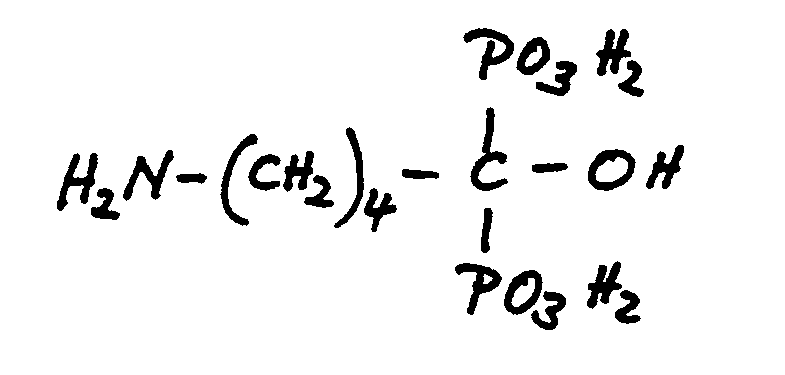
Bevorzugte Verbindung der allgemeinen Formel II sind z. B.
Ist A' in der Definition der allgemeinen Formel II ein gesättigter, geradkettiger aliphatischer Kohlenwasserstoffrest, sind Verbindungen der allgemeinen Formel II a

R' und n die oben angegebene Bedeutung haben, für das erfindungsgemäße Verfahren bevorzugt.R 'and n have the meaning given above, preferred for the process according to the invention.
Besonders bevorzugte Verbindungen der allgemeinen Formel II a sind z. B.

oder deren Alkali-, Erdalkali- oder Ammoniumsalze. Diese Verbindungen sind neu.or their alkali, alkaline earth or ammonium salts. These connections are new.
Ist A' in der Definition der allgemeinen Formel II ein durch ein Oxycycloalkoxyrest unterbrochener aliphatischer Kohlenwasserstoffrest, so sind für das erfindungsgemäße Verfahren Verbindungen der allgemeinen Formel II b

- R" eine Hydroxygruppe, eine Aminogruppe, ein Säurerest bzw. dessen Salze, wobei die Reste R" innerhalb einer Substanz gleich oder verschieden sein können, und
- G1 und G 2, die gleich oder verschieden sein können, einen Alkyl-oder Hydroxyalkylrest, der ein- oder mehrfach durch Reste R" substituiert ist,
bedeuten, bevorzugt.If A 'in the definition of general formula II is an aliphatic hydrocarbon radical interrupted by an oxycycloalkoxy radical, compounds of general formula II b are for the process according to the invention
- R "is a hydroxyl group, an amino group, an acid radical or its salts, where the radicals R" can be the same or different within a substance, and
- G 1 and G 2 , which may be the same or different, represent an alkyl or hydroxyalkyl radical which is substituted one or more times by radicals R ",
mean, preferred.
Für den Säurerest bzw. dessen Salze in der Definition von R" gilt das oben für die entsprechenden Reste bei der Definition von R Gesagte.For the acid residue or its salts in the definition of R ", the above applies to the corresponding residues in the definition of R.
Mit Alkyl- oder Hydroxyalkylresten in der Definition von G1 und G2 sind Reste aus 1 - 6 Kohlenstoffatomen, bevorzugt 1 - 4 Kohlenstoffatomen gemeint. Meist verwendet werden Reste aus 3 oder 4 Kohlenstoff-Atomen.Alkyl or hydroxyalkyl radicals in the definition of G 1 and G 2 mean radicals of 1-6 carbon atoms, preferably 1-4 carbon atoms. Residues of 3 or 4 carbon atoms are mostly used.
Verbindungen der allgemeinen Formel II b sind neu. Besonders bevorzugte Vertreter sind z. B.

Ist A' in der Definition der allgemeinen Formel II ein aromatischer Rest, dann sind für das erfindungsgemäße Verfahren Verbindungen der allgemeinen Formel II c

R' die in Formel II angegebene Bedeutung hat, bevorzugt.R 'has the meaning given in formula II, preferred.
Verbindungen der allgemeinen Formel II c sind neu. Besonders bevorzugte Vertreter sind z. B.

Die Herstellung von Verbindungen der allgemeinen Formeln II, II a, II b oder II c erfolgt nach an sich bekannten Methoden. Ausgehend von entsprechenden Polyolen werden OPO3H2- oder OP206H3-Gruppen oder deren Alkali-, Erdalkali- oder Ammoniumsalze mit geeigneten Phosphorylierungsmitteln [vgl. z. B. Adv. Org. Chem. 3, 75 - 157 (1963) oder Angew. Chem. 76, 704 - 712 (1964)], wie Polyphosphorsäure, Halogenphosphorsäureverbindungen oder Amidophosphorsäurederivaten eingeführt.Compounds of the general formulas II, II a, II b or II c are prepared by methods known per se. Starting from appropriate polyols, OPO 3 H 2 or OP206H3 groups or their alkali metal, alkaline earth metal or ammonium salts are mixed with suitable phosphorylating agents [cf. e.g. B. Adv. Org. Chem. 3, 75-157 (1963) or Angew. Chem. 76, 704-712 (1964)], such as polyphosphoric acid, halogen phosphoric acid compounds or amidophosphoric acid derivatives.
Die Reaktion wird zweckmäßigerweise ohne Lösungsmittel durchgeführt oder in einem Lösungsmittel wie Dichlormethan, Chloroform, Formamid, Dimethylformamid, Benzol, Tetrachlorkohlenstoff, Aceton, Acetonitril, Pyridin, Lutidin oder Collidin.The reaction is advantageously carried out without a solvent or in a solvent such as dichloromethane, chloroform, formamide, dimethylformamide, benzene, carbon tetrachloride, acetone, acetonitrile, pyridine, lutidine or collidine.
Phosphorylierungen finden mit oder ohne Zusatz von Hilfsreagentien, wie Silbersalze, Ammoniak, gegebenenfalls substituierte Amine, wie Triethylamin, Cyclohexylamin, Piperidine, Piperazine oder Pyridin statt.Phosphorylations take place with or without the addition of auxiliary reagents, such as silver salts, ammonia, and optionally substituted amines, such as triethylamine, cyclohexylamine, piperidines, piperazines or pyridine.
Die Isolierung der Produkte erfolgt durch Fällung als Salz, bevorzugt als Bariumsalz oder durch Ionenaustauschchromatographie.The products are isolated by precipitation as a salt, preferably as a barium salt or by ion exchange chromatography.
Die erhaltenen Verbindungen können durch Elementaranalyse, 1H-, 13 C- und 31P-NMR-Spektroskopie sowie durch die elektrophoretische Mobilität, Mrel, bezogen auf Pyrophosphat (Mrel = m1) auf cellulosebeschichteten Glasplatten mit einem geeigneten Puffersystem charakterisiert werden.The compounds obtained can be characterized by elemental analysis, 1 H, 13 C and 31 P NMR spectroscopy and by electrophoretic mobility, M rel , based on pyrophosphate (M rel = m1) on cellulose-coated glass plates with a suitable buffer system.
Sollen nur partiell phosphorylierte Produkte erhalten werden, müssen die entsprechenden Hydroxygruppen vorübergehend, während der Phosphorylierungsreaktion, durch geeignete Schutzgruppen geschützt werden.If only partially phosphorylated products are to be obtained, the corresponding hydroxyl groups must be temporarily protected by suitable protective groups during the phosphorylation reaction.
Geeignete Schutzgruppen sind insbesondere die Acetyl-, die Benzoyl-, die Benzyl-, die Isopyropyliden-, die Cyclohexyliden- oder die Benzyliden-Gruppe. Nach erfolgter Phosphorylierung werden die Schutzgruppen in bekannter Weise wieder abgespalten und die geschützten Alkoholfunktionen wieder freigesetzt.Suitable protective groups are in particular the acetyl, the benzoyl, the benzyl, the isopyropylidene, the cyclohexylidene or the benzylidene group. After phosphorylation has taken place, the protective groups are split off again in a known manner and the protected alcohol functions are released again.
Phosphonsäurederivate werden nach üblichen Methoden hergestellt. Vor allem geminale Diphosphonsäureverbindungen werden bevorzugt durch nachfolgende Umsetzung entsprechender Carbonylverbindungen mit phosphoriger Säure und Phosphortrichlorid in hochsiedenden Lösungsmitteln, wie z. B. Chlorbenzol und abschließende saure Hydrolyse der entstandenen Zwischenverbindungen erhalten.Phosphonic acid derivatives are produced by customary methods. Especially geminal diphosphonic acid compounds are preferred by subsequent reaction of corresponding carbonyl compounds with phosphorous acid and phosphorus trichloride in high-boiling solvents, such as. B. chlorobenzene and acidic hydrolysis of the resulting intermediates.
Die Reaktionstemperaturen sollten vorteilhafterweise etwa 70 - 140° C betragen. Besonders bevorzugt sind Temperaturen um 100° C.The reaction temperatures should advantageously be about 70-140 ° C. Temperatures around 100 ° C. are particularly preferred.
Bei solchen Temperaturen betragen die Reaktionszeiten einige Stunden, in den meisten Fällen 2 - 7 Stunden.At such temperatures, the reaction times are a few hours, in most cases 2-7 hours.
Die Isolierung der Verbindungen erfolgt vorteilhafterweise durch Ausfällung als Salz in organischen, mit Wasser mischbaren Lösungsmitteln, wie z. B. Methanol oder Ethanol oder durch Ionenaustauschchromatographie.The compounds are advantageously isolated by precipitation as a salt in organic, water-miscible solvents, such as. B. methanol or ethanol or by ion exchange chromatography.
Die Einführung von Sulfonsäuregruppen in den aliphatischen wie in den aromatischen Teil erfolgt durch übliche Sulfonierungsreaktionen. Als besonders günstig hat sich die Sulfonierung mit Chlorsulfonsäure erwiesen. Die aromatische Substitution führt bevorzugt bei erhöhter Temperatur, vorzugsweise 40 - 80° C, in guter Ausbeute zum Ziel. Uberführung der aliphatischen Alkoholfunktionen der Ausgangsverbindungen in OS03H-Gruppen gelingt mit Chlorsulfonsäure dagegen bereits bei niedrigen Temperaturen, vorzugsweise bei 0 - 20° C.The introduction of sulfonic acid groups into the aliphatic as well as into the aromatic part is carried out by conventional sulfonation reactions. Sulfonation with chlorosulfonic acid has proven to be particularly favorable. The aromatic substitution preferably leads to the goal in good yield at elevated temperature, preferably 40-80 ° C. Conversion of the aliphatic alcohol functions of the starting compounds into OS0 3 H groups, on the other hand, succeeds with chlorosulfonic acid even at low temperatures, preferably at 0-20 ° C.
Zur Herstellung von Carbonsäurederivaten können Carboxygruppen in Polyole nach bekannten Methoden, z. B. durch Überführung primärer oder sekundärer Alkoholfunktionen in gute Abgangsgruppen, Substitution dieser Abgangsgruppen durch Cyanid und abschließende Hydrolyse des Nitrils eingebracht werden.To produce carboxylic acid derivatives, carboxy groups in polyols can be prepared by known methods, e.g. B. by converting primary or secondary alcohol functions into good leaving groups, substitution of these leaving groups by cyanide and subsequent hydrolysis of the nitrile.
Als gute Abgangsgruppen gelten insbesondere z. B. die Acetyl-, die Benzoyl-, Toluolsulfonyl-, p-Brombenzolsulfonyl-, Methansulfonyl-oder Trifluormethansulfonylgruppe. Sie können in einfacher Weise durch Reaktion des Polyols, z. B. mit dem entsprechenden Säurechlorid oder Säureanhydrid eingeführt werden.Good leaving groups include in particular z. B. the acetyl, the benzoyl, toluenesulfonyl, p-bromobenzenesulfonyl, methanesulfonyl or trifluoromethanesulfonyl group. You can easily by reaction of the polyol, e.g. B. with the appropriate acid chloride or acid anhydride.
Zur Substitutionsreaktion mit Cyanid können Alkali-, Erdalkali- oder Ammoniumcyanide verwendet werden. Je nach Lösungsmittel und gewähltem Cyanid kann die Reaktion unter homogenen oder heterogenen Bedingungen, z. B. unter Phasentransferkatalyse stattfinden. Hydrolyse des als Zwischenprodukt entstehenden Nitrils ist sowohl sauer als auch basisch möglich. Bevorzugt werden basische Bedingungen gewählt.Alkali, alkaline earth or ammonium cyanides can be used for the substitution reaction with cyanide. Depending on the solvent and the selected cyanide, the reaction can be carried out under homogeneous or heterogeneous conditions, e.g. B. take place under phase transfer catalysis. Hydrolysis of the nitrile formed as an intermediate is possible both acidic and basic. Basic conditions are preferred.
Die Isolierung der Produkte erfolgt durch Fällung als Salz, bevorzugt als Bariumsalz oder durch Ionenaustauschchromatographie.The products are isolated by precipitation as a salt, preferably as a barium salt or by ion exchange chromatography.
Sollen nur partiell carboxylierte Produkte erhalten werden, müssen die entsprechenden Hydroxygruppen vorübergehend, während der Überführung von OH-Gruppen in gute Abgangsgruppen, durch geeignete Schutzgruppen geschützt werden. Als geeignete Schutzgruppen gelten insbesondere die Benzyl-, die Isopropyliden-, die Cyclohexyliden-oder die Benzyliden-Gruppe. Nach erfolgter Überführung der zu substituierenden Hydroxylgruppen in gute Abgangsgruppen können die Schutzgruppen in geeigneter Weise wieder abgespalten werden.If only partially carboxylated products are to be obtained, the corresponding hydroxyl groups must be temporarily protected by suitable protective groups during the conversion of OH groups into good leaving groups. Suitable protective groups are in particular the benzyl, the isopropylidene, the cyclohexylidene or the benzylidene group. After the hydroxyl groups to be substituted have been converted into good leaving groups, the protective groups can be split off again in a suitable manner.
In einer bevorzugten Ausführungsform des erfindungsgemäßen Verfahrens wird die Differenzierung von glykosiliertem und nichtglykosiliertem Hämoglobin mittels Haptoglobin in Gegenwart von Substanzen durchgeführt, die sowohl ionische als auch kovalente Bindungen ausbilden können. Dies sind Verbindungen der allgemeinen Formel III

- A" dieselbe Bedeutung wie A in Formel I hat, wobei A" ein- oder mehrfach durch Reste R substituiert sein kann, wobei R die in Formel I angegebene Bedeutung hat,
- B 1 und B2, die gleich oder verschieden sein können, dieselbe Bedeutung wie B in-Formel I haben, und
- X1 und X2, die gleich oder verschieden sein können, jeweils eine reaktive Gruppe
vorstellen.In a preferred embodiment of the method according to the invention, the differentiation of glycosylated and non-glycosylated hemoglobin is carried out by means of haptoglobin in the presence of substances which can form both ionic and covalent bonds. These are compounds of the general formula III
- A "has the same meaning as A in formula I, where A" can be substituted one or more times by radicals R, where R has the meaning given in formula I,
- B, which may be identical or different, have the same meaning as B 1 and B 2 in - have formula I, and
- X 1 and X 2 , which may be the same or different, each represent a reactive group
to introduce.
Für die reaktiven Gruppen X und X2 gelten die Ausführungen, die oben für die reaktive Gruppe X gemacht worden sind, in entsprechender Weise.The statements made above for reactive group X apply in a corresponding manner to reactive groups X and X 2 .
Eine bevorzugte Verbindung der allgemeinen Formel III ist z. B.

Im Fall, daß A" in der Definition der allgemeinen Formel III ein gesättigter, durch Heteroatome unterbrochener, aliphatischer Kohlenwasserstoffrest und B1 und B2 jeweils eine Einfachbindung darstellen, sind für das erfindungsgemäße Verfahren Verbindungen der allgemeinen Formel III a

- R''' Wasserstoff, eine Hydroxygruppe, einen Säurerest bzw. dessen Salze oder einen gegebenenfalls ein- oder mehrfach durch Säurereste bzw. deren Salze substituierter Alkyl-, Alkoxy-, Hydroxyalkyl- oder Hydroxyalkoxyrest,
- X1 und X 2 eine reaktive Gruppe und
- p, m, x jeweils eine ganze Zahl von 1 - 10
bedeuten, wobei bei Vorkommen mehrerer Reste R"' in einer Verbindung diese Reste gleich oder verschieden sein können, bevorzugt.In the case where A "in the definition of the general formula III is a saturated aliphatic hydrocarbon radical interrupted by heteroatoms and B 1 and B 2 are each a single bond, compounds of the general formula III a are for the process according to the invention
- R ″ ″ is hydrogen, a hydroxyl group, an acid residue or its salts or an alkyl, alkoxy, hydroxyalkyl or hydroxyalkoxy residue which is optionally substituted one or more times by acid residues or its salts,
- X 1 and X 2 are a reactive group and
- p, m, x are each an integer from 1 to 10
mean, where in the presence of several radicals R "'in a compound these radicals may be the same or different, preferred.
Für die Definitionen von R"' gilt das oben im Zusammenhang mit R Gesagte.For the definitions of R "', what has been said above in connection with R applies.
Für die reaktive Gruppen X und X2 gelten die Ausführungen, die oben für die reaktive Gruppe X gemacht worden sind, in entsprechender Weise.The statements made above for reactive group X apply correspondingly to reactive groups X and X 2 .
Verbindungen der allgemeinen Formel III a, in der mindestens ein Rest R'" einen Säurerest bzw. dessen Salze oder einen ein- oder mehrfach durch Säurereste bzw. dessen Salze substituierten Alkyl-, Alkoxy-, Hydroxyalkyl- oder Hydroxyalkoxyrest bedeutet, sind neu.Compounds of the general formula III a, in which at least one radical R '"denotes an acid radical or its salts or an alkyl, alkoxy, hydroxyalkyl or hydroxyalkoxy radical which is substituted one or more times by acid radicals or its salts, are new.
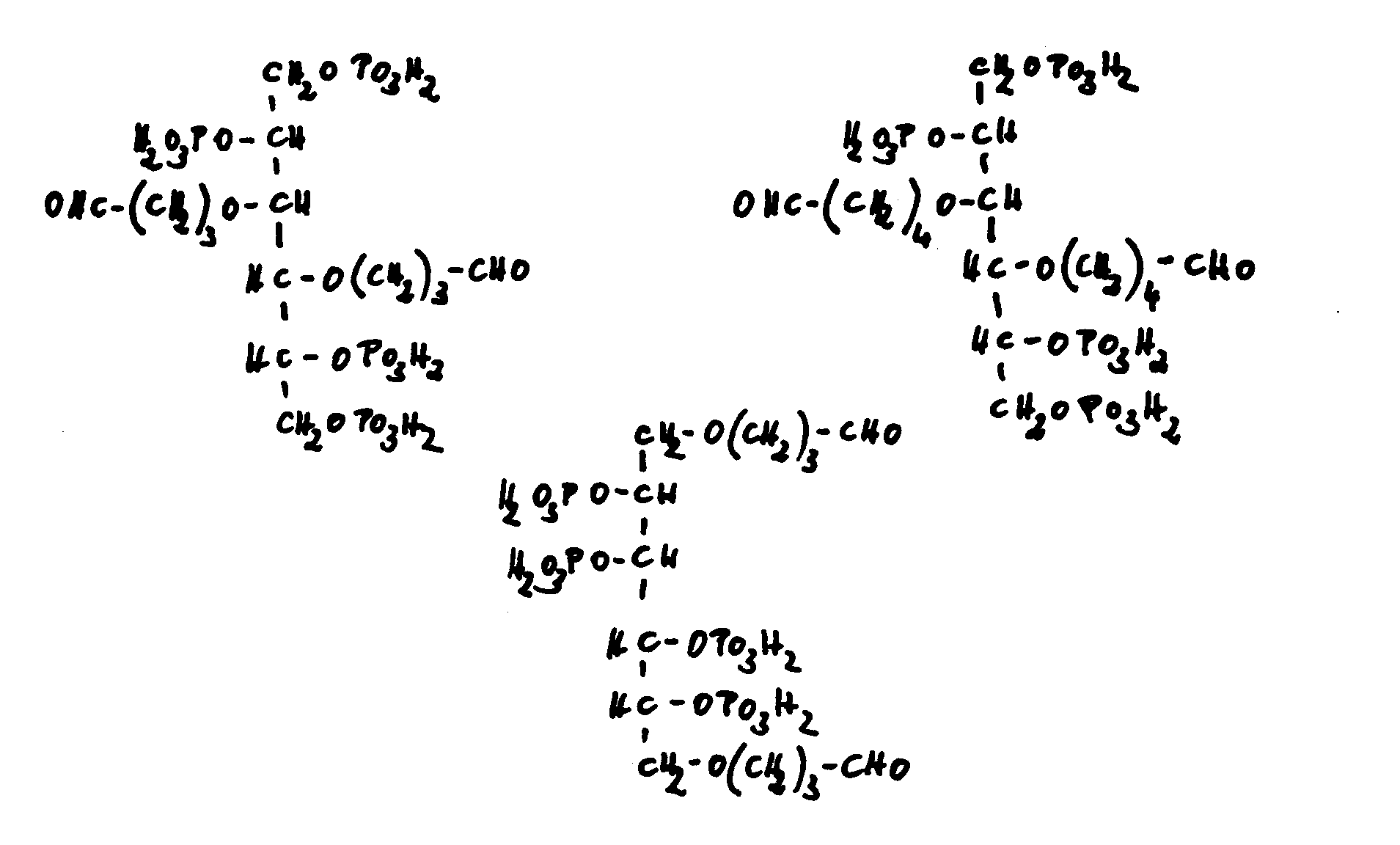
Besonders bevorzugte Vertreter sind z. B.
Sind A" in der Definition der allgemeinen Formel III ein aliphatischer Kohlenwasserstoffrest, der durch einen Oxycycloalkoxyrest unterbrochen ist, und B1 und B2 jeweils eine Einfachbindung, dann werden für das erfindungsgemäße Verfahren Verbindungen der allgemeinen Formel III b

- R"" Wasserstoff, ein Säurerest bzw. dessen Salze, wobei die verschiedenen Reste R"" innerhalb einer Verbindung gleich oder verschieden sein können,
- G 3 und G4, die gleich oder verschieden sein können, jeweils eine Kohlenwasserstoffkette und
- X1 und X 2, die gleich oder verschieden sein können, eine reaktive Gruppe
bedeuten, bevorzugt.If A "in the definition of the general formula III is an aliphatic hydrocarbon radical which is interrupted by an oxycycloalkoxy radical and B 1 and B 2 are each a single bond, then compounds of the general formula III b
- R "" is hydrogen, an acid radical or its salts, it being possible for the various radicals R "" to be the same or different within a compound,
- G 3 and G 4 , which may be the same or different, each have a hydrocarbon chain and
- X 1 and X 2 , which may be the same or different, represent a reactive group
mean, preferred.
Für den Säurerest bzw. dessen Salze in der Definition von R"" gilt das oben für die entsprechenden Reste bei der Definition von R Gesagte.For the acid residue or its salts in the definition of R "", the above applies to the corresponding residues in the definition of R.
Die Kohlenwasserstoffkette in der Definition von G3 und G4 besteht aus 1 bis 7, vorzugsweise 2 bis 5 Kohlenstoffatomen.The hydrocarbon chain in the definition of G 3 and G 4 consists of 1 to 7, preferably 2 to 5 carbon atoms.
Für die reaktiven Gruppen X1 und X2 gelten die Ausführungen, die oben für die reaktive Gruppe X gemacht worden sind, in entsprechender Weise.The statements made above for reactive group X apply accordingly to reactive groups X 1 and X 2 .
Verbindungen der allgemeinen Formel III b sind neu. Besonders bevorzugte Vertreter sind z. B.

Die Herstellung von Verbindungen der allgemeinen Formel III a oder III b erfolgt nach an sich bekannten Methoden, welche prinzipiell denen für die Herstellung von Verbindungen der allgemeinen Formel II a, II b und II c entsprechen.Compounds of the general formula III a or III b are prepared by methods known per se, which in principle correspond to those for the preparation of compounds of the general formula II a, II b and II c.
Ausgangsstoffe sind jeweils Polyole deren Hydroxygruppen analog der für Verbindungen der allgemeinen Formeln II, II a, II b und II c geschilderten Methoden in Säuregruppen überführt werden können. Die Einführung reaktiver Gruppen X und X2 ist abhängig von der Art dieser Gruppen.The starting materials are in each case polyols whose hydroxyl groups can be converted into acid groups analogously to the methods described for compounds of the general formulas II, II a, II b and II c. The introduction of reactive groups X and X 2 depends on the type of these groups.
Aldehydfunktionen werden üblicherweise durch Oxidation primärer Alkoholfunktionen gebildet. Als Oxidationsmittel werden Mangandioxid oder Manganatsalze, wie z. B. Bariummanganat verwendet.Aldehyde functions are usually formed by the oxidation of primary alcohol functions. Manganese dioxide or manganate salts, such as. B. barium manganate is used.
Um unter diesen Bedingungen eine selektive Oxidation bestimmter OH-Gruppen eines Polyols durchführen zu können, müssen vorher diejenigen Hydroxygruppen, die nicht angegriffen werden sollen, geschützt werden. Dies geschieht durch geeignete Schutzgruppen, wie z. B. die Acetyl-, Benzoyl-, Benzyl-, Isopropyliden-, Cyclohexyliden- oder Benzyliden-Gruppe. Nach erfolgter Einführung der Aldehydfunktionen werden die Schutzgruppen in bekannter Weise wieder abgespalten und die Alkoholfunktionen wieder freigesetzt. Anschließend können diese dann in Säuregruppen überführt werden.In order to be able to selectively oxidize certain OH groups of a polyol under these conditions, those hydroxyl groups which are not to be attacked must first be protected. This is done through suitable protection groups, such as e.g. B. the acetyl, benzoyl, benzyl, isopropylidene, cyclohexylidene or benzylidene group. After the introduction of the aldehyde functions, the protective groups are split off again in a known manner and the alcohol functions are released again. They can then be converted into acid groups.
Bisulfitaddukte von Aldehyden sind leicht durch Reaktion mit Natriumhydrogensulfit herstellbar, indem Aldehyde z. B. in Bisulfitlauge gelöst werden. Die Reaktionsmischung kann entweder direkt, ohne Isolierung des Endprodukts, oder auch erst nach Reinigung und Isolierung des Addukts für das erfindungsgemäße Verfahren zur Bestimmung von glykosiliertem Hämoglobin eingesetzt werden.Bisulfite adducts of aldehydes can easily be prepared by reaction with sodium bisulfite, by aldehydes e.g. B. be dissolved in bisulfite liquor. The reaction mixture can either be used directly, without isolation of the end product, or only after purification and isolation of the adduct for the method according to the invention for the determination of glycosylated hemoglobin.
Isothiocyanate werden vorteilhafterweise aus primären Aminen und Schwefelkohlenstoff in Gegenwart einer starken Base hergestellt. Unter starken Basen werden hierbei vor allem Alkali- und Erdalkalihydroxide verstanden. Das sich bildende Salz der N-Alkyl-dithio-carbamidsäure reagiert anschließend z. B. mit Chlorameisensäureestern zu den gewünschten Isothiocyanaten.Isothiocyanates are advantageously made from primary amines and carbon disulfide in the presence of a strong base. Strong bases are understood to mean above all alkali and alkaline earth hydroxides. The salt of N-alkyl-dithio-carbamic acid that forms then reacts z. B. with chloroformates to the desired isothiocyanates.
Besonders bevorzugte Verbindungen der allgemeinen Formel III sind die Benzylverbindungen der allgemeinen Formel IV
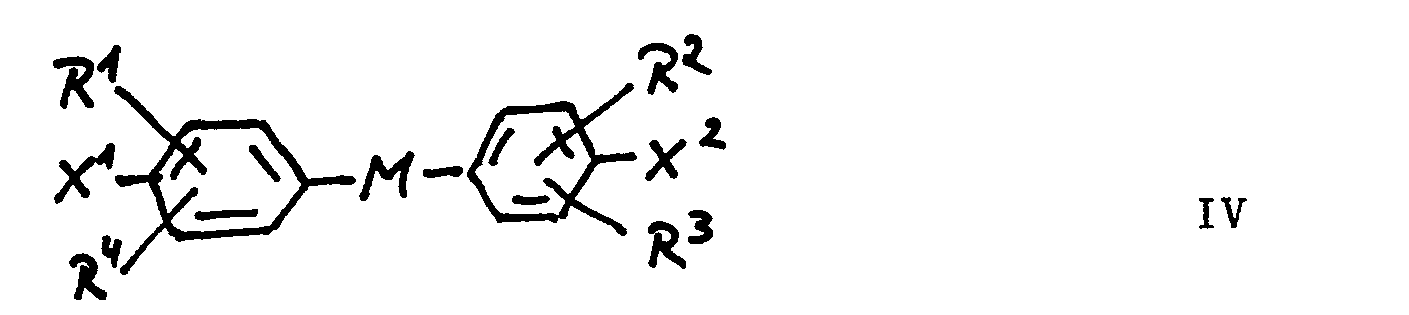
- M eine Einfachbindung oder eine gesättigte oder ungesättigte Kohlenwasserstoffkette, die gegebenenfalls ein- oder mehrfach durch Säurereste bzw. deren Salze substituiert ist, bedeutet,
- R1, R2, R3 und R4, die gleich oder verschieden sein können, die Bedeutung von R"' in Formel III a haben und
- X1 und X2, die gleich oder verschieden sein können, eine reaktive Gruppe vorstellen.
- M denotes a single bond or a saturated or unsaturated hydrocarbon chain which is optionally substituted one or more times by acid residues or their salts,
- R 1 , R 2 , R 3 and R 4 , which may be the same or different, have the meaning of R "'in formula III a and
- X 1 and X 2 , which may be the same or different, represent a reactive group.
Unter der gesättigten oder ungesättigten Kohlenwasserstoffkette in der Definition von M wird ein Rest aus 1 bis 8, bevorzugt 1 bis 4 Kohlenstoffatomen verstanden.The saturated or unsaturated hydrocarbon chain in the definition of M is understood to mean a radical of 1 to 8, preferably 1 to 4, carbon atoms.
Für die reaktiven Gruppen X und X2 gelten die Ausführungen, die oben für die reaktive GruppeX gemacht worden sind, in entsprechender Weise.The statements made above for reactive group X apply correspondingly to reactive groups X and X 2 .
Verbindungen der allgemeinen Formel IV, in der M eine durch Säuregruppen bzw. deren Salze ein- oder mehrfach substituierter Kohlenwasserstoffrest ist, sind neu.Compounds of the general formula IV in which M is a hydrocarbon radical which is mono- or polysubstituted by acid groups or their salts are new.
Besonders bevorzugte Vertreter sind z. B.

Die Herstellung der Verbindungen der allgemeinen Formel IV erfolgt nach an sich bekannten Methoden.The compounds of the general formula IV are prepared by methods known per se.
Besonders bevorzugte Verbindungen der allgemeinen Formel IV sind Verbindungen der allgemeinen Formel V

- R 1, R 2, R 3, R 4, X1 und X 2 die in Formel IV angegebene Bedeutung haben und
- R 5 und R 6, die gleich oder verschieden sein können, einen Säurerest
bzw. dessen Salze vorstellen.Particularly preferred compounds of the general formula IV are compounds of the general formula V
- R 1 , R 2 , R 3 , R 4 , X1 and X 2 have the meaning given in formula IV and
- R 5 and R 6 , which may be the same or different, represent an acid residue
or introduce its salts.
Als Säurerest in den Definitionen von R und R6 sind -OPO3H2, -OP2O6H3 oder -OS03H bevorzugt.Preferred acid residues in the definitions of R and R 6 are -OPO 3 H 2 , -OP 2 O 6 H 3 or -OS0 3 H.
Als Verbindungen, welche das erfindungsgemäße Verfahren zur Bestimmung glykosilierten Hämoglobins besonders günstig beeinflussen, sind 1,2-Bis(4-formyl-2-sulfonylphenyl)ethan und 1,2-Bis(4-formylphenyl)ethandiol-1,2-diphosphat zu nennen.As compounds which have a particularly favorable effect on the method according to the invention for determining glycosylated hemoglobin, 1,2-bis (4-formyl-2-sulfonylphenyl) ethane and 1,2-bis (4-formylphenyl) ethanediol-1,2-diphosphate are also available call.
Dibenzylverbindungen der allgemeinen Formel V sind neu. Sie können nach an sich bekannten Methoden hergestellt werden. Das 1,2-Bis(4-formylphenyl)ethan-gerüst erhält man z. B. durch Wittig-Reaktion eines p-Alkoxycarbonylbenzyltriphenylphosphoniumbromids mit einem p-Alkoxycarbonylbenzaldehyd. Unter Alkoxyresten werden in diesem Zusammenhang Gruppen aus 1 - 5 Kohlenstoffatomen verstanden. Besonders bevorzugt sind der Methoxy- oder Ethoxy-Rest. Das gebildete Stilben wird z. B. über Palladium auf Kohle hydriert. Die beiden Carbonsäureester-Funktionen wandelt man anschließend in bekannter Weise, z. B. durch Reduktion mit Lithiumaluminiumhydrid zum Benzylalkohol und anschließende Braunsteinoxidation zum Aldehyd um.Dibenzyl compounds of the general formula V are new. They can be produced by methods known per se. The 1,2-bis (4-formylphenyl) ethane backbone is obtained e.g. B. by Wittig reaction of a p-alkoxycarbonylbenzyltriphenylphosphonium bromide with a p-alkoxycarbonylbenzaldehyde. In this context, alkoxy radicals are understood to mean groups of 1-5 carbon atoms. The methoxy or ethoxy radical are particularly preferred. The stilbene formed is e.g. B. hydrogenated over palladium on carbon. The two carboxylic ester functions are then converted in a known manner, for. B. by reduction with lithium aluminum hydride to benzyl alcohol and subsequent manganese dioxide oxidation to aldehyde.
Sulfonsäuregruppen werden durch übliche Sulfonierungsreaktionen eingeführt. Als besonders günstig hat sich die Sulfonierung mit Chlorsulfonsäure erwiesen, welche bei erhöhter Temperatur, vorzugsweise 40 - 80° C, in guter Ausbeute zum Ziel führt.Sulfonic acid groups are introduced by conventional sulfonation reactions. Sulphonation with chlorosulphonic acid has proven to be particularly favorable, which leads to the goal in good yield at elevated temperature, preferably 40-80 ° C.
Carboxy- und Carboxymethylenoxygruppen können durch Wahl entsprechend geeigneter, literaturbekannter Ausgangsverbindungen eingeführt werden.Carboxy and carboxymethyleneoxy groups can be introduced by choosing appropriate starting compounds known from the literature.
Phosphatgruppen an der Ethylengruppierung werden eingeführt, indem man das entsprechende Stilben zunächst nach üblichen Verfahren epoxidiert, z. B. mit meta-Chlorperbenzoesäure, zum Diol öffnet und dann mit einem literaturüblichen Phosphorylierungsmittel, wie Phosphoroxychlorid umsetzt.Phosphate groups on the ethylene grouping are introduced by first epoxidizing the corresponding stilbene by conventional methods, e.g. B. opens with meta-chloroperbenzoic acid to the diol and then reacted with a literature phosphorylating agent such as phosphorus oxychloride.
Bisulfitaddukte der Bis(formylphenyl)ethan-Verbindungen sind durch Reaktion mit Natriumbisulfit leicht zugänglich. Sie können entweder gesondert hergestellt werden oder ohne besondere Isolierung im Test durch Lösen des Dialdehyds in Bisulfitlauge in Situ erzeugt werden.Bisulfite adducts of the bis (formylphenyl) ethane compounds are easily accessible by reaction with sodium bisulfite. They can either be prepared separately or generated in situ without special insulation in the test by dissolving the dialdehyde in bisulfite liquor.
Die für das erfindungsgemäße Verfahren geeigneten Verbindungen der allgemeinen Formel I werden in mindestens äquivalenter Menge, bezogen auf den Hämoglobingehalt, eingesetzt. Im allgemeinen ist es jedoch von Vorteil, diese Substanzen im Uberschuß, vorzugsweise in 2- bis 200fachem, besonders bevorzugt 5 bis 50fachem molarem Überschuß zuzugeben.The compounds of general formula I suitable for the process according to the invention are used in at least an equivalent amount, based on the hemoglobin content. In general, however, it is advantageous to add these substances in excess, preferably in 2 to 200 times, particularly preferably 5 to 50 times, molar excess.
Gegebenenfalls ist es zweckmäßig, jedoch nicht unbedingt notwendig, bei Durchführung des erfindungsgemäßen Verfahrens der Meßlösung vor dem Kontaktieren mit Haptoglobin ein Ionenbindungen stabilisierendes Mittel zuzusetzen. Solche Substanzen mit einer stabilisierenden Wirkung auf ionische Bindungen sind beispielsweise Ethylenglykole, Polyethylenglykole oder Saccharose.If appropriate, it is expedient, but not absolutely necessary, to add an ion-binding stabilizing agent to the test solution before carrying out contact with haptoglobin when carrying out the method according to the invention. Such substances with a stabilizing effect on ionic bonds are, for example, ethylene glycols, polyethylene glycols or sucrose.
Haptoglobin muß ebenfalls in mindestens äquivalenter Menge, bezogen auf das Hämoglobin, eingesetzt werden. Vorteilhaft wirkt sich jedoch auch hier ein Überschuß aus. Vorzugsweise wird die 1,2 bis 50fache, besonders bevorzugt die 1,5 bis Sfache molare Menge verwendet.Haptoglobin must also be used in at least an equivalent amount, based on the hemoglobin. However, an excess also has an advantageous effect here. Preferably the 1.2 to 50 times, particularly preferably 1.5 to S times the molar amount is used.
Es ist ferner möglich, Haptoglobin auf einen Träger zu fixieren. In diesem Fall kann das Bestimmungsverfahren durchgeführt werden, indem man entweder
- a) den mit dem Haptoglobin versehenen Träger in die hämolysierte, gegebenenfalls vorbehandelte Blutprobe eintaucht oder
- b) eine definierte Menge der vorbehandelten Blutprobe auf den Haptoglobinträger tropft oder
- c) mit einer definierten Menge der vorbehandelten Blutprobe das Haptoglobin vom Träger eluiert.
- a) immersing the carrier provided with the haptoglobin in the hemolyzed, optionally pretreated blood sample or
- b) a defined amount of the pretreated blood sample drips onto the haptoglobin carrier or
- c) eluting the haptoglobin from the carrier with a defined amount of the pretreated blood sample.
Als Trägermaterialien eignen sich die für analytische Nachweisreagenzien üblichen Träger, wie Papier, Cellulose, Faservliese, poröse Kunststoffe und dergleichen. Die Herstellung von mit Haptoglobin beladenen Trägern erfolgt durch Eintauchen in oder Besprühen mit einer haptoglobinhaltigen Lösung.Suitable supports are the supports customary for analytical detection reagents, such as paper, cellulose, non-woven fabrics, porous plastics and the like. Carriers loaded with haptoglobin are prepared by immersing them in or spraying them with a solution containing haptoglobin.
Das glykosilierte Hämoglobin kann auch aufgrund seiner Fähigkeit zur Inhibition der Haptoglobin-induzierten Agglutination von hämoglobinbeladenen Latexpartikeln bestimmt werden. Derartige Latexagglutinationstests sind dem Fachmann als Mittel zur besseren Erkennung der Bildung von Immunkomplexen bekannt und können überraschenderweise auch zur quantitativen Messung der Bindung von glykosiliertem Hämoglobin an Haptoglobin eingesetzt werden.The glycosylated hemoglobin can also be determined based on its ability to inhibit haptoglobin-induced agglutination of latex particles loaded with hemoglobin. Such latex agglutination tests are known to the person skilled in the art as a means for better detection of the formation of immune complexes and can surprisingly also be used for the quantitative measurement of the binding of glycosylated hemoglobin to haptoglobin.
Das Prinzip der Messung beruht darauf, daß hämoglobinbeladene Latexpartikel in Anwesenheit von Haptoglobin aggregieren und die Lösung trüben. Bei gleichzeitiger Anwesenheit von glykosiliertem Hämoglobin, reagiert Haptoglobin jedoch bevorzugt mit diesem und es findet eine verringerte Agglutination statt. Aus der Geschwindigkeit und dem Ausmaß der Agglutination bzw. der gemessenen Trübung kann mit Hilfe einer Eichkurve der Gehalt an glykosiliertem Hämoglobin in einer Probe ermittelt werden.The principle of the measurement is based on the fact that latex particles loaded with hemoglobin aggregate in the presence of haptoglobin and cloud the solution. If glycosylated hemoglobin is present at the same time, haptoglobin reacts preferentially with it and there is a reduced agglutination. The content of glycosylated hemoglobin in a sample can be determined from the speed and extent of the agglutination or the measured turbidity using a calibration curve.
Es ist auch folgende Vorgehensweise zur Bestimmung des glykosilierten Anteils möglich, indem die Agglutination von haptoglobinbeladenem Latex durch glykosiliertes Hämoglobin in Gegenwart eines Antikörpers gegen Hämoglobin gemessen wird. Hierfür können poly- oder monoklonale Antikörper gegen glykosiliertes oder nichtglykosiliertes Hämoglobin oder gegen beliebige Mischungen der beiden Formen verwendet werden. In einer bevorzugten Ausführungsform wird ein monoklonaler Antikörper gegen den glykosilierten Aminoterminus der ß-Kette des,glykosilierten Hämoglobins zugesetzt, wie er z. B. in dem US-Patent 4,478,744 beschrieben ist.The following procedure for determining the glycosylated fraction is also possible by measuring the agglutination of latex loaded with haptoglobin by glycosylated hemoglobin in the presence of an antibody against hemoglobin. Poly- or monoclonal antibodies against glycosylated or non-glycosylated hemoglobin or against any mixtures of the two forms can be used for this. In a preferred embodiment, a monoclonal antibody against the glycosylated amino terminus is added to the β-chain of the glycosylated hemoglobin, as described, for. Described in U.S. Patent 4,478,744.
Bevorzugt ist in jedem Fall der Einsatz von Antikörpern in einer Konzentration von 10-4 bis 10-8 mol/1. Die bevorzugte Größe der Latexpartikel liegt zwischen 10 und 300 nm. Die Partikelkonzentration weiß der Fachmann so zu wählen, daß im bevorzugten Wellenbereich zwischen etwa 400 und etwa 1000 nm eine ausreichend empfindliche photometrische Messung der Latexagglutination möglich wird.In any case, the use of antibodies in a concentration of 10 -4 to 10 -8 mol / 1 is preferred. The preferred size of the latex particles is between 10 and 300 nm. The person skilled in the art knows how to choose the particle concentration such that a sufficiently sensitive photometric measurement of the latex agglutination is possible in the preferred wave range between about 400 and about 1000 nm.
Ein wesentlicher Vorteil der Messung der Komplexbildung von Haptoglobin und glykosiliertem Hämoglobin durch Latexagglutination ist im Vergleich zur Detektion anhand der Peroxidaseaktivität die Einsparung eines Inkubationsschrittes, so daß bereits ohne Einsatz der erfindungsgemäßen Substanzen ein vollautomatisierbares Verfahren bestehend aus zwei Inkubationsschritten realisiert werden kann. Besondere Vorteile bietet die kombinierte Anwendung der oben genannten Substanzen der allgemeinen Formel I, welche durch nichtglykosiliertes Hämoglobin hervorgerufene Meßsignale unterbinden oder zumindest deutlich vermindern, und der Detektion durch Latexagglutination. Hierdurch wird ein einfaches, im günstigsten Fall nur aus einem Inkubationsschritt bestehendes Verfahren von hoher Spezifität ermöglicht.A major advantage of measuring the complex formation of haptoglobin and glycosylated hemoglobin by latex agglutination is, compared to detection based on the peroxidase activity, the saving of an incubation step, so that a fully automated process consisting of two incubation steps can be implemented even without using the substances according to the invention. The combined use of the above-mentioned substances of general formula I, which prevent or at least significantly reduce measurement signals caused by non-glycosylated hemoglobin, and detection by latex agglutination offers particular advantages. This enables a simple method of high specificity, which in the most favorable case consists of only one incubation step.
Gegenstand der Erfindung ist ferner ein Reagenz zur automatisierbaren Bestimmung von glykosiliertem Hämoglobin in Blutproben, enthaltend ein Mittel zur Hämolyse der Erythrozyten in einem geeigneten Puffersystem, freies oder trägergebundenes Haptoglobin, eine oder mehrere Verbindungen der allgemeinen Formel I sowie gegebenenfalls Substanzen mit stabilisierender Wirkung auf ionische Bindungen.The invention further relates to a reagent for the automated determination of glycosylated hemoglobin in blood samples, containing a means for hemolysis of the erythrocytes in a suitable buffer system, free or carrier-bound haptoglobin, one or more compounds of the general formula I and, if appropriate, substances with a stabilizing effect on ionic bonds .
Zur Herstellung des Reagenzes in Form eines Teststreifens wird ein saugfähiger Träger, vorzugsweise Papier, Cellulose, Faservlies, poröser Kunststoff oder dergleichen mit Lösungen der erforderlichen Reagenzien in geeigneten Lösungsmitteln imprägniert. Dies kann in einem Imprägnierschritt erfolgen. Oft ist es jedoch zweckmäßig, die Imprägnierung in mehreren Schritten durchzuführen, wobei Lösungen eingesetzt werden, die jeweils einen Teil der Bestandteile des Reagenzes enthalten. Die fertigen Teststreifen können als solche verwendet werden oder in an sich bekannter Weise an Griffe angeklebt oder vorzugsweise zwischen Kunststoffen und feinmaschigen Netzwerken gemäß DBP 21 18 455 eingesiegelt werden.To produce the reagent in the form of a test strip, an absorbent carrier, preferably paper, cellulose, nonwoven fabric, porous plastic or the like, is impregnated with solutions of the required reagents in suitable solvents. This can be done in one impregnation step. However, it is often expedient to carry out the impregnation in several steps, solutions being used which each contain part of the constituents of the reagent. The finished test strips can be used as such or glued to handles in a manner known per se or preferably sealed between plastics and fine-meshed networks in accordance with DBP 21 18 455.
Ein weiterer Gegenstand der Erfindung ist ein Reagenz zur Differenzierung von glykosiliertem und nichtglykosiliertem Hämoglobin, enthaltend Haptoglobin und hämoglobinbeladene Latexpartikel sowie eine oder mehrere Verbindungen der allgemeinen Formel I.Another object of the invention is a reagent for differentiating glycosylated and non-glycosylated hemoglobin, containing haptoglobin and hemoglobin-loaded latex particles and one or more compounds of the general formula I.
Ein Reagenz zur Differenzierung von glykosiliertem und nichtglykosiliertem Hämoglobin enthaltend haptoglobinbeladene Latexpartikel, poly- oder monoklonale Antikörper gegen glykosiliertes oder nichtglykosiliertes Hämoglobin sowie eine oder mehrere Verbindungen der allgemeinen Formel I ist ebenfalls Gegenstand der.Erfindung.The invention also relates to a reagent for the differentiation of glycosylated and non-glycosylated hemoglobin containing latex particles loaded with haptoglobin, poly- or monoclonal antibodies against glycosylated or non-glycosylated hemoglobin and one or more compounds of the general formula I.
Die folgenden Beispiele erläutern die Erfindung.The following examples illustrate the invention.
Reines Hämoglobin und glykosiliertes Hämoglobin werden durch Ionenaustauschchromatographie (nach Trivelli et al. NEJM 284, 353-357 (1971) isoliert und zur Herstellung einer Mischungsreihe von 0 - 50 glykosiliertem Hämoglobin verwendet. Die so erhaltenen Proben werden in parallelen Versuchen mit Lösungen der unten aufgeführten Substanzen in 50 mmol/1Pure hemoglobin and glycosylated hemoglobin are isolated by ion exchange chromatography (according to Trivelli et al. NEJM 284, 353-357 (1971)) and used to prepare a series of mixtures of 0-50 glycosylated hemoglobin, and the samples thus obtained are tested in parallel with solutions of the ones listed below Substances in 50 mmol / 1
Morpholinethansulfonsäure-Puffer pH 6,5 auf eine Hämoglobinkonzentration von jeweils 0,5 mg/1 verdünnt. Dann wird festes Natriumdithionit bis zur Konzentration 5 mg/ml und festes Natriumnitrit bis zur Konzentration 0,05 mg/ml zugesetzt und gelöst. Nach 30 min Inkubation bei 25° C wird die so erhaltene Lösung in die Probengefäße eines automatischen Analysengerätes, z. B. Abott VP eingefüllt. Das Gerät mischt jeweils 2,5/ul der Probelösung mit 250 /ul einer Reagenzlösung, welche 10 mmol/1 Bis-Tris-Puffer pH 6,5, 2 mmol/1 2,2'-Azino-di[3-ethylbenzthiazolin--sulfonat(6)], 0,05 mg/ml Haptoglobin und 11 Vol.-% Äthylenglykol enthält. Es wird 80 sec bei 25° C inkubiert. Danach wird die Pseudoperoxidaseaktivität durch Zugabe von 2,2 mg/ml Natriumperborat in einem 3 g/1 Saponin enthaltenden Citratpuffer (0,5 mol/1, pH 3,8) gestartet und mit einer geeigneten Filterkombination, z. B. 415/450 nm, gemessen. Es werden die in Fig. 1 wiedergegebenen Eichgeraden erhalten, wobei
- Gerade 1
mit 10 mmol/1
Gerade 2mit 2 mmol/1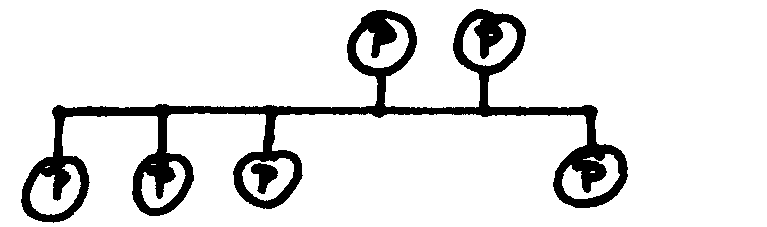
Gerade 3 mit 1 mmol/1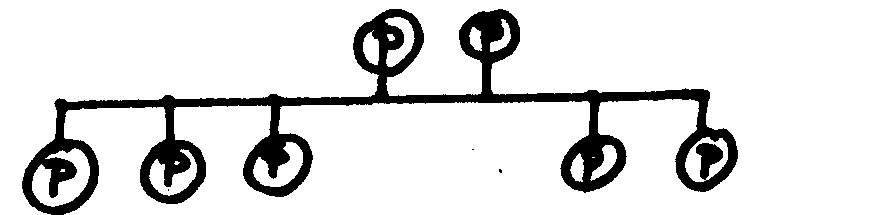
- Just 1 with 10 mmol / 1
- Just 2 with 2 mmol / 1
- Just 3 with 1 mmol / 1
20 /ul Vollblut werden in 5 ml einer Lösung hämolysiert, welche 50 mmol/1 Bis-Tris-Puffer pH 6,7, 0,2 g/1 Saponin und variable Mengen einer der unter a) bis e) aufgeführten Substanzen enthält. Nach einer 20minütigen Inkubation bei 25° C wird ein Aliquot von 20 /ul entnommen und mit 2 ml einer Lösung versetzt, welche 7 mmol/1 Bis-Tris-Puffer pH 6,7, 2 mmol/1 2,2'-Azino-di-[3-ethylbenzthiazolin-sulfonat(6)] (ABTS), 20 mg/1 Haptoglobin und 200 g/1 Saccharose enthält. Nach genau zwei weiteren Minuten bei 25° C wird die kinetische Bestimmung der Peroxidaseaktivität gestartet, indem 1 ml einer Lösung aus 0,5 mol/1 Citratpuffer pH 3,8, 30 mmol/1 Natriumperborat und 3 g/1 Saponin zugegeben wird. Aus der gemessenen Geschwindigkeit wird mittels einer Eichgeraden, welche durch Messung von verschiedenen Mischungen reinen glykosilierten und nichtglykosilierten Hämoglobins zu erstellen ist, der Gehalt an glykosiliertem Hämoglobin der Humanblutproben ermittelt. 20 / ul whole blood are hemolyzed in 5 ml of a solution containing 50 mmol / 1 bis-Tris buffer pH 6.7, 0.2 g / 1 saponin and variable amounts of one of the substances listed under a) to e). After a 20 minute incubation at 25 ° C., an aliquot of 20 / ul is removed and 2 ml of a solution containing 7 mmol / 1 bis-Tris buffer pH 6.7, 2 mmol / 1 2,2'-azino- contains di- [3-ethylbenzthiazoline sulfonate (6)] (ABTS), 20 mg / 1 haptoglobin and 200 g / 1 sucrose. After exactly two more minutes at 25 ° C., the kinetic determination of the peroxidase activity is started by adding 1 ml of a solution of 0.5 mol / 1 citrate buffer pH 3.8, 30 mmol / 1 sodium perborate and 3 g / 1 saponin. From the measured speed, the content of glycosylated hemoglobin of the human blood samples is determined by means of a calibration line, which is to be created by measuring different mixtures of pure glycosylated and non-glycosylated hemoglobin.
Die folgende Tabelle zeigt den nach folgenden Varianten bestimmten glykosilierten Hämoglobingehalt verschiedener Proben im Vergleich zu den Werten, welche mittels der gängigen Referenzmethode (Ionenaustauschchromatographie) erhalten wurden.The following table shows the glycosylated hemoglobin content of various samples determined according to the following variants in comparison to the values obtained using the common reference method (ion exchange chromatography).

-
a) Das Hämolysereagenz enthält 0,1 mmol/1
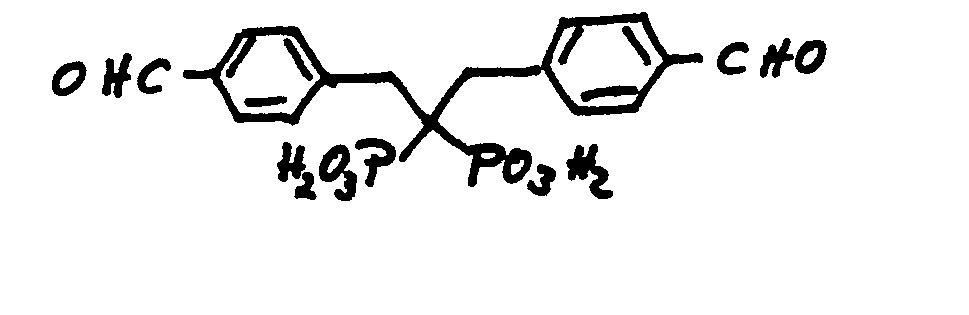
-
b) Das Hämolysereagenz enthält 0,2 mmol/1

-
c) Das Hämolysereagenz enthält 0,1 mmol/1

-
d) Das Hämolysereagenz enthält 2 mmol/1

-
e) Das Hämolysereagenz enthält 0,5 mmol/1

zusätzlich 0,05 g/1 Natriumnitrit und 5 g/1 Natriumdithionit
Es wird eine durchweg gute Übereinstimmung zwischen den jeweiligen Ergebnissen der verschiedenen Verfahrensvarianten a) bis e) mit denjenigen der Referenzmethode beobachtet.additionally 0.05 g / 1 sodium nitrite and 5 g / 1 sodium dithionite
A consistently good agreement between the respective results of the different process variants a) to e) is observed with those of the reference method.
5 ml einer 2 %igen Suspension von handelsüblichen, aktive Epoxidgruppen tragenden Latexpartikeln der durchschnittlichen Größe 160 nm wurden mit 5 ml einer Lösung von 10 mg/ml gereinigtem oxyhämoglobin A1, 50 mmol/1 Na-Phosphatpuffer pH 7,8 und 0,5 mol/1 NaCl 3 Stunden unter leichtem Rühren bei Raumtemperatur inkubiert. Nach Zugabe von 10 ml einer 5 %igen Lösung von Rinderserumalbumin wurde weitere 15 Stunden inkubiert. Dann wurde bei 50.000 g abzentrifugiert und zweimal mit 10 mmol/1 Bis-Tris-Puffer pH 6,7 gewaschen. Mit diesem Puffer wurde schließlich so stark verdünnt, daß eine Suspension erhalten wurde, welche bei 700 nm eine Extinktion von 0,4 hatte. Zu 2 ml einer derartigen Suspension wurden 100 /ul eines Hämolysats von 20 /ul Vollblut in 5 ml einer Lösung von 50 mmol/1 Bis-Tris-Puffer pH 6,7, 0,2 g/1 Saponin und 1 mmol/1 der Substanz


Die Übereinstimmung der Ergebnisse beider Verfahren ist sehr gut.The agreement of the results of both methods is very good.
Analog der Vorgehensweise in Beispiel 3 wird eine Suspension von mit Pferde-Haptoglobin beladenen Latexpartikeln hergestellt. Die erhaltene Suspension wird auf eine Extinktion von 0,4 bei 630 nm verdünnt und enthält außerdem einen der im folgenden aufgezählten anti-Hämoglobin-Antikörper als reines IgG:
- a) 0,04 mg/ml eines polyklonalen Antikörpers gegen Humanhämoglobin;
- b) 0,1 mg/ml eines polyklonalen Antikörpers gegen die ß-Kette des glykosilierten Humanhämoglobins;
- c) 0,5 mg/ml eines monoklonalen Antikörpers gegen den aminoterminalen Teil der ß-Kette von glykosiliertem Humanhämoglobin.
- a) 0.04 mg / ml of a polyclonal antibody against human hemoglobin;
- b) 0.1 mg / ml of a polyclonal antibody against the β chain of the glycosylated human hemoglobin;
- c) 0.5 mg / ml of a monoclonal antibody against the amino-terminal part of the β-chain of glycosylated human hemoglobin.
Außerdem enthält die Suspension 0,2 mmol/1 der Substanz

% glykosiliertes Hämoglobin

Ergebnisse aus der Referenzmethode und den Varianten des Latexagglutinationstests 4 a) - 4 c) zeigen auch hier sehr gute Übereinstimmung.Results from the reference method and the variants of the latex agglutination test 4 a) - 4 c) also show very good agreement here.
Eine Lösung von Perseitol (0,5 g, 2.4 mMol) in Polyphosphorsäure (8 g) wird 6 Stunden auf 150° C erwärmt, abgekühlt und in 80 ml Wasser eingetragen. Nach Zugabe von 20 ml 10 N Salzsäure wird diese Lösung 30 Minuten auf 100° C erhitzt, abgekühlt, durch Zugabe von Ammoniak alkalisch gestellt und auf ca. 20 ml eingeengt. Durch Zugabe von konzentrierter wässriger Ammoniaklösung (ca. 120 ml) und Aufbewahren bei 5° C wird anorganisches Phosphat ausgefällt. Das Filtrat wird wiederum auf ca. 20 ml eingeengt, mit Ammoniak auf pH 8 eingestellt und mit gesättigter wässriger Bariumacetat-Lösung versetzt. Zur vollständigen Ausfällung der Titelverbindung als Barium-Salz wird mit Ethanol versetzt, der Niederschlag abgesaugt und getrocknet. Man erhältA solution of perseitol (0.5 g, 2.4 mmol) in polyphosphoric acid (8 g) is heated to 150 ° C. for 6 hours, cooled and introduced into 80 ml of water. After adding 20 ml of 10 N hydrochloric acid, this solution is heated to 100 ° C. for 30 minutes, cooled, made alkaline by adding ammonia and concentrated to about 20 ml. By adding concentrated aqueous ammonia solution (approx. 120 ml) and storing at 5 ° C, inorganic phosphate is precipitated. The filtrate is again concentrated to about 20 ml, adjusted to pH 8 with ammonia and mixed with saturated aqueous barium acetate solution. To completely precipitate the title compound as barium salt, ethanol is added, the precipitate is filtered off with suction and dried. You get
1.5 g Perseitolheptaphosphat Ba-Salz als weißes, in Wasser schwerlösliches Pulver mit
Ausbeute: 36 % der Theorie1.5 g Perseitolheptaphosphat Ba salt as a white, sparingly water soluble powder with
Yield: 36% of theory
Eine Mischung des Polyols, 3,6-Bis-0-(4-hydroxybutyl)-myo-inosit (0,5 g, 1.5 mMol), N-Benzoylphosphoramidinsäure (7.5 g, 37.3 mMol) und Triethylamin (5.2 ml, 37.3 mMol) in 50 ml Dimethylformamid wird 24 Stunden auf 140° C erhitzt. Nach Abkühlen und Zugabe von 10 ml Wasser wird zur Trockne eingedampft. Der Rückstand wird mit 25 ml Wasser aufgenommen und zur Entferung des Benzamids mehrmals mit Ether extrahiert. Nach Zugabe von 6 ml 6 N Salzsäure zur wässrigen Lösung wird 30 Minuten auf 100° C erhitzt und nach dem Abkühlen mit wässriger Ammoniak-Lösung versetzt. Die weitere Aufarbeitung erfolgt wie in Beispiel 5 beschrieben. Man erhältA mixture of the polyol, 3,6-bis-0- (4-hydroxybutyl) -myo-inositol (0.5 g, 1.5 mmol), N-benzoylphosphoramidic acid (7.5 g, 37.3 mmol) and triethylamine (5.2 ml, 37.3 mmol) ) in 50 ml of dimethylformamide is heated to 140 ° C. for 24 hours. After cooling and adding 10 ml of water, the mixture is evaporated to dryness. The residue is taken up in 25 ml of water and extracted several times with ether to remove the benzamide. After adding 6 ml of 6 N hydrochloric acid to the aqueous solution, the mixture is heated to 100 ° C. for 30 minutes and, after cooling, mixed with aqueous ammonia solution. The further workup is carried out as described in Example 5. You get
1.2 g 3,6-Bis-0-(4-hydroxybutyl)-myo-inosithexaphosphat
Barium-Salz als
farbloses, pulverförmiges Material mit
Fp > 350° C
Mrel 1.4 (0.03 M Oxalat-Puffer, pH 4)
Ausbeute: 50 % der Theorie1.2
Barium salt as
colorless, powdery material with
Mp> 350 ° C
M rel 1.4 (0.03 M oxalate buffer, pH 4)
Yield: 50% of theory
Die als Ausgangsmaterial für vorstehendes Beispiel 6 eingesetzte Verbindung wird folgendermaßen erhalten:
- 1,2 : 4,5-Bis-0-cyclohexyliden-myo-inosit (14 g, 40 mMol) in 400 ml absolutem Dimethylformamid wird mit einem Überschuß Natriumhydrid (70 %ig; 6.86 g, 200 mMol) bei 0° C versetzt. Nach Beendigung der Wasserstoff-Entwicklung (ca. 10 Minuten) wird Benzyloxybutylbromid (Kp 148 - 150° C, 0.3 mm; 97 g, 400 mMol) zugegeben und 20 Stunden bei 25° C gerührt. Danach wird der Ansatz auf Eis/Wasser gegeben und mehrfach mit Essigester extrahiert. Die organische Phase wird getrocknet, eingeengt und der Rückstand säulenchromatographisch an Kieselgel mit Methylenchlorid/Methanol = 98 : 2 (v/v) gereinigt. Einengen der entsprechenden Fraktion (Rf 0.5) ergibt
- 1,2: 4,5-bis-0-cyclohexylidene-myo-inositol (14 g, 40 mmol) in 400 ml absolute dimethylformamide is mixed with an excess of sodium hydride (70%; 6.86 g, 200 mmol) at 0 ° C . After the evolution of hydrogen has ended (about 10 minutes), benzyloxybutyl bromide (bp 148-150 ° C, 0.3 mm; 97 g, 400 mmol) is added and the mixture is stirred at 25 ° C for 20 hours. Then the mixture is poured onto ice / water and extracted several times with ethyl acetate. The organic phase is dried, concentrated and the residue is purified by column chromatography on silica gel with methylene chloride / methanol = 98: 2 (v / v). Concentration of the corresponding fraction (Rf 0.5) results
19.9 g 3,6-Bis-0-(4-benzyloxybutyl)-1,2:4,5-bis-0-cyclohexyliden-myo-inosit als
farbloses Öl
Ausbeute: 84 der Theorie Katalytische Hydrierung (10 % Pd/C; 40° C, 50 bar Wasserstoff-Atmosphäre, 6 Stunden) der so erhaltenen Verbindung (20 g, 34 mMol) in 2 1 Ethanol unter Zusatz von konzentrierter wässriger Ammoniak-Lösung (5 ml) ergibt19.9
colorless oil
Yield: 84 of theory Catalytic hydrogenation (10% Pd / C; 40 ° C, 50 bar hydrogen atmosphere, 6 hours) of the compound thus obtained (20 g, 34 mmol) in 2 1 ethanol with the addition of concentrated aqueous ammonia solution (5 ml)
7 g 1,2:4,5-Bis-0-cyclohexyliden-3,6-bis-0-(4-hydroxybutyl)-myo-inosit
Fp 108 - 110° C
Ausbeute: 44 % der Theorie7 g 1,2: 4,5-bis-0-cyclohexylidene-3,6-bis-0- (4-hydroxybutyl) -myo-inositol
Mp 108-110 ° C
Yield: 44% of theory
Saure Hydrolyse (50 ml 0.4 %ige Schwefelsäure in 50 ml 1,4-Dioxan, 100° C, 2 Stunden) dieser Biscyclohexylidenverbindung (5 g, 10 mMol) ergibt nach Neutralisation mit Natriumhydrogencarbonat, Entfernung des Lösungsmittels, Extraktion des Rückstandes mit Methanol und Konzentration der ExtraktionslösungAcid hydrolysis (50 ml of 0.4% sulfuric acid in 50 ml of 1,4-dioxane, 100 ° C, 2 hours) of this biscyclohexylidene compound (5 g, 10 mmol) gives after neutralization with sodium hydrogen carbonate, removal of the solvent, extraction of the residue with methanol and Concentration of the extraction solution
3 g 3,6-Bis-0-(4-hydroxybutyl)-myo-inosit
Fp 74 - 76° C
Ausbeute: 93 % der Theorie3
Mp 74-76 ° C
Yield: 93% of theory
In 60 ml Chlorbenzol gibt man 14 g S-Aminovaleriansäure sowie 13,5 g phosphorige Säure und erhitzt 10 Minuten auf 100° C. Nach dem Entfernen des Ölbades tropft man langsam 15,7 ml Phosphortrichlorid zu und erhitzt weitere 3 Stunden auf 100° C. Nach dem Abkühlen wird das Chlorbenzol abdekantiert, der Rückstand mit 6 normaler Salzsäure 5 Stunden unter Rückfluß erhitzt und anschließend im Vakuum eingeengt. Das zurückbleibende gelbe Öl löst man in 100 ml Wasser, stellt mit 2 N Natronlauge auf pH 5 und versetzt mit 200 ml Methanol. Der Niederschlag wird abgesaugt und im Vakuum getrocknet. Man erhält 24,5 g (67 % der Theorie) der gewünschten Verbindung als Mononatriumsalz mit einer relativen Mobilität von 0,45.14 g of S-aminovaleric acid and 13.5 g of phosphorous acid are added to 60 ml of chlorobenzene and the mixture is heated at 100 ° C. for 10 minutes. After removing the oil bath, 15.7 ml of phosphorus trichloride are slowly added dropwise and the mixture is heated at 100 ° C. for a further 3 hours After cooling, the chlorobenzene is decanted off, the residue is refluxed for 5 hours with 6 normal hydrochloric acid and then concentrated in vacuo. The remaining yellow oil is dissolved in 100 ml of water, adjusted to pH 5 with 2 N sodium hydroxide solution and mixed with 200 ml of methanol. The precipitate is filtered off and dried in vacuo. 24.5 g (67% of theory) of the desired compound are obtained as the monosodium salt with a relative mobility of 0.45.
Durch Ansäuern einer wässrigen Lösung des Natriumsalzes mit 6 normaler Salzsäure erhält man die aus Wasser umkristallisierbare freie Diphosphonsäure mit Fp 240 - 245° C (Zersetzung).Acidification of an aqueous solution of the sodium salt with 6 normal hydrochloric acid gives the free diphosphonic acid which can be recrystallized from water and has a melting point of 240-245 ° C. (decomposition).
Analog zu dem in Beispiel 7 beschriebenen Verfahren erhält man ausgehend von 6-Amino-hexansäure 6-Amino-l-hydroxyhexan-1,1-diphosphonsäure in 43 tiger Ausbeute mit einer relativen Mobilität von 0,42 und Fp: 218 - 221° C (Zersetzung).Analogously to the process described in Example 7, starting from 6-amino-hexanoic acid, 6-amino-1-hydroxyhexane-1,1-diphosphonic acid is obtained in 43% yield with a relative mobility of 0.42 and mp: 218-221 ° C. (Decomposition).
Eine Lösung von 1,2 : 4,5-Bis-0-cyclohexyliden-3,6-bis-0-(4-oxobutyl)-myo-inosit (1,5 g, 3,1 mMol) in 30 ml Ethanol, 6 ml Wasser und 1 ml konzentrierter Salzsäure wird 2 Stunden auf 600 C erwärmt. Nach dem Abdampfen des Lösungsmittels wird über Kieselgel chromatographiert, zuerst mit Methylenchlorid zur Entfernung einer schnell-laufenden Verunreinigung und schließlich mit Methylenchlorid/Methanol = 4 : 1 (v/v). Einengen der entsprechenden Fraktion (Rf 0.08) ergibtA solution of 1,2: 4,5-bis-0-cyclohexylidene-3,6-bis-0- (4-oxobutyl) -myo-inositol (1.5 g, 3.1 mmol) in 30 ml ethanol, 6 ml of water and 1 ml of concentrated hydrochloric acid are heated to 60 ° C. for 2 hours. After the solvent has been evaporated off, it is chromatographed on silica gel, first with methylene chloride to remove a high-speed impurity and finally with methylene chloride / methanol = 4: 1 (v / v). Concentration of the corresponding fraction (Rf 0.08) results
0,3 g 3,6-Bis-0-(4-oxobutyl)-myo-inosit als
farbloses Öl
Ausbeute: 30 % der Theorie0.3
colorless oil
Yield: 30% of theory
Das eingesetzte Ausgangsmaterial wird erhalten durch Oxidation von 1,2 : 4,5-Bis-0-cyclohexyliden-3,6-bis-0-(4-hydroxybutyl)-myo-inosit (2 g, 4,1 mMol) mit Bariummanganat (30 g, 117 mMol) in 100 ml Toluol bei Siedetemperatur während 12 Stunden. Nach Abfiltrieren des Niederschlags und Einengen des Filtrats wird säulenchromatographisch über Kieselgel mit Toluol/Essigester = 1:1 (v/v) gereinigt. Einengen der Fraktion mit Rf 0.4 ergibtThe starting material used is obtained by oxidation of 1,2: 4,5-bis-0-cyclohexylidene-3,6-bis-0- (4-hydroxybutyl) -myo-inositol (2 g, 4.1 mmol) with barium manganate (30 g, 117 mmol) in 100 ml of toluene at boiling temperature for 12 hours. After filtering off the precipitate and concentrating the filtrate, it is purified by column chromatography over silica gel using toluene / ethyl acetate = 1: 1 (v / v). Concentration of the fraction with Rf 0.4 results
0.8 g 1,2:4,5-Bis-0-cyclohexyliden-3,6-bis-0-(4-oxobutyl)-myo-inosit
farbloses Öl
Ausbeute: 41 % der Theorie0.8 g 1,2: 4,5-bis-0-cyclohexylidene-3,6-bis-0- (4-oxobutyl) -myo-inositol
colorless oil
Yield: 41% of theory
Eine Mischung von 3,6-Bis-0-(4-oxobutyl)-myo-inosit (0.6 g, 1.87 mMol) aus Beispiel 9, N-Benzoylphosphoramidinsäure (7.23 g, 36 mMol) und Triethylamin (5 ml, 36 mMol) in 50 ml Dimethylformamid wird 24 Stunden auf 140° C erhitzt. Nach Abkühlen und Zugabe von 10 ml Wasser wird zur Trockne eingedampft. Der Rückstand wird mit 25 ml Wasser aufgenommen und zur Entfernung des Benzamids mehrmals mit Ether extrahiert. Nach Zugabe von 6 ml 6 N Salzsäure zur wässrigen Lösung wird 30 Minuten auf 100° C erhitzt und nach dem Abkühlen wird durch Zugabe von Ammoniak alkalisch gestellt und auf ca. 20 ml eingeengt. Durch Versetzen mit 120 ml konzentrierter wässriger Ammoniak-Lösung und Aufbewahren bei 5° C wird anorganisches Phosphat ausgefällt. Das Filtrat wird wiederum auf ca. 20 ml eingeengt, mit Ammoniak auf pH 8 eingestellt und mit gesättigter wässriger Bariumacetat-Lösung versetzt. Zur vollständigen Ausfällung der Titelverbindung als Bariumsalz wird mit etwas Ethanol versetzt. Der Niederschlag wird abgesaugt (1.05 g, 0.89 mMol) und in 50 ml Wasser suspendiert, mit Kationenaustauscher Amberlite IR 120 (H+-Form) (5 ml) während 30 Minuten bei 25° C behandelt. Nach Abfiltrieren des Ionenaustauscher-Harzes wird das Filtrat mit 18.ml 0.1 M Natrium-methylatlösung versetzt und eingeengt. Man erhältA mixture of 3,6-bis-0- (4-oxobutyl) -myo-inositol (0.6 g, 1.87 mmol) from Example 9, N-benzoylphosphoramidic acid (7.23 g, 36 mmol) and triethylamine (5 ml, 36 mmol) in 50 ml of dimethylformamide is heated to 140 ° C. for 24 hours. After cooling and adding 10 ml of water, the mixture is evaporated to dryness. The residue is taken up in 25 ml of water and extracted several times with ether to remove the benzamide. After adding 6 ml of 6N hydrochloric acid to the aqueous solution, the mixture is heated to 100 ° C. for 30 minutes and, after cooling, is made alkaline by adding ammonia and concentrated to about 20 ml. By adding 120 ml of concentrated aqueous ammonia solution and storing at 5 ° C, inorganic phosphate is precipitated. The filtrate is again concentrated to about 20 ml, adjusted to pH 8 with ammonia and mixed with saturated aqueous barium acetate solution. A little ethanol is added to completely precipitate the title compound as the barium salt. The precipitate is filtered off with suction (1.05 g, 0.89 mmol) and suspended in 50 ml of water, treated with amberlite IR 120 (H + form) (5 ml) cation exchanger for 30 minutes at 25 ° C. After filtering off the ion exchange resin, the filtrate is mixed with 18 ml of 0.1 M sodium methylate solution and concentrated. You get
0.57 g 3,6-Bis-0-(4-oxobutyl)-myo-inosittetraphosphat Natrium-Salz als weißes, in Wasser gut lösliches Pulver
Fp > 3500 C
Mrel 1,3 (0,03 M Oxalat-Puffer, pH 4)
Ausbeute: 37 % der Theorie0.57
Mp> 350 ° C.
M rel 1.3 (0.03 M oxalate buffer, pH 4)
Yield: 37% of theory
50 g 4-Methylbenzoesäureethylester werden mit 60 g N-Bromsuccinimid und 3 Spatelspitzen Dibenzoylperoxid 3 Stunden in 100 ml Tetrachlorkohlenstoff unter Rückfluß erhitzt. Man rührt noch 12 Stunden bei Raumtemperatur, saugt dann ab, wäscht den Niederschlag mit Tetrachlorkohlenstoff und dampft das Filtrat ein. Der ölige Rückstand wird bei 0,3 mbar destilliert.50 g of ethyl 4-methylbenzoate are refluxed with 60 g of N-bromosuccinimide and 3 spatula tips of dibenzoyl peroxide in 100 ml of carbon tetrachloride for 3 hours. The mixture is stirred for a further 12 hours at room temperature, then suction filtered, the precipitate is washed with carbon tetrachloride and the filtrate is evaporated. The oily residue is distilled at 0.3 mbar.
Die Fraktion bei 105° C wird aus 50 ml n-Hexan kristallisiert.The fraction at 105 ° C is crystallized from 50 ml of n-hexane.
Ausbeute: 52,3 gYield: 52.3 g
Schmelzpunkt: 24 - 29° CMelting point: 24-29 ° C
50 g der Brommethylverbindung aus Beispiel 11 a)und 54 g Triphenylphosphin werden 3 Stunden in 200 ml Toluol unter Rückfluß erhitzt. Man saugt das Produkt ab, wäscht mit Toluol nach und trocknet.50 g of the bromomethyl compound from Example 11 a) and 54 g of triphenylphosphine are refluxed in 200 ml of toluene for 3 hours. The product is suctioned off, washed with toluene and dried.
Ausbeute 92,8 gYield 92.8 g
Schmelzpunkt: 233 - 236° CMelting point: 233 - 236 ° C
In 150 ml trockenem 1,4-Dioxan werden 43,5 g des oben beschriebenen Phosphoniumbromids und 10,63 g Kalium-tert-butoxid gelöst. Nach 10 Minuten Rühren bei Raumtemperatur gibt man noch 150 ml 1,4-Dioxan zu und tropft dann 14,1 g 4-Formylbenzoesäuremethylester, gelöst in 80 ml 1,4-Dioxan, zu. Man rührt über Nacht bei Raumtemperatur, dampft ein und digeriert mit 150 ml Methanol. Man filtriert das Produkt ab und wäscht noch dreimal mit Methanol.43.5 g of the phosphonium bromide described above and 10.63 g of potassium tert-butoxide are dissolved in 150 ml of dry 1,4-dioxane. After 10 minutes of stirring at room temperature, 150 ml of 1,4-dioxane are added, and 14.1 g of methyl 4-formylbenzoate, dissolved in 80 ml of 1,4-dioxane, are then added dropwise. The mixture is stirred overnight at room temperature, evaporated and digested with 150 ml of methanol. The product is filtered off and washed three more times with methanol.
Ausbeute: 22,2 gYield: 22.2 g
1H-NMR: ([D6]-DMSO): 1 H-NMR: ([D 6 ] -DMSO):
δ = 1.34 (t, J = 6.9 Hz, 3 H); 3,86 (s, 3H); 4.32 (q, J = 6,9 Hz, 3 H); 7.45 (s, 2H); 7.74 und 7.94 ppm je d, J = 9 Hz, 8 H)δ = 1 . 34 (t, J = 6.9 H z, 3 H ); 3 , 8 6 (s, 3H ); 4.32 (q, J = 6.9 Hz, 3H); 7.45 (s, 2H); 7.74 and 7.94 ppm each d, J = 9 Hz, 8 H)
20 g des oben beschriebenen Stilbens werden in 400 ml Dimethylformamid und 100 ml Methanol aufgenommen und mit lg Palladium auf Aktivkohle bei Atmosphärendruck hydriert. Nach 2,5 Stunden ist die theoretische Menge Wasserstoff verbraucht.20 g of the stilbene described above are taken up in 400 ml of dimethylformamide and 100 ml of methanol and hydrogenated with 1 g of palladium on activated carbon at atmospheric pressure. The theoretical amount of hydrogen is consumed after 2.5 hours.
Man filtriert vom Katalysator ab, dampft ein und kristallisiert aus Methanol.The catalyst is filtered off, evaporated and crystallized from methanol.
Ausbeute: 14,4 gYield: 14.4 g
Schmelzpunkt 60 - 62° CMelting point 60-62 ° C
1 H-NMR: ([D6]-DMSO): 1 H -NMR: ([D 6 ] -DMSO):
δ = 1.31 (t, J = 6.9 Hz, 3 H); 2.99 (s, 4 H); 3.83 (s, 3 H); 4.48 (q, J = 6.9 Hz, 2 H); 7.31 und 7.83 ppm (je"d", J = 9 Hz, 8 H)δ = 1.31 (t, J = 6.9 Hz, 3 H); 2.99 (s, 4H); 3.83 (s, 3H); 4.48 (q, J = 6.9 Hz, 2H); 7.31 and 7.83 ppm (each "d", J = 9 Hz, 8 H)
10 g l-(4-Ethoxycarbonylphenyl)-2-(4-methoxycarbonylphenyl)-ethan gelöst in 150 ml trockenem 1,4-Dioxan, werden langsam zu einer Suspension von 3,65 g Lithiumaluminiumhydrid in 200 ml trockenem Ether getropft. Nach 30 Minuten Rühren tropft man 50 ml Essigester langsam zu und rührt 15 Minuten. Danach werden noch 20 ml kalt gesättigte wässrige Natriumsulfatlösung zugetropft. Man gibt zur Bindung des Wassers noch festes Natriumsulfat zu und filtriert. Der Natriumsulfatniederschlag wird noch je dreimal mit 30 ml Essigester ausgerührt und filtriert. Die vereinigten organischen Filtrate werden eingedampft und aus Methanol kristallisiert.10 g of l- (4-ethoxycarbonylphenyl) -2- (4-methoxycarbonylphenyl) ethane dissolved in 150 ml of dry 1,4-dioxane are slowly added dropwise to a suspension of 3.65 g of lithium aluminum hydride in 200 ml of dry ether. After stirring for 30 minutes, 50 ml of ethyl acetate are slowly added dropwise and the mixture is stirred for 15 minutes. Then 20 ml of cold saturated aqueous sodium sulfate solution are added dropwise. Solid sodium sulfate is added to bind the water and the mixture is filtered. The sodium sulfate precipitate is stirred three times with 30 ml of ethyl acetate and filtered. The combined organic filtrates are evaporated and crystallized from methanol.
Ausbeute: 5,62 gYield: 5.62 g
Schmelzpunkt: 145 - 149° CMelting point: 145 - 149 ° C
1H-NMR ([D6]-DMSO): 1 H-NMR ([D 6 ] -DMSO):
δ = 2.84 (s, 4 H); 4.43 (d, J = 6 Hz, 4 H); 4.97 (t, J = 6 Hz, 2 H); 7.13 und 7.17 ppm (je d, J = 8 Hz, 8 H)δ = 2.84 (s, 4H); 4.43 (d, J = 6 Hz, 4H); 4.97 (t, J = 6 Hz, 2H); 7.13 and 7.17 ppm (each d, J = 8 Hz, 8 H)
4,27 g des in Beispiel 11 e) beschriebenen Bisbenzylalkohols werden 7 Tage bei Raumtemperatur mit 25,5 g Braunstein in 200 ml Petrolether (Kp 60 - 90° C) gerührt. Man filtriert, dampft ein und chromatographiert an Kieselgel (Eluens: Chloroform/Essigester 9:1; Rf-Wert des Produkts an Kieselgel-DC: 0,78).4.27 g of the bisbenzyl alcohol described in Example 11 e) are stirred for 7 days at room temperature with 25.5 g of manganese dioxide in 200 ml of petroleum ether (bp 60-90 ° C.). It is filtered, evaporated and chromatographed on silica gel (eluent: chloroform / ethyl acetate 9: 1; Rf value of the product on silica gel TLC: 0.78).
Ausbeute: 1,47 gYield: 1.47 g
1H-NMR ([D6]-DMSO): 1 H-NMR ([D 6] -DMSO):
δ = 3,04 (S, 4 H); 7,44 und 7,80 (je d, J = 8 Hz, 8 H); 9,87 ppm (s, 2 H)δ = 3.04 (S, 4H); 7.44 and 7.80 (each d, J = 8 Hz, 8 H); 9.87 ppm (s, 2 H)
200 mg des Dialdehyds aus Beispiel 11 f)werden in 20 ml Ethanol gelöst. Dazu tropft man 4 ml 1 M Natriumbisulfit-Lösung. Der Niederschlag wird filtriert und getrocknet.200 mg of the dialdehyde from Example 11 f) are dissolved in 20 ml of ethanol. 4 ml of 1 M sodium bisulfite solution are added dropwise. The precipitate is filtered and dried.
Elementaranalyse: C16H14 Na 2 S 2 0 8 x H2OElemental analysis: C 16 H 14 Na 2 S 2 0 8 x H 2 O
Ber: C 41,6, H 3,5, Na 10,0;Calcd: C 41.6, H 3.5, Na 10.0;
Gef: C 40,2, H 3,49, Na 10,7Found: C 40.2, H 3.49, Na 10.7
Zu 100 ml Chlorsulfonsäure gibt man unter Rühren 10 g 1,2-Bis(4-formylphenyl)-ethan und rührt 2 Stunden bei 85° C. Der Ansatz wird heiß auf Eiswasser gegeben. Der dabei ausgefallene Niederschlag wird abfiltriert und mit Wasser gewaschen. Man suspendiert den Niederschlag in 100 ml 2N HC1 und erhitzt 2 Stunden unter Rückfluß. Nach Eindampfen wird das Rohprodukt über Kieselgel (Eluent Butanol/Eisessig/Wasser 4:0,5:1) chromatographiert. Die Fraktionen, die das Produkt enthalten, werden eingedampft und an Diaion (Eluent Wasser) entsalzt.10 g of 1,2-bis (4-formylphenyl) ethane are added to 100 ml of chlorosulfonic acid with stirring and the mixture is stirred at 85 ° C. for 2 hours. The batch is poured hot into ice water. The precipitate is filtered off and washed with water. The precipitate is suspended in 100 ml of 2N HCl and heated under reflux for 2 hours. After evaporation, the crude product is chromatographed on silica gel (eluent butanol / glacial acetic acid / water 4: 0.5: 1). The fractions containing the product are evaporated and desalted on diaion (eluent water).
Ausbeute: 1,5 gYield: 1.5 g
Rf: (Kieselgel-DC, Fließmittel Butanol/Eisessig/Wasser 4:0,5:1) : 0,34Rf: (silica gel TLC, eluent butanol / glacial acetic acid / water 4: 0.5: 1): 0.34
Claims (10)

bedeuten, wobei sowohl die verschiedenen Reste B als auch R innerhalb einer Substanz auch unterschiedlich sein können,
erfolgt.1. A method for the determination of glycosylated hemoglobin in blood samples, wherein glycosylated and non-glycosylated hemoglobin is first released from the erythrocytes by chemical or physical treatment of the blood sample, where appropriate the hemoglobin is converted into methemoglobin, and then a differentiation between glycosylated and non-glycosylated hemoglobin and carried out by means of haptoglobin then the glycosylated portion of the hemoglobin is determined, characterized in that the differentiation of glycosylated and non-glycosylated hemoglobin with haptoglobin in the presence of a suitable buffer system and one or more substances of the general formula I
mean, where both the different radicals B and R can also be different within a substance,
he follows.

bedeuten.3. The method according to claim 2, characterized in that compounds of the general formula II as substances
mean.

vorstellen. 5 . A method according to claim 4, characterized in that compounds of general formula III are used as substances
to introduce.

Applications Claiming Priority (2)
| Application Number | Priority Date | Filing Date | Title |
|---|---|---|---|
| DE19853532868 DE3532868A1 (en) | 1985-09-14 | 1985-09-14 | METHOD AND REAGENT FOR THE DETERMINATION OF GLYCOSILATED HAEMOGLOBIN AS WELL AS SUITABLE COMPOUNDS AND METHODS FOR THEIR PRODUCTION |
| DE3532868 | 1985-09-14 |
Publications (2)
| Publication Number | Publication Date |
|---|---|
| EP0215401A2 true EP0215401A2 (en) | 1987-03-25 |
| EP0215401A3 EP0215401A3 (en) | 1987-05-20 |
Family
ID=6280993
Family Applications (1)
| Application Number | Title | Priority Date | Filing Date |
|---|---|---|---|
| EP86112347A Withdrawn EP0215401A3 (en) | 1985-09-14 | 1986-09-06 | Method and composition for determining glycosylated hemoglobin as well as compounds suited therefor and methods for their preparation |
Country Status (4)
| Country | Link |
|---|---|
| EP (1) | EP0215401A3 (en) |
| JP (1) | JPS6267457A (en) |
| DE (1) | DE3532868A1 (en) |
| ES (1) | ES2002147A6 (en) |
Cited By (3)
| Publication number | Priority date | Publication date | Assignee | Title |
|---|---|---|---|---|
| EP0329994A1 (en) * | 1988-02-04 | 1989-08-30 | Roche Diagnostics GmbH | Immunogen and its use in preparing antibodies to haemoglobin A1C |
| EP0559164A3 (en) * | 1992-03-05 | 1994-01-26 | Boehringer Mannheim Gmbh | |
| US20220043008A1 (en) * | 2018-09-26 | 2022-02-10 | Eiken Kagaku Kabushiki Kaisha | Hemoglobin assay reagent, assay kit and assay method |
Families Citing this family (2)
| Publication number | Priority date | Publication date | Assignee | Title |
|---|---|---|---|---|
| JP2535742B2 (en) * | 1990-08-15 | 1996-09-18 | 工業技術院長 | Method for synthesizing aromatic dialdehyde |
| JP6821963B2 (en) * | 2016-06-17 | 2021-01-27 | 三菱ケミカル株式会社 | Diol compound, polycarbonate resin produced from the diol compound, polycarbonate polyol resin, polyester resin, polyester polyol resin and polyurethane resin |
Family Cites Families (8)
| Publication number | Priority date | Publication date | Assignee | Title |
|---|---|---|---|---|
| US4247533A (en) * | 1978-05-01 | 1981-01-27 | The Rockefeller University | Hemoglobin A1c radioimmunoassay |
| US4255385A (en) * | 1979-10-23 | 1981-03-10 | Abbott Laboratories | Reagent and test kit for determining glycosylated hemoglobin |
| US4274978A (en) * | 1979-12-07 | 1981-06-23 | Abbott Laboratories | Standards for determining glycosylated hemoglobin |
| US4260516A (en) * | 1979-12-07 | 1981-04-07 | Abbott Laboratories | Glycosylated hemoglobin standards |
| DE3141146A1 (en) * | 1981-10-16 | 1983-04-28 | Boehringer Mannheim Gmbh, 6800 Mannheim | METHOD AND REAGENT FOR DETERMINING GLYCOSILED HAEMOGLOBIN |
| US4478744A (en) * | 1982-01-25 | 1984-10-23 | Sherwood Medical Company | Method of obtaining antibodies |
| DE3314308A1 (en) * | 1983-04-20 | 1984-10-25 | Boehringer Mannheim Gmbh, 6800 Mannheim | METHOD AND REAGENT FOR DETERMINING THE HEMOGLOBIN-HAPTOGLOBIN COMPLEX IN THE PRESENCE OF FREE HAEMOGLOBIN |
| DE3322643C2 (en) * | 1983-06-23 | 1986-07-10 | Brigitte Dr. Ebener | Process for the production of a latex test reagent for the detection and differentiation of human hemoglobin, human hemoglobin components or human hemoglobin variants |
-
1985
- 1985-09-14 DE DE19853532868 patent/DE3532868A1/en not_active Withdrawn
-
1986
- 1986-09-06 EP EP86112347A patent/EP0215401A3/en not_active Withdrawn
- 1986-09-12 ES ES8601857A patent/ES2002147A6/en not_active Expired
- 1986-09-16 JP JP21609286A patent/JPS6267457A/en active Pending
Cited By (6)
| Publication number | Priority date | Publication date | Assignee | Title |
|---|---|---|---|---|
| EP0329994A1 (en) * | 1988-02-04 | 1989-08-30 | Roche Diagnostics GmbH | Immunogen and its use in preparing antibodies to haemoglobin A1C |
| US5646255A (en) * | 1988-02-04 | 1997-07-08 | Boehringer Mannheim Gmbh | Immunogens and the use thereof for obtaining antibodies against HBA1C |
| EP0559164A3 (en) * | 1992-03-05 | 1994-01-26 | Boehringer Mannheim Gmbh | |
| US5541117A (en) * | 1992-03-05 | 1996-07-30 | Boehringer Mannheim Gmbh | Immunological method for the determination of a haemoglobin derivative |
| US20220043008A1 (en) * | 2018-09-26 | 2022-02-10 | Eiken Kagaku Kabushiki Kaisha | Hemoglobin assay reagent, assay kit and assay method |
| US12405277B2 (en) * | 2018-09-26 | 2025-09-02 | Eiken Kagaku Kabushiki Kaisha | Hemoglobin assay reagent, assay kit and assay method |
Also Published As
| Publication number | Publication date |
|---|---|
| DE3532868A1 (en) | 1987-03-26 |
| EP0215401A3 (en) | 1987-05-20 |
| JPS6267457A (en) | 1987-03-27 |
| ES2002147A6 (en) | 1988-07-16 |
Similar Documents
| Publication | Publication Date | Title |
|---|---|---|
| DE60018300T2 (en) | 8- (ANILINO) -1-NAPHTHALINE-SULFONATE ANALOGUE AND ITS USE IN ANALYTE DETECTION TESTS | |
| EP0161436B1 (en) | Redox indicators | |
| DE2716061C2 (en) | Guaiaconic acid A, process for its preparation and the use of this substance as a diagnostic agent | |
| EP0083773B1 (en) | Process for preparing of a tissue thromboplastine composition | |
| DE2920292C3 (en) | L-γ -glutamyl-3-carboxy-4-hydroxyanilide and its acid addition or alkali metal salts, process for their preparation and their use for determining the activity of γ-glutamyl transpeptidase | |
| DE4015590A1 (en) | TEST CARRIER FOR THE DETERMINATION OF IONS | |
| DE2858733C2 (en) | ||
| DE2365610A1 (en) | NEW SUBSTITUTED PROPANE OR BUTANE DERIVATIVES | |
| EP0077515A2 (en) | Method and composition for determining glycosylated hemoglobin | |
| EP0215401A2 (en) | Method and composition for determining glycosylated hemoglobin as well as compounds suited therefor and methods for their preparation | |
| EP0468481A1 (en) | Nonionic block copolymers of propyleneoxide and ethyleneoxide | |
| DE3427290C2 (en) | Method for determining formaldehyde | |
| DE3443415A1 (en) | COMPOSITION FOR DETERMINING HYDROGEN PEROXIDE | |
| CH659650A5 (en) | OXIMINOVERBINDUNGEN AND IMIDAZOLE N-OXIDE FOR PRODUCING cimetidine and PROCESS FOR PRODUCING. | |
| EP0465998B1 (en) | Beta-galactosidase substrate for CEDIA assays | |
| DE69212391T2 (en) | Dry, analytical element for the detection of lithium | |
| DE68912054T2 (en) | Phosphoric acid derivatives and methods for determining acid phosphatase activity using the same. | |
| DE2536951C3 (en) | Triazapentadienes, processes for their preparation and insecticidal compositions containing them | |
| EP0457184B1 (en) | Naphthol derivatives, method for their preparation and use therefor | |
| DE3852147T2 (en) | Substrates for beta-galactosidase. | |
| EP0174572B1 (en) | Cyclohexane-1,2-dicarboxylic amides, ionic-selectives membranes and test apparatus containing these compounds | |
| EP0316791A2 (en) | 1-Naphtolphtaleine mono phosphate, process for its preparation as well as its use for the determination of alcaline phosphatases | |
| DE69822909T2 (en) | Process for the preparation of deoxypyridinoline | |
| DE3219407C2 (en) | ||
| DE2734401B2 (en) | Process for the production of ß-methyldigoxin |
Legal Events
| Date | Code | Title | Description |
|---|---|---|---|
| PUAI | Public reference made under article 153(3) epc to a published international application that has entered the european phase |
Free format text: ORIGINAL CODE: 0009012 |
|
| 17P | Request for examination filed |
Effective date: 19860906 |
|
| AK | Designated contracting states |
Kind code of ref document: A2 Designated state(s): AT BE CH DE FR GB IT LI LU NL SE |
|
| PUAL | Search report despatched |
Free format text: ORIGINAL CODE: 0009013 |
|
| AK | Designated contracting states |
Kind code of ref document: A3 Designated state(s): AT BE CH DE FR GB IT LI LU NL SE |
|
| 17Q | First examination report despatched |
Effective date: 19881124 |
|
| STAA | Information on the status of an ep patent application or granted ep patent |
Free format text: STATUS: THE APPLICATION IS DEEMED TO BE WITHDRAWN |
|
| 18D | Application deemed to be withdrawn |
Effective date: 19890606 |
|
| RIN1 | Information on inventor provided before grant (corrected) |
Inventor name: KLEIN, CHRISTIAN, DR. Inventor name: ROLLINGER, WOLFGANG, DR. RER. NAT. Inventor name: WECKERLE, WOLFGANG, DR. RER. NAT. Inventor name: ZIEGENHORN, JOACHIM, DR. RER. NAT. Inventor name: KERSCHER, LORENZ, DR. RER. NAT. |