DE69822909T2 - Process for the preparation of deoxypyridinoline - Google Patents
Process for the preparation of deoxypyridinoline Download PDFInfo
- Publication number
- DE69822909T2 DE69822909T2 DE69822909T DE69822909T DE69822909T2 DE 69822909 T2 DE69822909 T2 DE 69822909T2 DE 69822909 T DE69822909 T DE 69822909T DE 69822909 T DE69822909 T DE 69822909T DE 69822909 T2 DE69822909 T2 DE 69822909T2
- Authority
- DE
- Germany
- Prior art keywords
- give
- protected
- deoxypyridinoline
- dmso
- oxidizing agent
- Prior art date
- Legal status (The legal status is an assumption and is not a legal conclusion. Google has not performed a legal analysis and makes no representation as to the accuracy of the status listed.)
- Expired - Fee Related
Links
- ZAHDXEIQWWLQQL-IHRRRGAJSA-N Deoxypyridinoline Chemical compound OC(=O)[C@@H](N)CCCC[N+]1=CC(O)=C(C[C@H](N)C([O-])=O)C(CC[C@H](N)C(O)=O)=C1 ZAHDXEIQWWLQQL-IHRRRGAJSA-N 0.000 title claims description 33
- 238000000034 method Methods 0.000 title claims description 20
- 238000002360 preparation method Methods 0.000 title claims description 5
- YMWUJEATGCHHMB-UHFFFAOYSA-N Dichloromethane Chemical compound ClCCl YMWUJEATGCHHMB-UHFFFAOYSA-N 0.000 claims description 47
- IAZDPXIOMUYVGZ-UHFFFAOYSA-N Dimethylsulphoxide Chemical compound CS(C)=O IAZDPXIOMUYVGZ-UHFFFAOYSA-N 0.000 claims description 34
- OKKJLVBELUTLKV-UHFFFAOYSA-N Methanol Chemical compound OC OKKJLVBELUTLKV-UHFFFAOYSA-N 0.000 claims description 30
- 239000002904 solvent Substances 0.000 claims description 20
- WEVYAHXRMPXWCK-UHFFFAOYSA-N Acetonitrile Chemical compound CC#N WEVYAHXRMPXWCK-UHFFFAOYSA-N 0.000 claims description 16
- HEDRZPFGACZZDS-UHFFFAOYSA-N Chloroform Chemical compound ClC(Cl)Cl HEDRZPFGACZZDS-UHFFFAOYSA-N 0.000 claims description 12
- 239000007800 oxidant agent Substances 0.000 claims description 11
- ZMANZCXQSJIPKH-UHFFFAOYSA-N Triethylamine Chemical compound CCN(CC)CC ZMANZCXQSJIPKH-UHFFFAOYSA-N 0.000 claims description 10
- 238000006243 chemical reaction Methods 0.000 claims description 10
- RTZKZFJDLAIYFH-UHFFFAOYSA-N Diethyl ether Chemical compound CCOCC RTZKZFJDLAIYFH-UHFFFAOYSA-N 0.000 claims description 9
- YIKSCQDJHCMVMK-UHFFFAOYSA-N Oxamide Chemical compound NC(=O)C(N)=O YIKSCQDJHCMVMK-UHFFFAOYSA-N 0.000 claims description 9
- 150000001875 compounds Chemical class 0.000 claims description 9
- 239000004472 Lysine Substances 0.000 claims description 8
- -1 5-benzyloxycarbonylamino-5-t-butoxycarbonylpentyl Chemical group 0.000 claims description 7
- LFQSCWFLJHTTHZ-UHFFFAOYSA-N Ethanol Chemical compound CCO LFQSCWFLJHTTHZ-UHFFFAOYSA-N 0.000 claims description 7
- XLYOFNOQVPJJNP-UHFFFAOYSA-N water Substances O XLYOFNOQVPJJNP-UHFFFAOYSA-N 0.000 claims description 7
- WFDIJRYMOXRFFG-UHFFFAOYSA-N Acetic anhydride Chemical compound CC(=O)OC(C)=O WFDIJRYMOXRFFG-UHFFFAOYSA-N 0.000 claims description 6
- WYURNTSHIVDZCO-UHFFFAOYSA-N Tetrahydrofuran Chemical compound C1CCOC1 WYURNTSHIVDZCO-UHFFFAOYSA-N 0.000 claims description 6
- KDXKERNSBIXSRK-YFKPBYRVSA-N L-lysine Chemical compound NCCCC[C@H](N)C(O)=O KDXKERNSBIXSRK-YFKPBYRVSA-N 0.000 claims description 5
- KDXKERNSBIXSRK-UHFFFAOYSA-N Lysine Natural products NCCCCC(N)C(O)=O KDXKERNSBIXSRK-UHFFFAOYSA-N 0.000 claims description 5
- XSEHBPXXAIDEFE-UHFFFAOYSA-N 1,2-dihydropyridin-3-ol Chemical compound [O-]C1=CC=C[NH2+]C1 XSEHBPXXAIDEFE-UHFFFAOYSA-N 0.000 claims description 4
- 150000002009 diols Chemical class 0.000 claims description 4
- FYSNRJHAOHDILO-UHFFFAOYSA-N thionyl chloride Chemical compound ClS(Cl)=O FYSNRJHAOHDILO-UHFFFAOYSA-N 0.000 claims description 4
- QAEDZJGFFMLHHQ-UHFFFAOYSA-N trifluoroacetic anhydride Chemical compound FC(F)(F)C(=O)OC(=O)C(F)(F)F QAEDZJGFFMLHHQ-UHFFFAOYSA-N 0.000 claims description 4
- LRQKBLKVPFOOQJ-YFKPBYRVSA-M L-2-aminohexanoate Chemical compound CCCC[C@H](N)C([O-])=O LRQKBLKVPFOOQJ-YFKPBYRVSA-M 0.000 claims description 3
- BDGDWWGTAFXEEW-UHFFFAOYSA-N methylsulfinylmethane;oxalyl dichloride Chemical compound CS(C)=O.ClC(=O)C(Cl)=O BDGDWWGTAFXEEW-UHFFFAOYSA-N 0.000 claims description 3
- 125000006239 protecting group Chemical group 0.000 claims description 3
- YLQBMQCUIZJEEH-UHFFFAOYSA-N tetrahydrofuran Natural products C=1C=COC=1 YLQBMQCUIZJEEH-UHFFFAOYSA-N 0.000 claims description 3
- GRFNBEZIAWKNCO-UHFFFAOYSA-N 3-pyridinol Chemical group OC1=CC=CN=C1 GRFNBEZIAWKNCO-UHFFFAOYSA-N 0.000 claims description 2
- JUJWROOIHBZHMG-UHFFFAOYSA-N Pyridine Chemical class C1=CC=NC=C1 JUJWROOIHBZHMG-UHFFFAOYSA-N 0.000 claims description 2
- MHCFAGZWMAWTNR-UHFFFAOYSA-M lithium perchlorate Chemical compound [Li+].[O-]Cl(=O)(=O)=O MHCFAGZWMAWTNR-UHFFFAOYSA-M 0.000 claims description 2
- 229910001486 lithium perchlorate Inorganic materials 0.000 claims description 2
- 239000000543 intermediate Substances 0.000 claims 3
- 239000003054 catalyst Substances 0.000 claims 1
- 238000002955 isolation Methods 0.000 claims 1
- AYGNOFSNYMGKMQ-UHFFFAOYSA-O tert-butyl 6-[3-[4-butoxy-4-oxo-3-(phenylmethoxycarbonylamino)butyl]-5-hydroxy-4-[3-[(2-methylpropan-2-yl)oxy]-3-oxo-2-(phenylmethoxycarbonylamino)propyl]pyridin-1-ium-1-yl]-2-(phenylmethoxycarbonylamino)hexanoate Chemical class C=1C=CC=CC=1COC(=O)NC(C(=O)OCCCC)CCC(C(=C(O)C=1)CC(NC(=O)OCC=2C=CC=CC=2)C(=O)OC(C)(C)C)=C[N+]=1CCCCC(C(=O)OC(C)(C)C)NC(=O)OCC1=CC=CC=C1 AYGNOFSNYMGKMQ-UHFFFAOYSA-O 0.000 claims 1
- SZHOJFHSIKHZHA-UHFFFAOYSA-N tridecanoic acid Chemical compound CCCCCCCCCCCCC(O)=O SZHOJFHSIKHZHA-UHFFFAOYSA-N 0.000 claims 1
- XEKOWRVHYACXOJ-UHFFFAOYSA-N Ethyl acetate Chemical compound CCOC(C)=O XEKOWRVHYACXOJ-UHFFFAOYSA-N 0.000 description 26
- HEMHJVSKTPXQMS-UHFFFAOYSA-M Sodium hydroxide Chemical compound [OH-].[Na+] HEMHJVSKTPXQMS-UHFFFAOYSA-M 0.000 description 16
- QTBSBXVTEAMEQO-UHFFFAOYSA-N Acetic acid Chemical compound CC(O)=O QTBSBXVTEAMEQO-UHFFFAOYSA-N 0.000 description 14
- 239000000203 mixture Substances 0.000 description 13
- 235000019439 ethyl acetate Nutrition 0.000 description 10
- 239000000047 product Substances 0.000 description 8
- LCYXYLLJXMAEMT-SAXRGWBVSA-N Pyridinoline Chemical compound OC(=O)[C@@H](N)CCC1=C[N+](C[C@H](O)CC[C@H](N)C([O-])=O)=CC(O)=C1C[C@H](N)C(O)=O LCYXYLLJXMAEMT-SAXRGWBVSA-N 0.000 description 7
- 239000011734 sodium Substances 0.000 description 7
- VYPSYNLAJGMNEJ-UHFFFAOYSA-N Silicium dioxide Chemical compound O=[Si]=O VYPSYNLAJGMNEJ-UHFFFAOYSA-N 0.000 description 6
- 239000000741 silica gel Substances 0.000 description 6
- 229910002027 silica gel Inorganic materials 0.000 description 6
- 239000000243 solution Substances 0.000 description 6
- JUJWROOIHBZHMG-UHFFFAOYSA-O pyridinium Chemical compound C1=CC=[NH+]C=C1 JUJWROOIHBZHMG-UHFFFAOYSA-O 0.000 description 5
- XQFGVGNRDPFKFJ-UHFFFAOYSA-N 1,2,3,5,6,7-hexahydropyrrolo[1,2-b]pyridazine Chemical compound N1CCC=C2CCCN21 XQFGVGNRDPFKFJ-UHFFFAOYSA-N 0.000 description 4
- 102000008186 Collagen Human genes 0.000 description 4
- 108010035532 Collagen Proteins 0.000 description 4
- MHAJPDPJQMAIIY-UHFFFAOYSA-N Hydrogen peroxide Chemical compound OO MHAJPDPJQMAIIY-UHFFFAOYSA-N 0.000 description 4
- 238000005481 NMR spectroscopy Methods 0.000 description 4
- 239000002585 base Substances 0.000 description 4
- 230000015572 biosynthetic process Effects 0.000 description 4
- 229920001436 collagen Polymers 0.000 description 4
- 239000012530 fluid Substances 0.000 description 4
- 150000002978 peroxides Chemical class 0.000 description 4
- 239000007787 solid Substances 0.000 description 4
- 238000003786 synthesis reaction Methods 0.000 description 4
- NHQDETIJWKXCTC-UHFFFAOYSA-N 3-chloroperbenzoic acid Chemical compound OOC(=O)C1=CC=CC(Cl)=C1 NHQDETIJWKXCTC-UHFFFAOYSA-N 0.000 description 3
- WSFSSNUMVMOOMR-UHFFFAOYSA-N Formaldehyde Chemical compound O=C WSFSSNUMVMOOMR-UHFFFAOYSA-N 0.000 description 3
- 229910004373 HOAc Inorganic materials 0.000 description 3
- FAPWRFPIFSIZLT-UHFFFAOYSA-M Sodium chloride Chemical compound [Na+].[Cl-] FAPWRFPIFSIZLT-UHFFFAOYSA-M 0.000 description 3
- 210000000988 bone and bone Anatomy 0.000 description 3
- 239000001913 cellulose Substances 0.000 description 3
- 229920002678 cellulose Polymers 0.000 description 3
- 239000012230 colorless oil Substances 0.000 description 3
- 238000001035 drying Methods 0.000 description 3
- 150000002118 epoxides Chemical class 0.000 description 3
- VLKZOEOYAKHREP-UHFFFAOYSA-N n-Hexane Chemical compound CCCCCC VLKZOEOYAKHREP-UHFFFAOYSA-N 0.000 description 3
- 239000011541 reaction mixture Substances 0.000 description 3
- HPALAKNZSZLMCH-UHFFFAOYSA-M sodium;chloride;hydrate Chemical class O.[Na+].[Cl-] HPALAKNZSZLMCH-UHFFFAOYSA-M 0.000 description 3
- 238000005160 1H NMR spectroscopy Methods 0.000 description 2
- QGZKDVFQNNGYKY-UHFFFAOYSA-N Ammonia Chemical compound N QGZKDVFQNNGYKY-UHFFFAOYSA-N 0.000 description 2
- XKRFYHLGVUSROY-UHFFFAOYSA-N Argon Chemical compound [Ar] XKRFYHLGVUSROY-UHFFFAOYSA-N 0.000 description 2
- 206010065687 Bone loss Diseases 0.000 description 2
- WKBOTKDWSSQWDR-UHFFFAOYSA-N Bromine atom Chemical compound [Br] WKBOTKDWSSQWDR-UHFFFAOYSA-N 0.000 description 2
- ROSDSFDQCJNGOL-UHFFFAOYSA-N Dimethylamine Chemical compound CNC ROSDSFDQCJNGOL-UHFFFAOYSA-N 0.000 description 2
- LRHPLDYGYMQRHN-UHFFFAOYSA-N N-Butanol Chemical compound CCCCO LRHPLDYGYMQRHN-UHFFFAOYSA-N 0.000 description 2
- 208000001132 Osteoporosis Diseases 0.000 description 2
- DTQVDTLACAAQTR-UHFFFAOYSA-N Trifluoroacetic acid Chemical compound OC(=O)C(F)(F)F DTQVDTLACAAQTR-UHFFFAOYSA-N 0.000 description 2
- 239000002253 acid Substances 0.000 description 2
- 150000007513 acids Chemical class 0.000 description 2
- VSCWAEJMTAWNJL-UHFFFAOYSA-K aluminium trichloride Chemical compound Cl[Al](Cl)Cl VSCWAEJMTAWNJL-UHFFFAOYSA-K 0.000 description 2
- 150000001412 amines Chemical class 0.000 description 2
- 238000004458 analytical method Methods 0.000 description 2
- 239000008346 aqueous phase Substances 0.000 description 2
- ILAHWRKJUDSMFH-UHFFFAOYSA-N boron tribromide Chemical compound BrB(Br)Br ILAHWRKJUDSMFH-UHFFFAOYSA-N 0.000 description 2
- 239000012267 brine Substances 0.000 description 2
- 229960004132 diethyl ether Drugs 0.000 description 2
- YSMODUONRAFBET-UHNVWZDZSA-N erythro-5-hydroxy-L-lysine Chemical group NC[C@H](O)CC[C@H](N)C(O)=O YSMODUONRAFBET-UHNVWZDZSA-N 0.000 description 2
- 238000004992 fast atom bombardment mass spectroscopy Methods 0.000 description 2
- 239000000706 filtrate Substances 0.000 description 2
- PCHJSUWPFVWCPO-UHFFFAOYSA-N gold Chemical compound [Au] PCHJSUWPFVWCPO-UHFFFAOYSA-N 0.000 description 2
- 239000010931 gold Substances 0.000 description 2
- 229910052737 gold Inorganic materials 0.000 description 2
- NUJOXMJBOLGQSY-UHFFFAOYSA-N manganese dioxide Chemical compound O=[Mn]=O NUJOXMJBOLGQSY-UHFFFAOYSA-N 0.000 description 2
- 239000000463 material Substances 0.000 description 2
- VNWKTOKETHGBQD-UHFFFAOYSA-N methane Chemical compound C VNWKTOKETHGBQD-UHFFFAOYSA-N 0.000 description 2
- CTSLXHKWHWQRSH-UHFFFAOYSA-N oxalyl chloride Chemical compound ClC(=O)C(Cl)=O CTSLXHKWHWQRSH-UHFFFAOYSA-N 0.000 description 2
- VLTRZXGMWDSKGL-UHFFFAOYSA-N perchloric acid Chemical compound OCl(=O)(=O)=O VLTRZXGMWDSKGL-UHFFFAOYSA-N 0.000 description 2
- BASFCYQUMIYNBI-UHFFFAOYSA-N platinum Chemical compound [Pt] BASFCYQUMIYNBI-UHFFFAOYSA-N 0.000 description 2
- 239000002002 slurry Substances 0.000 description 2
- 239000011780 sodium chloride Substances 0.000 description 2
- 238000003756 stirring Methods 0.000 description 2
- QWPPLZZDMBQLCG-UHFFFAOYSA-O tert-butyl 6-[3-hydroxy-5-[4-[(2-methylpropan-2-yl)oxy]-4-oxo-3-(phenylmethoxycarbonylamino)butyl]-4-[3-[(2-methylpropan-2-yl)oxy]-3-oxo-2-(phenylmethoxycarbonylamino)propyl]pyridin-1-ium-1-yl]-2-(phenylmethoxycarbonylamino)hexanoate Chemical class C=1C=CC=CC=1COC(=O)NC(C(=O)OC(C)(C)C)CCCC[N+](C=C1CCC(NC(=O)OCC=2C=CC=CC=2)C(=O)OC(C)(C)C)=CC(O)=C1CC(C(=O)OC(C)(C)C)NC(=O)OCC1=CC=CC=C1 QWPPLZZDMBQLCG-UHFFFAOYSA-O 0.000 description 2
- CSRZQMIRAZTJOY-UHFFFAOYSA-N trimethylsilyl iodide Chemical compound C[Si](C)(C)I CSRZQMIRAZTJOY-UHFFFAOYSA-N 0.000 description 2
- 210000002700 urine Anatomy 0.000 description 2
- 0 *CC(*)Cc(c(CCC([*+])*1CC1)c[n+](CCCCC(*)**)c1)c1O Chemical compound *CC(*)Cc(c(CCC([*+])*1CC1)c[n+](CCCCC(*)**)c1)c1O 0.000 description 1
- KPZGRMZPZLOPBS-UHFFFAOYSA-N 1,3-dichloro-2,2-bis(chloromethyl)propane Chemical class ClCC(CCl)(CCl)CCl KPZGRMZPZLOPBS-UHFFFAOYSA-N 0.000 description 1
- 238000002965 ELISA Methods 0.000 description 1
- 102000004190 Enzymes Human genes 0.000 description 1
- 108090000790 Enzymes Proteins 0.000 description 1
- LCWXJXMHJVIJFK-UHFFFAOYSA-N Hydroxylysine Natural products NCC(O)CC(N)CC(O)=O LCWXJXMHJVIJFK-UHFFFAOYSA-N 0.000 description 1
- 239000002841 Lewis acid Substances 0.000 description 1
- 229910013684 LiClO 4 Inorganic materials 0.000 description 1
- 150000001204 N-oxides Chemical class 0.000 description 1
- 238000002835 absorbance Methods 0.000 description 1
- 239000000654 additive Substances 0.000 description 1
- 230000000996 additive effect Effects 0.000 description 1
- 150000001413 amino acids Chemical group 0.000 description 1
- LSTJLLHJASXKIV-UHFFFAOYSA-N amino hexanoate Chemical compound CCCCCC(=O)ON LSTJLLHJASXKIV-UHFFFAOYSA-N 0.000 description 1
- 229910021529 ammonia Inorganic materials 0.000 description 1
- 229910052786 argon Inorganic materials 0.000 description 1
- RQPZNWPYLFFXCP-UHFFFAOYSA-L barium dihydroxide Chemical compound [OH-].[OH-].[Ba+2] RQPZNWPYLFFXCP-UHFFFAOYSA-L 0.000 description 1
- 229910001863 barium hydroxide Inorganic materials 0.000 description 1
- 125000001584 benzyloxycarbonyl group Chemical group C(=O)(OCC1=CC=CC=C1)* 0.000 description 1
- 230000008033 biological extinction Effects 0.000 description 1
- GDTBXPJZTBHREO-UHFFFAOYSA-N bromine Substances BrBr GDTBXPJZTBHREO-UHFFFAOYSA-N 0.000 description 1
- 229910052794 bromium Inorganic materials 0.000 description 1
- 238000004587 chromatography analysis Methods 0.000 description 1
- 229940125904 compound 1 Drugs 0.000 description 1
- 229940125898 compound 5 Drugs 0.000 description 1
- 210000002808 connective tissue Anatomy 0.000 description 1
- 238000001816 cooling Methods 0.000 description 1
- YSMODUONRAFBET-UHFFFAOYSA-N delta-DL-hydroxylysine Natural products NCC(O)CCC(N)C(O)=O YSMODUONRAFBET-UHFFFAOYSA-N 0.000 description 1
- 238000001514 detection method Methods 0.000 description 1
- 238000003745 diagnosis Methods 0.000 description 1
- 238000002405 diagnostic procedure Methods 0.000 description 1
- 238000005868 electrolysis reaction Methods 0.000 description 1
- 238000010828 elution Methods 0.000 description 1
- 239000002024 ethyl acetate extract Substances 0.000 description 1
- 239000000284 extract Substances 0.000 description 1
- 238000001914 filtration Methods 0.000 description 1
- 125000002485 formyl group Chemical class [H]C(*)=O 0.000 description 1
- 238000010438 heat treatment Methods 0.000 description 1
- FUZZWVXGSFPDMH-UHFFFAOYSA-N hexanoic acid Chemical compound CCCCCC(O)=O FUZZWVXGSFPDMH-UHFFFAOYSA-N 0.000 description 1
- 238000007327 hydrogenolysis reaction Methods 0.000 description 1
- QJHBJHUKURJDLG-UHFFFAOYSA-N hydroxy-L-lysine Natural products NCCCCC(NO)C(O)=O QJHBJHUKURJDLG-UHFFFAOYSA-N 0.000 description 1
- 238000003018 immunoassay Methods 0.000 description 1
- 238000002372 labelling Methods 0.000 description 1
- 239000010410 layer Substances 0.000 description 1
- 150000007517 lewis acids Chemical class 0.000 description 1
- 238000005259 measurement Methods 0.000 description 1
- 239000002808 molecular sieve Substances 0.000 description 1
- 229910052757 nitrogen Inorganic materials 0.000 description 1
- 125000004433 nitrogen atom Chemical group N* 0.000 description 1
- 239000003921 oil Substances 0.000 description 1
- 239000012044 organic layer Substances 0.000 description 1
- 239000012074 organic phase Substances 0.000 description 1
- UYWQUFXKFGHYNT-UHFFFAOYSA-N phenylmethyl ester of formic acid Natural products O=COCC1=CC=CC=C1 UYWQUFXKFGHYNT-UHFFFAOYSA-N 0.000 description 1
- 238000006303 photolysis reaction Methods 0.000 description 1
- 230000015843 photosynthesis, light reaction Effects 0.000 description 1
- 102000004196 processed proteins & peptides Human genes 0.000 description 1
- 108090000765 processed proteins & peptides Proteins 0.000 description 1
- 238000010926 purge Methods 0.000 description 1
- GAPYKZAARZMMGP-UHFFFAOYSA-N pyridin-1-ium;acetate Chemical compound CC(O)=O.C1=CC=NC=C1 GAPYKZAARZMMGP-UHFFFAOYSA-N 0.000 description 1
- 206010039073 rheumatoid arthritis Diseases 0.000 description 1
- URGAHOPLAPQHLN-UHFFFAOYSA-N sodium aluminosilicate Chemical compound [Na+].[Al+3].[O-][Si]([O-])=O.[O-][Si]([O-])=O URGAHOPLAPQHLN-UHFFFAOYSA-N 0.000 description 1
- 238000002798 spectrophotometry method Methods 0.000 description 1
- 239000003351 stiffener Substances 0.000 description 1
- 239000000725 suspension Substances 0.000 description 1
- WMOVHXAZOJBABW-UHFFFAOYSA-N tert-butyl acetate Chemical compound CC(=O)OC(C)(C)C WMOVHXAZOJBABW-UHFFFAOYSA-N 0.000 description 1
- 125000000999 tert-butyl group Chemical group [H]C([H])([H])C(*)(C([H])([H])[H])C([H])([H])[H] 0.000 description 1
- 150000003512 tertiary amines Chemical class 0.000 description 1
- 238000010998 test method Methods 0.000 description 1
- 210000001519 tissue Anatomy 0.000 description 1
- 239000011345 viscous material Substances 0.000 description 1
- 238000005406 washing Methods 0.000 description 1
Classifications
-
- C—CHEMISTRY; METALLURGY
- C07—ORGANIC CHEMISTRY
- C07D—HETEROCYCLIC COMPOUNDS
- C07D213/00—Heterocyclic compounds containing six-membered rings, not condensed with other rings, with one nitrogen atom as the only ring hetero atom and three or more double bonds between ring members or between ring members and non-ring members
- C07D213/02—Heterocyclic compounds containing six-membered rings, not condensed with other rings, with one nitrogen atom as the only ring hetero atom and three or more double bonds between ring members or between ring members and non-ring members having three double bonds between ring members or between ring members and non-ring members
- C07D213/04—Heterocyclic compounds containing six-membered rings, not condensed with other rings, with one nitrogen atom as the only ring hetero atom and three or more double bonds between ring members or between ring members and non-ring members having three double bonds between ring members or between ring members and non-ring members having no bond between the ring nitrogen atom and a non-ring member or having only hydrogen or carbon atoms directly attached to the ring nitrogen atom
- C07D213/60—Heterocyclic compounds containing six-membered rings, not condensed with other rings, with one nitrogen atom as the only ring hetero atom and three or more double bonds between ring members or between ring members and non-ring members having three double bonds between ring members or between ring members and non-ring members having no bond between the ring nitrogen atom and a non-ring member or having only hydrogen or carbon atoms directly attached to the ring nitrogen atom with hetero atoms or with carbon atoms having three bonds to hetero atoms with at the most one bond to halogen, e.g. ester or nitrile radicals, directly attached to ring carbon atoms
- C07D213/62—Oxygen or sulfur atoms
- C07D213/63—One oxygen atom
- C07D213/65—One oxygen atom attached in position 3 or 5
- C07D213/66—One oxygen atom attached in position 3 or 5 having in position 3 an oxygen atom and in each of the positions 4 and 5 a carbon atom bound to an oxygen, sulphur, or nitrogen atom, e.g. pyridoxal
Landscapes
- Chemical & Material Sciences (AREA)
- Organic Chemistry (AREA)
- Plural Heterocyclic Compounds (AREA)
- Pyridine Compounds (AREA)
- Low-Molecular Organic Synthesis Reactions Using Catalysts (AREA)
- Pharmaceuticals Containing Other Organic And Inorganic Compounds (AREA)
- Organic Low-Molecular-Weight Compounds And Preparation Thereof (AREA)
Description
HINTERGRUND DER ERFINDUNGBACKGROUND THE INVENTION
Kollagen ist in verschiedenen Formen in allen Geweben vorhanden. Es ist allgemein anerkannt, dass Kollagen die Form von Aminosäure-Ketten aufweist, die durch Pyridinium-Vernetzungen vernetzt sind. Die Pyridinium-Vernetzungen werden aus drei Hydroxylysin-Resten gebildet, von denen zwei aus den endständigen (nicht-helikalen) Peptiden des Kollagen-Moleküls, welche enzymatisch in Aldehyde vor der Reaktion überführt werden, und aus einem dritten Hydroxylysin stammen, das im helikalen Teil eines benachbarten Kollagen-Moleküls vorliegt. Zwei Pyridinium-Vernetzungen, nämlich Pyridinolin (PYD) und Deoxypyridinolin (DPD), sind identifiziert worden. Es sind in der Literatur Verfahrensweisen zur Messung von Pyridinolin in Urin durch Enzym-markiertes anti-PYD zur Bildung eines Pyridinolin-Enzym-markierten Komplexes beschrieben worden, der mit einem Enzym-gebundenen Imunosorbens-Assay nachgewiesen werden kann. Während sich die PYD-Analyse als Mittel zur Untersuchung von Osteoporose und rheumatoider Arthritis eignet, kann dessen Vorliegen und Vorhandensein in verbindendem Gewebe sowie im Knochen verfälschte Ergebnisse für die Diagnose von Osteoporose oder von Knochenabbau verursachen. Demzufolge haben Immunoassayverfahren für Deoxypyridinolin (DPD), das nur im Knochen vorgefunden wird, Vorrang gegenüber denjenigen für PYD zum frühen Nachweis eines Knochenabbaus erhalten.collagen is present in various forms in all tissues. It is general Recognized that collagen is in the form of amino acid chains that pass through Pyridinium crosslinks are crosslinked. The pyridinium crosslinks are formed from three hydroxylysine residues, two of which are the terminal (non-helical) Peptides of the collagen molecule, which be converted enzymatically into aldehydes before the reaction, and from a third Hydroxylysine, which is present in the helical part of an adjacent collagen molecule. Two pyridinium crosslinks, viz Pyridinoline (PYD) and deoxypyridinoline (DPD) are identified Service. There are procedures in the literature for measuring Pyridinoline in urine by enzyme-labeled anti-PYD for formation a pyridinoline-enzyme-labeled complex has been described be detected with an enzyme-linked immunosorbent assay can. While the PYD analysis as a means of studying osteoporosis and rheumatoid arthritis, its presence and presence in connective tissue as well as in bone falsified results for diagnosis of osteoporosis or bone loss. Consequently, have Immunoassay method for Deoxypyridinoline (DPD), which is found only in bone, takes precedence across from those for PYD to the early Evidence of bone loss obtained.
Ein
Testverfahren für
DPD kann durchgeführt
werden, wobei man eine fluide Testprobe, z. B. Urin, in Kontakt
mit einem für DPD
spezifischen markierten Antikörper
bringt. Ein besonders bequemes Verfahren zur DPD-Analyse beinhaltet
die Anwendung eines Teststreifens des in
In
der ersten Einfangzone
Ein
Verfahren zur Synthese von DPD sowie von PYD und Derivaten davon
ist in der veröffentlichten 
BESCHREIBUNG DER ERFINDUNGDESCRIPTION THE INVENTION
Die Synthese von DPD, welche durch die vorliegende Erfindung in Betracht gezogen und durchgeführt wird, beinhaltet die Stufen, in denen man:
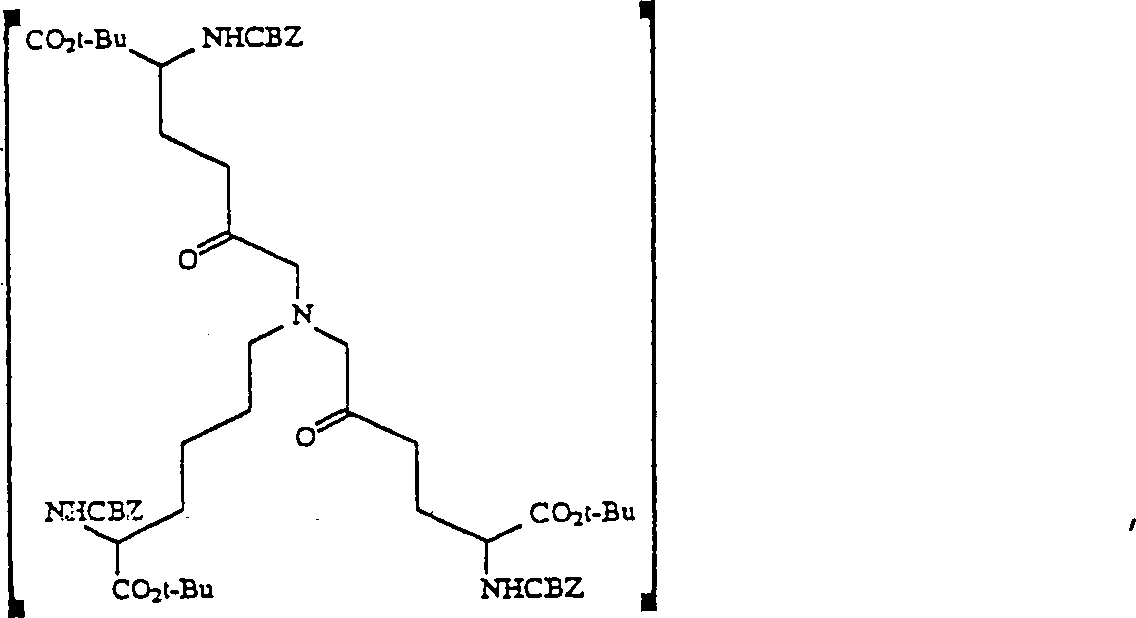
- a) ein Nα-geschütztes-O-geschütztes Lysin (Verbindung 1, Schema 1) mit mindestens 2 Äquivalenten des 5,6-Epoxy-2-N-geschützten-O-geschützten(2S)-2-aminohexanoats (Verbindung 5, Schema 1) in einem geeigneten Lösungsmittel zur Reaktion bringt, um das entsprechende Aminodiol zu erzeugen (Verbindung 6, Schema 1). Geeignete Lösungsmittel schließen Acetonitril, Methanol und Wasser/Alkohol ein. Im Schema 1 ist Lithiumperchlorat als ein Zugabestoff angegeben, welcher zur Katalyse der Reaktion vorgesehen ist. 2 Äquivalente des Epoxids pro Äquivalent des Aminohexanoats werden benötigt, weil eine Dialkylierung im Verfahren durchgeführt werden muss.
- b) Das Aminodiol 6 wird dann mit einem geeigneten Oxidiermittel, wie Oxalylchlorid-DMSO, in einem geeigneten Lösungsmittel wie Methylenchlorid oxidiert, um das entsprechende Aminodiketon zu ergeben (Verbindung 7, Schema 1). Geeignete oxidierende Mittel, die sich von Oxalylchlordi-DMSO unterscheiden, schließen Thionylchlorid-DMSO, Trifluoressigsäureanhydrid-DMSO und Essigsäureanhydrid-DMSO ein. Geeignete Lösungsmittel, die sich von Methylenchlorid unterscheiden, schließen Diethylether, Tetrahydrofuran und Chloroform ein.
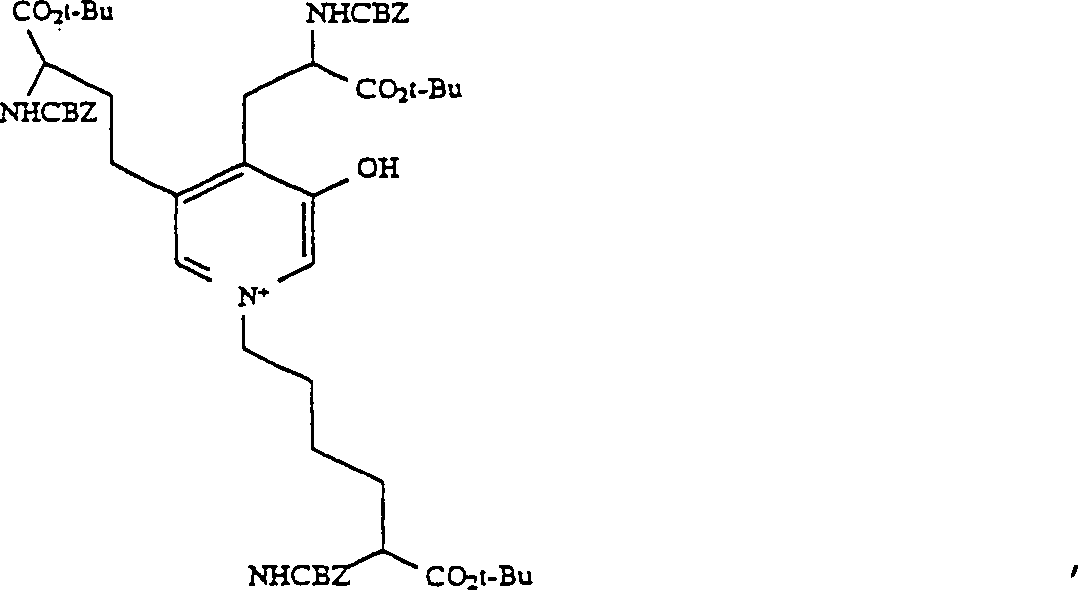
- c) Das Aminodiketon von Stufe (b) wird mit einer Base wie Natriumhydroxid in Alkohol oder einem tertiären Amin, z. B. mit Triethylamin, weiter umgesetzt, um das 3-Hydroxydihydropyridin zu erzeugen, das mit einem oxidierenden Mittel wie der Base (DBN) in der Gegenwart von O2 in einem geeigneten Lösungsmittel wie Methylenchlorid zusammengebracht wird, um den 3-Hydroxypyridin-Ring zu bilden, um das Pyridinium-Produkt 8 in Schema 1 zu ergeben. Weitere geeignete oxidierende Mittel schließen Dicyanodichlorchinon (DDQ), Brom oder MnO2, ein, wobei die Reaktion auch in weiteren Lösungsmitteln, wie Methylenchlorid, Essigsäure oder Methanol, durchgeführt werden kann. Aus dem Produkt 8 werden die Schutzgruppen abgespalten, um Deoxypyridinolin zu ergeben:
- a) an Nα-protected-O-protected lysine (Compound 1, Scheme 1) with at least 2 equivalents of the 5,6-epoxy-2-N-protected-O-protected (2S) -2-aminohexanoate (Compound 5, Scheme 1) in a suitable solvent to produce the corresponding aminodiol (Compound 6, Scheme 1). Suitable solvents include acetonitrile, methanol and water / alcohol. In Scheme 1, lithium perchlorate is indicated as an additive intended to catalyze the reaction. 2 equivalents of the epoxide per equivalent of the aminohexanoate are needed because dialkylation must be performed in the process.
- b) The aminodiol 6 is then oxidized with a suitable oxidizing agent such as oxalyl chloride-DMSO in a suitable solvent such as methylene chloride to give the corresponding aminodiketone (Compound 7, Scheme 1). Suitable oxidizing agents other than oxalylchlorodi-DMSO include thionyl chloride DMSO, trifluoroacetic anhydride DMSO and acetic anhydride DMSO. Suitable solvents other than methylene chloride include diethyl ether, tetrahydrofuran and chloroform.
- c) The aminodiketone of step (b) is treated with a base such as sodium hydroxide in alcohol or a tertiary amine, e.g. With triethylamine, to produce the 3-hydroxydihydropyridine which is contacted with an oxidizing agent such as the base (DBN) in the presence of O 2 in a suitable solvent such as methylene chloride to afford the 3-hydroxypyridine ring to give the pyridinium product 8 in Scheme 1. Other suitable oxidizing agents include dicyanodichloroquinone (DDQ), bromine or MnO 2 , which reaction may also be carried out in other solvents such as methylene chloride, acetic acid or methanol. From product 8, the protecting groups are cleaved to give deoxypyridinoline:
Schema
1 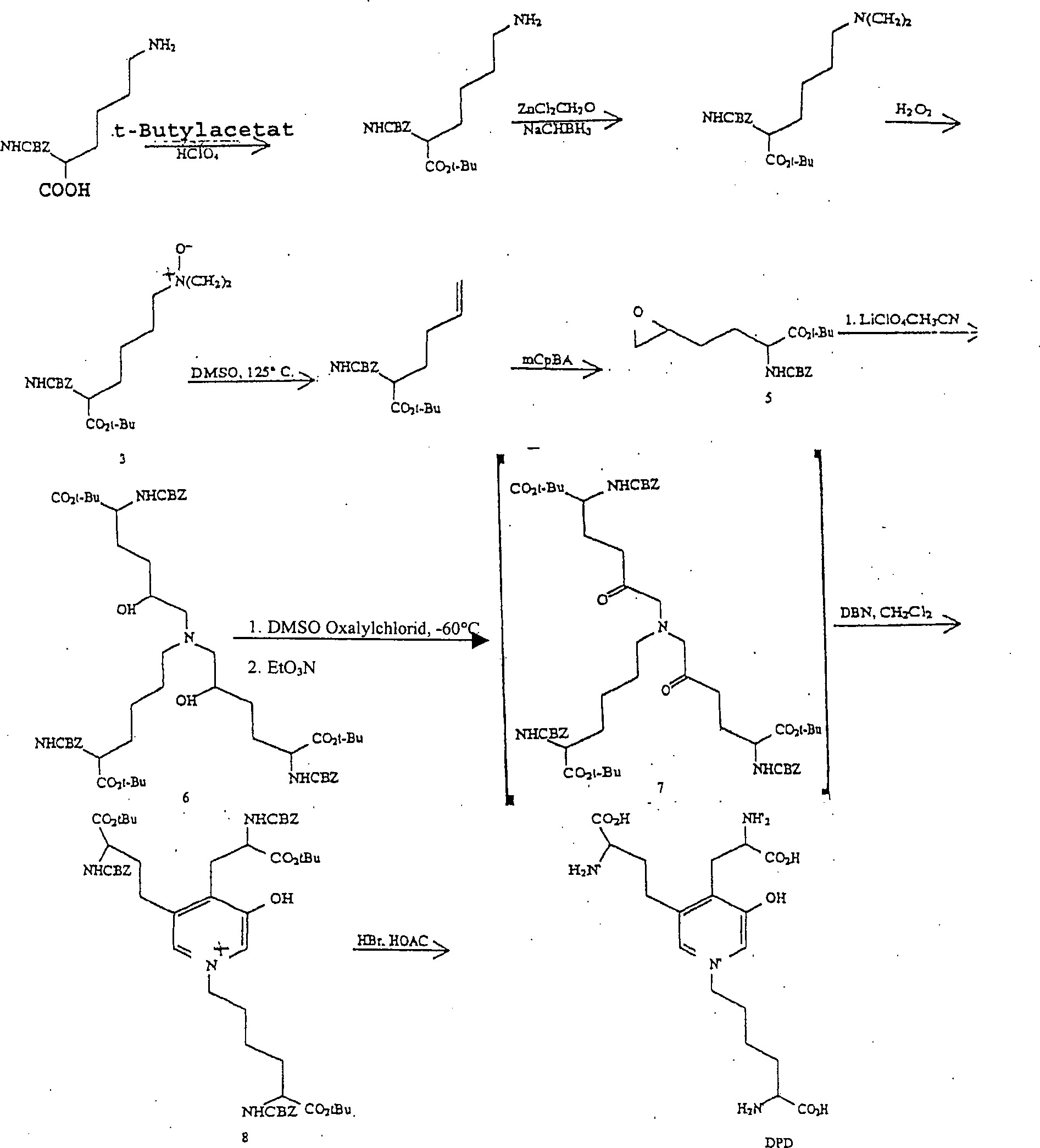
Die vorliegende Erfindung wird nun durch das folgende Beispiel noch weiter erläutert.The The present invention will now be apparent from the following example further explained.
Beispielexample
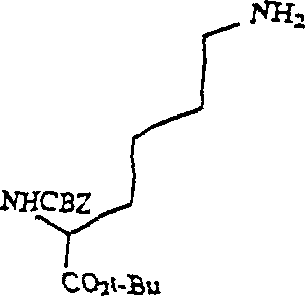
A. Herstellung von Nα-CNBZ-O-t-butyl-L-lysin (1)A. Preparation of Nα-CNBZ-O-t-butyl-L-lysine (1)
Eine
Mischung aus 25 g Nα-CBZ-L-lysin
von Sigma, worin CBZ Benzyloxycarbonyl bedeutet, aus 250 mL t-Butylacetat
und 14 mL 70%-iger Perchlorsäure
wurde gründlich
durchmischt, bis alle Feststoffe gelöst waren. Nach Rühren über Nacht
wurden 375 mL Ethylacetat und dann 250 mL Wasser zugegeben. Der
pH-Wert der wässrigen
Schicht wurde auf 5,5 mit 20%-iger NaOH angehoben, worauf die organische
Phase abgetrennt wurde. Die wässrige
Phase wurde mit der Ethylacetat-Lösung extrahiert, und der pH-Wert
wurde auf 10,5 erneut angehoben, worauf das Ganze mit 200 mL frischem
Ethylacetat erneut extrahiert wurde. Die organischen Extrakte wurden
vereinigt, mit gesättigter
Kochsalzlösung
gewaschen, über
Na2SO4 getrocknet
und eingeengt. Der Rückstand
wurde über
Nacht unter Hoch-Vakuum
getrocknet, um dann 23,2 g eines farblosen, viskosen Materials zu
ergeben.
1H-NMR (60 MHz, CDCl3) δ:
7,35 (s, 5H), 5,1 (s, 2H), 4,2 (m, 1H), 3,1 (m, 2H), 1,4 (s, 9H),
2,1–1,4
(m, 4H)A mixture of 25 g Sigma Nα-CBZ-L-lysine, in which CBZ is benzyloxycarbonyl, from 250 mL t-butyl acetate and 14 mL 70% perchloric acid was thoroughly mixed until all solids were dissolved. After stirring overnight, 375 mL of ethyl acetate and then 250 mL of water were added. The pH of the aqueous layer was raised to 5.5 with 20% NaOH, whereupon the organic phase was separated. The aqueous phase was extracted with the ethyl acetate solution and the pH was raised again to 10.5, after which it was re-extracted with 200 mL of fresh ethyl acetate. The organic extracts were combined, washed with saturated brine, dried over Na 2 SO 4 and concentrated. The residue was dried overnight under high vacuum to give 23.2 g of a colorless, viscous material.
1 H-NMR (60 MHz, CDCl 3) δ: 7.35 (s, 5H), 5.1 (s, 2H), 4.2 (m, 1H), 3.1 (m, 2H), 1 , 4 (s, 9H), 2.1-1.4 (m, 4H)
B. Nε-Dimethylamino-Nα-CBZ-O-t-butyl-L-lysin (2)Nε-dimethylamino-Nα-CBZ-O-t-butyl-L-lysine (2)
Eine
Mischung aus 3,7 g (27,2 mMol) ZnCl2, 3,2
g (53 mMol) NaCNBH3 und aus 60 mL Methanol
wurde hergestellt, und es wurde eine Lösung von 18 g (51,7 mMol) des
Amins (1) in 180 mL Methanol zugegeben. Nach Kühlung auf 10 bis 15°C wurden
12,4 mL 37%-iger Formaldehyd (165 mMol) über eine Dauer von 2 bis 3
min zugetropft. Die Reaktion wurde 1 h lang gerührt und durch Silika-Gel-TLC
unter Elution mit einer 60 : 10 : 1 (V/V/V)-Mischung aus Chloroform/Methanol/konzentriertem
Ammoniak (Lösungsmittel
A) verfolgt. 100 mL Wasser wurden zugegeben, und die Mischung wurde
auf ein Volumen von 200 mL eingeengt. Ethylacetat (200 mL) wurde
zugegeben, und der pH-Wert wurde auf 10,5 mit 10%-iger NaOH angehoben.
Das Ethylacetat wurde abgetrennt, und der pH-Wert der wässrigen
Phase wurde auf 10,5 erneut angehoben, worauf diese mit 200 mL frischem
Ethylacetat extrahiert wurde. Die Ethylacetat-Extrakte wurden vereinigt,
mit NaCl gewaschen, über
Na2SO4 getrocknet,
filtriert und eingeengt, um nach Trocknung über Nacht unter Hochvakuum
14,86 g viskoses Öl
zu ergeben.
1H-NMR (300 MHz, d6-DMSO), δ:
7,56 (d, 1H), 7,35 (s, 5H), 5,05 (s, 2H), 3,85 (m, 1H), 2,15 (t,
2H), 2,08 (s, 6H), 1,60 (d von t, 2H), 1,40 (s, 9H), 1,35 (m, 4H)A mixture of 3.7 g (27.2 mmol) ZnCl 2 , 3.2 g (53 mmol) NaCNBH 3 and 60 mL methanol was prepared and a solution of 18 g (51.7 mmol) of the amine was obtained (1) in 180 mL of methanol. After cooling to 10 to 15 ° C 12.4 mL of 37% formaldehyde (165 mmol) were added dropwise over a period of 2 to 3 min. The reaction was stirred for 1 h and monitored by silica gel TLC eluting with a 60: 10: 1 (v / v / v) mixture of chloroform / methanol / concentrated ammonia (Solvent A). 100 mL of water was added and the mixture was concentrated to a volume of 200 mL. Ethyl acetate (200 mL) was added and the pH was raised to 10.5 with 10% NaOH. The ethyl acetate was separated and the pH of the aqueous phase was raised again to 10.5, whereupon it was extracted with 200 mL of fresh ethyl acetate. The ethyl acetate extracts were combined, washed with NaCl, dried over Na 2 SO 4 , filtered and concentrated to give, after drying overnight under high vacuum, 14.86 g of viscous oil.
1 H-NMR (300 MHz, d 6 -DMSO), δ: 7.56 (d, 1H), 7.35 (s, 5H), 5.05 (s, 2H), 3.85 (m, 1H ), 2.15 (t, 2H), 2.08 (s, 6H), 1.60 (d of t, 2H), 1.40 (s, 9H), 1.35 (m, 4H)
C. Nε-Dimethylamino-Nα-CBZ-O-t-butyl-L-lysin-N-oxid (3)C. Nε-dimethylamino-Nα-CBZ-O-t-butyl-L-lysine N-oxide (3)
Eine
Lösung
aus 25,3 g des Dimethylamins (2), 7,9 mL 30%-igem Wasserstoffperoxid
und aus 150 mL Methanol wurde 5 h lang gerührt, worauf weitere 7,9 g des
30%-igen Wasserstoffperoxids zugegeben wurden. Die Reaktion wurde
48 h lang gerührt
und mit Silika-Gel-TLC unter Eluieren mit dem Lösungsmittel A verfolgt. Eine
1 mL wässrige
Aufschlämmung
von ca. 5 mg Platin-Schwarz wurde zugegeben, worauf die Reaktion
7 h lang gerührt
und eine weitere Aufschlämmung
von 5 bis 10 mg Platin-Schwarz zugegeben wurden. Die Mischung wurde über Nacht
gerührt
und bezüglich
Peroxid mit Peroxid-Testpapier
unter Erwärmung
auf 60°C
zur gegebenenfalls notwendigen Entfernung von Peroxiden verfolgt.
Sobald die Reaktion negativ bezüglich
der Peroxide getestet war, wurde die Mischung filtriert und eingeengt.
Der Rückstand
wurde in 300 mL EtOAc gelöst,
worauf das Ganze über
Na2SO4 getrocknet,
filtriert, eingeengt und an 400 g Silika-Gel unter Eluieren mit dem
Lösungsmittel
A chromatografiert wurde, um 13 g Produkt als farbloses Öl zu erzeugen.
1H-NMR (300 MHz, d6-DMSO) δ: 7,78 (d,
1H), 7,37 (s, 5H), 5,05 (dd, 2H), 2,88 (m, 1H), 3,05 (t, 2H), 2,95
(s, 6H), 1,70 (m, 4H), 1,40 (s, 9H), 1,32 (m, 2H)A solution of 25.3 g of the dimethylamine (2), 7.9 mL of 30% hydrogen peroxide and 150 mL of methanol was stirred for 5 h, after which a further 7.9 g of the 30% hydrogen peroxide were added. The reaction was stirred for 48 h and monitored by silica gel TLC eluting with solvent A. A 1 mL aqueous slurry of about 5 mg of platinum black was added, the reaction stirred for 7 h, and another slurry of 5-10 mg of platinum black added. The mixture was stirred overnight and monitored for peroxide with peroxide test paper with heating to 60 ° C. to remove possibly necessary peroxides. Once the reaction was tested negative for the peroxides, the mixture was filtered and concentrated. The residue was dissolved in 300 mL EtOAc and then dried over Na 2 SO 4 , filtered, concentrated and chromatographed on 400 g silica gel eluting with solvent A to give 13 g product as a colorless oil.
1 H NMR (300 MHz, d 6 -DMSO) δ: 7.78 (d, 1H), 7.37 (s, 5H), 5.05 (dd, 2H), 2.88 (m, 1H) , 3.05 (t, 2H), 2.95 (s, 6H), 1.70 (m, 4H), 1.40 (s, 9H), 1.32 (m, 2H)
Die Synthese des Nα-geschützten-O-geschützten Lysins ist in der Literatur bekannt (Scott et al, Commun. 1981, 11(4) 303–314).The Synthesis of the Nα-protected-O-protected lysine is known in the literature (Scott et al., Commun. 1981, 11 (4) 303-314).
D. N-CBZ-2-Amino-5-hexenoat-5-t-butylester (4)D. N-CBZ-2-amino-5-hexenoate-5-t-butyl ester (4)
Eine
Lösung
von 14,8 g des N-Oxids 3 in 250 mL DMSO wurde auf 125°C 2 h lang
unter Spülen
mit Argon erhitzt. Das DMSO wurde bei 70°C unter Hochvakuum abdestilliert.
Unter Chromatografie des Rückstands
an 450 mL Silika-Gel und Eluieren mit 20 : 80 (V/V) EtOAc/Hexan
wurde das Produkt in den Fraktionen 70 bis 120 (18 mL Fraktionen)
gewonnen. Diese wurden vereinigt und eingeengt, um 3,15 g des Produkts
als farbloses Öl
zu ergeben.
1H-NMR (d6-DMSO) δ: 7,62 (d,
1H), 7,35 (s, 5H), 5,78 (m, 1H), 5,08 (dd, 2H), 4,98 (m, 2H), 3,86
(m, 1H), 2,08 (dt, 2H), 1,68 (m, 2H), 1,38 (s, 9H), 1,35 (m, 2H)A solution of 14.8 g of N-oxide 3 in 250 mL of DMSO was heated to 125 ° C for 2 h while purging with argon. The DMSO was distilled off at 70 ° C under high vacuum. Chromatography of the residue on 450 mL silica gel and elution with 20:80 (v / v) EtOAc / hexane gave the product in fractions 70-120 (18 mL fractions). These were combined and concentrated to give 3.15 g of the product as a colorless oil.
1 H NMR (d 6 -DMSO) δ: 7.62 (d, 1H), 7.35 (s, 5H), 5.78 (m, 1H), 5.08 (dd, 2H), 4, 98 (m, 2H), 3.86 (m, 1H), 2.08 (dt, 2H), 1.68 (m, 2H), 1.38 (s, 9H), 1.35 (m, 2H )
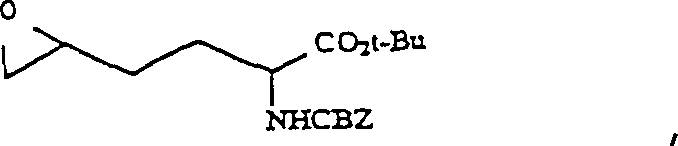
E. N-CBZ-2-Amino-5,6-epoxyhexanoat-5-t-butylester (5), ausgehend von Verbindung 4 (Stufe D)E. N-CBZ-2-amino-5,6-epoxyhexanoate-5-t-butyl ester (5), starting from compound 4 (step D)
Die 85%-ige m-Chlorperbenzoesäure (mCpBA) von Aldrich Chemical Co. wurde durch Auflösen in Methylenchlorid und waschen mit einem Puffer von pH = 7,5 gereinigt. Die organische Schicht wurde abgetrennt, über Na2SO4 getrocknet, filtriert und eingeengt. Der Feststoff wurde über Nacht unter Hochvakuum getrocknet und bei 3°C aufbewahrt.The 85% m-chloroperbenzoic acid (mCpBA) from Aldrich Chemical Co. was purified by dissolving in methylene chloride and washing with a buffer of pH = 7.5. The organic layer was separated, dried over Na 2 SO 4 , filtered and concentrated. The solid was dried under high vacuum overnight and stored at 3 ° C.
Eine
Mischung aus 3,15 g des Hexanoats 4 (9,75 mMol) und 1,76 g mCpBA
(10,2 mMol) in 25 mL Methylenchlorid wurde 48 h lang bei Raumtemperatur
gerührt.
Die Reaktion wurde mit 125 mL EtOAc verdünnt und 2 Mal mit 5%-iger NaOH
und dann mit Kochsalzlösung
gewaschen. Nach Trocknung über
Na2SO4 wurde die
Reaktionsmischung filtriert und eingeengt, um 2,9 g des Produkts
als farbloses Öl
zu erzeugen.
1H-NMR (d6-DMSO) δ: 7,35 (s,
5H), 5,05 (s, 2H), 3,90 (m, 1H), 2,65 (m, 1H), 2,50 (m, 1H), 2,42
(m, 1H), 1,8–1,5 (m,
2H), 1,40 (s, 9H), 1,35 (m, 2H)
MS (FAB): 358 (m+ +
Na+)A mixture of 3.15 g of hexanoate 4 (9.75 mmol) and 1.76 g of mCpBA (10.2 mmol) in 25 mL of methylene chloride was stirred for 48 h at room temperature. The reaction was diluted with 125 mL EtOAc and washed twice with 5% NaOH and then with brine. After drying over Na 2 SO 4 , the reaction mixture was filtered and concentrated to produce 2.9 g of the product as a colorless oil.
1 H NMR (d 6 -DMSO) δ: 7.35 (s, 5H), 5.05 (s, 2H), 3.90 (m, 1H), 2.65 (m, 1H), 2, 50 (m, 1H), 2.42 (m, 1H), 1.8-1.5 (m, 2H), 1.40 (s, 9H), 1.35 (m, 2H)
MS (FAB): 358 (m + + Na + )
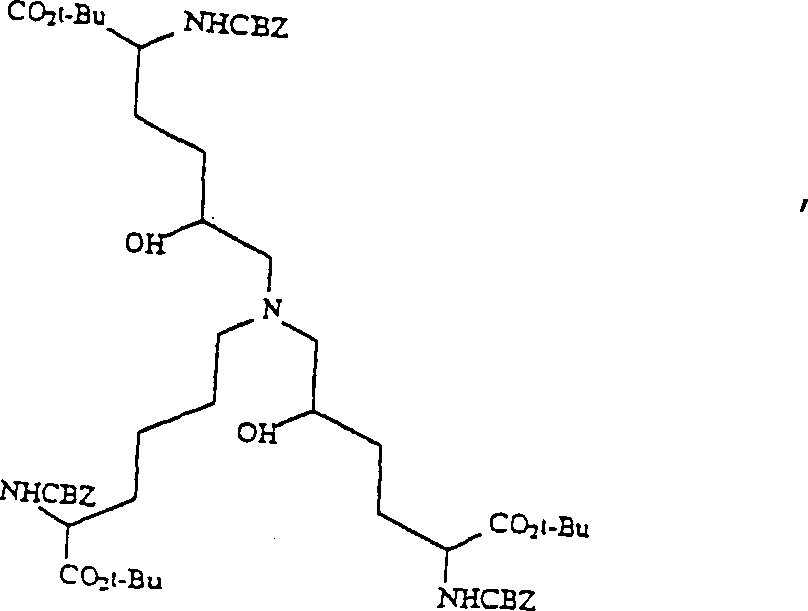
F. 2,12-Benzyloxycarbonylamino-7-(5-benzyloxycarbonylamino-5-t-butoxycarbonylpentyl-)aza-1,13-di-t-butyl-5,9-dihydroxytridecanodiat (6)F. 2,12-Benzyloxycarbonylamino-7- (5-benzyloxycarbonylamino-5-t-butoxycarbonylpentyl) aza-1,13-di-t-butyl-5,9-dihydroxytridecanodiat (6)
Das
Epoxid 5 (1,68 g, 5,01 mMol) wurde in 1,5 mL trockenem Acetonitril
gelöst,
worauf 0,53 g (5,01 mMol) wasserfreies LiClO4 zugegeben
wurden. Als der Feststoff aufgelöst
war, wurden 0,8 g (23 mMol) des Amins (1) in 1,5 mL Acetonitril
zugegeben. Die Mischung wurde bei 50°C über Nacht gerührt und
dann unter vermindertem Druck eingeengt. Der Rückstand wurde an 150 g Silika-Gel
unter Eluieren mit 7 : 1 (V/V) Chloroform/Lösungsmittel A chromatografiert,
um 1 g Aminodiol 6 und 0,5 g rückgewonnenes
Epoxid zu ergeben. Das Diol wurde in einer bekannten Menge Methylenchlorid
gelöst
und über
3 Å Molekularsieben
zum späteren Gebrauch
aufbewahrt.
MS (FAB): 1007 (M+)The epoxide 5 (1.68 g, 5.01 mmol) was dissolved in 1.5 mL of dry acetonitrile, after which 0.53 g (5.01 mmol) of anhydrous LiClO 4 was added. When the solid was dissolved, 0.8 g (23 mmol) of the amine (1) in 1.5 mL of acetonitrile was added. The mixture was stirred at 50 ° C overnight and then concentrated under reduced pressure. The residue was chromatographed on 150 g of silica gel eluting with 7: 1 (v / v) chloroform / solvent A to give 1 g of aminodiol 6 and 0.5 g of recovered epoxide. The diol was dissolved in a known amount of methylene chloride and stored over 3 Å molecular sieves for later use.
MS (FAB): 1007 (M + )
G. 3-Hydroxy-1-(5-benzyloxycarbonylamino-5-t-butoxycarbonylpentyl)-4-(2-benzyloxycarbonylamino-2-t-butoxycarbonylethyl)-5-(3-benzyloxycarbonylamino-3-t-butoxycarbonylpropyl)pyridinium-Salz (8)G. 3-Hydroxy-1- (5-benzyloxycarbonylamino-5-t-butoxycarbonylpentyl) -4- (2-benzyloxycarbonylamino-2-t-butoxycarbonylethyl) -5- (3-benzyloxycarbonylamino-3-t-butoxycarbonylpropyl) pyridinium salt (8th)
Zu 1 mL Methylenchlorid wurden 0,6 mL 2 M (1,2 mMol) Oxalylchlorid in Methylenchlorid gegeben und die Mischung auf –55°C gekühlt. Dimethylsulfoxid (DMSO) (78 μL, 1,1 mMol) in 0,25 mL Methylenchlorid wurde dann zugetropft. Nach 15 min wurden 400 mg des Diols 6 in 1 mL Methylenchlorid zugetropft. Die Mischung wurde auf –30°C unter Rühren über 20 min erwärmt, und die Reaktionsmischung wurde dann zurück auf –55°C gekühlt, worauf 0,26 g (2,6 mMol) Triethylamin zugegeben wurden. Die Reaktionsmischung wurde auf Raumtemperatur erwärmt und dann mit 25 mL EtOAc verdünnt, mit 5%-iger NaOH und dann mit Kochsalzlösung gewaschen und über Na2SO4 getrocknet. Nach Filtrieren wurde die Lösung eingeengt, um 0,39 g 2,12-Benzyloxycarbonylamino-7-(5-benzyoxycarbonylamino-5-t-butoxycarbonylpentyl)aza-1,13-di-t-butyl-5,9-dioxotridecanodiat 7 zu ergeben, das wegen seiner Instabilität nicht charakterisiert wurde. Der Rückstand wurde in 4 mL Methylenchlorid gelöst, worauf 0,25 g Diazabicyclo[4.3.0]non-5-en (DBN) zugegeben wurden. Die Mischung wurde über Nacht unter Schutz eines Trocknungsrohrs gerührt. Essigsäure (100 μL) wurde zugefügt, und das Lösungsmittel wurde eingedampft. Der Rückstand wurde an 100 g Silika-Gel unter Eluieren mit 20 : 1 : 0,5 Chloroform/Methanol/Essigsäure chromatografiert. Die Fraktionen 11 bis 14 (18 mL Fraktionen) enthielten 0,26 g Pyridinium-Produkt 8.To 1 mL of methylene chloride was added 0.6 mL of 2 M (1.2 mmol) oxalyl chloride in methylene chloride and the mixture was cooled to -55 ° C. Dimethylsulfoxide (DMSO) (78 μL, 1.1 mmol) in 0.25 mL of methylene chloride was then added dropwise. After 15 minutes, 400 mg of the diol 6 in 1 mL of methylene chloride were added dropwise. The mixture was warmed to -30 ° C with stirring for 20 minutes, and the reaction mixture was then cooled back to -55 ° C, whereupon 0.26 g (2.6 mmol) of triethylamine was added. The reaction mixture was warmed to room temperature and then diluted with 25 mL EtOAc, washed with 5% NaOH and then brine, and dried over Na 2 SO 4 . After filtration, the solution was concentrated to give 0.39 g of 2,12-benzyloxycarbonylamino-7- (5-benzyoxycarbonylamino-5-t-butoxycarbonylpentyl) aza-1,13-di-t-butyl-5,9-dioxotridecanodiate 7 which was not characterized because of its instability. The residue was dissolved in 4 mL of methylene chloride, to which 0.25 g of diazabicyclo [4.3.0] non-5-ene (DBN) was added. The mixture was stirred overnight under protection of a drying tube. Acetic acid (100 μL) was added and the solvent was evaporated. The residue was chromatographed on 100 g of silica gel eluting with 20: 1: 0.5 chloroform / methanol / acetic acid. Fractions 11-14 (18 mL fractions) contained 0.26 g of pyridinium product 8.
H. Deoxypyridinolin (DPD)H. Deoxypyridinoline (DPD)
Eine
Mischung aus 160 mg des Pyridiniumacetats 8 und aus 1 mL HBr in
HOAc wurde 30 min lang gerührt,
worauf noch einmal 1 mL HBr/HOAc zugegeben wurde. Nach 1 h wurde
das Lösungsmittel
entfernt, und der Rückstand
wurde in 50 mL einer 4 : 1 : 1 (V/V/V)-Mischung aus n-Butanol/Wasser/HOAc
(Lösungsmittel
B) gelöst,
worauf 5 g Faser-Cellulose zugegeben wurden. Die Suspension wurde
30 min lang stehen gelassen und filtriert, worauf weitere 3 g Cellulose
zum Filtrat gegeben und nach 2 h erneut filtriert wurde. Die zwei
Cellulose-Feststoffe wurden vereinigt und in 50 mL Wasser aufgeschlämmt und
nach 30 min filtriert. Ein Mengenanteil wurde entnommen, dessen
Absorption in einem Puffer von pH = 8 bei 326 nm unter Zugrundelegen
eines molaren Extinktionskoeffizienten von 5290 und eines Molekulargewichts
von 413 28 mg DPD anzeigte. Die Lösung wurde lyophilisiert, und
der Rückstand
wurde in 10 mMol HCl und 8 g gewaschenem BioRad AG-1X10 (Cl–-Form)
aufgelöst.
Nach 1 h wurden das entstandene Produkt filtriert und das Filtrat
zur Trockene in einem Savant Speed-Vac®-Konzentrator eingeengt,
um 56 mg des sehr hygroskopischen Tetrachlorid-Salzes zu ergeben.
1H-NMR (300 MHz, d6-DMSO) δ: 8,65 (s,
1H), 8,50 (s, 1H), 4,51 (t, 2H, J = 7,5), 4,28 (t, 1H, J = 7), 4,10
(t, 1H, J = 6), 3,99 (t, 1H, J = 7), 3,4 (m, 2H), 3,2–2,9 (m,
2H), 2,2 (m, 2H), 2,1 (m, 2H), 2,0 (m, 2H), 1,5–1,3 (m, 2H)A mixture of 160 mg of pyridinium acetate 8 and 1 mL of HBr in HOAc was stirred for 30 minutes, after which once again 1 mL of HBr / HOAc was added. After 1 h, the solvent was removed and the residue was dissolved in 50 mL of a 4: 1: 1 (v / v / v) mixture of n-butanol / water / HOAc (solvent B) followed by 5 g of fiber-cellulose were added. The suspension was allowed to stand for 30 minutes and filtered, whereupon a further 3 g of cellulose were added to the filtrate and filtered again after 2 hours. The two cellulose solids were combined and slurried in 50 mL of water and filtered after 30 min. An amount was withdrawn whose absorbance in a buffer of pH = 8 at 326 nm indicated a molar extinction coefficient of 5290 and a molecular weight of 413-28 mg of DPD. The solution was lyophilized and the residue was dissolved in 10 mM HCl and 8 g of washed BioRad AG-1X10 (Cl - form). After 1 h, the resulting product was filtered and the filtrate was concentrated to dryness in a Savant Speed-Vac ® concentrator to 56 mg of the very hygroscopic tetrachloride salt to give.
1 H NMR (300 MHz, d 6 -DMSO) δ: 8.65 (s, 1H), 8.50 (s, 1H), 4.51 (t, 2H, J = 7.5), 4, 28 (t, 1H, J = 7), 4.10 (t, 1H, J = 6), 3.99 (t, 1H, J = 7), 3.4 (m, 2H), 3.2- 2.9 (m, 2H), 2.2 (m, 2H), 2.1 (m, 2H), 2.0 (m, 2H), 1.5-1.3 (m, 2H)
Die O-t-Butylester- und CBZ-Schutzgruppen können mit einer Vielzahl von Behandlungsverfahren entfernt werden, mit denen der Fachmann vertraut ist, wie beschrieben von Greene et al in Protective Groups in Organic Synthesis; John Wiley & Sons: New York, 1991: S. 246 und 335–7. Somit kann der t-Butylester mit weiteren Säuren wie mit Ameisen-, Salz-, p-Toluolsulfon-, Trifluormethansulfon-, Methansulfon- und mit Trifluoressigsäure entfernt werden. Die CBZ-Gruppe kann mit einer Vielzahl von Verfahren wie z. B. durch Hydrogenolyse, mit Lewis-Säuren wie Aluminiumchlorid, Trimethylsilyljodid und Bortribromid, durch Fotolyse, Elektrolyse, mit Bariumhydroxid und mit weiteren Säuren wie mit Trifluor- und Methansulfonsäure entfernt werden.The O-t-butyl ester and CBZ protecting groups can be used with a variety of Treatment procedures are removed, with which the expert trusts is as described by Greene et al in Protective Groups in Organic Synthesis; John Wiley & Sons: New York, 1991: pp. 246 and 335-7. Thus, the t-butyl ester can be treated with other acids such as formic, saline, p-toluenesulfonic, trifluoromethanesulfone, methanesulfone and removed with trifluoroacetic acid become. The CBZ group can use a variety of methods such as z. B. by hydrogenolysis, with Lewis acids such as aluminum chloride, Trimethylsilyl iodide and boron tribromide, by photolysis, electrolysis, with barium hydroxide and with other acids such as trifluoro- and methane be removed.
Claims (10)

Applications Claiming Priority (2)
| Application Number | Priority Date | Filing Date | Title |
|---|---|---|---|
| US782214 | 1997-01-13 | ||
| US08/782,214 US5723619A (en) | 1997-01-13 | 1997-01-13 | Method for the synthesis of deoxypyridinoline |
Publications (2)
| Publication Number | Publication Date |
|---|---|
| DE69822909D1 DE69822909D1 (en) | 2004-05-13 |
| DE69822909T2 true DE69822909T2 (en) | 2005-04-07 |
Family
ID=25125363
Family Applications (1)
| Application Number | Title | Priority Date | Filing Date |
|---|---|---|---|
| DE69822909T Expired - Fee Related DE69822909T2 (en) | 1997-01-13 | 1998-01-03 | Process for the preparation of deoxypyridinoline |
Country Status (11)
| Country | Link |
|---|---|
| US (1) | US5723619A (en) |
| EP (1) | EP0857720B1 (en) |
| JP (1) | JPH10195052A (en) |
| AU (1) | AU725687B2 (en) |
| CA (1) | CA2225198C (en) |
| DE (1) | DE69822909T2 (en) |
| DK (1) | DK0857720T3 (en) |
| IL (1) | IL122213A (en) |
| NO (1) | NO309601B1 (en) |
| NZ (1) | NZ329034A (en) |
| ZA (1) | ZA9710340B (en) |
Families Citing this family (2)
| Publication number | Priority date | Publication date | Assignee | Title |
|---|---|---|---|---|
| US5834610A (en) * | 1997-05-06 | 1998-11-10 | Johnson; Gary M. | Conversion of pyridinoline to deoxypyridinoline |
| US6824985B1 (en) * | 1997-09-09 | 2004-11-30 | Bayer Corporation | Formulation for reducing urea effect for immunochromatography assays using urine samples |
Family Cites Families (4)
| Publication number | Priority date | Publication date | Assignee | Title |
|---|---|---|---|---|
| US527715A (en) * | 1894-10-16 | Car-fender | ||
| GB9202139D0 (en) * | 1992-01-31 | 1992-03-18 | Sandoz Ltd | Improvements in or relating to organic compounds |
| US5527715A (en) * | 1992-07-31 | 1996-06-18 | Metra Biosystems, Inc. | Method and kit for pyridinoline assay |
| US5350855A (en) * | 1992-09-30 | 1994-09-27 | Metra Biosystems, Inc. | Derivatized D-acyl pyridinium reagent |
-
1997
- 1997-01-13 US US08/782,214 patent/US5723619A/en not_active Expired - Lifetime
- 1997-10-24 NZ NZ329034A patent/NZ329034A/en unknown
- 1997-11-17 ZA ZA9710340A patent/ZA9710340B/en unknown
- 1997-11-17 IL IL12221397A patent/IL122213A/en not_active IP Right Cessation
- 1997-11-24 NO NO975384A patent/NO309601B1/en unknown
- 1997-12-18 CA CA002225198A patent/CA2225198C/en not_active Expired - Fee Related
- 1997-12-19 JP JP9350499A patent/JPH10195052A/en active Pending
-
1998
- 1998-01-03 DE DE69822909T patent/DE69822909T2/en not_active Expired - Fee Related
- 1998-01-03 EP EP98100050A patent/EP0857720B1/en not_active Expired - Lifetime
- 1998-01-03 DK DK98100050T patent/DK0857720T3/en active
- 1998-01-08 AU AU50389/98A patent/AU725687B2/en not_active Ceased
Also Published As
| Publication number | Publication date |
|---|---|
| IL122213A (en) | 2000-07-26 |
| CA2225198A1 (en) | 1998-07-13 |
| NO309601B1 (en) | 2001-02-26 |
| DE69822909D1 (en) | 2004-05-13 |
| US5723619A (en) | 1998-03-03 |
| IL122213A0 (en) | 1998-04-05 |
| DK0857720T3 (en) | 2004-07-26 |
| AU725687B2 (en) | 2000-10-19 |
| EP0857720B1 (en) | 2004-04-07 |
| EP0857720A1 (en) | 1998-08-12 |
| CA2225198C (en) | 2003-10-07 |
| NZ329034A (en) | 1998-07-28 |
| ZA9710340B (en) | 1998-06-10 |
| NO975384D0 (en) | 1997-11-24 |
| JPH10195052A (en) | 1998-07-28 |
| AU5038998A (en) | 1998-07-16 |
| NO975384L (en) | 1998-07-14 |
Similar Documents
| Publication | Publication Date | Title |
|---|---|---|
| DE69332988T2 (en) | Reagents for the detection and quantification of thyroxine in liquid samples | |
| DE3587793T2 (en) | LUMINESCENT METAL CHELATE MARKERS AND MEANS TO DETECT THEM. | |
| EP0371262B1 (en) | Digoxigenin derivatives and their use | |
| DE2716061C2 (en) | Guaiaconic acid A, process for its preparation and the use of this substance as a diagnostic agent | |
| DE3856358T3 (en) | Chemiluminescent esters, thioesters and amides that can be used for tests | |
| DE2920292A1 (en) | L- GAMMA -GLUTAMYL-3-CARBOXY-4-HYDROXYANILIDE AND ITS SALTS, METHOD FOR THE PRODUCTION THEREOF AND THE USE THEREOF FOR DETERMINING THE ACTIVITY OF GAMMA -GLUTAMYL TRANSPEPTIDASE | |
| EP1576059A2 (en) | Carboxamide-substituted dyes for analytical applications | |
| DE19521231A1 (en) | New oxazine dyes and their use as fluorescent markers | |
| DE69223851T2 (en) | Nitro or nitroso substituted polyhalogenated phenol sulfone phthaleins | |
| DE2305775A1 (en) | NEW ANALYTICAL CONNECTIONS AND THEIR USE | |
| DE3000879C2 (en) | ||
| DE2919545C3 (en) | L-leucine-4-hydroxyanilide derivatives, processes for their preparation and their use for determining the activity of leucine aminopeptidase | |
| DE2808111A1 (en) | NEW DIPEPTIDE DERIVATIVES AND THEIR USE FOR MEASURING ENZYMATIC ACTIVITY | |
| DE2921782A1 (en) | CHEMILUMINESCENT NAPHTHALINE-1,2-DICARBONIC ACID HYDRAZIDE LABELED CONJUGATES AND PROCESS FOR THEIR PREPARATION | |
| DE19900172A1 (en) | Preparation of L-4-boronophenylalanine comprises hydrogenation of new aryl borate compounds in the presence of a palladium-based catalyst, useful for the treatment of skin cancer and brain tumors | |
| EP0442372B1 (en) | Improved labeled haptens, process for their preparation and the use of these labeled haptens in immunoassays | |
| DE69431396T2 (en) | METHOD FOR PRODUCING N-TERT-BUTYL-2-PYRAZINE CARBOXAMIDE AND N-TERT-BUTYL-2-PIPERAZINE CARBOXAMIDE | |
| DE2735904A1 (en) | 1,5-DISUBSTITUTED-2-PYRROLIDONE AND METHOD FOR THE PRODUCTION THEREOF | |
| EP0465998B1 (en) | Beta-galactosidase substrate for CEDIA assays | |
| DE3034618C2 (en) | Method for the determination of the activity of the angiotensin converting enzyme | |
| EP0857720B1 (en) | Method for the synthesis of deoxypyridinoline | |
| CH640870A5 (en) | METHOD FOR PRODUCING 9-DESACETYL-9-FORMYL-N-TRIFLUORACETYLDAUNORUBICIN. | |
| DE69706098T2 (en) | Carbodiimide compounds that contain a chemiluminescent group | |
| EP0342157B1 (en) | Aromatic acids | |
| DE2661113C2 (en) |
Legal Events
| Date | Code | Title | Description |
|---|---|---|---|
| 8332 | No legal effect for de | ||
| 8370 | Indication related to discontinuation of the patent is to be deleted | ||
| 8364 | No opposition during term of opposition | ||
| 8339 | Ceased/non-payment of the annual fee |