EP0215038B1 - Process for esterification - Google Patents
Process for esterification Download PDFInfo
- Publication number
- EP0215038B1 EP0215038B1 EP19860901364 EP86901364A EP0215038B1 EP 0215038 B1 EP0215038 B1 EP 0215038B1 EP 19860901364 EP19860901364 EP 19860901364 EP 86901364 A EP86901364 A EP 86901364A EP 0215038 B1 EP0215038 B1 EP 0215038B1
- Authority
- EP
- European Patent Office
- Prior art keywords
- carboxylic acid
- hydroxy
- general formula
- enzyme
- ketalized
- Prior art date
- Legal status (The legal status is an assumption and is not a legal conclusion. Google has not performed a legal analysis and makes no representation as to the accuracy of the status listed.)
- Expired
Links
- 230000032050 esterification Effects 0.000 title claims abstract description 22
- 238000005886 esterification reaction Methods 0.000 title claims abstract description 22
- 238000000034 method Methods 0.000 title claims description 40
- 108090000790 Enzymes Proteins 0.000 claims abstract description 22
- 102000004190 Enzymes Human genes 0.000 claims abstract description 22
- 125000002887 hydroxy group Chemical group [H]O* 0.000 claims abstract description 14
- 125000002777 acetyl group Chemical class [H]C([H])([H])C(*)=O 0.000 claims abstract description 11
- DHKHKXVYLBGOIT-UHFFFAOYSA-N acetaldehyde Diethyl Acetal Natural products CCOC(C)OCC DHKHKXVYLBGOIT-UHFFFAOYSA-N 0.000 claims abstract description 7
- PEDCQBHIVMGVHV-UHFFFAOYSA-N Glycerine Chemical compound OCC(O)CO PEDCQBHIVMGVHV-UHFFFAOYSA-N 0.000 claims description 35
- VLKZOEOYAKHREP-UHFFFAOYSA-N n-Hexane Chemical compound CCCCCC VLKZOEOYAKHREP-UHFFFAOYSA-N 0.000 claims description 24
- 239000002904 solvent Substances 0.000 claims description 18
- 108090001060 Lipase Proteins 0.000 claims description 16
- 102000004882 Lipase Human genes 0.000 claims description 16
- 239000004367 Lipase Substances 0.000 claims description 16
- 230000015572 biosynthetic process Effects 0.000 claims description 16
- 235000019421 lipase Nutrition 0.000 claims description 16
- 150000001733 carboxylic acid esters Chemical class 0.000 claims description 14
- 125000003118 aryl group Chemical group 0.000 claims description 13
- 150000001732 carboxylic acid derivatives Chemical class 0.000 claims description 13
- 150000001875 compounds Chemical class 0.000 claims description 13
- 125000000217 alkyl group Chemical group 0.000 claims description 12
- -1 hydroxy, amino, carboxy Chemical group 0.000 claims description 12
- 150000001728 carbonyl compounds Chemical class 0.000 claims description 10
- 239000001257 hydrogen Substances 0.000 claims description 10
- 229910052739 hydrogen Inorganic materials 0.000 claims description 10
- 125000003545 alkoxy group Chemical group 0.000 claims description 8
- 150000001720 carbohydrates Chemical group 0.000 claims description 7
- UFHFLCQGNIYNRP-UHFFFAOYSA-N Hydrogen Chemical compound [H][H] UFHFLCQGNIYNRP-UHFFFAOYSA-N 0.000 claims description 6
- 125000004414 alkyl thio group Chemical group 0.000 claims description 6
- 239000003795 chemical substances by application Substances 0.000 claims description 6
- 108090000371 Esterases Proteins 0.000 claims description 5
- 125000004093 cyano group Chemical group *C#N 0.000 claims description 5
- 238000004519 manufacturing process Methods 0.000 claims description 5
- 150000002772 monosaccharides Chemical class 0.000 claims description 5
- 125000000449 nitro group Chemical group [O-][N+](*)=O 0.000 claims description 5
- 125000001424 substituent group Chemical group 0.000 claims description 5
- LFQSCWFLJHTTHZ-UHFFFAOYSA-N Ethanol Chemical compound CCO LFQSCWFLJHTTHZ-UHFFFAOYSA-N 0.000 claims description 4
- OFBQJSOFQDEBGM-UHFFFAOYSA-N Pentane Chemical compound CCCCC OFBQJSOFQDEBGM-UHFFFAOYSA-N 0.000 claims description 4
- WQZGKKKJIJFFOK-GASJEMHNSA-N Glucose Natural products OC[C@H]1OC(O)[C@H](O)[C@@H](O)[C@@H]1O WQZGKKKJIJFFOK-GASJEMHNSA-N 0.000 claims description 3
- 150000002431 hydrogen Chemical class 0.000 claims description 3
- 239000004215 Carbon black (E152) Substances 0.000 claims description 2
- 108010093096 Immobilized Enzymes Proteins 0.000 claims description 2
- QVGXLLKOCUKJST-UHFFFAOYSA-N atomic oxygen Chemical compound [O] QVGXLLKOCUKJST-UHFFFAOYSA-N 0.000 claims description 2
- 239000008103 glucose Substances 0.000 claims description 2
- 229930195733 hydrocarbon Natural products 0.000 claims description 2
- 150000002430 hydrocarbons Chemical class 0.000 claims description 2
- 239000001301 oxygen Substances 0.000 claims description 2
- 229910052760 oxygen Inorganic materials 0.000 claims description 2
- 229930091371 Fructose Natural products 0.000 claims 1
- RFSUNEUAIZKAJO-ARQDHWQXSA-N Fructose Chemical compound OC[C@H]1O[C@](O)(CO)[C@@H](O)[C@@H]1O RFSUNEUAIZKAJO-ARQDHWQXSA-N 0.000 claims 1
- 239000005715 Fructose Substances 0.000 claims 1
- LKDRXBCSQODPBY-AMVSKUEXSA-N L-(-)-Sorbose Chemical compound OCC1(O)OC[C@H](O)[C@@H](O)[C@@H]1O LKDRXBCSQODPBY-AMVSKUEXSA-N 0.000 claims 1
- WQZGKKKJIJFFOK-PHYPRBDBSA-N alpha-D-galactose Chemical compound OC[C@H]1O[C@H](O)[C@H](O)[C@@H](O)[C@H]1O WQZGKKKJIJFFOK-PHYPRBDBSA-N 0.000 claims 1
- 229930182830 galactose Natural products 0.000 claims 1
- 125000002791 glucosyl group Chemical group C1([C@H](O)[C@@H](O)[C@H](O)[C@H](O1)CO)* 0.000 claims 1
- 229920005862 polyol Polymers 0.000 abstract description 17
- 150000003077 polyols Chemical class 0.000 abstract description 17
- 238000006359 acetalization reaction Methods 0.000 abstract description 3
- 239000007858 starting material Substances 0.000 abstract description 2
- OGBUMNBNEWYMNJ-UHFFFAOYSA-N batilol Chemical class CCCCCCCCCCCCCCCCCCOCC(O)CO OGBUMNBNEWYMNJ-UHFFFAOYSA-N 0.000 description 10
- 239000011541 reaction mixture Substances 0.000 description 10
- UHOVQNZJYSORNB-UHFFFAOYSA-N Benzene Chemical compound C1=CC=CC=C1 UHOVQNZJYSORNB-UHFFFAOYSA-N 0.000 description 9
- KEJGAYKWRDILTF-JDDHQFAOSA-N (3ar,5s,6s,6ar)-5-[(4r)-2,2-dimethyl-1,3-dioxolan-4-yl]-2,2-dimethyl-3a,5,6,6a-tetrahydrofuro[2,3-d][1,3]dioxol-6-ol Chemical compound O1C(C)(C)OC[C@@H]1[C@@H]1[C@H](O)[C@H]2OC(C)(C)O[C@H]2O1 KEJGAYKWRDILTF-JDDHQFAOSA-N 0.000 description 8
- GHVNFZFCNZKVNT-UHFFFAOYSA-N Decanoic acid Natural products CCCCCCCCCC(O)=O GHVNFZFCNZKVNT-UHFFFAOYSA-N 0.000 description 7
- 239000002253 acid Substances 0.000 description 7
- 238000006243 chemical reaction Methods 0.000 description 7
- XLYOFNOQVPJJNP-UHFFFAOYSA-N water Substances O XLYOFNOQVPJJNP-UHFFFAOYSA-N 0.000 description 7
- CSCPPACGZOOCGX-UHFFFAOYSA-N Acetone Chemical compound CC(C)=O CSCPPACGZOOCGX-UHFFFAOYSA-N 0.000 description 6
- YXFVVABEGXRONW-UHFFFAOYSA-N Toluene Chemical compound CC1=CC=CC=C1 YXFVVABEGXRONW-UHFFFAOYSA-N 0.000 description 6
- 150000002148 esters Chemical class 0.000 description 6
- 238000002360 preparation method Methods 0.000 description 6
- JOXIMZWYDAKGHI-UHFFFAOYSA-N toluene-4-sulfonic acid Chemical compound CC1=CC=C(S(O)(=O)=O)C=C1 JOXIMZWYDAKGHI-UHFFFAOYSA-N 0.000 description 6
- 125000002252 acyl group Chemical group 0.000 description 5
- 150000001298 alcohols Chemical class 0.000 description 5
- 239000003153 chemical reaction reagent Substances 0.000 description 5
- UYXTWWCETRIEDR-UHFFFAOYSA-N Tributyrin Chemical compound CCCC(=O)OCC(OC(=O)CCC)COC(=O)CCC UYXTWWCETRIEDR-UHFFFAOYSA-N 0.000 description 4
- 238000010533 azeotropic distillation Methods 0.000 description 4
- 229940077731 carbohydrate nutrients Drugs 0.000 description 4
- 235000014633 carbohydrates Nutrition 0.000 description 4
- 239000003054 catalyst Substances 0.000 description 4
- 230000018044 dehydration Effects 0.000 description 4
- 238000006297 dehydration reaction Methods 0.000 description 4
- IPCSVZSSVZVIGE-UHFFFAOYSA-M hexadecanoate Chemical compound CCCCCCCCCCCCCCCC([O-])=O IPCSVZSSVZVIGE-UHFFFAOYSA-M 0.000 description 4
- YRHYCMZPEVDGFQ-UHFFFAOYSA-N methyl decanoate Chemical compound CCCCCCCCCC(=O)OC YRHYCMZPEVDGFQ-UHFFFAOYSA-N 0.000 description 4
- 239000000203 mixture Substances 0.000 description 4
- 239000000843 powder Substances 0.000 description 4
- 150000003626 triacylglycerols Chemical class 0.000 description 4
- WEVYAHXRMPXWCK-UHFFFAOYSA-N Acetonitrile Chemical compound CC#N WEVYAHXRMPXWCK-UHFFFAOYSA-N 0.000 description 3
- 241000235403 Rhizomucor miehei Species 0.000 description 3
- 125000004432 carbon atom Chemical group C* 0.000 description 3
- 150000001735 carboxylic acids Chemical class 0.000 description 3
- 150000002576 ketones Chemical class 0.000 description 3
- NGNBDVOYPDDBFK-UHFFFAOYSA-N 2-[2,4-di(pentan-2-yl)phenoxy]acetyl chloride Chemical compound CCCC(C)C1=CC=C(OCC(Cl)=O)C(C(C)CCC)=C1 NGNBDVOYPDDBFK-UHFFFAOYSA-N 0.000 description 2
- FERIUCNNQQJTOY-UHFFFAOYSA-M Butyrate Chemical compound CCCC([O-])=O FERIUCNNQQJTOY-UHFFFAOYSA-M 0.000 description 2
- FERIUCNNQQJTOY-UHFFFAOYSA-N Butyric acid Natural products CCCC(O)=O FERIUCNNQQJTOY-UHFFFAOYSA-N 0.000 description 2
- JGFBQFKZKSSODQ-UHFFFAOYSA-N Isothiocyanatocyclopropane Chemical compound S=C=NC1CC1 JGFBQFKZKSSODQ-UHFFFAOYSA-N 0.000 description 2
- FLIACVVOZYBSBS-UHFFFAOYSA-N Methyl palmitate Chemical compound CCCCCCCCCCCCCCCC(=O)OC FLIACVVOZYBSBS-UHFFFAOYSA-N 0.000 description 2
- 241000203622 Nocardiopsis Species 0.000 description 2
- FAPWRFPIFSIZLT-UHFFFAOYSA-M Sodium chloride Chemical compound [Na+].[Cl-] FAPWRFPIFSIZLT-UHFFFAOYSA-M 0.000 description 2
- QAOWNCQODCNURD-UHFFFAOYSA-N Sulfuric acid Chemical compound OS(O)(=O)=O QAOWNCQODCNURD-UHFFFAOYSA-N 0.000 description 2
- 239000003377 acid catalyst Substances 0.000 description 2
- WNLRTRBMVRJNCN-UHFFFAOYSA-N adipic acid Chemical compound OC(=O)CCCCC(O)=O WNLRTRBMVRJNCN-UHFFFAOYSA-N 0.000 description 2
- 150000001299 aldehydes Chemical class 0.000 description 2
- 238000009835 boiling Methods 0.000 description 2
- WTEOIRVLGSZEPR-UHFFFAOYSA-N boron trifluoride Chemical compound FB(F)F WTEOIRVLGSZEPR-UHFFFAOYSA-N 0.000 description 2
- PWLNAUNEAKQYLH-UHFFFAOYSA-N butyric acid octyl ester Natural products CCCCCCCCOC(=O)CCC PWLNAUNEAKQYLH-UHFFFAOYSA-N 0.000 description 2
- 239000006227 byproduct Substances 0.000 description 2
- 235000014113 dietary fatty acids Nutrition 0.000 description 2
- POULHZVOKOAJMA-UHFFFAOYSA-N dodecanoic acid Chemical compound CCCCCCCCCCCC(O)=O POULHZVOKOAJMA-UHFFFAOYSA-N 0.000 description 2
- 239000003995 emulsifying agent Substances 0.000 description 2
- 229930195729 fatty acid Natural products 0.000 description 2
- 239000000194 fatty acid Substances 0.000 description 2
- 150000004665 fatty acids Chemical group 0.000 description 2
- IPCSVZSSVZVIGE-UHFFFAOYSA-N hexadecanoic acid Chemical compound CCCCCCCCCCCCCCCC(O)=O IPCSVZSSVZVIGE-UHFFFAOYSA-N 0.000 description 2
- 125000002496 methyl group Chemical group [H]C([H])([H])* 0.000 description 2
- UUIQMZJEGPQKFD-UHFFFAOYSA-N n-butyric acid methyl ester Natural products CCCC(=O)OC UUIQMZJEGPQKFD-UHFFFAOYSA-N 0.000 description 2
- FBUKVWPVBMHYJY-UHFFFAOYSA-N nonanoic acid Chemical compound CCCCCCCCC(O)=O FBUKVWPVBMHYJY-UHFFFAOYSA-N 0.000 description 2
- 239000003960 organic solvent Substances 0.000 description 2
- FDPIMTJIUBPUKL-UHFFFAOYSA-N pentan-3-one Chemical compound CCC(=O)CC FDPIMTJIUBPUKL-UHFFFAOYSA-N 0.000 description 2
- 125000001997 phenyl group Chemical group [H]C1=C([H])C([H])=C(*)C([H])=C1[H] 0.000 description 2
- 239000008363 phosphate buffer Substances 0.000 description 2
- 239000000047 product Substances 0.000 description 2
- 241000894007 species Species 0.000 description 2
- 238000003786 synthesis reaction Methods 0.000 description 2
- UFTFJSFQGQCHQW-UHFFFAOYSA-N triformin Chemical compound O=COCC(OC=O)COC=O UFTFJSFQGQCHQW-UHFFFAOYSA-N 0.000 description 2
- WRIDQFICGBMAFQ-UHFFFAOYSA-N (E)-8-Octadecenoic acid Natural products CCCCCCCCCC=CCCCCCCC(O)=O WRIDQFICGBMAFQ-UHFFFAOYSA-N 0.000 description 1
- LDVVTQMJQSCDMK-UHFFFAOYSA-N 1,3-dihydroxypropan-2-yl formate Chemical compound OCC(CO)OC=O LDVVTQMJQSCDMK-UHFFFAOYSA-N 0.000 description 1
- GYSCBCSGKXNZRH-UHFFFAOYSA-N 1-benzothiophene-2-carboxamide Chemical compound C1=CC=C2SC(C(=O)N)=CC2=C1 GYSCBCSGKXNZRH-UHFFFAOYSA-N 0.000 description 1
- 125000000094 2-phenylethyl group Chemical group [H]C1=C([H])C([H])=C(C([H])=C1[H])C([H])([H])C([H])([H])* 0.000 description 1
- LQJBNNIYVWPHFW-UHFFFAOYSA-N 20:1omega9c fatty acid Natural products CCCCCCCCCCC=CCCCCCCCC(O)=O LQJBNNIYVWPHFW-UHFFFAOYSA-N 0.000 description 1
- QSBYPNXLFMSGKH-UHFFFAOYSA-N 9-Heptadecensaeure Natural products CCCCCCCC=CCCCCCCCC(O)=O QSBYPNXLFMSGKH-UHFFFAOYSA-N 0.000 description 1
- 229910015900 BF3 Inorganic materials 0.000 description 1
- 241000222120 Candida <Saccharomycetales> Species 0.000 description 1
- 239000005639 Lauric acid Substances 0.000 description 1
- AFVFQIVMOAPDHO-UHFFFAOYSA-N Methanesulfonic acid Chemical compound CS(O)(=O)=O AFVFQIVMOAPDHO-UHFFFAOYSA-N 0.000 description 1
- 239000005640 Methyl decanoate Substances 0.000 description 1
- 239000005642 Oleic acid Substances 0.000 description 1
- ZQPPMHVWECSIRJ-UHFFFAOYSA-N Oleic acid Natural products CCCCCCCCC=CCCCCCCCC(O)=O ZQPPMHVWECSIRJ-UHFFFAOYSA-N 0.000 description 1
- 235000021314 Palmitic acid Nutrition 0.000 description 1
- 239000005643 Pelargonic acid Substances 0.000 description 1
- 241000607720 Serratia Species 0.000 description 1
- VYPSYNLAJGMNEJ-UHFFFAOYSA-N Silicium dioxide Chemical compound O=[Si]=O VYPSYNLAJGMNEJ-UHFFFAOYSA-N 0.000 description 1
- XSTXAVWGXDQKEL-UHFFFAOYSA-N Trichloroethylene Chemical compound ClC=C(Cl)Cl XSTXAVWGXDQKEL-UHFFFAOYSA-N 0.000 description 1
- 238000005903 acid hydrolysis reaction Methods 0.000 description 1
- 150000007513 acids Chemical class 0.000 description 1
- 239000001361 adipic acid Substances 0.000 description 1
- 235000011037 adipic acid Nutrition 0.000 description 1
- 125000002947 alkylene group Chemical group 0.000 description 1
- IYABWNGZIDDRAK-UHFFFAOYSA-N allene Chemical group C=C=C IYABWNGZIDDRAK-UHFFFAOYSA-N 0.000 description 1
- 150000001413 amino acids Chemical class 0.000 description 1
- 239000008346 aqueous phase Substances 0.000 description 1
- 238000010945 base-catalyzed hydrolysis reactiony Methods 0.000 description 1
- 125000001797 benzyl group Chemical group [H]C1=C([H])C([H])=C(C([H])=C1[H])C([H])([H])* 0.000 description 1
- 238000004587 chromatography analysis Methods 0.000 description 1
- 238000003776 cleavage reaction Methods 0.000 description 1
- 239000012024 dehydrating agents Substances 0.000 description 1
- 239000003599 detergent Substances 0.000 description 1
- 230000000694 effects Effects 0.000 description 1
- 239000003480 eluent Substances 0.000 description 1
- 230000002255 enzymatic effect Effects 0.000 description 1
- 125000001301 ethoxy group Chemical group [H]C([H])([H])C([H])([H])O* 0.000 description 1
- 125000001495 ethyl group Chemical group [H]C([H])([H])C([H])([H])* 0.000 description 1
- 125000004705 ethylthio group Chemical group C(C)S* 0.000 description 1
- 238000001704 evaporation Methods 0.000 description 1
- 230000008020 evaporation Effects 0.000 description 1
- 230000001747 exhibiting effect Effects 0.000 description 1
- 229960002737 fructose Drugs 0.000 description 1
- 238000001030 gas--liquid chromatography Methods 0.000 description 1
- 238000010438 heat treatment Methods 0.000 description 1
- 238000004128 high performance liquid chromatography Methods 0.000 description 1
- 125000004435 hydrogen atom Chemical group [H]* 0.000 description 1
- 230000002209 hydrophobic effect Effects 0.000 description 1
- 150000001261 hydroxy acids Chemical class 0.000 description 1
- QXJSBBXBKPUZAA-UHFFFAOYSA-N isooleic acid Natural products CCCCCCCC=CCCCCCCCCC(O)=O QXJSBBXBKPUZAA-UHFFFAOYSA-N 0.000 description 1
- 150000003903 lactic acid esters Chemical class 0.000 description 1
- 239000000463 material Substances 0.000 description 1
- 125000000956 methoxy group Chemical group [H]C([H])([H])O* 0.000 description 1
- 125000002816 methylsulfanyl group Chemical group [H]C([H])([H])S[*] 0.000 description 1
- 239000002808 molecular sieve Substances 0.000 description 1
- WQEPLUUGTLDZJY-UHFFFAOYSA-N n-Pentadecanoic acid Natural products CCCCCCCCCCCCCCC(O)=O WQEPLUUGTLDZJY-UHFFFAOYSA-N 0.000 description 1
- QIQXTHQIDYTFRH-UHFFFAOYSA-N octadecanoic acid Chemical compound CCCCCCCCCCCCCCCCCC(O)=O QIQXTHQIDYTFRH-UHFFFAOYSA-N 0.000 description 1
- ZQPPMHVWECSIRJ-KTKRTIGZSA-N oleic acid Chemical compound CCCCCCCC\C=C/CCCCCCCC(O)=O ZQPPMHVWECSIRJ-KTKRTIGZSA-N 0.000 description 1
- 239000012074 organic phase Substances 0.000 description 1
- 210000000496 pancreas Anatomy 0.000 description 1
- 239000012071 phase Substances 0.000 description 1
- 239000002243 precursor Substances 0.000 description 1
- 125000001436 propyl group Chemical group [H]C([*])([H])C([H])([H])C([H])([H])[H] 0.000 description 1
- 238000000746 purification Methods 0.000 description 1
- 239000000376 reactant Substances 0.000 description 1
- 230000035484 reaction time Effects 0.000 description 1
- 230000009257 reactivity Effects 0.000 description 1
- 238000010992 reflux Methods 0.000 description 1
- 238000001448 refractive index detection Methods 0.000 description 1
- 150000003839 salts Chemical class 0.000 description 1
- 230000007017 scission Effects 0.000 description 1
- 239000000741 silica gel Substances 0.000 description 1
- 229910002027 silica gel Inorganic materials 0.000 description 1
- URGAHOPLAPQHLN-UHFFFAOYSA-N sodium aluminosilicate Chemical compound [Na+].[Al+3].[O-][Si]([O-])=O.[O-][Si]([O-])=O URGAHOPLAPQHLN-UHFFFAOYSA-N 0.000 description 1
- 239000011780 sodium chloride Substances 0.000 description 1
- 238000003756 stirring Methods 0.000 description 1
- 239000000126 substance Substances 0.000 description 1
Classifications
-
- C—CHEMISTRY; METALLURGY
- C07—ORGANIC CHEMISTRY
- C07H—SUGARS; DERIVATIVES THEREOF; NUCLEOSIDES; NUCLEOTIDES; NUCLEIC ACIDS
- C07H9/00—Compounds containing a hetero ring sharing at least two hetero atoms with a saccharide radical
- C07H9/02—Compounds containing a hetero ring sharing at least two hetero atoms with a saccharide radical the hetero ring containing only oxygen as ring hetero atoms
- C07H9/04—Cyclic acetals
-
- C—CHEMISTRY; METALLURGY
- C07—ORGANIC CHEMISTRY
- C07D—HETEROCYCLIC COMPOUNDS
- C07D317/00—Heterocyclic compounds containing five-membered rings having two oxygen atoms as the only ring hetero atoms
- C07D317/08—Heterocyclic compounds containing five-membered rings having two oxygen atoms as the only ring hetero atoms having the hetero atoms in positions 1 and 3
- C07D317/44—Heterocyclic compounds containing five-membered rings having two oxygen atoms as the only ring hetero atoms having the hetero atoms in positions 1 and 3 ortho- or peri-condensed with carbocyclic rings or ring systems
- C07D317/46—Heterocyclic compounds containing five-membered rings having two oxygen atoms as the only ring hetero atoms having the hetero atoms in positions 1 and 3 ortho- or peri-condensed with carbocyclic rings or ring systems condensed with one six-membered ring
- C07D317/48—Methylenedioxybenzenes or hydrogenated methylenedioxybenzenes, unsubstituted on the hetero ring
- C07D317/62—Methylenedioxybenzenes or hydrogenated methylenedioxybenzenes, unsubstituted on the hetero ring with hetero atoms or with carbon atoms having three bonds to hetero atoms with at the most one bond to halogen, e.g. ester or nitrile radicals, directly attached to atoms of the carbocyclic ring
- C07D317/64—Oxygen atoms
-
- C—CHEMISTRY; METALLURGY
- C07—ORGANIC CHEMISTRY
- C07H—SUGARS; DERIVATIVES THEREOF; NUCLEOSIDES; NUCLEOTIDES; NUCLEIC ACIDS
- C07H13/00—Compounds containing saccharide radicals esterified by carbonic acid or derivatives thereof, or by organic acids, e.g. phosphonic acids
- C07H13/02—Compounds containing saccharide radicals esterified by carbonic acid or derivatives thereof, or by organic acids, e.g. phosphonic acids by carboxylic acids
- C07H13/04—Compounds containing saccharide radicals esterified by carbonic acid or derivatives thereof, or by organic acids, e.g. phosphonic acids by carboxylic acids having the esterifying carboxyl radicals attached to acyclic carbon atoms
- C07H13/06—Fatty acids
-
- C—CHEMISTRY; METALLURGY
- C12—BIOCHEMISTRY; BEER; SPIRITS; WINE; VINEGAR; MICROBIOLOGY; ENZYMOLOGY; MUTATION OR GENETIC ENGINEERING
- C12P—FERMENTATION OR ENZYME-USING PROCESSES TO SYNTHESISE A DESIRED CHEMICAL COMPOUND OR COMPOSITION OR TO SEPARATE OPTICAL ISOMERS FROM A RACEMIC MIXTURE
- C12P17/00—Preparation of heterocyclic carbon compounds with only O, N, S, Se or Te as ring hetero atoms
- C12P17/02—Oxygen as only ring hetero atoms
- C12P17/04—Oxygen as only ring hetero atoms containing a five-membered hetero ring, e.g. griseofulvin, vitamin C
-
- C—CHEMISTRY; METALLURGY
- C12—BIOCHEMISTRY; BEER; SPIRITS; WINE; VINEGAR; MICROBIOLOGY; ENZYMOLOGY; MUTATION OR GENETIC ENGINEERING
- C12P—FERMENTATION OR ENZYME-USING PROCESSES TO SYNTHESISE A DESIRED CHEMICAL COMPOUND OR COMPOSITION OR TO SEPARATE OPTICAL ISOMERS FROM A RACEMIC MIXTURE
- C12P19/00—Preparation of compounds containing saccharide radicals
- C12P19/44—Preparation of O-glycosides, e.g. glucosides
-
- C—CHEMISTRY; METALLURGY
- C12—BIOCHEMISTRY; BEER; SPIRITS; WINE; VINEGAR; MICROBIOLOGY; ENZYMOLOGY; MUTATION OR GENETIC ENGINEERING
- C12P—FERMENTATION OR ENZYME-USING PROCESSES TO SYNTHESISE A DESIRED CHEMICAL COMPOUND OR COMPOSITION OR TO SEPARATE OPTICAL ISOMERS FROM A RACEMIC MIXTURE
- C12P7/00—Preparation of oxygen-containing organic compounds
- C12P7/62—Carboxylic acid esters
Definitions
- the present invention relates to a process for preparing acetal and ketal esters of polyols, and, optionally, monoesters of carbohydrates or monoglycerides.
- carboxylic acid esters is, likewise, a well established organic chemical reaction. This process may be carried out by heating a mixture of a carboxylic acid and an alcohol or by contacting these reagents in the presence of a catalyst.
- a catalyst is often used in this context but, recently, it has been shown that enzymes such as esterases and lipases may be used as catalysts in ester synthesis.
- polyols of interest are often soluble only in hydrophilic solvents such as water.
- acyl donor is often soluble only in an organic solvent. The consequence of this is that the two species are brought in contact only with difficulty and thus normally react in only poor yields to the desired esters.
- Danish patent application No. 938/80 describes a process by which glycerol is reacted with a keton and the resulting ketal is esterified using an acid chloride of an acid.
- French patent No. 2147091 a similar esterification using an acid instead of an acid chloride is described.
- a similar process is described in U.S. Patent-specification No. 3 686 238.
- the use of an enzyme is mentioned.
- One object of this invention is to provide a process whereby the above problems are overcome.
- a further object of this invention is to provide a process whereby the desired compounds are obtained in high yields.
- a still further object of this invention is to provide a process wherein the desired compounds are easily obtained.
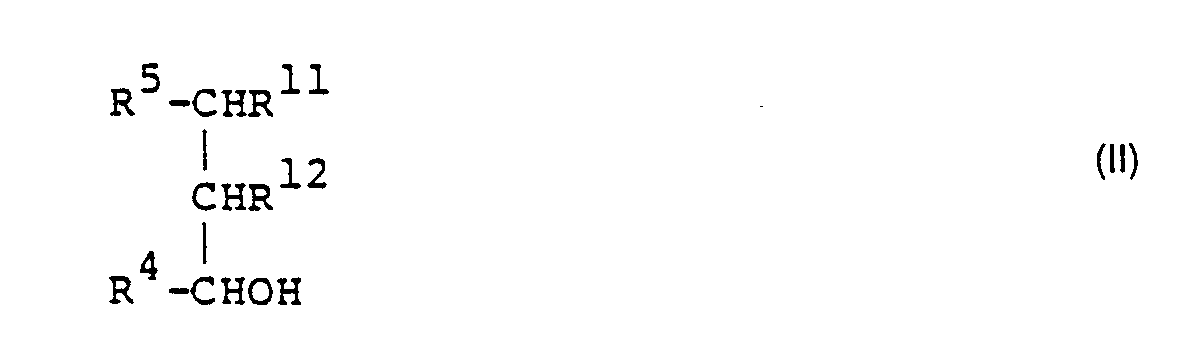
- R 4 and R 5 each are as stated below, in high yield by carrying out the esterification process concomitant with ketalisation or acetalisation of the polyols of formula lla.
- partial esterification of the polyols of formula Ila can be achieved, according to the process of this invention, by treating, under dehydrating conditions or other circumstances which favour ketalisation or acetalisation, a polyol of formula Ila with a carbonyl compound of formula III stated below, or a precursor thereof and a carboxylic acid or a carboxylic acid ester of formula IV stated below, in the presence of an agent which catalyses formation of acetals or ketals and an enzyme which catalyse esterification.
- Treatment of a polyol of formula Ila with a carbonyl compound of formula III may be carried out simultaneously with treatment of the polyol of formula Ila with a carboxylic acid or a carboxylic acid derivative of formula IV, or treatment with a carbonyl compound of formula III may be carried out alternating with or prior to treatment of the polyol of formula Ila with a carboxylic acid or a carboxylic acid derivative of formula IV.
- the process of this invention may, if desired, be carried out in a solvent, in a mixture of solvents or in the absence of solvents.
- the process of this invention is carried out in a solvent of a hydrocarbon, for example, pentane, hexane or benzene, or in the absence of a solvent.
- the agent catalyzing formation of acetal or ketal and applied in the process of this invention may be any agent known to catalyze formation of acetals and ketals from the corresponding carbonyl compound, for example, acids such as p-toluenesulfonic acid, methansulfonic acid, sulfuric acid, DowexTM-50 or a carboxylic acid, for example, adipic acid, or reagents such as boron trifluoride. Reagents other than free aldehydes and ketones may also be applied for acetal or ketal formation according to the process of this invention.
- acids such as p-toluenesulfonic acid, methansulfonic acid, sulfuric acid, DowexTM-50 or a carboxylic acid, for example, adipic acid
- reagents such as boron trifluoride.
- Reagents other than free aldehydes and ketones may also be applied for acetal or ketal formation according
- the enzyme catalyzing esterification and applied in the process of this invention may be an enzyme such as a lipase or an esterase or any other enzyme exhibiting an esterase activity.
- Enzymes applied according to the process of this invention may be used as the native enzymes, as immobilized enzymes, as chemically modified enzymes or as encapsulated enzymes.
- Dehydration applied according to the process of this invention may be achieved by any known means for dehydration.
- dehydration is achieved by azeotropic distillation of water by the solvent applied in the process of the invention.
- the dehydration can be achieved using an insoluble dehydrating agent, for example a molecular sieve.
- the process of this invention may be carried out by reacting an alcohol of the general formula Ilb wherein R 1 , R 2 , R 4 and R 5 each are as stated below, with a carboxylic acid or a carboxylic acid ester of formula IV in the presence of an enzyme catalyzing esterification. This process is carried out as described above for the esterification.
- Compounds of formula Ilb can by the process of this invention be used as starting material for preparing the desired esters of carbohydrates or monoglycerides of formula VII.
- Alcohols of formula Ilb can be prepared by reacting a compound of formula Ila with a carbonyl compound of formula III as stated above.
- the process of this invention may be carried out batch-wise or continuously at temperatures varying from ambient temperature to the boiling point of the applied solvent or, in the absence of solvents, at temperatures up to about 260 °C.
- the reaction time may be from a few hours to several days.
- the products of the reaction may be isolated in a manner known per se, optionally after removal of the applied reagents and solvents in a manner known per se.
- the esterification with the carboxylic acid or carboxylic acid ester of formula IV is carried out after all the hydroxy groups, apart from only one, are acetalized or ketalized and, thereafter, the hydroxy groups are, if desired, liberated.
- R 1 , R 2 and R 3 are the same or different each representing hydrogen, alkyl, lower alkoxy, aryl or aryl (lower alkyl) each of which may be substituted with one or more of the following groups : hydroxy, amino, carboxy, nitro, cyano, aryl, lower alkoxy, lower alkylthio or lower alkylen, preferably one or two substituents, R 4 and R 5 each represent hydrogen or R 4 together with R 5 represents straight or branched lower alkylen which may be substituted with one or more of the following groups : hydroxy, hydroxymethyl, amino, carboxy, nitro, cyano, aryl, lower alkoxy, lower alkylthio or lower alkylen, and which alkylen moiety may be interrupted by oxygen, preferably one or two substituents, or R 4 , and R 5 together with the moiety from formula I represents a carbohydrate moiety wherein - apart from one hydroxy group - the hydroxy groups, if desired
- R 4 and R 5 are each hydrogen. According to another embodiment of this invention, R 4 and R 5 together with the moiety from formula I represents a carbohydrate moiety wherein - apart from one hydroxy group - the hydroxy groups, if desired, are acetalized or ketalized.
- the carbonyl compound of formula III may be an alifatic ketone, for example, acetone.
- the carboxylic acid ester of formula IV may be a naturally occurring triglyceride.
- the group R 3 may be a fatty acid residue containing from 8 to 24 carbon atoms, and, preferably, the fatty acid is palmitic acid, oleic acid, lauric acid or pelargonic acid.
- the groups R 1 and R 2 are hydrogen and lower alkyl, for example, methyl, ethyl or propyl.
- the group R 3 is straight chain alkyl with 1-23 carbon atoms.
- the term « lower alkyl herein designates alkyl containing not more than 6 carbon atoms.
- aryl is phenyl.
- aryl (lower alkyl) is, preferably, phenyl (lower alkyl), most preferred benzyl and phenethyl.
- Lower alkoxy is, preferably, methoxy and ethoxy.
- Lower alkylthio is, preferably, methylthio and ethylthio.
- Lower alkylene is, preferably, methylene, ethylene and n-propylene.
- the group R 6 is preferably different from hydrogen.
- Examples of preferred alcohols of the general formula IIb are as follows : wherein R 1 and R 2 are as defined above, and R 13 and R 14 are the same or different each representing hydrogen, alkyl, lower alkoxy, aryl or aryl (lower alkyl) each of which may be substituted with one or more of the following groups : hydroxy, amino, carboxy, nitro, cyano, aryl, lower alkoxy, lower alkylthio or lower alkylen, preferably one or two substituents.
- R 1 , R 2 , R 13 and R 14 are the same and preferably methyl.
- alcohols of formula II wherein R 4 and R 5 together with the moiety from formula I does not represent a corbohydrate moiety, are preferred.
- a preferred embodiment of this invention relates to a process for preparing carboxylic acid esters of ketalized or acetalized monosaccharides or carboxylic acid esters of ketalized or acetalized glycerol, characterized by treating a ketalized or acetalized monosaccharide or glycerol with a carboxylic acid or carboxylic acid ester in the presence of an enzyme catalyzing esterification.
- a utility of the invention concerns preparation of monoglycerides of the general formula VII wherein R 3 is as defined above and R 4 and R 5 each is hydrogen.
- These compounds may readily be prepared according to the process of this invention, for example, by treating, as visualized in Scheme 1, below, the corresponding triglyceride of formula IVa with glycerol (formula Ilf) and the appropriate carbonyl compound of formula Illa in a solvent like hexane and in the presence of p-toluenesulfonic acid and a lipase at the boiling point of hexane which will serve both as a solvent for the reaction mixture and as a solvent for azeotropic removal of water generated in the course of the reaction.
- the ketalyzed monoglyceride of formula la can easily be isolated from the reaction mixture, for example by evaporation of the solvent after removal of the applied catalysts.
- Compounds of formula la may subsequently be converted into monoglycerides of formula Vlla, c.f. Scheme 1, for example, in a gentle acid medium, or it may be condensed with hydroxy acids or amino acids in a manner exemplified in Scheme 1 by conversion of compounds of formula la into the lactic acid ester of the free monoglycerides of formula IX. wherein R', R 2 and R 3 are as stated above.
- Another utility of the invention relates to preparation of fatty acid esters of carbohydrates having the above formula VII which may be prepared in a manner analogous to the exemplified preparation of monoglycerides.
- Compounds of this nature which may thus be prepared according to the process of this invention can be utilized, for example, as detergents and emulsifying agents.
- the reaction mixture was refluxed for one hour to remove water present in the reactants whereupon p-toluenesulfonic acid (1.25 g) and an immobilized Mucor miehei lipase prepared as described in Danish patent application No. 4167/84 and available from Novo Industri A/S (60 mg) were added to the reaction mixture.
- the reaction mixture was refluxed for 24 hours, an additional portion of lipase was added, and refluxing was finally continued for another 24 hours.
- the reaction mixture was analyzed by gas liquid chromatography (hereinafter GLC) using a CarbowaxTM column and it was shown to contain the monobutyric acid ester of glycerol diethyl ketal in a yield close to 90 % based on the quantity of the applied tributyrin.
- GLC gas liquid chromatography
- 1,2:5,6-di-O-isopropylidene-D-glucofuranose was dissolved in phosphate buffer (100 mM, pH 6.0) to provide a 3 % solution of the derivatised glucose.
- Methyl butyrate (3 equivalents) was added to 25 ml of this solution followed by the addition of 25 ml of hexane.
- 200 mg of a freeze dried powder of Candida lipase was added to the reaction mixture which was subsequently stirred vigorously at 30 °C.
- the progress of the reaction was monitored by HPLC using a UChrosorb-NH 2 column, acetonitrile/water as eluent and a refractive index detection system. After 24 hours the yield of 4-(1,2:5,6-di-O-isopropylidene-D-glucofuranosyl) butyrate was found to be 10 % and the product was isolated by chromatography on silica gel.
- 1,2:5,6-di-O-isopropylidene-D-glucofuranose was esterified with decanoic acid using decanoic acid methyl ester as acyl doner and the lipase isolated from a strain of Mucor miehei in a manner analogous to the one described in Example 2.
- the yield of 4-(1,2 5,6-di-O-isopropylidene-D-glucofuranosyl) decanoate was 5 %.
- 1,2:4,5-di-O-isopropylidene-D-fructopyranose was esterified in a manner analogous to the procedure described in Example 3.
- the yield of 3-(1,2:4,5-di-0-isopropylidene-D-fructopyranosyl) decanoate was 10%.
- 2,3:4,6-di-O-isopropylidene-D-sorbofuranose was esterified using methyl butyrate as acyl doner and hog pancreas lipase as the transacylating reagent in a manner analogous to the procedure described in Example 1.
- the yield of 1-(2,3 : 4,6-di-O-isopropylidene-D-sorbofuranosyl) butyrate was 8 %.
- 1,2:5,6-di-O-isopropylidene-D-glucofuranose was esterified in a two-phase system using toluene as the organic phase and a 4 M sodium chloride solution in phosphate buffer (100 mM pH 6) as the aqueous phase.
- the acyl doner applied was tri-sterin and the transacylating agent the immobilized Mucor miehei lipase. Otherwise, the synthesis was performed according to the procedure outlined in Example 1.
- the yield of 4-(1,2:5,6-di-O-isopropylidene-D-glucofuranosyl) stearate was 20 %.
- 1,2:5,6-di-O-isopropylidene-D-glucofuranose was dissolved in a mixture of hexane and benzene (3 : 7 (v/v), 50 mM) together with methyl decanoate (50 mM).
- the reaction mixture was stirred vigorously while a freeze dried powder of Nocardiopsis lipase was added to the reaction mixture. Stirring was continued for 18 hours whereupon the reaction mixture was analyzed as indicated in Example 1, the yield of 3-(1,2:5,6-di-O-isopropylidene-D-glucofuranyl) decanoate being 15 %.
- 1,2:5,6-di-O-isopropylidene-D-glucofuranose was esterified in a manner analogous to that described in Example 7 using toluene as solvent.
- the yield of 3-(1,2:5,6-diisopropylidene-D-glucofuranosyl) decanoate was 20 %.
- 1,2:5,6-di-O-isopropylidene-D-glucofuranose was esterified as indicated in Example 7 by using benzene as the organic solvent.
- the yield of 3-(1,2:5,6-diisopropylidene-D-glucofuranosyl) decanoate was 10 %.
- 1,2:5,6-di-O-isopropylidene-D-glucofuranose was esterified as indicated in Example 7 using hexane/acetone (9:1 1 (v/v)) as solvent.
- the yield of 3-(1,2:5,6-diisopropylidene-D-glucofuranosyl) decanoate was 15 %.
- 1,2:5,6-di-O-isopropylidene-D-glucofuranose was esterified with methyl palmitate in a manner analogous to that described in Example 2 the lipase from a species of Pseudomononas being used as catalyst.
- a yield of 3-(1,2:5,6-diisopropylidene-D-glucofuranosyl)palmitate of 15 % was achieved.
- Example 11 Application of freeze dried lipase from Nocardiopsis as described in Example 11 served to provide 3-(1,2:5,6-diisopropylidene-D-glucofuranosyl) palmitate in a yield of 25 %.
Landscapes
- Chemical & Material Sciences (AREA)
- Organic Chemistry (AREA)
- Life Sciences & Earth Sciences (AREA)
- Engineering & Computer Science (AREA)
- Wood Science & Technology (AREA)
- Zoology (AREA)
- Biochemistry (AREA)
- Biotechnology (AREA)
- General Health & Medical Sciences (AREA)
- Genetics & Genomics (AREA)
- Health & Medical Sciences (AREA)
- Chemical Kinetics & Catalysis (AREA)
- Microbiology (AREA)
- General Chemical & Material Sciences (AREA)
- Bioinformatics & Cheminformatics (AREA)
- General Engineering & Computer Science (AREA)
- Molecular Biology (AREA)
- Preparation Of Compounds By Using Micro-Organisms (AREA)
- Polyesters Or Polycarbonates (AREA)
- Organic Low-Molecular-Weight Compounds And Preparation Thereof (AREA)
Abstract
Description
- The present invention relates to a process for preparing acetal and ketal esters of polyols, and, optionally, monoesters of carbohydrates or monoglycerides.
- Formation of acetals and ketals is a well established process within the art of organic chemistry. It is thus well known that aldehydes and ketones may combine with simple alcohols under formation of acetals and ketals. Usually, these reactions are carried out in the presence of an acid catalyst and in a solvent which, by azeotropic distillation, will serve to remove the water generated in the course of the reaction thereby displacing the equilibrium towards acetal or ketal formation.
- Formation of carboxylic acid esters is, likewise, a well established organic chemical reaction. This process may be carried out by heating a mixture of a carboxylic acid and an alcohol or by contacting these reagents in the presence of a catalyst. Traditionally, an acid catalyst is often used in this context but, recently, it has been shown that enzymes such as esterases and lipases may be used as catalysts in ester synthesis.
- In contrast to the predictable course, the simplicity of the processes and the high yields which thus characterize formation of actetals, ketals and carboxylic acid esters of simple monofunctional alcohols, formation of such derivatives from polyols pose problems. However desirable, it is often difficult to prepare, for example, pure derivatives of polyols and carboxylic acids in a satisfactorily high yield. This difficulty has been clearly experienced during attempts to prepare monocarboxylic acid esters of glycerol - the so-called monoglycerides - which are currently used on a large scale as emulsifying agents. Attempted preparation of these compounds by acid or base catalyzed hydrolysis of readily available, naturally occurring triglycerides invariably provides mixtures of mono-, di- and triglycerides besides free carboxylic acids, glycerol and inorganic salts. This is the case also for even the best, currently applied industrial processes for preparation of monoglycerides which comprises glycerolysis of triglycerides in the presence of a strong base at temperatures above 200 °C. Invariably this process suffers from low yields and formation of by-products which necessitates extensive purification of the desired monoglycerides. Likewise, attempted use of enzymes, for example lipases or esterases, for preparation of monoglycerides suffer from formation of undesired by-products such as glycerol, free carboxylic acids and diglycerides. The origin of these difficulties lies in the polyfunctionality of the glycerol molecule which carries three hydroxyl groupings of comparable reactivity towards esterification, the consequence being that selective esterification of the triol is difficult to achieve as is selective cleavage of ester linkages in triglycerides. This is true, also, in regard to other polyols among which the carbohydrates constitute a particularly important group. It is a quite difficult task to achieve selective, partial esterification of these compounds by chemical as well as by enzymatic means. Moreover, the different hydrophilic and hydrophobic properties of polyols and acyl donors give rise to technical problems in the design of esterification processes. On one hand, polyols of interest are often soluble only in hydrophilic solvents such as water. On the other hand, the acyl donor is often soluble only in an organic solvent. The consequence of this is that the two species are brought in contact only with difficulty and thus normally react in only poor yields to the desired esters.
- Danish patent application No. 938/80 describes a process by which glycerol is reacted with a keton and the resulting ketal is esterified using an acid chloride of an acid. In French patent No. 2147091 a similar esterification using an acid instead of an acid chloride is described. A similar process is described in U.S. Patent-specification No. 3 686 238. In none of these publications the use of an enzyme is mentioned.
- One object of this invention is to provide a process whereby the above problems are overcome.
- A further object of this invention is to provide a process whereby the desired compounds are obtained in high yields.
- A still further object of this invention is to provide a process wherein the desired compounds are easily obtained.
- It has now surprisingly been found that it is possible to overcome the problems associated with hydrophilic properties as well as the polyfunctionality of polyols in a single process thereby making possible selective, partial esterification of polyols of the general formula Ila
-

- The agent catalyzing formation of acetal or ketal and applied in the process of this invention may be any agent known to catalyze formation of acetals and ketals from the corresponding carbonyl compound, for example, acids such as p-toluenesulfonic acid, methansulfonic acid, sulfuric acid, DowexTM-50 or a carboxylic acid, for example, adipic acid, or reagents such as boron trifluoride. Reagents other than free aldehydes and ketones may also be applied for acetal or ketal formation according to the process of this invention.
- The enzyme catalyzing esterification and applied in the process of this invention may be an enzyme such as a lipase or an esterase or any other enzyme exhibiting an esterase activity. Enzymes applied according to the process of this invention may be used as the native enzymes, as immobilized enzymes, as chemically modified enzymes or as encapsulated enzymes.
- It is very surprising that the enzymes can be used in the acid medium containing the carbonyl compound of formula III and the acetalized or ketalized compound of formula I stated below.
- Dehydration applied according to the process of this invention may be achieved by any known means for dehydration. Preferably, dehydration is achieved by azeotropic distillation of water by the solvent applied in the process of the invention. Also, the dehydration can be achieved using an insoluble dehydrating agent, for example a molecular sieve.
- Alternatively, the process of this invention may be carried out by reacting an alcohol of the general formula Ilb
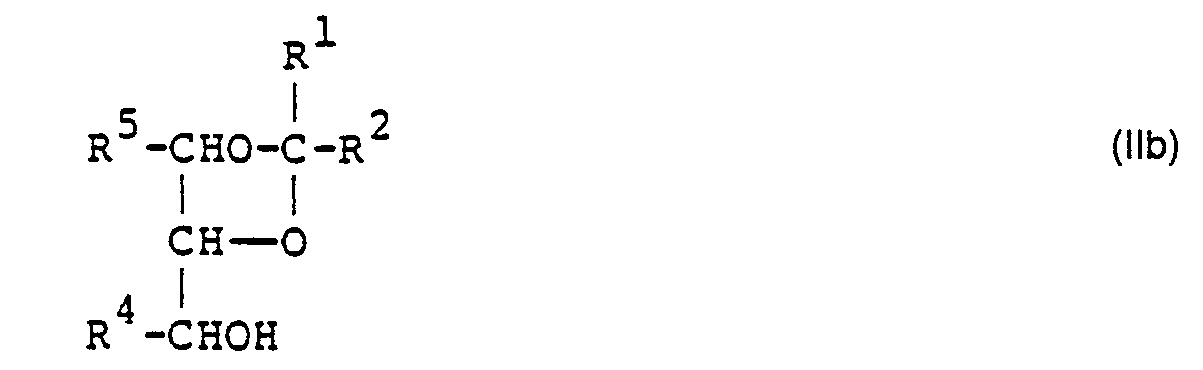
- The process of this invention may be carried out batch-wise or continuously at temperatures varying from ambient temperature to the boiling point of the applied solvent or, in the absence of solvents, at temperatures up to about 260 °C. The reaction time may be from a few hours to several days. The products of the reaction may be isolated in a manner known per se, optionally after removal of the applied reagents and solvents in a manner known per se.
- According to a preferred embodiment of this invention the esterification with the carboxylic acid or carboxylic acid ester of formula IV is carried out after all the hydroxy groups, apart from only one, are acetalized or ketalized and, thereafter, the hydroxy groups are, if desired, liberated.
- The above, two process variants can be combined in that they relate to a process for preparing compounds of the general formula I
-


- According to one embodiment of this invention, R4 and R5 are each hydrogen. According to another embodiment of this invention, R4 and R5 together with the moiety

- The carbonyl compound of formula III may be an alifatic ketone, for example, acetone. The carboxylic acid ester of formula IV may be a naturally occurring triglyceride.
- The group R3 may be a fatty acid residue containing from 8 to 24 carbon atoms, and, preferably, the fatty acid is palmitic acid, oleic acid, lauric acid or pelargonic acid.
- Preferably, the groups R1 and R2 are hydrogen and lower alkyl, for example, methyl, ethyl or propyl. Preferably, the group R3 is straight chain alkyl with 1-23 carbon atoms. The term « lower alkyl herein designates alkyl containing not more than 6 carbon atoms. Preferably, aryl is phenyl. Hence, aryl (lower alkyl) is, preferably, phenyl (lower alkyl), most preferred benzyl and phenethyl. Lower alkoxy is, preferably, methoxy and ethoxy. Lower alkylthio is, preferably, methylthio and ethylthio. Lower alkylene is, preferably, methylene, ethylene and n-propylene. The group R6 is preferably different from hydrogen.
- Examples of preferred alcohols of the general formula IIb are as follows :


- A preferred embodiment of this invention relates to a process for preparing carboxylic acid esters of ketalized or acetalized monosaccharides or carboxylic acid esters of ketalized or acetalized glycerol, characterized by treating a ketalized or acetalized monosaccharide or glycerol with a carboxylic acid or carboxylic acid ester in the presence of an enzyme catalyzing esterification.
- A utility of the invention concerns preparation of monoglycerides of the general formula VII


- Another utility of the invention relates to preparation of fatty acid esters of carbohydrates having the above formula VII which may be prepared in a manner analogous to the exemplified preparation of monoglycerides. Compounds of this nature which may thus be prepared according to the process of this invention can be utilized, for example, as detergents and emulsifying agents.
- The features disclosed in the foregoing description and in the following examples and claims may, both separately and in any combination thereof, be material for realising the invention in diverse forms thereof.
- The process of this invention is further illustrated by the following examples which, however, are not construed as limiting. The examples illustrate some preferred embodiments of the invention. The letters TM after a name indicate that it is a trade mark.
- Diethylketone (7 ml), tributyrin (19.6 ml) and glycerol diethylketal (21.2 g) were dissolved in hexane (75 ml) and transferred to a Dean-Stark apparatus for azeotropic removal of water.
- The reaction mixture was refluxed for one hour to remove water present in the reactants whereupon p-toluenesulfonic acid (1.25 g) and an immobilized Mucor miehei lipase prepared as described in Danish patent application No. 4167/84 and available from Novo Industri A/S (60 mg) were added to the reaction mixture. The reaction mixture was refluxed for 24 hours, an additional portion of lipase was added, and refluxing was finally continued for another 24 hours. The reaction mixture was analyzed by gas liquid chromatography (hereinafter GLC) using a Carbowax™ column and it was shown to contain the monobutyric acid ester of glycerol diethyl ketal in a yield close to 90 % based on the quantity of the applied tributyrin.
- 1,2:5,6-di-O-isopropylidene-D-glucofuranose was dissolved in phosphate buffer (100 mM, pH 6.0) to provide a 3 % solution of the derivatised glucose. Methyl butyrate (3 equivalents) was added to 25 ml of this solution followed by the addition of 25 ml of hexane. Finally 200 mg of a freeze dried powder of Candida lipase was added to the reaction mixture which was subsequently stirred vigorously at 30 °C. The progress of the reaction was monitored by HPLC using a UChrosorb-NH2 column, acetonitrile/water as eluent and a refractive index detection system. After 24 hours the yield of 4-(1,2:5,6-di-O-isopropylidene-D-glucofuranosyl) butyrate was found to be 10 % and the product was isolated by chromatography on silica gel.
- 1,2:5,6-di-O-isopropylidene-D-glucofuranose was esterified with decanoic acid using decanoic acid methyl ester as acyl doner and the lipase isolated from a strain of Mucor miehei in a manner analogous to the one described in Example 2. The yield of 4-(1,2 5,6-di-O-isopropylidene-D-glucofuranosyl) decanoate was 5 %.
- 1,2:4,5-di-O-isopropylidene-D-fructopyranose was esterified in a manner analogous to the procedure described in Example 3. The yield of 3-(1,2:4,5-di-0-isopropylidene-D-fructopyranosyl) decanoate was 10%.
- 2,3:4,6-di-O-isopropylidene-D-sorbofuranose was esterified using methyl butyrate as acyl doner and hog pancreas lipase as the transacylating reagent in a manner analogous to the procedure described in Example 1. The yield of 1-(2,3 : 4,6-di-O-isopropylidene-D-sorbofuranosyl) butyrate was 8 %.
- 1,2:5,6-di-O-isopropylidene-D-glucofuranose was esterified in a two-phase system using toluene as the organic phase and a 4 M sodium chloride solution in phosphate buffer (100 mM pH 6) as the aqueous phase. The acyl doner applied was tri-sterin and the transacylating agent the immobilized Mucor miehei lipase. Otherwise, the synthesis was performed according to the procedure outlined in Example 1. The yield of 4-(1,2:5,6-di-O-isopropylidene-D-glucofuranosyl) stearate was 20 %.
- 1,2:5,6-di-O-isopropylidene-D-glucofuranose was dissolved in a mixture of hexane and benzene (3 : 7 (v/v), 50 mM) together with methyl decanoate (50 mM). The reaction mixture was stirred vigorously while a freeze dried powder of Nocardiopsis lipase was added to the reaction mixture. Stirring was continued for 18 hours whereupon the reaction mixture was analyzed as indicated in Example 1, the yield of 3-(1,2:5,6-di-O-isopropylidene-D-glucofuranyl) decanoate being 15 %.
- 1,2:5,6-di-O-isopropylidene-D-glucofuranose was esterified in a manner analogous to that described in Example 7 using toluene as solvent. The yield of 3-(1,2:5,6-diisopropylidene-D-glucofuranosyl) decanoate was 20 %.
- 1,2:5,6-di-O-isopropylidene-D-glucofuranose was esterified as indicated in Example 7 by using benzene as the organic solvent. The yield of 3-(1,2:5,6-diisopropylidene-D-glucofuranosyl) decanoate was 10 %.
- 1,2:5,6-di-O-isopropylidene-D-glucofuranose was esterified as indicated in Example 7 using hexane/acetone (9:1 1 (v/v)) as solvent. The yield of 3-(1,2:5,6-diisopropylidene-D-glucofuranosyl) decanoate was 15 %.
- 1,2:5,6-di-O-isopropylidene-D-glucofuranose was esterified with methyl palmitate in a manner analogous to that described in Example 2 the lipase from a species of Pseudomononas being used as catalyst. A yield of 3-(1,2:5,6-diisopropylidene-D-glucofuranosyl)palmitate of 15 % was achieved.
- Application of freeze dried lipase from Nocardiopsis as described in Example 11 served to provide 3-(1,2:5,6-diisopropylidene-D-glucofuranosyl) palmitate in a yield of 25 %.
- Application of a freeze dried powder of Serratia lipase analogously to the manner described in Example 11 provided 3-(1,2 :5,6-diisopropylidene-D-glucofuranosyl) palmitate in a yield of 15 %.
- Application of a freeze dried powder of Geotricium lipase analogously as described in Example 11 served to provide 3-(1,2:5,6-diisopropylidene-D-glucofuranosyl) palmitate in a yield of 10 %.
- The formulae Ilc, lid and lie mentioned above are represented on the following page.


Claims (7)




Priority Applications (1)
| Application Number | Priority Date | Filing Date | Title |
|---|---|---|---|
| AT86901364T ATE45362T1 (en) | 1985-02-27 | 1986-02-27 | ESTERIFICATION PROCESS. |
Applications Claiming Priority (4)
| Application Number | Priority Date | Filing Date | Title |
|---|---|---|---|
| DK87785A DK87785A (en) | 1985-02-27 | 1985-02-27 | esterification |
| DK877/85 | 1985-02-27 | ||
| DK514785A DK157308C (en) | 1985-02-27 | 1985-11-07 | PROCEDURE FOR THE PREPARATION OF ACETAL OR CATAL ESTERS OF POLYOLES OR MONOESTERS OF MONO OR DISACCHARIDES OR MONOGLYCERIDES |
| DK5147/85 | 1985-11-07 |
Publications (2)
| Publication Number | Publication Date |
|---|---|
| EP0215038A1 EP0215038A1 (en) | 1987-03-25 |
| EP0215038B1 true EP0215038B1 (en) | 1989-08-09 |
Family
ID=26064825
Family Applications (1)
| Application Number | Title | Priority Date | Filing Date |
|---|---|---|---|
| EP19860901364 Expired EP0215038B1 (en) | 1985-02-27 | 1986-02-27 | Process for esterification |
Country Status (5)
| Country | Link |
|---|---|
| EP (1) | EP0215038B1 (en) |
| AU (1) | AU601678B2 (en) |
| DE (1) | DE3664915D1 (en) |
| DK (1) | DK157308C (en) |
| WO (1) | WO1986005186A1 (en) |
Families Citing this family (8)
| Publication number | Priority date | Publication date | Assignee | Title |
|---|---|---|---|---|
| DK438887D0 (en) * | 1987-08-21 | 1987-08-21 | Novo Industri As | PROCEDURE FOR THE PREPARATION OF CHEMICAL COMPOUNDS |
| FR2621039B1 (en) * | 1987-09-25 | 1990-12-07 | Univ Picardie | NON-TOXIC N-BUTYRIC ACID DERIVATIVES WITH DELAYED THERAPEUTIC ACTIONS |
| FR2633929B2 (en) * | 1987-09-25 | 1995-05-24 | Picardie Universite | NON-TOXIC N-BUTYRIC ACID DERIVATIVES WITH DELAYED THERAPEUTIC ACTIONS |
| GB8806691D0 (en) * | 1988-03-21 | 1988-04-20 | Cerestar Holding Bv | Surface active compounds & process for their preparation |
| DK0383405T3 (en) * | 1989-02-17 | 1993-12-06 | Unichema Chemie Bv | ester Preparation |
| WO1997048817A1 (en) | 1996-06-18 | 1997-12-24 | Unilever N.V. | Enzymatic esterification process |
| NL1005947C2 (en) * | 1997-05-01 | 1998-11-03 | Inst Voor Agrotech Onderzoek | Method for the esterification of carbohydrates. |
| US20240225981A1 (en) * | 2023-01-10 | 2024-07-11 | Brasil Bio Fuels S.A | Synthesized Molecule of Solketal Esters from Palm Kit Oil and Glycerin for Cosmetic and Agricultural Formulations |
Family Cites Families (9)
| Publication number | Priority date | Publication date | Assignee | Title |
|---|---|---|---|---|
| DE1183895B (en) * | 1959-07-24 | 1964-12-23 | Spiess C F & Sohn | Process for the preparation of esters of the condensation products of monosaccharides with ketones |
| DE1200276B (en) * | 1959-10-08 | 1965-09-09 | Bayer Ag | Process for the preparation of carboxylic acid esters of non-reducing sugars |
| DE1543495A1 (en) * | 1966-08-31 | 1970-04-16 | Huels Chemische Werke Ag | Process for the preparation of cycloacetal and cycloketal esters |
| US3686238A (en) * | 1970-01-19 | 1972-08-22 | Syntex Corp | Glycerol esterified with 2-naphthyl-acetic acids and fatty acids |
| JPS5048186A (en) * | 1973-08-29 | 1975-04-30 | ||
| GB1589916A (en) * | 1976-11-16 | 1981-05-20 | Prodotti Antibiotici Spa | Glucofuranose derivatives |
| IL59407A (en) * | 1979-03-06 | 1983-12-30 | Sanofi Sa | Di-n-propylacetic acid diesters of glycerol,their preparation and pharmaceutical compositions containing them |
| DE3108927A1 (en) * | 1981-03-10 | 1982-09-23 | Haarmann & Reimer Gmbh, 3450 Holzminden | METHOD FOR THE ENZYMATIC PRODUCTION OF ESTERS AND LACONS |
| DE3468433D1 (en) * | 1983-05-19 | 1988-02-11 | Asahi Denka Kogyo Kk | Reaction method for transesterifying fats and oils |
-
1985
- 1985-11-07 DK DK514785A patent/DK157308C/en not_active IP Right Cessation
-
1986
- 1986-02-27 EP EP19860901364 patent/EP0215038B1/en not_active Expired
- 1986-02-27 AU AU55457/86A patent/AU601678B2/en not_active Ceased
- 1986-02-27 DE DE8686901364T patent/DE3664915D1/en not_active Expired
- 1986-02-27 WO PCT/DK1986/000017 patent/WO1986005186A1/en not_active Ceased
Also Published As
| Publication number | Publication date |
|---|---|
| DK514785A (en) | 1986-08-28 |
| DK157308B (en) | 1989-12-04 |
| WO1986005186A1 (en) | 1986-09-12 |
| DK514785D0 (en) | 1985-11-07 |
| AU601678B2 (en) | 1990-09-20 |
| EP0215038A1 (en) | 1987-03-25 |
| DK157308C (en) | 1990-05-07 |
| DE3664915D1 (en) | 1989-09-14 |
| AU5545786A (en) | 1986-09-24 |
Similar Documents
| Publication | Publication Date | Title |
|---|---|---|
| Yan et al. | Lipase-catalyzed solid-phase synthesis of sugar fatty acid esters: Removal of byproducts by azeotropic distillation | |
| Leitgeb et al. | The influence of water on the synthesis of n‐butyl oleate by immobilizedMucor miehei lipase | |
| De Castro et al. | Evaluation of different approaches for lipase catalysed synthesis of citronellyl acetate | |
| US4959459A (en) | Surface active compounds and a process for their preparation | |
| KR970011305B1 (en) | Esters of glycosides and a process for enzymatic preparation thereof | |
| WO1986005186A1 (en) | Process for esterification | |
| Oguntimein et al. | Synthesis of geraniol esters in a solvent-free system catalysed by Candida antarctica lipase | |
| CA2258614C (en) | Enzymatic esterification process | |
| US5443971A (en) | Pyranones | |
| EP1404844B1 (en) | Process for the preparation of 2,4-dideoxyhexoses and 2,4,6-trideoxyhexoses | |
| EP0507323A2 (en) | Process for preparing fatty acid esters of saccharides | |
| Popov et al. | Coenzyme A-and NADH-dependent esterase activity of methylmalonate semialdehyde dehydrogenase | |
| EP0945516B1 (en) | Process for the selective preparation of partially acylated derivatives of monosaccharides and polyols | |
| US6268187B1 (en) | Process for preparing lysophospholipid using enzyme | |
| JP4644433B2 (en) | Method for producing novel D-allose fatty acid ester | |
| JPS62502375A (en) | Esterification method | |
| JP2886628B2 (en) | Method for producing monoacylglycerophospholipid | |
| JP5358802B2 (en) | Process for producing novel rare sugar fatty acid diesters | |
| JPH0528114B2 (en) | ||
| JPH05176784A (en) | Method for esterification or transesterification of sugars and fatty acids | |
| KALO | Department of Applied Chemistry and Microbiology | |
| EP0463680A1 (en) | Method for preparing acetate esters of diols and polyols using corynebacterium oxydans in substantially aqueous media | |
| JPH05208968A (en) | Production of ascorbic acid fatty ester | |
| JPH089987A (en) | Method for producing sugar fatty acid ester | |
| HK1010563B (en) | Process for preparing intermediates for the synthesis of antifungal agents |
Legal Events
| Date | Code | Title | Description |
|---|---|---|---|
| PUAI | Public reference made under article 153(3) epc to a published international application that has entered the european phase |
Free format text: ORIGINAL CODE: 0009012 |
|
| AK | Designated contracting states |
Kind code of ref document: A1 Designated state(s): AT BE CH DE FR GB IT LI LU NL SE |
|
| 17P | Request for examination filed |
Effective date: 19870218 |
|
| 17Q | First examination report despatched |
Effective date: 19880201 |
|
| GRAA | (expected) grant |
Free format text: ORIGINAL CODE: 0009210 |
|
| AK | Designated contracting states |
Kind code of ref document: B1 Designated state(s): AT BE CH DE FR GB IT LI LU NL SE |
|
| REF | Corresponds to: |
Ref document number: 45362 Country of ref document: AT Date of ref document: 19890815 Kind code of ref document: T |
|
| REF | Corresponds to: |
Ref document number: 3664915 Country of ref document: DE Date of ref document: 19890914 |
|
| ITF | It: translation for a ep patent filed | ||
| RAP2 | Party data changed (patent owner data changed or rights of a patent transferred) |
Owner name: NOVO-NORDISK A/S |
|
| ET | Fr: translation filed | ||
| NLT2 | Nl: modifications (of names), taken from the european patent patent bulletin |
Owner name: NOVO-NORDISK A/S TE BAGSVAERD, DENEMARKEN. |
|
| PLBE | No opposition filed within time limit |
Free format text: ORIGINAL CODE: 0009261 |
|
| STAA | Information on the status of an ep patent application or granted ep patent |
Free format text: STATUS: NO OPPOSITION FILED WITHIN TIME LIMIT |
|
| 26N | No opposition filed | ||
| ITTA | It: last paid annual fee | ||
| EPTA | Lu: last paid annual fee | ||
| EAL | Se: european patent in force in sweden |
Ref document number: 86901364.9 |
|
| PGFP | Annual fee paid to national office [announced via postgrant information from national office to epo] |
Ref country code: FR Payment date: 19950210 Year of fee payment: 10 |
|
| PGFP | Annual fee paid to national office [announced via postgrant information from national office to epo] |
Ref country code: AT Payment date: 19950214 Year of fee payment: 10 |
|
| PGFP | Annual fee paid to national office [announced via postgrant information from national office to epo] |
Ref country code: SE Payment date: 19950215 Year of fee payment: 10 |
|
| PGFP | Annual fee paid to national office [announced via postgrant information from national office to epo] |
Ref country code: GB Payment date: 19950217 Year of fee payment: 10 |
|
| PGFP | Annual fee paid to national office [announced via postgrant information from national office to epo] |
Ref country code: DE Payment date: 19950222 Year of fee payment: 10 |
|
| PGFP | Annual fee paid to national office [announced via postgrant information from national office to epo] |
Ref country code: CH Payment date: 19950223 Year of fee payment: 10 |
|
| PGFP | Annual fee paid to national office [announced via postgrant information from national office to epo] |
Ref country code: NL Payment date: 19950228 Year of fee payment: 10 |
|
| PGFP | Annual fee paid to national office [announced via postgrant information from national office to epo] |
Ref country code: LU Payment date: 19950301 Year of fee payment: 10 |
|
| PGFP | Annual fee paid to national office [announced via postgrant information from national office to epo] |
Ref country code: BE Payment date: 19950410 Year of fee payment: 10 |
|
| PG25 | Lapsed in a contracting state [announced via postgrant information from national office to epo] |
Ref country code: LU Free format text: LAPSE BECAUSE OF NON-PAYMENT OF DUE FEES Effective date: 19960227 Ref country code: GB Effective date: 19960227 Ref country code: AT Effective date: 19960227 |
|
| PG25 | Lapsed in a contracting state [announced via postgrant information from national office to epo] |
Ref country code: SE Effective date: 19960228 Ref country code: LI Free format text: LAPSE BECAUSE OF NON-PAYMENT OF DUE FEES Effective date: 19960228 Ref country code: CH Free format text: LAPSE BECAUSE OF NON-PAYMENT OF DUE FEES Effective date: 19960228 Ref country code: BE Effective date: 19960228 |
|
| BERE | Be: lapsed |
Owner name: NOVO-NORDISK A/S Effective date: 19960228 |
|
| PG25 | Lapsed in a contracting state [announced via postgrant information from national office to epo] |
Ref country code: NL Effective date: 19960901 |
|
| REG | Reference to a national code |
Ref country code: CH Ref legal event code: PL |
|
| GBPC | Gb: european patent ceased through non-payment of renewal fee |
Effective date: 19960227 |
|
| PG25 | Lapsed in a contracting state [announced via postgrant information from national office to epo] |
Ref country code: FR Effective date: 19961031 |
|
| NLV4 | Nl: lapsed or anulled due to non-payment of the annual fee |
Effective date: 19960901 |
|
| PG25 | Lapsed in a contracting state [announced via postgrant information from national office to epo] |
Ref country code: DE Effective date: 19961101 |
|
| REG | Reference to a national code |
Ref country code: FR Ref legal event code: ST |
|
| PG25 | Lapsed in a contracting state [announced via postgrant information from national office to epo] |
Ref country code: IT Free format text: LAPSE BECAUSE OF NON-PAYMENT OF DUE FEES;WARNING: LAPSES OF ITALIAN PATENTS WITH EFFECTIVE DATE BEFORE 2007 MAY HAVE OCCURRED AT ANY TIME BEFORE 2007. THE CORRECT EFFECTIVE DATE MAY BE DIFFERENT FROM THE ONE RECORDED. Effective date: 20050227 |