EP0212894B1 - Removal of iron fouling in cooling water systems - Google Patents
Removal of iron fouling in cooling water systems Download PDFInfo
- Publication number
- EP0212894B1 EP0212894B1 EP86305958A EP86305958A EP0212894B1 EP 0212894 B1 EP0212894 B1 EP 0212894B1 EP 86305958 A EP86305958 A EP 86305958A EP 86305958 A EP86305958 A EP 86305958A EP 0212894 B1 EP0212894 B1 EP 0212894B1
- Authority
- EP
- European Patent Office
- Prior art keywords
- compound
- sodium
- iron
- water
- formula
- Prior art date
- Legal status (The legal status is an assumption and is not a legal conclusion. Google has not performed a legal analysis and makes no representation as to the accuracy of the status listed.)
- Expired
Links
- XEEYBQQBJWHFJM-UHFFFAOYSA-N Iron Chemical compound [Fe] XEEYBQQBJWHFJM-UHFFFAOYSA-N 0.000 title claims description 96
- 229910052742 iron Inorganic materials 0.000 title claims description 45
- 239000000498 cooling water Substances 0.000 title claims description 22
- 150000001875 compounds Chemical class 0.000 claims description 36
- XLYOFNOQVPJJNP-UHFFFAOYSA-N water Substances O XLYOFNOQVPJJNP-UHFFFAOYSA-N 0.000 claims description 31
- 238000004140 cleaning Methods 0.000 claims description 20
- 239000000243 solution Substances 0.000 claims description 20
- 239000011734 sodium Substances 0.000 claims description 17
- 229910052708 sodium Inorganic materials 0.000 claims description 17
- DGAQECJNVWCQMB-PUAWFVPOSA-M Ilexoside XXIX Chemical compound C[C@@H]1CC[C@@]2(CC[C@@]3(C(=CC[C@H]4[C@]3(CC[C@@H]5[C@@]4(CC[C@@H](C5(C)C)OS(=O)(=O)[O-])C)C)[C@@H]2[C@]1(C)O)C)C(=O)O[C@H]6[C@@H]([C@H]([C@@H]([C@H](O6)CO)O)O)O.[Na+] DGAQECJNVWCQMB-PUAWFVPOSA-M 0.000 claims description 16
- 239000000203 mixture Substances 0.000 claims description 16
- 238000012546 transfer Methods 0.000 claims description 16
- 238000000034 method Methods 0.000 claims description 15
- 229910052700 potassium Inorganic materials 0.000 claims description 15
- ZLMJMSJWJFRBEC-UHFFFAOYSA-N Potassium Chemical compound [K] ZLMJMSJWJFRBEC-UHFFFAOYSA-N 0.000 claims description 14
- 239000011591 potassium Substances 0.000 claims description 14
- -1 2-hydroxy-4-methyl phenyl Chemical group 0.000 claims description 11
- 239000001257 hydrogen Substances 0.000 claims description 11
- 229910052739 hydrogen Inorganic materials 0.000 claims description 11
- 159000000000 sodium salts Chemical class 0.000 claims description 11
- DHMQDGOQFOQNFH-UHFFFAOYSA-N Glycine Chemical compound NCC(O)=O DHMQDGOQFOQNFH-UHFFFAOYSA-N 0.000 claims description 10
- QPCDCPDFJACHGM-UHFFFAOYSA-N N,N-bis{2-[bis(carboxymethyl)amino]ethyl}glycine Chemical compound OC(=O)CN(CC(O)=O)CCN(CC(=O)O)CCN(CC(O)=O)CC(O)=O QPCDCPDFJACHGM-UHFFFAOYSA-N 0.000 claims description 9
- 239000007864 aqueous solution Substances 0.000 claims description 8
- 150000002431 hydrogen Chemical class 0.000 claims description 8
- OYPRJOBELJOOCE-UHFFFAOYSA-N Calcium Chemical compound [Ca] OYPRJOBELJOOCE-UHFFFAOYSA-N 0.000 claims description 7
- 239000011575 calcium Substances 0.000 claims description 7
- 229910052791 calcium Inorganic materials 0.000 claims description 7
- URDCARMUOSMFFI-UHFFFAOYSA-N 2-[2-[bis(carboxymethyl)amino]ethyl-(2-hydroxyethyl)amino]acetic acid Chemical compound OCCN(CC(O)=O)CCN(CC(O)=O)CC(O)=O URDCARMUOSMFFI-UHFFFAOYSA-N 0.000 claims description 6
- 239000004471 Glycine Substances 0.000 claims description 5
- 150000003839 salts Chemical class 0.000 claims description 5
- 125000006290 2-hydroxybenzyl group Chemical group [H]OC1=C(C([H])=C([H])C([H])=C1[H])C([H])([H])* 0.000 claims description 4
- 125000002496 methyl group Chemical group [H]C([H])([H])* 0.000 claims description 4
- QGZKDVFQNNGYKY-UHFFFAOYSA-O Ammonium Chemical compound [NH4+] QGZKDVFQNNGYKY-UHFFFAOYSA-O 0.000 claims description 3
- UFHFLCQGNIYNRP-UHFFFAOYSA-N Hydrogen Chemical compound [H][H] UFHFLCQGNIYNRP-UHFFFAOYSA-N 0.000 claims description 3
- XAEFZNCEHLXOMS-UHFFFAOYSA-M potassium benzoate Chemical compound [K+].[O-]C(=O)C1=CC=CC=C1 XAEFZNCEHLXOMS-UHFFFAOYSA-M 0.000 claims description 3
- 125000001495 ethyl group Chemical group [H]C([H])([H])C([H])([H])* 0.000 claims description 2
- 150000002506 iron compounds Chemical class 0.000 claims description 2
- 229910052757 nitrogen Inorganic materials 0.000 claims description 2
- 229960003330 pentetic acid Drugs 0.000 claims description 2
- WDJHALXBUFZDSR-UHFFFAOYSA-N acetoacetic acid Chemical compound CC(=O)CC(O)=O WDJHALXBUFZDSR-UHFFFAOYSA-N 0.000 claims 1
- 238000001816 cooling Methods 0.000 description 12
- 238000011282 treatment Methods 0.000 description 12
- 230000007797 corrosion Effects 0.000 description 9
- 238000005260 corrosion Methods 0.000 description 9
- 239000002253 acid Substances 0.000 description 8
- 239000012141 concentrate Substances 0.000 description 8
- 229910052751 metal Inorganic materials 0.000 description 8
- 239000002184 metal Substances 0.000 description 8
- ZYOINXVOXQFEIP-UHFFFAOYSA-K trisodium;2-[bis[(2-hydroxy-5-sulfonatophenyl)methyl]amino]acetate Chemical compound [Na+].[Na+].[Na+].OC1=CC=C(S([O-])(=O)=O)C=C1CN(CC([O-])=O)CC1=CC(S([O-])(=O)=O)=CC=C1O ZYOINXVOXQFEIP-UHFFFAOYSA-K 0.000 description 8
- HEMHJVSKTPXQMS-UHFFFAOYSA-M Sodium hydroxide Chemical compound [OH-].[Na+] HEMHJVSKTPXQMS-UHFFFAOYSA-M 0.000 description 6
- KRKNYBCHXYNGOX-UHFFFAOYSA-N citric acid Chemical compound OC(=O)CC(O)(C(O)=O)CC(O)=O KRKNYBCHXYNGOX-UHFFFAOYSA-N 0.000 description 6
- SFJPGSCMZIUEDJ-UHFFFAOYSA-N 2-[2-[[carboxy-(2-hydroxy-4-methylphenyl)methyl]amino]ethylamino]-2-(2-hydroxy-4-methylphenyl)acetic acid Chemical compound OC1=CC(C)=CC=C1C(C(O)=O)NCCNC(C(O)=O)C1=CC=C(C)C=C1O SFJPGSCMZIUEDJ-UHFFFAOYSA-N 0.000 description 5
- CWYNVVGOOAEACU-UHFFFAOYSA-N Fe2+ Chemical compound [Fe+2] CWYNVVGOOAEACU-UHFFFAOYSA-N 0.000 description 5
- UQSXHKLRYXJYBZ-UHFFFAOYSA-N Iron oxide Chemical compound [Fe]=O UQSXHKLRYXJYBZ-UHFFFAOYSA-N 0.000 description 5
- 239000002826 coolant Substances 0.000 description 5
- KCXVZYZYPLLWCC-UHFFFAOYSA-N EDTA Chemical compound OC(=O)CN(CC(O)=O)CCN(CC(O)=O)CC(O)=O KCXVZYZYPLLWCC-UHFFFAOYSA-N 0.000 description 4
- 125000002947 alkylene group Chemical group 0.000 description 4
- 125000003277 amino group Chemical group 0.000 description 4
- 229910000019 calcium carbonate Inorganic materials 0.000 description 4
- 239000002270 dispersing agent Substances 0.000 description 4
- 238000012360 testing method Methods 0.000 description 4
- LYCAIKOWRPUZTN-UHFFFAOYSA-N Ethylene glycol Chemical compound OCCO LYCAIKOWRPUZTN-UHFFFAOYSA-N 0.000 description 3
- 150000007513 acids Chemical class 0.000 description 3
- 235000013980 iron oxide Nutrition 0.000 description 3
- 239000000463 material Substances 0.000 description 3
- YXIWHUQXZSMYRE-UHFFFAOYSA-N 1,3-benzothiazole-2-thiol Chemical compound C1=CC=C2SC(S)=NC2=C1 YXIWHUQXZSMYRE-UHFFFAOYSA-N 0.000 description 2
- KMBSSXSNDSJXCG-UHFFFAOYSA-N 1-[2-(2-hydroxyundecylamino)ethylamino]undecan-2-ol Chemical compound CCCCCCCCCC(O)CNCCNCC(O)CCCCCCCCC KMBSSXSNDSJXCG-UHFFFAOYSA-N 0.000 description 2
- IJGRMHOSHXDMSA-UHFFFAOYSA-N Atomic nitrogen Chemical compound N#N IJGRMHOSHXDMSA-UHFFFAOYSA-N 0.000 description 2
- VTYYLEPIZMXCLO-UHFFFAOYSA-L Calcium carbonate Chemical compound [Ca+2].[O-]C([O-])=O VTYYLEPIZMXCLO-UHFFFAOYSA-L 0.000 description 2
- VEXZGXHMUGYJMC-UHFFFAOYSA-N Hydrochloric acid Chemical compound Cl VEXZGXHMUGYJMC-UHFFFAOYSA-N 0.000 description 2
- FYYHWMGAXLPEAU-UHFFFAOYSA-N Magnesium Chemical compound [Mg] FYYHWMGAXLPEAU-UHFFFAOYSA-N 0.000 description 2
- 229910000831 Steel Inorganic materials 0.000 description 2
- 125000003178 carboxy group Chemical group [H]OC(*)=O 0.000 description 2
- 238000002485 combustion reaction Methods 0.000 description 2
- 229920001577 copolymer Polymers 0.000 description 2
- 239000012530 fluid Substances 0.000 description 2
- 238000011010 flushing procedure Methods 0.000 description 2
- 239000008233 hard water Substances 0.000 description 2
- 239000003112 inhibitor Substances 0.000 description 2
- 239000011777 magnesium Substances 0.000 description 2
- 229910052749 magnesium Inorganic materials 0.000 description 2
- 229920000768 polyamine Polymers 0.000 description 2
- 238000004064 recycling Methods 0.000 description 2
- 239000010959 steel Substances 0.000 description 2
- 239000000126 substance Substances 0.000 description 2
- 125000001424 substituent group Chemical group 0.000 description 2
- QDAYZTZGLPEDOB-UHFFFAOYSA-N 2-(2-hydroxyanilino)acetic acid Chemical compound OC(=O)CNC1=CC=CC=C1O QDAYZTZGLPEDOB-UHFFFAOYSA-N 0.000 description 1
- 229920000536 2-Acrylamido-2-methylpropane sulfonic acid Polymers 0.000 description 1
- XHZPRMZZQOIPDS-UHFFFAOYSA-N 2-Methyl-2-[(1-oxo-2-propenyl)amino]-1-propanesulfonic acid Chemical compound OS(=O)(=O)CC(C)(C)NC(=O)C=C XHZPRMZZQOIPDS-UHFFFAOYSA-N 0.000 description 1
- CMGDVUCDZOBDNL-UHFFFAOYSA-N 4-methyl-2h-benzotriazole Chemical compound CC1=CC=CC2=NNN=C12 CMGDVUCDZOBDNL-UHFFFAOYSA-N 0.000 description 1
- ZSSDZVXLTYKFCD-UHFFFAOYSA-N C1C2(C3)C1CCC3C2 Chemical compound C1C2(C3)C1CCC3C2 ZSSDZVXLTYKFCD-UHFFFAOYSA-N 0.000 description 1
- 0 CC(*)(C=CCC1CN(C)C)C=C1O Chemical compound CC(*)(C=CCC1CN(C)C)C=C1O 0.000 description 1
- 229910021578 Iron(III) chloride Inorganic materials 0.000 description 1
- QNAYBMKLOCPYGJ-REOHCLBHSA-N L-alanine Chemical compound C[C@H](N)C(O)=O QNAYBMKLOCPYGJ-REOHCLBHSA-N 0.000 description 1
- CERQOIWHTDAKMF-UHFFFAOYSA-N Methacrylic acid Chemical compound CC(=C)C(O)=O CERQOIWHTDAKMF-UHFFFAOYSA-N 0.000 description 1
- 229910019142 PO4 Inorganic materials 0.000 description 1
- 206010039509 Scab Diseases 0.000 description 1
- 238000010306 acid treatment Methods 0.000 description 1
- 239000000654 additive Substances 0.000 description 1
- 235000004279 alanine Nutrition 0.000 description 1
- 150000001412 amines Chemical class 0.000 description 1
- 125000000129 anionic group Chemical group 0.000 description 1
- 230000003466 anti-cipated effect Effects 0.000 description 1
- QVGXLLKOCUKJST-UHFFFAOYSA-N atomic oxygen Chemical compound [O] QVGXLLKOCUKJST-UHFFFAOYSA-N 0.000 description 1
- QRUDEWIWKLJBPS-UHFFFAOYSA-N benzotriazole Chemical compound C1=CC=C2N[N][N]C2=C1 QRUDEWIWKLJBPS-UHFFFAOYSA-N 0.000 description 1
- 239000012964 benzotriazole Substances 0.000 description 1
- 238000009835 boiling Methods 0.000 description 1
- 239000002738 chelating agent Substances 0.000 description 1
- 239000003795 chemical substances by application Substances 0.000 description 1
- 239000008367 deionised water Substances 0.000 description 1
- 229910021641 deionized water Inorganic materials 0.000 description 1
- 230000008021 deposition Effects 0.000 description 1
- 238000013461 design Methods 0.000 description 1
- IFQUWYZCAGRUJN-UHFFFAOYSA-N ethylenediaminediacetic acid Chemical compound OC(=O)CNCCNCC(O)=O IFQUWYZCAGRUJN-UHFFFAOYSA-N 0.000 description 1
- 238000001704 evaporation Methods 0.000 description 1
- 230000008020 evaporation Effects 0.000 description 1
- 239000000284 extract Substances 0.000 description 1
- 239000011521 glass Substances 0.000 description 1
- 125000004435 hydrogen atom Chemical group [H]* 0.000 description 1
- 150000004679 hydroxides Chemical class 0.000 description 1
- 238000009434 installation Methods 0.000 description 1
- 150000002505 iron Chemical class 0.000 description 1
- RBTARNINKXHZNM-UHFFFAOYSA-K iron trichloride Chemical compound Cl[Fe](Cl)Cl RBTARNINKXHZNM-UHFFFAOYSA-K 0.000 description 1
- VBMVTYDPPZVILR-UHFFFAOYSA-N iron(2+);oxygen(2-) Chemical class [O-2].[Fe+2] VBMVTYDPPZVILR-UHFFFAOYSA-N 0.000 description 1
- 150000002739 metals Chemical class 0.000 description 1
- 238000012544 monitoring process Methods 0.000 description 1
- 230000007935 neutral effect Effects 0.000 description 1
- MGFYIUFZLHCRTH-UHFFFAOYSA-N nitrilotriacetic acid Chemical compound OC(=O)CN(CC(O)=O)CC(O)=O MGFYIUFZLHCRTH-UHFFFAOYSA-N 0.000 description 1
- 230000003647 oxidation Effects 0.000 description 1
- 238000007254 oxidation reaction Methods 0.000 description 1
- 239000001301 oxygen Substances 0.000 description 1
- 229910052760 oxygen Inorganic materials 0.000 description 1
- NBIIXXVUZAFLBC-UHFFFAOYSA-K phosphate Chemical compound [O-]P([O-])([O-])=O NBIIXXVUZAFLBC-UHFFFAOYSA-K 0.000 description 1
- 239000010452 phosphate Substances 0.000 description 1
- 230000000750 progressive effect Effects 0.000 description 1
- 230000003134 recirculating effect Effects 0.000 description 1
- 239000002455 scale inhibitor Substances 0.000 description 1
- 238000012216 screening Methods 0.000 description 1
- 239000003352 sequestering agent Substances 0.000 description 1
- 229910001220 stainless steel Inorganic materials 0.000 description 1
- 239000010935 stainless steel Substances 0.000 description 1
- 125000000542 sulfonic acid group Chemical group 0.000 description 1
- 238000010301 surface-oxidation reaction Methods 0.000 description 1
- YWYZEGXAUVWDED-UHFFFAOYSA-N triammonium citrate Chemical compound [NH4+].[NH4+].[NH4+].[O-]C(=O)CC(O)(CC([O-])=O)C([O-])=O YWYZEGXAUVWDED-UHFFFAOYSA-N 0.000 description 1
- 239000003643 water by type Substances 0.000 description 1
Classifications
-
- C—CHEMISTRY; METALLURGY
- C02—TREATMENT OF WATER, WASTE WATER, SEWAGE, OR SLUDGE
- C02F—TREATMENT OF WATER, WASTE WATER, SEWAGE, OR SLUDGE
- C02F5/00—Softening water; Preventing scale; Adding scale preventatives or scale removers to water, e.g. adding sequestering agents
- C02F5/08—Treatment of water with complexing chemicals or other solubilising agents for softening, scale prevention or scale removal, e.g. adding sequestering agents
- C02F5/10—Treatment of water with complexing chemicals or other solubilising agents for softening, scale prevention or scale removal, e.g. adding sequestering agents using organic substances
- C02F5/12—Treatment of water with complexing chemicals or other solubilising agents for softening, scale prevention or scale removal, e.g. adding sequestering agents using organic substances containing nitrogen
-
- C—CHEMISTRY; METALLURGY
- C23—COATING METALLIC MATERIAL; COATING MATERIAL WITH METALLIC MATERIAL; CHEMICAL SURFACE TREATMENT; DIFFUSION TREATMENT OF METALLIC MATERIAL; COATING BY VACUUM EVAPORATION, BY SPUTTERING, BY ION IMPLANTATION OR BY CHEMICAL VAPOUR DEPOSITION, IN GENERAL; INHIBITING CORROSION OF METALLIC MATERIAL OR INCRUSTATION IN GENERAL
- C23G—CLEANING OR DE-GREASING OF METALLIC MATERIAL BY CHEMICAL METHODS OTHER THAN ELECTROLYSIS
- C23G1/00—Cleaning or pickling metallic material with solutions or molten salts
- C23G1/24—Cleaning or pickling metallic material with solutions or molten salts with neutral solutions
Definitions
- This invention relates to cleaning aqueous cooling water systems and particularly to the removal of iron fouling from the heat transfer surfaces of cooling water systems using an aqueous solution having a near-neutral pH.
- the internal metallic surfaces of cooling water systems tend to pick up iron fouling, which may be compounded with scaling from hard water (calcium and magnesium scale).
- This fouling forms an insulating layer which not only reduces heat flow from the system (e.g., tubes) outward into the cooling medium, but also reduces volume capacity of the heat-exchanger and can promote corrosion. Hence the fouling must be removed periodically if the original design capacity of the system is to be maintained.
- Various cleaning procedures are known, e.g., use of hydrochloric acid (which removes Fe as soluble FeCl a ), or citric acid or ammonium citrate (which removes Fe as a water-soluble complex).
- the system must be shut down during cleaning, followed by water flush.
- the HCI-cleaning is particularly disadvantageous in this respect, since the very low pH requires vigilance to avoid damage to ferrous internals.
- the instant invention functions very effectively in a near-neutral pH range (about 5-9), thereby permitting on-stream cleaning.
- U.S. 4,454,046 teaches treatment of boiler water with hydroxyethylethylene diaminetriacetic acid.
- U.S. 4,190,463 teaches removal of iron deposits on cooling water surfaces with hydrolyzable tanning extracts, followed by citric acid treatment.
- U.S. 3,110,679 teaches a rust-removing composition containing N,N-di-(o-hydroxybenzyl) ethylene diaminediacetic acid.
- U.S. 3,754,990 refers to N,N-di-(beta-hydroxyethyl) glycine as a chelating agent for ferrous metals.
- the following U.S. patents refer to alkylene polyamine polycarboxylic acids as metal sequestrants: 3,308,065; 3,929,874; 3,965,027; 4,011,171; and 4,020,016.
- AACP concentrate refers to a concentrated aqueous solution of AACP in Na or K salt form, suitable for use in large scale heat exchange installations.
- alkylene amine carboxyl polyacids are effective in removing iron fouling from surfaces of cooling water systems while the system water is maintained at a near neutral pH.
- the alkylene amine polyacids are particularly suited for on stream cleaning of heat transfer surfaces in industrial heat exchangers. They can also be used for cleaning iron deposits and corrosion products from fouled or corroded metal surfaces in other cooling water systems such as internal combustion engine cooling systems.
- This invention is directed to AACPs which are useful in removing iron-rich fouling from the heat transfer surfaces of cooling water systems at near-neutral pH.
- the iron fouling generally includes iron from the water circulated through the cooling system during circulation which deposition the heat transfer surfaces.
- the invention is particularly suited for industrial heat exchangers where these deposits are generally found on surfaces operating at temperatures below about 210°F (99°C), typically in the range of 150°F to 200°F, (66° to 93°C), and often about 180°F (82°C) or less.
- the AACPs useful in removing such deposits from cooling water systems at near-neutral pH thus include APAs such as TMHBED, and Hamp-OL.
- APAs such as TMHBED, and Hamp-OL.
- EDTA and NTA are known to attack metallic iron as well as its polyvalenf oxides and thus themselves may contribute to corrosion and/or oxidation of ferrous metals, particularly at pH near 7 or below. Accordingly (and this is especially so when on stream cleaning is practiced over long periods of time), the AACPs used to remove iron fouling from ferrous surfaces have a strong attraction for polyvalent iron.
- both X groups are preferably either hydrogens or methyls situated in the para position relative to the alkylene amine group, most preferably said para methyls.
- the preferred value for n is 2, and the preferred M substituents are sodium and potassium, most preferably sodium; and consequently, examples of preferred Formula A compounds used in this invention are the sodium salts of N,N'-ethylene- bis ((2-hydroxyphenyl) glycine), and N,N'-ethylene-bis ((2-hydroxy4-methyl phenyl) alanine).
- R 1 and R 2 are hydrogen and a particularly preferred compound is EDDHMA.
- R 3 , R 4 , R 5 and R 6 are all preferably -CH 2 COOL groups, m is 1, and the L substituents are either sodium or potassium, most preferably sodium. Consequently, another particularly preferred compound is the sodium salt of Hamp-Ex Acid.
- each J is sodium or potassium (most preferably sodium), q is 1, and the sulfonic acid groups are situated in the para position relative to the alkylene amine group.
- a particularly preferred compound is thus the sodium salt of Hamplex DPS.
- the solution contains a compound of formula C and at least one of a compound of formula A or B, Hamp-OL or TMHBED.
- an aqueous solution of the alkylene amine carboxyl polyacid or its ammonium, sodium, or potassium salt is used.
- the solution of AACP is operable at concentrations in the range of about 0.1 ppm (lower limit) up to the solubility point of the compound. For economic reasons, the range of 1 to 250 ppm is preferred.
- the AACP is added in concentrated aqueous solution to the chemical feed line of the cooling apparatus, until the concentration within the system reaches the desired ppm range.
- the preferred AACP concentrate contains 25-35 weight percent AACP as the sodium salt. The addition can be made to water of substantially any temperature in the heat exchange system.
- Water being heat-exchanged in typical cooling water systems enters the system generally at 90 to 105°F (32 to 41°C).
- the water is generally under a mild pressure head.
- the cleaning operation is allowed to proceed without shut-down during the usual operation of the cooling system.
- Samples are withdrawn from time to time to analyze for Fe.
- a portion of the recycling Fe-containing water can be withdrawn toward the end of the cleaning cycle, with simultaneous addition of make-up water at the make-up port. Withdrawal can be intermittent or continuous. Cleaning can of course be done during shut-down, with or without water flush, but the invention does not necessitate this.
- the apparatus used was specially designed for testing Fe fouling and monitoring attempts to remove it under control conditions and with specific agents, including the AACP materials of this invention.
- Tests were conducted using a steam heated dynamic scale tester.
- the stainless steel heat transfer tube was initially fouled with a ferric chloride solution. This was done by recirculating the solution past the heat transfer tube at a skin temperature of about 180°F. After an appreciable amount of iron was deposited, the water was drained and excess deposited iron in the basin, tubes and pump was removed. Fresh test water was added to the basin and circulated at about 2 liters per minute with an outlet water temperature of 140-150°F (6166°C).
- a level control switch in conjunction with a solenoid valve for controlling the addition of deionized water was used to compensate for evaporation losses.
- Treatments were evaluated at three pH levels: 9.0,7.5-8.0 and 6.0. Since the iron concentration from a blank run showed little change over the pH range of 9.0 to 6.0, a blank run at a pH of 9.0 represented the equilibrium iron concentration before the addition of treatment. Treatment was added once and the iron concentration measured at 24-hour intervals at the three pH levels. The sample of water for iron analysis was unfiltered and acidified to represent soluble and dispersed iron. Thus a comparison of the iron concentration before and after the addition of treatment measured the performance of that treatment.
- the initial screening was done in ionized water at the three pH levels.
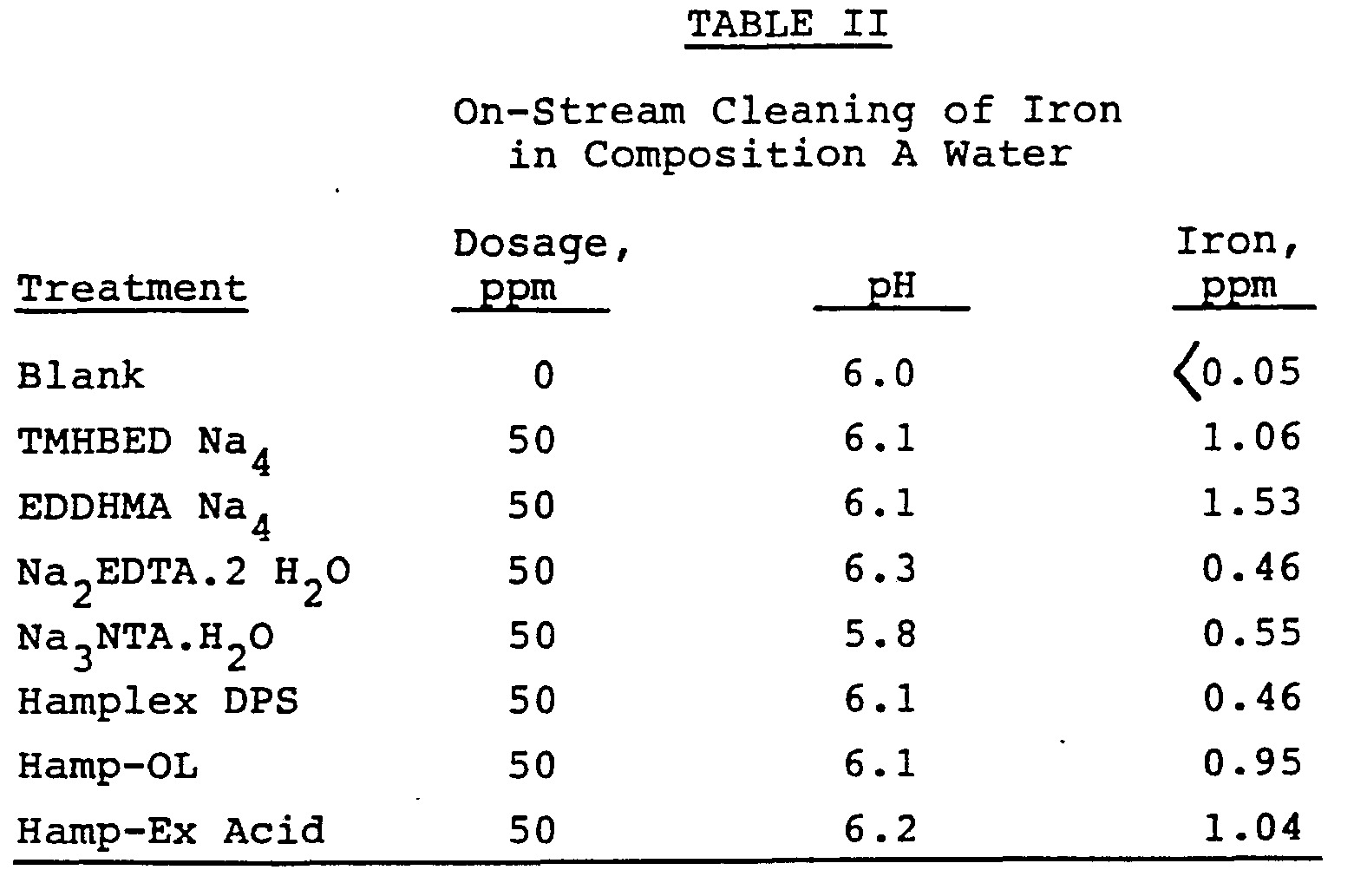
- composition A contains 187 ppm calcium hardness as CaC0 3 and 312 ppm total hardness as CaC0 3 .
- Composition B water contains 500 ppm calcium hardness as CaCO 3 and 828 ppm total hardness as CaC0 3 .
- the effectiveness of iron removal is demonstrated in Tables II and III.
- the preferred compounds of this invention should be effective in removing iron fouling at calcium hardness of at least about 500 ppm. It is evident from Table IV that of the compounds tested EDDHMA and Hamp-Ex acid can be used most effectively under these hardness conditions, and that Hamp-OL was also effective, all of them substantially outper f orming EDTA and NTA.
- the method of this invention comprises contacting the heat transfer surfaces with an aqueous solution having a pH of at least 5 and containing an effective amount of at least one of the compounds specified herein.
- the compounds used are preferably those which perform effectively at elevated hardness levels, and do not tend to corrode the ferrous metals within the pH range of the invention.
- the method uses compounds which are sufficiently attracted to polyvalent iron to allow effective removal of the iron-rich deposits of the cooling systems without a need to first separately treat the system to remove hardness. Indeed, it is anticipated that any calcium component of the iron fouling will ordinarily also be dispersed in the treatment solution as the iron fouling is removed. As demonstrated above, mixes of these preferred compounds may be used advantageously.
- the preferred AACP composition is a mix of Hamp-Ex Acid and Hamplex DPS, used in the form of the sodium salt.
- the material is suitably added as an AACP concentrate to the chemical feed line.
- the AACP concentrate may contain conventional additives such as corrosion inhibitors (e.g., mercaptobenzothiazole, tolyltriazole, benzotriazole, phosphate) and dispersants.
- a suitable AACP concentrate for large scale use consists of:
- the Hamp-Ex Acid and Hamplex DPS are dissolved, and then the pH is adjusted to 9 with NaOH.
- the anionic dispersant is sulfonated styrene maleic anhydride copolymer, but other dispersants well known in the art (e.g., copolymer of 2-acrylamido-2-methylpropanesulfonic acid and methacrylic acid) are operable.
- Hamplex DPS is desirable in a mix not only because it provides iron removal, but because it also imparts color to the solution, and thus may be used as an indication of treatment strength.
- Hamplex DPS is thus considered a preferred component of mixes not only with Formula B compounds such as Hamplex Acid, but with the other APAs shown particularly effective as progressive iron removers in Table IV (i.e. Formula A compounds such as EDDHMA; and the compounds Hamp-OL and TMHBED and their equivalents).
- Time (duration) of treatment is not critical, especially in the preferred on-stream mode.
- treatment is continued until Fe analysis of recycling water shows Fe defouling is substantially complete. Generally this requires at least several hours, and may require several days, weeks, or even months, depending on the amount and nature of fouling, and other conditions characteristic of the particular apparatus.
- the circulating fluid may be gradually removed, with simultaneous make-up.
- the temperature of the water being treated is not critical, it being evident that (in the general case) the hotterthe water, the faster the cleaning process will proceed. Iron fouling is removed at rates acceptable for many purposes even at temperatures less than 150°F (66°C). Water in heat-exchange tube bundles flows typically at 90 to 105°F (32 to 41°C).
- compositions used in this invention may be used in conjunction with other materials commonly found in cooling water systems, such as corrosion inhibitors, scale inhibitors and dispersants.
- the compositions of this invention are particularly suited for treating industrial heat exchangers and the like where iron-containing metals, such as steel, generally constitute a substantial portion of the cooling water apparatus, and where the fouling is particularly rich in iron.
- iron-rich deposits can also form in other cooling systems which are subject to contact with oxygen and which experience similar pH and temperature conditions during operation.
- These other systems, such as internal combustion engine cooling systems may be somewhat more complex with respect to their metallic components, their corrosion attributes, and their coolant composition, but the iron fouling found in those systems can also be effectively treated with the compositions used in this invention.
- compositions may be used in conjunction with ethylene glycol and the like, which may be present in many engine cooling systems. While these systems often operate at somewhat higher coolant and surface temperatures as well as higher coolant pH than industrial cooling water systems, iron-rich fouling similar to that in industrial cooling water is still commonly encountered. Cleaning of engine cooling systems is more likely accomplished by flushing the coolant from the system and cleaning the fouling from the heat transfer surfaces by circulating the treating solution through the system at a pH between 5 and 9 during a separate cleaning operation.
Landscapes
- Chemical & Material Sciences (AREA)
- Engineering & Computer Science (AREA)
- Chemical Kinetics & Catalysis (AREA)
- General Chemical & Material Sciences (AREA)
- Organic Chemistry (AREA)
- Environmental & Geological Engineering (AREA)
- Hydrology & Water Resources (AREA)
- Water Supply & Treatment (AREA)
- Life Sciences & Earth Sciences (AREA)
- Materials Engineering (AREA)
- Mechanical Engineering (AREA)
- Metallurgy (AREA)
- Preventing Corrosion Or Incrustation Of Metals (AREA)
- Cleaning And De-Greasing Of Metallic Materials By Chemical Methods (AREA)
Description
- This invention relates to cleaning aqueous cooling water systems and particularly to the removal of iron fouling from the heat transfer surfaces of cooling water systems using an aqueous solution having a near-neutral pH.
- The internal metallic surfaces of cooling water systems, particularly ferrous surfaces, tend to pick up iron fouling, which may be compounded with scaling from hard water (calcium and magnesium scale). This fouling forms an insulating layer which not only reduces heat flow from the system (e.g., tubes) outward into the cooling medium, but also reduces volume capacity of the heat-exchanger and can promote corrosion. Hence the fouling must be removed periodically if the original design capacity of the system is to be maintained. Various cleaning procedures are known, e.g., use of hydrochloric acid (which removes Fe as soluble FeCla), or citric acid or ammonium citrate (which removes Fe as a water-soluble complex). For either of these prior systems to be effective, the system must be shut down during cleaning, followed by water flush. The HCI-cleaning is particularly disadvantageous in this respect, since the very low pH requires vigilance to avoid damage to ferrous internals. In contrast, the instant invention functions very effectively in a near-neutral pH range (about 5-9), thereby permitting on-stream cleaning.
- Certain alkylene amine carboxylic acids known for use in removal of iron fouling in aqueous systems (Cf. U.S. Reissue 30,766).
- U.S. 4,454,046 teaches treatment of boiler water with hydroxyethylethylene diaminetriacetic acid. U.S. 4,190,463 teaches removal of iron deposits on cooling water surfaces with hydrolyzable tanning extracts, followed by citric acid treatment. U.S. 3,110,679 teaches a rust-removing composition containing N,N-di-(o-hydroxybenzyl) ethylene diaminediacetic acid. U.S. 3,754,990 refers to N,N-di-(beta-hydroxyethyl) glycine as a chelating agent for ferrous metals. Additionally, the following U.S. patents refer to alkylene polyamine polycarboxylic acids as metal sequestrants: 3,308,065; 3,929,874; 3,965,027; 4,011,171; and 4,020,016.
- Herein, the following definitions are used.
- (1) Heat transfer surfaces of cooling water systems refers to surfaces of apparatus which contact relatively cool flowing water used to cool flowing hot water or other hot fluids, or process equipment. Typical of such systems are industrial heat exchangers composed of bundles of ferrous metal tubes. Such systems are generally cooled by contact with the cool water (which of course is warmed by the contact). The warmed water is itself thereafter cooled in, e.g., a cooling tower, and is recycled to the heat exchanger. In some instances the heat exchanger is cooled by air fans. The term excludes boiler water systems, where exterior heat is applied across ferrous tube(s).
- (2) Iron fouling refers to deposits, crusts, and/or scale of iron compounds that build up on the internals of heat transfer surfaces of cooling water systems. This iron can be present in various forms, including the oxides (Fe203, Fe304), the hydroxides, and (in the presence of hard water) may include complex forms bound with calcium and/or magnesium. At start-up of the apparatus (before fouling can result from water contact) the fouling may consist simply of mill scale, i.e., Fe203 or magnetic iron oxide.
- (3) On-stream cleaning refers to removal of iron fouling while the heat transfer system is in standard use, without shut-down for removal of the cleaning solution or for flushing the cleaned system.
- (4) Alkylene amine carboxyl polyacid (AACP) refers to a compound having at least one amine group in which at least two carbons attach to the amine nitrogen, and having a plurality of acid groups, at least one of the acid groups being a carboxyl. The term includes the compound in the form of its sodium or potassium salt, as well as its acid form. Most of these compounds (as herein contemplated) have more than one carboxyl group, and thus the term includes alkylene amine polycarboxylic acids (APAs). Most of the APAs in turn include more than one amine group; thus the AACPs also include the alkylene polyamine polycarboxylic acids. The term includes all the individual compounds specified as useful in this instant application. The alkylene amine carboxyl polyacids used in the present invention are well-known in the chelating art. See, e.g., U.S. Reissue 30,796.
- The names of the relevant AACP compounds are on occasion abbreviated herein, as follows (given in acid form):
- TMHBED is N,N-di (2-hydroxybenzyl)-trimethylenediamine-N,N-diacetic acid,

- EDDHMA is N,N-ethylene-bis ((2-hydroxy-4-methyl phenyl) glycine),

- Hamplex DPS is N,N-di-(2-hydroxy-5-sulfonic acid benzyl) glycine,

- Hamp-OL is N-hydroxyethylethylenediamine triacetic acid,

- Hamp-Ex Acid is diethylenetriamine pentaacetic acid,

- (Note: Hamplex DPS, Hamp-OL, and Hamp-EX Acid are trademarks of W. R. Grace & Co.)
- EDTA is ethylenediamine tetraacetic acid.
- NTA is nitrilotriacetic acid.
- (5) AACP concentrate refers to a concentrated aqueous solution of AACP in Na or K salt form, suitable for use in large scale heat exchange installations.
- We have found that certain alkylene amine carboxyl polyacids (AACPs) are effective in removing iron fouling from surfaces of cooling water systems while the system water is maintained at a near neutral pH. The alkylene amine polyacids are particularly suited for on stream cleaning of heat transfer surfaces in industrial heat exchangers. They can also be used for cleaning iron deposits and corrosion products from fouled or corroded metal surfaces in other cooling water systems such as internal combustion engine cooling systems.
- According to the present invention there is provided a method of reducing or removing iron fouling from a heat transfer surface of a cooling water system characterised by:
- (a) contacting said surface with an aqueous solution containing an amount totalling at least 0.1 ppm of at least one alkylene amine carboxyl polyacid which is:
- (i) N-hydroxyethylethylenediamine triacetic acid or a water-soluble potassium or sodium salt thereof;
- (ii) a compound having the formula

- (iii) a compound having the formula

- (iv) a compound having the formula

- (b) maintaining the solution at a pH of at least 5 but not exceeding 9.
- This invention is directed to AACPs which are useful in removing iron-rich fouling from the heat transfer surfaces of cooling water systems at near-neutral pH. The iron fouling generally includes iron from the water circulated through the cooling system during circulation which deposition the heat transfer surfaces. The invention is particularly suited for industrial heat exchangers where these deposits are generally found on surfaces operating at temperatures below about 210°F (99°C), typically in the range of 150°F to 200°F, (66° to 93°C), and often about 180°F (82°C) or less.
- The AACPs useful in removing such deposits from cooling water systems at near-neutral pH thus include APAs such as TMHBED, and Hamp-OL. However, some APAs such as EDTA and NTA are known to attack metallic iron as well as its polyvalenf oxides and thus themselves may contribute to corrosion and/or oxidation of ferrous metals, particularly at pH near 7 or below. Accordingly (and this is especially so when on stream cleaning is practiced over long periods of time), the AACPs used to remove iron fouling from ferrous surfaces have a strong attraction for polyvalent iron.
- In Formula A, both X groups are preferably either hydrogens or methyls situated in the para position relative to the alkylene amine group, most preferably said para methyls. The preferred value for n is 2, and the preferred M substituents are sodium and potassium, most preferably sodium; and consequently, examples of preferred Formula A compounds used in this invention are the sodium salts of N,N'-ethylene- bis ((2-hydroxyphenyl) glycine), and N,N'-ethylene-bis ((2-hydroxy4-methyl phenyl) alanine). Preferably R1 and R2 are hydrogen and a particularly preferred compound is EDDHMA.
- In Formula B, R3, R4, R5 and R6 are all preferably -CH2COOL groups, m is 1, and the L substituents are either sodium or potassium, most preferably sodium. Consequently, another particularly preferred compound is the sodium salt of Hamp-Ex Acid.
- In formula C, preferably, each J is sodium or potassium (most preferably sodium), q is 1, and the sulfonic acid groups are situated in the para position relative to the alkylene amine group. A particularly preferred compound is thus the sodium salt of Hamplex DPS.
- In one embodiment of the invention the solution contains a compound of formula C and at least one of a compound of formula A or B, Hamp-OL or TMHBED.
- For removing iron fouling from the heat transfer surfaces of industrial heat exchangers and the like, an aqueous solution of the alkylene amine carboxyl polyacid or its ammonium, sodium, or potassium salt is used. The solution of AACP is operable at concentrations in the range of about 0.1 ppm (lower limit) up to the solubility point of the compound. For economic reasons, the range of 1 to 250 ppm is preferred. In commercial operation the AACP is added in concentrated aqueous solution to the chemical feed line of the cooling apparatus, until the concentration within the system reaches the desired ppm range. The preferred AACP concentrate contains 25-35 weight percent AACP as the sodium salt. The addition can be made to water of substantially any temperature in the heat exchange system. Water being heat-exchanged in typical cooling water systems enters the system generally at 90 to 105°F (32 to 41°C). The water is generally under a mild pressure head. The cleaning operation is allowed to proceed without shut-down during the usual operation of the cooling system. Samples are withdrawn from time to time to analyze for Fe. A portion of the recycling Fe-containing water can be withdrawn toward the end of the cleaning cycle, with simultaneous addition of make-up water at the make-up port. Withdrawal can be intermittent or continuous. Cleaning can of course be done during shut-down, with or without water flush, but the invention does not necessitate this.
- Practice of the invention will become further apparent from the following non-limiting examples.
- The apparatus used (and described below) was specially designed for testing Fe fouling and monitoring attempts to remove it under control conditions and with specific agents, including the AACP materials of this invention.
- Tests were conducted using a steam heated dynamic scale tester. The stainless steel heat transfer tube was initially fouled with a ferric chloride solution. This was done by recirculating the solution past the heat transfer tube at a skin temperature of about 180°F. After an appreciable amount of iron was deposited, the water was drained and excess deposited iron in the basin, tubes and pump was removed. Fresh test water was added to the basin and circulated at about 2 liters per minute with an outlet water temperature of 140-150°F (6166°C). A level control switch in conjunction with a solenoid valve for controlling the addition of deionized water was used to compensate for evaporation losses.
- Treatments were evaluated at three pH levels: 9.0,7.5-8.0 and 6.0. Since the iron concentration from a blank run showed little change over the pH range of 9.0 to 6.0, a blank run at a pH of 9.0 represented the equilibrium iron concentration before the addition of treatment. Treatment was added once and the iron concentration measured at 24-hour intervals at the three pH levels. The sample of water for iron analysis was unfiltered and acidified to represent soluble and dispersed iron. Thus a comparison of the iron concentration before and after the addition of treatment measured the performance of that treatment.
- The initial screening was done in ionized water at the three pH levels.

- Note that there is a general trend for the AACPs used in this invention as well as particularly TMHBED, sodium salt, to become less effective in removing fouling as the pH approached 9. The method of this invention, therefore, is generally practiced at a pH below about 9. Preferably, for rapid cleaning the pH should be kept at within the range of 5 to 8. However, as evidenced by the surprising effectiveness of EDDHMA even at a pH of about 9, Formula A compounds are particularly useful for cleaning cooling systems at pH 8 and above.
- The next step was to evaluate the above treatments in the presence of hardness. This was done at pH 6.0 with two different waters, Composition A and Composition B. Composition A water contains 187 ppm calcium hardness as CaC03 and 312 ppm total hardness as CaC03. Composition B water contains 500 ppm calcium hardness as CaCO3 and 828 ppm total hardness as CaC03. The effectiveness of iron removal is demonstrated in Tables II and III.

- The results are shown in Table IV.

- The preferred compounds of this invention should be effective in removing iron fouling at calcium hardness of at least about 500 ppm. It is evident from Table IV that of the compounds tested EDDHMA and Hamp-Ex acid can be used most effectively under these hardness conditions, and that Hamp-OL was also effective, all of them substantially outperforming EDTA and NTA.
- Surface oxidation and corrosion of iron-containing apparatus is often a component of the fouling encountered in cooling water systems. To test the effectiveness of the AACP compositions of this invention on removing iron oxides from metal surfaces, a treatment concentrate containing about 18.75 percent Hamp-Ex Acid and about 714 percent Hamplex DPS, as their sodium salts, was added to about 0.5 liters of demineralised water at a level of about one part concentrate to about 99 parts water. The pH of the solution was adjusted to about 8.0 to 8.5 using sodium hydroxide, and the solution was agitated in a glass flask using a magnetic stirrer. A steel coupon which had previously oxidized at its surface to form common iron oxide corrosion products was then immersed in the solution and the solution was gradually heated to boiling. About 1 hour after heat was applied, the coupon was removed and observed to be clean and completely free of iron corrosion products. Thus the mix was effective even at pH 8 and above. Other mixes, particularly those of Formula C compounds with compounds of Formula B, are considered similarly effective.
- The method of this invention comprises contacting the heat transfer surfaces with an aqueous solution having a pH of at least 5 and containing an effective amount of at least one of the compounds specified herein. The compounds used are preferably those which perform effectively at elevated hardness levels, and do not tend to corrode the ferrous metals within the pH range of the invention. Most preferably, as exemplified above, the method uses compounds which are sufficiently attracted to polyvalent iron to allow effective removal of the iron-rich deposits of the cooling systems without a need to first separately treat the system to remove hardness. Indeed, it is anticipated that any calcium component of the iron fouling will ordinarily also be dispersed in the treatment solution as the iron fouling is removed. As demonstrated above, mixes of these preferred compounds may be used advantageously. Indeed, the preferred AACP composition is a mix of Hamp-Ex Acid and Hamplex DPS, used in the form of the sodium salt. The material is suitably added as an AACP concentrate to the chemical feed line. The AACP concentrate may contain conventional additives such as corrosion inhibitors (e.g., mercaptobenzothiazole, tolyltriazole, benzotriazole, phosphate) and dispersants.
- A suitable AACP concentrate for large scale use consists of:

- In preparing the concentrate, the Hamp-Ex Acid and Hamplex DPS are dissolved, and then the pH is adjusted to 9 with NaOH. The anionic dispersant is sulfonated styrene maleic anhydride copolymer, but other dispersants well known in the art (e.g., copolymer of 2-acrylamido-2-methylpropanesulfonic acid and methacrylic acid) are operable. Hamplex DPS is desirable in a mix not only because it provides iron removal, but because it also imparts color to the solution, and thus may be used as an indication of treatment strength. Hamplex DPS is thus considered a preferred component of mixes not only with Formula B compounds such as Hamplex Acid, but with the other APAs shown particularly effective as progressive iron removers in Table IV (i.e. Formula A compounds such as EDDHMA; and the compounds Hamp-OL and TMHBED and their equivalents).
- Time (duration) of treatment is not critical, especially in the preferred on-stream mode. Suitably, treatment is continued until Fe analysis of recycling water shows Fe defouling is substantially complete. Generally this requires at least several hours, and may require several days, weeks, or even months, depending on the amount and nature of fouling, and other conditions characteristic of the particular apparatus. After defouling is fairly well completed, the circulating fluid may be gradually removed, with simultaneous make-up.
- The temperature of the water being treated is not critical, it being evident that (in the general case) the hotterthe water, the faster the cleaning process will proceed. Iron fouling is removed at rates acceptable for many purposes even at temperatures less than 150°F (66°C). Water in heat-exchange tube bundles flows typically at 90 to 105°F (32 to 41°C).
- The compositions used in this invention may be used in conjunction with other materials commonly found in cooling water systems, such as corrosion inhibitors, scale inhibitors and dispersants. The compositions of this invention are particularly suited for treating industrial heat exchangers and the like where iron-containing metals, such as steel, generally constitute a substantial portion of the cooling water apparatus, and where the fouling is particularly rich in iron. However, iron-rich deposits can also form in other cooling systems which are subject to contact with oxygen and which experience similar pH and temperature conditions during operation. These other systems, such as internal combustion engine cooling systems, may be somewhat more complex with respect to their metallic components, their corrosion attributes, and their coolant composition, but the iron fouling found in those systems can also be effectively treated with the compositions used in this invention.
- With regard to engine cooling systems, particular mention is made that the compositions may be used in conjunction with ethylene glycol and the like, which may be present in many engine cooling systems. While these systems often operate at somewhat higher coolant and surface temperatures as well as higher coolant pH than industrial cooling water systems, iron-rich fouling similar to that in industrial cooling water is still commonly encountered. Cleaning of engine cooling systems is more likely accomplished by flushing the coolant from the system and cleaning the fouling from the heat transfer surfaces by circulating the treating solution through the system at a pH between 5 and 9 during a separate cleaning operation.
Claims (10)


Priority Applications (1)
| Application Number | Priority Date | Filing Date | Title |
|---|---|---|---|
| AT86305958T ATE60312T1 (en) | 1985-08-05 | 1986-08-01 | REMOVAL OF IRON DEPOSITS FROM COOLING WATER CIRCUITS. |
Applications Claiming Priority (4)
| Application Number | Priority Date | Filing Date | Title |
|---|---|---|---|
| US76222985A | 1985-08-05 | 1985-08-05 | |
| US762229 | 1985-08-05 | ||
| US06/885,348 US4721532A (en) | 1985-08-05 | 1986-07-22 | Removal of iron fouling in cooling water systems |
| US885348 | 1992-05-19 |
Publications (3)
| Publication Number | Publication Date |
|---|---|
| EP0212894A2 EP0212894A2 (en) | 1987-03-04 |
| EP0212894A3 EP0212894A3 (en) | 1988-01-13 |
| EP0212894B1 true EP0212894B1 (en) | 1991-01-23 |
Family
ID=27117096
Family Applications (1)
| Application Number | Title | Priority Date | Filing Date |
|---|---|---|---|
| EP86305958A Expired EP0212894B1 (en) | 1985-08-05 | 1986-08-01 | Removal of iron fouling in cooling water systems |
Country Status (7)
| Country | Link |
|---|---|
| US (1) | US4721532A (en) |
| EP (1) | EP0212894B1 (en) |
| JP (1) | JPH0761477B2 (en) |
| AU (1) | AU585631B2 (en) |
| CA (1) | CA1279241C (en) |
| DE (1) | DE3677093D1 (en) |
| ES (1) | ES2002123A6 (en) |
Families Citing this family (14)
| Publication number | Priority date | Publication date | Assignee | Title |
|---|---|---|---|---|
| GB2184109A (en) * | 1985-10-29 | 1987-06-17 | Grace W R & Co | The treatment of aqueous systems |
| US5022926A (en) * | 1988-06-10 | 1991-06-11 | W. R. Grace & Co.-Conn. | Corrosion control |
| US5015298A (en) * | 1989-08-22 | 1991-05-14 | Halliburton Company | Composition and method for removing iron containing deposits from equipment constructed of dissimilar metals |
| US5094757A (en) * | 1990-05-24 | 1992-03-10 | Radiator Robot, Inc. | Radiator cooling system cleaner/refiner |
| US5158684A (en) * | 1991-03-12 | 1992-10-27 | Betz Laboratories, Inc. | Transport and deposit inhibition of copper in boilers |
| US5183573A (en) * | 1991-07-22 | 1993-02-02 | W. R. Grace & Co.-Conn. | Multipurpose scale preventer/remover |
| US5311892A (en) * | 1992-12-03 | 1994-05-17 | Cyclotron, Inc. | Apparatus for dispensing cleaning fluids to an object |
| US5948267A (en) * | 1994-10-07 | 1999-09-07 | Kay Chemical Company | Composition and method for inhibiting chloride-Induced corrosion and limescale formation on ferrous metals and alloys |
| TW442864B (en) * | 1997-01-27 | 2001-06-23 | Mitsubishi Chem Corp | Surface treatment composition and method for treating surface of substrate by using the same |
| FR2833941B1 (en) * | 2001-12-26 | 2005-12-30 | Water Treat Internat Ltd | METHOD FOR DISEMBLY OF HEATING FACILITIES |
| US6797177B2 (en) * | 2002-07-18 | 2004-09-28 | Ashland Inc. | Process for inhibiting scale and fouling on the metal surfaces exposed to an aqeuous system |
| US20060042663A1 (en) * | 2004-08-25 | 2006-03-02 | Baker Hughes Incorporated | Method for removing iron deposits from within closed loop systems |
| JP5510123B2 (en) * | 2010-06-30 | 2014-06-04 | 三浦工業株式会社 | Operation method of steam boiler |
| US9115432B2 (en) * | 2011-05-06 | 2015-08-25 | Chemtreat, Inc. | Methods and compositions for inhibiting metal corrosion in heated aqueous solutions |
Family Cites Families (54)
| Publication number | Priority date | Publication date | Assignee | Title |
|---|---|---|---|---|
| USRE23766E (en) | 1954-01-12 | Metal ion chelating compounds con | ||
| USRE23904E (en) | 1954-12-14 | Chrcooh chrcooh | ||
| USRE23767E (en) | 1954-01-12 | Hydroxy-aromatic alkylene di-imino | ||
| US23905A (en) * | 1859-05-10 | Pence-post | ||
| USRE23905E (en) | 1954-12-14 | Substituted poly aralkyl alkylene poly | ||
| US23766A (en) * | 1859-04-26 | Perry g | ||
| US23904A (en) * | 1859-05-10 | Improvement in plows | ||
| US23767A (en) * | 1859-04-26 | Improvement in steam spading-machines | ||
| US30796A (en) * | 1860-12-04 | Improvement in cultivators | ||
| US2249757A (en) * | 1933-09-26 | 1941-07-22 | Nat Aniline & Chem Co Inc | Alkyl hydroxy aromatic sulphonate |
| US2396938A (en) * | 1944-01-22 | 1946-03-19 | Martin Dennis Company | Method of treating boilers |
| US2532391A (en) * | 1947-03-15 | 1950-12-05 | Frederick C Bersworth | Alkylene polyamine derivatives |
| US2624757A (en) * | 1950-11-01 | 1953-01-06 | Frederick C Bersworth | Substituted aralkyl alkylene diamino di acetic acids and salts |
| US2673213A (en) * | 1952-06-03 | 1954-03-23 | Frederick C Bersworth | Polyalkylene polyamino acids |
| US2717263A (en) * | 1952-10-03 | 1955-09-06 | Leonard L Mckinney | Condensation products of alpha-amino acids and phenols |
| US2794818A (en) * | 1952-10-07 | 1957-06-04 | Dow Chemical Co | Germicidally active phenolic copper chelate compounds |
| US3038793A (en) * | 1955-12-06 | 1962-06-12 | Geigy Chem Corp | Treating iron deficient plants with ferric chelates of ethylenediaminediacetic acids containing phenolic groups |
| US2967196A (en) * | 1955-12-06 | 1961-01-03 | Geigy Chem Corp | Ethylenediaminediacetic acids containing phenolic groups |
| US3005848A (en) * | 1957-09-09 | 1961-10-24 | Geigy Chem Corp | Ethylenediamine derivatives containing aromatic rings |
| US3293176A (en) * | 1964-04-01 | 1966-12-20 | Le Roy A White | Method of chelating with an ethergroup-containing sequestering agent |
| US3110679A (en) * | 1959-03-17 | 1963-11-12 | Rubin Martin | Neutral composition for removal of rust |
| US3394174A (en) * | 1961-02-10 | 1968-07-23 | Tanatex Chemical Corp | Amphoteric phenolic compounds containing amine groups and sulfonic acid or carboxylic acid groups |
| USRE30796E (en) | 1962-07-23 | 1981-11-17 | The Dow Chemical Co. | Scale removal, ferrous metal passivation and compositions therefor |
| US3308065A (en) * | 1963-07-22 | 1967-03-07 | Dow Chemical Co | Scale removal, ferrous metal passivation and compositions therefor |
| US3490741A (en) * | 1966-09-15 | 1970-01-20 | Dow Chemical Co | Method of cleaning metal surfaces with polycarboxylic acid complexing agents inhibited by ethyleneimines or polyethylenepolyamines containing divalent sulfur |
| US3532791A (en) * | 1966-10-03 | 1970-10-06 | Dow Chemical Co | N,n'-ethylenebis(2-(o-hydroxyphenyl)glycine) |
| US3549538A (en) * | 1967-06-22 | 1970-12-22 | Nalco Chemical Co | Scale inhibition and removal in steam generation |
| GB1159462A (en) * | 1967-06-30 | 1969-07-23 | Chemolimpex | Novel Organic Chelating Compounds |
| US3565813A (en) * | 1967-10-02 | 1971-02-23 | Frederick C Bersworth | Composite chelating compositions |
| US3627687A (en) * | 1968-02-09 | 1971-12-14 | Dow Chemical Co | Cleaning of ferrous metal surfaces |
| US3527609A (en) * | 1968-04-29 | 1970-09-08 | Dow Chemical Co | In-service cleaning of cooling water systems |
| US3684720A (en) * | 1970-03-06 | 1972-08-15 | Western Co Of North America | Removal of scale from surfaces |
| US3742002A (en) * | 1971-06-14 | 1973-06-26 | Grace W R & Co | Iron chelates useful for supplying iron to plants growing in calcareous soil |
| US3806459A (en) * | 1971-07-06 | 1974-04-23 | Drew Chem Corp | On-stream cleaning compositions and process of using same |
| US3898037A (en) * | 1972-06-01 | 1975-08-05 | Betz Laboratories | Acrylamido-sulfonic acid polymers and their use |
| US3796667A (en) * | 1972-06-02 | 1974-03-12 | Grace W R & Co | Method for inhibiting iron containing scale formation in seawater distillaton plants |
| DE2241134A1 (en) * | 1972-08-22 | 1974-03-21 | Hoechst Ag | COMPLEX BUILDER |
| US3965027A (en) * | 1974-03-11 | 1976-06-22 | Calgon Corporation | Scale inhibition and corrosion inhibition |
| US4020016A (en) * | 1975-02-28 | 1977-04-26 | The Drackett Company | Cleaning compositions effective in dissolving soap curd |
| US4069249A (en) * | 1975-11-11 | 1978-01-17 | W. R. Grace & Co. | N,N-di-(hydroxybenzyl)-trimethylene diaminediacetic acids |
| US4338460A (en) * | 1975-11-11 | 1982-07-06 | W. R. Grace & Co. | Process for preparing chelating agents |
| US4152345A (en) * | 1975-11-11 | 1979-05-01 | W. R. Grace & Co. | Metal chelates |
| US3988367A (en) * | 1975-11-11 | 1976-10-26 | W. R. Grace & Co. | Preparation of N,N'-dicarboxymethyl-1,3-propanediamines |
| GB1473488A (en) * | 1976-01-15 | 1977-05-11 | Calgon Corp | Sludge prevention and removal |
| US4011171A (en) * | 1976-01-29 | 1977-03-08 | Nalco Chemical Company | Boiler treatment using amines and organophosphonate materials |
| US4225502A (en) * | 1977-02-07 | 1980-09-30 | W. R. Grace & Co. | N,N'Di(hydroxybenzyl) 1,3-propanediamine N,N'-diacetonitriles |
| US4130582A (en) * | 1977-04-19 | 1978-12-19 | Ciba-Geigy Corporation | Preparation of phenolic ethylenediaminepolycarboxylic acids |
| US4181672A (en) * | 1977-09-27 | 1980-01-01 | W. R. Grace & Co. | Process for preparing metal chelates |
| US4144185A (en) * | 1978-02-24 | 1979-03-13 | The United States Of America As Represented By The Secretary Of The Interior | Method and composition for removing calcium sulfate scale deposits from surfaces |
| US4190463A (en) * | 1979-02-05 | 1980-02-26 | Nalco Chemical Company | Method of removing iron oxide deposits from heat transfer surfaces |
| US4197091A (en) * | 1979-04-12 | 1980-04-08 | Nalco Chemical Co. | Metal chelate/anti-oxidant combinations with dimer-trimer acids, pipeline corrosion inhibitors |
| US4387244A (en) * | 1980-10-02 | 1983-06-07 | W. R. Grace & Co. | Chelating agents for non-aqueous systems |
| DE3230291A1 (en) * | 1981-08-18 | 1983-03-03 | Dearborn Chemicals Ltd., Widnes, Cheshire | COMPOSITION FOR PREVENTING KETTLE IN AQUEOUS SYSTEMS |
| US4454046A (en) * | 1982-09-07 | 1984-06-12 | The Dow Chemical Company | Boiler scale prevention employing an organic chelant |
-
1986
- 1986-07-22 US US06/885,348 patent/US4721532A/en not_active Expired - Lifetime
- 1986-08-01 DE DE8686305958T patent/DE3677093D1/en not_active Expired - Lifetime
- 1986-08-01 EP EP86305958A patent/EP0212894B1/en not_active Expired
- 1986-08-01 AU AU60793/86A patent/AU585631B2/en not_active Ceased
- 1986-08-04 ES ES8601526A patent/ES2002123A6/en not_active Expired
- 1986-08-05 CA CA000515277A patent/CA1279241C/en not_active Expired - Lifetime
- 1986-08-05 JP JP61182840A patent/JPH0761477B2/en not_active Expired - Lifetime
Also Published As
| Publication number | Publication date |
|---|---|
| EP0212894A3 (en) | 1988-01-13 |
| JPH0761477B2 (en) | 1995-07-05 |
| AU6079386A (en) | 1987-02-12 |
| JPS6279899A (en) | 1987-04-13 |
| CA1279241C (en) | 1991-01-22 |
| EP0212894A2 (en) | 1987-03-04 |
| AU585631B2 (en) | 1989-06-22 |
| ES2002123A6 (en) | 1988-07-16 |
| DE3677093D1 (en) | 1991-02-28 |
| US4721532A (en) | 1988-01-26 |
Similar Documents
| Publication | Publication Date | Title |
|---|---|---|
| US4721532A (en) | Removal of iron fouling in cooling water systems | |
| US5021096A (en) | Method for removal of scale | |
| US4789406A (en) | Method and compositions for penetrating and removing accumulated corrosion products and deposits from metal surfaces | |
| US4666528A (en) | Method of removing iron and copper-containing scale from a metal surface | |
| WO1998021304A1 (en) | Liquid metal cleaner for an aqueous system | |
| CN101864575B (en) | Special cleaning agent for stainless steel equipment and its application method | |
| US4387027A (en) | Control of iron induced fouling in water systems | |
| CN110818099A (en) | Water circulation dirt treating agent | |
| JP4366462B2 (en) | How to wash the circulating water system | |
| US5679170A (en) | Methods for removing iron oxide scale from interior surfaces of steel vessels using formic acid-citric acid mixtures | |
| JPH0119958B2 (en) | ||
| JPS59189998A (en) | Scale removing method | |
| CA2087199C (en) | Method and compositions for removing deposits from cooling water systems | |
| US3996147A (en) | Novel sulfonium corrosion inhibitors in aqueous acid solutions | |
| JP2002536545A (en) | Detergent composition and use thereof | |
| CA1204372A (en) | Methods and compositions for simultaneously removing iron and copper scales from ferrous metal surfaces | |
| CN112853364A (en) | Condenser manganese scale chemical cleaning agent | |
| US7731803B2 (en) | Descaling and corrosion inhibiting method | |
| CN119432508A (en) | Descaling cleaning agent and its application | |
| JP5200326B2 (en) | Scale cleaner and scale removal method | |
| RU2154109C1 (en) | Method of cleaning internal surfaces of blast-furnace coolers from scale-and-corrosion deposits | |
| RU2206034C1 (en) | Compound for chemical cleaning of surfaces from scale and corrosion | |
| SU1369684A3 (en) | Composition for removing mineral deposits from surface of refrigerator and steam generator units | |
| JPS6345474B2 (en) | ||
| EP1808428B1 (en) | Descaling solutions comprising EDDH |
Legal Events
| Date | Code | Title | Description |
|---|---|---|---|
| PUAI | Public reference made under article 153(3) epc to a published international application that has entered the european phase |
Free format text: ORIGINAL CODE: 0009012 |
|
| AK | Designated contracting states |
Kind code of ref document: A2 Designated state(s): AT BE CH DE FR GB IT LI LU NL SE |
|
| PUAL | Search report despatched |
Free format text: ORIGINAL CODE: 0009013 |
|
| AK | Designated contracting states |
Kind code of ref document: A3 Designated state(s): AT BE CH DE FR GB IT LI LU NL SE |
|
| 17P | Request for examination filed |
Effective date: 19880712 |
|
| RAP1 | Party data changed (applicant data changed or rights of an application transferred) |
Owner name: W.R. GRACE & CO.-CONN. (A CONNECTICUT CORP.) |
|
| 17Q | First examination report despatched |
Effective date: 19890518 |
|
| GRAA | (expected) grant |
Free format text: ORIGINAL CODE: 0009210 |
|
| AK | Designated contracting states |
Kind code of ref document: B1 Designated state(s): AT BE CH DE FR GB IT LI LU NL SE |
|
| PG25 | Lapsed in a contracting state [announced via postgrant information from national office to epo] |
Ref country code: LI Effective date: 19910123 Ref country code: CH Effective date: 19910123 Ref country code: BE Effective date: 19910123 Ref country code: AT Effective date: 19910123 |
|
| REF | Corresponds to: |
Ref document number: 60312 Country of ref document: AT Date of ref document: 19910215 Kind code of ref document: T |
|
| REF | Corresponds to: |
Ref document number: 3677093 Country of ref document: DE Date of ref document: 19910228 |
|
| ITF | It: translation for a ep patent filed | ||
| REG | Reference to a national code |
Ref country code: CH Ref legal event code: PL |
|
| ET | Fr: translation filed | ||
| PG25 | Lapsed in a contracting state [announced via postgrant information from national office to epo] |
Ref country code: LU Free format text: LAPSE BECAUSE OF NON-PAYMENT OF DUE FEES Effective date: 19910831 |
|
| PLBE | No opposition filed within time limit |
Free format text: ORIGINAL CODE: 0009261 |
|
| STAA | Information on the status of an ep patent application or granted ep patent |
Free format text: STATUS: NO OPPOSITION FILED WITHIN TIME LIMIT |
|
| 26N | No opposition filed | ||
| EAL | Se: european patent in force in sweden |
Ref document number: 86305958.0 |
|
| PGFP | Annual fee paid to national office [announced via postgrant information from national office to epo] |
Ref country code: GB Payment date: 19970723 Year of fee payment: 12 |
|
| PGFP | Annual fee paid to national office [announced via postgrant information from national office to epo] |
Ref country code: FR Payment date: 19970811 Year of fee payment: 12 |
|
| PGFP | Annual fee paid to national office [announced via postgrant information from national office to epo] |
Ref country code: SE Payment date: 19970818 Year of fee payment: 12 |
|
| PGFP | Annual fee paid to national office [announced via postgrant information from national office to epo] |
Ref country code: NL Payment date: 19970826 Year of fee payment: 12 |
|
| NLS | Nl: assignments of ep-patents |
Owner name: BETZDEARBORN INC. |
|
| REG | Reference to a national code |
Ref country code: GB Ref legal event code: 732E |
|
| REG | Reference to a national code |
Ref country code: FR Ref legal event code: TP |
|
| PG25 | Lapsed in a contracting state [announced via postgrant information from national office to epo] |
Ref country code: GB Free format text: LAPSE BECAUSE OF NON-PAYMENT OF DUE FEES Effective date: 19980801 |
|
| PG25 | Lapsed in a contracting state [announced via postgrant information from national office to epo] |
Ref country code: SE Free format text: LAPSE BECAUSE OF NON-PAYMENT OF DUE FEES Effective date: 19980802 |
|
| PGFP | Annual fee paid to national office [announced via postgrant information from national office to epo] |
Ref country code: DE Payment date: 19981005 Year of fee payment: 13 |
|
| PG25 | Lapsed in a contracting state [announced via postgrant information from national office to epo] |
Ref country code: NL Free format text: LAPSE BECAUSE OF NON-PAYMENT OF DUE FEES Effective date: 19990301 |
|
| GBPC | Gb: european patent ceased through non-payment of renewal fee |
Effective date: 19980801 |
|
| PG25 | Lapsed in a contracting state [announced via postgrant information from national office to epo] |
Ref country code: FR Free format text: LAPSE BECAUSE OF NON-PAYMENT OF DUE FEES Effective date: 19990430 |
|
| EUG | Se: european patent has lapsed |
Ref document number: 86305958.0 |
|
| NLV4 | Nl: lapsed or anulled due to non-payment of the annual fee |
Effective date: 19990301 |
|
| REG | Reference to a national code |
Ref country code: FR Ref legal event code: ST |
|
| PG25 | Lapsed in a contracting state [announced via postgrant information from national office to epo] |
Ref country code: DE Free format text: LAPSE BECAUSE OF NON-PAYMENT OF DUE FEES Effective date: 20000601 |
|
| PG25 | Lapsed in a contracting state [announced via postgrant information from national office to epo] |
Ref country code: IT Free format text: LAPSE BECAUSE OF NON-PAYMENT OF DUE FEES;WARNING: LAPSES OF ITALIAN PATENTS WITH EFFECTIVE DATE BEFORE 2007 MAY HAVE OCCURRED AT ANY TIME BEFORE 2007. THE CORRECT EFFECTIVE DATE MAY BE DIFFERENT FROM THE ONE RECORDED. Effective date: 20050801 |