EP0211237B1 - Process for lubricating accessories of cassettes containing magnetic tapes - Google Patents
Process for lubricating accessories of cassettes containing magnetic tapes Download PDFInfo
- Publication number
- EP0211237B1 EP0211237B1 EP86109026A EP86109026A EP0211237B1 EP 0211237 B1 EP0211237 B1 EP 0211237B1 EP 86109026 A EP86109026 A EP 86109026A EP 86109026 A EP86109026 A EP 86109026A EP 0211237 B1 EP0211237 B1 EP 0211237B1
- Authority
- EP
- European Patent Office
- Prior art keywords
- different
- cfxo
- group
- zero
- integer
- Prior art date
- Legal status (The legal status is an assumption and is not a legal conclusion. Google has not performed a legal analysis and makes no representation as to the accuracy of the status listed.)
- Expired - Lifetime
Links
Classifications
-
- G—PHYSICS
- G11—INFORMATION STORAGE
- G11B—INFORMATION STORAGE BASED ON RELATIVE MOVEMENT BETWEEN RECORD CARRIER AND TRANSDUCER
- G11B5/00—Recording by magnetisation or demagnetisation of a record carrier; Reproducing by magnetic means; Record carriers therefor
- G11B5/62—Record carriers characterised by the selection of the material
- G11B5/72—Protective coatings, e.g. anti-static or antifriction
-
- G—PHYSICS
- G11—INFORMATION STORAGE
- G11B—INFORMATION STORAGE BASED ON RELATIVE MOVEMENT BETWEEN RECORD CARRIER AND TRANSDUCER
- G11B23/00—Record carriers not specific to the method of recording or reproducing; Accessories, e.g. containers, specially adapted for co-operation with the recording or reproducing apparatus ; Intermediate mediums; Apparatus or processes specially adapted for their manufacture
- G11B23/50—Reconditioning of record carriers; Cleaning of record carriers ; Carrying-off electrostatic charges
- G11B23/502—Reconditioning of record carriers; Cleaning of record carriers ; Carrying-off electrostatic charges of tape carriers
-
- G—PHYSICS
- G11—INFORMATION STORAGE
- G11B—INFORMATION STORAGE BASED ON RELATIVE MOVEMENT BETWEEN RECORD CARRIER AND TRANSDUCER
- G11B15/00—Driving, starting or stopping record carriers of filamentary or web form; Driving both such record carriers and heads; Guiding such record carriers or containers therefor; Control thereof; Control of operating function
- G11B15/60—Guiding record carrier
-
- Y—GENERAL TAGGING OF NEW TECHNOLOGICAL DEVELOPMENTS; GENERAL TAGGING OF CROSS-SECTIONAL TECHNOLOGIES SPANNING OVER SEVERAL SECTIONS OF THE IPC; TECHNICAL SUBJECTS COVERED BY FORMER USPC CROSS-REFERENCE ART COLLECTIONS [XRACs] AND DIGESTS
- Y10—TECHNICAL SUBJECTS COVERED BY FORMER USPC
- Y10T—TECHNICAL SUBJECTS COVERED BY FORMER US CLASSIFICATION
- Y10T428/00—Stock material or miscellaneous articles
- Y10T428/31504—Composite [nonstructural laminate]
- Y10T428/3154—Of fluorinated addition polymer from unsaturated monomers
- Y10T428/31544—Addition polymer is perhalogenated
Definitions
- the present invention relates to the use of fluids for lubricating accessory elements which magnetic tapes come into contact with, during their operation, in the devices containing them.
- this invention relates to the use of lubricants based on perfluoropolyethers in order to reduce the friction and/or wear phenomena which the magnetic tapes are subjected to owing to the contact with the accessory elements of the cassettes in which the magnetic tapes are contained.
- perfluoropolyethers which is the object of the present invention can be extended to any device which includes magnetic tape cassettes, such as, for example, magnetic tapes for computers or typewriters.
- the audio cassettes consist, for example, of an outer casing of plastic material which consists of two flat halves which fit into each other and are fixed by means of screws. Inside the halves there are two horizontally arranged reels around which the magnetic means winds.
- the recording occurs on the tape portion having access to the outside which is made possible by proper guides and by a window in the cassette edge.
- the reels are not axially constrained but are simply caused to rotate by the corresponding pins, so that the tape edge slides against the plastic casing and is subjected to considerable wear and friction phenomena.
- the tape comes into contact with other metallic or non-metallic accessory elements which have the function of guiding the tape so that it can wind around the respective reels.
- the plastic material generally used is based on polyesters, such as e.g. polyethyleneterephthalate.
- the interposition of the liners is accompanied by the drawback of leading to an accumulation of electrostatic charges by triboelectric effect during the. operation of the device with consequent increase of friction which results in a deterioration of the recording qualitites or jamming of the tape and also, in some cases, breaking of the tape.
- the graphitized coating is affected however by the drawback of being subjected to progressive wear and flaking during tape operation due to friction. Furthermore this method is very expensive as it requires highly sophisticated techniques to obtain very uniform graphite coatings on the liner.
- a further complication arising in this method is achieving a good adhesion of the graphitized coating to the plastic substrate.
- JP-A 107 470 polytetrafluoroethylene (PTFE) has been described as a lubricant.
- Liners based on graphite-filled polytetrafluoroethylene are known as well. In this case, however, it should be taken into consideration that the liners based on PTFE are very difficult to prepare with the dimensional parameters required for their application in audio cassettes. In fact, PTFE is very difficult to produce in extremely thin films, and this strongly reduces the utilization thereof, as the use of layers of greater dimensions results in too high costs which are not compatible with these uses.
- video cassettes consist of two halves of plastic material and are free of liners, as the magnetic tape is wound on two reels equipped with flanges, and in order to permit access to the tape from the outside the tape is made to pass on two metal cylinders, generally made of stainless steel, and is kept under tension by a proper tab of plastic material which presses the tape.
- lubricants offer the advantage of enormously reducing the interface friction and wear between tape and liner or between liner and accessory elements, and furthermore they do not involve the difficulty of obtaining uniform and extremely thin coatings as in the case of the graphitized coatings; moreover, they are easy to apply on the plastic liner or on the accessory elements of the cassettes.
- the perfluoropolyethereal compounds are endowed with a high stability to chemical agents and to oxidation, which imparts to the coating the capability of providing a constant and permanent performance.
- perfluoropolyethers which are used for the purposes of the invention are selected from the following classes of compounds A1 to AS comprising the constitutive units of the types listed below:
- the perfluoropolyethers regardless to which of the above-mentioned classes they may belong, have a viscosity range from 10 to 1500 mm 2 /s (cSt), in particular from 60 to 250 mm 2 /s (cSt) (at 20 ° C).
- perfluoropolyethers employable in the present invention are selected from those belonging to the following perfluoropolyether classes:
- Said perfluoroethers are prepared by cycloaddition reactions between a fluoride of a perfluorinated acid and a perfluoroolefin in which at least one of the compounds contains an ethereal oxygen atom according to what is described in an earlier patent application filed by the Applicant hereof;
- perfluoropolyethers having functional groups at one or both ends.
- difunctional perfluoropolyethers like the ones described in US patent 4 094 911 and US patent 4 085 137 (Mitsch) can be employed with advantage.
- perfluoropolyethers comprising, besides the units C 2 F 4 0 and CF 2 0, also units (CF 2 CF 2 CF 2 0) and (CF 2 CF 2 CF 2 CF 2 0), as described in the article "Perfluoropolyethers by Photooxidation of Fluoroolefins" by D. Sianesi, A. Pasetti, R. Fontanelli, G. C. Bernardi and G. Caporiccio - La Chimica e l'lndustria, February 1973, pages 216-220.
- the neutral perfluoropolyethers of the indicated classes are preferably employed in the audio cassettes which generally do not contain metallic accessory elements; in video cassettes the above-cited perfluoropolyethers containing functional groups are preferred because they exhibit a better adhesion to metals.
- the deposition techniques suitable for the liners of audio cassettes are for example the coating by spraying or immersion or by rubbing with a soaked pad, starting from dilute solutions of perfluoropolyethereal oils in 1,1,2-trichlorotrifluoro ethane, in the case of applications onto already punched plates or the continuous coating by means of spraying techniques or the application by means of extrusion head or gavure roll coating of the plastic film tape to be punched.
- the application of the lubricant to the sliding cylinders and to the tension tab can be accomplished preferably by immersion or rubbing.
- the lubricant thicknesses useful in said application are in the range from 5 to 2000 nm (50 to 20,000 A) and preferably from 10 to 1000 nm (100 to 10,000 A).
- concentrations of the solutions useful to obtain said thicknesses are in the range from 0.1 to 10% of perfluoropolyethereal oil in 1,1,2-trichiorotrifiuoroethane, and preferably from 0.2 to 5% by weight.
- perfluoropolyethers according to the invention when used as lubricants in video cassettes, prove to be particularly effective with respect to a reduction of friction, also during the fast-winding steps of the tape.
- the application method used to prepare the lubricated plates was the following: the plate was uniformly rubbed with a pad soaked with a 10% by weight solution of perfluoropolyethereal oil dissolved in 1,1,2-trichlorofluoroethane.
- the thickness of the resulting film was in the order of 500 nm (5000 A); the thus lubricated plate was then again introduced into the cassette.
- the apparatus used for this purpose consisted of a platform coated with one of the two materials forming the kinematic couple (in the present case the material forming the liner).
- the other component consisted of the tape reel horizontally resting on the liners.
- the tangential stress was detected through a loading cell and was graphically recorded, after proper signal conditioning, by a potentiometric recorder as a function of time.
- the tractive force required to make the tape slide was 10 g in the lubricated cassette instead of 15 to 18 g necessary for the comparison tape.
- the values obtained are the average of five tests.
- the lubricant was not in contact with the magnetic coating of the tape but only with the top surface of the plastic substrate.
Landscapes
- Lubricants (AREA)
- Polyethers (AREA)
- Paints Or Removers (AREA)
- Organic Low-Molecular-Weight Compounds And Preparation Thereof (AREA)
Description
- The present invention relates to the use of fluids for lubricating accessory elements which magnetic tapes come into contact with, during their operation, in the devices containing them.
- In particular, this invention relates to the use of lubricants based on perfluoropolyethers in order to reduce the friction and/or wear phenomena which the magnetic tapes are subjected to owing to the contact with the accessory elements of the cassettes in which the magnetic tapes are contained.
- Said friction problems arise in any device using magnetic tapes, however for the sake of simplicity, the audio or video cassettes will be discussed in particular.
- It is understood, however, that the use of the perfluoropolyethers which is the object of the present invention can be extended to any device which includes magnetic tape cassettes, such as, for example, magnetic tapes for computers or typewriters.
- As is known, the audio cassettes consist, for example, of an outer casing of plastic material which consists of two flat halves which fit into each other and are fixed by means of screws. Inside the halves there are two horizontally arranged reels around which the magnetic means winds.
- The recording occurs on the tape portion having access to the outside which is made possible by proper guides and by a window in the cassette edge.
- While the device is in operation, the reels are not axially constrained but are simply caused to rotate by the corresponding pins, so that the tape edge slides against the plastic casing and is subjected to considerable wear and friction phenomena.
- During operation, furthermore, the tape comes into contact with other metallic or non-metallic accessory elements which have the function of guiding the tape so that it can wind around the respective reels.
- To reduce the rubbing of the tape against the plastic casing of the cassette it is known to interpose between the two parts of plastic material which form the cassette and the reels two sliding sheets which are called liners, are generally self-lubricating and are obtained by means of punching from a sheet of plastic material.
- The plastic material generally used is based on polyesters, such as e.g. polyethyleneterephthalate.
- The interposition of the liners however is accompanied by the drawback of leading to an accumulation of electrostatic charges by triboelectric effect during the. operation of the device with consequent increase of friction which results in a deterioration of the recording qualitites or jamming of the tape and also, in some cases, breaking of the tape.
- To overcome these drawbacks it is known to coat the liner surface with a layer of a material containing dispersed graphite. This process consists of depositing on the liner, according to known techniques, a suspension of graphite particles in a suitable binder, generally vinyl resins dissolved in proper solvents. This method is known in the art as graphitized coating.
- The graphitized coating is affected however by the drawback of being subjected to progressive wear and flaking during tape operation due to friction. Furthermore this method is very expensive as it requires highly sophisticated techniques to obtain very uniform graphite coatings on the liner.
- A further complication arising in this method is achieving a good adhesion of the graphitized coating to the plastic substrate.
- It is also known to use lubricants of the class of polyalcohols; these fluids however do not possess good lubricating properties and have a low stability to chemical agents and to oxidation, which limits the performance constancy over rather long periods of time.
- From JP-A 150 164 lubrication layers made of either fluoride or fluoride, alkoxysilane and silane fluoride are known.
- In JP-A 107 470 polytetrafluoroethylene (PTFE) has been described as a lubricant.
- Liners based on graphite-filled polytetrafluoroethylene are known as well. In this case, however, it should be taken into consideration that the liners based on PTFE are very difficult to prepare with the dimensional parameters required for their application in audio cassettes. In fact, PTFE is very difficult to produce in extremely thin films, and this strongly reduces the utilization thereof, as the use of layers of greater dimensions results in too high costs which are not compatible with these uses.
- PTFE, though theoretically being a material suited to reduce the friction phenomena, is in practice not used because of the above-mentioned drawbacks.
- In addition, the sliding on the accessories acting as a guide for the winding of the tape around the reels during the magnetic tape operation is a further cause of wear and friction.
- The sliding phenomenon on accessory elements of the cassette containing the magnetic tape is actually the only cause of friction and wear in the video cassettes, where no sliding sheets are used. In fact, video cassettes consist of two halves of plastic material and are free of liners, as the magnetic tape is wound on two reels equipped with flanges, and in order to permit access to the tape from the outside the tape is made to pass on two metal cylinders, generally made of stainless steel, and is kept under tension by a proper tab of plastic material which presses the tape.
- As one of the main characteristics of the coating of the tape accessory parts is the constancy of their performance over a very long period of time, there was great need to find a material capable of reducing to the best possible extent the friction and wear phenomena as well as the triboelectric effect described hereinbefore.
- It has now surprisingly been found that it is possible to overcome the cited drawbacks by using as a lubricating fluid a fluid based on perfluoropolyethers applied to the surface of the liners or of all the accessory elements of the devices necessary for the operation of the magnetic tapes contained in cassettes.
- These lubricants offer the advantage of enormously reducing the interface friction and wear between tape and liner or between liner and accessory elements, and furthermore they do not involve the difficulty of obtaining uniform and extremely thin coatings as in the case of the graphitized coatings; moreover, they are easy to apply on the plastic liner or on the accessory elements of the cassettes.
- In addition to the foregoing, the perfluoropolyethereal compounds are endowed with a high stability to chemical agents and to oxidation, which imparts to the coating the capability of providing a constant and permanent performance.
- The perfluoropolyethers which are used for the purposes of the invention are selected from the following classes of compounds A1 to AS comprising the constitutive units of the types listed below:
- A1) (CsFeO) and (CFXO) statistically distributed along the perfluoropolyether chain, where X is -F, -CF3;
- A2) (CsFeO);
- A3) (C3F6O), (C2F40), (CFXO), statistically distributed along the perfluoropolyether chain, where X is -F, -CF3;
- A4) (C2F40), (CF20), statistically distributed along the perfluoropolyether chain;
- A5) (C3F6O), this class furthermore comprising the characteristic group -CF(CF3)-CF(CF3)-;
- A6) an oxetane ring of the general formula selected from

- F, a perfluoroalkyl radical having 1 to 7 carbon atoms, or a group
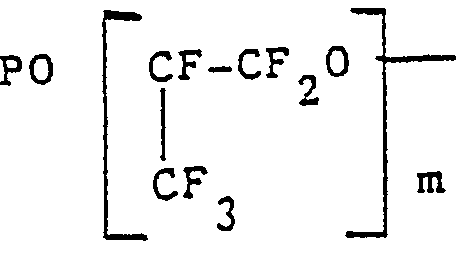

- A7) (CD2CF2CF20), where D is H or F;
- A8) (CF2CF20).
- The perfluoropolyethers, regardless to which of the above-mentioned classes they may belong, have a viscosity range from 10 to 1500 mm2/s (cSt), in particular from 60 to 250 mm2/s (cSt) (at 20°C).
- The perfluoropolyethers employable in the present invention in particular are selected from those belonging to the following perfluoropolyether classes:
- A1) RfO(C3F6O)m(CFXO)nRf, in which Rf is ―CF3, -C2Fs, ―C3F7; X is -F, -CFs; m and n are integers, and the m/n ratio ranges from 5 to 40 when n is different from 0. These compounds are prepared according to the process described in GB patent No. 1 104 482 and by means of subsequent neutralization reaction, as described below for class A4);
- A2) C3F7O(C3F6O)m―Rf; where Rf may be ―C2F5, ―C3F7, -CFHCF3; and m is a positive integer. These compounds are prepared according to US patent 3 242 218;
- A3) CF30(C3F60)m(C2F40)n(CFXO)q-CF3; where X is -F, -CF3; m, n and q are integers, and n and q may also be 0; the ratio

- A4) CF3O(C2F4O)p(CF2O)q―CF3; where p and q are the same or different integers and which may also be 0, where the p/q ratio ranges from 0.5 to 1.5. These perfluoroethers are prepared according to US patent 3 715 378 and subsequently neutralized with fluorine according to US patent 3 665 041;

- These products are obtained by ionic telomerization of the hexafluoropropene epoxide and subsequent photochemical dimerization of the acid fluoride according to processes described in US patent 3 214 478;


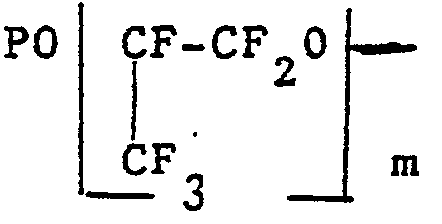
- A7) RfO(CD2CF2CF2O)nR'f; where Rf and R'f, which may be the same or different, are fluorinated alkyl radicals; D is H or F, and n is a positive integer. Said perfluorpolyethers are prepared according to European Patent Application 148 482;
- A8) RfO(CF2CF2O)mR'f; where Rf and R'f, which may be the same or different, are -CF3, -C2Fs, and m is a positive integer. Said perfluoropolyethers are prepared according to US patent 4 523 039.
- Besides the neutral perfluoropolyethers it is also possible to use perfluoropolyethers having functional groups at one or both ends.
- Compounds I) and II), indicated hereinafter, respectively fall within the above-specified classes A1) and A3).
- I) RO―(C3F6O)m(CFXO)n―CFX-L, or
- II) R"CFXO―(C3F6O)x(CFXO)y―(C2F4O)z―CFX―L, where
- R = ―CF3, ―C2F5, ―C3F7
- X = -F, ―CF3
- R" = -F, ―CF3, -C2Fs
- m = an integer other than zero,
- n = an integer or zero, and when n is different from zero m/n varies from 5 to 20 and R is preferably =
- -CFs, if n = zero, R is preferably -C2Fs or ―C3F7;
- x = an integer or zero;
- y, z = integers, and

- L = group Y-Z, where
- Y = -CH20-, -CH20CH2-, -CF2-, -CF20-;
- Z = a non-aromatic, non-fluorinated organic radical free from active hydrogen atoms, containing two or
- These perfluoropolyethers containing functionalities are prepared as described in IT patent applications Nos. 21 480 A/84 and 21 481 A/84 in the name of Applicant.
- Also difunctional perfluoropolyethers like the ones described in US patent 4 094 911 and US patent 4 085 137 (Mitsch) can be employed with advantage.
- As compounds of class A4) one may also use perfluoropolyethers comprising, besides the units C2F40 and CF20, also units (CF2CF2CF20) and (CF2CF2CF2CF20), as described in the article "Perfluoropolyethers by Photooxidation of Fluoroolefins" by D. Sianesi, A. Pasetti, R. Fontanelli, G. C. Bernardi and G. Caporiccio - La Chimica e l'lndustria, February 1973, pages 216-220.
- Besides the copolymers containing the above-indicated units it is possible to also use only or prevail- ingly homopolymers comprising the abovesaid units (CF2)30 or (CF2)40.
- The neutral perfluoropolyethers of the indicated classes are preferably employed in the audio cassettes which generally do not contain metallic accessory elements; in video cassettes the above-cited perfluoropolyethers containing functional groups are preferred because they exhibit a better adhesion to metals.
- The deposition techniques suitable for the liners of audio cassettes are for example the coating by spraying or immersion or by rubbing with a soaked pad, starting from dilute solutions of perfluoropolyethereal oils in 1,1,2-trichlorotrifluoro ethane, in the case of applications onto already punched plates or the continuous coating by means of spraying techniques or the application by means of extrusion head or gavure roll coating of the plastic film tape to be punched.
- With video cassettes the application of the lubricant to the sliding cylinders and to the tension tab can be accomplished preferably by immersion or rubbing.
- The lubricant thicknesses useful in said application are in the range from 5 to 2000 nm (50 to 20,000 A) and preferably from 10 to 1000 nm (100 to 10,000 A).
- The concentrations of the solutions useful to obtain said thicknesses are in the range from 0.1 to 10% of perfluoropolyethereal oil in 1,1,2-trichiorotrifiuoroethane, and preferably from 0.2 to 5% by weight.
- The perfluoropolyethers according to the invention, when used as lubricants in video cassettes, prove to be particularly effective with respect to a reduction of friction, also during the fast-winding steps of the tape.
- The following examples are merely given to illustrate the present invention without being, however, a limitation thereof.
- To check the friction properties of the various lubricating materials and to make a comparison to the technologies used at present, a comparative measurement of the tape friction against the liner during the unwinding and the fast rewinding of the cassette was carried out.
- There were tested small plates made of PET (polyethylene terephthalate) in one case (case A in table I) in the absence of coating or lubricating layer, and in another case (case B in table I) in the presence of a graphitized coating limited to two parallel bands in which the contact area with the reel side is the greatest; in a third case (case C in table I) the plate was coated with perfluoropolyether, commercially known as Fomblin Y 06 (n = 60 mm2/s (cSt) at 20°C).
- The application method used to prepare the lubricated plates was the following: the plate was uniformly rubbed with a pad soaked with a 10% by weight solution of perfluoropolyethereal oil dissolved in 1,1,2-trichlorofluoroethane.
- The thickness of the resulting film was in the order of 500 nm (5000 A); the thus lubricated plate was then again introduced into the cassette.
- To carry out the test a usual commercial recorder was used, the friction (during the FAST FORWARD or REWIND operations) having been evaluated by measuring the absorbed current. The data relating to the rewind operation are reported in table I.
- In consideration of the different diameters of the reels in the various steps of the rewind process the current absorption at the beginning, at half, and at the end of the operation was measured, and the results obtained under the same conditions were compared.
- In order to test the behaviour of the interface between tape and lubricated plate, linear friction coefficient tests according to ASTM method 1984 73 (DIN 53 375) were performed.
- The apparatus used for this purpose consisted of a platform coated with one of the two materials forming the kinematic couple (in the present case the material forming the liner).
- The other component consisted of the tape reel horizontally resting on the liners.
- The tangential stress was detected through a loading cell and was graphically recorded, after proper signal conditioning, by a potentiometric recorder as a function of time.
- From the resulting graph there were calculated the friction coefficient values resulting from the ratio between tangential stress and normal stress.
- For this example there were used PET liners lubricated with perfluoropolyethereal oils commercially known as Fomblin Z 25 (11 = 250 mm2/s (cSt) at 20°C).
- The results obtained, expressed in terms of static and dynamic friction coefficients, are reported in table II.
- To verify the validity of the technological choice based on the liner lubrication a mechanical torque measurement of audio cassettes was effected by means of an apparatus "Information Terminals M400 Cassette Tester". Such measurements are generally made by manufacturers of audio cassettes for the production quality control; the instrument substantially measures the current absorbed by the motor which keeps the tape rotating and permits the reading of the mechanical torque (in g*cm). According to quality control practice the readings are made at the beginning and at the end of the tape rewinding.
- Table III shows the experimental results obtained by using, as lubricants for the liners, perfluoropolyethereal oils commercially known as Fomblin Z 25 (11 = 250 mm2/s (cSt) at 20°C). From a comparison of the data it is apparent that an improvement of the mechanical performance of the audio cassettes occurs when the perfluoropolyether of the present invention is used.
- From the results obtained it is possible to infer that the liners treated with perfluoropolyethereal oil - besides meeting, as regards the mechanical properties, the specifications determined long ago by Philips, i.e. generally a starting torque of 8 g*cm and a final torque of 20 g*cm - permit a more uniform sliding of the tape inside the halves, compared to the graphite-coated liners, either those made of PET or of PTFE.
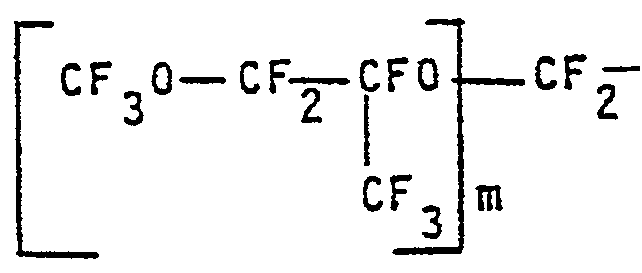
- The sliding steel cylinders and the tension tab of a commercial-type video cassette were lubricated. Lubrication was done by immersing said parts, taken from the cassette, into a 1% solution of perfluoropolyether having functional groups at both ends and belonging to class II) in which X = O, Y = CH20CH2, R" = L and

- The lubricated parts were then again placed "in situ", and a mechanical test was carried out with the thus modified cassette by using, as a comparison, an untreated cassette belonging to the same production lot.
- The tractive force required to make the tape slide (measured by means of a dynamometer) was 10 g in the lubricated cassette instead of 15 to 18 g necessary for the comparison tape. The values obtained are the average of five tests.
- With the same cassettes electromagnetic tests were performed (still frame, counting of dropouts, chromanoise, luminance to noise ratio) which did not reveal any deterioration of the tape properties as a consequence to lubrication.
- In the proposed application, however, the lubricant was not in contact with the magnetic coating of the tape but only with the top surface of the plastic substrate.



Claims (5)


Applications Claiming Priority (2)
| Application Number | Priority Date | Filing Date | Title |
|---|---|---|---|
| IT2141785 | 1985-07-03 | ||
| IT21417/85A IT1187676B (en) | 1985-07-03 | 1985-07-03 | PROCESS FOR THE LUBRICATION OF ACCESSORIES OF BOXES CONTAINING MAGNETIC TAPES |
Publications (2)
| Publication Number | Publication Date |
|---|---|
| EP0211237A1 EP0211237A1 (en) | 1987-02-25 |
| EP0211237B1 true EP0211237B1 (en) | 1990-05-02 |
Family
ID=11181457
Family Applications (1)
| Application Number | Title | Priority Date | Filing Date |
|---|---|---|---|
| EP86109026A Expired - Lifetime EP0211237B1 (en) | 1985-07-03 | 1986-07-02 | Process for lubricating accessories of cassettes containing magnetic tapes |
Country Status (8)
| Country | Link |
|---|---|
| US (1) | US4746575A (en) |
| EP (1) | EP0211237B1 (en) |
| JP (1) | JPS6231083A (en) |
| KR (1) | KR950007136B1 (en) |
| AU (1) | AU594065B2 (en) |
| CA (1) | CA1281705C (en) |
| DE (1) | DE3670922D1 (en) |
| IT (1) | IT1187676B (en) |
Families Citing this family (14)
| Publication number | Priority date | Publication date | Assignee | Title |
|---|---|---|---|---|
| US4935833A (en) * | 1988-10-28 | 1990-06-19 | Tdk Corporation | Guide members for magnetic tape cassette |
| JPH07118172B2 (en) * | 1989-10-05 | 1995-12-18 | 三信工業株式会社 | Resin tape guide |
| AU660336B2 (en) * | 1991-10-18 | 1995-06-22 | Alza Corporation | Device for the transdermal administration of melatonin |
| JPH07282559A (en) * | 1994-02-09 | 1995-10-27 | Minnesota Mining & Mfg Co <3M> | Data storage device with improved roller lubricant |
| US5658962A (en) | 1994-05-20 | 1997-08-19 | Minnesota Mining And Manufacturing Company | Omega-hydrofluoroalkyl ethers, precursor carboxylic acids and derivatives thereof, and their preparation and application |
| US5663127A (en) * | 1994-07-29 | 1997-09-02 | Minnesota Mining And Manufacturing Company | Perfluoropolyether lubricating compositions |
| US5760100B1 (en) | 1994-09-06 | 2000-11-14 | Ciba Vision Corp | Extended wear ophthalmic lens |
| US5494596A (en) * | 1995-01-13 | 1996-02-27 | Minnesota Mining And Manufacturing Company | Data storage device with improved roller lubricant characterized by stable viscosity over wide range of temperatures |
| US5823455A (en) * | 1996-12-20 | 1998-10-20 | Imation Corp. | Belt-driven data storage device with corner roller assemblies preselected to have different drag force profiles |
| EP1108519B1 (en) * | 1999-12-13 | 2006-08-16 | Fuji Photo Film Co., Ltd. | Molding method of and injection mould for manufacturing a cassette half. |
| US6403149B1 (en) | 2001-04-24 | 2002-06-11 | 3M Innovative Properties Company | Fluorinated ketones as lubricant deposition solvents for magnetic media applications |
| ITMI20030372A1 (en) * | 2003-03-03 | 2004-09-04 | Solvay Solexis Spa | LINEAR PERFLUOROPOLYTERS WITH IMPROVED THERMO-OXIDATIVE STABILITY. |
| JP2014506954A (en) | 2011-03-03 | 2014-03-20 | スリーエム イノベイティブ プロパティズ カンパニー | Lubricant composition containing fluorooxirane |
| US20260148750A1 (en) * | 2024-11-22 | 2026-05-28 | Western Digital Technologies, Inc. | Thermo-mechanical-optical bonding of lubricants to carbon overcoat of magnetic recording media |
Family Cites Families (15)
| Publication number | Priority date | Publication date | Assignee | Title |
|---|---|---|---|---|
| DE1249247B (en) * | 1961-04-25 | 1967-09-07 | E. I. Du Pont De Nemours And Company, Wilmington, Del. (V. St. A.) | Process for the preparation of perfluoroolefin polyethers |
| GB1153217A (en) * | 1966-04-25 | 1969-05-29 | Allied Chem | Fluorinated Oxetanes |
| US3665041A (en) * | 1967-04-04 | 1972-05-23 | Montedison Spa | Perfluorinated polyethers and process for their preparation |
| US4174461A (en) * | 1970-06-27 | 1979-11-13 | Montecantini Edison S.P.A. | Stabilized perfluoropolyether fluids |
| US3778308B1 (en) * | 1970-12-18 | 1991-06-04 | Magnetic storage device coating and process | |
| US4188434A (en) * | 1978-05-15 | 1980-02-12 | Storage Technology Corporation | Lubricant for a magnetic member |
| DE2839378B1 (en) * | 1978-09-11 | 1979-11-15 | Basf Ag | Magnetic recording medium |
| JPS57158037A (en) * | 1981-03-24 | 1982-09-29 | Fuji Photo Film Co Ltd | Magnetic recording medium and its manufacture |
| JPH0715751B2 (en) * | 1982-05-12 | 1995-02-22 | 富士写真フイルム株式会社 | Method of manufacturing magnetic recording medium |
| US4529658A (en) * | 1982-10-13 | 1985-07-16 | Minnesota Mining And Manufacturing Company | Fluorochemical copolymers and ovenable paperboard and textile fibers treated therewith |
| US4570197A (en) * | 1983-01-03 | 1986-02-11 | Minnesota Mining & Manufacturing Company | Static reduction in magnetic recording cassettes |
| US4446193A (en) * | 1983-04-29 | 1984-05-01 | International Business Machines Corporation | Process for chemically bonding lubricant to an information carrier and products thereof |
| US4569962A (en) * | 1983-09-19 | 1986-02-11 | Minnesota Mining And Manufacturing Company | Perfluoropolyether compositions which are soluble in non-fluorinated solvents |
| US4526833A (en) * | 1983-10-03 | 1985-07-02 | Minnesota Mining And Manufacturing Company | Magnetic recording medium having a perfluoropolyether polymer protective coating |
| US4675452A (en) * | 1985-07-18 | 1987-06-23 | Lagow Richard J | Perfluorinated polyether fluids |
-
1985
- 1985-07-03 IT IT21417/85A patent/IT1187676B/en active
-
1986
- 1986-07-01 US US06/880,919 patent/US4746575A/en not_active Expired - Fee Related
- 1986-07-02 EP EP86109026A patent/EP0211237B1/en not_active Expired - Lifetime
- 1986-07-02 AU AU59738/86A patent/AU594065B2/en not_active Ceased
- 1986-07-02 DE DE8686109026T patent/DE3670922D1/en not_active Expired - Lifetime
- 1986-07-02 KR KR1019860005356A patent/KR950007136B1/en not_active Expired - Lifetime
- 1986-07-02 CA CA000512925A patent/CA1281705C/en not_active Expired - Lifetime
- 1986-07-03 JP JP61157159A patent/JPS6231083A/en active Pending
Also Published As
| Publication number | Publication date |
|---|---|
| CA1281705C (en) | 1991-03-19 |
| AU594065B2 (en) | 1990-03-01 |
| DE3670922D1 (en) | 1990-06-07 |
| AU5973886A (en) | 1987-01-08 |
| KR870001300A (en) | 1987-03-12 |
| IT8521417A0 (en) | 1985-07-03 |
| KR950007136B1 (en) | 1995-06-30 |
| US4746575A (en) | 1988-05-24 |
| JPS6231083A (en) | 1987-02-10 |
| EP0211237A1 (en) | 1987-02-25 |
| IT1187676B (en) | 1987-12-23 |
Similar Documents
| Publication | Publication Date | Title |
|---|---|---|
| US4746575A (en) | Process for lubricating accessories of cassettes containing magnetic tapes | |
| CA1287637C (en) | Fluoropolyethers containing end groups endowed with anchoring capacity | |
| DE69503003T2 (en) | Perfluoropolyether lubricant compositions | |
| US4657687A (en) | Lubricating compositions having improved film-forming properties | |
| US6379801B1 (en) | Silane derivatized lubricants for magnetic recording media | |
| EP0226279B1 (en) | Process for lubricating magnetic disks, and to magnetic disks | |
| KR920001569B1 (en) | Perfluoropolyether composition and preparation method thereof | |
| US5759968A (en) | Lubricating agent and magnetic recording medium comprising the same | |
| US11308985B2 (en) | Fluoropolyether compound and lubricant | |
| JPS6010368B2 (en) | magnetic recording medium | |
| US20040202894A1 (en) | Lubricant for thin film storage media | |
| EP0467289B1 (en) | Magnetic recording medium | |
| US6103677A (en) | Lubricant and magnetic recording medium comprising the same | |
| DE69509004T2 (en) | Magnetic recording medium | |
| KR0138251B1 (en) | Magnetic recording medium and its manufacturing method | |
| DE69313904T2 (en) | Magnetic recording medium | |
| JPS62250514A (en) | Magnetic recording medium | |
| JP2560183B2 (en) | Lubricant and magnetic recording medium using the same | |
| US4741960A (en) | Magnetic recording medium having a back coat layer containing a specific type of lubricant | |
| JP2003067912A (en) | Magnetic recording media | |
| EP0042439B1 (en) | Magnetic recording medium having a lubricated contact layer | |
| JP3946387B2 (en) | Lubricant and magnetic recording medium using the same | |
| CA1139158A (en) | Flexible magnetic recording media lubricated with fluorinated telechelic polyether polymer | |
| EP0232162B1 (en) | Magnetic recording medium and process for producing the same | |
| JP3946386B2 (en) | Lubricant and magnetic recording medium using the same |
Legal Events
| Date | Code | Title | Description |
|---|---|---|---|
| PUAI | Public reference made under article 153(3) epc to a published international application that has entered the european phase |
Free format text: ORIGINAL CODE: 0009012 |
|
| AK | Designated contracting states |
Kind code of ref document: A1 Designated state(s): BE DE FR GB NL SE |
|
| 17P | Request for examination filed |
Effective date: 19870813 |
|
| 17Q | First examination report despatched |
Effective date: 19890301 |
|
| RAP1 | Party data changed (applicant data changed or rights of an application transferred) |
Owner name: AUSIMONT S.R.L. |
|
| GRAA | (expected) grant |
Free format text: ORIGINAL CODE: 0009210 |
|
| AK | Designated contracting states |
Kind code of ref document: B1 Designated state(s): BE DE FR GB NL SE |
|
| REF | Corresponds to: |
Ref document number: 3670922 Country of ref document: DE Date of ref document: 19900607 |
|
| ET | Fr: translation filed | ||
| PLBE | No opposition filed within time limit |
Free format text: ORIGINAL CODE: 0009261 |
|
| STAA | Information on the status of an ep patent application or granted ep patent |
Free format text: STATUS: NO OPPOSITION FILED WITHIN TIME LIMIT |
|
| 26N | No opposition filed | ||
| PGFP | Annual fee paid to national office [announced via postgrant information from national office to epo] |
Ref country code: GB Payment date: 19920619 Year of fee payment: 7 |
|
| PGFP | Annual fee paid to national office [announced via postgrant information from national office to epo] |
Ref country code: FR Payment date: 19920707 Year of fee payment: 7 |
|
| PGFP | Annual fee paid to national office [announced via postgrant information from national office to epo] |
Ref country code: SE Payment date: 19920713 Year of fee payment: 7 |
|
| PGFP | Annual fee paid to national office [announced via postgrant information from national office to epo] |
Ref country code: DE Payment date: 19920727 Year of fee payment: 7 |
|
| PGFP | Annual fee paid to national office [announced via postgrant information from national office to epo] |
Ref country code: NL Payment date: 19920731 Year of fee payment: 7 |
|
| PGFP | Annual fee paid to national office [announced via postgrant information from national office to epo] |
Ref country code: BE Payment date: 19920831 Year of fee payment: 7 |
|
| PG25 | Lapsed in a contracting state [announced via postgrant information from national office to epo] |
Ref country code: GB Effective date: 19930702 |
|
| PG25 | Lapsed in a contracting state [announced via postgrant information from national office to epo] |
Ref country code: SE Effective date: 19930703 |
|
| PG25 | Lapsed in a contracting state [announced via postgrant information from national office to epo] |
Ref country code: BE Effective date: 19930731 |
|
| BERE | Be: lapsed |
Owner name: AUSIMONT S.R.L. Effective date: 19930731 |
|
| PG25 | Lapsed in a contracting state [announced via postgrant information from national office to epo] |
Ref country code: NL Effective date: 19940201 |
|
| GBPC | Gb: european patent ceased through non-payment of renewal fee |
Effective date: 19930702 |
|
| NLV4 | Nl: lapsed or anulled due to non-payment of the annual fee | ||
| PG25 | Lapsed in a contracting state [announced via postgrant information from national office to epo] |
Ref country code: FR Effective date: 19940331 |
|
| PG25 | Lapsed in a contracting state [announced via postgrant information from national office to epo] |
Ref country code: DE Effective date: 19940401 |
|
| REG | Reference to a national code |
Ref country code: FR Ref legal event code: ST |
|
| EUG | Se: european patent has lapsed |
Ref document number: 86109026.4 Effective date: 19940210 |