EP0210016B1 - Polymerisationsverfahren und Initiator dafür - Google Patents
Polymerisationsverfahren und Initiator dafür Download PDFInfo
- Publication number
- EP0210016B1 EP0210016B1 EP86305238A EP86305238A EP0210016B1 EP 0210016 B1 EP0210016 B1 EP 0210016B1 EP 86305238 A EP86305238 A EP 86305238A EP 86305238 A EP86305238 A EP 86305238A EP 0210016 B1 EP0210016 B1 EP 0210016B1
- Authority
- EP
- European Patent Office
- Prior art keywords
- lithium
- carbon atoms
- molecular weight
- alkoxide
- multifunctional
- Prior art date
- Legal status (The legal status is an assumption and is not a legal conclusion. Google has not performed a legal analysis and makes no representation as to the accuracy of the status listed.)
- Expired - Lifetime
Links
- 239000003999 initiator Substances 0.000 title claims description 19
- 238000006116 polymerization reaction Methods 0.000 title claims description 12
- 229910052744 lithium Inorganic materials 0.000 claims description 21
- 238000000034 method Methods 0.000 claims description 19
- -1 lithium alkoxide Chemical class 0.000 claims description 17
- 239000000178 monomer Substances 0.000 claims description 17
- RRHGJUQNOFWUDK-UHFFFAOYSA-N Isoprene Chemical group CC(=C)C=C RRHGJUQNOFWUDK-UHFFFAOYSA-N 0.000 claims description 16
- 125000004432 carbon atom Chemical group C* 0.000 claims description 14
- 150000002642 lithium compounds Chemical class 0.000 claims description 10
- HAUKUGBTJXWQMF-UHFFFAOYSA-N lithium;propan-2-olate Chemical group [Li+].CC(C)[O-] HAUKUGBTJXWQMF-UHFFFAOYSA-N 0.000 claims description 10
- WHXSMMKQMYFTQS-UHFFFAOYSA-N Lithium Chemical compound [Li] WHXSMMKQMYFTQS-UHFFFAOYSA-N 0.000 claims description 9
- 150000004703 alkoxides Chemical class 0.000 claims description 9
- KAKZBPTYRLMSJV-UHFFFAOYSA-N butadiene group Chemical group C=CC=C KAKZBPTYRLMSJV-UHFFFAOYSA-N 0.000 claims description 8
- PPBRXRYQALVLMV-UHFFFAOYSA-N Styrene Chemical compound C=CC1=CC=CC=C1 PPBRXRYQALVLMV-UHFFFAOYSA-N 0.000 claims description 6
- 125000003118 aryl group Chemical group 0.000 claims description 6
- 239000001257 hydrogen Substances 0.000 claims description 6
- 229910052739 hydrogen Inorganic materials 0.000 claims description 6
- 239000000203 mixture Substances 0.000 claims description 6
- 239000002904 solvent Substances 0.000 claims description 6
- XYLMUPLGERFSHI-UHFFFAOYSA-N alpha-Methylstyrene Chemical compound CC(=C)C1=CC=CC=C1 XYLMUPLGERFSHI-UHFFFAOYSA-N 0.000 claims description 5
- 239000003505 polymerization initiator Substances 0.000 claims description 5
- QVGXLLKOCUKJST-UHFFFAOYSA-N atomic oxygen Chemical compound [O] QVGXLLKOCUKJST-UHFFFAOYSA-N 0.000 claims description 4
- 229930195733 hydrocarbon Natural products 0.000 claims description 4
- 150000002430 hydrocarbons Chemical class 0.000 claims description 4
- 239000001301 oxygen Substances 0.000 claims description 4
- 229910052760 oxygen Inorganic materials 0.000 claims description 4
- OKTJSMMVPCPJKN-UHFFFAOYSA-N Carbon Chemical compound [C] OKTJSMMVPCPJKN-UHFFFAOYSA-N 0.000 claims description 3
- 239000004215 Carbon black (E152) Substances 0.000 claims description 3
- 229910052799 carbon Inorganic materials 0.000 claims description 3
- 150000001993 dienes Chemical class 0.000 claims description 3
- UFHFLCQGNIYNRP-UHFFFAOYSA-N Hydrogen Chemical compound [H][H] UFHFLCQGNIYNRP-UHFFFAOYSA-N 0.000 claims description 2
- 125000000217 alkyl group Chemical group 0.000 claims description 2
- 125000000753 cycloalkyl group Chemical group 0.000 claims description 2
- USIUVYZYUHIAEV-UHFFFAOYSA-N diphenyl ether Chemical compound C=1C=CC=CC=1OC1=CC=CC=C1 USIUVYZYUHIAEV-UHFFFAOYSA-N 0.000 claims description 2
- 150000002431 hydrogen Chemical class 0.000 claims description 2
- 125000004435 hydrogen atom Chemical group [H]* 0.000 claims description 2
- 125000002496 methyl group Chemical group [H]C([H])([H])* 0.000 claims description 2
- 150000002900 organolithium compounds Chemical class 0.000 claims description 2
- KFZMGEQAYNKOFK-UHFFFAOYSA-N Isopropanol Chemical compound CC(C)O KFZMGEQAYNKOFK-UHFFFAOYSA-N 0.000 description 18
- 229920001400 block copolymer Polymers 0.000 description 12
- YXFVVABEGXRONW-UHFFFAOYSA-N Toluene Chemical compound CC1=CC=CC=C1 YXFVVABEGXRONW-UHFFFAOYSA-N 0.000 description 9
- 229920000642 polymer Polymers 0.000 description 8
- 238000005227 gel permeation chromatography Methods 0.000 description 7
- 238000009826 distribution Methods 0.000 description 6
- 229960004592 isopropanol Drugs 0.000 description 6
- 150000001875 compounds Chemical class 0.000 description 5
- IJGRMHOSHXDMSA-UHFFFAOYSA-N Atomic nitrogen Chemical compound N#N IJGRMHOSHXDMSA-UHFFFAOYSA-N 0.000 description 4
- LFQSCWFLJHTTHZ-UHFFFAOYSA-N Ethanol Chemical compound CCO LFQSCWFLJHTTHZ-UHFFFAOYSA-N 0.000 description 4
- 229920001195 polyisoprene Polymers 0.000 description 4
- 239000011541 reaction mixture Substances 0.000 description 4
- UHOVQNZJYSORNB-UHFFFAOYSA-N Benzene Chemical compound C1=CC=CC=C1 UHOVQNZJYSORNB-UHFFFAOYSA-N 0.000 description 3
- LYCAIKOWRPUZTN-UHFFFAOYSA-N Ethylene glycol Chemical compound OCCO LYCAIKOWRPUZTN-UHFFFAOYSA-N 0.000 description 3
- OKKJLVBELUTLKV-UHFFFAOYSA-N Methanol Chemical compound OC OKKJLVBELUTLKV-UHFFFAOYSA-N 0.000 description 3
- 230000000052 comparative effect Effects 0.000 description 3
- VLKZOEOYAKHREP-UHFFFAOYSA-N n-Hexane Chemical compound CCCCCC VLKZOEOYAKHREP-UHFFFAOYSA-N 0.000 description 3
- QTBSBXVTEAMEQO-UHFFFAOYSA-N Acetic acid Chemical compound CC(O)=O QTBSBXVTEAMEQO-UHFFFAOYSA-N 0.000 description 2
- MZRVEZGGRBJDDB-UHFFFAOYSA-N N-Butyllithium Chemical compound [Li]CCCC MZRVEZGGRBJDDB-UHFFFAOYSA-N 0.000 description 2
- 150000004945 aromatic hydrocarbons Chemical class 0.000 description 2
- 238000006243 chemical reaction Methods 0.000 description 2
- 229910052757 nitrogen Inorganic materials 0.000 description 2
- DNIAPMSPPWPWGF-GSVOUGTGSA-N (R)-(-)-Propylene glycol Chemical compound C[C@@H](O)CO DNIAPMSPPWPWGF-GSVOUGTGSA-N 0.000 description 1
- MCSXGCZMEPXKIW-UHFFFAOYSA-N 3-hydroxy-4-[(4-methyl-2-nitrophenyl)diazenyl]-N-(3-nitrophenyl)naphthalene-2-carboxamide Chemical compound Cc1ccc(N=Nc2c(O)c(cc3ccccc23)C(=O)Nc2cccc(c2)[N+]([O-])=O)c(c1)[N+]([O-])=O MCSXGCZMEPXKIW-UHFFFAOYSA-N 0.000 description 1
- XDTMQSROBMDMFD-UHFFFAOYSA-N Cyclohexane Chemical compound C1CCCCC1 XDTMQSROBMDMFD-UHFFFAOYSA-N 0.000 description 1
- 239000005062 Polybutadiene Substances 0.000 description 1
- 239000004793 Polystyrene Substances 0.000 description 1
- 229960000583 acetic acid Drugs 0.000 description 1
- 150000001298 alcohols Chemical class 0.000 description 1
- 125000001931 aliphatic group Chemical group 0.000 description 1
- 125000000129 anionic group Chemical group 0.000 description 1
- 239000003153 chemical reaction reagent Substances 0.000 description 1
- 229920001577 copolymer Polymers 0.000 description 1
- SMBQBQBNOXIFSF-UHFFFAOYSA-N dilithium Chemical compound [Li][Li] SMBQBQBNOXIFSF-UHFFFAOYSA-N 0.000 description 1
- 229920001971 elastomer Polymers 0.000 description 1
- 239000000806 elastomer Substances 0.000 description 1
- 238000002474 experimental method Methods 0.000 description 1
- 238000010528 free radical solution polymerization reaction Methods 0.000 description 1
- 239000012362 glacial acetic acid Substances 0.000 description 1
- 239000011521 glass Substances 0.000 description 1
- 238000010438 heat treatment Methods 0.000 description 1
- 229920001519 homopolymer Polymers 0.000 description 1
- 230000000977 initiatory effect Effects 0.000 description 1
- LZWQNOHZMQIFBX-UHFFFAOYSA-N lithium;2-methylpropan-2-olate Chemical compound [Li+].CC(C)(C)[O-] LZWQNOHZMQIFBX-UHFFFAOYSA-N 0.000 description 1
- WGOPGODQLGJZGL-UHFFFAOYSA-N lithium;butane Chemical compound [Li+].CC[CH-]C WGOPGODQLGJZGL-UHFFFAOYSA-N 0.000 description 1
- 238000004519 manufacturing process Methods 0.000 description 1
- 125000001037 p-tolyl group Chemical group [H]C1=C([H])C(=C([H])C([H])=C1*)C([H])([H])[H] 0.000 description 1
- RFPMGSKVEAUNMZ-UHFFFAOYSA-N pentylidene Chemical group [CH2+]CCC[CH-] RFPMGSKVEAUNMZ-UHFFFAOYSA-N 0.000 description 1
- 239000002798 polar solvent Substances 0.000 description 1
- 229920002587 poly(1,3-butadiene) polymer Polymers 0.000 description 1
- 229920002857 polybutadiene Polymers 0.000 description 1
- 229920002223 polystyrene Polymers 0.000 description 1
- 238000002360 preparation method Methods 0.000 description 1
- ZAKVZVDDGSFVRG-UHFFFAOYSA-N prop-1-en-2-ylbenzene;styrene Chemical compound C=CC1=CC=CC=C1.CC(=C)C1=CC=CC=C1 ZAKVZVDDGSFVRG-UHFFFAOYSA-N 0.000 description 1
- HJWLCRVIBGQPNF-UHFFFAOYSA-N prop-2-enylbenzene Chemical compound C=CCC1=CC=CC=C1 HJWLCRVIBGQPNF-UHFFFAOYSA-N 0.000 description 1
- OGHBATFHNDZKSO-UHFFFAOYSA-N propan-2-olate Chemical compound CC(C)[O-] OGHBATFHNDZKSO-UHFFFAOYSA-N 0.000 description 1
- 229920006250 telechelic polymer Polymers 0.000 description 1
Classifications
-
- C—CHEMISTRY; METALLURGY
- C08—ORGANIC MACROMOLECULAR COMPOUNDS; THEIR PREPARATION OR CHEMICAL WORKING-UP; COMPOSITIONS BASED THEREON
- C08F—MACROMOLECULAR COMPOUNDS OBTAINED BY REACTIONS ONLY INVOLVING CARBON-TO-CARBON UNSATURATED BONDS
- C08F2/00—Processes of polymerisation
- C08F2/04—Polymerisation in solution
-
- C—CHEMISTRY; METALLURGY
- C08—ORGANIC MACROMOLECULAR COMPOUNDS; THEIR PREPARATION OR CHEMICAL WORKING-UP; COMPOSITIONS BASED THEREON
- C08F—MACROMOLECULAR COMPOUNDS OBTAINED BY REACTIONS ONLY INVOLVING CARBON-TO-CARBON UNSATURATED BONDS
- C08F4/00—Polymerisation catalysts
- C08F4/42—Metals; Metal hydrides; Metallo-organic compounds; Use thereof as catalyst precursors
- C08F4/44—Metals; Metal hydrides; Metallo-organic compounds; Use thereof as catalyst precursors selected from light metals, zinc, cadmium, mercury, copper, silver, gold, boron, gallium, indium, thallium, rare earths or actinides
- C08F4/46—Metals; Metal hydrides; Metallo-organic compounds; Use thereof as catalyst precursors selected from light metals, zinc, cadmium, mercury, copper, silver, gold, boron, gallium, indium, thallium, rare earths or actinides selected from alkali metals
- C08F4/48—Metals; Metal hydrides; Metallo-organic compounds; Use thereof as catalyst precursors selected from light metals, zinc, cadmium, mercury, copper, silver, gold, boron, gallium, indium, thallium, rare earths or actinides selected from alkali metals selected from lithium, rubidium, caesium or francium
- C08F4/486—Metals; Metal hydrides; Metallo-organic compounds; Use thereof as catalyst precursors selected from light metals, zinc, cadmium, mercury, copper, silver, gold, boron, gallium, indium, thallium, rare earths or actinides selected from alkali metals selected from lithium, rubidium, caesium or francium at least two metal atoms in the same molecule
- C08F4/488—Metals; Metal hydrides; Metallo-organic compounds; Use thereof as catalyst precursors selected from light metals, zinc, cadmium, mercury, copper, silver, gold, boron, gallium, indium, thallium, rare earths or actinides selected from alkali metals selected from lithium, rubidium, caesium or francium at least two metal atoms in the same molecule at least two lithium atoms in the same molecule
-
- C—CHEMISTRY; METALLURGY
- C08—ORGANIC MACROMOLECULAR COMPOUNDS; THEIR PREPARATION OR CHEMICAL WORKING-UP; COMPOSITIONS BASED THEREON
- C08F—MACROMOLECULAR COMPOUNDS OBTAINED BY REACTIONS ONLY INVOLVING CARBON-TO-CARBON UNSATURATED BONDS
- C08F36/00—Homopolymers and copolymers of compounds having one or more unsaturated aliphatic radicals, at least one having two or more carbon-to-carbon double bonds
- C08F36/02—Homopolymers and copolymers of compounds having one or more unsaturated aliphatic radicals, at least one having two or more carbon-to-carbon double bonds the radical having only two carbon-to-carbon double bonds
- C08F36/04—Homopolymers and copolymers of compounds having one or more unsaturated aliphatic radicals, at least one having two or more carbon-to-carbon double bonds the radical having only two carbon-to-carbon double bonds conjugated
-
- C—CHEMISTRY; METALLURGY
- C08—ORGANIC MACROMOLECULAR COMPOUNDS; THEIR PREPARATION OR CHEMICAL WORKING-UP; COMPOSITIONS BASED THEREON
- C08F—MACROMOLECULAR COMPOUNDS OBTAINED BY REACTIONS ONLY INVOLVING CARBON-TO-CARBON UNSATURATED BONDS
- C08F4/00—Polymerisation catalysts
- C08F4/42—Metals; Metal hydrides; Metallo-organic compounds; Use thereof as catalyst precursors
- C08F4/44—Metals; Metal hydrides; Metallo-organic compounds; Use thereof as catalyst precursors selected from light metals, zinc, cadmium, mercury, copper, silver, gold, boron, gallium, indium, thallium, rare earths or actinides
- C08F4/46—Metals; Metal hydrides; Metallo-organic compounds; Use thereof as catalyst precursors selected from light metals, zinc, cadmium, mercury, copper, silver, gold, boron, gallium, indium, thallium, rare earths or actinides selected from alkali metals
- C08F4/48—Metals; Metal hydrides; Metallo-organic compounds; Use thereof as catalyst precursors selected from light metals, zinc, cadmium, mercury, copper, silver, gold, boron, gallium, indium, thallium, rare earths or actinides selected from alkali metals selected from lithium, rubidium, caesium or francium
Definitions
- Block copolymers are well known in the art and are employed for a variety of purposes.
- block copolymers one of the more interesting varieties is of the configuration A(BA) n wherein n has a value of from about 1-10.
- One of the more interesting of block copolymers of this variety is that obtained when n is 1, or the block copolymer has a simple ABA configuration.
- Such block copolymers are often prepared to have a polystyrene-polybutadiene-polystyrene configuration; the A blocks may be homopolymers or copolymers.
- the B block is an elastomer such as a butadiene polymer or an isoprene polymer segment.
- block copolymers of maximum uniformity it is usually desirable to inititate polymerization employing a multifunctional lithium compound.
- a multifunctional lithium compound In the case of an ABA block copolymer, a difunctional compound would be employed.
- a tetrafunctional initiator In the case of an A(BA)3 block copolymer, a tetrafunctional initiator would be utilized.
- the multifunctional lithium containing initiators do not initiate as rapidly as smaller monofunctional compounds, and the polymerization product has a broader molecular weight range than is often desired. If it were possible to prepare block copolymers having very narrow molecular weight distribution which are often desirable for some applications, one could then blend such narrow molecular weight distribution block copolymers to obtain a product having almost any desired molecular weight distribution.
- FR-A-1492154 discloses a process for preparing oligomers using a combination of reagents which changes the microstructure of the dienes used in the polymerizations. Mention is made in this reference of the use of dilithiostilbene as a possible initiator, but no specific example is given of using dilithiostilbene. This is not surprising, because it is well known generally in the art that dilithiostilbene requires the use of a polar solvent as shown, for example, in US Patent 3392202. Dilithiostilbene is thus not suitable for use in anionic polymerisation.
- Dilithium initiators are disclosed in US Patent 4205016. However, there is no suggestion in this reference of the use of such initiators for providing block copolymers having a narrow molecular weight distribution.
- This invention provides an improved process for the preparation of block copolymers of the A(BA) n variety which have a narrow molecular weight distribution.
- the invention also provides an initiator system which produces such polymers having a narrow molecular weight distribution.
- a polymerization initiator system comprising a hydrocarbon solvent, a particular multifunctional lithium containing polymerization initiator and a lithium alkoxide containing 1 to 16 carbon atoms wherein the equivalent ratio of alkoxide to multifunctional lithium compound is from 0.05 to 2.
- the multifunctional lithium containing compounds employed in the present invention have the formula: wherein each R1, independently contains from 0 to 16 carbon atoms and is hydrogen, an alkyl radical, a cycloalkyl radical, an alkoxy radical, or an aromatic, preferably aromatic hydrocarbon, radical; R2 is a divalent organic radical containing carbon, hydrogen and optionally oxygen and having at least 6 carbon atoms, at least one aromatic ring which is directly attached to a carbon which is attached to an aromatic ring of the above formula; oxygen when present is present only in the configuration of a diphenyl oxide; each R3 independently represents an alkyl, cycloalkyl, or aromatic, preferably aromatic hydrocarbon, radical containing from 1 to 20 carbon atoms.
- Preferred such components have the formula wherein R1 and R3 have the same definition as above.
- Polydiene monomers suitable for use in the practice of the present invention include conjugated dienes, for example, 1,3-butadiene, isoprene and mixtures thereof.
- alkenyl aromatic monomers are also employed.
- alkenyl aromatic monomer is meant a monomer of the formula: where n is 0 or an integer from 1 to 3, each R4 independantly is an alkyl radical containing up to 5 carbon atoms and R5 is hydrogen or methyl.
- Preferred alkenyl aromatic monomers include styrene, vinyltoluene, (all isomers alone or in admixture); particularly desirable is paravinyltoluene, or -methyl styrene.
- Solvents useful for the practice of the present invention include hydrocarbons, both aliphatic and aromatic, as well as cycloaliphatic and include hexane, benzene, toluene, cyclohexane and in some instances a monomer can be employed also as a solvent, such as in the case of alphamethylstyrene.
- Lithium alkoxides suitable for the practice of the present invention are readily prepared by the reaction of an alkyl lithium compound with an aliphatic alcohol having from 1 to 16, preferably 3 to 8, carbon atoms.
- Such alcohols may be monohydric or polyhydric and include methanol, ethanol, isopropyl alcohol, ethylene glycol and the like.
- the alkoxide may be prepared at any convenient temperature up to the polymerization temperature.
- the multifunctional lithium compound and the lithium alkoxide may be combined at any time prior to initiation of polymerization.
- the equivalent ratio of alkoxide to the polylithium compound is from 0.05 to 2 and advantageously from 0.1 to 1.
- the lithium alkoxide can be made in the hydrocarbon solution of an organolithium compound, such as n-butyllithium by addition of the appropriate alcohol thereto.
- organolithium compound such as n-butyllithium
- a nitrogen purged 2-liter air-tight stirred reactor was charged with 1350 milliliters of alphamethylstyrene and 0.78 milliequivalents of isopropyl alcohol.
- the alphamethylstyrene isopropyl alcohol mixture was blanked with 2.3 milliequivalents of secondary butyllithium to produce lithium isopropoxide in the alphamethylstyrene solution.
- 12 grams of styrene and 177 grams of isoprene were added to the reactor.
- the heating jacket of the reactor was set at a temperature of 45° Centigrade.
- Polymerization was terminated by the addition of isopropylalcohol.
- the resulting polymer was an isoprene triblock with a center block of polyisoprene, and end blocks of styrene-alpha-methylstyrene polymer.
- the molecular weight was determined employing gel permeation chromatography. The chromatogram showed a single peak and indicated a weight average molecular weight of 213,800 and an apparent weight average molecular weight to number average average molecular weight ratio of 1.14.
- Example 1 The procedure of Example 1 was repeated with the exception that the dilithio initiator was 1,3-phenylene-bis(3-methyl-1,[4-methylphenyl]pentylidene)bis(lithium). 0.78 milliequivalents of lithium isopropoxide was generated in the reaction mixture to give an equivalent ratio of the alkoxide to dilithium compound of 0.22.
- the recovered polymer showed a single peak in the gel permeation chromatograph indicating weight average molecular weight of 239,100 and an apparent weight average molecular weight to number average molecular weight ratio of 1.17.
- the triblock polymer had a weight average molecular weight of 293,100 as indicated by the peak of the gel permeation chromatography and an apparent weight average molecular weight to number average molecular weight ratio of 1.27.
- a 1-liter nitrogen purged round bottom glass reactor was charged with 400 milliliters of toluene and 34 grams of isoprene.
- the mixture was heated to 50° C and 1.24 millimoles of 1,3-phenylene-bis(3-methyl-1-phenylpentylidene)bis-(lithium) with lithium isopropoxide in toluene was added as an initiator.
- the equivalent ratio of isopropoxide to the lithium compound was 0.11.
- the reaction was terminated by the addition of glacial acetic acid.
- Polyisoprene was the product which had a weight average molecular weight as determined by gel permeation chromatography 53,000 and a weight average and a number average molecular weight ratio of 1.35. The gel permeation chromatogram indicated 2 peaks.
- the foregoing procedure was repeated with the exception that no lithium isopropoxide was employed.
- the resultant product had a weight average molecular weight of 64,300.
- the weight average molecular weight to number average molecular weight ratio was 1.50, and the gel permeation chromatogram contained 2 peaks spaced further apart than that obtained when employing the lithium isopropoxide.
- the resulting polymer had a weight average molecular weight of 51,100.
- the molecular weight average to number average molecular weight ratio was 1.54 and 2 distinct peaks were observed in the gel permeation chromatogram.
- Example 3 The procedure of Example 3 was repeated except that the equivalent ratio of lithium isopropoxide to the dilithium compound was 0.21.
- the polyisopropene recovered had a weight average molecular weight of 42,300, the weight average molecular weight to number average molecular weight ratio was 1.30 and the gel permeation chromatography chromatogram showed only a single peak.
- Example 3 The procedure of Example 3 was repeated except that the equivalent ratio in the initiator was 0.50.
- the product recovered had a weight average molecular weight of 41,200.
- the gel permeation chromatography chromatogram indicated only a single peak and the weight average molecular weight to number average molecular weight ratio was 1.19.
- Example 3 The procedure of Example 3 was repeated with the exception that the equivalent ratio of dilithium compound in the initiator to alkoxide was 1.01.
- the resultant polyisoprene had a weight average molecular weight of 44,000 and the gel permeation chromatography showed only 1 peak.
- the weight average molecular weight to number average molecular weight ratio was 1.24.
- Example 3 The procedure of Example 3 was repeated with the exception that lithium tertiary-butoxide was employed in place of lithium isopropoxide.
- the polyisopropene recovered had a molecular weight of 55,500.
- the molecular weight average to number molecular weight average ratio was 1.35.
- the gel permeation chromatogram indicated 2 peaks which were closer together than the peaks obtained in the comparative experiment in Example 3.
- Example 3 The procedure of Example 3 was repeated with the exception that lithium octanoxide was employed in place of lithium isopropoxide.
- the polyisoprene recovered had a weight average molecular weight of 51,100.
- the weight average molecular weight to number molecular weight average ratio was 1.45.
- the gel permeation chromatograph indicated 2 peaks. However, the peaks were closer together than that obtained in the comparative process of Example 3.
- Example 5 The procedure of Example 5 was repeated with the exception that butadiene was employed instead of isoprene.
- the resultant polybutadiene had a weight average molecular weight of 30,100.
- the molecular weight average to number molecular weight average ratio was 1.09 and only a single peak was observed on the gel permeation chromatogram.
Landscapes
- Chemical & Material Sciences (AREA)
- Engineering & Computer Science (AREA)
- Materials Engineering (AREA)
- Health & Medical Sciences (AREA)
- Chemical Kinetics & Catalysis (AREA)
- Medicinal Chemistry (AREA)
- Polymers & Plastics (AREA)
- Organic Chemistry (AREA)
- Polymerization Catalysts (AREA)
- Addition Polymer Or Copolymer, Post-Treatments, Or Chemical Modifications (AREA)
- Graft Or Block Polymers (AREA)
Claims (10)
- Verfahren zum Polymerisieren in Lösung von mindestens einem anionisch polymerisierbaren Monomer, wobei die Polymerisation des Monomeren in Gegenwart eines löslichen Initiators, der eine multifunktionelle Organo-Lithiumverbindung enthält, eingeleitet wird,
gekennzeichnetdurch
Verwenden einer Initiatormischung, enthaltend ein Lithiumalkoxid mit 1-16 Kohlenstoffatomen und eine multifunktionelle Lithiumverbindung der Formel
R₁ unabhängig von 0-16 Kohlenstoffatome aufweist und Wasserstoff, ein Alkylrest, ein Cycloalkylrest, eine Alkoxyrest oder ein aromatischer Rest ist,
R₂ ein zweiwertiger organischer Rest ist, der Kohlenstoff, Wasserstoff und gegebenenfalls Sauerstoff enthält und mindestens 6 Kohlenstoffatome aufweist, enthaltend mindestens einen aromatischen Ring, der direkt an eines der in der Formel mit einem Stern markierten Kohlenstoffatome gebunden ist, wobei Sauerstoff, wenn vorhanden, nur in der Konfiguration eines Diphenyloxides vorhanden ist,
jedes R₃ unabhäng ein Alkylrest, Cycloalkylrest oder aromatischer Rest mit 1-20 Kohlenstoffatomen ist, wobei das Äquivalentverhältnis von Alkoxid zu multifunktioneller Lithiumverbindung von 0,05 bis 2 beträgt. - Verfahren nach Anspruch 1,
dadurchgekennzeichnet,
daß die multifunktionelle Lithiumverbindung die Formel aufweist:
- Verfahren nach Anspruch 1 oder Anspruch 2,
dadurchgekennzeichnet,
daß das anionisch polymerisierbare Monomer ein alkenylaromatisches Monomer der Formel ist:
- Verfahren nach jedem der Ansprüche 1 bis 3,
dadurchgekennzeichnet,
daß das anionisch polymerisierbare Monomer ein konjugiertes Dien ist. - Verfahren nach Anspruch 4,
dadurchgekennzeichnet,
daß das Monomer Butadien ist. - Verfahren nach Anspruch 4,
dadurchgekennzeichnet,
daß das Monomer Isopren ist. - Verfahren nach jedem der Ansprüche 1 bis 3,
dadurchgekennzeichnet,
daß Styrol und Alpha-Methylstyrol als Monomere verwendet werden. - Polymerisationsinitiatorsystem, enthaltend ein Kohlenwasserstofflösemittel, ein 1-16 Kohlenstoffatome enthaltendes Lithiumalkoxid und einen multifunktionellen Lithium-haltigen Polymerisationsinitiator der Formel:

- Polymerisationsinitiatorsystem nach Anspruch 8,
dadurchgekennzeichnet,
daß die multifunktionelle, Lithium enthaltende Verbindung die Formel aufweist: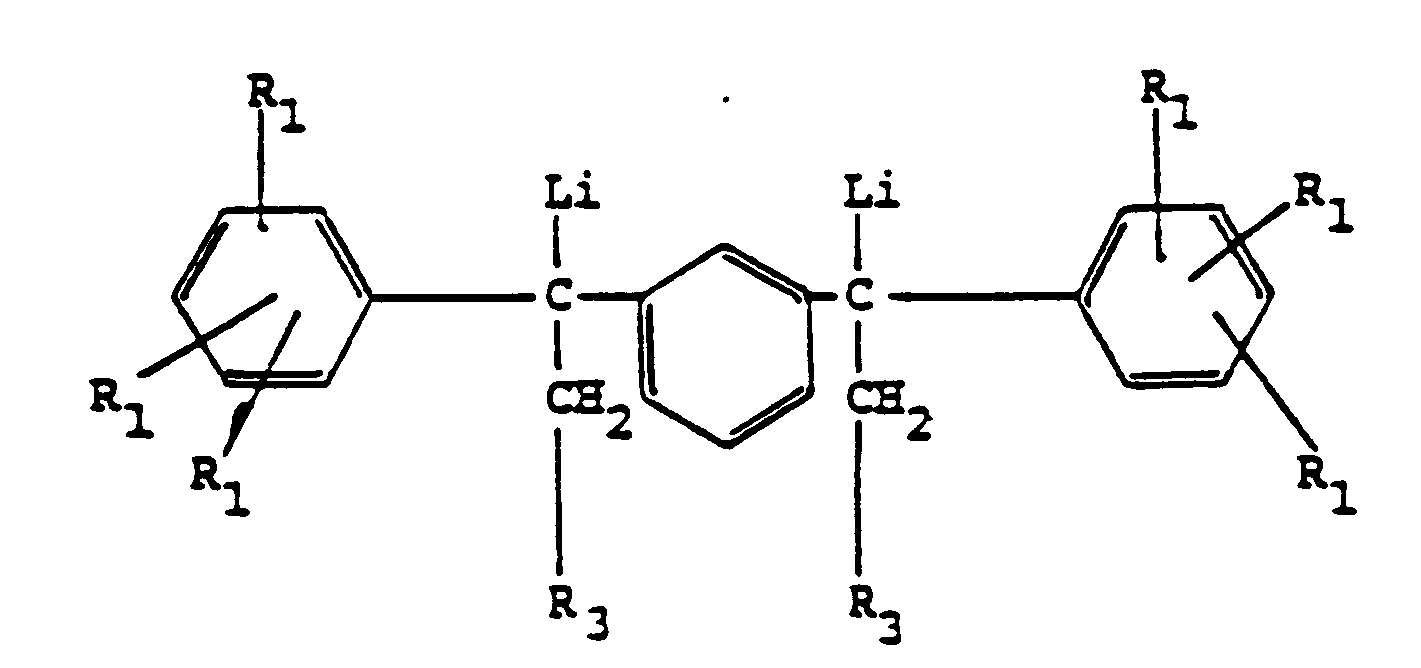
- Initiatorsystem nach Anspruch 8 oder Anspruch 9,
dadurchgekennzeichnet,
daß das Lithiumalkoxid Lithiumisopropoxid ist.
Applications Claiming Priority (2)
| Application Number | Priority Date | Filing Date | Title |
|---|---|---|---|
| US75432985A | 1985-07-12 | 1985-07-12 | |
| US754329 | 1985-07-12 |
Publications (2)
| Publication Number | Publication Date |
|---|---|
| EP0210016A1 EP0210016A1 (de) | 1987-01-28 |
| EP0210016B1 true EP0210016B1 (de) | 1992-01-22 |
Family
ID=25034328
Family Applications (1)
| Application Number | Title | Priority Date | Filing Date |
|---|---|---|---|
| EP86305238A Expired - Lifetime EP0210016B1 (de) | 1985-07-12 | 1986-07-07 | Polymerisationsverfahren und Initiator dafür |
Country Status (6)
| Country | Link |
|---|---|
| EP (1) | EP0210016B1 (de) |
| JP (1) | JPS6264806A (de) |
| KR (1) | KR920004616B1 (de) |
| AU (1) | AU596363B2 (de) |
| CA (1) | CA1284548C (de) |
| DE (1) | DE3683555D1 (de) |
Families Citing this family (9)
| Publication number | Priority date | Publication date | Assignee | Title |
|---|---|---|---|---|
| JPH0667970B2 (ja) * | 1987-11-16 | 1994-08-31 | ザ ダウ ケミカル カンパニー | 陰イオン重合用のアミン含有開始剤システム |
| EP0472749A1 (de) * | 1990-08-27 | 1992-03-04 | The Dow Chemical Company | Verfahren zur Entfernung von Verunreinigungen aus einer Reaktionsmischung |
| CN1048989C (zh) * | 1995-10-17 | 2000-02-02 | 中国石油化工总公司 | 多官能团有机碱金属引发剂及其合成方法 |
| EP0877034A1 (de) * | 1997-05-05 | 1998-11-11 | The Goodyear Tire & Rubber Company | Statistisches SBR mit hohem Transgehalt und niedrigem Vinylgehalt |
| CN1118493C (zh) * | 1999-02-24 | 2003-08-20 | 北京燕山石油化工公司研究院 | 共轭二烯和单乙烯芳烃无规共聚物的制备方法 |
| US6489403B1 (en) * | 1999-12-14 | 2002-12-03 | The Goodyear Tire & Rubber Company | Process for improved coupling of rubbery polymers |
| DE10033343A1 (de) * | 2000-07-08 | 2002-01-17 | Bosch Gmbh Robert | Kraftstoffeinspritzanlage für einen Verbrennungsmotor |
| SE522473C2 (sv) * | 2002-06-20 | 2004-02-10 | Alfa Laval Corp Ab | Ett sätt och en anordning för rening av vevhusgas |
| KR101748915B1 (ko) * | 2014-11-28 | 2017-06-19 | 주식회사 엘지화학 | 신규 음이온 중합 개시제 및 이를 이용한 공역디엔계 공중합체의 제조방법 |
Family Cites Families (3)
| Publication number | Priority date | Publication date | Assignee | Title |
|---|---|---|---|---|
| FR1492154A (fr) * | 1965-06-01 | 1967-08-18 | Exxon Research Engineering Co | Polydioléfines de faible viscosité, ayant un pourcentage élevé de non-saturation de type 1.2. |
| US4205016A (en) * | 1975-08-01 | 1980-05-27 | The Dow Chemical Company | Multifunctional lithium containing initiator |
| US4196154A (en) * | 1977-10-11 | 1980-04-01 | The Dow Chemical Company | Soluble multifunctional lithium containing initiator |
-
1986
- 1986-07-07 EP EP86305238A patent/EP0210016B1/de not_active Expired - Lifetime
- 1986-07-07 DE DE8686305238T patent/DE3683555D1/de not_active Expired - Fee Related
- 1986-07-08 AU AU59830/86A patent/AU596363B2/en not_active Ceased
- 1986-07-08 CA CA000513281A patent/CA1284548C/en not_active Expired - Fee Related
- 1986-07-11 KR KR1019860005607A patent/KR920004616B1/ko not_active Expired
- 1986-07-11 JP JP61162165A patent/JPS6264806A/ja active Pending
Also Published As
| Publication number | Publication date |
|---|---|
| AU596363B2 (en) | 1990-05-03 |
| CA1284548C (en) | 1991-05-28 |
| KR920004616B1 (ko) | 1992-06-12 |
| KR870001238A (ko) | 1987-03-12 |
| DE3683555D1 (de) | 1992-03-05 |
| EP0210016A1 (de) | 1987-01-28 |
| AU5983086A (en) | 1987-01-15 |
| JPS6264806A (ja) | 1987-03-23 |
Similar Documents
| Publication | Publication Date | Title |
|---|---|---|
| US4196154A (en) | Soluble multifunctional lithium containing initiator | |
| EP0212693B1 (de) | Verfahren zur Kupplung von Polymeren hergestellt durch anionischen Polymerisation von Dienmonomeren und/oder vinylaromatischen Monomeren | |
| US4172190A (en) | Soluble multifunctional lithium containing initiator | |
| US4088813A (en) | Promoters in the polymerization of monovinyl-aromatic compounds with primary lithium initiators | |
| US7763696B2 (en) | Diene elastomer with cyclic vinyl units and processes for obtaining same | |
| GB1597500A (en) | Polymers | |
| US6506862B2 (en) | Process for the preparation of a diene elastomer by anionic polymerization | |
| EP0207562A1 (de) | Verfahren zur Kupplung von lebenden Polymeren und Verbindungen verwendbar dafür | |
| US4182818A (en) | Polyfunctional lithium containing initiator | |
| US3855189A (en) | Polar compounds improve effectiveness of polyvinyl aromatic compounds | |
| EP0210016B1 (de) | Polymerisationsverfahren und Initiator dafür | |
| US4960842A (en) | Amine containing initiator system for anionic polymerization | |
| US4461874A (en) | Block copolymers of conjugated dienes or vinyl substituted aromatic hydrocarbons and acrylic esters and process for their manufacture | |
| EP0316857B1 (de) | Amine, einen Initiator für die anionische Polymerisation enthaltend | |
| US3959412A (en) | Block polymer preparation | |
| US4427837A (en) | Process for preparation of diene-styrene-α-methylstyrene block polymers and polymers therefrom | |
| US5057583A (en) | Polymerization process and initiator system therefor | |
| US4172100A (en) | 1,3-Bis[1-(4-methylphenyl)ethenyl]benzene | |
| KR101748915B1 (ko) | 신규 음이온 중합 개시제 및 이를 이용한 공역디엔계 공중합체의 제조방법 | |
| US4618449A (en) | Method for the termination of living polymers, and compounds suitable for the purpose | |
| EP0856522A1 (de) | Multifunktioneller organischer alkalimetallinitiator und seine synthese, anionisch polymerisierte sternförmige polymere und ihre herstellung | |
| EP0856532B1 (de) | Anionische Copolymerisation von konjugierten Dienen und Vinylarenen in Gegenwart von Alkylether von Tetrahydropyranylmethanol | |
| US4754005A (en) | Method for the termination of living polymers obtained by anionic polymerization and compounds suitable to that purpose | |
| GB2124228A (en) | Organo-lithium polymerization initiator | |
| EP0161021B1 (de) | Verfahren zur Kupplung von lebenden Polymeren und Verbindungen verwendbar dafür |
Legal Events
| Date | Code | Title | Description |
|---|---|---|---|
| PUAI | Public reference made under article 153(3) epc to a published international application that has entered the european phase |
Free format text: ORIGINAL CODE: 0009012 |
|
| AK | Designated contracting states |
Kind code of ref document: A1 Designated state(s): BE DE FR GB IT NL SE |
|
| 17P | Request for examination filed |
Effective date: 19870610 |
|
| 17Q | First examination report despatched |
Effective date: 19881025 |
|
| GRAA | (expected) grant |
Free format text: ORIGINAL CODE: 0009210 |
|
| AK | Designated contracting states |
Kind code of ref document: B1 Designated state(s): BE DE FR GB IT NL SE |
|
| PG25 | Lapsed in a contracting state [announced via postgrant information from national office to epo] |
Ref country code: SE Effective date: 19920122 |
|
| ET | Fr: translation filed | ||
| ITF | It: translation for a ep patent filed | ||
| REF | Corresponds to: |
Ref document number: 3683555 Country of ref document: DE Date of ref document: 19920305 |
|
| PGFP | Annual fee paid to national office [announced via postgrant information from national office to epo] |
Ref country code: GB Payment date: 19920701 Year of fee payment: 7 |
|
| PGFP | Annual fee paid to national office [announced via postgrant information from national office to epo] |
Ref country code: NL Payment date: 19920731 Year of fee payment: 7 |
|
| PLBE | No opposition filed within time limit |
Free format text: ORIGINAL CODE: 0009261 |
|
| STAA | Information on the status of an ep patent application or granted ep patent |
Free format text: STATUS: NO OPPOSITION FILED WITHIN TIME LIMIT |
|
| 26N | No opposition filed | ||
| PGFP | Annual fee paid to national office [announced via postgrant information from national office to epo] |
Ref country code: FR Payment date: 19930525 Year of fee payment: 8 |
|
| PGFP | Annual fee paid to national office [announced via postgrant information from national office to epo] |
Ref country code: DE Payment date: 19930601 Year of fee payment: 8 |
|
| PGFP | Annual fee paid to national office [announced via postgrant information from national office to epo] |
Ref country code: BE Payment date: 19930621 Year of fee payment: 8 |
|
| PG25 | Lapsed in a contracting state [announced via postgrant information from national office to epo] |
Ref country code: GB Effective date: 19930707 |
|
| PG25 | Lapsed in a contracting state [announced via postgrant information from national office to epo] |
Ref country code: NL Effective date: 19940201 |
|
| GBPC | Gb: european patent ceased through non-payment of renewal fee |
Effective date: 19930707 |
|
| NLV4 | Nl: lapsed or anulled due to non-payment of the annual fee | ||
| PG25 | Lapsed in a contracting state [announced via postgrant information from national office to epo] |
Ref country code: BE Effective date: 19940731 |
|
| BERE | Be: lapsed |
Owner name: THE DOW CHEMICAL CY Effective date: 19940731 |
|
| PG25 | Lapsed in a contracting state [announced via postgrant information from national office to epo] |
Ref country code: FR Effective date: 19950331 |
|
| PG25 | Lapsed in a contracting state [announced via postgrant information from national office to epo] |
Ref country code: DE Effective date: 19950401 |
|
| REG | Reference to a national code |
Ref country code: FR Ref legal event code: ST |
|
| PG25 | Lapsed in a contracting state [announced via postgrant information from national office to epo] |
Ref country code: IT Free format text: LAPSE BECAUSE OF NON-PAYMENT OF DUE FEES;WARNING: LAPSES OF ITALIAN PATENTS WITH EFFECTIVE DATE BEFORE 2007 MAY HAVE OCCURRED AT ANY TIME BEFORE 2007. THE CORRECT EFFECTIVE DATE MAY BE DIFFERENT FROM THE ONE RECORDED. Effective date: 20050707 |