EP0209070A2 - Intraarterielles hochfrequentes Herzunterstützungssystem - Google Patents
Intraarterielles hochfrequentes Herzunterstützungssystem Download PDFInfo
- Publication number
- EP0209070A2 EP0209070A2 EP86109358A EP86109358A EP0209070A2 EP 0209070 A2 EP0209070 A2 EP 0209070A2 EP 86109358 A EP86109358 A EP 86109358A EP 86109358 A EP86109358 A EP 86109358A EP 0209070 A2 EP0209070 A2 EP 0209070A2
- Authority
- EP
- European Patent Office
- Prior art keywords
- balloon
- valve
- pumping
- catheter
- frequency
- Prior art date
- Legal status (The legal status is an assumption and is not a legal conclusion. Google has not performed a legal analysis and makes no representation as to the accuracy of the status listed.)
- Withdrawn
Links
- 230000000747 cardiac effect Effects 0.000 title claims abstract description 18
- 238000001361 intraarterial administration Methods 0.000 title claims abstract description 16
- 238000005086 pumping Methods 0.000 claims abstract description 52
- 239000012530 fluid Substances 0.000 claims abstract description 14
- 238000006073 displacement reaction Methods 0.000 claims abstract description 12
- 210000001367 artery Anatomy 0.000 claims abstract description 9
- 238000010009 beating Methods 0.000 claims abstract description 7
- 230000007246 mechanism Effects 0.000 claims abstract description 6
- 210000000709 aorta Anatomy 0.000 claims description 9
- 210000001765 aortic valve Anatomy 0.000 claims description 5
- 210000002168 brachiocephalic trunk Anatomy 0.000 claims description 4
- 230000002685 pulmonary effect Effects 0.000 claims description 4
- 239000008280 blood Substances 0.000 claims description 3
- 210000004369 blood Anatomy 0.000 claims description 3
- 238000011144 upstream manufacturing Methods 0.000 claims description 2
- 230000017531 blood circulation Effects 0.000 claims 1
- 230000004087 circulation Effects 0.000 description 5
- 230000000694 effects Effects 0.000 description 3
- 230000036772 blood pressure Effects 0.000 description 2
- 210000004351 coronary vessel Anatomy 0.000 description 2
- 238000010586 diagram Methods 0.000 description 2
- 239000013536 elastomeric material Substances 0.000 description 2
- 239000007788 liquid Substances 0.000 description 2
- 210000005241 right ventricle Anatomy 0.000 description 2
- 238000001356 surgical procedure Methods 0.000 description 2
- WKBPZYKAUNRMKP-UHFFFAOYSA-N 1-[2-(2,4-dichlorophenyl)pentyl]1,2,4-triazole Chemical compound C=1C=C(Cl)C=C(Cl)C=1C(CCC)CN1C=NC=N1 WKBPZYKAUNRMKP-UHFFFAOYSA-N 0.000 description 1
- 208000037260 Atherosclerotic Plaque Diseases 0.000 description 1
- 210000002376 aorta thoracic Anatomy 0.000 description 1
- 210000003129 brachiocephalic vein Anatomy 0.000 description 1
- 210000004556 brain Anatomy 0.000 description 1
- 230000003247 decreasing effect Effects 0.000 description 1
- 238000011257 definitive treatment Methods 0.000 description 1
- 230000001419 dependent effect Effects 0.000 description 1
- 230000003205 diastolic effect Effects 0.000 description 1
- 230000003628 erosive effect Effects 0.000 description 1
- 239000007789 gas Substances 0.000 description 1
- 239000001307 helium Substances 0.000 description 1
- 229910052734 helium Inorganic materials 0.000 description 1
- SWQJXJOGLNCZEY-UHFFFAOYSA-N helium atom Chemical compound [He] SWQJXJOGLNCZEY-UHFFFAOYSA-N 0.000 description 1
- 238000003780 insertion Methods 0.000 description 1
- 230000037431 insertion Effects 0.000 description 1
- 238000007914 intraventricular administration Methods 0.000 description 1
- 210000005240 left ventricle Anatomy 0.000 description 1
- 230000033001 locomotion Effects 0.000 description 1
- 239000000463 material Substances 0.000 description 1
- 238000000034 method Methods 0.000 description 1
- 230000004048 modification Effects 0.000 description 1
- 238000012986 modification Methods 0.000 description 1
- 230000010412 perfusion Effects 0.000 description 1
- 230000002572 peristaltic effect Effects 0.000 description 1
- 210000003102 pulmonary valve Anatomy 0.000 description 1
- 210000003270 subclavian artery Anatomy 0.000 description 1
- 230000001839 systemic circulation Effects 0.000 description 1
- 210000000115 thoracic cavity Anatomy 0.000 description 1
- 239000011031 topaz Substances 0.000 description 1
- 229910052853 topaz Inorganic materials 0.000 description 1
- 230000002792 vascular Effects 0.000 description 1
- 210000002620 vena cava superior Anatomy 0.000 description 1
Images


Classifications
-
- A—HUMAN NECESSITIES
- A61—MEDICAL OR VETERINARY SCIENCE; HYGIENE
- A61M—DEVICES FOR INTRODUCING MEDIA INTO, OR ONTO, THE BODY; DEVICES FOR TRANSDUCING BODY MEDIA OR FOR TAKING MEDIA FROM THE BODY; DEVICES FOR PRODUCING OR ENDING SLEEP OR STUPOR
- A61M60/00—Blood pumps; Devices for mechanical circulatory actuation; Balloon pumps for circulatory assistance
- A61M60/50—Details relating to control
- A61M60/508—Electronic control means, e.g. for feedback regulation
- A61M60/577—High-frequency driving
-
- A—HUMAN NECESSITIES
- A61—MEDICAL OR VETERINARY SCIENCE; HYGIENE
- A61M—DEVICES FOR INTRODUCING MEDIA INTO, OR ONTO, THE BODY; DEVICES FOR TRANSDUCING BODY MEDIA OR FOR TAKING MEDIA FROM THE BODY; DEVICES FOR PRODUCING OR ENDING SLEEP OR STUPOR
- A61M60/00—Blood pumps; Devices for mechanical circulatory actuation; Balloon pumps for circulatory assistance
- A61M60/10—Location thereof with respect to the patient's body
- A61M60/122—Implantable pumps or pumping devices, i.e. the blood being pumped inside the patient's body
- A61M60/126—Implantable pumps or pumping devices, i.e. the blood being pumped inside the patient's body implantable via, into, inside, in line, branching on, or around a blood vessel
- A61M60/13—Implantable pumps or pumping devices, i.e. the blood being pumped inside the patient's body implantable via, into, inside, in line, branching on, or around a blood vessel by means of a catheter allowing explantation, e.g. catheter pumps temporarily introduced via the vascular system
-
- A—HUMAN NECESSITIES
- A61—MEDICAL OR VETERINARY SCIENCE; HYGIENE
- A61M—DEVICES FOR INTRODUCING MEDIA INTO, OR ONTO, THE BODY; DEVICES FOR TRANSDUCING BODY MEDIA OR FOR TAKING MEDIA FROM THE BODY; DEVICES FOR PRODUCING OR ENDING SLEEP OR STUPOR
- A61M60/00—Blood pumps; Devices for mechanical circulatory actuation; Balloon pumps for circulatory assistance
- A61M60/10—Location thereof with respect to the patient's body
- A61M60/122—Implantable pumps or pumping devices, i.e. the blood being pumped inside the patient's body
- A61M60/126—Implantable pumps or pumping devices, i.e. the blood being pumped inside the patient's body implantable via, into, inside, in line, branching on, or around a blood vessel
- A61M60/135—Implantable pumps or pumping devices, i.e. the blood being pumped inside the patient's body implantable via, into, inside, in line, branching on, or around a blood vessel inside a blood vessel, e.g. using grafting
- A61M60/139—Implantable pumps or pumping devices, i.e. the blood being pumped inside the patient's body implantable via, into, inside, in line, branching on, or around a blood vessel inside a blood vessel, e.g. using grafting inside the aorta, e.g. intra-aortic balloon pumps
-
- A—HUMAN NECESSITIES
- A61—MEDICAL OR VETERINARY SCIENCE; HYGIENE
- A61M—DEVICES FOR INTRODUCING MEDIA INTO, OR ONTO, THE BODY; DEVICES FOR TRANSDUCING BODY MEDIA OR FOR TAKING MEDIA FROM THE BODY; DEVICES FOR PRODUCING OR ENDING SLEEP OR STUPOR
- A61M60/00—Blood pumps; Devices for mechanical circulatory actuation; Balloon pumps for circulatory assistance
- A61M60/20—Type thereof
- A61M60/295—Balloon pumps for circulatory assistance
-
- A—HUMAN NECESSITIES
- A61—MEDICAL OR VETERINARY SCIENCE; HYGIENE
- A61M—DEVICES FOR INTRODUCING MEDIA INTO, OR ONTO, THE BODY; DEVICES FOR TRANSDUCING BODY MEDIA OR FOR TAKING MEDIA FROM THE BODY; DEVICES FOR PRODUCING OR ENDING SLEEP OR STUPOR
- A61M60/00—Blood pumps; Devices for mechanical circulatory actuation; Balloon pumps for circulatory assistance
- A61M60/40—Details relating to driving
- A61M60/497—Details relating to driving for balloon pumps for circulatory assistance
-
- A—HUMAN NECESSITIES
- A61—MEDICAL OR VETERINARY SCIENCE; HYGIENE
- A61M—DEVICES FOR INTRODUCING MEDIA INTO, OR ONTO, THE BODY; DEVICES FOR TRANSDUCING BODY MEDIA OR FOR TAKING MEDIA FROM THE BODY; DEVICES FOR PRODUCING OR ENDING SLEEP OR STUPOR
- A61M60/00—Blood pumps; Devices for mechanical circulatory actuation; Balloon pumps for circulatory assistance
- A61M60/80—Constructional details other than related to driving
- A61M60/841—Constructional details other than related to driving of balloon pumps for circulatory assistance
- A61M60/843—Balloon aspects, e.g. shapes or materials
-
- A—HUMAN NECESSITIES
- A61—MEDICAL OR VETERINARY SCIENCE; HYGIENE
- A61M—DEVICES FOR INTRODUCING MEDIA INTO, OR ONTO, THE BODY; DEVICES FOR TRANSDUCING BODY MEDIA OR FOR TAKING MEDIA FROM THE BODY; DEVICES FOR PRODUCING OR ENDING SLEEP OR STUPOR
- A61M60/00—Blood pumps; Devices for mechanical circulatory actuation; Balloon pumps for circulatory assistance
- A61M60/10—Location thereof with respect to the patient's body
- A61M60/122—Implantable pumps or pumping devices, i.e. the blood being pumped inside the patient's body
- A61M60/126—Implantable pumps or pumping devices, i.e. the blood being pumped inside the patient's body implantable via, into, inside, in line, branching on, or around a blood vessel
- A61M60/148—Implantable pumps or pumping devices, i.e. the blood being pumped inside the patient's body implantable via, into, inside, in line, branching on, or around a blood vessel in line with a blood vessel using resection or like techniques, e.g. permanent endovascular heart assist devices
-
- A—HUMAN NECESSITIES
- A61—MEDICAL OR VETERINARY SCIENCE; HYGIENE
- A61M—DEVICES FOR INTRODUCING MEDIA INTO, OR ONTO, THE BODY; DEVICES FOR TRANSDUCING BODY MEDIA OR FOR TAKING MEDIA FROM THE BODY; DEVICES FOR PRODUCING OR ENDING SLEEP OR STUPOR
- A61M60/00—Blood pumps; Devices for mechanical circulatory actuation; Balloon pumps for circulatory assistance
- A61M60/20—Type thereof
- A61M60/205—Non-positive displacement blood pumps
- A61M60/211—Non-positive displacement blood pumps using a jet, venturi or entrainment effect for pumping the blood
-
- A—HUMAN NECESSITIES
- A61—MEDICAL OR VETERINARY SCIENCE; HYGIENE
- A61M—DEVICES FOR INTRODUCING MEDIA INTO, OR ONTO, THE BODY; DEVICES FOR TRANSDUCING BODY MEDIA OR FOR TAKING MEDIA FROM THE BODY; DEVICES FOR PRODUCING OR ENDING SLEEP OR STUPOR
- A61M60/00—Blood pumps; Devices for mechanical circulatory actuation; Balloon pumps for circulatory assistance
- A61M60/20—Type thereof
- A61M60/247—Positive displacement blood pumps
- A61M60/253—Positive displacement blood pumps including a displacement member directly acting on the blood
- A61M60/268—Positive displacement blood pumps including a displacement member directly acting on the blood the displacement member being flexible, e.g. membranes, diaphragms or bladders
- A61M60/274—Positive displacement blood pumps including a displacement member directly acting on the blood the displacement member being flexible, e.g. membranes, diaphragms or bladders the inlet and outlet being the same, e.g. para-aortic counter-pulsation blood pumps
-
- A—HUMAN NECESSITIES
- A61—MEDICAL OR VETERINARY SCIENCE; HYGIENE
- A61M—DEVICES FOR INTRODUCING MEDIA INTO, OR ONTO, THE BODY; DEVICES FOR TRANSDUCING BODY MEDIA OR FOR TAKING MEDIA FROM THE BODY; DEVICES FOR PRODUCING OR ENDING SLEEP OR STUPOR
- A61M60/00—Blood pumps; Devices for mechanical circulatory actuation; Balloon pumps for circulatory assistance
- A61M60/80—Constructional details other than related to driving
- A61M60/802—Constructional details other than related to driving of non-positive displacement blood pumps
- A61M60/833—Occluders for preventing backflow
Definitions
- This invention relates generally to temporary cardiac assist devices used to assist the operation of a failing, traumatized or infarcted heart for a limited period until either the heart recovers or more definitive treatment can be provided.
- it relates to so-called intra-aortic balloon pumps.
- Such a pump does not require major thoracic surgery to connect it to the circulation but is a collapsible structure which may be introduced into an easily accessible large artery, such as a femoral, and may then be guided into some portion of the aorta, usually the thoracic aorta, where it can be employed to assist the left side of the heart, the side most frequently in need of assistance and the driving force behind the systemic circulation.
- the balloon In the usual "counterpulsation" mode of employment, the balloon is pneumatically inflated during diastole to increase blood pressure and deflated during systole to lower the pressure load upon the ventricle.
- This device and its mode of operation was described in a paper by Moulopolous, Topaz and Kolff, "Diastolic Balloon Pumping in the Aorta - A Mechanical Assistance to the Failing Circulation", American Heart Journal (1962) 63, p.669.
- intra-aortic balloon pumps can be applied with relatively minor surgery and fairly standard vascular catheterization procedures, and afford some useful assistance to the left heart, they are well regarded. However, they provide much less pumping assistance than one would desire, for at least three reasons: first, the conveniently available volume within the aorta is not large compared to the desired stroke volume of the heart; second, the necessity to avoid occlusion of important arteries such as the carotids and renals, and erosion of atherosclerotic plaques, further limits the size of a pump balloon; and third, the elastic compliance of the aortic walls makes the effective pumping displacement of the balloon less than its geometric displacement. Many inventions have been addressed to the alleviation of this problem: For example, U.S. Patent No.
- the desired objects are attained by positioning a small balloon pump, provided with valve means on its downstream side, in a major artery immediately adjacent to the heart, such as in the ascending aorta between the aortic valve and the ostium of the innominate artery, or in the pulmonary trunk.
- This small balloon pump iscyclically inflated and deflated at a frequency much higher than that of the beating of the heart, whereby the ejected stroke volume of the ventricle is pumped away by several rapid cycles of balloon pumping.
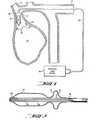
- FIG. 1 is a schematic view of the high-frequency intra-arterial cardiac support system in its mode of employment in support of the left heart.
- Left ventricle 10 is assisted by balloon pump 20 located in ascending aorta 11 between aortic valve 12 and the ostium of innominate artery 13.
- pump 20 comprises pumping balloon 14 and valve 15 downstream from balloon 14, both attached to two-lumen catheter 16 which is brought outside the body through the arterial tree, as via subclavian artery 17 in the Figure.
- Pump 20 as seen more particularly in Figure 2, comprises a shaped hollow tubular body of thin elastomeric material cemented to two-lumen catheter 16 to form pumping balloon 14 and valve 15.
- the end of catheter 16 is closed, and the end of balloon 14 is supported, by closure 23, which may advantageously be made of radio-opaque material to facilitate placement of the device.
- the interior of pumping balloon 14 is connected fluidically to one lumen of catheter 16 by holes 22, and the interior of valve 15 is connected fluidically to the other lumen by hole 21.
- dimensions such as thicknesses have been exaggerated in the interest of clarity.
- valve 15 when erected by inflation, should be just sufficient to substantially occlude ascending aorta 11, and the outside diameter of pumping balloon 14 should be somewhat less.
- the inside diameter of the ascending aorta is of the order of of 2.5 centimeters, and the available length for the balloon pump, between the aortic valve and the ostium of the innominate artery, is of the order of 5.0 centimeters.
- two-lumen catheter 16 is connected to control and drive mechanism 18 which cyclically and individually inflates and deflates balloon 14 and erects and collapses valve 15 by fluid flow through lumens of catheter 16.
- control and drive mechanism 18 which cyclically and individually inflates and deflates balloon 14 and erects and collapses valve 15 by fluid flow through lumens of catheter 16.
- the elements of such mechanisms are well known in the art, but the operating parameters of the mechanism of this invention are quite unusual. In particular, the frequencies of inflation and deflation are much higher, and the inflation and deflation volumes are much lower, than those of prior art devices, as will be set forth in greater detail hereinbelow.
- FIG 3 is a schematic view of the high-frequency intra-arterial cardiac support system of this invention in its mode of employment in support of the right heart.
- right ventricle 25 is assisted by balloon pump 20 located in pulmonary trunk 26 just downstream from pulmonary valve 27.
- the catheter be placed in the venous system, leading out through right ventricle 25 and superior vena cava 28 and a brachiocephalic vein 29.
- valve 15 is again located downstream from pumping balloon 14, but that the different direction of approach of the catheter requires that the valve now be placed at the far end of the assembly.
- This arrangement is shown in detail in Figure 4, where similar numbers refer to similar elements in the arrangement shown in Figure 2.
- FIG. 5 is a timing diagram illustrating the sequence of inflations and deflations of the pumping balloon and the valve of the preferred embodiment of the balloon pump of this invention.
- Two modes of operation are shown, called respectively “continuous” and “burst”.
- the letter “B” refers to the pumping balloon and the letter “V” refers to the valve.
- Upward displacement of a trace signifies increased pressure, or inflation, and downward displacement signifies decreased pressure, or deflation.
- the waveforms shown are illustrative only of timing relationships, and that actual balloon and valve pressure and flow waveforms will be quite rounded, approaching the sinusoidal for high frequencies of inflation and deflation.
- the pumping frequency of the balloon pump must be correspondingly increased. Defining the systolic duty cycle as being the fraction of the total heartbeat period occupied by the systolic period leads to a rule of thumb for the burst mode: that the pumping frequency of the balloon pump must be at least three times the beating frequency of the heart divided by the systolic duty cycle.
- pump throughput is essentially proportional to the product of pump displacement and pumping frequency, it follows that higher pumping frequencies permit smaller pumps. At lower pumping frequencies, pump throughput is limited largely by fluid inertia and viscosity forces in the catheter, and is only weakly dependent on pump displacement up to frequencies at which blood inertia effects become dominant: this leads to a preference for the highest practical pumping frequency. Analysis indicates that a pumping frequency of 1000 strokes per minute is attainable, or almost 14 times the nominal adult heart rate, using helium gas as the drive fluid. It is further likely that arterial compliance effects may be less pronounced at such higher frequencies. For one example, a small pumping balloon of only 7.5 ml displacement, at a pumping frequency of 12 per second and a displacement efficiency of 75% may yield a generous 4 liters per minute.
- FIG. 6 It is not absolutely necessary to use an externally-driven valve in order to accomplish pumping. Indeed, some pumping action can be observed if the valve be simply erected by inflation to some moderate constant pressure, especially if a liquid be used as the inflating fluid.
- a preferable arrangement is to use a one-way passive check valve, several of which have been suggested in the literature.
- the structure is mounted upon and cemented to two-lumen catheter 16, and the ribs are fluidically connected to one of the lumens by holes 24, so that they can be erected and collapsed by fluid, preferably a liquid, supplied from the outside through a lumen in the catheter.
- fluid preferably a liquid
Landscapes
- Health & Medical Sciences (AREA)
- Heart & Thoracic Surgery (AREA)
- Engineering & Computer Science (AREA)
- Cardiology (AREA)
- Life Sciences & Earth Sciences (AREA)
- Public Health (AREA)
- Biomedical Technology (AREA)
- Hematology (AREA)
- Mechanical Engineering (AREA)
- Animal Behavior & Ethology (AREA)
- General Health & Medical Sciences (AREA)
- Anesthesiology (AREA)
- Veterinary Medicine (AREA)
- Vascular Medicine (AREA)
- Transplantation (AREA)
- Physics & Mathematics (AREA)
- Geometry (AREA)
- External Artificial Organs (AREA)
Applications Claiming Priority (2)
| Application Number | Priority Date | Filing Date | Title |
|---|---|---|---|
| US75510785A | 1985-07-15 | 1985-07-15 | |
| US755107 | 1985-07-15 |
Publications (2)
| Publication Number | Publication Date |
|---|---|
| EP0209070A2 true EP0209070A2 (de) | 1987-01-21 |
| EP0209070A3 EP0209070A3 (de) | 1988-07-20 |
Family
ID=25037757
Family Applications (1)
| Application Number | Title | Priority Date | Filing Date |
|---|---|---|---|
| EP19860109358 Withdrawn EP0209070A3 (de) | 1985-07-15 | 1986-07-09 | Intraarterielles hochfrequentes Herzunterstützungssystem |
Country Status (3)
| Country | Link |
|---|---|
| EP (1) | EP0209070A3 (de) |
| JP (1) | JPS6284770A (de) |
| IL (1) | IL79405A0 (de) |
Cited By (7)
| Publication number | Priority date | Publication date | Assignee | Title |
|---|---|---|---|---|
| US4902272A (en) * | 1987-06-17 | 1990-02-20 | Abiomed Cardiovascular, Inc. | Intra-arterial cardiac support system |
| US4906229A (en) * | 1988-05-03 | 1990-03-06 | Nimbus Medical, Inc. | High-frequency transvalvular axisymmetric blood pump |
| FR2681789A1 (fr) * | 1991-09-30 | 1993-04-02 | Nippon Zeon Co | Appareil d'assistance cardio-circulatoire. |
| US5372573A (en) * | 1989-06-20 | 1994-12-13 | British Technology Group Limited | Blood flow |
| WO1999015227A1 (en) * | 1997-09-26 | 1999-04-01 | Cardeon Corporation | Main stage catheterization instrument |
| US6669674B1 (en) | 1997-09-26 | 2003-12-30 | Cardeon Corporation | Introducer and perfusion cannula |
| US11426563B2 (en) | 2018-12-03 | 2022-08-30 | Nxt Biomedical, Llc | Blood pump or balloon cycling and venous occlusion |
Families Citing this family (2)
| Publication number | Priority date | Publication date | Assignee | Title |
|---|---|---|---|---|
| CA1325937C (en) * | 1987-05-29 | 1994-01-11 | Ingemar H. Lundquist | Retroperfusion and retroinfusion control apparatus, system and method |
| US11351355B2 (en) | 2017-10-19 | 2022-06-07 | Datascope Corporation | Devices for pumping blood, related systems, and related methods |
Family Cites Families (6)
| Publication number | Priority date | Publication date | Assignee | Title |
|---|---|---|---|---|
| US3266487A (en) * | 1963-06-04 | 1966-08-16 | Sundstrand Corp | Heart pump augmentation system and apparatus |
| US3692018A (en) * | 1970-02-11 | 1972-09-19 | Robert H Goetz | Cardiac assistance device |
| US3939820A (en) * | 1974-10-29 | 1976-02-24 | Datascope Corporation | Single-chamber, multi-section balloon for cardiac assistance |
| JPS522231A (en) * | 1975-06-24 | 1977-01-08 | Hitachi Ltd | Information processing apparatus |
| JPS5545220A (en) * | 1978-09-27 | 1980-03-29 | Hitachi Ltd | Trunk circuit |
| US4522195A (en) * | 1981-05-25 | 1985-06-11 | Peter Schiff | Apparatus for left heart assist |
-
1986
- 1986-07-09 EP EP19860109358 patent/EP0209070A3/de not_active Withdrawn
- 1986-07-14 IL IL79405A patent/IL79405A0/xx unknown
- 1986-07-15 JP JP61166562A patent/JPS6284770A/ja active Pending
Cited By (8)
| Publication number | Priority date | Publication date | Assignee | Title |
|---|---|---|---|---|
| US4902272A (en) * | 1987-06-17 | 1990-02-20 | Abiomed Cardiovascular, Inc. | Intra-arterial cardiac support system |
| US4906229A (en) * | 1988-05-03 | 1990-03-06 | Nimbus Medical, Inc. | High-frequency transvalvular axisymmetric blood pump |
| EP0415949A4 (en) * | 1988-05-03 | 1991-07-03 | Nimbus Medical, Inc. | High-frequency transvalvular axisymmetric blood pump |
| US5372573A (en) * | 1989-06-20 | 1994-12-13 | British Technology Group Limited | Blood flow |
| FR2681789A1 (fr) * | 1991-09-30 | 1993-04-02 | Nippon Zeon Co | Appareil d'assistance cardio-circulatoire. |
| WO1999015227A1 (en) * | 1997-09-26 | 1999-04-01 | Cardeon Corporation | Main stage catheterization instrument |
| US6669674B1 (en) | 1997-09-26 | 2003-12-30 | Cardeon Corporation | Introducer and perfusion cannula |
| US11426563B2 (en) | 2018-12-03 | 2022-08-30 | Nxt Biomedical, Llc | Blood pump or balloon cycling and venous occlusion |
Also Published As
| Publication number | Publication date |
|---|---|
| JPS6284770A (ja) | 1987-04-18 |
| EP0209070A3 (de) | 1988-07-20 |
| IL79405A0 (en) | 1986-10-31 |
Similar Documents
| Publication | Publication Date | Title |
|---|---|---|
| US4785795A (en) | High-frequency intra-arterial cardiac support system | |
| US4902272A (en) | Intra-arterial cardiac support system | |
| US4080958A (en) | Apparatus for aiding and improving the blood flow in patients | |
| US6468200B1 (en) | Segmented peristaltic intra-aortic balloon pump | |
| US3504662A (en) | Intra-arterial blood pump | |
| US20250325799A1 (en) | Devices for Pumping Blood, Related Systems, and Related Methods | |
| US4014317A (en) | Multipurpose cardiocirculatory assist cannula and methods of use thereof | |
| US4546759A (en) | Method and apparatus for assisting human heart function | |
| US7229402B2 (en) | Minimally invasive ventricular assist technology and method | |
| US5688245A (en) | Cannula system for a biventricular cardiac support system or a cardiopulmonary bypass system | |
| EP0471029B1 (de) | Ballonpumpe als hilfe für das herz | |
| US4861330A (en) | Cardiac assist device and method | |
| US5928132A (en) | Closed chest intra-aortic balloon based ventricular assist device | |
| US6190304B1 (en) | Enhanced intra-aortic balloon assist device | |
| US8221303B2 (en) | Intra-ventricular cardiac assist device and related method of use | |
| US8784292B2 (en) | Double balloon pump cardiac assist device and related method of use | |
| US4648384A (en) | Retrograde coronary sinus perfusion device and method | |
| US4527549A (en) | Method of and means for intraaortic assist | |
| US3791374A (en) | Programmer for segmented balloon pump | |
| US11253691B2 (en) | Intra-aortic dual balloon driving pump catheter device | |
| JPH04500318A (ja) | 高周波経弁軸対称血液ポンプ | |
| EP3566741A1 (de) | Intra-aortale doppelballonpumpenkathetervorrichtung | |
| US20220032033A1 (en) | Improved intra-aortic balloon pump | |
| US6149578A (en) | Piston-action intra-aortic coronary assist device | |
| US20080207986A1 (en) | Heart assist device |
Legal Events
| Date | Code | Title | Description |
|---|---|---|---|
| PUAI | Public reference made under article 153(3) epc to a published international application that has entered the european phase |
Free format text: ORIGINAL CODE: 0009012 |
|
| AK | Designated contracting states |
Kind code of ref document: A2 Designated state(s): BE CH DE FR GB IT LI LU NL SE |
|
| PUAL | Search report despatched |
Free format text: ORIGINAL CODE: 0009013 |
|
| AK | Designated contracting states |
Kind code of ref document: A3 Designated state(s): BE CH DE FR GB IT LI LU NL SE |
|
| 17P | Request for examination filed |
Effective date: 19890112 |
|
| RAP1 | Party data changed (applicant data changed or rights of an application transferred) |
Owner name: ABIOMED LIMITED PARTNERSHIP |
|
| 17Q | First examination report despatched |
Effective date: 19900711 |
|
| RAP1 | Party data changed (applicant data changed or rights of an application transferred) |
Owner name: ABIOMED, INC. |
|
| RAP1 | Party data changed (applicant data changed or rights of an application transferred) |
Owner name: ABIOMED, INC. ( A DELAWARE CORPORATION) |
|
| STAA | Information on the status of an ep patent application or granted ep patent |
Free format text: STATUS: THE APPLICATION IS DEEMED TO BE WITHDRAWN |
|
| 18D | Application deemed to be withdrawn |
Effective date: 19920211 |
|
| RIN1 | Information on inventor provided before grant (corrected) |
Inventor name: SINGH, PARAM I. |