EP0206538A2 - Formen von Kabelspleissverschlüssen - Google Patents
Formen von Kabelspleissverschlüssen Download PDFInfo
- Publication number
- EP0206538A2 EP0206538A2 EP86303986A EP86303986A EP0206538A2 EP 0206538 A2 EP0206538 A2 EP 0206538A2 EP 86303986 A EP86303986 A EP 86303986A EP 86303986 A EP86303986 A EP 86303986A EP 0206538 A2 EP0206538 A2 EP 0206538A2
- Authority
- EP
- European Patent Office
- Prior art keywords
- cable
- splices
- cables
- tape
- conductors
- Prior art date
- Legal status (The legal status is an assumption and is not a legal conclusion. Google has not performed a legal analysis and makes no representation as to the accuracy of the status listed.)
- Withdrawn
Links
Images
Classifications
-
- H—ELECTRICITY
- H02—GENERATION; CONVERSION OR DISTRIBUTION OF ELECTRIC POWER
- H02G—INSTALLATION OF ELECTRIC CABLES OR LINES, OR OF COMBINED OPTICAL AND ELECTRIC CABLES OR LINES
- H02G15/00—Cable fittings
- H02G15/08—Cable junctions
- H02G15/18—Cable junctions protected by sleeves, e.g. for communication cable
-
- H—ELECTRICITY
- H02—GENERATION; CONVERSION OR DISTRIBUTION OF ELECTRIC POWER
- H02G—INSTALLATION OF ELECTRIC CABLES OR LINES, OR OF COMBINED OPTICAL AND ELECTRIC CABLES OR LINES
- H02G1/00—Methods or apparatus specially adapted for installing, maintaining, repairing or dismantling electric cables or lines
- H02G1/14—Methods or apparatus specially adapted for installing, maintaining, repairing or dismantling electric cables or lines for joining or terminating cables
- H02G1/145—Moulds
-
- H—ELECTRICITY
- H02—GENERATION; CONVERSION OR DISTRIBUTION OF ELECTRIC POWER
- H02G—INSTALLATION OF ELECTRIC CABLES OR LINES, OR OF COMBINED OPTICAL AND ELECTRIC CABLES OR LINES
- H02G15/00—Cable fittings
- H02G15/08—Cable junctions
- H02G15/10—Cable junctions protected by boxes, e.g. by distribution, connection or junction boxes
- H02G15/117—Cable junctions protected by boxes, e.g. by distribution, connection or junction boxes for multiconductor cables
-
- H—ELECTRICITY
- H02—GENERATION; CONVERSION OR DISTRIBUTION OF ELECTRIC POWER
- H02G—INSTALLATION OF ELECTRIC CABLES OR LINES, OR OF COMBINED OPTICAL AND ELECTRIC CABLES OR LINES
- H02G15/00—Cable fittings
- H02G15/08—Cable junctions
- H02G15/18—Cable junctions protected by sleeves, e.g. for communication cable
- H02G15/196—Cable junctions protected by sleeves, e.g. for communication cable having lapped insulation
Definitions
- This invention relates to the forming of cable splice closures-A telecommunications cable from a central office and for underground or aerial use comprises a core having a plurality of pairs of individually insulated conductors. There may be up to 3600 pairs of conductors in the core.
- conductors are spliced together from cable-to-cable by removing the end portions of core surrounding material, i.e.
- Conductor splices are then formed between conductors of one cable and those of the other and each splice is located upon an end portion of core surrounding material with conductors extending across the end portion to their respective cable cores.
- Each individual splice is sealed within sealing material and an encapsulation is formed axially over the end portions of core surrounding material to cover and fluid tightly seal the splices.
- the splices are enclosed in a heat softenable sealing tape as the sealing material and this sealing tape is provided as wrappings around the core surrounding material of the cable end regions. It is found with the method described in the aforementioned application that a fluid tight seal is provided around each of the splices for cables up to a certain diameter. However, moisture leaks have been found to occur in a few instances in cables of large diameters, e.g. up to 3600 pairs of conductors. Some improvement is therefore required in the method of sealing the splices.
- the present invention provides a method of forming an encapsulated splice region between two cable ends in which the problem of splice failures caused by moisture is eliminated.
- the invention also provides an assembly of two telecommunications cables with the conductors forming splices which are sealed in a manner so as to solve the moisture leakage problem.
- the present invention provides a method of forming an encapsulated splice region between two cable ends comprising:-removing core surrounding material from end regions of two cables to provide end portions of core surrounding material and cable core regions projecting a certain distance beyond said end portions; turning the conductors of said core regions so that they extend radially outwards from the cables; locating the end portions of core surrounding material close together and substantially in axial alignment with the conductors projecting from between the end portions; connecting shields of the two cables together with a rigid axially extending grounding means which is enclosed within a seal; surrounding the seal and end portions of core surrounding material with a layer of stiffening material with conductor ends projecting radially beyond the stiffening material; with conductor ends electrically connected together to form splices from one cable to the other, individually enclosing each splice within a compressible deformable sealing material which extends over the stiffening layer and onto the outer surface of each cable at each end of the stiffening layer and with the splic
- the stiffening material serves to hold the end regions of the two cables substantially immovable one relative to the other so as to prevent any slight movement between the deformable sealing material and the conductors extending between the splices and the core regions.
- the method of the invention applies to any diameter of cable. If cables of large diameter are to be spliced together, e.g. of 3600 conductor pairs, then the method of the invention is preferably performed by separating the splices into groups and then sealing a first group of splices by locating them around at least one end portion of a cable and placing a layer of resilient tape material upon the deformable sealing material so as to compress the sealing material against the conductors for the first groups of splices. Second and subsequent groups of splices are then positioned between sealing material axially spaced from the first group and layers of resilient tape material are applied in the manner defined according to the invention. Alternatively, layers of sealing material may be placed over the first and subsequent layers of resilient tape material for succeeding groups of splices to be applied directly surrounding the first group.
- the invention also includes an assembly of two telecommunications cables disposed end-to-end with conductors of each cable electrically connected each to one conductor of the other cable to form a conductor splice and in which:-shields of the two cables are connected together with ' a rigid axially extending grounding means which is enclosed within a seal; a layer of stiffening material surrounds the seal and end portions of core surrounding material with conductors projecting radially beyond the stiffening material and having axially extending parts outside the end portion of at least one of the cables to dispose the splices radially outwards of core surrounding material with each splice individually closed within and sealed from other splices by a sealing material and with axially extending parts of the conductors enclosed within and sealed by said sealing material, said sealing material being compressibly deformable; a layer of resilient tape material wrapped around the sealing material in a position over the axially extending parts of the conductors, the resilient tape material in a stretched resilient condition circum
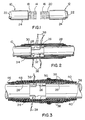
- two cables 10 and 12 each with 900 pairs of conductors are to be joined together by electrically interconnecting each individual conductor 14 and 16 of two cable cores 18 and 20 with an individual conductor of the other cable.
- the core surrounding material of each cable end namely a metal sheath or shield 22 and polymeric jacket material 24 is removed to expose a projecting portion of the core 18 or 20 extending beyond the end portions of the jacket 24.
- the lengths of conductors extending beyond the jacket and sheath of each cable should be sufficient for this purpose.
- each cable As shown by Figure 2, the conductors of each cable are splayed outwardly so that they project in all radial directions from the cables and separation of the conductor pairs is achieved. This operation then enables the cable ends to be disposed substantially in axial alignment with the core surrounding material closer together than would be the case if the cores were left in their condition shown in Figure 1.
- the cable ends are in fact brought together in this particular construction so that the jackets 24 are approximately 75 mm apart.
- a grounding means in the form of a grounding bar 26 is then positioned so as to bridge the gap between the metal sneaths 22 and is secured to them in conventional fashion to electrically connect them together.
- the grounding bar 26 extends for a substantial distance aiong the jacket of the cable 12, this distance being sufficient to enable ail of the splices formed be- ween conductors of the two cables to be disposed .Jver this axial distance of the cable.
- the grounding car is sealed to prevent any moisture passing along it, by a seating tape material formed of windings of ethylene-propylene sealing tape which is formed into overlapped wrappings 28 of the tape which are positioned at each cable end and be- ! 1 eath the grounding bar. Further wrappings 30 are then wound on top of the wrappings 28 and also over the grounding bar so as to completely enclose it.
- a rigid elongate support means is also provided.
- This support means is also a metal bar 32 which is circumferentially spaced around the cables from the grounding bar 26 and extends for the full axial distance of the grounding bar as shown in Figure 2.
- the metal bar 32 is also sealed within the wrappings 28 and 30 of the sealing tape.
- a stiffening material is added.
- This stiffening material is in the form of overlapped windings 34 of vinyl tape which extend completely axially across the windings 28 and 30 so as to axially bridge the windings of the sealing tape and also of the grounding bar and the support means 32.
- the wrappings 34 assist in the stiffening of the connection between the two cable ends so that substantially all of the movement between the two cable ends is eliminated.
- splices 38 between the conductors are then made to electrically connect one cable to the other. Only four splices are shown in Figure 2 for clarity. Groups of the splices are then chosen. A first group of splices is to be laid upon the cable 12 and sealed into position before subsequent groups. To seal the first group of splices in position, a layer of deformable sealing material is positioned to extend across the windings 34 of vinyl tape into contact with the jacket of the cables.
- This sealing material which is ethylene-propylene rubber sealing tape is formed as layer 36 by overlapped windings and the conductors are then laid over the layer 36 as shown by Figure 3 to locate the splices 38 of the first group upon the layer, possibly towards the end of the grounding bar 26 and support means 32 on the cable 12.
- a further layer 40 of the compressible sealing tape is then formed by overlapped windings and these windings completely overlay the layer 38 so as to enclose between the layers the conductors extending from the gap between the cables and also the splices themselves.
- a layer 42 of resilient sealing tape is then wrapped around the layer 40 in a localized axial position, i.e. so as to lie outwardly of the conductors 14 and 16 passing to the first group of splices.
- This layer of resilient tape material is of any suitable material for the purpose of permanently compressing the ethylene-propylene tape material.
- a requirement for the resilient tape material is that it may be stretched sufficiently so as to apply a degree of compression to the layers 40 and 38 to cause their permanent deformation under the compressive force.
- a suitable material for the layer 42 includes a tape referred to throughout the telecommunications cable industry as "DR tape", or a neoprene rubber tape.
- Subsequent groups of splices are then located around the cable 12 in the manner discussed above with each of the splices in each group being circumferentially spaced from others in the group.
- the second group of splices is laid around the cable core, possibly slightly axially spaced from the previous group.
- the splices 38 in the second group are contained between layers 46 and 48 of ethylene-propylene rubber tape material which are wound upon the previous layers as described. It may be possible to dispense with the layer 46 so that the splices 44 lie directly upon the layer 40.
- a further layer 50 of the resilient tape material is wrapped tightly around the layer 48 so as to overlie in a localized area, the conductors leading to the splices 38.
- the material of the layers 42 and 44 should be stretched sufficiently so that the width of the tape decreases to approximately .75 of its original unstretched width.
- the number of splices per group does of course relate to the circumferential distance around the cable and is related therefore to the cable diameter. It has been found that the groups may be formed conveniently of up to 100 splices per group and these may be applied in succession in the manner described around a single cable end while sealing each group in turn.
- the splices all lie axially along the extent of the grounding bar 26 and rigid support bar 32 so that they lie within the encapsulated region which is rigidified by the bars and by the vinyl tape 34.
- each has been enclosed within its own sealing material provided by the ethylene-propylene rubber tape and the resilient tape material has been wrapped around the layers for each splice group as is required, then the splice region is completed by an encapsulation.
- the encapsulation is preceded however by disposing a barrier material around the windings of ethylene-propylene rubber tape. This barrier material may extend completely from end-to-end of the previous windings so as to lie upon the cable jackets at each end.
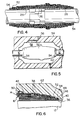
- the barrier material 52 terminates axially short of the ends of previous windings of ethylene-propylene rubber, to provide a short exposed region 54 which may be about 0.5 inches wide, for contact by the encapsulating material which is to be applied.
- the barrier material may itself be vinyl.
- the splice assembly as shown in Figure 4 is then located within a mold comprising mold halves 54 ( Figure 5). Only one of these is shown as the view is taken on the parting line of the mold. Moldable material is extruded through inlet gate 56 into the mold cavity 58 to mold the encapsulation with polyethylene material. The polyethylene flows through the mold and fills the cavity and completely encloses the vinyl layer 52.
- the ethylene-propylene rubber tape layers should be softened sufficiently to cause them to merge together while also ensuring that the production of toxic gases is minimized.
- the temperatures for molding are therefore carefully controlled so that fusion will take place between the molding material and the jackets for the cables.
- the jacket material is basically polyethylene and it is intended to use a different grade of polyethylene for the molding operation.
- a required temperature for the molding material is below 204°C and preferably between 160°C and 190°C as the molding material enters the mold.
- the molding temperature is such that a fusion bond does not take place between the plastic molding 62 forming the encapsulation and the cable jacket
- the resilient material in each of the layers 42 and 50 is not heated sufficiently to soften it which would otherwise cause it to relax from its stretched condition.
- the heat retention and the temperature of molding is sufficiently high for a fusion bond to take place between the ethylene-propylene rubber layers and between these layers and the molding at any interfacial region between them such as occurs along the region 54 at each end of the encapsulation. Seals are therefore formed at regions 54.
- the ethylene-propylene rubber layers which contact each other are merged into a single mass completely surrounding each individual splice and also surrounding the conductors where these pass through between the layers.
- the molding 62 is not bonded to the jackets, moisture cannot reach the splices 38.
- the sealing material completely surrounds the grounding bar and the support means 32 so that moisture cannot move along the surfaces of these members.
Landscapes
- Cable Accessories (AREA)
- Processing Of Terminals (AREA)
Applications Claiming Priority (2)
| Application Number | Priority Date | Filing Date | Title |
|---|---|---|---|
| CA484546 | 1985-06-19 | ||
| CA000484546A CA1232954A (en) | 1985-06-19 | 1985-06-19 | Forming of cable splice closures |
Publications (2)
| Publication Number | Publication Date |
|---|---|
| EP0206538A2 true EP0206538A2 (de) | 1986-12-30 |
| EP0206538A3 EP0206538A3 (de) | 1989-07-19 |
Family
ID=4130768
Family Applications (1)
| Application Number | Title | Priority Date | Filing Date |
|---|---|---|---|
| EP86303986A Withdrawn EP0206538A3 (de) | 1985-06-19 | 1986-05-27 | Formen von Kabelspleissverschlüssen |
Country Status (6)
| Country | Link |
|---|---|
| US (1) | US4654474A (de) |
| EP (1) | EP0206538A3 (de) |
| JP (1) | JPS61295809A (de) |
| KR (1) | KR940004226B1 (de) |
| AU (1) | AU588594B2 (de) |
| CA (1) | CA1232954A (de) |
Families Citing this family (36)
| Publication number | Priority date | Publication date | Assignee | Title |
|---|---|---|---|---|
| CA1202388A (en) * | 1983-12-06 | 1986-03-25 | Leonard J. Charlebois | Forming cable splice closures |
| US5537742A (en) * | 1995-05-22 | 1996-07-23 | General Signal Corporation | Method for joining multiple conductor cables |
| US6378202B1 (en) | 1999-06-29 | 2002-04-30 | Sbc Communications | Thermal shield and hermetic seal for preventing deterioration of plastic insulation in open access closures and method therefor |
| US7120347B2 (en) * | 2004-01-27 | 2006-10-10 | Corning Cable Systems Llc | Multi-port optical connection terminal |
| US7013074B2 (en) * | 2004-02-06 | 2006-03-14 | Corning Cable Systems Llc | Optical connection closure having at least one connector port |
| EA007573B1 (ru) * | 2004-07-27 | 2006-12-29 | Тоо Казцентрэлектропровод | Способ заземления кабелей в силовых муфтах и устройство для его осуществления |
| US7680388B2 (en) | 2004-11-03 | 2010-03-16 | Adc Telecommunications, Inc. | Methods for configuring and testing fiber drop terminals |
| US7489849B2 (en) | 2004-11-03 | 2009-02-10 | Adc Telecommunications, Inc. | Fiber drop terminal |
| US20060153516A1 (en) * | 2005-01-13 | 2006-07-13 | Napiorkowski John J | Network interface device having integral slack storage compartment |
| US7349605B2 (en) | 2005-04-19 | 2008-03-25 | Adc Telecommunications, Inc. | Fiber breakout with radio frequency identification device |
| US7418177B2 (en) | 2005-11-10 | 2008-08-26 | Adc Telecommunications, Inc. | Fiber optic cable breakout system, packaging arrangement, and method of installation |
| US7251411B1 (en) | 2006-03-09 | 2007-07-31 | Adc Telecommunication, Inc. | Fiber optic cable breakout configuration with “Y” block |
| US7424189B2 (en) * | 2006-03-09 | 2008-09-09 | Adc Telecommunications, Inc. | Mid-span breakout with potted closure |
| US7317863B2 (en) * | 2006-03-09 | 2008-01-08 | Adc Telecommunications, Inc. | Fiber optic cable breakout configuration with retention block |
| US7590321B2 (en) * | 2006-03-09 | 2009-09-15 | Adc Telecommunications, Inc. | Mid-span breakout with helical fiber routing |
| US7422378B2 (en) | 2006-03-09 | 2008-09-09 | Adc Telecommunications, Inc. | Fiber optic cable breakout configuration with excess fiber length |
| US7599598B2 (en) * | 2006-08-09 | 2009-10-06 | Adc Telecommunications, Inc. | Cable payout systems and methods |
| WO2008021253A2 (en) * | 2006-08-14 | 2008-02-21 | Adc Telecommunications, Inc. | Factory spliced cable assembly |
| US7840109B2 (en) * | 2006-08-14 | 2010-11-23 | Adc Telecommunications, Inc. | Factory spliced cable assembly |
| US7289714B1 (en) | 2006-09-26 | 2007-10-30 | Adc Telecommunication, Inc. | Tubing wrap procedure |
| US7480436B2 (en) * | 2006-10-10 | 2009-01-20 | Adc Telecommunications, Inc. | Systems and methods for securing a tether to a distribution cable |
| US7403685B2 (en) * | 2006-10-13 | 2008-07-22 | Adc Telecommunications, Inc. | Overmold zip strip |
| US7489843B2 (en) * | 2007-02-06 | 2009-02-10 | Adc Telecommunications, Inc. | Polyurethane to polyethylene adhesion process |
| US7558458B2 (en) * | 2007-03-08 | 2009-07-07 | Adc Telecommunications, Inc. | Universal bracket for mounting a drop terminal |
| US7609925B2 (en) * | 2007-04-12 | 2009-10-27 | Adc Telecommunications, Inc. | Fiber optic cable breakout configuration with tensile reinforcement |
| US7532799B2 (en) * | 2007-04-12 | 2009-05-12 | Adc Telecommunications | Fiber optic telecommunications cable assembly |
| GB2449120A (en) * | 2007-05-11 | 2008-11-12 | Tyco Electronics | A composite sealing tape having two layers |
| US7769261B2 (en) * | 2007-09-05 | 2010-08-03 | Adc Telecommunications, Inc. | Fiber optic distribution cable |
| US7740409B2 (en) * | 2007-09-19 | 2010-06-22 | Corning Cable Systems Llc | Multi-port optical connection terminal |
| JP4350794B1 (ja) * | 2008-07-01 | 2009-10-21 | 武三郎 大谷 | ゴム芯入り組紐の接合方法 |
| US9188759B2 (en) * | 2008-10-14 | 2015-11-17 | Corning Cable Systems Llc | Optical connection terminal having port mapping scheme |
| US8915659B2 (en) | 2010-05-14 | 2014-12-23 | Adc Telecommunications, Inc. | Splice enclosure arrangement for fiber optic cables |
| CA2816059A1 (en) | 2010-10-28 | 2012-05-03 | Corning Cable Systems Llc | Impact resistant fiber optic enclosures and related methods |
| US8885998B2 (en) | 2010-12-09 | 2014-11-11 | Adc Telecommunications, Inc. | Splice enclosure arrangement for fiber optic cables |
| US9069151B2 (en) | 2011-10-26 | 2015-06-30 | Corning Cable Systems Llc | Composite cable breakout assembly |
| US8873926B2 (en) | 2012-04-26 | 2014-10-28 | Corning Cable Systems Llc | Fiber optic enclosures employing clamping assemblies for strain relief of cables, and related assemblies and methods |
Family Cites Families (10)
| Publication number | Priority date | Publication date | Assignee | Title |
|---|---|---|---|---|
| US3753204A (en) * | 1971-12-27 | 1973-08-14 | J Thompson | Solderless connector assembly for cable shielding jackets and method of installing the same |
| US4092488A (en) * | 1975-10-24 | 1978-05-30 | Sumitomo Electric Industries, Ltd. | Connection or terminal portions for cross-linked polyethylene cables |
| US4164621A (en) * | 1977-08-08 | 1979-08-14 | Amerace Corporation | Cable shield connecting device |
| US4322573A (en) * | 1980-03-11 | 1982-03-30 | Northern Telecom Limited | Encapsulation of telecommunications cable splices |
| US4490315A (en) * | 1982-02-04 | 1984-12-25 | Northern Telecom Limited | Methods of moulding of plastics articles |
| CA1197296A (en) * | 1983-06-08 | 1985-11-26 | Leonard J. Charlebois | Telecommunications cable splice closures |
| CA1202388A (en) * | 1983-12-06 | 1986-03-25 | Leonard J. Charlebois | Forming cable splice closures |
| US4528419A (en) * | 1983-12-12 | 1985-07-09 | Northern Telecom Limited | Forming of cable splice closures |
| US4496795A (en) * | 1984-05-16 | 1985-01-29 | Harvey Hubbell Incorporated | Electrical cable splicing system |
| US4570032A (en) * | 1984-09-07 | 1986-02-11 | Northern Telecom Limited | Sealing closure for a cable splice |
-
1985
- 1985-06-19 CA CA000484546A patent/CA1232954A/en not_active Expired
- 1985-07-08 US US06/752,745 patent/US4654474A/en not_active Expired - Lifetime
-
1986
- 1986-05-27 EP EP86303986A patent/EP0206538A3/de not_active Withdrawn
- 1986-05-29 AU AU58064/86A patent/AU588594B2/en not_active Ceased
- 1986-06-18 KR KR1019860004823A patent/KR940004226B1/ko not_active Expired - Fee Related
- 1986-06-19 JP JP61141528A patent/JPS61295809A/ja active Pending
Also Published As
| Publication number | Publication date |
|---|---|
| AU588594B2 (en) | 1989-09-21 |
| EP0206538A3 (de) | 1989-07-19 |
| US4654474A (en) | 1987-03-31 |
| CA1232954A (en) | 1988-02-16 |
| KR870000723A (ko) | 1987-02-20 |
| AU5806486A (en) | 1986-12-24 |
| JPS61295809A (ja) | 1986-12-26 |
| KR940004226B1 (ko) | 1994-05-17 |
Similar Documents
| Publication | Publication Date | Title |
|---|---|---|
| US4654474A (en) | Forming of cable splice closures | |
| US4528419A (en) | Forming of cable splice closures | |
| US4678866A (en) | Forming of cable splice closures | |
| CA1236958A (en) | Manufacture of sealing closures for a telecommunications cable splice | |
| US4322573A (en) | Encapsulation of telecommunications cable splices | |
| US4629597A (en) | Forming of cable splice closures | |
| US4570032A (en) | Sealing closure for a cable splice | |
| US4142592A (en) | Repairable assembly for protecting a cable junction and method of assembling same | |
| US6423952B1 (en) | Heater arrangement with connector or terminating element and fluoropolymer seal, and method of making the same | |
| US4581480A (en) | Cable splice closure and strain relief | |
| CA1247826A (en) | Manufacture of sealing closures for a telecommunications cable splice | |
| US3777048A (en) | Molding process for splicing cable and product formed thereby | |
| US4252849A (en) | Heat shrinkable covers | |
| US4216351A (en) | Plastic collar integral with a cable jacket | |
| US4378323A (en) | Method of producing plastic collar integral with a cable jacket | |
| US3758353A (en) | Able thermal screen method of welding an electric cable sheathing employing a heat shrink | |
| US4503283A (en) | Cable stub assembly and methods of making | |
| JPS6362971B2 (de) | ||
| CA1202388A (en) | Forming cable splice closures | |
| US3702372A (en) | Molded corona shield for a high voltage coupling | |
| CA1235195A (en) | Forming of cable splice closures | |
| WO1998021796A1 (en) | Sealed closure with support core systems and methods | |
| AU663433B2 (en) | Multi-layer wraparound heat shrink sleeve | |
| JP2618489B2 (ja) | プラスチック絶縁電力ケーブルの接続方法 | |
| CA1127255A (en) | Encapsulation of telecommunications cable splices |
Legal Events
| Date | Code | Title | Description |
|---|---|---|---|
| PUAI | Public reference made under article 153(3) epc to a published international application that has entered the european phase |
Free format text: ORIGINAL CODE: 0009012 |
|
| AK | Designated contracting states |
Kind code of ref document: A2 Designated state(s): DE FR GB SE |
|
| PUAL | Search report despatched |
Free format text: ORIGINAL CODE: 0009013 |
|
| AK | Designated contracting states |
Kind code of ref document: A3 Designated state(s): DE FR GB SE |
|
| 17P | Request for examination filed |
Effective date: 19890829 |
|
| STAA | Information on the status of an ep patent application or granted ep patent |
Free format text: STATUS: THE APPLICATION IS DEEMED TO BE WITHDRAWN |
|
| 18D | Application deemed to be withdrawn |
Effective date: 19920428 |
|
| RIN1 | Information on inventor provided before grant (corrected) |
Inventor name: D'AOUST, RONALD RAYMOND Inventor name: SCOTT, JAMES RONALD Inventor name: CHARLEBOIS, LEONARD JOSEPH |