EP0205601B1 - Verfahren und vorrichtung zur bearbeitung von molke und/oder permeat aus der käsebereitung - Google Patents
Verfahren und vorrichtung zur bearbeitung von molke und/oder permeat aus der käsebereitung Download PDFInfo
- Publication number
- EP0205601B1 EP0205601B1 EP86900651A EP86900651A EP0205601B1 EP 0205601 B1 EP0205601 B1 EP 0205601B1 EP 86900651 A EP86900651 A EP 86900651A EP 86900651 A EP86900651 A EP 86900651A EP 0205601 B1 EP0205601 B1 EP 0205601B1
- Authority
- EP
- European Patent Office
- Prior art keywords
- whey
- crystallized
- cheese
- concentrated
- powder
- Prior art date
- Legal status (The legal status is an assumption and is not a legal conclusion. Google has not performed a legal analysis and makes no representation as to the accuracy of the status listed.)
- Expired
Links
Images

Classifications
-
- A—HUMAN NECESSITIES
- A23—FOODS OR FOODSTUFFS; TREATMENT THEREOF, NOT COVERED BY OTHER CLASSES
- A23C—DAIRY PRODUCTS, e.g. MILK, BUTTER OR CHEESE; MILK OR CHEESE SUBSTITUTES; PREPARATION THEREOF
- A23C21/00—Whey; Whey preparations
-
- A—HUMAN NECESSITIES
- A23—FOODS OR FOODSTUFFS; TREATMENT THEREOF, NOT COVERED BY OTHER CLASSES
- A23C—DAIRY PRODUCTS, e.g. MILK, BUTTER OR CHEESE; MILK OR CHEESE SUBSTITUTES; PREPARATION THEREOF
- A23C1/00—Concentration, evaporation or drying
Definitions
- This invention relates to a method of and an apparatus for drying materials, particularly cheese-making by-products such as whey and/or permeate.
- Whey is rich in lactose, and particularly in a dry powdered form, is useful in other human and animal food products.
- the principal problems is to convert the largely liquid whey (approximately 94 % liquid) as it is collected from the cheese-making process into its dry powdered form.
- This crystallized whey which is still only 50 % to 65 % solids, is then fed to a large spray dryer and sometimes to a secondary dryer, which remove the bulk of the remaining liquid, after which the whey is a dry powder of about 96 % solids.
- the prior art process has several drawbacks.
- the amount of energy used in the process is significant because the energy-efficient vacuum evaporation process is only used to reduce the whey to a level of 50 % to 65 % solids. Any further removal of liquid from the whey by evaporation at that point results in a whey of such high viscosity that it would inhibit agitation in the crystallizing tanks.
- the vacuum evaporation process cannot be used to maximum efficiency, and instead, substantial drying of the whey must be done by the less energy-efficient air dryer after crystallization.
- the overall process itself is not really completely continuous since the crystallizing tanks operate on a batch basis, and requires a great deal of large and expensive equipment, particularly in the form of the crystallizing tanks and a large air dryer needed to remove a substantial amount of liquid after crystallization.
- a finishing vacuum evaporater is used after the usual vacuum evaporators to produce a whey in paste form which is approximately 75% solids and is at a temperature usually between 45 °C and 80 °C.
- the resulting whey paste is then fed to a cooled heat exchanger for continuous crystallization.
- the whey paste, with its now high content of alpha-monohydrate lactose, goes from the heat exchanger into a spin flash dryer which quickly converts the paste into a dry, non-caking powder.
- the method reduces the energy used for several reasons.
- the bulk of the evaporation in this invention is done by the vacuum evaporators and the finishing evaporators, which are more energy-efficient than the dryers which do most of the drying on the prior art.
- the whey is at a higher solids concentration when it reaches the crystallizing stage with this invention, the crystallization is faster and more complete due to the super-saturation of the lactose in the more concentrated whey.
- the continuous crystallization occurs to a much higher degree than the prior art, which results in a more non-caking powder, and it requires fewer, less expensive and smaller pieces of equipment.
- the process is also a continuous one, which enchances operation of the overall system.
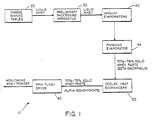
- the apparatus 10 generally comprises cheese-making tables 20, preprocessing apparatus 30, vacuum evaporators 40, a finishing evaporator 44, a crystallizing heat exchanger 50 and a spin flash dryer 60.
- the cheese-making tables 20 are conventional vats in which processed milk is converted to cheese by the usual method. Only two tables are shown, but in practice, any number of tables could be used. There are two basic by-products from the cheese-making, and they are curds and whey, both of which are subsequently processed for further use. The curd processing apparatus is not shown here.
- the whey from the cheese-making tables 20 is about 94 % liquid, and it is drawn from the tables through tubes 22, which carry it to some conventional preprocessing apparatus 30.
- preprocessing apparatus 30 One example of such preprocessing apparatus is shown on pages 74 and 75 of the September, 1981 issue of « Food Engineering •.
- the vacuum evaporators 40 are a series of vertical containers which remove the liquid content from the whey.
- the evaporators 40 may be any of those commonly used in whey processing.
- the evaporators 40 are followed by a finishing evaporator 44 which removes more of the liquid content of the whey.
- the resulting whey from the finishing evaporator 44 is up to 75 % solids and, in the preferred embodiment, has a temperature of about 45 °C to 80 °C.
- the lactose in the whey paste is still largely in its beta amorphous state, and it is fed to a continuous crystallizing device called a cooled heat exchanger 50.
- the 75 % solid whey paste would be so thick that it would overload and clog the agitators in conventional crystallizing tanks).
- the resulting product from the exchanger 50 is a whey paste in which the lactose is largely of the alpha-monohydrate form.
- the paste has a temperature of about 15 °C to 45 °C, and it is then fed to the spin flash dryer 60.
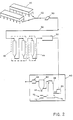
- the whey paste from the heat exchanger 50 is sent to a feeding tank 62 for the dryer 60.
- the tank 62 contains a rotating agitator 64 and a screw feeder 66.
- the screw feeder 66 which has a variable speed drive, is connected to a drying chamber 68. Air is also taken into the dryer 60 at an inlet 70. Inlet 70 is connected through a heater 72 to an air distributor 74 surrounding and communicating with the lower portion of the drying chamber 68.
- a rotor 76 is also disposed in the bottom of the drying chamber 68.
- a classifier 78 which is connected to a filter apparatus 80.
- the filter apparatus 80 in the preferred embodiment is a cyclone filter 82 above a valve 84.
- An air exhaust duct 86 is connected from the filter to a scrubber 88 and other cleansing equipment (not shown) to remove whey particles from any exhausted air.
- Such a dryer, as well as the finishing evaporator and continuous heat exchanger, is available from APV Anhydro A/S, Oestmarken 8, DK-2860 Soeborg, Denmark.
- a suitable spin flash dryer for use in the present invention is also disclosed in EP-application No. 84113132.9 published as EP-A-141403.
- the whey paste is fed into the feeding tank 62 of the dryer 60.
- the rotating agitator 64 gently mixes the whey and forces it into the screw feeder 66, which carries the whey paste into the drying chamber 68 at a continuous rate.
- air from the inlet 70 which is first heated by heater 72, is introduced tangentially into the bottom of the chamber 68 by the distributor 74. The heated air rises to the top of the chamber 68.
- the dryer thus operates as an agitated fluidized bed.
- the rotor 76 turns in the bottom of the chamber 68 agitating the powder and the large lumps of whey entering from the screw feeder 66. The lumps dry around their outside and the dried portions tend to break off.
- this powder When fine enough, this powder is carried upward with the airflow. The rest of the lumps remain near the bottom of the chamber 68 until they are sufficiently dried and small enough to by carried to the top of the chamber as well.
- the dried powder and air travel through classifier 78 to the filter apparatus 80.
- the air In the filter apparatus 80, the air is drawn into the cyclone 82 in a circular fashion. This forces the solid particles to the outside walls where they then drop to valve 84, which is used to collect the now-powdered whey.
- the powder at that point is a non-caking whey powder that is approximately 96 % solids.
- the finishing evaporator 44 does the large part of the work in converting the liquid whey to solid form, as opposed to the less efficient air dryer in prior art systems. This will give an estimated energy savings of about 20 %. Also, smaller equipment is required, as the dryer here does not need to do the substantial drying that the prior dryers did (because the whey is already 75 % solids when it reaches the dryer of this invention). Also, the spin flash dryer of this invention performs its drying quicker than other air dryers. Less equipment is also required here than in prior art processes. Particularly, the series of large batch crystallizing tanks are replaced here by a much smaller, continuously operating cooled heat exchanger. The net result of all this is that much less plant space is needed to accomo- date the equipment.
- the process of this invention is a continuous one, which greatly simplifies plant operation.
- the air dryer After the evaporators are turned off, it is necessary for the air dryer to run for a full day to process the large amount of whey stored in the crystallizers. Otherwise, if left in the vats, the whey might solidify or decay. Conversely, when the old systems are started, the evaporators must work for a full day (to fill the tanks) before the dryer is activated.
Landscapes
- Life Sciences & Earth Sciences (AREA)
- Chemical & Material Sciences (AREA)
- Engineering & Computer Science (AREA)
- Food Science & Technology (AREA)
- Polymers & Plastics (AREA)
- Dairy Products (AREA)
- Micro-Organisms Or Cultivation Processes Thereof (AREA)
Claims (8)
Priority Applications (1)
| Application Number | Priority Date | Filing Date | Title |
|---|---|---|---|
| AT86900651T ATE40507T1 (de) | 1985-01-02 | 1985-12-19 | Verfahren und vorrichtung zur bearbeitung von molke und/oder permeat aus der kaesebereitung. |
Applications Claiming Priority (2)
| Application Number | Priority Date | Filing Date | Title |
|---|---|---|---|
| US68834985A | 1985-01-02 | 1985-01-02 | |
| US688349 | 1985-01-02 |
Publications (2)
| Publication Number | Publication Date |
|---|---|
| EP0205601A1 EP0205601A1 (de) | 1986-12-30 |
| EP0205601B1 true EP0205601B1 (de) | 1989-02-01 |
Family
ID=24764071
Family Applications (1)
| Application Number | Title | Priority Date | Filing Date |
|---|---|---|---|
| EP86900651A Expired EP0205601B1 (de) | 1985-01-02 | 1985-12-19 | Verfahren und vorrichtung zur bearbeitung von molke und/oder permeat aus der käsebereitung |
Country Status (5)
| Country | Link |
|---|---|
| EP (1) | EP0205601B1 (de) |
| DE (1) | DE3567998D1 (de) |
| IE (1) | IE57150B1 (de) |
| NO (1) | NO863360L (de) |
| WO (1) | WO1986003942A1 (de) |
Families Citing this family (10)
| Publication number | Priority date | Publication date | Assignee | Title |
|---|---|---|---|---|
| EP0896510B1 (de) * | 1996-03-25 | 2002-08-28 | Apv Anhydro A/S | Verfahren und vorrichtung zum umwandeln von flüssiger molke zu pulver |
| FI104247B1 (fi) * | 1997-02-26 | 1999-12-15 | Imatran Voima Oy | Sovitelma tasaisen kaasuvirran muodostamiseksi raemaisten kiinteiden materiaalien leijuttamiseen tai kuljetukseen |
| ATE244989T1 (de) * | 1999-05-31 | 2003-08-15 | Anhydro As | Konzentrierung flüssiger produkte |
| WO2002087348A1 (en) * | 2001-04-26 | 2002-11-07 | Apv Nordic A/S, Anhydro | A method and a system for converting liquid products into free-flowing powders with pre-cooling |
| EP1221859B1 (de) | 1999-09-22 | 2003-11-12 | APV Nordic A/S, Anhydro | Herstellung eines eiweisshaltigen pulverigen produktes |
| FR2818873B1 (fr) * | 2001-01-02 | 2004-07-16 | Garnier Ets | Procede de fabrication d'un fromage, et fromage ainsi obtenu |
| US20040191381A1 (en) * | 2001-04-26 | 2004-09-30 | Jens Getler | Method and a system for converting liquid products into free-flowing powders with spray drying |
| US7909881B2 (en) | 2007-07-03 | 2011-03-22 | Benoist Girard Sas | Femoral prosthesis |
| US10440971B2 (en) | 2013-08-23 | 2019-10-15 | Keller Technologies, Inc. | System for drying acid whey |
| US10641398B2 (en) | 2016-05-13 | 2020-05-05 | Red-White Valve Corp. | Ball valve with integrated fitting |
Family Cites Families (8)
| Publication number | Priority date | Publication date | Assignee | Title |
|---|---|---|---|---|
| US1763633A (en) * | 1930-01-02 | 1930-06-10 | Nicholas L Simmons | Process of making whey products |
| US2181146A (en) * | 1936-12-09 | 1939-11-28 | Western Condensing Co | Process of manufacturing a noncaking dried whey powder |
| DE699179C (de) * | 1938-01-29 | 1940-11-23 | Wilh Schmitz Scholl Fa | Verfahren und Vorrichtung zum Trocknen von Milcherzeugnissen |
| US2555514A (en) * | 1947-01-20 | 1951-06-05 | Golden State Company Ltd | Whey product derived from milk and process of producing same |
| US3537860A (en) * | 1967-09-22 | 1970-11-03 | Blaw Knox Co | Preparation of dried whey |
| US3615663A (en) * | 1969-04-14 | 1971-10-26 | Laval Separator Co De | Production of nonhygroscopic acid whey powder |
| NL8004614A (nl) * | 1980-08-14 | 1982-03-16 | Dmv Campina Bv | Werkwijze en inrichting voor het concentreren van zure wei. |
| DK149583C (da) * | 1983-11-10 | 1987-01-12 | Anhydro As | Apparat til fluidiseringstaerring, navnlig til samtidig taerring og disintegrering af et pastaformigt materiale |
-
1985
- 1985-12-19 WO PCT/DK1985/000125 patent/WO1986003942A1/en not_active Ceased
- 1985-12-19 DE DE8686900651T patent/DE3567998D1/de not_active Expired
- 1985-12-19 EP EP86900651A patent/EP0205601B1/de not_active Expired
- 1985-12-31 IE IE3337/85A patent/IE57150B1/en not_active IP Right Cessation
-
1986
- 1986-08-20 NO NO863360A patent/NO863360L/no unknown
Also Published As
| Publication number | Publication date |
|---|---|
| WO1986003942A1 (en) | 1986-07-17 |
| NO863360D0 (no) | 1986-08-20 |
| NO863360L (no) | 1986-08-20 |
| IE57150B1 (en) | 1992-05-06 |
| DE3567998D1 (en) | 1989-03-09 |
| EP0205601A1 (de) | 1986-12-30 |
| IE853337L (en) | 1986-07-02 |
Similar Documents
| Publication | Publication Date | Title |
|---|---|---|
| EP0619075B1 (de) | Verbesserte Trocknung von saurer Molke und/oder saurem Permeat | |
| US6335045B1 (en) | Concentration of liquid products | |
| US6048565A (en) | Process and apparatus for converting liquid whey into powder | |
| US2728678A (en) | Process for drying solutions containing crystallizable material, and product produced thereby | |
| EP0311977B1 (de) | Verfahren zur Ausscheidung der Laktose aus Molke | |
| EP2629623B1 (de) | Herstellung von laktose | |
| EP1494538B1 (de) | Verfahren und anlage zur verdampfungskoncentration und kristallisation einer viskosen lactose enhthaltende wässrige lösung | |
| WO1986003942A1 (en) | A method and an apparatus for processing whey and/or permeate from a cheese-working process | |
| US3447930A (en) | Process of treating whey | |
| US3615664A (en) | Treatment of whey | |
| US2627463A (en) | Process for the manufacture of stabilized milk products | |
| US3537860A (en) | Preparation of dried whey | |
| Pearce | Whey processing | |
| US2439612A (en) | Process for manufacture of milk sugar | |
| US4448795A (en) | Process of concentrating acid whey | |
| US2661294A (en) | Method of drying lacteal fluids | |
| RU2658441C1 (ru) | Способ получения молочного сахара с поточной кристаллизацией лактозы | |
| US3721585A (en) | Method for manufacture of lactose | |
| US1600161A (en) | Process of separating proteins and other matter from whey in soluble form | |
| DK164764B (da) | Fremgangsmaade og anlaeg til toerring af valle og/eller permeat | |
| Písecký | Opening Paper |
Legal Events
| Date | Code | Title | Description |
|---|---|---|---|
| PUAI | Public reference made under article 153(3) epc to a published international application that has entered the european phase |
Free format text: ORIGINAL CODE: 0009012 |
|
| AK | Designated contracting states |
Kind code of ref document: A1 Designated state(s): AT BE CH DE FR GB LI NL SE |
|
| 17P | Request for examination filed |
Effective date: 19861120 |
|
| 17Q | First examination report despatched |
Effective date: 19880321 |
|
| GRAA | (expected) grant |
Free format text: ORIGINAL CODE: 0009210 |
|
| AK | Designated contracting states |
Kind code of ref document: B1 Designated state(s): AT BE CH DE FR GB LI NL SE |
|
| REF | Corresponds to: |
Ref document number: 40507 Country of ref document: AT Date of ref document: 19890215 Kind code of ref document: T |
|
| REF | Corresponds to: |
Ref document number: 3567998 Country of ref document: DE Date of ref document: 19890309 |
|
| ET | Fr: translation filed | ||
| PLBE | No opposition filed within time limit |
Free format text: ORIGINAL CODE: 0009261 |
|
| STAA | Information on the status of an ep patent application or granted ep patent |
Free format text: STATUS: NO OPPOSITION FILED WITHIN TIME LIMIT |
|
| 26N | No opposition filed | ||
| EAL | Se: european patent in force in sweden |
Ref document number: 86900651.0 |
|
| PGFP | Annual fee paid to national office [announced via postgrant information from national office to epo] |
Ref country code: AT Payment date: 19951130 Year of fee payment: 11 |
|
| PGFP | Annual fee paid to national office [announced via postgrant information from national office to epo] |
Ref country code: GB Payment date: 19951211 Year of fee payment: 11 |
|
| PGFP | Annual fee paid to national office [announced via postgrant information from national office to epo] |
Ref country code: BE Payment date: 19951214 Year of fee payment: 11 |
|
| PGFP | Annual fee paid to national office [announced via postgrant information from national office to epo] |
Ref country code: SE Payment date: 19951218 Year of fee payment: 11 |
|
| PGFP | Annual fee paid to national office [announced via postgrant information from national office to epo] |
Ref country code: FR Payment date: 19951222 Year of fee payment: 11 |
|
| PGFP | Annual fee paid to national office [announced via postgrant information from national office to epo] |
Ref country code: DE Payment date: 19951228 Year of fee payment: 11 |
|
| PGFP | Annual fee paid to national office [announced via postgrant information from national office to epo] |
Ref country code: NL Payment date: 19951230 Year of fee payment: 11 |
|
| PGFP | Annual fee paid to national office [announced via postgrant information from national office to epo] |
Ref country code: CH Payment date: 19960402 Year of fee payment: 11 |
|
| PG25 | Lapsed in a contracting state [announced via postgrant information from national office to epo] |
Ref country code: GB Effective date: 19961219 Ref country code: AT Effective date: 19961219 |
|
| PG25 | Lapsed in a contracting state [announced via postgrant information from national office to epo] |
Ref country code: SE Effective date: 19961220 |
|
| PG25 | Lapsed in a contracting state [announced via postgrant information from national office to epo] |
Ref country code: LI Effective date: 19961231 Ref country code: CH Effective date: 19961231 Ref country code: BE Effective date: 19961231 |
|
| BERE | Be: lapsed |
Owner name: APV ANHYDRO A/S Effective date: 19961231 |
|
| PG25 | Lapsed in a contracting state [announced via postgrant information from national office to epo] |
Ref country code: NL Effective date: 19970701 |
|
| GBPC | Gb: european patent ceased through non-payment of renewal fee |
Effective date: 19961219 |
|
| REG | Reference to a national code |
Ref country code: CH Ref legal event code: PL |
|
| PG25 | Lapsed in a contracting state [announced via postgrant information from national office to epo] |
Ref country code: FR Effective date: 19970829 |
|
| NLV4 | Nl: lapsed or anulled due to non-payment of the annual fee |
Effective date: 19970701 |
|
| PG25 | Lapsed in a contracting state [announced via postgrant information from national office to epo] |
Ref country code: DE Effective date: 19970902 |
|
| EUG | Se: european patent has lapsed |
Ref document number: 86900651.0 |
|
| REG | Reference to a national code |
Ref country code: FR Ref legal event code: ST |