EP0204593B1 - Verfahren zur Grauwertregelung bei einer digitalen Bildreproduktion und Vorrichtung zur Durchführung des Verfahrens - Google Patents
Verfahren zur Grauwertregelung bei einer digitalen Bildreproduktion und Vorrichtung zur Durchführung des Verfahrens Download PDFInfo
- Publication number
- EP0204593B1 EP0204593B1 EP86400909A EP86400909A EP0204593B1 EP 0204593 B1 EP0204593 B1 EP 0204593B1 EP 86400909 A EP86400909 A EP 86400909A EP 86400909 A EP86400909 A EP 86400909A EP 0204593 B1 EP0204593 B1 EP 0204593B1
- Authority
- EP
- European Patent Office
- Prior art keywords
- parameter
- value
- window width
- image
- mean level
- Prior art date
- Legal status (The legal status is an assumption and is not a legal conclusion. Google has not performed a legal analysis and makes no representation as to the accuracy of the status listed.)
- Expired - Lifetime
Links
- 238000000034 method Methods 0.000 title claims description 11
- 230000001105 regulatory effect Effects 0.000 title claims 3
- 230000006870 function Effects 0.000 claims description 7
- 238000012545 processing Methods 0.000 claims description 7
- 238000012986 modification Methods 0.000 description 5
- 230000004048 modification Effects 0.000 description 5
- 238000009434 installation Methods 0.000 description 4
- 238000011161 development Methods 0.000 description 3
- 239000006185 dispersion Substances 0.000 description 3
- 238000013461 design Methods 0.000 description 2
- 238000012800 visualization Methods 0.000 description 2
- 238000010521 absorption reaction Methods 0.000 description 1
- 238000007792 addition Methods 0.000 description 1
- 238000000429 assembly Methods 0.000 description 1
- 238000010586 diagram Methods 0.000 description 1
- 238000006073 displacement reaction Methods 0.000 description 1
Images
Classifications
-
- H—ELECTRICITY
- H04—ELECTRIC COMMUNICATION TECHNIQUE
- H04N—PICTORIAL COMMUNICATION, e.g. TELEVISION
- H04N1/00—Scanning, transmission or reproduction of documents or the like, e.g. facsimile transmission; Details thereof
- H04N1/40—Picture signal circuits
- H04N1/407—Control or modification of tonal gradation or of extreme levels, e.g. background level
- H04N1/4072—Control or modification of tonal gradation or of extreme levels, e.g. background level dependent on the contents of the original
-
- H—ELECTRICITY
- H04—ELECTRIC COMMUNICATION TECHNIQUE
- H04N—PICTORIAL COMMUNICATION, e.g. TELEVISION
- H04N5/00—Details of television systems
- H04N5/14—Picture signal circuitry for video frequency region
- H04N5/20—Circuitry for controlling amplitude response
Definitions
- the invention relates to a method for adjusting the gray scale in the reproduction of digitized images, in particular radiology images for which it is desirable to view the digital information representative of the image through a "gray window". user-defined characteristics.
- the invention relates more precisely to the development of the parameters of this window.
- the invention also relates to a digital image processing system implementing this method.
- the dynamics of the acquisition means are significantly more important than the ability of the eye to distinguish two neighboring gray levels.
- the dynamics of the acquisition means are significantly more important than the ability of the eye to distinguish two neighboring gray levels.
- only part of the information contained in the scanned image is useful for the examination; it corresponds, for example, to a certain range of absorption of X-rays by the structures that one wishes to observe.
- it is known to visualize the image by means of a "gray window" consisting in making the entire scale of gray levels correspond to the range of numerical values useful for the examination in Classes.
- the width of the window represents the number of numerical values which will be effectively transcribed in shades of gray, this parameter is therefore representative of the contrast, this being all the higher the smaller the width of the window.
- the average level is given by the numerical value of the acquired image to which the average shade of the gray scale is associated. This average level is therefore chosen according to the nature of the structures to be examined. These two parameters are subject to very frequent modifications by the user, in order to examine the content of the image exhaustively.
- the display installations therefore comprise means for controlling variation of these two parameters which comprise, on the front panel, actuating members such as push-buttons or rotary buttons, associated with pulse generator circuits. Each pulse generated is used by the control electronics to modify the width or the average level by a predetermined value. This elementary variation is difficult to determine.
- GB-A 2 129 635 discloses a system (FIG. 2) for correcting the average gray level of a video image by a "f (a) LOGIC” (29) or “f (b) circuit.
- LOGIC (206) by calculating the average gray level and comparing the calculated value f (b) with a desired value which is displayed by the user.
- the system is also provided to correct the temperature distribution by calculating the dispersion f (a) of the histogram with respect to the average gray level and by comparing this calculated value f (a) with a desired value which is displayed by the user.
- the invention relates to a method for adjusting the gray scale in the reproduction of a digitized image, for example a radiology image, this reproduction comprising in particular the step consisting in transposing the digital values representative of the elements of the image. through a gray window defined by a so-called new means parameter and a so-called window width parameter, each parameter having only one value at a given instant, characterized in that the variation of the value of the level parameter medium is a function of the value of the window width parameter.
- the parameters of average level and width of window can be modified by a succession of elementary commands. Furthermore, the variation of the average level parameter as a function of the value of the window width parameter is carried out at the time of each elementary command.
- the elementary command for adjusting the medium level parameter consists in adding or subtracting from its value a quantity proportional to the window width parameter at the time of said elementary command, the proportionality factor being constant.
- the new value thereof is obtained by making the product of the old value by a predetermined coefficient.
- the coefficient is for example a given number k or its inverse 1 / k.
- the invention also relates to a digital image processing system comprising a gray equivalence table or the like inserted between means for reading an image memory and a digital-to-analog converter and writing means for modifying the content.
- a digital image processing system comprising a gray equivalence table or the like inserted between means for reading an image memory and a digital-to-analog converter and writing means for modifying the content.
- said equivalence table characterized in that it includes connected calculation means for controlling said writing means on the basis of a medium level parameter and a window width parameter determined by respective processing circuits , these circuits being controlled by respective variation control means and in that the circuit for developing the medium level parameter comprises an operator coupled to the output of the circuit for preparing the window width parameter.
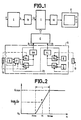
- an image memory is shown, the input E of which is connected to means for digitally acquiring an image, here in a radiology installation.
- the output S of this memory is connected to reading means 10 arranged to rectify values read from the memory to a gray equivalence table T whose output is connected to display means such as for example a television monitor 11, via a Digital-to-Analog converter 12.
- the digital values contained in the memory are representative of the pixels of the image and arrive as addresses at the address entry Ea of the table of equivalence T. It is therefore the content of this table which performs the windowing according to FIG. 2.
- the table T is associated with writing means E arranged to load all of its values in a very short time, of the order of the frame return from the television monitor 11.
- These writing means comprise means for developing the curve of FIG. 2 as soon as they are supplied with two parameters, a first parameter known as of medium level and a second parameter says width.
- the arrangement which has just been described so far is conventional, its design is therefore within the reach of the skilled person.
- the writing means E are therefore implemented by calculation means 13 which supply it, as data, with the values of the two aforementioned parameters.
- the writing means therefore comprise for this purpose two inputs, an input 14 where the medium level parameter is applied and an input 15 where the width parameter is applied.
- the invention is more particularly situated in the structure of the means 13 for calculating the two parameters.
- the possible levels N of the digitized image are indicated on the abscissa as they are actually stored in memory I and on the ordinate the possible values of the gray scale, evolving between a minimum value G o and a maximum value Cm ⁇ x, these values being the extreme values applied to the Digital-Analog converter 11.
- the mean level M is therefore defined as being the digital value of the image memory 1 (plotted on the abscissa) at which table T matches a shade of ordinate gray
- the width L is represented by the interval occupied on the abscissa by the linear part of the curve, that is to say Nmax - Nmin.
- the role of the writing means is therefore to transcribe into the table T the curve of FIG. 2 in order to correspond to each possible digital value of the image memory I, a possible value defined by the windowing.
- the calculation circuit 13 responsible for updating the values of M and L as a function of the operator's maneuvers is controlled by two groups of two keys ⁇ , respectively the keys 16 for the modification of the average value M and the keys 17 for the modification of the width L.
- These groups of keys are therefore associated with two separate parameter development circuits, one for the first parameter known as of average value and the other for the second parameter called width.
- the values of these two pa rameters are respectively updated in two registers RM and RL periodically "consulted" by the writing means E for the development of the loading of the values of the table T.
- the keys 16 and 17 are associated with generator circuits of pulses (not shown), each pulse being taken into account by the calculation circuit 13 as an order of incrementation or decrementation of the corresponding parameter L or M. All the components of the calculation circuit 13 are circuits responsible for developing simple operations such as additions, subtractions or multiplications. Those skilled in the art can easily design them or obtain such sub-assemblies. According to an advantageous feature of the invention, the law of progression of the width L (as a function of the number of pulses delivered by one of the keys 17) is logarithmic.
- any new value of L is the product of the old value by a constant factor k (k being a relative number greater than 1), if we want to increase this width, or 1 / k if we want to reduce it . Consequently, each key 17 +, 17 - is connected to a control input of a multiplier 19a, 19b, respectively.
- a data input of each multiplier is connected to the output of the register RL while the other data input is connected to another register forming memory, containing the factor k or 1 / k, respectively.
- the outputs of the two multipliers are connected to the input of the RL register. All of these components form the circuit for developing the aforementioned second parameter.
- each key 16 - and 16 + is connected to a control input of a subtractor 20 - and of an adder 20 +, respectively.
- a data input of each adder or subtractor is connected to the output of the register RM while its other data input is connected to the output of a multiplier 21.
- a data input of this multiplier which constitutes the operator mentioned above above, is connected to a memory register containing a predetermined factor g while its other data input is connected to the output of the register RL by a link 22.
- the arrangement of the multiplier 21, of the register g and of the link 22 is specific to the invention since it produces the product gL each time a button 16 + or 16 - is pressed.
- This product is then added or subtracted from the previous value of the average level M by the adder 20 + or the subtractor 20 - depending on whether the key 16 + or 16 - has been pressed by the operator. All of these components form the circuit for developing the above-mentioned first parameter.
- the factor g could be of the order of 1/8 while the factor k could be chosen between 1.25 to 1.30, these values being in no way limiting.
- the embodiment which has just been described with reference to FIG. 1 can of course include many variants and the invention is not limited to an entirely wired embodiment.
- the operations performed by the calculation circuit 13 and the writing means E can be partially or entirely transcribed in a program. This means that the invention is not limited to the example described but includes all the equivalents within the limits of the claims which follow.
Landscapes
- Engineering & Computer Science (AREA)
- Multimedia (AREA)
- Signal Processing (AREA)
- Apparatus For Radiation Diagnosis (AREA)
- Image Processing (AREA)
Claims (6)
Applications Claiming Priority (2)
| Application Number | Priority Date | Filing Date | Title |
|---|---|---|---|
| FR8507150A FR2581775B1 (fr) | 1985-05-10 | 1985-05-10 | Procede de reglage de l'echelle des gris dans la reproduction d'images numerisees et systeme mettant en oeuvre ce procede |
| FR8507150 | 1985-05-10 |
Publications (2)
| Publication Number | Publication Date |
|---|---|
| EP0204593A1 EP0204593A1 (de) | 1986-12-10 |
| EP0204593B1 true EP0204593B1 (de) | 1990-08-01 |
Family
ID=9319174
Family Applications (1)
| Application Number | Title | Priority Date | Filing Date |
|---|---|---|---|
| EP86400909A Expired - Lifetime EP0204593B1 (de) | 1985-05-10 | 1986-04-24 | Verfahren zur Grauwertregelung bei einer digitalen Bildreproduktion und Vorrichtung zur Durchführung des Verfahrens |
Country Status (4)
| Country | Link |
|---|---|
| US (1) | US4852002A (de) |
| EP (1) | EP0204593B1 (de) |
| DE (1) | DE3673077D1 (de) |
| FR (1) | FR2581775B1 (de) |
Families Citing this family (14)
| Publication number | Priority date | Publication date | Assignee | Title |
|---|---|---|---|---|
| EP0225100B1 (de) * | 1985-11-18 | 1994-06-22 | Canon Kabushiki Kaisha | Elektronisches Abbildungsgerät |
| JPS6311146A (ja) * | 1986-07-02 | 1988-01-18 | ジーイー横河メディカルシステム株式会社 | 画像診断装置 |
| EP0353409B1 (de) * | 1988-07-28 | 1994-07-06 | Oerlikon-Contraves AG | Automatische Helligkeits- und Kontrast-Steuerung einer Video-Kamera für industrielle/militärische Zwecke |
| JP2714164B2 (ja) * | 1989-07-31 | 1998-02-16 | 株式会社東芝 | 三次元画像表示装置 |
| CA2040672C (en) * | 1990-04-26 | 1995-05-30 | Masaaki Kanashiki | Image signal processing apparatus |
| JP3188491B2 (ja) * | 1990-10-24 | 2001-07-16 | コーニンクレッカ フィリップス エレクトロニクス エヌ ヴィ | X線記録のダイナミック圧縮方法及びその装置 |
| US5293313A (en) * | 1990-11-21 | 1994-03-08 | Picker International, Inc. | Real time physician view box |
| US5469275A (en) * | 1992-08-04 | 1995-11-21 | International Business Machines Corporation | Method and apparatus for grayscale adjustment |
| US5447153A (en) * | 1993-07-02 | 1995-09-05 | Eastman Kodak Company | Real-time window/leveling on a radiographic workstation |
| JP3363735B2 (ja) * | 1996-06-26 | 2003-01-08 | 松下電器産業株式会社 | X線画像装置 |
| CA2365893A1 (en) * | 2001-12-21 | 2003-06-21 | Jaldi Semiconductor Corp. | System and method for dynamically enhanced colour space |
| FR2847698B1 (fr) * | 2002-11-27 | 2005-05-06 | Ge Med Sys Global Tech Co Llc | Procede de gestion de la dynamique d'une image radiologique numerique |
| KR20070051441A (ko) * | 2005-11-15 | 2007-05-18 | 삼성전자주식회사 | 액정 표시 장치의 계조 조정 방법 및 시스템 |
| US8406493B2 (en) * | 2008-07-17 | 2013-03-26 | The Henry M. Jackson Foundation For The Advancement Of Military Medicine, Inc. | Multi-grayscale overlay window |
Family Cites Families (9)
| Publication number | Priority date | Publication date | Assignee | Title |
|---|---|---|---|---|
| US32164A (en) * | 1861-04-23 | Stove | ||
| US4229764A (en) * | 1978-07-03 | 1980-10-21 | Michael Danos | Visibility expander |
| US4236128A (en) * | 1979-04-27 | 1980-11-25 | Gte Products Corporation | Ground fault receptacle |
| GB2129635B (en) * | 1979-09-21 | 1984-12-19 | Emi Ltd | Controlling the grey levels represented by a video signal |
| USRE32164E (en) | 1980-12-01 | 1986-05-27 | The University Of Utah | Radiographic systems employing multi-linear arrays of electronic radiation detectors |
| US4445138A (en) * | 1981-12-21 | 1984-04-24 | Hughes Aircraft Company | Real time dynamic range compression for image enhancement |
| US4506292A (en) * | 1982-06-14 | 1985-03-19 | Motorola, Inc. | Video driver circuit and method for automatic gray scale adjustment and elimination of contrast tracking errors |
| IL69326A (en) * | 1983-07-26 | 1986-11-30 | Elscint Ltd | System and methods for translating radiation intensity into pixel values |
| JPS6116371A (ja) * | 1984-07-03 | 1986-01-24 | Toshiba Corp | デジタルフルオログラフイ装置 |
-
1985
- 1985-05-10 FR FR8507150A patent/FR2581775B1/fr not_active Expired - Lifetime
-
1986
- 1986-04-24 EP EP86400909A patent/EP0204593B1/de not_active Expired - Lifetime
- 1986-04-24 DE DE8686400909T patent/DE3673077D1/de not_active Expired - Fee Related
- 1986-05-02 US US06/858,766 patent/US4852002A/en not_active Expired - Lifetime
Also Published As
| Publication number | Publication date |
|---|---|
| DE3673077D1 (de) | 1990-09-06 |
| EP0204593A1 (de) | 1986-12-10 |
| FR2581775B1 (fr) | 1990-03-23 |
| US4852002A (en) | 1989-07-25 |
| FR2581775A1 (fr) | 1986-11-14 |
Similar Documents
| Publication | Publication Date | Title |
|---|---|---|
| Reinhard et al. | Photographic tone reproduction for digital images | |
| Song et al. | Probabilistic exposure fusion | |
| Kuang et al. | Testing HDR image rendering algorithms | |
| Likar et al. | Retrospective shading correction based on entropy minimization | |
| JP6961139B2 (ja) | 知覚的な縮小方法を用いて画像を縮小するための画像処理システム | |
| AU727503B2 (en) | Image filtering method and apparatus | |
| JP4452497B2 (ja) | ノイズを考慮してデジタルイメージを修正する方法およびシステム | |
| EP0204593A1 (de) | Verfahren zur Grauwertregelung bei einer digitalen Bildreproduktion und Vorrichtung zur Durchführung des Verfahrens | |
| Julliand et al. | Image noise and digital image forensics | |
| US20180053289A1 (en) | Method and system for real-time noise removal and image enhancement of high-dynamic range images | |
| JP4498361B2 (ja) | レティネックス型アルゴリズムを高速化する方法 | |
| US20060165311A1 (en) | Spatial standard observer | |
| JP4456819B2 (ja) | デジタル画像鮮鋭化装置 | |
| EP3491620B1 (de) | Adaptive echtzeit-schatten- und highlightverstärkung | |
| Zhao et al. | RIRO: From Retinex-inspired reconstruction optimization model to deep low-light image enhancement unfolding network | |
| KR20230025340A (ko) | 이미지 처리 및 이미지 합성에서 이미지 데이터 및 관련 노이즈 모델의 동시적이고 일치된 처리 | |
| Guarnieri et al. | High dynamic range image display with halo and clipping prevention | |
| CN119359606B (zh) | 一种多媒体图像优化方法及系统 | |
| CN113724282A (zh) | 图像处理方法和相关产品 | |
| CN118447162A (zh) | 一种施工场景的视觉三维点云模型生成方法 | |
| JP7498238B2 (ja) | 画像内のディストラクションを低減させるための技術 | |
| US7248745B1 (en) | Differential image adjustments | |
| CN114998163B (zh) | 一种红外数字图像灰度映射方法 | |
| Debevec et al. | A tone mapping algorithm for high contrast images | |
| WO2021042641A1 (zh) | 一种图像分割方法及装置 |
Legal Events
| Date | Code | Title | Description |
|---|---|---|---|
| PUAI | Public reference made under article 153(3) epc to a published international application that has entered the european phase |
Free format text: ORIGINAL CODE: 0009012 |
|
| AK | Designated contracting states |
Kind code of ref document: A1 Designated state(s): DE GB NL |
|
| 17P | Request for examination filed |
Effective date: 19870116 |
|
| 17Q | First examination report despatched |
Effective date: 19881027 |
|
| RAP1 | Party data changed (applicant data changed or rights of an application transferred) |
Owner name: GENERAL ELECTRIC CGR SA. |
|
| RAP1 | Party data changed (applicant data changed or rights of an application transferred) |
Owner name: GENERAL ELECTRIC CGR S.A. |
|
| GRAA | (expected) grant |
Free format text: ORIGINAL CODE: 0009210 |
|
| AK | Designated contracting states |
Kind code of ref document: B1 Designated state(s): DE GB NL |
|
| REF | Corresponds to: |
Ref document number: 3673077 Country of ref document: DE Date of ref document: 19900906 |
|
| GBT | Gb: translation of ep patent filed (gb section 77(6)(a)/1977) | ||
| PG25 | Lapsed in a contracting state [announced via postgrant information from national office to epo] |
Ref country code: GB Effective date: 19910424 |
|
| PLBE | No opposition filed within time limit |
Free format text: ORIGINAL CODE: 0009261 |
|
| STAA | Information on the status of an ep patent application or granted ep patent |
Free format text: STATUS: NO OPPOSITION FILED WITHIN TIME LIMIT |
|
| 26N | No opposition filed | ||
| GBPC | Gb: european patent ceased through non-payment of renewal fee | ||
| PGFP | Annual fee paid to national office [announced via postgrant information from national office to epo] |
Ref country code: DE Payment date: 19920326 Year of fee payment: 7 |
|
| PGFP | Annual fee paid to national office [announced via postgrant information from national office to epo] |
Ref country code: NL Payment date: 19920430 Year of fee payment: 7 |
|
| PG25 | Lapsed in a contracting state [announced via postgrant information from national office to epo] |
Ref country code: NL Effective date: 19931101 |
|
| NLV4 | Nl: lapsed or anulled due to non-payment of the annual fee | ||
| PG25 | Lapsed in a contracting state [announced via postgrant information from national office to epo] |
Ref country code: DE Effective date: 19940101 |